<?xml version="1.0" encoding="UTF-8"?>
<!DOCTYPE html PUBLIC "-//W3C//DTD XHTML 1.1//EN" "http://www.w3.org/TR/xhtml11/DTD/xhtml11.dtd">
<html xmlns="http://www.w3.org/1999/xhtml" xml:lang="en">
<head>
<meta content="text/html; charset=UTF-8" http-equiv="content-type" />
<meta http-equiv="Content-Language" content="en" />
<meta name="generator" content="Pressbooks 5.27.1" />
<meta name="pb-authors" content="The BC Cook Articulation Committee" />
<meta name="pb-title" content="Food Safety, Sanitation, and Personal Hygiene" />
<meta name="pb-language" content="en" />
<meta name="pb-cover-image" content="https://opentextbc.ca/foodsafety/wp-content/uploads/sites/106/2019/06/OTB082-01-food-safety-sanitation-and-personal-hygiene-2018-COVER-STORE.jpg" />
<meta name="pb-copyright-year" content="2015" />
<meta name="pb-book-license" content="cc-by" />
<meta name="pb-custom-copyright" content="© 2015 go2HRThe CC licence permits you to retain, reuse, copy, redistribute, and revise this book—in whole or in part—for free providing the author is attributed as follows:Food Safety, Sanitation, and Personal Hygiene by the BC Cook Articulation Committee is used under a CC BY 4.0 International Licence.If you redistribute all or part of this book, it is recommended the following statement be added to the copyright page so readers can access the original book at no cost:Download for free from the B.C. Open Collection.Sample APA-style citation:This textbook can be referenced. In APA citation style, it would appear as follows:BC Cook Articulation Committee. (2015). Food Safety, Sanitation, and Personal Hygiene. Victoria, B.C.: BCcampus. Retrieved from https://opentextbc.ca/foodsafety/.Cover image attribution:Salmon 104 °F  by ChefSteps is used under a CC BY 2.0 Licence.Ebook ISBN: 978-1-7753524-6-4Print ISBN: 978-1-7753524-7-1Visit BCcampus Open Education to learn about open education in British Columbia." />
<meta name="pb-about-50" content="Food Safety, Sanitation, and Personal Hygiene is one of a series of Culinary Arts open textbooks developed to support the training of students and apprentices in British Columbia’s foodservice and hospitality industry. Although created with the Professional Cook, Baker and Meatcutter programs in mind, these have been designed as a modular series, and therefore can be used to support a wide variety of programs that offer training in foodservice skills." />
<meta name="pb-about-unlimited" content="Food Safety, Sanitation, and Personal Hygiene is one of a series of Culinary Arts open textbooks developed to support the training of students and apprentices in British Columbia’s foodservice and hospitality industry. Although created with the Professional Cook, Baker and Meatcutter programs in mind, these have been designed as a modular series, and therefore can be used to support a wide variety of programs that offer training in foodservice skills.Other books in the series include:Basic Kitchen and Food Service ManagementWorking in the Food Service IndustryWorkplace Safety in the Food Service IndustryMeat Cutting and ProcessingHuman Resources in the Food Service and Hospitality IndustryNutrition and Labelling for the Canadian BakerUnderstanding Ingredients for the Canadian BakerModern Pastry and Plated Dessert TechniquesThe series has been developed collaboratively with participation from public and private post-secondary institutions. " />
<meta name="pb-publisher" content="BCcampus" />
<meta name="pb-publisher-city" content="Victoria, B.C." />
<meta name="pb-publication-date" content="1431648000" />
<meta name="pb-ebook-isbn" content="978-1-7753524-6-4" />
<meta name="pb-print-isbn" content="978-1-7753524-7-1" />
<meta name="pb-primary-subject" content="KNSB" />
<meta name="pb-additional-subjects" content="TDCT1" />
<meta name="pb-keywords-tags" content="Culinary Arts, Cook, Food Safety, Sanitation, Hygiene" />
<meta name="pb-bisac-subject" content="Cooking" />
<title>Food Safety, Sanitation, and Personal Hygiene</title>
</head>
<body lang='en' >
<div id="half-title-page"><h1 class="title">Food Safety, Sanitation, and Personal Hygiene</h1></div>
<div id="title-page"><h1 class="title">Food Safety, Sanitation, and Personal Hygiene</h1><h2 class="subtitle"></h2><h3 class="author">The BC Cook Articulation Committee</h3><h3 class="author"></h3><h4 class="publisher">BCcampus</h4><h5 class="publisher-city">Victoria, B.C.</h5></div>
<div id="copyright-page"><div class="ugc">
<div class="license-attribution"><p><img src="https://opentextbc.ca/foodsafety/wp-content/themes/pressbooks-book/packages/buckram/assets/images/cc-by.svg" alt="Icon for the Creative Commons Attribution 4.0 International License" /></p><p>Food Safety, Sanitation, and Personal Hygiene by The BC Cook Articulation Committee is licensed under a <a rel="license" href="https://creativecommons.org/licenses/by/4.0/">Creative Commons Attribution 4.0 International License</a>, except where otherwise noted.</p></div>
<p>© 2015 go2HR</p><p>The CC licence permits you to retain, reuse, copy, redistribute, and revise this book—in whole or in part—for free providing the author is attributed as follows:</p><div class="textbox"><a href="https://opentextbc.ca/foodsafety/"><em>Food Safety, Sanitation, and Personal Hygiene</em></a> by the BC Cook Articulation Committee is used under a <a href="http://creativecommons.org/licenses/by/4.0/">CC BY 4.0 International Licence</a>.</div><p>If you redistribute all or part of this book, it is recommended the following statement be added to the copyright page so readers can access the original book at no cost:</p><div class="textbox"><p>Download for free from the <a href="https://collection.bccampus.ca/" target="_blank" rel="noopener">B.C. Open Collection</a>.</p></div><p><strong>Sample APA-style citation:</strong></p><p>This textbook can be referenced. In APA citation style, it would appear as follows:</p><div class="textbox">BC Cook Articulation Committee. (2015). <em>Food Safety, Sanitation, and Personal Hygiene</em>. Victoria, B.C.: BCcampus. Retrieved from https://opentextbc.ca/foodsafety/.</div><p><strong>Cover image attribution:</strong></p><div class="textbox"><a href="https://www.flickr.com/photos/90246333@N08/8224056345/">Salmon 104 °F</a>  by <a href="https://www.flickr.com/photos/90246333@N08/">ChefSteps</a> is used under a <a href="https://creativecommons.org/licenses/by/2.0/">CC BY 2.0 Licence</a>.</div><p><strong>Ebook ISBN: </strong>978-1-7753524-6-4</p><p><strong>Print ISBN:</strong> 978-1-7753524-7-1</p><p>Visit <a href="http://open.bccampus.ca/">BCcampus Open Education</a> to learn about open education in British Columbia.</p></div></div>
<div id="toc"><h1>Contents</h1><ul><li class="front-matter miscellaneous"><a href="#front-matter-accessibility-statement"><span class="toc-chapter-title">Accessibility Statement</span></a></li><li class="front-matter introduction"><a href="#front-matter-about-bccampus"><span class="toc-chapter-title">About BCcampus Open Education</span></a></li><li class="front-matter miscellaneous post-introduction"><a href="#front-matter-preface"><span class="toc-chapter-title">Preface</span></a></li><li class="front-matter miscellaneous post-introduction"><a href="#front-matter-introduction"><span class="toc-chapter-title">Introduction</span></a></li><li class="part display-none"><a href="#part-main-body">Food Safety, Sanitation, and Personal Hygiene</a></li><li class="chapter standard"><a href="#chapter-food-safety-regulations"><span class="toc-chapter-title">Food Safety Regulations</span></a></li><li class="chapter standard"><a href="#chapter-an-approach-to-food-safety"><span class="toc-chapter-title">An Approach to Food Safety</span></a></li><li class="chapter standard"><a href="#chapter-causes-of-foodborne-illnesses"><span class="toc-chapter-title">Causes of Foodborne Illnesses</span></a></li><li class="chapter standard"><a href="#chapter-preventing-foodborne-illness"><span class="toc-chapter-title">Preventing Foodborne Illness</span></a></li><li class="chapter standard"><a href="#chapter-receiving-practices"><span class="toc-chapter-title">Receiving Practices</span></a></li><li class="chapter standard"><a href="#chapter-storage-temperatures-and-procedures"><span class="toc-chapter-title">Storage Temperatures and Procedures</span></a></li><li class="chapter standard"><a href="#chapter-food-rotation"><span class="toc-chapter-title">Food Rotation</span></a></li><li class="chapter standard"><a href="#chapter-developing-a-food-safety-plan"><span class="toc-chapter-title">Developing a Food Safety Plan</span></a></li><li class="chapter standard"><a href="#chapter-workplace-sanitation"><span class="toc-chapter-title">Workplace Sanitation</span></a></li><li class="chapter standard"><a href="#chapter-key-takeaways-and-activities"><span class="toc-chapter-title">Key Takeaways and Activities</span></a></li><li class="back-matter glossary"><a href="#back-matter-key-terms"><span class="toc-chapter-title">Key Terms</span></a></li><li class="back-matter bibliography"><a href="#back-matter-references"><span class="toc-chapter-title">References</span></a></li><li class="back-matter miscellaneous"><a href="#back-matter-about-the-authors"><span class="toc-chapter-title">About the Authors</span></a></li><li class="back-matter miscellaneous"><a href="#back-matter-versioning-history"><span class="toc-chapter-title">Versioning History</span></a></li><li class="back-matter miscellaneous"><a href="#back-matter-list-of-links-by-chapter-for-print-users"><span class="toc-chapter-title">List of Links by Chapter for Print Users</span></a></li></ul></div>
<div class="front-matter miscellaneous" id="front-matter-accessibility-statement" title="Accessibility Statement"><div class="front-matter-title-wrap"><h3 class="front-matter-number">1</h3><h1 class="front-matter-title">Accessibility Statement</h1></div><div class="ugc front-matter-ugc"> <p>BCcampus Open Education believes that education must be available to everyone; this means supporting the creation of free, open, and accessible educational resources. We are actively committed to increasing the accessibility and usability of the textbooks we produce.</p> <h1>Accessibility features of the web version of this resource</h1> <p>The&nbsp;<a href="https://opentextbc.ca/foodsafety/" data-url="https://opentextbc.ca/foodsafety/">web version of&nbsp;<em>Food Safety, Sanitation and Personal Hygien</em>e</a>&nbsp;includes the following features:</p> <ul><li>It as been optimized for people who use screen-reader technology: <ul><li>all content can be navigated using a keyboard</li> <li>links, headings, tables use proper markup</li> <li>all images have text descriptions</li> </ul> </li> <li>It includes an option to increase font size. (See tab on top right of screen titled, “Increase Font Size.”)</li> </ul> <h1>Other file formats available</h1> <p>In addition to the web version, this book is available in a number of file formats including PDF, EPUB (for eReaders), MOBI (for Kindles), and various editable files. Here is a link to where you can&nbsp;<a href="https://opentextbc.ca/foodsafety/" data-url="https://opentextbc.ca/foodsafety/">download this book in another file format</a>. Look for the “Download this book” drop-down menu to select the file type you want.</p> <p>For those using a print copy of this book, you can find a list of web addresses for all external links referenced in this book in the back matter.</p> <h1>Known accessibility issues and areas for improvement</h1> <p>There are no known accessibility issues at this time.</p> <h1>Let us know if you are having problems accessing this book</h1> <p>If any of the above accessibility issues are stopping you from accessing the information in this textbook,&nbsp;please contact us to let us know and we will get it fixed. If you discover any other issues, please let us know of those as well.</p> <p>Please include the following information:</p> <ul><li>The location of the problem by providing a web address or page description</li> <li>A description of the problem</li> <li>The computer, software, browser, and any assistive technology you are using that can help us diagnose and solve your issue<br /> e.g., Windows 10, Google Chrome (Version 65.0.3325.181), NVDA screen reader</li> </ul> <p>You can contact us through the following form:&nbsp;<a href="https://open.bccampus.ca/reporting-an-open-textbook-error/" data-url="https://open.bccampus.ca/reporting-an-open-textbook-error/">Report an Open Textbook Error</a></p> <h1>Help us improve the accessibility of our resources</h1> <p>Are you interested in helping us make more of our textbooks accessible? If you have Pressbooks experience, a basic knowledge of web accessibility guidelines, and some time your are willing to volunteer, we would love some help as we have a number of textbooks that need remediation work.&nbsp;<a href="https://open.bccampus.ca/contact-us/" data-url="https://open.bccampus.ca/contact-us/">Contact us</a>.</p> <p><strong>This statement was last updated on June 13, 2019.</strong></p> </div></div>
<div class="front-matter introduction" id="front-matter-about-bccampus" title="About BCcampus Open Education"><div class="front-matter-title-wrap"><h3 class="front-matter-number">2</h3><h1 class="front-matter-title">About BCcampus Open Education</h1></div><div class="ugc front-matter-ugc"> <p><a href="https://open.bccampus.ca/" data-url="https://open.bccampus.ca/">BCcampus Open Education</a> began in 2012 as the B.C. Open Textbook Project with the goal of making post-secondary education in British Columbia more accessible by reducing student costs through the use of openly licensed textbooks and other OER. <a href="https://bccampus.ca/" data-url="https://bccampus.ca/">BCcampus</a> supports the post-secondary institutions of British Columbia as they adapt and evolve their teaching and learning practices to enable powerful learning opportunities for the students of B.C. BCcampus Open Education is funded by the <a href="https://www2.gov.bc.ca/gov/content/governments/organizational-structure/ministries-organizations/ministries/advanced-education-skills-training" data-url="https://www2.gov.bc.ca/gov/content/governments/organizational-structure/ministries-organizations/ministries/advanced-education-skills-training">British Columbia Ministry of Advanced Education, Skills &amp; Training</a>, and the <a href="http://www.hewlett.org/" data-url="http://www.hewlett.org/">Hewlett Foundation</a>.</p> <p>Open textbooks are open educational resources (OER) created and shared in ways so that more people have access to them. This is a different model than traditionally copyrighted materials. OER are defined as teaching, learning, and research resources that reside in the public domain or have been released under an intellectual property license that permits their free use and re-purposing by others.<span class="footnote"><span class="footnote-indirect" data-fnref="134-1"></span></span> Our open textbooks are openly licensed using a <a href="https://creativecommons.org/licenses/" data-url="https://creativecommons.org/licenses/">Creative Commons licence</a>, and are offered in various e-book formats free of charge, or as printed books that are available at cost. For more information about open education in British Columbia, please visit the <a href="https://open.bccampus.ca/" data-url="https://open.bccampus.ca/">BCcampus Open Education</a> website. If you are an instructor who is using this book for a course, please fill out our <a href="https://open.bccampus.ca/use-open-textbooks/tell-us-youre-using-an-open-textbook/" data-url="https://open.bccampus.ca/use-open-textbooks/tell-us-youre-using-an-open-textbook/">Adoption of an Open Textbook</a> form.</p> </div><div class="footnotes"><div id='134-1'>"Open Educational Resources," <em>Hewlett Foundation</em>, https://hewlett.org/strategy/open-educational-resources/ (accessed September 27, 2018).</div></div></div>
<div class="front-matter miscellaneous post-introduction" id="front-matter-preface" title="Preface"><div class="front-matter-title-wrap"><h3 class="front-matter-number">3</h3><h1 class="front-matter-title">Preface</h1></div><div class="ugc front-matter-ugc"> <p><em>Food Safety, Sanitation, and Personal Hygiene</em> is one of a series of Culinary Arts open textbooks developed to support the training of students and apprentices in British Columbia’s foodservice and hospitality industry. Although created with the Professional Cook, Baker and Meatcutter programs in mind, these have been designed as a modular series, and therefore can be used to support a wide variety of programs that offer training in foodservice skills.</p> <p>Other books in the series include:</p> <ul><li>Basic Kitchen and Food Service Management</li> <li>Working in the Food Service Industry</li> <li>Workplace Safety in the Food Service Industry</li> <li>Meat Cutting and Processing</li> <li>Human Resources in the Food Service and Hospitality Industry</li> <li>Nutrition and Labelling for the Canadian Baker</li> <li>Understanding Ingredients for the Canadian Baker</li> <li>Modern Pastry and Plated Dessert Techniques</li> </ul> <p>The series has been developed collaboratively with participation from public and private post-secondary institutions.</p> </div></div>
<div class="front-matter miscellaneous post-introduction" id="front-matter-introduction" title="Introduction"><div class="front-matter-title-wrap"><h3 class="front-matter-number">4</h3><h1 class="front-matter-title">Introduction</h1></div><div class="ugc front-matter-ugc"> <div class="textbox textbox--learning-objectives"><div class="textbox__header"><p class="textbox__title">Learning Objectives</p> </div> <div class="textbox__content"><ul><li>Describe food safety regulations</li> <li>Describe the causes and prevention of foodborne illnesses</li> <li>Describe the principles of Hazard Analysis Critical Control Points (HACCP)</li> <li>Describe general food-handling and storage procedures</li> <li>Describe the procedures for maintaining workplace sanitation and personal hygiene</li> </ul> </div> </div> <p>This material is intended as a review of food safety regulations and principles and not a replacement for required food safety training or certification.</p> </div></div>
<div class="chapter standard" id="chapter-food-safety-regulations" title="Food Safety Regulations"><div class="chapter-title-wrap"><h3 class="chapter-number">1</h3><h2 class="chapter-title">Food Safety Regulations</h2></div><div class="ugc chapter-ugc"> <p>In British Columbia, the <a href="http://www.bclaws.ca/EPLibraries/bclaws_new/document/ID/freeside/11_210_99" data-url="http://www.bclaws.ca/EPLibraries/bclaws_new/document/ID/freeside/11_210_99">Food Premises Regulation</a><span class="footnote"><span class="footnote-indirect" data-fnref="139-1"></span></span> stipulates that:</p> <blockquote><p>(1) Every operator of a food service establishment must hold a certificate, issued by a health officer, for the successful completion of the food handler training program known as FOODSAFE or its equivalent.</p> <p>(2) Every operator of a food service establishment must ensure that, while the operator is absent from the food service establishment, at least one employee present in the establishment holds the certificate referred to in subsection (1).</p></blockquote> <p>Although food safety certification is only required of one person per shift, a <strong><span class="glossary-term">FOODSAFE</span></strong> certificate is recognized by many employers as a valuable and necessary employee qualification and an industry best practice for all people handling food.</p> <p>FOODSAFE Level 1, B.C.’s provincial food safety course, is available in three ways: face to face, online, or through distance education (correspondence). In order to obtain a FOODSAFE Level 1 certificate, you must take a course through an approved training provider and pass an exam, which consists of 50 multiple-choice questions. A minimum score of 70% is required to pass the exam. Once you have successfully completed both the course and the exam, you will be registered in the BC Centre for Disease Control (BCCDC) database and receive a FOODSAFE certificate.</p> <p>All new FOODSAFE Level 1 certificates have a five-year expiry date. Once your certificate expires, you must take a refresher course and achieve a grade of 80% on the refresher exam in order to be recertified.</p> <p>For those in supervisory positions, the FOODSAFE Level 2 course offers training in the management of food safety and food safety systems.</p> <p>More information on FOODSAFE certification as well as other equivalent food safety certificates can be found on the <a href="http://www.foodsafe.ca/" data-url="http://www.foodsafe.ca/">FOODSAFE website</a>.</p> <div class="footnotes"><div id='139-1'>http://www.bclaws.ca/EPLibraries/bclaws_new/document/ID/freeside/11_210_99</div></div></div></div>
<div class="chapter standard" id="chapter-an-approach-to-food-safety" title="An Approach to Food Safety"><div class="chapter-title-wrap"><h3 class="chapter-number">2</h3><h2 class="chapter-title">An Approach to Food Safety</h2></div><div class="ugc chapter-ugc"> <p>Food safety does not happen by accident. To prepare safe food, you must follow certain steps and procedures throughout the entire food preparation process. You have to think, and you have to pay attention to how you prepare food to make sure it is safe. You do this by developing a food safety plan. A good food safety plan will make sure that anything that might make someone sick is under control.</p> <p>A basic food safety plan uses the <strong><span class="glossary-term">HACCP</span></strong>&nbsp;method. HACCP stands for hazard analysis critical control points. HACCP was originally developed by NASA to make sure the food on their space flights was safe to eat. HACCP is not a complicated process; it just means that you have to first identify the various steps you must take when you prepare your menu items, then look for possible sources of contamination, and then find ways to control these sources.</p> <h1>The HACCP approach</h1> <p>HACCP is an approach to food safety that is systematic and preventive. It is recommended by the Codex Alimentarius Commission, the United Nations international standards organization for food safety. HACCP is used by most countries around the world and has been in use since the 1960s.</p> <p>HACCP goes beyond inspecting finished food products. It helps to find, correct, and prevent hazards throughout the production process. These include physical, chemical, and biological hazards.</p> <p>There are seven universally accepted HACCP principles. Every country that uses HACCP follows these principles.</p> <h2>Principle 1: Hazard analysis</h2> <p>A plan is laid out to identify all possible food safety hazards that could cause a <strong><span class="glossary-term">product</span></strong> to be unsafe for consumption, and the measures that can be taken to control those hazards. For example, at the cooking step of the production process, one of the identified hazards is the survival of <strong><span class="glossary-term">pathogens</span></strong>&nbsp;due to inadequate cooking time or temperature.</p> <h2>Principle 2: Identifying critical control points</h2> <p><strong><span class="glossary-term">Critical control points</span></strong> are the points in the production process where an action can be taken to prevent, eliminate, or reduce a food safety hazard to an acceptable level. For example, the cooking step is considered a critical control point because control measures are necessary to deal with the hazard of pathogens surviving the cooking process.</p> <h2>Principle 3: Establishing critical limits for each critical control point</h2> <p>A <strong><span class="glossary-term">critical limit</span></strong> is the limit at which a hazard is acceptable without compromising food safety. For example, critical limits at the cooking stage include specific time and temperature for cooking the product.</p> <h2>Principle 4: Establishing monitoring procedures for critical control points</h2> <p>Highly detailed monitoring activities are essential to make sure the process continues to operate safely and within the critical limits at each critical control point. For example, monitoring procedures at a cooking critical control point could include taking the internal temperature of the product with a specialized thermometer.</p> <h2>Principle 5: Establishing corrective actions</h2> <p>Actions must be taken to bring the production process back on track if monitoring indicates that deviation from critical limits has occurred. In food production, correcting problems before end-stage production is far more effective than waiting until a product is finished to test it. For example: If the required internal temperature has not been reached, a corrective action would require that the product be cooked further. If the cooking temperature cannot be reached, another corrective action would call for the product to be held and destroyed.</p> <h2>Principle 6: Establishing verification procedures</h2> <p>Verification means applying methods, procedures, tests, sampling and other evaluations (in addition to monitoring) to determine whether a control measure at a critical control point is or has been operating as intended. Verification activities also ensure that the monitoring and the corrective actions are done according to a company’s written HACCP program. For example, testing and calibrating thermometers is a verification procedure that is important to ensure accurate readings. The easiest way to test a thermometer’s accuracy is by submerging the probe into a pot of boiling water. If it does not read 100˚C (212˚F) then the thermometer must be adjusted to read the correct temperature.</p> <h2>Principle 7: Record keeping</h2> <p>The company must keep records to demonstrate the effective application of the critical control points and assist with official verification (which is done in Canada by the Canadian Food Inspection Agency). Records must be established to document the monitoring and verification results as well as all information and actions taken in response to any deviations found through monitoring and verification. For example, the employee responsible for monitoring a cooking critical control point completes a cooking log sheet. This sheet includes the date, the start and finish time, the temperature, and the employee’s signature. If a deviation has occurred in the production process, the responsible employee records the details in a deviation log book.</p> <p>For more information on current food safety regulations in Canada, see <a href="https://laws-lois.justice.gc.ca/eng/regulations/SOR-2018-108/index.html" data-url="https://laws-lois.justice.gc.ca/eng/regulations/SOR-2018-108/index.html">Safe Food for Canadians Regulations</a>.</p> <p>Here is the original <a href="https://web.archive.org/web/20180217222259/http://www.inspection.gc.ca/about-the-cfia/newsroom/food-safety-system/haccp/eng/1346306502207/1346306685922" data-url="https://web.archive.org/web/20180217222259/http://www.inspection.gc.ca/about-the-cfia/newsroom/food-safety-system/haccp/eng/1346306502207/1346306685922">HACCP document from the Canadian Food Inspection Agency</a> (now archived).</p> </div></div>
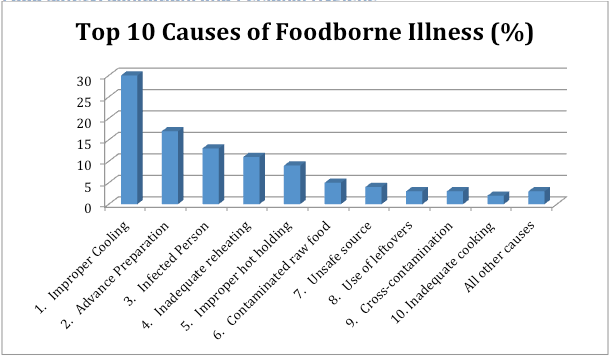
<div class="chapter standard" id="chapter-causes-of-foodborne-illnesses" title="Causes of Foodborne Illnesses"><div class="chapter-title-wrap"><h3 class="chapter-number">3</h3><h2 class="chapter-title">Causes of Foodborne Illnesses</h2></div><div class="ugc chapter-ugc"> <p>There are many myths about foodborne illness and food poisoning. Table 1 dispels some common misconceptions about food poisoning.</p> <table style="border-color: #000000;"><caption>Table 1. Food poisoning myths</caption> <tbody><tr><th><strong>Myth</strong></th> <th><strong>Fact</strong></th> </tr> <tr><td>1. A food with enough pathogens to make you sick will look, smell, or taste bad.</td> <td>1. A food with enough pathogens to make you sick <em>may</em> look, smell, or taste good.</td> </tr> <tr><td>2. Really fresh food cannot make people sick.</td> <td>2. Really fresh food can cause food poisoning if it is not properly handled.</td> </tr> <tr><td>3. Only dirty kitchens can make people sick.</td> <td>3. Even clean kitchens can make people sick.</td> </tr> <tr><td>4. Properly cooked food can never cause food poisoning.</td> <td>4. Food poisoning can occur even when foods are properly cooked.</td> </tr> </tbody> </table> <p>Foodborne illnesses can be caused by any of:</p> <ul><li>Contaminants</li> <li>Improper food handling practices</li> <li>Food allergies</li> </ul> <p>Understanding each of these is critical in ensuring that food safety is maintained.<span class="footnote"><span class="footnote-indirect" data-fnref="141-1"></span></span></p> <p>Food <strong><span class="glossary-term">contaminants</span> </strong>can be:</p> <ul><li>Chemical, such as cleaning agents or pesticides</li> <li>Physical, such as hair, bandages, or glass</li> <li>Biological, such as pathogens and microbes introduced from infected workers, unsanitary work surfaces, or contaminated water</li> </ul> <h1 style="text-align: left;">Biological causes of foodborne illness</h1> <p>Biological contaminants are by far the greatest cause of illness. Many of the risks associated with biological contaminants can be controlled or removed by effective food handling practices, so it is critical that the safe food handling and prevention procedures outline in the rest of the book be followed.</p> <p>Microbes are all around us. They are living things, often too small to be seen without a microscope. Many microbes are beneficial, but some can cause illness or even death. These harmful microbes are called <strong><span class="glossary-term">pathogens</span>. </strong>Five types of microbes include bacteria, viruses, parasites, protozoa, and fungi.</p> <ul><li>Bacteria are present in many of the foods we eat and the body itself. Most bacteria are not harmful, and some are even very beneficial to people, but some types of bacteria are pathogenic and can cause illness. Campylobacter, E.coli, Listeria, and Salmonella are examples of pathogenic bacteria. Foods that contain these bacteria must be handled correctly and cooked appropriately.</li> <li>Viruses frequently cause illness, and are found in food, but do not grow or multiply in food. Most foodborne illness caused by viruses happens because the person handling the food has transmitted to the virus to the food through improper food handling or poor sanitation. Hepatitis A and Norovirus are examples of viruses that are responsible for foodborne illness.</li> <li>Parasites live in or on animals and people and cause illness when the food infected with the parasite is not cooked to a temperature high enough or frozen to a temperature cold enough to kill the parasite. Trichinella (found in pork and some game meats) and roundworms (found in raw fish) are examples of parasites found in food.</li> <li>Protozoa are one celled animals that may be found in water. Use of water from unsafe sources can lead to illness. Giardia lamblia is an example of protozoa that may be found in water from rivers, lakes, streams and shallow wells. Food washed in water containing Giardia lamblia that is served without any further cooking (such as salad greens) can cause illness.</li> <li>Fungi grow on decaying organic matter. Many fungi are harmless or beneficial, but some, such as mould that grows on spoiled food, can be harmful and remain even after cutting or scraping the visible mould off the food.</li> </ul> <h1 style="text-align: left;">Food Intoxication and Food Infection</h1> <p>Have you ever had the “24-hour flu”? Probably not, because there’s no such thing. Many people who think they have the 24-hour flu have had a foodborne illness caused by some type of pathogen. A rapid reaction is normally caused by a food intoxication. A slower reaction is normally caused by a food infection. Here’s how to tell the difference between the two:</p> <ul><li>Food <strong><span class="glossary-term">intoxication</span></strong> occurs when bacteria grow in food and produce a waste product called a toxin (poison).&nbsp; When the food is eaten, the toxins are immediately introduced into the body, causing a rapid reaction.&nbsp; Example:&nbsp; Staphylococcus</li> <li>Food <strong><span class="glossary-term">infection</span></strong> occurs when food contains living pathogens that grow in the human intestinal tract after the food is eaten.&nbsp; Because the bacteria continue to multiply in the body and cause infection, the reaction will be slower.&nbsp; Example: Salmonella</li> </ul> <h1 style="text-align: left;">Improper Food Handling Practices</h1> <p>The top 10 causes of foodborne illness are the following:</p> <ol><li>Improper cooling</li> <li>Advance preparation</li> <li>Infected person</li> <li>Inadequate reheating for hot holding</li> <li>Improper hot holding</li> <li>Contaminated raw food or ingredient</li> <li>Unsafe source</li> <li>Use of leftovers</li> <li>Cross-contamination</li> <li>Inadequate cooking</li> </ol> <p>We will be looking at this top 10 list in greater detail later in the book.</p> <div><div><h1 style="text-align: left;">Food Allergies</h1> <p>Food allergies are specific to individuals, but can be life threatening, and can be prevented by a thorough understanding of the allergy issue, knowledge of ingredients used in the preparation of foods, including pre-prepared foods, and care in ensuring separate cooking utensils, cookware, and food preparation surfaces. Oftentimes, the smallest oversights can have serious consequences, as indicated in the example below:</p> <p>A customer has indicated they have an allergy to MSG and ordered chicken strips with a sweet and sour sauce.&nbsp; The server tells them that the restaurant doesn’t add MSG to any of its food normally, so the order should be fine.&nbsp; After eating the sauce, the customer experiences tingling lips and hives.&nbsp; In follow up, the manager discovers that the pre-prepared sweet and sour sauce served with the chicken strips contains MSG on the list of ingredients.</p> <p>This incident could have been prevented if the server was aware of all of the ingredients used in the dish.</p> <div class="bcc-box bcc-info">Find more information foodborne illness and their causes and symptoms on the <a href="http://www.foodsafe.ca/docs/Foodborne_Illness_Chart.pdf" data-url="http://www.foodsafe.ca/docs/Foodborne_Illness_Chart.pdf">FOODSAFE Foodborne Illness Chart [PDF]</a>.</div> </div> </div> <div class="footnotes"><div id='141-1'>
For more information on foodborne illnesses, outbreaks, and important news bulletins, consult the <a href="http://www.bccdc.ca/" data-url="http://www.bccdc.ca/">BC Centre for Disease Control website</a>.
</div></div></div></div>
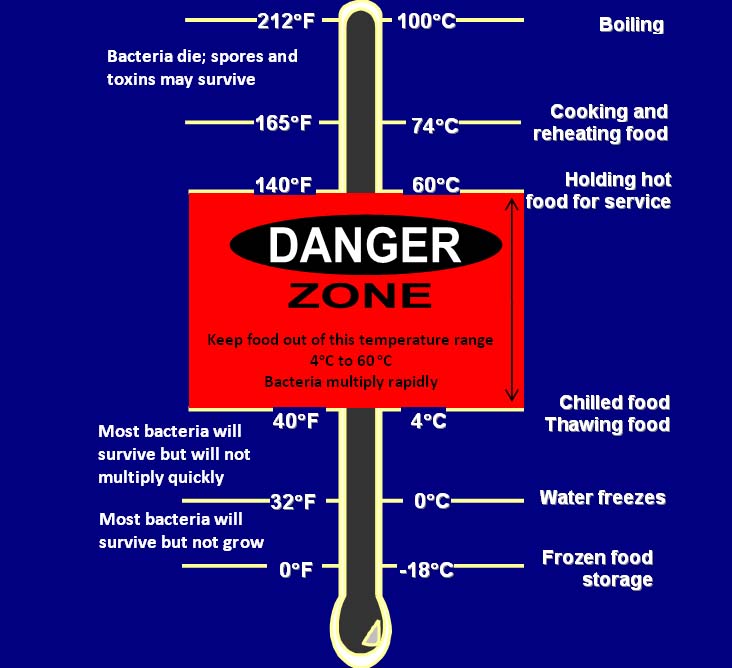
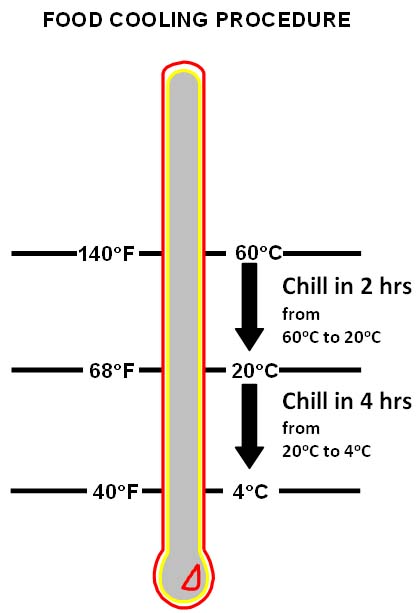
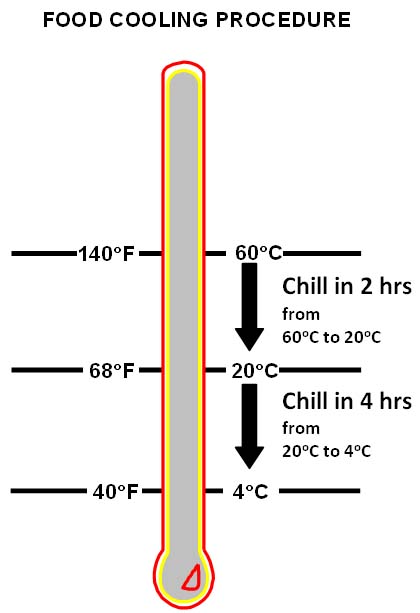
<div class="chapter standard" id="chapter-preventing-foodborne-illness" title="Preventing Foodborne Illness"><div class="chapter-title-wrap"><h3 class="chapter-number">4</h3><h2 class="chapter-title">Preventing Foodborne Illness</h2></div><div class="ugc chapter-ugc"> <h1>Food-handling and Storage Procedures</h1> <p>Proper food handling and storage can prevent most foodborne illnesses. In order for pathogens to grow in food, certain conditions must be present. By controlling the environment and conditions, even if potentially harmful bacteria are present in the unprepared or raw food, they will not be able to survive, grow, and multiply, causing illness.</p> <p>There are six factors that affect bacterial growth, which can be referred to by the mnemonic <strong><span class="glossary-term">FATTOM</span></strong>:</p> <ol><li><strong>F</strong>ood</li> <li><strong>A</strong>cid</li> <li><strong>T</strong>emperature</li> <li><strong>T</strong>ime</li> <li><strong>O</strong>xygen</li> <li><strong>M</strong>oisture</li> </ol> <p>Each of these factors contributes to bacterial growth in the following ways:</p> <ul><li>Food: Bacteria require food to survive. For this reason, moist, protein-rich foods are good potential sources of bacterial growth.</li> <li>Acid: Bacteria do not grow in acidic environments. This is why acidic foods like lemon juice and vinegar do not support the growth of bacteria and can be used as preservatives</li> <li>Temperature: Most bacteria will grow rapidly between 4°C and 60°C (40°F and 140°F). This is referred to as the <strong><span class="glossary-term">danger zone</span> </strong>(see the section below for more information on the danger zone).</li> <li>Time: Bacteria require time to multiply. When small numbers of bacteria are present, the risk is usually low, but extended time with the right conditions will allow the bacteria to multiply and increase the risk of contamination</li> <li>Oxygen: There are two types of bacteria. <strong><span class="glossary-term">Aerobic bacteria</span></strong> require oxygen to grow, so will not multiply in an oxygen-free environment such as a vacuum-packaged container. <strong><span class="glossary-term">Anaerobic bacteria</span></strong> will only grow in oxygen-free environments. Food that has been improperly processed and then stored at room temperature can be at risk from anaerobic bacteria. A common example is a product containing harmful <em>Clostridium botulinum</em> (botulism-causing) bacteria that has been improperly processed during canning, and then is consumed without any further cooking or reheating.</li> <li>Moisture: Bacteria need moisture to survive and will grow rapidly in moist foods. This is why dry and salted foods are at lower risk of being hazardous.</li> </ul> <h1>Identifying Potentially Hazardous Foods (PHFs)</h1> <p>Foods that have the FATTOM conditions are considered <strong><span class="glossary-term">potentially hazardous foods (PHFs)</span>. </strong>PHFs are those foods that are considered perishable. That is, they will spoil or “go bad” if left at room temperature. PHFs are foods that support the growth or survival of disease-causing bacteria (pathogens) or foods that may be contaminated by pathogens.</p> <p>Generally, a food is a PHF if it is:</p> <ul><li>Of animal origin such as meat, milk, eggs, fish, shellfish, poultry (or if it contains any of these products)</li> <li>Of plant origin (vegetables, beans, fruit, etc.) that has been heat-treated or cooked</li> <li>Any of the raw sprouts (bean, alfalfa, radish, etc.)</li> <li>Any cooked starch (rice, pasta, etc.)</li> <li>Any type of soya protein (soya milk, tofu, etc.)</li> </ul> <p>Table 2 identifies common foods as either PHF or non-PHF.</p> <table style="border-color: #000000; width: 100%;"><caption>Table 2. Common PHF and non-PHFs</caption> <tbody><tr><th><strong>PHF</strong></th> <th><strong>Non-PHF</strong></th> </tr> <tr><td>Chicken, beef, pork, and other meats</td> <td>Beef jerky</td> </tr> <tr><td>Pastries filled with meat, cheese, or cream</td> <td>Bread</td> </tr> <tr><td>Cooked rice</td> <td>Uncooked rice</td> </tr> <tr><td>Fried onions</td> <td>Raw onions</td> </tr> <tr><td>Opened cans of meat, vegetables, etc.</td> <td>Unopened cans of meat, vegetables, etc. (as long as they are not marked with “Keep Refrigerated”)</td> </tr> <tr><td>Tofu</td> <td>Uncooked beans</td> </tr> <tr><td>Coffee creamers</td> <td>Cooking oil</td> </tr> <tr><td>Fresh garlic in oil</td> <td>Fresh garlic</td> </tr> <tr><td>Fresh or cooked eggs</td> <td>Powdered eggs</td> </tr> <tr><td>Gravy</td> <td>Flour</td> </tr> <tr><td>Dry soup mix with water added</td> <td>Dry soup mix</td> </tr> </tbody> </table> <h1>The Danger Zone</h1> <p>One of the most important factors to consider when handling food properly is temperature. Table 3 lists the most temperatures to be aware of when handling food.</p> <table style="border-color: #000000; width: 100%; height: 126px;"><caption>Table 3. Important temperatures to remember</caption> <tbody><tr style="height: 18px;"><th style="height: 18px;">Celsius</th> <th style="height: 18px;">Fahrenheit</th> <th style="height: 18px;">What happens?</th> </tr> <tr style="height: 18px;"><td style="height: 18px;">100°</td> <td style="height: 18px;">212°</td> <td style="height: 18px;">Water boils</td> </tr> <tr style="height: 18px;"><td style="height: 18px;">60°</td> <td style="height: 18px;">140°</td> <td style="height: 18px;">Most pathogenic bacteria are destroyed. Keep hot foods above this temperature.</td> </tr> <tr style="height: 18px;"><td style="height: 18px;">20°</td> <td style="height: 18px;">68°</td> <td style="height: 18px;">Food must be cooled from 60°C to 20°C (140°F to 68°F) within two hours or less</td> </tr> <tr style="height: 18px;"><td style="height: 18px;">4°</td> <td style="height: 18px;">40°</td> <td style="height: 18px;">Food must be cooled from 20°C to 4°C (68°F to 40°F) within four hours or less</td> </tr> <tr style="height: 18px;"><td style="height: 18px;">0°</td> <td style="height: 18px;">32°</td> <td style="height: 18px;">Water freezes</td> </tr> <tr style="height: 18px;"><td style="height: 18px;">–18°</td> <td style="height: 18px;">0°</td> <td style="height: 18px;">Frozen food must be stored at −18°C (0°F) or below<a id="retfig1" data-url=""></a></td> </tr> </tbody> </table> <div class="wp-caption aligncenter" id="attachment_28" aria-describedby="caption-attachment-28" style="width: 500px"><a href="http://opentextbc.ca/foodsafety/wp-content/uploads/sites/106/2015/05/FS_DangerZone_1.jpg" data-url="http://opentextbc.ca/foodsafety/wp-content/uploads/sites/106/2015/05/FS_DangerZone_1.jpg"><img src="https://opentextbc.ca/foodsafety/wp-content/uploads/sites/106/2019/06/FS_DangerZone_1.jpg" alt="Temperature chart. Long description available." class="wp-image-28" width="500" height="456" title="" /></a><div class="wp-caption-text" id="caption-attachment-28">Figure 1. Danger Zone Chart, Used with permission from BC Centre for Disease Control (BCCDC). <a href="#fig1" data-url="https://opentextbc.ca/foodsafety/chapter/preventing-foodborne-illness/#fig1">[Image description]</a></div></div> <p>The range of temperature from 4°C and 60°C (40°F and 140°F) is known as the <strong><span class="glossary-term">danger zone</span></strong>, or the range at which most pathogenic bacteria will grow and multiply.</p> <h1>Time-temperature Control of PHFs</h1> <p>Pathogen growth is controlled by a time-temperature relationship. To kill micro-organisms, food must be held at a sufficient temperature for a sufficient time. Cooking is a scheduled process in which each of a series of continuous temperature combinations can be equally effective. For example, when cooking a beef roast, the microbial lethality achieved at 121 minutes after it has reached an internal temperature of 54°C (130°F) is the same as if it were cooked for 3 minutes after it had reached 63°C (145°F).</p> <p>Table 4 show the minimum time-temperature requirements to keep food safe. (Other time-temperature regimens might be suitable if it can be demonstrated, with scientific data, that the regimen results in a safe food.)</p> <table style="border-collapse: collapse; width: 99.9999%;"><caption>Table 4. Temerature control for PHFs</caption> <thead><tr><th style="width: 33.3333%;" scope="col">Critical control point</th> <th style="width: 33.3333%;" scope="col">Type of food</th> <th style="width: 33.3333%;" scope="col">Temperature</th> </tr> </thead> <tbody><tr><td style="width: 33.3333%;">Refrigeration</td> <td style="width: 33.3333%;">Cold food storage, all foods.</td> <td style="width: 33.3333%;">4°C (40°F) or less</td> </tr> <tr><td style="width: 33.3333%;">Freezing</td> <td style="width: 33.3333%;">Frozen food storage, all foods.</td> <td style="width: 33.3333%;">−18°C (0°F) or less</td> </tr> <tr><td style="width: 33.3333%;">Freezing</td> <td style="width: 33.3333%;">Parasite reduction in fish intended to be served raw, such as sushi and sashimi</td> <td style="width: 33.3333%;">−20°C (−4°F) for 7 days or −35°C (−31°F) in a blast freezer for 15 hours</td> </tr> <tr><td style="width: 33.3333%;">Cooking</td> <td style="width: 33.3333%;">Food mixtures containing poultry, eggs, meat, fish, or other potentially hazardous foods</td> <td style="width: 33.3333%;">Internal temperature of 74°C (165°F) for at least 15 seconds</td> </tr> <tr><td style="width: 33.3333%;">Cooking</td> <td style="width: 33.3333%;">Rare roast beef</td> <td style="width: 33.3333%;">Internal temperature of 54°C to 60°C (130°F to 140°F)</td> </tr> <tr><td style="width: 33.3333%;">Cooking</td> <td style="width: 33.3333%;">Medium roast beef</td> <td style="width: 33.3333%;">Internal temperature of 60°C to 65°C (140°F to 150°F)</td> </tr> <tr><td style="width: 33.3333%;">Cooking</td> <td style="width: 33.3333%;">Pork, lamb, veal, beef (medium-well)</td> <td style="width: 33.3333%;">Internal temperature of 65°C to 69°C (150°F to 158°F)</td> </tr> <tr><td style="width: 33.3333%;">Cooking</td> <td style="width: 33.3333%;">Pork, lamb, veal, beef (well done)</td> <td style="width: 33.3333%;">Internal temperature of 71°C (160°F)</td> </tr> <tr><td style="width: 33.3333%;">Cooking</td> <td style="width: 33.3333%;">Poultry</td> <td style="width: 33.3333%;">Internal temperature of 74°C (165°F) for 15 seconds</td> </tr> <tr><td style="width: 33.3333%;">Cooking</td> <td style="width: 33.3333%;">Stuffing in poultry</td> <td style="width: 33.3333%;">74°C (165°F)</td> </tr> <tr><td style="width: 33.3333%;">Cooking</td> <td style="width: 33.3333%;">Ground meat (Includes chopped, ground, flaked, or minced beef, pork, or fish)</td> <td style="width: 33.3333%;">70°C (158°F)</td> </tr> <tr><td style="width: 33.3333%;">Cooking</td> <td style="width: 33.3333%;">Eggs<span class="footnote"><span class="footnote-indirect" data-fnref="145-1"></span></span></td> <td style="width: 33.3333%;">63°C (145°F) for 15 seconds</td> </tr> <tr><td style="width: 33.3333%;">Cooking</td> <td style="width: 33.3333%;">Fish<span class="footnote"><span class="footnote-indirect" data-fnref="145-2"></span></span></td> <td style="width: 33.3333%;">70°C (158°F)</td> </tr> <tr><td style="width: 33.3333%;">Holding</td> <td style="width: 33.3333%;">Hot foods</td> <td style="width: 33.3333%;">60°C (140°F)</td> </tr> <tr><td style="width: 33.3333%;">Cooling</td> <td style="width: 33.3333%;">All foods</td> <td style="width: 33.3333%;">60°C to 20°C (140°F to 68°F) within 2 hours and 20°C to 4°C (68°F to 40°F) within 4 hours</td> </tr> <tr><td style="width: 33.3333%;">Reheating</td> <td style="width: 33.3333%;">All foods</td> <td style="width: 33.3333%;">74°C (165°F) for at least 15 seconds</td> </tr> </tbody> </table> <h1>The Top 10 List: Do’s and Don’ts</h1> <p>Figure 1 illustrates the top 10 improper food-handling methods and the percentage of foodborne illnesses they cause.<a id="retfig2" data-url=""></a></p> <div class="wp-caption aligncenter" id="attachment_29" aria-describedby="caption-attachment-29" style="width: 609px"><a href="http://opentextbc.ca/foodsafety/wp-content/uploads/sites/106/2015/05/Screen-Shot-2015-05-05-at-9.45.29-AM.png" data-url="http://opentextbc.ca/foodsafety/wp-content/uploads/sites/106/2015/05/Screen-Shot-2015-05-05-at-9.45.29-AM.png"><img class="wp-image-29 size-full" alt="A chart of the top 10 causes of foodborne illnesses. Long description availabale." src="https://opentextbc.ca/foodsafety/wp-content/uploads/sites/106/2019/06/Screen-Shot-2015-05-05-at-9.45.29-AM.png" width="609" height="356" title="" /></a><div class="wp-caption-text" id="caption-attachment-29">Figure 2. Top 10 causes of foodborne illness. Chart created by go2HR under <a href="http://creativecommons.org/licenses/by/4.0/" data-url="http://creativecommons.org/licenses/by/4.0/">CC BY</a>. <a href="#fig2" data-url="https://opentextbc.ca/foodsafety/chapter/preventing-foodborne-illness/#fig2">[Image description]</a></div></div> <p>This section describes each food-handling practice outlined in the top 10 list and the ways to prevent each problem.</p> <h2 style="text-align: left;">1. Improper cooling</h2> <p>Many people think that once a food has been properly cooked, all disease-causing organisms (pathogens) have been killed. This is not true. Some pathogens can form heat-resistant spores, which can survive cooking temperatures. When the food begins cooling down and enters the danger zone, these spores begin to grow and multiply. If the food spends too much time in the danger zone, the pathogens will increase in number to a point where the food will make people sick. That is why the <strong><span class="glossary-term">cooling</span></strong> process is crucial. Cooked food must be cooled from 60°C to 20°C (140°F to 70°F) in two hours or less, AND then from 20°C to 4°C (70°F to 40°F) in four hours or less.</p> <div class="wp-caption aligncenter" id="attachment_30" aria-describedby="caption-attachment-30" style="width: 420px"><a href="http://opentextbc.ca/foodsafety/wp-content/uploads/sites/106/2015/05/FS_Cooling_Procedure.jpg" data-url="http://opentextbc.ca/foodsafety/wp-content/uploads/sites/106/2015/05/FS_Cooling_Procedure.jpg"><img src="https://opentextbc.ca/foodsafety/wp-content/uploads/sites/106/2019/06/FS_Cooling_Procedure.jpg" alt="Food needs to cool from 60°C to 20°C in 2 hours. It needs to cool between 20°C and 4°C in 4 hours." class="wp-image-30 size-full" width="420" height="613" title="" /></a><div class="wp-caption-text" id="caption-attachment-30">Figure 3. Food Cooling Procedure, used with permission from BC Centre for Disease Control (BCCDC)</div></div> <p>Even in modern walk-in coolers, large cuts of meat will not cool down properly. Neither will whole poultry. Even large pots (4 L/1 gal. or more) of soup, stews, gravy, etc., can take a day or more to cool to 4°C (40°F). However, you can cool these foods down quickly by using one or more of the following methods depending on the type of food being cooled:</p> <ul><li>Place the food in <strong><span class="glossary-term">shallow pans</span></strong> (with the food no deeper than 5 cm/2 in.) and put the pans in the cooler.</li> <li>When the food is cooling, do not tightly cover. Doing so only seals in the heat.</li> <li>Do not stack the shallow cooling pans during the cooling step. This will defeat the purpose of shallow panning by preventing cold air from reaching the food. You may need to add more shelves to your cooler.</li> <li>Cut large cuts of meat or whole poultry into smaller or thinner portions. Then place these portions into shallow pans for cooling.</li> <li>Use <strong><span class="glossary-term">cooling wands</span></strong> or cooling sticks to cool foods quickly.</li> <li>Use rapid cooling equipment such as walk-in coolers with wire shelving and good air flow. Home-style refrigerators or reach-ins do not cool food well.</li> <li>Stir the food in a container placed in an ice-water bath.</li> <li>Use containers that help heat transfer, such as stainless steel or aluminum. Plastic does not transfer heat well.</li> <li>Use ice as an ingredient (e.g., in stews or soups).</li> <li>For large pots of cooked desserts (e.g., custard), divide it into serving sizes and then cool.</li> </ul> <h2 style="text-align: left;">2. Advance preparation</h2> <p>Advance preparation is the cause of many food-poisoning outbreaks, usually because food has been improperly cooled. Often, foods that are prepared well before serving spend too much time in the danger zone. This may happen for one or more of the following reasons:</p> <ul><li>The food is left out at room temperature too long.</li> <li>The food is not heated or reheated properly (to a high enough temperature), or not cooled properly.</li> <li>The food is brought in and out of the danger zone too many times (e.g., cooked, hot held, cooled, reheated, hot held, cooled, reheated again).</li> </ul> <p>To prevent problems of advance preparation:</p> <ul><li>Try to prepare all foods for same-day use and as close to serving time as possible.</li> <li>To prevent outside contamination of foods prepared in advance, cover them tightly after they have been properly cooled.</li> <li>Reheat leftovers only once. If leftovers are not consumed after being reheated, throw them out.</li> <li>For foods prepared and held refrigerated in the cooler for more than 24 hours, mark the date of preparation and a “serve by” date. Generally, PHFs should be thrown out if not used within three days from date they were made.</li> <li>If you must prepare foods in advance, be sure you properly cool and refrigerate them.</li> </ul> <h2 style="text-align: left;">3. Infected person</h2> <p>Many people carry pathogens somewhere on or in their bodies without knowing it—in their gut, in their nose, on their hands, in their mouth, and in other warm, moist places. People who are carrying pathogens often have no outward signs of illness. However, people with symptoms of illness (diarrhea, fever, vomiting, jaundice, sore throat with a fever, hand infections, etc.) are much more likely to spread pathogens to food.</p> <p>Another problem is that pathogens can be present in the cooked and cooled food that, if given enough time, can still grow. These pathogens multiply slowly but they can eventually reach numbers where they can make people sick. This means that foods that are prepared improperly, many days before serving, yet stored properly the entire time can make people sick.</p> <p>Some pathogens are more dangerous than others (e.g., salmonella, E. coli, campylobacter). Even if they are only present in low numbers, they can make people very sick. A food handler who is carrying these kinds of pathogens can easily spread them to foods – usually from their hands. <span class="glossary-term"><strong>Ready-to-eat</strong> <strong>food</strong></span> is extra dangerous. Ready-to-eat food gets no further cooking after being prepared, so any pathogens will not be killed or controlled by cooking.</p> <p>To prevent problems:</p> <ul><li>Make sure all food handlers wash their hands properly after any job that could dirty their hands (e.g., using the toilet, eating, handling raw meats, blowing their nose, smoking).</li> <li>Food handlers with infected cuts on their hands or arms (including sores, burns, lesions, etc.) must not handle food or utensils unless the cuts are properly covered (e.g., waterproof bandage covered with a latex glove or finger cot).</li> <li>When using <strong><span class="glossary-term">gloves</span></strong> or <strong><span class="glossary-term">finger cots</span></strong>, food handlers must still wash their hands. As well, gloves or cots must be replaced if they are soiled, have a hole, and at the end of each day.</li> <li>Food handlers with infection symptoms must not handle utensils or food and should be sent home.</li> <li>Where possible, avoid direct hand contact with food – especially ready-to-eat foods (e.g., use plastic utensils plastic or latex gloves).</li> </ul> <h2 style="text-align: left;">4. Inadequate reheating for hot holding</h2> <p>Many restaurants prepare some of menu items in advance or use leftovers in their <strong><span class="glossary-term">hot hold</span></strong> units the next day. In both cases, the foods travel through the danger zone when they are cooled for storage and again when they are reheated.</p> <p>Foods that are hot held before serving are particularly vulnerable to pathogens. In addition to travelling through the danger zone twice, even in properly operating hot hold units, the food is close to the temperature that will allow pathogens to grow.</p> <p>To prevent problems:</p> <ul><li>Do not use hot hold units to reheat food. They are not designed for this purpose. Instead, rapidly reheat to 74°C (165°F) (and hold the food at that temperature for at least 15 seconds before putting it in the hot hold unit. This will kill any pathogens that may have grown during the cool-down step and the reheat step.</li> <li>If using direct heat (stove top, oven, etc.), the temperature of the reheated food must reach at least 74°C (165°F) for at least 15 seconds within two hours. Keep a thermometer handy to check the temperature of the food.</li> <li>If using a microwave, rotate or stir the food at least once during the reheat step, as microwaves heat unevenly. As well, the food must be heated to at least 74°C (165°F) and then stand covered for two minutes after reheating before adding to the hot hold unit. The snapping and crackling sounds coming from food being reheated in a microwave do not mean the food is hot.</li> </ul> <h2 style="text-align: left;">5. Improper hot holding</h2> <p>Hot hold units are meant to keep hot foods at 60°C (140°F) or hotter. At or above this temperature, pathogens will not grow. However, a mistake in using the hot hold unit can result in foods being held in the <strong><span class="glossary-term">super danger zone</span></strong> – between 20°C and 49°C (70°F and 120°F), temperatures at which pathogens grow very quickly.</p> <p>To prevent problems:</p> <ul><li>Make sure the hot hold unit is working properly (e.g., heating elements are not burnt out; water is not too low in steam tables; the thermostat is properly set so food remains at 60°C (140°F) or hotter) Check it daily with a thermometer.</li> <li>Put only already hot (74°C/165°F) foods into the hot hold unit.</li> <li>Preheat the hot hold unit to at least 60°C (140°F) before you start putting hot foods into it.</li> <li>Do not use the hot hold unit to reheat cold foods. It is not designed for or capable of doing this rapidly.</li> <li>After the lunch or dinner rush, do not turn off the heat in the hot hold unit and then leave the food there to cool. This is very dangerous. When you do this, the food does not cool down. It stays hot in the super danger zone and lets pathogens grow quickly. Foods in hot hold units should be taken out of the units after the meal time is over and cooled right away.</li> </ul> <h2 style="text-align: left;">6. Contaminated raw food or ingredient</h2> <p>We know that many raw foods often contain pathogens, yet certain foods are often served raw. While some people believe these foods served raw are “good for you,” the truth is that they have always been dangerous to serve or eat raw. Some examples include:</p> <ul><li>Raw oysters served in the shell</li> <li>Raw eggs in certain recipes (e.g., Caesar salad, eggnog made from raw eggs)</li> <li>Rare hamburger</li> <li>Sushi/sashimi</li> <li>Steak tartare</li> </ul> <p>These foods have caused many food-poisoning outbreaks. Always remember: you cannot tell if a food contains pathogens just by look, taste, or smell.</p> <p>To prevent problems:</p> <ul><li>Buy all your foods or ingredients from approved suppliers.</li> <li>If available, buy foods or ingredients from suppliers who also have food safety plans for their operations.</li> <li>Where possible, use processed or pasteurized alternatives (e.g., pasteurized liquid eggs).</li> <li>Never serve these types of foods to high-risk customers (e.g., seniors, young children, people in poor health, people in hospitals or nursing homes).</li> </ul> <h2 style="text-align: left;">7. Unsafe source</h2> <p>Foods from approved sources are less likely to contain high levels of pathogens or other forms of contamination. Approved sources are those suppliers that are inspected for cleanliness and safety by a government food inspector. Foods supplied from unreliable or disreputable sources, while being cheaper, may contain high levels of pathogens that can cause many food-poisoning outbreaks.</p> <p>Fly-by-night suppliers (trunk sales) often do not care if the product is safe to sell to you, but approved suppliers do! As well, many fly-by-night suppliers have obtained their product illegally (e.g., closed shellfish fisheries, rustled cattle, poached game and fish) and often do not have the equipment to properly process, handle, store, and transport the food safely.</p> <p>Of particular concern is seafood from unapproved sources. Seafood, especially shellfish, from unapproved sources can be heavily contaminated with pathogens or poisons if they have been harvested from closed areas.</p> <p>To prevent problems:</p> <ul><li>Buy your food and ingredients from approved sources only. If you are not sure a supplier has been approved, contact your local environmental health officer. He or she can find out for you.</li> <li>Do not take the chance of causing a food-poisoning outbreak by trying to save a few dollars. Remember, your reputation is on the line.</li> </ul> <h2 style="text-align: left;">8. Use of leftovers</h2> <p>Using leftovers has been the cause of many outbreaks of food poisoning because of improper cooling and reheating (of “hot” leftovers). Leftovers that are intended to be served hot pass through the danger zone twice (during the initial cooling of the hot food and when reheating). Those leftovers intended to be served without reheating, or as an ingredient in other foods (e.g., sandwich filler), go through the danger zone during cooling and then, when being prepared and portioned, often stay in the danger zone for another long period. The time in the danger zone adds up unless the food is quickly cooled and then quickly reheated (if being served hot), or kept cold until serving (if not being served hot).</p> <p>Contamination can also occur with leftover foods when they are stored in the cooler. Improperly stored leftovers can accidentally be contaminated by raw foods (e.g., blood dripping from a higher shelf).</p> <p>To prevent problems:</p> <ul><li>Reheat leftovers only once. Throw out any leftovers that have already been reheated once.</li> <li>Do not mix leftover foods with fresh foods.</li> <li>Be sure to follow the proper cooling and reheating procedures when handling leftovers. These are critical control points.</li> <li>Cool leftovers in uncovered containers separate from any raw foods. After they are cooled, cover them tightly.</li> </ul> <h2 style="text-align: left;">9. Cross-contamination</h2> <p>You can expect certain foods to contain pathogens, especially raw meat, raw poultry, and raw seafood. Use extreme caution when you bring these foods into your kitchen. Cross-contamination happens when something that can cause illness (pathogens or chemicals) is accidentally put into a food where not previously found. This can include, for example, pathogens from raw meats getting into ready-to-eat foods like deli meats. It can also include nuts (which some people are very allergic to) getting into a food that does not normally have nuts (e.g., tomato sauce).</p> <p>To prevent problems:</p> <ul><li>Use separate cutting boards, separate cleaning cloths, knives/utensils, sinks, preparation areas, etc., for raw and for ready-to-eat foods. Otherwise, wash all of these items with detergent and <strong><span class="glossary-term">sanitize</span></strong> them with bleach between use.</li> <li>Use separate storage areas for raw and ready-to-eat foods. Always store ready-to-eat foods on separate shelves and above raw foods. Store dry foods above wet foods.</li> <li>Prepare ready-to-eat foods at the beginning of the day before the raw foods are prepared.</li> <li>After handling raw foods, always wash your hands properly before doing anything else.</li> <li>Keep wiping or cleaning cloths in a container of fresh bleach solution (30 mL/1 oz. of bleach per 4 L/1 gal. of water) when not in use.</li> <li>Use clean utensils, not your hands, to handle cooked or ready-to-eat foods.</li> <li>If a customer indicates a food allergy, follow all the same steps to avoid cross contamination and use separate or freshly sanitized tools and utensils to prepare food for the individual with the allergy.</li> </ul> <h2 style="text-align: left;">10. Inadequate cooking</h2> <p>Proper cooking is one of the best means of making sure your operation does not cause a food-poisoning outbreak. Proper cooking kills all pathogens (except spores) or at least reduces their numbers to a point where they cannot make people sick. Inadequate cooking is often done by accident: for example, cooking still-frozen poultry or meat; attempting to cook a stuffed bird using the same time and temperature as an unstuffed bird; using an inexperienced cook.</p> <p>To prevent problems:</p> <ul><li>Don’t rely on cooking times alone. Check the <strong><span class="glossary-term">internal temperature</span></strong> of the food being cooked.</li> <li>For large cuts of meat or large batches of food, check the temperature in several spots.</li> <li>Be extra careful when cooking partially frozen foods. There can be cold spots in the food that are not properly cooked. The normal cooking time will have to be increased.</li> <li>When grilling or frying meat, cook until the juices run clear. Cooked fish until it flakes easily. Make thin, not thick, hamburgers.</li> </ul> <h1>Image descriptions</h1> <p><strong><a id="fig1" data-url=""></a>Figure 1 image description:</strong></p> <p>At 100°C (or 212°F), water boils. Above 74°C (or 165°F), bacteria die, although spores and toxins may survive. Food that is being cooked or reheated should hit 74°C (or 165°F). You can hold hot food for service at 60°C (or 140°F). Between 4°C and 60°C (or 40°F and 140°F) is the “Danger Zone.” Keep food out of this temperature range because bacteria will multiply rapidly. Between 0°C and 4°C (or 32°F and 40°F), most bacteria will survive but will not multiply quickly. Water freezes at 0°C (or 32°F). Between 0°C and −18°C (or 0°F and 32°F), most bacterial will survive but not grow. Frozen food is stored at −18°C (or 0°F).</p> <p><a href="#retfig1" data-url="https://opentextbc.ca/foodsafety/chapter/preventing-foodborne-illness/#retfig1">[Return to Figure 1]</a></p> <p><strong><a id="fig2" data-url=""></a>Figure 2 image description:</strong></p> <div class="twocolumn"><ol><li>Improper cooling, 30%.</li> <li>Advance preparation, 15%.</li> <li>Infected person, 12%.</li> <li>Inadequate reheating, 10%.</li> <li>Improper hot holding, 8%.</li> <li>Contaminated raw food, 4%.</li> <li>Unsafe source, 3%.</li> <li>Use of leftovers, 2%.</li> <li>Cross-contamination, 2%.</li> <li>Inadequate cooking, 1%.</li> <li>All other causes, 3%.</li> </ol> </div> <p><a href="#retfig2" data-url="https://opentextbc.ca/foodsafety/chapter/preventing-foodborne-illness/#retfig2">[Return to Figure 2]</a></p> <div class="footnotes"><div id='145-1'>Customers requiring a runny yolk egg should be aware that pathogens are not destroyed until yolk has completely coagulated.</div><div id='145-2'>Customers wishing raw marinated fish and raw shellfish, such as oysters, should be aware that they should be cooked to ensure safety.</div></div></div></div>
<div class="chapter standard" id="chapter-receiving-practices" title="Receiving Practices"><div class="chapter-title-wrap"><h3 class="chapter-number">5</h3><h2 class="chapter-title">Receiving Practices</h2></div><div class="ugc chapter-ugc"> <p>HACCP is an operation system that ensures that as many precautions as possible are undertaken to eliminate, minimize, or prevent any kind of contamination. HACCP identifies critical control points that relate to all transportation, handling, preparation, service, and storage of food products.</p> <p>Receiving, storage, and preparation are all important sections of a food safety flow chart, and receiving of products is your first step when developing a flow chart. The following are important elements to consider when receiving products in general.</p> <ul><li>Never assume that all the food you receive is good enough to eat.</li> <li>The receiving dock and related areas should be well lit and kept very tidy. Incorporate this area into a daily cleaning schedule to ensure proper cleanliness.</li> <li>Schedule your deliveries to allow adequate time for the proper inspection and receiving of all food products.</li> <li>Have all appropriate equipment and containers on hand. Scales, plastic gloves, containers, and thermometers are important pieces to have in easy reach.</li> <li>Record the temperatures of the delivery trucks refrigerated and freezer storage. If the temperature is not within an acceptable range, do not accept the shipment (because you are unable to ascertain the length of time that the temperature has been unacceptable).</li> </ul> <p>Each group of food, whether dry foods, dairy products, fresh produce, or meats, requires a slightly different procedure. No matter what the product type, the principal component in a receiving procedure is accuracy. Any carelessness or half-hearted attempts at checking the delivery will render the whole process useless.</p> <h1>Dry foods</h1> <p>Dry foods or goods are usually shipped in cartons, bags, cases, or pails. Count the pieces and check that the number corresponds with what is listed on the invoice.</p> <p>If a carton is damaged, check the contents carefully. Pay particular attention to signs of leakage in cartons that contain products in jars or bottles. It is extremely difficult to get credit at a later date for products stored in glass jars or bottles that have broken. In addition, visually check bags and pails for damage or leakage.</p> <p>If sealed cartons show evidence of having been opened, check the contents. All unsealed or obviously repacked cartons should be checked to verify what they contain. Do not sign the invoice if there is any doubt about quantity, quality, or damage until you or your supervisor has cleared up the problem with the shipper.</p> <p>Canned goods are delivered in cases or cartons. Do a count and a quality check of the cans.</p> <p>The two most common types of damage to cans are swelling and large dents. If cans are swollen or bulging, it means the food has spoiled and must not be used. If the cans have large dents, seams may have split and the food may be contaminated. Again, the canned product is unsafe to use and should be sent back to the supplier. If a whole case of canned goods is unacceptable, the local health authority should be notified.</p> <h1>Dairy products</h1> <p>Dairy products are perishable and do not store long. Check the best-before date on each container, which should be at least a week after the receiving date.</p> <p>As with dry foods, compare the number of items received with the invoice and check all items for damage and leakage.</p> <h1>Produce</h1> <p>Produce is delivered in bags, cases, or cartons. Count the number of pieces, weigh items, and check for quality. Open any closed cases and cartons to check the produce for ripeness, freshness, and other signs of quality.</p> <p>When there are mistakes in delivery or an unacceptable quality of food has been received, you should insist that the supplier pick up the item and issue a credit.</p> <h1>Meats, poultry, and seafood</h1> <p>Fresh meat is shipped in pieces and/or by weight. Count and weigh the fresh items. Check for leaking vacuum-packed (Cryovac) packages, and check the grade of the meat against the grade on the invoice. In addition, if specifications were given on the order form, confirm the cuts of meat do meet those specifications.</p> <p>Fresh poultry and seafood should also be counted, weighed, and checked for quality.</p> <p>Frozen products are often delivered in cases and cartons. Open the cases to count the items and to check for signs of freezer burn, torn wrappings, partial thawing, or other problems.</p> <p>In summary, when receiving goods, remember:</p> <ul><li>The quantity of the goods received should match the quantity on the invoice and the quantity on the purchase order.</li> <li>The quality of the goods received should be to the specifications given on the invoice or to specifications previously worked out with the supplier. This includes supplying the specific brand name when it is requested.</li> <li>The prices of the goods should be listed on the invoice and should match the prices on the purchase order.</li> </ul> </div></div>
<div class="chapter standard" id="chapter-storage-temperatures-and-procedures" title="Storage Temperatures and Procedures"><div class="chapter-title-wrap"><h3 class="chapter-number">6</h3><h2 class="chapter-title">Storage Temperatures and Procedures</h2></div><div class="ugc chapter-ugc"> <p>A food service operation needs to have clearly defined storage areas and procedures for several reasons. First, by providing storage facilities it is possible to purchase supplies in quantities large enough quantities to get price breaks. Second, the ability to store supplies on the premises reduces the cost and time needed to order supplies and handle them upon delivery. Third, menu planning is easier when you are aware of the quality, quantity, and types of supplies that are on hand. If there is a run on a particular menu item, it is nice to know there are enough materials on hand to ensure that everyone who orders the item can be served.</p> <p>In today’s market, many food service operations are reducing the amount of stock they keep on hand because storage is expensive. Not only does space need to be found but security needs to be tight. Many operators are willing to pay a bit extra to suppliers in order to avoid the headaches of keeping track of expensive items such as large quantities of high-quality meat, wines, and spirits.</p> <p>Regardless, there still is a need for storing many types of supplies including dry foods, dairy products, frozen foods, produce, and fresh meats. Storage areas for such items often have design requirements that must be built into the space in order to efficiently handle the specific types of supplies.</p> <h1>Dry Foods</h1> <p>The storeroom for dry foods should be located near the receiving area and close to the main kitchen. Unfortunately, the storeroom for dry foods is often an afterthought in food service facility designs, and the area designated for storage is sometimes in an inconvenient location.</p> <p>No matter where the location, there are several essential points to be observed in the care and control of the dry storeroom.</p> <ul><li>The area should be dry and cool to prevent spoilage and the swelling of canned goods. The ideal temperature range is 10°C to 15°C (50°F to 59°F).</li> <li>The storeroom should be easy to keep clean and free from rodents and vermin. This means all wall, ceiling, and floor openings should be sealed and protected to prevent access.</li> <li>It should be designed so it is easy to arrange and rearrange supplies to facilitate stock rotation. The best arrangement is to have shelves situated in the middle of the room so they can be stocked from both sides. This allows you to rotate stock by simply pushing out old stock by sliding new stock in from the other side of the shelf. This guarantees that first items received will be the first items used, or the “first in, first out” (<strong><span class="glossary-term">FIFO</span></strong>) concept in stock rotation.</li> <li>The area should be well lit.</li> <li>Shelving must be at least 15 cm (6 in.) above the floor. Do not store items right on the floor.</li> <li>Aisles should be wide enough to allow room for carts or dollies, which should be used to prevent possible injuries from lifting.</li> <li>Food and supply storage areas should be kept under lock and key to prevent pilferage. Food storage control is an important step in the overall control of food costs. All storerooms should be considered to be like bank safes where the assets of the operation are being stored. This may mean that more valuable commodities such as liquor and wine should be stored and locked inside a larger storage area, such as the dry food storage area.</li> </ul> <h1>Refrigerated Products</h1> <p>The refrigerator, whether a walk-in or a standard upright, is an important component in planning the storage of food items. Most fresh foods must be stored in the refrigerator to delay their deterioration and decomposition. The most basic rule must be always followed: store raw products below, <em>never </em>above, your cooked or ready-to-eat products.</p> <div class="textbox textbox--key-takeaways"><div class="textbox__header"><p class="textbox__title">Critical Control Point</p> </div> <div class="textbox__content"><p>Keep foods 4°C (39°F) or colder, the safe temperature for refrigerated storage.</p> </div> </div> <p>Here are some considerations to ensure that the refrigerator does not break down and risk spoiling food:</p> <ul><li>Monitor the temperature of the refrigerator daily. All refrigerators should be provided with a thermometer so that daily readings can be taken.</li> <li>Keep refrigerators in good working order. Maintain a regular servicing contract with a local refrigerator repair company.</li> <li>Most breakdowns are beyond the ability of kitchen staff to repair, but if the refrigerator does stop running, first check that the power supply cord hasn’t simply been pulled out or the breaker has flipped off.</li> <li>Clean refrigerators regularly. Shelves should be shallow and well vented to make such cleaning quick and easy. Develop and follow a schedule to ensure that refrigerators are cleaned on a consistent basis.</li> </ul> <p>There are also several general rules that all personnel using the refrigerator should follow:</p> <ul><li>Store raw products below cooked or ready-to-eat products.</li> <li>Develop and follow a FIFO system for refrigerated food.</li> <li>Designate areas in the refrigerator for certain items, and keep only those items in their designated place.</li> <li>Never put hot foods in the refrigerator unless absolutely necessary. (Unfortunately, one person’s understanding of “necessary” may not be the same as another person’s, so consider developing guidelines.)</li> <li>Never leave the refrigerator door open longer than needed.</li> </ul> <p>Although lack of time and personnel shortages often make it difficult to observe these rules, it is imperative that they be followed.</p> <h1>Dairy Products</h1> <p>Dairy products must be stored in the refrigerator at temperatures of 2°C to 4°C (36° to 39°F). Follow these guidelines:</p> <ul><li>The fat in dairy products has a tendency to absorb strong odours from the storage surroundings. To reduce the likelihood of this happening, store dairy products in their own area in protective coverings.</li> <li>Do not store dairy products in a vegetable cooler; a separate refrigerator is much more acceptable.</li> <li>Keep the refrigerator clean at all times.</li> <li>Rotate dairy products when fresh product arrives. Dairy products should not be ordered too far in advance of when they will be used. Ideally, such products should be delivered on a daily basis.</li> </ul> <h1>Produce</h1> <p>Most produce is stored in the refrigerator at 2° to 4°C (36° to 39°F) to ensure freshness and to prevent rapid deterioration. There are, however, a number of exceptions, including potatoes and bananas, which should be stored at higher temperatures.</p> <p>Keep these factors in mind when storing produce:</p> <ul><li>Soft fruits should not be stored too long. It is often best to buy soft fruit as you need it, keeping very little on hand.</li> <li>Unripe fruit can be ripened at storeroom temperatures of 10°C to 15°C (50°F to 59°F). It will ripen much more slowly under refrigerator conditions.</li> <li>Before storing and when rotating stock, it is important to remove rotting fruit from cases as one piece can affect others. The chain reaction can quickly destroy the quality of a whole case of fruit.</li> <li>Be aware of special storage problems. For example, bananas stored in the refrigerator turn black quickly. Bananas should be stored under conditions where the temperature range is 10°C to 15°C (50°F to 59°F).</li> <li>The length of time produce can be stored varies widely. For example, hardy vegetables such as carrots and cabbage will last for weeks, while delicate vegetables such as lettuce should be bought as fresh as possible as they do not keep for long.</li> <li>Moisture on vegetables tends to soften them, causing rot. Even though in the early stages of rot there is nothing basically wrong with such vegetables, they can be unattractive to the eye.</li> </ul> <h1><strong>Fresh Meats, Poultry, and Seafood</strong></h1> <p>These items are the most difficult to store and the most expensive food items sold by the restaurant. When storing meats, poultry, and seafood items, remember the critical control point.</p> <div class="textbox textbox--key-takeaways"><div class="textbox__header"><p class="textbox__title">Critical Control Point</p> </div> <div class="textbox__content"><p>Keep foods 4°C (39°F) or colder, the safe temperature for refrigerated storage.</p> </div> </div> <p>Keep these factors in mind when storing fresh meats, poultry, and produce:</p> <ul><li>All carcass meats should be unwrapped and hung so that air can circulate around them. They should be stored at 1°C to 3°C (34°C to 37°F) in a walk-in refrigerator. Place absorbent paper under the meats for quick cleanup of any unwanted drips.</li> <li>Fresh meat must not be kept too long. Boned meat should be kept no longer than three days. Individual cuts should be used within two days, preferably on the day they are cut.</li> <li>Individual meat cuts such as steaks, chops, stewing meat, and ground meat should be kept covered on plastic or stainless steel trays at 2°C to 4°C (36°F to 39°F).</li> <li>Fresh poultry should be packed in ice and stored in the refrigerator.</li> <li>Fresh seafood should be packed in ice, stored at −1°C to 2°C (30°C to 34°F) and used as soon as possible.</li> <li>Store raw products on the lower shelves of the refrigerator, below cooked products.</li> </ul> <h1>Frozen Foods</h1> <p>Frozen foods should be stored at –18°C (0°F) or lower. If the temperature rises above –18°C, food can become discoloured and lose vitamin content. Lowering the temperature after it has risen does not correct the damage.</p> <div class="textbox textbox--key-takeaways"><div class="textbox__header"><p class="textbox__title">Critical Control Point</p> </div> <div class="textbox__content"><p>Frozen food must be kept at −18°C or lower to maintain its quality.</p> </div> </div> <p>Keep these factors in mind when storing frozen foods:</p> <ul><li>Fruit and vegetables that are received frozen will keep for months if they are properly wrapped. Fish and meat properly wrapped also have a relatively long freezer shelf life.</li> <li>Freezing fresh fruits and vegetables on the premises is time consuming and may be too expensive to consider. Fresh fruit must be properly prepared for freezing or it will not store well.</li> <li>All freezer products not properly wrapped will develop freezer burn, which is a loss of moisture that affects both the texture and the flavour of the food. A common sign of freezer burn is a white or grey dry spot developing on the surface of the frozen product. Meat is particularly susceptible to freezer burn.</li> <li>Rotating stock is extremely important with frozen foods. Such rotation is difficult in standard chest freezers as it often means that old stock must be removed before new stock is added. The temptation with frozen foods is to develop the unacceptable habit of using the last item bought first, instead of FIFO (first in, first out).</li> </ul> </div></div>
<div class="chapter standard" id="chapter-food-rotation" title="Food Rotation"><div class="chapter-title-wrap"><h3 class="chapter-number">7</h3><h2 class="chapter-title">Food Rotation</h2></div><div class="ugc chapter-ugc"> <p>The primary purpose of proper storage is to prevent food from spoiling. There are three main agents that cause food to deteriorate: moulds, yeast, and bacteria. Although they all act quickly on all foods containing moisture, each has its own characteristics.</p> <p>Moulds are easily detected by their bluish-green colour and hair-like fungal structure. Mould commonly grows on bread, fruit, and cheese when these items are stored in a warm, dark, and slightly moist environment.</p> <p>Yeast are plant micro organisms that are present in the air at all times. In order to grow and reproduce, yeasts require air, a source of food, and warm temperatures. Yeasts cause fruit and vegetables to ferment and rot by changing the natural sugars of the fruit into alcohol and carbon dioxide. This process of fermentation is used deliberately to make wine and beer, and the production of carbon dioxide during fermentation causes bread dough to rise. Yeasts can be detected by the formation of slime in the foods in which they are present.</p> <p>Bacteria, although they are usually the first agents to begin the decomposition process, are the hardest to detect. Their presence usually only becomes noticeable after decomposition has advanced to the stage where unpleasant odours are produced.</p> <p>When food is deteriorating, you will notice changes in its colour, odour, and taste. Examples include:</p> <ul><li>Fruit goes soft, gets darker, and quickly rots.</li> <li>Vegetables start wilting and then become slimy and rotten.</li> <li>Butter, cheese, and dairy products get darker and develop a sour smell.</li> <li>Eggs become darker and acquire a foul aroma.</li> <li>Meat changes gradually at first, but then becomes darker and begins to smell “off.”</li> <li>Slime and mould appear.</li> </ul> </div></div>
<div class="chapter standard" id="chapter-developing-a-food-safety-plan" title="Developing a Food Safety Plan"><div class="chapter-title-wrap"><h3 class="chapter-number">8</h3><h2 class="chapter-title">Developing a Food Safety Plan</h2></div><div class="ugc chapter-ugc"> <p>You should always know, without a doubt, that the food you serve your customers is safe. The only way you can be sure of this is by developing and following a food safety plan (FSP).</p> <p>There are two types of food safety plans: process based and recipe based. A process-based FSP is often used when the same process is used for several different food items, or when menu items change regularly, such as on a daily special sheet. For example, the process for cooking pork chops and chicken breasts is very similar, as is the process for cooking bacon and sausages. A process-based food safety plan for the station preparing these items will ensure the steps to food safety are being followed.</p> <p>Whether the FSP is process based or recipe based, the seven basic steps for creating one are the same. This section leads you through these steps by using a basic recipe and turning it into a food safety plan.</p> <h1>Recipe</h1> <table style="border-color: #000000; width: 100%;"><caption><strong>SAMPLE RECIPE: BEEF STEW </strong></caption> <tbody><tr><th>Ingredients</th> <th>Weights and Measures</th> </tr> <tr><td>Stewing beef (pre-cooked)</td> <td>2.5 kilograms</td> </tr> <tr><td>Beef stew base, beef consommé, beef gravy</td> <td>1 can (each)</td> </tr> <tr><td>Vegetables (frozen)</td> <td>2 packages</td> </tr> <tr><td>Seasoning</td> <td>1 packet</td> </tr> <tr><td>Water</td> <td>5 litres</td> </tr> </tbody> </table> <h2>PREPARING</h2> <ol><li>Pour beef stew base, beef consommé, and beef gravy into stock pot. Add water and seasoning. Stir with wire whisk until all seasoning is dissolved.</li> </ol> <h2>COOKING</h2> <ol><li>Preheat stove. Begin heating beef stew mix.</li> <li>Break up any clumps in the frozen vegetables. Add to the beef stew mix. Stir with long-handled spoon.</li> <li>Add cooked stewing beef and stir. Simmer for 30 minutes.</li> </ol> <h2>SERVING AND HOLDING</h2> <ol><li>Serve immediately, or</li> <li>Hold beef stew in hot hold unit.</li> </ol> <h2>COOLING</h2> <ol><li>Store any leftovers in a covered pan in the cooler.</li> </ol> <h2>REHEATING</h2> <ol><li>Reheat beef stew until steaming.</li> </ol> <h1 style="text-align: left;">Step 1: Find the food safety hazards and critical control points.</h1> <ul><li>Look at your menu. Find those menu items that are potentially hazardous foods (PHFs) or that have one or more PHFs as ingredients.</li> <li>For each of these menu items, think about the steps the food goes through from when you first get the ingredients to when you serve it to your customers.</li> <li>To make this step easier, use your recipe to review every ingredient, or make a flow chart for each menu item.</li> <li>Consider the list of top 10 causes of foodborne illness. For each menu item, ask yourself if it is handled in any of the ways shown on the list: Does the food ever go through the temperature range in the danger zone? Is it cooked and then cooled? Hot held? Reheated? Remember, most food-poisoning cases involve food that has been heated up and then cooled down through the danger zone.</li> <li>Is the food handled a lot by workers? Could it be contaminated by a <strong><span class="glossary-term">sick worker</span></strong>?</li> <li>Could the food be contaminated by raw food or dirty equipment after it is cooked?</li> </ul> <p>If the answer is yes to any of the questions in the list above, then the menu item has a food safety hazard that must be controlled.</p> <p>Now let’s apply this to the beef stew recipe.</p> <p>Beef stew is a PHF. The main hazards with this menu item would be:</p> <ul><li>Pathogens in the raw beef stew</li> <li>Pathogens in the cooked beef stew that survived the cooking step or that were accidentally introduced after the cooking step and then given a chance to grow if the cooked beef stew is <strong><span class="glossary-term">temperature abused</span></strong></li> </ul> <h1 style="text-align: left;">Step 2: Identify where and when you have to control the hazards for each menu item.</h1> <p>In Step 1 you found the food safety hazards in a specific menu item that must be controlled. Now you must find the steps in the food preparation process where these hazards can best be controlled. (These steps are called critical control points.)</p> <p>The critical control point is the “kill step” where the bacteria are either killed by cooking or are controlled to prevent or slow their growth (such as by proper hot holding or rapid cooling). Cooking, cooling, hot holding, and reheating are always critical control points. For ready-to-eat foods (e.g., sandwiches, salads), all steps where hands touch foods are critical control points.</p> <p>Highlight the critical control points in your recipe or flow chart of the menu item by underlining them or highlighting them with a marker.</p> <p>Here is the same recipe with the critical control points identified:</p> <table style="border-color: #000000; width: 100%;"><caption>SAMPLE RECIPE: BEEF STEW (with critical control points identified)</caption> <tbody><tr><th><strong>Ingredients&nbsp;&nbsp; </strong></th> <th><strong>Weights and Measures</strong></th> </tr> <tr><td>Stewing beef (pre-cooked)&nbsp;&nbsp;&nbsp;&nbsp;&nbsp;&nbsp;&nbsp;&nbsp;&nbsp;&nbsp;&nbsp;&nbsp;&nbsp;<strong>&nbsp;&nbsp;&nbsp;&nbsp;&nbsp;&nbsp;&nbsp;&nbsp;&nbsp;&nbsp;&nbsp; </strong></td> <td>2.5 kilograms</td> </tr> <tr><td>Beef stew base, beef consommé, beef gravy</td> <td>1 can (each)</td> </tr> <tr><td>Vegetables (frozen)</td> <td>2 packages</td> </tr> <tr><td>Seasoning</td> <td>1 packet</td> </tr> <tr><td>Water</td> <td>5 litres</td> </tr> </tbody> </table> <h2>PREPARING</h2> <ol><li>Pour beef stew base, beef consommé, and beef gravy into stock pot. Add water and seasoning. Stir with wire whisk until all seasoning is dissolved.</li> </ol> <h2>COOKING <strong>(critical control point)</strong></h2> <ol><li>Preheat stove. Begin heating beef stew mix.</li> <li>Break up any clumps in the frozen vegetables. Add to the beef stew mix. Stir with long-handled spoon.</li> <li>Add cooked stewing beef and stir. Simmer for 30 minutes.</li> </ol> <h2>SERVING AND HOLDING <strong>(critical control point)</strong></h2> <ol><li>Serve immediately, or</li> <li>Hold beef stew in hot hold unit.</li> </ol> <h2>COOLING <strong>(critical control point)</strong></h2> <ol><li>Store any leftovers in a covered pan in the cooler.</li> </ol> <h2>REHEATING <strong>(critical control point)</strong></h2> <ol><li>Reheat beef stew until steaming.</li> </ol> <h1 style="text-align: left;">Step 3: Set critical limits or procedures to control the hazards.</h1> <p>Once you have identified the food safety hazards and where to control them (the critical control points), you need to set limits or procedures to control the hazard at each critical control point. This includes identifying minimum cooking temperature/times, maximum time to cool foods , minimum hot hold temperatures, etc.</p> <p>You can incorporate most control procedures or limits right onto your recipe cards. Now look at the beef stew recipe showing both the critical control points and critical limits. You will see that the cooking temperature and time, the hot hold temperature, the cooling temperatures and times, and the reheating temperature and times (the critical control points) have the limits written right into the recipe.</p> <table style="border-color: #000000; width: 100%;"><caption>SAMPLE RECIPE: BEEF STEW (with critical control points and critical limits identified)</caption> <tbody><tr><th><strong>Ingredients&nbsp;&nbsp; </strong></th> <th><strong>Weights and Measures</strong></th> </tr> <tr><td>Stewing beef (pre-cooked)&nbsp;&nbsp;&nbsp;&nbsp;&nbsp;&nbsp;&nbsp;&nbsp;&nbsp;&nbsp;&nbsp;&nbsp;&nbsp;<strong>&nbsp;&nbsp;&nbsp;&nbsp;&nbsp;&nbsp;&nbsp;&nbsp;&nbsp;&nbsp;&nbsp; </strong></td> <td>2.5 kilograms</td> </tr> <tr><td>Beef stew base, beef consommé, beef gravy</td> <td>1 can (each)</td> </tr> <tr><td>Vegetables (frozen)</td> <td>2 packages</td> </tr> <tr><td>Seasoning</td> <td>1 packet</td> </tr> <tr><td>Water</td> <td>5 litres</td> </tr> </tbody> </table> <h2>PREPARING</h2> <ol><li>Pour beef stew base, beef consommé, and beef gravy into stock pot. Add water and seasoning. Stir with wire whisk until all seasoning is dissolved.</li> </ol> <h2>COOKING <strong>(critical control point)</strong></h2> <ol><li>Preheat stove. Begin heating beef stew mix.</li> <li>Break up any clumps in the frozen vegetables. Add to the beef stew mix. Stir with long-handled spoon.</li> <li>Add cooked stewing beef and stir. Continue heating beef stew until 74°C (165°F) or hotter is reached for at least 15 seconds <strong>(<span class="glossary-term">critical limit</span>).</strong> Simmer for 30 minutes.</li> </ol> <h2>SERVING AND HOLDING <strong>(critical control point)</strong></h2> <ol><li>Serve immediately, or</li> <li>Hold beef stew at 60°C (140°F) or hotter in hot hold unit <strong>(critical limit)</strong></li> </ol> <h2>COOLING <strong>(critical control point)</strong></h2> <ol><li>Cool in shallow pans with product depth not to exceed 5 cm (2 in.)<em>, </em>stirring frequently while cooling. Product temperature must reach 20°C (70°F) within 2 hours and then 4°C (60°F) within next 4 hours (<strong>critical limit</strong>).</li> </ol> <h2>REHEATING <strong>(critical control point)</strong></h2> <ol><li>Reheat beef stew to an internal temperature of 74°C (160°F) or hotter for at least 15 seconds within 2 hours – one time only (<strong>critical limit</strong>).</li> </ol> <h1 style="text-align: left;">Step 4: Check the critical limits.</h1> <p>You have now set critical limits for each critical control point. Next you want to make sure the limits that you’ve set are actually being followed. To do this they must be checked regularly.</p> <ul><li>For those critical control points that involve temperature, this means measuring the actual internal temperature of the food (whether cooking, cooling, or hot holding).</li> <li>For those critical control points that involve things that workers do, this means first training them to make sure they know how to do their jobs properly, and then watching them regularly to make sure they keep doing it right.</li> </ul> <p>Make sure everyone in your operation knows their responsibilities for checking critical limits. Make it a part of their job description.</p> <h1 style="text-align: left;">Step 5: Set up procedures to handle control problems.</h1> <p>Workers must also know what to do if a process or step does not meet critical limits and what corrective action can be taken.</p> <p>Problems happen when critical limits are not met. You must have a plan in place when a critical limit is not met. These procedures are called corrective actions.</p> <p>Examples of corrective actions might include:</p> <ul><li>Rejecting received products that are unacceptable (broken containers, etc.)</li> <li>Adjusting a thermostat in the cooler to get the proper temperature</li> <li>Recooking or reheating a food again to get to the proper temperature (one time only)</li> <li>Changing the food handling steps</li> <li>Throwing the food away</li> </ul> <p>If you find a problem, correct it right away, and remember, If in doubt, throw it out!</p> <p>Let’s again use the beef stew recipe and include corrective actions to take when critical limits are not met. In most cases, the corrective actions are common sense and can easily be incorporated into the recipe or flow chart. Also add any food safety steps that are important to keep in mind prior to and while preparing the recipe.</p> <p>Once you have added the corrective actions and safety steps, you have a completed food safety plan for the beef stew recipe.</p> <table style="border-color: #000000; width: 100%;"><caption>SAMPLE RECIPE: BEEF STEW (with critical control points, critical limits, and corrective actions identified)</caption> <tbody><tr><th><strong>Ingredients&nbsp;&nbsp; </strong></th> <th><strong>Weights and Measures</strong></th> </tr> <tr><td>Stewing beef (pre-cooked)&nbsp;&nbsp;&nbsp;&nbsp;&nbsp;&nbsp;&nbsp;&nbsp;&nbsp;&nbsp;&nbsp;&nbsp;&nbsp;<strong>&nbsp;&nbsp;&nbsp;&nbsp;&nbsp;&nbsp;&nbsp;&nbsp;&nbsp;&nbsp;&nbsp; </strong></td> <td>2.5 kilograms</td> </tr> <tr><td>Beef stew base, beef consommé, beef gravy</td> <td>1 can (each)</td> </tr> <tr><td>Vegetables (frozen)</td> <td>2 packages</td> </tr> <tr><td>Seasoning</td> <td>1 packet</td> </tr> <tr><td>Water</td> <td>5 litres</td> </tr> </tbody> </table> <h2>PREPARING</h2> <ol><li>Pour beef stew base, beef consommé, and beef gravy into stock pot. Add water and seasoning. Stir with wire whisk until all seasoning is dissolved.</li> </ol> <h2>COOKING <strong>(critical control point)</strong></h2> <ol><li>Preheat stove. Begin heating beef stew mix.</li> <li>Break up any clumps in the frozen vegetables. Add to the beef stew mix. Stir with long-handled spoon.</li> <li>Add cooked stewing beef and stir. Continue heating beef stew until 74°C (165°F) or hotter is reached for at least 15 seconds <strong>critical limit.</strong> If the critical limit has not been met, continue to cook until it has been met <strong>(corrective action) </strong>Simmer for 30 minutes.</li> </ol> <h2>SERVING AND HOLDING <strong>(critical control point<em>)</em></strong></h2> <ol><li>Serve immediately, or</li> <li>Hold beef stew at 60°C(140°F) or hotter in hot hold unit <strong>(critical limit)</strong>. If critical limit has not been met, increase thermostat on holding unit <strong>(corrective action).</strong></li> </ol> <h2>COOLING <strong>(critical control point)</strong></h2> <ol><li>Cool in shallow pans with product depth not to exceed 5 cm (2 in.)<em>, </em>stirring frequently while cooling. Product temperature must reach 20°C (70°F) within 2 hours and then 4°C (60°F) within next 4 hours (<strong>critical limit).</strong> If critical limit is not met, modify the cooling procedure to ensure food does not stay in the danger zone or discard food <strong>(corrective action).</strong></li> </ol> <h2>REHEATING <strong>(critical control point)</strong></h2> <ol><li>Reheat beef stew to an internal temperature of 74°C (160°F) or hotter for at least 15 seconds within 2 hours – one time only (<strong>critical limit). </strong>If the critical limit has not been met, continue to heat food until it has been met <strong>(corrective action).</strong></li> </ol> <p><strong>Remember these safety steps:</strong></p> <ul><li>Receiving: Check temperature of the beef at delivery to ensure the temperature is below 4°C. Check package of beef for damage. If the beef or packaging is damaged or the temperature is above 4°C, refuse the product. Ensure the product is from approved suppliers</li> <li>Storing: Put beef into the cooler immediately.</li> <li>Preparing: Measure all temperatures with a cleaned and sanitized thermometer. Wash hands before handling food, after handling raw foods, and after any interruption that may contaminate hands. Wash, rinse and sanitize all equipment and utensils before and after use. Return all ingredients to refrigerated storage if preparation is interrupted. Clean and sanitize all tools and equipment according to the cleaning schedule before reusing.</li> </ul> <p>Figure 2 shows in detail a process-based food safety plan flow chart. The plan identifies the critical control points and critical limits in the process for cooking and reheating hot foods and provides a monitoring step and corrective action to minimize risk at each of the critical control points.</p> <div class="textbox textbox--exercises"><div class="textbox__header"><p class="textbox__title">Figure 4. Process-based food safety plan</p> </div> <div class="textbox__content"><table><caption>Figure 5. Process-based food safety plan: hot entrée station (hot entrée items: chicken cacciatore, beef bourguignon, turkey tetrazzini)</caption> <tbody><tr><th><strong>Hazards</strong></th> <th><strong>Monitoring action</strong></th> <th><strong>Corrective action</strong></th> <th>Checks</th> <th>Actions</th> </tr> <tr><td><strong>Receiving raw meats and poultry</strong> <p>Safety step</p></td> <td>Bacterial growth during transportation <p>Cross-contamination during transport</p> <p>Physical contamination during transport</p></td> <td>Sourced from approved suppliers <p>Remained colder than 4°C (39°F) during transport.</p> <p>Delivered in secure packaging</p></td> <td>Ensure supplier is on approved list. <p>Check temperature of product and vehicle on delivery.</p> <p>Ensure packaging is secure.</p></td> <td>Refuse delivery if any of the following are found: <ul><li>Supplier is not on approved list</li> <li>Temperature of product is above 4°C (39°F)</li> <li>Packaging is damaged</li> </ul> </td> </tr> <tr><td><strong>Storing ingredients</strong> <p>Safety step</p></td> <td>Bacterial growth during storage <p>Cross-contamination during storage</p></td> <td>Stored between 0° and 4°C (32°F and 39°F) <p>Raw meats and poultry are stored separately from each other and below ready-to-use or prepared foods</p></td> <td>Check temperature of cooler twice each shift. <p>Monitor storage locations in cooler.</p></td> <td>If ingredients have been stored over 4°C (39°F) for less than 2 hours, move to a cooler at the correct temperature <p>If ingredients have been stored over 4°C (39°F) for more than 2 hours, discard food</p> <p>If raw meats and poultry have been stored above ready to eat or prepared foods, modify storage procedures and discard any foods that have been contaminated</p></td> </tr> <tr><td><strong>Preparation</strong> <p>Safety step</p></td> <td>Cross-contamination by food handlers</td> <td>Use clean hands <p>Use sanitized utensils</p> <p>Do not work when sick</p></td> <td>Visual observation. <p>Do not allow employees to work when sick.</p></td> <td>Follow proper handwashing procedures <p>Provide sanitized utensils for preparation</p> <p>Send sick employees home</p></td> </tr> <tr><td><strong>Cooking</strong> <p>Critical control point</p></td> <td>Survival of pathogens during cooking process</td> <td>Cook foods to a minimum of 74°C (165°F)</td> <td>Measure and record internal temperature at the end of the cooking time.</td> <td>If food has not reached 74°C (165°F), continue cooking until it reaches 74°C (165°F)</td> </tr> <tr><td><strong>Hot holding<br /> </strong>Critical control point<strong><br /> </strong></td> <td>Bacterial growth following cooking process</td> <td>Cover foods and hold hotter than 60°C (140°F)</td> <td>Check temperature of food every 2 hours.</td> <td>If food has been held below 60°C (140°F) for less than 2 hours, reheat food to 74°C (165°F), and transfer to a clean container. <p>Increase temperature of storage equipment to above 60°C (140°F)</p> <p>Reheat food only once</p> <p>If food has been held at below 60°C (140°F) for more than 2 hours, discard food</p></td> </tr> <tr><td><strong>Serving</strong> <p>Critical control point</p></td> <td>Cross-contamination by servers</td> <td>Use clean hands <p>Use sanitized utensils</p> <p>Do not work when sick</p></td> <td>Visual observation. <p>Do not allow employees to work when sick.</p></td> <td>Follow proper handwashing procedures <p>Provide sanitized utensils for serving</p> <p>Send sick employees home</p></td> </tr> </tbody> </table> </div> </div> <h1 style="text-align: left;">Step 6: Keep accurate records. Review them regularly to make sure that the controls are working.</h1> <p>You and your workers are now taking corrective actions when critical limits are not met. To make sure that the controls are working, you have to keep records of the checks that are being done, and any corrective actions that have been taken</p> <p>A regular review of these records will quickly tell you if your controls are working and if your workers are handling the foods properly. If your records show a problem, fix it right away.</p> <h1 style="text-align: left;">Step 7: Check your food safety plan to make sure it’s working.</h1> <p>At least once a year you should check your food safety plan to make sure it is working and is complete. Verify with your environmental health officer that your plan is appropriate. Questions to ask yourself can include:</p> <ul><li>Are there any new foods or recipes being served?</li> <li>Have you changed recipes for some foods?</li> <li>Have any preparation steps been changed?</li> </ul> <p>If the answer is yes to any of these questions, you probably need to adjust your food safety plan.</p> </div></div>
<div class="chapter standard" id="chapter-workplace-sanitation" title="Workplace Sanitation"><div class="chapter-title-wrap"><h3 class="chapter-number">9</h3><h2 class="chapter-title">Workplace Sanitation</h2></div><div class="ugc chapter-ugc"> <p>Maintaining a clean work environment is critical in preventing foodborne illness. Bacteria can grow on unsanitary surfaces and then contaminate food. Just because a work surface looks clean does not mean that it is sanitary. Always ensure that you clean and sanitize a work area before starting to prepare food.</p> <h1>Cleaning Procedures and Schedules</h1> <p>Cleaning with soap and other detergents is just one step of the cleaning procedure. It is also necessary to sanitize. Cleaning will remove any dirt or grease, but will not necessarily kill any bacteria or other pathogens. Only a sanitizer will kill bacteria and ensure the area is safe for food preparation. Leading sanitizers used in the food service industry are chlorine solutions (bleach), quaternary solutions (quats), and iodine. Use these materials according to the manufacturer’s instructions that accompany the product and that are found on the material safety data sheet (MSDS) using the appropriate personal protective equipment.</p> <p>A sanitation plan is important in any food service preparation area. It ensures that all surfaces are cleaned on a regular basis and reduces the risks of transferring bacteria or other pathogens from an unclean surface to clean equipment such as cutting boards or tools. A sanitation plan has two components:</p> <ol><li>A list of cleaning and sanitizing agents or supplies with instructions on their safe use and storage</li> <li>A cleaning schedule, outlining how each item needs to be cleaned, who is responsible, and how frequently it happens</li> </ol> <p>Figure 5 shows a sample daily and weekly cleaning schedule for a restaurant.</p> <div class="textbox textbox--exercises"><div class="textbox__header"><p class="textbox__title">Figure 5. Sample Cleaning Schedule</p> </div> <div class="textbox__content"><table style="width: 100%;"><caption>Daily Cleaning Schedule. Date: ______________</caption> <tbody><tr><th><strong>Item</strong></th> <th><strong>Frequency</strong></th> <th><strong>Method</strong></th> <th><strong>Responsibility</strong></th> <th><strong>Supervisor initial</strong></th> </tr> <tr><td>Upright mixer</td> <td><ul><li>Prior to use if mixer not used in previous 2 hours</li> <li>Immediately after use when finished task</li> </ul> </td> <td><ol><li>Lock out machine (unplug) and remove attachments and bowl. Send through dishwasher.</li> <li>Wash down all surfaces with a clean cloth immersed in clean warm water and detergent.</li> <li>Wipe down all surfaces with a second clean cloth immersed in sanitizing solution (100 ppm chlorine or 28 mL bleach per 4.5 L water).</li> <li>Allow to air dry prior to reassembly and next use.</li> </ol> </td> <td>Pastry cooks</td> <td>________</td> </tr> <tr><td>Meat slicer</td> <td><ul><li>Prior to use if slicer not used in previous 2 hours</li> <li>Immediately after use when finished task</li> </ul> </td> <td><ol><li>Lock out machine (unplug) and set slicer to zero.</li> <li>Remove blade guard. Send through dishwasher.</li> <li>Carefully wash down all surfaces with a clean cloth immersed in clean warm water and detergent.</li> <li>Carefully wipe down all surfaces with a second clean cloth immersed in sanitizing solution (100 ppm chlorine or 28 mL bleach per 4.5 L water).</li> <li>Allow air dry prior to reassembly and next use.</li> </ol> </td> <td>Garde manger</td> <td>________</td> </tr> </tbody> </table> <table style="width: 100%;"><caption>Weekly Cleaning Schedule. Date: ______________</caption> <tbody><tr><th><strong>Item</strong></th> <th><strong>Frequency</strong></th> <th><strong>Method</strong></th> <th><strong>Responsibility</strong></th> <th><strong>Supervisor initial</strong></th> </tr> <tr><td>Dry storage</td> <td>&nbsp;Monday after dinner service</td> <td><ol><li>Remove food from shelves one shelf at a time. Store rolling rack in dry storage while cleaning shelf in place.</li> <li>Wash down all surfaces with a clean cloth immersed in clean warm water and detergent.</li> <li>Wipe down all surfaces with a second clean cloth immersed in sanitizing solution (100 ppm chlorine or 28 mL bleach per 4.5 L water).</li> <li>Allow to air dry prior to replacing food on shelves.</li> </ol> </td> <td>Grill cook</td> <td>________</td> </tr> <tr><td>Reach-in freezer</td> <td>Tuesday after dinner dervice</td> <td><ol><li>Remove food from shelves one shelf at a time. Store rolling rack in cooler while cleaning shelf in place.</li> <li>Wash down all surfaces with a clean cloth immersed in clean warm water and detergent.</li> <li>Wipe down all surfaces with a second clean cloth immersed in sanitizing solution (100 ppm chlorine or 28 mL bleach per 4.5 L water).</li> <li>Allow to air dry prior to replacing food on shelves.</li> </ol> </td> <td>Garde manger</td> <td>________</td> </tr> </tbody> </table> <p>&nbsp;</p> </div> </div> <h1>Dishwashing Procedures</h1> <p>Effective dishwashing ensures that all equipment is sanitary and ready for use when required. Using soiled or dirty china is not only dangerous, but it will tell customers that the operator as little or no regard for customer safety. Table 2.5 shows the proper procedures for both manual and automatic dishwashing.</p> <p>Before washing, scrape dishes and pre-soak any items with hard to remove residue. Then follow the procedure in Table 5, depending on whether you are using a high- or low-temperature dishwasher or you are washing dishes manually.</p> <table><caption>Table 5. Dishwashing procedures</caption> <tbody><tr><th style="text-align: center;"><strong>Step</strong></th> <th style="text-align: center;"><strong>Manual</strong></th> <th style="text-align: center;"><strong>High-temperature dishwasher</strong></th> <th style="text-align: center;"><strong>Low-temperature dishwasher or glass washer</strong></th> </tr> <tr><td>Wash</td> <td>Use a commercial detergent and 45°C (113°F) water.</td> <td>Wash cycle must reach at least 60°C (140°F).</td> <td>Wash cycle must reach at least 60°C (140°F).</td> </tr> <tr><td>Rinse</td> <td>Rinse in clean hot water.</td> <td>Hot rinse cycle.</td> <td>Warm or cold rinse cycle with sanitizer.</td> </tr> <tr><td>Sanitize</td> <td>Sanitize for 2 minutes with an approved sanitizing solution (50 ppm chlorine or 12.5 ppm iodine).</td> <td>Rinse cycle must reach at least 82°C (180°F) for at least 10 seconds.</td> <td>Final rinse must have concentration of 50 ppm chlorine or 12.5 ppm iodine.</td> </tr> <tr><td>Dry</td> <td>Drain boards should be sanitized and sloped for drainage. <p>Never towel dry.</p></td> <td>Drain boards should be sanitized and sloped for drainage <p>Never towel dry.</p></td> <td>Drain boards should be sanitized and sloped for drainage <p>Never towel dry.</p></td> </tr> </tbody> </table> <h1>Routine Equipment Maintenance</h1> <p>Most kitchen equipment is intended to be disassembled for cleaning. Refer to the manufacturer’s instructions and training provided by your employer or instructor on how to do this safely. Some equipment is intended to be cleaned in place. This should be identified in your sanitation plan and cleaning schedule.</p> <p>All equipment must be routinely cleaned and inspected. Older equipment may have nooks and crannies where dirt and bacteria can hide, which can be difficult to clean effectively. Proper cleaning procedures must be established and followed at all times with regular review to ensure that procedures are working. If equipment is replaced or cleaning materials change, the process may have to be adjusted. If you notice any safety concerns with the equipment while cleaning it, such as a frayed cord, missing guard or loose parts, let your supervisor know immediately.</p> <h1>Importance of Personal Hygiene</h1> <p>It is imperative for safe food-handling outcomes for all workers to be familiar with standard sanitation and hygiene practices. Figure 6 shows the cycles of transmission of micro-organisms. One of the basic principles is to break the cycle by avoiding cross-contamination, which can be achieved by ensuring personal hygiene practices are followed.</p> <p>&nbsp;</p> <div class="wp-caption aligncenter" id="attachment_41" aria-describedby="caption-attachment-41" style="width: 516px"><a href="http://opentextbc.ca/foodsafety/wp-content/uploads/sites/106/2015/05/Screen-Shot-2015-05-05-at-1.43.54-PM.png" data-url="http://opentextbc.ca/foodsafety/wp-content/uploads/sites/106/2015/05/Screen-Shot-2015-05-05-at-1.43.54-PM.png"><img class="wp-image-41 size-full" alt="The cycle of bacterial transmission goes from food handler to environment to food and back to the Food Handler" src="https://opentextbc.ca/foodsafety/wp-content/uploads/sites/106/2019/06/Screen-Shot-2015-05-05-at-1.43.54-PM.png" width="516" height="383" title="" /></a><div class="wp-caption-text" id="caption-attachment-41">Figure 6. The cycle of bacterial transmission. Image created by go2hr and used under a <a href="https://creativecommons.org/licenses/by/4.0/" data-url="https://creativecommons.org/licenses/by/4.0/">CC BY 4.0 Licence</a>.</div></div> <p>Proper personal hygiene is critical in any food service premise. Personal hygiene includes:</p> <ul><li>Showering and bathing regularly</li> <li>Keeping hair clean hair and&nbsp;covered or tied back</li> <li>Keeping clean clothing and footwear that is used only at work</li> <li>Handwashing regularly</li> <li>Using clean utensils for tasting food</li> <li>Using separate cloths for cleaning and wiping plates</li> </ul> <h1>Handwashing</h1> <p>Proper and regular handwashing is a critical part of any food safety system. You must always wash your hands after:</p> <ul><li>Sneezing, coughing, or touching your mouth or nose</li> <li>Using the bathroom</li> <li>Smoking or using toothpicks</li> <li>Handling raw foods</li> <li>Cleaning and wiping tables, food preparation surfaces, or equipment</li> <li>Handling soiled objects, garbage, or money</li> </ul> <p>The steps for proper handwashing are as follows:</p> <ol><li>Wet hands with warm water.</li> <li>Apply liquid soap and lather for at least 20 to 30 seconds.</li> <li>Scrub backs of hands, wrists, all fingers, and under nails.</li> <li>Rinse under running water, pointing down toward the drain.</li> <li>Dry with a paper towel.</li> <li>Turn off taps and open bathroom door using the paper towel.</li> </ol> </div></div>
<div class="chapter standard" id="chapter-key-takeaways-and-activities" title="Key Takeaways and Activities"><div class="chapter-title-wrap"><h3 class="chapter-number">10</h3><h2 class="chapter-title">Key Takeaways and Activities</h2></div><div class="ugc chapter-ugc"> <div class="textbox textbox--key-takeaways"><div class="textbox__header"><p class="textbox__title">Key Takeaways</p> </div> <div class="textbox__content"><ul><li>Foodborne illness is most often caused by cross-contamination of some form, and therefore effective steps must be taken to prevent the transfer of contaminants at every stage of the production process.</li> <li>Temperature control is a critical way to manage food safety—by properly heating and cooling foods, and limiting the time potential hazardous foods spend in the danger zone.</li> <li>Personal hygiene, equipment and tool cleanliness, pest control, and environmental sanitation are all areas to scrutinize when considering an operations ability to control cross-contamination.</li> </ul> </div> </div> <div class="textbox textbox--exercises"><div class="textbox__header"><p class="textbox__title">Activities</p> </div> <div class="textbox__content"><ol><li>Complete a <a href="https://opentextbc.ca/foodsafety/wp-content/uploads/sites/106/2015/05/Food-safety-plan-flow-chart.docx" data-url="https://opentextbc.ca/foodsafety/wp-content/uploads/sites/106/2015/05/Food-safety-plan-flow-chart.docx">Food safety plan flow chart [.docx]</a> for a recipe or process of your choice. Remember to follow all of the seven steps when completing your flow chart.</li> <li>Complete a&nbsp;<a href="https://opentextbc.ca/foodsafety/wp-content/uploads/sites/106/2015/05/cleaning-schedule.docx" data-url="https://opentextbc.ca/foodsafety/wp-content/uploads/sites/106/2015/05/cleaning-schedule.docx">Cleaning Schedule [.docx]</a> for your station or work area.<a href="https://opentextbc.ca/foodsafety/wp-content/uploads/sites/106/2015/05/cleaning-schedule.docx" data-url="https://opentextbc.ca/foodsafety/wp-content/uploads/sites/106/2015/05/cleaning-schedule.docx"></a></li> </ol> </div> </div> </div></div>
<div class="back-matter glossary" id="back-matter-key-terms" title="Key Terms"><div class="back-matter-title-wrap"><h3 class="back-matter-number">1</h3><h1 class="back-matter-title">Key Terms</h1></div><div class="ugc back-matter-ugc"> <dl data-type="glossary"><dt data-type="glossterm"><dfn id="dfn-aerobic-bacteria">aerobic bacteria</dfn></dt> <dd data-type="glossdef">Bacteria that require oxygen in order to grow</dd> <dt data-type="glossterm"><dfn id="dfn-anaerobic-bacteria">anaerobic bacteria</dfn></dt> <dd data-type="glossdef">Bacteria that only grow in environments where oxygen is not present</dd> <dt data-type="glossterm"><dfn id="dfn-contaminants">contaminants</dfn></dt> <dd data-type="glossdef">&nbsp;Unwanted bacteria or substances</dd> <dt data-type="glossterm"><dfn id="dfn-cooling">cooling</dfn></dt> <dd data-type="glossdef">Lowering the temperature of a food from 60°C (140°F) down to 20°C (70°F) in two hours or less AND then from 20°C (70°F) down to 4°C (40°F) in four hours or less</dd> <dt data-type="glossterm"><dfn id="dfn-cooling-wands">cooling wands</dfn></dt> <dd data-type="glossdef">Reusable, hollow, plastic, sealable containers that are filled with water, sealed, and then once frozen, can be put in a liquid food to help cool the food quickly</dd> <dt data-type="glossterm"><dfn id="dfn-critical-control-points">critical control points</dfn></dt> <dd data-type="glossdef">The steps in the food preparation processes where an action can be taken&nbsp;to control a hazard; loss of control may result in an unacceptable health risk</dd> <dt data-type="glossterm"><dfn id="dfn-critical-limits">critical limits</dfn></dt> <dd data-type="glossdef">The limits at which a hazard is acceptable without compromising food safety</dd> <dt data-type="glossterm"><dfn id="dfn-danger-zone">danger zone</dfn></dt> <dd data-type="glossdef">Temperature zone in which bacteria will grow the fastest: between 4°C and 60°C (40°F and 140°F)</dd> <dt data-type="glossterm"><dfn id="dfn-fattom">FATTOM</dfn></dt> <dd data-type="glossdef">A mnemonic to remember the conditions that affect the growth of bacteria: food, acid, temperature, time, oxygen, moisture</dd> <dt data-type="glossterm"><dfn id="dfn-fifo">FIFO</dfn></dt> <dd data-type="glossdef">First in, first out; the principle of using supplies and stock in the order they were received</dd> <dt data-type="glossterm"><dfn id="dfn-finger-cots">finger cots</dfn></dt> <dd data-type="glossdef">Small plastic or rubber tubes that, when inserted over a finger, will form a waterproof cover over a cut or sore</dd> <dt data-type="glossterm"><dfn id="dfn-foodsafe">FOODSAFE</dfn></dt> <dd data-type="glossdef">Provincial food safety program</dd> <dt data-type="glossterm"><dfn id="dfn-gloves">gloves</dfn></dt> <dd data-type="glossdef">Plastic, latex, or rubber gloves that, when worn while handling food, will eliminate direct&nbsp;hand contact with the food</dd> <dt data-type="glossterm"><dfn id="dfn-haacp">HAACP</dfn></dt> <dd data-type="glossdef">Hazard analysis and critical control points; system to define potential areas of risk in food production and prevention methods</dd> </dl> <dl data-type="glossary"><dt data-type="glossterm"><dfn id="dfn-hot-hold">hot hold</dfn></dt> <dd data-type="glossdef">To hold foods at 60°C (140°F) or hotter; at these temperatures, pathogens will not grow</dd> <dt data-type="glossterm"><dfn id="dfn-infection">infection</dfn></dt> <dd data-type="glossdef">Invasion of the body by pathogenic microorganisms</dd> <dt data-type="glossterm"><dfn id="dfn-internal-temperature">internal temperature</dfn></dt> <dd data-type="glossdef">The temperature taken with a thermometer in the centre of the food; in the case of whole poultry or large cuts of meat, the temperature should be taken in the thickest part of the flesh without the thermometer touching a bone</dd> <dt data-type="glossterm"><dfn id="dfn-intoxication">intoxication</dfn></dt> <dd data-type="glossdef">Effects on the body produced from the consumption of harmful pathogens or substances</dd> <dt data-type="glossterm"><dfn id="dfn-pathogen">pathogen</dfn></dt> <dd data-type="glossdef">An agent that causes disease, especially a living micro-organism such as a bacterium, virus, or fungus</dd> <dt data-type="glossterm"><dfn id="dfn-potentially-hazardous-foods-(phfs)">potentially hazardous foods (PHFs)</dfn></dt> <dd data-type="glossdef">Foods that will allow the growth or survival of pathogens OR foods that may be&nbsp;contaminated by pathogens</dd> <dt data-type="glossterm"><dfn id="dfn-product">product</dfn></dt> <dd data-type="glossdef">Any menu item</dd> <dt data-type="glossterm"><dfn id="dfn-ready-to-eat-food">ready-to-eat food</dfn></dt> <dd data-type="glossdef">Any food that can be eaten without cooking or any other additional preparation, and is expected to be served this way</dd> <dt data-type="glossterm"><dfn id="dfn-sanitize">sanitize</dfn></dt> <dd data-type="glossdef">to apply heat or chemicals on a clean food contact surface (e.g., cutting board, countertop) to destroy most pathogens</dd> <dt data-type="glossterm"><dfn id="dfn-shallow-pans">shallow pans</dfn></dt> <dd data-type="glossdef">Large metal pans that are usually not deeper than 10 cm (4 in.) that are useful for cooling foods</dd> <dt data-type="glossterm"><dfn id="dfn-sick-worker">sick worker</dfn></dt> <dd data-type="glossdef">Any food handler who has one or more of the following symptoms associated with a foodborne illness: sore throat with a fever, diarrhea, fever, vomiting, or jaundice; or has a sore containing pus that is open and draining</dd> <dt data-type="glossterm"><dfn id="dfn-super-danger-zone">super danger zone</dfn></dt> <dd data-type="glossdef">The temperature range where pathogens will grow very quickly, between 20°C and 49°C (70°F and 120°F)</dd> <dt data-type="glossterm"><dfn id="dfn-temperature-abuse">temperature abuse</dfn></dt> <dd data-type="glossdef">The practice of either not cooling PHFs fast enough after cooking (see Cooling) or of storing PHFs between 4°C and 60°C (40°F and 140°F&nbsp;)</dd> <dt data-type="glossterm"><dfn id="dfn-toxins">toxins</dfn></dt> <dd data-type="glossdef">Any of various poisonous substances produced by microorganisms that stimulate the production of neutralizing substances (antitoxins) in the body</dd> </dl> </div></div>
<div class="back-matter bibliography" id="back-matter-references" title="References"><div class="back-matter-title-wrap"><h3 class="back-matter-number">2</h3><h1 class="back-matter-title">References</h1></div><div class="ugc back-matter-ugc"> <p><a href="http://www.bccdc.ca/" data-url="http://www.bccdc.ca/">BC Centre for Disease Control</a>. (n.d.). Retrieved May 5, 2015, from http://www.bccdc.ca</p> <p><a href="http://www.foodsafe.ca/" data-url="http://www.foodsafe.ca/">FOODSAFE</a>. (n.d.). Retrieved April 21, 2015, from http://www.foodsafe.ca</p> <p><a href="http://www.halton.ca/cms/one.aspx?portalId=8310&amp;pageId=37644" data-url="http://www.halton.ca/cms/one.aspx?portalId=8310&amp;pageId=37644">Food Safety Definitions for Food Vendors at Special Events</a>. (n.d.). Retrieved April 22, 2015, from http://www.halton.ca/cms/one.aspx?portalId=8310&amp;pageId=37644</p> <p><a href="http://www.inspection.gc.ca/about-the-cfia/newsroom/food-safety-system/haccp/eng/1346306502207/1346306685922" data-url="http://www.inspection.gc.ca/about-the-cfia/newsroom/food-safety-system/haccp/eng/1346306502207/1346306685922">Hazard Analysis Critical Control Point</a> (HACCP). (2012, August 30). Retrieved April 22, 2015, from http://www.inspection.gc.ca/about-the-cfia/newsroom/food-safety-system/haccp/eng/1346306502207/1346306685922</p> <p><a href="http://www.bclaws.ca/civix/document/id/complete/statreg/08028_01" data-url="http://www.bclaws.ca/civix/document/id/complete/statreg/08028_01">Public Health Act</a>. (n.d.). Retrieved April 21, 2015, from http://www.bclaws.ca/civix/document/id/complete/statreg/08028_01</p> </div></div>
<div class="back-matter miscellaneous" id="back-matter-about-the-authors" title="About the Authors"><div class="back-matter-title-wrap"><h3 class="back-matter-number">3</h3><h1 class="back-matter-title">About the Authors</h1></div><div class="ugc back-matter-ugc"> <p>This series of Open Textbooks has been developed collaboratively on behalf of the BC Provincial Cook Articulation Committee and go2HR. The committee would like to thank the following individuals for their contributions to developing, editing and reviewing these texts:</p> <ul><li>Wendy Anderson, Selkirk College</li> <li>Martin Barnett, Vancouver Island University</li> <li>David Bensmiller, University of the Fraser Valley</li> <li>Fionna Chong, Vancouver Community College</li> <li>Ron Christian, College of New Caledonia</li> <li>Darren Clay, Pacific Institute of Culinary Arts</li> <li>Tim Curnow, College of the Rockies</li> <li>Corey Davison, Thompson Rivers University</li> <li>Michael French, Northern Lights College</li> <li>Rita Gower, Vancouver Island University</li> <li>Dennis Green, go2HR</li> <li>Linda Halingten, go2HR</li> <li>Ken Harper, Vancouver Island University</li> <li>Ken Jakes, Jakes and Associates Meat Industry Consultants</li> <li>Kimberly Johnstone, Thompson Rivers University</li> <li>Zito Kare, go2HR</li> <li>Stuart Klassen, Okanagan College</li> <li>Philip Lie, Vancouver Community College</li> <li>Christine Lilyholm, North Island College</li> <li>Tobias Macdonald, Vancouver Community College</li> <li>Robyn Mitz, Selkirk College</li> <li>Gilbert Noussitou, Camosun College</li> <li>Harry Pringle, Selkirk College</li> <li>Tony Rechsteiner, College of New Caledonia</li> <li>Debbie Shore, Vancouver Island University</li> <li>Ysabel Sukic, Vancouver Community College</li> <li>Brad Vennard, Northwest Community College</li> <li>Luzia Zemp, Vancouver Community College</li> </ul> </div></div>
<div class="back-matter miscellaneous" id="back-matter-versioning-history" title="Versioning History"><div class="back-matter-title-wrap"><h3 class="back-matter-number">4</h3><h1 class="back-matter-title">Versioning History</h1></div><div class="ugc back-matter-ugc"> <p>This page provides a record of edits and changes made to this book since its initial publication. Whenever edits or updates are made, we make the required changes in the text and provide a record and description of those changes here. If the change is minor, the version number increases by 0.01. However, if the edits involve substantial updates, the version number goes up to the next full number. The files on our website always reflect the most recent version, including the Print on Demand copy.</p> <p>If you find an error in this book, please fill out the <a href="https://open.bccampus.ca/browse-our-collection/reporting-an-error/" target="_blank" rel="noopener" data-url="https://open.bccampus.ca/browse-our-collection/reporting-an-error/">Report an Error</a> form.</p> <table style="border-collapse: collapse; width: 100%;"><tbody><tr><th style="width: 25%;">Version</th> <th style="width: 25%;">Date</th> <th style="width: 25%;">Change</th> <th style="width: 25%;">Details</th> </tr> <tr><td style="width: 25%;">1.00</td> <td style="width: 25%;">May 14, 2015</td> <td style="width: 25%;">Book added to the B.C. Open Textbook Collection</td> <td style="width: 25%;"></td> </tr> <tr><td style="width: 25%;">1.01</td> <td style="width: 25%;">June 6, 2019</td> <td style="width: 25%;">Updated the book’s theme.</td> <td style="width: 25%;">The styles of this book have been updated, which may affect the page numbers of the PDF and print copy.</td> </tr> <tr><td style="width: 25%;">2.00</td> <td style="width: 25%;">June 26, 2019</td> <td style="width: 25%;">Entire book revised for accessibility. <p>Applied a number of changes as part of a project to standardize BCcampus-published books.</p></td> <td style="width: 25%;">Accessibility remediation: <ul><li>Image descriptions added.</li> <li>Tables reformatted for accessibility.</li> <li>Link text edited to be descriptive.</li> <li>Headings added.</li> <li>Added an Accessibility Statement.</li> </ul> <p>Standardization project:</p> <ul><li>Added additional publication information.</li> <li>Updated copyright information.</li> <li>Added a Versioning History page.</li> <li>Renamed the “About the Book” section to “About BCcampus Open Education” and updated the content.</li> </ul> <p>Other changes:</p> <ul><li>Added pop-up definitions for key terms in web book.</li> <li>Changed some table and figure numbers for consistency.</li> <li>Replaced broken links.</li> </ul> </td> </tr> <tr><td style="width: 25%;">2.01</td> <td style="width: 25%;">October 19, 2021</td> <td style="width: 25%;">Edited table of contents.</td> <td style="width: 25%;">Moved “Introduction” from the main body to front matter so it would not be numbered as a chapter.</td> </tr> </tbody> </table> </div></div>
<div class="back-matter miscellaneous" id="back-matter-list-of-links-by-chapter-for-print-users" title="List of Links by Chapter for Print Users"><div class="back-matter-title-wrap"><h3 class="back-matter-number">5</h3><h1 class="back-matter-title">List of Links by Chapter for Print Users</h1></div><div class="ugc back-matter-ugc"> <p>This page contains a list of links to external resources referenced in this book for people who are using a print version. Links are listed by the chapters in which they appear and are listed alphabetically. Internal links are not included in this list.</p> <h1>Accessibility Statement</h1> <ul><li>Contact us: https://open.bccampus.ca/contact-us/</li> <li>Download this book in another file format: https://opentextbc.ca/foodsafety/</li> <li>Report an open textbook error: https://open.bccampus.ca/reporting-an-open-textbook-error/</li> <li>Web version of Modern Pastry and Plated Dessert Techniques: https://opentextbc.ca/foodsafety/</li> </ul> <h1>About BCcampus Open Education</h1> <ul><li>Adoption of an open textbook: https://open.bccampus.ca/use-open-textbooks/tell-us-youre-using-an-open-textbook/</li> <li>BCcampus: https://bccampus.ca/</li> <li>BCcampus Open Education: https://open.bccampus.ca/</li> <li>British Columbia Ministry of Advanced Education, Skills &amp; Training: https://www2.gov.bc.ca/gov/content/governments/organizational-structure/ministries-organizations/ministries/advanced-education-skills-training</li> <li>Creative Commons licence: https://creativecommons.org/licenses/</li> <li>Hewlett Foundation: http://www.hewlett.org/</li> </ul> <h1>Food Safety Regulations</h1> <ul><li>Food Premises Regulation: http://www.bclaws.ca/EPLibraries/bclaws_new/document/ID/freeside/11_210_99</li> <li>FOODSAFE website: http://www.foodsafe.ca/</li> </ul> <h1>An Approach to Food Safety</h1> <ul><li>HACCP document from the Canadian Food Inspection Agency: https://web.archive.org/web/20180217222259/http://www.inspection.gc.ca/about-the-cfia/newsroom/food-safety-system/haccp/eng/1346306502207/1346306685922</li> <li>Safe Food for Canadians Regulations: https://laws-lois.justice.gc.ca/eng/regulations/SOR-2018-108/index.html</li> </ul> <h1>Causes of Foodborne Illness</h1> <ul><li>BC Centre for Disease Control website: http://www.bccdc.ca/</li> <li>FOODSAFE Foodborne Illness Chart [PDF]: http://www.foodsafe.ca/docs/Foodborne_Illness_Chart.pdf</li> </ul> </div></div>

</body>
</html>