<?xml version="1.0" encoding="UTF-8"?>
<!DOCTYPE html PUBLIC "-//W3C//DTD XHTML 1.1//EN" "http://www.w3.org/TR/xhtml11/DTD/xhtml11.dtd">
<html xmlns="http://www.w3.org/1999/xhtml" xml:lang="en">
<head>
<meta content="text/html; charset=UTF-8" http-equiv="content-type" />
<meta http-equiv="Content-Language" content="en" />
<meta name="generator" content="Pressbooks 5.27.1" />
<meta name="pb-authors" content="The BC Cook Articulation Committee" />
<meta name="pb-title" content="Human Resources in the Food Service and Hospitality Industry" />
<meta name="pb-language" content="en" />
<meta name="pb-cover-image" content="https://opentextbc.ca/humanresourcesinfoodservices/wp-content/uploads/sites/116/2019/06/OTB084-01-Human-Resources-in-the-Food-Service-and-Hospitality-Industry-2018-COVER-STORE.jpg" />
<meta name="pb-copyright-year" content="2015" />
<meta name="pb-book-license" content="cc-by" />
<meta name="pb-custom-copyright" content="© 2015 go2HRThe CC licence permits you to retain, reuse, copy, redistribute, and revise this book—in whole or in part—for free providing the author is attributed as follows:Human Resources in the Food Service and Hospitality Industry by the BC Cook Articulation Committee is used under a CC BY 4.0 International Licence.If you redistribute all or part of this book, it is recommended the following statement be added to the copyright page so readers can access the original book at no cost:Download for free from the B.C. Open Collection.Sample APA-style citation:This textbook can be referenced. In APA citation style, it would appear as follows:BC Cook Articulation Committee. (2015). Human Resources in the Food Service and Hospitality Industry. Victoria, B.C.: BCcampus. Retrieved from https://opentextbc.ca/humanresourcesinfoodservices/.Cover image attribution:Human Resources in the Food Service and Hospitality Industry cover image by Go2HR used under a CC BY 2.0 Licence.Ebook ISBN: 978-1-7753524-8-8Print ISBN: 978-1-7753524-9-5Visit BCcampus Open Education to learn about open education in British Columbia." />
<meta name="pb-about-50" content="Human Resources in the Food Services and Hospitality Industry is one of a series of Culinary Arts open textbooks developed to support the training of students and apprentices in British Columbia’s foodservice and hospitality industry. Although created with the Professional Cook, Baker and Meatcutter programs in mind, these have been designed as a modular series, and therefore can be used to support a wide variety of programs that offer training in foodservice skills." />
<meta name="pb-about-unlimited" content="Human Resources in the Food Service and Hospitality Industry is one of a series of Culinary Arts open textbooks developed to support the training of students and apprentices in British Columbia’s foodservice and hospitality industry. Although created with the Professional Cook, Baker and Meatcutter programs in mind, these have been designed as a modular series, and therefore can be used to support a wide variety of programs that offer training in foodservice skills.Other books in the series include:Food Safety, Sanitation, and Personal HygieneWorking in the Food Service IndustryWorkplace Safety in the Food Service IndustryMeat Cutting and ProcessingBasic Kitchen and Food Service ManagementNutrition and Labelling for the Canadian BakerUnderstanding Ingredients for the Canadian BakerModern Pastry and Plated Dessert TechniquesThe series has been developed collaboratively with participation from public and private post-secondary institutions." />
<meta name="pb-bisac-regional-theme" content="Cooking" />
<meta name="pb-short-title" content="Human Resources" />
<meta name="pb-publisher" content="BCcampus" />
<meta name="pb-publisher-city" content="Victoria, B.C." />
<meta name="pb-publication-date" content="1434499200" />
<meta name="pb-ebook-isbn" content="978-1-7753524-8-8" />
<meta name="pb-print-isbn" content="978-1-7753524-9-5" />
<meta name="pb-primary-subject" content="KNSB" />
<meta name="pb-additional-subjects" content="KJMV2" />
<meta name="pb-keywords-tags" content="Culinary Arts, Cook, Human Resources, Food Service, Hospitality" />
<title>Human Resources in the Food Service and Hospitality Industry</title>
</head>
<body lang='en' >
<div id="half-title-page"><h1 class="title">Human Resources in the Food Service and Hospitality Industry</h1></div>
<div id="title-page"><h1 class="title">Human Resources in the Food Service and Hospitality Industry</h1><h2 class="subtitle"></h2><h3 class="author">The BC Cook Articulation Committee</h3><h3 class="author"></h3><h4 class="publisher">BCcampus</h4><h5 class="publisher-city">Victoria, B.C.</h5></div>
<div id="copyright-page"><div class="ugc">
<div class="license-attribution"><p><img src="https://opentextbc.ca/humanresourcesinfoodservices/wp-content/themes/pressbooks-book/packages/buckram/assets/images/cc-by.svg" alt="Icon for the Creative Commons Attribution 4.0 International License" /></p><p>Human Resources in the Food Service and Hospitality Industry by The BC Cook Articulation Committee is licensed under a <a rel="license" href="https://creativecommons.org/licenses/by/4.0/">Creative Commons Attribution 4.0 International License</a>, except where otherwise noted.</p></div>
<p>© 2015 go2HR</p><p>The CC licence permits you to retain, reuse, copy, redistribute, and revise this book—in whole or in part—for free providing the author is attributed as follows:</p><div class="textbox"><a href="https://opentextbc.ca/humanresourcesinfoodservices/"><em>Human Resources in the Food Service and Hospitality Industry</em></a> by the BC Cook Articulation Committee is used under a <a href="http://creativecommons.org/licenses/by/4.0/">CC BY 4.0 International Licence</a>.</div><p>If you redistribute all or part of this book, it is recommended the following statement be added to the copyright page so readers can access the original book at no cost:</p><div class="textbox">Download for free from the <a href="https://collection.bccampus.ca/" target="_blank" rel="noopener">B.C. Open Collection</a>.</div><p><strong>Sample APA-style citation:</strong></p><p>This textbook can be referenced. In APA citation style, it would appear as follows:</p><div class="textbox">BC Cook Articulation Committee. (2015)<em>.</em> <em>Human Resources in the Food Service and Hospitality Industry</em>. Victoria, B.C.: BCcampus. Retrieved from https://opentextbc.ca/humanresourcesinfoodservices/.</div><p><strong>Cover image attribution:</strong></p><div class="textbox">Human Resources in the Food Service and Hospitality Industry cover image by <a href="https://www.go2hr.ca/">Go2HR</a> used under a <a href="https://creativecommons.org/licenses/by/2.0/">CC BY 2.0 Licence</a>.</div><p><strong>Ebook ISBN:</strong> 978-1-7753524-8-8</p><p><strong>Print ISBN:</strong> 978-1-7753524-9-5</p><p>Visit <a href="http://open.bccampus.ca/">BCcampus Open Education</a> to learn about open education in British Columbia.</p></div></div>
<div id="toc"><h1>Contents</h1><ul><li class="front-matter miscellaneous"><a href="#front-matter-accessibility-statement"><span class="toc-chapter-title">Accessibility Statement</span></a></li><li class="front-matter introduction"><a href="#front-matter-about-bccampus"><span class="toc-chapter-title">About BCcampus Open Education</span></a></li><li class="front-matter miscellaneous post-introduction"><a href="#front-matter-preface"><span class="toc-chapter-title">Preface</span></a></li><li class="part"><a href="#part-human-resources-management-in-hospitality">Human Resources Management in the Hospitality Sector</a></li><li class="chapter standard"><a href="#chapter-hr-management-issues"><span class="toc-chapter-title">HR Management Issues</span></a></li><li class="chapter standard"><a href="#chapter-planning-process"><span class="toc-chapter-title">Planning Process</span></a></li><li class="part"><a href="#part-part-two-employee-recruitment-and-selection">Employee Recruitment and Selection</a></li><li class="chapter standard"><a href="#chapter-job-analysis-a-crucial-first-step"><span class="toc-chapter-title">Job Analysis: A Crucial First Step</span></a></li><li class="chapter standard"><a href="#chapter-job-description"><span class="toc-chapter-title">Job Description</span></a></li><li class="chapter standard"><a href="#chapter-hiring-the-right-person-for-the-job"><span class="toc-chapter-title">Hiring the Right Person for the Job</span></a></li><li class="chapter standard"><a href="#chapter-preparing-the-job-advertisement"><span class="toc-chapter-title">Preparing the Job Advertisement</span></a></li><li class="chapter standard"><a href="#chapter-selecting-the-best-person-for-the-job"><span class="toc-chapter-title">Selecting the Best Person for the Job</span></a></li><li class="chapter standard"><a href="#chapter-conducting-the-interview"><span class="toc-chapter-title">Conducting the Interview</span></a></li><li class="chapter standard"><a href="#chapter-checking-references"><span class="toc-chapter-title">Checking References</span></a></li><li class="chapter standard"><a href="#chapter-making-an-offer-of-employment"><span class="toc-chapter-title">Making an Offer of Employment</span></a></li><li class="chapter standard"><a href="#chapter-complying-with-human-rights-laws"><span class="toc-chapter-title">Complying with Human Rights Laws</span></a></li><li class="part"><a href="#part-part-three-performance-management">Performance Management</a></li><li class="chapter standard"><a href="#chapter-orientation"><span class="toc-chapter-title">Orientation</span></a></li><li class="chapter standard"><a href="#chapter-training-program"><span class="toc-chapter-title">Training Program</span></a></li><li class="chapter standard"><a href="#chapter-employment-development-programs"><span class="toc-chapter-title">Employment Development Programs</span></a></li><li class="chapter standard"><a href="#chapter-performance-evaluation"><span class="toc-chapter-title">Performance Evaluation</span></a></li><li class="chapter standard"><a href="#chapter-progressive-discipline-and-termination-processes"><span class="toc-chapter-title">Progressive Discipline and Termination Processes</span></a></li><li class="part"><a href="#part-compensation">Compensation</a></li><li class="chapter standard"><a href="#chapter-the-total-compensation-plan"><span class="toc-chapter-title">The Total Compensation Plan</span></a></li><li class="chapter standard"><a href="#chapter-payroll"><span class="toc-chapter-title">Payroll</span></a></li><li class="part"><a href="#part-part-five-occupational-health-and-safety-in-human-resources">Part Five: Occupational Health and Safety in Human Resources</a></li><li class="chapter standard"><a href="#chapter-good-health-and-safety-practices"><span class="toc-chapter-title">Good health and safety practices</span></a></li><li class="back-matter glossary"><a href="#back-matter-glossary"><span class="toc-chapter-title">Key Terms</span></a></li><li class="back-matter miscellaneous"><a href="#back-matter-references"><span class="toc-chapter-title">References</span></a></li><li class="back-matter miscellaneous"><a href="#back-matter-appendix-1-sample-job-description"><span class="toc-chapter-title">Appendix 1 – Sample Job Description</span></a></li><li class="back-matter miscellaneous"><a href="#back-matter-appendix-2-sample-job-advertisement"><span class="toc-chapter-title">Appendix 2 – Sample Job Advertisement</span></a></li><li class="back-matter miscellaneous"><a href="#back-matter-appendix-3-interview-question-template"><span class="toc-chapter-title">Appendix 3 – Interview Question Template</span></a></li><li class="back-matter miscellaneous"><a href="#back-matter-appendix-4-reference-check-form"><span class="toc-chapter-title">Appendix 4 – Reference Check Form</span></a></li><li class="back-matter miscellaneous"><a href="#back-matter-appendix-5-employment-offer-letter"><span class="toc-chapter-title">Appendix 5 – Employment Offer Letter</span></a></li><li class="back-matter miscellaneous"><a href="#back-matter-appendix-6-employee-orientation-checklist"><span class="toc-chapter-title">Appendix 6 – Employee Orientation Checklist</span></a></li><li class="back-matter miscellaneous"><a href="#back-matter-appendix-7-sample-performance-evaluation-form"><span class="toc-chapter-title">Appendix 7 – Sample Performance Evaluation Form</span></a></li><li class="back-matter miscellaneous"><a href="#back-matter-about-the-authors"><span class="toc-chapter-title">About the Authors</span></a></li><li class="back-matter miscellaneous"><a href="#back-matter-list-of-links-by-chapter-for-print-users"><span class="toc-chapter-title">List of Links by Part for Print Users</span></a></li><li class="back-matter miscellaneous"><a href="#back-matter-versioning-history"><span class="toc-chapter-title">Versioning History</span></a></li></ul></div>
<div class="front-matter miscellaneous" id="front-matter-accessibility-statement" title="Accessibility Statement"><div class="front-matter-title-wrap"><h3 class="front-matter-number">1</h3><h1 class="front-matter-title">Accessibility Statement</h1></div><div class="ugc front-matter-ugc"> <p>BCcampus Open Education believes that education must be available to everyone; this means supporting the creation of free, open, and accessible educational resources. We are actively committed to increasing the accessibility and usability of the textbooks we produce.</p> <h1>Accessibility features of the web version of this resource</h1> <p>The <a href="https://opentextbc.ca/humanresourcesinfoodservices/" data-url="https://opentextbc.ca/humanresourcesinfoodservices/">web version of <em>Human Resources in the Food Service and Hospitality Industry</em></a>&nbsp;includes the following features:</p> <ul><li>It as been optimized for people who use screen-reader technology: <ul><li>all content can be navigated using a keyboard</li> <li>links, headings, tables use proper markup</li> <li>all images have text descriptions</li> </ul> </li> <li>It includes an option to increase font size. (See tab on top right of screen titled, “Increase Font Size.”)</li> </ul> <h1>Other file formats available</h1> <p>In addition to the web version, this book is available in a number of file formats including PDF, EPUB (for eReaders), MOBI (for Kindles), and various editable files. Here is a link to where you can <a href="https://opentextbc.ca/humanresourcesinfoodservices/" data-url="https://opentextbc.ca/humanresourcesinfoodservices/">download this book in another file format</a>. Look for the Download this book drop-down menu to select the file type you want.</p> <h1>Known accessibility issues and areas for improvement</h1> <p>There are no known accessibility issues at this time.</p> <h1>Let us know if you are having problems accessing this book</h1> <p>If any of the above accessibility issues are stopping you from accessing the information in this textbook,&nbsp;please contact us to let us know and we will get it fixed. If you discover any other issues, please let us know of those as well.</p> <p>Please include the following information:</p> <ul><li>The location of the problem by providing a web address or page description</li> <li>A description of the problem</li> <li>The computer, software, browser, and any assistive technology you are using that can help us diagnose and solve your issue<br /> e.g., Windows 10, Google Chrome (Version 65.0.3325.181), NVDA screen reader</li> </ul> <p>You can contact us through the following form: <a href="https://open.bccampus.ca/reporting-an-open-textbook-error/" data-url="https://open.bccampus.ca/reporting-an-open-textbook-error/">Report an Open Textbook Error</a></p> <h1>Help us improve the accessibility of our resources</h1> <p>Are you interested in helping us make more of our textbooks accessible? If you have Pressbooks experience, a basic knowledge of web accessibility guidelines, and some time your are willing to volunteer, we would love some help as we have a number of textbooks that need remediation work. <a href="https://open.bccampus.ca/contact-us/" data-url="https://open.bccampus.ca/contact-us/">Contact us</a>.</p> <p><strong>This statement was last updated on June 13, 2019.<br /> </strong></p> </div></div>
<div class="front-matter introduction" id="front-matter-about-bccampus" title="About BCcampus Open Education"><div class="front-matter-title-wrap"><h3 class="front-matter-number">2</h3><h1 class="front-matter-title">About BCcampus Open Education</h1></div><div class="ugc front-matter-ugc"> <p><a href="https://open.bccampus.ca/" data-url="https://open.bccampus.ca/">BCcampus Open Education</a> began in 2012 as the B.C. Open Textbook Project with the goal of making post-secondary education in British Columbia more accessible by reducing student costs through the use of openly licensed textbooks and other OER. <a href="https://bccampus.ca/" data-url="https://bccampus.ca/">BCcampus</a> supports the post-secondary institutions of British Columbia as they adapt and evolve their teaching and learning practices to enable powerful learning opportunities for the students of B.C. BCcampus Open Education is funded by the <a href="https://www2.gov.bc.ca/gov/content/governments/organizational-structure/ministries-organizations/ministries/advanced-education-skills-training" data-url="https://www2.gov.bc.ca/gov/content/governments/organizational-structure/ministries-organizations/ministries/advanced-education-skills-training">British Columbia Ministry of Advanced Education, Skills &amp; Training</a>, and the <a href="http://www.hewlett.org/" data-url="http://www.hewlett.org/">Hewlett Foundation</a>.</p> <p>Open textbooks are open educational resources (OER) created and shared in ways so that more people have access to them. This is a different model than traditionally copyrighted materials. OER are defined as teaching, learning, and research resources that reside in the public domain or have been released under an intellectual property license that permits their free use and re-purposing by others.<span class="footnote"><span class="footnote-indirect" data-fnref="169-1"></span></span> Our open textbooks are openly licensed using a <a href="https://creativecommons.org/licenses/" data-url="https://creativecommons.org/licenses/">Creative Commons licence</a>, and are offered in various e-book formats free of charge, or as printed books that are available at cost. For more information about open education in British Columbia, please visit the <a href="https://open.bccampus.ca/" data-url="https://open.bccampus.ca/">BCcampus Open Education</a> website. If you are an instructor who is using this book for a course, please fill out our <a href="https://open.bccampus.ca/use-open-textbooks/tell-us-youre-using-an-open-textbook/" data-url="https://open.bccampus.ca/use-open-textbooks/tell-us-youre-using-an-open-textbook/">Adoption of an Open Textbook</a> form.</p> </div><div class="footnotes"><div id='169-1'>"Open Educational Resources," <em>Hewlett Foundation</em>, https://hewlett.org/strategy/open-educational-resources/ (accessed September 27, 2018).</div></div></div>
<div class="front-matter miscellaneous post-introduction" id="front-matter-preface" title="Preface"><div class="front-matter-title-wrap"><h3 class="front-matter-number">3</h3><h1 class="front-matter-title">Preface</h1></div><div class="ugc front-matter-ugc"> <p><em>Human Resources in the Food Services and Hospitality Industry</em> is one of a series of Culinary Arts open textbooks developed to support the training of students and apprentices in British Columbia’s food service and hospitality industry. Although created with the Professional Cook, Baker, and Meatcutter programs in mind, these have been designed as a modular series, and therefore can be used to support a wide variety of programs that offer training in food service skills.</p> <p>Other books in the series include:</p> <ul><li>Food Safety, Sanitation, and Personal Hygiene</li> <li>Working in the Food Service Industry</li> <li>Workplace Safety in the Food Service Industry</li> <li>Meat Cutting and Processing</li> <li>Basic Kitchen and Food Service Management</li> <li>Nutrition and Labelling for the Canadian Baker</li> <li>Understanding Ingredients for the Canadian Baker</li> <li>Modern Pastry and Plated Dessert Techniques</li> </ul> <p>The series has been developed collaboratively with participation from public and private post-secondary institutions.</p> </div></div>
<div class="part " id="part-human-resources-management-in-hospitality"><div class="part-title-wrap"><h3 class="part-number">I</h3><h1 class="part-title">Human Resources Management in the Hospitality Sector</h1></div><div class="textbox textbox--learning-objectives"><div class="textbox__header"><p class="textbox__title">Learning Objectives</p> </div> <div class="textbox__content"><ul><li>Describe current human resources department principles and practices</li> <li>Describe the various functions of human resources management</li> <li>Describe current human resources management issues</li> <li>Describe the human resources planning process</li> </ul> </div> </div> <p><strong>Human resources management (HRM)</strong> is often perceived as an extra cost for businesses; however, the opposite can be true. Regardless of the type of business you are running, in order to successfully attract and retain good workers, you need to have a good understanding of effective human resources practices and implement those practices in your business. A well-planned HRM program that is tailored to your organization and staff can actually improve your business’s bottom line. Increasingly, employers in the hospitality sector are recognizing the importance of, and challenges associated with, attracting and retaining good workers and are placing human resources issues at the top of their priority list.</p> <p>Business success can never be achieved by just one person; it takes a team – and the right team – for you and your business. So how do you find, attract, and keep the right people to work for you and your business? You do this by putting employees first. Some of the overall benefits of good human resources (HR) practices include higher employee satisfaction, lower staff turnover, superior customer service and, of course, increased profitability. In short, A human resource department’s main goal is to implement a variety of functions that are strategically designed to both <em>attract and maintain</em> an effective workforce.</p> <p>Most HRM initiatives fall into one of the following functions. These functions are described in further detail in the following chapters of this book.</p> <ul><li><strong>Human resources planning:</strong> Through job analysis and strategic planning, including assessment of the environment and projections for future business, organizations can forecast short- and long-term staffing needs and the strategic use of the human resource functions to meet those needs.</li> <li><strong>Job analyses and job descriptions:</strong> Job analyses are used to define the tasks and responsibilities involved in each job and to determine the qualifications required to successfully fulfill the job requirements. Job descriptions are the resulting documents. They provide a basis for all other HR functions.</li> <li><strong>Recruitment: </strong>Various methods are used to attract suitable applicants from labour pools.</li> <li><strong>Selection: </strong>The selection process is used to hire the best people into the positions for which they are most suited.</li> <li><strong>Orientation: </strong>A new employee’s initial introduction to the company provides essential information and creates a positive first impression.</li> <li><strong>Training and development: </strong>These functions facilitate the development of knowledge, skills, and attitudes required for staff to perform in their current position and/or to prepare for advancement.</li> <li><strong>Compensation, benefits, and recognition:</strong> Businesses need to determine appropriate types and levels of remuneration and incentives, including <strong>wages</strong>, formal benefits, and perquisites (perks).</li> <li><strong>Performance management: </strong>Providing feedback to employees on their work performance encourages and supports improvement. Also included in performance management is coaching. <strong>Progressive discipline</strong> is a separate process intended as a formal corrective process to address unsatisfactory behaviour or job performance.</li> <li><strong>Termination: </strong>Businesses must manage the process of employees leaving the organization due to just cause or termination being the final stage of progressive discipline.</li> </ul> <p>The following pages describe these human resource functions in more detail.</p><div class="ugc part-ugc"></div></div>
<div class="chapter standard" id="chapter-hr-management-issues" title="HR Management Issues"><div class="chapter-title-wrap"><h3 class="chapter-number">1</h3><h2 class="chapter-title">HR Management Issues</h2></div><div class="ugc chapter-ugc"> <p>Human resources managers, especially within the tourism industry, are currently facing some major issues. The continued growth in tourism in British Columbia, and the impacts of that growth on the workforce, are outlined in the 2012 <a href="https://www.go2hr.ca/research/bc-tourism-labour-market-strategy" data-url="https://www.go2hr.ca/research/bc-tourism-labour-market-strategy">Tourism Labour Markey Strategy</a> (TLMS) prepared by go2HR, BC’s Tourism Human Resource organization. For more information on go2HR and the TLMS, visit the <a href="http://www.go2hr.ca/" data-url="http://www.go2hr.ca/">go2HR website</a>.</p> <p>One major issue is the expected tourism <strong><span class="glossary-term">labour shortages </span></strong>over the 10-year period of 2012-2022, especially for cooks and chefs (go2HR, 2012). When tourism operators are unable to find enough staff, they typically react by either cutting back on services for visitors or working longer hours themselves. Service cutbacks can result in lower visitor satisfaction, fewer repeat visits, and a decline in positive word-of-mouth advertising. Working longer hours might keep visitors happy, but doing so can leave operators exhausted, stressed, and questioning their career choice. As well, customers may be less satisfied if workers are too tired to provide efficient, friendly service or if the quality of the food is not up to standard due to a shortage of kitchen staff.</p> <p>Another issue currently facing human resources managers today is the changing <strong><span class="glossary-term">demographics</span></strong> of the labour force in British Columbia. Tourism has historically relied heavily on young people to fill positions in the industry, but Canadian-born youth are declining in proportion to other sources of labour. As noted in the report <em>British Columbia 2022 Labour Market Outlook</em>, “Given the aging population challenge facing B.C. and the decreasing number of new entrants to the labour market over the forecast period, B.C. will rely more on migrants as a source of new labour supply. Migrants to B.C. that arrive during the forecast period are expected to fill one-third of the total projected job openings in the province to 2022” (WorkBC, n.d.). These trends indicate that tourism operators will increasingly need to tap into the <strong><span class="glossary-term">labour supply</span></strong> represented by <strong><span class="glossary-term">migrants</span></strong> (including migrant youth), older workers, and other non-traditional labour sources in order to find the workers they need.</p> </div></div>
<div class="chapter standard" id="chapter-planning-process" title="Planning Process"><div class="chapter-title-wrap"><h3 class="chapter-number">2</h3><h2 class="chapter-title">Planning Process</h2></div><div class="ugc chapter-ugc"> <p>Human resources planning is an essential function that, if done properly, can result in the increased effectiveness, efficiency, and profitability of your business. The planning process aims to look ahead and forecast future HR requirements and determine how the different HR functions will be employed to ensure sufficient human resources are available.</p> <p>The first and most important step in the planning process is understanding the needs of your business. To do this, you must identify your business’s values, mission, goals, and objectives and aim to align your plans with these. The mission and values are the foundation of what you are trying to achieve, and they provide direction for decision making and problem solving. The goals and objectives should have both a short- and long-term perspective. Short-term goals and objectives are usually established annually and support your business to achieve the long-term goals.<em><br /> </em></p> <p>Whether you manage a small breakfast café or operate a 200-seat high-volume restaurant, you need the right employees with the right combination of attitude, skills, knowledge, and abilities for your business. The right employees will complement your existing business culture and positively impact your bottom line. This is another example of how the needs of your business provide direction for decision making, as the business culture is a product of the business’s values and mission.</p> <p>The consequences of poor hiring practices and planning are profound. Employees who are not the right fit for your business are unlikely to stay long and can negatively impact your business in the long-term. <strong><span class="glossary-term">Staff turnover</span></strong> is expensive and results in lost customer service, increased training time, low productivity, poor team morale, and the expenditure of valuable time and resources spent searching and interviewing to fill vacant positions. Making poor hiring decisions can cost you the equivalent of 6 to 18 months of a new employee’s annual salary.</p> <p>Whether vacancies arise from the departure of staff or newly created positions that are required to meet business demands, determining the need for new employees is just the beginning of the process. The secret to successful hiring is being continually prepared for the hiring process.</p> <p>Both short-term and long-term planning are essential for hiring. Asking yourself the following six questions before hiring can help with the process. Your answers will increase your success rate, save you valuable time and resources, and provide you with employees who can quickly fit well into your company.</p> <ol><li><strong>How many new employees do I need?</strong></li> <li><strong>How much should I budget for a new employee?</strong> What dollar amount do you need to allow for salary, training, and benefits?</li> <li><strong>What type of employee do I need? </strong>Do you require full-time, part-time, long-term, or seasonal employees? What skills do they need? What level/length of previous experience is important for the employees to have? Should they have supervisory experience?</li> <li><strong>What do I need my new employee to do? </strong>What specific duties will employees be responsible for? Are there any responsibilities outside the role?</li> <li><strong>When do I need the employee to start?</strong></li> <li><strong>Where can I find my ideal candidate? </strong>What resources to find candidates have you used or do you know of? Who can you ask to learn about new resources?</li> </ol> </div></div>
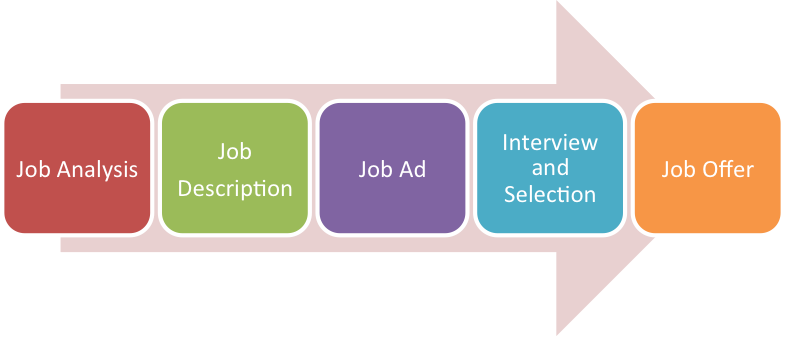
<div class="part " id="part-part-two-employee-recruitment-and-selection"><div class="part-title-wrap"><h3 class="part-number">II</h3><h1 class="part-title">Employee Recruitment and Selection</h1></div><div class="textbox textbox--learning-objectives"><div class="textbox__header"><p class="textbox__title">Learning Objectives</p> </div> <div class="textbox__content"><ul><li>Describe the employee recruitment process</li> <li>Write job descriptions</li> <li>Describe internal and external recruitment methods</li> <li>Describe how to prepare for and conduct an interview</li> <li>Evaluate and select candidates</li> <li>Know and apply the human rights legislation</li> </ul> </div> </div> <div class="wp-caption aligncenter" id="attachment_33" aria-describedby="caption-attachment-33" style="width: 785px"><a href="https://opentextbc.ca/humanresourcesinfoodservices/wp-content/uploads/sites/116/2015/06/stages-of-recuritment.png" data-url="https://opentextbc.ca/humanresourcesinfoodservices/wp-content/uploads/sites/116/2015/06/stages-of-recuritment.png"><img src="https://opentextbc.ca/humanresourcesinfoodservices/wp-content/uploads/sites/116/2015/06/stages-of-recuritment.png" alt="Job Analysis, Job Description, Job Ad, Interview and Selection, Job Offer." class="size-full wp-image-33" width="785" height="337" srcset="https://opentextbc.ca/humanresourcesinfoodservices/wp-content/uploads/sites/116/2015/06/stages-of-recuritment.png 785w, https://opentextbc.ca/humanresourcesinfoodservices/wp-content/uploads/sites/116/2015/06/stages-of-recuritment-300x129.png 300w, https://opentextbc.ca/humanresourcesinfoodservices/wp-content/uploads/sites/116/2015/06/stages-of-recuritment-65x28.png 65w, https://opentextbc.ca/humanresourcesinfoodservices/wp-content/uploads/sites/116/2015/06/stages-of-recuritment-225x97.png 225w, https://opentextbc.ca/humanresourcesinfoodservices/wp-content/uploads/sites/116/2015/06/stages-of-recuritment-350x150.png 350w" title="" /></a><div class="wp-caption-text" id="caption-attachment-33">Figure 1. The typical stages of employee recruitment and selection.</div></div><div class="ugc part-ugc"></div></div>
<div class="chapter standard" id="chapter-job-analysis-a-crucial-first-step" title="Job Analysis: A Crucial First Step"><div class="chapter-title-wrap"><h3 class="chapter-number">3</h3><h2 class="chapter-title">Job Analysis: A Crucial First Step</h2></div><div class="ugc chapter-ugc"> <p>The job analysis is a crucial first step. It’s the foundation of the recruitment and selection process.</p> <p>Job analysis is the process of collecting information about the specifics of each job in the organization. A job analysis answers the question “What does the job involve?” It is a list of behaviours and skills required to do the job.</p> <p>But how do you really know what the job involves? There are many ways to gather this job information depending on the size and scope of your operation. Methods can include:</p> <ul><li>Surveys completed by current employees</li> <li>Managers interviewing employees who are currently doing the job</li> <li>General observation</li> </ul> <p>It is important that all key stakeholders participate in the job analysis process to ensure the information is accurate and for employee buy-in. No one knows the job better than the person who does it, and both manager and employee perspectives are important so that the analysis captures all relevant duties and responsibilities in a non-biased way.</p> <p>Once the job analysis is complete, you will have a sound base of information to move on to the next step of developing a meaningful job description that will be consistent with everyone’s understanding of the position.</p> </div></div>
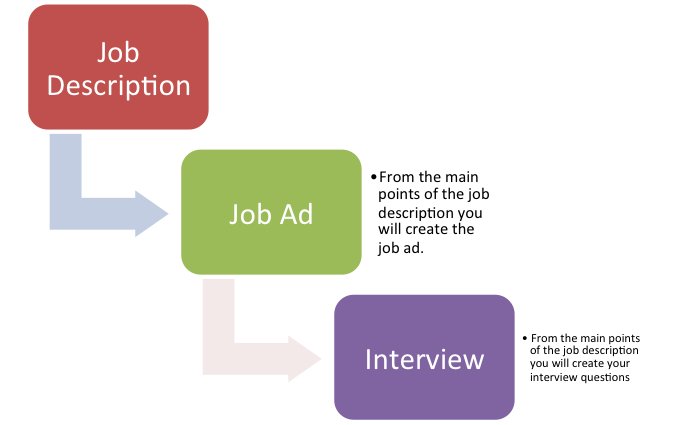
<div class="chapter standard" id="chapter-job-description" title="Job Description"><div class="chapter-title-wrap"><h3 class="chapter-number">4</h3><h2 class="chapter-title">Job Description</h2></div><div class="ugc chapter-ugc"> <div class="wp-caption aligncenter" id="attachment_38" aria-describedby="caption-attachment-38" style="width: 678px"><a href="https://opentextbc.ca/humanresourcesinfoodservices/wp-content/uploads/sites/116/2015/06/job-description.png" data-url="https://opentextbc.ca/humanresourcesinfoodservices/wp-content/uploads/sites/116/2015/06/job-description.png"><img src="https://opentextbc.ca/humanresourcesinfoodservices/wp-content/uploads/sites/116/2015/06/job-description.png" alt="Use main points from job description to create job ad. Use mainpoints from job ad to create interview questions" class="wp-image-38 size-full" width="678" height="425" srcset="https://opentextbc.ca/humanresourcesinfoodservices/wp-content/uploads/sites/116/2015/06/job-description.png 678w, https://opentextbc.ca/humanresourcesinfoodservices/wp-content/uploads/sites/116/2015/06/job-description-300x188.png 300w, https://opentextbc.ca/humanresourcesinfoodservices/wp-content/uploads/sites/116/2015/06/job-description-65x41.png 65w, https://opentextbc.ca/humanresourcesinfoodservices/wp-content/uploads/sites/116/2015/06/job-description-225x141.png 225w, https://opentextbc.ca/humanresourcesinfoodservices/wp-content/uploads/sites/116/2015/06/job-description-350x219.png 350w" title="" /></a><div class="wp-caption-text" id="caption-attachment-38">Figure 2. Using a job description to create both the job ad and interview questions.</div></div> <p>A great <strong><span class="glossary-term">job description</span></strong> is your road map to successful hiring, training, and evaluation. A job description summarizes the duties, responsibilities, and qualifications required for the position. A clear job will not only make every step of the hiring process easier, it will also make other human resources functions easier and more streamlined. (See Appendix 1 for an example of a job description.)</p> <p>Here are some guidelines for creating an effective job description.</p> <ol><li><strong>Identify the main duties and responsibilities of the position.</strong> <ul><li>Summarize the most critical or important functions.</li> <li>List the daily, weekly, monthly, and annual tasks or responsibilities of the position. Use descriptive verbs to identify the skills required (e.g., <em>manage</em> serving staff, <em>resolve</em> customer complaints, <em>coordinate</em> shift schedules, <em>complete</em> food orders).</li> </ul> </li> <li>&nbsp;<strong>Be specific about the qualifications, skills, and experience required.</strong> <ul><li>Consider requirements for education, work experience, technical skills, and “soft” skills (i.e., interpersonal skills, attitude) that an employee must have to succeed in the position.</li> <li>Identify the specific skills that you require (e.g., ability to solve problems with staff and guests tactfully and efficiently).</li> <li>Specify to what degree the candidate needs to possess the skills you require (e.g., for keyboarding skills, specify the speed and accuracy expected).</li> <li>Include the level of education and training needed to meet the requirements of the job.</li> <li>Be sure to include any specific training prerequisites (e.g., Red Seal, WorldHost, FOODSAFE, Serving It Right certificates), as well the number of years of experience in a similar position (e.g., minimum two years’ experience working in a high-volume restaurant).</li> <li>Determine which skills are essential for the position and which are an asset but not absolutely necessary.</li> <li>Be clear to what degree you are willing to train successful candidates once they are hired (such as offering an apprenticeship).</li> <li>Be realistic. Asking for too much may prevent suitable applicants from applying; asking for too little may attract too many underqualified applicants.</li> <li>Identify to which position this position reports.</li> <li>List which positions report to this position. In both these cases, the people in the positions may change but the reporting structure would not necessarily change.</li> </ul> </li> <li><strong>Date the document.</strong> <ul><li>Job descriptions are not static documents. As positions within the organization and the needs of the organization change, so do the job requirements. Therefore the job description needs to reflect these changes, and knowing the date the job description was last reviewed is very helpful.</li> </ul> </li> </ol> <p>In short, be&nbsp;sure to include the following components when creating a job description:</p> <ul><li>Job title</li> <li>Main duties and responsibilities</li> <li>Skills, qualifications, and experience required</li> <li>Equipment and tools required</li> <li>Training requirements</li> <li>Working conditions (e.g., any travel requirements, heavy lifting expectations, hours of work, whether inside or outside work)</li> <li>Reporting structure</li> <li>Date</li> </ul> </div></div>
<div class="chapter standard" id="chapter-hiring-the-right-person-for-the-job" title="Hiring the Right Person for the Job"><div class="chapter-title-wrap"><h3 class="chapter-number">5</h3><h2 class="chapter-title">Hiring the Right Person for the Job</h2></div><div class="ugc chapter-ugc"> <p>Hiring the wrong person can be frustrating and ultimately very costly for the company. Instead, you want to attract employees who respect and will uphold your business values. This simple principle is essential to your business success.</p> <p>Remember that values are the principles, beliefs, and standards of excellence that guide how you run your business and how you interact with your employees, suppliers, and customers. Reviewing your business values and mission along with the job description before you post the position will help to attract the right employee, and will allow you to clearly identify your expectations to new employees. This hiring approach is often referred to as “hiring for the right fit” or “hiring for attitude.” Keep in mind that the hiring process has to be a win-win situation. You want the right person for the job and the future employee wants to work for the right organization that supports and is in line with his or her own values.</p> <h1>When to start the hiring process</h1> <p>To prepare a hiring timeline, work backwards from when you need a position filled. Doing this will help you determine when you need to start recruitment activities. In your calculation, it is important to factor in orientation and training time (e.g., does the new employee need to start training by June 1, or should the person be ready and trained as a sous-chef by this date?). Note that training periods can vary greatly depending on the complexity of the job and the experience of the employee.</p> <p>Keep in mind that you may need to allow time to re-advertise if you do not find a suitable candidate right away. Other factors that can affect the hiring timeline are your location (are you in a favourable geographic area?) and the number of qualified candidates available with the expertise you are looking for (is the job market particularly competitive?).</p> <h1>Planning for the job ad/posting</h1> <p>Before you post the job opening, ask yourself these five questions</p> <ol><li><strong>From what demographic or geographic pool am I trying to draw? </strong>For example, are you identifying as possible recruits local residents, youth, career changers, Aboriginal people, seniors, new immigrants, foreign workers?</li> <li><strong>How do I reach my ideal candidates?</strong> Where do your ideal candidates spend their time (e.g., school, sporting events, religious groups, industry networking events, career fairs)? What do your ideal candidates regularly read and in what format (e.g., local, community or regional newspapers, trade journals, online job boards, social media sites)?</li> <li><strong>Is there anyone within our organization who may know of someone, either personally or professionally, who would be suitable for the position? </strong>For example, does your sous-chef know another chef who is looking for a job?</li> <li><strong>What benefits will an employee receive besides wages? </strong>For example, do you offer flexible hours, seasonal work, a fun environment, a chance to give back to the community, an opportunity to work outdoors?</li> <li><strong>Do I have an existing employee who would be interested and qualified for this position or could be trained for the job? </strong>For example, is one of your line cooks ready to be trained as a sous-chef?</li> </ol> <h1>Where to find your ideal recruit</h1> <p>You have a variety of options available to help you locate potential job candidates, both internally and externally. Some of these options are free while others require a financial investment, and each has different advantages and disadvantages that you will want to consider.</p> <p>Identifying potential employees internally (including through word of mouth, friends, and family) can offer many benefits, including being typically the cheapest method of recruitment. Additionally, internal recruitment can help with team morale as they see the possibility of promotion from within. This can be a huge motiving factor for many employees. Internal recruiting can also provide consistency as the applicants know the organization, systems, values, etc.</p> <p>However, internal recruiting may lead to having a stagnant workforce. Hiring from within may not provide the fresh approach you are looking for. Also, sometimes the right person for the job is just not available internally. Existing employees may not have the right mix of education, skills, or experience.</p> <p>External recruiting through newspapers, appropriate Internet sites, radio, schools, and professional organizations can be effective, but can also yield a huge number of applications to sift through, both good and bad, which is very time consuming. Additionally, external recruiting can be expensive; job ads in prominent places such as online job boards and newspapers can cost hundreds or even thousands of dollars.</p> <p>You will want to choose the recruitment tools that will bring you the greatest return on your investment and are most appropriate to targeting your profile recruits. Here are some tips for various recruitment options:</p> <ul><li><strong>Word of mouth:</strong> Ask for referrals from high-performing employees, business contacts, service providers, friends, and family.</li> <li><strong>Internet:</strong> The Internet offers several options for finding employees. These include posting job openings on your company’s own website or on job search sites; looking for job seekers on resumé-posting sites; including information on available job openings as part of company blogs and on other social media sites (e.g., LinkedIn, Twitter, Facebook); and creating a virtual job fair. A key advantage of using the Internet to post job openings is the potential to reach a large job-seeking audience for little, if any, cost. However, be sure you have both the capability to receive a potentially large volume of online applications, as well as the staff resources required to properly review these applications for suitable candidates.</li> <li><strong>Hospitality job search sites:</strong> A number of hospitality specific websites cover all aspects of the tourism industry, enabling employers to advertise positions in specific fields. Useful hospitality and tourism websites include <a href="http://www.go2hr.ca" data-url="http://www.go2hr.ca">go2HR</a>, <a href="http://www.hcareers.ca" data-url="http://www.hcareers.ca">Hcareers</a>, and <a href="http://www.workopolis.ca" data-url="http://www.workopolis.ca">Workopolis</a> (hospitality and tourism sections). The B.C. government has also recently invested a great deal into a provincial job board and other tools such as an apprentice job match at its <a href="http://www.workbc.ca" data-url="http://www.workbc.ca">WorkBC website</a>.</li> <li><strong>Professional associations and special interest groups:</strong> Trade associations and other industry organizations are a helpful source for finding qualified and motivated talent. Examples include: <ul><li>Hospitality industry associations such as the <a href="http://www.bchotelassociation.com/" data-url="http://www.bchotelassociation.com/">BC Hotel Association</a> and the <a href="https://www.travel-british-columbia.com/about/" data-url="https://www.travel-british-columbia.com/about/">BC Lodging and Campgrounds Association</a>,</li> <li>Professional trade organizations such as the <a href="http://www.bcchefs.com/" data-url="http://www.bcchefs.com/">BC Chefs’ Association</a>, the <a href="http://www.bchrma.org/" data-url="http://www.bchrma.org/">BC Human Resources Management Association</a>, and the <a href="http://www.cga-bc.org/" data-url="http://www.cga-bc.org/">Certified General Accountants Association of British Columbia</a>,</li> <li>Immigrant organizations such as the <a href="http://www.amssa.org/" data-url="http://www.amssa.org/">Affiliation of Multicultural Societies and Services Agencies of BC</a>,</li> <li>Seniors’ organizations such as <a href="http://www.carp.ca/" data-url="http://www.carp.ca/">CARP</a>, Canada’s association for people 50 and older,</li> <li>Aboriginal associations such as the <a href="http://www.bcaafc.com/" data-url="http://www.bcaafc.com/">British Columbia Association of Aboriginal Friendship Centres</a>, and</li> <li>Disabled persons’ associations such as <a href="http://www.workablesolutionsbc.ca/" data-url="http://www.workablesolutionsbc.ca/">WorkAble Solutions</a>.</li> </ul> </li> </ul> <ul><li><strong>Schools:</strong> High schools, colleges, universities, and trade schools are all potential sources of employees, and many provide job-posting services for their students. Students tend to be highly motivated and eager to learn. Many schools also organize co-ops, practicums, or work experience placements for students, which are an excellent source of temporary or seasonal employees.</li> <li><strong>Newspaper and other print advertising:</strong> Newspaper advertising remains a good way of raising awareness of all levels and types of job openings, and most will have online sections to complement those in print. Typically, the more senior the position, the further afield you should consider posting a newspaper ad. A disadvantage of newspaper advertising is that you may receive applications from many unqualified candidates, and these will take time to review. If you do select newspaper advertising as a source for potential candidates, remember to think carefully about who will be reading the publication (i.e., a more senior position may be better advertised in a large business-oriented publication or in the business section, whereas an entry-level position may attract more suitable candidates when advertised in a local daily publication). Advertising in industry-sector member publications and newsletters is also a great way to reach your target audience.</li> <li><strong>Recruitment agencies and search firms:</strong> These agencies can handle all aspects of recruitment, up to and including negotiating an employment offer, and they are particularly useful for finding short-term employees, senior level hires, or people for positions where qualified candidates are difficult to find. <strong>Note:</strong> Be sure to carefully review all contract details and requirements before signing with a recruitment agency.</li> <li><strong>Job fairs and open houses:</strong> If you have, or anticipate having, a number of job openings, you may want to consider attending job fairs and hosting open houses as a way to introduce your company to potential candidates and raise awareness of available openings. Check with your local college or university to see when their job fairs are held and what is required to participate as an <strong><span class="glossary-term">employer</span></strong>. Whether you participate in a job fair, or host an open house at your business, be prepared to have the appropriate resources available to talk to future candidates and screen resumés.</li> </ul> <p>The labour market will continue to change quickly so it is important to be creative and keep an open mind on new and alternative methods to drawing in top performers. Stay open to the possibilities of changing the way you choose to recruit as well as changes to your internal policies with regards to perks and benefits that go along with the job. Stay current on what others are doing within the industry and be competitive; why would someone choose to work for you over the restaurant next door?</p> </div></div>
<div class="chapter standard" id="chapter-preparing-the-job-advertisement" title="Preparing the Job Advertisement"><div class="chapter-title-wrap"><h3 class="chapter-number">6</h3><h2 class="chapter-title">Preparing the Job Advertisement</h2></div><div class="ugc chapter-ugc"> <p>Your job advertisement should reflect your company values and effectively communicate the various duties and responsibilities of the available position. For example, if your organization is free-spirited and encourages employees to show personal style, then depict that in your advertisement. Ultimately, the hiring process should be a “win-win” situation for both employer and employee.</p> <p>You want individuals who want to come and work for you, so be sure to provide all the information in your advertisement that potential clients need. This includes:</p> <ul><li>Qualifications required (professional qualifications/experience/skills and personal traits)</li> <li>How to apply (email, in person)</li> <li>Deadline for applications</li> <li>Company information and why a candidate would want to work for the company</li> </ul> <p>See <a href="#back-matter-appendix-2-sample-job-advertisement" data-url="/humanresourcesinfoodservices/back-matter/appendix-2-sample-job-advertisement/">Appendix 2 for a sample job advertisement.</a></p> </div></div>
<div class="chapter standard" id="chapter-selecting-the-best-person-for-the-job" title="Selecting the Best Person for the Job"><div class="chapter-title-wrap"><h3 class="chapter-number">7</h3><h2 class="chapter-title">Selecting the Best Person for the Job</h2></div><div class="ugc chapter-ugc"> <p>During a busy working season, it is easy to hire less-than-ideal candidates. But if you do that, often the result is creating more work for everyone in the long run. Making a hiring decision is one of the most important decisions that a <strong><span class="glossary-term">manager</span></strong> or business owner can make. In this section we consider the first step: how to screen resumés. The following sections discuss preparing for and conducting interviews, checking references, and making the employment offer</p> <h1>Effective resumé screening</h1> <p>The goal of screening resumés is to select the most qualified applicants to interview so that you do not waste your time interviewing people who are not suitable for the available positions. Until you reach the interview process and are able to talk with the candidates face-to-face, the resumé is generally your only source of information about the candidate’s abilities, knowledge, and skills, unless someone you know has recommended the person, or you have had prior experience in working with them.</p> <p>To help you screen resumés efficiently and select the most qualified candidates to interview, use the following step-by-step procedure:</p> <h2>1. Make a checklist and compare resumés</h2> <p style="padding-left: 30px;">Create a checklist of the “must-have” and the “nice-to-have” skills, qualifications, and experience from the job description for the available position. Read through each resumé to determine if any applicants possess all of the must-have skills. If there are none, you may need to consider continuing with your recruitment efforts. Eliminate those resumés that do not meet your minimum requirements. Be wary of changing the must-have list to accommodate the experience and background of the applicants. It is important to maintain the integrity of the position you are trying to fill; hiring a less-than-qualified applicant will likely result in a short-term placement.</p> <h2>2. Categorize each applicant</h2> <p style="padding-left: 30px;">Based on your initial review of the resumés, separate them into “yes,” “maybe,” and “no” piles:</p> <ul><li>Yes: Applicants have all must-have skills and most nice-to-have skills.</li> <li>Maybe: Applicants have all must-have skills and a few nice-to-have skills.</li> <li>No: Applicants lack must-have skills and maybe also lack the nice-to-have skills.</li> </ul> <p style="padding-left: 30px;">As you categorize the applicants, flag those resumés that show:</p> <ul><li>Frequent changes in employers and short periods of time with a company</li> <li>Large gaps in employment</li> <li>Jumps between lateral level positions (versus changing jobs for career progression)</li> <li>No dates assigned to previous jobs listed on resumé</li> <li>Spelling and grammatical errors</li> <li>Vague descriptions of duties and responsibilities</li> <li>Seemingly over-inflated role descriptions.</li> </ul> <p style="padding-left: 30px;">These factors are not necessarily reasons to rule out a candidate, but you should address them during an interview if a candidate makes it that far in the process.</p> <h2>3. Select candidates for interviews</h2> <p style="padding-left: 30px;">Select applicants to be interviewed from the “yes” pile first. If, following the interviews, you do not find the right candidate, you can then move to the “maybe” pile. If you still do not find the right candidate, you will need to re-advertise your position to attract more qualified candidates.</p> <h2>4. Communicate with applicants</h2> <p style="padding-left: 30px;">Depending on the volume of applications and company preferences, you may decide to communicate with all applicants or only those you invite to an interview. When applications are limited you may find yourself in a position of wanting to keep some potential candidates “warm.” This means that you do not indicate to the “maybe” candidates right way that they have not been selected for an interview. In the meantime you conduct interviews with the best possible candidates. This way if your preferred candidates do not work out as planned, you can still go to your “maybe” pile without candidates feeling they’re a second choice.</p> <p style="padding-left: 30px;">When the time is right, contact the applicants to let them know where you are in your hiring process and when they can expect a decision. This is a good way to position your company in a professional manner and to reduce the number of calls or emails you need to respond to from candidates who are eager to follow up. You can contact applicants by sending a simple email thanking them for their applications and what to expect next (e.g., only applicants selected for interviews will be contacted following the closing date).</p> </div></div>
<div class="chapter standard" id="chapter-conducting-the-interview" title="Conducting the Interview"><div class="chapter-title-wrap"><h3 class="chapter-number">8</h3><h2 class="chapter-title">Conducting the Interview</h2></div><div class="ugc chapter-ugc"> <p>Interviews may be conducted by telephone or in person. Telephone interviews are often used as a first step to assess whether a candidate may be suitable for a further face-to-face meeting. They are also useful when a candidate lives too far away for a face-to-face meeting because of cost and time restraints. In this case, interviewing by Skype (or similar software) can bridge the gap between having a telephone interview and an in-person interview.</p> <p>However, whenever possible, telephone interviews should not take the place of personal interviews. Some personality traits and behaviours may be more evident in person, and the more time you spend with a potential candidate in person, the better your hiring decision will be. In-person interviews are sometimes held in conjunction with a performance-based interview (see below for more information on performance-based interviews).</p> <h1>Telephone interviews</h1> <p>If you choose to conduct a telephone interview consider the following tips:</p> <ul><li>Contact the candidate either by email or telephone to arrange a mutually convenient time to conduct the interview. Let the candidate know the estimated length of the interview and confirm the best number to call. This courtesy allows the candidate time to research the position and operation and arrange the time for the interview adequately. During the interview, you can then assess whether the candidate is adequately prepared.</li> <li>Call the applicant at the confirmed time and introduce yourself. As an interview is is a highly confidential process, be sure to confirm that he or she is available and feels comfortable to talk at this time. Once you and the candidate have agreed that the interview can continue, ask whether he or she is still interested in being considered for the position.</li> <li>Let the candidate know who else is in the room with you, especially if you are putting the call on speaker phone.</li> <li>Listen carefully for tone of voice, energy, and enthusiasm in the candidate’s answers.</li> <li>Ask qualifying questions to determine whether the candidate possesses the basic skills and experience necessary. Try to determine the person’s attitude, work ethic, professionalism, and telephone manner. Pick two to three key questions to ask all candidates, such as: <ul><li>What interested and motivated you to apply for this position?</li> <li>Can you tell me what you know about this company and what we do?</li> <li>What is your most memorable customer service experience?</li> </ul> </li> <li>Avoid questions that allow yes/no answers. Using <strong><span class="glossary-term">open-ended questions</span></strong> (questions that require more than just a yes or no or single word answer) will provide you with the information you will need to determine if you would like to move to the next step with the candidate. Starting questions with the word “what” will help you ask open-ended questions.</li> <li>Whenever possible, consider offering face-to-face interviews to all candidates who do well in a telephone interview.</li> </ul> <h1>Face-to-face interviews</h1> <p>Face-to-face interviews are an invaluable tool to determine if a candidate is a suitable fit for an organization and the best opportunity to ensure that the person’s&nbsp;characteristics, values, and experiences fit with your needs and overall corporate culture. Face-to-face interaction gives the interviewer the opportunity to properly communicate, read the applicant’s body language, and understand if the applicant uses professional mannerisms, seems sincere, and makes eye contact.</p> <h1>The interview process</h1> <p>Before you invite any candidate to an interview it is important to have a plan. You want to have developed your interview questions prior to the interview, and the questions should come from the job description you previously completed.</p> <p>It is important to ask the same questions of each candidate, although some side questions may arise during conversation. Asking the same questions of each candidate will help you fairly compare candidates.</p> <p>Spend time thinking about what you want to ask in an interview, and what answers you expect back. It may be helpful to make a list of some responses you are looking for to match with the responses of the candidates. Also, it is helpful if you determine the criteria for which responses exceed, meet, partially meet, or do not meet what you are looking for with the answers. It is helpful to create a template of the questions with some responses you are looking for and a space to indicate if the response meets those criteria. (An interview question template, including sample questions, is supplied in Appendix 3.)</p> <p>Finally, consider what type of attitude and personality will fit with your team. For example, do you need someone with a new perspective to come in and shake things up in a positive way?</p> <p>You may want to involve others within your organization in the interview and selection process. Having other managers and/or colleagues spend time with potential employees can complement your assessment and help further determine the qualifications and fit of individuals you are considering. Everyone’s perspective will be different, and a collective and collaborative approach to interviewing and selecting candidates can help assess suitability to both the job and the overall operation.</p> <p>Once you have your plan, you need to prepare for the process of the interview:</p> <ul><li>Introduction</li> <li>Questions</li> <li>Wrap-up</li> </ul> <h2>1. Introduction</h2> <p style="padding-left: 30px;">To begin the interview, introduce yourself and any others who may be present and involved in the process. State your role(s) and make the applicant feel at ease. Let the applicant know how long you expect the interview to take and what to expect. For example, you might explain that there will be about 30 minutes of question followed by a short facility tour. Giving the applicant this kind or orientation to the interview will help make them more comfortable.</p> <p style="padding-left: 30px;">During the interview, let the candidate do the majority of the talking. The 80/20 rule is a good rule of thumb to follow (i.e., the candidate talks 80 percent of the time, and you ask questions, or answer the candidate’s questions, 20 percent of the time).</p> <p style="padding-left: 30px;">Tell the candidate about your company, your philosophies, the products, and the services offered. You can do this either at the start of the interview, or at the end. Some interviewers wait to describe these details of the position and organization until after they have asked all of the main interview questions to lessen the tendency of leading the candidate to the answers you may be seeking. For example, if you tell a candidate at the start of the interview that you are looking for someone who is very energetic, forward thinking, and embraces change, that may influence the person’s answers to your questions. However, you may reduce the risk of guiding the applicant’s responses by asking a behavioural descriptive question (see below).</p> <h2>2. Questions</h2> <p style="padding-left: 30px;">The most effective type of interview question is one that encourages candidates to describe what they have actually done in the past, as opposed to focusing on hypothetical “what would you do if…” questions that are speculative at best, or closed questions requiring a simple yes/no answer.</p> <p style="padding-left: 30px;">A question asking how a candidate has done something in the past is a <strong><span class="glossary-term">behavioural descriptive question</span></strong>. The principle behind this type of question is that the best indicator of a person’s future behaviour is his or her past behaviour. Additionally, behavioural descriptive questions give better insight into how well the candidate understands the situation and topic, as well as his or her knowledge base and learning abilities. You can formulate behavioural descriptive questions simply by asking about past behaviour instead of about hypothetical future behaviour. The following examples illustrate the difference between the two forms of questioning.</p> <ul><li><strong>Behavioural descriptive question</strong>: “Can you describe a situation where you dealt with a really angry customer who was waiting too long for food? Describe how you handled the situation, specifically what you did and said, and what the final outcome was.” (You might also ask, “What did your learn from this situation?”)</li> <li><strong>Situational question</strong>: “How would you deal with a really angry customer who was waiting too long for food?”</li> </ul> <p style="padding-left: 30px;">The two questions are very similar, but can lead to very different answers. The first asks about a real situation and allows the candidate to explain something he or she actually did in the past, whereas the second question is situational and could be answered with any number of responses, depending on what the applicant thinks the interviewer wants to hear.</p> <p style="padding-left: 30px;">Not all questions need to be the behavioural descriptive type. Some issues do not lend themselves to this type of question, such as confirming education and experience qualifications. But keep in mind that the best indicator of a person’s future behaviour is their past behaviour.</p> <p style="padding-left: 30px;">Also remember that some of the questions may be difficult to answer, or if you ask about a situation in the past, it may take time for the candidate to recall a specific incidence. Let the candidate know that it is all right to take time to think of the answers before answering. This will make the person feel more comfortable if there is a moment of silence while he or she thinks. As an interviewer, do not be tempted to “help” candidates with answer or interrupt them.</p> <h2>3. Wrap-up</h2> <p style="padding-left: 30px;">The best time to tell the candidate more about the job and what you are looking for is after asking all your predetermined questions. Lastly, but importantly, the candidate should be given the opportunity to ask questions. Encourage each candidate to ask any questions they may have about the specifics of the job and the company.</p> <p style="padding-left: 30px;">If a candidate has no questions, be sure to tell the person when you expect to make a decision. For example, if you have a week of interviews and then need approval from someone who is on vacation, say so. Nothing is worse for the candidate than waiting days for a phone call and not knowing when to expect it.</p> <p style="padding-left: 30px;">The interview is also a time when you can promote your company, encouraging candidates on the benefits of working there. But remember to stay professional; the interview provides a lasting impression of what the company is all about and will serve as a starting base for the impressions of your new hire. It can be helpful to consider that the candidate might be interviewing <em>you</em>, to determine if he or she wants to work for you, as much as you are interviewing the candidate.</p> <p style="padding-left: 30px;">Finally, always remember to thank all candidates for their time. Put yourself in a&nbsp;candidate’s shoes; interviews can be stressful and demanding.</p> <h1>Consider adding a performance-based part to the interview</h1> <p>Depending on the position available, it may be useful to ask the applicant to demonstrate his or her skills, knowledge, and attitude according to the comprehensive job description. Combining this performance-based interview with appropriate face-to-face questions greatly increases the chances of putting the right person in the right job.</p> <p>For example, you might ask candidates for a cook position to demonstrate knife skills or to create a dish given some parameters. Or you might ask a server to demonstrate opening a bottle of wine table-side. Adding a performance-based component to an interview requires more time and effort to design, but it can pay off in the long run. If you are going to include a performance-based part to the interview, make sure to tell candidates ahead of time so they come well prepared.</p> <h1>Tips for effective interviewing</h1> <ul><li><strong>Listen to your intuition, but do not settle on your first impression: </strong>Try to avoid basing your decision on a first impression without giving the candidate ample time to answer the questions. Another trap to avoid is having such a specific response in mind that it prevents you from considering a different response. As an interviewer, you must remain objective throughout the meeting, and even if the candidate makes a statement you disagree with, do not interrupt, dispute, or express judgment. Keep an open mind during the interview. Listen to your intuition, but ensure it is supported by what you have heard and seen during the interview. Avoid making a hiring decision simply based on “having a good feeling” about or liking a candidate.</li> <li><strong>Be consistent: </strong>Use a consistent list of questions for all candidates to ensure you can make a fair comparison after the interviews are completed. Of course, you can still naturally follow a particular line of question based on the answers individual candidates provide to specific questions, but be sure to cover all the same basic lines of enquiry with each candidate. Take notes for every candidate so that you remember who said what during each interview. (It may help to have a designated note taker so you can concentrate on the candidate, or consider having several people on the interview panel who take turns with note taking.) As part of each interview, strive to identify candidates’ strengths and weaknesses as well as their plans and career aspirations.</li> <li><strong>Practise active listening: </strong>Observe the 80/20 rule: the candidate talks 80 percent of the time. and you ask questions or answer the candidate’s questions the other 20 percent of the time. Give the candidate an opportunity to ask you questions about your company and business philosophies. The questions the candidate poses will give you insight into the person. When you are listening, be aware of how the candidate is responding. What is the tone of voice? What facial expressions and gestures is the candidate showing? Does the candidate sound excited about the experience and the opportunity to work in your organization, or does he or she seem to be just going through the motions of a job interview? Listen carefully to the words as well and ask for clarification of any points you don’t understand. The best way to get the best employee is to find out as much as you can about each candidate.</li> <li><strong>Evaluate the interview after it is over: </strong>After each interview, evaluate each candidate based on his or her answers to your interview questions. For each question you asked, determine whether the response exceeded, met, partially met, or did not meet your criteria. Based on this rating, you can evaluate and compare the candidates more objectively. In addition to a candidate’s skills and experience, evaluate how well the individual would fit into the organization’s environment and culture. It is important that you are aware of what you are looking for in a candidate. Talk with others within your organization, such as the person who greets the candidates upon arrival, to get a sense of the candidate’s&nbsp;personality when not being formally interviewed. You can learn a lot about applicants by asking how they interacted with a front-line employee like the person at the reception area.</li> </ul> <p>Always follow-up with each candidate interviewed, regardless of your final decision. This simple step will help leave a more positive lasting impression with the candidate and may prove beneficial in the event another employment opportunity arises in the future for which you may wish to consider a previously unsuccessful candidate.</p> </div></div>
<div class="chapter standard" id="chapter-checking-references" title="Checking References"><div class="chapter-title-wrap"><h3 class="chapter-number">9</h3><h2 class="chapter-title">Checking References</h2></div><div class="ugc chapter-ugc"> <p>Unfortunately, not everyone is totally honest, so doing reference checks is an integral part of the selection process. References should be professional or educational, not personal.</p> <p>You may wish to consider conducting reference checks before interviewing candidates, particularly if there are any red flags on the resumé, as discussed above. This can save a lot of time if references don’t check out. Several hours and considerable expense can be incurred in interviews, travel, etc. only to find afterward that someone’s employment track record is poor.</p> <p>When conducting a reference check, ask about:</p> <ul><li>The applicant’s past performance on the job</li> <li>Position(s) held</li> <li>Duties and responsibilities completed successfully (and how these align with your detailed job description)</li> <li>Dates of previous employment</li> <li>Why the applicant left the job</li> <li>Whether the applicant would be rehired</li> </ul> <p>When conducting the reference, remember that you are representing your company. Act professionally and respect the time of the person you are talking to. Whenever possible speak to the candidate’s direct supervisor as that person will know the most about the candidate’s day-to-day work habits and skills.</p> <p>Be sure to document all information supplied by the applicant’s references. It, along with the interviewers’ feedback and impressions, will be important in making the hiring decision. Ensure all feedback is kept confidential; do not share it with others.</p> <p>One of the shortcomings of the reference check is that it can put the previous employer in a difficult position. If he or she tells you the applicant was unreliable, moody, and difficult to get along with, and if the applicant finds out about these comments, the previous employer could be in a vulnerable legal position. For this reason some organizations refuse to give references and will only confirm dates of employment and position held, a policy that can make selection more difficult because you are denied information about previous behaviour.</p> <p>Sometimes you may have to settle for the last question: “Would you hire the applicant again?” A simple “yes” or “no” speaks volumes. Sometimes you may have to read between the lines by listening to vague answers, tone of voice, hesitation, or silence.</p> <p>Since some companies give only an applicant’s job title and the period the person was employed, it’s important to request references from every employer the person has had. Chances are you will find some previous employer who will provide useful information. When assessing candidate resumés, check for former employers that the applicant does not have a reference for; employment and reference gaps are worthy of follow-up. See Appendix 4 for a template that you may wish to use when checking references.</p> </div></div>
<div class="chapter standard" id="chapter-making-an-offer-of-employment" title="Making an Offer of Employment"><div class="chapter-title-wrap"><h3 class="chapter-number">10</h3><h2 class="chapter-title">Making an Offer of Employment</h2></div><div class="ugc chapter-ugc"> <p>After selecting the best candidate, you need to make a job offer. Remember, you are not obliged to hire any of the applicants if you are not satisfied with them. A verbal job offer must be followed by a formal written offer of employment; this ensures that you and the candidate are fully aware of the terms and conditions of employment.</p> <p>When making a verbal offer, ensure you:</p> <ul><li>Congratulate the person on being the successful candidate.</li> <li>Enthusiastically welcome the candidate to your team.</li> <li>Re-state the position for which the candidate is being hired.</li> <li>Inform the candidate of the starting wage you agreed upon, as well as hours/days of work, benefits, vacation time, and any other relevant information</li> <li>Confirm the start date and time.</li> <li>Inform the candidate of any training programs he or she will be attending on the first day, including length and expectations.</li> <li>Inform the candidate of dress code standards.</li> <li>Inform the candidate that this information will be put into a formal letter for signing.</li> </ul> <p>Once you have made the verbal offer, provide the candidate with a reasonable time frame to consider the decision and the opportunity to clarify any of the terms of the offer. Be prepared to reconsider your terms and conditions if the candidate asks to negotiate something. Once these details are agreed upon, make sure they are clear in the written offer you provide. The written letter should ask for the candidate’s signature and contain a company representative’s signature. After both of you have signed the letter, give the employee the original and keep a copy in the employee’s file.</p> <p>Common components of an letter of offer include:</p> <ul><li>Position title (attach a copy of the job description)</li> <li>Basic duties and responsibilities</li> <li>Position status (part-time, full-time, seasonal, temporary full-time)</li> <li>Start date</li> <li>Performance review expectations</li> <li>Salary and overtime</li> <li>Work schedule</li> <li>Probationary period</li> <li>Benefits and insurance entitlement</li> <li>Vacation entitlement and statutory holidays</li> <li>Union contract (if applicable)</li> <li>Training programs</li> <li>Bonus plan information, if applicable, and eligibility requirements</li> <li>Notice period requirements for <strong><span class="glossary-term">termination of employment</span></strong> or resignation</li> <li>Reference to an employee handbook and/or any other included attachments/schedules</li> </ul> <p>Don’t forget to include the date the letter is written and the date it is valid until, who it needs to be returned to, in what format, and how. See Appendix 5 for a sample letter of offer.</p> <h1>Informing unsuccessful candidates</h1> <p>Once you have selected and informed the successful applicant, and both of you have signed the letter of offer, you must inform the unsuccessful applicants as quickly as possible so they hear the news from you and not on the street.</p> <p>The successful applicant is probably ecstatic and might want to tell the world how great your company is without any prompting from you. The unsuccessful people will naturally be disappointed and, unless you handle the situation correctly, they can become very poor ambassadors. Because there are usually many more unsuccessful applicants than successful ones, the potential for spreading bad news about your company is significant.</p> <p>When informing the unsuccessful applicants, take a forthright and understanding approach. The conversation should be short and to the point. Start by telling them that they were not the successful in their application. You might express the sentiment that they were really good, but the selected person was better qualified. This is true, of course, otherwise they would not have been on the shortlist. Wish the unsuccessful applicants well. For those candidates who stood out, consider asking if you can keep their resumé on file should a similar position become available it the future. Most importantly in every instance, treat the unsuccessful applicants with dignity, respect, and empathy.</p> </div></div>
<div class="chapter standard" id="chapter-complying-with-human-rights-laws" title="Complying with Human Rights Laws"><div class="chapter-title-wrap"><h3 class="chapter-number">11</h3><h2 class="chapter-title">Complying with Human Rights Laws</h2></div><div class="ugc chapter-ugc"> <p>In Canada, human rights are guaranteed under the federal Charter of Human Rights, as well as under provincial legislation, such as the <a href="http://www.bclaws.ca/Recon/document/ID/freeside/00_96210_01" data-url="http://www.bclaws.ca/Recon/document/ID/freeside/00_96210_01">British Columbia Human Rights Code</a>. The premise that forms the basis of these laws is that all people should be treated fairly, consistently, and in a dignified manner. In order to protect both your and your candidate’s rights in the hiring process, it is important to be familiar with the fundamental principles of human rights legislation and how it applies in the context of job interviews. You must also ensure that the questions you ask are not in any way as discriminatory.</p> <p>A component of human resources management is the practice of legal <strong><span class="glossary-term">discrimination</span></strong>. For example, you may decide to hire a person who has at least five years in marketing because the job requires that level of expertise. If two people apply for the job and only one has this qualification, you can legally discriminate. In other words, you have the right to offer the job to the best candidate.</p> <p>However, there are areas in which you must not discriminate. The most familiar ones are race, sex, age, religion, and place of origin. (When hiring be sure to review the legislation for your jurisdiction.) Specifically the BC Human Rights Code sets out the following list of protected grounds that you cannot ask about or discriminate against:</p> <ul><li>Race</li> <li>Colour</li> <li>Ancestry</li> <li>Religion</li> <li>Place of origin</li> <li>Age</li> <li>Sex</li> <li>Sexual orientation</li> <li>Marital status</li> <li>Family status</li> <li>Physical or mental disability</li> <li>Political belief</li> <li>Criminal or summary conviction offence that is unrelated to the employment or to the intended employment of that person</li> </ul> <p>Interview questions should avoid these protected grounds and focus strictly on determining the applicant’s ability to perform the essential duties of the available position.</p> <p>For more information on complying with human rights legislation, the following resources are available:</p> <ul><li>Websites <ul><li><a href="http://www.bchrt.bc.ca/" data-url="http://www.bchrt.bc.ca/">BC Human Rights Tribunal</a><a href="http://www.bchrt.bc.ca/" data-url="http://www.bchrt.bc.ca/"></a></li> <li><a href="http://www.chrc-ccdp.ca/eng" data-url="http://www.chrc-ccdp.ca/eng">Canadian Human Rights Commission</a></li> </ul> </li> </ul> <ul><li>Videos <ul><li><a href="https://www.youtube.com/watch?v=kziCfRPWRKY" data-url="https://www.youtube.com/watch?v=kziCfRPWRKY">Canadian Human Rights Act video</a><a href="https://www.youtube.com/watch?v=kziCfRPWRKY" data-url="https://www.youtube.com/watch?v=kziCfRPWRKY"></a></li> <li><a href="https://www.youtube.com/watch?v=gr8MMwoUqAs" data-url="https://www.youtube.com/watch?v=gr8MMwoUqAs">What Is Discrimination? video</a> <a href="https://www.youtube.com/watch?v=gr8MMwoUqAs" data-url="https://www.youtube.com/watch?v=gr8MMwoUqAs"></a></li> <li><a href="https://www.youtube.com/watch?v=qfSY6EhCQMs" data-url="https://www.youtube.com/watch?v=qfSY6EhCQMs">Duty to Accommodate video</a></li> <li><a href="https://www.youtube.com/watch?v=5Hgx_EfAr4U" data-url="https://www.youtube.com/watch?v=5Hgx_EfAr4U">Harassment video</a></li> </ul> </li> </ul> <ul><li>Fact sheets <ul><li><a href="http://www.ag.gov.bc.ca/human-rights-protection/pdfs/ProtectDiscrimination.pdf" data-url="http://www.ag.gov.bc.ca/human-rights-protection/pdfs/ProtectDiscrimination.pdf">Human Rights in British Columbia [PDF] </a></li> <li><a href="http://www.bchrt.gov.bc.ca/shareddocs/human-rights/HR1-Employment.pdf" data-url="http://www.bchrt.gov.bc.ca/shareddocs/human-rights/HR1-Employment.pdf">Human Rights in Employment [PDF]</a></li> </ul> </li> </ul> </div></div>
<div class="part " id="part-part-three-performance-management"><div class="part-title-wrap"><h3 class="part-number">III</h3><h1 class="part-title">Performance Management</h1></div><div class="textbox textbox--learning-objectives"><div class="textbox__header"><p class="textbox__title">Learning Objectives</p> </div> <div class="textbox__content"><ul><li>Describe the components of an orientation program</li> <li>Describe the components of a training program</li> <li>Describe employment development programs</li> <li>Identify the basics of an employee performance planning and review program</li> <li>Describe the role of discipline in performance management</li> <li>Describe termination procedures and legal issues</li> </ul> </div> </div> <p>&nbsp;</p><div class="ugc part-ugc"></div></div>
<div class="chapter standard" id="chapter-orientation" title="Orientation"><div class="chapter-title-wrap"><h3 class="chapter-number">12</h3><h2 class="chapter-title">Orientation</h2></div><div class="ugc chapter-ugc"> <p><strong><span class="glossary-term">Orientation</span></strong> is an event that is structured and organized to focus on all the information a new <strong><span class="glossary-term">employee</span></strong> needs to get started in a new job. Orientation is the best time to influence and shape perceptions and attitudes in new employees.</p> <p>According to the <a href="http://www.merriam-webster.com/word/word.php?date=Apr-26-2008" data-url="http://www.merriam-webster.com/word/word.php?date=Apr-26-2008">Merriam-Webster Dictionary</a>, the word <em>orient</em> means “to acquaint with an existing situation or environment” (Encyclopedia Britannica Company, n.d.). Therefore one of the main objectives of an orientation program is to integrate employees into their new work environment. The goals of orientation are to:</p> <ul><li>Familiarize new hires with your organization’s history, current undertakings, and future plans</li> <li>Inform them about relevant policies and procedures</li> <li>Outline desired workplace philosophy and behaviours when people are most receptive</li> </ul> <h1>Why orientation?</h1> <p>Orientation is well worth the time. With the focus on integrating into the organization, orientation allows a new employee to feel comfortable in the environment and with the new job. Effective orientation contributes to:</p> <ul><li>An increase in employee commitment</li> <li>An increase in productivity</li> <li>A decrease in employee turnover</li> </ul> <p>Orientation should emphasize <em>people, procedures,</em> and <em>information</em>. New employees should understand how the company is organized, what its history is, how it operates, and what’s expected of them. They should understand that they are welcome, valuable members of the organization, and that coaching and personal networks are there to help them to develop and learn.</p> <p>Employees should have a chance to get to know other people in the organization and to witness the approaches and styles that form your corporate culture. This process helps to introduce employees to both information and people in a controlled manner. A note of caution: new employees can’t absorb everything at once, so be careful not to overwhelm them. To help employees remember information presented during orientation, provide as much written material as possible.</p> <h1>An orientation program</h1> <p>Start with the basics. Orientation should introduce employees to the company and to their jobs. People become more productive sooner if they are firmly grounded in the basic knowledge they need to understand their job.</p> <ul><li><strong>Provide employees with an introduction and education to your organization.</strong> This sets the stage for your employees to understand and integrate the core values, mission, philosophy, and goals of your organization.</li> </ul> <ul><li><strong>Create comfort and rapport.</strong> Provide an environment that encourages acceptance and belonging in your organization. Spread out and vary meetings and any training sessions. Offer refreshments, dinner, lunch, or informal conversation.</li> </ul> <ul><li><strong>Create a team spirit.</strong> Encourage camaraderie among employees as this enhances communication and openness across departments. It is important to provide opportunities for team members to get to know each other so that the workplace is professional and team members understand and care about each other, which will enhance the work environment and business.</li> </ul> <ul><li><strong>Show the big picture.</strong> Detail your organization’s past accomplishments, future goals, and current directions. What are your organization’s vision and goals? Where does your organization want to go? What is your current focus? Who are your customers? What is your market position? Demonstrate excitement for future directions.</li> </ul> <ul><li><strong>Explain job responsibilities and rewards.</strong> Clarify expectations from the beginning. Ensure your new employees are well versed in their job responsibilities and understand the levels of authority.<strong><br /> </strong></li> </ul> <ul><li><strong>Introduce the company culture.</strong> Let your employees know how things “really work around here.” New employees want to fit in and understand the culture and&nbsp;the informal rules of how to operate or behave in the organization. Don’t leave them guessing!</li> </ul> <ul><li><strong>Handle administrative tasks.</strong> There will always be paperwork to complete and detailed procedures to follow, such as knowing how to complete time sheets, requisitions, and&nbsp;incident&nbsp;reports (in the case of&nbsp;workplace accidents).</li> </ul> <ul><li><strong>Gain full participation.</strong> Give everyone a role to play; engage in talks, and use games or exercises. Have your new employees explore the company, research the competition, meet the customers, and/or generate their own questions for you.<strong><br /> </strong></li> </ul> <ul><li><strong>Explain what the employee can expect from the organization.</strong> If you have an employee handbook, ensure your employees receive a copy of it before they start. If possible, provide the handbook two weeks in advance so they have time to absorb information. Try to not overwhelm them with too much information on their first day: spread orientation over a period of days or weeks. Use the handbook during orientation to reinforce the information they have received and build identification with your company. If you don’t have an employee handbook, and want to create one, the list below provides topics that are usually included. Alternatively, you can use this as your orientation checklist:</li> </ul> <div class="textbox textbox--key-takeaways"><div class="textbox__header"><p class="textbox__title">Orientation Checklist</p> </div> <div class="textbox__content"><ul><li>Introduction to company and management</li> <li>Values, mission, goals, objectives</li> <li>Company history and culture</li> <li>Organizational structure (reporting hierarchy)</li> <li>Product and service descriptions</li> <li>Employee and employer expectations</li> <li>Comprehensive job description (if not provided with employment offer letter)</li> <li>Benefits: medical, dental, life insurance, employee assistance programs, etc.</li> <li>Payroll specifics</li> <li>Incentive programs</li> <li>Grooming policies</li> <li>Workplace health and safety (first aid and emergency procedures)</li> <li>Workplace harassment and discrimination policies</li> <li>How promotions and raises are handled</li> <li>Disciplinary procedures</li> <li>Probationary period</li> <li>Vacation details and pay specifics</li> <li>What to do if there are problems</li> <li>Work hours and statutory holidays</li> <li>How performance evaluations are scheduled and done</li> <li>Copies of communication vehicles (e.g., newsletters, annual reports)</li> <li>Personal comfort issues: staff room, restrooms, eating facilities, rest breaks, lockers, restricted areas, smoking policies</li> <li>Security issues during the day and after hours</li> <li>Keys</li> <li>Employee agreement (signed document stating they have read the employee handbook)</li> </ul> </div> </div> <p>However you choose to present your orientation program, give it structure and provide a schedule or an agenda with everyone involved having clearly defined roles. See <a href="#back-matter-appendix-6-employee-orientation-checklist" data-url="/humanresourcesinfoodservices/back-matter/appendix-6-employee-orientation-checklist/">Appendix 6 for a sample orientation checklist.</a></p> </div></div>
<div class="chapter standard" id="chapter-training-program" title="Training Program"><div class="chapter-title-wrap"><h3 class="chapter-number">13</h3><h2 class="chapter-title">Training Program</h2></div><div class="ugc chapter-ugc"> <p>While employee orientation involves organizational information and expectations, employee training focuses on the acquisition of specific knowledge, skills, and attitudes. All new hires are not created equal, and a good training program can even out the differences significantly.</p> <p>The problems that can potentially arise from lack of training, or from poor training, are numerous and serious:</p> <ul><li>Low productivity</li> <li>Mistakes (often costly)</li> <li>Poor morale</li> <li>Employee grievances</li> <li>High waste</li> <li>Customer complaints</li> <li>Lost revenue</li> </ul> <p>Properly trained employees deliver better service, are usually happier in their jobs, and are more motivated to accept new challenges and information (because they don’t feel overwhelmed).</p> <p>Not only is training great for business, it’s also great for employees and employers —everyone is happier and more productive. As with most management concepts, training is most effective when it’s approached holistically and as a process—a series of steps designed to improve employee performance. Training should not be viewed as a cost either in time or money: it is one of the most important investments business managers can make because it dramatically increases the value of your key asset—your staff.</p> <h1>Understand the training process</h1> <p>The following steps outline a model training process:</p> <ul><li>Review the job description and set training objectives.</li> <li>Select the trainees.</li> <li>Create a training plan.</li> <li>Determine the training methods and mode.</li> <li>Identify competent trainers.</li> <li>Choose a means of evaluating if your training was successful.</li> <li>Deliver the training.</li> <li>Evaluate the training.</li> </ul> <p>It is important to document the training upon completion and to place notes in each employee’s file including what topics where covered, when, where, and how the employee was trained. You might also include the employee’s own evaluation of the training (if not anonymous or confidential) or other document demonstrating what the employee learned.</p> <h1>Use excellent trainers</h1> <p>Who actually conducts the training depends on the type of training needed and who will receive it. On-the-job training is typically conducted by supervisors or senior staff members. Off-the-job training can be conducted either by in-house personnel or outside instructors.</p> <p>In-house training is the daily responsibility of supervisors and senior employees. Supervisors are ultimately responsible for the productivity and, therefore, the training of their subordinates. These supervisors should be taught the techniques of good training. They must be aware of the knowledge and skills necessary to make a productive employee. This information can be found in both the job analysis and the job description.</p> <p>Trainers should be taught to establish goals and objectives for their training and to determine how these objectives can be used to influence the productivity of their departments. They also must be aware of how adults learn and how best to communicate with adults. Small businesses may need to develop their supervisors’ training capabilities by sending them to courses on training methods. The investment will pay off in increased productivity.</p> <h1>Train to the job description</h1> <p>Employee training isn’t always straightforward, particularly from the perspective of the employee. Employees don’t always make the connection between training and improved job performance. Using a job description as a base for training programs highlights the focus on job performance and ensures relevant training content.</p> <h1>Use employee training manuals</h1> <p>Most personnel problems are actually created by systems, procedures, and/or training problems. When job descriptions, procedure manuals, and adequate training are in place, many issues disappear.</p> <p>As noted in previous sections, it all starts with planning, job analysis, and job descriptions for every employee. Comprehensive job descriptions break down duties, roles, and responsibilities into logical tasks. With those in place, you can then determine how to impart necessary information and instructions for each task employees need to master. Training manuals serve double duty as checklists for performance evaluations.</p> </div></div>
<div class="chapter standard" id="chapter-employment-development-programs" title="Employment Development Programs"><div class="chapter-title-wrap"><h3 class="chapter-number">14</h3><h2 class="chapter-title">Employment Development Programs</h2></div><div class="ugc chapter-ugc"> <p>A common misconception is that employee training only happens with new hires. This is certainly not the case, as one of the key strategies to maintaining a strong and productive workforce is to invest in employees and focus on internal promotion, succession planning, and employment development. Creating a well-thought-out employee development program will help improve your employee productivity and retention, as well as the reputation of your organization.</p> <p>Employee development programs should be more than just sending your employees off to a one-day commercially advertised course or program. The development program should be aligned with your business goals and the skills that are important to provide a progressive skill base.</p> <h1>Creating an employee development program</h1> <p>The following points will help you to create an employee development program:</p> <ul><li>Invite discussions on development and career improvement with your employees.</li> <li>Establish formal training opportunities using either in-house expertise or out-of-house-programs that fit into the skill base that you would like to achieve.</li> <li>Create a formal mentoring program within your organization, again providing training for the mentors.</li> <li>Recognize and reward employee participation. Find out what each employee considers rewarding, as different people will value different things (e.g., a gift card, time off, advancement, a special excursion).</li> <li>Support and encourage cross-training and movement within your organization.</li> </ul> <p>A company that wants to strengthen its bond with its employees needs to invest in a development program. This involves creating opportunities for role enhancement within the company as well as training and skill development that allow employees to enhance their employability in the market. Well-trained employees perform better and have greater self-esteem and commitment toward work.</p> </div></div>
<div class="chapter standard" id="chapter-performance-evaluation" title="Performance Evaluation"><div class="chapter-title-wrap"><h3 class="chapter-number">15</h3><h2 class="chapter-title">Performance Evaluation</h2></div><div class="ugc chapter-ugc"> <p>An employee’s development should be tailored to an individual’s personal goals, which are determined in a formal performance appraisal. Done well, the performance appraisal process can be extremely positive for both employees and supervisors. Too often performance appraisals are considered to be painful and time consuming, but if they are properly planned and executed they offer an important opportunity to provide employees with constructive feedback that can help them to define successful career paths for their work and careers in both the short- and long-term.</p> <p>Providing employees with honest feedback and direction promotes efficiency and increases morale in the workplace, and is something an effective leader does on an ongoing basis. The many benefits of performance appraisal include:</p> <ul><li>Improved performance and profitability</li> <li>The opportunity to open two-way communication</li> <li>Increased job satisfaction and motivation</li> <li>Better morale and teamwork</li> <li>Improved planning for employee development</li> <li>Assistance with possible hourly wage or salary increases</li> </ul> <p>Effective employee performance involves many components. Before conducting a formal evaluation, it is a good idea to gather documents and think about the employee and his or her performance. It is also important to keep an open mind and ask the employee to comment on working in the organization, personal successes and challenges, and any general input. Including the employee in the whole process leads to increased commitment and engagement, and often the person will present observations, ideas, and insights that otherwise may not be addressed.</p> <h1>Steps in a performance review</h1> <h2>1. Do background work for the performance review</h2> <ul><li>Clarify job description and responsibilities.</li> <li>Clarify employee development interests and needs with the employee.</li> <li>List specific development areas for concentration. Holding this conversation with the employee will ensure that the areas of development are those that really interest them and, at the same time, benefit the organization.</li> <li>Review performance objectives and performance standards. Again, including the employee will ensure that the objectives and standards are clear.</li> <li>Review progress toward objectives through ongoing feedback and periodic discussions.</li> <li>Decide on purposes. In all of the following purposes, although it is helpful to present your perspective, it is equally important to ask the employee for insights and ideas for direction. Typically, the purposes include: <ul><li>What the employee is expected to do</li> <li>How well the employee is doing</li> <li>What the employee’s strengths and weaknesses are</li> <li>How the employee can do a better job how he or she can contribute more</li> </ul> </li> </ul> <h2>2. Prepare the employee</h2> <p>Employees should be told about the appraisal process during their hiring and orientation. When people know it is part of organizational policy, they don’t feel singled out. Schedule the meeting in advance, explain the process, and give the employee a copy of the evaluation form to review and complete prior to the meeting. Ask the employee to also give some thought to his or her performance over the period in question in order to come prepared with examples of successes and challenges, insights into trouble spots within the organization or systems for work, and ideas for improvements and areas for development.</p> <h2>3. Prepare the setting</h2> <p>Plan to conduct the interview in a location that is free from interruptions. Remember to schedule sufficient time; evaluations can take quite a bit of time in some cases.</p> <h2>4. Prepare yourself</h2> <p>Collect necessary information from all sources. This should include a careful review of the detailed job description, previous appraisals, commendations or warnings in the employee’s personnel file, evaluations from peers, subordinates, and customers, if applicable. Complete a draft of the appraisal form in advance. Plan what you are going to say, especially about particularly good or poor performance. Anticipate possible points of confrontation and likely reactions from the employee and maintain an open mind to hear what the employee has to say about points of possible contention.</p> <h2>5. Hold the meeting</h2> <p>In the meeting use the RAP approach: <strong>R</strong>eview the past, <strong>A</strong>nalyze the present, <strong>P</strong>lan for the future. At least 50 percent of the meeting time should be spent on the future.</p> <ul><li><strong>Start on a positive note. </strong>Ensure employees know that the purpose of the meeting is to help them perform their jobs better and that their input is valued—that they are to be active participants in the process.</li> <li><strong>Describe specific behaviour in simple, direct language. </strong>Avoid commenting on intangibles such as attitude, personality, and motivations. Don’t say something such as, “You’re lazy.” Instead say, “I have observed that you frequently spend time chatting with co-workers when there is work to be done.”</li> <li><strong>Compare behaviour to specific performance standards whenever possible</strong>. Don’t say, “You work too slowly.” Say, “You often take two minutes to chop an onion; it is typically done in one.”</li> <li><strong>Encourage employees to participate. </strong>Ask how they feel about their own performance in each criterion and if there are other factors or procedures that might be getting in the way of their performance. Ask them to suggest methods and ideas for improvement.</li> <li><strong>Try to balance positive and negative feedback</strong><strong>.</strong> Even if the employee is an extremely low performer in one area, find something positive to maintain self-esteem and optimism for success in the job. For high performers, balance praise with discussion on ideas and areas for further development.</li> <li><strong>Discuss reasons for low performance. </strong>Telling an employee that improvement is necessary without exploring the reasons for deficient performance will rarely result in improvement. It is very important to explore with employees what is hindering performance and what they can do and what supports or resources they might need to bring performance up to standard. These might include pairing the employee with a high performer, providing additional training, clarifying expectations, brainstorming ways for the employee to meet standards, etc.</li> </ul> <h2>6. Measure performance</h2> <p>Develop a performance review form to support your performance discussions. The main components to include are:</p> <ul><li>Employee name and title</li> <li>Date of review and assessment period</li> <li>Annual objectives</li> <li>Major job duties and ratings on those duties</li> <li>Personal performance criteria and ratings on those criteria</li> <li>Strengths and development areas</li> <li>Performance action plan for developmental areas</li> <li>Career goals and training plan</li> <li>Narrative comments from both the manager and the employee</li> <li>Employee and manager signatures.</li> </ul> <p>See <a href="#back-matter-appendix-7-sample-performance-evaluation-form" data-url="/humanresourcesinfoodservices/back-matter/appendix-7-sample-performance-evaluation-form/">Appendix 7 for a sample performance evaluation form.</a></p> </div></div>
<div class="chapter standard" id="chapter-progressive-discipline-and-termination-processes" title="Progressive Discipline and Termination Processes"><div class="chapter-title-wrap"><h3 class="chapter-number">16</h3><h2 class="chapter-title">Progressive Discipline and Termination Processes</h2></div><div class="ugc chapter-ugc"> <p>According to Indiana University Organizational Development<strong>&nbsp;</strong>“Progressive discipline is the process of using increasingly severe steps or measures when an employee fails to correct a problem after being given a reasonable opportunity to do so. The underlying principle of sound progressive discipline is to use the least severe action that you believe is necessary to correct the undesirable situation” (Indiana University Human Resources, n.d.).</p> <p>There are usually two reasons for disciplining employees: performance problems and misconduct.</p> <p><strong><span class="glossary-term">Misconduct</span></strong> is generally the more serious problem as it is often deliberate, exhibited by acts of defiance. In contrast, poor performance is more often the result of lack of training, skills, or motivation. Performance problems can often be solved through coaching and performance management, while misconduct normally calls for progressive discipline. Sometimes extreme cases of misconduct are grounds for immediate termination.</p> <p>Managers often cite the following behaviour when identifying what they perceive to be poor worker performance or misconduct:</p> <ul><li>Lack of skills or knowledge</li> <li>Lack of motivation</li> <li>Poor attitude</li> <li>Lack of effort or misconduct (working at a reduced speed, poor quality, tardiness, sleeping on the job, wasting time)</li> <li>Poor co-worker relations (arguing on the job, lack of cooperation)</li> <li>Poor subordinate-supervisor relations (insubordination, lack of follow-through)</li> <li>Inappropriate supervisor-subordinate relations (favouritism, withholding of key information, mistreatment, abuse of power)</li> <li>Mishandling company property (misuse of tools, neglect)</li> <li>Harassment or workplace violence (verbal or physical abuse, threats, bullying)</li> <li>Dishonesty</li> <li>Disregard for safety practices (not wearing safety equipment, horseplay, carrying weapons on the job, working under the influence of alcohol or drugs)</li> </ul> <h1>The steps of progressive discipline</h1> <p>Company policies on discipline should strive for fairness by adhering to these criteria:</p> <ul><li>Develop clear, fair rules and consequences.</li> <li>Clearly communicate policies.</li> <li>Conduct a fair investigation.</li> <li>Balance consistency with flexibility.</li> <li>Use corrective action, not punishment.</li> </ul> <p>When an employee must be disciplined, typically these steps are followed:</p> <ol><li>Verbal counselling</li> <li>Written warning</li> <li>Suspension without pay</li> <li>Termination</li> </ol> <p>After each step before termination, the employee should be given an opportunity to correct the problem or behaviour. If he or she fails to do so, the final step is taken: termination.</p> <h2>Step 1: Verbal counselling</h2> <p>Verbal counselling is usually the initial step. Verbal counselling sessions are used to bring a problem to the attention of the employee before it becomes so serious that it has to become part of a written warning and placed in the employee’s file.</p> <p>The purpose of the initial discussion is to alleviate misunderstandings and clarify the direction for necessary and successful correction. Most discipline problems can be solved at this stage if the matter is approached constructively and if the employee can be engaged in seeking solutions. This is usually effective because most people don’t want the disciplinary process to escalate.</p> <p>Tips for the verbal counselling discussion:</p> <ul><li>Conduct the counselling session in private. Keep the tone low-key, friendly yet firm.</li> <li>Tell the employee the purpose for the discussion. Identify the problems specifically and ensure the employee understands expectations.</li> <li>Have documentation available to serve as a basis for the discussion, but try not to read from a list as this might lead the employee to feel defensive.</li> <li>Seek input from the employee about his or her perceptions of causes of problems.</li> <li>Where possible, identify solutions together. If this is not possible, clearly state your desired solution.</li> <li>Be sure the employee understands your expectations; ask them to describe the standard involved and how he or she will behave to correct the problem.</li> <li>Let the employee know that possible disciplinary action may follow if the problem is not corrected.</li> <li>Ask for a commitment from the employee to resolve the problem.</li> </ul> <p>It isn’t necessary to complete a formal document of the counselling session as it is considered an informal step in progressive discipline. However, you may want to write a brief statement confirming the subject matter discussed and the agreed-upon course of action to correct the problem. This can be a useful reference later if further discipline is needed.</p> <p>After an appropriate period, be sure to schedule a follow-up meeting with the employee. Provide opportunities for two-way feedback and discussion. Let the employee know how he or she is progressing and ask how the new procedures or behaviours are working.</p> <h2>Step 2: Written warning</h2> <p>If the problem is not resolved, you will need to prepare the written warning. Include in the warning information, responses, and commitments already made in the verbal counselling session.</p> <p>The written warning has three parts:</p> <ul><li>A statement that the verbal discussion has occurred, which reviewed the employee’s history with respect to the problem. Be sure to include the date the verbal discussion took place.</li> <li>A statement about the present, including a description of the current situation and including the employee’s explanation or response. Use the “who, what, when” model to be sure you include all necessary details.</li> <li>A statement of the future, describing your expectations and the consequences of continued failure to correct the problem. This step may be repeated in the future with stronger consequence statements, so be clear on what the next step is. For example, this statement might state that the situation “may lead to further disciplinary action” or, in a later warning, “this is a final warning and failure to correct the problem will lead to discharge.”</li> </ul> <p>By documenting these conversations, you cover yourself in legal disputes that may arise from terminations. Here are some guidelines for documenting written warnings:</p> <ul><li>Clearly identify the performance issue that needs to be resolved.</li> <li>Give the employee the opportunity to propose a solution to the issue with you.</li> <li>Agree on the solution, and document what is going to change. Include a section on how the employer will help the employee change the behaviour.</li> <li>If appropriate, agree on a date when you will review the situation together, and ensure that the performance issue has changed for the better.</li> <li>Ensure that the employee understands the repercussions if the behaviour does not change. This must also be documented on the progressive discipline form.</li> <li>Both the employee and the employer should sign this written record of the conversation that outlines the issue, the solution, and the timeline for the change.</li> <li>Give the employee a copy of the written documentation for his or her own records.</li> <li>Follow-up on the agreed-upon date.</li> </ul> <h2>Step 3: Suspension without pay</h2> <p>Depending on the situation there are times when it is appropriate to suspend an employee and times when it is not. The rules on suspending employees without pay may depend on the specific situation, and, therefore, it is advised that employers review the <a href="https://www.labour.gov.bc.ca/esb/esaguide/" data-url="https://www.labour.gov.bc.ca/esb/esaguide/">BC Employment Standards Act</a> (or other provincial employment standards legislation) before carrying out a suspension without pay.</p> <h2>Step 4: Termination</h2> <p>If a problem is not resolved after appropriate warning, you may have to terminate an employee. As well, there may be cases when you want to terminate an employee immediately before going through steps 1 to 3.</p> <p>Employment standards legislation in most provinces establishes a three-month probationary period during which an employee can be terminated for any reason, without notice. The only exceptions to termination within the probation period are any reason deemed discriminatory under human rights legislation, such as religious beliefs or nationality.</p> <p>BC Employment Standards Branch’s <a href="https://www.youtube.com/watch?v=_7mxo-Hrnpo&amp;feature=youtu.be" data-url="https://www.youtube.com/watch?v=_7mxo-Hrnpo&amp;feature=youtu.be">video on Termination of Employment</a>.</p> <p>After the probationary period, the employer must have <strong><span class="glossary-term">just cause</span></strong> for termination or otherwise provide sufficient notice or severance. It is recommended that you consult with your provincial labour regulations to confirm what is deemed “just cause.” Poor work performance is <em>not</em> normally considered just cause unless the progressive discipline process has been followed and the employee has been given sufficient time to improve. Just cause normally includes any of the following as grounds for immediate dismissal:</p> <ul><li>Theft, fraud, or embezzlement</li> <li>Fighting</li> <li>Working while under the influence of drugs or alcohol</li> <li>Any conduct that threatens the safety of others</li> <li>Gross insubordination</li> </ul> <h1>Appropriate level of discipline</h1> <p>It is important to determine the proper level of discipline in each situation. In other words, “the punishment must fit the crime.”</p> <p>First, consistency in discipline is important. How others have been treated for similar infractions should provide the primary basis for determining appropriate action, but there are several factors that may justify increasing or decreasing the level of discipline:</p> <ul><li>The employee’s length of service</li> <li>Previous record of performance and conduct</li> <li>Whether the employee was provoked</li> <li>Whether the misconduct was premeditated or a spur-of-the-moment lack of judgment (i.e., was it with or without intent?)</li> <li>Whether the employee knew the rules and those rules have been consistently enforced on others</li> <li>Whether the employee acknowledges the mistake and shows remorse</li> </ul> <p>After considering all of these factors, there still may be times when you believe it is best for the business to terminate an employee, particularly if you determine that a particular person or situation is likely to be a chronic problem. Paying the required severance, or <strong><span class="glossary-term">termination pay</span></strong>, is a small cost compared to the damage a problem employee can cause.</p> <h1>How to terminate an employee</h1> <p>If you are going to terminate an employee, you must have all the pertinent documentation in order and follow all the rules. If you do not, you risk legal repercussions for wrongful termination.</p> <p>If you have a human resources department, it is advisable to discuss the termination process with them beforehand. If your business is small and there is no formal human resources function, be sure you follow the employment standards regulations for your jurisdiction. If you feel unsure about any rule, you may want to contact a similar business that has a human resource department or the provincial Employment Standards Branch for advice.</p> <p>Regardless of the specific rules for your jurisdiction, you should follow these general steps when terminating an employee:</p> <ul><li>A discussion with the employee must occur before a final determination is reached. Inform the employee about the nature of the problem.</li> <li>The employee must be given an opportunity to explain his or her action and to provide information.</li> <li>If the employee provides pertinent information, you must investigate where appropriate.</li> <li>A written notice of termination must be prepared after the discussion and consideration of all available information.</li> <li>When you meet with the employee for the final termination meeting, hold it in a private location where the employee will not have to walk past co-workers afterwards.</li> <li>Have a witness or backup present in case the conversation gets heated.</li> <li>Explain how the employee has continued to perform below expectations. Refer to warnings given earlier.</li> <li>Announce the termination.</li> <li>Collect all property of the company, such as keys and uniforms.</li> <li>Ensure that the employee’s hours of work are sent to the payroll department, and final cheques and vacation pay are paid out according to the provincial regulations.</li> <li>Inform the employee of any information they need to know, such as when the final paycheque will be ready if not already available, where to hand in keys and uniform, and if and when there will be an exit interview.</li> </ul> <p>In all termination cases, aim to preserve the dignity of the employee and to have them leave with the feeling of being treated fairly and with respect.</p> </div></div>
<div class="part " id="part-compensation"><div class="part-title-wrap"><h3 class="part-number">IV</h3><h1 class="part-title">Compensation</h1></div><div class="textbox textbox--learning-objectives"><div class="textbox__header"><p class="textbox__title">Learning Objectives</p> </div> <div class="textbox__content"><ul><li>Assess the importance of compensation planning to sound human resources practices</li> <li>Describe the different types of compensation</li> <li>Distinguish between different types of benefit plans and describe legally required benefits</li> <li>Understand the obligations under the provincial Employment Standards Act</li> </ul> </div> </div> <p>It’s no surprise that people work because they get paid to do so. But, increasingly, people also work to ensure they have benefits such as health care, long-term disability protection, and retirement plans. While job satisfaction is important, few people would work without receiving a salary and benefits.</p> <p>Compensation is typically the largest expense of any organization, so it is important that you determine a compensation strategy that is in keeping with your overall operational strategy. A company can set wage levels at the top end, mid-level, or lower end of the market. Regardless of where you chose to position yourself, the goal is to ensure that your compensation plan is competitive enough to attract and retain qualified employees and meet the needs of your workforce.</p><div class="ugc part-ugc"></div></div>
<div class="chapter standard" id="chapter-the-total-compensation-plan" title="The Total Compensation Plan"><div class="chapter-title-wrap"><h3 class="chapter-number">17</h3><h2 class="chapter-title">The Total Compensation Plan</h2></div><div class="ugc chapter-ugc"> <p>Total employee compensation is more than the sum of wages and benefits. It comprises three parts:</p> <ul><li>Base wage and other monetary compensation</li> <li>Benefits</li> <li>Recognition and non-monetary compensation</li> </ul> <p>Combined, these elements create a total package that keeps quality staff on board and happy, plus it ensures internal pay equity and external competitiveness, as well as fairness and adherence to laws and regulations. Your total compensation package is one of your most valuable employee retention tools. Each part of the total compensation package is discussed below.</p> <h1>Base wage and other monetary compensation</h1> <p>The base wage is the fixed and regular wage/salary paid to your employees for work they perform for you. The base wage can be paid at an hourly or annual rate, usually depending on the position (i.e., more senior positions are normally paid an annual salary, while entry-level and junior positions are often paid an hourly rate). Pay rates are assigned to jobs based on the responsibilities and requirements of the position, as well as the skills and competencies required of the individual doing the job.</p> <p>To determine base pay, you need to have a thorough understanding of the job, so you should start the process by conducting a job analysis and then drafting a job description prior to hiring, as discussed in Part Two. Accurate job analyses and descriptions are important in determining things such as qualifications, job content, workload, training needs, salary ranges, and an employee’s perception of the job versus the job of another employee working for you.</p> <p>There are many different methods used to decide rates of pay. The goal is to determine the worth of each job in relation to the other jobs in your organization, and then design an appropriate pay structure for each. In general, the factors that determine the base pay of jobs within any method include:</p> <ul><li>Level of responsibility</li> <li>Qualifications</li> <li>Experience</li> <li>Working conditions</li> <li>Tasks</li> </ul> <p>It is important to ensure internal equity within an organization as everyone wants to feel they are being paid fairly in relation to their co-workers. This is done by reviewing the job analysis and the job description. By comparing one job to another, looking at responsibility, qualifications, experience, working conditions, and tasks, you can separate jobs into different pay levels.</p> <p>It is also important to identify the value of the same jobs in the external marketplace to ensure that wages are set competitively and are aligned with industry norms, making adjustments if required.</p> <p>Once all the internal and external information is collected and jobs are graded, ranges for wages can then be determined. Typically, you should have a minimum, mid-point, and maximum rate within each range. You should also have a corresponding policy for the initial placement of employees, and how and why they would move through the range.</p> <p>In addition to fixed wages your employee’s compensation package may include the following monetary benefits:</p> <ul><li>Signing bonuses are a one-time cash payment provided when candidates accept job offers. Signing bonuses can be used to recruit employees who are critical to your operation.</li> <li>Retention bonuses are a one-time cash payment provided when an employee has worked for a specified period of time (e.g., one year). Retention bonuses can be offered to key positions to keep employees for a certain length of time.</li> <li>Gratuities/tips are cash payments provided by customers for services provided. Tips may be earned depending on the occupation/position of worker and the type of business that operate. Some tourism businesses (e.g., hotels, restaurants) have sharing policies for gratuities. Keep in mind that tips are not considered part of minimum wage, although some provinces (including B.C.) have different minimum wages for employees who normally receive gratuities as a part of their job.</li> <li>Performance-based bonus or commissions are additional compensation paid as a reward for achieving specific goals or predetermined targets.</li> </ul> <p>Bonuses can also be used as incentives for individual performance or to motivate the staff to work together to achieve the overall goals of the business. Although bonus systems have traditionally been used mostly for managerial employees, it is now common to see this type of compensation at all levels within an organization. If you use a bonus program, ensure that the rules are fair and the bonuses are considered competitive within the industry.</p> <h1>Benefits</h1> <p>Benefits include compensation other than pay for work performed that are provided to employees and funded in whole or in part by the employer (e.g., health benefits, dental coverage, one free meal per work shift). Benefits are an integral part of an employee’s overall compensation package. Employers should be aware that the traditional “one-size-fits-all” approach to employee benefits no longer provides a competitive edge in terms of attracting and retaining top-performing employees or increasing productivity, reducing absenteeism and improving overall employee engagement. With the mix of generations within the workforce today, from baby boomers to millennials, companies of all sizes must be more creative than ever with their benefit plans to ensure they appeal to a wide employee demographic.</p> <p>As an employer, you are required to provide certain benefits by law (e.g., vacation, maternity/parental leave, statutory holidays), while others are discretionary. You need to evaluate the established benefit norms for your industry, as well as other competitive industries, before selecting among various benefit plans. As benefits and plans can be expensive to offer and administer, consider using a good broker or benefits consultant to ensure you are getting the service and coverage that is most appropriate to the size and scope of your business. Additionally, benefits consultants can help to educate your employees about your benefit plan (e.g., through group presentations).</p> <p>Typical benefits include:</p> <ul><li>Provincial medical services plan (MSP) premiums payment</li> <li>Group extended health care</li> <li>Group dental insurance</li> <li>Group life insurance</li> <li>Group disability plans</li> <li>Extra vacation days</li> <li>Free/discounted meals</li> <li>Employee discounts</li> <li>Professional development</li> <li>Employee assistance programs</li> </ul> <h1>Recognition and non-monetary benefits</h1> <p>Finding the right mix to include in your total compensation package is complicated and should focus on what is important to your employees. Consider what will motivate them not only to stay with you, but to perform in a way that helps your business to succeed. Offering non-monetary benefits and recognition programs is an excellent way to complement your total compensation package in such a way that you have an easier time attracting and retaining top employees, often with minimal financial impact to your overall bottom line.</p> <p>Today’s diverse employee base puts a high value on life-work balance, advancement and development opportunities, and recognition. Options in this area are endless and employers can be creative in developing programs and incentives that are in keeping with the vision, mission, culture, and operational strategy of the organization.</p> <p>Some non-cash benefits you may consider include:</p> <ul><li>Flexible work schedules</li> <li>Social activities (annual golf tournament, children’s Christmas party, movie nights)</li> <li>Transit passes</li> <li>Free or discounted meals</li> <li>Spot rewards (gift certificates, store discounts)</li> <li>Employee and family pricing for hotel rooms</li> <li>Service recognition awards</li> <li>Health and wellness allowances</li> </ul> <p>As labour market conditions change and generations of workers enter and leave the workforce, there will continue to be changes in what should be included in an effective total compensation package. You need to understand what your employees really want and need in order to come to work for you, and subsequently remain motivated and engaged. Taking the time to develop a total compensation package that fits your organization and its employees will go a long way toward attracting, motivating, and retaining staff.</p> </div></div>
<div class="chapter standard" id="chapter-payroll" title="Payroll"><div class="chapter-title-wrap"><h3 class="chapter-number">18</h3><h2 class="chapter-title">Payroll</h2></div><div class="ugc chapter-ugc"> <p>Payroll is the function of paying your employees in exchange for services rendered. The primary objective of your payroll system is to ensure that you pay your employees accurately and on time. Being paid is a basic expectation and right of your employees, so it is important to understand how important it is to have a timely and accurate payment system, and how not having one can negatively impact morale and ultimately the ability to retain your staff.</p> <h1>Employees and non-employees</h1> <p>It is important to classify the individuals who work for you as either employees or non-employees. Pay for employees is processed through your payroll system and includes required deductions, such as income tax and employment insurance premiums. You are required to remit any employee income taxes withheld at source to the government. In general, if someone regularly works at your place of business, and you direct the person’s work, he or she is an employee.</p> <p>Non-employees, such as independent contractors and consultants, are not part of your payroll and you are not required to pay benefits or withhold taxes. Instead, contractors and consultants are considered to be independently employed and typically submit an invoice to cover the cost of services they have provided to your company.</p> <p>If you have any doubts about the appropriate status of your workers, you should check with the <a href="https://www.canada.ca/en/revenue-agency.html" data-url="https://www.canada.ca/en/revenue-agency.html">Canada Revenue Agency website</a> or the <a href="https://www2.gov.bc.ca/gov/content/employment-business/employment-standards-advice" data-url="https://www2.gov.bc.ca/gov/content/employment-business/employment-standards-advice">BC Employment Standards website</a>.</p> <h1><strong>How to pay wages</strong></h1> <p>The government legislates a <strong><span class="glossary-term">pay period</span></strong> that requires an employer to pay at least semi-monthly and within eight days after the expiration of each pay period. Under the Income Tax Act, every employer paying wages is required to withhold tax from these payments.</p> <p>You are also legally responsible for making many other deductions from your employee’s paycheque, such as the income tax, Canada Pension Plan (CPP) and Employment Insurance (EI). WorkSafeBC premiums are an additional cost, based on wages but are entirely an employer’s expense (see www.worksafebc.com).</p> <p>Since some of these deductions have percentages that change, you will need to verify them each year. To ensure you are following the rules according to the <a href="https://www.canada.ca/en/revenue-agency.html" data-url="https://www.canada.ca/en/revenue-agency.html">Canada Revenue Agency (CRA)</a>, check their website.<a href="http://www.cra-arc.gc.ca./" data-url="http://www.cra-arc.gc.ca./"></a></p> <p>Most software accounting packages that are used in industry also send updates with new tax rate information at the beginning of each year.</p> <p>Employers also have payroll-related obligations under the British Columbia Employment Standards Act. For example, payroll records must include certain employee information, including name, date of birth, and occupation. These records must be kept at the employer’s principal place of business and be retained by the employer for two years after the employment terminates. These provincial record-keeping requirements should not be confused with CRA’s record-keeping requirements. Please refer to the following links for the most up-to-date information.</p> <ul><li><a href="https://www2.gov.bc.ca/gov/content/employment-business/employment-standards-advice/employment-standards" data-url="https://www2.gov.bc.ca/gov/content/employment-business/employment-standards-advice/employment-standards">The Employment Standards Act and regulations</a> (along with an interpretation guide)<a href="http://www.labour.gov.bc.ca/esb/" data-url="http://www.labour.gov.bc.ca/esb/"></a></li> <li><a href="https://www.youtube.com/watch?v=Yw5BQJkXApk" data-url="https://www.youtube.com/watch?v=Yw5BQJkXApk">Video on hours of work and overtime in BC</a></li> <li><a href="https://www.youtube.com/watch?v=_7mxo-Hrnpo&amp;feature=youtu.be" data-url="https://www.youtube.com/watch?v=_7mxo-Hrnpo&amp;feature=youtu.be">Video on termination of employment</a></li> <li><a href="https://www.youtube.com/watch?v=XUhzYNNbOio&amp;feature=youtu.be" data-url="https://www.youtube.com/watch?v=XUhzYNNbOio&amp;feature=youtu.be">Video on “10 things BC employers should know”</a></li> <li><a href="https://www2.gov.bc.ca/gov/content/employment-business/employment-standards-advice/employment-standards/forms-resources" data-url="https://www2.gov.bc.ca/gov/content/employment-business/employment-standards-advice/employment-standards/forms-resources">Employment Standards Resources and Fact Sheets</a> <a href="https://www.labour.gov.bc.ca/esb/esaguide/guide.pdf" data-url="https://www.labour.gov.bc.ca/esb/esaguide/guide.pdf"></a></li> </ul> <p>Ensuring accurate and timely payroll processing can be a time-consuming function. Given the time and expertise required, many smaller independent businesses find that outsourcing payroll to an independent bookkeeper can offer many advantages to their business and employees. In addition to processing your payroll, these experienced professionals can also be responsible for maintaining updated knowledge of all legislation, making technological changes to comply with legislative changes, and providing answers to any payroll-related questions from employees.</p> </div></div>
<div class="part " id="part-part-five-occupational-health-and-safety-in-human-resources"><div class="part-title-wrap"><h3 class="part-number">V</h3><h1 class="part-title">Part Five: Occupational Health and Safety in Human Resources</h1></div><div class="textbox textbox--learning-objectives"><div class="textbox__header"><p class="textbox__title">Learning Objectives</p> </div> <div class="textbox__content"><ul><li>Describe the employer’s requirements under the OHS Regulation</li> <li>Identify the importance of health and safety issues</li> <li>Discuss the responsibilities of the manager to ensure employee safety, well-being, and employee assistance programs are in place</li> </ul> </div> </div><div class="ugc part-ugc"></div></div>
<div class="chapter standard" id="chapter-good-health-and-safety-practices" title="Good health and safety practices"><div class="chapter-title-wrap"><h3 class="chapter-number">19</h3><h2 class="chapter-title">Good health and safety practices</h2></div><div class="ugc chapter-ugc"> <p>Good health and safety practices should be a high priority within your organizational culture. In order to retain your staff, a safe and healthy work environment is key. Everybody values a safe work environment, especially young workers. According to WorkSafe BC, “in the past five years in British Columbia, more than 9,400 young workers in the tourism and hospitality industry suffered on-the-job injuries severe enough to keep them from working. The cost to the industry is staggering – almost $20 million and 170,000 days lost from work” (WorkSafeBC, OHS Guidelines, n.d.).</p> <p>According to WorkSafeBC (Young Worker Safety Can’t Wait, n.d.), &nbsp;it is up to the employer to ensure the health and safety of all employees. To guarantee a safe environment, everyone in your organization should be properly trained and oriented within the scope of the Occupational Health and Safety (OHS) Regulation. This should be a continuous process and part of your ongoing training culture.</p> <p>Developing and maintaining a safe and healthy work environment can be a time-demanding task; however, the importance of keeping a safe work environment is worth the investment. There are formal regulations and many resources available to assist in the creation and continuation of health and safety within your workplace.</p> <p>To begin developing an occupational health and safety program in your organization, begin with a risk assessment of your entire workplace, identifying all of the potential hazards to you and/or your employees. Elements in your program should include:</p> <ul><li>A statement of the employer’s aims, and of the responsibilities of the employer, supervisors, and workers</li> <li>Provision for regular inspection of premises, equipment, work methods, and work practices, at appropriate intervals, to ensure that prompt action is taken to correct any hazardous conditions found</li> <li>Appropriate written instructions, available for reference by all workers, to supplement the OHS Regulation</li> <li>Provision for the prompt investigation of incidents to determine the action necessary to prevent their recurrence</li> <li>Records and statistics, including reports of inspections and incident investigations, with provision for making this information available to the joint committee or worker health and safety representative, as applicable and, on request, to a prevention officer, the union representing the workers at the workplace or, if there is no union, the workers at the workplace</li> <li>Provision by the employer for the instruction and supervision of workers in the safe performance of their work</li> <li>Provision for holding periodic management meetings to review health and safety activities and incident trends, and to determine necessary courses of action</li> </ul> <p>An effective program will:</p> <ul><li>Identify hazards in the workplace</li> <li>Control the hazards and eliminate or minimize the potential for workplace injuries or illness</li> <li>Be monitored to ensure the program meets its goals and WorkSafeBC requirements under the Workers Compensation Act and the OHS Regulation</li> </ul> <p>For more information visit <a href="http://www2.worksafebc.com/publications/OHSRegulation/Home.asp" data-url="http://www2.worksafebc.com/publications/OHSRegulation/Home.asp">WorkSafeBC</a>.</p> <p>As part of the <a href="https://www.worksafebc.com/en/law-policy/occupational-health-safety/searchable-ohs-regulation/workers-compensation-act" data-url="https://www.worksafebc.com/en/law-policy/occupational-health-safety/searchable-ohs-regulation/workers-compensation-act">Workers Compensation Act</a>, the <a href="https://www.worksafebc.com/en/law-policy/workers-compensation-law/workers-compensation-act-regulations" data-url="https://www.worksafebc.com/en/law-policy/workers-compensation-law/workers-compensation-act-regulations">Occupational Health and Safety (OHS) Regulation</a> applies to all employers and workers within BC. The OHS Regulation contains legal requirements in which all workplaces must comply under the jurisdiction of WorkSafeBC. The OHS Regulation acts as a foundation upon which organizations can build to maintain an effective and safe work environment.</p> <p>Follow the <a href="https://www.worksafebc.com/en/law-policy/occupational-health-safety/searchable-ohs-regulation/ohs-guidelines/guidelines-part-03#SectionNumber:G3.2" data-url="https://www.worksafebc.com/en/law-policy/occupational-health-safety/searchable-ohs-regulation/ohs-guidelines/guidelines-part-03#SectionNumber:G3.2">OHS Regulation Guidelines</a> to determine the legal requirements for your organization. Typically the guidelines are based on the number of workers you have. Whichever situation you fall under within the regulations, it is essential you organize a formal OHS meeting every month, where there must be workers represented. The meeting should focus on existing health and safety matters and how any unsafe conditions and practices will be dealt with. Keep a record of the meetings including when they are held, who attends them, and the general nature of what is discussed. This record should be made available for inspection by a prevention officer when requested.</p> <p>Research shows that there are clear links between well-thought-out OHS programs and long-term business efficiency. Benefits of a good, updated program include:</p> <ul><li>Reducing workplace injuries and the costs associated with them</li> <li>Enhancing your organization’s reputation</li> <li>Retaining staff</li> <li>Having a measureable system to continuously verify your current safety practices</li> </ul> <p>In addition to the above benefits, if you choose to participate in the <a href="https://www.worksafebc.com/en/health-safety/create-manage/certificate-recognition" data-url="https://www.worksafebc.com/en/health-safety/create-manage/certificate-recognition">Certificate of Recognition (COR) Program</a>, and your company is in good standing, you could receive incentive payments from WorkSafeBC. The program rewards employers that go above and beyond the legal requirements of the Workers Compensation Act and OHS Regulation by looking at best practices to injury prevention in the workplace.</p> <p>Here are a few helpful links for information on occupational health and safety:</p> <ul><li><a href="https://www.go2hr.ca/resource-library/watch-your-step-an-employers-guide-to-preventing-slips-trips-and-falls-in-the-food-beverage-industry" data-url="https://www.go2hr.ca/resource-library/watch-your-step-an-employers-guide-to-preventing-slips-trips-and-falls-in-the-food-beverage-industry">Watch Your Step: An Employer’s Guide to Preventing Slips, Trips and Falls in the Food &amp; Beverage Industry</a></li> <li><a href="https://www.worksafebc.com/en/health-safety/industries/tourism-hospitality/types/food-beverage" data-url="https://www.worksafebc.com/en/health-safety/industries/tourism-hospitality/types/food-beverage">WorkSafeBC Injury Prevention Resources for Tourism &amp; Hospitality – Food &amp; Beverage</a></li> </ul> </div></div>
<div class="back-matter glossary" id="back-matter-glossary" title="Key Terms"><div class="back-matter-title-wrap"><h3 class="back-matter-number">1</h3><h1 class="back-matter-title">Key Terms</h1></div><div class="ugc back-matter-ugc"> <dl data-type="glossary"><dt data-type="glossterm"><dfn id="dfn-behavioural-descriptive-questions">behavioural descriptive questions</dfn></dt> <dd data-type="glossdef">Questions designed to identify how an individual has or will perform in certain situations by asking about how a past situation was handled.</dd> <dt data-type="glossterm"><dfn id="dfn-demographics">demographics</dfn></dt> <dd data-type="glossdef">The balance and composition of a group of people or population.</dd> <dt data-type="glossterm"><dfn id="dfn-discrimination">discrimination</dfn></dt> <dd data-type="glossdef">The practice of denying a person or class of persons any accommodation, service, or facility customarily available to the public because of the race, colour, ancestry, place of origin, religion, marital status, family status, physical or mental disability, sex, sexual orientation, or age.</dd> <dt data-type="glossterm"><dfn id="dfn-employee">employee</dfn></dt> <dd data-type="glossdef">A person:<br /> 1. who is receiving or entitled to wages for work performed for another<br /> 2. who an employer allows, directly or indirectly, to perform work normally performed by an employee<br /> 3. who is being trained by an employer for the employer’s business<br /> 4. who is&nbsp;on leave from an employer</dd> <dt data-type="glossterm"><dfn id="dfn-employer">employer</dfn></dt> <dd data-type="glossdef">A person or business entity:<br /> 1. who has or had control or direction of an employee<br /> 2. who is or was responsible, directly or indirectly, for the employment of an employee</dd> <dt data-type="glossterm"><dfn id="dfn-human-resources-management-(hrm)">human resources management (HRM)</dfn></dt> <dd data-type="glossdef">The management of people within organizations, focusing on policies and systems.</dd> </dl> <dl data-type="glossary"><dt data-type="glossterm"><dfn id="dfn-job-description">job description</dfn></dt> <dd data-type="glossdef">A detailed list of duties, skills, and qualifications required to perform a job.</dd> <dt data-type="glossterm"><dfn id="dfn-just-cause">just cause</dfn></dt> <dd data-type="glossdef">A legal reason for&nbsp;which an employer is allowed to terminate an employee without any notice or severance.</dd> <dt data-type="glossterm"><dfn id="dfn-labour-shortages">labour shortages</dfn></dt> <dd data-type="glossdef">The difference between supply and demand of available labour.</dd> <dt data-type="glossterm"><dfn id="dfn-labour-supply">labour supply</dfn></dt> <dd data-type="glossdef">The number of people available to fill labour demand.</dd> <dt data-type="glossterm"><dfn id="dfn-manager">manager</dfn></dt> <dd data-type="glossdef">A person whose principal employment responsibilities consist of supervising and/or directing human or other resources, or a person employed in an executive capacity.</dd> <dt data-type="glossterm"><dfn id="dfn-migrants">migrants</dfn></dt> <dd data-type="glossdef">People who are not currently in the local labour supply; can include Canadians moving to a new area for work or people coming to Canada from other countries to work.</dd> <dt data-type="glossterm"><dfn id="dfn-misconduct">misconduct</dfn></dt> <dd data-type="glossdef">Behaviour in the workplace that is undesirable.</dd> <dt data-type="glossterm"><dfn id="dfn-open-ended-questions">open-ended questions</dfn></dt> <dd data-type="glossdef">Questions that require more than a “yes” or “no” answer.</dd> <dt data-type="glossterm"><dfn id="dfn-orientation&nbsp;&nbsp;&nbsp;">orientation&nbsp;&nbsp;&nbsp;</dfn></dt> <dd data-type="glossdef">Initial training given to an employee when starting a new or different job.</dd> <dt data-type="glossterm"><dfn id="dfn-overtime">overtime</dfn></dt> <dd data-type="glossdef">The wages an employee is entitled to under the Employment Standards Act or the terms of an employment agreement for working in excess of the regular schedule.</dd> <dt data-type="glossterm"><dfn id="dfn-pay-period">pay period</dfn></dt> <dd data-type="glossdef">The number of days for which an employee gets regularly paid.</dd> <dt data-type="glossterm"><dfn id="dfn-progressive-discipline">progressive discipline</dfn></dt> <dd data-type="glossdef">A series of increasingly severe actions used to address poor performance or misconduct in the workplace.</dd> <dt data-type="glossterm"><dfn id="dfn-staff-turnover">staff turnover</dfn></dt> <dd data-type="glossdef">Change in staff due to employees leaving the workplace permanently.</dd> <dt data-type="glossterm"><dfn id="dfn-termination-of-employment">termination of employment</dfn></dt> <dd data-type="glossdef">The end of the employee-employer relationship.</dd> <dt data-type="glossterm"><dfn id="dfn-termination-pay">termination pay</dfn></dt> <dd data-type="glossdef">Pay for each week of notice a terminated employee is entitled to.</dd> <dt data-type="glossterm"><dfn id="dfn-wages">wages</dfn></dt> <dd data-type="glossdef">1. salaries, commissions or money, paid or payable by an employer to an employee for work<br /> 2. money that is paid or payable by an employer as an incentive;&nbsp;relates to hours of work, production, or efficiencyDoes not include gratuities; money paid at the discretion of the employer that is not related to hours of work, production, or efficiency; allowances or expenses; penalties; and administrative fees.</dd> </dl> </div></div>
<div class="back-matter miscellaneous" id="back-matter-references" title="References"><div class="back-matter-title-wrap"><h3 class="back-matter-number">2</h3><h1 class="back-matter-title">References</h1></div><div class="ugc back-matter-ugc"> <p>Encyclopedia Britannica Company. (n.d.). <a href="http://www.merriam-webster.com/word/word.php?date=Apr-26-2008" data-url="http://www.merriam-webster.com/word/word.php?date=Apr-26-2008"><em>Merriam-Webster Dictionary</em></a>. Retrieved June 26, 2015, from Merriam-Webster Dictionary: http://www.merriam-webster.com/word/word.php?date=Apr-26-2008</p> <p>go2HR. (n.d.). <a href="https://www.go2hr.ca/research/bc-tourism-labour-market-strategy" data-url="https://www.go2hr.ca/research/bc-tourism-labour-market-strategy"><em>BC Tourism Labour Market Strategy</em></a>. Retrieved June 26, 2015, from Go2HR/Research: https://www.go2hr.ca/research/bc-tourism-labour-market-strategy</p> <p>Indiana University Human Resources. (n.d.). <a href="http://hr.iu.edu/training/ca/progressive.html" data-url="http://hr.iu.edu/training/ca/progressive.html"><em>Indiana University Human Resources</em></a>. Retrieved June 26, 2015, from Organizational Development: http://hr.iu.edu/training/ca/progressive.html</p> <p>WorkBC. (n.d.). <a href="https://www.workbc.ca/WorkBC/media/WorkBC/Documents/Docs/BC-LM-Outlook-2012-2022.pdf" data-url="https://www.workbc.ca/WorkBC/media/WorkBC/Documents/Docs/BC-LM-Outlook-2012-2022.pdf"><em>British Columbia 2022 Labour Market Outlook</em> [PDF]</a>. Retrieved June 26, 2015, from Work BC: https://www.workbc.ca/WorkBC/media/WorkBC/Documents/Docs/BC-LM-Outlook-2012-2022.pdf</p> <p>WorkSafeBC. (n.d.). <a href="http://www2.worksafebc.com/Publications/OHSRegulation/GuidelinePart3.asp" data-url="http://www2.worksafebc.com/Publications/OHSRegulation/GuidelinePart3.asp"><em>OHS Guidelines</em></a>. Retrieved June 26, 2015 , from Work Place BC: http://www2.worksafebc.com/Publications/OHSRegulation/GuidelinePart3.asp</p> <p>WorkSafeBC. (n.d.). <a href="http://www2.worksafebc.com/PDFs/YoungWorker/tourism_yw_safety_kit.pdf" data-url="http://www2.worksafebc.com/PDFs/YoungWorker/tourism_yw_safety_kit.pdf"><em>Young Worker Safety Can’t Wait – Safety kit for the Tourism and Hospitality</em> Industry [PDF]</a>. Retrieved May 11, 2015, from Work Safe BC: http://www2.worksafebc.com/PDFs/YoungWorker/tourism_yw_safety_kit.pdf</p> <p>&nbsp;</p> </div></div>
<div class="back-matter miscellaneous" id="back-matter-appendix-1-sample-job-description" title="Appendix 1 – Sample Job Description"><div class="back-matter-title-wrap"><h3 class="back-matter-number">3</h3><h1 class="back-matter-title">Appendix 1 – Sample Job Description</h1></div><div class="ugc back-matter-ugc"> <h1><strong>BRITISH COLUMBIA RESTAURANTS LTD.</strong></h1> <p><strong>Position</strong>: Restaurant Chef</p> <p><strong>Department</strong>: Kitchen</p> <p><strong>Reports to</strong>: Executive Chef</p> <p>British Columbia Restaurants is one of the leading employers in the province having been selected as one of the Top 10 Places to Work in B.C. for the past five years. With a compliment of over 100 staff working in our 4 locations, we are extremely proud of our success and the part we play in showing visitors what makes our province stand out in the culinary field. We are a leader in sustainability and farm-to-table dining and pride ourselves in the quality of our team. Working for British Columbia Restaurants provides excitement, variety, and the opportunity to create amazing food for guests from all over the world in a fun environment that supports excellence, commitment, and growth.</p> <h2>Duties and Responsibilities</h2> <p>This position leads the kitchen in our busy downtown Vancouver location and includes the following responsibilities:</p> <ul><li>Supervising activities of all kitchen staff, including sous chefs, cooks, and dishwashers</li> <li>Scheduling all kitchen staff</li> <li>Creating daily specials and special menus</li> <li>Managing the ordering, purchasing, and inventory</li> <li>Ensuring appropriate health and safety standards, including FOODSAFE practices, are followed and implemented</li> <li>Carrying out performance management of kitchen staff including discipline</li> <li>Being involved in chain-wide menu and product research and development</li> <li>Monitoring development of apprentices</li> </ul> <h2>Skills, Experience, and Qualifications</h2> <h3>Skills and Experience</h3> <ul><li>At least 5 years of previous experience in a high-volume restaurant environment</li> <li>Ability to coach and mentor other staff</li> <li>Excellent communication skills</li> <li>Ability to deal with high-pressure environments</li> <li>Good decision-making and organizational skills</li> <li>Ability to create and cost menus and specials</li> <li>Ability to manage food and labour costs to meet targets</li> <li>A solid understanding of employment standards and regulations</li> <li>Proficient in health and safety and FOODSAFE rules and regulations</li> </ul> <h3>Qualifications</h3> <ul><li>Cook (Professional Cook 3) Red Seal certification or equivalent qualification</li> <li>Secondary school diploma or equivalent</li> <li>FOODSAFE Level 1. FOODSAFE Level 2 an asset</li> <li>Occupational First Aid (OFA) Level 1 is an asset</li> </ul> <h2>Working Conditions</h2> <ul><li>Evening shifts 5 days per week, with some weekend and holiday shifts required.</li> <li>Some lifting may be required (up to 15 kg)</li> <li>Must be able to work standing for long periods</li> </ul> </div></div>
<div class="back-matter miscellaneous" id="back-matter-appendix-2-sample-job-advertisement" title="Appendix 2 – Sample Job Advertisement"><div class="back-matter-title-wrap"><h3 class="back-matter-number">4</h3><h1 class="back-matter-title">Appendix 2 – Sample Job Advertisement</h1></div><div class="ugc back-matter-ugc"> <p><strong>Come Work Where You Can Make a Difference!</strong></p> <p>Here’s your chance to join a dynamic, growing team of culinary professionals who are dedicated to local food and sustainability. We are seeking an individual with a passion for cooking who has a strong interest in mentoring the younger members of our team. Successful candidates must have a minimum of five years of previous experience as a cook, and at least two years in a supervisory position (sous chef or higher). Strong communication and interpersonal skills and a commitment to excellence are essential.</p> <p>Make your mark on the culinary world with British Columbia Restaurants Limited (www.bcrestaurantsltd.com).</p> <p>Qualified applicants should forward their resumé by Friday, June 5, 2015, to:</p> <p style="text-align: center;">Jake Peters, Human Resources Manager</p> <p style="text-align: center;">222 Smith Street</p> <p style="text-align: center;">Vancouver, BC</p> <p style="text-align: center;">V1V 1V1</p> <p>&nbsp;</p> <p>Or send your resume via email to jpeters@bcrestaurantsltd.com. Phone calls are also welcome at 1.250.555.5555.</p> <p>&nbsp;</p> </div></div>
<div class="back-matter miscellaneous" id="back-matter-appendix-3-interview-question-template" title="Appendix 3 – Interview Question Template"><div class="back-matter-title-wrap"><h3 class="back-matter-number">5</h3><h1 class="back-matter-title">Appendix 3 – Interview Question Template</h1></div><div class="ugc back-matter-ugc"> <p>Interview questions should address any concerns regarding the applicant’s suitability in terms of skills, personal characteristics, and remuneration. Often, by asking questions (similar to many of those listed below) that reflect the candidate’s behaviour in past situations, you will be better able to assess the likelihood of the candidate’s success in the future. However, it is important to note that all good questions are not necessarily behavioural based, and a combination of various forms of interview questions will allow you to form the most accurate and complete assessment of the candidate. Some questions to ask yourself based on the candidates responses are:</p> <h1>Skills</h1> <p>What evidence/examples have you that:</p> <ul><li>The applicant can do the job?</li> <li>The applicant possesses the skills required to fulfill the job role and to become a productive employee within a reasonable time frame?</li> <li>The applicant has demonstrated that he or she has done these same job duties before?</li> <li>The applicant was successful in previous work situations?</li> </ul> <p>Also consider:</p> <ul><li>What types of problems did the applicant encounter at previous employers, and did the applicant demonstrate problem-solving abilities and/or acquire new skills to resolve the issue?</li> <li>If the applicant has not performed this job or job duties elsewhere, can he or she prove the necessary skills to succeed in this role?</li> </ul> <h1>Personal Characteristics</h1> <p>What indications have you noticed that suggest the applicant:</p> <ul><li>Is motivated to perform the role well?</li> <li>Seems genuinely interested by the available position?</li> <li>Possesses the drive and self-confidence to do the job?</li> <li>Is likely to remain with the company long enough to provide a return on the investment of time, energy, and money spent by the company on recruiting and training this individual?</li> <li>Seems like a good fit for the company’s culture, values, attitudes, work style, etc?</li> <li>Is a team player?</li> <li>Appears as though he or she will be a positive influence on co-workers?</li> <li>Will take direction well and communicate clearly and efficiently?</li> <li>Will be easy to manage?</li> <li>Will adapt well to the company’s existing leadership style?</li> <li>Will adhere to and support all organizational policies and procedures?</li> </ul> <h1>Remuneration</h1> <ul><li>Can the organization afford the applicant?</li> <li>Is the salary range in keeping with the applicant’s salary history?</li> <li>Will the benefits package meet the applicant’s needs?</li> </ul> <h1>Suggested Interview Questions</h1> <h2>Customer Service</h2> <ul><li>Give me an example of a situation in which you provided exemplary customer service.</li> <li>Tell me about a time when you’ve handled a dissatisfied customer. Why was the customer dissatisfied? What did you do? What was the result?</li> <li>What specific things have you done to establish a “customer-first” attitude in the businesses you have worked in?</li> </ul> <h2>Work Ethic</h2> <ul><li>Tell me about a time when you had to “go the extra mile.” What were the circumstances? What made it an “extra mile? What did you do? What were the results? Given that most people don’t want to make “going the extra mile” a part of their everyday routine, when have you had to say “no” when an extra mile was called for?</li> <li>Give me a specific example of something you do as part of your normal duties that you take pride in: something you do as well as or better than anyone else. (Do not accept generalities like “make a guest feel welcome”). How do you know XXXX is well done? Describe what you did, how you did it, etc.</li> <li>What do you consider your greatest strength? Give me an example of how you used this strength to benefit your last employer.</li> <li>What do you know about this company, our business, and our clients? Why do you want to do this job? What unique skills would you bring to this company?</li> <li>Tell me about an instance in your career when you were wrong about something, even though you were absolutely sure you were right. How did you deal with the fallout?</li> </ul> <h2>Self-Motivation</h2> <ul><li>Give me an example of something you have done that you are proud of where you had a goal to achieve with little or no direction and nobody was “looking over your shoulder” to make sure it got done. What did you do? What were the results? What are some reasons you are you proud of this particular achievement?</li> <li>Give me a personal or career goal you set for yourself a couple of years ago and tell me what you have done to achieve it? What were some of the challenges you faced and what did you do to overcome them?</li> <li>What really motivates you in a workplace? Give me an example of when you felt extremely motivated at work?</li> <li>Where do you see yourself in five years from now? Why? What are your long-term career goals? Give me an example of how you are preparing now in order to achieve your future goals?</li> </ul> <h2>Interpersonal Skills</h2> <ul><li>Describe a situation in which your work was criticized. How did you react? What was the result?</li> <li>Tell me about a confrontation that you’ve had with a co-worker. What caused the confrontation? How did you react? What happened as a result of the confrontation?</li> <li>How would your former co-workers or managers describe you?</li> </ul> <h2>Responding to Pressure</h2> <ul><li>Give me an example of how you resolved a problem without any rules or guidelines to assist you.</li> <li>Tell me about a time when you have had to make an unpopular decision that was not well received? How did you deal with the fallout.</li> <li>Provide me with an example of how you’ve handled an emergency or high-pressured situation. What was the result?</li> </ul> <h2>Multi-Tasking</h2> <ul><li>One of the requirements of this job is the ability to multi-task on a regular basis. Tell me about a recent job you’ve had where this was also an important requirement.</li> <li>Describe the multi-tasking you were required to perform, how often, and under what time constraints.</li> <li>What will your previous supervisor tell us when we ask&nbsp;how well you demonstrated this skill?</li> </ul> <h2>Teamwork</h2> <ul><li>Tell me about a successful team you were a member of. What made the team successful? What specifically was your role on the team and what contribution did you make to its success?</li> <li>What types of co-workers or managers irritate you? How do you deal with these types of people?</li> <li>How would you describe the difference between leadership and management? What characteristics or competencies do you look for in a manager or leader?</li> <li>How do you work when you’re alone, as opposed to working in a group?</li> </ul> <h2>Attendance</h2> <ul><li>How many days were you absent from work last year (days you were scheduled to work)? How does the number of days you were absent compare to those of your co-workers?</li> </ul> </div></div>
<div class="back-matter miscellaneous" id="back-matter-appendix-4-reference-check-form" title="Appendix 4 – Reference Check Form"><div class="back-matter-title-wrap"><h3 class="back-matter-number">6</h3><h1 class="back-matter-title">Appendix 4 – Reference Check Form</h1></div><div class="ugc back-matter-ugc"> <table style="width: 80%;"><tbody><tr><td>Name of applicant:</td> <td></td> </tr> <tr><td>Employer:</td> <td>Phone:</td> </tr> <tr><td>Name of contact and position:</td> <td>Email:</td> </tr> </tbody> </table> <ol><li>In what capacity do you know the applicant (immediate supervisor, manager, co-worker, etc.)?</li> <li>Position held/confirmation of employment dates:</li> <li>Nature of job (provide a brief job description):</li> <li>What would you consider to be the applicant’s strengths?</li> <li>Were there specific areas that required improvement?</li> <li>Can you tell me what kind of an employee the applicant was?</li> <li>Could you describe the applicant’s relationship with co-workers, customers, and managers?</li> <li>Do you think that the applicant works better individually or in a group environment?</li> <li>Describe the applicant’s expertise in the field for which he or she is applying:</li> <li>Please comment on: <ol><li>Quantity of work:</li> <li>Dependability/reliability:</li> <li>Environment required to excel:</li> <li>Quality of work:</li> </ol> </li> <li>How does the applicant react to stressful situations?</li> <li>What comments or suggestions would you have for the new manager of (applicant’s name)?</li> <li>What is your overall opinion of (applicant’s name)?</li> <li>Can you tell me the reason the applicant left your organization?</li> <li>Would you re-employ the applicant? (If no, why not?)</li> <li>From what you know, would you recommend the applicant for the position applied? (If no, why not?)</li> <li>Is there anything else you would like to comment on regarding (applicant’s name) employment or job performance?</li> </ol> <table style="width: 80%;"><tbody><tr><td>Date of reference check:</td> <td>Completed by:</td> </tr> </tbody> </table> <p>&nbsp;</p> </div></div>
<div class="back-matter miscellaneous" id="back-matter-appendix-5-employment-offer-letter" title="Appendix 5 – Employment Offer Letter"><div class="back-matter-title-wrap"><h3 class="back-matter-number">7</h3><h1 class="back-matter-title">Appendix 5 – Employment Offer Letter</h1></div><div class="ugc back-matter-ugc"> <p>June 1, 2015</p> <p>Sally Smith</p> <p>123 Main Street</p> <p>Vancouver, BC V1V 1V1</p> <p>Dear Sally:</p> <h1>Sample Employment Offer Letter</h1> <p>I am pleased to offer you the position of ____________ at ABC Hotel, with the intended start date of ___________. We look forward to welcoming you to our team.</p> <p>This letter details the terms and conditions of your employment.</p> <ol><li><strong>Position: </strong>You will be employed on a full-time basis as a ______________. Your full responsibilities are outlined in the attached job description. Within the position of ___________________ you will report directly to _______________ in the position of _____________.</li> <li><strong>Commencement: </strong>Your start date will be July 1, 2015.</li> <li><strong>Rate of pay: </strong>Your rate of pay will be $13 per hour, payable every two weeks (by cheque or direct deposit).</li> <li><strong>Work week:</strong> Your regular work week will be Monday to Friday from 8:30 a.m. to 4:30 p.m. You will receive two paid 15-minute breaks and 30 minutes unpaid for lunch.</li> <li><strong>Overtime:</strong> Should you be required to work overtime, you will be entitled to <strong>overtime </strong>payfor these hours worked in accordance with the Employment Standards Act.</li> <li><strong>Probationary period: </strong>You will serve a probationary period of three months. During this time your performance will be monitored, assessed, and evaluated for suitability to this role and your continued employment.</li> <li><strong>Benefits:</strong> You will be eligible to participate in the company’s benefits plan, details of which are attached, after three months of continuous employment..</li> <li><strong>Vacation: </strong>Your vacation entitlement will be 10 workings days of paid vacation after one year of full-time employment; 12 working days of paid vacation after two years of full-time employment; 15 working days of paid vacation after five years of full-time employment; 20 working days of paid vacation after 10 years of full-time employment.</li> <li><strong>Statutory holidays:</strong> You are entitled to 10 statutory holidays as follows: New Year’s Day, Family Day, Good Friday, Victoria Day, Canada Day, B.C. Day, Labour Day, Thanksgiving Day, Remembrance Day and Christmas Day. Eligibility for statutory holiday pay will be in accordance with the Employment Standards Act.</li> <li><strong>Company policies: </strong>You are expected to abide by all ABC Hotel’s policies, practices, and procedures. They will be provided to you during your orientation, which will be scheduled for you on your first day of work.</li> </ol> <p>&nbsp;</p> <p>If you agree with these terms and conditions, please sign and return one copy to me by (date).</p> <p>On behalf of ABC Hotels I would like to congratulate you on attaining this position and look forward to welcoming you to the ABC team. We are confident that you will be a great asset to our organization.</p> <p>Please do not hesitate to contact me should you have any questions or concerns.</p> <p>Yours truly</p> <p>&nbsp;</p> <p>&nbsp;</p> <p>Jane Doe</p> <p>Manager, Front Desk</p> <p>&nbsp;</p> <p>&nbsp;</p> <p>I, the undersigned, accept the job offer of ___________at the ABC Hotel. I accept the terms and conditions stated above and accept the responsibilities outlined in my job description.</p> <p>&nbsp;</p> <p><strong>&nbsp;</strong></p> <table style="width: 628px;"><tbody><tr><td style="width: 398px;"><strong>Signature:</strong></td> <td style="width: 230px;"><strong>Date:</strong></td> </tr> </tbody> </table> <p><strong>&nbsp;</strong></p> </div></div>
<div class="back-matter miscellaneous" id="back-matter-appendix-6-employee-orientation-checklist" title="Appendix 6 – Employee Orientation Checklist"><div class="back-matter-title-wrap"><h3 class="back-matter-number">8</h3><h1 class="back-matter-title">Appendix 6 – Employee Orientation Checklist</h1></div><div class="ugc back-matter-ugc"> <h1>Category 1: Prior to Start Date</h1> <div class="twocolumn"><ul><li>Personnel requisition form</li> <li>Application (signed and completed)</li> <li>Reference check information and interview notes</li> <li>Written offer of employment</li> <li>Training and paperwork documentation ready for start date</li> <li>Company literature</li> <li>An organizational chart and map of the building(s)</li> <li>A comprehensive employee handbook that details company policies, procedures, and standards</li> <li>A glossary of industry or company-specific terminology and acronyms</li> <li>A list of internal contacts for inquiries related to payroll, benefits, technical support, etc.</li> </ul> </div> <h1>Category 2: Start Date Responsibilities</h1> <h2>2a) Receive the Employee</h2> <div class="twocolumn"><ul><li>Review a copy of the employee’s application</li> <li>Be familiar with the employee’s experience, training, and education</li> <li>Review the job description with the employee, including the duties, responsibilities, and working relationships</li> <li>Provide employee with new-employee workbook</li> <li>Ensure employee signs all applicable documentation</li> <li>Direct deposit authorization form</li> <li>Fill out employee benefit forms</li> <li>Explain the total organization and how the employee fits in</li> <li>Ascertain future career goals of the employee</li> <li>Outline department specific goals and objectives</li> </ul> </div> <p>Review the following:</p> <div class="twocolumn"><ul><li>Probationary period</li> <li>Performance review process</li> <li>Salary increase</li> <li>Work hours, breaks, mealtimes, and other rules</li> <li>Equipment, such as telephone and copier machine</li> <li>Duties, responsibilities, purpose</li> <li>Handling of confidential information</li> <li>Performance expectations/goals</li> <li>promotions/transfers</li> <li>Safety/emergency procedures (safety orientation checklist)</li> <li>Emergency exits</li> <li>Reporting injuries</li> </ul> </div> <h2>2b) Welcome the Employee</h2> <div class="twocolumn"><ul><li>Introduce the new employee to co-workers</li> <li>Indicate to each co-worker what the new employee’s position will be</li> <li>Explain the functions of each person to the new employee as you introduce them</li> <li>Tour the department, plant, and company</li> <li>Explain where the lavatories, coffee, and/or break areas and the parking facilities are located</li> <li>Set a time and date within one week to address any questions or concerns of the new employee and check progress</li> </ul> </div> <h2>2c) Introduce the Employee</h2> <div class="twocolumn"><ul><li>Ensure the new employee’s work area, equipment, tools, and supplies are prepared and available</li> <li>Have the employee sign for any tools, equipment, vehicles, etc. provided by the company</li> <li>Explain the levels of supervision within the department</li> <li>Provide the new employee with the necessary or required training (employee training plan)</li> <li>Review general administrative procedures</li> <li>Explain the hours of work, overtime procedures, call-in procedures</li> <li>Give the new employee the department telephone number</li> <li>Explain company products and services.</li> </ul> </div> <h1>Acknowledgement and Agreement</h1> <p>I, [employee name], acknowledge that I have read and understand the employer orientation checklist of [company name].</p> <table style="width: 697px;"><tbody><tr><td style="width: 282px;">Name:</td> <td style="width: 415px;">Signature:</td> </tr> <tr><td style="width: 282px;">Date:</td> <td style="width: 415px;"></td> </tr> </tbody> </table> </div></div>
<div class="back-matter miscellaneous" id="back-matter-appendix-7-sample-performance-evaluation-form" title="Appendix 7 – Sample Performance Evaluation Form"><div class="back-matter-title-wrap"><h3 class="back-matter-number">9</h3><h1 class="back-matter-title">Appendix 7 – Sample Performance Evaluation Form</h1></div><div class="ugc back-matter-ugc"> <table><tbody><tr><td><strong>Employee:</strong></td> </tr> <tr><td><strong>Job Title:</strong></td> </tr> <tr><td><strong>Department:</strong></td> </tr> <tr><td><strong>Supervisor:</strong></td> </tr> <tr><td><strong>Period of Evaluation:&nbsp;&nbsp;&nbsp;&nbsp;&nbsp;&nbsp;&nbsp;&nbsp;&nbsp;&nbsp;&nbsp;&nbsp; From:&nbsp;&nbsp;&nbsp;&nbsp;&nbsp;&nbsp;&nbsp;&nbsp;&nbsp;&nbsp;&nbsp;&nbsp;&nbsp;&nbsp;&nbsp;&nbsp;&nbsp;&nbsp;&nbsp;&nbsp;&nbsp;&nbsp;&nbsp;&nbsp;&nbsp;&nbsp;&nbsp;&nbsp;&nbsp;&nbsp; To:</strong></td> </tr> </tbody> </table> <h1>Part I – Instructions</h1> <p>This evaluation form lists the criteria and competencies against which you must rank the employee. [Company name] considers these performance factors to be critical to the success of personal, departmental, and company goals. The criteria listed in this evaluation should accurately reflect the employee’s overall performance as it relates to the duties/expectations set forth in his or her job description.</p> <p>Rate the employee in each section of this form according to the table below. Be sure to add comments, thoughts, and observations important to the evaluation process.</p> <p>&nbsp;</p> <table><tbody><tr><td><strong>1</strong></td> <td><strong>UNACCEPTABLE</strong> – Consistently fails to meet job duties and expectations; performs at a level demonstrably below corporate requirements; improvement required immediately to maintain employment.</td> </tr> <tr><td><strong>2</strong></td> <td><strong>MEETS EXPECTATIONS</strong> – Performs job duties at a satisfactory level according to job description under normal supervision and direction.</td> </tr> <tr><td><strong>3</strong></td> <td><strong>EXCEEDS EXPECTATIONS</strong> – Often exceeds job requirements; consistently meets goals and objectives; accomplishments occasionally made in areas outside normal job role.</td> </tr> </tbody> </table> <p>&nbsp;</p> <h1>Part II – Job Criteria</h1> <table><tbody><tr><td><strong>Abilities, Knowledge, and Skills</strong></td> <td></td> </tr> <tr><td>The degree to which the employee exhibits the knowledge and skills required to fulfill job duties, as well as the techniques and tools used to do so.</td> <td></td> </tr> <tr><td><strong>Unacceptable</strong></td> <td><strong>1</strong></td> </tr> <tr><td><strong>Meets Expectations</strong></td> <td><strong>2</strong></td> </tr> <tr><td><strong>Exceeds Expectations</strong></td> <td><strong>3</strong></td> </tr> <tr><td><strong>Comments:</strong> <p>&nbsp;</p> <p>&nbsp;</p> <p>&nbsp;</p></td> <td></td> </tr> </tbody> </table> <p>&nbsp;</p> <table><tbody><tr><td><strong>Quality of Work</strong></td> <td></td> </tr> <tr><td>Does the employee complete his or her work with the expected degree of quality? Is the employee attentive to detail? Does the employee&nbsp;actively seek out and correct quality-control issues? Take into account accuracy of work, neatness, and adherence to standards.</td> <td></td> </tr> <tr><td><strong>Unacceptable</strong></td> <td><strong>1</strong></td> </tr> <tr><td><strong>Meets Expectations</strong></td> <td><strong>2</strong></td> </tr> <tr><td><strong>Exceeds Expectations</strong></td> <td><strong>3</strong></td> </tr> <tr><td><strong>Comments:</strong> <p>&nbsp;</p> <p>&nbsp;</p> <p>&nbsp;</p></td> <td></td> </tr> </tbody> </table> <p>&nbsp;</p> <table><tbody><tr><td><strong>Quantity of Work</strong></td> <td></td> </tr> <tr><td>Does the employee complete his or her fair share of the assigned work load? Are deadlines met consistently? Also consider how well the employee manages time, and how well he or she manages simultaneous or conflicting priorities.</td> <td></td> </tr> <tr><td><strong>Unacceptable</strong></td> <td><strong>1</strong></td> </tr> <tr><td><strong>Meets Expectations</strong></td> <td><strong>2</strong></td> </tr> <tr><td><strong>Exceeds Expectations</strong></td> <td><strong>3</strong></td> </tr> <tr><td><strong>Comments:</strong> <p>&nbsp;</p> <p>&nbsp;</p> <p>&nbsp;</p></td> <td></td> </tr> </tbody> </table> <p>&nbsp;</p> <table><tbody><tr><td><strong>Attitude</strong></td> <td></td> </tr> <tr><td>Does the employee display a positive and cooperative attitude about the job role, assigned work, and the organization? Are working relationships built and maintained by this employee? Is the employee open minded and accepting of constructive feedback by peers?</td> <td></td> </tr> <tr><td><strong>Unacceptable</strong></td> <td><strong>1</strong></td> </tr> <tr><td><strong>Meets Expectations</strong></td> <td><strong>2</strong></td> </tr> <tr><td><strong>Exceeds Expectations</strong></td> <td><strong>3</strong></td> </tr> <tr><td><strong>Comments:</strong> <p>&nbsp;</p> <p>&nbsp;</p> <p>&nbsp;</p></td> <td></td> </tr> </tbody> </table> <p>&nbsp;</p> <table><tbody><tr><td><strong>Communication Skills</strong></td> <td></td> </tr> <tr><td>Does the employee communicate clearly and effectively within the role? Does the employee clearly express themself both orally and in writing? Does the employee listen well and respond appropriately? Are written and verbal reports clear and accurate?</td> <td></td> </tr> <tr><td><strong>Unacceptable</strong></td> <td><strong>1</strong></td> </tr> <tr><td><strong>Meets Expectations</strong></td> <td><strong>2</strong></td> </tr> <tr><td><strong>Exceeds Expectations</strong></td> <td><strong>3</strong></td> </tr> <tr><td><strong>Comments:</strong> <p>&nbsp;</p> <p>&nbsp;</p> <p>&nbsp;</p></td> <td></td> </tr> </tbody> </table> <p>&nbsp;</p> <h1>Part III – Behavioural Characteristics</h1> <table><tbody><tr><td><strong>Cooperation</strong></td> <td></td> </tr> <tr><td>Does the employee work well with peers and supervisors? Does the employee willingly contribute to the success of the team or department? Does the employee exhibit consideration for others; a willingness to help; maintain a rapport with co-workers?</td> <td></td> </tr> <tr><td><strong>Unacceptable</strong></td> <td><strong>1</strong></td> </tr> <tr><td><strong>Meets Expectations</strong></td> <td><strong>2</strong></td> </tr> <tr><td><strong>Exceeds Expectations</strong></td> <td><strong>3</strong></td> </tr> <tr><td><strong>Comments:</strong> <p>&nbsp;</p> <p>&nbsp;</p> <p>&nbsp;</p></td> <td></td> </tr> </tbody> </table> <p>&nbsp;</p> <table><tbody><tr><td><strong>Reliability</strong></td> <td></td> </tr> <tr><td>Does the employee follow through on commitments and job duties consistently? Does the employee accept accountability for his or her work? Does the employee properly follow instructions, directives, and procedures?</td> <td></td> </tr> <tr><td><strong>Unacceptable</strong></td> <td><strong>1</strong></td> </tr> <tr><td><strong>Meets Expectations</strong></td> <td><strong>2</strong></td> </tr> <tr><td><strong>Exceeds Expectations</strong></td> <td><strong>3</strong></td> </tr> <tr><td><strong>Comments:</strong> <p>&nbsp;</p> <p>&nbsp;</p> <p>&nbsp;</p></td> <td></td> </tr> </tbody> </table> <p>&nbsp;</p> <table><tbody><tr><td><strong>Initiative</strong></td> <td></td> </tr> <tr><td>Does the employee actively seek out and assume additional responsibilities without being asked to do so? Does the employee demonstrate an ability to encourage and/or inspire others? Does the employee recognize and act upon new opportunities?</td> <td></td> </tr> <tr><td><strong>Unacceptable</strong></td> <td><strong>1</strong></td> </tr> <tr><td><strong>Meets Expectations</strong></td> <td><strong>2</strong></td> </tr> <tr><td><strong>Exceeds Expectations</strong></td> <td><strong>3</strong></td> </tr> <tr><td><strong>Comments:</strong> <p>&nbsp;</p> <p>&nbsp;</p> <p>&nbsp;</p></td> <td></td> </tr> </tbody> </table> <p>&nbsp;</p> <table><tbody><tr><td><strong>Attendance and Punctuality</strong></td> <td></td> </tr> <tr><td>Consider how often the employee is late on assigned working days, leaves early on assigned working days, and is sick or absent, all within the context of organizational policies.</td> <td></td> </tr> <tr><td><strong>Unacceptable</strong></td> <td><strong>1</strong></td> </tr> <tr><td><strong>Meets Expectations</strong></td> <td><strong>2</strong></td> </tr> <tr><td><strong>Exceeds Expectations</strong></td> <td><strong>3</strong></td> </tr> <tr><td><strong>Comments:</strong> <p>&nbsp;</p> <p>&nbsp;</p> <p>&nbsp;</p></td> <td></td> </tr> </tbody> </table> <p>&nbsp;</p> <table><tbody><tr><td><strong>Judgment and Analysis</strong></td> <td></td> </tr> <tr><td>How well does the employee effectively analyze and solve problems? Does the employee clearly use sound judgment to do so? Is the employee decisive? Does the employee act on decisions in a timely manner? Does the employee successfully overcome obstacles?</td> <td></td> </tr> <tr><td><strong>Unacceptable</strong></td> <td><strong>1</strong></td> </tr> <tr><td><strong>Meets Expectations</strong></td> <td><strong>2</strong></td> </tr> <tr><td><strong>Exceeds Expectations</strong></td> <td><strong>3</strong></td> </tr> <tr><td><strong>Comments:</strong> <p><strong>&nbsp;</strong></p> <p>&nbsp;</p> <p>&nbsp;</p></td> <td></td> </tr> </tbody> </table> <p>&nbsp;</p> <table><tbody><tr><td><strong>Adaptability</strong></td> <td></td> </tr> <tr><td>How well does the employee adjust to new directives, procedures, duties, supervisors, or working environments? Does the employee accept new ideas with relative ease? Does the employee suggest new methods and approaches to work?</td> <td></td> </tr> <tr><td><strong>Unacceptable</strong></td> <td><strong>1</strong></td> </tr> <tr><td><strong>Meets Expectations</strong></td> <td><strong>2</strong></td> </tr> <tr><td><strong>Exceeds Expectations</strong></td> <td><strong>3</strong></td> </tr> <tr><td><strong>Comments:</strong> <p>&nbsp;</p> <p>&nbsp;</p> <p>&nbsp;</p></td> <td></td> </tr> </tbody> </table> <p>&nbsp;</p> <h1>Part IV – Supervisory Criteria (if applicable)</h1> <p>&nbsp;</p> <table><tbody><tr><td><strong>Leadership</strong></td> <td></td> </tr> <tr><td>Does the employee consistently demonstrate an ability to lead others? Does the employee motivate others to perform better? Does the employee have the respect of his or her work group? Also consider the ability to direct others toward a common goal.</td> <td></td> </tr> <tr><td><strong>Unacceptable</strong></td> <td><strong>1</strong></td> </tr> <tr><td><strong>Meets Expectations</strong></td> <td><strong>2</strong></td> </tr> <tr><td><strong>Exceeds Expectations</strong></td> <td><strong>3</strong></td> </tr> <tr><td><strong>Comments:</strong> <p>&nbsp;</p> <p>&nbsp;</p> <p>&nbsp;</p></td> <td></td> </tr> </tbody> </table> <p>&nbsp;</p> <table><tbody><tr><td><strong>Organizational and Planning Abilities</strong></td> <td></td> </tr> <tr><td>How well does the employee plan and organize work duties? Does the employee coordinate well with other workers and departments? Does the employee establish priorities appropriately and anticipate future needs?</td> <td></td> </tr> <tr><td><strong>Unacceptable</strong></td> <td><strong>1</strong></td> </tr> <tr><td><strong>Meets Expectations</strong></td> <td><strong>2</strong></td> </tr> <tr><td><strong>Exceeds Expectations</strong></td> <td><strong>3</strong></td> </tr> <tr><td><strong>Comments:</strong> <p>&nbsp;</p> <p>&nbsp;</p> <p>&nbsp;</p></td> <td></td> </tr> </tbody> </table> <p>&nbsp;</p> <table><tbody><tr><td><strong>Task Delegation</strong></td> <td></td> </tr> <tr><td>How well does the employee oversee the work and direction of subordinates? Are duties assigned appropriately? Does the employee select the right kind of staff as appropriate to the task at hand?</td> <td></td> </tr> <tr><td><strong>Unacceptable</strong></td> <td><strong>1</strong></td> </tr> <tr><td><strong>Meets Expectations</strong></td> <td><strong>2</strong></td> </tr> <tr><td><strong>Exceeds Expectations</strong></td> <td><strong>3</strong></td> </tr> <tr><td><strong>Comments:</strong> <p>&nbsp;</p> <p>&nbsp;</p> <p>&nbsp;</p></td> <td></td> </tr> </tbody> </table> <p>&nbsp;</p> <table><tbody><tr><td><strong>Administrative Skill</strong></td> <td></td> </tr> <tr><td>To what extent does the employee manage day-to-day administrative duties? Does the employee ensure that organizational policies are adhered to? Does the employee make the appropriate utilization of company budget, equipment, and resources?</td> <td></td> </tr> <tr><td><strong>Unacceptable</strong></td> <td><strong>1</strong></td> </tr> <tr><td><strong>Meets Expectations</strong></td> <td><strong>2</strong></td> </tr> <tr><td><strong>Exceeds Expectations</strong></td> <td><strong>3</strong></td> </tr> <tr><td><strong>Comments:</strong> <p>&nbsp;</p> <p>&nbsp;</p> <p>&nbsp;</p></td> <td></td> </tr> </tbody> </table> <p>&nbsp;</p> <table><tbody><tr><td><strong>Staff Management</strong></td> <td></td> </tr> <tr><td>Is the employee a positive role model for peers and/or subordinates? Does the employee provide constructive guidance and feedback to others? Does the employee assist other workers in accomplishing their own goals, duties, objectives?</td> <td></td> </tr> <tr><td><strong>Unacceptable</strong></td> <td><strong>1</strong></td> </tr> <tr><td><strong>Meets Expectations</strong></td> <td><strong>2</strong></td> </tr> <tr><td><strong>Exceeds Expectations</strong></td> <td><strong>3</strong></td> </tr> <tr><td><strong>Comments:</strong> <p>&nbsp;</p> <p>&nbsp;</p> <p>&nbsp;</p></td> <td></td> </tr> </tbody> </table> <p>&nbsp;</p> <h1><strong>Part V – Objective Completion </strong></h1> <p>&nbsp;</p> <table><tbody><tr><td><strong>Objectives for Review Period</strong></td> </tr> <tr><td>List and discuss the objectives set forth for this employee during the period under review. Identify those areas of responsibility where the employee did/did not meet performance objectives and/or project milestones. Evaluate the progress made by the employee on predetermined objectives, projects, job duties, and special assignments by selecting the appropriate box below each goal listed.</td> </tr> <tr><td><strong>Objective #1</strong> <p>&nbsp;</p> <p>&nbsp;</p> <p>&nbsp;</p> <p>&nbsp;</p></td> </tr> <tr><td><strong>Satisfactory Progress _______&nbsp;&nbsp;&nbsp;&nbsp;&nbsp;&nbsp; Unsatisfactory Progress _______</strong></td> </tr> <tr><td><strong>Objective #2</strong> <p>&nbsp;</p> <p>&nbsp;</p> <p>&nbsp;</p> <p>&nbsp;</p></td> </tr> <tr><td><strong>Satisfactory Progress _______&nbsp;&nbsp;&nbsp;&nbsp; &nbsp; &nbsp; Unsatisfactory Progress _______</strong></td> </tr> <tr><td><strong>Objective #3</strong> <p>&nbsp;</p> <p>&nbsp;</p> <p>&nbsp;</p> <p>&nbsp;</p></td> </tr> <tr><td><strong>Satisfactory Progress _______&nbsp;&nbsp;&nbsp;&nbsp; &nbsp; &nbsp; Unsatisfactory Progress _______</strong></td> </tr> </tbody> </table> <p>&nbsp;</p> <table><tbody><tr><td><strong>Objective for Next Review Period</strong></td> </tr> <tr><td>List any goals, projects, job duties, and special assignments to be continued and/or completed in the coming year. Set these goals with the understanding that corporate priorities are subject to change as business situations change. Update this section as necessary throughout the next review period.</td> </tr> <tr><td><strong>Objective #1</strong> <p>&nbsp;</p> <p>&nbsp;</p> <p>&nbsp;</p></td> </tr> <tr><td><strong>Objective#2</strong> <p>&nbsp;</p> <p>&nbsp;</p> <p>&nbsp;</p></td> </tr> <tr><td><strong>Objective #3</strong> <p>&nbsp;</p> <p>&nbsp;</p> <p>&nbsp;</p> <p>&nbsp;</p></td> </tr> </tbody> </table> <p>&nbsp;</p> <h1>Part VI – Overall Performance</h1> <p>&nbsp;</p> <table><tbody><tr><td><strong>Overall Assessment</strong></td> <td></td> </tr> <tr><td>Use this space to specify the employee’s overall job performance. The overall rating should reflect and take into account job criteria, behavioural, supervisory, and goal completion rankings.</td> <td></td> </tr> <tr><td><strong>Unacceptable</strong></td> <td><strong>1</strong></td> </tr> <tr><td><strong>Meets Expectations</strong></td> <td><strong>2</strong></td> </tr> <tr><td><strong>Exceeds Expectations</strong></td> <td><strong>3</strong></td> </tr> <tr><td><strong>Comments:</strong> <p>&nbsp;</p> <p>&nbsp;</p> <p>&nbsp;</p> <p>&nbsp;</p> <p>&nbsp;</p> <p>&nbsp;</p> <p>&nbsp;</p> <p>&nbsp;</p></td> <td></td> </tr> </tbody> </table> <p>&nbsp;</p> <table><tbody><tr><td><strong>Development/Training Objectives</strong></td> </tr> <tr><td>Complete this section once you and the employee have discussed and agreed upon opportunities for improvement of the employee’s performance/skills. Include training (either formal or informal) and/or developmental objectives, corresponding activities, and time frames for completion.</td> </tr> <tr><td><strong>Developmental/Training Objective #1</strong> <p>&nbsp;</p> <p>&nbsp;</p> <p>&nbsp;</p></td> </tr> <tr><td><strong>Developmental/Training Objective #2</strong> <p>&nbsp;</p> <p>&nbsp;</p> <p>&nbsp;</p></td> </tr> <tr><td><strong>Developmental/Training Objective #3</strong> <p>&nbsp;</p> <p>&nbsp;</p> <p>&nbsp;</p></td> </tr> </tbody> </table> <p>&nbsp;</p> <table style="width: 661px;"><tbody><tr><td style="width: 511px;">Supervisor Signature:</td> <td style="width: 150px;">Date:</td> </tr> </tbody> </table> <p><strong>&nbsp;</strong></p> <h1>Part VII – Employee Sign Off</h1> <p>&nbsp;</p> <p>I have been advised of my performance rankings. The rankings and comments in this review have been discussed and explained to me by my supervisor. My own comments are as follows:</p> <p>&nbsp;</p> <p>&nbsp;</p> <table style="width: 660px;"><tbody><tr><td style="width: 505px;">Employee Signature:</td> <td style="width: 155px;">Date:</td> </tr> </tbody> </table> <p><strong>&nbsp;</strong></p> </div></div>
<div class="back-matter miscellaneous" id="back-matter-about-the-authors" title="About the Authors"><div class="back-matter-title-wrap"><h3 class="back-matter-number">10</h3><h1 class="back-matter-title">About the Authors</h1></div><div class="ugc back-matter-ugc"> <p>This series of Open Textbooks has been developed collaboratively on behalf of the BC Provincial Cook Articulation Committee and go2HR. The committee would like to thank the following individuals for their contributions to developing, editing and reviewing these texts:</p> <ul><li>Wendy Anderson, Selkirk College</li> <li>Martin Barnett, Vancouver Island University</li> <li>David Bensmiller, University of the Fraser Valley</li> <li>Fionna Chong, Vancouver Community College</li> <li>Ron Christian, College of New Caledonia</li> <li>Darren Clay, Pacific Institute of Culinary Arts</li> <li>Tim Curnow, College of the Rockies</li> <li>Corey Davison, Thompson Rivers University</li> <li>Michael French, Northern Lights College</li> <li>Rita Gower, Vancouver Island University</li> <li>Dennis Green, go2HR</li> <li>Linda Halingten, go2HR</li> <li>Ken Harper, Vancouver Island University</li> <li>Ken Jakes, Jakes and Associates Meat Industry Consultants</li> <li>Kimberly Johnstone, Thompson Rivers University</li> <li>Zito Kare, go2HR</li> <li>Stuart Klassen, Okanagan College</li> <li>Philip Lie, Vancouver Community College</li> <li>Christine Lilyholm, North Island College</li> <li>Tobias Macdonald, Vancouver Community College</li> <li>Robyn Mitz, Selkirk College</li> <li>Gilbert Noussitou, Camosun College</li> <li>Harry Pringle, Selkirk College</li> <li>Tony Rechsteiner, College of New Caledonia</li> <li>Debbie Shore, Vancouver Island University</li> <li>Ysabel Sukic, Vancouver Community College</li> <li>Brad Vennard, Northwest Community College</li> <li>Luzia Zemp, Vancouver Community College</li> </ul> </div></div>
<div class="back-matter miscellaneous" id="back-matter-list-of-links-by-chapter-for-print-users" title="List of Links by Part for Print Users"><div class="back-matter-title-wrap"><h3 class="back-matter-number">11</h3><h1 class="back-matter-title">List of Links by Part for Print Users</h1></div><div class="ugc back-matter-ugc"> <p>This page contains a list of links to external resources referenced in this book for people who are using a print version. Links are listed by the part in which they appear and are listed alphabetically. Internal links are not included in this list.</p> <h1>Accessibility Statement</h1> <ul><li>Contact us: https://open.bccampus.ca/contact-us/</li> <li>Download this book in another file format: https://opentextbc.ca/humanresourcesinfoodservices/</li> <li>Report an open textbook error: https://open.bccampus.ca/reporting-an-open-textbook-error/</li> <li>Web version of Human Resources in the Food Service and Hospitality Industry: https://opentextbc.ca/humanresourcesinfoodservices/</li> </ul> <h1>About BCcampus Open Education</h1> <ul><li>Adoption of an open textbook: https://open.bccampus.ca/use-open-textbooks/tell-us-youre-using-an-open-textbook/</li> <li>BCcampus: https://bccampus.ca/</li> <li>BCcampus Open Education: https://open.bccampus.ca/</li> <li>British Columbia Ministry of Advanced Education, Skills &amp; Training: https://www2.gov.bc.ca/gov/content/governments/organizational-structure/ministries-organizations/ministries/advanced-education-skills-training</li> <li>Creative Commons licence: https://creativecommons.org/licenses/</li> <li>Hewlett Foundation: http://www.hewlett.org/</li> </ul> <h1 class="p1">I. Human Resource Management in the Hospitality Sector</h1> <ul><li class="p2"><span class="s1">BC Tourism Labour Market Strategy: <span class="s2">https://www.go2hr.ca/research/bc-tourism-labour-market-strategy</span></span></li> <li class="p2"><span class="s1">go2HR website: <span class="s2">https://www.go2hr.ca/</span></span><span class="s3"><span class="Apple-converted-space">&nbsp; &nbsp;</span></span></li> </ul> <h1>II. Employee Recruitment and Selection</h1> <ul><li>Affiliation of Multicultural Societies and Services Agencies of BC: <span class="s2">https://www.amssa.org/</span><a href="http://www.carp.ca/" data-url="http://www.carp.ca/"><span class="s2"></span></a><span class="s1"><a href="https://bchotelassociation.com/" data-url="https://bchotelassociation.com/"><span class="s2"></span></a></span></li> <li class="p2"><span class="s1">BC Chefs’ Association: <span class="s2">https://www.bcchefs.com/</span></span></li> <li><span class="s1">BC Hotel Association: <span class="s2">https://bchotelassociation.com/</span></span></li> <li>BC Human Resources Management Association: http://www.bchrma.org/</li> <li class="p1">BC Human Rights Tribunal: <span class="s2">http://www.bchrt.bc.ca/</span></li> <li>BC Lodging and Campgrounds Association: https://www.travel-british-columbia.com/about/</li> <li>British Columbia Association of Aboriginal Friendship Centres: <span class="s2">http://www.bcaafc.com/</span></li> <li><span class="s1">British Columbia Human Rights Code: <span class="s2">http://www.bclaws.ca/Recon/document/ID/freeside/00_96210_01</span></span></li> <li>Canadian Human Rights Act video: https://www.youtube.com/watch?v=kziCfRPWRKY</li> <li>Canadian Human Rights Commission: http://www.chrc-ccdp.ca/eng</li> <li class="p1">CARP: <span class="s2">http://www.carp.ca/</span></li> <li class="p1">Certified General Accountants Association of British Columbia: <span class="s2">https://www.bccpa.ca/</span></li> <li>Duty to Accommodate video: https://www.youtube.com/watch?v=qfSY6EhCQMs</li> <li class="p2"><span class="s1">go2HR: <span class="s2">https://www.go2hr.ca/</span></span><span class="s3"><span class="Apple-converted-space">&nbsp; &nbsp;</span></span></li> <li>Harassment video: https://www.youtube.com/watch?v=5Hgx_EfAr4U</li> <li class="p2"><span class="s1">Hcareers: <span class="s2">https://www.hcareers.ca/</span></span><span class="s1"><a href="https://www.workopolis.com/en/" data-url="https://www.workopolis.com/en/"><span class="s2"></span></a></span><span class="s1"><a href="https://www.workbc.ca/" data-url="https://www.workbc.ca/"><span class="s2"></span></a></span><a href="http://www.bcaafc.com/" data-url="http://www.bcaafc.com/"><span class="s2"></span></a></li> <li>Human Rights in British Columbia [PDF]: http://www.ag.gov.bc.ca/human-rights-protection/pdfs/ProtectDiscrimination.pdf</li> <li>Human Rights in Employment [PDF]: <span class="s2">http://www.bchrt.gov.bc.ca/shareddocs/human-rights/HR1-Employment.pdf</span></li> <li>What is Discrimination? video: https://www.youtube.com/watch?v=gr8MMwoUqAs</li> <li class="p2"><span class="s1">WorkAble Solutions: <span class="s2">http://www.workablesolutionsbc.ca/</span></span></li> <li><span class="s1">Work BC website: <span class="s2">https://www.workbc.ca/</span></span></li> <li><span class="s1">Workopolis: <span class="s2">https://www.workopolis.com/en/</span></span><a href="http://www.bchrt.gov.bc.ca/shareddocs/human-rights/HR1-Employment.pdf" style="text-align: initial; font-size: 14pt;" data-url="http://www.bchrt.gov.bc.ca/shareddocs/human-rights/HR1-Employment.pdf"><span class="s2"></span></a></li> </ul> <h1>III. Performance Management<span class="s1"><a href="https://www.merriam-webster.com/word/word.php?date=Apr-26-2008" data-url="https://www.merriam-webster.com/word/word.php?date=Apr-26-2008"><span class="s2"></span></a></span></h1> <ul><li class="p2"><span class="s1">BC Employment Standards Act: <span class="s2">https://www2.gov.bc.ca/gov/content/employment-business/employment-standards-advice/employment-standards</span></span></li> <li class="p1">BC Employment Standards Branch video on Termination of Employment: <span class="s2">https://www.youtube.com/watch?v=_7mxo-Hrnpo&amp;feature=youtu.be</span></li> <li><span class="s1">Orient definition from Merriam-Webster: <span class="s2">https://www.merriam-webster.com/word/word.php?date=Apr-26-2008</span></span></li> </ul> <h1>IV. Compensation</h1> <ul><li><span class="s1">BC Employment Standards website: https://www2.gov.bc.ca/gov/content/employment-business/employment-standards-advice</span></li> <li class="p2"><span class="s1">Canada Revenue Agency website: https://www.canada.ca/en/revenue-agency.html<a href="https://www.cra-arc.gc.ca" data-url="https://www.cra-arc.gc.ca"><span class="s5"></span></a></span><span class="s1"></span> <span class="s3"></span></li> <li><span class="s1">Current Employment Standards Act fact sheet [PDF]: <span class="s2">https://www.labour.gov.bc.ca/esb/esaguide/guide.pdf</span></span></li> <li class="p1">Employment Standards Act and regulations (along with an interpretation guide): <span class="s2">https://www2.gov.bc.ca/gov/content/employment-business/employment-standards-advice/employment-standards</span></li> <li>Employment Standards Resources and Fact Sheets: https://www2.gov.bc.ca/gov/content/employment-business/employment-standards-advice/employment-standards/forms-resources</li> <li class="p1">Video on hours of work and overtime in BC: <span class="s2">https://www.youtube.com/watch?v=Yw5BQJkXApk</span></li> <li class="p2"><span class="s1">Video on termination of employment: <span class="s2">https://www.youtube.com/watch?v=_7mxo-Hrnpo&amp;feature=youtu.be</span></span></li> <li class="p2"><span class="s1">Video on “10 things BC employers should know”: <span class="s2">https://www.youtube.com/watch?v=XUhzYNNbOio&amp;feature=youtu.be</span></span><span class="s1"><span class="s2"></span></span></li> </ul> <h1>V. Occupational Health and Safety in Human Resources</h1> <ul><li><span class="s1">Certificate of Recognition (COR) Program: <span class="s2">https://www.worksafebc.com/en/health-safety/create-manage/certificate-recognition</span></span></li> <li class="p2"><span class="s1">Occupational Health and Safety (OHS) Regulation: <span class="s2">https://www.worksafebc.com/en/law-policy/workers-compensation-law/workers-compensation-act-regulations</span></span></li> <li class="p2"><span class="s1">OHS Regulation Guidelines: <span class="s2">https://www.worksafebc.com/en/law-policy/occupational-health-safety/searchable-ohs-regulation/ohs-guidelines/guidelines-part-03#SectionNumber:G3.2</span></span></li> <li><span class="s1">Watch Your Step: An Employer’s Guide to Preventing Slips, Trips and Falls in the Food &amp; Beverage Industry: https://www.worksafebc.com/en/health-safety/industries/tourism-hospitality/types/food-beverage</span><span class="s1"><span class="s2"></span></span></li> <li class="p2"><span class="s1">Workers Compensation Act: https://www.worksafebc.com/en/law-policy/occupational-health-safety/searchable-ohs-regulation/workers-compensation-act<a href="http://www2.worksafebc.com/Publications/OHSRegulation/WorkersCompensationAct.asp#SectionNumber:Part3" data-url="http://www2.worksafebc.com/Publications/OHSRegulation/WorkersCompensationAct.asp#SectionNumber:Part3"><span class="s2"></span></a></span></li> <li><span class="s1">WorkSafeBC: <span class="s2">https://www.worksafebc.com/en/law-policy/occupational-health-safety/searchable-ohs-regulation</span></span><span class="s1"><span class="s2"></span></span></li> <li class="p2"><span class="s1">WorkSafeBC Injury Prevention Resources for Tourism &amp; Hospitality – Food &amp; Beverage: <span class="s2">https://www.worksafebc.com/en/health-safety/industries/tourism-hospitality/types/food-beverage</span></span><span class="s1"><a href="https://www.go2hr.ca/resource-library/watch-your-step-an-employers-guide-to-preventing-slips-trips-and-falls-in-the-food-beverage-industry" data-url="https://www.go2hr.ca/resource-library/watch-your-step-an-employers-guide-to-preventing-slips-trips-and-falls-in-the-food-beverage-industry"><span class="s2"></span></a></span></li> </ul> </div></div>
<div class="back-matter miscellaneous" id="back-matter-versioning-history" title="Versioning History"><div class="back-matter-title-wrap"><h3 class="back-matter-number">12</h3><h1 class="back-matter-title">Versioning History</h1></div><div class="ugc back-matter-ugc"> <p>This page provides a record of edits and changes made to this book since its initial publication in the BC Open Textbook Collection. Whenever edits or updates are made, we make the required changes in the text and provide a record and description of those changes here. If the change is minor, the version number increases by 0.1. However, if the edits involve substantial updates, the version number goes up to the next full number. The files on our website always reflect the most recent version, including the Print on Demand copy.</p> <p>If you find an error in this book, please fill out the&nbsp;<a href="https://open.bccampus.ca/browse-our-collection/reporting-an-error/" target="_blank" rel="noopener" data-url="https://open.bccampus.ca/browse-our-collection/reporting-an-error/">Report an Error</a> form. We will contact the author, make the necessary changes, and replace all file types as soon as possible.</p> <table style="width: 100%;"><thead><tr><th>Version</th> <th>Date</th> <th>Change</th> <th>Details</th> </tr> </thead> <tbody><tr><td>1.0</td> <td>June 17, 2015</td> <td>Book added to the BC Open Textbook Collection.</td> <td></td> </tr> <tr><td>1.01</td> <td>June 12, 2019</td> <td>Updated the book’s theme.</td> <td>The styles of this book have been updated, which may affect the page numbers of the PDF and print copy.</td> </tr> <tr><td>2.00</td> <td>June 14, 2019</td> <td>Revised the entire book for accessibility and applied a number of changes as part of a project to standardize BCcampus-published books.</td> <td>Accessibility remediation: <ul><li>Image descriptions added.</li> <li>Tables reformatted for accessibility.</li> <li>Link text edited to be descriptive.</li> <li>Headings added.</li> <li>Added an Accessibility Statement</li> </ul> <p>Standardization project:</p> <ul><li>Added additional publication information, including ISBNs.</li> <li>Updated copyright information.</li> <li>Added a Versioning History page.</li> <li>Renamed the “About the Book” section to “About BCcampus Open Education” and updated the content.</li> </ul> <p>Other changes:</p> <ul><li>Chapters numbered</li> <li>Added pop-up definitions for key terms in webbook</li> <li>Links updated</li> </ul> </td> </tr> </tbody> </table> <p>&nbsp;</p> </div></div>

</body>
</html>