<?xml version="1.0" encoding="UTF-8"?>
<!DOCTYPE html PUBLIC "-//W3C//DTD XHTML 1.1//EN" "http://www.w3.org/TR/xhtml11/DTD/xhtml11.dtd">
<html xmlns="http://www.w3.org/1999/xhtml" xml:lang="en">
<head>
<meta content="text/html; charset=UTF-8" http-equiv="content-type" />
<meta http-equiv="Content-Language" content="en" />
<meta name="generator" content="Pressbooks 6.8.0" />
<meta name="pb-authors" content="Daniel Munro" />
<meta name="pb-authors" content="Jenna Omassi" />
<meta name="pb-authors" content="Brady Yano" />
<meta name="pb-title" content="OER Student Toolkit" />
<meta name="pb-language" content="en-ca" />
<meta name="pb-cover-image" content="https://opentextbc.ca/studenttoolkit/wp-content/uploads/sites/153/2023/10/552052129-resource-covers-oer-student-toolkit.png" />
<meta name="pb-subtitle" content="A BCcampus Open Education advocacy guide for student leaders" />
<meta name="pb-publisher" content="BCcampus" />
<meta name="pb-publication-date" content="1464220800" />
<meta name="pb-copyright-year" content="2016" />
<meta name="pb-copyright-holder" content="BCcampus" />
<meta name="pb-book-license" content="cc-by" />
<meta name="pb-custom-copyright" content="© 2016 BCcampusThe CC licence permits you to retain, reuse, copy, redistribute, and revise this book — in whole or in part — for free, providing the author is attributed as follows:The BCcampus Open Education OER Student Toolkit by Daniel Munro, Jenna Omassi, and Brady Yano is used under a CC BY 4.0 licence.If you redistribute all or part of this book, it is recommended the following statement be added to the copyright page so readers can access the original book at no cost:Download for free from the https://opentextbc.ca/studenttoolkitThis textbook can be referenced. In APA style, it should appear as follows:Munro, D., Omassi, J., &amp; Yano, B. (2016). OER Student Toolkit. Victoria, BC: BCcampus. Retrieved from https://opentextbc.ca/studenttoolkit/Cover image attribution:Image taken from Open Textbooks Now! by BC Federation of Students, licensed under a CC BY-NC 4.0 licence.Visit BCcampus Open Education to learn about open education in British Columbia.This toolkit was inspired by Making Textbooks Affordable, Student Government Toolkit published by the Student Government Resource Center as well as the Open Educational Resources (OER) Guide for Students in Post-Secondary and Higher Education published by the Commonwealth of Learning.Ebook ISBN: 978-1-77420-040-7Print ISBN: 978-1-77420-039-1" />
<meta name="pb-about-50" content="For students, the high cost of educational resources and textbooks can be a serious obstacle to the accessibility and affordability of a post-secondary education. For instructors, traditional educational resources may also present a barrier to innovation in teaching and curriculum design. Fortunately, open educational resources (OER) provide a viable solution to both these issues. OER can be accessed for free online or printed at a fraction of the cost of a traditional textbook, and can be edited to better fit the curricular or pedagogical goals of an instructor." />
<meta name="pb-about-unlimited" content="The high cost of educational resources and textbooks create a serious obstacle to the accessibility and affordability of a post-secondary education. Traditional educational resources also present barriers to innovation in pedagogy and curriculum design. Fortunately, open educational resources (OER) are a viable solution to both these problems, since they can be accessed for free online or printed at a fraction of the cost of a traditional textbook and can be edited to better fit the curricular or pedagogical goals of an instructor." />
<meta name="pb-about-140" content="Helping students promote open educational resources" />
<meta name="pb-publisher-city" content="Victoria, B.C." />
<meta name="pb-primary-subject" content="CB" />
<meta name="pb-ebook-isbn" content="978-1-77420-040-7" />
<meta name="pb-print-isbn" content="978-1-77420-039-1" />
<meta name="pb-keywords-tags" content="toolkit, OER, student, open education, post-secondary" />
<meta name="pb-bisac-subject" content="REF000000 REFERENCE / General" />
<title>OER Student Toolkit</title>
</head>
<body lang='en' >
<div id="half-title-page"><h1 class="title">OER Student Toolkit</h1></div>
<div id="title-page">
			<h1 class="title">OER Student Toolkit</h1>
		<h2 class="subtitle">A BCcampus Open Education advocacy guide for student leaders</h2>
					<p class="author">Daniel Munro; Jenna Omassi; and Brady Yano</p>
								<p class="publisher">BCcampus</p>
		<p class="publisher-city">Victoria, B.C.</p>
	</div>
<div id="copyright-page">
	<div class="ugc">
					
<div class="license-attribution"><p><img src="https://opentextbc.ca/studenttoolkit/wp-content/themes/pressbooks-book/packages/buckram/assets/images/cc-by.svg" alt="Icon for the Creative Commons Attribution 4.0 International License" /></p><p>OER Student Toolkit by BCcampus is licensed under a <a rel="license" href="https://creativecommons.org/licenses/by/4.0/">Creative Commons Attribution 4.0 International License</a>, except where otherwise noted.</p></div>

							<p>© 2016 BCcampus</p><p>The CC licence permits you to retain, reuse, copy, redistribute, and revise this book &#8212; in whole or in part &#8212; for free, providing the author is attributed as follows:</p><div class="textbox" style="text-align: center;">The BCcampus Open Education <em>OER Student Toolkit</em> by Daniel Munro, Jenna Omassi, and Brady Yano is used under a <a href="https://creativecommons.org/licenses/by/4.0/">CC BY 4.0</a> licence.</div><p>If you redistribute all or part of this book, it is recommended the following statement be added to the copyright page so readers can access the original book at no cost:</p><div class="textbox" style="text-align: center;">Download for free from the https://opentextbc.ca/studenttoolkit</div><p>This textbook can be referenced. In APA style, it should appear as follows:</p><table style="border-collapse: collapse; width: 100%;"><tbody><tr><td style="width: 100%;">Munro, D., Omassi, J., &#38; Yano, B. (2016). <em>OER Student Toolkit</em>. Victoria, BC: BCcampus. Retrieved from https://opentextbc.ca/studenttoolkit/</td></tr></tbody></table><p>Cover image attribution:</p><div class="textbox">Image taken from <a href="https://www.wearebcstudents.ca/open_textbooks_now">Open Textbooks Now!</a> by <a href="https://www.wearebcstudents.ca/">BC Federation of Students</a>, licensed under a <a href="https://creativecommons.org/licenses/by-nc/4.0/deed.en">CC BY-NC 4.0</a> licence.</div><p>Visit <a href="http://open.bccampus.ca/">BCcampus Open Education</a> to learn about open education in British Columbia.</p><p>This toolkit was inspired by <a href="http://studentgovresources.org/wp-content/uploads/2015/05/SGRC_Making_Textbooks_Affordable_Toolkit.pdf">Making Textbooks Affordable, Student Government Toolkit</a> published by the Student Government Resource Center as well as the <a href="https://www.col.org/resources/open-educational-resources-oer-guide-students-post-secondary-and-higher-education">Open Educational Resources (OER) Guide for Students in Post-Secondary and Higher Education</a> published by the Commonwealth of Learning.</p><p><strong>Ebook ISBN:</strong> 978-1-77420-040-7</p><p><strong>Print ISBN:</strong> 978-1-77420-039-1</p>
							</div>
</div>
<div id="toc">
	<h1>Contents</h1>
	<ul>
					<li class="front-matter miscellaneous">
	<a href="#front-matter-about-this-toolkit">
		<span class="toc-chapter-title">About This Toolkit</span>
							</a>
	</li>

					<li class="front-matter introduction">
	<a href="#front-matter-introduction">
		<span class="toc-chapter-title">Introduction</span>
							</a>
	</li>

					<li class="part">
	<a href="#part-main-body">
					Main Body
			</a>
</li>

					<li class="chapter standard">
	<a href="#chapter-step-one-what-are-oer">
		<span class="toc-chapter-title">Step One: What Are OER, Why Are They Important, and What are the Barriers to Adoption?</span>
					<span class="chapter-subtitle">What Are OER, Why Are They Important, and What are the Barriers to Adoption?</span>
							</a>
	</li>

					<li class="chapter standard">
	<a href="#chapter-step-two-what-already-exists-on-your-campus">
		<span class="toc-chapter-title">Step Two: What Already Exists On Your Campus?</span>
							</a>
	</li>

					<li class="chapter standard">
	<a href="#chapter-step-three-how-to-advocate-on-your-campus">
		<span class="toc-chapter-title">Step Three: How To Advocate On Your Campus</span>
							</a>
	</li>

					<li class="back-matter appendix">
	<a href="#back-matter-appendix-a-resources">
		<span class="toc-chapter-title">Appendix A: Resources</span>
					<span class="chapter-subtitle">Resources</span>
							</a>
	</li>

					<li class="back-matter appendix">
	<a href="#back-matter-appendix-b-oer-repositories">
		<span class="toc-chapter-title">Appendix B: OER Repositories</span>
					<span class="chapter-subtitle">OER Repositories</span>
							</a>
	</li>

					<li class="back-matter appendix">
	<a href="#back-matter-appendix-c-textbookbroke-information">
		<span class="toc-chapter-title">Appendix C: #TextbookBroke Information</span>
					<span class="chapter-subtitle">#Textbookbroke Information</span>
							</a>
	</li>

					<li class="back-matter miscellaneous">
	<a href="#back-matter-versioning-history">
		<span class="toc-chapter-title">Versioning History</span>
							</a>
	</li>

			</ul>
</div>
<div class="front-matter miscellaneous " id="front-matter-about-this-toolkit" title="About This Toolkit">
	<div class="front-matter-title-wrap">
		<p class="front-matter-number">1</p>
		<h1 class="front-matter-title">About This Toolkit</h1>
								</div>
	<div class="ugc front-matter-ugc">
				 <div class="textbox shaded" style="text-align: center;">This is one of many support guides from BCcampus Open Education. It is designed to supplement our main resource, the <a href="https://opentextbc.ca/selfpublishguide/" rel="noopener" data-url="https://opentextbc.ca/selfpublishguide/"><em>Self-Publishing Guide</em></a>.</div> <p>Welcome to BCcampus Open Education’s <em>OER Student Toolkit.&nbsp;</em>This toolkit explains the benefits of OER and provides guidance on how students can help promote OER adoption.</p> <p><a href="https://open.bccampus.ca/" data-url="https://open.bccampus.ca/">BCcampus Open Education</a> began in 2012 as the B.C. Open Textbook Project with the goal of making post-secondary education in British Columbia more accessible by reducing students’ costs through the use of open textbooks and other OER. <a href="https://bccampus.ca/about-us/" rel="noopener" data-url="https://bccampus.ca/about-us/">BCcampus</a> supports the post-secondary institutions of British Columbia as they adapt and evolve their teaching and learning practices to enable powerful learning opportunities for the students of B.C. BCcampus Open Education is funded by the&nbsp;<a href="https://www2.gov.bc.ca/gov/content/governments/organizational-structure/ministries-organizations/ministries/post-secondary-education-and-future-skills" data-url="https://www2.gov.bc.ca/gov/content/governments/organizational-structure/ministries-organizations/ministries/post-secondary-education-and-future-skills">British Columbia Ministry of Post-Secondary Education and Future Skills</a>, and the <a href="http://www.hewlett.org/" rel="noopener" data-url="http://www.hewlett.org/">Hewlett Foundation</a>.</p> <p>Open educational resources (OER) are defined as teaching, learning, and research resources that, through permissions granted by the copyright holder, allow others to use, distribute, keep, or make changes to them. We consider this publication — along with our guides, webinar slide decks, and other support materials –as a type of OER that trains faculty, staff, and students how to understand, use, build, and customize open textbooks and other OER.</p> <p>This toolkit does not come with an index. Instead, use the search field located in the top-right of each page in the online version to locate a specific topic.</p> <p>The <a href="https://bccampus.ca/bccampus-editorial-guidelines-for-tone-voice-and-style/" rel="noopener" data-url="https://bccampus.ca/bccampus-editorial-guidelines-for-tone-voice-and-style/">BCcampus Writing Guidelines for Articles and Web Content</a> and <a href="https://opentextbc.ca/selfpublishguide/back-matter/appendix-2/" rel="noopener" data-url="https://opentextbc.ca/selfpublishguide/back-matter/appendix-2/">BCcampus Open Education Style Guide</a>&nbsp;were referenced during the copy editing and proofreading phases of this toolkit.</p> <div class="textbox shaded" style="text-align: center;">If you find an error in this toolkit, please report it using the <a href="https://open.bccampus.ca/reporting-an-open-textbook-error/" data-url="https://open.bccampus.ca/reporting-an-open-textbook-error/">Report a Textbook Error</a> form. For other feedback or comments, contact <a href="https://open.bccampus.ca/help/" data-url="https://open.bccampus.ca/help/">BCcampus Support</a>.</div> 
	</div>


	</div>
<div class="front-matter introduction " id="front-matter-introduction" title="Introduction">
	<div class="front-matter-title-wrap">
		<p class="front-matter-number">2</p>
		<h1 class="front-matter-title">Introduction</h1>
								</div>
	<div class="ugc front-matter-ugc">
				 <p>The high cost of educational resources and textbooks create a serious obstacle to the accessibility and affordability of a post-secondary education. Traditional educational resources also present barriers to innovation in pedagogy and curriculum design. Fortunately, Open Educational Resources (OER) are a viable solution to both these problems, since they can be accessed for free online or printed at a fraction of the cost of a traditional textbook. They can also be edited to better fit the curricular or pedagogical goals of an instructor.</p> <p>In British Columbia, OER have been funded by institutions such as the provincial government, a number of universities and colleges, and other organizations. Though there has been quite a concerted effort within the open community to promote the creation of open resources, widespread uptake at post-secondary institutions has not followed.</p> <p>Student support and advocacy for OER is important to:</p> <ul><li>ensure that OER gain or continue to build momentum on campuses,</li> <li>bring together community members, and</li> <li>push for the adoption and creation of resources.</li> </ul> <p>This toolkit provides information on how interested student societies/associations as well as individual students can successfully advocate for greater OER adoption on campus. Primarily designed to serve post-secondary students in Canada working to support open education, we hope this toolkit will be useful to students from any country.</p> <p>Greater OER adoption results in:</p> <ul><li>an increase in the amount of student dollars saved,</li> <li>pedagogical benefits in the classroom, and</li> <li>benefits to society more broadly.</li> </ul> <p>This toolkit explains the benefits of OER and provides guidance on how students can help promote OER adoption.</p> 
	</div>


	</div>
<div class="part-wrapper" id="part-main-body-wrapper">
    <div class="chapter standard " id="chapter-step-one-what-are-oer" title="Step One">
	<div class="chapter-title-wrap">
		<p class="chapter-number">1</p>
		<h1 class="chapter-title">Step One: What Are OER, Why Are They Important, and What are the Barriers to Adoption?</h1>
					<p class="chapter-subtitle">What Are OER, Why Are They Important, and What are the Barriers to Adoption?</p>
			</div>
	<div class="ugc chapter-ugc">
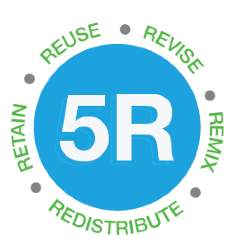
				 <h2>What are OER?</h2> <p>Open Education Resources (OER) can be any type of educational material: their scale varies from something as small as a class handout or image to something as large as a textbook or online course. While traditional course resources come with restrictive copyright laws, OER use open copyright licenses like <a href="https://creativecommons.org/licenses/" data-url="https://creativecommons.org/licenses/">Creative Commons</a>. Depending on the creator’s desires, these licenses allow for different degrees of openness, and may restrict or preclude users from engaging in one or more of the 5Rs.<br /> <img class="size-full wp-image-18 aligncenter" src="https://opentextbc.ca/studenttoolkit/wp-content/uploads/sites/153/2016/05/Screen-Shot-2016-05-26-at-3.16.48-PM.png" alt="5R: Reuse, Revise, Remix, Redistribute, Retain" width="239" height="249" srcset="https://opentextbc.ca/studenttoolkit/wp-content/uploads/sites/153/2016/05/Screen-Shot-2016-05-26-at-3.16.48-PM.png 239w, https://opentextbc.ca/studenttoolkit/wp-content/uploads/sites/153/2016/05/Screen-Shot-2016-05-26-at-3.16.48-PM-65x68.png 65w, https://opentextbc.ca/studenttoolkit/wp-content/uploads/sites/153/2016/05/Screen-Shot-2016-05-26-at-3.16.48-PM-225x234.png 225w" title="" /></p> <p>According to David Wiley’s <a href="http://www.opencontent.org/definition/" data-url="http://www.opencontent.org/definition/">definition of openness</a>, OER are “licensed in a manner that provides users with free and perpetual permission to engage in the 5R activities:</p> <ol><li>Retain – the right to make, own, and control copies of the content (e.g., download, duplicate, store, and manage)</li> <li>Reuse – the right to use the content in a wide range of ways (e.g., in a class, in a study group, on a website, in a video)</li> <li>Revise – the right to adapt, adjust, modify, or alter the content itself (e.g., translate the content into another language)</li> <li>Remix – the right to combine the original or revised content with other material to create something new (e.g., incorporate the content into a mashup)</li> <li>Redistribute – the right to share copies of the original content, your revisions, or your remixes with others (e.g., give a copy of the content to a friend)”</li> </ol> <h3>Why are OER important? Cost Savings.</h3> <p>For students already struggling to afford rising tuition and housing costs, the additional expense of textbooks can be a hurdle to accessing higher education (see “Books and course materials” on the <a href="https://www.canada.ca/en/financial-consumer-agency/services/budget-student-life.html" data-url="https://www.canada.ca/en/financial-consumer-agency/services/budget-student-life.html">Financial Consumer Agency of Canada’s page on budgeting for student life</a>). In a <a href="https://openoregon.org/wp-content/uploads/2015/06/The-direct-relationship-between.pdf" data-url="https://openoregon.org/wp-content/uploads/2015/06/The-direct-relationship-between.pdf">2012 study conducted on the direct relationship between textbook costs and student success [PDF]</a>, 65% of respondents indicated that they did not purchase textbooks at one point in their schooling due to cost. The same survey also indicated that 35% of students reduced their semesterly course load due to textbook cost and that 23% of students regularly forego purchasing textbooks due to cost alone. A Consumer Study conducted by NBC in 2015 states that, <a href="https://www.nbcnews.com/feature/freshman-year/college-textbook-prices-have-risen-812-percent-1978-n399926" data-url="https://www.nbcnews.com/feature/freshman-year/college-textbook-prices-have-risen-812-percent-1978-n399926">from January 1977 to June 2015, textbook prices within the United States rose 1,041%</a>, which is three times the rate of U.S. inflation.</p> <p>While there are many short-term measures that students can use to save money on textbooks, such as buying or borrowing used materials, rental programs, or using e-textbooks and library reserves, none of these options are as innovative as OER. Open educational resources, like open textbooks, can decrease the cost of education because they are either free or low cost. Lower costs will result in students being less dependent on student loans and may even result in higher program completion rates. Greater open textbook adoption will therefore result in a more affordable, more accessible post-secondary education.</p> <p>Because their license allows OER to be retained and reused, OER can also be accessed repeatedly throughout one’s degree, unlike online textbooks (or e-books) and course materials that require expensive access codes that expire when a course is finished. OER can therefore be used to enhance future projects or assignments or serve as supplementary reading later in one’s degree or post-graduation, promoting low-cost, lifelong learning that is not confined to the span of a course.</p> <p><strong>OER cost savings in action:</strong></p> <ul><li>The BCcampus Open Textbook Project <a href="https://bccampus.ca/2014/10/16/open-textbook-project-2012-2014/" data-url="https://bccampus.ca/2014/10/16/open-textbook-project-2012-2014/">saved students over $350,000</a> in its first two years. As of 2022, <a href="https://open.bccampus.ca/advocate-for-open-education/open-textbook-stats/" data-url="https://open.bccampus.ca/advocate-for-open-education/open-textbook-stats/">savings have surpassed $31 million</a></li> <li>Introductory Physics students at the University of British Columbia <a href="https://web.archive.org/web/20180508142033/https://ctlt.ubc.ca/2015/10/01/physics-course-adopts-an-open-textbook-and-saves-students-90000/" data-url="https://web.archive.org/web/20180508142033/https://ctlt.ubc.ca/2015/10/01/physics-course-adopts-an-open-textbook-and-saves-students-90000/">saved $90,000</a> in one year</li> <li>In its first year, the UC Davis <a href="http://chemwiki.ucdavis.edu/" data-url="http://chemwiki.ucdavis.edu/">ChemWiki</a> (now part of Chemistry LibreTexts) replaced traditional textbooks to <a href="https://library.educause.edu/resources/2015/1/assessing-the-impact-and-efficacy-of-the-openaccess-chemwiki-textbook-project" data-url="https://library.educause.edu/resources/2015/1/assessing-the-impact-and-efficacy-of-the-openaccess-chemwiki-textbook-project">save students $500,000</a> across four U.S. campuses</li> </ul> <h3>Why are OER important? Pedagogical Benefits.</h3> <p>The many cost saving benefits of OER are matched by the equally important pedagogical benefits of open education.</p> <p>One of the main teaching benefits is that, since open materials are fully revisable and remixable, they can be customized to fit the way an instructor wants to teach a course. When using static traditional resources that cannot be easily edited or combined due to copyright restrictions, instructors may be forced to teach their courses in a way that conforms to available resources, rather than teach the course in their ideal way. Using OER allows the freedom to revise material by removing irrelevant content or adding one’s own content, as well as the flexibility to combine parts of resources together, thereby ensuring materials are contextualized to a specific course (see <a href="https://opencontent.org/blog/archives/3854" data-url="https://opencontent.org/blog/archives/3854">Forgetting Our History: From the Reusability Paradox to the Remix Hypothesis</a>).</p> <p>Because anyone, including students, can be involved in the creation, revision, and distribution of OER, instructors can also use these resources to engage in “<a href="http://opencontent.org/blog/archives/2975" data-url="http://opencontent.org/blog/archives/2975">open pedagogy</a>,” assignments that leverage OER to create more meaningful learning experiences. Traditionally, students work hard on assignments that will be handed in to their instructor, graded, and then never seen again. Instead, instructors might, for example, ask students to edit OER for redistribution, or have students openly license their own work for use by future students, thereby allowing their work to be shared with a more meaningful audience. This positions students as active participants in scholarly knowledge-sharing.</p> <p><strong>Open pedagogy in action:</strong></p> <ul><li>University of British Columbia students created and contributed to Wikipedia articles on Latin American literature and <a href="https://en.wikipedia.org/wiki/Wikipedia:WikiProject_Murder_Madness_and_Mayhem#Statistics" data-url="https://en.wikipedia.org/wiki/Wikipedia:WikiProject_Murder_Madness_and_Mayhem#Statistics">reached audiences in the hundreds of thousands</a></li> <li><a href="https://pubs.acs.org/doi/abs/10.1021/acs.jchemed.5b00354" data-url="https://pubs.acs.org/doi/abs/10.1021/acs.jchemed.5b00354">Students at NC State University created instructional chemistry videos for other students</a>, resulting in better lab performance than students instructed by TAs</li> </ul> <h3>Why are OER important? Knowledge Creation and Dissemination.</h3> <p>OER also provide benefits to members of communities beyond college and university campuses, allowing for knowledge creation and sharing outside the bounds of the traditional class and campus settings. It can be difficult for those outside of scholarly communities to access and participate in learning materials or research, and the creation of openly licensed research and teaching materials helps break down such barriers. This allows broader access to information and research, and broader participation in scholarship, helping universities to spread their core missions to society as a whole.</p> <p><strong>Open knowledge in action:</strong></p> <ul><li>A <a href="https://videogamelaw.allard.ubc.ca/about-2/communityparticipate/" data-url="https://videogamelaw.allard.ubc.ca/about-2/communityparticipate/">UBC video game law course invited members of the outside community</a> to join in course discussions through an open course website</li> <li><a href="https://www.statcan.gc.ca/en/lode" data-url="https://www.statcan.gc.ca/en/lode">Open data sets</a> from governments, universities, businesses, and other organizations allow anyone to access and analyze information traditionally restricted to professional researchers</li> </ul> <h3>What are the Main Barriers to Adopting OER?</h3> <p>Research has shown there are many barriers to faculty and instructors adopting open educational resources. These include a mixture of true barriers and barriers caused by faculty perceptions of OER and open pedagogy. Students should keep the following list of barriers in mind when starting their own advocacy for OER; suggestions in Steps Two and Three of this toolkit attempt to address them.</p> <ul><li>Not available or difficult to find. Faculty who are new to OER perceive knowing where to find relevant course materials, as well as the time involved in finding them, as barriers to adoption. It is thus important that institutions provide staff and library support for the adoption process, as well as incentives for faculty to spend extra time adopting OER.</li> </ul> <ul><li>Perception of quality. Faculty are used to using traditionally published resources, and may be hesitant to adopt OER when they don’t know if they can trust their quality. However, those who have used OER often report their quality as equal to or better than traditional resources. The pedagogical benefits that come with the flexibility of OER should be emphasized in messaging to faculty, as these can contribute to improved perception.</li> </ul> <ul><li>Traditional textbook package. Traditional textbooks often come with not just a book, but also with ancillary resources like online homework platforms or banks of exam questions. Faculty will be more likely to adopt OER if, in doing so, they can adopt both a textbook and a package of related materials.</li> </ul> <ul><li>Institutional culture. Faculty may be reluctant to adopt OER if they perceive that they are alone in doing so, or that they are acting against the culture of their institution. Student advocacy should target not just faculty, but also university administrations who set strategic priorities and make decisions about what initiatives to fund. Showing broad support from the student body can also help to shift institutional culture.</li> </ul> <ul><li>Not an individual decision. Often, the choice of which textbook to use in large courses is made by departments, not individual faculty members. This makes it more difficult for faculty to choose to adopt OER, because of competing interests and values of instructors. Working with faculty champions to speak to those instructors who may be reluctant to adopt OER can be successful to ensure widespread support. This can be effective in leveraging the support of instructors who are willing to do the work behind adoption.</li> </ul> <p><strong>For a more in-depth look at these issues:</strong></p> <ul><li>the <a href="http://thatpsychprof.com/a-faculty-perspective-on-open-textbooks/" data-url="http://thatpsychprof.com/a-faculty-perspective-on-open-textbooks/">blog post “A Faculty Perspective on Open Textbooks”</a> summarizes barriers from a faculty member’s perspective, and</li> </ul> <ul><li>the BCcampus <a href="https://bccampus.ca/2016/01/18/new-study-exploring-faculty-use-of-oer-at-bc-institutions/" data-url="https://bccampus.ca/2016/01/18/new-study-exploring-faculty-use-of-oer-at-bc-institutions/">research report “Exploring Faculty Use of Open Educational Resources at British Columbia Post-secondary Institutions”</a> studies many of these barriers, and includes links to many similar studies describing these barriers in detail.</li> </ul> 
	</div>


	</div>
<div class="chapter standard " id="chapter-step-two-what-already-exists-on-your-campus" title="Step Two: What Already Exists On Your Campus?">
	<div class="chapter-title-wrap">
		<p class="chapter-number">2</p>
		<h1 class="chapter-title">Step Two: What Already Exists On Your Campus?</h1>
								</div>
	<div class="ugc chapter-ugc">
				 <h2>How to start</h2> <p>When starting any new initiative as a student society, it is important to recognize that there are likely already faculty, staff, or librarians on your campus who care about an issue as much as you. This is also an issue that provides incentives and benefits to all groups on campus. Before starting to work on an OER campaign in isolation, an indispensable first step is to conduct a scan of the advocates and initiatives that already exist at your institution. This could include:</p> <ul><li>Faculty who engage in open educational practices in their courses;</li> <li>Staff at teaching and learning centres who offer resources and professional development for faculty who wish to adopt open educational practices;</li> <li>Librarians who encourage faculty to adopt open resources in place of traditional ones;</li> <li>Administrators who are interested in making open education part of your university’s strategic goals.</li> </ul> <p>If you already know of one or more such people, approach them and ask about the work they are doing, and ask them to connect you with other advocates. If you don’t know where to start, you might try reaching out to the broader OER network beyond your institution, as they likely have connections with advocates in your community. Regional organizations that have open education as part of their mandate (e.g. <a href="https://open.bccampus.ca/" data-url="https://open.bccampus.ca/">BCcampus</a>, <a href="https://openedmb.ca/" data-url="https://openedmb.ca/">Campus Manitoba</a>) can be a good place to start.</p> <p>Once you have conducted this scan, some things to reflect on include:</p> <ul><li><strong>What is some work already being done that could use an extra boost?</strong><br /> You may find that many advocates have ideas for things they want to start, but they need an extra boost that can come from students expressing their passion about an issue. Talk to these advocates to encourage them to get started implementing their ideas, and offer to help in any ways you can.</li> </ul> <ul><li><strong>Who needs to be brought together that is working alone?</strong><br /> Students, especially student leaders, have access to people in all areas of the university, who may be working in silos. You may find that people in all areas have similar interests but are not working as closely together as they could, and one key role students can play is bringing all of these advocates together.</li> <li><strong>After you consider the above, where are the remaining gaps?</strong><br /> Once you have determined how you can augment and build upon existing work and ideas, you can look for the remaining gaps that you can fill by starting new projects and initiatives. The next section contains some ideas for that.</li> </ul> 
	</div>


	</div>
<div class="chapter standard " id="chapter-step-three-how-to-advocate-on-your-campus" title="Step Three: How To Advocate On Your Campus">
	<div class="chapter-title-wrap">
		<p class="chapter-number">3</p>
		<h1 class="chapter-title">Step Three: How To Advocate On Your Campus</h1>
								</div>
	<div class="ugc chapter-ugc">
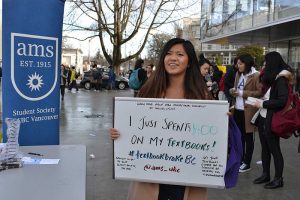
				 <h1>For Student Societies and Student Leaders</h1> <h2>Student-Facing Advocacy</h2> <p><strong>#TextbookBroke</strong></p> <p>One of the best ways to mobilize student voices in support of open education is to appeal to the fact that students spend too much money on textbooks each term. You can demonstrate wide student support and inform students about the high cost of textbooks through a campaign like #TextbookBroke, a social media campaign that can be adapted to any institution.</p> <p>This campaign involves asking students to take a photo showing how much they spent on their textbooks, then posting the photo on social media along with the hashtag #TextbookBroke (or a variation of this hashtag, like #TextbookBrokeBC). The photo could be taken as the student leaves their campus bookstore, or an image of their bookstore receipt could be posted online along with the hashtag.</p> <div class="wp-caption aligncenter" id="attachment_24" aria-describedby="caption-attachment-24" style="width: 500px"><img class="wp-image-24" src="https://opentextbc.ca/studenttoolkit/wp-content/uploads/sites/153/2016/05/800px-AMS_textbookbrokeBC_2015-2016_10-300x200.jpg" alt="A female student holds up a whiteboard that says she just spent $400 on textbooks." width="500" height="333" srcset="https://opentextbc.ca/studenttoolkit/wp-content/uploads/sites/153/2016/05/800px-AMS_textbookbrokeBC_2015-2016_10-300x200.jpg 300w, https://opentextbc.ca/studenttoolkit/wp-content/uploads/sites/153/2016/05/800px-AMS_textbookbrokeBC_2015-2016_10-768x512.jpg 768w, https://opentextbc.ca/studenttoolkit/wp-content/uploads/sites/153/2016/05/800px-AMS_textbookbrokeBC_2015-2016_10-65x43.jpg 65w, https://opentextbc.ca/studenttoolkit/wp-content/uploads/sites/153/2016/05/800px-AMS_textbookbrokeBC_2015-2016_10-225x150.jpg 225w, https://opentextbc.ca/studenttoolkit/wp-content/uploads/sites/153/2016/05/800px-AMS_textbookbrokeBC_2015-2016_10-350x233.jpg 350w, https://opentextbc.ca/studenttoolkit/wp-content/uploads/sites/153/2016/05/800px-AMS_textbookbrokeBC_2015-2016_10.jpg 800w" title="" /><div class="wp-caption-text" id="caption-attachment-24">A student participates in the UBC AMS #TextbookBrokeBC campaign.</div></div> <p>The campaign raises awareness of the existence of open textbooks and OER, and starts the conversation surrounding the costs of educational resources and how they are used in the classroom. More information about the #TextbookBroke campaign can be found in <a href="#back-matter-appendix-c-textbookbroke-information" data-url="https://opentextbc.ca/studenttoolkit/back-matter/appendix-c-textbookbroke-information/">Appendix C: #TextbookBroke Information</a>.</p> <p><strong>Engage students in programming during events like Open Education Week.</strong></p> <p>Many universities hold OER-themed programming, like panel discussions or workshops, during <a href="https://oeweek.oeglobal.org/" data-url="https://oeweek.oeglobal.org/">Open Education Week</a> or similar annual events. These are opportunities to involve students in programming that is normally only appealing to faculty and staff, ensuring that student opinions are heard. You might try to get students involved in event planning processes, ensure students participate in panels or presentations, or advertise events to your study body. This allows information to be shared with students that are involved, and student-centric messaging to be shared with those on your campus involved in OER promotion.</p> <p><strong>Ensure that your own resources and information is openly licensed and share with other student groups and societies.</strong></p> <p>It is great to talk the talk, but make sure to walk the walk as well. The open education community is very supportive, and we can only be successful if we work together and make our resources open. You can use open licenses for resources your student society creates and adapts, to ensure that you are supporting other student groups and societies in starting their own OER initiatives. An easy way to do this is using the <a href="https://creativecommons.org/choose/" data-url="https://creativecommons.org/choose/">Creative Commons Choose a License</a> feature. Make sure to look for existing resources you could adapt before creating your own.</p> <h2>Faculty-Facing Advocacy</h2> <p><strong>Make faculty-facing advocacy a priority.</strong></p> <p>Instructors and faculty members are the ones who choose the educational resources they will be using in the classroom, so advocacy directed at faculty may be the best means for change. Having a good understanding of the pedagogical benefits of open and how to adopt and create OERs makes students able to provide instructors with the right information to support them in adopting OER and open practices.</p> <p><strong>Create opportunities for faculty engagement and professional development.</strong></p> <p>Many faculty have either never heard of OER or, even if they have, don’t know how to start using it in their courses. University teaching and learning centres and libraries often offer regular professional development workshops or events centred around themes related to improving teaching. Student leaders can encourage more content related to open education to be injected into these, and can join in their delivery to talk about what is important from the student perspective.</p> <p><strong>Encourage your institution to offer grants to faculty willing to redesign courses with OER.</strong></p> <p>Providing monetary support for faculty members willing to adopt OER as their primary course materials can incentivize greater adoption, and also shows that faculty thinking about adoption have institutional support behind them. For example, at Simon Fraser University (SFU) the Vice-President Academic Office made available a number of <a href="https://www.sfu.ca/oergrants.html" data-url="https://www.sfu.ca/oergrants.html">OER Grants</a> valued at $5,000 which aim to support the adoption of OER in SFU courses. These are restricted to covering the costs of support for the faculty member through research assistants, persons with specific expertise, support for data collection and analysis, and travel for the dissemination of findings. Institutions should ensure that the focus includes both resources like textbooks but also ancillary materials that instructors often find as part of publishers’ packages.</p> <p><strong>Advocate for your library to make OER easily accessible in their catalogue.</strong></p> <p>Faculty are more likely to trust resources if their quality is assured by librarian approval. If your library can make resources like open textbooks available to find in their online, searchable databases, faculty will be more likely to adopt them. The UBC Library, for example, has an online <a href="https://guides.library.ubc.ca/open-education" data-url="https://guides.library.ubc.ca/open-education">research guide about open education</a>, which includes a page about finding open textbooks in the UBC collections.</p> <p><strong>Encourage creation and adoption of OER through faculty promotion and tenure processes.</strong></p> <p>Investigate the processes for faculty promotion and tenure at your institution, and determine who is responsible for setting guidelines. Ask them to consider the use of open educational practices as one (among many) of the ways faculty can demonstrate commitments to quality teaching during the promotion and tenure process. Showing that you have faculty members who support this may help, and you might consider garnering this support by connecting with your institution’s union or association of faculty.</p> <h2>For Students more Broadly</h2> <p>There are many low-barrier ways that individual students can get involved in the open education movement, and student societies can encourage these activities within their student body.</p> <p><strong>Talk to your professors or instructors about open educational resources.</strong></p> <p>The final say about what resources will be used in a course usually lies with faculty, to whom students have unique, direct access. Some ways of doing this include:</p> <ul><li>Show faculty students care about this issue by sharing your thoughts on high textbook costs or showing them you appreciate it when they use cheap or free alternatives. One easy way to do this is through anonymous midterm or end of term course evaluations that take place at many institutions.</li> <li>Tell faculty whom you think may be interested about open education. If you know of any examples of OER that would be useful in a course you have taken, tell the instructor about it. You can also refer them to resources or OER repositories (see below), or share stories of other faculty adopting OER at your institution.</li> </ul> <p><strong>Create open content yourself.</strong></p> <p>Students can choose to publish their own work under an open license as well:</p> <ul><li>See this <a href="http://www.righttoresearch.org/bm~doc/r2rc_open_publishing_guide.pdf" data-url="http://www.righttoresearch.org/bm~doc/r2rc_open_publishing_guide.pdf">open publishing guide [PDF]</a> developed by SPARC’s <a href="https://sparcopen.org/our-work/r2rc/" data-url="https://sparcopen.org/our-work/r2rc/">Right to Research Coalition</a> for some suggestions and guidelines.</li> <li>Students can use platforms like <a href="https://www.flickr.com/" data-url="https://www.flickr.com/">Flickr</a> to upload photos and images they have created under open licenses, including content they may have created as part of their courses.</li> <li>Many institutions also have local opportunities for students to publish their work, often in student-led, open access journals. Students can seek out these opportunities, and student leaders can help promote them widely.</li> </ul> <p><strong>Pass this resource on to your student society.</strong></p> <p>As a member of your institution’s scholarly community you can have a lot of influence over the way in which you create content and experience teaching and learning. However, you can have much more support by working with the student society that represents you to advocate for OER, and by doing so you can ensure that it is a priority for more students. This resource is meant for you as a student, and for groups and societies, so make sure to pass it along, or adopt it for your own context.</p> <h3>Media Attributions</h3> <ul><li><a href="https://wiki.ubc.ca/File:AMS_textbookbrokeBC_2015-2016_10.jpg" data-url="https://wiki.ubc.ca/File:AMS_textbookbrokeBC_2015-2016_10.jpg">“UBC AMS #TextbookBroke”</a> © 2016 by <a href="https://wiki.ubc.ca/User:DanielMunro" data-url="https://wiki.ubc.ca/User:DanielMunro">Daniel Munro</a> is used under a <a href="https://creativecommons.org/licenses/by-sa/3.0/" data-url="https://creativecommons.org/licenses/by-sa/3.0/">CC BY-SA 3.0 Unported licence</a></li> </ul> 
	</div>


	</div>

</div>
<div class="back-matter appendix " id="back-matter-appendix-a-resources" title="Appendix A">
	<div class="back-matter-title-wrap">
		<p class="back-matter-number">1</p>
		<h1 class="back-matter-title">Appendix A: Resources</h1>
					<p class="chapter-subtitle">Resources</p>
			</div>
	<div class="ugc back-matter-ugc">
				 <p><a href="http://www.opencontent.org/" data-url="http://www.opencontent.org/">OpenContent.org</a> has various resources and articles that serve as a good introduction to OER and their benefits.</p> <p>The British Columbia Federation of Students (BCFS) provides a number of openly licensed campaign resources for promoting open textbooks within your institution: <a href="https://www.wearebcstudents.ca/open_textbooks_now" data-url="https://www.wearebcstudents.ca/open_textbooks_now">Open Textbooks Now!</a></p> <p>Learn more about how open licensing works at <a href="http://www.creativecommons.org/" data-url="http://www.creativecommons.org/">CreativeCommons.org</a>.</p> <p>Learn more about <a href="https://open.bccampus.ca/" data-url="https://open.bccampus.ca/">BCcampus Open Education</a>&nbsp;and <a href="https://open.bccampus.ca/advocate-for-open-education/student-advocates/" data-url="https://open.bccampus.ca/advocate-for-open-education/student-advocates/">Student Advocates</a>.</p> 
	</div>


	</div>
<div class="back-matter appendix " id="back-matter-appendix-b-oer-repositories" title="Appendix B">
	<div class="back-matter-title-wrap">
		<p class="back-matter-number">2</p>
		<h1 class="back-matter-title">Appendix B: OER Repositories</h1>
					<p class="chapter-subtitle">OER Repositories</p>
			</div>
	<div class="ugc back-matter-ugc">
				 <p>Since the field is constantly growing, this list provides a small sample of the open resources and repositories that are currently available.</p> <p>The <a href="https://open.bccampus.ca/find-open-textbooks" data-url="https://open.bccampus.ca/find-open-textbooks"><strong>B.C Open Textbook Collection</strong></a> (https://open.bccampus.ca/find-open-textbooks) aims to make higher education more accessible by reducing student costs through the use of openly licensed textbooks. They provide over 250 textbooks across various subject areas.</p> <hr /> <p>The <strong><a href="https://openlibrary.ecampusontario.ca/" data-url="https://openlibrary.ecampusontario.ca/">eCampus Ontario Open Library</a></strong> (https://openlibrary.ecampusontario.ca/) is a collection of open textbooks and other open resources. The curated collection aligns with top subject areas in post-secondary education and features reviews from experts and educators across Canada.</p> <hr /> <p><a href="http://www.merlot.org/" data-url="http://www.merlot.org/"><strong>MERLOT</strong></a> (www.merlot.org) is a curated collection of OER and open resources.</p> <hr /> <p>The <strong><a href="https://opentextbc.ca/oerdiscipline/" data-url="https://opentextbc.ca/oerdiscipline/">OER by Discipline Directory</a></strong> (https://opentextbc.ca/oerdiscipline/) lists a wide range of open educational resources organized by discipline.</p> <hr /> <p><a href="http://www.oercommons.org/" data-url="http://www.oercommons.org/"><strong>OER Commons</strong></a> (www.oercommons.org) is a dynamic digital library and network.</p> <hr /> <p><a href="http://www.oercommons.org/" data-url="http://www.oercommons.org/"><strong>Open Culture</strong></a> (http://www.oercommons.org/) offers a collection of 200 textbooks covering various subject areas.<a href="http://www.openculture.com/free_textbooks" data-url="http://www.openculture.com/free_textbooks"></a></p> <hr /> <p><a href="https://openstax.org/subjects" data-url="https://openstax.org/subjects"><strong>OpenStax</strong></a> (https://openstax.org/subjects) offers students free textbooks that meet scope and sequence requirements for most courses. They are peer-reviewed texts written by professional content developers.<a href="https://openstaxcollege.org/books" data-url="https://openstaxcollege.org/books"></a></p> <hr /> <p>The <a href="https://open.umn.edu/opentextbooks" data-url="https://open.umn.edu/opentextbooks"><strong>Open Textbook Library</strong></a> (https://open.umn.edu/opentextbooks) is a collection of free, peer-reviewed and openly-licensed textbooks for university students developed by the University of Minnesota.<a href="https://open.umn.edu/opentextbooks" data-url="https://open.umn.edu/opentextbooks"></a></p> <hr /> <p>&nbsp;</p> 
	</div>


	</div>
<div class="back-matter appendix " id="back-matter-appendix-c-textbookbroke-information" title="Appendix C">
	<div class="back-matter-title-wrap">
		<p class="back-matter-number">3</p>
		<h1 class="back-matter-title">Appendix C: #TextbookBroke Information</h1>
					<p class="chapter-subtitle">#Textbookbroke Information</p>
			</div>
	<div class="ugc back-matter-ugc">
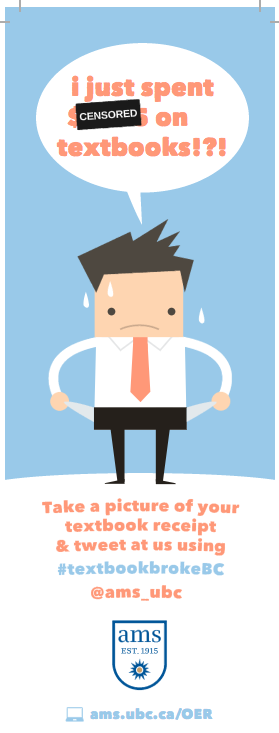
				 <p>The&nbsp;<a href="https://studentgovresources.org/textbookbroke-campaign-for-affordable-textbooks/" data-url="https://studentgovresources.org/textbookbroke-campaign-for-affordable-textbooks/">#TextbookBroke campaign</a> began in the United States as a way to showcase the high prices of textbooks and engage in conversations with college and university communities surrounding affordability. This campaign’s goal is to spread awareness surrounding open textbooks and OER more generally, as well as ensure that students are talking about the price of educational materials, and thinking critically about the resources that they are assigned.</p> <h1>Campaign Steps:</h1> <ol><li>Identify goals of bringing #TextbookBroke to your campus.</li> <li>Look at materials and plans that already exist.</li> <li>Reach out to your university campus and bookstore to see if they would like to work with you.</li> <li>Tie the campaign into your broader advocacy efforts.</li> </ol> <h1>#TextbookBrokeBC</h1> <p>As a result of the success of the #TextbookBroke campaign, the Alma Mater Society of UBC Vancouver (AMS), the Simon Fraser Student Society (SFSS), and the Student Union of the Okanagan at UBC Okanagan (SUO), ran a #TextbookBrokeBC campaign in September 2015 and January 2016. The goal of the campaign was similar to the goal of the U.S. campaign: to engage students in conversations surrounding the cost of educational resources and make them aware of alternatives, such as Open Textbooks and OER.</p> <div class="wp-caption aligncenter" id="attachment_31" aria-describedby="caption-attachment-31" style="width: 279px"><img class="wp-image-31 size-full" src="https://opentextbc.ca/studenttoolkit/wp-content/uploads/sites/153/2016/05/Screen-Shot-2016-05-26-at-3.27.17-PM.png" alt="A student looking stressed out and saying, &amp;quot;I just spend *censored* on textbooks?!&amp;quot;" width="279" height="733" srcset="https://opentextbc.ca/studenttoolkit/wp-content/uploads/sites/153/2016/05/Screen-Shot-2016-05-26-at-3.27.17-PM.png 279w, https://opentextbc.ca/studenttoolkit/wp-content/uploads/sites/153/2016/05/Screen-Shot-2016-05-26-at-3.27.17-PM-114x300.png 114w, https://opentextbc.ca/studenttoolkit/wp-content/uploads/sites/153/2016/05/Screen-Shot-2016-05-26-at-3.27.17-PM-65x171.png 65w, https://opentextbc.ca/studenttoolkit/wp-content/uploads/sites/153/2016/05/Screen-Shot-2016-05-26-at-3.27.17-PM-225x591.png 225w" title="" /><div class="wp-caption-text" id="caption-attachment-31">A bookmark for the UBC AMS’s #TextbookBroke campaign.</div></div> <p>The open community is just that: open. The aim is to ensure that openness is a practice that is used in not only the promotion of OER, but in their adoption and creation as well. In that spirit, the <a href="https://www.wearebcstudents.ca/open_textbooks_now" data-url="https://www.wearebcstudents.ca/open_textbooks_now">#TextbookBrokeBC materials</a> have been offered openly by BC Federation of Students (BCFS)</p> <h3>Media Attributions</h3> <ul><li><a href="http://www.ams.ubc.ca/wp-content/uploads/2015/05/Bookmark-AMS-SFSS.pdf" data-url="http://www.ams.ubc.ca/wp-content/uploads/2015/05/Bookmark-AMS-SFSS.pdf">TextbookBrokeBC Bookmark</a> © AMS UBC. <a href="https://creativecommons.org/licenses/by/4.0/" data-url="https://creativecommons.org/licenses/by/4.0/">CC BY 4.0 Licence</a>.</li> </ul> 
	</div>


	</div>
<div class="back-matter miscellaneous " id="back-matter-versioning-history" title="Versioning History">
	<div class="back-matter-title-wrap">
		<p class="back-matter-number">4</p>
		<h1 class="back-matter-title">Versioning History</h1>
								</div>
	<div class="ugc back-matter-ugc">
				 <p>This page provides a record of changes made to this toolkit. Each set of edits is acknowledged with a 0.01 increase in the version number. The exported files for this toolkit reflect the most recent version.</p> <p>If you find an error in this toolkit, please fill out the&nbsp;<a href="https://open.bccampus.ca/browse-our-collection/reporting-an-error/" target="_blank" rel="noopener" data-url="https://open.bccampus.ca/browse-our-collection/reporting-an-error/">Report an Error</a> form.</p> <table style="border-collapse: collapse; width: 100%; height: 91px;"><tbody><tr style="height: 18px;"><td style="width: 12.1099%; height: 18px;"><strong>Version</strong></td> <td style="width: 18.2157%; height: 18px;"><strong>Date</strong></td> <td style="width: 25.6785%; height: 18px;"><strong>Change</strong></td> <td style="width: 43.9959%; height: 18px;"><strong>Details</strong></td> </tr> <tr style="height: 55px;"><td style="width: 12.1099%; height: 55px;">1.0</td> <td style="width: 18.2157%; height: 55px;">May 26, 2016</td> <td style="width: 25.6785%; height: 55px;">Toolkit published in the B.C. Open Textbook Collection.</td> <td style="width: 43.9959%; height: 55px;"></td> </tr> <tr style="height: 18px;"><td style="width: 12.1099%; height: 18px;">1.01</td> <td style="width: 18.2157%; height: 18px;">June 28, 2019</td> <td style="width: 25.6785%; height: 18px;">Altered theme</td> <td style="width: 43.9959%; height: 18px;">Changed theme from Open Textbook to Clarke theme</td> </tr> <tr><td style="width: 12.1099%;">1.02</td> <td style="width: 18.2157%;">October 1, 2019</td> <td style="width: 25.6785%;">ISBN</td> <td style="width: 43.9959%;">Added Print and eBook ISBNs</td> </tr> <tr><td style="width: 12.1099%;">1.03</td> <td style="width: 18.2157%;">September 13, 2022</td> <td style="width: 25.6785%;">Changed links</td> <td style="width: 43.9959%;">Updated broken links and ensured all links opened in the same tab.</td> </tr> <tr><td style="width: 12.1099%;">1.04</td> <td style="width: 18.2157%;">October 31, 2023</td> <td style="width: 25.6785%;">Updated cover image</td> <td style="width: 43.9959%;"></td> </tr> </tbody> </table> 
	</div>


	</div>

</body>
</html>