<?xml version="1.0" encoding="UTF-8"?>
<!DOCTYPE html PUBLIC "-//W3C//DTD XHTML 1.1//EN" "http://www.w3.org/TR/xhtml11/DTD/xhtml11.dtd">
<html xmlns="http://www.w3.org/1999/xhtml" xml:lang="en">
<head>
<meta content="text/html; charset=UTF-8" http-equiv="content-type" />
<meta http-equiv="Content-Language" content="en" />
<meta name="generator" content="Pressbooks 6.17.1" />
<meta name="pb-authors" content="Gemma Armstrong" />
<meta name="pb-authors" content="Michelle Daoust" />
<meta name="pb-authors" content="Ycha Gil" />
<meta name="pb-authors" content="Albert Seinen" />
<meta name="pb-authors" content="Faye Shedletzky" />
<meta name="pb-authors" content="Jewell Gillies" />
<meta name="pb-authors" content="Barbara Johnston" />
<meta name="pb-authors" content="Liz Warwick" />
<meta name="pb-contributors" content="Brie Deimling" />
<meta name="pb-contributors" content="Lehoa Mak" />
<meta name="pb-contributors" content="Brenda McKay" />
<meta name="pb-contributors" content="Josephine McNeilly" />
<meta name="pb-contributors" content="Amy Haagsma" />
<meta name="pb-contributors" content="Michelle Glubke" />
<meta name="pb-contributors" content="Kaitlyn Zheng" />
<meta name="pb-contributors" content="Okanagan College" />
<meta name="pb-contributors" content="Project Advisory Group Members" />
<meta name="pb-title" content="Capacity to Connect: Supporting Students’ Mental Health and Wellness" />
<meta name="pb-language" content="en-ca" />
<meta name="pb-cover-image" content="https://pressbooks.bccampus.ca/capacitytoconnect/wp-content/uploads/sites/1264/2021/03/Cover-scaled.jpg" />
<meta name="pb-subtitle" content="Facilitator’s Guide for Use with Faculty and Staff" />
<meta name="pb-publisher" content="BCcampus" />
<meta name="pb-publisher-city" content="Victoria, B.C." />
<meta name="pb-book-license" content="cc-by" />
<meta name="pb-about-50" content="&quot;Capacity to Connect: Supporting Students’ Mental Health and Wellness&quot; includes a facilitator’s guide with handouts and a PowerPoint presentation. This adaptable training resource covers foundational mental health and wellness knowledge for post-secondary faculty and staff and ways to support students in distress. It can be used for two-hour online or in-person training or for self-study." />
<meta name="pb-about-unlimited" content="Capacity to Connect: Supporting Students’ Mental Health and Wellness includes a facilitator’s guide with handouts and a PowerPoint presentation. This adaptable training resource covers foundational mental health and wellness knowledge for post-secondary faculty and staff and ways to support students in distress. It can be used for two-hour online or in-person training or for self-study. This resource incorporates a decolonized perspective and was guided by the following principles: accessible, adaptable, culturally located, evidence-informed, inclusive, and trauma-informed. Handouts include a wellness wheel self-assessment tool and information on supporting students in distress." />
<meta name="pb-custom-copyright" content="© 2021 Gemma Armstrong, Michelle Daoust, Ycha Gil, Albert Seinen, Faye Shedletzky, Jewell Gillies, Barbara Johnston, and Liz Warwick.Capacity to Connect: Supporting Students’ Mental Health and Wellness was adapted from Capacity to Connect: Supporting Students from Distress to Suicide. © Vancouver Island University. It was shared under a memorandum of understanding with BCcampus to be adapted as an open education resource.The Creative Commons license permits you to retain, reuse, copy, redistribute, and revise this book – in whole or in part – for free, providing the author is attributed as follows:Capacity to Connect: Supporting Students’ Mental Health and Wellness by Gemma Armstrong, Michelle Daoust, Ycha Gil, Albert Seinen, Faye Shedletzky, Jewell Gillies, Barbara Johnston, and Liz Warwick is used under a CC BY 4.0 license.This adaptation includes changes and additions that are © 2021 by Jewell Gillies, Barbara Johnston, and Liz Warwick and are licensed under a CC BY 4.0 license.A list of adaptations appears at the end of each chapter.If you redistribute all or part of this book, it is recommended that the following statement be added to the copyright page so readers can access the original book at no cost:Download for free from https://opentextbc.ca/capacitytoconnectSample APA-style citation:This resource can be referenced in APA citation style (7th edition) as follows:Armstrong, G., Daoust, M., Gil, Y., Seinen, A., Shedletzky, F., Gillies, J., Johnston, B., &amp; Warwick, L. (2021). Capacity to connect: Supporting students’ mental health and wellness. BCcampus. https://opentextbc.ca/capacitytoconnect/Cover image attribution:Cairn Stones and Body of Water in Distance by Pixabay is used under a CC0 license.Ebook ISBN: 978-1-77420-120-6Print ISBN: 978-1-77420-119-0This resource is a result of the BCcampus Mental Health and Wellness Project funded by the Ministry of Advanced Education and Skills Training." />
<meta name="pb-primary-subject" content="MBPK" />
<meta name="pb-publication-date" content="1620000000" />
<meta name="pb-ebook-isbn" content="978-1-77420-120-6" />
<meta name="pb-print-isbn" content="978-1-77420-119-0" />
<meta name="pb-additional-subjects" content="JNP, JNDG, JNF, JNFK, JBSL1, JBSJ, JBSL11, JM, JBFX, JBFA, JBS, JHB, JNS, JNMT, JKSM, VFJQ" />
<title>Capacity to Connect: Supporting Students’ Mental Health and Wellness</title>
</head>
<body lang='en' >
<div id="half-title-page"><h1 class="title">Capacity to Connect: Supporting Students’ Mental Health and Wellness</h1></div>
<div id="title-page">
			 <h1 class="title">Capacity to Connect: Supporting Students’ Mental Health and Wellness</h1> <h2 class="subtitle">Facilitator’s Guide</h2> <h3 class="author">Gemma Armstrong, Michelle Daoust, Ycha Gil, Albert Seinen, Faye Shedletzky, Jewell Gillies, Barbara Johnston, and Liz Warwick</h3> <h4 class="publisher">BCcampus</h4> <h5 class="publisher-city">Victoria, B.C.</h5> 
	</div>
<div id="copyright-page">
	<div class="ugc">
					
<div class="license-attribution"><p><img src="https://opentextbc.ca/capacitytoconnect/wp-content/themes/pressbooks-book/packages/buckram/assets/images/cc-by.svg" alt="Icon for the Creative Commons Attribution 4.0 International License" /></p><p>Capacity to Connect: Supporting Students’ Mental Health and Wellness Copyright © 2021 by <span>Gemma Armstrong; Michelle Daoust; Ycha Gil; Albert Seinen; Faye Shedletzky; Jewell Gillies; Barbara Johnston; and Liz Warwick</span> is licensed under a <a rel="license" href="https://creativecommons.org/licenses/by/4.0/">Creative Commons Attribution 4.0 International License</a>, except where otherwise noted.</p></div>

							<p>© 2021 Gemma Armstrong, Michelle Daoust, Ycha Gil, Albert Seinen, Faye Shedletzky, Jewell Gillies, Barbara Johnston, and Liz Warwick.</p><p><em>Capacity to Connect: Supporting Students’ Mental Health and Wellness</em> was adapted from <em>Capacity to Connect: Supporting Students from Distress to Suicide</em>. © Vancouver Island University. It was shared under a memorandum of understanding with BCcampus to be adapted as an open education resource.</p><p>The Creative Commons license permits you to retain, reuse, copy, redistribute, and revise this book – in whole or in part – for free, providing the author is attributed as follows:</p><div class="textbox"><em><a href="https://opentextbc.ca/capacitytoconnect/">Capacity to Connect: Supporting Students’ Mental Health and Wellness</a></em> by Gemma Armstrong, Michelle Daoust, Ycha Gil, Albert Seinen, Faye Shedletzky, Jewell Gillies, Barbara Johnston, and Liz Warwick is used under a <a href="http://creativecommons.org/licenses/by/4.0/">CC BY 4.0</a> license.</div><p>This adaptation includes changes and additions that are © 2021 by Jewell Gillies, Barbara Johnston, and Liz Warwick and are licensed under a <a href="https://creativecommons.org/licenses/by/4.0/">CC BY 4.0</a> license.</p><p>A list of adaptations appears at the end of each chapter.</p><p>If you redistribute all or part of this book, it is recommended that the following statement be added to the copyright page so readers can access the original book at no cost:</p><div class="textbox">Download for free from https://opentextbc.ca/capacitytoconnect</div><p><strong>Sample APA-style citation:</strong><br />This resource can be referenced in APA citation style (7th edition) as follows:</p><div class="textbox">Armstrong, G., Daoust, M., Gil, Y., Seinen, A., Shedletzky, F., Gillies, J., Johnston, B., &#38; Warwick, L. (2021). <em>Capacity to connect: Supporting students’ mental health and wellness</em>. BCcampus. https://opentextbc.ca/capacitytoconnect/</div><p><strong>Cover image attribution:</strong></p><div class="textbox"><a href="https://www.pexels.com/photo/balance-macro-ocean-pebbles-235990/">Cairn Stones and Body of Water in Distance</a> by <a href="https://www.pexels.com/@pixabay">Pixabay</a> is used under a <a href="https://creativecommons.org/share-your-work/public-domain/cc0/">CC0 license</a>.</div><p><strong>Ebook ISBN:</strong> 978-1-77420-120-6</p><p><strong>Print ISBN:</strong> 978-1-77420-119-0</p><p>This resource is a result of the BCcampus Mental Health and Wellness Project funded by the Ministry of Advanced Education and Skills Training.</p>
							</div>
</div>
<div id="toc">
	<h1>Contents</h1>
	<ul>
					<li class="front-matter miscellaneous">
	<a href="#front-matter-accessibility-statement">
		<span class="toc-chapter-title">Accessibility Statement</span>
							</a>
	</li>

					<li class="front-matter miscellaneous">
	<a href="#front-matter-acknowledgements">
		<span class="toc-chapter-title">Acknowledgements</span>
							</a>
	</li>

					<li class="front-matter introduction">
	<a href="#front-matter-introduction">
		<span class="toc-chapter-title">Introduction</span>
							</a>
	</li>

					<li class="part">
	<a href="#part-getting-ready">
					Section 1: Getting Ready
			</a>
</li>

					<li class="chapter standard">
	<a href="#chapter-preparing-for-the-session">
		<span class="toc-chapter-title">Preparing for the Session</span>
							</a>
	</li>

					<li class="chapter standard">
	<a href="#chapter-indigenous-considerations">
		<span class="toc-chapter-title">Indigenous Considerations</span>
							</a>
	</li>

					<li class="chapter standard">
	<a href="#chapter-guidelines-and-tips-for-facilitation">
		<span class="toc-chapter-title">Guidelines and Tips for Facilitation</span>
							</a>
	</li>

					<li class="chapter standard">
	<a href="#chapter-detailed-agenda">
		<span class="toc-chapter-title">Detailed Agenda</span>
							</a>
	</li>

					<li class="part">
	<a href="#part-section-2-mental-health-and-wellness">
					Section 2: Mental Health and Wellness
			</a>
</li>

					<li class="chapter standard">
	<a href="#chapter-opening-the-session">
		<span class="toc-chapter-title">Opening the Session</span>
							</a>
	</li>

					<li class="chapter standard">
	<a href="#chapter-mental-wellness">
		<span class="toc-chapter-title">Mental Wellness</span>
							</a>
	</li>

					<li class="chapter standard">
	<a href="#chapter-mental-health-models">
		<span class="toc-chapter-title">Mental Health Models</span>
							</a>
	</li>

					<li class="chapter standard">
	<a href="#chapter-mental-health-statistics">
		<span class="toc-chapter-title">Mental Health Statistics</span>
							</a>
	</li>

					<li class="part">
	<a href="#part-section-3">
					Section 3: The Three Rs Framework: Recognize, Respond, Refer
			</a>
</li>

					<li class="chapter standard">
	<a href="#chapter-the-first-r-recognizing-signs-of-distress">
		<span class="toc-chapter-title">The First R: Recognizing Signs of Distress</span>
							</a>
	</li>

					<li class="chapter standard">
	<a href="#chapter-the-second-r-responding">
		<span class="toc-chapter-title">The Second R: Responding</span>
							</a>
	</li>

					<li class="chapter standard">
	<a href="#chapter-the-third-r-referring">
		<span class="toc-chapter-title">The Third R: Referring</span>
							</a>
	</li>

					<li class="chapter standard">
	<a href="#chapter-maintaining-boundaries">
		<span class="toc-chapter-title">Maintaining Boundaries</span>
							</a>
	</li>

					<li class="part">
	<a href="#part-section-4-practice-scenarios-and-closing">
					Section 4: Practice Scenarios and Closing
			</a>
</li>

					<li class="chapter standard">
	<a href="#chapter-scenarios-for-practice-and-discussion">
		<span class="toc-chapter-title">Scenarios for Practice and Discussion</span>
							</a>
	</li>

					<li class="chapter standard">
	<a href="#chapter-summary-and-conclusion">
		<span class="toc-chapter-title">Summary and Conclusion</span>
							</a>
	</li>

					<li class="back-matter appendix">
	<a href="#back-matter-wellness-wheel">
		<span class="toc-chapter-title">Appendix 1: Wellness Wheel (Handout 1)</span>
							</a>
	</li>

					<li class="back-matter miscellaneous">
	<a href="#back-matter-responding-to-students-in-distress">
		<span class="toc-chapter-title">Appendix 2: Responding to Students in Distress (Handout 2)</span>
							</a>
	</li>

					<li class="back-matter miscellaneous">
	<a href="#back-matter-acknowledgements">
		<span class="toc-chapter-title">Appendix 3: Acknowledgements</span>
							</a>
	</li>

					<li class="back-matter miscellaneous">
	<a href="#back-matter-references">
		<span class="toc-chapter-title">References</span>
							</a>
	</li>

					<li class="back-matter miscellaneous">
	<a href="#back-matter-versioning-history">
		<span class="toc-chapter-title">Versioning History</span>
							</a>
	</li>

			</ul>
</div>
<div class="front-matter miscellaneous " id="front-matter-accessibility-statement" title="Accessibility Statement">
	<div class="front-matter-title-wrap">
		<p class="front-matter-number">1</p>
		<h1 class="front-matter-title">Accessibility Statement</h1>
								</div>
	<div class="ugc front-matter-ugc">
				 <p>The&nbsp;web version of <a href="https://opentextbc.ca/capacitytoconnect/" data-url="https://opentextbc.ca/capacitytoconnect/"><em>Capacity to Connect: Supporting Students’ Mental Health</em></a> has been designed with accessibility in mind by incorporating the following features:</p> <ul><li>It has been optimized for people who use screen-reader technology. <ul><li>All content can be navigated using a keyboard</li> <li>Links, headings, and tables are formatted to work with screen readers</li> <li>Images have alt tags</li> </ul> </li> <li>Information is not conveyed by colour alone.</li> <li>There is an option to increase font size (see tab on top right of screen).</li> </ul> <h1>Other File Formats Available</h1> <p>In addition to the web version, this book is available in a number of file formats including PDF, EPUB (for e-readers), MOBI (for Kindles), and various editable files. Here is a link to where you can <a href="https://opentextbc.ca/capacitytoconnect/" data-url="https://opentextbc.ca/capacitytoconnect/">download the guide in another format</a>. Look for the “Download this book” drop-down menu to select the file type you want.</p> <p>Those using a print copy of this resource can find the URLs for any websites mentioned in this resource in the footnotes.</p> <h1>Known Accessibility Issues and Areas for Improvement</h1> <p>While we strive to ensure that this resource is as accessible and usable as possible, we might not always get it right. Any issues we identify will be listed below.</p> <p>There are currently no known issues.</p> <h1>Accessibility Standards</h1> <p>The web version of this resource has been designed to meet&nbsp;<a href="https://www.w3.org/TR/WCAG20/" data-url="https://www.w3.org/TR/WCAG20/">Web Content Accessibility Guidelines 2.0</a>, level AA. In addition, it follows all guidelines in&nbsp;<a href="https://opentextbc.ca/accessibilitytoolkit/back-matter/appendix-checklist-for-accessibility-toolkit/" data-url="https://opentextbc.ca/accessibilitytoolkit/back-matter/appendix-checklist-for-accessibility-toolkit/">Accessibility Toolkit: Checklist for Accessibility</a>. The development of this toolkit involved working with students with various print disabilities who provided their personal perspectives and helped test the content.</p> 
	</div>


	</div>
<div class="front-matter miscellaneous " id="front-matter-acknowledgements" title="Acknowledgements">
	<div class="front-matter-title-wrap">
		<p class="front-matter-number">2</p>
		<h1 class="front-matter-title">Acknowledgements</h1>
								</div>
	<div class="ugc front-matter-ugc">
				 <p>We gratefully acknowledge that this facilitator’s guide and the associated presentation have been adapted from Vancouver Island University’s training <em>Capacity to Connect: Supporting Students from Distress to Suicide</em>, which was developed by Vancouver Island University counsellors with input from Lyndsay Wells and Heather Owen, Vancouver Island Crisis Society. Recognition also goes to Heather Hyde, who developed the British Columbia Institute of Technology resource <em>Identifying and Referring Students in Difficulty</em>.</p> <p>Thank you is extended to the B.C. Ministry of Advanced Education and Skills Training for their support, to BCcampus for their collaborative leadership, to the Mental Health and Wellness Advisory Group, and to the adaptation authors and collaborators whose knowledge and expertise informed this adapted version. See <a class="internal" href="#back-matter-acknowledgements" data-url="/capacitytoconnect/back-matter/acknowledgements/">Appendix 3</a> for the list of authors, contributors, and advisory group members.</p> <p>The authors and contributors who worked on this resource are dispersed throughout British Columbia and Canada, and they wish to acknowledge the following traditional, ancestral, and unceded territories from where they live and work, including Algonquin Anishinabeg Territory in Ottawa, Ontario; xʷməθkwəy̓əm (Musqueam), Skwxwú7mesh (Squamish), and Səl̓ílwətaʔ/Selilwitulh (Tsleil-Waututh) territories in Vancouver, BC; Syilx Okanagan Territory in Kelowna B.C.; Lekwungen/Songhees territories in Victoria, BC; and the Kʷikʷəƛ̓əm (Kwikwetlem), xʷməθkwəy̓əm (Musqueam), Skwxwú7mesh (Squamish), Stó:lō and Səl̓ílwətaʔ/Selilwitulh (Tsleil-Waututh) Nations in Port Moody, B.C. We honour the knowledge of the peoples of these territories.</p> 
	</div>


	</div>
<div class="front-matter introduction " id="front-matter-introduction" title="Introduction">
	<div class="front-matter-title-wrap">
		<p class="front-matter-number">3</p>
		<h1 class="front-matter-title">Introduction</h1>
								</div>
	<div class="ugc front-matter-ugc">
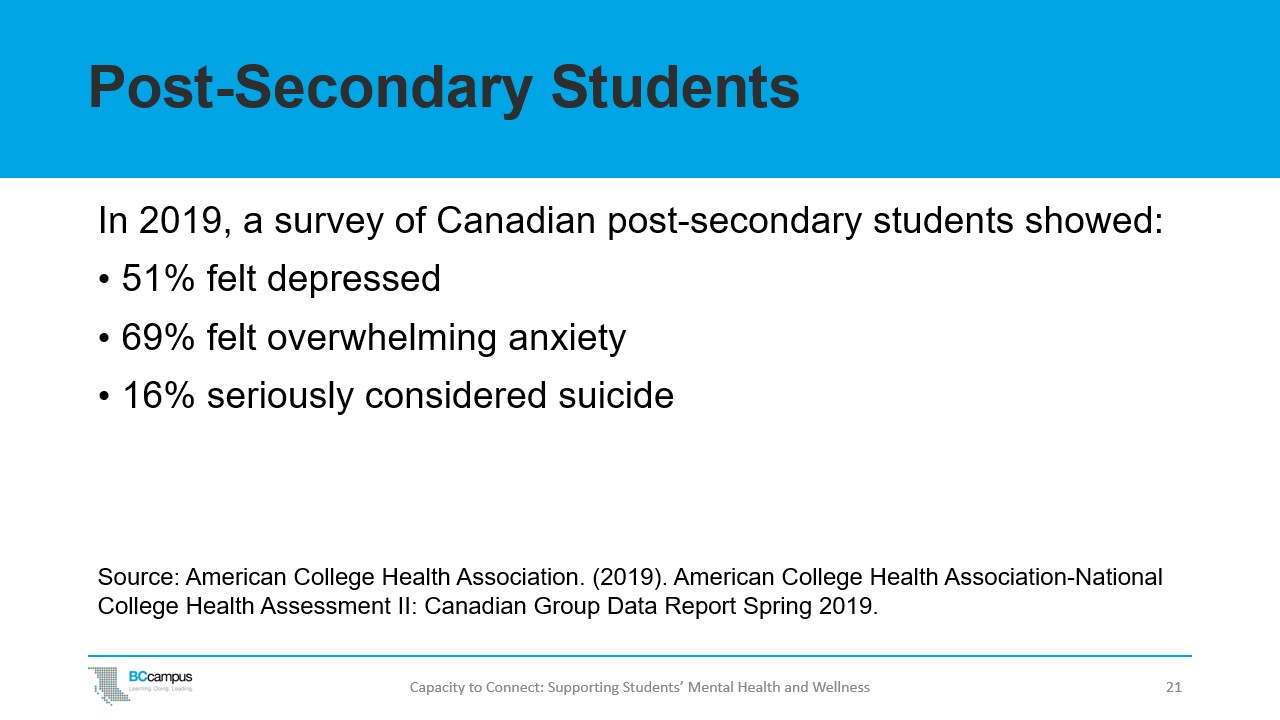
				 <div class="textbox"><h1 style="margin-top: 0.5em; margin-bottom: 0.5em;">How to Access the Facilitator’s Guide, Slides, and Handouts</h1> <p><em>Capacity to Connect: Supporting Students’ Mental Health and Wellness </em>includes a facilitator’s guide, an accompanying PowerPoint slide deck, <em><a href="https://opentextbc.ca/capacitytoconnect/wp-content/uploads/sites/343/2021/04/Capacity-to-Connect.pptx" data-url="https://opentextbc.ca/capacitytoconnect/wp-content/uploads/sites/343/2021/04/Capacity-to-Connect.pptx">Capacity to Connect: Supporting Students’ Mental Health and Wellness&nbsp;[PPTX]</a></em>, and handouts to share with participants.</p> <p>Two handouts are available to download:</p> <ul><li><a class="internal" href="#back-matter-wellness-wheel" data-url="/capacitytoconnect/back-matter/wellness-wheel/">Handout 1: Wellness Wheel</a></li> <li><a class="internal" href="#back-matter-responding-to-students-in-distress" data-url="/capacitytoconnect/back-matter/responding-to-students-in-distress/">Handout 2: Supporting Students in Distress</a> (This handout includes the scenarios and suggested responses)</li> </ul> <p>You may also want to bookmark (and have ready to play in a browser) these this video before offering a session:</p> <ul><li><a href="https://www.youtube.com/watch?v=1Evwgu369Jw" data-url="https://www.youtube.com/watch?v=1Evwgu369Jw">Brené Brown on Empathy</a> (2:53 min.)</li> </ul> </div> <p><em>Capacity to Connect: Supporting Students’ Mental Health and Wellness</em> was developed as part of BCcampus’s Mental Health and Wellness Projects to provide open educational resources to increase awareness of mental health and support for post-secondary students. This training session is one of <a href="https://bccampus.ca/projects/wellness/mental-health-and-wellness/" data-url="https://bccampus.ca/projects/wellness/mental-health-and-wellness/">a series of open educational resources on mental health</a> available for the B.C. post-secondary sector.</p> <p>This training was developed with funding from the Ministry of Advanced Education and Skills Training and guidance from an advisory group of students, staff, and faculty from B.C. post-secondary institutions.</p> <h1>How to Use This Resource</h1> <p>This resource is for facilitators presenting a two- to three-hour session to faculty and staff at post-secondary institutions. The training can be offered in person or online, and you are welcome to augment the training with your own stories, models, and examples.</p> <p>The resource includes three components:</p> <ul><li><strong>Facilitator’s guide</strong>. The guide includes presentation notes, activities, and scenarios to help you deliver the training. You can download the guide as a PDF file before giving a session. The guide also has a Getting Ready section, with suggestions for preparing, adapting, and modifying the training.</li> <li><strong>Slide deck. </strong>The guide has an accompanying PowerPoint slide deck that you can download. The slides can be formatted to meet your institution’s guidelines or slide deck templates. You can add slides or include contact information for counselling services, campus helplines, Indigenous student centres, and other services on your campus that support students.</li> <li><strong>Handouts. </strong>The guide includes handouts that you can share with participants. You can format these handouts according to your institution’s guidelines (e.g., colours, fonts, logos). You can also adapt the information in them to reflect the needs and concerns of the group you are addressing.</li> </ul> <h1>Length of the Session</h1> <p>For a breakdown of the session, see the <a class="internal" href="#chapter-detailed-agenda" data-url="/capacitytoconnect/chapter/detailed-agenda/">Detailed Agenda</a>. The agenda assumes that you will offer the training over the course of two hours; however, you may want more time and could extend the session to two and a half or even three hours to allow time for more discussion and to give participants more time to work through the scenarios at the end. Some facilitators may want to offer the training over two sessions. While the training is adaptable, we recommend that you include the sections on marginalized groups as it is important to maintain the integrity and diversity of voice in this resource.</p> <h1>Creative Commons License</h1> <p>This training is an open educational resource and licensed under a <a href="https://creativecommons.org/licenses/by/4.0/" data-url="https://creativecommons.org/licenses/by/4.0/">Creative Commons Attribution 4.0 International License</a>, unless otherwise indicated. This means you may retain, reuse, revise, remix, and redistribute this resource without permission. If you revise or remix the resource, it is important to include both the copyright holder of the original resource and the authors of this adapted version.</p> <h2>Attribution Statement</h2> <p><em>Capacity to Connect: Supporting Students’ Mental Health and Wellness</em>&nbsp;is an open educational resource (OER) and licensed under a&nbsp;<a href="https://creativecommons.org/licenses/by/4.0/" data-url="https://creativecommons.org/licenses/by/4.0/">Creative Commons Attribution 4.0 International</a>&nbsp;license, unless otherwise indicated.</p> <h1>Post-Secondary Students and Mental Health</h1> <p>Student life is a time of change, uncertainty, and challenges. Many post-secondary students are living away from home for the first time and are learning to balance very busy academic schedules with managing finances, building their social circles, and figuring out their interests and future careers. The stress of post-secondary education is felt by all students at some point, and it can be overwhelming for some.</p> <p>When the National College Health Assessment surveyed Canadian students in 2019, they found that students’ academic performance was adversely affected by stress (42%), anxiety (35%), sleep difficulties (29%) and depression (24%) within the past 12 months. This same study found that 16% of students had seriously considered suicide over the prior year at least one time.<span class="footnote"><span class="footnote-indirect" data-fnref="27-1"></span></span> People in their late teens and early 20s are also at the highest risk of all age groups for mental illness; in these years, first episodes of psychiatric disorders like major depression are most likely to appear. <span class="footnote"><span class="footnote-indirect" data-fnref="27-2"></span></span></p> <p>Post-secondary institutions are taking these statistics seriously and working to address students’ mental health and find ways to better support them. Everyone has a role to play. As faculty and staff have frequent contact with students, we are often in a position to recognize when a student may be struggling. Responding with empathy and knowing how to connect a student to campus services and resources such as counselling services can be critical factors in supporting a student in distress.</p> <p>This training is an introduction to what we can all do to support students’ mental health and well-being. The presentation starts with a discussion of mental health and wellness and looks at ways to promote resilience. The training then provides advice on how to recognize and respond to a student in distress and how to refer students to the other supports.</p> <h3>Text Attributions</h3> <ul><li>This chapter was adapted from&nbsp;<em>Capacity to Connect: Supporting Students from Distress to Suicide </em>© Vancouver Island University. Adapted by Barbara Johnston.&nbsp;<a href="https://creativecommons.org/licenses/by/4.0/" data-url="https://creativecommons.org/licenses/by/4.0/">CC BY 4.0</a> licence.</li> </ul> 
	</div>
			
				
				<div class="footnotes"><div id='27-1'>1. American College Health Association. (2019). <em>American College Health Association-National College Health Assessment II: Canadian Reference Group executive summary Spring 2019</em>. Silver Spring, MD: American College Health Association.</div><div id='27-2'>Queen’s University. (2012). <em>Report of the principal’s commission on mental health.</em> https://www.queensu.ca/principal/sites/webpublish.queensu.ca.opvcwww/files/files/CMHFinalReport.pdf</div></div>
	</div>
<div class="part-wrapper" id="part-getting-ready-wrapper">
    <div class="part  " id="part-getting-ready">
	<div class="part-title-wrap">
		<p class="part-number">I</p>
		<h1 class="part-title">Section 1: Getting Ready</h1>
	</div>
	<div class="ugc part-ugc">
		
	</div>
			
				
	</div>
<div class="chapter standard " id="chapter-preparing-for-the-session" title="Preparing for the Session">
	<div class="chapter-title-wrap">
		<p class="chapter-number">1</p>
		<h1 class="chapter-title">Preparing for the Session</h1>
								</div>
	<div class="ugc chapter-ugc">
				 <div class="textbox"><p>This section offers tips on preparing for the session. To download the PowerPoint slide deck and handouts that accompany this facilitator’s guide, please see the <a class="internal" href="#front-matter-introduction" data-url="/capacitytoconnect/front-matter/introduction/">Introduction</a>.</p> </div> <h1>Key Learning Points</h1> <p>This training opens up the conversation about mental health to increase understanding and reduce negative stigma surrounding mental illness. Key learning points of the training include the following:</p> <ul><li>We can all play a role in supporting students’ mental health.</li> <li>Mental health and wellness can be viewed as a wheel in which we’re keeping many different dimensions in balance.</li> <li>Resilience can help us deal with stresses and challenges when the wheel is out of balance.</li> <li>Mental health can be viewed as a continuum, and we are all on some point the continuum at any given time.</li> <li>We can make a difference to a student in distress by knowing how to recognize the signs of distress, responding empathetically, and knowing how to refer the student to other resources.</li> <li>Staff and faculty are not expected to and should never diagnose or act as a counsellor, and they should be aware of their own boundaries and need for self-care.</li> </ul> <h1>Know the Procedures and Contacts at Your Campus and in Your Community</h1> <p>Consider your post-secondary institution’s resources, procedures, or policies for helping students in distress and make sure you are familiar with who to notify during the day, when the campus is open, and at night or on weekends, when the campus is closed. Procedures for non-emergencies will vary from institution to institution.</p> <p>Find out what on-campus and community resources are available that support student mental health,&nbsp;or create your own contacts sheet to share with participants (or have a website ready for viewing on-screen).</p> <h1>Preparing for In-Person and Online Sessions: Practical Considerations</h1> <ul><li>Before giving a session, read through the <a class="internal" href="#chapter-guidelines-and-tips-for-facilitation" data-url="/capacitytoconnect/chapter/guidelines-and-tips-for-facilitation/">Guidelines and Tips for Facilitation</a> section and reflect on your own experiences and feelings about mental health.</li> <li>Download the slide deck and make any needed modifications.</li> <li>Read through the facilitator’s guide and handouts to familiarize yourself with the content. You may want to download the guide as a PDF file and print it.</li> <li>Prepare to give a territory acknowledgement to open the session. Also consider ways you can Indigenize the content. (See <a class="internal" href="#chapter-indigenous-considerations" data-url="/capacitytoconnect/chapter/indigenous-considerations/">Indigenous Considerations</a>.)</li> <li>Read through the scenarios and think about which scenarios you want participants to discuss. There are six scenarios to choose from, but it’s unlikely you’ll have time to cover them all. You may want to prepare a handout with just the scenarios (no responses) so participants can work through the scenarios and consider what to say before they see the suggested responses in Handout 2.</li> <li>Consider how many participants you expect to attend. The facilitator’s guide assumes a small to medium number of participants (approximately 6 to 30); if your group is large, you may need to modify some of the small group and reflection activities.</li> <li>Add relevant examples and additional insights that are based on your own experience or are relevant to the student population at your institution.</li> <li>Prepare the handouts. Either have them ready to hand out for an in-person session or have the links to the PDFs ready for an online session. Determine how you will share handouts and other resources, particularly when you are facilitating an online session. You can put PDFs in the chat, share a link in the chat, or email participants after the session.</li> <li>Have your institution’s workshop evaluation form ready to give to participants after the session.</li> <li>Consider providing participants with group guidelines before the session so people can prepare and create guidelines together. This will save time during the session. See <a href="#gg" data-url="/capacitytoconnect/chapter/guidelines-and-tips-for-facilitation#gg">Group Guidelines</a> for more information.</li> </ul> <h2>Preparing for an In-Person Session</h2> <p>You will need the following:</p> <ul><li>Laptop</li> <li>Projector</li> <li>Flipchart or whiteboard and appropriate markers</li> <li>Copies of Handouts 1 and 2 (see <a class="internal" href="#back-matter-wellness-wheel" data-url="/capacitytoconnect/back-matter/wellness-wheel/">Handout 1: Wellness Wheel</a> and <a class="internal" href="#back-matter-responding-to-students-in-distress" data-url="/capacitytoconnect/back-matter/responding-to-students-in-distress/">Handout 2: Responding to Students in Distress</a>)</li> </ul> <p>You will also need to consider where participants can go if they need to leave the session for a while. Is there a place where they can sit that is close to the classroom? Arrange in advance for someone to check on anyone who leaves the session, whether a co-facilitator, an assistant, or another participant.</p> <h2>Preparing for an Online Session</h2> <p>If you are offering the session online, there are a few additional things to do in advance:</p> <ul><li>Schedule a meeting time in your post-secondary institution’s preferred video-conferencing platform.</li> <li>Make sure that the screen-share function is enabled for sharing slides.</li> <li>If you will be using the chat or breakout rooms, make sure they are enabled.</li> <li>Share the meeting link and any passwords with participants before the session. (Consider sending the meeting information at least twice, including once the day before the session.)</li> <li>You may also want to share suggestions for online meeting etiquette for creating a safe learning space (e.g., sharing supportive comments, respecting confidentiality).</li> <li>Consider assigning someone to be the monitor responsible for responding to technical issues and questions posted in the chat.</li> <li>As noted above, make sure you have a plan for distributing any resources, such as the handouts, online. Remember to let participants know how and when they can expect to receive these resources.</li> </ul> <h3>Working in small groups online</h3> <p>If your video-conferencing software allows you to create breakout rooms, you can have participants work together in smaller groups. Take some time before the session to get comfortable with the process for setting up breakout rooms. It can be helpful to have someone assist you with setting up the breakout rooms during the session so you can facilitate while they handle the technical issues.</p> <p>Breakout rooms will work well for discussing the scenarios, but you will need to do some preparation. It may be easiest to put the scenarios in the chat; if you are doing this, have the scenarios ready to add to the chat before the session. During the session, you can then assign each group to a specific breakout room to discuss the different scenarios. Alternatively, you could move participants into breakout rooms and then visit each room to verbally provide each group with a scenario.</p> 
	</div>


	</div>
<div class="chapter standard " id="chapter-indigenous-considerations" title="Indigenous Considerations">
	<div class="chapter-title-wrap">
		<p class="chapter-number">2</p>
		<h1 class="chapter-title">Indigenous Considerations</h1>
								</div>
	<div class="ugc chapter-ugc">
				 <div class="textbox">Developing and delivering training on mental health can be an opportunity to build upon existing work at your institution toward Indigenization, decolonization, and reconciliation.</div> <h1>Territory Acknowledgement</h1> <p>Acknowledging the Indigenous Peoples on whose traditional lands you live, work, and study is an important way to begin an event or meeting and can be included as part of classroom activities and taught to students. Meaningful territory acknowledgements allow you to develop a closer and deeper relationship with not only the land but the traditional stewards and peoples whose territory you reside, work, live, and prosper in. For more information on giving a territory acknowledgement, see <a class="internal" href="#welcome" data-url="/capacitytoconnect/chapter/opening-the-session#welcome">Welcome and Territory Acknowledgement</a>.</p> <p>The Truth and Reconciliation Commission’s Calls to Action explicitly state that each of us as members of Canadian society has a direct responsibility to contribute to reconciliation; how we discuss colonization in relation to mental health is a direct response to that responsibility.</p> <p>The United Nations Declaration on the Rights of Indigenous Peoples (UNDRIP) is an international instrument adopted by the United Nations on September 13, 2007, to enshrine (according to Article 43) the rights that “constitute the minimum standards for the survival, dignity and well- being of the indigenous peoples of the world.” UNDRIP was adopted by the government of British Columbia on November 26, 2019. Centring the history of colonization as a background to and framework for mental health from a perspective of historical and current ongoing struggle is in direct response to our legal and moral obligation as members of Canadian society.</p> <h1>Curriculum Development and Indigenous Ways of Knowing and Being</h1> <p>Indigenization is a process of naturalizing and valuing Indigenous knowledge systems. <span class="footnote"><span class="footnote-indirect" data-fnref="210-1"></span></span> In the context of post-secondary institutions, this involves bringing Indigenous knowledge and approaches together with Western knowledge systems. This benefits not only Indigenous learners but all students, staff, faculty, and campus community members involved in or impacted by Indigenization.</p> <p>As you adapt this training for your particular context, consider how and in what ways you might interweave Indigenous content and approaches. Here are some examples of how you might include an understanding of Indigenous ways of knowing and being:</p> <ul><li>Incorporate Indigenous pedagogical approaches, such as holistic and relational perspectives, experiential learning, place-based learning, and intergenerational learning.</li> <li>Involve Indigenous students, faculty, and staff in reviewing, adapting, and evaluating resources.</li> <li>Integrate knowledge from Indigenous communities local to your institution.</li> </ul> <p>As you do this work, as an Indigenous or non-Indigenous person, continue to draw from and build on existing relationships with Indigenous people, both within and outside of your institution. As a way of continuing to work in intentional and respectful ways, you may want to reflect on questions like these:</p> <ul><li>How does this work benefit Indigenous communities and help them to meet their goals?</li> <li>Will there be benefits for Indigenous students, faculty, and staff?</li> <li>Have the community or communities identified their own priorities or goals related to this work?</li> <li>How can this work support Indigenous efforts related to healing from past and ongoing colonial violence?</li> </ul> <h1>Elders and Knowledge Keepers</h1> <p>Elders have always been the foundation for emotional, social, intellectual, physical, and spiritual guidance for Indigenous communities. As you find ways to naturalize Indigenous context, perspectives, and traditional ways of being in your session, consider inviting an Elder or Knowledge Keeper from your local community to support the sessions. One way of doing this is to speak with Indigenous services staff at your institution, share with them some of the recommendations in this guide, and see how they might wish to support this work.</p> <p>Not all institutions will have an Elder in Residence, but each should have ways for you to contract with an Elder or Knowledge Keeper to come in and support your work. Elders and Knowledge Keepers often support the whole post-secondary institution community, not just the Indigenous students. Involving Elders and Knowledge Keepers can support reconciliation by helping to build respectful, reciprocal relationships that are deep and meaningful.</p> <p>Whenever you plan to bring in a community member, an Elder, or a Knowledge Keeper, it is important to plan for the honorarium required to remunerate them for their time and for sharing their wisdom and traditional teachings. In many communities, it is seen as most respectful to offer payment on par with what you would pay a PhD holder to do a keynote presentation.</p> <p>However, consulting with the Indigenous services staff at your institution on what is a typical amount for this type of event is also a good practice.</p> <h3>Text Attributions</h3> <ul><li>This chapter is adapted from&nbsp;<a href="https://opentextbc.ca/svmconsent/" data-url="https://opentextbc.ca/svmconsent/"><em>Consent &amp; Sexualized Violence Training and Facilitator Guide: Preventing</em>&nbsp;<em>and Responding to Sexual Violence in B.C. Post-Secondary Institutions</em></a>&nbsp;by Sexual Violence Training Development Team (<a href="https://creativecommons.org/licenses/by/4.0/deed.en" data-url="https://creativecommons.org/licenses/by/4.0/deed.en">CC BY 4.0 License</a>).</li> </ul> 
	</div>
			
				
				<div class="footnotes"><div id='210-1'>Antoine, A., Mason, R., Mason, R., Palahicky, S., &amp; Rodriguez, C. (2018), <em>Pulling together: A guide for</em> <em>Indigenization of post-secondary institutions. A professional learning series</em>, https://opentextbc.ca/indigenizationcurriculumdevelopers/; Little Bear, L. (2009), <em>Naturalizing Indigenous knowledge:</em> <em>Synthesis paper</em>, Canadian Council on Learning, https://www.afn.ca/uploads/files/education/21._2009_july_ccl-alkc_leroy_littlebear_naturalizing_indigenous_knowledge-report.pdf</div></div>
	</div>
<div class="chapter standard " id="chapter-guidelines-and-tips-for-facilitation" title="Guidelines and Tips for Facilitation">
	<div class="chapter-title-wrap">
		<p class="chapter-number">3</p>
		<h1 class="chapter-title">Guidelines and Tips for Facilitation</h1>
								</div>
	<div class="ugc chapter-ugc">
				 <div class="textbox">Talking about mental health can sometimes bring up many feelings and memories for people, and sometimes the discussion can run off topic. This section provides some guidelines and tips for facilitating a session on mental health.</div> <h1>Creating a Safe Learning Space</h1> <p>Participants need to feel comfortable, safe, and respected during the training. We discuss several strategies for helping to create a positive learning space. As you prepare to facilitate, you will want to consider factors such as when and where to hold the session, key messages on promotional materials, whether to use group guidelines, how to ensure diverse representation, and ways of working with co-facilitators or guests. If possible, having a co-facilitator or someone to assist you during the presentation can be very helpful. If a participant is triggered and needs to leave the session, a co-facilitator or helper can follow up with the participant.</p> <h1>Opening with Intention</h1> <p>Facilitators have an enormous role to play in setting the tone for a session. As people enter the space (online or in person), you can welcome them and help them get oriented. You can let them know if you’ve started or whether you’re waiting for a few more people, and share housekeeping information such as where the bathrooms are, where they can put their things, or how to use online interactive features. You may want to consider using a breathing exercise together or an icebreaker activity to help put people at ease. As you begin the session, you can use opening questions that help create inclusivity, such as correct pronouns, check-in questions, or information about accessibility needs and requests.</p> <h1>Scope of the Session</h1> <p>It is important to hold space in a session for people’s feelings and experiences – shared or not. However, boundaries are also needed to allow the session to move forward and be completed within the stated time frame.</p> <p>It is also important to establish at the beginning that the training is a learning space and not a counselling session (you may also want to send an email with this message to all participants prior to the session). If a participant is starting to take over the discussion with their personal experiences, you can gently redirect the conversation back to the material that you need to cover. Plan to stay after the session is over to talk to any participants one-on-one.</p> <p>It’s also important to reassure participants who worry that they must “fix” a student who is in distress. Emphasize that faculty and staff are not expected to be counsellors or to provide mental health treatment.</p> <h2>What This Session Does Not Include</h2> <p>This training doesn’t focus on how to recognize and support a student struggling with substance use and addiction. Substance use and mental health are closely linked, but this topic is beyond the scope of this foundational training.</p> <p>This session briefly addresses suicide, but suicide is a very serious issue that requires more in-depth training. BCcampus has a training resource on suicide awareness for faculty and staff. BCcampus also has a facilitated resource on suicide <a href="https://opentextbc.ca/suicideawareness/" data-url="https://opentextbc.ca/suicideawareness/">Let’s Talk About Suicide: Raising Awareness and Supporting Students</a>.</p> <p>Faculty and staff who have concerns about a student who is suicidal should consult a counsellor. If it’s an emergency, they should call 911 and campus security. <a class="internal" href="#chapter-the-first-r-recognizing-signs-of-distress" data-url="/capacitytoconnect/chapter/the-first-r-recognizing-signs-of-distress/">Section 3</a> of this resource, “The Three Rs Framework: Recognize, Respond, Refer,” provides information on how to refer another student to campus and community resources.</p> <h1><a id="gg" class="internal" data-url=""></a>Group Guidelines</h1> <p>It can be helpful to ask participants to agree to a list of guidelines or a code of conduct when they register for the session. You can either send the group guidelines to participants before the session or take some time at the beginning of the session to establish the guidelines together.</p> <p>When you start the session, you can ask participants if they feel comfortable with the guidelines or if they have something they would like to add or change.</p> <p>Group guidelines can be an important tool for supporting safer discussion about difficult topics. You can remind participants of the guidelines if the discussion is getting difficult. Important group agreements relate to listening to and showing respect for others (e.g., not talking when others are speaking, not making rude comments, not talking on the phone), confidentiality, and participation.</p> <p>Group guidelines come in all shapes and sizes. Some groups have a few guidelines, while others have many. Here are some suggestions for possible guidelines:</p> <ul><li>Share the learning, not the names or the stories (confidentiality).</li> <li>Participants have the right to “pass” on activities/questions that feel uncomfortable.</li> <li>It is all right to feel uncomfortable or to not know answers to everything.</li> <li>It is okay to step out of the session at any time.</li> <li>Treat others with respect.</li> <li>Be mindful of your language; respect everyone’s names and pronouns.</li> <li>Speak for yourself. Use “I statements” to state opinions or feelings.</li> <li>Seek to replace judgment with curiosity.</li> <li>Take care of yourself.</li> <li>Allow everyone a chance to participate.</li> </ul> <h1>Content Warnings</h1> <p>Content warnings (also called trigger warnings) are statements made before sharing potentially difficult or challenging material. The intent of content warnings is to provide participants with the opportunity to prepare themselves emotionally for engaging with the topic or to make a choice to not participate.</p> <p>Different departments and institutions will have different approaches to content warnings, and this may guide your decision about including content warnings on registration or sign-up forms, in learning materials, and in the learning environment. Here is an example of a content warning:</p> <blockquote><p>We will be discussing topics related to mental health and mental illness in this training. During the training, you can choose not to participate in certain activities or discussions and can leave the room or virtual space at any time. If you feel upset or overwhelmed, please know that there are resources to support you.</p></blockquote> <p>There are a number of other facilitation strategies you may want to consider in addition to or instead of a content warning:</p> <ul><li>When discussing difficult content, check in with participants from time to time. Ask them how they are doing, whether they need a break, and so on. Let them know that you are aware that the content is difficult.</li> <li>Ask participants to be mindful of their fellow learners during the discussions and remind them that people who have struggled with mental illness may be present in the room (regardless of whether this information has been shared with others).</li> </ul> <h1>Trauma Awareness</h1> <p>Some participants may have direct experience with mental illness or trauma. There are a number of strategies you can use to help create a trauma-aware learning space.</p> <h2>Before the Session</h2> <p>Before you start facilitating, ensure that you are knowledgeable about receiving disclosures and about available supports and resources on campus and in the community. Some institutions have developed practices such as expedited counselling for participants who might need support after a training session, or making intensive crisis supports available for a short time after a training session or other initiative.</p> <h2>To Start</h2> <p>At the beginning of the session, let participants know that they have the right and freedom to take care of themselves in a way that works for them. In particular, let participants know that they can leave the room or virtual space or choose not to participate in an activity. You could say something like “If at any time you feel you need to leave, that’s fine with me. You are empowered to take care of yourself.” You can also let participants know that reactions to difficult material can sometimes be delayed and that they may wish to connect with you a few days after the training or to access support from family, friends, or other people in their lives.</p> <p>If you feel comfortable doing so, you can share information about grounding activities that may be helpful to participants during the session. Grounding activities, such as breathing exercises, are simple activities that can help people relax, stay present, and reconnect with the “here and now” following a trauma response – for example, pressing or “rooting” your feet into the ground, breathing slowly in and out for a count of two, repeating a statement such as “I am safe now, I can relax,” or using your five senses to describe the environment in detail.</p> <h2>During the Session</h2> <p>If you notice that a participant has left the group and you suspect that they were reminded of previous trauma by something in the session, follow up with them one-on-one after the session to check in and offer any resources that you think might be helpful to them.</p> <p>During the session, if the conversation becomes intense or you believe that a number of participants have become overwhelmed or affected by the discussion, it can be helpful to take a break or use an activity that involves the body or movement to help people reconnect with the present moment.</p> <p>Let participants know that you will be available after the training if they would like to debrief or share their responses to the session or how they are feeling. Schedule at least 30 minutes after a session so that you can be available to participants. If you are delivering the training online, let participants know that they can private message or email you.</p> <p>Participants may need some time near the end of the session to ask questions, share a reflection, or simply sit with what they have heard and discussed. If possible, try to ensure that this time is built in at the end so no one feels rushed when concluding the session.</p> <h2>After the Session</h2> <p>Plan to stay after the session to talk to participants who have questions or concerns. If you are concerned about a participant, ask them if they would find it helpful for you to check in with them later in the day or the following day. You could also ask them if they have a friend or family member that they might find it helpful to speak with after the session. If so, help them make a plan to connect with them by phone, text, or in person or at a certain time.</p> <p>For more information on trauma-informed practice, see the BCcampus recorded webinar <a href="https://bccampus.ca/event/trauma-informed-facilitation/" data-url="https://bccampus.ca/event/trauma-informed-facilitation/">Trauma-Informed Facilitation</a>, by Dawn Schell, and the Education Northwest resource <a href="https://educationnorthwest.org/sites/default/files/resources/trauma-informed-practices-postsecondary-508.pdf" data-url="https://educationnorthwest.org/sites/default/files/resources/trauma-informed-practices-postsecondary-508.pdf">Trauma-</a><a href="https://educationnorthwest.org/sites/default/files/resources/trauma-informed-practices-postsecondary-508.pdf" data-url="https://educationnorthwest.org/sites/default/files/resources/trauma-informed-practices-postsecondary-508.pdf">Informed Practices for Postsecondary Education: A Guide</a>, by Shannon Davidson.</p> <h1>Questions That May Come Up and How to Respond</h1> <p>Facilitating conversations about mental health can be challenging. Participants likely bring many different experiences, assumptions, ideas, and worries about how best to support students who are struggling with these issues.</p> <p>It’s important to create a space where people feel safe and supported so they share and listen to others with respect and empathy. This section offers ideas and tips for creating such an environment, but you also have a time limit within which to present material. It’s important to keep an eye on the clock and know how, and when, to direct participants’ attention to the next topic.</p> <p>As mental health and wellness affects all parts of our lives, participants may bring up related issues or concerns. Below are some questions that might come up during the presentation, with suggestions for responses. The goal is to acknowledge people’s comments, thank them for their contribution, and point them to resources they may find helpful. Then the discussion can move back to the specific topic at hand.</p> <div class="h5p"><div class="textbox interactive-content"><span class="interactive-content__icon"></span> <p>An interactive H5P element has been excluded from this version of the text. You can view it online here:<br /> <a href="https://opentextbc.ca/capacitytoconnect/?p=206#h5p-2" title="BCcampus, Capacity to Connect: Supporting Students’ Mental Health and Wellness (Frequently Asked Questions)" data-url="https://opentextbc.ca/capacitytoconnect/?p=206#h5p-2">https://opentextbc.ca/capacitytoconnect/?p=206#h5p-2</a> </p> </div> </div> <div class="pdf"><em>What teaching practices can I use in my classroom to support student mental health and well-being?</em></div> <ul><li class="pdf">Thank the person for bringing up this important topic.</li> <li class="pdf">Acknowledge that there isn’t time to address this question in a meaningful way.</li> <li class="pdf">Direct participants to the supports available at your institution around this topic.</li> <li class="pdf">Invite the person to talk with you after the session for further assistance.</li> </ul> <div class="pdf"><p><em>Why isn’t this institution doing more to support students struggling with mental health and wellness?</em></p> <ul><li>Acknowledge in a respectful way the person’s commitment to students’ well-being.</li> <li>Let them know that you’ll be sharing resources that are available currently.</li> <li>Invite them to meet with you after the session to share ideas for how the institution could do better.</li> </ul> <p><em>Why do I have to be responsible for students’ mental health and well-being? We have counselling services for that.</em></p> <ul><li>Remind people that no one is being asked to take responsibility for students’ well-being.</li> <li>Note that faculty and staff have a role to play, but only if they feel comfortable doing so while maintaining their own boundaries.</li> <li>Suggest that participants who still have concerns after the presentation come and talk with you for further guidance.</li> </ul> <p><em>I tried to help a student and it went badly.</em></p> <ul><li>Acknowledge that the person has had a negative experience in the past.<br /> Focus their attention on the present: by attending this session they can perhaps discover other ways of supporting students while maintaining good boundaries.</li> <li>Invite the person to talk with you after the presentation if they still have concerns.</li> </ul> <p><em>What about the support for the mental health and well-being of faculty and staff?</em></p> <ul><li>Acknowledge the importance of the issue being raised: faculty and staff face their own challenges around mental health and well-being.</li> <li>Let people know that there are institutional and community resources available to them and you can provide those after the session.</li> <li>Invite participants to support each other using the skills that are covered in the session. Remind people that we can benefit from being seen and being offered empathy and care.</li> </ul> </div> <h2>Transitions and Difficult Conversations</h2> <p>While facilitating, you may encounter challenging moments when you may not be sure how to respond. Someone may start to dominate the discussion, or the conversation may shift in a direction that makes you concerned for the comfort of other participants.</p> <p>Here are some potential responses for bringing participants back to the topic or handling challenging moments:</p> <ul><li>“This is a really great dialogue, but I would like to bring us back to the topic at hand.”</li> <li>“Thank you for sharing that story. I’d like to follow up with you after the session today if we can save this conversation for later.”</li> <li>“I’m getting conscious of time here. Let’s move on for now.”</li> <li>“Your feelings are important and I want to be able to give you my full attention. Would you like to step out and have a conversation about it? My colleague can continue with the session.” (This can work if there are two co-facilitators. If there is only one facilitator, you can suggest continuing the conversation after the session.)</li> <li>“It’s okay for us to agree to disagree. Let’s move on; I’d like to bring us back to some of the activities and questions we had planned.”</li> </ul> <h1>Self-Care and Community Care</h1> <p>Self-care and community care are about looking after yourself and those around you. The experience of facilitating a session on mental health can range from satisfying and rewarding to challenging and overwhelming. It is important to make sure that you are able to take the time to take care of yourself and that you are willing to reach out to co-workers, friends, and family, or for professional support if needed.</p> <p>After facilitating a session, you may want to check in with a friend or colleague about your experiences and any successes or challenges in facilitating. This allows for time to reflect on issues related to your own mental health, to consider any feedback that you received from participants, and to discuss any facilitation successes and challenges. You might use the time after a session to reflect or use a journal to make notes as a way of processing the experience.</p> <h2>Check-In/Reflection Questions for Facilitators</h2> <p>Taking time after a session to debrief can be a helpful way to care for yourself. Here are some sample debriefing questions.</p> <ul><li>What was a positive moment or a success in this session?</li> <li>How did participants engage with the different activities? Is there something I want to facilitate or do differently next time?</li> <li>Did I or a participant seem to have a response to the material, a shared story, or another participant that was challenging? If so, how was it responded to or resolved?</li> <li>Is there something that would be helpful for me to learn about or check with a colleague about?</li> </ul> <h1>Resources on Mental Health for Further Reading and Preparation</h1> <ul><li><a href="https://www.camh.ca/en/suicide-prevention" data-url="https://www.camh.ca/en/suicide-prevention">Centre for Addiction and Mental Health</a> (CAMH): Has many resources on mental health and addiction, including a Get Help page with information on crisis lines and immediate help.</li> <li><a href="https://headsupguys.org/" data-url="https://headsupguys.org/">HeadsUpGuys</a>: An online resource from the University of British Columbia that supports men in their fight against depression by providing tips, tools, information about professional services, and stories of success. Supports men’s mental health in a positive, inclusive, and mutually supportive way and is for people of all backgrounds, regardless of gender, race, or sexual orientation.</li> <li><a href="https://keltymentalhealth.ca/" data-url="https://keltymentalhealth.ca/">Kelty Mental Health Resource Centre</a>, B.C. Children’s Hospital: Provides mental health and substance use information, resources, and peer support for youth and young adults. Also provides information and resources for people of all ages with an eating disorder or disordered eating concern.</li> <li><a href="https://www.mentalhealthcommission.ca/" data-url="https://www.mentalhealthcommission.ca/">Mental Health Commission of Canada</a>: Offers a number of fact sheets, research reports, and webinars on mental health and mental illness.</li> <li><a href="https://www.sochmentalhealth.com/" data-url="https://www.sochmentalhealth.com/">South Asian Mental Health (SOCH)</a>: A mental health promotion initiative tailored to provide the South Asian community with mental health support and start the conversation to break the stigma around mental health. <em>The Pardesi Project</em>, a film about the mental health of South Asian international students, is available on their website.</li> <li><a href="https://wemattercampaign.org/" data-url="https://wemattercampaign.org/">We Matter Campaign</a>: An Indigenous, youth-led, nationally registered organization dedicated to Indigenous youth support, hope, and life promotion.</li> </ul> <h3>Text Attributions</h3> <ul><li>“Creating a Safe Learning Space,” “Trauma Awareness,” and “Self-Care and Community Care” are adapted from <a href="https://opentextbc.ca/svmconsent/" data-url="https://opentextbc.ca/svmconsent/"><em>Consent &amp; Sexualized Violence Training and Facilitator Guide: Preventing</em> <em>and Responding to Sexual Violence in B.C. Post-Secondary Institutions</em></a> by Sexual Violence Training Development Team (<a href="https://creativecommons.org/licenses/by/4.0/deed.en" data-url="https://creativecommons.org/licenses/by/4.0/deed.en">CC BY 4.0 License</a>).</li> </ul> 
	</div>


	</div>
<div class="chapter standard " id="chapter-detailed-agenda" title="Detailed Agenda">
	<div class="chapter-title-wrap">
		<p class="chapter-number">4</p>
		<h1 class="chapter-title">Detailed Agenda</h1>
								</div>
	<div class="ugc chapter-ugc">
				 <p>This agenda provides suggested timings for a two-hour session, the minimum time recommended for presenting the information and providing time for the activities. However, you may want more time to offer the training and could extend the session to two and a half or even three hours to allow more time for discussion, debriefs, and short breaks, and to give participants lots of time to work through the scenarios at the end. Some facilitators may want to offer this training over two sessions. While the training is adaptable, we recommend that you include the sections on marginalized groups, as it is important to maintain the integrity of diversity of voice in this resource.</p> <table class="grid" style="width: 100%;"><tbody><tr><th scope="col">Content</th> <th scope="col">Time</th> </tr> <tr><td><strong>Welcome</strong> <ul><li>Welcome and Territory Acknowledgement</li> <li>Introduction</li> <li>Opening Check-in Activity</li> <li>Goals and Objectives</li> <li>Supporting Participants</li> </ul> </td> <td>8 min</td> </tr> <tr><td><strong>What is Mental Health and Wellness?</strong> <ul><li>Brainstorming Activity</li> <li>Presentation on Wellness Wheel</li> <li>Resilience</li> <li>Small Group Activity Using Wellness Wheel.</li> </ul> </td> <td>15 min</td> </tr> <tr><td><strong>Mental Health Models</strong> <ul><li>Mental Health and Mental Illness and Corey Keys’ Dual Continuum Model</li> <li>Mental Health Continuum</li> <li>Marginalized Groups and Mental Health</li> <li>Reflection Activity</li> </ul> </td> <td>8 min</td> </tr> <tr><td><strong>Mental Health Statistics</strong> <ul><li>Mental Health Problems Are Common</li> <li>COVID-19 Pandemic and Global Environmental Stressors</li> <li>Reflection Activity</li> </ul> </td> <td>5 min</td> </tr> <tr><td><strong>Introduction to Three Rs Framework</strong></td> <td>1 min</td> </tr> <tr><td><strong>First R: <em>Recognize</em></strong> <ul><li>Academic, Emotional, Physical, and Behavioural Signs of Distress</li> <li>Signs that a Student Might Be Thinking About Suicide</li> </ul> </td> <td>10 min</td> </tr> <tr><td><strong>Second R: <em>Respond</em></strong> <ul><li>Reflection Activity</li> <li>Short Video: Brené Brown on Empathy</li> <li>Video Reflection Activity</li> <li>Tips for Responding to Students in Distress</li> <li>Asking About Suicide</li> </ul> </td> <td>&nbsp;20 min</td> </tr> <tr><td><strong>Third R: <em>Refer</em></strong> <ul><li>Services and Resources at Your Institution</li> <li>Provincial Crisis and Support Lines</li> <li>Provincial Supports for Indigenous Students</li> <li>If A Student Won’t See a Counsellor or Seek Help</li> <li>Privacy</li> <li>Handouts</li> </ul> </td> <td>8 min</td> </tr> <tr><td><strong>Maintaining Boundaries</strong> <ul><li>Maintain Your Own Boundaries</li> <li>Consult with Others</li> <li>Brainstorming Activity</li> </ul> </td> <td>15 min</td> </tr> <tr><td><strong>Scenarios for Practice and Discussion</strong> <ul><li>Introduction Practice Scenarios Activity</li> <li>Small Group Discussion or Role Play</li> <li>Debrief</li> </ul> </td> <td>20 min</td> </tr> <tr><td><strong>Summary and Conclusion</strong> <ul><li>Summary</li> <li>Share Handouts with Participants</li> <li>Q&amp;A</li> </ul> </td> <td>10 min</td> </tr> </tbody> </table> 
	</div>


	</div>

</div>
<div class="part-wrapper" id="part-section-2-mental-health-and-wellness-wrapper">
    <div class="part  " id="part-section-2-mental-health-and-wellness">
	<div class="part-title-wrap">
		<p class="part-number">II</p>
		<h1 class="part-title">Section 2: Mental Health and Wellness</h1>
	</div>
	<div class="ugc part-ugc">
		
	</div>
			
				
	</div>
<div class="chapter standard " id="chapter-opening-the-session" title="Opening the Session">
	<div class="chapter-title-wrap">
		<p class="chapter-number">5</p>
		<h1 class="chapter-title">Opening the Session</h1>
								</div>
	<div class="ugc chapter-ugc">
				 <div class="textbox"><p>This section describes how to welcome participants and prepare them to engage with the material. This includes:</p> <ul><li>Welcome and territory acknowledgement</li> <li>Explaining goals and objectives</li> <li>Supporting participants</li> </ul> </div> <div class="h5p"><div class="textbox interactive-content"><span class="interactive-content__icon"></span> <p>An interactive H5P element has been excluded from this version of the text. You can view it online here:<br /> <a href="https://opentextbc.ca/capacitytoconnect/?p=35#h5p-1" title="BCcampus, Capacity to Connect: Supporting Students’ Mental Health and Wellness (Opening the Session)" data-url="https://opentextbc.ca/capacitytoconnect/?p=35#h5p-1">https://opentextbc.ca/capacitytoconnect/?p=35#h5p-1</a> </p> </div> <p><em>These slides are available for use with this section of the presentation. For information about downloading presentation slides, see <a class="internal" href="#front-matter-introduction" data-url="/capacitytoconnect/front-matter/introduction/">Introduction.</a></em></p></div> <div class="pdf"><img class="aligncenter wp-image-146" src="https://opentextbc.ca/capacitytoconnect/wp-content/uploads/sites/343/2021/04/Slide1.jpg" alt="" width="500" height="281" srcset="https://opentextbc.ca/capacitytoconnect/wp-content/uploads/sites/343/2021/04/Slide1.jpg 1280w, https://opentextbc.ca/capacitytoconnect/wp-content/uploads/sites/343/2021/04/Slide1-300x169.jpg 300w, https://opentextbc.ca/capacitytoconnect/wp-content/uploads/sites/343/2021/04/Slide1-1024x576.jpg 1024w, https://opentextbc.ca/capacitytoconnect/wp-content/uploads/sites/343/2021/04/Slide1-768x432.jpg 768w, https://opentextbc.ca/capacitytoconnect/wp-content/uploads/sites/343/2021/04/Slide1-65x37.jpg 65w, https://opentextbc.ca/capacitytoconnect/wp-content/uploads/sites/343/2021/04/Slide1-225x127.jpg 225w, https://opentextbc.ca/capacitytoconnect/wp-content/uploads/sites/343/2021/04/Slide1-350x197.jpg 350w" sizes="(max-width: 500px) 100vw, 500px" title="" /></div> <h1><a id="welcome" class="internal" data-url=""></a>Welcome</h1> <div class="pdf"><img class="aligncenter wp-image-147" src="https://opentextbc.ca/capacitytoconnect/wp-content/uploads/sites/343/2021/04/Slide2.jpg" alt="" width="500" height="281" srcset="https://opentextbc.ca/capacitytoconnect/wp-content/uploads/sites/343/2021/04/Slide2.jpg 1280w, https://opentextbc.ca/capacitytoconnect/wp-content/uploads/sites/343/2021/04/Slide2-300x169.jpg 300w, https://opentextbc.ca/capacitytoconnect/wp-content/uploads/sites/343/2021/04/Slide2-1024x576.jpg 1024w, https://opentextbc.ca/capacitytoconnect/wp-content/uploads/sites/343/2021/04/Slide2-768x432.jpg 768w, https://opentextbc.ca/capacitytoconnect/wp-content/uploads/sites/343/2021/04/Slide2-65x37.jpg 65w, https://opentextbc.ca/capacitytoconnect/wp-content/uploads/sites/343/2021/04/Slide2-225x127.jpg 225w, https://opentextbc.ca/capacitytoconnect/wp-content/uploads/sites/343/2021/04/Slide2-350x197.jpg 350w" sizes="(max-width: 500px) 100vw, 500px" title="" /></div> <p>Welcome participants and open with a territory acknowledgement. If you’re unsure of your territory, the website <a href="https://native-land.ca/" data-url="https://native-land.ca/">Native-Land.ca</a> is a helpful resource.</p> <div class="textbox textbox--examples"><div class="textbox__header"><p class="textbox__title">Territory Acknowledgement and Indigenous Ways of Knowing and Being</p> </div> <div class="textbox__content"><p>A meaningful territory acknowledgement allows us to develop a closer and deeper relationship with not only the land but also the traditional stewards and peoples whose territories we reside, work, live, and prosper in.</p> <p>Acknowledging the territory within the context of mental health and well-being can open a person’s perspective on traditional ways of knowing and being, stepping out of an organizational structure and allowing participants to delve into their own perceptions, needs, and abilities.</p> <p>Territory acknowledgements are designed as the very first step to reconciliation. What we do with the knowledge of whose traditional lands we are on is the next important step.</p> <p>Some questions to consider as you acknowledge your territory:</p> <ul><li>What do we do as good guests here?</li> <li>What can I do in my personal and professional roles to contribute to reconciliation?</li> </ul> <p>Should your institution have an approved territory acknowledgement please use that to open the session; however, we invite you to consider how to make that institutional statement more personal and specific to you, in that moment and in the work you are about to delve into with your participants.</p> </div> </div> <h1>Opening Check-in Activity</h1> <p>After the welcome, introduce yourself. You could ask participants to very briefly introduce themselves, or you may want to start the session with a short participant check-in as a way to invite people into a learning space. You could ask participants to share very brief introductions or do an online poll that asks people to choose the type of weather that matches how they are feeling. There are many different ways to have participants check in with themselves and the group, and we invite you to use questions and reflections that are meaningful to you and the group.</p> <h1>Goals and Objectives</h1> <div class="pdf"><p><img class="aligncenter wp-image-150" src="https://opentextbc.ca/capacitytoconnect/wp-content/uploads/sites/343/2021/04/Slide4.jpg" alt="" width="500" height="281" srcset="https://opentextbc.ca/capacitytoconnect/wp-content/uploads/sites/343/2021/04/Slide4.jpg 1280w, https://opentextbc.ca/capacitytoconnect/wp-content/uploads/sites/343/2021/04/Slide4-300x169.jpg 300w, https://opentextbc.ca/capacitytoconnect/wp-content/uploads/sites/343/2021/04/Slide4-1024x576.jpg 1024w, https://opentextbc.ca/capacitytoconnect/wp-content/uploads/sites/343/2021/04/Slide4-768x432.jpg 768w, https://opentextbc.ca/capacitytoconnect/wp-content/uploads/sites/343/2021/04/Slide4-65x37.jpg 65w, https://opentextbc.ca/capacitytoconnect/wp-content/uploads/sites/343/2021/04/Slide4-225x127.jpg 225w, https://opentextbc.ca/capacitytoconnect/wp-content/uploads/sites/343/2021/04/Slide4-350x197.jpg 350w" sizes="(max-width: 500px) 100vw, 500px" title="" /></p> </div> <p>Review the overall goal of this presentation: to help faculty and staff develop the knowledge, skills, perspectives, and confidence to support student mental health and wellness.</p> <p>After participating in the presentation, participants will be able to:</p> <ul><li>Describe what mental health and wellness is.</li> <li>Describe how students show resilience to deal with common and reversible stress.</li> <li>Recognize the different ways a student may show they are in distress.</li> <li>Respond to a student with a mental health concern in an empathetic way.</li> <li>Refer a student in distress to appropriate resources.</li> <li>Explain the role of faculty and staff in supporting student mental health and the need for boundaries when supporting students in distress.</li> </ul> <p>Participants will leave this session with a clear understanding of their role in responding to students in distress and have basic tools for approaching and referring students to campus resources.</p> <h1>Practical Information</h1> <div class="pdf"><img class="aligncenter wp-image-151" src="https://opentextbc.ca/capacitytoconnect/wp-content/uploads/sites/343/2021/04/Slide7.jpg" alt="" width="500" height="281" srcset="https://opentextbc.ca/capacitytoconnect/wp-content/uploads/sites/343/2021/04/Slide7.jpg 1280w, https://opentextbc.ca/capacitytoconnect/wp-content/uploads/sites/343/2021/04/Slide7-300x169.jpg 300w, https://opentextbc.ca/capacitytoconnect/wp-content/uploads/sites/343/2021/04/Slide7-1024x576.jpg 1024w, https://opentextbc.ca/capacitytoconnect/wp-content/uploads/sites/343/2021/04/Slide7-768x432.jpg 768w, https://opentextbc.ca/capacitytoconnect/wp-content/uploads/sites/343/2021/04/Slide7-65x37.jpg 65w, https://opentextbc.ca/capacitytoconnect/wp-content/uploads/sites/343/2021/04/Slide7-225x127.jpg 225w, https://opentextbc.ca/capacitytoconnect/wp-content/uploads/sites/343/2021/04/Slide7-350x197.jpg 350w" sizes="(max-width: 500px) 100vw, 500px" title="" /></div> <p>Suggest that as people engage with the presentation, they reflect and think about how the information might apply to situations they have already had with students, or situations that they can imagine coming up in their role as faculty or staff.</p> <p>Encourage people to provide feedback and share their input during the discussions as this helps improve the learning opportunities.</p> <p>Encourage people to jot down notes during reflection activities. Encourage them to ask questions if they have any questions during the session.</p> <p>Let everyone know that after the presentation, they will have access to printable (PDF) handouts of a Wellness Wheel worksheet and a handout on how to respond to students in distress. If possible, have a handout with contact information of your institution’s support services for students.</p> <p><span style="background-color: initial; font-size: 1em;">If you are giving this session online, remind online participants that they can turn off their cameras and move around the room during the session. Ask them to be mindful of using the mute button to reduce noise in the online space.</span></p> <h1>Supporting Participants</h1> <div class="pdf"><img class="aligncenter wp-image-149" src="https://opentextbc.ca/capacitytoconnect/wp-content/uploads/sites/343/2021/04/Slide5.jpg" alt="" width="500" height="281" srcset="https://opentextbc.ca/capacitytoconnect/wp-content/uploads/sites/343/2021/04/Slide5.jpg 1280w, https://opentextbc.ca/capacitytoconnect/wp-content/uploads/sites/343/2021/04/Slide5-300x169.jpg 300w, https://opentextbc.ca/capacitytoconnect/wp-content/uploads/sites/343/2021/04/Slide5-1024x576.jpg 1024w, https://opentextbc.ca/capacitytoconnect/wp-content/uploads/sites/343/2021/04/Slide5-768x432.jpg 768w, https://opentextbc.ca/capacitytoconnect/wp-content/uploads/sites/343/2021/04/Slide5-65x37.jpg 65w, https://opentextbc.ca/capacitytoconnect/wp-content/uploads/sites/343/2021/04/Slide5-225x127.jpg 225w, https://opentextbc.ca/capacitytoconnect/wp-content/uploads/sites/343/2021/04/Slide5-350x197.jpg 350w" sizes="(max-width: 500px) 100vw, 500px" title="" /></div> <p>Most importantly, invite people to do whatever they need to take care of themselves throughout the presentation. Acknowledge this may be a difficult topic for some and suggest that participants do what they need to in order to care for themselves. Remind people that everyone is human and is touched in some way by the topics discussed in the presentation. People should feel free at any time to pause, take a break, stretch, and ground themselves.</p> <p>For example, if a participant needs to leave or if some people prefer not to share, it’s okay. For in-person sessions, you could suggest that if a participant does need to leave a session that they give a thumbs up as they go to let you know they’re okay. Tell everyone that if you don’t see a thumbs up, you’ll ask a colleague to look for the participant outside the session to make sure they are all right.</p> <p>Also, remind participants that they can share at the level that they feel comfortable with. Suggest that if anything comes up in the session that feels too important or difficult to handle on their own, people shouldn’t hesitate to reach out to the appropriate services – a counselling office or an employee assistance program – to debrief or discuss it further.</p> <div class="pdf"><img class="aligncenter wp-image-152" src="https://opentextbc.ca/capacitytoconnect/wp-content/uploads/sites/343/2021/04/Slide6.jpg" alt="" width="500" height="281" srcset="https://opentextbc.ca/capacitytoconnect/wp-content/uploads/sites/343/2021/04/Slide6.jpg 1280w, https://opentextbc.ca/capacitytoconnect/wp-content/uploads/sites/343/2021/04/Slide6-300x169.jpg 300w, https://opentextbc.ca/capacitytoconnect/wp-content/uploads/sites/343/2021/04/Slide6-1024x576.jpg 1024w, https://opentextbc.ca/capacitytoconnect/wp-content/uploads/sites/343/2021/04/Slide6-768x432.jpg 768w, https://opentextbc.ca/capacitytoconnect/wp-content/uploads/sites/343/2021/04/Slide6-65x37.jpg 65w, https://opentextbc.ca/capacitytoconnect/wp-content/uploads/sites/343/2021/04/Slide6-225x127.jpg 225w, https://opentextbc.ca/capacitytoconnect/wp-content/uploads/sites/343/2021/04/Slide6-350x197.jpg 350w" sizes="(max-width: 500px) 100vw, 500px" title="" /></div> <div class="textbox textbox--examples"><div class="textbox__header"><p class="textbox__title">Understanding the Role of Faculty and Staff</p> </div> <div class="textbox__content"><p>Because faculty and staff interact with students frequently, they are often in a position to recognize when a student may be in distress. Responding with empathy and knowing how to connect a student to campus services and resources such as counselling services can be critical factors in supporting students’ mental health and well-being.</p> <p>However, it’s important to emphasize that staff and faculty are not expected to act as a counsellor and should never try to diagnose a mental health issue. There are services on campus or in the community that support students who are struggling or in distress.</p> <p>To effectively support students who are struggling, faculty and staff do need to be aware of the signs and symptoms of mental health issues. This session is to clarify what faculty and staff can do to support students’ mental health and wellness.</p> </div> </div> <h3>Text Attributions</h3> <ul><li>This chapter was adapted from <em>Capacity to Connect: Supporting Students from Distress to Suicide. </em>© Vancouver Island University. Added “Welcome,” “Opening Check-in Activity,” “Goals and Objectives,” “Practical Information,” and “Understanding the Role of Faculty and Staff” by Barbara Johnston. <a href="https://creativecommons.org/licenses/by/4.0/" data-url="https://creativecommons.org/licenses/by/4.0/">CC BY 4.0</a>&nbsp;license.</li> <li>Added “Territory Acknowledgement and Indigenous Ways of Knowing and Being” by Jewell Gillies. <a href="https://creativecommons.org/licenses/by/4.0/" data-url="https://creativecommons.org/licenses/by/4.0/">CC BY 4.0</a> license.</li> </ul> <h3>Media Attributions</h3> <ul><li><a href="https://www.pexels.com/photo/balance-macro-ocean-pebbles-235990/" data-url="https://www.pexels.com/photo/balance-macro-ocean-pebbles-235990/">Cairn Stones and Body of Water in Distance</a> by Pixabay is licensed under a <a href="https://creativecommons.org/publicdomain/zero/1.0/" data-url="https://creativecommons.org/publicdomain/zero/1.0/">Creative Commons 0</a> license.</li> <li><a href="https://commons.wikimedia.org/wiki/File:Sunrise_at_Okeover_Arm_in_British_Columbia,_Canada.jpg" data-url="https://commons.wikimedia.org/wiki/File:Sunrise_at_Okeover_Arm_in_British_Columbia,_Canada.jpg">Sunrise at Okeover Arm in British Columbia, Canada</a> by Islander61 is licensed under a <a href="https://creativecommons.org/licenses/by-sa/4.0/deed.en" data-url="https://creativecommons.org/licenses/by-sa/4.0/deed.en">CC BY-SA 4.0</a>&nbsp;International license.</li> </ul> 
	</div>


	</div>
<div class="chapter standard " id="chapter-mental-wellness" title="Mental Wellness">
	<div class="chapter-title-wrap">
		<p class="chapter-number">6</p>
		<h1 class="chapter-title">Mental Wellness</h1>
								</div>
	<div class="ugc chapter-ugc">
				 <div class="textbox">This section describes what mental health is and introduces the Wellness Wheel, which is a model based on Indigenous holistic perspectives of wellness. The Wellness Wheel is available as a PDF. See <a class="internal" href="#back-matter-wellness-wheel" data-url="/capacitytoconnect/back-matter/wellness-wheel/">Handout 1: Wellness Wheel</a>.</div> <div class="h5p"><div class="textbox interactive-content"><span class="interactive-content__icon"></span> <p>An interactive H5P element has been excluded from this version of the text. You can view it online here:<br /> <a href="https://opentextbc.ca/capacitytoconnect/?p=44#h5p-3" title="BCcampus, Capacity to Connect: Supporting Students’ Mental Health and Wellness (Mental Wellness)" data-url="https://opentextbc.ca/capacitytoconnect/?p=44#h5p-3">https://opentextbc.ca/capacitytoconnect/?p=44#h5p-3</a> </p> </div> <p><em>These slides are available for use with this section of the presentation. For information about downloading presentation slides, see <a class="internal" href="#front-matter-introduction" data-url="/capacitytoconnect/front-matter/introduction/">Introduction.</a></em></p></div> <h1>What Is Mental Health and Wellness?</h1> <div class="pdf"><img class="aligncenter wp-image-154" src="https://opentextbc.ca/capacitytoconnect/wp-content/uploads/sites/343/2021/04/Slide8.jpg" alt="" width="500" height="281" srcset="https://opentextbc.ca/capacitytoconnect/wp-content/uploads/sites/343/2021/04/Slide8.jpg 1280w, https://opentextbc.ca/capacitytoconnect/wp-content/uploads/sites/343/2021/04/Slide8-300x169.jpg 300w, https://opentextbc.ca/capacitytoconnect/wp-content/uploads/sites/343/2021/04/Slide8-1024x576.jpg 1024w, https://opentextbc.ca/capacitytoconnect/wp-content/uploads/sites/343/2021/04/Slide8-768x432.jpg 768w, https://opentextbc.ca/capacitytoconnect/wp-content/uploads/sites/343/2021/04/Slide8-65x37.jpg 65w, https://opentextbc.ca/capacitytoconnect/wp-content/uploads/sites/343/2021/04/Slide8-225x127.jpg 225w, https://opentextbc.ca/capacitytoconnect/wp-content/uploads/sites/343/2021/04/Slide8-350x197.jpg 350w" sizes="(max-width: 500px) 100vw, 500px" title="" /></div> <div class="textbox textbox--exercises"><div class="textbox__header"><p class="textbox__title">Brainstorming Activity</p> </div> <div class="textbox__content"><p>To open, ask people to jot down what they think of when they think of mental health and wellness. (If online, ask people to add one or two thoughts into chat.) Ask people to briefly share.</p> </div> </div> <div class="pdf"><img class="aligncenter wp-image-155" src="https://opentextbc.ca/capacitytoconnect/wp-content/uploads/sites/343/2021/04/Slide9.jpg" alt="" width="500" height="281" srcset="https://opentextbc.ca/capacitytoconnect/wp-content/uploads/sites/343/2021/04/Slide9.jpg 1280w, https://opentextbc.ca/capacitytoconnect/wp-content/uploads/sites/343/2021/04/Slide9-300x169.jpg 300w, https://opentextbc.ca/capacitytoconnect/wp-content/uploads/sites/343/2021/04/Slide9-1024x576.jpg 1024w, https://opentextbc.ca/capacitytoconnect/wp-content/uploads/sites/343/2021/04/Slide9-768x432.jpg 768w, https://opentextbc.ca/capacitytoconnect/wp-content/uploads/sites/343/2021/04/Slide9-65x37.jpg 65w, https://opentextbc.ca/capacitytoconnect/wp-content/uploads/sites/343/2021/04/Slide9-225x127.jpg 225w, https://opentextbc.ca/capacitytoconnect/wp-content/uploads/sites/343/2021/04/Slide9-350x197.jpg 350w" sizes="(max-width: 500px) 100vw, 500px" title="" /></div> <p>The Public Health Agency of Canada defines <em>mental health</em> as “the capacity of every individual to feel, think, and act in ways that enhance their ability to enjoy life and deal with challenges. It is a positive sense of emotional and spiritual well-being that respects the importance of culture, equity, social justice, interconnections, and personal dignity.”<span class="footnote"><span class="footnote-indirect" data-fnref="44-1"></span></span></p> <p>Mental health is essential to overall health and influenced by the many different factors. We can all work to restore our mental health and wellness.</p> <h1>Wellness Wheel</h1> <div class="pdf"><img class="aligncenter wp-image-156" src="https://opentextbc.ca/capacitytoconnect/wp-content/uploads/sites/343/2021/04/Slide10.jpg" alt="" width="500" height="281" srcset="https://opentextbc.ca/capacitytoconnect/wp-content/uploads/sites/343/2021/04/Slide10.jpg 1280w, https://opentextbc.ca/capacitytoconnect/wp-content/uploads/sites/343/2021/04/Slide10-300x169.jpg 300w, https://opentextbc.ca/capacitytoconnect/wp-content/uploads/sites/343/2021/04/Slide10-1024x576.jpg 1024w, https://opentextbc.ca/capacitytoconnect/wp-content/uploads/sites/343/2021/04/Slide10-768x432.jpg 768w, https://opentextbc.ca/capacitytoconnect/wp-content/uploads/sites/343/2021/04/Slide10-65x37.jpg 65w, https://opentextbc.ca/capacitytoconnect/wp-content/uploads/sites/343/2021/04/Slide10-225x127.jpg 225w, https://opentextbc.ca/capacitytoconnect/wp-content/uploads/sites/343/2021/04/Slide10-350x197.jpg 350w" sizes="(max-width: 500px) 100vw, 500px" title="" /></div> <p>The Wellness Wheel aligns with Indigenous traditional practices that view individuals holistically, recognizing that wellness means being in a state of balance with the physical, emotional, academic/career, social, creative, spiritual, environmental, financial, and intellectual aspects of your life.</p> <p>The Wellness Wheel is not a static concept, but a way of viewing the many dimensions that support wellness. There are things we can all do as individuals to improve our own mental health and well-being, and how we manage our wellness is an ongoing reflective practice.</p> <p>The Wellness Wheel helps us to see what aspects might be falling in and out of balance in our lives. We can try our best to be flexible and respond to aspects of well-being that may need additional care or attention. Using the concepts in the Wellness Wheel can help us visualize our journey and assist in not only mitigating stressful circumstances, but also in recognizing areas of our lives in which we are thriving.</p> <h2>Dimensions of the Wellness Wheel</h2> <div class="h5p"><em>Click on the + signs in the Wellness Wheel for more information about each of the dimensions.</em> <div class="textbox interactive-content"><span class="interactive-content__icon"></span> <p>An interactive H5P element has been excluded from this version of the text. You can view it online here:<br /> <a href="https://opentextbc.ca/capacitytoconnect/?p=44#h5p-4" title="Dimensions of Wellness" data-url="https://opentextbc.ca/capacitytoconnect/?p=44#h5p-4">https://opentextbc.ca/capacitytoconnect/?p=44#h5p-4</a> </p> </div> </div> <div class="pdf"><p><img class="aligncenter wp-image-138" src="https://opentextbc.ca/capacitytoconnect/wp-content/uploads/sites/343/2021/04/wheel-scaled-1.jpg" alt="dimensions of wellness. image described by the following text" width="700" height="700" title="" /></p> <p>The following dimensions make up this Wellness Wheel:</p> <p><strong>Physical wellness</strong>: Taking care of your body through physical activity, nutrition, sleep, and mental well-being. For example:</p> <ul><li>Engage in some form of physical activity every day for at least 30 minutes</li> <li>Eat a variety of healthy foods</li> <li>Get an adequate amount of sleep every night (7–9 hours)</li> </ul> <p><strong>Emotional wellness:</strong> Making time to relax, reduce stress, and take care of yourself. Paying attention to both positive and negative feelings and understanding how to handle these emotions. For example:</p> <ul><li>Practice mindfulness</li> <li>Start a gratitude journal</li> <li>Pay attention to self-talk and shift toward positive self-talk</li> <li>Track emotions daily to look for patterns and possible triggers</li> </ul> <p><strong>Academic/career wellness</strong>: Expanding your knowledge and creating strategies to support continued learning. For example:</p> <ul><li>Set up academic goals</li> <li>Create a study schedule and plan ahead</li> <li>Connect with a mentor to further your understanding of career ideas</li> <li>Review your short- and long-term career goals regularly to make sure you are on track</li> </ul> <p><strong>Social wellness</strong>: Taking care of your relationships and society by building healthy, nurturing, and supportive relationships and fostering a genuine connection with those around you. For example:</p> <ul><li>Make an effort to keep in touch with individuals who are supportive</li> <li>Practice active listening skills</li> <li>Join a club or an organization to meet new people</li> <li>Be mindful of commitments you make – know your limitations (don’t spread yourself too thin)</li> </ul> <p><strong>Creative wellness</strong>: Valuing and actively participating in arts and cultural experiences as a means to understand and appreciate the surrounding world. For example:</p> <ul><li>Play an instrument or make music</li> <li>Engage in the visual arts</li> <li>Try creative writing</li> <li>Engage in creativity through movement (dance)</li> </ul> <p><strong>Spiritual wellness</strong>: Taking care of your values and beliefs and creating purpose in your life. For example:</p> <ul><li>Volunteer</li> <li>Meditate</li> <li>Express gratitude</li> <li>Practice forgiveness and compassion for yourself and others</li> </ul> <p><strong>Environmental wellness</strong>: Taking care of what is around you. Living in harmony with the Earth by taking action to protect it and respecting nature and all species. For example:</p> <ul><li>Spend time in nature</li> <li>When possible, travel by walking, riding your bike, or taking public transportation</li> <li>Recycle and compost</li> <li>Use reusable water bottles and shopping bags</li> </ul> <p><strong>Financial wellness</strong>: Learning how to successfully manage finances to be financially responsible and independent. For example:</p> <ul><li>Create and maintain a budget</li> <li>Pay your bills on time</li> <li>Pack your lunch to limit how often you eat out</li> <li>Meal plan before grocery shopping</li> </ul> <p><strong>Intellectual wellness</strong>: Being open to exploring new concepts, gaining new skills, and seeking creative and stimulating activities. For example:</p> <ul><li>Try a new activity at school or in the community</li> <li>Explore things that you are curious about</li> <li>Read and write for pleasure</li> </ul> </div> <h1>Resilience</h1> <div class="pdf"><img class="aligncenter wp-image-157" src="https://opentextbc.ca/capacitytoconnect/wp-content/uploads/sites/343/2021/04/Slide12.jpg" alt="" width="500" height="281" srcset="https://opentextbc.ca/capacitytoconnect/wp-content/uploads/sites/343/2021/04/Slide12.jpg 1280w, https://opentextbc.ca/capacitytoconnect/wp-content/uploads/sites/343/2021/04/Slide12-300x169.jpg 300w, https://opentextbc.ca/capacitytoconnect/wp-content/uploads/sites/343/2021/04/Slide12-1024x576.jpg 1024w, https://opentextbc.ca/capacitytoconnect/wp-content/uploads/sites/343/2021/04/Slide12-768x432.jpg 768w, https://opentextbc.ca/capacitytoconnect/wp-content/uploads/sites/343/2021/04/Slide12-65x37.jpg 65w, https://opentextbc.ca/capacitytoconnect/wp-content/uploads/sites/343/2021/04/Slide12-225x127.jpg 225w, https://opentextbc.ca/capacitytoconnect/wp-content/uploads/sites/343/2021/04/Slide12-350x197.jpg 350w" sizes="(max-width: 500px) 100vw, 500px" title="" /></div> <p>Resilience means being able to adapt to life’s challenges and setbacks. When something is out of balance in our lives or we’re experiencing stress, resilience helps us to shift back toward balance and mental wellness. It’s the ability to adapt to difficult situations and it can help protect us from various mental health issues, such as depression and anxiety. Resilience isn’t about avoiding or ignoring challenges in life; rather, it’s noticing when stress appears and taking proactive steps to manage the stress and pressure.</p> <p>The Wellness Wheel can help us recognize what might be causing stress or pressure in our lives. It also reminds us of our own resilience and strengths; while we may be struggling in one area, we may be doing well in many other areas.</p> <div class="textbox textbox--examples"><div class="textbox__header"><p class="textbox__title">Traditional Healing Practices</p> </div> <div class="textbox__content"><p>In many Indigenous cultures across Turtle Island (what we now call North America), Indigenous Peoples have used natural resources as a source of healing and ceremonial medicine since time began. These traditional healing practices are ways many Indigenous people restore balance and build resilience.</p> <p>Below is one perspective on maintaining balance and wellness from Kwakwa̱ka̱’wakw culture. You can share this with your group or consider reaching out to Indigenous Elders or Knowledge Keepers in your community to learn more about local traditional healing practices that you could share with participants.</p> <p><em>In my culture, we use the roots of a yarrow plant steeped in hot water to make tea to soothe stomachaches, headaches, colds, and diarrhea. We steam cedar branches in a pot on the stove to help with respiratory distress. We burn sage to smudge and cleanse ourselves, our space, or items of negative energies or spirits. When we have painful or negative emotions or when grief, sadness, or loss overwhelms us, we are taught to go back to the land, to go back to the water, to reconnect with the universe’s life force. Doing this through ceremony can be simple or elaborate; we can do this in private or within a trusted community.</em></p> <p><em>One way we refer to these medicines is as helpers. Water is a common helper many people use, going to a natural body of water and submerging themselves entirely so the water cleanses them head to toe. If you do not have access to natural bodies of water, stand in the shower – not a bath that you soak in, but a shower to let the water run over you. This can be a time to speak to your helper and share with it your burdens; tell it what is weighing you down and ask for the help you need, allowing all the negativity to flow off you with the water. End with words of gratitude for the support of that helper.</em></p> <p><em>As each Indigenous community has its own sacred connections to its territory and the medicines and plants that thrive there, we encourage you to seek out Knowledge Keepers in your area to learn more. Observe protocol by approaching the Elder or Knowledge Keeper with deep respect and an offering of tobacco (loose tobacco as it comes in the pouch from any general store is sufficient) while asking them to share with you what their traditional helpers may be. Not all ceremonial or cultural knowledge can be shared freely with people outside the community, as some sacred knowledge is kept for the community alone. But what can be shared will be shared with a good heart, as it helps all peoples come together in harmony.</em></p> <p>—Jewell Gillies is Musgamagw Dzawada’enuxw of the Kwakwa̱ka̱’wakw Nation (Ukwana’lis, Kingcome Inlet, B.C.).</p> </div> </div> <div class="pdf"><img class="aligncenter wp-image-158" src="https://opentextbc.ca/capacitytoconnect/wp-content/uploads/sites/343/2021/04/Slide13.jpg" alt="" width="500" height="281" srcset="https://opentextbc.ca/capacitytoconnect/wp-content/uploads/sites/343/2021/04/Slide13.jpg 1280w, https://opentextbc.ca/capacitytoconnect/wp-content/uploads/sites/343/2021/04/Slide13-300x169.jpg 300w, https://opentextbc.ca/capacitytoconnect/wp-content/uploads/sites/343/2021/04/Slide13-1024x576.jpg 1024w, https://opentextbc.ca/capacitytoconnect/wp-content/uploads/sites/343/2021/04/Slide13-768x432.jpg 768w, https://opentextbc.ca/capacitytoconnect/wp-content/uploads/sites/343/2021/04/Slide13-65x37.jpg 65w, https://opentextbc.ca/capacitytoconnect/wp-content/uploads/sites/343/2021/04/Slide13-225x127.jpg 225w, https://opentextbc.ca/capacitytoconnect/wp-content/uploads/sites/343/2021/04/Slide13-350x197.jpg 350w" sizes="(max-width: 500px) 100vw, 500px" title="" /></div> <div class="textbox textbox--exercises"><div class="textbox__header"><p class="textbox__title">Small Group Activity</p> </div> <div class="textbox__content"><p>Divide the participants into small groups and ask each group to consider one or more aspects of the Wellness Wheel to discuss:</p> <ul><li>What stressors might fall under this part of the wheel?</li> <li>How might students behave when they are facing these stressors?</li> <li>What strengths and resilience might students show?</li> <li>Come back and debrief. Some responses may include: <ul><li>Moving</li> <li>Adjusting to university</li> <li>Exams</li> <li>Financial pressure</li> <li>Difficulty finding child care</li> <li>Break-up with a partner or argument with a friend</li> <li>Loneliness or isolation</li> <li>Job interview</li> </ul> </li> </ul> </div> </div> <h3>Text Attributions</h3> <ul><li>This chapter is original text by Jewell Gillies and Barbara Johnston. Added “Mental Wellness,” “Wellness Wheel,” “Resilience,” “Traditional Healing Practices,” “Small Group Activity.”&nbsp; <a href="https://creativecommons.org/licenses/by/4.0/" data-url="https://creativecommons.org/licenses/by/4.0/">CC BY 4.0 license.</a></li> <li>“Dimensions of the Wellness Wheel” text adapted from Okanagan College, (n.d.), <em>Wellness peer ambassador handbook</em>. Kelowna, B.C.: Okanagan College. <a href="https://creativecommons.org/licenses/by/4.0/" data-url="https://creativecommons.org/licenses/by/4.0/">CC BY 4.0 license</a>.</li> </ul> <h3>Media Attributions</h3> <ul><li>Wellness Wheel © Jewell Gillies and Amy Haagsma (designer) is licensed under a <a href="https://creativecommons.org/licenses/by/4.0/" data-url="https://creativecommons.org/licenses/by/4.0/">CC BY 4.0</a> license. All icons licensed as <a href="https://creativecommons.org/licenses/by/4.0/" data-url="https://creativecommons.org/licenses/by/4.0/">CC BY 4.0</a> » yoga by zidney from the Noun Project | heart rate by Naufal Hudallah from the Noun Project | Book by Studio TROISQUATRE from the Noun Project | Gears by Gregor Cresnar from the Noun Project | Lotus by Brad Avison from the Noun Project | landscape by Creative Stall from the Noun Project | forest by Creative Stall from the Noun Project | Sea Sunset by Creative Stall from the Noun Project | Park by Creative Stall from the Noun Project | gaining by Alice Design from the Noun Project | Tree by Brian Hurshman from the Noun Project.</li> </ul> 
	</div>
			
				
				<div class="footnotes"><div id='44-1'>Public Health Agency of Canada. (n.d.). Mental health and wellness. https://cbpp-pcpe.phac-aspc.gc.ca/public-health-topics/mental-health-and-wellness</div></div>
	</div>
<div class="chapter standard " id="chapter-mental-health-models" title="Mental Health Models">
	<div class="chapter-title-wrap">
		<p class="chapter-number">7</p>
		<h1 class="chapter-title">Mental Health Models</h1>
								</div>
	<div class="ugc chapter-ugc">
				 <div class="textbox"><p>This section looks at the difference between mental health and mental illness and introduces the Mental Health Continuum, which illustrates how we can all move from healthier to more disrupted levels of functioning and back.</p> <p>This section also looks at marginalized groups that are at higher risk of experiencing mental health challenges and face greater barriers to getting help.</p> </div> <div class="h5p"><div class="textbox interactive-content"><span class="interactive-content__icon"></span> <p>An interactive H5P element has been excluded from this version of the text. You can view it online here:<br /> <a href="https://opentextbc.ca/capacitytoconnect/?p=51#h5p-5" title="BCcampus, Capacity to Connect: Supporting Students’ Mental Health and Wellness (Mental Health Models)" data-url="https://opentextbc.ca/capacitytoconnect/?p=51#h5p-5">https://opentextbc.ca/capacitytoconnect/?p=51#h5p-5</a> </p> </div> <p><em>These slides are available for use with this section of the presentation. For information about downloading presentation slides, see <a class="internal" href="#front-matter-introduction" data-url="/capacitytoconnect/front-matter/introduction/">Introduction.</a></em></p></div> <h1>Mental Health and Mental Illness</h1> <div class="pdf"><img class="aligncenter wp-image-160" src="https://opentextbc.ca/capacitytoconnect/wp-content/uploads/sites/343/2021/04/Slide14.jpg" alt="" width="500" height="281" srcset="https://opentextbc.ca/capacitytoconnect/wp-content/uploads/sites/343/2021/04/Slide14.jpg 1280w, https://opentextbc.ca/capacitytoconnect/wp-content/uploads/sites/343/2021/04/Slide14-300x169.jpg 300w, https://opentextbc.ca/capacitytoconnect/wp-content/uploads/sites/343/2021/04/Slide14-1024x576.jpg 1024w, https://opentextbc.ca/capacitytoconnect/wp-content/uploads/sites/343/2021/04/Slide14-768x432.jpg 768w, https://opentextbc.ca/capacitytoconnect/wp-content/uploads/sites/343/2021/04/Slide14-65x37.jpg 65w, https://opentextbc.ca/capacitytoconnect/wp-content/uploads/sites/343/2021/04/Slide14-225x127.jpg 225w, https://opentextbc.ca/capacitytoconnect/wp-content/uploads/sites/343/2021/04/Slide14-350x197.jpg 350w" sizes="(max-width: 500px) 100vw, 500px" title="" /></div> <p><em>Mental health</em> is a term that is often used interchangeably with <em>mental health issues</em> or <em>mental illness</em>, but they are not the same.</p> <p>As we discussed, <em>mental health</em> is the capacity of every individual to feel, think, and act in ways that enhance their ability to enjoy life and deal with challenges.</p> <p><em>Mental health issues</em> refer to diminished capacities – whether cognitive, emotional, attentional, interpersonal, motivational, or behavioural – that interfere with a person’s enjoyment of life or adversely affect interactions with society and environment. Feelings of low self-esteem, frequent frustration or irritability, burnout, feelings of stress, or excessive worrying, are all examples of common mental health problems.<span class="footnote"><span class="footnote-indirect" data-fnref="51-1"></span></span> Most people will experience mental health issues like these at some point in their life.</p> <p><em>Mental illnesses</em> are conditions that affect a person’s thinking, feeling, mood, or behaviour, such as depression, anxiety, post-traumatic stress disorder (PTSD), bipolar disorder, or schizophrenia. Such conditions may be occasional or long-lasting (chronic) and affect someone’s ability to relate to others and function each day.</p> <p>Mental health is more than the absence of mental illness. It includes our emotional, psychological, and social well-being. It is influenced by many factors, and it affects how we handle the normal stresses of life and relate to others.</p> <div class="pdf"><img class="aligncenter wp-image-161" src="https://opentextbc.ca/capacitytoconnect/wp-content/uploads/sites/343/2021/04/Slide15.jpg" alt="" width="500" height="281" srcset="https://opentextbc.ca/capacitytoconnect/wp-content/uploads/sites/343/2021/04/Slide15.jpg 1280w, https://opentextbc.ca/capacitytoconnect/wp-content/uploads/sites/343/2021/04/Slide15-300x169.jpg 300w, https://opentextbc.ca/capacitytoconnect/wp-content/uploads/sites/343/2021/04/Slide15-1024x576.jpg 1024w, https://opentextbc.ca/capacitytoconnect/wp-content/uploads/sites/343/2021/04/Slide15-768x432.jpg 768w, https://opentextbc.ca/capacitytoconnect/wp-content/uploads/sites/343/2021/04/Slide15-65x37.jpg 65w, https://opentextbc.ca/capacitytoconnect/wp-content/uploads/sites/343/2021/04/Slide15-225x127.jpg 225w, https://opentextbc.ca/capacitytoconnect/wp-content/uploads/sites/343/2021/04/Slide15-350x197.jpg 350w" sizes="(max-width: 500px) 100vw, 500px" title="" /></div> <p>A person diagnosed with a mental illness can have good mental health and be flourishing and thriving. Likewise, a person can be languishing or experiencing poor mental health and not be diagnosed with a mental illness. The Corey Keyes Dual Continuum Model illustrates this.</p> <p><img class="aligncenter wp-image-162" src="https://opentextbc.ca/capacitytoconnect/wp-content/uploads/sites/343/2021/04/Slide16.jpg" alt="" width="500" height="281" srcset="https://opentextbc.ca/capacitytoconnect/wp-content/uploads/sites/343/2021/04/Slide16.jpg 1280w, https://opentextbc.ca/capacitytoconnect/wp-content/uploads/sites/343/2021/04/Slide16-300x169.jpg 300w, https://opentextbc.ca/capacitytoconnect/wp-content/uploads/sites/343/2021/04/Slide16-1024x576.jpg 1024w, https://opentextbc.ca/capacitytoconnect/wp-content/uploads/sites/343/2021/04/Slide16-768x432.jpg 768w, https://opentextbc.ca/capacitytoconnect/wp-content/uploads/sites/343/2021/04/Slide16-65x37.jpg 65w, https://opentextbc.ca/capacitytoconnect/wp-content/uploads/sites/343/2021/04/Slide16-225x127.jpg 225w, https://opentextbc.ca/capacitytoconnect/wp-content/uploads/sites/343/2021/04/Slide16-350x197.jpg 350w" sizes="(max-width: 500px) 100vw, 500px" title="" /></p> <h1>Mental Health Continuum</h1> <div class="h5p"><em>On the&nbsp;Mental Health Continuum&nbsp;below, click on the&nbsp;+ signs for more information about each aspect.</em> <div class="textbox interactive-content"><span class="interactive-content__icon"></span> <p>An interactive H5P element has been excluded from this version of the text. You can view it online here:<br /> <a href="https://opentextbc.ca/capacitytoconnect/?p=51#h5p-7" title="Mental Health Continuum" data-url="https://opentextbc.ca/capacitytoconnect/?p=51#h5p-7">https://opentextbc.ca/capacitytoconnect/?p=51#h5p-7</a> </p> </div> </div> <p>The Mental Health Continuum is another way to think about mental health. All of us have a mental health life; we all experience changes in our mood, changes in our level of anxiety – from life stressors or from crises – and those changes can be considered on a spectrum or a continuum. On this continuum, we can move from healthier to more disrupted levels of functioning and back. At each level, there are resources to promote health and reduce disruption.</p> <div class="pdf"><p><img class="aligncenter wp-image-141" src="https://opentextbc.ca/capacitytoconnect/wp-content/uploads/sites/343/2021/04/continuum-scaled-1.jpg" alt="" width="700" height="306" title="" /></p> <h2>Healthy</h2> <p>On one end of the continuum, we have times when our health is good, we can cope with whatever comes our way, and we can do the things we need or want to do. We would describe that as healthy functioning. Thinking back to the Wellness Wheel, this is when everything is mostly in balance on the wheel or in our lives.</p> <h2>Mild Disruption</h2> <p>There are moments in our lives when we have what we call predictable or common stress. These experiences of stress are to be expected at times in our lives – they may be common and reversible, and they are usually temporary, such as the stress students experience during exam time. Students can maintain hope that when it’s all over, they’ll likely feel a lot better – the stressor will come to end and there is usually some relief.</p> <p>We all have times when we feel down or stressed or frightened. Most of the time those feelings pass. Sometimes a person may just need someone to talk to and to be reminded that they are resilient and have other strengths, even though they may be struggling in one part of their life.</p> <h2>Moderate Disruption</h2> <p>The next level is <em>moderate disruption</em>, which signifies more severe impairment to one’s mental health. Here the disruption is becoming more serious, and it is affecting other parts of a person’s life and their ability to function. A relationship break-up or financial pressures could cause more moderate disruption. On the Wellness Wheel, several areas of wellness are impaired and there is a more serious imbalance.</p> <h2>Severe Disruption</h2> <p>Severe disruption is when a person is unable to cope on their own because of significant and persistent functional impairment. They may need to take time off, and to seek professional help from a counsellor, doctor, or the hospital because of a mental illness such as anxiety, depression, or post-traumatic stress disorder (PTSD).</p> </div> <h1>Marginalized Groups and Mental Health</h1> <p>When we talk about mental health, we also need to be aware of factors like race, sexual orientation, social class, age, disability, and gender and the unique life experiences and stressors that accompany them. Some students face inequality, discrimination, and violence because of their race, gender orientation, or disability. These unique and specific stressors impact mental and physical health, and these students often experience greater mental health burdens and face more barriers to accessing care.</p> <p>By providing a culturally safe environment, we can all play a role to ensure that each student feels their personal, social, and cultural identity is respected and valued.</p> <div class="pdf"><img class="aligncenter wp-image-163" src="https://opentextbc.ca/capacitytoconnect/wp-content/uploads/sites/343/2021/04/Slide18.jpg" alt="" width="500" height="281" srcset="https://opentextbc.ca/capacitytoconnect/wp-content/uploads/sites/343/2021/04/Slide18.jpg 1280w, https://opentextbc.ca/capacitytoconnect/wp-content/uploads/sites/343/2021/04/Slide18-300x169.jpg 300w, https://opentextbc.ca/capacitytoconnect/wp-content/uploads/sites/343/2021/04/Slide18-1024x576.jpg 1024w, https://opentextbc.ca/capacitytoconnect/wp-content/uploads/sites/343/2021/04/Slide18-768x432.jpg 768w, https://opentextbc.ca/capacitytoconnect/wp-content/uploads/sites/343/2021/04/Slide18-65x37.jpg 65w, https://opentextbc.ca/capacitytoconnect/wp-content/uploads/sites/343/2021/04/Slide18-225x127.jpg 225w, https://opentextbc.ca/capacitytoconnect/wp-content/uploads/sites/343/2021/04/Slide18-350x197.jpg 350w" sizes="(max-width: 500px) 100vw, 500px" title="" /></div> <h2><strong>International Students</strong></h2> <p>Both undergraduate and graduate international students are often under a lot of pressure and the stakes are often very high for them. Their tuition is expensive, they’ve travelled a long way to attend a post-secondary institution in B.C., and they feel a lot of pressure to do well academically. They may be struggling to adjust to a new culture or learn English, and they may be missing home, family, and friends. The understanding of mental health and wellness differs between cultures, and international students may have a different understanding of how mental health impacts academic performance, and they may not be aware of the support systems available to them when they arrive.</p> <h2>Indigenous Students</h2> <p>Indigenous students may be struggling as they adjust from living in a community where they are surrounded by family and neighbours who share the same culture and spiritual beliefs to living in an urban academic setting. They may be the first generation to pursue post-secondary education, and they may be missing their home, family, Elders, and community. The impact of residential schools and other colonial policies have created ongoing adversity for Indigenous people, and there is evidence that this has created intergenerational trauma. Many Indigenous students may also lack trust in educational and health care institutions because of the negative or traumatic experiences they or family and friends have experienced in the past.</p> <h2>LGBTQ2S+ Students</h2> <p>People who are LGBTQ2S+ (lesbian, gay, bi-sexual, transgender, queer, Two-Spirit) are at a much higher risk than the general population for mental health disorders, substance abuse, and suicide.<span class="footnote"><span class="footnote-indirect" data-fnref="51-2"></span></span> Homophobia and negative stereotypes about being LGBTQ2S+ can make it challenging for a student to let people know this important part of their identity. When people do openly express this part of themselves, they worry about the potential of rejection from peers, colleagues, and friends, and this can exacerbate feelings of loneliness. Their health needs may be unique and complex, and health care settings can feel unsafe or uncomfortable for some.</p> <h2>Students with a Disability</h2> <p>Many students live with some form of physical, cognitive, sensory, mental health, or other disability. Students of all abilities and backgrounds deserve post-secondary settings that are inclusive and respectful. Unfortunately, many institutions are not designed to fully support people who need extra accommodation, and students with a disability frequently encounter accessibility challenges and extra barriers to achieving academic success. In addition to navigating the complex environment of a post-secondary institution that is not set up for them, students with a disability also often have to combat negative stereotypes, bias, and discrimination. These many extra challenges can take their toll on mental health.</p> <h2>Racialized Students</h2> <p>Black, Indigenous, and other racialized students have likely faced racism and discrimination multiple times throughout their lives. Racism can encompass a range of words and actions, from the overt racism of violence or slurs to microaggressions (everyday, subtle interactions that demean or put down a person based on their race). Sometimes microaggressions are not intentional, but they can still be very harmful, and they are a form of racism that many students experience. These repeated negative interactions can be overwhelming at times, especially in post-secondary spaces where a&nbsp; student could reasonably assume they would be free from any form of bullying, harassment, or discrimination.</p> <p>Racism and discrimination in various forms can have a significant impact on a student’s mental health and&nbsp;can lead to increased risk of depression or suicide, increased levels of anxiety and stress-related illnesses, and post-traumatic stress disorder.</p> <div class="pdf"><img class="aligncenter wp-image-164" src="https://opentextbc.ca/capacitytoconnect/wp-content/uploads/sites/343/2021/04/Slide19.jpg" alt="" width="500" height="281" srcset="https://opentextbc.ca/capacitytoconnect/wp-content/uploads/sites/343/2021/04/Slide19.jpg 1280w, https://opentextbc.ca/capacitytoconnect/wp-content/uploads/sites/343/2021/04/Slide19-300x169.jpg 300w, https://opentextbc.ca/capacitytoconnect/wp-content/uploads/sites/343/2021/04/Slide19-1024x576.jpg 1024w, https://opentextbc.ca/capacitytoconnect/wp-content/uploads/sites/343/2021/04/Slide19-768x432.jpg 768w, https://opentextbc.ca/capacitytoconnect/wp-content/uploads/sites/343/2021/04/Slide19-65x37.jpg 65w, https://opentextbc.ca/capacitytoconnect/wp-content/uploads/sites/343/2021/04/Slide19-225x127.jpg 225w, https://opentextbc.ca/capacitytoconnect/wp-content/uploads/sites/343/2021/04/Slide19-350x197.jpg 350w" sizes="(max-width: 500px) 100vw, 500px" title="" /></div> <div class="textbox textbox--exercises"><div class="textbox__header"><p class="textbox__title">Reflection Activity</p> </div> <div class="textbox__content"><p>Ask participants to think about the students they work with and consider the stresses that may be specific to certain groups.</p> </div> </div> <h3>Text Attributions</h3> <ul><li>This chapter was adapted from <em>Capacity to Connect: Supporting Students in Distress&nbsp;</em>© Vancouver Island University. Added “Mental Health and Mental Illness,” “Continuum of Mental Health,” “Marginalized Groups and Mental Health.” Adapted by Barbara Johnston. <a href="https://creativecommons.org/licenses/by/4.0/" data-url="https://creativecommons.org/licenses/by/4.0/">CC BY 4.0</a>&nbsp;license.</li> </ul> <h3>Media Attributions</h3> <ul><li>Dual-Continuum Model © BCcampus based on the conceptual work of Corey Keys and a diagram created by CACUSS and Canadian Mental Health Association is licensed under a <a href="https://creativecommons.org/licenses/by-nc/4.0/" data-url="https://creativecommons.org/licenses/by-nc/4.0/">CC BY-NC 4.0</a>&nbsp;license.</li> <li>Mental Health Continuum model, based on the University of Victoria continuum of mental health, which is adapted from on Queen’s University continuum of mental health and the Canada Department of National Defence continuum of mental health.</li> <li>Icon on slide 6. <a href="https://thenounproject.com/search/?q=2283668&amp;i=2283668" data-url="https://thenounproject.com/search/?q=2283668&amp;i=2283668">reflections of the heart</a> by www.mindgraphy.com,&nbsp;ES&nbsp;In the&nbsp;<a title="View the Heart and love 2 collection" href="https://thenounproject.com/mindgraphy/collection/heart-and-love-2" data-url="https://thenounproject.com/mindgraphy/collection/heart-and-love-2">Heart and love 2&nbsp;Collection</a>,&nbsp;&nbsp;from the Noun Project&nbsp;is licensed under a <a href="https://creativecommons.org/licenses/by/4.0/" data-url="https://creativecommons.org/licenses/by/4.0/">CC BY 4.0</a>&nbsp;license.</li> </ul> 
	</div>
			
				
				<div class="footnotes"><div id='51-1'>Stephens, T., Dulberg, C., &amp; Joubert, N. (1999). Mental health of the Canadian population: A comprehensive analysis. <em>Chronic Diseases in Canada</em>, <em>20</em>(3): 118–126.</div><div id='51-2'>U.S. Office of Disease Prevention and Health Promotion. (n.d.). <em>Healthy people 2020: Lesbian, gay, and transgender health.</em> https://www.healthypeople.gov/2020/topics-objectives/topic/lesbian-gay-bisexual-and-transgender-health</div></div>
	</div>
<div class="chapter standard " id="chapter-mental-health-statistics" title="Mental Health Statistics">
	<div class="chapter-title-wrap">
		<p class="chapter-number">8</p>
		<h1 class="chapter-title">Mental Health Statistics</h1>
								</div>
	<div class="ugc chapter-ugc">
				 <div class="textbox"><p>This section provides general statistics on mental health in Canada as well as specific information about young adults.</p> <p>It includes suggestions about finding and using statistics that best reflect the lived experience of your institution’s students, faculty, and staff.</p> </div> <div class="h5p"><div class="textbox interactive-content"><span class="interactive-content__icon"></span> <p>An interactive H5P element has been excluded from this version of the text. You can view it online here:<br /> <a href="https://opentextbc.ca/capacitytoconnect/?p=56#h5p-6" title="BCcampus, Capacity to Connect: Supporting Students’ Mental Health and Wellness (Mental Health Statistics)" data-url="https://opentextbc.ca/capacitytoconnect/?p=56#h5p-6">https://opentextbc.ca/capacitytoconnect/?p=56#h5p-6</a> </p> </div> <p><em>These slides are available for use with this section of the presentation. For information about downloading presentation slides, see <a class="internal" href="#front-matter-introduction" data-url="/capacitytoconnect/front-matter/introduction/">Introduction.</a></em></p> </div> <div class="pdf"><img class="aligncenter wp-image-166" src="https://opentextbc.ca/capacitytoconnect/wp-content/uploads/sites/343/2021/04/Slide20.jpg" alt="" width="500" height="281" srcset="https://opentextbc.ca/capacitytoconnect/wp-content/uploads/sites/343/2021/04/Slide20.jpg 1280w, https://opentextbc.ca/capacitytoconnect/wp-content/uploads/sites/343/2021/04/Slide20-300x169.jpg 300w, https://opentextbc.ca/capacitytoconnect/wp-content/uploads/sites/343/2021/04/Slide20-1024x576.jpg 1024w, https://opentextbc.ca/capacitytoconnect/wp-content/uploads/sites/343/2021/04/Slide20-768x432.jpg 768w, https://opentextbc.ca/capacitytoconnect/wp-content/uploads/sites/343/2021/04/Slide20-65x37.jpg 65w, https://opentextbc.ca/capacitytoconnect/wp-content/uploads/sites/343/2021/04/Slide20-225x127.jpg 225w, https://opentextbc.ca/capacitytoconnect/wp-content/uploads/sites/343/2021/04/Slide20-350x197.jpg 350w" sizes="(max-width: 500px) 100vw, 500px" title="" /></div> <h1>Mental Health Problems Are Common</h1> <p>Mental illness is common and in any given year, one in five people will experience a mental health problem or illness.<span class="footnote"><span class="footnote-indirect" data-fnref="56-1"></span></span> This means that if we count all of our friends, family, associates, people we work with, students in our classrooms, or even ourselves, we’re going to encounter a significant number of people who have a mental health problem or illness.</p> <p>People in their late teens and early twenties are at the highest risk for mental illness; in these years, first episodes of psychiatric disorders like major depression are most likely to appear.<span class="footnote"><span class="footnote-indirect" data-fnref="56-2"></span></span> We know that mental health problems actually create more lost time from work and more lost pleasure in life than any physical health conditions.<span class="footnote"><span class="footnote-indirect" data-fnref="56-3"></span></span> <span style="text-align: initial; font-size: 1em;">Mental health problems can be hugely disabling.</span></p> <p>According to the Mental Health Commission of Canada, only one in three people (and only one in four children or youth) who experience a mental health problem or illness say that they have sought and received services and treatment. This means a lot of people who need treatment and support are not seeking help.</p> <div class="pdf"><img class="aligncenter wp-image-167" src="https://opentextbc.ca/capacitytoconnect/wp-content/uploads/sites/343/2021/04/Slide21.jpg" alt="" width="500" height="281" srcset="https://opentextbc.ca/capacitytoconnect/wp-content/uploads/sites/343/2021/04/Slide21.jpg 1280w, https://opentextbc.ca/capacitytoconnect/wp-content/uploads/sites/343/2021/04/Slide21-300x169.jpg 300w, https://opentextbc.ca/capacitytoconnect/wp-content/uploads/sites/343/2021/04/Slide21-1024x576.jpg 1024w, https://opentextbc.ca/capacitytoconnect/wp-content/uploads/sites/343/2021/04/Slide21-768x432.jpg 768w, https://opentextbc.ca/capacitytoconnect/wp-content/uploads/sites/343/2021/04/Slide21-65x37.jpg 65w, https://opentextbc.ca/capacitytoconnect/wp-content/uploads/sites/343/2021/04/Slide21-225x127.jpg 225w, https://opentextbc.ca/capacitytoconnect/wp-content/uploads/sites/343/2021/04/Slide21-350x197.jpg 350w" sizes="(max-width: 500px) 100vw, 500px" title="" /></div> <p>The National College Health Assessment collects data related to health and health behaviours of post-secondary students across Canada and the U.S. In 2019, the study of Canadian students found that over the prior year at least one time:<span class="footnote"><span class="footnote-indirect" data-fnref="56-4"></span></span></p> <ul><li>51% of students had felt so depressed that they found it difficult to function</li> <li>69% had felt overwhelming anxiety</li> <li>16% had seriously considered suicide</li> </ul> <p>Pursuing a post-secondary education is often a demanding and stressful time. These stressors can play a role in a student’s mental well-being and contribute to increased risk for mental health problems.</p> <h1><img class="alignleft size-full wp-image-158" src="https://opentextbc.ca/capacitytoconnect/wp-content/uploads/sites/343/2021/04/adaptation-icon.png" alt="" width="36" height="34" title="" /> Adaptations</h1> <p>You need to give participants only a few statistics to illustrate that mental health issues are prevalent. There may be statistics on student mental health at your institution that you can use. Check with counselling services, student services, or Indigenous student services to see if they have statistics specific to your student population.</p> <p>As you select and present statistics, you might want to consider using:</p> <ul><li>Statistics that show the long-term impacts of the pandemic on mental health. For example, this resource was created during the COVID-19 pandemic, but in the next few years, other issues such as economic concerns or intergenerational trauma caused by the pandemic could affect students’ mental health.</li> <li>Research that has been done in your community or at your institution.</li> <li>Statistics that show how global issues impact students’ mental health, such as the environmental crisis or natural disasters.</li> <li>Statistics that show the magnitude of suicide and overdose deaths of young people.</li> <li>Both quantitative data (numbers) and qualitative data (for example, brief statements from students about how they are feeling).</li> </ul> <h1>The COVID-19 Pandemic and Global Environmental Stressors</h1> <p>The arrival of COVID-19 upended the functioning of post-secondary institutions around the world. This created new challenges and stresses for students, faculty, and staff, as well as the larger community. While the pandemic will end, there are other global factors, such as the environmental crisis, that have a great impact on students’ mental health; you may want to find statistics on this.</p> <p>If you want to address the stressors of COVID-19, here are some statistics about the effect it’s having on mental health.</p> <p>From the beginning of the COVID-19 pandemic, Statistics Canada reports:<span class="footnote"><span class="footnote-indirect" data-fnref="56-5"></span></span></p> <ul><li>52% of participants indicated that their mental health was either “somewhat worse” or “much worse” since physical distancing.</li> <li>64% of those aged 15 to 24 reported a negative impact on their mental health.</li> <li>41% of youth report symptoms consistent with moderate or severe anxiety.</li> </ul> <p>Also, in a May 2020 a Canadian Alliance of Student Associations study of 1,000 post-secondary students found the following:</p> <ul><li>Over 70% of respondents reported they have felt stressed, anxious, or isolated due to the pandemic.</li> <li>82% reported worry about their future beyond the pandemic.</li> <li>Students are reporting more stress about everything, from their health, to their finances and future.<span class="footnote"><span class="footnote-indirect" data-fnref="56-6"></span></span></li> </ul> <div class="pdf"><img class="aligncenter wp-image-168" src="https://opentextbc.ca/capacitytoconnect/wp-content/uploads/sites/343/2021/04/Slide22.jpg" alt="" width="500" height="281" srcset="https://opentextbc.ca/capacitytoconnect/wp-content/uploads/sites/343/2021/04/Slide22.jpg 1280w, https://opentextbc.ca/capacitytoconnect/wp-content/uploads/sites/343/2021/04/Slide22-300x169.jpg 300w, https://opentextbc.ca/capacitytoconnect/wp-content/uploads/sites/343/2021/04/Slide22-1024x576.jpg 1024w, https://opentextbc.ca/capacitytoconnect/wp-content/uploads/sites/343/2021/04/Slide22-768x432.jpg 768w, https://opentextbc.ca/capacitytoconnect/wp-content/uploads/sites/343/2021/04/Slide22-65x37.jpg 65w, https://opentextbc.ca/capacitytoconnect/wp-content/uploads/sites/343/2021/04/Slide22-225x127.jpg 225w, https://opentextbc.ca/capacitytoconnect/wp-content/uploads/sites/343/2021/04/Slide22-350x197.jpg 350w" sizes="(max-width: 500px) 100vw, 500px" title="" /></div> <div class="textbox textbox--exercises"><div class="textbox__header"><p class="textbox__title">Reflection Activity</p> </div> <div class="textbox__content"><p>Notice for yourself, do any of those statistics surprise you?</p> <p>What thoughts have come up for you so far as you think about the prevalence of mental health issues?</p> </div> </div> <h3>Text Attributions</h3> <ul><li>This chapter was adapted from <em>Capacity to Connect: Supporting Students from Distress to Suicide. </em>© Vancouver Island University. Added “Adaptations” section and “The COVID-19 Pandemic and Global Environmental Stressors.” Adapted by Barbara Johnston. <a href="https://creativecommons.org/licenses/by/4.0/" data-url="https://creativecommons.org/licenses/by/4.0/">CC BY 4.0</a>&nbsp;license.</li> </ul> <h3>Media Attributions</h3> <ul><li>Icon on slide 3. <a href="https://thenounproject.com/search/?q=2283668&amp;i=2283668" data-url="https://thenounproject.com/search/?q=2283668&amp;i=2283668">reflections of the heart</a>&nbsp;by www.mindgraphy.com,&nbsp;ES&nbsp;In the&nbsp;<a title="View the Heart and love 2 collection" href="https://thenounproject.com/mindgraphy/collection/heart-and-love-2" data-url="https://thenounproject.com/mindgraphy/collection/heart-and-love-2">Heart and love 2&nbsp;Collection</a>, from the Noun Project is licensed under a&nbsp;<a href="https://creativecommons.org/licenses/by/4.0/" data-url="https://creativecommons.org/licenses/by/4.0/">CC BY 4.0</a>&nbsp;license.</li> </ul> 
	</div>
			
				
				<div class="footnotes"><div id='56-1'>Mental Health Commission of Canada. (2012).Changing directions, changing lives: The mental health strategy for Canada. Calgary: Author.</div><div id='56-2'>Queen’s University. (2012).<span style="font-size: 1em;"> </span><em style="font-size: 1em;">Report of the principal’s commission on mental health</em><span style="font-size: 1em;">; Mental Health Commission of Canada. (2012)</span><em style="font-size: 1em;">. Changing directions, changing lives: The mental health strategy for Canada</em><span style="font-size: 1em;">. Calgary, AB</span><span style="text-align: initial; font-size: 1em;"></div><div id='56-3'>Canadian Psychological Association. (2006).</span><span style="font-size: 1em;"> </span><em style="font-size: 1em;">Out of the shadows at last: Transforming mental health, mental illness and addiction services in Canada: A review of the final report of the Standing Senate Committee on Social Affairs, Science and Technology</em><span style="font-size: 1em;">; Warren Sheppell Research Group. (2005). </span><em style="font-size: 1em;">Workplace mental health indicators: An EAP’s perspective</em><span style="font-size: 1em;">. </span>https://www.shepellfgi.com/EN-US/AboutUs/News/Research%20Report/pdf/ir_mentalhealthindicators_enreport.pdf<span style="text-align: initial; font-size: 1em;"></div><div id='56-4'>American College Health Association. (2019). American College Health Association-National College Health Assessment II: Canadian Reference Group, executive summary spring 2019. Silver Spring, MD: American College Health Association.</div><div id='56-5'>Statistics Canada. (2020, May 27). Canadian’s mental health during the COVID-19 pandemic. <em>The Daily</em>. https://www150.stacan.gc.ca/n1/daily-quotidien/200527/dg200527/dg200S27b-eng.htm</div><div id='56-6'>Canadian Alliance of Student Associations. (2020, June 15). <em>Students are still worried: COVID-19 and post-secondary education</em>. https://www.casa-acae.come/students_are_still_worried_covid19.</div></div>
	</div>

</div>
<div class="part-wrapper" id="part-section-3-wrapper">
    <div class="part  " id="part-section-3">
	<div class="part-title-wrap">
		<p class="part-number">III</p>
		<h1 class="part-title">Section 3: The Three Rs Framework: Recognize, Respond, Refer</h1>
	</div>
	<div class="ugc part-ugc">
		
	</div>
			
				
	</div>
<div class="chapter standard " id="chapter-the-first-r-recognizing-signs-of-distress" title="The First R: Recognizing Signs of Distress">
	<div class="chapter-title-wrap">
		<p class="chapter-number">9</p>
		<h1 class="chapter-title">The First R: Recognizing Signs of Distress</h1>
								</div>
	<div class="ugc chapter-ugc">
				 <div class="textbox">This section introduces the Three Rs Framework – recognize, respond, refer – as a way to support students who may be in distress. This section focuses on how to recognize signs of distress, including signs that a student may be considering suicide.</div> <div class="h5p"><div class="textbox interactive-content"><span class="interactive-content__icon"></span> <p>An interactive H5P element has been excluded from this version of the text. You can view it online here:<br /> <a href="https://opentextbc.ca/capacitytoconnect/?p=62#h5p-8" title="BCcampus, Capacity to Connect: Supporting Students’ Mental Health and Wellness (The First R)" data-url="https://opentextbc.ca/capacitytoconnect/?p=62#h5p-8">https://opentextbc.ca/capacitytoconnect/?p=62#h5p-8</a> </p> </div> <p><em>These slides are available for use with this section of the presentation. For information about downloading presentation slides, see <a class="internal" href="#front-matter-introduction" data-url="/capacitytoconnect/front-matter/introduction/">Introduction.</a></em></p> </div> <div class="pdf"><p><img class="aligncenter wp-image-170" src="https://opentextbc.ca/capacitytoconnect/wp-content/uploads/sites/343/2021/04/Slide23.jpg" alt="" width="500" height="281" srcset="https://opentextbc.ca/capacitytoconnect/wp-content/uploads/sites/343/2021/04/Slide23.jpg 1280w, https://opentextbc.ca/capacitytoconnect/wp-content/uploads/sites/343/2021/04/Slide23-300x169.jpg 300w, https://opentextbc.ca/capacitytoconnect/wp-content/uploads/sites/343/2021/04/Slide23-1024x576.jpg 1024w, https://opentextbc.ca/capacitytoconnect/wp-content/uploads/sites/343/2021/04/Slide23-768x432.jpg 768w, https://opentextbc.ca/capacitytoconnect/wp-content/uploads/sites/343/2021/04/Slide23-65x37.jpg 65w, https://opentextbc.ca/capacitytoconnect/wp-content/uploads/sites/343/2021/04/Slide23-225x127.jpg 225w, https://opentextbc.ca/capacitytoconnect/wp-content/uploads/sites/343/2021/04/Slide23-350x197.jpg 350w" sizes="(max-width: 500px) 100vw, 500px" title="" /></p> <p><img class="aligncenter wp-image-171" src="https://opentextbc.ca/capacitytoconnect/wp-content/uploads/sites/343/2021/04/Slide24.jpg" alt="" width="500" height="281" srcset="https://opentextbc.ca/capacitytoconnect/wp-content/uploads/sites/343/2021/04/Slide24.jpg 1280w, https://opentextbc.ca/capacitytoconnect/wp-content/uploads/sites/343/2021/04/Slide24-300x169.jpg 300w, https://opentextbc.ca/capacitytoconnect/wp-content/uploads/sites/343/2021/04/Slide24-1024x576.jpg 1024w, https://opentextbc.ca/capacitytoconnect/wp-content/uploads/sites/343/2021/04/Slide24-768x432.jpg 768w, https://opentextbc.ca/capacitytoconnect/wp-content/uploads/sites/343/2021/04/Slide24-65x37.jpg 65w, https://opentextbc.ca/capacitytoconnect/wp-content/uploads/sites/343/2021/04/Slide24-225x127.jpg 225w, https://opentextbc.ca/capacitytoconnect/wp-content/uploads/sites/343/2021/04/Slide24-350x197.jpg 350w" sizes="(max-width: 500px) 100vw, 500px" title="" /></p> </div> <h1>Recognize</h1> <p>The Three Rs Framework – recognize, respond, refer – is an important way that we can support students. The first R is recognize. How do we recognize when someone is distressed and struggling? Thinking about your students and any times you might have been concerned about them, what are some signs you have noticed that they may be experiencing distress, which we define as more than predictable day-to-day stress? What did you notice? (Make the key point: the main sign is a change in a student’s presentation.)</p> <p>Students often give us clues about the state of their wellness through either their words, body language, or actions. What are some signs of distress that you’ve noticed in students?</p> <div class="pdf"><img class="aligncenter wp-image-172" src="https://opentextbc.ca/capacitytoconnect/wp-content/uploads/sites/343/2021/04/Slide25.jpg" alt="" width="500" height="281" srcset="https://opentextbc.ca/capacitytoconnect/wp-content/uploads/sites/343/2021/04/Slide25.jpg 1280w, https://opentextbc.ca/capacitytoconnect/wp-content/uploads/sites/343/2021/04/Slide25-300x169.jpg 300w, https://opentextbc.ca/capacitytoconnect/wp-content/uploads/sites/343/2021/04/Slide25-1024x576.jpg 1024w, https://opentextbc.ca/capacitytoconnect/wp-content/uploads/sites/343/2021/04/Slide25-768x432.jpg 768w, https://opentextbc.ca/capacitytoconnect/wp-content/uploads/sites/343/2021/04/Slide25-65x37.jpg 65w, https://opentextbc.ca/capacitytoconnect/wp-content/uploads/sites/343/2021/04/Slide25-225x127.jpg 225w, https://opentextbc.ca/capacitytoconnect/wp-content/uploads/sites/343/2021/04/Slide25-350x197.jpg 350w" sizes="(max-width: 500px) 100vw, 500px" title="" /></div> <p>Either share the slide “Recognizing Signs of Distress” or write “Academic, Behavioural, Physical, Emotional” on the board and invite participants to share signs of distress that they’ve noticed in students. (For online sessions, ask participants to write their responses in chat.) You could also refer back to the exercise done earlier, where participants identified different behaviour changes they might see when there is an imbalance in the wheel.</p> <p>Some possible signs that a student is not doing well include:</p> <p><strong>Academic signs</strong></p> <ul><li>Significant decline in the quality or quantity of classroom/research work</li> <li>Change in attendance</li> <li>Repeated lateness, missed appointments or deadlines</li> <li>Missed assignments or exams</li> </ul> <p><strong>Emotional signs</strong></p> <ul><li>Exaggerated emotional response (e.g., intense anger, sobbing, persistent worry)</li> <li>Overly confident and enthusiastic</li> <li>Absence of emotion – appearing flat, disengaged</li> <li>Lack of motivation or interest</li> </ul> <p><strong>Physical signs</strong></p> <ul><li>Falling asleep in class</li> <li>Noticeable decline in hygiene or looking unkempt</li> <li>Significant change in energy level</li> <li>Appearing drunk or high</li> <li>Visible bruises, cuts, or injuries</li> </ul> <p><strong>Behavioural signs</strong></p> <ul><li>Describing difficult circumstances or experiences (e.g., loss, conflict, trauma, assault)</li> <li>Ranting emails</li> <li>Disregard of rules or authority</li> <li>Peer reports of concerns about, or discomfort with, a student</li> </ul> <h1>Signs that a Student Might Be Thinking About Suicide</h1> <div class="pdf"><img class="aligncenter wp-image-173" src="https://opentextbc.ca/capacitytoconnect/wp-content/uploads/sites/343/2021/04/Slide26.jpg" alt="" width="500" height="281" srcset="https://opentextbc.ca/capacitytoconnect/wp-content/uploads/sites/343/2021/04/Slide26.jpg 1280w, https://opentextbc.ca/capacitytoconnect/wp-content/uploads/sites/343/2021/04/Slide26-300x169.jpg 300w, https://opentextbc.ca/capacitytoconnect/wp-content/uploads/sites/343/2021/04/Slide26-1024x576.jpg 1024w, https://opentextbc.ca/capacitytoconnect/wp-content/uploads/sites/343/2021/04/Slide26-768x432.jpg 768w, https://opentextbc.ca/capacitytoconnect/wp-content/uploads/sites/343/2021/04/Slide26-65x37.jpg 65w, https://opentextbc.ca/capacitytoconnect/wp-content/uploads/sites/343/2021/04/Slide26-225x127.jpg 225w, https://opentextbc.ca/capacitytoconnect/wp-content/uploads/sites/343/2021/04/Slide26-350x197.jpg 350w" sizes="(max-width: 500px) 100vw, 500px" title="" /></div> <p>Now let’s shift to talk a little more about suicide, which may be a concern for anyone trying to support students who are in crisis. A student could give warning signs such as:</p> <ul><li>Talking or writing about death, dying, or ending their life.</li> <li>Misusing substances, like drugs, alcohol, and inhalants, or showing signs of other harmful behaviours like excessive gambling or self-harming.</li> <li>Saying things like, “I don’t see any point,” or “They’d be better off without me.”</li> <li>Withdrawing from friends, family, and activities.</li> <li>Missing classes and avoiding help.</li> <li>Showing changes in feelings, appearance, or behaviour that are outside their norm.</li> </ul> <p>For more information on signs that a person is considering suicide, see the IS PATH WARM tool, which is based on research from the American Association of Suicidology and used worldwide. It’s available on the <a href="https://www.suicideprevention.ca/resources/Documents/CASP-Know-the-Warning-Signs-.pdf" data-url="https://www.suicideprevention.ca/resources/Documents/CASP-Know-the-Warning-Signs-.pdf">Canadian Association for Suicide Prevention</a> website. This tool helps you think about some of the signs that a student could show if they are thinking about suicide and need help. It is important to remember that faculty and staff are not in a position to diagnose and are not expected to act as a counsellor, but if they are aware of the signs, they can help refer the student so they get the help they need.</p> <p>You now have a sense of some signs of distress that you may see in students, and you have all seen and experienced some of these before. This is the first step: Recognizing.</p> <h3>Text Attributions</h3> <ul><li>This chapter was adapted from <em>Capacity to Connect: Supporting Students from Distress to Suicide. </em>© Vancouver Island University. Added new paragraph to introduce the Three Rs Framework and “Signs that a Student Might Be Thinking About Suicide.” Adapted by Barbara Johnston. <a href="https://creativecommons.org/licenses/by/4.0/" data-url="https://creativecommons.org/licenses/by/4.0/">CC BY 4.0</a>&nbsp;license.</li> </ul> 
	</div>


	</div>
<div class="chapter standard " id="chapter-the-second-r-responding" title="The Second R: Responding">
	<div class="chapter-title-wrap">
		<p class="chapter-number">10</p>
		<h1 class="chapter-title">The Second R: Responding</h1>
								</div>
	<div class="ugc chapter-ugc">
				 <div class="textbox">This section focuses on how to respond in an empathetic way to a student in distress. <a class="internal" href="#back-matter-responding-to-students-in-distress" data-url="/capacitytoconnect/back-matter/responding-to-students-in-distress/">Handout 2: Responding to Students in Distress</a> is available as a PDF.</div> <div class="h5p"><div class="textbox interactive-content"><span class="interactive-content__icon"></span> <p>An interactive H5P element has been excluded from this version of the text. You can view it online here:<br /> <a href="https://opentextbc.ca/capacitytoconnect/?p=69#h5p-9" title="BCcampus, Capacity to Connect: Supporting Students’ Mental Health and Wellness (The Second R)" data-url="https://opentextbc.ca/capacitytoconnect/?p=69#h5p-9">https://opentextbc.ca/capacitytoconnect/?p=69#h5p-9</a> </p> </div> <p><em>These slides are available for use with this section of the presentation. For information about downloading presentation slides, see <a class="internal" href="#front-matter-introduction" data-url="/capacitytoconnect/front-matter/introduction/">Introduction.</a></em></p> </div> <h1>Respond</h1> <p>The second R is respond. Start this section with a reflection activity.</p> <div class="pdf"><img class="aligncenter wp-image-176" src="https://opentextbc.ca/capacitytoconnect/wp-content/uploads/sites/343/2021/04/Slide27.jpg" alt="" width="500" height="281" srcset="https://opentextbc.ca/capacitytoconnect/wp-content/uploads/sites/343/2021/04/Slide27.jpg 1280w, https://opentextbc.ca/capacitytoconnect/wp-content/uploads/sites/343/2021/04/Slide27-300x169.jpg 300w, https://opentextbc.ca/capacitytoconnect/wp-content/uploads/sites/343/2021/04/Slide27-1024x576.jpg 1024w, https://opentextbc.ca/capacitytoconnect/wp-content/uploads/sites/343/2021/04/Slide27-768x432.jpg 768w, https://opentextbc.ca/capacitytoconnect/wp-content/uploads/sites/343/2021/04/Slide27-65x37.jpg 65w, https://opentextbc.ca/capacitytoconnect/wp-content/uploads/sites/343/2021/04/Slide27-225x127.jpg 225w, https://opentextbc.ca/capacitytoconnect/wp-content/uploads/sites/343/2021/04/Slide27-350x197.jpg 350w" sizes="(max-width: 500px) 100vw, 500px" title="" /></div> <div class="textbox textbox--exercises"><div class="textbox__header"><p class="textbox__title">Reflection Activity</p> </div> <div class="textbox__content"><p>Think of a time when you were mildly or moderately upset or distressed yourself. Perhaps think back to when you were a post-secondary student. Reflect on what you needed or hoped for at that time. What did you need or want from others? Please take a couple minutes to write some of your thoughts. (Give participants a few minutes.)</p> <p>Then ask participants to share one of the things they needed or wanted from others when they were upset or distressed (remind them not to share the details of the event itself).</p> <p>If you are presenting online, ask participants to put their answers in the chat box, and read the responses from chat.</p> <p>Then ask them to share one thing that wasn’t or would not have been helpful. (If you are presenting online, ask participants to put their answers in the chat box.)</p> </div> </div> <p>You have all had experiences with various responses when you were distressed. From your own life experience, you have developed an understanding of what is helpful that you can draw on when you are responding to students. The responses you have identified as helpful are examples of an empathic response.</p> <h1>Video: Brené Brown on Empathy (2:53 min)</h1> <div class="pdf"><img class="aligncenter wp-image-177" src="https://opentextbc.ca/capacitytoconnect/wp-content/uploads/sites/343/2021/04/Slide28.jpg" alt="" width="500" height="281" srcset="https://opentextbc.ca/capacitytoconnect/wp-content/uploads/sites/343/2021/04/Slide28.jpg 1280w, https://opentextbc.ca/capacitytoconnect/wp-content/uploads/sites/343/2021/04/Slide28-300x169.jpg 300w, https://opentextbc.ca/capacitytoconnect/wp-content/uploads/sites/343/2021/04/Slide28-1024x576.jpg 1024w, https://opentextbc.ca/capacitytoconnect/wp-content/uploads/sites/343/2021/04/Slide28-768x432.jpg 768w, https://opentextbc.ca/capacitytoconnect/wp-content/uploads/sites/343/2021/04/Slide28-65x37.jpg 65w, https://opentextbc.ca/capacitytoconnect/wp-content/uploads/sites/343/2021/04/Slide28-225x127.jpg 225w, https://opentextbc.ca/capacitytoconnect/wp-content/uploads/sites/343/2021/04/Slide28-350x197.jpg 350w" sizes="(max-width: 500px) 100vw, 500px" title="" /></div> <p>This short video from well-known sociologist Brené Brown demonstrates how to respond in a helpful, compassionate way – empathy in action. (Show the Brené Brown video or share the link in chat): <a href="https://www.youtube.com/watch?v=1Evwgu369Jw" data-url="https://www.youtube.com/watch?v=1Evwgu369Jw">Brené Brown on Empathy</a>.</p> <div class="textbox interactive-content interactive-content--oembed"><span class="interactive-content__icon"></span> <p>One or more interactive elements has been excluded from this version of the text. You can view them online here: <a href="#oembed-2" title="Brené Brown on Empathy" data-url="https://opentextbc.ca/capacitytoconnect/?p=69#oembed-2">https://opentextbc.ca/capacitytoconnect/?p=69#oembed-2</a> </p> </div> <div class="pdf"><img class="aligncenter wp-image-178" src="https://opentextbc.ca/capacitytoconnect/wp-content/uploads/sites/343/2021/04/Slide29.jpg" alt="" width="500" height="281" srcset="https://opentextbc.ca/capacitytoconnect/wp-content/uploads/sites/343/2021/04/Slide29.jpg 1280w, https://opentextbc.ca/capacitytoconnect/wp-content/uploads/sites/343/2021/04/Slide29-300x169.jpg 300w, https://opentextbc.ca/capacitytoconnect/wp-content/uploads/sites/343/2021/04/Slide29-1024x576.jpg 1024w, https://opentextbc.ca/capacitytoconnect/wp-content/uploads/sites/343/2021/04/Slide29-768x432.jpg 768w, https://opentextbc.ca/capacitytoconnect/wp-content/uploads/sites/343/2021/04/Slide29-65x37.jpg 65w, https://opentextbc.ca/capacitytoconnect/wp-content/uploads/sites/343/2021/04/Slide29-225x127.jpg 225w, https://opentextbc.ca/capacitytoconnect/wp-content/uploads/sites/343/2021/04/Slide29-350x197.jpg 350w" sizes="(max-width: 500px) 100vw, 500px" title="" /></div> <div class="textbox textbox--exercises"><div class="textbox__header"><p class="textbox__title">Video Reflection Activity</p> </div> <div class="textbox__content"><ul><li>What stood out to you about the video?</li> <li>Is there anything you would like to add to the conversation we had about what would (or wouldn’t) be part of a supportive response?</li> </ul> </div> </div> <p>After the video, remind participants that there is not a script you need to follow, nor one way that will always work. The most important thing is to be yourself and to be authentic – and this can include being honest when you’re not sure what to say.</p> <p>The role of an empathetic listener is not to “fix” the student or tell them how to respond. Instead it is to listen and try to help them find appropriate support. Your expression of concern may be a critical factor in saving a student’s academic career or life.</p> <p>In many cases it’s not the things we have to say that make the difference, it’s the things that we allow the other person to say and get off their chest that will make room for more life-affirming options to come forth. Just being there, giving support, and offering a listening ear can help create a turning point for a student who is struggling.</p> <p>When responding to students in distress, consider an appropriate balance of desire to help and provide solutions and respect for students’ autonomy and their own capacity.</p> <h1>Some Tips for Responding to Students in Distress</h1> <div class="pdf"><img class="aligncenter wp-image-179" src="https://opentextbc.ca/capacitytoconnect/wp-content/uploads/sites/343/2021/04/Slide30.jpg" alt="" width="500" height="281" srcset="https://opentextbc.ca/capacitytoconnect/wp-content/uploads/sites/343/2021/04/Slide30.jpg 1280w, https://opentextbc.ca/capacitytoconnect/wp-content/uploads/sites/343/2021/04/Slide30-300x169.jpg 300w, https://opentextbc.ca/capacitytoconnect/wp-content/uploads/sites/343/2021/04/Slide30-1024x576.jpg 1024w, https://opentextbc.ca/capacitytoconnect/wp-content/uploads/sites/343/2021/04/Slide30-768x432.jpg 768w, https://opentextbc.ca/capacitytoconnect/wp-content/uploads/sites/343/2021/04/Slide30-65x37.jpg 65w, https://opentextbc.ca/capacitytoconnect/wp-content/uploads/sites/343/2021/04/Slide30-225x127.jpg 225w, https://opentextbc.ca/capacitytoconnect/wp-content/uploads/sites/343/2021/04/Slide30-350x197.jpg 350w" sizes="(max-width: 500px) 100vw, 500px" title="" /></div> <p>Before you talk to a student, make sure you are in a private place to have the conversation. Here are some suggestions:</p> <ul><li>Give the student your complete attention. Listen without judgment and let them talk without interruption.</li> <li>Acknowledge the student’s thoughts and feelings with compassion and empathy.</li> <li>Try using an “I” statement to start a conversation to express your concern. For example, “I’ve noticed that you haven’t handed in the last two assignments and have missed a lot of classes lately, and I’m concerned.”</li> <li>Repeat their statements to clarify and ensure that you understand what the issues are. For example, you could say, “I want to be sure I understand what you are saying. Is this what you meant?”</li> <li>Let them know you are concerned and want to help them find the right resources.</li> </ul> <p>You don’t need to “fix” the student, and you are not expected to act as the counsellor. You can assist many students simply by listening and referring them for further help.</p> <h1>Should I Ask About Suicide?</h1> <div class="pdf"><img class="aligncenter wp-image-180" src="https://opentextbc.ca/capacitytoconnect/wp-content/uploads/sites/343/2021/04/Slide31.jpg" alt="" width="500" height="281" srcset="https://opentextbc.ca/capacitytoconnect/wp-content/uploads/sites/343/2021/04/Slide31.jpg 1280w, https://opentextbc.ca/capacitytoconnect/wp-content/uploads/sites/343/2021/04/Slide31-300x169.jpg 300w, https://opentextbc.ca/capacitytoconnect/wp-content/uploads/sites/343/2021/04/Slide31-1024x576.jpg 1024w, https://opentextbc.ca/capacitytoconnect/wp-content/uploads/sites/343/2021/04/Slide31-768x432.jpg 768w, https://opentextbc.ca/capacitytoconnect/wp-content/uploads/sites/343/2021/04/Slide31-65x37.jpg 65w, https://opentextbc.ca/capacitytoconnect/wp-content/uploads/sites/343/2021/04/Slide31-225x127.jpg 225w, https://opentextbc.ca/capacitytoconnect/wp-content/uploads/sites/343/2021/04/Slide31-350x197.jpg 350w" sizes="(max-width: 500px) 100vw, 500px" title="" /></div> <p>Ask the group: what comes up for you when you consider asking about suicide? Invite them to share (either in person or in chat for online) and address answers, which may include:</p> <ul><li>I’d be afraid that by asking they would start thinking about it more.</li> <li>It’s so much responsibility.</li> <li>I don’t have time to deal with the issue fully.</li> <li>I won’t know what to do if they are considering suicide – what next?</li> <li>What if it’s insulting to the student?</li> </ul> <p>Validate all responses, reinforcing the notion that it is frightening to ask about suicide. Reinforce that one of the greatest fears most people have about asking is, what if a student says “yes”?</p> <p>One concern that people often have is that if they bring up suicide and a student isn’t considering it, they may start thinking about it as an option. That is untrue. Asking about suicide will not put the thought into someone’s mind. It can give the person a sense of relief – for example, “Finally, someone has seen my pain” – or give them permission to open up further about something they have been keeping hidden.</p> <div class="pdf"><img class="aligncenter wp-image-181" src="https://opentextbc.ca/capacitytoconnect/wp-content/uploads/sites/343/2021/04/Slide32.jpg" alt="" width="500" height="281" srcset="https://opentextbc.ca/capacitytoconnect/wp-content/uploads/sites/343/2021/04/Slide32.jpg 1280w, https://opentextbc.ca/capacitytoconnect/wp-content/uploads/sites/343/2021/04/Slide32-300x169.jpg 300w, https://opentextbc.ca/capacitytoconnect/wp-content/uploads/sites/343/2021/04/Slide32-1024x576.jpg 1024w, https://opentextbc.ca/capacitytoconnect/wp-content/uploads/sites/343/2021/04/Slide32-768x432.jpg 768w, https://opentextbc.ca/capacitytoconnect/wp-content/uploads/sites/343/2021/04/Slide32-65x37.jpg 65w, https://opentextbc.ca/capacitytoconnect/wp-content/uploads/sites/343/2021/04/Slide32-225x127.jpg 225w, https://opentextbc.ca/capacitytoconnect/wp-content/uploads/sites/343/2021/04/Slide32-350x197.jpg 350w" sizes="(max-width: 500px) 100vw, 500px" title="" /></div> <p>If you do ask about suicide, it can be helpful to be open and direct in your questioning – this approach will convey a level of comfort. If a student says they are contemplating suicide, here are some ways to be helpful:</p> <ul><li>Ask if they want to talk about it.</li> <li>Ask if there is anything you can do, and offer to help them access support.</li> <li>Be non-judgmental and empathic.</li> <li>Do not minimize the feelings expressed by the student.</li> <li>Do not be sworn to secrecy. Seek out the support of appropriate professionals.</li> <li>Do not use clichés or try to debate with the student.</li> <li>In an acute crisis, take the student to counselling services or call a crisis line or 911 and campus security.</li> <li>If there seems to be an immediate risk, do not leave the student alone until help is provided.</li> </ul> <p>Reinforce that it isn’t the expectation that everyone ask about suicide. If a participant is still nervous or uncomfortable with the question, that’s okay. It’s okay to have limits. Within your role, the expectation is that you would help get the student connected to someone who will ask.</p> <h3>Text Attributions</h3> <ul><li>This chapter was adapted from <em>Capacity to Connect: Supporting Students from Distress to Suicide. </em>© Vancouver Island University. Added “Reflection: Responding to Distress,” “Some Tips for Responding to Students in Distress,” and “Should I Ask About Suicide?” Adapted by Barbara Johnston and Liz Warwick. <a href="https://creativecommons.org/licenses/by/4.0/" data-url="https://creativecommons.org/licenses/by/4.0/">CC BY 4.0</a>&nbsp;license.</li> </ul> <h3>Media Attributions</h3> <ul><li><a href="https://commons.wikimedia.org/wiki/File:Practicing-Empathy." data-url="https://commons.wikimedia.org/wiki/File:Practicing-Empathy.">Practicing empathy</a> © Melissa Hogan is licensed under a <a href="https://creativecommons.org/licenses/by-sa/4.0/deed.en" data-url="https://creativecommons.org/licenses/by-sa/4.0/deed.en">CC BY-SA 4.0</a> license.</li> <li><a class="ytp-title-link yt-uix-sessionlink" href="https://www.youtube.com/watch?v=1Evwgu369Jw" target="_blank" rel="noopener noreferrer" data-sessionlink="feature=player-title" data-url="https://www.youtube.com/watch?v=1Evwgu369Jw">Brené Brown on Empathy</a> © <a class="yt-simple-endpoint style-scope yt-formatted-string" style="font-size: 1em;" href="https://www.youtube.com/channel/UCvhsiQGy_zcNCiSbeXEjhLg" data-url="https://www.youtube.com/channel/UCvhsiQGy_zcNCiSbeXEjhLg">RSA</a> is licensed under a Standard YouTube license.</li> <li>Icon on slides 1 and 3. <a href="https://thenounproject.com/search/?q=2283668&amp;i=2283668" data-url="https://thenounproject.com/search/?q=2283668&amp;i=2283668">reflections of the heart</a>&nbsp;by www.mindgraphy.com,&nbsp;ES&nbsp;In the&nbsp;<a title="View the Heart and love 2 collection" href="https://thenounproject.com/mindgraphy/collection/heart-and-love-2" data-url="https://thenounproject.com/mindgraphy/collection/heart-and-love-2">Heart and love 2&nbsp;Collection</a>, from the Noun Project is licensed under a&nbsp;<a href="https://creativecommons.org/licenses/by/4.0/" data-url="https://creativecommons.org/licenses/by/4.0/">CC BY 4.0</a>&nbsp;license.</li> </ul> 
	</div>


	</div>
<div class="chapter standard " id="chapter-the-third-r-referring" title="The Third R: Referring">
	<div class="chapter-title-wrap">
		<p class="chapter-number">11</p>
		<h1 class="chapter-title">The Third R: Referring</h1>
								</div>
	<div class="ugc chapter-ugc">
				 <div class="textbox">This section focuses on when and how you should refer students to support services and what to do in an emergency.</div> <div class="h5p"><div class="textbox interactive-content"><span class="interactive-content__icon"></span> <p>An interactive H5P element has been excluded from this version of the text. You can view it online here:<br /> <a href="https://opentextbc.ca/capacitytoconnect/?p=73#h5p-10" title="BCcampus, Capacity to Connect: Supporting Students’ Mental Health and Wellness (The Third R)" data-url="https://opentextbc.ca/capacitytoconnect/?p=73#h5p-10">https://opentextbc.ca/capacitytoconnect/?p=73#h5p-10</a> </p> </div> <p><em>These slides are available for use with this section of the presentation. For information about downloading presentation slides, see <a class="internal" href="#front-matter-introduction" data-url="/capacitytoconnect/front-matter/introduction/">Introduction.</a></em></p> </div> <h1>Refer</h1> <p>Let’s talk now about the third R, referring students for further support. Often a few minutes of effective listening are enough to help a student feel cared about. If their distress is more significant and they are open to accessing more support, there are several services that can help. Knowing what these services are and how to contact them will help you in your role.</p> <h1>Services and Resources at Your Institution</h1> <div class="pdf"><img class="aligncenter wp-image-183" src="https://opentextbc.ca/capacitytoconnect/wp-content/uploads/sites/343/2021/04/Slide33.jpg" alt="" width="500" height="281" srcset="https://opentextbc.ca/capacitytoconnect/wp-content/uploads/sites/343/2021/04/Slide33.jpg 1280w, https://opentextbc.ca/capacitytoconnect/wp-content/uploads/sites/343/2021/04/Slide33-300x169.jpg 300w, https://opentextbc.ca/capacitytoconnect/wp-content/uploads/sites/343/2021/04/Slide33-1024x576.jpg 1024w, https://opentextbc.ca/capacitytoconnect/wp-content/uploads/sites/343/2021/04/Slide33-768x432.jpg 768w, https://opentextbc.ca/capacitytoconnect/wp-content/uploads/sites/343/2021/04/Slide33-65x37.jpg 65w, https://opentextbc.ca/capacitytoconnect/wp-content/uploads/sites/343/2021/04/Slide33-225x127.jpg 225w, https://opentextbc.ca/capacitytoconnect/wp-content/uploads/sites/343/2021/04/Slide33-350x197.jpg 350w" sizes="(max-width: 500px) 100vw, 500px" title="" /></div> <p>If you have a list with names and contact information for these services at your campus, share this information with participants.</p> <p>Below are some of the services available at most campuses.</p> <ul><li><strong>Counselling services</strong> help students manage personal, academic, and life concerns. Professional counsellors provide individual and group counselling sessions for students.</li> <li><strong>Campus security</strong> helps coordinate responses to student emergencies and crises. If you call 911, call security first, as security can help first responders locate you.</li> <li><strong>Indigenous student centres</strong> offer programs, mentorship, and a gathering place. They may have an Elder available to talk to students.</li> <li><strong>Health services</strong> offer health and mental health care for students.</li> <li><strong>International student services </strong>help students with personal or academic issues, study and work permits, and visa applications.</li> <li><strong>Accessible learning centres</strong> provide services, coordinate academic accommodations for students, and act as a resource to work with the university community.</li> <li><strong>Financial aid</strong> helps students needing financial support for their education.</li> </ul> <h1>Provincial Crisis and Support Lines</h1> <div class="pdf"><img class="aligncenter wp-image-184" src="https://opentextbc.ca/capacitytoconnect/wp-content/uploads/sites/343/2021/04/Slide34.jpg" alt="" width="500" height="281" srcset="https://opentextbc.ca/capacitytoconnect/wp-content/uploads/sites/343/2021/04/Slide34.jpg 1280w, https://opentextbc.ca/capacitytoconnect/wp-content/uploads/sites/343/2021/04/Slide34-300x169.jpg 300w, https://opentextbc.ca/capacitytoconnect/wp-content/uploads/sites/343/2021/04/Slide34-1024x576.jpg 1024w, https://opentextbc.ca/capacitytoconnect/wp-content/uploads/sites/343/2021/04/Slide34-768x432.jpg 768w, https://opentextbc.ca/capacitytoconnect/wp-content/uploads/sites/343/2021/04/Slide34-65x37.jpg 65w, https://opentextbc.ca/capacitytoconnect/wp-content/uploads/sites/343/2021/04/Slide34-225x127.jpg 225w, https://opentextbc.ca/capacitytoconnect/wp-content/uploads/sites/343/2021/04/Slide34-350x197.jpg 350w" sizes="(max-width: 500px) 100vw, 500px" title="" /></div> <p>Some larger campuses have a crisis line for students. If your institution does not have this service, there are also provincial crisis and suicide lines that have 24/7 support. These crisis lines also provide support to anyone who is helping a student in distress and needs to talk to someone and debrief.</p> <p>Some provincial supports include:</p> <ul><li><strong>BC Suicide Line</strong>: 1-800-784-2433 (1-800-SUICIDE)</li> <li><strong>Mental Health Support Line</strong>: 310-6789 (no need for area code)</li> <li><strong>Here2Talk: </strong>1-877-857-3397 (a 24-hour phone and chat counselling support for B.C. post-secondary students that offers free, confidential counselling and community referral services via app, phone, and web: <a href="https://here2talk.ca/home" data-url="https://here2talk.ca/home">Here2Talk</a>)</li> </ul> <h2>Provincial Supports for Indigenous Students</h2> <ul><li>For Indigenous students, the KUU-US Crisis Response Services (24/7) provides culturally safe support: 1-800-588-8717</li> <li>The First Nations Health Authority website has Indigenous resources: <a href="https://www.fnha.ca/what-we-do/ehealth" data-url="https://www.fnha.ca/what-we-do/ehealth">eHealth &amp; Virtual Health</a>.</li> </ul> <div class="textbox textbox--examples"><div class="textbox__header"><p class="textbox__title">If You’re Concerned for a Student’s Immediate Safety</p> </div> <div class="textbox__content"><p>If it’s an emergency situation, such as the student has taken pills, is experiencing psychosis, or is a danger to themselves or others, call 911 and campus security.</p> <p>If it’s not an emergency, but you are concerned, it can be helpful to offer to contact support services on the student’s behalf while they are with you. You may also offer to walk with the student to counselling services.</p> </div> </div> <h1>If the Student Won’t See a Counsellor or Seek Help</h1> <div class="pdf"><img class="aligncenter wp-image-185" src="https://opentextbc.ca/capacitytoconnect/wp-content/uploads/sites/343/2021/04/Slide35.jpg" alt="" width="500" height="281" srcset="https://opentextbc.ca/capacitytoconnect/wp-content/uploads/sites/343/2021/04/Slide35.jpg 1280w, https://opentextbc.ca/capacitytoconnect/wp-content/uploads/sites/343/2021/04/Slide35-300x169.jpg 300w, https://opentextbc.ca/capacitytoconnect/wp-content/uploads/sites/343/2021/04/Slide35-1024x576.jpg 1024w, https://opentextbc.ca/capacitytoconnect/wp-content/uploads/sites/343/2021/04/Slide35-768x432.jpg 768w, https://opentextbc.ca/capacitytoconnect/wp-content/uploads/sites/343/2021/04/Slide35-65x37.jpg 65w, https://opentextbc.ca/capacitytoconnect/wp-content/uploads/sites/343/2021/04/Slide35-225x127.jpg 225w, https://opentextbc.ca/capacitytoconnect/wp-content/uploads/sites/343/2021/04/Slide35-350x197.jpg 350w" sizes="(max-width: 500px) 100vw, 500px" title="" /></div> <p>Sometimes a student may not want to see a counsellor or refuses help.</p> <p>Your first step in these cases will be to consider safety: is anyone at risk of immediate harm, whether it’s the student or someone else? If so, share your concerns with a counsellor or someone who can help ensure safety. If a student expresses thoughts about suicide, you don’t have to carry that knowledge alone or assess the risk yourself – consult, refer, and if the risk is imminent, then contact emergency services.</p> <p>If there is no risk of harm to anyone, keep in mind that ultimately it is the individual’s right to choose whether to seek help. Individuals are resilient and often come to their own solutions or find their own supports when they are ready.</p> <p>Ensure you are supported! Talk to friends, family, other instructors, an Elder, or a counsellor to share your concerns and decide how to proceed.</p> <h1>Privacy</h1> <p>Please be aware that if you refer a student to Counselling Services and are hoping to follow up to find out about the student, it is up to the student to give consent to release information.</p> <p>Unless a student gives permission, faculty and staff won’t be notified of what has happened.</p> <h3>Text Attributions</h3> <ul><li>This chapter was adapted from <em>Capacity to Connect: Supporting Students from Distress to Suicide. </em>© Vancouver Island University. Added “Services and Resources at Your Institution,” “Provincial Crisis Support Lines,” “Provincial Support for Indigenous Students,” and “Privacy.” Adapted by Barbara Johnston. <a href="https://creativecommons.org/licenses/by/4.0/" data-url="https://creativecommons.org/licenses/by/4.0/">CC BY 4.0</a> license.</li> </ul> 
	</div>


	</div>
<div class="chapter standard " id="chapter-maintaining-boundaries" title="Maintaining Boundaries">
	<div class="chapter-title-wrap">
		<p class="chapter-number">12</p>
		<h1 class="chapter-title">Maintaining Boundaries</h1>
								</div>
	<div class="ugc chapter-ugc">
				 <div class="textbox">This section will help you consider your own boundaries and limits as you respond to students.</div> <div class="h5p"><div class="textbox interactive-content"><span class="interactive-content__icon"></span> <p>An interactive H5P element has been excluded from this version of the text. You can view it online here:<br /> <a href="https://opentextbc.ca/capacitytoconnect/?p=77#h5p-11" title="BCcampus, Capacity to Connect: Supporting Students’ Mental Health and Wellness (Maintaining Boundaries)" data-url="https://opentextbc.ca/capacitytoconnect/?p=77#h5p-11">https://opentextbc.ca/capacitytoconnect/?p=77#h5p-11</a> </p> </div> <p><em>These slides are available for use with this section of the presentation. For information about downloading presentation slides, see <a class="internal" href="#front-matter-introduction" data-url="/capacitytoconnect/front-matter/introduction/">Introduction.</a></em></p> </div> <div class="pdf"><img class="aligncenter wp-image-187" src="https://opentextbc.ca/capacitytoconnect/wp-content/uploads/sites/343/2021/04/Slide36.jpg" alt="" width="500" height="281" srcset="https://opentextbc.ca/capacitytoconnect/wp-content/uploads/sites/343/2021/04/Slide36.jpg 1280w, https://opentextbc.ca/capacitytoconnect/wp-content/uploads/sites/343/2021/04/Slide36-300x169.jpg 300w, https://opentextbc.ca/capacitytoconnect/wp-content/uploads/sites/343/2021/04/Slide36-1024x576.jpg 1024w, https://opentextbc.ca/capacitytoconnect/wp-content/uploads/sites/343/2021/04/Slide36-768x432.jpg 768w, https://opentextbc.ca/capacitytoconnect/wp-content/uploads/sites/343/2021/04/Slide36-65x37.jpg 65w, https://opentextbc.ca/capacitytoconnect/wp-content/uploads/sites/343/2021/04/Slide36-225x127.jpg 225w, https://opentextbc.ca/capacitytoconnect/wp-content/uploads/sites/343/2021/04/Slide36-350x197.jpg 350w" sizes="(max-width: 500px) 100vw, 500px" title="" /></div> <h1>Maintain Your Own Boundaries</h1> <p>When helping students, it is important to remember to maintain your own boundaries. Recognize what you can and can’t do, given the limitations of your role, and be clear with others. Refer students as appropriate and access your own support when needed.</p> <div class="pdf"><img class="aligncenter wp-image-188" src="https://opentextbc.ca/capacitytoconnect/wp-content/uploads/sites/343/2021/04/Slide37.jpg" alt="" width="500" height="281" srcset="https://opentextbc.ca/capacitytoconnect/wp-content/uploads/sites/343/2021/04/Slide37.jpg 1280w, https://opentextbc.ca/capacitytoconnect/wp-content/uploads/sites/343/2021/04/Slide37-300x169.jpg 300w, https://opentextbc.ca/capacitytoconnect/wp-content/uploads/sites/343/2021/04/Slide37-1024x576.jpg 1024w, https://opentextbc.ca/capacitytoconnect/wp-content/uploads/sites/343/2021/04/Slide37-768x432.jpg 768w, https://opentextbc.ca/capacitytoconnect/wp-content/uploads/sites/343/2021/04/Slide37-65x37.jpg 65w, https://opentextbc.ca/capacitytoconnect/wp-content/uploads/sites/343/2021/04/Slide37-225x127.jpg 225w, https://opentextbc.ca/capacitytoconnect/wp-content/uploads/sites/343/2021/04/Slide37-350x197.jpg 350w" sizes="(max-width: 500px) 100vw, 500px" title="" /></div> <p>We’re going to consider a list of some feelings people might have as they try to support a student. These feelings may be signs that you are taking on too much and not maintaining boundaries. You may need to step back, consult, and take time for self-care. As you read this list, check in with your body and notice which of these resonate with you. They may remind you of an experience you’ve had with a student.</p> <ul><li>You feel overly responsible for the student.</li> <li>You often think about how to solve the student’s problems outside of work hours.</li> <li>You think the problems the student brings are more than you can handle.</li> <li>You feel stressed out by the student’s issues or behaviour.</li> <li>You feel pressure to solve the student’s problems.</li> <li>You feel uneasy or have a gut feeling that the student is not okay despite the student denying it.</li> <li>You see a pattern repeating itself in your interactions with a student.</li> <li>You find yourself avoiding the student.</li> <li>You feel anxious or angry when the student approaches you.</li> </ul> <p>All of the above responses are common, and we can all likely relate to many.</p> <p>We all have our limits of comfort challenged in different ways. When you notice any of these responses within yourself, it may be time to consult or refer.</p> <h1>Consult with Others</h1> <p>We encourage you to consult with your colleagues, chairs, deans, or others whom you trust. Counsellors can meet with staff and faculty who are concerned about a student and are unsure how to handle the situation. You can also call a crisis line if you have serious concerns about a student. You are encouraged to consult when:</p> <ul><li>You are concerned about a student’s safety, academic performance, or well-being but unsure how or whether to intervene.</li> <li>You are uncertain how to respond to a student’s approach for help.</li> <li>You continue to be concerned about a student who has declined help.</li> </ul> <div class="pdf"><img class="aligncenter wp-image-189" src="https://opentextbc.ca/capacitytoconnect/wp-content/uploads/sites/343/2021/04/Slide38.jpg" alt="" width="500" height="281" srcset="https://opentextbc.ca/capacitytoconnect/wp-content/uploads/sites/343/2021/04/Slide38.jpg 1280w, https://opentextbc.ca/capacitytoconnect/wp-content/uploads/sites/343/2021/04/Slide38-300x169.jpg 300w, https://opentextbc.ca/capacitytoconnect/wp-content/uploads/sites/343/2021/04/Slide38-1024x576.jpg 1024w, https://opentextbc.ca/capacitytoconnect/wp-content/uploads/sites/343/2021/04/Slide38-768x432.jpg 768w, https://opentextbc.ca/capacitytoconnect/wp-content/uploads/sites/343/2021/04/Slide38-65x37.jpg 65w, https://opentextbc.ca/capacitytoconnect/wp-content/uploads/sites/343/2021/04/Slide38-225x127.jpg 225w, https://opentextbc.ca/capacitytoconnect/wp-content/uploads/sites/343/2021/04/Slide38-350x197.jpg 350w" sizes="(max-width: 500px) 100vw, 500px" title="" /></div> <div class="textbox textbox--exercises"><div class="textbox__header"><p class="textbox__title">Brainstorming Activity</p> </div> <div class="textbox__content"><p>Ask participants to jot down a few ideas about how they can take care of themselves while still being open and available to offer support to students.</p> <p>(If online, ask people to add one or two thoughts into the chat.)</p> </div> </div> <h3>Text Attributions</h3> <ul><li>This chapter was adapted from <em>Capacity to Connect: Supporting Students from Distress to Suicide. </em>© Vancouver Island University.&nbsp;Adapted by Barbara Johnston. <a href="https://creativecommons.org/licenses/by/4.0/" data-url="https://creativecommons.org/licenses/by/4.0/">CC BY 4.0</a>&nbsp;license.</li> </ul> <h3>Media Attributions</h3> <ul><li><a href="https://commons.wikimedia.org/wiki/File:Lotus_flower_(978659)." data-url="https://commons.wikimedia.org/wiki/File:Lotus_flower_(978659).">Flower of an Indian Lotus</a>&nbsp;© Hong Zhang is licensed under a <a href="https://creativecommons.org/publicdomain/zero/1.0/deed.en" data-url="https://creativecommons.org/publicdomain/zero/1.0/deed.en">CC0</a>&nbsp;license.</li> </ul> 
	</div>


	</div>

</div>
<div class="part-wrapper" id="part-section-4-practice-scenarios-and-closing-wrapper">
    <div class="part  " id="part-section-4-practice-scenarios-and-closing">
	<div class="part-title-wrap">
		<p class="part-number">IV</p>
		<h1 class="part-title">Section 4: Practice Scenarios and Closing</h1>
	</div>
	<div class="ugc part-ugc">
		
	</div>
			
				
	</div>
<div class="chapter standard " id="chapter-scenarios-for-practice-and-discussion" title="Scenarios for Practice and Discussion">
	<div class="chapter-title-wrap">
		<p class="chapter-number">13</p>
		<h1 class="chapter-title">Scenarios for Practice and Discussion</h1>
								</div>
	<div class="ugc chapter-ugc">
				 <div class="textbox"><p>In this section, you’ll find examples of scenarios you can use, either in person or online, to provide opportunities for participants to practise using the knowledge they’ve gained.</p> <p>These scenarios provide helpful tips on what to say to students in different situations. If you don’t have time for practice and discussion, try to allow some time to briefly review some of the responses. You can provide the scenarios as a handout or PDF (see <a class="internal" href="#back-matter-responding-to-students-in-distress" data-url="/capacitytoconnect/back-matter/responding-to-students-in-distress/">Handout 2: Responding to Students in Distress</a>).</p> </div> <div class="pdf"><img class="aligncenter wp-image-191" src="https://opentextbc.ca/capacitytoconnect/wp-content/uploads/sites/343/2021/04/Slide40.jpg" alt="" width="500" height="281" srcset="https://opentextbc.ca/capacitytoconnect/wp-content/uploads/sites/343/2021/04/Slide40.jpg 1280w, https://opentextbc.ca/capacitytoconnect/wp-content/uploads/sites/343/2021/04/Slide40-300x169.jpg 300w, https://opentextbc.ca/capacitytoconnect/wp-content/uploads/sites/343/2021/04/Slide40-1024x576.jpg 1024w, https://opentextbc.ca/capacitytoconnect/wp-content/uploads/sites/343/2021/04/Slide40-768x432.jpg 768w, https://opentextbc.ca/capacitytoconnect/wp-content/uploads/sites/343/2021/04/Slide40-65x37.jpg 65w, https://opentextbc.ca/capacitytoconnect/wp-content/uploads/sites/343/2021/04/Slide40-225x127.jpg 225w, https://opentextbc.ca/capacitytoconnect/wp-content/uploads/sites/343/2021/04/Slide40-350x197.jpg 350w" sizes="(max-width: 500px) 100vw, 500px" title="" /></div> <div class="textbox textbox--exercises"><div class="textbox__header"><p class="textbox__title">Scenarios Pairs Activity</p> </div> <div class="textbox__content"><p>Ask participants to work in pairs to talk through some possible things to say to the student. Give the participants one of the six scenarios provided below to discuss together. (For online sessions, use breakout rooms.)</p> <p>We’ve provided six scenarios of students who need support. Working in pairs, you can either role play or discuss together how you might respond and offer support to the student in this scenario. This is a chance to think through how to express your care and concern for the student and offer support and any further resources that seem appropriate. Also consider the perspective of the student, referring to the Wellness Wheel<strong>.</strong></p> <p>Questions to discuss as a group:</p> <ul><li>How might you respond and offer support to the student?</li> <li>What services might you suggest to the student?</li> <li>Who might you consult with?</li> <li>How does it feel to imagine offering support to the students in the scenarios?</li> <li>How was it to ask (or not ask) about suicide?</li> </ul> </div> </div> <p>An important thing to remember is that you don’t have to have all the answers for students, and you don’t have to act as a counsellor. You can really support students by opening up a conversation, showing your care and respect, and inviting them to access support services.</p> <h1>Options for Scenarios</h1> <p>The following six scenarios offer participants opportunities to think about and practise responding to situations of students in distress. People may also want to read and reflect on them in their own time.</p> <p>Encourage participants to use these scenarios as starting points, not scripts, for discussions and continued thought about how we can respond with empathy to students while recognizing and honouring their strengths and capacity to achieve balance.</p> <div class="h5p"><div class="textbox interactive-content"><span class="interactive-content__icon"></span> <p>An interactive H5P element has been excluded from this version of the text. You can view it online here:<br /> <a href="https://opentextbc.ca/capacitytoconnect/?p=80#h5p-12" title="BCcampus, Capacity to Connect: Supporting Students’ Mental Health and Wellness (Practice Scenarios)" data-url="https://opentextbc.ca/capacitytoconnect/?p=80#h5p-12">https://opentextbc.ca/capacitytoconnect/?p=80#h5p-12</a> </p> </div> </div> <div class="pdf"><hr /> <h2>Scenario 1: Student who failed an exam</h2> <p>A student has just found out they failed an exam and starts to cry while talking to their instructor.</p> <h3>Key points</h3> <ul><li>Highlight support and empathy while recognizing the capacity of the student</li> <li>Set a boundary</li> <li>Facilitate a referral</li> </ul> <h3>Possible staff/faculty response</h3> <p><em>I can see that you are upset about the exam. I can hear the disappointment in your voice. You’ve said that you don’t feel that you can stay to attend the class, but I’m concerned about having you leave like this. I want to support you, but I have to teach this class right now. I wonder if you’d be willing to talk to a counsellor? It’s confidential. Would it help you to have someone from class or a friend walk over with you? Who will you ask? Let me call Counselling Services and tell them to expect you.</em></p> <hr /> <h2>Scenario 2: Indigenous student needing leave time for a family death</h2> <p>An Indigenous student comes into your office upset. They disclose to you that a close relative has just died unexpectedly, and they are stressed about how to ask their instructors for leave time from classes to go home for the ceremony and funeral. They explain to you that cultural protocols regarding the death of a family member are elaborate and can take up to a week or more to complete. They feel overwhelmed because they want to be home with their family and community, but they also have upcoming projects due in many of their courses. They express feelings of hopelessness during this interaction.</p> <h3>Key points</h3> <ul><li>Highlight support and empathy while recognizing the capacity of the student.</li> <li>Connect the student with staff from Indigenous Services (or Student Services if your campus does not have Indigenous Services. Student Services can connect the student with local Indigenous supports).</li> <li>Provide a referral to campus and community supports.</li> <li>Provide student support in their advocacy to instructors.</li> </ul> <h3>Possible staff/faculty response</h3> <p><em>I am so sorry to hear about your loss; dealing with grief while trying to manage other responsibilities can be so challenging. I commend you for your resilience in such a difficult time; you are actively looking for support and that is important to honour in yourself.</em></p> <p><em>Are there any cultural supports here that I can assist you in connecting with? Have you spoken with the staff in Indigenous Services? As for advocating for your needs with your instructors for leave time, I am happy to help you navigate that process – there are ways to make a request to your instructors for an extension on any class work or assignments. Shall we map out how you can email your instructors? Would you like me to connect you with Indigenous Services? I can introduce you to the staff there if you don’t already know them. I think they’ll be really receptive to supporting you in your request to the instructors as well and might have community or cultural supports that you can use.</em></p> <hr /> <h2>Scenario 3: International student who failed an exam</h2> <p>An international student who is on probation has just failed an exam. The student fears they will be suspended and forced to go back to their home country, but they would be a disgrace to their family and they couldn’t face them. The student says that they can’t see any other option but to end it all.</p> <h3>Key points</h3> <ul><li>Highlight support and empathy while recognizing the capacity of the student</li> <li>Ask about suicide</li> <li>Facilitate a referral or follow-up</li> </ul> <h3>Possible staff/faculty response</h3> <p><em>I can see that you are upset about the exam. I can hear the disappointment in your voice and understand the fear about what will happen for you. When you say you might end it, I wonder if you mean you are thinking about suicide? I want to support you to be safe and to have a good outcome from this challenging time. I wonder if you’d be willing to talk to a counsellor? It’s confidential and I think it’s a wise thing to do. I’d like to walk over there with you.</em></p> <p>If the student refuses, you could say, <em>Another option is for us to call the crisis line together right now so you can talk with them and find out about some resources.</em></p> <p>If the student says no, you could say, <em>I care about you and am worried about you, so for me to feel comfortable, I need to have someone contact you to see how you’re doing and help support you.</em></p> <hr /> <h2>Scenario 4: Student who didn’t receive financial aid (student loan)</h2> <p>A student presents as agitated and tearful. The student just found out they didn’t get a student loan. They talked to their parents, who are clear about not giving them money. They have paid their fees for courses but will not have enough money to get through the semester and are considered dropping out.</p> <h3>Key points</h3> <ul><li>Highlight support and empathy while recognizing the capacity of the student</li> <li>Facilitate a referral or follow-up</li> </ul> <h3>Possible staff/faculty response</h3> <p><em>I’m sorry that you are having such a difficult time. I can see how upsetting this is to you and how much you want to take these classes. Have you spoken about your concerns with someone at the Financial Aid office? Are you aware of where they are located? Have you spoken to the chair of your department or to Academic Advising?</em></p> <p><em>Do you have anyone to talk to about this? Perhaps you’d find it helpful to talk with someone in Counselling Services about making a plan for next steps. They are just down the hall. I can walk you there if you like. If you need support after hours you can also call the crisis line for support; here is their number.</em></p> <hr /> <h2>Scenario 5: Transgender student who is facing discrimination and isolation</h2> <p>A student who has disclosed to you in the past that they are transgender approaches you in tears. When you ask what is happening, they tell you that they were home with their family over the holiday break and they “came out” to their family. The family’s response was not supportive, and the student tells you their parents made hurtful and derogatory comments during the discussion. The student makes statements like “This is so difficult. I can’t keep going like this,” and ”I don’t know why I even try anymore; my own parents don’t love me or accept me for who I am.” I am tired of having to validate myself and who I am.” They share other more general feelings of loneliness and hopelessness.</p> <h3>Key points</h3> <ul><li>Highlight support and empathy while recognizing the capacity of the student.</li> <li>Thank them for confiding this difficult incident to you and explain you can refer them to resources in the institution or community as appropriate.</li> <li>Validate their experience and recognize (if appropriate) that while you do not personally know what this experience is like for them that you can see this is extremely difficult for the student.</li> <li>Ask the student if they have connected with their student union or the LGBTQ2S+ community on campus or in the surrounding community for additional support.</li> <li>Ask about suicide or self-harm.</li> <li>Highlight the student’s strengths and resilience that they have demonstrated so far and that their identity is valued. Tell them they are seen, heard, and celebrated at your institution.</li> </ul> <h3>Possible staff/faculty response</h3> <p><em>Thank you for sharing this with me, I can appreciate this is such a difficult time for you and this has a significant impact on your well-being. While I don’t personally know what it’s like to identify in the LGBTQ2S+ community and not have the support or acceptance of your family, I can appreciate that this is a fundamentally important aspect of your well-being. Do you have any ideas on how I might be able to support you through this?</em></p> <p><em>Have you connected with our Pride Centre or Student Union office on campus? I am happy to walk you over there now if you would like.</em></p> <p><em>I have heard you make some statements around feeling hopeless and losing a sense of purpose in your life generally. Are you having any thoughts of self-harm or suicide? We have counselling services on campus that are confidential and free for all students; can I walk you down to their office so you can meet them and see if it would be a good fit to talk with one of their team?</em></p> <p>If the student says no you, could say: <em>Another option is for us to call the crisis line together right now so you can talk with them and find out about some resources.</em></p> <p><em>I want you to know that I support you; you are a valued and important member of our campus community. I would like to support you in any way that I can to know that you are seen, valued, and celebrated here on campus.</em></p> <hr /> <h2>Scenario 6: Student who is showing major changes in behaviour</h2> <p>You noticed a student in class who has been wearing the same clothes on a few occasions and looks somewhat dishevelled. They appear tense at times and other times they’ve seemed sleepy in class. Last class you walked by them and wondered if you smelled alcohol. They have been handing in their assignments but doing mediocre, and their grades have been dropping. The most recent assignment wasn’t handed in. You feel concerned but not sure if all of these observations are enough reason to act.</p> <h3>Key points</h3> <ul><li>Consult with colleagues – talk with the chair/dean.</li> <li>Consult with Counselling Services. Phone to talk through situations and find out about possible resources. Talk through how they might structure the conversation with the student.</li> <li>If ready to take on this role, request a meeting with the student. In that conversation, highlight support and empathy while recognizing the capacity of the student. Then, facilitate a referral or follow-up.</li> </ul> <h3>Possible staff/faculty response</h3> <p><em>Thank you for meeting with me. I’ve been feeling concerned about how you are doing. I can see that you are motivated to be here as your attendance has been good. At the beginning you seemed enthusiastic about the material and discussions. However you seem tense and tired. Your grades have been going down and your last assignment was late. Last class I wondered if I smelled alcohol. I wonder how you are doing and I’m concerned you are going through a challenging time that is interfering with your ability to do as well as you can at school.</em></p> <p><em>I’m glad that we are talking, although I feel that it’s beyond my scope/role to talk to you in detail about what’s happening. I’ve found that in times of challenge it’s helpful to get support for myself. Seeking help is courageous, not weak, and shows you are committed to working through the hard times. Do you have someone you can talk to? Have you considered accessing Counselling Services to talk or find out about resources? It’s confidential.</em></p> <p><em>There are other supports on campus, and I wonder if you are aware of them and if anything would be useful to you. The campus website lists all of the student resources in one place: I’m happy to show it to you. The crisis line is also good to know about as they can provide support and ideas of community resources.</em></p> </div> <h3>Text Attributions</h3> <ul><li>This chapter was adapted from <em>Capacity to Connect: Supporting Students from Distress to Suicide. </em>© Vancouver Island University. Adapted by Barbara Johnston and Jewell Gillies. <a href="https://creativecommons.org/licenses/by/4.0/" data-url="https://creativecommons.org/licenses/by/4.0/">CC BY 4.0</a>&nbsp;license.</li> </ul> 
	</div>


	</div>
<div class="chapter standard " id="chapter-summary-and-conclusion" title="Summary and Conclusion">
	<div class="chapter-title-wrap">
		<p class="chapter-number">14</p>
		<h1 class="chapter-title">Summary and Conclusion</h1>
								</div>
	<div class="ugc chapter-ugc">
				 <div class="h5p"><div class="textbox interactive-content"><span class="interactive-content__icon"></span> <p>An interactive H5P element has been excluded from this version of the text. You can view it online here:<br /> <a href="https://opentextbc.ca/capacitytoconnect/?p=84#h5p-13" title="BCcampus, Capacity to Connect: Supporting Students’ Mental Health and Wellness (Summary and Closing)" data-url="https://opentextbc.ca/capacitytoconnect/?p=84#h5p-13">https://opentextbc.ca/capacitytoconnect/?p=84#h5p-13</a> </p> </div> <p><em>These slides are available for use with this section of the presentation. For information about downloading presentation slides, see <a class="internal" href="#front-matter-introduction" data-url="/capacitytoconnect/front-matter/introduction/">Introduction.</a></em></p></div> <div class="pdf"><img class="aligncenter wp-image-193" src="https://opentextbc.ca/capacitytoconnect/wp-content/uploads/sites/343/2021/04/Slide41.jpg" alt="" width="500" height="281" srcset="https://opentextbc.ca/capacitytoconnect/wp-content/uploads/sites/343/2021/04/Slide41.jpg 1280w, https://opentextbc.ca/capacitytoconnect/wp-content/uploads/sites/343/2021/04/Slide41-300x169.jpg 300w, https://opentextbc.ca/capacitytoconnect/wp-content/uploads/sites/343/2021/04/Slide41-1024x576.jpg 1024w, https://opentextbc.ca/capacitytoconnect/wp-content/uploads/sites/343/2021/04/Slide41-768x432.jpg 768w, https://opentextbc.ca/capacitytoconnect/wp-content/uploads/sites/343/2021/04/Slide41-65x37.jpg 65w, https://opentextbc.ca/capacitytoconnect/wp-content/uploads/sites/343/2021/04/Slide41-225x127.jpg 225w, https://opentextbc.ca/capacitytoconnect/wp-content/uploads/sites/343/2021/04/Slide41-350x197.jpg 350w" sizes="(max-width: 500px) 100vw, 500px" title="" /></div> <p>To close the session, review the Wellness Wheel, the Mental Health Continuum, and the Three Rs Framework.</p> <p>Review everything you’ve talked about: how to recognize signs of distress in students, how to respond empathically while considering your own limits and a balance of care and respect, and how to refer to appropriate supports for you and for students.</p> <p>If you haven’t already shared resources, hand out or share the links to any resource sheets available as well as campus and community resources and Handouts 1 and 2.</p> <p>You might also like to read aloud the Maya Angelou quote to conclude the session.</p> <div class="textbox"><p>“I’ve learned that people will forget what you said, people will forget what you did, but people will never forget how you made them feel.”</p> <p>—Maya Angelou</p> </div> <p>Invite questions and comments.</p> <div class="pdf"><p><img class="aligncenter wp-image-194" src="https://opentextbc.ca/capacitytoconnect/wp-content/uploads/sites/343/2021/04/Slide43.jpg" alt="" width="500" height="281" srcset="https://opentextbc.ca/capacitytoconnect/wp-content/uploads/sites/343/2021/04/Slide43.jpg 1280w, https://opentextbc.ca/capacitytoconnect/wp-content/uploads/sites/343/2021/04/Slide43-300x169.jpg 300w, https://opentextbc.ca/capacitytoconnect/wp-content/uploads/sites/343/2021/04/Slide43-1024x576.jpg 1024w, https://opentextbc.ca/capacitytoconnect/wp-content/uploads/sites/343/2021/04/Slide43-768x432.jpg 768w, https://opentextbc.ca/capacitytoconnect/wp-content/uploads/sites/343/2021/04/Slide43-65x37.jpg 65w, https://opentextbc.ca/capacitytoconnect/wp-content/uploads/sites/343/2021/04/Slide43-225x127.jpg 225w, https://opentextbc.ca/capacitytoconnect/wp-content/uploads/sites/343/2021/04/Slide43-350x197.jpg 350w" sizes="(max-width: 500px) 100vw, 500px" title="" /></p> <p><img class="aligncenter wp-image-195" src="https://opentextbc.ca/capacitytoconnect/wp-content/uploads/sites/343/2021/04/Slide44.jpg" alt="" width="500" height="281" srcset="https://opentextbc.ca/capacitytoconnect/wp-content/uploads/sites/343/2021/04/Slide44.jpg 1280w, https://opentextbc.ca/capacitytoconnect/wp-content/uploads/sites/343/2021/04/Slide44-300x169.jpg 300w, https://opentextbc.ca/capacitytoconnect/wp-content/uploads/sites/343/2021/04/Slide44-1024x576.jpg 1024w, https://opentextbc.ca/capacitytoconnect/wp-content/uploads/sites/343/2021/04/Slide44-768x432.jpg 768w, https://opentextbc.ca/capacitytoconnect/wp-content/uploads/sites/343/2021/04/Slide44-65x37.jpg 65w, https://opentextbc.ca/capacitytoconnect/wp-content/uploads/sites/343/2021/04/Slide44-225x127.jpg 225w, https://opentextbc.ca/capacitytoconnect/wp-content/uploads/sites/343/2021/04/Slide44-350x197.jpg 350w" sizes="(max-width: 500px) 100vw, 500px" title="" /></p> </div> <h3>Text Attributions</h3> <ul><li>This chapter was adapted from <em>Capacity to Connect: Supporting Students from Distress to Suicide. </em>© Vancouver Island University.&nbsp;Adapted by Barbara Johnston. <a href="https://creativecommons.org/licenses/by/4.0/" data-url="https://creativecommons.org/licenses/by/4.0/">CC BY 4.0</a>&nbsp;license.</li> </ul> <h3>Media Attributions</h3> <ul><li>Wellness Wheel © Jewell Gillies and Amy Haagsma (designer) is licensed under a&nbsp;<a href="https://creativecommons.org/licenses/by/4.0/" data-url="https://creativecommons.org/licenses/by/4.0/">CC BY 4.0</a>&nbsp;license. All icons licensed as&nbsp;<a href="https://creativecommons.org/licenses/by/4.0/" data-url="https://creativecommons.org/licenses/by/4.0/">CC BY 4.0</a>&nbsp;» yoga by zidney from the Noun Project | heart rate by Naufal Hudallah from the Noun Project | Book by Studio TROISQUATRE from the Noun Project | Gears by Gregor Cresnar from the Noun Project | Lotus by Brad Avison from the Noun Project | landscape by Creative Stall from the Noun Project | forest by Creative Stall from the Noun Project | Sea Sunset by Creative Stall from the Noun Project | Park by Creative Stall from the Noun Project | gaining by Alice Design from the Noun Project | Tree by Brian Hurshman from the Noun Project.</li> <li>Mental Health Continuum based on the University of Victoria continuum of mental health, which is adapted from Queen’s University’s continuum of mental health and the Canada Department of National Defence continuum of mental health.</li> <li><a href="https://commons.wikimedia.org/wiki/File:Diversity_speech_bubble_icons.svg" data-url="https://commons.wikimedia.org/wiki/File:Diversity_speech_bubble_icons.svg">Diversity speech bubble icons</a> by Louise Wigö is licensed under a&nbsp;<a href="https://creativecommons.org/publicdomain/zero/1.0/deed.en" data-url="https://creativecommons.org/publicdomain/zero/1.0/deed.en">CC0</a>&nbsp;license.</li> </ul> 
	</div>


	</div>

</div>
<div class="back-matter appendix " id="back-matter-wellness-wheel" title="Appendix 1: Wellness Wheel (Handout 1)">
	<div class="back-matter-title-wrap">
		<p class="back-matter-number">1</p>
		<h1 class="back-matter-title">Appendix 1: Wellness Wheel (Handout 1)</h1>
								</div>
	<div class="ugc back-matter-ugc">
				 <div class="textbox"><p>Handout 1 is a two-page PDF of a Wellness Wheel worksheet for faculty and staff to share with students who are experiencing stress and feeling overwhelmed. It shows the Wellness Wheel and gives descriptions and examples of the nine dimension of wellness.</p> <p>Download the Wellness Wheel Worksheet:</p> <p><a href="https://opentextbc.ca/capacitytoconnect/wp-content/uploads/sites/343/2021/04/BCcampus-wellness-wheel-worksheet-final-bw-.pdf" data-url="https://opentextbc.ca/capacitytoconnect/wp-content/uploads/sites/343/2021/04/BCcampus-wellness-wheel-worksheet-final-bw-.pdf">BCcampus wellness wheel worksheet – black &amp;white [PDF]</a></p> <p><a href="https://opentextbc.ca/capacitytoconnect/wp-content/uploads/sites/343/2021/04/BCcampus-wellness-wheel-worksheet-final-colour.pdf" data-url="https://opentextbc.ca/capacitytoconnect/wp-content/uploads/sites/343/2021/04/BCcampus-wellness-wheel-worksheet-final-colour.pdf">BCcampus wellness wheel worksheet – colour [PDF]</a></p> </div> <div class="h5p"><h1>Wellness Wheel Tips and Strategies</h1> <p><strong>Physical wellness</strong>: Taking care of your body through physical activity, nutrition, sleep, and mental well-being. For example:</p> <ul><li>Engage in some form of physical activity every day for at least 30 minutes</li> <li>Eat a variety of healthy foods</li> <li>Get an adequate amount of sleep every night (7–9 hours)</li> </ul> <p><strong>Emotional wellness:</strong> Making time to relax, reduce stress, and take care of yourself. Paying attention to both positive and negative feelings and understanding how to handle these emotions. For example:</p> <ul><li>Practice mindfulness</li> <li>Start a gratitude journal</li> <li>Pay attention to self-talk and shift toward positive self-talk</li> <li>Track emotions daily to look for patterns and possible triggers</li> </ul> <p><strong>Academic/career wellness</strong>: Expanding your knowledge and creating strategies to support continued learning. For example:</p> <ul><li>Set up academic goals</li> <li>Create a study schedule and plan ahead</li> <li>Form a study group</li> <li>Connect with a mentor to further your understanding of career ideas</li> <li>Review your short- and long-term career goals regularly to make sure you are on track</li> </ul> <p><strong>Social wellness</strong>: Taking care of your relationships and society by building healthy, nurturing, and supportive relationships and fostering a genuine connection with those around you. For example:</p> <ul><li>Make an effort to keep in touch with individuals who are supportive</li> <li>Practice active listening skills</li> <li>Join a club or an organization to meet new people</li> <li>Be mindful of commitments you make – know your limitations (don’t spread yourself too thin)</li> </ul> <p><strong>Creative wellness</strong>: Valuing and actively participating in arts and cultural experiences as a means to understand and appreciate the surrounding world. For example:</p> <ul><li>Play an instrument or make music</li> <li>Engage in the visual arts</li> <li>Try creative writing</li> <li>Engage in creativity through movement (dance)</li> </ul> <p><strong>Spiritual wellness</strong>: Taking care of your values and beliefs and creating purpose in your life. For example:</p> <ul><li>Volunteer</li> <li>Meditate</li> <li>Express gratitude</li> <li>Practice forgiveness and compassion for yourself and others</li> </ul> <p><strong>Environmental wellness</strong>: Taking care of what is around you. Living in harmony with the Earth by taking action to protect it and respecting nature and all species. For example:</p> <ul><li>Spend time in nature</li> <li>When possible, travel by walking, riding your bike, or taking public transportation</li> <li>Recycle and compost</li> <li>Use reusable water bottles and shopping bags</li> </ul> <p><strong>Financial wellness</strong>: Learning how to successfully manage finances to be financially responsible and independent. For example:</p> <ul><li>Create and maintain a budget</li> <li>Pay your bills on time</li> <li>Pack your lunch to limit how often you eat out</li> <li>Meal plan before grocery shopping</li> </ul> <p><strong>Intellectual wellness</strong>: Being open to exploring new concepts, gaining new skills, and seeking creative and stimulating activities. For example:</p> <ul><li>Try a new activity at school or in the community</li> <li>Explore things that you are curious about</li> <li>Read and write for pleasure</li> </ul> <p>Wellness Wheel Handout. Adapted from Okanagan College. <em>Wellness peer ambassador handbook</em>. Kelowna, B.C.: Okanagan College.</p> </div> 
	</div>


	</div>
<div class="back-matter miscellaneous " id="back-matter-responding-to-students-in-distress" title="Appendix 2: Responding to Students in Distress (Handout 2)">
	<div class="back-matter-title-wrap">
		<p class="back-matter-number">2</p>
		<h1 class="back-matter-title">Appendix 2: Responding to Students in Distress (Handout 2)</h1>
								</div>
	<div class="ugc back-matter-ugc">
				 <div class="textbox"><p>Handout 2 is a resource to help faculty and staff recognize some signs and symptoms of students in distress. It provides tips on how to refer a student in distress for further assistance. It also include six scenarios of students in distress and suggested scripts for how to talk to these students and refer them to other services.</p> <p>Download this handout:</p> <p><a href="https://opentextbc.ca/capacitytoconnect/wp-content/uploads/sites/343/2021/04/Supporting-Students-in-Distress.pdf" data-url="https://opentextbc.ca/capacitytoconnect/wp-content/uploads/sites/343/2021/04/Supporting-Students-in-Distress.pdf">Supporting Students in Distress [PDF]</a></p> </div> <div class="h5p"><p>Student life is a period of unique change filled with challenging events. As a member of the post-secondary community, you may identify and have the opportunity to support students who are struggling with issues that affect their mental health and well-being. This handout will help you recognize some signs and symptoms of students in distress. It provides tips on how to refer a student in distress for further assistance through Counselling Services or other appropriate resources.</p> <h1>Recognizing Signs of Distress</h1> <p>A common indicator of distress is change – behaving or reacting in ways that are not typical for an individual.</p> <h2>Academic Signs</h2> <ul><li>Significant decline in the quality or quantity of classroom /research work</li> <li>Change in attendance</li> <li>Repeated lateness, missed appointments or deadlines</li> <li>Missed assignments or exams</li> <li>Repeated requests for extensions or deferrals</li> <li>Repeated help seeking or requests for reassurance</li> <li>Difficulty listening, processing information, or problem-solving</li> <li>Working hard but struggling to meet demands</li> </ul> <h2>Emotional Signs</h2> <ul><li>Exaggerated emotional response (e.g., intense anger, sobbing, persistent worry)</li> <li>Overly confident and enthusiastic</li> <li>Absence of emotion – appearing flat, disengaged</li> <li>Lack of motivation or interest</li> <li>Feelings of worthlessness</li> <li>Talking about giving up or not caring anymore</li> <li>Talking or writing about hopelessness, death, or suicide</li> <li>Mistrust or sense of being persecuted</li> <li>Persistent blame, lack of ownership</li> </ul> <h2>Physical Signs</h2> <ul><li>Falling asleep in class</li> <li>Noticeable decline in hygiene or looking unkempt</li> <li>Significant weight change</li> <li>Significant change in energy level</li> <li>Appearing drunk or high</li> <li>Visible bruises, cuts, or injuries</li> </ul> <h2>Behavioural Signs</h2> <ul><li>Describing difficult circumstances or experiences (e.g., loss, conflict, trauma, assault)</li> <li>Ranting emails</li> <li>Excessive time spent on the Internet or engaged in fantasy games</li> <li>Expressing contempt toward others or a wish to seek revenge</li> <li>Disregard of rules or authority</li> <li>Peer reports of concerns about, or discomfort with a student</li> <li>Actions or gestures that threaten or intimidate</li> </ul> <h1>How to Respond to a Distressed Student</h1> <h2>Approach<img class="alignright wp-image-126" src="https://opentextbc.ca/capacitytoconnect/wp-content/uploads/sites/343/2021/01/speech-bubble-1-e1614888184904.png" alt="" width="250" height="133" srcset="https://opentextbc.ca/capacitytoconnect/wp-content/uploads/sites/343/2021/01/speech-bubble-1-e1614888184904.png 345w, https://opentextbc.ca/capacitytoconnect/wp-content/uploads/sites/343/2021/01/speech-bubble-1-e1614888184904-300x159.png 300w, https://opentextbc.ca/capacitytoconnect/wp-content/uploads/sites/343/2021/01/speech-bubble-1-e1614888184904-65x34.png 65w, https://opentextbc.ca/capacitytoconnect/wp-content/uploads/sites/343/2021/01/speech-bubble-1-e1614888184904-225x119.png 225w" sizes="(max-width: 250px) 100vw, 250px" title="" /></h2> <ul><li>It’s OK to ask and express concern.</li> <li>Be specific about the behaviour that concerns you.</li> <li>Be aware of cultural and/or gender norms.</li> </ul> <p><em>“I noticed you were tearful in class today.”</em></p> <p><em>“I noticed that your grades have dropped.”</em></p> <p><em>“Is everything okay?”</em></p> <h2>Listen<img class="alignright wp-image-348" src="https://opentextbc.ca/capacitytoconnect/wp-content/uploads/sites/343/2021/04/speech-bubble-2-1.png" alt="" width="250" height="86" title="" /></h2> <p>Listen in non-judgmental fashion.</p> <ul><li>Be patient and give your undivided attention.</li> <li>Be clear about your concerns and how you can/cannot help.</li> </ul> <p><em>“Is there something I can do to help you?”</em></p> <h2>Support<img class="alignright wp-image-347" src="https://opentextbc.ca/capacitytoconnect/wp-content/uploads/sites/343/2021/04/speech-bubble-3-1.png" alt="" width="250" height="93" title="" /></h2> <ul><li>Acknowledge the student’s thoughts and feelings in a compassionate way.</li> <li>Offer support and reassurance that you want to help.</li> </ul> <p><em>“It sounds like you’re feeling overwhelmed.”</em></p> <p><em>“What you’re feeling is normal…other students are having similar experiences.”</em></p> <h1>Refer</h1> <p>Provide students with information on campus services:</p> <ul><li>Counselling Services</li> <li>Student Health Clinic</li> <li>International Student Services</li> <li>Services for Indigenous students</li> <li>Disability Services</li> <li>Health and Safety</li> <li>Campus Security</li> <li>Safe Walk program</li> <li>Sexual Misconduct Support Centre</li> <li>Human Rights and Respectful Workplace Office</li> </ul> <p>If possible, walk the student to the support services if you have a serious concern.</p> <p><img class="alignright wp-image-346" src="https://opentextbc.ca/capacitytoconnect/wp-content/uploads/sites/343/2021/04/speech-bubble-4-e1614887796558-1.png" alt="" width="250" height="121" title="" /></p> <p><em>“Would you like me to help you connect with resources on campus?”</em></p> <p><em>“Would you like to call together and book an appointment?”</em></p> <p><em>“Seeking help through Counselling Services is confidential.”</em></p> <p><em>“Would you like me to walk with you to the support services?”</em></p> <h2>What if a Student Won’t Seek Help?</h2> <p>Accessing services is voluntary, unless the situation is urgent and the student is not safe on their own.</p> <h2>Assess for Danger</h2> <p>Is anyone at risk of immediate harm? If yes, call 911 and then Campus Security.</p> <h2>Know Your Limits</h2> <p>You will be able to assist many distressed students on your own by simply listening and referring them for further help. Some students will, however, need much more than you can offer. Below are some signs to look for that may suggest the assistance of a professional is warranted:</p> <ul><li>You feel overly responsible for the student.</li> <li>You feel the problems the student brings are more than you can handle.</li> <li>You feel stressed out by the student’s issues or behaviour.</li> <li>You see a pattern repeating itself in your interactions with a student.</li> <li>You find yourself avoiding the student.</li> <li>You feel anxious or angry when the student approaches.</li> </ul> <h2>Boundaries and Balance</h2> <p>Your ability to respond to students who need help will be influenced by your personal style and the role you play at your institution. When helping students, it is important to remember to maintain your own boundaries. Recognize what you can and can’t do given the limitations of your role. Refer students as appropriate and access your own support when needed.</p> <h2>Consultation</h2> <p>Staff of the various Student Services on campus can meet with staff and faculty who are concerned about a student and are unsure how to handle the situation. You are encouraged to consult when:</p> <ul><li>You are concerned about a student’s well-being or academic performance but unsure how or whether to intervene.</li> <li>You are uncertain how to respond to a student’s approach for help.</li> <li>You continue to be concerned about a student who has declined help.</li> </ul> <p><strong>TRUST YOUR INSTINCTS</strong> and respond if a student situation leaves you feeling worried, alarmed, or threatened. If you are unsure, please consult. Once the student is supported, ensure that you are supported, while maintaining the confidentiality of the student. Talk to friends, family, Elders, colleagues.</p> <h1>Scenarios</h1> <p>The following six scenarios offer participants opportunities during the workshop to think about and practise responding to situations of students in distress. People may also want to read and reflect on them in their own time.</p> <p>We encourage people to use these scenarios as starting points, not scripts, for discussions and continued thought about how we can respond with empathy to students while recognizing and honouring their strengths and capacity to achieve balance.</p> <ul><li>Scenario 1: Student who failed an exam</li> <li>Scenario 2: Indigenous student needing leave time for a family death</li> <li>Scenario 3: International student who failed an exam</li> <li>Scenario 4: Student who didn’t receive financial aid (loan)</li> <li>Scenario 5: Transgender student who is facing discrimination and isolation</li> <li>Scenario 6: Student who is showing major changes in behaviour</li> </ul> <hr /> <h2>Scenario 1: Student who failed an exam</h2> <p>A student has just found out they failed an exam and starts to cry while talking to their instructor.</p> <h3>Key points</h3> <ul><li>Highlight support and empathy while recognizing the capacity of the student</li> <li>Set a boundary</li> <li>Facilitate a referral</li> </ul> <h3>Possible staff/faculty response</h3> <p><em>I can see that you are upset about the exam. I can hear the disappointment in your voice. You’ve said that you don’t feel that you can stay to attend the class, but I’m concerned about having you leave like this. I want to support you, but I have to teach this class right now. I wonder if you’d be willing to talk to a counsellor? It’s confidential. Would it help you to have someone from class or a friend walk over with you? Who will you ask? Let me call Counselling Services and tell them to expect you.</em></p> <hr /> <h2>Scenario 2: Indigenous student needing leave time for a family death</h2> <p>An Indigenous student comes into your office upset. They disclose to you that a close relative has just died unexpectedly, and they are stressed about how to ask their instructors for leave time from classes to go home for the ceremony and funeral. They explain to you that cultural protocols regarding the death of a family member are elaborate and can take up to a week or more to complete. They feel overwhelmed because they want to be home with their family and community, but they also have upcoming projects due in many of their courses. They express feelings of hopelessness during this interaction.</p> <h3>Key points</h3> <ul><li>Highlight support and empathy while recognizing the capacity of the student</li> <li>Connect the student with staff from Indigenous Services (or Student Services if your campus does not have Indigenous Services. Student Services can connect the student with local Indigenous supports)</li> <li>Provide a referral to campus and community supports</li> <li>Provide student support in their advocacy to instructors</li> </ul> <h3>Possible staff/faculty response</h3> <p><em>I am so sorry to hear about your loss; dealing with grief while trying to manage other responsibilities can be so challenging. I commend you for your resilience in such a difficult time; you are actively looking for support and that is important to honour in yourself.</em></p> <p><em>Are there any cultural supports here that I can assist you in connecting with? Have you spoken with the staff in Indigenous Services? As for advocating for your needs with your instructors for leave time, I am happy to help you navigate that process – there are ways to make a request to your instructors for an extension on any class work or assignments. Shall we map out how you can email your instructors? Would you like me to connect you with Indigenous Services? I can introduce you to the staff there if you don’t already know them. I think they’ll be really receptive to supporting you in your request to the instructors as well and might have community or cultural supports that you can use.</em></p> <hr /> <h2>Scenario 3: International student who failed an exam</h2> <p>An international student who is on probation has just failed an exam. The student fears they will be suspended and forced to go back to their home country, but they would be a disgrace to their family and they couldn’t face them. The student says that they can’t see any other option but to end it all.</p> <h3>Key points</h3> <ul><li>Highlight support and empathy while recognizing the capacity of the student</li> <li>Ask about suicide</li> <li>Facilitate a referral or follow-up</li> </ul> <h3>Possible staff/faculty response</h3> <p><em>I can see that you are upset about the exam. I can hear the disappointment in your voice and understand the fear about what will happen for you. When you say you might end it, I wonder if you mean you are thinking about suicide? I want to support you to be safe and to have a good outcome from this challenging time. I wonder if you’d be willing to talk to a counsellor? It’s confidential and I think it’s a wise thing to do. I’d like to walk over there with you.</em></p> <p>If the student refuses, you could say, <em>Another option is for us to call the crisis line together right now so you can talk with them and find out about some resources.</em></p> <p>If the student says no, you could say, <em>I care about you and am worried about you, so for me to feel comfortable, I need to have someone contact you to see how you’re doing and help support you.</em></p> <hr /> <h2>Scenario 4: Student who didn’t receive financial aid (loan)</h2> <p>A student presents as agitated and tearful. The student just found out they didn’t get a student loan. They talked to their parents, who are clear about not giving them money. They have paid their fees for courses but will not have enough money to get through the semester and are considered dropping out.</p> <h3>Key points</h3> <ul><li>Highlight support and empathy while recognizing the capacity of the student</li> <li>Facilitate a referral or follow-up</li> </ul> <h3>Possible staff/faculty response</h3> <p><em>I’m sorry that you are having such a difficult time. I can see how upsetting this is to you and how much you want to take these classes. Have you spoken about your concerns with someone at the Financial Aid office? Are you aware of where they are located? Have you spoken to the chair of your department or to Academic Advising?</em></p> <p><em>Do you have anyone to talk to about this? Perhaps you’d find it helpful to talk with someone in Counselling Services about making a plan for next steps. They are just down the hall. I can walk you there if you like. If you need support after hours you can also call the crisis line for support; here is their number.</em></p> <hr /> <h2>Scenario 5: Transgender student who is facing discrimination and isolation</h2> <p>A student who has disclosed to you in the past that they are transgender approaches you in tears. When you ask what is happening, they tell you that they were home with their family over the holiday break and they “came out” to their family. The family’s response was not supportive, and the student tells you their parents made hurtful and derogatory comments during the discussion. The student makes statements like “This is so difficult. I can’t keep going like this,” and “I don’t know why I even try anymore; my own parents don’t love me or accept me for who I am.” I am tired of having to validate myself and who I am.” They share other more general feelings of loneliness and hopelessness.</p> <h3>Key points</h3> <ul><li>Highlight support and empathy while recognizing the capacity of the student</li> <li>Thank them for confiding this difficult incident to you and explain you can refer them to resources in the institution or community as appropriate</li> <li>Validate their experience and recognize (if appropriate) that while you do not personally know what this experience is like for them that you can see this is extremely difficult for the student</li> <li>Ask the student if they have connected with their student union or the LGBTQ2S+ community on campus or in the surrounding community for additional support</li> <li>Ask about suicide or self-harm</li> <li>Highlight the student’s strengths and resilience that they have demonstrated so far and that their identity is valued. Tell them they are seen, heard, and celebrated at your institution</li> </ul> <h3>Possible staff/faculty response</h3> <p><em>Thank you for sharing this with me, I can appreciate this is such a difficult time for you and this has a significant impact on your well-being. While I don’t personally know what it’s like to identify in the LGBTQ2S+ community and not have the support or acceptance of your family, I can appreciate that this is a fundamentally important aspect of your well-being. Do you have any ideas on how I might be able to support you through this?</em></p> <p><em>&nbsp;Have you connected with our Pride Centre or Student Union office on campus? I am happy to walk you over there now if you would like.</em></p> <p><em>I have heard you make some statements around feeling hopeless and losing a sense of purpose in your life generally. Are you having any thoughts of self-harm or suicide? We have counselling services on campus that are confidential and free for all students; can I walk you down to their office so you can meet them and see if it would be a good fit to talk with one of their team?</em></p> <p>If the student says no, you could say: <em>Another option is for us to call the crisis line together right now so you can talk with them and find out about some resources.</em></p> <p><em>I want you to know that I support you; you are a valued and important member of our campus community. I would like to support you in any way that I can to know that you are seen, valued, and celebrated here on campus.</em></p> <hr /> <h2>Scenario 6: Student who is showing major changes in behaviour</h2> <p>You noticed a student in class who has been wearing the same clothes on a few occasions and looks somewhat dishevelled. They appear tense at times and other times they’ve seemed sleepy in class. Last class you walked by them and wondered if you smelled alcohol. They have been handing in their assignments but doing mediocre, and their grades have been dropping. The most recent assignment wasn’t handed in. You feel concerned but not sure if all of these observations are enough reason to act.</p> <h3>Key points</h3> <ul><li>Consult with colleagues – talk with the chair/dean</li> <li>Consult with Counselling Services. Phone to talk through situations and find out about possible resources. Talk through how they might structure the conversation with the student</li> <li>If ready to take on this role, request a meeting with the student. In that conversation, highlight support and empathy while recognizing the capacity of the student. Then, facilitate a referral or follow-up</li> </ul> <h3>Possible staff/faculty response</h3> <p><em>Thank you for meeting with me. I’ve been feeling concerned about how you are doing. I can see that you are motivated to be here as your attendance has been good. At the beginning you seemed enthusiastic about the material and discussions. However you seem tense and tired. Your grades have been going down and your last assignment was late. Last class I wondered if I smelled alcohol. I wonder how you are doing and I’m concerned you are going through a challenging time that is interfering with your ability to do as well as you can at school.</em></p> <p><em>I’m glad that we are talking, although I feel that it’s beyond my scope/role to talk to you in detail about what’s happening. I’ve found that in times of challenge it’s helpful to get support for myself. Seeking help is courageous, not weak, and shows you are committed to working through the hard times. Do you have someone you can talk to? Have you considered accessing Counselling Services to talk or find out about resources? It’s confidential.</em></p> <p><em>There are other supports on campus, and I wonder if you are aware of them and if anything would be useful to you. The campus website lists all of the student resources in one place: I’m happy to show it to you. The crisis line is also good to know about as they can provide support and ideas of community resources.</em></p> </div> 
	</div>


	</div>
<div class="back-matter miscellaneous " id="back-matter-acknowledgements" title="Appendix 3: Acknowledgements">
	<div class="back-matter-title-wrap">
		<p class="back-matter-number">3</p>
		<h1 class="back-matter-title">Appendix 3: Acknowledgements</h1>
								</div>
	<div class="ugc back-matter-ugc">
				 <h1>Pressbooks Authors and Contributors</h1> <h2>Authors</h2> <p>Gemma Armstrong</p> <p>Michelle Daoust</p> <p>Ycha Gil</p> <p>Faye Shedletzky</p> <p>Albert Seinen</p> <p>Jewell Gillies</p> <p>Barbara Johnston</p> <p>Liz Warwick</p> <h2>Contributors</h2> <p>Brie Deimling, Royal Roads University</p> <p>Amy Haagsma, West Coast Editorial Associates</p> <p>Michelle Glubke, BCcampus</p> <p>Lehoa Mak, Simon Fraser University</p> <p>Brenda McKay, Vancouver Island University</p> <p>Josephine McNeilly, Vancouver Island University</p> <p>Kaitlyn Zheng, BCcampus</p> <p>Okanagan College Student Services Division</p> <h2>Project Advisory Group Members</h2> <p>Tara Black, Simon Fraser University</p> <p>Andrei Bondoreff, Ministry of Advanced Education and Skills Training</p> <p>Kelly Chirhart, Ministry of Advanced Education and Skills Training</p> <p>Heidi Deagle, North Island College</p> <p>Brie Deimling, Royal Roads University</p> <p>Rafael de la Peña, College of New Caledonia</p> <p>Brin Dunphy, College of New Caledonia</p> <p>Kate Gates, Vancouver Community College</p> <p>Eva Gavaris, Okanagan College</p> <p>Michelle Glubke, BCcampus</p> <p>Thierry Iradukunda, North Island College</p> <p>Kate Jennings, Vancouver Island University</p> <p>Nina Johnson, Thompson Rivers University</p> <p>Melissa Lafrance, Simon Fraser University</p> <p>Lehoa Mak, Simon Fraser University</p> <p>Michael Mandrusiak, British Columbia Institute of Technology</p> <p>Brenda McKay, Vancouver Island University</p> <p>Shelley McKenzie, University of Northern British Columbia</p> <p>Josephine McNeilly, Vancouver Island University</p> <p>Karen Mason, North Island College</p> <p>Laurie Michaud, North Island College</p> <p>Declan Robinson Spence, BCcampus</p> <p>Doris Silva, College of the Rockies</p> 
	</div>


	</div>
<div class="back-matter miscellaneous " id="back-matter-references" title="References">
	<div class="back-matter-title-wrap">
		<p class="back-matter-number">4</p>
		<h1 class="back-matter-title">References</h1>
								</div>
	<div class="ugc back-matter-ugc">
				 <p class="hanging-indent">American College Health Association. (2019). <em>American College Health Association-National College Health Assessment II: Canadian Reference Group, executive summary, spring 2019</em>. Silver Spring, MD: American College Health Association.</p> <p class="hanging-indent">Cairns, S. L., Massfeller, H. F., Deeth, Sander S. C. (2009). Why do post-secondary students seek counselling? <em>Canadian Journal of Counselling and Psychotherapy, 44</em>(1), Article 58896.</p> <p class="hanging-indent">Canadian Alliance of Student Associations. (2020, June 15). <a class="internal" href="https://www.casa-acae.come/students_are_still_worried_covid19" data-url="https://www.casa-acae.come/students_are_still_worried_covid19"><em>Students are still worried: COVID-19 and post-secondary education.</em></a> https://www.casa-acae.com/students_are_still_worried_covid19.</p> <p class="hanging-indent">Canadian Association for Suicide Prevention. <a class="internal" href="https://suicideprevention.ca/im-concerned-about-someone" data-url="https://suicideprevention.ca/im-concerned-about-someone"><em>How to be helpful when someone is suicidal</em></a>. https://suicideprevention.ca/im-concerned-about-someone</p> <p class="hanging-indent">Canadian Psychological Association. (2006). <em>Out of the shadows at last: Transforming mental health, mental illness and addiction services in Canada: A review of the final report of the Standing Senate Committee on Social Affairs, Science and Technology</em>.</p> <p class="hanging-indent">Centre for Suicide Prevention. (n.d.). <em><a class="internal" href="https://www.suicideinfo.ca/resource/sexual-minorities-suicide-prevention/" data-url="https://www.suicideinfo.ca/resource/sexual-minorities-suicide-prevention/">Sexual minorities and suicide prevention</a>.</em> https://www.suicideinfo.ca/resource/sexual-minorities-suicide-prevention/</p> <p class="hanging-indent">First Nations Health Authority. (n.d.). <a class="internal" href="https://www.fnha.ca/wellness/wellness-and-the-first-nations-health-authority/first-nations-perspective-on-wellness" data-url="https://www.fnha.ca/wellness/wellness-and-the-first-nations-health-authority/first-nations-perspective-on-wellness"><em>First Nations perspectives on health and wellness</em></a>. https://www.fnha.ca/wellness/wellness-and-the-first-nations-health-authority/first-nations-perspective-on-wellness</p> <p class="hanging-indent">Hyde, H. (2011). <a class="internal" href="https://www.bcit.ca/files/counselling/pdf/identifying_and_referring_students_in_difficulty.pdf" data-url="https://www.bcit.ca/files/counselling/pdf/identifying_and_referring_students_in_difficulty.pdf"><em>Identifying and referring students in difficulty</em></a>. BCIT Counselling Services. https://www.bcit.ca/files/counselling/pdf/identifying_and_referring_students_in_difficulty.pdf</p> <p class="hanging-indent">Mental Health Commission of Canada. (2012). <em>Changing directions, changing lives: The mental health strategy for Canada</em>. Calgary, AB: Author.</p> <p class="hanging-indent">Mental Health and Wellness Advisory Groups. (2020). <em><a class="internal" href="https://opentextbc.ca/mhwframework/" data-url="https://opentextbc.ca/mhwframework/">Framework for evaluating mental health and wellness education and training resources</a>.</em> Victoria, B.C.: BCcampus.&nbsp; https://opentextbc.ca/mhwframework/</p> <p class="hanging-indent">Moore, K. (2019). <em>Mental Health Collaborative Project: Student resilience and coping workshops. Environmental scan summary</em>. BCcampus.</p> <p class="hanging-indent">Okanagan College. (n.d.). <em>Wellness peer ambassador handbook. Kelowna, B.C.: Okanagan College.</em></p> <p class="hanging-indent">Public Health Agency of Canada. (n.d.). <a class="internal" href="https://cbpp-pcpe.phac-aspc.gc.ca/public-health-topics/mental-health-and-wellness" data-url="https://cbpp-pcpe.phac-aspc.gc.ca/public-health-topics/mental-health-and-wellness"><em>Mental health and wellness</em></a>. https://cbpp-pcpe.phac-aspc.gc.ca/public-health-topics/mental-health-and-wellness</p> <p class="hanging-indent">Queen’s University. (2012). <a class="internal" href="https://www.queensu.ca/principal/sites/webpublish.queensu.ca.opvcwww/files/files/CMHFinalReport.pdf" data-url="https://www.queensu.ca/principal/sites/webpublish.queensu.ca.opvcwww/files/files/CMHFinalReport.pdf"><em>Report of the principal’s commission on mental health.</em></a> https://www.queensu.ca/principal/sites/webpublish.queensu.ca.opvcwww/files/files/CMHFinalReport.pdf</p> <p class="hanging-indent">Schnell, D. (n.d.). <em>Facilitator’s guide student mental health literacy, levels one and two</em>. Victoria, B.C.: University of Victoria.</p> <p class="hanging-indent">Statistics Canada. (2020, May 27). <a class="internal" href="https://www150.stacan.gc.ca/n1/daily-quotidien/200527/dg200S27b-eng.htm" data-url="https://www150.stacan.gc.ca/n1/daily-quotidien/200527/dg200S27b-eng.htm">Canadians’ mental health during the COVID-19 pandemic</a>. <em>The Daily</em>. https://www150.statcan.gc.ca/n1/daily-quotidien/200527/dq200527b-eng.htm</p> <p class="hanging-indent">Stephens, T., Dulberg, C., &amp; Joubert, N. (1999). Mental health of the Canadian population: A comprehensive analysis. <em>Chronic Diseases in Canada, 20(</em>3): 118–126.</p> <p class="hanging-indent">U.S. Office of Disease Prevention and Health Promotion. (n.d.). <a class="internal" href="https://www.healthypeople.gov/2020/topics-objectives/topic/lesbian-gay-bisexual-and-transgender-health" data-url="https://www.healthypeople.gov/2020/topics-objectives/topic/lesbian-gay-bisexual-and-transgender-health"><em>Healthy people 2020: Lesbian, gay, and transgender health</em></a>. https://www.healthypeople.gov/2020/topics-objectives/topic/lesbian-gay-bisexual-and-transgender-health</p> <p class="hanging-indent">Veltman, A. &amp; La Rose, T. (2019, December 30). <a class="internal" href="https://www.psychiatrictimes.com/view/lgbtq-mental-health-what-every-clinician-needs-know" data-url="https://www.psychiatrictimes.com/view/lgbtq-mental-health-what-every-clinician-needs-know">LGBTQ mental health: What every clinician needs to know</a>. <em>Psychiatric </em><i>Times</i>, <i>36</i>(12), 21–23. https://www.psychiatrictimes.com/view/lgbtq-mental-health-what-every-clinician-needs-know</p> <p class="hanging-indent">Waddell, C., McEwan, K., Shepherd, C. A., Offord, D. R., &amp; Hua, J. M. (2005). A public health strategy to improve the mental health of Canadian children. <em>Canadian Journal of Psychiatry.</em> <em>50</em>(4), 226–233.</p> <p class="hanging-indent">Warren Sheppell Research Group. (2005). <em><a class="internal" href="https://www.shepellfgi.com/EN-US/AboutUs/News/Research%20Report/pdf/ir_mentalhealthindicators_enreport.pdf" data-url="https://www.shepellfgi.com/EN-US/AboutUs/News/Research%20Report/pdf/ir_mentalhealthindicators_enreport.pdf">Workplace mental health indicators: An EAP’s perspective</a>. </em>https://www.shepellfgi.com/EN-US/AboutUs/News/Research%20Report/pdf/ir_mentalhealthindicators_enreport.pdf</p> <p class="hanging-indent">World Health Organization. <a class="internal" href="https://www.who.int/news-room/fact-sheets/detail/mental-health-strengthening-our-response" data-url="https://www.who.int/news-room/fact-sheets/detail/mental-health-strengthening-our-response"><em>Mental health: Strengthening our response</em></a>. https://www.who.int/news-room/fact-sheets/detail/mental-health-strengthening-our-response</p> 
	</div>


	</div>
<div class="back-matter miscellaneous " id="back-matter-versioning-history" title="Versioning History">
	<div class="back-matter-title-wrap">
		<p class="back-matter-number">5</p>
		<h1 class="back-matter-title">Versioning History</h1>
								</div>
	<div class="ugc back-matter-ugc">
				 <p>This page provides a record of edits and changes made to this book since its initial publication in the&nbsp;<a href="https://open.bccampus.ca/" data-url="https://open.bccampus.ca/">B.C. Open Textbook Collection</a>. Whenever edits or updates are made in the text, we provide a record and description of those changes here. If the change is minor, the version number increases by 0.01. If the edits involve substantial updates, the version number increases to the next full number.</p> <p>The files posted by this book always reflect the most recent version. If you find an error in this book, please fill out the&nbsp;<a href="https://open.bccampus.ca/browse-our-collection/reporting-an-error/" target="_blank" rel="noopener" data-url="https://open.bccampus.ca/browse-our-collection/reporting-an-error/">Report an Error</a> form.</p> <table class="grid" style="border-collapse: collapse; width: 100%;"><tbody><tr><th style="width: 10%;" scope="col">Version</th> <th style="width: 15%;" scope="col">Date</th> <th style="width: 35%;" scope="col">Change</th> <th style="width: 40%;" scope="col">Details</th> </tr> <tr><td style="width: 10%;">1.00</td> <td style="width: 15%;">May 3, 2021</td> <td style="width: 35%;">Book published.</td> <td style="width: 40%;"></td> </tr> <tr><td style="width: 10%;">1.01</td> <td style="width: 15%;">June 2, 2021</td> <td style="width: 35%;">Wording correction.</td> <td style="width: 40%;">Moved the PTSD acronym so it followed the correct word in <a class="internal" href="#chapter-mental-health-models" data-url="/capacitytoconnect/chapter/mental-health-models/">Mental Health Models</a>.</td> </tr> <tr><td style="width: 10%;">1.02</td> <td style="width: 15%;">December 13, 2022</td> <td style="width: 35%;">Structural revision.</td> <td style="width: 40%;"><ul><li>“Overview”, “Open Educational Resource” and “How to Use and Adapt this Guide” in the front matter were revised and reorganized under “<a class="internal" href="#front-matter-introduction" data-url="/capacitytoconnect/front-matter/introduction/">Introduction</a>”.</li> <li>“Section 1: Preparing for and Opening the Session” was renamed as “Section 1: Getting Ready”, revised and reorganized into 4 chapters: “<a class="internal" href="#chapter-preparing-for-the-session" data-url="/capacitytoconnect/chapter/preparing-for-the-session/">Preparing for the Session</a>”, “<a class="internal" href="#chapter-indigenous-considerations" data-url="/capacitytoconnect/chapter/indigenous-considerations/">Indigenous Considerations</a>”, “<a class="internal" href="#chapter-guidelines-and-tips-for-facilitation" data-url="/capacitytoconnect/chapter/guidelines-and-tips-for-facilitation/">Guidelines and Tips for Facilitation</a>”, “<a class="internal" href="#chapter-detailed-agenda" data-url="/capacitytoconnect/chapter/detailed-agenda/">Detailed Agenda</a>”.</li> <li>“<a class="internal" href="#chapter-opening-the-session" data-url="/capacitytoconnect/chapter/opening-the-session/">Opening the Session</a>” was moved to “Section 2: Mental Health and Wellness”.</li> </ul> </td> </tr> </tbody> </table> 
	</div>


	</div>

</body>
</html>