
<?xml version="1.0" encoding="UTF-8"?>
<!DOCTYPE html PUBLIC "-//W3C//DTD XHTML 1.1//EN" "http://www.w3.org/TR/xhtml11/DTD/xhtml11.dtd">
<html xmlns="http://www.w3.org/1999/xhtml" xml:lang="en">
<head>
<meta content="text/html; charset=UTF-8" http-equiv="content-type" />
<meta http-equiv="Content-Language" content="en" />
<meta name="generator" content="Pressbooks 5.14.6" />
<meta name="pb-authors" content="MHW Advisory Groups" />
<meta name="pb-editors" content="Robynne Devine" />
<meta name="pb-translators" content="" />
<meta name="pb-reviewers" content="Sally Glover" />
<meta name="pb-illustrators" content="" />
<meta name="pb-contributors" content="Alyssa Amit, Heather Collins, Ian Cull, Brie Deimling, Grace Dupasquier, Eva Gavaris, Patty Hambler, Tanysha Klassen, Romana Pasca, Carolyn Levy, and Robynne Devine" />
<meta name="pb-title" content="Framework for Evaluating Mental Health and Wellness Education and Training Resources" />
<meta name="pb-language" content="en" />
<meta name="pb-cover-image" content="https://opentextbc.ca/mhwframework/wp-content/uploads/sites/310/2020/06/health-wellness-cover-1.jpg" />
<meta name="pb-publisher" content="BCcampus" />
<meta name="pb-publisher-city" content="Victoria, BC" />
<meta name="pb-book-license" content="cc-by-nc" />
<meta name="pb-about-50" content="The purpose of this toolkit is to assist B.C. post-secondary institutions with evaluating and selecting resources to support their ongoing planning and delivery of education and training on mental health and wellness." />
<meta name="pb-short-title" content="MHW Framework" />
<meta name="pb-subtitle" content="A Toolkit for B.C. Post-Secondary Institutions" />
<meta name="pb-copyright-year" content="2020" />
<meta name="pb-custom-copyright" content="© 2020 BCcampusThe Creative Commons licence permits you to retain, reuse, copy, redistribute, and revise this book—in whole or in part—for free providing it is for non-commercial purposes and the authors are attributed as follows:Framework for Evaluating Mental Health and Wellness Education and Training Resources by the MHW Advisory Groups is used under a CC BY-NC 4.0 Licence.If you redistribute all or part of this book, it is recommended the following statement be added to the copyright page so readers can access the original book at no cost:Download for free from https://opentextbc.ca/mhwframework/Sample APA-style citation:This textbook can be referenced. In APA citation style, it would appear as follows:MHW Advisory Groups. (2020). Framework for evaluating mental health and wellness education and training resources. Victoria, B.C.: BCcampus. Retrieved from https://opentextbc.ca/mhwframework/AttributionsThe following principles in this document include content adapted from the Evaluating Sexualized Violence Training and Resources by the Sexualized Violence and Misconduct Training and Resources Working Group, which is under a CC BY-NC 4.0 Licence.AccessibleAdaptableCulturally locatedEvidence-informedTrauma-informedEbook ISBN: 978-1-77420-073-5Print ISBN: 978-1-77420-072-8" />
<meta name="pb-publication-date" content="1592438400" />
<meta name="pb-ebook-isbn" content="978-1-77420-073-5" />
<meta name="pb-print-isbn" content="978-1-77420-072-8" />
<title>Framework for Evaluating Mental Health and Wellness Education and Training Resources</title>
</head>
<body lang='en' >
<div id="half-title-page"><h1 class="title">Framework for Evaluating Mental Health and Wellness Education and Training Resources</h1></div>
<div id="title-page"><div class="wp-nocaption wp-image-99 size-full"><img class="wp-image-99 size-full" src="https://opentextbc.ca/mhwframework/wp-content/uploads/sites/310/2020/06/health-wellness-cover.jpg" alt="MHW Framework cover" width="1978" height="2560" srcset="https://opentextbc.ca/mhwframework/wp-content/uploads/sites/310/2020/06/health-wellness-cover.jpg 1978w, https://opentextbc.ca/mhwframework/wp-content/uploads/sites/310/2020/06/health-wellness-cover-232x300.jpg 232w, https://opentextbc.ca/mhwframework/wp-content/uploads/sites/310/2020/06/health-wellness-cover-791x1024.jpg 791w, https://opentextbc.ca/mhwframework/wp-content/uploads/sites/310/2020/06/health-wellness-cover-768x994.jpg 768w, https://opentextbc.ca/mhwframework/wp-content/uploads/sites/310/2020/06/health-wellness-cover-1187x1536.jpg 1187w, https://opentextbc.ca/mhwframework/wp-content/uploads/sites/310/2020/06/health-wellness-cover-1582x2048.jpg 1582w, https://opentextbc.ca/mhwframework/wp-content/uploads/sites/310/2020/06/health-wellness-cover-65x84.jpg 65w, https://opentextbc.ca/mhwframework/wp-content/uploads/sites/310/2020/06/health-wellness-cover-225x291.jpg 225w, https://opentextbc.ca/mhwframework/wp-content/uploads/sites/310/2020/06/health-wellness-cover-350x453.jpg 350w" /></div> </div>
<div id="copyright-page"><div class="ugc">
<div class="license-attribution"><p><img src="https://opentextbc.ca/mhwframework/wp-content/themes/pressbooks-book/packages/buckram/assets/images/cc-by-nc.svg" alt="Icon for the Creative Commons Attribution-NonCommercial 4.0 International License" /></p><p>Framework for Evaluating Mental Health and Wellness Education and Training Resources by MHW Advisory Groups is licensed under a <a rel="license" href="https://creativecommons.org/licenses/by-nc/4.0/">Creative Commons Attribution-NonCommercial 4.0 International License</a>, except where otherwise noted.</p></div>
<p><span class="ILfuVd"><span class="e24Kjd">©</span></span> 2020 BCcampus</p><p>The Creative Commons licence permits you to retain, reuse, copy, redistribute, and revise this book—in whole or in part—for free providing it is for non-commercial purposes and the authors are attributed as follows:</p><div class="textbox"><em>Framework for Evaluating Mental Health and Wellness Education and Training </em><i>Resources</i> by the MHW Advisory Groups is used under a <a href="http://creativecommons.org/licenses/by-nc/4.0/">CC BY-NC 4.0 Licence</a>.</div><p>If you redistribute all or part of this book, it is recommended the following statement be added to the copyright page so readers can access the original book at no cost:</p><div class="textbox">Download for free from https://opentextbc.ca/mhwframework/</div><p><strong>Sample APA-style citation:</strong></p><p>This textbook can be referenced. In APA citation style, it would appear as follows:</p><div class="textbox">MHW Advisory Groups. (2020). <em>Framework for evaluating mental health and wellness education and training resources</em>. Victoria, B.C.: BCcampus. Retrieved from https://opentextbc.ca/mhwframework/</div><p><strong>Attributions</strong></p><p>The following principles in this document include content adapted from the <em><a href="https://opentextbc.ca/evaluatingsvtraining/">Evaluating Sexualized Violence Training and Resources</a></em> by the Sexualized Violence and Misconduct Training and Resources Working Group, which is under a <a href="https://creativecommons.org/licenses/by-nc/4.0/">CC BY-NC 4.0 Licence</a>.</p><ul><li>Accessible</li><li>Adaptable</li><li>Culturally located</li><li>Evidence-informed</li><li>Trauma-informed</li></ul><p><strong>Ebook ISBN: </strong>978-1-77420-073-5</p><p><strong>Print ISBN:</strong> 978-1-77420-072-8</p></div></div>
<div id="toc"><h1>Contents</h1><ul><li class="front-matter introduction"><a href="#front-matter-introduction"><span class="toc-chapter-title">Introduction</span></a></li><li class="part display-none"><a href="#part-main-body">Main Body</a></li><li class="chapter standard"><a href="#chapter-purpose"><span class="toc-chapter-title">Purpose of the Framework</span></a></li><li class="chapter standard"><a href="#chapter-target-audience"><span class="toc-chapter-title">Target Audience</span></a></li><li class="chapter standard"><a href="#chapter-guiding-theories"><span class="toc-chapter-title">Guiding Theories</span></a></li><li class="chapter standard"><a href="#chapter-six-key-principles"><span class="toc-chapter-title">Six Key Principles</span></a></li><li class="chapter standard"><a href="#chapter-mhw-evaluation-tool"><span class="toc-chapter-title">Mental Health and Wellness Evaluation Tool</span></a></li><li class="back-matter appendix"><a href="#back-matter-glossary"><span class="toc-chapter-title">Glossary</span></a></li><li class="back-matter appendix"><a href="#back-matter-appendix-a"><span class="toc-chapter-title">Appendix A - Ecological Model</span></a></li><li class="back-matter miscellaneous"><a href="#back-matter-appendix-b"><span class="toc-chapter-title">Appendix B - Dual-Continuum Model</span></a></li><li class="back-matter miscellaneous"><a href="#back-matter-acknowledgements"><span class="toc-chapter-title">Acknowledgements</span></a></li><li class="back-matter miscellaneous"><a href="#back-matter-references"><span class="toc-chapter-title">References</span></a></li></ul></div>
<div class="front-matter introduction" id="front-matter-introduction" title="Introduction"><div class="front-matter-title-wrap"><h3 class="front-matter-number">1</h3><h1 class="front-matter-title">Introduction</h1></div><div class="ugc front-matter-ugc"><p>The development of the <em>Framework for Evaluating Mental Health and Wellness Education and Training Resources</em> is supported by the Ministry of Advanced Education, Skills and Training and led by BCcampus and an advisory group of students, staff, and faculty from the B.C. post-secondary institutions.</p> <p>The <em>Framework for Evaluating Mental Health and Wellness Education and Training Resources</em> is the first step in a process to evaluate education and training resources specifically designed for post-secondary institutions. The framework is part of phase one for two future projects:</p> <ol><li>Evaluation of Education and Training Resources for Staff and Faculty to Support Student Mental Health and Wellness in the Post-Secondary Context: Phase One</li> <li>Evaluation of Resources for Mental Health – Student Mental Health and Wellness Training in the Post-Secondary Context: Phase One</li> </ol> <p>These projects support the Ministry’s work with post-secondary institutions on several mental health and wellness initiatives as part of a government-wide approach to improve mental health and substance use services for British Columbians.</p> </div></div>
<div class="chapter standard" id="chapter-purpose" title="Purpose of the Framework"><div class="chapter-title-wrap"><h3 class="chapter-number">1</h3><h2 class="chapter-title">Purpose of the Framework</h2></div><div class="ugc chapter-ugc"><p>The <em>Framework for Evaluating Mental Health and Wellness Education and Training Resources</em> is intended to guide the evaluation and selection of mental health and wellness education and training resources to support students, staff, and faculty at B.C. post-secondary institutions. Specifically, this framework will guide the process of reviewing existing resources and identify gaps that will inform recommendations for the development of new resources.</p> <p>The framework identifies the elements for selecting and creating resources for mental health and wellness education and training. It includes the following elements:</p> <ol><li>Target audiences</li> <li>Guiding theories</li> <li>Six key principles</li> <li>Evaluation tool to guide the review of mental health education and training resources</li> <li>Glossary</li> <li>References</li> </ol> </div></div>
<div class="chapter standard" id="chapter-target-audience" title="Target Audience"><div class="chapter-title-wrap"><h3 class="chapter-number">2</h3><h2 class="chapter-title">Target Audience</h2></div><div class="ugc chapter-ugc"><p>An environmental scan conducted on behalf of BCcampus identified a number of needs regarding the target audiences for mental health and wellness education and training (Moore, 2019). The following information outlines the particular needs for each group.</p> <h1>All Students</h1> <p>The broad audience is <em>all</em> students; however, specific groups were identified for whom a lack of resources is a key issue. International, Indigenous, and graduate students make up these specific groups.</p> <p>The most notable challenges for students are as follows:</p> <ul><li>Finding the time and effort required to attend and “survive” school</li> <li>Mental load from uncertainty and external pressures</li> <li>Availability of resources that support different barriers</li> <li>Managing multiple demands</li> <li>Building day-to-day resilience (BCcampus, 2020)</li> </ul> <h1>Faculty and Staff</h1> <p>The broad audience is all faculty; however, it was noted that frontline staff are in most need of mental health and wellness education and training:</p> <blockquote><p>Qualitative interviews revealed that student mental health training for faculty and staff was a gap particularly for sessional faculty and new employees. Furthermore, they highlighted that educating faculty to support student mental health in the classroom was an unmet need.</p></blockquote> <p>The environmental scan identified a lack of resources for the following specific groups:</p> <ul><li>TAs/lab assistants and sessionals</li> <li>New hires</li> <li>Frontline staff (e.g., security, coaches, academic advisors, accessibility assessment coordinators, department secretaries)</li> </ul> <p>The most notable challenges for faculty and staff are as follows:</p> <ul><li>Establishing a boundary of responsibility</li> <li>Mental load</li> <li>Clarity in role</li> <li>Clarity around what to do/who to contact if a specific situation arises (BCcampus, 2020, p. 11)</li> </ul> </div></div>
<div class="chapter standard" id="chapter-guiding-theories" title="Guiding Theories"><div class="chapter-title-wrap"><h3 class="chapter-number">3</h3><h2 class="chapter-title">Guiding Theories</h2></div><div class="ugc chapter-ugc"> <p>Moving from awareness to literacy is critical. The concept of <em>health literacy</em> is foundational to health-related learning (Nutbeam, 2020). Similarly, when we seek to educate about mental health and wellness, <em>mental health literacy</em> is the goal (Kutcher et al., 2016). A range of research shows the positive effects of mental health literacy and the negative impacts that result when it doesn’t exist (Coles et al., 2016; Gulliver et al., 2019; Brijnath et al., 2016).</p> <p>Mental health literacy is commonly understood as having four components (Kutcher et al., 2016):</p> <ol><li>Understanding how to obtain and maintain positive mental health</li> <li>Understanding mental disorders and their treatments</li> <li>Decreasing stigma related to mental disorders</li> <li>Enhancing help-seeking efficacy</li> </ol> <p>We propose a fifth component to mental health literacy: <em>critical mental health literacy</em>. Building on the concept of health literacy (Nutbeam, 2000), critical mental health literacy refers to the skills and knowledge needed to advocate for change in an environment, which may result in improved mental health and wellness.</p> <p>As we work to curate and develop mental health and wellness education and training resources for students, faculty, and staff, the goal should be to increase their mental health literacy.</p> <p>Existing literature and research can inform how we approach this work. We propose two key theories that establish a reference point and language we can use to evaluate resources.</p> <p>The first guiding theory is the ecological model of health (<a class="internal" href="#back-matter-appendix-a">Appendix A</a>), which recognizes the importance of one’s environment on their mental well-being.</p> <p>The second is the dual-continuum model of mental health and mental illness (<a class="internal" href="#back-matter-appendix-b">Appendix B</a>), which reminds us that mental health is not defined by the absence of mental illness and also that a diagnosis of a mental illness does not deny one’s ability to achieve positive mental health.</p> </div></div>
<div class="chapter standard" id="chapter-six-key-principles" title="Six Key Principles"><div class="chapter-title-wrap"><h3 class="chapter-number">4</h3><h2 class="chapter-title">Six Key Principles</h2></div><div class="ugc chapter-ugc"><p>Mental health and wellness education and training resources should be:</p> <ul><li><a class="internal" href="#accessible">Accessible</a></li> <li><a class="internal" href="#adaptable">Adaptable</a></li> <li><a class="internal" href="#culturallylocated">Culturally located</a></li> <li><a class="internal" href="#evidenceinformed">Evidence-informed</a></li> <li><a class="internal" href="#inclusive">Inclusive</a></li> <li><a class="internal" href="#traumainformed">Trauma-informed</a></li> </ul> <p>Currently post-secondary institutions use a range of principles, philosophies, and approaches to guide the use of resources that support student mental health and wellness on campus. Two advisory groups of staff, faculty, and students worked together to identify key principles for education and training resources that support students with mental health and wellness. These principles capture both the how and the what of effective training resources: What does the resource do? How does it accomplish this?</p> <p>Ideally, all resources will include all six principles. However, this will be difficult to accomplish. Our goal is to identify those resources that explicitly or implicitly embed the majority of the principles outlined below. These principles are drawn from the guiding theories and are required components to delivering effective mental health and wellness education and training.</p> <h1><a id="accessible" class="internal"></a>1. Accessible</h1> <p><em>Access</em> typically refers to all the ways in which organizations work to accommodate the needs of people from a variety of backgrounds, abilities, and learning styles.</p> <p>Accessibility means having a place, environment, or event that is set up from the start to be accessible to all individuals. This may require strategies that address actual and potential barriers, such as offering learning materials in multiple formats and languages, using plain language, and ensuring representation of diverse needs in resources and training materials.</p> <h2>Examples</h2> <ul><li>Resources developed using principles of the Universal Design for Learning approach to accommodate learning and other access differences.</li> <li>Low barriers to use and entry, such as being welcoming and avoiding stigmatization.</li> <li>Online courses that include images of individuals with disabilities engaged in their communities.</li> <li>Resources developed for individuals who do not have internet access or internet-enabled devices.</li> <li>Free online resources available without paywalls.</li> <li>Using plain language.</li> <li>Different delivery methods, such as in person and online.</li> </ul> <h1><a id="adaptable" class="internal"></a>2. Adaptable</h1> <p>Recognizing that all post-secondary institutions are unique, mental health and wellness education and training resources must be adaptable to different audiences and campus contexts. Resources should have creative commons licensing that allows for adaptation.</p> <h2>Examples:</h2> <ul><li>Resources that can accommodate the branding of any institute, college, or university that chooses to adopt them.</li> <li>Resources that include stories and perspectives and refer to services that are meaningful for both urban and rural individuals.</li> <li>Resources that can be delivered online, face to face, or blended and could be self-directed or facilitated.</li> <li>Resources that are sustainable.</li> <li>Resources that have a modular format and licensing that allows for adaptation.</li> </ul> <h1><a id="culturallylocated" class="internal"></a>3. Culturally Located</h1> <p>Culture is a complex phenomenon that includes the worldviews, knowledge, values, traditions, beliefs, capabilities, and social and political relationships of a group of people. Mental health and wellness resources must recognize and incorporate diverse cultural identities and value the knowledge and experience participants bring to the learning environment. Individuals in different cultures might describe illness differently and possibly even experience different symptoms. Culture affects whether people seek help, what types of help they seek, their coping styles and social supports, and how much stigma they attach to mental illness.</p> <h2>Examples:</h2> <ul><li>Indigenous cultural safety that fosters a climate where the unique history of Indigenous peoples is recognized and respected.</li> <li>Acknowledgement that different cultures view mental health and wellness in different ways.</li> <li>Resources that avoid a cultural bias.</li> <li>Resources that incorporate stories or testimonials from unique cultural contexts, such as Indigenous, 2SLGBTQQIA+, and Multicultural, for example.</li> <li>Resources that acknowledge and avoid colonial bias.</li> <li>Resources that acknowledge intersectionality and provide diverse examples.</li> </ul> <h1><a id="evidenceinformed" class="internal"></a>4. Evidence-informed</h1> <p>Evidence-informed practice brings together lived experience and diverse expertise with the best available research. It means using evidence to identify the potential benefits, harms, and costs of any intervention and acknowledging that what works in one context may not be appropriate or feasible in another. Evidence-informed practice acknowledges that evidence and research change over time, and best practices cannot remain static.</p> <h2>Examples:</h2> <ul><li>A training program or resource developed using evidence from a range of sources, including expertise from a campus group that has run the program before, findings from a community organization that has run a similar program before, Indigenous perspectives, and a synthesis of academic research.</li> <li>Resources that are based on leading practices from current research and delivered in a way that considers the capacity of the individual, on-campus organizations, and the local community.</li> </ul> <h1><a id="inclusive" class="internal"></a>5. Inclusive</h1> <p>In this context, inclusivity acknowledges the diversity of lived experiences. Guided by Corey Keyes’s dual-continuum model of mental health and illness, inclusivity ensures we do not exclude any individual who does not identify with one definition of mental health or illness. Inclusivity ensures that resources do not perpetuate mental health stigma, prejudice, or discrimination and invites all individuals to join in the conversation and participate in the work.</p> <h2>Examples:</h2> <ul><li>Resources for addressing individuals with pre-existing mental health conditions, individuals showing precursors to a mental health condition, individuals experiencing episodic distress (stress, mood issues, anxiety issues), and individuals looking for information to support another (faculty to student, staff to student, student to student, etc.).</li> <li>Resources that incorporate stories or testimonials from a range of experiences with mental health and illness.</li> <li>Resources for individuals who are currently well and looking to stay resilient but have possibly experienced mental illness or episodic distress in the past.</li> </ul> <h1><a id="traumainformed" class="internal"></a>6. Trauma-informed</h1> <p>Trauma describes the challenging emotional consequences of a distressing event. Traumatic events can be difficult to define because the same event may be more traumatic for one individual than for others (CAMH, n.d.).</p> <p>Trauma-informed practice is about developing approaches to training resources that avoid re-traumatizing people and incorporate the principles of safety, choice, collaboration, trustworthiness, and empowerment (University of Buffalo, n.d.).</p> <h2>Examples:</h2> <ul><li>Reframing the perspective away from “What’s wrong with you?”</li> <li>Including “space-making” activities such as group guidelines and debriefing practices to increase participant safety.</li> <li>Applying an understanding of trauma theory.</li> </ul> <h3>Attributions</h3> <p>The principles in this chapter were adapted from the <em><a href="https://opentextbc.ca/evaluatingsvtraining/">Evaluating Sexualized Violence Training and Resources</a></em> by the Sexualized Violence and Misconduct Training and Resources Working Group, which is under a <a href="https://creativecommons.org/licenses/by-nc/4.0/">CC BY-NC 4.0 Licence</a>.</p> </div></div>
<div class="chapter standard" id="chapter-mhw-evaluation-tool" title="Mental Health and Wellness Evaluation Tool"><div class="chapter-title-wrap"><h3 class="chapter-number">5</h3><h2 class="chapter-title">Mental Health and Wellness Evaluation Tool</h2></div><div class="ugc chapter-ugc"><p>The tool that follows helps guide the assessment of education and training resources. The first section documents the resource’s key elements. The second section evaluates the resource against the guiding theories and principles. You can download an editable version of this tool here: <a href="https://opentextbc.ca/mhwframework/wp-content/uploads/sites/310/2020/06/MHW-Evaluation-Tool.docx">MHW Evaluation Tool [Word]</a>.</p> <hr /> <p><strong>Name of resource:</strong></p> <p><strong>Source:</strong></p> <h1>Key Element</h1> <p><em><strong>Guiding Questions</strong></em></p> <ul><li><strong>Audience</strong>: Who is the general audience: students, faculty, staff, or all? Who is the specific target audience? (e.g., Indigenous students, grad students, international students, women, men, gender-diverse individuals)</li> <li><strong>Content</strong>: What are the learning goals and outcomes of the training? Which aspects of mental health literacy are addressed? What is the primary focus? Is it comprehensive?</li> <li><strong>Format</strong>: How long is the education or training? Is it online or in person? Is the training accessible in physical space, language, and pedagogical approach? Are learner needs considered?</li> </ul> <table style="border-collapse: collapse; width: 100%; height: 400px;"><tbody><tr style="height: 86px;"><td style="width: 20%; height: 86px;">Audience</td> <td style="width: 80%; height: 86px;"></td> </tr> <tr style="height: 86px;"><td style="width: 20%; height: 86px;">Content</td> <td style="width: 80%; height: 86px;"></td> </tr> <tr style="height: 86px;"><td style="width: 20%; height: 86px;">Format</td> <td style="width: 80%; height: 86px;"></td> </tr> </tbody> </table> <h1>Evaluation</h1> <p><em><strong>Guiding Questions</strong></em></p> <ul><li><strong>Theories</strong>: What is the overall approach in the training or resource? Is a particular theory indicated?</li> <li><strong>Principles</strong>: What principles are reflected in the training or resource? Some principles may be explicitly stated; others may be implicit. <ol><li>Accessible</li> <li>Adaptable</li> <li>Culturally located</li> <li>Evidence informed</li> <li>Inclusive</li> <li>Trauma informed</li> </ol> </li> <li><strong>Strengths</strong>: What indicates that the training or resource is worth using? (e.g., meets the needs of a particular audience, is flexible, can be delivered in multiple ways, supports one of the guiding theories, has been successful in the past)</li> <li><strong>Limitations</strong>: What factors limit the success of the training or resource? Can the training or resource be revised with minimal effort?</li> <li><strong>Recommendations</strong>: Do you recommend this resource? Is it fit for purpose? Does it need modification? If yes, how much?</li> </ul> <table style="border-collapse: collapse; width: 100%; height: 650px;"><tbody><tr><td style="width: 20%;">Theories</td> <td style="width: 80%;"></td> </tr> <tr><td style="width: 20%;">Principles<span class="footnote">Add a short description if the resource meets the principle. Use N/A if the principle is not addressed.</span></td> <td style="width: 80%;"></td> </tr> <tr><td style="width: 20%;">Strengths</td> <td style="width: 80%;"></td> </tr> <tr><td style="width: 20%;">Limitations</td> <td style="width: 80%;"></td> </tr> <tr><td style="width: 20%;">Recommendations</td> <td style="width: 80%;"></td> </tr> </tbody> </table> </div></div>
<div class="back-matter appendix" id="back-matter-glossary" title="Glossary"><div class="back-matter-title-wrap"><h3 class="back-matter-number">1</h3><h1 class="back-matter-title">Glossary</h1></div><div class="ugc back-matter-ugc"><h2><strong>Education resources</strong></h2> <p>Education resources are used for acquiring knowledge and skills.</p> <h2><strong>Training resources</strong></h2> <p>Training resources are used to facilitate the learning process, such as through programs, workshops, or activities.</p> <h2><strong>Mental health </strong></h2> <p>Mental health is the capacity of every individual to feel, think, and act in ways that enhance their ability to enjoy life and deal with challenges. It is a positive sense of emotional and spiritual well-being that respects the importance of culture, equity, social justice, interconnections, and personal dignity (Public Health Agency of Canada, n.d.).</p> <h2><strong>Mental health literacy</strong></h2> <p>Mental health literacy involves understanding how to obtain and maintain positive mental health, understanding mental disorders and their treatments, decreasing stigma related to mental disorders, and enhancing help-seeking efficacy (Kutcher et al., 2016; Whitley et al., 2013; Whitley &amp; Gooderham, 2016).</p> <h2><strong>Mental illness</strong></h2> <p>Mental illnesses are characterized by alterations in thinking, mood, or behaviour associated with significant distress and impaired functioning. They result from complex interactions of biological, psychosocial, economic, and genetic factors. Mental illnesses affect individuals of any age; however, they often appear by adolescence or early adulthood. The many different types of mental illnesses range from single, short-lived episodes to chronic disorders (Public Health Agency of Canada, n.d.).</p> <h2><strong>Resilience</strong></h2> <p>Resilience is the ability to return to a normal emotional state after experiencing a difficult or stressful time (MentalHelp.net, n.d.). The concept of resilience must be considered within a cultural context. Seccombe (2002) argues for understanding resilience as a quality of the environment as much as the individual; cultural traditions and upbringing play an important role in individual resilience.</p> <p>For example, “Resilience from an indigenous perspective is varied and diverse, just like the Aboriginal Peoples of Canada. Narratives of resilience are rooted in culturally distinctive concepts of the person, the importance of collective history, the richness of Aboriginal languages and traditions, and the importance of individual and collective agency and activism” (Hollinshead, 2019).</p> <h2><strong>Well-being</strong></h2> <p>Well-being is the experience of health, happiness, and prosperity. It includes having good mental health, high life satisfaction, a sense of meaning or purpose, and the ability to manage stress. More generally, well-being is just feeling well (Davis, 2019).</p> <h2><strong>Wellness</strong></h2> <p>Wellness goes beyond physical health to include an individual’s ability to identify and achieve goals, satisfy needs, and change or cope with the demands of their environment. Wellness encompasses many elements, including physical, intellectual, emotional, relational, vocational, cultural, spiritual, financial, and environmental. It is a dynamic concept that represents the conditions that allow humans to flourish (University of Waterloo, n.d.).</p> </div></div>
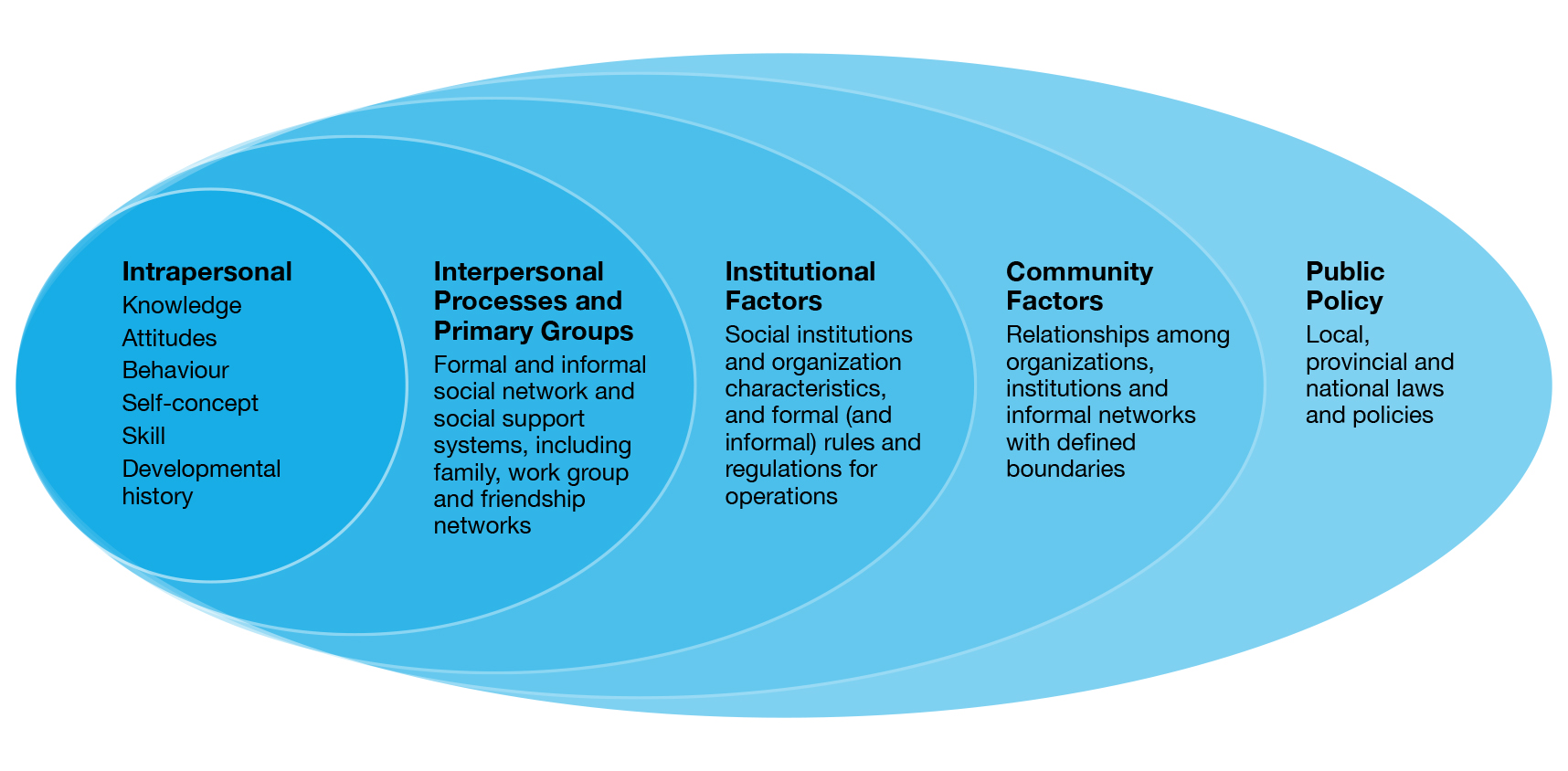
<div class="back-matter appendix" id="back-matter-appendix-a" title="Appendix A - Ecological Model"><div class="back-matter-title-wrap"><h3 class="back-matter-number">2</h3><h1 class="back-matter-title">Appendix A - Ecological Model</h1></div><div class="ugc back-matter-ugc"><p>Often when we think of improving mental health for students, we start with the individual: How can we improve coping strategies, help someone to be mentally healthy, and help them find support? If we focus on only the individual student, however, we miss a range of factors that might influence mental health. As Dan Reist says, “If the frogs in a pond started behaving strangely, our first reaction would not be to punish them or even to treat them. Instinctively, we&#8217;d wonder what was going on in the pond.”</p> <p>The student experience is inexorably linked to the workplace experience of faculty and staff. The mental health of campus community members is impacted by the physical environment and the policies and culture at the university. Recognizing the importance of an individual’s environment on their mental well-being is best understood using the <em>ecological model</em>.</p> <div class="wp-caption alignnone" id="attachment_183" aria-describedby="caption-attachment-183" style="width: 1716px"><img class="wp-image-183 size-full" src="https://opentextbc.ca/mhwframework/wp-content/uploads/sites/310/2020/06/mhf-image-1-1.jpg" alt="The ecological model of mental health. Image description available." width="1716" height="844" srcset="https://opentextbc.ca/mhwframework/wp-content/uploads/sites/310/2020/06/mhf-image-1-1.jpg 1716w, https://opentextbc.ca/mhwframework/wp-content/uploads/sites/310/2020/06/mhf-image-1-1-300x148.jpg 300w, https://opentextbc.ca/mhwframework/wp-content/uploads/sites/310/2020/06/mhf-image-1-1-1024x504.jpg 1024w, https://opentextbc.ca/mhwframework/wp-content/uploads/sites/310/2020/06/mhf-image-1-1-768x378.jpg 768w, https://opentextbc.ca/mhwframework/wp-content/uploads/sites/310/2020/06/mhf-image-1-1-1536x755.jpg 1536w, https://opentextbc.ca/mhwframework/wp-content/uploads/sites/310/2020/06/mhf-image-1-1-65x32.jpg 65w, https://opentextbc.ca/mhwframework/wp-content/uploads/sites/310/2020/06/mhf-image-1-1-225x111.jpg 225w, https://opentextbc.ca/mhwframework/wp-content/uploads/sites/310/2020/06/mhf-image-1-1-350x172.jpg 350w" /><div class="wp-caption-text" id="caption-attachment-183"><a class="internal" href="#eco">Ecological model image description</a></div></div> <p><a class="internal" id="reteco"></a>The ecological model considers multiple levels that impact health, both physical and mental: intrapersonal, interpersonal, institutional, community, and public policy (ACHA, n.d.).</p> <p>We propose this model as a lens for curating and developing mental health and wellness education and training resources because it recognizes that an individual is not solely responsible for their own well-being. In addition to focusing on intrapersonal factors (knowledge, attitudes, behaviour, self-concept, skills), the broader context of the individual should be considered. Important learning resources may exist that address the other levels as well. For example, learning resources for faculty members could help them create supportive and healthy learning environments for students. Other resources may focus on how to build community and social support networks as a means for enhancing mental health.</p> <h3><strong>Ecological model image description</strong></h3> <p><a class="internal" id="eco"></a>The ecological model considers how intrapersonal, interpersonal, institutional, community, and public policy factors affect health:</p> <ul><li>Intrapersonal considers the individual&#8217;s knowledge, attitudes, behaviour, self-concept, skill, and developmental history.</li> <li>Interpersonal processes and primary groups looks at formal and informal social network and social support systems, including family, work group, and friendship networks.</li> <li>Institutional factors include social institutions and organization characteristics, and formal (and informal) rules and regulations for operations.</li> <li>Community factors include relationships among organizations, institutions, and informal networks with defined boundaries.</li> <li>Public policy includes local, provincial, and national laws and policies.</li> </ul> <p><a class="internal" href="#reteco">[Return to text]</a></p> <div class="media-attributions clear"><h3>Media Attributions</h3><ul><li>Ecological Model &copy; BCcampus, based on conceptual work from McLeroy, Bibeau, &amp; Steckler, 1988; and a diagram by ACHA, n.d., is licensed under a <a rel="license" href="https://creativecommons.org/licenses/by-nc/4.0/">CC BY-NC (Attribution NonCommercial)</a> license</li></ul></div></div></div>
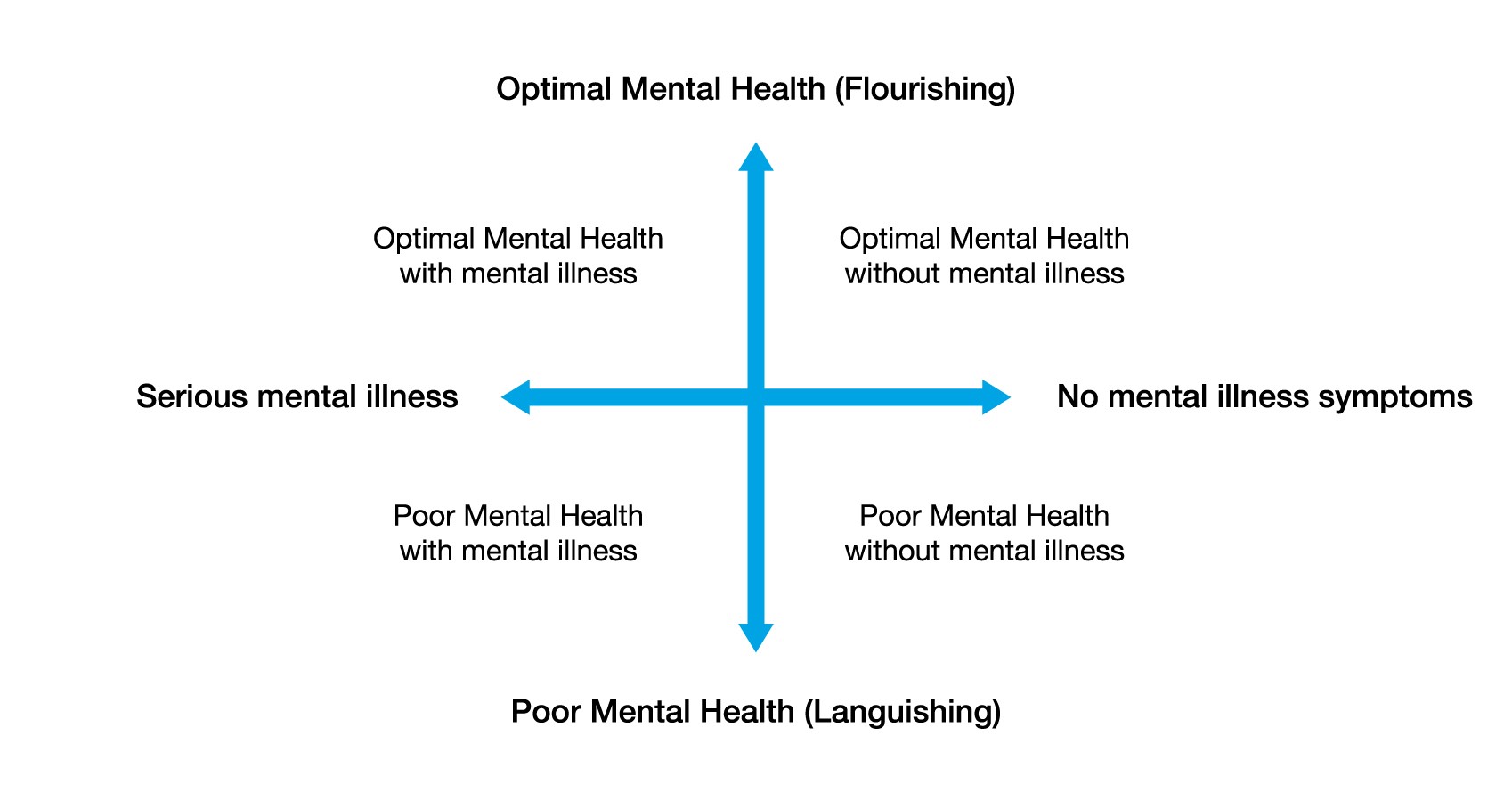
<div class="back-matter miscellaneous" id="back-matter-appendix-b" title="Appendix B - Dual-Continuum Model"><div class="back-matter-title-wrap"><h3 class="back-matter-number">3</h3><h1 class="back-matter-title">Appendix B - Dual-Continuum Model</h1></div><div class="ugc back-matter-ugc"><p>According to the dual-continuum model of mental health and mental illness, mental health is not merely the absence of mental illness (Westerhof &amp; Keyes, 2010). An individual’s ability to thrive and flourish is not negated by a diagnosis of a mental illness. Consider the dual-continuum model (CACUSS &amp; Canadian Mental Health Association, 2013):</p> <div class="wp-nocaption alignnone wp-image-177 size-full"><img class="alignnone wp-image-177 size-full" src="https://opentextbc.ca/mhwframework/wp-content/uploads/sites/310/2020/06/mhf-image-2.jpg" alt="A diagram representing the dual-continuum model of mental health. Image described in following paragraph." width="1698" height="890" srcset="https://opentextbc.ca/mhwframework/wp-content/uploads/sites/310/2020/06/mhf-image-2.jpg 1698w, https://opentextbc.ca/mhwframework/wp-content/uploads/sites/310/2020/06/mhf-image-2-300x157.jpg 300w, https://opentextbc.ca/mhwframework/wp-content/uploads/sites/310/2020/06/mhf-image-2-1024x537.jpg 1024w, https://opentextbc.ca/mhwframework/wp-content/uploads/sites/310/2020/06/mhf-image-2-768x403.jpg 768w, https://opentextbc.ca/mhwframework/wp-content/uploads/sites/310/2020/06/mhf-image-2-1536x805.jpg 1536w, https://opentextbc.ca/mhwframework/wp-content/uploads/sites/310/2020/06/mhf-image-2-65x34.jpg 65w, https://opentextbc.ca/mhwframework/wp-content/uploads/sites/310/2020/06/mhf-image-2-225x118.jpg 225w, https://opentextbc.ca/mhwframework/wp-content/uploads/sites/310/2020/06/mhf-image-2-350x183.jpg 350w" /></div> <p>The dual-continuum model is divided into four quadrants. On the x-axis is a continuum of serious mental illness on one end on no mental illness symptoms on the other end. On the y-axis is a continuum of poor mental health (languishing) on one end to optimal mental health (flourishing) on the other end. As such, someone can have optimal mental health without mental illness, they can have poor mental health without mental illness, they can have poor mental health with mental illness, and they can have optimal mental health with mental illness.</p> <p>Many people with a mental illness live rich and rewarding lives. Many people who do not have a mental illness struggle with their mental health. We hold this model in mind when developing and curating resources because it allows a nuanced conversation and recognizes the importance of skills, knowledge, and attitudes that allow for good mental health and acknowledges the need for literacy about mental illnesses, including their symptoms and treatments. Mental health and wellness resources should be inclusive of a range of experiences, should not place mental health in opposition to mental illness, and should collectively address all four quadrants of the dual-continuum model.</p> <div class="media-attributions clear"><h3>Media Attributions</h3><ul><li>Dual-Continuum Model &copy; BCcampus, based on the conceptual work of Corey Keyes and a diagram created by CACUSS &amp; Canadian Mental Health Association is licensed under a <a rel="license" href="https://creativecommons.org/licenses/by-nc/4.0/">CC BY-NC (Attribution NonCommercial)</a> license</li></ul></div></div></div>
<div class="back-matter miscellaneous" id="back-matter-acknowledgements" title="Acknowledgements"><div class="back-matter-title-wrap"><h3 class="back-matter-number">4</h3><h1 class="back-matter-title">Acknowledgements</h1></div><div class="ugc back-matter-ugc"><p>We acknowledge with respect the Musqueam, Squamish, Tsleil-Waututh, QayQayt First Nations, Kwikwetlem Nations, Snuneymuxw, Tla’amin, Snaw-naw-as, and Quw’utsun peoples, Stó:lō Nations, Lheidli T’enneh First Nations, Syilx Okanagan Nations, and the Lkwungen-speaking peoples from Songhees and Esquimalt Nations, on whose lands the <em>Framework for Evaluating Mental Health and Wellness Education and Training Resources</em> was created. We also acknowledge the WSÁNEĆ peoples, who have historical relationships with these lands that continue to this day.</p> <p>We would like to acknowledge the various mental health advisory groups, staff and faculty, and student mental health and wellness advocates who provided guidance during the development of the framework.</p> <p>We would like to thank our core development team:</p> <table style="border-collapse: collapse; width: 100%;"><tbody><tr><th style="width: 27.2271%;" scope="col">Contributor</th> <th style="width: 72.7729%;" scope="col">Organization</th> </tr> <tr><td style="width: 27.2271%;">Alyssa Amit</td> <td style="width: 72.7729%;">Ministry of Advanced Education, Skills and Training</td> </tr> <tr><td style="width: 27.2271%;">Heather Collins</td> <td style="width: 72.7729%;">Ministry of Advanced Education, Skills and Training</td> </tr> <tr><td style="width: 27.2271%;">Ian Cull</td> <td style="width: 72.7729%;">University of British Columbia, Okanagan</td> </tr> <tr><td style="width: 27.2271%;">Brie Deimling</td> <td style="width: 72.7729%;">Royal Roads University</td> </tr> <tr><td style="width: 27.2271%;">Grace Dupasquier</td> <td style="width: 72.7729%;">Alliance of British Columbia Students</td> </tr> <tr><td style="width: 27.2271%;">Eva Gavaris</td> <td style="width: 72.7729%;">Okanagan College</td> </tr> <tr><td style="width: 27.2271%;">Patty Hambler</td> <td style="width: 72.7729%;">Douglas College</td> </tr> <tr><td style="width: 27.2271%;">Tanysha Klassen</td> <td style="width: 72.7729%;">British Columbia Federation of Students</td> </tr> <tr><td style="width: 27.2271%;">Romana Pasca</td> <td style="width: 72.7729%;">College of New Caledonia</td> </tr> <tr><td style="width: 27.2271%;">Carolyn Levy</td> <td style="width: 72.7729%;">Blank Design and Project Management Inc.</td> </tr> </tbody> </table> <p>We also acknowledge BCcampus and the Ministry of Advanced Education, Skills and Training for funding and managing this project.</p> <p>Finally, we acknowledge the readers of the <em>Framework for Evaluating Mental Health and Wellness Education and Training Resources</em> who are bravely taking steps to evaluate and improve education and training resources around mental health and wellness for the safety and betterment of all post-secondary students in B.C.</p> <h1>Attributions</h1> <p>The following principles in this document include content adapted from the <a href="https://opentextbc.ca/evaluatingsvtraining/">Evaluating Sexualized Violence Training and Resources</a> by the Sexualized Violence and Misconduct Training and Resources Working Group (<a href="https://creativecommons.org/licenses/by-nc/4.0/">CC BY-NC 4.0 Licence</a>):</p> <ul><li>Accessible</li> <li>Adaptable</li> <li>Culturally located</li> <li>Evidence-informed</li> <li>Trauma-informed</li> </ul> <div class="wp-nocaption alignnone size-full wp-image-91"><img class="alignnone size-full wp-image-91" src="https://opentextbc.ca/mhwframework/wp-content/uploads/sites/310/2020/06/Picture1-1.png" alt="CC BY NC" width="132" height="46" srcset="https://opentextbc.ca/mhwframework/wp-content/uploads/sites/310/2020/06/Picture1-1.png 132w, https://opentextbc.ca/mhwframework/wp-content/uploads/sites/310/2020/06/Picture1-1-65x23.png 65w" /></div> <p>Creative Commons licences icons are used under the <a href="https://creativecommons.org/policies">Creative Commons Trademark policy</a>.</p> <div class="wp-nocaption size-full wp-image-94 alignleft"><img class="size-full wp-image-94 alignleft" src="https://opentextbc.ca/mhwframework/wp-content/uploads/sites/310/2020/06/AEST.png" alt="Logo for the Ministry of Advanced Education, Skills and Training" width="328" height="128" srcset="https://opentextbc.ca/mhwframework/wp-content/uploads/sites/310/2020/06/AEST.png 328w, https://opentextbc.ca/mhwframework/wp-content/uploads/sites/310/2020/06/AEST-300x117.png 300w, https://opentextbc.ca/mhwframework/wp-content/uploads/sites/310/2020/06/AEST-65x25.png 65w, https://opentextbc.ca/mhwframework/wp-content/uploads/sites/310/2020/06/AEST-225x88.png 225w" /></div> <div class="wp-nocaption alignnone wp-image-187"><img class="alignnone wp-image-187" src="https://opentextbc.ca/mhwframework/wp-content/uploads/sites/310/2020/06/BCcampus-logo.jpg" alt="BCcampus logo" width="308" height="112" srcset="https://opentextbc.ca/mhwframework/wp-content/uploads/sites/310/2020/06/BCcampus-logo.jpg 752w, https://opentextbc.ca/mhwframework/wp-content/uploads/sites/310/2020/06/BCcampus-logo-300x109.jpg 300w, https://opentextbc.ca/mhwframework/wp-content/uploads/sites/310/2020/06/BCcampus-logo-65x24.jpg 65w, https://opentextbc.ca/mhwframework/wp-content/uploads/sites/310/2020/06/BCcampus-logo-225x82.jpg 225w, https://opentextbc.ca/mhwframework/wp-content/uploads/sites/310/2020/06/BCcampus-logo-350x128.jpg 350w" /></div> </div></div>
<div class="back-matter miscellaneous" id="back-matter-references" title="References"><div class="back-matter-title-wrap"><h3 class="back-matter-number">5</h3><h1 class="back-matter-title">References</h1></div><div class="ugc back-matter-ugc"><p class="hanging-indent">ACHA (n.d.). <em>Ecological model</em>. https://www.acha.org/HealthyCampus/HealthyCampus/Ecological_Model.aspx</p> <p class="hanging-indent">BCcampus. (2020). <em>Mental wellness project &#8211; Full report</em>.</p> <p class="hanging-indent">Brijnath, B., Protheroe, J., Mahtani, K. R., &amp; Antoniades, J. (2016). Do web-based mental health literacy interventions improve the mental health literacy of adult consumers? Results from a systematic review. <em>Journal of Medical Internet Research</em>, <em>18</em>(6), e165. https://doi.org/10.2196/jmir.5463</p> <p class="hanging-indent">CAMH. (n.d.). <em>Trauma</em>. https://www.camh.ca/en/health-info/mental-illness-and-addiction-index/trauma</p> <p class="hanging-indent">Canadian Association of College &amp; University Student Services and Canadian Mental Health Association. (2013). <em>Post-Secondary Student Mental Health: Guide to a Systemic Approach</em>. Vancouver, BC. CC BY. https://healthycampuses.ca/wp-content/uploads/2014/09/The-National-Guide.pdf</p> <p class="hanging-indent">Coles, M. E., Ravid, A., Gibb, B., George-Denn, D., Bronstein, L. R., &amp; McLeod, S. (2016). <a class="internal" href="https://doi.org/10.1016/j.jadohealth.2015.09.017">Adolescent mental health literacy: Young people&#8217;s knowledge of depression and social anxiety disorder</a>. <em>The Journal of Adolescent Health</em>, <em>58</em>(1), 57–62. https://doi.org/10.1016/j.jadohealth.2015.09.017</p> <p class="hanging-indent">Davis, T. (2019). What is well-being? Definition, types, and well-being skills. <em>Psychology Today</em>. https://www.psychologytoday.com/ca/blog/click-here-happiness/201901/what-is-well-being-definition-types-and-well-being-skills</p> <p class="hanging-indent">Gulliver, A., Farrer, L., Bennett, K., &amp; Griffiths, K. M. (2019). University staff mental health literacy, stigma and their experience of students with mental health problems. <em>Journal of Further and Higher Education, 43</em>(3), 434–442. doi: 10.1080/0309877X.2017.1367370</p> <p class="hanging-indent">Healthy Campus Alberta. (n.d.). <em>Four key foundations to the ACMHI strategy</em>. https://www.healthycampusalberta.ca/toolkit/overview/framing/four-key-foundations-to-the-acmhi-strategy</p> <p class="hanging-indent">Hollinshead, J. (2019). <em>Peak resilience</em>. https://peak-resilience.com/blog/2017/6/18/resilience-from-an-indigenous-perspective</p> <p class="hanging-indent">Kutcher, S., Wei, Y., Costa, S., Gusmão, R., Skokauskas, N., &amp; Sourander, A. (2016). Enhancing mental health literacy in young people. <em>European Child &amp; Adolescent Psychiatry, 25</em>(6), 567–569. https://doi.org/10.1007/s00787-016-0867-9</p> <p class="hanging-indent">MentalHelp.net. (n.d.). <em>Defining resilience</em>. https://www.mentalhelp.net/emotional-resilience/defining-resilience</p> <p>McLeroy, K.R., Bibeau, D., &amp; Steckler, A. (1988). An ecological perspective on health promotion programs. <em>Health Education &amp; Behavior, 15</em>(4), 351-377. https://doi.org/10.1177/109019818801500401</p> <p class="hanging-indent">Moore, K. (2019). Mental health collaborative project, student resilience and coping training workshops: Environmental scan. Vancouver, BC: BCcampus.</p> <p class="hanging-indent">Nutbeam, D. (2000). Health literacy as a public health goal: A challenge for contemporary health education and communication strategies into the 21st century. <em>Health Promotion International, 15</em>(3), 259–267. https://doi.org/10.1093/heapro/15.3.259</p> <p class="hanging-indent">Public Health Agency of Canada. (n.d.). <em>Mental health and wellness</em>. https://cbpp-pcpe.phac-aspc.gc.ca/public-health-topics/mental-health-and-wellness</p> <p class="hanging-indent">Seccombe, K. (2002). “Beating the odds” versus “changing the odds”: Poverty, resilience, and family policy. <em>Journal of Marriage and Family</em>, <em>64</em>(2), 384–394. https://doi.org/10.1111/j.1741-3737.2002.00384.x</p> <p class="hanging-indent">SVM Training and Resources Working Group. (2020). <em>Evaluating sexualized violence training and resources. </em>BCcampus. https://opentextbc.ca/evaluatingsvtraining</p> <p class="hanging-indent">Westerhof, G. J., &amp; Keyes, C. L. (2010). Mental illness and mental health: The two continua model across the lifespan. <em>Journal of Adult Development</em>, <em>17</em>(2), 110–119. https://doi.org/10.1007/s10804-009-9082-y</p> <p class="hanging-indent">Whitley, J., &amp; Gooderham, S. (2016). Exploring and promoting mental health literacy and outcomes: Introduction to the special issue. <em>Exceptionality Education International</em>, <em>26</em>(2), 1–4. http://search.proquest.com/docview/2083800913</p> <p class="hanging-indent">Whitley, J., Smith, J. D., Vaillancourt, T., Leschied, A. D. W., Flett, G. L., &amp; Saklofske, D. H. (2013). <a class="internal" href="https://doi.org/10.1177/0829573512468852">Promoting mental health literacy among educators: Critical in school-based prevention and intervention</a>. <em>Canadian Journal of School Psychology</em>, <em>28</em>(1), 56–70. https://doi.org/10.1177/0829573512468852</p> <p class="hanging-indent">University of Buffalo. (n.d.). <em>What is trauma informed care?</em> http://socialwork.buffalo.edu/social-research/institutes-centers/institute-on-trauma-and-trauma-informed-care/what-is-trauma-informed-care.html</p> <p class="hanging-indent">University of Waterloo. (n.d.). <em>Nine dimensions of wellness</em>. https://uwaterloo.ca/engineering-wellness-program/nine-dimensions-wellness</p> </div></div>

</body>
</html>