<?xml version="1.0" encoding="UTF-8"?>
<!DOCTYPE html PUBLIC "-//W3C//DTD XHTML 1.1//EN" "http://www.w3.org/TR/xhtml11/DTD/xhtml11.dtd">
<html xmlns="http://www.w3.org/1999/xhtml" xml:lang="en">
<head>
<meta content="text/html; charset=UTF-8" http-equiv="content-type" />
<meta http-equiv="Content-Language" content="en" />
<meta name="generator" content="Pressbooks 6.27.1" />
<meta name="pb-authors" content="Industry Training Authority BC" />
<meta name="pb-title" content="Block G: Green Thermal Systems" />
<meta name="pb-language" content="en-ca" />
<meta name="pb-cover-image" content="https://opentextbc.ca/plumbing3g/wp-content/uploads/sites/411/2022/09/OTB-BOOK-COVERS-PLUMBING-G_GREEN-THERMAL.jpg" />
<meta name="pb-subtitle" content="Plumbing Apprenticeship Program Level 3" />
<meta name="pb-book-license" content="cc-by-nc-sa" />
<meta name="pb-is-based-on" content="https://pressbooks.bccampus.ca/plumbing3g" />
<meta name="pb-custom-copyright" content="© 2023 Industry Training Authority BCThe CC licence permits you to retain, reuse, copy, redistribute, and revise this book—in whole or in part—for free providing it is for non-commercial purposes, and adapted and reshared content retains the same licence, and the author is attributed as follows:Block F: Hydronic Heating and Cooling Systems by Industry Training Authority BC is used under a CC BY-NC-SA 4.0 licence.If you redistribute all or part of this book, it is recommended the following statement be added to the copyright page so readers can access the original book at no cost:Download for free from https://opentextbc.ca/plumbing3f/Sample APA-style citation (7th Edition):Industry Training Authority BC. (2023). Block f: Hydronic heating and cooling systems. BCcampus. https://opentextbc.ca/plumbing3f/Cover image attribution:Rainwater harvesting by London Permaculture is licensed under a CC BY-NC-SA licence.Ebook ISBN: 978-1-77420-187-9Print ISBN: 978-1-77420-186-2Visit BCcampus Open Education to learn about open education in British Columbia." />
<meta name="pb-primary-subject" content="TTV" />
<meta name="pb-ebook-isbn" content="978-1-77420-187-9" />
<meta name="pb-print-isbn" content="978-1-77420-186-2" />
<meta name="pb-publisher" content="BCcampus" />
<meta name="pb-about-50" content="The content of this block is organized to introduce the plumber apprentice to the theory and installation of Geothermal and Solar Energy systems. Ground source systems and solar systems provide a viable option for the green energy minded installer. This module is designed to introduce the apprentice plumber to fundamental principles of design and installation, recognizing that these applications will be conducted differently within differing regions of the province." />
<meta name="pb-additional-subjects" content="TNTP" />
<meta name="pb-publisher-city" content="Victoria, B.C." />
<meta name="pb-publication-date" content="1673395200" />
<title>Block G: Green Thermal Systems</title>
</head>
<body lang='en' >
<div id="half-title-page"><h1 class="title">Block G: Green Thermal Systems</h1></div>
<div id="title-page">
			<h1 class="title">Block G: Green Thermal Systems</h1>
		<h2 class="subtitle">Plumbing Apprenticeship Program Level 3</h2>
					<p class="author">Industry Training Authority BC</p>
														<p class="publisher">BCcampus</p>
		<p class="publisher-city">Victoria, B.C.</p>
	</div>
<div id="copyright-page">
	<div class="ugc">
					
<div class="license-attribution"><p><img src="https://opentextbc.ca/plumbing3g/wp-content/themes/pressbooks-book/packages/buckram/assets/images/cc-by-nc-sa.svg" alt="Icon for the Creative Commons Attribution-NonCommercial-ShareAlike 4.0 International License" role="presentation" /></p><p>Block G: Green Thermal Systems Copyright © 2023 by <span>Industry Training Authority BC</span> is licensed under a <a rel="license" href="https://creativecommons.org/licenses/by-nc-sa/4.0/">Creative Commons Attribution-NonCommercial-ShareAlike 4.0 International License</a>, except where otherwise noted.</p></div>

							<p>© 2023 Industry Training Authority BC</p><p>The CC licence permits you to retain, reuse, copy, redistribute, and revise this book—in whole or in part—for free providing it is for non-commercial purposes, and adapted and reshared content retains the same licence, and the author is attributed as follows:</p><div class="textbox"><em>Block F: Hydronic Heating and Cooling Systems</em> by Industry Training Authority BC is used under a <a href="http://creativecommons.org/licenses/by-nc-sa/4.0/">CC BY-NC-SA 4.0 licence</a>.</div><p>If you redistribute all or part of this book, it is recommended the following statement be added to the copyright page so readers can access the original book at no cost:</p><div class="textbox">Download for free from https://opentextbc.ca/plumbing3f/</div><p><strong>Sample APA-style citation (7th Edition):</strong></p><div class="textbox">Industry Training Authority BC. (2023). <i>Block f: Hydronic heating and cooling systems</i>. BCcampus. https://opentextbc.ca/plumbing3f/</div><p><strong>Cover image attribution:</strong></p><div class="textbox"><a href="https://www.flickr.com/photos/naturewise/5529264038/">Rainwater harvesting</a> by <a href="https://www.flickr.com/photos/naturewise/">London Permaculture</a> is licensed under a <a href="https://creativecommons.org/licenses/by-nc-sa/2.0/">CC BY-NC-SA</a> licence.</div><p><strong>Ebook ISBN:</strong> 978-1-77420-187-9</p><p><strong>Print ISBN:</strong> 978-1-77420-186-2</p><p>Visit <a href="http://open.bccampus.ca/">BCcampus Open Education</a> to learn about open education in British Columbia.</p>
							</div>
</div>
<div id="toc">
	<h1>Contents</h1>
	<ul>
					<li class="front-matter miscellaneous">
	<a href="#front-matter-accessibility-statement">
		<span class="toc-chapter-title">Accessibility Statement</span>
							</a>
	</li>

					<li class="front-matter miscellaneous">
	<a href="#front-matter-for-students-how-to-access-and-use-this-textbook">
		<span class="toc-chapter-title">For Students: How to Access and Use this Textbook</span>
							</a>
	</li>

					<li class="front-matter miscellaneous">
	<a href="#front-matter-about-bccampus-open-education">
		<span class="toc-chapter-title">About BCcampus Open Education</span>
							</a>
	</li>

					<li class="part">
	<a href="#part-main-body">
					Competency G1: Geothermal Systems
			</a>
</li>

					<li class="chapter standard">
	<a href="#chapter-the-refrigeration-cycle">
		<span class="toc-chapter-title">Learning Task 1</span>
					<span class="chapter-subtitle">The Refrigeration Cycle</span>
							</a>
	</li>

					<li class="chapter standard">
	<a href="#chapter-heat-pump-performance-terminology">
		<span class="toc-chapter-title">Learning Task 2</span>
					<span class="chapter-subtitle">Heat Pump Performance Terminology</span>
							</a>
	</li>

					<li class="chapter standard">
	<a href="#chapter-closed-loop-systems">
		<span class="toc-chapter-title">Learning Task 3</span>
					<span class="chapter-subtitle">Closed-Loop Systems</span>
							</a>
	</li>

					<li class="chapter standard">
	<a href="#chapter-combined-heat-cool-systems">
		<span class="toc-chapter-title">Learning Task 4</span>
					<span class="chapter-subtitle">Combined Heat/Cool Systems</span>
							</a>
	</li>

					<li class="part">
	<a href="#part-solar-thermal-systems">
					Competency G2: Solar Thermal Systems
			</a>
</li>

					<li class="chapter standard">
	<a href="#chapter-types-of-systems">
		<span class="toc-chapter-title">Learning Task 1</span>
					<span class="chapter-subtitle">Types of Systems</span>
							</a>
	</li>

					<li class="chapter standard">
	<a href="#chapter-active-solar-thermal-system-operation">
		<span class="toc-chapter-title">Learning Task 2</span>
					<span class="chapter-subtitle">Active Solar Thermal System Operation</span>
							</a>
	</li>

					<li class="chapter standard">
	<a href="#chapter-active-solar-space-heating-systems">
		<span class="toc-chapter-title">Learning Task 3</span>
					<span class="chapter-subtitle">Active Solar Space Heating Systems</span>
							</a>
	</li>

					<li class="chapter standard">
	<a href="#chapter-solar-installation-considerations">
		<span class="toc-chapter-title">Learning Task 4</span>
					<span class="chapter-subtitle">Solar Installation Considerations</span>
							</a>
	</li>

					<li class="back-matter appendix">
	<a href="#back-matter-self-test-answer-keys">
		<span class="toc-chapter-title">Appendix 1: Self-Test Answer Keys</span>
							</a>
	</li>

					<li class="back-matter miscellaneous">
	<a href="#back-matter-versioning-history">
		<span class="toc-chapter-title">Versioning History</span>
							</a>
	</li>

			</ul>
</div>
<div class="front-matter miscellaneous " id="front-matter-accessibility-statement" title="Accessibility Statement">
	<div class="front-matter-title-wrap">
		<p class="front-matter-number">1</p>
		<h1 class="front-matter-title">Accessibility Statement</h1>
								</div>
	<div class="ugc front-matter-ugc">
				 <p>BCcampus Open Education believes that education must be available to everyone. This means supporting the creation of free, open, and accessible educational resources. We are actively committed to increasing the accessibility and usability of the resources we produce.</p> <h1>Accessibility of This Resource</h1> <p>The web version of <em>Block F: Hydronic Heating and Cooling Systems</em>&nbsp;has been designed to meet <a href="https://www.w3.org/TR/WCAG20/" data-url="https://www.w3.org/TR/WCAG20/">Web Content Accessibility Guidelines 2.0</a>, level AA. In addition, it follows all guidelines in <a href="https://opentextbc.ca/accessibilitytoolkit/back-matter/appendix-checklist-for-accessibility-toolkit/" data-url="https://opentextbc.ca/accessibilitytoolkit/back-matter/appendix-checklist-for-accessibility-toolkit/">Appendix A: Checklist for Accessibility</a> of the <a href="https://opentextbc.ca/accessibilitytoolkit/" data-url="https://opentextbc.ca/accessibilitytoolkit/"><em>Accessibility Toolkit – 2nd Edition</em></a>. It includes:</p> <ul><li><strong>Easy navigation</strong>. This resource has a linked table of contents and uses headings in each chapter to make navigation easy.</li> <li><strong>Accessible math equations</strong>. Many of the equations in this resource have been written in LaTeX and rendered with MathJax, which makes them accessible to people using screen readers that are set up to read MathML. The rest of the equations are rendered as images with appropriate alternative text.</li> <li><strong>Accessible videos</strong>. All videos in this resource have captions.</li> <li><strong>Accessible images</strong>. All images in this resource that convey information have alternative text. Images that are decorative have empty alternative text.</li> <li><strong>Accessible links</strong>. All links use descriptive link text.</li> </ul> <table class="grid" style="width: 100%;"><caption>Accessibility Checklist</caption> <tbody><tr><th scope="col">Element</th> <th scope="col">Requirements</th> <th scope="col">Pass?</th> </tr> <tr><th scope="row">Headings</th> <td>Content is organized under headings and subheadings that are used sequentially.</td> <td>Yes</td> </tr> <tr><th scope="row">Images</th> <td>Images that convey information include alternative text descriptions. These descriptions are provided in the alt text field, in the surrounding text, or linked to as a long description.</td> <td>Yes</td> </tr> <tr><th scope="row">Images</th> <td>Images and text do not rely on colour to convey information.</td> <td>Yes</td> </tr> <tr><th scope="row">Images</th> <td>Images that are purely decorative or are already described in the surrounding text contain empty alternative text descriptions. (Descriptive text is unnecessary if the image doesn’t convey contextual content information.)</td> <td>Yes</td> </tr> <tr><th scope="row">Tables</th> <td>Tables include row and/or column headers that have the correct scope assigned.</td> <td>Yes</td> </tr> <tr><th scope="row">Tables</th> <td>Tables include a title or caption.</td> <td>Yes</td> </tr> <tr><th scope="row">Tables</th> <td>Tables do not have merged or split cells.</td> <td>Yes</td> </tr> <tr><th scope="row">Tables</th> <td>Tables have adequate cell padding.</td> <td>Yes</td> </tr> <tr><th scope="row">Links</th> <td>The link text describes the destination of the link.</td> <td>Yes</td> </tr> <tr><th scope="row">Links</th> <td>Links do not open new windows or tabs. If they do, a textual reference is included in the link text.</td> <td>Yes</td> </tr> <tr><th><strong>Links</strong></th> <td>Links to files include the file type in the link text.</td> <td>Yes</td> </tr> <tr><th scope="row">Formulas</th> <td>Formulas have been created using LaTeX and are rendered with MathJax.</td> <td>Yes</td> </tr> <tr><th scope="row">Formulas</th> <td>If LaTeX is not an option, formulas are images with alternative text descriptions.</td> <td>Yes</td> </tr> <tr><th scope="row">Font</th> <td>Font size is 12 point or higher for body text.</td> <td>Yes</td> </tr> <tr><th scope="row">Font</th> <td>Font size is 9 point for footnotes or endnotes.</td> <td>Yes</td> </tr> <tr><th scope="row">Font</th> <td>Font size can be zoomed to 200% in the webbook or eBook formats.</td> <td>Yes</td> </tr> </tbody> </table> <h1>Known Accessibility Issues and Areas for Improvement</h1> <p>There are currently no known accessibility issues.</p> <h1>Let Us Know if You are Having Problems Accessing This Book</h1> <p>We are always looking for ways to make our resources more accessible. If you have problems accessing this resource, please contact us to let us know so we can fix the issue.</p> <p>Please include the following information:</p> <ul><li>The name of the resource</li> <li>The location of the problem by providing a web address or page description.</li> <li>A description of the problem</li> <li>The computer, software, browser, and any assistive technology you are using that can help us diagnose and solve your issue (e.g., Windows 10, Google Chrome (Version 65.0.3325.181), NVDA screen reader)</li> </ul> <p>You can contact us one of the following ways:</p> <ul><li>Web form: <a href="https://collection.bccampus.ca/contact/" data-url="https://collection.bccampus.ca/contact/">BCcampus Open Ed Help</a></li> <li>Web form: <a href="https://open.bccampus.ca/browse-our-collection/reporting-an-error/" data-url="https://open.bccampus.ca/browse-our-collection/reporting-an-error/">Report an Error</a></li> </ul> <p>This statement was last updated on August 3, 2022.</p> <p>The Accessibility Checklist table was adapted from one originally created by the <a href="https://press.rebus.community/the-rebus-guide-to-publishing-open-textbooks/back-matter/accessibility-assessment/" data-url="https://press.rebus.community/the-rebus-guide-to-publishing-open-textbooks/back-matter/accessibility-assessment/">Rebus Community</a> and shared under a <a href="https://creativecommons.org/licenses/by/4.0/" data-url="https://creativecommons.org/licenses/by/4.0/">CC BY 4.0 License</a>.</p> 
	</div>


	</div>
<div class="front-matter miscellaneous " id="front-matter-for-students-how-to-access-and-use-this-textbook" title="For Students: How to Access and Use this Textbook">
	<div class="front-matter-title-wrap">
		<p class="front-matter-number">2</p>
		<h1 class="front-matter-title">For Students: How to Access and Use this Textbook</h1>
								</div>
	<div class="ugc front-matter-ugc">
				 <p>This textbook is available in the following formats:</p> <ul><li><strong>Online webbook</strong>. You can read this textbook online on a computer or mobile device in one of the following browsers: Chrome, Firefox, Edge, and Safari.</li> <li><strong>PDF</strong>. You can download this book as a PDF to read on a computer (Digital PDF) or print it out (Print PDF).</li> <li><strong>Mobile</strong>. If you want to read this textbook on your phone or tablet, you can use the EPUB (eReader) file.</li> <li><strong>HTML</strong>. An HTML file can be opened in a browser. It has very little style so it doesn’t look very nice, but some people might find it useful.</li> </ul> <p>For more information about the accessibility of this textbook, see the Accessibility Statement.</p> <p>You can access the online webbook and download any of the formats for free here: <em>Block G: Green Thermal Systems</em>. To download the book in a different format, look for the “Download this book” drop-down menu and select the file type you want.</p> <table><caption>How can I use the different formats?</caption> <tbody><tr><th scope="col">Format</th> <th scope="col">Internet required?</th> <th scope="col">Device</th> <th scope="col">Required apps</th> <th scope="col">Accessibility Features</th> <th scope="col">Screen reader compatible</th> </tr> <tr><td>Online webbook</td> <td>Yes</td> <td>Computer, tablet, phone</td> <td>An Internet browser (Chrome, Firefox, Edge, or Safari)</td> <td>WCAG 2.0 AA compliant, option to enlarge text, and compatible with browser text-to-speech tools</td> <td>Yes</td> </tr> <tr><td>PDF</td> <td>No</td> <td>Computer, print copy</td> <td>Adobe Reader (for reading on a computer) or a printer</td> <td>Ability to highlight and annotate the text. If reading on the computer, you can zoom in.</td> <td>Unsure</td> </tr> <tr><td>EPUB</td> <td>No</td> <td>Computer, tablet, phone</td> <td>An eReader app</td> <td>Option to enlarge text, change font style, size, and colour.</td> <td>Unsure</td> </tr> <tr><td>HTML</td> <td>No</td> <td>Computer, tablet, phone</td> <td>An Internet browser (Chrome, Firefox, Edge, or Safari)</td> <td>WCAG 2.0 AA compliant and compatible with browser text-to-speech tools.</td> <td>Yes</td> </tr> </tbody> </table> <h1>Tips for Using This Textbook</h1> <ul><li><strong>Search the textbook</strong>. <ul><li>If using the online webbook, you can use the search bar in the top right corner to search the entire book for a key word or phrase. To search a specific chapter, open that chapter and use your browser’s search feature by hitting <strong>[Cntr] + [f]</strong> on your keyboard if using a Windows computer or <strong>[Command] + [f] </strong>if using a Mac computer.</li> <li>The <strong>[Cntr] + [f]</strong> and <strong>[Command] + [f]</strong> keys will also allow you to search a PDF, HTML, and EPUB files if you are reading them on a computer.</li> <li>If using an eBook app to read this textbook, the app should have a built-in search tool.</li> </ul> </li> <li><strong>Navigate the textbook</strong>. <ul><li>This textbook has a table of contents to help you navigate through the book easier. If using the online webbook, you can find the full table of contents on the book’s homepage or by selecting “Contents” from the top menu when you are in a chapter.</li> </ul> </li> <li><strong>Annotate the textbook</strong>. <ul><li>If you like to highlight or write on your textbooks, you can do that by getting a print copy, using the Digital PDF in Adobe Reader, or using the highlighting tools in eReader apps.</li> </ul> </li> </ul> 
	</div>


	</div>
<div class="front-matter miscellaneous " id="front-matter-about-bccampus-open-education" title="About BCcampus Open Education">
	<div class="front-matter-title-wrap">
		<p class="front-matter-number">3</p>
		<h1 class="front-matter-title">About BCcampus Open Education</h1>
								</div>
	<div class="ugc front-matter-ugc">
				 <p><em>Block G: Green Thermal Systems</em> by Industry Training Authority BC was funded by Industry Training Authority BC.</p> <p><a href="https://open.bccampus.ca/" data-url="https://open.bccampus.ca/">BCcampus Open Education</a> began in 2012 as the B.C. Open Textbook Project with the goal of making post-secondary education in British Columbia more accessible by reducing students’ costs through the use of open textbooks and other OER. <a href="https://bccampus.ca/" data-url="https://bccampus.ca/">BCcampus</a> supports the post-secondary institutions of British Columbia as they adapt and evolve their teaching and learning practices to enable powerful learning opportunities for the students of B.C. BCcampus Open Education is funded by the <a href="https://www2.gov.bc.ca/gov/content/governments/organizational-structure/ministries-organizations/ministries/advanced-education-skills-training" rel="noopener" data-url="https://www2.gov.bc.ca/gov/content/governments/organizational-structure/ministries-organizations/ministries/advanced-education-skills-training">British Columbia Ministry of Advanced Education and Skills Training</a> and the <a href="http://www.hewlett.org/" rel="noopener" data-url="http://www.hewlett.org/">Hewlett Foundation</a>.</p> <p>Open educational resources (OER) are teaching, learning, and research resources that, through permissions granted by the copyright holder, allow others to use, distribute, keep, or make changes to them. Our open textbooks are openly licensed using a <a href="https://creativecommons.org/licenses/" data-url="https://creativecommons.org/licenses/">Creative Commons licence</a> and are offered in various eBook formats free of charge, or as printed books that are available at cost.</p> <p>For more information about open education in British Columbia, please visit the <a href="https://open.bccampus.ca/" data-url="https://open.bccampus.ca/">BCcampus Open Education</a> website. If you are an instructor who is using this book for a course, please fill out our <a href="https://open.bccampus.ca/use-open-textbooks/tell-us-youre-using-an-open-textbook/" data-url="https://open.bccampus.ca/use-open-textbooks/tell-us-youre-using-an-open-textbook/">Adoption of an Open Textbook</a> form.</p> <div class="textbox">This book was produced using the following styles: <a href="https://opentextbc.ca/plumbing3b/wp-content/uploads/sites/411/2022/08/Plumbing-Level-Three-Series-Style-Sheet.docx" data-url="https://opentextbc.ca/plumbing3b/wp-content/uploads/sites/411/2022/08/Plumbing-Level-Three-Series-Style-Sheet.docx">Plumbing Level Three Series Style Sheet [Word file]</a>.</div> 
	</div>


	</div>
<div class="part-wrapper" id="part-main-body-wrapper">
    <div class="part  introduction" id="part-main-body">
	<div class="part-title-wrap">
		<p class="part-number">I</p>
		<h1 class="part-title">Competency G1: Geothermal Systems</h1>
	</div>
	<div class="ugc part-ugc">
		<p>Over the last number of decades, <em>geothermal</em> (earth or ground source) systems have emerged as a viable source for providing the heating and cooling that we all need for comfort in our homes and buildings. The heart of any of these systems is a <em>heat pump</em>. This term is used to describe a device that uses the refrigeration cycle to convert low-temperature heat from a source into higher-temperature heat which is imparted to a load. When used to heat buildings, heat pumps can gather low-temperature heat from sources such as outdoor air, groundwater, lakes or ponds, or from tubing embedded in the ground. All of these sources provide “free” low-temperature heat. Some heat pumps also have the ability to reverse the direction of the refrigerant within them, so they can use those sources as a <em>heat sink</em> (place to dispose of unwanted heat) if cooling is what the heat pump circuit is trying to achieve on the load side. No matter what the source or load, the refrigeration cycle is at the core of the operations of any heat pump.</p> <div class="textbox textbox--learning-objectives"><div class="textbox__header"><p class="textbox__title">Learning Objectives</p> </div> <div class="textbox__content"><p>After completing this learning task, the student will be able to:</p> <ul><li>Describe the operation of geothermal systems</li> <li>Describe the installation of different types of geothermal systems</li> <li>Describe the testing and commissioning involved in geothermal systems</li> <li>Describe the maintenance and repair considerations for geothermal systems</li> </ul> </div> </div> <p>&nbsp;</p>
	</div>
			
				
	</div>
<div class="chapter standard " id="chapter-the-refrigeration-cycle" title="Learning Task 1">
	<div class="chapter-title-wrap">
		<p class="chapter-number">1</p>
		<h1 class="chapter-title">Learning Task 1</h1>
					<p class="chapter-subtitle">The Refrigeration Cycle</p>
			</div>
	<div class="ugc chapter-ugc">
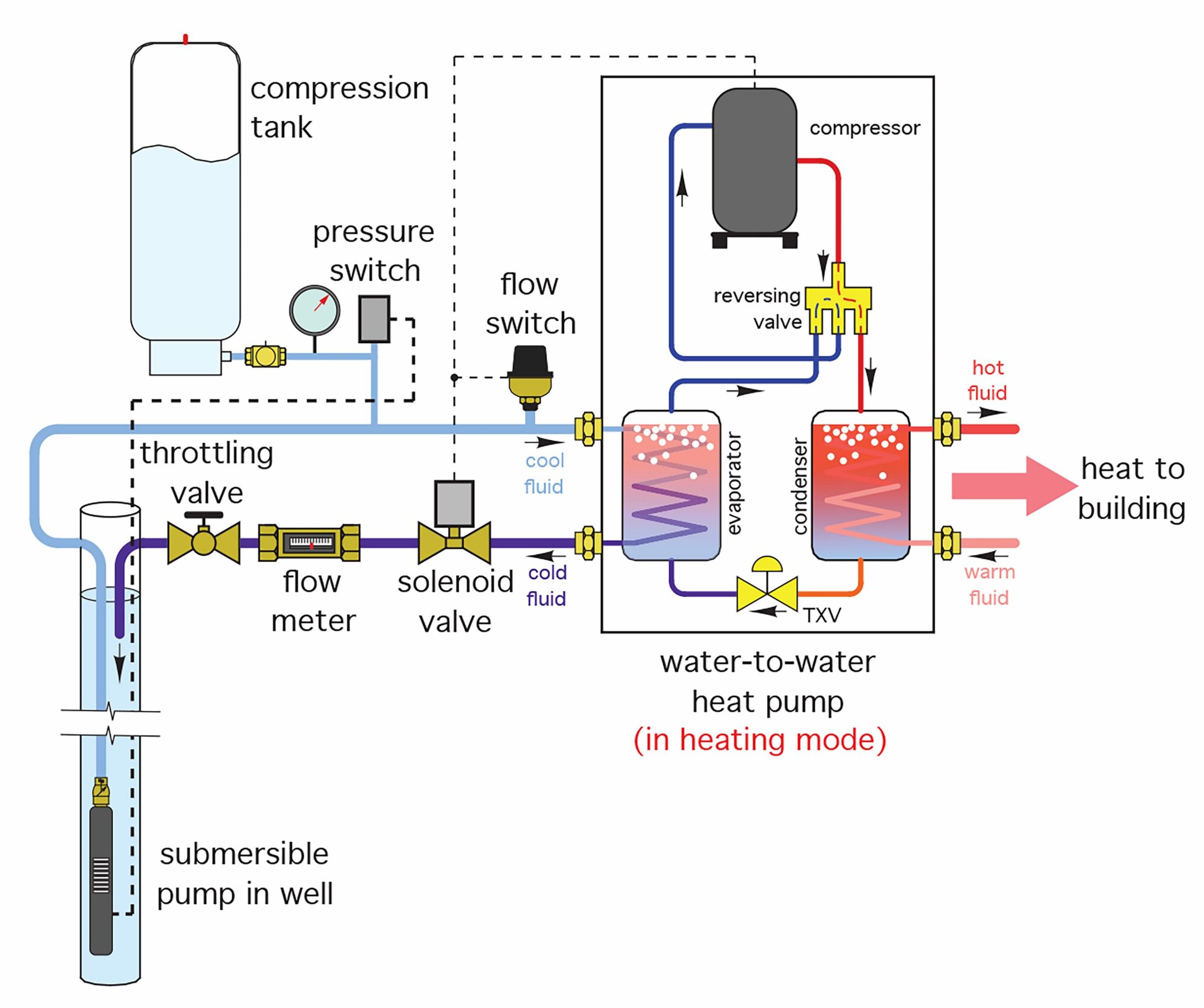
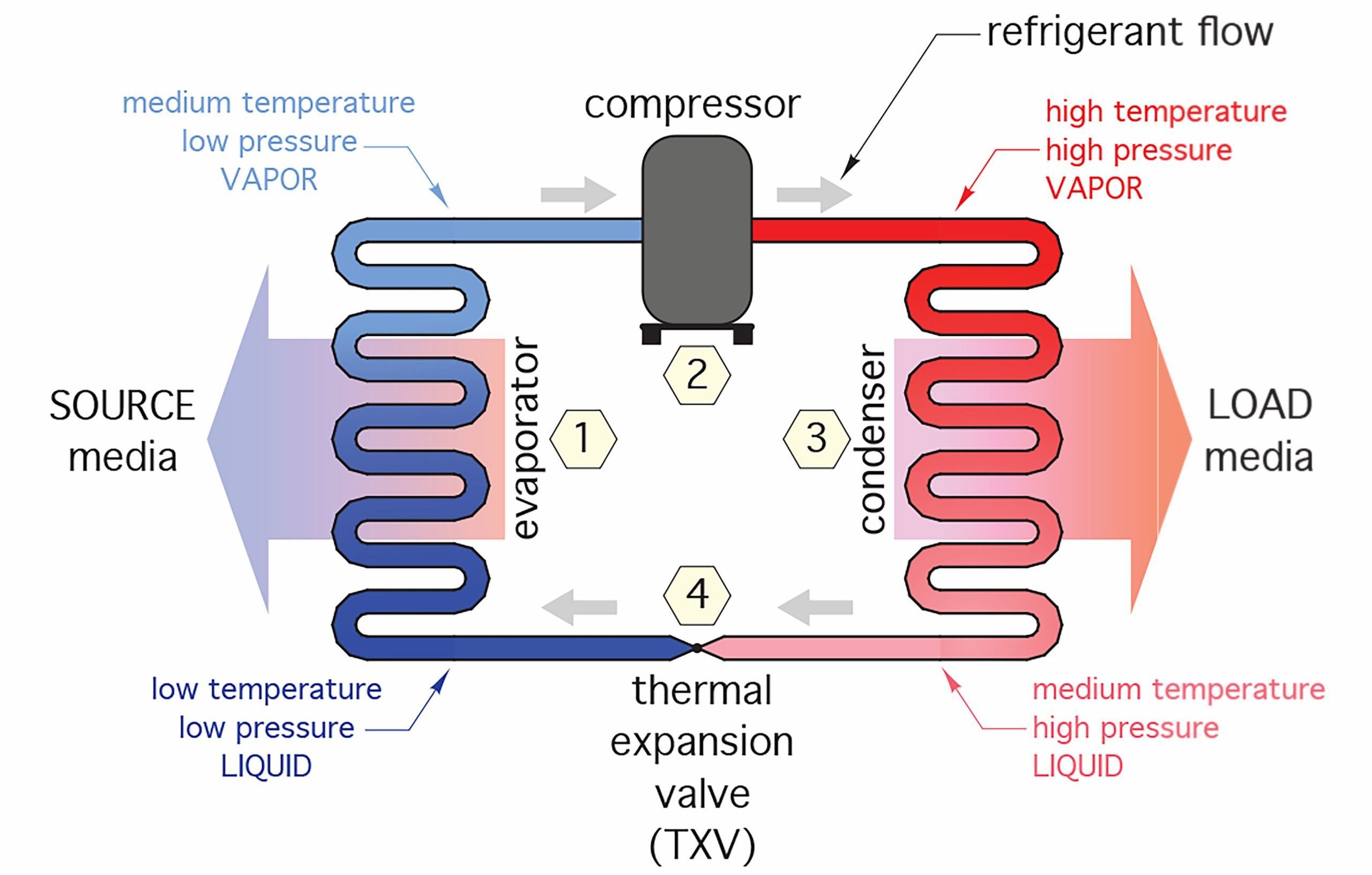
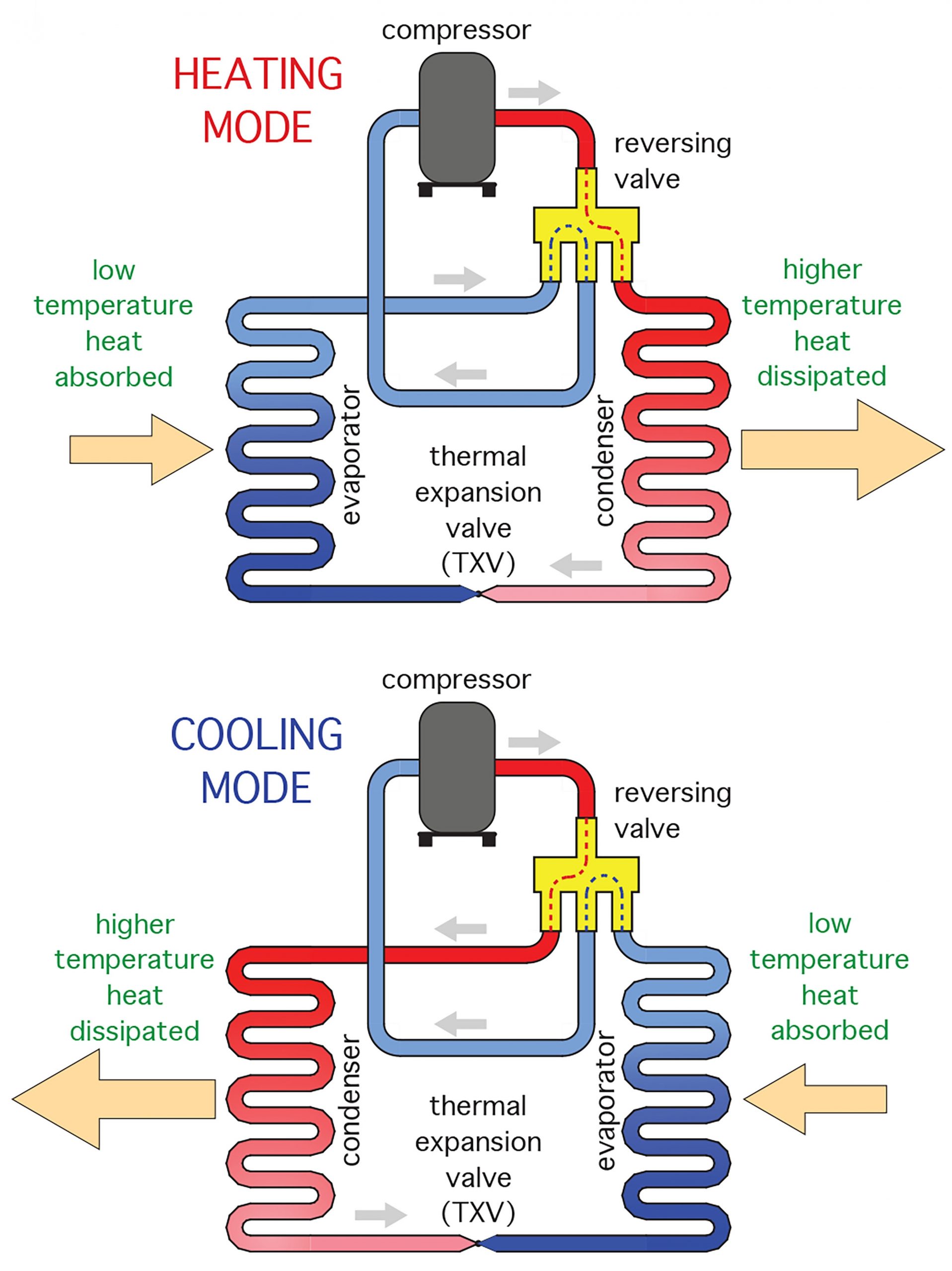
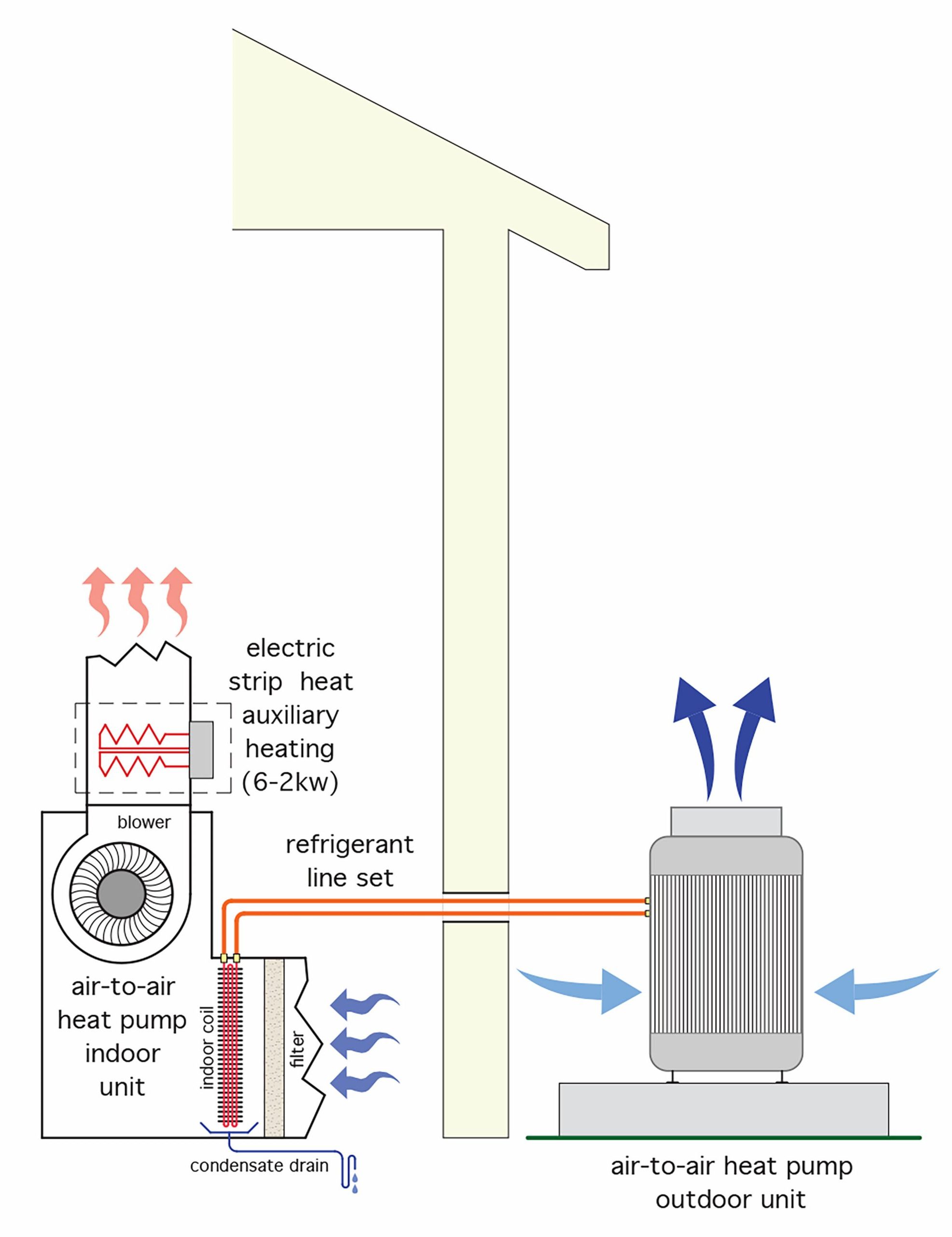
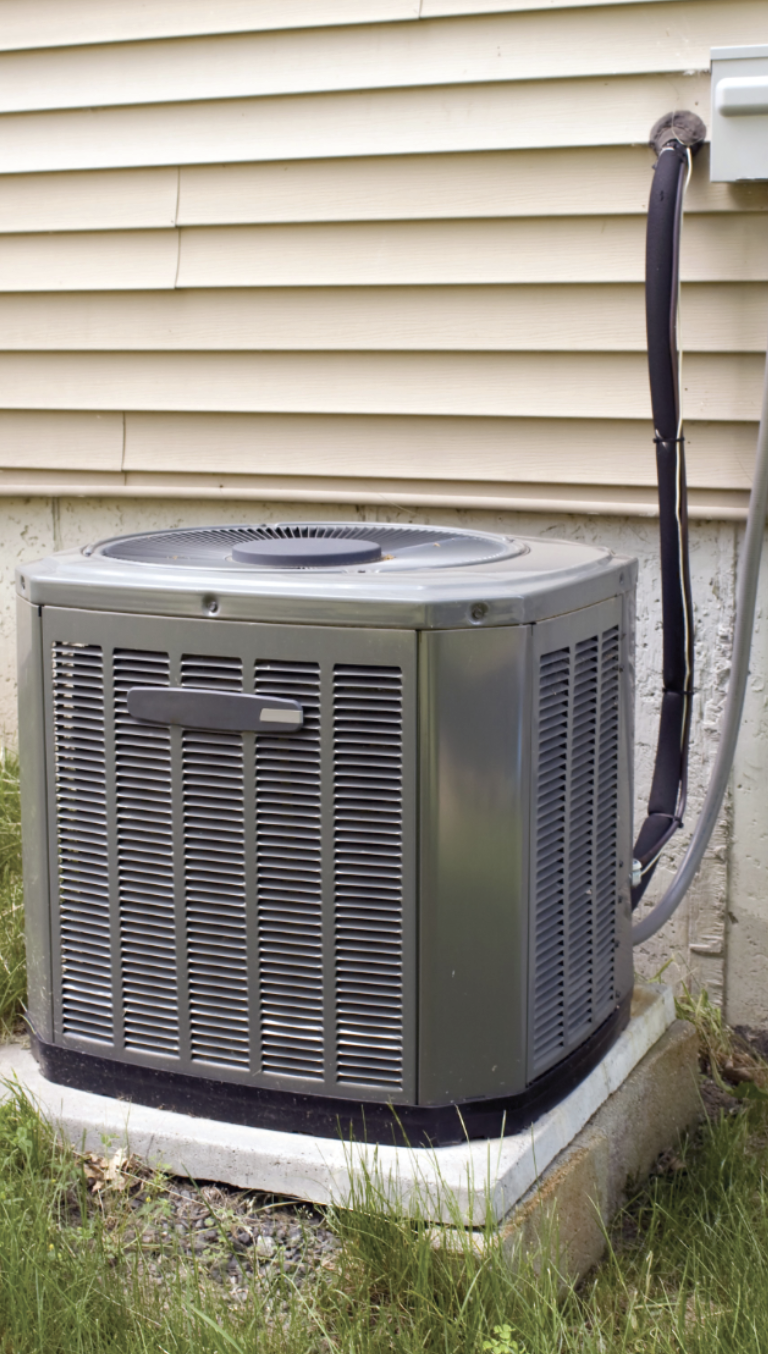
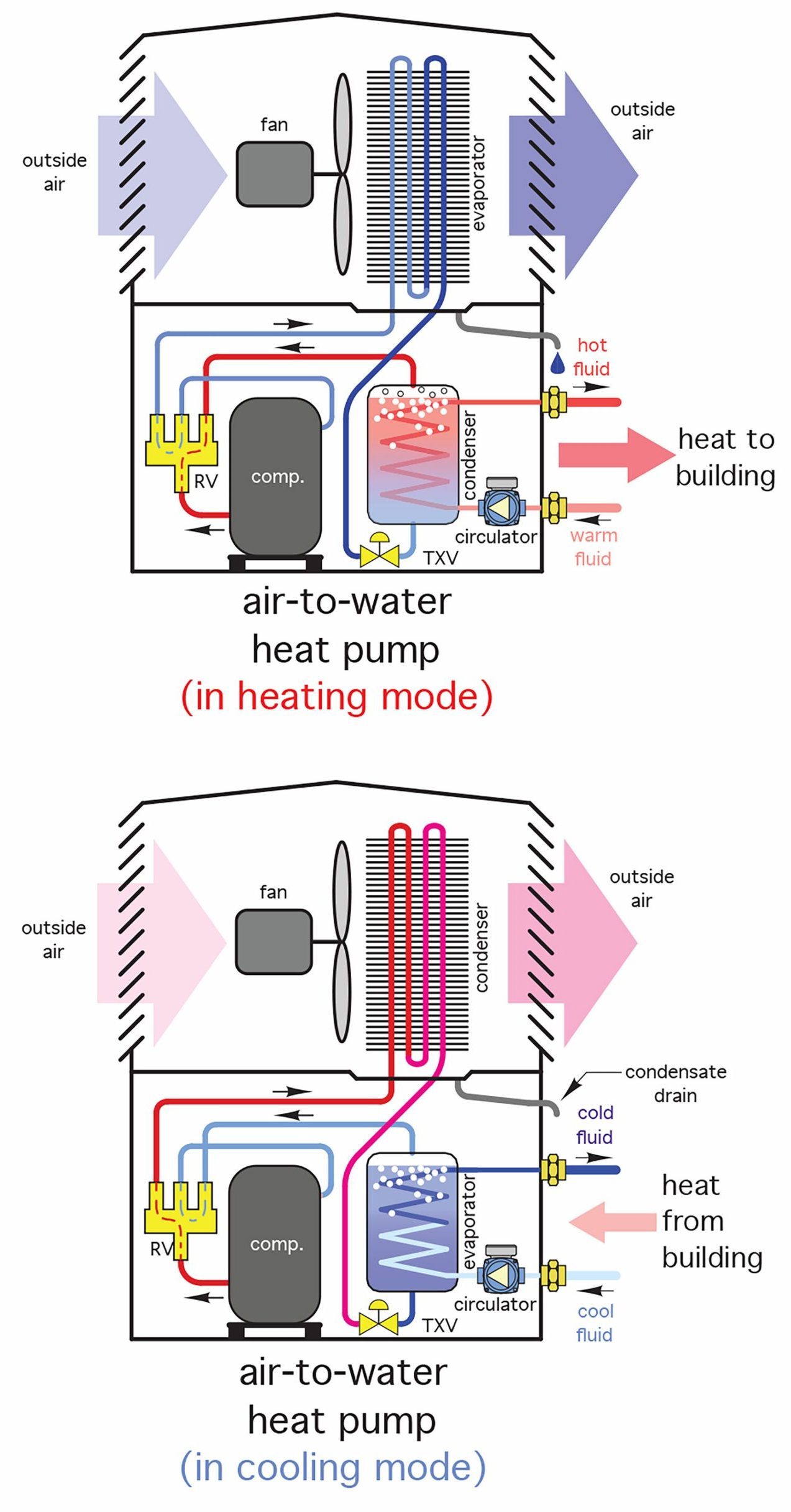
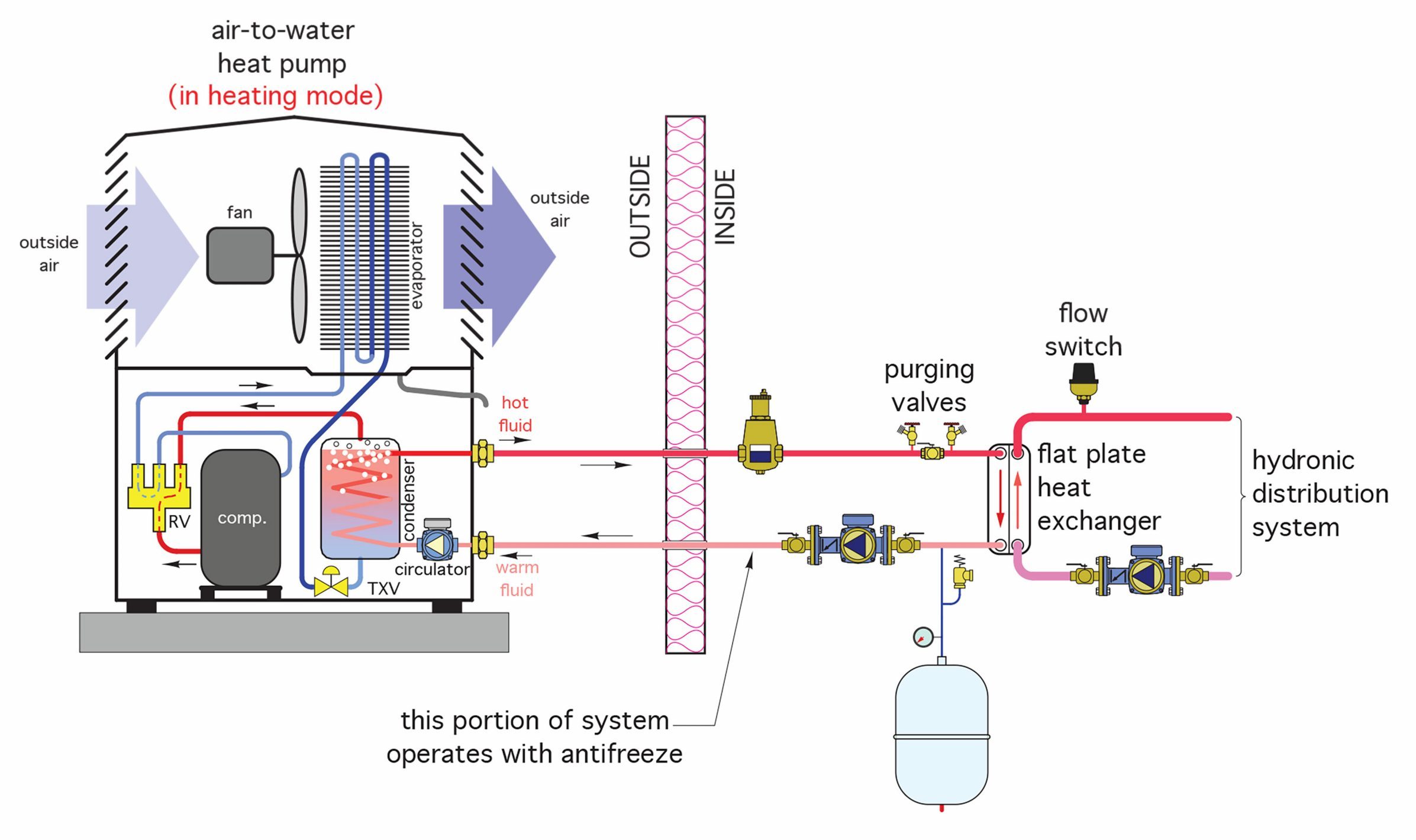
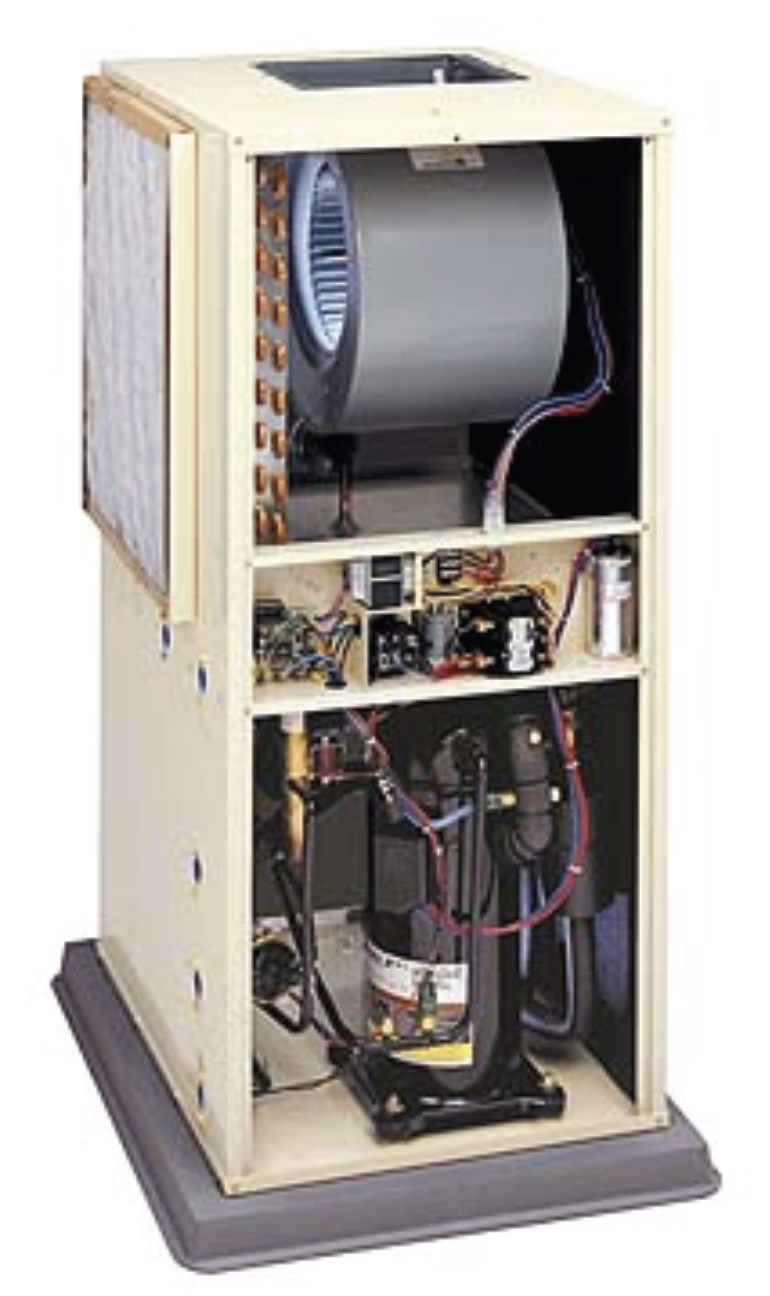
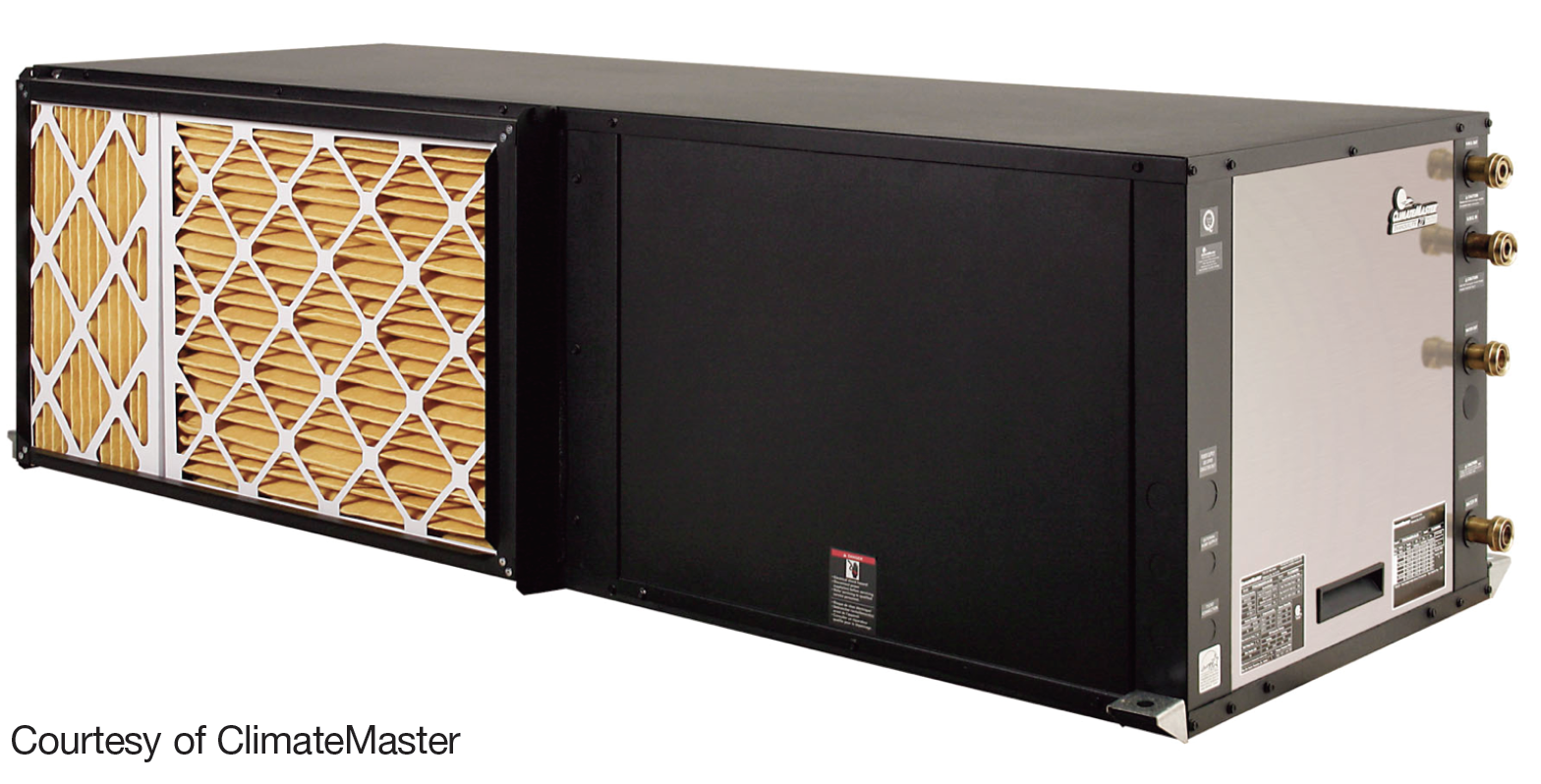
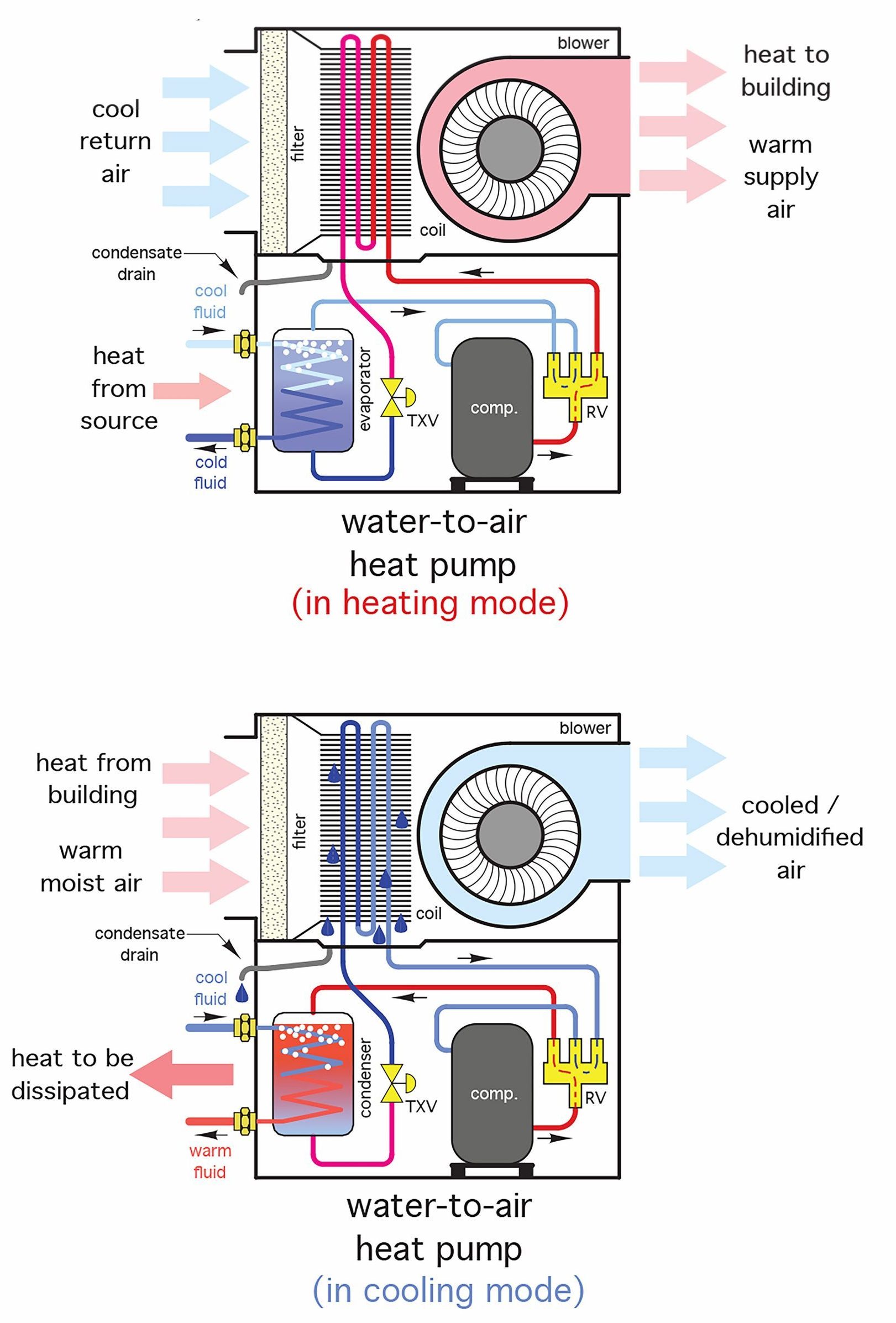
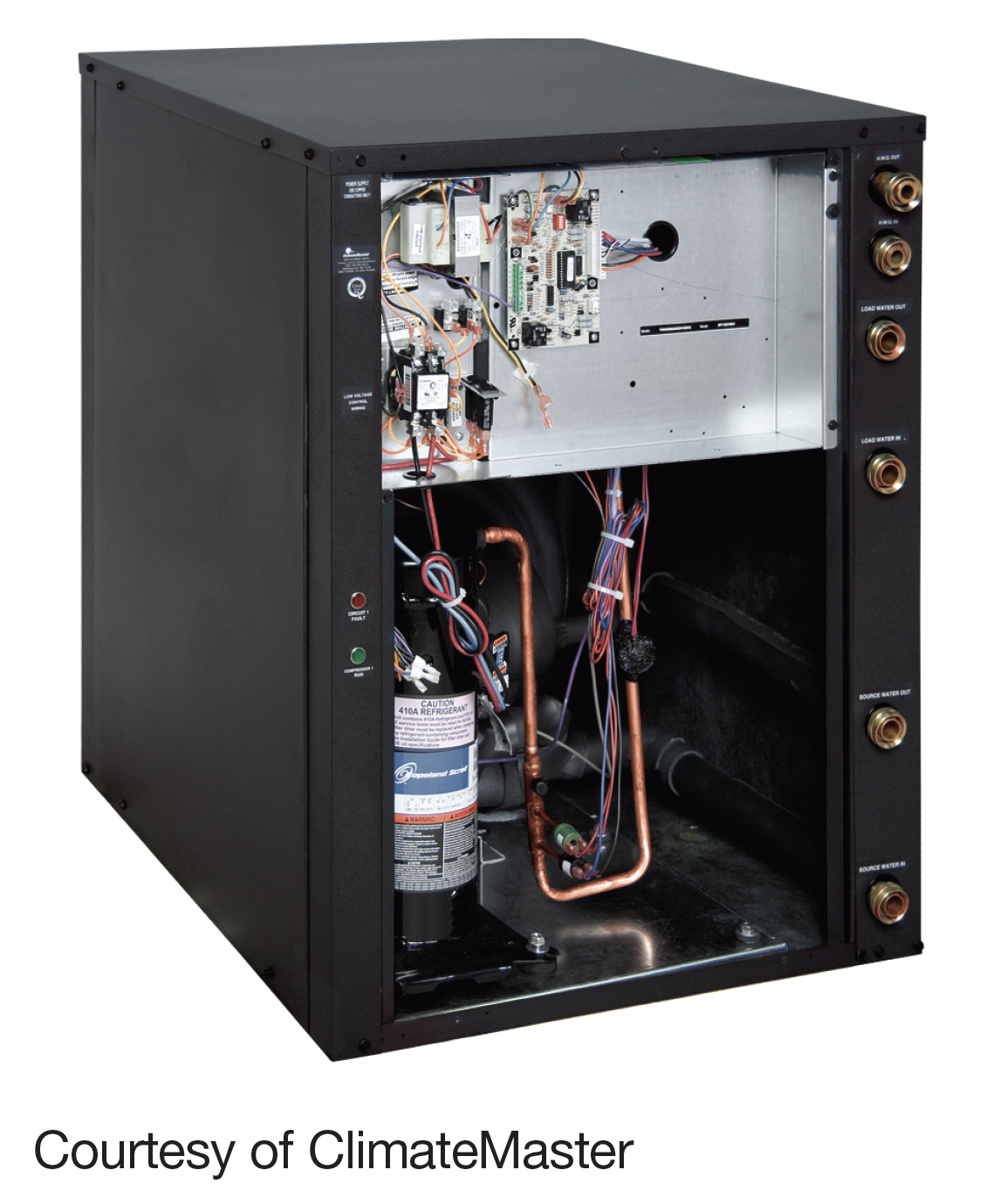
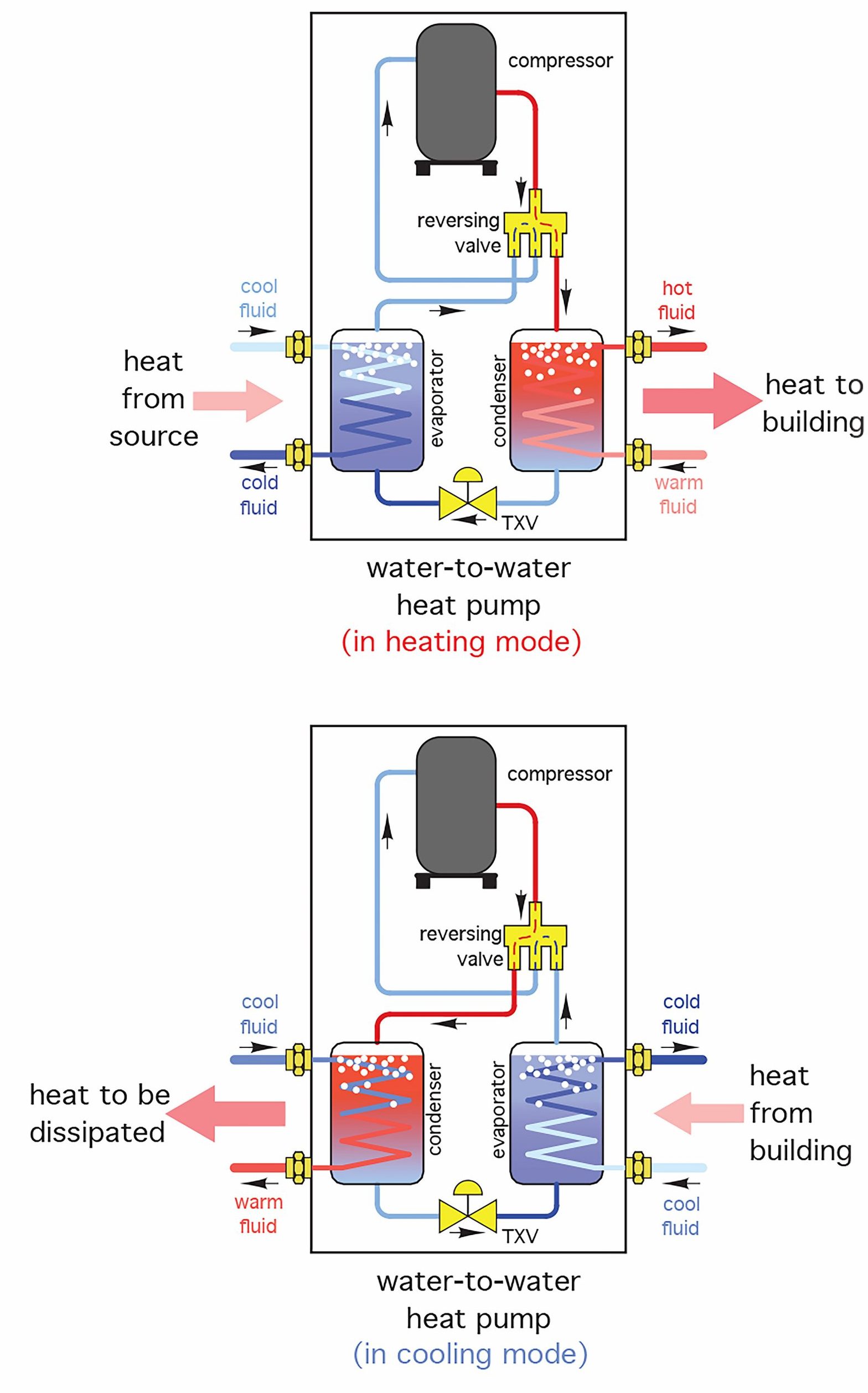
				 <p>The refrigeration cycle is the basis of operation of all vapour-compression heat pumps. A chemical compound with a low boiling point, known as <em>refrigerant,</em> travels through piping around a closed-loop circuit that consists of:</p> <ul><li>An evaporator</li> <li>A compressor</li> <li>A condenser, and</li> <li>A thermal or thermostatic expansion valve, referred to as a “TXV”</li> </ul> <p>Figure 1 below shows these four components and how they are connected.</p> <div class="wp-caption aligncenter" id="attachment_31" aria-describedby="caption-attachment-31" style="width: 500px"><img class="wp-image-21" src="https://opentextbc.ca/plumbing3b/wp-content/uploads/sites/411/2022/05/figure-1-1-scaled-e1660771242686.jpg" alt="" width="500" height="319" srcset="https://opentextbc.ca/plumbing3g/wp-content/uploads/sites/411/2022/05/figure-1-1-scaled-e1660771242686.jpg 2560w, https://opentextbc.ca/plumbing3g/wp-content/uploads/sites/411/2022/05/figure-1-1-scaled-e1660771242686-300x191.jpg 300w, https://opentextbc.ca/plumbing3g/wp-content/uploads/sites/411/2022/05/figure-1-1-scaled-e1660771242686-1024x653.jpg 1024w, https://opentextbc.ca/plumbing3g/wp-content/uploads/sites/411/2022/05/figure-1-1-scaled-e1660771242686-768x490.jpg 768w, https://opentextbc.ca/plumbing3g/wp-content/uploads/sites/411/2022/05/figure-1-1-scaled-e1660771242686-1536x979.jpg 1536w, https://opentextbc.ca/plumbing3g/wp-content/uploads/sites/411/2022/05/figure-1-1-scaled-e1660771242686-2048x1306.jpg 2048w, https://opentextbc.ca/plumbing3g/wp-content/uploads/sites/411/2022/05/figure-1-1-scaled-e1660771242686-65x41.jpg 65w, https://opentextbc.ca/plumbing3g/wp-content/uploads/sites/411/2022/05/figure-1-1-scaled-e1660771242686-225x143.jpg 225w, https://opentextbc.ca/plumbing3g/wp-content/uploads/sites/411/2022/05/figure-1-1-scaled-e1660771242686-350x223.jpg 350w" sizes="auto, (max-width: 500px) 100vw, 500px" title="" /><div class="wp-caption-text" id="caption-attachment-31">Figure 1 The refrigeration cycle</div></div> <p>The cycle begins at station (1) as cold liquid refrigerant within the evaporator. At this point, the refrigerant is colder than the source media (e.g., air or water) passing across the evaporator. Because of this temperature difference, heat moves from the higher-temperature source media into the lower-temperature refrigerant. As the refrigerant absorbs this heat, it vapourizes (changes from a liquid to a gas). The vaporized refrigerant continues to absorb heat until it is slightly warmer than the temperature at which it evaporated. The additional heat required to raise the temperature of the refrigerant above its “saturation” temperature (the point at which it vaporizes) is called superheat, and it also comes from the source media. This vaporized refrigerant then flows into the compressor at station (2). Here a reciprocating piston or a rotating scroll driven by an electric motor compresses the vapourized refrigerant. Charles’ Law dictates that this causes a large increase in both pressure and temperature. The electrical energy used to operate the compressor also creates heat which is also absorbed by the refrigerant. The temperature of the refrigerant gas leaving the compressor is usually in the range of 120°F to 170°F depending on the operating conditions.</p> <p>The hot refrigerant gas then flows into the condenser at station (3). Here it transfers heat to a stream of water or air (the load media) that carries the heat away to the load. As it gives up heat, the refrigerant changes from a high-pressure, high-temperature vapor into a high-pressure, somewhat cooler liquid. In other words, it condenses. The high-pressure liquid refrigerant then flows through the thermal expansion valve at station (4). This valve, mentioned above as being abbreviated to “TXV”, is essentially an orifice that operates on Bernoulli’s Principle, meaning the greater the velocity, the lower the pressure. Thus, the refrigerant’s pressure is greatly reduced and the drop in pressure causes a corresponding drop in temperature. This restores the refrigerant to the same condition it was in when the cycle began, and the refrigerant vapour is now ready to repeat the cycle.</p> <p>The refrigeration cycle remains in continuous operation whenever the compressor is running. It is used in refrigerators, freezers, room air conditioners, dehumidifiers, water coolers, vending machines and other heat-moving machines. The average person is certainly familiar with these devices and what they do, but often is unaware of how they do it.</p> <h1>Non-Reversible vs Reversible Heat Pumps</h1> <p>Non-reversible (heating-only or cooling-only) heat pumps provide dedicated cooling or dedicated heating of a load by moving the refrigerant through the components within the loop in one direction only. An example of cooling-only heat pumps are appliances such as refrigerators, where the evaporator is the device that is performing the desired task of cooling the load by taking away the heat from the inside of the cabinet and delivering it to the condenser which “dumps” the unwanted heat to the surrounding air. In a heating-only application, such as a dedicated heat pump system providing heat for a building, the evaporator is gathering low-temperature heat from an abundant source such as the outdoors, and transferring it to the condenser (a coil in indoor ductwork) where it is used to heat the air being circulated through the building. So, in a cooling-only scenario, the evaporator is the vehicle for the cooling, while in a heating-only scenario it is the condenser that is the vehicle for delivering the heat.</p> <p>Some varieties of heat pumps have the ability to either heat or cool the load, by reversing the flow of refrigerant on demand. These are known as reversible heat pumps, and when used for a residential house can heat it in the winter and cool it in the summer. Reversible heat pumps use an electrically-operated device called a reversing valve. As suspected by its name, this valve at rest would direct refrigerant through the system so that the load would be in heating mode. If cooling at the load were needed, the reversing valve is electrically energized and the flow of refrigerant through the system is reversed, providing cooling to the load. Figure 2 below shows the heat pump in heating and cooling modes, dependant on the direction of refrigerant flow.</p> <div class="wp-caption aligncenter" aria-describedby="caption-attachment-31" style="width: 500px"><img class="wp-image-96" src="https://opentextbc.ca/plumbing3b/wp-content/uploads/sites/411/2022/09/figure-1-2-scaled-1.jpg" alt="" width="500" height="668" title="" /><div class="wp-caption-text">Figure 2 Reversible heat pump</div></div> <p>The evaporator and condenser effectively change functions in a reversible system. The heat exchanger that serves as the evaporator while in heating mode becomes the condenser while in cooling mode, and the exchanger that is the condenser in the heating mode becomes the evaporator in the cooling mode.</p> <p>Reversible heat pumps commonly use two sets of thermal expansion and check valves, with one set used for the cooling mode and the other set for the heating mode. Others use a bi-directional (two-way) TXV for flow reversal of refrigerant. For simplicity and ease of understanding we will use diagrams that show a reversing valve and single TXV.</p> <h2>Heat Pump Categories</h2> <p>Heat pumps are classed by the media that they firstly take heat from (the source) and secondly deliver it to (the load). Consequently, the heat pump types are:</p> <ul><li>Air-to-air</li> <li>Air-to-water</li> <li>Water-to-air, and</li> <li>Water-to-water</li> </ul> <h2>Air-to-Air Heat Pumps</h2> <p>These are the most commonly-used types for residential buildings in North America, as they can provide both heating and cooling on demand. In heating mode, low-temperature heat is extracted from outdoor air through an evaporator contained within an outdoor unit (“outside coil”). This is a large air-to-refrigerant heat exchanger consisting of several feet of copper or aluminum tubing to which are attached closely-spaced fins of aluminum, similar to a car’s radiator. The large surface area of the fins facilitates the heat exchange process. The fins and coil surround a compressor that is mounted at the base and a fan that is mounted on the underside of the top of the outdoor unit’s housing. The fan pulls outdoor air horizontally across the fins and discharges it vertically upward. The vapourized refrigerant is compressed by the compressor and moved through one of the two copper tubes, known as a lineset, to the condenser coil mounted in the air handling unit inside the building. The condenser is also a heat exchanger consisting of copper or aluminum tubing and closely-spaced fins. The hot refrigerant gas from the outdoor unit passes through the condenser coil, giving up its heat to the airstream and condensing back into a liquid. It then moves through the other copper line of the lineset back to the outdoor unit, where it passes through the TXV and is returned to its same starting condition, ready for the next cycle.</p> <p>In cooling mode, the refrigerant direction reverses. The condenser in the air handler becomes an evaporator which extracts heat from the air moving through the ductwork. The refrigerant transfers this heat via the lineset to the outdoor coil which becomes the condenser. The fan pulls heat from the condenser and releases the heat to the outdoor air.</p> <p>Figure 3 below shows an air-to-air heat pump system in heating mode, with a supplemental electric heater, called a <em>strip heater</em>, in the air handler. The strip heater adds heat to the air stream if the heat pump’s output can’t keep up with the heat loss for the building (see the explanation following).</p> <div class="wp-caption aligncenter" aria-describedby="caption-attachment-31" style="width: 500px"><img class="wp-image-23" src="https://opentextbc.ca/plumbing3b/wp-content/uploads/sites/411/2022/09/figure-1-4-scaled-e1660771790944.jpg" alt="" width="500" height="649" srcset="https://opentextbc.ca/plumbing3g/wp-content/uploads/sites/411/2022/09/figure-1-4-scaled-e1660771790944.jpg 1971w, https://opentextbc.ca/plumbing3g/wp-content/uploads/sites/411/2022/09/figure-1-4-scaled-e1660771790944-231x300.jpg 231w, https://opentextbc.ca/plumbing3g/wp-content/uploads/sites/411/2022/09/figure-1-4-scaled-e1660771790944-788x1024.jpg 788w, https://opentextbc.ca/plumbing3g/wp-content/uploads/sites/411/2022/09/figure-1-4-scaled-e1660771790944-768x998.jpg 768w, https://opentextbc.ca/plumbing3g/wp-content/uploads/sites/411/2022/09/figure-1-4-scaled-e1660771790944-1183x1536.jpg 1183w, https://opentextbc.ca/plumbing3g/wp-content/uploads/sites/411/2022/09/figure-1-4-scaled-e1660771790944-1577x2048.jpg 1577w, https://opentextbc.ca/plumbing3g/wp-content/uploads/sites/411/2022/09/figure-1-4-scaled-e1660771790944-65x84.jpg 65w, https://opentextbc.ca/plumbing3g/wp-content/uploads/sites/411/2022/09/figure-1-4-scaled-e1660771790944-225x292.jpg 225w, https://opentextbc.ca/plumbing3g/wp-content/uploads/sites/411/2022/09/figure-1-4-scaled-e1660771790944-350x455.jpg 350w" sizes="auto, (max-width: 500px) 100vw, 500px" title="" /><div class="wp-caption-text">Figure 3 Air-to-air heat pump in heating mode</div></div> <p>When in cooling mode, water vapour in the air passing through the inside coil will condense onto the surfaces of the coil. This will create a couple of issues. Firstly, the liquid water will need to be collected and drained safely away from the unit so as to avoid corrosion problems and water damage. Indoor coils for cooling normally sit within a drain pan that can be piped to a safe location. Secondly, the damp surfaces of the indoor coil will allow dirt, dust and other impurities in the air stream to cling to it. Over time, this will plug the very small openings between the fins and hinder the flow of air through them. The installation of a high-quality filter element is essential in order to avoid plugging the heat exchanger.</p> <p>Because of the prominence of forced air heating systems in North America, homes that are located in areas where air conditioning in summer months is a necessity are prime candidates for reversible heat pump systems. They work very well in temperate climates, where the winter outdoor design temperature is not extremely low. In Canada, however, their use is fairly restricted to the lower latitudes. The further geographically north that they are installed, the more potential the need for some form of supplemental heat in the coldest times of the year.&nbsp; Although technology is improving, many air-to-air heat pumps are still not suitable for severe winter climates where temperatures frequently drop below -18°C (0°F) and large accumulations of snow and ice are possible around the outdoor unit. Figure 4 below shows a typical outdoor unit.</p> <div class="wp-caption aligncenter" aria-describedby="caption-attachment-31" style="width: 400px"><img class="wp-image-24" src="https://opentextbc.ca/plumbing3b/wp-content/uploads/sites/411/2022/09/figure-1-5.png" alt="" width="400" height="705" srcset="https://opentextbc.ca/plumbing3g/wp-content/uploads/sites/411/2022/09/figure-1-5.png 768w, https://opentextbc.ca/plumbing3g/wp-content/uploads/sites/411/2022/09/figure-1-5-170x300.png 170w, https://opentextbc.ca/plumbing3g/wp-content/uploads/sites/411/2022/09/figure-1-5-581x1024.png 581w, https://opentextbc.ca/plumbing3g/wp-content/uploads/sites/411/2022/09/figure-1-5-65x115.png 65w, https://opentextbc.ca/plumbing3g/wp-content/uploads/sites/411/2022/09/figure-1-5-225x397.png 225w, https://opentextbc.ca/plumbing3g/wp-content/uploads/sites/411/2022/09/figure-1-5-350x617.png 350w" sizes="auto, (max-width: 400px) 100vw, 400px" title="" /><div class="wp-caption-text">Figure 4 Typical air-to-air outdoor unit</div></div> <p>Downsides to an air-to-air outdoor unit are its visibility and noise. While the more recent versions of these units are much quieter in operation than their early counterparts, they can still be aesthetically objectionable.</p> <h2>Air-to-Water Heat Pumps</h2> <p>An air-to-water heat pump uses an outdoor unit that is similar to those in the air-to-air systems, but the indoor unit is a heat exchanger that transfers its heat to a hydronic distribution system. Figure 5 below shows an air-to-water reversible heat pump in both heating and cooling modes.</p> <div class="wp-caption aligncenter" aria-describedby="caption-attachment-31" style="width: 400px"><img class="wp-image-25" src="https://opentextbc.ca/plumbing3b/wp-content/uploads/sites/411/2022/09/figure-1-7-scaled-e1660771921414.jpg" alt="" width="400" height="764" srcset="https://opentextbc.ca/plumbing3g/wp-content/uploads/sites/411/2022/09/figure-1-7-scaled-e1660771921414.jpg 1273w, https://opentextbc.ca/plumbing3g/wp-content/uploads/sites/411/2022/09/figure-1-7-scaled-e1660771921414-157x300.jpg 157w, https://opentextbc.ca/plumbing3g/wp-content/uploads/sites/411/2022/09/figure-1-7-scaled-e1660771921414-536x1024.jpg 536w, https://opentextbc.ca/plumbing3g/wp-content/uploads/sites/411/2022/09/figure-1-7-scaled-e1660771921414-768x1467.jpg 768w, https://opentextbc.ca/plumbing3g/wp-content/uploads/sites/411/2022/09/figure-1-7-scaled-e1660771921414-804x1536.jpg 804w, https://opentextbc.ca/plumbing3g/wp-content/uploads/sites/411/2022/09/figure-1-7-scaled-e1660771921414-1072x2048.jpg 1072w, https://opentextbc.ca/plumbing3g/wp-content/uploads/sites/411/2022/09/figure-1-7-scaled-e1660771921414-65x124.jpg 65w, https://opentextbc.ca/plumbing3g/wp-content/uploads/sites/411/2022/09/figure-1-7-scaled-e1660771921414-225x430.jpg 225w, https://opentextbc.ca/plumbing3g/wp-content/uploads/sites/411/2022/09/figure-1-7-scaled-e1660771921414-350x669.jpg 350w" sizes="auto, (max-width: 400px) 100vw, 400px" title="" /><div class="wp-caption-text">Figure 5 Air-to-water reversible heat pump</div></div> <p>The outdoor unit shown above is “self-contained”, in that the heat exchange tank acting as the evaporator/condenser, depending on the mode, is built into the outdoor unit. A circulator, which is also located within the housing, pumps heated or chilled water from the heat exchanger into the building to feed the hydronic distribution system. In cold climates, the water being circulated between the outdoor unit and the building must be treated with an anti-freeze solution in addition to being insulated. This would mean that the entire distribution system would need to have anti-freeze solution running through it. An alternative to that strategy would be to have the anti-freeze feed a load such as a heat exchanger. That way, only the loop between the outdoor and indoor heat exchangers would need to be freeze protected. Figure 6 below shows such a system.</p> <div class="wp-caption aligncenter" aria-describedby="caption-attachment-31" style="width: 600px"><img class="wp-image-26" src="https://opentextbc.ca/plumbing3b/wp-content/uploads/sites/411/2022/09/figure-1-8-scaled-e1660772068616.jpg" alt="" width="600" height="356" srcset="https://opentextbc.ca/plumbing3g/wp-content/uploads/sites/411/2022/09/figure-1-8-scaled-e1660772068616.jpg 2393w, https://opentextbc.ca/plumbing3g/wp-content/uploads/sites/411/2022/09/figure-1-8-scaled-e1660772068616-300x178.jpg 300w, https://opentextbc.ca/plumbing3g/wp-content/uploads/sites/411/2022/09/figure-1-8-scaled-e1660772068616-1024x608.jpg 1024w, https://opentextbc.ca/plumbing3g/wp-content/uploads/sites/411/2022/09/figure-1-8-scaled-e1660772068616-768x456.jpg 768w, https://opentextbc.ca/plumbing3g/wp-content/uploads/sites/411/2022/09/figure-1-8-scaled-e1660772068616-1536x911.jpg 1536w, https://opentextbc.ca/plumbing3g/wp-content/uploads/sites/411/2022/09/figure-1-8-scaled-e1660772068616-2048x1215.jpg 2048w, https://opentextbc.ca/plumbing3g/wp-content/uploads/sites/411/2022/09/figure-1-8-scaled-e1660772068616-65x39.jpg 65w, https://opentextbc.ca/plumbing3g/wp-content/uploads/sites/411/2022/09/figure-1-8-scaled-e1660772068616-225x134.jpg 225w, https://opentextbc.ca/plumbing3g/wp-content/uploads/sites/411/2022/09/figure-1-8-scaled-e1660772068616-350x208.jpg 350w" sizes="auto, (max-width: 600px) 100vw, 600px" title="" /><div class="wp-caption-text">Figure 6 Air-to-water system using antifreeze and heat exchanger for freeze protection</div></div> <p>The antifreeze loop above would be a closed system and therefore require its own circulator, expansion tank and makeup water station. If conditions allow, connecting the outdoor unit to the indoor unit using refrigerant within linesets makes the most sense, as it eliminates the need for an antifreeze solution and extra equipment.</p> <h2>Water-to-Air Heat Pumps</h2> <p><em>Water-source</em> heat pumps are used in almost all applications where a heat pump is drawing low-temperature heat from any other source other than air. The fluid that delivers heat to the heat pump can be either water or a water-based antifreeze solution that pulls heat from a few different sources, such as a pond, stream, horizontal trenches, vertical wells, etc. Figure 7 below is an example of a common variety of water-to-air heat pump.</p> <div class="wp-caption aligncenter" aria-describedby="caption-attachment-31" style="width: 300px"><img class="wp-image-27" src="https://opentextbc.ca/plumbing3b/wp-content/uploads/sites/411/2022/09/figure-1-9.png" alt="" width="300" height="505" srcset="https://opentextbc.ca/plumbing3g/wp-content/uploads/sites/411/2022/09/figure-1-9.png 770w, https://opentextbc.ca/plumbing3g/wp-content/uploads/sites/411/2022/09/figure-1-9-178x300.png 178w, https://opentextbc.ca/plumbing3g/wp-content/uploads/sites/411/2022/09/figure-1-9-608x1024.png 608w, https://opentextbc.ca/plumbing3g/wp-content/uploads/sites/411/2022/09/figure-1-9-768x1293.png 768w, https://opentextbc.ca/plumbing3g/wp-content/uploads/sites/411/2022/09/figure-1-9-65x109.png 65w, https://opentextbc.ca/plumbing3g/wp-content/uploads/sites/411/2022/09/figure-1-9-225x379.png 225w, https://opentextbc.ca/plumbing3g/wp-content/uploads/sites/411/2022/09/figure-1-9-350x589.png 350w" sizes="auto, (max-width: 300px) 100vw, 300px" title="" /><div class="wp-caption-text">Figure 7 Water-to-air heat pump</div></div> <p>In Figure 7, a fan pulls return air through the filter on the side of the cabinet and across the condenser coil which heats the air. The heated air is discharged through the supply outlet on the top of the cabinet into the ducting. Tubing carrying low temperature heat from the evaporator is piped into the lower compartment of the housing which contains the compressor, circulator and controls. The cabinet shown above would be found in an upflow or downflow forced air ducting system, whereas the unit shown below in Figure 8 would be more preferable for installation horizontally, such as in an attic or crawl space.</p> <div class="wp-caption aligncenter" aria-describedby="caption-attachment-31" style="width: 500px"><img class="wp-image-28" src="https://opentextbc.ca/plumbing3b/wp-content/uploads/sites/411/2022/09/figure-1-10.png" alt="" width="500" height="254" srcset="https://opentextbc.ca/plumbing3g/wp-content/uploads/sites/411/2022/09/figure-1-10.png 1568w, https://opentextbc.ca/plumbing3g/wp-content/uploads/sites/411/2022/09/figure-1-10-300x153.png 300w, https://opentextbc.ca/plumbing3g/wp-content/uploads/sites/411/2022/09/figure-1-10-1024x521.png 1024w, https://opentextbc.ca/plumbing3g/wp-content/uploads/sites/411/2022/09/figure-1-10-768x391.png 768w, https://opentextbc.ca/plumbing3g/wp-content/uploads/sites/411/2022/09/figure-1-10-1536x782.png 1536w, https://opentextbc.ca/plumbing3g/wp-content/uploads/sites/411/2022/09/figure-1-10-65x33.png 65w, https://opentextbc.ca/plumbing3g/wp-content/uploads/sites/411/2022/09/figure-1-10-225x115.png 225w, https://opentextbc.ca/plumbing3g/wp-content/uploads/sites/411/2022/09/figure-1-10-350x178.png 350w" sizes="auto, (max-width: 500px) 100vw, 500px" title="" /><div class="wp-caption-text">Figure 8 Horizontal water-to-air heat pump</div></div> <p>Figure 9 below is a schematic diagram of a reversible water-to-air heat pump.</p> <div class="wp-caption aligncenter" aria-describedby="caption-attachment-31" style="width: 500px"><img class="wp-image-29" src="https://opentextbc.ca/plumbing3b/wp-content/uploads/sites/411/2022/09/figure-1-11-scaled-e1660772238221.jpg" alt="" width="500" height="738" srcset="https://opentextbc.ca/plumbing3g/wp-content/uploads/sites/411/2022/09/figure-1-11-scaled-e1660772238221.jpg 1621w, https://opentextbc.ca/plumbing3g/wp-content/uploads/sites/411/2022/09/figure-1-11-scaled-e1660772238221-203x300.jpg 203w, https://opentextbc.ca/plumbing3g/wp-content/uploads/sites/411/2022/09/figure-1-11-scaled-e1660772238221-694x1024.jpg 694w, https://opentextbc.ca/plumbing3g/wp-content/uploads/sites/411/2022/09/figure-1-11-scaled-e1660772238221-768x1134.jpg 768w, https://opentextbc.ca/plumbing3g/wp-content/uploads/sites/411/2022/09/figure-1-11-scaled-e1660772238221-1040x1536.jpg 1040w, https://opentextbc.ca/plumbing3g/wp-content/uploads/sites/411/2022/09/figure-1-11-scaled-e1660772238221-1387x2048.jpg 1387w, https://opentextbc.ca/plumbing3g/wp-content/uploads/sites/411/2022/09/figure-1-11-scaled-e1660772238221-65x96.jpg 65w, https://opentextbc.ca/plumbing3g/wp-content/uploads/sites/411/2022/09/figure-1-11-scaled-e1660772238221-225x332.jpg 225w, https://opentextbc.ca/plumbing3g/wp-content/uploads/sites/411/2022/09/figure-1-11-scaled-e1660772238221-350x517.jpg 350w" sizes="auto, (max-width: 500px) 100vw, 500px" title="" /><div class="wp-caption-text">Figure 9 Reversible water-to-air heat pump</div></div> <p>Water-to-air reversible heat pumps will either cool or heat the building air while extracting or dumping heat between the source and load, depending on which mode the unit is in.</p> <p>Remember that when using an indoor heat exchanger for cooling of air, liquid condensate must be collected and piped to a safe location.</p> <h2>Water-to-Water Heat Pumps</h2> <p>Water-to-water heat pumps extract low-temperature heat from the same sources as do the water-to-air heat pumps, however the load for these systems is water or a water-based solution rather than air. They can be used to heat or cool a building’s hydronic distribution system or process piping, or to heat swimming pools or domestic hot water. Figure 10 below shows one variety of water-to-water heat pump. They can be more compact than a water-to-air type because of the lack of need for a large blower assembly and associated ductwork.</p> <div class="wp-caption aligncenter" aria-describedby="caption-attachment-31" style="width: 400px"><img class="wp-image-30" src="https://opentextbc.ca/plumbing3b/wp-content/uploads/sites/411/2022/09/figure-1-12.png" alt="" width="400" height="485" srcset="https://opentextbc.ca/plumbing3g/wp-content/uploads/sites/411/2022/09/figure-1-12.png 1138w, https://opentextbc.ca/plumbing3g/wp-content/uploads/sites/411/2022/09/figure-1-12-247x300.png 247w, https://opentextbc.ca/plumbing3g/wp-content/uploads/sites/411/2022/09/figure-1-12-844x1024.png 844w, https://opentextbc.ca/plumbing3g/wp-content/uploads/sites/411/2022/09/figure-1-12-768x931.png 768w, https://opentextbc.ca/plumbing3g/wp-content/uploads/sites/411/2022/09/figure-1-12-65x79.png 65w, https://opentextbc.ca/plumbing3g/wp-content/uploads/sites/411/2022/09/figure-1-12-225x273.png 225w, https://opentextbc.ca/plumbing3g/wp-content/uploads/sites/411/2022/09/figure-1-12-350x424.png 350w" sizes="auto, (max-width: 400px) 100vw, 400px" title="" /><div class="wp-caption-text">Figure 10 Water-to-water heat pump</div></div> <p>A common example of the use of a water-to-water heat pump might be one that is found in a radiant heating system for a house. Either vertical or horizontal underground (earth loop) piping carrying water or a water-based solution is connected to a water-to-water heat pump located within the building. The heat pump provides heated water for the building’s radiant system and may also provide heat for domestic hot water. Figure 11 below is a schematic drawing for a water-to-water heat pump.</p> <div class="wp-caption aligncenter" aria-describedby="caption-attachment-31" style="width: 500px"><img class="wp-image-31" src="https://opentextbc.ca/plumbing3b/wp-content/uploads/sites/411/2022/09/figure-1-13-scaled-e1660772347666.jpg" alt="" width="500" height="802" srcset="https://opentextbc.ca/plumbing3g/wp-content/uploads/sites/411/2022/09/figure-1-13-scaled-e1660772347666.jpg 1568w, https://opentextbc.ca/plumbing3g/wp-content/uploads/sites/411/2022/09/figure-1-13-scaled-e1660772347666-187x300.jpg 187w, https://opentextbc.ca/plumbing3g/wp-content/uploads/sites/411/2022/09/figure-1-13-scaled-e1660772347666-638x1024.jpg 638w, https://opentextbc.ca/plumbing3g/wp-content/uploads/sites/411/2022/09/figure-1-13-scaled-e1660772347666-768x1232.jpg 768w, https://opentextbc.ca/plumbing3g/wp-content/uploads/sites/411/2022/09/figure-1-13-scaled-e1660772347666-958x1536.jpg 958w, https://opentextbc.ca/plumbing3g/wp-content/uploads/sites/411/2022/09/figure-1-13-scaled-e1660772347666-1277x2048.jpg 1277w, https://opentextbc.ca/plumbing3g/wp-content/uploads/sites/411/2022/09/figure-1-13-scaled-e1660772347666-65x104.jpg 65w, https://opentextbc.ca/plumbing3g/wp-content/uploads/sites/411/2022/09/figure-1-13-scaled-e1660772347666-225x361.jpg 225w, https://opentextbc.ca/plumbing3g/wp-content/uploads/sites/411/2022/09/figure-1-13-scaled-e1660772347666-350x561.jpg 350w" sizes="auto, (max-width: 500px) 100vw, 500px" title="" /><div class="wp-caption-text">Figure 11 Water-to-water reversible heat pump schematic</div></div> <p>The water-to-water systems are predominantly used as building heating-only systems due to the restraints encountered in using a hydronic heating system for summer cooling. Process systems, however, could utilize the cooling side of these systems quite easily.</p> <p>Now complete Self-Test 1 and check your answers.</p> <h1>Self-Test 1</h1> <div class="textbox textbox--exercises"><div class="textbox__header"><p class="textbox__title">Self-Test 1</p> </div> <div class="textbox__content"><ol><li>What is considered to be the core of a heat pump system? <ol type="a"><li>Heat</li> <li>A furnace</li> <li>The refrigeration cycle</li> <li>The earth’s hydrological cycle</li> </ol> </li> <li>Which one of the following is the fourth component of a refrigeration system that contains a compressor, a condenser, and a TXV? <ol type="a"><li>A chiller</li> <li>A manifold</li> <li>A buffer tank</li> <li>An evaporator</li> </ol> </li> <li>What is the term given to the additional heat that is required to raise the temperature of the refrigerant above its saturation temperature? <ol type="a"><li>Extra heat</li> <li>Superheat</li> <li>Latent heat</li> <li>Sensible heat</li> </ol> </li> <li>Which component of a refrigeration system is responsible for absorbing heat from a source into the refrigerant? <ol type="a"><li>The condenser</li> <li>The evaporator</li> <li>The compressor</li> <li>The thermal expansion valve</li> </ol> </li> <li>Which component of a refrigeration system is responsible for “dumping” heat from the system to a load? <ol type="a"><li>The condenser</li> <li>The evaporator</li> <li>The compressor</li> <li>The thermal expansion valve</li> </ol> </li> <li>In a cooling-only scenario, which one of the following would be the vehicle responsible and would be mounted within the ductwork? <ol type="a"><li>The condenser</li> <li>The evaporator</li> <li>The compressor</li> <li>The thermal expansion valve</li> </ol> </li> <li>What component listed below is responsible for allowing a heat pump to either heat or cool a load? <ol type="a"><li>The condenser</li> <li>The compressor</li> <li>The reversing valve</li> <li>The thermal expansion valve</li> </ol> </li> <li>What type of heat pump is most commonly used in homes in North America? <ol type="a"><li>Air-to-air</li> <li>Air-to-water</li> <li>Water-to-air</li> <li>Water-to-water</li> </ol> </li> <li>What is the term given to the pair of copper tubes that move refrigerant between the evaporator and compressor? <ol type="a"><li>A supply/return set</li> <li>A supply set</li> <li>A return set</li> <li>A lineset</li> </ol> </li> <li>What may be required if an air-to-air heat pump can’t keep up with the building heat loss in very cold climates? <ol type="a"><li>An auxiliary electric heater installed in the supply ductwork</li> <li>A changeover to an air-to-water heat pump</li> <li>A newer, bigger air-to-air heat pump</li> <li>A larger TXV</li> </ol> </li> <li>What component will aid in keeping a cooling coil in a furnace’s supply duct from becoming plugged? <ol type="a"><li>A condensate drain pan</li> <li>A high-quality air filter</li> <li>A reversible TXV</li> <li>A strip heater</li> </ol> </li> <li>What component, when installed with an air-to-water heat pump, eliminates the need for having to freeze-protect the entire distribution system? <ol type="a"><li>A TXV</li> <li>A circulator</li> <li>An evaporator</li> <li>A heat exchanger</li> </ol> </li> <li>If a heat pump pulls low-temperature heat from vertical loops installed in a well and transfers it to a coil in a forced-air furnace, what variety of heat pump is it? <ol type="a"><li>Air-to-air</li> <li>Air-to-water</li> <li>Water-to-air</li> <li>Water-to-water</li> </ol> </li> <li>A coil installed within a supply duct on a heat pump, intended to heat the air, would be an example of what component? <ol type="a"><li>A condenser</li> <li>A strip heater</li> <li>An evaporator</li> <li>A reversing valve</li> </ol> </li> <li>A heat pump installed to heat or cool a building through a radiant floor system by using the heat from an earth loop would be an example of what type of heat pump? <ol type="a"><li>Air-to-air</li> <li>Air-to-water</li> <li>Water-to-air</li> <li>Water-to-water</li> </ol> </li> </ol> <p>Check your answers using the&nbsp;<a class="internal" href="#back-matter-self-test-answer-keys" data-url="/plumbing3g/back-matter/self-test-answer-keys/">Self-Test Answer Keys</a>&nbsp;in Appendix 1.</p> </div> </div> <h3>Media Attributions</h3> <ul><li>Figure 1 The refrigeration cycle © <a href="https://www.caleffi.com/usa/en-us" data-url="https://www.caleffi.com/usa/en-us">Caleffi Hydronic Solutions</a>. Used with permission.</li> <li>Figure 2 Reversible heat pump&nbsp;©&nbsp;<a href="https://www.caleffi.com/usa/en-us" data-url="https://www.caleffi.com/usa/en-us">Caleffi Hydronic Solutions</a>. Used with permission.</li> <li>Figure 3 Air-to-air heat pump in heating mode&nbsp;©&nbsp;<a href="https://www.caleffi.com/usa/en-us" data-url="https://www.caleffi.com/usa/en-us">Caleffi Hydronic Solutions</a>. Used with permission.</li> <li>Figure 4 Typical air-to-air outdoor unit&nbsp;©&nbsp;<a href="https://www.caleffi.com/usa/en-us" data-url="https://www.caleffi.com/usa/en-us">Caleffi Hydronic Solutions</a>. Used with permission.</li> <li>Figure 5 Air-to-water reversible heat pump&nbsp;©&nbsp;<a href="https://www.caleffi.com/usa/en-us" data-url="https://www.caleffi.com/usa/en-us">Caleffi Hydronic Solutions</a>. Used with permission.</li> <li>Figure 6 Air-to-water system using antifreeze and heat exchanger for freeze protection&nbsp;©&nbsp;<a href="https://www.caleffi.com/usa/en-us" data-url="https://www.caleffi.com/usa/en-us">Caleffi Hydronic Solutions</a>. Used with permission.</li> <li>Figure 7 Water-to-air heat pump&nbsp;©&nbsp;<a href="https://www.caleffi.com/usa/en-us" data-url="https://www.caleffi.com/usa/en-us">Caleffi Hydronic Solutions</a>. Used with permission.</li> <li>Figure 8 Horizontal water-to-air heat pump&nbsp;©&nbsp;<a href="https://www.caleffi.com/usa/en-us" data-url="https://www.caleffi.com/usa/en-us">Caleffi Hydronic Solutions</a>. Used with permission.</li> <li>Figure 9 Reversible water-to-air heat pump&nbsp;©&nbsp;<a href="https://www.caleffi.com/usa/en-us" data-url="https://www.caleffi.com/usa/en-us">Caleffi Hydronic Solutions</a>. Used with permission.</li> <li>Figure 10 Water-to-water heat pump&nbsp;©&nbsp;<a href="https://www.caleffi.com/usa/en-us" data-url="https://www.caleffi.com/usa/en-us">Caleffi Hydronic Solutions</a>. Used with permission.</li> <li>Figure 11 Water-to-water reversible heat pump schematic&nbsp;©&nbsp;<a href="https://www.caleffi.com/usa/en-us" data-url="https://www.caleffi.com/usa/en-us">Caleffi Hydronic Solutions</a>. Used with permission.</li> </ul> 
	</div>


	</div>
<div class="chapter standard " id="chapter-heat-pump-performance-terminology" title="Learning Task 2">
	<div class="chapter-title-wrap">
		<p class="chapter-number">2</p>
		<h1 class="chapter-title">Learning Task 2</h1>
					<p class="chapter-subtitle">Heat Pump Performance Terminology</p>
			</div>
	<div class="ugc chapter-ugc">
				 <p>Heat pumps heat or cool by moving energy, and have expressions of efficiency that go along with each process. On the heating side, it will have a heating capacity expressed in btuh and an efficiency expressed by the term “Coefficient of Performance” or “COP”. On the cooling side, it will have a cooling capacity usually expressed in “tons of cooling” and an efficiency expressed by the term “Energy Efficiency Rating” or “EER”.</p> <h1>Heating Performance of Heat Pumps</h1> <p>The expression of the heating capacity of a gas-fired furnace is centred around the quantity and type of fuel being burned (eg. 75,000 btuh natural gas or propane) and the construction of the furnace (mid-or-high efficiency) and is therefore fairly straightforward. In other words, the conditions that determine its heat output are fairly finite and will not vary depending on conditions such as the temperature of the return. However, the conditions that determine the heating capacity of a water-to-water heat pump can vary greatly. Temperature of the source media, temperature of the load media, as well as the flow rates of both the source and load media can change, and they all have an effect on the heat pump’s heating capacity. Formulas and graphs must be consulted that take into account the variations in these conditions. An example of a chart showing the heating capacity in btuh of a water-to-water heat pump is shown in Figure 1 below.</p> <div class="wp-caption aligncenter" id="attachment_40" aria-describedby="caption-attachment-40" style="width: 500px"><img class="wp-image-34" src="https://opentextbc.ca/plumbing3b/wp-content/uploads/sites/411/2022/05/figure-2-1-scaled-e1660772662183.jpg" alt="" width="500" height="362" srcset="https://opentextbc.ca/plumbing3g/wp-content/uploads/sites/411/2022/05/figure-2-1-scaled-e1660772662183.jpg 2438w, https://opentextbc.ca/plumbing3g/wp-content/uploads/sites/411/2022/05/figure-2-1-scaled-e1660772662183-300x217.jpg 300w, https://opentextbc.ca/plumbing3g/wp-content/uploads/sites/411/2022/05/figure-2-1-scaled-e1660772662183-1024x742.jpg 1024w, https://opentextbc.ca/plumbing3g/wp-content/uploads/sites/411/2022/05/figure-2-1-scaled-e1660772662183-768x556.jpg 768w, https://opentextbc.ca/plumbing3g/wp-content/uploads/sites/411/2022/05/figure-2-1-scaled-e1660772662183-1536x1113.jpg 1536w, https://opentextbc.ca/plumbing3g/wp-content/uploads/sites/411/2022/05/figure-2-1-scaled-e1660772662183-2048x1483.jpg 2048w, https://opentextbc.ca/plumbing3g/wp-content/uploads/sites/411/2022/05/figure-2-1-scaled-e1660772662183-65x47.jpg 65w, https://opentextbc.ca/plumbing3g/wp-content/uploads/sites/411/2022/05/figure-2-1-scaled-e1660772662183-225x163.jpg 225w, https://opentextbc.ca/plumbing3g/wp-content/uploads/sites/411/2022/05/figure-2-1-scaled-e1660772662183-350x254.jpg 350w" sizes="auto, (max-width: 500px) 100vw, 500px" title="" /><div class="wp-caption-text" id="caption-attachment-40">Figure 1 Heating capacity for a water-to-water heat pump</div></div> <p>The vertical left side of the graph represents the heating capacity in thousands of btus per hour or btuh. The bottom of the graph represents the temperature of the water that could be in contact with the evaporator (entering source water temperature) and the three curved lines indicate the possible temperatures of water entering the condenser (entering load temperatures). To demonstrate the use of this graph, let’s say that it’s the month of September, and the summer sun has contributed to a ground temperature in contact with the earth loop (evaporator) of 60°F (16°C). If the temperature of the water entering the condenser from the load is 80°F (27°C), the heating capacity of the heat pump would be approximately 35,000 btuh as seen in Figure 2a below.</p> <div class="wp-caption aligncenter" id="attachment_145" aria-describedby="caption-attachment-145" style="width: 500px"><img class="wp-image-145" src="https://opentextbc.ca/plumbing3g/wp-content/uploads/sites/411/2022/05/G1-LT2-F2a-20221003014118-e1664830298299.png" alt="" width="500" height="352" srcset="https://opentextbc.ca/plumbing3g/wp-content/uploads/sites/411/2022/05/G1-LT2-F2a-20221003014118-e1664830298299.png 3810w, https://opentextbc.ca/plumbing3g/wp-content/uploads/sites/411/2022/05/G1-LT2-F2a-20221003014118-e1664830298299-300x211.png 300w, https://opentextbc.ca/plumbing3g/wp-content/uploads/sites/411/2022/05/G1-LT2-F2a-20221003014118-e1664830298299-1024x720.png 1024w, https://opentextbc.ca/plumbing3g/wp-content/uploads/sites/411/2022/05/G1-LT2-F2a-20221003014118-e1664830298299-768x540.png 768w, https://opentextbc.ca/plumbing3g/wp-content/uploads/sites/411/2022/05/G1-LT2-F2a-20221003014118-e1664830298299-1536x1080.png 1536w, https://opentextbc.ca/plumbing3g/wp-content/uploads/sites/411/2022/05/G1-LT2-F2a-20221003014118-e1664830298299-2048x1441.png 2048w, https://opentextbc.ca/plumbing3g/wp-content/uploads/sites/411/2022/05/G1-LT2-F2a-20221003014118-e1664830298299-65x46.png 65w, https://opentextbc.ca/plumbing3g/wp-content/uploads/sites/411/2022/05/G1-LT2-F2a-20221003014118-e1664830298299-225x158.png 225w, https://opentextbc.ca/plumbing3g/wp-content/uploads/sites/411/2022/05/G1-LT2-F2a-20221003014118-e1664830298299-350x246.png 350w" sizes="auto, (max-width: 500px) 100vw, 500px" title="" /><div class="wp-caption-text" id="caption-attachment-145">Figure 2a Heat capacity at 60°F (16°C) ground temperature</div></div> <p>However, with the same water temperature entering the condenser on the load side, the heat pump’s heating capacity in March, when the ground temperature may be as low as 35°F (2°C), drops to approximately 26,000 btus/hr as seen in Figure 2b.</p> <div class="wp-caption aligncenter" id="attachment_146" aria-describedby="caption-attachment-146" style="width: 500px"><img class="wp-image-146" src="https://opentextbc.ca/plumbing3g/wp-content/uploads/sites/411/2022/05/G1-LT2-F2b-20221003014949-e1664830366700.png" alt="" width="500" height="362" srcset="https://opentextbc.ca/plumbing3g/wp-content/uploads/sites/411/2022/05/G1-LT2-F2b-20221003014949-e1664830366700.png 3770w, https://opentextbc.ca/plumbing3g/wp-content/uploads/sites/411/2022/05/G1-LT2-F2b-20221003014949-e1664830366700-300x217.png 300w, https://opentextbc.ca/plumbing3g/wp-content/uploads/sites/411/2022/05/G1-LT2-F2b-20221003014949-e1664830366700-1024x742.png 1024w, https://opentextbc.ca/plumbing3g/wp-content/uploads/sites/411/2022/05/G1-LT2-F2b-20221003014949-e1664830366700-768x556.png 768w, https://opentextbc.ca/plumbing3g/wp-content/uploads/sites/411/2022/05/G1-LT2-F2b-20221003014949-e1664830366700-1536x1112.png 1536w, https://opentextbc.ca/plumbing3g/wp-content/uploads/sites/411/2022/05/G1-LT2-F2b-20221003014949-e1664830366700-2048x1483.png 2048w, https://opentextbc.ca/plumbing3g/wp-content/uploads/sites/411/2022/05/G1-LT2-F2b-20221003014949-e1664830366700-65x47.png 65w, https://opentextbc.ca/plumbing3g/wp-content/uploads/sites/411/2022/05/G1-LT2-F2b-20221003014949-e1664830366700-225x163.png 225w, https://opentextbc.ca/plumbing3g/wp-content/uploads/sites/411/2022/05/G1-LT2-F2b-20221003014949-e1664830366700-350x253.png 350w" sizes="auto, (max-width: 500px) 100vw, 500px" title="" /><div class="wp-caption-text" id="caption-attachment-146">Figure 2b Heat capacity at 35° (2°C) ground temperature</div></div> <p>This significant difference of over 25% in heat output, depending on time of year, would have to be allowed for when designing the heat emitters and distribution system.</p> <p>The above examples show the change in heating capacity resulting from a change in entering <em>source</em> water temperature. When looking at the curved lines in those examples that represent the entering <em>load</em> water temperature, it should be plain to see that the lower the entering temperature at the condenser, the higher the btuh output. This illustrates that these water-to-water heat pumps work best when the output or load temperature is lower, such as with a radiant floor system, and when the source entering temperature is higher.</p> <p>Equations are used to calculate the temperatures of the water <em>leaving</em> the load side (condenser) of the heat pump, depending on the <em>water flow rate</em> (USGPM) and <em>current heating capacity.</em> These factors, in turn, would be used to calculate the other factors involved in heating capacity determination. These equations are fairly involved and are, at this point, unnecessary to wade through, so for simplicity, rather than using examples of these formulas, a summary of the effects of the variables that are involved in the heating side of a water-to-water heat pump are as follows;</p> <ul><li>The higher the entering source water temperature (bottom of graph), the greater the heating capacity</li> <li>The lower the entering load water temperature (curved diagonal lines), the greater the heating capacity</li> <li>The higher the flow rate through the evaporator and condenser (solid vs dotted curved lines), the greater the heating capacity</li> </ul> <p>The graph shown below as Figure 3 illustrates these statements of summary.</p> <div class="wp-caption aligncenter" aria-describedby="caption-attachment-40" style="width: 500px"><img class="wp-image-35" src="https://opentextbc.ca/plumbing3b/wp-content/uploads/sites/411/2022/09/figure-2-2-scaled-e1660772795987.jpg" alt="" width="500" height="339" srcset="https://opentextbc.ca/plumbing3g/wp-content/uploads/sites/411/2022/09/figure-2-2-scaled-e1660772795987.jpg 2560w, https://opentextbc.ca/plumbing3g/wp-content/uploads/sites/411/2022/09/figure-2-2-scaled-e1660772795987-300x203.jpg 300w, https://opentextbc.ca/plumbing3g/wp-content/uploads/sites/411/2022/09/figure-2-2-scaled-e1660772795987-1024x694.jpg 1024w, https://opentextbc.ca/plumbing3g/wp-content/uploads/sites/411/2022/09/figure-2-2-scaled-e1660772795987-768x520.jpg 768w, https://opentextbc.ca/plumbing3g/wp-content/uploads/sites/411/2022/09/figure-2-2-scaled-e1660772795987-1536x1040.jpg 1536w, https://opentextbc.ca/plumbing3g/wp-content/uploads/sites/411/2022/09/figure-2-2-scaled-e1660772795987-2048x1387.jpg 2048w, https://opentextbc.ca/plumbing3g/wp-content/uploads/sites/411/2022/09/figure-2-2-scaled-e1660772795987-65x44.jpg 65w, https://opentextbc.ca/plumbing3g/wp-content/uploads/sites/411/2022/09/figure-2-2-scaled-e1660772795987-225x152.jpg 225w, https://opentextbc.ca/plumbing3g/wp-content/uploads/sites/411/2022/09/figure-2-2-scaled-e1660772795987-350x237.jpg 350w" sizes="auto, (max-width: 500px) 100vw, 500px" title="" /><div class="wp-caption-text">Figure 3 Heating capacity graph</div></div> <p>Heating and cooling capacities of refrigeration-based equipment are traditionally referred to in the trade by how many “tons” of cooling they can deliver. Before refrigeration systems were commonly available, blocks of ice were used for cooling buildings and processes. Once smaller, electrically-driven refrigeration systems came into being, they were rated by being compared to the equivalent amount of ice that could be melted in a day. A “ton” of cooling was then determined to be equivalent to 12,000 btuh and that expression is still commonly used today. So, for example, a water-to-water 3-ton heat pump would be capable of providing approximately 3 ×12,000 = 36,000 btuh of heating, depending upon the conditions described earlier.</p> <h2>Coefficient of Performance (COP)</h2> <p>Because the conditions affecting a heat pump’s heating capacity can vary, a method of determining the <em>overall</em> efficiency of a heat pump was necessary. This is known as the <em>coefficient of performance</em>, or <em>“COP”.</em> &nbsp;The term <em>efficiency</em> describes the <em>desired output</em> of a heating or cooling unit as compared to its <em>necessary input</em> and is normally expressed as a percentage. So, if a heating unit such as a furnace has an <em>input</em> (heat created by the burning of gas) of 100,000 btuh and an <em>output</em> (actual heat transferred to the airstream) of 94,000 btuh, it would have an efficiency of:</p> <p style="text-align: center;">&nbsp;(94,000 ÷ 100,000) × 100 = 94%</p> <p>For this equation to work, the expressions of energy used in the numerator and denominator must be the same.</p> <p>Where heat pumps are concerned, the desired output is the rate that heat is to be transferred to the load and is expressed in <em>btuh</em>. The necessary input is the amount of electrical energy that must be used to operate the heat pump and is normally expressed in <em>watts </em>or <em>volt-amps (VA). </em>1 watt = a volt x 1 amp, which is also equivalent to 3.413 btus. The expression for COP is then:</p> <p style="text-align: center;"><img src="https://opentextbc.ca:3000/latex?latex=XHRleHR7Q09QfT1cZGZyYWN7XHRleHR7aGVhdCBvdXRwdXQgKGJ0dWgpfX17XHRleHR7ZWxlY3RyaWMgaW5wdXQgKHdhdHRzKX1cdGltZXMgMy40MTN9&amp;fg=000000&amp;svg=1&amp;isBase64=1" alt="\text{COP}=\dfrac{\text{heat output (btuh)}}{\text{electric input (watts)}\times 3.413}" title="\text{COP}=\dfrac{\text{heat output (btuh)}}{\text{electric input (watts)}\times 3.413}" class="latex mathjax" /></p> <p>The heat input in the denominator is only concerned with the electricity needed to operate the compressor, as the low-temperature heat being absorbed from the heat source medium is considered to be “free heat”. Thus, the definition of COP reflects only the “paid for” electrical input power as being the required input. The higher the COP, the higher the heat output rate to a load for a given rate of electrical energy input.</p> <p>An example calculation of a COP is as follows:</p> <p>Let’s assume that a heat pump is to deliver 37,000 btuh of heat to a load, and its electrical requirements to operate the heat pump are 12.5 amps at 240 volts, which is 3,000 watts. Using the formula above, we can calculate the COP as:</p> <p style="text-align: center;"><img src="https://opentextbc.ca:3000/latex?latex=XGJlZ2lue2FycmF5fXtsfVx0ZXh0e0NPUH09XGRmcmFje1x0ZXh0e2hlYXQgb3V0cHV0IChidHVoKX19e1x0ZXh0e2VsZWN0cmljIGlucHV0ICh3YXR0cyl9XHRpbWVzIDMuNDEzfVxcIFx0ZXh0e0NPUH09XGRmcmFjezM3LDAwMFx0ZXh0eyBidHVofX17MTAsMjM5XHRleHR7IGJ0dWh9fVxcIFx0ZXh0e0NPUH09My42MVxlbmR7YXJyYXl9&amp;fg=000000&amp;svg=1&amp;isBase64=1" alt="\begin{array}{l}\text{COP}=\dfrac{\text{heat output (btuh)}}{\text{electric input (watts)}\times 3.413}\\ \text{COP}=\dfrac{37,000\text{ btuh}}{10,239\text{ btuh}}\\ \text{COP}=3.61\end{array}" title="\begin{array}{l}\text{COP}=\dfrac{\text{heat output (btuh)}}{\text{electric input (watts)}\times 3.413}\\ \text{COP}=\dfrac{37,000\text{ btuh}}{10,239\text{ btuh}}\\ \text{COP}=3.61\end{array}" class="latex mathjax" /></p> <p>Note that the COP has the same units of measurement in the numerator as in the denominator, and so they cancel out to become simply a number, which is a ratio. The ratio represents how many units of heat output will be produced for every unit of electrical input energy used. The higher the COP, the more efficient it is. In the earlier comparisons to a 94% efficient gas furnace, for every 100,000 btus of heat created by burning of gas, only 94,000 btus are actually being transferred to the air being circulated. Comparatively, using a heat pump with a COP of 3.61, for every 100,000 btus of equivalent input heat, it would have an output of 361% of that, or 361,000 btus. It can be said, then, that heat pumps are capable of efficiencies of over 100%, and this makes them far more attractive for heating than does the burning of fossil fuels, which can approach but never exceed 100% due to the processes involved. The COP of a heat pump is very dependant upon the operating conditions. The closer the temperature that the source media is to the temperature of the load media, the higher the heat pump’s COP. This temperature difference between the two points is known as “temperature lift”, and so the smaller the lift, the higher the COP.</p> <h1>Cooling Performance of Heat Pumps</h1> <p>Just as on the heating side of a heat pump’s operation, there are two indicators that used to represent a heat pump’s cooling output, which are <em>cooling capacity</em> and <em>EER</em>, which stands for <em>Energy Efficiency Ratio. </em></p> <p>Total cooling capacity for a water-to-water heat pump combines sensible cooling and latent cooling, whereas water-to-air heat pumps have separate ratings for latent cooling and sensible cooling. This rating is affected by the temperatures of the fluid streams entering the evaporator and condenser and, to a lesser degree, by the flow rates of these two fluid streams. Figure 4 below represents the cooling capacity of a water-to-water heat pump with a nominal cooling capacity of 3 tons.</p> <div class="wp-caption aligncenter" aria-describedby="caption-attachment-40" style="width: 500px"><img class="wp-image-36" src="https://opentextbc.ca/plumbing3b/wp-content/uploads/sites/411/2022/09/figure-2-5-scaled-e1660772865389.jpg" alt="" width="500" height="376" srcset="https://opentextbc.ca/plumbing3g/wp-content/uploads/sites/411/2022/09/figure-2-5-scaled-e1660772865389.jpg 2560w, https://opentextbc.ca/plumbing3g/wp-content/uploads/sites/411/2022/09/figure-2-5-scaled-e1660772865389-300x226.jpg 300w, https://opentextbc.ca/plumbing3g/wp-content/uploads/sites/411/2022/09/figure-2-5-scaled-e1660772865389-1024x770.jpg 1024w, https://opentextbc.ca/plumbing3g/wp-content/uploads/sites/411/2022/09/figure-2-5-scaled-e1660772865389-768x578.jpg 768w, https://opentextbc.ca/plumbing3g/wp-content/uploads/sites/411/2022/09/figure-2-5-scaled-e1660772865389-1536x1156.jpg 1536w, https://opentextbc.ca/plumbing3g/wp-content/uploads/sites/411/2022/09/figure-2-5-scaled-e1660772865389-2048x1541.jpg 2048w, https://opentextbc.ca/plumbing3g/wp-content/uploads/sites/411/2022/09/figure-2-5-scaled-e1660772865389-65x49.jpg 65w, https://opentextbc.ca/plumbing3g/wp-content/uploads/sites/411/2022/09/figure-2-5-scaled-e1660772865389-225x169.jpg 225w, https://opentextbc.ca/plumbing3g/wp-content/uploads/sites/411/2022/09/figure-2-5-scaled-e1660772865389-350x263.jpg 350w" sizes="auto, (max-width: 500px) 100vw, 500px" title="" /><div class="wp-caption-text">Figure 4 Typical 3-ton water-to-water heat pump cooling capacity</div></div> <p>The horizontal axis shows the entering source water temperature, which when in cooling mode, would now be the return water from the distribution system. The curved diagonal lines represent the entering water temperature from the condenser, which now could be an earth loop, and the vertical axis is the total cooling capacity in thousands of btus per hour (btuh). As you can see, the lower the condenser (earth loop) water temperature, the higher the cooling capacity. As the temperature of the entering source water goes up, so does the heat pump’s cooling capacity. Thus, if the heat pump’s return water temperature from the distribution piping is 60°F (15°C) it has a greater cooling capacity than if the return water temperature was 50°F (10°C). It should also be able to be seen that, as the temperature of the fluid into which the heat is to be dissipated (e.g. earth loop) increases, the heat pump’s cooling capacity decreases.</p> <h2>Energy Efficiency Ratio (EER)</h2> <p>The common way of expressing the cooling efficiency of a heat pump is by a term called energy efficiency ratio, or simply “EER”. It is calculated in almost identical fashion to the COP with the exception that the numerator is now the cooling capacity rather than the heating capacity and is doesn’t get converted into btuh as it does in the calculation of COP. The equation for EER is:</p> <p style="text-align: center;"><img src="https://opentextbc.ca:3000/latex?latex=XHRleHR7RUVSfT1cZGZyYWN7XHRleHR7Y29vbGluZyBjYXBhY2l0eSAoYnR1aCl9fXtcdGV4dHtlbGVjdHJpYyBpbnB1dCAod2F0dHMpfX0&amp;fg=000000&amp;svg=1&amp;isBase64=1" alt="\text{EER}=\dfrac{\text{cooling capacity (btuh)}}{\text{electric input (watts)}}" title="\text{EER}=\dfrac{\text{cooling capacity (btuh)}}{\text{electric input (watts)}}" class="latex mathjax" /></p> <p>In effect, the EER for a water-to-water heat pump is an expression of how many btuh it can deliver for every Watt of electricity it takes to do so. The higher the EER of a heat pump, the less energy it requires to produce a certain amount of cooling. Just as in the determination of a COP, the EER is a function of the entering source water temperature and the entering load water temperature. Figure 5 below is a graph that represents the EER (vertical axis) of a water-to-water heat pump depending on the temperatures of the entering source water (eg. distribution system) at three different water temperatures entering the heat pump from the load (eg. earth loop).</p> <div class="wp-caption aligncenter" aria-describedby="caption-attachment-40" style="width: 500px"><img class="wp-image-37" src="https://opentextbc.ca/plumbing3b/wp-content/uploads/sites/411/2022/09/figure-2-6-scaled-e1660772965478.jpg" alt="" width="500" height="389" srcset="https://opentextbc.ca/plumbing3g/wp-content/uploads/sites/411/2022/09/figure-2-6-scaled-e1660772965478.jpg 2560w, https://opentextbc.ca/plumbing3g/wp-content/uploads/sites/411/2022/09/figure-2-6-scaled-e1660772965478-300x233.jpg 300w, https://opentextbc.ca/plumbing3g/wp-content/uploads/sites/411/2022/09/figure-2-6-scaled-e1660772965478-1024x796.jpg 1024w, https://opentextbc.ca/plumbing3g/wp-content/uploads/sites/411/2022/09/figure-2-6-scaled-e1660772965478-768x597.jpg 768w, https://opentextbc.ca/plumbing3g/wp-content/uploads/sites/411/2022/09/figure-2-6-scaled-e1660772965478-1536x1194.jpg 1536w, https://opentextbc.ca/plumbing3g/wp-content/uploads/sites/411/2022/09/figure-2-6-scaled-e1660772965478-2048x1592.jpg 2048w, https://opentextbc.ca/plumbing3g/wp-content/uploads/sites/411/2022/09/figure-2-6-scaled-e1660772965478-65x51.jpg 65w, https://opentextbc.ca/plumbing3g/wp-content/uploads/sites/411/2022/09/figure-2-6-scaled-e1660772965478-225x175.jpg 225w, https://opentextbc.ca/plumbing3g/wp-content/uploads/sites/411/2022/09/figure-2-6-scaled-e1660772965478-350x272.jpg 350w" sizes="auto, (max-width: 500px) 100vw, 500px" title="" /><div class="wp-caption-text">Figure 5 Energy efficiency ratios (EERs) of a typical water-to-water heat pump</div></div> <p>The graph above shows that, as the temperature of the entering source water increases, so does the EER, and also that, as the temperature of the water entering the heat pump from the earth loop decreases, the EER increases. Just like in a water-to-water heat pump in heating mode, the less the temperature differential between the source and load water , the greater the cooling capacity and EER.</p> <p>Also as in a water-to-water heat pump in heating mode, as the flow rate of water through either the evaporator or condenser, or both increases, so does its cooling capacity and EER. However, this increase is offset by the extra electrical energy in wattage to power the circulators causing the higher flow rates, and so, typically, flow rates are meant to be kept to no more than 3 GPM per ton of cooling.</p> <h1>Geothermal Heat Pumps</h1> <p>A heat pump gathers heat from a source and rejects it to a load. Ideally, the source should be as warm as possible in order to heat a building during the heating season, and conversely the “heat sink” should be as cool as possible for the same building in times of warm weather.</p> <p>In many areas of Canada, the outdoor air temperatures can vary greatly between winter and summer. For instance, according to Appendix “C” of the BC Building Code, the Kelowna BC January 2.5% outdoor design temperature is 1°F (−17°C) and the July dry bulb temperature is 91°F (33°C). &nbsp;Such large variations in outdoor air temperature strain the ability of air-source heat pumps. Long stretches of cold weather cause heat pumps to operate at low COPs and correspondingly low heating capacities, with a need for &nbsp;high-cost electric resistance heating to augment the heat pumps’ output. Likewise, prolonged periods of extreme summer temperatures reduce the cooling capacity and EER of air source heat pumps. These facts make air source heat pumps less desirable than their ground source counterparts</p> <p>Most people recognize that the temperature of the soil in different geographical areas of North America doesn’t fluctuate as much as does the temperature of air through the year. Soil within a few feet of the surface acts as a storage media for solar heat. The sun adds heat to the soil from spring through summer and this heat gradually dissipates through fall and winter. This slow process results in less temperature variation throughout the year and makes ground loops a better source media than air. Figure 6 below is a graph that illustrates the lessening of these variations as soil depth increases.</p> <div class="wp-caption aligncenter" aria-describedby="caption-attachment-40" style="width: 400px"><img class="wp-image-112" src="https://opentextbc.ca/plumbing3b/wp-content/uploads/sites/411/2022/09/figure-3-2-scaled-1.jpg" alt="" width="400" height="525" title="" /><div class="wp-caption-text">Figure 6 Soil temperatures at different depths and times of year</div></div> <p>The curves in Figure 6 are based on a typical year in Albany, New York where the yearly average air temperature is 50°F (10°C). Moisture content and thermal conductivity of the soil also play a part in the soil’s ability to absorb and dissipate heat but in simplest terms, the deeper the soil depth, the less fluctuation in temperature through the year.</p> <p>The first ground source refrigeration systems in North America appeared in the 1940s and ‘50s. The biggest initial challenge in using the soil as the media for an earth-loop piping system was coming up with piping that wasn’t too costly, was fairly easy to install and that would last many decades. Piping materials were the major stumbling block, in that copper, which has long been regarded as the best material as far as thermal conductivity is concerned, was also quite costly to install given the diameter of pipe needed for correct flow rates and the overall length required. As well, many underground joints were necessary in order to have enough tube length for heat transfer; consequently leaks were an issue. The plastics that were available at the time also proved unreliable due to leaks and flow restrictions caused by primitive joining methods.</p> <p>The biggest boon to the industry came in the 1970s with the invention of heat-fusible, high-density polyethylene (HDPE) piping. This material, along with improved trenching and joining methods, saw ground-source heat exchangers emerge as a viable component of water-to-water heat pumps. Today, high-cost energy, the use of reliable HDPE and PeX tubing for earth loops, and the availability of proven, reliable engineered design have fostered the rise in ground-source heat pump installations across Canada and many other countries. Low temperature radiant heating distribution systems are a perfect match for ground-source water-to-water heat pumps, while water-to-air heat pumps can utilize ducted forced-air systems as a media for cooling and heating.</p> <h1>Open-Loop Systems</h1> <p>Water drawn from open sources such as lakes, pond and wells can be circulated through the piping that collects heat when it acts as an evaporator or that dissipates heat when it is used as a condenser. The temperature of water that lies at the deepest points in a pond or lake, even those that freeze over in winter, doesn’t fluctuate by more than a couple of degrees over the year, and so is a good heat medium. Deep wells (those over 25 feet in depth) also share this attribute, which makes them well suited for use with water-to-air and water-to-water heat pumps. The two key issues that can have a detrimental effect of the system’s performance are the water’s <em>quantity </em>and <em>quality</em>.</p> <p>A general conservative estimate of the amount of water required for sustained heat pump operation is 3 gallons per minute per ton at the evaporator or condenser. Therefore a 3-ton heat pump that may need to operate all day long would have to be capable of at least:</p> <p>9 gallons per minute × 60 minutes per hour × 24 hours per day = 12,960 gallons per day</p> <p>While most lakes and large ponds should be capable of supplying this amount of water, especially if the water is being returned to that source, a residential well may not. Also, a residential well’s primary purpose is usually to supply an adequate amount of domestic potable water for the home, and that factor combined with the heating/cooling water requirement often makes residential wells undersized and a non-viable option. Professionals such as hydrologists and well drillers should be consulted when investigating deep wells as an option.</p> <p>After water from an open-loop system has passed through a heat pump, it is then returned to the same environment it was drawn from. The use of a private well may not be as much a contentious issue as would the use of “public” water, such as from a stream, lake or pond. Increasing environmental awareness may play a large part in the allowance or prohibition of such endeavours, and appropriate local, provincial and federal codes and laws must be consulted before forging ahead with an open-loop system. Also, the fact that the water may be returning to a private well may still have restrictions in place by groundwater legislation.</p> <p>The <em>quality</em> of the water source is also a consideration to be dealt with. Deep wells are often high in TDS (total dissolved solids), silt, calcium and magnesium carbonates (hardness), sulphur compounds, manganese and iron, to mention a few constituents of groundwater. These can accumulate in the piping and heat exchangers and be the cause of high ongoing maintenance and a host of other possible problems. Manufacturers of heat pumps usually have literature that lists the possible contaminants found in open-loop systems, what their acceptable limits are and how to deal with them. Always consult manufacturers’ literature to avoid costly repairs and warranty issues.</p> <p>Figure 7 below is representative of an open-loop system using a lake or pond as the water source.</p> <div class="wp-caption aligncenter" aria-describedby="caption-attachment-40" style="width: 2560px"><img class="wp-image-39 size-full" src="https://opentextbc.ca/plumbing3b/wp-content/uploads/sites/411/2022/09/figure-3-5-scaled-e1660773091213.jpg" alt="" width="2560" height="857" srcset="https://opentextbc.ca/plumbing3g/wp-content/uploads/sites/411/2022/09/figure-3-5-scaled-e1660773091213.jpg 2560w, https://opentextbc.ca/plumbing3g/wp-content/uploads/sites/411/2022/09/figure-3-5-scaled-e1660773091213-300x100.jpg 300w, https://opentextbc.ca/plumbing3g/wp-content/uploads/sites/411/2022/09/figure-3-5-scaled-e1660773091213-1024x343.jpg 1024w, https://opentextbc.ca/plumbing3g/wp-content/uploads/sites/411/2022/09/figure-3-5-scaled-e1660773091213-768x257.jpg 768w, https://opentextbc.ca/plumbing3g/wp-content/uploads/sites/411/2022/09/figure-3-5-scaled-e1660773091213-1536x514.jpg 1536w, https://opentextbc.ca/plumbing3g/wp-content/uploads/sites/411/2022/09/figure-3-5-scaled-e1660773091213-2048x686.jpg 2048w, https://opentextbc.ca/plumbing3g/wp-content/uploads/sites/411/2022/09/figure-3-5-scaled-e1660773091213-65x22.jpg 65w, https://opentextbc.ca/plumbing3g/wp-content/uploads/sites/411/2022/09/figure-3-5-scaled-e1660773091213-225x75.jpg 225w, https://opentextbc.ca/plumbing3g/wp-content/uploads/sites/411/2022/09/figure-3-5-scaled-e1660773091213-350x117.jpg 350w" sizes="auto, (max-width: 2560px) 100vw, 2560px" title="" /><div class="wp-caption-text">Figure 7 An open-loop system using a lake as the source</div></div> <p>The pump is elevated above the lake bottom to prevent silt from being drawn into it. A sleeve is used around the intake line to allow the pump to be pulled and replaced for maintenance or repair, and terminates in a vault that is large enough to allow proper working space for the above. The submersible pump uses a variable speed controller that is set to provide a certain amount of temperature drop across the heat exchanger. If there is a large thermal demand on the system, indicated by a wider temperature differential, the pump’s speed increases to try to maintain the preset temperature drop. When the thermal demand lessens and the temperature differential narrows, the pump slows down.</p> <p>On the load side of the heat exchanger, flow through each heat pump is controlled by a zone or motorized valve that opens when the heat pump starts. A variable-speed, pressure-regulated circulator modulates flow between the heat exchanger and heat pumps. It will ramp up or down to provide only as much flow as is needed, thereby minimizing power requirements. Keeping pumping power usage as low as possible contributes to achieving higher COPs and EERs.</p> <p>An open-loop well system is shown in Figure 8 below.</p> <div class="wp-caption aligncenter" aria-describedby="caption-attachment-40" style="width: 500px"><img class="wp-image-40" src="https://opentextbc.ca/plumbing3b/wp-content/uploads/sites/411/2022/09/figure-3-6-scaled-e1660773142426.jpg" alt="" width="500" height="419" srcset="https://opentextbc.ca/plumbing3g/wp-content/uploads/sites/411/2022/09/figure-3-6-scaled-e1660773142426.jpg 2393w, https://opentextbc.ca/plumbing3g/wp-content/uploads/sites/411/2022/09/figure-3-6-scaled-e1660773142426-300x251.jpg 300w, https://opentextbc.ca/plumbing3g/wp-content/uploads/sites/411/2022/09/figure-3-6-scaled-e1660773142426-1024x857.jpg 1024w, https://opentextbc.ca/plumbing3g/wp-content/uploads/sites/411/2022/09/figure-3-6-scaled-e1660773142426-768x643.jpg 768w, https://opentextbc.ca/plumbing3g/wp-content/uploads/sites/411/2022/09/figure-3-6-scaled-e1660773142426-1536x1286.jpg 1536w, https://opentextbc.ca/plumbing3g/wp-content/uploads/sites/411/2022/09/figure-3-6-scaled-e1660773142426-2048x1714.jpg 2048w, https://opentextbc.ca/plumbing3g/wp-content/uploads/sites/411/2022/09/figure-3-6-scaled-e1660773142426-65x54.jpg 65w, https://opentextbc.ca/plumbing3g/wp-content/uploads/sites/411/2022/09/figure-3-6-scaled-e1660773142426-225x188.jpg 225w, https://opentextbc.ca/plumbing3g/wp-content/uploads/sites/411/2022/09/figure-3-6-scaled-e1660773142426-350x293.jpg 350w" sizes="auto, (max-width: 500px) 100vw, 500px" title="" /><div class="wp-caption-text">Figure 8 Open-loop well system</div></div> <p>The water supply section of this system operates almost identically to that of a well system supplying only potable water to a house, in that it is operated by a pressure switch and a hydro-pneumatic tank. The pump comes on when the drop in pressure in the system causes the switch to close, and stays on until the pressure reaches its higher shutoff point. The building’s potable water system normally operates in this fashion. When water flow through the heat pump is needed, an electrically-operated solenoid valve opens and will close when the heat pump shuts off. A throttling valve and flow meter automatically adjust the flow rate through the heat pump, and a flow switch verifies that there is flow through the piping before the heat pump is allowed to operate.</p> <p>Now complete Self-Test 2 and check your answers</p> <h1>Self-Test 2</h1> <div class="textbox textbox--exercises"><div class="textbox__header"><p class="textbox__title">Self-Test 2</p> </div> <div class="textbox__content"><ol><li>Which one of the following choices is associated with the <em>heating</em> efficiency of a heat pump? <ol type="a"><li>Annual fuel utilization efficiency (AFUE)</li> <li>Coefficient of performance (COP)</li> <li>Energy efficiency rating (EER)</li> <li>Steady state efficiency (SSE)</li> </ol> </li> <li>Which one of the following choices is associated with the <em>cooling</em> efficiency of a heat pump? <ol type="a"><li>Annual fuel utilization efficiency (AFUE)</li> <li>Coefficient of performance (COP)</li> <li>Energy efficiency rating (EER)</li> <li>Steady state efficiency (SSE)</li> </ol> </li> <li>Pick the response that most accurately completes the following statement: “Water-to-water heat pumps in heating mode work best when …..” <ol type="a"><li>The source temperature is highest and the load temperature is lowest</li> <li>The source temperature is lowest and the load temperature is lowest</li> <li>The source temperature is highest and the load temperature is highest</li> <li>The source temperature is lowest and the load temperature is highest</li> </ol> </li> <li>What is one ton of cooling equivalent to? <ol type="a"><li>2,000 btuh</li> <li>7,500 btuh</li> <li>12,000 btuh</li> <li>36,000 btuh</li> </ol> </li> <li>When determining a COP for the heating side of a heat pump, what are the units of measurement for the electrical energy input? <ol type="a"><li>Volts</li> <li>Amps</li> <li>Ohms</li> <li>Watts</li> </ol> </li> <li>Using the formula <img src="https://opentextbc.ca:3000/latex?latex=XHRleHR7Q09QfT1cZGZyYWN7XHRleHR7aGVhdCBvdXRwdXQgKGJ0dWgpfX17XHRleHR7ZWxlY3RyaWMgaW5wdXQgKHdhdHRzKX1cdGltZXMgMy40MTN9&amp;fg=000000&amp;svg=1&amp;isBase64=1" alt="\text{COP}=\dfrac{\text{heat output (btuh)}}{\text{electric input (watts)}\times 3.413}" title="\text{COP}=\dfrac{\text{heat output (btuh)}}{\text{electric input (watts)}\times 3.413}" class="latex mathjax" />, what would be the COP of a heat pump that is to deliver 24,000 btuh and its compressor is rated for 10 amps at 240 volts? <ol type="a"><li>2.93</li> <li>10</li> <li>29.3</li> <li>100</li> </ol> </li> <li>Select the response that most accurately completes the following statement: “Water-to-water heat pumps in cooling mode work best when …..” <ol type="a"><li>The source temperature is lowest and the load temperature is highest</li> <li>The source temperature is highest and the load temperature is highest</li> <li>The source temperature is lowest and the load temperature is lowest</li> <li>The source temperature is highest and the load temperature is lowest</li> </ol> </li> <li>What would be the EER of a heat pump that is to exchange 2 tons of cooling if the compressor is rated for 10 amps at 240 volts? <ol type="a"><li>2.93</li> <li>10</li> <li>29.3</li> <li>100</li> </ol> </li> <li>In order to keep the EER of a heat pump in cooling mode as high as possible, what is the maximum suggested flow rate through either the evaporator or condenser? <ol type="a"><li>1 GPM</li> <li>2 GPM</li> <li>3 GPM</li> <li>4 GPM</li> </ol> </li> <li>Why are earth (ground) loops considered to be a better heat pump source media than air? <ol type="a"><li>Because the ground is always hotter than outdoor air</li> <li>Because the ground is always colder than outdoor air</li> <li>Because the ground temperature is more consistent year-round as compared to air temperature year-round</li> <li>Because the ground temperature is less consistent year-round as compared to air temperature year-round</li> </ol> </li> <li>What is the piing material most commonly used in ground-source heating? <ol type="a"><li>PeX</li> <li>HDPE</li> <li>Steel</li> <li>Copper</li> </ol> </li> <li>According to conservative estimates, at least how many GPM per ton would be required in a water-to-water or water-to-air heat pump? <ol type="a"><li>1</li> <li>3</li> <li>5</li> <li>10</li> </ol> </li> <li>When using open-loop systems, what are the characteristics of water that are of most concern? <ol type="a"><li>Quantity and quality</li> <li>Only the pH value</li> <li>Only the GPM</li> <li>Only the TDS</li> </ol> </li> <li>In an open loop system using lake water as the source, what is used to allow periodic replacement of the pump? <ol type="a"><li>A sleeve on the intake line and a vault</li> <li>A sleeve on the return line</li> <li>A rowboat with oars</li> <li>A crane on a barge</li> </ol> </li> <li>What two components of an open-loop well system are similar or identical to those found in a well system for a house? <ol type="a"><li>A throttling valve and TXV</li> <li>A solenoid valve and flow switch</li> <li>A torque arrestor and flow meter</li> <li>A hydro-pneumatic tank and pressure switch</li> </ol> </li> </ol> <p>Check your answers using the&nbsp;<a class="internal" href="#back-matter-self-test-answer-keys" data-url="/plumbing3g/back-matter/self-test-answer-keys/">Self-Test Answer Keys</a>&nbsp;in Appendix 1.</p> </div> </div> <h3>Media Attributions</h3> <ul><li>Figure 1 Heating capacity for a water-to-water heat pump&nbsp;©&nbsp;<a href="https://www.caleffi.com/usa/en-us" data-url="https://www.caleffi.com/usa/en-us">Caleffi Hydronic Solutions</a>. Used with permission.</li> <li>Figure 2a Heat capacity at 60°F (16°C) ground temperature&nbsp;©&nbsp;<a href="https://www.caleffi.com/usa/en-us" data-url="https://www.caleffi.com/usa/en-us">Caleffi Hydronic Solutions</a>. Used with permission.</li> <li>Figure 2b Heat capacity at 35° (2°C) ground temperature&nbsp;©&nbsp;<a href="https://www.caleffi.com/usa/en-us" data-url="https://www.caleffi.com/usa/en-us">Caleffi Hydronic Solutions</a>. Used with permission.</li> <li>Figure 3 Heating capacity graph&nbsp;©&nbsp;<a href="https://www.caleffi.com/usa/en-us" data-url="https://www.caleffi.com/usa/en-us">Caleffi Hydronic Solutions</a>. Used with permission.</li> <li>Figure 4 Typical 3-ton water-to-water heat pump cooling capacity&nbsp;©&nbsp;<a href="https://www.caleffi.com/usa/en-us" data-url="https://www.caleffi.com/usa/en-us">Caleffi Hydronic Solutions</a>. Used with permission.</li> <li>Figure 5 Energy efficiency ratios (EERs) of a typical water-to-water heat pump&nbsp;©&nbsp;<a href="https://www.caleffi.com/usa/en-us" data-url="https://www.caleffi.com/usa/en-us">Caleffi Hydronic Solutions</a>. Used with permission.</li> <li>Figure 6 Soil temperatures at different depths and times of year&nbsp;©&nbsp;<a href="https://www.caleffi.com/usa/en-us" data-url="https://www.caleffi.com/usa/en-us">Caleffi Hydronic Solutions</a>. Used with permission.</li> <li>Figure 7 An open-loop system using a lake as the source&nbsp;©&nbsp;<a href="https://www.caleffi.com/usa/en-us" data-url="https://www.caleffi.com/usa/en-us">Caleffi Hydronic Solutions</a>. Used with permission.</li> <li>Figure 8 Open-loop well system&nbsp;©&nbsp;<a href="https://www.caleffi.com/usa/en-us" data-url="https://www.caleffi.com/usa/en-us">Caleffi Hydronic Solutions</a>. Used with permission.</li> </ul> 
	</div>


	</div>
<div class="chapter standard " id="chapter-closed-loop-systems" title="Learning Task 3">
	<div class="chapter-title-wrap">
		<p class="chapter-number">3</p>
		<h1 class="chapter-title">Learning Task 3</h1>
					<p class="chapter-subtitle">Closed-Loop Systems</p>
			</div>
	<div class="ugc chapter-ugc">
				 <p>A closed-loop geothermal system is a good choice when open-loop sources are either not available or are not allowable for various reasons noted above. Closed-loop geothermal systems either extract low-temperature heat from the earth (in heating mode) or reject it (in cooling mode) by circulating 100% water or a water-based antifreeze solution through a closed assembly of piping loops that are buried in the ground. These loops can be installed either vertically or horizontally.</p> <p>The choice of use of a horizontal earth loop installation is based on available area, soil conditions and availability of excavating equipment. Piping is buried 4 to 8 feet below the ground’s surface and can be installed with one, two or four pipes in a narrow trench or as a series of coils known as “slinkies” that are installed in a larger excavated area.</p> <p>Figures 1 through 4 below show pipes installed in trenches created either by chain trenchers or backhoe-type excavators. Ground conditions typically determine which of the two are used; if the ground has soils with rocks that are no larger than fist-sized, the chain trenchers can be used. A &nbsp;“Ditch Witch®” is a well-known example of this type of tool. Trenches can be narrow, as shown in Figures 1 and 2, and therefore use less area for the system piping, with up to two pipes per trench. The narrow trench and its spoils will occupy less ground area before backfilling.</p> <div class="wp-caption aligncenter" id="attachment_59" aria-describedby="caption-attachment-59" style="width: 300px"><img class="wp-image-43" src="https://opentextbc.ca/plumbing3b/wp-content/uploads/sites/411/2022/05/figure-3-7-scaled-e1660774602760.jpg" alt="" width="300" height="429" srcset="https://opentextbc.ca/plumbing3g/wp-content/uploads/sites/411/2022/05/figure-3-7-scaled-e1660774602760.jpg 1792w, https://opentextbc.ca/plumbing3g/wp-content/uploads/sites/411/2022/05/figure-3-7-scaled-e1660774602760-210x300.jpg 210w, https://opentextbc.ca/plumbing3g/wp-content/uploads/sites/411/2022/05/figure-3-7-scaled-e1660774602760-717x1024.jpg 717w, https://opentextbc.ca/plumbing3g/wp-content/uploads/sites/411/2022/05/figure-3-7-scaled-e1660774602760-768x1097.jpg 768w, https://opentextbc.ca/plumbing3g/wp-content/uploads/sites/411/2022/05/figure-3-7-scaled-e1660774602760-1075x1536.jpg 1075w, https://opentextbc.ca/plumbing3g/wp-content/uploads/sites/411/2022/05/figure-3-7-scaled-e1660774602760-1434x2048.jpg 1434w, https://opentextbc.ca/plumbing3g/wp-content/uploads/sites/411/2022/05/figure-3-7-scaled-e1660774602760-65x93.jpg 65w, https://opentextbc.ca/plumbing3g/wp-content/uploads/sites/411/2022/05/figure-3-7-scaled-e1660774602760-225x321.jpg 225w, https://opentextbc.ca/plumbing3g/wp-content/uploads/sites/411/2022/05/figure-3-7-scaled-e1660774602760-350x500.jpg 350w" sizes="auto, (max-width: 300px) 100vw, 300px" title="" /><div class="wp-caption-text" id="caption-attachment-59">Figure 1 Single pipe in trench</div></div> <div class="wp-caption aligncenter" aria-describedby="caption-attachment-59" style="width: 300px"><img class="wp-image-44" src="https://opentextbc.ca/plumbing3b/wp-content/uploads/sites/411/2022/09/figure-3-9.jpg" alt="" width="300" height="417" srcset="https://opentextbc.ca/plumbing3g/wp-content/uploads/sites/411/2022/09/figure-3-9.jpg 852w, https://opentextbc.ca/plumbing3g/wp-content/uploads/sites/411/2022/09/figure-3-9-216x300.jpg 216w, https://opentextbc.ca/plumbing3g/wp-content/uploads/sites/411/2022/09/figure-3-9-737x1024.jpg 737w, https://opentextbc.ca/plumbing3g/wp-content/uploads/sites/411/2022/09/figure-3-9-768x1066.jpg 768w, https://opentextbc.ca/plumbing3g/wp-content/uploads/sites/411/2022/09/figure-3-9-65x90.jpg 65w, https://opentextbc.ca/plumbing3g/wp-content/uploads/sites/411/2022/09/figure-3-9-225x312.jpg 225w, https://opentextbc.ca/plumbing3g/wp-content/uploads/sites/411/2022/09/figure-3-9-350x486.jpg 350w" sizes="auto, (max-width: 300px) 100vw, 300px" title="" /><div class="wp-caption-text">Figure 2 Two pipes vertically in trench</div></div> <div class="wp-caption aligncenter" aria-describedby="caption-attachment-59" style="width: 400px"><img class="wp-image-119" src="https://opentextbc.ca/plumbing3b/wp-content/uploads/sites/411/2022/09/figure-3-10a-scaled-1.jpg" alt="" width="400" height="400" title="" /><div class="wp-caption-text">Figure 3 Two pipes horizontally in trench</div></div> <div class="wp-caption aligncenter" aria-describedby="caption-attachment-59" style="width: 400px"><img class="wp-image-46" src="https://opentextbc.ca/plumbing3b/wp-content/uploads/sites/411/2022/09/figure-3-10b-scaled-e1660774700956.jpg" alt="" width="400" height="495" srcset="https://opentextbc.ca/plumbing3g/wp-content/uploads/sites/411/2022/09/figure-3-10b-scaled-e1660774700956.jpg 2067w, https://opentextbc.ca/plumbing3g/wp-content/uploads/sites/411/2022/09/figure-3-10b-scaled-e1660774700956-242x300.jpg 242w, https://opentextbc.ca/plumbing3g/wp-content/uploads/sites/411/2022/09/figure-3-10b-scaled-e1660774700956-827x1024.jpg 827w, https://opentextbc.ca/plumbing3g/wp-content/uploads/sites/411/2022/09/figure-3-10b-scaled-e1660774700956-768x951.jpg 768w, https://opentextbc.ca/plumbing3g/wp-content/uploads/sites/411/2022/09/figure-3-10b-scaled-e1660774700956-1240x1536.jpg 1240w, https://opentextbc.ca/plumbing3g/wp-content/uploads/sites/411/2022/09/figure-3-10b-scaled-e1660774700956-1654x2048.jpg 1654w, https://opentextbc.ca/plumbing3g/wp-content/uploads/sites/411/2022/09/figure-3-10b-scaled-e1660774700956-65x81.jpg 65w, https://opentextbc.ca/plumbing3g/wp-content/uploads/sites/411/2022/09/figure-3-10b-scaled-e1660774700956-225x279.jpg 225w, https://opentextbc.ca/plumbing3g/wp-content/uploads/sites/411/2022/09/figure-3-10b-scaled-e1660774700956-350x433.jpg 350w" sizes="auto, (max-width: 400px) 100vw, 400px" title="" /><div class="wp-caption-text">Figure 4 Four pipes in trench</div></div> <p>If larger excavators are needed due to soil conditions or chain trencher availability, the trenches will be wider and will therefore have room available to install two or four pipes within them, such as in Figures 21 and 22. Using four-pipe trenches can reduce the area needed for the piping “field” which may be advantageous.</p> <p>Figure 5 below shows pipe fashioned into coils, known as “slinkies” and laid within wide excavated areas. These layouts work well in soils that can be excavated and back-filled using a front-end loader.</p> <div class="wp-caption aligncenter" aria-describedby="caption-attachment-59" style="width: 500px"><img class="wp-image-47" src="https://opentextbc.ca/plumbing3b/wp-content/uploads/sites/411/2022/09/figure-3-11a.png" alt="" width="500" height="351" srcset="https://opentextbc.ca/plumbing3g/wp-content/uploads/sites/411/2022/09/figure-3-11a.png 1548w, https://opentextbc.ca/plumbing3g/wp-content/uploads/sites/411/2022/09/figure-3-11a-300x211.png 300w, https://opentextbc.ca/plumbing3g/wp-content/uploads/sites/411/2022/09/figure-3-11a-1024x720.png 1024w, https://opentextbc.ca/plumbing3g/wp-content/uploads/sites/411/2022/09/figure-3-11a-768x540.png 768w, https://opentextbc.ca/plumbing3g/wp-content/uploads/sites/411/2022/09/figure-3-11a-1536x1080.png 1536w, https://opentextbc.ca/plumbing3g/wp-content/uploads/sites/411/2022/09/figure-3-11a-65x46.png 65w, https://opentextbc.ca/plumbing3g/wp-content/uploads/sites/411/2022/09/figure-3-11a-225x158.png 225w, https://opentextbc.ca/plumbing3g/wp-content/uploads/sites/411/2022/09/figure-3-11a-350x246.png 350w" sizes="auto, (max-width: 500px) 100vw, 500px" title="" /><div class="wp-caption-text">Figure 5 “Slinkies” laid into large-area excavation</div></div> <p>Note that the coils are attached to two manifolds seen near the bottom of the picture. This means that the coils are piped in parallel, rather than in series, with each other and reduces the power that the circulator(s) must produce in order to move the water solution through the field. Figure 6 below shows the coils partially backfilled.</p> <div class="wp-caption aligncenter" aria-describedby="caption-attachment-59" style="width: 400px"><img class="wp-image-48" src="https://opentextbc.ca/plumbing3b/wp-content/uploads/sites/411/2022/09/figure-3-11b.png" alt="" width="400" height="323" srcset="https://opentextbc.ca/plumbing3g/wp-content/uploads/sites/411/2022/09/figure-3-11b.png 1552w, https://opentextbc.ca/plumbing3g/wp-content/uploads/sites/411/2022/09/figure-3-11b-300x242.png 300w, https://opentextbc.ca/plumbing3g/wp-content/uploads/sites/411/2022/09/figure-3-11b-1024x827.png 1024w, https://opentextbc.ca/plumbing3g/wp-content/uploads/sites/411/2022/09/figure-3-11b-768x621.png 768w, https://opentextbc.ca/plumbing3g/wp-content/uploads/sites/411/2022/09/figure-3-11b-1536x1241.png 1536w, https://opentextbc.ca/plumbing3g/wp-content/uploads/sites/411/2022/09/figure-3-11b-65x53.png 65w, https://opentextbc.ca/plumbing3g/wp-content/uploads/sites/411/2022/09/figure-3-11b-225x182.png 225w, https://opentextbc.ca/plumbing3g/wp-content/uploads/sites/411/2022/09/figure-3-11b-350x283.png 350w" sizes="auto, (max-width: 400px) 100vw, 400px" title="" /><div class="wp-caption-text">Figure 6 Partially backfilled “slinkies”</div></div> <p>Note that in Figures 5 and 6, there is a straight run of pipe beside each coil. This is the return line from the end of the coil. There will be a supply and a return manifold for each field.</p> <p>If there is insufficient area in which to install horizontal earth loops, such as in an urban neighbourhood, vertical earth loops are a viable option. Equipment that is similar or identical to that which is used by well drillers create 6-inch bore holes that can be many hundreds of feet deep. Figure 7 below shows an example of a vertical field of bore holes.</p> <div class="wp-caption aligncenter" aria-describedby="caption-attachment-59" style="width: 400px"><img class="wp-image-123" src="https://opentextbc.ca/plumbing3b/wp-content/uploads/sites/411/2022/09/figure-3-12-scaled-1.jpg" alt="" width="400" height="400" title="" /><div class="wp-caption-text">Figure 7 Field of boreholes with vertical loops</div></div> <p>The boreholes are normally 6 inches in diameter, with 125 to 150 feet of borehole required per ton of heat pump evaporator capacity. Once a borehole is established, a U-tube of HDPE or PeX tubing is inserted down into the full depth of each borehole. Because of the tight space in the borehole, a special pre-formed return bend is fusion welded to the ends of the vertical tubes and pressure tested before being installed. After insertion, the space between the tubing and borehole is filled with a grout mixture composed of sand and an expansive clay called Bentonite. The addition of grout increases the thermal conductivity between the earth and the tubing. As well, it acts to fill the void to prevent any ground surface contaminants from making their way down into the water aquifer.</p> <p>The supply and return tube from each borehole are then connected together into supply and return manifolds or “headers”, in much the same fashion as in a hydronic heating system. A reverse-return piping configuration, as shown in Figure 8 below, ensures equal flow through each borehole.</p> <div class="wp-caption aligncenter" aria-describedby="caption-attachment-59" style="width: 400px"><img class="wp-image-123" src="https://opentextbc.ca/plumbing3b/wp-content/uploads/sites/411/2022/09/figure-3-12-scaled-1.jpg" alt="" width="400" height="400" title="" /><div class="wp-caption-text">Figure 8 Reverse-return manifold piping</div></div> <h1>Piping for Closed Earth Loops</h1> <p>The most commonly used material for earth loop piping is HDPE (high density polyethylene) specifically designated as PE3608 based on the ASTM F-412 standard. This is a thermoplastic material that can be heat-fusion welded, making it very adaptable to all aspects of connecting piping for direct-earth burial. Although a DR (diameter-ratio) of 11 or lower is preferable for buried tubing, this thicker material isn’t as favourable for heat transfer as is that with a DR of higher than 11 (remember that the lower the DR number, the thicker the pipe wall). When done correctly, heat-fused joints are stronger than the base pipe itself and can last for many decades. For information regarding the processes involved in heat-fusion welding, consult the ITA modules concerned with Level 1 of the BC Pipe Trades Training programs.</p> <p>Cross-linked polyethylene tubing (“PeX”) can also be used for buried earth loops, although this practice isn’t as common as is the use of non-cross-linked PE3608 tubing. PeX tubing <em>cannot</em> be joined by heat-fusion methods, so any buried joints must be made using mechanical means that are approved by the manufacturer. If PeX tubing is to be used, the system is carefully pre-planned so that any buried tubing is continuous and free of joints or connections, and the manifolds are accessible either inside or outside the building.</p> <h2>Exterior versus Interior Manifolds</h2> <p>A manifold is simply a series of tee connections into a main pipe, commonly referred to as a “header”. Manifolds for earth loops are most commonly formed by heat-fusing tees into a header that will increase in size according to the amount of flow through each segment, with a header at the supply and return ends of the loops. These headers are buried underground along with the loops and are not accessible for flow adjustment, temperature monitoring or for the possible addition of more loops unless they are located within a buried vault that is freeze-protected, or an aboveground structure with the same considerations. For equal flow to be an option, the loops must be connected to the mains in a reverse-return configuration, identical to that found in hydronic heating systems, and the loops must also be of the same length. If monitoring and adjustment of flow rates and temperatures is desired, or if more loops are to be added, manifolds are best installed within the building.</p> <p>If the piping manifolds are outside the building, there will only be two penetrations of the foundation wall necessary; one for the supply header and one for the return header. This makes sealing of the pipe penetrations simpler. Figure 9 below illustrates a common method of sealing pipe penetrations through foundation walls.</p> <p><img class="aligncenter wp-image-50" src="https://opentextbc.ca/plumbing3b/wp-content/uploads/sites/411/2022/09/figure-3-22a_b-scaled-e1660775203168.jpg" alt="" width="300" height="489" srcset="https://opentextbc.ca/plumbing3g/wp-content/uploads/sites/411/2022/09/figure-3-22a_b-scaled-e1660775203168.jpg 1491w, https://opentextbc.ca/plumbing3g/wp-content/uploads/sites/411/2022/09/figure-3-22a_b-scaled-e1660775203168-184x300.jpg 184w, https://opentextbc.ca/plumbing3g/wp-content/uploads/sites/411/2022/09/figure-3-22a_b-scaled-e1660775203168-628x1024.jpg 628w, https://opentextbc.ca/plumbing3g/wp-content/uploads/sites/411/2022/09/figure-3-22a_b-scaled-e1660775203168-768x1253.jpg 768w, https://opentextbc.ca/plumbing3g/wp-content/uploads/sites/411/2022/09/figure-3-22a_b-scaled-e1660775203168-942x1536.jpg 942w, https://opentextbc.ca/plumbing3g/wp-content/uploads/sites/411/2022/09/figure-3-22a_b-scaled-e1660775203168-1256x2048.jpg 1256w, https://opentextbc.ca/plumbing3g/wp-content/uploads/sites/411/2022/09/figure-3-22a_b-scaled-e1660775203168-65x106.jpg 65w, https://opentextbc.ca/plumbing3g/wp-content/uploads/sites/411/2022/09/figure-3-22a_b-scaled-e1660775203168-225x367.jpg 225w, https://opentextbc.ca/plumbing3g/wp-content/uploads/sites/411/2022/09/figure-3-22a_b-scaled-e1660775203168-350x571.jpg 350w" sizes="auto, (max-width: 300px) 100vw, 300px" title="" /></p> <p>The mechanical seal shown above expands both outward and inward when compressed by tightening the through-bolts. The holes in the concrete foundation must be of a certain size in relation to the pipe and can either be pre-formed at the time of the pour or drilled through the wall using a “core drill” machine. In either case, the interior surfaces of the hole must be smooth.</p> <p>The area around the pipe penetrations should be backfilled with clean granular fill and compacted adequately so as to deter soil settlement that may put stress on the pipe at the penetration.</p> <p>The two obvious disadvantages of installing manifolds inside buildings are that there are many more pipe penetrations in the structure, and that the individual loop lengths must be longer. The advantages of interior manifolds are:</p> <ul><li>reverse-return layout and equal-length loops are not necessary because of the ability to control flows and monitor temperatures for each loop from an accessible location</li> <li>“stepped” pipe size isn’t required, as the flows through each loop are now controllable</li> <li>temperature monitoring is easily accomplished by the placement of accessible thermometers</li> <li>pre-manufactured manifolds are available, which negates the necessity of heat-fused joints</li> <li>the system can be increased in capacity by the addition of more loops to the manifold</li> <li>if a leak is suspected in any loop, it can be shut down for repair without affecting the flow through the other loops</li> </ul> <p>Figures 10a and 10b below shows an example of a pre-manufactured interior modular manifold.</p> <div class="wp-caption aligncenter" aria-describedby="caption-attachment-59" style="width: 400px"><img class="wp-image-51" src="https://opentextbc.ca/plumbing3b/wp-content/uploads/sites/411/2022/09/figure-3-20.png" alt="" width="400" height="281" srcset="https://opentextbc.ca/plumbing3g/wp-content/uploads/sites/411/2022/09/figure-3-20.png 2286w, https://opentextbc.ca/plumbing3g/wp-content/uploads/sites/411/2022/09/figure-3-20-300x211.png 300w, https://opentextbc.ca/plumbing3g/wp-content/uploads/sites/411/2022/09/figure-3-20-1024x719.png 1024w, https://opentextbc.ca/plumbing3g/wp-content/uploads/sites/411/2022/09/figure-3-20-768x540.png 768w, https://opentextbc.ca/plumbing3g/wp-content/uploads/sites/411/2022/09/figure-3-20-1536x1079.png 1536w, https://opentextbc.ca/plumbing3g/wp-content/uploads/sites/411/2022/09/figure-3-20-2048x1439.png 2048w, https://opentextbc.ca/plumbing3g/wp-content/uploads/sites/411/2022/09/figure-3-20-65x46.png 65w, https://opentextbc.ca/plumbing3g/wp-content/uploads/sites/411/2022/09/figure-3-20-225x158.png 225w, https://opentextbc.ca/plumbing3g/wp-content/uploads/sites/411/2022/09/figure-3-20-350x246.png 350w" sizes="auto, (max-width: 400px) 100vw, 400px" title="" /><div class="wp-caption-text">Figure 10a Exploded view of modular geothermal manifold</div></div> <div class="wp-caption aligncenter" aria-describedby="caption-attachment-59" style="width: 300px"><img class="wp-image-52" src="https://opentextbc.ca/plumbing3b/wp-content/uploads/sites/411/2022/09/figure-3-21.png" alt="" width="300" height="372" srcset="https://opentextbc.ca/plumbing3g/wp-content/uploads/sites/411/2022/09/figure-3-21.png 1050w, https://opentextbc.ca/plumbing3g/wp-content/uploads/sites/411/2022/09/figure-3-21-242x300.png 242w, https://opentextbc.ca/plumbing3g/wp-content/uploads/sites/411/2022/09/figure-3-21-826x1024.png 826w, https://opentextbc.ca/plumbing3g/wp-content/uploads/sites/411/2022/09/figure-3-21-768x952.png 768w, https://opentextbc.ca/plumbing3g/wp-content/uploads/sites/411/2022/09/figure-3-21-65x81.png 65w, https://opentextbc.ca/plumbing3g/wp-content/uploads/sites/411/2022/09/figure-3-21-225x279.png 225w, https://opentextbc.ca/plumbing3g/wp-content/uploads/sites/411/2022/09/figure-3-21-350x434.png 350w" sizes="auto, (max-width: 300px) 100vw, 300px" title="" /><div class="wp-caption-text">Figure 10b Assembled view of modular geothermal manifold</div></div> <p>If control of an exterior manifold is desired, they can be mounted inside a buried, semi-buried or aboveground heated enclosure, often called a “vault”. Figure 11 below is an example of a buried vault installation.</p> <div class="wp-caption aligncenter" aria-describedby="caption-attachment-59" style="width: 500px"><img class="wp-image-53" src="https://opentextbc.ca/plumbing3b/wp-content/uploads/sites/411/2022/09/figure-3-26a-scaled-e1660775395428.jpg" alt="" width="500" height="408" srcset="https://opentextbc.ca/plumbing3g/wp-content/uploads/sites/411/2022/09/figure-3-26a-scaled-e1660775395428.jpg 2406w, https://opentextbc.ca/plumbing3g/wp-content/uploads/sites/411/2022/09/figure-3-26a-scaled-e1660775395428-300x245.jpg 300w, https://opentextbc.ca/plumbing3g/wp-content/uploads/sites/411/2022/09/figure-3-26a-scaled-e1660775395428-1024x836.jpg 1024w, https://opentextbc.ca/plumbing3g/wp-content/uploads/sites/411/2022/09/figure-3-26a-scaled-e1660775395428-768x627.jpg 768w, https://opentextbc.ca/plumbing3g/wp-content/uploads/sites/411/2022/09/figure-3-26a-scaled-e1660775395428-1536x1254.jpg 1536w, https://opentextbc.ca/plumbing3g/wp-content/uploads/sites/411/2022/09/figure-3-26a-scaled-e1660775395428-2048x1672.jpg 2048w, https://opentextbc.ca/plumbing3g/wp-content/uploads/sites/411/2022/09/figure-3-26a-scaled-e1660775395428-65x53.jpg 65w, https://opentextbc.ca/plumbing3g/wp-content/uploads/sites/411/2022/09/figure-3-26a-scaled-e1660775395428-225x184.jpg 225w, https://opentextbc.ca/plumbing3g/wp-content/uploads/sites/411/2022/09/figure-3-26a-scaled-e1660775395428-350x286.jpg 350w" sizes="auto, (max-width: 500px) 100vw, 500px" title="" /><div class="wp-caption-text">Figure 11 Exterior manifold in a buried vault</div></div> <p>The open bottom design of the vault allows the individual loops to be routed up to their respective manifold connections, as can the manifold mains be dropped down underground to the building. As well, the open bottom prevents the vault from becoming buoyant and floating upward in the event that the ground becomes saturated. Figure 12 below shows a buried vault with a formed bottom and sealed pipe penetrations.</p> <div class="wp-caption aligncenter" aria-describedby="caption-attachment-59" style="width: 500px"><img class="wp-image-54" src="https://opentextbc.ca/plumbing3b/wp-content/uploads/sites/411/2022/09/figure-3-26b.jpg" alt="" width="500" height="519" srcset="https://opentextbc.ca/plumbing3g/wp-content/uploads/sites/411/2022/09/figure-3-26b.jpg 1426w, https://opentextbc.ca/plumbing3g/wp-content/uploads/sites/411/2022/09/figure-3-26b-289x300.jpg 289w, https://opentextbc.ca/plumbing3g/wp-content/uploads/sites/411/2022/09/figure-3-26b-987x1024.jpg 987w, https://opentextbc.ca/plumbing3g/wp-content/uploads/sites/411/2022/09/figure-3-26b-768x797.jpg 768w, https://opentextbc.ca/plumbing3g/wp-content/uploads/sites/411/2022/09/figure-3-26b-65x67.jpg 65w, https://opentextbc.ca/plumbing3g/wp-content/uploads/sites/411/2022/09/figure-3-26b-225x233.jpg 225w, https://opentextbc.ca/plumbing3g/wp-content/uploads/sites/411/2022/09/figure-3-26b-350x363.jpg 350w" sizes="auto, (max-width: 500px) 100vw, 500px" title="" /><div class="wp-caption-text">Figure 12 Watertight buried vault</div></div> <p>The vault in Figure 12 would be prone to “floating” in a highwater table unless engineered with extra ballast.</p> <h2>Earth Loop Sizing Considerations</h2> <p>The length of tubing required for earth loops systems depends on many factors, such as:</p> <ul><li>the diameter and wall thickness of the tubing</li> <li>the depth of burial</li> <li>the heating and cooling capacity of the heat pump(s)</li> <li>the maximum and minimum earth loop fluid temperatures during the heating and cooling seasons</li> <li>the arrangement of the tubing within trenches or boreholes</li> <li>the thermal conductivity, moisture content, density and structure of the soil</li> </ul> <p>Earth loop lengths are calculated based on the above information, for the heating load and the cooling load separately. The longer of the two lengths is then chosen. Other general considerations of note are:</p> <ul><li>the deeper the horizontal loops are buried, the less loop length is needed</li> <li>single loops spaced further apart are more effective than multiple loops placed closer together, although less trenching may be needed. This suits an installation with minimal space available</li> <li>wet, dense soils are preferable to light, dry soils</li> <li>vertical loops will experience less soil temperature variations than will horizontal loops, and as such are more consistent with their COP over winter months</li> <li>earth loops should be designed so as to maximize turbulent flow. Turbulent flow provides more heat transfer than does laminar flow</li> <li>make sure backfill doesn’t leave any voids or air pockets, which are more insulative than conductive</li> <li>all earth loops should be pressure tested with compressed air to at least 75 psi for 24 hours, with no drops in pressure. Any leaks in underground pipe, once it is buried, will be almost impossible to pinpoint.</li> </ul> <h2>Connections to Heat Pumps and Equipment</h2> <p>An example of the piping connections and major components of an earth loop with exterior manifold and a single heat pump are shown in Figure 13 below.</p> <div class="wp-caption aligncenter" aria-describedby="caption-attachment-59" style="width: 500px"><img class="wp-image-55" src="https://opentextbc.ca/plumbing3b/wp-content/uploads/sites/411/2022/09/figure-3-28-scaled-e1660775801435.jpg" alt="" width="500" height="574" srcset="https://opentextbc.ca/plumbing3g/wp-content/uploads/sites/411/2022/09/figure-3-28-scaled-e1660775801435.jpg 2092w, https://opentextbc.ca/plumbing3g/wp-content/uploads/sites/411/2022/09/figure-3-28-scaled-e1660775801435-262x300.jpg 262w, https://opentextbc.ca/plumbing3g/wp-content/uploads/sites/411/2022/09/figure-3-28-scaled-e1660775801435-893x1024.jpg 893w, https://opentextbc.ca/plumbing3g/wp-content/uploads/sites/411/2022/09/figure-3-28-scaled-e1660775801435-768x881.jpg 768w, https://opentextbc.ca/plumbing3g/wp-content/uploads/sites/411/2022/09/figure-3-28-scaled-e1660775801435-1339x1536.jpg 1339w, https://opentextbc.ca/plumbing3g/wp-content/uploads/sites/411/2022/09/figure-3-28-scaled-e1660775801435-1785x2048.jpg 1785w, https://opentextbc.ca/plumbing3g/wp-content/uploads/sites/411/2022/09/figure-3-28-scaled-e1660775801435-65x75.jpg 65w, https://opentextbc.ca/plumbing3g/wp-content/uploads/sites/411/2022/09/figure-3-28-scaled-e1660775801435-225x258.jpg 225w, https://opentextbc.ca/plumbing3g/wp-content/uploads/sites/411/2022/09/figure-3-28-scaled-e1660775801435-350x402.jpg 350w" sizes="auto, (max-width: 500px) 100vw, 500px" title="" /><div class="wp-caption-text">Figure 13 Piping connections between the earth loops and heat pump</div></div> <p>The circulation and purging module contains two circulators and two high-capacity purge valves.</p> <p>The two circulators are piped in series with each other, which roughly doubles the pressure head created. This may be necessary when long loop lengths are used. The high-capacity purge valves are necessary for the filling process. When horizontal loops are used, there are many high and low points within each loop, where air can collect to cause circulation problems. Purging the loops at a high flow rate with a temporary external pump will carry any trapped air out of the loops.</p> <p>Reinforced flexible hose connects the heat pump to the inlet and outlet piping. This reduces or eliminates any issues caused by vibration.</p> <p>Figure 14 below shows the major components that may be found on an earth loop system using an interior manifold. Note that there are minor components that are similar to those found in a hydronic heating system. These would also be necessary for the system shown in Figure 13.</p> <div class="wp-caption aligncenter" aria-describedby="caption-attachment-59" style="width: 500px"><img class="wp-image-56" src="https://opentextbc.ca/plumbing3b/wp-content/uploads/sites/411/2022/09/figure-3-29-scaled-e1660775870128.jpg" alt="" width="500" height="563" srcset="https://opentextbc.ca/plumbing3g/wp-content/uploads/sites/411/2022/09/figure-3-29-scaled-e1660775870128.jpg 2144w, https://opentextbc.ca/plumbing3g/wp-content/uploads/sites/411/2022/09/figure-3-29-scaled-e1660775870128-267x300.jpg 267w, https://opentextbc.ca/plumbing3g/wp-content/uploads/sites/411/2022/09/figure-3-29-scaled-e1660775870128-910x1024.jpg 910w, https://opentextbc.ca/plumbing3g/wp-content/uploads/sites/411/2022/09/figure-3-29-scaled-e1660775870128-768x864.jpg 768w, https://opentextbc.ca/plumbing3g/wp-content/uploads/sites/411/2022/09/figure-3-29-scaled-e1660775870128-1365x1536.jpg 1365w, https://opentextbc.ca/plumbing3g/wp-content/uploads/sites/411/2022/09/figure-3-29-scaled-e1660775870128-1820x2048.jpg 1820w, https://opentextbc.ca/plumbing3g/wp-content/uploads/sites/411/2022/09/figure-3-29-scaled-e1660775870128-65x73.jpg 65w, https://opentextbc.ca/plumbing3g/wp-content/uploads/sites/411/2022/09/figure-3-29-scaled-e1660775870128-225x253.jpg 225w, https://opentextbc.ca/plumbing3g/wp-content/uploads/sites/411/2022/09/figure-3-29-scaled-e1660775870128-350x394.jpg 350w" sizes="auto, (max-width: 500px) 100vw, 500px" title="" /><div class="wp-caption-text">Figure 14 Piping connections and components of a heat pump and interior manifold</div></div> <p>“Power-purging”, which is forcing air from the earth loops by high-velocity water flows from an exterior pump, will remove the large bubbles present during the initial filling of the loops, but because the system is “closed”, it will need to have a microbubble resorber (air separator) installed to take care of the microscopic air bubbles that will collect once the water-based solution is heated. An expansion tank is necessary to allow for the expansion and contraction of the fluid through its heating and cooling cycles. A dirt separator keeps unwanted debris from accumulating in the loops. Each individual loop can be purged of air, so the purge valves do not have to be large enough to accommodate high flow rates through the entire earth loop simultaneously.</p> <h2>Earth Loop Fluids</h2> <p>100% water is seldom used in earth loops. This is due to the fact that the refrigerant evaporators can operate at temperatures well below the freezing point of water. Thus, antifreeze solutions using salt, glycol or alcohol additives are needed.</p> <p>“Brine” solutions of water and calcium chloride and potassium acetate were used in early generations of geothermal heat pump systems but, because of their corrosive nature which affected any ferrous components of the systems, they are not widely used anymore.</p> <p>Alcohol-based antifreeze fluids are diluted solutions of ethanol and methanol. The negative issues with these fluids are that they are toxic and, in certain strengths, are also flammable, and therefore are banned by many jurisdictions for use in geothermal systems.</p> <p>A water-based solution of food-grade propylene glycol is by far the most widely-used fluid for geothermal systems. It is non-flammable, non-corrosive and non-toxic. A common solution strength is 20% propylene glycol, 80% water. Commercial-grade propylene glycol may contain small amounts of “inhibitors” that make the solution less acidic, discourage the growth of bacteria and minimize corrosion potential.</p> <h2>Heat Emitters for Earth Loop Systems</h2> <p>As mentioned earlier, radiant floor heating systems are perfectly suited for use as the recipients of geothermal heat. They are the emitters that tend to operate at the lowest temperatures necessary to convey heat to a building. This is due to the large floor surface area available for the delivery of heat to a room. Any other heat emitter is more compact and therefore requires a higher temperature of the fluid being driven through it. Radiant floor heating system design is covered within the Hydronic Heating component of Levels 2 and 3 of British Columbia’s Plumber apprenticeship training program. An example of a geothermal system connected to a radiant floor heating system is shown in Figure 15 below.</p> <div class="wp-caption aligncenter" aria-describedby="caption-attachment-59" style="width: 600px"><img class="wp-image-57" src="https://opentextbc.ca/plumbing3b/wp-content/uploads/sites/411/2022/09/figure-5-1-scaled-e1660775920450.jpg" alt="" width="600" height="318" srcset="https://opentextbc.ca/plumbing3g/wp-content/uploads/sites/411/2022/09/figure-5-1-scaled-e1660775920450.jpg 2496w, https://opentextbc.ca/plumbing3g/wp-content/uploads/sites/411/2022/09/figure-5-1-scaled-e1660775920450-300x159.jpg 300w, https://opentextbc.ca/plumbing3g/wp-content/uploads/sites/411/2022/09/figure-5-1-scaled-e1660775920450-1024x543.jpg 1024w, https://opentextbc.ca/plumbing3g/wp-content/uploads/sites/411/2022/09/figure-5-1-scaled-e1660775920450-768x407.jpg 768w, https://opentextbc.ca/plumbing3g/wp-content/uploads/sites/411/2022/09/figure-5-1-scaled-e1660775920450-1536x815.jpg 1536w, https://opentextbc.ca/plumbing3g/wp-content/uploads/sites/411/2022/09/figure-5-1-scaled-e1660775920450-2048x1086.jpg 2048w, https://opentextbc.ca/plumbing3g/wp-content/uploads/sites/411/2022/09/figure-5-1-scaled-e1660775920450-65x34.jpg 65w, https://opentextbc.ca/plumbing3g/wp-content/uploads/sites/411/2022/09/figure-5-1-scaled-e1660775920450-225x119.jpg 225w, https://opentextbc.ca/plumbing3g/wp-content/uploads/sites/411/2022/09/figure-5-1-scaled-e1660775920450-350x186.jpg 350w" sizes="auto, (max-width: 600px) 100vw, 600px" title="" /><div class="wp-caption-text">Figure 15 A single-zone, combination geothermal radiant heating system</div></div> <p>The system shown in Figure 15 is a simple single-zone heating-only application, in which the heating capacity of the heat pump is assumed to be matched to the heat output required by the floor system at the lowest design water temperature possible. The suggested maximum supply water temperature for a system such as this is 120°F (49°C). Remember that the lower the supply water temperature required, the higher the heating capacity and COP of the heat pump. With a single zone application and a heat pump output matched to the design heat loss, the system would simply be turned on and off whenever there is a call for heat.</p> <p>On larger heating-only systems with multiple zones, where the heat pump’s output is designed for all zones possibly needing heat at the same time, the installation of a buffer tank is necessary in order to prevent the heat pump from short cycling. Figure 16 below shows such an arrangement.</p> <div class="wp-caption aligncenter" aria-describedby="caption-attachment-59" style="width: 500px"><img class="wp-image-58" src="https://opentextbc.ca/plumbing3b/wp-content/uploads/sites/411/2022/09/figure-5-2-scaled-e1660775977206.jpg" alt="" width="500" height="439" srcset="https://opentextbc.ca/plumbing3g/wp-content/uploads/sites/411/2022/09/figure-5-2-scaled-e1660775977206.jpg 2374w, https://opentextbc.ca/plumbing3g/wp-content/uploads/sites/411/2022/09/figure-5-2-scaled-e1660775977206-300x264.jpg 300w, https://opentextbc.ca/plumbing3g/wp-content/uploads/sites/411/2022/09/figure-5-2-scaled-e1660775977206-1024x900.jpg 1024w, https://opentextbc.ca/plumbing3g/wp-content/uploads/sites/411/2022/09/figure-5-2-scaled-e1660775977206-768x675.jpg 768w, https://opentextbc.ca/plumbing3g/wp-content/uploads/sites/411/2022/09/figure-5-2-scaled-e1660775977206-1536x1350.jpg 1536w, https://opentextbc.ca/plumbing3g/wp-content/uploads/sites/411/2022/09/figure-5-2-scaled-e1660775977206-2048x1800.jpg 2048w, https://opentextbc.ca/plumbing3g/wp-content/uploads/sites/411/2022/09/figure-5-2-scaled-e1660775977206-65x57.jpg 65w, https://opentextbc.ca/plumbing3g/wp-content/uploads/sites/411/2022/09/figure-5-2-scaled-e1660775977206-225x198.jpg 225w, https://opentextbc.ca/plumbing3g/wp-content/uploads/sites/411/2022/09/figure-5-2-scaled-e1660775977206-350x308.jpg 350w" sizes="auto, (max-width: 500px) 100vw, 500px" title="" /><div class="wp-caption-text">Figure 16 Geothermal/heating only system using a buffer tank</div></div> <p>The buffer tank is the “load” for the heat from the geothermal system and in turn is the heat “source” for the radiant floors. An outdoor reset control is used to maintain the temperature of water in the buffer tank as calculated by the needs of the floor system. In this way, there is no mixing valves needed for the floor system. The large thermal mass of the buffer tank allows the heat pump to operate for longer periods of time and thereby reduces the possibility of short-cycling. As well, it acts as a hydraulic separator between the load side of the heat pump and the radiant floor circulators.</p> <p>Figure 17 below shows an example of multiple heat pumps being used to supply heating-only to a radiant floor system with multiple zones. An outdoor reset control will operate to cycle the heat pumps on and off as needed to maintain the required temperature in the buffer tank.</p> <div class="wp-caption aligncenter" aria-describedby="caption-attachment-59" style="width: 2560px"><img class="wp-image-59 size-full" src="https://opentextbc.ca/plumbing3b/wp-content/uploads/sites/411/2022/09/figure-5-4-scaled-e1660776038225.jpg" alt="" width="2560" height="1459" srcset="https://opentextbc.ca/plumbing3g/wp-content/uploads/sites/411/2022/09/figure-5-4-scaled-e1660776038225.jpg 2560w, https://opentextbc.ca/plumbing3g/wp-content/uploads/sites/411/2022/09/figure-5-4-scaled-e1660776038225-300x171.jpg 300w, https://opentextbc.ca/plumbing3g/wp-content/uploads/sites/411/2022/09/figure-5-4-scaled-e1660776038225-1024x584.jpg 1024w, https://opentextbc.ca/plumbing3g/wp-content/uploads/sites/411/2022/09/figure-5-4-scaled-e1660776038225-768x438.jpg 768w, https://opentextbc.ca/plumbing3g/wp-content/uploads/sites/411/2022/09/figure-5-4-scaled-e1660776038225-1536x875.jpg 1536w, https://opentextbc.ca/plumbing3g/wp-content/uploads/sites/411/2022/09/figure-5-4-scaled-e1660776038225-2048x1167.jpg 2048w, https://opentextbc.ca/plumbing3g/wp-content/uploads/sites/411/2022/09/figure-5-4-scaled-e1660776038225-65x37.jpg 65w, https://opentextbc.ca/plumbing3g/wp-content/uploads/sites/411/2022/09/figure-5-4-scaled-e1660776038225-225x128.jpg 225w, https://opentextbc.ca/plumbing3g/wp-content/uploads/sites/411/2022/09/figure-5-4-scaled-e1660776038225-350x199.jpg 350w" sizes="auto, (max-width: 2560px) 100vw, 2560px" title="" /><div class="wp-caption-text">Figure 17 Multiple heat pumps supplying a multi-zone heating-only radiant system</div></div> <p>This control strategy is similar to that used by multiple boilers. The trend for many decades now has been to use a number of small heating plants, rather than one large one, to supply the heat demand. This achieves greater efficiencies in the shoulder seasons where the heat needed is minimal.</p> <p>Now complete Self-Test 3 and check your answers.</p> <h1>Self-Test 3</h1> <div class="textbox textbox--exercises"><div class="textbox__header"><p class="textbox__title">Self-Test 3</p> </div> <div class="textbox__content"><ol><li>If a chain trencher is used, how many pipes can be buried in the trench? <ol type="a"><li>1 only</li> <li>1 or 2</li> <li>1 to 3</li> <li>2 to 4</li> </ol> </li> <li>What is the normal capacity of a 6-inch vertical borehole in feet per ton of capacity? <ol type="a"><li>75 – 100</li> <li>100 – 125</li> <li>125 – 150</li> <li>200 – 250</li> </ol> </li> <li>What is used in a borehole to increase the thermal conductivity between the tubing and the earth around it? <ol type="a"><li>Nothing</li> <li>Concrete</li> <li>Gypsum and gravel</li> <li>Sand and Bentonite</li> </ol> </li> <li>How are the manifolds piped in a vertical field? <ol type="a"><li>In a series-loop configuration</li> <li>In a Monoflo® tee configuration</li> <li>In a reverse-return configuration</li> <li>In any configuration that uses less pipe</li> </ol> </li> <li>What is the material that is most commonly used for earth-loop piping? <ol type="a"><li>PeX</li> <li>PVC</li> <li>CPVC</li> <li>HDPE</li> </ol> </li> <li>How is earth-loop piping joined? <ol type="a"><li>Using crimped connections</li> <li>Using heat-fusion methods</li> <li>Using threaded connections</li> <li>Using pressed fittings and methods</li> </ol> </li> <li>If manifolds are installed inside a building, how many wall penetrations will there be? <ol type="a"><li>None</li> <li>Two only</li> <li>Four or more</li> <li>Two for each field loop</li> </ol> </li> <li>Which one of the following choices would <em>not</em> be an advantage to installing manifolds within the building? <ol type="a"><li>There are many pipe penetrations through foundation walls</li> <li>Flow through each loop can be monitored and adjusted</li> <li>Length of larger-diameter manifold pipe is reduced</li> <li>Temperature of each loop can be monitored</li> </ol> </li> <li>Which one of the following choices would <em>not</em> be an advantage to installing vertical, rather than horizontal, earth loops? <ol type="a"><li>There is less ground area needed</li> <li>There is less soil temperature variation</li> <li>Specialized well-drilling equipment and personnel is needed</li> <li>More vertical pipe means less chances of air pockets being formed</li> </ol> </li> <li>What is the accepted pressure and duration of the air test on all buried piping in earth-loop installations? <ol type="a"><li>15 psi for 1 hour</li> <li>50 psi for 2 hours</li> <li>75 psi for 24 hours</li> <li>150 psi for 72 hours</li> </ol> </li> <li>What is “power-purging”? <ol type="a"><li>Freeze-protecting loops using electrolysis</li> <li>Heat-fusing HDPE using high-temperature air</li> <li>Adding antifreeze by using pressurized water</li> <li>Removing trapped air by using high-velocity water flows</li> </ol> </li> <li>What type of antifreeze solution was used in early versions of geothermal heat pump field loops but is no longer the industry standard? <ol type="a"><li>Alcohol-based</li> <li>Ethylene glycol-based</li> <li>Calcium chloride-based</li> <li>Propylene glycol-based</li> </ol> </li> <li>What type of heating system is best suited for use with geothermal heat pumps? <ol type="a"><li>Forced air</li> <li>Radiant floor</li> <li>Cast-iron radiator</li> <li>Baseboard wallfin</li> </ol> </li> <li>The installation of what piece of equipment helps ensure that a heat pump in a multiple-zone heating system doesn’t short-cycle when only one or two zones are calling for heat? <ol type="a"><li>A buffer tank</li> <li>A heat exchanger</li> <li>An expansion tank</li> <li>A water makeup line</li> </ol> </li> <li>What control component is used to maintain the temperature of the water in a buffer tank, and thereby eliminate the need for a mixing valve? <ol type="a"><li>A thermostat</li> <li>An expansion tank</li> <li>An outdoor reset controller</li> <li>A differential pressure relief valve</li> </ol> </li> </ol> <p>Check your answers using the&nbsp;<a class="internal" href="#back-matter-self-test-answer-keys" data-url="/plumbing3g/back-matter/self-test-answer-keys/">Self-Test Answer Keys</a>&nbsp;in Appendix 1.</p> </div> </div> <h3>Media Attributions</h3> <ul><li>Figure 1 Single pipe in trench&nbsp;©&nbsp;<a href="https://www.caleffi.com/usa/en-us" data-url="https://www.caleffi.com/usa/en-us">Caleffi Hydronic Solutions</a>. Used with permission.</li> <li>Figure 2 Two pipes vertically in trench&nbsp;©&nbsp;<a href="https://www.caleffi.com/usa/en-us" data-url="https://www.caleffi.com/usa/en-us">Caleffi Hydronic Solutions</a>. Used with permission.</li> <li>Figure 3 Two pipes horizontally in trench&nbsp;©&nbsp;<a href="https://www.caleffi.com/usa/en-us" data-url="https://www.caleffi.com/usa/en-us">Caleffi Hydronic Solutions</a>. Used with permission.</li> <li>Figure 4 Four pipes in trench&nbsp;©&nbsp;<a href="https://www.caleffi.com/usa/en-us" data-url="https://www.caleffi.com/usa/en-us">Caleffi Hydronic Solutions</a>. Used with permission.</li> <li>Figure 5 “Slinkies” laid into large-area excavation&nbsp;©&nbsp;<a href="https://www.caleffi.com/usa/en-us" data-url="https://www.caleffi.com/usa/en-us">Caleffi Hydronic Solutions</a>. Used with permission.</li> <li>Figure 6 Partially backfilled “slinkies”&nbsp;©&nbsp;<a href="https://www.caleffi.com/usa/en-us" data-url="https://www.caleffi.com/usa/en-us">Caleffi Hydronic Solutions</a>. Used with permission.</li> <li>Figure 7 Field of boreholes with vertical loops&nbsp;©&nbsp;<a href="https://www.caleffi.com/usa/en-us" data-url="https://www.caleffi.com/usa/en-us">Caleffi Hydronic Solutions</a>. Used with permission.</li> <li>Figure 8 Reverse-return manifold piping&nbsp;©&nbsp;<a href="https://www.caleffi.com/usa/en-us" data-url="https://www.caleffi.com/usa/en-us">Caleffi Hydronic Solutions</a>. Used with permission.</li> <li>Figure 9 Mechanical seal for pipe penetrating a foundation wall&nbsp;©&nbsp;<a href="https://www.caleffi.com/usa/en-us" data-url="https://www.caleffi.com/usa/en-us">Caleffi Hydronic Solutions</a>. Used with permission.</li> <li>Figure 10a Exploded view of modular geothermal manifold&nbsp;©&nbsp;<a href="https://www.caleffi.com/usa/en-us" data-url="https://www.caleffi.com/usa/en-us">Caleffi Hydronic Solutions</a>. Used with permission.</li> <li>Figure 10b Assembled view of modular geothermal manifold&nbsp;©&nbsp;<a href="https://www.caleffi.com/usa/en-us" data-url="https://www.caleffi.com/usa/en-us">Caleffi Hydronic Solutions</a>. Used with permission.</li> <li>Figure 11 Exterior manifold in a buried vault&nbsp;©&nbsp;<a href="https://www.caleffi.com/usa/en-us" data-url="https://www.caleffi.com/usa/en-us">Caleffi Hydronic Solutions</a>. Used with permission.</li> <li>Figure 12 Watertight buried vault&nbsp;©&nbsp;<a href="https://www.caleffi.com/usa/en-us" data-url="https://www.caleffi.com/usa/en-us">Caleffi Hydronic Solutions</a>. Used with permission.</li> <li>Figure 13 Piping connections between the earth loops and heat pump&nbsp;©&nbsp;<a href="https://www.caleffi.com/usa/en-us" data-url="https://www.caleffi.com/usa/en-us">Caleffi Hydronic Solutions</a>. Used with permission.</li> <li>Figure 14 Piping connections and components of a heat pump and interior manifold&nbsp;©&nbsp;<a href="https://www.caleffi.com/usa/en-us" data-url="https://www.caleffi.com/usa/en-us">Caleffi Hydronic Solutions</a>. Used with permission.</li> <li>Figure 15 A single-zone, combination geothermal radiant heating system&nbsp;©&nbsp;<a href="https://www.caleffi.com/usa/en-us" data-url="https://www.caleffi.com/usa/en-us">Caleffi Hydronic Solutions</a>. Used with permission.</li> <li>Figure 16 Geothermal/heating only system using a buffer tank&nbsp;©&nbsp;<a href="https://www.caleffi.com/usa/en-us" data-url="https://www.caleffi.com/usa/en-us">Caleffi Hydronic Solutions</a>. Used with permission.</li> <li>Figure 17 Multiple heat pumps supplying a multi-zone heating-only radiant system&nbsp;©&nbsp;<a href="https://www.caleffi.com/usa/en-us" data-url="https://www.caleffi.com/usa/en-us">Caleffi Hydronic Solutions</a>. Used with permission.</li> </ul> 
	</div>


	</div>
<div class="chapter standard " id="chapter-combined-heat-cool-systems" title="Learning Task 4">
	<div class="chapter-title-wrap">
		<p class="chapter-number">4</p>
		<h1 class="chapter-title">Learning Task 4</h1>
					<p class="chapter-subtitle">Combined Heat/Cool Systems</p>
			</div>
	<div class="ugc chapter-ugc">
				 <p>To this point, we have focused mainly on the use of heat pumps for heating applications. There are far more design possibilities within that context, and to try to cover them all would be pointless. To that end, we will now look at a few options for the use of ground source heat pumps in heating/cooling scenarios.</p> <p>The biggest advantage in the use of a reversible heat pump is its ability to provide both heating and cooling. Water taken to low temperatures for use in cooling operations is known as <em>“chilled water”. </em>While heating water can be utilized at low or high intensities (temperatures) depending on the intended size and type of emitter, there aren’t normally as many options available for the use of chilled water for cooling.</p> <p>Firstly, if a building’s cooling system is meant to provide comfort for its inhabitants, it must lower both the air’s temperature <em>and</em> its moisture content. Most heat pumps are capable of producing chilled water in the 40°F – 60°F (4°C – 15°C) range, with some able to reach temperatures below 32°F (0°C). Such low temperatures are not only not necessary but they also negatively impact the cooling capacity and EER of the heat pump. It is seldom necessary to chill water to temperatures below 45°F (7°C), and temperatures greater than 60°F (15°C) will not effectively remove moisture from the air. Removing moisture from air is known as <em>latent cooling </em>and is a critical step in maintaining comfort conditions indoors.</p> <p>Morning dew on a lawn is a visible indication that moisture from the air has condensed overnight when the outdoor temperature has dropped below a certain point. This point is known as the <em>dew point,</em> at which the air is said to be <em>saturated</em>, and any cooling of the air below this point will result in the water vapour condensing into water. This is the most important effect caused by building cooling that must be dealt with.</p> <p>There is no singular dew point temperature; it changes with the air’s thermometer-measured (sensible heat) temperature, called the <em>dry bulb temperature</em>, and the relative humidity of the air. Because of the issue concerning condensation formation on surfaces conveying chilled water, radiant cooling is not often an option. High-tech, expensive controls would be needed for those systems to ensure that the chilled water temperature stays a few degrees above the dew point, which would need to be calculated at all times of cooling, while still ensuring it is cold enough to achieve the desired cooling effect. Radiant-cooled surfaces would actually be the interior surfaces of the building and would become wet. This means that, as far as the cooling (evaporator) side of a heat pump is concerned, air will be the medium being cooled.</p> <p>Any piece of equipment that intentionally uses chilled water to lower the temperature of the air for cooling purposes is called a <em>chilled water terminal unit</em>, and the formation of condensed water on the surfaces of the heat exchanger within it, as just mentioned, is fairly unavoidable. Therefore, there must be means of collecting and disposing of this condensation. Chilled water terminal units will contain a <em>drip pan</em> for these purposes. Condensation forming on the surfaces of the chilled water heat exchanger will form droplets that will fall vertically into a pan made of corrosion-resistant material, usually plastic. The drip pan is then piped to a safe disposal location such as a hub drain or to outdoors. This is <em>clear-water waste</em> by definition and so can be disposed of almost anywhere, according to governing Plumbing codes. Sch 40 PVC is the material most commonly used for this purpose.</p> <p>Figure 1 below shows two examples of chilled water terminal units.</p> <div class="wp-caption aligncenter" id="attachment_69" aria-describedby="caption-attachment-69" style="width: 400px"><img class="wp-image-62" src="https://opentextbc.ca/plumbing3b/wp-content/uploads/sites/411/2022/05/G1LT4F1.png" alt="" width="400" height="469" srcset="https://opentextbc.ca/plumbing3g/wp-content/uploads/sites/411/2022/05/G1LT4F1.png 2122w, https://opentextbc.ca/plumbing3g/wp-content/uploads/sites/411/2022/05/G1LT4F1-256x300.png 256w, https://opentextbc.ca/plumbing3g/wp-content/uploads/sites/411/2022/05/G1LT4F1-873x1024.png 873w, https://opentextbc.ca/plumbing3g/wp-content/uploads/sites/411/2022/05/G1LT4F1-768x900.png 768w, https://opentextbc.ca/plumbing3g/wp-content/uploads/sites/411/2022/05/G1LT4F1-1310x1536.png 1310w, https://opentextbc.ca/plumbing3g/wp-content/uploads/sites/411/2022/05/G1LT4F1-1747x2048.png 1747w, https://opentextbc.ca/plumbing3g/wp-content/uploads/sites/411/2022/05/G1LT4F1-65x76.png 65w, https://opentextbc.ca/plumbing3g/wp-content/uploads/sites/411/2022/05/G1LT4F1-225x264.png 225w, https://opentextbc.ca/plumbing3g/wp-content/uploads/sites/411/2022/05/G1LT4F1-350x410.png 350w" sizes="auto, (max-width: 400px) 100vw, 400px" title="" /><div class="wp-caption-text" id="caption-attachment-69">Figure 1 Chilled water terminal units</div></div> <p>The upper image is of a unit that would likely be installed above a T-bar ceiling in a commercial building. The lower image is of the terminal unit in a “split” system. It is meant to be exposed, high on an outside wall, with the chilled water piping feeding it from a heat pump normally located outdoors in either a residential or commercial setting.</p> <p>Any component of a chilled water system that can contact air will have a possibility of condensation formation on it, which will be problematic. Stained ceiling surfaces, puddles on the floor and mold and mildew will be the results of unwanted condensation. Therefore, piping and other components of the chilled water delivery system such as valves and circulators must be insulated and hermetically sealed. Any air leakage onto those components will result in water drippage and must be avoided. Foam-type insulation has proven to be the best material for this purpose due to its closed-cell structure, moisture resistance and ability to be sealed tightly. Figure 2 below shows piping using foam- type insulation.</p> <div class="wp-caption aligncenter" aria-describedby="caption-attachment-69" style="width: 300px"><img class="wp-image-63" src="https://opentextbc.ca/plumbing3b/wp-content/uploads/sites/411/2022/09/figure-6-3.png" alt="" width="300" height="399" srcset="https://opentextbc.ca/plumbing3g/wp-content/uploads/sites/411/2022/09/figure-6-3.png 1212w, https://opentextbc.ca/plumbing3g/wp-content/uploads/sites/411/2022/09/figure-6-3-226x300.png 226w, https://opentextbc.ca/plumbing3g/wp-content/uploads/sites/411/2022/09/figure-6-3-770x1024.png 770w, https://opentextbc.ca/plumbing3g/wp-content/uploads/sites/411/2022/09/figure-6-3-768x1021.png 768w, https://opentextbc.ca/plumbing3g/wp-content/uploads/sites/411/2022/09/figure-6-3-1155x1536.png 1155w, https://opentextbc.ca/plumbing3g/wp-content/uploads/sites/411/2022/09/figure-6-3-65x86.png 65w, https://opentextbc.ca/plumbing3g/wp-content/uploads/sites/411/2022/09/figure-6-3-225x299.png 225w, https://opentextbc.ca/plumbing3g/wp-content/uploads/sites/411/2022/09/figure-6-3-350x466.png 350w" sizes="auto, (max-width: 300px) 100vw, 300px" title="" /><div class="wp-caption-text">Figure 2 Insulated piping and fittings</div></div> <p>For proper operation, some piping components such as valve actuators and motors must remain uninsulated.</p> <h1>Domestic Water Heating</h1> <p>There are far too many options available for the use of reversible heat pumps to list in this learning module. For residential use, a heat pump is most often of the air-to-air variety based almost solely on the facts that:</p> <ul><li>while radiant heat is the most comfortable means of delivering heat to occupants, it doesn’t match well with the budgets needed to fund the control systems required for radiant cooling through the same system</li> <li>most homeowners don’t have the budget for separate radiant-heat and convective (forced-air) cooling, and</li> <li>the use of two separate heating and cooling systems takes up more space than homeowners and contractors are willing to sacrifice</li> </ul> <p>Consequently, reversible heat pumps used in residential buildings are mainly of the air-to-air type. Regardless of the type of system used, the heat that is rejected by the system in its cooling mode can be diverted and used to heat domestic hot water, as shown in Figure 3 below.</p> <div class="wp-caption aligncenter" aria-describedby="caption-attachment-69" style="width: 400px"><img class="wp-image-64" src="https://opentextbc.ca/plumbing3b/wp-content/uploads/sites/411/2022/09/figure-6-5-scaled-e1660841569358.jpg" alt="" width="400" height="625" srcset="https://opentextbc.ca/plumbing3g/wp-content/uploads/sites/411/2022/09/figure-6-5-scaled-e1660841569358.jpg 1638w, https://opentextbc.ca/plumbing3g/wp-content/uploads/sites/411/2022/09/figure-6-5-scaled-e1660841569358-192x300.jpg 192w, https://opentextbc.ca/plumbing3g/wp-content/uploads/sites/411/2022/09/figure-6-5-scaled-e1660841569358-655x1024.jpg 655w, https://opentextbc.ca/plumbing3g/wp-content/uploads/sites/411/2022/09/figure-6-5-scaled-e1660841569358-768x1200.jpg 768w, https://opentextbc.ca/plumbing3g/wp-content/uploads/sites/411/2022/09/figure-6-5-scaled-e1660841569358-983x1536.jpg 983w, https://opentextbc.ca/plumbing3g/wp-content/uploads/sites/411/2022/09/figure-6-5-scaled-e1660841569358-1310x2048.jpg 1310w, https://opentextbc.ca/plumbing3g/wp-content/uploads/sites/411/2022/09/figure-6-5-scaled-e1660841569358-65x102.jpg 65w, https://opentextbc.ca/plumbing3g/wp-content/uploads/sites/411/2022/09/figure-6-5-scaled-e1660841569358-225x352.jpg 225w, https://opentextbc.ca/plumbing3g/wp-content/uploads/sites/411/2022/09/figure-6-5-scaled-e1660841569358-350x547.jpg 350w" sizes="auto, (max-width: 400px) 100vw, 400px" title="" /><div class="wp-caption-text">Figure 3 Heating domestic water using “reject” heat</div></div> <p>In the figure above, the heat that would normally need to be rejected to the condenser through the cooling process is instead diverted to a “desuperheater”. This heat exchanger instead transfers the rejected heat to the water in the tank. In effect, this heat is truly 100% “free heat”.</p> <p>Figure 4 below is an example of a system that is fairly elaborate, in that it has captured all the aforementioned aspects of the use of reversible water-to-water (geothermal) heat pumps into one system.</p> <div class="wp-caption aligncenter" aria-describedby="caption-attachment-69" style="width: 600px"><img class="wp-image-65" src="https://opentextbc.ca/plumbing3b/wp-content/uploads/sites/411/2022/09/figure-6-4-scaled-e1660841703500.jpg" alt="" width="600" height="483" srcset="https://opentextbc.ca/plumbing3g/wp-content/uploads/sites/411/2022/09/figure-6-4-scaled-e1660841703500.jpg 2368w, https://opentextbc.ca/plumbing3g/wp-content/uploads/sites/411/2022/09/figure-6-4-scaled-e1660841703500-300x242.jpg 300w, https://opentextbc.ca/plumbing3g/wp-content/uploads/sites/411/2022/09/figure-6-4-scaled-e1660841703500-1024x825.jpg 1024w, https://opentextbc.ca/plumbing3g/wp-content/uploads/sites/411/2022/09/figure-6-4-scaled-e1660841703500-768x618.jpg 768w, https://opentextbc.ca/plumbing3g/wp-content/uploads/sites/411/2022/09/figure-6-4-scaled-e1660841703500-1536x1237.jpg 1536w, https://opentextbc.ca/plumbing3g/wp-content/uploads/sites/411/2022/09/figure-6-4-scaled-e1660841703500-2048x1649.jpg 2048w, https://opentextbc.ca/plumbing3g/wp-content/uploads/sites/411/2022/09/figure-6-4-scaled-e1660841703500-65x52.jpg 65w, https://opentextbc.ca/plumbing3g/wp-content/uploads/sites/411/2022/09/figure-6-4-scaled-e1660841703500-225x181.jpg 225w, https://opentextbc.ca/plumbing3g/wp-content/uploads/sites/411/2022/09/figure-6-4-scaled-e1660841703500-350x282.jpg 350w" sizes="auto, (max-width: 600px) 100vw, 600px" title="" /><div class="wp-caption-text">Figure 4 A water-to-water reversible heat pump with domestic hot water generation</div></div> <p>It shows a manifolded ground source (geothermal) field, a buffer tank, radiant floor heating, convective (forced air) cooling, and domestic hot water generation.</p> <h1>Filling/Flushing</h1> <p>Unwanted debris in any system can cause problems, and so, just like every mechanical piping system, an earth loop piping system must be flushed before being commissioned. Flushing using a high-velocity stream of water is the preferred means for debris removal and should be done in an orderly fashion. The order should be:</p> <ol><li>Fill and flush the earth loops and exterior piping</li> <li>Fill and flush the interior portions of the earth loop piping and heat exchanger, then</li> <li>Simultaneously purge the earth loops, exterior and interior piping</li> </ol> <p>Once flushed, the earth loop side of the system can have antifreeze added if required.</p> <p>A valved earth loop system will need to be purged in a different manner than one that doesn’t have valved earth loops. For a valved system, each loop can be individually isolated and purged at a rate of at least 2 feet per second. This rate has been proven to be effective at removing air and debris from the piping, however, the system’s installed circulator will usually not be able to move water at a sufficient velocity and quantity to achieve proper purging results. Therefore, a powerful high-capacity purging pump, as shown in Figure 5 below, is temporarily connected to the piping for both valved and non-valved configurations. Sometimes called a “purge cart” or “purge barrel”, the setup consists of a pump, which is similar to one used for pools or shallow wells, a barrel that holds at least 30 gallons of liquid, and large-diameter flexible hose connections.</p> <div class="wp-caption aligncenter" aria-describedby="caption-attachment-69" style="width: 500px"><img class="wp-image-66" src="https://opentextbc.ca/plumbing3b/wp-content/uploads/sites/411/2022/09/figure-8-4-scaled-e1660841784337.jpg" alt="" width="500" height="457" srcset="https://opentextbc.ca/plumbing3g/wp-content/uploads/sites/411/2022/09/figure-8-4-scaled-e1660841784337.jpg 2387w, https://opentextbc.ca/plumbing3g/wp-content/uploads/sites/411/2022/09/figure-8-4-scaled-e1660841784337-300x274.jpg 300w, https://opentextbc.ca/plumbing3g/wp-content/uploads/sites/411/2022/09/figure-8-4-scaled-e1660841784337-1024x936.jpg 1024w, https://opentextbc.ca/plumbing3g/wp-content/uploads/sites/411/2022/09/figure-8-4-scaled-e1660841784337-768x702.jpg 768w, https://opentextbc.ca/plumbing3g/wp-content/uploads/sites/411/2022/09/figure-8-4-scaled-e1660841784337-1536x1404.jpg 1536w, https://opentextbc.ca/plumbing3g/wp-content/uploads/sites/411/2022/09/figure-8-4-scaled-e1660841784337-2048x1872.jpg 2048w, https://opentextbc.ca/plumbing3g/wp-content/uploads/sites/411/2022/09/figure-8-4-scaled-e1660841784337-65x59.jpg 65w, https://opentextbc.ca/plumbing3g/wp-content/uploads/sites/411/2022/09/figure-8-4-scaled-e1660841784337-225x206.jpg 225w, https://opentextbc.ca/plumbing3g/wp-content/uploads/sites/411/2022/09/figure-8-4-scaled-e1660841784337-350x320.jpg 350w" sizes="auto, (max-width: 500px) 100vw, 500px" title="" /><div class="wp-caption-text">Figure 5 Purge setup for earth loops</div></div> <p>The pump will draw liquid from the barrel, push it through the piping at a high velocity and return it into the barrel, where any entrained air will be seen as bubbly water. For a valved system, loops are individually purged through the purge point connections installed in every loop until there are no indications or air bubbles in the return flow. For a system with no valves, where loops are connected to the mains in a reverse-return configuration and are inaccessible, the purge pump is connected to purge points in the supply and return mains. This system will take longer to purge, as water has to be pushed through the entire system and returned to the cart. Figure 6 shows potential purge flow rates in GPM for the various parts of a non-valved system.</p> <div class="wp-caption aligncenter" aria-describedby="caption-attachment-69" style="width: 500px"><img class="wp-image-67" src="https://opentextbc.ca/plumbing3b/wp-content/uploads/sites/411/2022/09/figure-8-3-scaled-e1660841856235.jpg" alt="" width="500" height="325" srcset="https://opentextbc.ca/plumbing3g/wp-content/uploads/sites/411/2022/09/figure-8-3-scaled-e1660841856235.jpg 2284w, https://opentextbc.ca/plumbing3g/wp-content/uploads/sites/411/2022/09/figure-8-3-scaled-e1660841856235-300x195.jpg 300w, https://opentextbc.ca/plumbing3g/wp-content/uploads/sites/411/2022/09/figure-8-3-scaled-e1660841856235-1024x665.jpg 1024w, https://opentextbc.ca/plumbing3g/wp-content/uploads/sites/411/2022/09/figure-8-3-scaled-e1660841856235-768x499.jpg 768w, https://opentextbc.ca/plumbing3g/wp-content/uploads/sites/411/2022/09/figure-8-3-scaled-e1660841856235-1536x998.jpg 1536w, https://opentextbc.ca/plumbing3g/wp-content/uploads/sites/411/2022/09/figure-8-3-scaled-e1660841856235-2048x1331.jpg 2048w, https://opentextbc.ca/plumbing3g/wp-content/uploads/sites/411/2022/09/figure-8-3-scaled-e1660841856235-65x42.jpg 65w, https://opentextbc.ca/plumbing3g/wp-content/uploads/sites/411/2022/09/figure-8-3-scaled-e1660841856235-225x146.jpg 225w, https://opentextbc.ca/plumbing3g/wp-content/uploads/sites/411/2022/09/figure-8-3-scaled-e1660841856235-350x227.jpg 350w" sizes="auto, (max-width: 500px) 100vw, 500px" title="" /><div class="wp-caption-text">Figure 6 Purge rates through a non-valved system</div></div> <p>The flow rates in gallons per minute for three common sizes of loop piping are:</p> <ul><li>3.6 GPM for ¾″ DR-11 HDPE tubing</li> <li>5.7 GPM for 1″ DR-11 HDPE tubing</li> <li>9.0 GPM for 1 ¼″ DR-11 HDPE tubing</li> </ul> <p>As shown in Figure 6 above, the flow rate through the manifold will be the total flow rate through all the loops it serves.</p> <p>Figure 7 below illustrates connections and valve operation for first purging the loop and manifolds of a non-valved system, and then the remainder of its piping.</p> <div class="wp-caption aligncenter" aria-describedby="caption-attachment-69" style="width: 600px"><img class="wp-image-68" src="https://opentextbc.ca/plumbing3b/wp-content/uploads/sites/411/2022/09/figure-8-5_8-6-scaled-e1660842082483.jpg" alt="" width="600" height="454" srcset="https://opentextbc.ca/plumbing3g/wp-content/uploads/sites/411/2022/09/figure-8-5_8-6-scaled-e1660842082483.jpg 2419w, https://opentextbc.ca/plumbing3g/wp-content/uploads/sites/411/2022/09/figure-8-5_8-6-scaled-e1660842082483-300x227.jpg 300w, https://opentextbc.ca/plumbing3g/wp-content/uploads/sites/411/2022/09/figure-8-5_8-6-scaled-e1660842082483-1024x775.jpg 1024w, https://opentextbc.ca/plumbing3g/wp-content/uploads/sites/411/2022/09/figure-8-5_8-6-scaled-e1660842082483-768x581.jpg 768w, https://opentextbc.ca/plumbing3g/wp-content/uploads/sites/411/2022/09/figure-8-5_8-6-scaled-e1660842082483-1536x1162.jpg 1536w, https://opentextbc.ca/plumbing3g/wp-content/uploads/sites/411/2022/09/figure-8-5_8-6-scaled-e1660842082483-2048x1549.jpg 2048w, https://opentextbc.ca/plumbing3g/wp-content/uploads/sites/411/2022/09/figure-8-5_8-6-scaled-e1660842082483-65x49.jpg 65w, https://opentextbc.ca/plumbing3g/wp-content/uploads/sites/411/2022/09/figure-8-5_8-6-scaled-e1660842082483-225x170.jpg 225w, https://opentextbc.ca/plumbing3g/wp-content/uploads/sites/411/2022/09/figure-8-5_8-6-scaled-e1660842082483-350x265.jpg 350w" sizes="auto, (max-width: 600px) 100vw, 600px" title="" /><div class="wp-caption-text">Figure 7 Purging a non-valved system</div></div> <p>Once the purging is complete, the system can be started. It is recommended that, before adding antifreeze, the system is operated for a day or two using 100% water. This will allow any minor leaks to be dealt with, as well as ensuring that as much dissolved air as possible is removed from the system through the microbubble resorber and the dirt separator has taken care of any debris issues remaining after the purging process.</p> <h1>Adding Antifreeze</h1> <p>When freeze-protecting the earth loop system, its volume must be estimated fairly accurately in order to determine the correct amount of propylene glycol to be added. Manufacturers’ literature will publish the volume that one foot of their piping will hold, so all lengths and sizes of pipe must be recorded at the installation phase for this purpose. The volumes that heat exchangers and other components will hold are fairly small as compared to those in the manifolds and loops but must be added in nonetheless. The total volume of piping to be freeze protected must be known as well as the desired percentage of antifreeze solution. Most designers use a mixture in the range of between 15% and 25% glycol and water, with 20% as the median value. This low percentage will protect the piping as it is buried and shouldn’t be exposed to above-ground temperatures that can be much lower than those below-ground.</p> <p>Once the system volume has been calculated, the amount of antifreeze to be added can be determined using the following formula:</p> <p>V<sub>antifreeze</sub> = % × (V<sub>S</sub> + V<sub>min</sub>) where:</p> <ul><li>V<sub>antifreeze</sub> is the amount of 100% antifreeze to be added, in gallons</li> <li>% is the desired mixture of antifreeze/water, expressed as a percentage</li> <li>V<sub>S</sub> is the calculated volume of earth loop piping system, in gallons, and</li> <li>V<sub>min</sub> is the minimum volume of fluid required in the barrel to allow proper pumping, in gallons</li> </ul> <p>Figure 8 below illustrates the minimum fluid level in the purge barrel below which air might be drawn into the system, which must be avoided. This level is 1-inch above the intake level of the inlet fitting’s uppermost opening.</p> <div class="wp-caption aligncenter" aria-describedby="caption-attachment-69" style="width: 500px"><img class="wp-image-69" src="https://opentextbc.ca/plumbing3b/wp-content/uploads/sites/411/2022/09/figure-8-8-scaled-e1660842141953.jpg" alt="" width="500" height="396" srcset="https://opentextbc.ca/plumbing3g/wp-content/uploads/sites/411/2022/09/figure-8-8-scaled-e1660842141953.jpg 2470w, https://opentextbc.ca/plumbing3g/wp-content/uploads/sites/411/2022/09/figure-8-8-scaled-e1660842141953-300x238.jpg 300w, https://opentextbc.ca/plumbing3g/wp-content/uploads/sites/411/2022/09/figure-8-8-scaled-e1660842141953-1024x812.jpg 1024w, https://opentextbc.ca/plumbing3g/wp-content/uploads/sites/411/2022/09/figure-8-8-scaled-e1660842141953-768x609.jpg 768w, https://opentextbc.ca/plumbing3g/wp-content/uploads/sites/411/2022/09/figure-8-8-scaled-e1660842141953-1536x1218.jpg 1536w, https://opentextbc.ca/plumbing3g/wp-content/uploads/sites/411/2022/09/figure-8-8-scaled-e1660842141953-2048x1623.jpg 2048w, https://opentextbc.ca/plumbing3g/wp-content/uploads/sites/411/2022/09/figure-8-8-scaled-e1660842141953-65x52.jpg 65w, https://opentextbc.ca/plumbing3g/wp-content/uploads/sites/411/2022/09/figure-8-8-scaled-e1660842141953-225x178.jpg 225w, https://opentextbc.ca/plumbing3g/wp-content/uploads/sites/411/2022/09/figure-8-8-scaled-e1660842141953-350x277.jpg 350w" sizes="auto, (max-width: 500px) 100vw, 500px" title="" /><div class="wp-caption-text">Figure 8 Minimum fluid level in purge barrel</div></div> <p>This amount is added to the calculated system volume in order to accurately determine the total volume of propylene glycol needed. As an example, if:</p> <ul><li>The system volume is 124 gallons</li> <li>The minimum purge barrel operating volume is 2.5 gallons, and</li> <li>A 20% glycol mixture is desired, then</li> </ul> <p>The percentage of 100% glycol needed would be determined using the equation shown above.</p> <p>Volume = 20% × (124 gallons + 2.5 gallons)</p> <p>Volume = 20% × 126.5 = <strong>25.3 gallons of 100% glycol</strong></p> <p>To add the antifreeze to our example system, first drain from the filled system the amount of 100% water equal to 2.5 gallons. Then, add the 25.3 gallons of glycol to the purge barrel (this illustrates the benefit of using a barrel that holds at least 30 gallons). Turn on the pump and let the mixture circulate for at least 10 minutes in order to thoroughly mix the two mediums and to also rid the system of all but the dissolved air which will be handled by the microbubble resorber once the system is in operation.</p> <p>The purge pump is also used to pressurize the system to its operating pressure, typically between 20 and 30 psi, by throttling partially closed the outlet valve being used for purging. This pressurizes the piping system including the expansion tank, which should be pre-charged to the desired system pressure. Once the appropriate system pressure is reached, the inlet purge valve is closed, the pump is shut off and the purge setup is removed. The fluid remaining in the purge barrel can be labeled as to its product used, its concentration and its date and stored for future use.</p> <p>The procedures used for adding antifreeze to a valved system are the same as for a manifolded system.</p> <h1>Expansion Tanks for Earth Loop Systems</h1> <p>If an earth loop system is closed, there will be expansion and contraction of the fluid within it which are caused by changes in fluid temperature. This will affect the fluid’s pressure. An expansion tank is therefore a necessity in a closed-loop system. These are identical to those used in a hydronic heating system, and manufacturers will have sizing literature that is based on system volume and the net temperature change that it will undergo. Just as in a hydronic heating system, the amount of “acceptance volume” (amount of extra space the expanded liquid will occupy) needed will determine the tank’s size, and just like those heating systems, using a glycol solution rather than 100% water will have an effect on the size of tank needed. A system using a 20% glycol solution will typically need a larger expansion tank than one with 100% water. Earth loops will typically operate between as low as 30°F (−1°C) during the heating season to as high as 90°F (32°C) in the cooling season, with 50°F (10°C) usually used as the water temperature at the time of filling and commissioning.</p> <h1>Maintenance of Heat Pump Systems</h1> <p>Routine maintenance and performance checks should be done at least once a year, just like any other building mechanical system. The closed systems should stay that way – don’t dump, flush and refill any system unless necessary for repairs. Motors should be checked for excessive noise, vibration, heat and amperage. Any filters should be routinely changed throughout the season. Operating temperatures of the mediums should be checked to assure that the system is providing the expected temperature differentials at various locations within the system, such as the evaporator and condenser. Always check for fluid leakage and physical damage, and repair when noticed. Check for damaged or missing piping insulation and replace if necessary. Make sure any condensate drain pans are collecting water as they should, and ensure the piping from them isn’t blocked.</p> <p>Now complete Self-Test 4 and check your answers.</p> <h1>Self-Test 4</h1> <div class="textbox textbox--exercises"><div class="textbox__header"><p class="textbox__title">Self-Test 4</p> </div> <div class="textbox__content"><ol><li>What is water that is taken to low temperatures and used for cooling known as? <ol type="a"><li>Cold water</li> <li>Chilled water</li> <li>Cooling water</li> <li>Condensed water</li> </ol> </li> <li>What is moisture removal from interior air, for cooling and comfort purposes, known as? <ol type="a"><li>Latent cooling</li> <li>Sensible cooling</li> <li>Moisture depletion</li> <li>Dewpoint verification</li> </ol> </li> <li>What is the most important consideration for cooling systems in order to avoid damage to the building? <ol type="a"><li>Fan locations</li> <li>Noise and vibration</li> <li>Thermostat locations</li> <li>Condensate collection and removal</li> </ol> </li> <li>What is the condensate from a chilled water terminal unit considered to be? <ol type="a"><li>Sewage</li> <li>Rainwater</li> <li>Potable water</li> <li>Clear water waste</li> </ol> </li> <li>Besides being insulated, what other protection is needed to prevent piping and associated fittings from causing condensation issues? <ol type="a"><li>They should be made of plastic</li> <li>They must always be concealed</li> <li>They must be hermetically sealed</li> <li>All piping should have drip pans below it</li> </ol> </li> <li>What variety of heat pump is most common for residential use in Canada? <ol type="a"><li>Air-to-air</li> <li>Air-to-water</li> <li>Water-to-air</li> <li>Water-to-water</li> </ol> </li> <li>In its simplest sense, what is a “desuperheater”? <ol type="a"><li>A heat exchanger</li> <li>An undersized heater</li> <li>A superheater that has been removed</li> <li>A component of an air-to-air heat pump</li> </ol> </li> <li>What is the minimum suggested rate of purging (flushing) in order to remove unwanted debris and trapped air from earth loops and manifolds? <ol type="a"><li>1 ft/sec</li> <li>2 ft/sec</li> <li>3 ft/sec</li> <li>4 ft/sec</li> </ol> </li> <li>What should be the minimum capacity of a purge barrel? <ol type="a"><li>10 gallons</li> <li>20 gallons</li> <li>30 gallons</li> <li>40 gallons</li> </ol> </li> <li>What component of an earth-loop system will remove dissolved air from the piping, just as it does when installed in a hydronic heating system? <ol type="a"><li>A microbubble resorber</li> <li>An expansion tank</li> <li>A purge cart</li> <li>A float vent</li> </ol> </li> <li>What is the median (average) percentage of glycol/water mixture used in antifreeze systems for heat pumps? <ol type="a"><li>80% glycol, 20% water</li> <li>50% glycol, 50% water</li> <li>35% glycol, 65% water</li> <li>20% glycol, 80% water</li> </ol> </li> <li>Where is the lowest point (minimum water level) that liquid should be when using a purge barrel to flush or add glycol to the system, in order to prevent air from being drawn in with the liquid? <ol type="a"><li>1 inch above the highest opening in the pump intake line</li> <li>1 inch below the highest opening in the pump intake line</li> <li>1 inch above the lowest opening in the pump return line</li> <li>1 inch below the lowest opening in the pump return line</li> </ol> </li> <li>Which one of the following components would have to be installed in any closed earth-loop system, to avoid issues caused by fluid temperature variations? <ol type="a"><li>A circulator</li> <li>A heat exchanger</li> <li>An expansion tank</li> <li>An outdoor reset controller</li> </ol> </li> <li>For calculation purposes, what is usually used as the water temperature at time of filling the system? <ol type="a"><li>30°F (−1°C)</li> <li>50°F (10°C)</li> <li>70°F (21°C)</li> <li>90°F (32°C)</li> </ol> </li> <li>Which one of the following choices would <em>not</em> be one that should be done routinely as part of regular system maintenance? <ol type="a"><li>Change any filters regularly</li> <li>Check for system leaks or damage</li> <li>Dump, flush and refill all closed-system piping</li> <li>Inspect motors for excessive noise, heat and vibration</li> </ol> </li> </ol> <p>Check your answers using the&nbsp;<a class="internal" href="#back-matter-self-test-answer-keys" data-url="/plumbing3g/back-matter/self-test-answer-keys/">Self-Test Answer Keys</a>&nbsp;in Appendix 1.</p> </div> </div> <h3>Media Attributions</h3> <ul><li>Figure 1 Chilled water terminal units&nbsp;©&nbsp;<a href="https://www.caleffi.com/usa/en-us" data-url="https://www.caleffi.com/usa/en-us">Caleffi Hydronic Solutions</a>. Used with permission.</li> <li>Figure 2 Insulated piping and fittings&nbsp;©&nbsp;<a href="https://www.caleffi.com/usa/en-us" data-url="https://www.caleffi.com/usa/en-us">Caleffi Hydronic Solutions</a>. Used with permission.</li> <li>Figure 3 Heating domestic water using “reject” heat&nbsp;©&nbsp;<a href="https://www.caleffi.com/usa/en-us" data-url="https://www.caleffi.com/usa/en-us">Caleffi Hydronic Solutions</a>. Used with permission.</li> <li>Figure 4 A water-to-water reversible heat pump with domestic hot water generation&nbsp;©&nbsp;<a href="https://www.caleffi.com/usa/en-us" data-url="https://www.caleffi.com/usa/en-us">Caleffi Hydronic Solutions</a>. Used with permission.</li> <li>Figure 5 Purge setup for earth loops&nbsp;©&nbsp;<a href="https://www.caleffi.com/usa/en-us" data-url="https://www.caleffi.com/usa/en-us">Caleffi Hydronic Solutions</a>. Used with permission.</li> <li>Figure 6 Purge rates through a non-valved system&nbsp;©&nbsp;<a href="https://www.caleffi.com/usa/en-us" data-url="https://www.caleffi.com/usa/en-us">Caleffi Hydronic Solutions</a>. Used with permission.</li> <li>Figure 7 Purging a non-valved system&nbsp;©&nbsp;<a href="https://www.caleffi.com/usa/en-us" data-url="https://www.caleffi.com/usa/en-us">Caleffi Hydronic Solutions</a>. Used with permission.</li> <li>Figure 8 Minimum fluid level in purge barrel&nbsp;©&nbsp;<a href="https://www.caleffi.com/usa/en-us" data-url="https://www.caleffi.com/usa/en-us">Caleffi Hydronic Solutions</a>. Used with permission.</li> </ul> 
	</div>


	</div>

</div>
<div class="part-wrapper" id="part-solar-thermal-systems-wrapper">
    <div class="part  " id="part-solar-thermal-systems">
	<div class="part-title-wrap">
		<p class="part-number">II</p>
		<h1 class="part-title">Competency G2: Solar Thermal Systems</h1>
	</div>
	<div class="ugc part-ugc">
		<p>Solar energy has been used in buildings in Canada for decades. The oil crisis of the late 1970’s sparked a flurry of interest in the use of renewable energy sources, with solar thermal at the forefront. A lack of standards and regulations in those early years contributed to the failure and abandonment of many of the systems although some are still operating today. The more recent push for a “greener” planet has resulted in much more research and engineering of solar systems, with guidelines now established for their design and installation. The intent of this module is to familiarize the learner with the basic principles involved in the design and installation of solar thermal systems.</p> <div class="textbox textbox--learning-objectives"><div class="textbox__header"><p class="textbox__title">Learning Objectives</p> </div> <div class="textbox__content"><p>After completing this learning task, students will be able to:</p> <ul><li>Describe the purpose of solar thermal systems</li> <li>Describe the types of solar thermal systems</li> <li>Describe the components used in solar thermal systems</li> </ul> </div> </div> <p>Nuclear reactions within the sun emit energy in the form of electromagnetic radiation of varying wavelengths that stream outward through space. Figure 1 shows the relationship between the various types of electromagnetic wavelengths and those of the “visible light” portion of the light spectrum.</p> <div class="wp-caption aligncenter" id="attachment_91" aria-describedby="caption-attachment-91" style="width: 1152px"><img class="size-full wp-image-90" src="https://opentextbc.ca/plumbing3g/wp-content/uploads/sites/411/2022/10/i3-figure-3.jpg" alt="" width="1152" height="442" srcset="https://opentextbc.ca/plumbing3g/wp-content/uploads/sites/411/2022/10/i3-figure-3.jpg 1152w, https://opentextbc.ca/plumbing3g/wp-content/uploads/sites/411/2022/10/i3-figure-3-300x115.jpg 300w, https://opentextbc.ca/plumbing3g/wp-content/uploads/sites/411/2022/10/i3-figure-3-1024x393.jpg 1024w, https://opentextbc.ca/plumbing3g/wp-content/uploads/sites/411/2022/10/i3-figure-3-768x295.jpg 768w, https://opentextbc.ca/plumbing3g/wp-content/uploads/sites/411/2022/10/i3-figure-3-65x25.jpg 65w, https://opentextbc.ca/plumbing3g/wp-content/uploads/sites/411/2022/10/i3-figure-3-225x86.jpg 225w, https://opentextbc.ca/plumbing3g/wp-content/uploads/sites/411/2022/10/i3-figure-3-350x134.jpg 350w" sizes="auto, (max-width: 1152px) 100vw, 1152px" title="" /><div class="wp-caption-text" id="caption-attachment-91">Figure 1 The electromagnetic spectrum</div></div> <p>Although the intensity of electromagnet energy is very high when it leaves the sun, it is greatly reduced by the time it reaches the earth’s surface by encountering numerous factors such as gases, vapours and dust particles in the atmosphere, as well as by geographic location, time of day and time of year. The majority of radiation striking the earth’s surface travels in a straight line from the sun and is known as “direct” solar radiation. Direct radiation is easy to reflect using polished silver or aluminum surfaces, or to focus using parabolic mirrors. “Diffuse” solar radiation is the result of direct radiation striking gas, vapour and dust particles in the atmosphere, which reflect it in every direction. Diffuse radiation cannot be easily focused using mirrors and reflective surfaces, and so is therefore not a major contributor to solar system design.</p> <p>Solar angles play a significant role in the operation of solar heating systems. It takes 365 days for the earth to orbit the sun, and within that period the earth’s tilt, called the declination angle, changes. Declination angles are responsible for the changes in seasons and hours of daylight, and significantly affect the intensity of direct solar radiation striking a fixed surface at any location on earth. The declination angle can be seen as the change in the sun’s path across the sky between summer and winter, as shown in Figure 2.</p> <div class="wp-caption aligncenter" aria-describedby="caption-attachment-91" style="width: 647px"><img class="size-full wp-image-91" src="https://opentextbc.ca/plumbing3g/wp-content/uploads/sites/411/2022/10/i3-figure-6.jpg" alt="" width="647" height="420" srcset="https://opentextbc.ca/plumbing3g/wp-content/uploads/sites/411/2022/10/i3-figure-6.jpg 647w, https://opentextbc.ca/plumbing3g/wp-content/uploads/sites/411/2022/10/i3-figure-6-300x195.jpg 300w, https://opentextbc.ca/plumbing3g/wp-content/uploads/sites/411/2022/10/i3-figure-6-65x42.jpg 65w, https://opentextbc.ca/plumbing3g/wp-content/uploads/sites/411/2022/10/i3-figure-6-225x146.jpg 225w, https://opentextbc.ca/plumbing3g/wp-content/uploads/sites/411/2022/10/i3-figure-6-350x227.jpg 350w" sizes="auto, (max-width: 647px) 100vw, 647px" title="" /><div class="wp-caption-text">Figure 2 Example of solar declination with solar altitude and azimuth angles</div></div> <p>There are two other solar angles at play, also shown in Figure 2, that can be measured simultaneously and described; the <em>solar altitude</em> angle which is measured from a fixed surface to the centre of the sun, and the <em>solar azimuth</em> angle which is measured from true north (0°) in a clockwise direction (the south pole would be 180°). These angles change continuously as the sun moves across the sky, are different at different latitudes and longitudes, and change over time as the earth’s magnetic field changes. It is important to note that the solar azimuth angles are measured from “true north” (the polar axis point for the earth’s rotation) and can differ by many degrees from “magnetic north”. The deviation between compass-indicated north/south and “true” north/south is called <em>magnetic declination</em>. Online calculators such as <a href="https://www.magnetic-declination.com/" data-url="https://www.magnetic-declination.com/">Magnetic Declination</a> can be consulted to determine the magnetic declination for any point on the globe. For example, Kelowna, BC has a latitude of 49.8880°N and a longitude of 119.4960°W. Plugging these values into the website above results in a magnetic declination of 15° 3.91′ east. This implies that “true” south is actually 15° 3.91′ (15.07°) east of magnetic south.&nbsp; This information is necessary for use in accurately positioning the solar panels that collect the sun’s rays.</p> <h3>Media Attributions</h3> <ul><li>Figure 1 The electromagnetic spectrum&nbsp;©&nbsp;<a href="https://www.caleffi.com/usa/en-us" data-url="https://www.caleffi.com/usa/en-us">Caleffi Hydronic Solutions</a>. Used with permission.</li> <li>Figure 2 Example of solar declination with solar altitude and azimuth angles&nbsp;©&nbsp;<a href="https://www.caleffi.com/usa/en-us" data-url="https://www.caleffi.com/usa/en-us">Caleffi Hydronic Solutions</a>. Used with permission.</li> </ul>
	</div>
			
				
	</div>
<div class="chapter standard " id="chapter-types-of-systems" title="Learning Task 1">
	<div class="chapter-title-wrap">
		<p class="chapter-number">5</p>
		<h1 class="chapter-title">Learning Task 1</h1>
					<p class="chapter-subtitle">Types of Systems</p>
			</div>
	<div class="ugc chapter-ugc">
				 <p>Any device or combination of components intended to convert solar radiation into useable heat can be classified as a <em>solar thermal system</em>, and within that designation lie the two classifications of systems, which are <em>passive </em>and <em>active</em> systems.</p> <h1>Passive Solar Thermal Systems</h1> <p>Passive systems are solar thermal systems that collect and distribute heat without the use of fans or circulators. A building with large south-facing windows and concrete floors can absorb heat during the day and release it to the room in the evening. An example of a “direct gain” passive solar design is seen in Figure 1.</p> <div class="wp-caption aligncenter" id="attachment_102" aria-describedby="caption-attachment-102" style="width: 660px"><img class="size-full wp-image-94" src="https://opentextbc.ca/plumbing3g/wp-content/uploads/sites/411/2022/05/i3-figure-9.jpg" alt="" width="660" height="515" srcset="https://opentextbc.ca/plumbing3g/wp-content/uploads/sites/411/2022/05/i3-figure-9.jpg 660w, https://opentextbc.ca/plumbing3g/wp-content/uploads/sites/411/2022/05/i3-figure-9-300x234.jpg 300w, https://opentextbc.ca/plumbing3g/wp-content/uploads/sites/411/2022/05/i3-figure-9-65x51.jpg 65w, https://opentextbc.ca/plumbing3g/wp-content/uploads/sites/411/2022/05/i3-figure-9-225x176.jpg 225w, https://opentextbc.ca/plumbing3g/wp-content/uploads/sites/411/2022/05/i3-figure-9-350x273.jpg 350w" sizes="auto, (max-width: 660px) 100vw, 660px" title="" /><div class="wp-caption-text" id="caption-attachment-102">Figure 1 Passive building heating</div></div> <p>An appropriate amount of eave overhang allows the rays from the low winter sun into the building while blocking the more overhead rays in the summer. In this way, heat gain is maximized in the winter and minimized in the summer.</p> <p>Passive solar systems can also be used to heat domestic hot water, as seen in Figure 2.</p> <div class="wp-caption aligncenter" aria-describedby="caption-attachment-102" style="width: 700px"><img class="size-full wp-image-95" src="https://opentextbc.ca/plumbing3g/wp-content/uploads/sites/411/2022/10/i3-figure-10.jpg" alt="" width="700" height="823" srcset="https://opentextbc.ca/plumbing3g/wp-content/uploads/sites/411/2022/10/i3-figure-10.jpg 700w, https://opentextbc.ca/plumbing3g/wp-content/uploads/sites/411/2022/10/i3-figure-10-255x300.jpg 255w, https://opentextbc.ca/plumbing3g/wp-content/uploads/sites/411/2022/10/i3-figure-10-65x76.jpg 65w, https://opentextbc.ca/plumbing3g/wp-content/uploads/sites/411/2022/10/i3-figure-10-225x265.jpg 225w, https://opentextbc.ca/plumbing3g/wp-content/uploads/sites/411/2022/10/i3-figure-10-350x412.jpg 350w" sizes="auto, (max-width: 700px) 100vw, 700px" title="" /><div class="wp-caption-text">Figure 2 Passive solar DHW system</div></div> <p>A sloped solar collector is mounted below an insulated storage tank. When the sun’s rays warm the water in the collector, it expands in volume, becomes less dense and is pushed upward by gentle convection currents created by the cooler water below it into the insulated tank. This is known as “thermosiphoning”. As long as there is more heat in the collector than in the storage tank, this process will continue. Once the sun sets, or at any time where the temperature in the collector falls below that of the tank, the flow stops. These systems work well in warmer climates where the possibility of freezing is minimal or non-existent, but in colder climates, the collector and any parts of the system that may freeze must be drained. Figure 4 shows the insulated storage tank as a pre-heater for the electric water heater. This can reduce the energy costs caused by the electric elements. If water temperatures higher than 140°F (60°C) are expected, a thermostatic mixing valve must be installed to avoid scalding water from reaching any plumbing fixtures. High temperatures are possible in any type of solar water system, especially in times of prolonged sunny weather, especially if hot water demand is low.</p> <h1>Active Solar Thermal Systems</h1> <p>Any system that uses a circulator to move a fluid through a solar collector is known as an active solar thermal system. The use of a circulator (pump) to move water through the collector makes the design considerations of these systems almost limitless. We will focus our study of solar thermal systems on those using water or liquid as the heating medium, and we will start by looking at the heart of the system, the collector.</p> <h2>Solar Collectors</h2> <p>There are two main types of solar collectors used in domestic hot water and space heating; flat plate type and evacuated tube type.</p> <h2>Flat Plate Collectors</h2> <p>Flat plate type collectors have been on the market for many decades and can also be home-built. They are essentially many small-diameter copper tubes that are bonded to a copper sheet and run vertically within the housing between an upper and lower header, as shown in Figure 3.</p> <div class="wp-caption aligncenter" aria-describedby="caption-attachment-102" style="width: 855px"><img class="wp-image-96 size-full" src="https://opentextbc.ca/plumbing3g/wp-content/uploads/sites/411/2022/10/i3-figure-11-e1664820189579.jpg" alt="" width="855" height="906" srcset="https://opentextbc.ca/plumbing3g/wp-content/uploads/sites/411/2022/10/i3-figure-11-e1664820189579.jpg 855w, https://opentextbc.ca/plumbing3g/wp-content/uploads/sites/411/2022/10/i3-figure-11-e1664820189579-283x300.jpg 283w, https://opentextbc.ca/plumbing3g/wp-content/uploads/sites/411/2022/10/i3-figure-11-e1664820189579-768x814.jpg 768w, https://opentextbc.ca/plumbing3g/wp-content/uploads/sites/411/2022/10/i3-figure-11-e1664820189579-65x69.jpg 65w, https://opentextbc.ca/plumbing3g/wp-content/uploads/sites/411/2022/10/i3-figure-11-e1664820189579-225x238.jpg 225w, https://opentextbc.ca/plumbing3g/wp-content/uploads/sites/411/2022/10/i3-figure-11-e1664820189579-350x371.jpg 350w" sizes="auto, (max-width: 855px) 100vw, 855px" title="" /><div class="wp-caption-text">Figure 3 Flat plate collector</div></div> <p>The copper sheet absorbs the sun’s heat and transfers it to the copper tubes. The thermosiphon principle moves the heated water to the upper header where it is pumped out to the system. The heat-absorbing feature of the copper sheet is augmented by painting or electro-plating with a matte black finish. The assembly of headers, tubes and sheet are contained within an aluminum frame having a high-impact tempered glass cover and high temperature insulation between the back of the copper sheet and the back of the frame. All materials have to be capable of withstanding temperatures in excess of 350°F (177°C) on days where there is minimal or no water flow through the collector. As well, the collector must withstand the impacts from hailstones and other objects. Flat plate collectors have been used for many decades and, due to their simple design, are capable of being fabricated on-site.</p> <h2>Evacuated Tube Collectors</h2> <p>Evacuated tube collectors are a series of glass tubes inserted into a special header. Each tube consists of an inner and an outer glass shell, with the atmosphere removed from the space between them, which makes it operate similarly to a Thermos® bottle. Inside the inner glass tube is a sealed copper tube that has a special liquid inside it. When exposed to sunlight, the liquid in the copper tube vapourizes and rises to the top of the tube, where the heat of the vapour is transferred via conduction through a copper “cap” to a sealed socket in the liquid-filled header. The header’s liquid, which can be either water or a water-glycol mixture, is then moved through the system by pumps. There is only one header at the top of the tubes, with inlet and outlet at opposite ends.</p> <div class="wp-caption aligncenter" aria-describedby="caption-attachment-102" style="width: 528px"><img class="wp-image-97 size-full" src="https://opentextbc.ca/plumbing3g/wp-content/uploads/sites/411/2022/10/i3-figure-13-e1664820263520.jpg" alt="" width="528" height="406" srcset="https://opentextbc.ca/plumbing3g/wp-content/uploads/sites/411/2022/10/i3-figure-13-e1664820263520.jpg 528w, https://opentextbc.ca/plumbing3g/wp-content/uploads/sites/411/2022/10/i3-figure-13-e1664820263520-300x231.jpg 300w, https://opentextbc.ca/plumbing3g/wp-content/uploads/sites/411/2022/10/i3-figure-13-e1664820263520-65x50.jpg 65w, https://opentextbc.ca/plumbing3g/wp-content/uploads/sites/411/2022/10/i3-figure-13-e1664820263520-225x173.jpg 225w, https://opentextbc.ca/plumbing3g/wp-content/uploads/sites/411/2022/10/i3-figure-13-e1664820263520-350x269.jpg 350w" sizes="auto, (max-width: 528px) 100vw, 528px" title="" /><div class="wp-caption-text">Figure 4 Evacuated tube collector in position</div></div> <div class="wp-caption aligncenter" aria-describedby="caption-attachment-102" style="width: 763px"><img class="size-full wp-image-98" src="https://opentextbc.ca/plumbing3g/wp-content/uploads/sites/411/2022/10/i3-figure-12.jpg" alt="" width="763" height="743" srcset="https://opentextbc.ca/plumbing3g/wp-content/uploads/sites/411/2022/10/i3-figure-12.jpg 763w, https://opentextbc.ca/plumbing3g/wp-content/uploads/sites/411/2022/10/i3-figure-12-300x292.jpg 300w, https://opentextbc.ca/plumbing3g/wp-content/uploads/sites/411/2022/10/i3-figure-12-65x63.jpg 65w, https://opentextbc.ca/plumbing3g/wp-content/uploads/sites/411/2022/10/i3-figure-12-225x219.jpg 225w, https://opentextbc.ca/plumbing3g/wp-content/uploads/sites/411/2022/10/i3-figure-12-350x341.jpg 350w" sizes="auto, (max-width: 763px) 100vw, 763px" title="" /><div class="wp-caption-text">Figure 5 Evacuated tube collector</div></div> <p>It is important to note that the liquid in the tubes never mixes with the system liquid within the header. When the vapour in the tube cools, it condenses and falls back to the bottom of the copper tube, ready to repeat the cycle. Headers can be “ganged” together for extra capacity, and piped similarly to heat transfer units in a hydronic heating system. If a tube is damaged, it is simply pulled from the header and replaced; the “socket” that the tube is inserted into is sealed to the header.</p> <h2>Swimming Pool Solar Collectors</h2> <p>One of the most common residential uses of solar energy is in the heating of swimming pool water. These collectors are normally of the uninsulated, unglazed flat plate variety, made of UV-stabilized polymers that are compatible with the pool water’s chemistry. A sheet of small-diameter plastic tubes is connected to an upper and a lower header and is laid on a flat surface such as a roof, with no insulating material between them. Their design is similar to that of a flat plate collector, with the exception that there is no enclosure around the headers or tube sheet.</p> <div class="wp-caption aligncenter" aria-describedby="caption-attachment-102" style="width: 518px"><img class="wp-image-99 size-full" src="https://opentextbc.ca/plumbing3g/wp-content/uploads/sites/411/2022/10/i3-figure-14-e1664820605620.jpg" alt="" width="518" height="644" srcset="https://opentextbc.ca/plumbing3g/wp-content/uploads/sites/411/2022/10/i3-figure-14-e1664820605620.jpg 518w, https://opentextbc.ca/plumbing3g/wp-content/uploads/sites/411/2022/10/i3-figure-14-e1664820605620-241x300.jpg 241w, https://opentextbc.ca/plumbing3g/wp-content/uploads/sites/411/2022/10/i3-figure-14-e1664820605620-65x81.jpg 65w, https://opentextbc.ca/plumbing3g/wp-content/uploads/sites/411/2022/10/i3-figure-14-e1664820605620-225x280.jpg 225w, https://opentextbc.ca/plumbing3g/wp-content/uploads/sites/411/2022/10/i3-figure-14-e1664820605620-350x435.jpg 350w" sizes="auto, (max-width: 518px) 100vw, 518px" title="" /><div class="wp-caption-text">Figure 6 Swimming pool collector</div></div> <p>Ideally, the roof would be angled appropriately to as close to its optimum summertime declination as possible, but in most cases, these collectors are placed wherever there is roof space available that has exposure to the sun. Unlike the flat plate or evacuated tube collectors, the polymers of pool collectors have a low thermal conductivity. They operate on a low temperature differential (ΔT), and a high volume of water must pass through them in order to increase the water’s temperature by a degree or two. Consequently, much more surface or “wetted” area is needed than the other two types of collectors mentioned in earlier text. Those operate on a much higher ΔT and so require less surface area and volume. Swimming pool collectors operate by passing the pool water directly through them, so there is no need for any type of heat exchanger.</p> <h2>Solar Collector Performance</h2> <p>Solar system designers look to collector manufacturers for data that reflects the output of their products. The makers of solar collectors have data available that express the thermal efficiency of the collector as a numerical value. This value is a ratio of the instantaneous heat output of the collector divided by the rate solar radiation strikes the panel. This is similar to the expression of thermal efficiency used by boiler manufacturers, in that it states the desired output quantity (collected heat) as a percentage of the required input quantity (solar “fuel”). However, unlike a boiler, there are more conditions that can change, which will affect the collector’s thermal efficiency, such as fluid inlet temperature, the ambient air temperature and the intensity of the solar radiation striking it. These conditions can be plotted on a graph, with the horizontal axis reflecting the “inlet fluid parameter”, expressed as the result of the following equation: <img src="https://opentextbc.ca:3000/latex?latex=cD1cZGZyYWN7e1R9X3tpfS17VH17YX19e0l9&amp;fg=000000&amp;svg=1&amp;isBase64=1" alt="p=\dfrac{{T}_{i}-{T}{a}}{I}" title="p=\dfrac{{T}_{i}-{T}{a}}{I}" class="latex mathjax" /> where:</p> <ul><li>T<sub>i</sub> = inlet fluid temperature to the collector in °F</li> <li>T<sub>a</sub> = ambient air temperature surrounding the collector in °F</li> <li>I = solar radiation intensity striking the collector in Btu/hr/ft²</li> </ul> <p>The greater the value of the inlet fluid parameter, the more severe the conditions under which the collector operates, and the lower its thermal efficiency.</p> <p>Figure 7 shows one graph that is used for determining the efficiency of a solar flat plate collector. We’ll use it in the following example.</p> <div class="wp-caption aligncenter" aria-describedby="caption-attachment-102" style="width: 525px"><img class="wp-image-100 size-full" src="https://opentextbc.ca/plumbing3g/wp-content/uploads/sites/411/2022/10/i3-figure-15-e1664820649477.jpg" alt="" width="525" height="555" srcset="https://opentextbc.ca/plumbing3g/wp-content/uploads/sites/411/2022/10/i3-figure-15-e1664820649477.jpg 525w, https://opentextbc.ca/plumbing3g/wp-content/uploads/sites/411/2022/10/i3-figure-15-e1664820649477-284x300.jpg 284w, https://opentextbc.ca/plumbing3g/wp-content/uploads/sites/411/2022/10/i3-figure-15-e1664820649477-65x69.jpg 65w, https://opentextbc.ca/plumbing3g/wp-content/uploads/sites/411/2022/10/i3-figure-15-e1664820649477-225x238.jpg 225w, https://opentextbc.ca/plumbing3g/wp-content/uploads/sites/411/2022/10/i3-figure-15-e1664820649477-350x370.jpg 350w" sizes="auto, (max-width: 525px) 100vw, 525px" title="" /><div class="wp-caption-text">Figure 7 Efficiency graph for a solar flat plate collector</div></div> <p>For our example, let’s assume that:</p> <ul><li>Inlet water temperature to the collector is 160°F</li> <li>Ambient air temperature is 20°F</li> <li>Intensity of solar radiation striking the panel is 200 btu/hr/ft²</li> </ul> <p>Figure 8 below is a graph that is representative of the amount of direct solar radiation that might be expected at a geographical location lying at 40° north latitude, dependent upon summer versus winter and at different times of the day. At noon, when the sun is most directly above the collector, that panel may generate as much as 300 btu/hr/ft² of collector surface. Panels in lower latitudes can expect to peak at higher outputs whereas panels in Canada, which are above the 49th parallel line of latitude, can expect a lower output value.</p> <div class="wp-caption aligncenter" aria-describedby="caption-attachment-102" style="width: 525px"><img class="wp-image-101 size-full" src="https://opentextbc.ca/plumbing3g/wp-content/uploads/sites/411/2022/10/i3-figure-4-e1664820682926.jpg" alt="" width="525" height="400" srcset="https://opentextbc.ca/plumbing3g/wp-content/uploads/sites/411/2022/10/i3-figure-4-e1664820682926.jpg 525w, https://opentextbc.ca/plumbing3g/wp-content/uploads/sites/411/2022/10/i3-figure-4-e1664820682926-300x229.jpg 300w, https://opentextbc.ca/plumbing3g/wp-content/uploads/sites/411/2022/10/i3-figure-4-e1664820682926-65x50.jpg 65w, https://opentextbc.ca/plumbing3g/wp-content/uploads/sites/411/2022/10/i3-figure-4-e1664820682926-225x171.jpg 225w, https://opentextbc.ca/plumbing3g/wp-content/uploads/sites/411/2022/10/i3-figure-4-e1664820682926-350x267.jpg 350w" sizes="auto, (max-width: 525px) 100vw, 525px" title="" /><div class="wp-caption-text">Figure 8 Example of intensity of solar radiation at a location at 40° north latitude</div></div> <p>For our example conditions above, using the formula below, the inlet fluid parameter would calculate to be: <img src="https://opentextbc.ca:3000/latex?latex=cD1cZGZyYWN7MTYwLTIwfXsyMDB9IFxxcXVhZCBwPTAuNw&amp;fg=000000&amp;svg=1&amp;isBase64=1" alt="p=\dfrac{160-20}{200} \qquad p=0.7" title="p=\dfrac{160-20}{200} \qquad p=0.7" class="latex mathjax" /></p> <p>To find the efficiency of that particular panel at that inlet fluid parameter, enter the graph in Figure 7 at 0.7 on the horizontal axis. Follow a vertical line up to intersect the diagonal red line, then read horizontally left from that point to a value on the vertical axis. The reading arrived at is approximately 0.16 or 16%. This means that, under the aforementioned operating conditions, only 16% of the direct solar radiation striking the panel is converted to a useable heat output. This low efficiency is due to the unfavourable operating conditions, such as forcing the collector to operate with a relatively high inlet water temperature during cold outdoor conditions.</p> <p>For comparison, we’ll change only one of the operating conditions, namely the inlet water temperature. If the same collector (hence same graph) has an inlet water temperature of 95°F and unchanged ambient air temperature and solar radiation intensity, the equation becomes: <img src="https://opentextbc.ca:3000/latex?latex=cD1cZGZyYWN7OTUtMjB9ezIwMH0gXHFxdWFkIHA9MC4zNzU&amp;fg=000000&amp;svg=1&amp;isBase64=1" alt="p=\dfrac{95-20}{200} \qquad p=0.375" title="p=\dfrac{95-20}{200} \qquad p=0.375" class="latex mathjax" /></p> <p>Plotting 0.375 on the horizontal axis, and projecting up to the diagonal line and over to the vertical axis, the efficiency rises to approximately 0.42 or 42%. The significant drop in the inlet fluid temperature results in a much higher thermal efficiency. This demonstrates that collector efficiency is extremely dependent upon inlet fluid temperature. For best performance, the inlet fluid temperature to a collector should be kept as low as possible.</p> <p>In Canada, building codes reference two publications that a solar system must conform to. They are:</p> <ul><li>CSA F378 “Solar Collectors”, and</li> <li>CSA F379 “Solar Domestic Hot Water Systems (Liquid to Liquid Heat Transfer)</li> </ul> <p>Anyone wishing to install a solar thermal system must satisfy the local Authority Having Jurisdiction that the equipment meets or exceeds the performance criteria laid out in those publications.</p> <h2>Which Collector is Best?</h2> <p>There is no simple answer to this question. To make any accurate comparisons between collectors, one would have to consider many factors such as differences in roof area requirements, maintenance requirements, ability to shed snow, freeze protection options, water temperature required, aesthetics and, no doubt, initial cost. From the standpoint of thermal performance only, the collector with the best performance depends upon the temperature required by the system it supplies.</p> <p>The graph in Figure 9 represents a sampling of performance ratings of different types of collectors as compiled by the SRCC (Solar Rating and Certification Corporation) who are the US counterpart to CANREA (Canadian Renewable Energy Association). CANREA are a not-for-profit association of manufacturers and industry partners who provide guidance and certification for companies and authorities in Canada involved in solar and wind technology. The graph shows that the collector with the highest thermal efficiency depends on the value of the “inlet fluid parameter”, which was discussed earlier.</p> <div class="wp-caption aligncenter" aria-describedby="caption-attachment-102" style="width: 687px"><img class="wp-image-102 size-full" src="https://opentextbc.ca/plumbing3g/wp-content/uploads/sites/411/2022/10/i3-figure-16-e1664820705316.jpg" alt="" width="687" height="449" srcset="https://opentextbc.ca/plumbing3g/wp-content/uploads/sites/411/2022/10/i3-figure-16-e1664820705316.jpg 687w, https://opentextbc.ca/plumbing3g/wp-content/uploads/sites/411/2022/10/i3-figure-16-e1664820705316-300x196.jpg 300w, https://opentextbc.ca/plumbing3g/wp-content/uploads/sites/411/2022/10/i3-figure-16-e1664820705316-65x42.jpg 65w, https://opentextbc.ca/plumbing3g/wp-content/uploads/sites/411/2022/10/i3-figure-16-e1664820705316-225x147.jpg 225w, https://opentextbc.ca/plumbing3g/wp-content/uploads/sites/411/2022/10/i3-figure-16-e1664820705316-350x229.jpg 350w" sizes="auto, (max-width: 687px) 100vw, 687px" title="" /><div class="wp-caption-text">Figure 9 Efficiency comparisons of collector types</div></div> <p>The graph indicates that, if the inlet water temperature is at or just above the ambient air temperature, such as with a swimming pool, an unglazed, uninsulated flat plate collector will provide the highest thermal efficiency. However, as the load temperature increases, an unglazed collector rapidly loses efficiency relative to a glazed, insulated collector. At even higher inlet temperatures, the better-insulated properties of the evacuated tube collector propel it past the glazed flat plate collector for efficiency.</p> <p>Truly, the only way to accurately compare seasonal performance in collectors is through the use of computer simulation software based on a specified load in a specified climate.</p> <h1>Stagnation Conditions</h1> <p>In situations where there is bright sun but no flow through the collectors, such as in a power outage or through a system component malfunction, the collector is said to be “stagnating”, and can reach internal temperatures of 350°F or more. This can cause any plastic components in the piping to fail, so copper tube has long been the piping material of choice. As well, prolonged stagnation can cause the breakdown of glycol-based anti-freeze solutions, so some active systems employ a “self-dump” feature that will automatically drain the collector if excessively high temperatures due to stagnation are sensed.</p> <p>Now complete Self-Test 1 and check your answers.</p> <h1>Self-Test 1</h1> <div class="textbox textbox--exercises"><div class="textbox__header"><p class="textbox__title">Self-Test 1</p> </div> <div class="textbox__content"><ol><li>What is the type of radiation that strikes the earth’s surface and is easy to reflect using mirrors? <ol type="a"><li>Direct</li> <li>Diffuse</li> <li>Delinear</li> <li>Deflected</li> </ol> </li> <li>What is the type of radiation that is reflected in every direction due to particles in the air, and that cannot be easily reflected? <ol type="a"><li>Direct</li> <li>Diffuse</li> <li>Delinear</li> <li>Deflected</li> </ol> </li> <li>Which one of the following can be viewed as the position or change in the sun’s path across the sky in the different seasons? <ol type="a"><li>Solar azimuth angle</li> <li>Solar altitude angle</li> <li>Solar declination angle</li> <li>Magnetic declination angle</li> </ol> </li> <li>Which one of the following is measured from true north in a clockwise direction, with the south pole being 180°? <ol type="a"><li>Solar azimuth angle</li> <li>Solar altitude angle</li> <li>Solar declination angle</li> <li>Magnetic declination angle</li> </ol> </li> <li>What is the difference between compass-indicated north/south and “true” (polar) north/south known as? <ol type="a"><li>Solar azimuth</li> <li>Solar altitude</li> <li>Solar declination</li> <li>Magnetic declination</li> </ol> </li> <li>Which one of the following choices best describes the type of system that might use large south-facing windows and bare concrete floors to absorb heat during the day and release it at night? <ol type="a"><li>Active</li> <li>Passive</li> <li>Direct-gain active</li> <li>Direct-gain passive</li> </ol> </li> <li>What is the term known as whereby heat from the solar storage tank is lost to the collectors through convection currents? <ol type="a"><li>Thermosiphoning</li> <li>Respiration</li> <li>Conduction</li> <li>Radiation</li> </ol> </li> <li>What is the term given to any system that uses a circulator to move a fluid through collectors? <ol type="a"><li>Passive thermal</li> <li>Active thermal</li> <li>Passive photovoltaic</li> <li>Active photovoltaic</li> </ol> </li> <li>What type of finish on the tubes and sheets helps with the collection of heat by a flat plate solar collector? <ol type="a"><li>Brushed chrome</li> <li>Bright white</li> <li>Black matte</li> <li>Unfinished</li> </ol> </li> <li>What type of solar collector is built somewhat like a Thermos® bottle? <ol type="a"><li>Flat plate</li> <li>Home built</li> <li>Evacuated tube</li> <li>Solar-declinated</li> </ol> </li> <li>What type of installation is well-suited to the use of collectors that are of the unglazed, uninsulated flat plate UV-stabilized polymer variety? <ol type="a"><li>Hot water tank</li> <li>Swimming pool</li> <li>Space heating</li> <li>Greenhouses</li> </ol> </li> <li>What collector criteria is the result of an equation that factors in the collector inlet fluid temperature, ambient air temperature and solar radiation intensity? <ol type="a"><li>Inlet fluid parameter</li> <li>Outlet fluid parameter</li> <li>Inlet collector perimeter</li> <li>Outlet collector perimeter</li> </ol> </li> <li>At what time of day is solar direct radiation the strongest, no matter what the latitude of the location? <ol type="a"><li>10 am</li> <li>12 pm</li> <li>2 pm</li> <li>5 pm</li> </ol> </li> <li>Which one of the following contributes most to achieving the best collector performance? <ol type="a"><li>High collector outlet fluid temperature</li> <li>Low collector outlet fluid temperature</li> <li>High collector inlet fluid temperature</li> <li>Low collector inlet fluid temperature</li> </ol> </li> <li>What is the term given to a high-temperature situation in the collectors that is caused by unusually high sustained direct radiation and low flow conditions? <ol type="a"><li>Radiation</li> <li>Stagnation</li> <li>Conduction</li> <li>Stratification</li> </ol> </li> </ol> <p>Check your answers using the&nbsp;<a class="internal" href="#back-matter-self-test-answer-keys" data-url="/back-matter/self-test-answer-keys/">Self-Test Answer Keys</a>&nbsp;in Appendix 1.</p> </div> </div> <h3>Media Attributions</h3> <ul><li>Figure 1 Passive building heating&nbsp;©&nbsp;<a href="https://www.caleffi.com/usa/en-us" data-url="https://www.caleffi.com/usa/en-us">Caleffi Hydronic Solutions</a>. Used with permission.</li> <li>Figure 2 Passive solar DHW system&nbsp;©&nbsp;<a href="https://www.caleffi.com/usa/en-us" data-url="https://www.caleffi.com/usa/en-us">Caleffi Hydronic Solutions</a>. Used with permission.</li> <li>Figure 3 Flat plate collector&nbsp;©&nbsp;<a href="https://www.caleffi.com/usa/en-us" data-url="https://www.caleffi.com/usa/en-us">Caleffi Hydronic Solutions</a>. Used with permission.</li> <li>Figure 4 Evacuated tube collector in position&nbsp;©&nbsp;<a href="https://www.caleffi.com/usa/en-us" data-url="https://www.caleffi.com/usa/en-us">Caleffi Hydronic Solutions</a>. Used with permission.</li> <li>Figure 5 Evacuated tube collector&nbsp;©&nbsp;<a href="https://www.caleffi.com/usa/en-us" data-url="https://www.caleffi.com/usa/en-us">Caleffi Hydronic Solutions</a>. Used with permission.</li> <li>Figure 6 Swimming pool collector © <a href="https://www.caleffi.com/usa/en-us" data-url="https://www.caleffi.com/usa/en-us">Caleffi Hydronic Solutions</a>. Used with permission.</li> <li>Figure 7 Efficiency graph for a solar flat plate collector © <a href="https://www.caleffi.com/usa/en-us" data-url="https://www.caleffi.com/usa/en-us">Caleffi Hydronic Solutions</a>. Used with permission.</li> <li>Figure 8 Example of intensity of solar radiation at a location at 40° north latitude © <a href="https://www.caleffi.com/usa/en-us" data-url="https://www.caleffi.com/usa/en-us">Caleffi Hydronic Solutions</a>. Used with permission.</li> <li>Figure 9 Efficiency comparisons of collector types © <a href="https://www.caleffi.com/usa/en-us" data-url="https://www.caleffi.com/usa/en-us">Caleffi Hydronic Solutions</a>. Used with permission.</li> </ul> 
	</div>


	</div>
<div class="chapter standard " id="chapter-active-solar-thermal-system-operation" title="Learning Task 2">
	<div class="chapter-title-wrap">
		<p class="chapter-number">6</p>
		<h1 class="chapter-title">Learning Task 2</h1>
					<p class="chapter-subtitle">Active Solar Thermal System Operation</p>
			</div>
	<div class="ugc chapter-ugc">
				 <p>There are many different ways to combine solar thermal collectors with system hardware to provide options for space heating as well as for domestic hot water. In some cases, both loads can be supplied from a single system. Figure 1 below shows probably the simplest active solar thermal system.</p> <div class="wp-caption aligncenter" id="attachment_113" aria-describedby="caption-attachment-113" style="width: 527px"><img class="size-full wp-image-105" src="https://opentextbc.ca/plumbing3g/wp-content/uploads/sites/411/2022/05/i3-figure-17.jpg" alt="" width="527" height="680" srcset="https://opentextbc.ca/plumbing3g/wp-content/uploads/sites/411/2022/05/i3-figure-17.jpg 527w, https://opentextbc.ca/plumbing3g/wp-content/uploads/sites/411/2022/05/i3-figure-17-233x300.jpg 233w, https://opentextbc.ca/plumbing3g/wp-content/uploads/sites/411/2022/05/i3-figure-17-65x84.jpg 65w, https://opentextbc.ca/plumbing3g/wp-content/uploads/sites/411/2022/05/i3-figure-17-225x290.jpg 225w, https://opentextbc.ca/plumbing3g/wp-content/uploads/sites/411/2022/05/i3-figure-17-350x452.jpg 350w" sizes="auto, (max-width: 527px) 100vw, 527px" title="" /><div class="wp-caption-text" id="caption-attachment-113">Figure 1 A basic closed active solar thermal system</div></div> <p>This system consists of one or more collectors, circulators, an expansion tank, a storage tank, a heat load, control components and the piping connecting them. This is how it operates.</p> <p>The collector temperature sensor and storage tank temperature sensor are connected to the differential temperature controller. This controller constantly measures the difference between the two sensors, and when the water temperature at the collector exceeds the tank water’s temperature by from 3 to 10°F, the differential controller starts the pump which moves the cooler water from the bottom of the tank up through the collector array and back to the tank. When the collector temperature is very close to, equal to or below the tank’s temperature, the differential controller shuts the circulator off. Some differential controllers contain logic that can adjust the speed of an ECM circulator to more fully utilize the heat gained by the collector, speeding it up when there is much heat to be harvested or slowing it when, for instance, clouds pass over. The check valve installed in the collector supply piping ensures that, if the temperature of the collector water is lower than that of the storage tank water, thermosiphoning won’t occur. Thermosiphoning would eject the tank’s heat back out to the atmosphere through the collector if the circulator stops and the collector’s temperature was below that of the tank. The load on the system, shown to the right of the storage tank, has its own circulator and would draw heated water from the storage tank whenever the demand for heat at the load is there.</p> <p>The downsides to this simple system are:</p> <ul><li>It doesn’t have any means of freeze protection, and</li> <li>There is no alternate or “backup” source of heat for the load if the water in the storage tank cools overnight</li> </ul> <p>This simple system needs further controls and equipment to adequately address these shortcomings, and to also provide for various different configurations caused by other added loads.</p> <h1>Methods of Freeze Protection</h1> <p>Firstly, any active solar system installed in North America should have a method of freeze protection that will work automatically. Even states such as Florida and Texas can experience freezing temperatures that would damage the system, even if it were to only occur overnight. Obviously, any system installed in Canada must have freeze protection as a necessary option.</p> <p>One option for freeze protection is to use antifreeze in the piping between the collector and storage tank. This is known as a closed-loop antifreeze system and is shown in Figure 2 below.</p> <div class="wp-caption aligncenter" aria-describedby="caption-attachment-113" style="width: 600px"><img class="wp-image-106" src="https://opentextbc.ca/plumbing3g/wp-content/uploads/sites/411/2022/10/i3-figure-18.jpg" alt="" width="600" height="833" srcset="https://opentextbc.ca/plumbing3g/wp-content/uploads/sites/411/2022/10/i3-figure-18.jpg 1040w, https://opentextbc.ca/plumbing3g/wp-content/uploads/sites/411/2022/10/i3-figure-18-216x300.jpg 216w, https://opentextbc.ca/plumbing3g/wp-content/uploads/sites/411/2022/10/i3-figure-18-738x1024.jpg 738w, https://opentextbc.ca/plumbing3g/wp-content/uploads/sites/411/2022/10/i3-figure-18-768x1066.jpg 768w, https://opentextbc.ca/plumbing3g/wp-content/uploads/sites/411/2022/10/i3-figure-18-65x90.jpg 65w, https://opentextbc.ca/plumbing3g/wp-content/uploads/sites/411/2022/10/i3-figure-18-225x312.jpg 225w, https://opentextbc.ca/plumbing3g/wp-content/uploads/sites/411/2022/10/i3-figure-18-350x486.jpg 350w" sizes="auto, (max-width: 600px) 100vw, 600px" title="" /><div class="wp-caption-text">Figure 2 Closed-loop antifreeze system using storage tank as heat exchanger</div></div> <p>In this system, the storage tank is actually a heat exchanger. The coil within the tank keeps the antifreeze solution separate from the heat load fluid, negating the need for antifreeze within the heat load’s system. The tank and system load piping would need to be located within a heated space.</p> <p>Figure 3 shows a heat exchanger mounted external to the tank, rather than within it. Although it contains antifreeze on the collector side, the heat exchanger would have to be mounted within a heated space to prevent the system water side from freezing.</p> <div class="wp-caption aligncenter" aria-describedby="caption-attachment-113" style="width: 600px"><img class="wp-image-107" src="https://opentextbc.ca/plumbing3g/wp-content/uploads/sites/411/2022/10/i3-figure-19.jpg" alt="" width="600" height="639" srcset="https://opentextbc.ca/plumbing3g/wp-content/uploads/sites/411/2022/10/i3-figure-19.jpg 1490w, https://opentextbc.ca/plumbing3g/wp-content/uploads/sites/411/2022/10/i3-figure-19-281x300.jpg 281w, https://opentextbc.ca/plumbing3g/wp-content/uploads/sites/411/2022/10/i3-figure-19-961x1024.jpg 961w, https://opentextbc.ca/plumbing3g/wp-content/uploads/sites/411/2022/10/i3-figure-19-768x819.jpg 768w, https://opentextbc.ca/plumbing3g/wp-content/uploads/sites/411/2022/10/i3-figure-19-1441x1536.jpg 1441w, https://opentextbc.ca/plumbing3g/wp-content/uploads/sites/411/2022/10/i3-figure-19-65x69.jpg 65w, https://opentextbc.ca/plumbing3g/wp-content/uploads/sites/411/2022/10/i3-figure-19-225x240.jpg 225w, https://opentextbc.ca/plumbing3g/wp-content/uploads/sites/411/2022/10/i3-figure-19-350x373.jpg 350w" sizes="auto, (max-width: 600px) 100vw, 600px" title="" /><div class="wp-caption-text">Figure 3 Externally-mounted heat exchanger using antifreeze</div></div> <p>Systems having storage tanks with internal coils only need one collector circulator, whereas two are needed when using an external heat exchanger, which results in added costs for the circulator and the total power consumption. In either case, the heat exchangers should be generously sized to maximize system efficiency. The larger the heat exchanger, the cooler the collector array can operate relative to the storage tank temperature. As previously mentioned, the cooler the collector operates, the higher its efficiency.</p> <p>An alternative method of freeze protection is to drain the water from the collector array and any other exposed piping whenever there is no collection of solar energy during freezing ambient temperatures. This option is called a <em>drainback</em> system. It relies on properly graded piping to quickly empty the collectors and associated equipment.</p> <div class="wp-caption aligncenter" aria-describedby="caption-attachment-113" style="width: 600px"><img class="wp-image-108" src="https://opentextbc.ca/plumbing3g/wp-content/uploads/sites/411/2022/10/i3-figure-20.jpg" alt="" width="600" height="817" srcset="https://opentextbc.ca/plumbing3g/wp-content/uploads/sites/411/2022/10/i3-figure-20.jpg 1210w, https://opentextbc.ca/plumbing3g/wp-content/uploads/sites/411/2022/10/i3-figure-20-220x300.jpg 220w, https://opentextbc.ca/plumbing3g/wp-content/uploads/sites/411/2022/10/i3-figure-20-752x1024.jpg 752w, https://opentextbc.ca/plumbing3g/wp-content/uploads/sites/411/2022/10/i3-figure-20-768x1046.jpg 768w, https://opentextbc.ca/plumbing3g/wp-content/uploads/sites/411/2022/10/i3-figure-20-1128x1536.jpg 1128w, https://opentextbc.ca/plumbing3g/wp-content/uploads/sites/411/2022/10/i3-figure-20-65x89.jpg 65w, https://opentextbc.ca/plumbing3g/wp-content/uploads/sites/411/2022/10/i3-figure-20-225x306.jpg 225w, https://opentextbc.ca/plumbing3g/wp-content/uploads/sites/411/2022/10/i3-figure-20-350x477.jpg 350w" sizes="auto, (max-width: 600px) 100vw, 600px" title="" /><div class="wp-caption-text">Figure 4 Closed-loop drainback system</div></div> <p>The thermal storage tank, drainback tank and circulators are all installed within the boiler room or other heated space. The drainback tank is installed in as high a location as possible, in order to minimize the length of piping that is exposed to freezing conditions. The system is filled so that the water level is somewhere within the bottom half of the drainback tank. A fluid level indicator, such as a sight glass, is mounted parallel to the tank to give a visual indication of the water level within the tank. There should be enough air space left in the tank to accommodate the water contained within the collector array and exposed piping. Accordingly, the tank should be carefully sized. When the differential controller senses more heat at the collector than at the tank, the circulator starts and fills the collectors and piping. The water from the collector array spills into the drainback tank through the collector return. When the circulator shuts off due to little or no temperature differential, water will fall back through both the collector supply and return piping to the air space within the drainback tank, thus emptying any portion of the system that could freeze. It is important that there not be a check valve in the collector supply piping. This would prevent the exposed portion of that pipe from draining and would thus freeze. One downside to a drainback system is that, even though it is a closed system, the collector circulator has to be strong enough to “lift” water from the level of the drainback tank to the top of the collectors. In some cases, two circulators installed in series are necessary to create enough head to get this job done. Once the water spills through the collectors and into the return, it creates a siphon which assists the collector circulator so that less power is consumed. A bonus to this system is that the drainback tank, if properly sized, can also act as the expansion tank for the system water. Also, there is no automatic air vent at the top of the system collectors. Any air within the system is directed to the drainback tank where it adds to the space needed for the water to settle into in the “off” cycle.</p> <p>Both types of freeze protection have advantages and disadvantages.</p> <p><strong>Closed-loop antifreeze advantages:</strong></p> <ul><li>Pitched piping not required</li> <li>Low wattage circulators can be used</li> <li>No drainback tank needed</li> </ul> <p><strong>Closed-loop antifreeze disadvantages:</strong></p> <ul><li>Extra expense of heat exchangers, antifreeze, expansion tank, pressure relief valve and purge valve</li> <li>Extra monitoring for pH level</li> <li>Increased awareness needed for cross connections and backflow prevention</li> </ul> <p><strong>Advantages of closed-loop drainback systems:</strong></p> <ul><li>Slightly higher efficiencies by operating collectors at lower temperatures</li> <li>No antifreeze and associated equipment needed</li> <li>Drainback tank can also act as an expansion tank for rest of system</li> </ul> <p><strong>Disadvantages of closed-loop drainback system:</strong></p> <ul><li>Piping and collectors <strong>not</strong> pitched properly can cause much damage if freeze-up occurs</li> <li>Higher pumping power required due to head difference</li> <li>Proper drainback tank liquid level must be maintained</li> <li>Drainback tank must be located as high as possible in a heated space</li> <li>Extra expense of drainback tank and possibly extra pump</li> </ul> <p>As you can see, there are many considerations that will factor into the choice of a freeze protection option.</p> <h1>Active Solar Domestic Water Heating</h1> <p>Some of the most economically viable active solar thermal systems are those used for the heating of domestic hot water. These can be as small as a system found in a rural cabin or can be large enough to supply hot water demands for a hotel, laundromat or commercial office building. Let’s look at some of the options available.</p> <p>A single-tank system is shown in Figure 16 below. This system uses a storage tank with an internal electric heating element and heat exchanger.</p> <div class="wp-caption aligncenter" aria-describedby="caption-attachment-113" style="width: 600px"><img class="wp-image-109" src="https://opentextbc.ca/plumbing3g/wp-content/uploads/sites/411/2022/10/i3-figure-21-e1664822512240.jpg" alt="" width="600" height="915" srcset="https://opentextbc.ca/plumbing3g/wp-content/uploads/sites/411/2022/10/i3-figure-21-e1664822512240.jpg 1057w, https://opentextbc.ca/plumbing3g/wp-content/uploads/sites/411/2022/10/i3-figure-21-e1664822512240-197x300.jpg 197w, https://opentextbc.ca/plumbing3g/wp-content/uploads/sites/411/2022/10/i3-figure-21-e1664822512240-671x1024.jpg 671w, https://opentextbc.ca/plumbing3g/wp-content/uploads/sites/411/2022/10/i3-figure-21-e1664822512240-768x1171.jpg 768w, https://opentextbc.ca/plumbing3g/wp-content/uploads/sites/411/2022/10/i3-figure-21-e1664822512240-1007x1536.jpg 1007w, https://opentextbc.ca/plumbing3g/wp-content/uploads/sites/411/2022/10/i3-figure-21-e1664822512240-65x99.jpg 65w, https://opentextbc.ca/plumbing3g/wp-content/uploads/sites/411/2022/10/i3-figure-21-e1664822512240-225x343.jpg 225w, https://opentextbc.ca/plumbing3g/wp-content/uploads/sites/411/2022/10/i3-figure-21-e1664822512240-350x534.jpg 350w" sizes="auto, (max-width: 600px) 100vw, 600px" title="" /><div class="wp-caption-text">Figure 5 Single-tank active solar domestic hot water system</div></div> <p>In this system, an internal coil provides solar heat (or pre-heat) for the domestic water surrounding the coil. A thermostatically-controlled electric immersion element near the top of the tank cycles on and off to keep the water temperature in the top of the tank at its desired setpoint, usually 140°F (60°C). A tempering (“anti-scald”) valve at the tank outlet adds cold water to excessively-hot water leaving the tank so that scalding water is not delivered to any faucets. This is a critical component of the system. In times of high sunlight and low usage, collector water can get extremely hot, and water temperature being supplied to any hot water faucet should not exceed 120°F (49°C).</p> <p>As hot water is drawn off the top of the tank, incoming cold water replaces it and is directed to the bottom of the tank through an internal dip tube. Temperature stratification (layering) of water in the tank ensures that the hottest water for the faucets is drawn from the top of the tank while the coolest water at the bottom is pulled out to the collectors by the circulator. Remember that cooler water fed into the collectors ensures the best collector efficiency.</p> <p>To avoid damage from possible stagnation, the isolation valve at the high point vent should be closed once the system is filled. It can be opened again if the system is ever drained and refilled.</p> <p>Alternatively, as described earlier, an external heat exchanger can be used with a single-tank system. In Figure 6 below, note that there are two circulators needed, along with an expansion tank on the collector side of the heat exchanger. The collector loop is a closed-loop glycol-based circuit and would therefore operate in the same manner as a hydronic heating system, requiring makeup water components, an expansion tank and circulator as well as control components.</p> <div class="wp-caption aligncenter" aria-describedby="caption-attachment-113" style="width: 600px"><img class="wp-image-110" src="https://opentextbc.ca/plumbing3g/wp-content/uploads/sites/411/2022/10/i3-figure-22-e1664822940700.jpg" alt="" width="600" height="727" srcset="https://opentextbc.ca/plumbing3g/wp-content/uploads/sites/411/2022/10/i3-figure-22-e1664822940700.jpg 1385w, https://opentextbc.ca/plumbing3g/wp-content/uploads/sites/411/2022/10/i3-figure-22-e1664822940700-247x300.jpg 247w, https://opentextbc.ca/plumbing3g/wp-content/uploads/sites/411/2022/10/i3-figure-22-e1664822940700-845x1024.jpg 845w, https://opentextbc.ca/plumbing3g/wp-content/uploads/sites/411/2022/10/i3-figure-22-e1664822940700-768x931.jpg 768w, https://opentextbc.ca/plumbing3g/wp-content/uploads/sites/411/2022/10/i3-figure-22-e1664822940700-1267x1536.jpg 1267w, https://opentextbc.ca/plumbing3g/wp-content/uploads/sites/411/2022/10/i3-figure-22-e1664822940700-65x79.jpg 65w, https://opentextbc.ca/plumbing3g/wp-content/uploads/sites/411/2022/10/i3-figure-22-e1664822940700-225x273.jpg 225w, https://opentextbc.ca/plumbing3g/wp-content/uploads/sites/411/2022/10/i3-figure-22-e1664822940700-350x424.jpg 350w" sizes="auto, (max-width: 600px) 100vw, 600px" title="" /><div class="wp-caption-text">Figure 6 Single-tank system using external heat exchanger</div></div> <p>When the differential temperature controller senses enough heat differential between the collector and DHW tank, both circulators start, and heated glycol-based water is circulated through one side of the heat exchanger. Potable water is simultaneously circulated through the other side of the heat exchanger in a counterflow pattern. As in the previous example, the tank’s electric immersion element will operate automatically and independently of the solar system to try to maintain 140°F (60°C) water at the top of the tank. An anti-scald valve near the tank’s hot water outlet will ensure that excessively hot water leaving the tank is cooled to satisfy code requirements.</p> <p>Existing single domestic hot water tanks can be retrofitted to accommodate solar energy collection, and their small footprint makes them advantageous over a multi-tank set-up. However, they don’t typically collect as much solar energy on an annual basis as systems that separate the solar storage tank from the auxiliary heat source (electric immersion-type or gas-fired).</p> <h2>Two-Tank Systems</h2> <p>Increased storage mass and the separation of the conventional energy source contribute are the main reasons for two-tank systems providing greater solar energy collection on an annual basis as compared to single-tank systems. These are typical installations for existing residential DHW systems, providing there is enough space for the extra tank. As seen in Figure 18 below, in a two-tank system, cold water enters the bottom of the solar storage tank through a dip tube, and leaves the tank through the outlet at the top, where it feeds into the cold water inlet of the existing conventional tank. If there is enough solar energy to collect, the solar system may provide all the heat necessary for DHW supply. If the solar capacity is reduced at all, the conventional system adds heat as needed. Remember that even a slight pre-heating of the water going into the conventional tank can result in a substantial energy cost saving. For example, water heated from 50°F (10°C) to 90°F (32°C) represents about 40/90 or 44% of the energy input needed to raise that water to a final temperature of 140°F (60°C). This can result in a substantial reduction of energy costs on an annual basis.</p> <div class="wp-caption aligncenter" aria-describedby="caption-attachment-113" style="width: 600px"><img class="wp-image-111" src="https://opentextbc.ca/plumbing3g/wp-content/uploads/sites/411/2022/10/i3-figure-23-e1664823027680.jpg" alt="" width="600" height="686" srcset="https://opentextbc.ca/plumbing3g/wp-content/uploads/sites/411/2022/10/i3-figure-23-e1664823027680.jpg 1723w, https://opentextbc.ca/plumbing3g/wp-content/uploads/sites/411/2022/10/i3-figure-23-e1664823027680-263x300.jpg 263w, https://opentextbc.ca/plumbing3g/wp-content/uploads/sites/411/2022/10/i3-figure-23-e1664823027680-896x1024.jpg 896w, https://opentextbc.ca/plumbing3g/wp-content/uploads/sites/411/2022/10/i3-figure-23-e1664823027680-768x878.jpg 768w, https://opentextbc.ca/plumbing3g/wp-content/uploads/sites/411/2022/10/i3-figure-23-e1664823027680-1344x1536.jpg 1344w, https://opentextbc.ca/plumbing3g/wp-content/uploads/sites/411/2022/10/i3-figure-23-e1664823027680-65x74.jpg 65w, https://opentextbc.ca/plumbing3g/wp-content/uploads/sites/411/2022/10/i3-figure-23-e1664823027680-225x257.jpg 225w, https://opentextbc.ca/plumbing3g/wp-content/uploads/sites/411/2022/10/i3-figure-23-e1664823027680-350x400.jpg 350w" sizes="auto, (max-width: 600px) 100vw, 600px" title="" /><div class="wp-caption-text">Figure 7 Two-tank system</div></div> <p>Tees and valves are installed so that either tank can operate if the other one needs to be shut down for maintenance, repair or replacement. The solar side of the single and two-tank systems operates typically, with the differential temperature controller operating the circulator whenever there is heat to be gained. Although not shown in Figure 7, a check valve should be installed to prevent off-cycle losses through thermosiphoning.</p> <h2>Bypass Systems</h2> <p>Figure 8 shows a system that can be used in conjunction with a modulating tankless water heater. This system has the two heaters piped in parallel, with a diverting valve controlling the path of the heated water out to the domestic potable system.</p> <div class="wp-caption aligncenter" aria-describedby="caption-attachment-113" style="width: 600px"><img class="wp-image-112" src="https://opentextbc.ca/plumbing3g/wp-content/uploads/sites/411/2022/10/i3-figure-24-e1664823080858.jpg" alt="" width="600" height="711" srcset="https://opentextbc.ca/plumbing3g/wp-content/uploads/sites/411/2022/10/i3-figure-24-e1664823080858.jpg 1616w, https://opentextbc.ca/plumbing3g/wp-content/uploads/sites/411/2022/10/i3-figure-24-e1664823080858-253x300.jpg 253w, https://opentextbc.ca/plumbing3g/wp-content/uploads/sites/411/2022/10/i3-figure-24-e1664823080858-864x1024.jpg 864w, https://opentextbc.ca/plumbing3g/wp-content/uploads/sites/411/2022/10/i3-figure-24-e1664823080858-768x910.jpg 768w, https://opentextbc.ca/plumbing3g/wp-content/uploads/sites/411/2022/10/i3-figure-24-e1664823080858-1296x1536.jpg 1296w, https://opentextbc.ca/plumbing3g/wp-content/uploads/sites/411/2022/10/i3-figure-24-e1664823080858-65x77.jpg 65w, https://opentextbc.ca/plumbing3g/wp-content/uploads/sites/411/2022/10/i3-figure-24-e1664823080858-225x267.jpg 225w, https://opentextbc.ca/plumbing3g/wp-content/uploads/sites/411/2022/10/i3-figure-24-e1664823080858-350x415.jpg 350w" sizes="auto, (max-width: 600px) 100vw, 600px" title="" /><div class="wp-caption-text">Figure 8 Bypass system</div></div> <p>The solar side of the system is as in the single tank system, with a glycol-water mixture being circulated through an internal coil in the tank. On the domestic potable side, the temperature of the water leaving the storage tank is constantly monitored. If the water is hot enough to go directly to the faucets, the motorized diverter valve routes it to the anti-scald (tempering) valve and out to the faucets. If the water leaving the tank needs additional heating, the diverter valve routes it to the tankless heater. From there it again passes through the tempering valve on its way to faucets. Just as in the two-tank system, tees and isolating valves are installed to allow, in this case, the tankless heater to operate as the sole supplier of heated water in the event that the solar tank is out of service for any reason.</p> <p>One of the benefits of this system is that the tankless heater doesn’t add any heat to the solar storage tank and thereby allows the solar collectors to operate at as low an inlet temperature as possible. This ensures maximum efficiency of the collector array. Another benefit is that the system doesn’t have the additional surfaced area of a second tank, so standby heat losses are minimized. Thirdly, the wall-mounted tankless heater takes up less of a “footprint” in the mechanical room relative to that of a two-tank system.</p> <h1>Solar Circulation “Stations”</h1> <p>Just like hydronic heating equipment manufacturers, many producers of solar heating equipment recognize the advantages of assembling the necessary solar components into a pre-packaged unit called a “station”. Figure 9 below illustrates that concept.</p> <div class="wp-caption aligncenter" aria-describedby="caption-attachment-113" style="width: 600px"><img class="wp-image-113" src="https://opentextbc.ca/plumbing3g/wp-content/uploads/sites/411/2022/10/i3-figure-25-e1664823122289.jpg" alt="" width="600" height="565" srcset="https://opentextbc.ca/plumbing3g/wp-content/uploads/sites/411/2022/10/i3-figure-25-e1664823122289.jpg 1951w, https://opentextbc.ca/plumbing3g/wp-content/uploads/sites/411/2022/10/i3-figure-25-e1664823122289-300x282.jpg 300w, https://opentextbc.ca/plumbing3g/wp-content/uploads/sites/411/2022/10/i3-figure-25-e1664823122289-1024x964.jpg 1024w, https://opentextbc.ca/plumbing3g/wp-content/uploads/sites/411/2022/10/i3-figure-25-e1664823122289-768x723.jpg 768w, https://opentextbc.ca/plumbing3g/wp-content/uploads/sites/411/2022/10/i3-figure-25-e1664823122289-1536x1446.jpg 1536w, https://opentextbc.ca/plumbing3g/wp-content/uploads/sites/411/2022/10/i3-figure-25-e1664823122289-65x61.jpg 65w, https://opentextbc.ca/plumbing3g/wp-content/uploads/sites/411/2022/10/i3-figure-25-e1664823122289-225x212.jpg 225w, https://opentextbc.ca/plumbing3g/wp-content/uploads/sites/411/2022/10/i3-figure-25-e1664823122289-350x330.jpg 350w" sizes="auto, (max-width: 600px) 100vw, 600px" title="" /><div class="wp-caption-text">Figure 9 Solar circulation station</div></div> <p>In the figure above, the diagram on the left shows the equipment that would be installed separately in the solar collector side of a system. It shows a circulator, expansion tank, purge/fill valves, check valve, thermometers, air separator and flow meter. On the right, all those components are contained within a pre-packed box, so that an installer only needs to connect piping to it. This greatly speeds up the installation process while ensuring that the components are correctly sized and located. A spinoff bonus here is that the installation has a more professional appearance.</p> <p>Now complete Self-Test 2 and check your answers.</p> <h1>Self-Test 2</h1> <div class="textbox textbox--exercises"><div class="textbox__header"><p class="textbox__title">Self-Test 2</p> </div> <div class="textbox__content"><ol><li>Which one of the following components prevents thermosiphoning of the heated water in the thermal storage tank? <ol type="a"><li>Differential temperature controller</li> <li>Collector circulator</li> <li>Load circulator</li> <li>Check valve</li> </ol> </li> <li>Which one of the following components ensures that water won’t be circulated through the collectors unless there is enough heat there? <ol type="a"><li>Check valve</li> <li>Load circulator</li> <li>Collector circulator</li> <li>Differential temperature controller</li> </ol> </li> <li>What important component is needed on an antifreeze system so that collector fluid and heat load fluid are kept separate from each other? <ol type="a"><li>Heat exchanger</li> <li>Expansion tank</li> <li>Water makeup</li> <li>Air separator</li> </ol> </li> <li>Which one of the following conditions would require the use of two circulators to introduce heated water to the thermal storage tank? <ol type="a"><li>A closed loop antifreeze system using a coil in the tank</li> <li>An antifreeze loop with an external heat exchanger</li> <li>An antifreeze loop with no heat exchanger</li> <li>A closed loop drainback system</li> </ol> </li> <li>Which one of the following choices uses a tank and properly-graded piping for freeze protection? <ol type="a"><li>Antifreeze system</li> <li>Drainback system</li> <li>Passive system</li> <li>Active system</li> </ol> </li> <li>Which one of the following choices must <em>not</em> have a check valve in the collector supply piping nor an air vent at the top of the collector array? <ol type="a"><li>Single tank with external heat exchanger</li> <li>Closed loop antifreeze system</li> <li>Closed loop drainback system</li> <li>Single tank active system</li> </ol> </li> <li>What critical component or device is necessary at the <em>outlet</em> of a solar domestic hot water tank to protect users of system water? <ol type="a"><li>A check valve</li> <li>A load circulator</li> <li>A tempering valve</li> <li>An expansion tank</li> </ol> </li> <li>What principle ensures that the coolest water in the tank is fed to the collectors, thereby ensuring higher collector efficiency? <ol type="a"><li>Stratification</li> <li>Conduction</li> <li>Stagnation</li> <li>Radiation</li> </ol> </li> <li>Complete the following statement: “The flow pattern through brazed plate heat exchangers&nbsp;”. <ol type="a"><li>should be piped in a counterflow pattern between the two mediums</li> <li>should be in a similar pattern between the two mediums</li> <li>should mix the liquids of the two mediums</li> <li>is never a consideration at all</li> </ol> </li> <li>Which one of the following would <em>not</em> be true of using a tankless water heater, rather than a second tank, for domestic water heating? <ol type="a"><li>A smaller footprint is needed for equipment in the mechanical room</li> <li>The tankless heater doesn’t add any heat to the solar storage tank</li> <li>Without a second tank, standby losses are minimized</li> <li>An antiscald valve is not necessary</li> </ol> </li> </ol> <p>Check your answers using the&nbsp;<a class="internal" href="#back-matter-self-test-answer-keys" data-url="/back-matter/self-test-answer-keys/">Self-Test Answer Keys</a> in Appendix 1.</p> </div> </div> <h3>Media Attributions</h3> <ul><li>Figure 1 A basic closed active solar thermal system&nbsp;©&nbsp;<a href="https://www.caleffi.com/usa/en-us" data-url="https://www.caleffi.com/usa/en-us">Caleffi Hydronic Solutions</a>. Used with permission.</li> <li>Figure 2 Closed-loop antifreeze system using storage tank as heat exchanger&nbsp;©&nbsp;<a href="https://www.caleffi.com/usa/en-us" data-url="https://www.caleffi.com/usa/en-us">Caleffi Hydronic Solutions</a>. Used with permission.</li> <li>Figure 3 Externally-mounted heat exchanger using antifreeze&nbsp;©&nbsp;<a href="https://www.caleffi.com/usa/en-us" data-url="https://www.caleffi.com/usa/en-us">Caleffi Hydronic Solutions</a>. Used with permission.</li> <li>Figure 4 Closed-loop drainback system&nbsp;©&nbsp;<a href="https://www.caleffi.com/usa/en-us" data-url="https://www.caleffi.com/usa/en-us">Caleffi Hydronic Solutions</a>. Used with permission.</li> <li>Figure 5 Single-tank active solar domestic hot water system&nbsp;©&nbsp;<a href="https://www.caleffi.com/usa/en-us" data-url="https://www.caleffi.com/usa/en-us">Caleffi Hydronic Solutions</a>. Used with permission.</li> <li>Figure 6 Single-tank system using external heat exchanger&nbsp;©&nbsp;<a href="https://www.caleffi.com/usa/en-us" data-url="https://www.caleffi.com/usa/en-us">Caleffi Hydronic Solutions</a>. Used with permission.</li> <li>Figure 7 Two-tank system&nbsp;©&nbsp;<a href="https://www.caleffi.com/usa/en-us" data-url="https://www.caleffi.com/usa/en-us">Caleffi Hydronic Solutions</a>. Used with permission.</li> <li>Figure 8 Bypass system&nbsp;©&nbsp;<a href="https://www.caleffi.com/usa/en-us" data-url="https://www.caleffi.com/usa/en-us">Caleffi Hydronic Solutions</a>. Used with permission.</li> <li>Figure 9 Solar circulation station&nbsp;©&nbsp;<a href="https://www.caleffi.com/usa/en-us" data-url="https://www.caleffi.com/usa/en-us">Caleffi Hydronic Solutions</a>. Used with permission.</li> </ul> 
	</div>


	</div>
<div class="chapter standard " id="chapter-active-solar-space-heating-systems" title="Learning Task 3">
	<div class="chapter-title-wrap">
		<p class="chapter-number">7</p>
		<h1 class="chapter-title">Learning Task 3</h1>
					<p class="chapter-subtitle">Active Solar Space Heating Systems</p>
			</div>
	<div class="ugc chapter-ugc">
				 <p>It is both unrealistic and uneconomical to attempt to supply 100% of a space heating load through an active solar system. This is due to the fact that, when space heating needs are highest, solar availability is lowest. This means that active solar systems are almost always supplemented by an auxiliary heat source, such as forced air or electric baseboard convection. Whatever the auxiliary heat source, carefully planned and constructed systems can effect fully automatic changeover between systems without the occupants noticing that it is happening.</p> <p>Three principles that need to be observed when using solar for space heating are:</p> <ul><li>Space heating distribution systems that operate using low-temperature water will result in greater collector efficiency</li> <li>Conventional energy sources (eg. Oil, gas, electric, etc.) should only be operated when “instantaneous” heat is need – they should be left “off” and not producing heat at all until immediately needed</li> <li>As typical with the systems covered, all solar equipment must be protected from freezing during periods of inactivity</li> </ul> <h1>Active Solar Supplying Hydronic Space Heating Systems</h1> <p>Hydronic-based solar subsystems can supply heat to either forced air or hydronic space heating systems. Ideally, radiant floor systems are the most logical recipients of solar energy. They typically operate using water temperatures of 100 – 130°F (38 – 54°C). If tube spacing, under-slab insulation and floor covering considerations are carefully planned, those water temperatures can be further lowered, thereby increasing the effectiveness of a solar energy supply. Figure 1 below illustrates an antifreeze-based solar subsystems supplying a radiant panel distribution system that is supplied by a gas-fired boiler.</p> <div class="wp-caption aligncenter" id="attachment_120" aria-describedby="caption-attachment-120" style="width: 2143px"><img class="wp-image-116 size-full" src="https://opentextbc.ca/plumbing3g/wp-content/uploads/sites/411/2022/05/i3-figure-26.jpg" alt="" width="2143" height="1488" srcset="https://opentextbc.ca/plumbing3g/wp-content/uploads/sites/411/2022/05/i3-figure-26.jpg 2143w, https://opentextbc.ca/plumbing3g/wp-content/uploads/sites/411/2022/05/i3-figure-26-300x208.jpg 300w, https://opentextbc.ca/plumbing3g/wp-content/uploads/sites/411/2022/05/i3-figure-26-1024x711.jpg 1024w, https://opentextbc.ca/plumbing3g/wp-content/uploads/sites/411/2022/05/i3-figure-26-768x533.jpg 768w, https://opentextbc.ca/plumbing3g/wp-content/uploads/sites/411/2022/05/i3-figure-26-1536x1067.jpg 1536w, https://opentextbc.ca/plumbing3g/wp-content/uploads/sites/411/2022/05/i3-figure-26-2048x1422.jpg 2048w, https://opentextbc.ca/plumbing3g/wp-content/uploads/sites/411/2022/05/i3-figure-26-65x45.jpg 65w, https://opentextbc.ca/plumbing3g/wp-content/uploads/sites/411/2022/05/i3-figure-26-225x156.jpg 225w, https://opentextbc.ca/plumbing3g/wp-content/uploads/sites/411/2022/05/i3-figure-26-350x243.jpg 350w" sizes="auto, (max-width: 2143px) 100vw, 2143px" title="" /><div class="wp-caption-text" id="caption-attachment-120">Figure 1 Solar supplementing a radiant floor system</div></div> <p>The 100% water in the thermal storage tank and boiler is separated from the antifreeze-protected solar loop by a stainless – steel plate exchanger. All the components of the solar loop are typical of those we’ve previously studied. An optional fluid feeder is shown that constantly monitors the pressure in the solar loop and automatically adds antifreeze mixture whenever the pressure in the solar loop drops below a setpoint for any reason. These are usually only used in large commercial systems.</p> <p>An outdoor reset controller is used to monitor the temperature at the top of the storage tank and constantly calculate the water temperature required at the distribution piping for the radiant floor panels. On a call for heat, the controller determines if the storage tank temperature is at or above the temperature needed for the distribution system and if it is, the tank circulator turns on while the boiler and boiler circulator remain off. Water passes through the air separator which is mounted on the primary loop and on to the closely-spaced tees. These tees are the interconnection between the primary loop and the 3-way motorized mixing valve in the distribution system. Their spacing ensures that the operation of the primary (supply loop) and secondary (distribution) pumps won’t affect each other’s operation. The motorized 3-way valve automatically adjusts its position to provide water of the proper temperature to the distribution piping by mixing cool return water with supply water that may be hotter than needed. The 3-way valve is also operated by an outdoor reset controller.</p> <p>On a call for heat, if the tank’s temperature is too low, the boiler and boiler circulator are powered on while the tank circulator remains off. The 3-way motorized mixing valve maintains the required temperature to the distribution system. Properly-placed tees and isolation valves allow the solar system to be shut down while still maintaining the operation of the boiler.</p> <p>Note that water heated by the boiler does not circulate through the storage tank. This allows residual heat in the tank to slowly transfer from the tank into the surrounding space. The cooler the storage tank, the sooner the solar collection process can begin when sunshine returns. When the storage tank warms back above the minimum usable temperature of the distribution system, the storage tank again becomes the heat source for the system.</p> <p>Figure 2 below shows a similar system using a drainback feature and a modulationg condensing boiler.</p> <div class="wp-caption aligncenter" aria-describedby="caption-attachment-120" style="width: 2162px"><img class="size-full wp-image-117" src="https://opentextbc.ca/plumbing3g/wp-content/uploads/sites/411/2022/10/i3-figure-27.jpg" alt="" width="2162" height="2007" srcset="https://opentextbc.ca/plumbing3g/wp-content/uploads/sites/411/2022/10/i3-figure-27.jpg 2162w, https://opentextbc.ca/plumbing3g/wp-content/uploads/sites/411/2022/10/i3-figure-27-300x278.jpg 300w, https://opentextbc.ca/plumbing3g/wp-content/uploads/sites/411/2022/10/i3-figure-27-1024x951.jpg 1024w, https://opentextbc.ca/plumbing3g/wp-content/uploads/sites/411/2022/10/i3-figure-27-768x713.jpg 768w, https://opentextbc.ca/plumbing3g/wp-content/uploads/sites/411/2022/10/i3-figure-27-1536x1426.jpg 1536w, https://opentextbc.ca/plumbing3g/wp-content/uploads/sites/411/2022/10/i3-figure-27-2048x1901.jpg 2048w, https://opentextbc.ca/plumbing3g/wp-content/uploads/sites/411/2022/10/i3-figure-27-65x60.jpg 65w, https://opentextbc.ca/plumbing3g/wp-content/uploads/sites/411/2022/10/i3-figure-27-225x209.jpg 225w, https://opentextbc.ca/plumbing3g/wp-content/uploads/sites/411/2022/10/i3-figure-27-350x325.jpg 350w" sizes="auto, (max-width: 2162px) 100vw, 2162px" title="" /><div class="wp-caption-text">Figure 2 Drainback system with radiant floor heat and modulating condensing boiler</div></div> <p>The solar subsystem uses a drainback feature instead of antifreeze for freeze protection. The drainback tank is located as high as possible within a heated space to minimize both the head required by the collector circulator as well as to minimize drainback volume. The liquid level in the drainback tank is what determines the pressure on the whole system, so it should be at least 5 feet higher than any of the other components within the system (see the notes in red on the diagram). An air riser tube directs any air that accumulates at the top of the thermal storage tank to the drainback tank, rather than eliminate it from the system piping. This is a closed-loop system; eliminating air from it will drop the system’s pressure and possibly cause circulation and corrosion problems. Float-type air vents should be placed at all high points in the system.</p> <p>It should be noted that drainback systems should not have automatic makeup water connections. The operation of automatic air vents, in conjunction with automatic makeup water, would result in vented air being replaced with water, and eventually the system would become “waterlogged”. Although this practice would be desirable in conventional hydronic systems, it would undoubtedly lead to system freeze-up and costly damage. It is imperative that the correct air volume in the drainback tank be maintained. The drainback tank’s air volume must be periodically checked. Small volumes of water may have to be added manually to replace volume that is lost through the operation of the high point air vents.</p> <h1>Active Solar Supplying Forced Air Space Heating</h1> <p>Even though the majority of homes in Canada are heating using forced-air systems, an active solar system can be incorporated to assist the energy load. Figure 3 below shows an active solar system in conjunction with a forced-air furnace.</p> <div class="wp-caption aligncenter" aria-describedby="caption-attachment-120" style="width: 2168px"><img class="size-full wp-image-118" src="https://opentextbc.ca/plumbing3g/wp-content/uploads/sites/411/2022/10/i3-figure-28.jpg" alt="" width="2168" height="1735" srcset="https://opentextbc.ca/plumbing3g/wp-content/uploads/sites/411/2022/10/i3-figure-28.jpg 2168w, https://opentextbc.ca/plumbing3g/wp-content/uploads/sites/411/2022/10/i3-figure-28-300x240.jpg 300w, https://opentextbc.ca/plumbing3g/wp-content/uploads/sites/411/2022/10/i3-figure-28-1024x819.jpg 1024w, https://opentextbc.ca/plumbing3g/wp-content/uploads/sites/411/2022/10/i3-figure-28-768x615.jpg 768w, https://opentextbc.ca/plumbing3g/wp-content/uploads/sites/411/2022/10/i3-figure-28-1536x1229.jpg 1536w, https://opentextbc.ca/plumbing3g/wp-content/uploads/sites/411/2022/10/i3-figure-28-2048x1639.jpg 2048w, https://opentextbc.ca/plumbing3g/wp-content/uploads/sites/411/2022/10/i3-figure-28-65x52.jpg 65w, https://opentextbc.ca/plumbing3g/wp-content/uploads/sites/411/2022/10/i3-figure-28-225x180.jpg 225w, https://opentextbc.ca/plumbing3g/wp-content/uploads/sites/411/2022/10/i3-figure-28-350x280.jpg 350w" sizes="auto, (max-width: 2168px) 100vw, 2168px" title="" /><div class="wp-caption-text">Figure 3 Active solar and forced-air furnace</div></div> <p>The solar section operates with an antifreeze mixture on one side of a stainless-steel plate heat exchanger. When the differential controller senses more heat at the collectors than at the tank, the collector circulator is turned on to move water through the supply side of the heat exchanger. This is a closed loop so requires an expansion tank.</p> <p>On the load side of the heat exchanger, 100% water is moved from the heat exchanger to the thermal storage tank. On a call for heat, a setpoint temperature control senses if there is enough heat at the tank, and if so, turns on the circulator which feeds the coil above the furnace while simultaneously powering the furnace fan motor. A 3-way valve keeps excessively hot water from reaching the coil by mixing hot supply water with return water from the coil. When the water temperature in the storage tank gets too low, the setpoint controller turns off the circulator and allows the furnace burner to fire.</p> <p>This relatively simple system is easily adapted to an existing forced-air system. A key consideration is that the duct coil should be adequately sized to allow as low a water temperature as possible through the coil.</p> <h1>Combined Solar Space and Domestic Water Heating</h1> <p>These systems are often known as “solar combi-systems”. If a solar system was being planned as the main source of space heating, it just makes sense to add in the capability for domestic water heating as well, given that solar thermal systems are best suited for that purpose. If a boiler is the backup source for the space heating, it can also be easily worked into the plans as the backup for the domestic heat as well. While not endless, the options for uses and configurations of system hardware components are varied. On the solar side, drainback versus antifreeze, internal versus external heat exchanger are choices to be considered. On the load side, some of the choices are single tank versus two-tank, hydronic radiant versus forced air, on-demand versus conventional boiler, and 3-way versus 4-way mixing valves. We will look at 2 options for combi-systems and discuss their design considerations.<br /> One example of a state-of-the-art combi-system is shown below in Figure 4. We’ll label it “Combi-system 1”.</p> <div class="wp-caption aligncenter" aria-describedby="caption-attachment-120" style="width: 2158px"><img class="wp-image-119 size-full" src="https://opentextbc.ca/plumbing3g/wp-content/uploads/sites/411/2022/10/i3-figure-29a-e1664826849576.jpg" alt="" width="2158" height="1640" srcset="https://opentextbc.ca/plumbing3g/wp-content/uploads/sites/411/2022/10/i3-figure-29a-e1664826849576.jpg 2158w, https://opentextbc.ca/plumbing3g/wp-content/uploads/sites/411/2022/10/i3-figure-29a-e1664826849576-300x228.jpg 300w, https://opentextbc.ca/plumbing3g/wp-content/uploads/sites/411/2022/10/i3-figure-29a-e1664826849576-1024x778.jpg 1024w, https://opentextbc.ca/plumbing3g/wp-content/uploads/sites/411/2022/10/i3-figure-29a-e1664826849576-768x584.jpg 768w, https://opentextbc.ca/plumbing3g/wp-content/uploads/sites/411/2022/10/i3-figure-29a-e1664826849576-1536x1167.jpg 1536w, https://opentextbc.ca/plumbing3g/wp-content/uploads/sites/411/2022/10/i3-figure-29a-e1664826849576-2048x1556.jpg 2048w, https://opentextbc.ca/plumbing3g/wp-content/uploads/sites/411/2022/10/i3-figure-29a-e1664826849576-65x49.jpg 65w, https://opentextbc.ca/plumbing3g/wp-content/uploads/sites/411/2022/10/i3-figure-29a-e1664826849576-225x171.jpg 225w, https://opentextbc.ca/plumbing3g/wp-content/uploads/sites/411/2022/10/i3-figure-29a-e1664826849576-350x266.jpg 350w" sizes="auto, (max-width: 2158px) 100vw, 2158px" title="" /><div class="wp-caption-text">Figure 4 Combi-system 1</div></div> <p>The solar side is an antifreeze-protected closed loop with the usual components:</p> <ul><li>a differential temperature controller sensing tank vs collector temperature</li> <li>a collector circulator</li> <li>an expansion tank</li> <li>a check valve</li> <li>purge/fill valves</li> <li>an air separator</li> <li>a high point air vent with shutoff valve</li> <li>a solar collector array</li> <li>a coil-type heat exchanger mounted within a storage tank</li> </ul> <p>When the differential temperature control senses more heat at the collectors than in the tank, the circulator is powered and antifreeze fluid is moved from the collector array to the tank until the temperature differential between the two points is very near to being equal, at which time it shuts off.</p> <p>On the load side, the components of this system are:</p> <ul><li>a single two-coil tank (heat exchanger) with the upper coil connected to the space heating fluid, the lower coil receiving heat from the solar array, and domestic water surrounding both coils</li> <li>an expansion tank and makeup water components</li> <li>a hydraulic separator (“Hydrolink” by Caleffi)</li> <li>an anti-scald (tempering) valve on the domestic hot water supply from the tank</li> <li>a primary loop, with circulator, connecting the tank coil and “Hydrolink”</li> <li>an on-demand, high-efficiency, condensing boiler on a secondary loop</li> <li>secondary loops consisting of low-temperature radiant manifolds with 3-way mixing valves, zone valves, balancing valves and dedicated circulators</li> <li>an outdoor reset control connected to the top of the tank and the boiler</li> </ul> <p>On the load side, the outdoor reset control constantly monitors the temperature at the top of the tank. If it falls below a minimum setpoint, the controller starts the primary pump along with the boiler and the boiler loop’s circulator. If sufficient heat exists at the top of the tank, the boiler loop remains off.</p> <p>On a call for heat from one of the space heating zones, the circulators for that zone and the primary loop start. Heat is drawn from the tank’s upper coil to supply the primary loop and hydraulic separator. The connections to the space heating circuits are taken from the hydraulic separator to ensure that the operation of one secondary loop doesn’t affect the operation of other circulators on the system. The zone’s 3-way motorized valve is operated by an outdoor reset control that is actually reading the outdoor temperature and automatically raising or lowering the loop temperature in response to the outdoor temperature rising or falling. This ensures that the coolest water possible that will provide heat is applied to the radiant zones, thereby maximizing efficiencies.</p> <p>If the tank’s temperature falls while space heat is being supplied, the boiler loop is energized and adds necessary heat to the primary loop.</p> <p>The anti-scald valve on the domestic hot water supply, taken from the space around the tank coils, operates to ensure no scalding water reaches the faucets.</p> <p>When domestic water and space heating water are supplied from the same heat source, a standard practice is to employ “priority” controls. The strategy of priority control is to stop the space heating system whenever there is need for adding heat to the domestic hot water storage vessel. The rationale here is that most buildings are insulated well enough that they can withstand short periods where the heating system is concentrating on domestic water while ignoring space heat deficiencies. There are timers involved in these controls so that the “off” period for space heat isn’t too prolonged – at a certain point, the controls will switch over to satisfy space heat needs while ignoring the domestic water demand. Once the space heat demand has been satisfied, the heating of domestic water can once again take priority.</p> <p>Figure 5 below is a second example of a combi-system.</p> <div class="wp-caption aligncenter" aria-describedby="caption-attachment-120" style="width: 1957px"><img class="wp-image-120 size-full" src="https://opentextbc.ca/plumbing3g/wp-content/uploads/sites/411/2022/10/i3-figure-30-e1664826917546.jpg" alt="" width="1957" height="1248" srcset="https://opentextbc.ca/plumbing3g/wp-content/uploads/sites/411/2022/10/i3-figure-30-e1664826917546.jpg 1957w, https://opentextbc.ca/plumbing3g/wp-content/uploads/sites/411/2022/10/i3-figure-30-e1664826917546-300x191.jpg 300w, https://opentextbc.ca/plumbing3g/wp-content/uploads/sites/411/2022/10/i3-figure-30-e1664826917546-1024x653.jpg 1024w, https://opentextbc.ca/plumbing3g/wp-content/uploads/sites/411/2022/10/i3-figure-30-e1664826917546-768x490.jpg 768w, https://opentextbc.ca/plumbing3g/wp-content/uploads/sites/411/2022/10/i3-figure-30-e1664826917546-1536x980.jpg 1536w, https://opentextbc.ca/plumbing3g/wp-content/uploads/sites/411/2022/10/i3-figure-30-e1664826917546-65x41.jpg 65w, https://opentextbc.ca/plumbing3g/wp-content/uploads/sites/411/2022/10/i3-figure-30-e1664826917546-225x143.jpg 225w, https://opentextbc.ca/plumbing3g/wp-content/uploads/sites/411/2022/10/i3-figure-30-e1664826917546-350x223.jpg 350w" sizes="auto, (max-width: 1957px) 100vw, 1957px" title="" /><div class="wp-caption-text">Figure 5 Combi-system 2</div></div> <p>On the solar side, it consists of an antifreeze-protected loop having:</p> <ul><li>a solar collector array</li> <li>a stainless-steel plate heat exchanger</li> <li>a differential temperature controller</li> <li>a collector circulator</li> <li>an air separator</li> <li>purge/fill valves</li> <li>an expansion tank</li> <li>a check valve</li> </ul> <p>The differential temperature controller constantly monitors the tank and collector temperatures and starts the collector circulator when there is more heat at the collectors than at the tank, circulating an&nbsp; antifreeze solution through the heat exchanger .</p> <p>The load side of the system consists of:</p> <ul><li>the load side of the heat exchanger</li> <li>a solar thermal tank</li> <li>a tank circulator with built-in check valve</li> <li>an on-demand boiler with circulator</li> <li>radiant manifolds with 3-way motorized mixing valves and outdoor reset control</li> <li>an indirect domestic storage-type water heater</li> <li>a hydraulic separator</li> <li>an expansion tank with makeup water components</li> </ul> <p>An outdoor reset controller constantly monitors the temperature at the top of the thermal storage tank. If auxiliary heat is needed, the controller energizes the boiler, its circulator and the tank circulator which work to maintain temperature in the hydraulic separator. On a call for heat by a radiant manifold, its circulator is powered to pull heated water from the hydraulic separator. The motorized 3-way mixing valve tempers the hot water with cool manifold return water in reaction to the outdoor reset control’s signal. This automatically adjusts the temperature of the water delivered to the radiant system to correlate to the temperature outdoors.</p> <p>On a call for heat from the domestic water tank, the circulator for the tank’s coil turns on and pulls water from the hydraulic separator. The domestic hot water leaving the tank passes through the anti-scald valve, which adds cold water to the flow if necessary in order to keep the hot water delivered to the faucets within the allowable temperature limit according to governing codes.</p> <p>These are only two of many possible variations within the realm of combination space and domestic water heating.</p> <p>Now complete Self-Test 3 and check your answers.</p> <h1>Self-Test 3</h1> <div class="textbox textbox--exercises"><div class="textbox__header"><p class="textbox__title">Self-Test 3</p> </div> <div class="textbox__content"><ol><li>Which one of the following is <em>not</em> a principle to be considered when using solar for space heating? <ol type="a"><li>Space heating systems that operate using low-temperature water will yield the highest collector efficiency</li> <li>All solar equipment must be protected from freezing during periods of solar inactivity</li> <li>Conventional energy source should remain “off” until immediately needed</li> <li>The need for cross connection control is never a consideration</li> </ol> </li> <li>Which space heating system is ideally suited to an active solar system? <ol type="a"><li>Hydronic baseboard wallfin</li> <li>Hydronic radiant floor</li> <li>Electric radiant floor</li> <li>Forced warm air</li> </ol> </li> <li>Which one of the following is <em>not</em> used to ensure hydraulic separation between primary and secondary circulators in a hydronic system’s primary loop? <ol type="a"><li>A “Hydrolink”</li> <li>Closely-spaced tees</li> <li>A 3-way mixing valve</li> <li>A hydraulic separator</li> </ol> </li> <li>What determines the system pressure in a closed loop drainback system? <ol type="a"><li>The liquid level in the drainback tank</li> <li>The liquid level in the heat exchanger</li> <li>The liquid level in the collector array</li> <li>The liquid level in the boiler</li> </ol> </li> <li>Which one of the following should a drainback system <em>not </em>contain? <ol type="a"><li>A circulator</li> <li>An air riser tube</li> <li>A pressure relief valve</li> <li>An air vent and automatic makeup water</li> </ol> </li> <li>On a solar system suppling heat for a forced-air system, what component prevents excessively hoy water from reaching the coil in the furnace’s supply plenum? <ol type="a"><li>A T&amp;P relief valve</li> <li>A 3-way mixing valve</li> <li>A pressure relief valve</li> <li>A circulator isolation valve</li> </ol> </li> <li>In Figure 24, what provides the hydraulic separation between the primary and secondary loops? <ol type="a"><li>The “HydroLink”</li> <li>A heat exchanger</li> <li>The tank circulator</li> <li>The water makeup valve</li> </ol> </li> <li>What is the control strategy called that shuts off space heat when domestic water needs to be heated in a combi-system? <ol type="a"><li>Priority</li> <li>Stagnation</li> <li>Preference</li> <li>Primary-secondary</li> </ol> </li> <li>What is the control that is normally used to automatically adjust the water temperature to a radiant floor system, depending on the temperature outdoors, but can also be used to monitor the water temperature at the top of the thermal storage tank? <ol type="a"><li>Automatic temperature adjustment</li> <li>Thermal storage tank reset</li> <li>Outdoor reset</li> <li>Indoor reset</li> </ol> </li> <li>On which side of a hydronic system the radiant floor panels be found? <ol type="a"><li>The load side</li> <li>The source side</li> <li>The thermal side</li> <li>The exchange side</li> </ol> </li> </ol> <p>Check your answers using the&nbsp;<a class="internal" href="#back-matter-self-test-answer-keys" data-url="/back-matter/self-test-answer-keys/">Self-Test Answer Keys</a>&nbsp;in Appendix 1.</p> </div> </div> <h3>Media Attributions</h3> <ul><li>Figure 1 Solar supplementing a radiant floor system&nbsp;©&nbsp;<a href="https://www.caleffi.com/usa/en-us" data-url="https://www.caleffi.com/usa/en-us">Caleffi Hydronic Solutions</a>. Used with permission.</li> <li>Figure 2 Drainback system with radiant floor heat and modulating condensing boiler&nbsp;©&nbsp;<a href="https://www.caleffi.com/usa/en-us" data-url="https://www.caleffi.com/usa/en-us">Caleffi Hydronic Solutions</a>. Used with permission.</li> <li>Figure 3 Active solar and forced-air furnace&nbsp;©&nbsp;<a href="https://www.caleffi.com/usa/en-us" data-url="https://www.caleffi.com/usa/en-us">Caleffi Hydronic Solutions</a>. Used with permission.</li> <li>Figure 4 Combi-system 1&nbsp;©&nbsp;<a href="https://www.caleffi.com/usa/en-us" data-url="https://www.caleffi.com/usa/en-us">Caleffi Hydronic Solutions</a>. Used with permission.</li> <li>Figure 5 Combi-system 2&nbsp;©&nbsp;<a href="https://www.caleffi.com/usa/en-us" data-url="https://www.caleffi.com/usa/en-us">Caleffi Hydronic Solutions</a>. Used with permission.</li> </ul> 
	</div>


	</div>
<div class="chapter standard " id="chapter-solar-installation-considerations" title="Learning Task 4">
	<div class="chapter-title-wrap">
		<p class="chapter-number">8</p>
		<h1 class="chapter-title">Learning Task 4</h1>
					<p class="chapter-subtitle">Solar Installation Considerations</p>
			</div>
	<div class="ugc chapter-ugc">
				 <p>Probably the single most important consideration in a solar system is the placing of the collector(s), with any possibility of shading being the determining factor. Collector arrays located so that they have direct sun playing on them all day long, if it is present, is certainly the situation to strive for. Properly assessing every potential site for possible shading from trees, hills and other objects is extremely critical and can be challenging, given the conditions and time of year that the assessment is being done. Special tools are available that can assist in predicting the possible occurrence of shading at any specific location. One such tool, called a “solar pathfinder”, is shown in Figure 1 below.</p> <div class="wp-caption aligncenter" id="attachment_138" aria-describedby="caption-attachment-138" style="width: 400px"><img class="wp-image-123" src="https://opentextbc.ca/plumbing3g/wp-content/uploads/sites/411/2022/05/i3-figure-31.jpg" alt="" width="400" height="366" srcset="https://opentextbc.ca/plumbing3g/wp-content/uploads/sites/411/2022/05/i3-figure-31.jpg 868w, https://opentextbc.ca/plumbing3g/wp-content/uploads/sites/411/2022/05/i3-figure-31-300x274.jpg 300w, https://opentextbc.ca/plumbing3g/wp-content/uploads/sites/411/2022/05/i3-figure-31-768x703.jpg 768w, https://opentextbc.ca/plumbing3g/wp-content/uploads/sites/411/2022/05/i3-figure-31-65x59.jpg 65w, https://opentextbc.ca/plumbing3g/wp-content/uploads/sites/411/2022/05/i3-figure-31-225x206.jpg 225w, https://opentextbc.ca/plumbing3g/wp-content/uploads/sites/411/2022/05/i3-figure-31-350x320.jpg 350w" sizes="auto, (max-width: 400px) 100vw, 400px" title="" /><div class="wp-caption-text" id="caption-attachment-138">Figure 1 Solar pathfinder</div></div> <p>This device is placed at the location being considered. After being properly leveled and oriented according to the local latitude and longitude coordinates, it will use the reflections of nearby obstructions through its clear dome and project them onto a special chart that predicts the shading effects through the entire year. Because direct solar intensity varies throughout the day, some minimal shading in early morning and late afternoon isn’t as critical as it is between the hours of 9am and 3pm, when no shading should be encountered.</p> <p>While collectors are manufactured to withstand severe weather conditions, if collector arrays are to last as long as the collectors themselves, the installation base they are mounted on must be sound. Collectors can be mounted on roofs (most common) or at ground level, as seen in Figure 2 below.</p> <div class="wp-caption aligncenter" aria-describedby="caption-attachment-138" style="width: 400px"><img class="wp-image-124" src="https://opentextbc.ca/plumbing3g/wp-content/uploads/sites/411/2022/10/Figure-2-Collector-mounting-locations.jpg" alt="" width="400" height="300" srcset="https://opentextbc.ca/plumbing3g/wp-content/uploads/sites/411/2022/10/Figure-2-Collector-mounting-locations.jpg 624w, https://opentextbc.ca/plumbing3g/wp-content/uploads/sites/411/2022/10/Figure-2-Collector-mounting-locations-300x225.jpg 300w, https://opentextbc.ca/plumbing3g/wp-content/uploads/sites/411/2022/10/Figure-2-Collector-mounting-locations-65x49.jpg 65w, https://opentextbc.ca/plumbing3g/wp-content/uploads/sites/411/2022/10/Figure-2-Collector-mounting-locations-225x169.jpg 225w, https://opentextbc.ca/plumbing3g/wp-content/uploads/sites/411/2022/10/Figure-2-Collector-mounting-locations-350x263.jpg 350w" sizes="auto, (max-width: 400px) 100vw, 400px" title="" /><div class="wp-caption-text">Figure 2 Collector mounting locations</div></div> <p>Collectors mounted on a frame that is affixed to a roof may have little ability to be positioned at the optimum angles for direct solar energy collection, such as seen in the upper picture in Figure 2. A ground-level array, as seen in the lower picture in Figure 27, can be better positioned for energy collection purposes but will take up more space than the roof-mounted array. If collector positioning is critical and ground area is limited, special engineer-designed pedestals can be an option. Figure 3 below shows a solar PV (photovoltaic) pedestal-mounted array that is positioned for optimal solar energy collection.</p> <div class="wp-caption aligncenter" aria-describedby="caption-attachment-138" style="width: 400px"><img class="wp-image-125" src="https://opentextbc.ca/plumbing3g/wp-content/uploads/sites/411/2022/10/Figure-3-Pedestal-mounted-PV-array.jpeg" alt="" width="400" height="515" srcset="https://opentextbc.ca/plumbing3g/wp-content/uploads/sites/411/2022/10/Figure-3-Pedestal-mounted-PV-array.jpeg 444w, https://opentextbc.ca/plumbing3g/wp-content/uploads/sites/411/2022/10/Figure-3-Pedestal-mounted-PV-array-233x300.jpeg 233w, https://opentextbc.ca/plumbing3g/wp-content/uploads/sites/411/2022/10/Figure-3-Pedestal-mounted-PV-array-65x84.jpeg 65w, https://opentextbc.ca/plumbing3g/wp-content/uploads/sites/411/2022/10/Figure-3-Pedestal-mounted-PV-array-225x290.jpeg 225w, https://opentextbc.ca/plumbing3g/wp-content/uploads/sites/411/2022/10/Figure-3-Pedestal-mounted-PV-array-350x451.jpeg 350w" sizes="auto, (max-width: 400px) 100vw, 400px" title="" /><div class="wp-caption-text">Figure 3 Pedestal-mounted PV array</div></div> <p>This option raises the array off the ground, allowing for optimum positioning for maximum solar gain while not taking away as much ground area. However, support and protection for the supply and return piping will be more difficult.</p> <p>While solar collectors should be installed level, all solar piping should be pitched to allow adequate drainage when required, as well as to allow air to be vented through the high point on the top header (if the system isn’t of the drainback variety). Good piping insulation is also critical. A good foam rubber type insulation, without a split feature, is the best choice, although its installation must be done at the time the piping is being joined together. This can make the installation more difficult but certainly not impossible. Fewer gaps in the insulation allows less air movement around the pipes and provides a better insulation level. Weather and birds, such as crows, can wreak havoc on foam insulation and it may require a plastic or aluminum cover to protect it. Ideally all joints in the insulation should be sealed.</p> <h1>Collector Mounting Angles</h1> <p>In the northern hemisphere, the optimum azimuth angle (check back to Figure 2) is 180°, which means the solar array faces directly polar south. Studies have shown that the azimuth angle can vary by as much as 30° east or west of polar south without having much effect on the annual solar energy gain. What does have a large effect is the solar collector angle or horizontal “tilt” of the array (again, check back to Figure 2). Studies suggest that collectors used for solar domestic water heating operate best at an angle equal to the local latitude. For space heating purposes, they suggest a solar angle of the local latitude plus 10 to 20° to allow better energy collection during late fall, winter and early spring. In order to satisfy both requirements, it is generally acceptable to install collectors at a solar angle of local latitude plus 15°. For example, an array in Kelowna, with a latitude of 49.8880°N should be tilted at approximately 65° from horizontal and an azimuth angle of polar south. If possible, construction design may be altered to accommodate roof-mounted collectors by increasing roof angles in that area. Figure 4 below shows an array that supplies both space and domestic heating. The roof angle was increased to 60° in a geographic location at 44°N.</p> <div class="wp-caption aligncenter" aria-describedby="caption-attachment-138" style="width: 400px"><img class="wp-image-126" src="https://opentextbc.ca/plumbing3g/wp-content/uploads/sites/411/2022/10/i3-figure-34.jpg" alt="" width="400" height="269" srcset="https://opentextbc.ca/plumbing3g/wp-content/uploads/sites/411/2022/10/i3-figure-34.jpg 2041w, https://opentextbc.ca/plumbing3g/wp-content/uploads/sites/411/2022/10/i3-figure-34-300x202.jpg 300w, https://opentextbc.ca/plumbing3g/wp-content/uploads/sites/411/2022/10/i3-figure-34-1024x688.jpg 1024w, https://opentextbc.ca/plumbing3g/wp-content/uploads/sites/411/2022/10/i3-figure-34-768x516.jpg 768w, https://opentextbc.ca/plumbing3g/wp-content/uploads/sites/411/2022/10/i3-figure-34-1536x1032.jpg 1536w, https://opentextbc.ca/plumbing3g/wp-content/uploads/sites/411/2022/10/i3-figure-34-65x44.jpg 65w, https://opentextbc.ca/plumbing3g/wp-content/uploads/sites/411/2022/10/i3-figure-34-225x151.jpg 225w, https://opentextbc.ca/plumbing3g/wp-content/uploads/sites/411/2022/10/i3-figure-34-350x235.jpg 350w" sizes="auto, (max-width: 400px) 100vw, 400px" title="" /><div class="wp-caption-text">Figure 4 Roof slope increased to accommodate optimum solar angle for collector array</div></div> <h1>Equipment Installation Considerations</h1> <p>Solar equipment in the mechanical room should be carefully arranged so as to provide adequate access for servicing and minimize loss of available space. A neatly arranged, well thought-out placement of equipment and piping will project an air of professionalism and contributes to good aesthetics. Tank size and placement is critical. Space limitations may require the use of multiple smaller tanks rather than one large one. As well, they may have to be small enough to fit through a doorway if replacement is needed. Floors must be constructed strong enough to bear the weight of the full tanks, and ceilings may have to be utilized for the support of horizontal piping and pumps. Labeling of components is important if a service technician has to decipher the layout, and a simply-worded “sequence of operation”, which spells out exactly how the system works, should be left in a conspicuous place in the mechanical room. This alone is a huge boon to any service tech.</p> <p>As far as piping materials are concerned, copper is the piping of choice for these systems, and today’s pressing technology is preferred due to the lack of flux and other contaminants such as solder potentially plugging the system. Flushing flux from piping and components with cold water rarely achieves good results, although the flux will thin and coat the inside of the system once the system heats up, but it will still remain there, so pressed fittings alleviate that situation.</p> <p>As with any other fluid mechanical system, solar systems must be tested according to the codes and regulations being adhered to, as well as to manufacturers’ specifications. This should be done with the collector array covered, or at night, to avoid unwanted heat during the process. After testing, the system should be flushed according to good piping practices before it is put into operation, done as well at night or without the collectors absorbing heat. Some literature suggests a flushing solution of 1% to 2% trisodium phosphate (TSP) to aid in the removal of dirt and debris.</p> <p>Testing, commissioning and final report checklists are available to assist the technician in ensuring that no important points of these procedures are overlooked.</p> <h1>Active Solar System Performance Estimates</h1> <p>There are so many variations of collector types, geographic locations, equipment types, etc. that an estimation of the performance of a solar thermal system will be very difficult for any contractor or installer. Fortunately, software programs exist that can be helpful when proposing an installation to a potential customer. Three of the most common software tools that simulate the performance of a solar system are:</p> <ul><li><strong>F-chart</strong>. This was developed by the University of Wisconsin and has been used for technical and economic analysis of active solar space and domestic water heating for over thirty years.</li> <li><strong>Tsol</strong>. This simulation software was developed and intended for use in Europe.</li> <li><strong>RET Screen</strong>. Developed by Natural Resources Canada (NRC), RET Screen is a powerful simulation software tool that can be used to study the technical and economic feasibility of active solar energy systems, as well as several other types of renewable energy technologies. This software is available as a free download from <a href="https://www.nrcan.gc.ca/maps-tools-and-publications/tools/modelling-tools/retscreen/7465" data-url="https://www.nrcan.gc.ca/maps-tools-and-publications/tools/modelling-tools/retscreen/7465">RETScreen</a>.</li> </ul> <p>A common method of expressing the thermal performance of an active solar system is by stating the percentage of the load met by the solar energy on a month-by-month basis, known as solar fraction. The monthly totals can also be combined to yield an annual solar fraction. Solar fractions are usually expressed as a percentage. Larger collector arrays and larger storage tanks will yield larger solar heating fractions in all locations. While installing large arrays and large tanks may seem like the best idea, there will be a point where the economic viability of oversizing equipment will not be present, and the installation of smaller components may yield a better return on investment over the life of the system. Again, the only way to obtain a fair economic analysis is through the use of computer simulation software.</p> <h1>Typical Solar Thermal Equipment</h1> <p>Listed are the components that accompany collectors and are commonly found in active solar thermal systems. Their use is much the same as if they were installed in a hydronic heating system, and as such, you may already be familiar with them.</p> <h2>Heat Exchangers</h2> <p>These are identical to those used in a hydronic system. There are two types commonly used in solar systems – brazed plate and indirect-storage.</p> <h2>Brazed Plate Heat Exchangers</h2> <p>These have an enormous heat exchange capacity relative to their size due to their small-diameter fluid passages in relation to a large heat-transfer surface area. Fluid paths through them are always piped in a counterflow configuration for greatest heat transfer. These have a high temperature differential at low flow rates through them.</p> <div class="wp-caption aligncenter" aria-describedby="caption-attachment-138" style="width: 400px"><img class="wp-image-127" src="https://opentextbc.ca/plumbing3g/wp-content/uploads/sites/411/2022/10/Figure-5-Stainless-steel-brazed-plate-heat-exchanger.jpeg" alt="" width="400" height="194" srcset="https://opentextbc.ca/plumbing3g/wp-content/uploads/sites/411/2022/10/Figure-5-Stainless-steel-brazed-plate-heat-exchanger.jpeg 748w, https://opentextbc.ca/plumbing3g/wp-content/uploads/sites/411/2022/10/Figure-5-Stainless-steel-brazed-plate-heat-exchanger-300x146.jpeg 300w, https://opentextbc.ca/plumbing3g/wp-content/uploads/sites/411/2022/10/Figure-5-Stainless-steel-brazed-plate-heat-exchanger-65x32.jpeg 65w, https://opentextbc.ca/plumbing3g/wp-content/uploads/sites/411/2022/10/Figure-5-Stainless-steel-brazed-plate-heat-exchanger-225x109.jpeg 225w, https://opentextbc.ca/plumbing3g/wp-content/uploads/sites/411/2022/10/Figure-5-Stainless-steel-brazed-plate-heat-exchanger-350x170.jpeg 350w" sizes="auto, (max-width: 400px) 100vw, 400px" title="" /><div class="wp-caption-text">Figure 5 Stainless-steel brazed plate heat exchanger</div></div> <h2>Indirect Storage-Type Heat Exchangers</h2> <p>These are simply a storage tank with one or two internally-mounted coils. Typically, non-potable heating fluid is circulated through the coil(s) and potable water surrounds the coil(s). These typically have lower temperature differentials and higher flow rates than the brazed plate heat exchangers, and are usually meant to heat and store domestic potable water but can be used for any purpose. A cutaway of a single-coil indirect heat exchanger is shown in Figure 6 below.</p> <div class="wp-caption aligncenter" aria-describedby="caption-attachment-138" style="width: 300px"><img class="wp-image-128" src="https://opentextbc.ca/plumbing3g/wp-content/uploads/sites/411/2022/10/Figure-6-Differential-temperature-controller.jpeg" alt="" width="300" height="435" srcset="https://opentextbc.ca/plumbing3g/wp-content/uploads/sites/411/2022/10/Figure-6-Differential-temperature-controller.jpeg 595w, https://opentextbc.ca/plumbing3g/wp-content/uploads/sites/411/2022/10/Figure-6-Differential-temperature-controller-207x300.jpeg 207w, https://opentextbc.ca/plumbing3g/wp-content/uploads/sites/411/2022/10/Figure-6-Differential-temperature-controller-65x94.jpeg 65w, https://opentextbc.ca/plumbing3g/wp-content/uploads/sites/411/2022/10/Figure-6-Differential-temperature-controller-225x326.jpeg 225w, https://opentextbc.ca/plumbing3g/wp-content/uploads/sites/411/2022/10/Figure-6-Differential-temperature-controller-350x507.jpeg 350w" sizes="auto, (max-width: 300px) 100vw, 300px" title="" /><div class="wp-caption-text">Figure 6 Cutaway of single-coil indirect storage-type heat exchanger</div></div> <h2>Differential Temperature Controller</h2> <p>This electronic control constantly compares the temperatures at its sensor locations and will send power to a circulator to add heat to the desired location.</p> <div class="wp-caption aligncenter" aria-describedby="caption-attachment-138" style="width: 300px"><img class="wp-image-129" src="https://opentextbc.ca/plumbing3g/wp-content/uploads/sites/411/2022/10/i3-figure-43.jpg" alt="" width="300" height="473" srcset="https://opentextbc.ca/plumbing3g/wp-content/uploads/sites/411/2022/10/i3-figure-43.jpg 333w, https://opentextbc.ca/plumbing3g/wp-content/uploads/sites/411/2022/10/i3-figure-43-190x300.jpg 190w, https://opentextbc.ca/plumbing3g/wp-content/uploads/sites/411/2022/10/i3-figure-43-65x102.jpg 65w, https://opentextbc.ca/plumbing3g/wp-content/uploads/sites/411/2022/10/i3-figure-43-225x355.jpg 225w" sizes="auto, (max-width: 300px) 100vw, 300px" title="" /><div class="wp-caption-text">Figure 7 Differential temperature controller</div></div> <h2>Expansion Tank</h2> <p>These are constructed and operate identically to those used in a hydronic heating system.&nbsp; They allow the fluid in the system to expand and contract in reaction to the heating and cooling of the system fluid, without appreciably causing a change in system pressure.</p> <div class="wp-caption aligncenter" aria-describedby="caption-attachment-138" style="width: 399px"><img class="size-full wp-image-130" src="https://opentextbc.ca/plumbing3g/wp-content/uploads/sites/411/2022/10/i3-figure-48.jpg" alt="" width="399" height="399" srcset="https://opentextbc.ca/plumbing3g/wp-content/uploads/sites/411/2022/10/i3-figure-48.jpg 399w, https://opentextbc.ca/plumbing3g/wp-content/uploads/sites/411/2022/10/i3-figure-48-300x300.jpg 300w, https://opentextbc.ca/plumbing3g/wp-content/uploads/sites/411/2022/10/i3-figure-48-150x150.jpg 150w, https://opentextbc.ca/plumbing3g/wp-content/uploads/sites/411/2022/10/i3-figure-48-65x65.jpg 65w, https://opentextbc.ca/plumbing3g/wp-content/uploads/sites/411/2022/10/i3-figure-48-225x225.jpg 225w, https://opentextbc.ca/plumbing3g/wp-content/uploads/sites/411/2022/10/i3-figure-48-350x350.jpg 350w" sizes="auto, (max-width: 399px) 100vw, 399px" title="" /><div class="wp-caption-text">Figure 8 Expansion tank</div></div> <h2>Water Makeup Station</h2> <p>Normally found on the load side piping of a closed loop, the makeup water station contains a backflow preventer and a pressure reducing valve. Other components that can be found in a water makeup line are a pressure gauge, bypass piping and a manual shutoff valve.</p> <div class="wp-caption aligncenter" aria-describedby="caption-attachment-138" style="width: 300px"><img class="wp-image-131" src="https://opentextbc.ca/plumbing3g/wp-content/uploads/sites/411/2022/10/Figure-9-Water-makeup-station.jpeg" alt="" width="300" height="193" srcset="https://opentextbc.ca/plumbing3g/wp-content/uploads/sites/411/2022/10/Figure-9-Water-makeup-station.jpeg 649w, https://opentextbc.ca/plumbing3g/wp-content/uploads/sites/411/2022/10/Figure-9-Water-makeup-station-300x193.jpeg 300w, https://opentextbc.ca/plumbing3g/wp-content/uploads/sites/411/2022/10/Figure-9-Water-makeup-station-65x42.jpeg 65w, https://opentextbc.ca/plumbing3g/wp-content/uploads/sites/411/2022/10/Figure-9-Water-makeup-station-225x145.jpeg 225w, https://opentextbc.ca/plumbing3g/wp-content/uploads/sites/411/2022/10/Figure-9-Water-makeup-station-350x225.jpeg 350w" sizes="auto, (max-width: 300px) 100vw, 300px" title="" /><div class="wp-caption-text">Figure 9 Water makeup station</div></div> <h2>Pressure Relief Valve</h2> <p>Used to limit pressure in the primary circuits of closed-loop solar thermal systems, these valves open to release fluid to atmosphere when the calibrated pressure in the piping is reached, preventing system pressure from damaging system components.</p> <div class="wp-caption aligncenter" aria-describedby="caption-attachment-138" style="width: 260px"><img class="size-full wp-image-132" src="https://opentextbc.ca/plumbing3g/wp-content/uploads/sites/411/2022/10/i3-figure-47.jpg" alt="" width="260" height="355" srcset="https://opentextbc.ca/plumbing3g/wp-content/uploads/sites/411/2022/10/i3-figure-47.jpg 260w, https://opentextbc.ca/plumbing3g/wp-content/uploads/sites/411/2022/10/i3-figure-47-220x300.jpg 220w, https://opentextbc.ca/plumbing3g/wp-content/uploads/sites/411/2022/10/i3-figure-47-65x89.jpg 65w, https://opentextbc.ca/plumbing3g/wp-content/uploads/sites/411/2022/10/i3-figure-47-225x307.jpg 225w" sizes="auto, (max-width: 260px) 100vw, 260px" title="" /><div class="wp-caption-text">Figure 10 Pressure relief valve</div></div> <h2>Float-Type Air Vent and Shutoff</h2> <p>These are used at the high point of the solar array in a closed loop.</p> <div class="wp-caption aligncenter" aria-describedby="caption-attachment-138" style="width: 396px"><img class="size-full wp-image-133" src="https://opentextbc.ca/plumbing3g/wp-content/uploads/sites/411/2022/10/Figure-11-Float-type-air-vent-and-shutoff.png" alt="" width="396" height="307" srcset="https://opentextbc.ca/plumbing3g/wp-content/uploads/sites/411/2022/10/Figure-11-Float-type-air-vent-and-shutoff.png 396w, https://opentextbc.ca/plumbing3g/wp-content/uploads/sites/411/2022/10/Figure-11-Float-type-air-vent-and-shutoff-300x233.png 300w, https://opentextbc.ca/plumbing3g/wp-content/uploads/sites/411/2022/10/Figure-11-Float-type-air-vent-and-shutoff-65x50.png 65w, https://opentextbc.ca/plumbing3g/wp-content/uploads/sites/411/2022/10/Figure-11-Float-type-air-vent-and-shutoff-225x174.png 225w, https://opentextbc.ca/plumbing3g/wp-content/uploads/sites/411/2022/10/Figure-11-Float-type-air-vent-and-shutoff-350x271.png 350w" sizes="auto, (max-width: 396px) 100vw, 396px" title="" /><div class="wp-caption-text">Figure 11 Float-type air vent and shutoff</div></div> <h2>Solar Pump Station</h2> <p>A solar pump station is a compact insulated box containing various common components found in a solar thermal system. The station simplifies and speeds up the installation process.</p> <div class="wp-caption aligncenter" aria-describedby="caption-attachment-138" style="width: 639px"><img class="size-full wp-image-134" src="https://opentextbc.ca/plumbing3g/wp-content/uploads/sites/411/2022/10/Figure-12-Solar-pump-station.png" alt="" width="639" height="375" srcset="https://opentextbc.ca/plumbing3g/wp-content/uploads/sites/411/2022/10/Figure-12-Solar-pump-station.png 639w, https://opentextbc.ca/plumbing3g/wp-content/uploads/sites/411/2022/10/Figure-12-Solar-pump-station-300x176.png 300w, https://opentextbc.ca/plumbing3g/wp-content/uploads/sites/411/2022/10/Figure-12-Solar-pump-station-65x38.png 65w, https://opentextbc.ca/plumbing3g/wp-content/uploads/sites/411/2022/10/Figure-12-Solar-pump-station-225x132.png 225w, https://opentextbc.ca/plumbing3g/wp-content/uploads/sites/411/2022/10/Figure-12-Solar-pump-station-350x205.png 350w" sizes="auto, (max-width: 639px) 100vw, 639px" title="" /><div class="wp-caption-text">Figure 12 Solar pump station</div></div> <h2>Thermostatic Mixing (Anti-Scald) Valve</h2> <p>These valves are installed on the domestic hot water line leaving the tank. They will mix cold water with potentially scalding water so that the water temperature to the faucets stays within allowable pre-set limits (usually 120°F or 49°C).</p> <div class="wp-caption aligncenter" aria-describedby="caption-attachment-138" style="width: 300px"><img class="wp-image-135" src="https://opentextbc.ca/plumbing3g/wp-content/uploads/sites/411/2022/10/Figure-13-Anti-scald-thermostatic-mixing-valve-e1664828442101.jpeg" alt="" width="300" height="323" srcset="https://opentextbc.ca/plumbing3g/wp-content/uploads/sites/411/2022/10/Figure-13-Anti-scald-thermostatic-mixing-valve-e1664828442101.jpeg 366w, https://opentextbc.ca/plumbing3g/wp-content/uploads/sites/411/2022/10/Figure-13-Anti-scald-thermostatic-mixing-valve-e1664828442101-279x300.jpeg 279w, https://opentextbc.ca/plumbing3g/wp-content/uploads/sites/411/2022/10/Figure-13-Anti-scald-thermostatic-mixing-valve-e1664828442101-65x70.jpeg 65w, https://opentextbc.ca/plumbing3g/wp-content/uploads/sites/411/2022/10/Figure-13-Anti-scald-thermostatic-mixing-valve-e1664828442101-225x242.jpeg 225w, https://opentextbc.ca/plumbing3g/wp-content/uploads/sites/411/2022/10/Figure-13-Anti-scald-thermostatic-mixing-valve-e1664828442101-350x377.jpeg 350w" sizes="auto, (max-width: 300px) 100vw, 300px" title="" /><div class="wp-caption-text">Figure 13 Anti-scald (thermostatic mixing) valve</div></div> <h2>Air Separator</h2> <p>The inside of an air separator, also called a “microbubble resorber”, is composed of a set of metal screen surfaces arranged like spokes (A). This screen creates a swirling motion to assist the release of microbubbles from the solution and their adhesion to the metal screen. The bubbles join together and increase in size until the hydrostatic force exerted on the air bubble increases to overcome the force of its adhesion to the screen. Next, they rise to the top of the chamber where they are released by the built-in float-operated automatic air vent valve (B).</p> <div class="wp-caption aligncenter" aria-describedby="caption-attachment-138" style="width: 537px"><img class="size-full wp-image-136" src="https://opentextbc.ca/plumbing3g/wp-content/uploads/sites/411/2022/10/Figure-14-Air-separator.png" alt="" width="537" height="477" srcset="https://opentextbc.ca/plumbing3g/wp-content/uploads/sites/411/2022/10/Figure-14-Air-separator.png 537w, https://opentextbc.ca/plumbing3g/wp-content/uploads/sites/411/2022/10/Figure-14-Air-separator-300x266.png 300w, https://opentextbc.ca/plumbing3g/wp-content/uploads/sites/411/2022/10/Figure-14-Air-separator-65x58.png 65w, https://opentextbc.ca/plumbing3g/wp-content/uploads/sites/411/2022/10/Figure-14-Air-separator-225x200.png 225w, https://opentextbc.ca/plumbing3g/wp-content/uploads/sites/411/2022/10/Figure-14-Air-separator-350x311.png 350w" sizes="auto, (max-width: 537px) 100vw, 537px" title="" /><div class="wp-caption-text">Figure 14 Air separator</div></div> <h2>Flow Balancing Valves</h2> <p>These are identical to those used in a hydronic heating system, commonly known as “circuit setters”. They are a low head loss type of globe valve that has two ports for the attachment of a differential pressure gauge –&nbsp; one each on the upstream and downstream sides of the valve seat. The pressure differential read across the two ports, known as Pete’s plugs”,&nbsp; is referenced on a chart for that particular valve, to indicate the flow rate. The valve’s handle can be operated to allow an increase or decrease in flow rate as needed, and most have a locking feature so that inadvertent adjustment is avoided once it is set in the desired position. If possible, locate these valves on the discharge side of a pump, in order to avoid cavitation issues caused by mounting too close to a pump’s inlet.</p> <div class="wp-caption aligncenter" aria-describedby="caption-attachment-138" style="width: 300px"><img class="wp-image-137" src="https://opentextbc.ca/plumbing3g/wp-content/uploads/sites/411/2022/10/Figure-15-Balancing-valve-circuit-setter-with-Petes-plugs-e1664828660202.jpeg" alt="" width="300" height="279" srcset="https://opentextbc.ca/plumbing3g/wp-content/uploads/sites/411/2022/10/Figure-15-Balancing-valve-circuit-setter-with-Petes-plugs-e1664828660202.jpeg 437w, https://opentextbc.ca/plumbing3g/wp-content/uploads/sites/411/2022/10/Figure-15-Balancing-valve-circuit-setter-with-Petes-plugs-e1664828660202-300x279.jpeg 300w, https://opentextbc.ca/plumbing3g/wp-content/uploads/sites/411/2022/10/Figure-15-Balancing-valve-circuit-setter-with-Petes-plugs-e1664828660202-65x60.jpeg 65w, https://opentextbc.ca/plumbing3g/wp-content/uploads/sites/411/2022/10/Figure-15-Balancing-valve-circuit-setter-with-Petes-plugs-e1664828660202-225x209.jpeg 225w, https://opentextbc.ca/plumbing3g/wp-content/uploads/sites/411/2022/10/Figure-15-Balancing-valve-circuit-setter-with-Petes-plugs-e1664828660202-350x325.jpeg 350w" sizes="auto, (max-width: 300px) 100vw, 300px" title="" /><div class="wp-caption-text">Figure 15 Balancing valve (“circuit setter”) with “Pete’s plugs”</div></div> <h2>Cross Connection Considerations</h2> <p>Any time that potable water is connected to a liquid non-potable system, even with a pipe or tank wall between the two, there is a hazard of the mixing of potable and non-potable fluids through a break in the wall. Most plumbing jurisdictions in Canada are acutely aware of cross connection control regulations and standards, and have strict requirements that must be met. In areas within British Columbia that have cross connection control programs in place, the procedures for installing and testing backflow preventers as laid out by BCWWA (BC Water and Waste Association) apply. Otherwise, the enforceable regulations found in the BC Plumbing Code and/or National Plumbing Code of Canada or local bylaws must be followed. Always check with the governing Authority Having Jurisdiction for any cross connection control requirements before planning a solar thermal installation. When in doubt, the installation of an RPBA (reduced pressure backflow assembly) to protect the potable water system is never a bad choice (see Figure 16 below).</p> <div class="wp-caption aligncenter" aria-describedby="caption-attachment-138" style="width: 400px"><img class="wp-image-138" src="https://opentextbc.ca/plumbing3g/wp-content/uploads/sites/411/2022/10/Figure-16-Reduced-pressure-backflow-assembly-RPBA.jpeg" alt="" width="400" height="219" srcset="https://opentextbc.ca/plumbing3g/wp-content/uploads/sites/411/2022/10/Figure-16-Reduced-pressure-backflow-assembly-RPBA.jpeg 856w, https://opentextbc.ca/plumbing3g/wp-content/uploads/sites/411/2022/10/Figure-16-Reduced-pressure-backflow-assembly-RPBA-300x164.jpeg 300w, https://opentextbc.ca/plumbing3g/wp-content/uploads/sites/411/2022/10/Figure-16-Reduced-pressure-backflow-assembly-RPBA-768x421.jpeg 768w, https://opentextbc.ca/plumbing3g/wp-content/uploads/sites/411/2022/10/Figure-16-Reduced-pressure-backflow-assembly-RPBA-65x36.jpeg 65w, https://opentextbc.ca/plumbing3g/wp-content/uploads/sites/411/2022/10/Figure-16-Reduced-pressure-backflow-assembly-RPBA-225x123.jpeg 225w, https://opentextbc.ca/plumbing3g/wp-content/uploads/sites/411/2022/10/Figure-16-Reduced-pressure-backflow-assembly-RPBA-350x192.jpeg 350w" sizes="auto, (max-width: 400px) 100vw, 400px" title="" /><div class="wp-caption-text">Figure 16 Reduced pressure backflow assembly (RPBA)</div></div> <p>Now complete Self-Test 4 and check your answers.</p> <h1>Self-Test 4</h1> <div class="textbox textbox--exercises"><div class="textbox__header"><p class="textbox__title">Self-Test 4</p> </div> <div class="textbox__content"><ol><li>What is the single most important consideration in a solar thermal system? <ol type="a"><li>The placement of the heat exchangers</li> <li>The placement of the solar collectors</li> <li>The placement of the piping runs</li> <li>The placement of the circulators</li> </ol> </li> <li>Between what hours of the day is potential shading of the collectors most critical? <ol type="a"><li>5am to 11am</li> <li>12pm to 5pm</li> <li>9am to 3pm</li> <li>1pm to 6pm</li> </ol> </li> <li>What would be the issue of most concern when using an engineer-designed pedestal base to support a solar thermal array? <ol type="a"><li>Support/protection of piping</li> <li>Correct azimuth position</li> <li>Weight of the array</li> <li>Area of the array</li> </ol> </li> <li>What protection should also be installed along with insulation for supply and return piping? <ol type="a"><li>Thermometers and pressure gauges</li> <li>Directional indicators for flow</li> <li>Aluminum or plastic covers</li> <li>A drip pan</li> </ol> </li> <li>What is the optimum azimuth angle for collectors installed in the northern hemisphere? <ol type="a"><li>45°</li> <li>90°</li> <li>145°</li> <li>180°</li> </ol> </li> <li>What is the optimal collector angle or “tilt” when used for domestic water heating? <ol type="a"><li>The same as the local latitude</li> <li>10° to 20° less than the local latitude</li> <li>10° to 20° more than the local latitude</li> <li>45° to 180° more than the local latitude</li> </ol> </li> <li>What is the preferred type of pipe or tube and joining method used in solar thermal systems? <ol type="a"><li>Steel pipe with welded connections</li> <li>Copper tube with pressed connections</li> <li>Copper tube with soldered connections</li> <li>Aluminum tube with pressed connections</li> </ol> </li> <li>Which one of the following is a Canadian-based software program, developed to simulate and estimate the performance of a solar thermal system? <ol type="a"><li>“F-chart”</li> <li>“Tsol”</li> <li>“Aquasol”</li> <li>“RETScreen”</li> </ol> </li> <li>What is the term “solar fraction” used to describe? <ol type="a"><li>The percentage of the month-by-month total energy load that is met by an active solar system</li> <li>The amount of ongoing cost of operation that the initial installation cost represents</li> <li>The percentage of time that the solar system is shut down for routine maintenance</li> <li>The percentage of time that the solar system is energized and operating</li> </ol> </li> <li>Which one of the following would best a storage tank with one or two internal coils? <ol type="a"><li>A brazed plate heat exchanger</li> <li>A shell-and-tube heat exchanger</li> <li>An indirect storage-type heat exchanger</li> <li>A high ΔT, low flow rate heat exchanger</li> </ol> </li> <li>Which one of the following devices should always be installed on the hot water outlet of any thermal storage tank that feeds the potable water system? <ol type="a"><li>A water makeup station</li> <li>A pressure relief valve</li> <li>A solar pump station</li> <li>An anti-scald valve</li> </ol> </li> <li>Which one of the following devices contains “Pete’s plugs” that allow a pressure differential to be read across it? <ol type="a"><li>A differential temperature controller</li> <li>A microbubble resorber</li> <li>A pressure relief valve</li> <li>A circuit setter</li> </ol> </li> <li>Whenever a cross connection may exist between a potable water system and the solar thermal system, which one of the following would be considered the best choice for protection of the potable system? <ol type="a"><li>An RPBA</li> <li>A DCVA</li> <li>An AVB</li> <li>A PVB</li> </ol> </li> <li>Which one of the following devices, used in solar thermal systems, would normally <em>not </em>also be found within a typical hydronic heating system? <ol type="a"><li>An air separator</li> <li>A drainback tank</li> <li>An expansion tank</li> <li>A pressure relief valve</li> </ol> </li> </ol> <p>Check your answers using the&nbsp;<a class="internal" href="#back-matter-self-test-answer-keys" data-url="/back-matter/self-test-answer-keys/">Self-Test Answer Keys</a> in Appendix 1.</p> </div> </div> <h3>Media Attributions</h3> <ul><li>Figure 1 Solar pathfinder&nbsp;©&nbsp;<a href="https://www.caleffi.com/usa/en-us" data-url="https://www.caleffi.com/usa/en-us">Caleffi Hydronic Solutions</a>. Used with permission.</li> <li>Figure 2 Collector mounting locations&nbsp;©&nbsp;<a href="https://www.caleffi.com/usa/en-us" data-url="https://www.caleffi.com/usa/en-us">Caleffi Hydronic Solutions</a>. Used with permission.</li> <li>Figure 3 Pedestal-mounted PV array&nbsp;©&nbsp;<a href="https://www.caleffi.com/usa/en-us" data-url="https://www.caleffi.com/usa/en-us">Caleffi Hydronic Solutions</a>. Used with permission.</li> <li>Figure 4 Roof slope increased to accommodate optimum solar angle for collector array&nbsp;©&nbsp;<a href="https://www.caleffi.com/usa/en-us" data-url="https://www.caleffi.com/usa/en-us">Caleffi Hydronic Solutions</a>. Used with permission.</li> <li>Figure 5 Stainless-steel brazed plate heat exchanger&nbsp;©&nbsp;<a href="https://www.caleffi.com/usa/en-us" data-url="https://www.caleffi.com/usa/en-us">Caleffi Hydronic Solutions</a>. Used with permission.</li> <li>Figure 6 Differential temperature controller&nbsp;©&nbsp;<a href="https://www.caleffi.com/usa/en-us" data-url="https://www.caleffi.com/usa/en-us">Caleffi Hydronic Solutions</a>. Used with permission.</li> <li>Figure 7 Differential temperature controller</li> <li>Figure 8 Expansion tank © <a href="https://www.caleffi.com/usa/en-us" data-url="https://www.caleffi.com/usa/en-us">Caleffi Hydronic Solutions</a>. Used with permission.</li> <li>Figure 9 Water makeup station © <a href="https://www.caleffi.com/usa/en-us" data-url="https://www.caleffi.com/usa/en-us">Caleffi Hydronic Solutions</a>. Used with permission.</li> <li>Figure 10 Pressure relief valve © <a href="https://www.caleffi.com/usa/en-us" data-url="https://www.caleffi.com/usa/en-us">Caleffi Hydronic Solutions</a>. Used with permission.</li> <li>Figure 11 Float-type air vent and shutoff © <a href="https://www.caleffi.com/usa/en-us" data-url="https://www.caleffi.com/usa/en-us">Caleffi Hydronic Solutions</a>. Used with permission.</li> <li>Figure 12 Solar pump station © <a href="https://www.caleffi.com/usa/en-us" data-url="https://www.caleffi.com/usa/en-us">Caleffi Hydronic Solutions</a>. Used with permission.</li> <li>Figure 13 Anti-scald (thermostatic mixing) valve © <a href="https://www.caleffi.com/usa/en-us" data-url="https://www.caleffi.com/usa/en-us">Caleffi Hydronic Solutions</a>. Used with permission.</li> <li>Figure 14 Air separator © <a href="https://www.caleffi.com/usa/en-us" data-url="https://www.caleffi.com/usa/en-us">Caleffi Hydronic Solutions</a>. Used with permission.</li> <li>Figure 15 Balancing valve (“circuit setter”) with “Pete’s plugs” © <a href="https://www.caleffi.com/usa/en-us" data-url="https://www.caleffi.com/usa/en-us">Caleffi Hydronic Solutions</a>. Used with permission.</li> <li>Figure 16 Reduced pressure backflow assembly (RPBA) © <a href="https://www.caleffi.com/usa/en-us" data-url="https://www.caleffi.com/usa/en-us">Caleffi Hydronic Solutions</a>. Used with permission.</li> </ul> 
	</div>


	</div>

</div>
<div class="back-matter appendix " id="back-matter-self-test-answer-keys" title="Appendix 1: Self-Test Answer Keys">
	<div class="back-matter-title-wrap">
		<p class="back-matter-number">1</p>
		<h1 class="back-matter-title">Appendix 1: Self-Test Answer Keys</h1>
								</div>
	<div class="ugc back-matter-ugc">
				 <h1>Competency G1</h1> <h2>Self-Test 1</h2> <ol><li>c. the refrigeration cycle</li> <li>d. an evaporator</li> <li>b. superheat</li> <li>b. the evaporator</li> <li>a. the condenser</li> <li>b. the evaporator</li> <li>c. the reversing valve</li> <li>a. air-to-air</li> <li>d. a lineset</li> <li>a. an auxiliary electric heater installed in the supply air plenum</li> <li>b. a high-quality air filter</li> <li>d. a heat exchanger</li> <li>c. water-to-air</li> <li>a. a condenser</li> <li>d. water-to-water</li> </ol> <h2>Self-Test 2</h2> <ol><li>b. coefficient of performance (COP)</li> <li>c. energy efficiency rating (EER)</li> <li>a. the source temperature is highest and the load temperature is lowest</li> <li>c. 12,000 btuh</li> <li>d. watts</li> <li>a. 2.93</li> <li>d. the source temperature is highest and the load temperature is lowest</li> <li>b. 10</li> <li>c. 3 GPM</li> <li>c. because the ground temperature is more consistent year-round as compared to air temperature year-round</li> <li>b. HDPE</li> <li>b. 3</li> <li>a. quantity and quality</li> <li>a. a sleeve on the intake line and a vault</li> <li>d. a hydro-pneumatic tank and pressure switch</li> </ol> <h2>Self-Test 3</h2> <ol><li>b. 1 or 2</li> <li>c. 125 – 150</li> <li>d. sand and Bentonite</li> <li>c. in a reverse-return configuration</li> <li>d. HDPE</li> <li>b. using heat-fusion methods</li> <li>d. two for each field loop</li> <li>a. there are many pipe penetrations through foundation walls</li> <li>c. specialized well-drilling equipment and personnel is needed</li> <li>c. 75 psi for 24 hours</li> <li>d. removing trapped air by using high-velocity water flows</li> <li>c. calcium chloride-based</li> <li>b. radiant floor</li> <li>a. a buffer tank</li> <li>c. an outdoor reset controller</li> </ol> <h2>Self-Test 4</h2> <ol><li>b. chilled water</li> <li>a. latent cooling</li> <li>d. condensate collection and removal</li> <li>d. clear water waste</li> <li>c. they must be hermetically sealed</li> <li>a. air-to-air</li> <li>a. a heat exchanger</li> <li>b. 2 ft/sec</li> <li>c. 30 gallons</li> <li>a. a microbubble resorber</li> <li>d. 20% glycol, 80% water</li> <li>a. 1 inch above the highest opening in the pump intake line</li> <li>c. an expansion tank</li> <li>b. 50°F (10°C)</li> <li>c. dump, flush and refill all closed-system piping</li> </ol> <h1>Competency G2</h1> <h2>Self-Test 1</h2> <ol><li>a. Direct</li> <li>b. Diffuse</li> <li>c. Solar declination angle</li> <li>a. Solar azimuth angle</li> <li>d. Magnetic declination</li> <li>d. Direct-gain passive</li> <li>a. Thermosiphoning</li> <li>b. Active thermal</li> <li>c. Black matte</li> <li>c. Evacuated tube</li> <li>b. Swimming pool</li> <li>a. Inlet fluid parameter</li> <li>b. 12 pm</li> <li>d. Low collector inlet fluid temperature</li> <li>b. Stagnation</li> </ol> <h2>Self-Test 2</h2> <ol><li>d. Check valve</li> <li>a. differential temperature controller</li> <li>a. Heat exchanger</li> <li>b. An antifreeze loop with an external heat exchanger</li> <li>b. Drainback system</li> <li>c. Closed loop drainback system</li> <li>c. A tempering valve</li> <li>a. Stratification</li> <li>a. should be piped in a counterflow pattern between the two mediums</li> <li>d. An anti-scald valve is not necessary</li> </ol> <h2>Self-Test 3</h2> <ol><li>d. The need for cross connection control is never a consideration</li> <li>b. Hydronic radiant floor</li> <li>c. A 3-way mixing valve</li> <li>a. The liquid level in the drainback tank</li> <li>d. An air vent and automatic makeup water</li> <li>b. A 3-way mixing valve</li> <li>a. The “HydroLink”</li> <li>a. Priority</li> <li>c. Outdoor reset</li> <li>a. The load side</li> </ol> <h2>Self-Test 4</h2> <ol><li>b. The placement of the solar collectors</li> <li>c. 9am to 3pm</li> <li>a. Support/protection of piping</li> <li>c. Aluminum or plastic covers</li> <li>d. 180°</li> <li>a. The same as the local latitude</li> <li>b. Copper tube with pressed connections</li> <li>d. “RETScreen”</li> <li>a. The percentage of the month-by-month total energy load that is met by an active solar system</li> <li>c. An indirect storage-type heat exchanger</li> <li>d. An anti-scald valve</li> <li>d. A circuit setter</li> <li>a. An RPBA</li> <li>b. A drainback tank</li> </ol> 
	</div>


	</div>
<div class="back-matter miscellaneous " id="back-matter-versioning-history" title="Versioning History">
	<div class="back-matter-title-wrap">
		<p class="back-matter-number">2</p>
		<h1 class="back-matter-title">Versioning History</h1>
								</div>
	<div class="ugc back-matter-ugc">
				 <p>This page provides a record of edits and changes made to this book since its initial publication. Whenever edits or updates are made in the text, we provide a record and description of those changes here. If the change is minor, the version number increases by 0.01. If the edits involve substantial updates, the version number increases to the next full number.</p> <p>The files posted by this book always reflect the most recent version. If you find an error in this book, please fill out the <a href="https://collection.bccampus.ca/report-error/" data-url="https://collection.bccampus.ca/report-error/">Report an Error</a> form.</p> <table style="border-collapse: collapse; width: 100%;"><tbody><tr><th style="width: 10%;" scope="col">Version</th> <th style="width: 15%;" scope="col">Date</th> <th style="width: 35%;" scope="col">Change</th> <th style="width: 40%;" scope="col">Details</th> </tr> <tr><td style="width: 10%;">1.00</td> <td style="width: 15%;">Jan 11, 2023</td> <td style="width: 35%;">Book published.</td> <td style="width: 40%;"></td> </tr> </tbody> </table> 
	</div>


	</div>

</body>
</html>