1
1
BCcampus
Victoria, B.C.

Pooling Resources, Building Value Copyright © 2025 by Shared Educational Resources and Technology Initiative is licensed under a Creative Commons Attribution 4.0 International License, except where otherwise noted.
© 2025 Simon Fraser University (BCcampus)
The CC licence permits you to retain, reuse, copy, redistribute, and revise this book—in whole or in part—for free providing the author is attributed as follows: Pooling Resources, Building Value: Case Studies in Collaborative Technology and Curriculum Services by the Shared Educational Resources and Technology Initiative is licensed under a CC BY 4.0 licence, except where otherwise noted.
If you redistribute all or part of this book, we ask that you add the following statement to the copyright page so readers can access the original book at no cost: Download for free from opentextbc.ca/sertcasestudies/
The case studies are copyrighted and licensed as follows:
Sample APA-style citation (7th Edition):
Cover: The book cover was designed by Jeseye Tanner. Simon Fraser University (BCcampus)
Ebook ISBN: 978-1-77420-277-7
Print ISBN: 978-1-77420-276-0
To learn more about BCcampus, visit bccampus.ca.
2
In 2023, the British Columbia Ministry of Post-Secondary Education and Future Skills began to implement the Digital Learning Strategy, which was developed in collaboration with the Digital Learning Advisory Committee. The Digital Learning Strategy identified three strategic priorities to support the post-secondary system with digital learning in B.C. One of these priorities is system collaboration.
To address this priority, the ministry created the Shared Educational Resources and Technology (SERT) Initiative to identify models for delivering and sustaining shared educational technology and curriculum initiatives in the B.C. post-secondary system. The SERT initiative looks at how the B.C. post-secondary system can share resources and collaborate in order to support digital learning opportunities for students, create opportunities for innovation, and reduce costs for institutions. SERT is managed by BCcampus and guided by the SERT Advisory Committee, which is comprised of people with experience supporting system-wide collaboration, open education, educational technologies, and educational resources.
This case study collection is one of the key deliverables of the SERT Initiative. It aims to synthesize the experiences, successes, and learnings of existing collaborative curriculum and technology initiatives, and provides concrete examples that can inform the work of people working on similar projects.
3
This collection of case studies explores the business models of initiatives that provide technology or curriculum services to multiple organizations. When soliciting case studies, we looked for initiatives that could provide insight into two things:
All case studies are written by people who have worked directly with the initiative. They provide an overview and history, and insight into the specific value and impact of the initiative. As this collection is focused on business models, the authors then discuss the following:
Although the initiatives described in these case studies provide services related to technology or curriculum, they come from a range of contexts, each of which provides a unique perspective and approach to sustainability and sharing.
Here is an overview of the case studies in this collection, along with some of their key contributions and insights.
In Three Models for Sustaining Open Source Software: Pressbooks the authors explore approaches to sustaining an open source tool for publishing open educational resources on the web. This case study:
Community-Owned and -Led Shared Technology Services: BC Libraries Cooperative describes an organization that exists to support the collective technology and licensing needs of the B.C. public library system. This case study:
Sustaining Virtual Library Support through Multi-Institutional Collaboration: AskAway Chat Reference describes a virtual chat service that exists on post-secondary library websites where students can chat anonymously with a real librarian when they need help or have questions. This service is coordinated by the B.C. Electronic Library Network and 28 post-secondary institutions in B.C. and the Yukon participate. This case study:
The Rise and Fall of an International Medical EdTech Consortium describes an international Consortium that was created to develop and maintain a medical educational technology. Despite many years of successful collaboration, the Consortium has since been dismantled and the technology sold. This case study:
A University Providing Software as a Service: Noteable describes the business model of Noteable, a coding educational technology offered by the University of Edinburgh to institutions across the United Kingdom and internationally. This case study:
Leading with Values as an Education Charity: The Rebus Foundation describes a small charitable organization that provides professional development and support to institutions working in open education. This case study:
These case studies explore models that are diverse and context dependent; there is no one model that sustains all collaborative projects. However, these case studies do demonstrate some common elements and themes.
Much experimentation, evolution, and trial and error goes into figuring out how to get an organization, a service, or a product to a point of relative sustainability. It is common for these initiatives to navigate changes in funding sources, revenue models, governance structures, clients, and more before they’ve identified a model that is truly sustainable; even then, nothing is guaranteed. This is particularly true when thinking about governance and organizational structure. When initiatives are young and small, they benefit from more flexible structures that allow them to be responsive and act quickly. However, as initiatives grow and become more complex, there is a need to formalize and standardize to provide greater reliability and transparency.
For example, in Part 1: Pressbooks (The Company): Software as a Service, Hugh McGuire, founder of Pressbooks, reflects on the many years of lean budgets and uncertainty that the organization experienced while trying to build up clientele for their software-as-a-service (SAAS) offering. During those early years, there were only two paid part-time staff; fixed-term development contracts were key to ensuring they could continue to develop and maintain the software. Another example is AskAway, a B.C. provincial chat reference service for post-secondary libraries that is administered and coordinated by the B.C. Electronic Library Network (BC ELN). In Sustaining Virtual Library Support through Multi-Institutional Collaboration: AskAway Chat Reference, BC ELN describes AskAway’s evolution from a government-funded service to a service now almost completely funded by the participating libraries. A third example of the iterative nature of sustainability comes from the BC Libraries Cooperative. In Community-Owned and -Led Shared Technology Services: BC Libraries Cooperative, Scott Leslie describes how the co-op was formed to allow for the central coordination and provision of software services for provincial library needs. Since then, the co-op has worked to expand their services and membership base in order to be less reliant on government funding and more self-sustaining.
Another theme emerging from these case studies is the dedicated coordination that collaborations require in order to succeed in the long term. Many case study authors identified the value in centralizing and formalizing the responsibilities associated with operationalizing and coordinating a service.
For example, BC ELN describes the important role that the AskAway Administrative Centre (based out of the BC ELN) plays in coordinating the AskAway Chat Reference service, including setting schedules, coordinating meetings, providing training, and handling payments. Similarly, the BC Libraries Cooperative is positioned to address the common needs of member libraries and do the work of maintaining existing services and investigating new services on behalf of their members. In The Rise and Fall of an International Medical EdTech Consortium, Matt Simpson describes the Consortium that was set up to sustain a medical educational technology platform that was being used by universities around the world. Although all users were involved in the consortium, the administration and maintenance of the tool was centrally coordinated by one university.
Another theme emerging from these case studies is how collaboration and sharing allows groups to do more than they could on their own. This is especially crucial for publicly funded organizations and services, which are expected to efficiently leverage public money to provide maximum benefit to a public system.
For example, in Part 2 and Part 3 of Three Models for Sustaining Open Source Software: Pressbooks Josie Gray (BCcampus) and Michelle Brailey (Open Education Alberta) demonstrate how provincial coordination has allowed the two groups to provide their communities access to open publishing software more efficiently than if institutions were to each set up access on their own. The BC Libraries Cooperative describes how they are able to centrally host open source software on behalf of their members, which is a much more efficient system than each member self-hosting or needing to find an external vendor. And the BC ELN demonstrates that because multiple institutions contribute to the funding and staffing of the AskAway Chat Reference service, the service itself is more robust and reliable, especially for smaller institutions with fewer resources.
Some of the case studies describe collaborations between organizations of vastly different sizes and resources. As such, flexible contribution models and cost structures are vital in order to ensure equity across the collaboration. Without those flexible structures, smaller organizations are unlikely to be able to afford the services, which then limits the ability of smaller organizations to support their user community.
Examples of flexible contribution models include Open Education Alberta’s Pressbooks service, which is based on a combination of institution size and Pressbooks usage and BC ELN’s tiered-commitment model for the AskAway Chat Reference service.
Sustaining buy-in for shared services depends upon shared governance models and the work to foster community engagement. It fosters a sense of ownership and responsibility and helps ensure the service is directly informed by the users of the service and meets their needs.
This is demonstrated most clearly through AskAway, the Consortium that developed around a medical educational technology, Open Education Alberta, and the BC Libraries Cooperative.
In telling the story of how their organizations or initiatives figured out sustainability, many case study authors identify a tipping point: a point where a decision was made, a critical mass was reached, or there was a push that moved the initiative from a place of uncertainty to a place of greater security and sustainability.
For example, in the case of AskAway, the ending of funding from BCcampus in 2014 resulted in participating libraries increasing their contributions to cover the shortfall and ensuring the service would continue to operate long term. When talking about the evolution of Pressbooks’s business model, Hugh McGuire identified the COVID-19 pandemic and associated post-secondary institutions’ shift to digital as key to bringing in enough business to allow Pressbooks to actually become sustainable. In contrast, Matt Simpson identifies the decision to transfer the intellectual property for a medical educational technology platform from individual contributors to one university and move from an open source to a community source license as key changes that allowed for the eventual sale of the software to private equity and the dismantling of the Consortium.
One key takeaway from all of these case studies is how often the value is in the service as much as (if not more than) the product itself. This is demonstrated by the many institutions and organizations, including Open Education Alberta, who pay Pressbooks to host and support the software for them rather than try to do that locally. These case studies also demonstrate the specific additional value that comes from models built around sharing and collaboration. For example, the value of the AskAway Chat Reference service is much larger than the specific functionality provided by the chat software. It also includes all of the cross-provincial connections, and resource and knowledge sharing that comes from librarians working together. When looking at Open Education Alberta’s model for supporting Pressbooks, they have also built a robust community of practice that allows them to share expertise and resources around OER publishing. And when reflecting on the dissolution of the Consortium after the sale of the technology to a private equity firm, Matt Simpson highlights all that is being lost: “[The Consortium was] a framework for collaboration, a mechanism for institutions to pool their knowledge, ideas, and expertise in ways that extended beyond code. The Consortium fostered a community where niche medical educational challenges could be tackled collectively and where institutions could refine not just their technology but also the very processes that supported their educators and learners. Its low-cost model allowed universities to invest in their own teams, developing internal expertise, innovation, and self-sufficiency.”
This collection of case studies offers valuable insights into the diverse approaches to sustainability, collaboration, and resource sharing across technology and curriculum service initiatives. While each case represents a unique context with distinct challenges and solutions, together they illustrate important principles for success. Through these real-world examples, we hope to provide practical guidance and inspiration for organizations seeking to develop or improve their own collaborative initiatives. Whether you’re establishing a new service or refining an existing one, these case studies demonstrate that with thoughtful design, clear agreements, and community-centered approaches, collaborative models can create lasting value that extends far beyond what individual organizations could achieve alone.
Josie is the project manager for the SERT Initiative and an advisor on the open education team at BCcampus. At BCcampus, she works to support and grow open educational practices in British Columbia, with a specific focus on critical and equitable practices
1
Abstract
This case study provides three different experiences and contexts for working with and supporting Pressbooks, an open source, web-based self publishing tool used to create, share, and edit open educational resources (OER):
Together, these three perspectives provide a diverse view of challenges and benefits of sustaining open source technologies in a post-secondary context, as well as different strategies for providing access to an educational technology across multiple institutions.
Pressbooks is an open source web-based digital book publishing tool built upon WordPress. Pressbooks aims to make it easy for people to publish their long-form works on the web and make them available for download in standard ebook formats: EPUBs and PDFs. Pressbooks supports text and images as well as interactive and multimodal components such as video, audio, and interactive activities.
As of today, the Pressbooks software is mainly used by post-secondary OER programs to publish OER that are written and adapted by faculty and staff working at their institutions. Overall, Pressbooks has been widely adopted as it is easy to learn, easy to share content that looks good, and has been designed specifically to support the publication of OER.
This case study takes a comprehensive look at the range of sustainability models that have developed around the Pressbooks software and how open source plays into that. First, we will look at Pressbooks (the company), which develops Pressbooks and offers it as a service, and how they’ve been able to build a company and a sustainable business model around a largely open source software. Then we will look at Open Education Alberta, a collective of post-secondary institutions in the province of Alberta that have organized access to Pressbooks for their institutions. Finally, we will look at BCcampus, an organization funded by the Province of British Columbia that self-hosts the open source version of Pressbooks and provides free access to the software for faculty and staff at BC post-secondary institutions.
By Hugh McGuire and Josie Gray. © 2025 Hugh McGuire. CC BY 4.0 license.
Pressbooks was founded by Hugh McGuire and first released in 2011. Hugh had worked on various web projects over the years. In particular, in 2005 he founded LibriVox, a non-profit initiative to crowdsource the creation of audiobooks for public domain books and share them for free. LibriVox worked because there was a set of free, open source tools that people could use to make audio recordings. Based on the success of that project, Hugh determined that the world should have a set of easy, web-based tools to enable making books. That was the genesis of Pressbooks.
From the beginning, Hugh wanted Pressbooks to be open source but also a business. Initially, Pressbooks focused on supporting independent writers who wanted to self-publish their books. However, starting in 2013, Pressbooks began shifting their focus from individual authors to academic and educational publishing. In 2015, Pressbooks announced PressbooksEDU, a Pressbooks-hosted service to support publishing initiatives at post-secondary institutions, with a specific focus on open textbook publishing (Mays, 2015).
Since then, Pressbooks has become the most common tool used to publish OER and has developed into a successful company with 20 employees. Pressbooks has around 200 enterprise-level subscribers, serving approximately 600 institutions across mainly the United States and Canada, as well as Ireland, Australia, and a few other places. Over 6,000 OER have been published using Pressbooks. It also continues to have a number of open source users who self-host the software for their communities.
Pressbooks’s organizational structure grew and developed in step with the company. In 2015, Pressbooks had one developer working three days a week and one marketing person working 10 hours a week. At this time, Hugh was not drawing a salary from the business. In 2017, Pressbooks received a substantial grant from Toronto Metropolitan University (then Ryerson University), with funding from eCampusOntario that allowed them to hire two full time developers to start developing the features needed to break into the EDU market, recruit clients, and actually begin to establish a sustainable business model.
As of 2024, Pressbooks is a private company with about 20 employees. While the company is technically based in Montreal, the team is fully remote, working across Canada, the United States, and beyond. The team comprises approximately 40% development and support, 40% marketing and sales, and 10% admin.
As a private company, Pressbooks does not have external governance, although they have had external advisors over the years. Strategy and decisions are determined collaboratively by the leadership team made up of the founder, the CEO, the VP Technology, and the VP Strategy and Growth; the entire team provides significant input regarding the directions they should be going and what to prioritize. In addition, Pressbooks makes an active effort to stay connected to their clients and respond to their needs and ultimately grow value for educational clients using Pressbooks.
Pressbooks struggled for a number of years to establish a reliable revenue stream and become financially sustainable. In the early days, Hugh believed that universities and institutions who thought open source was important would also understand the importance of financially supporting the open source software they were using. However, that never materialized in a meaningful way. While large organizations like SUNY, BCcampus, and UNIZIN were hosting Pressbooks for their communities and contributing some code back, they were not paying Pressbooks on a consistent basis for the work that goes into sustaining the software. In the early days, development contracts played a key role in sustaining Pressbooks financially as they worked on growing their client base. The COVID-19 pandemic in 2020 and the following push towards digital was key in cementing that client base – it marked a financial turning point for Pressbooks that really enabled them to develop a sustainable business model.
Now, Pressbooks is a for-profit company that makes its money by providing software as a service. Pressbooks uses a subscription model with subscription levels targeted at educational institutions, teams, and individuals. Ninety percent of Pressbooks’s revenue comes from providing the Pressbooks software as a service to educational institutions. In addition, a small amount of revenue comes from independent self-published authors and a partnership agreement with a company that sells to public libraries.
As Pressbooks’s core functionality is open source, it has always been possible for others to take the Pressbooks software and host it themselves. For example, BCcampus has done this for the B.C. post-secondary system for a number of years, which has resulted in that market being largely out of reach for Pressbooks. The trade-off has been that BCcampus has been a key ambassador for Pressbooks, which has helped Pressbooks grow and connect with new clients, especially in the early days. However, it does continue to be a concern that someone else will come along and compete directly with Pressbooks’s services by hosting the software for large communities themselves. As such, the development of additional, subscriber-only features has been key to ensure there are things Pressbooks can offer that another hosting service could not. So far, with a few exceptions, organizations have generally preferred to pay Pressbooks to handle the maintenance, support, security management and hosting rather than trying to do it internally; this includes some organizations who started out self-hosting the software.
Pressbooks’s core functionality centers around the creation and publishing of books, and Pressbooks operates on the fundamental principle that tools supporting the making of books and content should remain open. This core functionality is built upon WordPress, an open source tool for creating websites. WordPress uses the General Public License (GPL), which requires that derivatives of the software retain the same license. As such, the core Pressbooks software is under the same license and anyone is able to take that software, host it themselves, and adapt it as they wish.
Although initially completely open source, Pressbooks has put considerable resources into developing new features and functionality that are proprietary and only available to Pressbooks clients and subscribers. This is a key part of Pressbooks’s business model to ensure that there are additional incentives for people to subscribe to Pressbooks directly rather than host the open source software themselves.
When determining what is released open source and what remains proprietary, Pressbooks looks at whether the new feature is related to the core functionality of creating and sharing books or if it is additional to that. For example, a feature related to book metadata would likely be released open source while a feature to support managing an institutional publishing network or passing student data back to a learning management system would likely remain proprietary. When Pressbooks takes on external development contracts, they have a conversation with the contracting organization and negotiate the license of the resulting software.
Although open source has presented a challenge when it comes to recruiting revenue and developing a sustainable business model, it has also played a key role in recruiting clients and building trust in the company. In the early days, big open source users like BCcampus contributed code to adapt the software for the specific needs of open textbooks and demonstrated the potential of Pressbooks for OER publishing to the wider OER community. In addition, people working in OER generally want to use open source tools where possible, even if open source isn’t key to the tool’s functionality. And finally, with open source, there is a guarantee that if at any time Pressbooks were to quadruple its prices or behave unethically, people could take their data and go somewhere else or set up their own Pressbooks network.
The main community that Pressbooks engages with are those working in OER. Pressbooks works hard to connect with the OER community where they are by attending open education conferences, setting up booths, and facilitating panel discussions between open education leaders. Pressbooks continues this work online by organizing public webinars on topics of interest to the OER community. In addition, there are roles on the Pressbooks team that are dedicated to recruiting clients and supporting existing clients.
Unfortunately, Pressbooks has never had the capacity to facilitate a robust open source software development community around Pressbooks. Fostering that type of community takes time and energy, and it wasn’t something Pressbooks could prioritize when they were putting all their resources into prioritizing the needs of clients, and generating enough revenue to keep going.
Pressbooks works hard to ensure its software aligns with various legislation that its clients are expected to follow. Because Pressbooks has clients all over the globe, that legislation varies from place to place, from the Accessibility for Ontarians with Disabilities Act (AODA) in Ontario, Canada, to the General Data Protection Regulation (GDPR) in the European Union.
When onboarding new clients, Pressbooks is often asked to provide documentation that shows their compliance with legislation relevant to the jurisdiction of that client. For accessibility compliance, Pressbooks works to ensure their software aligns with WCAG AA standard, which is often the standard cited in accessibility legislation. To demonstrate this, Pressbooks fills out a Voluntary Product Assessment Template (VPAT) that shows a self-assessment of the accessibility of their software. Pressbooks is also asked to complete security reviews for new clients. These types of reviews can be labour intensive, and it has been valuable to have someone on the team who has in-depth knowledge about privacy compliance.
Pressbooks has policies and procedures built into their work to ensure the development work they do and new features they put out remain compliant with security and accessibility requirements and legislation. For example, for something like accessibility, these policies and procedures are built into the development process from the start. This ensures new features are more likely to be accessible from the beginning rather than having to retrofit and redesign, which can create a lot of extra work. In addition, to ensure their design is accessible to end users, Pressbooks occasionally has their software audited for accessibility and makes improvements based on those audits.
One of the values of working directly with Pressbooks is that clients benefit from the expertise and work the company does to ensure Pressbooks is compliant with these different requirements and laws, which is a significant amount of work.
A key challenge for Pressbooks is one that exists across the OER ecosystem: the value that OER and open educational technology generates for the educational systems is often not truly seen by the budget controllers in educational institutions. For instance, the financial inputs from educational institutions for OER (and by extension, Pressbooks) remains small relative to the spending on other educational technologies. In addition, there seems to be a lack of systems thinking in the OER space, which has made it hard to coordinate the financial side of things on a larger scale. In the end, although OER and open source software may be free to use, they are not free to make and maintain, and if open source is to endure, higher education needs to invest in it properly.
In the end, a stubborn commitment to Pressbooks’s principles has been key in building a successful, sustainable, mission-driven company.
When it comes to advocating for funding for open initiatives, it’s really important to understand what funders are trying to achieve, and to articulate how open can help them achieve that. It should be the case that “open” is an obvious choice, especially around things like student success. But, when designing these kinds of open programs, people working in open haven’t invested as much as they should in directly tracking the data about how a specific open program is moving a needle on something that is a priority for someone who controls a substantial budget. We need to know what those metrics are and demonstrate how an open initiative contributes to that priority to make the case that more should go into this effort rather than less. “Open is good for you” needs to be turned into a metric that is measurable if someone is going to continue to fund it.
By Michelle Brailey. © 2025 Michelle Brailey. CC BY 4.0 license.
Alberta does not have a centralized organization supporting open education work in the province. As such, open initiatives have been community-driven. Following community practice discussions in May 2018, a province-wide Open Education Technology and Infrastructure working group was established between several Alberta academic institutions. The group identified the shared barrier of the lack of hosting and publishing infrastructure for open education work because many institutions did not have the institutional capacity to support local publishing and hosting technologies. In March 2021, Open Education Alberta was launched using a self-hosted instance of Pressbooks as the infrastructure for open education publishing.
The original service model for Open Education Alberta (2021-2024) used a self-hosted instance of Pressbooks organized at the University of Alberta. The University of Alberta provided access to the technical infrastructure free of charge to any interested Alberta institutions, while partner institutions joined a collaboration agreement. This agreement ensured that participating institutions agreed to manage the majority of the service load by providing direct support to their students, staff, and faculty to publish OER licensed content. Each partner institution was responsible for their own local service model that supported individual content creators and intersected with the provincial model around account creation, publication, licensing, and marketing.
The creation of content was a mediated process where institutional representatives would use a shared Google form to request the creation of books, the creation of user accounts and the publication of new books to the Pressbooks catalog. The publication of books was also mediated through a request form. University of Alberta staff would check requested books to ensure they had an OER-applicable Creative Commons License, that they had a downloadable file, and a statement of credit to the University of Alberta Library as the Pressbooks service host. Upon publication, all content was minted a DOI and ISBN from the University of Alberta Press and deposited into the University of Alberta Institutional Repository for preservation.
Because the network was self-hosted, there were no limits on the amount of books each institution could have and experiment with. The group also had several shared books and user accounts that could be used for teaching and demonstration purposes. Finally, a steering committee consisting of representatives from various institutions also existed to make decisions and steer the direction and vision of the program as it grew.
Over the four years of 2020-2024, Open Education Alberta grew to represent 14 institutions and one external organization. The group had published 65 books, with hundreds more in development. However, the group was growing out of the small grass-roots model that had been initially developed. Although the group was collaborative, administration and hosting of the Pressbooks instance was solely with the University of Alberta. That meant the University of Alberta was responsible for the technical support for all institutions and updating the Pressbooks software. University of Alberta institutional policies required Pressbooks to be upgraded within a few weeks of each new release for safety and security purposes. Pressbooks has a frequent upgrade schedule, so testing and upgrading the service was a time-consuming activity. In addition, the open source version of Pressbooks didn’t have some of the features they needed to effectively run a multi-institutional Pressbooks instance. This included the ability for faculty with approved institutional email addresses to create their own accounts or to have institution-specific network managers. With the open source version, all account creation had to go through the University of Alberta, and network managers had editing access to all books on the service, as well as the public facing website.
In 2022 it became unsustainable for the University of Alberta to continue their hosting of the Pressbooks service. As such, Open Education Alberta began to investigate a hosted network with Pressbooks that shared costs and administration responsibilities among all participating institutions, with Pressbooks taking over hosting and maintaining the software. In summer 2024 Open Education Alberta transitioned to a hosted network. Instead of funneling all work-flows through the University of Alberta, this new consortial model has required the development of a new governance model. Network administrators are now elected from across the participating institutions to manage the creation of books, coordinate user accounts, manage the public facing website, and respond to support requests. The University of Alberta Libraries still responds to publication requests as they continue to assign a DOI and ISBN to published content and deposit the downloaded Pressbook in their institutional repository.
The shared workflows have meant that Open Education Alberta has had to develop more robust shared service and policy documents. A Workflow and Participation guidelines document governs the group’s activities as whole. Open Education Alberta now has several governing committees including: a By-Laws and Administration project group, an Outreach Project Group, a Network Managers group, and a Steering Committee. Because the new consortia model requires a financial commitment to access Pressbooks, interested institutions can also join the community of practice without subscribing to the Pressbooks instance. Policy developments such as group by-laws that consider specific terms and procedures for the administrative roles are still in development, but readers can contact contact@openeducationalberta.ca for any policy and procedure documents or details of interest.
Open Education Alberta now partners with The Alberta Library (TAL), a not-for-profit library consortium in Alberta who negotiated on behalf of OEA institutions to establish a contract with Pressbooks for a hosted network. Each institution has a different financial contribution determined by the number of books requested by an institutional representative and size of the institution. TAL coordinates the contract management and payment with Pressbooks on behalf of the group, allowing the group to focus on the community of practice and the content creation of OER.
There are three levels of agreements in place in the management of Open Education Alberta: The negotiated contract between The Alberta Library and Pressbooks on behalf of all participating institutions, a collaboration agreement between TAL and each participating institution, and then each institution’s local agreements with their authors with terms that meet their institutional needs. Key to all these agreements is the requirement that materials published using the OEA platform are freely available, without barriers, as open educational resources.
Beyond Pressbooks, Open Education Alberta is a community of practice for supporting the creation and adaptation of OER. While institutions now have to pay to access the Pressbooks tool, interested institutions and practitioners can still take part in community meetings and be involved with the group.
Members spent significant time and energy supporting the self-hosted Pressbooks. Now that this work is contracted to Pressbooks, Open Education Alberta is at an exciting time where this energy can be turned to engaging and growing our community of practice in new ways. It is exciting to see how this group will develop over time!
The Open Education Alberta (OEA) service model developed quickly over a short period of time, so they can compare the experience of self-hosted to Pressbooks-hosted models. As a self hosted network, the University of Alberta was responsible for every software update and all front-line user technical support requests on behalf of all member institutions. This extra administrative work was incredibly time-consuming and meant that staff were focused on activities that maintained the service. On the other hand, self-hosting meant the University of Alberta had full control over the platform and could offer unlimited user accounts and books. For that reason, a policy about removing incomplete content was not a priority for them, especially given the understanding that authors might have to delay a project and come back to it years later.
As a hosted network, OEA now has support from Pressbooks in managing the infrastructure, updating the software, and responding to technical support requests. Sharing the network administration across institutions also means the workload does not fall to only one person, and also ensures greater sustainability of the network, as all participating institutions are working together to develop the program. One notable drawback of the hosted network is that it will require more mediation of content creation due to the book limits that each institution is subscribed to.
Looking at both experiences, depending on financial considerations, the technical abilities of staff, and organizational priorities, both options have benefits and challenges.
By Josie Gray. © 2025 BCcampus. CC BY 4.0 license.
In 2012, BCcampus received funding from the Ministry of Post-Secondary Education in British Columbia for the BC Open Textbook Project, which had the goal of identifying and creating open textbooks for 40 high-enrollment entry-level courses in the B.C. post-secondary system. As part of this project, BCcampus needed a tool to support the publication and sharing of OER. In 2014 they decided to adopt Pressbooks, as it was open source and took a web-first approach to publishing (BCcampus, 2014).
Initially, BCcampus was using Pressbooks to publish select open textbooks funded directly by BCcampus. In 2015, BCcampus decided to open up Pressbooks to all faculty and staff in British Columbia so they could experiment with and try out the platform. Since then, the BCcampus instance of Pressbooks has been self-hosted by BCcampus at no cost to the BC post-secondary system. It is a self-serve instance, meaning any person with a BC post-secondary institutional email address can create a Pressbooks account and use the tool to write and publish their own educational resources. As of October 2024, the BCcampus Pressbooks instance has over 2000 registered users, 300 of whom had been active in the previous four months. There are over 400 public books, 340 of which are under some kind of open license.
BCcampus is predominantly funded by the Ministry of Post-secondary Education and Future Skills in British Columbia, Canada, and is mandated to lead projects and facilitate collaboration in teaching, learning, and open education in alignment with B.C.’s post-secondary system priorities (BCcampus, n.d.). BCcampus is made up of three core units: Learning & Teaching, Open Education, and the Project Management Office. In addition, BCcampus has three support units, including Communications and Engagement, IT Services, and Operations. The leads of each unit report to the Executive Director, who reports to the Steering Committee, BCcampus’s governing body. The Steering Committee includes ministry representatives, senior post-secondary administrators, and leads from other post-secondary and Indigenous education organizations based in B.C. BCcampus is not a legal entity and as such is administered by Simon Fraser University via an agreement with the ministry.
The Pressbooks service operated by BCcampus for the B.C. post-secondary system does not have a formalized governance model. It is jointly operated internally by the Pressbooks product owner on the Open Education team and the IT Services team. The Pressbooks product owner is predominantly responsible for the front end of Pressbooks and user support. The IT Services team is responsible for the back end of Pressbooks, ensuring the software is secure and operating as expected. The Pressbooks product owner and IT Services team get together a few times a year to update the software. Decisions about Pressbooks at BCcampus are made in consultation between the Open Education and IT Services teams, with the Open Education team providing strategic direction and identifying priorities.
BCcampus has funded the self-hosted Pressbooks service through a combination of annual operating funds from the ministry, additional project funds from the ministry, and project funds from the William and Flora Hewlett Foundation. As such, BCcampus has made Pressbooks available to the B.C. post-secondary system at no cost. This has allowed BCcampus to provide a free, centralized service without needing to generate revenue from users or recover costs. This centralized structure ensures a more efficient use of public funds and human resources.
The initial costs of setting up Pressbooks at BCcampus in 2014 was covered through targeted government funding for the B.C. Open Textbook Project. The lead developer on the project at BCcampus dedicated significant time to developing plugins for Pressbooks so the tool would include features specific to textbooks. Much of this code was incorporated back into the core Pressbooks platform (BCcampus, 2014).
The ongoing cost of operating Pressbooks has generally been covered through BCcampus’s annual operating funds. The Pressbooks software is open source, so BCcampus does not pay for the software, but it does pay for the costs that go into hosting, maintaining, and supporting the software, most of which goes towards salaries and hosting infrastructure. Here is a breakdown of approximate annual operating costs for Pressbooks at BCcampus as of 2024:
Total: $92,700
In addition to annual operating costs, at times BCcampus has been able to dedicate resources to developing new features for Pressbooks, either internally at BCcampus or by hiring external contractors. This has generally been possible due to additional project funds received either from the ministry or the William and Flora Hewlett Foundation, which has funded open education projects at BCcampus for a number of years.
Regarding sharing mechanisms, licenses, and agreements that are relevant for the BCcampus Pressbooks instance, there are three things discuss:
BCcampus began offering Pressbooks accounts to faculty and staff in the B.C. post-secondary system in 2015 to allow them to explore and experiment with the tool. Since then, Pressbooks has grown into a key tool for open education practitioners in British Columbia, as many use it in their teaching and publishing. However, due in part to the emergent way Pressbooks use developed in B.C., BCcampus has never established a formal service agreement with Pressbooks users. In practice, anyone with a B.C. post-secondary email address can create a Pressbooks account and create and publish content using the platform without restraint. This open approach to giving out accounts has some benefits, as it ensures that all institutions have access to the service, no matter their financial resources, and it ensures there is a low barrier to experimenting with Pressbooks and publishing OER. However, it also comes with some challenges and risks as the number of accounts and books on the platform has ballooned.
As for content published by users, BCcampus doesn’t oversee what gets published and doesn’t dictate what licenses people apply to their work. Content creators retain the copyright of their work and are responsible for the content they publish as well as following licensing terms and copyright law applicable to content they are using or adapting from others (OER Production Team, 2021). In general, most content published in Pressbooks is under a Creative Commons license, an open copyright license that allows anyone to use, edit, and share the resource for free.
As for the Pressbooks software, when BCcampus first started using Pressbooks, BCcampus had a dedicated open source developer who installed, configured and maintained the Pressbooks platform. BCcampus felt it was important to not only use an open source product for the open textbook project, but also actively contribute back to the Pressbooks eco-system to support the sustainability of the platform. As such, the BCcampus developer wrote code for new features and contributed that code back to the Pressbooks core platform under an open license, which allowed BCcampus to contribute to Pressbooks in a way that benefited both BCcampus and Pressbooks. Although this happens less often now, BCcampus is occasionally able to contribute to the development of new Pressbooks features.
BCcampus works to engage with three groups of people around their Pressbooks service: community users, other organizations self-hosting Pressbooks, and the Pressbooks company.
Community users include instructors, faculty, and staff at B.C. post-secondary institutions that are using, sharing, creating, and adapting open educational resources in Pressbooks. To support these users, BCcampus works to build awareness and provide training and resources for Pressbooks. The support resources include an annual live webinar series called the OER Production Series that covers the basics of OER, Creative Commons licenses, Pressbooks, and accessible design. This series is recorded so it’s available for someone to watch at any time. In addition, BCcampus maintains written guides and video tutorials. In general, the support resources are designed to be multimodal and allow people to navigate them on their own time. BCcampus also has an OpenEd help email where people can reach out with questions or if they need help.
The next group that BCcampus aims to connect with are other organizations who host the open source version of Pressbooks. Since there are many self-hosted open source users, BCcampus occasionally comes across software bugs and errors that are from the local hosting environment and can be hard to diagnose. Reaching out to other open source networks for help and insight has proven valuable. These relationships have generally been relatively informal, with emails being exchanged back and forth when issues arise.
And the final group that BCcampus works to retain a positive relationship with is the Pressbooks company. When BCcampus first adopted Pressbooks, BCcampus worked closely with Pressbooks to develop new features for the platform. Contributing code back to Pressbooks is something BCcampus continues to do as resources allow, but in general this happens less often now. Pressbooks has grown as a company and now develops features that are geared to an open education audience more so than it did in its early days. In addition, BCcampus has focused on supporting a growing user base for the self-hosted platform, which has required spending more time on ensuring uptime of the platform rather than developing new features. BCcampus continues to engage with Pressbooks through their GitHub repository, reporting bugs, submitting feature requests, and staying up to date with new releases, as well as attending Pressbooks webinars and info sessions and connecting with them at conferences.
Two pieces of legislation that are relevant to an organization hosting software and operating in British Columbia include the Freedom of Information and Protection of Privacy Act (FOIPPA) and the Accessible British Columbia Act. To ensure the privacy and security of content and user data, BCcampus regularly updates the software and dependencies to ensure the software remains secure. In addition, BCcampus uses servers that are based in British Columbia to ensure all data is stored locally. As for accessibility, the legislation is still quite new, so there are not yet clearly defined standards to follow. However, the company that runs Pressbooks has customers in other jurisdictions, including Ontario and the United States, that do have mature accessibility legislation. As an open source user, BCcampus benefits from the work Pressbooks does to ensure the platform is accessible. In addition, BCcampus works to support its community users in creating content that is accessible for students with disabilities through regular webinars and written guides.
Having a B.C.-specific Pressbooks instance that any B.C. faculty and staff member can use to publish open content has been vital to the success and growth of open education in B.C. Since Pressbooks is designed for open education and web publishing, it is easy for people with limited technical experience to create accessible content, clearly openly license it, and have that content be used and findable on the web. In addition, as account creation and publication is largely unrestricted, it has allowed for the decentralization of OER creation and publishing in the province. While many OER in Pressbooks are published via BCcampus grant programs or institutional OER publishing programs, many are also the result of an individual or small team getting together on their own to create and share open content that is relevant for their context.
BCcampus. (n.d.). About us. https://bccampus.ca/about-us/
BCcampus. (2014, October 16). The BC Open Textbook Project turns 2. https://bccampus.ca/2014/10/16/the-bc-open-textbook-project-turns-2/
OER Production Team. (2021, November 26). Content disclaimer. Pressbooks Guide. https://opentextbc.ca/pressbooks/chapter/content-disclaimer/
Open Education Alberta. (n.d.) About. https://pressbooks.openeducationalberta.ca/
Mays, E. (2015, May 29). Pressbooks releases new offering for academic and library publishing, open educational resources. Pressbooks. https://web.archive.org/web/20200322024312/https://pressbooks.com/2015/05/29/new-offering-academic-library-publishing-open-education-resources/
Taylor, S. (2024, February 27). Five things to know about Canada’s proposed law to guard against online harms. CTV News. https://www.ctvnews.ca/politics/five-things-to-know-about-canada-s-proposed-law-to-guard-against-online-harms-1.6785283
Hugh McGuire has been innovating around open content, communities, and open source software for two decades. He is the founder of Pressbooks, an open source platform for creating interactive digital books, widely used in higher education to create open educational resources. He is the co-founder of the Rebus Foundation, a non-profit organization that delivers professional development and coaching for open education projects; and the founder of LibriVox, a global community of makers of free public domain audiobooks. He lives in Montreal.
Michelle is the Open Publishing and Open Education Librarian at the University of Alberta. Her role supports OER publishing, institution-wide program development, awareness, and sustainability for open education. As an open education advocate, Michelle is active with local open education committees, advocating for OER alongside her students union. She has been active in the development of the Open Education Alberta community since its inception in 2018.
Josie is the project manager for the SERT Initiative and an advisor on the open education team at BCcampus. At BCcampus, she works to support and grow open educational practices in British Columbia, with a specific focus on critical and equitable practices
2
© 2025 BC Libraries Cooperative. CC BY 4.0 license.
Abstract
To understand the BC Libraries Cooperative, it is helpful to understand the context in which it was formed. Public libraries in BC are mostly funded by their municipalities or regional districts, with provincial funding typically comprising only around 10 percent of their annual operating budgets. As such, the provincial funder is always looking for ways to make those limited funds benefit all 71 public library systems to the highest degree.
All public libraries (indeed almost all libraries of any stripe) use Integrated Library Software (ILS) – software that contains records of its holdings, its patrons, and their transactions (books checked out, items due, etc.). In the early 2000s, libraries could choose from a competitive market of ILS software providers. However, in the middle 2000s this changed as ILS firms merged or were acquired by venture capital. This change resulted in less competition in the market and upward pressure on price for what should have been classified as somewhat “commodity” software (i.e., the use cases and feature sets across ILS – and libraries – were fairly static, well known, and standardized). And all of this was at a time when library budgets weren’t increasing compared to the increase in services and costs. And in some cases, the smallest libraries had yet to automate at all.
In 2006, the Public Libraries Branch followed the advice of a provincial ILS Advisory Board made up of library directors from around the province. At that point, an opportunity arose to stabilize these costs for many of the province’s libraries and save them money through an investment in the operation of an ILS platform that could be shared across the public libraries in B.C. The pre-existing arrangement between libraries to share their collections in the form of interlibrary loans also influenced this decision. In the past, that had been facilitated by standalone commercial software but a shared ILS was deemed more effective.
Through a consultative process, the software Evergreen was chosen as the shared ILS platform. As an open-source software, there were several benefits, including the absence of ongoing (and often arbitrary) license fees as well as the permissions to develop, modify, and learn from the software.
In 2007, the Public Libraries Services Branch in partnership with public libraries launched an ILS hosting and support service called Sitka, based on the Evergreen open-source software. The Sitka service gave each participating library its own online catalogue and user base on a shared technology instance, and provided migration and startup support, ongoing training, and end-user support for the ILS software to libraries in BC that opted in.
Early on it became clear there was a need for a discrete entity outside of the Ministry of Education to operate the service: one that could make purchases, hire staff, and most importantly, be governed by the users of the system itself. Adoption of the service was opt-in, completely at the discretion of each library, so there needed to be a mechanism to ensure it reflected their priorities and needs.
After much deliberation amongst the participating libraries and the Ministry, a cooperative structure was chosen for that new entity, and in 2009 the BC Libraries Cooperative (hereafter the “Co-op” or “BCLC”) was founded.
While the Ministry through the Public Libraries Branch provided initial startup and then ongoing funding for the Co-op services, since its inception the Co-op has always had a mandate to reduce its reliance on provincial funding and become more self-sustaining. One way this occurs is through service fees applied to Co-op services and offering contractive services to other bodies for services.
Co-op has always charged members fees to participate in services. In the case of BC members, these fees were partly underwritten by the provincial funding. In addition to these membership service fees and at the direction of its members, the Co-op has always sought to expand the set of services it provides to members as well as expand the membership base itself. It aims to assist libraries further and, over time, reduce the overall percentage of the Co-op’s budget’s dependence on provincial contributions. As the Libraries Branch is meant to support BC public libraries specifically, since its initial founding, the Co-op has expanded both its service offerings and its membership in several ways:
Finally, because it exists, the Co-op is positioned to run many other smaller shared services (email hosting, mailing lists, EZproxy hosting) and actively works with members to surface new needs and ways in which it can facilitate shared services, cooperation, and savings.
The Co-op now has 200+ members across Canada. Our services help users across the entire country and serve at minimum 600,000+ end users (many more if licensed content products are considered).
As noted previously, it was important for the group that operated the shared ILS service to be formed as a free-standing legal entity. While there are a number of legal structures that could have facilitated this, the cooperative model was selected because it was a well-established model with its own legal status (in BC it is governed by the BC Cooperatives Act), but mainly because built into that legal model is the requirement for a democratic process of ownership and governance by members themselves. All cooperatives, be they in BC or elsewhere, strive to adhere to the 7 Values and Principles of Cooperatives, drafted by the Rochdale Society of Equitable Pioneers in England in 1844. The first two of the principles, “Voluntary and Open Membership” and “Democratic Member Control” are core to BCLC and its membership.
In its founding documents, the Co-op allows for membership by any library or library-related entity. Membership can be had for a one-time (refundable upon departure) fee of $50. Membership grants members shared ownership of the Co-op, and as such, the right to be a voting member. Voting members participate and vote at the Annual General Meeting, serve on the Co-op’s governing board, and vote on matters of existential importance to the future of the Cooperative. To consume the services the Co-op provides, a library must first become a member.
All services the Co-op offers are “opt in,” meaning it is entirely possible to be a member but not participate in specific individual services. To further extend democratic governance to the individual service level, the Co-op’s by-laws also provide the ability to create “Business Function Groups.” These groups govern individual services. They meet regularly (annually, quarterly, or monthly, depending on the frequency of changes/decisions in the service) and allow for discussion and democratic decision-making on specific service-level choices.
Not all libraries are the same (the Co-op serves libraries from single branches and smaller service populations in the low thousands, up to those with multiple branches and service populations in the hundreds of thousands). And in their use of Co-op services, libraries may have different priorities based on their size or focus. Because of this, these Business Function Groups also have the ability to do weighted voting, where some libraries can be given more votes based on their size.
The Co-op currently has around 22 full-time staff, as well as a complement of 20 part-time or limited-term staff that are grant-funded and primarily dedicated to the NNELS project. The Co-op’s Executive Director reports to the governing board and oversees a small admin team and managers from the four core service areas (Sitka, Licensing, LibPress/Systems, and NNELS). The remaining majority of staff fill a combination of support and technologist roles across these four core service areas.
The Co-op is a not-for-profit entity. As a member-owned and governed entity, it aims to keep costs as low as possible for its members. Costs for major services were established early in the service’s history and set by member vote. While modest increases can be implemented without the need for a member vote, anything above 2 percent typically needs to be taken to the membership for approval. All budgets are approved by the board, which is made up of member representatives. The Co-op adds a small administrative fee to pass through costs like “license brokering,” which help fund its overall operations, but as a rule all pricing for services is cost-recovery only.
As noted earlier, the Co-op revenue comes from funding from the BC’s Public Libraries Branch (currently within the Ministry of Housing and Municipal Affairs) and member fees for service. An early mandate for the Co-op was to scale strategically to reduce the percentage dependence on the core funding. As the funding is meant to support services offered to BC public libraries specifically, part of that strategic growth to date has been leveraging the Co-op’s existing services for members outside of that core audience. Similarly, leveraging existing infrastructure and support staff to provide services not covered by the core funding has added revenues to sustain the overall operation. Both have been especially important as the core funding for the Co-op (and indeed its membership) did not fundamentally change between 2013 and 2023, until a one-time infusion in 2024. In 2011, provincial funding made up 46 percent of the Co-op’s annual revenue. In recent years this is now under 15 percent of operating revenue.
In the fiscal year 2023-24, the Co-op reviewed its member fees and fee structures and revised upwards for the first time since its inception (other than the standard 1-2 percent CPI increases over the years). It did so both to harmonize the fee structure across services (some services had used a “service population size” while others had been a flat fee), and to address severe inflationary pressures the Co-op was facing (along with everyone else). But it also did so with a strong view towards long-term sustainability.
In 2023 the Co-op’s Board approved the creation of a Contingency Fund as part of the budgeting process. This was part of a larger move to long-range planning for financial stability and sustainability. It also allows the Co-op to retain (up to a specified limit) any operating surpluses in a contingency fund that can be drawn on in the future in the event of funding shortfalls or other unanticipated demands on the budget. This is a major step in financial sustainability at the Co-op. However, work remains to be done, including working with membership to determine a reasonable annual amount for “research and development” not directly tied to immediate operations. Another part of that work is identifying long-term growth demands and determining how best to strategically meet them, whether through growth via expanded markets, new product offerings, or other means. The Co-op’s board and senior management is undertaking this work over the next few years.
“Open” is at the very heart of the Co-op. The initial core product, the Sitka ILS service, is built on the Evergreen open-source software, but it goes far deeper than that. With a few small exceptions, almost every single service and operational element of the Co-op is run on open-source software. This is core to our business, as it allows us to avoid arbitrary and pernicious license cost increases and to enjoy the freedoms open source offers. It means the Co-op invests in people and know-how first. It has allowed the Co-op to offer its services to members at competitive rates while retaining those public monies within the local BC economy. The ability to work in an organization that champions open source has been shown to be a motivator in attracting and retaining staff, as has the mission to serve libraries.
The Co-op contributes code back to several of these projects, Evergreen being a prime example. Contributions are made using the same license that the project runs under, the GPL (GNU Public License) v2. Code created by the Co-op uses the GPL v2 license, and the Creative Commons Attribution license for non-code content.
As a major beneficiary of open-source software, the Co-op also believes in being a good open-source actor. In addition to our contributions of open-source code, documentation, testing, and participation on governance boards and advisory committees, the Co-op recognizes that it benefits from many open-source projects that it either can’t or hasn’t contributed back code, documentation, or other participation. For this reason, in 2014 the Co-op’s board approved the “Open-Source Contribution Fund” policy, a vehicle that allows the Co-op to donate funds (at the discretion of the Executive Director and only if there are funds available at fiscal year-end) to open-source projects to which the Co-op otherwise hasn’t contributed. In the 10 years since its origin, the Open-Source Contribution fund has donated approximately $8000 to 25 open-source projects on behalf of its membership.
Finally, as a cooperative, the Co-op strives to live up to the 7 Values and Principles of Cooperatives, the last two of which, “Cooperation amongst Cooperatives” and “Care for Community,” guide the Co-op’s daily operations, causing it to prioritize looking for solutions from other cooperatives and always considering how its choices impact not just the membership but the wider community too. Openness, which enables serendipity, often means the Co-op helps the wider community simply by operating and sharing in ways that create future benefits we can never anticipate.
All of the Co-op’s “customer/users” are members, and as such the owners of the Co-op. Members are engaged regularly through either Business Function Group calls or Community calls as well as member surveys to solicit feedback and get guidance on future plans for the services. With the key funder, the now Public Libraries Branch, there are annual discussions between the Executive Director of the Co-op and the Director of the Public Libraries Branch to lay out the following year’s plans, as well as quarterly reporting back to both members and the Branch on operational milestones. In addition, the Director of the Public Libraries Branch sits on the Co-op’s board in an ex-officio (non-voting) capacity. Finally, the Co-op puts major emphasis on end-user training as a key way in which it supports members and provides additional value to its services.
While the Co-op itself is not considered a public entity and thus does not itself fall under FOIPPA legislation, the vast majority of its membership in BC are public entities subject to FOIPPA. As such, the Co-op ensures its practices conform with FOIPPA requirements and works closely with its members to ensure they have everything they need to complete Privacy Impact Assessments and be FOIPPA-compliant.
The Co-op also maintains a Privacy and Security Management Plan governed by its democratic member-elected board and compliant with industry standards, which outlines its Security and Privacy practices. This policy is reviewed every five years and is always available to members.
Because of the Co-op’s leading role on the NNELS project, it has amassed a lot of knowledge and expertise on accessibility. In addition to running the Accessible Libraries project, the Co-op received one-time Covid Relief funds from the Public Libraries Branch to conduct audits of its core services (performed by accessibility testers with lived experience from the NNELS team) and then performed remediation work based on this report to ensure that all of its core services meet (indeed far exceed) both provincial and international accessibility standards. This is another example of a small investment resulting in a large amount of shared benefit across all participating members, even those (like both Manitoba and post-secondary libraries) outside of that core funder’s remit.
Creating the Co-op was a heroic effort on many people’s part; in its early days it very much resembled a startup, with massive amounts of “sweat equity” contributed by its founders and early staff. It is entirely possible that starting any such endeavor always requires this kind of heroic effort. However, such a level of effort and dedication is rarely if ever sustainable long term, and it took at least six or seven years of operation for the Co-op to transition away from this situation of “heroism as general operating principle” to a more sustainable pace and model. Ultimately that journey has left the Co-op and its members in good stead – the Co-op is a values-driven organization whose staff actively choose to work there, believe in its core mission and its membership’s mission, and give a lot of themselves. But it is easy to forget the efforts it took to get here.
Another big challenge has been finding the right amount and right kinds of growth to sustain the organization and its membership. Some drivers of costs are far beyond the Co-op’s (or any organization’s) direct control: e.g., inflation, exchange rates, and the ongoing need to technologically innovate and keep up to date. Some of these costs may need to be borne by the funder and membership, and some can be absorbed through smart growth, i.e., growth that scales well. Identifying these, and communicating the demands and the strategy to all stakeholders – funders, members, management, staff – is an ongoing challenge, made even more difficult in the public sector that typically does not have the ability to instantly raise prices/increase revenues to cover rising cost pressures.
The Co-op is now officially 15 years old, a teenager! It enters its 15th year with a solid balance sheet, a revamped fee model that will allow it to continue operating effectively, and a contingency fund that will help it to more successfully weather future funding instability. It’s evolving healthy conversations about how it can grow intelligently while still maintaining quality high-value services for members.
The Co-op’s 2020 Strategic Plan identified “Care for Staff” as a core strategic aim, and in this regard the Co-op is now more sustainable than ever. It offers long-term employment, generous leave allowances and benefits, and competitive salaries to its staff. Turnover is low and employee work satisfaction is high, all good indicators of a sustainable, healthy approach.
Each of the four core services continues to grow organically, by word of mouth (the Co-op has no sales or marketing department). Those services are operated with a surveyed high degree of satisfaction by members and an operational uptime of 99.9 percent, again all indicators of success.
Creating a new entity requires a lot of attention and effort in the present, but also awareness of the future. If either of these focuses are out of balance, that entity may either never get off the ground, or falter in the longer term. Having a clear idea of the immediate need one is trying to serve is important, as is having a realistic picture of the pace of growth and the pressures that may necessitate it. Trying to consider both of these perspectives in a balanced way can help. Also, before creating something from scratch (which can be a huge lift), it’s a good idea to see if there are existing entities under which the collaboration could work.
But also… just start. A compelling problem and a group of people committed to trying to solve it can go a long way. What started as a Ministry-led project to host a shared ILS has become a 200+ member strong cooperative that other provinces eye in admiration, and that has consistently found new ways to help libraries help their communities.
Scott Leslie is a technologist and passionate advocate for openness on the Internet. Prior to joining the BC Libraries Cooperative in 2013, Scott worked in educational technology, first in the 90s at the Banff Centre and Mount Royal University in Alberta, then later in BC at the Center for Curriculum, Transfer, and Technology and its successor, BCcampus, where he was instrumental in helping to launch the BC Open Textbook Project as well as early iterations of the Educational Technology Sandbox project. Scott lives in Victoria, BC.
3
© 2025 BC Electronic Library Network. CC BY 4.0 license.
Abstract
AskAway is a collaborative virtual reference service that fosters sustainability in British Columbia’s post-secondary library system by expanding institutional capacity, optimizing resources, and ensuring long-term service continuity. Through a shared staffing and funding model, it provides real-time research and library support to students, faculty, alumni, and staff at 28 institutions across British Columbia and the Yukon. AskAway not only enhances access to library support but also cultivates a strong community of practice among library professionals. Its centralized coordination streamlines operations, training, and governance, reducing administrative burdens on participating institutions. The service has contributed to resilience in the sector and proven particularly valuable during library closures, including those caused by crises such as the COVID-19 pandemic; it ensures uninterrupted library support when it is needed most. As a powerful example of consortial collaboration, AskAway provides valuable insights and inspiration for others seeking to build impactful, sustainable shared services.
AskAway is a collaborative post-secondary library chat service providing real-time support for research and library-related inquiries. Serving students, faculty, alumni, and staff from 28 participating institutions in British Columbia and the Yukon, it offers easy-to-access assistance through chat widgets on library websites and is available seven days a week during the academic term. During operating hours, users can simply type their questions into a chat window and within seconds receive assistance from a knowledgeable library staff member. AskAway service providers specialize in handling research, citation, access, reference, and circulation inquiries. For highly complex or out-of-scope questions, service providers direct users to the appropriate staff at their home institution.
The BC Electronic Library Network (BC ELN) manages AskAway’s operations, via the AskAway Administrative Centre. To join AskAway, institutions must be a member of BC ELN, and then must meet AskAway’s requirements. BC ELN employees staff the AskAway Administrative Centre, which provides centralized coordination for the service.
Participating institutions collectively share almost all costs and labour associated with AskAway service delivery. Each library contributes service fees and staffing based on tiered commitment models. Cumulatively, over 300 librarians, library technicians, and in some cases student librarians, staff AskAway and respond to questions from users across all member institutions in addition to their own.
AskAway governance and strategic planning is shared by participating institutions. An Advisory Committee made up of participating member representatives provides strategic oversight for AskAway and reports to the BC ELN Steering Committee, which holds ultimate responsibility for the service.
Both public and private post-secondary institutions are members of AskAway, as both are eligible for membership within BC ELN. While private institutions pay an annual membership fee to belong to BC ELN, there is no difference in how private and public post-secondary institutions participate in AskAway. Private institutions contribute staffing and service support fees based on their full-time equivalent (FTE) numbers and, like public institutions, may also serve on the AskAway Advisory Committee.
AskAway launched in 2006 as a collaborative initiative between public and post-secondary libraries in British Columbia. It emerged in response to strong interest from both sectors in establishing a provincially coordinated virtual reference service for public library users and post-secondary students. Pilot projects at Vancouver Public Library, Simon Fraser University, the University of Victoria, and the University of British Columbia demonstrated both the need for the service and the feasibility of operating side-by-side public and post-secondary virtual reference services.
From the outset, the Council of Post-Secondary Library Directors encouraged BC ELN to request seed funding from the Ministry of Advanced Education (AVED) to support the post-secondary component. Seed funding for the public library service came from the Ministry of Education’s Public Libraries Services Branch. Early discussions about the post-secondary service took place within the BCcampus Learning Services Committee, of which BC ELN was a member. AVED ultimately provided $250,000 in seed funding over two years, enabling BC ELN to launch the service with 19 early-adopter libraries contributing only in-kind staffing. This funding also allowed BC ELN to operationalize the service and conduct in-person training sessions across the province — critical for addressing initial staff concerns about the new technology.
When public library seed funding ended in 2010, public libraries withdrew from the initiative, and AskAway transitioned into a stand-alone post-secondary service. BC ELN’s Administrative Centre took over coordination, with BCcampus providing annual funding of approximately $55,000 to sustain operations. Around the same time, BC ELN introduced tiered annual service support fees based on student FTEs for participating institutions.
In 2014, when BCcampus funding was discontinued, participating libraries increased their financial and staffing contributions to cover the shortfall, ensuring AskAway’s long-term sustainability as a self-funded service.
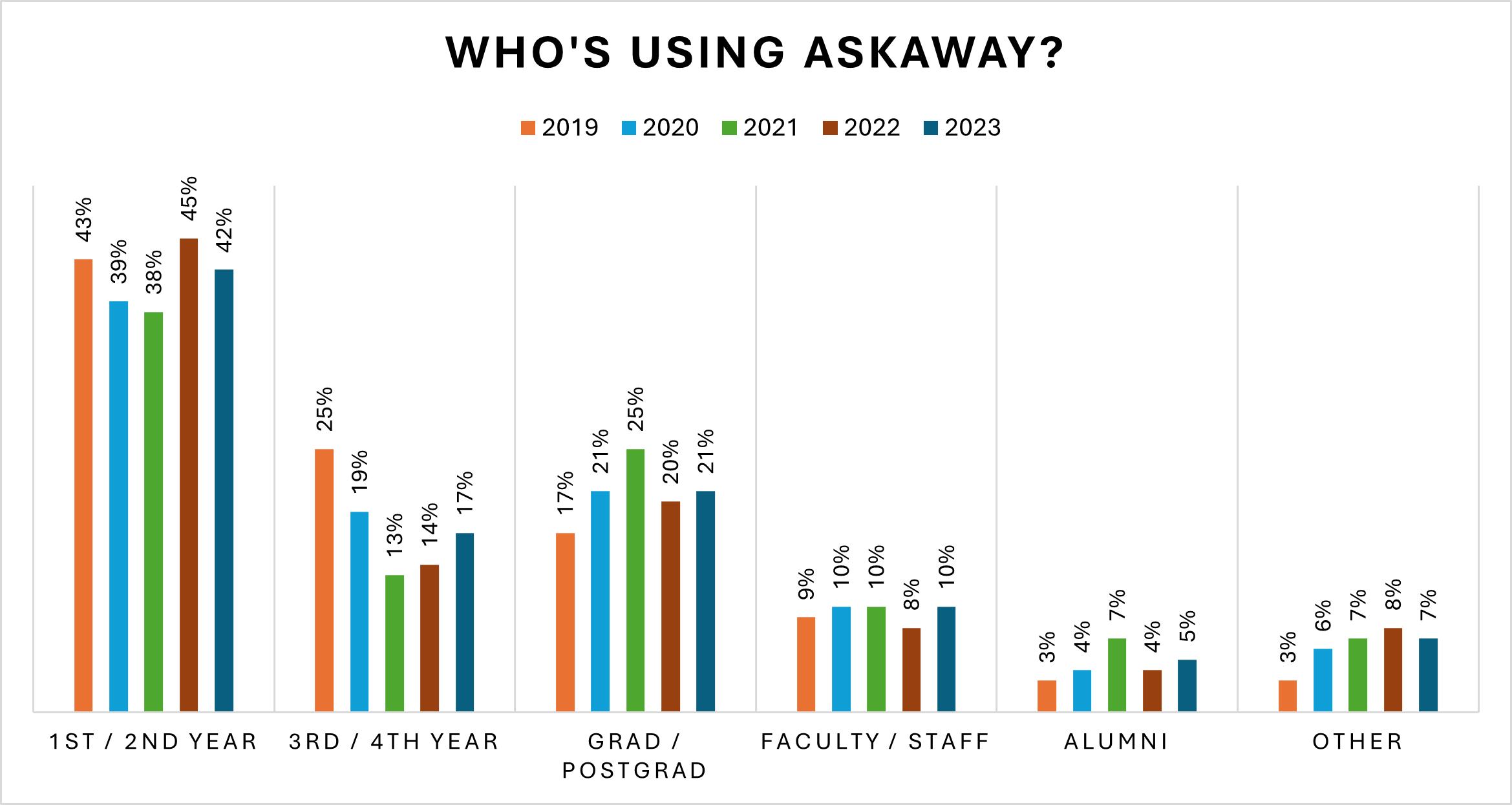
AskAway’s primary users are the 200,000 students who attend its participating institutions. Faculty, staff, and alumni also use the service.
Figure 1 below shows a breakdown of users over five years (2019-2023) based on AskAway exit surveys. The data shows that first- and second-year students consistently represent approximately 40% of users, while third- and fourth-year students and graduate/postgraduate students each typically account for about 20% of users respectively.
Libraries have a longstanding history of collaborating through consortia to maximize resources and expand capacity. Since its establishment in 1989, BC ELN has offered its members a variety of shared services, such as consortial licensing and province-wide interlibrary loan, and has consistently shown the impacts of collaborative efforts. As a collaborative service, AskAway delivers significant benefits to both participating libraries and end users.
AskAway exists to leverage the resources of individual libraries to create a broader and more significant impact for all. While all participating libraries benefit, the service is especially valuable for medium- and small-sized institutions. Through AskAway, these institutions can provide a service that would otherwise be out of reach due to limited resources, technology, and/or expertise.
Participating libraries contribute a portion of staff time to AskAway, ranging from 2 to 34 hours per week based on student enrollment. In return, institutions gain access to approximately 240 hours of reference service weekly, covering AskAway’s 73 service hours across seven days, including evenings and weekends — ensuring support even when physical libraries are closed.
Additional benefits for participating libraries include:
An interactive H5P element has been excluded from this version of the text. You can view it online here:
https://opentextbc.ca/sertcasestudies/?p=43#h5p-1
Since participating libraries contribute just a small portion of staffing compared to what is available in return, and the service is centrally managed by the AskAway Administrative Centre, institutions benefit from significant cost savings. The Administrative Centre handles key tasks like scheduling, training, governance support, communication, statistics, reporting, and technical support, significantly reducing the financial and labour burdens associated with these tasks for institutions. BC ELN estimates that medium-sized institutions save about 80% of the costs they would incur if running a similar service independently. From a sector-wide perspective, this collaborative model supported by a centralized coordinating body significantly reduces costs by eliminating duplicated efforts and by sharing resources across institutions.
AskAway was created to help libraries address the growing need for flexible research support in an era of online and distance education. It enables libraries to meet students “where they are,” supporting those studying off-campus or during evenings and weekends when physical libraries may be closed.
The service’s technical capabilities have also advanced to better meet users at their point of need. In 2022, AskAway introduced proactive chat, allowing timed widgets to invite visitors to chat after lingering on library webpages. Early data suggests proactive chat effectively engages a larger percentage of new users. Additionally, the AskAway chat widget can now be embedded directly in EBSCO and ProQuest databases. This ensures students don’t need to search for help, they can access assistance precisely when they need it most: while researching.
AskAway provides uninterrupted support when physical libraries are closed or minimally staffed. Operating seven days a week during the academic term and until 9 pm Sunday through Thursday, it provides students with assistance when they need it most. In summer, when many smaller college libraries reduce hours or have limited staffing, AskAway continues to offer service.
In exceptional circumstances this benefit becomes a critical safety net for institutions. As natural disasters like forest fires and floods are expected to increase due to climate change (see Is climate change increasing the risk of disasters?), physical libraries and infrastructure are at risk. When flooding affected the community of Merritt B.C. in 2021, Nicola Valley Institute of Technology’s Merritt campus library had to close, but students could continue to access library support via AskAway.
AskAway became a crucial support system in 2020 when COVID-19 forced post-secondary libraries in British Columbia to close and transition quickly to fully online services. As an established virtual service, AskAway was well-positioned to seamlessly facilitate this shift. The traffic data tells a compelling story: usage increased by 62% in 2020 compared to 2019, underscoring how heavily students and other users relied on the service. Institutions responded by adding shifts and extending hours, ensuring students continued to receive the support they needed during a very challenging time.
“Being able to pivot almost immediately to virtual reference after the shutdown of our physical spaces and services [because of COVID-19] was invaluable. Our staff and students are grateful to have the ability to communicate with each other in real time during the crisis, and the work of the AskAway team to ensure everything continued to run smoothly is much appreciated. Thank you!”
— Dan Slessor, Librarian, Langara College
Participating institutions benefit from AskAway’s strong culture of community support. During COVID-19, libraries recognized the importance of keeping the service open during typically closed periods and took action by collectively contributing 3,275 extra staff hours and adding 42 service days in 2020 to meet increased demand. Even in less challenging times, libraries frequently volunteer additional staffing. When the service experiences an overwhelming volume of activity, providers send a “swamped” message to the AskAway service provider listserv. Unscheduled library staff then step in to assist by logging in and responding to users until the traffic has returned to a manageable level. Several institutions consistently volunteer hours over the term, while others contribute as needed, which helps keep service costs low.
AskAway fosters a supportive community of practice among participating library staff. Service coordinators and providers stay connected through tools like Campfire, a team messaging app used during shifts for communication, transferring chat sessions, and offering mutual support. The AskAway Administrative Centre further strengthens collaboration by hosting semi-regular coordinator meetings for all 28 institutions to discuss progress, share strategies, address challenges, and explore trends in virtual reference. Periodic working groups provide additional opportunities for library professionals to collaborate, share insights, and contribute to the service’s ongoing improvement.
AskAway service providers include librarians, library technicians, and student librarians, depending on the institution. Service providers respond to queries from any of the 28 participating institutions, offering exposure to a wide variety of questions and providing an excellent opportunity to keep skills sharp. Master of Library and Information Studies (MLIS) students hired to staff AskAway gain valuable hands-on experience in research assistance strategies while on the job and bring the asset of AskAway experience to their job searches in the library sector.
Thanks to AskAway, students, faculty, and researchers at 28 participating institutions have access to convenient, online, point-of-need research assistance. Since students are the primary users of AskAway — comprising approximately 80% of its traffic — the following section will focus on AskAway’s benefits for students specifically:
An interactive H5P element has been excluded from this version of the text. You can view it online here:
https://opentextbc.ca/sertcasestudies/?p=43#h5p-2
No accounts or logins are required to use AskAway. Students can access immediate assistance during AskAway’s operating hours simply by typing their question into a chat box. The service is anonymous, with any information shared being entirely voluntary. Anecdotal feedback suggests that the privacy offered by AskAway is an important and valued feature for users:
“I like that the service is anonymous for both the librarian and user. I feel that it helps avoid anxiety barriers that might come up when seeking help. Thank you!” – Okanagan College student
“I really appreciated that it was a one-click button to start a chat with a librarian, and I got quick help, and no one asked me for any information or proof or whatever, all in all the whole process took 5 minutes!” – University of Victoria student
AskAway’s 28 participating institutions range from the smallest public and private colleges to the largest university in British Columbia. Institutions are geographically spread throughout the province and are found in both rural and urban environments. If a student attends an AskAway institution, they have access to the same high-quality research support regardless of the size or location of their school.
AskAway interactions offer students valuable opportunities to learn how to search for and evaluate relevant sources. Service providers are trained to guide students, not by doing the research for them, but by demonstrating effective research strategies that students can apply independently in the future. Via exit survey data, students report learning skills such as where and how to search for information, how the library can assist, and how to accurately cite sources from their AskAway interactions.
BC ELN provides the infrastructural framework for AskAway, while participating institutions shape AskAway’s development through representational governance. It is important to note that a consortium dynamic is different than a vendor-client relationship. Simply put: BC ELN is not merely providing a service that libraries pay for — libraries are “the service.” BC ELN’s role is to maintain a strong foundation that enables that service to flourish.
BC ELN plays a critical role in supporting AskAway through the Administrative Centre, which provides and maintains the service’s infrastructural framework. The Administrative Centre leverages existing BC ELN resources, and is staffed by the equivalent of 0.7 FTE, made up of a portion of several BC ELN staff positions, including a librarian faculty member, student librarians, finance, communications and administrative roles. For example, BC ELN Client Support staff assists with invoicing participating libraries and BC ELN’s Communications Manager produces AskAway marketing materials and an annual service report.
The Administrative Centre, which was established at AskAway’s inception, handles essential administrative tasks such as compiling the collective schedule, managing software licensing, training new service providers, and more. It also maintains archived historical documents that trace AskAway’s evolution over time. This external framework enhances sustainability in several key ways:
Because AskAway is a service provided by the BC ELN consortium to its members, the BC ELN Steering Committee is responsible for AskAway. The Steering Committee approves AskAway’s annual expenditure plan and must be consulted if major financial or structural changes are proposed.
The AskAway Advisory Committee, a standing subcommittee of the BC ELN Steering Committee, plays a more hands-on role in guiding AskAway’s development and direction. Comprised of representatives from AskAway participating institutions, the Advisory Committee meets throughout the year and provides oversight for AskAway policy, planning, and operations. The Administrative Centre supports this governance group by organizing meetings, facilitating agenda preparation, and managing committee transitions. This representational governance structure contributes to sustainability in a variety of important ways:
AskAway participating libraries actively contribute to decision-making through multiple avenues. They can join the Advisory Committee as a representative for their constituency group or share their perspectives with their constituency representative on the Advisory Committee. Beyond the Advisory Committee’s work, participating libraries are regularly consulted on strategic directions and service changes. For example, the 2023 AskAway Action Plan was developed using insights from a comprehensive participant survey and shaped through a community workshop open to all participating libraries.
AskAway is a not-for-profit service operating on a cost-recovery basis, with participant service fees constituting the primary source of revenue. Participating institutions contribute this revenue in three ways, with all contributions tiered based on institutional FTE (see: AskAway Library Commitment Models):
Revenue also comes from BC ELN, which contributes a modest annual amount. Over the past four years, the British Columbia Ministry of Post-Secondary Education and Future Skills has provided temporary “bridge” funding to help AskAway adjust staffing levels and explore sustainable strategies to meet the increased student usage driven by the COVID-19 pandemic. Approximately 84% of AskAway’s budget is allocated to the Administrative Centre and centralized staffing that fills gaps in the service schedule, with the remaining funds covering software and technology, administration, communications, governance, and marketing expenses.
Participating institutions must adhere to AskAway’s requirements and responsibilities, which were developed by the Advisory Committee at the inception of the service. Since all institutions are actively involved at all times, it would not be possible for one to remain inactive while still benefiting from the service. Indeed, the requirements page includes strategies to support institutions that might be facing challenges in meeting their commitments. Institutions wishing to leave the service must provide 12 months’ notice.
While all institutions agree to contribute to the service, they each have some choice in how they contribute. Since 2014, Flexible Service Support Contributions have been a core part of each institution’s commitment to AskAway (see AskAway Library Commitment Models). Institutions can fulfill this commitment by contributing funds, providing additional evening or weekend staffing beyond their base commitment, or a combination of both. The allocation of hours and funds can vary each year, and the Administrative Centre consults participating libraries annually to confirm their preferred contribution method. This flexibility allows institutions to adapt their contributions based on changing budgets, staffing availability, and service priorities.
AskAway has developed many guidelines and best practices over the years that help set expectations and establish clarity for participants. These are available on the AskAway website and include:
Participating institutions are responsible for user engagement and promote AskAway in ways that best suit their campus communities. That said, because AskAway’s visibility is a primary determinant of how much the service is used, the AskAway Administrative Centre has put concerted effort into developing resources to assist institutions with service visibility, including best practices, guidelines, tips, and marketing materials.
AskAway offers several opportunities for staff to contribute to service development, including through the Advisory Committee, working groups, and virtual coordinator meetings hosted by the Administrative Centre. These meetings allow members to share ideas, raise issues, and learn from one another. Additionally, the service has launched community engagement initiatives, such as “Prep-a-Palooza,” an online work party that brought coordinators together to prepare AskAway for the new term. The event was well attended and received positive feedback.
BC ELN is hosted by Simon Fraser University (SFU) and is subject to SFU’s legal policies and frameworks for legal compliance. AskAway has undergone a Privacy Impact Assessment and makes a privacy statement available on its website. The LibraryH3lp software was selected in 2018 in part for its Canadian hosting and FOIPPA (Freedom of Information and Protection of Privacy Act) compliance. While a formal assessment of AskAway’s accessibility has not been completed, the software is built to be compatible with assistive technology.
Several factors present ongoing challenges to the sustainability of AskAway:
The following are significant successes related to AskAway’s sustainability:
The following recommendations highlight key factors that contribute to the sustainability and success of a consortial service like AskAway:
Having an external coordinating body (e.g., AskAway’s Administrative Centre) is invaluable. Beyond reducing the administrative burden on participating institutions, this body provides essential structure, maintains focus on core values, and advances strategic priorities.
Well-documented service guidelines, policies, and procedures create a stable framework for participation. Clearly defining terms, staffing expectations, and operational protocols helps prevent misunderstandings and ensures consistency across institutions.
AskAway follows a grassroots, user-driven approach to service development, ensuring that evolution aligns with real needs. The process is quite simple:
Sustainable investment in the service depends on all levels recognizing its value. This requires understanding and addressing the priorities of different contributors.
The AskAway Advisory Committee maintains alignment with user and institutional needs through ongoing consultation, review, and service adjustments. Currently, a seven-person working group — representing a diverse range of participating libraries by tier, type, and geographic location — is evaluating the AskAway commitment models to support long-term sustainability in light of post-COVID-19 service demands and financial pressures on libraries. The enthusiastic response to a call-out for working group members is a testament to the community’s engagement and commitment to AskAway. The working group will present its recommendations to the Advisory Committee in February 2025, after which next steps will be determined. Any major financial or structural decisions will then be brought forward by the Advisory Committee to the BC ELN Steering Committee for consideration.
| Year | 1st/2nd Year | 2nd/3rd Year | Grad/Postgrad | Faculty/Staff | Alumni | Other |
|---|---|---|---|---|---|---|
| 2019 | 43% | 25% | 17% | 9% | 3% | 3% |
| 2020 | 39% | 19% | 21% | 10% | 4% | 6% |
| 2021 | 38% | 13% | 25% | 10% | 7% | 7% |
| 2022 | 45% | 14% | 20% | 8% | 4% | 8% |
| 2023 | 42% | 17% | 21% | 10% | 5% | 7% |
[Return to Who’s Using AskAway? Image]
BC Electronic Library Network (BC ELN)
BC ELN is an award-winning consortium of 34 public and private post-secondary libraries in B.C. and the Yukon. BC ELN’s purpose is to develop and support system-wide mechanisms that allow post-secondary libraries to meet the expanding information needs of learners, educators, and researchers at the lowest possible cost.
Users are invited to provide feedback on their AskAway experience through a survey presented at the end of their session. Participation is voluntary. The response rate is approximately 3%.
The BC ELN Steering Committee is charged with determining the overall strategic direction of BC ELN, identifying specific strategic initiatives, and monitoring and evaluating the progress of BC ELN’s services. The Committee is made up of representatives from BC ELN’s six constituencies. Learn more at: BC ELN Governance Categories
4
© 2025 Matt Simpson. CC BY-NC-SA 4.0 license.
Abstract
A few years ago, a friend and I gave a well-received presentation at a well-known technology in academic medicine conference called Building Together: Lessons Learned Building a Consortium. Creating this talk was both enjoyable and challenging, as it required us to distill a tremendous amount of experience gained over fifteen years of building an international open-source (turned community-source) software consortium. After presenting the talk again at an annual Consortium conference, I felt that this important work would translate nicely into a blog post, a story, and now a case study — one that may help other organisations considering a collaboration model learn from our experience.
In 2008, after four years of developing a homegrown software solution for managing curricular data at our medical school, another major Canadian university was looking to replace a similar platform they had initially partnered with a commercial vendor to create. It was expensive for them to operate, and they found that they paid a significant amount of money to the vendor whenever they had to make changes to meet their evolving needs. In other words, the vendor relationship they built was cost-prohibitive and unsustainable.
After carefully considering their options, some truly progressive leaders asked our university if they could collaborate on the development effort for our software and share our source code. This collaboration was the impetus of what became our Consortium.
In 2011, a prominent American university formed an internal committee tasked with replacing its specialized learning management system after its commercial vendor discontinued the product post-acquisition and attempted to force a migration to another popular general-purpose learning management system. The committee reviewed eight platforms, which included homegrown tools, open-source systems, and vendor products. After a year and a half of extensive research, product demos, analyses, and pilots, they chose our software in 2013, and our Consortium sprang to life.
Instead of simply sharing the source code between our three organisations, the Consortium we created became the vehicle that enabled both the technical and product collaboration.
From a technical perspective, the concept was to build and maintain the upstream Consortium software collaboratively first, then pull the released product down to our organisations for local customization and branding purposes before deploying it to our own self-hosted server environments. After several significant evolutions, we landed on managing the upstream software product using shared source code repositories on GitHub and tracking our features and bugs in a commercial project management system called Jira.
At first, our collaboration model was incredibly simplistic, and there was very little governance, process, and operational structure. Our teams would meet bi-weekly using readily available video conferencing technology to discuss the latest needs and how we would address them. Initially, having limited governance allowed us to embrace the now common “move fast and break things” paradigm, which worked well for a while but began to show cracks as Consortium participation increased and the software needed stability and maturity.
To address the need for increased governance, we ended up creating a Consortium Advisory Committee (Advisory Committee Terms of Reference [docx]) and two sub-committees, the Product Management Committee (PMC) (PMC Terms of Reference [docx]) and the Architecture Review Committee (ARC) (ARC Terms of Reference [docx]).
The Consortium Advisory Committee was chaired by and reported to the Director of Information Technology at the host university and comprised representation from six of the early adopting organisations and two rotating two-year term representatives. This committee was responsible for maintaining our mission, vision, and strategic plan, the big-picture prioritization of areas of focus, the development and approval of policies, procedures, and best practices, and overseeing the work of the Product Management and Architecture Review Committees. It is important to note that this structure resulted from multiple iterations of governance attempts. This final governance structure worked well, with leadership focused on leadership activity, product experts focused on product functionality, and technical experts focused on architecture.
To enhance operational efficiency and stability, we formed a “Core Team,” a dedicated department for the Consortium within our Faculty at the host university. The team had its own budget, funded through an annual $60,000 Consortium fee paid by participants, which increased over the years with inflation. The fee itself was determined by understanding the true costs of running the department and dividing it equally between the participating organisations. This low annual Consortium participation fee was often inconsequential compared to what schools would otherwise pay to commercial vendors for similar or less capable software. And that was the point. Schools would then have money available to invest in themselves and their own technology teams, who would, in turn, contribute back.
Our scalable and sustainable funding model supported the salaries of several dedicated staff members, including an Associate Director, Technical Lead, Product Lead, UI/UX Designer, and Web Developers, as well as covering the administrative overhead costs of operating within the university. This Core Team provided stability and support for the Consortium community. Also, it functioned as a corporate memory in a sense, as when there was instability within a participating organisation, such as leadership or staff turnover, there was a stable team who could help the participating organisation with retraining, orientation, or re-onboarding.
So why did our collaboration work so well? What were the magical ingredients that made our teams click, translating into a successful product, stable collaboration, and substantial growth in the market?
After several years of increasing success with our consortium model, and as the software product continued to mature, the Dean of our Faculty began to push for a potential pathway for commercializing the product. While a commercialization pathway was never the intent of our collaboration, the Consortium Advisory Committee did understand and agree in principle with the fact that the full impact and benefit of the software we were building could never be fully realized in a pure-consortium model, given the technical expertise required by an organisation to maintain, upgrade, and develop software hosted on-premises. The consensus from the Consortium community was that we wanted to keep the software open-source and self-host our implementations of the software but that we would also welcome the concept of a Software-as-a-Service (“SaaS”) commercial vendor into the Consortium, with the assumption that a successful vendor would become a prolific contributor and could potentially inject funding and enhance the Consortium’s influence, sustainability, and long-term viability.
Between 2015 and 2020, while continuing to grow the Consortium to 21 universities spread across Canada, the United States, and Singapore, our university spent countless hours and substantial energy with technology-transfer units, venture capitalists, investors, and lawyers, attempting to fulfill the mandate of establishing a viable pathway to commercialization.
In my opinion, we never found the right investment partner during this crucial phase. It was not that the software wasn’t impressive, that the market was too small, or that the growth wasn’t remarkable; it was that the individuals we met could not comprehend how open-source software could be investible. Given how we had structured and licensed the software under the GNU GPL v3, the intellectual property (“IP”) was owned by the universities or, in some cases, the individuals who created it. I often referred to this as an “IP constellation,” and in my opinion, this was more of a feature than a bug because it prevented any single institution from unilaterally making IP-related decisions that could impact the others. Unfortunately, my perspective was not shared by the individuals we met, so according to the advice our university received, the product was not investible in its current open-source state. This advice was disappointing, and no number of modern examples, proposals, or evidence provided was enough to alter any opinions. As a result, our university determined that moving forward, the software licence would need to change, and the IP would need to be owned by our university.
In 2018, after a substantial amount of effort, our university created a new Software Consortium Agreement coupled with a new custom-built community-source software licence. This agreement and licence ultimately capped the Consortium at its current size, transitioned future versions of the software to a commercial licence, and transferred ownership of the intellectual property to our university. Consortium participants did raise some concerns throughout this transition; however, organisations ultimately signed onto the new agreement with the understanding that our university would safely steward the intellectual property and proceed with the SaaS commercialization efforts, which would benefit all.
Over the next few years, the collaboration efforts continued to be refined and improved, the software continued to mature, and the community collectively continued to support the concept of the eventual arrival of a commercial vendor Consortium participant.
In 2021, approximately six years since the former Dean of our Faculty began pursuing commercialization efforts, our university officially launched the new start-up company. New clients were ready and started signing up for their Software-as-a-Service offering of the software initially created by the Consortium community. Despite the challenges of launching a new start-up company during the COVID-19 pandemic, there was substantial optimism from all parties that this new company would be successful and high hopes from the Consortium community that they would realize tremendous benefits in terms of contributions, recognition, and long-term viability.
However, after its launch, it didn’t take long for tensions to rise. Software start-up companies must be focused and competitive. As one would expect, the new company was squarely focused on their customers, their revenue, and their growth, but surprisingly, they abandoned the concept of contributing to the software releases of the Consortium and moved towards developing a forked version of the software. There were strong indications to many that the new company felt the Consortium presented competition instead of allies and collaborators, which cast a heavy shadow of mistrust between the Consortium community and the budding start-up company.
In July 2023, five years after our university took ownership of the intellectual property and only two years after launching the start-up company, the intellectual property and company were sold to an American private equity firm. At the same time, our university announced a review process to decide whether to discontinue in-house development and adopt the SaaS version of the software and determine if they would transition the Consortium to the company using an assignment clause within the Software Consortium Agreement signed by the organisations in 2018.
The review process was difficult for everyone in the Consortium community; it took six months to complete. Finally, on January 25th, 2024, our university announced that it would be moving to the SaaS version of the software and that as of February 26th, 2024, the Consortium would be transferred to the company to become a short-lived corporate division that would ultimately be closed as of June 2025.
What began in 2008 as an effective collaboration between universities grew into far more than a shared software project — it became a framework for collaboration, a mechanism for institutions to pool their knowledge, ideas, and expertise in ways that extended beyond code. The Consortium fostered a community where niche medical educational challenges could be tackled collectively and where institutions could refine not just their technology but also the very processes that supported their educators and learners. Its low-cost model allowed universities to invest in their own teams, developing internal expertise, innovation, and self-sufficiency.
Now, with its closure, Consortium participants face a critical decision: adopt the SaaS product, maintain their on-premises implementation on their own, or transition to an entirely new system. As institutions navigate this shift, many may find themselves relying more on external vendors, redirecting financial resources outward and potentially reducing their capacity to cultivate in-house expertise and shape their own technological and educational future.
The Consortium was more than a software project—it was a framework for collaboration and innovation, and its impact on academic collaboration and technology innovation will continue to be felt far into the future.
There are many different perspectives from which this story could be told; my perspective is that of someone within the higher education community who values academic and technical challenges, collaboration, and community above many other things. Therefore, the lessons I have distilled from this experience reflect those values.
How you license your output will influence adoption and culture within your collaboration and determine what you can do with and what can be done to the output of your collaboration in the future.
We were creating software in our case, but the need for a licence extends far beyond software. We started using the GNU General Public License v3.0 (GPL v3) open-source software licence. While this licence was perfect for our initial needs, once our organisation signaled an intent to commercialize the product, they were uncomfortable with the copyleft license that prevented the extent of commercialization they were ultimately after.
Through significant difficulty and expense, we transitioned to our own community-source software licence, which was more restrictive but better reflected how we operated within our consortium model at the time.
Looking back, it seems like a chicken-and-egg scenario. If you spend all your time and energy upfront, with all the decision-makers at your organisation, determining what may eventually become of the software you have not yet built, you may never get around to creating it. But, if you don’t get enough initial input or buy-in from everyone in every layer of the organisational onion, you might be missing the opinions and input of individuals who will require changes in the future.
Who owns intellectual property created by the collaboration must be crystal clear in order to avoid future conflict and wasted energy.
While this will be very clear legally in the software licence, it’s essential to recognize how difficult it is to change intellectual property ownership later. As I mentioned, we started using the GPL v3, resulting in what I refer to as an “IP constellation.” Maybe that’s good for you, maybe it’s not, but it’s something to be aware of.
Take the time to define what is considered intellectual property. Is it an idea, the documentation, the processes, an entire file within the software, or lines changed within a file? There are, of course, legal definitions to be aware of.
Ensure that all contributors to your output, including students, faculty, and staff, have employment contracts that specifically outline intellectual property ownership. You should also have a “Contributor Licence Agreement” that individuals sign in if the organisation they’re contributing through has either no policy or conflicting policies. For an excellent example, please see the Individual Contributor License Agreement (ICLA) from the Apache Software Foundation.1
Trademark tip: If you choose a formal name for your collaboration, ensure you can get the appropriate registered trademark in every country in which you intend to operate. Failing to do so may result in a time and energy-consuming rebranding exercise.
An appropriate governance structure will balance innovation and creativity with process.
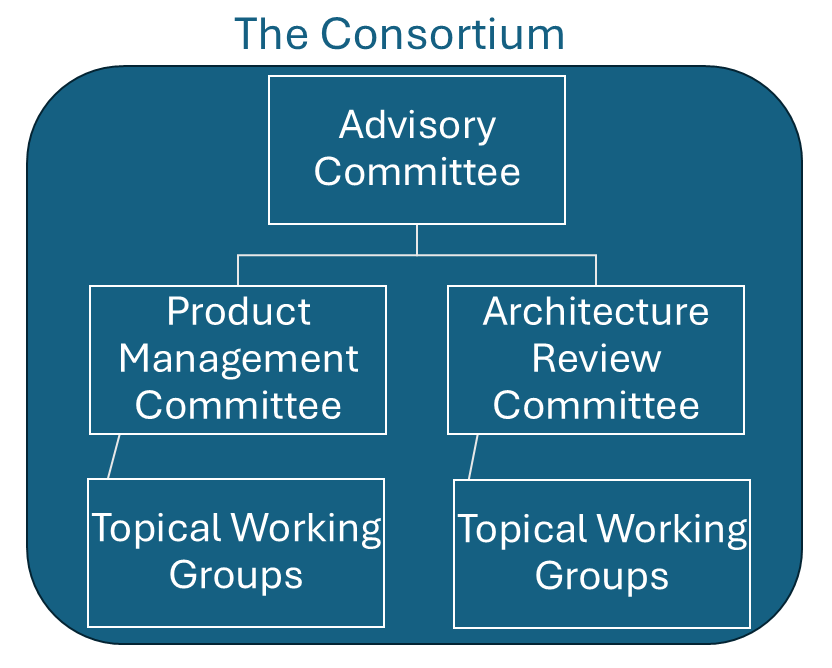
You should recognize there is likely governance already above you that will drive or influence your collaboration. Also, consider that your internal governance needs will change from time to time as the maturity of your collaboration and the product evolves.
Your collaboration’s governance is essential; however, governance will, in most cases, slow down the ability to make decisions. This slowdown isn’t necessarily bad. However, consider the milestones necessary before introducing appropriate governance.
Starting with a rigid governance structure may unnecessarily hinder innovation and creativity but introducing it later in the life of the collaboration is a complex change to manage and communicate.
By defining your mission, vision, and values, you will have robust documentation to refer to during planning and difficult decisions.
We officially defined our mission, vision, and values in 2018, ten years after the Consortium began. We did this while developing our first Strategic Plan (2019–2022). This process felt unnatural to me as a software developer in a leadership role; however, this was a beneficial exercise, thanks to a few talented facilitators and our collaborative Consortium Advisory Committee. Even if this is done early in the collaboration and requires revisiting, it is still worth it.
Whether or not you initially recognize them, there are goals. You have goals, individual contributors have goals, and organisations have goals. You could easily substitute the word “goals” with “interests” in this lesson, which may more accurately represent the lesson’s intent.
As someone presumably integral to the collaboration, it’s essential to be honest with yourself and recognize your personal goals. What motivates you to do all the additional work necessary to make this collaboration successful? Because it’s going to take a lot of work. Collaborating with others takes several times more energy than solving a problem by yourself. As the popular saying goes, “If you want to go fast, go alone. If you want to go far, go together.”
Do your best to determine the organisation’s goals that support this collaboration, recognizing that these goals may change over time (e.g., from Dean to Dean, CFO to CFO, CIO to CIO, or accreditation to accreditation). Consider whether your own goals align with the goals of the host organisation. From experience, it may feel like you’re pushing a rock uphill if you want to build open-source software but the organisation you work for is more focused on a commercialization pathway. Also, consider whether your idea for collaboration fits into the strategic plan of the organisation employing you. If it does, make every effort to communicate that fact and map what you do to the strategic plan.
Will this be a manageable localized collaboration that solves unique problems in a geographical region or niche market, or do you need this to scale to a national or international market?
From experience, collaborating with three teams is very different than collaborating with 23 teams. Not that one is better than the other; it’s just that the larger your collaboration gets, the more critical it is to have all the other lessons we discuss (e.g., Goals, Mission, Vision, Values, Governance, Licence) fully dialed in.
A strong and supportive community will be your most significant source of strength.
We were continually learning better ways to do this. An effective community isn’t built overnight; it is cultured through clear vision, consistency, and integrity. Be inclusive and ensure that everyone has a voice.
The community engagement opportunities we provided to the Consortium community included:
Onboarding a new participant, whether an organisation or a person, is an expensive operation at the best of times. From experience, onboarding the wrong participant can be an incredible drain on resources. Discuss with your community what makes a good participant, and focus your energy on attracting fully aligned and committed participants.
Building a successful Consortium requires a shared vision and goal, a culture of collaboration and sharing, buy-in from leadership, open communication, and some technical aptitude. These ingredients and a willingness to adapt as you go will help to ensure that you will go far together.
While our specific collaboration can no longer evolve, I am excited to see where and how the lessons we learned from the incredible experience may inspire and guide others as they embark on their collaborative journeys.
Matt Simpson
Matt Simpson is a passionate technology leader with over 21 years of experience shaping the digital landscape of Canadian higher education. Passionate about leveraging technology to enhance teaching and support administration, he is dedicated to building engaged, high-performing teams that develop innovative solutions to empower and inspire the communities he serves. His leadership philosophy is grounded in collaboration, creativity, and a deep understanding of both the technical and human aspects of technology.
As a Certified Information Systems Security Professional (CISSP), Zend Certified PHP Engineer, and professionally trained graphic designer, Matt blends technical expertise with creative problem-solving to drive meaningful digital transformation. Throughout his career, he has been a champion of community-driven innovation, fostering collaboration and developing software that advances medical education at universities around the world. Balancing hands-on development with strategic leadership, he remains deeply connected to his technical roots, ensuring that every decision aligns with real-world needs and industry best practices.
5
© 2025 The University of Edinburgh. CC BY 4.0 license.
Abstract
This case study explores the creation and development of the Noteable platform and its evolution to Software-as-a-Service. Noteable is an educational platform born at the University of Edinburgh, now serving thousands in the UK and internationally. From its early stages as a coding tool for classrooms, Noteable has matured into a highly valued service across numerous institutions, including a growing presence in Europe. With a business model grounded in sustainability and openness, Noteable’s success provides a blueprint for educational technology initiatives that aim to scale and remain viable in ever-evolving, dynamic academic landscapes.
EDINA is a business unit in the University of Edinburgh. A cornerstone of digital expertise and data innovation since 1995, it was initially established as a national data centre. EDINA has been instrumental in providing the UK academic sector with access to an array of digital resources that help to enable teaching and learning with data of different types. Over the years, EDINA’s focus has broadened to include geospatial resources, bibliographic services, and digital preservation.
Renowned for its collaborative efforts, EDINA works alongside universities and education institutions to develop user-driven, bespoke digital solutions. Among its portfolio of services are Digimap, a comprehensive online mapping service that offers access to a wide range of datasets. These include geographical, geological and historical maps. Digimap is now a vital tool in higher education, enabling students and researchers to create custom maps and perform detailed spatial analysis, thus enhancing both teaching and research capabilities.
One of EDINA’s more recent flagship initiatives is Noteable, a platform that promotes interactive learning by enabling the use of computational notebooks across various disciplines. Through such ventures, EDINA continues to equip educators and researchers with advanced tools, facilitating the seamless integration of technology into education and research pursuits.
Noteable was originally developed in 2018 as a central technology services initiative within the University of Edinburgh. At the time, there was a need for centrally hosted tools and platforms that integrated coding platforms, languages, and extensions for education. Noteable was envisioned to infuse traditional curricula with robust data literacy capabilities and improve learners’ abilities for computational thinking. The platform provides interactive computational notebooks, largely based on the Jupyter ecosystem. Jupyter notebooks are essentially digital canvases for data analysis, coding, and problem solving that can integrate directly with course content across disciplines.
Since then, Noteable has evolved remarkably, growing from a small-scale single-university tool to a significant software service and contributor to global educational technology, with ongoing enterprise subscriptions and partnerships. Noteable currently supports over 15,000 users annually across an array of fields, which include mathematics, biology, and computer science, within Scotland and also reaching academic institutions across the UK and beyond. Noteworthy among its development is the successful integration into courses at the University of Leiden, and now, expanding its presence in the education market, with other universities showing interest in the platform.
The integration of Noteable with virtual learning environments like Canvas, Moodle, Blackboard, and Brightspace exemplifies its versatility and adaptability within diverse educational ecosystems. At the University of Leeds and the Leiden Academic Centre for Drug Research (LACDR), Noteable has been seamlessly merged with existing digital environments to enhance coding education. Its cloud-based computational notebooks facilitate interactive coding lessons in languages such as Python and R, providing educators with the flexibility to integrate coding environments into modules and courses with ease. This feature also supports various devices, ensuring accessibility and encouraging computational literacy across disciplines and technologies. Additionally, the development of innovative digital learning environments like LACDR’s ”Digital Labcoat” showcases Noteable’s impact in fostering technological advancements in education.
Fundamental to Noteable’s ethos is the principle of open-source technologies and sharing best practices. By selecting and making use of available online resources and collaborative development, the platform creates an ecosystem where educators can innovate and enrich the learning experience for students.
Noteable’s integration with Moodle at the University of Bath exemplifies a fusion of education and technology, designed to simplify and enhance the teaching and learning of coding skills. By offering a cloud-based Jupyter environment, Noteable eliminated the need for students to install software locally, thus overcoming common technological barriers such as hardware compatibility and software dependency issues. Furthermore, the Noteable service and its adherence to accessibility standards and guidelines has been able to provide a more inclusive set of tools for students to work with.
This accessibility ensures that students can access Noteable across a broad range of device capabilities and engage fully with programming exercises using only a web browser. For educators, Noteable provides powerful tools that simplify the distribution and collection of assignments, alongside capabilities for auto-grading, saving marking time and streamlining the assessment process.
Access to Noteable is offered exclusively through the virtual learning environment, making it easily accessible to students. This setup ensures that students can conveniently transition from various locations while maintaining access to their work. Furthermore, although Noteable includes a comprehensive suite of pre-installed libraries, it allows for on-the-fly installation of additional packages, providing flexibility while maintaining stability throughout the academic year. For guidance, educators and students can utilise the extensive resources available.
Noteable’s governance structure is anchored within EDINA, which is part of the University of Edinburgh’s infrastructure. This relationship leverages the university’s resources and reputation, providing a sturdy legal and operational framework for the project’s growth. The governance is collaborative, involving an active community of academic leaders, IT specialists, and stakeholders who collectively steer the project through strategic decision-making and continuous improvement.
The team involved in Noteable consists of approximately 10 members, comprising developers, educational technologists, user support staff and ancillary IT services. There are also dedicated user groups that have developed at the University of Edinburgh and in institutions with a subscription to Noteable. This multi-disciplinary community of contributors to the service ensures that Noteable meets both the technological needs of a modern educational platform and the pedagogical requirements of diverse academic programmes.
Noteable operates with a strong focus on enhancing educational value and reinvests all revenue to advance platform development. At the heart of its revenue model is a close collaboration with Jisc, which facilitates the delivery of education-oriented Software-as-a-Service (SaaS) through Chest agreements. This partnership allows institutions to access Noteable at competitive prices specifically designed for the educational market. Jisc’s pricing model includes multiple subscription tiers, tailored to meet various institutional sizes and needs, ensuring that Noteable is financially accessible while maintaining high-quality service.
Jisc’s pricing bands play a pivotal role in determining the subscription fees for institutions accessing Noteable through Jisc’s Chest agreements. Each educational institution engaging with Jisc’s negotiated agreements, such as Noteable, is assigned to a specific band. This assignment is based on the total relevant income of the institution, ensuring a fair and equitable fee structure that aligns with an institution’s financial capacity. By tailoring fees to institutional capacities through strategic banding, Jisc ensures that the educational resources it supports, including Noteable, remain accessible and competitively priced, promoting widespread adoption and enabling institutions to enhance their educational offerings in a sustainable manner.
Beyond the standard Jisc CHEST framework within the UK and Ireland, Noteable also demonstrates flexibility by crafting contractual agreements with international institutions. This capability allows Noteable to extend its reach beyond the UK higher education sector, accommodating specific institutional requirements and fostering educational partnerships across the globe. These service level agreements ensure that Noteable can support diverse educational environments while maintaining its commitment to innovation and excellence.
Revenue allocation within Noteable is strategically managed to sustain operations, drive the development of new features, and support strategic growth initiatives. This financial strategy ensures that the platform’s core services remain robust, while ongoing innovation keeps Noteable at the forefront of educational technology.
In its collaborative efforts, Noteable ensures transparency by establishing well-defined roles and agreements with its partners. This is achieved through comprehensive documentation and rigorous contractual processes that clearly outline the expectations and deliverables for all involved. Such clarity is crucial in building trust and facilitating seamless collaboration, thereby guaranteeing that projects are executed to the highest industry standards.
While Noteable itself is a trademarked software service and not open source, many of the resources and software components it employs are based on open-source licensing. This adoption of open-source technologies cultivates an environment conducive to sharing and continuous enhancement. This openness underpinning Noteable’s approach is not merely a strategic choice; it is a foundational philosophy that significantly enhances the platform’s utility and broadens its influence across the educational technology landscape.
The integration of open-source technologies within Noteable significantly contributes to promoting open research, development, and functionality, extending benefits to a broader user base. As a teaching and learning tool, Noteable is committed to setting the standard in leveraging open technologies, not only to build its platform but also to introduce educators and students to widely recognised tools such as Jupyter notebooks. These open-source technologies are prevalent in various industry settings, thus providing users with valuable skills and insights that are directly applicable beyond the classroom.
Community engagement lies at the heart of Noteable’s success. The platform hosts numerous webinars, training sessions, and feedback forums to foster an active user community. This interaction is critical for gathering insights and driving the continuous improvement that users demand. In 2024, the Geospatial Fringe focused on the service, using it to demonstrate data visualisations and analysis regarding orbital congestion, and cleaning up available data to visualise satellites around Earth.
In terms of partnerships, Noteable employs a proactive approach, collaborating with academic and enterprise entities through joint projects and consistent dialogue. This engagement has been pivotal as Noteable establishes footholds in new regions and subjects, adapting to local educational paradigms while maintaining its foundational strengths. Community engagement is central to Noteable’s ethos and success. The frequent webinars, training sessions, and feedback forums that Noteable hosts are integral to cultivating an active and engaged user community.
Open source also plays a significant role in community engagement for Noteable. By contributing back to open-source projects, Noteable fosters a spirit of collaboration and reciprocity, encouraging a communal approach to development and innovation. This engagement ensures that the platform evolves in alignment with both community and technological advancements.
An example of Noteable’s community engagement and collaborative impact is its adoption by Scottish schools as a key tool to practice for the Higher Applications of Math exam. School pupils use one of the available environments in Noteable, RStudio, to learn about statistical concepts and run code from an integrated platform that they can access through their existing school systems.
Another example is the Leiden Academic Centre for Drug Research. Supported by a donation from Chris Oomen, Noteable has been integrated into the “Digital Labcoat” initiative, offering biopharmaceutical sciences students opportunities to develop crucial computational skills. This engagement strategy not only enriches the curriculum but also aligns with Noteable’s mission to enhance educational outcomes through digital solutions. By facilitating programmatic use, including programming and AI methods, Noteable continues to refine its service to meet the evolving needs of global academia.
Legal compliance is paramount to the operations and sustainability of the Noteable platform, under the stewardship of the wider University of Edinburgh strategies. This responsibility underscores the commitment to upholding rigorous standards in data protection, privacy, and accessibility across all services rendered. As part of the University of Edinburgh’s remit, Noteable adheres to comprehensive regulatory frameworks and institutional guidelines that ensure ethical and secure handling of user data.
The University of Edinburgh provides a robust legal framework that supports EDINA and Noteable’s operations, encompassing thorough compliance with the General Data Protection Regulation (GDPR) and adherence to industry best practices in information security. Testing and audits conducted by the university’s dedicated compliance teams ensure that Noteable meets the required standards, thereby safeguarding user trust and fostering a secure learning environment.
Ensuring comprehensive legal compliance with data protection, privacy, and accessibility laws is an ongoing commitment for Noteable. The service website includes current policies and statements on data retention and usage of the service, which are readily available for all users to see when they launch the platform.
Scaling Noteable from a university pilot to an internationally recognised platform has not been without challenges. Evolving funding landscapes, technological scalability, and diverse educational requirements posed significant hurdles. However, these challenges also reinforced Noteable’s strategic resilience and adaptability.
At the core of Noteable’s success is its transformation into a critical educational tool used by diverse academic institutions across multiple continents. Its ability to integrate smoothly into various academic ecosystems, coupled with its subscription-based revenue model, ensures not only sustainability but also growth. The expansion beyond the United Kingdom exemplifies Noteable’s capacity to broaden its impact, adapting to new markets while preserving core values.
Noteable has accomplished significant successes across various facets of its operation, reflecting its status as a leading educational technology platform. One of the most notable achievements is the expansion into enterprise-level engagements, where educational institutions around the world have integrated Noteable into their core teaching and learning processes. These enterprise partnerships exemplify trust in Noteable’s capability to deliver a robust, scalable solution that addresses the dynamic needs of diverse educational environments.
An initiative we are particularly proud of is the free provision of Noteable to Scottish schools, supporting local education systems by democratising access to advanced computational tools that can be used in exam preparation for the Higher Applications of Math qualification. This initiative aligns with the University of Edinburgh’s mission to promote educational equity and has been instrumental in fostering early engagement with computational thinking among school students. By offering Noteable free of charge, schools are empowered to enhance their curriculum with cutting-edge technology without financial barriers, cultivating the next generation of digital learners.
The user base across Noteable has consistently shared positive feedback and testimonials highlighting the platform’s ease of use, comprehensive functionalities, and impactful learning outcomes. This satisfaction is rooted in Noteable’s commitment to user-centric design and continuous improvement processes that incorporate user feedback into its development roadmap.
Whether in mathematics, biology, computer science, or humanities, Noteable has proven capable of meeting the unique demands of each discipline. This cross-departmental utility not only illustrates the platform’s inherent flexibility but also its ability to promote interdisciplinary collaboration. Students and educators from different fields benefit from a unified set of tools that supports diverse educational objectives for computation, enhancing both teaching and learning experiences.
Noteable’s evolution from a university project to a pivotal global educational resource underscores the power of strategic planning and innovation. By adopting these guiding principles, educational technology projects can not only meet but exceed the demands of modern education environments, creating sustainable and impactful learning experiences that transcend traditional boundaries.
James is a Service Manager at EDINA, the University of Edinburgh, where he leads on the development of Noteable, an innovative educational platform. With a background in academia and technology services, James focuses on delivering impactful solutions that enhance data literacy and promote collaborative learning. His leadership in service management emphasises strategic project sustainability and user-centered innovation
6
© 2025 The Rebus Foundation. CC BY 4.0 license.
Abstract
The Rebus Foundation is a registered Canadian charity, initially founded as a non-profit in 2016, with the mission of forging new avenues for learning in open publishing. Rebus works across borders to deliver professional development programs and resources for low-to-no costs, such as its signature Open Publishing Projects Certificate and webinars. Despite being a small team in an underfunded sector, Rebus’s charitable status enables the organization to prioritize people over profits and establish itself as an award-winning organization and thought leader. As an organization that works across multiple educational jurisdictions, Rebus has experience building capacity and community through collaboration and sharing. The Rebus team recommends practicing deep listening, elevating community, and leading with values to any organization seeking to make a difference in open education.
“Rebus envisions a liberatory future where lifelong learning is valued as a public good and communities leverage education as a catalyst for positive change.”
— The Rebus Foundation Strategic Plan, 2024
The Rebus Foundation strives to make knowledge freely available in the pursuit of equity, understanding, and the common good. These objectives, which first manifested during the development of open-source software and technology projects that improved workflows for reading and publishing open educational resources (OER) and traditional scholarly materials, evolved into leading professional development practices in higher education. Founded in 2016 as a global non-profit, Rebus became a registered Canadian charity in 2019 to better serve individuals and organizations working across all levels of education. This change in status coincided with the immense growth of the Rebus Community, the Foundation’s professional development arm which offers guidance, community, and spaces for educators to collaborate on pedagogy and publishing. Rebus encourages educators to rediscover passion, purpose, and potential in their work so all learners can embrace the ripple effects of education. Guided by the organization’s values (Table 1), Rebus promotes a supportive culture and education system that centers on student experience and learning. A cornerstone of the Rebus Community is the Open Publishing Projects Certificate (OPC) – formerly the Textbook Success Program – an upskilling pathway for OER creators.
The Rebus Foundation’s Open Publishing Projects Certificate (OPC) is a cohort-based model for training educators to create OER. A facilitator guides project teams from institutions across North America through three phases of professional development over the course of a year. The program focuses on leadership development and community-building, while collaborating on the creation and publication of a large-scale open education project. Institutions assemble one to four team members – including faculty, librarians, administrators, students, instructional designers, and managers – who join a cohort of up to six project teams.
In Phase 1 of the OPC, the cohort meets remotely for eight weeks to deepen their knowledge around open publishing topics, including project scoping, storytelling, team management, accessibility, and more. Phase 2 extends over six monthly meetings that alternate between full cohort meetings and one-on-one meetings between the facilitator and each project team. This phase encourages individual exploration as project teams focus on putting their plans into action to author their resources. The cohort reconvenes for weekly meetings in Phase 3 to prepare review processes for their resources, plan, and promote their releases. See Figure 1 for an outline of the three phases.
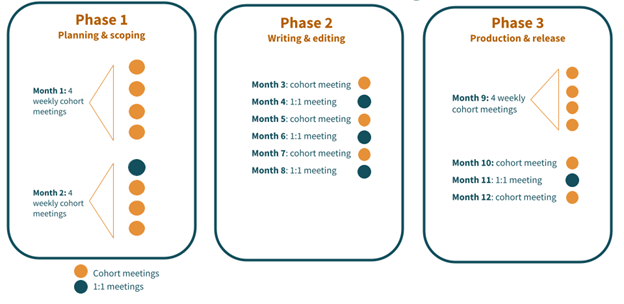
Participant learning encompasses not only authoring, but also essential project management skills for leading a diverse team with confidence. Participants foster community by connecting with fellow educators and support staff, many of whom they might have never encountered, on their campuses in the creation of their projects. Participants also expand their networks externally by connecting with OER leaders across North America as they move through the program together.
Following graduation, Open Publishing Projects Certificate alumni may elect to become facilitators of the program, cultivating a robust set of skills in mentoring, facilitating, and guiding project management. The facilitator pathway involves not only preparing for and facilitating the course material provided by Rebus but also coordinating with project teams and coaching each team through their publication timeline. Learning objectives in the facilitator pathway program include supporting participants in the creation of efficient workflows, applying best practices to ensure smooth project progression, and creating meaningful connections and relationships to assist participants in OER capacity building at their institutions, both within and beyond the cohort. Benefits for facilitators include opportunities to refine their leadership skills, encouraging sharing knowledge across institutions/states, and securing the offer of tenure and promotion letters and other letters of support to further their career advancement.
The Rebus Foundation is a registered Canadian charity, a category distinct from other non-profit organizations. While non-profits and charities are both entities working towards social welfare, civic improvement, or similar purposes without the goal of generating profit, the charity classification is assigned only to organizations that operate exclusively for charitable purposes. Based on the structure, source of funding, and mode of operation, registered charities are further designated into 3 types. Rebus’s designation is a “charitable organization,“ meaning that:
The application process is intensive, and charities must meet several requirements beyond operating on a non-profit basis, to maintain their status every year. Requirements include maintaining an active Board of Directors who maintain fiduciary oversight of the organization, completing an annual audit and an annual information return and more (Checklist for charities, Government of Canada).
One key impetus for Rebus to pursue registered charity status over the easier-to-maintain non-profit status, was the necessity to maintain eligibility for grant applications that could advance the organization’s mission. The charitable designation, which may be the equivalent of the 501(c)(3) designation in the United States, is often a make-or-break requirement for obtaining significant grants from other philanthropic organizations or donors. However, charitable status alone does not guarantee success with each application. Some organizations may decide that the obligations to maintain legal status outweigh the benefits of the status itself. Given the global communities Rebus serves, primarily with educators across the border in the United States, the organization must also stay abreast of evolving policies in all states, provinces, and territories.
As a registered Canadian charity, Rebus’s strategic priorities are set by its Board of Directors and enacted by a team led by the Executive Director. Rebus’s values determine its course as an organization:
| Reciprocity | We believe deeply in the reciprocal nature of the world. Our activities are not conducted in a vacuum, rather, everything we do is a collaborative, collective effort for community – the onus of who we are, how we show up, what we do, and the benefits we reap are all shared. |
|---|---|
| Agency | We believe that people hold possibility and use collective agency to co-design new spaces for individuals to grow and communities to thrive. |
| Authenticity | We center the human experience in our work and approach by actively creating an environment that encourages and supports people to authentically show up as themselves. |
| Curiosity | We stay curious to address key problems in education and to keep growing as individuals and as an organization. |
| Celebrating Joy | We center and celebrate joy at multiple points throughout the journey, in lieu of focusing only on the destination. |
Rebus’s Board is composed of leaders who share these values and show active engagement in work that complements the Foundation’s mission. Rebus has sought to create a diverse and representative Board that can offer counsel on organizational issues ranging from programmatic direction to legal status. Each board member brings a unique point of view informed by their lived experience, geography, and expertise in topics like publishing, pedagogy, organizational management, accounting, technology, and law. The organization is stronger for each of their contributions. Unlike other charities, Rebus’s Board members are not encouraged or required to make personal (fiscal) contributions to the organization; this can often pose a barrier to leaders who wish to offer this kind of service to a charity like Rebus. Rebus hopes to cycle Board members at regular intervals, filling in any advisory gaps and ensuring that fresh perspectives continue to support the evolving organization to meet new demands as they arise in the education sector.
In addition to the core staff who work on programs (Director of Programs and Program Operations Manager), marketing (Marketing and Communications Manager), and fundraising (Executive Director), Rebus also employs several independent contractors ranging from facilitators, accountants, tech support, and legal counsel. Open Publishing Projects Certificate facilitators earn a stipend for their time and mentorship to program participants. Additionally, consultants at Marigold Strategy and edBridge have also made indispensable contributions to improving Rebus’s programs through strategic planning and evaluation, pushing the organization forward.
Rebus’s operations are sustained by a mixed-revenue model comprising a combination of grants from philanthropic foundations and program participation fees. Rebus offers its programs, such as the Open Publishing Projects Certificate and the OER Webinar Series, for modest fees designed to recover costs related to running the programs. Clients pay for guidance, timely expertise, and care, as well as, in the case of the Open Publishing Projects Certificate, the opportunity to join a community and a framework that will hold them accountable for achieving their project goals. Rebus also extends scholarships to select participants in the OPC, enabling them to join a cohort free of charge and enjoy the many professional development opportunities the program affords. All earned revenue is poured back into the organization, and Rebus is always attentive to meeting community needs while diversifying program offerings. Despite the fact that these efforts offset a portion of the organization’s overhead, Rebus continues to rely on donations and grants. Two major donors, The William and Flora Hewlett Foundation and The Andrew W. Mellon Foundation, have previously furnished restricted grants to Rebus, to further support programmatic efforts and organizational effectiveness. As they lower the initial risk of development, these grants have encouraged more innovation and experimentation with new initiatives. But they have also introduced challenges related to sustaining activities beyond the grant term. Unrestricted grants for general operating support have been rarer, but incredibly critical to the ability to hire more staff to execute the work, cover operational expenses, and alleviate financial burdens.
While the Open Publishing Projects Certificate is a paid professional development program, Rebus stands by its principles and embodies openness and sharing with The Rebus Guide to Publishing Open Textbooks (So Far), which is licensed with a Creative Commons attribution (CC BY) license and available in multiple formats. All other Open Publishing Projects Certificate materials are also licensed CC BY and freely available in the program’s curriculum hub, which is housed in Google Drive. Open Publishing Projects Certificate participants are equally encouraged to apply Creative Commons licenses to their resources and are provided with instruction to help them choose the appropriate licenses for their projects.
The civic-service mindset that underlies Rebus’s operations as a charity means that the organization views the general public as part of the broader community it serves. The ripple effects of education are experienced across the board. However, it can be difficult to operate an organization that supports everyone. Since Rebus is part of a growing movement toward open education, the Foundation’s primary community comprises individuals and organizations working in the post-secondary education sector. Like-minded individuals in the primary and secondary education sectors, related non-profit organizations, and education advocacy spaces form Rebus’s extended demographic. The organization has cultivated relationships with both demographics by participating in conferences, events, communities of practice, and direct collaborations that have highlighted the thought leadership of Rebus staff, board members, facilitators, and program participants, such as: The Open Education Conference; Open Education Global; Open/Technology in Education, Society, and Scholarship Association (OTESSA); OpenCon Ohio; and more. Rebus’s success is built on this foundation of community outreach that sparks genuine interest in the Foundation’s programming and attracts new participants by word-of-mouth.
The Open Publishing Projects Certificate is designed to facilitate community engagement and collaboration across different roles at an institution. Participants are encouraged to use the Rebus Forum to engage with their cohorts, heralding their project milestones, sharing and seeking resources, and leaning on mutual support as they take on new challenges. Program facilitators are equally encouraged to take advantage of their peer network, coming together in monthly meetings with the Rebus programs team to exchange tools, knowledge, and achievements.
Rebus is a modest but ambitious organization consisting in its current iteration of a small team of full-time staff members guided by a Board of Directors. Despite its size, Rebus remains consistent in delivering transformative programming and modelling good organizational practices to a wide array of stakeholders. For this accomplishment, staff owe gratitude to the Board of Directors, program facilitators, and the wider open community for generously offering their time, guidance, and expertise.
Funding for higher education in Canada and the United States has been notoriously unstable in recent years. In Canada, a cap on study permits for international students has shrunk enrollments to the extent that these institutions are cutting entire academic programs, such as at Centennial College in Ontario, where 49 programs are on hold (Sarah Petz, CBC News). Institutions in the United States are suffering a similar enrollment crisis, with net tuition revenue at American public colleges and universities having declined 3.3 percent in 2023, the steepest decrease on record since 1980 (Liam Knox, Inside Higher Ed). This poses a challenge for Rebus’s revenue, given that the majority of the organization’s clients are Canadian and American institutions of higher education or higher education library consortia. Funding from donors offers some stability to Rebus to continue to offer impactful programs, but the current precarity in the education sector is nonetheless troubling, especially considering the limited resources that were originally available to institutions for open education initiatives.
Making the case for professional development can also be a challenge in this sector. Some educators do not see the value of upskilling in OER creation because they perceive OER only as a movement toward lowering textbook costs, which may not speak to their principles. Others may not believe they have any skills to learn or develop when it comes to creating resources. Then there are some educators who do see the value of upskilling in this area but cannot commit the time and effort required for professional development.
“Unlike other groups, Rebus has purity about their role… They are community-driven and that’s their silver bullet.”
— Rebus Interviewee
An interactive H5P element has been excluded from this version of the text. You can view it online here:
https://opentextbc.ca/sertcasestudies/?p=69#h5p-4
Rebus’s work in open education has been recognized on numerous occasions by OE Global. In 2020, Executive Director Apurva Ashok won the Support Specialist Award at the OE Global Awards for Excellence for her work leading the Rebus Community project. In 2024, Rebus Foundation Program Operations Manager Kaitlin Schilling was nominated for the Significant Impact OER award for authoring Making Ripples: A Guidebook to Challenge Status Quo in OER Creation. This shows the ability of a small organization to have a big impact.
Rebus’s guides to publishing distill years of experience from diverse perspectives into comprehensive primers for developing OER. The Rebus Guide to Publishing Open Textbooks (So Far) by Zoe Wake Hyde and Apurva Ashok is a living document with an accompanying video series designed to equip creators with skills essential to designing impactful OER, such as project scoping, managing teams, and storytelling. Making Ripples: A Guidebook to Challenge Status Quo in OER Creation by Kaitlin Schilling lays bare inequities in education systems, offering opportunities for reflection and strategies to address these inequities in OER creation.
The Open Publishing Projects Certificate commenced in October 2019 with a cohort of 23 participants facilitated by Rebus’s Executive Director Apurva Ashok. Since then, 25 cohorts have graduated from the program, transforming the skills, knowledge, and networks of more than 450 OER creators. However, the success of the program and Rebus’s story cannot be captured in numbers alone.
Rebus is proud to have offered guidance to the creators of OER that challenge traditional paradigms by centering equity and accessibility, including the following:
By far the greatest success Rebus celebrates as an organization is its impact on the OER community, such as with the following program participants who have generously offered testimonials about their experiences:
“The Rebus Community has allowed me to accomplish far more than I could have on my own, even with institutional support. It has built bridges between my university and others, providing me with the chance to collaborate with professors and students from all over the country. The tireless and generous project managers have made my life so much easier — it has been a true joy to work with Rebus.”
— Julie Ward
“I would encourage anyone who is considering authoring or editing an open book to take part [in] this program. The advice and strategies are incredibly practical, and the cohort of like-minded professionals lent support along the way. As the publishing process moved ahead, we were able to learn from others who had previous experience. This program served as a lifeline to someone who was a novice to publishing in the open.”
— Open Publishing Projects Certificate Graduate
As a service-oriented organization, Rebus seeks to identify and address the most essential dilemmas faced by students and educators. By being attuned to the needs of these communities, the Rebus team has tailored the organization’s programming to cater to the dual necessities of affordable learning materials and career development opportunities in OER. Rather than forcing their way into a niche, Rebus staff have gently carved one out. This success can be attributed to listening to the response to their programming in the OER community and responding with expanded offerings that represent an authentic effort to lend help wherever it is needed.
It is by the grace of the OER community that Rebus has enjoyed such success as a leader in the education sector. Cultivating a vast and diverse network has broadened the scope of Rebus’s capabilities, such as in its partnerships with OEN (on Office Hours), the Hewlett Foundation, and the Mellon Foundation. By emphasizing authentic connections, Rebus is proud to see many program participants repeatedly engaging with the organization, whether that is taking advantage of the Rebus Forum, participating in or facilitating the OPC, attending webinars, or enjoying the foundation’s openly licensed materials.
Every action of the Rebus team is tied to an intention, championing reciprocity, agency, authenticity, curiosity, and celebrating joy. Rebus is privileged to lead with these values owing to the foundation’s charitable status and the leadership modeled by the Board and team. With a mandate to maximize community impact rather than maximizing profits, Rebus is empowered to offer programs and resources at low-to-no costs. Rebus enjoys the greatest possible reach by attracting like-minded program participants and partner organizations who can engage with us regardless of their size or access to funds.
Spencer Kahler is a librarian, an educator, and a writer, but he is first and foremost an inquisitive mind. His work at The Rebus Foundation encompasses oversight of the day-to-day operations of the organization’s programs, lending a hand wherever he can to support Rebus’s diverse network of staff, program facilitators, program participants, partners, and clients. Prior to joining Rebus, Spencer had the distinct pleasure of working on eCampusOntario’s Open Library Team, providing reference services to instructors at Ontario post-secondary institutions, driving research that informed strategic planning, and delivering creative and engaging webinars. Spencer earned his Master’s of Library and Information Science from Western University.
Apurva Ashok (Ed.)
The Rebus Foundation
Amber Hoye (Ed.)
The Rebus Foundation
1
Josie is the project manager for the SERT Initiative and an advisor on the open education team at BCcampus. At BCcampus, she works to support and grow open educational practices in British Columbia, with a specific focus on critical and equitable practices
Shared Educational Resources and Technology Initiative
The Shared Educational Resources and Technology (SERT) initiative aims to support the B.C. post-secondary system identify and implement models for developing, delivering, and sustaining shared educational technologies and curriculum and course materials. The initiative is funded by the Ministry of Post-Secondary Education and Future Skills as part of the implementation of the British Columbia Post-Secondary Digital Learning Strategy. BCcampus manages the project with guidance from the SERT Advisory Committee.
BC Electronic Library Network (BC ELN)
BC ELN is an award-winning consortium of 34 public and private post-secondary libraries in B.C. and the Yukon. BC ELN’s purpose is to develop and support system-wide mechanisms that allow post-secondary libraries to meet the expanding information needs of learners, educators, and researchers at the lowest possible cost.
Michelle is the Open Publishing and Open Education Librarian at the University of Alberta. Her role supports OER publishing, institution-wide program development, awareness, and sustainability for open education. As an open education advocate, Michelle is active with local open education committees, advocating for OER alongside her students union. She has been active in the development of the Open Education Alberta community since its inception in 2018.
Josie is the project manager for the SERT Initiative and an advisor on the open education team at BCcampus. At BCcampus, she works to support and grow open educational practices in British Columbia, with a specific focus on critical and equitable practices
Spencer Kahler is a librarian, an educator, and a writer, but he is first and foremost an inquisitive mind. His work at The Rebus Foundation encompasses oversight of the day-to-day operations of the organization’s programs, lending a hand wherever he can to support Rebus’s diverse network of staff, program facilitators, program participants, partners, and clients. Prior to joining Rebus, Spencer had the distinct pleasure of working on eCampusOntario’s Open Library Team, providing reference services to instructors at Ontario post-secondary institutions, driving research that informed strategic planning, and delivering creative and engaging webinars. Spencer earned his Master’s of Library and Information Science from Western University.
Scott Leslie is a technologist and passionate advocate for openness on the Internet. Prior to joining the BC Libraries Cooperative in 2013, Scott worked in educational technology, first in the 90s at the Banff Centre and Mount Royal University in Alberta, then later in BC at the Center for Curriculum, Transfer, and Technology and its successor, BCcampus, where he was instrumental in helping to launch the BC Open Textbook Project as well as early iterations of the Educational Technology Sandbox project. Scott lives in Victoria, BC.
Hugh McGuire has been innovating around open content, communities, and open source software for two decades. He is the founder of Pressbooks, an open source platform for creating interactive digital books, widely used in higher education to create open educational resources. He is the co-founder of the Rebus Foundation, a non-profit organization that delivers professional development and coaching for open education projects; and the founder of LibriVox, a global community of makers of free public domain audiobooks. He lives in Montreal.
Matt Simpson
Matt Simpson is a passionate technology leader with over 21 years of experience shaping the digital landscape of Canadian higher education. Passionate about leveraging technology to enhance teaching and support administration, he is dedicated to building engaged, high-performing teams that develop innovative solutions to empower and inspire the communities he serves. His leadership philosophy is grounded in collaboration, creativity, and a deep understanding of both the technical and human aspects of technology.
As a Certified Information Systems Security Professional (CISSP), Zend Certified PHP Engineer, and professionally trained graphic designer, Matt blends technical expertise with creative problem-solving to drive meaningful digital transformation. Throughout his career, he has been a champion of community-driven innovation, fostering collaboration and developing software that advances medical education at universities around the world. Balancing hands-on development with strategic leadership, he remains deeply connected to his technical roots, ensuring that every decision aligns with real-world needs and industry best practices.
James is a Service Manager at EDINA, the University of Edinburgh, where he leads on the development of Noteable, an innovative educational platform. With a background in academia and technology services, James focuses on delivering impactful solutions that enhance data literacy and promote collaborative learning. His leadership in service management emphasises strategic project sustainability and user-centered innovation
2
This case study collection is the work of many.
First of all, thank you to all of the case study authors. This collection would not exist without you, and we appreciate your willingness to share so openly the experiences and learnings of your organizations and initiatives.
Thank you to the members of the SERT Advisory Committee for their advice and guidance in scoping the call for case studies and their support in identifying case study contributors. Thank you especially to members of the Case Study Evaluation Subcommittee: Arielle Andrews, Emily Hannah, Clint Lalonde, Suzanne Rackover, and Emily Schudel, for reviewing proposals and providing insightful feedback.
Thank you to everyone involved in the production and design of the collection: Kaitlyn Zheng for Pressbooks support, Karen Kelm for copyediting, and Jeseye Tanner for designing such a wonderful cover.
And finally, thank you to the Ministry of Post-Secondary Education and Future Skills for funding this work as part of the B.C. Digital Learning Strategy, and Keleigh Annau, Benjamin Ferrel, Emily Hannah, and Arielle Andrews at the Digital Policy and Business Transformation Branch for their support and insights.
3
BCcampus believes that education must be available to everyone. This means supporting the creation of free, open, and accessible educational resources. We are actively committed to increasing the accessibility and usability of the resources we produce.
The web version of Pooling Resources, Building Value has been designed to meet Web Content Accessibility Guidelines 2.0, level AA. In addition, it follows all guidelines in Appendix A: Checklist for Accessibility of the Accessibility Toolkit – 2nd Edition. It includes:
We are always looking for ways to make our resources more accessible. If you have problems accessing this resource, please contact us to let us know so we can fix the issue.
Please include the following information:
You can contact us one of the following ways:
This statement was last updated on July 16, 2025.