<?xml version="1.0" encoding="UTF-8"?>
<!DOCTYPE html PUBLIC "-//W3C//DTD XHTML 1.1//EN" "http://www.w3.org/TR/xhtml11/DTD/xhtml11.dtd">
<html xmlns="http://www.w3.org/1999/xhtml" xml:lang="en">
<head>
<meta content="text/html; charset=UTF-8" http-equiv="content-type" />
<meta http-equiv="Content-Language" content="en" />
<meta name="generator" content="Pressbooks 6.27.1" />
<meta name="pb-authors" content="Industry Training Authority BC" />
<meta name="pb-title" content="Block E: Fuel Gas Systems" />
<meta name="pb-language" content="en-ca" />
<meta name="pb-cover-image" content="https://opentextbc.ca/plumbing3e/wp-content/uploads/sites/406/2022/09/OTB-BOOK-COVERS-PLUMBING-E_FUEL-GAS.jpg" />
<meta name="pb-subtitle" content="Plumbing Apprenticeship Program Level 3" />
<meta name="pb-copyright-year" content="2023" />
<meta name="pb-publisher" content="BCcampus" />
<meta name="pb-publisher-city" content="Victoria, B.C." />
<meta name="pb-book-license" content="cc-by-nc-sa" />
<meta name="pb-is-based-on" content="https://pressbooks.bccampus.ca/plumbing3e" />
<meta name="pb-custom-copyright" content="© 2023 Industry Training Authority BCThe CC licence permits you to retain, reuse, copy, redistribute, and revise this book—in whole or in part—for free providing it is for non-commercial purposes, and adapted and reshared content retains the same licence, and the author is attributed as follows:Block E: Fuel Gas Systems by Industry Training Authority BC is used under a CC BY-NC-SA 4.0 licence.If you redistribute all or part of this book, it is recommended the following statement be added to the copyright page so readers can access the original book at no cost:Download for free from https://opentextbc.ca/plumbing3e/Sample APA-style citation (7th Edition):Industry Training Authority BC. (2023). Block e: Fuel gas systems. BCcampus. https://opentextbc.ca/plumbing3e/Cover image attribution:Gas burners by Anomynous is licensed under a CC0 licence.Ebook ISBN: 978-1-77420-183-1Print ISBN: 978-1-77420-182-4Visit BCcampus Open Education to learn about open education in British Columbia." />
<meta name="pb-ebook-isbn" content="978-1-77420-183-1" />
<meta name="pb-print-isbn" content="978-1-77420-182-4" />
<meta name="pb-primary-subject" content="TTV" />
<meta name="pb-about-50" content="The content of this block is organized to introduce the plumber apprentice to the theory and installation of natural gas systems. This block will cover topics from design and installation code requirements to air supply and venting requirements and applications. Flame safeguards will also be addressed with special attention being given to the B149.1 Natural Gas and Propane Installation Code." />
<meta name="pb-additional-subjects" content="TNTP" />
<meta name="pb-publication-date" content="1673395200" />
<title>Block E: Fuel Gas Systems</title>
</head>
<body lang='en' >
<div id="half-title-page"><h1 class="title">Block E: Fuel Gas Systems</h1></div>
<div id="title-page">
			<h1 class="title">Block E: Fuel Gas Systems</h1>
		<h2 class="subtitle">Plumbing Apprenticeship Program Level 3</h2>
					<p class="author">Industry Training Authority BC</p>
														<p class="publisher">BCcampus</p>
		<p class="publisher-city">Victoria, B.C.</p>
	</div>
<div id="copyright-page">
	<div class="ugc">
					
<div class="license-attribution"><p><img src="https://opentextbc.ca/plumbing3e/wp-content/themes/pressbooks-book/packages/buckram/assets/images/cc-by-nc-sa.svg" alt="Icon for the Creative Commons Attribution-NonCommercial-ShareAlike 4.0 International License" role="presentation" /></p><p>Block E: Fuel Gas Systems Copyright © 2023 by <span>Industry Training Authority BC</span> is licensed under a <a rel="license" href="https://creativecommons.org/licenses/by-nc-sa/4.0/">Creative Commons Attribution-NonCommercial-ShareAlike 4.0 International License</a>, except where otherwise noted.</p></div>

							<p>© 2023 Industry Training Authority BC</p><p>The CC licence permits you to retain, reuse, copy, redistribute, and revise this book—in whole or in part—for free providing it is for non-commercial purposes, and adapted and reshared content retains the same licence, and the author is attributed as follows:</p><div class="textbox"><em>Block E: Fuel Gas Systems</em> by Industry Training Authority BC is used under a <a href="http://creativecommons.org/licenses/by-nc-sa/4.0/">CC BY-NC-SA 4.0 licence</a>.</div><p>If you redistribute all or part of this book, it is recommended the following statement be added to the copyright page so readers can access the original book at no cost:</p><div class="textbox">Download for free from https://opentextbc.ca/plumbing3e/</div><p><strong>Sample APA-style citation (7th Edition):</strong></p><div class="textbox">Industry Training Authority BC. (2023). <i>Block e: Fuel gas systems</i>. BCcampus. https://opentextbc.ca/plumbing3e/</div><p><strong>Cover image attribution:</strong></p><div class="textbox"><a href="https://pxhere.com/en/photo/1031382">Gas burners</a> by Anomynous is licensed under a <a href="https://creativecommons.org/publicdomain/zero/1.0/">CC0</a> licence.</div><p><strong>Ebook ISBN:</strong> 978-1-77420-183-1</p><p><strong>Print ISBN:</strong> 978-1-77420-182-4</p><p>Visit <a href="http://open.bccampus.ca/">BCcampus Open Education</a> to learn about open education in British Columbia.</p>
							</div>
</div>
<div id="toc">
	<h1>Contents</h1>
	<ul>
					<li class="front-matter miscellaneous">
	<a href="#front-matter-accessibility-statement">
		<span class="toc-chapter-title">Accessibility Statement</span>
							</a>
			<ul class="sections">
							<li class="section">
	<a href="#front-matter-16-section-1">
		<span class="toc-subsection-title">Accessibility of This Resource</span>
	</a>
</li>
							<li class="section">
	<a href="#front-matter-16-section-2">
		<span class="toc-subsection-title">Known Accessibility Issues and Areas for Improvement</span>
	</a>
</li>
							<li class="section">
	<a href="#front-matter-16-section-3">
		<span class="toc-subsection-title">Let Us Know if You are Having Problems Accessing This Book</span>
	</a>
</li>
					</ul>
	</li>

					<li class="front-matter miscellaneous">
	<a href="#front-matter-for-students-how-to-access-and-use-this-textbook">
		<span class="toc-chapter-title">For Students: How to Access and Use this Textbook</span>
							</a>
			<ul class="sections">
							<li class="section">
	<a href="#front-matter-17-section-1">
		<span class="toc-subsection-title">Tips for Using This Textbook</span>
	</a>
</li>
					</ul>
	</li>

					<li class="front-matter miscellaneous">
	<a href="#front-matter-about-bccampus-open-education">
		<span class="toc-chapter-title">About BCcampus Open Education</span>
							</a>
	</li>

					<li class="front-matter introduction">
	<a href="#front-matter-introduction">
		<span class="toc-chapter-title">Introduction</span>
							</a>
	</li>

					<li class="part">
	<a href="#part-gas-piping-and-tubing-systems">
					Competency E1: Describe Gas Piping and Tubing Systems
			</a>
</li>

					<li class="chapter standard">
	<a href="#chapter-natural-gas-supply-and-distribution-system">
		<span class="toc-chapter-title">Learning Task 1</span>
					<span class="chapter-subtitle">Describe the Natural Gas Supply and Distribution System</span>
							</a>
			<ul class="sections">
							<li class="section">
	<a href="#chapter-29-section-1">
		<span class="toc-subsection-title">Bringing Fuel Gas to the Consumer</span>
	</a>
</li>
							<li class="section">
	<a href="#chapter-29-section-2">
		<span class="toc-subsection-title">Consumer Gas Piping System</span>
	</a>
</li>
							<li class="section">
	<a href="#chapter-29-section-3">
		<span class="toc-subsection-title">Self-Test 1</span>
	</a>
</li>
					</ul>
	</li>

					<li class="chapter standard">
	<a href="#chapter-fluid-flow-in-a-piping-system">
		<span class="toc-chapter-title">Learning Task 2</span>
					<span class="chapter-subtitle">Describe Factors that Affect Fluid Flow in a Piping System</span>
							</a>
			<ul class="sections">
							<li class="section">
	<a href="#chapter-33-section-1">
		<span class="toc-subsection-title">Friction Loss</span>
	</a>
</li>
							<li class="section">
	<a href="#chapter-33-section-2">
		<span class="toc-subsection-title">Friction Loss Factors</span>
	</a>
</li>
							<li class="section">
	<a href="#chapter-33-section-3">
		<span class="toc-subsection-title">Self-Test 2</span>
	</a>
</li>
					</ul>
	</li>

					<li class="chapter standard">
	<a href="#chapter-gas-piping-tubing-and-hoses">
		<span class="toc-chapter-title">Learning Task 3</span>
					<span class="chapter-subtitle">Describe Gas Piping, Tubing and Hoses</span>
							</a>
			<ul class="sections">
							<li class="section">
	<a href="#chapter-38-section-1">
		<span class="toc-subsection-title">Types of Piping Systems</span>
	</a>
</li>
							<li class="section">
	<a href="#chapter-38-section-2">
		<span class="toc-subsection-title">Gas Connectors</span>
	</a>
</li>
							<li class="section">
	<a href="#chapter-38-section-3">
		<span class="toc-subsection-title">Self-Test 3</span>
	</a>
</li>
					</ul>
	</li>

					<li class="part">
	<a href="#part-install-gas-piping-tubing-systems">
					Competency E2: Install Gas Piping and Tubing Systems
			</a>
</li>

					<li class="chapter standard">
	<a href="#chapter-nstallation-of-gas-piping-tubing-and-hoses">
		<span class="toc-chapter-title">Learning Task 1</span>
					<span class="chapter-subtitle">Describe the installation of gas piping, tubing and hoses</span>
							</a>
			<ul class="sections">
							<li class="section">
	<a href="#chapter-66-section-1">
		<span class="toc-subsection-title">Code Requirements</span>
	</a>
</li>
							<li class="section">
	<a href="#chapter-66-section-2">
		<span class="toc-subsection-title">Fittings</span>
	</a>
</li>
							<li class="section">
	<a href="#chapter-66-section-3">
		<span class="toc-subsection-title">Manual Shut-Off Valves</span>
	</a>
</li>
							<li class="section">
	<a href="#chapter-66-section-4">
		<span class="toc-subsection-title">Gas Quick Disconnects</span>
	</a>
</li>
							<li class="section">
	<a href="#chapter-66-section-5">
		<span class="toc-subsection-title">Drip and Dirt Pockets</span>
	</a>
</li>
							<li class="section">
	<a href="#chapter-66-section-6">
		<span class="toc-subsection-title">Anchors and supports</span>
	</a>
</li>
							<li class="section">
	<a href="#chapter-66-section-7">
		<span class="toc-subsection-title">Structural Penetrations</span>
	</a>
</li>
							<li class="section">
	<a href="#chapter-66-section-8">
		<span class="toc-subsection-title">Location Limitations</span>
	</a>
</li>
							<li class="section">
	<a href="#chapter-66-section-9">
		<span class="toc-subsection-title">Protecting Piping</span>
	</a>
</li>
							<li class="section">
	<a href="#chapter-66-section-10">
		<span class="toc-subsection-title">Physical and mechanical damage protection</span>
	</a>
</li>
							<li class="section">
	<a href="#chapter-66-section-11">
		<span class="toc-subsection-title">Identification of Gas Piping</span>
	</a>
</li>
							<li class="section">
	<a href="#chapter-66-section-12">
		<span class="toc-subsection-title">Self-Test 1</span>
	</a>
</li>
					</ul>
	</li>

					<li class="part">
	<a href="#part-size-gas-piping-systems">
					Competency E3: Use Codes, Regulations and Standards to Size Gas Piping Systems
			</a>
</li>

					<li class="chapter standard">
	<a href="#chapter-understanding-gas-sizing-tables">
		<span class="toc-chapter-title">Learning Task 1</span>
					<span class="chapter-subtitle">Understanding Gas Sizing Tables</span>
							</a>
			<ul class="sections">
							<li class="section">
	<a href="#chapter-70-section-1">
		<span class="toc-subsection-title">Flow Factors</span>
	</a>
</li>
							<li class="section">
	<a href="#chapter-70-section-2">
		<span class="toc-subsection-title">Selecting the Correct Capacity Table</span>
	</a>
</li>
							<li class="section">
	<a href="#chapter-70-section-3">
		<span class="toc-subsection-title">Using the Capacity Tables</span>
	</a>
</li>
							<li class="section">
	<a href="#chapter-70-section-4">
		<span class="toc-subsection-title">Self-Test 1</span>
	</a>
</li>
					</ul>
	</li>

					<li class="chapter standard">
	<a href="#chapter-sizing-gas-low-pressure-and-2-psi-piping-systems">
		<span class="toc-chapter-title">Learning Task 2</span>
					<span class="chapter-subtitle">Sizing Gas Low Pressure and 2 psi Piping Systems</span>
							</a>
			<ul class="sections">
							<li class="section">
	<a href="#chapter-78-section-1">
		<span class="toc-subsection-title">Sizing Low Pressure Systems</span>
	</a>
</li>
							<li class="section">
	<a href="#chapter-78-section-2">
		<span class="toc-subsection-title">Sizing 2 psig (14 kPa) Piping Systems</span>
	</a>
</li>
							<li class="section">
	<a href="#chapter-78-section-3">
		<span class="toc-subsection-title">Self-Test 2</span>
	</a>
</li>
					</ul>
	</li>

					<li class="chapter standard">
	<a href="#chapter-sizing-gas-piping-systems-over-2-psig">
		<span class="toc-chapter-title">Learning Task 3</span>
					<span class="chapter-subtitle">Sizing Gas Piping Systems Over 2 psig</span>
							</a>
			<ul class="sections">
							<li class="section">
	<a href="#chapter-84-section-1">
		<span class="toc-subsection-title">Calculating Fitting Allowances</span>
	</a>
</li>
							<li class="section">
	<a href="#chapter-84-section-2">
		<span class="toc-subsection-title">Sizing Procedure</span>
	</a>
</li>
							<li class="section">
	<a href="#chapter-84-section-3">
		<span class="toc-subsection-title">Self-Test 3</span>
	</a>
</li>
					</ul>
	</li>

					<li class="part">
	<a href="#part-design-a-fuel-gas-distribution-system">
					Competency E4: Design a Fuel Gas Distribution System
			</a>
</li>

					<li class="chapter standard">
	<a href="#chapter-creating-gas-piping-design-documents">
		<span class="toc-chapter-title">Learning Task 1</span>
					<span class="chapter-subtitle">Creating Gas Piping Design Documents</span>
							</a>
			<ul class="sections">
							<li class="section">
	<a href="#chapter-93-section-1">
		<span class="toc-subsection-title">Create Plans and Isometric Drawings of Gas Piping Systems</span>
	</a>
</li>
							<li class="section">
	<a href="#chapter-93-section-2">
		<span class="toc-subsection-title">Material Take-Off</span>
	</a>
</li>
							<li class="section">
	<a href="#chapter-93-section-3">
		<span class="toc-subsection-title">Practical Competency Design a Residential Gas Piping System</span>
	</a>
</li>
							<li class="section">
	<a href="#chapter-93-section-4">
		<span class="toc-subsection-title">Appendix 1 Project Floor Plans</span>
	</a>
</li>
							<li class="section">
	<a href="#chapter-93-section-5">
		<span class="toc-subsection-title">Appendix 1 Project Equipment Specifications</span>
	</a>
</li>
					</ul>
	</li>

					<li class="part">
	<a href="#part-select-gas-burners">
					Competency E5: Select Gas Burners
			</a>
</li>

					<li class="chapter standard">
	<a href="#chapter-describe-gas-burners">
		<span class="toc-chapter-title">Learning Task 1</span>
					<span class="chapter-subtitle">Describe Gas Burners</span>
							</a>
			<ul class="sections">
							<li class="section">
	<a href="#chapter-106-section-1">
		<span class="toc-subsection-title">Burner Terminology</span>
	</a>
</li>
							<li class="section">
	<a href="#chapter-106-section-2">
		<span class="toc-subsection-title">Burner Types</span>
	</a>
</li>
							<li class="section">
	<a href="#chapter-106-section-3">
		<span class="toc-subsection-title">Flame Stability</span>
	</a>
</li>
							<li class="section">
	<a href="#chapter-106-section-4">
		<span class="toc-subsection-title">Self-Test 1</span>
	</a>
</li>
					</ul>
	</li>

					<li class="chapter standard">
	<a href="#chapter-describe-atmospheric-burners">
		<span class="toc-chapter-title">Learning Task 2</span>
					<span class="chapter-subtitle">Describe Atmospheric Burners</span>
							</a>
			<ul class="sections">
							<li class="section">
	<a href="#chapter-124-section-1">
		<span class="toc-subsection-title">Flame Characteristics</span>
	</a>
</li>
							<li class="section">
	<a href="#chapter-124-section-2">
		<span class="toc-subsection-title">Burner Operation</span>
	</a>
</li>
							<li class="section">
	<a href="#chapter-124-section-3">
		<span class="toc-subsection-title">Types of Burners</span>
	</a>
</li>
							<li class="section">
	<a href="#chapter-124-section-4">
		<span class="toc-subsection-title">Troubleshooting Atmospheric Burners</span>
	</a>
</li>
							<li class="section">
	<a href="#chapter-124-section-5">
		<span class="toc-subsection-title">Self-Test 2</span>
	</a>
</li>
					</ul>
	</li>

					<li class="chapter standard">
	<a href="#chapter-describe-burner-orifices">
		<span class="toc-chapter-title">Learning Task 3</span>
					<span class="chapter-subtitle">Describe Burner Orifices</span>
							</a>
			<ul class="sections">
							<li class="section">
	<a href="#chapter-150-section-1">
		<span class="toc-subsection-title">Types of Gas Orifices</span>
	</a>
</li>
							<li class="section">
	<a href="#chapter-150-section-2">
		<span class="toc-subsection-title">Sizing Orifices</span>
	</a>
</li>
							<li class="section">
	<a href="#chapter-150-section-3">
		<span class="toc-subsection-title">Cross Index Chart</span>
	</a>
</li>
							<li class="section">
	<a href="#chapter-150-section-4">
		<span class="toc-subsection-title">High Altitude Installations</span>
	</a>
</li>
							<li class="section">
	<a href="#chapter-150-section-5">
		<span class="toc-subsection-title">Verifying Input</span>
	</a>
</li>
							<li class="section">
	<a href="#chapter-150-section-6">
		<span class="toc-subsection-title">Self-Test 3</span>
	</a>
</li>
					</ul>
	</li>

					<li class="part">
	<a href="#part-select-flame-safeguards">
					Competency E6: Select Flame Safeguards
			</a>
</li>

					<li class="chapter standard">
	<a href="#chapter-describe-pilot-ignition-systems">
		<span class="toc-chapter-title">Learning Task 1</span>
					<span class="chapter-subtitle">Describe Pilot Ignition Systems</span>
							</a>
			<ul class="sections">
							<li class="section">
	<a href="#chapter-154-section-1">
		<span class="toc-subsection-title">Pilot Type (Ignition Sequence)</span>
	</a>
</li>
							<li class="section">
	<a href="#chapter-154-section-2">
		<span class="toc-subsection-title">Self-Test 1</span>
	</a>
</li>
					</ul>
	</li>

					<li class="chapter standard">
	<a href="#chapter-describe-flame-detectors">
		<span class="toc-chapter-title">Learning Task 2</span>
					<span class="chapter-subtitle">Describe Flame Detectors</span>
							</a>
			<ul class="sections">
							<li class="section">
	<a href="#chapter-165-section-1">
		<span class="toc-subsection-title">Thermocouple</span>
	</a>
</li>
							<li class="section">
	<a href="#chapter-165-section-2">
		<span class="toc-subsection-title">Thermopile</span>
	</a>
</li>
							<li class="section">
	<a href="#chapter-165-section-3">
		<span class="toc-subsection-title">Flame Rod</span>
	</a>
</li>
							<li class="section">
	<a href="#chapter-165-section-4">
		<span class="toc-subsection-title">Flame Rectification System</span>
	</a>
</li>
							<li class="section">
	<a href="#chapter-165-section-5">
		<span class="toc-subsection-title">Self-Test 2</span>
	</a>
</li>
					</ul>
	</li>

					<li class="chapter standard">
	<a href="#chapter-describe-pilot-thermocouple-systems">
		<span class="toc-chapter-title">Learning Task 3</span>
					<span class="chapter-subtitle">Describe Pilot Thermocouple Systems</span>
							</a>
			<ul class="sections">
							<li class="section">
	<a href="#chapter-173-section-1">
		<span class="toc-subsection-title">Standing Pilot Combustion Safety Circuits</span>
	</a>
</li>
							<li class="section">
	<a href="#chapter-173-section-2">
		<span class="toc-subsection-title">Self-Test 3</span>
	</a>
</li>
					</ul>
	</li>

					<li class="back-matter appendix">
	<a href="#back-matter-self-test-answer-keys">
		<span class="toc-chapter-title">Appendix 1: Self-Test Answer Keys</span>
							</a>
			<ul class="sections">
							<li class="section">
	<a href="#back-matter-175-section-1">
		<span class="toc-subsection-title">Competency E1</span>
	</a>
</li>
							<li class="section">
	<a href="#back-matter-175-section-2">
		<span class="toc-subsection-title">Competency E2</span>
	</a>
</li>
							<li class="section">
	<a href="#back-matter-175-section-3">
		<span class="toc-subsection-title">Competency E3</span>
	</a>
</li>
							<li class="section">
	<a href="#back-matter-175-section-4">
		<span class="toc-subsection-title">Competency E5</span>
	</a>
</li>
							<li class="section">
	<a href="#back-matter-175-section-5">
		<span class="toc-subsection-title">Competency E6</span>
	</a>
</li>
					</ul>
	</li>

					<li class="back-matter miscellaneous">
	<a href="#back-matter-imperial-orifice-capacity-table-flow-values-in-cfh">
		<span class="toc-chapter-title">Appendix 2: Imperial Orifice Capacity Table (flow values in CFH)</span>
							</a>
	</li>

					<li class="back-matter miscellaneous">
	<a href="#back-matter-versioning-history">
		<span class="toc-chapter-title">Versioning History</span>
							</a>
	</li>

			</ul>
</div>
<div class="front-matter miscellaneous with-subsections" id="front-matter-accessibility-statement" title="Accessibility Statement">
	<div class="front-matter-title-wrap">
		<p class="front-matter-number">1</p>
		<h1 class="front-matter-title">Accessibility Statement</h1>
								</div>
	<div class="ugc front-matter-ugc">
				
 <p>BCcampus Open Education believes that education must be available to everyone. This means supporting the creation of free, open, and accessible educational resources. We are actively committed to increasing the accessibility and usability of the resources we produce.</p> <h1 id="front-matter-16-section-1" class="section-header">Accessibility of This Resource</h1> <p>The web version of <em>Block E: Fuel Gas Systems</em>&nbsp;has been designed to meet <a href="https://www.w3.org/TR/WCAG20/" data-url="https://www.w3.org/TR/WCAG20/">Web Content Accessibility Guidelines 2.0</a>, level AA. In addition, it follows all guidelines in <a href="https://opentextbc.ca/accessibilitytoolkit/back-matter/appendix-checklist-for-accessibility-toolkit/" data-url="https://opentextbc.ca/accessibilitytoolkit/back-matter/appendix-checklist-for-accessibility-toolkit/">Appendix A: Checklist for Accessibility</a> of the <a href="https://opentextbc.ca/accessibilitytoolkit/" data-url="https://opentextbc.ca/accessibilitytoolkit/"><em>Accessibility Toolkit – 2nd Edition</em></a>. It includes:</p> <ul><li><strong>Easy navigation</strong>. This resource has a linked table of contents and uses headings in each chapter to make navigation easy.</li> <li><strong>Accessible math equations</strong>. Many of the equations in this resource have been written in LaTeX and rendered with MathJax, which makes them accessible to people using screen readers that are set up to read MathML. The rest of the equations are rendered as images with appropriate alternative text.</li> <li><strong>Accessible videos</strong>. All videos in this resource have captions.</li> <li><strong>Accessible images</strong>. All images in this resource that convey information have alternative text. Images that are decorative have empty alternative text.</li> <li><strong>Accessible links</strong>. All links use descriptive link text.</li> </ul> <table class="grid" style="width: 100%;"><caption>Accessibility Checklist</caption> <tbody><tr><th scope="col">Element</th> <th scope="col">Requirements</th> <th scope="col">Pass?</th> </tr> <tr><th scope="row">Headings</th> <td>Content is organized under headings and subheadings that are used sequentially.</td> <td>Yes</td> </tr> <tr><th scope="row">Images</th> <td>Images that convey information include alternative text descriptions. These descriptions are provided in the alt text field, in the surrounding text, or linked to as a long description.</td> <td>Yes</td> </tr> <tr><th scope="row">Images</th> <td>Images and text do not rely on colour to convey information.</td> <td>Yes</td> </tr> <tr><th scope="row">Images</th> <td>Images that are purely decorative or are already described in the surrounding text contain empty alternative text descriptions. (Descriptive text is unnecessary if the image doesn’t convey contextual content information.)</td> <td>Yes</td> </tr> <tr><th scope="row">Tables</th> <td>Tables include row and/or column headers that have the correct scope assigned.</td> <td>Yes</td> </tr> <tr><th scope="row">Tables</th> <td>Tables include a title or caption.</td> <td>Yes</td> </tr> <tr><th scope="row">Tables</th> <td>Tables do not have merged or split cells.</td> <td>No</td> </tr> <tr><th scope="row">Tables</th> <td>Tables have adequate cell padding.</td> <td>Yes</td> </tr> <tr><th scope="row">Links</th> <td>The link text describes the destination of the link.</td> <td>Yes</td> </tr> <tr><th scope="row">Links</th> <td>Links do not open new windows or tabs. If they do, a textual reference is included in the link text.</td> <td>Yes</td> </tr> <tr><th><strong>Links</strong></th> <td>Links to files include the file type in the link text.</td> <td>Yes</td> </tr> <tr><th scope="row">Formulas</th> <td>Formulas have been created using LaTeX and are rendered with MathJax.</td> <td>Yes</td> </tr> <tr><th scope="row">Formulas</th> <td>If LaTeX is not an option, formulas are images with alternative text descriptions.</td> <td>Yes</td> </tr> <tr><th scope="row">Font</th> <td>Font size is 12 point or higher for body text.</td> <td>Yes</td> </tr> <tr><th scope="row">Font</th> <td>Font size is 9 point for footnotes or endnotes.</td> <td>Yes</td> </tr> <tr><th scope="row">Font</th> <td>Font size can be zoomed to 200% in the webbook or eBook formats.</td> <td>Yes</td> </tr> </tbody> </table> <h1 id="front-matter-16-section-2" class="section-header">Known Accessibility Issues and Areas for Improvement</h1> <ul><li>Tables use merged cells but they have been structured to work properly with screen readers.</li> </ul> <h1 id="front-matter-16-section-3" class="section-header">Let Us Know if You are Having Problems Accessing This Book</h1> <p>We are always looking for ways to make our resources more accessible. If you have problems accessing this resource, please contact us to let us know so we can fix the issue.</p> <p>Please include the following information:</p> <ul><li>The name of the resource</li> <li>The location of the problem by providing a web address or page description.</li> <li>A description of the problem</li> <li>The computer, software, browser, and any assistive technology you are using that can help us diagnose and solve your issue (e.g., Windows 10, Google Chrome (Version 65.0.3325.181), NVDA screen reader)</li> </ul> <p>You can contact us one of the following ways:</p> <ul><li>Web form: <a href="https://collection.bccampus.ca/contact/" data-url="https://collection.bccampus.ca/contact/">BCcampus Open Ed Help</a></li> <li>Web form: <a href="https://open.bccampus.ca/browse-our-collection/reporting-an-error/" data-url="https://open.bccampus.ca/browse-our-collection/reporting-an-error/">Report an Error</a></li> </ul> <p>This statement was last updated on August 3, 2022.</p> <p>The Accessibility Checklist table was adapted from one originally created by the <a href="https://press.rebus.community/the-rebus-guide-to-publishing-open-textbooks/back-matter/accessibility-assessment/" data-url="https://press.rebus.community/the-rebus-guide-to-publishing-open-textbooks/back-matter/accessibility-assessment/">Rebus Community</a> and shared under a <a href="https://creativecommons.org/licenses/by/4.0/" data-url="https://creativecommons.org/licenses/by/4.0/">CC BY 4.0 License</a>.</p> 

	</div>


	</div>
<div class="front-matter miscellaneous with-subsections" id="front-matter-for-students-how-to-access-and-use-this-textbook" title="For Students: How to Access and Use this Textbook">
	<div class="front-matter-title-wrap">
		<p class="front-matter-number">2</p>
		<h1 class="front-matter-title">For Students: How to Access and Use this Textbook</h1>
								</div>
	<div class="ugc front-matter-ugc">
				
 <p>This textbook is available in the following formats:</p> <ul><li><strong>Online webbook</strong>. You can read this textbook online on a computer or mobile device in one of the following browsers: Chrome, Firefox, Edge, and Safari.</li> <li><strong>PDF</strong>. You can download this book as a PDF to read on a computer (Digital PDF) or print it out (Print PDF).</li> <li><strong>Mobile</strong>. If you want to read this textbook on your phone or tablet, you can use the EPUB (eReader) file.</li> <li><strong>HTML</strong>. An HTML file can be opened in a browser. It has very little style so it doesn’t look very nice, but some people might find it useful.</li> </ul> <p>For more information about the accessibility of this textbook, see the Accessibility Statement.</p> <p>You can access the online webbook and download any of the formats for free here: <em>Block E: Fuel Gas Systems</em>. To download the book in a different format, look for the “Download this book” drop-down menu and select the file type you want.</p> <table><caption>How can I use the different formats?</caption> <tbody><tr><th scope="col">Format</th> <th scope="col">Internet required?</th> <th scope="col">Device</th> <th scope="col">Required apps</th> <th scope="col">Accessibility Features</th> <th scope="col">Screen reader compatible</th> </tr> <tr><td>Online webbook</td> <td>Yes</td> <td>Computer, tablet, phone</td> <td>An Internet browser (Chrome, Firefox, Edge, or Safari)</td> <td>WCAG 2.0 AA compliant, option to enlarge text, and compatible with browser text-to-speech tools</td> <td>Yes</td> </tr> <tr><td>PDF</td> <td>No</td> <td>Computer, print copy</td> <td>Adobe Reader (for reading on a computer) or a printer</td> <td>Ability to highlight and annotate the text. If reading on the computer, you can zoom in.</td> <td>Unsure</td> </tr> <tr><td>EPUB</td> <td>No</td> <td>Computer, tablet, phone</td> <td>An eReader app</td> <td>Option to enlarge text, change font style, size, and colour.</td> <td>Unsure</td> </tr> <tr><td>HTML</td> <td>No</td> <td>Computer, tablet, phone</td> <td>An Internet browser (Chrome, Firefox, Edge, or Safari)</td> <td>WCAG 2.0 AA compliant and compatible with browser text-to-speech tools.</td> <td>Yes</td> </tr> </tbody> </table> <h1 id="front-matter-17-section-1" class="section-header">Tips for Using This Textbook</h1> <ul><li><strong>Search the textbook</strong>. <ul><li>If using the online webbook, you can use the search bar in the top right corner to search the entire book for a key word or phrase. To search a specific chapter, open that chapter and use your browser’s search feature by hitting <strong>[Cntr] + [f]</strong> on your keyboard if using a Windows computer or <strong>[Command] + [f] </strong>if using a Mac computer.</li> <li>The <strong>[Cntr] + [f]</strong> and <strong>[Command] + [f]</strong> keys will also allow you to search a PDF, HTML, and EPUB files if you are reading them on a computer.</li> <li>If using an eBook app to read this textbook, the app should have a built-in search tool.</li> </ul> </li> <li><strong>Navigate the textbook</strong>. <ul><li>This textbook has a table of contents to help you navigate through the book easier. If using the online webbook, you can find the full table of contents on the book’s homepage or by selecting “Contents” from the top menu when you are in a chapter.</li> </ul> </li> <li><strong>Annotate the textbook</strong>. <ul><li>If you like to highlight or write on your textbooks, you can do that by getting a print copy, using the Digital PDF in Adobe Reader, or using the highlighting tools in eReader apps.</li> </ul> </li> </ul> 

	</div>


	</div>
<div class="front-matter miscellaneous " id="front-matter-about-bccampus-open-education" title="About BCcampus Open Education">
	<div class="front-matter-title-wrap">
		<p class="front-matter-number">3</p>
		<h1 class="front-matter-title">About BCcampus Open Education</h1>
								</div>
	<div class="ugc front-matter-ugc">
				 <p><em>Block E: Fuel Gas Systems</em> by Industry Training Authority BC was funded by Industry Training Authority BC.</p> <p><a href="https://open.bccampus.ca/" data-url="https://open.bccampus.ca/">BCcampus Open Education</a> began in 2012 as the B.C. Open Textbook Project with the goal of making post-secondary education in British Columbia more accessible by reducing students’ costs through the use of open textbooks and other OER. <a href="https://bccampus.ca/" data-url="https://bccampus.ca/">BCcampus</a> supports the post-secondary institutions of British Columbia as they adapt and evolve their teaching and learning practices to enable powerful learning opportunities for the students of B.C. BCcampus Open Education is funded by the <a href="https://www2.gov.bc.ca/gov/content/governments/organizational-structure/ministries-organizations/ministries/advanced-education-skills-training" rel="noopener" data-url="https://www2.gov.bc.ca/gov/content/governments/organizational-structure/ministries-organizations/ministries/advanced-education-skills-training">British Columbia Ministry of Advanced Education and Skills Training</a> and the <a href="http://www.hewlett.org/" rel="noopener" data-url="http://www.hewlett.org/">Hewlett Foundation</a>.</p> <p>Open educational resources (OER) are teaching, learning, and research resources that, through permissions granted by the copyright holder, allow others to use, distribute, keep, or make changes to them. Our open textbooks are openly licensed using a <a href="https://creativecommons.org/licenses/" data-url="https://creativecommons.org/licenses/">Creative Commons licence</a> and are offered in various eBook formats free of charge, or as printed books that are available at cost.</p> <p>For more information about open education in British Columbia, please visit the <a href="https://open.bccampus.ca/" data-url="https://open.bccampus.ca/">BCcampus Open Education</a> website. If you are an instructor who is using this book for a course, please fill out our <a href="https://open.bccampus.ca/use-open-textbooks/tell-us-youre-using-an-open-textbook/" data-url="https://open.bccampus.ca/use-open-textbooks/tell-us-youre-using-an-open-textbook/">Adoption of an Open Textbook</a> form.</p> <div class="textbox">This book was produced using the following styles: <a href="https://opentextbc.ca/technicalwritingh5p/wp-content/uploads/sites/406/2022/08/Plumbing-Level-Three-Series-Style-Sheet.docx" data-url="https://opentextbc.ca/technicalwritingh5p/wp-content/uploads/sites/406/2022/08/Plumbing-Level-Three-Series-Style-Sheet.docx">Plumbing Level Three Series Style Sheet [Word file]</a>.</div> 
	</div>


	</div>
<div class="front-matter introduction " id="front-matter-introduction" title="Introduction">
	<div class="front-matter-title-wrap">
		<p class="front-matter-number">4</p>
		<h1 class="front-matter-title">Introduction</h1>
								</div>
	<div class="ugc front-matter-ugc">
				 <p>In this training block you will look at natural gas supply piping systems including their design and installation requirements. Type of gas burners and basic flame safeguards will also be introduced.</p> 
	</div>


	</div>
<div class="part-wrapper" id="part-gas-piping-and-tubing-systems-wrapper">
    <div class="part  " id="part-gas-piping-and-tubing-systems">
	<div class="part-title-wrap">
		<p class="part-number">I</p>
		<h1 class="part-title">Competency E1: Describe Gas Piping and Tubing Systems</h1>
	</div>
	<div class="ugc part-ugc">
		<p>Gas flowing from higher to lower pressure is the fundamental principle of the natural gas delivery system. The amount of pressure in a pipeline is measured in pounds per square inch.</p> <div class="textbox textbox--learning-objectives"><div class="textbox__header"><p class="textbox__title">Learning Objectives</p> </div> <div class="textbox__content"><p>After completing the learning tasks in this competency, you will be able to:</p> <ul><li>Describe the natural gas supply and distribution system <ul><li>Utility Provider</li> <li>Consumer</li> </ul> </li> <li>Describe factors that affect fluid flow in a piping system <ul><li>Laminar flow</li> <li>Turbulent flow</li> <li>Specific gravity</li> <li>Pressure drop</li> <li>Velocity</li> <li>Size</li> <li>Piping material</li> <li>Fittings</li> <li>Gas pressures</li> </ul> </li> <li>Describe gas piping, tubing and hoses <ul><li>Types</li> <li>Schedules and grades</li> <li>Sizes</li> <li>Connection methods</li> <li>Pressure ratings</li> <li>Manufactures identification markings</li> </ul> </li> </ul> </div> </div>
	</div>
			
				
	</div>
<div class="chapter standard with-subsections" id="chapter-natural-gas-supply-and-distribution-system" title="Learning Task 1">
	<div class="chapter-title-wrap">
		<p class="chapter-number">1</p>
		<h1 class="chapter-title">Learning Task 1</h1>
					<p class="chapter-subtitle">Describe the Natural Gas Supply and Distribution System</p>
			</div>
	<div class="ugc chapter-ugc">
				
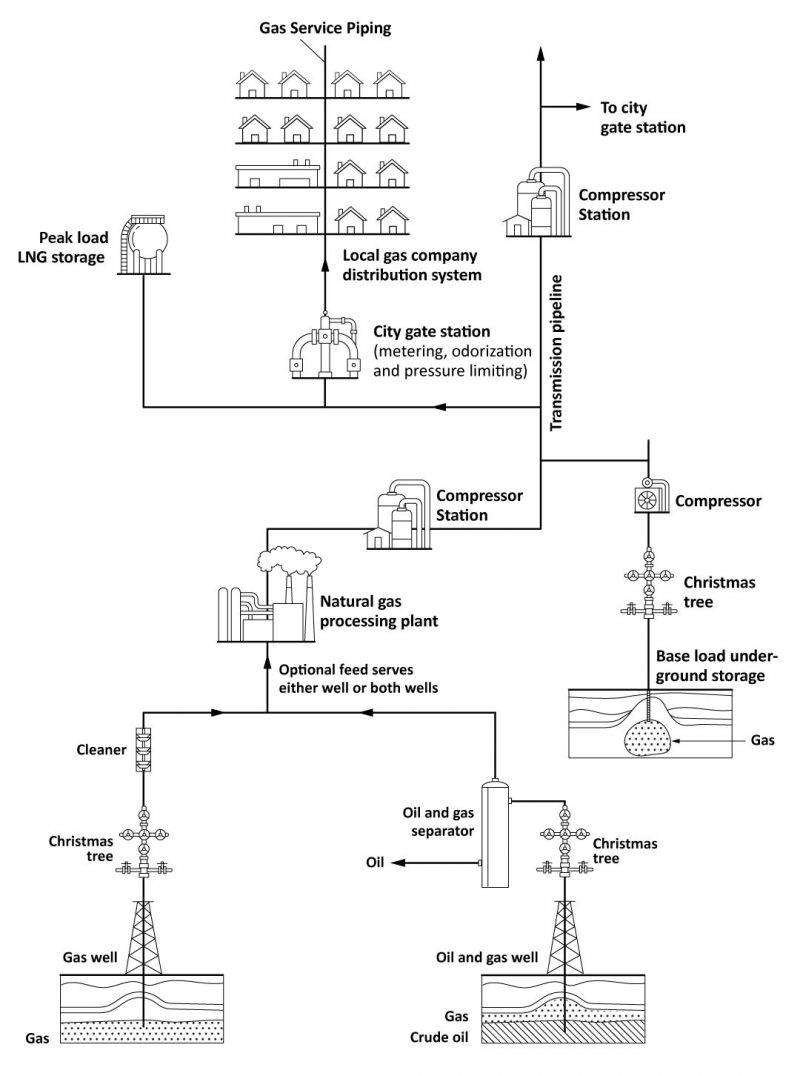
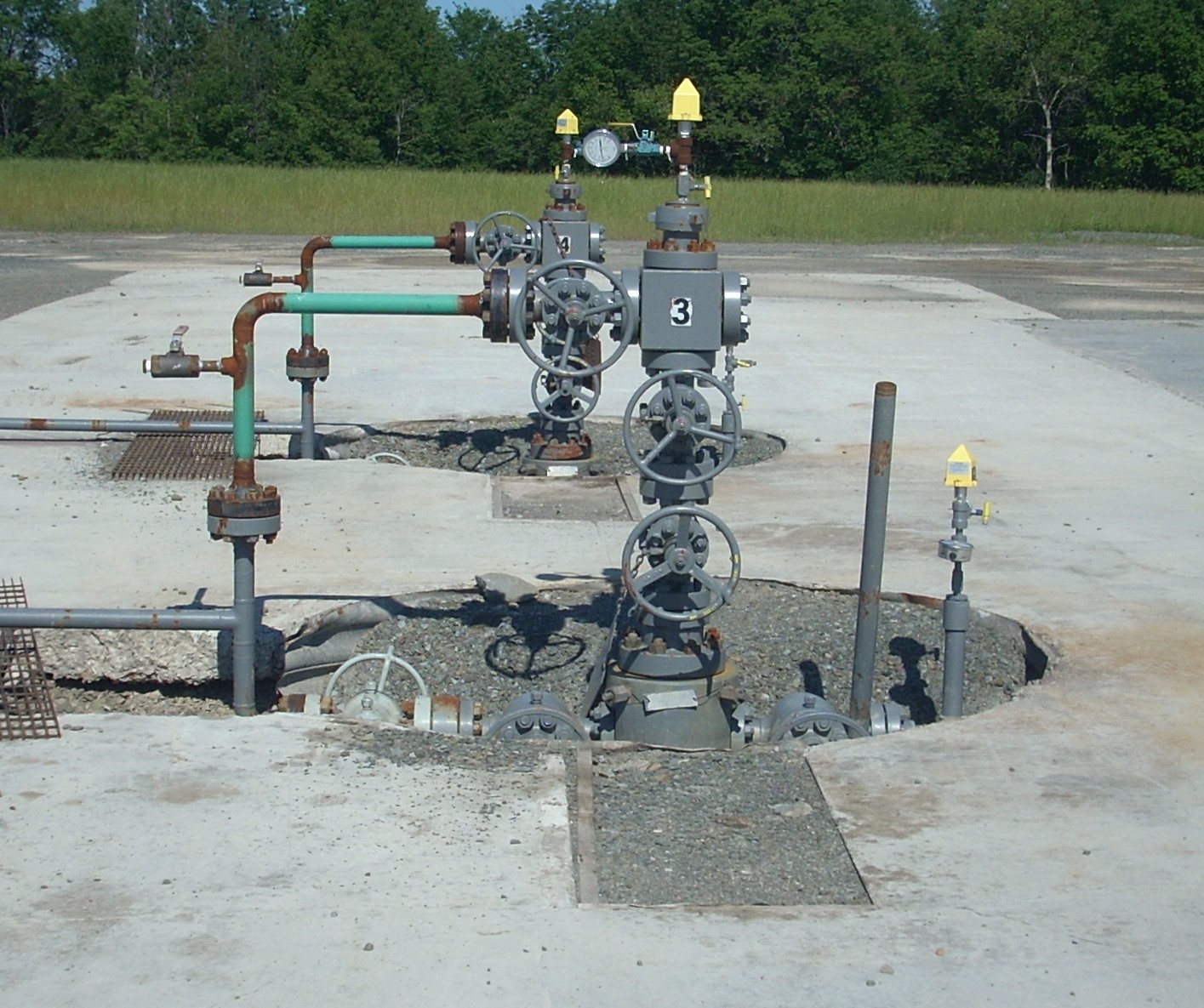
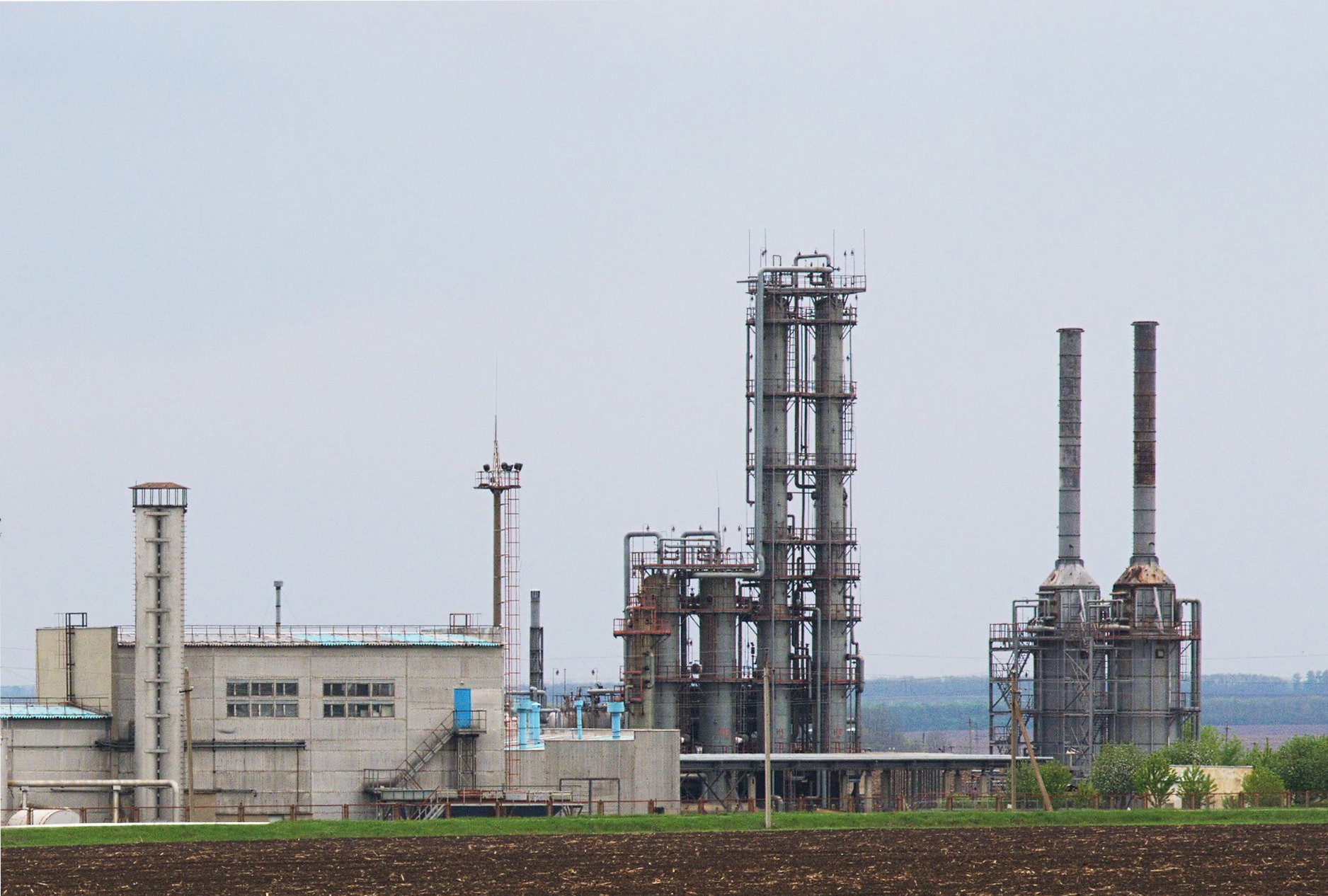
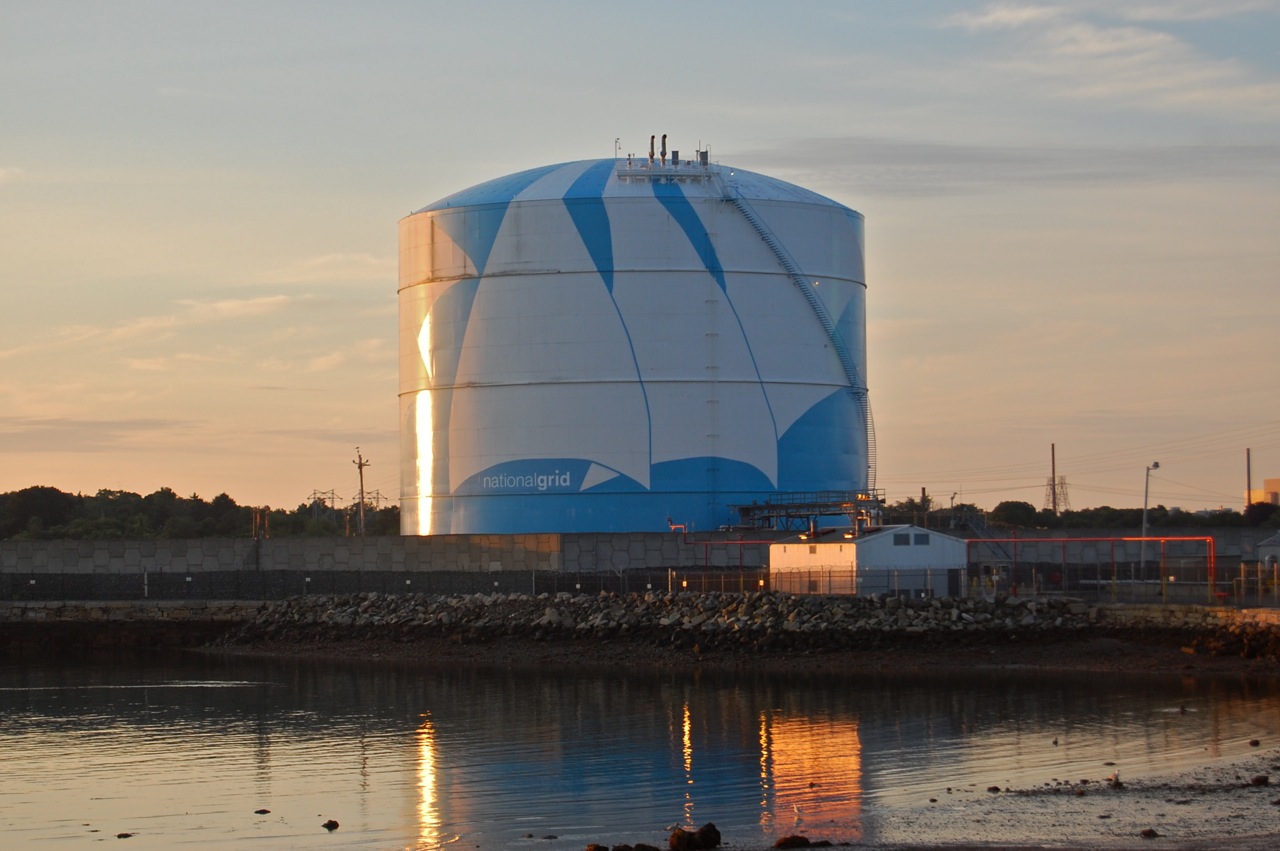
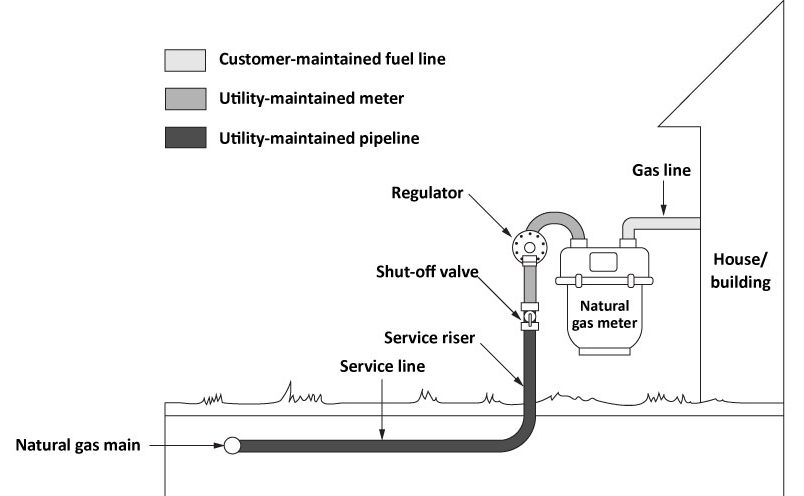
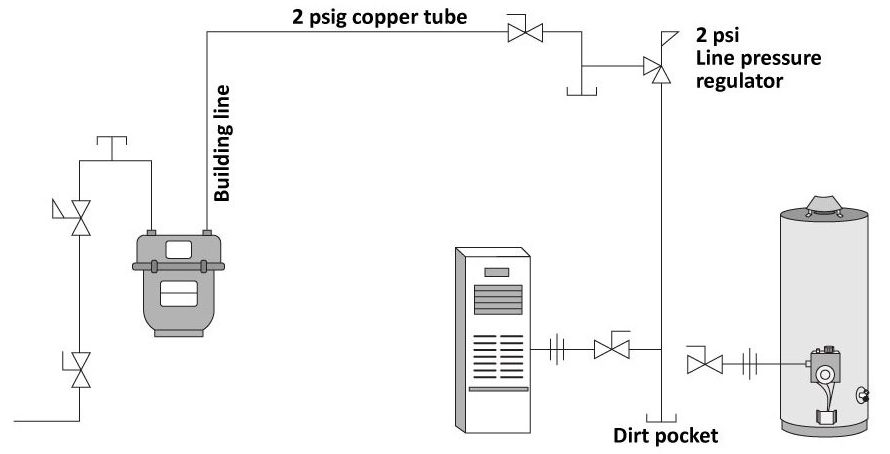
 <p>Natural gas either in a gaseous or liquid state can be transported between facilities or to consumers by ships/vessels, special trucks, and pipelines.</p> <p>Pipelines are an efficient and safe means of transporting natural gas. Some of the advantages of using a pipeline to transport gas are:</p> <ul><li>Continuous delivering of gas to consumers without disruption. The delivery is not affected by most environmental factors.</li> <li>Pipelines can be routed to take short cuts to its destination thereby reducing the time of transportation compared to other means of transportation.</li> <li>The large volume of gas that is transported</li> </ul> <p>According to the Fraser Institute’s 2015 study, pipeline transportation is the safest and most reliable means of transporting gas.</p> <h1 id="chapter-29-section-1" class="section-header">Bringing Fuel Gas to the Consumer</h1> <p>With so many varieties of geological formations, Canada yields many types of natural gas. Exploration studies and seismographic surveys indicate likely sources of oil and natural gas in a particular area.</p> <p>Once a productive well has been established, gas processing plants separate the oil and gas into different productive components. Transmission companies move both the natural gas and liquefied petroleum (LP) gases to markets thousands of miles from the wellhead.</p> <p>The process of gas transmission, storage and distribution, from drill well head to consumers, is shown in Figure 1.</p> <div class="wp-caption aligncenter" id="attachment_27" aria-describedby="caption-attachment-27" style="width: 600px"><img class="wp-image-22" src="https://opentextbc.ca/technicalwritingh5p/wp-content/uploads/sites/406/2022/01/E1-LT1-Figure-1_Process-of-gas-transmission-from-drill-site-to-utility-company-1-e1646786395368.jpg" alt="Flow diagram of distribution elements including in order: Gas wells, Christmas trees, Processing plant, Compressor stations, Base load underground storage, City gate station, Peak load LNG storage, Service piping to buildings" width="600" height="807" srcset="https://opentextbc.ca/plumbing3e/wp-content/uploads/sites/406/2022/01/E1-LT1-Figure-1_Process-of-gas-transmission-from-drill-site-to-utility-company-1-e1646786395368.jpg 800w, https://opentextbc.ca/plumbing3e/wp-content/uploads/sites/406/2022/01/E1-LT1-Figure-1_Process-of-gas-transmission-from-drill-site-to-utility-company-1-e1646786395368-223x300.jpg 223w, https://opentextbc.ca/plumbing3e/wp-content/uploads/sites/406/2022/01/E1-LT1-Figure-1_Process-of-gas-transmission-from-drill-site-to-utility-company-1-e1646786395368-761x1024.jpg 761w, https://opentextbc.ca/plumbing3e/wp-content/uploads/sites/406/2022/01/E1-LT1-Figure-1_Process-of-gas-transmission-from-drill-site-to-utility-company-1-e1646786395368-768x1033.jpg 768w, https://opentextbc.ca/plumbing3e/wp-content/uploads/sites/406/2022/01/E1-LT1-Figure-1_Process-of-gas-transmission-from-drill-site-to-utility-company-1-e1646786395368-65x87.jpg 65w, https://opentextbc.ca/plumbing3e/wp-content/uploads/sites/406/2022/01/E1-LT1-Figure-1_Process-of-gas-transmission-from-drill-site-to-utility-company-1-e1646786395368-225x303.jpg 225w, https://opentextbc.ca/plumbing3e/wp-content/uploads/sites/406/2022/01/E1-LT1-Figure-1_Process-of-gas-transmission-from-drill-site-to-utility-company-1-e1646786395368-350x471.jpg 350w" sizes="auto, (max-width: 600px) 100vw, 600px" title=""><div class="wp-caption-text" id="caption-attachment-27">Figure 1. Process of gas transmission from drill site to utility company.</div></div> <h2>Drilling</h2> <p>Drill rigs are units composed of a complex arrangement of machines and instruments which bore through the porous sedimentary rocks to find a pocket containing trapped crude oil or natural gas. As the borehole is being drilled, the hole is sheathed in a steel casing at various depth intervals to support the well from collapsing and create a controlled return path for the pumped drilling fluid and removed material. The upper first depth interval casing string is cemented into place, then each consecutive depth interval is drilled to a smaller size and the subsequent casing slips inside the previous one, and they are all run to the surface (well head) were they are supported. Once the drilling rig has completed it is dismantled and relocated.</p> <p>If it has been established that the well will produce sufficient oil or gas, then production tubing is run through the casing to transport the oil and gas to the surface. The production tubing is connected at the surface to an assortment of valves, pressure gauges, and flow line connections (Figure 2), often called a “Christmas tree.”</p> <div class="wp-caption aligncenter" aria-describedby="caption-attachment-27" style="width: 400px"><img class="wp-image-23" src="https://opentextbc.ca/technicalwritingh5p/wp-content/uploads/sites/406/2022/08/E1-LT1-Figure-2-Gas-well-head.jpg" alt="" width="400" height="335" srcset="https://opentextbc.ca/plumbing3e/wp-content/uploads/sites/406/2022/08/E1-LT1-Figure-2-Gas-well-head.jpg 1415w, https://opentextbc.ca/plumbing3e/wp-content/uploads/sites/406/2022/08/E1-LT1-Figure-2-Gas-well-head-300x251.jpg 300w, https://opentextbc.ca/plumbing3e/wp-content/uploads/sites/406/2022/08/E1-LT1-Figure-2-Gas-well-head-1024x858.jpg 1024w, https://opentextbc.ca/plumbing3e/wp-content/uploads/sites/406/2022/08/E1-LT1-Figure-2-Gas-well-head-768x643.jpg 768w, https://opentextbc.ca/plumbing3e/wp-content/uploads/sites/406/2022/08/E1-LT1-Figure-2-Gas-well-head-65x54.jpg 65w, https://opentextbc.ca/plumbing3e/wp-content/uploads/sites/406/2022/08/E1-LT1-Figure-2-Gas-well-head-225x188.jpg 225w, https://opentextbc.ca/plumbing3e/wp-content/uploads/sites/406/2022/08/E1-LT1-Figure-2-Gas-well-head-350x293.jpg 350w" sizes="auto, (max-width: 400px) 100vw, 400px" title=""><div class="wp-caption-text">Figure 2. Gas well head Christmas tree.</div></div> <h2>Processing</h2> <p>Gas processing plants operate near the well fields and separate the components of natural gas that are used in different areas of the petrochemical industry (Figure 3). It is noteworthy that many processing plants obtain more revenue from the sale of gas by-products than from the sale of gas itself. Sulphur is one example of a major by-product.</p> <div class="wp-caption aligncenter" aria-describedby="caption-attachment-27" style="width: 400px"><img class="wp-image-24" src="https://opentextbc.ca/technicalwritingh5p/wp-content/uploads/sites/406/2022/08/Solohiv_natural_gas_plant_-_fragment-cropped.jpg" alt="" width="400" height="270" srcset="https://opentextbc.ca/plumbing3e/wp-content/uploads/sites/406/2022/08/Solohiv_natural_gas_plant_-_fragment-cropped.jpg 1876w, https://opentextbc.ca/plumbing3e/wp-content/uploads/sites/406/2022/08/Solohiv_natural_gas_plant_-_fragment-cropped-300x202.jpg 300w, https://opentextbc.ca/plumbing3e/wp-content/uploads/sites/406/2022/08/Solohiv_natural_gas_plant_-_fragment-cropped-1024x691.jpg 1024w, https://opentextbc.ca/plumbing3e/wp-content/uploads/sites/406/2022/08/Solohiv_natural_gas_plant_-_fragment-cropped-768x518.jpg 768w, https://opentextbc.ca/plumbing3e/wp-content/uploads/sites/406/2022/08/Solohiv_natural_gas_plant_-_fragment-cropped-1536x1037.jpg 1536w, https://opentextbc.ca/plumbing3e/wp-content/uploads/sites/406/2022/08/Solohiv_natural_gas_plant_-_fragment-cropped-65x44.jpg 65w, https://opentextbc.ca/plumbing3e/wp-content/uploads/sites/406/2022/08/Solohiv_natural_gas_plant_-_fragment-cropped-225x152.jpg 225w, https://opentextbc.ca/plumbing3e/wp-content/uploads/sites/406/2022/08/Solohiv_natural_gas_plant_-_fragment-cropped-350x236.jpg 350w" sizes="auto, (max-width: 400px) 100vw, 400px" title=""><div class="wp-caption-text">Figure 3. Natural gas processing plant.</div></div> <h2>Transportation</h2> <p>Because of their different natures, natural gas and LP-gases are transported to consumers in different ways.</p> <h3>Natural gas</h3> <p>Large pipeline transmission companies gather the gas from the plants and channel the fuel to local and distant markets. The natural gas is compressed from 5500 – 8000 kPa (800 to 1,200 psi) so that it can be pushed though the transmission pipelines at speeds of 11–32 kilometers per hour.</p> <p>As natural gas moves through a pipeline, distance, friction, and elevation differences slow the movement of the gas, and reduce its pressure. To ensure that gas continues to flow optimally the pressure must be periodically boosted, so additional compressor stations are placed, typically 80 – 100 kilometers apart, along the pipeline.</p> <p>The transmission companies take care of maintenance of pipelines which includes checking cathodic protection levels for the proper range, and surveillance for construction, land erosion, or leaks.</p> <h3>LP-gas</h3> <p>LP-gases are not transported in their gaseous state, since they were condensed into the liquid state upon extraction from natural gas or petroleum oil. After they leave the refinery, they are stored in a liquid state under pressure.</p> <h2>Distribution</h2> <p>When the transmission company has delivered it, and before the local utility can use the gas, it must have its pressure reduced. To do this, the gas passes through a regulating station, called a <em>city gate</em> or <em>town gate</em>. Distribution city gate branches may be installed at points along the transmission line.</p> <p>The city gate station controls metering, pressure limiting, and odourization of the gas before it is finally distributed by the utility company to the individual consumers. Since natural gas is colourless and odourless specific chemicals, called mercaptan, are added, to give natural gas a distinct odor before it is distributed to the highly populated areas. That rotten egg odour is used as a safety measure to ensure that natural gas leaks do not go undetected. The transmission pipeline pressures are reduced to below 690 kPA (100 psi) at the gate stations then transported to the consumers through the distribution mains.</p> <h2>Storage</h2> <p>The natural gas storage infrastructure can be utilized to accommodate sudden rises or falls in demand. Storage acts as a buffer between transportation and distribution, to ensure adequate supplies of natural gas are in place for seasonal demand shifts (base load), and unexpected demand surges (peak load).</p> <p>Base load gas is usually stored underground, in large storage reservoirs. There are three main types of underground storage: depleted gas reservoirs, aquifers, and salt caverns. In addition to underground storage, natural gas can be stored as liquefied natural gas (LNG) in large insulated above-ground tanks (Figure 4) for peak load periods. As a liquid at −161 °C (−258 °F), it occupies about 600 times less space than gas stored underground. The LNG storage facilities are generally located close to market, giving them the ability to provide high deliverability at very short notice, by releasing and returning the liquid to its gaseous state when it is needed.</p> <p>The release of gas from the liquid storage is also used to maintain the remaining stored liquid at low temperature, this is known as auto-refrigeration.</p> <div class="wp-caption aligncenter" aria-describedby="caption-attachment-27" style="width: 400px"><img class="wp-image-25" src="https://opentextbc.ca/technicalwritingh5p/wp-content/uploads/sites/406/2022/08/National_Grid_LNG_Tank.jpg" alt="" width="400" height="266" srcset="https://opentextbc.ca/plumbing3e/wp-content/uploads/sites/406/2022/08/National_Grid_LNG_Tank.jpg 1280w, https://opentextbc.ca/plumbing3e/wp-content/uploads/sites/406/2022/08/National_Grid_LNG_Tank-300x199.jpg 300w, https://opentextbc.ca/plumbing3e/wp-content/uploads/sites/406/2022/08/National_Grid_LNG_Tank-1024x681.jpg 1024w, https://opentextbc.ca/plumbing3e/wp-content/uploads/sites/406/2022/08/National_Grid_LNG_Tank-768x511.jpg 768w, https://opentextbc.ca/plumbing3e/wp-content/uploads/sites/406/2022/08/National_Grid_LNG_Tank-65x43.jpg 65w, https://opentextbc.ca/plumbing3e/wp-content/uploads/sites/406/2022/08/National_Grid_LNG_Tank-225x150.jpg 225w, https://opentextbc.ca/plumbing3e/wp-content/uploads/sites/406/2022/08/National_Grid_LNG_Tank-350x233.jpg 350w" sizes="auto, (max-width: 400px) 100vw, 400px" title=""><div class="wp-caption-text">Figure 4. LNG storage tank.</div></div> <div><p>LP-gases in refineries are also stored in above-ground storage tanks similar to natural gas storage facilities. They range in capacity from 2 kg tanks to tanks which hold thousands of liters.</p> </div> <h2>Service Piping</h2> <p>The gas utility installs and maintains the gas service, which includes the service line, service riser, service stop (valve), service regulator, and meter (Figure 5).</p> <div class="wp-caption aligncenter" aria-describedby="caption-attachment-27" style="width: 804px"><img class="wp-image-26 size-full" src="https://opentextbc.ca/technicalwritingh5p/wp-content/uploads/sites/406/2022/08/E1-LT1-Figure-2_Consumer-gas-service-e1641501522654.jpg" alt="Underground gas service pipeline rising above ground to a shut-off valve, regulator and meter before entering the building." width="804" height="496" srcset="https://opentextbc.ca/plumbing3e/wp-content/uploads/sites/406/2022/08/E1-LT1-Figure-2_Consumer-gas-service-e1641501522654.jpg 804w, https://opentextbc.ca/plumbing3e/wp-content/uploads/sites/406/2022/08/E1-LT1-Figure-2_Consumer-gas-service-e1641501522654-300x185.jpg 300w, https://opentextbc.ca/plumbing3e/wp-content/uploads/sites/406/2022/08/E1-LT1-Figure-2_Consumer-gas-service-e1641501522654-768x474.jpg 768w, https://opentextbc.ca/plumbing3e/wp-content/uploads/sites/406/2022/08/E1-LT1-Figure-2_Consumer-gas-service-e1641501522654-65x40.jpg 65w, https://opentextbc.ca/plumbing3e/wp-content/uploads/sites/406/2022/08/E1-LT1-Figure-2_Consumer-gas-service-e1641501522654-225x139.jpg 225w, https://opentextbc.ca/plumbing3e/wp-content/uploads/sites/406/2022/08/E1-LT1-Figure-2_Consumer-gas-service-e1641501522654-350x216.jpg 350w" sizes="auto, (max-width: 804px) 100vw, 804px" title=""><div class="wp-caption-text">Figure 5. Consumer gas service.</div></div> <p>The Natural Gas and Propane Installation Code specifies the maximum gas pressures allowed inside different classes of buildings. The service regulator will need to reduce the utility distribution pressure accordingly, for example a single-family dwellings is limited to a maximum of 14 kPa (2 psig), whereas pressures in industrial and commercial applications range from 35 to 140 kPa (5 to 20 psig).</p> <h1 id="chapter-29-section-2" class="section-header">Consumer Gas Piping System</h1> <p>The consumer gas piping system conveys the fuel gas from the point of supply to the gas burning appliances. It may be black iron pipe, CSST, copper tubing or polyethylene (PE) plastic (underground only). The point of supply for natural gas is usually a gas utility companies’ meter and, for propane, a propane storage tank. The gas fitter is responsible for designing a piping system, capable of supplying the required volume of gas to each gas-fired appliance, following good piping practices and the requirements of the B149.1 National Gas Code. Figure 6 shows the typical parts of a consumer fuel gas piping system.</p> <div class="wp-caption aligncenter" aria-describedby="caption-attachment-27" style="width: 890px"><img class="wp-image-27 size-full" src="https://opentextbc.ca/technicalwritingh5p/wp-content/uploads/sites/406/2022/08/E1-LT1-Figure-3_Building-gas-piping-system-e1646786430665.jpg" alt="Building gas piping system feeding a furnace and water heater" width="890" height="454" srcset="https://opentextbc.ca/plumbing3e/wp-content/uploads/sites/406/2022/08/E1-LT1-Figure-3_Building-gas-piping-system-e1646786430665.jpg 890w, https://opentextbc.ca/plumbing3e/wp-content/uploads/sites/406/2022/08/E1-LT1-Figure-3_Building-gas-piping-system-e1646786430665-300x153.jpg 300w, https://opentextbc.ca/plumbing3e/wp-content/uploads/sites/406/2022/08/E1-LT1-Figure-3_Building-gas-piping-system-e1646786430665-768x392.jpg 768w, https://opentextbc.ca/plumbing3e/wp-content/uploads/sites/406/2022/08/E1-LT1-Figure-3_Building-gas-piping-system-e1646786430665-65x33.jpg 65w, https://opentextbc.ca/plumbing3e/wp-content/uploads/sites/406/2022/08/E1-LT1-Figure-3_Building-gas-piping-system-e1646786430665-225x115.jpg 225w, https://opentextbc.ca/plumbing3e/wp-content/uploads/sites/406/2022/08/E1-LT1-Figure-3_Building-gas-piping-system-e1646786430665-350x179.jpg 350w" sizes="auto, (max-width: 890px) 100vw, 890px" title=""><div class="wp-caption-text">Figure 6. Building gas piping system.</div></div> <div><p><img class="wp-image-28 alignleft" src="https://opentextbc.ca/technicalwritingh5p/wp-content/uploads/sites/406/2022/08/noun-check-702756.png" alt="" width="50" height="50" srcset="https://opentextbc.ca/plumbing3e/wp-content/uploads/sites/406/2022/08/noun-check-702756.png 485w, https://opentextbc.ca/plumbing3e/wp-content/uploads/sites/406/2022/08/noun-check-702756-300x300.png 300w, https://opentextbc.ca/plumbing3e/wp-content/uploads/sites/406/2022/08/noun-check-702756-150x150.png 150w, https://opentextbc.ca/plumbing3e/wp-content/uploads/sites/406/2022/08/noun-check-702756-65x65.png 65w, https://opentextbc.ca/plumbing3e/wp-content/uploads/sites/406/2022/08/noun-check-702756-225x225.png 225w, https://opentextbc.ca/plumbing3e/wp-content/uploads/sites/406/2022/08/noun-check-702756-350x350.png 350w" sizes="auto, (max-width: 50px) 100vw, 50px" title="">Now complete E-1 LT1 Self-Test and check your answers.</p> <p>&nbsp;</p> </div> <h1 id="chapter-29-section-3" class="section-header">Self-Test 1</h1> <div class="textbox textbox--exercises"><div class="textbox__header"><p class="textbox__title"><span style="color: #ffffff;">Self-Test 1</span></p> </div> <div class="textbox__content"><ol><li>What is the safest and most reliable method of transporting natural gas? <ol type="a"><li>Trucking</li> <li>Railway</li> <li>Pipeline</li> <li>Aircraft</li> </ol> </li> <li>Transmission lines are the pipes that move the gas from the city gate station to the customers. <ol type="a"><li>True</li> <li>False</li> </ol> </li> <li>What is the maximum pressure of natural gas in city distribution mains? <ol type="a"><li>35 kPa</li> <li>140 kPa</li> <li>680 kPa</li> <li>8000 kPa</li> </ol> </li> <li>The release of gas from the liquid storage will reduce the temperature of the remain liquid. <ol type="a"><li>True</li> <li>False</li> </ol> </li> <li>What is the maximum Natural gas supply pressure to a single-family dwelling? <ol type="a"><li>14 kPa</li> <li>35 kPa</li> <li>140 kPa</li> <li>450 kPa</li> </ol> </li> </ol> <p>Check your answers using the <a href="#back-matter-self-test-answer-keys" data-url="https://opentextbc.ca/plumbing3e/back-matter/self-test-answer-keys/">Self-Test Answer Keys</a> in Appendix 1.</p> </div> </div> <h3>Media Attributions</h3> <ul><li>Figure 1 “Gas transmission from drill site to utility company” by Camosun College is licensed under a <a href="https://creativecommons.org/licenses/by/4.0/" data-url="https://creativecommons.org/licenses/by/4.0/">CC BY 4.0 licence</a>.</li> <li>Figure 2 “<a href="https://commons.wikimedia.org/wiki/File:Gas_wells_(5910123732).jpg" data-url="https://commons.wikimedia.org/wiki/File:Gas_wells_(5910123732).jpg">Gas wells</a>” by <a href="https://www.flickr.com/people/11629603@N04" data-url="https://www.flickr.com/people/11629603@N04">Gerry Dincher</a> is licensed under a <a href="https://creativecommons.org/licenses/by-sa/2.0/deed.en" data-url="https://creativecommons.org/licenses/by-sa/2.0/deed.en">CC BY-SA 2.0 licence</a>.</li> <li>Figure 3 “<a href="https://commons.wikimedia.org/wiki/File:Solohiv_natural_gas_plant_-_fragment.jpg" data-url="https://commons.wikimedia.org/wiki/File:Solohiv_natural_gas_plant_-_fragment.jpg">Solohiv natural gas plant</a>” by <a href="https://commons.wikimedia.org/wiki/User:ReAl" data-url="https://commons.wikimedia.org/wiki/User:ReAl">ReAl</a> is licensed under a <a href="https://creativecommons.org/licenses/by-sa/3.0/deed.en" data-url="https://creativecommons.org/licenses/by-sa/3.0/deed.en">CC BY-SA 3.0 licence</a>.</li> <li>Figure 4 “National Grid LNG Tank” by <a href="https://commons.wikimedia.org/wiki/User:Fletcher6" data-url="https://commons.wikimedia.org/wiki/User:Fletcher6">Fletcher6</a>&nbsp;is licensed under a <a href="https://creativecommons.org/licenses/by-sa/3.0/deed.en" data-url="https://creativecommons.org/licenses/by-sa/3.0/deed.en">CC BY-SA 3.0 licence</a>.</li> <li>Figure 5 “Consumer gas service” by Camosun College is licensed under a <a href="https://creativecommons.org/licenses/by/4.0/" data-url="https://creativecommons.org/licenses/by/4.0/">CC BY 4.0 licence</a>.</li> <li>Figure 6 “Building gas piping system” by Camosun College is licensed under a <a href="https://creativecommons.org/licenses/by/4.0/" data-url="https://creativecommons.org/licenses/by/4.0/">CC BY 4.0 licence</a>.</li> <li>“<a href="https://thenounproject.com/icon/check-702756/" data-url="https://thenounproject.com/icon/check-702756/">Check</a>” by <a href="https://thenounproject.com/KimmiStudio/" data-url="https://thenounproject.com/KimmiStudio/">Kimmi Studio</a> is licensed under a <a href="https://creativecommons.org/licenses/by/4.0/" data-url="https://creativecommons.org/licenses/by/4.0/">CC BY 4.0 licence</a>.</li> </ul> 

	</div>


	</div>
<div class="chapter standard with-subsections" id="chapter-fluid-flow-in-a-piping-system" title="Learning Task 2">
	<div class="chapter-title-wrap">
		<p class="chapter-number">2</p>
		<h1 class="chapter-title">Learning Task 2</h1>
					<p class="chapter-subtitle">Describe Factors that Affect Fluid Flow in a Piping System</p>
			</div>
	<div class="ugc chapter-ugc">
				
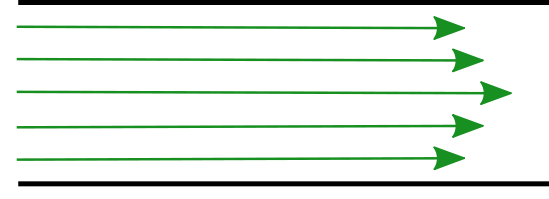
 <p>In physics the flow of fluids (liquids and gases) is described as fluid dynamics. The affect on the gas pressure energy is one of the most important aspects to consider when determining the allowable flow rates through a piping system.</p> <h1 id="chapter-33-section-1" class="section-header">Friction Loss</h1> <p>Flow in pipe is always creating energy loss due to friction. Fiction loss can be measured like static pressure drop in the direction of fluid flow with two gauges at different points in the piping system. For design purposes the relevant friction loss pressure drop is the difference in operating gas pressure between the point of gas supply, being either the meter set or the pressure regulator, and the most distant appliance.</p> <p>As pressure difference is the driving force that causes the gas to move through the piping. The greater the pressure difference between two points in a given pipe size, the greater the volume and velocity of flow through the pipe.</p> <p>The Natural Gas and Propane Installation Code book specifies the maximum allowable pressure drop in a system, based on the system supply pressure.</p> <p>Gas piping systems with supply pressures:</p> <ul><li>less than 7″ w.c. (1.75 kPa) must be designed so the pressure drop does not exceed 0.5″ w.c. (125 Pa).</li> <li>7″ w.c. to 14″ w.c. (1.75 kPa to 3.5 kPa) must be designed so that the pressure drop does not exceed 1″ w.c. (250 Pa).</li> <li>The pressure drop for a 2 Psig (14 kPa) system operating on natural gas can be either 1.5 Psig (10 kPa) or 1 Psig (7 kPa) depending on what pressure is required at the end of the system. The pressure drop for a 2 Psig (14 kPa) system operating on propane must not exceed 1 Psig (7 kPa).</li> <li>5 Psig (34 kPa) systems must be designed so that the pressure drop does not exceed 2.5 Psig (17 kPa).</li> <li>10 Psig (70 kPa) systems must be designed so that the pressure drop does not exceed 5 Psig (34 kPa).</li> <li>20 Psig (140 kPa) systems must be designed so that the pressure drop does not exceed 10 Psig (70 kPa).</li> </ul> <h1 id="chapter-33-section-2" class="section-header">Friction Loss Factors</h1> <p>The pressure energy lost due to flow is affected by many factors. Each factor must be considered when designing a piping system to ensure the required flow volume of gas is supplied to each appliance with sufficient pressure energy remaining to operate the appliance. These flow factors include:</p> <ul><li>Velocity <ul><li>Pipe size</li> </ul> </li> <li>Density (Specific Gravity)</li> <li>Pipe Material</li> <li>Fittings</li> </ul> <div class="textbox">This information is important introductory background knowledge that will be referred to when the actual gas pipe sizing procedures are explained in <a class="internal" href="#part-install-gas-piping-tubing-systems" data-url="/plumbing3e/part/install-gas-piping-tubing-systems/">Competency E2</a>.</div> <p>The friction loss in uniform, straight sections of pipe, is greatly affected by the velocity of the fluid. When a fluid is flowing through a pipe either of two types of flow may occur depending on the velocity and viscosity of the fluid: laminar flow or turbulent flow.</p> <h2>Laminar and Turbulent flow</h2> <p>In non-scientific terms, laminar flow is smooth, while turbulent flow is rough. The term laminar refers to streamlined flow in which a fluid glides along in layers that do not mix. The flow takes place in smooth continuous lines called streamlines (Figure 1).</p> <div class="wp-caption aligncenter" id="attachment_28" aria-describedby="caption-attachment-28" style="width: 549px"><img class="wp-image-31 size-full" src="https://opentextbc.ca/technicalwritingh5p/wp-content/uploads/sites/406/2022/01/753px-Laminar_and_turbulent_flows.svg_-e1643242345326.png" alt="" width="549" height="199" srcset="https://opentextbc.ca/plumbing3e/wp-content/uploads/sites/406/2022/01/753px-Laminar_and_turbulent_flows.svg_-e1643242345326.png 549w, https://opentextbc.ca/plumbing3e/wp-content/uploads/sites/406/2022/01/753px-Laminar_and_turbulent_flows.svg_-e1643242345326-300x109.png 300w, https://opentextbc.ca/plumbing3e/wp-content/uploads/sites/406/2022/01/753px-Laminar_and_turbulent_flows.svg_-e1643242345326-65x24.png 65w, https://opentextbc.ca/plumbing3e/wp-content/uploads/sites/406/2022/01/753px-Laminar_and_turbulent_flows.svg_-e1643242345326-225x82.png 225w, https://opentextbc.ca/plumbing3e/wp-content/uploads/sites/406/2022/01/753px-Laminar_and_turbulent_flows.svg_-e1643242345326-350x127.png 350w" sizes="auto, (max-width: 549px) 100vw, 549px" title=""><div class="wp-caption-text" id="caption-attachment-28">Figure 1 Laminar flow patterns</div></div> <p>Turbulent flow is a less orderly flow regime that is characterized by eddies or small pockets of fluid particles, which result in lateral mixing.</p> <div class="wp-caption aligncenter" aria-describedby="caption-attachment-28" style="width: 549px"><img class="wp-image-32 size-full" src="https://opentextbc.ca/technicalwritingh5p/wp-content/uploads/sites/406/2022/08/753px-Laminar_and_turbulent_flows.svg_-1-e1643243034573.png" alt="" width="549" height="199" srcset="https://opentextbc.ca/plumbing3e/wp-content/uploads/sites/406/2022/08/753px-Laminar_and_turbulent_flows.svg_-1-e1643243034573.png 549w, https://opentextbc.ca/plumbing3e/wp-content/uploads/sites/406/2022/08/753px-Laminar_and_turbulent_flows.svg_-1-e1643243034573-300x109.png 300w, https://opentextbc.ca/plumbing3e/wp-content/uploads/sites/406/2022/08/753px-Laminar_and_turbulent_flows.svg_-1-e1643243034573-65x24.png 65w, https://opentextbc.ca/plumbing3e/wp-content/uploads/sites/406/2022/08/753px-Laminar_and_turbulent_flows.svg_-1-e1643243034573-225x82.png 225w, https://opentextbc.ca/plumbing3e/wp-content/uploads/sites/406/2022/08/753px-Laminar_and_turbulent_flows.svg_-1-e1643243034573-350x127.png 350w" sizes="auto, (max-width: 549px) 100vw, 549px" title=""><div class="wp-caption-text">Figure 2 Turbulent flow patterns</div></div> <p>Laminar flow occurs at lower velocities, and has a more predictable energy loss. Whereas turbulent flow, tends to produce flow instabilities and consequently increased friction losses.</p> <h2>Pipe size</h2> <p>Changing the pipe size for a given volume flow rate will obviously change the gas velocity. The pipe system designer has to strike a practical balance between increasing the pipe diameter to reduce energy loss and keeping the diameter small to lower installation costs.</p> <h2>Density Effects</h2> <p>The shear rate is a measure of a fluid’s viscosity or slipperiness. For fluid flow in a pipe the friction loss is affected by the viscosity of the fluid near the surface of the pipe or duct. The more viscous, or less slippery, a fluid the harder it is to get shearing between layers. The density of a fluid affects its viscosity. Fluids with higher density require more energy to move them and shear less easily.</p> <p>The specific gravity (SG) of a gas describes its density relative to that of air. When comparing the flow of propane gas (SG of 1.5) to Natural gas (SG of 0.6), the Propane gas would cause a greater pressure loss when all other flow factors are equal.</p> <h2>Pipe Material</h2> <p>A fluid flowing through a pipe contacts the pipe wall. The pipe wall has surface roughness. The amount of roughness affects the drag on the fluid. Piping with smooth interior walls has less resistance to flow than those with rough interior walls. When comparing the flow of a gas through copper tube and carbon steel pipe of the same inside diameter, the steel pipe would cause a greater pressure loss when all other flow factors are equal.</p> <p>This factor will be accounted for by the use a table or formula, relative to the type of pipe being used. The accumulated length of pipe will then determine the total pressure drop of the piping system.</p> <h2>Fittings</h2> <p>When a fluid is forced to change direction, or go around a disruption, eddies are produced. These new twisting eddies interfere with the flow pattern and produce additional pressure losses. It is important to account for the pressure loss caused by fittings.</p> <p>There are a number of different methods used to account for the friction loss of fittings, including:</p> <ul><li>Percentage of length</li> <li>Pressure drop (∆P) calculations</li> <li>Equivalent length tables</li> </ul> <h3>Percentage of length</h3> <p>Some pipe sizing methods will simply add 10% or 20% to the actual measure length to give an allowance for the additional friction loss created by the fittings. This system makes it even more important to design the piping system with as few fittings as possible, so that the total pressure drop accounted for in the pipe size and length calculations is not exceeded.</p> <h3>Fitting ∆P calculations</h3> <p>The pressure drop of each fitting and valve can also be calculated by the used of experiential data, in the form of resistance constants. These values are available from different sources like tables and diagrams from different sources such as manufacturers. Some example of these constants include; resistance coefficient (K), equivalent length (L/D) and flow coefficient (Cv). These constants are used within various formulas that will also require such information as; flow rate, SG, internal diameter.</p> <h3>Equivalent length tables</h3> <p>To make fitting friction calculations easier the fitting and valve friction loss values are given in tables. The table values are often expressed in terms of an equivalent length of pipe. In other words, each pipe fitting or valve is equal, in resistance, to an equivalent length of straight pipe. This length can be added to the actual length of the pipe, to get an equivalent run of pipe that would include an allowance for the fittings.</p> <p><img class="alignnone wp-image-28" src="https://opentextbc.ca/technicalwritingh5p/wp-content/uploads/sites/406/2022/08/noun-check-702756.png" alt="" width="50" height="50" srcset="https://opentextbc.ca/plumbing3e/wp-content/uploads/sites/406/2022/08/noun-check-702756.png 485w, https://opentextbc.ca/plumbing3e/wp-content/uploads/sites/406/2022/08/noun-check-702756-300x300.png 300w, https://opentextbc.ca/plumbing3e/wp-content/uploads/sites/406/2022/08/noun-check-702756-150x150.png 150w, https://opentextbc.ca/plumbing3e/wp-content/uploads/sites/406/2022/08/noun-check-702756-65x65.png 65w, https://opentextbc.ca/plumbing3e/wp-content/uploads/sites/406/2022/08/noun-check-702756-225x225.png 225w, https://opentextbc.ca/plumbing3e/wp-content/uploads/sites/406/2022/08/noun-check-702756-350x350.png 350w" sizes="auto, (max-width: 50px) 100vw, 50px" title="">Now complete Self-Test 2 and check your answers.</p> <h1 id="chapter-33-section-3" class="section-header">Self-Test 2</h1> <div class="textbox textbox--exercises"><div class="textbox__header"><p class="textbox__title">Self-Test 2</p> </div> <div class="textbox__content"><ol><li>For design purposes the relevant friction loss pressure drop is the difference in gas pressure between the point of gas supply and the nearest appliance. <ol type="a"><li>True</li> <li>False</li> </ol> </li> <li>As per the Natural Gas and Propane Installation Code book what is the maximum allowable pressure drop in a propane gas piping system with a supply pressure of 14 kPa. <ol type="a"><li>250 Pa</li> <li>1.75 kPa</li> <li>7 kPa</li> <li>10 kPa</li> </ol> </li> <li>Laminar flow is smooth and occurs at low velocities <ol type="a"><li>True</li> <li>False</li> </ol> </li> <li>Pipe size does not change the gas velocity. <ol type="a"><li>True</li> <li>False</li> </ol> </li> <li>Which of these listed gasses will have the greatest pressure loss when all other flow factors are equal. <ol type="a"><li>Natural gas (SG 0.6)</li> <li>Air (SG 1.0)</li> <li>Propane gas (SG 1.5)</li> <li>Butane gas (SG 2.0)</li> </ol> </li> <li>For piping systems what method can be used to account for the friction loss of fittings? <ol type="a"><li>Percentage of pipe length</li> <li>Pressure drop (∆P) calculations</li> <li>Equivalent length tables</li> <li>All of the above</li> </ol> </li> </ol> <p>Check your answers using the&nbsp;<a href="#back-matter-self-test-answer-keys" data-url="https://opentextbc.ca/plumbing3e/back-matter/self-test-answer-keys/">Self-Test Answer Keys</a>&nbsp;in Appendix 1.</p> </div> </div> <h3>Media Attributions</h3> <ul><li>Figure 1 “Laminar flow patterns” is cropped from “<a href="https://commons.wikimedia.org/w/index.php?curid=5100439" data-url="https://commons.wikimedia.org/w/index.php?curid=5100439">Laminar and turbulent flows</a>” by Dubaj, vectorized by Guillaume Paumier is in the public domain.</li> <li>Figure 2 “Turbulent flow patterns” is cropped from “<a href="https://commons.wikimedia.org/w/index.php?curid=5100439" data-url="https://commons.wikimedia.org/w/index.php?curid=5100439">Laminar and turbulent flows</a>” by Dubaj, vectorized by Guillaume Paumier is in the public domain.</li> </ul> 

	</div>


	</div>
<div class="chapter standard with-subsections" id="chapter-gas-piping-tubing-and-hoses" title="Learning Task 3">
	<div class="chapter-title-wrap">
		<p class="chapter-number">3</p>
		<h1 class="chapter-title">Learning Task 3</h1>
					<p class="chapter-subtitle">Describe Gas Piping, Tubing and Hoses</p>
			</div>
	<div class="ugc chapter-ugc">
				
 <p>There are many different piping systems available on the market only some of which are approved for gas installations. Section 6 of the Gas Code stipulates the approved materials.</p> <h1 id="chapter-38-section-1" class="section-header">Types of Piping Systems</h1> <p>Section 6 of the gas code identifies the following types of pipe, tubing and hoses as well as the approved methods for making connections.</p> <table style="border-collapse: collapse; width: 100%;"><tbody><tr><th style="width: 50%;" scope="col">Type of material</th> <th style="width: 50%;" scope="col">Type of Connections</th> </tr> <tr><td style="width: 50%; vertical-align: top;">Steel pipe</td> <td style="width: 50%; vertical-align: top;">Threaded <p>Flanged</p> <p>Press-connected</p> <p>Welded</p></td> </tr> <tr><td style="width: 50%; vertical-align: top;">Copper tube</td> <td style="width: 50%; vertical-align: top;">Brazed <p>Flared</p> <p>Compression</p> <p>Press-connected</p></td> </tr> <tr><td style="width: 50%; vertical-align: top;">Steel tube</td> <td style="width: 50%; vertical-align: top;">Flared <p>Compression</p> <p>Press-connected</p></td> </tr> <tr><td style="width: 50%; vertical-align: top;">Polyethylene</td> <td style="width: 50%; vertical-align: top;">Fusion <p>Compression slip-lock</p></td> </tr> <tr><td style="width: 50%; vertical-align: top;">Corrugated stainless steel tubing (CSST)</td> <td style="width: 50%; vertical-align: top;">Manufacture specific self-flaring fittings</td> </tr> <tr><td style="width: 50%; vertical-align: top;">Corrugated metal connectors</td> <td style="width: 50%; vertical-align: top;">Flare coupler</td> </tr> <tr><td style="width: 50%; vertical-align: top;">Hose connectors</td> <td style="width: 50%; vertical-align: top;">Flare coupler <p>Quick-Disconnect</p> <p>Swivel coupling</p></td> </tr> </tbody> </table> <p>The Gas Code recognizes that as new materials are developed they would not be identified yet. Therefore the code stipulates that materials not specified in clause 6.2 of the Gas Code may be used if they conform to a nationally recognizes standard or to a test report of a nationally recognized certification organization.</p> <h2>Steel piping</h2> <p>Steel piping is also commonly referred Carbon steel or black Iron pipe. Steel pipe must conform to ASTM A53/ A53M of ASTM A106 pipe specifications. Steel pipe used for gas systems must have a wall thickness of either Schedule 40, Schedule 80, or Standard weight depending on the application or size, as outline in clause 6.2.3 and 6.3.8.1 of the gas code. Hot dipped zinc coated pipe and fittings may be used.</p> <h2>Copper tubing</h2> <p>Seamless copper water tube approved for gas installations may be either Type G, K, or L. All of these types may be used above ground provided they do not exceed 1-3/8″ OD size. Copper tubing is available is soft annealed coils or hard drawn straight lengths.</p> <p>Type G copper tube is manufactured to the ASTM B837 Standard Specification for Seamless Copper Tube for Natural Gas and Liquified Petroleum (LP) Gas Fuel Distribution Systems, and is available in a range of outside diameter (OD) sizes.</p> <p>Type K and L copper tube are manufactured to the ASTM B88 Standard Specification for Seamless Copper Water Tube and is available in a range of nominal sizes. The actual OD size of Type K and L nominal tube size is 1/8″ larger than its nominal size. This is important to know as the flare fittings for all types of copper tubing are sized by the OD. The pipe sizing tables within the gas code book are also based on OD tube size.</p> <p>If copper tubing is used for underground applications it must be soft annealed Type K. Manufactures also produce Type L or G, tubing with an external poly coating which as also approved for underground gas installations.</p> <h2>Steel tubing</h2> <p>Steel tubing is approved for use on gas systems, but is not used as commonly for gas appliance supply installations. Seamless cold drawn low-carbon steel tubing used for gas systems must conform to the ASTM A179/A179M standard specification.</p> <h2>Polyethylene</h2> <p>All plastic gas pipe, tube and fittings shall be made of polyethylene (PE) that complies with the CSA B137.4 standard. Polyethylene medium density gas pipe has a maximum pressure rating of 100 psi and typically comes in coils in a variety of sizes. Plastic pipe and tubing are only approved for outdoor underground applications and is used for distribution mains, house service lines and after the meter on premise underground lines.</p> <p>Plastic piping and tubing shall be inspected before and after installation for defects such as cuts, scratches, and gouges. Damaged cylindrical pieces shall be cut out and replaced. Inspection shall be adequate to confirm that sound joints have been made. Joints in plastic piping and tubing shall be visually checked for evidence of poor bonding. Where inspection reveals defective joints, they shall be cut out and replaced.</p> <p>Polyethylene is a thermoplastic which softens when heated and solidifies when cooled, without any chemical reaction taking place. Polyethylene piping can be fused by applying heat and pressure. This is normally done with heating irons powered by electricity. The heating irons are used to heat the surfaces of the plastic pipe and fittings until the necessary temperature is reached. As the surfaces begin to melt, the heating irons are removed and the surfaces are pressed together and fused. Plain-ended piping is joined by butt-fusion (Figure 1), and fittings are typically socket fused, and tees are often formed by saddle fusion.</p> <div class="wp-caption aligncenter" aria-describedby="caption-attachment-28" style="width: 400px"><img class="wp-image-35" src="https://opentextbc.ca/technicalwritingh5p/wp-content/uploads/sites/406/2022/01/butt-fusion.jpg" alt="" width="400" height="239" srcset="https://opentextbc.ca/plumbing3e/wp-content/uploads/sites/406/2022/01/butt-fusion.jpg 981w, https://opentextbc.ca/plumbing3e/wp-content/uploads/sites/406/2022/01/butt-fusion-300x180.jpg 300w, https://opentextbc.ca/plumbing3e/wp-content/uploads/sites/406/2022/01/butt-fusion-768x460.jpg 768w, https://opentextbc.ca/plumbing3e/wp-content/uploads/sites/406/2022/01/butt-fusion-65x39.jpg 65w, https://opentextbc.ca/plumbing3e/wp-content/uploads/sites/406/2022/01/butt-fusion-225x135.jpg 225w, https://opentextbc.ca/plumbing3e/wp-content/uploads/sites/406/2022/01/butt-fusion-350x209.jpg 350w" sizes="auto, (max-width: 400px) 100vw, 400px" title=""><div class="wp-caption-text">Figure 1 Butt fusion</div></div> <h3>PE markings</h3> <p>In accordance with CSA B137.4, any polyethylene piping shall be clearly marked in a color which contrasts with the pipe, at intervals not greater than 1.5 m (4.9 ft), with the following information:</p> <ul><li>the manufacturer’s name or trademark</li> <li>the generic plastic symbol</li> <li>the word “pipe” or “tubing” or the equivalent references “IPS” or “CTS”</li> <li>the minimum wall thickness, Standard Dimension Ratio (SDR), or Series Number of the pipe</li> <li>the date of manufacture or date code</li> <li>the nominal size of the pipe (NPS 2)</li> <li>the designation B137.4</li> <li>the word “Gas.”</li> </ul> <p>There are many different grades of polyethylene (PE) used in plastic pipeline systems. Many of these materials are not compatible. As a result, each pipe is also marked with the grade of PE by way of a four-digit code. The first number of the code denotes the density of the pipe, the second number is the melt index rating, and the last two numbers indicate the design strength for density.</p> <h2>Corrugated stainless steel tubing</h2> <p>Flexible corrugated stainless-steel tubing is approved and available for installation on gas systems up to 5 psig. It is available in diameters of 3/8 in to 2 in, and typically comes in rolls of 250 ft (70 m) in length, but can be purchased longer coils depending on the size (Figure 2).</p> <p>Corrugated stainless steel tubing (CSST) and associated fittings shall comply with ANSI/LC 1/CSA 6.26 or CSA publication CGA Certification Laboratory Requirement LAB-009.</p> <div class="wp-caption aligncenter" aria-describedby="caption-attachment-28" style="width: 399px"><img class="wp-image-107 size-full" src="https://pressbooks.bccampus.ca/plumbing3e/wp-content/uploads/sites/1587/2022/01/Roll-of-½-CSST-tubing-e1643315943287.png#fixme" alt="" width="399" height="292" title=""><div class="wp-caption-text">Figure 2 Roll of ½″ CSST tubing</div></div> <p>Corrugated gas tubing is easily distinguished by a flexible yellow polyethylene jacket on the outside. Corrugated stainless steel tubing (CSST) will also be identified as such on the jacket itself. The general rule for CSST is that it must be installed in accordance with the manufacturer’s instructions. Before</p> <p>installing CSST piping, you must first complete the manufacturer’s training program. The flexibility of CSST make it easy to weave through obstacles in one continuous run.</p> <p>Corrugated stainless steel tubing manufacturers have also developed a lightning-resistant system, which will have a black jacket. The covering has a layer of metal mesh, designed to dissipate heat and electricity. The mesh is placed between two jackets of semi-conductive polymer. Fittings are designed to bite through the first layer of semi conductive polymer and into the metal mesh. This creates electrical continuity throughout the system, eliminating the need for manufacturer required bonding.</p> <p>CSST may not be used as a gas connector. Although approved gas connectors may look similar to CSST their outside poly layer is actually a tighter fitting coating, not a loose jacket as with CSST.</p> <h1 id="chapter-38-section-2" class="section-header">Gas Connectors</h1> <p>Gas connectors are factory-fabricated assemblies use to connect certain appliances, that require a flexible connection, to the ridged permanently installed gas supply piping or tubing. They may take the form of corrugated metal connectors or gas hose assemblies (Figure 3) depending on the application requirements.</p> <div class="wp-caption aligncenter" aria-describedby="caption-attachment-28" style="width: 400px"><img class="wp-image-36 size-full" src="https://opentextbc.ca/technicalwritingh5p/wp-content/uploads/sites/406/2022/08/gas-connectors-e1643321113278.png" alt="" width="400" height="400" srcset="https://opentextbc.ca/plumbing3e/wp-content/uploads/sites/406/2022/08/gas-connectors-e1643321113278.png 400w, https://opentextbc.ca/plumbing3e/wp-content/uploads/sites/406/2022/08/gas-connectors-e1643321113278-300x300.png 300w, https://opentextbc.ca/plumbing3e/wp-content/uploads/sites/406/2022/08/gas-connectors-e1643321113278-150x150.png 150w, https://opentextbc.ca/plumbing3e/wp-content/uploads/sites/406/2022/08/gas-connectors-e1643321113278-65x65.png 65w, https://opentextbc.ca/plumbing3e/wp-content/uploads/sites/406/2022/08/gas-connectors-e1643321113278-225x225.png 225w, https://opentextbc.ca/plumbing3e/wp-content/uploads/sites/406/2022/08/gas-connectors-e1643321113278-350x350.png 350w" sizes="auto, (max-width: 400px) 100vw, 400px" title=""><div class="wp-caption-text">Figure 3 Gas Connectors</div></div> <p>The correct connector for the application depends on usage factors such as.</p> <p>Will the appliance:</p> <ul><li>have repeated movement after being connected</li> <li>have repeated disconnection and reconnection requirements</li> <li>be used outdoors</li> </ul> <p>A gas connector shall be certified to ANSI Z21.24/CSA 6.10, ANSI Z21.69/CSA 6.16, ANSI Z21.75/CSA 6.27, or ANSI Z21.101/CSA 8.5. All hose and hose fittings must comply with CSA CAN/CGA-8.1 or CSA CAN1-8.3, and be rated for a minimum working pressure of 350 Psig (2,400 kPa).</p> <p>A gas hose may be equipped with a quick disconnect device that has an internal automatic shut-off when disconnected (Figure 4). Quick disconnects must be certified to ANSI Z21.41/CSA 6.9.</p> <div class="wp-caption aligncenter" aria-describedby="caption-attachment-28" style="width: 259px"><img class="wp-image-37 size-full" src="https://opentextbc.ca/technicalwritingh5p/wp-content/uploads/sites/406/2022/08/quick-disconnect-device.png" alt="" width="259" height="119" srcset="https://opentextbc.ca/plumbing3e/wp-content/uploads/sites/406/2022/08/quick-disconnect-device.png 259w, https://opentextbc.ca/plumbing3e/wp-content/uploads/sites/406/2022/08/quick-disconnect-device-65x30.png 65w, https://opentextbc.ca/plumbing3e/wp-content/uploads/sites/406/2022/08/quick-disconnect-device-225x103.png 225w" sizes="auto, (max-width: 259px) 100vw, 259px" title=""><div class="wp-caption-text">Figure 4 Quick disconnect device</div></div> <p><img class="alignleft wp-image-28" src="https://opentextbc.ca/technicalwritingh5p/wp-content/uploads/sites/406/2022/08/noun-check-702756.png" alt="" width="50" height="50" srcset="https://opentextbc.ca/plumbing3e/wp-content/uploads/sites/406/2022/08/noun-check-702756.png 485w, https://opentextbc.ca/plumbing3e/wp-content/uploads/sites/406/2022/08/noun-check-702756-300x300.png 300w, https://opentextbc.ca/plumbing3e/wp-content/uploads/sites/406/2022/08/noun-check-702756-150x150.png 150w, https://opentextbc.ca/plumbing3e/wp-content/uploads/sites/406/2022/08/noun-check-702756-65x65.png 65w, https://opentextbc.ca/plumbing3e/wp-content/uploads/sites/406/2022/08/noun-check-702756-225x225.png 225w, https://opentextbc.ca/plumbing3e/wp-content/uploads/sites/406/2022/08/noun-check-702756-350x350.png 350w" sizes="auto, (max-width: 50px) 100vw, 50px" title="">Now complete Self-Test 3 and check your answers.</p> <p>&nbsp;</p> <h1 id="chapter-38-section-3" class="section-header">Self-Test 3</h1> <div class="textbox textbox--exercises"><div class="textbox__header"><p class="textbox__title">Self-Test 3</p> </div> <div class="textbox__content"><ol><li>What is the name for the process of heat fusing the plain ends of PE pipe? <ol type="a"><li>End fusion</li> <li>Butt fusion</li> <li>Socket fusion</li> <li>Saddle fusion</li> </ol> </li> <li>CSST tubing may be used as a flexible gas connector if the appropriate end adapters and Quick disconnect fittings are installed <ol type="a"><li>True</li> <li>False</li> </ol> </li> <li>Copper tubing used for underground service (unless externally coated with PVC resin) shall be what minimum type <ol type="a"><li>Type L</li> <li>Type K</li> <li>Type G</li> <li>Type M</li> </ol> </li> </ol> <p><em><strong>The answers for the following questions can be found in Section 6 of the B 149.1 Gas Installation Code.</strong></em></p> <ol start="4"><li>A certified flexible gas connector, used to connect an unvented appliance, must not exceed what length? <ol type="a"><li>1 m</li> <li>1.5 m</li> <li>2 m</li> <li>3 m</li> </ol> </li> <li>What type of gasket is not permitted in a gas piping system? <ol type="a"><li>Nylon</li> <li>Teflon</li> <li>Neoprene</li> <li>Natural rubber</li> </ol> </li> <li>Gas piping systems must be welded at what minimum size? <ol type="a"><li>2″</li> <li>2 ½″</li> <li>3″</li> <li>4″</li> </ol> </li> <li>A quick-disconnect device shall not be used to connect appliances indoors in a residential building. <ol type="a"><li>True</li> <li>False</li> </ol> </li> <li>Piping having a nominal diameter of less than NPS ½″ shall not be used underground. <ol type="a"><li>True</li> <li>False</li> </ol> </li> <li>What is the maximum length of the Type I gas hose that must be used to connect a tube-type infrared heater? <ol type="a"><li>.6 m</li> <li>1.05 m</li> <li>1.5 m</li> <li>2 m</li> </ol> </li> </ol> <p>Check your answers using the&nbsp;<a href="#back-matter-self-test-answer-keys" data-url="https://opentextbc.ca/plumbing3e/back-matter/self-test-answer-keys/">Self-Test Answer Keys</a> in Appendix 1.</p> </div> </div> <h3>Media Attributions</h3> <ul><li>Figure 1 “Butt fusion” by <span class="TextRun SCXW22992951 BCX0" xml:lang="EN-CA" data-contrast="auto"><span class="NormalTextRun SCXW22992951 BCX0">Trades Training BC is licensed under a&nbsp;<a href="https://creativecommons.org/licenses/by/4.0/" data-url="https://creativecommons.org/licenses/by/4.0/">CC BY 4.0 licence</a>.</span></span></li> <li><span class="TextRun SCXW193756228 BCX0" xml:lang="EN-CA" data-contrast="none"><span class="NormalTextRun SCXW193756228 BCX0" data-ccp-parastyle="Image title">Figure 2 “Roll of ½″ CSST tubing”</span></span>&nbsp;by <span class="TextRun SCXW22992951 BCX0" xml:lang="EN-CA" data-contrast="auto"><span class="NormalTextRun SCXW22992951 BCX0">Trades Training BC </span></span>is licensed under a <a href="https://creativecommons.org/licenses/by/4.0/" data-url="https://creativecommons.org/licenses/by/4.0/">CC BY 4.0 licence</a>.</li> <li>Figure 3 “Gas connectors” by Camosun College is licensed under a <a href="https://creativecommons.org/licenses/by/4.0/" data-url="https://creativecommons.org/licenses/by/4.0/">CC BY 4.0 licence</a>.</li> <li>Figure 4 “Quick disconnect device” by <span class="TextRun SCXW22992951 BCX0" xml:lang="EN-CA" data-contrast="auto"><span class="NormalTextRun SCXW22992951 BCX0">Trades Training BC </span></span>is licensed under a <a href="https://creativecommons.org/licenses/by/4.0/" data-url="https://creativecommons.org/licenses/by/4.0/">CC BY 4.0 licence</a>.</li> </ul> 

	</div>


	</div>

</div>
<div class="part-wrapper" id="part-install-gas-piping-tubing-systems-wrapper">
    <div class="part  " id="part-install-gas-piping-tubing-systems">
	<div class="part-title-wrap">
		<p class="part-number">II</p>
		<h1 class="part-title">Competency E2: Install Gas Piping and Tubing Systems</h1>
	</div>
	<div class="ugc part-ugc">
		<p>As we saw in E-1 LT3 there are a broad range of materials that are approved for gas piping, tubing and hoses. Installation practices can include industry standards for some assembly techniques such as threading or brazing. In other cases, such as CSST there are manufactures installation instructions. Additionally, the CSA B149.1 Natural Gas and Propane Installation Code has minimum requirements regarding many aspects of the piping and tubing installation.</p> <div class="textbox textbox--learning-objectives"><div class="textbox__header"><p class="textbox__title">Learning Objectives</p> </div> <div class="textbox__content"><p>After completing the learning tasks in this Competency, you will be able to:</p> <ul><li>Describe the installation requirements for piping, tubing and hoses on fuel gas applications. <ul><li>Code Regulations</li> <li>Fittings</li> <li>Valves</li> <li>Dirt and drip pockets</li> <li>Anchors and supports</li> <li>Structural penetrations</li> <li>Location limitations</li> <li>Piping protection</li> <li>Identification labeling</li> </ul> </li> </ul> </div> </div>
	</div>
			
				
	</div>
<div class="chapter standard with-subsections" id="chapter-nstallation-of-gas-piping-tubing-and-hoses" title="Learning Task 1">
	<div class="chapter-title-wrap">
		<p class="chapter-number">4</p>
		<h1 class="chapter-title">Learning Task 1</h1>
					<p class="chapter-subtitle">Describe the installation of gas piping, tubing and hoses</p>
			</div>
	<div class="ugc chapter-ugc">
				
 <p>In this module the use of the term “Piping System” can include any approved pipe, tube, connector, hose or fitting used to convey the fuel gas from the point of supply to the gas burning equipment.</p> <p>A good quality installation of the piping system is necessary to ensure reasonable life expectancy, durability, and operating performance of equipment and materials.</p> <h1 id="chapter-66-section-1" class="section-header">Code Requirements</h1> <p>The majority of the gas code requirements regarding the installation of piping systems are in Section 6, but there are other rules that apply to the installation throughout the code. Some code clauses will be referenced throughout this learning task, but you will need to be able to find and apply any clause that may pertain to your installation.</p> <h1 id="chapter-66-section-2" class="section-header">Fittings</h1> <p>Section 6 of the gas code identifies the connections that may be used with the different types of approved piping system materials.</p> <h2>Steel Pipe Fittings</h2> <p>All valves, flanges, fittings and gaskets used on steel pipe shall conform to ANSI/ASME B16.3 for threaded connections or ANSI LC-4/CSA 6.32 for press-connections. The pipe shall have tapered threads that comply with ANSI/ASME B1.20.1. When a jointing sealant is used, it shall be certified to CAN/ULC-S642 and must be applied to the male threads of the pipe. Tape must be stretched and applied in a clockwise direction, with a 50% overlap leaving the first two starter threads bare.</p> <p>For nominal pipe sizes 2 ½″ and over steel pipe must be connected with welded joints. Manufactured fabricated fittings must be used for welded piping systems (Figure 1) other than large job fabricated headers 2 ½″ NPS and over.</p> <div class="wp-caption aligncenter" aria-describedby="caption-attachment-28" style="width: 261px"><img class="size-full wp-image-41" src="https://opentextbc.ca/technicalwritingh5p/wp-content/uploads/sites/406/2022/01/elbow.png" alt="" width="261" height="238" srcset="https://opentextbc.ca/plumbing3e/wp-content/uploads/sites/406/2022/01/elbow.png 261w, https://opentextbc.ca/plumbing3e/wp-content/uploads/sites/406/2022/01/elbow-65x59.png 65w, https://opentextbc.ca/plumbing3e/wp-content/uploads/sites/406/2022/01/elbow-225x205.png 225w" sizes="auto, (max-width: 261px) 100vw, 261px" title=""><div class="wp-caption-text">Figure 1 Carbon steel butt-weld Sch40 90 deg elbow</div></div> <h3>Steel pipe threaded fittings</h3> <p>Threaded fittings must be of malleable iron or steel construction, cast iron threaded fittings are not to be used on gas systems as they are more susceptible to cracking. Cast iron threaded fittings can be differentiated from mailable fittings by there heavier reinforcing bead (Figure 2).</p> <div class="wp-caption aligncenter" aria-describedby="caption-attachment-28" style="width: 447px"><img class="size-full wp-image-42" src="https://opentextbc.ca/technicalwritingh5p/wp-content/uploads/sites/406/2022/08/Malleable-iron-to-cast-iron-bead-comparison-.png" alt="" width="447" height="199" srcset="https://opentextbc.ca/plumbing3e/wp-content/uploads/sites/406/2022/08/Malleable-iron-to-cast-iron-bead-comparison-.png 447w, https://opentextbc.ca/plumbing3e/wp-content/uploads/sites/406/2022/08/Malleable-iron-to-cast-iron-bead-comparison--300x134.png 300w, https://opentextbc.ca/plumbing3e/wp-content/uploads/sites/406/2022/08/Malleable-iron-to-cast-iron-bead-comparison--65x29.png 65w, https://opentextbc.ca/plumbing3e/wp-content/uploads/sites/406/2022/08/Malleable-iron-to-cast-iron-bead-comparison--225x100.png 225w, https://opentextbc.ca/plumbing3e/wp-content/uploads/sites/406/2022/08/Malleable-iron-to-cast-iron-bead-comparison--350x156.png 350w" sizes="auto, (max-width: 447px) 100vw, 447px" title=""><div class="wp-caption-text">Figure 2 Malleable iron to cast iron bead comparison</div></div> <p>All pipe threads shall be clear and free from burrs, scale and defects and the inside ends must be reamed. When a jointing sealant is used for threaded connections, it shall be <strong><em>certified</em></strong> to CAN/ULC-S642 and shall be applied to the male threads of the metal pipe. Tape shall be stretched and applied in a clockwise direction, with a 50% overlap leaving the first two starter threads bare.</p> <h3>Press-connect fittings for steel pipe</h3> <p>There are approved cold press mechanical joint systems designed for use with ASTM A53 carbon steel pipe in gas applications. The press fittings must be installed using the proper tool, actuator, jaws and rings as instructed by the press fitting manufacturer.</p> <p>The fittings are designed to ensure that any unpressed connections will leak past the internal sealing element. The function of this feature is to provide the installer quick and easy identification of connections which have not been pressed prior to putting the system into operation.</p> <p>There are steel press fitting available for many applications besides gas, therefore it is important to confirm that the correct fittings designed and approved for gas installations are being used. Notice in Figure 3 the Viega MegaPressG fittings will have a yellow dot or label on the fitting as well the internal sealing element is colour coded yellow.</p> <div class="wp-caption aligncenter" aria-describedby="caption-attachment-28" style="width: 250px"><img class="wp-image-43" src="https://opentextbc.ca/technicalwritingh5p/wp-content/uploads/sites/406/2022/08/Viega-MegaPressG-elbow.png" alt="" width="250" height="292" srcset="https://opentextbc.ca/plumbing3e/wp-content/uploads/sites/406/2022/08/Viega-MegaPressG-elbow.png 624w, https://opentextbc.ca/plumbing3e/wp-content/uploads/sites/406/2022/08/Viega-MegaPressG-elbow-257x300.png 257w, https://opentextbc.ca/plumbing3e/wp-content/uploads/sites/406/2022/08/Viega-MegaPressG-elbow-65x76.png 65w, https://opentextbc.ca/plumbing3e/wp-content/uploads/sites/406/2022/08/Viega-MegaPressG-elbow-225x263.png 225w, https://opentextbc.ca/plumbing3e/wp-content/uploads/sites/406/2022/08/Viega-MegaPressG-elbow-350x408.png 350w" sizes="auto, (max-width: 250px) 100vw, 250px" title=""><div class="wp-caption-text">Figure 3 Viega MegaPressG elbow</div></div> <h3>Prohibited steel pipe fittings</h3> <p>Some types of threaded fittings are not permitted for use with gas systems (Figure 4). These include:</p> <ul><li>fittings with running threads, such as thread protectors</li> <li>close nipples</li> <li>Street elbows</li> <li>fittings with right-hand and left-hand threads (not shown).</li> </ul> <div class="wp-caption aligncenter" aria-describedby="caption-attachment-28" style="width: 339px"><img class="size-full wp-image-44" src="https://opentextbc.ca/technicalwritingh5p/wp-content/uploads/sites/406/2022/08/Prohibited-threaded-fittings-.png" alt="" width="339" height="317" srcset="https://opentextbc.ca/plumbing3e/wp-content/uploads/sites/406/2022/08/Prohibited-threaded-fittings-.png 339w, https://opentextbc.ca/plumbing3e/wp-content/uploads/sites/406/2022/08/Prohibited-threaded-fittings--300x281.png 300w, https://opentextbc.ca/plumbing3e/wp-content/uploads/sites/406/2022/08/Prohibited-threaded-fittings--65x61.png 65w, https://opentextbc.ca/plumbing3e/wp-content/uploads/sites/406/2022/08/Prohibited-threaded-fittings--225x210.png 225w" sizes="auto, (max-width: 339px) 100vw, 339px" title=""><div class="wp-caption-text">Figure 4 Prohibited threaded fittings</div></div> <p>When using threaded bushings, they may be made of malleable iron or steel if they reduce by at least two pipe sizes. If a one pipe size change is to be made with a threaded bushing, it must be done by using a forged steel bushing, as the reduced wall thickness will not be strong enough for the cast malleable material. For example, a threaded ¾″ x ½″ bushing could not be made of malleable iron it would have to be of the steel type. Using multiple bushings together, also known as nesting, is prohibited (Figure 5). Some trades people avoid the use of bushing altogether and prefer t o use reducing couplings.</p> <div class="wp-caption aligncenter" aria-describedby="caption-attachment-28" style="width: 240px"><img class="wp-image-45 size-full" src="https://opentextbc.ca/technicalwritingh5p/wp-content/uploads/sites/406/2022/08/Prohibited-nested-bushings-e1643328098106.png" alt="" width="240" height="240" srcset="https://opentextbc.ca/plumbing3e/wp-content/uploads/sites/406/2022/08/Prohibited-nested-bushings-e1643328098106.png 240w, https://opentextbc.ca/plumbing3e/wp-content/uploads/sites/406/2022/08/Prohibited-nested-bushings-e1643328098106-150x150.png 150w, https://opentextbc.ca/plumbing3e/wp-content/uploads/sites/406/2022/08/Prohibited-nested-bushings-e1643328098106-65x65.png 65w, https://opentextbc.ca/plumbing3e/wp-content/uploads/sites/406/2022/08/Prohibited-nested-bushings-e1643328098106-225x225.png 225w" sizes="auto, (max-width: 240px) 100vw, 240px" title=""><div class="wp-caption-text">Figure 5 Prohibited nested bushings</div></div> <h2>Copper Tube Fittings</h2> <p>Fittings and connections for copper tubing may be flared, brazed, press- connected. Some compression fittings may also be accepted by the authority having jurisdiction.</p> <p>The flare fitting for gas copper tubing systems, using soft annealed copper, are of the SAE 45 degree type (Figure 6). Flare fittings do not come complete with nuts these must be ordered separately.</p> <div class="wp-caption aligncenter" aria-describedby="caption-attachment-28" style="width: 400px"><img class="wp-image-46" src="https://opentextbc.ca/technicalwritingh5p/wp-content/uploads/sites/406/2022/08/SAE-Flare-union.jpg" alt="" width="400" height="176" srcset="https://opentextbc.ca/plumbing3e/wp-content/uploads/sites/406/2022/08/SAE-Flare-union.jpg 541w, https://opentextbc.ca/plumbing3e/wp-content/uploads/sites/406/2022/08/SAE-Flare-union-300x132.jpg 300w, https://opentextbc.ca/plumbing3e/wp-content/uploads/sites/406/2022/08/SAE-Flare-union-65x29.jpg 65w, https://opentextbc.ca/plumbing3e/wp-content/uploads/sites/406/2022/08/SAE-Flare-union-225x99.jpg 225w, https://opentextbc.ca/plumbing3e/wp-content/uploads/sites/406/2022/08/SAE-Flare-union-350x154.jpg 350w" sizes="auto, (max-width: 400px) 100vw, 400px" title=""><div class="wp-caption-text">Figure 6 SAE Flare union</div></div> <p>Flared nuts must be of the brass forged type (Figure 7 left). Externally machined nuts (Figure 7 right) may not be used as they are not as strong, due to their decrease wall thickness from the machining process.</p> <div class="wp-caption aligncenter" aria-describedby="caption-attachment-28" style="width: 310px"><img class="size-full wp-image-47" src="https://opentextbc.ca/technicalwritingh5p/wp-content/uploads/sites/406/2022/08/Forged-and-externally-machined-nuts.png" alt="" width="310" height="164" srcset="https://opentextbc.ca/plumbing3e/wp-content/uploads/sites/406/2022/08/Forged-and-externally-machined-nuts.png 310w, https://opentextbc.ca/plumbing3e/wp-content/uploads/sites/406/2022/08/Forged-and-externally-machined-nuts-300x159.png 300w, https://opentextbc.ca/plumbing3e/wp-content/uploads/sites/406/2022/08/Forged-and-externally-machined-nuts-65x34.png 65w, https://opentextbc.ca/plumbing3e/wp-content/uploads/sites/406/2022/08/Forged-and-externally-machined-nuts-225x119.png 225w" sizes="auto, (max-width: 310px) 100vw, 310px" title=""><div class="wp-caption-text">Figure 7 Brass flare nuts, Forged left, externally machined right</div></div> <h2>CSST Fittings</h2> <p>CSST gas supply systems must get proprietary certification, therefore only manufacturer’s certified fittings may be used for each brand of CSST tubing.</p> <p>CSST tubing is connected using self-flaring brass fittings that creates a metal to metal seal when tightened. The fitting in Figure 8 was previously tighten and was disassembled to show how the tubing gets compressed to create a double flare. Adapter fittings have standard NPT threads and may be used in combination with other approved fuel gas piping fittings.</p> <div class="wp-caption aligncenter" aria-describedby="caption-attachment-28" style="width: 400px"><img class="wp-image-125" src="https://pressbooks.bccampus.ca/plumbing3e/wp-content/uploads/sites/1587/2022/01/CSST-½-straight-fitting.png#fixme" alt="" width="400" height="174" title=""><div class="wp-caption-text">Figure 8 CSST ½″ straight fitting</div></div> <h2>PE Fittings</h2> <p>PE pipe installed for underground distribution mains and service lines is assembled primarily with heat fusion, this work is not regulated by the CSA B149.1 gas code. PE may also be used as an underground pipeline on the premises, for example, to supply a separate outbuilding or a firepit.</p> <p>Fusion fittings may also be used for on premise installations. For gas contractors that may not want to invest in cost of the fusion equipment for the small number of underground installation they may have, there are approved PE compression slab lock fittings (Figure 9) available for sizes 2″ IPS and under.</p> <div class="wp-caption aligncenter" aria-describedby="caption-attachment-28" style="width: 532px"><img class="size-full wp-image-48" src="https://opentextbc.ca/technicalwritingh5p/wp-content/uploads/sites/406/2022/08/Gas-compression-stab-fittings.png" alt="" width="532" height="144" srcset="https://opentextbc.ca/plumbing3e/wp-content/uploads/sites/406/2022/08/Gas-compression-stab-fittings.png 532w, https://opentextbc.ca/plumbing3e/wp-content/uploads/sites/406/2022/08/Gas-compression-stab-fittings-300x81.png 300w, https://opentextbc.ca/plumbing3e/wp-content/uploads/sites/406/2022/08/Gas-compression-stab-fittings-65x18.png 65w, https://opentextbc.ca/plumbing3e/wp-content/uploads/sites/406/2022/08/Gas-compression-stab-fittings-225x61.png 225w, https://opentextbc.ca/plumbing3e/wp-content/uploads/sites/406/2022/08/Gas-compression-stab-fittings-350x95.png 350w" sizes="auto, (max-width: 532px) 100vw, 532px" title=""><div class="wp-caption-text">Figure 9 Gas compression stab fittings</div></div> <h1 id="chapter-66-section-3" class="section-header">Manual Shut-Off Valves</h1> <p>Approved appliance manual shut-off valves are required for each appliance and must be readily accessible. Where it is acceptable to the authority having jurisdiction, systems using a distribution manifold may have all the identified appliance shut-offs at the manifold. Manual shut-off valves must also be installed upstream, of any line pressure regulators that are in the system, or were system supplies an underground section of plastic piping. Manual shut-off valves must be of the quarter turn style. Plug, ball or eccentric types (Figure 10) are approved as long as they rated for the pressure and temperature they are being used for.</p> <div class="wp-caption aligncenter" aria-describedby="caption-attachment-28" style="width: 743px"><img class="wp-image-49 size-full" src="https://opentextbc.ca/technicalwritingh5p/wp-content/uploads/sites/406/2022/08/Approved-manual-gas-shutoff-valves.png" alt="" width="743" height="182" srcset="https://opentextbc.ca/plumbing3e/wp-content/uploads/sites/406/2022/08/Approved-manual-gas-shutoff-valves.png 743w, https://opentextbc.ca/plumbing3e/wp-content/uploads/sites/406/2022/08/Approved-manual-gas-shutoff-valves-300x73.png 300w, https://opentextbc.ca/plumbing3e/wp-content/uploads/sites/406/2022/08/Approved-manual-gas-shutoff-valves-65x16.png 65w, https://opentextbc.ca/plumbing3e/wp-content/uploads/sites/406/2022/08/Approved-manual-gas-shutoff-valves-225x55.png 225w, https://opentextbc.ca/plumbing3e/wp-content/uploads/sites/406/2022/08/Approved-manual-gas-shutoff-valves-350x86.png 350w" sizes="auto, (max-width: 743px) 100vw, 743px" title=""><div class="wp-caption-text">Figure 10 Approved manual gas shutoff valves (left to right; plug, ball, eccentric)</div></div> <p>Ball valve are the most common type used, lubricated plug valves are typically found at the utilities meter set. The eccentric styles types are usually only seen on large applications over 2″ in size, the offset half plug creates less friction giving the lower operating torque needed for large valves.</p> <h1 id="chapter-66-section-4" class="section-header">Gas Quick Disconnects</h1> <p>Some appliances that are connected with a gas connector or hose may be approved to have a quick-disconnect device used. Even though the quick-disconnect device has an internal shut-off an additional manual shut off valve must be installed upstream of the quick-disconnect devoice. Additionally, some appliances or locations may require a gas convenience outlet. A gas convenience outlet is a combined unit with the quick disconnect and manual shutoff valve supplied as a unit (Figure 11) certified to ANSI Z21.90/CSA6.24. The manually operated gas valve has the additional feature of a handle designed so that disconnection can be accomplished only when the gas valve is in the closed position.</p> <div class="wp-caption aligncenter" aria-describedby="caption-attachment-28" style="width: 400px"><img class="wp-image-50" src="https://opentextbc.ca/technicalwritingh5p/wp-content/uploads/sites/406/2022/08/Gas-convenience-outlet.jpg" alt="" width="400" height="432" srcset="https://opentextbc.ca/plumbing3e/wp-content/uploads/sites/406/2022/08/Gas-convenience-outlet.jpg 581w, https://opentextbc.ca/plumbing3e/wp-content/uploads/sites/406/2022/08/Gas-convenience-outlet-278x300.jpg 278w, https://opentextbc.ca/plumbing3e/wp-content/uploads/sites/406/2022/08/Gas-convenience-outlet-65x70.jpg 65w, https://opentextbc.ca/plumbing3e/wp-content/uploads/sites/406/2022/08/Gas-convenience-outlet-225x243.jpg 225w, https://opentextbc.ca/plumbing3e/wp-content/uploads/sites/406/2022/08/Gas-convenience-outlet-350x378.jpg 350w" sizes="auto, (max-width: 400px) 100vw, 400px" title=""><div class="wp-caption-text">Figure 11 Gas convenience outlet</div></div> <h1 id="chapter-66-section-5" class="section-header">Drip and Dirt Pockets</h1> <p>Depending on the type of appliance a dirt pocket may be required at the inlet to an appliance regulator or at the base of a vertical drop to an appliance. The dirt pocket is designed to capture dust before it enters the appliance to reduce the chance of clogged gas valves or orifices.</p> <p>A drip pocket shall be provided at all points in a piping system where condensation can collect, such as points where the piping is exposed to either wide ranges or sudden changes in temperature.</p> <p>The names drip and dirt pockets are often used interchangeable because they are built and sized in the same way, by using threaded fittings so that the section below the tee can be removed for cleaning or draining (Figure 12).</p> <div class="wp-caption aligncenter" aria-describedby="caption-attachment-28" style="width: 535px"><img class="wp-image-51 size-full" src="https://opentextbc.ca/technicalwritingh5p/wp-content/uploads/sites/406/2022/08/Appliance-dirt-pocket.jpg" alt="Gas water heater with labelled components and closeup image of dirt pocket piping." width="535" height="382" srcset="https://opentextbc.ca/plumbing3e/wp-content/uploads/sites/406/2022/08/Appliance-dirt-pocket.jpg 535w, https://opentextbc.ca/plumbing3e/wp-content/uploads/sites/406/2022/08/Appliance-dirt-pocket-300x214.jpg 300w, https://opentextbc.ca/plumbing3e/wp-content/uploads/sites/406/2022/08/Appliance-dirt-pocket-65x46.jpg 65w, https://opentextbc.ca/plumbing3e/wp-content/uploads/sites/406/2022/08/Appliance-dirt-pocket-225x161.jpg 225w, https://opentextbc.ca/plumbing3e/wp-content/uploads/sites/406/2022/08/Appliance-dirt-pocket-350x250.jpg 350w" sizes="auto, (max-width: 535px) 100vw, 535px" title=""><div class="wp-caption-text">Figure 12 Appliance dirt pocket</div></div> <h1 id="chapter-66-section-6" class="section-header">Anchors and supports</h1> <p>Piping or tubing must be mounted, braced, and supported to provide for expansion, contraction, jarring, vibration, and settling, so there is no wear or strain on the piping. For each piping installation, you’ll be required to select and install the appropriate types of hangers and supports. Many factors must be considered when selecting pipe supports.</p> <ul><li>Refer to job specifications for the correct type of hanger.</li> <li>Refer to table 6.2 of the B 149.1 Gas Installation Code for the minimum spacing of supports.</li> <li>Piping must be installed with individual supports and may not be supported by other piping</li> <li>Identify the piping material regarding contact between the hanger and the material the hanger is made of. Contact between dissimilar metals can result in electrolytic action between hangers and piping.</li> <li>Identify the type of building structure materials that the hanger will be fastened to. For example, attaching to concrete, metal, or wood.</li> <li>Select the correct size and type of fastener and the method and tools used to install the fastener. For example, wood screw, lag screw, bolts, or beam clamp.</li> <li>Refer to the manufacturer’s maximum load capacity requirements for each hanger and fastener.</li> <li>If seismic restraint/sway-bracing is required</li> </ul> <p>For long straight runs of exposed piping such as on commercial or industrial roof tops there are additional considerations needed to accommodate the pipe movement caused by thermal expansion and contraction. This may be obtained by the use of designed pipe bends, loops (Figure 13), offsets, expansion, joints. The piping will need to be anchored at appropriate locations to control the direction of expansion and contraction. Annex G of the Gas code gives examples of an acceptable expansion loop design for pipe sizes 2″ or less up to 100 feet in length.</p> <div class="wp-caption aligncenter" aria-describedby="caption-attachment-28" style="width: 600px"><img class="wp-image-52 size-full" src="https://opentextbc.ca/technicalwritingh5p/wp-content/uploads/sites/406/2022/08/Expansion-loop-with-guides-and-anchors-e1646786816182.jpg" alt="Piping expansion loop with anchors and guide locations." width="600" height="233" srcset="https://opentextbc.ca/plumbing3e/wp-content/uploads/sites/406/2022/08/Expansion-loop-with-guides-and-anchors-e1646786816182.jpg 600w, https://opentextbc.ca/plumbing3e/wp-content/uploads/sites/406/2022/08/Expansion-loop-with-guides-and-anchors-e1646786816182-300x117.jpg 300w, https://opentextbc.ca/plumbing3e/wp-content/uploads/sites/406/2022/08/Expansion-loop-with-guides-and-anchors-e1646786816182-65x25.jpg 65w, https://opentextbc.ca/plumbing3e/wp-content/uploads/sites/406/2022/08/Expansion-loop-with-guides-and-anchors-e1646786816182-225x87.jpg 225w, https://opentextbc.ca/plumbing3e/wp-content/uploads/sites/406/2022/08/Expansion-loop-with-guides-and-anchors-e1646786816182-350x136.jpg 350w" sizes="auto, (max-width: 600px) 100vw, 600px" title=""><div class="wp-caption-text">Figure 13 Expansion loop with guides and anchors</div></div> <p>For roof top installations the piping may be supported with treated wood blocks or material having at least equivalent characteristics as wood blocks. The support spacing for piping NPS 1 and greater shall comply with Table 6.2 and support must be provided for every threaded fitting. Horizontal roof top piping less than NPS 1 must be supported every 4 ft (1.2 m), and all tubing must be supported continuously.</p> <h1 id="chapter-66-section-7" class="section-header">Structural Penetrations</h1> <p>Much of the gas pipe and venting you install will penetrate through walls, floors, ceilings and roofs. You may need to consult with the manufacturer’s specifications, regulatory codes, inspection authority and design engineer before making structural penetrations.</p> <h2>Exterior Penetrations</h2> <p>Gas piping should not enter the building from underground it must rise above grade before entry unless otherwise permitted by the authority having jurisdiction. When gas piping or tubing passes through an exterior wall above ground, it must be sealed watertight and the portion of piping that runs through the wall shall be sleeved or double wrapped with a waterproof wrap.</p> <h2>Interior Penetrations</h2> <p>When installing gas piping systems, you must maintain the integrity of the structure. You cannot simply remove cut, notch, drill or otherwise alter a building’s structural components without considering the effect you are having on that structural component’s purpose.</p> <p>On the job you will need to reference the building code and specific manufacturer’s specifications for drilling and cutting of building framing.</p> <h3>Fire separations</h3> <p>A fire separation is a construction assembly that acts against the spread of fire. A fire separation is constructed of components that make up a fire-rated assembly or system. The fire rating of each component in the assembly contributes to the final fire rating for the fire-separation assembly.</p> <p>It is critical that the gas piping systems, and vents do not compromise the integrity of the fire separations, walls and stops. When gas systems penetrate into or through, or are installed in a fire separation, the pipes or vent penetrations will need to be installed with an approved firestopping method (Figure 14) to ensure the integrity of the fire separation. The installation of firestop systems and the penetration of piping through structural components often involve the manufacturer’s design installation.</p> <div class="wp-caption aligncenter" aria-describedby="caption-attachment-28" style="width: 600px"><img class="wp-image-53 size-full" src="https://opentextbc.ca/technicalwritingh5p/wp-content/uploads/sites/406/2022/08/Typical-parts-of-a-firestop-e1646786989134.jpg" alt="Cross sectional image of concrete floor with a firestopped pipe running through it." width="600" height="219" srcset="https://opentextbc.ca/plumbing3e/wp-content/uploads/sites/406/2022/08/Typical-parts-of-a-firestop-e1646786989134.jpg 600w, https://opentextbc.ca/plumbing3e/wp-content/uploads/sites/406/2022/08/Typical-parts-of-a-firestop-e1646786989134-300x110.jpg 300w, https://opentextbc.ca/plumbing3e/wp-content/uploads/sites/406/2022/08/Typical-parts-of-a-firestop-e1646786989134-65x24.jpg 65w, https://opentextbc.ca/plumbing3e/wp-content/uploads/sites/406/2022/08/Typical-parts-of-a-firestop-e1646786989134-225x82.jpg 225w, https://opentextbc.ca/plumbing3e/wp-content/uploads/sites/406/2022/08/Typical-parts-of-a-firestop-e1646786989134-350x128.jpg 350w" sizes="auto, (max-width: 600px) 100vw, 600px" title=""><div class="wp-caption-text">Figure 14 Typical parts of a firestop</div></div> <h1 id="chapter-66-section-8" class="section-header">Location Limitations</h1> <p>Many of the location limitations identified in the gas code are related to the obvious hazards associated with the potential accumulation of pockets of fuel gas within a building. Any joints or fittings that are going to be concealed must be tested and inspected before they are covered over.</p> <p>Gas piping or tubing can not be installed in the following locations:</p> <ul><li>A stairwell other than a stairwell within a dwelling unit, unless it is totally enclosed by a chase consisting of material that has the same fire-resistance rating as that required for the stairwell.</li> <li>A chimney, flue, elevator shaft, dumbwaiter, or chute.</li> <li>A heating or ventilating plenum, duct, or shaft. The only exception to that gas piping may be installed in a false ceiling space, including one used as a return-air plenum of a central warm-air or air-conditioning system</li> <li>In contact with either cinders, ashes, or other corrosive materials.</li> <li>In a conceal location where a corrosive chemical is used.</li> <li>Underground piping or tubing shall not pass below a foundation or wall, or under a building.</li> </ul> <p>If gas piping or tubing is to be installed in solid flooring, such as concrete, it must be laid in channels and suitably covered to permit access to the piping or tubing. Alternatively, the piping or tubing shall be encased in ventilated ducts so that there is free air space around the pipe or tube.</p> <p>Each vertical piping chase shall have an opening at the top and bottom, and the opening shall have a minimum area equivalent to a round opening of 1 in (25 mm) in diameter.</p> <h1 id="chapter-66-section-9" class="section-header">Protecting Piping</h1> <p>There are many factors that can cause damage to piping. Damaged pipe will result in reduced life expectancy or failure of the piping system. Pipe can deteriorate for many reasons including installation practices, environment conditions. This damage can be reduced by protecting the pipe when selecting and installing gas piping systems.</p> <p>Basic methods used to protect piping and piping systems include:</p> <ul><li>protective coatings</li> <li>physical and mechanical damage protection</li> <li>cathodic protection</li> </ul> <h2>Protective Pipe Coatings</h2> <p>Outdoor piping, or indoor piping and tubing that is exposed to atmospheres that are corrosive to the piping or tubing, must be protected by either painting or coating. Because of the exposure to sunlight and rain or snow, coated or wrapped gas piping is not recommended.</p> <p>To avoid galvanic corrosion, metallic piping or tubing shall be installed in such a manner that it is not in contact with any other dissimilar metal. This includes supports of dissimilar metal which will need to be lined or insulated from the gas pipe (Figure 15).</p> <div class="wp-caption aligncenter" aria-describedby="caption-attachment-28" style="width: 400px"><img class="wp-image-54" src="https://opentextbc.ca/technicalwritingh5p/wp-content/uploads/sites/406/2022/08/Copper-tube-support-with-isolative-capability.jpg" alt="" width="400" height="196" srcset="https://opentextbc.ca/plumbing3e/wp-content/uploads/sites/406/2022/08/Copper-tube-support-with-isolative-capability.jpg 856w, https://opentextbc.ca/plumbing3e/wp-content/uploads/sites/406/2022/08/Copper-tube-support-with-isolative-capability-300x147.jpg 300w, https://opentextbc.ca/plumbing3e/wp-content/uploads/sites/406/2022/08/Copper-tube-support-with-isolative-capability-768x377.jpg 768w, https://opentextbc.ca/plumbing3e/wp-content/uploads/sites/406/2022/08/Copper-tube-support-with-isolative-capability-65x32.jpg 65w, https://opentextbc.ca/plumbing3e/wp-content/uploads/sites/406/2022/08/Copper-tube-support-with-isolative-capability-225x110.jpg 225w, https://opentextbc.ca/plumbing3e/wp-content/uploads/sites/406/2022/08/Copper-tube-support-with-isolative-capability-350x172.jpg 350w" sizes="auto, (max-width: 400px) 100vw, 400px" title=""><div class="wp-caption-text">Figure 15 Copper tube support with isolative capability</div></div> <p>Or were copper tubing is installed in steel stub walls it should be wrapped with electrical tape or use plastic grommets (Figure 16) to avoid contact with the steel studs.</p> <div class="wp-caption aligncenter" aria-describedby="caption-attachment-28" style="width: 500px"><img class="wp-image-55" src="https://opentextbc.ca/technicalwritingh5p/wp-content/uploads/sites/406/2022/08/Plastic-grommets-e1643331629458.png" alt="" width="500" height="196" srcset="https://opentextbc.ca/plumbing3e/wp-content/uploads/sites/406/2022/08/Plastic-grommets-e1643331629458.png 756w, https://opentextbc.ca/plumbing3e/wp-content/uploads/sites/406/2022/08/Plastic-grommets-e1643331629458-300x118.png 300w, https://opentextbc.ca/plumbing3e/wp-content/uploads/sites/406/2022/08/Plastic-grommets-e1643331629458-65x26.png 65w, https://opentextbc.ca/plumbing3e/wp-content/uploads/sites/406/2022/08/Plastic-grommets-e1643331629458-225x88.png 225w, https://opentextbc.ca/plumbing3e/wp-content/uploads/sites/406/2022/08/Plastic-grommets-e1643331629458-350x138.png 350w" sizes="auto, (max-width: 500px) 100vw, 500px" title=""><div class="wp-caption-text">Figure 16 Plastic grommets</div></div> <p>Masonry or concrete can be very corrosive when in contact with piping and tubing, therefore the portion of piping or tubing that runs through this material must be sleeved or double wrapped with a pipe wrap tape.</p> <h1 id="chapter-66-section-10" class="section-header">Physical and mechanical damage protection</h1> <p>All gas piping must be protected against either damage or breakage due to strain, wear, and mechanical impact. There are many potential hazards that may required additional piping protection.</p> <p>Tubing run in hollow walls can be punctured so striker plates or some other protection will be required if the tubing is near the surface (Figure 17).</p> <div class="wp-caption aligncenter" aria-describedby="caption-attachment-28" style="width: 400px"><img class="wp-image-56" src="https://opentextbc.ca/technicalwritingh5p/wp-content/uploads/sites/406/2022/08/striker-plate.jpg" alt="" width="400" height="251" srcset="https://opentextbc.ca/plumbing3e/wp-content/uploads/sites/406/2022/08/striker-plate.jpg 1290w, https://opentextbc.ca/plumbing3e/wp-content/uploads/sites/406/2022/08/striker-plate-300x188.jpg 300w, https://opentextbc.ca/plumbing3e/wp-content/uploads/sites/406/2022/08/striker-plate-1024x641.jpg 1024w, https://opentextbc.ca/plumbing3e/wp-content/uploads/sites/406/2022/08/striker-plate-768x481.jpg 768w, https://opentextbc.ca/plumbing3e/wp-content/uploads/sites/406/2022/08/striker-plate-65x41.jpg 65w, https://opentextbc.ca/plumbing3e/wp-content/uploads/sites/406/2022/08/striker-plate-225x141.jpg 225w, https://opentextbc.ca/plumbing3e/wp-content/uploads/sites/406/2022/08/striker-plate-350x219.jpg 350w" sizes="auto, (max-width: 400px) 100vw, 400px" title=""><div class="wp-caption-text">Figure 17 Striker plate protecting CSST tubing</div></div> <p>Posts or guard rails will need to be installed to protect the piping from vehicular traffic in locations where services enter a building at a street or parking lot (Figure 18).</p> <div class="wp-caption aligncenter" aria-describedby="caption-attachment-28" style="width: 400px"><img class="wp-image-57" src="https://opentextbc.ca/technicalwritingh5p/wp-content/uploads/sites/406/2022/08/pipe-bollards.jpg" alt="" width="400" height="293" srcset="https://opentextbc.ca/plumbing3e/wp-content/uploads/sites/406/2022/08/pipe-bollards.jpg 1568w, https://opentextbc.ca/plumbing3e/wp-content/uploads/sites/406/2022/08/pipe-bollards-300x220.jpg 300w, https://opentextbc.ca/plumbing3e/wp-content/uploads/sites/406/2022/08/pipe-bollards-1024x751.jpg 1024w, https://opentextbc.ca/plumbing3e/wp-content/uploads/sites/406/2022/08/pipe-bollards-768x563.jpg 768w, https://opentextbc.ca/plumbing3e/wp-content/uploads/sites/406/2022/08/pipe-bollards-1536x1127.jpg 1536w, https://opentextbc.ca/plumbing3e/wp-content/uploads/sites/406/2022/08/pipe-bollards-65x48.jpg 65w, https://opentextbc.ca/plumbing3e/wp-content/uploads/sites/406/2022/08/pipe-bollards-225x165.jpg 225w, https://opentextbc.ca/plumbing3e/wp-content/uploads/sites/406/2022/08/pipe-bollards-350x257.jpg 350w" sizes="auto, (max-width: 400px) 100vw, 400px" title=""><div class="wp-caption-text">Figure 18 Pipe bollards filled with concrete protecting gas piping</div></div> <p>When piping or tubing is laid under pavement where it comes through the pavement a sleeve will need to be installed to permit free movement of the soil and covering without placing strain on the piping or tubing (Figure 19).</p> <div class="wp-caption aligncenter" aria-describedby="caption-attachment-28" style="width: 388px"><img class="size-full wp-image-58" src="https://opentextbc.ca/technicalwritingh5p/wp-content/uploads/sites/406/2022/08/Sleeved-gas-service-pipe.jpg" alt="" width="388" height="333" srcset="https://opentextbc.ca/plumbing3e/wp-content/uploads/sites/406/2022/08/Sleeved-gas-service-pipe.jpg 388w, https://opentextbc.ca/plumbing3e/wp-content/uploads/sites/406/2022/08/Sleeved-gas-service-pipe-300x257.jpg 300w, https://opentextbc.ca/plumbing3e/wp-content/uploads/sites/406/2022/08/Sleeved-gas-service-pipe-65x56.jpg 65w, https://opentextbc.ca/plumbing3e/wp-content/uploads/sites/406/2022/08/Sleeved-gas-service-pipe-225x193.jpg 225w, https://opentextbc.ca/plumbing3e/wp-content/uploads/sites/406/2022/08/Sleeved-gas-service-pipe-350x300.jpg 350w" sizes="auto, (max-width: 388px) 100vw, 388px" title=""><div class="wp-caption-text">Figure 19 Sleeved gas service pipe</div></div> <p>Underground gas piping must be laid so there are no sags or strains piping, which may require the installation of compacted bedding material. This and proper backfill material must be used that is free of sharp objects, large stones, or any other material that can damage the piping or tubing (Figure 20).</p> <div class="wp-caption aligncenter" aria-describedby="caption-attachment-28" style="width: 500px"><img class="wp-image-59" src="https://opentextbc.ca/technicalwritingh5p/wp-content/uploads/sites/406/2022/08/Example-of-properly-backfilled-underground-pipe.jpg" alt="A properly backfilled underground pipe is consisted of 4 layers. From bottom up: compacted pipe bedding, compacted pipe side support, compacted overlay, and backfill" width="500" height="187" srcset="https://opentextbc.ca/plumbing3e/wp-content/uploads/sites/406/2022/08/Example-of-properly-backfilled-underground-pipe.jpg 1415w, https://opentextbc.ca/plumbing3e/wp-content/uploads/sites/406/2022/08/Example-of-properly-backfilled-underground-pipe-300x112.jpg 300w, https://opentextbc.ca/plumbing3e/wp-content/uploads/sites/406/2022/08/Example-of-properly-backfilled-underground-pipe-1024x382.jpg 1024w, https://opentextbc.ca/plumbing3e/wp-content/uploads/sites/406/2022/08/Example-of-properly-backfilled-underground-pipe-768x287.jpg 768w, https://opentextbc.ca/plumbing3e/wp-content/uploads/sites/406/2022/08/Example-of-properly-backfilled-underground-pipe-65x24.jpg 65w, https://opentextbc.ca/plumbing3e/wp-content/uploads/sites/406/2022/08/Example-of-properly-backfilled-underground-pipe-225x84.jpg 225w, https://opentextbc.ca/plumbing3e/wp-content/uploads/sites/406/2022/08/Example-of-properly-backfilled-underground-pipe-350x131.jpg 350w" sizes="auto, (max-width: 500px) 100vw, 500px" title=""><div class="wp-caption-text">Figure 20 Example of properly backfilled underground pipe</div></div> <p>For the purpose of locating the underground pipeline all plastic piping or tubing must have a yellow poly coated tracing wire. or other approved electronically detectable tracing method such as magnetic tape, buried alongside the pipeline. The tracer wire should be laid within 6 inches of the plastic pipe where practical and directly above if possible. The ends of the tracer wire shall have easily accessible above ground termination points for connecting the electronic tracing equipment (Figure 21).</p> <div class="wp-caption aligncenter" aria-describedby="caption-attachment-28" style="width: 400px"><img class="wp-image-60" src="https://opentextbc.ca/technicalwritingh5p/wp-content/uploads/sites/406/2022/08/PE-Sleeved-meter-riser-with-tracer-wire-for-PE-tracing.jpg" alt="" width="400" height="533" srcset="https://opentextbc.ca/plumbing3e/wp-content/uploads/sites/406/2022/08/PE-Sleeved-meter-riser-with-tracer-wire-for-PE-tracing.jpg 688w, https://opentextbc.ca/plumbing3e/wp-content/uploads/sites/406/2022/08/PE-Sleeved-meter-riser-with-tracer-wire-for-PE-tracing-225x300.jpg 225w, https://opentextbc.ca/plumbing3e/wp-content/uploads/sites/406/2022/08/PE-Sleeved-meter-riser-with-tracer-wire-for-PE-tracing-65x87.jpg 65w, https://opentextbc.ca/plumbing3e/wp-content/uploads/sites/406/2022/08/PE-Sleeved-meter-riser-with-tracer-wire-for-PE-tracing-350x466.jpg 350w" sizes="auto, (max-width: 400px) 100vw, 400px" title=""><div class="wp-caption-text">Figure 21 PE Sleeved meter riser with tracer wire for PE tracing</div></div> <p>When steel gas pipe is buried additional corrosion control measures are required.</p> <h2>Underground Piping Corrosion Protection</h2> <p>Electrochemical corrosion occurs when two dissimilar metals are in contact with each other in a moisture-rich environment. Although this can happen anywhere, it’s especially problematic for buried steel pipe. One metal becomes a cathode, and the other (usually the pipe) becomes an anode that corrodes and develops a leak. Although corrosion cannot be eliminated, it can be substantially reduced with proper protection. There are three methods of protecting underground piping from corrosion:</p> <ul><li>protective coatings</li> <li>cathodic protection.</li> <li>electrical insulation</li> </ul> <h3>Underground protective coatings</h3> <p>Protective coatings insulate a pipe from the soil (the electrolyte). A good coating has a high dielectric strength — that is, it is a good electrical insulator. It adheres tightly to the pipe and has the necessary mechanical strength to withstand handling, soil stresses, and any tendency towards cracking.</p> <p>Yard-applied coal tar and extruded polyethylene are the main coatings used. While most coatings absorb some water and allow some current to penetrate through to the steel surface, for most practical purposes, the steel is considered isolated from the soil.</p> <p>In theory, this would be enough to prevent corrosion; however, it is virtually impossible to install a pipeline without some defects in its coating. The portions of pipe that become exposed to the soil as a result of damage to the coating corrode quickly because the corrosion is concentrated in those areas.</p> <p>The integrity of the pipe coating can be tested for areas were pipe is not protected, these areas are known as a Jeep or Holiday. The Jeep meter (Figure 22) is an electronic testing unit that finds these imperfections so that they can be repaired before the piping is buried.</p> <div class="wp-caption aligncenter" aria-describedby="caption-attachment-28" style="width: 400px"><img class="wp-image-61 size-full" src="https://opentextbc.ca/technicalwritingh5p/wp-content/uploads/sites/406/2022/08/Jeep-Test-e1643654053734.jpg" alt="person performing a jeep test on a pipeline, by dragging the spring electrode over the pipe" width="400" height="322" srcset="https://opentextbc.ca/plumbing3e/wp-content/uploads/sites/406/2022/08/Jeep-Test-e1643654053734.jpg 400w, https://opentextbc.ca/plumbing3e/wp-content/uploads/sites/406/2022/08/Jeep-Test-e1643654053734-300x242.jpg 300w, https://opentextbc.ca/plumbing3e/wp-content/uploads/sites/406/2022/08/Jeep-Test-e1643654053734-65x52.jpg 65w, https://opentextbc.ca/plumbing3e/wp-content/uploads/sites/406/2022/08/Jeep-Test-e1643654053734-225x181.jpg 225w, https://opentextbc.ca/plumbing3e/wp-content/uploads/sites/406/2022/08/Jeep-Test-e1643654053734-350x282.jpg 350w" sizes="auto, (max-width: 400px) 100vw, 400px" title=""><div class="wp-caption-text">Figure 22 Jeep Test</div></div> <h3>Methods of cathodic corrosion protection</h3> <p>All metals have a known electrical value on an electromotive scale. If two metals have different electrical potential, a current will flow between them. The current always flows from active metals (metals with higher potential) to less active metals (metals with lower potential).</p> <p>Four things are necessary for galvanic corrosion to occur. They are:</p> <ol><li>an anode</li> <li>a cathode</li> <li>an electrolyte</li> <li>a conductive path.</li> </ol> <p>The current flows between metals of differing potential regardless of whether the metals are close together or far apart (Figure 23).</p> <p>For galvanic corrosion to occur there must be a complete electrical circuit. The electrical current travels from the anode to the cathode in the electrolyte.</p> <div class="wp-caption aligncenter" aria-describedby="caption-attachment-28" style="width: 499px"><img class="wp-image-62 size-full" src="https://opentextbc.ca/technicalwritingh5p/wp-content/uploads/sites/406/2022/08/Corrosion-of-an-underground-metallic-pipe-e1643654443384.jpg" alt="Underground pipeline with electrical currents created by galvanic corrosion shown" width="499" height="245" srcset="https://opentextbc.ca/plumbing3e/wp-content/uploads/sites/406/2022/08/Corrosion-of-an-underground-metallic-pipe-e1643654443384.jpg 499w, https://opentextbc.ca/plumbing3e/wp-content/uploads/sites/406/2022/08/Corrosion-of-an-underground-metallic-pipe-e1643654443384-300x147.jpg 300w, https://opentextbc.ca/plumbing3e/wp-content/uploads/sites/406/2022/08/Corrosion-of-an-underground-metallic-pipe-e1643654443384-65x32.jpg 65w, https://opentextbc.ca/plumbing3e/wp-content/uploads/sites/406/2022/08/Corrosion-of-an-underground-metallic-pipe-e1643654443384-225x110.jpg 225w, https://opentextbc.ca/plumbing3e/wp-content/uploads/sites/406/2022/08/Corrosion-of-an-underground-metallic-pipe-e1643654443384-350x172.jpg 350w" sizes="auto, (max-width: 499px) 100vw, 499px" title=""><div class="wp-caption-text">Figure 23 Corrosion of an underground metallic pipe</div></div> <p>The simplest method of protecting against galvanic corrosion is to connect the protected metal to a sacrificial metal that acts as the anode in the electrochemical cell. The sacrificial metal corrodes instead of the protected metal.</p> <p>There are two basic methods of cathodic protection:</p> <ul><li>passive galvanic anode system</li> <li>impressed current system</li> </ul> <h4>Passive galvanic anode system</h4> <p>Anodes are usually installed near the pipe and connected to the pipe with an insulated conductor. They are sacrificed (corroded) instead of the pipe. Anodes are “sized” to meet the electrical current requirements of the soil. Anodes are made of materials such as magnesium (Mg), zinc (Zn), or aluminum (Al).</p> <p>The sacrificial anode consists of a bag containing either magnesium or zinc ingot and other chemicals and is connected by wire to an underground metal piping system. It functions as a battery that induces a direct current on the piping system to retard corrosion (Figure 24).</p> <div class="wp-caption aligncenter" aria-describedby="caption-attachment-28" style="width: 600px"><img class="wp-image-63 size-full" src="https://opentextbc.ca/technicalwritingh5p/wp-content/uploads/sites/406/2022/08/Passive-anode-system-e1646787046422.jpg" alt="" width="600" height="244" srcset="https://opentextbc.ca/plumbing3e/wp-content/uploads/sites/406/2022/08/Passive-anode-system-e1646787046422.jpg 600w, https://opentextbc.ca/plumbing3e/wp-content/uploads/sites/406/2022/08/Passive-anode-system-e1646787046422-300x122.jpg 300w, https://opentextbc.ca/plumbing3e/wp-content/uploads/sites/406/2022/08/Passive-anode-system-e1646787046422-65x26.jpg 65w, https://opentextbc.ca/plumbing3e/wp-content/uploads/sites/406/2022/08/Passive-anode-system-e1646787046422-225x92.jpg 225w, https://opentextbc.ca/plumbing3e/wp-content/uploads/sites/406/2022/08/Passive-anode-system-e1646787046422-350x142.jpg 350w" sizes="auto, (max-width: 600px) 100vw, 600px" title=""><div class="wp-caption-text">Figure 24 Passive anode system</div></div> <h4>Impressed current systems</h4> <p>For structures where passive galvanic corrosion protection is inadequate (e.g., long pipelines), an external DC electrical power source is used to provide current. This direct current is induced onto the pipe by means of a rectifier (Figure 25).</p> <p>These systems are normally used along transmission pipelines where there is less likelihood of interference with other pipelines. Anodes made of corrosion-resistant material such as graphite, high-silicon cast iron, lead-silver alloy, platinum, or scrap steel are used to disperse the electric current. The DC rectifier will typically have a DC output of between 10 and 50 amperes and 50 volts, depending on the system requirements.</p> <div class="wp-caption aligncenter" aria-describedby="caption-attachment-28" style="width: 600px"><img class="wp-image-64 size-full" src="https://opentextbc.ca/technicalwritingh5p/wp-content/uploads/sites/406/2022/08/Impressed-Current-Systems-e1646787117428.jpg" alt="" width="600" height="280" srcset="https://opentextbc.ca/plumbing3e/wp-content/uploads/sites/406/2022/08/Impressed-Current-Systems-e1646787117428.jpg 600w, https://opentextbc.ca/plumbing3e/wp-content/uploads/sites/406/2022/08/Impressed-Current-Systems-e1646787117428-300x140.jpg 300w, https://opentextbc.ca/plumbing3e/wp-content/uploads/sites/406/2022/08/Impressed-Current-Systems-e1646787117428-65x30.jpg 65w, https://opentextbc.ca/plumbing3e/wp-content/uploads/sites/406/2022/08/Impressed-Current-Systems-e1646787117428-225x105.jpg 225w, https://opentextbc.ca/plumbing3e/wp-content/uploads/sites/406/2022/08/Impressed-Current-Systems-e1646787117428-350x163.jpg 350w" sizes="auto, (max-width: 600px) 100vw, 600px" title=""><div class="wp-caption-text">Figure 25 Impressed Current Systems</div></div> <h3>Electrical Insulation</h3> <p>For piping systems with cathodic protection, the current is regulated to follow a specific electrical path. A protected piping system must be electrically insulated from other metallic structures to prevent stray electrical currents from affecting the protected underground pipeline. This is accomplished by installing a dielectric fitting on the pipeline directly outside the building wall. This prevents electrical contact between protected piping (underground) and unprotected piping (above ground). This fitting is usually an insulated union, insulated flange, or insulated meter spud (Figure 26).</p> <div class="wp-caption aligncenter" aria-describedby="caption-attachment-28" style="width: 532px"><img class="size-full wp-image-65" src="https://opentextbc.ca/technicalwritingh5p/wp-content/uploads/sites/406/2022/08/Gas-service-with-insulated-unions..png" alt="" width="532" height="327" srcset="https://opentextbc.ca/plumbing3e/wp-content/uploads/sites/406/2022/08/Gas-service-with-insulated-unions..png 532w, https://opentextbc.ca/plumbing3e/wp-content/uploads/sites/406/2022/08/Gas-service-with-insulated-unions.-300x184.png 300w, https://opentextbc.ca/plumbing3e/wp-content/uploads/sites/406/2022/08/Gas-service-with-insulated-unions.-65x40.png 65w, https://opentextbc.ca/plumbing3e/wp-content/uploads/sites/406/2022/08/Gas-service-with-insulated-unions.-225x138.png 225w, https://opentextbc.ca/plumbing3e/wp-content/uploads/sites/406/2022/08/Gas-service-with-insulated-unions.-350x215.png 350w" sizes="auto, (max-width: 532px) 100vw, 532px" title=""><div class="wp-caption-text">Figure 26 Gas service with insulated unions</div></div> <h1 id="chapter-66-section-11" class="section-header">Identification of Gas Piping</h1> <p>Pipe markers should be added to all piping systems to identify the contents of any section of piping in a facility. The primary visual indicator of a pipe marker is the colour. ASME defines the colour codes by hazard classifications. All flammable or oxidizing fluids or gas are labeled yellow with black text.</p> <p>In addition to the color-coding scheme mentioned above, the standard ANSI/ASME A13.1 also includes requirements for the content, sizing, and placement of pipe markers. Additionally, section 6.17 of the B149.1 gas code specifies the minimum requirements based on the type of building and the pressure in the gas system.</p> <p><img class="wp-image-28 alignleft" src="https://opentextbc.ca/technicalwritingh5p/wp-content/uploads/sites/406/2022/08/noun-check-702756.png" alt="" width="50" height="50" srcset="https://opentextbc.ca/plumbing3e/wp-content/uploads/sites/406/2022/08/noun-check-702756.png 485w, https://opentextbc.ca/plumbing3e/wp-content/uploads/sites/406/2022/08/noun-check-702756-300x300.png 300w, https://opentextbc.ca/plumbing3e/wp-content/uploads/sites/406/2022/08/noun-check-702756-150x150.png 150w, https://opentextbc.ca/plumbing3e/wp-content/uploads/sites/406/2022/08/noun-check-702756-65x65.png 65w, https://opentextbc.ca/plumbing3e/wp-content/uploads/sites/406/2022/08/noun-check-702756-225x225.png 225w, https://opentextbc.ca/plumbing3e/wp-content/uploads/sites/406/2022/08/noun-check-702756-350x350.png 350w" sizes="auto, (max-width: 50px) 100vw, 50px" title="">Now complete Self-Test 1 and check your answers.</p> <p>&nbsp;</p> <h1 id="chapter-66-section-12" class="section-header">Self-Test 1</h1> <div class="textbox textbox--exercises"><div class="textbox__header"><p class="textbox__title">Self-Test 1</p> </div> <div class="textbox__content"><ol><li>Which of the following cannot be used in a gas piping system? <ol type="a"><li>Street elbow</li> <li>Close nipple</li> <li>Thread protector couplings</li> <li>None of the above are permitted</li> </ol> </li> <li>For steel press-connect fittings used on gas systems the internal sealing element is colour coded red. <ol type="a"><li>True</li> <li>False</li> </ol> </li> <li>Flared nuts used on gas systems may be of the brass forged or machined type. <ol type="a"><li>True</li> <li>False</li> </ol> </li> <li>Flare fittings for all copper tubing are base on what tube dimension? <ol type="a"><li>ID</li> <li>OD</li> <li>CTS</li> <li>Both OD and Nominal size</li> </ol> </li> <li>On an underground catholically protected piping system the pipe will be considered what component? <ol type="a"><li>Anode</li> <li>Cathode</li> <li>Electrolyte</li> <li>DC source</li> </ol> </li> </ol> <p><em><strong>The answers for the following questions can be found in Section 6 of the B 149.1 Gas Installation Code.</strong></em></p> <ol start="6"><li>When tubing is run in hollow walls or partitions it must be protected by 16 gauge plates or sleeves if it is within a minimum of _______ inches of the wall’s surface. <ol type="a"><li>0.75″</li> <li>1.00″</li> <li>1.50″</li> <li>1.75″</li> </ol> </li> <li>Gas lines installed underground must be buried a minimum of what distance? <ol type="a"><li>12″</li> <li>15″</li> <li>18″</li> <li>24″</li> </ol> </li> <li>What is the maximum permitted spacing for horizontal support of 1 ¼″ NPS black iron gas pipe? <ol type="a"><li>6 ft.</li> <li>8 ft.</li> <li>10 ft.</li> <li>12 ft.</li> </ol> </li> <li>What is the maximum permitted spacing for horizontal support of 1″ OD copper gas tubing? <ol type="a"><li>6 ft.</li> <li>8 ft.</li> <li>10 ft.</li> <li>12 ft.</li> </ol> </li> <li>When penetrating a floor with a gas line, what minimum distance must the un-threaded portion extend through the floor? <ol type="a"><li>25 mm</li> <li>50 mm</li> <li>75 mm</li> <li>100 mm</li> </ol> </li> <li>What is the minimum depth required for a drip pocket or dirt pocket? <ol type="a"><li>2″</li> <li>3″</li> <li>4″</li> <li>6″</li> </ol> </li> <li>What is the maximum diameter required for a drip pocket or dirt pocket? <ol type="a"><li>1″ NPS</li> <li>2″ NPS</li> <li>3″ NPS</li> <li>4″ NPS</li> </ol> </li> <li>May a quick-disconnect device be used as a substitute for a manual shut-off valve? <ol type="a"><li>Yes</li> <li>No</li> </ol> </li> <li>What is the maximum spacing permitted for identification of tubing systems in residential buildings? <ol type="a"><li>2 m</li> <li>3 m</li> <li>4 m</li> <li>6 m</li> </ol> </li> <li>What is the maximum permitted length of an approved hose that may be used to connect a construction heater to the gas supply? <ol type="a"><li>20 ft.</li> <li>50 ft.</li> <li>75 ft.</li> <li>100 ft.</li> </ol> </li> </ol> <p>Check your answers using the&nbsp;<a href="#back-matter-self-test-answer-keys" data-url="https://opentextbc.ca/plumbing3e/back-matter/self-test-answer-keys/">Self-Test Answer Keys</a>&nbsp;in Appendix 1.</p> </div> </div> <h3>Media Attributions – TO BE REORGANIZED</h3> <ul><li>Figure 1 “Carbon steel butt-weld Sch40 90 deg elbow” by <span class="TextRun SCXW22992951 BCX0" xml:lang="EN-CA" data-contrast="auto"><span class="NormalTextRun SCXW22992951 BCX0">Trades Training BC is licensed under a&nbsp;<a href="https://creativecommons.org/licenses/by/4.0/" data-url="https://creativecommons.org/licenses/by/4.0/">CC BY 4.0 licence</a>.</span></span></li> <li>Figure 2 “Malleable iron to cast iron bead comparison” by <span class="TextRun SCXW22992951 BCX0" xml:lang="EN-CA" data-contrast="auto"><span class="NormalTextRun SCXW22992951 BCX0">Trades Training BC is licensed under a&nbsp;<a href="https://creativecommons.org/licenses/by/4.0/" data-url="https://creativecommons.org/licenses/by/4.0/">CC BY 4.0 licence</a>.</span></span></li> <li>Figure 3 “Viega MegaPressG elbow” by Camosun College is licensed under a <a style="font-size: 14pt;" href="https://creativecommons.org/licenses/by/4.0/" data-url="https://creativecommons.org/licenses/by/4.0/">CC BY 4.0 licence</a><span style="font-size: 14pt;">.</span></li> <li>Figure 4 “Prohibited nested bushings” by Camosun College is licensed under a <a href="https://creativecommons.org/licenses/by/4.0/" data-url="https://creativecommons.org/licenses/by/4.0/">CC BY 4.0 licence</a>.</li> <li>Figure 5 “SAE Flare union” by <span class="TextRun SCXW22992951 BCX0" xml:lang="EN-CA" data-contrast="auto"><span class="NormalTextRun SCXW22992951 BCX0">Trades Training BC is licensed under a&nbsp;<a href="https://creativecommons.org/licenses/by/4.0/" data-url="https://creativecommons.org/licenses/by/4.0/">CC BY 4.0 licence</a>.</span></span></li> <li>Figure 6 “Forged and externally machined nuts” by <span class="TextRun SCXW22992951 BCX0" xml:lang="EN-CA" data-contrast="auto"><span class="NormalTextRun SCXW22992951 BCX0">Trades Training BC is licensed under a&nbsp;<a href="https://creativecommons.org/licenses/by/4.0/" data-url="https://creativecommons.org/licenses/by/4.0/">CC BY 4.0 licence</a>.</span></span></li> <li>Figure 7 “CSST ½″ straight fitting” by <span class="TextRun SCXW22992951 BCX0" xml:lang="EN-CA" data-contrast="auto"><span class="NormalTextRun SCXW22992951 BCX0">Trades Training BC is licensed under a&nbsp;<a href="https://creativecommons.org/licenses/by/4.0/" data-url="https://creativecommons.org/licenses/by/4.0/">CC BY 4.0 licence</a>.</span></span></li> <li>Figure 8 “Gas compression stab fittings” by Camosun College is licensed under a <a href="https://creativecommons.org/licenses/by/4.0/" data-url="https://creativecommons.org/licenses/by/4.0/">CC BY 4.0 licence</a>.</li> <li>Figure 9 “Approved manual gas shutoff valves – plug and ball” by <span class="TextRun SCXW22992951 BCX0" xml:lang="EN-CA" data-contrast="auto"><span class="NormalTextRun SCXW22992951 BCX0">Trades Training BC is licensed under a&nbsp;<a href="https://creativecommons.org/licenses/by/4.0/" data-url="https://creativecommons.org/licenses/by/4.0/">CC BY 4.0 licence</a>.</span></span></li> <li>Figure 10 “Approved manual gas shutoff valves – eccentric” by Camosun College is licensed under a <a href="https://creativecommons.org/licenses/by/4.0/" data-url="https://creativecommons.org/licenses/by/4.0/">CC BY 4.0 licence</a>.</li> <li>Figure 11 “Gas convenience outlet” by Camosun College is licensed under a <a href="https://creativecommons.org/licenses/by/4.0/" data-url="https://creativecommons.org/licenses/by/4.0/">CC BY 4.0 licence</a>.</li> <li>Figure 12 “Appliance dirt pocket” by Camosun College is licensed under a <a href="https://creativecommons.org/licenses/by/4.0/" data-url="https://creativecommons.org/licenses/by/4.0/">CC BY 4.0 licence</a>.</li> <li>Figure 13 “Expansion loop with guides and anchors” by <span class="TextRun SCXW22992951 BCX0" xml:lang="EN-CA" data-contrast="auto"><span class="NormalTextRun SCXW22992951 BCX0">Trades Training BC is licensed under a&nbsp;<a href="https://creativecommons.org/licenses/by/4.0/" data-url="https://creativecommons.org/licenses/by/4.0/">CC BY 4.0 licence</a>.</span></span></li> <li>Figure 14 Typical parts of a firestop by <span class="TextRun SCXW22992951 BCX0" xml:lang="EN-CA" data-contrast="auto"><span class="NormalTextRun SCXW22992951 BCX0">Trades Training BC is licensed under a&nbsp;<a href="https://creativecommons.org/licenses/by/4.0/" data-url="https://creativecommons.org/licenses/by/4.0/">CC BY 4.0 licence</a>.</span></span></li> <li>Figure 15 “Copper tube support with isolative capability” by <span class="TextRun SCXW22992951 BCX0" xml:lang="EN-CA" data-contrast="auto"><span class="NormalTextRun SCXW22992951 BCX0">Trades Training BC is licensed under a&nbsp;<a href="https://creativecommons.org/licenses/by/4.0/" data-url="https://creativecommons.org/licenses/by/4.0/">CC BY 4.0 licence</a>.</span></span></li> <li>Figure 16 “Plastic grommets” by <span class="TextRun SCXW22992951 BCX0" xml:lang="EN-CA" data-contrast="auto"><span class="NormalTextRun SCXW22992951 BCX0">Trades Training BC is licensed under a&nbsp;<a href="https://creativecommons.org/licenses/by/4.0/" data-url="https://creativecommons.org/licenses/by/4.0/">CC BY 4.0 licence</a>.</span></span></li> <li>Figure 17 “Striker plate protecting CSST tubing” by <span class="TextRun SCXW22992951 BCX0" xml:lang="EN-CA" data-contrast="auto"><span class="NormalTextRun SCXW22992951 BCX0">Trades Training BC is licensed under a&nbsp;<a href="https://creativecommons.org/licenses/by/4.0/" data-url="https://creativecommons.org/licenses/by/4.0/">CC BY 4.0 licence</a>.</span></span></li> <li>Figure 18 “Pipe bollards filled with concrete protecting gas piping” by <span class="TextRun SCXW22992951 BCX0" xml:lang="EN-CA" data-contrast="auto"><span class="NormalTextRun SCXW22992951 BCX0">Trades Training BC is licensed under a&nbsp;<a href="https://creativecommons.org/licenses/by/4.0/" data-url="https://creativecommons.org/licenses/by/4.0/">CC BY 4.0 licence</a>.</span></span></li> <li>Figure 19 “Sleeved gas service pipe” <span style="font-size: 14pt;">by Camosun College is licensed under a </span><a style="font-size: 14pt;" href="https://creativecommons.org/licenses/by/4.0/" data-url="https://creativecommons.org/licenses/by/4.0/">CC BY 4.0 licence</a><span style="font-size: 14pt;">.</span></li> <li>Figure 20 “Example of properly backfilled underground pipe” by <span class="TextRun SCXW22992951 BCX0" xml:lang="EN-CA" data-contrast="auto"><span class="NormalTextRun SCXW22992951 BCX0">Trades Training BC is licensed under a&nbsp;<a href="https://creativecommons.org/licenses/by/4.0/" data-url="https://creativecommons.org/licenses/by/4.0/">CC BY 4.0 licence</a>.</span></span></li> <li>Figure 21 “PE Sleeved meter riser with tracer wire for PE tracing” <span class="TextRun BCX0 SCXW216308181" xml:lang="EN-CA" data-contrast="none"><span class="NormalTextRun BCX0 SCXW216308181" data-ccp-parastyle="Image title" data-ccp-parastyle-defn="{&quot;ObjectId&quot;:&quot;b3c29524-a273-43a0-b212-b7772bba1515|219&quot;,&quot;ClassId&quot;:1073872969,&quot;Properties&quot;:[469775450,&quot;Image title&quot;,201340122,&quot;2&quot;,134234082,&quot;true&quot;,134233614,&quot;true&quot;,469778129,&quot;Imagetitle&quot;,335572020,&quot;1&quot;,134224900,&quot;true&quot;,469777841,&quot;Calibri&quot;,469777842,&quot;Calibri&quot;,469777843,&quot;Calibri&quot;,469777844,&quot;Calibri&quot;,469769226,&quot;Calibri&quot;,335551500,&quot;2105123&quot;,268442635,&quot;20&quot;,335559740,&quot;240&quot;,201341983,&quot;0&quot;,335559739,&quot;0&quot;,335559738,&quot;135&quot;,335551550,&quot;2&quot;,335551620,&quot;2&quot;,134245417,&quot;false&quot;,469777929,&quot;Image title Char&quot;,469778324,&quot;Normal&quot;]}" data-ccp-parastyle-linked-defn="{&quot;ObjectId&quot;:&quot;b3c29524-a273-43a0-b212-b7772bba1515|220&quot;,&quot;ClassId&quot;:1073872969,&quot;Properties&quot;:[469775450,&quot;Image title Char&quot;,201340122,&quot;1&quot;,134233614,&quot;true&quot;,469778129,&quot;ImagetitleChar&quot;,335572020,&quot;1&quot;,134231262,&quot;true&quot;,134224900,&quot;true&quot;,469777841,&quot;Calibri&quot;,469777842,&quot;Calibri&quot;,469777843,&quot;Calibri&quot;,469777844,&quot;Calibri&quot;,469769226,&quot;Calibri&quot;,335551500,&quot;2105123&quot;,268442635,&quot;20&quot;,335551547,&quot;1033&quot;,469777929,&quot;Image title&quot;,469778324,&quot;Default Paragraph Font&quot;]}">by Rodney Lidstone, Camosun College is </span></span>licensed under a <a href="https://creativecommons.org/licenses/by/4.0/" data-url="https://creativecommons.org/licenses/by/4.0/">CC BY 4.0 licence</a>.</li> <li>Figure 22 “Jeep test” by Camosun College is licensed under a <a href="https://creativecommons.org/licenses/by/4.0/" data-url="https://creativecommons.org/licenses/by/4.0/">CC BY 4.0 licence</a>.</li> <li>Figure 23 “Corrosion of an underground metallic pipe” by Camosun College is licensed under a <a href="https://creativecommons.org/licenses/by/4.0/" data-url="https://creativecommons.org/licenses/by/4.0/">CC BY 4.0 licence</a>.</li> <li>Figure 24 “Passive anode system” by <span class="TextRun SCXW22992951 BCX0" xml:lang="EN-CA" data-contrast="auto"><span class="NormalTextRun SCXW22992951 BCX0">Trades Training BC is licensed under a&nbsp;<a href="https://creativecommons.org/licenses/by/4.0/" data-url="https://creativecommons.org/licenses/by/4.0/">CC BY 4.0 licence</a>.</span></span></li> <li>Figure 25 “Impressed Current Systems” by <span class="TextRun SCXW22992951 BCX0" xml:lang="EN-CA" data-contrast="auto"><span class="NormalTextRun SCXW22992951 BCX0">Trades Training BC is licensed under a&nbsp;<a href="https://creativecommons.org/licenses/by/4.0/" data-url="https://creativecommons.org/licenses/by/4.0/">CC BY 4.0 licence</a>.</span></span></li> <li>Figure 26 “Gas service with insulated unions” by <span class="TextRun SCXW22992951 BCX0" xml:lang="EN-CA" data-contrast="auto"><span class="NormalTextRun SCXW22992951 BCX0">Trades Training BC is licensed under a&nbsp;<a href="https://creativecommons.org/licenses/by/4.0/" data-url="https://creativecommons.org/licenses/by/4.0/">CC BY 4.0 licence</a>.</span></span></li> </ul> 

	</div>


	</div>

</div>
<div class="part-wrapper" id="part-size-gas-piping-systems-wrapper">
    <div class="part  " id="part-size-gas-piping-systems">
	<div class="part-title-wrap">
		<p class="part-number">III</p>
		<h1 class="part-title">Competency E3: Use Codes, Regulations and Standards to Size Gas Piping Systems</h1>
	</div>
	<div class="ugc part-ugc">
		<div style="font-weight: 400;"><p>The gas fitter is responsible for installing a piping system that is capable of supplying enough fuel to each gas-fired appliance. Sizing and installing the system to the requirements of the B149.1 Natural Gas and Propane Installation Code will ensure the appliance has the required volume of gas to operates at the manufactures designed input rate.</p> </div> <div style="font-weight: 400;"><p>As was previously mentioned the consumer gas piping system conveys the fuel gas from the point of supply to the gas burning appliances. Previous competencies covered different types of pipe, tube, and fittings that are approved for gas installations, as well as their installation criteria and regulations.</p> </div> <div style="font-weight: 400;"><p>Additionally, the factors that affect the gas flow rate in a piping system were discussed. In this competency will explain how to use the gas code to ensure the consumer gas piping system is sized to ensure adequate flow rate.</p> </div> <div style="font-weight: 400;"><p>In this module the use of the term “Piping System” can include any approved pipe, tube, connector, hose or fitting used to convey the fuel gas from the point of supply to the gas burning equipment.</p> <div class="textbox textbox--learning-objectives"><div class="textbox__header"><p class="textbox__title">Learning Objectives</p> </div> <div class="textbox__content"><p>After completing the learning tasks in this Competency, you will be able to:</p> <ul><li>Use gas codes, regulations and standards to size gas piping systems.</li> </ul> </div> </div> <p>&nbsp;</p> </div>
	</div>
			
				
	</div>
<div class="chapter standard with-subsections" id="chapter-understanding-gas-sizing-tables" title="Learning Task 1">
	<div class="chapter-title-wrap">
		<p class="chapter-number">5</p>
		<h1 class="chapter-title">Learning Task 1</h1>
					<p class="chapter-subtitle">Understanding Gas Sizing Tables</p>
			</div>
	<div class="ugc chapter-ugc">
				
 <p>The gas piping system must be sized using good engineering practice which accounts for all of the flow factors. This can be done by way of gas flow formulas or more easily by using the capacity tables supplied in Annex A and B of the 149.1 Gas Code.</p> <h1 id="chapter-70-section-1" class="section-header">Flow Factors</h1> <p>As was previously studied, the factors that affect the gas rate of flow in a piping system are:</p> <ul><li>Relative density of the gas</li> <li>Length of pipe</li> <li>Pressure drop</li> <li>Diameter of pipe</li> </ul> <p>The first two factors will be determined by the installation itself. Additionally, the pressure drop available will also have limitations based on good engineering practice.</p> <p>Even though the greater the pressure difference between two points in a pipe line will increase the volume of gas being delivered, there are limitations. For example, there will still need to be adequate pressure left at the end of the pipeline to operate the appliance controls and burners. Additionally, if the piping system is operated at to great of a pressure drop the system will be very noisy as the flowing gas could reach sonic velocity.</p> <p>For these reasons the Natural Gas and Propane Installation Code book specifies the maximum allowable pressure drop in a system, based on the system supply pressure.</p> <p>Gas piping systems with supply pressures:</p> <ul><li>less than 7″ w.c. (1.75 kPa) must be designed so the pressure drop does not exceed 0.5″ w.c. (125 Pa).</li> <li>7″ w.c. to 14″ w.c. (1.75 kPa to 3.5 kPa) must be designed so that the pressure drop does not exceed 1″ w.c. (250 Pa).</li> <li>the pressure drop for a 2 Psig (14 kPa) system operating on natural gas can be either 1.5 Psig (10 kPa) or 1 Psig (7 kPa) depending on what pressure is required at the end of the operating system. The pressure drop for a 2 Psig (14 kPa) system operating on propane must not exceed 1 Psig (7 kPa).</li> <li>5 Psig (34 kPa) systems must be designed so that the pressure drop does not exceed 2.5 Psig (17 kPa).</li> <li>10 Psig (70 kPa) systems must be designed so that the pressure drop does not exceed 5 Psig (34 kPa).</li> <li>20 Psig (140 kPa) systems must be designed so that the pressure drop does not exceed 10 Psig (70 kPa).</li> </ul> <p>Therefore, the pipe size becomes the flow factor that must be properly selected by the installer.</p> <h1 id="chapter-70-section-2" class="section-header">Selecting the Correct Capacity Table</h1> <p>Selecting the proper table may seem like a simple task but when you consider there are 96 different tables to choose from it is easy to see why the majority of mistakes that are made in sizing are attributed to simply using the incorrect table.</p> <p>Each table is based on the following sequence of pipe system criteria:</p> <ol><li>Type of gas</li> <li>Type of Pipe</li> <li>System supply pressure</li> <li>Pressure drop</li> </ol> <p>Review the description at the top of the tables as you read through the following criteria explanations. The required information is presented in an order that will enable you to selectively pinpoint the correct table.</p> <h2>Type of Gas</h2> <p>The gas code includes tables for sizing both natural gas and propane gas systems. The natural gas tables are included in Annex A and the propane tables are in Annex B. If an alternate gas is being used Table A.15 has multipliers that can be used to convert the natural gas table values for the alternate gas.</p> <h2>Type of Pipe</h2> <p>The first half of the tables in each Annex are for use with carbon steel pipe systems. Tables A.1 to A.7 in Annex A for natural gas or Tables B.1 to B.5 in Annex B for propane. These tables may also be used for a plastic piping system but you will need to be aware of the inside diameter of the type of plastic being used as it may be less than inside diameter (ID) of schedule 40 steel pipe, which was used to calculate the capacities for these tables. Although plastic pipe has smoother flow characteristics that carbon steel pipe, a reduced plastic pipe ID size may cause lower flow capacities. For reference Table A.17 supplies the ID of some of the different plastic pipes based on their Standard Dimeson Ratio (SDR).</p> <p>The second half of the tables in each Annex are for used with copper tube systems. Tables A.8 to A.14 in Annex A for natural gas or Tables B.6 to B.10 in Annex B for propane. These tables are based on Type K tubing as it has a smaller inside diameter than Types G and L.</p> <p>Manufacture supplied sizing tables must be used when sizing corrugated stainless steel tubing (CSST). These are typically laid out and used in the same manner as the B149.1 Gas Coed tables.</p> <h2>System Supply Pressure</h2> <p>The system supply pressure is also identified at the top of each table. Notice that the previously identified table criteria groupings start with the lower system supply pressure, then increased with each subsequent table. There is an Imperial and a metric version of each table within this identified system supply pressure. For example, Table A.1(a) is for gas supply pressures less than 7 in w.c. or the metric equivalent Table A.1 (b) is for gas supply pressures less than 1.75 kPa.</p> <h2>Pressure Drop</h2> <p>Although pressure drop is the most important factor affecting the flow of gas in a piping system it is listed last in our table selection process, only because the allowable pressure drop has already been determined for us by the calculations made within the table. By staying within the values shown in these tables we will ensure that the pressure drop listed at the top of the tables is not exceeded. For most of the tables you will not need to select the pressure drop, this will be determined by the selection of the appropriate system supply pressure table. The only exception is for 2 psig (14 kPa) natural gas systems, were there is a choice between using a pressure drop pf 1 psig (7 kPa) or 1.5 psig (10 kPa). In this case you will need to consider the minimum required inlet pressure at the end of the 2 psig system that will be necessary for the line pressure regulator to function correctly. If unsure it is always best to size the system based on a 1 psig (7 kPA) pressure drop, this will ensure the most left-over energy at the end of the 2 psig system.</p> <div class="textbox"><strong>Hint:</strong> Always read all of the information at the top of the table one extra time before using the table, as a last check to ensure you are using the correct table.</div> <h1 id="chapter-70-section-3" class="section-header">Using the Capacity Tables</h1> <p>To use the tables there is important information that must be gathered. This information is best placed on a system sketch or drawing for reference. The creation of the system drawing will be covered in competency E-4 Design a Building Fuel Gas Distribution System. For consistency the drawing will be supplied to you in this competency.</p> <p>From the design drawing you will need to know:</p> <ul><li>Load on each section of pipe</li> <li>Length of pipe or tube</li> </ul> <h2>Piping loads</h2> <p>This term expresses the volume of fuel that must pass through a pipe each hour. This volume is determined by all of the appliance maximum inputs that are connected to that pipe. Each section of pipe has its own piping load. The capacity table pipe loads are expressed in thousands of Btuh (MBH) or kW, if the exact required load demand is not shown in the table the next larger table value will be used to ensure the pipe has ample flow capacity.</p> <h2>Pipe Length</h2> <p>The longer the length of run of the piping or tubing, the greater the pressure drop that will occur for a given flow rate. Therefore, in order to ensure a minimum pressure drop, pipe and tube sizes will need to increase for systems with longer runs. In order to simplify the sizing process, and ensure that the maximum allowable pressure drop is not exceeded to any of the appliances, the distance from the system supply meter or regulator to the furthest appliance is used for the entire pipe sizing procedure. This distance represents the worst-case scenario and will be known as the Longest Measured Run (LMR) of the piping system. Each fitting on a pipe system adds resistance to the gas flow, notice that some of the tables will include in their description “including fittings” and others will not. If the pipe sizing table includes fittings, a 20% allowance has been included in the table length. This allowance is usually more than enough for a normal piping system. For the higher pressure tables that do not include a fitting allowance, the fittings will need to be individually accounted for when computing the longest run, this will be explained in detail later.</p> <h2>Reading a Capacity Table</h2> <p>Assuming the required table for the system was Table A.1 (A) Imperial, we will use similar table shown in Figure 1 as a guide, for a single appliance system that has:</p> <ul><li>Longest measure run (LMR) of 65 ft.</li> <li>Appliance maximum rated input of 300,000 Btuh</li> </ul> <p>Use the following procedure when using the tables:</p> <ol><li>The rated inputs will first need to be converted to MBH for the purpose of the tables. <em>300,000 Btuh/1000 = 300 MBH</em></li> <li>Look down the length of pipe column for a value exactly the same or larger than the longest measure run, this row will be referred to as the code zone (CZ). If there was more than one appliance on this pressure system, this would be the only row that would be used in the entire sizing procedure for that whole system. <em>LMR of 65 ft. = CZ of 70 ft.</em></li> <li>Move across the code zone until an equal of greater value then the pipe load being sized is located. <em>For pipe load of 300 MBH stop at 440 MBH</em></li> <li>The required pipe size is shown at the top of the column. <em>In this case 1 ¼″ NPS iron pipe size is required.</em></li> </ol> <div class="wp-caption aligncenter" aria-describedby="caption-attachment-28" style="width: 625px"><img class="size-full wp-image-69" src="https://opentextbc.ca/technicalwritingh5p/wp-content/uploads/sites/406/2022/01/E3-table-1.png" alt="" width="625" height="531" srcset="https://opentextbc.ca/plumbing3e/wp-content/uploads/sites/406/2022/01/E3-table-1.png 625w, https://opentextbc.ca/plumbing3e/wp-content/uploads/sites/406/2022/01/E3-table-1-300x255.png 300w, https://opentextbc.ca/plumbing3e/wp-content/uploads/sites/406/2022/01/E3-table-1-65x55.png 65w, https://opentextbc.ca/plumbing3e/wp-content/uploads/sites/406/2022/01/E3-table-1-225x191.png 225w, https://opentextbc.ca/plumbing3e/wp-content/uploads/sites/406/2022/01/E3-table-1-350x297.png 350w" sizes="auto, (max-width: 625px) 100vw, 625px" title=""><div class="wp-caption-text">Figure 1 Reading a pipe sizing table</div></div> <p><img class="alignleft wp-image-28" src="https://opentextbc.ca/technicalwritingh5p/wp-content/uploads/sites/406/2022/08/noun-check-702756.png" alt="" width="50" height="50" srcset="https://opentextbc.ca/plumbing3e/wp-content/uploads/sites/406/2022/08/noun-check-702756.png 485w, https://opentextbc.ca/plumbing3e/wp-content/uploads/sites/406/2022/08/noun-check-702756-300x300.png 300w, https://opentextbc.ca/plumbing3e/wp-content/uploads/sites/406/2022/08/noun-check-702756-150x150.png 150w, https://opentextbc.ca/plumbing3e/wp-content/uploads/sites/406/2022/08/noun-check-702756-65x65.png 65w, https://opentextbc.ca/plumbing3e/wp-content/uploads/sites/406/2022/08/noun-check-702756-225x225.png 225w, https://opentextbc.ca/plumbing3e/wp-content/uploads/sites/406/2022/08/noun-check-702756-350x350.png 350w" sizes="auto, (max-width: 50px) 100vw, 50px" title="">Now complete Self-Test 1 and check your answers.</p> <p>&nbsp;</p> <h1 id="chapter-70-section-4" class="section-header">Self-Test 1</h1> <div class="textbox textbox--exercises"><div class="textbox__header"><p class="textbox__title">Self-Test 1</p> </div> <div class="textbox__content"><ol><li>The greater the pressure drop through a piping system the more volume of gas being delivered. <ol type="a"><li>True</li> <li>False</li> </ol> </li> <li>The gas pipe sizing tables in the B149.1 code book do not limit the amount of pressure drop in the piping system. <ol type="a"><li>True</li> <li>False</li> </ol> </li> <li>The greater the pressure drop through a piping system the more pressure that is left at the end of the pipeline. <ol type="a"><li>True</li> <li>False</li> </ol> </li> <li>If the piping system is operated at to great of a pressure drop, the system will be very noisy as the flowing gas could reach sonic velocity. <ol type="a"><li>True</li> <li>False</li> </ol> </li> <li>Using the alternate gas Table A.15 for what is the multiplier for Butane gas (SG 2.00) that can be used to convert the natural gas tables? <ol type="a"><li>1.31</li> <li>1.00</li> <li>0.680</li> <li>0.547</li> </ol> </li> <li>Which table supplies the inside diameters of some of the different plastic pipes based on their Standard Dimeson Ratio (SDR). <ol type="a"><li>Table A.15</li> <li>Table A.16 (a)</li> <li>Table A.16 (b)</li> <li>Table A.17</li> </ol> </li> <li>The copper tube tables are based on Type K tubing as it has a larger inside diameter than Types G and L. <ol type="a"><li>True</li> <li>False</li> </ol> </li> <li>For the list identify in order pipe system criteria in the best order that will ensure the proper table is selected. <ol type="a"><li>System supply pressure</li> <li>Pressure drop</li> <li>Type of gas</li> <li>Type of pipe</li> </ol> </li> <li>The B149.1 sizing table can be used when sizing corrugated stainless steel tubing (CSST). <ol type="a"><li>True</li> <li>False</li> </ol> </li> <li>Within the identified table criteria groupings the tables start with the lower system supply pressure, then increased with each subsequent table. <ol type="a"><li>True</li> <li>False</li> </ol> </li> <li>If the exact required load demand is not shown in the table the next larger table value will be used to ensure the pipe has ample flow capacity. <ol type="a"><li>True</li> <li>False</li> </ol> </li> <li>To ensure that maximum allowable pressure drop is not exceeded to any of the appliances, the distance from the system supply meter or regulator to the furthest appliance is used for the entire pipe sizing procedure. <ol type="a"><li>True</li> <li>False</li> </ol> </li> <li>When using the imperial sizing tables the rated inputs will first need to be converted to MBH. <ol type="a"><li>True</li> <li>False</li> </ol> </li> </ol> <p>Check your answers using the&nbsp;<a href="#back-matter-self-test-answer-keys" data-url="https://opentextbc.ca/plumbing3e/back-matter/self-test-answer-keys/">Self-Test Answer Keys</a>&nbsp;in Appendix 1.</p> </div> </div> 

	</div>


	</div>
<div class="chapter standard with-subsections" id="chapter-sizing-gas-low-pressure-and-2-psi-piping-systems" title="Learning Task 2">
	<div class="chapter-title-wrap">
		<p class="chapter-number">6</p>
		<h1 class="chapter-title">Learning Task 2</h1>
					<p class="chapter-subtitle">Sizing Gas Low Pressure and 2 psi Piping Systems</p>
			</div>
	<div class="ugc chapter-ugc">
				
 <p>As was previously noted some of the capacity tables will include in their description “including fittings” and others will not. For all low pressure and 2 psig tables a 20% allowance has been included in the table length. Therefore the sizing procedure for these pressure ranges is very similar and they have been grouped together in this learning task.</p> <h1 id="chapter-78-section-1" class="section-header">Sizing Low Pressure Systems</h1> <p>Low pressure systems are systems in which the pressures do not exceed 0.5 Psig (14″ w.c.). The low pressure pipe sizing tables for natural gas are: A.1, A.2, A.8 and A.9. The low pressure pipe sizing tables for propane are: B.1 and B.6. All of these tables include fittings so a separate fitting allowance calculation is not required.</p> <p>Once you have drawn the sketch and selected the correct table, you are ready to size the piping system.</p> <p>The following is a summary of the steps required to size a piping system:</p> <ol><li>Identify the gas (natural gas, propane, etc.).</li> <li>Identify the piping material (carbon steel pipe, copper tubing, or other).</li> <li>Identify the pressure system and the allowable pressure drop.</li> <li>Select the correct pipe sizing table.</li> <li>Calculate the gas load in Btu/h (or kW) on each section of pipe and list each load.</li> <li>Calculate the longest measured run in the system.</li> <li>Locate the appropriate code zone.</li> <li>Size each pipe in the system from the selected code zone.</li> </ol> <p>Note: When branch lines are connected within 2′ of the outlet of a meter or pressure regulator, this section is considered to be a manifold. All lines connected to the manifold are sized independent of the rest of the system, each with an individual longest measured run. A zero length is assumed for the manifold, and its size must be equal to or greater than the outlet size of the regulator.</p> <div class="textbox textbox--examples"><div class="textbox__header"><p class="textbox__title">Example 1 – Low Pressure Imperial</p> </div> <div class="textbox__content"><p>Refer to Figure 1 for an example of the sizing of a natural gas, low pressure, imperial system. Go through each step to size each pipe in the system.</p> <div class="wp-caption aligncenter" id="attachment_72" aria-describedby="caption-attachment-72" style="width: 400px"><img class="wp-image-72 size-full" src="https://opentextbc.ca/technicalwritingh5p/wp-content/uploads/sites/406/2022/01/E3-LT2-Fig-1-low-pressure-pipe-size-imperial-e1646865971698.jpg" alt="" width="400" height="531" srcset="https://opentextbc.ca/plumbing3e/wp-content/uploads/sites/406/2022/01/E3-LT2-Fig-1-low-pressure-pipe-size-imperial-e1646865971698.jpg 400w, https://opentextbc.ca/plumbing3e/wp-content/uploads/sites/406/2022/01/E3-LT2-Fig-1-low-pressure-pipe-size-imperial-e1646865971698-226x300.jpg 226w, https://opentextbc.ca/plumbing3e/wp-content/uploads/sites/406/2022/01/E3-LT2-Fig-1-low-pressure-pipe-size-imperial-e1646865971698-65x86.jpg 65w, https://opentextbc.ca/plumbing3e/wp-content/uploads/sites/406/2022/01/E3-LT2-Fig-1-low-pressure-pipe-size-imperial-e1646865971698-225x299.jpg 225w, https://opentextbc.ca/plumbing3e/wp-content/uploads/sites/406/2022/01/E3-LT2-Fig-1-low-pressure-pipe-size-imperial-e1646865971698-350x465.jpg 350w" sizes="auto, (max-width: 400px) 100vw, 400px" title=""><div class="wp-caption-text" id="caption-attachment-72">Figure 1 Low pressure pipe sizing (Imperial) example</div></div> <p>Pipe sizing example Figure 1 results</p> <ol><li>Identify the type of gas; <em>Natural gas</em></li> <li>Identify the type of pipe; <em>Carbon steel pipe</em></li> <li>Identify the system operating pressure; <em>The gas pressure being delivered through the gas meter is 5.5″ w.c.</em></li> <li>Select the pipe sizing table; <em>From the information gathered in Steps 1, 2 and 3;, the appropriate table to be used is Table A.1 (Imperial). By using Table A.1, the pressure drop in the system should not exceed 0.5″ w.c.</em></li> <li>Calculate loads on each section of pipe in thousands of Btu’s per hour (MBH); On your sketch you will need to label the pipe so that you can make a list. When listing the loads, it is easier to start with the appliance that is furthest away from the meter and move back towards the meter, adding up the loads as you approach the meter. <ul><li><em>Pipe “A”&nbsp; =&nbsp; 120 MBH</em></li> <li><em>Pipe “B”&nbsp; =&nbsp; 74 MBH</em></li> <li><em>Pipe “C”&nbsp; =&nbsp; Pipe “A” + Pipe “B”&nbsp; =&nbsp; 194 MBH</em></li> </ul> </li> <li>Calculate the longest measured run of the system, measuring from the meter to the most distant appliance; <em>LMR =34 feet&nbsp;</em></li> <li>Select the code zone from the table that is equal to or greater than the LMR; <em>CZ 40 feet</em></li> <li>Size each pipe in the system using the same code zone, selecting an equal of greater value then the pipe load being sized. <ul><li><em>Pipe “A”: 120 MBH = 3/4″</em></li> <li><em>Pipe “B”: 74 MBH = 1/2″</em></li> <li><em>Pipe “C”: 194 MBH = 1″</em></li> </ul> </li> </ol> </div> </div> <div class="textbox textbox--examples"><div class="textbox__header"><p class="textbox__title">Example 2 – Low Pressure Metric</p> </div> <div class="textbox__content"><p>Refer to Figure 2 for an example of the sizing of a propane gas, low pressure, metric system. Go through each step to size each pipe in the system.</p> <div class="wp-caption aligncenter" id="attachment_73" aria-describedby="caption-attachment-73" style="width: 500px"><img class="wp-image-73 size-full" src="https://opentextbc.ca/technicalwritingh5p/wp-content/uploads/sites/406/2022/08/E3-LT2-Fig-2-low-pressure-pipe-size-propane-metric-e1646865959987.jpg" alt="" width="500" height="479" srcset="https://opentextbc.ca/plumbing3e/wp-content/uploads/sites/406/2022/08/E3-LT2-Fig-2-low-pressure-pipe-size-propane-metric-e1646865959987.jpg 500w, https://opentextbc.ca/plumbing3e/wp-content/uploads/sites/406/2022/08/E3-LT2-Fig-2-low-pressure-pipe-size-propane-metric-e1646865959987-300x287.jpg 300w, https://opentextbc.ca/plumbing3e/wp-content/uploads/sites/406/2022/08/E3-LT2-Fig-2-low-pressure-pipe-size-propane-metric-e1646865959987-65x62.jpg 65w, https://opentextbc.ca/plumbing3e/wp-content/uploads/sites/406/2022/08/E3-LT2-Fig-2-low-pressure-pipe-size-propane-metric-e1646865959987-225x216.jpg 225w, https://opentextbc.ca/plumbing3e/wp-content/uploads/sites/406/2022/08/E3-LT2-Fig-2-low-pressure-pipe-size-propane-metric-e1646865959987-350x335.jpg 350w" sizes="auto, (max-width: 500px) 100vw, 500px" title=""><div class="wp-caption-text" id="caption-attachment-73">Figure 2 Low pressure pipe sizing (Metric) example</div></div> <p>Pipe sizing example Figure 2 results</p> <ol><li>Identify the type of gas; <em>Propane gas</em></li> <li>Identify the type of pipe; <em>Copper tube</em></li> <li>Identify the system operating pressure; <em>The gas pressure being delivered from the twin stage propane regulator at the cylinder is 2.7 kPa (11″ w.c.)</em></li> <li>Select the pipe sizing table; <em>From the information gathered in Steps 1, 2 and 3;, the appropriate table to be used is Table B.6 (Metric). By using Table B.6, the pressure drop in the system should not exceed 250 Pa.</em></li> <li>Calculate loads on each section of tubing in kilowatts (kW); <ul><li><em>Pipe “A”&nbsp; =&nbsp; 50 kW</em></li> <li><em>Pipe “B”&nbsp; =&nbsp; 20 kW</em></li> <li><em>Pipe “C”&nbsp; =&nbsp; Pipe “A” + Pipe “B”&nbsp; =&nbsp; 70 kW</em></li> </ul> </li> <li>Calculate the longest measured run of the system, measuring from the propane system regulator to the most distant appliance; <em>LMR =20 meters&nbsp;</em></li> <li>Select the code zone from the table that is equal to or greater than the LMR; <em>CZ 21 meters</em></li> <li>Size each pipe in the system using the same code zone, selecting a equal of greater value then the pipe load being sized. <ul><li><em>Pipe “A”:&nbsp; 50 kW&nbsp; =&nbsp; 22 mm OD (<img src="https://opentextbc.ca:3000/latex?latex=XGZyYWN7N317OH0&amp;fg=000000&amp;svg=1&amp;isBase64=1" alt="\frac{7}{8}" title="\frac{7}{8}" class="latex mathjax">″ OD)</em></li> <li><em>Pipe “B”:&nbsp; 20 kW&nbsp; =&nbsp; 16 mm OD (<img src="https://opentextbc.ca:3000/latex?latex=XGZyYWN7NX17OH0&amp;fg=000000&amp;svg=1&amp;isBase64=1" alt="\frac{5}{8}" title="\frac{5}{8}" class="latex mathjax">″ OD)</em></li> <li><em>Pipe “C”:&nbsp; 70 kW&nbsp; =&nbsp; 29 mm OD (<img src="https://opentextbc.ca:3000/latex?latex=MVxmcmFjezF9ezh9&amp;fg=000000&amp;svg=1&amp;isBase64=1" alt="1\frac{1}{8}" title="1\frac{1}{8}" class="latex mathjax">″ OD)</em></li> </ul> </li> </ol> </div> </div> <h1 id="chapter-78-section-2" class="section-header">Sizing 2 psig (14 kPa) Piping Systems</h1> <p>With a 2 psig (14 kPa) supply pressure, you can design a smaller diameter piping system, which allows for additional cost savings. Residential 2 psig (14 kPa) systems are very common. Most gas appliances are not designed to accept inlet pressures of over 0.5 Psi (3.5 kPa), therefore, a line pressure regulator would be required before the appliance.</p> <p>There are four 2 Psig (14 kPa) pipe sizing tables for natural gas, two allow for 1 psig (7 kPa) pressure drops and two allow for a 1.5 psig (10 kPa) pressure drop. If the 1.5 psig (10 kPA) tables are used, this would allow for smaller pipe sizes but a higher capacity regulator may be required due to the lower available operating inlet pressure to the regulator (0.5 psig/ 4 kPa). There are two 2 psig (14 kPa) pipe sizing tables for propane gas, both of these allow for a 1 psig (7 kPA) pressure drop.</p> <p><strong><em>For natural gas 2 psig (14 kPA) systems if the pressure drop is not specified the Gas Safety Authority recommends that a 1 psig (7 kPa) pressure drop is used in order to maximize the flow capacity of the line pressure regulator.</em></strong></p> <p>If the line Pressure regulator is located any appreciable distance (more than about 2 ft) before the inlet of the appliance, then a multiple pressure piping system is created, and each pressure zone will need to be sized separately with the appropriate table.</p> <p>It is advisable to first size the low pressure zone (if required), and then to size the 2 Psig zone. The LMR for the low pressure zone will be measured from the 2 Psig line pressure regulator to the appliance. The LMR for the 2 Psig zone will be measured from the meter regulator to the 2 Psig line pressure regulator.</p> <p>If the line pressure regulator is connected within 2 ft of the appliance then there is no need to use a piping capacity table to size the low pressure piping between the regulator and the appliance. The size is simply based on the larger of either; the line pressure regulator outlet or the appliance inlet connection.</p> <p>Once you have drawn the sketch and selected the correct table or tables, you are ready to size the piping system.</p> <p><em>First be sure to separately size any low pressure systems being supplied by the 2 psig system using there own LMR’s from each of there own 2 psig line Pressure regulators to the appliance.</em></p> <p>The following is a summary of the steps required to size a 2 psig ( 14 kPa) piping system:</p> <ol><li>Identify the gas (natural gas, propane, etc.).</li> <li>Identify the piping material (carbon steel pipe, copper tubing, or other).</li> <li>Identify the pressure system</li> <li>For natural gas select the allowable pressure drop, either 1 psig&nbsp; (7 kPa) pressure drop or 1.5 psig (10 kPa) pressure drop. If it is not specified choose 1 psig (7 kPa)</li> <li>Select the correct pipe sizing table.</li> <li>Calculate the gas load in Btu/h (or kW) on each section of pipe and list each load.</li> <li>Calculate the longest measured run in the 2 psig system. (measured from the meter regulator to the 2 Psig line pressure regulator).</li> <li>Locate the appropriate code zone.</li> <li>Size each pipe in the 2 psig system from the selected code zone.</li> </ol> <div class="textbox textbox--examples"><div class="textbox__header"><p class="textbox__title">Example 3 -2 psig (14 kPa)</p> </div> <div class="textbox__content"><p>Refer to Figure 3 for an example of the sizing of a 2 psig and 7″ w.c. system. Go through each step to size each pipe in each separate system.</p> <div class="wp-caption aligncenter" aria-describedby="caption-attachment-28" style="width: 600px"><img class="wp-image-74 size-full" src="https://opentextbc.ca/technicalwritingh5p/wp-content/uploads/sites/406/2022/08/E3-LT2-Fig-3-e1646866109683.jpg" alt="" width="600" height="344" srcset="https://opentextbc.ca/plumbing3e/wp-content/uploads/sites/406/2022/08/E3-LT2-Fig-3-e1646866109683.jpg 600w, https://opentextbc.ca/plumbing3e/wp-content/uploads/sites/406/2022/08/E3-LT2-Fig-3-e1646866109683-300x172.jpg 300w, https://opentextbc.ca/plumbing3e/wp-content/uploads/sites/406/2022/08/E3-LT2-Fig-3-e1646866109683-65x37.jpg 65w, https://opentextbc.ca/plumbing3e/wp-content/uploads/sites/406/2022/08/E3-LT2-Fig-3-e1646866109683-225x129.jpg 225w, https://opentextbc.ca/plumbing3e/wp-content/uploads/sites/406/2022/08/E3-LT2-Fig-3-e1646866109683-350x201.jpg 350w" sizes="auto, (max-width: 600px) 100vw, 600px" title=""><div class="wp-caption-text">Figure 3 Pipe sizing example for 2 psig system</div></div> <p><img class="alignleft wp-image-28" src="https://opentextbc.ca/technicalwritingh5p/wp-content/uploads/sites/406/2022/08/noun-check-702756.png" alt="" width="50" height="50" srcset="https://opentextbc.ca/plumbing3e/wp-content/uploads/sites/406/2022/08/noun-check-702756.png 485w, https://opentextbc.ca/plumbing3e/wp-content/uploads/sites/406/2022/08/noun-check-702756-300x300.png 300w, https://opentextbc.ca/plumbing3e/wp-content/uploads/sites/406/2022/08/noun-check-702756-150x150.png 150w, https://opentextbc.ca/plumbing3e/wp-content/uploads/sites/406/2022/08/noun-check-702756-65x65.png 65w, https://opentextbc.ca/plumbing3e/wp-content/uploads/sites/406/2022/08/noun-check-702756-225x225.png 225w, https://opentextbc.ca/plumbing3e/wp-content/uploads/sites/406/2022/08/noun-check-702756-350x350.png 350w" sizes="auto, (max-width: 50px) 100vw, 50px" title=""></p> <p>Pipe sizing example Figure 3 results</p> <p>Sizing of low pressure system first:</p> <ol><li>Identify the type of gas; <em>Natural gas</em></li> <li>Identify the type of pipe; <em>Carbon steel pipe</em></li> <li>Identify the system operating pressure; <em>The gas pressure being delivered from the line pressure regulator is 7″ w.c.</em></li> <li>Select the pipe sizing table; <em>From the information gathered in Steps 1, 2 and 3;, the appropriate table to be used is Table A.2 (a) Imperia]. By using Table A.2 (a), the pressure drop in the system should not exceed 1″ w.c.</em></li> <li>Calculate loads on each section of piping in MBH; <ul><li><em>Pipe “A”&nbsp; =&nbsp; 40 MBH</em></li> <li><em>Pipe “B”&nbsp; =&nbsp; 120 MBH</em></li> <li><em>Pipe “C”&nbsp; =&nbsp; Pipe “A” + Pipe “B”&nbsp; =&nbsp; 160 MBH</em></li> </ul> </li> <li>Calculate the longest measured run of the system, measuring from the line pressure regulator to the most distant appliance; <em>LMR =11 feet&nbsp;</em></li> <li>Select the code zone from the table that is equal to or greater than the LMR; <em>CZ 20 feet</em></li> <li>Size each pipe in the system using the same code zone, selecting a equal of greater value then the pipe load being sized. <ul><li><em>Pipe “A”:&nbsp; 40 MBH&nbsp; =&nbsp; ½″ NPS</em></li> <li><em>Pipe “B”:&nbsp; 120 MBH&nbsp; =&nbsp; ½″ NPS</em></li> <li><em>Pipe “C”:&nbsp; 160 MBH&nbsp; =&nbsp; ¾″ NPS</em></li> </ul> </li> </ol> <p>Sizing of 2 psig pressure system:</p> <ol><li>Identify the type of gas; <em>Natural gas</em></li> <li>Identify the type of pipe; <em>Carbon steel pipe</em></li> <li>Identify the system operating pressure and pressure drop for natural gas; <em>2 psig meter supply pressure with an allowable system pressure drop of 1 psig.</em></li> <li>Select the pipe sizing table; <em>From the information gathered in Steps 1, 2 and 3;, the appropriate table to be used is Table A.3 (a) Imperia]. By using Table A.3 (a), the pressure drop in the system should not exceed 1 psig.</em></li> <li>Calculate loads on each section of 2 psig piping in MBH; <ul><li><em>Pipe “D”&nbsp; =&nbsp; 160 MBH</em></li> </ul> </li> <li>Calculate the longest measured run of the system, measuring from the meter to the line pressure regulator;&nbsp; <em>LMR =44 feet&nbsp;</em></li> <li>Select the code zone from the table that is equal to or greater than the LMR; <em>CZ 50 feet</em></li> <li>Size each pipe in the 2 psig system using the same code zone, selecting a equal of greater value then the pipe load being sized. <ul><li><em>Pipe “D”: 160 MBH&nbsp; =&nbsp; ½″ NPS</em></li> </ul> </li> </ol> <p><em>Notice that the line pressure regulator will have a smaller size inlet pipe than outlet pipe this not uncommon due to the different system pressures. The selected regulator will typically have the same connection size on the inlet and outlet therefore the piping will need to be adapted immediately before or after the regulator, as needed, to the proper pipe size.</em></p> </div> </div> <p>When a branch line is connected within 2′ of the outlet of a meter or pressure regulator, this section is considered to be a manifold. All lines connected to the manifold are sized independent of the rest of the system, each with an individual longest measured run and appropriate code zone. A zero length is assumed for the manifold and in fact this manifold section could end up being smaller than a branch that might be added, as described in code clause 6.6.2. Think of it as though the runs from the manifold are connecting directly into the gas source (regulator) therefore there is no significant pressure loss in the area immediately downstream of the meter or line pressure regulators as long as the manifold size is no smaller than the regulator outlet size.</p> <p><img class="alignleft wp-image-28" src="https://opentextbc.ca/technicalwritingh5p/wp-content/uploads/sites/406/2022/08/noun-check-702756.png" alt="" width="50" height="50" srcset="https://opentextbc.ca/plumbing3e/wp-content/uploads/sites/406/2022/08/noun-check-702756.png 485w, https://opentextbc.ca/plumbing3e/wp-content/uploads/sites/406/2022/08/noun-check-702756-300x300.png 300w, https://opentextbc.ca/plumbing3e/wp-content/uploads/sites/406/2022/08/noun-check-702756-150x150.png 150w, https://opentextbc.ca/plumbing3e/wp-content/uploads/sites/406/2022/08/noun-check-702756-65x65.png 65w, https://opentextbc.ca/plumbing3e/wp-content/uploads/sites/406/2022/08/noun-check-702756-225x225.png 225w, https://opentextbc.ca/plumbing3e/wp-content/uploads/sites/406/2022/08/noun-check-702756-350x350.png 350w" sizes="auto, (max-width: 50px) 100vw, 50px" title=""></p> <p>Now complete Self-Test 2 and check your answers.</p> <h1 id="chapter-78-section-3" class="section-header">Self-Test 2</h1> <div class="textbox textbox--exercises"><div class="textbox__header"><p class="textbox__title">Self-Test 2</p> </div> <div class="textbox__content"><ol><li>Size the drawing in Figure 4 and show all calculations.<br> <div class="wp-caption aligncenter" id="attachment_75" aria-describedby="caption-attachment-75" style="width: 500px"><img class="wp-image-75 size-full" src="https://opentextbc.ca/technicalwritingh5p/wp-content/uploads/sites/406/2022/08/E3-LT2-Fig-4-e1646866211828.jpg" alt="" width="500" height="277" srcset="https://opentextbc.ca/plumbing3e/wp-content/uploads/sites/406/2022/08/E3-LT2-Fig-4-e1646866211828.jpg 500w, https://opentextbc.ca/plumbing3e/wp-content/uploads/sites/406/2022/08/E3-LT2-Fig-4-e1646866211828-300x166.jpg 300w, https://opentextbc.ca/plumbing3e/wp-content/uploads/sites/406/2022/08/E3-LT2-Fig-4-e1646866211828-65x36.jpg 65w, https://opentextbc.ca/plumbing3e/wp-content/uploads/sites/406/2022/08/E3-LT2-Fig-4-e1646866211828-225x125.jpg 225w, https://opentextbc.ca/plumbing3e/wp-content/uploads/sites/406/2022/08/E3-LT2-Fig-4-e1646866211828-350x194.jpg 350w" sizes="auto, (max-width: 500px) 100vw, 500px" title=""><div class="wp-caption-text" id="caption-attachment-75">Figure 4</div></div> <table style="border-collapse: collapse; width: 100%;"><tbody><tr><th style="width: 50%;" scope="row">Type of Gas</th> <td style="width: 50%;"></td> </tr> <tr><th style="width: 50%;" scope="row">Piping Material</th> <td style="width: 50%;"></td> </tr> <tr><th style="width: 50%;" scope="row">System Pressure</th> <td style="width: 50%;"></td> </tr> <tr><th style="width: 50%;" scope="row">Table Used</th> <td style="width: 50%;"></td> </tr> <tr><th style="width: 50%;" scope="row">Table Allowable Pressure Drop</th> <td style="width: 50%;"></td> </tr> <tr><th style="width: 50%;" scope="row">Longest Measured Run (LMR)</th> <td style="width: 50%;"></td> </tr> <tr><th style="width: 50%;" scope="row">Code Zone (CZ)</th> <td style="width: 50%;"></td> </tr> </tbody> </table> <table style="border-collapse: collapse; width: 100%;"><tbody><tr><th style="width: 33.3333%;" scope="col">Pipe Letter</th> <th style="width: 33.3333%;" scope="col">Pipe Load</th> <th style="width: 33.3333%;" scope="col">Pipe Size</th> </tr> <tr><td style="width: 33.3333%;">A</td> <td style="width: 33.3333%;"></td> <td style="width: 33.3333%;"></td> </tr> <tr><td style="width: 33.3333%;">B</td> <td style="width: 33.3333%;"></td> <td style="width: 33.3333%;"></td> </tr> <tr><td style="width: 33.3333%;">C</td> <td style="width: 33.3333%;"></td> <td style="width: 33.3333%;"></td> </tr> </tbody> </table> </li> <li>Size the drawing in Figure 5 and show all calculations.<br> <div class="wp-caption aligncenter" id="attachment_76" aria-describedby="caption-attachment-76" style="width: 500px"><img class="wp-image-76 size-full" src="https://opentextbc.ca/technicalwritingh5p/wp-content/uploads/sites/406/2022/08/E3-LT2-Fig-5-e1646866267878.jpg" alt="" width="500" height="287" srcset="https://opentextbc.ca/plumbing3e/wp-content/uploads/sites/406/2022/08/E3-LT2-Fig-5-e1646866267878.jpg 500w, https://opentextbc.ca/plumbing3e/wp-content/uploads/sites/406/2022/08/E3-LT2-Fig-5-e1646866267878-300x172.jpg 300w, https://opentextbc.ca/plumbing3e/wp-content/uploads/sites/406/2022/08/E3-LT2-Fig-5-e1646866267878-65x37.jpg 65w, https://opentextbc.ca/plumbing3e/wp-content/uploads/sites/406/2022/08/E3-LT2-Fig-5-e1646866267878-225x129.jpg 225w, https://opentextbc.ca/plumbing3e/wp-content/uploads/sites/406/2022/08/E3-LT2-Fig-5-e1646866267878-350x201.jpg 350w" sizes="auto, (max-width: 500px) 100vw, 500px" title=""><div class="wp-caption-text" id="caption-attachment-76">Figure 5</div></div> <table style="border-collapse: collapse; width: 100%;"><tbody><tr><th style="width: 50%;" scope="row">Type of Gas</th> <td style="width: 50%;"></td> </tr> <tr><th style="width: 50%;" scope="row">Piping Material</th> <td style="width: 50%;"></td> </tr> <tr><th style="width: 50%;" scope="row">System Pressure</th> <td style="width: 50%;"></td> </tr> <tr><th style="width: 50%;" scope="row">Table Used</th> <td style="width: 50%;"></td> </tr> <tr><th style="width: 50%;" scope="row">Table Allowable Pressure Drop</th> <td style="width: 50%;"></td> </tr> <tr><th style="width: 50%;" scope="row">Longest Measured Run (LMR)</th> <td style="width: 50%;"></td> </tr> <tr><th style="width: 50%;" scope="row">Code Zone (CZ)</th> <td style="width: 50%;"></td> </tr> </tbody> </table> <table style="border-collapse: collapse; width: 100%;"><tbody><tr><th style="width: 33.3333%;" scope="col">Pipe Letter</th> <th style="width: 33.3333%;" scope="col">Pipe Load</th> <th style="width: 33.3333%;" scope="col">Pipe Size</th> </tr> <tr><td style="width: 33.3333%;">A</td> <td style="width: 33.3333%;"></td> <td style="width: 33.3333%;"></td> </tr> <tr><td style="width: 33.3333%;">B</td> <td style="width: 33.3333%;"></td> <td style="width: 33.3333%;"></td> </tr> <tr><td style="width: 33.3333%;">C</td> <td style="width: 33.3333%;"></td> <td style="width: 33.3333%;"></td> </tr> </tbody> </table> </li> <li>Size the drawing in Figure 6 and show all calculations.<br> <div class="wp-caption aligncenter" id="attachment_77" aria-describedby="caption-attachment-77" style="width: 600px"><img class="wp-image-77 size-full" src="https://opentextbc.ca/technicalwritingh5p/wp-content/uploads/sites/406/2022/08/Figure-6-e1646866286621.jpg" alt="" width="600" height="282" srcset="https://opentextbc.ca/plumbing3e/wp-content/uploads/sites/406/2022/08/Figure-6-e1646866286621.jpg 600w, https://opentextbc.ca/plumbing3e/wp-content/uploads/sites/406/2022/08/Figure-6-e1646866286621-300x141.jpg 300w, https://opentextbc.ca/plumbing3e/wp-content/uploads/sites/406/2022/08/Figure-6-e1646866286621-65x31.jpg 65w, https://opentextbc.ca/plumbing3e/wp-content/uploads/sites/406/2022/08/Figure-6-e1646866286621-225x106.jpg 225w, https://opentextbc.ca/plumbing3e/wp-content/uploads/sites/406/2022/08/Figure-6-e1646866286621-350x165.jpg 350w" sizes="auto, (max-width: 600px) 100vw, 600px" title=""><div class="wp-caption-text" id="caption-attachment-77">Figure 6</div></div> <table style="border-collapse: collapse; width: 100%;"><tbody><tr><th style="width: 33.3333%; vertical-align: top;" scope="row">Type of Gas</th> <th style="width: 33.3333%;" scope="col">Natural Gas – Low Pressure Systems</th> <th style="width: 33.3333%;" scope="col">Natural Gas – High Pressure Systems</th> </tr> <tr><th style="width: 33.3333%; vertical-align: top;" scope="row">Piping Material</th> <td style="width: 33.3333%;"></td> <td style="width: 33.3333%;"></td> </tr> <tr><th style="width: 33.3333%; vertical-align: top;" scope="row">System Pressure</th> <td style="width: 33.3333%;"></td> <td style="width: 33.3333%;"></td> </tr> <tr><th style="width: 33.3333%; vertical-align: top;" scope="row">Table Used</th> <td style="width: 33.3333%;"></td> <td style="width: 33.3333%;"></td> </tr> <tr><th style="width: 33.3333%; vertical-align: top;" scope="row">Table Allowable Pressure Drop</th> <td style="width: 33.3333%;"></td> <td style="width: 33.3333%;">1 psig</td> </tr> <tr><th style="width: 33.3333%; vertical-align: top;" scope="row">Longest Measured Run (LMR)</th> <td style="width: 33.3333%;">A = <p>B =</p> <p>C =</p></td> <td style="width: 33.3333%;"></td> </tr> <tr><th style="width: 33.3333%; vertical-align: top;" scope="row">Code Zone (CZ)</th> <td style="width: 33.3333%;">A = <p>B =</p> <p>C =</p></td> <td style="width: 33.3333%;"></td> </tr> </tbody> </table> <table style="border-collapse: collapse; width: 100%;"><tbody><tr><th style="width: 25%;" scope="col">Pipe Letter</th> <th style="width: 25%;" scope="col">Pipe Load</th> <th style="width: 25%;" scope="col">Pipe Size</th> </tr> <tr><td style="width: 25%;">A</td> <td style="width: 25%;"></td> <td style="width: 25%;"></td> </tr> <tr><td style="width: 25%;">B</td> <td style="width: 25%;"></td> <td style="width: 25%;"></td> </tr> <tr><td style="width: 25%;">C</td> <td style="width: 25%;"></td> <td style="width: 25%;"></td> </tr> <tr><td style="width: 25%;">D</td> <td style="width: 25%;"></td> <td style="width: 25%;"></td> </tr> </tbody> </table> </li> </ol> <p>Check your answers using the&nbsp;<a href="#back-matter-self-test-answer-keys" data-url="https://opentextbc.ca/plumbing3e/back-matter/self-test-answer-keys/">Self-Test Answer Keys</a>&nbsp;in Appendix 1.</p> </div> </div> <h3>Media Attributions</h3> <ul><li>Figure 1 “Low pressure pipe sizing (Imperial) example” by Camosun College is licensed under a <a href="https://creativecommons.org/licenses/by/4.0/" data-url="https://creativecommons.org/licenses/by/4.0/">CC BY 4.0 licence</a>.</li> <li>Figure 2 “Low pressure pipe sizing (Metric) example” by Camosun College is licensed under a <a href="https://creativecommons.org/licenses/by/4.0/" data-url="https://creativecommons.org/licenses/by/4.0/">CC BY 4.0 licence</a>.</li> <li>Figure 3 “Pipe sizing example for 2 psig system” by Camosun College is licensed under a <a href="https://creativecommons.org/licenses/by/4.0/" data-url="https://creativecommons.org/licenses/by/4.0/">CC BY 4.0 licence</a>.</li> <li>Figure 4 by Camosun College is licensed under a <a href="https://creativecommons.org/licenses/by/4.0/" data-url="https://creativecommons.org/licenses/by/4.0/">CC BY 4.0 licence</a>.</li> <li>Figure 5 by Camosun College is licensed under a <a href="https://creativecommons.org/licenses/by/4.0/" data-url="https://creativecommons.org/licenses/by/4.0/">CC BY 4.0 licence</a>.</li> <li>Figure 6 by Camosun College is licensed under a <a href="https://creativecommons.org/licenses/by/4.0/" data-url="https://creativecommons.org/licenses/by/4.0/">CC BY 4.0 licence</a>.</li> </ul> 

	</div>


	</div>
<div class="chapter standard with-subsections" id="chapter-sizing-gas-piping-systems-over-2-psig" title="Learning Task 3">
	<div class="chapter-title-wrap">
		<p class="chapter-number">7</p>
		<h1 class="chapter-title">Learning Task 3</h1>
					<p class="chapter-subtitle">Sizing Gas Piping Systems Over 2 psig</p>
			</div>
	<div class="ugc chapter-ugc">
				
 <p>High pressure gas is any gas pressure over 1/2 psig. Although the two psig gas piping systems discussed in LT3 are classified as high pressure, the pipe sizing tables include fittings. This Learning Task will only discuss systems used in industrial and commercial applications, operating at 5 to 20 psig, were the pipe capacity tables do not have an allowance for fittings built into them.</p> <p>Although not technically correct, the two different sizing procedures are often referred to as:</p> <ul><li>Low Pressure Sizing; when fittings are included in tables</li> <li>High Pressure Sizing; when fittings are not included in</li> </ul> <p>For the high pressure sizing procedure it will be necessary to complete a separate fitting allowance calculation.</p> <h1 id="chapter-84-section-1" class="section-header">Calculating Fitting Allowances</h1> <p>If a pipe sizing table does not include an allowance for fittings, the resistance through the fittings must be added to the measured length. The resistance through a fitting is expressed as the equivalent resistance through a specific length of straight pipe. In other words, each pipe fitting is equal, in resistance, to an equivalent length of straight pipe. The equivalent length values are listed in Tables A.16 and B.11 of the Natural Gas and Propane Installation Code.</p> <h2>Fitting Equivalent Length Tables</h2> <p>Both table A.16 and B.11 are identical and either can be used for natural gas or propane system sizing. Each one has an imperial and metric version it is very important to not get these mixed up. As this is a common error we recommend highlighting the words imperial and metric on all tables.</p> <p>When looking at the table we notice the following columns and information:</p> <ul><li>The first column on the far left identifies the fitting sizes by there nominal imperial pipe size for both the metric and imperial tables you will select a row in this column that matches your fitting size</li> <li>The second column shows the actual inside diameter of the different nominal sizes. This column is for reference only and will not be used. The equivalent lengths shown in the tables have been computed on the basis that the inside diameter corresponds to that of Schedule 40 (standard-weight) steel pipe, which is close enough for most purposes.</li> <li>The third column is used for threaded 45 degree elbows. For example a ½″ threaded 45 degree elbow would create resistance to gas flow equivalent to that of 0.73 feet (0.22 metres) of ½″ pipe.</li> <li>The fourth column is for threaded 90 degree elbows</li> <li>The fifth column is for threaded tees</li> <li>The sixth column is for valves. Although the table shows a Plug style valve, this column will be used for all quarter turn valves. Notice the values in this column are the same as those in the threaded 90 degree elbow column.</li> <li>The Globe, Angle and Swing check columns will not be used for gas systems they would only be applicable to the Liquid side of an LP system.</li> <li>The last three columns are used on a welded piping systems. The welded bend values are for standard radius manufactured 90 degree butt weld fittings. There are two welded tee columns depending on whether the tees are manufacture forged tees or fabricated mitred tees. Socket weld fittings which have more resistance are often used for welded pipe sizes under 2″. For socket weld 90 degree fittings use the threaded 90 degree fitting column. For socket weld tees use the mitred tee column although the threaded tee column will also work.</li> </ul> <p>It is important to remember that when we are performing the fitting equivalent length tabulation only the fittings that are on the LMR path will be listed in the material list, as the purpose of the tabulation will be to add the equivaled length of fittings to the LMR to get the Longest Equivalent Run (LER).</p> <p>Some addition points to keep in mind when calculating the fitting equivalent length are:</p> <ul><li>Do not include fittings which do not change the direction of flow (pipe couplings, unions, reducing couplings), other than valves.</li> <li>Only tees which change the direction of flow 90 degrees are included in the equivalent length of pipe, do not include tees were the measure run that is being calculated flows through the run of the tee.</li> <li>Reducing tees that change flow direction are calculated by using the largest inlet size of the tee.</li> </ul> <h1 id="chapter-84-section-2" class="section-header">Sizing Procedure</h1> <p>As you saw in order to use the fitting equivalent length table you will first need to know the pipe sizes. Since pipe sizing tables for system pressures of 5 Psig (34 kPa) and higher do not include fittings, an estimate for fittings will be added to the longest measured run in order to select an estimated code zone for the initial sizing. These initial pipe sizes can then be used to calculate the total equivalent length of the fittings on the LMR. The calculated equivalent length of fittings will then be added to the actual measured length of the run to see whether or not the estimate code zone was correct.</p> <p>The high pressure sizing procedure is similar to low pressure, except for steps seven and nine:</p> <ol><li>Identify the gas (natural gas, propane, etc.).</li> <li>Identify the piping material (carbon steel pipe, copper tubing, or other).</li> <li>Identify the pressure system and the allowable pressure drop.</li> <li>Select the correct pipe sizing table.</li> <li>Calculate the gas load in Btu/h (or kW) on each section of pipe and list each load.</li> <li>Calculate the longest measured run in the system.</li> <li>Estimate the appropriate code zone.</li> <li>Size each pipe in the system from the estimated code zone.</li> <li>Prove the code zone</li> </ol> <p>Step seven – At this point, you do not know the size of the fittings, so you must include an allowance for a reasonable number of fittings that is added to the measured run to select a code zone for initial sizing. This initial estimate can be done by simply adding 20% to the measured run. At this point it is not imperative that you estimate is correct as that will be checked in step number nine. When you become more familiar with the process you will start recognize situations were a different percentage would be better suited, due to runs with excessive or very few fittings.</p> <p>Step eight – sizes the pipe based on that estimated code zone.</p> <p>Step nine – is a check to see whether you chose the correct code zone. This is very important. Since you have guessed at the code zone, if the fitting estimate was incorrect and the wrong code zone was used the pipe sizes may not be correct. You do this check by comparing the LER to the code zones that were available to use in the selected table. If the wrong estimated code zone was used then the pipe sizes must be rechecked in the appropriate code zone to see if any of the sizes will change.</p> <div class="textbox textbox--examples"><div class="textbox__header"><p class="textbox__title">Examples 1 -5 psig (34 kPa)</p> </div> <div class="textbox__content"><p>Refer to Figure 1 for an example of the sizing of a 5 psig system. Go through each step to size each pipe in the system.</p> <div class="wp-caption aligncenter" id="attachment_80" aria-describedby="caption-attachment-80" style="width: 449px"><img class="wp-image-80 size-full" src="https://opentextbc.ca/technicalwritingh5p/wp-content/uploads/sites/406/2022/01/Pipe-sizing-example-for-5-psig-system-e1643672450233.jpg" alt="" width="449" height="192" srcset="https://opentextbc.ca/plumbing3e/wp-content/uploads/sites/406/2022/01/Pipe-sizing-example-for-5-psig-system-e1643672450233.jpg 449w, https://opentextbc.ca/plumbing3e/wp-content/uploads/sites/406/2022/01/Pipe-sizing-example-for-5-psig-system-e1643672450233-300x128.jpg 300w, https://opentextbc.ca/plumbing3e/wp-content/uploads/sites/406/2022/01/Pipe-sizing-example-for-5-psig-system-e1643672450233-65x28.jpg 65w, https://opentextbc.ca/plumbing3e/wp-content/uploads/sites/406/2022/01/Pipe-sizing-example-for-5-psig-system-e1643672450233-225x96.jpg 225w, https://opentextbc.ca/plumbing3e/wp-content/uploads/sites/406/2022/01/Pipe-sizing-example-for-5-psig-system-e1643672450233-350x150.jpg 350w" sizes="auto, (max-width: 449px) 100vw, 449px" title=""><div class="wp-caption-text" id="caption-attachment-80">Figure 1 Pipe sizing example for 5 psig system</div></div> <p>&nbsp;</p> <ol><li>Identify the type of gas; <em>Natural gas</em></li> <li>Identify the type of pipe; <em>Carbon steel pipe</em></li> <li>Identify the system operating pressure; <em>The gas pressure being delivered through the gas meter is 5 psig.</em></li> <li>Select the pipe sizing table; <em>From the information gathered in Steps 1, 2 and 3;, the appropriate table to be used is Table A.5 (Imperial). By using Table A.5, the pressure drop in the system should not exceed 2.5 psig.</em></li> <li>Calculate loads on each section of pipe in thousands of Btu’s per hour (MBH); <ul><li><em>Pipe “A” = 1,000 MBH</em></li> <li><em>Pipe “B” = 750 MBH</em></li> <li><em>Pipe “C” = Pipe “A” + Pipe “B” = 1,750 MBH</em></li> </ul> </li> <li>Calculate the longest measured run of the system; <em>LMR =145 feet to the end of Pipe A.</em></li> <li>Estimate the code zone, then from the table chose a code zone that is closest to your estimate; <ul><li><em>Multiply the longest measured run by 1.2 (adding 20% for fittings).</em></li> <li><em>145 feet x 1.2 = 174 ft.</em></li> <li><em>If you refer to Table A.5 you can see, the code zone that is closest to our estimate is 175 feet, so we will choose that code zone for our initial sizing</em></li> </ul> </li> <li>Size each pipe in the system using the same selected code zone; <ul><li><em>Pipe “A”: 1,000 MBH = 3/4″</em></li> <li><em>Pipe “B”: 750 MBH = 3/4″</em></li> <li><em>Pipe “C”: 1,750 MBH = 1″</em></li> </ul> </li> <li>Prove the Code Zone: <em>To proof the length of pipe runs, add the measured length of pipe with the fittings equivalent length of pipe to find the total equivalent length of the run. You must ensure that path that created the longest equivalent run is verified. This is typically the initial LMR plus its fitting equivalent length, but occasionally a shorter measure run may tun out to be longer in equivalent length due to, more or larger, fittings. For this reason, it may be necessary to proof additional runs beyond the initial LMR proof.</em></li> </ol> <p>Proof Procedure:</p> <ol><li>List all fittings on the run, starting with the longest measured run. Remember it is only the fittings that are on the run being proofed not all of the fittings on the system. A highlighter is very helpful for this step.</li> <li>Look up their equivalent lengths from Table A-3.</li> <li>Add the fittings equivalent length to the measured length to get the total equivalent length of the run.</li> <li>Once you have verified the Longest Equivalent Run (LER) compare it to the estimated code zone that was used to ensure it was the correct choice.</li> <li>If a more appropriate code zone is identified than you must resize the piping on the proper code zone.</li> <li>If any pipe sizes change then the system needs to be reproofed to verify that the new code zone was correct.</li> </ol> <p><strong>Meter to regulator serving appliance at Pipe A (LMR):</strong></p> <p><img src="https://opentextbc.ca:3000/latex?latex=XGJlZ2lue2FycmF5fXtsbH0gXHRleHR7MyAtIDHigLMgdGhyZWFkZWQgOTDCsCBAIDIuNjIgZmVldH0gJiA9IDcuODYgXHRleHR7IGZlZXR9IFxcIFx0ZXh0ezEgLSAx4oCzIHRocmVhZGVkIHRlZSBAIDUuMjQgZmVldH0gJiA9IDUuMjQgXHRleHR7IGZlZXR9IFxcIFx0ZXh0ezIgLSDCvuKAsyB0aHJlYWRlZCA5MMKwIEAgMi4wNiBmZWV0fSAmID0gNC4xMiBcdGV4dHsgZmVldH0gXFwgXHRleHR7MSAtIMK-4oCzIHRocmVhZGVkIHZhbHZlIEAgMi4wNiBmZWV0fSAmID0gXHVuZGVybGluZXsyLjA2IFx0ZXh0eyBmZWV0fX1cXCBcdGV4dHtFcXVpdmFsZW50IEZpdHRpbmcgTGVuZ3RofSAmID0gMTkuMjggXHRleHR7IGZlZXR9IFxcIFx0ZXh0e01lYXN1cmVkIExlbmd0aH0gJiA9IFx1bmRlcmxpbmV7MTQ1LjAwIFx0ZXh0eyBmZWV0fX0gXFwgXHRleHR7RXF1aXZhbGVudCBMZW5ndGggb2YgUnVuIChFTFIpfSAmID0gMTY0LjI4IFx0ZXh0eyBmZWV0fSBcZW5ke2FycmF5fQ&amp;fg=000000&amp;svg=1&amp;isBase64=1" alt="\begin{array}{ll} \text{3 - 1″ threaded 90° @ 2.62 feet} &amp;amp; = 7.86 \text{ feet} \\ \text{1 - 1″ threaded tee @ 5.24 feet} &amp;amp; = 5.24 \text{ feet} \\ \text{2 - ¾″ threaded 90° @ 2.06 feet} &amp;amp; = 4.12 \text{ feet} \\ \text{1 - ¾″ threaded valve @ 2.06 feet} &amp;amp; = \underline{2.06 \text{ feet}}\\ \text{Equivalent Fitting Length} &amp;amp; = 19.28 \text{ feet} \\ \text{Measured Length} &amp;amp; = \underline{145.00 \text{ feet}} \\ \text{Equivalent Length of Run (ELR)} &amp;amp; = 164.28 \text{ feet} \end{array}" title="\begin{array}{ll} \text{3 - 1″ threaded 90° @ 2.62 feet} &amp;amp; = 7.86 \text{ feet} \\ \text{1 - 1″ threaded tee @ 5.24 feet} &amp;amp; = 5.24 \text{ feet} \\ \text{2 - ¾″ threaded 90° @ 2.06 feet} &amp;amp; = 4.12 \text{ feet} \\ \text{1 - ¾″ threaded valve @ 2.06 feet} &amp;amp; = \underline{2.06 \text{ feet}}\\ \text{Equivalent Fitting Length} &amp;amp; = 19.28 \text{ feet} \\ \text{Measured Length} &amp;amp; = \underline{145.00 \text{ feet}} \\ \text{Equivalent Length of Run (ELR)} &amp;amp; = 164.28 \text{ feet} \end{array}" class="latex mathjax"></p> <p><em>By looking at the drawing of this simple system it is pretty easy to tell that the run from pipes C to B will not be longer in equivalent length when you consider that pipes A and B are the same size and pipe B has less fittings.</em></p> <p><em>On more complexed systems it is not as easy to determine this without performing a proof of any alternate runs that you suspect may be longer in equivalent length. Therefore for this example we have also performed a proof of the C to B run for the purpose of demonstrating the process of checking alternate runs.</em></p> <p><strong>Meter to regulator serving appliance at Pipe B (C-B):</strong></p> <p><img src="https://opentextbc.ca:3000/latex?latex=XGJlZ2lue2FycmF5fXtsbH0gXHRleHR7MyAtIDHigLMgdGhyZWFkZWQgOTDCsCBAIDIuNjIgZmVldH0gJiA9IDcuODYgXHRleHR7IGZlZXR9IFxcIFx0ZXh0ezEgLSAx4oCzIHRocmVhZGVkIHRlZSBAIDUuMjQgZmVldH0gJiA9IDUuMjQgXHRleHR7IGZlZXR9IFxcIFx0ZXh0ezEgLSDCvuKAsyB0aHJlYWRlZCA5MMKwIEAgMi4wNiBmZWV0fSAmID0gMi4wNiBcdGV4dHsgZmVldH0gXFwgXHRleHR7MSAtIMK-4oCzIHRocmVhZGVkIHZhbHZlIEAgMi4wNiBmZWV0fSAmID0gXHVuZGVybGluZXsyLjA2IFx0ZXh0eyBmZWV0fX1cXCBcdGV4dHtFcXVpdmFsZW50IEZpdHRpbmcgTGVuZ3RofSAmID0gMTcuMjIgXHRleHR7IGZlZXR9IFxcIFx0ZXh0e01lYXN1cmVkIExlbmd0aCBDLUJ9ICYgPSBcdW5kZXJsaW5lezE0MC4wMCBcdGV4dHsgZmVldH19IFxcIFx0ZXh0e0VxdWl2YWxlbnQgTGVuZ3RoIG9mIFJ1biAoRUxSKX0gJiA9IDE1Ny4yMiBcdGV4dHsgZmVldH0gXGVuZHthcnJheX0&amp;fg=000000&amp;svg=1&amp;isBase64=1" alt="\begin{array}{ll} \text{3 - 1″ threaded 90° @ 2.62 feet} &amp;amp; = 7.86 \text{ feet} \\ \text{1 - 1″ threaded tee @ 5.24 feet} &amp;amp; = 5.24 \text{ feet} \\ \text{1 - ¾″ threaded 90° @ 2.06 feet} &amp;amp; = 2.06 \text{ feet} \\ \text{1 - ¾″ threaded valve @ 2.06 feet} &amp;amp; = \underline{2.06 \text{ feet}}\\ \text{Equivalent Fitting Length} &amp;amp; = 17.22 \text{ feet} \\ \text{Measured Length C-B} &amp;amp; = \underline{140.00 \text{ feet}} \\ \text{Equivalent Length of Run (ELR)} &amp;amp; = 157.22 \text{ feet} \end{array}" title="\begin{array}{ll} \text{3 - 1″ threaded 90° @ 2.62 feet} &amp;amp; = 7.86 \text{ feet} \\ \text{1 - 1″ threaded tee @ 5.24 feet} &amp;amp; = 5.24 \text{ feet} \\ \text{1 - ¾″ threaded 90° @ 2.06 feet} &amp;amp; = 2.06 \text{ feet} \\ \text{1 - ¾″ threaded valve @ 2.06 feet} &amp;amp; = \underline{2.06 \text{ feet}}\\ \text{Equivalent Fitting Length} &amp;amp; = 17.22 \text{ feet} \\ \text{Measured Length C-B} &amp;amp; = \underline{140.00 \text{ feet}} \\ \text{Equivalent Length of Run (ELR)} &amp;amp; = 157.22 \text{ feet} \end{array}" class="latex mathjax"></p> <p>If both pipe A and pipe B’s equivalent length of runs are less than the selected code zone, the code zone is okay. In neither case does the ELR exceed the selected code zone of 175 ft. Therefore, the 175 ft code zone is okay and the pipe is sized correctly</p> <p>If any ELR had exceeded the chosen code zone, it would indicate the chosen code zone is too short and the piping would have to be resized and re-proofed on the next longest code zone.</p> <p>Additionally, there is the possibly that the fitting allowance guess was very excessive. In that case if our Longest Equivalent Run (LER) was quite a lot shorter that the selected code zone and in fact fell within the next smallest code zone on the table, then we should also resize and reproof on the next shortest code zone so that we don’t unnecessarily oversize the system.</p> </div> </div> <p><img class="alignleft wp-image-28" src="https://opentextbc.ca/technicalwritingh5p/wp-content/uploads/sites/406/2022/08/noun-check-702756.png" alt="" width="50" height="50" srcset="https://opentextbc.ca/plumbing3e/wp-content/uploads/sites/406/2022/08/noun-check-702756.png 485w, https://opentextbc.ca/plumbing3e/wp-content/uploads/sites/406/2022/08/noun-check-702756-300x300.png 300w, https://opentextbc.ca/plumbing3e/wp-content/uploads/sites/406/2022/08/noun-check-702756-150x150.png 150w, https://opentextbc.ca/plumbing3e/wp-content/uploads/sites/406/2022/08/noun-check-702756-65x65.png 65w, https://opentextbc.ca/plumbing3e/wp-content/uploads/sites/406/2022/08/noun-check-702756-225x225.png 225w, https://opentextbc.ca/plumbing3e/wp-content/uploads/sites/406/2022/08/noun-check-702756-350x350.png 350w" sizes="auto, (max-width: 50px) 100vw, 50px" title="">Now complete Self-Test 3 and check your answers.</p> <p>&nbsp;</p> <h1 id="chapter-84-section-3" class="section-header">Self-Test 3</h1> <div class="textbox textbox--exercises"><div class="textbox__header"><p class="textbox__title">Self-Test 3</p> </div> <div class="textbox__content"><ol><li>Size the drawing in Figure 2 and show all calculations.<br> <div class="wp-caption aligncenter" id="attachment_81" aria-describedby="caption-attachment-81" style="width: 431px"><img class="wp-image-81 size-full" src="https://opentextbc.ca/technicalwritingh5p/wp-content/uploads/sites/406/2022/08/Figure-2-e1643673844529.jpg" alt="" width="431" height="283" srcset="https://opentextbc.ca/plumbing3e/wp-content/uploads/sites/406/2022/08/Figure-2-e1643673844529.jpg 431w, https://opentextbc.ca/plumbing3e/wp-content/uploads/sites/406/2022/08/Figure-2-e1643673844529-300x197.jpg 300w, https://opentextbc.ca/plumbing3e/wp-content/uploads/sites/406/2022/08/Figure-2-e1643673844529-65x43.jpg 65w, https://opentextbc.ca/plumbing3e/wp-content/uploads/sites/406/2022/08/Figure-2-e1643673844529-225x148.jpg 225w, https://opentextbc.ca/plumbing3e/wp-content/uploads/sites/406/2022/08/Figure-2-e1643673844529-350x230.jpg 350w" sizes="auto, (max-width: 431px) 100vw, 431px" title=""><div class="wp-caption-text" id="caption-attachment-81">Figure 2</div></div> <table style="border-collapse: collapse; width: 100%;"><tbody><tr><th style="width: 50%;" scope="row">Type of Gas</th> <td style="width: 50%;"></td> </tr> <tr><th style="width: 50%;" scope="row">Piping Material</th> <td style="width: 50%;"></td> </tr> <tr><th style="width: 50%;" scope="row">System Pressure</th> <td style="width: 50%;"></td> </tr> <tr><th style="width: 50%;" scope="row">Table Used</th> <td style="width: 50%;"></td> </tr> <tr><th style="width: 50%;" scope="row">Table Allowable Pressure Drop</th> <td style="width: 50%;"></td> </tr> <tr><th style="width: 50%;" scope="row">Longest Measured Run (LMR)</th> <td style="width: 50%;"></td> </tr> <tr><th style="width: 50%;" scope="row">Code Zone (CZ)</th> <td style="width: 50%;"></td> </tr> <tr><th style="width: 50%;">Proofed Longest (ELR)</th> <td style="width: 50%;"></td> </tr> </tbody> </table> <table style="border-collapse: collapse; width: 100%;"><tbody><tr><th style="width: 33.3333%;" scope="col">Pipe Letter</th> <th style="width: 33.3333%;" scope="col">Pipe Load</th> <th style="width: 33.3333%;" scope="col">Pipe Size</th> </tr> <tr><td style="width: 33.3333%;">A</td> <td style="width: 33.3333%;"></td> <td style="width: 33.3333%;"></td> </tr> <tr><td style="width: 33.3333%;">B</td> <td style="width: 33.3333%;"></td> <td style="width: 33.3333%;"></td> </tr> <tr><td style="width: 33.3333%;">C</td> <td style="width: 33.3333%;"></td> <td style="width: 33.3333%;"></td> </tr> </tbody> </table> </li> <li>Size the drawing in Figure 3 and show all calculations.<br> <div class="wp-caption aligncenter" id="attachment_82" aria-describedby="caption-attachment-82" style="width: 413px"><img class="wp-image-82 size-full" src="https://opentextbc.ca/technicalwritingh5p/wp-content/uploads/sites/406/2022/08/Figure-3-e1644432052548.jpg" alt="" width="413" height="358" srcset="https://opentextbc.ca/plumbing3e/wp-content/uploads/sites/406/2022/08/Figure-3-e1644432052548.jpg 413w, https://opentextbc.ca/plumbing3e/wp-content/uploads/sites/406/2022/08/Figure-3-e1644432052548-300x260.jpg 300w, https://opentextbc.ca/plumbing3e/wp-content/uploads/sites/406/2022/08/Figure-3-e1644432052548-65x56.jpg 65w, https://opentextbc.ca/plumbing3e/wp-content/uploads/sites/406/2022/08/Figure-3-e1644432052548-225x195.jpg 225w, https://opentextbc.ca/plumbing3e/wp-content/uploads/sites/406/2022/08/Figure-3-e1644432052548-350x303.jpg 350w" sizes="auto, (max-width: 413px) 100vw, 413px" title=""><div class="wp-caption-text" id="caption-attachment-82">Figure 3</div></div> <table style="border-collapse: collapse; width: 100%;"><tbody><tr><th style="width: 50%;" scope="row">Type of Gas</th> <td style="width: 50%;"></td> </tr> <tr><th style="width: 50%;" scope="row">Piping Material</th> <td style="width: 50%;"></td> </tr> <tr><th style="width: 50%;" scope="row">System Pressure</th> <td style="width: 50%;"></td> </tr> <tr><th style="width: 50%;" scope="row">Table Used</th> <td style="width: 50%;"></td> </tr> <tr><th style="width: 50%;" scope="row">Table Allowable Pressure Drop</th> <td style="width: 50%;"></td> </tr> <tr><th style="width: 50%;" scope="row">Longest Measured Run (LMR)</th> <td style="width: 50%;"></td> </tr> <tr><th style="width: 50%;" scope="row">Code Zone (CZ)</th> <td style="width: 50%;"></td> </tr> <tr><th style="width: 50%;">Proofed Longest (ELR)</th> <td style="width: 50%;"></td> </tr> </tbody> </table> <table style="border-collapse: collapse; width: 100%;"><tbody><tr><th style="width: 33.3333%;" scope="col">Pipe Letter</th> <th style="width: 33.3333%;" scope="col">Pipe Load</th> <th style="width: 33.3333%;" scope="col">Pipe Size</th> </tr> <tr><td style="width: 33.3333%;">A</td> <td style="width: 33.3333%;"></td> <td style="width: 33.3333%;"></td> </tr> <tr><td style="width: 33.3333%;">B</td> <td style="width: 33.3333%;"></td> <td style="width: 33.3333%;"></td> </tr> <tr><td style="width: 33.3333%;">C</td> <td style="width: 33.3333%;"></td> <td style="width: 33.3333%;"></td> </tr> <tr><td style="width: 33.3333%;">D</td> <td style="width: 33.3333%;"></td> <td style="width: 33.3333%;"></td> </tr> <tr><td style="width: 33.3333%;">E</td> <td style="width: 33.3333%;"></td> <td style="width: 33.3333%;"></td> </tr> <tr><td style="width: 33.3333%;">F</td> <td style="width: 33.3333%;"></td> <td style="width: 33.3333%;"></td> </tr> <tr><td style="width: 33.3333%;">G</td> <td style="width: 33.3333%;"></td> <td style="width: 33.3333%;"></td> </tr> </tbody> </table> </li> <li>Size the drawing in Figure 4 and show all calculations.<br> <div class="wp-caption aligncenter" id="attachment_83" aria-describedby="caption-attachment-83" style="width: 417px"><img class="wp-image-83 size-full" src="https://opentextbc.ca/technicalwritingh5p/wp-content/uploads/sites/406/2022/08/Figure-4-LT3-e1643674065216.jpg" alt="" width="417" height="355" srcset="https://opentextbc.ca/plumbing3e/wp-content/uploads/sites/406/2022/08/Figure-4-LT3-e1643674065216.jpg 417w, https://opentextbc.ca/plumbing3e/wp-content/uploads/sites/406/2022/08/Figure-4-LT3-e1643674065216-300x255.jpg 300w, https://opentextbc.ca/plumbing3e/wp-content/uploads/sites/406/2022/08/Figure-4-LT3-e1643674065216-65x55.jpg 65w, https://opentextbc.ca/plumbing3e/wp-content/uploads/sites/406/2022/08/Figure-4-LT3-e1643674065216-225x192.jpg 225w, https://opentextbc.ca/plumbing3e/wp-content/uploads/sites/406/2022/08/Figure-4-LT3-e1643674065216-350x298.jpg 350w" sizes="auto, (max-width: 417px) 100vw, 417px" title=""><div class="wp-caption-text" id="caption-attachment-83">Figure 4</div></div> <p>7″ WC Piping System:</p> <table style="border-collapse: collapse; width: 100%; height: 112px;"><tbody><tr style="height: 16px;"><th style="width: 50%; height: 16px;" scope="row">Type of Gas</th> <td style="width: 50%; height: 16px;"></td> </tr> <tr style="height: 16px;"><th style="width: 50%; height: 16px;" scope="row">Piping Material</th> <td style="width: 50%; height: 16px;"></td> </tr> <tr style="height: 16px;"><th style="width: 50%; height: 16px;" scope="row">System Pressure – 7″ WS</th> <td style="width: 50%; height: 16px;"></td> </tr> <tr style="height: 16px;"><th style="width: 50%; height: 16px;" scope="row">Table Used</th> <td style="width: 50%; height: 16px;"></td> </tr> <tr style="height: 16px;"><th style="width: 50%; height: 16px;" scope="row">Table Allowable Pressure Drop</th> <td style="width: 50%; height: 16px;"></td> </tr> <tr style="height: 16px;"><th style="width: 50%; height: 16px;" scope="row">Longest Measured Run (LMR)</th> <td style="width: 50%; height: 16px;"></td> </tr> <tr style="height: 16px;"><th style="width: 50%; height: 16px;" scope="row">Code Zone (CZ)</th> <td style="width: 50%; height: 16px;"></td> </tr> </tbody> </table> <table style="border-collapse: collapse; width: 100%;"><tbody><tr><th style="width: 33.3333%;" scope="col">Pipe Letter</th> <th style="width: 33.3333%;" scope="col">Pipe Load</th> <th style="width: 33.3333%;" scope="col">Pipe Size</th> </tr> <tr><td style="width: 33.3333%;">A</td> <td style="width: 33.3333%;"></td> <td style="width: 33.3333%;"></td> </tr> <tr><td style="width: 33.3333%;">B</td> <td style="width: 33.3333%;"></td> <td style="width: 33.3333%;"></td> </tr> <tr><td style="width: 33.3333%;">C</td> <td style="width: 33.3333%;"></td> <td style="width: 33.3333%;"></td> </tr> </tbody> </table> <p>2 PSG Piping System:</p> <table style="border-collapse: collapse; width: 100%; height: 112px;"><tbody><tr style="height: 16px;"><th style="width: 50%; height: 16px;" scope="row">Type of Gas</th> <td style="width: 50%; height: 16px;"></td> </tr> <tr style="height: 16px;"><th style="width: 50%; height: 16px;" scope="row">Piping Material</th> <td style="width: 50%; height: 16px;"></td> </tr> <tr style="height: 16px;"><th style="width: 50%; height: 16px;" scope="row">System Pressure – 2 PSI</th> <td style="width: 50%; height: 16px;"></td> </tr> <tr><th style="width: 50%;">Selected Pressure Drop – 1 PSI</th> <td style="width: 50%;"></td> </tr> <tr style="height: 16px;"><th style="width: 50%; height: 16px;" scope="row">Table Used</th> <td style="width: 50%; height: 16px;"></td> </tr> <tr style="height: 16px;"><th style="width: 50%; height: 16px;" scope="row">Longest Measured Run (LMR)</th> <td style="width: 50%; height: 16px;"></td> </tr> <tr style="height: 16px;"><th style="width: 50%; height: 16px;" scope="row">Code Zone (CZ)</th> <td style="width: 50%; height: 16px;"></td> </tr> </tbody> </table> <table style="border-collapse: collapse; width: 100%;"><tbody><tr><th style="width: 33.3333%;" scope="col">Pipe Letter</th> <th style="width: 33.3333%;" scope="col">Pipe Load</th> <th style="width: 33.3333%;" scope="col">Pipe Size</th> </tr> <tr><td style="width: 33.3333%;">1</td> <td style="width: 33.3333%;"></td> <td style="width: 33.3333%;"></td> </tr> <tr><td style="width: 33.3333%;">2</td> <td style="width: 33.3333%;"></td> <td style="width: 33.3333%;"></td> </tr> <tr><td style="width: 33.3333%;">2</td> <td style="width: 33.3333%;"></td> <td style="width: 33.3333%;"></td> </tr> </tbody> </table> <p>5 PSG Piping System</p> <table style="border-collapse: collapse; width: 100%;"><tbody><tr><th style="width: 50%;" scope="row">Type of Gas</th> <td style="width: 50%;"></td> </tr> <tr><th style="width: 50%;" scope="row">Piping Material</th> <td style="width: 50%;"></td> </tr> <tr><th style="width: 50%;" scope="row">System Pressure – 5 PSI</th> <td style="width: 50%;"></td> </tr> <tr><th style="width: 50%;" scope="row">Table Used</th> <td style="width: 50%;"></td> </tr> <tr><th style="width: 50%;" scope="row">Table Allowable Pressure Drop</th> <td style="width: 50%;"></td> </tr> <tr><th style="width: 50%;" scope="row">Longest Measured Run (LMR)</th> <td style="width: 50%;"></td> </tr> <tr><th style="width: 50%;" scope="row">Code Zone (CZ)</th> <td style="width: 50%;"></td> </tr> <tr><th style="width: 50%;">Proofed Longest (ELR)</th> <td style="width: 50%;"></td> </tr> </tbody> </table> <table style="border-collapse: collapse; width: 100%;"><tbody><tr><th style="width: 33.3333%;" scope="col">Pipe Letter</th> <th style="width: 33.3333%;" scope="col">Pipe Load</th> <th style="width: 33.3333%;" scope="col">Pipe Size</th> </tr> <tr><td style="width: 33.3333%;">A</td> <td style="width: 33.3333%;"></td> <td style="width: 33.3333%;"></td> </tr> <tr><td style="width: 33.3333%;">B</td> <td style="width: 33.3333%;"></td> <td style="width: 33.3333%;"></td> </tr> <tr><td style="width: 33.3333%;">C</td> <td style="width: 33.3333%;"></td> <td style="width: 33.3333%;"></td> </tr> <tr><td style="width: 33.3333%;">D</td> <td style="width: 33.3333%;"></td> <td style="width: 33.3333%;"></td> </tr> <tr><td style="width: 33.3333%;">E</td> <td style="width: 33.3333%;"></td> <td style="width: 33.3333%;"></td> </tr> </tbody> </table> </li> </ol> <p>Check your answers using the&nbsp;<a href="#back-matter-self-test-answer-keys" data-url="https://opentextbc.ca/plumbing3e/back-matter/self-test-answer-keys/">Self-Test Answer Keys</a>&nbsp;in Appendix 1.</p> </div> </div> <h3>Media Attributions</h3> <ul><li>Figure&nbsp; 1 “Pipe sizing example for 5 psig system” by Camosun College is licensed under a <a href="https://creativecommons.org/licenses/by/4.0/" data-url="https://creativecommons.org/licenses/by/4.0/">CC BY 4.0 licence</a>.</li> <li>Figure 2 by Camosun College is licensed under a <a href="https://creativecommons.org/licenses/by/4.0/" data-url="https://creativecommons.org/licenses/by/4.0/">CC BY 4.0 licence</a>.</li> <li>Figure 3 by Camosun College is licensed under a <a href="https://creativecommons.org/licenses/by/4.0/" data-url="https://creativecommons.org/licenses/by/4.0/">CC BY 4.0 licence</a>.</li> <li>Figure 4 by Camosun College is licensed under a <a href="https://creativecommons.org/licenses/by/4.0/" data-url="https://creativecommons.org/licenses/by/4.0/">CC BY 4.0 licence</a>.</li> </ul> 

	</div>


	</div>

</div>
<div class="part-wrapper" id="part-design-a-fuel-gas-distribution-system-wrapper">
    <div class="part  " id="part-design-a-fuel-gas-distribution-system">
	<div class="part-title-wrap">
		<p class="part-number">IV</p>
		<h1 class="part-title">Competency E4: Design a Fuel Gas Distribution System</h1>
	</div>
	<div class="ugc part-ugc">
		<p>For residential construction besides the responsible for installing the gas piping system, the gas fitter will also need design the system. Time and materials can be wasted if a project is not planned well. In this competency, you will be asked to create plan, isometric drawing and material list for residential gas piping systems.</p> <p>The air supply, flue gas venting, condensate drainage and power supply are also very important aspects the overall design that will be covered in future studies.</p> <div class="textbox textbox--learning-objectives"><div class="textbox__header"><p class="textbox__title">Learning Objectives</p> </div> <div class="textbox__content"><p>After completing the learning tasks in this Competency, you will be able to:</p> <ul><li>Use gas codes, regulations and standards to design a residential fuel gas distribution from an architectural plan.</li> </ul> </div> </div> <p>&nbsp;</p>
	</div>
			
				
	</div>
<div class="chapter standard with-subsections" id="chapter-creating-gas-piping-design-documents" title="Learning Task 1">
	<div class="chapter-title-wrap">
		<p class="chapter-number">8</p>
		<h1 class="chapter-title">Learning Task 1</h1>
					<p class="chapter-subtitle">Creating Gas Piping Design Documents</p>
			</div>
	<div class="ugc chapter-ugc">
				
 <p>A drawing of the whole gas piping system allows you to identify and locate important system components and create a materials list. Knowing the following details will also help you properly size the piping system.</p> <ul><li>Gas supply – The gas supply may be a meter installed by a local utility company for natural gas or propane. In other cases, propane may be supplied from a storage container.</li> <li>System pressure – For residential meter sets the gas utility will supply two options for outlet pressures, either a 2 psig of a 7″ WC. In many jurisdictions the only meter pressure available for a residential service is now 2 psig.</li> <li>Appliance location – The appliance’s location is usually fixed by the building design and not the gas fitter. The architectural drawing will be needed to identify the locations.</li> <li>Appliance inputs – The appliance input, determines the amount of gas required by the appliance. Each appliance’s input is determined by the manufacturer, then stamped on a rating plate, and permanently affixed to the equipment. At the design stage the actual gas appliance is not usually available, so you will need to rely upon the equipment manufactures specifications</li> <li>Piping route – You must determine the best piping route. The best piping route is usually the one that uses the least amount of pipe, fittings, and valves.</li> <li>Valves and related equipment – Every piping system requires valves and other equipment such as regulators. You must know where this equipment will be located before sizing the piping system.</li> </ul> <h1 id="chapter-93-section-1" class="section-header">Create Plans and Isometric Drawings of Gas Piping Systems</h1> <p>The gas piping plan is a two-dimensional plan view drawing showing the gas piping system. It is generated from the architectural floor plan showing the types and locations of the gas appliances. The piping plan describes the location, sizes and types of all piping and fittings used in the system. The horizontal piping is drawn to scale, but due to the two-dimensional properties of the drawing, only the locations of all vertical pipes are shown.</p> <h2>Sketching a Plan View</h2> <p>You may choose to draw the orthographic piping plan on the house plan, or you may want to use a separate sheet of paper. The first step in creating an orthographic piping plan is to determine the locations of any gas appliances and their supply connection location.</p> <p>At this point the gas appliance is not usually available so you will need to rely upon the equipment manufactures specifications for the piping connection details. It is very important to note where the gas meter is located, as this will be the design ending point. You can then create a network of lines that tie-in all of the gas appliances, working back from the appliances toward the meter. The piping will often run in the ceiling joists and feed both upper and lower floor appliances though the floors and walls.</p> <h2>Appliance Specifications</h2> <p>Once the appliance locations have been established on the plan drawing, the next step is to reference the appliance manufacturer’s specifications (figure 1) to determine:</p> <ul><li>Appliance input</li> <li>Connection location, type and size</li> </ul> <div class="wp-caption aligncenter" id="attachment_87" aria-describedby="caption-attachment-87" style="width: 1215px"><img class="size-full wp-image-87" src="https://opentextbc.ca/technicalwritingh5p/wp-content/uploads/sites/406/2022/02/Knight-boiler.png" alt="" width="1215" height="903" srcset="https://opentextbc.ca/plumbing3e/wp-content/uploads/sites/406/2022/02/Knight-boiler.png 1215w, https://opentextbc.ca/plumbing3e/wp-content/uploads/sites/406/2022/02/Knight-boiler-300x223.png 300w, https://opentextbc.ca/plumbing3e/wp-content/uploads/sites/406/2022/02/Knight-boiler-1024x761.png 1024w, https://opentextbc.ca/plumbing3e/wp-content/uploads/sites/406/2022/02/Knight-boiler-768x571.png 768w, https://opentextbc.ca/plumbing3e/wp-content/uploads/sites/406/2022/02/Knight-boiler-65x48.png 65w, https://opentextbc.ca/plumbing3e/wp-content/uploads/sites/406/2022/02/Knight-boiler-225x167.png 225w, https://opentextbc.ca/plumbing3e/wp-content/uploads/sites/406/2022/02/Knight-boiler-350x260.png 350w" sizes="auto, (max-width: 1215px) 100vw, 1215px" title=""><div class="wp-caption-text" id="caption-attachment-87">Figure 1 Boiler product summary sheet</div></div> <h2>Sketching Residential Isometric Piping Drawings</h2> <p>Isometric drawings are generated from the information found on the orthographic plan and elevation views when available. Unlike orthographic piping plans, isometrics allow the system to be drawn in a manner by which the length, width and height are shown in a single view. This allows for a more complete view of the system. Usually, piping isometrics are drawn on sheets pre-printed with lines drawn vertically and at 30° to the horizontal. The symbols that represent fittings and valves are modified to adapt to the isometric grid. Isometrics are the most important drawings for mechanical contractors during the rough-in portion of a project.</p> <h1 id="chapter-93-section-2" class="section-header">Material Take-Off</h1> <p>To stay organized, it is advisable when doing a material take-off, to start at the most remote appliance and work toward the gas supply to avoid missing or duplicating material requirements. Because there is so much material information that you take off the drawings, it is best to use some kind of form to keep all of the information organized. The pipe and fittings should be arranged according to size and type (Figure 2). Most gas piping systems that are constructed use more fittings than what was estimated in the take-off. These extra fittings are largely elbows used in getting around obstructions. An allowance should be made for extra fittings that are over and above the total in the estimate. The actual percentage will be refined as you become more experienced, but it will be in the area of 5% of the total counted.</p> <table style="border-collapse: collapse; width: 100%;"><caption>Gas System Fitting Take-Off</caption> <tbody><tr><th style="width: 25%;" scope="col">Quantity</th> <th style="width: 25%;" scope="col">Size</th> <th style="width: 50%;" scope="col">Fitting Name</th> </tr> <tr><td style="width: 25%; height: 30px;"></td> <td style="width: 25%; height: 30px;"></td> <td style="width: 50%; height: 30px;"></td> </tr> <tr><td style="width: 25%; height: 30px;"></td> <td style="width: 25%; height: 30px;"></td> <td style="width: 50%; height: 30px;"></td> </tr> <tr><td style="width: 25%; height: 30px;"></td> <td style="width: 25%; height: 30px;"></td> <td style="width: 50%; height: 30px;"></td> </tr> <tr><td style="width: 25%; height: 30px;"></td> <td style="width: 25%; height: 30px;"></td> <td style="width: 50%; height: 30px;"></td> </tr> <tr><td style="width: 25%; height: 30px;"></td> <td style="width: 25%; height: 30px;"></td> <td style="width: 50%; height: 30px;"></td> </tr> <tr><td style="width: 25%; height: 30px;"></td> <td style="width: 25%; height: 30px;"></td> <td style="width: 50%; height: 30px;"></td> </tr> <tr><td style="width: 25%; height: 30px;"></td> <td style="width: 25%; height: 30px;"></td> <td style="width: 50%; height: 30px;"></td> </tr> <tr><td style="width: 25%; height: 30px;"></td> <td style="width: 25%; height: 30px;"></td> <td style="width: 50%; height: 30px;"></td> </tr> <tr><td style="width: 25%; height: 30px;"></td> <td style="width: 25%; height: 30px;"></td> <td style="width: 50%; height: 30px;"></td> </tr> </tbody> </table> <p>A relatively straightforward gas appliance schedule (figure 3) can be created that references a numbered location on the plan drawing. The appliance schedule will also give enough make and model information to enable you to refer to the appropriate equipment specification.</p> <table style="border-collapse: collapse; width: 100%;"><caption>Gas Appliance Schedule</caption> <tbody><tr><th style="width: 15%;" scope="col">Ref. #</th> <th style="width: 25%;" scope="col">Equipment Type</th> <th style="width: 60%;" scope="col">Make and Model</th> </tr> <tr><td style="width: 15%;">01</td> <td style="width: 25%;">Force Air Furnace</td> <td style="width: 60%;">American Standard – S9V2-</td> </tr> <tr><td style="width: 15%;">02</td> <td style="width: 25%;">Gas Fireplace</td> <td style="width: 60%;">Napoleon – Ascent Linear 36</td> </tr> <tr><td style="width: 15%;">03</td> <td style="width: 25%;">Storage Water Heater</td> <td style="width: 60%;">Rheem – G50-40N</td> </tr> </tbody> </table> <h1 id="chapter-93-section-3" class="section-header">Practical Competency Design a Residential Gas Piping System</h1> <ol><li>Create a plan view of the residential piping system from an architectural drawing <ul><li>Refer to the architectural drawing on the following page.</li> <li>Use the drawing to create a plan view drawing of the gas piping system.</li> <li>Scale the drawing as per your instructor’s directions.</li> <li><strong>Equipment</strong> <ul><li>architectural drawing supplied</li> <li>drawing instruments</li> <li>appliance specification’s supplied in flowing pages</li> </ul> </li> </ul> </li> <li>Create an sized isometric projection from the piping plan view <ul><li><strong>Equipment</strong> <ul><li>isometric grid paper</li> <li>orthographic DWV plan from step #1</li> <li>B 149.1 Code book</li> </ul> </li> </ul> </li> <li>Create material list from the piping isometric <ul><li><strong>Equipment</strong> <ul><li>Isometric drawing from step #2</li> </ul> </li> </ul> </li> </ol> <h2>Evaluation Criteria</h2> <p>Your instructor will evaluate your work using the following criteria:</p> <ol><li>Plan view routing is efficient.</li> <li>Isometric drawing is proportional to plan view.</li> <li>Appliance loads are shown on drawings</li> <li>Pipes are correctly sized as per the B149.1 Gas Code</li> <li>Material list included all pipe, fittings, valves and connectors required to complete the installation.</li> </ol> <h1 id="chapter-93-section-4" class="section-header">Appendix 1 Project Floor Plans</h1> <p><img class="aligncenter wp-image-88 size-full" src="https://opentextbc.ca/technicalwritingh5p/wp-content/uploads/sites/406/2022/08/Main-floor-e1644435686771.png" alt="floor plan for main floor" width="400" height="614" srcset="https://opentextbc.ca/plumbing3e/wp-content/uploads/sites/406/2022/08/Main-floor-e1644435686771.png 400w, https://opentextbc.ca/plumbing3e/wp-content/uploads/sites/406/2022/08/Main-floor-e1644435686771-195x300.png 195w, https://opentextbc.ca/plumbing3e/wp-content/uploads/sites/406/2022/08/Main-floor-e1644435686771-65x100.png 65w, https://opentextbc.ca/plumbing3e/wp-content/uploads/sites/406/2022/08/Main-floor-e1644435686771-225x345.png 225w, https://opentextbc.ca/plumbing3e/wp-content/uploads/sites/406/2022/08/Main-floor-e1644435686771-350x537.png 350w" sizes="auto, (max-width: 400px) 100vw, 400px" title=""><img class="aligncenter size-full wp-image-89" src="https://opentextbc.ca/technicalwritingh5p/wp-content/uploads/sites/406/2022/08/Basement.png" alt="floor plan of the basement" width="431" height="613" srcset="https://opentextbc.ca/plumbing3e/wp-content/uploads/sites/406/2022/08/Basement.png 431w, https://opentextbc.ca/plumbing3e/wp-content/uploads/sites/406/2022/08/Basement-211x300.png 211w, https://opentextbc.ca/plumbing3e/wp-content/uploads/sites/406/2022/08/Basement-65x92.png 65w, https://opentextbc.ca/plumbing3e/wp-content/uploads/sites/406/2022/08/Basement-225x320.png 225w, https://opentextbc.ca/plumbing3e/wp-content/uploads/sites/406/2022/08/Basement-350x498.png 350w" sizes="auto, (max-width: 431px) 100vw, 431px" title=""></p> <table style="border-collapse: collapse; width: 100%;"><caption>Gas Appliance Schedule</caption> <tbody><tr><th style="width: 20%;" scope="col">Ref. #</th> <th style="width: 33.3333%;" scope="col">Equipment type</th> <th style="width: 33.3333%;" scope="col">Make and model</th> </tr> <tr><td style="width: 20%;">01</td> <td style="width: 33.3333%;">Gas Fireplace</td> <td style="width: 33.3333%;">Napoleon – Ascent Linear BL36-1</td> </tr> <tr><td style="width: 20%;">02</td> <td style="width: 33.3333%;">Gas Fireplace</td> <td style="width: 33.3333%;">Napoleon – Ascent Linear BL 46</td> </tr> <tr><td style="width: 20%;">03</td> <td style="width: 33.3333%;">Storage Water Heater</td> <td style="width: 33.3333%;">John Wood – DV50N 300</td> </tr> <tr><td style="width: 20%;">04</td> <td style="width: 33.3333%;">Hydronic Boiler</td> <td style="width: 33.3333%;">Knight – KBN 106</td> </tr> </tbody> </table> <h1 id="chapter-93-section-5" class="section-header">Appendix 1 Project Equipment Specifications</h1> <p><img class="aligncenter wp-image-90 size-full" src="https://opentextbc.ca/technicalwritingh5p/wp-content/uploads/sites/406/2022/08/Napoleon-specs_Page_1.jpg" alt="Napoleon Ascent linear series direct vent gas fireplace specifications" width="1913" height="2475" srcset="https://opentextbc.ca/plumbing3e/wp-content/uploads/sites/406/2022/08/Napoleon-specs_Page_1.jpg 1913w, https://opentextbc.ca/plumbing3e/wp-content/uploads/sites/406/2022/08/Napoleon-specs_Page_1-232x300.jpg 232w, https://opentextbc.ca/plumbing3e/wp-content/uploads/sites/406/2022/08/Napoleon-specs_Page_1-791x1024.jpg 791w, https://opentextbc.ca/plumbing3e/wp-content/uploads/sites/406/2022/08/Napoleon-specs_Page_1-768x994.jpg 768w, https://opentextbc.ca/plumbing3e/wp-content/uploads/sites/406/2022/08/Napoleon-specs_Page_1-1187x1536.jpg 1187w, https://opentextbc.ca/plumbing3e/wp-content/uploads/sites/406/2022/08/Napoleon-specs_Page_1-1583x2048.jpg 1583w, https://opentextbc.ca/plumbing3e/wp-content/uploads/sites/406/2022/08/Napoleon-specs_Page_1-65x84.jpg 65w, https://opentextbc.ca/plumbing3e/wp-content/uploads/sites/406/2022/08/Napoleon-specs_Page_1-225x291.jpg 225w, https://opentextbc.ca/plumbing3e/wp-content/uploads/sites/406/2022/08/Napoleon-specs_Page_1-350x453.jpg 350w" sizes="auto, (max-width: 1913px) 100vw, 1913px" title=""><img class="aligncenter wp-image-427 size-full" src="https://opentextbc.ca/technicalwritingh5p/wp-content/uploads/sites/406/2022/08/Napoleon-specs_Page_2-scaled-1.jpg" alt="Napoleon Ascent linear series direct vent gas fireplace dimensions and wall protection" width="1978" height="2560" title=""><img class="aligncenter wp-image-92 size-full" src="https://opentextbc.ca/technicalwritingh5p/wp-content/uploads/sites/406/2022/08/jw-proline-direct-vent-english-jwdv100_0217rev-1_compressed_Page_2.png" alt="John Wood commercial grade residential water heaters specifications sheet" width="1275" height="1650" srcset="https://opentextbc.ca/plumbing3e/wp-content/uploads/sites/406/2022/08/jw-proline-direct-vent-english-jwdv100_0217rev-1_compressed_Page_2.png 1275w, https://opentextbc.ca/plumbing3e/wp-content/uploads/sites/406/2022/08/jw-proline-direct-vent-english-jwdv100_0217rev-1_compressed_Page_2-232x300.png 232w, https://opentextbc.ca/plumbing3e/wp-content/uploads/sites/406/2022/08/jw-proline-direct-vent-english-jwdv100_0217rev-1_compressed_Page_2-791x1024.png 791w, https://opentextbc.ca/plumbing3e/wp-content/uploads/sites/406/2022/08/jw-proline-direct-vent-english-jwdv100_0217rev-1_compressed_Page_2-768x994.png 768w, https://opentextbc.ca/plumbing3e/wp-content/uploads/sites/406/2022/08/jw-proline-direct-vent-english-jwdv100_0217rev-1_compressed_Page_2-1187x1536.png 1187w, https://opentextbc.ca/plumbing3e/wp-content/uploads/sites/406/2022/08/jw-proline-direct-vent-english-jwdv100_0217rev-1_compressed_Page_2-65x84.png 65w, https://opentextbc.ca/plumbing3e/wp-content/uploads/sites/406/2022/08/jw-proline-direct-vent-english-jwdv100_0217rev-1_compressed_Page_2-225x291.png 225w, https://opentextbc.ca/plumbing3e/wp-content/uploads/sites/406/2022/08/jw-proline-direct-vent-english-jwdv100_0217rev-1_compressed_Page_2-350x453.png 350w" sizes="auto, (max-width: 1275px) 100vw, 1275px" title=""></p> <p><img class="aligncenter wp-image-87 size-full" src="https://opentextbc.ca/technicalwritingh5p/wp-content/uploads/sites/406/2022/02/Knight-boiler.png" alt="Knight boiler dimensions and specifications - floor-standing models" width="1215" height="903" srcset="https://opentextbc.ca/plumbing3e/wp-content/uploads/sites/406/2022/02/Knight-boiler.png 1215w, https://opentextbc.ca/plumbing3e/wp-content/uploads/sites/406/2022/02/Knight-boiler-300x223.png 300w, https://opentextbc.ca/plumbing3e/wp-content/uploads/sites/406/2022/02/Knight-boiler-1024x761.png 1024w, https://opentextbc.ca/plumbing3e/wp-content/uploads/sites/406/2022/02/Knight-boiler-768x571.png 768w, https://opentextbc.ca/plumbing3e/wp-content/uploads/sites/406/2022/02/Knight-boiler-65x48.png 65w, https://opentextbc.ca/plumbing3e/wp-content/uploads/sites/406/2022/02/Knight-boiler-225x167.png 225w, https://opentextbc.ca/plumbing3e/wp-content/uploads/sites/406/2022/02/Knight-boiler-350x260.png 350w" sizes="auto, (max-width: 1215px) 100vw, 1215px" title=""></p> <h3>Media Attributions</h3> <ul><li>Figure 1 Boiler product summary sheet © <a href="https://www.lochinvar.com/products/commercial-boilers/classic-knight-xl/" data-url="https://www.lochinvar.com/products/commercial-boilers/classic-knight-xl/">Lockinvar</a>. Used with permission.</li> <li>“Project floor plans” were taken from ITA Plumber Level 2 Module C2 by <span class="TextRun SCXW22992951 BCX0" xml:lang="EN-CA" data-contrast="auto"><span class="NormalTextRun SCXW22992951 BCX0">Trades Training BC</span></span> with modifications: Fireplaces added, Gas meter added, appliance numbers added, title box changed. <a href="https://creativecommons.org/licenses/by/4.0/" data-url="https://creativecommons.org/licenses/by/4.0/">CC BY 4.0 licence</a>.</li> <li>Accent™ Linear Series Direct Vent Gas Fireplace © <a href="https://brand.napoleon.com/" data-url="https://brand.napoleon.com/">Napoleon</a>. Used with permission.</li> <li>John Wood Commercial Grade Residential Water Heaters © <a href="https://www.johnwoodwaterheaters.com/en" data-url="https://www.johnwoodwaterheaters.com/en">John Wood</a>. Used with permission.</li> </ul> 

	</div>


	</div>

</div>
<div class="part-wrapper" id="part-select-gas-burners-wrapper">
    <div class="part  " id="part-select-gas-burners">
	<div class="part-title-wrap">
		<p class="part-number">V</p>
		<h1 class="part-title">Competency E5: Select Gas Burners</h1>
	</div>
	<div class="ugc part-ugc">
		<p>Gas burners can be either mechanical or non-mechanical depending on how the combustion air is being supplied. Non-mechanical or “atmospheric burners” rely on atmospheric pressure to supply the required combustion air. This learning competency will focus primarily on atmospheric burners.</p> <p>Although a greater number of gas appliances are moving towards mechanical burners to achieve higher efficiency standards the fundamentals characteristics of atmospheric burners are relevant to all burner types. Many residential and commercial gas-fired equipment are stilled equipped with an atmospheric burner because of their simple operation and low cost.</p> <p>You must clearly understand how an atmospheric burner operates — and how to adjust it — so that it operates safely and efficiently, meeting the manufacturer’s specifications and the requirements of local gas authorities.</p> <div class="textbox textbox--learning-objectives"><div class="textbox__header"><p class="textbox__title">Learning Objectives</p> </div> <div class="textbox__content"><p>After completing the learning tasks in this Competency, you will be able to:</p> <ul><li>Use burner terminology to describe different types of burners and their characteristics.</li> <li>Describe types of atmospheric burners</li> <li>Describe and select burner orifices</li> </ul> </div> </div> <p>&nbsp;</p>
	</div>
			
				
	</div>
<div class="chapter standard with-subsections" id="chapter-describe-gas-burners" title="Learning Task 1">
	<div class="chapter-title-wrap">
		<p class="chapter-number">9</p>
		<h1 class="chapter-title">Learning Task 1</h1>
					<p class="chapter-subtitle">Describe Gas Burners</p>
			</div>
	<div class="ugc chapter-ugc">
				
 <p>Burners are designed in different shapes and sizes to accommodate the wide variety of heat exchangers and combustion chamber requirements. It is important for you to know the special characteristics of the different burners you are likely to encounter in the gas industry.</p> <h1 id="chapter-106-section-1" class="section-header">Burner Terminology</h1> <p>The world of burners has its own language and terms. An introduction to some of these terms and their definitions will help you when they get used in context.</p> <h2>High fire</h2> <p>High fire is the design maximum firing rate of a burner. It represents the maximum fuel input and heat output a burner can safely be operated at in a particular application.</p> <h2>Low fire</h2> <p>Low fire is the minimum input of fuel that is required to keep a burner from flaming out. This is similar to an automobile: If gasoline intake were reduced while a vehicle was idling, the engine would stall.</p> <h2>Modulation</h2> <p>Burner modulation is used to vary the gas input to vary the heat output to a process in order to match the heat load requirement and sustain the desired temperature. Modulating controls can regulate a burner between high and low fire in a continuously variable manner,</p> <h2>Turndown ratio</h2> <p>The turndown ratio is defined as the ratio of the maximum fuel input rate to the minimum fuel input rate for a modulating burner. It is used to help determine how low a boiler can modulate before it turns off. For example, the turndown ratio for a gas fired burners may be listed as 5:1. This means the burner can modulate as low as 20% off its full rated input.</p> <h2>Port loading</h2> <p>The term port loading refers to the amount of gas-air mixture passing through a burner that will create a stable flame. Burner port loading is expressed as the number of Btus per square inch of port area. The port loading can be changed by altering either the orifice size or the gas pressure (manifold pressure). For most applications using natural gas, a port loading between 25,000 Btus and 30,000 Btus per square inch of port area provides a stable flame.</p> <h1 id="chapter-106-section-2" class="section-header">Burner Types</h1> <p>Gas burners can be either mechanical or non-mechanical depending on how the combustion air is being supplied. Classifying burners can be very confusing because there are no standard definitions the following represent some of the more common industry accepted terms.</p> <h2>Non-Mechanical Burners</h2> <p>Non-mechanical or “atmospheric burners” rely on atmospheric pressure to supply the required combustion air. An atmospheric burner has a venturi that sucks primary air into the burner and mixes the air and gas before ignition (Figure 1).</p> <div class="wp-caption aligncenter" aria-describedby="caption-attachment-28" style="width: 400px"><img class="wp-image-96 size-full" src="https://opentextbc.ca/technicalwritingh5p/wp-content/uploads/sites/406/2022/02/Atmospheric-burner-e1643827597315.jpg" alt="" width="400" height="185" srcset="https://opentextbc.ca/plumbing3e/wp-content/uploads/sites/406/2022/02/Atmospheric-burner-e1643827597315.jpg 400w, https://opentextbc.ca/plumbing3e/wp-content/uploads/sites/406/2022/02/Atmospheric-burner-e1643827597315-300x139.jpg 300w, https://opentextbc.ca/plumbing3e/wp-content/uploads/sites/406/2022/02/Atmospheric-burner-e1643827597315-65x30.jpg 65w, https://opentextbc.ca/plumbing3e/wp-content/uploads/sites/406/2022/02/Atmospheric-burner-e1643827597315-225x104.jpg 225w, https://opentextbc.ca/plumbing3e/wp-content/uploads/sites/406/2022/02/Atmospheric-burner-e1643827597315-350x162.jpg 350w" sizes="auto, (max-width: 400px) 100vw, 400px" title=""><div class="wp-caption-text">Figure 1 Atmospheric burner</div></div> <p><em>The operation and parts of atmospheric burners will be discussed in much greater detail in <a href="#chapter-describe-atmospheric-burners" data-url="/plumbing3e/chapter/describe-atmospheric-burners/">E-5 Learning Task 2, Describe Atmospheric Burners</a>.</em></p> <h2>Mechanical Burners</h2> <p>Mechanical burners use a fan or blower to supply the required amount of combustion air and may also assist in venting the products of combustion.</p> <p>Mechanical burners are categorized based on either; the location of the fan or blower in relation to the combustion chamber, or the air pressure being delivered through the burner and where the gas and air are mixed in the burner.</p> <p>Here are some of some of the types of mechanical burners.</p> <h3>Forced draft burner</h3> <p>In a forced-draft burner, combustion air is supplied by a fan or blower at sufficient pressure to overcome the resistance of the burner and the appliance. Therefore, the blower in a forced draft burner supplies the air to the burner and also forces the products of combustion through the appliance. The fan or blower is located upstream of the combustion zone as shown in Figure 2.</p> <div class="wp-caption aligncenter" aria-describedby="caption-attachment-28" style="width: 400px"><img class="wp-image-97" src="https://opentextbc.ca/technicalwritingh5p/wp-content/uploads/sites/406/2022/08/Forced-draft-burner-e1643828002277.jpg" alt="" width="400" height="231" srcset="https://opentextbc.ca/plumbing3e/wp-content/uploads/sites/406/2022/08/Forced-draft-burner-e1643828002277.jpg 780w, https://opentextbc.ca/plumbing3e/wp-content/uploads/sites/406/2022/08/Forced-draft-burner-e1643828002277-300x173.jpg 300w, https://opentextbc.ca/plumbing3e/wp-content/uploads/sites/406/2022/08/Forced-draft-burner-e1643828002277-768x443.jpg 768w, https://opentextbc.ca/plumbing3e/wp-content/uploads/sites/406/2022/08/Forced-draft-burner-e1643828002277-65x38.jpg 65w, https://opentextbc.ca/plumbing3e/wp-content/uploads/sites/406/2022/08/Forced-draft-burner-e1643828002277-225x130.jpg 225w, https://opentextbc.ca/plumbing3e/wp-content/uploads/sites/406/2022/08/Forced-draft-burner-e1643828002277-350x202.jpg 350w" sizes="auto, (max-width: 400px) 100vw, 400px" title=""><div class="wp-caption-text">Figure 2 Forced draft burner</div></div> <h3>Induced draft burner</h3> <p>The induced-draft burner uses the mechanical draft produced by a fan located on the downstream, or chimney side, of the combustion zone as shown in Figure 3. The fan is designed to pull in the required air supply for combustion and vent the products of combustion with a positive vent pressure.</p> <div class="wp-caption aligncenter" aria-describedby="caption-attachment-28" style="width: 369px"><img class="wp-image-98 size-full" src="https://opentextbc.ca/technicalwritingh5p/wp-content/uploads/sites/406/2022/08/Induced-draft-burner-e1643828293122.jpg" alt="" width="369" height="255" srcset="https://opentextbc.ca/plumbing3e/wp-content/uploads/sites/406/2022/08/Induced-draft-burner-e1643828293122.jpg 369w, https://opentextbc.ca/plumbing3e/wp-content/uploads/sites/406/2022/08/Induced-draft-burner-e1643828293122-300x207.jpg 300w, https://opentextbc.ca/plumbing3e/wp-content/uploads/sites/406/2022/08/Induced-draft-burner-e1643828293122-65x45.jpg 65w, https://opentextbc.ca/plumbing3e/wp-content/uploads/sites/406/2022/08/Induced-draft-burner-e1643828293122-225x155.jpg 225w, https://opentextbc.ca/plumbing3e/wp-content/uploads/sites/406/2022/08/Induced-draft-burner-e1643828293122-350x242.jpg 350w" sizes="auto, (max-width: 369px) 100vw, 369px" title=""><div class="wp-caption-text">Figure 3 Induced draft burner</div></div> <h3>Balanced draft burner</h3> <p>The balanced-draft burner system has a combination of forced and induced draft, were one fan is located upstream, another is located downstream of the combustion chamber (Figure 4). The combustion air is forced through the burner and then pulled from the combustion chamber by an induced draft fan. This is more common with larger boilers with multiple passes where the flue gases have to travel a long distance.</p> <div class="wp-caption aligncenter" aria-describedby="caption-attachment-28" style="width: 400px"><img class="wp-image-99 size-full" src="https://opentextbc.ca/technicalwritingh5p/wp-content/uploads/sites/406/2022/08/E5-LT1-Figure-4_Balanced-draft-burner-e1646786021566.jpg" alt="combustion chamber with both an upstream blower and a down stream fan." width="400" height="261" srcset="https://opentextbc.ca/plumbing3e/wp-content/uploads/sites/406/2022/08/E5-LT1-Figure-4_Balanced-draft-burner-e1646786021566.jpg 400w, https://opentextbc.ca/plumbing3e/wp-content/uploads/sites/406/2022/08/E5-LT1-Figure-4_Balanced-draft-burner-e1646786021566-300x196.jpg 300w, https://opentextbc.ca/plumbing3e/wp-content/uploads/sites/406/2022/08/E5-LT1-Figure-4_Balanced-draft-burner-e1646786021566-65x42.jpg 65w, https://opentextbc.ca/plumbing3e/wp-content/uploads/sites/406/2022/08/E5-LT1-Figure-4_Balanced-draft-burner-e1646786021566-225x147.jpg 225w, https://opentextbc.ca/plumbing3e/wp-content/uploads/sites/406/2022/08/E5-LT1-Figure-4_Balanced-draft-burner-e1646786021566-350x228.jpg 350w" sizes="auto, (max-width: 400px) 100vw, 400px" title=""><div class="wp-caption-text">Figure 4 Balanced draft system</div></div> <h3>Fan-assisted burner</h3> <p>A fan-assisted burner is a burner in which the combustion air is supplied by a mechanical device such as a fan or blower at sufficient pressure to overcome the resistance of the burner only.</p> <p>The fan can be located upstream as is the case with a fan-assisted conversion burner (Figure 5 left), or downstream as in the fan-assisted combustion system shown on the right of Figure 5.</p> <div class="wp-caption aligncenter" aria-describedby="caption-attachment-28" style="width: 600px"><img class="wp-image-100 size-full" src="https://opentextbc.ca/technicalwritingh5p/wp-content/uploads/sites/406/2022/08/E5-LT1-Figure-5-e1646786062684.jpg" alt="water heater with conversion burner and a inducer fan on a mid efficient furnace" width="600" height="279" srcset="https://opentextbc.ca/plumbing3e/wp-content/uploads/sites/406/2022/08/E5-LT1-Figure-5-e1646786062684.jpg 600w, https://opentextbc.ca/plumbing3e/wp-content/uploads/sites/406/2022/08/E5-LT1-Figure-5-e1646786062684-300x140.jpg 300w, https://opentextbc.ca/plumbing3e/wp-content/uploads/sites/406/2022/08/E5-LT1-Figure-5-e1646786062684-65x30.jpg 65w, https://opentextbc.ca/plumbing3e/wp-content/uploads/sites/406/2022/08/E5-LT1-Figure-5-e1646786062684-225x105.jpg 225w, https://opentextbc.ca/plumbing3e/wp-content/uploads/sites/406/2022/08/E5-LT1-Figure-5-e1646786062684-350x163.jpg 350w" sizes="auto, (max-width: 600px) 100vw, 600px" title=""><div class="wp-caption-text">Figure 5 Fan-assisted systems (conversion burner left, inducer fan-assisted right)</div></div> <p>These systems are often described as forced or induced fan assisted systems, which can make them easy to confuse with the previously described forced and induced draft powered burners. For fan-assisted systems the fan only gives a more precise control over the air entering the combustion chamber, compared to that of a natural draft burner. The combustion products are vented naturally with a nonpositive vent stack pressure.</p> <h3>Pre-mix burners</h3> <p>Industrial combustion systems that require a short, hot flame with a high-heat release may use a burner that pre-mixes the gas and air upstream of the burner. There are three types of pre-mix burners:</p> <ul><li>Inspirator or Gas Jet Mixer;</li> <li>Aspirating Mixer, and</li> <li>Mechanical Mixer</li> </ul> <p>Pre-mix burners mix the required amounts of air and gas before ignition.</p> <h4>Inspirator mixer</h4> <p>An inspirating burner system uses high pressure gas, of 10 psi or more. When the gas is issued at high velocity through an orifice within a gas-jet mixer it entrains and mixes the required combustion air from the ambient air (Figure 6). Inspirators can entrain and pre-mix up to 100% of the required combustion air.</p> <div class="wp-caption aligncenter" aria-describedby="caption-attachment-28" style="width: 376px"><img class="wp-image-101 size-full" src="https://opentextbc.ca/technicalwritingh5p/wp-content/uploads/sites/406/2022/08/Industrial-inspirator-burner-e1643830001347.jpg" alt="" width="376" height="174" srcset="https://opentextbc.ca/plumbing3e/wp-content/uploads/sites/406/2022/08/Industrial-inspirator-burner-e1643830001347.jpg 376w, https://opentextbc.ca/plumbing3e/wp-content/uploads/sites/406/2022/08/Industrial-inspirator-burner-e1643830001347-300x139.jpg 300w, https://opentextbc.ca/plumbing3e/wp-content/uploads/sites/406/2022/08/Industrial-inspirator-burner-e1643830001347-65x30.jpg 65w, https://opentextbc.ca/plumbing3e/wp-content/uploads/sites/406/2022/08/Industrial-inspirator-burner-e1643830001347-225x104.jpg 225w, https://opentextbc.ca/plumbing3e/wp-content/uploads/sites/406/2022/08/Industrial-inspirator-burner-e1643830001347-350x162.jpg 350w" sizes="auto, (max-width: 376px) 100vw, 376px" title=""><div class="wp-caption-text">Figure 6 Industrial inspirator burner</div></div> <h4>Aspirating mixer</h4> <p>An aspirating burner system uses pressurized air, issued at high velocity through a venturi to entrain and mix the gas. Gas is drawn from an atmospheric regulator (or zero governor) in proportion to the amount of air flowing into the burner (Figure 7). This allows the air-to-gas ratio to stay the same and provides a consistent flame throughout the firing range of the burner. In recent years these burners have become common on residential and commercial condensing boilers due to there excellent turndown ratio.</p> <div class="wp-caption aligncenter" aria-describedby="caption-attachment-28" style="width: 512px"><img class="wp-image-102 size-full" src="https://opentextbc.ca/technicalwritingh5p/wp-content/uploads/sites/406/2022/08/Aspirating-mixer-e1643831021423.jpg" alt="Aspirating burner with its label components." width="512" height="208" srcset="https://opentextbc.ca/plumbing3e/wp-content/uploads/sites/406/2022/08/Aspirating-mixer-e1643831021423.jpg 512w, https://opentextbc.ca/plumbing3e/wp-content/uploads/sites/406/2022/08/Aspirating-mixer-e1643831021423-300x122.jpg 300w, https://opentextbc.ca/plumbing3e/wp-content/uploads/sites/406/2022/08/Aspirating-mixer-e1643831021423-65x26.jpg 65w, https://opentextbc.ca/plumbing3e/wp-content/uploads/sites/406/2022/08/Aspirating-mixer-e1643831021423-225x91.jpg 225w, https://opentextbc.ca/plumbing3e/wp-content/uploads/sites/406/2022/08/Aspirating-mixer-e1643831021423-350x142.jpg 350w" sizes="auto, (max-width: 512px) 100vw, 512px" title=""><div class="wp-caption-text">Figure 7 Aspirating mixer</div></div> <h4>Mechanical mixers</h4> <p>A mechanical mixer is a fairly straight forward idea, a fan or blower are used to mix and supply both the air and the gas to a burner (Figure 8). Because ratio control is accurate and independent of the volume delivered, a number of burners may be supplied independently. Although there has to be design measures incorporated to prevent the fuel air mixture from burning back through the burner head into the mixture piping (flashback).</p> <div class="wp-caption aligncenter" aria-describedby="caption-attachment-28" style="width: 418px"><img class="wp-image-103 size-full" src="https://opentextbc.ca/technicalwritingh5p/wp-content/uploads/sites/406/2022/08/Mechanical-mixer-e1643831100776.jpg" alt="Mechanical mixer showing gas and air inlets." width="418" height="229" srcset="https://opentextbc.ca/plumbing3e/wp-content/uploads/sites/406/2022/08/Mechanical-mixer-e1643831100776.jpg 418w, https://opentextbc.ca/plumbing3e/wp-content/uploads/sites/406/2022/08/Mechanical-mixer-e1643831100776-300x164.jpg 300w, https://opentextbc.ca/plumbing3e/wp-content/uploads/sites/406/2022/08/Mechanical-mixer-e1643831100776-65x36.jpg 65w, https://opentextbc.ca/plumbing3e/wp-content/uploads/sites/406/2022/08/Mechanical-mixer-e1643831100776-225x123.jpg 225w, https://opentextbc.ca/plumbing3e/wp-content/uploads/sites/406/2022/08/Mechanical-mixer-e1643831100776-350x192.jpg 350w" sizes="auto, (max-width: 418px) 100vw, 418px" title=""><div class="wp-caption-text">Figure 8 Mechanical mixer</div></div> <h1 id="chapter-106-section-3" class="section-header">Flame Stability</h1> <p>All burners have unique performance envelopes, or the range of flows and gas/air ratios, over which they are stable and operate reliably. Burners create a stable flame by balancing the different combustion properties of the gas-air mixture. Exceeding any of the combustion limits of the fuel gas and the combustion process will not generate enough heat to keep the chain reaction going, and the burner will go out.</p> <h2>Combustion Properties</h2> <p>The combustion properties that have the greatest effect on burner flame stability are:</p> <ul><li>Limits of flammability</li> <li>Maximum flame speed</li> <li>Ignition temperature</li> <li>Maximum flame temperature</li> </ul> <h3>Limits of flammability</h3> <p>The limits of flammability are the upper and lower ranges of gas in the air-gas mixture that will support combustion. For example, the perfect ratio for natural gas is 10 parts air to one-part gas. It is possible to get a mixture to burn within a ratio of 4 to 15% natural gas to air.</p> <h3>Maximum flame speed</h3> <p>Flame speed is the velocity at which the flame front moves or propagates towards the air-gas mixture issuing from the burner. Although natural gas will burn at a ratio of approximately 4-15% fuel, the flame speed varies by the air-gas mixture and the type of gas. For example the maximum flame speed of 12″ per second for natural gas is only achievable at the perfect 10% mixture.</p> <p>Stable flames have a balanced air-gas flow velocity and flame speed keeping the flame front close to the burner port (Figure 9). If any condition changes the balance between the flow velocity and the flame speed, unstable flames are created.</p> <div class="wp-caption aligncenter" aria-describedby="caption-attachment-28" style="width: 487px"><img class="wp-image-104 size-full" src="https://opentextbc.ca/technicalwritingh5p/wp-content/uploads/sites/406/2022/08/Flame-propagation-e1643831535886.jpg" alt="Burner flame with arrows indicating direction of air-gas mixture movement and opposing flame front movement" width="487" height="106" srcset="https://opentextbc.ca/plumbing3e/wp-content/uploads/sites/406/2022/08/Flame-propagation-e1643831535886.jpg 487w, https://opentextbc.ca/plumbing3e/wp-content/uploads/sites/406/2022/08/Flame-propagation-e1643831535886-300x65.jpg 300w, https://opentextbc.ca/plumbing3e/wp-content/uploads/sites/406/2022/08/Flame-propagation-e1643831535886-65x14.jpg 65w, https://opentextbc.ca/plumbing3e/wp-content/uploads/sites/406/2022/08/Flame-propagation-e1643831535886-225x49.jpg 225w, https://opentextbc.ca/plumbing3e/wp-content/uploads/sites/406/2022/08/Flame-propagation-e1643831535886-350x76.jpg 350w" sizes="auto, (max-width: 487px) 100vw, 487px" title=""><div class="wp-caption-text">Figure 9 Flame propagation</div></div> <h3>Ignition temperature</h3> <p>Ignition temperature is the temperature at which an air-gas mixture will initiate and support combustion. It varies according to the fuel gas used.</p> <h3>Flame Temperature</h3> <p>Each fuel gas has its own maximum flame temperature. Maximum flame temperature can only be reached at perfect combustion which is the ideal theoretical combustion ratio.</p> <p>The flowing table summarizes the combustion properties for the three common fuel gases.</p> <table style="border-collapse: collapse; width: 100%;"><tbody><tr><th style="width: 40%;" scope="col">Combustion Property</th> <th style="width: 20%;" scope="col">Natural Gas</th> <th style="width: 20%;" scope="col">Propane</th> <th style="width: 20%;" scope="col">Butane</th> </tr> <tr><td style="width: 40%;">Limits of flammability</td> <td style="width: 20%;">4 ~ 15%</td> <td style="width: 20%;">2.4 ~ 9.5%</td> <td style="width: 20%;">1.9 ~ 8.5%</td> </tr> <tr><td style="width: 40%;">Maximum flame speed</td> <td style="width: 20%;">12″/sec</td> <td style="width: 20%;">18″/sec</td> <td style="width: 20%;">18″/sec</td> </tr> <tr><td style="width: 40%;">Approximate ignition temperature</td> <td style="width: 20%;">700°C (1,300°F)</td> <td style="width: 20%;">490°C (920°F)</td> <td style="width: 20%;">480°C (900°F)</td> </tr> <tr><td style="width: 40%;">Approximate maximum flame temperature</td> <td style="width: 20%;">1,980°C (3,600°F)</td> <td style="width: 20%;">1,980°C (3,600°F)</td> <td style="width: 20%;">1,980°C (3,600°F)</td> </tr> </tbody> </table> <p><em>A full list of fuel gas properties can be found in Annex I of the CSA B149.1 Natural gas and propane installation code.</em></p> <h2>Stabilizing Methods</h2> <p>As was previously mentioned, stable flames have a balanced air-gas flow velocity and flame speed, therefore the flow rate of the gas/air mixture through the burner has an effect on its operating range.</p> <p>To maximize heat output burner ports may need to operate with flow velocities which can create unstable flames. The high operating range of the burner can be improved by designing it to incorporate areas where the mixture velocity is lower. Part of the gas/air mixture flows into these sheltered areas and burns, generating enough heat to ignite the gas/air mixture leaving the burner head. These are called flame retention devices. Burner designers will add some sort of flame stabilizing device, spin vanes, a disc or tabs at the point where the gas and air come together (Figure 10), to assist the mixing process and also provide the flame with a sheltered spot to anchor itself.</p> <div class="wp-caption aligncenter" aria-describedby="caption-attachment-28" style="width: 541px"><img class="wp-image-105 size-full" src="https://opentextbc.ca/technicalwritingh5p/wp-content/uploads/sites/406/2022/08/Flame-retention-methods-e1643835697647.jpg" alt="Three methods of flame retention burner designs are shown; infrared burner, tunnel burner, and flame retention nozzle" width="541" height="325" srcset="https://opentextbc.ca/plumbing3e/wp-content/uploads/sites/406/2022/08/Flame-retention-methods-e1643835697647.jpg 541w, https://opentextbc.ca/plumbing3e/wp-content/uploads/sites/406/2022/08/Flame-retention-methods-e1643835697647-300x180.jpg 300w, https://opentextbc.ca/plumbing3e/wp-content/uploads/sites/406/2022/08/Flame-retention-methods-e1643835697647-65x39.jpg 65w, https://opentextbc.ca/plumbing3e/wp-content/uploads/sites/406/2022/08/Flame-retention-methods-e1643835697647-225x135.jpg 225w, https://opentextbc.ca/plumbing3e/wp-content/uploads/sites/406/2022/08/Flame-retention-methods-e1643835697647-350x210.jpg 350w" sizes="auto, (max-width: 541px) 100vw, 541px" title=""><div class="wp-caption-text">Figure 10 Flame retention methods</div></div> <p><img class="alignleft wp-image-28" src="https://opentextbc.ca/technicalwritingh5p/wp-content/uploads/sites/406/2022/08/noun-check-702756.png" alt="" width="50" height="50" srcset="https://opentextbc.ca/plumbing3e/wp-content/uploads/sites/406/2022/08/noun-check-702756.png 485w, https://opentextbc.ca/plumbing3e/wp-content/uploads/sites/406/2022/08/noun-check-702756-300x300.png 300w, https://opentextbc.ca/plumbing3e/wp-content/uploads/sites/406/2022/08/noun-check-702756-150x150.png 150w, https://opentextbc.ca/plumbing3e/wp-content/uploads/sites/406/2022/08/noun-check-702756-65x65.png 65w, https://opentextbc.ca/plumbing3e/wp-content/uploads/sites/406/2022/08/noun-check-702756-225x225.png 225w, https://opentextbc.ca/plumbing3e/wp-content/uploads/sites/406/2022/08/noun-check-702756-350x350.png 350w" sizes="auto, (max-width: 50px) 100vw, 50px" title="">Now complete E-5 LT1 Self-Test and check your answers.</p> <p>&nbsp;</p> <h1 id="chapter-106-section-4" class="section-header">Self-Test 1</h1> <div class="textbox textbox--exercises"><div class="textbox__header"><p class="textbox__title">Self-Test 1</p> </div> <div class="textbox__content"><ol><li>What term refers to the minimum input of fuel that is required to keep a burner from flaming out? <ol type="a"><li>Low-fire</li> <li>Modulation</li> <li>Port loading</li> <li>Turndown ratio</li> </ol> </li> <li>What term is used to help determine how low a boiler can modulate from maximum firing rate before it turns off? <ol type="a"><li>High fire</li> <li>Low-fire</li> <li>Port loading</li> <li>Turndown ratio</li> </ol> </li> <li>What type of burner relies upon atmospherics pressure to supply all of its combustion air? <ol type="a"><li>Non-mechanical burner</li> <li>Forced draft burner</li> <li>Induced draft burner</li> <li>Balanced draft burner</li> </ol> </li> <li>What type of burner uses a fan located downstream of the combustion zone to pull in the air supply for combustion and vent the products of combustion with a positive vent pressure. <ol type="a"><li>Forced draft burner</li> <li>Fan -assisted burner</li> <li>Induced draft burner</li> <li>Balanced draft burner</li> </ol> </li> <li>What type of burner uses a mechanical device to supply combustion air at the pressure necessary to only overcome the resistance of the burner. <ol type="a"><li>Forced draft burner</li> <li>Fan -assisted burner</li> <li>Induced draft burner</li> <li>Balanced draft burner</li> </ol> </li> <li>What type of mechanical burner relies on the products of combustion to be vented naturally with a nonpositive vent stack pressure. <ol type="a"><li>Forced draft burner</li> <li>Fan -assisted burner</li> <li>Induced draft burner</li> <li>Balanced draft burner</li> </ol> </li> <li>Which type of pre-mix burner has become very common in residential condensing boilers? <ol type="a"><li>Gas jet mixer</li> <li>Aspirating mixer</li> <li>Inspirator mixer</li> <li>Mechanical mixer</li> </ol> </li> <li>What are the limits of flammability for natural gas? <ol type="a"><li>10%</li> <li>2.4%–9.5%</li> <li>4%-15%</li> <li>1.9%-8.5%</li> </ol> </li> <li>What is the approximate maximum flame temperature for Propane, Butane and Natural gas? <ol type="a"><li>480°C</li> <li>490°C</li> <li>700°C</li> <li>1980°C</li> </ol> </li> <li>What is the purpose of burner flame retention devises? <ol type="a"><li>Increase flame lifting</li> <li>Reduce gas mixture velocity</li> <li>Retain heat at the burner port</li> <li>Stabilize flame by reducing the ignition temperature</li> </ol> </li> </ol> <p>Check your answers using the&nbsp;<a href="#back-matter-self-test-answer-keys" data-url="https://opentextbc.ca/plumbing3e/back-matter/self-test-answer-keys/">Self-Test Answer Keys</a>&nbsp;in Appendix 1.</p> </div> </div> <h3>Media Attributions</h3> <ul><li>Figure 1 “Atmospheric burner” by Camosun College is licensed under a <a href="https://creativecommons.org/licenses/by/4.0/" data-url="https://creativecommons.org/licenses/by/4.0/">CC BY 4.0 licence</a>.</li> <li>Figure 2 “Forced draft burner” by Camosun College is licensed under a <a href="https://creativecommons.org/licenses/by/4.0/" data-url="https://creativecommons.org/licenses/by/4.0/">CC BY 4.0 licence</a>.</li> <li>Figure 3 “Induced draft burner” by Camosun College is licensed under a <a href="https://creativecommons.org/licenses/by/4.0/" data-url="https://creativecommons.org/licenses/by/4.0/">CC BY 4.0 licence</a>.</li> <li>Figure 4 “Balanced draft system” by Camosun College is licensed under a <a href="https://creativecommons.org/licenses/by/4.0/" data-url="https://creativecommons.org/licenses/by/4.0/">CC BY 4.0 licence</a>.</li> <li>Figure 5 “Fan-assisted systems” by Camosun College is licensed under a <a href="https://creativecommons.org/licenses/by/4.0/" data-url="https://creativecommons.org/licenses/by/4.0/">CC BY 4.0 licence</a>.</li> <li>Figure 6 “Industrial inspirator burner” by Camosun College is licensed under a <a href="https://creativecommons.org/licenses/by/4.0/" data-url="https://creativecommons.org/licenses/by/4.0/">CC BY 4.0 licence</a>.</li> <li>Figure 7 “Aspirating mixer” by Camosun College is licensed under a <a href="https://creativecommons.org/licenses/by/4.0/" data-url="https://creativecommons.org/licenses/by/4.0/">CC BY 4.0 licence</a>.</li> <li>Figure 8 “Mechanical mixer” by Camosun College is licensed under a <a href="https://creativecommons.org/licenses/by/4.0/" data-url="https://creativecommons.org/licenses/by/4.0/">CC BY 4.0 licence</a>.</li> <li>Figure 9 “Flame propagation” by Camosun College is licensed under a <a href="https://creativecommons.org/licenses/by/4.0/" data-url="https://creativecommons.org/licenses/by/4.0/">CC BY 4.0 licence</a>.</li> <li>Figure 10 “Flame retention methods” by Camosun College is licensed under a <a href="https://creativecommons.org/licenses/by/4.0/" data-url="https://creativecommons.org/licenses/by/4.0/">CC BY 4.0 licence</a>.</li> </ul> 

	</div>


	</div>
<div class="chapter standard with-subsections" id="chapter-describe-atmospheric-burners" title="Learning Task 2">
	<div class="chapter-title-wrap">
		<p class="chapter-number">10</p>
		<h1 class="chapter-title">Learning Task 2</h1>
					<p class="chapter-subtitle">Describe Atmospheric Burners</p>
			</div>
	<div class="ugc chapter-ugc">
				
 <p>An atmospheric burner is a simple device that requires no fans or electrical supply, and it is designed to burn gaseous fuels efficiently and simply. It is one of the most common types of burners found in residential and commercial equipment, although many appliances have moved towards various types of mechanical burners.</p> <h1 id="chapter-124-section-1" class="section-header">Flame Characteristics</h1> <p>Atmospheric burners can be either a “luminous burner” or a “Bunsen burner”, each having its own unique characteristics.</p> <h2>Luminous Burner</h2> <p>A luminous flame burner does not premix gas and air before ignition and consequently the flame depends upon the air around the flame (secondary air) for combustion. When the gas is heated inside the flame without air, the hydrogen and carbon particles separate. The flame has a small blue inner cone created by the hydrogen burning at a greater speed and a lower temperature than does carbon. The slower burning carbon, because of their higher temperature, produce an incandescent light creating a large glowing yellow flame (Figure 1). This type of burner is used in decorative appliances and appliances that are designed to give off light.</p> <div class="wp-caption aligncenter" aria-describedby="caption-attachment-28" style="width: 389px"><img class="wp-image-108 size-full" src="https://opentextbc.ca/technicalwritingh5p/wp-content/uploads/sites/406/2022/02/Luminous-flame-e1643836154864.jpg" alt="" width="389" height="207" srcset="https://opentextbc.ca/plumbing3e/wp-content/uploads/sites/406/2022/02/Luminous-flame-e1643836154864.jpg 389w, https://opentextbc.ca/plumbing3e/wp-content/uploads/sites/406/2022/02/Luminous-flame-e1643836154864-300x160.jpg 300w, https://opentextbc.ca/plumbing3e/wp-content/uploads/sites/406/2022/02/Luminous-flame-e1643836154864-65x35.jpg 65w, https://opentextbc.ca/plumbing3e/wp-content/uploads/sites/406/2022/02/Luminous-flame-e1643836154864-225x120.jpg 225w, https://opentextbc.ca/plumbing3e/wp-content/uploads/sites/406/2022/02/Luminous-flame-e1643836154864-350x186.jpg 350w" sizes="auto, (max-width: 389px) 100vw, 389px" title=""><div class="wp-caption-text">Figure 1 Luminous flame</div></div> <h2>Bunsen Burner</h2> <p>Most atmospheric burners today use a Bunsen flame, named after Robert Wilhelm Bunsen who discovered that premixing air with the gas before it is ignited produced a much more efficient flame. The flame is blue in colour, non-luminous, smaller in size and has a higher temperature. The bright blue flame is the result of premixing primary air with the fuel. The remainder of the air necessary for combustion is supplied by the secondary air, from around the flame. A stable atmospheric Bunsen burner flame has several color zones. Each of these zones (Figure 2) marks a stage in burning of the gas.</p> <div class="wp-caption aligncenter" aria-describedby="caption-attachment-28" style="width: 488px"><img class="wp-image-109 size-full" src="https://opentextbc.ca/technicalwritingh5p/wp-content/uploads/sites/406/2022/08/Bunsen-Burner-e1643836264272.jpg" alt="Bunsen burner and flame with labelled components" width="488" height="440" srcset="https://opentextbc.ca/plumbing3e/wp-content/uploads/sites/406/2022/08/Bunsen-Burner-e1643836264272.jpg 488w, https://opentextbc.ca/plumbing3e/wp-content/uploads/sites/406/2022/08/Bunsen-Burner-e1643836264272-300x270.jpg 300w, https://opentextbc.ca/plumbing3e/wp-content/uploads/sites/406/2022/08/Bunsen-Burner-e1643836264272-65x59.jpg 65w, https://opentextbc.ca/plumbing3e/wp-content/uploads/sites/406/2022/08/Bunsen-Burner-e1643836264272-225x203.jpg 225w, https://opentextbc.ca/plumbing3e/wp-content/uploads/sites/406/2022/08/Bunsen-Burner-e1643836264272-350x316.jpg 350w" sizes="auto, (max-width: 488px) 100vw, 488px" title=""><div class="wp-caption-text">Figure 2 Bunsen Burner</div></div> <h2>Inner cone</h2> <p>On the burner tip, or port, is a thin, blue cone called the inner or primary cone. The inner cone marks the first step in the burning process where gas is burned to form products such as aldehydes, alcohols, carbon monoxide, and hydrogen. The velocity of the unburned gas-air mixture forms the shape of the inner cone. Inside the inner cone is a darker area, an unburned, fairly cool gas-air mixture.</p> <h3>Outer cone</h3> <p>The inner cone is surrounded by a darker outer cone. At the outer cone secondary air around the flame diffuses into the flame to take part in the burning. If enough secondary air is present and other conditions are favourable, products from the inner cone are completely burned here, yielding the final products, carbon dioxide and water vapour. Highest flame temperatures usually occur at a point just above the outer cone.</p> <h3>Outer mantle</h3> <p>A colorless mantle surrounds the outer cone. Since burning is usually completed at the outer cone, there are almost no unburned gases at the outer mantle. This nearly invisible mantle only glows because of the combustion products’ high temperature.</p> <h3>Types of Bunsen flames</h3> <p>The primary air supply sets the Bunsen flame characteristics. If the proper amount of primary air is premixed with the gas, the burner will provide a stable blue flame. Adjustments to the air supply will cause the flame to change shape and color. These changes result in one of three types of flames:</p> <ul><li>Reducing flame</li> <li>Oxidizing flame</li> <li>Neutral flame</li> </ul> <p>The reducing flame is a flame with low oxygen. It has a yellowish color due to the presence of unburned carbon or hydrocarbons. The reducing flame is also called a carburizing flame, since it tends to introduce carbon into molten metal when being used for welding or brazing operations.</p> <p>An oxidizing flame is the flame produced with an excessive amount of oxygen. When the amount of oxygen increases, the flame shortens, its color darkens, and it hisses and roars. The oxidizing flame is usually undesirable for welding and soldering, since, as its name suggests, it oxidizes the metal’s surface.</p> <p>The neutral flame is the flame in which the amount of oxygen is precisely enough for burning, and neither oxidation nor reduction occurs. This flame has a good balance of oxygen and is clear blue.</p> <h2>Flame Impingement</h2> <p>If a cold surface touches (impinges) the bright blue inner cone of the Bunsen flame it will reduce the temperature and cause incomplete combustion. Soot forming on the colder surface is an indicator of this condition.</p> <p>Impingement of the outer cone will not cause incomplete combustion because the heat from the inner cone maintains the temperature required for combustion. This principle is sometimes used in burners to reduce flame temperatures and lower NO<sub>x</sub> levels.</p> <h2>Flame retention</h2> <p>Flow velocity is not the same at all points across a burner port. At some distance above the burner port, the flow velocity equals burning speed, and the flame stabilizes at that point. Since flow velocity is highest at the port centerline, the flame stabilizes the furthest from the burner port around the centerline. The flame also stabilizes at lower points near the burner port walls, were the friction slows down the flow velocity. When the flow velocities across a burner port are shown as arrows (Figure 3) you can see why the inner flame assumes its typical conical shape. Burner ports can be designed to increase the gas volume and still create a low velocity area for the flame to anchor or retain itself. Otherwise the flame will lift from the port and possibly extinguish itself.</p> <div class="wp-caption aligncenter" aria-describedby="caption-attachment-28" style="width: 358px"><img class="wp-image-110 size-full" src="https://opentextbc.ca/technicalwritingh5p/wp-content/uploads/sites/406/2022/08/Burner-port-flow-velocity-e1643842383499.jpg" alt="Cone shape diagram of the inner flame with different gas flow velocities shown as arrows." width="358" height="240" srcset="https://opentextbc.ca/plumbing3e/wp-content/uploads/sites/406/2022/08/Burner-port-flow-velocity-e1643842383499.jpg 358w, https://opentextbc.ca/plumbing3e/wp-content/uploads/sites/406/2022/08/Burner-port-flow-velocity-e1643842383499-300x201.jpg 300w, https://opentextbc.ca/plumbing3e/wp-content/uploads/sites/406/2022/08/Burner-port-flow-velocity-e1643842383499-65x44.jpg 65w, https://opentextbc.ca/plumbing3e/wp-content/uploads/sites/406/2022/08/Burner-port-flow-velocity-e1643842383499-225x151.jpg 225w, https://opentextbc.ca/plumbing3e/wp-content/uploads/sites/406/2022/08/Burner-port-flow-velocity-e1643842383499-350x235.jpg 350w" sizes="auto, (max-width: 358px) 100vw, 358px" title=""><div class="wp-caption-text">Figure 3 Burner port flow velocity</div></div> <h1 id="chapter-124-section-2" class="section-header">Burner Operation</h1> <p>All atmospheric burners are designed to provide complete combustion, stable flames, and quiet operation. To understand fully how an atmospheric burner operates, let’s look at the burner components and how they operate.</p> <h2>Burner Parts</h2> <p>Gas burners have many different shapes, sizes, and styles but they all have essentially the same components (Figure 4).</p> <div class="wp-caption aligncenter" aria-describedby="caption-attachment-28" style="width: 500px"><img class="wp-image-111 size-full" src="https://opentextbc.ca/technicalwritingh5p/wp-content/uploads/sites/406/2022/08/Atmospheric-burner-parts-e1643843239308.jpg" alt="An atmospheric burner consists of burner ports, burner head, mixing tube, venturi, orifice, and primary air opening" width="500" height="250" srcset="https://opentextbc.ca/plumbing3e/wp-content/uploads/sites/406/2022/08/Atmospheric-burner-parts-e1643843239308.jpg 500w, https://opentextbc.ca/plumbing3e/wp-content/uploads/sites/406/2022/08/Atmospheric-burner-parts-e1643843239308-300x150.jpg 300w, https://opentextbc.ca/plumbing3e/wp-content/uploads/sites/406/2022/08/Atmospheric-burner-parts-e1643843239308-65x33.jpg 65w, https://opentextbc.ca/plumbing3e/wp-content/uploads/sites/406/2022/08/Atmospheric-burner-parts-e1643843239308-225x113.jpg 225w, https://opentextbc.ca/plumbing3e/wp-content/uploads/sites/406/2022/08/Atmospheric-burner-parts-e1643843239308-350x175.jpg 350w" sizes="auto, (max-width: 500px) 100vw, 500px" title=""><div class="wp-caption-text">Figure 4 Atmospheric burner parts</div></div> <h3>Venturi</h3> <p>The venturi is a short tube with a constricted, throat-like passage. This narrowing passage increases the velocity and creates a negative pressure in relation to the air surrounding the burner. Due to the negative pressure, atmospheric air is sucked in and mixed with the high velocity gas flow.</p> <div class="textbox"><p><strong>Recall Bernoulli’s Theorem</strong></p> <p>For any given flow rate:</p> <ul><li>when velocity increases, the pressure decreases</li> <li>when velocity decreases, the pressure increases.</li> </ul> </div> <h3>Primary air openings</h3> <p>Some burners are furnished with fixed primary air openings, and may have a device to adjust primary air, such as an air shutter. This shutter is used to adjust the size of air openings to control primary air flow.</p> <p>Primary air control devices can take a variety of forms. Some of the more common types are wing, butterfly, rotating or sliding disc and spoiler screw.</p> <div class="wp-caption aligncenter" aria-describedby="caption-attachment-28" style="width: 500px"><img class="wp-image-112" src="https://opentextbc.ca/technicalwritingh5p/wp-content/uploads/sites/406/2022/08/Primary-air-control-devices-e1643843911217.jpg" alt="" width="500" height="328" srcset="https://opentextbc.ca/plumbing3e/wp-content/uploads/sites/406/2022/08/Primary-air-control-devices-e1643843911217.jpg 538w, https://opentextbc.ca/plumbing3e/wp-content/uploads/sites/406/2022/08/Primary-air-control-devices-e1643843911217-300x197.jpg 300w, https://opentextbc.ca/plumbing3e/wp-content/uploads/sites/406/2022/08/Primary-air-control-devices-e1643843911217-65x43.jpg 65w, https://opentextbc.ca/plumbing3e/wp-content/uploads/sites/406/2022/08/Primary-air-control-devices-e1643843911217-225x148.jpg 225w, https://opentextbc.ca/plumbing3e/wp-content/uploads/sites/406/2022/08/Primary-air-control-devices-e1643843911217-350x230.jpg 350w" sizes="auto, (max-width: 500px) 100vw, 500px" title=""><div class="wp-caption-text">Figure 5 Primary air control devices</div></div> <h3>Orifice</h3> <p>Technically the orifice is not part of the burner, but it is such a vital part of the burner system that it is included in the explanation of burners. The gas enters the burner through the orifice and the combination of the gas pressure and the orifice size controls the volume and velocity of gas being injected into the burner. Adjusting the gas supply (manifold) pressure will change the velocity of the gas stream and the venturi affect, thereby changing the amount of primary air being drawn into the burner. A good example of that is the fact that a typical atmospheric burner may operate at manifold pressure of approximately 4” WC when firing on natural gas, but that same burner when converted (re-orificed) to operate on propane will have the manifold pressure adjusted to approximately 10” WC. The higher pressure is needed to draw in the greater ratio of primary air required for the propane gas.</p> <h3>Mixing tube</h3> <p>The mixing tube is the portion of the burner that lies between the venturi and the burner head. The gas and primary air mix together as they move along this tube.</p> <h3>Burner head</h3> <p>When the gas/air mixture enters the burner head (the point where the area is greatest) the velocity is at its lowest point and therefore, the pressure is at its highest point within the burner. The increased pressure will allow the gas/air mixture to be uniformly distributed to the burner ports with enough velocity to match the flame speed of the fuel gas. Its size and shape can be tailored to fit an appliance combustion chamber and to provide even heat release to the heat transfer surfaces.</p> <h3>Burner ports</h3> <p>The burner port is an orifice, or opening, that does three things:</p> <ul><li>discharges the air-gas mixture for ignition</li> <li>distributes flames to provide an even heat transfer to the heat exchanger</li> <li>spreads the flames so they can be reached by secondary air.</li> </ul> <h2>Burner Adjustments</h2> <p>A properly functioning burner should have the following characteristics:</p> <ul><li>Uniform heat distribution and flame height, with good flame distribution over the burner area.</li> <li>Complete combustion, where neither carbon nor carbon monoxide escapes from the flames.</li> <li>Stable flames that do not lift away from the burner ports.</li> <li>Ready ignition where the flame travels rapidly and easily from port to port over the entire burner.</li> <li>Quiet operation during ignition, burning, and on extinction.</li> </ul> <p>As a general rule, simple adjustments can make a properly designed burner work satisfactorily under changing service conditions. A small hard blue flame or a flame blowing off the burner ports or lighting back at the burner orifice indicates too much primary air and the air shutter should be closed. A soft, blurred or yellow tipped flame indicates lack of primary air and the air shutter should be opened.</p> <h1 id="chapter-124-section-3" class="section-header">Types of Burners</h1> <p>Burners are designed in many shapes and sizes to accommodate the wide variety of heat exchangers and combustion chamber requirements.</p> <p>There are two main categories of atmospheric burners used on gas appliances:</p> <ul><li>Main burners</li> <li>Pilot burners</li> </ul> <h2>Main Burners</h2> <p>There are two common types of atmospheric main burners:</p> <ul><li>Single port</li> <li>Multiport</li> </ul> <h3>Single port burners</h3> <p>Single port or Mono-port burners consist of a single pipe or single nozzle of the inshot or upshot design. An inshot burner usually fires horizontally and the gas burns on the end of the straight extension of the mixer tube (Figure 6). A flame spreader is sometimes used to deflect the flames in a predetermined pattern.</p> <div class="wp-caption aligncenter" aria-describedby="caption-attachment-28" style="width: 355px"><img class="wp-image-113 size-full" src="https://opentextbc.ca/technicalwritingh5p/wp-content/uploads/sites/406/2022/08/Four-Inshot-mono-port-burners-e1643844289454.jpg" alt="manifold with flames coming from mono-port burners and a pilot burner" width="355" height="260" srcset="https://opentextbc.ca/plumbing3e/wp-content/uploads/sites/406/2022/08/Four-Inshot-mono-port-burners-e1643844289454.jpg 355w, https://opentextbc.ca/plumbing3e/wp-content/uploads/sites/406/2022/08/Four-Inshot-mono-port-burners-e1643844289454-300x220.jpg 300w, https://opentextbc.ca/plumbing3e/wp-content/uploads/sites/406/2022/08/Four-Inshot-mono-port-burners-e1643844289454-65x48.jpg 65w, https://opentextbc.ca/plumbing3e/wp-content/uploads/sites/406/2022/08/Four-Inshot-mono-port-burners-e1643844289454-225x165.jpg 225w, https://opentextbc.ca/plumbing3e/wp-content/uploads/sites/406/2022/08/Four-Inshot-mono-port-burners-e1643844289454-350x256.jpg 350w" sizes="auto, (max-width: 355px) 100vw, 355px" title=""><div class="wp-caption-text">Figure 6 Four Inshot mono-port burners</div></div> <p>In an upshot burner, air-gas mixture flows through a bend and into a riser tube where it burns vertically. These are common in domestic storage type water heaters.</p> <div class="wp-caption aligncenter" aria-describedby="caption-attachment-28" style="width: 277px"><img class="wp-image-114 size-full" src="https://opentextbc.ca/technicalwritingh5p/wp-content/uploads/sites/406/2022/08/Upshot-mono-port-burner-e1643844393623.jpg" alt="Upshot mon-port burner with a flame spreader" width="277" height="215" srcset="https://opentextbc.ca/plumbing3e/wp-content/uploads/sites/406/2022/08/Upshot-mono-port-burner-e1643844393623.jpg 277w, https://opentextbc.ca/plumbing3e/wp-content/uploads/sites/406/2022/08/Upshot-mono-port-burner-e1643844393623-65x50.jpg 65w, https://opentextbc.ca/plumbing3e/wp-content/uploads/sites/406/2022/08/Upshot-mono-port-burner-e1643844393623-225x175.jpg 225w" sizes="auto, (max-width: 277px) 100vw, 277px" title=""><div class="wp-caption-text">Figure 7 Upshot mono-port burner</div></div> <h3>Multiport burners</h3> <p>The multiport burner is the most common atmospheric burner used in appliances. There are a number of different shapes and types of multi-port burners including; drilled ports, ribbon burners, slotted port, or bar burners (Figure 8).</p> <div class="wp-caption aligncenter" aria-describedby="caption-attachment-28" style="width: 497px"><img class="size-full wp-image-115" src="https://opentextbc.ca/technicalwritingh5p/wp-content/uploads/sites/406/2022/08/Multiport-upshot-burners-e1643844506590.jpg" alt="" width="497" height="203" srcset="https://opentextbc.ca/plumbing3e/wp-content/uploads/sites/406/2022/08/Multiport-upshot-burners-e1643844506590.jpg 497w, https://opentextbc.ca/plumbing3e/wp-content/uploads/sites/406/2022/08/Multiport-upshot-burners-e1643844506590-300x123.jpg 300w, https://opentextbc.ca/plumbing3e/wp-content/uploads/sites/406/2022/08/Multiport-upshot-burners-e1643844506590-65x27.jpg 65w, https://opentextbc.ca/plumbing3e/wp-content/uploads/sites/406/2022/08/Multiport-upshot-burners-e1643844506590-225x92.jpg 225w, https://opentextbc.ca/plumbing3e/wp-content/uploads/sites/406/2022/08/Multiport-upshot-burners-e1643844506590-350x143.jpg 350w" sizes="auto, (max-width: 497px) 100vw, 497px" title=""><div class="wp-caption-text">Figure 8 Multiport upshot burners</div></div> <p>When a number of these burners are used together as shown in Figure 9, it is referred to as a burner bed.</p> <div class="wp-caption aligncenter" aria-describedby="caption-attachment-28" style="width: 342px"><img class="size-full wp-image-116" src="https://opentextbc.ca/technicalwritingh5p/wp-content/uploads/sites/406/2022/08/Burner-bed-e1643844550782.jpg" alt="" width="342" height="248" srcset="https://opentextbc.ca/plumbing3e/wp-content/uploads/sites/406/2022/08/Burner-bed-e1643844550782.jpg 342w, https://opentextbc.ca/plumbing3e/wp-content/uploads/sites/406/2022/08/Burner-bed-e1643844550782-300x218.jpg 300w, https://opentextbc.ca/plumbing3e/wp-content/uploads/sites/406/2022/08/Burner-bed-e1643844550782-65x47.jpg 65w, https://opentextbc.ca/plumbing3e/wp-content/uploads/sites/406/2022/08/Burner-bed-e1643844550782-225x163.jpg 225w" sizes="auto, (max-width: 342px) 100vw, 342px" title=""><div class="wp-caption-text">Figure 9 Burner bed</div></div> <h2>Pilot Burners</h2> <p>The primary function of a pilot burner is to ignite the main burner flame. No one pilot burners design can give an adequate ignition flame for all types of main burners. Consequently, there are many different pilot burner designs with a wide selection of mounting styles and directional hoods. Most pilot burners may also serve as a component in the flame safety circuit and are monitored by a device that shuts off the gas supply to the main burner if the pilot flame is extinguished.</p> <p>Pilot burners are often described by either; their ability to premix primary air or their ignition sequence. The ignition sequence will be described in Competency E-6 Select Flame Safeguards</p> <h3>Pilot burner aeration</h3> <p>Pilot burners, as with main burners, can be categorized according to their ability to premix gas with air. Consequently, two basic types of pilot burners are; aerated pilots and non-aerated pilots.</p> <h4>Aerated pilots</h4> <p>Aerated pilots premix air and gas, and therefore develop a sharp blue flame. These pilots have a relatively stable flame and are not normally affected by draft or main burner variations. Aerated pilots produce higher flame temperatures making them good for use with heat activated safety devices, such as a thermocouple (Figure 10).</p> <div class="wp-caption aligncenter" aria-describedby="caption-attachment-28" style="width: 245px"><img class="wp-image-117 size-full" src="https://opentextbc.ca/technicalwritingh5p/wp-content/uploads/sites/406/2022/08/Aerated-pilot-with-thermocouple-e1643844667891.jpg" alt="" width="245" height="215" srcset="https://opentextbc.ca/plumbing3e/wp-content/uploads/sites/406/2022/08/Aerated-pilot-with-thermocouple-e1643844667891.jpg 245w, https://opentextbc.ca/plumbing3e/wp-content/uploads/sites/406/2022/08/Aerated-pilot-with-thermocouple-e1643844667891-65x57.jpg 65w, https://opentextbc.ca/plumbing3e/wp-content/uploads/sites/406/2022/08/Aerated-pilot-with-thermocouple-e1643844667891-225x197.jpg 225w" sizes="auto, (max-width: 245px) 100vw, 245px" title=""><div class="wp-caption-text">Figure 10 Aerated pilot with thermocouple</div></div> <p>The most common problem associated with aerated pilot burners is clogging of the primary air openings due to dust and lint. This is especially true for burners that are near the floor, such as water heaters. An aerated incinerating pilot, can help combat the dust problem. This type of pilot draws the primary air through a tube or air duct (Figure 11). This tube passes around the pilot flame, incinerating any lint or dust that could be in the primary air.</p> <div class="wp-caption aligncenter" aria-describedby="caption-attachment-28" style="width: 320px"><img class="wp-image-118 size-full" src="https://opentextbc.ca/technicalwritingh5p/wp-content/uploads/sites/406/2022/08/Aerated-incinerating-pilot-e1643844731483.jpg" alt="Cutaway diagram of an aerated incinerating pilot showing the primary air passages." width="320" height="300" srcset="https://opentextbc.ca/plumbing3e/wp-content/uploads/sites/406/2022/08/Aerated-incinerating-pilot-e1643844731483.jpg 320w, https://opentextbc.ca/plumbing3e/wp-content/uploads/sites/406/2022/08/Aerated-incinerating-pilot-e1643844731483-300x281.jpg 300w, https://opentextbc.ca/plumbing3e/wp-content/uploads/sites/406/2022/08/Aerated-incinerating-pilot-e1643844731483-65x61.jpg 65w, https://opentextbc.ca/plumbing3e/wp-content/uploads/sites/406/2022/08/Aerated-incinerating-pilot-e1643844731483-225x211.jpg 225w" sizes="auto, (max-width: 320px) 100vw, 320px" title=""><div class="wp-caption-text">Figure 11 Aerated incinerating pilot</div></div> <h4>Non-aerated pilots</h4> <p>Non-aerated pilots have a softer flame which sometime includes a little yellow colouring. The non-aerating pilots do not have the same dust and lint problems as the aerated pilots, but they can be affected by draft and main burner variations. A deflector target will often be used to direct the flame toward the main burner port and shield the pilot flame<br> To create the similar stable characteristics of an aerated pilot the target shield will have a tapered shape to create a venturi effect on the secondary air and improve the mixing of the air and gas (Figure 12).</p> <div class="wp-caption aligncenter" aria-describedby="caption-attachment-28" style="width: 173px"><img class="size-full wp-image-119" src="https://opentextbc.ca/technicalwritingh5p/wp-content/uploads/sites/406/2022/08/Non-aerated-target-pilot-e1643844793360.jpg" alt="" width="173" height="222" srcset="https://opentextbc.ca/plumbing3e/wp-content/uploads/sites/406/2022/08/Non-aerated-target-pilot-e1643844793360.jpg 173w, https://opentextbc.ca/plumbing3e/wp-content/uploads/sites/406/2022/08/Non-aerated-target-pilot-e1643844793360-65x83.jpg 65w" sizes="auto, (max-width: 173px) 100vw, 173px" title=""><div class="wp-caption-text">Figure 12 Non-aerated target pilot</div></div> <h1 id="chapter-124-section-4" class="section-header">Troubleshooting Atmospheric Burners</h1> <p>The most common problems associated with atmospheric burners are:</p> <ul><li>Flashback <ul><li>Extinction Pop</li> </ul> </li> <li>Flame Liftoff</li> <li>Floating Flames</li> <li>Waving Flames</li> <li>Flame Roll Out</li> <li>Yellow Tipping</li> <li>Fluctuating Flames</li> <li>Gas odour</li> </ul> <h2>Flashback</h2> <p>When flashback occurs in a burner, the gas/air mixture ignites inside the burner to burn near the orifice. This burning in the mixing tube usually creates a roaring noise like a torch.</p> <p>Any flashback condition must be avoided as prolonged burning inside the burner can cause damage to the burner as well. The burning action inside the mixing tube will not get enough air, and cause incomplete combustion producing carbon monoxide and aldehydes. Incomplete combustion can also produce free carbon (soot), which clogs the inside of the burner.</p> <h3>Remedies for flashback</h3> <p>Flashback on ignition or during burner operation can be caused by a very lean gas/air mixture and can be usually eliminated by reducing the primary air to the burner. Make sure the air adjustment does not produce yellow-tipping of the flames. The burner may be underfired, so check the input rate and adjust it to its correct value (orifice size and manifold pressure), if necessary. The orifice size may need to be enlarged, or the gas pressure increased, if the input is found to be too low.</p> <p>Sometimes only one burner of several in an appliance flashes back, such as in a multi-sectional furnace. Check the orifice size of that burner. If flashback occurs with the gas valve in the OFF position, the valve is probably leaking. Experience has shown that sticking valves which are slow opening and/or closing may cause flashback. Replace the valve. The burner ports themselves may require cleaning. Be sure not to enlarge or deform the burner ports. Replace the burner or burners if the above corrections fail to eliminate the flashback.</p> <h3>Extinction Pop</h3> <p>Sometimes a type of flashback occurs when the burner is shut off. This problem is commonly called “extinction pop”. Extinction pop, as the name implies, creates a noise or a “bang”. Ordinarily, it is not followed by burning in the burner head or mixing tube, since the gas supply is turned off. The pop occurs when the gas supply to the burner is shut off, or sometimes it may be delayed for a few seconds.</p> <p>Ordinarily, extinction pop is not unsafe or hazardous, and will not damage the appliance. It may result in a customer complaint because of the noise created. However, the explosion may blow out the pilot flame. If an automatic pilot safety device is used to sense the pilot flame, it will shut off the gas supply to the appliance.</p> <h4>Remedies for extinction pop</h4> <p>It may be possible to eliminate extinction pop by reducing the primary air supply to the burner, due to the fact that a lean mixture may exist at the burner port with a richer mixture inside the mixing tube when the gas supply is shut off. This can be a common problem on long atmospheric burners. Make sure to check for proper manifold pressure and orifice size. Cleaning of the burner and/or orifice may be required. If these actions fail to correct the problem, a burner change may be required.</p> <h2>Flame Liftoff</h2> <p>When flame liftoff occurs, part of the flame lifts or “dances” on the burner port. Lifting flames may occur on a few or on all of the burner ports. If flames lift from a number of burner ports, they may create a distinct flame noise. Lifting burner flames result when the flow velocity of the gas/air mixture from a burner port is greater than the flame burning speed. The flame cannot stabilize on or just slightly above the burner port, as in normal operation.<br> Lifting flames which create a roaring noise in an appliance can lead to customer complaints. Of a more serious concern, products of incomplete combustion may escape the flames if the flame cones rupture. Unburned gas may also escape, reducing the appliance’s efficiency.</p> <h3>Remedies for lifting flames</h3> <p>Any operating factor or burner design factor which increases flow velocities may be the cause of flame lifting. The simplest way to stop burner flames from lifting is to reduce the primary air. However, before doing this always check that the appliance input is correct, the orifice size and/or the manifold pressure may need to be reduced first. Flame lifting on pilot burners is often a result of high gas pressure</p> <p>Flame lifting may only be on one of several burners in an appliance. Check the orifice size of that burner to make sure it is not being overfired. When reducing the primary air to stop the flames from lifting, do not reduce it to the point that yellow-tipping occurs.</p> <h2>Floating Flames</h2> <p>The term floating flame often causing confusion with lifting flames but they are quite different, as are the causes and corrective steps. As previously described flame liftoff has lifting or blowing flames that are well defined and hard, and may create a blowing noise, whereas floating flames are lazy looking. They do not have well-defined cones and appear to be “reaching” for air. Use extreme caution when removing access doors or inspection doors while the burners are operating. The sudden supply of oxygen could cause the flames to blow through the doors. The flames are long, undefined and quiet and tend to roll around in the combustion chamber, sometimes completely off the burner ports (Figure 13). Usually a strong aldehyde odour is present.</p> <div class="wp-caption aligncenter" aria-describedby="caption-attachment-28" style="width: 335px"><img class="size-full wp-image-120" src="https://opentextbc.ca/technicalwritingh5p/wp-content/uploads/sites/406/2022/08/Floating-flame-e1643845434860.jpg" alt="" width="335" height="262" srcset="https://opentextbc.ca/plumbing3e/wp-content/uploads/sites/406/2022/08/Floating-flame-e1643845434860.jpg 335w, https://opentextbc.ca/plumbing3e/wp-content/uploads/sites/406/2022/08/Floating-flame-e1643845434860-300x235.jpg 300w, https://opentextbc.ca/plumbing3e/wp-content/uploads/sites/406/2022/08/Floating-flame-e1643845434860-65x51.jpg 65w, https://opentextbc.ca/plumbing3e/wp-content/uploads/sites/406/2022/08/Floating-flame-e1643845434860-225x176.jpg 225w" sizes="auto, (max-width: 335px) 100vw, 335px" title=""><div class="wp-caption-text">Figure 13 Floating flame</div></div> <p>Floating flames almost always indicate incomplete combustion. Floating flames are a dangerous condition, which require immediate attention. If there is an inadequate supply of secondary (and excess) air the burner flames will float. Combustion products will recirculate lower in the combustion chamber. These products contaminate the air supply, adding to the problem. If the appliance utilizes a pilot for main burner ignition, it will often smother and go out. The flame safeguard will then shut off the gas supply and stop any further incomplete combustion. This will indicate a problem which must be corrected immediately.</p> <h3>Remedies for floating flames</h3> <p>A lack of combustion air causes burner flames to float. Several conditions or a combination of these conditions can be the cause. The appliance may be overfired. If so, the flue outlet provided for the rated input may be too small to handle the increased flow rate. Check the appliance input rating and reduce it if necessary.</p> <p>Floating flame can be a result of poor venting, check for blockages at the flue collar of the appliance if it is equipped with a draft control device. If the appliance is not equipped with a draft control device, a blockage anywhere in the venting system could cause floating flames check causes of poor venting. Check for blockages at the burner ports and clean them if necessary. Adjust the primary air to get rid of any yellow tipping which may have produced soot to block the flue passages. Make sure combustion air inlet openings are clean and are not blocked. Contamination of the air supply may cause flames to float.</p> <h2>Waving Flames</h2> <p>Waving flames is another expression that must not be confused with flame lifting or floating flames. This condition is a result of drafts across burners which can cause flames to waver or appear to be unstable (Figure 14).</p> <div class="wp-caption aligncenter" aria-describedby="caption-attachment-28" style="width: 208px"><img class="size-full wp-image-121" src="https://opentextbc.ca/technicalwritingh5p/wp-content/uploads/sites/406/2022/08/Waving-flame-e1643845501842.jpg" alt="" width="208" height="302" srcset="https://opentextbc.ca/plumbing3e/wp-content/uploads/sites/406/2022/08/Waving-flame-e1643845501842.jpg 208w, https://opentextbc.ca/plumbing3e/wp-content/uploads/sites/406/2022/08/Waving-flame-e1643845501842-207x300.jpg 207w, https://opentextbc.ca/plumbing3e/wp-content/uploads/sites/406/2022/08/Waving-flame-e1643845501842-65x94.jpg 65w" sizes="auto, (max-width: 208px) 100vw, 208px" title=""><div class="wp-caption-text">Figure 14 Waving flame</div></div> <p>Waving burner flames can lead to incomplete combustion if the flames impinge on cool surfaces. Pilot flames under draft conditions may go out, or they may be directed away from the flame safeguard. In either case, the gas supply to the burners will be shut off.</p> <h3>Remedies for waving flames</h3> <p>Drafts affecting pilot flames may simply be external drafts such as across the floor. Protect the pilot with a suitable shield. If the main burner flame in a furnace begins to waver only after the fan motor is energized, this may indicate a more serious problem such as a cracked heat exchanger. Replace the heat exchanger or appliance without delay.</p> <h2>Flame Rollout</h2> <p>When the condition known as flame rollout occurs, flames rollout of the front of the combustion chamber when the burners are ignited (Figure 15).</p> <p>Flame rollout may create a fire hazard or scorch appliance finishes, burn wire, or damage controls. The gas in the burners mixing tube may be ignited, producing flashback.</p> <div class="wp-caption aligncenter" aria-describedby="caption-attachment-28" style="width: 332px"><img class="size-full wp-image-122" src="https://opentextbc.ca/technicalwritingh5p/wp-content/uploads/sites/406/2022/08/Flame-rollout-e1643845597516.jpg" alt="" width="332" height="281" srcset="https://opentextbc.ca/plumbing3e/wp-content/uploads/sites/406/2022/08/Flame-rollout-e1643845597516.jpg 332w, https://opentextbc.ca/plumbing3e/wp-content/uploads/sites/406/2022/08/Flame-rollout-e1643845597516-300x254.jpg 300w, https://opentextbc.ca/plumbing3e/wp-content/uploads/sites/406/2022/08/Flame-rollout-e1643845597516-65x55.jpg 65w, https://opentextbc.ca/plumbing3e/wp-content/uploads/sites/406/2022/08/Flame-rollout-e1643845597516-225x190.jpg 225w" sizes="auto, (max-width: 332px) 100vw, 332px" title=""><div class="wp-caption-text">Figure 15 Flame rollout</div></div> <h3>Remedies for flame rollout</h3> <p>Flame rollout is actually a variation of floating flames, with flames reaching for air outside the combustion chamber. Again, the basic cause is a lack of combustion air. This lack of air may be due to overfiring of the burners, poor draft, or blockages in flue passages. Apply many of the same corrections for these problems listed for floating flames.</p> <p>Some appliances use step-type controls to achieve what as known as a soft start. These controls limit the initial gas flow to the burner by starting the appliance on low-fire to establish a draft in the appliance before the full flow rate or high fire is allowed. Check the operation of this control and replace it if it is faulty.</p> <p>Use caution when opening access/service panels on appliances where rollout/floating flames are suspected. The flames can extend several feet and may cause burns to your face and/or hands.</p> <h2>Yellow Tipping</h2> <p>If not enough primary air is supplied to a Bunsen flame, yellow tips appear. Yellow tipped flames indicate incomplete combustion in appliances. This condition is aggravated if the flames impinge on cool surfaces such as the heat exchanger. Yellow flames which produce soot (carbon) on the heat exchanger can have an insulating effect on heat transfer; a 1/32 of an inch build up of soot or scale on the combustion side of the heat exchanger could result in efficiency losses exceeding 16%. Sooting presents a serious problem if it collects to restrict flue passages. Plugged flue passages impede venting of combustion products and therefore, reduces the amount of air that can be drawn into the combustion chamber. If the volume of combustion air is decreased, incomplete combustion can occur.</p> <p>Do not confuse yellow tips with red or orange streaks which sometimes appear in flames. These colour streaks are usually due to dirt and dust in the primary air supply and can usually be eliminated by cleaning the burner and or air supply grill to the appliance. By using tinted glasses, such as brazing or cutting goggles, will eliminate the orange streaks from view, leaving true yellow tips still visible.</p> <h3>Remedies for yellow tipping</h3> <p>Yellow tipping is caused by a lack of primary air. This condition may be due simply to an incorrect setting of the primary air shutter. If this is the case, slowly open the primary air shutters to get rid of the yellow tips. Make sure that the increase in primary air does not cause flame lifting or flashback.</p> <p>Lint and dust may restrict primary air openings, or collect inside the burner tube, or on the inside of the burner head to reduce primary air, causing yellow tipping. If so, clean and readjust the burner. A burner orifice that is out of alignment, drilled improperly or is dirty will reduce primary air injection. Check the orifice. Clean it, realign it, or replace it if necessary.</p> <h2>Fluctuating Flames</h2> <p>A fluctuating gas pressure at the burner orifice can cause the length of burner flames to fluctuate over a period of time without adjusting the burner. Fluctuating flames usually do not create any immediate problems, such as incomplete combustion, unless flames impinge on cool surfaces. This condition should be corrected however since it warns of possible future problems and appliance efficiency losses.</p> <h3>Remedies for fluctuating flames</h3> <p>Unsteady gas pressures cause flames to fluctuate. Usually this condition indicates a supply problem such as; faulty or oversized hunting regulator, or undersized gas piping causing other appliances to affect the gas line pressure.</p> <p>If burner flames shorten without changes in gas pressure or primary air adjustment. Check the burner orifice for blockages by dust or dirt from the supply piping. Small pilot orifices are quite prone to blockages. Occasionally, too much lubricant in pilot valves restricts gas flow to the pilot burner. Remove any excess lubrication.</p> <h2>Gas Odour at Primary Air Openings</h2> <p>Under normal burner operation, a negative pressure (vacuum) should exist inside the primary air openings of a burner, drawing in air. If all gas fed to the burner by the orifice does not flow to the burner head, some gas may spill from the primary air openings. If this condition is found, check the burner for restrictions, and check that the orifice is not out of alignment.</p> <p><img class="alignleft wp-image-28" src="https://opentextbc.ca/technicalwritingh5p/wp-content/uploads/sites/406/2022/08/noun-check-702756.png" alt="" width="50" height="50" srcset="https://opentextbc.ca/plumbing3e/wp-content/uploads/sites/406/2022/08/noun-check-702756.png 485w, https://opentextbc.ca/plumbing3e/wp-content/uploads/sites/406/2022/08/noun-check-702756-300x300.png 300w, https://opentextbc.ca/plumbing3e/wp-content/uploads/sites/406/2022/08/noun-check-702756-150x150.png 150w, https://opentextbc.ca/plumbing3e/wp-content/uploads/sites/406/2022/08/noun-check-702756-65x65.png 65w, https://opentextbc.ca/plumbing3e/wp-content/uploads/sites/406/2022/08/noun-check-702756-225x225.png 225w, https://opentextbc.ca/plumbing3e/wp-content/uploads/sites/406/2022/08/noun-check-702756-350x350.png 350w" sizes="auto, (max-width: 50px) 100vw, 50px" title="">Now complete Self-Test 2 and check your answers.</p> <p>&nbsp;</p> <h1 id="chapter-124-section-5" class="section-header">Self-Test 2</h1> <div class="textbox textbox--exercises"><div class="textbox__header"><p class="textbox__title">Self-Test 2</p> </div> <div class="textbox__content"><ol><li>A luminous flame burner does not premix gas and air before ignition. <ol type="a"><li>True</li> <li>False</li> </ol> </li> <li>A Bunsen burner produces a large glowing yellow flame. <ol type="a"><li>True</li> <li>False</li> </ol> </li> <li>A Bunsen burner premixes the air with the gas before it is ignited. <ol type="a"><li>True</li> <li>False</li> </ol> </li> <li>Which type of Bunsen flame has a yellowish color due to the presence of unburned carbon or hydrocarbons? <ol type="a"><li>Neutral flame</li> <li>Reducing flame</li> <li>Oxidizing flame</li> <li>Luminous flame</li> </ol> </li> <li>Which type of Bunsen flame has a hissing shortened flame? <ol type="a"><li>Neutral flame</li> <li>Reducing flame</li> <li>Oxidizing flame</li> <li>Luminous flame</li> </ol> </li> <li>The flow velocity is highest at the centerline of the burner port opening. <ol type="a"><li>True</li> <li>False</li> </ol> </li> <li>Match the names of the burner parts to their lettered locations.<img class="aligncenter size-full wp-image-123" src="https://opentextbc.ca/technicalwritingh5p/wp-content/uploads/sites/406/2022/08/Burner-parts-matching-e1643928276372.jpg" alt="" width="362" height="220" srcset="https://opentextbc.ca/plumbing3e/wp-content/uploads/sites/406/2022/08/Burner-parts-matching-e1643928276372.jpg 362w, https://opentextbc.ca/plumbing3e/wp-content/uploads/sites/406/2022/08/Burner-parts-matching-e1643928276372-300x182.jpg 300w, https://opentextbc.ca/plumbing3e/wp-content/uploads/sites/406/2022/08/Burner-parts-matching-e1643928276372-65x40.jpg 65w, https://opentextbc.ca/plumbing3e/wp-content/uploads/sites/406/2022/08/Burner-parts-matching-e1643928276372-225x137.jpg 225w, https://opentextbc.ca/plumbing3e/wp-content/uploads/sites/406/2022/08/Burner-parts-matching-e1643928276372-350x213.jpg 350w" sizes="auto, (max-width: 362px) 100vw, 362px" title=""> <ul class="threecolumn"><li>Venturi&nbsp; <span style="text-decoration: underline;" aria-label="blank">&nbsp; &nbsp; &nbsp;&nbsp;</span></li> <li>Mixing Tube&nbsp; <span style="text-decoration: underline;" aria-label="blank">&nbsp; &nbsp; &nbsp;&nbsp;</span></li> <li>Burner Ports&nbsp; <span style="text-decoration: underline;" aria-label="blank">&nbsp; &nbsp; &nbsp;&nbsp;</span></li> <li>Orifice&nbsp; <span style="text-decoration: underline;" aria-label="blank">&nbsp; &nbsp; &nbsp;&nbsp;</span></li> <li>Burner Head&nbsp; <span style="text-decoration: underline;" aria-label="blank">&nbsp; &nbsp; &nbsp;&nbsp;</span></li> <li>Primary air openings&nbsp; <span style="text-decoration: underline;" aria-label="blank">&nbsp; &nbsp; &nbsp;&nbsp;</span></li> </ul> </li> <li>What part of the burner increases the gas velocity and creates a negative pressure, used to suck in the combustion air? <ol type="a"><li>Orifice</li> <li>Venturi</li> <li>Burner port</li> <li>Mixing Tube</li> </ol> </li> <li>The manifold pressure required for an atmospheric burner operating on propane gas is typically 2.5 times higher than that required for natural gas, in order to draw in the higher ratio of primary air required. <ol type="a"><li>True</li> <li>False</li> </ol> </li> <li>One of the two pilot burner categories describes their ability to premix primary air. What does the other category describe? <ol type="a"><li>Orifice type</li> <li>Burner shape</li> <li>Ignition sequence</li> <li>Thermocouple types</li> </ol> </li> <li>If flashback is occurring in an atmospheric burner, which of the following actions may be required? <ol type="a"><li>Clean the burner and increase the primary air</li> <li>Clean the burner and decrease the gas pressure</li> <li>Decrease the primary air and/or increase the gas pressure</li> <li>Increase the primary air and/or decrease the gas pressure</li> </ol> </li> <li>How can flame lift-off be corrected? <ol type="a"><li>Decrease the primary air</li> <li>Add more secondary air</li> <li>Increase the pipe size to appliance</li> <li>Turning the regulator adjusting screw clockwise</li> </ol> </li> <li>What usually causes a noisy, lifting, blowing pilot flame? <ol type="a"><li>High gas pressure</li> <li>A lack of secondary air</li> <li>Too large of a pilot orifice</li> <li>A partially blocked pilot orifice</li> </ol> </li> <li>Which of the following conditions would cause a floating flame? <ol type="a"><li>Low gas pressure</li> <li>A blocked vent</li> <li>Too much primary air</li> <li>An underfired appliance</li> </ol> </li> <li>What could be the problem with a furnace if a flame is waving or rolling out when the air circulation fan comes on? <ol type="a"><li>Too much primary air</li> <li>A cracked heat exchanger</li> <li>Partially blocked flue outlet</li> <li>An over-pressurized manifold</li> </ol> </li> </ol> <p>Check your answers using the&nbsp;<a href="#back-matter-self-test-answer-keys" data-url="https://opentextbc.ca/plumbing3e/back-matter/self-test-answer-keys/">Self-Test Answer Keys</a>&nbsp;in Appendix 1.</p> </div> </div> <h3>Media Attributions</h3> <ul><li>Figure 1 “Luminous flame” by Camosun College is licensed under a <a href="https://creativecommons.org/licenses/by/4.0/" data-url="https://creativecommons.org/licenses/by/4.0/">CC BY 4.0 licence</a>.</li> <li>Figure 2 “Bunsen Burner” by Camosun College is licensed under a <a href="https://creativecommons.org/licenses/by/4.0/" data-url="https://creativecommons.org/licenses/by/4.0/">CC BY 4.0 licence</a>.</li> <li>Figure 3 “Burner port flow velocity” by Camosun College is licensed under a <a href="https://creativecommons.org/licenses/by/4.0/" data-url="https://creativecommons.org/licenses/by/4.0/">CC BY 4.0 licence</a>.</li> <li>Figure 4 “Atmospheric burner parts” by Camosun College is licensed under a <a href="https://creativecommons.org/licenses/by/4.0/" data-url="https://creativecommons.org/licenses/by/4.0/">CC BY 4.0 licence</a>.</li> <li>Figure 5 “Primary air control devices” by Camosun College is licensed under a <a href="https://creativecommons.org/licenses/by/4.0/" data-url="https://creativecommons.org/licenses/by/4.0/">CC BY 4.0 licence</a>.</li> <li>Figure 6 “Four Inshot mono-port burners” by Camosun College is licensed under a <a href="https://creativecommons.org/licenses/by/4.0/" data-url="https://creativecommons.org/licenses/by/4.0/">CC BY 4.0 licence</a>.</li> <li>Figure 7 “Upshot mono-port burner” by Camosun College is licensed under a <a href="https://creativecommons.org/licenses/by/4.0/" data-url="https://creativecommons.org/licenses/by/4.0/">CC BY 4.0 licence</a>.</li> <li>Figure 8 “Multiport upshot burners” by Camosun College is licensed under a <a style="orphans: 1; text-align: initial; font-size: 14pt;" href="https://creativecommons.org/licenses/by/4.0/" data-url="https://creativecommons.org/licenses/by/4.0/">CC BY 4.0 licence</a><span style="orphans: 1; text-align: initial; font-size: 14pt;">.</span></li> <li>Figure 9 “Burner bed” by Camosun College is licensed under a <a href="https://creativecommons.org/licenses/by/4.0/" data-url="https://creativecommons.org/licenses/by/4.0/">CC BY 4.0 licence</a>.</li> <li>Figure 10 “Aerated pilot with thermocouple” by Camosun College is licensed under a <a href="https://creativecommons.org/licenses/by/4.0/" data-url="https://creativecommons.org/licenses/by/4.0/">CC BY 4.0 licence</a>.</li> <li>Figure 11 “Aerated incinerating pilot” by Camosun College is licensed under a <a style="orphans: 1; text-align: initial; font-size: 14pt;" href="https://creativecommons.org/licenses/by/4.0/" data-url="https://creativecommons.org/licenses/by/4.0/">CC BY 4.0 licence</a><span style="orphans: 1; text-align: initial; font-size: 14pt;">.</span></li> <li>Figure 12 “Non-aerated target pilot” by Camosun College is licensed under a <a href="https://creativecommons.org/licenses/by/4.0/" data-url="https://creativecommons.org/licenses/by/4.0/">CC BY 4.0 licence</a>.</li> <li>Figure 13 “Floating flame” by Camosun College is licensed under a <a href="https://creativecommons.org/licenses/by/4.0/" data-url="https://creativecommons.org/licenses/by/4.0/">CC BY 4.0 licence</a>.</li> <li>Figure 14 “Waving flame” by Camosun College is licensed under a <a style="orphans: 1; text-align: initial; font-size: 14pt;" href="https://creativecommons.org/licenses/by/4.0/" data-url="https://creativecommons.org/licenses/by/4.0/">CC BY 4.0 licence</a><span style="orphans: 1; text-align: initial; font-size: 14pt;">.</span></li> <li>Figure 15 “Flame rollout” by Camosun College is licensed under a <a style="orphans: 1; text-align: initial; font-size: 14pt;" href="https://creativecommons.org/licenses/by/4.0/" data-url="https://creativecommons.org/licenses/by/4.0/">CC BY 4.0 licence</a><span style="orphans: 1; text-align: initial; font-size: 14pt;">.</span></li> <li>“Burner parts – matching” in Self-Test 2 by Camosun College is licensed under a <a style="orphans: 1; text-align: initial; font-size: 14pt;" href="https://creativecommons.org/licenses/by/4.0/" data-url="https://creativecommons.org/licenses/by/4.0/">CC BY 4.0 licence</a><span style="orphans: 1; text-align: initial; font-size: 14pt;">.</span></li> </ul> 

	</div>


	</div>
<div class="chapter standard with-subsections" id="chapter-describe-burner-orifices" title="Learning Task 3">
	<div class="chapter-title-wrap">
		<p class="chapter-number">11</p>
		<h1 class="chapter-title">Learning Task 3</h1>
					<p class="chapter-subtitle">Describe Burner Orifices</p>
			</div>
	<div class="ugc chapter-ugc">
				
 <p>An orifice is a hole or opening used primarily in the gas industry to control the direction and amount of gas that is discharged into a burner.</p> <p>Changing input to the burner can only be accomplished by adjusting the manifold pressure or by changing the area of the orifice.</p> <h1 id="chapter-150-section-1" class="section-header">Types of Gas Orifices</h1> <p>A gas orifice is a simple device that comes in a variety of shapes and forms.</p> <p>Orifices discussed in this section fall into two categories; main burner orifices and pilot orifices.</p> <h2>Main Burner Orifices</h2> <p>Main burner orifices come in three common types, each having particular characteristics:</p> <ul><li>Fixed (Plug)</li> <li>Cap (Universal)</li> <li>Adjustable</li> </ul> <h3>Fixed orifices</h3> <p>Fixed orifices, also known as orifice spuds, are the most common orifice type and are simply a drilled opening in a brass or aluminium orifice spud. The orifice spud comes with a male thread which allows it to be screwed into the manifold of the burner assembly (Figure 1).</p> <div class="wp-caption aligncenter" aria-describedby="caption-attachment-28" style="width: 160px"><img class="size-full wp-image-126" src="https://opentextbc.ca/technicalwritingh5p/wp-content/uploads/sites/406/2022/02/Orifice-Spud-e1643929836356.jpg" alt="" width="160" height="166" srcset="https://opentextbc.ca/plumbing3e/wp-content/uploads/sites/406/2022/02/Orifice-Spud-e1643929836356.jpg 160w, https://opentextbc.ca/plumbing3e/wp-content/uploads/sites/406/2022/02/Orifice-Spud-e1643929836356-65x67.jpg 65w" sizes="auto, (max-width: 160px) 100vw, 160px" title=""><div class="wp-caption-text">Figure 1 Orifice Spud</div></div> <h3>Cap (universal) orifices</h3> <p>Cap or universal orifices are found on dual fuel appliances designed to be operated on natural gas or propane without replacing the orifices (Figure 2).</p> <div class="wp-caption aligncenter" aria-describedby="caption-attachment-28" style="width: 303px"><img class="wp-image-127 size-full" src="https://opentextbc.ca/technicalwritingh5p/wp-content/uploads/sites/406/2022/08/Gas-range-Cap-orifice-e1643930405180.jpg" alt="" width="303" height="196" srcset="https://opentextbc.ca/plumbing3e/wp-content/uploads/sites/406/2022/08/Gas-range-Cap-orifice-e1643930405180.jpg 303w, https://opentextbc.ca/plumbing3e/wp-content/uploads/sites/406/2022/08/Gas-range-Cap-orifice-e1643930405180-300x194.jpg 300w, https://opentextbc.ca/plumbing3e/wp-content/uploads/sites/406/2022/08/Gas-range-Cap-orifice-e1643930405180-65x42.jpg 65w, https://opentextbc.ca/plumbing3e/wp-content/uploads/sites/406/2022/08/Gas-range-Cap-orifice-e1643930405180-225x146.jpg 225w" sizes="auto, (max-width: 303px) 100vw, 303px" title=""><div class="wp-caption-text">Figure 2 Gas range Cap orifice</div></div> <p>Under the cap (or hood) of the orifice is a needle with a hole drilled through it which is sized for the propane use. For propane operation, which has a higher heat value, the cap is threaded onto the needle (clockwise), giving a fixed flow rate through the needle hole. (Figure 3)</p> <div class="wp-caption aligncenter" aria-describedby="caption-attachment-28" style="width: 275px"><img class="size-full wp-image-128" src="https://opentextbc.ca/technicalwritingh5p/wp-content/uploads/sites/406/2022/08/Cap-orifice-setup-for-propane-e1643930531131.jpg" alt="" width="275" height="143" srcset="https://opentextbc.ca/plumbing3e/wp-content/uploads/sites/406/2022/08/Cap-orifice-setup-for-propane-e1643930531131.jpg 275w, https://opentextbc.ca/plumbing3e/wp-content/uploads/sites/406/2022/08/Cap-orifice-setup-for-propane-e1643930531131-65x34.jpg 65w, https://opentextbc.ca/plumbing3e/wp-content/uploads/sites/406/2022/08/Cap-orifice-setup-for-propane-e1643930531131-225x117.jpg 225w" sizes="auto, (max-width: 275px) 100vw, 275px" title=""><div class="wp-caption-text">Figure 3 Cap orifice setup for propane</div></div> <p>For natural gas use, having a lower heat value, a greater flow rate is required so the orifice cap or hood is unthreaded (counter-clockwise) away from the needle. This allows the gas to also flow both through around the needle opening and around the opening between the shoulder and the edge of the orifice in the hood (Figure 4). For the most part the opening size in the hood becomes the fixed orifice for the required natural gas flow rate, but some flow rate adjustment is available by fine tuning the amount of gas that can squeeze through the area between the needle shoulder and the edge of the cap hole.</p> <div class="wp-caption aligncenter" aria-describedby="caption-attachment-28" style="width: 259px"><img class="size-full wp-image-129" src="https://opentextbc.ca/technicalwritingh5p/wp-content/uploads/sites/406/2022/08/Cap-orifice-setup-for-natural-gas-e1643930579793.jpg" alt="" width="259" height="165" srcset="https://opentextbc.ca/plumbing3e/wp-content/uploads/sites/406/2022/08/Cap-orifice-setup-for-natural-gas-e1643930579793.jpg 259w, https://opentextbc.ca/plumbing3e/wp-content/uploads/sites/406/2022/08/Cap-orifice-setup-for-natural-gas-e1643930579793-65x41.jpg 65w, https://opentextbc.ca/plumbing3e/wp-content/uploads/sites/406/2022/08/Cap-orifice-setup-for-natural-gas-e1643930579793-225x143.jpg 225w" sizes="auto, (max-width: 259px) 100vw, 259px" title=""><div class="wp-caption-text">Figure 4 Cap orifice setup for natural gas</div></div> <h3>Adjustable orifices</h3> <p>Adjustable orifices are used on some nozzle-mix and pre-mix industrial burners. The needle inside the orifice spud is adjustable to increase or decrease the effective opening of the orifice. The gas flow rate can be altered from zero, with the needle tight against the orifice wall, or to the full flow rate, with the needle backed away from the orifice wall (Figure 5).</p> <div class="wp-caption aligncenter" aria-describedby="caption-attachment-28" style="width: 534px"><img class="size-full wp-image-130" src="https://opentextbc.ca/technicalwritingh5p/wp-content/uploads/sites/406/2022/08/Adjustable-orifice.jpg" alt="" width="534" height="197" srcset="https://opentextbc.ca/plumbing3e/wp-content/uploads/sites/406/2022/08/Adjustable-orifice.jpg 534w, https://opentextbc.ca/plumbing3e/wp-content/uploads/sites/406/2022/08/Adjustable-orifice-300x111.jpg 300w, https://opentextbc.ca/plumbing3e/wp-content/uploads/sites/406/2022/08/Adjustable-orifice-65x24.jpg 65w, https://opentextbc.ca/plumbing3e/wp-content/uploads/sites/406/2022/08/Adjustable-orifice-225x83.jpg 225w, https://opentextbc.ca/plumbing3e/wp-content/uploads/sites/406/2022/08/Adjustable-orifice-350x129.jpg 350w" sizes="auto, (max-width: 534px) 100vw, 534px" title=""><div class="wp-caption-text">Figure 5 Adjustable orifice</div></div> <h2>Pilot Orifices</h2> <p>As the flame is very small for a pilot burner, the pilot burner orifice opening will be smaller than the main burner orifice. They come in two common designs types to accommodate their mounting to the pilot burner:</p> <ul><li>spud type</li> <li>insert type</li> </ul> <h3>Spud type</h3> <p>The spud type orifice will have a threaded or flare gas supply connection on its inlet end as well as threaded seat on the orifice end (Figure 6). This short straight thread is used to secure the spud to the pilot burner assembly.</p> <div class="wp-caption aligncenter" aria-describedby="caption-attachment-28" style="width: 357px"><img class="wp-image-131 size-full" src="https://opentextbc.ca/technicalwritingh5p/wp-content/uploads/sites/406/2022/08/Spud-type-pilot-orifice-e1643931030399.jpg" alt="" width="357" height="179" srcset="https://opentextbc.ca/plumbing3e/wp-content/uploads/sites/406/2022/08/Spud-type-pilot-orifice-e1643931030399.jpg 357w, https://opentextbc.ca/plumbing3e/wp-content/uploads/sites/406/2022/08/Spud-type-pilot-orifice-e1643931030399-300x150.jpg 300w, https://opentextbc.ca/plumbing3e/wp-content/uploads/sites/406/2022/08/Spud-type-pilot-orifice-e1643931030399-65x33.jpg 65w, https://opentextbc.ca/plumbing3e/wp-content/uploads/sites/406/2022/08/Spud-type-pilot-orifice-e1643931030399-225x113.jpg 225w, https://opentextbc.ca/plumbing3e/wp-content/uploads/sites/406/2022/08/Spud-type-pilot-orifice-e1643931030399-350x175.jpg 350w" sizes="auto, (max-width: 357px) 100vw, 357px" title=""><div class="wp-caption-text">Figure 6 Spud type pilot orifice</div></div> <h3>Insert type</h3> <p>The insert type of pilot orifice has no threaded seat or gas connection. It is an aluminum cone shaped insert that sits in a receptacle on the burner assembly (Figure 7). It gets held in place and sealed by the pilot tubing inlet fitting.</p> <div class="wp-caption aligncenter" aria-describedby="caption-attachment-28" style="width: 409px"><img class="size-full wp-image-132" src="https://opentextbc.ca/technicalwritingh5p/wp-content/uploads/sites/406/2022/08/Insert-type-pilot-orifice-e1643931084364.jpg" alt="" width="409" height="176" srcset="https://opentextbc.ca/plumbing3e/wp-content/uploads/sites/406/2022/08/Insert-type-pilot-orifice-e1643931084364.jpg 409w, https://opentextbc.ca/plumbing3e/wp-content/uploads/sites/406/2022/08/Insert-type-pilot-orifice-e1643931084364-300x129.jpg 300w, https://opentextbc.ca/plumbing3e/wp-content/uploads/sites/406/2022/08/Insert-type-pilot-orifice-e1643931084364-65x28.jpg 65w, https://opentextbc.ca/plumbing3e/wp-content/uploads/sites/406/2022/08/Insert-type-pilot-orifice-e1643931084364-225x97.jpg 225w, https://opentextbc.ca/plumbing3e/wp-content/uploads/sites/406/2022/08/Insert-type-pilot-orifice-e1643931084364-350x151.jpg 350w" sizes="auto, (max-width: 409px) 100vw, 409px" title=""><div class="wp-caption-text">Figure 7 Insert type pilot orifice</div></div> <h1 id="chapter-150-section-2" class="section-header">Sizing Orifices</h1> <p>The volume of gas (flow rate) that passes through an orifice can be expressed as ft3/hr or m3/hr of flow and the input as Btu/h or kW.</p> <p>Before examining the sizing of gas orifices, you must be familiar with the following four factors that influence the flow of gas through an orifice (Figure 8).</p> <ul><li>K factor</li> <li>Pressure drop</li> <li>Specific gravity</li> <li>Area</li> </ul> <div class="wp-caption aligncenter" aria-describedby="caption-attachment-28" style="width: 389px"><img class="wp-image-133 size-full" src="https://opentextbc.ca/technicalwritingh5p/wp-content/uploads/sites/406/2022/08/Burner-Showing-Gas-Flow-through-an-Orifice-e1643931917375.jpg" alt="Atmospheric burner illustration with identified parts and air flow arrows" width="389" height="283" srcset="https://opentextbc.ca/plumbing3e/wp-content/uploads/sites/406/2022/08/Burner-Showing-Gas-Flow-through-an-Orifice-e1643931917375.jpg 389w, https://opentextbc.ca/plumbing3e/wp-content/uploads/sites/406/2022/08/Burner-Showing-Gas-Flow-through-an-Orifice-e1643931917375-300x218.jpg 300w, https://opentextbc.ca/plumbing3e/wp-content/uploads/sites/406/2022/08/Burner-Showing-Gas-Flow-through-an-Orifice-e1643931917375-65x47.jpg 65w, https://opentextbc.ca/plumbing3e/wp-content/uploads/sites/406/2022/08/Burner-Showing-Gas-Flow-through-an-Orifice-e1643931917375-225x164.jpg 225w, https://opentextbc.ca/plumbing3e/wp-content/uploads/sites/406/2022/08/Burner-Showing-Gas-Flow-through-an-Orifice-e1643931917375-350x255.jpg 350w" sizes="auto, (max-width: 389px) 100vw, 389px" title=""><div class="wp-caption-text">Figure 8 Burner showing gas flow through an orifice</div></div> <h2>K Factor</h2> <p>The orifice coefficient of flow factor (K factor) is determined by the angle of approach to the orifice and by the orifice design. If the angle of approach is altered by drilling, or by changing the orifice type, the K factor will change. This helps explain why drilling out an orifice doesn’t always get the exact flow result you may expect. This K-factor alteration is the reason that some manufactures will specify that you cannot drill out the orifices when doing a fuel conversion.</p> <h2>Pressure Drop</h2> <p>The pressure drop across an orifice is determined by the manifold pressure of the appliance. It is normally the difference between the manifold pressure and the atmospheric pressure surrounding the orifice outlet. Altering the manifold pressure will change the flow rate through the orifice. Flow rate (Q) increases with the square root of the pressure increase.</p> <p style="text-align: center;"><img src="https://opentextbc.ca:3000/latex?latex=XGxhcmdlIFxkZnJhY3tRMX17UTJ9ID0gXGRmcmFje1xzcXJ0e1AxfX17XHNxcnR7UDJ9fQ&amp;fg=000000&amp;svg=1&amp;isBase64=1" alt="\large \dfrac{Q1}{Q2} = \dfrac{\sqrt{P1}}{\sqrt{P2}}" title="\large \dfrac{Q1}{Q2} = \dfrac{\sqrt{P1}}{\sqrt{P2}}" class="latex mathjax"></p> <p>Many modern appliances have sealed combustion chambers and the pressure surrounding the orifice outlet can fluctuate, therefore the appliance will have a means to automatically alter the manifold pressure to maintain a constant pressure differential across the orifice. Also, appliances with modulating burners will automatically change the manifold pressure for the purpose of turning down the burner input to match the heat demand.</p> <p>As was discussed in E5 LT2 it is also worth mentioning that, for atmospheric burners, different manifold pressures are used for different gasses to alter the venturi effect and change the primary air proportion.</p> <p>Additionally, some burners, that do not rely on primary air pre-mix, may operate on manifold pressures as low as 1″ WC.</p> <h2>Specific Gravity</h2> <p>As we know all gasses have a different density and these are expressed as their specific gravity (Sg) or relative density compared to air. The Sg of natural gas is usually taken as 0.6, propane as 1.5, and butane as 2.0. It stands to reason that a heavier gas will flow less easily through an orifice.</p> <p>This change in flow rate (Q) can be predicted as it varies inversely to the square root of the Sg of the gas.</p> <p style="text-align: center;"><img src="https://opentextbc.ca:3000/latex?latex=XGxhcmdlIFxkZnJhY3tRMX17UTJ9ID0gXGRmcmFje1xzcXJ0e1NnMn19e1xzcXJ0e1NnMX19&amp;fg=000000&amp;svg=1&amp;isBase64=1" alt="\large \dfrac{Q1}{Q2} = \dfrac{\sqrt{Sg2}}{\sqrt{Sg1}}" title="\large \dfrac{Q1}{Q2} = \dfrac{\sqrt{Sg2}}{\sqrt{Sg1}}" class="latex mathjax"></p> <p>In fact, you may have seen some conversion constants used in Table A.15 of the B149 Gas Code for converting the flow rates of the gas pipe sizing tables for alternate gases, these were calculated with this formula.</p> <h2>Area</h2> <p>You can change the flow rate to the burner by resizing the orifice. The flow rate or orifice capacity varies in direct proportion to the orifice’s area measurement.</p> <p style="text-align: center;"><img src="https://opentextbc.ca:3000/latex?latex=XGxhcmdlIFxkZnJhY3tRMX17UTJ9ID0gXGRmcmFje1xzcXJ0e0ExfX17XHNxcnR7QTJ9fQ&amp;fg=000000&amp;svg=1&amp;isBase64=1" alt="\large \dfrac{Q1}{Q2} = \dfrac{\sqrt{A1}}{\sqrt{A2}}" title="\large \dfrac{Q1}{Q2} = \dfrac{\sqrt{A1}}{\sqrt{A2}}" class="latex mathjax"></p> <h3>Drill size</h3> <p>In the gas industry, there are four measuring systems used to indicate the size (diameter) of the orifice, these are based on the drill bit used when the orifice was drilled.</p> <ul><li>Drill manufacturers size (DMS)</li> <li>Letter size</li> <li>Fractional size</li> <li>Metric size</li> </ul> <h4>Drill manufacturer’s size</h4> <p>This is a series of numbered drill bits ranging from the smallest at No. 80 (0.0135 in.) to the largest at No. 1 (0.2280 in.). An example of a common drill index is shown in Figure 9 includes twist drills from #1 through #40, smaller sizes are too delicate to be used in a power drill.</p> <div class="wp-caption aligncenter" aria-describedby="caption-attachment-28" style="width: 290px"><img class="wp-image-134 size-full" src="https://opentextbc.ca/technicalwritingh5p/wp-content/uploads/sites/406/2022/08/Twist-drill-index-e1643932270611.jpg" alt="" width="290" height="321" srcset="https://opentextbc.ca/plumbing3e/wp-content/uploads/sites/406/2022/08/Twist-drill-index-e1643932270611.jpg 290w, https://opentextbc.ca/plumbing3e/wp-content/uploads/sites/406/2022/08/Twist-drill-index-e1643932270611-271x300.jpg 271w, https://opentextbc.ca/plumbing3e/wp-content/uploads/sites/406/2022/08/Twist-drill-index-e1643932270611-65x72.jpg 65w, https://opentextbc.ca/plumbing3e/wp-content/uploads/sites/406/2022/08/Twist-drill-index-e1643932270611-225x249.jpg 225w" sizes="auto, (max-width: 290px) 100vw, 290px" title=""><div class="wp-caption-text">Figure 9 Twist drill index</div></div> <p>The orifice drill set in Figure 10 contains the smaller sizes from #40 through #80 and is designed to be used by finger twisting.</p> <div class="wp-caption aligncenter" aria-describedby="caption-attachment-28" style="width: 288px"><img class="size-full wp-image-135" src="https://opentextbc.ca/technicalwritingh5p/wp-content/uploads/sites/406/2022/08/Finger-orifice-drill-set-e1643932316445.jpg" alt="" width="288" height="328" srcset="https://opentextbc.ca/plumbing3e/wp-content/uploads/sites/406/2022/08/Finger-orifice-drill-set-e1643932316445.jpg 288w, https://opentextbc.ca/plumbing3e/wp-content/uploads/sites/406/2022/08/Finger-orifice-drill-set-e1643932316445-263x300.jpg 263w, https://opentextbc.ca/plumbing3e/wp-content/uploads/sites/406/2022/08/Finger-orifice-drill-set-e1643932316445-65x74.jpg 65w, https://opentextbc.ca/plumbing3e/wp-content/uploads/sites/406/2022/08/Finger-orifice-drill-set-e1643932316445-225x256.jpg 225w" sizes="auto, (max-width: 288px) 100vw, 288px" title=""><div class="wp-caption-text">Figure 10 Finger orifice drill set</div></div> <h4>Letter drill size</h4> <p>This series has letter size drill bits ranging from the smallest at “A” (0.2350 in.) to the largest at “Z” (0.4130 in.).</p> <h4>Fractional drill size</h4> <p>This series of drill bits range from <img src="https://opentextbc.ca:3000/latex?latex=XGRmcmFjezF9ezY0fQ&amp;fg=000000&amp;svg=1&amp;isBase64=1" alt="\dfrac{1}{64}" title="\dfrac{1}{64}" class="latex mathjax"> inch to 1 inch and are expressed in <img src="https://opentextbc.ca:3000/latex?latex=XGRmcmFjezF9ezY0fQ&amp;fg=000000&amp;svg=1&amp;isBase64=1" alt="\dfrac{1}{64}" title="\dfrac{1}{64}" class="latex mathjax"> of an inch increments. Bigger drill sizes are available although the unit of increment is larger.</p> <h4>Metric drill size</h4> <p>These drill bit sizes have their diameters expressed in millimetres. The sizing starts at 0.25 mm and increases by 0.05 mm increments.</p> <h1 id="chapter-150-section-3" class="section-header">Cross Index Chart</h1> <p>The flowing table will help correlate the four different drill size systems, as it arranges them in ascending order of size with there equivalent decimal inches diameter.</p> <table style="width: 100%; font-size: 0.7em;"><tbody><tr style="height: 18px;"><th style="height: 18px;" scope="col">Drill<br> Size</th> <th style="height: 18px;" scope="col">Decimal<br> Inches</th> <th style="height: 18px;" scope="col">Drill<br> Size</th> <th style="height: 18px;" scope="col">Decimal<br> Inches</th> <th style="height: 18px;" scope="col">Drill<br> Size</th> <th style="height: 18px;" scope="col">Decimal<br> Inches</th> <th style="height: 18px;" scope="col">Drill<br> Size</th> <th style="height: 18px;" scope="col">Decimal<br> Inches</th> <th style="height: 18px;" scope="col">Drill<br> Size</th> <th style="height: 18px;" scope="col">Decimal<br> Inches</th> </tr> <tr><td>0.25 mm <p>0.30 mm</p> <p>#80</p> <p>0.35 mm</p> <p>#79</p></td> <td>0.0098 <p>0.0118</p> <p>0.0135</p> <p>0.0138</p> <p>0.0145</p></td> <td>#50 <p>1.80 mm</p> <p>1.85 mm</p> <p>#49</p> <p>1.90 mm</p></td> <td>0.0700 <p>0.0709</p> <p>0.0730</p> <p>0.0730</p> <p>0.0748</p></td> <td>3.90 mm <p>#23</p> <p>5/32″</p> <p>#22</p> <p>4.00 mm</p></td> <td>0.1535 <p>0.1540</p> <p>0.1562</p> <p>0.1570</p> <p>0.1575</p></td> <td>6.70 mm <p>17/64″</p> <p>H</p> <p>6.80 mm</p> <p>6.90 mm</p></td> <td>0.2638 <p>0.2656</p> <p>0.2660</p> <p>0.2677</p> <p>0.2716</p></td> <td>10.40 mm <p>Z</p> <p>10.50 mm</p> <p>10.60 mm</p> <p>10.70 mm</p></td> <td>0.4094 <p>0.4130</p> <p>0.4134</p> <p>0.4173</p> <p>0.4213</p></td> </tr> <tr><td>1/64″ <p>0.40 mm</p> <p>#78</p> <p>0.45 mm</p> <p>#77</p></td> <td>0.0156 <p>0.0157</p> <p>0.0160</p> <p>0.0177</p> <p>0.0180</p></td> <td>#48 <p>1.95 mm</p> <p>5/64″</p> <p>#47</p> <p>2.00 mm</p></td> <td>0.0760 <p>0.0768</p> <p>0.0781</p> <p>0.0785</p> <p>0.0787</p></td> <td>#21 <p>#20</p> <p>4.10 mm</p> <p>4.20 mm</p> <p>#19</p></td> <td>0.1590 <p>0.1610</p> <p>0.1614</p> <p>0.1654</p> <p>0.1660</p></td> <td>I <p>7.00 mm</p> <p>J</p> <p>7.10 mm</p> <p>K</p></td> <td>0.2720 <p>0.2756</p> <p>0.2770</p> <p>0.2795</p> <p>0.2811</p></td> <td>27/64″ <p>10.80 mm</p> <p>10.90 mm</p> <p>11.00 mm</p> <p>11.10 mm</p></td> <td>0.4219 <p>0.4252</p> <p>0.4291</p> <p>0.4330</p> <p>0.4370</p></td> </tr> <tr><td>0.50 mm <p>#76</p> <p>#75</p> <p>0.55 mm</p> <p>#74</p></td> <td>0.0197 <p>0.0200</p> <p>0.0210</p> <p>0.0217</p> <p>0.0225</p></td> <td>2.05 mm <p>#46</p> <p>#45</p> <p>2.10 mm</p> <p>2.15 mm</p></td> <td>0.0807 <p>0.0810</p> <p>0.0820</p> <p>0.0827</p> <p>0.0846</p></td> <td>4.30 mm <p>#18</p> <p>11/64″</p> <p>#17</p> <p>4.40 mm</p></td> <td>0.1693 <p>0.1695</p> <p>0.1719</p> <p>0.1730</p> <p>0.1732</p></td> <td>9/32″ <p>7.20 mm</p> <p>7.30 mm</p> <p>L</p> <p>7.40 mm</p></td> <td>0.2811 <p>0.2835</p> <p>0.2874</p> <p>0.2900</p> <p>0.2913</p></td> <td>7/16″ <p>11.20 mm</p> <p>11.30 mm</p> <p>11.40 mm</p> <p>11.50 mm</p></td> <td>0.4375 <p>0.4409</p> <p>0.4449</p> <p>0.4488</p> <p>0.4528</p></td> </tr> <tr><td>0.60 mm <p>#73</p> <p>#72</p> <p>0.65 mm</p> <p>#71</p></td> <td>0.0236 <p>0.0240</p> <p>0.0250</p> <p>0.0256</p> <p>0.0260</p></td> <td>#44 <p>2.20 mm</p> <p>2.25 mm</p> <p>#43</p> <p>2.30 mm</p></td> <td>0.0860 <p>0.0866</p> <p>0.0886</p> <p>0.0890</p> <p>0.0905</p></td> <td>#16 <p>4.50 mm</p> <p>#15</p> <p>4.60 mm</p> <p>#14</p></td> <td>0.1770 <p>0.1771</p> <p>0.1800</p> <p>0.1811</p> <p>0.1820</p></td> <td>M <p>7.50 mm</p> <p>19/64″</p> <p>7.60 mm</p> <p>N</p></td> <td>0.2950 <p>0.2953</p> <p>0.2968</p> <p>0.2992</p> <p>0.3020</p></td> <td>29/64″ <p>11.60 mm</p> <p>11.70 mm</p> <p>11.80 mm</p> <p>11.90 mm</p></td> <td>0.4531 <p>0.4567</p> <p>0.4606</p> <p>0.4646</p> <p>0.4685</p></td> </tr> <tr><td>0.70 mm <p>#70</p> <p>#69</p> <p>0.75 mm</p> <p>#68</p></td> <td>0.0276 <p>0.0280</p> <p>0.0292</p> <p>0.0295</p> <p>0.0310</p></td> <td>2.35 mm <p>#42</p> <p>3/32″</p> <p>2.40 mm</p> <p>#41</p></td> <td>0.0925 <p>0.0935</p> <p>0.0937</p> <p>0.0945</p> <p>0.0960</p></td> <td>4.70 mm <p>#13</p> <p>3/16″</p> <p>4.80 mm</p> <p>#12</p></td> <td>0.1850 <p>0.1850</p> <p>0.1875</p> <p>0.1890</p> <p>0.1890</p></td> <td>7.70 mm <p>7.80 mm</p> <p>7.90 mm</p> <p>5/16″</p> <p>8.00 mm</p></td> <td>0.3031 <p>0.3071</p> <p>0.3110</p> <p>0.3125</p> <p>0.3150</p></td> <td>15/32″ <p>12.00 mm</p> <p>12.10 mm</p> <p>12.20 mm</p> <p>12.30 mm</p></td> <td>0.4687 <p>0.4724</p> <p>0.4764</p> <p>0.4803</p> <p>0.4843</p></td> </tr> <tr><td>1/32″ <p>0.80 mm</p> <p>#67</p> <p>#66</p> <p>0.85 mm</p></td> <td>0.0313 <p>0.0315</p> <p>0.0320</p> <p>0.0330</p> <p>0.0335</p></td> <td>2.45 mm <p>#40</p> <p>2.50 mm</p> <p>#39</p> <p>2.55 mm</p></td> <td>0.0965 <p>0.0980</p> <p>0.0984</p> <p>0.0995</p> <p>0.1004</p></td> <td>#11 <p>4.90 mm</p> <p>#10</p> <p>#9</p> <p>5.00 mm</p></td> <td>0.1910 <p>0.1929</p> <p>0.1935</p> <p>0.1960</p> <p>0.1968</p></td> <td>O <p>8.10 mm</p> <p>8.20 mm</p> <p>P</p> <p>8.30 mm</p></td> <td>0.3160 <p>0.3189</p> <p>0.3228</p> <p>0.3230</p> <p>0.3268</p></td> <td>31/64″ <p>12.40 mm</p> <p>12.50 mm</p> <p>12.60 mm</p> <p>12.70 mm</p></td> <td>0.4843 <p>0.4882</p> <p>0.4921</p> <p>0.4961</p> <p>0.5000</p></td> </tr> <tr><td>#65 <p>0.90 mm</p> <p>#64</p> <p>#63</p> <p>0.95mm</p></td> <td>0.0350 <p>0.0354</p> <p>0.0360</p> <p>0.0370</p> <p>0.0374</p></td> <td>#38 <p>2.60 mm</p> <p>#37</p> <p>2.65 mm</p> <p>2.70 mm</p></td> <td>0.1015 <p>0.1024</p> <p>0.1040</p> <p>0.1043</p> <p>0.1063</p></td> <td>#8 <p>5.10 mm</p> <p>#7</p> <p>13/64″</p> <p>#6</p></td> <td>0.1990 <p>0.2008</p> <p>0.2010</p> <p>0.2031</p> <p>0.2040</p></td> <td>21/64″ <p>8.40 mm</p> <p>Q</p> <p>8.50 mm</p> <p>8.60 mm</p></td> <td>0.3281 <p>0.3307</p> <p>0.3320</p> <p>0.3346</p> <p>0.3386</p></td> <td>1/2″ <p>12.80 mm</p> <p>12.90 mm</p> <p>13.00 mm</p> <p>33/64″</p></td> <td>0.5000 <p>0.5039</p> <p>0.5079</p> <p>0.5118</p> <p>0.5156</p></td> </tr> <tr><td>#62 <p>#61</p> <p>1.00 mm</p> <p>#60</p> <p>#59</p></td> <td>0.0380 <p>0.0390</p> <p>0.0394</p> <p>0.0400</p> <p>0.0410</p></td> <td>#36 <p>2.75 mm</p> <p>7/64″</p> <p>#35</p> <p>2.80 mm</p></td> <td>0.1065 <p>0.1083</p> <p>0.1093</p> <p>0.1100</p> <p>0.1102</p></td> <td>5.20 mm <p>#5</p> <p>5.30 mm</p> <p>#4</p> <p>5.40 mm</p></td> <td>0.2047 <p>0.2055</p> <p>0.2087</p> <p>0.2090</p> <p>0.2126</p></td> <td>R <p>8.70 mm</p> <p>11/32″</p> <p>8.80 mm</p> <p>S</p></td> <td>0.3390 <p>0.3425</p> <p>0.3437</p> <p>0.3465</p> <p>0.3480</p></td> <td>13.10 mm <p>13.20 mm</p> <p>13.30 mm</p> <p>13.40 mm</p> <p>17/32″</p></td> <td>0.5157 <p>0.5197</p> <p>0.5236</p> <p>0.5276</p> <p>0.5313</p></td> </tr> <tr><td>1.05 mm <p>#58</p> <p>#57</p> <p>1.10 mm</p> <p>1.15 mm</p></td> <td>0.0413 <p>0.0420</p> <p>0.0430</p> <p>0.0433</p> <p>0.0453</p></td> <td>#34 <p>2.85 mm</p> <p>#33</p> <p>2.90 mm</p> <p>#32</p></td> <td>0.1110 <p>0.1122</p> <p>0.1130</p> <p>0.1142</p> <p>0.1160</p></td> <td>#3 <p>5.50 mm</p> <p>7/32″</p> <p>5.60 mm</p> <p>#2</p></td> <td>0.2130 <p>0.2165</p> <p>0.2187</p> <p>0.2205</p> <p>0.2210</p></td> <td>8.90 mm <p>9.00 mm</p> <p>T</p> <p>9.10 mm</p> <p>23/64″</p></td> <td>0.3504 <p>0.3543</p> <p>0.3580</p> <p>0.3583</p> <p>0.3594</p></td> <td>13.50 mm <p>13.60 mm</p> <p>13.70 mm</p> <p>13.80 mm</p> <p>35/64″</p></td> <td>0.5315 <p>0.5354</p> <p>0.5394</p> <p>0.5433</p> <p>0.5469</p></td> </tr> <tr><td>#56 <p>3/64″</p> <p>1.20 mm</p> <p>1.25 mm</p> <p>1.30 mm</p></td> <td>0.0465 <p>0.0469</p> <p>0.0472</p> <p>0.0492</p> <p>0.0512</p></td> <td>2.95 mm <p>3.00 mm</p> <p>#31</p> <p>3.10 mm</p> <p>1/8″</p></td> <td>0.1161 <p>0.1181</p> <p>0.1200</p> <p>0.1220</p> <p>0.1250</p></td> <td>5.70 mm <p>#1</p> <p>5.80 mm</p> <p>5.90 mm</p> <p>A</p></td> <td>0.2244 <p>0.2280</p> <p>0.2283</p> <p>0.2323</p> <p>0.2340</p></td> <td>9.20 mm <p>9.30 mm</p> <p>U</p> <p>9.40 mm</p> <p>9.50 mm</p></td> <td>0.3622 <p>0.3661</p> <p>0.3680</p> <p>0.3701</p> <p>0.3740</p></td> <td>14.00 mm <p>14.25 mm</p> <p>9/16″</p> <p>14.50 mm</p> <p>37/64″</p></td> <td>0.5512 <p>0.5610</p> <p>0.5625</p> <p>0.5709</p> <p>0.5781</p></td> </tr> <tr><td>#55 <p>1.35 mm</p> <p>1.40 mm</p> <p>#54</p> <p>1.45 mm</p></td> <td>0.0520 <p>0.0531</p> <p>0.0550</p> <p>0.0550</p> <p>0.0571</p></td> <td>3.20 mm <p>#30</p> <p>3.30 mm</p> <p>3.40 mm</p> <p>#29</p></td> <td>0.1260 <p>0.1285</p> <p>0.1299</p> <p>0.1339</p> <p>0.1360</p></td> <td>15/64″ <p>6.00 mm</p> <p>B</p> <p>6.10 mm</p> <p>C</p></td> <td>0.2344 <p>0.2362</p> <p>0.2380</p> <p>0.2401</p> <p>0.2420</p></td> <td>3/8″ <p>V</p> <p>9.60 mm</p> <p>9.70 mm</p> <p>9.80 mm</p></td> <td>0.3750 <p>0.3770</p> <p>0.3780</p> <p>0.3819</p> <p>0.3858</p></td> <td>15.50 mm <p>15.75 mm</p> <p>5/8″</p> <p>16.00 mm</p> <p>16.25 mm</p></td> <td>0.6102 <p>0.6201</p> <p>0.6250</p> <p>0.6299</p> <p>0.6398</p></td> </tr> <tr><td>1.50 mm <p>#53</p> <p>1.55 mm</p> <p>1/16″</p> <p>1.60 mm</p></td> <td>0.0591 <p>0.0595</p> <p>0.0610</p> <p>0.0625</p> <p>0.0629</p></td> <td>3.50 mm <p>#28</p> <p>9/64″</p> <p>3.60 mm</p> <p>#27</p></td> <td>0.1378 <p>0.1405</p> <p>0.1405</p> <p>0.1417</p> <p>0.1440</p></td> <td>6.20 mm <p>D</p> <p>6.30 mm</p> <p>E</p> <p>1/4″</p></td> <td>0.2441 <p>0.2460</p> <p>0.2480</p> <p>0.2500</p> <p>0.2500</p></td> <td>W <p>9.90 mm</p> <p>25/64″</p> <p>10.00 mm</p> <p>X</p></td> <td>0.3860 <p>0.3898</p> <p>0.3906</p> <p>0.3937</p> <p>0.3970</p></td> <td>47/64″ <p>18.75 mm</p> <p>19.00 mm</p> <p>3/4″</p> <p>19.25 mm</p></td> <td>0.7344 <p>0.7382</p> <p>0.7480</p> <p>0.7500</p> <p>0.7579</p></td> </tr> <tr><td>#52 <p>1.65 mm</p> <p>1.70 mm</p> <p>#51</p> <p>1.75 mm</p></td> <td>0.0635 <p>0.0650</p> <p>0.0669</p> <p>0.0670</p> <p>0.0689</p></td> <td>3.70 mm <p>#26</p> <p>#25</p> <p>3.80 mm</p> <p>#24</p></td> <td>0.1457 <p>0.1470</p> <p>0.1495</p> <p>0.1496</p> <p>0.1520</p></td> <td>6.40 mm <p>6.50 mm</p> <p>F</p> <p>6.60 mm</p> <p>G</p></td> <td>0.2520 <p>0.2559</p> <p>0.2570</p> <p>0.2598</p> <p>0.2610</p></td> <td>10.10 mm <p>10.20 mm</p> <p>Y</p> <p>10.30 mm</p> <p>13/32″</p></td> <td>0.3976 <p>0.4016</p> <p>0.4040</p> <p>0.4055</p> <p>0.4062</p></td> <td>31/32″ <p>24.75 mm</p> <p>25.00 mm</p> <p>63/64″</p> <p>1″</p></td> <td>0.9688 <p>0.9744</p> <p>0.9843</p> <p>0.9844</p> <p>1.0000</p></td> </tr> </tbody> </table> <h2>Orifice Sizing Methods</h2> <p>There are two methods of determining the correct orifice size:</p> <ul><li>the orifice flow formula</li> <li>the orifice capacity tables</li> </ul> <h3>Orifice flow formula</h3> <p>The orifice flow formula shown below, gives the relationship between the gas flow through the orifice and the pressure drop across the orifice, the area of the orifice, and the specific gravity of the gas.</p> <p style="text-align: center;"><img src="https://opentextbc.ca:3000/latex?latex=XGxhcmdlIFEgPSAxLDY1OC41IFx0aW1lcyBLIFx0aW1lcyBBIFx0aW1lcyBcc3FydHtcZGZyYWN7XERlbHRhIFB9e1NnfX0&amp;fg=000000&amp;svg=1&amp;isBase64=1" alt="\large Q = 1,658.5 \times K \times A \times \sqrt{\dfrac{\Delta P}{Sg}}" title="\large Q = 1,658.5 \times K \times A \times \sqrt{\dfrac{\Delta P}{Sg}}" class="latex mathjax"></p> <table style="border-collapse: collapse; width: 100%;"><tbody><tr><th style="width: 15%;" scope="row">Q</th> <td style="width: 50%;">the flow rate of gas in cubic feet per hour</td> </tr> <tr><th style="width: 15%;" scope="row">1,658.5</th> <td style="width: 50%;">a constant used to convert the units of measure for area and pressure to cubic feet per hour</td> </tr> <tr><th style="width: 15%;" scope="row">K</th> <td style="width: 50%;">coefficient of flow factor that considers the efficiency of the orifice (usually approximately 0.9 for domestic gas burners)</td> </tr> <tr><th style="width: 15%;" scope="row">A</th> <td style="width: 50%;">cross sectional area of the orifice in square inches</td> </tr> <tr><th style="width: 15%;" scope="row">ΔP</th> <td style="width: 50%;">the pressure difference or pressure drop across the orifice expressed in inches of water column</td> </tr> <tr><th style="width: 15%;" scope="row">Sg</th> <td style="width: 50%;">the specific gravity of the fuel gas being used</td> </tr> </tbody> </table> <p>This flow formula is only used for low pressure gas applications, making it appropriate for gas appliance orifices.</p> <p>The formula could be used as shown above to determine the flow rate through a given orifice size, but more often you are trying to determine the required orifice for a given appliance input. In that case the formula could be reorganized to read:</p> <p style="text-align: center;"><img src="https://opentextbc.ca:3000/latex?latex=XGxhcmdlIEE9XGRmcmFje1F9ezEsNjU4LjUgXHRpbWVzIEt9IFx0aW1lcyBcc3FydHtcZGZyYWN7U2d9e1xEZWx0YSBQfX0&amp;fg=000000&amp;svg=1&amp;isBase64=1" alt="\large A=\dfrac{Q}{1,658.5 \times K} \times \sqrt{\dfrac{Sg}{\Delta P}}" title="\large A=\dfrac{Q}{1,658.5 \times K} \times \sqrt{\dfrac{Sg}{\Delta P}}" class="latex mathjax"></p> <p>Here is an example of using the formula to determine the orifice sizes for a 100 MBH appliance with 4 burners operating on natural gas (Sg 0.6) at a manifold pressure of 4 inches of water column using orifice with a 0.9 K factor.</p> <ol><li>The first step is to determine the flow rate per orifice in ft<sup>3</sup>/hr for each orifice:<br> <img src="https://opentextbc.ca:3000/latex?latex=XGJlZ2lue2FycmF5fXtjfSBcdGV4dHtGbG93IHJhdGUgcGVyIG9yaWZpY2V9PVxkZnJhY3tcc21hbGwgXHRleHR7SW5wdXQgb2YgYXBwbGFpbmNlIChCdHVoKX19e1xzbWFsbFx0ZXh0e051bWJlciBvZiBvcmlmaWNlc319IFxkaXYgXHRleHR7Y2Fsb3JpZmljIHZhbHVlIG9mIHRoZSBnYXMgKEJ0dS99e2Z0fV57M30pIFxcIFx0ZXh0e0Zsb3cgcmF0ZSBwZXIgb3JpZmljZX0gPSBcZGZyYWN7MTAwLDAwMCBCdHVofXs0IFx0ZXh0eyBidXJuZXJzfX0gXGRpdiAxMDAwIHsgQnR1L2Z0fV57M30gXFwgXHRleHR7RmxvdyByYXRlIHBlciBvcmlmaWNlIChRKX0gPSAyNSB7IGZ0fV57M30vaHIgXGVuZHthcnJheX0&amp;fg=000000&amp;svg=1&amp;isBase64=1" alt="\begin{array}{c} \text{Flow rate per orifice}=\dfrac{\small \text{Input of applaince (Btuh)}}{\small\text{Number of orifices}} \div \text{calorific value of the gas (Btu/}{ft}^{3}) \\ \text{Flow rate per orifice} = \dfrac{100,000 Btuh}{4 \text{ burners}} \div 1000 { Btu/ft}^{3} \\ \text{Flow rate per orifice (Q)} = 25 { ft}^{3}/hr \end{array}" title="\begin{array}{c} \text{Flow rate per orifice}=\dfrac{\small \text{Input of applaince (Btuh)}}{\small\text{Number of orifices}} \div \text{calorific value of the gas (Btu/}{ft}^{3}) \\ \text{Flow rate per orifice} = \dfrac{100,000 Btuh}{4 \text{ burners}} \div 1000 { Btu/ft}^{3} \\ \text{Flow rate per orifice (Q)} = 25 { ft}^{3}/hr \end{array}" class="latex mathjax"></li> <li>Now you can calculate the orifice area:<br> <img src="https://opentextbc.ca:3000/latex?latex=XGJlZ2lue2FycmF5fXtjfUEgPSBcZGZyYWN7UX17MTY1OC41IFx0aW1lcyBLfSBcdGltZXMgXHNxcnR7XGRmcmFje1NnfXtcRGVsdGEgUH19IFxcIEE9XGRmcmFjezI1IHsgZnR9XnszfS9ocn17MTY1OC41IFx0aW1lcyAwLjl9IFx0aW1lcyBcc3FydHtcZGZyYWN7MC42fXs0fX0gXFwgQSA9IC4wMDY1e1x0ZXh0eyBpbn19XnsyfVxlbmR7YXJyYXl9&amp;fg=000000&amp;svg=1&amp;isBase64=1" alt="\begin{array}{c}A = \dfrac{Q}{1658.5 \times K} \times \sqrt{\dfrac{Sg}{\Delta P}} \\ A=\dfrac{25 { ft}^{3}/hr}{1658.5 \times 0.9} \times \sqrt{\dfrac{0.6}{4}} \\ A = .0065{\text{ in}}^{2}\end{array}" title="\begin{array}{c}A = \dfrac{Q}{1658.5 \times K} \times \sqrt{\dfrac{Sg}{\Delta P}} \\ A=\dfrac{25 { ft}^{3}/hr}{1658.5 \times 0.9} \times \sqrt{\dfrac{0.6}{4}} \\ A = .0065{\text{ in}}^{2}\end{array}" class="latex mathjax"></li> <li>You will need to convert the orifice area into a diameter to get the actual drill size:<br> <img src="https://opentextbc.ca:3000/latex?latex=XGJlZ2lue2FycmF5fSBcdGV4dHtEaWFtZXRlciAoRCl9ID0gXHNxcnR7XGRmcmFje0F9ey43ODU0fX0gXFwgRCA9IFxzcXJ0e1xkZnJhY3suMDA2NSB7IFx0ZXh0e2lufX1eezJ9fXsuNzg1NH19IFxcIEQgPSAuMDkwOSBcdGV4dHsgaW4gfVxlbmR7YXJyYXl9&amp;fg=000000&amp;svg=1&amp;isBase64=1" alt="\begin{array} \text{Diameter (D)} = \sqrt{\dfrac{A}{.7854}} \\ D = \sqrt{\dfrac{.0065 { \text{in}}^{2}}{.7854}} \\ D = .0909 \text{ in }\end{array}" title="\begin{array} \text{Diameter (D)} = \sqrt{\dfrac{A}{.7854}} \\ D = \sqrt{\dfrac{.0065 { \text{in}}^{2}}{.7854}} \\ D = .0909 \text{ in }\end{array}" class="latex mathjax"></li> <li>When we check the drill size cross index chart we find that an orifice with a diameter of .0909 in. falls between: <ul><li>2.30 mm = .0905 in.</li> <li>2.45 mm = .0925 in.</li> </ul> </li> </ol> <p>If you were selecting one you would always choose the smaller orifice so that the appliance is not overfired. Therefore the 2.30 mm would be the correct orifice size. If number drill sizes were our only choice then you would go down to a No. 43 having an area of 0.0890 in.</p> <h3>Orifice capacity tables</h3> <p>The orifice capacity tables have been created from the orifice flow formula for a more convenience method of orifice sizing. There are a variety of orifice flow tables available so you must select a table that matches the type of gas being used, identified by its Sg. The K factor, or coefficient of discharge, should also be shown on orifice capacity table, the K-factor used by the table should match the K-factor of the orifice. If the K-factor of the orifice is not known, use 0.9 for commercial and residential equipment.</p> <p>One example of an orifice capacity table can be found in the CSA B149.1 Natural gas and propane installation code, in Annex I, Table I.3. If you look at that table you will notice the following flow factors that were used in the creation of this table:</p> <ul><li>Three different fuel gas options; <ul><li>Propane with a gross calorific value (CV) of 2520 and Sg of 1.52,</li> <li>Butane, with a CV of 3260 and Sg of 2.00,</li> <li>Natural gas with a CV of 1000 and Sg of 0.55</li> </ul> </li> <li>Orifice K factors – 0.8 and 0.779</li> <li>Manifold pressure; Propane and Butane 11 in w.c., Natural gas 3.5</li> <li>The flow values per orifice are expressed in Btuh and kW</li> </ul> <p><em>If any of these factors are different on the actual appliance being used then adjustments will need to be made to the flow values shown in the table to be completely accurate.</em></p> <p>As with the flow formula there are some initial steps required to calculate the flow value required for each orifice from the appliance input rating. As there are a variety of orifice tables available the orifice flow values could be expressed as:</p> <ul><li>Heat input per orifice (Btuh, or kW)</li> <li>Flow Rate per orifice (ft3/hr, or m3/hr)</li> </ul> <p>If the table being used expresses the orifice flow values as a heat input then:</p> <ul><li>Heat Input = Input of Appliance (Btuh or kW) ÷ Number of burners</li> </ul> <p>If the table being used expresses the orifice flow values as a flow rate then:</p> <ul><li><img src="https://opentextbc.ca:3000/latex?latex=XHRleHR7RmxvdyByYXRlIHBlciBvcmlmaWNlfT0gXGRmcmFje1xzbWFsbCBcdGV4dHtJbnB1dCAoQnR1aCBvciBrVyl9fXtcc21hbGwgXHRleHR7TnVtYmVyIG9mIGJ1cm5lcnN9fSBcZGl2IFx0ZXh0e0NWIG9mIGdhcyB9ICh7QnR1L2Z0fV57M30gXHRleHR7b3IgfXtrVy9tfV57M30p&amp;fg=000000&amp;svg=1&amp;isBase64=1" alt="\text{Flow rate per orifice}= \dfrac{\small \text{Input (Btuh or kW)}}{\small \text{Number of burners}} \div \text{CV of gas } ({Btu/ft}^{3} \text{or }{kW/m}^{3})" title="\text{Flow rate per orifice}= \dfrac{\small \text{Input (Btuh or kW)}}{\small \text{Number of burners}} \div \text{CV of gas } ({Btu/ft}^{3} \text{or }{kW/m}^{3})" class="latex mathjax"></li> </ul> <p>Here are some examples using the Table I.3 in the CSA B149.1 Natural gas and propane installation code.</p> <div class="textbox textbox--examples"><div class="textbox__header"><p class="textbox__title">Example 1</p> </div> <div class="textbox__content"><p>A boiler is to be fired on natural gas having a calorific value of 1,000 Btu/Ft.3. The appliance rating plate lists an input of 90,000 Btuh and a manifold pressure of 3.5 inches water column. The boiler has three burners.</p> <p>Determine the orifice sizes:</p> <ol><li>Select an orifice capacity table matching; Gas. CV, Sg, manifold pressure and orifice K-factor. For this example we will say that our orifices are 0.779 K-factor to match the code book</li> <li>From the table confirm the orifice flow value that is used. In this case the table expresses the flow values as heat input per orifice (Btuh and kW)</li> <li>Calculate the heat input per orifice. <ul><li>Heat Input = Input of Appliance (Btuh or kW) ÷ Number of burners</li> <li>Heat Input per orifice = 90,000 Btuh ÷ 3 burners</li> <li>Heat Input per orifice = 30,000 Btuh</li> </ul> </li> <li>Follow down appropriate (Natural gas ) column until a heat input (equal to or less than) the required 30,000 Btuh is found (Figure 11).</li> <li>The closest value that is equal to or less than 30,000 is 29,138. Looking directly to the far left of that row the orifice size would be No. 36, this is the largest orifice size that can be installed without overfiring the appliance.</li> </ol> <div class="wp-caption aligncenter" id="attachment_136" aria-describedby="caption-attachment-136" style="width: 903px"><img class="wp-image-136 size-full" src="https://opentextbc.ca/technicalwritingh5p/wp-content/uploads/sites/406/2022/08/Figure-11.png" alt="" width="903" height="510" srcset="https://opentextbc.ca/plumbing3e/wp-content/uploads/sites/406/2022/08/Figure-11.png 903w, https://opentextbc.ca/plumbing3e/wp-content/uploads/sites/406/2022/08/Figure-11-300x169.png 300w, https://opentextbc.ca/plumbing3e/wp-content/uploads/sites/406/2022/08/Figure-11-768x434.png 768w, https://opentextbc.ca/plumbing3e/wp-content/uploads/sites/406/2022/08/Figure-11-65x37.png 65w, https://opentextbc.ca/plumbing3e/wp-content/uploads/sites/406/2022/08/Figure-11-225x127.png 225w, https://opentextbc.ca/plumbing3e/wp-content/uploads/sites/406/2022/08/Figure-11-350x198.png 350w" sizes="auto, (max-width: 903px) 100vw, 903px" title=""><div class="wp-caption-text" id="caption-attachment-136">Figure 11 Example 1 excerpt from Natural gas and propane installation code</div></div> </div> </div> <div class="textbox textbox--examples"><div class="textbox__header"><p class="textbox__title">Example 2</p> </div> <div class="textbox__content"><p>If the same (90,000 Btuh ) boiler in the previous example is being converted for the use of propane gas having a calorific value of 2,500 Btu/Ft.3 and a manifold pressure of 11 inches water column. The boiler has three burners. Determine the orifice sizes:</p> <ol><li>Select an orifice capacity table matching; Gas. CV, manifold pressure and orifice K-factor. For this example, we will say that our orifices are 0.8 K-factor to match the code book.<br> <em>You will notice the gas code tables use a propane gas with a slightly higher Sg and heat value, this minor difference will not affect our selection but we will look at how to adjust table values when the difference is mote significant in later examples. </em></li> <li>From the table confirm the orifice flow value that is used. In this case Table I.3 (Figure 12) expresses the flow values as heat input per orifice (Btuh and kW)</li> <li>Calculate the heat input per orifice. <ul><li>Heat Input = Input of Appliance (Btuh or kW) ÷ Number of burners</li> <li>Heat Input per orifice = 90,000 Btuh ÷ 3 burners</li> <li>Heat Input per orifice = 30,000 Btuh</li> </ul> </li> <li>Follow down the appropriate (Propane gas) column until a heat input (equal to or less than) the required 30,000 Btuh is found.</li> <li>The closest value that is equal to or less than 30,000 is 28,383. Looking directly to the far left of that row the orifice size would be No. 52, this is the largest orifice size that can be installed without overfiring the appliance using propane gas.</li> </ol> <div class="wp-caption aligncenter" id="attachment_137" aria-describedby="caption-attachment-137" style="width: 931px"><img class="wp-image-137 size-full" src="https://opentextbc.ca/technicalwritingh5p/wp-content/uploads/sites/406/2022/08/Figure-12.png" alt="" width="931" height="535" srcset="https://opentextbc.ca/plumbing3e/wp-content/uploads/sites/406/2022/08/Figure-12.png 931w, https://opentextbc.ca/plumbing3e/wp-content/uploads/sites/406/2022/08/Figure-12-300x172.png 300w, https://opentextbc.ca/plumbing3e/wp-content/uploads/sites/406/2022/08/Figure-12-768x441.png 768w, https://opentextbc.ca/plumbing3e/wp-content/uploads/sites/406/2022/08/Figure-12-65x37.png 65w, https://opentextbc.ca/plumbing3e/wp-content/uploads/sites/406/2022/08/Figure-12-225x129.png 225w, https://opentextbc.ca/plumbing3e/wp-content/uploads/sites/406/2022/08/Figure-12-350x201.png 350w" sizes="auto, (max-width: 931px) 100vw, 931px" title=""><div class="wp-caption-text" id="caption-attachment-137">Figure 12 Example 2 excerpt from Natural gas and propane installation code</div></div> </div> </div> <h4>Alternate tables to the Code book</h4> <p>The previous examples were designed to match the specific flow factors in Table 1.3 of the Gas code. There are many other orifice sizing tables available from other sources such as; manufacturers, internet, spread sheets or even phone apps. If you were to search the internet for “Gas Orifice Capacity Chart” you would find that most of the tables will have more than one choice of manifold pressure, as not all domestic and commercial appliances are designed to operate at the limited choices of pressures that are available in Table I.3.</p> <p><em>If you find differences between two tables it is likely that they were created using slightly different flow factors such as the Sg or K-factor. To be completely accurate correction calculations can be made to adjust the flow values shown in the tables.</em></p> <p><em><strong>The orifice capacity table included as <a href="#back-matter-imperial-orifice-capacity-table-flow-values-in-cfh" data-url="/plumbing3e/back-matter/imperial-orifice-capacity-table-flow-values-in-cfh/">Appendix 2</a> at the end of this book has additional choices for manifold pressures and will be used for the following examples and self test questions.</strong></em></p> <div class="textbox textbox--examples"><div class="textbox__header"><p class="textbox__title">Example 3</p> </div> <div class="textbox__content"><p>A forced warm air furnace is to be fired on natural gas having a calorific value of 1,000 Btu/Ft.3 and an Sg of 0.60. The appliance rating plate lists an input of 100,000 Btuh and a manifold pressure of 4.0 inches water column. The furnace has four burners.</p> <p>Determine the orifice sizes:</p> <ol><li>From the table confirm the orifice flow value that is used. In this case the table expresses the flow values as flow rate per orifice in CFH (ft3/hr)</li> <li>Calculate the flow rate per orifice.</li> <li>Calculate the flow rate per orifice. <ul><li><img src="https://opentextbc.ca:3000/latex?latex=XHRleHR7RmxvdyByYXRlIHBlciBvcmlmaWNlfT0gXGRmcmFje1xzbWFsbCBcdGV4dHtJbnB1dCAoQnR1aCBvciBrVyl9fXtcc21hbGwgXHRleHR7TnVtYmVyIG9mIGJ1cm5lcnN9fSBcZGl2IFxzbWFsbCBcdGV4dHtDViBvZiBnYXMgfSAoe0J0dS9mdH1eezN9IFx0ZXh0e29yIH17a1cvbX1eezN9KQ&amp;fg=000000&amp;svg=1&amp;isBase64=1" alt="\text{Flow rate per orifice}= \dfrac{\small \text{Input (Btuh or kW)}}{\small \text{Number of burners}} \div \small \text{CV of gas } ({Btu/ft}^{3} \text{or }{kW/m}^{3})" title="\text{Flow rate per orifice}= \dfrac{\small \text{Input (Btuh or kW)}}{\small \text{Number of burners}} \div \small \text{CV of gas } ({Btu/ft}^{3} \text{or }{kW/m}^{3})" class="latex mathjax"></li> <li><img src="https://opentextbc.ca:3000/latex?latex=XHRleHR7RmxvdyByYXRlIHBlciBvcmlmaWNlfT0gXGRmcmFjezEwMCwwMDB9ezR9IFxkaXYgMSwwMDA&amp;fg=000000&amp;svg=1&amp;isBase64=1" alt="\text{Flow rate per orifice}= \dfrac{100,000}{4} \div 1,000" title="\text{Flow rate per orifice}= \dfrac{100,000}{4} \div 1,000" class="latex mathjax"></li> <li><img src="https://opentextbc.ca:3000/latex?latex=XHRleHR7RmxvdyByYXRlIHBlciBvcmlmaWNlfSA9IDI1IFx0ZXh0eyBDRkggb2YgTmF0dXJhbCBnYXMgfQ&amp;fg=000000&amp;svg=1&amp;isBase64=1" alt="\text{Flow rate per orifice} = 25 \text{ CFH of Natural gas }" title="\text{Flow rate per orifice} = 25 \text{ CFH of Natural gas }" class="latex mathjax"></li> </ul> </li> <li>Follow down appropriate (Natural gas) manifold pressure column of 4.0″ WC (Figure 13) until a flow rate (equal to or less than) the required 25 CFH is found.<br> <div class="wp-caption aligncenter" id="attachment_138" aria-describedby="caption-attachment-138" style="width: 615px"><img class="wp-image-138" src="https://opentextbc.ca/technicalwritingh5p/wp-content/uploads/sites/406/2022/08/excerpt-from-Appendix-A-Table.png" alt="" width="615" height="418" srcset="https://opentextbc.ca/plumbing3e/wp-content/uploads/sites/406/2022/08/excerpt-from-Appendix-A-Table.png 813w, https://opentextbc.ca/plumbing3e/wp-content/uploads/sites/406/2022/08/excerpt-from-Appendix-A-Table-300x204.png 300w, https://opentextbc.ca/plumbing3e/wp-content/uploads/sites/406/2022/08/excerpt-from-Appendix-A-Table-768x521.png 768w, https://opentextbc.ca/plumbing3e/wp-content/uploads/sites/406/2022/08/excerpt-from-Appendix-A-Table-65x44.png 65w, https://opentextbc.ca/plumbing3e/wp-content/uploads/sites/406/2022/08/excerpt-from-Appendix-A-Table-225x153.png 225w, https://opentextbc.ca/plumbing3e/wp-content/uploads/sites/406/2022/08/excerpt-from-Appendix-A-Table-350x238.png 350w" sizes="auto, (max-width: 615px) 100vw, 615px" title=""><div class="wp-caption-text" id="caption-attachment-138">Figure 13 excerpt from Appendix 2 Table</div></div> </li> <li>The closest value that is equal to or less than 25 CFH is 23.976. Looking directly to the far left of that row the orifice size would be No. 43, this is the largest orifice size that can be installed without overfiring the appliance.</li> </ol> </div> </div> <div class="textbox textbox--examples"><div class="textbox__header"><p class="textbox__title">Example 4</p> </div> <div class="textbox__content"><p>If the same (100,000 Btuh ) furnace from the previous example 3 is being converted for the use of butane gas having a calorific value of 3200 Btu/Ft.3 , and Sg of 2.00, and a manifold pressure of 10 inches water column. The furnace has three burners. Determine the orifice sizes:</p> <ol><li>Select an orifice capacity table with matching; Gas. CV, Sg, manifold pressure and orifice K-factor. For this example, we will say that our orifices are 0.90 K-factor to match the Appendix 2 table</li> <li>From the table confirm the orifice flow value that is used. In this case the table expresses the flow values as flow rate per orifice in CFH (ft3/hr)</li> <li>Calculate the flow rate per orifice. <ul><li><img src="https://opentextbc.ca:3000/latex?latex=XHRleHR7RmxvdyByYXRlIHBlciBvcmlmaWNlfT0gXGRmcmFje1xzbWFsbCBcdGV4dHtJbnB1dCAoQnR1aCBvciBrVyl9fXtcc21hbGwgXHRleHR7TnVtYmVyIG9mIGJ1cm5lcnN9fSBcZGl2IFxzbWFsbCBcdGV4dHtDViBvZiBnYXMgfSAoe0J0dS9mdH1eezN9IFx0ZXh0e29yIH17a1cvbX1eezN9KQ&amp;fg=000000&amp;svg=1&amp;isBase64=1" alt="\text{Flow rate per orifice}= \dfrac{\small \text{Input (Btuh or kW)}}{\small \text{Number of burners}} \div \small \text{CV of gas } ({Btu/ft}^{3} \text{or }{kW/m}^{3})" title="\text{Flow rate per orifice}= \dfrac{\small \text{Input (Btuh or kW)}}{\small \text{Number of burners}} \div \small \text{CV of gas } ({Btu/ft}^{3} \text{or }{kW/m}^{3})" class="latex mathjax"></li> <li><img src="https://opentextbc.ca:3000/latex?latex=XHRleHR7RmxvdyByYXRlIHBlciBvcmlmaWNlfT0gXGRmcmFjezEwMCwwMDB9ezR9IFxkaXYgMywyMDA&amp;fg=000000&amp;svg=1&amp;isBase64=1" alt="\text{Flow rate per orifice}= \dfrac{100,000}{4} \div 3,200" title="\text{Flow rate per orifice}= \dfrac{100,000}{4} \div 3,200" class="latex mathjax"></li> <li><img src="https://opentextbc.ca:3000/latex?latex=XHRleHR7RmxvdyByYXRlIHBlciBvcmlmaWNlfSA9IDcuODEzIFx0ZXh0eyBDRkggb2YgQnV0YW5lIGdhcyB9&amp;fg=000000&amp;svg=1&amp;isBase64=1" alt="\text{Flow rate per orifice} = 7.813 \text{ CFH of Butane gas }" title="\text{Flow rate per orifice} = 7.813 \text{ CFH of Butane gas }" class="latex mathjax"></li> </ul> </li> <li>Follow down appropriate (Butane gas) manifold pressure column of 10.0″WC until a flow rate (equal to or less than) the required 7.813 CFH is found.</li> <li>The closest value that is equal to or less than 7.813 CFH is 7.088. Looking directly to the far left of that row the orifice size would be No. 55, this is the largest orifice size that can be installed without overfiring the appliance.</li> </ol> </div> </div> <h3>Alternate fuels</h3> <p>As was mentioned earlier one of the factors governing the flow of gas through an orifice is specific gravity. Using a gas with a heavier specific gravity lowers the flow rate, whereas a lighter gas increases the flow rate. It is very important to use the correct orifice capacity table that matches the specific gravity of the gas being used.</p> <p>There may be times in which there is not a readily available orifice capacity table for type of fuel gas being used, for example some cities may use a Propane-Air mixture. In these cases you would have three options for sizing the orifices:</p> <ul><li>Calculate the orifice size using the orifice flow formula, as described earlier,</li> <li>Use relative density conversion constants supplied in Table A.15 of the B149 Gas Code for converting the flow rates of alternate gases</li> <li>Use an computer generated table which enable you to change any of the flow factors and recalculates itself accordingly.</li> </ul> <p>When looking at Table A.15 of the B149 Gas Code you will notice that these constants are called multipliers as they can be multiplied by the values shown in a Natural gas pipe sizing or orifice capacity table to get the flow values for a gas with a different specific gravity. By multiplying all of the values in natural gas table by the correct multiplier you could create an alternate table. Since this would be a time-consuming process if you only needed a one-time sizing task, it would be easier to divide the desired flow rate by the multiplier from Table A.15 to find an equivalent flow rate of natural gas and then size the orifice based on the natural gas orifice capacity tables.</p> <div class="textbox textbox--examples"><div class="textbox__header"><p class="textbox__title">Example 5 using Table A.15 constants (multipliers)</p> </div> <div class="textbox__content"><p>Determine the correct orifice size for a furnace equipped with five burners having an input of 250,000 Btuh and operating at a manifold pressure of 7″ water column. The fuel gas being used is a propane-air mixture with a calorific value of 1,450 Btu/Ft.3 and a specific gravity of 1.2.</p> <p style="text-align: center;"><img src="https://opentextbc.ca:3000/latex?latex=XGJlZ2lue2FycmF5fXtjfSBcdGV4dHtQcm9wYW5lL0FpciBGbG93IFJhdGUgcGVyIE9yaWZpY2V9ID0gXGRmcmFjezI1MCwwMDAgXHRleHR7IEJ0dWh9fXsxLDQ1MCB7XHRleHR7IEJ0dS9GdH19XnszfX0gXGRpdiA1IFx0ZXh0eyBCdXJuZXJzfSBcXCBcdGV4dHtQcm9wYW5lL0FpciBGbG93IFJhdGUgcGVyIE9yaWZpY2V9ID0gMzQuNDgzIFx0ZXh0eyBDRkh9IFxlbmR7YXJyYXl9&amp;fg=000000&amp;svg=1&amp;isBase64=1" alt="\begin{array}{c} \text{Propane/Air Flow Rate per Orifice} = \dfrac{250,000 \text{ Btuh}}{1,450 {\text{ Btu/Ft}}^{3}} \div 5 \text{ Burners} \\ \text{Propane/Air Flow Rate per Orifice} = 34.483 \text{ CFH} \end{array}" title="\begin{array}{c} \text{Propane/Air Flow Rate per Orifice} = \dfrac{250,000 \text{ Btuh}}{1,450 {\text{ Btu/Ft}}^{3}} \div 5 \text{ Burners} \\ \text{Propane/Air Flow Rate per Orifice} = 34.483 \text{ CFH} \end{array}" class="latex mathjax"></p> <p>By divided our Propane-Air flow rate by the multiplier we get the equivalent flow of natural gas.</p> <p>Multiplier from Table A.15 for a specific gravity of 1.2 is 0.707.</p> <p style="text-align: center;"><img src="https://opentextbc.ca:3000/latex?latex=XHRleHR7TmF0dXJhbCBHYXMgZmxvdyByYXRlfSA9IFxkZnJhY3szNC40ODN9ezAuNzA3fSBcdGV4dHsgQ0ZIfSA9IDQ4Ljc3NCBcdGV4dHsgQ1BIfQ&amp;fg=000000&amp;svg=1&amp;isBase64=1" alt="\text{Natural Gas flow rate} = \dfrac{34.483}{0.707} \text{ CFH} = 48.774 \text{ CPH}" title="\text{Natural Gas flow rate} = \dfrac{34.483}{0.707} \text{ CFH} = 48.774 \text{ CPH}" class="latex mathjax"></p> <p>Under the 7″ w.c. column of the natural gas section of the Appendix 2 orifice capacity table, the required size is a No. 35 which would deliver 48.452 CFH if fired on natural gas, but when using the propane -air mixture it will deliver an appropriate flow rate of 34.256 CFH.</p> <p><em>It is important to note that this method only works when working with a table were the flow values are expressed in volume (ft<sup>3</sup>/hr, or m<sup>3</sup>/hr).</em></p> </div> </div> <div class="textbox textbox--examples"><div class="textbox__header"><p class="textbox__title">Example 6 using electronic tables</p> </div> <div class="textbox__content"><p>In this day and age the use of computer and electronic devices is the norm. Computer tables that are created and run with spreadsheet software are much more versatile that conventional tables. These electronic tables enable you to change any of the flow factors and they will recalculate themselves accordingly.</p> <p><em>One example of this type of table is available for download at <a href="#back-matter-imperial-orifice-capacity-table-flow-values-in-cfh" data-url="/plumbing3e/back-matter/imperial-orifice-capacity-table-flow-values-in-cfh/">Appendix 2: Imperial Orifice Capacity Table (flow values in CFH)</a>.</em></p> <p>Notice it is laid out the same as the table in Appendix 2 (Figure 14), with the significant difference being that when this table is opened with your computer or electronic device any of the flow factors within the highlighted area can be changed.</p> <div class="wp-caption aligncenter" id="attachment_139" aria-describedby="caption-attachment-139" style="width: 615px"><img class="wp-image-139" src="https://opentextbc.ca/technicalwritingh5p/wp-content/uploads/sites/406/2022/08/Image-of-BCcampus-XLS-Orifice-Capacity-Spreadsheet.png" alt="" width="615" height="432" srcset="https://opentextbc.ca/plumbing3e/wp-content/uploads/sites/406/2022/08/Image-of-BCcampus-XLS-Orifice-Capacity-Spreadsheet.png 902w, https://opentextbc.ca/plumbing3e/wp-content/uploads/sites/406/2022/08/Image-of-BCcampus-XLS-Orifice-Capacity-Spreadsheet-300x211.png 300w, https://opentextbc.ca/plumbing3e/wp-content/uploads/sites/406/2022/08/Image-of-BCcampus-XLS-Orifice-Capacity-Spreadsheet-768x539.png 768w, https://opentextbc.ca/plumbing3e/wp-content/uploads/sites/406/2022/08/Image-of-BCcampus-XLS-Orifice-Capacity-Spreadsheet-65x46.png 65w, https://opentextbc.ca/plumbing3e/wp-content/uploads/sites/406/2022/08/Image-of-BCcampus-XLS-Orifice-Capacity-Spreadsheet-225x158.png 225w, https://opentextbc.ca/plumbing3e/wp-content/uploads/sites/406/2022/08/Image-of-BCcampus-XLS-Orifice-Capacity-Spreadsheet-350x246.png 350w" sizes="auto, (max-width: 615px) 100vw, 615px" title=""><div class="wp-caption-text" id="caption-attachment-139">Figure 14 Image of BCcampus XLS Orifice Capacity Spreadsheet</div></div> <p>In this example, we will use the information from Example 5 to size the orifices using the electronic table:</p> <p>Furnace equipped with five burners having an input of 250,000 Btuh and operating at a manifold pressure of 7″ water column. The fuel gas being used is a propane-air mixture with a calorific value of 1,450 Btu/Ft.3 and a specific gravity of 1.2.</p> <ol><li>Just as with our previous examples we will first need to calculate the volume flow rate per orifice of the alternate fuel.<br> <img src="https://opentextbc.ca:3000/latex?latex=XGJlZ2lue2FycmF5fXtjfSBcdGV4dHtQcm9wYW5lL0FpciBGbG93IFJhdGUgcGVyIE9yaWZpY2V9PSBcZGZyYWN7MjUwLDAwMCBcdGV4dHsgQnR1aH19ezEsNDUwIHtcdGV4dHsgQnR1L0Z0fX1eezN9fSBcZGl2IDUgXHRleHR7IEJ1cm5lcnN9IFxcIFx0ZXh0e1Byb3BhbmUvQWlyIEZsb3cgUmF0ZSBwZXIgT3JpZmljZX0gPSAzNC40ODMgXHRleHR7IENGSH0gXGVuZHthcnJheX0&amp;fg=000000&amp;svg=1&amp;isBase64=1" alt="\begin{array}{c} \text{Propane/Air Flow Rate per Orifice}= \dfrac{250,000 \text{ Btuh}}{1,450 {\text{ Btu/Ft}}^{3}} \div 5 \text{ Burners} \\ \text{Propane/Air Flow Rate per Orifice} = 34.483 \text{ CFH} \end{array}" title="\begin{array}{c} \text{Propane/Air Flow Rate per Orifice}= \dfrac{250,000 \text{ Btuh}}{1,450 {\text{ Btu/Ft}}^{3}} \div 5 \text{ Burners} \\ \text{Propane/Air Flow Rate per Orifice} = 34.483 \text{ CFH} \end{array}" class="latex mathjax"></li> <li>Using the Orifice Capacity Spreadsheet we will change one of the Sg values to 1.2 to match our alternate fuel gas. We will change the Natural Gas value as it already has a manifold pressure column that matches our required 7″ w.c. (Figure 15). The Propane or Butane sections could also be used but you would also need to change one of their manifold pressure values to 7″ w.c. Once the Sg value has been changed you will see that all of the flow values in the Natural Gas section have changed, and you can size the orifices directly from the modified table.<br> <div class="wp-caption aligncenter" id="attachment_140" aria-describedby="caption-attachment-140" style="width: 615px"><img class="wp-image-140" src="https://opentextbc.ca/technicalwritingh5p/wp-content/uploads/sites/406/2022/08/Image-for-example-6-of-BCcampus-XLS-Orifice-Capacity-Spreadsheet.png" alt="" width="615" height="496" srcset="https://opentextbc.ca/plumbing3e/wp-content/uploads/sites/406/2022/08/Image-for-example-6-of-BCcampus-XLS-Orifice-Capacity-Spreadsheet.png 936w, https://opentextbc.ca/plumbing3e/wp-content/uploads/sites/406/2022/08/Image-for-example-6-of-BCcampus-XLS-Orifice-Capacity-Spreadsheet-300x242.png 300w, https://opentextbc.ca/plumbing3e/wp-content/uploads/sites/406/2022/08/Image-for-example-6-of-BCcampus-XLS-Orifice-Capacity-Spreadsheet-768x619.png 768w, https://opentextbc.ca/plumbing3e/wp-content/uploads/sites/406/2022/08/Image-for-example-6-of-BCcampus-XLS-Orifice-Capacity-Spreadsheet-65x52.png 65w, https://opentextbc.ca/plumbing3e/wp-content/uploads/sites/406/2022/08/Image-for-example-6-of-BCcampus-XLS-Orifice-Capacity-Spreadsheet-225x181.png 225w, https://opentextbc.ca/plumbing3e/wp-content/uploads/sites/406/2022/08/Image-for-example-6-of-BCcampus-XLS-Orifice-Capacity-Spreadsheet-350x282.png 350w" sizes="auto, (max-width: 615px) 100vw, 615px" title=""><div class="wp-caption-text" id="caption-attachment-140">Figure 15 Image for example 6 of BCcampus XLS Orifice Capacity Spreadsheet</div></div> </li> </ol> <p>Notice the Natural Gas title has been crossed out in order to avoid any confusion, as the flow values in this highlighted area no longer reflect that of natural gas. It is advisable to not save any changes that you make to the factors in the spreadsheet so that the next time it is opened it will display the original settings. Alternately, you could save the modified version of the file with a different name.</p> </div> </div> <h1 id="chapter-150-section-4" class="section-header">High Altitude Installations</h1> <p>Atmospheric pressure changes with a change in altitude, so the air pressure at higher elevations is usually lower than air pressure at sea level. This atmospheric pressure reduction is about 4% for every 1,000 feet of higher elevation. This reduction in atmospheric pressure affects the density of the air as well as the fuel gas. Boyles law tells us that the amount a gas expands will be inversely proportional to the absolute pressure applied to it. If the fuel gas expands by approximately 4% for every 1000 feet of increase elevation then the calorific value of the gas will be reduced by 4% from its sea level (standard conditions) value. To ensure that the gas appliance operates properly at higher elevations the rated input of the appliance must be reduced to accommodate these changes densities of the gas and air.</p> <h2>Derating Gas Appliances</h2> <p>Clause 4.22 of the CSA B149.1 Natural gas and propane installation code addresses adjusting appliances for high-altitude installations. Certified high-altitude appliances, with atmospheric burners, will typically have two input ratings, shown on the rating plate (Figure 16):</p> <ul><li>Seal level rating which is considered to be the acceptable firing rate for the appliance when installed at elevations up to and including 2,000 feet (600m).</li> <li>High-altitude rating is to be used when the appliance is to be installed at elevations between 2,000 ft. (600m) and 4,500 ft. (1350m) and the orifices must be sized according to this rating.</li> </ul> <div class="wp-caption aligncenter" aria-describedby="caption-attachment-28" style="width: 289px"><img class="size-full wp-image-141" src="https://opentextbc.ca/technicalwritingh5p/wp-content/uploads/sites/406/2022/08/Rating-plate-with-Canadian-input-ratings-identified..jpg" alt="" width="289" height="485" srcset="https://opentextbc.ca/plumbing3e/wp-content/uploads/sites/406/2022/08/Rating-plate-with-Canadian-input-ratings-identified..jpg 289w, https://opentextbc.ca/plumbing3e/wp-content/uploads/sites/406/2022/08/Rating-plate-with-Canadian-input-ratings-identified.-179x300.jpg 179w, https://opentextbc.ca/plumbing3e/wp-content/uploads/sites/406/2022/08/Rating-plate-with-Canadian-input-ratings-identified.-65x109.jpg 65w, https://opentextbc.ca/plumbing3e/wp-content/uploads/sites/406/2022/08/Rating-plate-with-Canadian-input-ratings-identified.-225x378.jpg 225w" sizes="auto, (max-width: 289px) 100vw, 289px" title=""><div class="wp-caption-text">Figure 16 Rating plate with Canadian input ratings identified.</div></div> <p>For example, the boiler rating plate shown in Figure 15 has a sea level (0 – 2,000 ft.) rating of 62,000 Btuh and a high altitude (2,000 – 4,500 ft.) rating of 55,800 Btuh. If this boiler is installed at an elevation between 0 – 2,000 ft., the orifices would be sized based on 62,000 Btuh. If the boiler is installed between 2,000 – 4,500 ft., the orifices would be sized on the 55,800 Btuh input.</p> <p>Additionally, clause 4.22.2 stipulates that when an appliance is installed at an elevation above 4,500 ft (1,350 m), the certified high-altitude input rating shall be reduced at the rate of 4% for each additional<br> 1,000 ft (300 m).</p> <p>Therefore, if the appliance shown in Figure 15 was installed at 6500 ft the high-altitude rating would be reduced by 8% and the orifices would be sized based on an input of:</p> <ul><li>55.800 Btuh – 8% = 51,336 Btuh</li> </ul> <p>For partial 1,000 ft. increments check with the equipment manufacture and the AHJ as the interpretation of the intent varies.</p> <p>For example, if the previous appliance were installed at 7000 ft.</p> <ul><li>Some jurisdictions may permit the use of interpolation for appliances installed between the 1,000 Ft. increments. In these cases the high-altitude input would be reduced by 10% for the 2500 ft, above 4500 ft.</li> <li>Others may deduct a full 4% for every 1000 ft or portion thereof. So the high altitude input would be reduce by 12% for the 2500 ft, above 4500 ft.</li> <li>Others may only deduct 4% for each full 1000 ft, increment. in which case high altitude input would be reduce by only 8% for the 2500 ft, above 4500 ft.</li> </ul> <p>When resizing the orifices for the high elevation installation adjustments should be made to the orifice capacity tables to account for the fact that the gas will have a lower Sg therefore flow more easily through the orifice. The Sg of the gas decreases by approximately 2% for every 1000 ft. above sea level which will cause about a 1% increase the orifice flow rate.</p> <p>Many modern appliances, that use non-atmospheric burners, will monitor combustion chamber and vent pressures and automatically adjust their gas input for variations caused by different atmospheric conditions. For example, the rating plate shown in Figure 17 has <strong>one</strong> input rating from seal level up to 4500 ft. for installations above 4500 ft. the installer will need to consult the manufacturer.</p> <div class="wp-caption aligncenter" aria-describedby="caption-attachment-28" style="width: 502px"><img class="size-full wp-image-142" src="https://opentextbc.ca/technicalwritingh5p/wp-content/uploads/sites/406/2022/08/Non-atmospheric-boiler-rating-plate.jpg" alt="" width="502" height="349" srcset="https://opentextbc.ca/plumbing3e/wp-content/uploads/sites/406/2022/08/Non-atmospheric-boiler-rating-plate.jpg 502w, https://opentextbc.ca/plumbing3e/wp-content/uploads/sites/406/2022/08/Non-atmospheric-boiler-rating-plate-300x209.jpg 300w, https://opentextbc.ca/plumbing3e/wp-content/uploads/sites/406/2022/08/Non-atmospheric-boiler-rating-plate-65x45.jpg 65w, https://opentextbc.ca/plumbing3e/wp-content/uploads/sites/406/2022/08/Non-atmospheric-boiler-rating-plate-225x156.jpg 225w, https://opentextbc.ca/plumbing3e/wp-content/uploads/sites/406/2022/08/Non-atmospheric-boiler-rating-plate-350x243.jpg 350w" sizes="auto, (max-width: 502px) 100vw, 502px" title=""><div class="wp-caption-text">Figure 17 Non-atmospheric boiler rating plate</div></div> <h1 id="chapter-150-section-5" class="section-header">Verifying Input</h1> <p>Whether an appliance burner has been re-orificed or not the Gas Safety Regulations requires that the installer test to ensure it is operating in accordance with the manufacturer’s specifications. Checking appliance operation can include tests of the; flue gas, temperature rise, manifold pressure, and verifying the burner orifice flow rate.</p> <p>If the appliance is connected to natural gas, the most effective method of verifying the burner input is to use the gas utility companies gas meter (Figure 18) to check the fuel flow rate.</p> <div class="wp-caption aligncenter" aria-describedby="caption-attachment-28" style="width: 500px"><img class="wp-image-143" src="https://opentextbc.ca/technicalwritingh5p/wp-content/uploads/sites/406/2022/08/Gas-meters_DiaphragmRotary.jpg" alt="" width="500" height="278" srcset="https://opentextbc.ca/plumbing3e/wp-content/uploads/sites/406/2022/08/Gas-meters_DiaphragmRotary.jpg 604w, https://opentextbc.ca/plumbing3e/wp-content/uploads/sites/406/2022/08/Gas-meters_DiaphragmRotary-300x167.jpg 300w, https://opentextbc.ca/plumbing3e/wp-content/uploads/sites/406/2022/08/Gas-meters_DiaphragmRotary-65x36.jpg 65w, https://opentextbc.ca/plumbing3e/wp-content/uploads/sites/406/2022/08/Gas-meters_DiaphragmRotary-225x125.jpg 225w, https://opentextbc.ca/plumbing3e/wp-content/uploads/sites/406/2022/08/Gas-meters_DiaphragmRotary-350x195.jpg 350w" sizes="auto, (max-width: 500px) 100vw, 500px" title=""><div class="wp-caption-text">Figure 18 Gas meters -Diaphragm type left, Rotary type right</div></div> <p>The different types of gas meters, their operation and different applications will be covered in later studies. For these lessons we will only focus on the part of the meter called the index or display that indicates the amount of gas flowing through it. The meter display can be used to calculate the actual appliance input.</p> <h2>Index Types</h2> <p>To know how to use the gas meter requires an understanding of what is information is being shown on the different types of meter index displays. There are three types of meter reading displays shown below:</p> <div class="wp-caption aligncenter" aria-describedby="caption-attachment-28" style="width: 313px"><img class="wp-image-144 size-full" src="https://opentextbc.ca/technicalwritingh5p/wp-content/uploads/sites/406/2022/08/Dial-type-display-e1643995523422.jpg" alt="" width="313" height="207" srcset="https://opentextbc.ca/plumbing3e/wp-content/uploads/sites/406/2022/08/Dial-type-display-e1643995523422.jpg 313w, https://opentextbc.ca/plumbing3e/wp-content/uploads/sites/406/2022/08/Dial-type-display-e1643995523422-300x198.jpg 300w, https://opentextbc.ca/plumbing3e/wp-content/uploads/sites/406/2022/08/Dial-type-display-e1643995523422-65x43.jpg 65w, https://opentextbc.ca/plumbing3e/wp-content/uploads/sites/406/2022/08/Dial-type-display-e1643995523422-225x149.jpg 225w" sizes="auto, (max-width: 313px) 100vw, 313px" title=""><div class="wp-caption-text">Figure 19 Dial type display</div></div> <div class="wp-caption aligncenter" aria-describedby="caption-attachment-28" style="width: 287px"><img class="size-full wp-image-145" src="https://opentextbc.ca/technicalwritingh5p/wp-content/uploads/sites/406/2022/08/Direct-read-odometer-type-display.jpg" alt="" width="287" height="159" srcset="https://opentextbc.ca/plumbing3e/wp-content/uploads/sites/406/2022/08/Direct-read-odometer-type-display.jpg 287w, https://opentextbc.ca/plumbing3e/wp-content/uploads/sites/406/2022/08/Direct-read-odometer-type-display-65x36.jpg 65w, https://opentextbc.ca/plumbing3e/wp-content/uploads/sites/406/2022/08/Direct-read-odometer-type-display-225x125.jpg 225w" sizes="auto, (max-width: 287px) 100vw, 287px" title=""><div class="wp-caption-text">Figure 20 Direct read odometer type display</div></div> <div class="wp-caption aligncenter" aria-describedby="caption-attachment-28" style="width: 186px"><img class="size-full wp-image-146" src="https://opentextbc.ca/technicalwritingh5p/wp-content/uploads/sites/406/2022/08/Direct-read-LED-type-display.jpg" alt="" width="186" height="220" srcset="https://opentextbc.ca/plumbing3e/wp-content/uploads/sites/406/2022/08/Direct-read-LED-type-display.jpg 186w, https://opentextbc.ca/plumbing3e/wp-content/uploads/sites/406/2022/08/Direct-read-LED-type-display-65x77.jpg 65w" sizes="auto, (max-width: 186px) 100vw, 186px" title=""><div class="wp-caption-text">Figure 21 Direct read LED type display</div></div> <p>On the dial type shown (Figure 19) there are four dials that are used by the utility to determine the overall consumption of gas through the meter. The bottom middle dial is not used for consumption purposes, it is used to either check for leaks in the downstream piping, or determine the appliance input. For the test dial shown in Figure 19 every complete revolution would indicate a flow of 5 cubic feet of gas though the meter.</p> <p>For the odometer type index (Figure 20) the consumption is displayed with numbers, making it easier for the utility meter reader to record. This meter has two test dials of different volumes, that are of the dial type.</p> <p>Modern rotary meters typically have an LED direct read display, with multiple readout screens for different functions. Instead of test dials the gasfitter will use the scroll push buttons to access the different screens. Figure 21 showed the consumption screen on display, whereas Figure 22 shows the flow rate screen, that can be used to check the appliance input.</p> <div class="wp-caption aligncenter" aria-describedby="caption-attachment-28" style="width: 260px"><img class="size-full wp-image-147" src="https://opentextbc.ca/technicalwritingh5p/wp-content/uploads/sites/406/2022/08/Rotary-meter-LED-flow-rate-screen-e1643996602327.jpg" alt="" width="260" height="245" srcset="https://opentextbc.ca/plumbing3e/wp-content/uploads/sites/406/2022/08/Rotary-meter-LED-flow-rate-screen-e1643996602327.jpg 260w, https://opentextbc.ca/plumbing3e/wp-content/uploads/sites/406/2022/08/Rotary-meter-LED-flow-rate-screen-e1643996602327-65x61.jpg 65w, https://opentextbc.ca/plumbing3e/wp-content/uploads/sites/406/2022/08/Rotary-meter-LED-flow-rate-screen-e1643996602327-225x212.jpg 225w" sizes="auto, (max-width: 260px) 100vw, 260px" title=""><div class="wp-caption-text">Figure 22 Rotary meter LED flow rate screen</div></div> <h2>Clocking the Meter</h2> <p>The process of using the utility meter to determine the input of a gas appliance is often called “clocking a meter”.</p> <p>To make accurate calculations of the quantity of heat in the combustion chamber, the gas fitter must identify the calorific value of the gas in the piping system. If the calorific value is unknown, you should contact your local gas utility company.</p> <p>The gas industry usually accepts the following calorific values for the three main fuel gases.</p> <ul><li>natural gas – 1,000 Btu/cu ft or 10.35 kW/m3</li> <li>propane – 2,520 Btu/cu ft or 26 kW/m3</li> <li>butane – 3,260 Btu/cu ft or 33.7 kW/m3</li> </ul> <p>Natural gas is usually the only value that is needed for clocking, as Propane or Butane systems are not typically supplied by a utility therefore a gas meter is not usually available.</p> <h3>Meter flow correction factors</h3> <p>The heat values used are typically for gas at standard conditions which are:</p> <ul><li>pressure of 14.73 psia (Imperial) or 101.325 kPa (metric).</li> <li>temperature of 60°F (Imperial) or 15°C (metric).</li> </ul> <p>As the gas flowing within the piping and meter is compressed the volume recorded by the meter may need to be corrected to determine the actual amount of standard conditions gas that is entering the appliance combustion chamber. For low pressure gas meter sets the gas compression is so minimal that no pressure correction calculations are needed, for high pressure meter sets (exceeding 0.5 psig) the index values will need to be corrected. On some meters there will actually be a tag indicating the proper correction factor to be used (Figure 23).</p> <div class="wp-caption aligncenter" aria-describedby="caption-attachment-28" style="width: 437px"><img class="wp-image-148 size-full" src="https://opentextbc.ca/technicalwritingh5p/wp-content/uploads/sites/406/2022/08/5-psig-meter-set-correction-factor-tag-e1643998062329.jpg" alt="The tag reads &amp;quot;BC GAS CO. REG. NO.15855&amp;quot; 5 Psig P.F.M. CLOCKING MULTI. x 1.321" width="437" height="154" srcset="https://opentextbc.ca/plumbing3e/wp-content/uploads/sites/406/2022/08/5-psig-meter-set-correction-factor-tag-e1643998062329.jpg 437w, https://opentextbc.ca/plumbing3e/wp-content/uploads/sites/406/2022/08/5-psig-meter-set-correction-factor-tag-e1643998062329-300x106.jpg 300w, https://opentextbc.ca/plumbing3e/wp-content/uploads/sites/406/2022/08/5-psig-meter-set-correction-factor-tag-e1643998062329-65x23.jpg 65w, https://opentextbc.ca/plumbing3e/wp-content/uploads/sites/406/2022/08/5-psig-meter-set-correction-factor-tag-e1643998062329-225x79.jpg 225w, https://opentextbc.ca/plumbing3e/wp-content/uploads/sites/406/2022/08/5-psig-meter-set-correction-factor-tag-e1643998062329-350x123.jpg 350w" sizes="auto, (max-width: 437px) 100vw, 437px" title=""><div class="wp-caption-text">Figure 23 5 psig meter set correction factor tag</div></div> <p>The pressure correction factor is a derivative of Boyles law which states:</p> <p><em>The volume of any dry gas varies inversely with the absolute pressure when the temperature remains constant:</em></p> <p style="text-align: center;"><img src="https://opentextbc.ca:3000/latex?latex=XGJlZ2lue2FycmF5fSBcdGV4dHtWMVAxfSA9IFYyUDIgXFwgXHRleHR7b3IgfSBWMiA9IFxkZnJhY3tWMVAxfXtQMn1cZW5ke2FycmF5fQ&amp;fg=000000&amp;svg=1&amp;isBase64=1" alt="\begin{array} \text{V1P1} = V2P2 \\ \text{or } V2 = \dfrac{V1P1}{P2}\end{array}" title="\begin{array} \text{V1P1} = V2P2 \\ \text{or } V2 = \dfrac{V1P1}{P2}\end{array}" class="latex mathjax"></p> <p>Remember, when dealing with gas laws, the units for pressure and temperature must be expressed in absolute terms. If using Boyles Law to calculate the actual volume of standard conditions gas (V2) flowing into the burner compared to every one unit of volume that the meter records (V1 =1) we can come up with the following pressure correction factor.</p> <p style="text-align: center;"><img src="https://opentextbc.ca:3000/latex?latex=XHRleHR7UHJlc3N1cmUgQ29ycmVjdGlvbiBGYWN0b3IgKFBDRil9PSBcZGZyYWN7XHNtYWxsIFx0ZXh0e01ldGVyIEdhdWdlIFByZXNzdXJlICsgTG9jYWwgQXRtb3NwaGVyaWMgUHJlc3N1cmV9fXtcdGV4dHtTdGFuZGFyZCBQcmVzc3VyZX19&amp;fg=000000&amp;svg=1&amp;isBase64=1" alt="\text{Pressure Correction Factor (PCF)}= \dfrac{\small \text{Meter Gauge Pressure + Local Atmospheric Pressure}}{\text{Standard Pressure}}" title="\text{Pressure Correction Factor (PCF)}= \dfrac{\small \text{Meter Gauge Pressure + Local Atmospheric Pressure}}{\text{Standard Pressure}}" class="latex mathjax"></p> <p>This formula can be used to verified the correction factor shown on the 5-psig meter in Figure 23:</p> <p style="text-align: center;"><img src="https://opentextbc.ca:3000/latex?latex=XHRleHR7UENGfSA9IFxkZnJhY3s1IFx0ZXh0eyBwc2lnfSArIDE0LjczfXsxNC43M30gPSAxLjM0&amp;fg=000000&amp;svg=1&amp;isBase64=1" alt="\text{PCF} = \dfrac{5 \text{ psig} + 14.73}{14.73} = 1.34" title="\text{PCF} = \dfrac{5 \text{ psig} + 14.73}{14.73} = 1.34" class="latex mathjax"></p> <p>Most gas meter indexes are temperature compensated, which means that the meter has a temperature adjustment device that continuously monitors the gas temperature and adjusts both the consumption and test dials to give a reading at standard or base temperature.</p> <h3>Clocking rotary meter (LED index)</h3> <p>When using a Rotary meter with an LED display, the flow rate displayed will need to be multiped by the appropriate heat value to give an input that matches the rating plate. It is important to ensure that only the one appropriate appliance is operating at the time that the index reading is recorded.</p> <p>For example, the display shown in Figure 22 indicates a flow rate of 9.67 m<sup>3</sup>/h the input would be:</p> <ul><li>9.67 m<sup>3</sup>/h x 10.35 kW/m<sup>3</sup>= 100.08 kW</li> </ul> <p>The input calculation may have to be converted between imperial or metric in order to compare with the rating plate value.</p> <p>Conversion units:</p> <ul><li>1 Btuh = 0.000293 kW</li> <li>1 kW = 3412 Btuh</li> </ul> <p>The electronic flow rate display also known as the live flow rate, may or may not be pressure corrected depending on the parameter settings. You may have to contact the utility or meter manufacturer to verify which parameter are being displayed. If it is not a corrected value then it will have to be multiplied by a pressure correction factor.</p> <h3>Clocking test dial type meters</h3> <p>When using a gas meter with rotating circular test dials (Figure 19) dial type a stop watch is used to record the amount of time, in seconds, the dial takes to complete one full revolution. Watch the dial movement first to determine which volume test dial to use, when there is more than one choice (Figure 24), select the dial that is not moving to fast or to slow get an accurate volume reading. Choose a point in the rotation in which the dial is moving smoothly, as sometime you will notice a pause in the movement at the top and bottom of the rotation, therefore it would be best to not begin the clocking at those spots.</p> <div class="wp-caption aligncenter" aria-describedby="caption-attachment-28" style="width: 400px"><img class="wp-image-149" src="https://opentextbc.ca/technicalwritingh5p/wp-content/uploads/sites/406/2022/08/Rotating-circular-test-dials-e1644000089847.jpg" alt="" width="400" height="227" srcset="https://opentextbc.ca/plumbing3e/wp-content/uploads/sites/406/2022/08/Rotating-circular-test-dials-e1644000089847.jpg 504w, https://opentextbc.ca/plumbing3e/wp-content/uploads/sites/406/2022/08/Rotating-circular-test-dials-e1644000089847-300x170.jpg 300w, https://opentextbc.ca/plumbing3e/wp-content/uploads/sites/406/2022/08/Rotating-circular-test-dials-e1644000089847-65x37.jpg 65w, https://opentextbc.ca/plumbing3e/wp-content/uploads/sites/406/2022/08/Rotating-circular-test-dials-e1644000089847-225x128.jpg 225w, https://opentextbc.ca/plumbing3e/wp-content/uploads/sites/406/2022/08/Rotating-circular-test-dials-e1644000089847-350x199.jpg 350w" sizes="auto, (max-width: 400px) 100vw, 400px" title=""><div class="wp-caption-text">Figure 24 Rotating circular test dials</div></div> <p>As was already mentioned low pressure gas meter sets the gas compression is so minimal that no pressure correction calculations are needed, for high pressure meter sets (exceeding 0.5 psig) the index values will need to be corrected.</p> <h4>Low Pressure clocking</h4> <p>The clocking formula for a gas meter were the pressure in the meter is up to 0.5 psig the following formula will determine the appliance firing rate.</p> <p style="text-align: center;"><img src="https://opentextbc.ca:3000/latex?latex=XGJlZ2lue2FycmF5fXtsfSBcdGV4dHtBcHBsaWFuY2UgSW5wdXQgKEhlYXQgUXVhbnRpdHkvSHIpfSA9IFxcIFxzbWFsbCBcZGZyYWN7MzYwMCBcdGV4dHsgU2VjL0hyfX17XHRleHR7U2VjL1Jldm9sdXRpb24gb2YgVGVzdCBUcmlhbH19IFx0aW1lcyBcdGV4dHtUZXN0IERpYWwgVm9sdW1lL1Jldm9sdXRpb259XHRpbWVzIFx0ZXh0e0NhbG9yaWZpYyBWYWx1ZSAoSGVhdCBRdWFudGl0eS9Wb2x1bWUpfVxlbmR7YXJyYXl9&amp;fg=000000&amp;svg=1&amp;isBase64=1" alt="\begin{array}{l} \text{Appliance Input (Heat Quantity/Hr)} = \\ \small \dfrac{3600 \text{ Sec/Hr}}{\text{Sec/Revolution of Test Trial}} \times \text{Test Dial Volume/Revolution}\times \text{Calorific Value (Heat Quantity/Volume)}\end{array}" title="\begin{array}{l} \text{Appliance Input (Heat Quantity/Hr)} = \\ \small \dfrac{3600 \text{ Sec/Hr}}{\text{Sec/Revolution of Test Trial}} \times \text{Test Dial Volume/Revolution}\times \text{Calorific Value (Heat Quantity/Volume)}\end{array}" class="latex mathjax"></p> <div class="textbox textbox--examples"><div class="textbox__header"><p class="textbox__title">Example 1 (Imperial)</p> </div> <div class="textbox__content"><p>A new furnace has been installed and fired on natural gas with a calorific value of 1,000 Btu/Ft<sup>3</sup>.The meter pressure is 7″ water column and the test dial being used is the half cubic foot. It takes 20 seconds for the test dial to make one complete revolution. What is the appliance input?</p> <p style="text-align: center;"><img src="https://opentextbc.ca:3000/latex?latex=XHRleHR7QXBwbGlhbmNlIElucHV0fSA9IFxkZnJhY3szLDYwMCBcdGV4dHsgU2VjL0hyfX17MjAgXHRleHR7IFNlYy9SZXZ9fSBcdGltZXMgMC41IHtcdGV4dHsgRnR9fV57M31cdGV4dHsvUmV2fSBcdGltZXMgMSwwMDAge1x0ZXh0eyBCdHUvRnR9fV57M309OTAsMDAwIFx0ZXh0eyBCdHVofQ&amp;fg=000000&amp;svg=1&amp;isBase64=1" alt="\text{Appliance Input} = \dfrac{3,600 \text{ Sec/Hr}}{20 \text{ Sec/Rev}} \times 0.5 {\text{ Ft}}^{3}\text{/Rev} \times 1,000 {\text{ Btu/Ft}}^{3}=90,000 \text{ Btuh}" title="\text{Appliance Input} = \dfrac{3,600 \text{ Sec/Hr}}{20 \text{ Sec/Rev}} \times 0.5 {\text{ Ft}}^{3}\text{/Rev} \times 1,000 {\text{ Btu/Ft}}^{3}=90,000 \text{ Btuh}" class="latex mathjax"></p> </div> </div> <div class="textbox textbox--examples"><div class="textbox__header"><p class="textbox__title">Example 2 (Metric)</p> </div> <div class="textbox__content"><p>A new boiler has been installed and fired on natural gas with a calorific value of 10.35 kW/m<sup>3</sup>. The test dial being used is 0.05 m<sup>3</sup> per revolution and the meter pressure is 3.5 kPa. What would the appliance input be if the test dial took 25 seconds to complete a revolution?</p> <p style="text-align: center;"><img src="https://opentextbc.ca:3000/latex?latex=XHRleHR7QXBwbGlhbmNlIElucHV0fSA9IFxkZnJhY3szLDYwMCBcdGV4dHsgU2VjL0hyfX17MjUgXHRleHR7IFNlYy9SZXZ9fSBcdGltZXMgMC41IHtcdGV4dHsgbX19XnszfVx0ZXh0ey9SZXZ9IFx0aW1lcyAxMC4zNXtcdGV4dHsga1cvbX19XnszfT03NC41MiBcdGV4dHsga1d9&amp;fg=000000&amp;svg=1&amp;isBase64=1" alt="\text{Appliance Input} = \dfrac{3,600 \text{ Sec/Hr}}{25 \text{ Sec/Rev}} \times 0.5 {\text{ m}}^{3}\text{/Rev} \times 10.35{\text{ kW/m}}^{3}=74.52 \text{ kW}" title="\text{Appliance Input} = \dfrac{3,600 \text{ Sec/Hr}}{25 \text{ Sec/Rev}} \times 0.5 {\text{ m}}^{3}\text{/Rev} \times 10.35{\text{ kW/m}}^{3}=74.52 \text{ kW}" class="latex mathjax"></p> </div> </div> <div class="textbox textbox--examples"><div class="textbox__header"><p class="textbox__title">Example 3 (fast dial)</p> </div> <div class="textbox__content"><p>A new boiler has been installed and fired on natural gas with a calorific value of 1,000 Btu/Ft.3 The meter pressure is 7″ water column. The larger test dial is half cubic foot, but it is moving to quickly to get an accurate reading, In this case we will clock it for 4 revolutions divide the time by 4 revolutions to get a more accurate reading. It takes 32 seconds for the test dial to make four complete revolutions What is the appliance input?</p> <p style="text-align: center;"><img src="https://opentextbc.ca:3000/latex?latex=XGJlZ2lue2FycmF5fXtjfSBcdGV4dHtUaW1lIGZvciBvbmUgcmV2b2x1dGlvbn0gPSBcZGZyYWN7MzIgXHRleHR7IFNlYy80IFJldnN9fXs0fT0gOFx0ZXh0eyBTZWMvUmV2fSBcXCBcdGV4dHtBcHBsaWFuY2UgSW5wdXR9ID0gXGRmcmFjezMsNjAwfXs4fSBcdGltZXMgMC41IHtcdGV4dHsgRnR9fV57M31cdGV4dHsvUmV2fSBcdGltZXMgMSwwMDAge1x0ZXh0eyBCdHUvRnR9fV57M309IDIyNSwwMDAgXHRleHR7IEJ0dWh9XGVuZHthcnJheX0&amp;fg=000000&amp;svg=1&amp;isBase64=1" alt="\begin{array}{c} \text{Time for one revolution} = \dfrac{32 \text{ Sec/4 Revs}}{4}= 8\text{ Sec/Rev} \\ \text{Appliance Input} = \dfrac{3,600}{8} \times 0.5 {\text{ Ft}}^{3}\text{/Rev} \times 1,000 {\text{ Btu/Ft}}^{3}= 225,000 \text{ Btuh}\end{array}" title="\begin{array}{c} \text{Time for one revolution} = \dfrac{32 \text{ Sec/4 Revs}}{4}= 8\text{ Sec/Rev} \\ \text{Appliance Input} = \dfrac{3,600}{8} \times 0.5 {\text{ Ft}}^{3}\text{/Rev} \times 1,000 {\text{ Btu/Ft}}^{3}= 225,000 \text{ Btuh}\end{array}" class="latex mathjax"></p> </div> </div> <h4>High pressure clocking</h4> <p>These are the terms and definitions related to the high-pressure clocking formula:</p> <ul><li>Meter Pressure – is the gauge pressure of the gas flowing through the meter expressed in either Psig or kPa.</li> <li>Local Atmospheric Pressure – is the atmospheric pressure for the locality of the meter installation expressed in Psia or kPa.</li> <li>Standard Pressure – is the term for the absolute pressure at the heat value of the gas is base typically these are standard conditions values of 14.73 Psia or 101.325 kPa unless otherwise stated. <em style="orphans: 1; text-align: initial; font-size: 14pt;">For installations at higher elevations you should verify the heat value and base pressure for that area. The heat value may already be reduced for that region, in which case it is important to use the pressure standard that is relevant to that reduced regional heat value.</em></li> </ul> <p>For high pressure clocking the same low-pressure clocking formula is used, with the addition of the pressure correction factor. Any high-pressure meter that is not temperature compensated would also require a temperature correction factor</p> <div class="textbox textbox--examples"><div class="textbox__header"><p class="textbox__title">Example 1 (Imperial)</p> </div> <div class="textbox__content"><p>A gas appliance is clocked through a temperature compensated gas meter at a pressure of 5 Psig. One revolution of the two cubic foot test dial took 40 seconds. The local atmospheric pressure in the area is 14.60 Psi. Calculate the input in Btuh using standard conditions natural gas at 1,000 Btu/Ft<sup>3</sup>.</p> <p style="text-align: center;"><img src="https://opentextbc.ca:3000/latex?latex=XGJlZ2lue2FycmF5fXtjfSBcdGV4dHtQQ0Z9ID0gXGRmcmFjezUgXHRleHR7IFBzaWd9KzE0LjYwIFx0ZXh0eyBQc2l9fXsxNC43MyBcdGV4dHsgUHNpYX19PSAxLjMzMSBcXCBcdGV4dHtBcHBsaWFuY2UgSW5wdXR9ID0gXGRmcmFjezMsNjAwIFx0ZXh0eyBTZWMvSHJ9fXs0MCBcdGV4dHsgU2VjL1Jldn19IFx0aW1lcyAyIHtcdGV4dHsgRnR9fV57M31cdGV4dHsvUmV2fSBcdGltZXMgMSwwMDAge1x0ZXh0eyBCdHUvRnR9fV57M30gXHRpbWVzIDEuMzMxIFxcIFx0ZXh0e0FwcGxpYW5jZSBJbnB1dH0gPSAyMzksNTgwIFx0ZXh0eyBCdHVofVxlbmR7YXJyYXl9&amp;fg=000000&amp;svg=1&amp;isBase64=1" alt="\begin{array}{c} \text{PCF} = \dfrac{5 \text{ Psig}+14.60 \text{ Psi}}{14.73 \text{ Psia}}= 1.331 \\ \text{Appliance Input} = \dfrac{3,600 \text{ Sec/Hr}}{40 \text{ Sec/Rev}} \times 2 {\text{ Ft}}^{3}\text{/Rev} \times 1,000 {\text{ Btu/Ft}}^{3} \times 1.331 \\ \text{Appliance Input} = 239,580 \text{ Btuh}\end{array}" title="\begin{array}{c} \text{PCF} = \dfrac{5 \text{ Psig}+14.60 \text{ Psi}}{14.73 \text{ Psia}}= 1.331 \\ \text{Appliance Input} = \dfrac{3,600 \text{ Sec/Hr}}{40 \text{ Sec/Rev}} \times 2 {\text{ Ft}}^{3}\text{/Rev} \times 1,000 {\text{ Btu/Ft}}^{3} \times 1.331 \\ \text{Appliance Input} = 239,580 \text{ Btuh}\end{array}" class="latex mathjax"></p> </div> </div> <div class="textbox textbox--examples"><div class="textbox__header"><p class="textbox__title">Example 2 (Metric)</p> </div> <div class="textbox__content"><p>A gas appliance is clocked through a temperature compensated gas meter at a pressure of 35 kPa. One revolution of the test dial takes 30 seconds on a 0.05 cubic meter test dial. The local atmospheric pressure of the area is 96.25 kPa. Calculate the input using standard conditions natural gas with a calorific value of 10.35 kW/m<sup>3</sup>.</p> <p style="text-align: center;"><img src="https://opentextbc.ca:3000/latex?latex=XGJlZ2lue2FycmF5fXtjfSBcdGV4dHtQQ0Z9ID0gXGRmcmFjezk2LjI1IFx0ZXh0eyBrUGF9KzM1XHRleHR7IGtQYX19ezEwMS4zMjVcdGV4dHsga1BhfX09IDEuMjk1IFxcIFx0ZXh0e0FwcGxpYW5jZSBJbnB1dH0gPSBcZGZyYWN7Myw2MDAgXHRleHR7IFNlYy9Icn19ezMwIFx0ZXh0eyBTZWMvUmV2fX0gXHRpbWVzIDAuMDUge1x0ZXh0eyBtfX1eezN9XHRleHR7L1Jldn0gXHRpbWVzIDEwLjM1IHtcdGV4dHsga1cvbX19XnszfSBcdGltZXMgMS4yOTUgXFwgXHRleHR7QXBwbGlhbmNlIElucHV0fSA9IDgwLjQyIFx0ZXh0eyBrV31cZW5ke2FycmF5fQ&amp;fg=000000&amp;svg=1&amp;isBase64=1" alt="\begin{array}{c} \text{PCF} = \dfrac{96.25 \text{ kPa}+35\text{ kPa}}{101.325\text{ kPa}}= 1.295 \\ \text{Appliance Input} = \dfrac{3,600 \text{ Sec/Hr}}{30 \text{ Sec/Rev}} \times 0.05 {\text{ m}}^{3}\text{/Rev} \times 10.35 {\text{ kW/m}}^{3} \times 1.295 \\ \text{Appliance Input} = 80.42 \text{ kW}\end{array}" title="\begin{array}{c} \text{PCF} = \dfrac{96.25 \text{ kPa}+35\text{ kPa}}{101.325\text{ kPa}}= 1.295 \\ \text{Appliance Input} = \dfrac{3,600 \text{ Sec/Hr}}{30 \text{ Sec/Rev}} \times 0.05 {\text{ m}}^{3}\text{/Rev} \times 10.35 {\text{ kW/m}}^{3} \times 1.295 \\ \text{Appliance Input} = 80.42 \text{ kW}\end{array}" class="latex mathjax"></p> </div> </div> <h2>Verifying an Installed Orifice Size</h2> <p>When selecting an orifice size, you would typically work from the appliance rating plate input. There may also be instances where you will want to check the actual orifice size that has been installed in the appliance without removing and measuring it. In these cases, the appliance clocked input can be used to determine the input or flow rate per orifice to verify the orifice size.</p> <div class="textbox textbox--examples"><div class="textbox__header"><p class="textbox__title">Example</p> </div> <div class="textbox__content"><p>You have been called to check out a natural furnace that doesn’t seem to be giving the necessary heat output. After verifying the correct manifold pressure of 3″ WC as per the rating plate, you decide to clock the appliance input. The meter set has a temperature compensated gas meter at a pressure of 2 psig. One revolution of the .05 cubic foot test dial took 30 seconds. The local atmospheric pressure in the area is 14.73 Psi. Calculate the input in Btuh using standard conditions natural gas at 1,000 Btu/Ft<sup>3</sup>. and confirm the orifice size for the three burners.</p> <p style="text-align: center;"><img src="https://opentextbc.ca:3000/latex?latex=XGJlZ2lue2FycmF5fXtjfSBcdGV4dHtQQ0Z9ID0gXGRmcmFjezIgXHRleHR7IFBzaWd9KzE0LjcwIFx0ZXh0eyBQc2l9fXsxNC43MyBcdGV4dHsgUHNpYX19PSAxLjEzNiBcXCBcdGV4dHtBcHBsaWFuY2UgSW5wdXR9ID0gXGRmcmFjezMsNjAwIFx0ZXh0eyBTZWMvSHJ9fXszMCBcdGV4dHsgU2VjL1Jldn19IFx0aW1lcyAwLjUge1x0ZXh0eyBGdH19XnszfVx0ZXh0ey9SZXZ9IFx0aW1lcyAxLDAwMCB7XHRleHR7IEJ0dS9GdH19XnszfSBcdGltZXMgMS4xMzYgXFwgXHRleHR7QXBwbGlhbmNlIElucHV0fSA9IDY4LDE2MCBcdGV4dHsgQnR1aH1cZW5ke2FycmF5fQ&amp;fg=000000&amp;svg=1&amp;isBase64=1" alt="\begin{array}{c} \text{PCF} = \dfrac{2 \text{ Psig}+14.70 \text{ Psi}}{14.73 \text{ Psia}}= 1.136 \\ \text{Appliance Input} = \dfrac{3,600 \text{ Sec/Hr}}{30 \text{ Sec/Rev}} \times 0.5 {\text{ Ft}}^{3}\text{/Rev} \times 1,000 {\text{ Btu/Ft}}^{3} \times 1.136 \\ \text{Appliance Input} = 68,160 \text{ Btuh}\end{array}" title="\begin{array}{c} \text{PCF} = \dfrac{2 \text{ Psig}+14.70 \text{ Psi}}{14.73 \text{ Psia}}= 1.136 \\ \text{Appliance Input} = \dfrac{3,600 \text{ Sec/Hr}}{30 \text{ Sec/Rev}} \times 0.5 {\text{ Ft}}^{3}\text{/Rev} \times 1,000 {\text{ Btu/Ft}}^{3} \times 1.136 \\ \text{Appliance Input} = 68,160 \text{ Btuh}\end{array}" class="latex mathjax"></p> <p>This is substantially lower than the rating plate input of 200,000 Btuh, so before removing and components you decide to check the orifice size from the clocked input.</p> <p>Determining the orifice sizes:</p> <ol><li>Select an orifice capacity table with matching; Gas. CV, Sg, manifold pressure and orifice K-factor. For this example, we will say that our orifices are 0.90 K-factor to match the Appendix 2 table</li> <li>From the table confirm the orifice flow value that is used. In this case the table expresses the flow values as flow rate per orifice in CFH (ft3/hr)</li> <li>Calculate the flow rate per orifice. <ul><li><img src="https://opentextbc.ca:3000/latex?latex=XHRleHR7RmxvdyByYXRlIHBlciBvcmlmaWNlfSA9IFxkZnJhY3tcc21hbGwgXHRleHR7Q2xvY2tlZCBJbnB1dCAoQnR1aCBvciBrVyl9fXtcc21hbGwgXHRleHR7bnVtYmVyIG9mIGJ1cm5lcnN9fSBcZGl2IFxzbWFsbCBcdGV4dHtDVihCdHUvfXtmdH1eezN9IFx0ZXh0e29yIGtXL317bX1eezN9KQ&amp;fg=000000&amp;svg=1&amp;isBase64=1" alt="\text{Flow rate per orifice} = \dfrac{\small \text{Clocked Input (Btuh or kW)}}{\small \text{number of burners}} \div \small \text{CV(Btu/}{ft}^{3} \text{or kW/}{m}^{3})" title="\text{Flow rate per orifice} = \dfrac{\small \text{Clocked Input (Btuh or kW)}}{\small \text{number of burners}} \div \small \text{CV(Btu/}{ft}^{3} \text{or kW/}{m}^{3})" class="latex mathjax"></li> <li><img src="https://opentextbc.ca:3000/latex?latex=XHRleHR7RmxvdyByYXRlIHBlciBvcmlmaWNlfSA9IFxkZnJhY3s2OCwxNjB9ezN9IFxkaXYgMTAwMA&amp;fg=000000&amp;svg=1&amp;isBase64=1" alt="\text{Flow rate per orifice} = \dfrac{68,160}{3} \div 1000" title="\text{Flow rate per orifice} = \dfrac{68,160}{3} \div 1000" class="latex mathjax"></li> <li><img src="https://opentextbc.ca:3000/latex?latex=XHRleHR7RmxvdyByYXRlIHBlciBvcmlmaWNlfSA9IDIyLjcyIFx0ZXh0eyBDRkggb2YgTmF0dXJhbCBnYXN9&amp;fg=000000&amp;svg=1&amp;isBase64=1" alt="\text{Flow rate per orifice} = 22.72 \text{ CFH of Natural gas}" title="\text{Flow rate per orifice} = 22.72 \text{ CFH of Natural gas}" class="latex mathjax"></li> </ul> </li> <li>Follow down appropriate (Natural gas) manifold pressure column of 3.0″WC (Figure 11) until a flow rate (equal to or less than) the clocked 22.75 CFH is found.</li> <li>The closest value to 22.75 CFH is 22.917, if you were selecting an orifice this would the wrong choice as it would slightly overfired but, in this case, you are just trying to find out what orifice is in the burners and this one is the closest choice. Looking directly to the far left of that row the orifice size would be No. 42.</li> <li>This would be the orifice installed in the appliance based on the actual clocked input, it is not the correct orifice as the rating plate indicates that a No. 21 orifices are required when operating this appliance on natural gas.</li> <li>Further investigation concludes that this appliance was actually shipped with the propane orifices installed and the input was not checked by the original installer.</li> </ol> </div> </div> <p><img class="wp-image-28 alignleft" src="https://opentextbc.ca/technicalwritingh5p/wp-content/uploads/sites/406/2022/08/noun-check-702756.png" alt="" width="50" height="50" srcset="https://opentextbc.ca/plumbing3e/wp-content/uploads/sites/406/2022/08/noun-check-702756.png 485w, https://opentextbc.ca/plumbing3e/wp-content/uploads/sites/406/2022/08/noun-check-702756-300x300.png 300w, https://opentextbc.ca/plumbing3e/wp-content/uploads/sites/406/2022/08/noun-check-702756-150x150.png 150w, https://opentextbc.ca/plumbing3e/wp-content/uploads/sites/406/2022/08/noun-check-702756-65x65.png 65w, https://opentextbc.ca/plumbing3e/wp-content/uploads/sites/406/2022/08/noun-check-702756-225x225.png 225w, https://opentextbc.ca/plumbing3e/wp-content/uploads/sites/406/2022/08/noun-check-702756-350x350.png 350w" sizes="auto, (max-width: 50px) 100vw, 50px" title="">Now complete E-5 LT3 Self-Test and check your answers.</p> <p>&nbsp;</p> <h1 id="chapter-150-section-6" class="section-header">Self-Test 3</h1> <div class="textbox textbox--exercises"><div class="textbox__header"><p class="textbox__title">Self-Test 3</p> </div> <div class="textbox__content"><ol><li>There are two methods of changing the input to the burner, one is by adjusting the manifold pressure what is the other? <ol type="a"><li>Change the Vent size</li> <li>Adjust the primary air shutters</li> <li>Changing the size of the orifices.</li> <li>Increasing the gas meter pressure</li> </ol> </li> <li>The three common types of main burner orifices are: <ol type="a"><li>Spud, Pilot, and Cap</li> <li>Fixed, Adjustable, Cap</li> <li>Drilled, Universal, Appliance</li> <li>Adjustable, Flared, Universal</li> </ol> </li> <li>Which type of orifice can commonly be found on dual fuel (propane and natural gas) appliances? <ol type="a"><li>Spud type</li> <li>Insert type</li> <li>Calibrated</li> <li>Cap or Universal</li> </ol> </li> <li>How is a residential range with universal orifices converted from propane to natural gas? <ol type="a"><li>Adjusting the primary air shutters</li> <li>Decreasing the manifold pressure</li> <li>Turn the orifice cap clockwise and change the regulator setting</li> <li>Turn the orifice cap counter-clockwise and change the regulator setting</li> </ol> </li> <li>It is the diameter that is used to calculate the flow rate through an orifice not the area. <ol type="a"><li>True</li> <li>False</li> </ol> </li> <li>Select the smallest drill size from the four choices. <ol type="a"><li>#40</li> <li>#41</li> <li>2.45 mm</li> <li>3/32″</li> </ol> </li> <li>Which of the following factors does not affect the sizing of the burner orifice? <ol type="a"><li>Type of gas</li> <li>Position of the burner in relation to the pilot</li> <li>Appliance input</li> <li>Manifold pressure</li> </ol> </li> <li>Use the orifice flow formula to determine the area of the orifices for a 100 MBH appliance with 4 burners operating on natural gas (Sg 0.6, 1000 Btu/ft<sup>3</sup>) at a manifold pressure of 2 inches of water column using orifice with a 0.9 K factor. <ul><li>Step 1 <img src="https://opentextbc.ca:3000/latex?latex=XGJlZ2lue2FycmF5fXtsfSBcdGV4dHtGbG93IHJhdGUgcGVyIG9yaWZpY2UgKFEpfSBcXCA9IFxkZnJhY3tcdGV4dHtJbnB1dCBvZiBhcHBsaWFuY2UgKEJ0dWgpfX17XHRleHR7TnVtYmVyIG9mIG9yaWZpY2VzfX0gXGRpdiBcdGV4dHtjYWxvcmlmaWMgdmFsdWUgb2YgdGhlIGdhcyAoQnR1L317ZnR9XnszfSkgXGVuZHthcnJheX0&amp;fg=000000&amp;svg=1&amp;isBase64=1" alt="\begin{array}{l} \text{Flow rate per orifice (Q)} \\ = \dfrac{\text{Input of appliance (Btuh)}}{\text{Number of orifices}} \div \text{calorific value of the gas (Btu/}{ft}^{3}) \end{array}" title="\begin{array}{l} \text{Flow rate per orifice (Q)} \\ = \dfrac{\text{Input of appliance (Btuh)}}{\text{Number of orifices}} \div \text{calorific value of the gas (Btu/}{ft}^{3}) \end{array}" class="latex mathjax"></li> <li>Step 2 <img src="https://opentextbc.ca:3000/latex?latex=XFwgQT0gXGRmcmFje1F9ezE2NTguNSBcdGltZXMgS30gXHRpbWVzIFxzcXJ0e1xkZnJhY3tTZ317XERlbHRhIFB9fQ&amp;fg=000000&amp;svg=1&amp;isBase64=1" alt="\\ A= \dfrac{Q}{1658.5 \times K} \times \sqrt{\dfrac{Sg}{\Delta P}}" title="\\ A= \dfrac{Q}{1658.5 \times K} \times \sqrt{\dfrac{Sg}{\Delta P}}" class="latex mathjax"></li> </ul> <ol type="a"><li>0.0065 in<sup>2</sup></li> <li>0.0091 in<sup>2</sup></li> <li>0.0367 in<sup>2</sup></li> <li>0.0980 in<sup>2</sup></li> </ol> <p><em><strong>Use the Appendix 2 orifice capacity table to answer the following self test questions.</strong></em></p></li> <li>Determine the orifice sizes for a forced warm air furnace is to be fired on natural gas having a calorific value of 1,000 Btu/Ft<sup>3</sup>. and an Sg of 0.60. The appliance rating plate lists an input of 120,000 Btuh and a manifold pressure of 4.0 inches water column. The furnace has three burners. <ol type="a"><li>#15</li> <li>#32</li> <li>#33</li> <li>#43</li> </ol> </li> <li>Determine the orifice size for a forced storage type water heater to be fired on propane gas having a calorific value of 2,500 Btu/Ft<sup>3</sup>. and an Sg of 1.50. The appliance rating plate lists an input of 60,000 Btuh and a manifold pressure of 11.0 inches water column. The furnace has one upshot burner. <ol type="a"><li>#41</li> <li>#42</li> <li>#43</li> <li>#44</li> </ol> </li> <li>When an appliance is installed at an elevation above 4,500 ft (1,350 m), the certified high-altitude input rating shall be reduced at the rate of 2% for each additional 1,000 ft (300 m). <ol type="a"><li>True</li> <li>False</li> </ol> </li> <li>When using a rotary meter to clock a boiler the LED flow rate screen meter indicates 3.54 m<sup>3</sup>/h of natural gas. What is the appliance input? <ol type="a"><li>36.64 kW</li> <li>3,540 Btuh</li> <li>3,540 kW</li> <li>12,078 kW</li> </ol> </li> <li>A new gas appliance has been installed and fired on natural gas with a calorific value of 1,000 Btu/Ft<sup>3</sup>. The meter pressure is 7″ water column and the test dial being used is the half cubic foot. It takes 30 seconds for the test dial to make one complete revolution. What is the appliance input? <ol type="a"><li>30,000 Btuh</li> <li>45,000 Btuh</li> <li>60,000 Btuh</li> <li>120,000 Btuh</li> </ol> </li> <li>A gas appliance is clocked through a temperature compensated high pressure gas meter at a pressure of 35 kPa. One revolution of the test dial takes 20 seconds on a 0.025 cubic meter test dial. The local atmospheric pressure of the area is 97.25 kPa. Calculate the input using standard conditions natural gas with a calorific value of 10.35 kW/m<sup>3</sup>. <ol type="a"><li>46.58 kW</li> <li>60.79 kw</li> <li>93.15 kw</li> <li>5873.43 Kw</li> </ol> </li> <li>The propane gas orifice sizes are smaller then the required natural gas orifices for the same appliance. <ol type="a"><li>True</li> <li>False</li> </ol> </li> </ol> <p>Check your answers using the&nbsp;<a href="#back-matter-self-test-answer-keys" data-url="https://opentextbc.ca/plumbing3e/back-matter/self-test-answer-keys/">Self-Test Answer Keys</a>&nbsp;in Appendix 1.</p> </div> </div> <h3>Media Attributions</h3> <ul><li>Figure 1 “Orifice Spud” by Camosun College is licensed under a <a href="https://creativecommons.org/licenses/by/4.0/" data-url="https://creativecommons.org/licenses/by/4.0/">CC BY 4.0 licence</a>.</li> <li>Figure 2 “Gas range Cap orifice” by Camosun College is licensed under a <a href="https://creativecommons.org/licenses/by/4.0/" data-url="https://creativecommons.org/licenses/by/4.0/">CC BY 4.0 licence</a>.</li> <li>Figure 3 “Cap orifice setup for propane” by Camosun College is licensed under a <a href="https://creativecommons.org/licenses/by/4.0/" data-url="https://creativecommons.org/licenses/by/4.0/">CC BY 4.0 licence</a>.</li> <li>Figure 4 “Cap orifice setup for natural gas” by Camosun College is licensed under a <a href="https://creativecommons.org/licenses/by/4.0/" data-url="https://creativecommons.org/licenses/by/4.0/">CC BY 4.0 licence</a>.</li> <li>Figure 5 “Adjustable orifice” by Camosun College is licensed under a <a href="https://creativecommons.org/licenses/by/4.0/" data-url="https://creativecommons.org/licenses/by/4.0/">CC BY 4.0 licence</a>.</li> <li>Figure 6 “Spud type pilot orifice” by Camosun College is licensed under a <a href="https://creativecommons.org/licenses/by/4.0/" data-url="https://creativecommons.org/licenses/by/4.0/">CC BY 4.0 licence</a>.</li> <li>Figure 7 “Insert type pilot orifice” by Camosun College is licensed under a <a href="https://creativecommons.org/licenses/by/4.0/" data-url="https://creativecommons.org/licenses/by/4.0/">CC BY 4.0 licence</a>.</li> <li>Figure 8 “Burner Showing Gas Flow through an Orifice” by Camosun College is licensed under a <a href="https://creativecommons.org/licenses/by/4.0/" data-url="https://creativecommons.org/licenses/by/4.0/">CC BY 4.0 licence</a>.</li> <li>Figure 9 “Twist drill index” by Camosun College is licensed under a <a href="https://creativecommons.org/licenses/by/4.0/" data-url="https://creativecommons.org/licenses/by/4.0/">CC BY 4.0 licence</a>.</li> <li>Figure 10 “Finger orifice drill set” by Camosun College is licensed under a <a href="https://creativecommons.org/licenses/by/4.0/" data-url="https://creativecommons.org/licenses/by/4.0/">CC BY 4.0 licence</a>.</li> <li>Figure 11 Example 1 excerpt from Natural gas and propane installation code by BCcampus is licensed under a <a href="https://creativecommons.org/licenses/by/4.0/" data-url="https://creativecommons.org/licenses/by/4.0/">CC BY 4.0 licence</a>.</li> <li>Figure 12 Example 2 excerpt from Natural gas and propane installation code by BCcampus is licensed under a <a href="https://creativecommons.org/licenses/by/4.0/" data-url="https://creativecommons.org/licenses/by/4.0/">CC BY 4.0 licence</a>.</li> <li>Figure 13 excerpt from Appendix 2 Table is licensed under a <a href="https://creativecommons.org/licenses/by/4.0/" data-url="https://creativecommons.org/licenses/by/4.0/">CC BY 4.0 licence</a>.</li> <li>Figure 14 “Image of BCcampus XLS Orifice Capacity Spreadsheet” is licensed under a <a href="https://creativecommons.org/licenses/by/4.0/" data-url="https://creativecommons.org/licenses/by/4.0/">CC BY 4.0 licence</a>.</li> <li>Figure 15 “Image for example 6 of BCcampus XLS Orifice Capacity Spreadsheet” is licensed under a <a href="https://creativecommons.org/licenses/by/4.0/" data-url="https://creativecommons.org/licenses/by/4.0/">CC BY 4.0 licence</a>.</li> <li>Figure 16 “Rating plate with Canadian input ratings identified” by Camosun College is licensed under a <a href="https://creativecommons.org/licenses/by/4.0/" data-url="https://creativecommons.org/licenses/by/4.0/">CC BY 4.0 licence</a>.</li> <li>Figure 17 “Non-atmospheric boiler rating plate” by Camosun College is licensed under a <a href="https://creativecommons.org/licenses/by/4.0/" data-url="https://creativecommons.org/licenses/by/4.0/">CC BY 4.0 licence</a>.</li> <li>Figure 18 “Gas meters (diaphragm type and rotary)” by Camosun College is licensed under a <a href="https://creativecommons.org/licenses/by/4.0/" data-url="https://creativecommons.org/licenses/by/4.0/">CC BY 4.0 licence</a>.</li> <li>Figure 19 “Dial type display” by Camosun College is licensed under a <a href="https://creativecommons.org/licenses/by/4.0/" data-url="https://creativecommons.org/licenses/by/4.0/">CC BY 4.0 licence</a>.</li> <li>Figure 20 “Direct read odometer type display” by Camosun College is licensed under a <a href="https://creativecommons.org/licenses/by/4.0/" data-url="https://creativecommons.org/licenses/by/4.0/">CC BY 4.0 licence</a>.</li> <li>Figure 21 “Direct read LED type display” by Camosun College is licensed under a <a href="https://creativecommons.org/licenses/by/4.0/" data-url="https://creativecommons.org/licenses/by/4.0/">CC BY 4.0 licence</a>.</li> <li>Figure 22 “Rotary meter LED flow rate screen” by Camosun College is licensed under a <a href="https://creativecommons.org/licenses/by/4.0/" data-url="https://creativecommons.org/licenses/by/4.0/">CC BY 4.0 licence</a>.</li> <li>Figure 23 “5 psig meter set correction factor tag” by Camosun College is licensed under a <a href="https://creativecommons.org/licenses/by/4.0/" data-url="https://creativecommons.org/licenses/by/4.0/">CC BY 4.0 licence</a>.</li> <li>Figure 24 “Rotating circular test dials” by Camosun College is licensed under a <a href="https://creativecommons.org/licenses/by/4.0/" data-url="https://creativecommons.org/licenses/by/4.0/">CC BY 4.0 licence</a>.</li> </ul> 
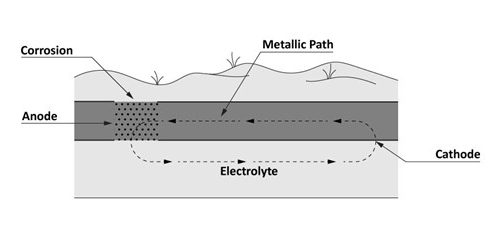
	</div>


	</div>

</div>
<div class="part-wrapper" id="part-select-flame-safeguards-wrapper">
    <div class="part  " id="part-select-flame-safeguards">
	<div class="part-title-wrap">
		<p class="part-number">VI</p>
		<h1 class="part-title">Competency E6: Select Flame Safeguards</h1>
	</div>
	<div class="ugc part-ugc">
		<p>Flame safeguard controls have evolved over the years from very basic flame monitoring and supervision to very complex microprocessor-based control systems. The basic purpose of the flame safety control system is the same for all fuel systems; to ensure the burner will ignite and continue to operate safely until the end of its run sequence.</p> <p>All the ignition and flame supervision systems work on this same basic principle at different levels and complexity. The ways in which the flame is ignited and detected is a primary indication of the system type.</p> <p>Flame sensors are designed to detect the presence of a flame, whether it be the pilot flame or the main burner. Under safe conditions, the control system will allow the burner to operate. If the flame is not detected, the flame sensor will not send a flame signal to the control system and the gas supply to the burner will be shut off.</p> <p>This module will focus only on flame safeguards systems that use a pilot flame for main burner ignition.</p> <div class="textbox textbox--learning-objectives"><div class="textbox__header"><p class="textbox__title">Learning Objectives</p> </div> <div class="textbox__content"><p>After completing the learning tasks in this Competency, you will be able to:</p> <ul><li>Describe pilot ignition systems</li> <li>Describe types of residential gas appliance flame detectors</li> <li>Describe the operation of pilot/thermocouple systems</li> </ul> </div> </div> <p>&nbsp;</p>
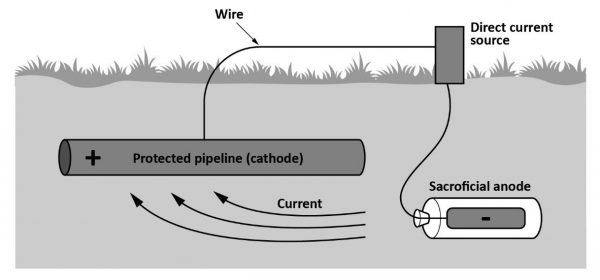
	</div>
			
				
	</div>
<div class="chapter standard with-subsections" id="chapter-describe-pilot-ignition-systems" title="Learning Task 1">
	<div class="chapter-title-wrap">
		<p class="chapter-number">12</p>
		<h1 class="chapter-title">Learning Task 1</h1>
					<p class="chapter-subtitle">Describe Pilot Ignition Systems</p>
			</div>
	<div class="ugc chapter-ugc">
				
 <p>The primary function of a pilot burner is to ignite the main burner flame. Most pilot burners may also serve as a component in the flame safety circuit. As long as the pilot flame is present then the main burner should ignite smoothly therefore the pilot is monitored by a device that will shut of the gas supply to the main burner if the pilot flame is extinguished.</p> <div class="wp-caption aligncenter" aria-describedby="caption-attachment-28" style="width: 314px"><img class="wp-image-153 size-full" src="https://opentextbc.ca/technicalwritingh5p/wp-content/uploads/sites/406/2022/02/Pilot-flame-e1643760236771.jpg" alt="" width="314" height="267" srcset="https://opentextbc.ca/plumbing3e/wp-content/uploads/sites/406/2022/02/Pilot-flame-e1643760236771.jpg 314w, https://opentextbc.ca/plumbing3e/wp-content/uploads/sites/406/2022/02/Pilot-flame-e1643760236771-300x255.jpg 300w, https://opentextbc.ca/plumbing3e/wp-content/uploads/sites/406/2022/02/Pilot-flame-e1643760236771-65x55.jpg 65w, https://opentextbc.ca/plumbing3e/wp-content/uploads/sites/406/2022/02/Pilot-flame-e1643760236771-225x191.jpg 225w" sizes="auto, (max-width: 314px) 100vw, 314px" title=""><div class="wp-caption-text">Figure 1 Pilot flame</div></div> <h1 id="chapter-154-section-1" class="section-header">Pilot Type (Ignition Sequence)</h1> <p>The common types of pilot ignition sequences are: continuous, intermittent and interrupted.</p> <h2>Continuous Pilot</h2> <p>Also known as a “standing pilot”, continuous pilots burn continuously regardless of whether the main burner is firing or not. The continuous flame is needed, as the pilot flame is typically also being used on a heat activated safety device such as a thermocouple. These were often used on residential storage-type hot water tanks and fireplaces but are being phased as the continuous use of fuel decreases the efficiency of the appliance.</p> <h2>Intermittent Pilot</h2> <p>Unlike the continuous pilot, the intermittent pilot is present only during the operation of the main burner, the pilot is ignited by an electronic spark or hot surface igniter when there is a call for heat. Once the pilot is ignited and proven by a flame safeguard device, the control module will allow gas to flow to the main burner for ignition by the pilot flame. The pilot remains lit, and monitored, throughout the main burner cycle and when the call for heat is satisfied, the pilot and main burners are shut off. For efficiency reasons intermittent pilot systems are replacing most previous standing pilot applications.</p> <h2>Interrupted Pilot</h2> <p>These are similar to intermittent pilots, except that the pilot flame extinguishes when the main burner has been ignited. Rather than monitor the pilot flame the flame safeguard will monitored the main burner during its operation until the call for heat is satisfied and then the main burner is extinguished. This system is not common on residential appliances and only used on larger commercial and industrial applications with programable burner management systems.</p> <p><img class="alignleft wp-image-28" src="https://opentextbc.ca/technicalwritingh5p/wp-content/uploads/sites/406/2022/08/noun-check-702756.png" alt="" width="50" height="50" srcset="https://opentextbc.ca/plumbing3e/wp-content/uploads/sites/406/2022/08/noun-check-702756.png 485w, https://opentextbc.ca/plumbing3e/wp-content/uploads/sites/406/2022/08/noun-check-702756-300x300.png 300w, https://opentextbc.ca/plumbing3e/wp-content/uploads/sites/406/2022/08/noun-check-702756-150x150.png 150w, https://opentextbc.ca/plumbing3e/wp-content/uploads/sites/406/2022/08/noun-check-702756-65x65.png 65w, https://opentextbc.ca/plumbing3e/wp-content/uploads/sites/406/2022/08/noun-check-702756-225x225.png 225w, https://opentextbc.ca/plumbing3e/wp-content/uploads/sites/406/2022/08/noun-check-702756-350x350.png 350w" sizes="auto, (max-width: 50px) 100vw, 50px" title="">Now complete Self-Test 1 and check your answers.</p> <p>&nbsp;</p> <h1 id="chapter-154-section-2" class="section-header">Self-Test 1</h1> <div class="textbox textbox--exercises"><div class="textbox__header"><p class="textbox__title">Self-Test 1</p> </div> <div class="textbox__content"><ol><li>What are the three common of pilot ignition systems? <ol type="a"><li>Direct spark, Hot surface, Intermittent</li> <li>Intermittent, Interrupted, Piezo</li> <li>Continuous pilot, Thermocouple, Fame rod</li> <li>Continuous, Intermittent, Interrupted</li> </ol> </li> <li>For which of the pilot ignition systems is the pilot flame typically also being used on a heat activated safety device such as a thermocouple? <ol type="a"><li>Auto Pilot</li> <li>Interrupted pilot</li> <li>Continuous pilot</li> <li>Intermittent Pilot</li> </ol> </li> <li>For which of the pilot ignition systems does the pilot flame remain lit throughout the main burner cycle and when the call for heat is satisfied, the pilot and main burners are shut off? <ol type="a"><li>Auto Pilot</li> <li>Interrupted pilot</li> <li>Continuous pilot</li> <li>Intermittent Pilot</li> </ol> </li> <li>For which of the pilot ignition systems is the pilot flame extinguished when the main burner has been ignited? <ol type="a"><li>Auto Pilot</li> <li>Interrupted pilot</li> <li>Continuous pilot</li> <li>Intermittent Pilot</li> </ol> </li> </ol> <p>Check your answers using the&nbsp;<a href="#back-matter-self-test-answer-keys" data-url="https://opentextbc.ca/plumbing3e/back-matter/self-test-answer-keys/">Self-Test Answer Keys</a>&nbsp;in Appendix 1.</p> </div> </div> <h3>Media Attributions</h3> <ul><li>Figure 1 “Pilot flame” by Camosun College is licensed under a <a href="https://creativecommons.org/licenses/by/4.0/" data-url="https://creativecommons.org/licenses/by/4.0/">CC BY 4.0 licence</a>.</li> </ul> 
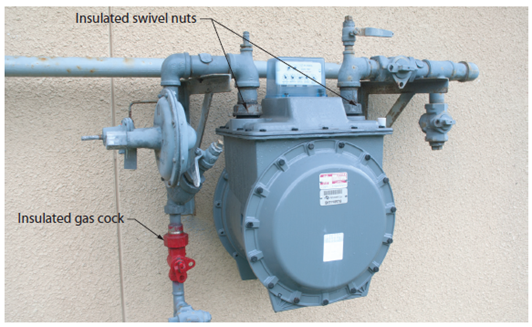
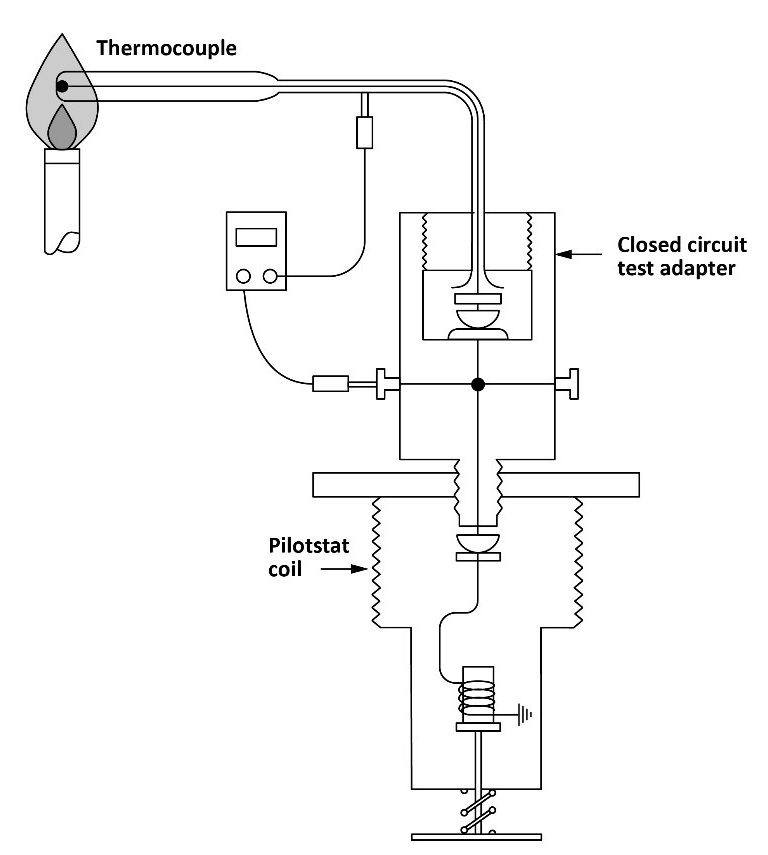
	</div>


	</div>
<div class="chapter standard with-subsections" id="chapter-describe-flame-detectors" title="Learning Task 2">
	<div class="chapter-title-wrap">
		<p class="chapter-number">13</p>
		<h1 class="chapter-title">Learning Task 2</h1>
					<p class="chapter-subtitle">Describe Flame Detectors</p>
			</div>
	<div class="ugc chapter-ugc">
				
 <p>The control system of a gas appliance utilizes flame detection devises to ensure the pilot and or main burner are lit safely. Knowing how flame detectors work, where they are applied, and how they interact with other controls is important to understanding the overall flame safety circuit. Any pilot flame that is supervised by some form of primary safety control designed to sense its presence before prior to gas being admitted to the main burner is referred to as a Proved pilot. The following flame detectors are commonly used with pilot flame ignition systems:</p> <ul><li>Thermocouple</li> <li>Thermopile</li> <li>Flame rod</li> </ul> <h1 id="chapter-165-section-1" class="section-header">Thermocouple</h1> <p>The thermocouple is made of two dissimilar metals joined together at one end called the hot junction. The opposite end, which is not joined together, is called the cold junction (Figure 1). It is important that only <img src="https://opentextbc.ca:3000/latex?latex=XGRmcmFjezN9ezh9&amp;fg=000000&amp;svg=1&amp;isBase64=1" alt="\dfrac{3}{8}" title="\dfrac{3}{8}" class="latex mathjax"> to <img src="https://opentextbc.ca:3000/latex?latex=XGRmcmFjezF9ezJ9&amp;fg=000000&amp;svg=1&amp;isBase64=1" alt="\dfrac{1}{2}" title="\dfrac{1}{2}" class="latex mathjax"> in (10 mm to 13 mm) of the hot junction is heated by the pilot flame, as the greater the temperature difference between the hot and cold junctions, the greater the voltage generated. The thermocouple generates approximately 25 to 30 millivolts (mV), which is enough to power the electromagnet in a safety shut-off valve or safety switch.</p> <div class="wp-caption aligncenter" aria-describedby="caption-attachment-28" style="width: 600px"><img class="wp-image-156" src="https://opentextbc.ca/technicalwritingh5p/wp-content/uploads/sites/406/2022/02/Thermocouple-hot-and-cold-junctions-e1643761014806.jpg" alt="" width="600" height="337" srcset="https://opentextbc.ca/plumbing3e/wp-content/uploads/sites/406/2022/02/Thermocouple-hot-and-cold-junctions-e1643761014806.jpg 934w, https://opentextbc.ca/plumbing3e/wp-content/uploads/sites/406/2022/02/Thermocouple-hot-and-cold-junctions-e1643761014806-300x169.jpg 300w, https://opentextbc.ca/plumbing3e/wp-content/uploads/sites/406/2022/02/Thermocouple-hot-and-cold-junctions-e1643761014806-768x432.jpg 768w, https://opentextbc.ca/plumbing3e/wp-content/uploads/sites/406/2022/02/Thermocouple-hot-and-cold-junctions-e1643761014806-65x37.jpg 65w, https://opentextbc.ca/plumbing3e/wp-content/uploads/sites/406/2022/02/Thermocouple-hot-and-cold-junctions-e1643761014806-225x126.jpg 225w, https://opentextbc.ca/plumbing3e/wp-content/uploads/sites/406/2022/02/Thermocouple-hot-and-cold-junctions-e1643761014806-350x197.jpg 350w" sizes="auto, (max-width: 600px) 100vw, 600px" title=""><div class="wp-caption-text">Figure 1 Thermocouple hot and cold junctions</div></div> <p>One of the ends of the cold junction is connected to the metallic outer sleeve of the thermocouple, while the other end of the cold junction is connected to an insulated wire inside the outer sleeve (Figure 2). The outer sleeve is typically made of constantan a nickel and copper-based which has a constant resistivity over a wide range of temperatures. The ends of the cold junction become the leads to the safety shut-off valve or switch. Commonly, thermocouples are 18, 24, and 36 in (0.5 m, 0.6 m and 0.9 m) long, but models are made as long as 60 in (1.5 m). When replacing a thermocouple, it is important to order one that matches.</p> <div class="wp-caption aligncenter" aria-describedby="caption-attachment-28" style="width: 500px"><img class="wp-image-157 size-full" src="https://opentextbc.ca/technicalwritingh5p/wp-content/uploads/sites/406/2022/08/Thermocouple-construction-e1643761561728.jpg" alt="" width="500" height="337" srcset="https://opentextbc.ca/plumbing3e/wp-content/uploads/sites/406/2022/08/Thermocouple-construction-e1643761561728.jpg 500w, https://opentextbc.ca/plumbing3e/wp-content/uploads/sites/406/2022/08/Thermocouple-construction-e1643761561728-300x202.jpg 300w, https://opentextbc.ca/plumbing3e/wp-content/uploads/sites/406/2022/08/Thermocouple-construction-e1643761561728-65x44.jpg 65w, https://opentextbc.ca/plumbing3e/wp-content/uploads/sites/406/2022/08/Thermocouple-construction-e1643761561728-225x152.jpg 225w, https://opentextbc.ca/plumbing3e/wp-content/uploads/sites/406/2022/08/Thermocouple-construction-e1643761561728-350x236.jpg 350w" sizes="auto, (max-width: 500px) 100vw, 500px" title=""><div class="wp-caption-text">Figure 2 Thermocouple construction</div></div> <p>If the standing pilot flame were to be extinguished there is delay of up to 90 seconds, while the thermocouple cools, before the gas valve shuts off. Therefore, the gas code sets limitations on their uses depending on the gas input to the burner or the type of gas. For example, appliances with a specific gravity greater than air (such as propane), shall have a maximum flame response time of 20 seconds. These appliances will be equipped with fast response thermocouples (Figure 3). As many of these appliances, such as fireplaces, are convertible for either fuel this is the type of thermocouple that is installed.</p> <div class="wp-caption aligncenter" aria-describedby="caption-attachment-28" style="width: 268px"><img class="wp-image-158 size-full" src="https://opentextbc.ca/technicalwritingh5p/wp-content/uploads/sites/406/2022/08/Fast-response-thermocouple-e1643761642612.jpg" alt="" width="268" height="189" srcset="https://opentextbc.ca/plumbing3e/wp-content/uploads/sites/406/2022/08/Fast-response-thermocouple-e1643761642612.jpg 268w, https://opentextbc.ca/plumbing3e/wp-content/uploads/sites/406/2022/08/Fast-response-thermocouple-e1643761642612-65x46.jpg 65w, https://opentextbc.ca/plumbing3e/wp-content/uploads/sites/406/2022/08/Fast-response-thermocouple-e1643761642612-225x159.jpg 225w" sizes="auto, (max-width: 268px) 100vw, 268px" title=""><div class="wp-caption-text">Figure 3 Fast response thermocouple</div></div> <h1 id="chapter-165-section-2" class="section-header">Thermopile</h1> <p>Thermopiles, also known as powerpiles or pilot generators, are similar to thermocouples and generate electricity from the heat of a pilot flame. Internally they consist of multiple thermocouples joined together in series to generate more voltage. Most thermopiles consist of 10 to 30 thermocouples connected in series, creating output ranges from 250 to 750 mV (Figure 4).</p> <div class="wp-caption aligncenter" aria-describedby="caption-attachment-28" style="width: 327px"><img class="wp-image-159 size-full" src="https://opentextbc.ca/technicalwritingh5p/wp-content/uploads/sites/406/2022/08/Thermopiles-from-top-to-bottom-750mV-500-mV-250-mV-e1643761736484.jpg" alt="" width="327" height="226" srcset="https://opentextbc.ca/plumbing3e/wp-content/uploads/sites/406/2022/08/Thermopiles-from-top-to-bottom-750mV-500-mV-250-mV-e1643761736484.jpg 327w, https://opentextbc.ca/plumbing3e/wp-content/uploads/sites/406/2022/08/Thermopiles-from-top-to-bottom-750mV-500-mV-250-mV-e1643761736484-300x207.jpg 300w, https://opentextbc.ca/plumbing3e/wp-content/uploads/sites/406/2022/08/Thermopiles-from-top-to-bottom-750mV-500-mV-250-mV-e1643761736484-65x45.jpg 65w, https://opentextbc.ca/plumbing3e/wp-content/uploads/sites/406/2022/08/Thermopiles-from-top-to-bottom-750mV-500-mV-250-mV-e1643761736484-225x156.jpg 225w" sizes="auto, (max-width: 327px) 100vw, 327px" title=""><div class="wp-caption-text">Figure 4 Thermopiles from top to bottom; 750mV, 500 mV, 250 mV</div></div> <p>The higher voltage enables the thermopile to power an appliance’s combustion safety circuit and its control circuit, as long as the pilot is lit. If the pilot flame should go out, both circuits would be broken and shut off. Thermopiles are made in two designs, either two wire or coaxial (Figure 5). The coaxial style having a very similar connection as a thermocouple.</p> <div class="wp-caption aligncenter" aria-describedby="caption-attachment-28" style="width: 624px"><img class="size-full wp-image-160" src="https://opentextbc.ca/technicalwritingh5p/wp-content/uploads/sites/406/2022/08/Thermopile-types.jpg" alt="" width="624" height="278" srcset="https://opentextbc.ca/plumbing3e/wp-content/uploads/sites/406/2022/08/Thermopile-types.jpg 624w, https://opentextbc.ca/plumbing3e/wp-content/uploads/sites/406/2022/08/Thermopile-types-300x134.jpg 300w, https://opentextbc.ca/plumbing3e/wp-content/uploads/sites/406/2022/08/Thermopile-types-65x29.jpg 65w, https://opentextbc.ca/plumbing3e/wp-content/uploads/sites/406/2022/08/Thermopile-types-225x100.jpg 225w, https://opentextbc.ca/plumbing3e/wp-content/uploads/sites/406/2022/08/Thermopile-types-350x156.jpg 350w" sizes="auto, (max-width: 624px) 100vw, 624px" title=""><div class="wp-caption-text">Figure 5 Thermopile types – Two wire (left), and Coaxial (right)</div></div> <h1 id="chapter-165-section-3" class="section-header">Flame Rod</h1> <p>Many modern appliances have intermittent pilots which will have an electronic ignition system to light the pilot and a flame rod to detect the pilot flame. Flame rods are small diameter metal rods supported by an insulator, the tip-end of the rod projects into the flame(Figure 6).</p> <div class="wp-caption aligncenter" aria-describedby="caption-attachment-28" style="width: 310px"><img class="wp-image-161 size-full" src="https://opentextbc.ca/technicalwritingh5p/wp-content/uploads/sites/406/2022/08/Pilot-burner-e1643761927894.jpg" alt="" width="310" height="277" srcset="https://opentextbc.ca/plumbing3e/wp-content/uploads/sites/406/2022/08/Pilot-burner-e1643761927894.jpg 310w, https://opentextbc.ca/plumbing3e/wp-content/uploads/sites/406/2022/08/Pilot-burner-e1643761927894-300x268.jpg 300w, https://opentextbc.ca/plumbing3e/wp-content/uploads/sites/406/2022/08/Pilot-burner-e1643761927894-65x58.jpg 65w, https://opentextbc.ca/plumbing3e/wp-content/uploads/sites/406/2022/08/Pilot-burner-e1643761927894-225x201.jpg 225w" sizes="auto, (max-width: 310px) 100vw, 310px" title=""><div class="wp-caption-text">Figure 6 Pilot burner with separate flame rod and spark igniter</div></div> <p>For spark ignition systems the rod is typically made of “Kanthol” which is an alloy capable of operating in temperatures of up to 2,400 ºF (1,300 ºC). There is not always a separate flame rod sometimes the spark igniter and flame rod are combined and use the same rod to serve both purposes. For hot surface ignition system, the “Globar” which has a maximum operating temperature of 2,600 ºF (1425 ºC) can also double as the flame rod.</p> <p>The operation of the flame rod is based on principle of flame ionization, whereby ions are formed during combustion process. This ionization process makes the flame a high resistance conductor of electricity. This phenomenon can be used to make a flame act like a switch and complete the flame sensing circuit by allowing a small amount of current to flow whenever the pilot flame is present (Figure 7).</p> <div class="wp-caption aligncenter" aria-describedby="caption-attachment-28" style="width: 300px"><img class="wp-image-162" src="https://opentextbc.ca/technicalwritingh5p/wp-content/uploads/sites/406/2022/08/Electron-flow-through-ionized-flame-e1643762022647.jpg" alt="" width="300" height="375" srcset="https://opentextbc.ca/plumbing3e/wp-content/uploads/sites/406/2022/08/Electron-flow-through-ionized-flame-e1643762022647.jpg 473w, https://opentextbc.ca/plumbing3e/wp-content/uploads/sites/406/2022/08/Electron-flow-through-ionized-flame-e1643762022647-240x300.jpg 240w, https://opentextbc.ca/plumbing3e/wp-content/uploads/sites/406/2022/08/Electron-flow-through-ionized-flame-e1643762022647-65x81.jpg 65w, https://opentextbc.ca/plumbing3e/wp-content/uploads/sites/406/2022/08/Electron-flow-through-ionized-flame-e1643762022647-225x281.jpg 225w, https://opentextbc.ca/plumbing3e/wp-content/uploads/sites/406/2022/08/Electron-flow-through-ionized-flame-e1643762022647-350x437.jpg 350w" sizes="auto, (max-width: 300px) 100vw, 300px" title=""><div class="wp-caption-text">Figure 7 Electron flow through ionized flame</div></div> <p>The original systems developed that used this characteristic were susceptible to potential false flame indications through shorts circuits caused by carbon deposits that could conduct current. The flame rectification system was developed to recognize the difference between high resistance leakage to ground and an actual flame.</p> <h1 id="chapter-165-section-4" class="section-header">Flame Rectification System</h1> <p>When AC voltage is applied across the non-rectified flame conductive system shown in the previous Figure 7 the resulting flame current constantly changes during each half cycle of the AC supply. Consequently, the amount of current is the same in each direction.</p> <p>The flame rectification system also uses two electrodes, but with one important difference: the ground electrode is much larger than the flame electrode. Usually the ground electrode will be the burner head. In some cases, additional metal rods or plates must be added to the burner to increase the grounding surface area, as it must be at least 4 times larger (usually up to 10 times larger) than the flame rod or flame electrode. (Figure 8).</p> <div class="wp-caption aligncenter" aria-describedby="caption-attachment-28" style="width: 586px"><img class="wp-image-163 size-full" src="https://opentextbc.ca/technicalwritingh5p/wp-content/uploads/sites/406/2022/08/Rectified-flame-rod-ground-area-e1643762136917.jpg" alt="Two types of pilot burners with identified parts" width="586" height="371" srcset="https://opentextbc.ca/plumbing3e/wp-content/uploads/sites/406/2022/08/Rectified-flame-rod-ground-area-e1643762136917.jpg 586w, https://opentextbc.ca/plumbing3e/wp-content/uploads/sites/406/2022/08/Rectified-flame-rod-ground-area-e1643762136917-300x190.jpg 300w, https://opentextbc.ca/plumbing3e/wp-content/uploads/sites/406/2022/08/Rectified-flame-rod-ground-area-e1643762136917-65x41.jpg 65w, https://opentextbc.ca/plumbing3e/wp-content/uploads/sites/406/2022/08/Rectified-flame-rod-ground-area-e1643762136917-225x142.jpg 225w, https://opentextbc.ca/plumbing3e/wp-content/uploads/sites/406/2022/08/Rectified-flame-rod-ground-area-e1643762136917-350x222.jpg 350w" sizes="auto, (max-width: 586px) 100vw, 586px" title=""><div class="wp-caption-text">Figure 8 Rectified flame rod ground area</div></div> <p>For a rectified system, when an AC supply voltage is placed across the two electrodes during the first half of the AC cycle, the flame rod is positive and the grounding area is negative (Figure 9 A). The positively charged ions collect on the negative charged grounding area. Since the grounding area is very large, it holds many ions. The positively charged ions pull a high stream of electrons into the flame, more than if the grounding area was the same size as the flame rod. This results in a high current flowing from the grounding area to the flame rod during the first half cycle of the AC supply voltage (Figure 9 C).</p> <div class="wp-caption aligncenter" aria-describedby="caption-attachment-28" style="width: 600px"><img class="wp-image-164" src="https://opentextbc.ca/technicalwritingh5p/wp-content/uploads/sites/406/2022/08/Current-flow-in-a-flame-rectification-system-e1643762266489.jpg" alt="9A: first half of AC circle. 9B&amp;quot; second half of AC circle. 9C shows the changes of ion charge of the full cycle" width="600" height="277" srcset="https://opentextbc.ca/plumbing3e/wp-content/uploads/sites/406/2022/08/Current-flow-in-a-flame-rectification-system-e1643762266489.jpg 1369w, https://opentextbc.ca/plumbing3e/wp-content/uploads/sites/406/2022/08/Current-flow-in-a-flame-rectification-system-e1643762266489-300x138.jpg 300w, https://opentextbc.ca/plumbing3e/wp-content/uploads/sites/406/2022/08/Current-flow-in-a-flame-rectification-system-e1643762266489-1024x473.jpg 1024w, https://opentextbc.ca/plumbing3e/wp-content/uploads/sites/406/2022/08/Current-flow-in-a-flame-rectification-system-e1643762266489-768x355.jpg 768w, https://opentextbc.ca/plumbing3e/wp-content/uploads/sites/406/2022/08/Current-flow-in-a-flame-rectification-system-e1643762266489-65x30.jpg 65w, https://opentextbc.ca/plumbing3e/wp-content/uploads/sites/406/2022/08/Current-flow-in-a-flame-rectification-system-e1643762266489-225x104.jpg 225w, https://opentextbc.ca/plumbing3e/wp-content/uploads/sites/406/2022/08/Current-flow-in-a-flame-rectification-system-e1643762266489-350x162.jpg 350w" sizes="auto, (max-width: 600px) 100vw, 600px" title=""><div class="wp-caption-text">Figure 9 Current flow in a flame rectification system</div></div> <p>During the second half cycle, the reverse process takes place (Figure9 B). However, the capacity of the flame rod to hold ions is less than the grounding area and the resulting flame current is smaller (Figure 9C).</p> <p>Since the current in one direction is so much larger than the current in the other direction, the resultant current is, effectively, a pulsating direct current (Figure 9C). The flame signal should be steady when measured with a DC microammeter (μA).</p> <p>The advantage of a rectified system over a conductivity system is that the rectified system can detect a high resistance leak. Sometimes a short circuit occurs between the flame rod and ground; carbon may build up between the rods or the insulating ceramics may crack and allow moisture to provide a path to ground. If this occurs, the current flow is the same in both directions and this signal would be rejected by the flame safeguard control as a flame failure.</p> <p><img class="alignleft wp-image-28" src="https://opentextbc.ca/technicalwritingh5p/wp-content/uploads/sites/406/2022/08/noun-check-702756.png" alt="" width="50" height="50" srcset="https://opentextbc.ca/plumbing3e/wp-content/uploads/sites/406/2022/08/noun-check-702756.png 485w, https://opentextbc.ca/plumbing3e/wp-content/uploads/sites/406/2022/08/noun-check-702756-300x300.png 300w, https://opentextbc.ca/plumbing3e/wp-content/uploads/sites/406/2022/08/noun-check-702756-150x150.png 150w, https://opentextbc.ca/plumbing3e/wp-content/uploads/sites/406/2022/08/noun-check-702756-65x65.png 65w, https://opentextbc.ca/plumbing3e/wp-content/uploads/sites/406/2022/08/noun-check-702756-225x225.png 225w, https://opentextbc.ca/plumbing3e/wp-content/uploads/sites/406/2022/08/noun-check-702756-350x350.png 350w" sizes="auto, (max-width: 50px) 100vw, 50px" title="">Now complete Self-Test 2 and check your answers.</p> <p>&nbsp;</p> <h1 id="chapter-165-section-5" class="section-header">Self-Test 2</h1> <div class="textbox textbox--exercises"><div class="textbox__header"><p class="textbox__title">Self-Test 2</p> </div> <div class="textbox__content"><ol><li>The point at which the two dissimilar metals are joined on a thermocouple is known as what? <ol type="a"><li>Anode</li> <li>Hot junction</li> <li>Cold junction</li> <li>Galvanic junction</li> </ol> </li> <li>Thermocouples are used with which type of pilot? <ol type="a"><li>Direct Pilot</li> <li>Standing pilot</li> <li>Interrupted pilot</li> <li>Intermittent pilot</li> </ol> </li> <li>What portion of the hot junction should be heated by the pilot flame? <ol type="a"><li>Full length of thermocouple</li> <li>½″ away from the top</li> <li>First 0.375″ to 0.5″ thermocouple</li> <li>Bottom/Base ½″ of thermocouple</li> </ol> </li> <li>What does a thermocouple power when it is being heated? <ol type="a"><li>Fan</li> <li>Safety coil</li> <li>Thermostat</li> <li>Main gas valve</li> </ol> </li> <li>A thermopile contains approximately 10 to 30 thermocouples? <ol type="a"><li>True</li> <li>False</li> </ol> </li> <li>How are multiple thermocouples electrically connected within a thermopile? <ol type="a"><li>Series</li> <li>Parallel</li> </ol> </li> <li>What setting should a multimeter be on measuring the flame sensing circuit? <ol type="a"><li>&nbsp;μAmps DC</li> <li>μVolts AC</li> <li>μAmps AC</li> <li>μVolts DC</li> </ol> </li> <li>Flame rods for spark ignition systems are typically made of what high temperature resistant alloy? <ol type="a"><li>Stainless steel</li> <li>Constantan</li> <li>Kanthol</li> <li>Inconel</li> </ol> </li> </ol> <p>Check your answers using the&nbsp;<a href="#back-matter-self-test-answer-keys" data-url="https://opentextbc.ca/plumbing3e/back-matter/self-test-answer-keys/">Self-Test Answer Keys</a>&nbsp;in Appendix 1.</p> </div> </div> <h3>Media Attributions</h3> <ul><li>Figure 1 “Thermocouple hot and cold junctions” by Camosun College is licensed under a <a href="https://creativecommons.org/licenses/by/4.0/" data-url="https://creativecommons.org/licenses/by/4.0/">CC BY 4.0 licence</a>.</li> <li>Figure 2 “Thermocouple construction” by <span class="TextRun SCXW22992951 BCX0" xml:lang="EN-CA" data-contrast="auto"><span class="NormalTextRun SCXW22992951 BCX0">Trades Training BC is licensed under a&nbsp;<a href="https://creativecommons.org/licenses/by/4.0/" data-url="https://creativecommons.org/licenses/by/4.0/">CC BY 4.0 licence</a>.</span></span></li> <li>Figure 3 “Fast response thermocouple” by Camosun College is licensed under a <a href="https://creativecommons.org/licenses/by/4.0/" data-url="https://creativecommons.org/licenses/by/4.0/">CC BY 4.0 licence</a>.</li> <li>Figure 4 “Thermopiles from top to bottom; 750mV, 500 mV, 250 mV” by Camosun College is licensed under a <a href="https://creativecommons.org/licenses/by/4.0/" data-url="https://creativecommons.org/licenses/by/4.0/">CC BY 4.0 licence</a>.</li> <li>Figure 5 “Thermopile types – Two wire and Coaxial (right)” by Camosun College is licensed under a <a href="https://creativecommons.org/licenses/by/4.0/" data-url="https://creativecommons.org/licenses/by/4.0/">CC BY 4.0 licence</a>.</li> <li>Figure 6 “Pilot burner with separate flame rod and spark igniter” by Camosun College is licensed under a <a href="https://creativecommons.org/licenses/by/4.0/" data-url="https://creativecommons.org/licenses/by/4.0/">CC BY 4.0 licence</a>.</li> <li>Figure 7 “Electron flow through ionized flame” by Camosun College is licensed under a <a href="https://creativecommons.org/licenses/by/4.0/" data-url="https://creativecommons.org/licenses/by/4.0/">CC BY 4.0 licence</a>.</li> <li>Figure 8 “Rectified flame rod ground area” by Camosun College is licensed under a <a href="https://creativecommons.org/licenses/by/4.0/" data-url="https://creativecommons.org/licenses/by/4.0/">CC BY 4.0 licence</a>.</li> <li>Figure 9 “Current flow in a flame rectification system” by Camosun College is licensed under a <a href="https://creativecommons.org/licenses/by/4.0/" data-url="https://creativecommons.org/licenses/by/4.0/">CC BY 4.0 licence</a>.</li> </ul> 

	</div>


	</div>
<div class="chapter standard with-subsections" id="chapter-describe-pilot-thermocouple-systems" title="Learning Task 3">
	<div class="chapter-title-wrap">
		<p class="chapter-number">14</p>
		<h1 class="chapter-title">Learning Task 3</h1>
					<p class="chapter-subtitle">Describe Pilot Thermocouple Systems</p>
			</div>
	<div class="ugc chapter-ugc">
				
 <p>The combustion safety circuit detects the presence or absence of a flame. If a flame is not proven, the combustion safety circuit prevents or terminates the flow of gas to the main burner and/or pilot burner. Combustion safety circuits incorporating standing pilots use a thermocouple or thermopile to detect the presence of a pilot flame. The use of thermally activated systems is limited by their slower responds time than electronic systems. The Gas Code stipulates that a combustion safety control system must de-energize the main burner fuel shut-off valve in the event of flame failure within 90 seconds for gases that are lighter than air, and within 20 seconds for gases heavier than air when the appliance has a maximum input of 120 kW (400,000 Btuh) or an appliance with a maximum input of 300 kW (1,000,000 Btuh) if it is atmospherically fired and it has an unrestricted vertical flow of combustion products. Appliances with an input in excess of 120 kW (400,000 Btuh) must have a flame failure response time that is within 4 seconds.</p> <p>Although standing pilot systems have been largely replaced by intermittent pilot systems, they are still common on commercial kitchen equipment as well as existing gas fireplaces and storage water heaters, that may require servicing.</p> <h1 id="chapter-173-section-1" class="section-header">Standing Pilot Combustion Safety Circuits</h1> <p>Combustion safety circuits incorporating standing pilots can be designed to mechanically interrupt the flow of gas with a safety shut-off valve, or to electrically interrupt the control circuit using a safety switch.</p> <h2>Pilot Safety Shut-Off Valve Systems</h2> <p>A safety shut-off valve can only be used where there is a constant pilot supervised by a thermocouple or thermopile. The safety shut-off valve is also referred to as a Pilotstat, as it thermally monitors the pilot flame. The safety shut-off valve is controlled by an internal electromagnet (solenoid) which is powered by the energy produced by the thermocouple being heated by the pilot flame. As long as the pilot is lit, the thermocouple supplies enough voltage to energize the safety shut-off valve. If the pilot light blows out, the thermocouple begins to cool and the current flow through the coil of the electromagnet weakens. This causes the magnetic field to weaken to the point where the spring force overcomes the electromagnetic force and the solenoid releases the keeper plate (Figure 1), and the valve snaps closed stopping the flow of gas.</p> <div class="wp-caption aligncenter" aria-describedby="caption-attachment-28" style="width: 500px"><img class="wp-image-167" src="https://opentextbc.ca/technicalwritingh5p/wp-content/uploads/sites/406/2022/02/Thermocouple-safety-shut-off-valve-system-e1643762790405.jpg" alt="" width="500" height="598" srcset="https://opentextbc.ca/plumbing3e/wp-content/uploads/sites/406/2022/02/Thermocouple-safety-shut-off-valve-system-e1643762790405.jpg 910w, https://opentextbc.ca/plumbing3e/wp-content/uploads/sites/406/2022/02/Thermocouple-safety-shut-off-valve-system-e1643762790405-251x300.jpg 251w, https://opentextbc.ca/plumbing3e/wp-content/uploads/sites/406/2022/02/Thermocouple-safety-shut-off-valve-system-e1643762790405-856x1024.jpg 856w, https://opentextbc.ca/plumbing3e/wp-content/uploads/sites/406/2022/02/Thermocouple-safety-shut-off-valve-system-e1643762790405-768x919.jpg 768w, https://opentextbc.ca/plumbing3e/wp-content/uploads/sites/406/2022/02/Thermocouple-safety-shut-off-valve-system-e1643762790405-65x78.jpg 65w, https://opentextbc.ca/plumbing3e/wp-content/uploads/sites/406/2022/02/Thermocouple-safety-shut-off-valve-system-e1643762790405-225x269.jpg 225w, https://opentextbc.ca/plumbing3e/wp-content/uploads/sites/406/2022/02/Thermocouple-safety-shut-off-valve-system-e1643762790405-350x419.jpg 350w" sizes="auto, (max-width: 500px) 100vw, 500px" title=""><div class="wp-caption-text">Figure 1 Thermocouple safety shut-off valve system, (closed position)</div></div> <p>In 100% safe systems, the valve shuts off the gas to both the main burner and the pilot light. Non-100% safe systems only shut off gas to the main burner. The safety shut-off valve is often one component within a combination gas valve. Figure 2 shows the thermocouple connected to the safety shutoff valve, that has been removed and placed in front of the appliance combination gas valve. The gas enters at the connection on the left therefore the safety shut-off valve is the first internal component, that the gas must flow through, within this combined gas valve. Since the closing of the Safety shut-off valve would stop the flow to both the pilot and main burners (Figure 1), this is referred to as a 100% safe system.</p> <div class="wp-caption aligncenter" aria-describedby="caption-attachment-28" style="width: 224px"><img class="size-full wp-image-168" src="https://opentextbc.ca/technicalwritingh5p/wp-content/uploads/sites/406/2022/08/Thermocouple-connected-to-the-removed-safety-shutoff-valve.jpg" alt="" width="224" height="345" srcset="https://opentextbc.ca/plumbing3e/wp-content/uploads/sites/406/2022/08/Thermocouple-connected-to-the-removed-safety-shutoff-valve.jpg 224w, https://opentextbc.ca/plumbing3e/wp-content/uploads/sites/406/2022/08/Thermocouple-connected-to-the-removed-safety-shutoff-valve-195x300.jpg 195w, https://opentextbc.ca/plumbing3e/wp-content/uploads/sites/406/2022/08/Thermocouple-connected-to-the-removed-safety-shutoff-valve-65x100.jpg 65w" sizes="auto, (max-width: 224px) 100vw, 224px" title=""><div class="wp-caption-text">Figure 2 Thermocouple connected to the removed safety shutoff valve</div></div> <h3>Lighting a standing pilot system</h3> <p>These instructions are only meant as a general explanation of standing pilot systems. It is important to thoroughly read and understand the manufactures lighting Instructions before attempting to operate any gas appliances. Before operating any gas appliance smell around the area, if you detect a gas odour do not try and light any appliances and take the appropriate precautions.</p> <ul><li>Make sure that the thermostat is turned down so the main burner does not light until you are prepared for it.</li> <li>The combination gas valve will typically have a knob with three positions; On, Pilot and Off. Turn the knob to the off position and wait three minutes for any potential residual gas within the combustion chamber to clear.</li> <li>Confirm that the pilot burner is not light, the pilot burner will be located within the burner chamber near the end of the pilot tube and thermocouple. This will typically be located within a closed chamber and only viewed though a viewing window.</li> <li>Turn the control valve knob to the “Pilot” position.</li> <li>Press the manual reset button, this will compress the spring and hold a spring against the electromagnet and will also hold the pilot valve open allowing gas to flow to the pilot burner.</li> <li>Light the pilot burner by pressing the spark ignition button repeatedly until you see a pilot light flame.</li> <li>Allow the pilot flame to heat the thermocouple for about a minute, or until the pilot relay (electromagnet) holds the pilot valve open.</li> <li>Release the reset button.</li> <li>The pilot relay electromagnetic coil (solenoid) will hold the shut-off valve open and the pilot should remain lit. While the upper spring will push the reset button back out and open the main gas stop enabling gas to flow to the next chamber within the gas valve.</li> <li>The gas valve knob can now be turned to the “on” position and set the thermostat to the desired temperature and the main burner should ignite.</li> </ul> <p>If after the heating period the pilot will not remain lit, wait for 10-minutes before attempting again. After several attempts if the pilot will not remain lit, then the pilot safety circuit may be faulty.</p> <h2>Troubleshooting the Pilot Safety Circuit</h2> <p>If the standing pilot will not remain lit it could be due to a number of problems, including:</p> <ul><li>Incorrectly positioned or adjusted pilot flame</li> <li>Loose thermocouple connection to the gas valve</li> <li>Defective thermocouple</li> <li>Defective pilotstat coil</li> </ul> <h3>Pilot flame positioning</h3> <p>To produce the correct voltage, the thermocouple or thermopile must be correctly positioned in the pilot flame with the proper flame characteristics as shown in Figure 3. It is important that only <img src="https://opentextbc.ca:3000/latex?latex=XGRmcmFjezN9ezh9&amp;fg=000000&amp;svg=1&amp;isBase64=1" alt="\dfrac{3}{8}" title="\dfrac{3}{8}" class="latex mathjax"> to <img src="https://opentextbc.ca:3000/latex?latex=XGRmcmFjezF9ezJ9&amp;fg=000000&amp;svg=1&amp;isBase64=1" alt="\dfrac{1}{2}" title="\dfrac{1}{2}" class="latex mathjax"> in (10 mm to 13 mm) of the hot junction is heated by the pilot flame, and that no other part of the thermocouple is heated. The greater the temperature difference between the hot and cold junctions, the greater the voltage generated.</p> <div class="wp-caption aligncenter" aria-describedby="caption-attachment-28" style="width: 400px"><img class="wp-image-169" src="https://opentextbc.ca/technicalwritingh5p/wp-content/uploads/sites/406/2022/08/Standing-pilot-flame-position-e1643824050297.jpg" alt="" width="400" height="430" srcset="https://opentextbc.ca/plumbing3e/wp-content/uploads/sites/406/2022/08/Standing-pilot-flame-position-e1643824050297.jpg 645w, https://opentextbc.ca/plumbing3e/wp-content/uploads/sites/406/2022/08/Standing-pilot-flame-position-e1643824050297-279x300.jpg 279w, https://opentextbc.ca/plumbing3e/wp-content/uploads/sites/406/2022/08/Standing-pilot-flame-position-e1643824050297-65x70.jpg 65w, https://opentextbc.ca/plumbing3e/wp-content/uploads/sites/406/2022/08/Standing-pilot-flame-position-e1643824050297-225x242.jpg 225w, https://opentextbc.ca/plumbing3e/wp-content/uploads/sites/406/2022/08/Standing-pilot-flame-position-e1643824050297-350x376.jpg 350w" sizes="auto, (max-width: 400px) 100vw, 400px" title=""><div class="wp-caption-text">Figure 3 Standing pilot flame position</div></div> <h3>Loose thermocouple connection</h3> <p>If the thermocouple connection to the control valve is loose then tighten it a ¼ turn past hand tight. You can also remove the thermocouple and check the terminal to make sure it is not broken or cracked. Ensure the threads are in good order and not restricting the end of the thermocouple from making internal contact.</p> <h3>Thermocouple test</h3> <p>To test for a defective thermocouple, use a millivolt-meter or a multi-meter.</p> <p>The two tests for a faulty thermocouple are:</p> <ul><li>Open-circuit test</li> <li>Closed-circuit test</li> </ul> <h4>Open-circuit test</h4> <p>A thermocouple should produce approximately 30 mV of potential energy when it is not under load.</p> <p>A voltmeter that will measure low range dc millivoltage is required to perform this test. Most digital meters meet this requirement; however, only special analogue meters are suitable for this application. Always ensure that the proper meter is used for this test.</p> <p>Perform the open circuit test when the thermocouple is not under load; therefore, before starting the test, disconnect the thermocouple from the pilotstat. (Figure 4):</p> <ul><li>Select a scale on the millivoltmeter suitable for reading a maximum 30 mV.</li> <li>Connect one lead of the meter to the outer constantan conductor of the thermocouple and the other lead to the end of the inner conductor.</li> <li>With a pilot flame heating the hot junction of the thermocouple, it should read approximately 30 mV.</li> <li>Replace the thermocouple if it produces less than 20 mV.</li> </ul> <div class="wp-caption aligncenter" aria-describedby="caption-attachment-28" style="width: 500px"><img class="wp-image-170" src="https://opentextbc.ca/technicalwritingh5p/wp-content/uploads/sites/406/2022/08/Open-thermocouple-test-e1643824757463.jpg" alt="" width="500" height="199" srcset="https://opentextbc.ca/plumbing3e/wp-content/uploads/sites/406/2022/08/Open-thermocouple-test-e1643824757463.jpg 1021w, https://opentextbc.ca/plumbing3e/wp-content/uploads/sites/406/2022/08/Open-thermocouple-test-e1643824757463-300x119.jpg 300w, https://opentextbc.ca/plumbing3e/wp-content/uploads/sites/406/2022/08/Open-thermocouple-test-e1643824757463-768x305.jpg 768w, https://opentextbc.ca/plumbing3e/wp-content/uploads/sites/406/2022/08/Open-thermocouple-test-e1643824757463-65x26.jpg 65w, https://opentextbc.ca/plumbing3e/wp-content/uploads/sites/406/2022/08/Open-thermocouple-test-e1643824757463-225x89.jpg 225w, https://opentextbc.ca/plumbing3e/wp-content/uploads/sites/406/2022/08/Open-thermocouple-test-e1643824757463-350x139.jpg 350w" sizes="auto, (max-width: 500px) 100vw, 500px" title=""><div class="wp-caption-text">Figure 4 Open thermocouple test</div></div> <p>Inspect the heated end for excessive wear and burned casing, if it appears questionable, the best action is to replace the thermocouple.</p> <h4>Closed-circuit test</h4> <p>All DC voltage sources have an internal or source resistance that can be observed, but not directly measured. To observe the source resistance a second resistance (load) must be connected through a completed circuit. To understand the change in readings between the open and closed-circuit test, and how they relate to the source resistance, it is important to remember the voltage drop laws. The sum of all of the voltage losses will equal the voltage output.</p> <p>The closed-circuit test will show the millivoltage drop that is being caused by the resistance of the magnetic pilotstat coil compared to the observed amount caused by the internal resistance of the thermocouple itself.</p> <p>In order perform the closed-circuit test a thermocouple test adapter is required (Figure 5), which will enable the meter to be connected in parallel with the load/coil.</p> <div class="wp-caption aligncenter" aria-describedby="caption-attachment-28" style="width: 302px"><img class="wp-image-171 size-full" src="https://opentextbc.ca/technicalwritingh5p/wp-content/uploads/sites/406/2022/08/Thermocouple-adapters-e1643825229614.jpg" alt="" width="302" height="204" srcset="https://opentextbc.ca/plumbing3e/wp-content/uploads/sites/406/2022/08/Thermocouple-adapters-e1643825229614.jpg 302w, https://opentextbc.ca/plumbing3e/wp-content/uploads/sites/406/2022/08/Thermocouple-adapters-e1643825229614-300x203.jpg 300w, https://opentextbc.ca/plumbing3e/wp-content/uploads/sites/406/2022/08/Thermocouple-adapters-e1643825229614-65x44.jpg 65w, https://opentextbc.ca/plumbing3e/wp-content/uploads/sites/406/2022/08/Thermocouple-adapters-e1643825229614-225x152.jpg 225w" sizes="auto, (max-width: 302px) 100vw, 302px" title=""><div class="wp-caption-text">Figure 5 Thermocouple adapters</div></div> <p>This will test the performance of the thermocouple under load conditions. At the end with the same connections setup, the pilotstat coil can be tested to determine its condition (Figure 6).<br> A closed-circuit test is completed as follows:</p> <ul><li>Disconnect the thermocouple from the pilotstat and install the test adapter.</li> <li>Reconnect the thermocouple to the top of the test adapter and relight the pilot burner.</li> <li>Connect one test lead to the outer conductor of the thermocouple and the other test lead to the side terminal on the test adaptor (watch polarity). <ul><li>Since the side terminal of the test adaptor is internally connected to the inner conductor of the thermocouple, a voltage drop test can be performed while the circuit is energized. This test will measure the voltage drop across the pilotstat coil only, the difference between this reading and the open circuit test represents the energy that is lost within the internal resistance of the thermocouple itself.</li> </ul> </li> <li>The meter should read about 15 mV if both the thermocouple and Pilotstat are in good condition. <ul><li>Notice that this is approximately one-half of the open circuit voltage, the other half of the energy is lost within the internal resistance of the thermocouple itself.</li> <li>If the closed-circuit voltage should drop to below 10 mV, replace the thermocouple as it is consuming more than its share of the energy produced.</li> </ul> </li> </ul> <div class="wp-caption aligncenter" aria-describedby="caption-attachment-28" style="width: 500px"><img class="wp-image-172" src="https://opentextbc.ca/technicalwritingh5p/wp-content/uploads/sites/406/2022/08/Closed-thermocouple-circuit-test-e1643826332766.jpg" alt="" width="500" height="557" srcset="https://opentextbc.ca/plumbing3e/wp-content/uploads/sites/406/2022/08/Closed-thermocouple-circuit-test-e1643826332766.jpg 768w, https://opentextbc.ca/plumbing3e/wp-content/uploads/sites/406/2022/08/Closed-thermocouple-circuit-test-e1643826332766-269x300.jpg 269w, https://opentextbc.ca/plumbing3e/wp-content/uploads/sites/406/2022/08/Closed-thermocouple-circuit-test-e1643826332766-65x72.jpg 65w, https://opentextbc.ca/plumbing3e/wp-content/uploads/sites/406/2022/08/Closed-thermocouple-circuit-test-e1643826332766-225x250.jpg 225w, https://opentextbc.ca/plumbing3e/wp-content/uploads/sites/406/2022/08/Closed-thermocouple-circuit-test-e1643826332766-350x390.jpg 350w" sizes="auto, (max-width: 500px) 100vw, 500px" title=""><div class="wp-caption-text">Figure 6 Closed thermocouple circuit test</div></div> <h3>Pilotstat magnetic coil test</h3> <p>A voltage drop across the coil of 2 mV to 5mV should create enough of a magnetic field to operate the pilotstat and hold the valve open. Also, of the valve stays open with a voltage drop below 2 mV it is sticking or the spring has weakened.</p> <p>These conditions can be checked using the same meter connection setup as the closed-circuit test (Figure 6):</p> <ul><li>Connect one lead of the millivoltmeter to the outer constantan conductor and the other to the terminal on the side of the test adaptor (check polarity).<br> Under normal operation, the voltage reading is between 10 and 15 mV.</li> <li>Blow out the pilot gas and allow the thermocouple to cool.<br> As it cools, watch the millivoltmeter and notice that the reading is slowly decreasing.</li> <li>The coil of the pilotstat should create enough magnetic field to hold the valve open until the millivoltage drops between 5 and 2 mV.<br> This drop out of the coil should take place within 90 seconds from flame failure, to meet the requirements of the CSA B149.1 Gas Code</li> </ul> <p><img class="wp-image-28 alignleft" src="https://opentextbc.ca/technicalwritingh5p/wp-content/uploads/sites/406/2022/08/noun-check-702756.png" alt="" width="50" height="50" srcset="https://opentextbc.ca/plumbing3e/wp-content/uploads/sites/406/2022/08/noun-check-702756.png 485w, https://opentextbc.ca/plumbing3e/wp-content/uploads/sites/406/2022/08/noun-check-702756-300x300.png 300w, https://opentextbc.ca/plumbing3e/wp-content/uploads/sites/406/2022/08/noun-check-702756-150x150.png 150w, https://opentextbc.ca/plumbing3e/wp-content/uploads/sites/406/2022/08/noun-check-702756-65x65.png 65w, https://opentextbc.ca/plumbing3e/wp-content/uploads/sites/406/2022/08/noun-check-702756-225x225.png 225w, https://opentextbc.ca/plumbing3e/wp-content/uploads/sites/406/2022/08/noun-check-702756-350x350.png 350w" sizes="auto, (max-width: 50px) 100vw, 50px" title=""></p> <p>Now complete Self-Test 3 and check your answers.</p> <p>&nbsp;</p> <h1 id="chapter-173-section-2" class="section-header">Self-Test 3</h1> <div class="textbox textbox--exercises"><div class="textbox__header"><p class="textbox__title">Self-Test 3</p> </div> <div class="textbox__content"><ol><li>What is the primary purpose of a thermocouple? <ol type="a"><li>&nbsp;To monitor the main burner</li> <li>To energize the gas valve</li> <li>To prove that the pilot is lit</li> <li>To supply power to the thermostat</li> </ol> </li> <li>What is the maximum time allowed in the event of pilot outage for the thermocouple to cool down and stop the flow of gas to the burner? <ol type="a"><li>45 seconds</li> <li>60 seconds</li> <li>90 seconds</li> <li>120 seconds</li> </ol> </li> <li>What type of current do thermocouples and thermopiles produce? <ol type="a"><li>AC</li> <li>DC</li> <li>3-phase</li> <li>Magnetic</li> </ol> </li> <li>A thermocouple must be under load to perform an open circuit test. True or False? <ol type="a"><li>True</li> <li>False</li> </ol> </li> <li>What reading should an open circuit test on a thermocouple produce? <ol type="a"><li>9 mV</li> <li>17 mV</li> <li>30 mV</li> <li>250 or 750 mV</li> </ol> </li> <li>What does a closed-circuit test show? <ol type="a"><li>Pilot stat dropout millivolts</li> <li>Millivolt output not under load</li> <li>Millivolt output unheated thermocouple</li> <li>Millivolt maintained under load</li> </ol> </li> <li>A thermocouple should be replaced if it cannot produce a closed circuit reading of more than. <ol type="a"><li>2 mV</li> <li>9 mV</li> <li>20 mV</li> <li>30 mV</li> </ol> </li> <li>During a pilotstat coil test at what mV reading should the coil drop out? <ol type="a"><li>Between 2-1 mV</li> <li>Between 5-2 mV</li> <li>Between 20-15 mV</li> <li>Between 30-15 mV</li> </ol> </li> </ol> <p>Check your answers using the&nbsp;<a href="#back-matter-self-test-answer-keys" data-url="https://opentextbc.ca/plumbing3e/back-matter/self-test-answer-keys/">Self-Test Answer Keys</a>&nbsp;in Appendix 1.</p> </div> </div> <h3>Media Attributions</h3> <ul><li>Figure 1 “Thermocouple safety shut-off valve system” by Camosun College is licensed under a <a href="https://creativecommons.org/licenses/by/4.0/" data-url="https://creativecommons.org/licenses/by/4.0/">CC BY 4.0 licence</a>.</li> <li>Figure 2 “Thermocouple connected to the removed safety shutoff valve” by Camosun College is licensed under a <a href="https://creativecommons.org/licenses/by/4.0/" data-url="https://creativecommons.org/licenses/by/4.0/">CC BY 4.0 licence</a>.</li> <li>Figure 3 “Standing pilot flame position” by Camosun College is licensed under a <a href="https://creativecommons.org/licenses/by/4.0/" data-url="https://creativecommons.org/licenses/by/4.0/">CC BY 4.0 licence</a>.</li> <li>Figure 4 “Open thermocouple test” by Camosun College is licensed under a <a href="https://creativecommons.org/licenses/by/4.0/" data-url="https://creativecommons.org/licenses/by/4.0/">CC BY 4.0 licence</a>.</li> <li>Figure 5 “Thermocouple adapters” by Camosun College is licensed under a <a href="https://creativecommons.org/licenses/by/4.0/" data-url="https://creativecommons.org/licenses/by/4.0/">CC BY 4.0 licence</a>.</li> <li>Figure 6 “Closed thermocouple circuit test” by Camosun College is licensed under a <a href="https://creativecommons.org/licenses/by/4.0/" data-url="https://creativecommons.org/licenses/by/4.0/">CC BY 4.0 licence</a>.</li> </ul> 

	</div>


	</div>

</div>
<div class="back-matter appendix with-subsections" id="back-matter-self-test-answer-keys" title="Appendix 1: Self-Test Answer Keys">
	<div class="back-matter-title-wrap">
		<p class="back-matter-number">1</p>
		<h1 class="back-matter-title">Appendix 1: Self-Test Answer Keys</h1>
								</div>
	<div class="ugc back-matter-ugc">
				
 <h1 id="back-matter-175-section-1" class="section-header">Competency E1</h1> <h2>Self-Test 1</h2> <ol class="threecolumn"><li>C</li> <li>B</li> <li>C</li> <li>A</li> <li>A</li> </ol> <h2>Self-Test 2</h2> <ol class="threecolumn"><li>B</li> <li>C</li> <li>A</li> <li>B</li> <li>D</li> <li>D</li> </ol> <h2>Self-Test 3</h2> <ol class="threecolumn"><li>B</li> <li>B</li> <li>B</li> <li>C</li> <li>D</li> <li>B</li> <li>A</li> <li>A</li> <li>B</li> </ol> <h1 id="back-matter-175-section-2" class="section-header">Competency E2</h1> <h2>Self-Test 1</h2> <ol class="threecolumn"><li>D</li> <li>B</li> <li>B</li> <li>B</li> <li>B</li> <li>D</li> <li>B</li> <li>C</li> <li>A</li> <li>B</li> <li>B</li> <li>B</li> <li>B</li> <li>A</li> <li>C</li> </ol> <h1 id="back-matter-175-section-3" class="section-header">Competency E3</h1> <h2>Self-Test 1</h2> <ol class="threecolumn"><li>A</li> <li>B</li> <li>B</li> <li>A</li> <li>D</li> <li>D</li> <li>B</li> <li>&nbsp;C, D, A, B</li> <li>B</li> <li>A</li> <li>A</li> <li>A</li> <li>A</li> </ol> <h2>Self-Test 2</h2> <ol><li><table style="border-collapse: collapse; width: 100%;"><tbody><tr><th style="width: 50%;" scope="row">Type of Gas</th> <td style="width: 50%;">Natural Gas</td> </tr> <tr><th style="width: 50%;" scope="row">Piping Material</th> <td style="width: 50%;">Steel</td> </tr> <tr><th style="width: 50%;" scope="row">System Pressure</th> <td style="width: 50%;">1.75 kPa</td> </tr> <tr><th style="width: 50%;" scope="row">Table Used</th> <td style="width: 50%;">A.2 (b) Metric</td> </tr> <tr><th style="width: 50%;" scope="row">Table Allowable Pressure Drop</th> <td style="width: 50%;">250 Pa</td> </tr> <tr><th style="width: 50%;" scope="row">Longest Measured Run (LMR)</th> <td style="width: 50%;">12 m</td> </tr> <tr><th style="width: 50%;" scope="row">Code Zone (CZ)</th> <td style="width: 50%;">12 m</td> </tr> </tbody> </table> <table style="border-collapse: collapse; width: 100%;"><tbody><tr><th style="width: 33.3333%;" scope="col">Pipe Letter</th> <th style="width: 33.3333%;" scope="col">Pipe Load</th> <th style="width: 33.3333%;" scope="col">Pipe Size</th> </tr> <tr><td style="width: 33.3333%;">A</td> <td style="width: 33.3333%;">35 kW</td> <td style="width: 33.3333%;"><img src="https://opentextbc.ca:3000/latex?latex=XGZyYWN7M317NH0&amp;fg=000000&amp;svg=1&amp;isBase64=1" alt="\frac{3}{4}" title="\frac{3}{4}" class="latex mathjax" /> in</td> </tr> <tr><td style="width: 33.3333%;">B</td> <td style="width: 33.3333%;">10 kW</td> <td style="width: 33.3333%;"><img src="https://opentextbc.ca:3000/latex?latex=XGZyYWN7MX17Mn0&amp;fg=000000&amp;svg=1&amp;isBase64=1" alt="\frac{1}{2}" title="\frac{1}{2}" class="latex mathjax" />&nbsp;in</td> </tr> <tr><td style="width: 33.3333%;">C</td> <td style="width: 33.3333%;">45 kW</td> <td style="width: 33.3333%;"><img src="https://opentextbc.ca:3000/latex?latex=XGZyYWN7M317NH0&amp;fg=000000&amp;svg=1&amp;isBase64=1" alt="\frac{3}{4}" title="\frac{3}{4}" class="latex mathjax" /> in</td> </tr> </tbody> </table> </li> <li><table style="border-collapse: collapse; width: 100%;"><tbody><tr><th style="width: 50%;" scope="row">Type of Gas</th> <td style="width: 50%;">Propane Gas</td> </tr> <tr><th style="width: 50%;" scope="row">Piping Material</th> <td style="width: 50%;">Copper Tube</td> </tr> <tr><th style="width: 50%;" scope="row">System Pressure</th> <td style="width: 50%;">11 in</td> </tr> <tr><th style="width: 50%;" scope="row">Table Used</th> <td style="width: 50%;">B.6 (a) Imperial</td> </tr> <tr><th style="width: 50%;" scope="row">Table Allowable Pressure Drop</th> <td style="width: 50%;">1 in</td> </tr> <tr><th style="width: 50%;" scope="row">Longest Measured Run (LMR)</th> <td style="width: 50%;">35 ft</td> </tr> <tr><th style="width: 50%;" scope="row">Code Zone (CZ)</th> <td style="width: 50%;">40 ft</td> </tr> </tbody> </table> <table style="border-collapse: collapse; width: 100%;"><tbody><tr><th style="width: 33.3333%;" scope="col">Pipe Letter</th> <th style="width: 33.3333%;" scope="col">Pipe Load</th> <th style="width: 33.3333%;" scope="col">Pipe Size</th> </tr> <tr><td style="width: 33.3333%;">A</td> <td style="width: 33.3333%;">100 MBH</td> <td style="width: 33.3333%;"><img src="https://opentextbc.ca:3000/latex?latex=XGZyYWN7NX17OH0&amp;fg=000000&amp;svg=1&amp;isBase64=1" alt="\frac{5}{8}" title="\frac{5}{8}" class="latex mathjax" /> in</td> </tr> <tr><td style="width: 33.3333%;">B</td> <td style="width: 33.3333%;">40 MBH</td> <td style="width: 33.3333%;"><img src="https://opentextbc.ca:3000/latex?latex=XGZyYWN7MX17Mn0&amp;fg=000000&amp;svg=1&amp;isBase64=1" alt="\frac{1}{2}" title="\frac{1}{2}" class="latex mathjax" /> in</td> </tr> <tr><td style="width: 33.3333%;">C</td> <td style="width: 33.3333%;">140 MBH</td> <td style="width: 33.3333%;"><img src="https://opentextbc.ca:3000/latex?latex=XGZyYWN7M317NH0&amp;fg=000000&amp;svg=1&amp;isBase64=1" alt="\frac{3}{4}" title="\frac{3}{4}" class="latex mathjax" /> in</td> </tr> </tbody> </table> </li> <li><table style="border-collapse: collapse; width: 100%;"><tbody><tr><th style="width: 33.3333%; vertical-align: top;" scope="row">Type of Gas</th> <th style="width: 33.3333%;" scope="col">Natural Gas – Low Pressure Systems</th> <th style="width: 33.3333%;" scope="col">Natural Gas – High Pressure Systems</th> </tr> <tr><th style="width: 33.3333%; vertical-align: top;" scope="row">Piping Material</th> <td style="width: 33.3333%;">Copper Tube</td> <td style="width: 33.3333%;">Copper Tube</td> </tr> <tr><th style="width: 33.3333%; vertical-align: top;" scope="row">System Pressure</th> <td style="width: 33.3333%;">7 in</td> <td style="width: 33.3333%;">2 psig</td> </tr> <tr><th style="width: 33.3333%; vertical-align: top;" scope="row">Table Used</th> <td style="width: 33.3333%;">A.9 (a) Imperial</td> <td style="width: 33.3333%;">A.10 (a) Imperial</td> </tr> <tr><th style="width: 33.3333%; vertical-align: top;" scope="row">Table Allowable Pressure Drop</th> <td style="width: 33.3333%;">1 in</td> <td style="width: 33.3333%;">1 psig</td> </tr> <tr><th style="width: 33.3333%; vertical-align: top;" scope="row">Longest Measured Run (LMR)</th> <td style="width: 33.3333%;">A = 10 ft <p>B = 20 ft</p> <p>C = 40 ft</p></td> <td style="width: 33.3333%;">40 ft</td> </tr> <tr><th style="width: 33.3333%; vertical-align: top;" scope="row">Code Zone (CZ)</th> <td style="width: 33.3333%;">A = 10 ft <p>B = 20 ft</p> <p>C = 40 ft</p></td> <td style="width: 33.3333%;">40 ft</td> </tr> </tbody> </table> <table style="border-collapse: collapse; width: 100%; height: 90px;"><tbody><tr style="height: 18px;"><th style="width: 25%; height: 18px;" scope="col">Pipe Letter</th> <th style="width: 25%; height: 18px;" scope="col">Pipe Load</th> <th style="width: 25%; height: 18px;" scope="col">Pipe Size</th> </tr> <tr style="height: 18px;"><td style="width: 25%; height: 18px;">A</td> <td style="width: 25%; height: 18px;">100 MBH</td> <td style="width: 25%; height: 18px;"><img src="https://opentextbc.ca:3000/latex?latex=XGZyYWN7NX17OH0&amp;fg=000000&amp;svg=1&amp;isBase64=1" alt="\frac{5}{8}" title="\frac{5}{8}" class="latex mathjax" /> in OD copper tube</td> </tr> <tr style="height: 18px;"><td style="width: 25%; height: 18px;">B</td> <td style="width: 25%; height: 18px;">40 MBH</td> <td style="width: 25%; height: 18px;"><img src="https://opentextbc.ca:3000/latex?latex=XGZyYWN7MX17Mn0&amp;fg=000000&amp;svg=1&amp;isBase64=1" alt="\frac{1}{2}" title="\frac{1}{2}" class="latex mathjax" /> in OD copper tube</td> </tr> <tr style="height: 18px;"><td style="width: 25%; height: 18px;">C</td> <td style="width: 25%; height: 18px;">40 MBH</td> <td style="width: 25%; height: 18px;"><img src="https://opentextbc.ca:3000/latex?latex=XGZyYWN7NX17OH0&amp;fg=000000&amp;svg=1&amp;isBase64=1" alt="\frac{5}{8}" title="\frac{5}{8}" class="latex mathjax" /> in OD copper tube</td> </tr> <tr style="height: 18px;"><td style="width: 25%; height: 18px;">D</td> <td style="width: 25%; height: 18px;">180 MBH</td> <td style="width: 25%; height: 18px;"><img src="https://opentextbc.ca:3000/latex?latex=XGZyYWN7MX17Mn0&amp;fg=000000&amp;svg=1&amp;isBase64=1" alt="\frac{1}{2}" title="\frac{1}{2}" class="latex mathjax" /> in OD copper tube</td> </tr> </tbody> </table> </li> </ol> <h2>Self-Test 3</h2> <ol><li><table style="border-collapse: collapse; width: 100%;"><tbody><tr><th style="width: 50%;" scope="row">Type of Gas</th> <td style="width: 50%;">Natural Gas</td> </tr> <tr><th style="width: 50%;" scope="row">Piping Material</th> <td style="width: 50%;">Welded carbon with forged fittings</td> </tr> <tr><th style="width: 50%;" scope="row">System Pressure</th> <td style="width: 50%;">5 psig</td> </tr> <tr><th style="width: 50%;" scope="row">Table Used</th> <td style="width: 50%;">A.5 (a) Imperial</td> </tr> <tr><th style="width: 50%;" scope="row">Table Allowable Pressure Drop</th> <td style="width: 50%;">2.5 psig</td> </tr> <tr><th style="width: 50%;" scope="row">Longest Measured Run (LMR)</th> <td style="width: 50%;">160 ft</td> </tr> <tr><th style="width: 50%;" scope="row">Code Zone (CZ)</th> <td style="width: 50%;">200 ft</td> </tr> <tr><th style="width: 50%;">Proofed longest (ELR)</th> <td style="width: 50%;">187.17 ft</td> </tr> </tbody> </table> <table style="border-collapse: collapse; width: 100%;"><tbody><tr><th style="width: 33.3333%;" scope="col">Pipe Letter</th> <th style="width: 33.3333%;" scope="col">Pipe Load</th> <th style="width: 33.3333%;" scope="col">Pipe Size</th> </tr> <tr><td style="width: 33.3333%;">A</td> <td style="width: 33.3333%;">1,500 MBH</td> <td style="width: 33.3333%;">1 in</td> </tr> <tr><td style="width: 33.3333%;">B</td> <td style="width: 33.3333%;">3,000 MBH</td> <td style="width: 33.3333%;"><img src="https://opentextbc.ca:3000/latex?latex=MSBcZnJhY3sxfXs0fQ&amp;fg=000000&amp;svg=1&amp;isBase64=1" alt="1 \frac{1}{4}" title="1 \frac{1}{4}" class="latex mathjax" /> in</td> </tr> <tr><td style="width: 33.3333%;">C</td> <td style="width: 33.3333%;">4,500 MBH</td> <td style="width: 33.3333%;"><img src="https://opentextbc.ca:3000/latex?latex=MVxmcmFjezF9ezJ9&amp;fg=000000&amp;svg=1&amp;isBase64=1" alt="1\frac{1}{2}" title="1\frac{1}{2}" class="latex mathjax" /> in</td> </tr> </tbody> </table> <p><span style="text-decoration: underline;">Proof of C-A</span><br /> <img src="https://opentextbc.ca:3000/latex?latex=XGJlZ2lue2FycmF5fXtsbH1cdGV4dHs0IC0gMcK94oCzIHdlbGRlZCA5MMKwIEAgMS42MSBmZWV0fSY9Ni40NCBcdGV4dHsgZmVldH0gXFwgXHRleHR7MiAtIDHCveKAsyB3ZWxkZWQgdGVlIEAgNi4wNCBmZWV0fSYgPSAxMi4wOCBcdGV4dHsgZmVldH0gXFwgXHRleHR7MiAtIDHigLMgd2VsZGVkIDkwwrAgQCAyLjA2IGZlZXR9Jj0yLjEwIFx0ZXh0eyBmZWV0fSBcXCBcdGV4dHsxIC0gMeKAsyB2YWx2ZSBAIDIuNjIgZmVldH0mID0gMi42Mlx0ZXh0eyBmZWV0fSBcXCBcdGV4dHsxIC0gMeKAsyB3ZWxkZWQgdGVlIEAgMy45MyBmZWV0fSYgPSBcdW5kZXJsaW5lezMuOTMgXHRleHR7IGZlZXR9fSBcXCBcdGV4dHtFcXVpdmFsZW50IEZpdHRpbmcgTGVuZ3RofSAmID0gMjcuMTdcdGV4dHsgZmVldH0gXFwgXHRleHR7TWVhc3VyZWQgTGVuZ3RoIEMtQX0gJiA9IFx1bmRlcmxpbmV7MTYwLjAwIFx0ZXh0eyBmZWV0fX0gXFwgXHRleHR7TG9uZ2VzdCBFcXVpdmFsZW50IExlbmd0aCBvZiBSdW4gKEVMUil9ICY9IDE4Ny4xN1x0ZXh0eyBmZWV0fSBcZW5ke2FycmF5fQ&amp;fg=000000&amp;svg=1&amp;isBase64=1" alt="\begin{array}{ll}\text{4 - 1½″ welded 90° @ 1.61 feet}&amp;amp;=6.44 \text{ feet} \\ \text{2 - 1½″ welded tee @ 6.04 feet}&amp;amp; = 12.08 \text{ feet} \\ \text{2 - 1″ welded 90° @ 2.06 feet}&amp;amp;=2.10 \text{ feet} \\ \text{1 - 1″ valve @ 2.62 feet}&amp;amp; = 2.62\text{ feet} \\ \text{1 - 1″ welded tee @ 3.93 feet}&amp;amp; = \underline{3.93 \text{ feet}} \\ \text{Equivalent Fitting Length} &amp;amp; = 27.17\text{ feet} \\ \text{Measured Length C-A} &amp;amp; = \underline{160.00 \text{ feet}} \\ \text{Longest Equivalent Length of Run (ELR)} &amp;amp;= 187.17\text{ feet} \end{array}" title="\begin{array}{ll}\text{4 - 1½″ welded 90° @ 1.61 feet}&amp;amp;=6.44 \text{ feet} \\ \text{2 - 1½″ welded tee @ 6.04 feet}&amp;amp; = 12.08 \text{ feet} \\ \text{2 - 1″ welded 90° @ 2.06 feet}&amp;amp;=2.10 \text{ feet} \\ \text{1 - 1″ valve @ 2.62 feet}&amp;amp; = 2.62\text{ feet} \\ \text{1 - 1″ welded tee @ 3.93 feet}&amp;amp; = \underline{3.93 \text{ feet}} \\ \text{Equivalent Fitting Length} &amp;amp; = 27.17\text{ feet} \\ \text{Measured Length C-A} &amp;amp; = \underline{160.00 \text{ feet}} \\ \text{Longest Equivalent Length of Run (ELR)} &amp;amp;= 187.17\text{ feet} \end{array}" class="latex mathjax" /></p> <p>The longest ELR is 187.17 feet, so the 200 ft code zone was correct.</p></li> <li><table style="border-collapse: collapse; width: 100%;"><tbody><tr><th style="width: 50%;" scope="row">Type of Gas</th> <td style="width: 50%;">Natural Gas</td> </tr> <tr><th style="width: 50%;" scope="row">Piping Material</th> <td style="width: 50%;">Welded carbon with forged fittings</td> </tr> <tr><th style="width: 50%;" scope="row">System Pressure</th> <td style="width: 50%;">34 kPa</td> </tr> <tr><th style="width: 50%;" scope="row">Table Used</th> <td style="width: 50%;">A.5 (b) Metric</td> </tr> <tr><th style="width: 50%;" scope="row">Table Allowable Pressure Drop</th> <td style="width: 50%;">17 kPa</td> </tr> <tr><th style="width: 50%;" scope="row">Longest Measured Run (LMR)</th> <td style="width: 50%;">30 m</td> </tr> <tr><th style="width: 50%;" scope="row">Code Zone (CZ)</th> <td style="width: 50%;">45 m</td> </tr> <tr><th style="width: 50%;">Proofed Longest (ELR)</th> <td style="width: 50%;">41.03 m</td> </tr> </tbody> </table> <table style="border-collapse: collapse; width: 100%;"><tbody><tr><th style="width: 33.3333%;" scope="col">Pipe Letter</th> <th style="width: 33.3333%;" scope="col">Pipe Load</th> <th style="width: 33.3333%;" scope="col">Pipe Size</th> </tr> <tr><td style="width: 33.3333%;">A</td> <td style="width: 33.3333%;">293 kW</td> <td style="width: 33.3333%;"><img src="https://opentextbc.ca:3000/latex?latex=XGZyYWN7M317NH0&amp;fg=000000&amp;svg=1&amp;isBase64=1" alt="\frac{3}{4}" title="\frac{3}{4}" class="latex mathjax" /> in</td> </tr> <tr><td style="width: 33.3333%;">B</td> <td style="width: 33.3333%;">805 kW</td> <td style="width: 33.3333%;"><img src="https://opentextbc.ca:3000/latex?latex=MVxmcmFjezF9ezR9&amp;fg=000000&amp;svg=1&amp;isBase64=1" alt="1\frac{1}{4}" title="1\frac{1}{4}" class="latex mathjax" /> in</td> </tr> <tr><td style="width: 33.3333%;">C</td> <td style="width: 33.3333%;">3,000 kW</td> <td style="width: 33.3333%;">2 in</td> </tr> <tr><td style="width: 33.3333%;">D</td> <td style="width: 33.3333%;">1,170 kW</td> <td style="width: 33.3333%;"><img src="https://opentextbc.ca:3000/latex?latex=MVxmcmFjezF9ezR9&amp;fg=000000&amp;svg=1&amp;isBase64=1" alt="1\frac{1}{4}" title="1\frac{1}{4}" class="latex mathjax" /> in</td> </tr> <tr><td style="width: 33.3333%;">E</td> <td style="width: 33.3333%;">4,170 kW</td> <td style="width: 33.3333%;">2 in</td> </tr> <tr><td style="width: 33.3333%;">F</td> <td style="width: 33.3333%;">4,975 kW</td> <td style="width: 33.3333%;"><img src="https://opentextbc.ca:3000/latex?latex=MlxmcmFjezF9ezJ9&amp;fg=000000&amp;svg=1&amp;isBase64=1" alt="2\frac{1}{2}" title="2\frac{1}{2}" class="latex mathjax" /> in</td> </tr> <tr><td style="width: 33.3333%;">G</td> <td style="width: 33.3333%;">5,268 kW</td> <td style="width: 33.3333%;"><img src="https://opentextbc.ca:3000/latex?latex=MlxmcmFjezF9ezJ9&amp;fg=000000&amp;svg=1&amp;isBase64=1" alt="2\frac{1}{2}" title="2\frac{1}{2}" class="latex mathjax" /> in</td> </tr> </tbody> </table> <p><span style="text-decoration: underline;">Proof of G – B</span><br /> <img src="https://opentextbc.ca:3000/latex?latex=XGJlZ2lue2FycmF5fXtsbH1cdGV4dHsyIC0gMsK94oCzIHdlbGRlZCA5MMKwIEAgMC43NW19Jj0xLjUwIFx0ZXh0eyBtfSBcXCBcdGV4dHsyIC0gMcK94oCzIHdlbGRlZCB0ZWVzIEAgMi44MiBtfSYgPSA1LjY0XHRleHR7IG19IFxcIFx0ZXh0ezMgLSAxwrzigLMgd2VsZGVkIDkwwrAgQCAwLjQyIG19Jj0xLjI2IFx0ZXh0eyBtfSBcXCBcdGV4dHsxIC0gMcK84oCzIHZhbHZlIEAgMS4wNSBtfSYgPSAxLjA1XHRleHR7IG19IFxcIFx0ZXh0ezEgLSAxwrzigLMgd2VsZGVkIHRlZSBAIDEuNTggbX0mID0gXHVuZGVybGluZXsxLjU4IFx0ZXh0eyBtfX0gXFwgXHRleHR7RXF1aXZhbGVudCBGaXR0aW5nIExlbmd0aH0gJiA9IDExLjAzXHRleHR7IG19IFxcIFx0ZXh0e01lYXN1cmVkIExlbmd0aCBDLUF9ICYgPSBcdW5kZXJsaW5lezMwLjAwIFx0ZXh0eyBtfX0gXFwgXHRleHR7RXF1aXZhbGVudCBMZW5ndGggb2YgUnVuIChFTFIpfSAmPSA0MS4wM1x0ZXh0eyBtfSBcZW5ke2FycmF5fQ&amp;fg=000000&amp;svg=1&amp;isBase64=1" alt="\begin{array}{ll}\text{2 - 2½″ welded 90° @ 0.75m}&amp;amp;=1.50 \text{ m} \\ \text{2 - 1½″ welded tees @ 2.82 m}&amp;amp; = 5.64\text{ m} \\ \text{3 - 1¼″ welded 90° @ 0.42 m}&amp;amp;=1.26 \text{ m} \\ \text{1 - 1¼″ valve @ 1.05 m}&amp;amp; = 1.05\text{ m} \\ \text{1 - 1¼″ welded tee @ 1.58 m}&amp;amp; = \underline{1.58 \text{ m}} \\ \text{Equivalent Fitting Length} &amp;amp; = 11.03\text{ m} \\ \text{Measured Length C-A} &amp;amp; = \underline{30.00 \text{ m}} \\ \text{Equivalent Length of Run (ELR)} &amp;amp;= 41.03\text{ m} \end{array}" title="\begin{array}{ll}\text{2 - 2½″ welded 90° @ 0.75m}&amp;amp;=1.50 \text{ m} \\ \text{2 - 1½″ welded tees @ 2.82 m}&amp;amp; = 5.64\text{ m} \\ \text{3 - 1¼″ welded 90° @ 0.42 m}&amp;amp;=1.26 \text{ m} \\ \text{1 - 1¼″ valve @ 1.05 m}&amp;amp; = 1.05\text{ m} \\ \text{1 - 1¼″ welded tee @ 1.58 m}&amp;amp; = \underline{1.58 \text{ m}} \\ \text{Equivalent Fitting Length} &amp;amp; = 11.03\text{ m} \\ \text{Measured Length C-A} &amp;amp; = \underline{30.00 \text{ m}} \\ \text{Equivalent Length of Run (ELR)} &amp;amp;= 41.03\text{ m} \end{array}" class="latex mathjax" /></p> <p>Additional proofs</p> <p><span style="text-decoration: underline;">Proof of G-C</span><br /> <img src="https://opentextbc.ca:3000/latex?latex=XGJlZ2lue2FycmF5fXtsbH1cdGV4dHsyIC0gMsK94oCzIHdlbGRlZCA5MMKwIEAgMC43NW19Jj0xLjUwIFx0ZXh0eyBtfSBcXCBcdGV4dHsxIC0gMsK94oCzIHdlbGRlZCB0ZWVzIEAgMi44MiBtfSYgPSAyLjgyXHRleHR7IG19IFxcIFx0ZXh0ezMgLSAy4oCzIHdlbGRlZCA5MMKwIEAgMC42MyBtfSY9MS44OVx0ZXh0eyBtfSBcXCBcdGV4dHsxIC0gMuKAsyB2YWx2ZSBAIDEuNTggbX0mID0gMS41OFx0ZXh0eyBtfSBcXCBcdGV4dHsyIC0gMuKAsyB3ZWxkZWQgdGVlcyBAIDIuMzYgbX0mID0gXHVuZGVybGluZXs0LjcyIFx0ZXh0eyBtfX0gXFwgXHRleHR7RXF1aXZhbGVudCBGaXR0aW5nIExlbmd0aH0gJiA9IDEyLjUxXHRleHR7IG19IFxcIFx0ZXh0e01lYXN1cmVkIExlbmd0aCBDLUF9ICYgPSBcdW5kZXJsaW5lezIyLjAwIFx0ZXh0eyBtfX0gXFwgXHRleHR7RXF1aXZhbGVudCBMZW5ndGggb2YgUnVuIChFTFIpfSAmPSAzNC41MVx0ZXh0eyBtfSBcZW5ke2FycmF5fQ&amp;fg=000000&amp;svg=1&amp;isBase64=1" alt="\begin{array}{ll}\text{2 - 2½″ welded 90° @ 0.75m}&amp;amp;=1.50 \text{ m} \\ \text{1 - 2½″ welded tees @ 2.82 m}&amp;amp; = 2.82\text{ m} \\ \text{3 - 2″ welded 90° @ 0.63 m}&amp;amp;=1.89\text{ m} \\ \text{1 - 2″ valve @ 1.58 m}&amp;amp; = 1.58\text{ m} \\ \text{2 - 2″ welded tees @ 2.36 m}&amp;amp; = \underline{4.72 \text{ m}} \\ \text{Equivalent Fitting Length} &amp;amp; = 12.51\text{ m} \\ \text{Measured Length C-A} &amp;amp; = \underline{22.00 \text{ m}} \\ \text{Equivalent Length of Run (ELR)} &amp;amp;= 34.51\text{ m} \end{array}" title="\begin{array}{ll}\text{2 - 2½″ welded 90° @ 0.75m}&amp;amp;=1.50 \text{ m} \\ \text{1 - 2½″ welded tees @ 2.82 m}&amp;amp; = 2.82\text{ m} \\ \text{3 - 2″ welded 90° @ 0.63 m}&amp;amp;=1.89\text{ m} \\ \text{1 - 2″ valve @ 1.58 m}&amp;amp; = 1.58\text{ m} \\ \text{2 - 2″ welded tees @ 2.36 m}&amp;amp; = \underline{4.72 \text{ m}} \\ \text{Equivalent Fitting Length} &amp;amp; = 12.51\text{ m} \\ \text{Measured Length C-A} &amp;amp; = \underline{22.00 \text{ m}} \\ \text{Equivalent Length of Run (ELR)} &amp;amp;= 34.51\text{ m} \end{array}" class="latex mathjax" /></p> <p><span style="text-decoration: underline;">Proof of G-D<br /> </span><img src="https://opentextbc.ca:3000/latex?latex=XGJlZ2lue2FycmF5fXtsbH1cdGV4dHsyIC0gMsK94oCzIHdlbGRlZCA5MMKwIEAgMC43NW19Jj0xLjUwIFx0ZXh0eyBtfSBcXCBcdGV4dHsxIC0gMsK94oCzIHdlbGRlZCB0ZWVzIEAgMi44MiBtfSYgPSAyLjgyXHRleHR7IG19IFxcIFx0ZXh0ezMgLSAxwrzigLMgd2VsZGVkIDkwwrAgQCAwLjQyIG19Jj0xLjI2XHRleHR7IG19IFxcIFx0ZXh0ezEgLSAxwrzigLMgdmFsdmUgQCAxLjA1IG19JiA9IDEuMDVcdGV4dHsgbX0gXFwgXHRleHR7MSAtIDHCvOKAsyB3ZWxkZWQgdGVlIEAgMS41OCBtfSYgPSBcdW5kZXJsaW5lezEuNThcdGV4dHsgbX19IFxcIFx0ZXh0e0VxdWl2YWxlbnQgRml0dGluZyBMZW5ndGh9ICYgPSA4LjIxXHRleHR7IG19IFxcIFx0ZXh0e01lYXN1cmVkIExlbmd0aCBDLUF9ICYgPSBcdW5kZXJsaW5lezI1LjAwIFx0ZXh0eyBtfX0gXFwgXHRleHR7RXF1aXZhbGVudCBMZW5ndGggb2YgUnVuIChFTFIpfSAmPSAzMy4yMVx0ZXh0eyBtfSBcZW5ke2FycmF5fQ&amp;fg=000000&amp;svg=1&amp;isBase64=1" alt="\begin{array}{ll}\text{2 - 2½″ welded 90° @ 0.75m}&amp;amp;=1.50 \text{ m} \\ \text{1 - 2½″ welded tees @ 2.82 m}&amp;amp; = 2.82\text{ m} \\ \text{3 - 1¼″ welded 90° @ 0.42 m}&amp;amp;=1.26\text{ m} \\ \text{1 - 1¼″ valve @ 1.05 m}&amp;amp; = 1.05\text{ m} \\ \text{1 - 1¼″ welded tee @ 1.58 m}&amp;amp; = \underline{1.58\text{ m}} \\ \text{Equivalent Fitting Length} &amp;amp; = 8.21\text{ m} \\ \text{Measured Length C-A} &amp;amp; = \underline{25.00 \text{ m}} \\ \text{Equivalent Length of Run (ELR)} &amp;amp;= 33.21\text{ m} \end{array}" title="\begin{array}{ll}\text{2 - 2½″ welded 90° @ 0.75m}&amp;amp;=1.50 \text{ m} \\ \text{1 - 2½″ welded tees @ 2.82 m}&amp;amp; = 2.82\text{ m} \\ \text{3 - 1¼″ welded 90° @ 0.42 m}&amp;amp;=1.26\text{ m} \\ \text{1 - 1¼″ valve @ 1.05 m}&amp;amp; = 1.05\text{ m} \\ \text{1 - 1¼″ welded tee @ 1.58 m}&amp;amp; = \underline{1.58\text{ m}} \\ \text{Equivalent Fitting Length} &amp;amp; = 8.21\text{ m} \\ \text{Measured Length C-A} &amp;amp; = \underline{25.00 \text{ m}} \\ \text{Equivalent Length of Run (ELR)} &amp;amp;= 33.21\text{ m} \end{array}" class="latex mathjax" /></p> <p>The longest ELR is 41.03 metres, so the 45 meter code zone was correct.</p></li> <li>7″ WC Piping System:<br /> <table style="border-collapse: collapse; width: 100%;"><tbody><tr><th style="width: 50%;" scope="row">Type of Gas</th> <td style="width: 50%;">Natural Gas</td> </tr> <tr><th style="width: 50%;" scope="row">Piping Material</th> <td style="width: 50%;">Screwed carbon steel pipe</td> </tr> <tr><th style="width: 50%;" scope="row">System Pressure – 7″ WS</th> <td style="width: 50%;">7″ WC</td> </tr> <tr><th style="width: 50%;" scope="row">Table Used</th> <td style="width: 50%;">A.2 (a) Imperial</td> </tr> <tr><th style="width: 50%;" scope="row">Table Allowable Pressure Drop</th> <td style="width: 50%;">1″ WC</td> </tr> <tr><th style="width: 50%;" scope="row">Longest Measured Run (LMR)</th> <td style="width: 50%;">93 ft</td> </tr> <tr><th style="width: 50%;" scope="row">Code Zone (CZ)</th> <td style="width: 50%;">100 ft</td> </tr> </tbody> </table> <table style="border-collapse: collapse; width: 100%;"><tbody><tr><th style="width: 33.3333%;" scope="col">Pipe Letter</th> <th style="width: 33.3333%;" scope="col">Pipe Load</th> <th style="width: 33.3333%;" scope="col">Pipe Size</th> </tr> <tr><td style="width: 33.3333%;">A</td> <td style="width: 33.3333%;">100 MBH</td> <td style="width: 33.3333%;"><img src="https://opentextbc.ca:3000/latex?latex=XGZyYWN7M317NH0&amp;fg=000000&amp;svg=1&amp;isBase64=1" alt="\frac{3}{4}" title="\frac{3}{4}" class="latex mathjax" /> in</td> </tr> <tr><td style="width: 33.3333%;">B</td> <td style="width: 33.3333%;">75 MBH</td> <td style="width: 33.3333%;"><img src="https://opentextbc.ca:3000/latex?latex=XGZyYWN7M317NH0&amp;fg=000000&amp;svg=1&amp;isBase64=1" alt="\frac{3}{4}" title="\frac{3}{4}" class="latex mathjax" /> in</td> </tr> <tr><td style="width: 33.3333%;">C</td> <td style="width: 33.3333%;">175 MBH</td> <td style="width: 33.3333%;">1 in</td> </tr> </tbody> </table> <p>2 PSG Piping System:</p> <table style="border-collapse: collapse; width: 100%; height: 112px;"><tbody><tr style="height: 16px;"><th style="width: 50%; height: 16px;" scope="row">Type of Gas</th> <td style="width: 50%; height: 16px;">Natural Gas</td> </tr> <tr style="height: 16px;"><th style="width: 50%; height: 16px;" scope="row">Piping Material</th> <td style="width: 50%; height: 16px;">Screwed carbon steel pipe</td> </tr> <tr style="height: 16px;"><th style="width: 50%; height: 16px;" scope="row">System Pressure – 2 PSI</th> <td style="width: 50%; height: 16px;">2 psig</td> </tr> <tr><th style="width: 50%;">Selected Pressure Drop – 1 PSI</th> <td style="width: 50%;">1 psig</td> </tr> <tr style="height: 16px;"><th style="width: 50%; height: 16px;" scope="row">Table Used</th> <td style="width: 50%; height: 16px;">A.3 (a) Imperial</td> </tr> <tr style="height: 16px;"><th style="width: 50%; height: 16px;" scope="row">Longest Measured Run (LMR)</th> <td style="width: 50%; height: 16px;">83 ft</td> </tr> <tr style="height: 16px;"><th style="width: 50%; height: 16px;" scope="row">Code Zone (CZ)</th> <td style="width: 50%; height: 16px;">90 ft</td> </tr> </tbody> </table> <table style="border-collapse: collapse; width: 100%;"><tbody><tr><th style="width: 33.3333%;" scope="col">Pipe Letter</th> <th style="width: 33.3333%;" scope="col">Pipe Load</th> <th style="width: 33.3333%;" scope="col">Pipe Size</th> </tr> <tr><td style="width: 33.3333%;">1</td> <td style="width: 33.3333%;">300 MBH</td> <td style="width: 33.3333%;"><img src="https://opentextbc.ca:3000/latex?latex=XGZyYWN7MX17Mn0&amp;fg=000000&amp;svg=1&amp;isBase64=1" alt="\frac{1}{2}" title="\frac{1}{2}" class="latex mathjax" /> in</td> </tr> <tr><td style="width: 33.3333%;">2</td> <td style="width: 33.3333%;">150 MBH</td> <td style="width: 33.3333%;"><img src="https://opentextbc.ca:3000/latex?latex=XGZyYWN7MX17Mn0&amp;fg=000000&amp;svg=1&amp;isBase64=1" alt="\frac{1}{2}" title="\frac{1}{2}" class="latex mathjax" /> in</td> </tr> <tr><td style="width: 33.3333%;">3</td> <td style="width: 33.3333%;">450 MBH</td> <td style="width: 33.3333%;"><img src="https://opentextbc.ca:3000/latex?latex=XGZyYWN7M317NH0&amp;fg=000000&amp;svg=1&amp;isBase64=1" alt="\frac{3}{4}" title="\frac{3}{4}" class="latex mathjax" /> in</td> </tr> </tbody> </table> <p>5 PSG Piping System</p> <table style="border-collapse: collapse; width: 100%;"><tbody><tr><th style="width: 50%;" scope="row">Type of Gas</th> <td style="width: 50%;">Natural Gas</td> </tr> <tr><th style="width: 50%;" scope="row">Piping Material</th> <td style="width: 50%;">Screwed carbon steel pipe</td> </tr> <tr><th style="width: 50%;" scope="row">System Pressure – 5 PSI</th> <td style="width: 50%;">5 psig</td> </tr> <tr><th style="width: 50%;" scope="row">Table Used</th> <td style="width: 50%;">A.5 (a) Imperial</td> </tr> <tr><th style="width: 50%;" scope="row">Table Allowable Pressure Drop</th> <td style="width: 50%;">2.5 psig</td> </tr> <tr><th style="width: 50%;" scope="row">Longest Measured Run (LMR)</th> <td style="width: 50%;">84 ft</td> </tr> <tr><th style="width: 50%;" scope="row">Code Zone (CZ)</th> <td style="width: 50%;">125 ft</td> </tr> <tr><th style="width: 50%;">Proofed Longest (ELR)</th> <td style="width: 50%;"></td> </tr> </tbody> </table> <table style="border-collapse: collapse; width: 100%;"><tbody><tr><th style="width: 33.3333%;" scope="col">Pipe Letter</th> <th style="width: 33.3333%;" scope="col">Pipe Load</th> <th style="width: 33.3333%;" scope="col">Pipe Size</th> </tr> <tr><td style="width: 33.3333%;">A</td> <td style="width: 33.3333%;">5,000 MBH</td> <td style="width: 33.3333%;"><img src="https://opentextbc.ca:3000/latex?latex=MVxmcmFjezF9ezR9&amp;fg=000000&amp;svg=1&amp;isBase64=1" alt="1\frac{1}{4}" title="1\frac{1}{4}" class="latex mathjax" /> in</td> </tr> <tr><td style="width: 33.3333%;">B</td> <td style="width: 33.3333%;">450 MBH</td> <td style="width: 33.3333%;"><img src="https://opentextbc.ca:3000/latex?latex=XGZyYWN7MX17Mn0&amp;fg=000000&amp;svg=1&amp;isBase64=1" alt="\frac{1}{2}" title="\frac{1}{2}" class="latex mathjax" /> in</td> </tr> <tr><td style="width: 33.3333%;">C</td> <td style="width: 33.3333%;">5,450 MBH</td> <td style="width: 33.3333%;"><img src="https://opentextbc.ca:3000/latex?latex=MVxmcmFjezF9ezR9&amp;fg=000000&amp;svg=1&amp;isBase64=1" alt="1\frac{1}{4}" title="1\frac{1}{4}" class="latex mathjax" /> in</td> </tr> <tr><td style="width: 33.3333%;">D</td> <td style="width: 33.3333%;">175 MBH</td> <td style="width: 33.3333%;"><img src="https://opentextbc.ca:3000/latex?latex=XGZyYWN7MX17Mn0&amp;fg=000000&amp;svg=1&amp;isBase64=1" alt="\frac{1}{2}" title="\frac{1}{2}" class="latex mathjax" /> in</td> </tr> <tr><td style="width: 33.3333%;">E</td> <td style="width: 33.3333%;">5,625 MBH</td> <td style="width: 33.3333%;"><img src="https://opentextbc.ca:3000/latex?latex=MVxmcmFjezF9ezR9&amp;fg=000000&amp;svg=1&amp;isBase64=1" alt="1\frac{1}{4}" title="1\frac{1}{4}" class="latex mathjax" /> in</td> </tr> </tbody> </table> <p>Proof of G – B<br /> <img src="https://opentextbc.ca:3000/latex?latex=XGJlZ2lue2FycmF5fXtsbH1cdGV4dHs1IC0gMcK84oCzIHNjcmV3ZWQgOTDCsCBAIDMuNDUgZnR9Jj0xNy4yNSBcdGV4dHsgZnR9IFxcIFx0ZXh0ezEgLSAxwrzigLMgdmFsdmUgQCAzLjQ1IGZ0fSYgPSAzLjQ1IFx0ZXh0eyBmdH0gXFwgXHRleHR7MiAtIDHCvOKAsyBzY3Jld2VkIHRlZXMgQCA2LjkwIGZ0fSY9XHVuZGVybGluZXsxMy44MCBcdGV4dHsgZnR9fSBcXCBcdGV4dHtFcXVpdmFsZW50IEZpdHRpbmcgTGVuZ3RofSAmID0gMzQuNTBcdGV4dHsgZmVldH0gXFwgXHRleHR7TWVhc3VyZWQgTGVuZ3RoIEMtQX0gJiA9IFx1bmRlcmxpbmV7ODQuMDAgXHRleHR7IGZlZXR9fSBcXCBcdGV4dHtFcXVpdmFsZW50IExlbmd0aCBvZiBSdW4gKEVMUil9ICY9IDExOC41MFx0ZXh0eyBmZWV0fSBcZW5ke2FycmF5fQ&amp;fg=000000&amp;svg=1&amp;isBase64=1" alt="\begin{array}{ll}\text{5 - 1¼″ screwed 90° @ 3.45 ft}&amp;amp;=17.25 \text{ ft} \\ \text{1 - 1¼″ valve @ 3.45 ft}&amp;amp; = 3.45 \text{ ft} \\ \text{2 - 1¼″ screwed tees @ 6.90 ft}&amp;amp;=\underline{13.80 \text{ ft}} \\ \text{Equivalent Fitting Length} &amp;amp; = 34.50\text{ feet} \\ \text{Measured Length C-A} &amp;amp; = \underline{84.00 \text{ feet}} \\ \text{Equivalent Length of Run (ELR)} &amp;amp;= 118.50\text{ feet} \end{array}" title="\begin{array}{ll}\text{5 - 1¼″ screwed 90° @ 3.45 ft}&amp;amp;=17.25 \text{ ft} \\ \text{1 - 1¼″ valve @ 3.45 ft}&amp;amp; = 3.45 \text{ ft} \\ \text{2 - 1¼″ screwed tees @ 6.90 ft}&amp;amp;=\underline{13.80 \text{ ft}} \\ \text{Equivalent Fitting Length} &amp;amp; = 34.50\text{ feet} \\ \text{Measured Length C-A} &amp;amp; = \underline{84.00 \text{ feet}} \\ \text{Equivalent Length of Run (ELR)} &amp;amp;= 118.50\text{ feet} \end{array}" class="latex mathjax" /></p> <p>The longest ELR is 118.50 feet, so the 125 ft code zone was correct.</p></li> </ol> <h1 id="back-matter-175-section-4" class="section-header">Competency E5</h1> <h2>Self-Test 1</h2> <ol class="threecolumn"><li>A</li> <li>D</li> <li>A</li> <li>C</li> <li>B</li> <li>B</li> <li>B</li> <li>C</li> <li>D</li> <li>B</li> </ol> <h2>Self-Test 2</h2> <ol class="twocolumn"><li>A</li> <li>B</li> <li>A</li> <li>B</li> <li>C</li> <li>A</li> <li>Match the names of the burner parts to their<br /> lettered locations <ul><li>Venturi D</li> <li>Mixing Tube C</li> <li>Burner Ports A</li> <li>Orifice E</li> <li>Burner Head B</li> <li>Primary air openings F</li> </ul> </li> <li>B</li> <li>A</li> <li>C</li> <li>C</li> <li>A</li> <li>A</li> <li>B</li> <li>B</li> </ol> <h2>Self-Test 3</h2> <ol class="threecolumn"><li>C</li> <li>B</li> <li>D</li> <li>D</li> <li>B</li> <li>D</li> <li>B</li> <li>B</li> <li>C</li> <li>D</li> <li>B</li> <li>A</li> <li>C</li> <li>B</li> <li>A</li> </ol> <h1 id="back-matter-175-section-5" class="section-header">Competency E6</h1> <h2>Self-Test 1</h2> <ol class="threecolumn"><li>D</li> <li>C</li> <li>D</li> <li>B</li> </ol> <h2>Self-Test 2</h2> <ol class="threecolumn"><li>B</li> <li>B</li> <li>C</li> <li>B</li> <li>A</li> <li>A</li> <li>A</li> <li>C</li> </ol> <h2>Self-Test 3</h2> <ol class="threecolumn"><li>C</li> <li>C</li> <li>B</li> <li>B</li> <li>C</li> <li>D</li> <li>B</li> <li>B</li> </ol> 

	</div>


	</div>
<div class="back-matter miscellaneous " id="back-matter-imperial-orifice-capacity-table-flow-values-in-cfh" title="Appendix 2: Imperial Orifice Capacity Table (flow values in CFH)">
	<div class="back-matter-title-wrap">
		<p class="back-matter-number">2</p>
		<h1 class="back-matter-title">Appendix 2: Imperial Orifice Capacity Table (flow values in CFH)</h1>
								</div>
	<div class="ugc back-matter-ugc">
				 <div class="textbox">Download this spreadsheet: <a class="external" href="https://opentextbc.ca/technicalwritingh5p/wp-content/uploads/sites/406/2022/01/BCcampus-D5-Orifice-Capacity-Table.xlsx" data-url="https://opentextbc.ca/technicalwritingh5p/wp-content/uploads/sites/406/2022/01/BCcampus-D5-Orifice-Capacity-Table.xlsx">BCcampus D5 Orifice Capacity Table [XLSX]</a>.</div> <table style="width: 100%;"><caption>Imperial Orifice Capacity Table (flow values in CFH) – Part 1</caption> <tbody><tr><td style="width: 23.3503%;" colspan="2" rowspan="2">Orifice Factor 0.90</td> <th style="width: 42.4946%;" colspan="5" scope="colgroup">Natural Gas</th> <th style="width: 17.0413%;" colspan="2" scope="colgroup">Propane</th> <th style="width: 17.0413%;" colspan="2" scope="colgroup">Butane</th> </tr> <tr><td style="width: 42.4946%;" colspan="5">Sg 0.60</td> <td style="width: 17.0413%;" colspan="2">Sg 1.50</td> <td style="width: 17.0413%;" colspan="2">Sg 2.00</td> </tr> <tr><th style="width: 13.0529%;" rowspan="2" scope="col">Drill Size</th> <th style="width: 10.2973%;" rowspan="2" scope="col">Dia. In</th> <th style="width: 76.5772%;" colspan="9" scope="col">Manifold Pressure in inches of water column</th> </tr> <tr><th style="width: 8.55693%;" scope="col">1.0</th> <th style="width: 8.48441%;" scope="col">3.0</th> <th style="width: 8.48441%;" scope="col">3.5</th> <th style="width: 8.48441%;" scope="col">4.0</th> <th style="width: 8.48441%;" scope="col">7.0</th> <th style="width: 8.55693%;" scope="col">10.0</th> <th style="width: 8.48441%;" scope="col">11.0</th> <th style="width: 8.48441%;" scope="col">10.0</th> <th style="width: 8.55693%;" scope="col">11.0</th> </tr> <tr><td style="width: 13.0529%;">80</td> <td style="width: 10.2973%;">0.0135</td> <td style="width: 8.55693%;">0.276</td> <td style="width: 8.48441%;">0.478</td> <td style="width: 8.48441%;">0.516</td> <td style="width: 8.48441%;">0.552</td> <td style="width: 8.48441%;">0.730</td> <td style="width: 8.55693%;">0.552</td> <td style="width: 8.48441%;">0.579</td> <td style="width: 8.48441%;">0.478</td> <td style="width: 8.55693%;">0.501</td> </tr> <tr><td style="width: 13.0529%;">79</td> <td style="width: 10.2973%;">0.0145</td> <td style="width: 8.55693%;">0.318</td> <td style="width: 8.48441%;">0.551</td> <td style="width: 8.48441%;">0.595</td> <td style="width: 8.48441%;">0.636</td> <td style="width: 8.48441%;">0.842</td> <td style="width: 8.55693%;">0.636</td> <td style="width: 8.48441%;">0.667</td> <td style="width: 8.48441%;">0.551</td> <td style="width: 8.55693%;">0.578</td> </tr> <tr><td style="width: 13.0529%;">1/64</td> <td style="width: 10.2973%;">0.0156</td> <td style="width: 8.55693%;">0.368</td> <td style="width: 8.48441%;">0.638</td> <td style="width: 8.48441%;">0.689</td> <td style="width: 8.48441%;">0.737</td> <td style="width: 8.48441%;">0.974</td> <td style="width: 8.55693%;">0.737</td> <td style="width: 8.48441%;">0.773</td> <td style="width: 8.48441%;">0.638</td> <td style="width: 8.55693%;">0.669</td> </tr> <tr><td style="width: 13.0529%;">78</td> <td style="width: 10.2973%;">0.0160</td> <td style="width: 8.55693%;">0.387</td> <td style="width: 8.48441%;">0.671</td> <td style="width: 8.48441%;">0.725</td> <td style="width: 8.48441%;">0.775</td> <td style="width: 8.48441%;">1.025</td> <td style="width: 8.55693%;">0.775</td> <td style="width: 8.48441%;">0.813</td> <td style="width: 8.48441%;">0.671</td> <td style="width: 8.55693%;">0.704</td> </tr> <tr><td style="width: 13.0529%;">77</td> <td style="width: 10.2973%;">0.0180</td> <td style="width: 8.55693%;">0.490</td> <td style="width: 8.48441%;">0.849</td> <td style="width: 8.48441%;">0.917</td> <td style="width: 8.48441%;">0.981</td> <td style="width: 8.48441%;">1.297</td> <td style="width: 8.55693%;">0.981</td> <td style="width: 8.48441%;">1.029</td> <td style="width: 8.48441%;">0.849</td> <td style="width: 8.55693%;">0.891</td> </tr> <tr><td style="width: 13.0529%;">76</td> <td style="width: 10.2973%;">0.0200</td> <td style="width: 8.55693%;">0.605</td> <td style="width: 8.48441%;">1.049</td> <td style="width: 8.48441%;">1.133</td> <td style="width: 8.48441%;">1.211</td> <td style="width: 8.48441%;">1.602</td> <td style="width: 8.55693%;">1.211</td> <td style="width: 8.48441%;">1.270</td> <td style="width: 8.48441%;">1.049</td> <td style="width: 8.55693%;">1.100</td> </tr> <tr><td style="width: 13.0529%;">75</td> <td style="width: 10.2973%;">0.0210</td> <td style="width: 8.55693%;">0.667</td> <td style="width: 8.48441%;">1.156</td> <td style="width: 8.48441%;">1.249</td> <td style="width: 8.48441%;">1.335</td> <td style="width: 8.48441%;">1.766</td> <td style="width: 8.55693%;">1.335</td> <td style="width: 8.48441%;">1.400</td> <td style="width: 8.48441%;">1.156</td> <td style="width: 8.55693%;">1.212</td> </tr> <tr><td style="width: 13.0529%;">74</td> <td style="width: 10.2973%;">0.0225</td> <td style="width: 8.55693%;">0.766</td> <td style="width: 8.48441%;">1.327</td> <td style="width: 8.48441%;">1.433</td> <td style="width: 8.48441%;">1.532</td> <td style="width: 8.48441%;">2.027</td> <td style="width: 8.55693%;">1.532</td> <td style="width: 8.48441%;">1.607</td> <td style="width: 8.48441%;">1.327</td> <td style="width: 8.55693%;">1.392</td> </tr> <tr><td style="width: 13.0529%;">73</td> <td style="width: 10.2973%;">0.0240</td> <td style="width: 8.55693%;">0.872</td> <td style="width: 8.48441%;">1.510</td> <td style="width: 8.48441%;">1.631</td> <td style="width: 8.48441%;">1.744</td> <td style="width: 8.48441%;">2.306</td> <td style="width: 8.55693%;">1.744</td> <td style="width: 8.48441%;">1.829</td> <td style="width: 8.48441%;">1.510</td> <td style="width: 8.55693%;">1.584</td> </tr> <tr><td style="width: 13.0529%;">72</td> <td style="width: 10.2973%;">0.0250</td> <td style="width: 8.55693%;">0.946</td> <td style="width: 8.48441%;">1.638</td> <td style="width: 8.48441%;">1.770</td> <td style="width: 8.48441%;">1.892</td> <td style="width: 8.48441%;">2.503</td> <td style="width: 8.55693%;">1.892</td> <td style="width: 8.48441%;">1.984</td> <td style="width: 8.48441%;">1.638</td> <td style="width: 8.55693%;">1.718</td> </tr> <tr><td style="width: 13.0529%;">71</td> <td style="width: 10.2973%;">0.0260</td> <td style="width: 8.55693%;">1.023</td> <td style="width: 8.48441%;">1.772</td> <td style="width: 8.48441%;">1.914</td> <td style="width: 8.48441%;">2.046</td> <td style="width: 8.48441%;">2.707</td> <td style="width: 8.55693%;">2.046</td> <td style="width: 8.48441%;">2.146</td> <td style="width: 8.48441%;">1.772</td> <td style="width: 8.55693%;">1.859</td> </tr> <tr><td style="width: 13.0529%;">70</td> <td style="width: 10.2973%;">0.0280</td> <td style="width: 8.55693%;">1.187</td> <td style="width: 8.48441%;">2.055</td> <td style="width: 8.48441%;">2.220</td> <td style="width: 8.48441%;">2.373</td> <td style="width: 8.48441%;">3.139</td> <td style="width: 8.55693%;">2.373</td> <td style="width: 8.48441%;">2.489</td> <td style="width: 8.48441%;">2.055</td> <td style="width: 8.55693%;">2.155</td> </tr> <tr><td style="width: 13.0529%;">69</td> <td style="width: 10.2973%;">0.0292</td> <td style="width: 8.55693%;">1.290</td> <td style="width: 8.48441%;">2.235</td> <td style="width: 8.48441%;">2.414</td> <td style="width: 8.48441%;">2.581</td> <td style="width: 8.48441%;">3.414</td> <td style="width: 8.55693%;">2.581</td> <td style="width: 8.48441%;">2.707</td> <td style="width: 8.48441%;">2.235</td> <td style="width: 8.55693%;">2.344</td> </tr> <tr><td style="width: 13.0529%;">68</td> <td style="width: 10.2973%;">0.0310</td> <td style="width: 8.55693%;">1.454</td> <td style="width: 8.48441%;">2.519</td> <td style="width: 8.48441%;">2.721</td> <td style="width: 8.48441%;">2.909</td> <td style="width: 8.48441%;">3.848</td> <td style="width: 8.55693%;">2.909</td> <td style="width: 8.48441%;">3.051</td> <td style="width: 8.48441%;">2.519</td> <td style="width: 8.55693%;">2.642</td> </tr> <tr><td style="width: 13.0529%;">1/32</td> <td style="width: 10.2973%;">0.0313</td> <td style="width: 8.55693%;">1.483</td> <td style="width: 8.48441%;">2.568</td> <td style="width: 8.48441%;">2.774</td> <td style="width: 8.48441%;">2.965</td> <td style="width: 8.48441%;">3.923</td> <td style="width: 8.55693%;">2.965</td> <td style="width: 8.48441%;">3.110</td> <td style="width: 8.48441%;">2.568</td> <td style="width: 8.55693%;">2.694</td> </tr> <tr><td style="width: 13.0529%;">67</td> <td style="width: 10.2973%;">0.0320</td> <td style="width: 8.55693%;">1.550</td> <td style="width: 8.48441%;">2.684</td> <td style="width: 8.48441%;">2.899</td> <td style="width: 8.48441%;">3.100</td> <td style="width: 8.48441%;">4.100</td> <td style="width: 8.55693%;">3.100</td> <td style="width: 8.48441%;">3.251</td> <td style="width: 8.48441%;">2.684</td> <td style="width: 8.55693%;">2.815</td> </tr> </tbody> </table> <table style="width: 100%;"><caption>Imperial Orifice Capacity Table (flow values in CFH) – Part 2</caption> <tbody><tr><td colspan="2" rowspan="2">Orifice Factor 0.90</td> <th colspan="5" scope="colgroup">Natural Gas</th> <th colspan="2" scope="colgroup">Propane</th> <th colspan="2" scope="colgroup">Butane</th> </tr> <tr><td colspan="5">Sg 0.60</td> <td colspan="2">Sg 1.50</td> <td colspan="2">Sg 2.00</td> </tr> <tr><th rowspan="2" scope="col">Drill Size</th> <th rowspan="2" scope="col">Dia. In</th> <th colspan="9" scope="col">Manifold Pressure in inches of water column</th> </tr> <tr><th scope="col">1.0</th> <th scope="col">3.0</th> <th scope="col">3.5</th> <th scope="col">4.0</th> <th scope="col">7.0</th> <th scope="col">10.0</th> <th scope="col">11.0</th> <th scope="col">10.0</th> <th scope="col">11.0</th> </tr> <tr><td style="width: 13.0529%;">66</td> <td style="width: 10.2973%;">0.0330</td> <td style="width: 8.55693%;">1.648</td> <td style="width: 8.48441%;">2.855</td> <td style="width: 8.48441%;">3.083</td> <td style="width: 8.48441%;">3.296</td> <td style="width: 8.48441%;">4.361</td> <td style="width: 8.55693%;">3.296</td> <td style="width: 8.48441%;">3.457</td> <td style="width: 8.48441%;">2.855</td> <td style="width: 8.55693%;">2.994</td> </tr> <tr><td style="width: 13.0529%;">65</td> <td style="width: 10.2973%;">0.0350</td> <td style="width: 8.55693%;">1.854</td> <td style="width: 8.48441%;">3.211</td> <td style="width: 8.48441%;">3.469</td> <td style="width: 8.48441%;">3.708</td> <td style="width: 8.48441%;">4.905</td> <td style="width: 8.55693%;">3.708</td> <td style="width: 8.48441%;">3.889</td> <td style="width: 8.48441%;">3.211</td> <td style="width: 8.55693%;">3.368</td> </tr> <tr><td style="width: 13.0529%;">64</td> <td style="width: 10.2973%;">0.0360</td> <td style="width: 8.55693%;">1.961</td> <td style="width: 8.48441%;">3.397</td> <td style="width: 8.48441%;">3.670</td> <td style="width: 8.48441%;">3.923</td> <td style="width: 8.48441%;">5.190</td> <td style="width: 8.55693%;">3.923</td> <td style="width: 8.48441%;">4.114</td> <td style="width: 8.48441%;">3.397</td> <td style="width: 8.55693%;">3.563</td> </tr> <tr><td style="width: 13.0529%;">63</td> <td style="width: 10.2973%;">0.0370</td> <td style="width: 8.55693%;">2.072</td> <td style="width: 8.48441%;">3.589</td> <td style="width: 8.48441%;">3.876</td> <td style="width: 8.48441%;">4.144</td> <td style="width: 8.48441%;">5.482</td> <td style="width: 8.55693%;">4.144</td> <td style="width: 8.48441%;">4.346</td> <td style="width: 8.48441%;">3.589</td> <td style="width: 8.55693%;">3.764</td> </tr> <tr><td style="width: 13.0529%;">62</td> <td style="width: 10.2973%;">0.0380</td> <td style="width: 8.55693%;">2.185</td> <td style="width: 8.48441%;">3.785</td> <td style="width: 8.48441%;">4.089</td> <td style="width: 8.48441%;">4.371</td> <td style="width: 8.48441%;">5.782</td> <td style="width: 8.55693%;">4.371</td> <td style="width: 8.48441%;">4.584</td> <td style="width: 8.48441%;">3.785</td> <td style="width: 8.55693%;">3.970</td> </tr> <tr><td>61</td> <td>0.0390</td> <td>2.302</td> <td>3.987</td> <td>4.307</td> <td>4.604</td> <td>6.090</td> <td>4.604</td> <td>4.829</td> <td>3.987</td> <td>4.182</td> </tr> <tr><td>60</td> <td>0.0400</td> <td>2.422</td> <td>4.194</td> <td>4.530</td> <td>4.843</td> <td>6.407</td> <td>4.843</td> <td>5.079</td> <td>4.194</td> <td>4.399</td> </tr> <tr><td>59</td> <td>0.0410</td> <td>2.544</td> <td>4.407</td> <td>4.760</td> <td>5.088</td> <td>6.731</td> <td>5.088</td> <td>5.337</td> <td>4.407</td> <td>4.622</td> </tr> <tr><td>58</td> <td>0.0420</td> <td>2.670</td> <td>4.624</td> <td>4.995</td> <td>5.340</td> <td>7.064</td> <td>5.340</td> <td>5.600</td> <td>4.624</td> <td>4.850</td> </tr> <tr><td>57</td> <td>0.0430</td> <td>2.798</td> <td>4.847</td> <td>5.235</td> <td>5.597</td> <td>7.404</td> <td>5.597</td> <td>5.870</td> <td>4.847</td> <td>5.084</td> </tr> <tr><td>56</td> <td>0.0465</td> <td>3.272</td> <td>5.668</td> <td>6.122</td> <td>6.545</td> <td>8.658</td> <td>6.545</td> <td>6.864</td> <td>5.668</td> <td>5.945</td> </tr> <tr><td>3/64</td> <td>0.0469</td> <td>3.329</td> <td>5.766</td> <td>6.228</td> <td>6.658</td> <td>8.808</td> <td>6.658</td> <td>6.983</td> <td>5.766</td> <td>6.048</td> </tr> <tr><td>55</td> <td>0.0520</td> <td>4.092</td> <td>7.088</td> <td>7.656</td> <td>8.185</td> <td>10.828</td> <td>8.185</td> <td>8.584</td> <td>7.088</td> <td>7.434</td> </tr> <tr><td>54</td> <td>0.0550</td> <td>4.578</td> <td>7.930</td> <td>8.565</td> <td>9.156</td> <td>12.113</td> <td>9.156</td> <td>9.603</td> <td>7.930</td> <td>8.317</td> </tr> <tr><td>53</td> <td>0.0595</td> <td>5.358</td> <td>9.280</td> <td>10.024</td> <td>10.716</td> <td>14.176</td> <td>10.716</td> <td>11.239</td> <td>9.280</td> <td>9.733</td> </tr> <tr><td>1/16</td> <td>0.0625</td> <td>5.912</td> <td>10.240</td> <td>11.060</td> <td>11.824</td> <td>15.642</td> <td>11.824</td> <td>12.401</td> <td>10.240</td> <td>10.740</td> </tr> <tr><td>52</td> <td>0.0635</td> <td>6.103</td> <td>10.570</td> <td>11.417</td> <td>12.205</td> <td>16.146</td> <td>12.205</td> <td>12.801</td> <td>10.570</td> <td>11.086</td> </tr> <tr><td>51</td> <td>0.0670</td> <td>6.794</td> <td>11.767</td> <td>12.710</td> <td>13.588</td> <td>17.975</td> <td>13.588</td> <td>14.251</td> <td>11.767</td> <td>12.342</td> </tr> <tr><td>50</td> <td>0.0700</td> <td>7.416</td> <td>12.845</td> <td>13.874</td> <td>14.832</td> <td>19.621</td> <td>14.832</td> <td>15.556</td> <td>12.845</td> <td>13.472</td> </tr> <tr><td>49</td> <td>0.0730</td> <td>8.065</td> <td>13.969</td> <td>15.089</td> <td>16.131</td> <td>21.339</td> <td>16.131</td> <td>16.918</td> <td>13.969</td> <td>14.651</td> </tr> <tr><td>48</td> <td>0.0760</td> <td>8.742</td> <td>15.141</td> <td>16.354</td> <td>17.484</td> <td>23.129</td> <td>17.484</td> <td>18.337</td> <td>15.141</td> <td>15.880</td> </tr> <tr><td>5/64</td> <td>0.0781</td> <td>9.232</td> <td>15.990</td> <td>17.271</td> <td>18.463</td> <td>24.424</td> <td>18.463</td> <td>19.364</td> <td>15.990</td> <td>16.770</td> </tr> <tr><td>47</td> <td>0.0785</td> <td>9.326</td> <td>16.154</td> <td>17.448</td> <td>18.653</td> <td>24.675</td> <td>18.653</td> <td>19.563</td> <td>16.154</td> <td>16.942</td> </tr> <tr><td>46</td> <td>0.0810</td> <td>9.930</td> <td>17.199</td> <td>18.577</td> <td>19.860</td> <td>26.272</td> <td>19.860</td> <td>20.829</td> <td>17.199</td> <td>18.038</td> </tr> <tr><td>45</td> <td>0.0820</td> <td>10.177</td> <td>17.626</td> <td>19.039</td> <td>20.353</td> <td>26.925</td> <td>20.353</td> <td>21.347</td> <td>17.626</td> <td>18.487</td> </tr> </tbody> </table> <table style="width: 100%;"><caption>Imperial Orifice Capacity Table (flow values in CFH) – Part 3</caption> <tbody><tr><td colspan="2" rowspan="2">Orifice Factor 0.90</td> <th colspan="5" scope="colgroup">Natural Gas</th> <th colspan="2" scope="colgroup">Propane</th> <th colspan="2" scope="colgroup">Butane</th> </tr> <tr><td colspan="5">Sg 0.60</td> <td colspan="2">Sg 1.50</td> <td colspan="2">Sg 2.00</td> </tr> <tr><th rowspan="2" scope="col">Drill Size</th> <th rowspan="2" scope="col">Dia. In</th> <th colspan="9" scope="col">Manifold Pressure in inches of water column</th> </tr> <tr><th scope="col">1.0</th> <th scope="col">3.0</th> <th scope="col">3.5</th> <th scope="col">4.0</th> <th scope="col">7.0</th> <th scope="col">10.0</th> <th scope="col">11.0</th> <th scope="col">10.0</th> <th scope="col">11.0</th> </tr> <tr><td>44</td> <td>0.0860</td> <td>11.194</td> <td>19.388</td> <td>20.941</td> <td>22.387</td> <td>29.616</td> <td>22.387</td> <td>23.480</td> <td>19.388</td> <td>20.334</td> </tr> <tr><td>43</td> <td>0.0890</td> <td>11.988</td> <td>20.764</td> <td>22.428</td> <td>23.976</td> <td>31.718</td> <td>23.976</td> <td>25.147</td> <td>20.764</td> <td>21.778</td> </tr> <tr><td>42</td> <td>0.0935</td> <td>13.231</td> <td>22.917</td> <td>24.753</td> <td>26.462</td> <td>35.006</td> <td>26.462</td> <td>27.754</td> <td>22.917</td> <td>24.036</td> </tr> <tr><td>3/32</td> <td>0.0938</td> <td>13.316</td> <td>23.064</td> <td>24.912</td> <td>26.632</td> <td>35.231</td> <td>26.632</td> <td>27.932</td> <td>23.064</td> <td>24.190</td> </tr> <tr><td>41</td> <td>0.0960</td> <td>13.948</td> <td>24.159</td> <td>26.095</td> <td>27.896</td> <td>36.903</td> <td>27.896</td> <td>29.258</td> <td>24.159</td> <td>25.338</td> </tr> <tr><td>40</td> <td>0.0980</td> <td>14.535</td> <td>25.176</td> <td>27.193</td> <td>29.071</td> <td>38.457</td> <td>29.071</td> <td>30.490</td> <td>25.176</td> <td>26.405</td> </tr> <tr><td>39</td> <td>0.0995</td> <td>14.984</td> <td>25.953</td> <td>28.032</td> <td>29.967</td> <td>39.643</td> <td>29.967</td> <td>31.430</td> <td>25.953</td> <td>27.219</td> </tr> <tr><td>38</td> <td>0.1015</td> <td>15.592</td> <td>27.006</td> <td>29.170</td> <td>31.184</td> <td>41.253</td> <td>31.184</td> <td>32.706</td> <td>27.006</td> <td>28.325</td> </tr> <tr><td>37</td> <td>0.1040</td> <td>16.370</td> <td>28.353</td> <td>30.625</td> <td>32.739</td> <td>43.310</td> <td>32.739</td> <td>34.337</td> <td>28.353</td> <td>29.737</td> </tr> <tr><td>36</td> <td>0.1065</td> <td>17.166</td> <td>29.733</td> <td>32.115</td> <td>34.332</td> <td>45.417</td> <td>34.332</td> <td>36.008</td> <td>29.733</td> <td>31.184</td> </tr> <tr><td>7/64</td> <td>0.1094</td> <td>18.114</td> <td>31.374</td> <td>33.888</td> <td>36.227</td> <td>47.924</td> <td>36.227</td> <td>37.996</td> <td>31.374</td> <td>32.905</td> </tr> <tr><td>35</td> <td>0.1100</td> <td>18.313</td> <td>31.719</td> <td>34.260</td> <td>36.626</td> <td>48.452</td> <td>36.626</td> <td>38.414</td> <td>31.719</td> <td>33.267</td> </tr> <tr><td>34</td> <td>0.1110</td> <td>18.647</td> <td>32.298</td> <td>34.886</td> <td>37.295</td> <td>49.336</td> <td>37.295</td> <td>39.115</td> <td>32.298</td> <td>33.875</td> </tr> <tr><td>33</td> <td>0.1130</td> <td>19.325</td> <td>33.473</td> <td>36.155</td> <td>38.651</td> <td>51.130</td> <td>38.651</td> <td>40.537</td> <td>33.473</td> <td>35.106</td> </tr> <tr><td>32</td> <td>0.1160</td> <td>20.365</td> <td>35.274</td> <td>38.100</td> <td>40.730</td> <td>53.881</td> <td>40.730</td> <td>42.718</td> <td>35.274</td> <td>36.995</td> </tr> <tr><td>31</td> <td>0.1200</td> <td>21.794</td> <td>37.748</td> <td>40.773</td> <td>43.588</td> <td>57.661</td> <td>43.588</td> <td>45.715</td> <td>37.748</td> <td>39.591</td> </tr> <tr><td>1/8</td> <td>0.1250</td> <td>23.648</td> <td>40.959</td> <td>44.241</td> <td>47.296</td> <td>62.567</td> <td>47.296</td> <td>49.604</td> <td>40.959</td> <td>42.959</td> </tr> <tr><td>30</td> <td>0.1285</td> <td>24.991</td> <td>43.285</td> <td>46.753</td> <td>49.982</td> <td>66.119</td> <td>49.982</td> <td>52.421</td> <td>43.285</td> <td>45.398</td> </tr> <tr><td>29</td> <td>0.1360</td> <td>27.993</td> <td>48.485</td> <td>52.370</td> <td>55.986</td> <td>74.063</td> <td>55.986</td> <td>58.719</td> <td>48.485</td> <td>50.852</td> </tr> <tr><td>28</td> <td>0.1405</td> <td>29.876</td> <td>51.747</td> <td>55.893</td> <td>59.752</td> <td>79.045</td> <td>59.752</td> <td>62.669</td> <td>51.747</td> <td>54.273</td> </tr> <tr><td>9/64</td> <td>0.1406</td> <td>29.919</td> <td>51.821</td> <td>55.973</td> <td>59.838</td> <td>79.158</td> <td>59.838</td> <td>62.758</td> <td>51.821</td> <td>54.350</td> </tr> <tr><td>27</td> <td>0.1440</td> <td>31.383</td> <td>54.357</td> <td>58.713</td> <td>62.767</td> <td>83.032</td> <td>62.767</td> <td>65.830</td> <td>54.357</td> <td>57.011</td> </tr> <tr><td>26</td> <td>0.1470</td> <td>32.705</td> <td>56.646</td> <td>61.185</td> <td>65.409</td> <td>86.528</td> <td>65.409</td> <td>68.602</td> <td>56.646</td> <td>59.411</td> </tr> <tr><td>25</td> <td>0.1495</td> <td>33.826</td> <td>58.589</td> <td>63.283</td> <td>67.653</td> <td>89.496</td> <td>67.653</td> <td>70.955</td> <td>58.589</td> <td>61.449</td> </tr> <tr><td>24</td> <td>0.1520</td> <td>34.967</td> <td>60.565</td> <td>65.418</td> <td>69.934</td> <td>92.514</td> <td>69.934</td> <td>73.348</td> <td>60.565</td> <td>63.521</td> </tr> </tbody> </table> <table style="width: 100%;"><caption>Imperial Orifice Capacity Table (flow values in CFH) – Part 4</caption> <tbody><tr><td colspan="2" rowspan="2">Orifice Factor 0.90</td> <th colspan="5" scope="colgroup">Natural Gas</th> <th colspan="2" scope="colgroup">Propane</th> <th colspan="2" scope="colgroup">Butane</th> </tr> <tr><td colspan="5">Sg 0.60</td> <td colspan="2">Sg 1.50</td> <td colspan="2">Sg 2.00</td> </tr> <tr><th rowspan="2" scope="col">Drill Size</th> <th rowspan="2" scope="col">Dia. In</th> <th colspan="9" scope="col">Manifold Pressure in inches of water column</th> </tr> <tr><th scope="col">1.0</th> <th scope="col">3.0</th> <th scope="col">3.5</th> <th scope="col">4.0</th> <th scope="col">7.0</th> <th scope="col">10.0</th> <th scope="col">11.0</th> <th scope="col">10.0</th> <th scope="col">11.0</th> </tr> <tr><td>23</td> <td>0.1540</td> <td>35.893</td> <td>62.169</td> <td>67.150</td> <td>71.787</td> <td>94.965</td> <td>71.787</td> <td>75.291</td> <td>62.169</td> <td>65.204</td> </tr> <tr><td>5/32</td> <td>0.1563</td> <td>36.974</td> <td>64.040</td> <td>69.171</td> <td>73.947</td> <td>97.823</td> <td>73.947</td> <td>77.556</td> <td>64.040</td> <td>67.166</td> </tr> <tr><td>22</td> <td>0.1570</td> <td>37.305</td> <td>64.615</td> <td>69.792</td> <td>74.611</td> <td>98.701</td> <td>74.611</td> <td>78.253</td> <td>64.615</td> <td>67.769</td> </tr> <tr><td>21</td> <td>0.1590</td> <td>38.262</td> <td>66.272</td> <td>71.582</td> <td>76.524</td> <td>101.232</td> <td>76.524</td> <td>80.259</td> <td>66.272</td> <td>69.506</td> </tr> <tr><td>20</td> <td>0.1610</td> <td>39.231</td> <td>67.949</td> <td>73.394</td> <td>78.461</td> <td>103.794</td> <td>78.461</td> <td>82.291</td> <td>67.949</td> <td>71.266</td> </tr> <tr><td>19</td> <td>0.1660</td> <td>41.705</td> <td>72.235</td> <td>78.023</td> <td>83.410</td> <td>110.341</td> <td>83.410</td> <td>87.481</td> <td>72.235</td> <td>75.761</td> </tr> <tr><td>18</td> <td>0.1695</td> <td>43.482</td> <td>75.314</td> <td>81.348</td> <td>86.965</td> <td>115.043</td> <td>86.965</td> <td>91.209</td> <td>75.314</td> <td>78.990</td> </tr> <tr><td>11/64</td> <td>0.1719</td> <td>44.722</td> <td>77.461</td> <td>83.668</td> <td>89.445</td> <td>118.324</td> <td>89.445</td> <td>93.810</td> <td>77.461</td> <td>81.242</td> </tr> <tr><td>17</td> <td>0.1730</td> <td>45.297</td> <td>78.456</td> <td>84.742</td> <td>90.593</td> <td>119.843</td> <td>90.593</td> <td>95.015</td> <td>78.456</td> <td>82.285</td> </tr> <tr><td>16</td> <td>0.1770</td> <td>47.415</td> <td>82.126</td> <td>88.706</td> <td>94.831</td> <td>125.449</td> <td>94.831</td> <td>99.459</td> <td>82.126</td> <td>86.134</td> </tr> <tr><td>15</td> <td>0.1800</td> <td>49.036</td> <td>84.933</td> <td>91.739</td> <td>98.073</td> <td>129.738</td> <td>98.073</td> <td>102.860</td> <td>84.933</td> <td>89.079</td> </tr> <tr><td>14</td> <td>0.1820</td> <td>50.132</td> <td>86.831</td> <td>93.789</td> <td>100.264</td> <td>132.637</td> <td>100.264</td> <td>105.158</td> <td>86.831</td> <td>91.070</td> </tr> <tr><td>13</td> <td>0.1850</td> <td>51.798</td> <td>89.718</td> <td>96.906</td> <td>103.597</td> <td>137.046</td> <td>103.597</td> <td>108.653</td> <td>89.718</td> <td>94.097</td> </tr> <tr><td>3/16</td> <td>0.1875</td> <td>53.208</td> <td>92.159</td> <td>99.543</td> <td>106.416</td> <td>140.775</td> <td>106.416</td> <td>111.610</td> <td>92.159</td> <td>96.657</td> </tr> <tr><td>12</td> <td>0.1890</td> <td>54.063</td> <td>93.639</td> <td>101.142</td> <td>108.125</td> <td>143.036</td> <td>108.125</td> <td>113.403</td> <td>93.639</td> <td>98.210</td> </tr> <tr><td>11</td> <td>0.1910</td> <td>55.213</td> <td>95.631</td> <td>103.294</td> <td>110.426</td> <td>146.079</td> <td>110.426</td> <td>115.815</td> <td>95.631</td> <td>100.299</td> </tr> <tr><td>10</td> <td>0.1935</td> <td>56.668</td> <td>98.151</td> <td>106.015</td> <td>113.335</td> <td>149.929</td> <td>113.335</td> <td>118.867</td> <td>98.151</td> <td>102.942</td> </tr> <tr><td>9</td> <td>0.1960</td> <td>58.141</td> <td>100.704</td> <td>108.773</td> <td>116.283</td> <td>153.828</td> <td>116.283</td> <td>121.958</td> <td>100.704</td> <td>105.619</td> </tr> <tr><td>8</td> <td>0.1990</td> <td>59.935</td> <td>103.810</td> <td>112.128</td> <td>119.870</td> <td>158.573</td> <td>119.870</td> <td>125.720</td> <td>103.810</td> <td>108.877</td> </tr> <tr><td>7</td> <td>0.2010</td> <td>61.146</td> <td>105.907</td> <td>114.393</td> <td>122.291</td> <td>161.776</td> <td>122.291</td> <td>128.260</td> <td>105.907</td> <td>111.077</td> </tr> <tr><td>13/64</td> <td>0.2031</td> <td>62.430</td> <td>108.132</td> <td>116.796</td> <td>124.860</td> <td>165.174</td> <td>124.860</td> <td>130.954</td> <td>108.132</td> <td>113.410</td> </tr> <tr><td>6</td> <td>0.2040</td> <td>62.984</td> <td>109.092</td> <td>117.833</td> <td>125.969</td> <td>166.641</td> <td>125.969</td> <td>132.117</td> <td>109.092</td> <td>114.417</td> </tr> <tr><td>5</td> <td>0.2055</td> <td>63.914</td> <td>110.703</td> <td>119.572</td> <td>127.828</td> <td>169.101</td> <td>127.828</td> <td>134.067</td> <td>110.703</td> <td>116.106</td> </tr> <tr><td>4</td> <td>0.2090</td> <td>66.110</td> <td>114.506</td> <td>123.680</td> <td>132.220</td> <td>174.910</td> <td>132.220</td> <td>138.673</td> <td>114.506</td> <td>120.094</td> </tr> <tr><td>3</td> <td>0.2130</td> <td>68.665</td> <td>118.930</td> <td>128.460</td> <td>137.329</td> <td>181.669</td> <td>137.329</td> <td>144.032</td> <td>118.930</td> <td>124.735</td> </tr> </tbody> </table> <table style="width: 100%;"><caption>Imperial Orifice Capacity Table (flow values in CFH) – Part 5</caption> <tbody><tr><td colspan="2" rowspan="2">Orifice Factor 0.90</td> <th colspan="5" scope="colgroup">Natural Gas</th> <th colspan="2" scope="colgroup">Propane</th> <th colspan="2" scope="colgroup">Butane</th> </tr> <tr><td colspan="5">Sg 0.60</td> <td colspan="2">Sg 1.50</td> <td colspan="2">Sg 2.00</td> </tr> <tr><th rowspan="2" scope="col">Drill Size</th> <th rowspan="2" scope="col">Dia. In</th> <th colspan="9" scope="col">Manifold Pressure in inches of water column</th> </tr> <tr><th scope="col">1.0</th> <th scope="col">3.0</th> <th scope="col">3.5</th> <th scope="col">4.0</th> <th scope="col">7.0</th> <th scope="col">10.0</th> <th scope="col">11.0</th> <th scope="col">10.0</th> <th scope="col">11.0</th> </tr> <tr><td>7/32</td> <td>0.2188</td> <td>72.455</td> <td>125.496</td> <td>135.551</td> <td>144.910</td> <td>191.698</td> <td>144.910</td> <td>151.983</td> <td>125.496</td> <td>131.621</td> </tr> <tr><td>2</td> <td>0.2210</td> <td>73.919</td> <td>128.032</td> <td>138.290</td> <td>147.839</td> <td>195.572</td> <td>147.839</td> <td>155.054</td> <td>128.032</td> <td>134.281</td> </tr> <tr><td>1</td> <td>0.2280</td> <td>78.676</td> <td>136.271</td> <td>147.190</td> <td>157.352</td> <td>208.157</td> <td>157.352</td> <td>165.032</td> <td>136.271</td> <td>142.922</td> </tr> </tbody> </table> 
	</div>


	</div>
<div class="back-matter miscellaneous " id="back-matter-versioning-history" title="Versioning History">
	<div class="back-matter-title-wrap">
		<p class="back-matter-number">3</p>
		<h1 class="back-matter-title">Versioning History</h1>
								</div>
	<div class="ugc back-matter-ugc">
				 <p>This page provides a record of edits and changes made to this book since its initial publication. Whenever edits or updates are made in the text, we provide a record and description of those changes here. If the change is minor, the version number increases by 0.01. If the edits involve substantial updates, the version number increases to the next full number.</p> <p>The files posted by this book always reflect the most recent version. If you find an error in this book, please fill out the <a href="https://collection.bccampus.ca/report-error/" data-url="https://collection.bccampus.ca/report-error/">Report an Error</a> form.</p> <table style="border-collapse: collapse; width: 100%;"><tbody><tr><th style="width: 10%;" scope="col">Version</th> <th style="width: 15%;" scope="col">Date</th> <th style="width: 35%;" scope="col">Change</th> <th style="width: 40%;" scope="col">Details</th> </tr> <tr><td style="width: 10%;">1.00</td> <td style="width: 15%;">Jan 11, 2023</td> <td style="width: 35%;">Book published.</td> <td style="width: 40%;"></td> </tr> <tr><td style="width: 10%;">1.01</td> <td style="width: 15%;">Ma 15, 2023</td> <td style="width: 35%;">Error correction.</td> <td style="width: 40%;">Corrected error in Step 4 of Orifice Sizing Methods in <a class="internal" href="#chapter-describe-burner-orifices" data-url="https://opentextbc.ca/plumbing3e/chapter/describe-burner-orifices/">Competency E5: Select Gas Burners, Learning Task 3</a>.</td> </tr> </tbody> </table> 
	</div>


	</div>

</body>
</html>