<?xml version="1.0" encoding="UTF-8"?>
<!DOCTYPE html PUBLIC "-//W3C//DTD XHTML 1.1//EN" "http://www.w3.org/TR/xhtml11/DTD/xhtml11.dtd">
<html xmlns="http://www.w3.org/1999/xhtml" xml:lang="en">
<head>
<meta content="text/html; charset=UTF-8" http-equiv="content-type" />
<meta http-equiv="Content-Language" content="en" />
<meta name="generator" content="Pressbooks 6.31.4" />
<meta name="pb-authors" content="Sexual Violence Training Development Team" />
<meta name="pb-contributors" content="Simon Fraser University" />
<meta name="pb-contributors" content="Sexual Violence Training and Resources Working Group" />
<meta name="pb-title" content="Active Bystander Intervention: Training and Facilitation Guide" />
<meta name="pb-language" content="en-ca" />
<meta name="pb-cover-image" content="https://opentextbc.ca/svmbystander/wp-content/uploads/sites/341/2021/05/SVM-Guide-Covers-Pressbooks4-scaled.jpg" />
<meta name="pb-subtitle" content="Training for Preventing and Responding to Sexual Violence in B.C. Post-Secondary Institutions" />
<meta name="pb-publisher" content="BCcampus" />
<meta name="pb-publisher-city" content="Victoria, B.C." />
<meta name="pb-book-license" content="cc-by" />
<meta name="pb-custom-copyright" content="© 2021 Sexual Violence Training Development TeamActive Bystander Intervention Training and Facilitator Guide: Preventing and Responding to Sexual Violence in BC Post-Secondary Institutions is an adaptation of Active Bystander Training May 2020 and Bystander Intervention January 2020 by Simon Fraser University. It was shared under a Memorandum of Understanding with BCcampus to be adapted as an open education resource (OER) for the B.C. post-secondary education sector.The Creative Commons licence permits you to retain, reuse, copy, redistribute, and revise this book—in whole or in part—for free providing the author is attributed as follows:Active Bystander Intervention Training and Facilitator Guide: Preventing and Responding to Sexual Violence in BC Post-Secondary Institutions by the Sexual Violence Training Development Team is licensed under a CC BY 4.0 International License, except where otherwise noted.If you redistribute all or part of this book, it is recommended the following statement be added to the copyright page so readers can access the original book at no cost:Download for free from https://opentextbc.ca/svmbystanderSample APA-style citation:This resource can be referenced in APA citation style (7th edition), as follows:Sexual Violence Training Development Team. (2021). Active bystander intervention: Training and facilitation guide. BCcampus. https://opentextbc.ca/svmbystander/Cover image attribution:Photo by SAIRA is used under an Unsplash license.Ebook ISBN: 978-1-77420-106-0Print ISBN: 978-1-77420-107-7This resource is a result of the BCcampus Sexual Violence and Misconduct (SVM) Training and Resources Project funded by the Ministry of Advanced Education and Skills Training (AEST)." />
<meta name="pb-about-50" content="A workshop and facilitation guide to support B.C. post-secondary institutions to prevent and respond to sexual violence and misconduct. Active Bystander Intervention is a 90-minute workshop for all members of the campus community: students, faculty, administrators, and staff. This training helps learners acquire the knowledge and skills needed to recognize and intervene in an incident of sexual violence as well as discuss strategies for creating a safer campus community. Uses the 4D’s (Direct, Distract, Delegate, Delay) Active Bystander Intervention Model. (The slide deck that accompanies this resource can be downloaded from the Introduction.)" />
<meta name="pb-about-unlimited" content="A workshop and facilitation guide to support B.C. post-secondary institutions to prevent and respond to sexual violence and misconduct. Active Bystander Intervention is a 90-minute workshop for all members of the campus community: students, faculty, administrators, and staff.This training helps learners acquire the knowledge and skills needed to recognize and intervene in an incident of sexual violence as well as discuss strategies for creating a safer campus community. Uses the 4D’s (Direct, Distract, Delegate, Delay) Active Bystander Intervention Model. (The slide deck that accompanies this resource can be downloaded from the Introduction.)" />
<meta name="pb-primary-subject" content="JBFK" />
<meta name="pb-ebook-isbn" content="978-1-77420-106-0" />
<meta name="pb-print-isbn" content="978-1-77420-107-7" />
<meta name="pb-publication-date" content="1620000000" />
<meta name="pb-additional-subjects" content="JNP, JNDG, JNF, JNFK, JBSL1, JBSF11, JBSJ, JBSF, JBSL11, JBFK2, JBFX, JBFA, JBS, JHB, JHBA, JNS, LAQG, LNFJ2, LNDV, JNMT, MBPK" />
<title>Active Bystander Intervention: Training and Facilitation Guide</title>
</head>
<body lang='en' >
<div id="half-title-page"><h1 class="title">Active Bystander Intervention: Training and Facilitation Guide</h1></div>
<div id="title-page">
			<h1 class="title">Active Bystander Intervention: Training and Facilitation Guide</h1> <h2 class="subtitle">Training for Preventing and Responding to Sexual Violence in B.C. Post-Secondary Institutions</h2> <h3 class="author">Sexual Violence Training Development Team</h3> <h4 class="publisher">BCcampus</h4> <h5 class="publisher-city">Victoria, B.C.</h5> 
	</div>
<div id="copyright-page">
	<div class="ugc">
					
<div class="license-attribution"><p><img src="https://opentextbc.ca/svmbystander/wp-content/themes/pressbooks-book/packages/buckram/assets/images/cc-by.svg" alt="Icon for the Creative Commons Attribution 4.0 International License" role="presentation" /></p><p>Active Bystander Intervention: Training and Facilitation Guide Copyright © 2021 by <span>Sexual Violence Training Development Team</span> is licensed under a <a rel="license" href="https://creativecommons.org/licenses/by/4.0/">Creative Commons Attribution 4.0 International License</a>, except where otherwise noted.</p></div>

							<p>© 2021 Sexual Violence Training Development Team</p><p><em><a href="https://opentextbc.ca/svmbystander/" target="_blank" rel="noopener">Active Bystander Intervention Training and Facilitator Guide: Preventing and Responding to Sexual Violence in BC Post-Secondary Institutions</a></em> is an adaptation of <em>Active Bystander Training May 2020 and Bystander Intervention January 2020</em> by Simon Fraser University. It was shared under a Memorandum of Understanding with BCcampus to be adapted as an open education resource (OER) for the B.C. post-secondary education sector.</p><p>The Creative Commons licence permits you to retain, reuse, copy, redistribute, and revise this book—in whole or in part—for free providing the author is attributed as follows:</p><div class="textbox"><em>Active Bystander Intervention Training and Facilitator Guide: Preventing and Responding to Sexual Violence in BC Post-Secondary Institutions</em> by the Sexual Violence Training Development Team is licensed under a <a href="http://creativecommons.org/licenses/by/4.0/" target="_blank" rel="noopener">CC BY 4.0 International License</a>, except where otherwise noted.</div><p>If you redistribute all or part of this book, it is recommended the following statement be added to the copyright page so readers can access the original book at no cost:</p><div class="textbox">Download for free from https://opentextbc.ca/svmbystander</div><p><strong>Sample APA-style citation:</strong><br />This resource can be referenced in APA citation style (7th edition), as follows:</p><div class="textbox">Sexual Violence Training Development Team. (2021). <em>Active bystander intervention: Training and facilitation guide</em>. BCcampus. https://opentextbc.ca/svmbystander/</div><p><strong>Cover image attribution:</strong></p><div class="textbox">Photo by <a href="https://unsplash.com/@sairaa">SAIRA</a> is used under an <a href="https://unsplash.com/license">Unsplash license</a>.</div><p><strong>Ebook ISBN: </strong>978-1-77420-106-0</p><p><strong>Print ISBN: </strong>978-1-77420-107-7</p><p>This resource is a result of the BCcampus Sexual Violence and Misconduct (SVM) Training and Resources Project funded by the Ministry of Advanced Education and Skills Training (AEST).</p>
							</div>
</div>
<div id="toc">
	<h1>Contents</h1>
	<ul>
					<li class="front-matter miscellaneous">
	<a href="#front-matter-accessibility-statement">
		<span class="toc-chapter-title">Accessibility Statement</span>
							</a>
	</li>

					<li class="front-matter miscellaneous">
	<a href="#front-matter-creative-commons-license">
		<span class="toc-chapter-title">Creative Commons License</span>
							</a>
	</li>

					<li class="front-matter miscellaneous">
	<a href="#front-matter-acknowledgements">
		<span class="toc-chapter-title">Acknowledgements</span>
							</a>
	</li>

					<li class="front-matter introduction">
	<a href="#front-matter-introduction">
		<span class="toc-chapter-title">Introduction</span>
							</a>
	</li>

					<li class="part">
	<a href="#part-section-1-getting-started">
					Section 1: Getting Started
			</a>
</li>

					<li class="chapter standard">
	<a href="#chapter-adapting-the-training-to-your-institution">
		<span class="toc-chapter-title">Adapting the Training to Your Institution</span>
							</a>
	</li>

					<li class="chapter standard">
	<a href="#chapter-indigenous-considerations">
		<span class="toc-chapter-title">Indigenous Considerations</span>
							</a>
	</li>

					<li class="chapter standard">
	<a href="#chapter-international-students">
		<span class="toc-chapter-title">International Students</span>
							</a>
	</li>

					<li class="part">
	<a href="#part-section-2-considerations-for-facilitators">
					Section 2: Considerations for Facilitators
			</a>
</li>

					<li class="chapter standard">
	<a href="#chapter-understanding-your-social-location-as-a-facilitator">
		<span class="toc-chapter-title">Understanding Your Social Location as a Facilitator</span>
							</a>
	</li>

					<li class="chapter standard">
	<a href="#chapter-accessibility-inclusion-and-safety">
		<span class="toc-chapter-title">Accessibility, Inclusion, and Safety</span>
							</a>
	</li>

					<li class="chapter standard">
	<a href="#chapter-sexual-violence-key-concepts-and-facilitation-strategies">
		<span class="toc-chapter-title">Sexual Violence: Key Concepts and Facilitation Strategies</span>
							</a>
	</li>

					<li class="chapter standard">
	<a href="#chapter-facilitating-discussion">
		<span class="toc-chapter-title">Facilitating Discussion</span>
							</a>
	</li>

					<li class="chapter standard">
	<a href="#chapter-self-care-and-community-care">
		<span class="toc-chapter-title">Self-Care and Community Care</span>
							</a>
	</li>

					<li class="part">
	<a href="#part-section-3">
					Section 3: Active Bystander Intervention Training Guide
			</a>
</li>

					<li class="chapter standard">
	<a href="#chapter-background">
		<span class="toc-chapter-title">Background</span>
							</a>
	</li>

					<li class="chapter standard">
	<a href="#chapter-training-overview">
		<span class="toc-chapter-title">Training Overview</span>
							</a>
	</li>

					<li class="chapter standard">
	<a href="#chapter-delivery">
		<span class="toc-chapter-title">Delivery</span>
							</a>
	</li>

					<li class="chapter standard">
	<a href="#chapter-facilitation-considerations">
		<span class="toc-chapter-title">Facilitation Considerations</span>
							</a>
	</li>

					<li class="chapter standard">
	<a href="#chapter-slide-deck-outline">
		<span class="toc-chapter-title">Slide Deck Outline</span>
							</a>
	</li>

					<li class="chapter standard">
	<a href="#chapter-evaluation">
		<span class="toc-chapter-title">Evaluation</span>
							</a>
	</li>

					<li class="chapter standard">
	<a href="#chapter-additional-resources">
		<span class="toc-chapter-title">Additional Resources</span>
							</a>
	</li>

					<li class="back-matter miscellaneous">
	<a href="#back-matter-references">
		<span class="toc-chapter-title">References</span>
							</a>
	</li>

					<li class="back-matter appendix">
	<a href="#back-matter-appendix-1">
		<span class="toc-chapter-title">Appendix 1: Sexual Violence Training and Resources Working Group</span>
							</a>
	</li>

					<li class="back-matter appendix">
	<a href="#back-matter-appendix-2">
		<span class="toc-chapter-title">Appendix 2: Sexual Violence Training Development Team</span>
							</a>
	</li>

					<li class="back-matter miscellaneous">
	<a href="#back-matter-versioning-history">
		<span class="toc-chapter-title">Versioning History</span>
							</a>
	</li>

			</ul>
</div>
<div class="front-matter miscellaneous " id="front-matter-accessibility-statement" title="Accessibility Statement">
	<div class="front-matter-title-wrap">
		<p class="front-matter-number">1</p>
		<h1 class="front-matter-title">Accessibility Statement</h1>
								</div>
	<div class="ugc front-matter-ugc">
				<p>The web version of <a href="https://opentextbc.ca/svmbystander/"><em>Active Bystander Intervention Training and Facilitator Guide: Preventing and Responding to Sexual Violence in B.C. Post-Secondary Institutions </em></a>has been designed with accessibility in mind by incorporating the following features:</p> <ul><li>It has been optimized for people who use screen-reader technology. <ul><li>All content can be navigated using a keyboard</li> <li>Links, headings, and tables are formatted to work with screen readers</li> <li>Images have alt tags</li> </ul> </li> <li>Information is not conveyed by colour alone.</li> </ul> <h1>Other File Formats Available</h1> <p>In addition to the web version, this book is available in a number of file formats including PDF, EPUB (for eReaders), MOBI (for Kindles), and various editable files. Here is a link to where you can <a href="https://opentextbc.ca/svmbystander/">download the guide in another format</a>. Look for the “Download this book” drop-down menu to select the file type you want.</p> <h1>Known Accessibility Issues and Areas for Improvement</h1> <p>While we strive to ensure that this resource is as accessible and usable as possible, we might not always get it right. Any issues we identify will be listed below.</p> <p>There are currently no known issues.</p> <h1>Accessibility Standards</h1> <p>The web version of this resource has been designed to meet <a href="https://www.w3.org/TR/WCAG20/">Web Content Accessibility Guidelines 2.0</a>, level AA. In addition, it follows all guidelines in <a href="https://opentextbc.ca/accessibilitytoolkit/back-matter/appendix-checklist-for-accessibility-toolkit/">Accessibility Toolkit: Checklist for Accessibility</a>. The development of this toolkit involved working with students with various print disabilities who provided their personal perspectives and helped test the content.</p> <h1>Let Us Know if You are Having Problems Accessing This Resource</h1> <p>If you have problems accessing this resource, please contact us to let us know so we can fix the issue.</p> <p>Please include the following information:</p> <ul><li>The name of the resource</li> <li>The location of the problem by providing a web address or page description.</li> <li>A description of the problem</li> <li>The computer, software, browser, and any assistive technology you are using that can help us diagnose and solve your issue (e.g., Windows 10, Google Chrome (Version 65.0.3325.181), NVDA screen reader)</li> </ul> <p>You can contact us one of the following ways:</p> <ul><li>Web form: <a href="https://collection.bccampus.ca/contact/" target="_blank" rel="noopener">BCcampus OpenEd Help</a></li> <li>Web form: <a href="https://open.bccampus.ca/browse-our-collection/reporting-an-error/" target="_blank" rel="noopener">Report an Error</a></li> </ul> <p>This statement was last updated on May 14, 2021.</p> 
	</div>


	</div>
<div class="front-matter miscellaneous " id="front-matter-creative-commons-license" title="Creative Commons License">
	<div class="front-matter-title-wrap">
		<p class="front-matter-number">2</p>
		<h1 class="front-matter-title">Creative Commons License</h1>
								</div>
	<div class="ugc front-matter-ugc">
				 <p><em>Active Bystander Intervention Training and Facilitator Guide: Preventing and Responding to Sexual Violence in B.C. Post-Secondary Institutions</em> was collaboratively created as part of the BCcampus Sexual Violence and Misconduct (SVM) Training and Resources Project. The project was led by BCcampus and <a class="internal" href="#back-matter-appendix-1" data-url="/svmbystander/back-matter/appendix-1/">a working group</a> of students, staff and faculty from B.C. post-secondary institutions. It was funded by the BC Ministry of Advanced Education and Skills Training (AEST).</p> <p>This guide is an adaptation of <em>Active Bystander Training May 2020 and Bystander Intervention January 2020</em> by Simon Fraser University, which was shared under a Memorandum of Understanding with BCcampus to be adapted as an open education resource (OER) for the B.C. post-secondary education sector.</p> <p>This adaptation is © 2021 by the <a class="internal" href="#back-matter-appendix-2" data-url="/svmbystander/back-matter/appendix-2/">Sexual Violence Training Development Team</a> and is licensed under a <a href="https://creativecommons.org/licenses/by/4.0/" data-url="https://creativecommons.org/licenses/by/4.0/">CC BY 4.0 License</a>, except where otherwise noted.</p> <p>The enhancements made to this resource were informed by the <a href="https://opentextbc.ca/evaluatingsvtraining/" data-url="https://opentextbc.ca/evaluatingsvtraining/">Evaluating Sexualized Violence Training and Resources: A Toolkit for B.C. Post-Secondary Institutions</a> developed by the <a class="internal" href="#back-matter-appendix-1" data-url="/svmbystander/back-matter/appendix-1/">Sexual Violence Training and Resources working group</a>.</p> 
	</div>


	</div>
<div class="front-matter miscellaneous " id="front-matter-acknowledgements" title="Acknowledgements">
	<div class="front-matter-title-wrap">
		<p class="front-matter-number">3</p>
		<h1 class="front-matter-title">Acknowledgements</h1>
								</div>
	<div class="ugc front-matter-ugc">
				 <p>The authors and contributors who worked on this resource are dispersed throughout BC and Canada and they wish to acknowledge the following traditional, ancestral and unceded territories where they met online and worked together, including K’ómoks First Nation in Comox Valley, BC; Songhees, Esquimalt and W̱SÁNEĆ territories in Victoria, BC; xʷməθkwəy̓əm (Musqueam), Skwxwú7mesh (Squamish), and Səl̓ílwətaʔ/Selilwitulh (Tsleil-Waututh) territories in Vancouver, BC; Syilx Okanagan Territory in Kelowna BC; the Tk’emlúps te Secwepemc Territory in Kamloops, BC; Ktunaxa, Syilx (Okanagan), and Sinixt territories in the West Kootenays, BC; Mississaugas of the Credit, the Anishnabeg, the Chippewa, the Haudenosaunee and the Wendat peoples in Toronto, ON. We honour the traditional knowledge and ways of knowing and being of the peoples of these territories. Their knowledge has existed in these spaces since time began.</p> <p><em>Active Bystander Intervention Training and Facilitator Guide: Preventing and Responding to Sexual Violence in BC Post-Secondary Institutions</em> was a collaboration between the public post-secondary institutions of British Columbia, BCcampus, and the Ministry of Advanced Education and Skills Training as part of the Sexual Violence and Misconduct (SVM) Training and Resources Project.</p> <p>We would like to thank the <a class="internal" href="#back-matter-appendix-1" data-url="/svmbystander/back-matter/appendix-1/">Sexual Violence Training and Resources Working Group</a> for their leadership, dedication, and passion for this project over the past two years.</p> <p>We would like to thank all the <a class="internal" href="#back-matter-appendix-2" data-url="/svmbystander/back-matter/appendix-2/">Sexual Violence Training Development Team</a>&nbsp;who worked hard to create content and enhance this training to ensure these resources reflect the core principles in the <a href="https://opentextbc.ca/evaluatingsvtraining/" data-url="https://opentextbc.ca/evaluatingsvtraining/">SVM Evaluation Toolkit</a>.</p> <p>We would like to thank all the BC post-secondary institutions, student associations, and community organizations who shared their training to be evaluated as part of Phase One for this Project. We would also like to thank DKS Consulting for their work on evaluating the SVM training in BC.</p> <p>We would like to thank Thompson Rivers University, the University of British Columbia Okanagan, AMS Student Society of UBC Vancouver; Sexual Assault Support Centre, and Simon Fraser University for the sharing of their SVM training resources for this project.</p> 
	</div>


	</div>
<div class="front-matter introduction " id="front-matter-introduction" title="Introduction">
	<div class="front-matter-title-wrap">
		<p class="front-matter-number">4</p>
		<h1 class="front-matter-title">Introduction</h1>
								</div>
	<div class="ugc front-matter-ugc">
				 <div class="textbox shaded">Download the <em>Active Bystander Intervention: Preventing and Responding to Sexual Violence in B.C. Post-Secondary Institutions Training</em> PowerPoint Slide Deck that accompanies this Facilitator Guide here: <a href="https://opentextbc.ca/svmbystander/wp-content/uploads/sites/341/2021/04/Active-Bystander-Intervention-Slide-Deck_1.03.pptx" data-url="https://opentextbc.ca/svmbystander/wp-content/uploads/sites/341/2021/04/Active-Bystander-Intervention-Slide-Deck_1.03.pptx">Active Bystander Intervention Slide Deck [PPTX]</a>.</div> <p>This resource was developed as part of a provincial project to develop open access resources to address sexual violence and misconduct at post-secondary institutions.</p> <p><em>Active Bystander Intervention Training and Facilitator Guide: Preventing and Responding to Sexual Violence in B.C. Post-Secondary Institutions</em> is one of four open educational resources now available for the B.C. post-secondary sector. These four components can serve as a foundation for a comprehensive educational strategy to provide students, faculty, and staff with the awareness, knowledge, and skills required to prevent and respond to sexual violence and misconduct and to create healthier and safer campuses for all.</p> <table class="grid" style="border-collapse: collapse; width: 100%;"><tbody><tr><th style="width: 20%;" scope="col">Training</th> <th style="width: 20%;" scope="col">Audience</th> <th style="width: 15%;" scope="col">Delivery</th> <th style="width: 15%;" scope="col">Length</th> <th style="width: 30%;" scope="col">Summary</th> </tr> <tr><th style="width: 20px; vertical-align: top;" scope="row"><a href="http://opentextbc.ca/svmaccandrep/" data-url="http://opentextbc.ca/svmaccandrep/">Accountability and Repairing Relationships</a></th> <td style="width: 20%; vertical-align: top;">Individuals who have been informed that they have caused harm in the context of sexual violence</td> <td style="width: 15%; vertical-align: top;">One-on-one or small group facilitation</td> <td style="width: 15%; vertical-align: top;">Four 60-90 minute sessions (minimum)</td> <td style="width: 30%; vertical-align: top;">A series of educational sessions that guides learners through information and reflection activities that help them recognize the harm they have caused, learn how to be accountable, and develop the skills needed to build better relationships and support a safe and healthy campus.</td> </tr> <tr><th style="width: 20px; vertical-align: top;" scope="row"><a href="http://opentextbc.ca/svmbystander/" data-url="http://opentextbc.ca/svmbystander/">Active Bystander Intervention</a></th> <td style="width: 20%; vertical-align: top;">All faculty, students, and staff</td> <td style="width: 15%; vertical-align: top;">Workshop</td> <td style="width: 15%; vertical-align: top;">One 90 minute session</td> <td style="width: 30%; vertical-align: top;">A workshop that focuses on the knowledge and skills needed to recognize and intervene in an incident of sexual violence. Uses the 4D’s Active Bystander Intervention Model.</td> </tr> <tr><th style="width: 20px; vertical-align: top;" scope="row"><a href="http://opentextbc.ca/svmconsent/" data-url="http://opentextbc.ca/svmconsent/">Consent and Sexual Violence</a></th> <td style="width: 20%; vertical-align: top;">All faculty, students, and staff</td> <td style="width: 15%; vertical-align: top;">Workshop</td> <td style="width: 15%; vertical-align: top;">One 90 minute session</td> <td style="width: 30%; vertical-align: top;">A workshop that explores different understandings of consent, including the legal definition. Learners have the opportunity to develop skills related to asking for and giving consent in all relationships as well as discuss strategies for creating a “culture of consent” in campus communities.</td> </tr> <tr><th style="width: 20px; vertical-align: top;" scope="row"><a href="http://opentextbc.ca/svmsurvivors/" data-url="http://opentextbc.ca/svmsurvivors/">Supporting Survivors</a></th> <td style="width: 20%; vertical-align: top;">All faculty, students, and staff</td> <td style="width: 15%; vertical-align: top;">Workshop</td> <td style="width: 15%; vertical-align: top;">One 90 minute session</td> <td style="width: 30%; vertical-align: top;">A workshop that helps learners respond supportively and effectively to disclosures of sexual violence. Includes a discussion of available supports and resources, the difference between disclosing and. reporting, and opportunities to practice skills for responding to disclosures. Uses the Listen, Believe, Support model.</td> </tr> </tbody> </table> <h1>Background: The Sexual Violence and Misconduct Policy Act</h1> <p>In 2016, the B.C. <em><a href="https://www2.gov.bc.ca/gov/content/education-training/post-secondary-education/institution-resources-administration/prevent-sexualized-violence/sexual-violence-misconduct-policies" data-url="https://www2.gov.bc.ca/gov/content/education-training/post-secondary-education/institution-resources-administration/prevent-sexualized-violence/sexual-violence-misconduct-policies">Sexual Violence and Misconduct Policy Act</a></em> was introduced, requiring all 25 B.C. public post-secondary institutions to develop policies to prevent and respond to sexual violence and misconduct. In 2017–2018, a government outreach campaign identified the need to increase access to quality training resources. While access to training resources is an issue for all institutions, it is a particular challenge for smaller institutions. The need for open access educational resources that could be adapted by individual post-secondary institutions was identified as an important part of increasing knowledge about sexual violence and system-level capacity building (BCcampus, 2019).</p> <p>In 2019, a cross-sectoral sexual violence and misconduct training and resources working group was established to provide advice and identify priorities for the development of the resources. Over a two year period, the Working Group:</p> <ul><li>Identified priority sexual violence and misconduct topics where training resources are needed. This included resources on consent, responding to disclosures, understanding the root causes of sexual violence, accountability and justice, and trauma-informed practice.</li> <li>Developed a toolkit for <a href="https://bccampus.ca/wp-content/uploads/2020/05/Evaluating-SV-Training-Toolkit.pdf" data-url="https://bccampus.ca/wp-content/uploads/2020/05/Evaluating-SV-Training-Toolkit.pdf">evaluating sexual violence training and resources</a> to guide the selection of training resources that are gender-inclusive, survivor-centred, evidence-informed, decolonial, trauma-informed, intersectional, culturally located, and accessible for all users. (<a href="https://bccampus.ca/wp-content/uploads/2020/05/Evaluating-SV-Training-Toolkit.pdf" data-url="https://bccampus.ca/wp-content/uploads/2020/05/Evaluating-SV-Training-Toolkit.pdf">Download toolkit</a>)</li> <li>With the support of external consultants, identified and reviewed sexual violence and misconduct training and educational materials from all 25 B.C. post-secondary institutions as well as community, provincial, and national organizations.</li> </ul> <p>This training is part of a growing collection of open education resources for addressing sexual violence in BC. These resources are intended to be of use for staff, students, and faculty working in a range of contexts, including:</p> <ul><li>Campus sexual violence centres</li> <li>Campus Indigenous groups</li> <li>Accessibility services</li> <li>Peer support workers</li> <li>Wellness programs</li> <li>International students and staff/faculty who work with them</li> <li>Student leaders</li> <li>Student organizations</li> <li>LGBTQ2SIA+ student groups</li> <li>Athletics and sports departments</li> <li>Fraternities and sororities</li> <li>Other groups that are working to prevent sexual violence on campus</li> </ul> <div class="textbox textbox--examples"><div class="textbox__header"><p class="textbox__title">How This Resource Was Developed</p> </div> <div class="textbox__content"><p>The resources for this project were developed, written, and reviewed collaboratively by a <a class="internal" href="#back-matter-appendix-2" data-url="/svmsurvivors/back-matter/appendix-2/">development team</a> which included individuals with expertise in a wide range of areas, including sexual violence prevention and response, trauma-informed practice, adult education, equity and inclusion, Indigenous education, and community-based anti-violence programming and service delivery. Members of the <a class="internal" href="#back-matter-appendix-1" data-url="/svmsurvivors/back-matter/appendix-1/">Sexual Violence Training and Resources Working Group</a> also reviewed the materials and provided feedback on how to tailor the materials to the post-secondary context.</p> <p>Content specific to Indigenous considerations, working with international students, and gender &amp; LGBTQ2SIA+ inclusion was reviewed and/or written by individuals with extensive experience in these areas. However, it is important to remember that these are areas where best practices are rapidly emerging and changing. We highly recommend that this resource be used as an introduction and foundation for addressing these topics in your work. As you adapt this training for your particular context, it is important to continue to build on the expertise and knowledge of students, staff, and faculty with experience in these areas and to develop an approach to training that reflects current issues, needs, language, and perspectives of these diverse groups within your institution and/or community.</p> </div> </div> <h1>How to Use This Resource</h1> <p>This resource includes two components:</p> <ol><li><strong>Slide deck.</strong> This includes slides with key presentation points and facilitator notes. The slides can be adapted to your institution as they include examples of where you can create a territory land acknowledgement specific to your context, update and include statistics, and share information about your institution’s sexual violence and misconduct policy and procedures.</li> <li><strong>Facilitator Guide.</strong> This includes information to prepare facilitators to deliver training on the topic of sexual violence as well as suggestions for adapting, expanding, and modifying the training for different audiences and formats.</li> </ol> <p>This resource is licensed under a Creative Commons license <a href="https://creativecommons.org/licenses/by/4.0/" data-url="https://creativecommons.org/licenses/by/4.0/">(CC BY 4.0 License</a>) which means that you are free to share (copy, distribute, and transmit) and remix (adapt) this resource providing that you provide attribution to the original content creators. You can provide credit by using the attribution statement below.</p> <h2>Attribution statement</h2> <p><em><a href="https://opentextbc.ca/svmbystander/" data-url="https://opentextbc.ca/svmbystander/">Active Bystander Intervention Training and Facilitator Guide: Preventing and Responding to Sexual Violence in B.C. Post-Secondary Institutions</a></em>, <a class="internal" href="#back-matter-appendix-2" data-url="/svmsurvivors/back-matter/appendix-2/">Sexual Violence Training Development Team</a> is licensed under a <a href="http://creativecommons.org/licenses/by/4.0/" data-url="http://creativecommons.org/licenses/by/4.0/">Creative Commons Attribution 4.0 International License</a>, except where otherwise noted.</p> <h1>Key Principles</h1> <p>In December 2019, a Working Group of experts in the field of sexual violence met to discuss the development of sexual violence training and resources at post-secondary institutions in BC. The group included staff, students and faculty actively involved in sexual violence prevention and response activities at their respective institutions. Following the meeting, the Working Group met through an online community of practice to identify key principles central to development of training on sexual violence. These eight key principles have guided the development of this resource.</p> <ol><li>Accessibility</li> <li>Culturally Located</li> <li>Decolonial Approach</li> <li>Evidence-Informed</li> <li>Gender-Inclusive</li> <li>Intersectionality</li> <li>Trauma-Informed</li> <li>Survivor-Centred</li> </ol> <p>A full description of the principles can be found in <a href="https://opentextbc.ca/evaluatingsvtraining/" data-url="https://opentextbc.ca/evaluatingsvtraining/">Evaluating Sexualized Violence Training and Resources: A Toolkit for B.C. Post-Secondary Institutions</a> (SVM Training and Resources Working Group, 2020).</p> 
	</div>


	</div>
<div class="part-wrapper" id="part-section-1-getting-started-wrapper">
    <div class="part  " id="part-section-1-getting-started">
	<div class="part-title-wrap">
		<p class="part-number">I</p>
		<h1 class="part-title">Section 1: Getting Started</h1>
	</div>
	<div class="ugc part-ugc">
		
	</div>
			
				
	</div>
<div class="chapter standard " id="chapter-adapting-the-training-to-your-institution" title="Adapting the Training to Your Institution">
	<div class="chapter-title-wrap">
		<p class="chapter-number">1</p>
		<h1 class="chapter-title">Adapting the Training to Your Institution</h1>
								</div>
	<div class="ugc chapter-ugc">
				 <h1>Link the Training to Your Institution’s Sexual Violence and Misconduct Policy</h1> <p>The&nbsp;<em><a href="http://www.bclaws.ca/civix/document/id/complete/statreg/16023_01" data-url="http://www.bclaws.ca/civix/document/id/complete/statreg/16023_01">Sexual Violence and Misconduct Policy Act</a>&nbsp;</em>(2016) requires all B.C. public post-secondary institutions to have a sexual violence and misconduct policy. Institutions are required to review their policies at least every three years and to include consultation with students as part of the review.</p> <p>As you prepare your training materials, you will want to make sure that you have the most up-to-date version of your institution’s policy. Every institution has different definitions of sexual violence and misconduct and you will want to revise the training materials to reflect this and include links to the policy in all resources.</p> <p>If your institution does not have a plain language summary of the policy, you may want to collaborate with on-campus organizations to develop one. Within a campus community, English literacy levels will vary enormously. As well, an accessible policy helps to support victims and survivors of sexual violence in having control and autonomy over their options related to making a disclosure, making a report, and accessing supports, accommodations, and other resources.</p> <h1>Link the Training to Your Institution’s Procedures and Protocols</h1> <p>As you prepare your training, you may want to learn more about your institution’s protocols and procedures related to sexual violence. These protocols and procedures will describe the roles and responsibilities of various departments, services, staff and faculty following a disclosure of sexual violence. It can be helpful to include some specific information about what happens following a disclosure in your training and/or to be able to respond to questions that learners might have.</p> <p>You also may be designing and delivering your training for students, staff, faculty, and administrators who may be involved in responding to disclosures. You may want to ask about what kind of training they are interested in, e.g., online or in-person, length, “Level 1” or “Level 2.” You will also want to ensure that your training reaches individuals from different areas of the campus community.</p> <h1>Link the Training to On-Campus and Community Resources and Supports</h1> <p>Collaborating with groups and organizations on your campus and in the community can increase the accessibility and effectiveness of your training. Collaboration can lead to the development of new resources, opportunities for including the latest research and best practices on sexual violence prevention and response, and opportunities for co-hosting training and involving guest speakers (such as community support workers or Elders) and a greater diversity of facilitators. Some of the groups you might consider include:</p> <ul><li>Faculty, staff, and students from all departments and areas of campus</li> <li>Campus-based sexual assault support centres</li> <li>Community-based sexual assault response programs and anti-violence programs and services</li> <li>Campus-based health and counselling services</li> <li>Campus security</li> <li>Victim services programs and law enforcement</li> <li>Hospital- and community-based health services</li> <li>Institutional representatives from senior administration</li> <li>Indigenous people and communities (see&nbsp;<a class="internal" href="#chapter-indigenous-considerations" data-url="/svmbystander/chapter/indigenous-considerations/">Indigenous Considerations</a>&nbsp;in the next section)</li> <li>Community-based organizations such as multicultural organizations that serve diverse populations and provide support related to sexual violence</li> </ul> <p>Building relationships with a variety of student groups can be one of the most important ways of enhancing your training. This can include international students, students with disabilities, LGBTQ2SIA+ students, Indigenous students, graduate students, fraternities and sororities, and students involved in sex work. They will be able to provide perspectives on the issues that are important or relevant to them and provide guidance on issues such as inclusive language, when and where to hold trainings to increase participation, and barriers to accessing supports and services.</p> <p>You will want to update any existing lists of resources and supports related to sexual violence. It is good practice to include both on-campus and community-based organizations, 24/7 supports as well as supports specific to various communities (e.g., LGBTQ2SIA+ people, multicultural groups). For information about community based anti-violence organizations, VictimLink B.C. (1-800-563-0808) is a good starting place as they will be able to connect you with organizations in your community.</p> <div class="textbox textbox--examples"><div class="textbox__header"><p class="textbox__title">Locating Community-Based Anti-Violence Programs and Services</p> </div> <div class="textbox__content"><p><a href="http://www2.gov.bc.ca/gov/content/justice/criminal-justice/victims-of-crime/victimlinkbc" data-url="http://www2.gov.bc.ca/gov/content/justice/criminal-justice/victims-of-crime/victimlinkbc">VictimLink BC</a>&nbsp;(1-800-563-0808) is a toll-free, BC-wide telephone help line, available 24 hours a day, 7 days a week. It provides services in over 130 languages. It can be an important resource to include in learning materials. As well, the service can provide support in identifying programs and services in your community related to preventing and responding to sexual violence. They can help you identify crisis services (available in the evenings and on weekends) and learn about the referral criteria for specific groups and populations. For example, you will want to make sure that resource lists indicate whether a program is trans-inclusive or whether a multicultural program provides services for non-immigrants.</p> <p>The&nbsp;<a href="https://endingviolence.org/" data-url="https://endingviolence.org/">Ending Violence Association of BC</a> (EVA-BC) website provides information about Community-Based Victim Services, Stopping the Violence Counselling and Stopping the Violence/Multicultural Outreach Programs in BC.</p> </div> </div> 
	</div>


	</div>
<div class="chapter standard " id="chapter-indigenous-considerations" title="Indigenous Considerations">
	<div class="chapter-title-wrap">
		<p class="chapter-number">2</p>
		<h1 class="chapter-title">Indigenous Considerations</h1>
								</div>
	<div class="ugc chapter-ugc">
				<p>Developing and delivering training on sexual violence can be an opportunity to build upon existing work at your institution toward Indigenization, decolonization, and reconciliation.</p> <h1>Territory Acknowledgement</h1> <p>Acknowledging the traditional lands of the Indigenous people on which you live, work, and study is an important way to begin an event or meeting and can be included as part of classroom activities and taught to students. Meaningful territory acknowledgements allow you to develop a closer and deeper relationship with not only the land but the traditional stewards and peoples whose territory you reside, work, live, and prosper in.</p> <p>Acknowledging the territory within the context of sexual violence training will open a person’s perspective to traditional ways of knowing and being, stepping out of an organizational structure and allowing you to delve into the person’s own perceptions, needs and abilities.</p> <p>When we speak about sexual violence, we cannot do so without highlighting the direct connection to tactics used to colonize and assimilate the Indigenous Peoples of Turtle Island (North America). Sexual violence is intimately intertwined in Indigenous peoples ongoing traumas from colonization; from first contact in North America, to the horrific abuses perpetrated upon children in Residential Schools, the occupation of land and accessing of natural resources without consent, to the forced sterilization of Indigenous women, to the thousands of Indigenous women, girls and Two-Spirit people as victims of sexual or physical violence and death as highlighted by the Missing and Murdered Indigenous Women and Girls Commission of Canada.</p> <p>Territory acknowledgements are designed as the very first step to reconciliation. What we do with the knowledge of whose traditional lands we are on is the next important step.</p> <p>Some questions to consider as you acknowledge your territory:</p> <ul><li>What do we do as good guests here?</li> <li>&nbsp;And what can you do in your personal and professional roles to contribute to reconciliation?</li> <li>How do we honour the resistance and resilience of Indigenous peoples in this work?</li> </ul> <p>Should your institution have an approved territory acknowledgement please use that to open the session(s); however, we invite you to consider how to make that institution statement more personal and specific to you, in that moment and in the work you are about to delve into with learners.</p> <p>The Truth and Reconciliation Commission Calls to Action explicitly state that each of us as members of Canadian society have a direct responsibility to contribute to reconciliation; how we discuss colonization in relation to sexual violence is a direct response to that responsibility.</p> <p>The United Nations Declaration on the Rights of Indigenous Peoples (UNDRIP) is an international instrument adopted by the United Nations on September 13, 2007, to enshrine (according to Article 43) the rights that “constitute the minimum standards for the survival, dignity and well-being of the indigenous peoples of the world.” UNDRIP was adopted into the B.C. provincial legislature on November 26, 2019. Centering the history of colonization as a background and framework to sexual violence and misconduct both from a historical as well as current ongoing struggle is in direct response to our legal and moral obligation as members of Canadian society.</p> <h1>Curriculum Development and Indigenous Ways of Knowing and Being</h1> <p>Indigenization is a process of naturalizing and valuing Indigenous knowledge systems (Antoine et al., 2018; Little Bear, 2009). In the context of post-secondary institutions, this involves bringing Indigenous knowledge and approaches together with Western knowledge systems. This benefits not only Indigenous learners but all students, staff, faculty and campus community members involved or impacted by Indigenization.</p> <p>As you adapt this training for your particular context, consider how and in what ways you might interweave Indigenous content and approaches. Examples of how you might include an understanding of Indigenous ways of knowing and being:</p> <ul><li>Incorporate Indigenous pedagogical approaches such as holistic and relational perspectives, experiential learning, place-based learning, and intergenerational learning</li> <li>Involve Indigenous students, faculty and staff with reviewing, adapting, and evaluating resources</li> <li>Integrate knowledge from Indigenous communities local to your institution.</li> </ul> <p>As you do this work, as an Indigenous or non-Indigenous person, you will want to continue to draw upon and build on existing relationships with Indigenous people, both within and outside of your institution. As a way of continuing to work in intentional and respectful ways, you may want to reflect on questions such as:</p> <ul><li>How does this work benefit Indigenous communities and help them to meet their goals?</li> <li>&nbsp;Will there be benefits for Indigenous students, faculty, and staff?</li> <li>Have the community or communities identified their own priorities or goals related to this work?</li> <li>How can this work support Indigenous efforts related to healing from past and ongoing colonial and sexual violence?</li> </ul> <div class="textbox textbox--examples"><div class="textbox__header"><p class="textbox__title">Elders and Knowledge Keepers</p> </div> <div class="textbox__content"><p>Elders have always been the foundation for emotional, social, intellectual, physical and spiritual guidance for Indigenous communities. As you find ways to naturalize Indigenous context, perspectives and traditional ways of being into your training, we recommend you consider inviting an Elder or Knowledge Keeper from your local community to support your sessions. One way of doing this is to speak with your Indigenous Student Services Department at your institution and share with them some of the recommendations in this guide and see how they might wish to support this work.</p> <p>Not all institutions will have an Elder-in-Residence but each should have ways for you to contract an Elder or Knowledge Keeper to come in and support your work. Elders and Knowledge Keepers often support the whole post-secondary institution community, not just the Indigenous students. Involving Elders and Knowledge Keepers can help support reconciliation by helping to build respectful, reciprocal relationships that are deep and meaningful.</p> <p>Whenever you plan to bring in a community member, Elder, or Knowledge Keeper, it is important to plan for the honorarium required to remunerate them for their time and sharing their lifetime of wisdom and traditional teachings. In many communities, it is seen as most respectful to offer payment on par with what you would pay a Ph.D. holder to do a keynote presentation. However, consulting on this with the Indigenous Services staff at your institution on what is a typical amount for this type of event is also a good practice.</p> </div> </div> 
	</div>


	</div>
<div class="chapter standard " id="chapter-international-students" title="International Students">
	<div class="chapter-title-wrap">
		<p class="chapter-number">3</p>
		<h1 class="chapter-title">International Students</h1>
								</div>
	<div class="ugc chapter-ugc">
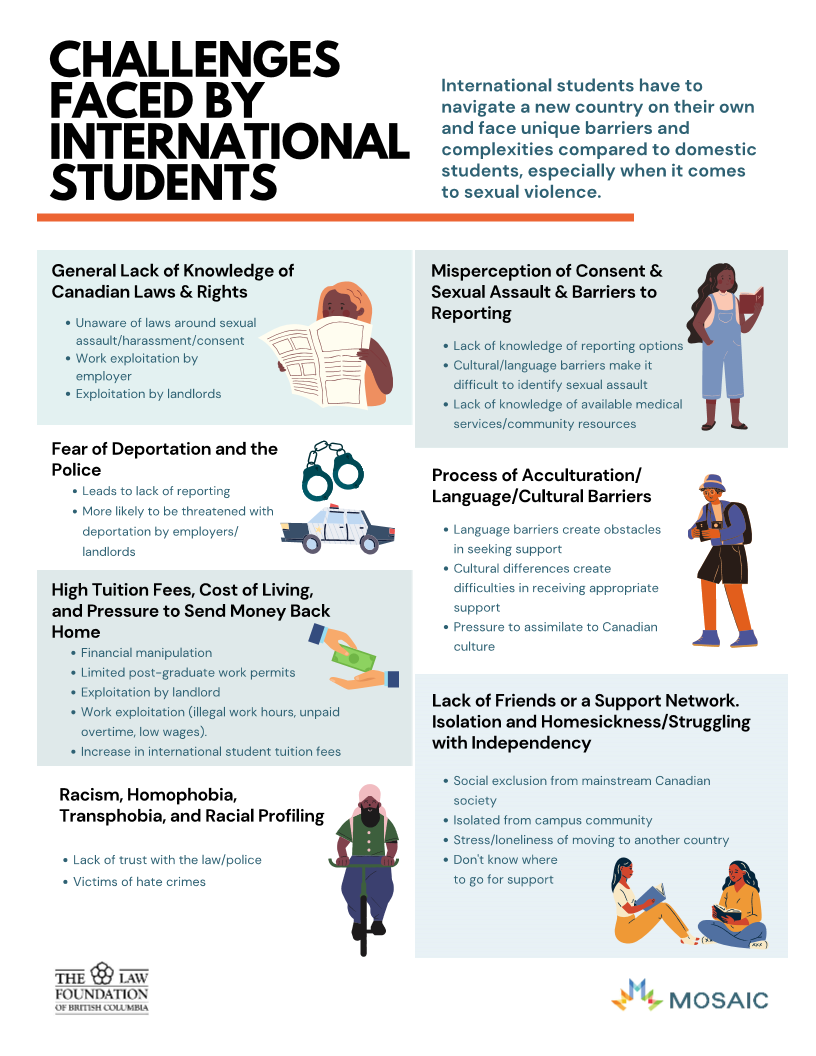
				 <p>In 2018, there were nearly 500,000 international students in Canada at all levels of study which was an 17% increase from 2017 (Canadian Bureau for International Education, 2018). B.C. hosts the second largest international student population next to Ontario, followed by Quebec.</p> <p>International students may be at significant increased risk of being targeted for sexual violence and may face unique barriers to reporting and accessing supports (see <a class="internal" href="#is" data-url="/svmbystander/chapter/accessibility-inclusion-and-safety#is">Section 2: International Students</a> for more information about barriers). According to the B.C. International Student Survey, international students rely primarily on other international students from their home country and from other countries for their primary sources of support, especially for non-academic issues (Adamosky, 2015). Consequently, international students who are survivors of sexual assault will be more likely to disclose the sexual assault and gain support from other the international students. International students who experience or who are impacted by sexual violence are also significantly less likely to seek help from counselling services due to language barriers and cultural differences (Mori, 2000). To make matters more complex, cultural perspectives of violence and rape myths differ from one culture to another (Bonistall Postel, 2017). Thus, international students might have difficulty identifying sexual violence and responding to disclosures of sexual assault. Therefore, it is important for post-secondary institutions to play a role in equipping international students with basic understanding on how to best respond, support, and advocate for their peers in an appropriate and sensitive matter that does not further traumatize the survivor.</p> <p>Post-secondary institutions should involve international students in the development and implementation of training on sexual violence. They are the experts and can identify the gaps and needs of their peer groups and as individuals. Facilitators can develop the training agenda based on their needs and be prepared with the relevant safety resources that include community organizations and groups, translated materials and supports.&nbsp; Post-secondary institutions can build partnerships with organizations that are providing support to international students who can share the collateral they have, e.g., safety booklets, infographics and educational materials (see, for example, the <a href="https://www.mosaicbc.org/wp-content/uploads/2020/03/International-Student-Safety-Guide.pdf" data-url="https://www.mosaicbc.org/wp-content/uploads/2020/03/International-Student-Safety-Guide.pdf">International Student Safety Guide</a> developed by <a href="https://www.mosaicbc.org/" data-url="https://www.mosaicbc.org/">MOSAIC</a>).</p> 
	</div>


	</div>

</div>
<div class="part-wrapper" id="part-section-2-considerations-for-facilitators-wrapper">
    <div class="part  " id="part-section-2-considerations-for-facilitators">
	<div class="part-title-wrap">
		<p class="part-number">II</p>
		<h1 class="part-title">Section 2: Considerations for Facilitators</h1>
	</div>
	<div class="ugc part-ugc">
		
	</div>
			
				
	</div>
<div class="chapter standard " id="chapter-understanding-your-social-location-as-a-facilitator" title="Understanding Your Social Location as a Facilitator">
	<div class="chapter-title-wrap">
		<p class="chapter-number">4</p>
		<h1 class="chapter-title">Understanding Your Social Location as a Facilitator</h1>
								</div>
	<div class="ugc chapter-ugc">
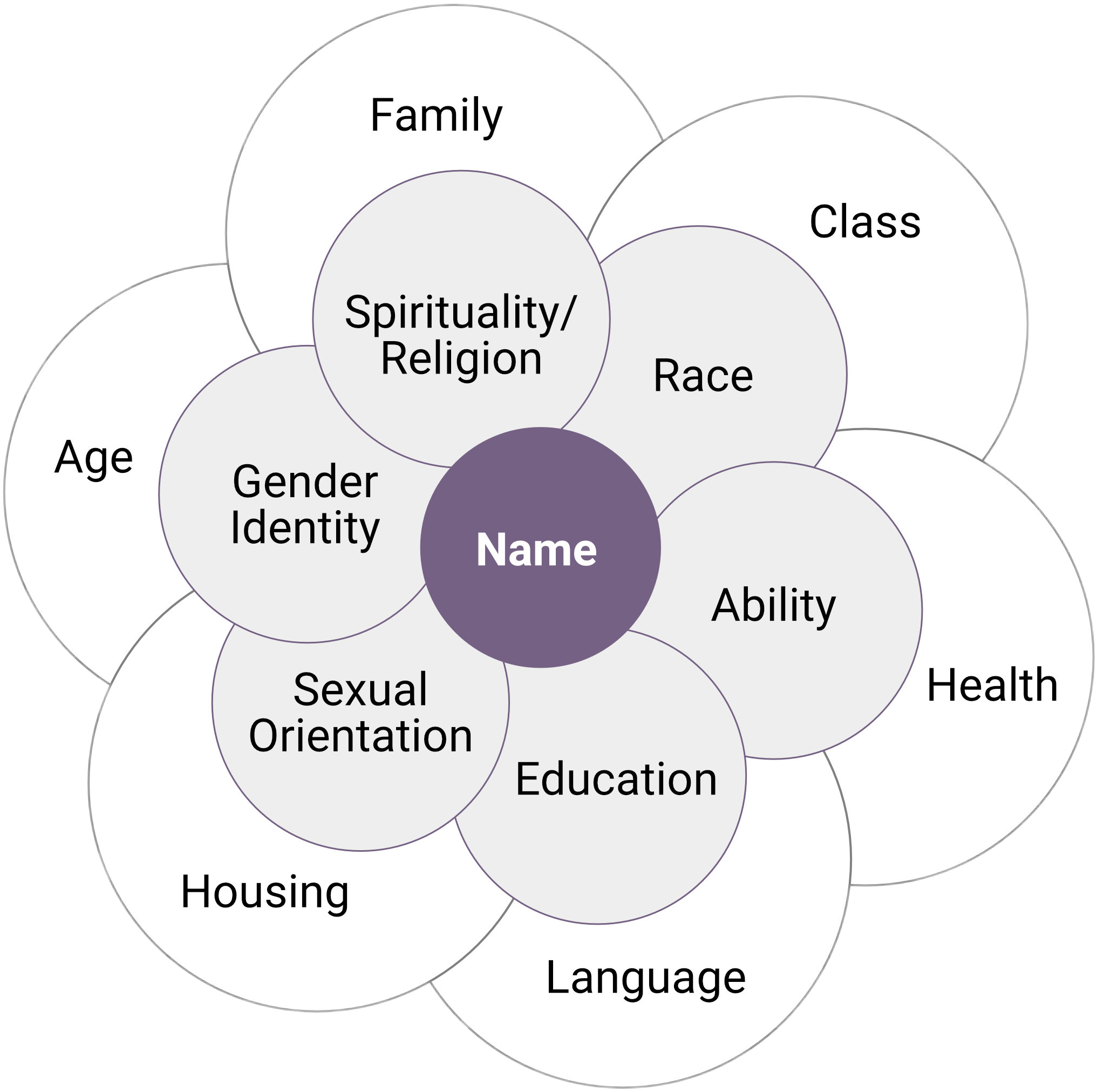
				 <p>The term social location is often used by facilitators working in the anti-violence sector (Baker et al, 2015; Ontario Association of Interval and Transition Houses, 2018; Simpson, 2009). The concept of social location comes from the field of sociology and describes the groups that people belong to because of their place or position in society. An individual’s social location is a combination of categories, factors, or attributes such as gender, race, age, ability, immigration status, language, sexual orientation, employment, and religion. All of these elements are constantly interacting which makes social location unique to each individual (Ontario Association of Interval and Transition Houses, 2018).</p> <p>Social location is important because it strongly influences our identity, or our sense of self, and how we see the world. When it comes to the topic of sexual violence, we all have different experiences, values, beliefs, attitudes, strengths, and vulnerabilities. It can be helpful to try to understand your social location in order to be able to facilitate across all these differences. Here are some questions to help with that process:</p> <ul><li>What is your social location relative to your audience?</li> <li>Based on your social location, in what ways are you able to and unable to relate to the experiences in your audience?</li> <li>&nbsp;In what ways, or through what aspects of your social location, do you experience privilege? (You can think of privilege as an advantage that you have because you belong to a certain group, e.g., being male or middle-class). In what ways could this impact your role as a facilitator?</li> <li>&nbsp;In what ways, or through what aspects of your social location, do you experience oppression? (A simple way of understanding oppression is to see it as a lack of privilege or disadvantages from belonging to a certain group. Keep in mind that multiple factors affect our social location so we can experience both privilege and oppression simultaneously). In what ways could this impact your role as a facilitator?</li> <li>How do you think your social location affects your approach to education and the way your work with people?</li> <li>How do you think your social location affects your approach to the topic of sexual violence?</li> </ul> <p>To facilitate across difference means to be grounded in an awareness of your own social location. As a facilitator, you will want to recognize the diversity of social locations of your audience and to value the knowledge and experience learners bring with them. At a practical level, this understanding can help you raise issues related to sexual violence in a way that will create a safer space for all learners. An awareness of your own social location allows you to engage in conversations about how social location influences experiences of sexual violence and provides a foundation for unpacking assumptions, championing new ideas, and promoting values central to creating safer campuses.</p> <div class="textbox textbox--examples"><div class="textbox__header"><p class="textbox__title">Disclosing Sexual Orientation and Gender Identity</p> </div> <div class="textbox__content"><p>Your sexual orientation and gender identity are important points of reflection as a facilitator. If you can and feel safe doing so, disclosing your sexual orientation and gender identity in a way that is thoughtful and respectful may help in creating a safe space for gender and sexual minorities by signalling that you are aware of your social location. Be precise in your language, for example:</p> <blockquote><p>“I am a straight, cisgender woman who is neurodivergent and I am aware that the privileges and disadvantages associated with sexual orientation and gender identity mean that I experience the world in a very different way than some of you might.” is preferable to “I’m a woman.”</p></blockquote> <p>For examples of precise language relating to sexual orientation and gender identity, please see <a class="internal" href="#incl" data-url="/svmbystander/chapter/accessibility-inclusion-and-safety#incl">Section 2: Gender &amp; LGBTQ2SIA+ Inclusive Language</a>.</p> </div> </div> <p>Individuals with a background in anti-violence work, human service work (i.e., social work, child and youth care), health services (i.e., nursing), or those that have experience and knowledge in issues related to social justice, criminology, and mental health are well suited to facilitating training on sexual violence. If resources are available, you will ideally want to have facilitators from a range of social locations deliver training related to sexual violence prevention and response. Having facilitators of diverse backgrounds is important in creating safe, inclusive, and welcoming learning environments for diverse learners.</p> <p>For example, when delivering to student groups, a peer-to-peer facilitation model can help to increase credibility of the training as well as have other benefits such as empowerment of facilitators (Hines &amp; Palm Reed, 2015; McMahon et al., 2013; McMahon et al., 2014; Turner &amp; Shepard, 1999). Transgender, non-binary, Two-Spirit and other queer people benefit from learning about sex and sexual violence from facilitators who share their personal lived experiences and have developed an analysis of the negative impacts of systemic queerphobia on LGBTQ2SIA+ people.</p> <p>With mixed audiences, whenever possible, co-facilitation teams should include people of differing social locations and experiences. For example, a transgender or non-binary facilitator could be paired with a cisgender/heterosexual facilitator. This is beneficial for two reasons: transgender, queer, and non-binary audiences may connect more and feel safer with a facilitator of similar lived experience and the other facilitator can carry the burden of diffusing problematic situations that may arise from (sometimes well-intentioned) queerphobic comments. In short, a pairing of non-queer and queer facilitators may create safe spaces for queer learners and facilitators (Rensburg &amp; Smith, 2020). In general, a diversity of facilitators demonstrates that sexual violence is an issue relevant to people of all genders and social locations (Moynihan et al., 2012; Roy et al., 2013).</p> 
	</div>


	</div>
<div class="chapter standard " id="chapter-accessibility-inclusion-and-safety" title="Accessibility, Inclusion, and Safety">
	<div class="chapter-title-wrap">
		<p class="chapter-number">5</p>
		<h1 class="chapter-title">Accessibility, Inclusion, and Safety</h1>
								</div>
	<div class="ugc chapter-ugc">
				 <h1>Accessibility</h1> <p>Accessibility typically refers to all the ways in which the training environment, delivery and participation options, and materials are designed to allow for people from a variety of backgrounds, abilities, and learning preferences to participate fully. Your institution will likely have policies, resources and supports related to accessibility that you can build on as you prepare to deliver training on sexual violence. Below is a list of strategies you may want to consider in order to make your training more accessible and inclusive.</p> <h2>Environment</h2> <ul><li>Are teaching and learning spaces physically accessible by those who use a wheelchair or other mobility aids? Are there chairs available that accommodate various body sizes?</li> <li>Are washrooms both physically accessible and designated as gender-neutral?</li> <li>If facilitating online, is the learning platform accessible to people using assistive technologies and a variety of devices?</li> </ul> <h2>Delivery and participation options</h2> <ul><li>During registration or sign-up, have you communicated what accessibility supports are available and asked whether learners have any accessibility requirements, e.g., “Is there something we can do to support your access and participation in this training?”</li> <li>Are a variety of learning methods being used? E.g., in an online workshop, methods such as asking questions, using breakout rooms, using the chatbox, reflective activities, polling or whiteboard features.</li> <li>If facilitating online, is captioning provided? Many web conferencing platforms have automatic captioning that can be turned on.</li> <li>When possible, is there support for child care or honoraria?</li> </ul> <h2>Materials</h2> <ul><li>If available, are learning materials provided in multiple formats and languages?</li> <li>Are you using plain language in your learning materials and delivery? (E.g., using a familiar term over the latest technological term, using several clear words or a familiar word instead of one complicated term such as “communication” instead of “discourse”)</li> <li>Do learning materials (e.g., images, statistics) include representation from learners of all backgrounds?</li> <li>Are learning materials available in digital formats that are accessible to people using assistive technologies? Do images have text descriptions? Often, these materials can be run through an accessibility checker (many word processing programs have these built in).</li> </ul> <div class="textbox textbox--examples"><div class="textbox__header"><p class="textbox__title">Creative Approaches to Learning</p> </div> <div class="textbox__content"><p>Community-based and campus-based anti-violence programs and initiatives have a long history of developing innovative and creative approaches to support learners of all backgrounds. This resource provides suggestions on how to facilitate activities both in-person and online. It also includes suggestions of additional activities that help to explore and increase understanding of issues related to sexual violence such as power and privilege; the impact of colonialism on sexual violence; and ideas about gender roles and how they influence people’s experiences of dating and relationships. Depending on the learner(s), many of these topics can be abstract and difficult to engage with through discussion-based activities or in a single workshop. We encourage you to make connections, in-person or online, with anti-violence organizations or to consult anti-violence resources and toolkits to develop creative approaches to delivering this training. Below are a few suggestions of creative approaches to education on sexual violence prevention and response.</p> <ol><li><strong>Digital or Paper Collage.</strong> Use images from popular culture, including films, books, TV, and music to explore stereotypes. Ask questions such as: Who are consistently the main characters? Who are the “heroes”? Who has power or who’s life and decisions are considered “important” and “valuable”? Explore ideas about what is considered “normal” and acceptable in our society and how this affects our attitudes and beliefs about issues such as sexual violence and consent and our roles in supporting change.</li> <li><strong>Group “Sculpture.”</strong> Use objects and movement to help learners visualize power dynamics in society. For example, you could ask several learners to use a water bottle and chair to create a group “sculpture” in which one of the objects is seen to be more powerful and then ask the audience to respond and share what they saw.</li> <li><strong>Guided Imagery.</strong> Read a story about the day-to-day experiences of a member of your community and ask learners to visualize themselves as that person. E.g., you could ask a cisgender man to imagine taking the bus to class from the perspective of a cisgender woman.</li> <li><strong>“I can help create a safer campus” Bingo.</strong> Create a bingo game that includes suggestions of actions that individuals can take to support safer campuses. E.g., “I can not laugh at sexist jokes,” “I can give active consent when I want to have sex,” “I can say something when I hear disrespectful language.”</li> <li><strong>“Take home” Readings and Viewings.</strong> Some groups of learners may benefit from having shorter sessions spread out over a period of days or weeks. This can create opportunities for take-home activities such as reading a graphic novel or watching a documentary or analyzing a spoken word video with a reflection component.</li> <li><strong>Interactive Theatre or Improv.</strong> Scenario-based activities are an effective approach to learning skills related to preventing and responding to sexual violence. Interactive theatre and improv approaches can build on discussion-based approaches to scenarios. They can help learners gain experience “rehearsing” real-life situations as well as explore short- and long-term consequences. Techniques such as “hot-seating” can be a way of exploring the motivations behind the actors’ actions and develop empathy and compassion.</li> </ol> </div> </div> <h1><a id="cs" class="internal"></a>Creating Space</h1> <p>For sexual violence training to be successful, learners need to feel comfortable, safe, and respected. As you prepare to facilitate, you will want to consider factors such as when and where to hold the training, key messages on promotional materials, the use of group guidelines, ensuring diverse representation, using icebreakers, whether activities require self-disclosure, and ways of working with co-facilitators or guests. In this section, we discuss several strategies for helping to create a positive learning space.</p> <h2>Opening with intention</h2> <p>Facilitators have an enormous role to play in setting the “tone” for a session. As people enter the space (online or in-person), you can welcome them and help them get oriented. You can let them know if you’ve started or whether you’re waiting for a few more people and share “housekeeping information” such as where the bathrooms are, where they can put their things, or how to use online interactive features. If the training will include interactive or discussion-based activities, you may want to consider using an icebreaker activity to help people get to know each other ahead of time. As you begin your session, you can use opening questions that help create inclusivity such as correct pronouns, check-in questions, or information about accessibility needs and requests.</p> <h2>Community or group guidelines</h2> <p>Community or group guidelines are an activity that brings groups together to decide how they will interact and support each other. This process can take anywhere from a few minutes to 30 minutes. If you are facilitating a short training (e.g., a one-hour lunch time session) or a training in which learners may not be interacting extensively with each other, creating community guidelines may not make sense. Instead, you might ask learners to agree to a list of guidelines or a code of conduct when they register or sign-up for the training. Or, you might share a list of guidelines at the beginning of the training and ask learners if they feel comfortable with them and/or if they have something they would like to add or change.</p> <p>For longer sessions (e.g., a three-hour workshop) or for training that involves multiple sessions over a period of time, community guidelines can be an important tool for supporting safer discussion about difficult topics. You can remind learners of the guidelines if the discussion is getting difficult or at the beginning of each session. Important group agreements relate to listening to and showing respect for others (e.g., not talking when others are speaking, not making rude comments, or not talking on the phone), confidentiality, and participation.</p> <div class="textbox textbox--examples"><div class="textbox__header"><p class="textbox__title">Examples of Community or Group Guidelines</p> </div> <div class="textbox__content"><p>Community guidelines come in all shapes and sizes. Some groups have a few guidelines while others have many. Often, groups will change or add guidelines as needs and ways of working together evolve. Here are suggestions of possible guidelines.</p> <ul><li>Share the learning, not the names or the stories (confidentiality)</li> <li>Participants have the right to “pass” on activities/questions that feel uncomfortable</li> <li>It is all right to feel uncomfortable or not to know answers to everything</li> <li>Treat others with respect</li> <li>Be mindful of your language; respect everyone’s names and pronouns</li> <li>Remember that survivors of sexual violence may be present</li> <li>Speak for yourself. Use “I statements” to state opinions or feelings</li> <li>Seek to replace judgment with curiosity</li> <li>Take care of yourself</li> <li>Take space, make space (allow everyone a chance to participate)</li> </ul> </div> </div> <h2>Content warnings</h2> <p>Content warnings (also called trigger warnings) are a statement made prior to sharing potentially difficult or challenging material. The intent of content warnings is to provide learners with the opportunity to prepare themselves emotionally for engaging with the topic or to make a choice to not participate.</p> <p>Different departments and institutions will have different approaches to content warnings and this may guide your decision about including content warnings on registration or sign-up forms, in learning materials, and in the learning environment. Below is an example of a content warning:</p> <blockquote><p>“We will be discussing topics related to sexual violence in this training. During the training, you can choose not to participate in certain activities or discussion and can leave the room at any time. If you feel upset or overwhelmed, please know that there are resources to support you.”</p></blockquote> <p>There are a number of other facilitation strategies you may want to consider in addition to or instead of a content warning:</p> <ul><li>When discussing difficult content, check in with learners from time to time. Ask them how they are doing, whether they need a break, etc. Let them know that you are aware that the content is difficult.</li> <li>Ask people to be mindful of their fellow learners during the discussion and remind them that survivors of sexual violence are present in the room (regardless of whether this information has been shared with others).</li> <li>If you are meeting regularly with a group of learners over time, you can give them advance notice (e.g., two weeks) about potentially difficult content.</li> <li>You can “scaffold” your learning process/materials so that you do not start with the most difficult content at the beginning of your training or you can make connections to other resources and training on sexual violence. In some learning contexts, you may be able to let students move through content at their own pace.</li> <li>Consider how graphic or “strong” your language is. Sometimes, we may use strong language to make a point or emphasize the seriousness of an issue. Ask yourself whether this is necessary and what alternatives might be equally effective at communicating your message while reducing the probability of activating someone’s trauma.</li> </ul> <h1><a id="incl" class="internal"></a>Gender &amp; LGBTQ2SIA+ Inclusive Language</h1> <p>Inclusive language is important and helps avoid making assumptions about others. As a facilitator, you will want to use language that is inclusive of all people regardless of their sexual orientation, gender identity, sex assigned at birth, and marital or romantic status.</p> <p>Because your audience is likely to be diverse, it’s important to be respectful of the many ways they experience gender, attraction, and relationships. Choose examples, scenarios, statistics, and images that are non-gendered or inclusive of LGBTQ2SIA+ people and relationships. Sexual violence is not exclusive; it can happen to and be perpetuated by people of diverse genders, sexes, and attractions.</p> <p>If you are speaking in general terms, take care to choose terms like “intimate partner or partners” instead of “husband,” “wife,” “boyfriend” or “girlfriend.” If you are referring to a specific person’s intimate partner, use the same language they use. If a person refers to their intimate partner as their “spouse” or “wife,” you should use the word they do instead of referring to their “partner.”</p> <p>Likewise, addressing learners using inclusive language will ensure a sense of safety for learners. For example, “Good afternoon, everyone,” “Hello, folks,” and “Have a good break, human beings” are inclusive of transgender, non-binary, Two Spirit, and gender diverse people while “Welcome, ladies and gentlemen” is exclusive.&nbsp; Similarly, avoid everyday gendered language (e.g. <em>man hours, spokesman,</em> and <em>waitress</em> should be replaced with work hours, <em>spokesperson/speaker</em>, and <em>server</em>) or historically oppressive turns of phrases such as “rule of thumb.” Try using language such as “someone of another gender” and “people of all genders” rather than “the opposite sex” or “both genders.”</p> <p>Be careful to address or refer to people with similar titles in similar ways, regardless of their gender identity. If you refer to a cisgender male professor as “Dr. Last Name,” as a default, refer to all professors as “Dr. Last Name.”</p> <p>Don’t assume pronouns, sexual orientation (attraction) or gender identity based on someone’s name or appearance. Invite all learners, guests, and co-facilitators to indicate their pronouns and their preferred name on their nametag or in their online display names, if they feel safe doing so. Explain that sharing our pronouns is a way to act in solidarity with some people who are gender diverse, transgender, non-binary, and Two Spirit people, but that, ultimately, it is a way to be inclusive of all people.</p> <p>Examples of gender inclusive language:</p> <p><img class="aligncenter wp-image-89" src="https://opentextbc.ca/svmbystander/wp-content/uploads/sites/341/2021/04/gender-inclusive-language-examples-1.jpg" alt="Speech bubbles with different greetings: People of all genders experience; hello folks; every group will need to have a spokesperson; good morning everyone." width="500" height="244" /></p> <h1><a id="ta" class="internal"></a>Trauma Awareness</h1> <p>Experiences of trauma and violence are common in our society. Many people participating in sexual violence training will have experiences of past or current trauma and many facilitators will have experiences of trauma themselves. There are a number of strategies you can use to help create a “trauma aware” learning space.</p> <ul><li>At the beginning of the training, acknowledge that the topics you will be discussing are difficult and let learners know that they have the right and freedom to take care of themselves in a way that works for them. In particular, let learners know that they can leave the room or choose not to participate in an activity. You could say something like “If at any time you feel you need to leave, that’s fine with me. You are empowered to take care of yourself.” You can also let learners know that reactions to difficult material can sometimes be delayed and that they may wish to connect with you a few days after the training or to access support from family, friends, or other people in their lives.</li> <li>&nbsp;If you do notice that someone has left the group and you suspect that they were reminded of previous trauma by the session, follow-up with them one-one-one after the session to check-in and offer them any resources that you think might be helpful to them.</li> <li>&nbsp;During the training, if the conversation becomes “intense” or you believe that a number of learners have become overwhelmed or affected by the discussion, it can be helpful to take a break or use an activity that involves the body or movement to help people re-connect to the present moment.</li> <li>Sometimes, during training on sexual violence, learners may realize that they have experienced things that are defined as violence. BEFORE you start facilitating in this area, you will want to ensure that you are knowledgeable about receiving disclosures and how to support trauma survivors as well as available supports and resources on campus and in the community. Some institutions have developed practices such as expedited counselling for learners who might need support after a training session or making intensive crisis supports available for a short-time after a training or particular initiative.</li> <li>Similarly, some learners may realize that they have done things to others that would be identified as violent. You may need to provide them with some initial support before referring them to available resources and services.</li> <li>Let learners know that you will be available after the training if they would like to debrief or share their responses to the session or how they are feeling. If possible, schedule at least 30 minutes after a session so that you can be available to your learners. If you are delivering training in an online context, you can let learners know that they can private message/email you.</li> <li>If you feel comfortable, you can share information about grounding activities or a link to a resource. Grounding activities are simple activities that can help people to relax, stay present, and re-connect to the “here and now” following a trauma response. Examples include pressing or “rooting” your feet into the ground, breathing slowly in and out for a count of 2, repeating a statement such as “I am safe now. I can relax,” or using your five senses to describe the environment in detail.</li> <li>If you are concerned about a learner, ask them if they would find it helpful for you to “check in” with them later in the day or the following day. You could also ask them if they have a friend or family member that they might find it helpful for them to speak with following the training. If so, help them make a plan to connect with them, e.g., via phone or text or in-person or at a certain time.</li> </ul> <h2>A note on language</h2> <p>People who have experienced trauma may describe themselves as a “victim” or “survivor” or “victim/survivor” of trauma. These words have their own history and meanings. Language is imperfect and constantly evolving and there is no one best or “correct” word. Do your best to use the term that people prefer whether that be “victim” or “survivor” or something else entirely and don’t be afraid to respectfully ask if you are unsure.</p> <div class="textbox textbox--examples"><div class="textbox__header"><p class="textbox__title">Possible Signs of a Trauma Response</p> </div> <div class="textbox__content"><p>The following list may help you in recognizing and responding to ‘in-the-moment’ trauma responses.</p> <ul><li>Sweating</li> <li>Change in breathing (breathing quickly or holding breath)</li> <li>Muscle stiffness, difficulty relaxing</li> <li>Flood of strong emotions (e.g., anger, sadness, etc.)</li> <li>Rapid heart rate</li> <li>Startle response, flinching</li> <li>Shaking</li> <li>Staring into the distance</li> <li>Becoming disconnected from present conversation, losing focus</li> <li>Inability to concentrate or respond to instructions</li> <li>Inability to speak</li> </ul> <p>(BC Mental Health and Substance Use Services, 2013)</p> </div> </div> <h1><a id="is" class="internal"></a>International Students</h1> <p>As a facilitator, you will want to ensure that you are knowledgeable and prepared to address the distinct and specific needs of multicultural and diverse communities. International students are one group that you may want to consider. They may be at significant increased risk of being targeted for sexual violence, due to multiple barriers they face including lower levels of English language fluency, a lack of understanding of criminal law in Canada, cultural views of sexual violence, discrimination, racism, a need to adjust to local culture and limited local support systems (Forbes-Mewett and McCulloch, 2016). Furthermore, they may not understand the legal definitions of sexual violence and what consent means, and where to find help.<a id="retinfog" class="internal"></a></p> <div class="wp-caption aligncenter" id="attachment_90" aria-describedby="caption-attachment-90" style="width: 816px"><img class="wp-image-90 size-full" src="https://opentextbc.ca/svmbystander/wp-content/uploads/sites/341/2021/04/challenges-faced-by-international-students-1.png" alt="An infographic describing challenges faced by international students. Image description linked in caption." width="816" height="1056" /><div class="wp-caption-text" id="caption-attachment-90"><a href="https://www.mosaicbc.org/wp-content/uploads/2020/11/Enhance-Challenges-Poster.pdf">“Challenge faced by International students”</a> © The Law Foundation of British Columbia and MOSAIC. (2020). Used with permission. <a class="internal" href="#infog">[Image description]</a></div></div> <p>It is important to highlight that international students are not weak or vulnerable; rather they are quite resilient and determined to thrive and make Canada their home. It takes positive determination to leave the safety of family, financial stability and social network. However, once here, they may face the additional challenges from within their own ethno-specific community while also experiencing homesickness, loneliness and helplessness as part of their acculturation into Canadian society.</p> <p>As a facilitator, there are a number of strategies you can take to ensure the inclusion and participation of international students:</p> <ul><li>Consider language barriers. Using plain language or translated materials and slow down the pace as you go through complex material.</li> <li>Learn about translated sexual violence resources and community supports that include services in diverse languages.</li> <li>Provide opportunities for participation while also considering safety. Be aware that some female international students may not be comfortable speaking about topics related to sexual violence if other male students are present.</li> <li>Be aware of community resources and supports available to international students so that you can share them with learners either verbally or in written form (or both).</li> <li>Consider collaborating with community organizations such as <a style="text-align: initial; font-size: 1em;" href="https://www.mosaicbc.org/">MOSAIC</a> <span style="text-align: initial; font-size: 1em;">so that a support worker can be available to international students, if needed.</span></li> </ul> <h3>Image descriptions</h3> <p id="infog"><strong>“Challenges Faced by International Students” image description</strong></p> <p>An infographic with the following text:</p> <p>International students have to navigate a new country on their own and face unique barriers and complexities compared to domestic students, especially when it comes to sexual violence.</p> <ul><li><strong>General lack of knowledge of Canadian laws &amp; rights.</strong> <ul><li>Unaware of laws around sexual assault/harassment/consent</li> <li>Work exploitation by employer</li> <li>Exploitation by landlords</li> </ul> </li> <li><strong>Misperception of consent &amp; sexual assault &amp; barriers to reporting.</strong> <ul><li>Lack of knowledge of reporting options</li> <li>Cultural/language barriers make it difficult to identify sexual assault</li> <li>Lack of knowledge of available medical services/community resources</li> </ul> </li> <li><strong>Fear of deportation and the police.</strong> <ul><li>Leads to lack of reporting</li> <li>More likely to be threatened with deportation by employers/landlords</li> </ul> </li> <li><strong>Process of acculturation/language/cultural barriers.</strong> <ul><li>Language barriers create obstacles in seeking support</li> <li>Cultural differences create difficulties in receiving appropriate support</li> <li>Pressure to assimilate to Canadian culture</li> </ul> </li> <li><strong>Racism, homophobia, transphobia, and racial profiling.</strong> <ul><li>Lack of trust with law/police</li> <li>Victims of hate crimes</li> </ul> </li> <li><strong>Lack of friends or a support network. Isolation and homesickness/struggling with independency.</strong> <ul><li>Social exclusion from mainstream Canadian society</li> <li>Isolated from campus community</li> <li>Stress/loneliness of moving to another country</li> <li>Don’t know where to go for support</li> </ul> </li> </ul> <p>End of image description. <a class="internal" href="#retinfog">[Return to place in text]</a></p> 
	</div>


	</div>
<div class="chapter standard " id="chapter-sexual-violence-key-concepts-and-facilitation-strategies" title="Sexual Violence: Key Concepts and Facilitation Strategies">
	<div class="chapter-title-wrap">
		<p class="chapter-number">6</p>
		<h1 class="chapter-title">Sexual Violence: Key Concepts and Facilitation Strategies</h1>
								</div>
	<div class="ugc chapter-ugc">
				 <h1>Intersectionality</h1> <p>Intersectionality is a concept that promotes an understanding of people as shaped by the interactions of different social locations or categories ― for example, race, ethnicity, Indigeneity, gender, class, sexuality, geography, age, ability, migration status, and religion.</p> <p>In the context of sexual violence, intersectionality can help increase understanding of how certain populations face increased risks of perpetrating sexual violence and others face increased risks of being targeted by sexual violence. It also highlights how different groups of people experience systemic barriers to disclosing and accessing support services. It can also help ensure that responses to sexual violence are attentive to and reflective of the diversity of campus communities.</p> <h2>Examples of facilitation strategies related to the concept of intersectionality</h2> <ol><li>As you facilitate discussion, you can highlight key ideas related to sexual violence and intersectionality. For example, you could say: <ul><li>“Violence does not happen in a vacuum and it isn’t merely a result of individual circumstances or bad luck.”</li> <li>“People’s circumstances, such as their income, housing situation, and access to health care, can affect their ability to access resources to heal from their experiences.”</li> <li>“When we take a look at ‘big picture’ issues like discrimination, economic conditions, and social policies, we can better understand why certain individuals might be reluctant to report that they have been assaulted.”</li> <li>“Even though LGBTQ2SIA+ people experience high rates of violence, when compared to the general population, they are often fearful of accessing the justice system due to a history of negative interactions with police and daily experiences of discrimination and harassment.”</li> <li>“Many international students are resilient and determined to thrive and make Canada their home. However, they might face unique barriers when it comes to sexual violence such as language barriers, lack of knowledge about services and supports, or work exploitation.”</li> </ul> </li> <li>In your training, include statistics, images, and other resources that reflect the perspectives, needs, experiences, and interests of diverse groups. For example, images of a mixed race queer couple with a visible disability gives recognition that race, sexual orientation, and ability can be places of diversity within one relationship. Or, include statistics on sexual violence and resilience within queer and polyamorous couples as well as straight, monogamous couples.</li> <li>If you are using statistics about a particular group of people, use precise language to avoid confusion. For example, “Men are likely to be the perpetrators of sexual violence against women” is less accurate than “Cisgender men are likely to be the perpetrators of sexual violence against all other genders, especially against cisgender women.” Your use of precise language will vary based on the information you will be sharing,</li> <li>Depending on your audience, you can include a resource or section about intersectionality in your training. This could be a more academic resource such as an interview with legal scholar Kimberlé Crenshaw (while many people have used intersectional perspectives in their work, her use of the term in 1989 has greatly influenced current understandings) or an experiential resource such as an interview or spoken word video by a survivor of sexual violence that highlights multiple social locations.</li> <li>If you have more time, you can include a reflective activity such as the Power Flower (below).</li> </ol> <div class="textbox textbox--exercises"><div class="textbox__header"><p class="textbox__title">Activity: Power Flower</p> </div> <div class="textbox__content"><p><img class="aligncenter wp-image-93" src="https://opentextbc.ca/svmbystander/wp-content/uploads/sites/341/2021/04/PicsArt_03-17-11.12.15-1.png" alt="A flower template with a place for your name in the centre and different identities and social positions on each of the petals." width="300" height="299" /></p> <p>The Power Flower is a visual tool that we can use to explore how our multiple identities combine to create the person we are.</p> <p>Instructions:</p> <ol><li>Each person fills out their own power flower, identifying different aspects of their own identities in a number of categories. (Colourful markers or paper are always a bonus!). As we all have many identities, you may want to start with: <ul><li>Ethnicity</li> <li>Sex</li> <li>Gender identity</li> <li>Sexual Orientation</li> <li>Class</li> <li>Language</li> <li>Ability</li> <li>Family</li> <li>Education</li> </ul> <p>Feel free to customize this list to your audience and the focus of your training.</p></li> <li>As a group, reflect on the implications of being able to choose certain aspects of your identity and not others and explore why you might think about certain aspects of your identity more than others. How does thinking through these different categories affect your perspective of yourself?</li> <li>What kind of power do you have? In your own life? As a student, staff or faculty member?</li> <li>What are your strengths? What are your skills? What kind of knowledge do you hold? What resources and supports are available to you?</li> <li>How might your power flower shape your experiences, knowledge, beliefs, and values about sexual violence?</li> </ol> <p>This Power Flower activity is adapted from: Arnold, R., Burke, B., James, C., Martin, D., and Thomas, B. (1991). <em>Educating for Change.</em> Toronto: Between the Lines. Available from https://files.eric.ed.gov/fulltext/ED336628.pdf</p> <p><img class="aligncenter wp-image-94" src="https://opentextbc.ca/svmbystander/wp-content/uploads/sites/341/2021/04/PicsArt_03-17-11.12.57-1.png" alt="A blank flower tempalte." width="300" height="282" /></p> <p>This Power Flower activity is adapted from: Arnold, R., Burke, B., James, C., Martin, D., and Thomas, B. (1991). <a href="https://files.eric.ed.gov/fulltext/ED336628.pdf"><em>Educating for Change </em>[PDF]</a><em>.</em> Toronto: Between the Lines.</p> <p>Download the Power Flower Activity here: <a href="https://opentextbc.ca/svmbystander/wp-content/uploads/sites/341/2021/04/Handout-Power-Flower-Activity-1.docx">Handout Power Flower Activity [Word file]</a>.</p> </div> </div> <h1>Sex, Gender, and Gender Identity</h1> <p>Because of the power inherent in sex and gender dynamics and the role they play in our lives, addressing sex, gender, and gender identity in discussions about sexual violence is essential. Gender can be a complex topic to discuss as there are many elements to consider such as identity, expression, orientation, and sex. Western understandings of sex, gender and gender identity have evolved from a binary view (two options: male and female) to a spectrum which suggests there are multiple sexes (male, female, intersex), many gender identities, and a wide range of gender expressions that may or may not conform to societal expectations. Many cultures have respect and recognition for more than two sexes, genders or gender identities. This is true not only abroad, but among many nations Indigenous to Turtle Island (North America).</p> <div class="textbox"><p><strong>Sex:</strong> Biological factors used to describe physiological differences such as gene expression, chromosomes, genitals, and hormones.</p> <p><strong>Gender:</strong> The social roles, expectations, and behaviours that are prescribed to us based on our sex assigned at birth. This can be different between cultures and time.</p> <p><strong>Gender Identity:</strong> Our internal understanding of our own gender. It may or may not match what is outwardly apparent to others or what is expected of us by society.</p> </div> <p>As a facilitator, you will want to be familiar with key terms used to discuss gender. These terms are continuing to evolve and it is important to refer to people using their own terms.</p> <table class="grid" style="border-collapse: collapse; width: 100%;"><caption>Some examples of language related to gender</caption> <tbody><tr><th style="width: 20%; vertical-align: top;" scope="row">Cisgender</th> <td style="width: 50%; vertical-align: top;">Refers to someone who identifies with the sex they were assigned at birth. <em>Cis</em> is a Latin prefix which means aligned with.</td> </tr> <tr><th style="width: 20%; vertical-align: top;" scope="row">Transgender</th> <td style="width: 50%; vertical-align: top;">Refers to someone whose gender identity differs from their sex assigned at birth. <em>Trans</em> is a Latin prefix which means across, beyond or through. (Note: use <em>transgender</em> and not <em>transgendered</em> as the term transgendered is outdated and seen as derogatory).</td> </tr> <tr><th style="width: 20%; vertical-align: top;" scope="row">Non-binary</th> <td style="width: 50%; vertical-align: top;">Refers to someone who identifies as having a gender outside of the male/female binary.</td> </tr> <tr><th style="width: 20%; vertical-align: top;" scope="row">Two-Spirit</th> <td style="width: 50%; vertical-align: top;">Refers to a specific identity held by some people Indigenous to Turtle Island (North America). Two-Spirit people may embody diverse sexualities, genders, gender expressions, and gender roles than those prescribed by colonial understandings of sex and gender. They often hold special cultural, spiritual, or ceremonial roles among their people.</td> </tr> <tr><th style="width: 20%; vertical-align: top;" scope="row">Sex assigned at birth</th> <td style="width: 50%; vertical-align: top;">Refers to the sex that an infant is assigned when they are born. It is based on the combination of hormones, chromosomes, and internal and external genitalia. The three most common options are female, male, and intersex.</td> </tr> <tr><th style="width: 20%; vertical-align: top;" scope="row">Gender Identity</th> <td style="width: 50%; vertical-align: top;">Refers to someone’s personal understanding of their gender. It may or may not align with their body and gender expression.</td> </tr> </tbody> </table> <div class="textbox textbox--key-takeaways"><div class="textbox__header"><p class="textbox__title">Regularly Updated Language Resource</p> </div> <div class="textbox__content"><p>Inclusive language is continuing to evolve. <a href="https://qmunity.ca/">Qmunity</a>, BC’s Queer, Trans, and Two-Spirit Resource Centre has a resource called <a href="https://qmunity.ca/resources/queer-glossary/">Queer Terminology from A to Q</a>&nbsp; that is regularly updated.</p> </div> </div> <h2>Examples of facilitation strategies related to the concepts of sex, gender, and gender identity</h2> <ol><li>When talking about diverse experiences of sexual violence, take care to be both inclusive of LGBTQ2SIA+ people while being precise when talking specifically about sexual violence committed by cisgender men against cisgender women.<br /> Key discussion points can include: <ul><li>The overwhelming majority of acts of sexual violence are committed by cisgender men against cisgender women and girls and people of other genders. Transgender, Two-Spirit, and non-binary people as well as lesbian, gay, and other queer people are disproportionately targeted by perpetrators of sexual violence.</li> <li>It’s important to remember that straight, cisgender men and boys can also be targeted and that people of all genders and sexual orientations may be perpetrators of sexual violence.</li> <li>We need to be mindful of the experiences of all victims of sexual violence while not minimizing the deep-rooted experiences of violence that cisgender women, girls, and gender diverse people are subjected to by cisgender men.</li> <li>Gendered sexual violence exists and thrives in the context of colonialism which privileges straight, white, able-bodied men while unjustly mistreating LGBTQ2SIA+, BIPOC, and disabled people. Because of these intersecting oppressions, people of colour, women, children, and queer people are especially at risk of being targeted by sexual violence.</li> </ul> </li> <li>Help people learn more about gender by including an activity in your training that explores concepts such as gender identity, attraction (sexual orientation), and gender expression (presentation). <div class="textbox textbox--exercises"><div class="textbox__header"><p class="textbox__title">Activity: Gender Unicorn</p> </div> <div class="textbox__content"><p>The <a href="https://transstudent.org/gender/">Gender Unicorn</a> is a visual activity by Trans Student Educational Resources that allows learners to map out of their own experiences of sex and gender. It is available in an interactive form, as a colouring book, and in different languages. (It uses a Creative Commons license and can be shared as long as credit is given.)<a id="retgender" class="internal"></a></p> <div class="wp-caption aligncenter" id="attachment_95" aria-describedby="caption-attachment-95" style="width: 500px"><img class="wp-image-95" src="https://opentextbc.ca/svmbystander/wp-content/uploads/sites/341/2021/04/genderunicorn1-scaled-1-1.jpg" alt="The Gender Unicorn activity. Image description linked to in caption." width="500" height="386" /><div class="wp-caption-text" id="caption-attachment-95">“<a href="https://transstudent.org/gender/">The Gender Unicorn</a>” © Trans Student Educational Resources (2015). <a class="internal" href="#gender">[Image description]</a></div></div> </div> </div> </li> <li>When facilitating, pay attention to the pronouns that you use as they are an important part of language related to gender. In addition to the binary English terms “she/her/her” and “he/his/him,” some people use gender-neutral pronouns such as “they/them” (in singular form). Use the pronouns that correspond to a person’s gender identity. As it is not possible to assume pronouns based on appearances, it is a good practice to ask for a person’s pronouns. For some people, being referred to intentionally and repeatedly with inappropriate or incorrect pronouns (or being “misgendered”) can be hurtful, offensive, and violent.</li> </ol> <h1><a id="root" class="internal"></a>Roots of Violence</h1> <p>There are many different theories and perspectives about what the causes of sexual violence in our society are. Discussions about ideas such as social constructions of gender roles, colonialism, enslavement, and patriarchy can help us to explore and understand the root causes of sexual violence and to collectively find answers and solutions.</p> <div class="textbox textbox--examples"><div class="textbox__header"><p class="textbox__title">Linking Sexual Violence and Gender Equity</p> </div> <div class="textbox__content"><p>Sexual violence is linked to gender inequities in society. The lives, bodies, agency, and work of women, girls, transgender people, and other gender diverse people are devalued while those of men are overvalued. Devaluing leads to dehumanizing and objectifying; overvaluing leads to entitlement and the misuse of power. Together this forms an environment where sexual violence perpetrated by men against women and people of diverse genders is normalized. One way to combat the pervasiveness of sexual violence is to ensure the norms, systems, and institutions in our society are equitable for people of all genders.</p> </div> </div> <p>The term “rape culture” was first coined in the 1970s in the United States by second-wave feminists and the concept is often used in sexual violence prevention training in post-secondary institutions. Rape culture describes how sexual violence is common in our society and how it is normalized, condoned, excused, or encouraged. Examples of rape culture include the public tolerance of sexual harassment, the prevalence of sexual violence in media, the socialization of boys that promotes masculine identities based on notions of power and control, persistent discrimination against women and other equity-seeking communities, and the scrutiny given to the sexual histories of victims of sexual violence (Baker, 2014; EVA-BC, 2016).</p> <p>Many aspects of rape culture are often conceptualized as a continuum or pyramid or can be connected to other forms of violence in society.<a id="retpyramid" class="internal"></a></p> <div class="wp-caption aligncenter" id="attachment_96" aria-describedby="caption-attachment-96" style="width: 500px"><img class="wp-image-96" src="https://opentextbc.ca/svmbystander/wp-content/uploads/sites/341/2021/04/anti-violence-pyramid-1.jpg" alt="An anti-violence continuum/pyramid. Image description linked in image caption." width="500" height="413" /><div class="wp-caption-text" id="caption-attachment-96">Image adapted from Simon Fraser University Sexual Violence Support and Prevention Office (SFU SVSPO, 2020). <a class="internal" href="#pyramid">[Image description]</a></div></div> <h2>Examples of facilitation strategies related to the concept of roots of violence</h2> <ol><li>Ask learners about their perceptions of campus safety: Do they feel safe all the time? Some of the time? What affects their sense of safety? What kind of role do we as campus community members have in preventing sexual violence and/or helping to promote norms of respect, safety, equity, and helping others? (As safety can be a deeply personal subject, you may want to facilitate this discussion in a structured way such as using specific examples or asking questions that require limited self-disclosure).</li> <li>You can connect your training to current events and media coverage, e.g., a news story about a high-profile sexual assault case that is in court, the latest opinions about the activities of a famous or infamous celebrity. To what extent are individuals held responsible for their actions and to what extent is society?</li> <li>You can include a section in your training on critical media analysis, e.g., reviewing advertisements and exploring what messages they communicate about dating, relationships, and sex. Do these advertisements reflect or challenge current attitudes and stereotypes about sexual violence?</li> </ol> <h1>Colonial Violence</h1> <p>Colonialism occurs when a group of people take control of other lands, regions, or territories outside of their own by turning those other lands, regions, or territories into a colony.</p> <p>Colonialism remains embedded in the legal, political and economic context of Canada today.</p> <p>Sexual violence and colonialism are interconnected through concepts such as self-determination, autonomy and consent. As well, many social norms in Canada are founded on colonial beliefs which are rooted in white patriarchal supremacy and which have created systems that support individuals, predominantly white men, to positions of power. These norms provide an illusion that people are entitled to what others have, including lands, cultures, and people’s bodies and that force is an acceptable way to claim these things, regardless of the harm to others (National Inquiry into Missing and Murdered Indigenous Women and Girls, 2019; Turpel-Lafond, 2020; Women’s Earth Alliance and Native Youth Sexual Health Network, 2016). An understanding of past and ongoing colonial violence can help provide context to issues such as why many Indigenous people and communities experience high rates of sexual violence today and the potential systemic or historical barriers to Indigenous People reporting sexual violence when it occurs.</p> <h2>Examples of facilitation strategies related to the concept of colonial violence</h2> <ol><li>During your training, you can discuss how your institution and/or campus unit/department is demonstrating accountability to Indigenous communities and peoples whose land you are on. It is especially important to highlight that reconciliation is a journey and not a destination. This helps to be able to speak frankly about the limitations or meaningfulness of specific initiatives and policies at your institution and to respectfully acknowledge the difficulty in repairing hundreds of years of harm.</li> <li>During discussions, you can make connections between colonization (non-consensual theft of land and violence/devaluing of Indigenous People, women, Two-Spirited people and members of the LGBTQ2SIA+ community) and sexual violence (non-consensual sexual touch and/or behavior, devaluing of people’s autonomy). In particular, you can make a connection between land and consent – Canada as a nation is built upon a fundamental lack of consent of Indigenous peoples</li> <li>Many people from diverse parts of the world have their own experiences of colonial violence and oppression. It can be helpful to acknowledge this as it helps people to build connections between their own experiences and those of Indigenous People. You will also want to keep in mind that individuals from these groups may be reminded of their own experiences when hearing about the injustices faced by Indigenous People and may benefit from learning about additional resources and supports.</li> <li>When discussing the impact of sexual violence as a tool of colonization and genocide against Indigenous communities, you can also highlight the resiliency and capacity of Indigenous peoples and communities to resist and overcome violence.</li> </ol> <div class="textbox textbox--exercises"><div class="textbox__header"><p class="textbox__title">Activity: Colonial Violence Wheel</p> </div> <div class="textbox__content"><p>This Colonial Violence Wheel is a visual tool that can be used to help further discussion on the connections between colonial violence and sexual violence. Each section of the wheel provides examples of strategies, policies, and laws that have been enacted by the Canadian government to colonize and assimilate Indigenous people. Discussion questions can include:</p> <ol><li>What do you already know about colonialism in Canada? What aspects of these strategies, policies and laws do you see in your life?</li> <li>How do the strategies, policies, and laws described in the Wheel connect to sexism, racism, and other forms of discrimination?</li> <li>How does colonial violence connect to sexual violence? For example, what is the connection between self-determination at an individual level (control of one’s own body) and at a community level (First Nations self-governance)?<a id="retwheel" class="internal"></a></li> </ol> <div class="wp-caption aligncenter" id="attachment_97" aria-describedby="caption-attachment-97" style="width: 500px"><img class="wp-image-97" src="https://opentextbc.ca/svmbystander/wp-content/uploads/sites/341/2021/04/PicsArt_03-17-12.22.53-1.png" alt="A wheel describing colonial violence. Image description linked in caption." width="500" height="493" /><div class="wp-caption-text" id="caption-attachment-97">“Colonial Violence Wheel” © Jewell Gillies (2021), Musgamgw Dzawada’enux. Used with permission under CC BY 4.0 License. <a class="internal" href="#wheel">[Image description]</a></div></div> <p>Download the Colonial Violence Wheel Activity here: <a href="https://opentextbc.ca/svmbystander/wp-content/uploads/sites/341/2021/04/Handout-Colonial-Violence-Wheel-Activity-1.docx">Handout Colonial Violence Wheel Activity [Word file]</a>.</p></div> </div> <h1>Healthy and Toxic Masculinity</h1> <p>“Healthy masculinity” and “toxic masculinity” are popular terms often used to explore beliefs, values, and stereotypes related to male identity and masculine norms in society. Masculine identity and norms are strongly linked with violence, with men and boys disproportionately likely both to perpetrate violent crimes and to die by homicide and suicide (Heilman and Barker, 2018).</p> <p>Training on sexual violence on campuses will often explore ideas related to masculinity as a way of helping to shifting societal ideas about masculinity and to centre new values related to inclusivity and diversity. These conversations can help highlight how sexual violence harms people of all genders, including boys, men, and masculine people. It also can be an entry point for cisgender men to take a role in addressing sexual violence in their community.</p> <h2>Examples of facilitation strategies related to healthy and toxic masculinity</h2> <ol><li>When discussing toxic masculinity is important to be clear that this term does not mean that men are bad or evil. It does not mean that men are naturally violent or that only men are violent.</li> <li>The topic of healthy and toxic masculinity can often fit well in discussions of why sexual violence happens in society. Questions to explore can include: <ol><li>What ideas do we as a society have about what it means to “be a man”?</li> <li>Who or what defines masculinity in our society?</li> <li>How does this affect boys, men, and masculine people?</li> <li>How might these ideas be related to sexual violence against all genders in our society?</li> <li>Can you be masculine without being aggressive or violent?</li> <li>How might the experience of masculinity differ for a non-binary person, a trans-masculine person or a masculine woman versus a man who was assigned male at birth?</li> </ol> </li> <li>Support boys, men, and masculine people in re-defining what healthy masculinity looks like for them. Suggest that there is more than one way to be a man (or any other gender identity). Connect healthy masculinity to topics such as asking consent, respecting boundaries, and being accountable.</li> </ol> <h3>Image descriptions</h3> <p><strong id="gender">Gender Unicorn image description.</strong></p> <p>A purple cartoon unicorn stands beside different ways to describe gender, sex, and attraction. They are as follows:</p> <ul><li>Gender identity (a spectrum): <ul><li>Female/woman/girl</li> <li>Male/man/boy</li> <li>Other gender(s)</li> </ul> </li> <li>Gender expression (a spectrum) <ul><li>Feminine</li> <li>Masculine</li> <li>Other</li> </ul> </li> <li>Sex assigned at birth <ul><li>Female</li> <li>Male</li> <li>Intersex</li> </ul> </li> <li>Physically attracted to (a spectrum) <ul><li>Women</li> <li>Men</li> <li>Other gender(s)</li> </ul> </li> <li>Emotionally attracted to (a spectrum) <ul><li>Women</li> <li>Men</li> <li>Other gender(s)</li> </ul> </li> </ul> <p><a class="internal" href="#retgender">[Return to place in the text]</a></p> <p><strong id="pyramid">Anti-Violence Continuum/Pyramid image description.</strong></p> <p>A pyramid representing different aspects of rape culture. As you go to higher levels of the pyramid, the degree of discrimination increases. These are the levels of the pyramid from low to high:</p> <ul><li><strong>Attitudes and beliefs</strong>, including ableism, racism, sexism, homophabia, transphobia, and ageism.</li> <li><strong>Cultural microaggressions</strong>, which can be subtle, intentional, or unintentional. These can include social exclusion, misrepresentation, and cultural invisibility.</li> <li><strong>Verbal expression</strong>, which can include sexual harassment and making sexual jokes.</li> <li><strong>Physical expression</strong>, which can include physical and/or sexual assault.</li> <li><strong>Homicide and or suicide.</strong></li> </ul> <p><a class="internal" href="#retpyramid">[Return to place in the text]</a></p> <p><strong id="wheel">Colonial Violence Wheel image description.<br /> </strong></p> <p>A wheel with the words “colonial violence” in the centre. Within each spoke of the wheel are examples of colonial violence. Surrounding the outer edge of the wheel are the words, “resilience,” “resistance,” and “self-determination.” Here are the examples of colonial violence:</p> <ul><li><strong>Segregation policies.</strong> Examples: Indigenous people not legally defined as a “person” until 1951, restriction of movement, separate schools and health care.</li> <li><strong>Land theft.</strong> Examples: Land taken without consent, removed from land and forced onto reserves, local and international treaties (UNDRIP) ignored or broken.</li> <li><strong>Medical experimentation.</strong> Examples: Indigenous women sterilized without consent, introduction of smallpox on blankets, experimentation on Indigenous children for food/starvation research.</li> <li><strong>Cultural genocide.</strong> Examples: The Potlatch Ban, ban of all ceremonial gatherings and practices, loss of language and traditional teachings, sexist policies (Bill C-31).</li> <li><strong>Assimilation policies.</strong> Examples: Residential schools, the 60’s Scoop, rape of Indigenous women and children in residential schools and other institutions.</li> <li><strong>Forced economic dependence.</strong> Examples: restricted access to hunting grounds, loss of habitat for food sources, inability to negotiate “Nation-to-Nation” as legally “wards of the state,” treaty rights not honoured.</li> </ul> <p><a class="internal" href="#retwheel">[Return to place in text]</a></p> 
	</div>


	</div>
<div class="chapter standard " id="chapter-facilitating-discussion" title="Facilitating Discussion">
	<div class="chapter-title-wrap">
		<p class="chapter-number">7</p>
		<h1 class="chapter-title">Facilitating Discussion</h1>
								</div>
	<div class="ugc chapter-ugc">
				<h1>Asking Questions to Promote Critical Thinking</h1> <p>Using questions is a simple way to deepen discussion and to promote critical thinking. We all make assumptions in order to arrive at opinions of how things are, what is important, and how things “should be.” Drawing out learner’s thoughts through the use of critical questions can help you to understand how to connect key concepts to learners’ personal experiences.</p> <p>Key questions to encourage critical thinking could include:</p> <ul><li>“Could you say a little more about that?”</li> <li>“Can you take us through your thinking on that?”</li> <li>“Where did you learn that?”</li> <li>“When did you first think that?”</li> <li>“When did you start thinking about that differently? What happened to change your mind?”</li> </ul> <p>You also can ask questions to help reframe an issue. For example:</p> <ul><li>Why do we teach people how to avoid sexual assault rather than teach people how not to sexually assault others?</li> <li>Why do you think that sexual violence is usually seen as a women’s issue? What responsibility do you think men might have in stopping sexual violence? How are people of all genders impacted?</li> </ul> <h1><a class="internal" id="myth" href=""></a>Responding to Common Myths about Sexual Violence</h1> <p>There are many stereotypes, myths, and beliefs about sexual violence that do not reflect what research evidence tells us about sexual violence. There are many different approaches to responding to common myths during a discussion, including sharing statistics or research, asking a reflective question, clarifying definitions and concepts, or sharing an anecdote or experiential perspective. Below are some suggestions on how to respond to common myths about sexual violence (Sexual Violence and Prevention Response Office, 2020).</p> <table class="grid" style="border-collapse: collapse;width: 100%"><tbody><tr><th style="width: 30%">Common Myths</th> <th style="width: 70%">Possible Responses</th> </tr> <tr><td style="width: 30%;vertical-align: top"><strong>False reports</strong> <p>“People are lying or exaggerating when they talk about experiencing sexual violence.”</p></td> <td style="width: 70%;vertical-align: top"><p>“What are some reasons why people wouldn’t disclose? How are people usually treated when they say something? Do we really think people would lie knowing these barriers and potential responses?”</p> <p>“The number of false reports for sexual assault is very low, consistent with the number of false reports for other crimes in Canada.”</p></td> </tr> <tr><td style="width: 30%;vertical-align: top"><strong>Clothing what a victim was wearing or doing</strong> <p>“If they’re dressing “that” way then they’re kind of asking for it.”</p> <p>“Why did she go there [party, hotel, nightclub]?</p></td> <td style="width: 70%;vertical-align: top"><p>“Nobody asks to be assaulted.”</p> <p>“Research has shown that outfits aren&#8217;t associated with assaults &#8211; there&#8217;s no kind of outfit that makes violence less likely.”</p> <p>“Consider if this response was applied to other crimes. For example, if your car was broken into and the police officers began questioning you about why you chose to park in a “bad” part of town. Does this sound fair?”</p></td> </tr> <tr><td style="width: 30%;vertical-align: top"><strong>Ulterior motives</strong> <p>“Survivors are only looking for attention/status/money, or are acting out of regret.”</p></td> <td style="width: 70%;vertical-align: top"><p>“What kind of attention do survivors who come forward (especially publicly) typically get? Are they famous now?”</p> <p>“Do we really think people would rather face negative social responses than manage their own regret if that’s what happened?”</p> <p>“How might people’s desire to see the world as a good/safe place influence whether they believe survivors?”</p></td> </tr> <tr><td style="width: 30%;vertical-align: top"><strong>Caution has gone too far</strong> <p>“People nowadays are too sensitive/overly politically correct/ anything can be construed as sexual violence.”</p></td> <td style="width: 70%;vertical-align: top"><p>“Who tends to be the person who is behaving ‘overly sensitive’? Who tends to be the other party?”</p> <p>“If you knew that something deeply hurt someone, why would you choose to continue anyways? What do you lose by ‘not doing the thing that causes harm’?”</p></td> </tr> <tr><td style="width: 30%;vertical-align: top"><strong>Drinking alcohol or using other substances</strong> <p>“So, basically, you’re saying anyone who’s had sex while they were drunk has actually raped someone.”</p></td> <td style="width: 70%;vertical-align: top"><p>“The law says that in some situations a person may be affected by alcohol or drugs so much that they can’t give legal consent. When a person can’t give legal consent, any sexual activity with them is sexual assault. If you want to do something sexual with someone who’s been drinking alcohol or using drugs, you must be very careful that their thinking is clear. They must be able to decide freely if they want to be sexual with you and be able to communicate their consent clearly.&#8221;</p> <p>“If a person is unconscious or incapable of consenting due to the use of alcohol or drugs, he/she/they cannot legally give consent. Without consent, it is sexual assault.”</p> <p>“Alcohol is the number one drug used in drug-facilitated sexual assault.”</p> <p>“Some people who have been sexually assaulted blame themselves because they were drinking and might not describe what happened to them as sexual assault. If they didn&#8217;t consent, it is considered sexual assault.&#8221;</p></td> </tr> <tr><td style="width: 30%;vertical-align: top"><strong>Assumptions about perpetrators</strong> <p>“But they’re such a nice person! I’ve never been uncomfortable around them.”</p> <p>“Different countries have different understanding so they just do it more.”</p> <p>“Most sexual assault is committed by strangers….usually outside in dark, dangerous places.”</p></td> <td style="width: 70%;vertical-align: top"><p>“About 80% of the time, the survivor knows the perpetrator. They can include dating partners, acquaintances, and common-law or married partners.”</p> <p>“Just because you have never experienced something with a person doesn’t mean others haven’t.”</p> <p>“We need to be careful with really broad generalizations about specific cultures. Perpetrators come from many different cultures and backgrounds. People from the same culture may hold very different values.”</p> <p>“The majority of sexual assaults happen in private spaces like a residence or private home.”</p></td> </tr> </tbody> </table> <p>Adapted from: Sexual Violence and Prevention Response Office. (2020). <em>Bystander Intervention (Facilitation notes)</em>. Thompson River University. Used with permission.</p> <h1>Transitions and Difficult Conversations</h1> <p>While facilitating, you are likely to encounter challenging moments when you might not be sure how to respond, when you strongly disagree with the perspective of the learner, or when the conversation has shifted in a direction that makes you concerned for the comfort and safety of other learners.</p> <p>Below are some potential responses for handling difficult moments (Sexual Violence and Prevention Response Office, 2020):</p> <ul><li>“Interesting. I’m not sure how to respond to that. Let me think on that for a minute and I’ll bring us back to that”</li> <li>“I’m not comfortable with where this conversation is going. I’d like to bring us back to some of the activities/questions we had planned.”</li> <li>“I’m just getting conscious of time here. Let’s move on for now.”</li> <li>“How do you think that comment might land for a survivor? I’m reminded of the commitments we all made when we came to the workshop…”</li> <li>“Tell me more about that.”</li> <li>“Where did you learn that/where does that thinking come from? Does anyone benefit from that?”</li> <li>“It’s okay for us to agree to disagree. Let’s move on for now.”</li> </ul> <p>&nbsp;</p> 
	</div>


	</div>
<div class="chapter standard " id="chapter-self-care-and-community-care" title="Self-Care and Community Care">
	<div class="chapter-title-wrap">
		<p class="chapter-number">8</p>
		<h1 class="chapter-title">Self-Care and Community Care</h1>
								</div>
	<div class="ugc chapter-ugc">
				<p>Self-care and community care are about looking after yourself and those around you. Facilitating learning about sexual violence can range from satisfying and rewarding to challenging and overwhelming. It is important to make sure that you are able to take the time to take care of yourself and that you are willing to reach out to co-workers, friends and family, or professional supports, if needed.</p> <p>Ideally, you will be in a situation where you are delivering training with a co-facilitator. Not only is this helpful if a learner needs support during a session, it also helps to have someone with whom to share the joys and challenges of facilitation. After a session, plan for time afterwards to check in with each other about your experiences and any successes or challenges in facilitating. This allows for time to reflect on issues related to participation, inclusion, and safety; to consider any feedback that you received from learners; and, to discuss any facilitation successes and challenges. If you are facilitating alone, you might use the time after a session to reflect or use a journal to make notes as a way of processing the experience.</p> <div class="textbox textbox--exercises"><div class="textbox__header"><p class="textbox__title">Check-in/Reflection Questions</p> </div> <div class="textbox__content"><p>Taking time after a session to “debrief” can be a helpful way to care for yourself. Here are some sample debriefing questions.</p> <ul><li>What was a positive moment or success in this session?</li> <li>How did the learners engage with the different activities? Is there something I want to facilitate or do differently next time?</li> <li>Did I or a learner seem to have a response to the material, a shared story or another learner that was challenging? If so, how was it responded to or resolved?</li> <li>Is there something I want to do differently next time? Is there something that would be helpful for me to learn about or check with a co-worker about?</li> </ul> </div> </div> 
	</div>


	</div>

</div>
<div class="part-wrapper" id="part-section-3-wrapper">
    <div class="part  " id="part-section-3">
	<div class="part-title-wrap">
		<p class="part-number">III</p>
		<h1 class="part-title">Section 3: Active Bystander Intervention Training Guide</h1>
	</div>
	<div class="ugc part-ugc">
		
	</div>
			
				
	</div>
<div class="chapter standard " id="chapter-background" title="Background">
	<div class="chapter-title-wrap">
		<p class="chapter-number">9</p>
		<h1 class="chapter-title">Background</h1>
								</div>
	<div class="ugc chapter-ugc">
				 <p>A bystander is someone who is a witness to an event or situation. Active bystander intervention training aims to provide all member of a campus community with the skills to recognize and respond to sexual violence. Active bystander intervention training views sexual violence as a societal problem in which everyone can play a role in preventing. It aims to help change social norms (e.g., victim blaming) and encourage people to be both proactive and reactive to situations in which sexual violence may occur.</p> <p>This training is grounded in a socio-ecological model (below) which allows learners to consider how actions and interaction at multiple levels can both perpetuate violence and be places for intervention. Research suggests that the connection to community belonging shows promise in facilitating bystander behaviour (Baynard et al., 2009; Bennett et al., 2014; Casey &amp; Lindhorst, 2009; Levine et al., 2020; McMahon et al., 2019).<a id="retsocial" class="internal"></a></p> <div class="wp-caption aligncenter" id="attachment_114" aria-describedby="caption-attachment-114" style="width: 500px"><img class="wp-image-114" src="https://opentextbc.ca/svmbystander/wp-content/uploads/sites/341/2021/04/socioecological-model-1.png" alt="The social-ecological approach to health promotion and sexual violence prevention focuses on the interaction between the individual, relationship, community, and societal factors. It allows us to consider factors that concern not only individual but also consider structural, environmental, social factors that influence harm-doers, survivors, and bystanders in the prevention of sexual violence." width="500" height="500" /><div class="wp-caption-text" id="caption-attachment-114">Social-Ecological model and Active bystander intervention © SFU SVSPO <a class="internal" href="#social">[Image description]</a></div></div> <p>This training takes learners through the 5-step model of bystander intervention (Baynard et al., 2009; Bennett et al., 2014). Following promising practices outlined by Baynard et al. (2009, p. 450), this training intentionally wove the following components throughout:</p> <ul><li>Including information to increase knowledge and decrease about when and where sexual violence occurs</li> <li>Directly asking all members of the campus community to play a role in ending sexual violence</li> <li>Provide learners with the opportunity to develop and practice a range of skills in order to feel more confident in being an active bystander; and</li> <li>Help learners consider their own physical and emotional safety when considering options for intervening so that the benefits of safely intervening outweigh the barriers.</li> </ul> <div class="wp-caption aligncenter" id="attachment_115" aria-describedby="caption-attachment-115" style="width: 1200px"><img class="wp-image-115 size-full" src="https://opentextbc.ca/svmbystander/wp-content/uploads/sites/341/2021/04/steps-to-intervention.jpg" alt="The 5-Step Model of Bystander Intervention. Image description linked in the caption." width="1200" height="394" /><div class="wp-caption-text" id="caption-attachment-115"><a class="internal" href="#5step">[Image description]</a></div></div> <h3>Image descriptions</h3> <p><strong id="social">Social-Ecological Model and Active Bystander Intervention image description. </strong></p> <p>A diagram with four semi-circles on top of each other to show the different levels where sexual violence can be prevented. They are as follows:</p> <ul><li><strong>Individual.</strong> This can include attending bystander intervention training, a student writing a paper on dating violence, and educating oneself on sexual violence support services on Campus.</li> <li><strong>Interpersonal.</strong> This can include mentoring new students, friends checking in on a concerning relationship, parents educating children on the subject, and talking to colleagues about doing more.</li> <li><strong>University.</strong> This can include the creation and implementation of anti-violence policies, having sexual violence support resources readily available, and collaboration between departments and sponsoring awareness initiatives.</li> <li><strong>Surrounding community.</strong> This can include community education programs, local businesses donating to prevention initiatives, bystander training for workings in the community such as bartenders, and the existence of anti-violence legislation.</li> </ul> <p><a class="internal" href="#retsocial">[Return to place in the text]</a></p> <p><strong id="5step">The 5-Step Model of Bystander Intervention image description.</strong></p> <ol><li><strong>Noticing.</strong> Bystanders first must notice the incident that is taking place.</li> <li><strong>Interpreting.</strong> Interpret the situation as harmful/emergency. decide if you have a responsibility to act.</li> <li><strong>Assuming responsibility.</strong> Decide how you will intervene and if you need to get others involved.</li> <li><strong>Have the skills to intervene.</strong> Learn the skills and strategies to intervene. Brainstorm situations before they happen and practice.</li> <li><strong>Intervene.</strong> When possible, ask for consent before you intervene.</li> </ol> <p>End of chapter.</p> 
	</div>


	</div>
<div class="chapter standard " id="chapter-training-overview" title="Training Overview">
	<div class="chapter-title-wrap">
		<p class="chapter-number">10</p>
		<h1 class="chapter-title">Training Overview</h1>
								</div>
	<div class="ugc chapter-ugc">
				 <table class="grid" style="border-collapse: collapse;width: 100%"><tbody><tr><th style="width: 25%;vertical-align: top" scope="row">Learning Outcomes</th> <td style="width: 50%">At the end of this workshop, learners will be able to: <ul><li>Define sexual violence</li> <li>Recognize the complex roots of sexual violence and how social influences normalize violence</li> <li>List barriers and safety concerns to consider before intervening</li> <li>Describe and apply the 4D’s Active Bystander Model</li> <li>Recognize that everyone has a role in contributing to healthy and safe campus communities</li> </ul> </td> </tr> <tr><th style="width: 25%;vertical-align: top" scope="row">Audience</th> <td style="width: 50%">This training is suitable and recommended for all members of the campus community: students, faculty, administrators and staff. The suggested minimum number of learners is 6 and the suggested maximum is 40.</td> </tr> <tr><th style="width: 25%;vertical-align: top" scope="row">Duration</th> <td style="width: 50%">Approximately 90 minutes.</td> </tr> <tr><th style="width: 25%;vertical-align: top" scope="row">Knowledge and Skills</th> <td style="width: 50%">This workshop is designed to support learners in taking care of the campus community and responding to sexual violence when they see it happening. It teaches learners about what violence can look like, why it happens, and four strategies to respond if they see it happening. Learners will have space to hear and reflect on new information in addition to discussing and applying their learnings.</td> </tr> </tbody> </table> 
	</div>


	</div>
<div class="chapter standard " id="chapter-delivery" title="Delivery">
	<div class="chapter-title-wrap">
		<p class="chapter-number">11</p>
		<h1 class="chapter-title">Delivery</h1>
								</div>
	<div class="ugc chapter-ugc">
				<p>This training can be delivered both in-person and remote (online) formats. Details on how to adapt the training for different formats can be found in the facilitator notes for the activities. In most instances, delivering this training in person is preferable. In-person delivery usually provides a greater opportunity for connection and relationship building between facilitator and learners, greater engagement between all learners, and more opportunities for facilitators to check for comprehension. Advantages for remote delivery include convenience, ability to reach students off- campus or prior to arriving on campus and the ability to record trainings. While this training is designed to be delivered synchronously, it can be adapted by individual institutions to be asynchronous.</p> <p>An ideal institutional practice would see all students, faculty, administration (including leadership) and staff complete this workshop early in the school year, perhaps within a suite of trainings (i.e., other training on preventing and responding to sexual violence). Regular updates of sexual violence trainings (e.g., yearly) is also a “wise practice.”</p> <p>Throughout the training, there are opportunities to adapt the training for different audiences by using different examples and scenarios. There are also brief activity slides throughout the presentation to assess learners’ knowledge and comfort level with the materials. This can help you decide which activities to spend more time on and when there might be opportunities to deepen the discussion and practice more advanced skills.</p> <p>There are multiple opportunities to connect content found in this workshop to other training on sexual violence. For example, conversations about rape culture and myths about sexual violence in training on responding to disclosures can be linked to bystander intervention skills and how learners would respond to these situations. This training can also be included as part of the curriculum for various programs, a professional development opportunity for faculty and staff, or an extra-curricular credit offering.</p> <h1>Timing for 90-Minute Session</h1> <div class="textbox textbox--examples"><div class="textbox__content"><h2>Opening (5 minutes)</h2> <ul><li>Territory acknowledgement</li> <li>Self-care</li> <li>Community agreement</li> <li>Learning outcomes</li> </ul> <h2>Building a &#8220;Good&#8221; community (5 minutes)</h2> <ul><li>Video: Maya’xala and Namwayut</li> <li>Group Brainstorm: Good Community</li> </ul> <h2>Activity: Self assessment (2 minutes)</h2> <h2>Defining sexual violence</h2> <ul><li>Brainstorm (5 minutes)</li> <li>Additional definition sharing (3 minutes)</li> </ul> <h2>Roots of violence</h2> <ul><li>Brainstorm: Why does it happen (5 minutes)</li> <li>Continuum of violence (5 minutes)</li> <li>Activity: Noticing rape culture (5 minutes)</li> <li>Who we are matters (5 minutes)</li> <li>Levels of intervention (5 minutes)</li> </ul> <h2>Break (5 minutes)</h2> <h2>Activity: Self-assessment (2 minutes)</h2> <h2>Understanding a bystander</h2> <ul><li>Activity: recalling personal experience (5 minutes)</li> <li>Discussion: defining &#8220;active bystander&#8221; (3 minutes)</li> <li>Info and brainstorm: Barriers to intervening (5 minutes)</li> </ul> <h2>Strategies to intervene</h2> <ul><li>Explaining 4 D&#8217;s (5 minutes)</li> <li>Activity: Scenarios &#8211; Applying the 4D&#8217;s (5 minutes group work, 10 minute debrief)</li> </ul> <h2>Closing: takeaways &amp; support options (5 minutes)</h2> </div> </div> 
	</div>


	</div>
<div class="chapter standard " id="chapter-facilitation-considerations" title="Facilitation Considerations">
	<div class="chapter-title-wrap">
		<p class="chapter-number">12</p>
		<h1 class="chapter-title">Facilitation Considerations</h1>
								</div>
	<div class="ugc chapter-ugc">
				 <h1>Length/Peer Delivery</h1> <p>The intended 90 minute length aligns with other post-secondary based bystander programming and it is appropriate to be delivered via peers when they have been adequately trained (Baynard et al., 2009; Mujal et al., 2019). While this workshop is informed by best available evidence, it is important to recognize that the published research does not necessarily include or represent all the diversity we find on our campuses (Evans et al., 2019; Hoxmeier et al., 2020; McMahon et al., 2020). As such, we invite and encourage you to thoughtfully tailor the message framing, scenarios, and structure to meet the needs of your audience.</p> <h1>The 4Ds Model</h1> <p><img class="aligncenter wp-image-146" src="https://opentextbc.ca/svmbystander/wp-content/uploads/sites/341/2021/04/4D-simple-e1616617850399.png" alt="The 4 Ds model: direct, distract, delegate and delay." width="500" height="197" /></p> <p>This training uses the 4Ds Model of Active Bystander Intervention. There are many versions and slight adaptations to this model available online, in purchasable programs and in the academic literature. If there is an aspect of the model that seems unclear or does not appear to fit into your context, you are encouraged to explore online resources that might work better. You may also want to explore various resources prior to delivering the training to deepen your own knowledge and understanding.</p> <p>Examples of resources on the 4D Model:</p> <ul><li>McMahon, S., Lowe Hoffman, M., McMahon, S. M., Zucker, S., &amp; Koenick, R. A. (2013). What would you do? strategies for bystander intervention to prevent sexual violence by college students. <em>Journal of College and Character, 14</em>(2), 141-152. doi:10.1515/jcc-2013-0019</li> <li><a href="https://www.ihollaback.org/bystander-resources/">Hollaback!’s 5Ds of Bystander Intervention Training</a>. In 2012, Hollaback! partnered with the bystander program <a href="https://www.livethegreendot.com/">Green Dot</a> (who pioneered the Three D’s of bystander intervention) to develop tools to help people intervene when they see harassment happen. In 2015, they expanded 3Ds to 4Ds&nbsp; to include “delay.” In 2017, they the 4Ds to 5Ds by including “document.”</li> <li>“<a href="https://thoughtcatalog.com/abbey-fox/2013/07/the-four-ds-of-bystander-intervention-how-to-make-the-world-a-better-place/">The Four Ds of Bystander Intervention: How To Make The World A Better Place</a>”. (online magazine article, Abbey Fox, 2013)</li> </ul> <h2>Intervening with online/digital violence</h2> <p>The need to intervene during instances of online/digital violence is increasingly common. While violence and intervening online could be a separate training on its own, it may come up in this training as well. If you have additional time you may want to explore this area with learners. The resources below may be helpful tools for expanding this training to address these issues.</p> <ul><li><a href="https://www.genvic.org.au/focus-areas/projects/online-active-bystander-project/">Gender Equity Victoria in Australia</a> has developed videos and a toolkit specific to addressing online harassment.</li> <li>Pen America has developed an <a href="https://onlineharassmentfieldmanual.pen.org/">Online Harassment Field Guide</a>, drawing specifically from the experiences and input from communities who are targeted most often.</li> </ul> <p>Below are some considerations for specific groups of learners.</p> <h1>Engaging Men</h1> <p>Research has consistently indicated that men participating in bystander intervention training may benefit from additional support and/or alternative message framing (Katz 2018; Leone &amp; Parrott, 2018; Reynolds-Tylus, et al., 2020). Because the topic of sexual violence can sometimes feel patronizing or identify only men as harm-doers, men can become reactant and disengage with the training. Suggestions to mitigate this include opening up and inviting discussion rather than relying solely on a lecture style, recognizing the diversity of perpetrators and victims, addressing larger social context and norms that allow people to choose violence, and encouraging the idea that everyone has a role to play in preventing violence. Facilitators with time and capacity could develop further tailored programming in this area to address the needs of learners. Engaging male allies in this work as presenters, co-facilitators and peer mentors would be valuable.</p> <div class="textbox textbox--key-takeaways"><div class="textbox__header"><p class="textbox__title">Resources</p> </div> <div class="textbox__content"><p>Facilitators looking to expand their knowledge and skills related to engaging men in bystander intervention training are encouraged to explore the following resources, which include facilitation manuals, publications, campaigns, and toolkits.</p> <ul><li><a href="https://endingviolence.org/prevention-programs/be-more-than-a-bystander/">Be More Than a Bystander</a> is a training program and suite of resources developed by Ending Violence Association of BC. In partnership with the BC Lions Football club, the program has multiple training options specifically designed to engage men. They also have <a href="https://endingviolence.org/prevention-programs/be-more-than-a-bystander/training-options/bystander-resource-industry/">video resources</a> and guides intended for people working or learning in a trades field.</li> <li><a href="https://www.couragetoact.ca/community-of-practice-engaging-men">Courage to Act</a> is a two-year national initiative to address and prevent gender-based violence at post-secondary institutions in Canada. Ten communities of practice have been created across the country to address important areas of work, including engaging men as allies in this work. A toolkit is expected to be released this year (2021) to support post-secondary institutions to take up this important work.</li> <li><a href="https://www.mvpstrat.com/">MVP Strategies</a> by Jackson Katz is an American based program that was initially developed to engage men in preventing violence. He also has a popular TedTalk encouraging men to be active bystanders.</li> <li><a href="https://www.manifestchange.ca/homepage">MANifest Change</a> is a project of the Ottawa Coalition to End Violence Against Women that involves men and boys in preventing gender-based violence.</li> <li><a href="https://www.moosehidecampaign.ca/">The Moose Hide Campaign</a> is a grassroots movement of Indigenous and non-Indigenous men and boys who are standing up against violence towards women and children.</li> <li><a href="https://www.whiteribbon.ca/publications.html">The White Ribbon Campaign</a> is a global movement of men and boys working to end violence against women and girls, promote gender equity, healthy relationships and a new vision of masculinity.</li> </ul> </div> </div> <h1>International Students</h1> <p>International students may be at significant increased risk of being targeted for sexual violence, due to multiple barriers they face including lower levels of English language fluency, a lack of understanding of criminal law in Canada, cultural views of violence, isolation, discrimination, racism, and a need to adjust to local culture and limited local support systems (Forbes-Mewett, McCulloch 2015).&nbsp; Research suggests that international students are reluctant to report sexual violence because of shame, guilt and embarrassment. Cultural norms may also hinder their ability to identify behaviors of others that may develop into situations of risk. Other factors include fear of not being believed, concerns about confidentiality and fear of retaliation by the offender. The majority of sexual assaults are committed by someone the victim knows and could include a friend, co-worker, person in authority, spouse or someone in their trusted peer group. International students face a number of transitional challenges related to adapting to the host culture leading them to turn to each other for support. Most often they form their own social network composed of other international students or former international students who share the same language and culture. Not only is there increased vulnerability for sexual violence from the larger community, international students may face sexual violence from other international students within their peer circle.</p> <p>Bystander intervention will be better understood by inviting international students to safely discuss their fears, cultural expectations, unfamiliar norms, values and beliefs of the host student population and to identify concerns they may have about their safety and wellbeing.&nbsp; Information about the law, consent and resources should help to reduce anxiety and increase confidence to reach out for help and access culturally and linguistically pertinent resources. All students can play a role in being an active bystander and intervening to stop an incident.</p> <h1>People who are LGBTQ2IA+</h1> <p>People in the LGBTQ2IA+ community are disproportionately targeted by perpetrators of sexual violence. Because of the lasting societal prevalence of homophobia, transphobia and queerphobia, they may be isolated from supportive networks of families and friends. Experiences with medical professionals and the criminal justice system may not offer culturally competent support or a sense of safety for queer victims of sexual violence. Likewise, victims of queer sexual violence may be reluctant to seek support or report the harm done to them (e.g., a straight, cisgender man may feel shame about being targeted by another man and choose not to seek support). Care must be taken to understand and acknowledge the intersecting oppressions faced by LGBTQ2IA+ folks of colour and those who are disabled and Indigenous. If at all possible, offer community and campus resources for queer victims of sexual violence that are culturally relevant (i.e. resources for Two Spirit people, queers of colour, disabled queers, religious queers, etc.).</p> 
	</div>


	</div>
<div class="chapter standard " id="chapter-slide-deck-outline" title="Slide Deck Outline">
	<div class="chapter-title-wrap">
		<p class="chapter-number">13</p>
		<h1 class="chapter-title">Slide Deck Outline</h1>
								</div>
	<div class="ugc chapter-ugc">
				 <p>This section complements the facilitator notes included in the slide deck. It provides suggestions on alternative ways of facilitating activities and how to “go deeper” into topics depending on time available, audience interest, and goals for the training.</p> <div class="textbox">There are several sections in the slide deck where the information provided can and should be specific to the institution delivering the training. Sections where institution specific information should be inserted include: land acknowledgement, on-campus support services and community-based victim services, and the institution’s sexual violence and misconduct policy.</div> <h1>Opening (Slides 2-8)</h1> <p><strong>Land Acknowledgement:</strong> Adapt your institution’s land acknowledgement. Territorial acknowledgements are designed as the very first step to reconciliation. See <a class="internal" href="#chapter-indigenous-considerations" data-url="/svmbystander/chapter/indigenous-considerations/">Section 1</a> for additional information about creating a land acknowledgement for this training.</p> <p><strong>Optional Introductory Ice Breaker:</strong> You may choose to include an ice breaker activity at the beginning of your training to provide learners with an opportunity to get to know each other. Below is an example of an activity that can be used for both in-person and online trainings.</p> <div class="wp-caption aligncenter" id="attachment_188" aria-describedby="caption-attachment-188" style="width: 500px"><img class="wp-image-188" src="https://opentextbc.ca/svmbystander/wp-content/uploads/sites/341/2021/04/pillow-fight.jpg" alt="Two young kids in a pillow fight." width="500" height="333" /><div class="wp-caption-text" id="caption-attachment-188"><a class="internal" href="https://unsplash.com/photos/dAMvcGb8Vog" data-url="https://unsplash.com/photos/dAMvcGb8Vog">Pillow Fight</a> by <a class="internal" href="https://unsplash.com/@allentaylorjr" data-url="https://unsplash.com/@allentaylorjr">Allen Taylor</a> is licensed under an <a class="internal" href="https://unsplash.com/license" data-url="https://unsplash.com/license">Unsplash license</a>.</div></div> <p>Give learners a moment to examine this photo (or another similar photo) and then ask them:</p> <ul><li><em>What’s going on here? </em></li> <li><em>If you saw this happening, would you act? </em></li> <li><em>What factors would you consider before deciding to act or not?</em></li> </ul> <p>Explore the different things people pick up on in the image, different perspectives on what’s happening, and how they might respond in the moment. Connect back to being a bystander in situations involving sexual violence. This activity is useful for “lightening the mood” or if there’s a lot of discomfort around the topic.</p> <h2>Community agreement</h2> <p>Help create a safe and respectful space through the use of a community agreement. See <a class="internal" href="#cs" data-url="/svmbystander/chapter/accessibility-inclusion-and-safety#cs">Section 2: Creating Space</a> for more information about the use of community agreements.</p> <h2>Self care</h2> <p>Slide 4 describes an activity that you can use to help learners identify strategies for taking care of themselves during and after the training. You can use the Wellness Wheel to discuss different types of wellness and different approaches to self-care. You can also expand this part of the training by providing learners with the opportunity to more deeply explore wellness and self-care by using the Wellness Wheel handout below.</p> <div class="textbox"><div class="wp-caption aligncenter" id="attachment_124" aria-describedby="caption-attachment-124" style="width: 500px"><img class="wp-image-124" src="https://opentextbc.ca/svmbystander/wp-content/uploads/sites/341/2021/04/wheel-scaled-1.jpg" alt="A wheel labelled with the 9 dimensions of self wellness." width="500" height="500" /><div class="wp-caption-text" id="caption-attachment-124">The 9 dimensions of self wellness: Physical, emotional, academic/career, social, creative, spiritual, environmental, financial, and intellectual.</div></div> <p>The Wellness Wheel was developed by Jewell Gillies, Musgamgw Dzawada’enux (they/them/theirs), and aligns with Indigenous traditional practices that view wellness holistically. You can download a handout version to share with learners here: <a href="https://opentextbc.ca/svmbystander/wp-content/uploads/sites/341/2021/04/BCcampus-wellness-wheel-worksheet-v3-colour-wheel-with-back-page-1.pdf" data-url="https://opentextbc.ca/svmbystander/wp-content/uploads/sites/341/2021/04/BCcampus-wellness-wheel-worksheet-v3-colour-wheel-with-back-page-1.pdf">BCcampus Wellness Wheel Worksheet [PDF]</a>.</p> </div> <p>During this discussion, you should make sure that learners know what supports are available on campus and in community, and that you will be available after the workshop to debrief with anyone who might need additional support. Additionally, let learners know that they can private message a specific facilitator (email).</p> <p>You can also deepen this discussion of self-care by talking about individual self-care versus community care and institutional support and resources. Self-care can often have an overly individual focus on it as people are encouraged to take care of themselves. Similar to how we encourage learners to think beyond the individual to systems and structures when we talk about preventing sexual violence, we need to expand our understanding of self-care and wellness. (This concept is relevant for learners, but it is also important for facilitators to consider for themselves. This is not easy or uncharged work to do, and it is both important and encouraged to acknowledge what kind of needs you may have to stay well in the work). Resources that may be helpful to review to support this type of discussion include:</p> <ul><li><a href="https://blog.usejournal.com/the-unspoken-complexity-of-self-care-8c9f30233467" data-url="https://blog.usejournal.com/the-unspoken-complexity-of-self-care-8c9f30233467">The Unspoken Complexity of “Self-Care”</a>.</li> <li><a href="https://vikkireynoldsdotca.files.wordpress.com/2019/09/2019-context-uk-zone-of-fabulousness-reynolds.pdf" data-url="https://vikkireynoldsdotca.files.wordpress.com/2019/09/2019-context-uk-zone-of-fabulousness-reynolds.pdf">The Zone of Fabulousness</a>.</li> <li><a href="https://mashable.com/article/community-care-versus-self-care/#:~:text=Unlike%20self%2Dcare%2C%20community%20care,one%20another%20in%20various%20ways.%22" data-url="https://mashable.com/article/community-care-versus-self-care/#:~:text=Unlike%20self%2Dcare%2C%20community%20care,one%20another%20in%20various%20ways.%22">Self-Care isn’t enough. We need community care to thrive.</a></li> </ul> <h2>Video: Maya’xala and Namwayut</h2> <p>This short video <a href="https://media.bccampus.ca/media/0_khxjt5dl" data-url="https://media.bccampus.ca/media/0_khxjt5dl">Maya’xala and Namwayut</a> with Jewell Gillies is an opportunity to ground discussions about bystander interventions in the context of community relationships and Indigenous ways of knowing. Following the video, you can highlight the following points:</p> <ul><li>Approaching bystander intervention from the basis of mutual respect and community is important;</li> <li>When we see people causing harm, we can situate our intervention in the assumption that they care about being respectful members of the community.</li> <li>By grounding our responses in these ideas, we are working to decolonize the way we build communities and respond to harm.</li> </ul> <h1>Section 1: Understanding Sexual Violence (slides 8-18)</h1> <h2>Activity: Definitions</h2> <p><strong>Learning Objective(s) Addressed</strong>: Define sexual violence</p> <p><strong>Intent</strong>: to ensure learners understand terms used by their institutions they attend/work at.</p> <h3>Instructions</h3> <p>Explain the importance of knowing what the terms mean, especially as language is ever changing and the meanings can vary depending on things like culture or setting (i.e., slightly different between different universities or from province to province). Because of the fluidity of language, it is important to define terms folks say they understand as well as the terms that they are unsure about. You are encouraged to make this piece interactive. Depending on time, you could choose one of the following options for a few terms, then distribute a full definitions page and let learners know it is their responsibility to be aware of what the terms mean at your institution.</p> <ul><li>Option 1: Put your institutional definitions into an interactive game, like <a href="https://kahoot.com/" data-url="https://kahoot.com/">Kahoot!</a></li> <li>Option 2: Create a matching worksheet or game.</li> <li>Option 3: Choose a term and have learners brainstorm what they think it means. Compare to your institution’s definition(s).</li> </ul> <h3>Notes and considerations</h3> <ul><li>Often this section leads people to realize that they have experienced things that are now being defined as violence. Facilitators should know how to receive disclosures and have working knowledge of supports for victim/survivors.</li> <li>Similarly, learners may realize from this section that they have done things to or with others that would be identified as violent. See <a class="internal" href="#ta" data-url="/svmbystander/chapter/accessibility-inclusion-and-safety#ta">Section 2: Trauma Awareness</a> for suggestions on supporting learners before and after a session. <ul><li>When possible, facilitators can share their experiences of how they felt when they learned these things and if they realized any of their previous actions or attitudes were harmful – recognizing that everyone learns and it’s possible to move through the discomfort of it all.</li> </ul> </li> <li>At the very least, ensure all learners have a copy of a definitions page for their reference. It can be easy to get lost in the words facilitators are comfortable using, so this is an important resource for learners.</li> <li>If you find other effective, interactive strategies for definitions, share them with the rest of the community!</li> </ul> <h2>Activity: What causes sexual violence</h2> <p><strong>Learning Objective(s) Addressed</strong>: Recognize the complex roots of sexual violence and how social influences normalize violence.</p> <p><strong>Intent</strong>: to gauge and gather learners’ ideas about sexual violence, to promote deeper reflection about why violence happens, to challenge myths that come up.</p> <h3>Instructions</h3> <p>Recognize that learners are coming from diverse backgrounds and histories with different experiences and may have lots of ideas and knowledge about this already.</p> <p><strong>Option 1</strong>: Allow learners 30 seconds or so to silently reflect on “What causes sexual violence” and write down an idea or two.</p> <p>Collect responses in one of these ways:</p> <ul><li>In person or online: Use an audience interaction platform like <a href="https://www.sli.do/" data-url="https://www.sli.do/">Slido</a> or <a href="https://www.mentimeter.com/" data-url="https://www.mentimeter.com/">Mentimeter</a> to pose the question and collect anonymous answers (e.g. Word cloud function).</li> <li>In person: whole group discussion with responses recorded on a board or chart paper</li> <li>Online: Invite verbal responses and contributions in the chat box. Record responses by typing into the slide, if possible.</li> </ul> <p><strong>Option 2</strong>: create a poll in <a href="https://kahoot.com/" data-url="https://kahoot.com/">Kahoot</a> or Slido with preloaded answers such as:</p> <p>Sexual violence happens because:</p> <ul><li>People drink too much.</li> <li>False beliefs about gender relations.</li> <li>People dress in provocative clothing.</li> <li>Women walk alone late at night.</li> <li>A desire to assert power and control over someone.</li> </ul> <p>Debrief answers received and use as transition to Continuum of Violence slide.</p> <h3>Notes and considerations</h3> <ul><li>Be prepared that this activity can bring up myths about sexual violence. It’s important to think about your responses to common sentiments about false reporting, victim/survivor behaviour, “bad apples,” impacts of substance use, perpetrators just not knowing what they were doing, violence often happening between strangers, etc. <ul><li>If something comes up that sounds like a rape myth or that it may cause harm but you’re unsure how to respond, you can say something like “I’m hesitant to dig into that in this space, but I’d be happy to discuss it with you further offline (or direct you to someone who may know more about that than I do)” or refer back to the group guidelines about assuming there are survivors in the room.</li> <li>Check out the table in <a class="internal" href="#myth" data-url="/svmbystander/chapter/facilitating-discussion#myth">Section 2: Responding to Common Myths about Sexual Violence</a> for more suggestions on how to facilitate these discussions.</li> </ul> </li> <li>Taking good notes during this activity is a great way to get new ideas and framings for future training or educational materials.</li> </ul> <h2>Activity: Roots of violence</h2> <p><strong>Learning Objective(s) Addressed</strong>: Recognize the complex roots of sexual violence and how social influences normalize violence.</p> <p><strong>Intent</strong>: to practice recognizing how everyday interactions and social messaging can perpetuate rape culture.</p> <h3>Instructions</h3> <ul><li>Facilitators should choose an image that reflects some of the key messages described below. Social media memes, music videos, romantic comedies or reality TV shows often have great examples.</li> <li>Divide students into small groups or ask them to discuss with others around them. <ul><li>Online delivery: invite whole group discussion using mics or chat boxes, or <em>if you have some extra time</em>, use breakout rooms for small groups.</li> </ul> </li> <li>Ask students to reflect on the images and engage with the following questions: <ul><li>What messages does this image send about gender and socializing?</li> <li>What does it say about “nice” people?</li> </ul> </li> <li>Give students 2 minutes to discuss or ask them to signal when they’ve completed their discussion. Ask each group to report back on their discussion.</li> <li>Key messages: <ul><li>Certain genders have rules about when and how they can socialize. Breaking the rules of socializing may be risky/dangerous which may mean rule breakers are to blame for anything bad that happens. This reinforces the binary of “good” people and “bad” people (nice girls/bad girls).</li> <li>Rape culture is also tied to homophobia, transphobia, and queerphobia. Rape and sexual violence is often joked about as a way to “cure” or punish queers. Also, there remains a false discourse that paints some members of the LGBTQ2SIA+ community (e.g. transgender, gay, lesbian, and bisexual) as threats to (sexual) safety or as sexual deviants.</li> <li>Final debrief note: It’s important to remember that rape culture is built and sustained by the small acts that are regularly enacted, permitted and add up over time. No one person is responsible for rape culture, and just because we engage in one act does not mean we are responsible for the rape of another person. What’s important is to start noticing these kinds of things, because they can all be places where we build stronger, more respectful communities free of violence.</li> </ul> </li> </ul> <h3>Notes and considerations</h3> <ul><li>If facilitators have the capacity, it may be worthwhile to monitor the chatrooms to ensure that conversations are flowing well and respectfully.</li> <li>This activity can be adapted to use lots of different images, songs or clips from TV/movies/news. Feel free to switch out the images if there is something that feels more topical or relevant to the group you’re presenting with.</li> </ul> <h1>Section 2: Active Bystander Intervention (slides 20-27)</h1> <h2>Activity: Think of a time when someone stood up for you</h2> <p><strong>Learning Objective(s) Addressed</strong>: Develop skills to intervene and be an active bystander if you see sexual violence happening</p> <p><strong>Intent</strong>: to reflect on personal experience of situations where bystander intervention is possible; to start identifying positive and negative impacts or attributes bystanders can have; to emphasize the importance of thinking about safety and the victim/survivor’s perspective before jumping into action.</p> <h3>Instructions</h3> <ul><li>Allow learners 1 minute or so to think quietly. If in person, ask learners to turn to those closest to them to debrief their responses to the question for 2 minutes. If online, skip this part.</li> <li>Ask the larger group: What did the bystander do well? What could they have done differently? <ul><li>Make notes on learners’ responses throughout the exercise. This will start to capture qualities of a “good” or “bad” bystander and some things to think about before intervening.</li> </ul> </li> <li>Main debrief note after discussion: It’s not always easy or clear to know if or how we should intervene, but considering how your actions may make the victim/survivor feel is an important step. <ul><li>It can also be helpful to think about a pros and cons to intervening. For example, Con: someone tells you to F off and you’re embarrassed for a minute, Pro: you prevent violence /support change culture etc. Oftentimes, the pros can outweigh the cons when considering to intervene.</li> </ul> </li> </ul> <h2>Activity: Identifying barriers to intervening</h2> <p><strong>Learning Objective(s) Addressed</strong>: Develop skills to intervene and be an active bystander if you see sexual violence happening.</p> <p><strong>Intent</strong>: To acknowledge that there are good reasons (i.e., risk of other forms of discrimination) why people do not intervene sometimes; to highlight that an intervention does not have to be “perfect” to be useful or helpful.</p> <h3>Instructions</h3> <ul><li>If sticking to the 90 minute workshop: Discuss this as a popcorn style group brainstorm for 3 minutes or so</li> <li>If you have additional time: <ul><li>Break learners up into small groups (using chat rooms for virtual delivery).</li> <li>Allow them 5 minutes to discuss the topic. Ask each group to take notes on their responses so that they can be shared back.</li> <li>As learners report back to the larger group, facilitators should note where there are commonalities in responses.</li> </ul> </li> <li>Moving to the next slide, note that some or many of these may have already been mentioned, but some we often hear and are supported in the academic literature include: <ul><li>fear about personal safety – especially if part of another already marginalized identity groups</li> <li>fear about doing it wrong or making it worse</li> <li>not knowing what to say/do</li> <li>uncertainty about whether or not it’s “your place”</li> <li>worry that other consequences will come because of the context (e.g. drug use happening, what will happen if RCMP come?)</li> <li>social ramifications/consequences: being seen as too sensitive, Debbie Downer, SJW (a Social Justice Warrior); being isolated from a peer group or community that provides significant support; being seens as responsible for causing a rift in a tight knit group/community/team</li> </ul> </li> <li>Final debrief note: acknowledge that many people share the same worries or fears about responding to a situation, and acknowledge that responses do not have to be perfect to be useful (Reynolds, 2013).</li> </ul> <h1>Section 3: The 4Ds Model</h1> <p><img class="aligncenter wp-image-119" src="https://opentextbc.ca/svmbystander/wp-content/uploads/sites/341/2021/04/4Ds-non-cursive-four-colours_1.jpg" alt="The 4 Ds: Direct, distract, delegate, and delay. Described in the following text." width="500" height="523" /></p> <ol><li><strong>(Be) Direct</strong>: Name what is happening or confront the harasser. <ul><li>It can be risky, so be thoughtful and use caution. The harasser may redirect their abuse toward you and escalate the situation.</li> <li>Ask yourself: Are you and the person being harassed physically safe? Does it seem unlikely that the situation will escalate? Can you tell if the person being harassed wants someone to speak up?</li> <li>Examples of direct statements: “That’s inappropriate, disrespectful, not okay, etc.” “Leave them alone.”“That’s homophobic, racist, etc.”</li> <li>Keep it short and succinct.</li> <li>Don’t engage in dialogue, debate, or an argument – this is how situations can escalate.</li> <li>If the harasser responds, try your best to stay focused on assisting the person who was targeted instead of engaging with the harasser.</li> </ul> </li> <li><strong>Distract</strong>: Derail the incident by interrupting it. <ul><li>Ignore the harasser and engage directly with the person who is being targeted.</li> <li>Don’t talk about or refer to the harassment. Instead, talk about something completely unrelated.</li> <li>Example strategies: Pretend to be lost. Ask for the time. Pretend you know the person being harassed. Talk about something to take attention off of the harassed person. Accidentally-on-purpose spill your coffee or make a commotion.</li> </ul> </li> <li><strong>Delegate</strong>: Ask for assistance, a resource or help from a third party. <ul><li>Set the expectation to speak up and step in. Talking openly and responding directly to inappropriate behaviors will encourage others to respond. It shows you recognize the comment or behavior is unacceptable and shows others that it will not be tolerated.</li> <li>Example Statements: Are you hearing what I am hearing?I can’t be the only one who thinks this is not OK.</li> <li>Find the store supervisor, bus driver, bar staff, faculty member, security officer or a transit employee and ask them to intervene.</li> <li>Work together. Speak to someone near you who notices what’s happening and might be in a better position to intervene.</li> <li>Call 911 to request help. <strong>Before contacting 911, try to check in with the person being targeted to make sure they want you to do this.</strong> Some people may not be comfortable with the intervention of law enforcement. It may not always be possible to check in first, so use your best judgement. Some people may not be comfortable with the intervention of law enforcement.</li> </ul> </li> <li><strong>Delay</strong>: Check in with the person who was harassed after the fact. <ul><li>Even if you can’t act in the moment, you can make a difference for the person who has been harassed afterward.</li> <li>Many types of harassment happen in passing or very quickly, in which case you can wait until the situation is over and speak to the person who was targeted then. For example, you can: <ul><li>Ask them if they’re okay</li> <li>Tell them you’re sorry that happened to them.</li> <li>Let them know that what has happened to them isn’t their fault</li> <li>Affirm that they didn’t do anything wrong.</li> <li>Ask them if there’s any way you can support them.</li> <li>Offer to accompany them to their destination or sit with them for a bit.</li> <li>Offer to share resources or help them make a report if they want to.</li> <li>If you’ve documented the incident, ask them if they want you to send it to them.</li> <li><span style="text-decoration: underline;">Respect their answer, whatever it is.</span></li> </ul> </li> </ul> </li> </ol> <h1>Section 4: Practice Scenarios (Slides 33 -36)</h1> <p><strong>Learning Outcome(s) Addressed</strong>: Developing skills to intervene and be an active bystander if you see sexual violence happening.</p> <p><strong>Intent</strong>: to practice specific intervention skills and strategies using real life circumstances.</p> <h2>Instructions</h2> <p>5 minute group work, 10 minute debrief.</p> <ul><li>Option 1: divide learners into small groups (breakout rooms for virtual work) and have each group work on a different scenario;</li> <li>Option 2: Go through multiple situations as a larger group.</li> <li>Invite learners to read the scenario and consider: <ul><li>Which of the 4D’s would you use to intervene?</li> <li>What would stop you from saying or doing something?</li> <li>Would you follow-up after the situation? If so, how?</li> </ul> </li> <li>If learners were divided into small groups, return for a whole group debrief. Encourage learners to identify which “D” their strategy falls under and any other big spots of discussion from their group.</li> <li>Online delivery tip: invite learners to contribute via chat boxes.</li> </ul> <h2>Notes and considerations</h2> <ul><li>It can be helpful to tailor your scenario to the program or audience that you’re working with to ensure that your examples resonate with learners. <ul><li>See McMahon&amp; Banyard (2012), Hayes (2019), <a href="https://www.uvic.ca/services/studentlife/assets/docs/2020-online-bystander-workbook-v1.pdf" data-url="https://www.uvic.ca/services/studentlife/assets/docs/2020-online-bystander-workbook-v1.pdf">The University of Victoria’s bystander workbook</a>, or the <a href="https://pressbooks.bccampus.ca/svmaccandrep/" data-url="https://pressbooks.bccampus.ca/svmaccandrep/">Accountability and Repairing Relationships Training and Facilitator Guide</a> for additional ideas and case study examples.</li> </ul> </li> <li>Depending on timing, you may be able to use more than one scenario.</li> <li>This could be another place where rape myths pop up. Refer to <a class="internal" href="#myth" data-url="/svmbystander/chapter/facilitating-discussion#myth">Section 2: Responding to Common Myths</a> for potential responses to them.</li> </ul> <h2>Scenarios</h2> <h3>Scenario 1: Waiting for the bus</h3> <p>You are waiting for the bus on campus after a long day with a group of people you are friendly with. You notice a student who is waiting for the same bus being approached by someone they seem to know and are being flirtatious with. Something in their conversation and body language changes as the bus pulls up. The student looks upset and rushes onto the bus, you hear them say firmly, “I said I am not interested!” The person they were flirting with looks confused and follows them onto the bus.</p> <h3>Scenario 2: Inappropriate “joke” between coworkers</h3> <p>Kai has just been hired in your department as the new administrative assistant. Your co-worker Shay is responsible for training all new staff. Shay is friendly and generally very funny. A few weeks after Kai starts, you notice Shay hanging out at Kai’s desk. As you get closer, you can hear Shay talking about how nice Kai’s eyes are. Shay laughs, “Oops, you better not tell HR about that!” Kai doesn’t laugh or say anything in response.</p> <p>Later that day you hear Shay asking for help with a jammed photocopier. As Kai bends over to help, you see Shay glancing at Kai’s bum. With a laugh Shay says, “I guess your eyes aren’t the only nice thing about you.”</p> <h3>Scenario 3: Socializing after an exam</h3> <p>After an exam, you and some classmates go out to celebrate. After a few drinks, one of them starts talking about a date he went on the weekend before. Ash talks loudly about how he could tell immediately that his date was going to have sex with him that night. Some classmates remain silent, pretending to be distracted by their phones or the menu. A few classmates chime in about their own sexual encounters on first dates, joking about how to tell by someone’s dating profile picture how likely they are to be open to having sex or hooking up. Ash asks a quiet classmate, “Would you have sex on the first date?” When the quiet classmate responds, “Not with you!” Ash suggests that he would just have to get the classmate drunk first to loosen them up.</p> <h2>Debriefing notes/Follow-up questions</h2> <h3>Scenario 1: Waiting for the bus</h3> <p>Though you may not have heard what was said between the two flirtatious people in this scenario, you may guess that something is not quite right from context clues like changes in body language and tone. You may not be completely sure that you have witnessed sexual violence or harassment, but it’s better to be an active bystander than to be a passive one — just in case.</p> <p>Sometimes being in a group of people we feel safe with changes the way we intervene when we witness sexual violence or harassment. We might be more or less likely to get involved based on our relationship within the group. For example, the bystander effect can kick in here if no one else in your group responds to help the student. You might second-guess your instincts to intervene because you aren’t sure that what you are witnessing is, indeed, some form of violence or harassment. You might wait for someone else in your friend group to make the first move if you assume they are better suited to intervening (maybe they are bigger, stronger, or feistier than you). On the other hand, you may feel safer to use one of the 4 D’s if you are surrounded by safe people who you think may support you in your efforts to intervene. There can be strength in numbers in this scenario. For example, you and your friend group could, if you wanted to, form a protective shield between the student and the person they were flirting with once you all get on the bus. Which of the 4 D’s would that be?</p> <h3>Scenario 2: Inappropriate “joke” between coworkers</h3> <p>Responding to sexual violence in the workplace can be tricky. There are often many dynamics at play that will inform your decisions about what to do and how to do it. Though it might be clear to some that Kai needs support and that Shay needs to correct their behaviour, how we go about being an active bystander may depend on how we fit in the workplace hierarchy. For example, this scenario shows a power imbalance between Kai and Shay. Kai is new to the team, while Shay has been a member of the team for a longer. Shay may feel more secure at work than Kai; they have had a longer time to prove themselves and their competency as well as make relationships and connections within the team. Kai may still be on probation and have less job security. Kai may be unsure of the supports available, the expectations of how to react to Shay’s inappropriate jokes, how to report harassment or even who to report it to.</p> <p>Your decision to be an active bystander may also be linked to how you fit in the workplace hierarchy. If Shay is your supervisor or has a friendship outside of work with your supervisor, you might be worried about things like retaliation or being fired. The strategies you choose in addressing the problematic behaviour towards Kai might be different if you and Shay are peers or if Shay reports to you. How would you change your strategy (i.e. which of the 4D’s you use) if there was an imbalance of power between you and Shay?</p> <h3>Scenario 3: Socializing after an exam</h3> <p>In this scenario, alcohol may play a big role. Ash and others are say sexually inappropriate and problematic things about the people they have sex with. This talk makes others uncomfortable, and finally one quiet person is singled out and victimized. Ash’s joke about getting your your quiet classmate drunk so that they will have sex with him shows that he equates drunkenness with consent. Consent can’t be given if someone is incapacitated by alcohol.</p> <p>There are many layers to this scenario and many things to consider when you are being an active bystander. What would you consider before using the 4 D’s to create a safe environment for your quiet classmate?</p> <h1>Closing (Slides 37-39)</h1> <p>Recognize that everyone has a role in creating healthy and safe campus communities. We’d like to know what piece of learning today has been most useful to you as you move forward to create safer communities. Maybe it’s a strategy, or a term or a statement. Let’s take one minutes to reflect and then enter your response into Slido (and/or invite active feedback, whichever seems more likely to encourage engagement).</p> <p>Optional closing activity: if you have a bit more time: <a href="https://www.teacherspayteachers.com/Product/Rock-Stick-Leaf-Debriefing-Activity-4688476" data-url="https://www.teacherspayteachers.com/Product/Rock-Stick-Leaf-Debriefing-Activity-4688476">Rock Stick Leaf Debrief</a>.</p> <p>Invite learners to take note of 3 pieces from today → something that “rocked their world”, something that’s going to stick with them, and a message they’d like to leave with peers. Invite them to share back with the larger group if they are comfortable.</p> <p>Thank learners for their participation.</p> <h1>Acknowledgements</h1> <p>Reminder of facilitator availability and available resources. Re-iterate that they can reach out to the facilitators after the session for support.</p> 
	</div>


	</div>
<div class="chapter standard " id="chapter-evaluation" title="Evaluation">
	<div class="chapter-title-wrap">
		<p class="chapter-number">14</p>
		<h1 class="chapter-title">Evaluation</h1>
								</div>
	<div class="ugc chapter-ugc">
				<p>When delivering training on sexual violence, you will want to consider different mechanisms for evaluating both short- and long-term outcomes. We encourage you to collaborate with community frontline workers and organizations and researchers within your institution to develop a comprehensive evaluation strategy to determine the overall effectiveness of various forms of training on preventing and responding to sexual violence at your institution as well as other indicators such as awareness of your institution’s sexual violence and misconduct policy, changes in attitudes and values related to sexual violence, and the effectiveness of institutional response to sexual violence (including investigations, accommodations, and collaboration with different stakeholders and on- and off-campus organizations).</p> <p>A consistent approach to measuring similar workshops will allow you to compare them over time and show improvement or the need for adapting the workshop to be more successful for the intended audience. The pre/post test is a common form of evaluating training programs. Identical tests are used at the beginning and end of the training and the results are compared to examine changes in knowledge, attitudes, and skills. Pre-tests can be given at the time of registration for a workshop or at the beginning of a session. Post-test can be given at the end of the session or shortly after the date of the last session. Additional tests can be given at set time after the workshop to assess long-term impact, e.g., 3 months, 6 months, 1 year. Post-tests can also be used throughout longer trainings, e.g., at the end of a morning session and again at the end of an afternoon session.</p> <p>Frequently, pre/post-test questions will be a mix of quantitative and qualitative questions. Quantitative questions are usually answered by many respondents and have definitive answers. They often use Likert scales, where respondents indicate how much they agree or disagree with a statement by choosing from a set of fixed choices on a linear scale (e.g., strongly agree, agree, neither agree or disagree, disagree, strongly disagree). Qualitative questions can be used to understand these statements and to gather information not captured by the quantitative questions. All the questions should link to the learning objectives and outcomes for the training.</p> <p>Below are examples of pre/post-test questions that can be used as part of your evaluation for this training.</p> <h1>Pre-Test</h1> <ol><li>How well do you understand the term “Sexual Violence”<br /> <table class="grid aligncenter" style="border-collapse: collapse;width: 100%"><tbody><tr><td style="width: 20%;text-align: center;vertical-align: top"><strong>1</strong><br /> No understanding</td> <td style="width: 20%;text-align: center;vertical-align: top"><strong>2</strong></td> <td style="width: 20%;text-align: center;vertical-align: top"><strong>3</strong><br /> Somewhat understand</td> <td style="width: 20%;text-align: center;vertical-align: top"><strong>4</strong></td> <td style="width: 20%;text-align: center;vertical-align: top"><strong>5</strong><br /> Clearly understand</td> </tr> </tbody> </table> </li> <li>How well do you understand the factors that contribute to sexual violence happening?<br /> <table class="grid aligncenter" style="border-collapse: collapse;width: 100%"><tbody><tr><td style="width: 20%;text-align: center;vertical-align: top"><strong>1</strong><br /> No understanding</td> <td style="width: 20%;text-align: center;vertical-align: top"><strong>2</strong></td> <td style="width: 20%;text-align: center;vertical-align: top"><strong>3</strong><br /> Somewhat understand</td> <td style="width: 20%;text-align: center;vertical-align: top"><strong>4</strong></td> <td style="width: 20%;text-align: center;vertical-align: top"><strong>5</strong><br /> Clearly understand</td> </tr> </tbody> </table> </li> <li>Can you think of reasons why people may not intervene?<br /> <table class="grid aligncenter" style="border-collapse: collapse;width: 100%"><tbody><tr><td style="width: 20%;text-align: center;vertical-align: top"><strong>1</strong><br /> Cannot think of any</td> <td style="width: 20%;text-align: center;vertical-align: top"><strong>2</strong></td> <td style="width: 20%;text-align: center;vertical-align: top"><strong>3</strong><br /> Can think of a few</td> <td style="width: 20%;text-align: center;vertical-align: top"><strong>4</strong></td> <td style="width: 20%;text-align: center;vertical-align: top"><strong>5</strong><br /> Can think of many</td> </tr> </tbody> </table> </li> <li>Can you think of different ways to intervene when violence is happening?<br /> <table class="grid aligncenter" style="border-collapse: collapse;width: 100%"><tbody><tr><td style="width: 20%;text-align: center;vertical-align: top"><strong>1</strong><br /> Cannot think of any</td> <td style="width: 20%;text-align: center;vertical-align: top"><strong>2</strong></td> <td style="width: 20%;text-align: center;vertical-align: top"><strong>3</strong><br /> Can think of a few</td> <td style="width: 20%;text-align: center;vertical-align: top"><strong>4</strong></td> <td style="width: 20%;text-align: center;vertical-align: top"><strong>5</strong><br /> Can think of many</td> </tr> </tbody> </table> </li> <li>Do you think you would intervene if you saw someone experiencing verbal sexual violence?<br /> <table class="grid aligncenter" style="border-collapse: collapse;width: 100%"><tbody><tr><td style="width: 20%;text-align: center;vertical-align: top"><strong>1</strong><br /> Would not intervene</td> <td style="width: 20%;text-align: center;vertical-align: top"><strong>2</strong></td> <td style="width: 20%;text-align: center;vertical-align: top"><strong>3</strong><br /> Might intervene</td> <td style="width: 20%;text-align: center;vertical-align: top"><strong>4</strong></td> <td style="width: 20%;text-align: center;vertical-align: top"><strong>5</strong><br /> Would definitely intervene</td> </tr> </tbody> </table> </li> <li>Do you think you would intervene if you saw someone experiencing physical violence?<br /> <table class="grid aligncenter" style="border-collapse: collapse;width: 100%"><tbody><tr><td style="width: 20%;text-align: center;vertical-align: top"><strong>1</strong><br /> Would not intervene</td> <td style="width: 20%;text-align: center;vertical-align: top"><strong>2</strong></td> <td style="width: 20%;text-align: center;vertical-align: top"><strong>3</strong><br /> Might intervene</td> <td style="width: 20%;text-align: center;vertical-align: top"><strong>4</strong></td> <td style="width: 20%;text-align: center;vertical-align: top"><strong>5</strong><br /> Would definitely intervene</td> </tr> </tbody> </table> </li> <li>Do you think you have a role to play in stopping sexual violence?<br /> <table class="grid aligncenter" style="border-collapse: collapse;width: 100%"><tbody><tr><td style="width: 20%;text-align: center;vertical-align: top"><strong>1</strong><br /> No, not at all</td> <td style="width: 20%;text-align: center;vertical-align: top"><strong>2</strong></td> <td style="width: 20%;text-align: center;vertical-align: top"><strong>3</strong><br /> Maybe a small role</td> <td style="width: 20%;text-align: center;vertical-align: top"><strong>4</strong></td> <td style="width: 20%;text-align: center;vertical-align: top"><strong>5</strong><br /> Yes, a large role</td> </tr> </tbody> </table> </li> </ol> <h1>Post-Test</h1> <ol><li>How well do you understand the term “Sexual Violence”?<br /> <table class="grid aligncenter" style="border-collapse: collapse;width: 100%"><tbody><tr><td style="width: 20%;text-align: center;vertical-align: top"><strong>1</strong><br /> No understanding</td> <td style="width: 20%;text-align: center;vertical-align: top"><strong>2</strong></td> <td style="width: 20%;text-align: center;vertical-align: top"><strong>3</strong><br /> Somewhat understand</td> <td style="width: 20%;text-align: center;vertical-align: top"><strong>4</strong></td> <td style="width: 20%;text-align: center;vertical-align: top"><strong>5</strong><br /> Clearly understand</td> </tr> </tbody> </table> </li> <li>Has your understanding of the term “Sexual Violence” changed? YES or NO <ol type="a"><li>If YES, how?</li> </ol> </li> <li>How well do you understand the factors that contribute to sexual violence happening?<br /> <table class="grid aligncenter" style="border-collapse: collapse;width: 100%"><tbody><tr><td style="width: 20%;text-align: center;vertical-align: top"><strong>1</strong><br /> No understanding</td> <td style="width: 20%;text-align: center;vertical-align: top"><strong>2</strong></td> <td style="width: 20%;text-align: center;vertical-align: top"><strong>3</strong><br /> Somewhat understand</td> <td style="width: 20%;text-align: center;vertical-align: top"><strong>4</strong></td> <td style="width: 20%;text-align: center;vertical-align: top"><strong>5</strong><br /> Clearly understand</td> </tr> </tbody> </table> </li> <li>Has your understanding of the factors that contribute to sexual violence changed? YES or NO <ol type="a"><li>If YES, how?</li> </ol> </li> <li>Can you think of reasons why people may not intervene?<br /> <table class="grid aligncenter" style="border-collapse: collapse;width: 100%"><tbody><tr><td style="width: 20%;text-align: center;vertical-align: top"><strong>1</strong><br /> Cannot think of any</td> <td style="width: 20%;text-align: center;vertical-align: top"><strong>2</strong></td> <td style="width: 20%;text-align: center;vertical-align: top"><strong>3</strong><br /> Can think of a few</td> <td style="width: 20%;text-align: center;vertical-align: top"><strong>4</strong></td> <td style="width: 20%;text-align: center;vertical-align: top"><strong>5</strong><br /> Can think of many</td> </tr> </tbody> </table> <ol type="a"><li>If you learned something new about this, what was it?</li> </ol> </li> <li>Can you think of different ways to intervene when violence is happening?<br /> <table class="grid aligncenter" style="border-collapse: collapse;width: 100%"><tbody><tr><td style="width: 20%;text-align: center;vertical-align: top"><strong>1</strong><br /> Cannot think of any</td> <td style="width: 20%;text-align: center;vertical-align: top"><strong>2</strong></td> <td style="width: 20%;text-align: center;vertical-align: top"><strong>3</strong><br /> Can think of a few</td> <td style="width: 20%;text-align: center;vertical-align: top"><strong>4</strong></td> <td style="width: 20%;text-align: center;vertical-align: top"><strong>5</strong><br /> Can think of many</td> </tr> </tbody> </table> <ol type="a"><li>If you learned something new about this, what was it?</li> </ol> </li> <li>Do you think you would intervene if you saw someone experiencing verbal sexual violence?<br /> <table class="grid aligncenter" style="border-collapse: collapse;width: 100%"><tbody><tr><td style="width: 20%;text-align: center;vertical-align: top"><strong>1</strong><br /> Would not intervene</td> <td style="width: 20%;text-align: center;vertical-align: top"><strong>2</strong></td> <td style="width: 20%;text-align: center;vertical-align: top"><strong>3</strong><br /> Might intervene</td> <td style="width: 20%;text-align: center;vertical-align: top"><strong>4</strong></td> <td style="width: 20%;text-align: center;vertical-align: top"><strong>5</strong><br /> Would definitely intervene</td> </tr> </tbody> </table> </li> <li>Do you think you would intervene if you saw someone experiencing physical violence?<br /> <table class="grid aligncenter" style="border-collapse: collapse;width: 100%"><tbody><tr><td style="width: 20%;text-align: center;vertical-align: top"><strong>1</strong><br /> Would not intervene</td> <td style="width: 20%;text-align: center;vertical-align: top"><strong>2</strong></td> <td style="width: 20%;text-align: center;vertical-align: top"><strong>3</strong><br /> Might intervene</td> <td style="width: 20%;text-align: center;vertical-align: top"><strong>4</strong></td> <td style="width: 20%;text-align: center;vertical-align: top"><strong>5</strong><br /> Would definitely intervene</td> </tr> </tbody> </table> </li> <li>Do you think you have a role to play in stopping sexual violence?<br /> <table class="grid aligncenter" style="border-collapse: collapse;width: 100%"><tbody><tr><td style="width: 20%;text-align: center;vertical-align: top"><strong>1</strong><br /> No, not at all</td> <td style="width: 20%;text-align: center;vertical-align: top"><strong>2</strong></td> <td style="width: 20%;text-align: center;vertical-align: top"><strong>3</strong><br /> Maybe a small role</td> <td style="width: 20%;text-align: center;vertical-align: top"><strong>4</strong></td> <td style="width: 20%;text-align: center;vertical-align: top"><strong>5</strong><br /> Yes, a large role</td> </tr> </tbody> </table> <ol type="a"><li>What do you think this could be?</li> </ol> </li> <li>What are one or two main pieces of knowledge or skills you’re taking away?</li> <li>Was there anything missing from the training?</li> <li>Is there anything you are still wondering about?</li> </ol> 
	</div>


	</div>
<div class="chapter standard " id="chapter-additional-resources" title="Additional Resources">
	<div class="chapter-title-wrap">
		<p class="chapter-number">15</p>
		<h1 class="chapter-title">Additional Resources</h1>
								</div>
	<div class="ugc chapter-ugc">
				<p>You may find these resources helpful to review for your own learning as a facilitator or to include in your trainings.</p> <ul><li><a href="https://www.couragetoact.ca/blog/gbveducationonline">6 Ways to Engage with GBV Prevention Education Online + Resources</a>. (blog post, June 2020)</li> <li>“<a href="https://endingviolence.org/prevention-programs/be-more-than-a-bystander/what-you-can-do-to-be-more-than-a-bystander/">Be More Than A Bystander</a>” Campaign, Ending Violence Association of BC.</li> <li><a href="https://www.uvic.ca/services/studentlife/assets/docs/2020-online-bystander-workbook-v1.pdf">Bringing in the Bystander</a> (Online): UVic’s Bystander Intervention Training, Participant Workbook (2020).</li> <li><a href="https://soundcloud.com/user-210912628/sarah-hunt-decolonizing-the-roots-of-rape-culture">Decolonizing the Roots of Rape Culture: reflections on consent, sexual violence and university campuses</a>. (podcast and paper) (<a href="https://uvic.academia.edu/SarahHunt">Sarah Hunt</a>, 2016)</li> <li><a href="https://www.genvic.org.au/focus-areas/projects/online-active-bystander-project/">Online Bystander Intervention Project</a>, Gender Equity Victoria. (Australia)</li> <li><a href="https://onlineharassmentfieldmanual.pen.org/">Online Harassment Field Manual</a>, PEN America.</li> <li><a href="https://opentextbc.ca/plbpsvpp/">Plain Language Best Practices: Sexualized Violence Policies and Procedures: A Model for BC Post-secondary Institution</a>s, West Coast Editorial Associates. (BCcampus)</li> <li><a href="https://mcsr.org/uaskbi">Reducing Assault On Campus: Technology and Bystander Intervention</a>, Men Can Stop Rape.</li> <li><a href="https://endingviolence.org/wp-content/uploads/2016/05/EVA_PracticeTips_UniversitiesColleges_vF.pdf">Responding to a Sexual Assault Disclosure: Practice Tips for Universities &amp; Colleges</a>, Ending Violence Association of BC. (2016)</li> <li><a href="http://www.vawlearningnetwork.ca/our-work/infographics/rapeculture/rapeculture-infographic-2016-LNlogo.pdf">Understanding Rape Culture</a> (infographic), Violence Against Women Learning Network, Western University.</li> </ul> 
	</div>


	</div>

</div>
<div class="back-matter miscellaneous " id="back-matter-references" title="References">
	<div class="back-matter-title-wrap">
		<p class="back-matter-number">1</p>
		<h1 class="back-matter-title">References</h1>
								</div>
	<div class="ugc back-matter-ugc">
				<p class="hanging-indent">Adamosky, R. (2015). <a class="internal" href="http://www.bccat.ca/pubs/ISSReport2015.pdf"><em>BC international student survey: Final report.</em></a> Retrieved from http://www.bccat.ca/pubs/ISSReport2015.pdf</p> <p class="hanging-indent">Antoine, A., Mason, R., Mason, R., Palahicky, S., and Rodriguez, C. (2018). <a class="internal" href="https://opentextbc.ca/indigenizationcurriculumdevelopers/"><em>Pulling together: A guide for Indigenization of post-secondary institutions. A professional learning series</em></a>. Retrieved from https://opentextbc.ca/indigenizationcurriculumdevelopers/</p> <p class="hanging-indent">Arnold, R., Burke, B., James, C., Martin, D., and Thomas, B. (1991). <a class="internal" href="https://files.eric.ed.gov/fulltext/ED336628.pdf"><em>Educating for Change</em></a>. Toronto: Between the Lines. Available from https://files.eric.ed.gov/fulltext/ED336628.pdf</p> <p class="hanging-indent">Baker, L. (2014). <a class="internal" href="http://www.vawlearningnetwork.ca/our-work/briefs/brief-21.html">Sexual Violence Prevention – Are we increasing safety or reinforcing rape culture? Good Intentions … and Unintended Bad Consequences</a>. <em>Learning Network Brief,</em> 21. London, Ontario: Learning Network, Centre for Research and Education on Violence Against Women and Children. Retrieved from http://www.vawlearningnetwork.ca/our-work/briefs/brief-21.html</p> <p class="hanging-indent">Baker, L., Barreto, E., and Etherington, N. (2015, October). <a class="internal" href="http://www.vawlearningnetwork.ca/our-work/issuebased_newsletters/issue-15/Issue%2015Intersectioanlity_Newsletter_FINAL2.pdf">Intersectionality</a>. <em>Learning Network</em>, 15. http://www.vawlearningnetwork.ca/our-work/issuebased_newsletters/issue-15/Issue%2015Intersectioanlity_Newsletter_FINAL2.pdf</p> <p class="hanging-indent">Balogh, D. W., Kite, M. E., Pickel, K. L., Canel, D., &amp; Schroeder, J. (2003). The effects of delayed report and motive for reporting on perceptions of sexual harassment. <em>Sex Roles, 48</em>(7), 337-348.</p> <p class="hanging-indent">Banyard, V.L., Moynihan, M.M., &amp; Crossman, M.T. (2009). <a class="internal" href="http://doi.org/10.1353/csd.0.0083">Reducing sexual violence on campus: The role of student leaders as empowered bystanders</a>. <em>Journal of College Student Development 50</em>(4), 446-457. doi:10.1353/csd.0.0083.</p> <p class="hanging-indent">Barker Heilman, B. and Barker, G. (2018). <a class="internal" href="https://promundoglobal.org/wp-content/uploads/2018/04/Masculine-Norms-and-Violence-Making-the-Connection-20180424.pdf"><em>Masculine norms and violence: Making the connections</em></a>. Washington, DC: Promundo-US. https://promundoglobal.org/wp-content/uploads/2018/04/Masculine-Norms-and-Violence-Making-the-Connection-20180424.pdf</p> <p class="hanging-indent">BCcampus. (2019). <a class="internal" href="https://pressbooks.bccampus.ca/svmfkpu/"><em>Moving forward together: Building capacity to prevent and respond to sexual violence on campus forum</em></a>. Victoria, BC. https://pressbooks.bccampus.ca/svmfkpu/</p> <p class="hanging-indent">BC Mental Health and Substance Use Services. (2013). <em>Trauma-Informed Practice Guide</em>. Victoria, BC: BC Mental Health and Substance Use Planning Council.</p> <p class="hanging-indent">Bennett, S., Banyard, V. L., &amp; Garnhart, L. (2014). To act or not to act, that is the question? Barriers and facilitators of bystander intervention. <em>Journal of Interpersonal Violence, 29</em>(3), 476-496.</p> <p class="hanging-indent">Bonistall Postel, E. J. (2020). <a class="internal" href="https://doi.org/10.1177/1524838017742385">Violence against international students: A critical gap in the literature</a>. <em>Trauma, Violence, &amp; Abuse, 21</em>(1), 71–82. https://doi.org/10.1177/1524838017742385</p> <p class="hanging-indent">Canadian Bureau for International Education. (2018). <a class="internal" href="https://cbie.ca/wp-content/uploads/2018/09/International-Students-in-Canada-ENG.pdf">International students in Canada</a>. <em>CBIE Research in Brief Number 10</em>. Retrieved from https://cbie.ca/wp-content/uploads/2018/09/International-Students-in-Canada-ENG.pdf</p> <p class="hanging-indent">Casey, E. A., &amp; Lindhorst, T. P. (2009). <a class="internal" href="https://doi.org/10.1177/1524838009334129.">Toward a multi-level, ecological approach to the primary prevention of sexual assault: Prevention in peer and community contexts</a>. <em>Trauma, Violence, &amp; Abuse, 10</em>(2), 91–114. https://doi.org/10.1177/1524838009334129.</p> <p class="hanging-indent">Darley, J. M., &amp; Latane, B. (1968). <a class="internal" href="https://doi.org/10.1037/h0025589">Bystander intervention in emergencies: Diffusion of responsibility</a>. <em>Journal of Personality and Social Psychology, 8</em>(4, Pt.1), 377–383. https://doi.org/10.1037/h0025589</p> <p class="hanging-indent">Ending Violence Association of BC. (2016). <a class="internal" href="https://endingviolence.org/wp-content/uploads/2016/05/EVABC_CampusSexualViolenceGuidelines_vF.pdf"><em>Campus Sexual Violence: Guidelines for a Comprehensive Response</em></a>. Vancouver, BC: Ending Violence Association of BC. Retrieved from https://endingviolence.org/wp-content/uploads/2016/05/EVABC_CampusSexualViolenceGuidelines_vF.pdf</p> <p class="hanging-indent">Evans, J. L., Burroughs, M. E., &amp; Knowlden, A. P. (2019). <a href="https://doi.org/10.1016/j.avb.2019.08.016">Examining the efficacy of bystander sexual violence interventions for first-year college students: A systematic review</a>. <em>Aggression and Violent Behavior</em>, 48, 72-82. https://doi.org/10.1016/j.avb.2019.08.016</p> <p class="hanging-indent">Forbes-Mewett, H., &amp; McCulloch, J. (2016). <a class="internal" href="https://doi.org/10.1177/1077801215602344">International students and gender-based violence</a>. <em>Violence against women, 22</em>(3), 344–365. https://doi.org/10.1177/1077801215602344</p> <p class="hanging-indent">Hayes, B. E. (2019). <a class="internal" href="https://doi.org/10.1177/1077801218793221">Bystander intervention to abusive behavior on social networking websites</a>. <em>Violence Against Women, 25</em>(4), 463–484. https://doi.org/10.1177/1077801218793221</p> <p class="hanging-indent">Hoxmeier, J. C., Mennicke, A., &amp; McMahon, S. (2020). <a class="internal" href="https://doi.org/10.1177/0886260520967131">Bystander intervention opportunities and prosocial behaviors among gender and sexual minority college students</a>. <em>Journal of Interpersonal Violence</em>. https://doi.org/10.1177/0886260520967131</p> <p class="hanging-indent">Hines, D. A., &amp; Palm Reed, K. M. (2015). <a class="internal" href="https://doi.org/10.1080/10926771.2015.1009601">An experimental evaluation of peer versus professional educators of a bystander program for the prevention of sexual and dating violence among college students</a>. <em>Journal of Aggression, Maltreatment &amp; Trauma, 24</em>(3), 279–298. https://doi.org/10.1080/10926771.2015.1009601</p> <p class="hanging-indent">Janse van Rensburg, M., &amp; Smith, H. (2021). <a href="https://doi.org/10.1111/gwao.12508">Navigating uncertainty, employment and women’s safety during COVID‐19: Reflections of sexual assault resistance educators</a>. <em>Gender, Work &amp; Organization, 28</em>(S1), 122–136. https://doi.org/10.1111/gwao.12508</p> <p class="hanging-indent">Katz, J. (2018). <a class="internal" href="https://doi.org/10.1177/1077801217753322">Bystander training as leadership training: Notes on the origins, philosophy, and pedagogy of the mentors in violence prevention model</a>. <em>Violence Against Women, 24</em>(15), 1755–1776. https://doi.org/10.1177/1077801217753322</p> <p class="hanging-indent">Leone, R. M., &amp; Parrott, D. J. (2019). <a href="https://doi.org/10.1002/ab.21795">Misogynistic peers, masculinity, and bystander intervention for sexual aggression: Is it really just “locker‐room talk?”</a>. <em>Aggressive Behavior, 45</em>(1), 42-51. https://doi.org/10.1002/ab.21795</p> <p class="hanging-indent">Levine, M., Philpot, R., &amp; Kovalenko, A. G. (2020). <a href="https://doi.org/10.1111/sipr.12063">Rethinking the bystander effect in violence reduction training programs</a>. <em>Social Issues and Policy Review, 14</em>(1), 273-296. https://doi.org/10.1111/sipr.12063</p> <p class="hanging-indent">Little Bear, L. (2009). <a class="internal" href="https://www.afn.ca/uploads/files/education/21._2009_july_ccl-alkc_leroy_littlebear_naturalizing_indigenous_knowledge-report.pdf">Naturalizing indigenous knowledge, Synthesis paper</a>. <em>Canadian Council on Learning</em>. Retrieved from https://www.afn.ca/uploads/files/education/21._2009_july_ccl-alkc_leroy_littlebear_naturalizing_indigenous_knowledge-report.pdf</p> <p class="hanging-indent">McMahon, S., &amp; Banyard, V. L. (2012). <a class="internal" href="https://doi.org/10.1177/1524838011426015">When can I help? A conceptual framework for the prevention of sexual violence through bystander intervention</a>. <em>Trauma, Violence, &amp; Abuse, 13</em>(1), 3–14. https://doi.org/10.1177/1524838011426015</p> <p class="hanging-indent">McMahon, S., Burnham, J., &amp; Banyard, V. L. (2020). <a class="internal" href="https://doi.org/10.1007/s11121-020-01134-2">Bystander intervention as a prevention strategy for campus sexual violence: Perceptions of historically minoritized college students</a>. <em>Prevention Science, 21</em>(6), 795–806. https://doi.org/10.1007/s11121-020-01134-2</p> <p class="hanging-indent">McMahon, S., Lowe Hoffman, M., McMahon, S. M., Zucker, S., &amp; Koenick, R. A. (2013). What would you do? strategies for bystander intervention to prevent sexual violence by college students. <em>Journal of College and Character, 14</em>(2), 141-152. doi:10.1515/jcc-2013-0019</p> <p class="hanging-indent">McMahon, S., Postmus, J. L., Warrener, C., &amp; Koenick, R. A. (2014). <a class="internal" href="https://doi.org/10.1353/csd.2014.0001">Utilizing peer education theater for the primary prevention of sexual violence on college campuses</a>. <em>Journal of College Student Development, 55</em>(1), 78–85. https://doi.org/10.1353/csd.2014.0001</p> <p class="hanging-indent">McMahon, S., Wood, L., Cusano, J., &amp; Macri, L. M. (2019). <a class="internal" href="https://doi.org/10.1177/1079063217750864">Campus sexual assault: Future directions for research</a>. <em>Sexual Abuse, 31</em>(3), 270–295. https://doi.org/10.1177/1079063217750864</p> <p class="hanging-indent">Mori, S.C. (2000). <a href="https://doi.org/10.1002/j.1556-6676.2000.tb02571.x">Addressing the mental health concerns of international students</a>. <em>Journal of Counseling &amp; Development, 78</em>(2), 137-144. https://doi.org/10.1002/j.1556-6676.2000.tb02571.x</p> <p class="hanging-indent">Moynihan, M. M., Eckstein, R. P., Banyard, V. L., &amp; Plante, E. G., (2012). <em>Facilitator’s guide for bringing in the bystander: A prevention workshop for establishing a community of responsibility</em> (Revised Version, 2017).</p> <p class="hanging-indent">Mujal, G. N., Taylor, M. E., Fry, J. L., Gochez-Kerr, T. H., &amp; Weaver, N. L. (2019). <a class="internal" href="https://doi.org/10.1177/1524838019849587">A systematic review of bystander interventions for the prevention of sexual violence</a>. <em>Trauma, Violence, &amp; Abuse, 22</em>(2), 381–396. https://doi.org/10.1177/1524838019849587</p> <p class="hanging-indent">National Inquiry into Missing and Murdered Indigenous Women and Girls. (2019). <em><a class="internal" href="https://www.mmiwg-ffada.ca/final-report/#:~:text=Women%20and%20Girls-,Reclaiming%20Power%20and%20Place,women%2C%20girls%20and%202SLGBTQQIA%20people">Reclaiming power and place: The final report of the national inquiry into missing and murdered indigenous women and girls</a></em>. https://www.mmiwg-ffada.ca/final-report/#:~:text=Women%20and%20Girls-,Reclaiming%20Power%20and%20Place,women%2C%20girls%20and%202SLGBTQQIA%20people</p> <p class="hanging-indent">National Sexual Violence Resource Center. (2012). <a class="internal" href="https://www.nsvrc.org/sites/default/files/Publications_NSVRC_Overview_False-Reporting.pdf"><em>False reporting overview</em></a>. Retrieved from: https://www.nsvrc.org/sites/default/files/Publications_NSVRC_Overview_False-Reporting.pdf</p> <p class="hanging-indent">Ontario Association of Interval and Transition Houses. (2018). <a class="internal" href="http://www.oaith.ca/assets/library/FINAL_OAITH_IntersectionalityReport_ENG.pdf"><em>How does intersectionality work? Understanding intersectionality for women&#8217;s services</em></a>. http://www.oaith.ca/assets/library/FINAL_OAITH_IntersectionalityReport_ENG.pdf</p> <p class="hanging-indent">RAINN. (n.d). <a class="internal" href="https://www.rainn.org/statistics/perpetrators-sexual-violence"><em>Perpetrators of sexual violence: Statistics</em></a>. Retrieved from: https://www.rainn.org/statistics/perpetrators-sexual-violence</p> <p class="hanging-indent">RAINN (n.d). <a class="internal" href="https://www.rainn.org/articles/drug-facilitated-sexual-assault"><em>Drug-facilitated sexual assault</em></a>. Retrieved from: https://www.rainn.org/articles/drug-facilitated-sexual-assault</p> <p class="hanging-indent">Reynolds, V. (2013). <a class="internal" href="https://doi.org/10.13021/G8K018">“Leaning in” as imperfect allies in community work</a>. <em>Conflict and Narrative: Explorations in Theory and Practice, 1</em>(1), 53-75. https://doi.org/10.13021/G8K018</p> <p class="hanging-indent">Reynolds-Tylus, T., Lukacena, K. M., &amp; Truban, O. (2020). <a class="internal" href="https://doi.org/10.1080/10410236.2020.1794551">Message fatigue to bystander intervention messages: Examining pathways of resistance among college men</a>. <em>Health Communication</em>, 1-9. https://doi.org/10.1080/10410236.2020.1794551</p> <p class="hanging-indent">Roy, V., Lindsay, J., &amp; Dallaire, L.-F. (2013). <a class="internal" href="https://doi.org/10.1080/01933922.2012.732981">Mixed-gender co-facilitation in therapeutic groups for men who have perpetrated intimate partner violence: Group members’ perspectives</a>. <em>The Journal for Specialists in Group Work, 38</em>(1), 3–29. https://doi.org/10.1080/01933922.2012.732981</p> <p class="hanging-indent"><a class="internal" href="https://www.bclaws.gov.bc.ca/civix/document/id/complete/statreg/16023_01">Sexual Violence and Misconduct Policy Act</a> (SBC 2016, chapter 23). Retrieved from the BC Laws website: https://www.bclaws.gov.bc.ca/civix/document/id/complete/statreg/16023_01</p> <p class="hanging-indent">Sexual Violence and Prevention Response Office. (2020). <em>Bystander intervention (Facilitation notes)</em>. Thompson River University.</p> <p class="hanging-indent">Simpson, J. (2009). <a class="internal" href="http://also-chicago.org/also_site/wp-content/uploads/2017/03/Everyone_Belongs-A-toolkit-for-applying-intersectionality.pdf">Everyone belongs: A toolkit for applying intersectionality</a>. Canadian Research Institute for the Advancement of Women. http://also-chicago.org/also_site/wp-content/uploads/2017/03/Everyone_Belongs-A-toolkit-for-applying-intersectionality.pdf</p> <p class="hanging-indent">SVM Training and Resources Working Group. (2020). <a class="internal" href="https://opentextbc.ca/evaluatingsvtraining/"><em>Evaluating sexualized violence training and resources: A toolkit for BC post-secondary institutions</em></a>. Victoria, BC. Retrieved from https://opentextbc.ca/evaluatingsvtraining/</p> <p class="hanging-indent">Turner, G., &amp; Shepherd, J. (1999). A method in search of a theory: Peer education and health promotion. <em>Health Education Research, 14</em>(2), 235-247.</p> <p class="hanging-indent">Turner, G. (1999). <a href="https://doi.org/10.1093/her/14.2.235">A method in search of a theory: Peer education and health promotion</a>. <em>Health Education Research, 14</em>(2), 235–247. https://doi.org/10.1093/her/14.2.235</p> <p class="hanging-indent">Turpel-Lafond, M. (2020). <em><a class="internal" href="https://engage.gov.bc.ca/app/uploads/sites/613/2020/11/In-Plain-Sight-Summary-Report.pdf">In plain sight: Addressing indigenous-specific racism and discrimination in B.C. health care summary report</a></em>. https://engage.gov.bc.ca/app/uploads/sites/613/2020/11/In-Plain-Sight-Summary-Report.pdf</p> <p class="hanging-indent">Women’s Earth Alliance and Native Youth Sexual Health Network. (2016). <a class="internal" href="http://landbodydefense.org/uploads/files/VLVBReportToolkit2016.pdf"><em>Violence on the land, violence on our bodies: Building and indigenous response to environmental violence</em></a>. http://landbodydefense.org/uploads/files/VLVBReportToolkit2016.pdf</p> 
	</div>


	</div>
<div class="back-matter appendix " id="back-matter-appendix-1" title="Appendix 1: Sexual Violence Training and Resources Working Group">
	<div class="back-matter-title-wrap">
		<p class="back-matter-number">2</p>
		<h1 class="back-matter-title">Appendix 1: Sexual Violence Training and Resources Working Group</h1>
								</div>
	<div class="ugc back-matter-ugc">
				 <table class="grid" style="width: 100%"><tbody><tr><th style="width: 35%" scope="col">Contributor</th> <th scope="col">Post-Secondary Institution</th> </tr> <tr><td style="width: 35%">Amy Rowes</td> <td><a href="https://www.nic.bc.ca/">North Island College</a></td> </tr> <tr><td style="width: 35%">Ashley Bentley</td> <td><a href="https://www.capilanou.ca/">Capilano University</a></td> </tr> <tr><td style="width: 35%">Audrey Wong</td> <td><a href="https://www.capilanou.ca/">Capilano University</a></td> </tr> <tr><td style="width: 35%">Bryanna Anderson</td> <td><a href="http://www.ufv.ca/">University of the Fraser Valley</a></td> </tr> <tr><td style="width: 35%">Chantelle Spicer</td> <td><a href="https://www.sfu.ca/">Simon Fraser University</a></td> </tr> <tr><td style="width: 35%">CJ Rowe</td> <td><a href="https://www.sfu.ca/">Simon Fraser University</a></td> </tr> <tr><td style="width: 35%">Cori Andrichuk</td> <td><a href="http://www.cotr.bc.ca/">College of the Rockies</a></td> </tr> <tr><td style="width: 35%">Dranna Andrews-Brown</td> <td><a href="http://www.royalroads.ca/">Royal Roads University</a></td> </tr> <tr><td style="width: 35%">Glen Magel</td> <td><a href="https://www.bcit.ca/">British Columbia Institute of Technology</a></td> </tr> <tr><td style="width: 35%">Greg Mather</td> <td><a href="http://www.ufv.ca/">University of the Fraser Valley</a></td> </tr> <tr><td style="width: 35%">Heather Carson</td> <td><a href="https://www.okanagan.bc.ca/">Okanagan College</a></td> </tr> <tr><td style="width: 35%">Heather Thomson</td> <td><a href="https://www.okanagan.bc.ca/">Okanagan College</a></td> </tr> <tr><td style="width: 35%">Jo-Anne Stoltz</td> <td><a href="http://selkirk.ca/">Selkirk College</a></td> </tr> <tr><td style="width: 35%">Kenya Rogers</td> <td><a href="https://www.uvic.ca/">University of Victoria</a></td> </tr> <tr><td style="width: 35%">Kerry Roberts</td> <td><a href="http://www.unbc.ca/">University of Northern British Columbia</a></td> </tr> <tr><td style="width: 35%">Kyla Mcleod</td> <td><a href="http://www.royalroads.ca/">Royal Roads University</a></td> </tr> <tr><td style="width: 35%">Mary DeMarinis</td> <td><a href="http://www.jibc.ca/">Justice Institute of British Columbia</a></td> </tr> <tr><td style="width: 35%">Nancy Darling</td> <td><a href="https://www.okanagan.bc.ca/">Okanagan College</a></td> </tr> <tr><td style="width: 35%">Paola Quiros</td> <td><a href="https://www.sfu.ca/">Simon Fraser University</a></td> </tr> <tr><td style="width: 35%">Patrick Bourke</td> <td><a href="https://www.kpu.ca/">Kwantlen Polytechnic University</a></td> </tr> <tr><td style="width: 35%">Rhonda Schmitz</td> <td><a href="http://selkirk.ca/">Selkirk College</a></td> </tr> <tr><td style="width: 35%">Sasha Wiley-Shaw</td> <td><a href="http://www.ubc.ca/">University of British Columbia</a></td> </tr> </tbody> </table> <table class="grid" style="width: 100%"><tbody><tr><th style="width: 35%" scope="col">Contributor</th> <th scope="col">Student Associations</th> </tr> <tr><td style="width: 35%">Adreen Muchini</td> <td>College of the Rockies</td> </tr> <tr><td style="width: 35%">Amrita Ramkumar</td> <td>Douglas College</td> </tr> <tr><td style="width: 35%">Anouk Borris</td> <td>Vancouver Island University Students’ Union</td> </tr> <tr><td style="width: 35%">Catherine Gehman</td> <td>Justice Institute of British Columbia</td> </tr> <tr><td style="width: 35%">Danielle Landeta-Gauthier</td> <td>British Columbia Institute of Technology Students’ Association</td> </tr> <tr><td style="width: 35%">Eleanor Vannan</td> <td>Camosun Student Society</td> </tr> <tr><td style="width: 35%">Grace Dupasquier</td> <td>Alliance of B.C. Students</td> </tr> <tr><td style="width: 35%">Gurpinder Gaidu</td> <td>Douglas College</td> </tr> <tr><td style="width: 35%">Irma Kahn</td> <td>Vancouver Island University Students’ Union</td> </tr> <tr><td style="width: 35%">Tashia Kootenayoo</td> <td>University of British Columbia – Okanagan Students’ Union</td> </tr> </tbody> </table> <table class="grid" style="border-collapse: collapse;width: 100%"><tbody><tr><th style="width: 35%" scope="col">Contributor</th> <th style="width: 65%" scope="col">Community Associations</th> </tr> <tr><td style="width: 35%">Kate Rossiter</td> <td style="width: 65%">Ending Violence Association of BC</td> </tr> <tr><td style="width: 35%">Nour Kachouh</td> <td style="width: 65%">Ending Violence Association of BC</td> </tr> </tbody> </table> 
	</div>


	</div>
<div class="back-matter appendix " id="back-matter-appendix-2" title="Appendix 2: Sexual Violence Training Development Team">
	<div class="back-matter-title-wrap">
		<p class="back-matter-number">3</p>
		<h1 class="back-matter-title">Appendix 2: Sexual Violence Training Development Team</h1>
								</div>
	<div class="ugc back-matter-ugc">
				<p>The resources for this project were developed, written, and reviewed collaboratively by a group of subject matter experts with project management and technical support provided by BCcampus. The development team included individuals with expertise in a wide range of areas, including sexual violence prevention and response, trauma-informed practice, adult education, equity and inclusion, Indigenous education, and community-based anti-violence programming and service delivery.</p> <table class="grid" style="width: 100%"><caption>Contributors</caption> <tbody><tr><td style="width: 35%">Matty Hillman</td> <td>Lead, Supporting Survivors Training</td> </tr> <tr><td style="width: 35%">Meaghan Hagerty</td> <td>Co-Lead, Active Bystander Intervention Training and Accountability &amp; Repairing Relationships Training</td> </tr> <tr><td style="width: 35%">Amber Huva</td> <td>Co-Lead, Active Bystander Intervention Training and Accountability &amp; Repairing Relationships Training</td> </tr> <tr><td style="width: 35%">Melissa Singh</td> <td>Co-Lead, Consent and Sexual Violence Training</td> </tr> <tr><td style="width: 35%">Sandra Suasnabar Alberco</td> <td>Co-Lead, Consent and Sexual Violence Training</td> </tr> <tr><td style="width: 35%">Tasnim Nathoo</td> <td>Lead, Curriculum Development</td> </tr> <tr><td style="width: 35%">Perminder Flora</td> <td>Subject matter expert (working with international students and multicultural considerations)</td> </tr> <tr><td style="width: 35%">Jewell Gillies (Musgamgw Dzawada’enux) (they/them/theirs)</td> <td>Subject matter expert (Indigenization and decolonization and LGBTQ2SIA+ considerations)</td> </tr> <tr><td style="width: 35%">Kate Rossiter</td> <td>Subject matter expert (community-based anti-violence programs and services)</td> </tr> <tr><td style="width: 35%">Chanelle Tye</td> <td>Subject matter expert (LGBTQ2SIA+ and gender inclusivity)</td> </tr> <tr><td style="width: 35%">Terri Bateman</td> <td>Instructional Designer</td> </tr> </tbody> </table> <table class="grid" style="border-collapse: collapse;width: 100%"><caption>BCcampus</caption> <tbody><tr><td style="width: 35%">Robynne Devine<br /> (she/her/hers)</td> <td style="width: 65%">Project Manager</td> </tr> <tr><td style="width: 35%">Kaitlyn Zheng</td> <td style="width: 65%">Pressbooks Coordinator</td> </tr> <tr><td style="width: 35%">Gabrielle Lamontagne</td> <td style="width: 65%">Indigenous Coordinator</td> </tr> </tbody> </table> 
	</div>


	</div>
<div class="back-matter miscellaneous " id="back-matter-versioning-history" title="Versioning History">
	<div class="back-matter-title-wrap">
		<p class="back-matter-number">4</p>
		<h1 class="back-matter-title">Versioning History</h1>
								</div>
	<div class="ugc back-matter-ugc">
				 <p>This page provides a record of edits and changes made to this book since its initial publication. Whenever edits or updates are made in the text, we provide a record and description of those changes here. If the change is minor, the version number increases by 0.01. If the edits involve substantial updates, the version number increases to the next full number.</p> <p>The files posted by this book always reflect the most recent version. If you find an error in this book, please fill out the&nbsp;<a href="https://open.bccampus.ca/browse-our-collection/reporting-an-error/" target="_blank" rel="noopener" data-url="https://open.bccampus.ca/browse-our-collection/reporting-an-error/">Report an Error</a> form.</p> <table class="grid" style="border-collapse: collapse; width: 100%;"><tbody><tr><th style="width: 10%;" scope="col">Version</th> <th style="width: 15%;" scope="col">Date</th> <th style="width: 35%;" scope="col">Change</th> <th style="width: 40%;" scope="col">Details</th> </tr> <tr><td style="width: 10%;">1.01</td> <td style="width: 15%;">May 3, 2021</td> <td style="width: 35%;">Book published</td> <td style="width: 40%;"></td> </tr> <tr><td style="width: 10%;">1.02</td> <td style="width: 15%;">Jan 11, 2022</td> <td style="width: 35%;">Updated slide deck.</td> <td style="width: 40%;">Remediated slide deck in <a class="internal" href="#front-matter-introduction" data-url="/svmbystander/front-matter/introduction/">Introduction</a> to be more accessible.</td> </tr> <tr><td style="width: 10%;">1.03</td> <td style="width: 15%;">Oct 4, 2022</td> <td style="width: 35%;">Link updated.</td> <td style="width: 40%;">Link to video “<a href="https://media.bccampus.ca/media/0_khxjt5dl" data-url="https://media.bccampus.ca/media/0_khxjt5dl">Maya’xala and Namwayut</a>” in <a class="internal" href="#chapter-slide-deck-outline" data-url="/svmbystander/chapter/slide-deck-outline/">Slide Deck Outline</a> and the slide deck changed due to Kaltura migration.</td> </tr> <tr><td style="width: 10%;">1.04</td> <td style="width: 15%;">Jan 3, 2023</td> <td style="width: 35%;">Minor text revision.</td> <td style="width: 40%;">Revised text in “<a class="internal" href="#chapter-understanding-your-social-location-as-a-facilitator" data-url="/svmbystander/chapter/understanding-your-social-location-as-a-facilitator/">Understanding Your Social Location as a Facilitator</a>“.</td> </tr> </tbody> </table> 
	</div>


	</div>

</body>
</html>