<?xml version="1.0" encoding="UTF-8"?>
<!DOCTYPE html PUBLIC "-//W3C//DTD XHTML 1.1//EN" "http://www.w3.org/TR/xhtml11/DTD/xhtml11.dtd">
<html xmlns="http://www.w3.org/1999/xhtml" xml:lang="en">
<head>
<meta content="text/html; charset=UTF-8" http-equiv="content-type" />
<meta http-equiv="Content-Language" content="en" />
<meta name="generator" content="Pressbooks 6.27.1" />
<meta name="pb-editors" content="Elizabeth Christman" />
<meta name="pb-editors" content="Kimberly Ernstmeyer" />
<meta name="pb-editors" content="Amanda Egert" />
<meta name="pb-editors" content="Kimberly Lee" />
<meta name="pb-editors" content="Manu Gill" />
<meta name="pb-authors" content="Chippewa Valley Technical College" />
<meta name="pb-authors" content="Amanda Egert" />
<meta name="pb-authors" content="Kimberly Lee" />
<meta name="pb-authors" content="Manu Gill" />
<meta name="pb-title" content="Fundamentals of Nursing Pharmacology - 1st Canadian Edition" />
<meta name="pb-language" content="en" />
<meta name="pb-cover-image" content="https://opentextbc.ca/nursingpharmacology/wp-content/uploads/sites/397/2023/01/OTBXXX-XX-Fundamentals-of-Nursing-Pharmacology-A-Conceptual-Approach-1st-CANADIAN-EDITION-COVER-STORE.jpg" />
<meta name="pb-is-based-on" content="https://pressbooks.bccampus.ca/nursingpharmacology" />
<meta name="pb-primary-subject" content="MKG" />
<meta name="pb-book-license" content="cc-by" />
<meta name="pb-publisher" content="BCcampus" />
<meta name="pb-publisher-city" content="Victoria, B.C." />
<meta name="pb-custom-copyright" content="© 2023 Amanda Egert, Manu Gill and Kimberly LeeNursing Pharmacology: A Conceptual Approach – 1st Canadian Edition was adapted by Amanda Egert, Manu Gill and Kimberly Lee from Nursing Pharmacology © 2020 by Chippewa Valley Technical College (edited by Kimberly Ernstmeyer and Elizabeth Christman), which is licensed under a CC BY 4.0 licence.The Creative Commons licence permits you to retain, reuse, copy, redistribute, and revise this book—in whole or in part—for free providing the author is attributed as follows:Nursing Pharmacology: A Conceptual Approach – 1st Canadian Edition by Chippewa Valley Technical College, Amanda Egert, Manu Gill, and Kimberly Lee is licensed under a CC BY 4.0 licence.This adaptation includes the following changes and additions which are © 2023 by Amanda Egert, Manu Gill, and Kimberly Lee and are licensed under a CC BY 4.0 licence:Overall revising text to make it fit a British Columbia and Canadian context. This included reordering, renaming, adding, and removing chapters and sections as needed.Moving list of key terms from end of each chapter to the beginning and compiling definitions at the end of the book.The following sections are original content by Amanda Egert, Kimberly Lee, and Manu Gill:Chapter 2.6 Safe Medication AdministrationChapter 3.3 Conditions and Diseases Related to InfectionChapter 4.3 Conditions and Disease of the ANSChapter 7.2 Gastrointestinal Elimination ConceptsChapter 7.3 Conditions and Diseases of the Gastrointestinal SystemChapter 7.4 Clinical Reasoning and Decision-Making for Gastrointestinal EliminationChapter 9.3 Conditions and Diseases Related to Metabolic RegulationAll sections under the “Resources” chapter at the end of the book.In addition, content has been adapted from the following sources and incorporated into various chapters. Content from these sources is attributed at the end of the chapter it appears in or in a footnote:Anatomy and Physiology by OpenStax is licensed under CC BY 4.0.Daily Med by U.S. National Library of Medicine is available in the public domain.Digesting Food by Stanford School of Medicine and Khan Academy is licensed under CC BY-NC-SA 3.0.Medication Safety in High Risk Situations by World Health Organization is licensed under CC BY-NC-SA 3.0.Medication Safety in Polypharmacy by World Health Organization is licensed under CC BY-NC-SA 3.0.Medication Safety in Transition of Care by World Health Organization is licensed under CC BY-NC-SA 3.0.Medicines by Design by US Department of Health and Human Services, National Institute of Health, National Institute of General Medical Sciences is licensed under CC BY 4.0.Microbiology by Open Stax is licensed under CC BY 4.0.Pharmacology Notes: Nursing Implications for Clinical Practice by Gloria Velarde is licensed under CC BY-NC-SA 4.0.Principles of Pharmacology by LibreTexts is licensed under CC BY-NC-SA 4.0.The Scholarship of Writing in Nursing Education (1st Canadian Edition) is licensed under CC BY-SA 4.0.Supporting Individuals with Intellectual Disability &amp; Mental illness by Sheri Melrose is licensed under CC BY 4.0.If you redistribute all or part of this book, it is recommended the following statement be added to the copyright page so readers can access the original book at no cost:Download for free from the B.C. Open Collection.Sample APA-style citation (7th Edition):Chippewa Valley Technical College, Egert, A., Lee, K., &amp; Gill, M. (2023). Nursing pharmacology: A conceptual approach (1st Canadian edition). BCcampus. https://opentextbc.ca/nursingpharmacology/Cover image attribution:“Pills” by phoenixwil is licensed under a Pixabay licence.Ebook ISBN: 978-1-77420-211-1Print ISBN: 978-1-77420-210-4Visit BCcampus Open Education to learn about open education in British Columbia." />
<meta name="pb-about-50" content="This adapted open-access Canadian Nursing Pharmacology textbook was designed specifically for the entry-level undergraduate nursing student. It is also applicable to other health disciplines for use. This textbook explores pharmacological concepts by showing the connections between pathophysiology, pharmacological principles, and common medication classes. This textbook also provides learning tools to improve the students retention with quizzes, videos, concept maps, drug cards, and is organized using a concept-based teaching approach." />
<meta name="pb-subtitle" content="A Conceptual Approach" />
<meta name="pb-short-title" content="Fundamentals of Nursing Pharmacology" />
<meta name="pb-publication-date" content="1673481600" />
<meta name="pb-additional-subjects" content="MQC" />
<meta name="pb-ebook-isbn" content="978-1-77420-211-1" />
<meta name="pb-print-isbn" content="978-1-77420-210-4" />
<title>Fundamentals of Nursing Pharmacology - 1st Canadian Edition</title>
</head>
<body lang='en' >
<div id="half-title-page"><h1 class="title">Fundamentals of Nursing Pharmacology - 1st Canadian Edition</h1></div>
<div id="title-page">
			<h1 class="title">Fundamentals of Nursing Pharmacology - 1st Canadian Edition</h1>
		<h2 class="subtitle">A Conceptual Approach</h2>
					<p class="author">Chippewa Valley Technical College; Amanda Egert; Kimberly Lee; and Manu Gill</p>
							<p class="author">Edited By Elizabeth Christman; Kimberly Ernstmeyer; Amanda Egert; Kimberly Lee; and Manu Gill</p>
												<p class="publisher">BCcampus</p>
		<p class="publisher-city">Victoria, B.C.</p>
	</div>
<div id="copyright-page">
	<div class="ugc">
					
<div class="license-attribution"><p><img src="https://opentextbc.ca/nursingpharmacology/wp-content/themes/pressbooks-book/packages/buckram/assets/images/cc-by.svg" alt="Icon for the Creative Commons Attribution 4.0 International License" role="presentation" /></p><p>Fundamentals of Nursing Pharmacology - 1st Canadian Edition Copyright © 2023 by <span>Chippewa Valley Technical College; Amanda Egert; Kimberly Lee; and Manu Gill</span> is licensed under a <a rel="license" href="https://creativecommons.org/licenses/by/4.0/">Creative Commons Attribution 4.0 International License</a>, except where otherwise noted.</p></div>

							<p>© 2023 Amanda Egert, Manu Gill and Kimberly Lee</p><p><em>Nursing Pharmacology: A Conceptual Approach &#8211; 1st Canadian Edition</em> was adapted by Amanda Egert, Manu Gill and Kimberly Lee from <a href="https://wtcs.pressbooks.pub/pharmacology"><em>Nursing Pharmacology</em></a> © 2020 by Chippewa Valley Technical College (edited by Kimberly Ernstmeyer and Elizabeth Christman), which is licensed under a <a href="https://creativecommons.org/licenses/by/4.0/">CC BY 4.0 licence</a>.</p><p>The Creative Commons licence permits you to retain, reuse, copy, redistribute, and revise this book—in whole or in part—for free providing the author is attributed as follows:</p><div class="textbox"><a href="https://opentextbc.ca/nursingpharmacology/"><em>Nursing Pharmacology: A Conceptual Approach &#8211; 1st Canadian Edition</em></a> by Chippewa Valley Technical College, Amanda Egert, Manu Gill, and Kimberly Lee is licensed under a <a href="http://creativecommons.org/licenses/by/4.0/">CC BY 4.0 licence</a>.</div><p>This adaptation includes the following changes and additions which are © 2023 by Amanda Egert, Manu Gill, and Kimberly Lee and are licensed under a <a href="http://creativecommons.org/licenses/by/4.0/">CC BY 4.0 licence</a>:</p><ul><li>Overall revising text to make it fit a British Columbia and Canadian context. This included reordering, renaming, adding, and removing chapters and sections as needed.</li><li>Moving list of key terms from end of each chapter to the beginning and compiling definitions at the end of the book.</li></ul><p>The following sections are original content by Amanda Egert, Kimberly Lee, and Manu Gill:</p><ul><li>Chapter 2.6 Safe Medication Administration</li><li>Chapter 3.3 Conditions and Diseases Related to Infection</li><li>Chapter 4.3 Conditions and Disease of the ANS</li><li>Chapter 7.2 Gastrointestinal Elimination Concepts</li><li>Chapter 7.3 Conditions and Diseases of the Gastrointestinal System</li><li>Chapter 7.4 Clinical Reasoning and Decision-Making for Gastrointestinal Elimination</li><li>Chapter 9.3 Conditions and Diseases Related to Metabolic Regulation</li><li>All sections under the &#8220;Resources&#8221; chapter at the end of the book.</li></ul><p>In addition, content has been adapted from the following sources and incorporated into various chapters. Content from these sources is attributed at the end of the chapter it appears in or in a footnote:</p><ul><li><a href="https://openstax.org/details/books/anatomy-and-physiology" rel="noopener noreferrer">Anatomy and Physiology</a> by OpenStax is licensed under <a href="https://creativecommons.org/licenses/by/4.0/" rel="noopener noreferrer">CC BY 4.0.</a></li><li><a href="https://opentextbc.ca/nursingpharmacology/chapter/6-15-glossary/" rel="noopener noreferrer">Daily Med</a> by <a href="https://www.nlm.nih.gov/" rel="noopener noreferrer">U.S. National Library of Medicine</a> is available in the public domain.</li><li><a href="https://www.khanacademy.org/partner-content/stanford-medicine/growth-and-metabolism/v/digesting-food" rel="noopener noreferrer">Digesting Food</a> by Stanford School of Medicine and Khan Academy is licensed under <a href="https://creativecommons.org/licenses/by-nc-sa/3.0/" rel="noopener noreferrer">CC BY-NC-SA 3.0</a>.</li><li><a href="https://apps.who.int/iris/bitstream/handle/10665/325131/WHO-UHC-SDS-2019.10-eng.pdf?ua=1" rel="noopener noreferrer">Medication Safety in High Risk Situations</a> by <a href="https://www.who.int/">World Health Organization</a> is licensed under <a href="https://creativecommons.org/licenses/by-nc-sa/3.0/" rel="noopener noreferrer">CC BY-NC-SA 3.0</a>.</li><li><a href="https://apps.who.int/iris/bitstream/handle/10665/325454/WHO-UHC-SDS-2019.11-eng.pdf?ua=1" rel="noopener noreferrer">Medication Safety in Polypharmacy</a> by <a href="https://www.who.int/" rel="noopener noreferrer">World Health Organization</a> is licensed under <a href="https://creativecommons.org/licenses/by-nc-sa/3.0/" rel="noopener noreferrer">CC BY-NC-SA 3.0</a>.</li><li><a href="https://apps.who.int/iris/bitstream/handle/10665/325453/WHO-UHC-SDS-2019.9-eng.pdf?ua=1" rel="noopener noreferrer">Medication Safety in Transition of Care</a> by <a href="https://www.who.int/" rel="noopener noreferrer">World Health Organization</a> is licensed under <a href="https://creativecommons.org/licenses/by-nc-sa/3.0/" rel="noopener noreferrer">CC BY-NC-SA 3.0</a>.</li><li><a href="https://open.bccampus.ca/browse-our-collection/find-open-textbooks/?uuid=81f9ddbb-b946-400e-ac10-9afd71c47e32&#38;contributor&#38;keyword&#38;subject=Pharmacy%2FPharmacology" rel="noopener noreferrer">Medicines by Design</a> by US Department of Health and Human Services, National Institute of Health, National Institute of General Medical Sciences is licensed under <a href="https://creativecommons.org/licenses/by/4.0/" rel="noopener noreferrer">CC BY 4.0.</a></li><li><a href="https://openstax.org/books/microbiology/pages/1-introduction" rel="noopener noreferrer">Microbiology</a> by Open Stax is licensed under <a href="https://creativecommons.org/licenses/by/4.0/" rel="noopener noreferrer">CC BY 4.0.</a></li><li><a href="https://www.oercommons.org/authoring/54330-pharmacology-notes-nursing-implications-for-clinic/view" rel="noopener noreferrer">Pharmacology Notes: Nursing Implications for Clinical Practice</a> by Gloria Velarde is licensed under <a href="https://creativecommons.org/licenses/by-nc-sa/4.0/" rel="noopener noreferrer">CC BY-NC-SA 4.0.</a></li><li><a href="https://med.libretexts.org/Bookshelves/Pharmacology_and_Medicine/Book%3A_Principles_of_Pharmacology_(OCW)" rel="noopener noreferrer">Principles of Pharmacology</a> by LibreTexts is licensed under <a href="https://creativecommons.org/licenses/by-nc-sa/4.0/" rel="noopener noreferrer">CC BY-NC-SA 4.0.</a></li><li><a href="https://pressbooks.library.ryerson.ca/scholarlywriting/" rel="noopener noreferrer">The Scholarship of Writing in Nursing Education</a> (1st Canadian Edition) is licensed under <a href="https://creativecommons.org/licenses/by-sa/4.0/" rel="noopener noreferrer">CC BY-SA 4.0</a>.</li><li><a href="https://opentextbc.ca/caregivers/chapter/chapter-three-an-overview-of-mental-illness/" rel="noopener noreferrer">Supporting Individuals with Intellectual Disability &#38; Mental illness</a> by Sheri Melrose is licensed under <a href="https://creativecommons.org/licenses/by/4.0/" rel="noopener noreferrer">CC BY 4.0</a>.</li></ul><p>If you redistribute all or part of this book, it is recommended the following statement be added to the copyright page so readers can access the original book at no cost:</p><div class="textbox">Download for free from the <a href="https://collection.bccampus.ca/">B.C. Open Collection</a>.</div><p><strong>Sample APA-style citation (7th Edition):</strong></p><div class="textbox">Chippewa Valley Technical College, Egert, A., Lee, K., &#38; Gill, M. (2023). <i>Nursing pharmacology: A conceptual approach </i>(1st Canadian edition). BCcampus. https://opentextbc.ca/nursingpharmacology/</div><p><strong>Cover image attribution:</strong></p><div class="textbox">&#8220;<a href="https://pixabay.com/images/id-3355177/">Pills</a>&#8221; by <a href="https://pixabay.com/users/phoenixwil-610865/">phoenixwil</a> is licensed under a <a href="https://pixabay.com/service/license/">Pixabay licence</a>.</div><p><strong>Ebook ISBN:</strong> 978-1-77420-211-1<strong><br /></strong></p><p><strong>Print ISBN:</strong> 978-1-77420-210-4<strong><br /></strong></p><p>Visit <a href="http://open.bccampus.ca/">BCcampus Open Education</a> to learn about open education in British Columbia.</p>
							</div>
</div>
<div id="toc">
	<h1>Contents</h1>
	<ul>
					<li class="front-matter miscellaneous">
	<a href="#front-matter-accessibility-statement">
		<span class="toc-chapter-title">Accessibility Statement</span>
							</a>
	</li>

					<li class="front-matter miscellaneous">
	<a href="#front-matter-for-students-how-to-access-and-use-this-textbook">
		<span class="toc-chapter-title">For Students: How to Access and Use this Textbook</span>
							</a>
	</li>

					<li class="front-matter miscellaneous">
	<a href="#front-matter-about-bccampus-open-education">
		<span class="toc-chapter-title">About BCcampus Open Education</span>
							</a>
	</li>

					<li class="front-matter preface">
	<a href="#front-matter-preface">
		<span class="toc-chapter-title">Preface</span>
							</a>
	</li>

					<li class="part">
	<a href="#part-kinetics-dynamics">
					Principles of Pharmacology
			</a>
</li>

					<li class="chapter numberless">
	<a href="#chapter-pharmacology-basics-introduction">
		<span class="toc-chapter-title">1.1 Pharmacology Introduction</span>
							</a>
	</li>

					<li class="chapter numberless">
	<a href="#chapter-slug-1-2-pharmacokineticsandpharmacodynamics">
		<span class="toc-chapter-title">1.2 Pharmacokinetics and Pharmacodynamics</span>
							</a>
	</li>

					<li class="chapter numberless">
	<a href="#chapter-slug-1-3-absorption">
		<span class="toc-chapter-title">1.3 Pharmacokinetics – Absorption</span>
							</a>
	</li>

					<li class="chapter numberless">
	<a href="#chapter-slug-1-4-distribution">
		<span class="toc-chapter-title">1.4 Pharmacokinetics – Distribution</span>
							</a>
	</li>

					<li class="chapter numberless">
	<a href="#chapter-slug-1-5-metabolism">
		<span class="toc-chapter-title">1.5 Pharmacokinetics – Metabolism</span>
							</a>
	</li>

					<li class="chapter numberless">
	<a href="#chapter-slug-1-6-excretion">
		<span class="toc-chapter-title">1.6 Phamacokinetics – Excretion</span>
							</a>
	</li>

					<li class="chapter numberless">
	<a href="#chapter-slug-1-7-pharmacodynamics">
		<span class="toc-chapter-title">1.7 Pharmacodynamics</span>
							</a>
	</li>

					<li class="chapter numberless">
	<a href="#chapter-slug-1-8-medication-types">
		<span class="toc-chapter-title">1.8 Medication Types</span>
							</a>
	</li>

					<li class="chapter numberless">
	<a href="#chapter-slug-1-9-examining-effect">
		<span class="toc-chapter-title">1.9 Examining Effect</span>
							</a>
	</li>

					<li class="chapter numberless">
	<a href="#chapter-slug-1-10-learningactivities">
		<span class="toc-chapter-title">1.10 Clinical Reasoning and Decision-Making Learning Activities</span>
							</a>
	</li>

					<li class="part">
	<a href="#part-legal-ethical">
					Safety and Ethics
			</a>
</li>

					<li class="chapter numberless">
	<a href="#chapter-slug-2-1-safety-ethics-introduction">
		<span class="toc-chapter-title">2.1 Safety and Ethics Introduction</span>
							</a>
	</li>

					<li class="chapter numberless">
	<a href="#chapter-slug-2-2-ethical-and-professional-foundations">
		<span class="toc-chapter-title">2.2 Ethical and Professional Foundations</span>
							</a>
	</li>

					<li class="chapter numberless">
	<a href="#chapter-slug-2-3-legal-foundations-and-national-guidelines">
		<span class="toc-chapter-title">2.3 Legal Foundations and National Guidelines</span>
							</a>
	</li>

					<li class="chapter numberless">
	<a href="#chapter-slug-2-4-cultural-safety-and-health-literacy">
		<span class="toc-chapter-title">2.4 Cultural Safety and Health Literacy in Nursing Medication Administration</span>
							</a>
	</li>

					<li class="chapter numberless">
	<a href="#chapter-slug-2-5-preventing-medication-errors">
		<span class="toc-chapter-title">2.5 Preventing Medication Errors</span>
							</a>
	</li>

					<li class="chapter standard">
	<a href="#chapter-slug-2-6-safe-medication-administration">
		<span class="toc-chapter-title">2.6 Safe Medication Administration</span>
							<span class="chapter-author">Amanda Egert; Kimberly Lee; and Manu Gill</span>
					</a>
	</li>

					<li class="chapter numberless">
	<a href="#chapter-slug-2-7learning-activities">
		<span class="toc-chapter-title">2.7 Clinical Reasoning and Decision-Making Learning Activities</span>
							</a>
	</li>

					<li class="part">
	<a href="#part-antimicrobials">
					Antimicrobials
			</a>
</li>

					<li class="chapter numberless">
	<a href="#chapter-slug-3-1-antimicrobials-introduction">
		<span class="toc-chapter-title">3.1 Infection and Antimicrobials Introduction</span>
							</a>
	</li>

					<li class="chapter numberless">
	<a href="#chapter-slug-3-2-infectionconcepts">
		<span class="toc-chapter-title">3.2 Infection Concepts</span>
							</a>
	</li>

					<li class="chapter standard">
	<a href="#chapter-slug-3-3-diseases-and-conditions">
		<span class="toc-chapter-title">3.3 Conditions and Diseases Related to Infection</span>
							<span class="chapter-author">Amanda Egert; Kimberly Lee; and Manu Gill</span>
					</a>
	</li>

					<li class="chapter numberless">
	<a href="#chapter-slug-3-4-nursing-process">
		<span class="toc-chapter-title">3.4 Clinical Reasoning and Decision-Making for Infection</span>
							</a>
	</li>

					<li class="chapter numberless">
	<a href="#chapter-slug-3-3-administration-considerations">
		<span class="toc-chapter-title">3.5 Administration Considerations</span>
							</a>
	</li>

					<li class="chapter numberless">
	<a href="#chapter-slug-3-5-penicillins">
		<span class="toc-chapter-title">3.6 Penicillins</span>
							</a>
	</li>

					<li class="chapter numberless">
	<a href="#chapter-slug-3-6-cephalosporins">
		<span class="toc-chapter-title">3.7 Cephalosporins</span>
							</a>
	</li>

					<li class="chapter numberless">
	<a href="#chapter-slug-3-7-carbapenems">
		<span class="toc-chapter-title">3.8 Carbapenems</span>
							</a>
	</li>

					<li class="chapter numberless">
	<a href="#chapter-slug-3-8-monobactams">
		<span class="toc-chapter-title">3.9 Monobactams</span>
							</a>
	</li>

					<li class="chapter numberless">
	<a href="#chapter-slug-3-9-sulfonamides">
		<span class="toc-chapter-title">3.10 Sulfonamides</span>
							</a>
	</li>

					<li class="chapter numberless">
	<a href="#chapter-slug-3-10-fluoroquinolones">
		<span class="toc-chapter-title">3.11 Fluoroquinolones</span>
							</a>
	</li>

					<li class="chapter numberless">
	<a href="#chapter-slug-3-12-macrolides">
		<span class="toc-chapter-title">3.12 Macrolides</span>
							</a>
	</li>

					<li class="chapter numberless">
	<a href="#chapter-slug-3-13-aminoglycosides">
		<span class="toc-chapter-title">3.13 Aminoglycosides</span>
							</a>
	</li>

					<li class="chapter numberless">
	<a href="#chapter-slug-3-14-tetracyclines">
		<span class="toc-chapter-title">3.14 Tetracyclines</span>
							</a>
	</li>

					<li class="chapter numberless">
	<a href="#chapter-slug-3-15-antivirals">
		<span class="toc-chapter-title">3.15 Antivirals</span>
							</a>
	</li>

					<li class="chapter numberless">
	<a href="#chapter-slug-3-16-antifungals">
		<span class="toc-chapter-title">3.16 Antifungals</span>
							</a>
	</li>

					<li class="chapter numberless">
	<a href="#chapter-slug-3-16-anitmalarials">
		<span class="toc-chapter-title">3.17 Antimalarials</span>
							</a>
	</li>

					<li class="chapter numberless">
	<a href="#chapter-slug-3-18-antiprotozoals">
		<span class="toc-chapter-title">3.18 Antiprotozoals</span>
							</a>
	</li>

					<li class="chapter numberless">
	<a href="#chapter-slug-3-19-anithelmintic">
		<span class="toc-chapter-title">3.19 Antihelmintic</span>
							</a>
	</li>

					<li class="chapter numberless">
	<a href="#chapter-slug-3-19-antituberculars">
		<span class="toc-chapter-title">3.20 Antituberculars</span>
							</a>
	</li>

					<li class="chapter numberless">
	<a href="#chapter-slug-3-20-misc-antibacterials-glycopeptides">
		<span class="toc-chapter-title">3.21 Miscellaneous Antibacterials: Glycopeptides</span>
							</a>
	</li>

					<li class="chapter numberless">
	<a href="#chapter-slug-3-21-module-learning-activities">
		<span class="toc-chapter-title">3.22 Clinical Reasoning and Decision Making Learning Activities</span>
							</a>
	</li>

					<li class="chapter numberless">
	<a href="#chapter-slug-3-glossary">
		<span class="toc-chapter-title">III. Glossary</span>
							</a>
	</li>

					<li class="part">
	<a href="#part-ans">
					Autonomic Nervous System Regulation
			</a>
</li>

					<li class="chapter numberless">
	<a href="#chapter-slug-4-1-autonomic-nervous-system-introduction">
		<span class="toc-chapter-title">4.1 Autonomic Nervous System Regulation Introduction</span>
							</a>
	</li>

					<li class="chapter numberless">
	<a href="#chapter-slug-4-2-ans-basics">
		<span class="toc-chapter-title">4.2 Autonomic Nervous System Regulation Concepts</span>
							</a>
	</li>

					<li class="chapter standard">
	<a href="#chapter-slug-4-3-conditions-and-disease-of-the-ans">
		<span class="toc-chapter-title">4.3 Conditions and Disease of the ANS</span>
							<span class="chapter-author">Amanda Egert; Kimberly Lee; and Manu Gill</span>
					</a>
	</li>

					<li class="chapter numberless">
	<a href="#chapter-slug-4-4-using-the-nursing-process-with-ans-medications">
		<span class="toc-chapter-title">4.4 Clinical Reasoning and Decision-Making for ANS Regulation</span>
							</a>
	</li>

					<li class="chapter numberless">
	<a href="#chapter-slug-4-5-ans-medication-classes-and-nursing-considerations">
		<span class="toc-chapter-title">4.5 ANS Medication Classes and Nursing Considerations</span>
							</a>
	</li>

					<li class="chapter numberless">
	<a href="#chapter-slug-4-6-nicotine-receptor-agonist">
		<span class="toc-chapter-title">4.6 Nicotine Receptor Agonists</span>
							</a>
	</li>

					<li class="chapter numberless">
	<a href="#chapter-slug-4-7-muscarinic-receptor-agonist">
		<span class="toc-chapter-title">4.7 Muscarinic Receptor Agonists</span>
							</a>
	</li>

					<li class="chapter numberless">
	<a href="#chapter-slug-4-8-muscarinic-antagonist">
		<span class="toc-chapter-title">4.8 Muscarinic Antagonists</span>
							</a>
	</li>

					<li class="chapter numberless">
	<a href="#chapter-slug-4-9-alpha-1-agonists">
		<span class="toc-chapter-title">4.9 Alpha-1 Agonists</span>
							</a>
	</li>

					<li class="chapter numberless">
	<a href="#chapter-slug-4-10-alpha-1-antagonists">
		<span class="toc-chapter-title">4.10 Alpha-1 Antagonists</span>
							</a>
	</li>

					<li class="chapter numberless">
	<a href="#chapter-slug-4-11-alpha-2">
		<span class="toc-chapter-title">4.11 Alpha-2 Antagonists</span>
							</a>
	</li>

					<li class="chapter numberless">
	<a href="#chapter-slug-4-12-beta-1-agonist">
		<span class="toc-chapter-title">4.12 Beta-1 Agonists</span>
							</a>
	</li>

					<li class="chapter numberless">
	<a href="#chapter-slug-4-13-beta-1-antagonists">
		<span class="toc-chapter-title">4.13 Beta-1 Antagonists</span>
							</a>
	</li>

					<li class="chapter numberless">
	<a href="#chapter-slug-4-14-beta-2-agonist">
		<span class="toc-chapter-title">4.14 Beta-2 Agonists</span>
							</a>
	</li>

					<li class="chapter numberless">
	<a href="#chapter-slug-4-15-beta-2-antagonist">
		<span class="toc-chapter-title">4.15 Beta-2 Antagonists</span>
							</a>
	</li>

					<li class="chapter numberless">
	<a href="#chapter-slug-4-16-alpha-and-beta-receptor-agonists-catecholamines">
		<span class="toc-chapter-title">4.16 Alpha and Beta Receptor Agonists (Catecholamines)</span>
							</a>
	</li>

					<li class="chapter numberless">
	<a href="#chapter-slug-4-17-module-learning-activities">
		<span class="toc-chapter-title">4.17 Clinical Reasoning and Decision-Making Learning Activities</span>
							</a>
	</li>

					<li class="chapter numberless">
	<a href="#chapter-slug-4-glossary">
		<span class="toc-chapter-title">IV. Glossary</span>
							</a>
	</li>

					<li class="part">
	<a href="#part-respiratory">
					Gas Exchange
			</a>
</li>

					<li class="chapter numberless">
	<a href="#chapter-slug-5-1-respiratory-introduction">
		<span class="toc-chapter-title">5.1 Gas Exchange Introduction</span>
							</a>
	</li>

					<li class="chapter numberless">
	<a href="#chapter-slug-5-2-respiratory-basics">
		<span class="toc-chapter-title">5.2 Gas Exchange Concepts</span>
							</a>
	</li>

					<li class="chapter numberless">
	<a href="#chapter-slug-5-3-diseases-of-the-respiratory-system">
		<span class="toc-chapter-title">5.3 Conditions and Diseases Related to Gas Exchange</span>
							</a>
	</li>

					<li class="chapter numberless">
	<a href="#chapter-slug-5-4-nursing-process-considerations">
		<span class="toc-chapter-title">5.4 Clinical Reasoning and Decision-Making related to Gas Exchange</span>
							</a>
	</li>

					<li class="chapter numberless">
	<a href="#chapter-slug-5-5-respiratory-medication-classes">
		<span class="toc-chapter-title">5.5 Gas Exchange Administration Considerations</span>
							</a>
	</li>

					<li class="chapter numberless">
	<a href="#chapter-slug-5-6-antihistamines">
		<span class="toc-chapter-title">5.6 Antihistamines</span>
							</a>
	</li>

					<li class="chapter numberless">
	<a href="#chapter-slug-5-7-decongestants">
		<span class="toc-chapter-title">5.7 Decongestants</span>
							</a>
	</li>

					<li class="chapter numberless">
	<a href="#chapter-slug-5-8-antitussives">
		<span class="toc-chapter-title">5.8 Antitussives</span>
							</a>
	</li>

					<li class="chapter numberless">
	<a href="#chapter-slug-5-9-expectorants">
		<span class="toc-chapter-title">5.9 Expectorants</span>
							</a>
	</li>

					<li class="chapter numberless">
	<a href="#chapter-slug-5-10-beta-2-agonist">
		<span class="toc-chapter-title">5.10 Beta-2 Agonist</span>
							</a>
	</li>

					<li class="chapter numberless">
	<a href="#chapter-slug-5-11-anticholinergics">
		<span class="toc-chapter-title">5.11 Anticholinergics</span>
							</a>
	</li>

					<li class="chapter numberless">
	<a href="#chapter-slug-5-12-corticosteriods">
		<span class="toc-chapter-title">5.12 Corticosteriods</span>
							</a>
	</li>

					<li class="chapter numberless">
	<a href="#chapter-slug-5-13-leukotriene-receptor-antagonists">
		<span class="toc-chapter-title">5.13 Leukotriene Receptor Antagonists</span>
							</a>
	</li>

					<li class="chapter numberless">
	<a href="#chapter-slug-5-14-xanthine-derivatives">
		<span class="toc-chapter-title">5.14 Xanthine Derivatives</span>
							</a>
	</li>

					<li class="chapter numberless">
	<a href="#chapter-slug-5-15-module-learning-activities">
		<span class="toc-chapter-title">5.15 Clinical Reasoning and Decision-Making Learning Activities</span>
							</a>
	</li>

					<li class="part">
	<a href="#part-cv">
					Perfusion and Renal Elimination
			</a>
</li>

					<li class="chapter numberless">
	<a href="#chapter-slug-6-1-cardiovascular-renal-system-introduction">
		<span class="toc-chapter-title">6.1 Perfusion and Renal Elimination Introduction</span>
							</a>
	</li>

					<li class="chapter numberless">
	<a href="#chapter-slug-6-2-review-of-basic-concepts">
		<span class="toc-chapter-title">6.2 Perfusion and Renal Elimination Concepts</span>
							</a>
	</li>

					<li class="chapter numberless">
	<a href="#chapter-slug-6-3-common-cardiac-disorders">
		<span class="toc-chapter-title">6.3 Conditions and Disorders Related to Perfusion</span>
							</a>
	</li>

					<li class="chapter numberless">
	<a href="#chapter-slug-6-4-nursing-process-related-to-cardiovascular-and-renal-medications">
		<span class="toc-chapter-title">6.4 Clinical Reasoning and Decision-Making Related to Perfusion Drugs</span>
							</a>
	</li>

					<li class="chapter numberless">
	<a href="#chapter-slug-6-5-cardiovascular-and-renal-system-medications">
		<span class="toc-chapter-title">6.5 Perfusion and Renal Elimination Drugs</span>
							</a>
	</li>

					<li class="chapter numberless">
	<a href="#chapter-slug-6-6-antiarrhythmics">
		<span class="toc-chapter-title">6.6 Antiarrhythmics</span>
							</a>
	</li>

					<li class="chapter numberless">
	<a href="#chapter-slug-6-7-cardiac-glycosides">
		<span class="toc-chapter-title">6.7 Cardiac Glycosides</span>
							</a>
	</li>

					<li class="chapter numberless">
	<a href="#chapter-slug-6-8-antianginal-nitrates">
		<span class="toc-chapter-title">6.8 Antianginal Drugs</span>
							</a>
	</li>

					<li class="chapter numberless">
	<a href="#chapter-slug-6-9-diuretics">
		<span class="toc-chapter-title">6.9 Diuretics</span>
							</a>
	</li>

					<li class="chapter numberless">
	<a href="#chapter-slug-6-10-antihypertensives">
		<span class="toc-chapter-title">6.10 Anti-hypertensives</span>
							</a>
	</li>

					<li class="chapter numberless">
	<a href="#chapter-slug-6-11-antilipemics">
		<span class="toc-chapter-title">6.11 Antilipemics</span>
							</a>
	</li>

					<li class="chapter numberless">
	<a href="#chapter-slug-6-12-blood-coagulation-modifiers">
		<span class="toc-chapter-title">6.12 Blood Coagulation Modifiers</span>
							</a>
	</li>

					<li class="chapter numberless">
	<a href="#chapter-slug-6-13-erectile-agents">
		<span class="toc-chapter-title">6.13 Erectile Agents</span>
							</a>
	</li>

					<li class="chapter numberless">
	<a href="#chapter-slug-6-14-module-learning-activities">
		<span class="toc-chapter-title">6.14 Clinical Reasoning and Decision-Making Learning Activities</span>
							</a>
	</li>

					<li class="chapter numberless">
	<a href="#chapter-slug-6-glossary">
		<span class="toc-chapter-title">VI: Glossary</span>
							</a>
	</li>

					<li class="part">
	<a href="#part-gi">
					Gastrointestinal Elimination
			</a>
</li>

					<li class="chapter numberless">
	<a href="#chapter-slug-7-1-gastrointestinalintroduction">
		<span class="toc-chapter-title">7.1 Gastrointestinal Elimination Introduction</span>
							</a>
	</li>

					<li class="chapter standard">
	<a href="#chapter-slug-7-2-gastrointestinalconcepts">
		<span class="toc-chapter-title">7.2 Gastrointestinal Elimination Concepts</span>
							<span class="chapter-author">Amanda Egert; Kimberly Lee; and Manu Gill</span>
					</a>
	</li>

					<li class="chapter standard">
	<a href="#chapter-slug-7-3-conditions-and-diseases">
		<span class="toc-chapter-title">7.3 Conditions and Diseases of the Gastrointestinal System</span>
							<span class="chapter-author">Amanda Egert; Kimberly Lee; and Manu Gill</span>
					</a>
	</li>

					<li class="chapter standard">
	<a href="#chapter-slug-7-4-clinical-reasoning-and-decision-making">
		<span class="toc-chapter-title">7.4 Clinical Reasoning and Decision-Making for Gastrointestinal Elimination</span>
							<span class="chapter-author">Amanda Egert; Kimberly Lee; and Manu Gill</span>
					</a>
	</li>

					<li class="chapter numberless">
	<a href="#chapter-slug-7-5-anti-ulcer">
		<span class="toc-chapter-title">7.5 Anti-Ulcer Medications</span>
							</a>
	</li>

					<li class="chapter numberless">
	<a href="#chapter-slug-7-6-antidiarrheal-laxatives">
		<span class="toc-chapter-title">7.6 Antidiarrheal Medications and Laxatives</span>
							</a>
	</li>

					<li class="chapter numberless">
	<a href="#chapter-slug-7-7-antiemetic">
		<span class="toc-chapter-title">7.7 Antiemetics</span>
							</a>
	</li>

					<li class="chapter numberless">
	<a href="#chapter-slug-7-8-learning-activities">
		<span class="toc-chapter-title">7.8 Learning Activities and Clinical Nursing Judgement</span>
							</a>
	</li>

					<li class="part">
	<a href="#part-cns">
					Central Nervous System Regulation, Mood, and Cognition
			</a>
</li>

					<li class="chapter numberless">
	<a href="#chapter-slug-8-1-cns-cognition-introduction">
		<span class="toc-chapter-title">8.1 CNS Regulation, Mood, and Cognition Introduction</span>
							</a>
	</li>

					<li class="chapter numberless">
	<a href="#chapter-slug-8-2-cns-and-cognition-concepts">
		<span class="toc-chapter-title">8.2 CNS Regulation, Mood, and Cognition Concepts</span>
							</a>
	</li>

					<li class="chapter numberless">
	<a href="#chapter-slug-8-3-diseases-and-disorders-of-cns">
		<span class="toc-chapter-title">8.3 Diseases and Disorders of the CNS, Mood, and Cognition</span>
							</a>
	</li>

					<li class="chapter numberless">
	<a href="#chapter-slug-8-4-clinical-reasoning-and-decision-making">
		<span class="toc-chapter-title">8.4 Clinical Reasoning and Decision-Making for CNS Regulation, Mood, and Cognition</span>
							</a>
	</li>

					<li class="chapter numberless">
	<a href="#chapter-slug-8-5-cns-depressants">
		<span class="toc-chapter-title">8.5 CNS Depressants</span>
							</a>
	</li>

					<li class="chapter numberless">
	<a href="#chapter-slug-8-6-cns-stimulants">
		<span class="toc-chapter-title">8.6 CNS Stimulants</span>
							</a>
	</li>

					<li class="chapter numberless">
	<a href="#chapter-slug-8-7-antidepressants">
		<span class="toc-chapter-title">8.7 Antidepressants</span>
							</a>
	</li>

					<li class="chapter numberless">
	<a href="#chapter-slug-8-8-antimania">
		<span class="toc-chapter-title">8.8 Antimania</span>
							</a>
	</li>

					<li class="chapter numberless">
	<a href="#chapter-slug-8-9-antipsychotics">
		<span class="toc-chapter-title">8.9 Antipsychotics</span>
							</a>
	</li>

					<li class="chapter numberless">
	<a href="#chapter-slug-8-10-anticonvulsants">
		<span class="toc-chapter-title">8.10 Anticonvulsants</span>
							</a>
	</li>

					<li class="chapter numberless">
	<a href="#chapter-slug-8-11-antiparkinson-medications">
		<span class="toc-chapter-title">8.11 Antiparkinson Medications</span>
							</a>
	</li>

					<li class="chapter numberless">
	<a href="#chapter-slug-8-12-learning-activities">
		<span class="toc-chapter-title">8.12 Learning Activities and Clinical Nursing Judgement</span>
							</a>
	</li>

					<li class="part">
	<a href="#part-endocrine">
					Endocrine
			</a>
</li>

					<li class="chapter numberless">
	<a href="#chapter-slug-9-1-endocrine-introduction">
		<span class="toc-chapter-title">9.1 Metabolic Regulation Introduction</span>
							</a>
	</li>

					<li class="chapter numberless">
	<a href="#chapter-slug-9-2-endocrine-system-basics">
		<span class="toc-chapter-title">9.2 Metablic Regulation Concepts</span>
							</a>
	</li>

					<li class="chapter standard">
	<a href="#chapter-slug-9-3-conditions-and-disease-related-to-metabolic-regulation">
		<span class="toc-chapter-title">9.3 Conditions and Diseases Related to Metabolic Regulation</span>
							<span class="chapter-author">Amanda Egert; Kimberly Lee; and Manu Gill</span>
					</a>
	</li>

					<li class="chapter numberless">
	<a href="#chapter-slug-9-4-corticosteriods">
		<span class="toc-chapter-title">9.4 Corticosteriods</span>
							</a>
	</li>

					<li class="chapter numberless">
	<a href="#chapter-slug-9-5-antidiabetics">
		<span class="toc-chapter-title">9.5 Antidiabetics</span>
							</a>
	</li>

					<li class="chapter numberless">
	<a href="#chapter-slug-9-6-thyroid-medications">
		<span class="toc-chapter-title">9.6 Thyroid Medications</span>
							</a>
	</li>

					<li class="chapter numberless">
	<a href="#chapter-slug-9-7-module-learning-activities">
		<span class="toc-chapter-title">9.7 Clinical Reasoning and Decision-Making Activities</span>
							</a>
	</li>

					<li class="part">
	<a href="#part-analgesic-and-musculoskeletal">
					Pain and Mobility
			</a>
</li>

					<li class="chapter numberless">
	<a href="#chapter-slug-10-1-pain-and-mobility-introduction">
		<span class="toc-chapter-title">10.1 Pain and Mobility Introduction</span>
							</a>
	</li>

					<li class="chapter numberless">
	<a href="#chapter-slug-10-2-pain-and-mobility-concepts">
		<span class="toc-chapter-title">10.2 Pain and Mobility Concepts</span>
							</a>
	</li>

					<li class="chapter numberless">
	<a href="#chapter-slug-10-3-conditions-and-diseases">
		<span class="toc-chapter-title">10.3 Conditions and Diseases of Pain and Mobility</span>
							</a>
	</li>

					<li class="chapter numberless">
	<a href="#chapter-slug-10-4-clinical-reasoning-and-decision-making">
		<span class="toc-chapter-title">10.4 Clinical Reasoning and Decision-Making for Pain and Mobility</span>
							</a>
	</li>

					<li class="chapter numberless">
	<a href="#chapter-slug-10-5-pain-and-mobility-medications-overview">
		<span class="toc-chapter-title">10.5 Pain and Mobility Medications Overview</span>
							</a>
	</li>

					<li class="chapter numberless">
	<a href="#chapter-slug-10-6-non-opioid-analgesics">
		<span class="toc-chapter-title">10.6 Non-Opioid Analgesics</span>
							</a>
	</li>

					<li class="chapter numberless">
	<a href="#chapter-slug-10-7-opioid-analgesics-and-antagonists">
		<span class="toc-chapter-title">10.7 Opioid Analgesics and Antagonists</span>
							</a>
	</li>

					<li class="chapter numberless">
	<a href="#chapter-slug-10-8-adjuvant-analgesics">
		<span class="toc-chapter-title">10.8 Adjuvant Analgesics</span>
							</a>
	</li>

					<li class="chapter numberless">
	<a href="#chapter-slug-10-9-antigout">
		<span class="toc-chapter-title">10.9 Antigout</span>
							</a>
	</li>

					<li class="chapter numberless">
	<a href="#chapter-slug-10-10-anesthetics">
		<span class="toc-chapter-title">10.10 Anesthetics</span>
							</a>
	</li>

					<li class="chapter numberless">
	<a href="#chapter-slug-10-11-learning-activities">
		<span class="toc-chapter-title">10.11 Learning Activities and Clinical Nursing Judgement</span>
							</a>
	</li>

					<li class="part">
	<a href="#part-answer-key">
					Learning Activities Answer Key
			</a>
</li>

					<li class="chapter standard">
	<a href="#chapter-chapter-1-answer-key">
		<span class="toc-chapter-title">Chapter 1 Answer Key</span>
							</a>
	</li>

					<li class="chapter standard">
	<a href="#chapter-chapter-2-answer-key">
		<span class="toc-chapter-title">Chapter 2 Answer Key</span>
							</a>
	</li>

					<li class="chapter standard">
	<a href="#chapter-chapter-3-answer-key">
		<span class="toc-chapter-title">Chapter 3 Answer Key</span>
							</a>
	</li>

					<li class="chapter standard">
	<a href="#chapter-chapter-4-answer-key">
		<span class="toc-chapter-title">Chapter 4 Answer Key</span>
							</a>
	</li>

					<li class="chapter standard">
	<a href="#chapter-chapter-5-answer-key">
		<span class="toc-chapter-title">Chapter 5 Answer Key</span>
							</a>
	</li>

					<li class="chapter standard">
	<a href="#chapter-chapter-6-answer-key">
		<span class="toc-chapter-title">Chapter 6 Answer Key</span>
							</a>
	</li>

					<li class="chapter standard">
	<a href="#chapter-chapter-7-answer-key">
		<span class="toc-chapter-title">Chapter 7 Answer Key</span>
							</a>
	</li>

					<li class="chapter standard">
	<a href="#chapter-chapter-8-answer-key">
		<span class="toc-chapter-title">Chapter 8 Answer Key</span>
							</a>
	</li>

					<li class="chapter standard">
	<a href="#chapter-chapter-9-answer-key">
		<span class="toc-chapter-title">Chapter 9 Answer Key</span>
							</a>
	</li>

					<li class="chapter standard">
	<a href="#chapter-chapter-10-answer-key">
		<span class="toc-chapter-title">Chapter 10 Answer Key</span>
							</a>
	</li>

					<li class="part">
	<a href="#part-resources">
					Resources
			</a>
</li>

					<li class="chapter standard">
	<a href="#chapter-medication-cards">
		<span class="toc-chapter-title">Medication Cards (Editable)</span>
							<span class="chapter-author">Amanda Egert; Kimberly Lee; and Manu Gill</span>
					</a>
	</li>

					<li class="chapter standard">
	<a href="#chapter-concept-map-infection">
		<span class="toc-chapter-title">Concept Map: Infection</span>
							<span class="chapter-author">Amanda Egert; Kimberly Lee; and Manu Gill</span>
					</a>
	</li>

					<li class="chapter standard">
	<a href="#chapter-concept-map-gas-exchange">
		<span class="toc-chapter-title">Concept Map: Gas Exchange</span>
							<span class="chapter-author">Amanda Egert; Kimberly Lee; and Manu Gill</span>
					</a>
	</li>

					<li class="chapter standard">
	<a href="#chapter-concept-map-perfusion">
		<span class="toc-chapter-title">Concept Map: Perfusion</span>
							<span class="chapter-author">Amanda Egert; Kimberly Lee; and Manu Gill</span>
					</a>
	</li>

					<li class="chapter standard">
	<a href="#chapter-concept-map-renal-elimination">
		<span class="toc-chapter-title">Concept Map: Renal Elimination</span>
							<span class="chapter-author">Amanda Egert; Kimberly Lee; and Manu Gill</span>
					</a>
	</li>

					<li class="chapter standard">
	<a href="#chapter-concept-map-gastrointestinal-elimination">
		<span class="toc-chapter-title">Concept Map: Gastrointestinal Elimination</span>
							<span class="chapter-author">Amanda Egert; Kimberly Lee; and Manu Gill</span>
					</a>
	</li>

					<li class="chapter standard">
	<a href="#chapter-concept-map-cognition">
		<span class="toc-chapter-title">Concept Map: Mood and Affect</span>
							<span class="chapter-author">Amanda Egert; Manu Gill; and Kimberly Lee</span>
					</a>
	</li>

					<li class="chapter standard">
	<a href="#chapter-concept-map-metabolic-regulation">
		<span class="toc-chapter-title">Concept Map: Glucose Regulation</span>
							<span class="chapter-author">Amanda Egert; Kimberly Lee; and Manu Gill</span>
					</a>
	</li>

					<li class="chapter standard">
	<a href="#chapter-concept-map-pain">
		<span class="toc-chapter-title">Concept Map: Pain</span>
							<span class="chapter-author">Amanda Egert; Manu Gill; and Kimberly Lee</span>
					</a>
	</li>

					<li class="back-matter glossary">
	<a href="#back-matter-full-glossary">
		<span class="toc-chapter-title">Full Glossary</span>
							</a>
	</li>

					<li class="back-matter contributors">
	<a href="#back-matter-contributors">
		<span class="toc-chapter-title">Contributors</span>
							</a>
	</li>

					<li class="back-matter miscellaneous">
	<a href="#back-matter-versioning-history">
		<span class="toc-chapter-title">Versioning History</span>
							</a>
	</li>

			</ul>
</div>
<div class="front-matter miscellaneous " id="front-matter-accessibility-statement" title="Accessibility Statement">
	<div class="front-matter-title-wrap">
		<p class="front-matter-number">1</p>
		<h1 class="front-matter-title">Accessibility Statement</h1>
								</div>
	<div class="ugc front-matter-ugc">
				 <p>BCcampus Open Education believes that education must be available to everyone. This means supporting the creation of free, open, and accessible educational resources. We are actively committed to increasing the accessibility and usability of the textbooks we produce.</p> <h1>Accessibility of This Resource</h1> <p>This resource is an adaptation of an existing resource that was not published by us. Due to its size and the complexity of the content, we did not have capacity to remediate the content to bring it up to our accessibility standards at the time of publication. This is something we hope to come back to in the future.</p> <p>In the mean time, we have done our best to be transparent about the existing accessibility barriers and features below:</p> <table class="grid" style="width: 100%; height: 400px;"><caption>Accessibility Checklist</caption> <tbody><tr style="height: 16px;"><th style="height: 16px;" scope="col">Element</th> <th style="height: 16px;" scope="col">Requirements</th> <th style="height: 16px;" scope="col">Pass?</th> </tr> <tr style="height: 16px;"><th style="height: 16px;" scope="row">Headings</th> <td style="height: 16px;">Content is organized under headings and subheadings that are used sequentially.</td> <td style="height: 16px;">Yes</td> </tr> <tr style="height: 32px;"><th style="height: 32px;" scope="row">Images</th> <td style="height: 32px;">Images that convey information include alternative text descriptions. These descriptions are provided in the alt text field, in the surrounding text, or linked to as a long description.</td> <td style="height: 32px;">No</td> </tr> <tr style="height: 16px;"><th style="height: 16px;" scope="row">Images</th> <td style="height: 16px;">Images and text do not rely on colour to convey information.</td> <td style="height: 16px;">No</td> </tr> <tr style="height: 32px;"><th style="height: 32px;" scope="row">Images</th> <td style="height: 32px;">Images that are purely decorative or are already described in the surrounding text contain empty alternative text descriptions. (Descriptive text is unnecessary if the image doesn’t convey contextual content information.)</td> <td style="height: 32px;">Yes</td> </tr> <tr style="height: 16px;"><th style="height: 16px;" scope="row">Tables</th> <td style="height: 16px;">Tables include row and/or column headers that have the correct scope assigned.</td> <td style="height: 16px;">Yes</td> </tr> <tr style="height: 16px;"><th style="height: 16px;" scope="row">Tables</th> <td style="height: 16px;">Tables include a title or caption.</td> <td style="height: 16px;">Yes</td> </tr> <tr style="height: 16px;"><th style="height: 16px;" scope="row">Tables</th> <td style="height: 16px;">Tables do not have merged or split cells.</td> <td style="height: 16px;">Yes</td> </tr> <tr style="height: 16px;"><th style="height: 16px;" scope="row">Tables</th> <td style="height: 16px;">Tables have adequate cell padding.</td> <td style="height: 16px;">Yes</td> </tr> <tr style="height: 16px;"><th style="height: 16px;" scope="row">Links</th> <td style="height: 16px;">The link text describes the destination of the link.</td> <td style="height: 16px;">Yes</td> </tr> <tr style="height: 16px;"><th style="height: 16px;" scope="row">Links</th> <td style="height: 16px;">Links do not open new windows or tabs. If they do, a textual reference is included in the link text.</td> <td style="height: 16px;">Yes</td> </tr> <tr style="height: 16px;"><th style="height: 16px;"><strong>Links</strong></th> <td style="height: 16px;">Links to files include the file type in the link text.</td> <td style="height: 16px;">Yes</td> </tr> <tr style="height: 32px;"><th style="height: 32px;"><strong>Audio</strong></th> <td style="height: 32px;">All audio content includes a transcript that includes all speech content and relevant descriptions of non-speech audio and speaker names/headings where necessary.</td> <td style="height: 32px;">NA</td> </tr> <tr style="height: 16px;"><th style="height: 16px;" scope="row">Video</th> <td style="height: 16px;">All videos include high-quality (i.e., not machine generated) captions of all speech content and relevant non-speech content.</td> <td style="height: 16px;">No</td> </tr> <tr style="height: 16px;"><th style="height: 16px;" scope="row">Video</th> <td style="height: 16px;">All videos with contextual visuals (graphs, charts, etc.) are described audibly in the video.</td> <td style="height: 16px;">No</td> </tr> <tr style="height: 16px;"><th style="height: 16px;">H5P</th> <td style="height: 16px;">All H5P activities have been tested for accessibility by the H5P team and have passed their testing.</td> <td style="height: 16px;">No</td> </tr> <tr style="height: 16px;"><th style="height: 16px;">H5P</th> <td style="height: 16px;">All H5P activities that include images, videos, and/or audio content meet the accessibility requirements for those media types.</td> <td style="height: 16px;">No</td> </tr> <tr style="height: 16px;"><th style="height: 16px;" scope="row">Formulas</th> <td style="height: 16px;">Formulas have been created using LaTeX and are rendered with MathJax.</td> <td style="height: 16px;">NA</td> </tr> <tr style="height: 16px;"><th style="height: 16px;" scope="row">Formulas</th> <td style="height: 16px;">If LaTeX is not an option, formulas are images with alternative text descriptions.</td> <td style="height: 16px;">NA</td> </tr> <tr style="height: 16px;"><th style="height: 16px;" scope="row">Font</th> <td style="height: 16px;">Font size is 12 point or higher for body text.</td> <td style="height: 16px;">Yes</td> </tr> <tr style="height: 16px;"><th style="height: 16px;" scope="row">Font</th> <td style="height: 16px;">Font size is 9 point for footnotes or endnotes.</td> <td style="height: 16px;">Yes</td> </tr> <tr style="height: 16px;"><th style="height: 16px;" scope="row">Font</th> <td style="height: 16px;">Font size can be zoomed to 200% in the webbook or eBook formats.</td> <td style="height: 16px;">Yes</td> </tr> </tbody> </table> <h1>Known Accessibility Issues and Areas for Improvement</h1> <ul><li>Many images do not have image descriptions at all or the image descriptions that are provided are not enough to properly describe the image.</li> <li>Videos either have no captions or have machine-generated captions. There are no text alternatives or audio descriptions for the videos.</li> <li>H5P activities with images and videos do not have image descriptions or text alternatives.</li> <li>There are no print versions of H5P activities.</li> </ul> <h1>Let Us Know if You are Having Problems Accessing This Book</h1> <p>We are always looking for ways to make our resources more accessible. If you have problems accessing this resource, please contact us to let us know so we can fix the issue.</p> <p>Please include the following information:</p> <ul><li>The name of the resource</li> <li>The location of the problem by providing a web address or page description.</li> <li>A description of the problem</li> <li>The computer, software, browser, and any assistive technology you are using that can help us diagnose and solve your issue (e.g., Windows 10, Google Chrome (Version 65.0.3325.181), NVDA screen reader)</li> </ul> <p>You can contact us one of the following ways:</p> <ul><li>Web form: <a href="https://collection.bccampus.ca/contact/" data-url="https://collection.bccampus.ca/contact/">BCcampus Open Ed Help</a></li> <li>Web form: <a href="https://collection.bccampus.ca/report-error/" data-url="https://collection.bccampus.ca/report-error/">Report an Error</a></li> </ul> <p>This statement was last updated on January 12, 2023.</p> <p>The Accessibility Checklist table was adapted from one originally created by the <a href="https://press.rebus.community/the-rebus-guide-to-publishing-open-textbooks/back-matter/accessibility-assessment/" data-url="https://press.rebus.community/the-rebus-guide-to-publishing-open-textbooks/back-matter/accessibility-assessment/">Rebus Community</a> and shared under a <a class="internal" href="https://creativecommons.org/licenses/by/4.0/" data-url="https://creativecommons.org/licenses/by/4.0/">CC BY 4.0 License</a>.</p> 
	</div>


	</div>
<div class="front-matter miscellaneous " id="front-matter-for-students-how-to-access-and-use-this-textbook" title="For Students: How to Access and Use this Textbook">
	<div class="front-matter-title-wrap">
		<p class="front-matter-number">2</p>
		<h1 class="front-matter-title">For Students: How to Access and Use this Textbook</h1>
								</div>
	<div class="ugc front-matter-ugc">
				 <p>This textbook is available in the following formats:</p> <ul><li><strong>Online webbook</strong>. You can read this textbook online on a computer or mobile device in one of the following browsers: Chrome, Firefox, Edge, and Safari.</li> <li><strong>PDF</strong>. You can download this book as a PDF to read on a computer (Digital PDF) or print it out (Print PDF).</li> <li><strong>Mobile</strong>. If you want to read this textbook on your phone or tablet, you can use the EPUB (eReader) file.</li> <li><strong>HTML</strong>. An HTML file can be opened in a browser. It has very little style so it doesn’t look very nice, but some people might find it useful.</li> </ul> <p>For more information about the accessibility of this textbook, see the Accessibility Statement.</p> <p>You can access the online webbook and download any of the formats for free here: <a href="https://opentextbc.ca/nursingpharmacology/" data-url="https://opentextbc.ca/nursingpharmacology/"><em>Fundamentals of Nursing Pharmacology: A Conceptual Approach – 1st Canadian Edition</em></a>. To download the book in a different format, look for the “Download this book” drop-down menu and select the file type you want.</p> <table style="width: 100%;"><caption>How can I use the different formats?</caption> <tbody><tr><th style="width: 109.5px;" scope="col">Format</th> <th style="width: 127.633px;" scope="col">Internet required?</th> <th style="width: 150.767px;" scope="col">Device</th> <th style="width: 323.45px;" scope="col">Required apps</th> <th style="width: 499.483px;" scope="col">Accessibility Features</th> </tr> <tr><td style="width: 109.5px;">Online webbook</td> <td style="width: 127.633px;">Yes</td> <td style="width: 150.767px;">Computer, tablet, phone</td> <td style="width: 323.45px;">An Internet browser (Chrome, Firefox, Edge, or Safari)</td> <td style="width: 499.483px;">Option to enlarge text, and compatible with browser text-to-speech tools</td> </tr> <tr><td style="width: 109.5px;">PDF</td> <td style="width: 127.633px;">No</td> <td style="width: 150.767px;">Computer, print copy</td> <td style="width: 323.45px;">Adobe Reader (for reading on a computer) or a printer</td> <td style="width: 499.483px;">Ability to highlight and annotate the text. If reading on the computer, you can zoom in.</td> </tr> <tr><td style="width: 109.5px;">EPUB</td> <td style="width: 127.633px;">No</td> <td style="width: 150.767px;">Computer, tablet, phone</td> <td style="width: 323.45px;">An eReader app</td> <td style="width: 499.483px;">Option to enlarge text, change font style, size, and colour.</td> </tr> <tr><td style="width: 109.5px;">HTML</td> <td style="width: 127.633px;">No</td> <td style="width: 150.767px;">Computer, tablet, phone</td> <td style="width: 323.45px;">An Internet browser (Chrome, Firefox, Edge, or Safari)</td> <td style="width: 499.483px;">Compatible with browser text-to-speech tools.</td> </tr> </tbody> </table> <h1>Tips for Using This Textbook</h1> <ul><li><strong>Search the textbook</strong>. <ul><li>If using the online webbook, you can use the search bar in the top right corner to search the entire book for a key word or phrase. To search a specific chapter, open that chapter and use your browser’s search feature by hitting <strong>[Cntr] + [f]</strong> on your keyboard if using a Windows computer or <strong>[Command] + [f] </strong>if using a Mac computer.</li> <li>The <strong>[Cntr] + [f]</strong> and <strong>[Command] + [f]</strong> keys will also allow you to search a PDF, HTML, and EPUB files if you are reading them on a computer.</li> <li>If using an eBook app to read this textbook, the app should have a built-in search tool.</li> </ul> </li> <li><strong>Navigate the textbook</strong>. <ul><li>This textbook has a table of contents to help you navigate through the book easier. If using the online webbook, you can find the full table of contents on the book’s homepage or by selecting “Contents” from the top menu when you are in a chapter.</li> </ul> </li> <li><strong>Annotate the textbook</strong>. <ul><li>If you like to highlight or write on your textbooks, you can do that by getting a print copy, using the Digital PDF in Adobe Reader, or using the highlighting tools in eReader apps.</li> </ul> </li> </ul> <h1>Webbook vs. All Other Formats</h1> <p>The webbook includes videos and H5P activities. If you are not using the webbook to access this textbook, this content will not be included. Instead, your copy of the text will provided a link to where you can access that content online.</p> <p>Even if you decide to use a PDF or a print copy to access the textbook, you can access the webbook and download any other formats at any time.</p> 
	</div>


	</div>
<div class="front-matter miscellaneous " id="front-matter-about-bccampus-open-education" title="About BCcampus Open Education">
	<div class="front-matter-title-wrap">
		<p class="front-matter-number">3</p>
		<h1 class="front-matter-title">About BCcampus Open Education</h1>
								</div>
	<div class="ugc front-matter-ugc">
				 <p class="section__title book-header__title"><em>Fundamentals of Nursing Pharmacology: A Conceptual Approach – 1st Canadian Edition</em> by Chippewa Valley Technical College; Amanda Egert; Kimberly Lee; and Manu Gill was funded by BCcampus Open Education.</p> <p><a href="https://open.bccampus.ca/" data-url="https://open.bccampus.ca/">BCcampus Open Education</a> began in 2012 as the B.C. Open Textbook Project with the goal of making post-secondary education in British Columbia more accessible by reducing students’ costs through the use of open textbooks and other OER. <a href="https://bccampus.ca/" data-url="https://bccampus.ca/">BCcampus</a> supports the post-secondary institutions of British Columbia as they adapt and evolve their teaching and learning practices to enable powerful learning opportunities for the students of B.C. BCcampus Open Education is funded by the <a href="https://www2.gov.bc.ca/gov/content/governments/organizational-structure/ministries-organizations/ministries/post-secondary-education-and-future-skills" rel="noopener" data-url="https://www2.gov.bc.ca/gov/content/governments/organizational-structure/ministries-organizations/ministries/post-secondary-education-and-future-skills">Ministry of Post-Secondary Education and Future Skills</a> and the <a href="http://www.hewlett.org/" rel="noopener" data-url="http://www.hewlett.org/">Hewlett Foundation</a>.</p> <p>Open educational resources (OER) are teaching, learning, and research resources that, through permissions granted by the copyright holder, allow others to use, distribute, keep, or make changes to them. Our open textbooks are openly licensed using a <a class="internal" href="https://creativecommons.org/licenses/" data-url="https://creativecommons.org/licenses/">Creative Commons licence</a> and are offered in various eBook formats free of charge, or as printed books that are available at cost.</p> <p>For more information about open education in British Columbia, please visit the <a href="https://open.bccampus.ca/" data-url="https://open.bccampus.ca/">BCcampus Open Education</a> website. If you are an instructor who is using this book for a course, please fill out our <a href="https://open.bccampus.ca/use-open-textbooks/tell-us-youre-using-an-open-textbook/" data-url="https://open.bccampus.ca/use-open-textbooks/tell-us-youre-using-an-open-textbook/">Adoption of an Open Textbook</a> form.</p> 
	</div>


	</div>
<div class="front-matter preface " id="front-matter-preface" title="Preface">
	<div class="front-matter-title-wrap">
		<p class="front-matter-number">4</p>
		<h1 class="front-matter-title">Preface</h1>
								</div>
	<div class="ugc front-matter-ugc">
				 <p>This text was adapted by British Columbia Institute of Technology nursing faculty for general use across British Columbia and other Canadian nursing programs to support nursing students’ understanding of the complex topic of pharmacology. It was designed specifically for the entry-level undergraduate nursing student. It is also applicable to other health disciplines for use. This textbook explores pharmacological concepts by showing the connections between pathophysiology, pharmacological principles, and common medication classes. This textbook also provides learning tools to improve the students retention with quizzes, videos, concept maps, drug cards, and is organized using a concept based teaching approach. Online learning activities are provided in each chapter using the free <a href="https://h5p.org/" data-url="https://h5p.org/">H5P software platform</a>.</p> <p>Note that this textbook is not intended to be used as a drug reference book, but it does provide direct links to <a href="https://dailymed.nlm.nih.gov/dailymed/" data-url="https://dailymed.nlm.nih.gov/dailymed/">DailyMed</a>, a trustworthy website that contains information about marketed drugs. Because information about medication is constantly changing, nurses should always consult evidence-based resources to review current recommendations before administering specific medication.</p> 
	</div>


	</div>
<div class="part-wrapper" id="part-kinetics-dynamics-wrapper">
    <div class="part  introduction" id="part-kinetics-dynamics">
	<div class="part-title-wrap">
		<p class="part-number">I</p>
		<h1 class="part-title">Principles of Pharmacology</h1>
	</div>
	<div class="ugc part-ugc">
		
	</div>
			
				
	</div>
<div class="chapter numberless " id="chapter-pharmacology-basics-introduction" title="1.1 Pharmacology Introduction">
	<div class="chapter-title-wrap">
		<p class="chapter-number"></p>
		<h1 class="chapter-title">1.1 Pharmacology Introduction</h1>
								</div>
	<div class="ugc chapter-ugc">
				 <div class="textbox textbox--examples"><div class="textbox__header"><p class="textbox__title">Learning Objectives</p> </div> <div class="textbox__content"><ol><li>Identify and describe the processes of pharmacokinetics</li> <li>Apply principles of evidence-based practice to&nbsp;identify pertinent information related to drugs</li> <li>Consider pharmacodynamic differences across the lifespan</li> <li>Differentiate among prescription drugs, over-the-counter drugs, herbals, and dietary supplements</li> </ol> </div> </div> <div class="textbox textbox--exercises"><div class="textbox__header"><p class="textbox__title">Key Terms</p> </div> <div class="textbox__content"><ul class="twocolumn"><li><span class="glossary-term">absorption</span></li> <li><span class="glossary-term">adverse effects</span></li> <li><span class="glossary-term">affinity</span></li> <li><span class="glossary-term">agonist</span></li> <li><span class="glossary-term">antagonist</span></li> <li><span class="glossary-term">bioavailability</span></li> <li><span class="glossary-term">blood-brain barrier</span></li> <li><span class="glossary-term">clients</span></li> <li><span class="glossary-term">distribution</span></li> <li><span class="glossary-term">dose-response</span></li> <li><span class="glossary-term">drugs</span></li> <li><span class="glossary-term">duration</span></li> <li><span class="glossary-term">efficacy</span></li> <li><span class="glossary-term">excretion</span></li> <li><span class="glossary-term">first-pass effect</span></li> <li><span class="glossary-term">half-life</span></li> <li><span class="glossary-term">mechanism of action</span></li> <li><span class="glossary-term">metabolism</span></li> <li><span class="glossary-term">onset</span></li> <li><span class="glossary-term">peak</span></li> <li><span class="glossary-term">pharmacodynamics</span></li> <li><span class="glossary-term">pharmacogenetics</span></li> <li><span class="glossary-term">pharmacokinetics</span></li> <li><span class="glossary-term">pharmacology</span></li> <li><span class="glossary-term">pharmacotherapeutics</span></li> <li><span class="glossary-term">potency</span></li> <li><span class="glossary-term">selectivity</span></li> <li><span class="glossary-term">side effect</span></li> <li><span class="glossary-term">therapeutic index</span></li> <li><span class="glossary-term">therapeutic window</span></li> <li><span class="glossary-term">trough</span></li> </ul> </div> </div> <p>Safe medication administration is a vital component of the nursing role. Each day it is common for nurses to make clinical judgments regarding the safety, appropriateness, and effectiveness of the medications administered to their clients.</p> <div class="textbox textbox--exercises"><div class="textbox__header"><p class="textbox__title">Key Term: Clients</p> </div> <div class="textbox__content"><p>In British Columbia, <span class="glossary-term">clients</span> are defined as, “individual consumers of healthcare services who can be either a Patient or Resident or Tenant”. <span class="footnote"><span class="footnote-indirect" data-fnref="20-1"></span></span>. In this textbook, the words client and patient are used interchangeably.</p> </div> </div> <p>Examples of decisions that a nurse might make during client care include:</p> <ul><li>Is my client’s heart rate within the correct range to receive this beta-blocker medication?</li> <li>Does my client have adequate renal function prior to administering this dose of antibiotic?</li> <li>Is this pain medication effective in controlling my client’s discomfort?</li> </ul> <p>In order to make safe medication administration decisions, the nurse must have a strong understanding of&nbsp;<span class="glossary-term">pharmacology</span>. Symptom management, physical recovery, and individual well-being can be strongly connected to the use of medications in a client’s treatment plan. Before a nurse reviews a medication order, checks a medication administration record, or administers a medication, it is important to have a foundational understanding of how medications work within the human body.</p> <p>Nurses should understand the key components of pharmacology</p> <ul><li><span class="glossary-term">Pharmacotherapeutics</span>: The clinical purpose or reason for the medication</li> <li>Pharmacokinetics: The movement of the drug through the body</li> <li>Pharmacodynamics: The physiological response of the body to the drug.</li> </ul> <p>These next sections will introduce pharmacokinetics and pharmacodynamics. Future chapters of this textbook will focus on the pharmacotherapeutics of specific drug classifications.</p> 
	</div>
			
				
				<div class="footnotes"><div id='20-1'><p>Health Information Management. (2021). Glossary of Terms &#8211; Client. http://www.himconnect.ca/meet-him/faqs/glossary-of-terms</p>
</div></div>
	</div>
<div class="chapter numberless " id="chapter-slug-1-2-pharmacokineticsandpharmacodynamics" title="1.2 Pharmacokinetics and Pharmacodynamics">
	<div class="chapter-title-wrap">
		<p class="chapter-number"></p>
		<h1 class="chapter-title">1.2 Pharmacokinetics and Pharmacodynamics</h1>
								</div>
	<div class="ugc chapter-ugc">
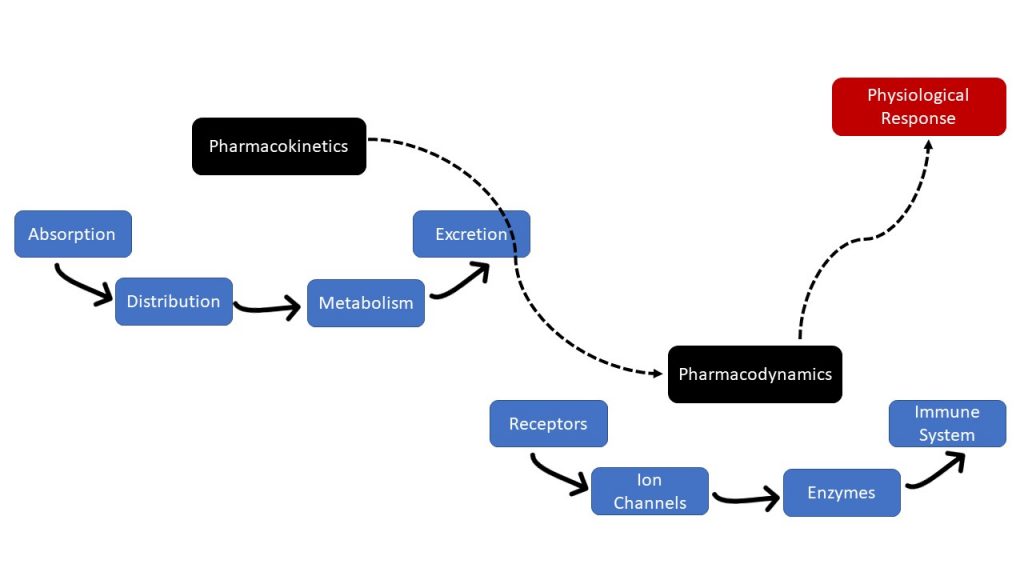
				 <h1>Pharmacokinetics</h1> <p><span class="glossary-term">Pharmacokinetics </span> is the term that describes the four stages of absorption, distribution, metabolism, and excretion of drugs. <span class="glossary-term">Drugs</span> are medications or other substances that have a physiological effect when introduced to the body. There are four basic stages for a medication to go through within the human body: absorption, distribution, metabolism, and excretion. This entire process is sometimes abbreviated <strong>ADME. </strong><span class="glossary-term">Absorption</span> occurs after medications enter the body and travel from the site of administration into the body’s circulation. <span class="glossary-term">Distribution</span> is the process by which medication is distributed throughout the body. <span class="glossary-term">Metabolism</span> is the breakdown of a drug molecule. <span class="glossary-term">Excretion</span> is the process by which the body eliminates waste. Each of these stages is described separately later in this chapter.</p> <p>Research scientists who specialize in pharmacokinetics must also pay attention to another dimension of drug action within the body: time. Unfortunately, scientists do not have the ability to actually see where a drug is going or how long it is active. To compensate, they use mathematical models and precise measurements of blood and urine to determine where a drug goes and how much of the drug (or breakdown product) remains after the body processes it. Other indicators, such as blood levels of liver enzymes, can help predict how much of a drug is going to be absorbed.</p> <p>Principles of chemistry are also applied while studying pharmacokinetics because the interactions between drug and body molecules are really just a series of chemical reactions. Understanding the chemical encounters between drugs and biological environments, such as the bloodstream and the oily surfaces of cells, is necessary to predict how much of a drug will be metabolized by the body.</p> <h1>Pharmacodynamics</h1> <p><span class="glossary-term">Pharmacodynamics</span> refers to the effects of drugs in the body and the mechanism of their action. As a drug travels through the bloodstream, it will exhibit a unique <span class="glossary-term">affinity</span> for the drug-receptor site, meaning how strongly it will bind to the site. Other components of pharmacodynamics include ion channels, enzymes, and the immune system.</p> <p>Examination of the ways in which drugs and receptor sites create a lock and key system (see Figure 1.2a<span class="footnote"><span class="footnote-indirect" data-fnref="24-1"></span></span>) is helpful to understand how drugs work and the amount of drug that may be left circulating within the bloodstream. This concept is broadly termed as drug <span class="glossary-term">bioavailability</span>. The bioavailability of drugs is an important feature that chemists and pharmaceutical scientists keep in mind when designing and packaging medicines.</p> <div class="wp-caption aligncenter" id="attachment_22" aria-describedby="caption-attachment-22" style="width: 521px"><img class="wp-image-22" title="Drug and Receptor Binding&amp;quot; by Dominic Slausen at Chippewa Valley Technical College is licensed under CC BY 4.0" src="https://opentextbc.ca/accessibilitytoolkit/wp-content/uploads/sites/397/2019/08/Drug-Binding-Barrier-Animation-1.gif" alt="Drug binding to receptor" width="521" height="391" /><div class="wp-caption-text" id="caption-attachment-22">Figure 1.2a Pharmacodynamics: Drug and Receptor Binding</div></div> <h1>The Relationship Between Pharmacokinetics and Pharmacodynamics</h1> <p>Essentially, pharmacokinetics is the movement of drugs through the body, and pharmacodynamics is the body’s biological response to the drugs. Pharmacokinetics and pharmacodynamics need to be considered when administering medications. Figure 1.2b displays the relationship between pharmacokinetics and pharmacodynamics.<a id="1.2b" data-url=""></a></p> <div class="wp-caption alignnone" id="attachment_23" aria-describedby="caption-attachment-23" style="width: 1024px"><img class="wp-image-23 size-large" src="https://opentextbc.ca/accessibilitytoolkit/wp-content/uploads/sites/397/2022/05/Chapter-1.2-Pharmacokinetics-v-Pharmacodynamics1-1024x576.jpg" alt="The Relationship Between Pharmacokinetics and Pharmacodynamics. Image description available." width="1024" height="576" srcset="https://opentextbc.ca/nursingpharmacology/wp-content/uploads/sites/397/2022/05/Chapter-1.2-Pharmacokinetics-v-Pharmacodynamics1-1024x576.jpg 1024w, https://opentextbc.ca/nursingpharmacology/wp-content/uploads/sites/397/2022/05/Chapter-1.2-Pharmacokinetics-v-Pharmacodynamics1-300x169.jpg 300w, https://opentextbc.ca/nursingpharmacology/wp-content/uploads/sites/397/2022/05/Chapter-1.2-Pharmacokinetics-v-Pharmacodynamics1-768x432.jpg 768w, https://opentextbc.ca/nursingpharmacology/wp-content/uploads/sites/397/2022/05/Chapter-1.2-Pharmacokinetics-v-Pharmacodynamics1-65x37.jpg 65w, https://opentextbc.ca/nursingpharmacology/wp-content/uploads/sites/397/2022/05/Chapter-1.2-Pharmacokinetics-v-Pharmacodynamics1-225x127.jpg 225w, https://opentextbc.ca/nursingpharmacology/wp-content/uploads/sites/397/2022/05/Chapter-1.2-Pharmacokinetics-v-Pharmacodynamics1-350x197.jpg 350w, https://opentextbc.ca/nursingpharmacology/wp-content/uploads/sites/397/2022/05/Chapter-1.2-Pharmacokinetics-v-Pharmacodynamics1.jpg 1280w" sizes="auto, (max-width: 1024px) 100vw, 1024px" title="" /><div class="wp-caption-text" id="caption-attachment-23">Figure 1.2b The Relationship Between Pharmacokinetics and Pharmacodynamics. <a href="#1.2b_desc" data-url="https://opentextbc.ca/nursingpharmacology/chapter/1-2-pharmacokineticsandpharmacodynamics/#1.2b_desc"><em>[Image Description]</em></a></div></div> <h1>Pharmacogenetics</h1> <p>No matter how effectively a drug works in a laboratory simulation, the performance in the human body will not always produce exactly the same results, and individualized responses to drugs have to be considered. Although many responses to medications may be anticipated, one’s unique genetic makeup may also have a significant impact on one’s response to a drug. <span class="glossary-term">Pharmacogenetics</span> is defined as the study of how people’s genes affect their response to medicines.<span class="footnote"><span class="footnote-indirect" data-fnref="24-2"></span></span>.</p> <h1>Image Description</h1> <p><a id="1.2b_desc" data-url=""></a><strong>Figure 1.2b image description</strong>:</p> <ol><li>Pharmacokinetics <ol><li>Absorption</li> <li>Distribution</li> <li>Metabolism</li> <li>Excretion</li> </ol> </li> <li>Pharmacodynamics <ol><li>Receptors</li> <li>Ion Channels</li> <li>Enzymes</li> <li>Immune System</li> </ol> </li> <li>Physiological Response <a href="#1.2b" data-url="https://opentextbc.ca/nursingpharmacology/chapter/1-2-pharmacokineticsandpharmacodynamics/#1.2b">[Return to Figure 1.2b]</a></li> </ol> 
	</div>
			
				
				<div class="footnotes"><div id='24-1'>
<p>“<a href="https://wlresources.dpi.wi.gov/courses/drug-and-receptor-binding/view" rel="noopener noreferrer" data-url="https://wlresources.dpi.wi.gov/courses/drug-and-receptor-binding/view">Drug and Receptor Binding</a>” by Dominic Slausen at <a href="https://www.cvtc.edu/" rel="noopener noreferrer" data-url="https://www.cvtc.edu/">Chippewa Valley Technical College</a> is licensed under <a class="internal" href="https://creativecommons.org/licenses/by/4.0/" rel="noopener noreferrer" data-url="https://creativecommons.org/licenses/by/4.0/">CC BY 4.0</a></p>

</div><div id='24-2'><p>Davis, A. (2006). <em>Medicines by design. </em>U.S. Department of Health and Human Services. https://nigms.nih.gov/education/Booklets/medicines-by-design</p>
</div></div>
	</div>
<div class="chapter numberless " id="chapter-slug-1-3-absorption" title="1.3 Pharmacokinetics – Absorption">
	<div class="chapter-title-wrap">
		<p class="chapter-number"></p>
		<h1 class="chapter-title">1.3 Pharmacokinetics – Absorption</h1>
								</div>
	<div class="ugc chapter-ugc">
				 <p>The first stage of pharmacokinetics is known as <strong><span class="glossary-term">absorption</span></strong>. Absorption occurs after drugs enter the body and travel from the site of administration into the body’s circulation. Medications can enter the body through various routes of administration. Common routes to administer medications include the following examples:</p> <ul><li>oral (swallowing an aspirin tablet)</li> <li>sublingual (dissolved under the tongue)</li> <li>enteral (administering to the GI tract such as via a nasogastric tube)</li> <li>rectal (administering a Tylenol suppository)</li> <li>inhalation (breathing in medication from an inhaler)</li> <li>intramuscular (getting a flu shot in the deltoid muscle)</li> <li>subcutaneous (injecting insulin into the fat tissue beneath the skin)</li> <li>transdermal (wearing a nicotine patch)</li> </ul> <p>When a medication is administered orally or enterally, it faces its biggest hurdle during absorption in the gastrointestinal (GI) tract. Medications made of protein, that are swallowed or otherwise absorbed in the GI tract, may quickly be deactivated by enzymes as they pass through the stomach and duodenum. If the drug does get into the blood from the intestines, part of it will be broken down by liver enzymes, known as the <span class="glossary-term">first-pass effect</span>, and some of it will escape to the general circulation to either become protein-bound (inactive) or stay free (and create an action at a receptor site). These metabolic effects are further described in the “Metabolism” section later in this chapter. Providers who prescribe medications, as well as nurses, understand that several doses of an oral medication may be needed before enough free drug stays active in the circulation to exert the desired effect.</p> <p>A workaround to the first-pass effect is to administer the medication using alternate routes such as dermal, nasal,&nbsp; inhalation, injection, or intravenous. Alternative routes of medication administration bypass the first-pass effect by entering the bloodstream directly or via absorption through the skin or lungs. Medications that are administered directly into the bloodstream (referred to as intravenous medications) do not undergo absorption and are fully available for distribution to tissues within the body.</p> <p>Alternative routes of medication have other potential problems to consider. For example, injections are often painful and cause a break in the skin, an important barrier to infection. They can also be costly and difficult to administer daily, cause localized side effects, or contribute to unpredictable fluctuations in medication blood levels.</p> <div class="wp-caption alignright" id="attachment_26" aria-describedby="caption-attachment-26" style="width: 234px"><img class="wp-image-26" title="&amp;quot;Applying transdermal patch.jpg&amp;quot; by British Columbia Institute of Technology (BCIT) is licensed under CC BY 4.0" src="https://opentextbc.ca/accessibilitytoolkit/wp-content/uploads/sites/397/2019/09/image2-268x300.png" alt="Photo of transdermal patch being applied to an arm" width="234" height="262" srcset="https://opentextbc.ca/nursingpharmacology/wp-content/uploads/sites/397/2019/09/image2-268x300.png 268w, https://opentextbc.ca/nursingpharmacology/wp-content/uploads/sites/397/2019/09/image2-915x1024.png 915w, https://opentextbc.ca/nursingpharmacology/wp-content/uploads/sites/397/2019/09/image2-768x860.png 768w, https://opentextbc.ca/nursingpharmacology/wp-content/uploads/sites/397/2019/09/image2-1372x1536.png 1372w, https://opentextbc.ca/nursingpharmacology/wp-content/uploads/sites/397/2019/09/image2-1829x2048.png 1829w, https://opentextbc.ca/nursingpharmacology/wp-content/uploads/sites/397/2019/09/image2-65x73.png 65w, https://opentextbc.ca/nursingpharmacology/wp-content/uploads/sites/397/2019/09/image2-225x252.png 225w, https://opentextbc.ca/nursingpharmacology/wp-content/uploads/sites/397/2019/09/image2-350x392.png 350w" sizes="auto, (max-width: 234px) 100vw, 234px" /><div class="wp-caption-text" id="caption-attachment-26">Figure 1.3a Applying Transdermal Patch</div></div> <p>Transdermal application of medication is an alternate route that has the primary benefit of slow, steady drug delivery directly to the bloodstream—without passing through the liver first.&nbsp; (See Figure 1.3a<span class="footnote"><span class="footnote-indirect" data-fnref="30-1"></span></span> for an image of applying a transdermal patch.) Drugs delivered transdermally enter the blood via a meshwork of small arteries, veins, and capillaries in the skin. This makes the transdermal route of drug delivery particularly useful when medication must be administered over a long period of time to control symptoms. For example, transdermal application of fentanyl, a pain medication, can provide effective pain management over a long period of time; the scopolamine patch can control motion sickness over the duration of a cruise ship vacation, and the nitroglycerin patch is used to control chronic chest pain. Despite their advantages, skin patches have a significant drawback in that only very small drug molecules can enter the body through the skin, making this application route not applicable for all types of medications.</p> <p>Inhaling drugs through the nose or mouth is another alternative route for rapid medication delivery that bypasses the liver (see <a href="#13b" data-url="https://opentextbc.ca/nursingpharmacology/chapter/1-3-absorption/#13b">Figure 1.3b</a>).&nbsp;Metered-dose inhalers have been a mainstay of asthma therapy for several years, and nasal steroid medications are often prescribed for allergy and sinus problems.</p> <h1>Lifespan Considerations</h1> <p><strong>Neonate &amp; Pediatric:</strong> Gastric absorption in neonatal and pediatric clients varies from that of their adult counterparts. In neonate and pediatric clients, the acid-producing cells of the stomach are immature until around the age of one to two years. Additionally, gastric emptying may be decreased because of slowed or irregular peristalsis (forward bowel movement). The liver of a neonatal or pediatric client continues to mature, experiencing a decrease in first-pass elimination, resulting in higher drug levels in the bloodstream.<span class="footnote"><span class="footnote-indirect" data-fnref="30-2"></span></span></p> <p><strong>Older Adult:</strong>&nbsp; As a natural result of aging, older adults will experience decreased blood flow to tissues within the GI tract. In addition, there may be changes in the gastric (stomach) pH that may alter the absorption of certain medications. Older adult clients may also experience variations in available plasma proteins, which can impact drug levels of medications that are highly protein-bound. Consideration must also be given to the use of subcutaneous and intramuscular injections in older clients experiencing decreased cardiac output. Decreased drug absorption of medications can occur when peripheral circulation is decreased. Finally, as adults age, they often have less body fat, resulting in decreased absorption of medication from transdermal patches that require adequate subcutaneous fat stores for proper absorption.<span class="footnote"><span class="footnote-indirect" data-fnref="30-3"></span></span>Table 1 summarizes route options that a nurse should consider when administering medication.</p> <table class="grid" style="border-collapse: collapse; width: 100%;"><caption>Table 1.3: Medication Route Considerations&nbsp;</caption> <tbody><tr><th class="shaded" style="width: 47.3799%;" scope="col">Medication Route</th> <th class="shaded" style="width: 52.5109%;" scope="col">Considerations</th> </tr> <tr style="height: 16px;"><td style="width: 47.3799%;" scope="row">Oral (PO), Sublingual (SL) or Enteral (NGT, GT, OGT) Ingestion <p><img src="https://opentextbc.ca/accessibilitytoolkit/wp-content/uploads/sites/397/2022/05/Adminstering_oral_medication-scaled-1.jpeg" alt="a nurse demonstrates how to adminster oral medication on a medical mannequin" width="300" height="216" title="" /></p></td> <td style="width: 52.5109%;"><ul><li>Oral route is a convenient route for administration of solid as well as liquid formulations.</li> <li>Additional variables that may influence the rate and extent of absorption include enteric coating or extended-release formulations, acidity of gastric contents, gastric emptying rate, dietary contents, and presence of other drugs.</li> <li>First-pass effect: Blood containing the absorbed drug passes through the liver, which can deactivate a substantial amount of the drug and decrease its bioavailability (the percentage of dose that reaches the systemic circulation).</li> </ul> </td> </tr> <tr style="height: 16px;"><td style="width: 47.3799%;" scope="row">Parenteral Injection (SC, IM, IV) <p><img src="https://opentextbc.ca/accessibilitytoolkit/wp-content/uploads/sites/397/2022/05/Vaccination-ChristianEmmer-CC-by-nc-4.0.jpeg" alt="a nurse about to inject the arm of a patient with a small needle" width="300" height="167" title="" /></p></td> <td style="width: 52.5109%;"><ul><li>Subcutaneous and intramuscular administration:&nbsp; Injections can be difficult for clients to self-administer at home or to administer on a daily basis.&nbsp; They can be costly and painful. Injections also cause a break in skin that is an important barrier to infection, and can cause fluctuation in drug levels and localized side effects to skin.</li> <li>Intravenous (IV): IV drugs are fully available to tissues after administration into the bloodstream, offering complete bioavailability and an immediate effect.&nbsp; However, this route requires intravenous access that can be painful to the client and also increases risk of infection.&nbsp; Medications must be administered in sterile fashion, and if two products are administered simultaneously, their compatibility must be verified.&nbsp; There is also an increased risk of toxicity.</li> </ul> </td> </tr> <tr style="height: 16px;"><td style="width: 47.3799%;" scope="row"><a id="13b" data-url=""></a>Pulmonary Inhalation <div><dl id="attachment_928"><dt></dt><div class="wp-caption alignnone" style="width: 300px"><img src="https://opentextbc.ca/accessibilitytoolkit/wp-content/uploads/sites/397/2022/05/29251369035_9ab3f4d858_b.jpeg" alt="person using a metered dose asthma inhaler" width="300" height="249" title="" /><div class="wp-caption-text">Figure 1.3b “Adult Using Asthma Inhaler” by NIAID<span class="footnote"><span class="footnote-indirect" data-fnref="30-4"></span></span></div></div> </dl> </div> </td> <td style="width: 52.5109%;"><ul><li>Inhalation allows for rapid absorption of drugs in gaseous, vaporized or aerosol form.</li> <li>Absorption of particulates/aerosols depends on particle/droplet size, which influences depth of entry through the pulmonary tree to reach the alveoli. The ability of the client to create successful inhalation, especially in the presence of bronchospasm, may also influence depth of entry in the pulmonary tree.</li> </ul> </td> </tr> <tr style="height: 243px;"><td style="width: 47.3799%;" scope="row">Topical and Transdermal Application <p><img title="&amp;quot;Applying transdermal patch.jpg&amp;quot; by British Columbia Institute of Technology (BCIT) is licensed under CC BY 4.0" src="https://opentextbc.ca/accessibilitytoolkit/wp-content/uploads/sites/397/2019/09/image2-268x300.png" alt="Photo of transdermal patch being applied to an arm" width="160" height="179" /></p></td> <td style="width: 52.5109%;"><ul><li>Topical creams, lotions, and ointments are generally used for local effect; transdermal patch formulations are used for systemic effect.</li> <li>Absorption through the buccal or sublingual membranes may be rapid.</li> <li>Absorption through skin is generally slower but produces steady, long-term effect that avoids the first-pass effect.&nbsp; However, absorption of medication is affected by blood flow to the skin.</li> </ul> </td> </tr> </tbody> </table> <div class="textbox"><h3 class="star">&nbsp;Interactive Activity</h3> <div class="textbox interactive-content"><span class="interactive-content__icon"></span> <p>An interactive H5P element has been excluded from this version of the text. You can view it online here:<br /> <a href="https://opentextbc.ca/nursingpharmacology/?p=30#h5p-1" title="Module 1: Absorption Knowledge Check" data-url="https://opentextbc.ca/nursingpharmacology/?p=30#h5p-1">https://opentextbc.ca/nursingpharmacology/?p=30#h5p-1</a> </p> </div> </div> <h3>Attributions</h3> <ul><li>“Table 1.3: Medication Route Considerations” was adapted from Chapter 1.3 Pharmacokinetics in <a href="https://med.libretexts.org/Bookshelves/Pharmacology_and_Neuroscience/Book%3A_Principles_of_Pharmacology_(Rosow_Standaert_and_Strichartz)" data-url="https://med.libretexts.org/Bookshelves/Pharmacology_and_Neuroscience/Book%3A_Principles_of_Pharmacology_(Rosow_Standaert_and_Strichartz)"><em>Principles of Pharmacology</em></a> by Carl Rosow, David Standaert, and Gary Strichartz, which is licenced under a <a class="internal" href="https://creativecommons.org/licenses/by-nc-sa/4.0" data-url="https://creativecommons.org/licenses/by-nc-sa/4.0">CC BY-NC-SA 4.0 licence</a>. Adapted by Amanda Egert, Kimberly Lee, and Manu Gill.</li> </ul> <hr class="before-footnotes clear" /><div class="footnotes"><ol><li id="footnote-30-1">“Adult Using Asthma Inhaler” by NIAID is licensed under CC BY 2.0 <a href="#return-footnote-30-1" class="return-footnote" aria-label="Return to footnote 1" data-url="https://opentextbc.ca/nursingpharmacology/chapter/1-3-absorption/#return-footnote-30-1">↵</a></li></ol></div> 
	</div>
			
				
				<div class="footnotes"><div id='30-1'>
<p>“<a href="https://commons.wikimedia.org/wiki/File:Applying_transdermal_patch.jpg" rel="noopener noreferrer" data-url="https://commons.wikimedia.org/wiki/File:Applying_transdermal_patch.jpg">Applying transdermal patch.jpg</a>” by <a href="https://www.bcit.ca/" rel="noopener noreferrer" data-url="https://www.bcit.ca/">British Columbia Institute of Technology (BCIT)</a> is licensed under <a class="internal" href="https://creativecommons.org/licenses/by/4.0/deed.ast" rel="noopener noreferrer" data-url="https://creativecommons.org/licenses/by/4.0/deed.ast">CC BY 4.0</a></p>

</div><div id='30-2'>
<p>Fernandez, E., Perez, R., Hernandez, A., Tejada, P., Arteta, M., &amp; Ramos, J. T. (2011). Factors and mechanisms for pharmacokinetic differences between pediatric population and adults. Pharmaceutics, 3(1), 53–72. <a class="internal" href="https://doi.org/10.3390/pharmaceutics3010053" rel="noopener noreferrer" data-url="https://doi.org/10.3390/pharmaceutics3010053">https://doi.org/10.3390/pharmaceutics3010053</a></p>

</div><div id='30-3'>
<p>Fernandez, E., Perez, R., Hernandez, A., Tejada, P., Arteta, M., &amp; Ramos, J. T. (2011). Factors and mechanisms for pharmacokinetic differences between pediatric population and adults. Pharmaceutics, 3(1), 53–72. <a class="internal" href="https://doi.org/10.3390/pharmaceutics3010053" rel="noopener noreferrer" data-url="https://doi.org/10.3390/pharmaceutics3010053">https://doi.org/10.3390/pharmaceutics3010053</a></p>

</div><div id='30-4'><p>“Adult Using Asthma Inhaler” by NIAID is licensed under CC BY 2.0</p>
</div></div>
	</div>
<div class="chapter numberless " id="chapter-slug-1-4-distribution" title="1.4 Pharmacokinetics – Distribution">
	<div class="chapter-title-wrap">
		<p class="chapter-number"></p>
		<h1 class="chapter-title">1.4 Pharmacokinetics – Distribution</h1>
								</div>
	<div class="ugc chapter-ugc">
				 <p>The second stage of pharmacokinetics is the process known as drug <span class="glossary-term">distribution</span>. Distribution is the process by which medication is dispersed throughout the body via the bloodstream. Once a drug enters into systemic circulation by absorption or direct administration, it must be distributed into interstitial and intracellular fluids to get to the target cells. The distribution of a drug throughout the body is dependent on common factors such as blood flow, plasma protein binding, lipid solubility, the blood-brain barrier, and the placental barrier. Other factors include capillary permeability, differences between blood/tissue, and volume of distribution.</p> <p>Distribution of a medication can also cause unintended&nbsp;<span class="glossary-term">adverse effects</span> or&nbsp;<span class="glossary-term">side effects</span>. Drugs are designed to primarily cause one effect, meaning they bind more strongly to one specific receptor site and predictably cause or block an action.&nbsp; However, side effects can occur when the drug binds to other sites in addition to the target tissue, causing secondary side effects.&nbsp; These side effects can range from tolerable to unacceptable resulting in the discontinuation of the medication. For example, a person might take the pain reliever ibuprofen (Advil) to treat a sore leg muscle, and the pain may be subsequently relieved, but there may also be stomach irritation as a side effect that may cause the person to stop taking Ibuprofen.</p> <h1>Blood Flow</h1> <p>The blood stream carries medications to their destinations in the body.&nbsp; Many factors can affect the blood flow and delivery of medication, such as decreased flow (due to dehydration), blocked vessels (due to atherosclerosis), constricted vessels (due to uncontrolled hypertension), or weakened pumping by the heart muscle (due to heart failure). As an example, when administering an antibiotic to a client with diabetes, who has an infected toe, it may be difficult for the antibiotic to move through the blood vessels all the way to the cells of the toe that is infected.</p> <p>Once the drug is in the bloodstream, a portion of it may exist as free drug, dissolved in plasma water. Some of the drug will be reversibly taken up by red cells, and some will be reversibly bound to plasma proteins. For many drugs, the bound forms can account for 95-98% of the total. This is important because it is the free drug that traverses cell membranes and produces the desired effect. It is also important because a protein-bound drug can act as a reservoir that releases the drug slowly and thus prolongs its action. With drug distribution, it is important to consider both the amount of free drug that is readily available to tissues, as well as the potential drug reserve that may be released over time.</p> <h1>Protein-Binding</h1> <p>A common factor impacting distribution of medication is plasma protein in the blood.&nbsp; Albumin is one of the most important proteins in the blood.&nbsp; Albumin levels can be decreased by several factors such as malnutrition and liver disease.&nbsp; A certain percentage of almost every drug gets bound to plasma proteins when it initially enters the bloodstream and starts to circulate. The portion of the drug that gets “protein-bound” is inactive while it is bound, but the portion of the drug that escapes initial protein-binding becomes immediately “free” to bind to the target tissue and exert or block an action.</p> <p>Clients taking several highly protein-bound medications often experience greater side effects.&nbsp; Some drugs are able to competitively grab (or bind to) plasma proteins more easily than other drugs, thus taking up the available protein molecules first. This prevents secondary medications from binding strongly to protein and the intended target site. Instead, these medications float freely in the circulation without exerting action and increase the risk of side effects and toxicities.</p> <div class="wp-caption alignright" id="attachment_32" aria-describedby="caption-attachment-32" style="width: 300px"><img class="wp-image-32 size-medium" title="&amp;#039;Renault Type r321 Service Bus&amp;#039; by Emslichter is licensed under CC0 1.0" src="https://opentextbc.ca/accessibilitytoolkit/wp-content/uploads/sites/397/2019/09/image5-300x101.png" alt="Photo of a City Public Transporation Bus" width="300" height="101" srcset="https://opentextbc.ca/nursingpharmacology/wp-content/uploads/sites/397/2019/09/image5-300x101.png 300w, https://opentextbc.ca/nursingpharmacology/wp-content/uploads/sites/397/2019/09/image5-768x258.png 768w, https://opentextbc.ca/nursingpharmacology/wp-content/uploads/sites/397/2019/09/image5-65x22.png 65w, https://opentextbc.ca/nursingpharmacology/wp-content/uploads/sites/397/2019/09/image5-225x76.png 225w, https://opentextbc.ca/nursingpharmacology/wp-content/uploads/sites/397/2019/09/image5-350x118.png 350w, https://opentextbc.ca/nursingpharmacology/wp-content/uploads/sites/397/2019/09/image5.png 1024w" sizes="auto, (max-width: 300px) 100vw, 300px" /><div class="wp-caption-text" id="caption-attachment-32">Figure 1.4&nbsp; Protein binding is like available seats on a bus<strong style="text-align: initial; font-size: 1em;">&nbsp;</strong></div></div> <p><span style="text-align: initial; font-size: 1em;">Think of protein-binding like a bus stop (see Figure 1.4<span class="footnote"><span class="footnote-indirect" data-fnref="33-1"></span></span>). Many passengers (or medication molecules) want to take a ride on the bus. Everyone is eager to get to their destination and interested in finding a seat.&nbsp; Some passengers are stronger and will get in the seats first (like drug molecules with greater protein-binding ability bind to the protein).&nbsp; Sometimes, there may not be enough seats on the bus, and some passengers are left at the bus stop. The passengers (medication molecules) who were left behind are “free” to move around and walk to their destination.&nbsp; They may strike out on their own and get “snatched” (connected to a target receptor site) while on foot.&nbsp; In a similar way, “free” drug particles that are not protein-bound are circulating in the bloodstream and connecting in a predictable fashion to receptor sites that have an affinity for that particular drug. </span>These active drug molecules that did not bind to the protein (like those passengers that were unable to get a seat on the bus) will produce the first effect in the body. Over time, the medication molecules that are bound to the protein (like the passengers with seats on the bus) will get off the bus, start walking around, and get “snatched” to the receptor site that has affinity for them.</p> <h1>Blood-Brain Barrier</h1> <p>Medications destined for the central nervous system (the brain and spinal cord) face an even larger hurdle than protein-binding; they must also pass through a nearly impenetrable barricade called the <span class="glossary-term">blood-brain barrier</span>. This blockade is built from a tightly woven mesh of capillaries that protect the brain from potentially dangerous substances, such as poisons or viruses.&nbsp; Only certain medications that are made of lipids (fats) or have a “carrier” can get through the blood-brain barrier.</p> <p>Research scientists have devised ways for certain medications to penetrate the blood-brain barrier. An example of this is the brand-named medication Sinemet®, which is a combination of two drugs: carbidopa and levadopa. Carbidopa is designed to carry the levadopa medication across the blood-brain barrier, where it enters the brain and is converted into dopamine to exert its effect on Parkinson’s disease symptoms.</p> <p>Some medications inadvertently bypass the blood-brain barrier and impact an individual’s central nervous system function. For example, diphenhydramine (Benadryl®) is an antihistamine used to decrease allergy symptoms, however it can also cross the blood-brain barrier, depress the central nervous system, and cause the side effect of drowsiness. In the case of a person who has difficulty falling asleep, this drowsy side effect may be useful, but for another person it may be problematic, as they try to safely carry out daily activities.</p> <h1>Placental Barrier</h1> <p>It is always important to consider the effects of medication for clients who are pregnant or may become pregnant. The placenta is permeable to some medications, while others have not been specifically studied in pregnant clients. Some drugs can cause harm to the unborn fetus during any trimester. Therefore, it is imperative to always consult a healthcare provider regarding the safety of medications for use during pregnancy.&nbsp; This imperative is assumed in the remaining chapters discussing medication classes, and nurses should always check the most recent, evidence-based drug references before administering medications during pregnancy.</p> <h1>Lifespan Considerations</h1> <p><strong>Neonate &amp; Pediatric:</strong> Fat content in young clients is decreased because of greater total body water. Additionally, for the growing pediatric client, the liver is still forming, protein-binding capacity is decreased, and the developing blood-brain barrier allows more drugs to enter the brain.<span class="footnote"><span class="footnote-indirect" data-fnref="33-2"></span></span></p> <p><strong>Older Adult:</strong> The aging adult client will experience a decrease in total body water and muscle mass. Body fat may increase and subsequently result in a longer duration of action for many medications. Serum albumin often also decreases, resulting in more active free drug within the body. This is one reason why many older adult clients require lower levels of medication.<span class="footnote"><span class="footnote-indirect" data-fnref="33-3"></span></span></p> <div class="textbox shaded"><p>Other factors that impact drug distribution are:</p> <p><strong>1) Tissue differences in rates of uptake of drugs.</strong></p> <ul><li>Blood flow: distribution occurs most rapidly into tissues with a greater number of blood vessels that allow high blood flow (lungs, kidneys, liver, brain) and least rapidly in tissues with fewer numbers of blood vessels resulting in low blood flow (fat).</li> <li>Capillary permeability: permeability of capillaries is tissue-dependent. Distribution rates are relatively slower or non-existent into the CNS because of the tight junction between capillary endothelial cells and the blood-brain barrier.&nbsp; Capillaries of the liver and kidney are more porous, allowing for greater permeability.</li> </ul> <p><strong>2) Differences in tissue/blood ratios at equilibrium</strong></p> <ul><li>Dissolution of lipid-soluble drugs in adipose tissue</li> <li>Binding of drugs to intracellular sites</li> <li>Plasma protein-binding</li> </ul> <p><strong>3) Apparent Volume of Distribution</strong></p> <ul><li>Fluid compartments: plasma, extracellular water, total body water.</li> <li>The plasma half-life of a drug <ul><li><span class="glossary-term">Half-life</span> is the amount of time it takes for half of the medication to be eliminated in the body. Half-life directly correlates to the duration of the therapeutic effect of a medication. Many factors can influence half-life, for example, liver disease or kidney dysfunction.</li> <li>Information about half-life of a medication can be found in evidence-based medication references.&nbsp; For example,&nbsp; in the “Clinical Pharmacology” section of the Daily Med reference for <a href="https://dailymed.nlm.nih.gov/dailymed/drugInfo.cfm?setid=87960726-e901-4596-bd33-ead02cb93a20" rel="noopener noreferrer" data-url="https://dailymed.nlm.nih.gov/dailymed/drugInfo.cfm?setid=87960726-e901-4596-bd33-ead02cb93a20">furosemide,</a> the half-life is approximately 2 hours.</li> </ul> </li> </ul> </div> 
	</div>
			
				
				<div class="footnotes"><div id='33-1'>
<p>‘<a href="https://pixabay.com/es/photos/renault-tipo-r321-1755835/" rel="noopener noreferrer" data-url="https://pixabay.com/es/photos/renault-tipo-r321-1755835/">Renault Type r321 Service Bus</a>‘ by <a href="https://pixabay.com/es/users/emslichter-1377910/" rel="noopener noreferrer" data-url="https://pixabay.com/es/users/emslichter-1377910/">Emslichter</a> is licensed under <a class="internal" href="https://creativecommons.org/share-your-work/public-domain/cc0/" rel="noopener noreferrer" data-url="https://creativecommons.org/share-your-work/public-domain/cc0/">CC0 1.0</a></p>

</div><div id='33-2'>
<p>Fernandez, E., Perez, R., Hernandez, A., Tejada, P., Arteta, M., &amp; Ramos, J. T. (2011). Factors and mechanisms for pharmacokinetic differences between pediatric population and adults. Pharmaceutics, 3(1), 53–72. <a class="internal" href="https://doi.org/10.3390/pharmaceutics3010053" rel="noopener noreferrer" data-url="https://doi.org/10.3390/pharmaceutics3010053">https://doi.org/10.3390/pharmaceutics3010053</a></p>

</div><div id='33-3'>
<p>Fernandez, E., Perez, R., Hernandez, A., Tejada, P., Arteta, M., &amp; Ramos, J. T. (2011). Factors and mechanisms for pharmacokinetic differences between pediatric population and adults. Pharmaceutics, 3(1), 53–72. <a href="#_5mty8zaepa8u" rel="noopener noreferrer" data-url="https://opentextbc.ca/nursingpharmacology/chapter/6-12-blood-coagulation-modifiers#_5mty8zaepa8u">https://doi.org/10.3390/pharmaceutics3010053</a></p>

</div></div>
	</div>
<div class="chapter numberless " id="chapter-slug-1-5-metabolism" title="1.5 Pharmacokinetics – Metabolism">
	<div class="chapter-title-wrap">
		<p class="chapter-number"></p>
		<h1 class="chapter-title">1.5 Pharmacokinetics – Metabolism</h1>
								</div>
	<div class="ugc chapter-ugc">
				 <div class="wp-caption alignright" id="attachment_35" aria-describedby="caption-attachment-35" style="width: 300px"><img class="wp-image-35 size-medium" title="&amp;#039;Liver Hepatic Organ Jaundice Bile Fatty Liver - Liver&amp;#039; by VSRao is licensed under CC0" src="https://opentextbc.ca/accessibilitytoolkit/wp-content/uploads/sites/397/2019/09/image6-300x300.png" alt="Image of a human liver" width="300" height="300" srcset="https://opentextbc.ca/nursingpharmacology/wp-content/uploads/sites/397/2019/09/image6-300x300.png 300w, https://opentextbc.ca/nursingpharmacology/wp-content/uploads/sites/397/2019/09/image6-150x150.png 150w, https://opentextbc.ca/nursingpharmacology/wp-content/uploads/sites/397/2019/09/image6-65x65.png 65w, https://opentextbc.ca/nursingpharmacology/wp-content/uploads/sites/397/2019/09/image6-225x225.png 225w, https://opentextbc.ca/nursingpharmacology/wp-content/uploads/sites/397/2019/09/image6-350x350.png 350w, https://opentextbc.ca/nursingpharmacology/wp-content/uploads/sites/397/2019/09/image6.png 720w" sizes="auto, (max-width: 300px) 100vw, 300px" /><div class="wp-caption-text" id="caption-attachment-35">Figure 1.5 Liver</div></div> <p>Once a drug has been absorbed and distributed in the body, it will then be broken down by a process known as <span class="glossary-term">metabolism</span>. The breakdown of a drug molecule usually involves two steps that take place primarily in the body’s chemical processing plant: the liver. See Figure 1.5<span class="footnote"><span class="footnote-indirect" data-fnref="38-1"></span></span> for an image of a human liver. Everything that enters the bloodstream—whether swallowed, injected, inhaled, absorbed through the skin, or produced by the body itself—is carried to this largest internal organ.</p> <p>The biotransformations that take place in the liver are performed by the liver enzymes. Every one of your cells has a variety of enzymes, and each enzyme specializes in a particular job. Some enzymes break molecules apart, while others link small molecules into long chains. With drugs, the first step in metabolizing occurs through a process known as the <span class="glossary-term">first-pass effect</span>, in which orally administered drugs are broken down in the liver and intestines.&nbsp; This makes the substance easier to excrete in the urine. Medications made of protein that are swallowed or otherwise absorbed in the GI tract may quickly be deactivated by enzymes as they pass through the stomach and duodenum. If the drug enters the blood from the intestines, part of it will be broken down by liver enzymes, known as the first-pass effect, and some of it will escape to the general circulation to either be protein-bound (inactive) or stay free (and create an action at a receptor site). Thus, several doses of an oral medication may be needed to maintain enough active free drug in the circulation to exert the desired effect.</p> <p>Many of the products of enzymatic breakdown, which are called metabolites, are less chemically active than the original molecule. For this reason, scientists refer to the liver as a “detoxifying” organ.&nbsp; &nbsp;However, rather than being destroyed by liver enzymes, a few drugs are metabolized into an active form of an intended drug called a “prodrug.”&nbsp; Prodrugs have chemical activities of their own—sometimes as powerful as those of the original drug. When prescribing certain drugs, healthcare providers must take into account these added effects. Once liver enzymes are finished working on a medicine, the now-inactive drug undergoes the final stage of its time in the body – excretion – as it exits via the urine or feces.</p> <h1>Lifespan Considerations</h1> <p><strong>Neonate &amp; Pediatric:</strong> The developing liver in infants and young children produces decreased levels of microsomal enzymes. This may result in a decreased ability of the young child or neonate to metabolize medications. In contrast, older children may experience increased metabolism and require higher doses of medications once the hepatic enzymes are fully produced.<span class="footnote"><span class="footnote-indirect" data-fnref="38-2"></span></span></p> <p><strong>Older Adult:</strong> Hepatic metabolism may experience a significant decline in the older adult. As a result, dosages should be adjusted according to the client’s liver function and anticipated metabolic rate. First-pass metabolism is also decreased with aging; therefore, older adults may have higher “free” circulating drug concentrations and be at higher risk for side effects and toxicities.<span class="footnote"><span class="footnote-indirect" data-fnref="38-3"></span></span></p> <div class="textbox textbox--key-takeaways"><div class="textbox__header"><p class="textbox__title">Clinical Reasoning and Decision Making Activity 1.5</p> </div> <div class="textbox__content"><p><img class="alignright wp-image-36" style="font-size: 14.4px; font-family: 'Encode Sans', sans-serif;" src="https://opentextbc.ca/accessibilitytoolkit/wp-content/uploads/sites/397/2022/05/ORN-Icons_internet-copy_internet-copy-300x300-1.png" alt="Image of a circle containing a speech bubble with a question mark in it." width="200" height="200" srcset="https://opentextbc.ca/nursingpharmacology/wp-content/uploads/sites/397/2022/05/ORN-Icons_internet-copy_internet-copy-300x300-1.png 300w, https://opentextbc.ca/nursingpharmacology/wp-content/uploads/sites/397/2022/05/ORN-Icons_internet-copy_internet-copy-300x300-1-150x150.png 150w, https://opentextbc.ca/nursingpharmacology/wp-content/uploads/sites/397/2022/05/ORN-Icons_internet-copy_internet-copy-300x300-1-65x65.png 65w, https://opentextbc.ca/nursingpharmacology/wp-content/uploads/sites/397/2022/05/ORN-Icons_internet-copy_internet-copy-300x300-1-225x225.png 225w" sizes="auto, (max-width: 200px) 100vw, 200px" title="" />Metabolism can be influenced by many factors within the body. If a client has liver damage, the client may not be able to break down (metabolize) medications as efficiently. Dosages are calculated according to the liver’s ability to metabolize and the kidney’s ability to excrete.</p> <p>When caring for a client with cirrhosis, how does this condition impact the dosages prescribed for the client?</p> <p>Note: Answers to these can be found in the “<a href="#chapter-chapter-1" rel="noopener" data-url="https://opentextbc.ca/nursingpharmacology/chapter/chapter-1/">Answer Key</a>” sections at the end of the book.</p> </div> </div> <div class="textbox shaded"><h1>Did you know the power of grapefruit juice?</h1> <p><strong>A Juicy Story</strong><span class="footnote"><span class="footnote-indirect" data-fnref="38-4"></span></span><strong><img class="alignright wp-image-37 size-full" title="&amp;quot;Grapefruit&amp;quot; by ExplorerBob is licensed under CC0" src="https://opentextbc.ca/accessibilitytoolkit/wp-content/uploads/sites/397/2022/05/image8.png" alt="Photo of sliced grapefruit" width="275" height="183" /><br /> </strong></p> <p><span style="text-align: initial; font-size: 1em;">Did you know that, in some people, a single glass of grapefruit juice can alter levels of drugs used to treat allergies, heart diseases, and infections? Fifteen years ago, pharmacologists discovered this “grapefruit juice effect” by luck, after giving volunteers grapefruit juice to mask the taste of a medicine. Nearly a decade later, researchers figured out that grapefruit juice affects the metabolizing rates of some medicines by lowering levels of a drug-metabolizing enzyme, called CYP3A4 (part of the CYP450 family of drug-binding enzymes), in the intestines. </span></p> <p><span style="text-align: initial; font-size: 1em;">More recently, Paul B. Watkins of the University of North Carolina at Chapel Hill discovered that other juices like Seville (sour) orange juice—but not regular orange juice—have the same effect on the liver’s ability to metabolize using enzymes. Each of ten people who volunteered for Watkins’ juice-medicine study took a standard dose of felodopine (Plendil), a drug used to treat high blood pressure, diluted in grapefruit juice, sour orange juice, or plain orange juice. The researchers measured blood levels of&nbsp; Plendil at various times afterward. The team observed that both grapefruit juice and sour orange juice increased blood levels of Plendil, as if the people had received a higher dose. Regular orange juice had no effect. Watkins and his coworkers have found that a chemical common to grapefruit and sour oranges, dihydroxybergamottin, is likely the molecular culprit.&nbsp; Thus, when taking medications that use the CYP3A4 enzyme to metabolize, clients are advised to avoid grapefruit juice and sour orange juice.</span></p> </div> <h3>Attributions</h3> <ul><li>The first three paragraphs of the chapter and “Did you know the power of grapefruit juice?” were adapted from <a href="https://nigms.nih.gov/education/Booklets/medicines-by-design" data-url="https://nigms.nih.gov/education/Booklets/medicines-by-design"><em>Medicines by Design</em></a> by Allison Davis (US Department of Health and Human Services) and is in the public domain.</li> </ul> 
	</div>
			
				
				<div class="footnotes"><div id='38-1'>
<p>‘<a href="https://pixabay.com/es/illustrations/h%C3%ADgado-hep%C3%A1tica-%C3%B3rgano-la-ictericia-4081243/" rel="noopener noreferrer" data-url="https://pixabay.com/es/illustrations/h%C3%ADgado-hep%C3%A1tica-%C3%B3rgano-la-ictericia-4081243/">Liver Hepatic Organ Jaundice Bile Fatty Liver – Liver</a>‘ by <a href="https://pixabay.com/es/users/vsrao-8105725/" rel="noopener noreferrer" data-url="https://pixabay.com/es/users/vsrao-8105725/">VSRao</a> is licensed under <a class="internal" href="https://creativecommons.org/share-your-work/public-domain/cc0/" rel="noopener noreferrer" data-url="https://creativecommons.org/share-your-work/public-domain/cc0/">CC0</a></p>

</div><div id='38-2'>
<p>Fernandez, E., Perez, R., Hernandez, A., Tejada, P., Arteta, M., &amp; Ramos, J. T. (2011). Factors and mechanisms for pharmacokinetic differences between pediatric population and adults. Pharmaceutics, 3(1), 53–72. <a class="internal" href="https://doi.org/10.3390/pharmaceutics3010053" rel="noopener noreferrer" data-url="https://doi.org/10.3390/pharmaceutics3010053">https://doi.org/10.3390/pharmaceutics3010053</a></p>

</div><div id='38-3'>
<p>Fernandez, E., Perez, R., Hernandez, A., Tejada, P., Arteta, M., &amp; Ramos, J. T. (2011). Factors and mechanisms for pharmacokinetic differences between pediatric population and adults. Pharmaceutics, 3(1), 53–72. <a class="internal" href="https://doi.org/10.3390/pharmaceutics3010053" rel="noopener noreferrer" data-url="https://doi.org/10.3390/pharmaceutics3010053">https://doi.org/10.3390/pharmaceutics3010053</a></p>

</div><div id='38-4'>
<p>“<a href="https://pixabay.com/es/photos/pomelo-pomelo-rojo-c%C3%ADtricos-2489409/" rel="noopener noreferrer" data-url="https://pixabay.com/es/photos/pomelo-pomelo-rojo-c%C3%ADtricos-2489409/">Grapefruit</a>” by <a href="https://pixabay.com/es/users/explorerbob-3093227/" rel="noopener noreferrer" data-url="https://pixabay.com/es/users/explorerbob-3093227/">ExplorerBob</a> is licensed under <a class="internal" href="https://creativecommons.org/share-your-work/public-domain/cc0/" rel="noopener noreferrer" data-url="https://creativecommons.org/share-your-work/public-domain/cc0/">CC0</a></p>

</div></div>
	</div>
<div class="chapter numberless " id="chapter-slug-1-6-excretion" title="1.6 Phamacokinetics – Excretion">
	<div class="chapter-title-wrap">
		<p class="chapter-number"></p>
		<h1 class="chapter-title">1.6 Phamacokinetics – Excretion</h1>
								</div>
	<div class="ugc chapter-ugc">
				 <p><span class="glossary-term">Excretion</span> is the final stage of a medication interaction within the body. The body has absorbed, distributed, and metabolized the medication molecules – now what does it do with the leftovers? Remaining parent drugs and metabolites in the bloodstream are often filtered by the kidney, where a portion undergoes reabsorption back into the bloodstream, and the remainder is excreted in the urine. The liver also excretes byproducts and waste into the bile. Another potential route of excretion is the lungs. For example, drugs like alcohol and the anesthetic gases are often eliminated by the lungs.</p> <div class="textbox textbox--key-takeaways"><div class="textbox__header"><p class="textbox__title">Clinical Reasoning and Decision Making Activity 1.6</p> </div> <div class="textbox__content"><p><img class="alignright wp-image-36" src="https://opentextbc.ca/nursingpharmacology/wp-content/uploads/sites/397/2022/05/ORN-Icons_internet-copy_internet-copy-300x300-1.png" alt="" width="150" height="150" srcset="https://opentextbc.ca/nursingpharmacology/wp-content/uploads/sites/397/2022/05/ORN-Icons_internet-copy_internet-copy-300x300-1.png 300w, https://opentextbc.ca/nursingpharmacology/wp-content/uploads/sites/397/2022/05/ORN-Icons_internet-copy_internet-copy-300x300-1-150x150.png 150w, https://opentextbc.ca/nursingpharmacology/wp-content/uploads/sites/397/2022/05/ORN-Icons_internet-copy_internet-copy-300x300-1-65x65.png 65w, https://opentextbc.ca/nursingpharmacology/wp-content/uploads/sites/397/2022/05/ORN-Icons_internet-copy_internet-copy-300x300-1-225x225.png 225w" sizes="auto, (max-width: 150px) 100vw, 150px" title="" />When providing care for a client who has chronic kidney disease, how does this disease impact medication excretion?</p> <p>Note: Answers to these can be found in the “<a href="#chapter-chapter-1" data-url="https://opentextbc.ca/nursingpharmacology/chapter/chapter-1/">Answer Key</a>” sections at the end of the book.</p> </div> </div> <h1>Routes of Excretion</h1> <p>Now let’s further discuss the various routes of excretion from the body.</p> <h2>Kidney</h2> <p>The most common route of excretion is the kidney.&nbsp; As the kidneys filter blood, the majority of drug byproducts and waste are excreted in the urine. The rate of excretion can be estimated by taking into consideration several factors:&nbsp; age, weight, biological sex, and kidney function.&nbsp; Kidney function is measured by lab values such as serum creatinine, glomerular filtration rate (GFR), and creatinine clearance.&nbsp; If a client’s kidney function is decreased, then their ability to excrete medication is affected and drug dosages must be altered for safe administration.</p> <h2>Liver</h2> <p>As the liver filters blood, some drugs and their metabolites are actively transported by the hepatocytes (liver cells) to bile. Bile moves through the bile ducts to the gallbladder and then on to the small intestine. During this process, some drugs may be partially absorbed by the intestine back into the bloodstream.&nbsp; Other drugs are biotransformed (metabolized) by intestinal bacteria and reabsorbed. Unabsorbed drugs and byproducts/metabolites are excreted via the feces. If a client is experiencing decreased liver function, their ability to excrete medication is affected and drug dosages must be decreased. Lab studies used to estimate liver function are called liver function tests and include measurement of the ALT and AST enzymes that the body releases in response to damage or disease.</p> <h1>Other Routes to Consider</h1> <p>Sweat, tears, reproductive fluids (such as seminal fluid), and breast milk can also contain drugs and byproducts/metabolites of drugs. This can pose a toxic threat, such as the exposure of an infant to breast milk containing drugs or byproducts of drugs ingested by their breastfeeding parent. Therefore, it is vital to check all medications with a healthcare provider before administering them to a parent who is breastfeeding.</p> <h1>Putting it all together…</h1> <p>Prescribing and administering medications in a safe manner to clients is challenging and requires a team effort by pharmacists, healthcare providers, and nurses.&nbsp; In addition to the factors described in this chapter, there are many other considerations for safe medication administration that are further explained in the “Safety and Ethics” chapter.</p> <h1>Lifespan Considerations</h1> <p><strong>Neonate &amp; Pediatrics:</strong> Young clients have immature kidneys with decreased glomerular filtration, resorption, and tubular secretion. As a result, they do not clear medications as efficiently from the body.&nbsp; Dosing for most medications used to treat infants and pediatric clients is commonly based on weight in kilograms, and a smaller dose is usually prescribed. In addition, pediatric clients may have higher levels of free circulating medication than anticipated and may become toxic quickly.&nbsp; Therefore, frequent assessment of infants and children is vital for the early identification of drug toxicity.<span class="footnote"><span class="footnote-indirect" data-fnref="40-1"></span></span></p> <p><strong>Older Adult:</strong>&nbsp; Kidney and liver function often decrease with age, which can lead to decreased excretion of medications. Subsequently, medication may have a prolonged half-life with a greater potential for toxicity due to elevated circulating drug levels.&nbsp; Smaller doses of medications are often recommended for older clients due to these factors, which are commonly referred to as, “start low and go slow.”<span class="footnote"><span class="footnote-indirect" data-fnref="40-2"></span></span></p> <div class="textbox"><h3 class="star">&nbsp;Interactive Activity</h3> <div class="textbox interactive-content"><span class="interactive-content__icon"></span> <p>An interactive H5P element has been excluded from this version of the text. You can view it online here:<br /> <a href="https://opentextbc.ca/nursingpharmacology/?p=40#h5p-2" title="Module 1: Pharmacokinetics Quiz" data-url="https://opentextbc.ca/nursingpharmacology/?p=40#h5p-2">https://opentextbc.ca/nursingpharmacology/?p=40#h5p-2</a> </p> </div> </div> <h3>Attributions</h3> <ul><li>The first paragraph and the paragraph under “Other Routes to Consider” were adapted from <a href="https://med.libretexts.org/Bookshelves/Pharmacology_and_Neuroscience/Book%3A_Principles_of_Pharmacology_(Rosow_Standaert_and_Strichartz)" data-url="https://med.libretexts.org/Bookshelves/Pharmacology_and_Neuroscience/Book%3A_Principles_of_Pharmacology_(Rosow_Standaert_and_Strichartz)"><em>Principles of Pharmacology</em></a> by Carl Rosow, David Standaert, &amp; Gary Strichartz (republished by LibreTexts), which is licensed under CC BY-NC-SA 4.0 licence.</li> </ul> 
	</div>
			
				
				<div class="footnotes"><div id='40-1'>
<p>Fernandez, E., Perez, R., Hernandez, A., Tejada, P., Arteta, M., &amp; Ramos, J. T. (2011). Factors and mechanisms for pharmacokinetic differences between pediatric population and adults. <em>Pharmaceutics, 3</em>(1), 53–72. <a class="internal" href="https://doi.org/10.3390/pharmaceutics3010053" rel="noopener noreferrer" data-url="https://doi.org/10.3390/pharmaceutics3010053">https://doi.org/10.3390/pharmaceutics3010053</a></p>

</div><div id='40-2'>
<p>Fernandez, E., Perez, R., Hernandez, A., Tejada, P., Arteta, M., &amp; Ramos, J. T. (2011). Factors and mechanisms for pharmacokinetic differences between pediatric population and adults. <em>Pharmaceutics, 3</em>(1), 53–72. <a class="internal" href="https://doi.org/10.3390/pharmaceutics3010053" rel="noopener noreferrer" data-url="https://doi.org/10.3390/pharmaceutics3010053">https://doi.org/10.3390/pharmaceutics3010053</a></p>

</div></div>
	</div>
<div class="chapter numberless " id="chapter-slug-1-7-pharmacodynamics" title="1.7 Pharmacodynamics">
	<div class="chapter-title-wrap">
		<p class="chapter-number"></p>
		<h1 class="chapter-title">1.7 Pharmacodynamics</h1>
								</div>
	<div class="ugc chapter-ugc">
				 <h1>Complex Interactions</h1> <p>So far, we have learned the importance of pharmacokinetics in describing how the body absorbs, moves, processes, and eliminates a medication. Now let’s consider a drug’s impact on the body, a series of complex interactions known as <span class="glossary-term">pharmacodynamics</span>.</p> <p>When considering how the cells of the body respond to medications, it is important to remember that the majority of drugs bind to specific receptors on the surface or interior of cells. However, there are many other cellular components and non-specific sites that can serve as receptor sites where drugs can bind to create a response. For example, did you know that an osmotic laxative like magnesium citrate attracts and binds with water? This medication works to pull water content into the bowel and increases the likelihood of a bowel movement.</p> <p>Other medications may inhibit specific enzyme binding sites in order to impact the functionality of a cell or tissue. For example, antimicrobial and antineoplastic drugs commonly work by inhibiting enzymes that are critical to the function of the cell. With blockage of the enzyme binding site, the cell microbe or neoplastic cell is no longer viable and cell death occurs.</p> <h2>Agonist and Antagonist Actions</h2> <div class="wp-caption alignright" id="attachment_42" aria-describedby="caption-attachment-42" style="width: 300px"><img class="wp-image-42 size-medium" title="&amp;quot;Mechanism of Action&amp;quot; by Dominic Slausen at Chippewa Valley Technical College is licensed under CC BY 4.0" src="https://opentextbc.ca/accessibilitytoolkit/wp-content/uploads/sites/397/2019/09/Mechanism-of-Action-300x225.gif" alt="" width="300" height="225" srcset="https://opentextbc.ca/nursingpharmacology/wp-content/uploads/sites/397/2019/09/Mechanism-of-Action-300x225.gif 300w, https://opentextbc.ca/nursingpharmacology/wp-content/uploads/sites/397/2019/09/Mechanism-of-Action-65x49.gif 65w, https://opentextbc.ca/nursingpharmacology/wp-content/uploads/sites/397/2019/09/Mechanism-of-Action-225x169.gif 225w, https://opentextbc.ca/nursingpharmacology/wp-content/uploads/sites/397/2019/09/Mechanism-of-Action-350x263.gif 350w" sizes="auto, (max-width: 300px) 100vw, 300px" /><div class="wp-caption-text" id="caption-attachment-42">Figure 1.7 Mechanism of Action</div></div> <p>Understanding the <span class="glossary-term">mechanism of action</span>,<span class="footnote"><span class="footnote-indirect" data-fnref="43-1"></span></span> or how a medication functions within the body, is essential to understanding the processes medications go through to produce the desired effect (see Figure 1.7).&nbsp; Drugs have agonistic or antagonistic effects.&nbsp; A drug <span class="glossary-term">agonist</span> binds tightly to a receptor to produce a desired effect.&nbsp; A drug&nbsp;<span class="glossary-term">antagonist</span> competes with other molecules and blocks a specific action or response at a receptor site. For example, the cardiac medication <em>atenolol</em> is a beta-1 receptor antagonist used to treat clients with hypertension or heart disease. Beta-1 receptor antagonist medications like atenolol produce several effects by blocking beta-1 receptors:&nbsp; a negative inotropic effect occurs by weakening the contraction of the heart, thus causing less work of the heart muscle; a negative chronotropic effect occurs when the heart rate is decreased, and a <span style="text-align: initial; font-size: 1em;">negative dromotropic effect occurs when the conduction of the electrical charge in the heart is slowed.&nbsp; </span>Understanding the effects of a beta-1 antagonist medication allows the nurse to anticipate the expected actions of the medication and the client’s response.&nbsp; Agonistic and antagonistic effects on receptors are further discussed in the “Autonomic Nervous System” chapter.</p> <div class="textbox textbox--key-takeaways"><div class="textbox__header"><p class="textbox__title">Clinical Reasoning and Decision-Making 1.7</p> </div> <div class="textbox__content"><p><img class="alignright wp-image-36" src="https://opentextbc.ca/nursingpharmacology/wp-content/uploads/sites/397/2022/05/ORN-Icons_internet-copy_internet-copy-300x300-1.png" alt="" width="150" height="150" srcset="https://opentextbc.ca/nursingpharmacology/wp-content/uploads/sites/397/2022/05/ORN-Icons_internet-copy_internet-copy-300x300-1.png 300w, https://opentextbc.ca/nursingpharmacology/wp-content/uploads/sites/397/2022/05/ORN-Icons_internet-copy_internet-copy-300x300-1-150x150.png 150w, https://opentextbc.ca/nursingpharmacology/wp-content/uploads/sites/397/2022/05/ORN-Icons_internet-copy_internet-copy-300x300-1-65x65.png 65w, https://opentextbc.ca/nursingpharmacology/wp-content/uploads/sites/397/2022/05/ORN-Icons_internet-copy_internet-copy-300x300-1-225x225.png 225w" sizes="auto, (max-width: 150px) 100vw, 150px" title="" />Atenolol (Tenormin) is a beta-1 antagonist with negative inotropic and chronotropic effects. What should a nurse assess before administration?</p> <p>Note: Answers to theses activities can be found in the “<a href="#chapter-chapter-1" data-url="https://opentextbc.ca/nursingpharmacology/chapter/chapter-1/">Answer Key</a>” sections at the end of the book.</p> </div> </div> <h3>Attributions</h3> <ul><li>“Agonist and Antagonist Actions” was adapted from <a href="https://med.libretexts.org/Bookshelves/Pharmacology_and_Neuroscience/Book%3A_Principles_of_Pharmacology_(Rosow_Standaert_and_Strichartz)" data-url="https://med.libretexts.org/Bookshelves/Pharmacology_and_Neuroscience/Book%3A_Principles_of_Pharmacology_(Rosow_Standaert_and_Strichartz)"><em>Principles of Pharmacology</em></a> by Carl Rosow, David Standaert, &amp; Gary Strichartz (republished by LibreTexts), which is licensed under <a class="internal" href="https://creativecommons.org/licenses/by-nc-sa/4.0/" data-url="https://creativecommons.org/licenses/by-nc-sa/4.0/">CC BY-NC-SA 4.0 licence</a>.</li> </ul> 
	</div>
			
				
				<div class="footnotes"><div id='43-1'>
<p>“Mechanism of Action” by Dominic Slausen at <a href="https://www.cvtc.edu/" rel="noopener noreferrer" data-url="https://www.cvtc.edu/">Chippewa Valley Technical College</a> is licensed under <a class="internal" href="https://creativecommons.org/licenses/by/4.0/" rel="noopener noreferrer" data-url="https://creativecommons.org/licenses/by/4.0/">CC BY 4.0</a></p>

</div></div>
	</div>
<div class="chapter numberless " id="chapter-slug-1-8-medication-types" title="1.8 Medication Types">
	<div class="chapter-title-wrap">
		<p class="chapter-number"></p>
		<h1 class="chapter-title">1.8 Medication Types</h1>
								</div>
	<div class="ugc chapter-ugc">
				 <h1>Prescription Medications, OTCs, Herbals, and Supplements</h1> <p>There is a variety of drug types and substances that clients may utilize for symptom management or to enhance wellness. Having an accurate record and knowledge of the different types of substances a client is taking is important to the client’s medical and nursing plan of care.&nbsp; It is also important to note any substances that are prescribed, over-the-counter, or herbal that have been taken in the past month, as some medications have a long half-life and may still be in the body with the potential to interact with new medications.</p> <p>A variety of substances available to the public include (but are not limited to) prescription medications (including brand name and generic drugs), over-the-counter medications, and herbals and supplements.</p> <h2>Prescription Medications</h2> <p>Drugs are prescribed by a licensed prescriber for a specific person’s use and regulated through the Health Products and Food Branch (HPFB) of Health Canada.&nbsp; More information about HPFB approval of medications can be found on the <a href="https://www.canada.ca/en/health-canada/corporate/about-health-canada/branches-agencies/health-products-food-branch/therapeutic-products-directorate.html#a2-2" data-url="https://www.canada.ca/en/health-canada/corporate/about-health-canada/branches-agencies/health-products-food-branch/therapeutic-products-directorate.html#a2-2">Therapeutic Products Directorate</a> page of the <a href="https://www.canada.ca/en/health-canada/corporate/about-health-canada/branches-agencies/health-products-food-branch.html" data-url="https://www.canada.ca/en/health-canada/corporate/about-health-canada/branches-agencies/health-products-food-branch.html">HPFB website</a>.</p> <h2>Generic Medications</h2> <p>Generic medications can be safe and effective alternatives to their brand-name counterparts and often at a reduced cost.&nbsp; By law, generic medications must have the same chemically active ingredient in the same dose (i.e., they must be “bio-equivalent”).&nbsp; However, the excipients (the base substance that holds the active chemical ingredient into a pill form (such as talc) or the flavouring can be different. Some clients do not tolerate these differences in excipients very well.&nbsp; When prescribing a medication, the provider must indicate that generic substitution is acceptable.&nbsp; When studying medications in nursing school, it is important to know medications by their generic name, since the NCLEX exam does not currently include brand-name medications in their question format. <span class="footnote"><span class="footnote-indirect" data-fnref="45-1"></span></span>&nbsp;</p> <h2>Over-the-Counter Medications</h2> <p>Over-the-counter (OTC) medications do not require a prescription.&nbsp; They can be bought at a store and may be used by multiple individuals.&nbsp; OTC medications are also regulated through Health Canada. Some prescription medications are available for purchase as OTC in smaller doses.&nbsp; For example, diphenhydramine (Benadryl) is commonly prescribed as 50 mg every 6 hours, and the prescription strength is 50 mg.&nbsp; However, it can also be purchased OTC in 25 mg doses (or less for children.) <span class="footnote"><span class="footnote-indirect" data-fnref="45-2"></span></span></p> <h2>Herbals &amp; Supplements</h2> <p>Herbs and supplements may include a wide variety of substances including vitamins, minerals, enzymes, and botanicals.&nbsp; Supplements such as “protein powders” are marketed to build muscle mass and can contain a variety of substances that may not be appropriate for all individuals. Health Canada has a Natural and Non-prescription Health Products Directorate that is responsible for authorizing natural/non-prescription products for which safety, efficacy, and quality standards are in place <span class="footnote"><span class="footnote-indirect" data-fnref="45-3"></span></span>. Some herbal and supplement substances are not regulated by Health Canada and most have not undergone rigorous scientific testing for safety for the public. While individuals may be tempted to try these herbals and supplements, there is no guarantee that they contain the ingredients listed on the label. It is also important to remember that there is a potential for adverse effects or even overdose if the herbal or supplement contains some of the same drug that was also prescribed to a client. <span class="footnote"><span class="footnote-indirect" data-fnref="45-4"></span></span></p> 
	</div>
			
				
				<div class="footnotes"><div id='45-1'>
<p>U.S. Food &amp; Drug Administration. (2018, Jun. 19). <em>Patient education</em>. <a href="https://www.fda.gov/drugs/generic-drugs/patient-education" rel="noopener noreferrer" data-url="https://www.fda.gov/drugs/generic-drugs/patient-education">https://www.fda.gov/drugs/generic-drugs/patient-education</a></p>

</div><div id='45-2'>
<p>U.S. Food &amp; Drug Administration. (2017, Nov. 13). <em>Prescription drug and over-the-counter drugs: Questions and answers.</em> <a href="https://www.fda.gov/drugs/questions-answers/prescription-drugs-and-over-counter-otc-drugs-questions-and-answers" rel="noopener noreferrer" data-url="https://www.fda.gov/drugs/questions-answers/prescription-drugs-and-over-counter-otc-drugs-questions-and-answers">https://www.fda.gov/drugs/questions-answers/prescription-drugs-and-over-counter-otc-drugs-questions-and-answers</a></p>

</div><div id='45-3'>
<p>Health Canada (2020, March 5).<em> Natural and Non-prescription Health Products Directorate.</em><br>
<a href="https://www.canada.ca/en/health-canada/corporate/about-health-canada/branches-agencies/health-products-food-branch/natural-non-prescription-health-products-directorate.html" data-url="https://www.canada.ca/en/health-canada/corporate/about-health-canada/branches-agencies/health-products-food-branch/natural-non-prescription-health-products-directorate.html">https://www.canada.ca/en/health-canada/corporate/about-health-canada/branches-agencies/health-products-food-branch/natural-non-prescription-health-products-directorate.html</a></p>

</div><div id='45-4'>
<p>U.S. Food &amp; Drug Administration. (2017, Nov. 13). <em>What are dietary supplements?</em> <a href="https://www.fda.gov/food/information-consumers-using-dietary-supplements/tips-older-dietary-supplement-users#what" rel="noopener noreferrer" data-url="https://www.fda.gov/food/information-consumers-using-dietary-supplements/tips-older-dietary-supplement-users#what">https://www.fda.gov/food/information-consumers-using-dietary-supplements/tips-older-dietary-supplement-users#what</a></p>

</div></div>
	</div>
<div class="chapter numberless " id="chapter-slug-1-9-examining-effect" title="1.9 Examining Effect">
	<div class="chapter-title-wrap">
		<p class="chapter-number"></p>
		<h1 class="chapter-title">1.9 Examining Effect</h1>
								</div>
	<div class="ugc chapter-ugc">
				 <h1>Onset, Peak, and Duration</h1> <p>Dosing considerations play an important role in understanding the effect that a medication may have on a client. During administration, the nurse must pay close attention to the desired effect and therapeutic response, as well as the safe dose range for any medication.&nbsp; The nurse should have an understanding of medication <strong><span class="glossary-term">efficacy</span></strong> in order to ensure its appropriateness.&nbsp; If a nurse is provided different medication choices according to a provider’s written protocol, the nurse should select the option with the anticipated desired therapeutic response. Additionally, the nurse must be aware of the overall <strong><span class="glossary-term">dose response</span></strong> based on the dosage selected.</p> <p>Three additional principles related to the effect of a medication on a client are onset, peak, and duration.</p> <p><strong><span class="glossary-term">Onset</span>:</strong> the onset of medication refers to when the medication first begins to take effect</p> <p><strong><span class="glossary-term">Peak </span>:</strong> the peak of medication refers to the maximum concentration of medication in the body, and the point at which the client shows evidence of greatest therapeutic effect</p> <p><strong><span class="glossary-term">Duration</span>:</strong> the duration of medication refers to the length of time the medication produces its desired therapeutic effect</p> <p>Consider this client care example and apply the principles of onset, peak, and duration: Gurmeet, a 67-year-old female client, who has just undergone hip replacement surgery earlier today, rings the call light to request medication for pain. She notes her pain is “excruciating, a definite 9 out of 10.” Her brow is furrowed, and she is grimacing in obvious discomfort. As the nurse providing care for Gurmeet, you examine her post-operative medication orders and consider the pain medication options available to you. In reviewing the various options, it is important to consider how quickly a medication will work (onset), when the medication will reach maximum effectiveness (peak), and how long the pain relief will last (duration). Understanding these principles is important in effectively relieving the client’s pain and constructing an overall plan of care.</p> <div class="textbox textbox--key-takeaways"><div class="textbox__header"><p class="textbox__title">Clinical Reasoning and Decision-Making Activity 1.9</p> </div> <div class="textbox__content"><ol><li><img class="alignright wp-image-36" src="https://opentextbc.ca/nursingpharmacology/wp-content/uploads/sites/397/2022/05/ORN-Icons_internet-copy_internet-copy-300x300-1.png" alt="" width="150" height="150" srcset="https://opentextbc.ca/nursingpharmacology/wp-content/uploads/sites/397/2022/05/ORN-Icons_internet-copy_internet-copy-300x300-1.png 300w, https://opentextbc.ca/nursingpharmacology/wp-content/uploads/sites/397/2022/05/ORN-Icons_internet-copy_internet-copy-300x300-1-150x150.png 150w, https://opentextbc.ca/nursingpharmacology/wp-content/uploads/sites/397/2022/05/ORN-Icons_internet-copy_internet-copy-300x300-1-65x65.png 65w, https://opentextbc.ca/nursingpharmacology/wp-content/uploads/sites/397/2022/05/ORN-Icons_internet-copy_internet-copy-300x300-1-225x225.png 225w" sizes="auto, (max-width: 150px) 100vw, 150px" title="" />At 0500, your client, who had a total knee replacement yesterday, rates his pain while walking as 7 out of 10.&nbsp; Physical therapy is scheduled at 0900. The client has acetaminophen (Tylenol) 650 mg ordered every four hours as needed for discomfort.&nbsp; What should you consider in relation to the administration and timing of this client’s pain medication?</li> <li>Your client is prescribed <a href="https://openmd.com/search?q=nph+insulin" data-url="https://openmd.com/search?q=nph+insulin">NPH insulin</a> to be given at breakfast and supper.&nbsp; As a student nurse, you know that insulin is used to decrease blood sugar levels in clients with diabetes mellitus. During report, you hear that the client has been ill with GI upset during the night, and the nursing assistant just informed you he refused his breakfast tray.&nbsp; While reviewing this medication order, you consider the purpose of the medication and information related to the medication’s onset, peak, and duration. When reviewing the drug reference, you find the NPH insulin has an onset of about 1 – 3 hours after medication administration.&nbsp; &nbsp;What should you consider in relation to the administration and timing of the client’s insulin?</li> </ol> <p>Note: Answers to these activities can be found in the “<a href="#chapter-chapter-1" rel="noopener" data-url="https://opentextbc.ca/nursingpharmacology/chapter/chapter-1/">Answer Key</a>” sections at the end of the book.</p> </div> </div> <h2>Duration and Dosing</h2> <p>Now let’s consider the implication of duration and dosing. Remember the duration of medication is correlated with the elimination. If a medication has a short half-life (and thus is eliminated more quickly from the body), the therapeutic effect is shorter. These medications may require repeated dosing throughout the day in order to achieve steady blood levels of active free drug and a sustained therapeutic effect.&nbsp; Other medications have a longer half-life (and thus a longer therapeutic duration) and are only given once or twice per day. For example, oxycodone immediate release is prescribed every 4 to 6 hours for the therapeutic effect of immediate relief of severe pain, whereas oxycodone ER (extended-release) is prescribed every 12 hours for the therapeutic effect of sustained relief of severe pain.</p> <h1>Monitoring Therapeutic Drug Levels</h1> <p>Now that the basic concepts of medication onset, peak, and duration have been discussed, it is important to understand the value of the therapeutic window and therapeutic index in medication administration.</p> <div class="wp-caption alignright" id="attachment_47" aria-describedby="caption-attachment-47" style="width: 282px"><img class="wp-image-47" title="&amp;quot;Therapeutic Window&amp;quot; by Shefaa Alasfoor is licensed under CC BY-SA 3.0" src="https://opentextbc.ca/accessibilitytoolkit/wp-content/uploads/sites/397/2019/09/image11-300x214.png" alt="Therapeutic window. When warfarin acts above window, causes bleeding. Too much Vitamin K1 then warfarin low, causes clotting." width="282" height="201" srcset="https://opentextbc.ca/nursingpharmacology/wp-content/uploads/sites/397/2019/09/image11-300x214.png 300w, https://opentextbc.ca/nursingpharmacology/wp-content/uploads/sites/397/2019/09/image11-65x46.png 65w, https://opentextbc.ca/nursingpharmacology/wp-content/uploads/sites/397/2019/09/image11-225x160.png 225w, https://opentextbc.ca/nursingpharmacology/wp-content/uploads/sites/397/2019/09/image11-350x250.png 350w, https://opentextbc.ca/nursingpharmacology/wp-content/uploads/sites/397/2019/09/image11.png 380w" sizes="auto, (max-width: 282px) 100vw, 282px" /><div class="wp-caption-text" id="caption-attachment-47">Figure 1.9 Therapeutic Window</div></div> <h2>Therapeutic Window</h2> <p>For every drug, there exists a dose that is minimally effective (the Effective Concentration) and another dose that is toxic (the Toxic Concentration). Between these doses is the <strong><span class="glossary-term">therapeutic window</span>,</strong> &nbsp;where the safest and most effective treatment will occur (see Figure 1.9).<span class="footnote"><span class="footnote-indirect" data-fnref="48-1"></span></span>&nbsp; Think of this area as the dosing “sweet spot.”</p> <p>For example, warfarin (Coumadin) is a medication used to prevent blood clotting and is monitored using a blood test called INR. Too high a dose of warfarin would cause the INR to increase above the therapeutic window and put the client at risk of bleeding. Conversely, too low a dose of warfarin would cause the INR to be below the therapeutic window and put the client at risk of clotting.&nbsp; It is vital that the nurse frequently monitor INR levels for a client receiving warfarin to ensure the dosage appropriately reaches the therapeutic window and does not place the client at risk for bleeding or clotting.</p> <h3>Peak and Trough Levels</h3> <p>Now let’s apply the idea of the therapeutic window to the administration of medications requiring the monitoring of peak and trough levels, which is required in the administration of some IV antibiotics. It is important for the dosage of these medications to be <strong>titrated</strong> to achieve a desired therapeutic effect for the client.&nbsp; Titration is often accomplished by closely monitoring the blood levels of the medication. A drug is said to be within the “therapeutic window” when the serum blood levels of an active drug remain consistently above the level of effective concentration (so that the medication is achieving its desired therapeutic effect) and consistently below the toxic level (so that no toxic effects are occurring). A <strong><span class="glossary-term">peak</span></strong> drug level is drawn at the time when the medication is being administered and is known to be at the highest level in the bloodstream.&nbsp; A <strong><span class="glossary-term">trough</span></strong> level is drawn when the drug is at its lowest in the bloodstream right before the next dose is given. Medications have a predicted reference range of normal values for peak and trough levels. These numbers assist the pharmacist and provider in gauging how the body is metabolizing, protein-binding, and excreting the drug, and assist in the adjustment of the prescribed drug doses to keep the medication within the therapeutic window.&nbsp; When administering IV medications that require peak or trough levels, it is vital for the nurse to time the administration of&nbsp; the medication according to the timing of these blood draws.</p> <h3>Therapeutic Index</h3> <p><strong><span class="glossary-term">Therapeutic Index</span> </strong>is a quantitative measurement of the relative safety of a drug.&nbsp; It is a comparison of the amount of drug that produces a therapeutic effect versus the amount of drug that produces a toxic effect.</p> <ul><li>A large (or high) therapeutic index number means there is a large therapeutic window between the effective concentration and the toxic concentration of a medication, so the drug is relatively safe.</li> <li>A small (or low) therapeutic index number means there is a small therapeutic window between the effective concentration and the toxic concentration.&nbsp; &nbsp;A drug with a narrow therapeutic range (i.e., having little difference between toxic and therapeutic doses) often has the dosage titrated according to measurements of the actual blood levels achieved in the person taking it.&nbsp; For example, clients who start taking phenytoin to control seizures have the drug levels in their blood stream measured frequently.</li> </ul> <div class="textbox textbox--key-takeaways"><div class="textbox__header"><p class="textbox__title">Clinical Reasoning and Decision-Making Activity 1.9a</p> <h2><img class="alignright wp-image-36" style="font-size: 14.4px; font-family: 'Encode Sans', sans-serif;" src="https://opentextbc.ca/accessibilitytoolkit/wp-content/uploads/sites/397/2022/05/ORN-Icons_internet-copy_internet-copy-300x300-1.png" alt="Image of a circle containing a speech bubble with a question mark in it." width="200" height="200" srcset="https://opentextbc.ca/nursingpharmacology/wp-content/uploads/sites/397/2022/05/ORN-Icons_internet-copy_internet-copy-300x300-1.png 300w, https://opentextbc.ca/nursingpharmacology/wp-content/uploads/sites/397/2022/05/ORN-Icons_internet-copy_internet-copy-300x300-1-150x150.png 150w, https://opentextbc.ca/nursingpharmacology/wp-content/uploads/sites/397/2022/05/ORN-Icons_internet-copy_internet-copy-300x300-1-65x65.png 65w, https://opentextbc.ca/nursingpharmacology/wp-content/uploads/sites/397/2022/05/ORN-Icons_internet-copy_internet-copy-300x300-1-225x225.png 225w" sizes="auto, (max-width: 200px) 100vw, 200px" title="" /></h2> </div> <div class="textbox__content"><p>Mr. Parker has been receiving gentamicin 80 mg IV three times daily to treat his infective endocarditis. He has his gentamicin level checked one hour after the end of his previous gentamicin infusion was completed.&nbsp; The result is 30 mcg/ml. Access the link below to determine the nurse’s course of action.</p> <p><a class="arrow" href="https://medlineplus.gov/ency/article/003430.htm" rel="noopener noreferrer" data-url="https://medlineplus.gov/ency/article/003430.htm">View information on Therapeutic Drug Levels</a></p> <p><em>(Within the activity link, be sure to select “click to keep reading” in order to view drugs that are commonly checked, their target levels, and what abnormal results mean).</em></p> <p>Based on the results in the above client scenario, what action will the nurse take based on the result of the gentamicin level of 30 mcg/mL?</p> <p><span style="text-align: initial; font-size: 0.9em;">Note: Answers to these activities can be found in the “</span><a style="text-align: initial; font-size: 0.9em;" href="#chapter-chapter-1" rel="noopener" data-url="https://opentextbc.ca/nursingpharmacology/chapter/chapter-1/">Answer Key</a><span style="text-align: initial; font-size: 0.9em;">” sections at the end of the book.</span></p> </div> </div> <h1>Monitoring the Effects</h1> <p>As medications are administered, the nurse should perform careful client assessments, trend the assessment results, and monitor for side effects or toxic adverse effects. Drug dosages should be evaluated for potency in action. <span class="glossary-term">Potency</span> refers to the amount of the drug required to produce the desired effect.&nbsp; A drug that is highly potent may require only a minimal dose to produce a desired therapeutic effect, whereas a drug that has low potency may need to be given at much higher concentrations to produce the same effect.&nbsp; Consider the example of opioid versus non-opioid medications for pain control.&nbsp; Opioid medications often have a much higher potency in smaller doses to produce pain relief; therefore, the overall dose required to produce a therapeutic effect may be much less than for other analgesics.</p> <p>The nurse preparing to administer medications must also be cognizant of drug selectivity and monitor for potential side effects and adverse effects.&nbsp; The <span class="glossary-term">selectivity</span> of a drug refers to how readily the drug targets specific cells to produce an intended therapeutic effect.&nbsp; Drugs that are selective will search out target sites to create a drug action, whereas non-selective drugs may impact many different types of cells and tissues, thus potentially causing side effects.&nbsp; &nbsp;A <span class="glossary-term">side effect</span> occurs when the drug produces effects other than the intended effect.&nbsp; A side effect, although often undesirable, is generally anticipated by the provider and is a known unintended consequence of the medication therapy.&nbsp; Conversely, there are occasional occurrences of unanticipated effects that are dangerous to the client.&nbsp; These dangerous occurrences are known as <span class="glossary-term">adverse effects</span>.&nbsp; Adverse effects are relatively unpredictable, severe, and are reason to discontinue the medication.</p> <h3>Attributions</h3> <ul><li>“Monitoring Therapeutic Drug Levels” and “Monitoring the Effects” was adapted from <a href="https://med.libretexts.org/Bookshelves/Pharmacology_and_Neuroscience/Book%3A_Principles_of_Pharmacology_(Rosow_Standaert_and_Strichartz)" data-url="https://med.libretexts.org/Bookshelves/Pharmacology_and_Neuroscience/Book%3A_Principles_of_Pharmacology_(Rosow_Standaert_and_Strichartz)"><em>Principles of Pharmacology</em></a> by Carl Rosow, David Standaert, &amp; Gary Strichartz (republished by LibreTexts), which is licensed under <a class="internal" href="https://creativecommons.org/licenses/by-nc-sa/4.0/" data-url="https://creativecommons.org/licenses/by-nc-sa/4.0/">CC BY-NC-SA 4.0 licence</a>.</li> </ul> 
	</div>
			
				
				<div class="footnotes"><div id='48-1'>
<p>“<a href="https://commons.wikimedia.org/wiki/File:Theuraputic_window.png" data-url="https://commons.wikimedia.org/wiki/File:Theuraputic_window.png">Therapeutic Window</a>” by Shefaa Alasfoor is licensed under <a class="internal" href="https://creativecommons.org/licenses/by-sa/3.0/" rel="noopener noreferrer" data-url="https://creativecommons.org/licenses/by-sa/3.0/">CC BY-SA 3.0</a></p>

</div></div>
	</div>
<div class="chapter numberless " id="chapter-slug-1-10-learningactivities" title="1.10 Clinical Reasoning and Decision-Making Learning Activities">
	<div class="chapter-title-wrap">
		<p class="chapter-number"></p>
		<h1 class="chapter-title">1.10 Clinical Reasoning and Decision-Making Learning Activities</h1>
								</div>
	<div class="ugc chapter-ugc">
				 <p>Within this unit, you have been introduced to many concepts related to pharmacokinetics and pharmacodynamics. These basic concepts are important to understand as we move our study into closer examination of various medication classes, principles of administration, and consideration of how medications can be safely incorporated into the client’s plan of care.</p> <div class="textbox"><h3 class="star">&nbsp;Interactive Activity</h3> <div class="textbox interactive-content"><span class="interactive-content__icon"></span> <p>An interactive H5P element has been excluded from this version of the text. You can view it online here:<br /> <a href="https://opentextbc.ca/nursingpharmacology/?p=51#h5p-3" title="Module 1: Pharmacology Term Flashcards" data-url="https://opentextbc.ca/nursingpharmacology/?p=51#h5p-3">https://opentextbc.ca/nursingpharmacology/?p=51#h5p-3</a> </p> </div> </div> <div class="textbox textbox--key-takeaways"><div class="textbox__header"><p class="textbox__title">Lightbulb Moment</p> <h2><img class="alignright wp-image-50" src="https://opentextbc.ca/accessibilitytoolkit/wp-content/uploads/sites/397/2019/09/ORN-Icons_lightbulb-300x300-1.png" alt="Image of a lightbulb inside a circle" width="200" height="200" srcset="https://opentextbc.ca/nursingpharmacology/wp-content/uploads/sites/397/2019/09/ORN-Icons_lightbulb-300x300-1.png 300w, https://opentextbc.ca/nursingpharmacology/wp-content/uploads/sites/397/2019/09/ORN-Icons_lightbulb-300x300-1-150x150.png 150w, https://opentextbc.ca/nursingpharmacology/wp-content/uploads/sites/397/2019/09/ORN-Icons_lightbulb-300x300-1-65x65.png 65w, https://opentextbc.ca/nursingpharmacology/wp-content/uploads/sites/397/2019/09/ORN-Icons_lightbulb-300x300-1-225x225.png 225w" sizes="auto, (max-width: 200px) 100vw, 200px" title="" /></h2> </div> <div class="textbox__content"><p>Test your knowledge and application. Use the information in the text, as well as evidence-informed online resources, such as <a href="https://openmd.com/" data-url="https://openmd.com/">OpenMD</a>, <a href="https://www.merckmanuals.com/en-ca/professional" data-url="https://www.merckmanuals.com/en-ca/professional">Merck Manuals</a> and <a class="rId61" href="https://dailymed.nlm.nih.gov/dailymed/index.cfm" rel="noopener noreferrer" data-url="https://dailymed.nlm.nih.gov/dailymed/index.cfm">Daily Med</a>, to read more about the medications included in the client scenarios.</p> <ol><li>You are working in a nursing home caring for an 86-year-old client with a history of stroke who reports left knee pain secondary to arthritis. The client has right-sided weakness and difficulty swallowing with no gag reflex. You review the client’s MAR, and note the provider has prescribed acetaminophen 325 mg either per oral or per rectal route. Which route would you choose and why?</li> <li>Mr. Johnson is a 92-year-old male admitted to the medical-surgical unit for severe pneumonia, and the provider prescribed gentamicin antibiotic therapy. Upon review of the order, you notice the initial dose is ordered at less than the standard recommended dose. What is the rationale behind the decreased starting dose for this client?</li> <li>Sara is a nurse working on the medical-surgical floor. She is reviewing her client’s chart and notes her client has a 0600 vancomycin infusion; however, the trough level is not available. The nurse phones the lab, and they state they will not be available to draw the trough level for an hour. What actions should the nurse take?</li> <li>Sam is a nurse working on the cardiology floor. He has an order to administer a dose of atenolol (a beta-blocker medication) to a client at 0800. What actions should the nurse take prior to administering the medication? What is the anticipated therapeutic effect of this medication?</li> <li>Julia is a 56-year-old client admitted to the cardiology unit with new-onset atrial fibrillation. She has been prescribed amiodarone for her irregular heartbeat and is set to receive her first dose with her morning breakfast tray. When you arrive in the room, you notice that she has grapefruit juice on her breakfast meal tray. Is this a concern? Why? What is the nurse’s next action?</li> <li>A nurse is caring for a 55-year-old male who recently was admitted to the medical-surgical unit for a total knee replacement. He is prescribed oxycodone/acetaminophen 5/325 mg (Percocet) every 4 hours for moderate pain. The client complains of pain in the knee, rating it at a “6.”&nbsp; Use your online resources to help you answer the following questions: <ul><li>When does the nurse anticipate the medication will peak in action?</li> <li>When does the nurse anticipate another dose will be needed due to the half-life of this drug?</li> </ul> </li> </ol> <p>Note: Answers to the light bulb moments can be found in the “<a style="text-align: initial; font-size: 0.9em;" href="#chapter-chapter-1" data-url="https://opentextbc.ca/nursingpharmacology/chapter/chapter-1/">Answer Key</a><span style="text-align: initial; font-size: 0.9em;">” sections at the end of the book.</span></p> </div> </div> 
	</div>


	</div>

</div>
<div class="part-wrapper" id="part-legal-ethical-wrapper">
    <div class="part  " id="part-legal-ethical">
	<div class="part-title-wrap">
		<p class="part-number">II</p>
		<h1 class="part-title">Safety and Ethics</h1>
	</div>
	<div class="ugc part-ugc">
		
	</div>
			
				
	</div>
<div class="chapter numberless " id="chapter-slug-2-1-safety-ethics-introduction" title="2.1 Safety and Ethics Introduction">
	<div class="chapter-title-wrap">
		<p class="chapter-number"></p>
		<h1 class="chapter-title">2.1 Safety and Ethics Introduction</h1>
								</div>
	<div class="ugc chapter-ugc">
				 <div class="textbox textbox--examples"><div class="textbox__header"><h2>Learning Objectives</h2> </div> <div class="textbox__content"><ol><li>Identify drug administration guidelines for registered nurses in Canada</li> <li>Identify nursing responsibilities to prevent and respond to medication errors</li> <li>Identify nursing responsibilities associated with controlled substances</li> <li>Identify ethical responsibilities as they relate to medication errors</li> <li>Explain client-centered care and cultural safety during medication administration</li> <li>Outline nursing actions within the scope of nursing practice as they relate to the administration of medication</li> <li>Identify nursing responsibilities associated with safe client medication administration and education</li> </ol> </div> </div> <div class="textbox textbox--exercises"><div class="textbox__header"><p class="textbox__title">Key Terms</p> </div> <div class="textbox__content"><ul class="twocolumn"><li><span class="glossary-term">black box warnings</span></li> <li><span class="glossary-term">BC College of Nurses and Midwives </span></li> <li><span class="glossary-term">Canadian Nurses Association (CNA)</span></li> <li><span class="glossary-term">Code of Ethics for Registered Nurses</span></li> <li><span class="glossary-term">controls on practice</span></li> <li><span class="glossary-term">cultural safety</span></li> <li><span class="glossary-term">do not crush list</span></li> <li><span class="glossary-term">drug diversion</span></li> <li><span class="glossary-term">error-prone abbreviations</span></li> <li><span class="glossary-term">health literacy</span></li> <li><span class="glossary-term">high-risk</span></li> <li><span class="glossary-term">inappropriate polypharmacy</span></li> <li><span class="glossary-term">look-alike and sound-alike drugs</span></li> <li><span class="glossary-term">nursing</span></li> <li><span class="glossary-term">nursing process</span></li> <li><span class="glossary-term">polypharmacy</span></li> <li><span class="glossary-term">practice standards</span></li> <li><span class="glossary-term">professional standards</span></li> <li><span class="glossary-term">registered nurse (RN)</span></li> <li><span class="glossary-term">root cause analysis</span></li> <li><span class="glossary-term">safety culture</span></li> <li><span class="glossary-term">scheduled medications</span></li> </ul> </div> </div> <p>Medication administration is an essential task that nurses perform while providing client care. However, safe medication administration is more than just a nursing task; it is a process involving several members of the health care team, as well as legal, ethical, social, and cultural issues. The primary focus of effective medication administration by all health professionals is client safety. Although many measures have been put into place over the past few decades to promote improved client safety, medication errors and adverse effects continue to be a common event. The World Health Organization (WHO) estimates, “Unsafe medication practices and medication errors are a leading cause of injury and avoidable harm in health care systems across the world. Globally, the cost associated with medication errors has been estimated at $42 billion USD annually.” <span class="footnote"><span class="footnote-indirect" data-fnref="54-1"></span></span> This chapter will examine the safety and ethical foundations of medication administration by nurses, as well as the practice standards and cultural and social issues that must be considered to ensure the safe and effective administration of medication.</p> 
	</div>
			
				
				<div class="footnotes"><div id='54-1'>
<p>World Health Organization. (2019). <em>Patient safety.</em> <a href="https://www.who.int/patientsafety/medication-safety/en/" rel="noopener noreferrer" data-url="https://www.who.int/patientsafety/medication-safety/en/">https://www.who.int/patientsafety/medication-safety/en/</a>.</p>

</div></div>
	</div>
<div class="chapter numberless " id="chapter-slug-2-2-ethical-and-professional-foundations" title="2.2 Ethical and Professional Foundations">
	<div class="chapter-title-wrap">
		<p class="chapter-number"></p>
		<h1 class="chapter-title">2.2 Ethical and Professional Foundations</h1>
								</div>
	<div class="ugc chapter-ugc">
				 <h1>CNA Code of Ethics for Nurses</h1> <p>The&nbsp;<span class="glossary-term"><strong>Canadian Nurses Association (CNA)</strong></span><span class="footnote"><span class="footnote-indirect" data-fnref="56-1"></span></span> <span style="text-align: initial; font-size: 14pt;">is a professional organization that represents the national and global interests of Canadian nurses. They represent registered nurses, nurse practitioners, licensed and registered practical nurses, registered psychiatric nurses, and retired nurses across all 13 provinces and territories. <span class="footnote"><span class="footnote-indirect" data-fnref="56-2"></span></span> The CNA developed the&nbsp;<span class="glossary-term"><strong>Code of Ethics for Registered Nurses</strong></span></span><span style="text-align: initial; font-size: 14pt;">&nbsp;as a guide for carrying out nursing responsibilities in a manner consistent with quality in nursing care and the ethical obligations of the profession.</span><span class="footnote"><span class="footnote-indirect" data-fnref="56-3"></span></span></p> <h2>CNA Registered Nurse Practice Framework</h2> <p>The CNA publishes <a href="https://www.cna-aiic.ca/en/nursing/regulated-nursing-in-canada/rn-practice-framework2" data-url="https://www.cna-aiic.ca/en/nursing/regulated-nursing-in-canada/rn-practice-framework2">The Framework for the Practice of Registered Nurses in Canada</a>. This framework promotes a common understanding of RN practice among nurses, students and stakeholders (including other health professionals, employers, educators, policy-makers and the public). Given the large number of regulated and unregulated care providers in Canada, it is essential for policy-makers, decision-makers and employers to clearly understand RN competencies and contributions as well as to know when RN care is the most appropriate. <span class="footnote"><span class="footnote-indirect" data-fnref="56-4"></span></span> Each province and territory also has a regional governing body for nurses. These regional bodies are responsible for further outlining the scope of practice, practice standards, and professional standards for their registrants. The regulatory body in British Columbia is the <span class="glossary-term"><strong>British Columbia College of Nurses and Midwives</strong></span><span class="footnote"><span class="footnote-indirect" data-fnref="56-5"></span></span></p> <p>The CNA defines <strong><span class="glossary-term">nursing </span></strong> as “the application of professional nursing knowledge, skills, and judgment for the purpose of: (a) promoting, maintaining, and restoring health; (b) preventing illness, injury, or disability; (c) caring for persons who are sick, injured, disabled, or dying; (d) assisting in pre-natal care, childbirth, and postnatal care; (e) health teaching and health counselling; (f) coordinating health care; or (g) engaging in administration, teaching, or <span style="background-color: #ffff00;"><span style="background-color: #ffffff;">research. <span class="footnote"><span class="footnote-indirect" data-fnref="56-6"></span></span> A <span class="glossary-term"><strong>registered nurse</strong> </span> is an </span></span>individual who is educationally prepared and licensed by a province or territory to practice as a registered nurse.<span class="Apple-converted-space">&nbsp;</span></p> <h3>CNA Entry-level Competencies</h3> <p>CNA entry-level competencies describe a competent level of behaviour in the professional role.<sup style="text-align: initial;"><span class="footnote"><span class="footnote-indirect" data-fnref="56-7"></span></span> A total of 101 competencies are grouped thematically under nine roles. Integration of all nine roles enables the entry-level registered nurse to provide safe, competent, ethical, compassionate, and evidence-informed nursing care in any practice setting. Some concepts are relevant to multiple roles. The roles include:</sup></p> <ol><li>Clinician: provide safe, competent, ethical, compassionate, and evidence-informed care across the lifespan in response to client needs; integrate knowledge, skills, judgment and professional values from nursing and other diverse sources into their practice.</li> <li>Professional: commit to the health and well-being of clients; uphold the profession’s practice standards and ethics and be accountable to the public and the profession; demonstrate accountability, accept responsibility, and seek assistance as necessary for decisions and actions within the legislated scope of practice.</li> <li>Communicator: use a variety of strategies and relevant technologies to create and maintain professional relationships, share information, and foster therapeutic environments.</li> <li>Collaborator: play an integral role in the health-care team partnership.</li> <li>Coordinator: coordinate point-of-care health service delivery with clients, the health-care team, and other sectors to ensure continuous, safe care.</li> <li>Leader: influence and inspire others to achieve optimal health outcomes for all.</li> <li>Advocate: support clients to voice their needs to achieve optimal health outcomes and support clients who cannot advocate for themselves.</li> <li>Educator: identify learning needs with clients and apply a broad range of educational strategies towards achieving optimal health outcomes.</li> <li>Scholar: demonstrate a lifelong commitment to excellence in practice through critical inquiry, continuous learning, application of evidence to practice, and support of research activities.</li> </ol> <h2>CNA Practice Standards</h2> <p>Compared to the other designations of regulated nurses, the standards of practice for registered nurses vary across Canada with no national framework identified. The next section will focus on the professional and practice standards in British Columbia as set out by BCCNM.</p> <h2>BCCNM Professional Standards and Practice Standards</h2> <p><span class="glossary-term"><strong>Professional Standards</strong></span> are “one set of standards under the umbrella of BCCNM Standards of Practice, are statements about levels of performance that nurses are required to achieve in their practice”.<span class="footnote"><span class="footnote-indirect" data-fnref="56-8"></span></span></p> <ul><li><a href="https://www.bccnm.ca/RN/ProfessionalStandards/Pages/ProfessionalAccountability.aspx" data-url="https://www.bccnm.ca/RN/ProfessionalStandards/Pages/ProfessionalAccountability.aspx">Standard 1: Professional Responsibility and Accountability</a></li> <li><a href="https://www.bccnm.ca/RN/ProfessionalStandards/Pages/Knowledgebased.aspx" data-url="https://www.bccnm.ca/RN/ProfessionalStandards/Pages/Knowledgebased.aspx">Standard 2:&nbsp;Knowledge-Based Practice</a></li> <li><a href="https://www.bccnm.ca/RN/ProfessionalStandards/Pages/ProvisionofService.aspx" data-url="https://www.bccnm.ca/RN/ProfessionalStandards/Pages/ProvisionofService.aspx">Standard 3: Client-Focused Provision of Service</a></li> <li><a href="https://www.bccnm.ca/RN/ProfessionalStandards/Pages/EthicalPractice.aspx" data-url="https://www.bccnm.ca/RN/ProfessionalStandards/Pages/EthicalPractice.aspx">Standard 4: Ethical Practice</a></li> </ul> <p>Nurses are guided by professional standards in all aspects of their roles, including medication administration.</p> <p><span class="glossary-term"><strong>Practice standards</strong></span> guide and direct nurses’ practice. ​They set out levels of performance that BCCNM nurse registrants are required to achieve in their practice. <span class="footnote"><span class="footnote-indirect" data-fnref="56-9"></span></span> There is a specific practice standard related to medication administration for nurses.</p> <h3>BCCNM Practice Standard for Medication</h3> <p>In British Columbia, the BCCNM has developed a <a href="https://www.bccnm.ca/RN/PracticeStandards/Lists/GeneralResources/RN_PS_Medication.pdf" data-url="https://www.bccnm.ca/RN/PracticeStandards/Lists/GeneralResources/RN_PS_Medication.pdf">practice standard for medication</a> administration for all nurses. This practice standard outlines nurses’ accountabilities for providing safe nursing care to clients when performing activities involving medication.<span class="footnote"><span class="footnote-indirect" data-fnref="56-10"></span></span></p> <h3>Controls on Practice</h3> <p><span style="background-color: #ffffff;"><span class="glossary-term"><strong>Controls on practice</strong></span> explains the bases for nurses’ scope of practice. There are four levels of controls on registered nurses’ practice. All these components are required to provide quality, safe client care that is evidence-based.</span></p> <ol><li><span style="background-color: #ffffff;">Nurses (Registered) and Nurse Practitioners Regulation, which sets out the scope of practice in fairly broad strokes.</span></li> <li><span style="background-color: #ffffff;">BCCNM standards, limits and conditions, which complement and further define and limit the scope of practice set out in the Regulation.</span></li> <li><span style="background-color: #ffffff;">Employer/organizational policies, which may restrict registered nurses’ practice in a particular agency or unit.</span></li> <li><span style="background-color: #ffffff;">An individual registered nurse’s competence to carry out a particular activity.<a id="fig2.2" data-url=""></a></span></li> </ol> <div class="wp-caption alignnone" style="width: 1557px"><a href="https://www.bccnm.ca/PublishingImages/standards_practice/controls.png" data-url="https://www.bccnm.ca/PublishingImages/standards_practice/controls.png"><img title="BCCNM" src="https://www.bccnm.ca/PublishingImages/standards_practice/controls.png" alt="The BC College of Nurses &amp;amp; Midwives controls on practice" width="1557" height="977" /></a><div class="wp-caption-text">Figure 2.2 BCCNM Controls on Nursing Practice. <a href="#fig2.2_desc" data-url="https://opentextbc.ca/nursingpharmacology/chapter/2-2-ethical-and-professional-foundations/#fig2.2_desc">[Image Description]</a></div></div> <h1>Image Description</h1> <p><a id="fig2.2_desc" data-url=""></a>Figure 2.2: BCCNM Controls on Nursing Practice.</p> <ol><li>Regulation &amp; Legislation: Health Professionals Act, Nurses (Registered) and Nurse Practitioners Regulation, Nurses (Licensed Practical) Regulation, Nurses (Registered Psychiatric) Regulation</li> <li>BCCNM Standards, Limits &amp; Conditions: Responsibility of BCCNM</li> <li>Organizational Policies: Responsibility of organization</li> <li>Individual Nurse Competence: Responsibility of the nurse <a href="#fig2.2" data-url="https://opentextbc.ca/nursingpharmacology/chapter/2-2-ethical-and-professional-foundations/#fig2.2">[Return to Figure 2.2]</a></li> </ol> <h3>Media Attributions</h3> <ul><li>Figure 2.2: “<a href="https://www.bccnm.ca/RN/ScopePractice/part1/Pages/controls.aspx" data-url="https://www.bccnm.ca/RN/ScopePractice/part1/Pages/controls.aspx">Controls on Nursing Practice</a>” is copyrighted by British Columbia College of Nurses and Midwives. All rights reserved. Reprinted with permission.</li> </ul> 
	</div>
			
				
				<div class="footnotes"><div id='56-1'><p>CNA. (2021). Canadian Nurses Association. https://www.cna-aiic.ca/en/home</p>
</div><div id='56-2'>
<p>Canadian Nurses Association. (2021). <em style="text-align: initial; font-size: 14pt;">Regulating Nursing in Canada: The landscape in 2021</em><span style="text-align: initial; font-size: 14pt;">. </span><a style="text-align: initial; font-size: 14pt;" href="https://hl-prod-ca-oc-download.s3-ca-central-1.amazonaws.com/CNA/2f975e7e-4a40-45ca-863c-5ebf0a138d5e/UploadedImages/documents/Regulated-Nursing-in-Canada_e.pdf" data-url="https://hl-prod-ca-oc-download.s3-ca-central-1.amazonaws.com/CNA/2f975e7e-4a40-45ca-863c-5ebf0a138d5e/UploadedImages/documents/Regulated-Nursing-in-Canada_e.pdf">https://hl-prod-ca-oc-download.s3-ca-central-1.amazonaws.com/CNA/2f975e7e-4a40-45ca-863c-5ebf0a138d5e/UploadedImages/documents/Regulated-Nursing-in-Canada_e.pdf</a><span style="text-align: initial; font-size: 14pt;"></span></p>

</div><div id='56-3'>
<p>Canadian Nurses Association. (2017). <em>Code of ethics for registered nurses</em>. <a href="https://www.cna-aiic.ca/en/nursing/regulated-nursing-in-canada/nursing-ethics" data-url="https://www.cna-aiic.ca/en/nursing/regulated-nursing-in-canada/nursing-ethics">https://www.cna-aiic.ca/en/nursing/regulated-nursing-in-canada/nursing-ethics</a></p>

</div><div id='56-4'>
<p>Canadian Nurses Association. (2015). <em>RN Practice Framework</em>. <a href="https://www.cna-aiic.ca/en/nursing/regulated-nursing-in-canada/rn-practice-framework2" data-url="https://www.cna-aiic.ca/en/nursing/regulated-nursing-in-canada/rn-practice-framework2">https://www.cna-aiic.ca/en/nursing/regulated-nursing-in-canada/rn-practice-framework2</a></p>

</div><div id='56-5'>
<p>BCCNM. (2021). British Columbia College of Nurses and Midwives. <a href="https://www.bccnm.ca/Pages/Default.aspx" data-url="https://www.bccnm.ca/Pages/Default.aspx">https://www.bccnm.ca/Pages/Default.aspx</a></p>

</div><div id='56-6'>
<p>CNA. (2021).&nbsp;Regulated Nursing in Canada: The landscape in 2021. <a href="https://hl-prod-ca-oc-download.s3-ca-central-1.amazonaws.com/CNA/2f975e7e-4a40-45ca-863c-5ebf0a138d5e/UploadedImages/documents/Regulated-Nursing-in-Canada_e.pdf" data-url="https://hl-prod-ca-oc-download.s3-ca-central-1.amazonaws.com/CNA/2f975e7e-4a40-45ca-863c-5ebf0a138d5e/UploadedImages/documents/Regulated-Nursing-in-Canada_e.pdf">https://hl-prod-ca-oc-download.s3-ca-central-1.amazonaws.com/CNA/2f975e7e-4a40-45ca-863c-5ebf0a138d5e/UploadedImages/documents/Regulated-Nursing-in-Canada_e.pdf</a><span style="background-color: #ffff00;"><span style="background-color: #ffffff;"></span></span></p>

</div><div id='56-7'>
<p><span style="text-align: initial; font-size: 14pt;">Canadian Nurses Association. (2021). </span><em style="text-align: initial; font-size: 14pt;">Regulating Nursing in Canada: The landscape in 2021.</em><a href="https://hl-prod-ca-oc-download.s3-ca-central-1.amazonaws.com/CNA/2f975e7e-4a40-45ca-863c-5ebf0a138d5e/UploadedImages/documents/Regulated-Nursing-in-Canada_e.pdf" data-url="https://hl-prod-ca-oc-download.s3-ca-central-1.amazonaws.com/CNA/2f975e7e-4a40-45ca-863c-5ebf0a138d5e/UploadedImages/documents/Regulated-Nursing-in-Canada_e.pdf"><span style="text-align: initial; font-size: 14pt;"> https://hl-prod-ca-oc-download.s3-ca-central-1.amazonaws.com/CNA/2f975e7e-4a40-45ca-863c-5ebf0a138d5e/UploadedImages/documents/Regulated-Nursing-in-Canada_e.pdf</span></a><sup style="text-align: initial;"></sup></p>

</div><div id='56-8'><p>BCCNM. (2021). Professional Standards. https://www.bccnm.ca/RN/ProfessionalStandards/Pages/Default.aspx</p>
</div><div id='56-9'><p>BCCNM. (2021). Practice Standards. https://www.bccnm.ca/RN/PracticeStandards/Pages/Default.aspx</p>
</div><div id='56-10'>
<p>BCCNM. (2020). Practice standard for all BCCNM nurses: Medication. <a href="https://www.bccnm.ca/RN/PracticeStandards/Lists/GeneralResources/RN_PS_Medication.pdf" data-url="https://www.bccnm.ca/RN/PracticeStandards/Lists/GeneralResources/RN_PS_Medication.pdf">https://www.bccnm.ca/RN/PracticeStandards/Lists/GeneralResources/RN_PS_Medication.pdf</a></p>

</div></div>
	</div>
<div class="chapter numberless " id="chapter-slug-2-3-legal-foundations-and-national-guidelines" title="2.3 Legal Foundations and National Guidelines">
	<div class="chapter-title-wrap">
		<p class="chapter-number"></p>
		<h1 class="chapter-title">2.3 Legal Foundations and National Guidelines</h1>
								</div>
	<div class="ugc chapter-ugc">
				 <p>There are many federal and provincial laws, as well as national guidelines, that have been established to protect public health and safety. This section will explain how Health Canada and provincial/territorial nursing governing bodies protect the public from medication harm.</p> <h1>Health<a id="_oo9sw45mcvx" data-url=""></a> Canada Health Products and Food Branch</h1> <p>To protect the public, the Health Products and Food Branch (HPFB) of Health Canada is responsible for regulating, evaluating and monitoring the safety, efficacy, and quality of therapeutic and diagnostic products available to Canadians. These products include drugs, medical devices, disinfectants and sanitizers with disinfectant claims. <span class="footnote"><span class="footnote-indirect" data-fnref="59-1"></span></span> Some of the ways that the HPFB protects the public health regarding medications include: enforcing an official drug approval process based on evidence-based research; issuing safety warnings for medications with serious adverse reactions; and regulating over-the-counter (OTC) medications. <span style="background-color: #ffffff;">Each of these actions is further explained below.</span></p> <h2><a id="_3mwn8iw3zliz" data-url=""></a>Developing New Drugs</h2> <p>Canadian consumers benefit from having access to the safest and most advanced pharmaceutical system in the world.&nbsp;Drug companies conduct extensive research and work to develop and test a drug and follow the <a href="https://spharm-inc.com/the-drug-review-and-approval-process-in-canada-an-eguide/" data-url="https://spharm-inc.com/the-drug-review-and-approval-process-in-canada-an-eguide/">Development and Approval Process of Drugs by Health Canada.</a></p> <h2><a id="_id4s01tcl6zm" data-url=""></a>Health Canada Approval: What it Means</h2> <p>Health Canada approval of a drug means that data on the drug’s effects have been reviewed by the HPFB, and the drug is determined to provide benefits that outweigh its known and potential risks for the intended population.</p> <p>The HPFB reviews all new drug submissions and all the information about the drug captured during the development process (quality, preclinical and clinical) and evaluates the risks of the drug versus its benefits to the Canadian population. More specifically, HPFB reviews information regarding the drug’s manufacturing, packaging and labelling, as well as information about the drug’s therapeutic claims and side effects. What doctors and clients will be told about the drug will also be reviewed, through the drug’s monographs and information sheets. All drugs allowed to be sold in Canada are reviewed to ensure that they meet the requirements of the <em>Food and Drugs Act and its Regulations</em>.<span class="footnote"><span class="footnote-indirect" data-fnref="59-2"></span></span> Once these requirements are met, the drug developer/sponsor receives a Notice of Compliance, confirming the dossier’s compliance with the <em>Food and Drugs Act and its Regulations</em>.</p> <h2><span style="background-color: #ffffff;">Safety Warnings</span></h2> <p><span style="background-color: #ffffff;">The HPFB posts a database of safety alerts, public health advisories, press releases and other notices related to therapeutic health products.&nbsp;This database includes recalls from Health Canada, the Canadian Food Inspection Agency, and Transport Canada.<span class="footnote"><span class="footnote-indirect" data-fnref="59-3"></span></span>&nbsp;In the United States, if a safety problem surfaces, <strong><span class="glossary-term">Black Box Warnings</span></strong> are issued by the FDA and appear on a prescription drug’s label. The purpose is to call attention to serious or life-threatening risks.</span></p> <div class="textbox textbox--key-takeaways"><div class="textbox__header">Clinical Reasoning and Decision-Making Activity 2.3a<img class="alignright wp-image-50" src="https://opentextbc.ca/accessibilitytoolkit/wp-content/uploads/sites/397/2019/09/ORN-Icons_lightbulb-300x300-1.png" alt="Image of lightbulb in a circle" width="200" height="200" srcset="https://opentextbc.ca/nursingpharmacology/wp-content/uploads/sites/397/2019/09/ORN-Icons_lightbulb-300x300-1.png 300w, https://opentextbc.ca/nursingpharmacology/wp-content/uploads/sites/397/2019/09/ORN-Icons_lightbulb-300x300-1-150x150.png 150w, https://opentextbc.ca/nursingpharmacology/wp-content/uploads/sites/397/2019/09/ORN-Icons_lightbulb-300x300-1-65x65.png 65w, https://opentextbc.ca/nursingpharmacology/wp-content/uploads/sites/397/2019/09/ORN-Icons_lightbulb-300x300-1-225x225.png 225w" sizes="auto, (max-width: 200px) 100vw, 200px" title="" /></div> <div class="textbox__content"><p>Levofloxacin is an antibiotic that received FDA approval (the US equivalent of HFPB). However, after the drug was on the market, it was discovered that some clients who took levofloxacin developed serious, irreversible adverse effects such as tendon rupture. The FDA issued a Black Box Warning with recommendations to reserve levofloxacin for use in clients who have no alternative treatment options for certain indications: uncomplicated UTI, acute exacerbation of chronic bronchitis, and acute bacterial sinusitis.</p> <p>A nurse is preparing to administer medications to a client and notices that levofloxacin has been prescribed for the indication of pneumonia. There is no other documentation in the provider’s notes related to the use of this medication.</p> <p>What is the nurse’s best response?</p> <p>Note: Answers to these activities can be found in the “<a href="#chapter-chapter-2" data-url="https://opentextbc.ca/nursingpharmacology/chapter/chapter-2/">Answer Key</a>” sections at the end of the book.</p> </div> </div> <h2>Drug Schedules Regulation</h2> <p>Because controlled substances have a greater chance of being misused, there are additional laws and procedures that must be followed when working with these medications. The federal government administers some regulations regarding controlled substances. Most controlled substance regulations, however, come from the provincial governments through the provincial <a href="https://www.bclaws.gov.bc.ca/civix/document/id/complete/statreg/9_98" data-url="https://www.bclaws.gov.bc.ca/civix/document/id/complete/statreg/9_98">Drug Schedules Regulation</a> under the <a href="https://www.bclaws.gov.bc.ca/civix/document/id/complete/statreg/03077_01" data-url="https://www.bclaws.gov.bc.ca/civix/document/id/complete/statreg/03077_01">Pharmacy Operations and Drug Scheduling Act</a> (PODSA). Nurses also have the authority to administer, dispense, and compound certain medications under the Nurses (Licensed Practical) Regulation, the Nurses (Registered) and Nurse Practitioners Regulation, and the Nurses (Registered Psychiatric) Regulation. It is important that nurses are aware of their standards of practice and regulations related to their licensing and regulation.<span class="footnote"><span class="footnote-indirect" data-fnref="59-4"></span></span></p> <h2><a id="_tj7fz92l0928" data-url=""></a>Scheduled Medications</h2> <p>The <a href="https://www.bclaws.gov.bc.ca/civix/document/id/complete/statreg/9_98" data-url="https://www.bclaws.gov.bc.ca/civix/document/id/complete/statreg/9_98">Drug Schedules Regulation</a> under the <a href="https://www.bclaws.gov.bc.ca/civix/document/id/complete/statreg/03077_01" data-url="https://www.bclaws.gov.bc.ca/civix/document/id/complete/statreg/03077_01">Pharmacy Operations and Drug Scheduling Act</a> places all substances that are regulated under existing federal law into one of five schedules. <span class="glossary-term"><strong>Scheduled medications</strong></span> are based on a substance’s medical use, the potential for misuse, and safety or dependence liability.</p> <table class="grid" style="border-collapse: collapse; width: 100%;"><caption></caption> <tbody><tr style="height: 18px;"><th style="width: 22.0145%; height: 18px;" scope="col">Schedule</th> <th style="width: 54.3094%; height: 18px;" scope="col">Definition</th> <th style="width: 23.676%; height: 18px;" scope="col">Examples</th> </tr> <tr style="height: 18px;"><td style="width: 22.0145%; height: 18px;" scope="row">Schedule I (Prescription)</td> <td style="width: 54.3094%; height: 18px;">Schedule I drugs require a prescription for sale and are provided to the public by a pharmacist following the diagnosis and professional intervention of a practitioner. The sale is controlled in a regulated environment as defined by provincial pharmacy legislation.</td> <td style="width: 23.676%; height: 18px;">Most medications <p>Atenolol</p> <p>Ciprofloxacin</p> <p>Enoxaparin</p> <p>Tylenol #3 (Codeine + Acetaminophen)</p></td> </tr> <tr style="height: 18px;"><td style="width: 22.0145%; height: 18px;" scope="row">Schedule IA (Triplicate/Duplicate Prescription Program)</td> <td style="width: 54.3094%; height: 18px;">Drugs which may be sold by a pharmacist to a practitioner or on the prescription of a practitioner in accordance with Bylaw 5&nbsp;(31)&nbsp;(6) of the bylaws to the&nbsp;<a href="https://www.bclaws.gov.bc.ca/civix/document/id/complete/statreg/96363TC_01" data-url="https://www.bclaws.gov.bc.ca/civix/document/id/complete/statreg/96363TC_01"><em>Pharmacists, Pharmacy Operations and Drug Scheduling Act</em></a>. <p>This bylaw aims to reduce inappropriate prescribing of selected controlled drugs and to prevent forgeries. Prescriptions for the controlled drugs specified in the program must be written on the duplicate prescription pad specially developed for this purpose.</p></td> <td style="width: 23.676%; height: 18px;">Fentanyl <p>Morphine</p> <p>Oxycodone</p> <p>Hydromorphone</p></td> </tr> <tr style="height: 18px;"><td style="width: 22.0145%; height: 18px;" scope="row">Schedule II (Professional Service Area)</td> <td style="width: 54.3094%; height: 18px;">Drugs which may be sold by a pharmacist on a non-prescription basis and which must be retained within the Professional Service Area of the pharmacy where there is no public access and no opportunity for clients self-selection.</td> <td style="width: 23.676%; height: 18px;">Diclofenac (when sold as single ingredient) <p>Dimenhydrinate (Gravol)</p></td> </tr> <tr style="height: 18px;"><td style="width: 22.0145%; height: 18px;" scope="row">Schedule III (Professional Products Area)</td> <td style="width: 54.3094%; height: 18px;">Drugs which may be sold by a pharmacist to any person from the self-selection Professional Products Area of a licensed pharmacy.</td> <td style="width: 23.676%; height: 18px;">Acetaminophen &gt; 650mg <p>Hydrocortisone &lt; 1%</p> <p>Lactulose</p></td> </tr> <tr style="height: 18px;"><td style="width: 22.0145%; height: 18px;" scope="row">Schedule IV (Prescription by Pharmacist)</td> <td style="width: 54.3094%; height: 18px;">Drugs which may be prescribed by a pharmacist in accordance with guidelines approved by the Council.</td> <td style="width: 23.676%; height: 18px;">Emergency contraceptives (Norgestrel, Progestin)</td> </tr> <tr><td style="width: 22.0145%;" scope="row">Unscheduled (Non-pharmacy Sale)</td> <td style="width: 54.3094%;">Drugs which may be sold by a non-pharmacist to any person.</td> <td style="width: 23.676%;">Acetaminophen &lt; 650mg, in pack sizes less than 50 units <p>TUMS</p></td> </tr> </tbody> </table> <p>Many problems associated with drug misuse are the result of legitimately made controlled substances being diverted from their lawful purpose into illicit drug traffic.</p> <h2><span style="background-color: #ffffff;"><a id="_uofazniim8wd" style="background-color: #ffffff;" data-url=""></a>Drug Diversion</span></h2> <p><span class="glossary-term"><strong>Drug diversion</strong></span> <span style="background-color: #ffffff;">involves the transfer of any legally prescribed controlled substance from the individual for whom it was prescribed to another person for any illicit use. The most common drugs diverted from the health care facility setting are opioids. Tampering is the riskiest and most harmful type of diversion.&nbsp;</span></p> <p>In some cases, drug diversion can occur by health care providers. Substance misuse by nurses is often unidentified, unreported, and untreated; nurses may continue to practice where their impairment may endanger the lives of their clients. BCCNM has established a professional and ethical responsibility to report a colleague’s suspected drug use. For more information about drug diversion in nurses visit <a href="https://bccnm.ca/LPN/learning/dutytoreport/drug_diversion/Pages/reporting_responsibilities.aspx" data-url="https://bccnm.ca/LPN/learning/dutytoreport/drug_diversion/Pages/reporting_responsibilities.aspx"><span id="ctl00_PlaceHolderMain_ctl01_TitleField">BCCNM Duty to report: Narcotic diversion and substance abuse impairing practice.</span></a></p> <h2><a id="_28sc7sdwbl9o" data-url=""></a>Prescription Monitoring Programs (PMP)</h2> <p>In addition to drug diversion programs, <span class="glossary-term"><strong>prescription monitoring programs</strong></span> (PMP)&nbsp;have been established in several provinces to address prescription drug misuse, addiction, and diversion<span class="footnote"><span class="footnote-indirect" data-fnref="59-6"></span></span>. A PMP “collects information about prescription and dispensing of controlled substances for the purposes of monitoring, analysis and education. In Canada, it is the responsibility of the provincial institutions to organize, maintain and run such programs”. <span class="footnote"><span class="footnote-indirect" data-fnref="59-7"></span></span> By providing valuable information about controlled substance prescriptions that are dispensed in the province, it aids healthcare professionals in their prescribing and dispensing decisions. The PMP also fosters the ability of pharmacies, healthcare professionals, law enforcement agencies, and public health officials to work together to reduce the misuse and diversion of prescribed controlled substance medications.</p> <h2><a id="_lgp5f0df7kyk" data-url=""></a>Proper Drug Disposal</h2> <div class="wp-caption alignright" style="width: 176px"><img title="&amp;quot;MedRx box.JPG&amp;quot; by York Police is licensed under CC0" src="https://opentextbc.ca/accessibilitytoolkit/wp-content/uploads/sites/397/2019/10/image9-2.png" alt="" width="176" height="240" /><div class="wp-caption-text">Figure 2.3 Controlled Substances Collection Receptacle</div></div> <p>Health Canada Guidelines allow users to dispose of controlled substances in a safe and effective manner. A Johns Hopkins study on sharing of medication found that 60% of people had leftover opioids they hung on to for future use; 20% shared their medications; 8% would likely share with a friend; 14% would likely share with a relative; and only 10% securely locked their medication.<span class="footnote"><span class="footnote-indirect" data-fnref="59-8"></span></span> Health Canada also has a <a href="https://www.canada.ca/en/health-canada/services/safe-disposal-prescription-drugs.html" data-url="https://www.canada.ca/en/health-canada/services/safe-disposal-prescription-drugs.html"><em>Take Back Program </em></a>in all provinces and territories that allows anyone to return unused medication at any time (see figure 2.3). Additionally, needle disposal bins (yellow bins) are given through pharmacies for people on injectable medications.</p> <div class="textbox textbox--key-takeaways"><div class="textbox__header">Clinical Reasoning and Decision-Making Activity 2.3b<img class="alignright wp-image-50" src="https://opentextbc.ca/accessibilitytoolkit/wp-content/uploads/sites/397/2019/09/ORN-Icons_lightbulb-300x300-1.png" alt="Image of lightbulb in a circle" width="200" height="200" srcset="https://opentextbc.ca/nursingpharmacology/wp-content/uploads/sites/397/2019/09/ORN-Icons_lightbulb-300x300-1.png 300w, https://opentextbc.ca/nursingpharmacology/wp-content/uploads/sites/397/2019/09/ORN-Icons_lightbulb-300x300-1-150x150.png 150w, https://opentextbc.ca/nursingpharmacology/wp-content/uploads/sites/397/2019/09/ORN-Icons_lightbulb-300x300-1-65x65.png 65w, https://opentextbc.ca/nursingpharmacology/wp-content/uploads/sites/397/2019/09/ORN-Icons_lightbulb-300x300-1-225x225.png 225w" sizes="auto, (max-width: 200px) 100vw, 200px" title="" /></div> <div class="textbox__content"><p>A nurse is providing discharge education to a client who recently had surgery and has been prescribed hydrocodone/acetaminophen tablets to take every four hours as needed at home. The nurse explains that when the post-op pain subsides and the medication is no longer needed, it should be dropped off at a local <span class="glossary-term"><strong>pharmacy</strong></span> for disposal in a collection receptacle. The client states, “I don’t like to throw anything away. I usually keep unused medication in case another family member needs it.”</p> <ol><li>What is the nurse’s best response?</li> </ol> <p>A nurse begins a new job on a medical-surgical unit. One of the charge nurses on this unit is highly regarded by her colleagues and appears to provide excellent care to her clients. The new nurse cares for a client that the charge nurse cared for on the previous shift. The new nurse asks the client about the effectiveness of the pain medication documented as provided by the charge nurse during the previous shift. The client states, “I didn’t receive any pain medication during the last shift.” The nurse mentions this incident to a preceptor who states, “I have noticed the same types of incidents have occurred with previous clients but didn’t want to say anything.”</p> <p>&nbsp;</p> <p class="indent">2. What is the new nurse’s best response?</p> <p>Note: Answers to these activities can be found in the “<a href="#chapter-chapter-2" data-url="https://opentextbc.ca/nursingpharmacology/chapter/chapter-2/">Answer Key</a>” sections at the end of the book.</p> </div> </div> <h3>Attributions</h3> <ul><li>“Clinical Reasoning and Decision-Making Activity 2.3a” was adapted from <a href="https://dailymed.nlm.nih.gov/dailymed/" rel="noopener noreferrer" data-url="https://dailymed.nlm.nih.gov/dailymed/">Daily Med</a> by <a href="https://www.nlm.nih.gov/" rel="noopener noreferrer" data-url="https://www.nlm.nih.gov/">U.S. National Library of Medicine</a>, which is the <a class="internal" href="https://creativecommons.org/share-your-work/public-domain/" rel="noopener noreferrer" data-url="https://creativecommons.org/share-your-work/public-domain/">public domain</a>.</li> </ul> 
	</div>
			
				
				<div class="footnotes"><div id='59-1'>
<p>Health Canada. (2015). <em>How Drugs are Reviewed in Canada.</em> <a href="https://www.canada.ca/en/health-canada/services/drugs-health-products/drug-products/fact-sheets/drugs-reviewed-canada.html" data-url="https://www.canada.ca/en/health-canada/services/drugs-health-products/drug-products/fact-sheets/drugs-reviewed-canada.html">https://www.canada.ca/en/health-canada/services/drugs-health-products/drug-products/fact-sheets/drugs-reviewed-canada.html</a></p>

</div><div id='59-2'>
<p>SPharm-Inc. (2019). <em>The Drug Review and Approval Process in Canada.</em> <a href="https://spharm-inc.com/wp-content/uploads/2019/02/drug-regulatory-and-approval-process-in-canada_infographic.pdf" data-url="https://spharm-inc.com/wp-content/uploads/2019/02/drug-regulatory-and-approval-process-in-canada_infographic.pdf">https://spharm-inc.com/wp-content/uploads/2019/02/drug-regulatory-and-approval-process-in-canada_infographic.pdf</a></p>

</div><div id='59-3'>
<p>HPFB. (2020).&nbsp;Advisories, Warnings and Recalls – Drugs and health products. <a href="https://www.canada.ca/en/health-canada/services/drugs-health-products/advisories-warnings-recalls.html" data-url="https://www.canada.ca/en/health-canada/services/drugs-health-products/advisories-warnings-recalls.html">https://www.canada.ca/en/health-canada/services/drugs-health-products/advisories-warnings-recalls.html</a></p>

</div><div id='59-4'>
<p>BCCNM. (2020). Practice standard for all BCCNM nurses: Medication. <a href="https://www.bccnm.ca/RN/PracticeStandards/Lists/GeneralResources/RN_PS_Medication.pdf" data-url="https://www.bccnm.ca/RN/PracticeStandards/Lists/GeneralResources/RN_PS_Medication.pdf">https://www.bccnm.ca/RN/PracticeStandards/Lists/GeneralResources/RN_PS_Medication.pdf</a></p>

</div><div id='59-5'>
<p>Pharmacy Operations and Drug Scheduling Act. (2020). Drug Schedules Regulation. <a href="https://www.bclaws.gov.bc.ca/civix/document/id/complete/statreg/9_98" data-url="https://www.bclaws.gov.bc.ca/civix/document/id/complete/statreg/9_98">https://www.bclaws.gov.bc.ca/civix/document/id/complete/statreg/9_98</a></p>

</div><div id='59-6'>
<p>Canadian Center on Substance Abuse. (2015). Prescription Monitoring Programs in Canada: Best Practice and Program Review. <a href="https://campusmentalhealth.ca/wp-content/uploads/2018/03/CCSA-Prescription-Monitoring-Programs-in-Canada-Report-2015-en1.pdf" data-url="https://campusmentalhealth.ca/wp-content/uploads/2018/03/CCSA-Prescription-Monitoring-Programs-in-Canada-Report-2015-en1.pdf">https://campusmentalhealth.ca/wp-content/uploads/2018/03/CCSA-Prescription-Monitoring-Programs-in-Canada-Report-2015-en1.pdf</a></p>

</div><div id='59-7'>
<p>Furlan, A. D., MacDougall, P., Pellerin, D., Shaw, K., Spitzig, D., Wilson, G., &amp; Wright, J. (2014). Overview of four prescription monitoring/review programs in Canada. Pain research &amp; management, 19(2), 102–106. <a class="internal" href="https://doi.org/10.1155/2014/634171" data-url="https://doi.org/10.1155/2014/634171">https://doi.org/10.1155/2014/634171</a></p>

</div><div id='59-8'>
<p>U.S. Department of Justice – Drug Enforcement Administration. (2017, December 13). <em>Federal regulations and the disposal of controlled substances. </em><a href="https://www.deadiversion.usdoj.gov/mtgs/drug_chemical/2017/wingert.pdf#search=drug%20disposal" rel="noopener noreferrer" data-url="https://www.deadiversion.usdoj.gov/mtgs/drug_chemical/2017/wingert.pdf#search=drug%20disposal">https://www.deadiversion.usdoj.gov/mtgs/drug_chemical/2017/wingert.pdf#search=drug%20disposal</a></p>

</div></div>
	</div>
<div class="chapter numberless " id="chapter-slug-2-4-cultural-safety-and-health-literacy" title="2.4 Cultural Safety and Health Literacy in Nursing Medication Administration">
	<div class="chapter-title-wrap">
		<p class="chapter-number"></p>
		<h1 class="chapter-title">2.4 Cultural Safety and Health Literacy in Nursing Medication Administration</h1>
								</div>
	<div class="ugc chapter-ugc">
				 <h1><span style="background-color: #ffffff;"><span class="glossary-term">Social Determinants of Health</span></span></h1> <p>The Canadian Public Health Association (CPHS), has a set of social and economic factors that impact our population’s health. There are fourteen determinants of health identified including;</p> <ul><li>Income and Income Distribution</li> <li>Education</li> <li>Unemployment and Job Security</li> <li>Employment and Working Conditions</li> <li>Early Childhood Development</li> <li>Food Insecurity</li> <li>Housing</li> <li>Social Exclusion</li> <li>Social Safety Network</li> <li>Health Services</li> <li>Aboriginal Status</li> <li>Gender</li> <li>Race</li> <li>Disability</li> </ul> <p>These are important considerations when caring for people.&nbsp; For example, patients that are unemployed may struggle to afford medications from the pharmacy.&nbsp; Understanding how these determinants of health can have an impact on their quality of life and their ability to access health care including medication, allows the nurse to provide adequate supports and resources to improve the person’s social determinants of health and ultimately their health and wellness overall. Along with determinants of health, Canadian nurses must also understand the implications of cultural influences in nursing care.</p> <p class="p1">Canada has become increasingly diverse in the last century. According to Statistics Canada 2016, approximately 7,674,580 people in Canada fit into the visible minority population in Canada. Though health indicators such as life expectancy and infant mortality have improved for many, some minorities experience a disproportionate burden of preventable disease, death, and disability compared with non-minorities.<span class="footnote"><span class="footnote-indirect" data-fnref="61-1"></span></span></p> <p>The British Columbia College of Nurses and Midwives (BCCNM) and the College of Physicians and Surgeons of BC (CPSBC) have been tirelessly working towards a practice standard on cultural safety and humility. BCCNM values cultural diversity and supports universal health care that transcends differences with respect to the culture, values and preferences of the individual, family, group, community, and population. Diversity characterizes today’s healthcare environment, and nursing is responsive to the changing needs of our society. To effectively promote meaningful client outcomes that maximize the quality of life across the lifespan, nurses must embrace diversity and engage in culturally safe practice.</p> <div class="textbox shaded"><span class="glossary-term"><strong>Cultural safety</strong></span> is defined as an outcome-based, respectful engagement that addresses power imbalances through societal and health care systems lenses. Being Culturally safe in a nurse’s practice provides an opportunity to fully engage in caring, where people feel safe when receiving care and are free from racism and/or discrimination. <span class="footnote"><span class="footnote-indirect" data-fnref="61-2"></span></span></div> <p>When providing culturally safe care, nurses must recognize the critical component of cultural humility. Cultural humility is self-reflection of our own personal bias as well as recognition of other systematic biases. When we change our lens from one of using our nursing role as a power position, we need to consider fostering a relationship between ourselves and our clients that is built on trust and openness. <span class="footnote"><span class="footnote-indirect" data-fnref="61-3"></span></span></p> <div class="textbox shaded"><p><strong>Relational Practice </strong>refers to the nurse’s ability to communicate within a deeper context, such as building a foundational health relationship that promotes effective nursing care. The interpersonal connection transcends and changes shape to meet the current needs of the client. <span class="footnote"><span class="footnote-indirect" data-fnref="61-4"></span></span></p> </div> <h2><span style="font-family: Helvetica, Arial, 'GFS Neohellenic', sans-serif; font-size: 1em; background-color: #ffffff; color: #333333;">Medication Administration and Cultural Safety</span></h2> <p>When administering medication, nurses build trust with their clients. Nurses must follow their scope of practice for medications but also recognize that it is vital to have their clients become key drivers in their own care. To create this relationship, nurses must consider cultural barriers that could impact the full engagement of the client, including language barriers, previous negative experience with medical staff, and distrust of health care. Utilizing open communication through the skills of relational practice allows nurses to develop a partnership in decision-making. Listening to the needs of the client initiates an open discussion that improves health outcomes through medication adherence and an understanding of key factors. <span class="footnote"><span class="footnote-indirect" data-fnref="61-5"></span></span></p> <h2>Health Literacy and Medication Administration</h2> <p><span class="glossary-term"><strong>Health literacy</strong></span> is “the ability to access, understand, evaluate, and communicate information as a way to promote, maintain, and improve health in a variety of settings across the life course”<span class="footnote"><span class="footnote-indirect" data-fnref="61-6"></span></span>&nbsp;60% of adults in Canada find it challenging to obtain, understand, and act on health information or services in Canada.&nbsp;<span class="footnote"><span class="footnote-indirect" data-fnref="61-7"></span></span></p> <p>When providing education around medications, nurses must ensure that the content is at an appropriate level for the client to understand the key concepts; it is also useful to appeal to multiple learning styles, such as writing it out, diagrams and other visuals, or recall. For more information about cultural safety, health literacy, and medication administration, you can review the following resources.</p> <ol><li>Health Literacy: You talk to your patients but do they understand? The importance of health literacy in your practice. The <a href="http://www.centreforliteracy.qc.ca/" data-url="http://www.centreforliteracy.qc.ca/">Centre for Literacy</a> offers a <a href="http://www.centreforliteracy.qc.ca/news/accredited-hl-online-course" data-url="http://www.centreforliteracy.qc.ca/news/accredited-hl-online-course">Health Literacy e-module</a>.</li> <li>Cultural Safety: Multiple Webinars to choose from. These webinars are free and sponsored through the <a href="https://www.bcacdi.org/directory-cultural-safety" data-url="https://www.bcacdi.org/directory-cultural-safety">BC Association for child development and intervention.</a></li> </ol> <div class="textbox textbox--key-takeaways"><div class="textbox__header">Clinical Reasoning and Decision-Making Activity 2.4 <h2><img class="alignright wp-image-50" src="https://opentextbc.ca/accessibilitytoolkit/wp-content/uploads/sites/397/2019/09/ORN-Icons_lightbulb-300x300-1.png" alt="Image of lightbulb in a circle" width="200" height="200" srcset="https://opentextbc.ca/nursingpharmacology/wp-content/uploads/sites/397/2019/09/ORN-Icons_lightbulb-300x300-1.png 300w, https://opentextbc.ca/nursingpharmacology/wp-content/uploads/sites/397/2019/09/ORN-Icons_lightbulb-300x300-1-150x150.png 150w, https://opentextbc.ca/nursingpharmacology/wp-content/uploads/sites/397/2019/09/ORN-Icons_lightbulb-300x300-1-65x65.png 65w, https://opentextbc.ca/nursingpharmacology/wp-content/uploads/sites/397/2019/09/ORN-Icons_lightbulb-300x300-1-225x225.png 225w" sizes="auto, (max-width: 200px) 100vw, 200px" title="" /></h2> </div> <div class="textbox__content"><div class="textbox__content" style="text-align: left;">A nurse is providing client education to a mother regarding a liquid antibiotic prescribed for her child to take at home. The prescription states amoxicillin 250 mg 1 teaspoon (5 ml) every 8 hours for 7 days. After talking with the mother, the nurse realizes the family does not have measuring spoons in their home.</div> <div class="textbox__content" style="text-align: left;">What is the nurse’s best response?</div> <div class="textbox__content" style="text-align: left;">Note: Answers to these activities can be found in the “<a href="#chapter-chapter-2" data-url="https://opentextbc.ca/nursingpharmacology/chapter/chapter-2/">Answer Key</a>” sections at the end of the book.</div> </div> </div> 
	</div>
			
				
				<div class="footnotes"><div id='61-1'>
<p>Centers for Disease Control and Prevention. (2018, July 17). <em>Health equity.</em> <a href="https://www.cdc.gov/minorityhealth/index.html" rel="noopener noreferrer" data-url="https://www.cdc.gov/minorityhealth/index.html">https://www.cdc.gov/minorityhealth/index.html</a></p>

</div><div id='61-2'>
<p>First Nations Health <span style="font-size: 14.9333px;">Authority-Healing through Wellness. (2021, Aug)</span> <em>Creating a Climate for Change</em>. <a href="https://www.fnha.ca/Documents/FNHA-Creating-a-Climate-For-Change-Cultural-Humility-Resource-Booklet.pdf" data-url="https://www.fnha.ca/Documents/FNHA-Creating-a-Climate-For-Change-Cultural-Humility-Resource-Booklet.pdf">https://www.fnha.ca/Documents/FNHA-Creating-a-Climate-For-Change-Cultural-Humility-Resource-Booklet.pdf&nbsp;&nbsp; </a></p>

</div><div id='61-3'>
<p>First Nations Health <span style="font-size: 14.9333px;">Authority-Healing through Wellness. (2021, Aug)</span> <em>Creating a Climate for Change</em>. <a href="https://www.fnha.ca/Documents/FNHA-Creating-a-Climate-For-Change-Cultural-Humility-Resource-Booklet.pdf" data-url="https://www.fnha.ca/Documents/FNHA-Creating-a-Climate-For-Change-Cultural-Humility-Resource-Booklet.pdf">https://www.fnha.ca/Documents/FNHA-Creating-a-Climate-For-Change-Cultural-Humility-Resource-Booklet.pdf </a></p>

</div><div id='61-4'>
<p>College of LPN’s of Alberta<span style="font-size: 14.9333px;">. (n.d) <em>Relational Practice Self Study Course</em></span> <em>Creating a Climate for Change</em>. <a href="https://studywithclpna.com/relationalpractice/" data-url="https://studywithclpna.com/relationalpractice/">https://studywithclpna.com/relationalpractice/&nbsp;</a></p>

</div><div id='61-5'>
<p>First Nations Health <span style="font-size: 14.9333px;">Authority-Healing through Wellness. (2021, Aug)</span> <em>Creating a Climate for Change</em>. <a href="https://www.fnha.ca/Documents/FNHA-Creating-a-Climate-For-Change-Cultural-Humility-Resource-Booklet.pdf" data-url="https://www.fnha.ca/Documents/FNHA-Creating-a-Climate-For-Change-Cultural-Humility-Resource-Booklet.pdf">https://www.fnha.ca/Documents/FNHA-Creating-a-Climate-For-Change-Cultural-Humility-Resource-Booklet.pdf&nbsp;&nbsp; </a></p>

</div><div id='61-6'>
<p>Rootman &amp; Bihbety. (2008). A vision for Health Literate Canada: Report on the expert panel on Health Literacy. <a href="https://www.cpha.ca/sites/default/files/uploads/resources/healthlit/execsum_e.pdf" data-url="https://www.cpha.ca/sites/default/files/uploads/resources/healthlit/execsum_e.pdf">https://www.cpha.ca/sites/default/files/uploads/resources/healthlit/execsum_e.pdf</a></p>

</div><div id='61-7'>
<p>First Health Literacy in Canada: A Healthy Understanding-Canadian Council on Learning, 2008. <a href="https://abclifeliteracy.ca/health-literacy/" data-url="https://abclifeliteracy.ca/health-literacy/">https://abclifeliteracy.ca/health-literacy/</a></p>

</div></div>
	</div>
<div class="chapter numberless " id="chapter-slug-2-5-preventing-medication-errors" title="2.5 Preventing Medication Errors">
	<div class="chapter-title-wrap">
		<p class="chapter-number"></p>
		<h1 class="chapter-title">2.5 Preventing Medication Errors</h1>
								</div>
	<div class="ugc chapter-ugc">
				 <p>When a nurse administers medication, the ultimate goal is to provide client safety and prevent harm from medications. However, medical errors and adverse effects of medication therapy continue to be a significant problem in Canada. This section will discuss initiatives established by the Institute of Medicine (IOM), the World Health Organization (WHO), the Institute for Safe Medication Practices (ISMP) Canada, and British Columbia Patient Safety and Quality Council (BCPSQC).</p> <h1><a id="_p2pv81uos5cy" data-url=""></a>Safety Culture</h1> <p>According to the Institute of Medicine, “The biggest challenge to moving toward a safer health system is changing the culture from one of blaming individuals for errors to one in which errors are treated not as personal failures, but as opportunities to improve the system and prevent harm.”<span class="footnote"><span class="footnote-indirect" data-fnref="64-1"></span></span>&nbsp;&nbsp;The British Columbia Patient Safety and Quality Council (BCPSQC) develops effective solutions for health care’s most critical safety and quality problems with a goal to ultimately achieving zero harm to clients. The Center has also been instrumental in creating a focus on a “Safety Culture” in health care organizations. A <strong><span class="glossary-term">safety culture</span></strong> empowers staff to speak up about risks to clients and to report errors and near misses, all of which drive improvement in client care and reduce the incidence of client harm.</p> <p>In addition to the BCPSQC, some health authorities in Canada also use electronic databases to collect and use evidence to support and sustain protocols that help identify drug misuse and see gaps (for example, the <a href="https://bcpslscentral.ca/" data-url="https://bcpslscentral.ca/">BC Patient Safety Learning System)</a>.</p> <p>As a result of the focus on creating a safety culture, whenever a medication error or a “near-miss” occurs nurses should submit a safety event report according to their institution’s guidelines. The incident report triggers a <strong><span class="glossary-term">root cause analysis</span></strong> to help identify not only what and how an event occurred, but also why it happened. When investigators are able to determine why an event or failure occurred, they can create workable corrective measures that prevent future errors from occurring.<span class="footnote"><span class="footnote-indirect" data-fnref="64-2"></span></span></p> <div class="textbox textbox--sidebar shaded"><strong>Safety Culture in Action:</strong> An example of safety culture in action is from 2006, when three babies died after receiving incorrect heparin doses to flush their vascular access devices. A root cause analysis found that pharmacy technicians accidentally placed vials containing more concentrated heparin (10,000 units/mL) in storage locations in client care areas designated for less concentrated heparin vials (10 units/mL). Additionally, the heparin vials were similar in appearance, so the nurses did not notice the incorrect dosage until after it was administered. In response to the root cause analysis, the hospital no longer stocks heparin 10 units/mL vials in pediatric units and uses saline to flush all peripheral lines. In the pharmacy, 10,000 units/mL heparin vials were separated from vials containing other strengths. Workable corrective measures were thus implemented to prevent future tragedies from occurring as a result of incorrect doses of heparin.<span class="footnote"><span class="footnote-indirect" data-fnref="64-3"></span></span></div> <p>Based on results from incident report data, the Canadian Patient Safety Institute (CPSI), in partnership with the ISMP Canada, created a <a href="https://www.patientsafetyinstitute.ca/en/About/PatientSafetyForwardWith4/Documents/A%20Medication%20Safety%20Action%20Plan.pdf" data-url="https://www.patientsafetyinstitute.ca/en/About/PatientSafetyForwardWith4/Documents/A%20Medication%20Safety%20Action%20Plan.pdf"><em>Medication Safety Action Plan</em></a> to accelerate improvements in safe medication use in Canada.&nbsp; The action plan covers five major themes:<span class="footnote"><span class="footnote-indirect" data-fnref="64-4"></span></span></p> <ol><li>Reporting, learning and sharing – focusing on reporting medication safety events, but also actively and mindfully sharing results with relevant parties.</li> <li>Evidence-informed practices – focusing on developing and implementing evidence-informed guidelines for clinical practice to improve medication safety.</li> <li>Partnering with patients – shifting the professional culture to encourage open sharing of information between providers and clients.</li> <li>Education – ensuring clients have access to plain-language resources related to medication safety, and ensuring each member of the interdisciplinary team has a clear understanding of their roles with medication safety.</li> <li>Technology – integration of health care system technologies, while addressing privacy concerns.</li> </ol> <p>The plan outlines clear goals and actions that health authorities can take in order to mitigate medication errors.</p> <h1>Reducing Medication Errors</h1> <p>The national focus on reducing medical errors has been in place for almost two decades. In Canada, researchers estimate that there are 70,000 preventable adverse events annually in hospitalized clients, and preventable mortalities in the range of 9,000 to 24,000. In response to this data, health organizations have aimed to break the cycle of inaction regarding medical errors by advocating a comprehensive approach to improving client safety. <span class="footnote"><span class="footnote-indirect" data-fnref="64-5"></span></span></p> <p>Despite the progress made in client safety over the last few years, medication errors remain extremely common, and the national health care system continues to implement initiatives to prevent errors. In 2015, ISMP Canada published a report titled <em><a href="https://www.ismp-canada.org/download/presentations/SystemsApproach_ISMPCanada_18Nov2015.pdf" data-url="https://www.ismp-canada.org/download/presentations/SystemsApproach_ISMPCanada_18Nov2015.pdf">Medication Error and Patient Safety: A Systems Approach</a>, </em>reporting that more than 7.5% (or 187,500) patients in Canadian hospitals were seriously harmed by their care. ISMP Canada emphasized systems-based actions that health care organizations, providers, and policy-makers/regulators could take to improve medication safety. These recommendations included actions such as automation or computerization of medication dispensing, standardization of order sets, electronic order sets, and improved policies/guidelines on medication administration.&nbsp; IOM and ISMP Canada also emphasize actions that individual clients can take to prevent medication errors, such as maintaining active medication lists and bringing their medications to appointments for review.<span class="footnote"><span class="footnote-indirect" data-fnref="64-6"></span></span><span class="footnote"><span class="footnote-indirect" data-fnref="64-7"></span></span></p> <p>On a global scale, multiple interventions to address the frequency and impact of medication errors have already been developed, yet their implementation has varied.&nbsp; In 2019, the World Health Organization (WHO) identified “Medication Without Harm” as a theme for the Global Patient Safety Challenge with the goal of reducing severe, avoidable medication-related harm by 50% over the next five years.&nbsp; As part of this challenge, WHO has prioritized three areas to protect clients from harm, while maximizing the benefit from medication:<span class="footnote"><span class="footnote-indirect" data-fnref="64-8"></span></span></p> <ol><li>Medication safety in high-risk situations</li> <li>Medication safety in <strong><span class="glossary-term">polypharmacy</span></strong></li> <li>Medication safety in transitions of care</li> </ol> <p>A summary of these three areas and the strategies to reduce harm is provided below.</p> <h2>Medication Safety in High-Risk Situations</h2> <p>Medication safety in high-risk situations includes high-risk medications, provider-client relations, and systems factors.</p> <h3>High-risk (High-Alert) Medications</h3> <p><span class="glossary-term"><strong>High-risk</strong></span> medications are drugs that bear a heightened risk of causing significant client harm when they are used in error. Although mistakes may or may not be more common with these medications, the consequences of an error are more devastating to clients. High-risk medication can be remembered using the mnemonic “A PINCH.” Figure 2.5 describes these medications included with the “A PINCH” mnemonic.</p> <table class="grid aligncenter" style="width: 100%;"><caption>Table 2.5 Demonstrating “A Pinch”</caption> <tbody><tr><th scope="col">High-Risk Medicine Group</th> <th scope="col">Examples of Medicines</th> </tr> <tr><td scope="row">A: Anti-infective</td> <td><ul><li>Amphotericin</li> <li>Aminoglycosides</li> </ul> </td> </tr> <tr><td scope="row">P: Potassium and other electrolytes</td> <td><ul><li>Injections of potassium, magnesium, calcium, hypertonic sodium chloride</li> </ul> </td> </tr> <tr><td scope="row">I: Insulin</td> <td><ul><li>All insulins</li> </ul> </td> </tr> <tr><td scope="row">N: Narcotics &amp; Other Sedatives</td> <td><ul><li>Hydromorphone, oxycodone, morphine</li> <li>Fentanyl</li> <li>Benozdiazepines</li> </ul> </td> </tr> <tr><td scope="row">C: Chemotherapeutic Agents</td> <td><ul><li>Methotrexate</li> <li>Vincristine</li> </ul> </td> </tr> <tr><td scope="row">H: Heparin &amp; Anticoagulants</td> <td><ul><li>Warfarin</li> <li>Enoxaparin</li> </ul> </td> </tr> </tbody> </table> <p><strong>Note:</strong> Based on research, the Institute of Safe Medication Practices (ISMP) has expanded this list. The list can be viewed at: <a href="https://www.ismp.org/recommendations/high-alert-medications-acute-list" data-url="https://www.ismp.org/recommendations/high-alert-medications-acute-list">ISMP List of High-Alert Medications in Acute Care Settings</a></p> <p>Strategies for safe administration of high-alert medication include:</p> <ul><li>Standardizing the ordering, storage, preparation, and administration of these products</li> <li>Improving access to information about these drugs</li> <li>Employing clinical decision support and automated alerts</li> <li>Using redundancies such as automated or independent double checks when necessary</li> </ul> <h3>Provider-Client Relations</h3> <p>In addition to high-risk medications, the second component of medication safety in high-risk situations includes provider and client factors. This component relates to either the health care professional providing care or the client being treated. Even the most dedicated health care professional is fallible and can make errors. The act of prescribing, dispensing, and administering medicine is complex and involves several health care professionals.</p> <p>Clients also can present risk factors. For example, it is well-known that adverse drug events occur most often at the extremes of life (in the very young and in older people). In the older population, frail clients are likely to be receiving several medications concurrently, which adds to the risk of adverse drug events. In addition, the harm of some of these medication combinations may sometimes be synergistic and greater than the sum of the risks of harm to the individual agents. In neonates (particularly premature neonates), elimination routes through the kidney or liver may not be fully developed. The very young and the very old are also less likely to tolerate adverse drug reactions, either because their homeostatic mechanisms are not yet fully developed or because they may have deteriorated. Medication errors in children, where doses may have to be calculated in relation to body weight or age, are also a source of major concern. Additionally, certain medical conditions predispose clients to an increased risk of adverse drug reactions, particularly renal or hepatic dysfunction and cardiac failure. Interprofessional strategies to address these potential harms are based on a systems approach with a “prescribing partnership” between the client, the prescriber, the pharmacist, and the nurse.</p> <p><span style="text-align: initial; font-size: 14pt;">Some other provider-related errors include: misinterpreting an abbreviation, misidentifying drugs due to look-alike labels and packages, mis-programming a pump due to a pump design flaw, or simply making a mental slip when distracted. We expand on a few of these, below. Other errors stem from systems problems and practice issues that are somewhat unique to environments where the interdisciplinary team is caring together for clients.&nbsp;</span></p> <h3><a id="_n1onpypcoc2m" data-url=""></a>Error-Prone Abbreviations</h3> <p><span class="glossary-term"><strong>Error-prone abbreviations</strong></span> are abbreviations, symbols, and dose designations that have been reported through the ISMP National Medication Errors Reporting Program as being frequently misinterpreted and involved in harmful medication errors. <a href="https://www.ismp-canada.org/download/ISMPCanadaListOfDangerousAbbreviations.pdf" data-url="https://www.ismp-canada.org/download/ISMPCanadaListOfDangerousAbbreviations.pdf">ISMP Canada’s Do Not Use Dangerous Abbreviations, Symbols, and Dose Designations</a>&nbsp;should never be used when communicating medical information. Some examples of abbreviations that were commonly used that should now be avoided are qd, qod, qhs, BID, QID, D/C, subq, and APAP.<span class="footnote"><span class="footnote-indirect" data-fnref="64-9"></span></span></p> <p>Strategies to avoid mistakes related to error-prone abbreviations include not using these abbreviations in medical documentation. Furthermore, if a nurse receives a prescription containing an error-prone abbreviation, it should be clarified with the provider and the order rewritten without the abbreviation.</p> <h3><a id="_84h99ik4obiu" data-url=""></a>Do Not Crush List</h3> <p>The IMSP also maintains a list of oral dosage medication that should not be crushed, commonly referred to as the&nbsp;<span class="glossary-term"><strong>do not crush list</strong></span>. These medications are typically extended-release formulations.<span class="footnote"><span class="footnote-indirect" data-fnref="64-10"></span></span></p> <p>Strategies for preventing harm related to oral medication that should not be crushed include requesting an order for a liquid form or a different route if the client cannot safely swallow the pill form.</p> <h3><a id="_e0siu3henne4" data-url=""></a>Look-Alike and Sound-Alike (LASA) Drugs</h3> <p>ISMP maintains a list of drug names containing <span class="glossary-term"><strong>look-alike and sound-alike</strong></span> name pairs such as <em>captopril</em> and <em>carvedilol</em>. These medications require special safeguards to reduce the risk of errors and minimize harm. For a full list of these medications, you can review the following resource <a class="arrow" href="https://www.ismp.org/recommendations/confused-drug-names-list" rel="noopener noreferrer" data-url="https://www.ismp.org/recommendations/confused-drug-names-list">ISMP Look Alike-Sound Alike List of Medications</a></p> <p>Safeguards may include:</p> <ul><li>Using both the brand and generic names on prescriptions and labels</li> <li>Including the purpose of the medication on prescriptions</li> <li>Changing the appearance of look-alike product names to draw attention to their dissimilarities</li> <li>Configuring computer selection screens to prevent look-alike names from appearing consecutively<span class="footnote"><span class="footnote-indirect" data-fnref="64-11"></span></span></li> </ul> <div class="textbox textbox--key-takeaways"><div class="textbox__header">Clinical Reasoning and Decision-Making Activity 2.5a <h2><img class="alignright wp-image-50" src="https://opentextbc.ca/accessibilitytoolkit/wp-content/uploads/sites/397/2019/09/ORN-Icons_lightbulb-300x300-1.png" alt="Image of lightbulb in a circle" width="200" height="200" srcset="https://opentextbc.ca/nursingpharmacology/wp-content/uploads/sites/397/2019/09/ORN-Icons_lightbulb-300x300-1.png 300w, https://opentextbc.ca/nursingpharmacology/wp-content/uploads/sites/397/2019/09/ORN-Icons_lightbulb-300x300-1-150x150.png 150w, https://opentextbc.ca/nursingpharmacology/wp-content/uploads/sites/397/2019/09/ORN-Icons_lightbulb-300x300-1-65x65.png 65w, https://opentextbc.ca/nursingpharmacology/wp-content/uploads/sites/397/2019/09/ORN-Icons_lightbulb-300x300-1-225x225.png 225w" sizes="auto, (max-width: 200px) 100vw, 200px" title="" /></h2> </div> <div class="textbox__content"><p>A nurse is preparing to administer insulin to a client. The nurse is aware that insulin is a medication on the ISMP list of high-alert medications.</p> <p>What strategies should the nurse implement to ensure safe administration of this medication to the client?</p> <p>Note: Answers to the activities can be found in the “<a href="#chapter-chapter-2-answer-key" data-url="https://opentextbc.ca/nursingpharmacology/chapter/chapter-2-answer-key/">Answer Key</a>” sections at the end of the book.</p> </div> </div> <h2>Systems Factors</h2> <p>In addition to high-risk medications and provider-client relations, systems factors also contribute to medication safety in high-risk situations. Systems factors, also called the environment in hospitals, can contribute to error-provoking conditions for several reasons. The unit may be busy or understaffed, which can contribute to inadequate supervision or failure to remember to check important information. Interruptions during critical processes (e.g., administration of medicines) can also occur, which can have significant implications for client safety. Tiredness and the need to multitask when busy or flustered can also contribute to error, and can be compounded by poor electronic medical record design. Preparing and administering intravenous medications is also particularly error-prone. Strategies for reducing errors include checking at each step of the medication administration process; preventing interruptions; electronic provider order entry; and utilizing prescribing assessment tools.</p> <h2>Medication Safety in Polypharmacy</h2> <p>Polypharmacy is the concurrent use of multiple medications. Although there is no standard definition, polypharmacy is often defined as the routine use of five or more medications. This includes over-the-counter, prescription and/or traditional, and complementary medicines used by a client. As the population ages, more people are likely to suffer from multiple long-term illnesses and take multiple medications. It is therefore essential to take a person-centered approach to ensure that medications are appropriate for the individual, to gain the most benefits without harm, and to ensure that clients are integral to the decision-making process.</p> <p>Appropriate polypharmacy is present when:</p> <ul><li>all medicines are prescribed for the purpose of achieving specific therapeutic objectives with which the client has agreed;</li> <li>therapeutic objectives are actually being achieved or there is a reasonable chance they will be achieved in the future; or</li> <li>medication therapy has been optimized to minimize the risk of adverse drug reactions, and the client is motivated and able to take all medicines as intended.</li> </ul> <p><strong><span class="glossary-term">Inappropriate polypharmacy </span></strong> is present when:</p> <ul><li>one or more medicines are prescribed that are not or no longer needed, either because there is no evidence-based indication, the indication has expired or the dose is unnecessarily high;</li> <li>one or more medicines fail to achieve the therapeutic objectives they are intended to achieve;</li> <li>a medicine or the combination of several medicines put the client at a high risk of adverse drug reactions; or</li> <li>the client is not willing or able to take one or more medicines as intended.</li> </ul> <p>When clients move across care settings, medication review is important to prevent harm caused by inappropriate polypharmacy. The WHO’s report, titled <a href="https://apps.who.int/iris/bitstream/handle/10665/325454/WHO-UHC-SDS-2019.11-eng.pdf?ua=1" data-url="https://apps.who.int/iris/bitstream/handle/10665/325454/WHO-UHC-SDS-2019.11-eng.pdf?ua=1">Medication Safety in Polypharmacy</a>, includes the questions that should be addressed during a medication review with a multidisciplinary approach that includes the nurse.</p> <h2>Medication Safety in Transitions of Care</h2> <p>A third area of the WHO<a href="https://www.who.int/initiatives/medication-without-harm" data-url="https://www.who.int/initiatives/medication-without-harm"><em>Medications Without Harm</em> </a>initiative relates to medication safety during transitions of care.&nbsp; View the interactive activity below to see how medications are reconciled during transitions of care from admission to discharge in a hospital setting.</p> <div class="textbox"><h3 class="star">&nbsp;Interactive Activity</h3> <div class="textbox interactive-content"><span class="interactive-content__icon"></span> <p>An interactive H5P element has been excluded from this version of the text. You can view it online here:<br /> <a href="https://opentextbc.ca/nursingpharmacology/?p=64#h5p-4" title="Medication reconcilliation admission to discharge" data-url="https://opentextbc.ca/nursingpharmacology/?p=64#h5p-4">https://opentextbc.ca/nursingpharmacology/?p=64#h5p-4</a> </p> </div> </div> <p>Medication errors can occur during these changes in settings. Figure 2.6<span class="footnote"><span class="footnote-indirect" data-fnref="64-12"></span></span> is an image from the WHO showing ranges of the percentage of errors that occur during common transitions of care.<a id="fig2.6" data-url=""></a></p> <div class="wp-caption aligncenter" style="width: 666px"><img title="This work is a derivative of (2019) Medication Safety in Transition of Care by World Health Organization, https://apps.who.int/iris/bitstream/handle/10665/325453/WHO-UHC-SDS-2019.9-eng.pdf?ua=1 page 15, licensed under CC BY-NC-SA 3.0" src="https://opentextbc.ca/accessibilitytoolkit/wp-content/uploads/sites/397/2019/10/image2-1.png" alt="Pie chart, showing medication discrepancies at various transitions of care" width="666" height="400" /><div class="wp-caption-text">Fig 2.6 Medication discrepancies at various transitions of care [<a href="#fig2.6_desc" data-url="https://opentextbc.ca/nursingpharmacology/chapter/2-5-preventing-medication-errors/#fig2.6_desc"><em>Image Description</em></a>]</div></div> <p>Some suggested strategies for improving medication safety include:<span class="footnote"><span class="footnote-indirect" data-fnref="64-13"></span></span></p> <ul><li>Implement formal structured processes for medication reconciliation at all transition points of care. Steps of effective medication reconciliation include: building the best possible medication history by interviewing the client and verifying with at least one reliable information source; reconciling and updating the medication list; and communicating with the client and future health care providers about changes in their medications.</li> <li>Partner with clients, families, caregivers, and health care professionals to agree on treatment plans, ensuring clients are equipped to manage their medications safely and clients have an up-to-date medication list.</li> <li>Where necessary, prioritize clients at high risk of medication-related harm for enhanced support, such as post-discharge contact by a nurse.</li> </ul> <div class="textbox textbox--key-takeaways"><div class="textbox__header">Clinical Reasoning Decision-Making Activity 2.5b <h2><img class="alignright wp-image-50" src="https://opentextbc.ca/accessibilitytoolkit/wp-content/uploads/sites/397/2019/09/ORN-Icons_lightbulb-300x300-1.png" alt="Image of lightbulb in a circle" width="200" height="200" srcset="https://opentextbc.ca/nursingpharmacology/wp-content/uploads/sites/397/2019/09/ORN-Icons_lightbulb-300x300-1.png 300w, https://opentextbc.ca/nursingpharmacology/wp-content/uploads/sites/397/2019/09/ORN-Icons_lightbulb-300x300-1-150x150.png 150w, https://opentextbc.ca/nursingpharmacology/wp-content/uploads/sites/397/2019/09/ORN-Icons_lightbulb-300x300-1-65x65.png 65w, https://opentextbc.ca/nursingpharmacology/wp-content/uploads/sites/397/2019/09/ORN-Icons_lightbulb-300x300-1-225x225.png 225w" sizes="auto, (max-width: 200px) 100vw, 200px" title="" /></h2> </div> <div class="textbox__content"><p>A nurse is performing medication reconciliation for an elderly client admitted from home. The client does not have a medication list and cannot report the names, dosages, and frequencies of the medication taken at home.</p> <p>What other sources can the nurse use to obtain medication information?</p> <p>Note: Answers to the activities can be found in the “<a href="#chapter-chapter-2" data-url="https://opentextbc.ca/nursingpharmacology/chapter/chapter-2/">Answer Key</a>” sections at the end of the book.</p> </div> </div> <h1>Supplementary Resources</h1> <p>Below are supplementary learning resources related to client safety and error prevention during medication administration.</p> <h2>Client example of medical errors.</h2> <p>Watch the Josie King Story about medical errors to gain perspective from a client who has experienced a medical error.</p> <div class="textbox"><h3 class="video">The Josie King Story and Medical Errors</h3> <p><span class="footnote"><span class="footnote-indirect" data-fnref="64-14"></span></span></p> <div class="textbox interactive-content interactive-content--oembed"><span class="interactive-content__icon"></span> <p>One or more interactive elements has been excluded from this version of the text. You can view them online here: <a href="#oembed-2" title="Introducing the Partnership for Patients with Sorrel King" data-url="https://opentextbc.ca/nursingpharmacology/?p=64#oembed-2">https://opentextbc.ca/nursingpharmacology/?p=64#oembed-2</a> </p> </div> </div> <p>&nbsp;</p> <h2>Questions a nursing student may be asked about medications</h2> <p>As a student, when you prepare to administer medications to your clients during clinical care, your instructor will ask you questions to ensure safe medication administration.</p> <p>See an example of the typical questions that a clinical instructor might ask. <a class="arrow" href="https://qsen.org/enhancing-medication-safety-in-clinical-a-video-for-students-and-nursing-faculty/" rel="noopener noreferrer" data-url="https://qsen.org/enhancing-medication-safety-in-clinical-a-video-for-students-and-nursing-faculty/">Enhancing Medication Safety in Clinical: A Video for Students and Nursing Faculty</a></p> <h2>BC Patient Safety and Quality Council</h2> <p>The BSPSQC was the basis for many references for this chapter; it also has several other resources that may be beneficial to your learning about client safety related to medication administration.</p> <p>The Council provides system-wide leadership to efforts designed to improve the quality of health care in British Columbia. Through collaborative partnerships with health authorities, clients, and those working within the health care system, BCPSQC promotes and informs a provincially coordinated, client-centered approach to client safety and quality. The Council also provides numerous resources for health care professionals to help build competence in safety and quality. To view and register for upcoming learning programs related to client safety and quality, visit the <a href="https://bcpsqc.ca/sharpen-your-skills/" data-url="https://bcpsqc.ca/sharpen-your-skills/">BCPSQC website</a>.</p> <h1>Image Description</h1> <p><strong><a id="fig2.6_desc" data-url=""></a>Fig 2.6 description: </strong>This is is a circle divided into 4 quadrants to depict 4 areas where medication discrepancy can occur:<span class="Apple-converted-space">&nbsp;</span></p> <ol><li>Community:&nbsp;14-98% of community-dwelling older person and 27-57% of those in residential aged care facilities had medication discrepancies.<span class="Apple-converted-space">&nbsp;</span></li> <li>Hospital admission:&nbsp;3-97% of adult patients and 22-72% of paediatric patients had at least one medication discrepancy at admission.<span class="Apple-converted-space">&nbsp;</span></li> <li>Discharge:&nbsp;25-80% of patients had at least one medication discrepancy at discharge.<span class="Apple-converted-space">&nbsp;</span></li> <li>Transfer within hospital:&nbsp;62% of patients had at least one unintentional medication discrepancy at transfer between units in hospital.<span class="Apple-converted-space">&nbsp;<a href="#fig2.6" data-url="https://opentextbc.ca/nursingpharmacology/chapter/2-5-preventing-medication-errors/#fig2.6">[Return to Fig 2.6]</a></span></li> </ol> <h3>Attributions</h3> <ul><li>“Systems Factors” was adapted from <a href="https://apps.who.int/iris/bitstream/handle/10665/325131/WHO-UHC-SDS-2019.10-eng.pdf?ua=1" rel="noopener noreferrer" data-url="https://apps.who.int/iris/bitstream/handle/10665/325131/WHO-UHC-SDS-2019.10-eng.pdf?ua=1">Medication Safety in High Risk Situations</a> by <a href="https://www.who.int/" rel="noopener noreferrer" data-url="https://www.who.int/">World Health Organization</a>, which is licensed under a <a class="internal" href="https://creativecommons.org/licenses/by-nc-sa/3.0/" rel="noopener noreferrer" data-url="https://creativecommons.org/licenses/by-nc-sa/3.0/">CC BY-NC-SA 3.0 licence</a>.</li> <li>“Medication Safety in Polypharmacy” was adapted from <a href="https://apps.who.int/iris/bitstream/handle/10665/325454/WHO-UHC-SDS-2019.11-eng.pdf?ua=1" rel="noopener noreferrer" data-url="https://apps.who.int/iris/bitstream/handle/10665/325454/WHO-UHC-SDS-2019.11-eng.pdf?ua=1">Medication Safety in Polypharmacy</a> by <a href="https://www.who.int/" rel="noopener noreferrer" data-url="https://www.who.int/">World Health Organization</a>, which is licensed under a <a class="internal" href="https://creativecommons.org/licenses/by-nc-sa/3.0/" rel="noopener noreferrer" data-url="https://creativecommons.org/licenses/by-nc-sa/3.0/">CC BY-NC-SA 3.0 licence</a>.</li> </ul> 
	</div>
			
				
				<div class="footnotes"><div id='64-1'>
<p>The Joint Commission. (2014, November). <em>Facts about the safety culture project.</em><a href="https://www.centerfortransforminghealthcare.org/-/media/cth/documents/improvement-topics/cth_sc_fact_sheet.pdf" rel="noopener noreferrer" data-url="https://www.centerfortransforminghealthcare.org/-/media/cth/documents/improvement-topics/cth_sc_fact_sheet.pdf">https://www.centerfortransforminghealthcare.org/-/media/cth/documents/improvement-topics/cth_sc_fact_sheet.pdf</a></p>

</div><div id='64-2'>
<p>Patient Safety Network. (2019). <em>Root cause analysis.</em> <a href="https://psnet.ahrq.gov/primer/root-cause-analysis" rel="noopener noreferrer" data-url="https://psnet.ahrq.gov/primer/root-cause-analysis">https://psnet.ahrq.gov/primer/root-cause-analysis</a></p>

</div><div id='64-3'>
<p>Institute for Safe Medication Practices. (2007, November 29). <em>Another heparin error: learning from mistakes so we don’t repeat them.</em> <a href="https://www.ismp.org/resources/another-heparin-error-learning-mistakes-so-we-dont-repeat-them" rel="noopener noreferrer" data-url="https://www.ismp.org/resources/another-heparin-error-learning-mistakes-so-we-dont-repeat-them">https://www.ismp.org/resources/another-heparin-error-learning-mistakes-so-we-dont-repeat-them</a></p>

</div><div id='64-4'>
<p>Patient Safety Institute. (2014). <em>Medication Safety Action Plan.</em> <a href="https://www.patientsafetyinstitute.ca/en/About/PatientSafetyForwardWith4/Documents/A%20Medication%20Safety%20Action%20Plan.pdf" data-url="https://www.patientsafetyinstitute.ca/en/About/PatientSafetyForwardWith4/Documents/A%20Medication%20Safety%20Action%20Plan.pdf">https://www.patientsafetyinstitute.ca/en/About/PatientSafetyForwardWith4/Documents/A%20Medication%20Safety%20Action%20Plan.pdf</a></p>

</div><div id='64-5'>
<p>Institute of Medicine. (2000).<em> To Err Is Human: Building a Safer Health System</em>. The National Academies Press. <a class="internal" href="https://doi.org/10.17226/9728" rel="noopener noreferrer" data-url="https://doi.org/10.17226/9728">https://doi.org/10.17226/9728</a> footnote]Stelfox, H. T., Palmisani, S., Scurlock, C., Orav, E. J., and Bates, D. W. (2006). The “To Err is Human” report and the patient safety literature. <em>Quality &amp; Safety in Health Care, 15</em>(3), 174–178. doi:&nbsp;<a href="https://dx.doi.org/10.1136%2Fqshc.2006.017947" rel="noopener noreferrer" data-url="https://dx.doi.org/10.1136%2Fqshc.2006.017947">10.1136/qshc.2006.017947</a></p>

</div><div id='64-6'>
<p>Institute of Medicine. (2007). <em>Preventing medication errors.</em> The National Academies Press. <a class="internal" href="https://doi.org/10.17226/11623" rel="noopener noreferrer" data-url="https://doi.org/10.17226/11623">https://doi.org/10.17226/11623</a></p>

</div><div id='64-7'>
<p>ISMP Canada (2015). <em>Medication Error and Patient Safety: A Systems Approach.</em><a href="https://www.ismp-canada.org/download/presentations/SystemsApproach_ISMPCanada_18Nov2015.pdf[" data-url="https://www.ismp-canada.org/download/presentations/SystemsApproach_ISMPCanada_18Nov2015.pdf["> https://www.ismp-canada.org/download/presentations/SystemsApproach_ISMPCanada_18Nov2015.pdf</a></p>

</div><div id='64-8'>
<p>World Health Organization. (2019). <em>Medication safety in key action areas.</em> <a href="https://www.who.int/patientsafety/medication-safety/technical-reports/en" data-url="https://www.who.int/patientsafety/medication-safety/technical-reports/en">https://www.who.int/patientsafety/medication-safety/technical-reports/en</a></p>

</div><div id='64-9'>
<p>Institute for Safe Medication Practices. (2017, October 2). <em>List of error-prone abbreviations.</em> <a href="https://www.ismp.org/recommendations/error-prone-abbreviations-list" rel="noopener noreferrer" data-url="https://www.ismp.org/recommendations/error-prone-abbreviations-list">https://www.ismp.org/recommendations/error-prone-abbreviations-list</a></p>

</div><div id='64-10'>
<p>Institute for Safe Medication Practices. (2020, February 21). <em>Oral dosage forms that should not be crushed.</em><a href="https://www.ismp.org/recommendations/do-not-crush" rel="noopener noreferrer" data-url="https://www.ismp.org/recommendations/do-not-crush">https://www.ismp.org/recommendations/do-not-crush</a></p>

</div><div id='64-11'>
<p>Institute for Safe Medication Practices. (2019, February 28). <em>List of confused drug names.</em> <a href="https://www.ismp.org/recommendations/confused-drug-names-list" rel="noopener noreferrer" data-url="https://www.ismp.org/recommendations/confused-drug-names-list">https://www.ismp.org/recommendations/confused-drug-names-list</a></p>

</div><div id='64-12'>
<p>This work is adapted from (2019) <a href="https://www.who.int/patientsafety/medication-safety/TransitionOfCare.pdf?ua=1" rel="noopener noreferrer" data-url="https://www.who.int/patientsafety/medication-safety/TransitionOfCare.pdf?ua=1">Medication Safety in Transition of Care</a> by <a href="https://www.who.int/" rel="noopener noreferrer" data-url="https://www.who.int/">World Health Organization</a>, <a href="https://apps.who.int/iris/bitstream/handle/10665/325453/WHO-UHC-SDS-2019.9-eng.pdf?ua=1" rel="noopener noreferrer" data-url="https://apps.who.int/iris/bitstream/handle/10665/325453/WHO-UHC-SDS-2019.9-eng.pdf?ua=1">https://apps.who.int/iris/bitstream/handle/10665/325453/WHO-UHC-SDS-2019.9-eng.pdf?ua=1</a> page 15, licensed under <a class="internal" href="https://creativecommons.org/licenses/by-nc-sa/3.0/" rel="noopener noreferrer" data-url="https://creativecommons.org/licenses/by-nc-sa/3.0/">CC BY-NC-SA 3.0</a></p>

</div><div id='64-13'>
<p>WHO. (2017). Medication Without Harm. <a href="https://www.who.int/initiatives/medication-without-harm" data-url="https://www.who.int/initiatives/medication-without-harm">https://www.who.int/initiatives/medication-without-harm</a></p>

</div><div id='64-14'>
<p>Healthcare.gov. (2011, May 25). Introducing the Partnerships for Patients with Sorrel King [Video]. YouTube. <a href="https://youtu.be/ak_5X66V5Ms" rel="noopener noreferrer" data-url="https://youtu.be/ak_5X66V5Ms">https://youtu.be/ak_5X66V5Ms</a></p>

</div></div>
	</div>
<div class="chapter standard " id="chapter-slug-2-6-safe-medication-administration" title="2.6 Safe Medication Administration">
	<div class="chapter-title-wrap">
		<p class="chapter-number">1</p>
		<h1 class="chapter-title">2.6 Safe Medication Administration</h1>
					<p class="chapter-author">Amanda Egert; Kimberly Lee; and Manu Gill</p>
			</div>
	<div class="ugc chapter-ugc">
				 <h1>Safe Medication Administration</h1> <p>Since nurses play a pivotal and hands-on role in all aspects of client care, the responsibility of ensuring client safety during medication administration often lies with them. The following sections summarize safety considerations for medication orders, medication administration, assessment/monitoring after medication administration, and documentation.</p> <h2>Safety Considerations – Medication Orders</h2> <p>Medications must be administered in response to an order from a practitioner or on the basis of a standing order that is subsequently appropriately authenticated by a practitioner. All practitioner orders for the administration of drugs and biologicals must include at least the following:</p> <ul><li>Name of the client</li> <li>Age and weight of the client to facilitate dose calculation when applicable. Policies and procedures must address weight-based dosing for pediatric clients as well as in other circumstances identified in the hospital’s policies. (Note that dose calculations are based on metric weight (kg, or g for newborns)).</li> <li>Date and time of the order</li> <li>Drug name</li> <li>Dose, frequency, and route</li> <li>Dose calculation requirements, when applicable</li> <li>Exact strength or concentration, when applicable</li> <li>Quantity and/or duration, when applicable</li> <li>Specific instructions for use, when applicable</li> <li>Name of the prescriber</li> </ul> <h2>Safety Considerations – Medication Preparation</h2> <p>The following safety considerations were taken from <a href="https://opentextbc.ca/clinicalskills" rel="cc:attributionURL" data-url="https://opentextbc.ca/clinicalskills">Clinical Procedures for Safer Patient Care</a> by Glynda Rees Doyle and Jodie Anita McCutcheon.<span class="footnote"><span class="footnote-indirect" data-fnref="66-1"></span></span></p> <ul><li>Plan medication administration to avoid disruption: <ul><li>Dispense medication in a quiet area</li> <li>Avoid conversations with others</li> <li>Follow agency’s no-interruption zone policy</li> </ul> </li> <li>Prepare medications for ONE client at a time.</li> <li>Follow the SEVEN RIGHTS of medication preparation (see below).</li> <li>Check that the medication has not expired.</li> <li>Perform hand hygiene.</li> <li>Check room for additional precautions (contact precautions, droplet precautions, and airborne precautions).</li> <li>Introduce yourself to client.</li> <li>Confirm client ID using two client identifiers (e.g., name and date of birth) AND check against MAR.</li> <li>Check allergy band for any allergies, and ask client about type and severity of reaction.</li> <li>Complete necessary focused assessments, lab values, and/or vital signs, and document on MAR.</li> <li>Provide client education as necessary.</li> <li>If a client questions or expresses concern regarding a medication, stop and do not administer.</li> </ul> <h2>Safety Considerations – Medication Administration<br /> The Seven Rights</h2> <p>For the purposes of this textbook, we will discuss the <strong>7 RIGHTS</strong> and <strong>3 CHECKS</strong> of medication administration. It is important that nurses always follow their hospital and regulatory College policies and guidelines.<span class="footnote"><span class="footnote-indirect" data-fnref="66-2"></span></span></p> <div class="textbox shaded"><h1 class="textbox__title" style="text-align: center;">7 Rights and 3 Checks of Medication Administration</h1> <p>The 7 RIGHTS are:</p> <ol><li>The right patient/client</li> <li>The right medication (drug)</li> <li>The right dose</li> <li>The right route</li> <li>The right time</li> <li>The right reason</li> <li>The right documentation</li> </ol> <p>These RIGHTS must be checked 3 times <strong>for each medication</strong> the nurse is administering.&nbsp; The 3 CHECKS are done at the following steps in the administration process:</p> <ul><li>When the medication is taken out of the drawer</li> <li>When the medication is being poured</li> <li>When the medication is being put away, or at bedside</li> </ul> </div> <p>Many agencies have implemented bar code medication scanning to improve safety during medication administration. Bar code scanning systems reduce medication errors by electronically verifying the “7 rights” of medication administration. For example, when a nurse scans a bar code on the client’s wristband and on the medication to be administered, the data is delivered to a computer software system where algorithms check various databases and generate real-time warnings or approvals. Studies have shown that bar code scanning reduces errors resulting from the administration of a wrong dose or wrong medication, as well as errors involving medication being given by the wrong route. However, it is important to remember that <strong>bar code scanning should be used in addition to performing the 7 rights of medication administration</strong>, not in place of this important safety process.</p> <p>Additionally, nurses should carefully consider their actions when errors occur during the bar code scanning process. Although it may be tempting to quickly dismiss the error and attribute it to a technology glitch, the error may have been triggered due to a client safety concern that requires further follow-up before the medication is administered. It is important for nurses to investigate errors that occur during the bar code scanning process just as they would do if an error is discovered during the traditional five rights of the medication process.</p> <h2>Safety Considerations – Client Education</h2> <p>The BCCNM Practice Standard for Medication states that “nurses educate the client about the medication they receive, including, as applicable:<span class="footnote"><span class="footnote-indirect" data-fnref="66-3"></span></span></p> <ul><li>the reason the client is receiving the medication,</li> <li>the expected action of the medication,</li> <li>the duration of the medication therapy,</li> <li>specific precautions or instructions for the medication,</li> <li>potential side-effects and adverse effects (e.g., allergic reactions) and action to take if they occur,</li> <li>potential interactions between the medication and certain foods, other medications, or substances,</li> <li>handling and storage requirements,</li> <li>recommended follow-up.”</li> </ul> <p>The book <em>Preventing Medication Errors</em> by the Institute of Medicine (2007), lists the following additional key actions to include when teaching clients about the safe use of their medications:</p> <ul><li>Clients should maintain an active list of all prescription drugs, over-the-counter (OTC) drugs, and dietary supplements they are taking, the reasons for taking them, and any known drug allergies. Every provider involved in the medication-use process for a client should have access to this list.</li> <li>Clients should be provided information about side effects, contraindications, methods for handling adverse reactions, and sources for obtaining additional objective, high-quality information.<span class="footnote"><span class="footnote-indirect" data-fnref="66-4"></span></span></li> </ul> <div class="textbox textbox--key-takeaways"><div class="textbox__header"><p style="text-align: left;">Clinical Reasoning and Decision-Making Activity 2.6a</p> <h2><img class="alignright wp-image-50" src="https://opentextbc.ca/accessibilitytoolkit/wp-content/uploads/sites/397/2019/09/ORN-Icons_lightbulb-300x300-1.png" alt="Image of a lightbulb inside a circle" width="200" height="200" srcset="https://opentextbc.ca/nursingpharmacology/wp-content/uploads/sites/397/2019/09/ORN-Icons_lightbulb-300x300-1.png 300w, https://opentextbc.ca/nursingpharmacology/wp-content/uploads/sites/397/2019/09/ORN-Icons_lightbulb-300x300-1-150x150.png 150w, https://opentextbc.ca/nursingpharmacology/wp-content/uploads/sites/397/2019/09/ORN-Icons_lightbulb-300x300-1-65x65.png 65w, https://opentextbc.ca/nursingpharmacology/wp-content/uploads/sites/397/2019/09/ORN-Icons_lightbulb-300x300-1-225x225.png 225w" sizes="auto, (max-width: 200px) 100vw, 200px" title="" /></h2> </div> <div class="textbox__content"><p>A nurse is preparing to administer metoprolol, a cardiac medication, to a client and implements the <span class="glossary-term"><strong>nursing process</strong></span>:</p> <p><strong>ASSESSES</strong> the vital signs prior to administration and discovers the heart rate is 48.</p> <p><strong>DIAGNOSES</strong> that the heart rate is too low to safely administer the medication per the parameters provided.&nbsp; Establishes the <strong>OUTCOME</strong> to keep the client’s heart rate within the normal range of 60-100.</p> <p><strong>PLANS</strong> to call the physician and report this incident in the shift handoff report.</p> <p>Implements <strong>INTERVENTIONS</strong> by withholding the metoprolol at this time, documenting the incident of the medication being withheld, and notifying the provider.</p> <p>Throughout the shift, continues to <strong>EVALUATE</strong> the client’s status after not receiving the metoprolol.</p> <p>While providing client teaching to a client about the medication before discharge, the nurse provides a handout with instructions, as well as a list of the current medications.</p> <p>What other information should be provided to the client?</p> <p>Note: Answers to the activities can be found in the “<a href="#chapter-chapter-2" data-url="https://opentextbc.ca/nursingpharmacology/chapter/chapter-2/">Answer Key</a>” sections at the end of the book.</p> </div> </div> <h2>Safety Considerations – Assessment and Monitoring of Clients Receiving Medications</h2> <p>Clients must be carefully monitored to determine whether the medication results in the therapeutically intended benefit, and to allow for early identification of adverse effects and timely initiation of appropriate corrective action. Depending on the medication and route/delivery mode, monitoring may need to include assessment of:</p> <ul><li>Clinical and laboratory data to evaluate the efficacy of medication therapy to anticipate or evaluate toxicity and adverse effects. For some medications, including opioids, this may include clinical data such as respiratory status, blood pressure, and oxygenation and carbon dioxide levels.</li> <li>Physical signs and clinical symptoms relevant to the client’s medication therapy, such as confusion, agitation, unsteady gait, pruritus, etc.</li> <li>Factors contributing to high risk for adverse drug events. Although mistakes may or may not be more common with these drugs, the consequences of errors are often harmful, sometimes fatal, to clients. In addition, certain factors place some clients at greater risk for adverse effects of medication. Factors include, but are not limited to: age, altered liver and kidney function, and drug-to-drug interactions; first-time medication use may contribute to increased risk.</li> </ul> <p>The nurse should consider client risk factors as well as the risks inherent in a medication when determining the type and frequency of monitoring. It is also essential to communicate information regarding the client’s medication risk factors and monitoring requirements during hand-offs of the client to other clinical staff. Adverse reactions such as anaphylaxis or opioid-induced respiratory depression require timely and appropriate intervention per established protocols and should be reported immediately to the practitioner responsible for the care of the client. An example of vigilant post-medication administration monitoring would be for a post-surgical client who is receiving pain medication via patient-controlled analgesia (PCA) pump. Narcotic medications are often used to control pain but also have a sedating effect. Clients can become overly sedated and suffer respiratory depression or arrest, which can be fatal. In addition, the client and/or family members should be educated to notify nursing staff promptly when the client experiences difficulty breathing or other changes that could be a reaction to a medication.<span class="footnote"><span class="footnote-indirect" data-fnref="66-5"></span></span></p> <h2>Safety Considerations – Documentation</h2> <p>The BCCNM outlines documentation requirements for registered nurses in the <a href="https://www.bccnm.ca/RN/PracticeStandards/Pages/documentation.aspx" data-url="https://www.bccnm.ca/RN/PracticeStandards/Pages/documentation.aspx">Documentation Practice Standard</a>. Documentation is expected to occur <strong>after</strong> the actual administration of the medication to the client; advance documentation is not only inappropriate but may result in medication errors. Proper documentation of medication administration actions taken and their outcomes is essential for planning and delivering future care of the client.<span class="footnote"><span class="footnote-indirect" data-fnref="66-6"></span></span></p> <div class="textbox textbox--key-takeaways"><div class="textbox__header">Clinical Reasoning and Decision-Making Activity 2.6b <h2><img class="alignright wp-image-50" src="https://opentextbc.ca/accessibilitytoolkit/wp-content/uploads/sites/397/2019/09/ORN-Icons_lightbulb-300x300-1.png" alt="Image of lightbulb in a circle" width="200" height="200" srcset="https://opentextbc.ca/nursingpharmacology/wp-content/uploads/sites/397/2019/09/ORN-Icons_lightbulb-300x300-1.png 300w, https://opentextbc.ca/nursingpharmacology/wp-content/uploads/sites/397/2019/09/ORN-Icons_lightbulb-300x300-1-150x150.png 150w, https://opentextbc.ca/nursingpharmacology/wp-content/uploads/sites/397/2019/09/ORN-Icons_lightbulb-300x300-1-65x65.png 65w, https://opentextbc.ca/nursingpharmacology/wp-content/uploads/sites/397/2019/09/ORN-Icons_lightbulb-300x300-1-225x225.png 225w" sizes="auto, (max-width: 200px) 100vw, 200px" title="" /></h2> </div> <div class="textbox__content"><p>A nurse is preparing to administer morphine, an opioid, to a client who recently had surgery.</p> <ol><li>Explain the 7 rights that the nurse will check prior to administering this medication to the client.</li> <li>Outline 3 methods the nurse can use to confirm client identification.</li> <li>What should the nurse assess prior to administering this medication to the client?</li> <li>What should be monitored after administering this medication?</li> <li>What should the nurse teach the client (and/or family member) about this medication?</li> <li>What information should be included in the shift handoff report about this medication?</li> </ol> <p>Note: Answers to the activities can be found in the “<a href="#chapter-chapter-2" data-url="https://opentextbc.ca/nursingpharmacology/chapter/chapter-2/">Answer Key</a>” sections at the end of the book.</p> </div> </div> <div class="__UNKNOWN__"><h1>Putting it all together…</h1> </div> <h2>Safe Medication Administration</h2> <p>Now that you have reviewed the safety requirements and understand that safety is a critical component of medication administration, take some time to review this medication administration checklist from <a href="https://opentextbc.ca/clinicalskills" rel="cc:attributionURL" data-url="https://opentextbc.ca/clinicalskills">Clinical Procedures for Safer Patient Care</a> by Glynda Rees Doyle and Jodie Anita McCutcheon.</p> <p>This checklist&nbsp;is a useful resource to help you safely administer medications.&nbsp; Consider printing a copy for yourself to take to clinical practice.<span class="footnote"><span class="footnote-indirect" data-fnref="66-7"></span></span></p> <div class="textbox shaded"><h1>SAFE MEDICATION ADMINISTRATION</h1> <p><em>Disclaimer:&nbsp;Always review and follow your hospital policy regarding this specific skill.</em></p> <h2>Safety considerations:</h2> <ul><li>Plan medication administration to avoid disruption: <ul><li>Dispense medication in a quiet area.</li> <li>Avoid conversation with others.</li> <li>Follow agency’s no-interruption zone policy.</li> </ul> </li> <li>Prepare medications for ONE patient at a time.</li> <li>Follow the SEVEN RIGHTS of medication preparation (see below).</li> <li>Check that the medication has not expired.</li> <li><a href="https://opentextbc.ca/clinicalskills/chapter/1-6-hand-hygiene/" data-url="https://opentextbc.ca/clinicalskills/chapter/1-6-hand-hygiene/">Perform hand hygiene</a>.</li> <li>Check room for&nbsp;<a href="https://opentextbc.ca/clinicalskills/chapter/1-8-masks/" data-url="https://opentextbc.ca/clinicalskills/chapter/1-8-masks/">additional precautions</a>.</li> <li>Introduce yourself to patient.</li> <li>Confirm patient ID using two patient identifiers (e.g., name and date of birth) AND check against MAR.</li> <li>Check allergy band for any allergies, and ask patient about type and severity of reaction.</li> <li>Complete necessary&nbsp;<a href="https://opentextbc.ca/clinicalskills/chapter/2-5-focussed-respiratory-assessment/" data-url="https://opentextbc.ca/clinicalskills/chapter/2-5-focussed-respiratory-assessment/">focused assessments</a>, lab values, and/or&nbsp;<a href="https://opentextbc.ca/clinicalskills/chapter/vital-signs/" data-url="https://opentextbc.ca/clinicalskills/chapter/vital-signs/">vital signs</a>, and document on MAR.</li> <li>Provide patient education as necessary.</li> <li>If a patient questions or expresses concern regarding a medication, stop and do not administer.</li> </ul> <table class="grid" style="border-collapse: collapse; width: 100%; height: 863px;"><tbody><tr style="height: 31px;"><th style="width: 44.4233%; height: 31px;" colspan="2" scope="col">STEPS</th> <th style="width: 54.9191%; height: 31px;" scope="col">&nbsp;ADDITIONAL INFORMATION</th> </tr> <tr style="height: 16px;"><td style="width: 44.4233%; height: 16px;" colspan="2">1.&nbsp;Check MAR against doctor’s orders.</td> <td style="width: 54.9191%; height: 16px;">Check that MAR and doctor’s orders are consistent. <div class="wp-caption aligncenter" id="attachment_6140" aria-describedby="caption-attachment-6140"><a href="http://opentextbc.ca/clinicalskills/wp-content/uploads/sites/82/2015/09/Book-pictures-2015-419.jpg" data-url="http://opentextbc.ca/clinicalskills/wp-content/uploads/sites/82/2015/09/Book-pictures-2015-419.jpg"><img class="wp-image-6140 size-thumbnail" src="http://opentextbc.ca/clinicalskills/wp-content/uploads/sites/82/2015/09/Book-pictures-2015-419-150x150.jpg" alt="Comparing physician orders and MAR" width="150" height="150" title="" /></a><div class="wp-caption-text" id="caption-attachment-6140">Compare physician orders and MAR</div></div> <p>Compare MAR with patient wristband.</p> <p>Night staff usually complete and verify this check as well.</p></td> </tr> <tr style="height: 305px;"><td style="width: 44.4233%; height: 305px;" colspan="2">2. Perform the SEVEN RIGHTS&nbsp;x 3 (this must be done with each individual medication): <ul><li>The right patient</li> <li>The right medication (drug)</li> <li>The right dose</li> <li>The right route</li> <li>The right time</li> <li>The right reason</li> <li>The right documentation</li> </ul> <p>Medication calculation: D/H x S = A</p> <p>(<strong>D</strong>&nbsp;or&nbsp;desired dosage/<strong>H</strong>&nbsp;or&nbsp;have available x&nbsp;<strong>S</strong>&nbsp;or&nbsp;stock =&nbsp;<strong>A</strong>&nbsp;or&nbsp;amount prepared)</p></td> <td style="width: 54.9191%; height: 305px;">The right patient: check that you have the correct patient using two patient identifiers&nbsp;(e.g., name and date of birth). <div class="wp-caption aligncenter" id="attachment_6143" aria-describedby="caption-attachment-6143"><a href="http://opentextbc.ca/clinicalskills/wp-content/uploads/sites/82/2015/09/Book-pictures-2015-430.jpg" data-url="http://opentextbc.ca/clinicalskills/wp-content/uploads/sites/82/2015/09/Book-pictures-2015-430.jpg"><img class="wp-image-6143 size-thumbnail" src="http://opentextbc.ca/clinicalskills/wp-content/uploads/sites/82/2015/09/Book-pictures-2015-430-150x150.jpg" alt="Compare MAR with patient name band" width="150" height="150" title="" /></a><div class="wp-caption-text" id="caption-attachment-6143">Compare MAR with patient wristband</div></div> <p>The right medication (drug): check that you have the correct medication and that it is appropriate for the patient in the current context.</p> <p>The right dose: check that the dose makes sense for the age, size, and condition of the patient. Different dosages may be indicated for different conditions.</p> <p>The right route: check that the route is appropriate for the patient’s current condition.</p> <p>The right time: adhere to the prescribed dose and schedule.</p> <div class="wp-caption aligncenter" id="attachment_6278" aria-describedby="caption-attachment-6278"><a href="http://opentextbc.ca/clinicalskills/wp-content/uploads/sites/82/2015/09/DSC_17601.jpg" data-url="http://opentextbc.ca/clinicalskills/wp-content/uploads/sites/82/2015/09/DSC_17601.jpg"><img class="wp-image-6278 size-thumbnail" src="http://opentextbc.ca/clinicalskills/wp-content/uploads/sites/82/2015/09/DSC_17601-150x150.jpg" alt="Check the right patient, medication, dose, route, time, reason, documentation" width="150" height="150" title="" /></a><div class="wp-caption-text" id="caption-attachment-6278">Check the right patient, medication, dose, route, time, reason, documentation</div></div> <p>The right reason: check that the patient is receiving the medication for the appropriate reason.</p> <p>The right documentation: always verify any unclear or inaccurate documentation prior to administering medications.</p> <p>NEVER document that you have given a medication until you have actually administered it.</p></td> </tr> <tr style="height: 176px;"><td style="width: 44.4233%; height: 176px;" colspan="2">3. The label on the medication must be checked for name, dose, and route, and compared with the MAR at three different times: <ol><li>When the medication is taken out of the drawer</li> <li>When the medication is being poured</li> <li>When the medication is being put away/or at bedside</li> </ol> </td> <td style="width: 54.9191%; height: 176px;"><div class="wp-caption aligncenter" id="attachment_6279" aria-describedby="caption-attachment-6279"><a href="http://opentextbc.ca/clinicalskills/wp-content/uploads/sites/82/2015/09/DSC_17621.jpg" data-url="http://opentextbc.ca/clinicalskills/wp-content/uploads/sites/82/2015/09/DSC_17621.jpg"><img class="wp-image-6279 size-thumbnail" src="http://opentextbc.ca/clinicalskills/wp-content/uploads/sites/82/2015/09/DSC_17621-150x150.jpg" alt="Perform 7 checks 3 times before administering medication" width="150" height="150" title="" /></a><div class="wp-caption-text" id="caption-attachment-6279">Perform seven checks three times before administering medication</div></div> <p>These checks are done before administering the medication to your patient.</p> <p>If taking the drug to the bedside (e.g., eye drops),&nbsp;do a third check at the bedside.</p> <p>4. Circle medication when poured.</p></td> </tr> <tr style="height: 16px;"><td style="width: 44.4233%; height: 16px;" colspan="2">4. Circle medication when poured.</td> <td style="width: 54.9191%; height: 16px;">Pour medication. Circle MAR to show that medication has been poured. <div class="wp-caption aligncenter" id="attachment_6277" aria-describedby="caption-attachment-6277"><a href="http://opentextbc.ca/clinicalskills/wp-content/uploads/sites/82/2015/09/DSC_17561.jpg" data-url="http://opentextbc.ca/clinicalskills/wp-content/uploads/sites/82/2015/09/DSC_17561.jpg"><img class="wp-image-6277 size-thumbnail" src="http://opentextbc.ca/clinicalskills/wp-content/uploads/sites/82/2015/09/DSC_17561-150x150.jpg" alt="Circle medication once it has been poured" width="150" height="150" title="" /></a><div class="wp-caption-text" id="caption-attachment-6277">Circle medication once it has been poured</div></div> </td> </tr> <tr style="height: 176px;"><td style="width: 44.4233%; height: 176px;" colspan="2">5. Positioning: <ul><li>Position patient appropriately for medication administration.</li> <li>Ensure proper body mechanics for&nbsp;health care provider.</li> <li>Position patient safely and appropriately&nbsp;once medication is administered.</li> </ul> </td> <td style="width: 54.9191%; height: 176px;">This ensures patient safety and comfort. <div class="wp-caption aligncenter" id="attachment_6280" aria-describedby="caption-attachment-6280"><a href="http://opentextbc.ca/clinicalskills/wp-content/uploads/sites/82/2015/09/DSC_17631.jpg" data-url="http://opentextbc.ca/clinicalskills/wp-content/uploads/sites/82/2015/09/DSC_17631.jpg"><img class="wp-image-6280 size-thumbnail" src="http://opentextbc.ca/clinicalskills/wp-content/uploads/sites/82/2015/09/DSC_17631-150x150.jpg" alt="Position patient appropriately for medication administration" width="150" height="150" title="" /></a><div class="wp-caption-text" id="caption-attachment-6280">Position patient appropriately for medication administration</div></div> </td> </tr> <tr style="height: 143px;"><td style="width: 44.4233%; height: 143px;" colspan="2">6. Post-medication safety check: <ul><li>Complete post-assessment and/or vital signs (if applicable).</li> <li>Sign MAR; place in the appropriate chart.</li> <li><a href="https://opentextbc.ca/clinicalskills/chapter/1-6-hand-hygiene/" data-url="https://opentextbc.ca/clinicalskills/chapter/1-6-hand-hygiene/">Perform hand hygiene</a>.</li> </ul> </td> <td style="width: 54.9191%; height: 143px;">This ensures patient safety. <p>This step prevents the transfer of microorganisms.</p> <div class="wp-caption aligncenter" id="attachment_5972" aria-describedby="caption-attachment-5972"><a href="http://opentextbc.ca/clinicalskills/wp-content/uploads/sites/82/2015/09/Book-pictures-2015-247.jpg" data-url="http://opentextbc.ca/clinicalskills/wp-content/uploads/sites/82/2015/09/Book-pictures-2015-247.jpg"><img class="wp-image-5972 size-thumbnail" src="http://opentextbc.ca/clinicalskills/wp-content/uploads/sites/82/2015/09/Book-pictures-2015-247-150x150.jpg" alt="Hand hygiene with ABHR" width="150" height="150" title="" /></a><div class="wp-caption-text" id="caption-attachment-5972">Hand hygiene with ABHR</div></div> </td> </tr> </tbody> </table> <p>Data source: Lilley, Harrington, Snyder, &amp; Swart, 2011; Lynn, 2011; Perry et al., 2014</p> </div> 
	</div>
			
				
				<div class="footnotes"><div id='66-1'>
<p>Doyle, Glynda and Jodie McCutcheon.&nbsp;<i><em>Clinical Procedures for Safer Patient Care</em>.&nbsp;</i>Victoria, BC:<i>&nbsp;</i>BCcampus, 2021. <a href="https://opentextbc.ca/clinicalskills/chapter/6-1-safe-medication-adminstration/" data-url="https://opentextbc.ca/clinicalskills/chapter/6-1-safe-medication-adminstration/">https://opentextbc.ca/clinicalskills/chapter/6-1-safe-medication-adminstration/</a></p>

</div><div id='66-2'>
<p>Doyle, Glynda and Jodie McCutcheon.&nbsp;<i><em>Clinical Procedures for Safer Patient Care</em>.&nbsp;</i>Victoria, BC:<i>&nbsp;</i>BCcampus, 2021. <a href="https://opentextbc.ca/clinicalskills/chapter/6-1-safe-medication-adminstration/" data-url="https://opentextbc.ca/clinicalskills/chapter/6-1-safe-medication-adminstration/">https://opentextbc.ca/clinicalskills/chapter/6-1-safe-medication-adminstration/</a></p>

</div><div id='66-3'>
<p>BCCNM (2021). <em>Medication: Practice Standard for Registered Nurses – Applying the principles to practice.</em> <a href="https://www.bccnm.ca/RN/PracticeStandards/Pages/medication.aspx" data-url="https://www.bccnm.ca/RN/PracticeStandards/Pages/medication.aspx">https://www.bccnm.ca/RN/PracticeStandards/Pages/medication.aspx</a></p>

</div><div id='66-4'>
<p>Institute of Medicine. (2007). <em>Preventing medication errors.</em> The National Academies Press. <a class="internal" href="https://doi.org/10.17226/11623" rel="noopener" data-url="https://doi.org/10.17226/11623">https://doi.org/10.17226/11623</a></p>

</div><div id='66-5'>
<p>U.S. Department of Health &amp; Human Services, Centers for Medicare &amp; Medicaid Services. (2014). <em>Memo: requirements for hospital medication administration, particularly intravenous (IV) medications and post-operative care of patients receiving IV opioids</em>. <a href="https://www.cms.gov/Medicare/Provider-Enrollment-and-Certification/SurveyCertificationGenInfo/Downloads/Survey-and-Cert-Letter-14-15.pdf" rel="noopener noreferrer" data-url="https://www.cms.gov/Medicare/Provider-Enrollment-and-Certification/SurveyCertificationGenInfo/Downloads/Survey-and-Cert-Letter-14-15.pdf">https://www.cms.gov/Medicare/Provider-Enrollment-and-Certification/SurveyCertificationGenInfo/Downloads/Survey-and-Cert-Letter-14-15.pdf</a></p>

</div><div id='66-6'>
<p>BCCNM. (2021). <em>Practice Standards – Documentation.</em> <a href="https://www.bccnm.ca/RN/PracticeStandards/Pages/documentation.aspx" data-url="https://www.bccnm.ca/RN/PracticeStandards/Pages/documentation.aspx">https://www.bccnm.ca/RN/PracticeStandards/Pages/documentation.aspx</a></p>

</div><div id='66-7'>
<p>Doyle, Glynda and Jodie McCutcheon.&nbsp;<i><em>Clinical Procedures for Safer Patient Care</em>.&nbsp;</i>Victoria, BC:<i>&nbsp;</i>BCcampus, 2021. <a href="https://opentextbc.ca/clinicalskills/chapter/6-1-safe-medication-adminstration/" data-url="https://opentextbc.ca/clinicalskills/chapter/6-1-safe-medication-adminstration/">https://opentextbc.ca/clinicalskills/chapter/6-1-safe-medication-adminstration/</a></p>

</div></div>
	</div>
<div class="chapter numberless " id="chapter-slug-2-7learning-activities" title="2.7 Clinical Reasoning and Decision-Making Learning Activities">
	<div class="chapter-title-wrap">
		<p class="chapter-number"></p>
		<h1 class="chapter-title">2.7 Clinical Reasoning and Decision-Making Learning Activities</h1>
								</div>
	<div class="ugc chapter-ugc">
				 <div class="textbox"><h3 class="star">&nbsp;Interactive Activity</h3> <div class="textbox interactive-content"><span class="interactive-content__icon"></span> <p>An interactive H5P element has been excluded from this version of the text. You can view it online here:<br /> <a href="https://opentextbc.ca/nursingpharmacology/?p=68#h5p-5" title="Legal/ Ethical Glossary Terms" data-url="https://opentextbc.ca/nursingpharmacology/?p=68#h5p-5">https://opentextbc.ca/nursingpharmacology/?p=68#h5p-5</a> </p> </div> </div> 
	</div>


	</div>

</div>
<div class="part-wrapper" id="part-antimicrobials-wrapper">
    <div class="part  " id="part-antimicrobials">
	<div class="part-title-wrap">
		<p class="part-number">III</p>
		<h1 class="part-title">Antimicrobials</h1>
	</div>
	<div class="ugc part-ugc">
		
	</div>
			
				
	</div>
<div class="chapter numberless " id="chapter-slug-3-1-antimicrobials-introduction" title="3.1 Infection and Antimicrobials Introduction">
	<div class="chapter-title-wrap">
		<p class="chapter-number"></p>
		<h1 class="chapter-title">3.1 Infection and Antimicrobials Introduction</h1>
								</div>
	<div class="ugc chapter-ugc">
				 <div class="textbox textbox--examples"><div class="textbox__header">Learning Objectives </div> <div class="textbox__content"><ul><li>Identify the classifications and actions of antimicrobial medications</li> <li>Provide examples of when, how, and to whom antimicrobial drugs may be administered</li> <li>Identify the side effects and special considerations associated with antimicrobial therapy</li> <li>Explain considerations and implications of using antimicrobial medications across the lifespan</li> <li><span style="color: #000000;">Consider evidence-based concepts when using the nursing process, clinical reasoning and decision-making</span></li> </ul> </div> </div> <div class="textbox textbox--exercises"><div class="textbox__header"><p class="textbox__title">Key Terms</p> </div> <div class="textbox__content"><ul class="twocolumn"><li><span class="glossary-term">antagonistic interactions</span></li> <li><span class="glossary-term">antifungal</span></li> <li><span class="glossary-term">antiviral</span></li> <li><span class="glossary-term">bactericidal</span></li> <li><span class="glossary-term">bacteriostatic</span></li> <li><span class="glossary-term">black box warnings</span></li> <li><span class="glossary-term">broad-spectrum antimicrobial</span></li> <li><span class="glossary-term">clostridium difficile (C diff)</span></li> <li><span class="glossary-term">culture</span></li> <li><span class="glossary-term">dose dependent</span></li> <li><span class="glossary-term">gram + infection</span></li> <li><span class="glossary-term">gram negative</span></li> <li><span class="glossary-term">gram stain</span></li> <li><span class="glossary-term">half-life</span></li> <li><span class="glossary-term">indications</span></li> <li><span class="glossary-term">mechanism of action</span></li> <li><span class="glossary-term">methicillin-resistant S. aureus (MRSA)</span></li> <li><span class="glossary-term">narrow-spectrum antimicrobial</span></li> <li><span class="glossary-term">pathogen</span></li> <li><span class="glossary-term">prototype</span></li> <li><span class="glossary-term">resistance</span></li> <li><span class="glossary-term">sensitivity analysis</span></li> <li><span class="glossary-term">superinfection</span></li> <li><span class="glossary-term">synergistic interaction</span></li> <li><span class="glossary-term">time dependent</span></li> <li><span class="glossary-term">trough</span></li> <li><span class="glossary-term">vancomycin-resistant S. aureus (VRSA)</span></li> </ul> </div> </div> <p>Have you ever been prescribed an antibiotic for an infection and asked, “Why do I have to finish taking all these pills when I already feel better”? Or, perhaps you wondered why the healthcare provider chose a certain medication over another or why the pharmacist told you to avoid certain foods when taking a certain antibiotic.</p> <p>You may have had these questions in your own healthcare experiences. It is important to remember that if you have these questions, many of your patients will as well. Learning about the various types of antimicrobials and how they work will help you provide better health education to your patients.</p> <div class="textbox shaded"><p><strong>Did you know that the use of antimicrobial agents dates back to ancient times?</strong></p> <p>Although the discovery of antimicrobials and their subsequent widespread use is commonly associated with modern medicine, there is evidence that humans have been exposed to antimicrobial compounds for millennia. Chemical analyses of the skeletal remains from between 350 and 550 AD of people living near the Nile River have shown residue of the antimicrobial agent tetracycline in high enough quantities to suggest the purposeful fermentation of tetracycline-producing Streptomyces during the beer-making process. The resulting beer, which was thick and gruel-like, was used to treat a variety of ailments, including gum disease and wounds, in both adults and children.</p> <p>Additionally, the antimicrobial properties of plants and honey have been recognized by various cultures around the world, including Indian and Chinese herbalists who have long used plants for a wide variety of medical purposes. Healers of many cultures understood the antimicrobial properties of fungi, and their use of moldy bread or other mold-containing products to treat wounds has been well documented for centuries.</p> </div> <h3>Attributions</h3> <ul><li>The section on the ancient use of antimicrobial agents was adapted from “<a class="internal" href="https://openstax.org/books/microbiology/pages/14-1-history-of-chemotherapy-and-antimicrobial-discovery" data-url="https://openstax.org/books/microbiology/pages/14-1-history-of-chemotherapy-and-antimicrobial-discovery">History of Chemotherapy and Antimicrobial Discovery</a>” in <em>Microbiology</em> by Nina Parker, Mark Schneegurt, Anh-Hue Thi Tu, Philip Lister, Brian M. Forster (© 2022 OpenStax), which is licened under a <a class="internal" href="https://creativecommons.org/licenses/by/4.0/" data-url="https://creativecommons.org/licenses/by/4.0/">CC BY 4.0 licence</a>.</li> </ul> 
	</div>


	</div>
<div class="chapter numberless " id="chapter-slug-3-2-infectionconcepts" title="3.2 Infection Concepts">
	<div class="chapter-title-wrap">
		<p class="chapter-number"></p>
		<h1 class="chapter-title">3.2 Infection Concepts</h1>
								</div>
	<div class="ugc chapter-ugc">
				 <h1>Concepts Related to Infection</h1> <p>For the purposes of this concept discussion, the Concept of Infection is defined as “the invasion and multiplication of microorganisms in body tissues, which may be clinically unapparent or result in local cellular injury”<span class="footnote"><span class="footnote-indirect" data-fnref="79-1"></span></span>. This resource provides a basic introduction to the concept of infection as it relates to pharmacology. The example concept map below provides a summary of the key information necessary to understand infection. You can revisit this map after you have completed the chapter. The information for the map was informed by several resources. <span class="footnote"><span class="footnote-indirect" data-fnref="79-2"></span></span><a id="fig3.1" data-url=""></a></p> <div class="wp-caption aligncenter" id="attachment_73" aria-describedby="caption-attachment-73" style="width: 997px"><a href="https://opentextbc.ca/nursingpharmacology/wp-content/uploads/sites/1167/2019/09/Screen-Shot-2022-04-04-at-2.48.24-PM.png" data-url="https://opentextbc.ca/nursingpharmacology/wp-content/uploads/sites/1167/2019/09/Screen-Shot-2022-04-04-at-2.48.24-PM.png"><img class="wp-image-73 size-full" src="https://opentextbc.ca/nursingpharmacology/wp-content/uploads/sites/397/2019/09/Screen-Shot-2022-04-04-at-2.48.24-PM.png" alt="concept map for infection" width="997" height="631" srcset="https://opentextbc.ca/nursingpharmacology/wp-content/uploads/sites/397/2019/09/Screen-Shot-2022-04-04-at-2.48.24-PM.png 997w, https://opentextbc.ca/nursingpharmacology/wp-content/uploads/sites/397/2019/09/Screen-Shot-2022-04-04-at-2.48.24-PM-300x190.png 300w, https://opentextbc.ca/nursingpharmacology/wp-content/uploads/sites/397/2019/09/Screen-Shot-2022-04-04-at-2.48.24-PM-768x486.png 768w, https://opentextbc.ca/nursingpharmacology/wp-content/uploads/sites/397/2019/09/Screen-Shot-2022-04-04-at-2.48.24-PM-65x41.png 65w, https://opentextbc.ca/nursingpharmacology/wp-content/uploads/sites/397/2019/09/Screen-Shot-2022-04-04-at-2.48.24-PM-225x142.png 225w, https://opentextbc.ca/nursingpharmacology/wp-content/uploads/sites/397/2019/09/Screen-Shot-2022-04-04-at-2.48.24-PM-350x222.png 350w" sizes="auto, (max-width: 997px) 100vw, 997px" title="" /></a><div class="wp-caption-text" id="caption-attachment-73">Fig 3.2a: Concept Map for Infection <a href="#fig3.1_desc" data-url="https://opentextbc.ca/nursingpharmacology/chapter/3-2-infectionconcepts/#fig3.1_desc"><em>[Image Description]</em></a></div></div> <p>Before learning about medications that are used to treat infections in our clients, it is important for nurses to first understand the basics of microbiology.&nbsp; Bacteria are found in nearly every habitat on earth, including within and on humans. Most bacteria are harmless or considered helpful, but some are pathogens.&nbsp; A <strong><span class="glossary-term">pathogen </span></strong> is defined as an organism causing disease to its host. Pathogens, when overgrown, can cause significant health problems or even death for your clients.</p> <p>Bacteria may be identified when a client has an infection by using a culture and sensitivity test or a gram stain test. Antimicrobials may be classified as broad-spectrum or narrow-spectrum, based on the variety of bacteria they effectively treat.&nbsp; Additionally, antibiotics may be bacteriostatic or bactericidal in terms of how they target the bacteria. Finally, the mechanism of action is also considered in the selection of an antibiotic.</p> <p>In addition to antibiotics, antimicrobials also include medications used to treat viruses and fungi.&nbsp; Each of these topics will be discussed in more detail below, along with the issue of drug resistance.</p> <h1>Concepts Related to Bacterial Infections</h1> <h2>Culture and Sensitivity</h2> <p>When a client presents signs or symptoms of an infection, healthcare providers will begin the detective work needed to identify the source of the infection.&nbsp; A <strong><span class="glossary-term">culture</span></strong> is a test performed to examine different body substances for the presence of bacteria or fungus. These culture samples are commonly collected from a client’s blood, urine, sputum, wound bed, etc.&nbsp; Nurses are commonly responsible for the collection of culture samples and must be conscientious to collect the sample prior to the administration of antibiotics.&nbsp; Antibiotic administration prior to a culture can result in a delayed identification of the organism and complicate the client’s recovery. Once culture samples are collected, they are then incubated in a solution that promotes bacterial or fungal growth and spread onto a special culture plate.<span class="footnote"><span class="footnote-indirect" data-fnref="79-3"></span></span>&nbsp; Clinical microbiologists subsequently monitor the culture for signs of organism growth to aid in the diagnosis of the infectious pathogen.&nbsp; A <strong><span class="glossary-term">sensitivity analysis </span></strong> is often performed to select an effective antibiotic to treat the microorganism.&nbsp; If the organism shows <strong><span class="glossary-term">resistance </span></strong> to the antibiotics used in the test, those antibiotics will not provide effective treatment for the client’s infection.&nbsp; Sometimes a client may begin antibiotic treatment for an infection, but will be switched to a different, more effective antibiotic, based on the culture and sensitivity results.<span class="footnote"><span class="footnote-indirect" data-fnref="79-4"></span></span></p> <h2>Gram-Positive vs. Gram-Negative</h2> <p>A <span class="glossary-term">gram stain</span> is another type of test that is used to assist in classification of pathogens.&nbsp; Gram stains are useful for quickly identifying if bacteria are “gram-positive” or “gram-negative,” based on the staining patterns of their cellular walls. Utilizing gram stain allows microbiologists to look for characteristic violet (Gram +) or red/pink (Gram -) staining patterns when they examine the organisms under a microscope. Identification of bacteria as gram-positive or gram-negative assists the healthcare provider in quickly selecting an appropriate antibiotic to treat the infection.</p> <h3>Sample Gram-Positive Infections</h3> <div class="wp-caption alignright" id="attachment_78" aria-describedby="caption-attachment-78" style="width: 300px"><img class="wp-image-74 size-medium" title="&amp;quot;OSC Microbio 04 04 Strep.jpg&amp;quot; by CNX OpenStax is licensed under CC BY 4.0 Access for free at https://openstax.org/books/microbiology/pages/4-4-gram-positive-bacteria" src="https://opentextbc.ca/accessibilitytoolkit/wp-content/uploads/sites/397/2022/05/Gram-Stain-Specimen-300x151.png" alt="Photos of Gram Stain Specimins" width="300" height="151" srcset="https://opentextbc.ca/nursingpharmacology/wp-content/uploads/sites/397/2022/05/Gram-Stain-Specimen-300x151.png 300w, https://opentextbc.ca/nursingpharmacology/wp-content/uploads/sites/397/2022/05/Gram-Stain-Specimen-65x33.png 65w, https://opentextbc.ca/nursingpharmacology/wp-content/uploads/sites/397/2022/05/Gram-Stain-Specimen-225x113.png 225w, https://opentextbc.ca/nursingpharmacology/wp-content/uploads/sites/397/2022/05/Gram-Stain-Specimen-350x176.png 350w, https://opentextbc.ca/nursingpharmacology/wp-content/uploads/sites/397/2022/05/Gram-Stain-Specimen.png 512w" sizes="auto, (max-width: 300px) 100vw, 300px" /><div class="wp-caption-text" id="caption-attachment-78">Figure 3.2b Gram Stain Specimen Streptococcus</div></div> <p>Streptococcus, the name of which comes from the Greek word for twisted chain, is responsible for many types of infectious diseases in humans. Streptococcus is an example of a <span class="glossary-term">Gram + infection</span> and is identified by its ability to lyse, or breakdown, red blood cells when grown on blood agar.</p> <p><em>S. pyogenes</em> is a type of&nbsp; β-hemolytic <em>Streptococcus.</em> This species is considered a pyogenic pathogen because of the associated pus production observed with infections it causes (see Figure 3.2b<span class="footnote"><span class="footnote-indirect" data-fnref="79-5"></span></span> for an image of Streptococcus undergoing gram staining). <em>S. pyogenes</em> is the most common cause of bacterial pharyngitis (strep throat); it is also a common cause of various skin infections that can be relatively mild (e.g., impetigo) or life-threatening (e.g., necrotizing fasciitis, also known as flesh-eating disease).</p> <div class="wp-caption alignright" aria-describedby="caption-attachment-78" style="width: 300px"><img class="wp-image-75 size-medium" title="This work is a derivative of &amp;quot;CDC-10046-MRSA.jpg&amp;quot; by Janice Haney Carr, Centers for Disease Control and Prevention is licensed under CC0" src="https://opentextbc.ca/accessibilitytoolkit/wp-content/uploads/sites/397/2022/05/Staphylococcus-aureus-300x202.png" alt="Photo of Staphylococcus auerus" width="300" height="202" srcset="https://opentextbc.ca/nursingpharmacology/wp-content/uploads/sites/397/2022/05/Staphylococcus-aureus-300x202.png 300w, https://opentextbc.ca/nursingpharmacology/wp-content/uploads/sites/397/2022/05/Staphylococcus-aureus-65x44.png 65w, https://opentextbc.ca/nursingpharmacology/wp-content/uploads/sites/397/2022/05/Staphylococcus-aureus-225x152.png 225w, https://opentextbc.ca/nursingpharmacology/wp-content/uploads/sites/397/2022/05/Staphylococcus-aureus-350x236.png 350w, https://opentextbc.ca/nursingpharmacology/wp-content/uploads/sites/397/2022/05/Staphylococcus-aureus.png 512w" sizes="auto, (max-width: 300px) 100vw, 300px" /><div class="wp-caption-text">Figure 3.2c Staphylococcus aureus illustrates the typical “grape-like” clustering of cells</div></div> <p>Staphylococcus is a second example of a Gram + bacteria. The name “Staphylococcus” comes from a Greek word for bunches of grapes, which describes their microscopic appearance in culture. Strains of S. aureus cause a wide variety of infections in humans, including skin infections that produce boils, carbuncles, cellulitis, or impetigo.&nbsp; Many strains of S. aureus have developed resistance to antibiotics. Some antibiotic-resistant strains are designated as <strong><span class="glossary-term">methicillin-resistant S. aureus (MRSA) </span></strong> and <strong><span class="glossary-term">vancomycin-resistant S. aureus (VRSA) </span></strong>. These strains are some of the most difficult to treat because they exhibit resistance to nearly all available antibiotics, not just methicillin and vancomycin. Because they are difficult to treat with antibiotics, infections can be lethal. MRSA and VRSA are also contagious, posing a serious threat in hospitals, nursing homes, dialysis facilities, and other places where there are large populations of elderly, bedridden, and/or immunocompromised individuals. See Figure 3.2c<span class="footnote"><span class="footnote-indirect" data-fnref="79-6"></span></span> for an image of Staphylococcus bacteria microscopically.</p> <h3>Sample Gram-Negative Infections</h3> <div class="wp-caption alignright" aria-describedby="caption-attachment-78" style="width: 300px"><img class="wp-image-76 size-medium" title="&amp;quot;OSC Microbio 04 02 Neisseria.jpg&amp;quot; by CNX OpenStax is licensed under CC BY 4.0 Access for free at https://openstax.org/books/microbiology/pages/4-2-proteobacteria" src="https://opentextbc.ca/accessibilitytoolkit/wp-content/uploads/sites/397/2022/05/Neisseria-meningitidis-300x165.png" alt="Photo shoing Neisseria meningitidis growing in colonies on a chocolate agar plate" width="300" height="165" srcset="https://opentextbc.ca/nursingpharmacology/wp-content/uploads/sites/397/2022/05/Neisseria-meningitidis-300x165.png 300w, https://opentextbc.ca/nursingpharmacology/wp-content/uploads/sites/397/2022/05/Neisseria-meningitidis-65x36.png 65w, https://opentextbc.ca/nursingpharmacology/wp-content/uploads/sites/397/2022/05/Neisseria-meningitidis-225x123.png 225w, https://opentextbc.ca/nursingpharmacology/wp-content/uploads/sites/397/2022/05/Neisseria-meningitidis-350x192.png 350w, https://opentextbc.ca/nursingpharmacology/wp-content/uploads/sites/397/2022/05/Neisseria-meningitidis.png 512w" sizes="auto, (max-width: 300px) 100vw, 300px" /><div class="wp-caption-text">Figure 3.2d Neisseria meningitidis growing in colonies on a chocolate agar plate</div></div> <p><span class="glossary-term">Gram negative</span> bacteria often grow between aerobic and anaerobic areas (such as in the intestines). Some gram-negative bacteria cause severe, sometimes life-threatening disease. The genus <em>Neisseria</em>, for example, includes the bacteria <em>N. gonorrhoeae</em>, the causative agent of the sexually transmitted infection gonorrhea, and <em>N. meningitides</em>, the causative agent of bacterial meningitis. See Figure 3.2d<span class="footnote"><span class="footnote-indirect" data-fnref="79-7"></span></span> for an image of Neisseria meningitides. Another common gram-negative infection that is seen in hospitalized clients is <em>Escherichia coli</em>&nbsp; (E. Coli).&nbsp; This is a frequent culprit for urinary tract infections due to its presence in the GI tract.</p> <h2>Broad-Spectrum vs. Narrow-Spectrum Antimicrobials</h2> <p>Spectrum of activity is one of the factors that is useful when selecting antibiotics to treat a client’s infection. A <strong><span class="glossary-term">narrow-spectrum antimicrobial </span></strong> targets only specific subsets of bacterial pathogens. For example, some narrow-spectrum drugs target only gram-positive bacteria, but others target only gram-negative bacteria. If the pathogen causing infection has been identified in a culture and sensitivity test, it is best to use a narrow-spectrum antimicrobial and minimize collateral damage to the normal microbacteria.</p> <p>A <strong><span class="glossary-term">broad-spectrum antimicrobial </span></strong> targets a wide variety of bacterial pathogens, including both gram-positive and gram-negative species, and is frequently used to cover a wide range of potential pathogens while waiting for the laboratory identification of the infecting pathogen. Broad-spectrum antimicrobials are also used for polymicrobial infections (a mixed infection with multiple bacterial species) or as prophylactic prevention of infections with surgery/invasive procedures. Finally, broad-spectrum antimicrobials may be selected to treat an infection when a narrow-spectrum drug fails because of development of drug resistance by the target pathogen.</p> <div class="wp-caption alignright" aria-describedby="caption-attachment-78" style="width: 300px"><img class="wp-image-77 size-medium" title="This work is a derivative of &amp;quot;Clostridium difficile 01.jpg&amp;quot; by Lois D Wiggs at Centers of Disease Control and Prevention is licensed under CC0" src="https://opentextbc.ca/accessibilitytoolkit/wp-content/uploads/sites/397/2022/05/Clostridium-difficile-300x177.png" alt="Photo of Clostridium difficile" width="300" height="177" srcset="https://opentextbc.ca/nursingpharmacology/wp-content/uploads/sites/397/2022/05/Clostridium-difficile-300x177.png 300w, https://opentextbc.ca/nursingpharmacology/wp-content/uploads/sites/397/2022/05/Clostridium-difficile-65x38.png 65w, https://opentextbc.ca/nursingpharmacology/wp-content/uploads/sites/397/2022/05/Clostridium-difficile-225x133.png 225w, https://opentextbc.ca/nursingpharmacology/wp-content/uploads/sites/397/2022/05/Clostridium-difficile-350x207.png 350w, https://opentextbc.ca/nursingpharmacology/wp-content/uploads/sites/397/2022/05/Clostridium-difficile.png 700w" sizes="auto, (max-width: 300px) 100vw, 300px" /><div class="wp-caption-text">Figure 3.2e Clostridium difficile, a gram-positive, rod-shaped bacterium, causes severe colitis and diarrhea, often after the normal gut microbiota is eradicated by antibiotics</div></div> <p>One risk associated with using broad-spectrum antimicrobials is that they will also target a broad spectrum of the normal microbacteria, potentially causing diarrhea.&nbsp; They also increase the risk of a <strong><span class="glossary-term">superinfection </span></strong>, a secondary infection in a client having a preexisting infection. A superinfection develops when the antibacterial intended for the preexisting infection kills the protective microbiota, allowing another pathogen resistant to the antibacterial to proliferate and cause a secondary infection. Common examples of superinfections that develop as a result of antimicrobial use include yeast infections (candidiasis) and pseudomembranous colitis caused by <span class="glossary-term">Clostridium difficile (C-diff)</span>, which can be fatal. Probiotics, such as lactobacillus, are commonly used for individuals with C-diff to introduce normal bacteria into the gastrointestinal system and improve bowel function. See Figure 3.2e<span class="footnote"><span class="footnote-indirect" data-fnref="79-8"></span></span> for an image of C-diff microscopically.</p> <div class="textbox shaded"><h1>Let’s Recap….</h1> <ul><li>A broad-spectrum antibiotic will treat gram-positive <strong>and</strong> gram-negative bacteria.</li> <li>A narrow-spectrum antibiotic will treat <strong>either</strong> gram-positive <strong>or</strong> gram-negative bacteria.</li> </ul> <p>If a client is started on an antibiotic that is gram + and the culture identifies a gram – organism, the medication will not improve the client’s status. The selection of an incorrect antibiotic can lead to adverse reactions and increase bacterial resistance.</p> <p>At times, a broad-spectrum antibiotic may be administered prior to receiving the culture report due to the severity of the illness of the client. Once the culture is reported, the antibiotic therapy is tailored to the client. It is the nurse’s responsibility to review culture results and ensure that the results have been communicated to the prescribing provider.</p> </div> <h2>Antibacterials’ Actions – Bacteriostatic vs. Bactericidal</h2> <p>When a provider selects an antibacterial drug, it is important to consider how and where the drug will ultimately target the bacteria.&nbsp; Antibacterial drugs can be either bacteriostatic or bactericidal in their interactions with the offending bacteria. <strong><span class="glossary-term">Bacteriostatic </span></strong> drugs cause bacteria to stop reproducing; however, they may not ultimately kill the bacteria.&nbsp; In contrast, <strong><span class="glossary-term">bactericidal </span></strong>&nbsp;drugs kill their target bacteria.</p> <p>The decision about whether to use a bacteriostatic or bactericidal drug often depends on the type of infection and the overall immune status of the client. In a healthy client with strong immune defences, both bacteriostatic and bactericidal drugs can be effective in achieving clinical cure. However, when a client is immunocompromised, a bactericidal drug is essential for the successful treatment of infections. Regardless of the immune status of the client, life-threatening infections such as acute endocarditis require the use of a bactericidal drug to eliminate all offending bacteria.</p> <h2>Mechanism of Action</h2> <p>Another consideration in the selection of an antibacterial drug is the drug’s mechanism of action.&nbsp; Each class of antibacterial drugs has a unique <span class="glossary-term">mechanism of action</span>, the way in which a drug affects microbes at the cellular level. For example, cephalosporins act on the integrity of the cell wall.&nbsp; In contrast, aminoglycosides impact ribosome function and inhibit protein synthesis, which stops the proliferation of cells. See Figure 3.2f<span class="footnote"><span class="footnote-indirect" data-fnref="79-9"></span></span> for a summary of how various antibiotics affect the cell wall, the plasma membrane, the ribosomes, the metabolic pathways, or DNA synthesis of bacteria.<br /> <a id="fig3.2f" data-url=""></a></p> <div class="wp-caption alignright" aria-describedby="caption-attachment-78" style="width: 512px"><img class="wp-image-78 size-full" src="https://opentextbc.ca/nursingpharmacology/wp-content/uploads/sites/397/2022/05/Mechanisms-of-Action.png" alt="Illustration of various mechanisms of actions of antimicrobial medication with labels." width="512" height="330" srcset="https://opentextbc.ca/nursingpharmacology/wp-content/uploads/sites/397/2022/05/Mechanisms-of-Action.png 512w, https://opentextbc.ca/nursingpharmacology/wp-content/uploads/sites/397/2022/05/Mechanisms-of-Action-300x193.png 300w, https://opentextbc.ca/nursingpharmacology/wp-content/uploads/sites/397/2022/05/Mechanisms-of-Action-65x42.png 65w, https://opentextbc.ca/nursingpharmacology/wp-content/uploads/sites/397/2022/05/Mechanisms-of-Action-225x145.png 225w, https://opentextbc.ca/nursingpharmacology/wp-content/uploads/sites/397/2022/05/Mechanisms-of-Action-350x226.png 350w" sizes="auto, (max-width: 512px) 100vw, 512px" title="" /><div class="wp-caption-text">Figure 3.2f Various mechanisms of actions of antimicrobial medication. <a href="#fig3.2f_desc" data-url="https://opentextbc.ca/nursingpharmacology/chapter/3-2-infectionconcepts/#fig3.2f_desc">[Image Description]</a></div></div> <h1>Viral Infections</h1> <h2>Antiviral</h2> <p>Similar to antibacterial medications, <span class="glossary-term">antiviral</span> drugs directly impact the interaction and reproduction of the offending microorganism.&nbsp; Antibacterial medications are required for treating bacterial infections; antivirals treat specific viral infections.&nbsp; For example, oseltamivir (Tamiflu) is commonly prescribed to treat influenza.&nbsp; Unlike antimicrobials, antiviral medications do not kill the offending virus, but they work to reduce replication and development of the virus.</p> <p>Review this quick video on how antiviral medications work<span class="footnote"><span class="footnote-indirect" data-fnref="79-10"></span></span>:</p> <div class="textbox"><h1>How Antiviral Drugs Work: The Virus Lifecycle</h1> <p>&nbsp;</p> <div class="textbox interactive-content interactive-content--oembed"><span class="interactive-content__icon"></span> <p>One or more interactive elements has been excluded from this version of the text. You can view them online here: <a href="#oembed-2" title="How Antiviral Drugs Work: The Virus Lifecycle" data-url="https://opentextbc.ca/nursingpharmacology/?p=79#oembed-2">https://opentextbc.ca/nursingpharmacology/?p=79#oembed-2</a> </p> </div> </div> <h1>Fungal Infections</h1> <h2>Antifungal</h2> <p><strong><span class="glossary-term">Antifungal</span></strong>, or antimycotic agents, are medications that are used to treat fungal infections.&nbsp; These medications work by killing the cells of the fungus or inhibiting the reproduction of the cells.&nbsp; Unlike antibacterial and antiviral medications, many antifungals are applied topically to the affected area.&nbsp; Fungal infections commonly affect surface areas of the body, including the toes, nails, mouth, groin, etc. For example, <em>Candida albicans</em> is a type of fungi that when overgrown in the mouth produces oral thrush.&nbsp; Clients experiencing thrush may be prescribed oral antifungal swish and spit medication such as nystatin.</p> <h2>Drug Resistance</h2> <p>Although there is a wide availability of medications that are useful for treating infection, greater limitations in effectiveness are being seen.&nbsp; It is estimated that 1 in 16 Canadians admitted to hospital will develop an infection from a resistant superbug.<span class="footnote"><span class="footnote-indirect" data-fnref="79-11"></span></span></p> <h1>Prevention Strategies</h1> <p>In Canada and many other countries, most antimicrobial drugs are self-administered by clients at home. Unfortunately, many clients stop taking antimicrobials once their symptoms dissipate and they feel better. If a 10-day course of treatment is prescribed, many clients only take the drug for 5 or 6 days, unaware of the negative consequences of not completing the full course of treatment.</p> <p><strong>The Problem:</strong> A shorter course of treatment not only fails to kill the target organisms to the expected levels but also assists in creating drug-resistant variants within the body.&nbsp; A client’s nonadherence amplifies drug resistance when the recommended course of treatment is long.</p> <div class="textbox shaded"><h1 class="textbox__title">For example…</h1> <p>Treatment for tuberculosis (TB) has a recommended treatment regimen lasting from 6 months to a year. The CDC estimates that about one-third of the world’s population is infected with TB, most living in underdeveloped or underserved regions where antimicrobial drugs are available over the counter. In such countries, there may be even lower rates of adherence than in developed areas. Nonadherence leads to antibiotic resistance and more difficulty in controlling pathogens. As a direct result, the emergence of multidrug-resistant strains of TB is becoming a huge problem.</p> </div> <p>The overprescription of antimicrobials also contributes to antibiotic resistance. Clients often demand antibiotics for diseases that do not require them, like viral colds and ear infections. Pharmaceutical companies aggressively market drugs to physicians and clinics, making it easy for them to give free samples to clients, and some pharmacies even offer certain antibiotics free to low-income clients with a prescription.</p> <p>In recent years, various initiatives have aimed to educate parents and clinicians about the judicious use of antibiotics. However, previous studies have shown the parental expectations for antimicrobial prescriptions for children actually increased.</p> <p>One possible solution that is being explored is a regimen called directly observed therapy (DOT), which involves the supervised administration of medications to clients. Clients are either required to visit a health-care facility to receive their medications, or health-care professionals must administer medication in clients’ homes or another designated location. DOT has been implemented in many cases for the treatment of TB and has been shown to be effective; indeed, DOT is an integral part of WHO’s global strategy for eradicating TB.&nbsp; If interested, more information about <a href="https://www.canada.ca/en/public-health/services/infectious-diseases/canadian-tuberculosis-standards-7th-edition/edition-17.html#a44" data-url="https://www.canada.ca/en/public-health/services/infectious-diseases/canadian-tuberculosis-standards-7th-edition/edition-17.html#a44">DOT programs in Canada for TB therapy</a> is available through the Public Health Agency of Canada.</p> <p>But is this a practical strategy for all antibiotics? Would clients taking penicillin, for example, be more or less likely to adhere to the full course of treatment if they had to travel to a health-care facility to receive each dose? Who would pay for the increased cost associated with DOT? When it comes to overprescription, should providers or drug companies be policed when it comes to overprescribing antibiotics to enforce best practices? What group should assume this responsibility, and what penalties would be effective in discouraging overprescription?</p> <p>This is a complex issue with no clear, easy solution.&nbsp; However, what is clear is that all clients need extensive education regarding the judicious and complete use of medications to increase adherence and decrease the opportunity for antimicrobial resistance.</p> <div class="textbox textbox--key-takeaways"><div class="textbox__header">Clinical Reasoning and Decision-Making Activity 3.2a<img class="alignright wp-image-36" style="font-size: 14.4px; font-family: 'Encode Sans', sans-serif;" src="https://opentextbc.ca/accessibilitytoolkit/wp-content/uploads/sites/397/2022/05/ORN-Icons_internet-copy_internet-copy-300x300-1.png" alt="Image of a circle containing a speech bubble with a question mark in it" width="152" height="152" srcset="https://opentextbc.ca/nursingpharmacology/wp-content/uploads/sites/397/2022/05/ORN-Icons_internet-copy_internet-copy-300x300-1.png 300w, https://opentextbc.ca/nursingpharmacology/wp-content/uploads/sites/397/2022/05/ORN-Icons_internet-copy_internet-copy-300x300-1-150x150.png 150w, https://opentextbc.ca/nursingpharmacology/wp-content/uploads/sites/397/2022/05/ORN-Icons_internet-copy_internet-copy-300x300-1-65x65.png 65w, https://opentextbc.ca/nursingpharmacology/wp-content/uploads/sites/397/2022/05/ORN-Icons_internet-copy_internet-copy-300x300-1-225x225.png 225w" sizes="auto, (max-width: 152px) 100vw, 152px" title="" /></div> <div class="textbox__content"><p>Reflecting on current healthcare challenges regarding the ongoing emergence of antimicrobial-resistant organisms, what actions could you take within your nursing practice to help prevent drug resistance?</p> <p>Note: Answers to the activities can be found in the “<a href="#chapter-chapter-3" data-url="https://opentextbc.ca/nursingpharmacology/chapter/chapter-3/">Answer Key</a>” sections at the end of the book.</p> </div> </div> <div class="textbox"><h3 class="star">&nbsp;Interactive Activity</h3> <div class="textbox interactive-content"><span class="interactive-content__icon"></span> <p>An interactive H5P element has been excluded from this version of the text. You can view it online here:<br /> <a href="https://opentextbc.ca/nursingpharmacology/?p=79#h5p-6" title="Module 3: Antimicrobial Flashcards" data-url="https://opentextbc.ca/nursingpharmacology/?p=79#h5p-6">https://opentextbc.ca/nursingpharmacology/?p=79#h5p-6</a> </p> </div> </div> <h1>Image Description</h1> <p><strong><a id="fig3.1_desc" data-url=""></a>Figure 3.2a – Concept Map for Infection: </strong>This flowchart describes the Concept of Infection.&nbsp; In the centre of the chart, Infection is defined.</p> <p>The definition of the Concept of Infection is: the invasion and multiplication of microorganisms in body tissues, which may be clinically unapparent or result in local cellular injury</p> <p>Next, there are 4 arrows pointing from the definition to the Scope of Infection.&nbsp; The scope is divided into 4 categories: Bacterial, Viral, Fungal and Parasitic.</p> <p>Next, one arrow points from the definition to the Variation of Infection.&nbsp; Types of infection can vary by severity, location, host response to treatment, and potential for debilitating consequences.</p> <p>Next, the Physiological Process of Infection is outlined.&nbsp; The steps included in the process are: 1) Pathogen invades body; 2) Immune responses initiated to minimize tissue and organ damage; 3) vasodilation, increased vascular permeability, WBC recruitment, phagocytosis, cytokine release.</p> <p>From the Physiological Process, an arrow points down towards Assessment for Infection.&nbsp; Here, a summary of site-specific and general signs and symptoms is listed, as well as laboratory studies used to confirm presence of infection.&nbsp;The symptom listed are: redness, heat, swelling, pain, exudate, cough, fever, fatigue.&nbsp; The laboratory studies listed are:&nbsp; C+S, CBC (↑ WBC count), radiographic studies, ↑ CRP, ESR, Serological tests for virus or ab’s)</p> <p>Finally, an arrow connects Assessment to Management of Infection. The treatment/management depends on the cause and symptoms.&nbsp; For Bacterial infection – treat with antibiotics, for Viral infection – treat with antivirals, for Fungal infection – treat with antifungals, for Parasitic infection – treat with antiprotazoals. [<a href="#fig3.1" data-url="https://opentextbc.ca/nursingpharmacology/chapter/3-2-infectionconcepts/#fig3.1">Return to Figure 3.2a</a>]</p> <p><a id="fig3.2f_desc" data-url=""></a><strong>Figure 3.2f Various mechanisms of actions of antimicrobial medication</strong>: A pill representing antimicrobial medication is sliced open to reveal what looks like the parts of a cell. The image provides examples of different antimicrobial medications that affect these parts of the cell. Parts and processes of the cell affected by antimicrobial medication include:</p> <ul><li>The cell wall, which is impacted by: <ul><li>β-lactams, such as penicillins, cephalosporins, monobactams, carbapenems;</li> <li>Glycopeptides, such as vancomycin;</li> <li>Bacitracin.</li> </ul> </li> <li>The plasma membrane, which is impacted by: <ul><li>Polymyxins, such as polymyxin B, colistin;</li> <li>Lipopeptides, such as daptomycin.</li> </ul> </li> <li>Ribosomes, including: <ul><li>30S subunit, which is affected by aminoglycosides, tetracyclines;</li> <li>50S subunit, which is affected by macrolides, lincosamides, chloramphenicol, oxazolidinones.</li> </ul> </li> <li>Metabolic pathways, including: <ul><li>Folic acid synthesis, which is affected by sulfonamides, sulfones, trimethoprim;</li> <li>Mycolic acid synthesis, which is affected by izoniazid.</li> </ul> </li> <li>DNA synthesis, which is impacted by: <ul><li>Fluoroquinolones, such as ciprofloxacin, levofloxacin, moxifloxacin.</li> </ul> </li> <li>RNA synthesis, which is impacted by: <ul><li>Rifamycins, including rifampin.</li> </ul> </li> </ul> <p><a href="#fig3.2f" data-url="https://opentextbc.ca/nursingpharmacology/chapter/3-2-infectionconcepts/#fig3.2f">[Return to Figure 3.2f]</a></p> <h3>Attributions</h3> <ul><li>This chapter was adapted from <a href="https://openstax.org/details/books/microbiology" data-url="https://openstax.org/details/books/microbiology"><em>Microbiology</em></a> by Nina Parker, Mark Schneegurt, Anh-Hue Thi Tu, Philip Lister, Brian M. Forster (© 2022 OpenStax), which is licened under a <a class="internal" href="https://creativecommons.org/licenses/by/4.0/" data-url="https://creativecommons.org/licenses/by/4.0/">CC BY 4.0 licence</a>.</li> </ul> 
	</div>
			
				
				<div class="footnotes"><div id='79-1'><p>Jean Giddens, <em>Concepts of Nursing Practice – 2nd edition</em> (Missouri: Elsevier, 2017), page 241.</p>
</div><div id='79-2'><p>Jean Giddens, <em>Concepts of Nursing Practice – 2nd edition</em> (Missouri: Elsevier, 2017), page 241.</p>
</div><div id='79-3'>
<p>Kristof, K. and Pongracz, J. (2016). Interpretation of blood microbiology results – function of the clinical microbiologist. <em>The Journal of the International Federation of Clinical Chemistry and Laboratory Medicine, 27</em>(2), 147-155. <a href="https://www.ncbi.nlm.nih.gov/pmc/articles/PMC4975230/" rel="noopener noreferrer" data-url="https://www.ncbi.nlm.nih.gov/pmc/articles/PMC4975230/">https://www.ncbi.nlm.nih.gov/pmc/articles/PMC4975230/</a></p>

</div><div id='79-4'>
<p>Vorvick, L. (Ed.). (2019, February 7). <em>Sensitivity analysis.</em> <a href="https://medlineplus.gov/ency/article/003741.htm" rel="noopener noreferrer" data-url="https://medlineplus.gov/ency/article/003741.htm">https://medlineplus.gov/ency/article/003741.htm</a></p>

</div><div id='79-5'>
<p>“<a href="https://commons.wikimedia.org/wiki/File:OSC_Microbio_04_04_Strep.jpg" rel="noopener noreferrer" data-url="https://commons.wikimedia.org/wiki/File:OSC_Microbio_04_04_Strep.jpg">OSC Microbio 04 04 Strep.jpg</a>” by <a href="https://cnx.org/" data-url="https://cnx.org/">CNX OpenStax</a> is licensed under <a class="internal" href="https://creativecommons.org/licenses/by/4.0/" rel="noopener noreferrer" data-url="https://creativecommons.org/licenses/by/4.0/">CC BY 4.0</a> Access for free at <a class="internal" href="https://openstax.org/books/microbiology/pages/4-4-gram-positive-bacteria" rel="noopener noreferrer" data-url="https://openstax.org/books/microbiology/pages/4-4-gram-positive-bacteria">https://openstax.org/books/microbiology/pages/4-4-gram-positive-bacteria</a></p>

</div><div id='79-6'>
<p>This work adapted from “<a href="https://commons.wikimedia.org/wiki/File:CDC-10046-MRSA.jpg" rel="noopener noreferrer" data-url="https://commons.wikimedia.org/wiki/File:CDC-10046-MRSA.jpg">CDC-10046-MRSA.jpg</a>” by Janice Haney Carr, Centers for Disease Control and Prevention is licensed under <a class="internal" href="https://creativecommons.org/share-your-work/public-domain/cc0/" rel="noopener noreferrer" data-url="https://creativecommons.org/share-your-work/public-domain/cc0/">CC0</a></p>

</div><div id='79-7'>
<p>“<a href="https://commons.wikimedia.org/wiki/File:OSC_Microbio_04_02_Neisseria.jpg" rel="noopener noreferrer" data-url="https://commons.wikimedia.org/wiki/File:OSC_Microbio_04_02_Neisseria.jpg">OSC Microbio 04 02 Neisseria.jpg</a>” by <a href="https://cnx.org/" rel="noopener noreferrer" data-url="https://cnx.org/">CNX OpenStax</a> is licensed under <a class="internal" href="https://creativecommons.org/licenses/by/4.0/" rel="noopener noreferrer" data-url="https://creativecommons.org/licenses/by/4.0/">CC BY 4.0</a> Access for free at <a class="internal" href="https://openstax.org/books/microbiology/pages/4-2-proteobacteria" rel="noopener noreferrer" data-url="https://openstax.org/books/microbiology/pages/4-2-proteobacteria">https://openstax.org/books/microbiology/pages/4-2-proteobacteria</a></p>

</div><div id='79-8'>
<p>This work is adapted from “<a href="https://commons.wikimedia.org/wiki/File:Clostridium_difficile_01.jpg" rel="noopener noreferrer" data-url="https://commons.wikimedia.org/wiki/File:Clostridium_difficile_01.jpg">Clostridium difficile 01.jpg</a>” by Lois D Wiggs at Centers of Disease Control and Prevention is licensed under <a class="internal" href="https://creativecommons.org/share-your-work/public-domain/cc0/" rel="noopener noreferrer" data-url="https://creativecommons.org/share-your-work/public-domain/cc0/">CC0</a></p>

</div><div id='79-9'>
<p>“<a href="https://s3-us-west-2.amazonaws.com/courses-images/wp-content/uploads/sites/1094/2016/11/03165210/OSC_Microbio_14_02_Modes.jpg" rel="noopener noreferrer" data-url="https://s3-us-west-2.amazonaws.com/courses-images/wp-content/uploads/sites/1094/2016/11/03165210/OSC_Microbio_14_02_Modes.jpg">OSC Microbio 14 02 Modes.jpg</a>” by <a href="https://cnx.org/" rel="noopener noreferrer" data-url="https://cnx.org/">CNX Openstax</a> is licensed under <a class="internal" href="https://creativecommons.org/licenses/by/4.0/" rel="noopener noreferrer" data-url="https://creativecommons.org/licenses/by/4.0/">CC BY 4.0</a> Access for free at <a class="internal" href="https://openstax.org/books/microbiology/pages/14-3-mechanisms-of-antibacterial-drugs" rel="noopener noreferrer" data-url="https://openstax.org/books/microbiology/pages/14-3-mechanisms-of-antibacterial-drugs">https://openstax.org/books/microbiology/pages/14-3-mechanisms-of-antibacterial-drugs</a></p>

</div><div id='79-10'>
<p><a href="https://www.youtube.com/watch?v=UKrDdmsaxlg" data-url="https://www.youtube.com/watch?v=UKrDdmsaxlg">How Antiviral Drugs Work: The Virus Lifecycle</a> by <a href="https://www.youtube.com/channel/UCnKiKZkxZRbKomkTXof1xYQ" data-url="https://www.youtube.com/channel/UCnKiKZkxZRbKomkTXof1xYQ">High Impact</a> is licensed under a <a href="https://can01.safelinks.protection.outlook.com/?url=https%3A%2F%2Fwww.youtube.com%2Ft%2Fterms%2522%2520%255Ct%2520%2522_blank&amp;data=04%7C01%7CManu_Gill%40bcit.ca%7Cfffa5e3b04674607f78308d9c0d1249e%7C8322cefd0a4c4e2cbde5b17933e7b00f%7C0%7C0%7C637752826761537355%7CUnknown%7CTWFpbGZsb3d8eyJWIjoiMC4wLjAwMDAiLCJQIjoiV2luMzIiLCJBTiI6Ik1haWwiLCJXVCI6Mn0%3D%7C3000&amp;sdata=dadYQ2pjBQ1xM5oeGIlEmH6vBz84ysF1LUAbcqBD2m8%3D&amp;reserved=0" data-url="https://can01.safelinks.protection.outlook.com/?url=https%3A%2F%2Fwww.youtube.com%2Ft%2Fterms%2522%2520%255Ct%2520%2522_blank&amp;data=04%7C01%7CManu_Gill%40bcit.ca%7Cfffa5e3b04674607f78308d9c0d1249e%7C8322cefd0a4c4e2cbde5b17933e7b00f%7C0%7C0%7C637752826761537355%7CUnknown%7CTWFpbGZsb3d8eyJWIjoiMC4wLjAwMDAiLCJQIjoiV2luMzIiLCJBTiI6Ik1haWwiLCJXVCI6Mn0%3D%7C3000&amp;sdata=dadYQ2pjBQ1xM5oeGIlEmH6vBz84ysF1LUAbcqBD2m8%3D&amp;reserved=0">Standard YouTube license</a>.</p>

</div><div id='79-11'>
<p>Chief Public Health Officer of Canada’s 2019 Spotlight Report. (2019). <em>About antibiotic resistance: Preserving antibiotics now and in the future.</em> <a href="https://www.cdc.gov/drugresistance/about.html" rel="noopener noreferrer" data-url="https://www.cdc.gov/drugresistance/about.html">https://www.cdc.gov/dhttps://www.canada.ca/en/public-health/corporate/publications/chief-public-health-officer-reports-state-public-health-canada/preserving-antibiotics/about-antibiotic-resistance.htmlrugresistance/about.html</a></p>

</div></div>
	</div>
<div class="chapter standard " id="chapter-slug-3-3-diseases-and-conditions" title="3.3 Conditions and Diseases Related to Infection">
	<div class="chapter-title-wrap">
		<p class="chapter-number">2</p>
		<h1 class="chapter-title">3.3 Conditions and Diseases Related to Infection</h1>
					<p class="chapter-author">Amanda Egert; Kimberly Lee; and Manu Gill</p>
			</div>
	<div class="ugc chapter-ugc">
				 <p>As discussed previously, humans are constantly exposed to a multitude of microorganisms in the forms of bacteria, viruses, parasites, or fungi. Although many microorganisms do not pose a health threat to humans, some microorganisms cause human disease and are known as pathogens. Typically, an individual’s immune system is able to rid the body of pathogens without developing an infection. An infection occurs when a susceptible host is invaded by a pathogen that multiplies and causes disease.</p> <h1>Bacterial Infections</h1> <p>In this section, we will review common bacterial infections that nurses will see in the hospital and in the community. Bacteria are one-celled organisms without a true nucleus or cellular organelles. They synthesize deoxyribonucleic acid (DNA), ribonucleic acid (RNA), and proteins, and can reproduce independently, but they require a host for a suitable environment for multiplication. Bacteria cause cellular injury by releasing toxins that are either exotoxins (enzymes released by gram-positive bacteria into the host) or endotoxins (part of the bacterial cell wall of gram-negative bacteria that can cause damage to the host even if the bacteria are dead). Diseases caused by bacterial invasion depend on the type of bacterial pathogen and the area of the body that is primarily invaded.<span class="footnote"><span class="footnote-indirect" data-fnref="81-1"></span></span></p> <h2>General symptoms of bacterial infections</h2> <p>Individuals of any age can develop a bacterial infection. Bacteria can infect any area of the body, including the skin, bladder, lungs, intestines, brain, and more. A bacterial infection can also spread throughout the blood, causing a condition described as <strong><span class="glossary-term">sepsis</span></strong>.</p> <p>Some generalized symptoms of infection include fever, chills, and fatigue.&nbsp; Localized symptoms of infection can include swelling, pain at the site, redness and organ dysfunction.</p> <table class="aligncenter" style="border-collapse: collapse; width: 100%;"><caption>Table 3.1: Systemic and Localized Symptoms of Bacterial Infection</caption> <tbody><tr style="height: 17px;"><th style="width: 20.0498%;" scope="col">Systemic</th> <th style="width: 79.8257%;" scope="col">Localized</th> </tr> <tr style="height: 104px;"><td style="width: 20.0498%;" scope="row"><ul><li>Fever</li> <li>Chills</li> <li>Fatigue</li> </ul> </td> <td style="width: 79.8257%;"><ul><li>Swelling</li> <li>Pain</li> <li>Redness</li> <li>Drainage</li> <li>Organ dysfunction (depending on the organ(s) impacted)</li> </ul> </td> </tr> </tbody> </table> <h2>Common bacterial infections</h2> <ol><li><strong>Salmonella</strong> is a type of infection often described as food poisoning. It causes severe stomach cramps, fever, diarrhea, and vomiting. Salmonella is caused by a non-typhoidal salmonellae bacteria found in the intestinal tracts of humans and other animals, and the most recognized method of infection is through undercooked poultry.&nbsp; Salmonella strains sometimes cause infection in urine, blood, bones, joints, or the nervous system (spinal fluid and brain), and can cause severe disease.</li> <li><strong>Escherichia coli (E. coli)</strong> causes gastrointestinal (GI) distress. The infection usually resolves on its own, but if it affects the kidney it can be severe or even fatal. E. Coli bacteria commonly spread through contaminated food (typically meat products, but sometimes even via uncooked vegetables).</li> <li><strong>Tuberculosis (TB)</strong> is a highly contagious disease caused by the Mycobacterium tuberculosis bacteria. It most commonly causes a lung infection, and it rarely affects the brain.&nbsp; Common symptoms of TB include cough, chest pain, weakness, weight loss, fever and lack of appetite. Although the incidence of active TB disease in the overall Canadian population has been decreasing over time and is among the lowest in the world, high rates persist among Aboriginal peoples and among foreign-born individuals.</li> <li><strong>Methicillin-resistant Staphylococcus aureus (MRSA)</strong> is an antibiotic-resistant bacteria that can be deadly, particularly in people who have compromised immune systems. Staphylococcus bacteria normally live on the skin and in the nose, usually without causing problems. But if these bacteria become resistant to antibiotics, they can cause serious infections, especially in people who are ill or weak. Symptoms of MRSA depend on where the infection is – for example, if MRSA is causing an infection in a wound, that area of the skin may have purulent drainage, and may be red, tender and warm to touch.&nbsp; MRSA is different from other types of staphylococcus because it cannot be treated with certain antibiotics, such as methicillin, making treatment complex and prolonging hospitalization.&nbsp; MRSA can be spread by contact with contaminated persons or through contaminated objects. It is a common <strong>hospital-acquired infection</strong>.</li> <li><strong>Clostridium difficile (C. diff)</strong> is a bacteria normally found in the intestine. For most healthy people, C.diff is not a health risk. It can cause GI illness when it overgrows due to antibiotic use or an impaired immune system. C.diff is the most frequent cause of infectious diarrhea in hospitals and health care facilities. Symptoms include watery diarrhea, fever, loss of appetite, nausea, and abdominal pain/tenderness. It can spread from person to person through the faecal-oral route; for example, if a health care provider does not clean their hands with soap and water after caring for a client with C. diff, they can potentially pass on the infection to other people they touch.&nbsp; It is important to note that c. diff bacterial spores cannot be killed with alcohol hand sanitizer, therefore infected persons and their care providers must always wash using soap and water, and practice frequent hand hygiene.</li> <li><strong>Bacterial pneumonia</strong> is a lung infection that can be caused by an array of different bacteria, including Streptococcus pneumonia (main culprit), Haemophilus Influenzae, Staphlyococcus aureus and others. Note that some pneumonia are caused by viruses and/or fungi, but bacterial pneumonias are the most common. These infections are typically spread through air particles from coughing or sneezing (droplets) and aspiration, which then leads to an infection in the respiratory tract.&nbsp; Pneumonia can be further divided into community-acquired, hospital-acquired (HAP) and ventilator-associated (VAP).&nbsp; Community-acquired bacterial pneumonia is less likely to involve multi-drug resistant bacteria, so is therefore usually less severe compared to HAP and VAP.</li> <li><strong>Helicobacter pylori (H. pylori)</strong> is a type of bacteria associated with stomach ulcers and chronic gastritis. The environment of the GI system can change due to reflux, acidity, and smoking, which predisposes individuals to this bacterial infection. H. pylori exists in the stomachs of approximately 50% of the population, typically causing no harm. Issues arise when H. pylori are able to adhere to the cells of the stomach, and begin to disrupt cell function, causing inflammation and ulcer formation.&nbsp; Symptoms of H. pylori infection include abdominal pain, loss of appetite, nausea, and bloating. In some cases, H. pylori infection can lead to duodenal ulcers as well.</li> </ol> <h2>Sepsis</h2> <p>If unmanaged, bacterial infections can lead to a state of severe disease, called sepsis.&nbsp; Sepsis is a life-threatening condition as it can result in damage to body tissues and organs.&nbsp; Severe sepsis can lead to low blood pressure, and therefore poor blood flow and organ dysfunction.&nbsp; If sepsis persists, worsens and does not improve with fluid replacement, septic shock can occur.&nbsp; In order to gain a better understanding of <a href="https://youtu.be/emOgJCoUy6Q" data-url="https://youtu.be/emOgJCoUy6Q">Sepsis and Septic Shock [Video]</a>, review the linked <a href="https://www.khanacademy.org/" data-url="https://www.khanacademy.org/">Khan Academy</a> resources.</p> <h1>Viral infections</h1> <p>A virus is a pathogen with nucleic acid molecule within a protein coat.&nbsp; It requires a living host for replication. An invading virus may immediately cause disease or may remain relatively dormant for years.&nbsp; Diseases develop as a result of interference of normal cellular functioning of the host, with the destruction of the virus by the immune system also requiring death of the host cell.</p> <h2>Common viral infections:</h2> <ol><li>Human immunodeficiency virus (HIV)</li> <li>Hepatitis A, B, C, or E</li> <li>Human papillomavirus (HPV)</li> <li>Respiratory syncytial virus (RSV)</li> <li>Severe acute respiratory syndrome coronavirus 2 (SARS-CoV-2)</li> </ol> <h1>Fungal Infections</h1> <p>A fungus is any spore-producing microorganism, which includes yeasts, molds, and mushrooms. Fungi typically grow and proliferate in moist areas of the body, such as between the toes, in the groin, under the panniculus, and under the breasts. In an otherwise healthy individual, fungi do not cause disease and are contained by the body’s natural flora.&nbsp; In the immunocompromised individual, they can result in infections that lead to death.&nbsp; Obese people and people with diabetes are also more susceptible to fungal infections.</p> <h2>Common fungal infections:</h2> <ol><li>Tinea pedis (athlete’s foot):&nbsp; this infection can occur in healthy individuals as well</li> <li><span style="text-align: initial; font-size: 14pt;">Candidiasis (yeast infection)</span></li> <li>Aspergillosis (lung infection caused by mold)</li> <li>Histoplasmosis (fungal lung infection)</li> </ol> <h1>Parasitic Infections</h1> <p>Parasites or protozoa generally infect individuals with compromised immune responses. They are typically found in dead material in water and soil and are spread by the fecal–oral route by ingesting food or water that is contaminated with the parasitic spores or cysts. Disease may develop in an otherwise healthy individual when the spores invade organs and stimulate an immune response, interfering with normal functioning of the organ system.</p> <h2>Common parasitic infections:</h2> <ol><li>Giardiasis</li> <li>Cryptosporidium</li> <li>Toxoplasmosis</li> <li>Malaria</li> </ol> <p>In the next chapters, we will review assessment and management for infection, focusing primarily on bacterial infections.</p> 
	</div>
			
				
				<div class="footnotes"><div id='81-1'><p>Jean Giddens, <em>Concepts of Nursing Practice – 2nd edition</em> (Missouri: Elsevier, 2017), page 241.</p>
</div></div>
	</div>
<div class="chapter numberless " id="chapter-slug-3-4-nursing-process" title="3.4 Clinical Reasoning and Decision-Making for Infection">
	<div class="chapter-title-wrap">
		<p class="chapter-number"></p>
		<h1 class="chapter-title">3.4 Clinical Reasoning and Decision-Making for Infection</h1>
								</div>
	<div class="ugc chapter-ugc">
				 <p>Now that we have reviewed antimicrobial basics, we will take a closer look at specific antimicrobial classes and administration considerations, therapeutic effects, adverse effects, and specific teaching needed for each class of antimicrobials. But before we do that, let’s reexamine the importance of the nursing process in guiding the nurse who administers antimicrobial medications.&nbsp; The nursing process consists of assessment, diagnosis, outcome identification, planning, implementation of interventions, and evaluation. Because diagnosis, outcome identification, and planning are specifically tailored to the individual client, we will broadly discuss considerations related to assessment, implementation of interventions, and evaluation when administering antimicrobials.</p> <h1>Assessment</h1> <p>Although there are numerous details to consider when administering medications, it is always important to first think more broadly about what you are giving and why.&nbsp; As a nurse who is administering an antimicrobial, you must remember some important broad considerations.</p> <h2>First, let’s think of the WHY? Recognizing cues…</h2> <p>Antimicrobials are given to prevent or treat infection. If a client is prescribed an antimicrobial, an important piece of the nursing assessment is to recognize and analyze cues.&nbsp; The nurse should look for signs and symptoms of infection, and always know WHY the client is receiving an antimicrobial to effectively evaluate whether the client is improving or deteriorating. Remember, the nurse must assess how this medication is working, and having pre-administration assessment information is an important part of this process.</p> <p>In order to define a baseline, typical data that a nurse collects at the start of a shift include:</p> <ul><li>temperature</li> <li>heart rate</li> <li>blood pressure</li> <li>respiratory rate, and</li> <li>white blood cell count.</li> </ul> <p>Focused assessments are then made based on the type of infection. For example, if it is a wound infection, the wound should be assessed for redness, inflammation, drainage type and amount, and pain. If it is a respiratory infection, the nurse should assess the client’s lung sounds, and type/consistency of respiratory expectorate. If a client has a urinary tract infection (UTI), the urine and symptoms related to a UTI (pain with urination, cloudy urine, foul-smelling urine) should be assessed.</p> <p>The following image summarizes some common signs and symptoms of infection (by system) that a nurse needs to monitor for.<a id="fig3.4" data-url=""></a></p> <p>&nbsp;</p> <div class="wp-caption aligncenter" id="attachment_83" aria-describedby="caption-attachment-83" style="width: 1280px"><img class="wp-image-83 size-full" src="https://opentextbc.ca/accessibilitytoolkit/wp-content/uploads/sites/397/2021/03/SS-of-Infection-1.jpg" alt="Graphic anatomical image of a human, outlining the signs and symptoms of infection that can be present in various areas of the human body." width="1280" height="720" srcset="https://opentextbc.ca/nursingpharmacology/wp-content/uploads/sites/397/2021/03/SS-of-Infection-1.jpg 1280w, https://opentextbc.ca/nursingpharmacology/wp-content/uploads/sites/397/2021/03/SS-of-Infection-1-300x169.jpg 300w, https://opentextbc.ca/nursingpharmacology/wp-content/uploads/sites/397/2021/03/SS-of-Infection-1-1024x576.jpg 1024w, https://opentextbc.ca/nursingpharmacology/wp-content/uploads/sites/397/2021/03/SS-of-Infection-1-768x432.jpg 768w, https://opentextbc.ca/nursingpharmacology/wp-content/uploads/sites/397/2021/03/SS-of-Infection-1-65x37.jpg 65w, https://opentextbc.ca/nursingpharmacology/wp-content/uploads/sites/397/2021/03/SS-of-Infection-1-225x127.jpg 225w, https://opentextbc.ca/nursingpharmacology/wp-content/uploads/sites/397/2021/03/SS-of-Infection-1-350x197.jpg 350w" sizes="auto, (max-width: 1280px) 100vw, 1280px" title="" /><div class="wp-caption-text" id="caption-attachment-83">Figure 3.4 Summary of common signs and symptoms of infection. <a href="#fig3.4_desc" data-url="https://opentextbc.ca/nursingpharmacology/chapter/3-4-nursing-process/#fig3.4_desc">[Image Description]</a></div></div> <p>Additionally, whenever a client has an infection, it is important to continually monitor for the development of sepsis, a life-threatening condition caused by severe infection.&nbsp; As you recall from the previous chapter, early signs of sepsis include new-onset confusion, elevated heart rate, decreased blood pressure, increased respiratory rate, and elevated fever.</p> <p>Additional baseline information to collect prior to the administration of any new medication order includes a client history, current medication use, including herbals or other supplements, and history of allergy or previous adverse response. Many clients with an allergy to one type of antimicrobial agent may experience cross-reactivity to other classes. This information should be appropriately communicated to the prescribing provider prior to the administration of any antimicrobial medication.</p> <p>When a nurse has completed a thorough assessment, they are able to prioritize their concerns/hypotheses before implementing further intervention.</p> <h2>Interventions</h2> <p>With administration of the antimicrobial medication, it is important for the nurse to anticipate any additional interventions associated with the medications. For example, antimicrobials often cause gastrointestinal upset (GI) such as nausea, diarrhea, etc.&nbsp; The nurse may need to refine their assessments and interventions, accordingly. The client should be educated about these potential side effects, and proper interventions should be taken to minimize these occurrences. For example, the nurse may instruct the client to take certain antimicrobials with food to diminish the chance of GI upset, whereas other medications should be taken on an empty stomach for optimal absorption.</p> <p>Hypersensitivity/allergic reactions are always a potential adverse reaction, especially when administering the first dose of a new antibiotic, and the nurse should monitor closely for these symptoms and respond appropriately by immediately notifying the prescriber.&nbsp; Hypersensitivity reactions are immune responses that are exaggerated or inappropriate to an antigen and can range from itching to anaphylaxis.&nbsp; Anaphylaxis is a medical emergency that can cause life-threatening respiratory failure.&nbsp; Early signs of anaphylaxis include, but are not limited to, hives and itching, the feeling of a swollen tongue or throat, shortness of breath, dizziness, and low blood pressure.</p> <h2>Evaluation</h2> <p>Finally, it is important to always evaluate the client’s response to a medication. With antimicrobial medications, the nurse should assess for the absence of or decreasing signs of infection, indicating the client is improving. It is important to document these findings to reflect the client’s trended response.</p> <p>Additionally, it is also important for the nurse to promptly identify and communicate signs of worsening infection to the provider. For example, increasing white blood cell count, temperature, heart rate, and respiratory rate may indicate that the client’s body is experiencing a life-threatening response to the infection. These signs of worsening clinical assessment require prompt intervention to prevent further clinical deterioration. Additionally, clients receiving antibiotics should be closely monitored for developing a complication called “C. diff,” resulting in frequent, foul-smelling stools. C. diff stands for Clostridioides difficile, which is a spore-forming, gram-positive bacterium that colonizes the human intestinal tract after the normal gut flora has been disrupted (frequently in association with antibiotic therapy). C. diff is one of the most common health care-associated infections and a significant cause of morbidity and mortality, especially among older adult hospitalized clients. Management of C-diff requires the implementation of modified contact precautions, including the use of soap and water, not hand sanitizer (as this does not kill the spores), as well as antibiotic therapy. <span class="footnote"><span class="footnote-indirect" data-fnref="84-1"></span></span></p> <h1>Image Description</h1> <p><strong><a id="fig3.4_desc" data-url=""></a>Figure 3.4 Summary of common signs and symptoms of infection</strong>: A diagram showing a cartoon version of a human body. This diagram gives an internal view of the body, including organs, veins and arteries, and bones. Indicating various points on the body, this diagram lists common signs and symptoms of infection based on where in the body they can originate. These include:</p> <ul><li>Respiratory (lungs): crackles, tachypnea, decreasing oxygen saturation, atelectasis.</li> <li>Gastrointestinal (digestive system): diarrhea, N/V (nausea and vomiting), stool sample positive.</li> <li>Incision/wound: purulent drainage, erythema, swollen, painful, warm.</li> <li>Central nervous system (brain): confusion, fever.</li> <li>Cardiac (heart): tachycardia, hypotension.</li> <li>Skin: red, swollen, painful, purulent, warm; phlebitis.</li> <li>Genitourinary (bladder): cloudy urine, dysuria, frequency, urgency, pelvic pain, urinalysis positive.</li> <li>Systemic: fever, hypotension, fatigue.</li> </ul> <p><a href="#fig3.4" data-url="https://opentextbc.ca/nursingpharmacology/chapter/3-4-nursing-process/#fig3.4">[Return to Figure 3.4]</a></p> 
	</div>
			
				
				<div class="footnotes"><div id='84-1'>
<p>Kelly, C.P., Lamon, J.T., &amp; Bakken, J.S.&nbsp; (2019). Clostridioides (formerly Clostridium) difficile infection in adults: Treatment and prevention. <em>UpToDate.</em> Retrieved on July 8, 2019, from <a href="https://www.uptodate.com/contents/clostridioides-formerly-clostridium-difficile-infection-in-adults-treatment-and-prevention?search=Clostridioides%20(formerly%20Clostridium)%20difficile%20infection%20in%20adults&amp;source=search_result&amp;selectedTitle=1~150&amp;usage_type=default&amp;display_rank=1" rel="noopener noreferrer" data-url="https://www.uptodate.com/contents/clostridioides-formerly-clostridium-difficile-infection-in-adults-treatment-and-prevention?search=Clostridioides%20(formerly%20Clostridium)%20difficile%20infection%20in%20adults&amp;source=search_result&amp;selectedTitle=1~150&amp;usage_type=default&amp;display_rank=1">https://www.uptodate.com/contents/clostridioides-formerly-clostridium-difficile-infection-in-adults-treatment-and-prevention?search=Clostridioides%20(formerly%20Clostridium)%20difficile%20infection%20in%20adults&amp;source=search_result&amp;selectedTitle=1~150&amp;usage_type=default&amp;display_rank=1</a></p>

</div></div>
	</div>
<div class="chapter numberless " id="chapter-slug-3-3-administration-considerations" title="3.5 Administration Considerations">
	<div class="chapter-title-wrap">
		<p class="chapter-number"></p>
		<h1 class="chapter-title">3.5 Administration Considerations</h1>
								</div>
	<div class="ugc chapter-ugc">
				 <p>The administration of antimicrobial drug therapy involves special considerations to ensure that the therapeutic drug effect is achieved while maintaining client safety and minimizing complications.</p> <p>Let’s consider some of the variables that may impact antimicrobial administration:</p> <div class="wp-caption alignright" id="attachment_87" aria-describedby="caption-attachment-87" style="width: 414px"><img class="wp-image-86" title="&amp;quot;Concentration_vs_number_of_half-life_periodes.png&amp;quot; by OPPSD is licensed under CC BY-SA 3.0" src="https://opentextbc.ca/accessibilitytoolkit/wp-content/uploads/sites/397/2019/09/Medication-half-live-300x296.png" alt="Graph showing Medication concentration over time demonstrates half-life." width="414" height="408" srcset="https://opentextbc.ca/nursingpharmacology/wp-content/uploads/sites/397/2019/09/Medication-half-live-300x296.png 300w, https://opentextbc.ca/nursingpharmacology/wp-content/uploads/sites/397/2019/09/Medication-half-live-65x64.png 65w, https://opentextbc.ca/nursingpharmacology/wp-content/uploads/sites/397/2019/09/Medication-half-live-225x222.png 225w, https://opentextbc.ca/nursingpharmacology/wp-content/uploads/sites/397/2019/09/Medication-half-live-350x345.png 350w, https://opentextbc.ca/nursingpharmacology/wp-content/uploads/sites/397/2019/09/Medication-half-live.png 491w" sizes="auto, (max-width: 414px) 100vw, 414px" /><div class="wp-caption-text" id="caption-attachment-87">Figure 3.5a Medication concentration over time demonstrates half-life</div></div> <h1>Half-Life</h1> <p><span style="text-align: initial; font-size: 1em;">Many antimicrobial medications are administered to ensure that a certain therapeutic level of medication remains in the bloodstream, and may require interval or repeated dosing throughout the day. For example, the </span><strong style="text-align: initial; font-size: 1em;"><span class="glossary-term">half-life</span></strong><span style="text-align: initial; font-size: 1em;">, or rate at which 50% of a drug is eliminated from the plasma, can vary significantly between drugs. Some drugs have a short half-life of only 1 hour and must be given multiple times a day, but other drugs have half-lives exceeding 12 hours and can be given as a single dose every 24 hours. Although a longer half-life can be considered an advantage for an antibacterial when it comes to convenient dosing intervals, the longer half-life can also be a concern for a drug with serious side effects. Medications that have longer half-life and more concerning side effects will exert these side effects over a longer period of time.</span></p> <p>See Figure 3.5a<span class="footnote"><span class="footnote-indirect" data-fnref="88-1"></span></span> for an illustration of half-lives and the time it takes for a medication to be eliminated from the bloodstream.</p> <h1>Lifespan Considerations</h1> <p>A majority of medications are calculated specifically based on the client’s size, weight, and renal function. Client age and size are especially vital in pediatric clients. A child’s stage of development and the size of their internal organs will greatly impact how the body absorbs, digests, metabolizes, and eliminates medications.</p> <h1>Liver &amp; Renal Function</h1> <p>Additionally, there are many antimicrobial medications that will require tailored dosing based on individual client response and the potential impact of the medication on the client’s liver and renal function. For more information about the effects of liver and renal function on medications, refer to Chapter 1 regarding metabolism and excretion.&nbsp; Oftentimes, pharmacists and providers will collect <span class="glossary-term">peak </span> and <span class="glossary-term">trough </span> drug blood levels to determine how an individual client’s body is responding to an antimicrobial. Follow-up interval dosing is then prescribed based on these blood levels. This is especially important for older adults or those with known liver/renal impairment. Individuals with diminished liver and renal function are more prone to drug toxicity because of the reduced ability of the body to metabolize or clear medications from the body. For more information about peak and trough levels, refer to Chapter 1 regarding medication safety.</p> <h1>Dose Dependency/Time Dependency</h1> <p>The goal of antimicrobial therapy is to select an optimal dosage that will result in clinical cure, while reducing complications or significant side effects. Many medications may be <strong><span class="glossary-term">dose-dependent</span></strong>. This means that there is a more significant killing of the bacterial with increasing levels of the antibiotic.&nbsp; For example, fluroquinolones are dose-dependent medications with the treatment goal to optimize the amount of the drug. Other medications are <strong><span class="glossary-term">time-dependent</span></strong>. Time-dependent medications have optimal bacterial killing effect at lower doses over a longer period of time. Time-dependent antimicrobials exert the greatest effect by binding to the microorganism for an extensive length of time.&nbsp; Penicillin is an example of a time-dependent medication where the goal is to optimize the duration of exposure.</p> <h1>Route</h1> <p>It is also important to consider the route of drug administration within the client’s body. Many of us may have been prescribed oral antibiotics and have simply filled our prescription and completed the drug regimen within the comfort of our own homes. However, there are many types of infections or disease processes that do not respond well to the use of oral antimicrobial therapy. For these diseases, clients may require intravenous or intramuscular injections. Clients requiring intravenous or intramuscular injections may need to be hospitalized, have home health nursing arranged, or travel to the hospital/clinic for their therapy. Concerns with treatment compliance exists with all routes of administration.&nbsp; For more information about considerations regarding routes of administration, refer to Chapter 1 on absorption. See Figure 3.7<span class="footnote"><span class="footnote-indirect" data-fnref="88-2"></span></span> for an illustration of three common routes of medication within the body.</p> <div class="wp-caption aligncenter" aria-describedby="caption-attachment-87" style="width: 682px"><img class="wp-image-87" title="&amp;quot;A drug&amp;#039;s life in the body (with labels)&amp;quot; by National Institute of General Medical Sciences Image and Video Gallery is licensed under CC NC-SA 3.0" src="https://opentextbc.ca/accessibilitytoolkit/wp-content/uploads/sites/397/2022/05/Routes-of-medication-administration-915x1024.png" alt="Illustration of human body, from waist up, showing routes of medication administration" width="682" height="763" srcset="https://opentextbc.ca/nursingpharmacology/wp-content/uploads/sites/397/2022/05/Routes-of-medication-administration-915x1024.png 915w, https://opentextbc.ca/nursingpharmacology/wp-content/uploads/sites/397/2022/05/Routes-of-medication-administration-268x300.png 268w, https://opentextbc.ca/nursingpharmacology/wp-content/uploads/sites/397/2022/05/Routes-of-medication-administration-768x859.png 768w, https://opentextbc.ca/nursingpharmacology/wp-content/uploads/sites/397/2022/05/Routes-of-medication-administration-1373x1536.png 1373w, https://opentextbc.ca/nursingpharmacology/wp-content/uploads/sites/397/2022/05/Routes-of-medication-administration-65x73.png 65w, https://opentextbc.ca/nursingpharmacology/wp-content/uploads/sites/397/2022/05/Routes-of-medication-administration-225x252.png 225w, https://opentextbc.ca/nursingpharmacology/wp-content/uploads/sites/397/2022/05/Routes-of-medication-administration-350x392.png 350w, https://opentextbc.ca/nursingpharmacology/wp-content/uploads/sites/397/2022/05/Routes-of-medication-administration.png 1430w" sizes="auto, (max-width: 682px) 100vw, 682px" /><div class="wp-caption-text">Figure 3.5b Common routes of medication administration include oral, inhalation, and IV</div></div> <h1>Drug Interactions</h1> <p>For the optimum treatment of select infections, two antibacterial drugs may be administered together. Concurrent drug administration produces a <strong><span class="glossary-term">synergistic interaction </span> </strong>that is better than the efficacy of either drug alone. In this case, TWO is truly better than ONE! A classic example of synergistic drug combinations is trimethoprim and sulfamethoxazole (Bactrim). Individually, these two drugs provide only bacteriostatic inhibition of bacterial growth, but combined, the drugs are bactericidal.</p> <p>Although synergistic drug interactions provide a benefit to the client, <strong><span class="glossary-term">antagonistic interactions </span></strong> produce harmful effects. Antagonism can occur between two antimicrobials or between antimicrobials and non-antimicrobials being used to treat other conditions. The effects vary depending on the drugs involved, but antagonistic interactions cause diminished drug activity, decreased therapeutic levels due to elevated metabolism and elimination, or increased potential for toxicity due to decreased metabolism and elimination.</p> <p>Let’s consider an example of these antagonistic interactions.</p> <p>Many antibacterials are absorbed most effectively from the acidic environment within the stomach. However, if a client takes antacids, the antacids increase the pH of the stomach and negatively impact the absorption of the antibacterial, thus decreasing their effectiveness in treating an infection.</p> <div class="textbox"><h3 class="star">&nbsp;Interactive Activity</h3> <div class="textbox interactive-content"><span class="interactive-content__icon"></span> <p>An interactive H5P element has been excluded from this version of the text. You can view it online here:<br /> <a href="https://opentextbc.ca/nursingpharmacology/?p=88#h5p-7" title="Module 4: Antimicrobial Basics Knowledge Check" data-url="https://opentextbc.ca/nursingpharmacology/?p=88#h5p-7">https://opentextbc.ca/nursingpharmacology/?p=88#h5p-7</a> </p> </div> </div> <h3>Attributions</h3> <ul><li>This chapter includes content adapted from <a href="https://openstax.org/details/books/microbiology" data-url="https://openstax.org/details/books/microbiology"><em>Microbiology</em></a> by Nina Parker, Mark Schneegurt, Anh-Hue Thi Tu, Philip Lister, Brian M. Forster (© 2022 OpenStax), which is licened under a <a class="internal" href="https://creativecommons.org/licenses/by/4.0/" data-url="https://creativecommons.org/licenses/by/4.0/">CC BY 4.0 licence</a>.</li> </ul> 
	</div>
			
				
				<div class="footnotes"><div id='88-1'>
<p>“<a href="https://en.wikipedia.org/wiki/File:Concentration_vs_number_of_half-life_periodes.png" rel="noopener noreferrer" data-url="https://en.wikipedia.org/wiki/File:Concentration_vs_number_of_half-life_periodes.png">Concentration_vs_number_of_half-life_periodes.png</a>” by OPPSD is licensed under <a class="internal" href="https://creativecommons.org/licenses/by-sa/3.0/" rel="noopener noreferrer" data-url="https://creativecommons.org/licenses/by-sa/3.0/">CC BY-SA 3.0</a></p>

</div><div id='88-2'>
<p>“<a href="https://images.nigms.nih.gov/Pages/DetailPage.aspx?imageID2=2528" rel="noopener noreferrer" data-url="https://images.nigms.nih.gov/Pages/DetailPage.aspx?imageID2=2528">A drug’s life in the body (with labels)</a>” by <a href="https://images.nigms.nih.gov/Pages/Home.aspx" rel="noopener noreferrer" data-url="https://images.nigms.nih.gov/Pages/Home.aspx">National Institute of General Medical Sciences Image and Video Gallery</a> is licensed under <a class="internal" href="https://creativecommons.org/licenses/by-nc-sa/3.0/" rel="noopener noreferrer" data-url="https://creativecommons.org/licenses/by-nc-sa/3.0/">CC NC-SA 3.0</a></p>

</div></div>
	</div>
<div class="chapter numberless " id="chapter-slug-3-5-penicillins" title="3.6 Penicillins">
	<div class="chapter-title-wrap">
		<p class="chapter-number"></p>
		<h1 class="chapter-title">3.6 Penicillins</h1>
								</div>
	<div class="ugc chapter-ugc">
				 <p>Now that we have reviewed antimicrobial basics, common bacterial infections and the nursing process when administering antimicrobials, and general administration considerations, we will take a closer look at specific antimicrobial classes and administration considerations, therapeutic effects, adverse effects, and specific teaching needed for each class of antimicrobials. Each of the following sections of this chapter is based on a class or subclass of anti-infective medications.&nbsp; Each section discusses the mechanism of action, specific administration considerations, and common client teaching for this class/subclass of medication.&nbsp; Each section is then followed by a medication table with a common generic medication and its specific administration considerations, therapeutic effects, and side effects/adverse effects for this medication.</p> <h1>Penicillins</h1> <p>Penicillin was the first antibiotic discovered and its detection came as a bit of an accident. In 1928, Alexander Fleming, a professor of bacteriology at St. Mary’s Hospital in London, discovered penicillin accidentally growing in a petri dish in his lab. The penicillin was the result of mold juice that had grown there inadvertently. Fleming noted that this “mold juice” inhibited the growth of Staphylococcus bacteria that was previously growing in the petri dish. Subsequently, the first antibiotic discovery was made.<span class="footnote"><span class="footnote-indirect" data-fnref="91-1"></span></span></p> <h2>Indications for&nbsp; Use</h2> <p>Penicillins are prescribed to treat a variety of infectious processes such as Streptococcal infections, Pneumococcal infections, and Staphylococcal infections. They are considered <span class="glossary-term">broad-spectrum</span> for <span class="glossary-term">gram-positive</span> bacteria, but have little effectiveness for <span class="glossary-term">gram-negative</span> bacteria. Penicillins may be administered orally, IV, or intramuscularly.</p> <h2>Mechanism of Action</h2> <p>Penicillins are <span class="glossary-term">bactericidal </span> and kill bacteria by interfering with the synthesis of proteins needed in their cellular walls. When the bacterial cell wall is impaired, the cell is rapidly broken down and destroyed.</p> <h2>Nursing Considerations Across the Lifespan</h2> <p>Penicillins are considered safe for children, with dosages varying based on pediatric clients’ weight. No dosage adjustment is required for clients with hepatic or renal impairment. Penicillins can be used during pregnancy.</p> <h2>Specific Administration Considerations</h2> <p>In addition to general antimicrobial administration considerations, it is important to monitor clients who receive penicillins for signs of superinfections such as C-diff or yeast infections.&nbsp; There is also a cross-sensitivity for clients allergic to cephalosporins.&nbsp; It is important to remember that clients who are prescribed high doses of penicillin may experience significant coagulation abnormalities.<span class="footnote"><span class="footnote-indirect" data-fnref="91-2"></span></span> Other notable drug interactions include the use of diuretic therapy with penicillin. Penicillin contains a significant amount of potassium. Clients receiving potassium-sparing diuretics or supplementation should be monitored for signs of hyperkalemia. Penicillin is best absorbed on an empty stomach; however, many clients may experience GI upset and subsequently take the medication with food.</p> <h2>Client Teaching &amp; Education</h2> <p>The client should notify the health care provider (HCP) if fever or diarrhoea develops, especially if the stool contains blood, pus, or mucus.&nbsp; Advise the client not to treat diarrhoea without advice from HCP. If GI upset occurs, the client may take the medication with meals but should avoid taking with citrus-based products, which can impede absorption.&nbsp; Additionally, clients should be instructed to chew oral chewable tablets thoroughly before swallowing.&nbsp; The client should report a rash or any signs of superinfection (black, furry overgrowth on tongue; vaginal itching or discharge; loose or foul-smelling stool).</p> <p>Clients should be instructed to take medication around the clock and to finish the drug completely as directed.&nbsp; Doses should be spaced evenly to achieve the desired therapeutic effect.&nbsp; Additionally, clients should receive instruction to not share medication and that any sharing of medications may be dangerous.&nbsp; Clients with a history of rheumatic heart disease or valve replacement should receive instruction regarding the importance of using antimicrobial prophylaxis before invasive medical or dental procedures. Female clients taking oral contraceptives should use an alternative form of contraception during therapy with amoxicillin and until their next period.&nbsp; Clients should notify their HCP if symptoms do not improve.<span class="footnote"><span class="footnote-indirect" data-fnref="91-3"></span></span></p> <h2>Penecillin Medication Card</h2> <p>Now let’s take a closer look at the penicillin medication card.<span class="footnote"><span class="footnote-indirect" data-fnref="91-4"></span></span></p> <p>Medication grids are intended to assist students to learn key points about each medication.&nbsp; Basic information related to a common generic medication in this class is outlined, including administration considerations, therapeutic effects, and side effects/adverse effects. Because information about medication is constantly changing, nurses should always consult evidence-based resources to review current recommendations before administering specific medication. <span class="glossary-term">Prototype</span>/generic medications listed in the medication card are also hyperlinked directly to a free resource from the United States National Library of Medicine called <a href="https://dailymed.nlm.nih.gov/dailymed/index.cfm" rel="noopener noreferrer" data-url="https://dailymed.nlm.nih.gov/dailymed/index.cfm">Daily Med</a>. Other resources you can access for free for evidence-based medication information include: <a href="https://openmd.com/" data-url="https://openmd.com/">OpenMD</a> and <a href="https://www.merckmanuals.com/en-ca/" data-url="https://www.merckmanuals.com/en-ca/">Merck Manuals</a>. Because information about medication is constantly changing, nurses should always consult evidence-based resources to review current recommendations before administering specific medication.</p> <div class="textbox textbox--learning-objectives"><div class="textbox__header"><h2 class="textbox__title">Medication Card 3.6.1: Penicillin (Antimicrobial)<span class="footnote"><span class="footnote-indirect" data-fnref="91-5"></span></span></h2> </div> <div class="textbox__content"><p><strong>Class:</strong> Penicillin</p> <p><strong>Prototypes:</strong> penicillin V (PO), penicillin G (IV), amoxicillin, piperacillin/ tazobactam (combination product)</p> <h3>Therapeutic Effects</h3> <ul><li>Monitor for systemic signs of infection: <ul><li>WBC</li> <li>Temperature</li> <li>Culture results</li> </ul> </li> <li>Monitor site of infection for improvement</li> </ul> <h3>Administration</h3> <ul><li>Check for allergies to penicillin or cephalosporins</li> <li>Obtain culture, if ordered, before first dose</li> <li>Take w/ full glass of water; no acidic juice</li> <li>Absorbed better than most antibiotics through GI tract (GI absorption impaired by presence of food)</li> <li>If high doses; monitor INR, platelets, PT</li> <li>administered via IM and IV</li> <li>Peak: 4-6 hr</li> </ul> <h3>Indications</h3> <ul><li>streptococcus</li> <li>enterococcus</li> <li>staphylococcus</li> <li>ear infections</li> <li>pneumonia</li> <li>UTI</li> <li>Prophylaxis pre → post surgery</li> <li>STIs</li> </ul> <h3>Contraindications</h3> <ul><li>Hypersensitivity/ penicillin allergy</li> <li>Other antibiotics = additive, inhibitory effects</li> <li>NSAIDs</li> <li>Oral birth control</li> <li>Potassium supplements</li> <li>Anticoagulants (eg Warfarin)</li> <li>Drug interaction (↓ effectiveness of Pen) with tetracycline, parenteral aminoglycosides (e.g., neomycin)</li> </ul> <h3>Side Effects</h3> <ul><li>GI most common: <strong>n/v, diarrhea</strong></li> <li>Monitor for C. didff, candidiasis and hyperkalemia</li> <li>Serious: seizures, anaphylaxis, fever, wheezing</li> <li>Allergies: urticaria, pruritus, angioedema</li> <li>Oral (thrush or vaginal yeast infection, Black ‘hairy’ tongue (will go away when dose finished)</li> </ul> <p><strong>SAFETY:</strong> If an allergic reaction occurs, penicillin should be discontinued and appropriate therapy instituted. Serious anaphylactic reactions require emergency treatment with epinephrine and airway management.</p> <h3>Nursing Considerations</h3> <ul><li>Avoid caffeine, citrus, cola, juices, tomato juice = can inactivate drug</li> <li>Monitor skin</li> <li>Monitor bowel</li> <li>Monitor labs</li> <li>Pts should report: diarrhea, flu stx, peeling skin, hearing loss, breathing issues, seizures, bad smelling/ loose/bloody stools</li> <li><strong>Regular dosing very imp bc therapeutic range is very narrow, MUST wake up pts for drug</strong></li> </ul> </div> </div> <p><strong>Note:&nbsp;</strong>All drug cards are available in the <a href="#chapter-medication-cards" data-url="https://opentextbc.ca/nursingpharmacology/chapter/medication-cards/">Medication Cards Chapter</a> as editable and printable documents.</p> <div class="textbox textbox--key-takeaways"><div class="textbox__header"><p class="textbox__title">Clinical Reasoning and Decision-Making Activity 3.5a</p> </div> <div class="textbox__content"><p><strong>Using the above grid information, consider the following clinical scenario question:</strong></p> <p>Mr. Jones was admitted to the medical-surgical floor with a Pneumococcal respiratory infection and prescribed penicillin V 500 mg PO every 6 hours. You bring the client his 0800 medications, which include his penicillin. The client has just finished his breakfast that included orange juice. Would you proceed with the penicillin administration at this time? Why or why not?</p> <p>Note: Answers to the activities can be found in the “<a href="#chapter-chapter-3" data-url="https://opentextbc.ca/nursingpharmacology/chapter/chapter-3/">Answer Key</a>” sections at the end of the book.</p> </div> </div> <h3>Attributions</h3> <ul><li>Penicillin’s “Mechanism of Action” was adapted from <a href="https://med.libretexts.org/Bookshelves/Pharmacology_and_Neuroscience/Book%3A_Principles_of_Pharmacology_(Rosow_Standaert_and_Strichartz)" data-url="https://med.libretexts.org/Bookshelves/Pharmacology_and_Neuroscience/Book%3A_Principles_of_Pharmacology_(Rosow_Standaert_and_Strichartz)"><em>Principles of Pharmacology</em></a> by Carl Rosow, David Standaert, and Gary Strichartz (republished by LibreTexts), which is licened under a <a class="internal" href="https://creativecommons.org/licenses/by-nc-sa/4.0" data-url="https://creativecommons.org/licenses/by-nc-sa/4.0">CC BY-NC-SA 4.0 licence</a>.</li> </ul> 
	</div>
			
				
				<div class="footnotes"><div id='91-1'>
<p>American Chemical Society International Historic Chemical Landmarks. <em>Discovery and development of penicillin.</em> <a href="http://www.acs.org/content/acs/en/education/whatischemistry/landmarks/flemingpenicillin.html" rel="noopener noreferrer" data-url="http://www.acs.org/content/acs/en/education/whatischemistry/landmarks/flemingpenicillin.html">http://www.acs.org/content/acs/en/education/whatischemistry/landmarks/flemingpenicillin.html</a></p>

</div><div id='91-2'>
<p><a href="https://www.oercommons.org/authoring/54330-pharmacology-notes-nursing-implications-for-clinic" rel="noopener noreferrer" data-url="https://www.oercommons.org/authoring/54330-pharmacology-notes-nursing-implications-for-clinic">Pharmacology Notes: Nursing Implications for Clinical Practice</a> by <a href="https://www.oercommons.org/profile/213497" rel="noopener noreferrer" data-url="https://www.oercommons.org/profile/213497">Gloria Velarde</a> is licensed under <a class="internal" href="https://creativecommons.org/licenses/by-nc-sa/4.0/" rel="noopener noreferrer" data-url="https://creativecommons.org/licenses/by-nc-sa/4.0/">CC BY-NA-SA 4.0</a></p>

</div><div id='91-3'>
<p>uCentral from Unbound Medicine. <a href="https://www.unboundmedicine.com/ucentral" rel="noopener noreferrer" data-url="https://www.unboundmedicine.com/ucentral">https://www.unboundmedicine.com/ucentral</a></p>

</div><div id='91-4'>
<p><a href="https://www.oercommons.org/authoring/54330-pharmacology-notes-nursing-implications-for-clinic" rel="noopener noreferrer" data-url="https://www.oercommons.org/authoring/54330-pharmacology-notes-nursing-implications-for-clinic">Pharmacology Notes: Nursing Implications for Clinical Practice</a> by <a href="https://www.oercommons.org/profile/213497" rel="noopener noreferrer" data-url="https://www.oercommons.org/profile/213497">Gloria Velarde</a> is licensed under <a class="internal" href="https://creativecommons.org/licenses/by-nc-sa/4.0/" rel="noopener noreferrer" data-url="https://creativecommons.org/licenses/by-nc-sa/4.0/">CC BY-NA-SA 4.0</a></p>

</div><div id='91-5'><p>UpToDate. (2021). Penicillin V Potassium (oral). https://www.uptodate.com/contents/search</p>
</div></div>
	</div>
<div class="chapter numberless " id="chapter-slug-3-6-cephalosporins" title="3.7 Cephalosporins">
	<div class="chapter-title-wrap">
		<p class="chapter-number"></p>
		<h1 class="chapter-title">3.7 Cephalosporins</h1>
								</div>
	<div class="ugc chapter-ugc">
				 <p>Cephalosporins are a slightly modified chemical “twin” to penicillins due to their beta-lactam chemical structure. (See Figure 3.7 for a comparison of the beta-lactam ring structure, spectrum of activity, and route of administration across different classes of medications.) Because of these similarities, some clients who have allergies to penicillins may experience cross-sensitivity to cephalosporins.<a id="fig3.7" data-url=""></a><span class="footnote"><span class="footnote-indirect" data-fnref="95-1"></span></span></p> <p>&nbsp;</p> <div class="wp-caption alignnone" style="width: 1300px"><img title="&amp;quot;OSC Microbio 14 02 BetaLactam.jpg&amp;quot; by CNX Openstax is licensed under CC BY 4.0 Access for free at https://openstax.org/books/microbiology/pages/14-3-mechanisms-of-antibacterial-drugs" src="https://opentextbc.ca/accessibilitytoolkit/wp-content/uploads/sites/397/2019/09/image11-1.png" alt="Illustration and chart detailing Beta-lactam ring structure" width="1300" height="908" /><div class="wp-caption-text">Figure 3.7 Comparison of beta-lactam ring structure across different classes of medications, spectrum of activity and routes of administration. <a href="#fig3.7_desc" data-url="https://opentextbc.ca/nursingpharmacology/chapter/3-6-cephalosporins/#fig3.7_desc">[Image Description]</a></div></div> <p><strong>Indications for Use:</strong> Cephalosporins are used to treat skin and skin-structure infections, bone infections, genitourinary infections, otitis media, and community-acquired respiratory tract infections.</p> <p><strong>Mechanism of Action:</strong> Cephalosporins are typically bactericidal and are similar to penicillin in their action within the cell wall. Cephalosporins are sometimes grouped into “generations” by their antimicrobial properties. The 1st-generation drugs are effective mainly against gram-positive organisms. Higher generations generally have expanded spectra against aerobic gram-negative bacilli. The 5th-generation cephalosporins are active against methicillin-resistant <a class="rId35" href="https://www.merckmanuals.com/professional/infectious-diseases/gram-positive-cocci/staphylococcal-infections" rel="noopener noreferrer" data-url="https://www.merckmanuals.com/professional/infectious-diseases/gram-positive-cocci/staphylococcal-infections">Staphylococcus aureus</a> (MRSA) or other complicated infections. <span class="footnote"><span class="footnote-indirect" data-fnref="95-2"></span></span></p> <p><strong>Nursing Considerations Across the Lifespan:</strong>&nbsp; Most cephalosporins are considered safe for use in pediatrics. Some dose adjustments are required based on renal dysfunction in older adults. Cephalosporins can be given during pregnancy.</p> <p><strong>Specific Administration Considerations:</strong> Clients who are allergic to pencillins may also be allergic to cephalosporins. Clients who consume cephalosporins while drinking alcoholic beverages may experience disulfiram-like reactions including severe headache, flushing, nausea, vomiting, etc.<span class="footnote"><span class="footnote-indirect" data-fnref="95-3"></span></span>Additionally, like penicillins, cephalosporins may interfere with coagulability and increase a client’s risk of bleeding. Cephalosporin dosing may require adjustment for clients experiencing renal impairment. Blood urea nitrogen (BUN) and creatinine should be monitored carefully to identify signs of nephrotoxicity.</p> <p><strong>Client Teaching &amp; Education:</strong> Clients who are prescribed cephalosporins should be specifically cautioned about a disulfiram reaction, which can occur when alcohol is ingested while taking the medication.&nbsp; Additionally, individuals should be instructed to monitor for rash and signs of superinfection (such as black, furry overgrowth on tongue; vaginal itching or discharge; loose or foul-smelling stool) and report to the prescribing provider.</p> <p>It is also important to note that cephalosporin can enter breastmilk and may alter bowel flora of the infant. Thus, use during breastfeeding is often discouraged.<span class="footnote"><span class="footnote-indirect" data-fnref="95-4"></span></span></p> <h1>Cephalosporin Medication Card</h1> <p>Now let’s take a closer look at the cephalosporin medication card.<span class="footnote"><span class="footnote-indirect" data-fnref="95-5"></span></span> Because information about medication is constantly changing, nurses should always consult evidence-based resources to review current recommendations before administering specific medication.</p> <div class="textbox textbox--learning-objectives"><div class="textbox__header"><h2 class="textbox__title">Medication Card 3.7.1: Cephalosporin (Antimicrobial)<span class="footnote"><span class="footnote-indirect" data-fnref="95-6"></span></span></h2> </div> <div class="textbox__content"><p><strong>Class:</strong> Cephalosporins</p> <p><strong>Prototypes:</strong> 1st generation: <a href="https://dailymed.nlm.nih.gov/dailymed/drugInfo.cfm?setid=19307ff0-71de-477b-965d-ea243e5ede3a&amp;audience=consumer" rel="noopener" data-url="https://dailymed.nlm.nih.gov/dailymed/drugInfo.cfm?setid=19307ff0-71de-477b-965d-ea243e5ede3a&amp;audience=consumer">cephalexin</a> and <a href="https://dailymed.nlm.nih.gov/dailymed/drugInfo.cfm?setid=48656c70-206d-652c-204f-62692d57616e&amp;audience=consumer" rel="noopener" data-url="https://dailymed.nlm.nih.gov/dailymed/drugInfo.cfm?setid=48656c70-206d-652c-204f-62692d57616e&amp;audience=consumer">Cefazolin</a>; 2nd generation: <a href="https://dailymed.nlm.nih.gov/dailymed/drugInfo.cfm?setid=97675251-70b8-43bc-93ea-f9ef6bb8cb68" rel="noopener" data-url="https://dailymed.nlm.nih.gov/dailymed/drugInfo.cfm?setid=97675251-70b8-43bc-93ea-f9ef6bb8cb68">cefprozil</a>; 3rd generation: <a href="https://dailymed.nlm.nih.gov/dailymed/drugInfo.cfm?setid=4d1ad77f-2c6b-4250-82e5-ab3574444e08" rel="noopener" data-url="https://dailymed.nlm.nih.gov/dailymed/drugInfo.cfm?setid=4d1ad77f-2c6b-4250-82e5-ab3574444e08">ceftriaxone</a>; 4th generation: <a href="https://dailymed.nlm.nih.gov/dailymed/drugInfo.cfm?setid=28f1c403-ab91-405e-bf52-ad81b1c66220" rel="noopener" data-url="https://dailymed.nlm.nih.gov/dailymed/drugInfo.cfm?setid=28f1c403-ab91-405e-bf52-ad81b1c66220">cefepime</a>; 5th generation: <a href="https://dailymed.nlm.nih.gov/dailymed/drugInfo.cfm?setid=70ac1d90-eff3-4f0b-9f46-5846c571b32f" rel="noopener" data-url="https://dailymed.nlm.nih.gov/dailymed/drugInfo.cfm?setid=70ac1d90-eff3-4f0b-9f46-5846c571b32f">ceftolozane</a></p> <h3>Mechanism</h3> <p>Similar to penicillins.&nbsp; Bactericidal and bacteriostatic. Well absorbed orally.</p> <h3>Therapeutic Effects</h3> <ul><li>Monitor for systemic signs of infection: <ul><li>WBC</li> <li>Temperature</li> <li>Culture results</li> </ul> </li> <li>Monitor site of infection for improvement</li> </ul> <h3>Administration</h3> <ul><li>Onset: rapid</li> <li>Peak: 1hr</li> <li>Duration: 6-12hr</li> <li>PO: Administer without regard to food; if GI distress, give with food</li> <li>IV: Reconstitute drug with sterile water or normal saline; shake well until dissolved. Inject into large vein or free-flowing IV solution over 3-5 minutes</li> <li>Geriatrics: may need dose adjustment d/t age-related ↓ in renal function</li> <li>OB, Lactating:&nbsp; ½ life ↓ &amp; blood levels lower during pregnancy</li> </ul> <h3>Indications</h3> <ul><li>UTI</li> <li>Respiratory infections</li> </ul> <p>Like penicillin:</p> <ul><li>streptococcus</li> <li>enterococcus</li> <li>staphylococcus</li> <li>ear infections</li> <li>pneumonia</li> <li>UTI</li> <li>Prophylaxis pre→post surgery</li> <li>STI</li> </ul> <h3>Contraindications</h3> <ul><li>caution if penicillin allergy</li> <li>Lactam drug hypersensitivity: Pts allergic to penicillin ↑likely to be allergic to cephalosporins</li> <li>Hx of GI disease</li> </ul> <p>Like penicillin:</p> <ul><li>Other antibiotics = additive, inhibitory effects</li> <li>NSAIDs</li> <li>Oral birth control</li> <li>K+ supplements</li> </ul> <p>Drug interaction with aminoglycosides or oral anti-coagulant drugs (eg warfarin)</p> <h3>Side Effects</h3> <ul><li>CNS: Seizures, headaches</li> <li>GI: N/V, diarrhea (Diarrhea can start 4-5 days in)</li> <li>Derm: Stevens-Johnson syndrome, rashes</li> <li>Local: Pain @ IV site, Phlebitis @ IV site</li> </ul> <p><strong>SAFETY:</strong> If an allergic reaction occurs, antibiotic should be discontinued and appropriate therapy instituted. Serious anaphylactic reactions require emergency treatment with epinephrine and airway management.</p> <h3>Nursing Considerations</h3> <ul><li>Concurrent use of Loop diuretics and Aminoglycosides may ↑ risk of nephrotoxicity</li> <li>alcohol should not be consumed until 72 hrs after stopping med.</li> <li>Like penicillin:</li> <li>Avoid caffeine, citrus, cola, juices, tomato juice = can inactivate drug</li> <li>Monitor skin</li> <li>Monitor bowel</li> <li>Monitor labs</li> <li>Pts should report: diarrhea, flu stx, peeling skin, hearing loss, breathing issues, seizures, bad smelling/ loose/bloody stools</li> </ul> </div> </div> <p><strong>Note:&nbsp;</strong>All drug cards are available in the <a href="#chapter-medication-cards" data-url="https://opentextbc.ca/nursingpharmacology/chapter/medication-cards/">Medication Cards Chapter</a> as editable and printable documents.</p> <div class="textbox textbox--key-takeaways"><div class="textbox__header">Clinical Reasoning and Decision-Making Activity 3.6a</div> <div class="textbox__content"><h3>Using the above information, consider the following clinical scenario question:</h3> <p>Mrs. Jenkins is an 89-year-old client admitted to the medical-surgical floor for treatment of a skin infection. The admitting provider prescribes Cefazolin 1 gram every 8 hours IV.</p> <p>Mrs. Jenkins’ admission laboratory tests include renal laboratory studies reflecting:</p> <ul><li><a class="rId42" href="https://medlineplus.gov/ency/article/003462.htm" rel="noopener noreferrer" data-url="https://medlineplus.gov/ency/article/003462.htm">Creatinine</a>: 120 μmol/L (Normal range: 50-110 μmol/L<span class="footnote"><span class="footnote-indirect" data-fnref="95-7"></span></span></li> <li><a class="rId43" href="https://medlineplus.gov/ency/article/003462.htm" rel="noopener noreferrer" data-url="https://medlineplus.gov/ency/article/003462.htm">Blood urea nitrogen (BUN)</a>: 10.5 mmol/L (Normal: 2.9-8.2 mmol/L)</li> <li><a class="rId44" href="https://medlineplus.gov/ency/article/007305.htm" data-url="https://medlineplus.gov/ency/article/007305.htm">Glomerular Filtration Rate</a>: 55 ml/min (Normal: 90-120 ml/min)<span class="footnote"><span class="footnote-indirect" data-fnref="95-8"></span></span></li> </ul> <p>On Day 3 Mrs. Jenkins has renal laboratory studies performed again. The results are:</p> <ul><li>Creatinine: 150 μmol/L</li> <li>Blood urea nitrogen (BUN):&nbsp; 16.8 mmol/L</li> <li>Glomerular Filtration Rate: 20 ml/min</li> </ul> <p>Are Day 3 findings expected or not? What course of action should the nurse take?</p> <p>Note: Answers to the activities can be found in the “<a href="#chapter-chapter-3" data-url="https://opentextbc.ca/nursingpharmacology/chapter/chapter-3/">Answer Key</a>” sections at the end of the book.</p> </div> </div> <h1>Image Description</h1> <p><strong><a id="fig3.7_desc" data-url=""></a>Figure 3.7 Comparison of beta-lactam ring structure across different classes of medications, spectrum of activity and routes of administration</strong>: Diagrams showing the chemical structures of various medication classes. These medications are:</p> <ul><li>Penicillin.</li> <li>Cephalosporin.</li> <li>Monobactam.</li> <li>Carbapenem.</li> </ul> <p>Each of these medications has a becta-lactam ring at the centre.</p> <table style="border-collapse: collapse; width: 100%; height: 129px;"><caption>Comparison of different classes of medications, their spectra of activity, routes of administration, and chemistry</caption> <tbody><tr style="height: 16px;"><th style="width: 16.6667%; height: 16px;" scope="row">Drug name</th> <td style="width: 16.6667%; height: 16px;">penicillin G</td> <td style="width: 16.6667%; height: 16px;">penicillin V</td> <td style="width: 16.6667%; height: 16px;">ampicillin</td> <td style="width: 16.6667%; height: 16px;">amoxicillin</td> <td style="width: 16.6667%; height: 16px;">methicillin</td> </tr> <tr><th style="width: 16.6667%;" scope="row">R group</th> <td style="width: 16.6667%;">CH<sub>2</sub></td> <td style="width: 16.6667%;">CH<sub>2</sub> bonded to O</td> <td style="width: 16.6667%;">CH bonded to NH<sub>2</sub></td> <td style="width: 16.6667%;">CH bonded to NH<sub>2</sub> on one side of the molecule, and OH bonded to the other side</td> <td style="width: 16.6667%;">CH<sub>3</sub>O bonded to one side of the molecule, and CH<sub>3</sub>O bonded to the other side</td> </tr> <tr style="height: 65px;"><th style="width: 16.6667%; height: 65px;" scope="row">Spectrum of activity</th> <td style="width: 16.6667%; height: 65px;">G+ and a few G−</td> <td style="width: 16.6667%; height: 65px;">similar to penicillin G</td> <td style="width: 16.6667%; height: 65px;">G+ and more G− than penicillin</td> <td style="width: 16.6667%; height: 65px;">similar to ampicillin</td> <td style="width: 16.6667%; height: 65px;">G+ only, including β-lactamase producers</td> </tr> <tr style="height: 32px;"><th style="width: 16.6667%; height: 32px;" scope="row">Route of administration</th> <td style="width: 16.6667%; height: 32px;">parenteral</td> <td style="width: 16.6667%; height: 32px;">oral</td> <td style="width: 16.6667%; height: 32px;">parenteral and oral</td> <td style="width: 16.6667%; height: 32px;">oral (better than ampicillin)</td> <td style="width: 16.6667%; height: 32px;">parenteral</td> </tr> </tbody> </table> <p><a href="#fig3.7" data-url="https://opentextbc.ca/nursingpharmacology/chapter/3-6-cephalosporins/#fig3.7">[Return to Figure 3.7]</a></p> 
	</div>
			
				
				<div class="footnotes"><div id='95-1'>
<p>“<a href="https://openstax.org/resources/875df04f09b347eb5af989aec39c17218e95e976" data-url="https://openstax.org/resources/875df04f09b347eb5af989aec39c17218e95e976">OSC Microbio 14 02 BetaLactam.jpg</a>” by <a href="https://cnx.org/" data-url="https://cnx.org/">CNX Openstax</a> is licensed under<a href="https://creativecommons.org/licenses/by/4.0/" data-url="https://creativecommons.org/licenses/by/4.0/"> CC BY 4.0</a> Access for free at <a href="https://openstax.org/books/microbiology/pages/14-3-mechanisms-of-antibacterial-drugs" data-url="https://openstax.org/books/microbiology/pages/14-3-mechanisms-of-antibacterial-drugs">https://openstax.org/books/microbiology/pages/14-3-mechanisms-of-antibacterial-drugs</a></p>

</div><div id='95-2'>
<p>Werth, B.J. (2018, August). <em>Cephalosporins.</em> Merck Manual Professional Version. <a href="https://www.merckmanuals.com/professional/infectious-diseases/bacteria-and-antibacterial-drugs/cephalosporins" rel="noopener noreferrer" data-url="https://www.merckmanuals.com/professional/infectious-diseases/bacteria-and-antibacterial-drugs/cephalosporins">https://www.merckmanuals.com/professional/infectious-diseases/bacteria-and-antibacterial-drugs/cephalosporins</a></p>

</div><div id='95-3'>
<p>Ren, S., Cao, Y., Zhang, X., Jiao, S., Qian, S., &amp; Liu, P. (2014). Cephalosporin induced disulfiram-like reaction: a retrospective review of 78 cases. <em>International Surgery, 99</em>(2), 142–146. <a href="https://www.internationalsurgery.org/doi/full/10.9738/INTSURG-D-13-00086.1" rel="noopener noreferrer" data-url="https://www.internationalsurgery.org/doi/full/10.9738/INTSURG-D-13-00086.1">https://www.internationalsurgery.org/doi/full/10.9738/INTSURG-D-13-00086.1</a></p>

</div><div id='95-4'>
<p>uCentral from Unbound Medicine. <a href="https://www.unboundmedicine.com/ucentral" rel="noopener noreferrer" data-url="https://www.unboundmedicine.com/ucentral">https://www.unboundmedicine.com/ucentral</a></p>

</div><div id='95-5'>
<p>Daily Med, <a href="https://dailymed.nlm.nih.gov/dailymed/index.cfm" rel="noopener noreferrer" data-url="https://dailymed.nlm.nih.gov/dailymed/index.cfm">https://dailymed.nlm.nih.gov/dailymed/index.cfm</a>, used for hyperlinked medications in this module. Retrieved June 27, 2019.</p>

</div><div id='95-6'><p>UpToDate (2021). &lt;em&gt;Cefazolin&lt;/em&gt;. &lt;a href=&#8221;https://www.uptodate.com/contents/search&#8221;&gt;https://www.uptodate.com/contents/search&lt;/a&gt;</p>
</div><div id='95-7'>
<p>U.S. National Library of Medicine, Medline Plus. (2020, February 13). <em>Basic metabolic panel.</em>&nbsp;<a href="https://medlineplus.gov/ency/article/003462.htm" rel="noopener noreferrer" data-url="https://medlineplus.gov/ency/article/003462.htm">https://medlineplus.gov/ency/article/003462.htm</a></p>

</div><div id='95-8'>
<p>U.S. National Library of Medicine, Medline Plus. (2020, February 13). <em>Glomerular filtration rate.</em> <a href="https://medlineplus.gov/ency/article/007305.htm" rel="noopener noreferrer" data-url="https://medlineplus.gov/ency/article/007305.htm">https://medlineplus.gov/ency/article/007305.htm</a></p>

</div></div>
	</div>
<div class="chapter numberless " id="chapter-slug-3-7-carbapenems" title="3.8 Carbapenems">
	<div class="chapter-title-wrap">
		<p class="chapter-number"></p>
		<h1 class="chapter-title">3.8 Carbapenems</h1>
								</div>
	<div class="ugc chapter-ugc">
				 <p>Carbapenems are a beta-lactam “cousin” to penicillins and cephalosporins.</p> <p><strong>Indications for Use:</strong> Carbapenems are useful for treating life-threatening, multidrug-resistant infections due to their broad spectrum of activity.<span class="footnote"><span class="footnote-indirect" data-fnref="98-1"></span></span> These antibiotics are effective in treating gram-positive and gram-negative infections. Because of their broad spectrum of activity, these medications can be especially useful for treating complex hospital-acquired infections or for clients who are immunocompromised.</p> <p><strong>Mechanism of Action:</strong> Carbapenems are typically bactericidal and work by inhibiting the synthesis of the bacterial cell wall.</p> <p><strong>Nursing Considerations Across the Lifespan:&nbsp;</strong> Some carbapenems (eg. meropenem) are considered safe for use in pediatrics. Dose adjustments are required based on renal dysfunction in older adults. Information related to carbapenems in pregnancy is limited.</p> <p><strong>Specific Administration Considerations:</strong> Carbapenems are similar to cephalosporins.&nbsp; Cross sensitivity may occur in clients allergic to pencillin or cephalosporins.</p> <p><strong>Client Teaching &amp; Education:&nbsp; </strong>Clients should monitor for signs of superinfection and report any occurrence to the provider.&nbsp; If a client experiences fever and bloody diarrhoea, they should contact the provider immediately.&nbsp; The client should also be advised that side effects can occur even weeks after the medication is discontinued.<span class="footnote"><span class="footnote-indirect" data-fnref="98-2"></span></span></p> <h1>Carbapenems Medication Card</h1> <p>Now let’s take a closer look at the medication card for Carbapenems.<span class="footnote"><span class="footnote-indirect" data-fnref="98-3"></span></span><span class="footnote"><span class="footnote-indirect" data-fnref="98-4"></span></span> Because information about medication is constantly changing, nurses should always consult evidence-based resources to review current recommendations before administering specific medication.</p> <div class="textbox textbox--learning-objectives"><div class="textbox__header"><h2 class="textbox__title">Medication Card 3.8.1: Carbapenems (Antimicrobials)</h2> </div> <div class="textbox__content"><p><strong>Class: </strong>Carbapenems</p> <p><strong>Prototypes: </strong><a href="https://dailymed.nlm.nih.gov/dailymed/drugInfo.cfm?setid=f41d8abd-7792-4918-1b93-bd83ea01955e" rel="noopener" data-url="https://dailymed.nlm.nih.gov/dailymed/drugInfo.cfm?setid=f41d8abd-7792-4918-1b93-bd83ea01955e">imipenem</a> and <a href="https://dailymed.nlm.nih.gov/dailymed/drugInfo.cfm?setid=186e8e7c-0a2a-4e48-b5f7-a036f351ca5f" data-url="https://dailymed.nlm.nih.gov/dailymed/drugInfo.cfm?setid=186e8e7c-0a2a-4e48-b5f7-a036f351ca5f">meropenem</a></p> <p><strong>Mechanism: </strong>Bactericidal. Broad-spectrum for both gram-positive and gram-negative infections.</p> <h3>Therapeutic Effects</h3> <ul><li>Monitor for systemic signs of infection: <ul><li>WBC</li> <li>Temperature</li> <li>Culture results</li> </ul> </li> <li>Monitor site of infection for improvement</li> </ul> <h3>Administration</h3> <ul><li>Onset: immediate (IV)</li> <li>Peak: 5 min</li> <li>Duration: 10-12 mins</li> <li>½ life: 1 hr</li> <li>Geri: use cautiously</li> </ul> <h3>Indications</h3> <ul><li>Complex body cavity, connective tissue infections in hospitalized pts.</li> <li>Bone, joint, skin, soft tissues infections</li> <li>Bacterial endocarditis</li> <li>Intra-abdominal infection</li> <li>Pneumonia</li> <li>Gynecological infection, UTI</li> <li>Septicemia</li> <li>Meropenem: only drug for bacterial meningitis</li> </ul> <h3>Contraindications</h3> <ul><li><strong>Caution Drugs</strong>: Valporic Acid, Cyclosporine, ganciclovir, probenecid (not with Meropenem): worsen seizures, confusion</li> <li>pt’s who have had <strong>anaphylactic</strong> rxns to beta-lactams</li> <li>Impaired renal function</li> <li>Pregnancy (only use if benefits outweigh risk to fetus)</li> <li>Hx of renal disease</li> <li>Seizure disorder</li> </ul> <h3>Side Effects</h3> <ul><li>Similar to cephalosporins</li> <li>CNS: confusion, seizures, Neurotoxicity at high concentrations</li> <li>Resp: Apnea</li> <li>GI: GI upset (including dysbiosis, C-diff), <strong>N/V, diarrhea, dehydration, </strong>electrolyte imbalance</li> <li>Derm: Rash (Drug reaction w/ Eosinophilia and Systemic Systems</li> <li>Superinfection</li> </ul> <h3>Nursing Considerations</h3> <ul><li>Monitor skin</li> <li>Monitor bowels</li> <li>Monitor labs</li> <li>Monitor CNS</li> </ul> </div> </div> <div class="textbox textbox--key-takeaways"><div class="textbox__header"><p class="textbox__title">Clinical Reasoning and Decision-Making Activity 3.7a</p> </div> <div class="textbox__content"><p><span style="text-align: initial; font-size: 1em;"><strong>Using the above information, consider the following clinical scenario question:</strong></span></p> <p><span style="text-align: initial; font-size: 1em;">John Smith was admitted to the hospital with a serious abdominal infection. The nurse notices that this client is allergic to penicillin as he prepares to administer the first dose of imipenem medication. What is the nurse’s next best action?</span></p> <p>Note: Answers to the activities can be found in the “<a href="#chapter-chapter-3" data-url="https://opentextbc.ca/nursingpharmacology/chapter/chapter-3/">Answer Key</a>” sections at the end of the book.</p> </div> </div> 
	</div>
			
				
				<div class="footnotes"><div id='98-1'>
<p>Papp-Wallace, K. M., Endimiani, A., Taracila, M. A., &amp; Bonomo, R. A. (2011). Carbapenems: past, present, and future. <em>Antimicrobial agents and chemotherapy, 55</em>(11), 4943–4960. <a href="https://www.ncbi.nlm.nih.gov/pmc/articles/PMC3195018/" rel="noopener noreferrer" data-url="https://www.ncbi.nlm.nih.gov/pmc/articles/PMC3195018/">https://www.ncbi.nlm.nih.gov/pmc/articles/PMC3195018/</a></p>

</div><div id='98-2'>
<p>uCentral from Unbound Medicine. <a href="https://www.unboundmedicine.com/ucentral" rel="noopener noreferrer" data-url="https://www.unboundmedicine.com/ucentral">https://www.unboundmedicine.com/ucentral</a></p>

</div><div id='98-3'>
<p>Daily Med, <a href="https://dailymed.nlm.nih.gov/dailymed/index.cfm" rel="noopener noreferrer" data-url="https://dailymed.nlm.nih.gov/dailymed/index.cfm">https://dailymed.nlm.nih.gov/dailymed/index.cfm</a>, used for hyperlinked medications in this module. Retrieved June 27, 2019.</p>

</div><div id='98-4'>
<p>UpToDate (2021). <em>Meropenem</em>. <a href="https://www.uptodate.com/contents/search" data-url="https://www.uptodate.com/contents/search">https://www.uptodate.com/contents/search</a></p>

</div></div>
	</div>
<div class="chapter numberless " id="chapter-slug-3-8-monobactams" title="3.9 Monobactams">
	<div class="chapter-title-wrap">
		<p class="chapter-number"></p>
		<h1 class="chapter-title">3.9 Monobactams</h1>
								</div>
	<div class="ugc chapter-ugc">
				 <p>Like penicillins, cephalosporins, and carbapenems, monobactams also have a beta-lactam ring structure.</p> <p><strong>Indications for Use:</strong> Monobactams are narrow-spectrum antibacterial medications that are used primarily to treat gram-negative bacteria such as Pseudomonas aeruginosa.</p> <p><strong>Mechanism of Action:</strong> Monobactams are bactericidal and work to inhibit bacterial cell wall synthesis.</p> <p><strong>Nursing Considerations Across the Lifespan:&nbsp;</strong> Monobactams are considered safe for use in pediatrics. Some dose adjustments are required based on renal dysfunction in older adults. Monobactams can be given during pregnancy if the client is allergic to other, more preferred, antibiotics.</p> <p><strong>Specific Administration Considerations:</strong> Clients taking monobactams may experience adverse effects similar to other beta-lactam medications, so nurses should monitor for GI symptoms, skin sensitivities, and coagulation abnormalities.</p> <p><strong>Client Teaching &amp; Education: </strong>Clients should monitor for signs of superinfection and report any occurrence to the provider. If the client experiences fever and bloody diarrhea, they should contact the provider immediately.&nbsp; The client should also be advised to notify the provider immediately if symptoms progress or if any sign of allergic response occurs.<span class="footnote"><span class="footnote-indirect" data-fnref="101-1"></span></span><strong>&nbsp;</strong></p> <h1>Monobactams Medication Card</h1> <p>Now let’s take a closer look at the medication card for Monobactams.<span class="footnote"><span class="footnote-indirect" data-fnref="101-2"></span></span><span class="footnote"><span class="footnote-indirect" data-fnref="101-3"></span></span> Because information about medication is constantly changing, nurses should always consult evidence-based resources to review current recommendations before administering specific medication.</p> <div class="textbox textbox--learning-objectives"><div class="textbox__header"><h2 class="textbox__title">Medication Card 3.9.1: Monobactams (Azteronam)</h2> </div> <div class="textbox__content"><p><strong>Class:</strong> Monobactams</p> <p><strong>Prototypes:</strong> azteronam</p> <p><strong>Mechanism:&nbsp; </strong>Bactericidal. Narrow-spectrum.</p> <h3>Therapeutic Effects</h3> <ul><li>Monitor for systemic signs of infection: <ul><li>WBC</li> <li>Temperature</li> <li>Culture results</li> </ul> </li> <li>Monitor site of infection for improvement</li> </ul> <h3>Administration</h3> <ul><li>Can be administered IM, IV, or via inhalation</li> <li>Peak: 60 minutes via IM</li> <li>½ life:&nbsp; 1.5-2 hours with normal renal function</li> </ul> <h3>Indications</h3> <ul><li>used primarily to treat gram-negative bacteria such as Pseudomonas aeruginosa.</li> <li>Meropenem: only drug for bacterial meningitis</li> </ul> <h3>Contraindications</h3> <ul><li>Check for allergies to any beta lactams – penicillin, cephalosporins, or carbapenems</li> <li>Impaired renal function</li> </ul> <h3>Side Effects</h3> <ul><li>hematologic neutropenia</li> <li>increased serum liver enzymes</li> <li>GI: GI upset, <strong>N/V, diarrhea, dehydration, </strong>electrolyte imbalance</li> <li>Skin sensitivities</li> <li>Coagulation abnormalities</li> <li>Superinfection</li> </ul> <h3>Nursing Considerations</h3> <ul><li>Monitor renal and liver function</li> <li>Monitor for signs of anaphylaxis during first dose</li> <li>Monitor skin</li> <li>Monitor bowels</li> <li>Monitor labs</li> </ul> </div> </div> <div class="textbox textbox--key-takeaways"><div class="textbox__header"><p class="textbox__title">Clinical Reasoning and Decision-Making Activity 3.8a</p> </div> <div class="textbox__content"><p><strong>Using the above information, consider the following clinical scenario question:</strong></p> <p>A client with cystic fibrosis is diagnosed with ventilator-associated pneumonia and is prescribed Aztreonam 1 gm IV daily for a suspected Pseudomonas aeruginosa infection. The nurse reviews the culture results that just arrived and notices that the results indicate the infection is caused by Methicillin-resistant Staphylococcus aureus. Will this medication be effective against this bacteria? What is the nurse’s next best response?</p> <p>Note: Answers to the activities can be found in the “<a href="#chapter-chapter-3" data-url="https://opentextbc.ca/nursingpharmacology/chapter/chapter-3/">Answer Key</a>” sections at the end of the book.</p> </div> </div> 
	</div>
			
				
				<div class="footnotes"><div id='101-1'>
<p>uCentral from Unbound Medicine. <a href="https://www.unboundmedicine.com/ucentral" rel="noopener noreferrer" data-url="https://www.unboundmedicine.com/ucentral">https://www.unboundmedicine.com/ucentral</a></p>

</div><div id='101-2'>
<p>Daily Med, <a href="https://dailymed.nlm.nih.gov/dailymed/index.cfm" rel="noopener noreferrer" data-url="https://dailymed.nlm.nih.gov/dailymed/index.cfm">https://dailymed.nlm.nih.gov/dailymed/index.cfm</a>, used for hyperlinked medications in this module. Retrieved June 27, 2019.</p>

</div><div id='101-3'>
<p>UpToDate (2021). <em>Aztreonam</em>. <a href="https://www.uptodate.com/contents/search" data-url="https://www.uptodate.com/contents/search">https://www.uptodate.com/contents/search</a></p>

</div></div>
	</div>
<div class="chapter numberless " id="chapter-slug-3-9-sulfonamides" title="3.10 Sulfonamides">
	<div class="chapter-title-wrap">
		<p class="chapter-number"></p>
		<h1 class="chapter-title">3.10 Sulfonamides</h1>
								</div>
	<div class="ugc chapter-ugc">
				 <p>Sulfonamides are one of the oldest broad-spectrum antimicrobial agents that work by competitively inhibiting bacterial metabolic enzymes needed for bacterial function.</p> <p><strong>Indications for Use:</strong> Sulfonamides are used to treat urinary tract infections, otitis media, acute exacerbations of chronic bronchitis, and travelers’ diarrhea.</p> <p><strong>Mechanism of Action:</strong> This mechanism of action provides bacteriostatic inhibition of growth against a wide spectrum of gram-positive and gram-negative pathogens.</p> <p><strong>Nursing Considerations Across the Lifespan:</strong> Sulfonamides are safe for use in pregnancy and with paediatric clients. Dosing should be altered for any client with renal insufficiency.</p> <p><strong>Specific Administration Considerations:</strong> Allergic reactions to sulfonamide medications are common and, therefore, clients should be monitored carefully for adverse effects including delayed hypersensitivity reactions. Sulfonamide medications increase the risk of crystalluria that can cause kidney stones or decreased kidney function; therefore, clients should increase their water intake while taking these medications.</p> <p><strong>Client Teaching &amp; Education: </strong>The client should receive education to complete the full prescribed dose of medications and take measures to not skip doses.&nbsp; If a dose is missed, the client should take the missed dose as soon as possible unless it is near the next dosing time.&nbsp; The medication can cause increased photosensitivity, and clients should be educated to use sunscreen and protective clothing with sun exposure.&nbsp; The client should also report any rash, sore throat, fever, or mouth sores that might occur.&nbsp; Unusual bleeding or bruising should also be reported to the provider.&nbsp; If clients are receiving prolonged therapy, they may require platelet count monitoring.<span class="footnote"><span class="footnote-indirect" data-fnref="104-1"></span></span></p> <h1>Sulfonamides Medication Card</h1> <p>Now let’s take a closer look at the medication card for trimethoprim-sulfamethoxazole.<span class="footnote"><span class="footnote-indirect" data-fnref="104-2"></span></span> Because information about medication is constantly changing, nurses should always consult evidence-based resources to review current recommendations before administering specific medication.</p> <div class="textbox textbox--learning-objectives"><div class="textbox__header"><h2 class="textbox__title">Medication Card 3.10.1: Sulfonamides (Trimethoprim/Sulfamethoxazole)</h2> </div> <div class="textbox__content"><p><strong>Class:</strong> Sulfonamides</p> <p><strong>Prototypes: </strong>Trimethoprim/Sulfamethoxazole, often referred to as “sulfa drugs”<br /> Example: Septra, Co-trimoxazole (Bactrim)</p> <p><strong>Mechanism: </strong>Bacteriostatic inhibition of growth against a wide spectrum of gram-positive and gram-negative pathogens.</p> <h3>Therapeutic Effects:</h3> <ul><li>Monitor for systemic signs of infection: <ul><li>WBC</li> <li>Temperature</li> <li>Culture results</li> </ul> </li> <li>Monitor site of infection for improvement</li> </ul> <h3>Administration</h3> <ul><li>Rarely used due to resistance</li> <li>Allergic reactions common</li> <li>PO: 1-4hr (Peak)</li> <li>IV: immediate onset</li> </ul> <h3>Indications</h3> <ul><li>Broad spectrum</li> <li>Gram + and –</li> <li>UTIs* really good</li> <li>Resp tract infections</li> <li>General prophylaxis</li> <li>useless in infections with ‘pus’</li> </ul> <h3>Contraindications</h3> <ul><li><strong>Sulfonylureas. sulfonamine, or thiazide diuretics</strong></li> <li>Hypersensitivity</li> <li>Cyclosporin</li> <li>Pregnancy/ lactating</li> <li>Kid &lt;2yr</li> <li>Geriatric</li> <li>Phenytoin</li> <li>Warfarin</li> <li>Hx kidney stones or renal disease</li> </ul> <h3>Side Effects</h3> <ul><li>“sulfa allergy” – starts with fever  rash</li> <li>photosensitivity rash</li> <li>anemia</li> <li>Stevens-Johnson</li> <li>GI: N/V, Diarrhea, anorexia, abdo pain</li> <li>CNS: Convulsions, Headache</li> <li>GU: Crystalluria, Toxic nephrosis, Hyperkalemia</li> <li>Pancreatitis</li> <li>Bone marrow depression</li> <li>folate deficiency</li> </ul> <h3>Nursing Considerations</h3> <ul><li>take with trimethoprim for synergistic effects</li> <li>Monitor skin</li> <li>Monitor bowels</li> <li>monitor labs</li> <li>*must take with LOTS of water</li> <li>Tobutamide, tolazamide, glyburide, glipizide, chlorpropamide – ↑ Risk of hypoglycemia</li> <li>Cyclosporines – ↑ Risk of nephrotoxicity</li> </ul> </div> </div> <div class="textbox textbox--key-takeaways"><div class="textbox__header"><p class="textbox__title">Clinical Reasoning and Decision-Making Activity 3.9a</p> </div> <div class="textbox__content"><p><strong>Using the above information, consider the following clinical scenario question:</strong></p> <p>A nurse is caring for an elderly diabetic client who has been prescribed trimethoprim-sulfamethoxazole for a urinary tract infection.&nbsp; What nursing interventions will be implemented prior to medication administration?</p> <p>Note: Answers to the Critical Thinking activities can be found in the “<a href="#chapter-chapter-3" data-url="https://opentextbc.ca/nursingpharmacology/chapter/chapter-3/">Answer Key</a>” sections at the end of the book.</p> </div> </div> 
	</div>
			
				
				<div class="footnotes"><div id='104-1'>
<p>uCentral from Unbound Medicine. <a href="https://www.unboundmedicine.com/ucentral" rel="noopener noreferrer" data-url="https://www.unboundmedicine.com/ucentral">https://www.unboundmedicine.com/ucentral</a></p>

</div><div id='104-2'>
<p>Daily Med, <a href="https://dailymed.nlm.nih.gov/dailymed/index.cfm" rel="noopener noreferrer" data-url="https://dailymed.nlm.nih.gov/dailymed/index.cfm">https://dailymed.nlm.nih.gov/dailymed/index.cfm</a>, used for hyperlinked medications in this module. Retrieved June 27, 2019</p>

</div></div>
	</div>
<div class="chapter numberless " id="chapter-slug-3-10-fluoroquinolones" title="3.11 Fluoroquinolones">
	<div class="chapter-title-wrap">
		<p class="chapter-number"></p>
		<h1 class="chapter-title">3.11 Fluoroquinolones</h1>
								</div>
	<div class="ugc chapter-ugc">
				 <p><strong>Indications for Use:</strong> Fluoroquinolones may be used to treat pneumonia or complicated skin or urinary tract infections.</p> <p><strong>Mechanism of Action:</strong> Fluoroquinolones are a synthetic antibacterial medication that work by inhibiting the bacterial DNA replication. They are bacteriocidal due to the action they take against the DNA of the bacterial cell wall. Many fluoroquinolones are broad spectrum and effective against a wide variety of both gram-positive and gram-negative bacteria.</p> <p><strong>Nursing Considerations Across the Lifespan:&nbsp;</strong> Fluoroquinolones are safe to use in pediatrics and with older adults.&nbsp; Dose adjustments are required for renal insufficiency.&nbsp; There is limited data on safety in pregnancy.</p> <p><strong>Specific Administration Considerations: </strong>Clients taking oral fluoroquinolones should avoid the use of antacid medication as antacids significantly impede absorption. Clients should also be instructed to take oral fluoroquinolones with a full glass of water two hours before or after meals to enhance absorption and prevent crystalluria. Fluoroquinolone therapy is contraindicated in children except for complicated UTIs, pyelonephritis, plague, or post Anthrax exposure and should be used cautiously in pregnancy.<span class="footnote"><span class="footnote-indirect" data-fnref="107-1"></span></span></p> <p><strong>Black Box Warning:&nbsp; </strong><strong><span class="glossary-term">Black Box Warnings</span></strong> are the strongest warnings issued by the Federal Drug Association (FDA) (equivalent to “Safety Warnings” by Health Canada) and signify that the medical studies have indicated that the drug carries a significant risk of serious or life-threatening adverse effects.</p> <p>Fluoroquinolones, including, have been associated with disabling and potentially irreversible serious adverse reactions, including:</p> <ul><li>Tendinitis and tendon rupture</li> <li>Peripheral neuropathy</li> <li>Central nervous system effects</li> <li>Exacerbation of muscle weakness in clients with myasthenia gravis</li> </ul> <p><strong>In clients who experience any of these serious adverse reactions, discontinue the medication immediately, and avoid the use of fluoroquinolones.</strong></p> <p><strong>Client Teaching &amp; Education:</strong> All clients on fluoroquinolone therapy should be instructed to avoid direct and indirect sunlight due to the photosensitivity that can be experienced while on these medications.&nbsp; The client should take measures to ensure that dosages are spaced evenly throughout the day and that fluid balance is maintained.&nbsp; It is important to maintain an intake of 1500mL-2000mL per day while taking the medication.&nbsp; The client should be advised that medications containing calcium, aluminum, iron, or zinc may impair absorption and should be avoided. Other side effects of fluoroquinolones increase drowsiness.&nbsp; Additionally, the client should be cautioned to monitor for episodes of fainting or decreased heart rate and report any history of prolonged QT syndrome.&nbsp; If a client notices peripheral neuropathy occurring, this should be reported to the healthcare provider.&nbsp; Additional side effects to monitor include increased tendon pain, jaundice, rash, or mood changes.<span class="footnote"><span class="footnote-indirect" data-fnref="107-2"></span></span></p> <h1>Flouroquinolones Medication Card</h1> <p>Now let’s take a closer look at the medication card for levofloxacin.<span class="footnote"><span class="footnote-indirect" data-fnref="107-3"></span></span><span class="footnote"><span class="footnote-indirect" data-fnref="107-4"></span></span> Because information about medication is constantly changing, nurses should always consult evidence-based resources to review recommendations before administering specific medication.</p> <div class="textbox textbox--learning-objectives"><div class="textbox__header"><h2 class="textbox__title">Medication Card 3.11.1: <strong>Flouroquinolones</strong> (<a href="https://dailymed.nlm.nih.gov/dailymed/drugInfo.cfm?setid=4438fed2-7ef5-488f-baa8-39bc65768d1d&amp;audience=consumer" rel="noopener" data-url="https://dailymed.nlm.nih.gov/dailymed/drugInfo.cfm?setid=4438fed2-7ef5-488f-baa8-39bc65768d1d&amp;audience=consumer">levofloxacin</a>, <a href="https://dailymed.nlm.nih.gov/dailymed/drugInfo.cfm?setid=3e9a6174-962b-400e-8ca7-4a6c32c60a5d" data-url="https://dailymed.nlm.nih.gov/dailymed/drugInfo.cfm?setid=3e9a6174-962b-400e-8ca7-4a6c32c60a5d">ciprofloxacin</a>)</h2> </div> <div class="textbox__content"><p><strong>Class: </strong>Fluoroquinolones</p> <p><strong>Prototypes:</strong> <a href="https://dailymed.nlm.nih.gov/dailymed/drugInfo.cfm?setid=4438fed2-7ef5-488f-baa8-39bc65768d1d&amp;audience=consumer" rel="noopener" data-url="https://dailymed.nlm.nih.gov/dailymed/drugInfo.cfm?setid=4438fed2-7ef5-488f-baa8-39bc65768d1d&amp;audience=consumer">levofloxacin</a>, <a href="https://dailymed.nlm.nih.gov/dailymed/drugInfo.cfm?setid=3e9a6174-962b-400e-8ca7-4a6c32c60a5d" data-url="https://dailymed.nlm.nih.gov/dailymed/drugInfo.cfm?setid=3e9a6174-962b-400e-8ca7-4a6c32c60a5d">ciprofloxacin</a></p> <p><strong>Mechanism:&nbsp; </strong>Bactericidal. Works by inhibiting the bacterial DNA replication</p> <h3>Therapeutic Effects</h3> <ul><li>Monitor for systemic signs of infection: <ul><li>WBC</li> <li>Temperature</li> <li>Culture results</li> </ul> </li> <li>Monitor site of infection for improvement</li> </ul> <h3>Administration</h3> <ul><li>Very potent</li> <li>Broad-spectrum: Mostly Gram –, some Gram+</li> <li>Useful against Gram+ bacteria that are resistant to penicillins (use when other less toxic antibiotics have failed)</li> <li>Can take w/food and plenty of fluid, except dairy</li> <li>PO:</li> </ul> <ul><li style="list-style-type: none;"><ul><li>Onset: rapid</li> <li>Peak: 1-2 hr</li> <li>Duration:12 hr</li> <li>Administer 2 hours before or after meals, antacid, or iron</li> </ul> </li> <li>PO-Extended Release:</li> </ul> <ul><li style="list-style-type: none;"><ul><li>Onset: rapid</li> <li>Peak: 1-4 hr</li> <li>Duration: 24hr</li> </ul> </li> <li>IV:</li> </ul> <ul><li style="list-style-type: none;"><ul><li>Onset: rapid</li> <li>Peak: end of infusion</li> <li>Duration: 12 hr</li> <li>Infuse 500 mg or less over 60 minutes and doses of 750 mg over 90 minutes</li> </ul> </li> </ul> <p>Dosage adjustment if renal or hepatic impairment</p> <h3>Indications</h3> <ul><li>Complicated UTI</li> <li>Resp tract infection</li> <li>Skin, GI, bone, joint infection</li> <li>STI</li> <li>UTIs</li> </ul> <h3>Contraindications</h3> <ul><li>renal impairment</li> <li>known/suspected CNS disorder</li> <li>concurrent use of corticosteroids (suppresses immune system)</li> <li>Anticoagulants</li> <li>Bronchodilators</li> <li>tizandine</li> <li>Cardiac dysrhythmias</li> <li>Don’t use in conjunction w/ theophylline (asthmatics)</li> </ul> <h3>Side Effects</h3> <ul><li>CNS: anxiety, depression, dizziness, insomnia, nervousness, fever somnolence, headache, restlessness, seizures, elevated ICP</li> <li>Rash</li> <li>GI: n/v, diarrhea, abdo pain, dyspepsia, C. Diff/ dysbiosis, crystaluria</li> <li>Hepatic: ALT, AST</li> <li>Increased, Hepatotoxicity</li> <li>QT prolongation</li> <li>anaphylaxis/allergy to drugs of same class</li> </ul> <h3>Nursing Considerations</h3> <ul><li>Reduce caffeine if excessive cardiac, CNS stimulation</li> <li>Maintain hydration to eliminate</li> <li>Drink &gt;2L H20/day</li> <li>Blood tests for liver fxn</li> <li>Antacid or meds containing Ca2+, Mg2+, Zn2+, Al3+, Fe3+ (cations = positive ion) should not be taken within 4hr or 2hr after (will slow absorption)</li> <li>Discontinue immediately if tendonitis, tendon rupture, peripheral neuropathy, CNS effects, or muscle weakness in patients with Myasthenia Gravis</li> <li>Monitor for: GI upset, Hypersensitivity, Photosensitivity, Hypoglycemia, C-diff</li> </ul> </div> </div> <div class="textbox textbox--key-takeaways"><div class="textbox__header">Clinical Reasoning and Decision-Making Activity 3.10a </div> <div class="textbox__content"><p><strong>Utilizing the above information, consider the following clinical scenario question:</strong></p> <p>A nurse is administering levofloxacin to a client diagnosed with pneumonia. The client reports that he has pain “above his heel” today. The nurse assesses and discovers the pain is over the Achilles tendon. What is the nurse’s next best response?</p> <p>Note: Answers to the Critical Thinking activities can be found in the “<a href="#chapter-chapter-3" data-url="https://opentextbc.ca/nursingpharmacology/chapter/chapter-3/">Answer Key</a>” sections at the end of the book.</p> </div> </div> 
	</div>
			
				
				<div class="footnotes"><div id='107-1'>
<p>This work is a derivative of <a href="https://cnx.org/contents/5CvTdmJL@7.1:rFziotaH@5/Introduction" rel="noopener noreferrer" data-url="https://cnx.org/contents/5CvTdmJL@7.1:rFziotaH@5/Introduction">Microbiology</a> by <a href="https://openstax.org/" rel="noopener noreferrer" data-url="https://openstax.org/">OpenStax</a> licensed under <a class="internal" href="https://creativecommons.org/licenses/by/4.0/" rel="noopener noreferrer" data-url="https://creativecommons.org/licenses/by/4.0/">CC BY 4.0</a>. Access for free at <a class="internal" href="https://openstax.org/books/microbiology/pages/1-introduction" rel="noopener noreferrer" data-url="https://openstax.org/books/microbiology/pages/1-introduction">https://openstax.org/books/microbiology/pages/1-introduction</a></p>

</div><div id='107-2'>
<p>uCentral from Unbound Medicine. <a href="https://www.unboundmedicine.com/ucentral" rel="noopener noreferrer" data-url="https://www.unboundmedicine.com/ucentral">https://www.unboundmedicine.com/ucentral</a></p>

</div><div id='107-3'>
<p>Daily Med, <a href="https://dailymed.nlm.nih.gov/dailymed/index.cfm" rel="noopener noreferrer" data-url="https://dailymed.nlm.nih.gov/dailymed/index.cfm">https://dailymed.nlm.nih.gov/dailymed/index.cfm</a>, used for hyperlinked medications in this module. Retrieved June 27, 2019</p>

</div><div id='107-4'>
<p>UpToDate (2021). Levofloxacin. <a href="https://www.uptodate.com/contents/search" data-url="https://www.uptodate.com/contents/search">https://www.uptodate.com/contents/search</a></p>

</div></div>
	</div>
<div class="chapter numberless " id="chapter-slug-3-12-macrolides" title="3.12 Macrolides">
	<div class="chapter-title-wrap">
		<p class="chapter-number"></p>
		<h1 class="chapter-title">3.12 Macrolides</h1>
								</div>
	<div class="ugc chapter-ugc">
				 <p>Macrolides are complex antibacterial broad-spectrum medications that are effective against both gram-positive and gram-negative bacteria.</p> <p><strong>Mechanism of Action:</strong> Macrolides inhibit RNA protein synthesis and suppress reproduction of the bacteria. Macrolides are bacteriostatic as they do not actually kill bacteria, but inhibit additional growth and allow the body’s immune system to kill the offending bacteria.<span class="footnote"><span class="footnote-indirect" data-fnref="110-1"></span></span></p> <p><strong>Indications for Use:</strong> Macrolides are often used for respiratory infections, otitis media, pelvic inflammatory infections, and Chlamydia.</p> <p><strong>Nursing Considerations Across the Lifespan:</strong> Macrolides are safe for use across the lifespan, including in pregnancy and with pediatric clients.</p> <p><strong>Specific Administration Considerations:</strong> Macrolides can have significant impact on liver function and should be used cautiously in clients with liver disease or impairment.</p> <p><strong>Patient Teaching &amp; Education:</strong> GI upset is common and clients can be advised to take medication with food. Clients should also be advised to avoid excessive sunlight and to wear protective clothing and use sunscreen when outside, as well as to report any adverse reactions immediately.&nbsp; Advise clients to report symptoms of chest pain, palpitations, or yellowing of eyes or skin.&nbsp; Additionally, clients should be advised that these medications can cause drowsiness.<span class="footnote"><span class="footnote-indirect" data-fnref="110-2"></span></span></p> <h1>Macrolides Medication Card</h1> <p>Now let’s take a closer look at the medication card for erythromycin and azithromycin.<span class="footnote"><span class="footnote-indirect" data-fnref="110-3"></span></span><span class="footnote"><span class="footnote-indirect" data-fnref="110-4"></span></span> Because information about medication is constantly changing, nurses should always consult evidence-based resources to review current recommendations before administering specific medication.</p> <div class="textbox textbox--learning-objectives"><div class="textbox__header"><h2 class="textbox__title">Medication Card 3.12.1: <strong>Macrolides</strong> (<a class="rId49" href="https://dailymed.nlm.nih.gov/dailymed/drugInfo.cfm?setid=16e754a6-f8e0-4ecf-8300-c55aebe73e33&amp;audience=consumer" rel="noopener noreferrer" data-url="https://dailymed.nlm.nih.gov/dailymed/drugInfo.cfm?setid=16e754a6-f8e0-4ecf-8300-c55aebe73e33&amp;audience=consumer">erythromycin,&nbsp;</a><a class="rId50" href="https://dailymed.nlm.nih.gov/dailymed/drugInfo.cfm?setid=8acce3c1-f4be-4968-a71f-3ffd9fbaa4a4&amp;audience=consumer" rel="noopener noreferrer" data-url="https://dailymed.nlm.nih.gov/dailymed/drugInfo.cfm?setid=8acce3c1-f4be-4968-a71f-3ffd9fbaa4a4&amp;audience=consumer">azithromycin</a>)</h2> </div> <div class="textbox__content"><p><strong>Class:</strong> Macrolides</p> <p><strong>Prototypes:</strong> erythromycin, azithromycin</p> <p><strong>Mechanism:</strong>&nbsp; Bacteriostatic – work by inhibiting RNA protein synthesis and suppressing reproduction of the bacteria.</p> <h3>Therapeutic Effects</h3> <ul><li>Monitor for systemic signs of infection: <ul><li>WBC</li> <li>Temperature</li> <li>Culture results</li> </ul> </li> <li>Monitor site of infection for improvement</li> </ul> <h3>Administration</h3> <ul><li>alternative to B-lactam if pt allergic</li> <li>inhibits translocation of proteins (binding to ribosome 50S = cell death)</li> <li>*effective against species that reproduce inside host cells (listeria, Neisseria, campylobacter) instead of just ones in bloodstream/interstitial spaces</li> <li>PO: Reconstitute suspension with water. Can be given with or without food. Take with food if GI upset occurs</li> <li>IV: Reconstitute and shake until well dissolved. Dilute as instructed. Infuse a 500-mg dose of azithromycin IV over 1 hour or longer. Never give as a bolus or IM injection</li> <li>May prolong QT interval segment. Monitor for dysrhythmias</li> </ul> <h3>Indications</h3> <ul><li>upper, lower respiratory tract infections</li> <li>skin infections</li> <li>soft tissue infections</li> <li>STIs: syphilis, gonorrhea, chlamydia</li> <li>lyme disease</li> <li>strep</li> </ul> <h3>Contraindications</h3> <ul><li>competes with other drugs for liver metabolism bc *highly protein bound</li> <li>decreased efficiency of oral birth control</li> <li>pregnancy</li> <li>geriatric</li> </ul> <h3>Side Effects</h3> <ul><li>Erythromycin: GI irritation = increase motility</li> <li>*GI</li> <li>GI disturbances</li> <li>Hypersensitivity</li> <li>Skin rashes</li> </ul> <h3>Nursing Considerations</h3> <ul><li>monitor skin</li> <li>monitor bowels</li> <li>monitor labs, esp liver enzymes</li> <li>good category if pt allergic to penicillin</li> </ul> </div> </div> <div class="textbox textbox--key-takeaways"><div class="textbox__header"><p class="textbox__title">Clincal Reasoning and Decsion-Making Activity 3.11a</p> </div> <div class="textbox__content"><p><strong>Using the above information, consider the following clinical scenario question:</strong></p> <p>A nurse is administering azithromycin to a client with an acute bacterial worsening of COPD. Today the client’s sclera appear yellow, which is a new finding. What is the nurse’s next best response?</p> <p>Note: Answers to the&nbsp; activities can be found in the “<a href="#chapter-chapter-3" data-url="https://opentextbc.ca/nursingpharmacology/chapter/chapter-3/">Answer Key</a>” sections at the end of the book.</p> </div> </div> 
	</div>
			
				
				<div class="footnotes"><div id='110-1'>
<p>This work is a derivative of <a href="https://cnx.org/contents/5CvTdmJL@7.1:rFziotaH@5/Introduction" rel="noopener noreferrer" data-url="https://cnx.org/contents/5CvTdmJL@7.1:rFziotaH@5/Introduction">Microbiology</a> by <a href="https://openstax.org/" rel="noopener noreferrer" data-url="https://openstax.org/">OpenStax</a> licensed under <a class="internal" href="https://creativecommons.org/licenses/by/4.0/" rel="noopener noreferrer" data-url="https://creativecommons.org/licenses/by/4.0/">CC BY 4.0</a>. Access for free at <a class="internal" href="https://openstax.org/books/microbiology/pages/1-introduction" rel="noopener noreferrer" data-url="https://openstax.org/books/microbiology/pages/1-introduction">https://openstax.org/books/microbiology/pages/1-introduction</a></p>

</div><div id='110-2'>
<p>uCentral from Unbound Medicine. <a href="https://www.unboundmedicine.com/ucentral" rel="noopener noreferrer" data-url="https://www.unboundmedicine.com/ucentral">https://www.unboundmedicine.com/ucentral</a></p>

</div><div id='110-3'>
<p>Daily Med, <a href="https://dailymed.nlm.nih.gov/dailymed/index.cfm" rel="noopener noreferrer" data-url="https://dailymed.nlm.nih.gov/dailymed/index.cfm">https://dailymed.nlm.nih.gov/dailymed/index.cfm</a>, used for hyperlinked medications in this module. Retrieved June 28, 2019.</p>

</div><div id='110-4'>
<p>UpToDate (2021). Erythromycin. <a href="https://www.uptodate.com/contents/search" data-url="https://www.uptodate.com/contents/search">https://www.uptodate.com/contents/search</a></p>

</div></div>
	</div>
<div class="chapter numberless " id="chapter-slug-3-13-aminoglycosides" title="3.13 Aminoglycosides">
	<div class="chapter-title-wrap">
		<p class="chapter-number"></p>
		<h1 class="chapter-title">3.13 Aminoglycosides</h1>
								</div>
	<div class="ugc chapter-ugc">
				 <p>Aminoglycosides are potent broad-spectrum antibiotics that are useful for treating severe infections. Many aminoglycosides are poorly absorbed in the GI tract; therefore, the majority are given IV or IM. Aminoglycosides are potentially nephrotoxic and neurotoxic. They should be administered cautiously. Blood peak and trough levels should be performed to titrate a safe dose for each client.</p> <p><strong>Indications for Use:</strong> Streptomycin is used for streptococcal endocarditis and a second line treatment for tuberculosis. Neomycin is used in the treatment of hepatic encephalopathy as adjunct therapy to lower ammonia levels and is also used as a bowel prep for colon procedures.</p> <p><strong>Mechanism of Action:</strong> Aminoglycosides are bactericidal and bind with the area of the ribosome known as the 30S subunit, inhibiting protein synthesis in the cell wall and resulting in bacterial death (see Figure 3.13).<span class="footnote"><span class="footnote-indirect" data-fnref="114-1"></span></span> Aminoglycosides may be given with beta-lactam medications to facilitate transport of aminoglycoside across the cellular membrane, resulting in a synergistic effect and increasing drug effectiveness.<a id="fig3.13" data-url=""></a></p> <p>&nbsp;</p> <div class="wp-caption aligncenter" style="width: 816px"><img title="&amp;quot;Unknown&amp;quot; by CNX OpenStax is licensed under CC BY 4.0 Access for free at https://openstax.org/books/microbiology/pages/14-3-mechanisms-of-antibacterial-drugs. CC BY 4.0" src="https://opentextbc.ca/accessibilitytoolkit/wp-content/uploads/sites/397/2019/09/image12.png" alt="Illustration of medications that inhibit protein synthesis with labels. Breaks medications into three major classes. Chloramphenicol, macrolides and licosamides. Aminoglycosides. Tetracyclines." width="816" height="406" /><div class="wp-caption-text">Figure 3.13 Medications that inhibit protein synthesis <a href="#fig3.13_desc" data-url="https://opentextbc.ca/nursingpharmacology/chapter/3-13-aminoglycosides/#fig3.13_desc">[Image Description]</a></div></div> <p><strong>Nursing Considerations Across the Lifespan:</strong>&nbsp; Aminoglycosides are safe to use in pediatric clients, with dose adjustments made based on the client’s weight.&nbsp; Some aminoglycosides are not safe for use in pregnancy, as they can cause fetal harm. In adult and older adult populations, renal function should be assessed as dose adjustments may be required.</p> <p><strong>Special Administration Considerations: </strong>Aminoglycosides can result in many adverse effects for the client and, therefore, the nurse should monitor the client carefully for signs of emerging concerns. Peak and trough levels are used to titrate this medication to a safe dose. Aminoglycosides can be nephrotoxic (damaging to kidney), neurotoxic (damaging to the nervous system), and ototoxic (damaging to the ear). Nurses should monitor the client receiving aminoglycosides for signs of decreased renal function such as declining urine output and increasing blood urea nitrogen (BUN), creatinine, and declining glomerular filtration rate (GFR). Indications of damage to the neurological system may be assessed as increasing peripheral numbness or tingling in the extremities. Additionally, the client should be carefully assessed for hearing loss or hearing changes throughout the course of drug administration.</p> <p><strong>ClientTeaching &amp; Education: </strong>Clients receiving aminoglycosides should be advised to monitor for signs of hypersensitivity and auditory changes.&nbsp; This may include tinnitus and hearing loss.&nbsp; Clients may also experience accompanying vertigo while on the medication.&nbsp; Clients should be advised to drink plenty of fluids while taking the medication.&nbsp; Female clients should notify their provider if pregnancy is planned or if they are actively breastfeeding.<span class="footnote"><span class="footnote-indirect" data-fnref="114-2"></span></span></p> <h1>Streptomycin and Gentamycin Medication Card</h1> <p>Now let’s take a closer look at the medication card for streptomycin and gentamycin.<span class="footnote"><span class="footnote-indirect" data-fnref="114-3"></span></span><span class="footnote"><span class="footnote-indirect" data-fnref="114-4"></span></span> Because information about medication is constantly changing, nurses should always consult evidence-based resources to review current recommendations before administering specific medication.</p> <div class="textbox textbox--learning-objectives"><div class="textbox__header"><h2 class="textbox__title">Medication Card 3.13.1: Aminoglycosides (<a class="rId52" href="https://dailymed.nlm.nih.gov/dailymed/drugInfo.cfm?setid=abd1f64e-4283-4370-aae8-3666316aa36e&amp;audience=consumer" rel="noopener noreferrer" data-url="https://dailymed.nlm.nih.gov/dailymed/drugInfo.cfm?setid=abd1f64e-4283-4370-aae8-3666316aa36e&amp;audience=consumer">streptomycin</a>,&nbsp;<a class="rId53" href="https://dailymed.nlm.nih.gov/dailymed/drugInfo.cfm?setid=84f5c763-1cd3-4d85-9afb-934db8666fbf&amp;audience=consumer" rel="noopener noreferrer" data-url="https://dailymed.nlm.nih.gov/dailymed/drugInfo.cfm?setid=84f5c763-1cd3-4d85-9afb-934db8666fbf&amp;audience=consumer">gentamicin</a>)</h2> </div> <div class="textbox__content"><p><strong>Class: </strong>Aminoglycosides</p> <p><strong>Prototypes: </strong>streptomycin,&nbsp;gentamicin</p> <p><strong>Mechanism:&nbsp; </strong>Bacteriocidal</p> <p><strong>Therapeutic Effects: </strong></p> <ul><li>Monitor for systemic signs of infection: <ul><li>WBC</li> <li>Temperature</li> <li>Culture results</li> </ul> </li> <li>Monitor site of infection for improvement</li> </ul> <h3>Administration</h3> <ul><li>very potent</li> <li>never PO: poor absorption</li> <li>given w/B-lactams, vanco for synergy</li> <li>Gram –, some Gram +</li> <li>Exact mechanism not fully known, similar to tetracyclines</li> <li>Resistance can be overcome if used with penicillin or vancomycin</li> <li>Routes: IM, IV, topical</li> <li>inactivated by lactams (penicillins &amp; cephalospirins) when coadmin to pts with renal insufficiency</li> </ul> <h3>Indications</h3> <ul><li>Serious Gram+ infections</li> <li>GI, GU</li> <li>Endocarditis</li> <li>Resp infections</li> </ul> <h3>Contraindications</h3> <ul><li>Preg/nursing: congenital deafness</li> <li>Allergy</li> <li>Renal impairment</li> <li>Loop diuretics</li> <li>Oral anticoagulants</li> </ul> <h3>Side Effects</h3> <ul><li>Ototoxicity (more common with pts taking furosemide)</li> <li>Nephrotoxicity</li> <li>Drug toxicity</li> <li>8th cranial nerve damage = dizziness, nystagmus, vertigo, ataxia, tinnitus, roaring in ears, hearing impairment</li> <li>GI upset</li> <li>Rash</li> <li>Risk for severe neurotoxic reactions, especially with renal impairment. Can result in respiratory paralysis if given soon after anesthesia or muscle relaxant</li> <li>Can cause harm to fetus and breastfed infants</li> </ul> <h3>Nursing Considerations</h3> <ul><li>SEs most likely if pt: has hx of renal impairment, is dehydrated, getting high dosage, prolonged therapy, using other ototoxic drugs</li> <li>Renal assessment: proteinuria, BUN, creatinine</li> <li>Neuro assessment</li> <li>Hearing can come back after drug tx</li> <li>Report diarrhea immediately</li> </ul> </div> </div> <div class="textbox textbox--key-takeaways"><div class="textbox__header"><p class="textbox__title">Clinical Reasoning and Decision-Making Activity 3.13</p> </div> <div class="textbox__content"><p><strong>Using the above grid information, consider the following clinical scenario question:</strong></p> <p>A client is admitted with streptococcal endocarditis and the nurse is preparing the morning dose of streptomycin. The lab test has not yet arrived to obtain the trough level, and the drug is now overdue to be given. What is the nurse’s next best response?</p> <p>Note: Answers to the activities can be found in the “<a href="#chapter-chapter-3" data-url="https://opentextbc.ca/nursingpharmacology/chapter/chapter-3/">Answer Key</a>” sections at the end of the book.</p> </div> </div> <h1>Image Description</h1> <p><strong><a id="fig3.13_desc" data-url=""></a>Figure 3.13 Medications that inhibit protein synthesis</strong>: Diagram of a cell undergoing protein synthesis that describes the major classes of protein synthesis–inhibiting antibacterials. These include:</p> <ul><li>Chloramphenicol, macrolides, and lincosamides, which: <ul><li>Bind to the 50S ribosomal subunit</li> <li>Prevent peptide bond formation</li> <li>Stop protein synthesis</li> </ul> </li> <li>Aminoglycosides, which: <ul><li>Bind to the 30S ribosomal subunit</li> <li>Impair proofreading, resulting in production of faulty proteins</li> </ul> </li> <li>Tetracyclines, which: <ul><li>Bind to the 30S ribosomal subunit</li> <li>Block the binding of tRNAs, thereby inhibiting protein synthesis</li> </ul> </li> </ul> <p><a href="#fig3.13" data-url="https://opentextbc.ca/nursingpharmacology/chapter/3-13-aminoglycosides/#fig3.13">[Return to Figure 3.13]</a></p> 
	</div>
			
				
				<div class="footnotes"><div id='114-1'>
<p>This work is a derivative of <a href="https://cnx.org/contents/5CvTdmJL@7.1:rFziotaH@5/Introduction" rel="noopener noreferrer" data-url="https://cnx.org/contents/5CvTdmJL@7.1:rFziotaH@5/Introduction">Microbiology</a> by <a href="https://openstax.org/" rel="noopener noreferrer" data-url="https://openstax.org/">OpenStax</a> licensed under <a class="internal" href="https://creativecommons.org/licenses/by/4.0/" rel="noopener noreferrer" data-url="https://creativecommons.org/licenses/by/4.0/">CC BY 4.0</a>. Access for free at <a class="internal" href="https://openstax.org/books/microbiology/pages/1-introduction" rel="noopener noreferrer" data-url="https://openstax.org/books/microbiology/pages/1-introduction">https://openstax.org/books/microbiology/pages/1-introduction</a></p>

</div><div id='114-2'>
<p>uCentral from Unbound Medicine. <a href="https://www.unboundmedicine.com/ucentral" rel="noopener noreferrer" data-url="https://www.unboundmedicine.com/ucentral">https://www.unboundmedicine.com/ucentral</a></p>

</div><div id='114-3'>
<p>Daily Med, <a href="https://dailymed.nlm.nih.gov/dailymed/index.cfm" rel="noopener noreferrer" data-url="https://dailymed.nlm.nih.gov/dailymed/index.cfm">https://dailymed.nlm.nih.gov/dailymed/index.cfm</a>, used for hyperlinked medications in this module. Retrieved June 27, 2019</p>

</div><div id='114-4'>
<p>UpToDate (2021). <em>Streptomycin</em>. <a href="https://www.uptodate.com/contents/search" data-url="https://www.uptodate.com/contents/search">https://www.uptodate.com/contents/search</a></p>

</div></div>
	</div>
<div class="chapter numberless " id="chapter-slug-3-14-tetracyclines" title="3.14 Tetracyclines">
	<div class="chapter-title-wrap">
		<p class="chapter-number"></p>
		<h1 class="chapter-title">3.14 Tetracyclines</h1>
								</div>
	<div class="ugc chapter-ugc">
				 <p>Tetracyclines are broad-spectrum antibiotics that are bacteriostatic, subsequently inhibiting bacterial growth.</p> <p><strong>Indications for Use:</strong> Tetracycline medications are useful for the treatment of many gram-positive and gram-negative infectious processes, yet are limited due to the significance of side effects experienced by many clients.</p> <p><strong>Mechanism of Action:</strong> Tetracyclines work by penetrating the bacterial cell wall and binding to the 30S ribosome, inhibiting the protein synthesis required to make the cellular wall.<span class="footnote"><span class="footnote-indirect" data-fnref="117-1"></span></span></p> <p><strong>Nursing Considerations Across the Lifespan:</strong> Tetracyclines are contraindicated in pregnancy and for children ages 8 and under. Small amounts may be excreted in breast milk. For adults and older adults, dose adjustments need to be made for renal impairment.</p> <p><strong>Special Administration Considerations:</strong> Significant side effects of tetracycline drug therapy include photosensitivity, discolouration of developing teeth and enamel hypoplasia, and renal and liver impairment.<span class="footnote"><span class="footnote-indirect" data-fnref="117-2"></span></span></p> <p><strong>Client Teaching &amp; Education</strong>: Clients should be instructed to avoid direct sunlight exposure and wear sunscreen to prevent skin sensitivities. Additionally, it is important for clients to be educated regarding potential impaired absorption of tetracycline with the use of dairy products.&nbsp; Clients who are on oral contraceptives should be educated that tetracyclines may impede the effectiveness of the oral contraceptive and an alternative measure of birth control should be utilized while on the antibiotic. Female clients must be aware to immediately stop tetracycline if they become pregnant.&nbsp; Expired tetracycline should be immediately disposed of as it can become toxic.<span class="footnote"><span class="footnote-indirect" data-fnref="117-3"></span></span></p> <h1>Tetracycline Medication Card</h1> <p>Now let’s take a closer look at the medication card for tetracycline.<span class="footnote"><span class="footnote-indirect" data-fnref="117-4"></span></span><span class="footnote"><span class="footnote-indirect" data-fnref="117-5"></span></span> Because information about medication is constantly changing, nurses should always consult evidence-based resources to review current recommendations before administering specific medication.</p> <div class="textbox textbox--learning-objectives"><div class="textbox__header"><h2 class="textbox__title">&nbsp;Medication Card 3.14.1: Tetracyclines (<a class="rId54" href="https://dailymed.nlm.nih.gov/dailymed/drugInfo.cfm?setid=32a409a0-fea6-411a-8218-c1c7df46d664&amp;audience=consumer" rel="noopener noreferrer" data-url="https://dailymed.nlm.nih.gov/dailymed/drugInfo.cfm?setid=32a409a0-fea6-411a-8218-c1c7df46d664&amp;audience=consumer">tetracycline</a>)</h2> </div> <div class="textbox__content"><p><strong>Class: </strong>Tetracyclines</p> <p><strong>Prototypes: </strong>tetracycline</p> <p><strong>Mechanism:&nbsp; </strong>Bacteriocidal.&nbsp; Broad-spectrum for both gram-positive and gram-negative</p> <p><strong>Therapeutic Effects </strong></p> <ul><li>Monitor for systemic signs of infection: <ul><li>WBC</li> <li>Temperature</li> <li>Culture results</li> </ul> </li> <li>Monitor site of infection for improvement</li> </ul> <h3>Administration</h3> <ul><li>used in renal impairment as an alt to B-lactams</li> <li>½ life: 12-24hrs</li> <li>Effectiveness is reduced when drug is given with milk or other dairy products, antacids, or iron products</li> <li>For best drug absorption, give drug with a full glass of water on an empty stomach at least 1 hour before or 2 hours after meals</li> <li>Give drug at least 1 hour before bedtime to prevent esophageal irritation or ulceration</li> <li>Use caution with renal or hepatic impairment</li> <li>Avoid using in children younger than age 8 because drug may cause permanent discoloration of teeth, enamel defects, and bone growth retardation</li> <li>Avoid in pregnancy due to toxic effects on the developing fetus (often related to retardation of skeletal development and teeth)</li> </ul> <h3>Indications</h3> <ul><li>Acne</li> <li>Chlamydia</li> <li>Pneumonia</li> <li>UTI</li> <li>Skin infection</li> <li>Cholera</li> <li>Mycoplasma</li> </ul> <h3>Contraindications</h3> <ul><li>Preg/nursing</li> <li>Kinds&lt;8yrs</li> <li>Calcium, iron</li> <li>Anticoagulants</li> <li>Bactericidal antibiotics</li> <li>Oral contraceptives</li> </ul> <h3>Side Effects</h3> <ul><li>Teeth discoloration in fetus, breastfed babies, kids</li> <li>Pregnancy: affects fetus skeletal development</li> <li>Photosensitivity</li> <li>GI: diarrhea, N/V, dysphagia, C-diff, Oral candidiasis</li> <li>GU: Yeast infection, red urine</li> <li>CNS: intra-cranial hypertension</li> <li>Intracranial hypertension: Monitor for headache, blurred vision, diplopia, and vision loss</li> <li>Decreased effectiveness of oral contraceptives</li> </ul> <h3>Nursing Considerations</h3> <ul><li>1 hr before meal OR 2 hr after meal</li> <li>at least 4 hr after antacids</li> <li>not to be taken w, food ESP dairy</li> <li>↓effectiveness of birth control and Penicillin G</li> </ul> </div> </div> <div class="textbox textbox--key-takeaways"><div class="textbox__header">Clinical Reasoning and Decision-Making Activity 3.13a </div> <div class="textbox__content"><p><strong>Using the above information, consider the following clinical scenario question:</strong></p> <p>The nurse is providing medication teaching to a parent of a six-year-old child with strep throat in a clinic setting.&nbsp; Due to multiple drug allergies, tetracycline was prescribed by a doctor who is new to the clinic. What is the nurse’s best response and why?</p> <p>Note: Answers to the activities can be found in the “<a href="#chapter-chapter-3" data-url="https://opentextbc.ca/nursingpharmacology/chapter/chapter-3/">Answer Key</a>” sections at the end of the book.</p> </div> </div> 
	</div>
			
				
				<div class="footnotes"><div id='117-1'>
<p>This work is a derivative of <a href="https://cnx.org/contents/5CvTdmJL@7.1:rFziotaH@5/Introduction" rel="noopener noreferrer" data-url="https://cnx.org/contents/5CvTdmJL@7.1:rFziotaH@5/Introduction">Microbiology</a> by <a href="https://openstax.org/" rel="noopener noreferrer" data-url="https://openstax.org/">OpenStax</a> licensed under <a class="internal" href="https://creativecommons.org/licenses/by/4.0/" rel="noopener noreferrer" data-url="https://creativecommons.org/licenses/by/4.0/">CC BY 4.0</a>. Access for free at <a class="internal" href="https://openstax.org/books/microbiology/pages/1-introduction" rel="noopener noreferrer" data-url="https://openstax.org/books/microbiology/pages/1-introduction">https://openstax.org/books/microbiology/pages/1-introduction</a></p>

</div><div id='117-2'>
<p>This work is a derivative of <a href="https://cnx.org/contents/5CvTdmJL@7.1:rFziotaH@5/Introduction" rel="noopener noreferrer" data-url="https://cnx.org/contents/5CvTdmJL@7.1:rFziotaH@5/Introduction">Microbiology</a> by <a href="https://openstax.org/" rel="noopener noreferrer" data-url="https://openstax.org/">OpenStax</a> licensed under <a class="internal" href="https://creativecommons.org/licenses/by/4.0/" rel="noopener noreferrer" data-url="https://creativecommons.org/licenses/by/4.0/">CC BY 4.0</a>. Access for free at <a class="internal" href="https://openstax.org/books/microbiology/pages/1-introduction" rel="noopener noreferrer" data-url="https://openstax.org/books/microbiology/pages/1-introduction">https://openstax.org/books/microbiology/pages/1-introduction</a></p>

</div><div id='117-3'>
<p>uCentral from Unbound Medicine. <a href="https://www.unboundmedicine.com/ucentral" rel="noopener noreferrer" data-url="https://www.unboundmedicine.com/ucentral">https://www.unboundmedicine.com/ucentral</a></p>

</div><div id='117-4'>
<p>Daily Med, <a href="https://dailymed.nlm.nih.gov/dailymed/index.cfm" rel="noopener noreferrer" data-url="https://dailymed.nlm.nih.gov/dailymed/index.cfm">https://dailymed.nlm.nih.gov/dailymed/index.cfm</a>, used for hyperlinked medications in this module. Retrieved June 27, 2019</p>

</div><div id='117-5'>
<p>UpToDate (2021). <em>Tetracycline</em>. <a href="https://www.uptodate.com/contents/search" data-url="https://www.uptodate.com/contents/search">https://www.uptodate.com/contents/search</a></p>

</div></div>
	</div>
<div class="chapter numberless " id="chapter-slug-3-15-antivirals" title="3.15 Antivirals">
	<div class="chapter-title-wrap">
		<p class="chapter-number"></p>
		<h1 class="chapter-title">3.15 Antivirals</h1>
								</div>
	<div class="ugc chapter-ugc">
				 <div class="wp-caption alignnone" style="width: 1200px"><img title="&amp;quot;Unknown&amp;quot; by CNX OpenStax is licensed under CC BY 4.0 Access for free at https://openstax.org/books/microbiology/pages/1-3-types-of-microorganisms" src="https://opentextbc.ca/accessibilitytoolkit/wp-content/uploads/sites/397/2019/09/image13.png" alt="Photos of viruses. The first photo shows members of the Coronavirus family. The second photo shows the Ebolavirus, a member of the Filovirus family." width="1200" height="522" /><div class="wp-caption-text">Figure 3.15a Images of viruses (a) Members of the Coronavirus family can cause respiratory infections like the common cold, severe acute respiratory syndrome (SARS), and Middle East respiratory syndrome (MERS). Here they are viewed under a transmission electron microscope (TEM). (b) Ebolavirus, a member of the Filovirus family. (credit a: modification of work by Centers for Disease Control and Prevention; credit b: modification of work by Thomas W. Geisbert)</div></div> <p>Unlike the complex structure of fungi or protozoa, viral structure is simple.&nbsp; There are several subclasses of antiviral medications: antiherpes, antiinfluenza, anti-hepatitis, and antiretrovirals.&nbsp; Each subclass will be discussed in more detail below.&nbsp; See Figure 3.10<span class="footnote"><span class="footnote-indirect" data-fnref="126-1"></span></span> for images of viruses.</p> <h2>Subclass: Antiherpes</h2> <p><strong>Indications for Use: </strong>Acyclovir (Zovirax) and its derivatives are frequently used for the treatment of herpes and varicella virus infections, including genital herpes, chickenpox, shingles, Epstein-Barr virus infections, and cytomegalovirus infections.</p> <p><strong>Mechanism of Action:</strong> Acyclovir causes termination of the DNA chain during the viral replication process. Acyclovir can be administered either topically or systemically, depending on the infection.<span class="footnote"><span class="footnote-indirect" data-fnref="126-2"></span></span></p> <p><strong>Special Administration Considerations:</strong> Acyclovir use may result in nephrotoxicity.</p> <p><strong>Client Teaching &amp; Education:</strong> Clients who are being treated with antiviral therapy should be instructed about the importance of medication compliance. They may also experience significant fatigue, so periods of rest should be encouraged.<span class="footnote"><span class="footnote-indirect" data-fnref="126-3"></span></span></p> <h2>Subclass: AntiInfluenza</h2> <p><strong>Indications for Use: </strong>Tamiflu (oseltamivir) is used to target the influenza virus by blocking the release of the virus from the infected cells.</p> <p><strong>Mechanism of Action:</strong> Tamiflu prevents the release of virus from infected cells.</p> <p><strong>Special Administration Considerations:</strong> This medication does not cure influenza, but can decrease flu symptoms and shorten the duration of illness if taken in a timely manner. Ckients are prescribed the medication for prophylaxis against infection, known exposure, or to lesson the course of the illness. If clients experience flu-like symptoms, it is critical that they start treatment within 48 hours of symptom onset.</p> <p><strong>Client Teaching &amp; Education:</strong> Clients who are being treated with antiviral therapy should be instructed about the importance of medication compliance. They may also experience significant fatigue, so periods of rest should be encouraged.<span class="footnote"><span class="footnote-indirect" data-fnref="126-4"></span></span></p> <p>The influenza virus is one of the few RNA viruses that replicates in the nucleus of cells. Antivirals block the release stage. See Figure 3.11.<span class="footnote"><span class="footnote-indirect" data-fnref="126-5"></span></span></p> <div class="wp-caption aligncenter" id="attachment_121" aria-describedby="caption-attachment-121" style="width: 1024px"><img class="wp-image-120 size-large" title="&amp;quot;Unknown&amp;quot; by CNX OpenStax is licensed under CC BY 4.0 Access for free at https://openstax.org/books/microbiology/pages/6-2-the-viral-life-cycle CC BY 4.0" src="https://opentextbc.ca/accessibilitytoolkit/wp-content/uploads/sites/397/2022/05/Influenza-Virus-1024x876.png" alt="Illustration of Influenza virus attaching to target cell and replication within nucleus of cells." width="1024" height="876" srcset="https://opentextbc.ca/nursingpharmacology/wp-content/uploads/sites/397/2022/05/Influenza-Virus-1024x876.png 1024w, https://opentextbc.ca/nursingpharmacology/wp-content/uploads/sites/397/2022/05/Influenza-Virus-300x257.png 300w, https://opentextbc.ca/nursingpharmacology/wp-content/uploads/sites/397/2022/05/Influenza-Virus-768x657.png 768w, https://opentextbc.ca/nursingpharmacology/wp-content/uploads/sites/397/2022/05/Influenza-Virus-65x56.png 65w, https://opentextbc.ca/nursingpharmacology/wp-content/uploads/sites/397/2022/05/Influenza-Virus-225x192.png 225w, https://opentextbc.ca/nursingpharmacology/wp-content/uploads/sites/397/2022/05/Influenza-Virus-350x299.png 350w, https://opentextbc.ca/nursingpharmacology/wp-content/uploads/sites/397/2022/05/Influenza-Virus.png 1290w" sizes="auto, (max-width: 1024px) 100vw, 1024px" /><div class="wp-caption-text" id="caption-attachment-121">Figure 3.15b Influenza virus replication stages</div></div> <h2>Subclass: Antiretrovirals</h2> <p>Viruses with complex life cycles, such as HIV, can be more difficult to treat. These types of viruses require the use of antiretroviral medications that block viral replication. (See Figure 3.12 to view the viral replication process of HIV.)<span class="footnote"><span class="footnote-indirect" data-fnref="126-6"></span></span> Additionally, antiretrovirals fall under the class of antiviral medications.</p> <div class="wp-caption aligncenter" aria-describedby="caption-attachment-121" style="width: 406px"><img class="wp-image-121 size-full" title="This work is a derivative of &amp;quot;HIV Virus Replication Cycle&amp;quot; by NIAID, https://www.flickr.com/photos/niaid/5057022555/in/album-72157625994990013/, licensed under CC BY 2.0" src="https://opentextbc.ca/accessibilitytoolkit/wp-content/uploads/sites/397/2022/05/HIV-and-surface-cell-receptor.png" alt="Illustration with labels showing HIV attached to cell surface receptor" width="406" height="512" srcset="https://opentextbc.ca/nursingpharmacology/wp-content/uploads/sites/397/2022/05/HIV-and-surface-cell-receptor.png 406w, https://opentextbc.ca/nursingpharmacology/wp-content/uploads/sites/397/2022/05/HIV-and-surface-cell-receptor-238x300.png 238w, https://opentextbc.ca/nursingpharmacology/wp-content/uploads/sites/397/2022/05/HIV-and-surface-cell-receptor-65x82.png 65w, https://opentextbc.ca/nursingpharmacology/wp-content/uploads/sites/397/2022/05/HIV-and-surface-cell-receptor-225x284.png 225w, https://opentextbc.ca/nursingpharmacology/wp-content/uploads/sites/397/2022/05/HIV-and-surface-cell-receptor-350x441.png 350w" sizes="auto, (max-width: 406px) 100vw, 406px" /><div class="wp-caption-text">Figure 3.15c HIV attaches to a cell surface receptor of an immune cell and fuses with the cell membrane. Viral contents are released into the cell, where viral enzymes convert the single-stranded RNA genome into DNA and incorporate it into the host genome</div></div> <p><strong>Indications for Use:</strong> Antiretrovirals are used for the treatment of illnesses like HIV.</p> <p><strong>Mechanism of Action:</strong> Antiretrovirals impede virus replication.</p> <p><strong>Special Administration Considerations:</strong>&nbsp; Many antiretrovirals may impact renal function; therefore, the client’s urine output and renal labs should be monitored carefully for signs of decreased function.</p> <p><strong>Client Teaching &amp; Education:</strong> Clients who are being treated with antiviral therapy should be instructed about the importance of antiretroviral compliance. They may also experience significant fatigue, so periods of rest should be encouraged.<span class="footnote"><span class="footnote-indirect" data-fnref="126-7"></span></span></p> <h1>Acyclovir Medication Card</h1> <p>Now let’s take a closer look at the medication cards for the subclasses of antivirals.<span class="footnote"><span class="footnote-indirect" data-fnref="126-8"></span></span><span class="footnote"><span class="footnote-indirect" data-fnref="126-9"></span></span><span class="footnote"><span class="footnote-indirect" data-fnref="126-10"></span></span><span class="footnote"><span class="footnote-indirect" data-fnref="126-11"></span></span><span class="footnote"><span class="footnote-indirect" data-fnref="126-12"></span></span> Because information about medication is constantly changing, nurses should always consult evidence-based resources to review current recommendations before administering specific medication.</p> <div class="textbox textbox--learning-objectives"><div class="textbox__header"><h2 class="textbox__title">Medication Card 3.15.1: Antivirals/Antiherpes (<a class="rId56" href="https://dailymed.nlm.nih.gov/dailymed/drugInfo.cfm?setid=d13b8cdd-59fd-472b-8125-a19f42ef5402&amp;audience=consumer" rel="noopener noreferrer" data-url="https://dailymed.nlm.nih.gov/dailymed/drugInfo.cfm?setid=d13b8cdd-59fd-472b-8125-a19f42ef5402&amp;audience=consumer">acyclovir</a>)</h2> </div> <div class="textbox__content"><p><strong>Class:</strong> Antivirals</p> <p><strong>Subclass:&nbsp;</strong> Antiherpes</p> <p><strong>Prototypes: </strong>acyclovir</p> <p><strong>Mechanism:&nbsp; </strong>Cause termination of the DNA chain during viral replication</p> <h3>Therapeutic Effects</h3> <ul><li>Discuss importance of medication compliance</li> <li>Monitor for significant fatigue</li> </ul> <h3>Administration</h3> <ul><li>Check for allergies</li> <li>Route: PO, IV, or topical; do not give IM or subcutaneously (subq)</li> <li>Give with food if GI distress</li> <li>IV: Give IV infusion over at least 1 hour to prevent renal tubular damage</li> <li>Use cautiously if renal impairment, neurological problems, or dehydration</li> <li>Start therapy as early as possible after signs or symptoms occur</li> <li>Encourage fluid intake</li> <li>Avoid sexual contact while lesions present</li> </ul> <h3>Indications</h3> <ul><li>Acyclovir (Zovirax) and its derivatives are frequently used for the treatment of herpes and varicella virus infections, including genital herpes, chickenpox, shingles, Epstein-Barr virus infections, and cytomegalovirus infections.</li> </ul> <h3>Side Effects</h3> <ul><li>GI distress</li> <li>Monitor renal function in long-term use, especially if renal impairment</li> <li>Lowers seizure threshold</li> </ul> <h3>Therapeutic Effects and Nursing Considerations</h3> <ul><li>Drug is not a cure for herpes but improves signs and symptoms of herpes lesions if started early</li> <li>Can be used long term for prevention of outbreaks</li> </ul> </div> </div> <div class="textbox textbox--learning-objectives"><div class="textbox__header"><h2 class="textbox__title">Medication Card 3.15.2: Antivirals/Anti-Influenza Agents (<a class="rId57" href="https://dailymed.nlm.nih.gov/dailymed/drugInfo.cfm?setid=82685c2f-791b-440f-a1c2-5a032da7adca&amp;audience=consumer" rel="noopener noreferrer" data-url="https://dailymed.nlm.nih.gov/dailymed/drugInfo.cfm?setid=82685c2f-791b-440f-a1c2-5a032da7adca&amp;audience=consumer">oseltamivir</a>)</h2> </div> <div class="textbox__content"><p><strong>Class:</strong> Antivirals</p> <p><strong>Subclass:&nbsp;</strong> Anti-Influenza Agent</p> <p><strong>Prototypes: </strong>oseltamivir</p> <p><strong>Mechanism:&nbsp; </strong>Prevents release of virus from infected cells</p> <h3>Therapeutic Effects</h3> <ul><li>Discuss importance of medication compliance</li> <li>Monitor for significant fatigue</li> </ul> <h3>Administration</h3> <ul><li>Check for allergies</li> <li>Route: PO</li> <li>Must be given within 48 hours of onset of symptoms</li> <li>Administer with food to avoid GI distress</li> <li>Does not replace need for annual influenza vaccination</li> </ul> <h3>Indications</h3> <ul><li>Tamiflu (oseltamivir) is used to target the influenza virus by blocking the release of the virus from the infected cells.</li> </ul> <h3>Side Effects</h3> <ul><li>GI distress</li> <li>Serious skin/ hypersensitivity reactions; discontinue immediately</li> <li>Monitor for neuropsychiatric symptoms</li> <li>Use cautiously in patients with renal failure, chronic cardiac or respiratory diseases, or any medical condition that may require imminent hospitalization</li> </ul> <h3>Therapeutic Effects and Nursing Considerations</h3> <ul><li>Reduce duration of flu symptoms</li> <li>Monitor for symptoms of flu</li> </ul> </div> </div> <div class="textbox textbox--learning-objectives"><div class="textbox__header"><h2 class="textbox__title">Medication Card 3.15.3: Antivirals/Anti-Hepatitis Agents (<a href="https://dailymed.nlm.nih.gov/dailymed/drugInfo.cfm?setid=80595d45-2224-47d1-bd5c-4b11a824e5bd&amp;audience=consumer" rel="noopener noreferrer" data-url="https://dailymed.nlm.nih.gov/dailymed/drugInfo.cfm?setid=80595d45-2224-47d1-bd5c-4b11a824e5bd&amp;audience=consumer">adefovir</a>)</h2> </div> <div class="textbox__content"><p><strong>Class: </strong>Antivirals</p> <p><strong>Subclass: </strong>Anti-Hepatitis Agents</p> <p><strong>Prototypes: </strong>adefovir</p> <h3>Therapeutic Effects</h3> <ul><li>Discuss importance of medication compliance</li> </ul> <h3>Administration</h3> <ul><li>Route: PO</li> <li>Prolonged therapy (&gt;1 year or indefinitely) based on patient status</li> <li>Offer HIV testing; may promote resistance to antiretrovirals in patients with chronic HBV infection who also have unrecognized or untreated HIV infection</li> <li>Do not stop taking medication unless directed. Monitor hepatic function several months after stopping therapy</li> </ul> <h3>Indications</h3> <ul><li>Tamiflu (oseltamivir) is used to target the influenza virus by blocking the release of the virus from the infected cells.</li> </ul> <h3>Side Effects</h3> <ul><li>Severe acute exacerbations of Hepatitis B</li> <li>Nephrotoxicity</li> <li>Lactic acidosis</li> <li>Severe hepatomegally</li> </ul> <h3>Therapeutic Effects and Nursing Considerations</h3> <ul><li>Maintain or improve liver function when active disease is present</li> </ul> </div> </div> <div class="textbox textbox--learning-objectives"><div class="textbox__header"><h2 class="textbox__title">Medication Card 3.154: Antivirals/Anti-retrovirals (<a class="rId59" href="https://dailymed.nlm.nih.gov/dailymed/drugInfo.cfm?setid=da2d3a56-a124-46cd-93bf-82b3c419536b&amp;audience=consumer" rel="noopener noreferrer" data-url="https://dailymed.nlm.nih.gov/dailymed/drugInfo.cfm?setid=da2d3a56-a124-46cd-93bf-82b3c419536b&amp;audience=consumer">lamivudine- zidovudine</a>)</h2> </div> <div class="textbox__content"><p><strong>Class: </strong>Antivirals</p> <p><strong>Subclass:&nbsp; </strong>Antiretrovirals</p> <p><strong>Prototypes: </strong>lamivudine- zidovudine</p> <h3>Therapeutic Effects</h3> <ul><li>Discuss importance of medication compliance</li> <li>Monitor for fatigue</li> </ul> <h3>Administration</h3> <ul><li>Lamivudine used to treat HIV-1 infection contains a higher dose of the active ingredient than the lamivudine used to treat chronic HBV infection. Patients with HIV-1 infection should receive only dosing forms appropriate for HIV-1 treatment</li> <li>Use cautiously in patients with renal impairment</li> <li>Inform patient that drug doesn’t cure HIV infection, that opportunistic infections and other complications of HIV infection may still occur, and that transmission of HIV to others through sexual contact or blood contamination is still possible. Taking these medications, along with practicing safer sex and making other lifestyle changes, may decrease the risk of transmitting (spreading) the HIV or hepatitis B virus to other people</li> <li>Teach symptoms of pancreatitis</li> </ul> <h3>Indications</h3> <ul><li>Antiretrovirals are used for the treatment of illnesses like HIV.</li> </ul> <h3>Side Effects</h3> <ul><li>Lactic acidosis</li> <li>Severe hepatomegaly</li> <li>Stop treatment immediately if pancreatititis</li> </ul> <h3>Therapeutic Effects and Nursing Considerations</h3> <ul><li>Decreases chance of developing acquired immunodeficiency syndrome (AIDS) and HIV-related illnesses such as serious infections or cancer</li> </ul> </div> </div> <div class="textbox textbox--key-takeaways"><div class="textbox__header">Clinical Reasoning and Decision-Making Activity 3.14</div> <div class="textbox__content"><p><strong>Using the above information, consider the following clinical scenario question:</strong></p> <p>A client is prescribed oseltamivir (Tamiflu) for influenza symptoms. The client states to the nurse, “I hope this medication works quickly! I have felt lousy for the past 5 days!” What is the nurse’s next best response?</p> <p>Note: Answers to the activities can be found in the “<a href="#chapter-chapter-3" data-url="https://opentextbc.ca/nursingpharmacology/chapter/chapter-3/">Answer Key</a>” sections at the end of the book.</p> </div> </div> 
	</div>
			
				
				<div class="footnotes"><div id='126-1'>
<p>“Unknown” by <a href="https://cnx.org/" rel="noopener noreferrer" data-url="https://cnx.org/">CNX OpenStax</a> is licensed under <a class="internal" href="https://creativecommons.org/licenses/by/4.0/" rel="noopener noreferrer" data-url="https://creativecommons.org/licenses/by/4.0/">CC BY 4.0</a> Access for free at <a class="internal" href="https://openstax.org/books/microbiology/pages/1-3-types-of-microorganisms" rel="noopener noreferrer" data-url="https://openstax.org/books/microbiology/pages/1-3-types-of-microorganisms">https://openstax.org/books/microbiology/pages/1-3-types-of-microorganisms</a></p>

</div><div id='126-2'>
<p>This work is a derivative of <a href="https://cnx.org/contents/5CvTdmJL@7.1:rFziotaH@5/Introduction" rel="noopener noreferrer" data-url="https://cnx.org/contents/5CvTdmJL@7.1:rFziotaH@5/Introduction">Microbiology</a> by <a href="https://openstax.org/" rel="noopener noreferrer" data-url="https://openstax.org/">OpenStax</a> licensed under <a class="internal" href="https://creativecommons.org/licenses/by/4.0/" rel="noopener noreferrer" data-url="https://creativecommons.org/licenses/by/4.0/">CC BY 4.0</a>. Access for free at <a class="internal" href="https://openstax.org/books/microbiology/pages/1-introduction" rel="noopener noreferrer" data-url="https://openstax.org/books/microbiology/pages/1-introduction">https://openstax.org/books/microbiology/pages/1-introduction</a></p>

</div><div id='126-3'>
<p>uCentral from Unbound Medicine. <a href="https://www.unboundmedicine.com/ucentral" rel="noopener noreferrer" data-url="https://www.unboundmedicine.com/ucentral">https://www.unboundmedicine.com/ucentral</a></p>

</div><div id='126-4'>
<p>uCentral from Unbound Medicine. <a href="https://www.unboundmedicine.com/ucentral" rel="noopener noreferrer" data-url="https://www.unboundmedicine.com/ucentral">https://www.unboundmedicine.com/ucentral</a></p>

</div><div id='126-5'>
<p>“Unknown” by <a href="https://cnx.org/" rel="noopener noreferrer" data-url="https://cnx.org/">CNX OpenStax</a> is licensed under <a class="internal" href="https://creativecommons.org/licenses/by/4.0/" rel="noopener noreferrer" data-url="https://creativecommons.org/licenses/by/4.0/">CC BY 4.0</a> Access for free at <a class="internal" href="https://openstax.org/books/microbiology/pages/6-2-the-viral-life-cycle" rel="noopener noreferrer" data-url="https://openstax.org/books/microbiology/pages/6-2-the-viral-life-cycle">https://openstax.org/books/microbiology/pages/6-2-the-viral-life-cycle</a></p>

</div><div id='126-6'>
<p>This work is a derivative of “<a href="https://www.flickr.com/photos/niaid/5057022555/in/album-72157625994990013/" rel="noopener noreferrer" data-url="https://www.flickr.com/photos/niaid/5057022555/in/album-72157625994990013/">HIV Virus Replication Cycle</a>” by <a href="https://www.flickr.com/photos/niaid/" rel="noopener noreferrer" data-url="https://www.flickr.com/photos/niaid/">NIAID</a> is licensed under <a class="internal" href="https://creativecommons.org/licenses/by/2.0/" rel="noopener noreferrer" data-url="https://creativecommons.org/licenses/by/2.0/">CC BY 2.0</a></p>

</div><div id='126-7'>
<p>uCentral from Unbound Medicine. <a href="https://www.unboundmedicine.com/ucentral" rel="noopener noreferrer" data-url="https://www.unboundmedicine.com/ucentral">https://www.unboundmedicine.com/ucentral</a></p>

</div><div id='126-8'>
<p>Daily Med, <a href="https://dailymed.nlm.nih.gov/dailymed/index.cfm" rel="noopener noreferrer" data-url="https://dailymed.nlm.nih.gov/dailymed/index.cfm">https://dailymed.nlm.nih.gov/dailymed/index.cfm</a>, used for hyperlinked medications in this module. Retrieved June 27, 2019</p>

</div><div id='126-9'>
<p>UpToDate (2021). <em>Acyclovir</em>. <a href="https://www.uptodate.com/contents/search" data-url="https://www.uptodate.com/contents/search">https://www.uptodate.com/contents/search</a></p>

</div><div id='126-10'>
<p>UpToDate (2021). <em>Oseltamivir</em>. <a href="https://www.uptodate.com/contents/search" data-url="https://www.uptodate.com/contents/search">https://www.uptodate.com/contents/search</a></p>

</div><div id='126-11'>
<p>UpToDate (2021). <em>Adefovir</em>. <a href="https://www.uptodate.com/contents/search" data-url="https://www.uptodate.com/contents/search">https://www.uptodate.com/contents/search</a></p>

</div><div id='126-12'>
<p>UpToDate (2021). <em>Lamivudine-Zidovudine.</em> <a href="https://www.uptodate.com/contents/search" data-url="https://www.uptodate.com/contents/search">https://www.uptodate.com/contents/search</a></p>

</div></div>
	</div>
<div class="chapter numberless " id="chapter-slug-3-16-antifungals" title="3.16 Antifungals">
	<div class="chapter-title-wrap">
		<p class="chapter-number"></p>
		<h1 class="chapter-title">3.16 Antifungals</h1>
								</div>
	<div class="ugc chapter-ugc">
				 <div class="wp-caption aligncenter" style="width: 470px"><img title="This work is a derivative of &amp;quot;Candida albicans&amp;quot; by CDC/ Dr. Gordon Roberstad, https://cnx.org/contents/y54zcuVm@1/Characteristics-of-Fungi, licensed under CC0" src="https://opentextbc.ca/accessibilitytoolkit/wp-content/uploads/sites/397/2019/09/image14.png" alt="Photomicrograph of the fungus Candida albicans, with nucleus labeled." width="470" height="324" /><div class="wp-caption-text">Figure 3.16 Candida albicans is a unicellular fungus, or yeast. It is the causative agent of vaginal yeast infections as well as oral thrush, a yeast infection of the mouth that commonly afflicts infants.</div></div> <p><span class="footnote"><span class="footnote-indirect" data-fnref="130-1"></span></span></p> <p>Fungi are important to humans in a variety of ways. Both microscopic and macroscopic fungi have medical relevance, but some pathogenic species that can cause <strong>mycoses</strong> (illnesses caused by fungi). See Figure 3.13 for a microscopic image of candida albicans that is the causative agent of yeast infections. Some pathogenic fungi are opportunistic, meaning that they mainly cause infections when the host’s immune defenses are compromised and do not normally cause illness in healthy individuals. Fungi are important in other ways. They act as decomposers in the environment, and they are critical for the production of certain foods such as cheeses. Fungi are also major sources of antibiotics, such as penicillin from the fungus <em>Penicillium</em>.<span class="footnote"><span class="footnote-indirect" data-fnref="130-2"></span></span>.</p> <p><strong>Indications:</strong></p> <p><strong>Imidazoles</strong> are synthetic fungicides commonly used in medical applications and also in agriculture to keep seeds and harvested crops from molding. Examples include miconazole, ketoconazole, and clotrimazole, which are used to treat fungal skin infections such as ringworm, specifically tinea pedis (athlete’s foot), tinea cruris (jock itch), and tinea corporis.</p> <p><strong>Triazole</strong> drugs, including fluconazole, can be administered orally or intravenously for the treatment of several types of systemic yeast infections, including oral thrush and cryptococcal meningitis, both of which are prevalent in clients with AIDS. Triazoles also exhibit more selective toxicity, compared with the imidazoles, and are associated with fewer side effects.<span class="footnote"><span class="footnote-indirect" data-fnref="130-3"></span></span></p> <p><strong>Allylamines</strong>, a structurally different class of synthetic antifungal drugs, are most commonly used topically for the treatment of dermatophytic skin infections like athlete’s foot, ringworm, and jock itch. Oral treatment with terbinafine is also used for fingernail and toenail fungus, but it can be associated with the rare side effect of hepatotoxicity.<span class="footnote"><span class="footnote-indirect" data-fnref="130-4"></span></span></p> <p><strong>Polyenes</strong> are a class of antifungal agents naturally produced by certain actinomycete soil bacteria and are structurally related to macrolides. Common examples include nystatin and amphotericin B. Nystatin is typically used as a topical treatment for yeast infections of the skin, mouth, and vagina, but may also be used for intestinal fungal infections. The drug amphotericin B is used for systemic fungal infections like aspergillosis, cryptococcal meningitis, histoplasmosis, blastomycosis, and candidiasis. Amphotericin B was the only antifungal drug available for several decades, but its use has associated serious side effects, including nephrotoxicity.<span class="footnote"><span class="footnote-indirect" data-fnref="130-5"></span></span></p> <p><strong>Mechanism of Action:</strong> Antifungals disrupt ergosterol biosyntheses of the cell membrane increasing cellular permeability and causing cell death.</p> <p><strong>Special Administration Considerations:</strong> Administration guidelines will vary depending on the type of fungal infection being treated. It is important to monitor response of the affected area and examine class-specific administration considerations to monitor client response.</p> <p><strong>Client Teaching &amp; Education: </strong>The client should be advised to follow dosage instructions carefully and finish the drug completely, even if they feel their symptoms have resolved.&nbsp; The client should report any skin rash, abdominal pain, fever, or diarrhea to the provider.&nbsp; The client should monitor carefully for unexplained bruising or bleeding, which may be a sign of liver dysfunction.<span class="footnote"><span class="footnote-indirect" data-fnref="130-6"></span></span></p> <h1>Antifungal Medication Card</h1> <p>Now let’s take a closer look at the medication card for various antifungals in Table 3.15.<span class="footnote"><span class="footnote-indirect" data-fnref="130-7"></span></span><span class="footnote"><span class="footnote-indirect" data-fnref="130-8"></span></span><span class="footnote"><span class="footnote-indirect" data-fnref="130-9"></span></span><span class="footnote"><span class="footnote-indirect" data-fnref="130-10"></span></span><span class="footnote"><span class="footnote-indirect" data-fnref="130-11"></span></span><span class="footnote"><span class="footnote-indirect" data-fnref="130-12"></span></span></p> <div class="textbox textbox--learning-objectives"><div class="textbox__header"><h2 class="textbox__header" style="text-align: left;">Medication Card 3.16.1: Antifungal</h2> </div> <div class="textbox__content"><p><strong>Class: </strong>Antifungals</p> <h3>Therapeutic Effects</h3> <ul><li>Discuss importance of medication compliance</li> <li>Monitor response of the affected area</li> </ul> <h3>Administration</h3> <ul><li>Clotrimazole <ul><li>Topical cream: apply liberally twice daily to affected area</li> </ul> </li> </ul> <ul><li>Flucanazole <ul><li>Route: PO/IV</li> <li>Single or multiple doses</li> <li>Caution if liver dysfunction</li> </ul> </li> <li>Terbinafine <ul><li>Cream or aerosol</li> <li>Wash affected area with soap and water and allow to dry completely before applying</li> </ul> </li> <li>Nystatin <ul><li>PO: If order is “‘swish and swallow,” instruct client to hold medication in mouth for several minutes before swallowing</li> <li>Topical cream/powder: apply liberally twice daily</li> </ul> </li> <li>Amphotericin B <ul><li>Route: IV</li> <li>Reconstitute and dilute as directed on packaging</li> <li>Administer slowly over several hours initially and monitor VS every 30 minutes; may require premedication</li> <li>Therapy may take several months</li> <li>Alert: Different amphotericin B preparations aren’t interchangeable</li> <li>Caution if renal impairment</li> </ul> </li> </ul> <h3>Indications</h3> <ul><li>Clotrimazole <ul><li>fungal skin infections</li> <li>athlete’s foot (tinea pedis)</li> <li>jock itch (tinea cruris), or</li> </ul> </li> <li>Flucanazole <ul><li>yeast infections</li> </ul> </li> <li>Terbinafine <ul><li>most commonly used topically for the treatment of dermatophytic skin infections</li> </ul> </li> <li>Nystatin <ul><li>typically used as a topical treatment for yeast infections of the skin, mouth, and vagina, but may also be used for intestinal fungal infections</li> </ul> </li> <li>Amphotericin B <ul><li>for systemic fungal infections like aspergillosis, cryptococcal meningitis, histoplasmosis, blastomycosis, and candidiasis</li> </ul> </li> </ul> <h3>Side Effects</h3> <ul><li>Clotrimazole <ul><li>topical-skin irritation</li> <li>rash</li> </ul> </li> <li>Flucanazole <ul><li>hepatotoxicity</li> </ul> </li> <li>Terbinafine <ul><li>hepatotoxicity</li> </ul> </li> <li>Amphotericin B <ul><li>nephrotoxicity</li> <li>hypokalemia</li> <li>may be ototoxic.</li> </ul> </li> </ul> <h3>Therapeutic Effects and Nursing Considerations</h3> <ul><li>Clotrimazole <ul><li>improve symptoms of fungal infection</li> </ul> </li> <li>Flucanazole <ul><li>improve symptoms of yeast infection</li> </ul> </li> <li>Terbinafine <ul><li>Improve symptoms of athlete’s foot (tinea pedis), jock itch (tinea cruris), or ringworm</li> </ul> </li> <li>Nystatin <ul><li>Improve symptoms of yeast infection of skin</li> </ul> </li> <li>Amphotericin B <ul><li>Improvement of systemic fungal infection</li> <li>Monitor fluid intake and output; report change in urine appearance or volume</li> <li>Monitor BUN and creatinine levels two or three times weekly. Kidney damage may be reversible if drug is stopped at first sign of renal dysfunction</li> <li>Hydrate client before infusion to reduce risk of nephrotoxicity</li> <li>liver function tests once or twice weekly</li> <li>Monitor potassium level closely and report signs of hypokalemia</li> <li>Report evidence of hearing loss, tinnitus, vertigo, or unsteady gait</li> </ul> </li> </ul> </div> </div> <div class="textbox textbox--key-takeaways"><div class="textbox__header">Clinical Reasoning and Decision-Making Activity 3.15a</div> <div class="textbox__content"><p><strong>Using the above information, consider the following clinical scenario question:</strong></p> <p>A client in a skilled nursing facility has been receiving nystatin applied to groin folds twice daily for several weeks, but there is no sign of improvement. What is the nurse’s best response?</p> <p>Note: Answers to the activities can be found in the “<a href="#chapter-chapter-3" data-url="https://opentextbc.ca/nursingpharmacology/chapter/chapter-3/">Answer Key</a>” sections at the end of the book.</p> </div> </div> 
	</div>
			
				
				<div class="footnotes"><div id='130-1'>
<p><span style="vertical-align: super; text-align: initial;">This image is a derivative of “Candida albicans” by Dr. Gordon Roberstad, </span><a style="vertical-align: super; text-align: initial;" href="https://www.cdc.gov/" rel="noopener noreferrer" data-url="https://www.cdc.gov/">Centers of Disease Control and Prevention</a><span style="vertical-align: super; text-align: initial;">. &nbsp;</span><a style="vertical-align: super; text-align: initial;" href="https://cnx.org/contents/y54zcuVm@1/Characteristics-of-Fungi" rel="noopener noreferrer" data-url="https://cnx.org/contents/y54zcuVm@1/Characteristics-of-Fungi">https://cnx.org/contents/y54zcuVm@1/Characteristics-of-Fungi</a><span style="vertical-align: super; text-align: initial;">, licensed under </span><a style="vertical-align: super; text-align: initial;" href="https://creativecommons.org/share-your-work/public-domain/cc0/" rel="noopener noreferrer" data-url="https://creativecommons.org/share-your-work/public-domain/cc0/">CC0</a></p>

</div><div id='130-2'>
<p>This work is a derivative of <a href="https://cnx.org/contents/5CvTdmJL@7.1:rFziotaH@5/Introduction" rel="noopener noreferrer" data-url="https://cnx.org/contents/5CvTdmJL@7.1:rFziotaH@5/Introduction">Microbiology</a> by <a href="https://openstax.org/" rel="noopener noreferrer" data-url="https://openstax.org/">OpenStax</a> licensed under <a class="internal" href="https://creativecommons.org/licenses/by/4.0/" rel="noopener noreferrer" data-url="https://creativecommons.org/licenses/by/4.0/">CC BY 4.0</a>. Access for free at <a class="internal" href="https://openstax.org/books/microbiology/pages/1-introduction" rel="noopener noreferrer" data-url="https://openstax.org/books/microbiology/pages/1-introduction">https://openstax.org/books/microbiology/pages/1-introduction</a></p>

</div><div id='130-3'>
<p>This work is a derivative of <a href="https://cnx.org/contents/5CvTdmJL@7.1:rFziotaH@5/Introduction" rel="noopener noreferrer" data-url="https://cnx.org/contents/5CvTdmJL@7.1:rFziotaH@5/Introduction">Microbiology</a> by <a href="https://openstax.org/" rel="noopener noreferrer" data-url="https://openstax.org/">OpenStax</a> licensed under <a class="internal" href="https://creativecommons.org/licenses/by/4.0/" rel="noopener noreferrer" data-url="https://creativecommons.org/licenses/by/4.0/">CC BY 4.0</a>. Access for free at <a class="internal" href="https://openstax.org/books/microbiology/pages/1-introduction" rel="noopener noreferrer" data-url="https://openstax.org/books/microbiology/pages/1-introduction">https://openstax.org/books/microbiology/pages/1-introduction</a></p>

</div><div id='130-4'>
<p>This work is a derivative of <a href="https://cnx.org/contents/5CvTdmJL@7.1:rFziotaH@5/Introduction" rel="noopener noreferrer" data-url="https://cnx.org/contents/5CvTdmJL@7.1:rFziotaH@5/Introduction">Microbiology</a> by <a href="https://openstax.org/" rel="noopener noreferrer" data-url="https://openstax.org/">OpenStax</a> licensed under <a class="internal" href="https://creativecommons.org/licenses/by/4.0/" rel="noopener noreferrer" data-url="https://creativecommons.org/licenses/by/4.0/">CC BY 4.0</a>. Access for free at <a class="internal" href="https://openstax.org/books/microbiology/pages/1-introduction" rel="noopener noreferrer" data-url="https://openstax.org/books/microbiology/pages/1-introduction">https://openstax.org/books/microbiology/pages/1-introduction</a></p>

</div><div id='130-5'>
<p>This work is a derivative of <a href="https://cnx.org/contents/5CvTdmJL@7.1:rFziotaH@5/Introduction" rel="noopener noreferrer" data-url="https://cnx.org/contents/5CvTdmJL@7.1:rFziotaH@5/Introduction">Microbiology</a> by <a href="https://openstax.org/" rel="noopener noreferrer" data-url="https://openstax.org/">OpenStax</a> licensed under <a class="internal" href="https://creativecommons.org/licenses/by/4.0/" rel="noopener noreferrer" data-url="https://creativecommons.org/licenses/by/4.0/">CC BY 4.0</a>. Access for free at <a class="internal" href="https://openstax.org/books/microbiology/pages/1-introduction" rel="noopener noreferrer" data-url="https://openstax.org/books/microbiology/pages/1-introduction">https://openstax.org/books/microbiology/pages/1-introduction</a></p>

</div><div id='130-6'>
<p>uCentral from Unbound Medicine. <a href="https://www.unboundmedicine.com/ucentral" rel="noopener noreferrer" data-url="https://www.unboundmedicine.com/ucentral">https://www.unboundmedicine.com/ucentral</a></p>

</div><div id='130-7'>
<p>Daily Med, <a href="https://dailymed.nlm.nih.gov/dailymed/index.cfm" rel="noopener noreferrer" data-url="https://dailymed.nlm.nih.gov/dailymed/index.cfm">https://dailymed.nlm.nih.gov/dailymed/index.cfm</a>, used for hyperlinked medications in this module. Retrieved June 27, 2019</p>

</div><div id='130-8'>
<p>UpToDate (2021). <em>Clotrimazole</em>. <a href="https://www.uptodate.com/contents/search" data-url="https://www.uptodate.com/contents/search">https://www.uptodate.com/contents/search</a></p>

</div><div id='130-9'>
<p>UpToDate (2021). <em>Fluconazole</em>. <a href="https://www.uptodate.com/contents/search" data-url="https://www.uptodate.com/contents/search">https://www.uptodate.com/contents/search</a></p>

</div><div id='130-10'>
<p>UpToDate (2021). <em>Terbinafine</em>. <a href="https://www.uptodate.com/contents/search" data-url="https://www.uptodate.com/contents/search">https://www.uptodate.com/contents/search</a></p>

</div><div id='130-11'>
<p>UpToDate (2021). <em>Nystatin</em>. <a href="https://www.uptodate.com/contents/search" data-url="https://www.uptodate.com/contents/search">https://www.uptodate.com/contents/search</a></p>

</div><div id='130-12'>
<p>UpToDate (2021). <em>Amphotericin B</em>. <a href="https://www.uptodate.com/contents/search" data-url="https://www.uptodate.com/contents/search">https://www.uptodate.com/contents/search</a></p>

</div></div>
	</div>
<div class="chapter numberless " id="chapter-slug-3-16-anitmalarials" title="3.17 Antimalarials">
	<div class="chapter-title-wrap">
		<p class="chapter-number"></p>
		<h1 class="chapter-title">3.17 Antimalarials</h1>
								</div>
	<div class="ugc chapter-ugc">
				 <p>Malaria is a prevalent protozoal disease impacting individuals across the world. According to the Centers for Disease Control, approximately 450 cases of malaria are diagnosed in Canada each year.<span class="footnote"><span class="footnote-indirect" data-fnref="133-1"></span></span></p> <p><strong>Indications for Use:</strong> Antimalarials are used for the prevention or treatment of malaria.</p> <p><strong>Mechanism of Action:</strong> Antimalarial agents work by targeting specific intracellular processes that impact cell development.<span class="footnote"><span class="footnote-indirect" data-fnref="133-2"></span></span></p> <p><strong>Nursing Considerations across the Lifespan:</strong> Antimalarial agents are safe to use for all age groups.&nbsp; Dose adjustments are not needed for renal or liver dysfunction.</p> <p><strong>Special Administration Considerations:</strong> Antimalarial medications may impact hearing and vision so clients should be monitored carefully for adverse effects. Additionally, antimalarial medications may cause GI upset, so clients should be instructed to take these medications with food.</p> <p><strong>Client Teaching &amp; Education: </strong>Clients should receive instruction to take medication as prescribed and adhere to the full prescription regimen.&nbsp; Clients should minimize additional exposure to mosquitoes using preventative means such as repellents, protective clothing, netting, etc.&nbsp; Clients on chloroquine therapy should also avoid alcohol.&nbsp; Chloroquine can be extremely toxic to children and should be safely stored and out of reach.&nbsp; Clients receiving antimalarial therapy may have increased sensitivity to light and should be counseled to wear protective glasses to prevent ocular damage.&nbsp; Treatment often requires sustained regimens of six months or greater so clients should be monitored carefully for adherence and compliance.<span class="footnote"><span class="footnote-indirect" data-fnref="133-3"></span></span></p> <h1>Chloroquine Medication Card</h1> <p>Now let’s take a closer look at the medication card on chloroquine.<span class="footnote"><span class="footnote-indirect" data-fnref="133-4"></span></span><span class="footnote"><span class="footnote-indirect" data-fnref="133-5"></span></span> Because information about medication is constantly changing, nurses should always consult evidence-based resources to review current recommendations before administering specific medication.</p> <div class="textbox textbox--learning-objectives"><div class="textbox__header"><h2 class="textbox__title">&nbsp;Medication Card 3.17.1: Chloroquine</h2> </div> <div class="textbox__content"><p><strong>Class: </strong>Antimalarials</p> <p><strong>Prototypes: </strong>chloroquine</p> <h3>Therapeutic Effects</h3> <ul><li>Discuss importance of medication compliance</li> <li>monitor for side effects</li> </ul> <h3>Administration</h3> <ul><li>Contraindicated in clients hypersensitive to drug and in those with retinal or visual field changes</li> <li>Use cautiously in clients with severe GI, neurologic, or blood disorders; hepatic disease or alcoholism; or G6PD deficiency or psoriasis</li> <li>Take with food to prevent GI upset</li> <li>In severe or resistant cases, artesunate IV may be prescribed</li> </ul> <h3>Indications</h3> <ul><li>Treatment of malaria</li> </ul> <h3>Side Effects</h3> <ul><li>Changes in vision</li> <li>Changes in hearing</li> <li>Monitor renal function closely</li> <li>Monitor client for overdose, which can quickly lead to toxic symptoms: headache, drowsiness, visual disturbances, nausea and vomiting, cardiovascular collapse, shock, and convulsions</li> </ul> <h3>Therapeutic Effects and Nursing Considerations</h3> <ul><li>Prevention of malaria or improvement of an acute attack of malaria</li> <li>For malaria prevention, the CDC recommends that clients take drug for 4 weeks after leaving the area</li> </ul> </div> </div> <div class="textbox textbox--key-takeaways"><div class="textbox__header">Clinical Reasoning and Decision-Making Activity 3.16a </div> <div class="textbox__content"><p><strong>Using the above information, consider the following clinical scenario question:</strong></p> <p>A nurse is providing medication teaching to a client who is planning on visiting a country with high rates of malaria to do mission work. The client states, “I’m glad I only have to take this medication for a week. The side effects sound horrific!” What is the nurse’s best response regarding the length of therapy?</p> <p>Note: Answers to the activities can be found in the “<a href="#chapter-chapter-3" data-url="https://opentextbc.ca/nursingpharmacology/chapter/chapter-3/">Answer Key</a>” sections at the end of the book.</p> </div> </div> 
	</div>
			
				
				<div class="footnotes"><div id='133-1'>
<p>Malaria. (2016). Surveillance of Malaria. <a href="https://www.canada.ca/en/public-health/services/diseases/malaria/surveillance-malaria.html#shr-pg0" data-url="https://www.canada.ca/en/public-health/services/diseases/malaria/surveillance-malaria.html#shr-pg0">https://www.canada.ca/en/public-health/services/diseases/malaria/surveillance-malaria.html#shr-pg0</a></p>

</div><div id='133-2'><p>Achieng, A., Rawat, M., Ogutu, B., Guyah, B., Ong&#8217;echa, J.M., Perkins, D., &amp; Kempaiah, P. (2017). Antimalarials: Molecular drug targets and mechanism of action. <em>Current Topics in Medicinal Chemistry, 17</em>, 1-15.</p>
</div><div id='133-3'>
<p>uCentral from Unbound Medicine. <a href="https://www.unboundmedicine.com/ucentral" rel="noopener noreferrer" data-url="https://www.unboundmedicine.com/ucentral">https://www.unboundmedicine.com/ucentral</a></p>

</div><div id='133-4'>
<p>Daily Med, <a href="https://dailymed.nlm.nih.gov/dailymed/index.cfm" rel="noopener noreferrer" data-url="https://dailymed.nlm.nih.gov/dailymed/index.cfm">https://dailymed.nlm.nih.gov/dailymed/index.cfm</a>, used for hyperlinked medications in this module. Retrieved June 27, 2019</p>

</div><div id='133-5'>
<p>UpToDate (2021). <em>Chloroquine</em>. <a href="https://www.uptodate.com/contents/search" data-url="https://www.uptodate.com/contents/search">https://www.uptodate.com/contents/search</a></p>

</div></div>
	</div>
<div class="chapter numberless " id="chapter-slug-3-18-antiprotozoals" title="3.18 Antiprotozoals">
	<div class="chapter-title-wrap">
		<p class="chapter-number"></p>
		<h1 class="chapter-title">3.18 Antiprotozoals</h1>
								</div>
	<div class="ugc chapter-ugc">
				 <div class="wp-caption aligncenter" style="width: 323px"><img title="&amp;quot;Giardia lamblia SEM 8698 lores.jpg&amp;quot; by CDC/ Janice Haney Carr is licensed under CC0" src="https://opentextbc.ca/accessibilitytoolkit/wp-content/uploads/sites/397/2019/09/image16.png" alt="Microphoto showing Giardia lamblia" width="323" height="327" /><div class="wp-caption-text">Figure 3.18 Giardia lamblia</div></div> <p>Antiprotozoal drugs target infectious protozoans such as Giardia, an intestinal protozoan parasite that infects humans and other mammals, causing severe diarrhea (see Figure 3.14 for a microscopic image of Giardia). <span class="footnote"><span class="footnote-indirect" data-fnref="136-1"></span></span></p> <p><strong>Indications:</strong>&nbsp; Metronidazole is an example of an antiprotozoal antibacterial medication gel that is commonly used to treat acne rosacea, bacterial vaginosis, or trichomonas. Metronidazole IV is used to treat Giardia and also serious anaerobic bacterial infections such as Clostridium difficile (C-diff).</p> <p><strong>Mechanism of Action:</strong> Many antiprotozoal agents work to inhibit protozoan folic acid synthesis, subsequently impairing the protozoal cell.<span class="footnote"><span class="footnote-indirect" data-fnref="136-2"></span></span></p> <p><strong>Special Administration Considerations:</strong> It can be administered PO, parenterally, or topically. Orally is the preferred route for GI infections. The nurse should monitor the client carefully for side effects such as seizures, peripheral neuropathies, and dizziness. Psychotic reactions have been reported with alcoholic clients taking disulfiram.</p> <p><strong>Client Teaching &amp; Education</strong></p> <p>Clients taking antiprotozoal medications should receive education regarding the need for medication compliance and prevention of reinfection.&nbsp; They should be advised that the medication may cause dizziness and dry mouth.&nbsp; Additionally, the medication may cause darkening of the urine.&nbsp; They should also avoid alcoholic beverages during medication therapy to prevent a disulfiram-like reaction.</p> <p>If clients are being treated for protozoal infections such as trichomoniasis, they should be advised that sexual partners might be sources of reinfection even if asymptomatic.&nbsp; Partners should also receive treatment.<span class="footnote"><span class="footnote-indirect" data-fnref="136-3"></span></span></p> <p>Client teaching should include the avoidance of alcohol during therapy.</p> <div class="textbox textbox--key-takeaways"><div class="textbox__header">Clinical Reasoning and Decision-Making Activity 3.17</div> <div class="textbox__content"><p><strong>Using the above information, consider the following clinical scenario question:</strong></p> <p>A client develops C-diff after taking multiple antibiotics for a non-healing wound. What medication is commonly used to treat C-diff, and what route is used?</p> <p>Note: Answers to the activities can be found in the “<a href="#chapter-chapter-3" data-url="https://opentextbc.ca/nursingpharmacology/chapter/chapter-3/">Answer Key</a>” sections at the end of the book.</p> </div> </div> 
	</div>
			
				
				<div class="footnotes"><div id='136-1'>
<p><a href="https://commons.wikimedia.org/wiki/File:Giardia_lamblia_SEM_8698_lores.jpg" rel="noopener noreferrer" data-url="https://commons.wikimedia.org/wiki/File:Giardia_lamblia_SEM_8698_lores.jpg">“Giardia lamblia SEM 8698 lores.jpg”</a> by CDC/ Janice Haney Carr is licensed under <a class="internal" href="https://creativecommons.org/share-your-work/public-domain/cc0/" rel="noopener noreferrer" data-url="https://creativecommons.org/share-your-work/public-domain/cc0/">CC0</a></p>

</div><div id='136-2'>
<p>This work is a derivative of <a href="https://cnx.org/contents/5CvTdmJL@7.1:rFziotaH@5/Introduction" rel="noopener noreferrer" data-url="https://cnx.org/contents/5CvTdmJL@7.1:rFziotaH@5/Introduction">Microbiology</a> by <a href="https://openstax.org/" rel="noopener noreferrer" data-url="https://openstax.org/">OpenStax</a> licensed under <a class="internal" href="https://creativecommons.org/licenses/by/4.0/" rel="noopener noreferrer" data-url="https://creativecommons.org/licenses/by/4.0/">CC BY 4.0</a>. Access for free at <a class="internal" href="https://openstax.org/books/microbiology/pages/1-introduction" rel="noopener noreferrer" data-url="https://openstax.org/books/microbiology/pages/1-introduction">https://openstax.org/books/microbiology/pages/1-introduction</a></p>

</div><div id='136-3'>
<p>uCentral from Unbound Medicine. <a href="https://www.unboundmedicine.com/ucentral" rel="noopener noreferrer" data-url="https://www.unboundmedicine.com/ucentral">https://www.unboundmedicine.com/ucentral</a></p>

</div></div>
	</div>
<div class="chapter numberless " id="chapter-slug-3-19-anithelmintic" title="3.19 Antihelmintic">
	<div class="chapter-title-wrap">
		<p class="chapter-number"></p>
		<h1 class="chapter-title">3.19 Antihelmintic</h1>
								</div>
	<div class="ugc chapter-ugc">
				 <p>There are two major groups of parasitic helminths: the roundworms (Nematoda) and flatworms (Platyhelminthes). See Figure 3.19 for images of a tapeworm and a guinea worm.<span class="footnote"><span class="footnote-indirect" data-fnref="139-1"></span></span> Of the many species that exist in these groups, about half are parasitic and some are important human pathogens.</p> <p><strong>Indications:</strong> Anthelmintic medications target parasitic helminths.<span class="footnote"><span class="footnote-indirect" data-fnref="139-2"></span></span></p> <p><strong>Mechanism of Action:</strong> Because helminths are multicellular eukaryotes like humans, developing drugs with selective toxicity against them is extremely challenging. Despite this, several effective classes have been developed. Many anthelmintic medications work by preventing microtubule formation within the parasitic cell, compromising glucose uptake. Others work by blocking neuronal transmission within the parasite, subsequently causing starvation, paralysis, and death of the worms. Additionally, many antihelminths inhibit ATP formation and impair calcium uptake inducing paralysis and death of the worms.<span class="footnote"><span class="footnote-indirect" data-fnref="139-3"></span></span></p> <p><strong>Special Administration Considerations:</strong> Prolonged therapy using antihelmintic medication can result in liver damage and bone marrow suppression.</p> <p><strong>Client Teaching &amp; Education: </strong>Clients on antihelmintic drug therapy should receive special instruction to ensure rigorous hygienic precautions to minimize the risk of reinfection.&nbsp; They should also wash all bedding, linens, towels, and clothing following treatment to minimize reinfection risk.<span class="footnote"><span class="footnote-indirect" data-fnref="139-4"></span></span></p> <div class="wp-caption alignnone" style="width: 1100px"><img title="This work is a derivative of &amp;quot;Taenia saginata adult 5260 lores.jpg&amp;quot; and &amp;quot;Dracunculus medinensis.jpg&amp;quot; by Centers for Disease Control and Prevention is licensed under CC0" src="https://opentextbc.ca/accessibilitytoolkit/wp-content/uploads/sites/397/2019/09/image17.png" alt="Photo of tapeworm. Second photo shows removal of tapeworm." width="1100" height="413" /><div class="wp-caption-text">Figure 3.19.&nbsp; A) The tapeworm Taenia saginata, that infects both cattle and humans. Eggs are microscopic, but the adult tapeworm like the one show here can reach 4-10 meters, taking up residence in the digestive system. B) An adult guinea worm, Dracunculus medinensis, is removed through a lesion in the patient’s skin by winding it around a matchstick</div></div> <div class="textbox textbox--key-takeaways"><div class="textbox__header">Clinical Reasoning and Decision-Making Activity 3.18</div> <div class="textbox__content"><p><strong>Using the above information, consider the following clinical scenario question:</strong></p> <p>A mother reports that her four-year-old son had a worm in his stool this morning. They live on a dairy farm. She reports that her son enjoys being in the barn during chore time, and it is common for the livestock to develop “worms.” Mebendazole was prescribed. What client teaching should the nurse provide to the child and the mother?</p> <p>Note: Answers to the activities can be found in the “<a href="#chapter-chapter-3-answer-key" data-url="https://opentextbc.ca/nursingpharmacology/chapter/chapter-3-answer-key/">Answer Key</a>” sections at the end of the book.</p> </div> </div> 
	</div>
			
				
				<div class="footnotes"><div id='139-1'>
<p>This work is a derivative of “<a href="https://commons.wikimedia.org/wiki/File:Taenia_saginata_adult_5260_lores.jpg" rel="noopener noreferrer" data-url="https://commons.wikimedia.org/wiki/File:Taenia_saginata_adult_5260_lores.jpg">Taenia saginata adult 5260 lores.jpg</a>” and “<a href="https://commons.wikimedia.org/wiki/File:Dracunculus_medinensis.jpg" rel="noopener noreferrer" data-url="https://commons.wikimedia.org/wiki/File:Dracunculus_medinensis.jpg">Dracunculus medinensis.jpg</a>” by <a href="https://en.wikipedia.org/wiki/en:Centers_for_Disease_Control_and_Prevention" rel="noopener noreferrer" data-url="https://en.wikipedia.org/wiki/en:Centers_for_Disease_Control_and_Prevention">Centers for Disease Control and Prevention</a> is licensed under <a class="internal" href="https://creativecommons.org/share-your-work/public-domain/cc0/" rel="noopener noreferrer" data-url="https://creativecommons.org/share-your-work/public-domain/cc0/">CC0</a></p>

</div><div id='139-2'>
<p>This work is a derivative of <a href="https://cnx.org/contents/5CvTdmJL@7.1:rFziotaH@5/Introduction" rel="noopener noreferrer" data-url="https://cnx.org/contents/5CvTdmJL@7.1:rFziotaH@5/Introduction">Microbiology</a> by <a href="https://openstax.org/" rel="noopener noreferrer" data-url="https://openstax.org/">OpenStax</a> licensed under <a class="internal" href="https://creativecommons.org/licenses/by/4.0/" rel="noopener noreferrer" data-url="https://creativecommons.org/licenses/by/4.0/">CC BY 4.0</a>. Access for free at <a class="internal" href="https://openstax.org/books/microbiology/pages/1-introduction" rel="noopener noreferrer" data-url="https://openstax.org/books/microbiology/pages/1-introduction">https://openstax.org/books/microbiology/pages/1-introduction</a></p>

</div><div id='139-3'>
<p>This work is a derivative of <a href="https://cnx.org/contents/5CvTdmJL@7.1:rFziotaH@5/Introduction" rel="noopener noreferrer" data-url="https://cnx.org/contents/5CvTdmJL@7.1:rFziotaH@5/Introduction">Microbiology</a> by <a href="https://openstax.org/" rel="noopener noreferrer" data-url="https://openstax.org/">OpenStax</a> licensed under <a class="internal" href="https://creativecommons.org/licenses/by/4.0/" rel="noopener noreferrer" data-url="https://creativecommons.org/licenses/by/4.0/">CC BY 4.0</a>. Access for free at <a class="internal" href="https://openstax.org/books/microbiology/pages/1-introduction" rel="noopener noreferrer" data-url="https://openstax.org/books/microbiology/pages/1-introduction">https://openstax.org/books/microbiology/pages/1-introduction</a></p>

</div><div id='139-4'>
<p>uCentral from Unbound Medicine. <a href="https://www.unboundmedicine.com/ucentral" rel="noopener noreferrer" data-url="https://www.unboundmedicine.com/ucentral">https://www.unboundmedicine.com/ucentral</a></p>

</div></div>
	</div>
<div class="chapter numberless " id="chapter-slug-3-19-antituberculars" title="3.20 Antituberculars">
	<div class="chapter-title-wrap">
		<p class="chapter-number"></p>
		<h1 class="chapter-title">3.20 Antituberculars</h1>
								</div>
	<div class="ugc chapter-ugc">
				 <p>M. tuberculosis is the causative agent of tuberculosis (TB), a disease that primarily impacts the lungs but can infect other parts of the body as well. It has been estimated that one third of the world’s population has been infected with M. tuberculosis and millions of new infections occur each year. Treatment of M. tuberculosis is challenging and requires clients to take a combination of drugs for an extended time. Complicating treatment even further is the development and spread of multidrug-resistant strains of this pathogen. <span class="footnote"><span class="footnote-indirect" data-fnref="141-1"></span></span></p> <p><strong>Indications for Use:</strong> Antitubercular medications are selective for mycobacteria work by inhibiting growth or selectively destroying mycobacteria.<span class="footnote"><span class="footnote-indirect" data-fnref="141-2"></span></span></p> <p><strong>Mechanism of Action:</strong> They work impacting the synthesis or transcription of mycobacteria RNA or inhibiting the synthesis of mycolic acids in the cellular wall. Mycobacteria can develop resistance to antitubercular medications; therefore, strict compliance to drug regimen must be emphasized.</p> <p><strong>Special Administration Considerations:</strong>&nbsp; Antitubicular medications require at least six months of treatment. Many antitubercular medications may impact liver function, and liver enzymes should be monitored carefully. Other side effects to medication administration include GI symptoms, peripheral neuropathy, and vision changes.<span class="footnote"><span class="footnote-indirect" data-fnref="141-3"></span></span></p> <p><strong>Client Teaching/Education: </strong>Advise clients that medications must be taken as directed.&nbsp; It is important that clients understand the significance of continuing drug therapy even after symptoms have resolved to prevent the spread of disease.&nbsp; Drug therapy may be continued for six months to two years.&nbsp; If a client notices any change in visual acuity or eye discomfort, it should be reported immediately to the healthcare provider.</p> <p>Clients should also be advised to avoid alcohol during antitubercular therapy because of the increased risk of liver toxicity.&nbsp; Foods containing tyramine such as tuna and Swiss cheese should be avoided.<span class="footnote"><span class="footnote-indirect" data-fnref="141-4"></span></span></p> <div class="textbox textbox--key-takeaways"><div class="textbox__header">Critical Thinking Activity 3.19 </div> <div class="textbox__content"><p><strong>Using the above information, consider the following clinical scenario question:</strong></p> <p>A client has been prescribed isoniazid as part of a multi-drug regimen for resistant TB. Direct observed therapy (DOT) has been initiated. The client asks the nurse, “What does ‘direct observed therapy’ mean?” What is the nurse’s best response?</p> <p>Note: Answers to the activities can be found in the “<a href="#chapter-chapter-3" data-url="https://opentextbc.ca/nursingpharmacology/chapter/chapter-3/">Answer Key</a>” sections at the end of the book.</p> </div> </div> 
	</div>
			
				
				<div class="footnotes"><div id='141-1'>
<p>This work is a derivative of <a href="https://cnx.org/contents/5CvTdmJL@7.1:rFziotaH@5/Introduction" rel="noopener noreferrer" data-url="https://cnx.org/contents/5CvTdmJL@7.1:rFziotaH@5/Introduction">Microbiology</a> by <a href="https://openstax.org/" rel="noopener noreferrer" data-url="https://openstax.org/">OpenStax</a> licensed under <a class="internal" href="https://creativecommons.org/licenses/by/4.0/" rel="noopener noreferrer" data-url="https://creativecommons.org/licenses/by/4.0/">CC BY 4.0</a>. Access for free at <a class="internal" href="https://openstax.org/books/microbiology/pages/1-introduction" rel="noopener noreferrer" data-url="https://openstax.org/books/microbiology/pages/1-introduction">https://openstax.org/books/microbiology/pages/1-introduction</a></p>

</div><div id='141-2'>
<p>This work is a derivative of <a href="https://cnx.org/contents/5CvTdmJL@7.1:rFziotaH@5/Introduction" rel="noopener noreferrer" data-url="https://cnx.org/contents/5CvTdmJL@7.1:rFziotaH@5/Introduction">Microbiology</a> by <a href="https://openstax.org/" rel="noopener noreferrer" data-url="https://openstax.org/">OpenStax</a> licensed under <a class="internal" href="https://creativecommons.org/licenses/by/4.0/" rel="noopener noreferrer" data-url="https://creativecommons.org/licenses/by/4.0/">CC BY 4.0</a>. Access for free at <a class="internal" href="https://openstax.org/books/microbiology/pages/1-introduction" rel="noopener noreferrer" data-url="https://openstax.org/books/microbiology/pages/1-introduction">https://openstax.org/books/microbiology/pages/1-introduction</a></p>

</div><div id='141-3'>
<p>This work is a derivative of <a href="https://cnx.org/contents/5CvTdmJL@7.1:rFziotaH@5/Introduction" rel="noopener noreferrer" data-url="https://cnx.org/contents/5CvTdmJL@7.1:rFziotaH@5/Introduction">Microbiology</a> by <a href="https://openstax.org/" rel="noopener noreferrer" data-url="https://openstax.org/">OpenStax</a> licensed under <a class="internal" href="https://creativecommons.org/licenses/by/4.0/" rel="noopener noreferrer" data-url="https://creativecommons.org/licenses/by/4.0/">CC BY 4.0</a>. Access for free at <a class="internal" href="https://openstax.org/books/microbiology/pages/1-introduction" rel="noopener noreferrer" data-url="https://openstax.org/books/microbiology/pages/1-introduction">https://openstax.org/books/microbiology/pages/1-introduction</a></p>

</div><div id='141-4'>
<p>uCentral from Unbound Medicine. <a href="https://www.unboundmedicine.com/ucentral" rel="noopener noreferrer" data-url="https://www.unboundmedicine.com/ucentral">https://www.unboundmedicine.com/ucentral</a></p>

</div></div>
	</div>
<div class="chapter numberless " id="chapter-slug-3-20-misc-antibacterials-glycopeptides" title="3.21 Miscellaneous Antibacterials: Glycopeptides">
	<div class="chapter-title-wrap">
		<p class="chapter-number"></p>
		<h1 class="chapter-title">3.21 Miscellaneous Antibacterials: Glycopeptides</h1>
								</div>
	<div class="ugc chapter-ugc">
				 <p>Vancomycin is a glycopeptide commonly used to treat MRSA.</p> <p><strong>Indications for Use:</strong> Vancomycin is a popular glycopeptide that is active against gram-positive bacteria. Vancomycin is commonly used to treat serious or severe infections when other antibiotics are ineffective or contraindicated, including those caused by MRSA.</p> <p><strong>Mechanism of Action:</strong> Glycopeptides are a class of medications that inhibit bacterial cell wall synthesis.</p> <p><strong>Special Administration Considerations:</strong> It is poorly absorbed from the GI tract, so it must be given by IV to treat a systemic infection. Oral vancomycin, on the other hand, is used to treat antibiotic-associated clostridium difficile (C-diff). Vancomycin poses a significant risk to kidney function and hearing; therefore, clients’ trough levels must be monitored carefully for effective IV dosing to avoid complications. Clients receiving IV vancomycin may also experience a complication known as “red man syndrome” in which they experience a flushing of the skin and a reddish rash on the upper body when the infusion is administered too rapidly.</p> <p><strong>Client Teaching/Education: </strong>Clients should be counselled to take medications as directed for the full course of antibacterial therapy.&nbsp; They should monitor for side effects such as hypersensitivity, tinnitus, hearing loss, and vertigo.&nbsp; Clients should promptly follow up with their healthcare provider if no improvement in symptoms is identified.<span class="footnote"><span class="footnote-indirect" data-fnref="144-1"></span></span><span class="footnote"><span class="footnote-indirect" data-fnref="144-2"></span></span></p> <h1>Vancomycin Medication Card</h1> <p>Now let’s take a closer look at the medication card on vancomycin.<span class="footnote"><span class="footnote-indirect" data-fnref="144-3"></span></span> Because information about medication is constantly changing, nurses should always consult evidence-based resources to review current recommendations before administering specific medication.</p> <div class="textbox textbox--learning-objectives"><div class="textbox__header"><h2 class="textbox__title">&nbsp;Medication Card 3.21.1: Miscellaneous Antibacterials: Glycopeptides (<a href="https://dailymed.nlm.nih.gov/dailymed/search.cfm?labeltype=all&amp;query=VANCOMYCIN" data-url="https://dailymed.nlm.nih.gov/dailymed/search.cfm?labeltype=all&amp;query=VANCOMYCIN">Vancomycin</a>)</h2> </div> <div class="textbox__content"><p><strong>Class: </strong>Miscellaneous Antibacterials: Glycopeptides</p> <p><strong>Prototypes: </strong>Vancomycin</p> <h3>Therapeutic Effects</h3> <ul><li>Monitor for systemic signs of infection: <ul><li>WBC</li> <li>Temperature</li> <li>Culture results</li> </ul> </li> <li>Monitor site of infection for improvement</li> <li>Monitor and report trough levels for targeted dosing</li> </ul> <p><strong>Administration</strong></p> <ul><li>IV only (except for C. diff, PO)</li> <li>SE can be minimized if infusion rate is slowed</li> <li>Dosage adjustment is required for renal impairment</li> <li>Monitor trough levels</li> <li>IV should be administered in a diluted solution over a period of 60 minutes or more to avoid rapid-infusion-related reactions</li> </ul> <h3>Indications</h3> <ul><li>Generally only used for serious staphylococcal infections</li> <li>Effective against Gram +</li> <li>MRSA</li> <li>VRE</li> <li>C-diff</li> <li>Bone infection</li> <li>Blood infection</li> </ul> <h3>Side Effects</h3> <ul><li>Nausea</li> <li>Ototoxicity</li> <li>Nephrotoxicity</li> <li>Neutropenia</li> <li>Blood disorders</li> <li>“Red man syndrome” [not harmful] Flushing, redness, itchiness upper trunk, face, head, neck</li> </ul> <h3>Nursing Considerations</h3> <ul><li>Contraindicated in: <ul><li>o Neuromuscular blockers</li> <li>o Hearing problem</li> <li>o Kidney dysfxn</li> <li>o Neonates</li> <li>o Geriatrics</li> </ul> </li> <li>maintain hydration</li> <li>monitor urine output</li> <li>v low dose = no effect, high = toxic</li> </ul> </div> </div> <div class="textbox textbox--key-takeaways" style="text-align: left;"><div class="textbox__header">Clinical Reasoning and Decision-Making Activity 3.20</div> <div class="textbox__content"><p><strong>Using the above information, consider the following clinical scenario question:</strong></p> <p>A nurse is caring for a client who was prescribed vancomycin IV for a MRSA infection. The dose of medication is due now, but a trough level is not yet available in the chart. What is the nurse’s next best response?</p> <p>Note: Answers to the activities can be found in the “<a href="#chapter-chapter-3" data-url="https://opentextbc.ca/nursingpharmacology/chapter/chapter-3/">Answer Key</a>” sections at the end of the book.</p> </div> </div> 
	</div>
			
				
				<div class="footnotes"><div id='144-1'>
<p>uCentral from Unbound Medicine. <a href="https://www.unboundmedicine.com/ucentral" rel="noopener noreferrer" data-url="https://www.unboundmedicine.com/ucentral">https://www.unboundmedicine.com/ucentral</a></p>

</div><div id='144-2'>
<p>UpToDate (2021). <em>Vancomycin</em>. <a href="https://www.uptodate.com/contents/search" data-url="https://www.uptodate.com/contents/search">https://www.uptodate.com/contents/search</a></p>

</div><div id='144-3'>
<p>Daily Med, <a href="https://dailymed.nlm.nih.gov/dailymed/index.cfm" rel="noopener noreferrer" data-url="https://dailymed.nlm.nih.gov/dailymed/index.cfm">https://dailymed.nlm.nih.gov/dailymed/index.cfm</a>, used for hyperlinked medications in this module. Retrieved June 27, 2019</p>

</div></div>
	</div>
<div class="chapter numberless " id="chapter-slug-3-21-module-learning-activities" title="3.22 Clinical Reasoning and Decision Making Learning Activities">
	<div class="chapter-title-wrap">
		<p class="chapter-number"></p>
		<h1 class="chapter-title">3.22 Clinical Reasoning and Decision Making Learning Activities</h1>
								</div>
	<div class="ugc chapter-ugc">
				 <p>Now that you’ve learned all about antimicrobials, practice applying your knowledge with the following activities.</p> <div class="textbox"><h3 class="star">&nbsp;Interactive Activity</h3> <div class="textbox interactive-content"><span class="interactive-content__icon"></span> <p>An interactive H5P element has been excluded from this version of the text. You can view it online here:<br /> <a href="https://opentextbc.ca/nursingpharmacology/?p=146#h5p-8" title="Module 4: Antimicrobial Classifications Quiz" data-url="https://opentextbc.ca/nursingpharmacology/?p=146#h5p-8">https://opentextbc.ca/nursingpharmacology/?p=146#h5p-8</a> </p> </div> </div> 
	</div>


	</div>
<div class="chapter numberless " id="chapter-slug-3-glossary" title="III. Glossary">
	<div class="chapter-title-wrap">
		<p class="chapter-number"></p>
		<h1 class="chapter-title">III. Glossary</h1>
								</div>
	<div class="ugc chapter-ugc">
				 <p><strong>Antagonistic Interactions:</strong> Concurrent administration of two drugs causes harmful effects such as a decrease of drug activity, decreased therapeutic levels due to increased metabolism and elimination, or increased potential for toxicity due to decreased metabolism and elimination.&nbsp; An example of an antagonistic interaction is taking antacids with antibiotics, causing decreased absorption of the antibiotic.</p> <p><strong>Antifungal:</strong> Medications that are used to treat fungal infections.&nbsp; For example, nystatin is used to treat Candida Albicans, a fungal infection.</p> <p><strong>Antiviral:</strong> Medications used to treat viral infections. For example, Tamiflu is used to treat influenza.</p> <p><strong>Bactericidal:</strong> Antimicrobial drugs that kill their target bacteria.</p> <p><strong>Bacteriostatic:</strong> Antimicrobial drugs that cause bacteria to stop reproducing but may not ultimately kill the bacteria.</p> <p><strong>Black Box Warnings:</strong> The strongest warnings issued by the Federal Drug Administration (FDA) that signify the drug carries a significant risk of serious or life-threatening adverse effects.</p> <p><strong>Broad-Spectrum Antimicrobial:</strong> An antibiotic that targets a wide variety of bacterial pathogens, including both gram-positive and gram-negative species.</p> <p><strong>Clostridium Difficile (C-diff):</strong> Clostridium difficile causes pseudomembranous colitis, a superinfection that can be caused by broad spectrum antibiotic therapy.</p> <p><strong>Culture:</strong> A test performed on various body substances for the presence of bacteria or fungus.</p> <p><strong>Dose-Dependent:</strong> A more significant response occurs in the body when the medication is administered in large doses to provide a large amount of medication to the site of infection for a short period of time.</p> <p><strong>Gram-Positive: </strong>Gram-positive bacteria are classified by the color they turn after a chemical called Gram stain is applied to them. Infections caused by Streptococcus and Staphylococcus bacteria are examples of gram-positive infections.</p> <p><strong>Gram-Negative:</strong>&nbsp; Gram-negative bacteria are classified by the color they turn after a chemical called Gram stain is applied to them. Escherichia Coli (also known as E. Coli) is an example of a gram-negative infection.</p> <p><strong>Gram Stain:</strong> A test used to quickly diagnose types of bacterial infection. Gram-positive and gram-negative bacteria stain differently because their cell walls are different. Identification of bacteria as gram-positive or gram-negative assists the healthcare provider in selecting an appropriate antibiotic to treat the infection.</p> <p><strong>Half-Life:</strong> The rate at which 50% of a drug is eliminated from the bloodstream.</p> <p><strong>Indications:</strong> The use of a drug for treating a particular condition or disease.&nbsp; The FDA determines if there is enough evidence for a labeled indication of a drug. Providers may also prescribe medications for off-label indications if there is reasonable scientific evidence that the drug is effective, but these uses have not been approved by the FDA.</p> <p><strong>Mechanism of Action:</strong>&nbsp; The way in which a drug affects microbes at the cellular level.</p> <p><strong>Methicillin-Resistant S. Aureus (MRSA):</strong> &nbsp;An infection caused by Methicillin-resistant Staphylococcus aureus that is difficult to treat because it exhibits resistance to nearly all available antibiotics.</p> <p><strong>Narrow-Spectrum Antimicrobial:</strong> An antibiotic that targets only specific subsets of bacterial pathogens.</p> <p><strong>Pathogen:</strong> An organism causing disease to its host.</p> <p><strong>Prototype:</strong> A common individual drug that represents a drug class or group of medications having similar chemical structures, mechanism of actions, and modes of action.</p> <p><strong>Resistance:</strong> A characteristic of bacteria manifested when sensitivity analysis is performed, demonstrating lack of effective treatment by a particular antibiotic.</p> <p><strong>Sensitivity Analysis:</strong> A test performed in addition to a culture to select an effective antibiotic to treat a microorganism.</p> <p><strong>Superinfection:</strong> A secondary infection in a patient having a preexisting infection.&nbsp; C-diff and yeast infections resulting from antibiotic therapy are examples of superinfections.</p> <p><strong>Synergistic Interaction:</strong> Concurrent drug administration producing a synergistic interaction that is better than the efficacy of either drug alone.&nbsp; An example of synergistic drug combinations is trimethoprim and sulfamethoxazole (Bactrim).</p> <p><strong>Time Dependent:</strong>&nbsp;Time dependency occurs when greater therapeutic effects are seen with lower blood levels over a longer period of time.</p> <p><strong>Vancomycin-Resistant S. Aureus (VRSA):</strong> An infection caused by Vancomycin-resistant Staphylococcus aureus that is difficult to treat because it exhibits resistance to nearly all available antibiotics.</p> 
	</div>


	</div>

</div>
<div class="part-wrapper" id="part-ans-wrapper">
    <div class="part  " id="part-ans">
	<div class="part-title-wrap">
		<p class="part-number">IV</p>
		<h1 class="part-title">Autonomic Nervous System Regulation</h1>
	</div>
	<div class="ugc part-ugc">
		
	</div>
			
				
	</div>
<div class="chapter numberless " id="chapter-slug-4-1-autonomic-nervous-system-introduction" title="4.1 Autonomic Nervous System Regulation Introduction">
	<div class="chapter-title-wrap">
		<p class="chapter-number"></p>
		<h1 class="chapter-title">4.1 Autonomic Nervous System Regulation Introduction</h1>
								</div>
	<div class="ugc chapter-ugc">
				 <div class="textbox textbox--examples"><div class="textbox__header"><h2>Learning Objectives</h2> </div> <div class="textbox__content"><ol><li>Identify the classifications and actions of autonomic nervous system drugs</li> <li>Give examples of when, how, and to whom autonomic nervous system drugs may be administered</li> <li>Identify the side effects and special considerations associated with autonomic nervous system drugs</li> <li>Include considerations and implications of using autonomic nervous system drugs across the lifespan</li> <li>Include evidence-based concepts when using the nursing process and clinical reasoning related to medications that affect the autonomic nervous system</li> </ol> </div> </div> <div class="textbox textbox--exercises"><div class="textbox__header"><h2 class="textbox__title">Key Terms</h2> </div> <div class="textbox__content"><ul class="twocolumn"><li><span class="glossary-term">acetylcholine (ACh)</span></li> <li><span class="glossary-term">adrenergic</span></li> <li><span class="glossary-term">adrenergic agonists</span></li> <li><span class="glossary-term">adrenergic antagonists</span></li> <li><span class="glossary-term">anticholinergics</span></li> <li><span class="glossary-term">autonomic nervous system</span></li> <li><span class="glossary-term">catecholamines</span></li> <li><span class="glossary-term">central nervous system</span></li> <li><span class="glossary-term">cholinergic</span></li> <li><span class="glossary-term">chronotropic</span></li> <li><span class="glossary-term">fight or flight response</span></li> <li><span class="glossary-term">glyconeogenesis</span></li> <li><span class="glossary-term">hemostasis</span></li> <li><span class="glossary-term">hyperglycemia</span></li> <li><span class="glossary-term">inotropic</span></li> <li><span class="glossary-term">involuntary responses</span></li> <li><span class="glossary-term">motor neurons</span></li> <li><span class="glossary-term">muscarinic agonists</span></li> <li><span class="glossary-term">neurons</span></li> <li><span class="glossary-term">nonselective beta blockers</span></li> <li><span class="glossary-term">parasympathomimetics</span></li> <li><span class="glossary-term">peripheral nervous system</span></li> <li><span class="glossary-term">postganglionic neurons</span></li> <li><span class="glossary-term">preganglionic neurons</span></li> <li><span class="glossary-term">selective beta blockers</span></li> <li><span class="glossary-term">sensory neurons</span></li> <li><span class="glossary-term">“SLUDGE”</span></li> <li><span class="glossary-term">somatic nervous system</span></li> <li><span class="glossary-term">sympathetic division</span></li> <li><span class="glossary-term">sympathomimetics</span></li> </ul> </div> </div> <p>Have you ever wondered what causes your heart to beat or your lungs to breathe? These are examples of <strong><span class="glossary-term">involuntary responses</span></strong> the brain controls without the need for conscious thought. The autonomic nervous system (ANS) works using a balance of the sympathetic and parasympathetic nervous systems that regulate the body’s involuntary functions, including heart rate, respiratory rate, digestion, and sweating. Many medications are used to control various cardiovascular, respiratory, and gastrointestinal conditions by acting on ANS receptors. Beta-blockers and anticholinergic medications are the most commonly prescribed medications in this category.</p> 
	</div>


	</div>
<div class="chapter numberless " id="chapter-slug-4-2-ans-basics" title="4.2 Autonomic Nervous System Regulation Concepts">
	<div class="chapter-title-wrap">
		<p class="chapter-number"></p>
		<h1 class="chapter-title">4.2 Autonomic Nervous System Regulation Concepts</h1>
								</div>
	<div class="ugc chapter-ugc">
				 <p>This section will review key anatomy concepts in the autonomic nervous system (ANS) related to the mechanism of action of medications. For more detailed information regarding the concepts reviewed, use the links provided to review detailed autonomic nervous system content in the Open Stax Anatomy and Physiology book:<span class="footnote"><span class="footnote-indirect" data-fnref="162-1"></span></span></p> <p><a class="arrow" href="https://openstax.org/books/anatomy-and-physiology/pages/12-1-basic-structure-and-function-of-the-nervous-system" rel="noopener noreferrer" data-url="https://openstax.org/books/anatomy-and-physiology/pages/12-1-basic-structure-and-function-of-the-nervous-system">Review the basic structure and function of the nervous system.</a></p> <p><a class="arrow" href="https://openstax.org/books/anatomy-and-physiology/pages/14-1-sensory-perception" rel="noopener noreferrer" data-url="https://openstax.org/books/anatomy-and-physiology/pages/14-1-sensory-perception">Review the anatomy of sensory perception</a>.</p> <p><a class="arrow" href="https://openstax.org/books/anatomy-and-physiology/pages/14-3-motor-responses" rel="noopener noreferrer" data-url="https://openstax.org/books/anatomy-and-physiology/pages/14-3-motor-responses">Review the anatomy of motor responses</a>.</p> <p><a class="arrow" href="https://openstax.org/books/anatomy-and-physiology/pages/15-1-divisions-of-the-autonomic-nervous-system" rel="noopener noreferrer" data-url="https://openstax.org/books/anatomy-and-physiology/pages/15-1-divisions-of-the-autonomic-nervous-system">Review the divisions of the autonomic nervous system</a>.</p> <p><a class="arrow" href="https://openstax.org/books/anatomy-and-physiology/pages/15-2-autonomic-reflexes-and-homeostasis" rel="noopener noreferrer" data-url="https://openstax.org/books/anatomy-and-physiology/pages/15-2-autonomic-reflexes-and-homeostasis">Review autonomic reflexes and homeostasis</a>.</p> <p><a class="arrow" href="https://openstax.org/books/anatomy-and-physiology/pages/15-4-drugs-that-affect-the-autonomic-system" rel="noopener noreferrer" data-url="https://openstax.org/books/anatomy-and-physiology/pages/15-4-drugs-that-affect-the-autonomic-system">Review information on a few drugs that affect the autonomic nervous system</a>.</p> <h1>Components and Functions of the Nervous System</h1> <div class="wp-caption aligncenter" style="width: 841px"><img title="&amp;quot;1201 Overview of Nervous System.jpg&amp;quot; by CNX OpenStax. is licensed under CC BY 4.0 Access for free at https://openstax.org/books/anatomy-and-physiology/pages/12-1-basic-structure-and-function-of-the-nervous-system" src="https://opentextbc.ca/accessibilitytoolkit/wp-content/uploads/sites/397/2019/10/image1.png" alt="Outline of human body showing Central and Peripheral Nervous systems, with labels indicating locations of brain, spinal cord, ganglion, and nerves." width="841" height="760" /><div class="wp-caption-text">Figure 4.2a Central and Peripheral Nervous System</div></div> <p>The nervous system has two major components: the central nervous system (CNS) and the peripheral nervous system. See Figure 4.2a.<span class="footnote"><span class="footnote-indirect" data-fnref="162-2"></span></span> The <strong><span class="glossary-term">central nervous system (CNS)</span></strong> is composed of the brain and the spinal cord. The <strong><span class="glossary-term">peripheral nervous system</span></strong> includes nerves outside the brain and spinal cord and consists of sensory neurons and motor neurons. <strong><span class="glossary-term">Sensory neurons</span></strong> sense the environment and conduct signals to the brain that become a conscious perception of that stimulus. This conscious perception may lead to a motor response that is conducted from the brain to the peripheral nervous system via motor neurons to cause a movement. <strong><span class="glossary-term">Motor neurons</span></strong> consist of the <strong><span class="glossary-term">somatic nervous system </span> </strong>that stimulates voluntary movement of muscles and the <strong><span class="glossary-term">autonomic nervous system</span></strong><span class="footnote"><span class="footnote-indirect" data-fnref="162-3"></span></span> that controls involuntary responses. This chapter will focus on the autonomic nervous system.</p> <p>The two divisions<span class="footnote"><span class="footnote-indirect" data-fnref="162-4"></span></span> of the autonomic nervous system are the <strong><span class="glossary-term">sympathetic division (SNS)</span></strong> and the <strong><span class="glossary-term">parasympathetic division (PNS)</span></strong>. The SNS contains alpha and beta receptors, and the PNS contains nicotinic and muscarinic receptors. Each type of receptor has a specific action when stimulated (see Figure 4.2b for an image of the divisions of the nervous system and the receptors in the ANS).<a id="4.2b" data-url=""></a></p> <p>&nbsp;</p> <div class="wp-caption aligncenter" id="attachment_161" aria-describedby="caption-attachment-161" style="width: 1024px"><img class="wp-image-154 size-large" title="&amp;quot;Component of the Nervous System&amp;quot; by Chippewa Valley Technical College is licensed under CC BY 4.0" src="https://opentextbc.ca/accessibilitytoolkit/wp-content/uploads/sites/397/2022/05/Nervous-System-Image-1024x684.png" alt="Concept map showing central and peripheral nervous systems, their functions and component parts." width="1024" height="684" srcset="https://opentextbc.ca/nursingpharmacology/wp-content/uploads/sites/397/2022/05/Nervous-System-Image-1024x684.png 1024w, https://opentextbc.ca/nursingpharmacology/wp-content/uploads/sites/397/2022/05/Nervous-System-Image-300x200.png 300w, https://opentextbc.ca/nursingpharmacology/wp-content/uploads/sites/397/2022/05/Nervous-System-Image-768x513.png 768w, https://opentextbc.ca/nursingpharmacology/wp-content/uploads/sites/397/2022/05/Nervous-System-Image-65x43.png 65w, https://opentextbc.ca/nursingpharmacology/wp-content/uploads/sites/397/2022/05/Nervous-System-Image-225x150.png 225w, https://opentextbc.ca/nursingpharmacology/wp-content/uploads/sites/397/2022/05/Nervous-System-Image-350x234.png 350w, https://opentextbc.ca/nursingpharmacology/wp-content/uploads/sites/397/2022/05/Nervous-System-Image.png 1047w" sizes="auto, (max-width: 1024px) 100vw, 1024px" /><div class="wp-caption-text" id="caption-attachment-161">Figure 4.2b Components of the Nervous System and ANS receptors <a href="#4.2b_desc" data-url="https://opentextbc.ca/nursingpharmacology/chapter/4-2-ans-basics/#4.2b_desc">[<em>Image Description</em>]</a></div></div> <h2>SNS and PNS Functions and Homeostasis</h2> <p>The sympathetic system is associated with the <strong><span class="glossary-term">"fight-or-flight"</span></strong> response, and parasympathetic activity is often referred to as “rest and digest.” See Figure 4.2c<span class="footnote"><span class="footnote-indirect" data-fnref="162-5"></span></span> to compare the effects on PNS and SNS stimulation on target organs.&nbsp; The autonomic nervous system regulates many of the internal organs through a balance of these two divisions and is instrumental in homeostatic mechanisms in the body.<span class="footnote"><span class="footnote-indirect" data-fnref="162-6"></span></span></p> <p>&nbsp;</p> <div class="wp-caption aligncenter" aria-describedby="caption-attachment-161" style="width: 598px"><img class="wp-image-155" title="Untitled image by Meredith Pomietlo for Chippewa Valley Technical College is licensed under CC BY 4.0" src="https://opentextbc.ca/accessibilitytoolkit/wp-content/uploads/sites/397/2022/05/Graphic-1024x807.png" alt="Diagram showing parts of parasympathetic and sympathetic stimulation on labeled target organs." width="598" height="471" srcset="https://opentextbc.ca/nursingpharmacology/wp-content/uploads/sites/397/2022/05/Graphic-1024x807.png 1024w, https://opentextbc.ca/nursingpharmacology/wp-content/uploads/sites/397/2022/05/Graphic-300x236.png 300w, https://opentextbc.ca/nursingpharmacology/wp-content/uploads/sites/397/2022/05/Graphic-768x605.png 768w, https://opentextbc.ca/nursingpharmacology/wp-content/uploads/sites/397/2022/05/Graphic-1536x1210.png 1536w, https://opentextbc.ca/nursingpharmacology/wp-content/uploads/sites/397/2022/05/Graphic-2048x1613.png 2048w, https://opentextbc.ca/nursingpharmacology/wp-content/uploads/sites/397/2022/05/Graphic-65x51.png 65w, https://opentextbc.ca/nursingpharmacology/wp-content/uploads/sites/397/2022/05/Graphic-225x177.png 225w, https://opentextbc.ca/nursingpharmacology/wp-content/uploads/sites/397/2022/05/Graphic-350x276.png 350w" sizes="auto, (max-width: 598px) 100vw, 598px" /><div class="wp-caption-text">Figure 4.2c Effects of PNS and SNS Stimulation on Target Organs</div></div> <p>Stimulation of SNS primarily produces increased heart rate, increased blood pressure via the constriction of blood vessels, and bronchial dilation. In comparison, stimulation of the PNS causes slowing of the heart, lowering of blood pressure due to vasodilation, bronchial constriction, and focuses on stimulating intestinal motility, salivation, and relaxation of the bladder.</p> <p><strong><span class="glossary-term">Homeostasis</span></strong> is the balance between the two systems. At each target organ, dual innervation determines activity. For example, the heart receives connections from both the sympathetic and parasympathetic divisions. SNS stimulation causes the heart rate to increase, whereas PNS stimulation causes the heart rate to decrease.</p> <p>To respond to a threat – to “fight or flight” – the sympathetic system stimulates many different target organs to achieve this purpose. For example, if a person sees a grizzly bear in the wilderness, the individual has the choice to stand and fight the bear or to run away. For either choice, several things must occur for additional oxygen and glucose to be delivered to skeletal muscle to fight or run. The respiratory, cardiovascular, and musculoskeletal systems are all activated to breathe rapidly, cause bronchodilation in the lungs to inhale more oxygen, stimulate the heart to pump more blood, and increase blood pressure to deliver it to the muscles.<span class="footnote"><span class="footnote-indirect" data-fnref="162-7"></span></span> The liver creates more glucose for energy for the muscles to use. The pupils dilate to see the threat (or the escape route) more clearly. Sweating prevents the body from overheating from excess muscle contraction.&nbsp; Since the digestive system is not needed during this time of threat, the body shunts oxygen-rich blood to the skeletal muscles. To coordinate all these targeted responses, catecholamines such as epinephrine and norepinephrine are released in the sympathetic system and disperse to the many neuroreceptors on the target organs simultaneously.<span class="footnote"><span class="footnote-indirect" data-fnref="162-8"></span></span></p> <h2>Chemical Signaling in the Autonomic Nervous System<a id="4.2d" data-url=""></a></h2> <div class="wp-caption aligncenter" style="width: 586px"><img title="&amp;quot;Autonomic Nervous System&amp;quot; by CNX OpenStax is licensed under CC BY 4.0 Access for free at https://commons.wikimedia.org/wiki/File:Figure_35_04_01f.png" src="https://opentextbc.ca/accessibilitytoolkit/wp-content/uploads/sites/397/2022/05/image6.png" alt="The Autonomic System neurons conduct signals via the preganglionic neurons to postganglionic neurons to the target organs." width="586" height="779" /><div class="wp-caption-text">Figure 4.2d Autonomic System neurons conduct signals via the preganglionic neurons to postganglionic neurons to the target organs. <a href="#4.2d_desc" data-url="https://opentextbc.ca/nursingpharmacology/chapter/4-2-ans-basics/#4.2d_desc">[<em>Image Description</em>]</a></div></div> <p><strong><span class="glossary-term">Neurons </span></strong> conduct impulses to the synapse of a target organ. The <strong><span class="glossary-term">synapse</span></strong> is a connection between the neuron and its target cell. See Figures 4.2e<span class="footnote"><span class="footnote-indirect" data-fnref="162-9"></span></span> and 4.2f<span class="footnote"><span class="footnote-indirect" data-fnref="162-10"></span></span> for images of synapse connections.</p> <div class="wp-caption aligncenter" style="width: 592px"><img title="&amp;quot;The Synapse&amp;quot; by CNX OpenStax is licensed under CC BY 4.0 Access for free at https://openstax.org/books/anatomy-and-physiology/pages/12-5-communication-between-neurons" src="https://opentextbc.ca/accessibilitytoolkit/wp-content/uploads/sites/397/2022/05/image7.png" alt="Illustration of the synapse with labels for synaptic vesticles, synaptic cleft, neurons, neurotransmitters, and Ligand gated channels." width="592" height="548" /><div class="wp-caption-text">Figure 4.2e The synapse is the connection between a neuron and its target cell where neurotransmitters are released</div></div> <h3>Preganglionic Neurons</h3> <p>The synapse is composed o<span style="font-size: 1em;">f a preganglionic (presynaptic) neuron and a postganglionic (postsynaptic) neuron.</span> <strong><span class="glossary-term">Preganglionic neurons</span> </strong><span style="text-align: initial; font-size: 1em;">release </span><strong style="text-align: initial; font-size: 1em;"><span class="glossary-term">acetylcholine (ACh)</span></strong> <span style="text-align: initial; font-size: 1em;">onto nicotinic receptors on the postganglionic neuron.&nbsp; Nicotine, found in tobacco products, also binds to and activates nicotinic receptors, mimicking the effects of ACh. This is worth noting, because if medications were developed to impact the nicotinic receptors, then it would impact both the SNS and PNS systems at the preganglionic level. Instead, most medications target the </span><strong style="text-align: initial; font-size: 1em;"><span class="glossary-term">postganglionic neurons</span></strong>, <span style="text-align: initial; font-size: 1em;">because each type of postganglionic neuron has different neurotransmitters and different target receptors.</span></p> <h3>Postganglionic Neurons</h3> <p>There are different types of postganglionic neurons in the SNS and PNS branches of the autonomic nervous system. Postganglionic neurons of the PNS branch are classified as <strong><span class="glossary-term">cholinergic,</span></strong>&nbsp;meaning that acetylcholine (ACh) is released, whereas postganglionic neurons of the SNS are classifed as <strong><span class="glossary-term">adrenergic</span></strong>, meaning that norepinephrine (NE) is released. The terms cholinergic and adrenergic refer not only to the signal that is released, but also to the class of neuroreceptors that each binds. (See Figure 4.2f for an image of the release of ACh and NE and their attachment to the corresponding adrenergic or nicotinic receptors.)</p> <p>The cholinergic system of the PNS includes two classes of postganglionic neuroreceptors: the nicotinic receptor and the muscarinic receptor. Both receptor types bind to ACh and cause changes in the target cell. The situation is similar to locks and keys. Imagine two locks—one for a classroom and the other for an office—opened by two separate keys. The classroom key will not open the office door, and the office key will not open the classroom door. This is similar to the specificity of nicotine and muscarine for their receptors. However, a master key can open multiple locks, such as a master key for the biology department that opens both the classroom and the office doors. This is similar to ACh that binds to both types of receptors.</p> <p>The adrenergic system of the SNS has two major types of neuroreceptors: the alpha (α)-adrenergic receptor and beta (β)-adrenergic receptor. There are two types of α-adrenergic receptors, termed α1 and α2, and there are two types of β-adrenergic receptors, termed β1 and β2. An additional aspect of the adrenergic system is that there is a second neurotransmitter in addition to norepinephrine. The second neurotransmitter is called epinephrine. The chemical difference between norepinephrine and epinephrine is the addition of a methyl group (CH3) in epinephrine. The prefix “nor-” actually refers to this chemical difference in which a methyl group is missing. <span class="footnote"><span class="footnote-indirect" data-fnref="162-11"></span></span></p> <p>The term adrenergic should remind you of the word adrenaline, which is associated with the fight-or-flight response described earlier. Adrenaline and epinephrine are two names for the same molecule. The adrenal gland (in Latin, ad- = “on top of”; renal = “kidney”) secretes adrenaline. The ending “-ine” refers to the chemical being derived, or extracted, from the adrenal gland.<span class="footnote"><span class="footnote-indirect" data-fnref="162-12"></span></span></p> <div class="wp-caption alignright" id="attachment_158" aria-describedby="caption-attachment-158" style="width: 1324px"><img class="wp-image-158 size-full" title="&amp;quot;Sympathetic and Parasympathetic Pre-and Postganglionic fibers and neuroreceptors&amp;quot; by Chippewa Valley Technical College is licensed under CC BY 4.0" src="https://opentextbc.ca/nursingpharmacology/wp-content/uploads/sites/397/2022/05/Sympathetic-and-Parasympathetic-Animation-ver-2.gif" alt="The nerve releases releases norepinephrine and acetylcholine. Norepinephrine goes to the adrenergic receptor of the cell while acetylcholine goes to the nicotinic receptor of the cell." width="1324" height="724" /><div class="wp-caption-text" id="caption-attachment-158">Figure 4.2f Sympathetic and Parasympathetic Pre-and Postganglionic Fibers and Neuroreceptors</div></div> <p>&nbsp;</p> <div class="textbox"><h3 class="star">&nbsp;Interactive Activity</h3> <div class="textbox interactive-content"><span class="interactive-content__icon"></span> <p>An interactive H5P element has been excluded from this version of the text. You can view it online here:<br /> <a href="https://opentextbc.ca/nursingpharmacology/?p=162#h5p-9" title="Module ANS Basics Quiz" data-url="https://opentextbc.ca/nursingpharmacology/?p=162#h5p-9">https://opentextbc.ca/nursingpharmacology/?p=162#h5p-9</a> </p> </div> </div> <h1>ANS Neuroreceptors and Effects</h1> <p>The effects of stimulating each type of neuroreceptor are outlined in this section and sample uses of medications are provided.</p> <h2>Sympathetic Nervous System</h2> <p>SNS receptors include Alpha-1, Alpha-2, Beta-1, and Beta-2 receptors. Epinephrine and norepinephrine stimulate these receptors, causing the overall fight-or-flight response in various target organs. Medications causing similar effects are called <strong><span class="glossary-term">adrenergic agonists</span></strong>, or <strong><span class="glossary-term">sympathomimetics</span></strong>, because they mimic the effects of the body’s natural SNS stimulation. On the other hand, <strong><span class="glossary-term">adrenergic antagonists</span></strong> block the effects of the SNS receptors. Dopamine also stimulates these receptors, but it is dosage-based. Dopamine causes vasodilation of arteries in the kidney, heart, and brain, depending on the dosage. See Table 4.2 for a comparison of stimulation and inhibition of these SNS receptors.</p> <table class="grid" style="border-collapse: collapse; width: 100%;"><caption></caption> <tbody><tr style="height: 62px;"><th scope="col">Receptor</th> <th scope="col">Effects of Stimulation</th> <th scope="col">Effects of Inhibition</th> </tr> <tr style="height: 224px;"><th scope="row">Alpha-1</th> <td><ul><li>Contract smooth muscle</li> <li>CNS stimulation</li> <li>Blood vessels: vasoconstriction to nonessential organs</li> <li>GI: relax smooth muscle and decrease motility</li> <li>Liver: glyconeogenesis</li> <li>Bladder: contraction</li> <li>Uterus: contraction</li> <li>Pupils: dilation</li> <li>Medication example: Pseudoephedrine to treat nasal congestion by vasoconstriction</li> </ul> </td> <td><ul><li>Relax smooth muscle</li> <li>Vasodilation</li> <li>Bladder: increase urine flow</li> <li>Medication example: Tamsulosin to improve urine flow</li> </ul> </td> </tr> <tr><th scope="row">Alpha-2</th> <td><ul><li>Vasodilation</li> <li>Medication Example: Clonidine to treat hypertension</li> </ul> </td> <td><ul><li>Not used clinically</li> </ul> </td> </tr> <tr><th scope="row">Beta-1</th> <td><ul><li>Primarily stimulates heart with increased heart rate and contractility</li> <li>Also causes kidneys to release renin</li> <li>Medication example: Dobutamine to treat acute heart failure, to increase cardiac output</li> </ul> </td> <td><ul><li>“Selective beta-blocker” used to decrease heart rate and blood pressure</li> <li>Medication example: Metoprolol to decrease heart rate and blood pressure</li> </ul> </td> </tr> <tr><th scope="row">Beta-2</th> <td><ul><li>Primarily relax smooth muscle</li> <li>Blood vessels: vasodilation</li> <li>Lungs: bronchodilation</li> <li>GI: decreased motility</li> <li>Liver: glyconeogenesis</li> <li>Uterus: relaxation</li> <li>Medication example: Albuterol for bronchodilation</li> </ul> </td> <td><ul><li>“Nonselective beta-blockers” block Beta-1 and Beta-2 receptors so also cause bronchoconstriction</li> <li>Medication example: Propranolol blocks Beta-1 and Beta-2 receptors so lowers blood pressure but inadvertently causes bronchoconstriction</li> </ul> </td> </tr> </tbody> </table> <div class="textbox"><h3 class="star">&nbsp;Interactive Activity</h3> <div class="textbox interactive-content"><span class="interactive-content__icon"></span> <p>An interactive H5P element has been excluded from this version of the text. You can view it online here:<br /> <a href="https://opentextbc.ca/nursingpharmacology/?p=162#h5p-10" title="Module SNS receptors" data-url="https://opentextbc.ca/nursingpharmacology/?p=162#h5p-10">https://opentextbc.ca/nursingpharmacology/?p=162#h5p-10</a> </p> </div> </div> <h1>Adrenergic Agonists</h1> <p>Adrenergic agonists stimulate Alpha-1, Alpha-2, Beta-1, or Beta-2 receptors. Stimulation of each type of receptor has different effects and are further explained below.</p> <p><strong>Alpha-1 receptor agonists:</strong> Stimulation of Alpha-1 receptors causes vasoconstriction in the periphery, which increases blood pressure. Vasoconstriction also occurs in mucus membranes, which decreases swelling and secretions for patients experiencing upper respiratory infections. Examples of Alpha-1 agonist medications are pseudoephedrine or phenylephrine, used to treat nasal congestion.</p> <p><strong>Alpha-2 receptor agonists:</strong> Stimulation of Alpha-2 receptors reduces CNS stimulation and is primarily used as an antihypertensive or a sedative. An example of an Alpha-2 agonist medication is clonidine, which is used to treat hypertension and is also used to treat attention deficit hyperactivity disorder.</p> <p><strong>Beta-1 receptor agonists</strong>: Stimulation of Beta-1 receptors primarily affects the heart by increasing heart rate and contractility. It also causes the kidneys to release renin. Effects on the heart are described as having a positive <strong><span class="glossary-term">chronotropic</span></strong> (increases heart rate), positive <strong><span class="glossary-term">inotropic</span></strong> (increases force of contraction), and positive <strong><span class="glossary-term">dromotropic</span></strong> (increases speed of conduction between SA and AV node) properties. Medications that stimulate Beta-1 receptors are primarily used during cardiac arrest, acute heart failure, or shock. An example of a Beta-1 receptor agonist medication is dobutamine, which is used to increase cardiac output in someone experiencing acute heart failure or shock. See Figure 4.2g<span class="footnote"><span class="footnote-indirect" data-fnref="162-13"></span></span>&nbsp; illustrating dromotropic properties of stimulating Beta-1 receptors.</p> <div class="wp-caption aligncenter" style="width: 673px"><img title="&amp;quot;2018 Conduction System of Heart.jpg&amp;quot; by OpenStax College is licensed under CC BY 3.0 Access for free at https://commons.wikimedia.org/wiki/File:2018_Conduction_System_of_Heart.jpg" src="https://opentextbc.ca/accessibilitytoolkit/wp-content/uploads/sites/397/2022/05/image12.jpg" alt="Illustration of human heart from anterior view of frontal section with labels for major areas. Also has small inset illustration of frontal plane through heart." width="673" height="451" /><div class="wp-caption-text">Figure 4.2g Dromotropic Properties Affect the Speed of Conduction Between SA and AV Nodes</div></div> <p><strong>Beta-2 receptor agonists</strong>: Stimulation of Beta-2 receptors causes relaxation in smooth muscle in the lungs, GI, uterus, and liver. Medications that stimulate Beta-2 receptors are primarily used to promote bronchodilation, which opens the airway, and are often used to treat patients with asthma or chronic obstructive pulmonary disease (COPD). An example of a Beta-2 receptor agonist medication used in asthma is albuterol. See Figure 4.2h<span class="footnote"><span class="footnote-indirect" data-fnref="162-14"></span></span>&nbsp; for an illustration of the effects of stimulating Beta-2 receptors in the lungs.</p> <p>Side effects of Beta-2 receptor agonists are related to stimulation of Beta-2 receptors in other locations in the body. For example, albuterol can cause tachycardia by stimulating Beta-2 receptors in the heart. Stimulation of Beta-2 receptors can also inadvertently cause <strong><span class="glossary-term">hyperglycemia</span> </strong>in patients with diabetes because of activation of Beta-2 receptors in the liver, causing <strong><span class="glossary-term">glyconeogenesis</span></strong>. <a id="4.2h" data-url=""></a></p> <div class="wp-caption aligncenter" style="width: 598px"><img title="&amp;quot;Bronchodilators&amp;quot; by BruceBlaus is licensed under CC BY 4.0 Access for fee at https://commons.wikimedia.org/wiki/File:Bronchodilators.png" src="https://opentextbc.ca/accessibilitytoolkit/wp-content/uploads/sites/397/2022/05/image13.png" alt="Images showing affect of asthma medication on bronchiole, as a woman inhales the medication." width="598" height="479" /><div class="wp-caption-text">Figure 4.2h Effects of Medications Stimulating Beta 2 Receptors in the Lungs <a href="#4.2h_desc" data-url="https://opentextbc.ca/nursingpharmacology/chapter/4-2-ans-basics/#4.2h_desc">[<em>Image Description</em>]</a></div></div> <h1>Adrenergic Antagonists</h1> <p>Adrenergic antagonist medications inhibit the Alpha-1, Alpha-2, Beta-1, and Beta-2 receptors. The effects of inhibition of each receptor are explained further below.</p> <p><strong>Alpha-1 antagonists:</strong> Alpha-1 antagonists are primarily used to relax smooth muscle in the bladder and cause vasodilation.</p> <p>Examples include:</p> <ul><li>Tamsulosin is used to decrease resistance of an enlarged prostate gland and improve urine flow.</li> <li>Prazosin is used to cause vasodilation and decrease blood pressure in patients with hypertension.</li> </ul> <p><strong>Alpha-2 antagonists:</strong> This classification is used in research, but has limited clinical application.</p> <p>Beta Antagonists: There are two types of beta antagonists: <strong><span class="glossary-term">selective beta blockers</span></strong>, which inhibit Beta-1 receptors and affect the heart only, and <strong><span class="glossary-term">nonselective beta blockers</span>,</strong> that block both Beta-1 and Beta-2 receptors, thus affecting both the heart and lungs. Beta-blockers are also referred to as having negative chronotropic (decreased heart rate), negative inotropic (decreased force of contraction), and negative dromotropic (decreased speed of conduction between SA and AV nodes) properties. It is also important for a nurse to remember that beta-blockers can mask the usual hypoglycemic symptoms of tremor, tachycardia, and nervousness in patients with diabetes.</p> <p><strong>Beta-1 antagonists:</strong> Beta-1 antagonists primarily block receptors in the heart, causing decreased heart rate and decreased blood pressure. An example is metoprolol, a selective beta-blocker used to treat high blood pressure, chest pain due to poor blood flow to the heart, and several conditions involving an abnormally fast heart rate.</p> <p><strong>Beta-2 antagonists:</strong> Nonselective beta-blockers block Beta-1 receptors and Beta-2 receptors in the lungs. An example is propranolol, which is used to lower blood pressure by decreasing the heart rate and cardiac output. However, it can also cause bronchoconstriction by inadvertently blocking Beta-2 receptors, so it must be used cautiously in patients with asthma or COPD.</p> <div class="textbox"><h3 class="star">&nbsp;Interactive Activity</h3> <div class="textbox interactive-content"><span class="interactive-content__icon"></span> <p>An interactive H5P element has been excluded from this version of the text. You can view it online here:<br /> <a href="https://opentextbc.ca/nursingpharmacology/?p=162#h5p-11" title="Module SNS receptor quiz" data-url="https://opentextbc.ca/nursingpharmacology/?p=162#h5p-11">https://opentextbc.ca/nursingpharmacology/?p=162#h5p-11</a> </p> </div> </div> <h2>Parasympathetic Nervous System</h2> <p>Acetylcholine (ACh) stimulates nicotinic and muscarinic receptors. Drugs that stimulate nicotinic and muscarinic receptors are called cholinergics. Medications are primarily designed to stimulate muscarinic receptors. Nicotine stimulates pre- and post-ganglionic nicotinic receptors, causing muscle relaxation and other CNS effects. An example of a medication designed to stimulate nicotinic receptors is the nicotine patch, used to assist with smoking cessation.</p> <p><strong><span class="glossary-term">Muscarinic agonists</span></strong> are also called <strong><span class="glossary-term">parasympathomimetics</span></strong> and primarily cause smooth muscle contraction, resulting in decreased heart rate, bronchoconstriction, increased gastrointestinal/genitourinary tone, and pupillary constriction. There are two types of muscarinic agonists: direct-acting and indirect-acting. Direct-acting agonists bind to the muscarinic receptor. Indirect-acting muscarinic agonists work by preventing the breakdown of ACh, thus increasing the amount of acetylcholine available to bind receptors.</p> <p>Examples of direct-acting muscarinic agonist medications include:</p> <ul><li>Pilocarpine<strong>:</strong> Used to treat glaucoma by causing the ciliary muscle to contract and allow for the drainage of aqueous humor</li> <li>Bethanechol<strong>:</strong> Used for urinary retention by stimulating the bladder causing urine output</li> </ul> <p>Examples of indirect-acting muscarinic agonist medications include:</p> <ul><li>Pyridostigmine<strong>:</strong> Used to reverse muscle weakness in patients with myasthenia gravis</li> <li>Physostigmine<strong>:</strong> Used to treat organophosphate insecticide poisoning</li> <li>Donepezil<strong>:</strong> Enhances memory in some patients with early Alzheimer’s disease</li> </ul> <p>Muscarinic antagonists are referred to as <strong><span class="glossary-term">anticholinergics</span> </strong>or “parasympatholytics.” Anticholinergics inhibit ACh and allow the SNS to dominate, creating similar effects as adrenergics. Their overall use is to relax smooth muscle. “SLUDGE” is a mnemonic commonly used to recall the effects of anticholinergics: <span style="text-decoration: underline;"><strong>S</strong></span>alivation decreased, <span style="text-decoration: underline;"><strong>L</strong></span>acrimation decreased, <span style="text-decoration: underline;"><strong>U</strong></span>rinary retention, <span style="text-decoration: underline;"><strong>D</strong></span>rowsiness/dizziness, <span style="text-decoration: underline;"><strong>G</strong></span>I upset, <span style="text-decoration: underline;"><strong>E</strong></span>yes (blurred vision/dry eyes).&nbsp; Anticholinergics may also cause confusion and constipation and must be used cautiously in the elderly. See Figure 4.2i<span class="footnote"><span class="footnote-indirect" data-fnref="162-15"></span></span> for an illustration of the&nbsp; <strong><span class="glossary-term">"SLUDGE"</span></strong> effects of anticholinergics.</p> <p>Examples of anticholinergic medications include:</p> <ul><li>Atropine<strong>:</strong> Specific anticholinergic responses are dose-related. Small doses of atropine inhibit salivary and bronchial secretions and sweating; moderate doses dilate the pupil, inhibit accommodation, and increase the heart rate (vagolytic effect); larger doses will decrease motility of the gastrointestinal (GI) and urinary tracts; very large doses will inhibit gastric acid secretion</li> <li>Oxybutynin<strong>:</strong> Relaxes overactive bladder</li> <li>Benztropine<strong>:</strong> Reduces tremor and muscle rigidity in Parkinson’s disease or in treatment of extrapyramidal reactions from antipsychotic medications</li> <li>Scopolamine<strong>:</strong> Decreases GI motility and GI secretions; used for motion sickness and post-operative nausea and vomiting <span class="footnote"><span class="footnote-indirect" data-fnref="162-16"></span></span>,<span class="footnote"><span class="footnote-indirect" data-fnref="162-17"></span></span>,<span class="footnote"><span class="footnote-indirect" data-fnref="162-18"></span></span>,<span class="footnote"><span class="footnote-indirect" data-fnref="162-19"></span></span></li> </ul> <div class="wp-caption aligncenter" aria-describedby="caption-attachment-161" style="width: 599px"><img class="wp-image-161" title="&amp;quot;&amp;quot;SLUDGE&amp;quot; effects of Anticholinergics&amp;quot; by Chippewa Valley Technical College is licensed under CC BY 4.0" src="https://opentextbc.ca/accessibilitytoolkit/wp-content/uploads/sites/397/2022/05/SLUDGE.png" alt="Showing the effects of Anticholinergics on organs." width="599" height="448" srcset="https://opentextbc.ca/nursingpharmacology/wp-content/uploads/sites/397/2022/05/SLUDGE.png 512w, https://opentextbc.ca/nursingpharmacology/wp-content/uploads/sites/397/2022/05/SLUDGE-300x225.png 300w, https://opentextbc.ca/nursingpharmacology/wp-content/uploads/sites/397/2022/05/SLUDGE-65x49.png 65w, https://opentextbc.ca/nursingpharmacology/wp-content/uploads/sites/397/2022/05/SLUDGE-225x169.png 225w, https://opentextbc.ca/nursingpharmacology/wp-content/uploads/sites/397/2022/05/SLUDGE-350x263.png 350w" sizes="auto, (max-width: 599px) 100vw, 599px" /><div class="wp-caption-text">Fig 4.2i “SLUDGE” Effects of Anticholinergics: Salivation decreased, Lacrimation decreased, Urinary retention, Drowsiness/Dizziness, GI upset, Eyes (blurred vision/dry eyes). Also may cause confusion and constipation</div></div> <h1>Image Descriptions</h1> <p class="p1"><strong><a id="4.2b_desc" data-url=""></a>Figure 4.2b image description: </strong>Flow chart of the components of the Nervous System and ANS receptors.</p> <p>Nervous System</p> <ol><li>Central</li> <li>Peripheral <ol type="a"><li>Sensory</li> <li>Motor <ol><li>Somatic</li> <li>Autonomic (ANS) <ol type="a"><li>Sympathetic (SNS) <ol><li>Alpha 1</li> <li>Alpha 2</li> <li>Beta 1</li> <li>Beta 2</li> </ol> </li> <li>Parasympathetic (PNS) <ol><li>Nicotinic</li> <li>Muscarinic <a href="#4.2b" data-url="https://opentextbc.ca/nursingpharmacology/chapter/4-2-ans-basics/#4.2b">[Return to Figure 4.2b]</a></li> </ol> </li> </ol> </li> </ol> </li> </ol> </li> </ol> <p><strong><a id="4.2d_desc" data-url=""></a>Figure 4.2d image description:</strong> The automatic nervous system neurons signals via the preganglionic neurons to postganglionic neurons to the target organs.</p> <ol><li>Parasympathetic Nervous System <ol type="a"><li>Preganglionic neuron: soma is usually in the brain-stem or sacral (toward the bottom) spinal cord</li> <li>Neurotransmitter released from the preganglionic synapse: acetylcholine</li> <li>Postganglionic neutron: soma is usually in a ganglion near the target organ</li> </ol> <ol type="a"><li>Neurotransmitters released from postganglionic synapse: acetylcholine or nitric oxide</li> <li>Target organ</li> <li>“Rest and digest” response is activated</li> </ol> </li> <li>Sympathetic Nervous System <ol type="a"><li>Preganglionic neutron: soma is usually in the spine</li> <li>Neurotransmitter from the preganglionic synapse: acetylcholine</li> <li>Postganglionic neutron: soma is in a sympathetic ganglion, located next to the spinal chord</li> <li>Neurotransmitters released from postganglionic synapse: norepinephrine</li> <li>Target organ</li> <li>“Fight or flight” response is activated&nbsp;<a href="#4.2d" data-url="https://opentextbc.ca/nursingpharmacology/chapter/4-2-ans-basics/#4.2d">[Return to Figure 4.2d]</a></li> </ol> </li> </ol> <p class="p1"><strong><a id="4.2h_desc" data-url=""></a>Figure 4.2h</strong> image description: Effects of Medications Stimulating Beta 2 Receptors in the Lungs</p> <ol><li style="list-style-type: none;"><ol><li>The bronchiole is normal. The muscle is relaxed, open, and smooth.</li> <li>The bronchiole is constricted. The muscle is tightened, which constricts the airways. Excessive mucus may occur.</li> <li>Medication dilates the constricted bronchiole. The bronchiole is normal again. The muscle is open and relaxed once more and the excess mucus can be cleared. <a href="#4.2h" data-url="https://opentextbc.ca/nursingpharmacology/chapter/4-2-ans-basics/#4.2h">[Return to Figure 4.2h]</a></li> </ol> </li> </ol> 
	</div>
			
				
				<div class="footnotes"><div id='162-1'>
<p>Content can be found at <a href="https://openstax.org/books/anatomy-and-physiology/pages/12-1-basic-structure-and-function-of-the-nervous-system" rel="noopener noreferrer" data-url="https://openstax.org/books/anatomy-and-physiology/pages/12-1-basic-structure-and-function-of-the-nervous-system">https://openstax.org/books/anatomy-and-physiology/pages/12-1-basic-structure-and-function-of-the-nervous-system</a></p>

</div><div id='162-2'>
<p>“<a href="https://commons.wikimedia.org/wiki/File:1201_Overview_of_Nervous_System_zh.jpg" rel="noopener noreferrer" data-url="https://commons.wikimedia.org/wiki/File:1201_Overview_of_Nervous_System_zh.jpg">1201 Overview of Nervous System.jpg</a>” by <a href="https://cnx.org/" rel="noopener noreferrer" data-url="https://cnx.org/">CNX OpenStax</a>. is licensed under <a class="internal" href="https://creativecommons.org/licenses/by/4.0/" rel="noopener noreferrer" data-url="https://creativecommons.org/licenses/by/4.0/">CC BY 4.0</a> Access for free at <a href="https://openstax.org/books/anatomy-and-physiology/pages/12-1-basic-structure-and-function-of-the-nervous-system" rel="noopener noreferrer" data-url="https://openstax.org/books/anatomy-and-physiology/pages/12-1-basic-structure-and-function-of-the-nervous-system">https://openstax.org/books/anatomy-and-physiology/pages/12-1-basic-structure-and-function-of-the-nervous-system</a></p>

</div><div id='162-3'>
<p>“Component of the Nervous System” by Blaire Babbit at <a href="https://www.cvtc.edu/" rel="noopener noreferrer" data-url="https://www.cvtc.edu/">Chippewa Valley Technical College</a> is licensed under <a class="internal" href="https://creativecommons.org/licenses/by/4.0/" rel="noopener noreferrer" data-url="https://creativecommons.org/licenses/by/4.0/">CC BY 4.0</a></p>

</div><div id='162-4'>
<p>“Component of the Nervous System” by Blaire Babbit at <a href="https://www.cvtc.edu/" rel="noopener noreferrer" data-url="https://www.cvtc.edu/">Chippewa Valley Technical College</a> is licensed under <a class="internal" href="https://creativecommons.org/licenses/by/4.0/" rel="noopener noreferrer" data-url="https://creativecommons.org/licenses/by/4.0/">CC BY 4.0</a></p>

</div><div id='162-5'>
<p>Untitled image by Meredith Pomietlo for <a href="https://www.cvtc.edu/" rel="noopener noreferrer" data-url="https://www.cvtc.edu/">Chippewa Valley Technical College</a> is licensed under <a class="internal" href="https://creativecommons.org/licenses/by/4.0/" rel="noopener noreferrer" data-url="https://creativecommons.org/licenses/by/4.0/">CC BY 4.0</a></p>

</div><div id='162-6'>
<p>This work is a derivative of <a href="https://openstax.org/details/books/anatomy-and-physiology" rel="noopener noreferrer" data-url="https://openstax.org/details/books/anatomy-and-physiology">Anatomy and Physiology</a> by <a href="https://openstax.org/" rel="noopener noreferrer" data-url="https://openstax.org/">OpenStax</a> licensed under <a class="internal" href="https://creativecommons.org/licenses/by/4.0/" rel="noopener noreferrer" data-url="https://creativecommons.org/licenses/by/4.0/">CC BY 4.0</a>. Access for free at Access for free at <a href="https://openstax.org/books/anatomy-and-physiology/pages/1-introduction" rel="noopener noreferrer" data-url="https://openstax.org/books/anatomy-and-physiology/pages/1-introduction">https://openstax.org/books/anatomy-and-physiology/pages/1-introduction</a></p>

</div><div id='162-7'>
<p>This work is a derivative of <a href="https://openstax.org/details/books/anatomy-and-physiology" rel="noopener noreferrer" data-url="https://openstax.org/details/books/anatomy-and-physiology">Anatomy and Physiology</a> by <a href="https://openstax.org/" rel="noopener noreferrer" data-url="https://openstax.org/">OpenStax</a> licensed under <a class="internal" href="https://creativecommons.org/licenses/by/4.0/" rel="noopener noreferrer" data-url="https://creativecommons.org/licenses/by/4.0/">CC BY 4.0</a>. Access for free at <a href="https://openstax.org/books/anatomy-and-physiology/pages/1-introduction" rel="noopener noreferrer" data-url="https://openstax.org/books/anatomy-and-physiology/pages/1-introduction">https://openstax.org/books/anatomy-and-physiology/pages/1-introduction</a></p>

</div><div id='162-8'>
<p>This work is a derivative of <a href="https://openstax.org/details/books/anatomy-and-physiology" rel="noopener noreferrer" data-url="https://openstax.org/details/books/anatomy-and-physiology">Anatomy and Physiology</a> by <a href="https://openstax.org/" rel="noopener noreferrer" data-url="https://openstax.org/">OpenStax</a> licensed under <a class="internal" href="https://creativecommons.org/licenses/by/4.0/" rel="noopener noreferrer" data-url="https://creativecommons.org/licenses/by/4.0/">CC BY 4.0</a>. Access for free at Access for free at <a href="https://openstax.org/books/anatomy-and-physiology/pages/1-introduction" rel="noopener noreferrer" data-url="https://openstax.org/books/anatomy-and-physiology/pages/1-introduction">https://openstax.org/books/anatomy-and-physiology/pages/1-introduction</a></p>

</div><div id='162-9'>
<p>“<a href="https://commons.wikimedia.org/wiki/File:Figure_35_04_01f.png" rel="noopener noreferrer" data-url="https://commons.wikimedia.org/wiki/File:Figure_35_04_01f.png">Autonomic Nervous System</a>” by <a href="https://cnx.org/" rel="noopener noreferrer" data-url="https://cnx.org/">CNX OpenStax</a> is licensed under <a class="internal" href="https://creativecommons.org/licenses/by/4.0/" rel="noopener noreferrer" data-url="https://creativecommons.org/licenses/by/4.0/">CC BY 4.0</a></p>

</div><div id='162-10'>
<p>“The Synapse” by <a href="https://cnx.org/" rel="noopener noreferrer" data-url="https://cnx.org/">CNX OpenStax</a> is licensed under <a class="internal" href="https://creativecommons.org/licenses/by/4.0/" rel="noopener noreferrer" data-url="https://creativecommons.org/licenses/by/4.0/">CC BY 4.0</a> Access for free at <a href="https://openstax.org/books/anatomy-and-physiology/pages/12-5-communication-between-neurons" rel="noopener noreferrer" data-url="https://openstax.org/books/anatomy-and-physiology/pages/12-5-communication-between-neurons">https://openstax.org/books/anatomy-and-physiology/pages/12-5-communication-between-neurons</a></p>

</div><div id='162-11'>
<p>“Sympathetic and Parasympathetic Pre-and Postganglionic fibers and neuroreceptors” by Dominic Slausen at <a href="https://www.cvtc.edu/" rel="noopener noreferrer" data-url="https://www.cvtc.edu/">Chippewa Valley Technical College</a> is licensed under <a class="internal" href="https://creativecommons.org/licenses/by/4.0/" rel="noopener noreferrer" data-url="https://creativecommons.org/licenses/by/4.0/">CC BY 4.0</a></p>

</div><div id='162-12'>
<p>This work is a derivative of <a href="https://openstax.org/details/books/anatomy-and-physiology" rel="noopener noreferrer" data-url="https://openstax.org/details/books/anatomy-and-physiology">Anatomy and Physiology</a> by <a href="https://openstax.org/" rel="noopener noreferrer" data-url="https://openstax.org/">OpenStax</a> licensed under <a class="internal" href="https://creativecommons.org/licenses/by/4.0/" rel="noopener noreferrer" data-url="https://creativecommons.org/licenses/by/4.0/">CC BY 4.0</a>. Access for free at Access for free at <a href="https://openstax.org/books/anatomy-and-physiology/pages/1-introduction" rel="noopener noreferrer" data-url="https://openstax.org/books/anatomy-and-physiology/pages/1-introduction">https://openstax.org/books/anatomy-and-physiology/pages/1-introduction</a></p>

</div><div id='162-13'>
<p>“<a href="https://commons.wikimedia.org/wiki/File:2018_Conduction_System_of_Heart.jpg" rel="noopener noreferrer" data-url="https://commons.wikimedia.org/wiki/File:2018_Conduction_System_of_Heart.jpg">2018 Conduction System of Heart.jpg</a>” by <a href="https://openstax.org/" rel="noopener noreferrer" data-url="https://openstax.org/">OpenStax College</a> is licensed under <a class="internal" href="https://creativecommons.org/licenses/by/3.0/" rel="noopener noreferrer" data-url="https://creativecommons.org/licenses/by/3.0/">CC BY 3.0</a></p>

</div><div id='162-14'>
<p>“<a href="https://commons.wikimedia.org/wiki/File:Bronchodilators.png" rel="noopener noreferrer" data-url="https://commons.wikimedia.org/wiki/File:Bronchodilators.png">Bronchodilators</a>” by <a href="https://commons.wikimedia.org/wiki/User:BruceBlaus" rel="noopener noreferrer" data-url="https://commons.wikimedia.org/wiki/User:BruceBlaus">BruceBlaus</a> is licensed under <a class="internal" href="https://creativecommons.org/licenses/by/4.0/" rel="noopener noreferrer" data-url="https://creativecommons.org/licenses/by/4.0/">CC BY 4.0</a></p>

</div><div id='162-15'>
<p>“”SLUDGE” effects of Anticholinergics” by Dominic Slausen at <a href="https://www.cvtc.edu/" rel="noopener noreferrer" data-url="https://www.cvtc.edu/">Chippewa Valley Technical College</a> is licensed under <a class="internal" href="https://creativecommons.org/licenses/by/4.0/" rel="noopener noreferrer" data-url="https://creativecommons.org/licenses/by/4.0/">CC BY 4.0</a></p>

</div><div id='162-16'><p>McCuistion, L., Vuljoin-DiMaggio, K., Winton, M, &amp; Yeager, J. (2018). <em>Pharmacology: A patient-centered nursing process approach</em>. Elsevier.</p>
</div><div id='162-17'><p>Gersch, C., Heimgartner, N., Rebar, C., &amp; Willis, L. (Eds.).  (2017). P<em>harmacology made incredibly easy</em>. Wolters Kluwer.</p>
</div><div id='162-18'><p>Lilley, L., Collins, S., &amp; Snyder, J. (2014). <em>Pharmacology and the Nursing Process</em>. Elsevier.</p>
</div><div id='162-19'>
<p>This work is a derivative of <a href="https://med.libretexts.org/Bookshelves/Pharmacology_and_Medicine/Book%3A_Principles_of_Pharmacology_(OCW)" rel="noopener noreferrer" data-url="https://med.libretexts.org/Bookshelves/Pharmacology_and_Medicine/Book%3A_Principles_of_Pharmacology_(OCW)">Principles of Pharmacology</a> by <a href="https://libretexts.org/" rel="noopener noreferrer" data-url="https://libretexts.org/">LibreTexts</a> licensed under <a class="internal" href="https://creativecommons.org/licenses/by-nc-sa/4.0/" rel="noopener noreferrer" data-url="https://creativecommons.org/licenses/by-nc-sa/4.0/">CC BY-NC-SA 4.0</a></p>

</div></div>
	</div>
<div class="chapter standard " id="chapter-slug-4-3-conditions-and-disease-of-the-ans" title="4.3 Conditions and Disease of the ANS">
	<div class="chapter-title-wrap">
		<p class="chapter-number">3</p>
		<h1 class="chapter-title">4.3 Conditions and Disease of the ANS</h1>
					<p class="chapter-author">Amanda Egert; Kimberly Lee; and Manu Gill</p>
			</div>
	<div class="ugc chapter-ugc">
				 <p>As you have just learned, the autonomic nervous system regulates vital functions of our internal organs, such as heart rate, blood pressure, digestion, water balance, urinary excretion, and body temperature. Individuals with an autonomic disorder have trouble regulating one or more of these systems, which can result in fainting, lightheadedness, fluctuating blood pressure, and other symptoms.<span class="footnote"><span class="footnote-indirect" data-fnref="164-1"></span></span></p> <p>Autonomic nervous system disorders can occur alone or as the result of another disease, such as Parkinson’s disease, cancer, autoimmune diseases, alcohol abuse, or diabetes.</p> <p>A common autonomic nervous system condition you may see in practice is orthostatic hypotension.</p> <h1>Orthostatic Hypotension</h1> <p>Orthostatic hypotension refers to a drop in blood pressure upon standing (after a prolonged period of sitting or lying).&nbsp; This can occur when autonomic reflexes are impaired or intravascular volume is markedly depleted. Failure of autonomic reflexes leading to hypotension is specifically knowns as baroreflex dysfunction.&nbsp; In baroreflex dysfunction, an individual’s neurons do not release appropriate levels of the hormone norepinephrine, causing poor vasoconstriction.&nbsp; In these clients, blood pressure drops after standing because the pooling of blood in the legs cannot be compensated by vasoconstriction. <span class="footnote"><span class="footnote-indirect" data-fnref="164-2"></span></span></p> <p>Orthostatic hypotension can be asymptomatic or symptomatic.</p> <p>Symptoms can include: dizziness, lightheadedness, syncope, muscle ache in the neck and shoulders, and even angina.<span class="footnote"><span class="footnote-indirect" data-fnref="164-3"></span></span></p> <h1>Other ANS Conditions and Disorders</h1> <p>Due to the limited scope of this textbook, we will not be discussing other ANS disorders as they are extremely rare.&nbsp; If you are interested in ANS dysfunction, consider reviewing resources on the following disorders:</p> <ul><li>postprandial hypotension</li> <li>multiple system atrophy</li> <li>pure autonomic failure</li> <li>familial dysautonomia</li> </ul> <p>ANS regulation is also closely linked to other concepts, such as <a href="#chapter-6-1-cardiovascular-renal-system-introduction" rel="noopener" data-url="https://opentextbc.ca/nursingpharmacology/chapter/6-1-cardiovascular-renal-system-introduction/">Perfusion</a>, <a href="#chapter-8-1-cns-cognition-introduction" data-url="https://opentextbc.ca/nursingpharmacology/chapter/8-1-cns-cognition-introduction/">Cognition and Central Nervous System Regulation</a>. These concepts and their related medications are discussed in later chapters.</p> 
	</div>
			
				
				<div class="footnotes"><div id='164-1'><p>Karch, Amy Morrison, 2017. Focus On Nursing Pharmacology. Philadelphia: Wolters Kluwer.</p>
</div><div id='164-2'>
<p>UpToDate. (2021). Mechanisms, causes, and evaluation of orthostatic hypotension. <a href="https://www.uptodate.com/contents/search" data-url="https://www.uptodate.com/contents/search">https://www.uptodate.com/contents/search</a></p>

</div><div id='164-3'>
<p>UpToDate. (2021). Mechanisms, causes, and evaluation of orthostatic hypotension. <a href="https://www.uptodate.com/contents/search" data-url="https://www.uptodate.com/contents/search">https://www.uptodate.com/contents/search</a></p>

</div></div>
	</div>
<div class="chapter numberless " id="chapter-slug-4-4-using-the-nursing-process-with-ans-medications" title="4.4 Clinical Reasoning and Decision-Making for ANS Regulation">
	<div class="chapter-title-wrap">
		<p class="chapter-number"></p>
		<h1 class="chapter-title">4.4 Clinical Reasoning and Decision-Making for ANS Regulation</h1>
								</div>
	<div class="ugc chapter-ugc">
				 <p>The next sections will focus on medications related to regulating the autonomic nervous system.&nbsp; Before we do that, it is important to re-examine the nursing process in guiding the nurse who administers ANS medications.&nbsp; The nursing process consists of assessment, diagnosis, outcome identification, planning, implementation of interventions, and evaluation.&nbsp; Because diagnosis, outcome identification, and planning are specifically tailored to the individual client, we will broadly discuss considerations related to assessment, implementation of interventions, and evaluation when administering antimicrobials.</p> <h1>Assessment</h1> <h2>Recognizing cues…</h2> <p>Recall that assessment is all about recognizing and analyzing “cues” from your conversations and physical assessment of your clients.</p> <p>Many types of medications stimulate or inhibit specific ANS receptors. By knowing the effects, it becomes easy for the nurse to recognize side effects resulting from the stimulation or inhibition of ANS neuroreceptors. Medications that stimulate ANS receptors often impact the heart, lungs, and blood vessels, so the nurse must often monitor blood pressure, heart rate, and lung sounds carefully for expected therapeutic effects and side effects. Anticholinergics cause muscle relaxation and can cause urinary retention, constipation, and dry mouth. The nurse should anticipate and assess for these side effects, and manage them as needed for client comfort.</p> <h1>Planning</h1> <h2>Next, plan (refine your hypothesis), and take action.</h2> <p>When planning your care, remember to prioritize and refine your hypotheses based on your client assessment.</p> <p>Common goals include:</p> <ul><li>Client will understand the effects of their medication, and the importance of adhering to the medication regimen.</li> <li>Client’s vital signs will be within the desired range.</li> </ul> <h1>Implementation of Interventions</h1> <p>A nurse should be aware of parameters to administer or withhold medications affecting the autonomic nervous system. If the order parameters are unclear, the nurse should withhold the medication following safe administration guidelines, and notify the prescriber.&nbsp; For example, when no parameters are provided, blood pressure medications should not be administered if the client’s apical heart rate is less than 60&nbsp; beats per minute and/or the systolic blood pressure is less than 100 mmHg.</p> <p>Report any marked vital signs, changes or suspected adverse effects.</p> <p>Implement fall precautions, when needed, based on anticipated side effects of ANS medications.</p> <h1>Evaluation</h1> <h2>Finally, evaluate the outcomes of your action.</h2> <p>It is always important for nurses to know the reason why a medication is ordered for a specific client, so evaluation of therapeutic effectiveness can be documented. For example, if the purpose of medication is to improve urine flow, then improvement should be seen and documented. Otherwise, the side effects may not warrant the use of the medication.</p> 
	</div>


	</div>
<div class="chapter numberless " id="chapter-slug-4-5-ans-medication-classes-and-nursing-considerations" title="4.5 ANS Medication Classes and Nursing Considerations">
	<div class="chapter-title-wrap">
		<p class="chapter-number"></p>
		<h1 class="chapter-title">4.5 ANS Medication Classes and Nursing Considerations</h1>
								</div>
	<div class="ugc chapter-ugc">
				 <p>Classes of medication, categorized according to neuroreceptor, are further discussed in more detail below. Figure 4.5a summarizes how ANS drugs are classified.<a id="ret4.5a" data-url=""></a></p> <div class="wp-caption aligncenter" id="attachment_168" aria-describedby="caption-attachment-168" style="width: 600px"><img class="wp-image-168 size-full" src="https://opentextbc.ca/nursingpharmacology/wp-content/uploads/sites/397/2019/10/ANS-drugs.jpg" alt="A flowchart depicting the classes of drugs acting on the ANS." width="600" height="450" srcset="https://opentextbc.ca/nursingpharmacology/wp-content/uploads/sites/397/2019/10/ANS-drugs.jpg 600w, https://opentextbc.ca/nursingpharmacology/wp-content/uploads/sites/397/2019/10/ANS-drugs-300x225.jpg 300w, https://opentextbc.ca/nursingpharmacology/wp-content/uploads/sites/397/2019/10/ANS-drugs-65x49.jpg 65w, https://opentextbc.ca/nursingpharmacology/wp-content/uploads/sites/397/2019/10/ANS-drugs-225x169.jpg 225w, https://opentextbc.ca/nursingpharmacology/wp-content/uploads/sites/397/2019/10/ANS-drugs-350x263.jpg 350w" sizes="auto, (max-width: 600px) 100vw, 600px" title="" /><div class="wp-caption-text" id="caption-attachment-168"><em>Figure 4.5a Classification of drugs acting on the ANS </em><a href="#4.5aid" data-url="https://opentextbc.ca/nursingpharmacology/chapter/4-5-ans-medication-classes-and-nursing-considerations/#4.5aid">[Figure 4.5a Image Description]</a><em><br /></em></div></div> <p>Table 4.5<span class="footnote"><span class="footnote-indirect" data-fnref="169-1"></span></span> further contrasts agonist and antagonist medications for each ANS neuroreceptor.</p> <table class="grid" style="width: 100%;"><caption></caption> <tbody><tr><th style="width: 137.117px;" scope="col">Receptor</th> <th style="width: 205.267px;" scope="col">Stimulation (Agonist)</th> <th style="width: 213.717px;" scope="col">Inhibition (Antagonist)</th> </tr> <tr><th style="width: 137.117px;" scope="row">Nicotinic</th> <td style="width: 205.267px;"><ul><li>Nicotine is a muscle relaxant with CNS effects.</li> <li><a href="https://dailymed.nlm.nih.gov/dailymed/drugInfo.cfm?setid=5aadb95f-428c-b637-01f4-50d5866ced0c&amp;audience=consumer" rel="noopener noreferrer" data-url="https://dailymed.nlm.nih.gov/dailymed/drugInfo.cfm?setid=5aadb95f-428c-b637-01f4-50d5866ced0c&amp;audience=consumer">Nicotine patch</a> is used for nicotine addiction by slowly reducing dose and avoiding withdrawal effects</li> </ul> </td> <td style="width: 213.717px;"><ul><li>Not clinically applicable</li> </ul> </td> </tr> <tr><th style="width: 137.117px;" scope="row">Muscarinic</th> <td style="width: 205.267px;"><ul><li><a href="https://dailymed.nlm.nih.gov/dailymed/drugInfo.cfm?setid=fa03947c-6844-45df-aa22-b584c5681269&amp;audience=consumer" rel="noopener noreferrer" data-url="https://dailymed.nlm.nih.gov/dailymed/drugInfo.cfm?setid=fa03947c-6844-45df-aa22-b584c5681269&amp;audience=consumer">Pilocarpine </a>causes muscle contraction; assists with glaucoma by contracting ciliary muscle and draining fluid</li> </ul> </td> <td style="width: 213.717px;"><ul><li><a href="https://dailymed.nlm.nih.gov/dailymed/drugInfo.cfm?setid=85225d12-3d96-427a-8027-a4530b8840b0&amp;audience=consumer" rel="noopener noreferrer" data-url="https://dailymed.nlm.nih.gov/dailymed/drugInfo.cfm?setid=85225d12-3d96-427a-8027-a4530b8840b0&amp;audience=consumer">Atropine</a> in small doses inhibits secretions; in moderate doses increases heart rate; in large doses decreases gastrointestinal motility</li> </ul> </td> </tr> <tr><th style="width: 137.117px;" scope="row">Alpha-1<br /> (found in smooth muscles)</th> <td style="width: 205.267px;"><ul><li><a href="https://dailymed.nlm.nih.gov/dailymed/drugInfo.cfm?setid=1056d9da-8a3f-4b7a-878e-7f8d45d298cd&amp;audience=consumer" rel="noopener noreferrer" data-url="https://dailymed.nlm.nih.gov/dailymed/drugInfo.cfm?setid=1056d9da-8a3f-4b7a-878e-7f8d45d298cd&amp;audience=consumer">Pseudoephedrine</a> and <a href="https://dailymed.nlm.nih.gov/dailymed/drugInfo.cfm?setid=c40df8f6-8374-4f9b-bfce-94d582470d48&amp;audience=consumer" rel="noopener noreferrer" data-url="https://dailymed.nlm.nih.gov/dailymed/drugInfo.cfm?setid=c40df8f6-8374-4f9b-bfce-94d582470d48&amp;audience=consumer">Phenylephrine</a> cause vasoconstriction, decreased swelling of mucus membranes, and decreased secretions</li> </ul> </td> <td style="width: 213.717px;"><ul><li><a href="https://dailymed.nlm.nih.gov/dailymed/drugInfo.cfm?setid=ed9988bc-0759-4c36-bee1-11b68dc1c84c&amp;audience=consumer" rel="noopener noreferrer" data-url="https://dailymed.nlm.nih.gov/dailymed/drugInfo.cfm?setid=ed9988bc-0759-4c36-bee1-11b68dc1c84c&amp;audience=consumer">Tamsulosin</a> relaxes smooth muscle in bladder/prostate to improve urine flow and also decreases blood pressure due to vasodilation</li> </ul> </td> </tr> <tr><th style="width: 137.117px;" scope="row">Alpha-2<br /> (found in brain and periphery)</th> <td style="width: 205.267px;"><ul><li><a href="https://dailymed.nlm.nih.gov/dailymed/drugInfo.cfm?setid=accb2879-7c0e-40d9-bc78-af78fc619609&amp;audience=consumer" rel="noopener noreferrer" data-url="https://dailymed.nlm.nih.gov/dailymed/drugInfo.cfm?setid=accb2879-7c0e-40d9-bc78-af78fc619609&amp;audience=consumer">Clonidine</a> decreases CNS outflow to treat ADHD and also reduces blood pressure and heart rate</li> </ul> </td> <td style="width: 213.717px;"><ul><li>Limited clinical use</li> </ul> </td> </tr> <tr><th style="width: 137.117px;" scope="row">Beta-1<br /> (found on heart and kidneys)</th> <td style="width: 205.267px;"><ul><li><a href="https://dailymed.nlm.nih.gov/dailymed/drugInfo.cfm?setid=6b17b98b-e06d-42ed-925f-69aa2699dead&amp;audience=consumer" rel="noopener noreferrer" data-url="https://dailymed.nlm.nih.gov/dailymed/drugInfo.cfm?setid=6b17b98b-e06d-42ed-925f-69aa2699dead&amp;audience=consumer">Dobutamine</a> increases heart rate, force of heart contraction, and speed of conduction between SA to AV nodes</li> </ul> </td> <td style="width: 213.717px;"><ul><li>Selective B blocker:&nbsp;<a href="https://dailymed.nlm.nih.gov/dailymed/drugInfo.cfm?setid=2d948600-35d8-4490-983b-918bdce488c8&amp;audience=consumer" rel="noopener noreferrer" data-url="https://dailymed.nlm.nih.gov/dailymed/drugInfo.cfm?setid=2d948600-35d8-4490-983b-918bdce488c8&amp;audience=consumer">Metoprolol</a> works on Beta-1 receptors to decrease blood pressure and heart rate</li> </ul> </td> </tr> <tr><th style="width: 137.117px;" scope="row">Beta-2<br /> (found on the lungs)</th> <td style="width: 205.267px;"><ul><li><a href="https://dailymed.nlm.nih.gov/dailymed/drugInfo.cfm?setid=808e2b04-9e84-440a-b00e-2cbe858041da&amp;audience=consumer" rel="noopener noreferrer" data-url="https://dailymed.nlm.nih.gov/dailymed/drugInfo.cfm?setid=808e2b04-9e84-440a-b00e-2cbe858041da&amp;audience=consumer">Albuterol</a> used for bronchodilation</li> </ul> </td> <td style="width: 213.717px;"><ul><li>Nonselective B blocker: <a href="https://dailymed.nlm.nih.gov/dailymed/drugInfo.cfm?setid=179e31a7-9956-4fba-9e9a-2ca28d37d42b&amp;audience=consumer" rel="noopener noreferrer" data-url="https://dailymed.nlm.nih.gov/dailymed/drugInfo.cfm?setid=179e31a7-9956-4fba-9e9a-2ca28d37d42b&amp;audience=consumer">Propranolol</a> works on Beta-2 and Beta-1 receptors; decreases blood pressure but can also cause bronchoconstriction</li> </ul> </td> </tr> <tr><th style="width: 137.117px;" scope="row">Catecholamines stimulate multiple adrenergic receptors</th> <td style="width: 205.267px;"><ul><li><a href="https://dailymed.nlm.nih.gov/dailymed/drugInfo.cfm?setid=f03ce427-2dfa-460c-a1a9-c659d7a35b67&amp;audience=consumer" rel="noopener noreferrer" data-url="https://dailymed.nlm.nih.gov/dailymed/drugInfo.cfm?setid=f03ce427-2dfa-460c-a1a9-c659d7a35b67&amp;audience=consumer">Epinephrine</a> and <a href="https://dailymed.nlm.nih.gov/dailymed/drugInfo.cfm?setid=a27fb6e0-8f7a-11db-9739-0050c2490048&amp;audience=consumer" rel="noopener noreferrer" data-url="https://dailymed.nlm.nih.gov/dailymed/drugInfo.cfm?setid=a27fb6e0-8f7a-11db-9739-0050c2490048&amp;audience=consumer">Norepinephrine</a>: stimulate alpha- and beta-receptors on target organs, causing increased heart rate and vasoconstriction for improved blood flow to essential organs</li> <li><a href="https://dailymed.nlm.nih.gov/dailymed/drugInfo.cfm?setid=cb97d4a0-89ed-407c-a763-209386b6f75c&amp;audience=consumer" rel="noopener noreferrer" data-url="https://dailymed.nlm.nih.gov/dailymed/drugInfo.cfm?setid=cb97d4a0-89ed-407c-a763-209386b6f75c&amp;audience=consumer">Dopamine</a> has dose-dependent effects that target arteries in the kidneys, heart, and brain</li> </ul> </td> <td style="width: 213.717px;"><ul><li>Not clinically applicable</li> </ul> </td> </tr> </tbody> </table> <p><strong style="text-align: initial; font-size: 14pt;">Supplementary Videos</strong><span style="text-align: initial; font-size: 14pt;">:&nbsp; See the supplementary videos below related to sympathetic and parasympathetic nervous system medications.</span></p> <div class="textbox"><h1 class="video">Sympathetic Nervous System Drugs</h1> <p><span class="footnote"><span class="footnote-indirect" data-fnref="169-2"></span></span></p> <div class="textbox interactive-content interactive-content--oembed"><span class="interactive-content__icon"></span> <p>One or more interactive elements has been excluded from this version of the text. You can view them online here: <a href="#oembed-2" title="Sympathetic Nervous System Drugs" data-url="https://opentextbc.ca/nursingpharmacology/?p=169#oembed-2">https://opentextbc.ca/nursingpharmacology/?p=169#oembed-2</a> </p> </div> <p>&nbsp;</p> </div> <div class="textbox"><h1 class="video">Parasympathetic Nervous System Drugs</h1> <p><span class="footnote"><span class="footnote-indirect" data-fnref="169-3"></span></span></p> </div> <h1>Image Descriptions</h1> <p><strong><a id="4.5aid" data-url=""></a>Figure 4.5a Classification of drugs acting on the ANS Image Description</strong></p> <p>Drugs acting on the ANS are classified by the receptor type affected:</p> <ul><li>Adrenergic drugs <ul><li>α1, α2</li> <li>β1, β2</li> </ul> </li> <li>Cholinergic drugs <ul><li>nicotinic (N1, N2)</li> <li>muscarinic (M1, M2, M3)</li> </ul> </li> </ul> <p>Drugs acting on the ANS are classified by the effect on the receptor:</p> <ol><li>agonist</li> <li>antagonist</li> </ol> <p><a href="#ret4.5a" data-url="https://opentextbc.ca/nursingpharmacology/chapter/4-5-ans-medication-classes-and-nursing-considerations/#ret4.5a">[Return to Figure 4.5a]</a></p> 
	</div>
			
				
				<div class="footnotes"><div id='169-1'>
<p>This work is a derivative of <a href="https://dailymed.nlm.nih.gov/dailymed/" rel="noopener noreferrer" data-url="https://dailymed.nlm.nih.gov/dailymed/">Daily Med</a> by <a href="https://www.nlm.nih.gov/" rel="noopener noreferrer" data-url="https://www.nlm.nih.gov/">U.S. National Library of Medicine</a> in the <a class="internal" href="https://creativecommons.org/share-your-work/public-domain/" rel="noopener noreferrer" data-url="https://creativecommons.org/share-your-work/public-domain/">public domain</a></p>

</div><div id='169-2'>
<p>Forciea, B. (2018, January 12). Sympathetic nervous system drugs. [Video]. YouTube. All rights reserved.&nbsp; Video used with permission.&nbsp;&nbsp;<a href="https://youtu.be/-e_s-jTPtm4" rel="noopener noreferrer" data-url="https://youtu.be/-e_s-jTPtm4">https://youtu.be/-e_s-jTPtm4</a></p>

</div><div id='169-3'>
<p>Forciea, B. (2018, February 2). Parasympathetic nervous system drugs. [Video]. YouTube. All rights reserved. Video used with permission.&nbsp;<a href="https://youtu.be/ZSRk_NkbBPg" rel="noopener noreferrer" data-url="https://youtu.be/ZSRk_NkbBPg">https://youtu.be/ZSRk_NkbBPg</a></p>

</div></div>
	</div>
<div class="chapter numberless " id="chapter-slug-4-6-nicotine-receptor-agonist" title="4.6 Nicotine Receptor Agonists">
	<div class="chapter-title-wrap">
		<p class="chapter-number"></p>
		<h1 class="chapter-title">4.6 Nicotine Receptor Agonists</h1>
								</div>
	<div class="ugc chapter-ugc">
				 <p><strong>Mechanism of Action:</strong> Nicotine binds to and activates nicotinic acetylcholine receptors, mimicking the effect of acetylcholine at these receptors.</p> <p><strong>Indications for Use:</strong> Nicotine patches are used as an aid to smoking cessation and for the relief of nicotine withdrawal signs and symptoms as part of a comprehensive behavioral smoking cessation program.</p> <p><strong>Nursing Considerations Across the Lifespan:&nbsp;</strong>Nicotine is not recommended for children or pregnant women. Based on available data, pregnancy outcomes are similar following maternal nicotine replacement therapy (NRT) when compared to cigarette smoking.<span class="footnote"><span class="footnote-indirect" data-fnref="172-1"></span></span></p> <p>Nicotine is a hazardous drug; use safe handling and disposal precautions. Apply one new patch every 24 hours on skin that is dry, clean, and hairless. Remove backing from patch and immediately press onto skin. Hold for 10 seconds. Wash hands after applying or removing the patch. Dispose of the used patches by folding sticky ends together and putting in pouch. The used patch should be removed and a new one applied to a different skin site at the same time each day. Do not apply more than one patch at a time.&nbsp; Discontinue use and call provider if an allergic reaction occurs, such as difficulty breathing or rash, or symptoms of nicotine overdose occur, such as nausea, vomiting, dizziness, weakness, and rapid heartbeat.&nbsp; It may also cause vivid dreams or sleep disturbances.&nbsp; If these occurrences occur, clients should be counselled to remove the patch at bedtime and apply a new one in the morning.</p> <p><strong>Patient Teaching &amp; Education:</strong> Emphasize that the client should stop smoking completely while on nicotine replacement therapy to avoid additive nicotine levels higher than smoking alone. Advise clients that participating in a comprehensive smoking cessation program improves success.&nbsp; If using a nicotine patch, client should be aware that skin sensitivity at the site of patch placement typically resolves within one hour.<span class="footnote"><span class="footnote-indirect" data-fnref="172-2"></span></span></p> <p><strong>Alert:</strong> Advise client to keep all nicotine products, including used inhaler cartridges, nasal spray bottles, and patches out of the reach of children and pets.</p> <h1>Nicotine Patch Medication Card</h1> <p>Now let’s take a closer look at the medication card on nicotine patch.<span class="footnote"><span class="footnote-indirect" data-fnref="172-3"></span></span><span class="footnote"><span class="footnote-indirect" data-fnref="172-4"></span></span> Medication cards assist students to learn key points about each medication class.&nbsp; Basic information related to a common generic medication in this class is outlined, including administration considerations, therapeutic effects, and side effects/adverse effects. Because information about medication is constantly changing, nurses should always consult evidence-based resources to review current recommendations before administering specific medication.</p> <div class="textbox textbox--learning-objectives"><div class="textbox__header"><h2 class="textbox__title">Medication Card 4.6.1: Nicotine Patch (ANS Medications)</h2> </div> <div class="textbox__content"><p><strong>Class: </strong>Nicotinic Agonist</p> <p><strong>Prototypes: </strong>Nicotine patch</p> <h3>Therapeutic Effects</h3> <ul><li>Used for nicotine addiction by slowly reducing dose and avoiding withdrawal effects</li> </ul> <h3>Administration</h3> <ul><li>Hazardous drug; use safe handling and disposal precautions</li> <li>Check for allergy to adhesives</li> <li>Use cautiously in patients with recent myocardial infarction, serious arrhythmias, coronary artery disease, severe or worsening angina, hypertension, vasospastic diseases, or peripheral vascular disease</li> <li>Patients taking monoamine oxidase inhibitors (MAOIs) require lower dosage</li> <li>Can cause fetal harm</li> </ul> <h3>Indications</h3> <ul><li>aid smoking cessation</li> <li>relief of nicotine withdrawal</li> </ul> <h3>Side Effects</h3> <ul><li>rash at site of application</li> <li>irregular heart rate/palpitations</li> <li>nicotine overdose (see nursing considerations)</li> </ul> <h3>Nursing Considerations</h3> <ul><li>Discontinue use and call provider if: <ul><li>Allergic reaction such as difficulty breathing or rash</li> <li>Irregular heartbeat or palpitations</li> <li>Symptoms of nicotine overdose such as nausea, vomiting, dizziness, weakness, and rapid heartbeat</li> </ul> </li> <li>ensure client is not smoking while on patch (risk for nicotine overdose)</li> </ul> </div> </div> 
	</div>
			
				
				<div class="footnotes"><div id='172-1'>
<p>UpToDate. (2021). <em>Nicotine: Drug Information</em>. <a href="https://www.uptodate.com/contents/search" data-url="https://www.uptodate.com/contents/search">https://www.uptodate.com/contents/search</a></p>

</div><div id='172-2'>
<p>uCentral from Unbound Medicine. <a href="https://www.unboundmedicine.com/ucentral" rel="noopener noreferrer" data-url="https://www.unboundmedicine.com/ucentral">https://www.unboundmedicine.com/ucentral</a></p>

</div><div id='172-3'>
<p>This work is a derivative of <a href="https://dailymed.nlm.nih.gov/dailymed/" rel="noopener noreferrer" data-url="https://dailymed.nlm.nih.gov/dailymed/">Daily Med</a> by <a href="https://www.nlm.nih.gov/" rel="noopener noreferrer" data-url="https://www.nlm.nih.gov/">U.S. National Library of Medicine</a> in the <a class="internal" href="https://creativecommons.org/share-your-work/public-domain/" rel="noopener noreferrer" data-url="https://creativecommons.org/share-your-work/public-domain/">public domain</a>.</p>

</div><div id='172-4'>
<p>UpToDate. (2021). <em>Nicotine: Drug Information</em>. <a href="https://www.uptodate.com/contents/search" data-url="https://www.uptodate.com/contents/search">https://www.uptodate.com/contents/search</a></p>

</div></div>
	</div>
<div class="chapter numberless " id="chapter-slug-4-7-muscarinic-receptor-agonist" title="4.7 Muscarinic Receptor Agonists">
	<div class="chapter-title-wrap">
		<p class="chapter-number"></p>
		<h1 class="chapter-title">4.7 Muscarinic Receptor Agonists</h1>
								</div>
	<div class="ugc chapter-ugc">
				 <p>Pilocarpine is a muscarinic receptor agonist.</p> <p><strong>Mechanism of Action:</strong> Pilocarpine causes the ciliary muscle to contract, allowing for the drainage of aqueous humor from the anterior chamber of the eye and reducing intraocular pressure related to glaucoma.</p> <p><strong>Indications for Use:</strong> Pilocarpine is used to treat glaucoma.</p> <p><strong>Nursing Considerations Across the Lifespan:&nbsp;</strong>Muscarinic receptor agonists, such as pilocarpine, can be used in children and older adults. There are no necessary dose adjustments for kidney or liver dysfunction in older adults.</p> <p>Remove contact lens before administration. Apply light finger pressure on lacrimal sac for 2 minutes after instilling to minimize systemic absorption.</p> <p><strong>Patient Teaching &amp; Education:</strong>&nbsp; Advise the client to use caution with night driving.&nbsp; Additionally, use of this medication can cause hypotension.<span class="footnote"><span class="footnote-indirect" data-fnref="175-1"></span></span></p> <h1>Pilocarpine Medication Card</h1> <p>Now let’s take a closer look at the medication card on pilocarpine.<span class="footnote"><span class="footnote-indirect" data-fnref="175-2"></span></span> Because information about medication is constantly changing, nurses should always consult evidence-based resources to review current recommendations before administering specific medication.</p> <div class="textbox textbox--learning-objectives"><div class="textbox__header"><h2 class="textbox__title">Medication Card 4.7.1: Pilocarpine</h2> </div> <div class="textbox__content"><p><strong>Class: </strong>Muscarinic Agonist</p> <p><strong>Prototypes: </strong>pilocarpine</p> <h3>Therapeutic Effects</h3> <ul><li>Controls intraocular pressure in glaucoma</li> </ul> <h3>Administration</h3> <ul><li>Remove contact lens before administration</li> <li>Apply light finger pressure on lacrimal sac for 2 minutes after instilling to minimize systemic absorption</li> </ul> <h3>Indications</h3> <ul><li>Management of intraocular pressure in glaucoma</li> </ul> <h3>Side Effects</h3> <ul><li>Caution client with night driving as medication can decrease visual acuity</li> </ul> <h3>Nursing Considerations</h3> <ul><li>Apply pressure on lacrimal sac after instilling</li> </ul> <div class="wp-caption aligncenter" id="attachment_1134" aria-describedby="caption-attachment-1134" style="width: 587px"><img class="wp-image-1134 size-full" src="https://opentextbc.ca/nursingpharmacology/wp-content/uploads/sites/397/2019/10/Picture1.jpg" alt="" width="587" height="319" srcset="https://opentextbc.ca/nursingpharmacology/wp-content/uploads/sites/397/2019/10/Picture1.jpg 587w, https://opentextbc.ca/nursingpharmacology/wp-content/uploads/sites/397/2019/10/Picture1-300x163.jpg 300w, https://opentextbc.ca/nursingpharmacology/wp-content/uploads/sites/397/2019/10/Picture1-65x35.jpg 65w, https://opentextbc.ca/nursingpharmacology/wp-content/uploads/sites/397/2019/10/Picture1-225x122.jpg 225w, https://opentextbc.ca/nursingpharmacology/wp-content/uploads/sites/397/2019/10/Picture1-350x190.jpg 350w" sizes="auto, (max-width: 587px) 100vw, 587px" title="" /><div class="wp-caption-text" id="caption-attachment-1134">Figure 4.7a</div></div> </div> </div> <h3>Media Attributions</h3> <ul><li>Figure 4.7a: Lacrimal Sac by OpenStax Microbiology is licensed under a <a class="internal" href="https://creativecommons.org/licenses/by/2.0/" rel="noopener" data-url="https://creativecommons.org/licenses/by/2.0/">CC BY 2.0 licence</a>.</li> </ul> 
	</div>
			
				
				<div class="footnotes"><div id='175-1'>
<p>uCentral from Unbound Medicine. <a href="https://www.unboundmedicine.com/ucentral" rel="noopener noreferrer" data-url="https://www.unboundmedicine.com/ucentral">https://www.unboundmedicine.com/ucentral</a></p>

</div><div id='175-2'>
<p>This work is a derivative of <a href="https://dailymed.nlm.nih.gov/dailymed/" rel="noopener noreferrer" data-url="https://dailymed.nlm.nih.gov/dailymed/">Daily Med</a> by <a href="https://www.nlm.nih.gov/" rel="noopener noreferrer" data-url="https://www.nlm.nih.gov/">U.S. National Library of Medicine</a> in the <a class="internal" href="https://creativecommons.org/share-your-work/public-domain/" rel="noopener noreferrer" data-url="https://creativecommons.org/share-your-work/public-domain/">public domain</a>.</p>

</div></div>
	</div>
<div class="chapter numberless " id="chapter-slug-4-8-muscarinic-antagonist" title="4.8 Muscarinic Antagonists">
	<div class="chapter-title-wrap">
		<p class="chapter-number"></p>
		<h1 class="chapter-title">4.8 Muscarinic Antagonists</h1>
								</div>
	<div class="ugc chapter-ugc">
				 <p>Atropine is a muscarinic antagonist.</p> <p><strong>Mechanism of Action:</strong> Specific anticholinergic responses are dose-related. Small doses of atropine inhibit salivary and bronchial secretions and sweating. Moderate doses dilate the pupil, inhibit accommodation, and increase the heart rate (vagolytic effect). Large doses decrease motility of the gastrointestinal and urinary tracts, and very large doses will inhibit gastric acid secretion.</p> <p><strong>Indications for Use:</strong> Varying dosages are used preoperatively to diminish secretions, to stimulate the heart rate in conditions causing bradycardia, or to treat muscarinic symptoms of insecticide (organophosphorus or carbamate) poisoning or mushroom poisoning.</p> <p><strong>Nursing Considerations Across the Lifespan:</strong> As with all anticholinergics, use with caution with the elderly, because elderly clients may react with agitation or drowsiness. Heat stroke may occur in the presence of high temperatures. Immediately report symptoms of overdose: urine retention, abnormal heartbeat, dizziness, passing out, difficulty breathing, weakness, or tremors. Physostigmine has been used to reverse anticholinergic effects.</p> <p>Atropine can be given to pediatric clients, with doses adjusted according to the child weight.</p> <p><strong>Patient Teaching &amp; Education:&nbsp;</strong>Advise clients that use of these medications may cause dizziness and drowsiness, so clients should be aware of potential impact on their level of alertness.&nbsp; Additionally, use of medications may cause dry mouth, and frequent oral hygiene is encouraged.&nbsp; The use of atropine may cause urinary retention in males with benign prostatic hypertrophy (BPH).<span class="footnote"><span class="footnote-indirect" data-fnref="178-1"></span></span></p> <h1>Atropine Medication Card</h1> <p>Now let’s take a closer look at the medication card on atropine in Table 4.8.<span class="footnote"><span class="footnote-indirect" data-fnref="178-2"></span></span><span class="footnote"><span class="footnote-indirect" data-fnref="178-3"></span></span> Because information about medication is constantly changing, nurses should always consult evidence-based resources to review current recommendations before administering specific medication.</p> <div class="textbox textbox--learning-objectives"><div class="textbox__header"><h2 class="textbox__title">Medication Card 4.8.1: Atropine</h2> </div> <div class="textbox__content"><p><strong>Class:</strong> Muscarinic Antagonist</p> <p><strong>Prototypes:</strong> Atropine</p> <h3>Therapeutic Effects</h3> <ul><li>dose dependent – reduce secretions, increase HR, decrease GI motility</li> </ul> <h3>Administration</h3> <ul><li>Can be administered IM and IV</li> <li>Use with caution in older adults</li> </ul> <h3>Indications</h3> <ul><li>Symptomatic bradycardia</li> <li>Inhibition of salivation and secretions</li> <li>Preoperative/preanesthetic medication to inhibit salivation and secretions.</li> </ul> <h3>Side Effects</h3> <ul><li>arrythmias</li> <li>CNS: anxiety, dizziness, vertigo</li> <li>constipation</li> <li>urinary retention</li> </ul> <h3>Nursing Considerations</h3> <ul><li>Monitor for overdose: urine retention, abnormal heartbeat, dizziness, passing out, difficulty breathing, weakness, or tremors</li> </ul> </div> </div> 
	</div>
			
				
				<div class="footnotes"><div id='178-1'>
<p>uCentral from Unbound Medicine. <a href="https://www.unboundmedicine.com/ucentral" rel="noopener noreferrer" data-url="https://www.unboundmedicine.com/ucentral">https://www.unboundmedicine.com/ucentral</a></p>

</div><div id='178-2'>
<p>This work is a derivative of <a href="https://dailymed.nlm.nih.gov/dailymed/" rel="noopener noreferrer" data-url="https://dailymed.nlm.nih.gov/dailymed/">Daily Med</a> by <a href="https://www.nlm.nih.gov/" rel="noopener noreferrer" data-url="https://www.nlm.nih.gov/">U.S. National Library of Medicine</a> in the <a class="internal" href="https://creativecommons.org/share-your-work/public-domain/" rel="noopener noreferrer" data-url="https://creativecommons.org/share-your-work/public-domain/">public domain</a>.</p>

</div><div id='178-3'>
<p>UpToDate (2021). <em>Atropine</em>. <a href="https://www.uptodate.com/contents/search" data-url="https://www.uptodate.com/contents/search">https://www.uptodate.com/contents/search</a></p>

</div></div>
	</div>
<div class="chapter numberless " id="chapter-slug-4-9-alpha-1-agonists" title="4.9 Alpha-1 Agonists">
	<div class="chapter-title-wrap">
		<p class="chapter-number"></p>
		<h1 class="chapter-title">4.9 Alpha-1 Agonists</h1>
								</div>
	<div class="ugc chapter-ugc">
				 <p>Pseudoephedrine and phenylephrine are Alpha-1 agonists.</p> <p><strong>Mechanism of Action:</strong> Alpha-1 agonists stimulate alpha receptors in the respiratory tract, causing constriction of blood vessels and shrinkage of swollen nasal mucous membranes, thus increasing airway patency and reducing nasal congestion.</p> <p><strong>Indications for Use:</strong> These drugs are commonly used for symptomatic relief in upper respiratory infections.</p> <p><strong>Nursing Considerations Across the Lifespan:</strong></p> <p>There is limited data on whether pseudoephedrine can be used in children under the age of 4 years old, so it should be avoided. It is safe to use in older adult populations, and no dosage adjustments are required for renal or liver dysfunction.</p> <p>Pseudoephedrine has had recent limitations placed on its use because it is a common ingredient in the illicit manufacturing of the drug methamphetamine. Pharmacies now require individuals to provide identification to purchase pseudoephedrine and must track the number of purchases. As a result, most over-the-counter decongestants now contain phenylephrine. Both should be used cautiously in clients with glaucoma, hypertension, or an enlarged prostate gland and are contraindicated in clients taking monoamine oxidase inhibitors (MAOIs), an older class of medication used to treat depression. Monitor for elevated blood pressure, urinary retention, nervousness, or difficulty sleeping. Do not administer within 2 hours of bedtime.</p> <p><strong>Patient Teaching &amp; Education:&nbsp; </strong>Clients should be instructed to take medication as prescribed and be careful not to double-dose.&nbsp; If they experience nervousness, breathing difficulties, or heart rate changes, they should notify their healthcare provider.<span class="footnote"><span class="footnote-indirect" data-fnref="181-1"></span></span></p> <h1>Phenylephrine and Pseudoephedrine Medication Card</h1> <p>Now let’s take a closer look at the medication grid on phenylephrine and pseudoephedrine in Table 4.9.<span class="footnote"><span class="footnote-indirect" data-fnref="181-2"></span></span><span class="footnote"><span class="footnote-indirect" data-fnref="181-3"></span></span> Because information about medication is constantly changing, nurses should always consult evidence-based resources to review current recommendations before administering specific medication.</p> <div class="textbox textbox--learning-objectives"><div class="textbox__header"><h2 class="textbox__title">Medication Card 4.9.1: Phenylephrine and Pseudoephedrine</h2> </div> <div class="textbox__content"><p><strong>Class:</strong> Alpha-1 Agonist</p> <p><strong>Prototypes:</strong> Phenylephrine and Pseudoephedrine</p> <h3>Therapeutic Effects</h3> <ul><li>hypotension, shock, nasal congestion, decrease secretions</li> </ul> <h3>Administration</h3> <ul><li>PO or IV</li> <li>Contraindicated with MAOIs</li> <li>Use cautiously in patients with glaucoma, hypertension, or enlarged prostate</li> </ul> <h3>Indications</h3> <ul><li>Hypotension/shock: Treatment of hypotension, vascular failure in shock.</li> <li>Hypotension during anesthesia: As a vasoconstrictor in regional analgesia.</li> <li>Nasal congestion: As a decongestant.</li> </ul> <h3>Side Effects</h3> <ul><li>hypertension</li> <li>urinary retention</li> <li>anxiety, dizziness</li> <li>dyspnea</li> </ul> <h3>Nursing Considerations</h3> <ul><li>Monitor blood pressure (or mean arterial pressure), heart rate; cardiac output (as appropriate), intravascular volume status, pulmonary capillary wedge pressure (as appropriate);</li> <li>monitor infusion site closely</li> </ul> </div> </div> 
	</div>
			
				
				<div class="footnotes"><div id='181-1'>
<p>uCentral from Unbound Medicine. <a href="https://www.unboundmedicine.com/ucentral" rel="noopener noreferrer" data-url="https://www.unboundmedicine.com/ucentral">https://www.unboundmedicine.com/ucentral</a></p>

</div><div id='181-2'>
<p>This work is a derivative of <a href="https://dailymed.nlm.nih.gov/dailymed/" rel="noopener noreferrer" data-url="https://dailymed.nlm.nih.gov/dailymed/">Daily Med</a> by <a href="https://www.nlm.nih.gov/" rel="noopener noreferrer" data-url="https://www.nlm.nih.gov/">U.S. National Library of Medicine</a> in the <a class="internal" href="https://creativecommons.org/share-your-work/public-domain/" rel="noopener noreferrer" data-url="https://creativecommons.org/share-your-work/public-domain/">public domain</a>.</p>

</div><div id='181-3'>
<p>UpToDate (2021). <em>Phenylephrine</em>. <a href="https://www.uptodate.com/contents/search" data-url="https://www.uptodate.com/contents/search">https://www.uptodate.com/contents/search</a></p>

</div></div>
	</div>
<div class="chapter numberless " id="chapter-slug-4-10-alpha-1-antagonists" title="4.10 Alpha-1 Antagonists">
	<div class="chapter-title-wrap">
		<p class="chapter-number"></p>
		<h1 class="chapter-title">4.10 Alpha-1 Antagonists</h1>
								</div>
	<div class="ugc chapter-ugc">
				 <p>Tamsulosin is an Alpha-1 antagonist.</p> <p><strong>Mechanism of Action:</strong>&nbsp; Tamsulosin selectively blocks alpha receptors in the prostate, leading to the relaxation of smooth muscles in the bladder, neck, and prostate, thus improving urine flow and reducing symptoms of benign prostatic hypertrophy (BPH).</p> <p><strong>Indications for Use:</strong> Tamsulosin is used to treat BPH.</p> <p><strong>Nursing Considerations Across the Lifespan:&nbsp;</strong>Alpha-1 antagonists are not recommended for children under the age of 2 years old.&nbsp; They are safe to use in older adults, but dose adjustments need to be made based on kidney function.&nbsp; There is limited information about whether alpha-1 antagonists, such as tamsulosin, can be used in pregnancy.</p> <p>Avoid using with other alpha-blockers. Tamsulosin is contraindicated with strong CYP3A4 inhibitors such as ketoconazole. Assess and monitor blood pressure, especially after first dose because tamsulosin may cause orthostatic hypotension.</p> <p><strong>Patient Teaching &amp; Education</strong>: Advise clients to change positions slowly because the drug may cause orthostatic blood pressure changes.&nbsp; Additionally, the client should take the medication at the same time each day.&nbsp; The client should follow up with their healthcare provider to assess the effectiveness of the medication.<span class="footnote"><span class="footnote-indirect" data-fnref="184-1"></span></span></p> <h1>Tamsulosin Medication Card</h1> <p>Now let’s take a closer look at the medication grid on tamsulosin.<span class="footnote"><span class="footnote-indirect" data-fnref="184-2"></span></span><span class="footnote"><span class="footnote-indirect" data-fnref="184-3"></span></span> Because information about medication is constantly changing, nurses should always consult evidence-based resources to review current recommendations before administering specific medication.</p> <div class="textbox textbox--learning-objectives"><div class="textbox__header"><h2 class="textbox__title">Medication Card 4.10.1: Tamsulosin</h2> </div> <div class="textbox__content"><p><strong>Class: </strong>Alpha-1 Antagonist</p> <p><strong>Prototypes: </strong>Tamsulosin</p> <h3>Therapeutic Effects</h3> <ul><li>Relaxes smooth muscle in bladder/prostate to improve urine flow</li> </ul> <h3>Administration</h3> <ul><li>PO</li> <li>should be administered ~30 minutes following the same meal each day.</li> <li>avoid using with other alpha-blockers</li> </ul> <h3>Indications</h3> <ul><li>Benign prostatic hyperplasia: Treatment of signs and symptoms of benign prostatic hyperplasia (BPH)</li> <li>Off-label use in chronic prostatitis/chronic pelvic pain syndrome in males; lower urinary tract symptoms in males; ureteral calculi expulsion; ureteral stent-related urinary symptoms.</li> </ul> <h3>Side Effects</h3> <ul><li>orthostatic hypotension</li> <li>ejaculation failure</li> <li>infection</li> <li>dizziness</li> <li>headache</li> <li>rhinitis</li> </ul> <h3>Nursing Considerations</h3> <ul><li>Monitor blood pressure, especially after first dose</li> <li>Advise client to change positions slowly</li> </ul> </div> </div> 
	</div>
			
				
				<div class="footnotes"><div id='184-1'>
<p>uCentral from Unbound Medicine. <a href="https://www.unboundmedicine.com/ucentral" rel="noopener noreferrer" data-url="https://www.unboundmedicine.com/ucentral">https://www.unboundmedicine.com/ucentral</a></p>

</div><div id='184-2'>
<p>This work is a derivative of <a href="https://dailymed.nlm.nih.gov/dailymed/" rel="noopener noreferrer" data-url="https://dailymed.nlm.nih.gov/dailymed/">Daily Med</a> by <a href="https://www.nlm.nih.gov/" rel="noopener noreferrer" data-url="https://www.nlm.nih.gov/">U.S. National Library of Medicine</a> in the <a class="internal" href="https://creativecommons.org/share-your-work/public-domain/" rel="noopener noreferrer" data-url="https://creativecommons.org/share-your-work/public-domain/">public domain</a>.</p>

</div><div id='184-3'>
<p>UpToDate (2021). <em>Tamsulosin</em>. <a href="https://www.uptodate.com/contents/search" data-url="https://www.uptodate.com/contents/search">https://www.uptodate.com/contents/search</a></p>

</div></div>
	</div>
<div class="chapter numberless " id="chapter-slug-4-11-alpha-2" title="4.11 Alpha-2 Antagonists">
	<div class="chapter-title-wrap">
		<p class="chapter-number"></p>
		<h1 class="chapter-title">4.11 Alpha-2 Antagonists</h1>
								</div>
	<div class="ugc chapter-ugc">
				 <p>Clonidine is an Alpha-2 antagonist.</p> <p><strong>Mechanism of Action:</strong>&nbsp; Clonidine reduces sympathetic outflow from the central nervous system and decreases peripheral resistance and renal vascular resistance.</p> <p><strong>Indications for Use:</strong> Clonidine is used to treat hypertension (HTN) and attention deficit hyperactivity disorder (ADHD).</p> <p><strong>Nursing Considerations Across the Lifespan:&nbsp;</strong>Alpha-2 antagonists can be used safely in pediatric and older adult populations.&nbsp; For pediatrics, dose adjustments need to be made based on the child’s weight, and titrated slowly.&nbsp; In older adult populations, dose adjustments are necessary when there is underlying kidney dysfunction.</p> <p>Nurses need to monitor blood pressure and pulse rate frequently when giving these medications. Dosage is usually adjusted to the client’s blood pressure and can cause hypotension, bradycardia, and sedation. Rebound hypertension may occur if stopped abruptly.</p> <p><strong>Patient Teaching &amp; Education: </strong>Clients should be taught the importance of adhering to the same dosing schedule each day.&nbsp; Clients may experience orthostatic blood pressure changes and should be cautioned against the use of alcohol while taking this medication.&nbsp; Additionally, clients may experience increased susceptibility to blood pressure changes when exercising and exposed to hot environments.&nbsp; If the client experiences mental depression as a side effect of the medication, a different medication therapy may be needed.<span class="footnote"><span class="footnote-indirect" data-fnref="187-1"></span></span></p> <h1>Clonidine Medication Card</h1> <p>Now let’s take a closer look at the medication grid on clonidine.<span class="footnote"><span class="footnote-indirect" data-fnref="187-2"></span></span><span class="footnote"><span class="footnote-indirect" data-fnref="187-3"></span></span> Because information about medication is constantly changing, nurses should always consult evidence-based resources to review current recommendations before administering specific medication.</p> <div class="textbox textbox--learning-objectives"><div class="textbox__header"><h2 class="textbox__title">Medication Card 4.11.1: Clonidine</h2> </div> <div class="textbox__content"><p><strong>Class: </strong>Alpha-2 Agonist</p> <p><strong>Prototypes:</strong> Clonidine</p> <h3>Therapeutic Effects</h3> <ul><li>treat hypertension, or ADHD</li> </ul> <h3>Administration</h3> <ul><li>PO (immediate-release and slow-release), transdermal</li> <li>dosage is usually adjusted to clients BP and tolerance</li> </ul> <h3>Indications</h3> <ul><li>Treatment of attention-deficit/ hyperactivity disorder (monotherapy or as adjunctive therapy)</li> <li>Hypertension (immediate-release tablet and transdermal patch)</li> <li>Vasomotor symptoms associated with menopause</li> </ul> <h3>Side Effects</h3> <ul><li>hypotension</li> <li>bradycardia</li> <li>sedation</li> <li>rebound hypertension if stopped abruptly</li> </ul> <h3>Nursing Considerations</h3> <ul><li>Monitor blood pressure and pulse rate frequently</li> <li>Never stop medication abruptly</li> </ul> </div> </div> <h1>Alpha-2 Antagonists</h1> <p>A2 antagonists are used in research with limited clinical application.<span class="footnote"><span class="footnote-indirect" data-fnref="187-4"></span></span></p> 
	</div>
			
				
				<div class="footnotes"><div id='187-1'>
<p>uCentral from Unbound Medicine. <a href="https://www.unboundmedicine.com/ucentral" rel="noopener noreferrer" data-url="https://www.unboundmedicine.com/ucentral">https://www.unboundmedicine.com/ucentral</a></p>

</div><div id='187-2'>
<p>This work is a derivative of <a href="https://dailymed.nlm.nih.gov/dailymed/" rel="noopener noreferrer" data-url="https://dailymed.nlm.nih.gov/dailymed/">Daily Med</a> by <a href="https://www.nlm.nih.gov/" rel="noopener noreferrer" data-url="https://www.nlm.nih.gov/">U.S. National Library of Medicine</a> in the <a class="internal" href="https://creativecommons.org/share-your-work/public-domain/" rel="noopener noreferrer" data-url="https://creativecommons.org/share-your-work/public-domain/">public domain</a>.</p>

</div><div id='187-3'>
<p>UpToDate (2021). <em>Clonidine</em>. <a href="https://www.uptodate.com/contents/search" data-url="https://www.uptodate.com/contents/search">https://www.uptodate.com/contents/search</a></p>

</div><div id='187-4'>
<p>This work is a derivative of <a href="https://dailymed.nlm.nih.gov/dailymed/" data-url="https://dailymed.nlm.nih.gov/dailymed/">Daily Med</a> by <a href="https://www.nlm.nih.gov/" data-url="https://www.nlm.nih.gov/">U.S. National Library of Medicine</a> in the public domain.</p>

</div></div>
	</div>
<div class="chapter numberless " id="chapter-slug-4-12-beta-1-agonist" title="4.12 Beta-1 Agonists">
	<div class="chapter-title-wrap">
		<p class="chapter-number"></p>
		<h1 class="chapter-title">4.12 Beta-1 Agonists</h1>
								</div>
	<div class="ugc chapter-ugc">
				 <p>Dobutamine is a Beta-1 agonist.</p> <p><strong>Mechanism of Action:</strong>&nbsp; Dobutamine stimulates Beta-1 receptors to increase heart rate, force of contraction, and conduction velocity.</p> <p><strong>Indications for Use:</strong> Dobutamine is used to treat cardiogenic shock and severe heart failure to increase contractility and cardiac output.</p> <p><strong>Nursing Considerations Across the Lifespan:</strong> Beta-1 agonists can safely be administered to pediatric clients, but doses must be adjusted according to weight. These medications are also safe in the older adult population, with no special dose adjustments for renal or liver insufficiency. Beta-1 agonists should not be given in pregnancy, if they can be avoided.</p> <p>In IV administration, dilute concentration before administering. Continuously monitor electrocardiogram (ECG), blood pressure, cardiac output, and urine output during therapy. This drug can cause a marked increase in heart rate and blood pressure. Report all adverse reactions promptly, especially laboured breathing, angina, palpitations, and dizziness.</p> <p><strong>Patient Teaching &amp; Education: </strong>The client should be instructed to inform the nurse immediately if they notice chest pain, shortness of breath, or numbness or tingling in the extremities.<span class="footnote"><span class="footnote-indirect" data-fnref="190-1"></span></span></p> <h1>Dobutamine Medication Card</h1> <p>Now let’s take a closer look at the&nbsp; medication card for dobutamine.<span class="footnote"><span class="footnote-indirect" data-fnref="190-2"></span></span><span class="footnote"><span class="footnote-indirect" data-fnref="190-3"></span></span> Because information about medication is constantly changing, nurses should always consult evidence-based resources to review current recommendations before administering specific medication.</p> <div class="textbox textbox--learning-objectives"><div class="textbox__header"><h2 class="textbox__title">Medication Card 4.12.1: Dobutamine</h2> </div> <div class="textbox__content"><p><strong>Class:</strong> Beta-1 Agonist</p> <p><strong>Prototypes:</strong> Dobutamine</p> <h3>Therapeutic Effects</h3> <ul><li>Increases heart rate, force of heart contraction, and speed of conduction between SA to AV nodes</li> </ul> <h3>Administration</h3> <ul><li>IV only</li> <li>Must be administered with infusion device</li> <li>Following IV administration, the onset of action of dobutamine occurs within 2 minutes. Peak plasma concentrations of the drug and peak effects occur within 10 minutes after initiation of an IV infusion.</li> <li>Continuously monitor ECG, blood pressure, cardiac output, and urine output during therapy</li> </ul> <h3>Indications</h3> <ul><li>treat cardiogenic shock and severe heart failure to increase contractility and cardiac output</li> </ul> <h3>Side Effects</h3> <ul><li>marked increase in heart rate and blood pressure</li> <li>headache</li> <li>nausea</li> <li>dyspnea</li> </ul> <h3>Nursing Considerations</h3> <ul><li>Report all adverse reactions promptly, especially labored breathing, angina, palpitations, and dizziness</li> <li>monitor vital signs closely (client must be on continuous ECG monitoring)</li> </ul> </div> </div> 
	</div>
			
				
				<div class="footnotes"><div id='190-1'>
<p>uCentral from Unbound Medicine. <a href="https://www.unboundmedicine.com/ucentral" rel="noopener noreferrer" data-url="https://www.unboundmedicine.com/ucentral">https://www.unboundmedicine.com/ucentral</a></p>

</div><div id='190-2'>
<p>This work is a derivative of <a href="https://dailymed.nlm.nih.gov/dailymed/" rel="noopener noreferrer" data-url="https://dailymed.nlm.nih.gov/dailymed/">Daily Med</a> by <a href="https://www.nlm.nih.gov/" rel="noopener noreferrer" data-url="https://www.nlm.nih.gov/">U.S. National Library of Medicine</a> in the <a class="internal" href="https://creativecommons.org/share-your-work/public-domain/" rel="noopener noreferrer" data-url="https://creativecommons.org/share-your-work/public-domain/">public domain</a>.</p>

</div><div id='190-3'>
<p>UpToDate (2021). <em>Dobutamine</em>. <a href="https://www.uptodate.com/contents/search" data-url="https://www.uptodate.com/contents/search">https://www.uptodate.com/contents/search</a></p>

</div></div>
	</div>
<div class="chapter numberless " id="chapter-slug-4-13-beta-1-antagonists" title="4.13 Beta-1 Antagonists">
	<div class="chapter-title-wrap">
		<p class="chapter-number"></p>
		<h1 class="chapter-title">4.13 Beta-1 Antagonists</h1>
								</div>
	<div class="ugc chapter-ugc">
				 <p>Metoprolol is a selective Beta-1 antagonist.</p> <p><strong>Mechanism of Action:</strong> Metoprolol primarily blocks Beta-1 receptors in the heart, causing decreased heart rate and decreased blood pressure. However, higher doses can also block Beta-2 receptors in the lungs, causing bronchoconstriction.</p> <p><strong>Indications for Use:</strong>&nbsp; Metoprolol is commonly used to treat high blood pressure, chest pain due to poor blood flow to the heart, as an early intervention during a myocardial infarction (MI), and in several heart conditions involving an abnormally fast heart rate.</p> <p><strong>Nursing Considerations Across the Lifespan:&nbsp;</strong>Beta-1 antagonists can be given to pediatric and older adult clients, but doses should be individualized based on client response.</p> <p>Do not crush extended-release (ER) formulations. Always check client’s apical pulse rate before giving drug. Withhold the drug and call the prescriber immediately if the heart rate is slower than 60 beats/minute, unless other parameters are provided. In diabetic clients, monitor glucose level closely because the drug masks common signs and symptoms of hypoglycemia. The most serious potential adverse effects are shortness of breath, bradycardia, and worsening heart failure. Other adverse effects include fatigue, dizziness, depression, insomnia, nightmares, gastrointestinal upset, erectile dysfunction, dyspnea, and wheezing.</p> <p><strong>Safety Warning</strong>: When stopping therapy, the dosage should be tapered over 1 to 2 weeks because abrupt discontinuation may cause chest pain or myocardial infarction (MI).</p> <p><strong>Patient Teaching &amp; Education:&nbsp;</strong>Patients should be instructed to take the medication as prescribed.&nbsp; They should be advised that abrupt cessation of medication therapy may result in life-threatening cardiac arrhythmias.&nbsp; Patients should also be taught how to self-check pulse and blood pressure to assess the effectiveness of medication therapy.&nbsp; Additionally, they should be cautioned against sudden changes in position due to orthostatic blood pressure changes.&nbsp; Patients may experience increased sensitivity to cold and should be cautioned to avoid caffeinated substances.<span class="footnote"><span class="footnote-indirect" data-fnref="193-1"></span></span></p> <h1>Metoprolol Medication Card</h1> <p>Now let’s take a closer look at the medication card for metoprolol.<span class="footnote"><span class="footnote-indirect" data-fnref="193-2"></span></span><span class="footnote"><span class="footnote-indirect" data-fnref="193-3"></span></span> Because information about medication is constantly changing, nurses should always consult evidence-based resources to review current recommendations before administering specific medication.</p> <div class="textbox textbox--learning-objectives"><div class="textbox__header"><h2 class="textbox__title">Medication Card 4.13.1: Metoprolol</h2> </div> <div class="textbox__content"><p><strong>Class:</strong> Beta-1 Antagonist</p> <p><strong>Prototypes:</strong> Metoprolol</p> <h3>Therapeutic Effects</h3> <ul><li>Selective beta-1 blocker</li> <li>Decreases blood pressure or controls rapid heart rate</li> </ul> <h3>Administration</h3> <ul><li>IV and PO</li> <li>always assess apical HR prior to administration</li> </ul> <h3>Indications</h3> <ul><li>Angina: Long-term treatment of angina pectoris.</li> <li>Heart failure with reduced ejection fraction (ER oral formulation): Treatment of stable, symptomatic heart failure</li> <li>Hypertension: Management of hypertension.</li> <li>Myocardial infarction: Treatment of hemodynamically stable acute myocardial infarction to reduce cardiovascular mortality</li> </ul> <h3>Side Effects</h3> <ul><li>bradycardia</li> <li>hypotension</li> <li>worsening heart failure</li> <li>CNS: fatigue, dizziness, depression, insomnia, nightmares</li> <li>GI upset</li> <li>GU: erectile dysfunction</li> <li>Respiratory: dyspnea and wheezing</li> </ul> <h3>Nursing Considerations</h3> <ul><li>Always assess apical HR and if less than 60, do not administer and call the prescriber unless other parameters are provided</li> <li>Monitor blood sugar in diabetic patients because drug can mask symptoms of hypoglycemia</li> </ul> </div> </div> 
	</div>
			
				
				<div class="footnotes"><div id='193-1'>
<p>uCentral from Unbound Medicine. <a href="https://www.unboundmedicine.com/ucentral" rel="noopener noreferrer" data-url="https://www.unboundmedicine.com/ucentral">https://www.unboundmedicine.com/ucentral</a></p>

</div><div id='193-2'>
<p>This work is a derivative of <a href="https://dailymed.nlm.nih.gov/dailymed/" rel="noopener noreferrer" data-url="https://dailymed.nlm.nih.gov/dailymed/">Daily Med</a> by <a href="https://www.nlm.nih.gov/" rel="noopener noreferrer" data-url="https://www.nlm.nih.gov/">U.S. National Library of Medicine</a> in the <a class="internal" href="https://creativecommons.org/share-your-work/public-domain/" rel="noopener noreferrer" data-url="https://creativecommons.org/share-your-work/public-domain/">public domain</a>.</p>

</div><div id='193-3'>
<p>UpToDate (2021). <em>Metoprolol</em>. <a href="https://www.uptodate.com/contents/search" data-url="https://www.uptodate.com/contents/search">https://www.uptodate.com/contents/search</a></p>

</div></div>
	</div>
<div class="chapter numberless " id="chapter-slug-4-14-beta-2-agonist" title="4.14 Beta-2 Agonists">
	<div class="chapter-title-wrap">
		<p class="chapter-number"></p>
		<h1 class="chapter-title">4.14 Beta-2 Agonists</h1>
								</div>
	<div class="ugc chapter-ugc">
				 <p>Albuterol is a Beta-2 agonist.</p> <p><strong>Mechanism of Action:</strong> Albuterol is a selective Beta-2 agonist primarily used to cause bronchodilation in the lungs. However, Beta-2 receptors in the heart can also be stimulated, causing cardiovascular side effects.</p> <p><strong>Indications for Use:</strong>&nbsp; Albuterol is commonly used to treat asthma and chronic obstructive pulmonary disease (COPD).</p> <p><strong>Nursing Considerations Across the Lifespan:</strong></p> <p>Monitor respiratory rate, oxygen saturation, and lungs sounds before and after administration. If more than one inhalation is ordered, wait at least 2 minutes between inhalations. Use a spacer device to improve drug delivery, if appropriate.</p> <p>Beta-2 agonists are safe for administration in pediatric and older adult populations.</p> <p><strong>Adverse Effects:</strong> Albuterol can cause hypersensitivity or paradoxical bronchospasm.&nbsp; It can also produce a clinically significant cardiovascular effect in some clients by causing increased heart rate and blood pressure, which may require the drug to be discontinued.</p> <p><strong>Patient Teaching &amp; Education: </strong>Clients should remain consistent with the medication dosing regimen.&nbsp; Individuals should contact their healthcare provider if they experience ongoing shortness of breath unrelieved with medication therapy.&nbsp; If using an inhaler, the client should be sure to prime the inhaler prior to administering the dose of medication.&nbsp; The medication can cause an unusual taste in the mouth, so clients should rinse their mouth with water after each use.<span class="footnote"><span class="footnote-indirect" data-fnref="196-1"></span></span></p> <h1>Albuterol Medication Card</h1> <p>Now let’s take a closer look at the medication card on albuterol.<span class="footnote"><span class="footnote-indirect" data-fnref="196-2"></span></span><span class="footnote"><span class="footnote-indirect" data-fnref="196-3"></span></span> Because information about medication is constantly changing, nurses should always consult evidence-based resources to review current recommendations before administering specific medication.</p> <div class="textbox textbox--learning-objectives"><div class="textbox__header"><h2 class="textbox__title">Medication Card 4.14.1: Albuterol</h2> </div> <div class="textbox__content"><p><strong>Class:</strong> Beta-2 Agonist</p> <p><strong>Prototypes:</strong> Albuterol</p> <h3>Therapeutic Effects</h3> <ul><li>bronchodilation</li> </ul> <h3>Administration</h3> <ul><li>oral inhalation</li> <li>can be given IV and PO</li> <li>wait at least 2 minutes between inhalations</li> </ul> <h3>Indications</h3> <ul><li>bronchodilation in asthma or COPD</li> <li>Off-label: treatment of hyperkalemia</li> </ul> <h3>Side Effects</h3> <ul><li>Hypersensitivity</li> <li>Can cause paradoxical bronchospasm</li> <li>Report significantly increased heart rate and blood pressure, which may require the drug to be discontinued</li> </ul> <h3>Nursing Considerations</h3> <ul><li>If more than 1 inhalation is ordered, wait at least 2 minutes between inhalations</li> <li>Use spacer device to improve drug delivery, if appropriate</li> </ul> </div> </div> 
	</div>
			
				
				<div class="footnotes"><div id='196-1'>
<p>uCentral from Unbound Medicine. <a href="https://www.unboundmedicine.com/ucentral" rel="noopener noreferrer" data-url="https://www.unboundmedicine.com/ucentral">https://www.unboundmedicine.com/ucentral</a></p>

</div><div id='196-2'>
<p>This work is a derivative of<a href="https://dailymed.nlm.nih.gov/dailymed/" rel="noopener noreferrer" data-url="https://dailymed.nlm.nih.gov/dailymed/"> Daily Med</a> by <a href="https://www.nlm.nih.gov/" rel="noopener noreferrer" data-url="https://www.nlm.nih.gov/">U.S. National Library of Medicine</a> in the <a class="internal" href="https://creativecommons.org/share-your-work/public-domain/" rel="noopener noreferrer" data-url="https://creativecommons.org/share-your-work/public-domain/">public domain</a>.</p>

</div><div id='196-3'>
<p>UpToDate (2021). Albuterol. <a href="https://www.uptodate.com/contents/search" data-url="https://www.uptodate.com/contents/search">https://www.uptodate.com/contents/search</a></p>

</div></div>
	</div>
<div class="chapter numberless " id="chapter-slug-4-15-beta-2-antagonist" title="4.15 Beta-2 Antagonists">
	<div class="chapter-title-wrap">
		<p class="chapter-number"></p>
		<h1 class="chapter-title">4.15 Beta-2 Antagonists</h1>
								</div>
	<div class="ugc chapter-ugc">
				 <p>Propranolol is a Beta-2 antagonist.</p> <p><strong>Mechanism of Action:</strong> Propranolol is a nonselective beta-blocker because of its inhibition of both Beta-1 and Beta-2 receptors.</p> <p><strong>Indications for Use:</strong> Propranolol is used to treat high blood pressure, angina, various heart dysrhythmias (to lower the heart rate), and essential tremors. It is also used after a myocardial infarction to reduce mortality by decreasing heart workload, and in migraine prevention.</p> <p><strong>Nursing Considerations Across the Lifespan:</strong> Nonselective beta blockers must be used cautiously with clients who have co-existing asthma or chronic obstructive pulmonary disease (COPD) because of the effects on Beta-2 receptors that could potentially cause bronchoconstriction. It can also mask symptoms of hypoglycemia in diabetics. Use with caution in clients with impaired hepatic or renal function. Give immediate-release (IR) formulations on an empty stomach. Do not crush extended-release (ER) formulations. Propranolol ER is not considered a simple milligram-for-milligram substitute for conventional propranolol. Check blood pressure and apical pulse before giving drug; withhold and notify prescriber if apical pulse is less than 60 beats per minute or systolic blood pressure is less than 100 mm Hg, unless other parameters are provided. During IV administration, monitor blood pressure, ECG, and heart rate frequently. The most serious adverse effects include bronchoconstriction, hypotension, bradycardia, and signs of worsening heart failure. Other adverse effects are similar to selective beta blockers like metoprolol.</p> <p>Propranolol is safe to give to pediatric clients, with dose adjustments made according to response to medication.&nbsp; No dose adjustments are needed for renal or liver dysfunction.</p> <p><strong>Safety Warning:</strong> Abrupt withdrawal of this drug may cause exacerbation of angina or a myocardial infarction. To discontinue this drug, gradually reduce dosage over 1 to 2 weeks.</p> <p><strong>Patient Teaching &amp; Education:</strong> Clients should be instructed to follow the medication dosing regimen.&nbsp; Stopping medication therapy abruptly may cause life-threatening arrhythmias.&nbsp; Clients should be instructed on how to self-assess pulse and blood pressure to evaluate medication effectiveness.&nbsp; The medication may cause increased susceptibility to orthostatic blood pressure changes and increased sensitivity to cold.<span class="footnote"><span class="footnote-indirect" data-fnref="199-1"></span></span></p> <h1>Propranolol Medication Card</h1> <p>Now let’s take a closer look at the medication Card for propranolol.<span class="footnote"><span class="footnote-indirect" data-fnref="199-2"></span></span> Because information about medication is constantly changing, nurses should always consult evidence-based resources to review current recommendations before administering specific medication.</p> <div class="textbox textbox--learning-objectives"><div class="textbox__header"><h2 class="textbox__title">Medication Card 4.15.1: Propranolol</h2> </div> <div class="textbox__content"><p><strong>Class: </strong>Beta-2 Antagonist</p> <p><strong>Prototypes:</strong> Propranolol</p> <h3>Therapeutic Effects</h3> <ul><li>Decrease blood pressure and heart rate</li> <li>Prevent migraines</li> <li>Manage tremors</li> </ul> <h3>Administration</h3> <ul><li>Give immediate release formulations on an empty stomach</li> <li>Do not crush ER formulations</li> <li>Contraindicated in patients with asthma, COPD, or bradycardia</li> <li>Use cautiously in patients who have diabetes mellitus because drug masks some symptoms of hypoglycemia</li> <li>Use with caution in patients with impaired hepatic or renal function</li> <li>During IV administration, monitor blood pressure, ECG, and heart rate frequently</li> </ul> <h3>Indications</h3> <ul><li>Angina, chronic stable: To decrease angina frequency and increase exercise tolerance in patients with angina pectoris.</li> <li>Cardiac arrhythmias: Control of supraventricular arrhythmias (eg, atrial fibrillation and flutter, atrioventricular nodal reentrant tachycardia) and ventricular tachycardias</li> <li>Essential tremor: Management of familial or hereditary essential tremor.</li> <li>Hypertension: Management of hypertension.</li> <li>Migraine headache prophylaxis</li> <li>Myocardial infarction, early treatment and secondary prevention.</li> </ul> <h3>Side Effects</h3> <ul><li>Bronchoconstriction</li> <li>Hypotension</li> <li>Bradycardia</li> <li>Worsening heart failure</li> <li>Other adverse effects similar to metoprolol</li> </ul> <h3>Nursing Considerations</h3> <ul><li>Check BP and apical pulse before giving drug; withhold and notify prescriber if apical pulse is less than 60 or systolic blood pressure is less than 100 unless other parameters are provided</li> <li>Monitor BP, HR frequently</li> <li>Abrupt withdrawal of drug may cause exacerbation of angina or myocardial infarction. To discontinue drug, gradually reduce dosage over 1 to 2 weeks</li> </ul> </div> </div> 
	</div>
			
				
				<div class="footnotes"><div id='199-1'>
<p>uCentral from Unbound Medicine. <a href="https://www.unboundmedicine.com/ucentral" rel="noopener noreferrer" data-url="https://www.unboundmedicine.com/ucentral">https://www.unboundmedicine.com/ucentral</a></p>

</div><div id='199-2'>
<p>This work is a derivative of <a href="https://dailymed.nlm.nih.gov/dailymed/" rel="noopener noreferrer" data-url="https://dailymed.nlm.nih.gov/dailymed/">Daily Med</a> by <a href="https://www.nlm.nih.gov/" rel="noopener noreferrer" data-url="https://www.nlm.nih.gov/">U.S. National Library of Medicine</a> in the <a class="internal" href="https://creativecommons.org/share-your-work/public-domain/" rel="noopener noreferrer" data-url="https://creativecommons.org/share-your-work/public-domain/">public domain</a>.</p>

</div></div>
	</div>
<div class="chapter numberless " id="chapter-slug-4-16-alpha-and-beta-receptor-agonists-catecholamines" title="4.16 Alpha and Beta Receptor Agonists (Catecholamines)">
	<div class="chapter-title-wrap">
		<p class="chapter-number"></p>
		<h1 class="chapter-title">4.16 Alpha and Beta Receptor Agonists (Catecholamines)</h1>
								</div>
	<div class="ugc chapter-ugc">
				 <h3><span class="glossary-term">Catecholamines</span></h3> <p><a id="_z5ionxmmm8dy" data-url=""></a>Epinephrine and norepinephrine (NE) are adrenergics that stimulate the beta and alpha receptors on the target cell. Dopamine has dose-dependent effects on targeted arteries in the kidneys, heart, and brain.</p> <p><strong>Epinephrine (Alpha and Beta Receptor Agonist):</strong>&nbsp; Epinephrine acts on both alpha- and beta-adrenergic receptors and is used in several routes including intravenously (IV), subcutaneously, intramuscularly, and via inhalation. Epinephrine decreases vasodilation and increases vascular permeability through its alpha-adrenergic receptor action, which can lead to loss of intravascular fluid volume and hypotension. Through its action on beta-adrenergic receptors, epinephrine causes bronchial smooth muscle relaxation and helps alleviate bronchospasm, wheezing, and dyspnea that may occur during anaphylaxis.</p> <p><strong>Indications for Use:</strong> Epinephrine is used for severe allergic reactions (anaphylaxis), acute bronchospasm during asthma attacks, cardiac resuscitation, hypotension in severe shock, or for local injection to control superficial bleeding.</p> <p><strong>Nursing Considerations Across the Lifespan:</strong> Epinephrine is contraindicated for use in fingers, toes, ears, nose, or genitalia when used with local anaesthetic due to the vasoconstrictive action. Contraindicated in clients with narrow-angle glaucoma. Administer with caution to the elderly and those with pre-existing cardiovascular disease. When administering IV, monitor vitals (blood pressure, heart rate and respiratory rate) and cardiovascular and respiratory systems closely; if blood pressure increases sharply, give rapid-acting vasodilators. Monitor IV site for extravasation. Discard IV solution if discoloured.</p> <p>Epinephrine can be used across the lifespan. It can also be given to pregnant women in the case of anaphylaxis.</p> <p><strong>Patient Teaching &amp; Education with EpiPen:</strong>&nbsp; Epinephrine formulated in a pen for injection is known as EpiPen.&nbsp; EpiPen is used for severe allergic reactions after exposure to an allergen like a bee sting. Check expiration date, store at room temperature, and protect from light. Effects fade after 15-20 minutes, so seek medical care immediately.<span class="footnote"><span class="footnote-indirect" data-fnref="203-1"></span></span></p> <p>Norepinephrine is another catecholamine, and is used as a peripheral vasoconstrictor (due to alpha-adrenergic action) and as an inotropic stimulator of the heart and dilator of coronary arteries (due to beta-adrenergic action) in clients with critically low blood pressure.</p> <h1>Epinephrine and Norepinephrine Medication Card</h1> <p>Now let’s take a closer look at the medication card for epinephrine and norepinephrine.<span class="footnote"><span class="footnote-indirect" data-fnref="203-2"></span></span><span class="footnote"><span class="footnote-indirect" data-fnref="203-3"></span></span> Because information about medication is constantly changing, nurses should always consult evidence-based resources to review current recommendations before administering specific medication.</p> <div class="textbox textbox--learning-objectives"><div class="textbox__header"><h2 class="textbox__title">Medication Card 4.16.1: Epinephrine and Norepinephrine</h2> </div> <div class="textbox__content"><p><strong>Class:</strong> Catecholamine</p> <p><strong>Prototypes:</strong> Epinephrine and Norepinephrine</p> <h3>Therapeutic Effects</h3> <ul><li>treatment of anaphylaxis</li> <li>cardiac resuscitation</li> </ul> <h3>Administration</h3> <ul><li>IV, IM, SC</li> <li>Discard IV solution if discolored</li> <li>Contraindicated for use in fingers, toes, ears, nose, or genitalia when used with local anesthetic</li> </ul> <h3>Indications</h3> <ul><li>Reversal of severe allergic reaction, bronchodilation, increased blood pressure, cardiac resuscitation, or control of superficial bleeding</li> </ul> <h3>Side Effects</h3> <ul><li>hypertension</li> <li>tachycardia</li> </ul> <h3>Nursing Considerations</h3> <ul><li>Monitor vitals (blood pressure, heart rate, respiratory rate), cardiovascular and respiratory systems closely when administering IV</li> <li>If administering IV, monitor IV site for extravasation</li> </ul> </div> </div> <p>Dopamine is another type of catecholamine specifically used to improve perfusion of organs, improve cardiac output, and increase blood pressure.</p> <p><strong>Mechanism of Action:</strong> In low doses, dopamine mainly stimulates dopamine receptors and dilates the renal vasculature. Moderate doses of dopamine stimulate beta receptors for a positive inotropic effect. Higher doses also stimulate alpha receptors, constricting blood vessels and increasing blood pressure.</p> <p><strong>Indications for Use:</strong>&nbsp; Dopamine is used to treat shock, improve perfusion to vital organs, increase cardiac output, and correct hypotension.</p> <p><strong>Nursing Considerations Across the Lifespan:</strong> During infusion, frequently monitor blood pressure, cardiac output, urine output, and colour and temperature of limbs. If urine flow decreases without hypotension, notify prescriber because dosage may need to be reduced. Concurrent alpha or beta-blockers can antagonize dopamine. Adverse effects include hypotension, tachycardia, palpitations, and decreased blood flow to the extremities.</p> <p>Dopamine is safe to adminster to pediatric and older adults.</p> <p><strong>Patient Teaching &amp; Education: </strong>Clients should contact their health care provider immediately if experiencing unusual sweating, dizziness, heart palpitations, or chest pain.</p> <h1>Dopamine Medication Card</h1> <p>Now let’s take a closer look at the medication card for dopamine.<span class="footnote"><span class="footnote-indirect" data-fnref="203-4"></span></span><span class="footnote"><span class="footnote-indirect" data-fnref="203-5"></span></span> Because information about medication is constantly changing, nurses should always consult evidence-based resources to review current recommendations before administering specific medication.</p> <div class="textbox textbox--learning-objectives"><div class="textbox__header"><h2 class="textbox__title">Medication Card 4.16.2: Dopamine</h2> </div> <div class="textbox__content"><p><strong>Class: </strong>Catecholamine</p> <p><strong>Prototypes: </strong>Dopamine</p> <h3>Therapeutic Effects</h3> <ul><li>increase CO and BP</li> </ul> <h3>Administration</h3> <ul><li>IV</li> <li>Must be administered via IV pump</li> </ul> <h3>Indications</h3> <ul><li>Hypotension or shock: Treatment of severe hypotension or shock (eg, septic shock and other vasodilatory shock states, cardiogenic shock, decompensated heart failure, post–cardiac arrest) that persists during and after adequate fluid volume replacement.</li> <li>Increased blood flow to kidneys causing increased urine output</li> <li>Increased cardiac output and elevated blood pressure</li> </ul> <h3>Side Effects</h3> <ul><li>Hypotension</li> <li>Tachycardia</li> <li>Palpitations</li> <li>Dyspnea</li> <li>Decreased blood flow to extremities</li> <li>If urine flow decreases without hypotension, notify prescriber because dosage may need to be reduced</li> </ul> <h3>Nursing Considerations</h3> <ul><li>During infusion, frequently monitor ECG, blood pressure, cardiac output, pulse rate, urine output, and color and temperature of limbs</li> <li>Check urine output often</li> </ul> </div> </div> 
	</div>
			
				
				<div class="footnotes"><div id='203-1'><p>uCentral from Unbound Medicine. https://www.unboundmedicine.com/ucentral</p>
</div><div id='203-2'>
<p>This work is a derivative of <a href="https://dailymed.nlm.nih.gov/dailymed/" rel="noopener noreferrer" data-url="https://dailymed.nlm.nih.gov/dailymed/">Daily Med</a> by <a href="https://www.nlm.nih.gov/" rel="noopener noreferrer" data-url="https://www.nlm.nih.gov/">U.S. National Library of Medicine</a> in the <a class="internal" href="https://creativecommons.org/share-your-work/public-domain/" rel="noopener noreferrer" data-url="https://creativecommons.org/share-your-work/public-domain/">public domain</a>.</p>

</div><div id='203-3'>
<p>UpToDate (2021). Epinephrine. <a href="https://www.uptodate.com/contents/search" data-url="https://www.uptodate.com/contents/search">https://www.uptodate.com/contents/search</a></p>

</div><div id='203-4'>
<p>This work is a derivative of <a href="https://dailymed.nlm.nih.gov/dailymed/" rel="noopener noreferrer" data-url="https://dailymed.nlm.nih.gov/dailymed/">Daily Med</a> by <a href="https://www.nlm.nih.gov/" rel="noopener noreferrer" data-url="https://www.nlm.nih.gov/">U.S. National Library of Medicine</a> in the <a class="internal" href="https://creativecommons.org/share-your-work/public-domain/" rel="noopener noreferrer" data-url="https://creativecommons.org/share-your-work/public-domain/">public domain</a>.</p>

</div><div id='203-5'>
<p>UpToDate (2021). Dopamine. <a href="https://www.uptodate.com/contents/search" data-url="https://www.uptodate.com/contents/search">https://www.uptodate.com/contents/search</a></p>

</div></div>
	</div>
<div class="chapter numberless " id="chapter-slug-4-17-module-learning-activities" title="4.17 Clinical Reasoning and Decision-Making Learning Activities">
	<div class="chapter-title-wrap">
		<p class="chapter-number"></p>
		<h1 class="chapter-title">4.17 Clinical Reasoning and Decision-Making Learning Activities</h1>
								</div>
	<div class="ugc chapter-ugc">
				 <div class="textbox textbox--key-takeaways"><div class="textbox__header"><p class="textbox__title">Lightbulb Moment</p> </div> <div class="textbox__content"><p><strong><img class="alignright wp-image-50" src="https://opentextbc.ca/nursingpharmacology/wp-content/uploads/sites/397/2019/09/ORN-Icons_lightbulb-300x300-1.png" alt="" width="200" height="200" srcset="https://opentextbc.ca/nursingpharmacology/wp-content/uploads/sites/397/2019/09/ORN-Icons_lightbulb-300x300-1.png 300w, https://opentextbc.ca/nursingpharmacology/wp-content/uploads/sites/397/2019/09/ORN-Icons_lightbulb-300x300-1-150x150.png 150w, https://opentextbc.ca/nursingpharmacology/wp-content/uploads/sites/397/2019/09/ORN-Icons_lightbulb-300x300-1-65x65.png 65w, https://opentextbc.ca/nursingpharmacology/wp-content/uploads/sites/397/2019/09/ORN-Icons_lightbulb-300x300-1-225x225.png 225w" sizes="auto, (max-width: 200px) 100vw, 200px" title="" />Test your knowledge and application.</strong></p> <p>Practice applying your knowledge regarding ANS neuroreceptors to the following client scenarios where a nurse must use clinical judgment for a solution:</p> <ol><li>A client begins a nicotine patch in an attempt to stop smoking. The client reports feelings of nausea, weakness, and a rapid heartbeat. What is the likely cause of these symptoms, and what is the nurse’s best response?</li> <li>A client with benign prostatic hyperplasia (BPH) has a new order for tamsulosin.&nbsp; He asks, “How will tamsulosin help me? I already take so many pills. <ol type="a"><li>What is the nurse’s best response?</li> <li>What does the nurse plan to monitor carefully, especially after administering the first dose of tamsulosin?</li> </ol> </li> <li>A client with asthma is taking albuterol to help when she feels increased shortness of breath. <ol type="a"><li>How will albuterol assist in her breathing?The client states, “After I take albuterol, it feels like my heart is racing.”</li> <li>What is the likely cause of this symptom?</li> <li>What is the nurse’s best response to the client’s concern?</li> </ol> </li> <li>A client with high blood pressure is prescribed propranolol. <ol type="a"><li>How will propranolol help to lower his blood pressure?</li> <li>What will the nurse assess before administering the propranolol?The nurse listens to the client’s lungs a few hours after administering propranolol and notices new wheezing.</li> <li>What&nbsp; could be a potential cause of this new finding?</li> <li>What is the nurse’s next best response?</li> </ol> </li> <li>A client is prescribed metoprolol to help control his atrial fibrillation, an irregular heart rhythm. <ol type="a"><li>What will the nurse assess before administering the metoprolol?</li> <li>What findings would cause the nurse to call the provider before administering the metoprolol?Upon reassessment the next day, the nurse notices a new finding of edema in the client’s feet and lower legs.</li> <li>What could be a potential cause of this new finding?</li> <li>What is the nurse’s next best response?</li> </ol> </li> <li>A client with an acute episode of heart failure is admitted and is prescribed dobutamine. <ol type="a"><li>How will dobutamine improve the client’s condition?</li> <li>What will the nurse monitor carefully during administration?</li> </ol> </li> </ol> <p>Note: Answers to the Light Bulb Moment can be found in the “<a href="#chapter-chapter-4" data-url="https://opentextbc.ca/nursingpharmacology/chapter/chapter-4/">Answer Key</a>” sections at the end of the book.</p> </div> </div> 
	</div>


	</div>
<div class="chapter numberless " id="chapter-slug-4-glossary" title="IV. Glossary">
	<div class="chapter-title-wrap">
		<p class="chapter-number"></p>
		<h1 class="chapter-title">IV. Glossary</h1>
								</div>
	<div class="ugc chapter-ugc">
				 <p><strong>Acetylcholine (ACh):</strong> Binds to both nicotinic receptors and muscarinic receptors in the PNS.</p> <p><strong>Adrenergic:</strong> Postganglionic neuron where neurotransmitters norepinephrine and epinephrine are released. Includes alpha (α) receptors and beta (β) receptors.</p> <p><strong>Adrenergic Agonist:</strong> Mimics the effects of the body’s natural SNS stimulation on alpha (α) and beta (β) receptors. Also called sympathomimetics.</p> <p><strong>Adrenergic Antagonist:</strong> Blocks the effects of the SNS receptors.</p> <p><strong>Anticholinergics:</strong> Inhibit acetylcholine (ACh), which allows the SNS to dominate. Also called parasympatholytics or muscarinic antagonists. Overall use is to relax smooth muscle.</p> <p><strong>Autonomic Nervous System:</strong> Controls cardiac and smooth muscle, as well as glandular tissue; associated with involuntary responses.</p> <p><strong>Catecholamines:</strong> Include norepinephrine, epinephrine, and dopamine. Stimulate the adrenergic receptors.</p> <p><strong>Central Nervous System (CNS):</strong> Anatomical division of the nervous system located within the cranial and vertebral cavities, namely the brain and spinal cord.</p> <p><strong>Cholinergic:</strong> Postganglionic neuron where acetylcholine (ACh) is released that stimulates nicotinic receptors and muscarinic receptors. Also relating to drugs that inhibit, enhance, or mimic the action of ACh.</p> <p><strong>Chronotropic:</strong> Drugs may change the heart rate and rhythm by affecting the electrical conduction system of the heart and the nerves that influence it, such as by changing the rhythm (increasing) produced by the sinoatrial node. Positive chronotropes increase heart rate; negative chronotropes decrease heart rate.</p> <p><strong>Dromotropic:</strong> Stimulation causes increased speed of conduction between SA and AV node.</p> <p><strong>Fight-or-Flight Response:</strong> The response when the SNS is stimulated, causing the main effects of increased heart rate, increased blood pressure, and bronchodilation.</p> <p><strong>Glyconeogenesis:</strong> The breakdown of glycogen into glucose, causing elevated blood glucose.</p> <p><strong>Homeostasis (in ANS):</strong> Balance between the SNS and PNS. At each target organ, dual innervation determines activity. For example, SNS stimulation causes the heart rate to increase, whereas PNS stimulation causes the heart rate to decrease.</p> <p><strong>Hyperglycemia:</strong> Elevated blood glucose.</p> <p><strong>Inotropic:</strong> Stimulation causes increased force of contraction.</p> <p><strong>Involuntary Responses:</strong> Responses that the brain controls without the need for conscious thought.</p> <p><strong>Motor Neurons:</strong> Consist of the somatic nervous system that stimulates voluntary movement of muscles and the autonomic nervous system that controls involuntary responses.</p> <p><strong>Muscarinic Agonists:</strong> Also called parasympathomimetics. Primarily cause smooth muscle contraction, resulting in decreased HR, bronchoconstriction, increased gastrointestinal/genitourinary tone, and pupil constriction.</p> <p><strong>Neurons:</strong> Cells that carry electrical impulses to the synapse of a target organ.</p> <p><strong>Nonselective Beta Blockers:</strong> Medications that block both Beta-1 and Beta-2 receptors, thus affecting both the heart and lungs.</p> <p><strong>Parasympathetic Division (PNS):</strong> Includes nerves outside the brain and spinal cord. Associated with the “rest and digest” response. Stimulation of PNS causes decreased heart rate, decreased blood pressure via vasodilation, bronchial constriction, and stimulates intestinal motility, salivation, and relaxation of the bladder.</p> <p><strong>Parasympatholytics: </strong>Inhibit acetylcholine (ACh), which allows the SNS to dominate. Also called anticholinergics or muscarinic antagonists.</p> <p><strong>Parasympathomimetics:</strong> Also called muscarinic agonists. Primarily cause smooth muscle contraction, resulting in decreased HR, bronchoconstriction, increased GI/GU tone, and pupil constriction.</p> <p><strong>Peripheral Nervous System (PNS):</strong> An anatomical division of the nervous system that is largely outside the cranial and vertebral cavities, namely all parts except the brain and spinal cord.</p> <p><strong>Postganglionic Neurons: </strong>Differ for the SNS and PNS branches. Postganglionic neurons of the autonomic system are classified as either cholinergic, meaning that acetylcholine (ACh) is released, or adrenergic, meaning that norepinephrine is released.</p> <p><strong>Preganglionic Neurons:</strong> All preganglionic neurons (in the SNS and PNS) release acetylcholine (ACh).</p> <p><strong>Selective Beta Blocker:</strong> Medications that mostly inhibit B1 receptors.</p> <p><strong>Sensory Neurons:</strong> Sense the environment and conduct signals to the brain that become a conscious perception of that stimulus.</p> <p><strong>“SLUDGE”:</strong> Mnemonic for the effects of anticholinergics: <strong><span style="text-decoration: underline">S</span></strong>alivation decreased, <strong><span style="text-decoration: underline">L</span></strong>acrimation decreased, <strong><span style="text-decoration: underline">U</span></strong>rinary retention, <strong><span style="text-decoration: underline">D</span></strong>rowsiness/dizziness, <strong><span style="text-decoration: underline">G</span></strong>I upset, <strong><span style="text-decoration: underline">E</span></strong>yes (blurred vision/dry eyes).</p> <p><strong>Somatic Nervous System:</strong> Causes contraction of skeletal muscles; associated with voluntary responses.</p> <p><strong>Sympathetic Division (SNS):</strong> Associated with the “fight-or-flight response.” Stimulation causes the main effects of increased heart rate, increased blood pressure via the constriction of blood vessels, and bronchodilation.</p> <p><strong>Sympathomimetics:</strong> Mimic the effects of the body’s natural SNS stimulation of adrenergic receptors. Also called adrenergic agonists.</p> <p><strong>Synapse:</strong> The connection between the neuron and its target cell.</p> 
	</div>


	</div>

</div>
<div class="part-wrapper" id="part-respiratory-wrapper">
    <div class="part  " id="part-respiratory">
	<div class="part-title-wrap">
		<p class="part-number">V</p>
		<h1 class="part-title">Gas Exchange</h1>
	</div>
	<div class="ugc part-ugc">
		
	</div>
			
				
	</div>
<div class="chapter numberless " id="chapter-slug-5-1-respiratory-introduction" title="5.1 Gas Exchange Introduction">
	<div class="chapter-title-wrap">
		<p class="chapter-number"></p>
		<h1 class="chapter-title">5.1 Gas Exchange Introduction</h1>
								</div>
	<div class="ugc chapter-ugc">
				 <div class="textbox textbox--examples"><div class="textbox__header"><h2>Learning Objectives</h2> </div> <div class="textbox__content"><ol><li>Identify the classifications and actions of respiratory system drugs</li> <li>Provide examples of when, how, and to whom respiratory system drugs may be administered</li> <li>Identify the side effects and special considerations associated with respiratory system drugs</li> <li>Include considerations and implications of using respiratory system drugs across the lifespan</li> <li>Include evidence-based concepts when using the nursing process and clinical reasoning related to medications that affect the respiratory system</li> </ol> </div> </div> <div class="textbox textbox--exercises"><div class="textbox__header"><h2 class="textbox__title">Key Terms</h2> </div> <div class="textbox__content"><ul class="twocolumn"><li><span class="glossary-term">allergies</span></li> <li><span class="glossary-term">anaphylaxis</span></li> <li><span class="glossary-term">clinical reasoning</span></li> <li><span class="glossary-term">cyanotic</span></li> <li><span class="glossary-term">gas exchange</span></li> <li><span class="glossary-term">pallor</span></li> <li><span class="glossary-term">paradoxical effect</span></li> <li><span class="glossary-term">respiratory rate</span></li> <li><span class="glossary-term">sputum</span></li> </ul> </div> </div> <h1>Gas Exchange Introduction</h1> <p>Every year millions of Canadians visit their health care provider for respiratory diseases such as allergies, asthma, bronchitis, common cold, chronic obstructive pulmonary disease (COPD), and pneumonia.</p> <p>Respiratory diseases are a major public health concern in Canada.&nbsp; The cost of chronic respiratory diseases has a great impact on health care costs in Canada.&nbsp; Currently, 3 million people in Canada, about 9.5% of Canada’s population, have asthma. Interestingly, 2 million adults have been diagnosed with COPD, and approximately 1.5 million people have not yet been diagnosed. The burden of respiratory diseases affects individuals and their families, schools, workplaces, neighborhoods, and cities.&nbsp; Improving health surveillance efforts will help to support and design new policies and programs that will positively impact the effects of these diseases on Canadians. The Canadian Chronic Disease Surveillance System (CCDSS) researches and identifies data on chronic diseases such as asthma and COPD to seek further solutions for the improvement of health for diagnosed Canadians.<span class="footnote"><span class="footnote-indirect" data-fnref="210-1"></span></span></p> <p>As you transition through this chapter and begin the section on medications to treat, you will notice that multiple medication classifications are discussed but there is only one medication card to be completed per chapter. These medication cards were developed as a guide for you to use in your own practice to build you own medication cards. There is a section that provides these tools in a word format for you to download and edit as needed. But before we look at the medications, let’s review the anatomy and physiology.</p> 
	</div>
			
				
				<div class="footnotes"><div id='210-1'>
<p>This work is a derivative of&nbsp; <a href="https://www.canada.ca/en/public-health/services/publications/diseases-conditions/asthma-chronic-obstructive-pulmonary-disease-canada-2018.html" data-url="https://www.canada.ca/en/public-health/services/publications/diseases-conditions/asthma-chronic-obstructive-pulmonary-disease-canada-2018.html">https://www.canada.ca/en/public-health/services/publications/diseases-conditions/asthma-chronic-obstructive-pulmonary-disease-canada-2018.html</a>.</p>

</div></div>
	</div>
<div class="chapter numberless " id="chapter-slug-5-2-respiratory-basics" title="5.2 Gas Exchange Concepts">
	<div class="chapter-title-wrap">
		<p class="chapter-number"></p>
		<h1 class="chapter-title">5.2 Gas Exchange Concepts</h1>
								</div>
	<div class="ugc chapter-ugc">
				 <h1 style="text-align: left;">Concepts Related to Respiratory Medications</h1> <h2>Overview of the Respiratory System</h2> <p>The purpose of the respiratory system is to perform gas exchange. Pulmonary ventilation provides air to the alveoli for this gas exchange process. At the respiratory membrane where the alveolar and capillary walls meet, gases move across the membranes, with oxygen entering the bloodstream and carbon dioxide exiting. It is through this mechanism that blood is oxygenated and carbon dioxide, the waste product of cellular respiration, is removed from the body. See Figure 5.2a<a id="5.2a" data-url=""></a></p> <div class="wp-caption aligncenter" id="attachment_216" aria-describedby="caption-attachment-216" style="width: 911px"><img class="wp-image-212 size-full" src="https://opentextbc.ca/accessibilitytoolkit/wp-content/uploads/sites/397/2019/11/Screen-Shot-2022-03-29-at-11.52.56-AM.png" alt="This concept map shows the connection between gas exchange- our body systems- and perfusion." width="911" height="592" srcset="https://opentextbc.ca/nursingpharmacology/wp-content/uploads/sites/397/2019/11/Screen-Shot-2022-03-29-at-11.52.56-AM.png 911w, https://opentextbc.ca/nursingpharmacology/wp-content/uploads/sites/397/2019/11/Screen-Shot-2022-03-29-at-11.52.56-AM-300x195.png 300w, https://opentextbc.ca/nursingpharmacology/wp-content/uploads/sites/397/2019/11/Screen-Shot-2022-03-29-at-11.52.56-AM-768x499.png 768w, https://opentextbc.ca/nursingpharmacology/wp-content/uploads/sites/397/2019/11/Screen-Shot-2022-03-29-at-11.52.56-AM-65x42.png 65w, https://opentextbc.ca/nursingpharmacology/wp-content/uploads/sites/397/2019/11/Screen-Shot-2022-03-29-at-11.52.56-AM-225x146.png 225w, https://opentextbc.ca/nursingpharmacology/wp-content/uploads/sites/397/2019/11/Screen-Shot-2022-03-29-at-11.52.56-AM-350x227.png 350w" sizes="auto, (max-width: 911px) 100vw, 911px" title="" /><div class="wp-caption-text" id="caption-attachment-216">Figure 5.2a Example of Gas Exchange Concept Map [<a href="#5.2a_desc" data-url="https://opentextbc.ca/nursingpharmacology/chapter/5-2-respiratory-basics/#5.2a_desc">Image Description</a>]</div></div> <p>The major organs of the respiratory system function primarily to provide oxygen to body tissues for cellular respiration, remove the waste product carbon dioxide, and help maintain acid-base balance. Portions of the respiratory system are also used for non-vital functions, such as sensing odors, speech production, and for straining, such as during childbirth or coughing. <span class="footnote"><span class="footnote-indirect" data-fnref="217-1"></span></span></p> <p>See Figure 5.2b<span class="footnote"><span class="footnote-indirect" data-fnref="217-2"></span></span> illustrating major respiratory structures</p> <p>&nbsp;</p> <div class="wp-caption alignleft" aria-describedby="caption-attachment-216" style="width: 490px"><img class="wp-image-213" title="&amp;quot;2301 Major Respiratory Organs.jpg&amp;quot; by OpenStax College is licensed under CC BY 4.0 Access for free at https://openstax.org/books/anatomy-and-physiology/pages/22-1-organs-and-structures-of-the-respiratory-system" src="https://opentextbc.ca/accessibilitytoolkit/wp-content/uploads/sites/397/2022/05/image15-4.jpg" alt="Major Respiratory Structures, Labeled" width="490" height="412" srcset="https://opentextbc.ca/nursingpharmacology/wp-content/uploads/sites/397/2022/05/image15-4.jpg 1933w, https://opentextbc.ca/nursingpharmacology/wp-content/uploads/sites/397/2022/05/image15-4-300x252.jpg 300w, https://opentextbc.ca/nursingpharmacology/wp-content/uploads/sites/397/2022/05/image15-4-1024x861.jpg 1024w, https://opentextbc.ca/nursingpharmacology/wp-content/uploads/sites/397/2022/05/image15-4-768x646.jpg 768w, https://opentextbc.ca/nursingpharmacology/wp-content/uploads/sites/397/2022/05/image15-4-1536x1291.jpg 1536w, https://opentextbc.ca/nursingpharmacology/wp-content/uploads/sites/397/2022/05/image15-4-65x55.jpg 65w, https://opentextbc.ca/nursingpharmacology/wp-content/uploads/sites/397/2022/05/image15-4-225x189.jpg 225w, https://opentextbc.ca/nursingpharmacology/wp-content/uploads/sites/397/2022/05/image15-4-350x294.jpg 350w" sizes="auto, (max-width: 490px) 100vw, 490px" /><div class="wp-caption-text">Figure 5.2b&nbsp; Major Respiratory Structures: The major respiratory structures span the nasal cavity to the diaphragm</div></div> <p>Functionally, the respiratory system can be divided into a conducting zone and a respiratory zone. The conducting zone of the respiratory system includes the organs and structures not directly involved in gas exchange. The gas exchange occurs in the respiratory zone.</p> <h2>Conducting Zone</h2> <p>The major functions of the conducting zone are to provide a route for incoming and outgoing air, remove debris and pathogens from the incoming air, and warm and humidify the incoming air. Several structures within the conducting zone perform other functions as well. The epithelium of the nasal passages, for example, is essential to sensing odors, and the bronchial epithelium that lines the lungs can metabolize some airborne carcinogens.</p> <p>The cilia of the respiratory epithelium help remove the mucus and debris from the nasal cavity with a constant beating motion, thus sweeping materials toward the throat to be swallowed. Interestingly, cold air slows the movement of the cilia, resulting in the accumulation of mucus that may, in turn, lead to a runny nose during cold weather. This moist epithelium functions to warm and humidify incoming air. Capillaries located just beneath the nasal epithelium warm the air by convection.</p> <h2>Bronchial Tree</h2> <p>The trachea branches into the right and left primary bronchi at the carina. A bronchial tree (or respiratory tree) is the collective term used for these multiple-branched bronchi. The main function of the bronchi, like other conducting zone structures, is to provide a passageway for air to move into and out of each lung. In addition, the mucous membrane traps debris and pathogens.</p> <p>A bronchiole branches from the tertiary bronchi. Bronchioles, which are about 1 mm in diameter, further branch until they become the tiny terminal bronchioles, which lead to the structures of gas exchange. There are more than 1,000 terminal bronchioles in each lung. The muscular walls of the bronchioles do not contain cartilage like those of the bronchi. This muscular wall can change the size of the tubing to increase or decrease airflow through the tube.</p> <h2>Respiratory Zone</h2> <p>In contrast to the conducting zone, the respiratory zone includes structures that are directly involved in <strong><span class="glossary-term">gas exchange</span></strong>. See Figure 5.2c<span class="footnote"><span class="footnote-indirect" data-fnref="217-3"></span></span> for an illustration of the respiratory zone. The respiratory zone begins where the terminal bronchioles join a respiratory bronchiole, the smallest type of bronchiole, which then leads to an alveolar duct, opening into a cluster of alveoli.</p> <div class="wp-caption aligncenter" aria-describedby="caption-attachment-216" style="width: 591px"><img class="wp-image-214" title="&amp;quot;2309 The Respiratory Zone.jpg&amp;quot; by OpenStax College is licensed under CC BY 3.0 Access for free at https://openstax.org/books/anatomy-and-physiology/pages/22-1-organs-and-structures-of-the-respiratory-system" src="https://opentextbc.ca/accessibilitytoolkit/wp-content/uploads/sites/397/2022/05/image16-3-1024x782.jpg" alt="Image showing Respiratory Zone Bronchioles lead to alveolar sacs in the respiratory zone where gas exchange occurs, with labels for major features." width="591" height="451" srcset="https://opentextbc.ca/nursingpharmacology/wp-content/uploads/sites/397/2022/05/image16-3-1024x782.jpg 1024w, https://opentextbc.ca/nursingpharmacology/wp-content/uploads/sites/397/2022/05/image16-3-300x229.jpg 300w, https://opentextbc.ca/nursingpharmacology/wp-content/uploads/sites/397/2022/05/image16-3-768x587.jpg 768w, https://opentextbc.ca/nursingpharmacology/wp-content/uploads/sites/397/2022/05/image16-3-1536x1173.jpg 1536w, https://opentextbc.ca/nursingpharmacology/wp-content/uploads/sites/397/2022/05/image16-3-2048x1564.jpg 2048w, https://opentextbc.ca/nursingpharmacology/wp-content/uploads/sites/397/2022/05/image16-3-65x50.jpg 65w, https://opentextbc.ca/nursingpharmacology/wp-content/uploads/sites/397/2022/05/image16-3-225x172.jpg 225w, https://opentextbc.ca/nursingpharmacology/wp-content/uploads/sites/397/2022/05/image16-3-350x267.jpg 350w" sizes="auto, (max-width: 591px) 100vw, 591px" /><div class="wp-caption-text">Figure 5.2c The Respiratory Zone. Bronchioles lead to alveolar sacs in the respiratory zone where gas exchange occurs</div></div> <h2>Alveoli</h2> <p>An alveolar duct is a tube composed of smooth muscle and connective tissue, which opens into a cluster of alveoli. An alveolus is one of the many small, grape-like sacs that are attached to the alveolar ducts.</p> <p>An alveolar sac is a cluster of many individual alveoli that are responsible for gas exchange. See Figure 5.2d<span class="footnote"><span class="footnote-indirect" data-fnref="217-4"></span></span> for an illustration of the structures of the respiratory zone.</p> <div class="wp-caption aligncenter" aria-describedby="caption-attachment-216" style="width: 607px"><img class="wp-image-215" title="&amp;quot;2310 Structures of the Respiratory Zone.jpg&amp;quot; by OpenStax College is licensed under CC BY 3.0 Access for free at https://openstax.org/books/anatomy-and-physiology/pages/22-1-organs-and-structures-of-the-respiratory-system" src="https://opentextbc.ca/accessibilitytoolkit/wp-content/uploads/sites/397/2022/05/image14-3-1024x604.jpg" alt="Image and microphotography showing structures of the Respiratory Zone, with labels." width="607" height="357" srcset="https://opentextbc.ca/nursingpharmacology/wp-content/uploads/sites/397/2022/05/image14-3-1024x604.jpg 1024w, https://opentextbc.ca/nursingpharmacology/wp-content/uploads/sites/397/2022/05/image14-3-300x177.jpg 300w, https://opentextbc.ca/nursingpharmacology/wp-content/uploads/sites/397/2022/05/image14-3-768x453.jpg 768w, https://opentextbc.ca/nursingpharmacology/wp-content/uploads/sites/397/2022/05/image14-3-1536x906.jpg 1536w, https://opentextbc.ca/nursingpharmacology/wp-content/uploads/sites/397/2022/05/image14-3-65x38.jpg 65w, https://opentextbc.ca/nursingpharmacology/wp-content/uploads/sites/397/2022/05/image14-3-225x133.jpg 225w, https://opentextbc.ca/nursingpharmacology/wp-content/uploads/sites/397/2022/05/image14-3-350x206.jpg 350w, https://opentextbc.ca/nursingpharmacology/wp-content/uploads/sites/397/2022/05/image14-3.jpg 1958w" sizes="auto, (max-width: 607px) 100vw, 607px" /><div class="wp-caption-text">Figure 5.2d Structures of the Respiratory Zone. The alveolus is responsible for gas exchange</div></div> <h2>Respiratory Rate and Control of Ventilation</h2> <p>Breathing usually occurs without thought, although at times you can consciously control it, such as when you swim under water, sing a song, or blow bubbles. The <strong><span class="glossary-term">respiratory rate</span></strong> is the total number of breaths, or respiratory cycles, that occur each minute. Respiratory rate can be an important indicator of disease, as the rate may increase or decrease during an illness. The respiratory rate is controlled by the respiratory center located within the medulla oblongata in the brain, which responds primarily to changes in carbon dioxide, oxygen, and pH levels in the blood.</p> <p>The normal respiratory rate of a child decreases from birth to adolescence. A child under 1 year of age has a normal respiratory rate between 30 and 60 breaths per minute, but by the time a child is about 10 years old, the normal rate is closer to 18 to 30. By adolescence, the normal respiratory rate is similar to that of adults, 12 to 18 breaths per minute.</p> <p>Neurons that stimulate the muscles of the respiratory system are responsible for controlling and regulating pulmonary ventilation. The major brain centers involved in pulmonary ventilation are the medulla oblongata and the pontine respiratory group. (See Figure 5.2e<span class="footnote"><span class="footnote-indirect" data-fnref="217-5"></span></span> for an illustration of the respiratory centers of the brain.)</p> <div class="wp-caption aligncenter" aria-describedby="caption-attachment-216" style="width: 1917px"><img class="wp-image-216 size-full" style="color: #373d3f; font-weight: bold; font-size: 1.424em;" title="&amp;quot;2327 Respiratory Centers of the Brain.jpg&amp;quot; by OpenStax College is licensed under CC BY 3.0 .Access for free at https://openstax.org/books/anatomy-and-physiology/pages/22-3-the-process-of-breathing" src="https://opentextbc.ca/accessibilitytoolkit/wp-content/uploads/sites/397/2022/05/image18-3.jpg" alt="Illlustration of respiratory centers of the brain, with labels." width="1917" height="2471" srcset="https://opentextbc.ca/nursingpharmacology/wp-content/uploads/sites/397/2022/05/image18-3.jpg 1917w, https://opentextbc.ca/nursingpharmacology/wp-content/uploads/sites/397/2022/05/image18-3-233x300.jpg 233w, https://opentextbc.ca/nursingpharmacology/wp-content/uploads/sites/397/2022/05/image18-3-794x1024.jpg 794w, https://opentextbc.ca/nursingpharmacology/wp-content/uploads/sites/397/2022/05/image18-3-768x990.jpg 768w, https://opentextbc.ca/nursingpharmacology/wp-content/uploads/sites/397/2022/05/image18-3-1192x1536.jpg 1192w, https://opentextbc.ca/nursingpharmacology/wp-content/uploads/sites/397/2022/05/image18-3-1589x2048.jpg 1589w, https://opentextbc.ca/nursingpharmacology/wp-content/uploads/sites/397/2022/05/image18-3-65x84.jpg 65w, https://opentextbc.ca/nursingpharmacology/wp-content/uploads/sites/397/2022/05/image18-3-225x290.jpg 225w, https://opentextbc.ca/nursingpharmacology/wp-content/uploads/sites/397/2022/05/image18-3-350x451.jpg 350w" sizes="auto, (max-width: 1917px) 100vw, 1917px" /><div class="wp-caption-text">Figure 5.2e Respiratory Centers of the Brain</div></div> <p><strong>Supplementary Videos</strong>:&nbsp; See the supplementary videos below related to respiratory anatomy and physiology.</p> <div class="textbox"><h1 class="video">Anatomy of Respiratory System<span class="footnote"><span class="footnote-indirect" data-fnref="217-6"></span></span></h1> <div class="textbox interactive-content interactive-content--oembed"><span class="interactive-content__icon"></span> <p>One or more interactive elements has been excluded from this version of the text. You can view them online here: <a href="#oembed-8" title="Respiratory System Anatomy (v2.0)" data-url="https://opentextbc.ca/nursingpharmacology/?p=217#oembed-8">https://opentextbc.ca/nursingpharmacology/?p=217#oembed-8</a> </p> </div> </div> <div class="textbox"><h1 class="video">Inhalation and Exhalation<span class="footnote"><span class="footnote-indirect" data-fnref="217-7"></span></span></h1> <div class="textbox interactive-content interactive-content--oembed"><span class="interactive-content__icon"></span> <p>One or more interactive elements has been excluded from this version of the text. You can view them online here: <a href="#oembed-5" title="Anatomy and Physiology: Respiratory System: Breathing Mechanics (v2.0)" data-url="https://opentextbc.ca/nursingpharmacology/?p=217#oembed-5">https://opentextbc.ca/nursingpharmacology/?p=217#oembed-5</a> </p> </div> </div> <div class="textbox"><h1 class="video">Carbon Dioxide Transport<span class="footnote"><span class="footnote-indirect" data-fnref="217-8"></span></span></h1> <div class="textbox interactive-content interactive-content--oembed"><span class="interactive-content__icon"></span> <p>One or more interactive elements has been excluded from this version of the text. You can view them online here: <a href="#oembed-6" title="Respiratory System: CO2 Transport (v2.0)" data-url="https://opentextbc.ca/nursingpharmacology/?p=217#oembed-6">https://opentextbc.ca/nursingpharmacology/?p=217#oembed-6</a> </p> </div> <h1></h1> </div> <div class="textbox"><h2 class="video">Surface Tension<span class="footnote"><span class="footnote-indirect" data-fnref="217-9"></span></span></h2> <div class="textbox interactive-content interactive-content--oembed"><span class="interactive-content__icon"></span> <p>One or more interactive elements has been excluded from this version of the text. You can view them online here: <a href="#oembed-7" title="Anatomy and Physiology: Respiratory System: Surface Tension (v2.0)" data-url="https://opentextbc.ca/nursingpharmacology/?p=217#oembed-7">https://opentextbc.ca/nursingpharmacology/?p=217#oembed-7</a> </p> </div> </div> <h1>Image Description</h1> <p><strong><a id="5.2a_desc" data-url=""></a>Figure 5.2a Example of Gas Exchange Concept Map image description:</strong> This concept map illustrates the steps of gas exchange. The flow is as follows:</p> <ul><li>Respirations <ul><li>Inhalation of air</li> </ul> </li> <li>Expiration to atmosphere</li> <li>Alveoli <ul><li>Pulmonary capillaries</li> <li>Diffusion</li> <li>Hemoglobin carrying capacity <ul><li>Perfusion</li> <li>Delivery of oxygen and nutrients</li> </ul> </li> <li>Cells lining alveoli</li> </ul> </li> <li>Cellular uptake of oxygen and nutrients</li> <li>Cellular metabolism and energy <ul><li>Waste products – carbon dioxide</li> <li>Capillaries carrying waste out of cell through perfusion <ul><li>Expiration&nbsp;<span style="text-align: initial; font-size: 14pt;">[</span><a style="text-align: initial; font-size: 14pt;" href="#5.2a" data-url="https://opentextbc.ca/nursingpharmacology/chapter/5-2-respiratory-basics/#5.2a">Return to image</a><span style="text-align: initial; font-size: 14pt;">]</span></li> </ul> </li> </ul> </li> </ul> 
	</div>
			
				
				<div class="footnotes"><div id='217-1'>
<p>This work is a derivative of <a href="https://openstax.org/details/books/anatomy-and-physiology" rel="noopener noreferrer" data-url="https://openstax.org/details/books/anatomy-and-physiology">Anatomy and Physiology</a> by <a href="https://openstax.org/" rel="noopener noreferrer" data-url="https://openstax.org/">OpenStax</a> licensed under <a class="internal" href="https://creativecommons.org/licenses/by/4.0/" rel="noopener noreferrer" data-url="https://creativecommons.org/licenses/by/4.0/">CC BY 4.0</a>. Access for free at <a href="https://openstax.org/books/anatomy-and-physiology/pages/1-introduction" rel="noopener noreferrer" data-url="https://openstax.org/books/anatomy-and-physiology/pages/1-introduction">https://openstax.org/books/anatomy-and-physiology/pages/1-introduction</a></p>

</div><div id='217-2'>
<p>“<a href="https://commons.wikimedia.org/wiki/File:2301_Major_Respiratory_Organs.jpg" rel="noopener noreferrer" data-url="https://commons.wikimedia.org/wiki/File:2301_Major_Respiratory_Organs.jpg">2301 Major Respiratory Organs.jpg</a>” by <a href="https://openstax.org/" rel="noopener noreferrer" data-url="https://openstax.org/">OpenStax College</a> is licensed under <a class="internal" href="https://creativecommons.org/licenses/by/4.0/" rel="noopener noreferrer" data-url="https://creativecommons.org/licenses/by/4.0/">CC BY 4.0</a> Access for free at <a href="https://openstax.org/books/anatomy-and-physiology/pages/22-1-organs-and-structures-of-the-respiratory-system" rel="noopener noreferrer" data-url="https://openstax.org/books/anatomy-and-physiology/pages/22-1-organs-and-structures-of-the-respiratory-system">https://openstax.org/books/anatomy-and-physiology/pages/22-1-organs-and-structures-of-the-respiratory-system</a></p>

</div><div id='217-3'>
<p>“<a href="https://commons.wikimedia.org/wiki/File:2309_The_Respiratory_Zone.jpg" rel="noopener noreferrer" data-url="https://commons.wikimedia.org/wiki/File:2309_The_Respiratory_Zone.jpg">2309 The Respiratory Zone.jpg</a>” by <a href="https://openstax.org/" rel="noopener noreferrer" data-url="https://openstax.org/">OpenStax College</a> is licensed under <a class="internal" href="https://creativecommons.org/licenses/by/3.0/" rel="noopener noreferrer" data-url="https://creativecommons.org/licenses/by/3.0/">CC BY 3.0</a> Access for free at <a href="https://openstax.org/books/anatomy-and-physiology/pages/22-1-organs-and-structures-of-the-respiratory-system" rel="noopener noreferrer" data-url="https://openstax.org/books/anatomy-and-physiology/pages/22-1-organs-and-structures-of-the-respiratory-system">https://openstax.org/books/anatomy-and-physiology/pages/22-1-organs-and-structures-of-the-respiratory-system</a></p>

</div><div id='217-4'>
<p>“<a href="https://commons.wikimedia.org/wiki/File:2310_Structures_of_the_Respiratory_Zone.jpg" rel="noopener noreferrer" data-url="https://commons.wikimedia.org/wiki/File:2310_Structures_of_the_Respiratory_Zone.jpg">2310 Structures of the Respiratory Zone.jpg</a>” by <a href="https://openstax.org/" rel="noopener noreferrer" data-url="https://openstax.org/">OpenStax College</a> is licensed under <a class="internal" href="https://creativecommons.org/licenses/by/3.0/" rel="noopener noreferrer" data-url="https://creativecommons.org/licenses/by/3.0/">CC BY 3.0</a> Access for free at <a href="https://openstax.org/books/anatomy-and-physiology/pages/22-1-organs-and-structures-of-the-respiratory-system" rel="noopener noreferrer" data-url="https://openstax.org/books/anatomy-and-physiology/pages/22-1-organs-and-structures-of-the-respiratory-system">https://openstax.org/books/anatomy-and-physiology/pages/22-1-organs-and-structures-of-the-respiratory-system</a></p>

</div><div id='217-5'>
<p>“<a href="https://commons.wikimedia.org/wiki/File:2327_Respiratory_Centers_of_the_Brain.jpg" rel="noopener noreferrer" data-url="https://commons.wikimedia.org/wiki/File:2327_Respiratory_Centers_of_the_Brain.jpg">2327 Respiratory Centers of the Brain.jpg</a>” by <a href="https://openstax.org/" rel="noopener noreferrer" data-url="https://openstax.org/">OpenStax College</a> is licensed under <a class="internal" href="https://creativecommons.org/licenses/by/3.0/" rel="noopener noreferrer" data-url="https://creativecommons.org/licenses/by/3.0/">CC BY 3.0</a> .Access for free at <a href="https://openstax.org/books/anatomy-and-physiology/pages/22-3-the-process-of-breathing" rel="noopener noreferrer" data-url="https://openstax.org/books/anatomy-and-physiology/pages/22-3-the-process-of-breathing">https://openstax.org/books/anatomy-and-physiology/pages/22-3-the-process-of-breathing</a></p>

</div><div id='217-6'>
<p>Forciea, B. (2015, May 13). Repiratory System Anatomy (v2.0)<em>. </em>[Video]. YouTube. All rights reserved. Video used with permission. <a href="https://youtu.be/aqTwrdMS6CE" rel="noopener noreferrer" data-url="https://youtu.be/aqTwrdMS6CE">https://youtu.be/aqTwrdMS6CE</a></p>

</div><div id='217-7'>
<p>Forciea, B. (2015, May 12). Anatomy and Physiology: Respriratory System: Breathing Mechanics (v2.0)<em>. </em>[Video]. YouTube. All rights reserved. Video used with permission. <a href="https://youtu.be/X-J5Xgg3l6s" rel="noopener noreferrer" data-url="https://youtu.be/X-J5Xgg3l6s">https://youtu.be/X-J5Xgg3l6s</a></p>

</div><div id='217-8'>
<p>Forciea, B. (2015, May 12). Repiratory System: C02 Transport (v2.0)<em>. </em>[Video]. YouTube. All rights reserved. Video used with permission. <a href="https://youtu.be/BmrvqZoxHYI" rel="noopener noreferrer" data-url="https://youtu.be/BmrvqZoxHYI">https://youtu.be/BmrvqZoxHYI</a>&nbsp;</p>

</div><div id='217-9'>
<p>Forciea, B. (2015, May 13). Anatomy and Physiology: Respiratory System: Surface Tension (v2.0)<em>. </em>[Video]. YouTube. All rights reserved. Video used with permission. <a href="https://youtu.be/YHTAausYA94" rel="noopener noreferrer" data-url="https://youtu.be/YHTAausYA94">https://youtu.be/YHTAausYA94</a></p>

</div></div>
	</div>
<div class="chapter numberless " id="chapter-slug-5-3-diseases-of-the-respiratory-system" title="5.3 Conditions and Diseases Related to Gas Exchange">
	<div class="chapter-title-wrap">
		<p class="chapter-number"></p>
		<h1 class="chapter-title">5.3 Conditions and Diseases Related to Gas Exchange</h1>
								</div>
	<div class="ugc chapter-ugc">
				 <h1>Allergies</h1> <p><span class="glossary-term">Allergies</span>&nbsp;occur when your immune system reacts to a foreign substance – such as pollen, bee venom, pet dander, or food – that doesn’t cause a reaction in most people.</p> <p>Your immune system produces substances known as antibodies. When you have allergies, your immune system makes antibodies that identify a particular allergen as harmful, even though it isn’t. When you come into contact with the allergen, your immune system’s reaction can inflame your skin, sinuses, airways, or digestive system.</p> <p>The severity of allergies varies from person to person and can range from minor irritation to a potentially life-threatening emergency. While most allergies can’t be cured, treatments can help relieve allergy symptoms.</p> <p>Allergy symptoms, which depend on the substance involved, can affect airways, sinuses, and nasal passages, skin, and the digestive system.<span class="footnote"><span class="footnote-indirect" data-fnref="221-1"></span></span></p> <p>Hay fever, also called allergic rhinitis, can cause:</p> <ul><li>Sneezing</li> <li>Itching of the nose, eyes, or roof of the mouth</li> <li>Runny, stuffy nose</li> <li>Watery, red or swollen eyes (conjunctivitis)</li> </ul> <p>A food allergy can cause:</p> <ul><li>Tingling in the mouth</li> <li>Swelling of the lips, tongue, face, or throat</li> <li>Hives</li> <li>Anaphylaxis</li> </ul> <p>An insect sting allergy can cause:</p> <ul><li>Large area of swelling (edema) at the sting site</li> <li>Itching or hives all over the body</li> <li>Cough, chest tightness, wheezing, or shortness of breath</li> <li>Anaphylaxis</li> </ul> <p>A drug allergy can cause:</p> <ul><li>Hives</li> <li>Itchy skin</li> <li>Rash</li> <li>Facial swelling</li> <li>Wheezing</li> <li>Anaphylaxis</li> </ul> <p>Atopic dermatitis, an allergic skin condition also called eczema, can cause skin to:</p> <ul><li>Itch</li> <li>Redden</li> <li>Flake or peel</li> </ul> <h1>Anaphylaxis</h1> <p>Some types of allergies, including allergies to foods and insect stings, can trigger a severe reaction known as <strong><span class="glossary-term">anaphylaxis.</span></strong> As a life-threatening medical emergency, anaphylaxis can cause a client to go into shock. Signs and symptoms of anaphylaxis include:</p> <ul><li>Loss of consciousness</li> <li>Drop in blood pressure</li> <li>Severe shortness of breath</li> <li>Skin rash</li> <li>Lightheadedness</li> <li>Rapid, weak pulse</li> <li>Nausea and vomiting</li> </ul> <h1>Asthma</h1> <p>Asthma is a chronic disease affecting the lungs of both children and adults,&nbsp; characterized by inflammation, edema, and bronchospasm of the airways, which inhibits air from entering the lungs. In addition, excessive mucus secretion can occur, which further contributes to airway blockage. Cells of the immune system, such as eosinophils and mononuclear cells, may also be involved in infiltrating the walls of the bronchi and bronchioles.</p> <p>Bronchospasms occur periodically and lead to an “asthma attack.” An attack may be triggered by environmental factors such as dust, pollen, pet hair, or dander; changes in the weather; mold; tobacco smoke; respiratory infections; exercise; and stress.<span class="footnote"><span class="footnote-indirect" data-fnref="221-2"></span></span></p> <p>See Figure 5.3<span class="footnote"><span class="footnote-indirect" data-fnref="221-3"></span></span> for an illustration of how asthma affects the airways.<a id="retfig5.3a" data-url=""></a></p> <div class="wp-caption aligncenter" id="attachment_219" aria-describedby="caption-attachment-219" style="width: 552px"><img class="wp-image-219" title="&amp;quot;Asthma and Your Airways&amp;quot; by unknown. is licensed under CC BY-NC-SA 3.0 Access for free at https://humannhealth.com/what-you-need-to-know-about-asthma/341/" src="https://opentextbc.ca/accessibilitytoolkit/wp-content/uploads/sites/397/2019/11/image1-7.png" alt="Diagrams of a normal airway, an asthmatic airway, and an asthmatic airway during attack. Full description linked in caption." width="552" height="419" srcset="https://opentextbc.ca/nursingpharmacology/wp-content/uploads/sites/397/2019/11/image1-7.png 770w, https://opentextbc.ca/nursingpharmacology/wp-content/uploads/sites/397/2019/11/image1-7-300x228.png 300w, https://opentextbc.ca/nursingpharmacology/wp-content/uploads/sites/397/2019/11/image1-7-768x583.png 768w, https://opentextbc.ca/nursingpharmacology/wp-content/uploads/sites/397/2019/11/image1-7-65x49.png 65w, https://opentextbc.ca/nursingpharmacology/wp-content/uploads/sites/397/2019/11/image1-7-225x171.png 225w, https://opentextbc.ca/nursingpharmacology/wp-content/uploads/sites/397/2019/11/image1-7-350x266.png 350w" sizes="auto, (max-width: 552px) 100vw, 552px" /><div class="wp-caption-text" id="caption-attachment-219">Figure 5.3a How Asthma Affects the Airways <a href="#fig5.3adesc" data-url="https://opentextbc.ca/nursingpharmacology/chapter/5-3-diseases-of-the-respiratory-system/#fig5.3adesc">[Figure 5.3a Image Description]</a></div></div> <p>Symptoms of an asthma attack involve coughing, shortness of breath, wheezing, and tightness of the chest. Symptoms of a severe asthma attack that requiring immediate medical attention include difficulty breathing that results in <strong><span class="glossary-term">cyanotic</span></strong>&nbsp;lips or face, confusion, drowsiness, a rapid pulse, sweating, and severe anxiety.</p> <p>The severity of the condition, frequency of attacks, and identified triggers influence the type of medication that an individual may require. Long-term treatments are used for clients with severe asthma. Short-term, fast-acting drugs are used to treat an asthma attack and are typically administered via an inhaler or nebulizer.<span class="footnote"><span class="footnote-indirect" data-fnref="221-4"></span></span>&nbsp; View the following video&nbsp;for additional insight into how asthma works.</p> <div class="textbox"><h1 class="video">How Does Asthma Work?<span class="footnote"><span class="footnote-indirect" data-fnref="221-5"></span></span></h1> <div class="textbox interactive-content interactive-content--oembed"><span class="interactive-content__icon"></span> <p>One or more interactive elements has been excluded from this version of the text. You can view them online here: <a href="#oembed-2" title="How does asthma work? - Christopher E. Gaw" data-url="https://opentextbc.ca/nursingpharmacology/?p=221#oembed-2">https://opentextbc.ca/nursingpharmacology/?p=221#oembed-2</a> </p> </div> </div> <h1>Bronchitis</h1> <p>Bronchitis is an inflammation of the lining of the bronchial tubes, which carry air to and from the lungs. People who have bronchitis often cough up thickened mucus, which can be discolored. Bronchitis may be either acute or chronic.</p> <p>Often developing from a cold or other respiratory infection, acute bronchitis is very common. Acute bronchitis, also called a chest cold, usually improves within a week to 10 days without lasting effects, although the cough may linger for weeks.</p> <p>Chronic bronchitis, a more serious condition, is a constant irritation or inflammation of the lining of the bronchial tubes, often due to smoking. Chronic bronchitis is one of the conditions included in COPD.<span class="footnote"><span class="footnote-indirect" data-fnref="221-6"></span></span></p> <p>Symptoms for either acute bronchitis or chronic bronchitis may include:</p> <ul><li>Cough</li> <li>Production of mucus (sputum), which can be clear, white, yellowish-gray, or green in color — rarely, it may be streaked with blood</li> <li>Fatigue</li> <li>Shortness of breath</li> <li>Slight fever and chills</li> <li>Chest discomfort</li> </ul> <h2>Cold</h2> <p>The common cold is a viral infection of the upper respiratory tract. Many types of viruses can cause a common cold.&nbsp; Children younger than 6 are at greatest risk of colds, but healthy adults can also expect to have two or three colds annually.&nbsp; Most people recover from a common cold in a week or 10 days. Symptoms might last longer in people who smoke.</p> <p>Symptoms of a common cold usually appear one to three days after exposure to a cold-causing virus. Signs and symptoms, which can vary from person to person, might include:</p> <ul><li>Runny or stuffy nose</li> <li>Sore throat</li> <li>Cough</li> <li>Congestion</li> <li>Slight body aches or a mild headache</li> <li>Sneezing</li> <li>Low-grade fever</li> <li>Generally feeling unwell (malaise)<span class="footnote"><span class="footnote-indirect" data-fnref="221-7"></span></span></li> </ul> <h2>Chronic Obstructive Pulmonary Disease</h2> <p>Chronic Obstructive Pulmonary Disease (COPD) is a chronic inflammatory lung disease that causes obstructed airflow out of the lungs. Symptoms include breathing difficulty, cough, mucus (sputum) production, and wheezing. It is often caused by long-term exposure to irritating gases or dust, and most often occurs due to smoking. People with COPD are at increased risk of developing heart disease, lung cancer, and a variety of other conditions.</p> <p>Emphysema and chronic bronchitis are the two types of COPD. Emphysema is a condition in which the alveoli at the end of the smallest air passages (bronchioles) of the lungs are destroyed and hyperinflated. Chronic bronchitis is inflammation of the lining of the bronchial tubes,&nbsp; characterized by daily cough and mucus (sputum) production. See Figure 5.3a for an illustration of normal lungs compared to lungs with COPD.<span class="footnote"><span class="footnote-indirect" data-fnref="221-8"></span></span></p> <div class="wp-caption aligncenter" id="attachment_220" aria-describedby="caption-attachment-220" style="width: 820px"><img class="wp-image-220" title="&amp;quot;Copd 2010Side.JPG&amp;quot; by unknown is licensed under CC0" src="https://opentextbc.ca/accessibilitytoolkit/wp-content/uploads/sites/397/2022/05/image8-6.png" alt="In lungs with C O P D, bronchioles lose their shape and become clogged with mucus, walls of alveoli are destroyed, forming fewer large alveoli." width="820" height="302" srcset="https://opentextbc.ca/nursingpharmacology/wp-content/uploads/sites/397/2022/05/image8-6.png 950w, https://opentextbc.ca/nursingpharmacology/wp-content/uploads/sites/397/2022/05/image8-6-300x111.png 300w, https://opentextbc.ca/nursingpharmacology/wp-content/uploads/sites/397/2022/05/image8-6-768x283.png 768w, https://opentextbc.ca/nursingpharmacology/wp-content/uploads/sites/397/2022/05/image8-6-65x24.png 65w, https://opentextbc.ca/nursingpharmacology/wp-content/uploads/sites/397/2022/05/image8-6-225x83.png 225w, https://opentextbc.ca/nursingpharmacology/wp-content/uploads/sites/397/2022/05/image8-6-350x129.png 350w" sizes="auto, (max-width: 820px) 100vw, 820px" /><div class="wp-caption-text" id="caption-attachment-220">Figure 5.3b Normal lungs compared with lungs in a person with COPD</div></div> <p>COPD is treatable but not curable. COPD symptoms often don’t appear until significant lung damage has occurred, and they usually worsen over time, particularly if smoke exposure continues.</p> <p>Other signs and symptoms of COPD may include:</p> <ul><li>Shortness of breath, especially during physical activities</li> <li>Wheezing</li> <li>Chest tightness</li> <li>Chronic cough that may produce mucus (sputum) that may be clear, white, yellow, or greenish</li> <li>Cyanosis</li> <li>Frequent respiratory infections</li> <li>Lack of energy</li> <li>Unintended weight loss (in later stages)</li> </ul> <p>Unlike some diseases, COPD has a clear cause and a clear path of prevention. The majority of cases are directly related to cigarette smoking, and the best way to prevent COPD is to never smoke — or to teach clients to stop smoking now.<span class="footnote"><span class="footnote-indirect" data-fnref="221-9"></span></span></p> <div class="textbox"><h3 class="star">&nbsp;Interactive Activity</h3> <div class="textbox interactive-content"><span class="interactive-content__icon"></span> <p>An interactive H5P element has been excluded from this version of the text. You can view it online here:<br /> <a href="https://opentextbc.ca/nursingpharmacology/?p=221#h5p-12" title="Respiratory Disease MatchUp" data-url="https://opentextbc.ca/nursingpharmacology/?p=221#h5p-12">https://opentextbc.ca/nursingpharmacology/?p=221#h5p-12</a> </p> </div> </div> <div class="textbox shaded"><h1>Everyday Connection</h1> <h2><strong>The Effects of Second-Hand Tobacco Smoke</strong></h2> <p>The burning of a tobacco cigarette creates multiple chemical compounds that are released through mainstream smoke, which is inhaled by the smoker, and through sidestream smoke, which is the smoke that is given off by the burning cigarette. Second-hand smoke, which is a combination of sidestream smoke and the mainstream smoke that is exhaled by the smoker, has been demonstrated by numerous scientific studies to cause disease. At least 40 chemicals in sidestream smoke have been identified that negatively impact human health, leading to the development of cancer or other conditions, such as immune system dysfunction, liver toxicity, cardiac arrhythmias, pulmonary edema, and neurological dysfunction. Furthermore, second-hand smoke has been found to harbor at least 250 compounds that are known to be toxic, carcinogenic, or both. Some major classes of carcinogens in second-hand smoke are polyaromatic hydrocarbons (PAHs), N-nitrosamines, aromatic amines, formaldehyde, and acetaldehyde.</p> <p>Tobacco and second-hand smoke are considered to be carcinogenic. Exposure to second-hand smoke can cause lung cancer in individuals who are not tobacco users themselves. It is estimated that the risk of developing lung cancer is increased by up to 30 percent in nonsmokers who live with an individual who smokes in the house, as compared to nonsmokers who are not regularly exposed to second-hand smoke. Children are especially affected by second-hand smoke. Children who live with an individual who smokes inside the home have a larger number of lower respiratory infections, which are associated with hospitalizations, and higher risk of sudden infant death syndrome (SIDS). Second-hand smoke in the home has also been linked to a greater number of ear infections in children, as well as worsening symptoms of asthma.<span class="footnote"><span class="footnote-indirect" data-fnref="221-10"></span></span></p> </div> <h3>Image Descriptions</h3> <p><strong><a id="fig5.3adesc" data-url=""></a>Figure 5.3a How Asthma Affects the Airway –&nbsp; Image Description</strong></p> <p>A normal airway has relaxed smooth muscles. Asthmatic airway has relaxed smooth muscles with inside wall inflamed and thickened. During an asthma attack, air is trapped in alveoli and the smooth muscles tighten.</p> <p><a href="#retfig5.3a" data-url="https://opentextbc.ca/nursingpharmacology/chapter/5-3-diseases-of-the-respiratory-system/#retfig5.3a">[Return to Figure 5.3a]</a></p> 
	</div>
			
				
				<div class="footnotes"><div id='221-1'>
<p>Mayo Clinic Staff. (2018, January 6). <em>Allergies.</em> <a href="https://www.mayoclinic.org/diseases-conditions/allergies/symptoms-causes/syc-20351497" rel="noopener noreferrer" data-url="https://www.mayoclinic.org/diseases-conditions/allergies/symptoms-causes/syc-20351497">https://www.mayoclinic.org/diseases-conditions/allergies/symptoms-causes/syc-20351497</a></p>

</div><div id='221-2'>
<p>This work is a derivative of <a href="https://openstax.org/details/books/anatomy-and-physiology" rel="noopener noreferrer" data-url="https://openstax.org/details/books/anatomy-and-physiology">Anatomy and Physiology</a> by <a href="https://openstax.org/" rel="noopener noreferrer" data-url="https://openstax.org/">OpenStax</a> licensed under <a class="internal" href="https://creativecommons.org/licenses/by/4.0/" rel="noopener noreferrer" data-url="https://creativecommons.org/licenses/by/4.0/">CC BY 4.0</a>. Access for free at <a href="https://openstax.org/books/anatomy-and-physiology/pages/1-introduction" rel="noopener noreferrer" data-url="https://openstax.org/books/anatomy-and-physiology/pages/1-introduction">https://openstax.org/books/anatomy-and-physiology/pages/1-introduction</a></p>

</div><div id='221-3'>
<p>“Asthma and Your Airways” by unknown, is licensed under <a class="internal" href="https://creativecommons.org/licenses/by-nc-sa/3.0/" rel="noopener noreferrer" data-url="https://creativecommons.org/licenses/by-nc-sa/3.0/">CC BY-NC-SA 3.0</a> Access for free at <a href="https://humannhealth.com/what-you-need-to-know-about-asthma/341/" rel="noopener noreferrer" data-url="https://humannhealth.com/what-you-need-to-know-about-asthma/341/">https://humannhealth.com/what-you-need-to-know-about-asthma/341/</a></p>

</div><div id='221-4'>
<p>This work is a derivative of <a href="https://openstax.org/details/books/anatomy-and-physiology" rel="noopener noreferrer" data-url="https://openstax.org/details/books/anatomy-and-physiology">Anatomy and Physiology</a> by <a href="https://openstax.org/" rel="noopener noreferrer" data-url="https://openstax.org/">OpenStax</a> licensed under <a class="internal" href="https://creativecommons.org/licenses/by/4.0/" rel="noopener noreferrer" data-url="https://creativecommons.org/licenses/by/4.0/">CC BY 4.0</a>. Access for free at <a href="https://openstax.org/books/anatomy-and-physiology/pages/1-introduction" rel="noopener noreferrer" data-url="https://openstax.org/books/anatomy-and-physiology/pages/1-introduction">https://openstax.org/books/anatomy-and-physiology/pages/1-introduction</a></p>

</div><div id='221-5'>
<p>TED-Ed. (2017, May 11). How does asthma work? – Christopher E. Gaw. [Video]. YouTube. <a href="https://youtu.be/PzfLDi-sL3w" rel="noopener noreferrer" data-url="https://youtu.be/PzfLDi-sL3w">https://youtu.be/PzfLDi-sL3w</a></p>

</div><div id='221-6'>
<p>Mayo Clinic Staff. (2017, April 11). <em>Bronchitis.</em> <a href="https://www.mayoclinic.org/diseases-conditions/bronchitis/symptoms-causes/syc-20355566" rel="noopener noreferrer" data-url="https://www.mayoclinic.org/diseases-conditions/bronchitis/symptoms-causes/syc-20355566">https://www.mayoclinic.org/diseases-conditions/bronchitis/symptoms-causes/syc-20355566</a>.</p>

</div><div id='221-7'>
<p>Mayo Clinic Staff. (2019, April 20). <em>Common cold.</em> <a href="https://www.mayoclinic.org/diseases-conditions/common-cold/symptoms-causes/syc-20351605" rel="noopener noreferrer" data-url="https://www.mayoclinic.org/diseases-conditions/common-cold/symptoms-causes/syc-20351605">https://www.mayoclinic.org/diseases-conditions/common-cold/symptoms-causes/syc-20351605</a></p>

</div><div id='221-8'>
<p>“<a href="https://commons.wikimedia.org/wiki/File:Copd_2010Side.JPG" rel="noopener noreferrer" data-url="https://commons.wikimedia.org/wiki/File:Copd_2010Side.JPG">Copd 2010Side.JPG</a>” by <a href="https://www.nhlbi.nih.gov/" rel="noopener noreferrer" data-url="https://www.nhlbi.nih.gov/">National Heart Lung and Blood Institute</a> is licensed under <a class="internal" href="https://creativecommons.org/share-your-work/public-domain/cc0/" rel="noopener noreferrer" data-url="https://creativecommons.org/share-your-work/public-domain/cc0/">CC0</a></p>

</div><div id='221-9'>
<p>Mayo Clinic Staff. (2017, August 11). <em>COPD</em>. <a href="https://www.mayoclinic.org/diseases-conditions/copd/symptoms-causes/syc-20353679" rel="noopener noreferrer" data-url="https://www.mayoclinic.org/diseases-conditions/copd/symptoms-causes/syc-20353679">https://www.mayoclinic.org/diseases-conditions/copd/symptoms-causes/syc-20353679</a></p>

</div><div id='221-10'>
<p>This work is a derivative of <a href="https://openstax.org/details/books/anatomy-and-physiology" rel="noopener noreferrer" data-url="https://openstax.org/details/books/anatomy-and-physiology">Anatomy and Physiology</a> by <a href="https://openstax.org/" rel="noopener noreferrer" data-url="https://openstax.org/">OpenStax</a> licensed under <a class="internal" href="https://creativecommons.org/licenses/by/4.0/" rel="noopener noreferrer" data-url="https://creativecommons.org/licenses/by/4.0/">CC BY 4.0</a>. Access for free at <a href="https://openstax.org/books/anatomy-and-physiology/pages/1-introduction" rel="noopener noreferrer" data-url="https://openstax.org/books/anatomy-and-physiology/pages/1-introduction">https://openstax.org/books/anatomy-and-physiology/pages/1-introduction</a></p>

</div></div>
	</div>
<div class="chapter numberless " id="chapter-slug-5-4-nursing-process-considerations" title="5.4 Clinical Reasoning and Decision-Making related to Gas Exchange">
	<div class="chapter-title-wrap">
		<p class="chapter-number"></p>
		<h1 class="chapter-title">5.4 Clinical Reasoning and Decision-Making related to Gas Exchange</h1>
								</div>
	<div class="ugc chapter-ugc">
				 <h1>Clinical Reasoning and Decision-Making Related to Gas Exchange</h1> <p><span class="glossary-term"><strong>Clinical reasoning</strong> </span> is a way that we think and process our knowledge, including what we have read or learned in the past, and apply it to the current context of what we are seeing right now in practice <span class="footnote"><span class="footnote-indirect" data-fnref="223-1"></span></span> <span style="text-align: initial; font-size: 14pt;">Nurses make decisions all the time, and making decisions requires a complex thinking process. There are so many useful tools to be found online that can support your thinking through to clinical judgments. In the past, and still relevant, is the nursing process.&nbsp; We will utilize the nursing process as well as clinical judgment tools to help you clearly understand further respiratory drugs and their application in practice.</span></p> <p>Now that we have reviewed the respiratory system and common respiratory disorders, let’s apply your knowledge to support the learning of the respiratory system and drugs related to gas exchange.</p> <h1>Assessment</h1> <p>Although there are numerous details to consider when administering medications, it is always important to first think about what you are giving and why.</p> <h2>First, let’s think of why? Recognizing Cues</h2> <p>Respiratory medications are often given to alleviate allergies or cold symptoms, or to decrease/eliminate shortness of breath (SOB). An important piece of your nursing assessment should be to assess the client’s respiratory status. The respiratory assessment includes observing the respiratory rate and quality of respirations (shallow, deep), obtaining a pulse oximetry reading, and auscultating lung sounds. Other pieces of the assessment include inspecting skin color, such as observing for <strong><span class="glossary-term">pallor</span></strong>, or cyanosis, and determining if there is a cough or <strong><span class="glossary-term">sputum</span></strong>present. If sputum is present, it should be assessed for color, odor, consistency, and amount (COCA).</p> <p>Additional baseline information to collect prior to the administration of any respiratory medication includes any history of allergy or previous adverse drug response.</p> <h1>Interventions</h1> <h2>Next, plan (refine your hypothesis), and take action.</h2> <p>Respiratory medications are available in many different formulations, such as nasal spray, inhalations, oral tablets or liquids, injections, or intravenous route, so it is always important to verify the correct route and anticipate the associated side effects. For example, inhalations deliver the required medicine or medicines directly to the lungs, which means the medicine(s) can act directly on the lung tissues, minimizing systemic side effects. On the other hand, intravenous medications are administered to act quickly, but can cause systemic side effects. Additionally, some products contain more than one medicine with different dosages (for example, inhalers that combine a long-acting bronchodilator with a glucocorticoid).</p> <p>During the administration of respiratory medications, it is important to anticipate the expected outcome of the medication and any common side effects. For example, albuterol is a short acting Beta-2 agonist that is given for bronchodilation. The nurse should plan to perform a respiratory assessment before and after administration of albuterol to document the effectiveness of the medication, as well as monitor for tachycardia, a common side effect.</p> <p>Additionally, the nurse should also ensure the proper use of the inhalers by the client. Observe the client self-administering the medication, and further instruct the client in proper use.<span class="footnote"><span class="footnote-indirect" data-fnref="223-2"></span></span></p> <h1>Evaluation</h1> <h2>Finally, evaluate the outcomes of your action.</h2> <p>It is important to always evaluate the client’s response to a medication. With respiratory medications, the nurse should assess decrease in allergy symptoms (cough, runny nose, tearing eyes) and any decrease in shortness of breath. The nurse should complete a respiratory assessment (respirations, pulse oximetry, and lung auscultation) before and after the medications have been administered and compare the results. If the symptoms are not improving or the clinical assessment is worsening, prompt intervention is required (such as notification of the health care provider for further orders) to prevent further clinical deterioration. Utilizing tools such as this concept map helps work through thinking like a nurse. This map in figure 5.4 is an example of what a concept map could look like. Your own design may vary so do not worry. You should now take time to explore what you have read and apply it visually.<a id="5.4" data-url=""></a></p> <h5></h5> <div class="wp-caption alignnone" id="attachment_212" aria-describedby="caption-attachment-212" style="width: 911px"><img class="wp-image-212 size-full" src="https://opentextbc.ca/accessibilitytoolkit/wp-content/uploads/sites/397/2019/11/Screen-Shot-2022-03-29-at-11.52.56-AM.png" alt="This concept map shows the connection between gas exchange- our body systems- and perfusion." width="911" height="592" srcset="https://opentextbc.ca/nursingpharmacology/wp-content/uploads/sites/397/2019/11/Screen-Shot-2022-03-29-at-11.52.56-AM.png 911w, https://opentextbc.ca/nursingpharmacology/wp-content/uploads/sites/397/2019/11/Screen-Shot-2022-03-29-at-11.52.56-AM-300x195.png 300w, https://opentextbc.ca/nursingpharmacology/wp-content/uploads/sites/397/2019/11/Screen-Shot-2022-03-29-at-11.52.56-AM-768x499.png 768w, https://opentextbc.ca/nursingpharmacology/wp-content/uploads/sites/397/2019/11/Screen-Shot-2022-03-29-at-11.52.56-AM-65x42.png 65w, https://opentextbc.ca/nursingpharmacology/wp-content/uploads/sites/397/2019/11/Screen-Shot-2022-03-29-at-11.52.56-AM-225x146.png 225w, https://opentextbc.ca/nursingpharmacology/wp-content/uploads/sites/397/2019/11/Screen-Shot-2022-03-29-at-11.52.56-AM-350x227.png 350w" sizes="auto, (max-width: 911px) 100vw, 911px" title="" /><div class="wp-caption-text" id="caption-attachment-212">Figure 5.4 Concept Map of Gas Exchange [<a href="#5.4_desc" data-url="https://opentextbc.ca/nursingpharmacology/chapter/5-4-nursing-process-considerations/#5.4_desc">Image Description</a>]</div></div> <h1>Image Description</h1> <p><strong><a id="5.4_desc" data-url=""></a>Figure 5.4 Concept Map of Gas Exchange image description:</strong> This concept map illustrates the steps of gas exchange. The flow is as follows:</p> <ul><li>Respirations <ul><li>Inhalation of air</li> </ul> </li> <li>Expiration to atmosphere</li> <li>Alveoli <ul><li>Pulmonary capillaries</li> <li>Diffusion</li> <li>Hemoglobin carrying capacity <ul><li>Perfusion</li> <li>Delivery of oxygen and nutrients</li> </ul> </li> <li>Cells lining alveoli</li> </ul> </li> <li>Cellular uptake of oxygen and nutrients</li> <li>Cellular metabolism and energy <ul><li>Waste products – carbon dioxide</li> <li>Capillaries carrying waste out of cell through perfusion <ul><li>Expiration [<a href="#5.4" data-url="https://opentextbc.ca/nursingpharmacology/chapter/5-4-nursing-process-considerations/#5.4">Return to image</a>]</li> </ul> </li> </ul> </li> </ul> 
	</div>
			
				
				<div class="footnotes"><div id='223-1'><p>NCSBN. (n.d). NCSBN Clinical Judgement Measurement model. https://www.ncsbn.org/14798.htm</p>
</div><div id='223-2'>
<p>Drugs.com. (n.d.). <em>Respiratory agents.</em> <a href="https://www.drugs.com/drug-class/respiratory-agents.html" rel="noopener noreferrer" data-url="https://www.drugs.com/drug-class/respiratory-agents.html">https://www.drugs.com/drug-class/respiratory-agents.html</a></p>

</div></div>
	</div>
<div class="chapter numberless " id="chapter-slug-5-5-respiratory-medication-classes" title="5.5 Gas Exchange Administration Considerations">
	<div class="chapter-title-wrap">
		<p class="chapter-number"></p>
		<h1 class="chapter-title">5.5 Gas Exchange Administration Considerations</h1>
								</div>
	<div class="ugc chapter-ugc">
				 <p>Now that we have reviewed basic concepts, we will take a closer look at specific respiratory classifications&nbsp; and specific administration considerations, therapeutic effects, adverse/side effects, and teaching needed for each class of medications.</p> <h1>Administration Considerations</h1> <p>Drugs related to gas exchange are given through multiple routes including inhalation, oral, sublingual, injectable, and nebulized.&nbsp; It is important to consider how these routes are impacted by your client’s needs. For example, children may struggle with certain routes such as inhalation.&nbsp; As a nurse, you must anticipate the needs of your client and mitigate complications. In this example, the nurse can provide an aerosol chamber to support the client getting the proper medication.</p> <h1>Therapeutic Effects</h1> <p>Nurses are responsible for monitoring the effects of any medications we administer. The therapeutic effect is the result we expect to see from administering a drug.&nbsp; In the next few chapters, you will learn about different drugs used for clients and the therapeutic effect of each drug. It is important to note that since we are discussing respiratory drugs, likely one of the therapeutic effects will be improved breathing.</p> <h1>Adverse and Side Effects</h1> <p>Side effects are the negative consequence of taking medications.&nbsp; It is important that nurses understand what side effects may occur and try to prevent these from happening. Adverse effects and side effects must be considered when deciding to take a medication. The benefit of the medication must out weigh the negative effects.</p> <h1>Client Teaching</h1> <p>Health Literacy is an important concept in medication administration and the nurse’s role.&nbsp; We must ensure our clients are comfortable and confident in the medication process and their knowledge about the medications they are taking. Before discharging a client from care, the nurse should ensure that the client fully understands their medications, how to take them, side effects that might happen, and the therapeutic effects we expect to see.</p> <p>In the next chapters we will look at drug classifications related to gas exchange.</p> 
	</div>


	</div>
<div class="chapter numberless " id="chapter-slug-5-6-antihistamines" title="5.6 Antihistamines">
	<div class="chapter-title-wrap">
		<p class="chapter-number"></p>
		<h1 class="chapter-title">5.6 Antihistamines</h1>
								</div>
	<div class="ugc chapter-ugc">
				 <h1>Antihistamines</h1> <p>Diphenhydramine and Cetirizine are two commonly-seen antihistamine drugs. In this chapter we explore Diphenhydramine.</p> <p>Diphenhydramine is an example of a first-generation antihistamine. (See Figures 5.6a<span class="footnote"><span class="footnote-indirect" data-fnref="230-1"></span></span> and 5.6b.<span class="footnote"><span class="footnote-indirect" data-fnref="230-2"></span></span>)&nbsp; Second-generation antihistamines were developed to have fewer side effects. An example of a second-generation antihistamine is cetirizine.</p> <div class="wp-caption aligncenter" id="attachment_227" aria-describedby="caption-attachment-227" style="width: 339px"><img class="wp-image-227" title="&amp;quot;Benadryl Allergy USA&amp;quot; by ZenBenjamin is licensed under CC BY-NC-SA 2.0" src="https://opentextbc.ca/accessibilitytoolkit/wp-content/uploads/sites/397/2019/11/image11-5.png" alt="An opened package of Benadryl." width="339" height="254" srcset="https://opentextbc.ca/nursingpharmacology/wp-content/uploads/sites/397/2019/11/image11-5.png 1024w, https://opentextbc.ca/nursingpharmacology/wp-content/uploads/sites/397/2019/11/image11-5-300x225.png 300w, https://opentextbc.ca/nursingpharmacology/wp-content/uploads/sites/397/2019/11/image11-5-768x576.png 768w, https://opentextbc.ca/nursingpharmacology/wp-content/uploads/sites/397/2019/11/image11-5-65x49.png 65w, https://opentextbc.ca/nursingpharmacology/wp-content/uploads/sites/397/2019/11/image11-5-225x169.png 225w, https://opentextbc.ca/nursingpharmacology/wp-content/uploads/sites/397/2019/11/image11-5-350x263.png 350w" sizes="auto, (max-width: 339px) 100vw, 339px" /><div class="wp-caption-text" id="caption-attachment-227">Figure 5.6a Diphenhydramine is a first-generation antihistamine that is available orally or as an IV medication</div></div> <div class="wp-caption aligncenter" id="attachment_228" aria-describedby="caption-attachment-228" style="width: 259px"><img class="wp-image-228" title="&amp;quot;diphenhydramine (1)&amp;quot; by M is licensed under CC BY-NC 2.0" src="https://opentextbc.ca/accessibilitytoolkit/wp-content/uploads/sites/397/2022/05/image10-4-225x300.png" alt="A bottle of diphenhydramine HCI." width="259" height="345" srcset="https://opentextbc.ca/nursingpharmacology/wp-content/uploads/sites/397/2022/05/image10-4-225x300.png 225w, https://opentextbc.ca/nursingpharmacology/wp-content/uploads/sites/397/2022/05/image10-4-65x87.png 65w, https://opentextbc.ca/nursingpharmacology/wp-content/uploads/sites/397/2022/05/image10-4-350x467.png 350w, https://opentextbc.ca/nursingpharmacology/wp-content/uploads/sites/397/2022/05/image10-4.png 768w" sizes="auto, (max-width: 259px) 100vw, 259px" /><div class="wp-caption-text" id="caption-attachment-228">Figure 5.6b Diphenhydramine HCl preparation, single dose vial for IV administration</div></div> <h2>Mechanism of Action</h2> <p>Antihistamines have the following mechanisms of action: blocks histamine at H1 receptors; inhibits smooth muscle constriction in blood vessels and the respiratory and GI tracts; and decreases capillary permeability, salivation, and tear formation.</p> <h2>Indications for Use</h2> <p>Antihistamines are used for relief of allergy or cold symptoms.</p> <h2>Nursing Considerations Across the Lifespan</h2> <p>This medication is not safe for children under the age of 2 years without a healthcare provider’s order.</p> <h2>Adverse/Side Effects</h2> <p>First-generation medications can cause anticholinergic effects (such as dry mouth, urinary retention, constipation and blurred vision). CNS depression or CNS stimulation with excessive doses can occur, especially in children. Therefore, first-generation antihistamines should be used with caution in the elderly.</p> <p>Second-generation medications may cause headache, nausea, vomiting, dysmenorrhea, and fatigue.<span class="footnote"><span class="footnote-indirect" data-fnref="230-3"></span></span></p> <h2>Client Teaching &amp; Education</h2> <p>Clients should be advised that antihistamines may cause drowsiness, and concurrent use of alcohol or other CNS depressants should be avoided.&nbsp; Clients should take only the recommended amount of medication and not exceed dosing recommendations.&nbsp; Some clients may experience side effects such as dry mouth, and frequent oral hygiene may assist in alleviating discomfort.<span class="footnote"><span class="footnote-indirect" data-fnref="230-4"></span></span></p> <h1>Diphenhydramine Medication Card</h1> <p>Now let’s take a closer look at the medication card for diphenhydramine and cetirizine in Table 5.6.<span class="footnote"><span class="footnote-indirect" data-fnref="230-5"></span></span>, <span class="footnote"><span class="footnote-indirect" data-fnref="230-6"></span></span>, <span class="footnote"><span class="footnote-indirect" data-fnref="230-7"></span></span> Medication cards are intended to assist students to learn key points about each medication class.&nbsp; Basic information related to a common generic medication in this class is outlined, including administration considerations, therapeutic effects, and side effects/adverse effects.&nbsp; Prototype/generic medication listed in the medication card is also hyperlinked to a free resource from&nbsp; <a href="https://dailymed.nlm.nih.gov/dailymed/index.cfm" rel="noopener noreferrer" data-url="https://dailymed.nlm.nih.gov/dailymed/index.cfm">Daily Med</a>.&nbsp; Because information about medication is constantly changing, nurses should always consult evidence-based resources to review current recommendations before administering specific medication.</p> <div class="textbox textbox--learning-objectives"><div class="textbox__header"><h2 class="textbox__title">Medication Card 5.6.1: Diphenhydramine</h2> </div> <div class="textbox__content"><p><strong>Class: </strong>Antihistamines (first generation)</p> <p><strong>Prototypes: </strong>Diphenhydramine (Benadryl)</p> <p><strong>Mechanism: </strong>Blocks histamine at H1 receptor, inhibits smooth muscle constriction in blood vessels and respiratory and GI tracts: decreases capillary permeability, salivation and tear formation</p> <h3>Therapeutic Effects</h3> <ul><li>Relieves allergic reactions and temporarily relieves&nbsp;symptoms due to hay fever or other upper respiratory allergies: runny nose; sneezing; itchy, watery eyes; itching of the nose or throat. For example: Common cold symptom management</li> </ul> <h3>Administration</h3> <ul><li>PO/IV/IM/Suppository</li> <li>Common dosages for adult PO 25-50mg q4-6hrs PRN. IV 10-50mg IM or IV</li> <li>Common dosages for children 4 years and older 1.25mg per kg or body weight injected IM (intramuscularly) up to 4 times per day</li> </ul> <h3>Indications</h3> <ul><li>Common Cold</li> <li>Respiratory Allergies</li> <li>Mild allergic reactions</li> </ul> <h3>Contraindications</h3> <ul><li>Avoid alcohol and CNS depressants due to risk of sedation</li> </ul> <h3>Side Effects</h3> <ul><li>Sedation Anticholinergic effects Gastrointestinal: Nausea/Vomiting</li> <li>Paradoxical effect: excitation in children</li> <li><strong>S</strong><strong>AFETY</strong><strong>:</strong> Note the name is close to Dimenhydramine (gravol) so double check you have the right medication</li> </ul> <h3>Nursing Considerations</h3> <ul><li>Administer as per policies. Sedation is a very serious consideration especially with intravenous administration.</li> <li>Monitor respirations ensure resps are over 12 resps per minute</li> <li>Consider second and third generation antihistamines since they have less sedative properties</li> </ul> </div> </div> 
	</div>
			
				
				<div class="footnotes"><div id='230-1'>
<p>“<a href="https://www.flickr.com/photos/zenbenjamin/4948476952" rel="noopener noreferrer" data-url="https://www.flickr.com/photos/zenbenjamin/4948476952">Benadryl Allergy USA</a>” by <a href="https://www.flickr.com/photos/zenbenjamin/" rel="noopener noreferrer" data-url="https://www.flickr.com/photos/zenbenjamin/">ZenBenjamin</a> is licensed under <a class="internal" href="https://creativecommons.org/licenses/by-nc-sa/2.0/" rel="noopener noreferrer" data-url="https://creativecommons.org/licenses/by-nc-sa/2.0/">CC BY-NC-SA 2.0</a></p>

</div><div id='230-2'>
<p>“<a href="https://commons.wikimedia.org/wiki/File:Diphenhydramine_(1).JPG" rel="noopener noreferrer" data-url="https://commons.wikimedia.org/wiki/File:Diphenhydramine_(1).JPG">diphenhydramine (1)</a>” by <a href="https://commons.wikimedia.org/wiki/User:Intropin" rel="noopener noreferrer" data-url="https://commons.wikimedia.org/wiki/User:Intropin">Intropin</a> is licensed under<a class="internal" href="https://creativecommons.org/licenses/by-nc-sa/2.0/" rel="noopener noreferrer" data-url="https://creativecommons.org/licenses/by-nc-sa/2.0/"> CC BY-NC 2.0</a></p>

</div><div id='230-3'><p>Frandsen, G. &amp; Pennington, S. (2018). <em>Abrams’ clinical drug: Rationales for nursing practice </em>(11th ed.). Wolters Kluwer.</p>
</div><div id='230-4'>
<p>uCentral from Unbound Medicine. <a href="https://www.unboundmedicine.com/ucentral" rel="noopener noreferrer" data-url="https://www.unboundmedicine.com/ucentral">https://www.unboundmedicine.com/ucentral</a></p>

</div><div id='230-5'>
<p>This work is a derivative of <a href="https://www.oercommons.org/authoring/54330-pharmacology-notes-nursing-implications-for-clinic/view" rel="noopener noreferrer" data-url="https://www.oercommons.org/authoring/54330-pharmacology-notes-nursing-implications-for-clinic/view">Pharmacology Notes: Nursing Implications for Clinical Practice</a> by <a href="https://www.oercommons.org/profile/213497" rel="noopener noreferrer" data-url="https://www.oercommons.org/profile/213497">Gloria Velarde</a> licensed under <a class="internal" href="https://creativecommons.org/licenses/by-nc-sa/4.0/" rel="noopener noreferrer" data-url="https://creativecommons.org/licenses/by-nc-sa/4.0/">CC BY-NC-SA 4.0</a>.</p>

</div><div id='230-6'><p>Frandsen, G. &amp; Pennington, S. (2018). <em>Abrams’ clinical drug: Rationales for nursing practice </em>(11th ed.). Wolters Kluwer.</p>
</div><div id='230-7'>
<p>This work is a derivative of <a href="https://dailymed.nlm.nih.gov/dailymed/" rel="noopener noreferrer" data-url="https://dailymed.nlm.nih.gov/dailymed/">Daily Med</a> by <a href="https://www.nlm.nih.gov/" rel="noopener noreferrer" data-url="https://www.nlm.nih.gov/">U.S. National Library of Medicine</a> in the <a class="internal" href="https://creativecommons.org/share-your-work/public-domain/" rel="noopener noreferrer" data-url="https://creativecommons.org/share-your-work/public-domain/">public domain</a>.</p>

</div></div>
	</div>
<div class="chapter numberless " id="chapter-slug-5-7-decongestants" title="5.7 Decongestants">
	<div class="chapter-title-wrap">
		<p class="chapter-number"></p>
		<h1 class="chapter-title">5.7 Decongestants</h1>
								</div>
	<div class="ugc chapter-ugc">
				 <h1>Decongestants</h1> <p>Decongestant medications have been available over the counter (drugs that you can buy at a pharmacy without a prescription) for years.&nbsp; Although they are readily available, considerations are necessary when taking any drug. In this chapter we will explore these drugs further.</p> <p><img class="alignright wp-image-232" title="box of Sudafed" src="https://opentextbc.ca/accessibilitytoolkit/wp-content/uploads/sites/397/2019/11/7184518521_84f5c6a237_w.jpg" alt="A box of Sudafed." width="275" height="183" data-popupalt-original-title="null" srcset="https://opentextbc.ca/nursingpharmacology/wp-content/uploads/sites/397/2019/11/7184518521_84f5c6a237_w.jpg 399w, https://opentextbc.ca/nursingpharmacology/wp-content/uploads/sites/397/2019/11/7184518521_84f5c6a237_w-300x200.jpg 300w, https://opentextbc.ca/nursingpharmacology/wp-content/uploads/sites/397/2019/11/7184518521_84f5c6a237_w-65x43.jpg 65w, https://opentextbc.ca/nursingpharmacology/wp-content/uploads/sites/397/2019/11/7184518521_84f5c6a237_w-225x150.jpg 225w, https://opentextbc.ca/nursingpharmacology/wp-content/uploads/sites/397/2019/11/7184518521_84f5c6a237_w-350x233.jpg 350w" sizes="auto, (max-width: 275px) 100vw, 275px" /></p> <h1>Pseudoephedrine</h1> <p>Pseudoephedrine is an over<span style="text-align: initial; font-size: 14pt;">-the-counter (OTC) decongestant (see Figure 5.7</span><span class="footnote"><span class="footnote-indirect" data-fnref="234-1"></span></span>). More details regarding pseudoephedrine are described in the <a href="#chapter-4-1-autonomic-nervous-system-introduction" data-url="https://opentextbc.ca/nursingpharmacology/chapter/4-1-autonomic-nervous-system-introduction/">“Autonomic Nervous System” chapter</a>.</p> <h2>Mechanism of Action</h2> <p>Pseudoephedrine acts directly on the adrenergic receptors and acts indirectly by releasing norepinephrine from its storage sites. The drug produces vasoconstriction, which shrinks nasal mucosa membranes.</p> <h2>Indications for Use</h2> <p>Decongestants relieve nasal obstruction due to inflammation.</p> <h2>Nursing Considerations Across the Lifespan</h2> <p>This medication is not safe for children under the age of 4 years.</p> <h2>Adverse/Side Effects</h2> <p>Common adverse/side effects include hypertension, dysrhythmia, dizziness, headache, insomnia, and restlessness. Some clients may experience blurred vision, tinnitus, chest tightness, dry nose, and nasal congestion.</p> <p>Decongestants are contraindicated in clients with severe hypertension, coronary artery disease (CAD), narrow-angle glaucoma, and some antidepressant use. Also, clients who have cardiac dysrhythmias, hyperthyroidism, DM (diabetes mellitus), prostatic hypertrophy, and glaucoma should use with caution.<span class="footnote"><span class="footnote-indirect" data-fnref="234-2"></span></span></p> <h2>Client Teaching &amp; Education</h2> <p>Client must take care to follow dosing recommendations.&nbsp; If dosing standards are surpassed, some clients may experience side effects such as increased nervousness, breathing difficulties, heart rate changes, and hallucinations.<span class="footnote"><span class="footnote-indirect" data-fnref="234-3"></span></span></p> <h1>Pseudoephedrine Medication Card</h1> <p>Now let’s take a closer look at the medication drug card on Pseudoephedrine. Medication cards are intended to assist students to learn key points about each medication class.&nbsp; Basic information related to a common generic medication in this class is outlined, including administration considerations, therapeutic effects, and side effects/adverse effects.&nbsp; Prototype/generic medication listed in the medication card is also hyperlinked to a free resource from <a href="https://dailymed.nlm.nih.gov/dailymed/index.cfm" rel="noopener noreferrer" data-url="https://dailymed.nlm.nih.gov/dailymed/index.cfm">Daily Med</a>.&nbsp; Because information about medication is constantly changing, nurses should always consult evidence-based resources to review current recommendations before administering specific medication.in Table 5.7.<span style="text-align: initial; font-size: 1em;"><span class="footnote"><span class="footnote-indirect" data-fnref="234-4"></span></span>, <span class="footnote"><span class="footnote-indirect" data-fnref="234-5"></span></span>, <span class="footnote"><span class="footnote-indirect" data-fnref="234-6"></span></span>.<br /> </span></p> <div class="textbox textbox--learning-objectives"><div class="textbox__header"><h2 class="textbox__title">Medication Card 5.7.1: Pseudoephedrine</h2> </div> <div class="textbox__content"><p><strong>Class:</strong> Decongestants</p> <p><strong>Prototypes:</strong> Pseudoephedrine (Sudafed)</p> <p><strong>Mechanism: </strong>Sudafed is an over the counter decongestant. It acts on the adrenergic receptors by releasing norepinephrine from its storage sites.&nbsp; This causes vasoconstriction-shrinking nasal mucosa membranes.</p> <h3>Therapeutic Effects</h3> <ul><li>Relieves nasal congestion</li> <li>Relieves sinus congestion</li> <li>Decreases sinus pressure and decrease pain</li> </ul> <h3>Administration</h3> <ul><li>Do not crush, chew, or break an extended release tablet</li> <li>Oral suspension is available, ensure proper measuring and dose</li> <li>Adult Doses: Immediate release: 30 to 60 mg orally every 4 to 6 hours as needed.<br /> Sustained release: 120 mg orally every 12 hours as needed.<br /> Sustained release suspension: 45 to 100 mg orally every 12 hours as needed.<br /> Maximum daily dose is 240 mg/day.</li> </ul> <h3>Indications</h3> <ul><li>Use of nasal congestion due to common cold and hay fever</li> <li>Upper respiratory allergies</li> <li>Temporarily relieves sinus congestions and pressure</li> </ul> <h3>Contraindications</h3> <ul><li>Avoid using prolonged- greater than 7 days</li> <li>Only use this medication if advised by prescribing practitioner or pharmacist if the person has heart disease since is acts as a sympathomimetic</li> <li>This drug is banned for professional sports by the World Anti-Doping Agency as it is a stimulant and is claimed to enhance performance</li> <li>DO not use in children under 4 years of age</li> <li>DO not take if taking MAO inhibitors within 14 days, this leads to serious side effects.</li> <li>DO not take if&nbsp; taking caffeine pills, diet pills or other stimulants such as ADHA medications</li> </ul> <h3>Side Effects</h3> <ul><li>Rebound congestion with nasal route</li> <li>Cardiovascular stimulation-fast heartbeat or pounding heart beat sensation</li> <li>Dizziness or anxiety</li> <li>Dangerously high blood pressure</li> <li>Loss of appetite</li> <li>Fever, headache, cough, or skin rash-contact doctor</li> </ul> <p><strong>SAFETY:</strong> &nbsp;Cautious when administering to cardiac patients due to the stimulation it can cause</p> <ul><li>Death can occur in misuse of cough and cold drugs in very young children</li> <li>Many over the counter drugs have combination of cough and cold drugs mixed together read the label to ensure you are not taking more drugs than indicated</li> <li>Can cross into breast milk and could harm a nursing baby</li> </ul> <h3>Nursing Considerations</h3> <ul><li>Drink at least 2-3 litres of water per day</li> <li>Ensure prescribing doctor thinks its ok to take this medication if the person has heart disease, diabetes or a thyroid disorder</li> </ul> </div> </div> 
	</div>
			
				
				<div class="footnotes"><div id='234-1'>
<p>“<a href="https://www.flickr.com/photos/comedynose/7184518521" rel="noopener noreferrer" data-url="https://www.flickr.com/photos/comedynose/7184518521">Project 366 #165: 130612 Helping Hand?</a>” by <a href="https://www.flickr.com/photos/comedynose/" rel="noopener noreferrer" data-url="https://www.flickr.com/photos/comedynose/">Pete</a> is licensed under <a href="https://creativecommons.org/publicdomain/mark/1.0/" rel="noopener noreferrer" data-url="https://creativecommons.org/publicdomain/mark/1.0/">public domain</a></p>

</div><div id='234-2'><p>Frandsen, G. &amp; Pennington, S. (2018). <em>Abrams’ clinical drug: Rationales for nursing practice </em>(11th ed.). Wolters Kluwer.</p>
</div><div id='234-3'>
<p>uCentral from Unbound Medicine. <a href="https://www.unboundmedicine.com/ucentral" rel="noopener noreferrer" data-url="https://www.unboundmedicine.com/ucentral">https://www.unboundmedicine.com/ucentral</a></p>

</div><div id='234-4'>
<p>This work is a derivative of&nbsp;<a href="https://www.oercommons.org/authoring/54330-pharmacology-notes-nursing-implications-for-clinic/view" rel="noopener noreferrer" data-url="https://www.oercommons.org/authoring/54330-pharmacology-notes-nursing-implications-for-clinic/view">Pharmacology Notes: Nursing Implications for Clinical Practice</a>&nbsp;by&nbsp;<a href="https://www.oercommons.org/profile/213497" rel="noopener noreferrer" data-url="https://www.oercommons.org/profile/213497">Gloria Velarde</a>&nbsp;is licensed under&nbsp;<a class="internal" href="https://creativecommons.org/licenses/by-nc-sa/4.0/" rel="noopener noreferrer" data-url="https://creativecommons.org/licenses/by-nc-sa/4.0/">CC BY-NC-SA 4.0</a>.</p>

</div><div id='234-5'><p>Frandsen, G. &amp; Pennington, S. (2018). <em>Abrams’ clinical drug: Rationales for nursing practice </em>(11th ed.). Wolters Kluwer.</p>
</div><div id='234-6'>
<p>This work is a derivative of&nbsp;<a href="https://dailymed.nlm.nih.gov/dailymed/" rel="noopener noreferrer" data-url="https://dailymed.nlm.nih.gov/dailymed/">Daily Med</a>&nbsp;by&nbsp;<a href="https://www.nlm.nih.gov/" rel="noopener noreferrer" data-url="https://www.nlm.nih.gov/">U.S. National Library of Medicine</a><span style="font-size: 1em;">&nbsp;in the <a class="internal" href="https://creativecommons.org/share-your-work/public-domain/" rel="noopener noreferrer" data-url="https://creativecommons.org/share-your-work/public-domain/">public domain</a>.</span></p>

</div></div>
	</div>
<div class="chapter numberless " id="chapter-slug-5-8-antitussives" title="5.8 Antitussives">
	<div class="chapter-title-wrap">
		<p class="chapter-number"></p>
		<h1 class="chapter-title">5.8 Antitussives</h1>
								</div>
	<div class="ugc chapter-ugc">
				 <h1>Antitussives</h1> <p>Antitussives are frequently used to prevent cold and flu symptoms. In this chapter, we will review one commonly used specific antitussive called Dextromethorphan.</p> <p>Dextromethorphan is an example of an antitussive (see Figure 5.8<span class="footnote"><span class="footnote-indirect" data-fnref="238-1"></span></span>).</p> <div class="wp-caption aligncenter" id="attachment_236" aria-describedby="caption-attachment-236" style="width: 400px"><img class="wp-image-236 size-full" src="https://opentextbc.ca/accessibilitytoolkit/wp-content/uploads/sites/397/2019/11/16034568990_72d40f246d_w.jpg" alt="" width="400" height="299" srcset="https://opentextbc.ca/nursingpharmacology/wp-content/uploads/sites/397/2019/11/16034568990_72d40f246d_w.jpg 400w, https://opentextbc.ca/nursingpharmacology/wp-content/uploads/sites/397/2019/11/16034568990_72d40f246d_w-300x224.jpg 300w, https://opentextbc.ca/nursingpharmacology/wp-content/uploads/sites/397/2019/11/16034568990_72d40f246d_w-65x49.jpg 65w, https://opentextbc.ca/nursingpharmacology/wp-content/uploads/sites/397/2019/11/16034568990_72d40f246d_w-225x168.jpg 225w, https://opentextbc.ca/nursingpharmacology/wp-content/uploads/sites/397/2019/11/16034568990_72d40f246d_w-350x262.jpg 350w" sizes="auto, (max-width: 400px) 100vw, 400px" title="" /><div class="wp-caption-text" id="caption-attachment-236">Figure 5.8: Robitussin Cough Cold Flu Congestion decongestant Relief Medicine</div></div> <h2>Mechanism of Action</h2> <p>Dextromethorphan suppresses a cough by depressing the cough center in the medulla oblongata or the cough receptors in the throat, trachea, or lungs, effectively elevating the threshold for coughing.</p> <h2>Indication for Use</h2> <p>Antitussives are used for a dry, hacking, nonproductive cough that interferes with rest and sleep.</p> <h2>Nursing Considerations Across the Lifespan</h2> <p>This medication is not safe for children under the age of 4 years.</p> <h2>Adverse/Side Effects</h2> <p>The most common side effects include nausea and drowsiness. Some clients may experience a rash or difficulty breathing. High doses may cause hallucinations and disassociation, and the drug has been reported to be used as a recreational drug.<span class="footnote"><span class="footnote-indirect" data-fnref="238-2"></span></span></p> <h2>Client Teaching &amp; Education</h2> <p>Clients should take care to avoid irritants that stimulate their cough.&nbsp; Additionally, antitussive medications can cause drowsiness, and clients should avoid taking them with other CNS depressants or alcohol.<span class="footnote"><span class="footnote-indirect" data-fnref="238-3"></span></span></p> <h1>Dextromethorphan Medication Card</h1> <p>Now let’s take a closer look at the medication card on dextromethorphan.<span class="footnote"><span class="footnote-indirect" data-fnref="238-4"></span></span>, <span class="footnote"><span class="footnote-indirect" data-fnref="238-5"></span></span>, <span class="footnote"><span class="footnote-indirect" data-fnref="238-6"></span></span></p> <div class="textbox textbox--learning-objectives"><div class="textbox__header"><h2 class="textbox__title">Medication Card 5.8.1: Dextromethorphan</h2> </div> <div class="textbox__content"><p><strong>Class:</strong> Antitussives</p> <p><strong>Prototypes:</strong> Dextromethorphan (Robitussin DM)</p> <p><strong>Mechanism: </strong>Suppresses a cough by depressing the cough center in the medulla oblongata or the cough receptors in the throat, trachea, or lungs that effectively elevate the threshold for coughing</p> <h3>Therapeutic Effects</h3> <ul><li>Prevents coughing or decreases the frequency</li> </ul> <h3>Administration</h3> <ul><li>PO by elixir</li> <li>Adults (12 years and over) 2 tsps every 6 hrs</li> <li>Not for use in children under 12 years old</li> </ul> <h3>Indications</h3> <ul><li>Antitussives are used for a dry, hacking, non-productive cough that interferes with rest and sleep</li> <li>Temporary relief of cough and minor throat and bronchial irritations from common cold or cough</li> <li>Itchy watery eyes</li> </ul> <h3>Contraindications</h3> <ul><li>Not safe for children under 12 years of age</li> <li>Has been used for recreational drug abuse to induce hallucinations this is a concern due to risk of overdose and impaired breathing</li> <li>Do not take with alcohol</li> <li>If taking MAOI’s consult doctor for further instruction</li> <li>If taking puffers for respiratory diseases such as albuterol review with pharmacist if there are any interactions</li> </ul> <h3>Side Effects</h3> <ul><li>Nausea</li> <li>Drowsiness</li> <li>Rash</li> <li>Adverse effect difficult breathing</li> </ul> <p><strong>SAFETY: </strong>Use cautiously with respiratory disease such as bronchitis, asthma or emphysema &nbsp;and people taking MAOI drugs</p> <h3>Nursing Considerations</h3> <ul><li>High dosage can cause hallucinations and disassociation</li> <li>Avoid irritants that stimulate more coughing</li> <li>Teaching related to possible multiple drugs in one over the counter medication needs to be addressed for example acetaminophen</li> <li>If symptoms persist more than 3-5 days seek medical assessment again</li> </ul> </div> </div> 
	</div>
			
				
				<div class="footnotes"><div id='238-1'>
<p>“<a href="https://www.flickr.com/photos/jeepersmedia/16034568990" rel="noopener noreferrer" data-url="https://www.flickr.com/photos/jeepersmedia/16034568990">Robitussin Cough Cold Flu Congestion decongestant Relief Medicine</a>” by <a href="https://www.flickr.com/photos/jeepersmedia/" rel="noopener noreferrer" data-url="https://www.flickr.com/photos/jeepersmedia/">Mike Mozart</a> is licensed under<a class="internal" href="https://creativecommons.org/licenses/by/2.0/" rel="noopener noreferrer" data-url="https://creativecommons.org/licenses/by/2.0/"> CC BY 2.0</a></p>

</div><div id='238-2'><p>Frandsen, G. &amp; Pennington, S. (2018). <em>Abrams’ clinical drug: Rationales for nursing practice </em>(11th ed.). Wolters Kluwer.</p>
</div><div id='238-3'>
<p>uCentral from Unbound Medicine. <a href="https://www.unboundmedicine.com/ucentral" rel="noopener noreferrer" data-url="https://www.unboundmedicine.com/ucentral">https://www.unboundmedicine.com/ucentral</a></p>

</div><div id='238-4'>
<p>This work is a derivative of&nbsp;<a href="https://www.oercommons.org/authoring/54330-pharmacology-notes-nursing-implications-for-clinic/view" rel="noopener noreferrer" data-url="https://www.oercommons.org/authoring/54330-pharmacology-notes-nursing-implications-for-clinic/view">Pharmacology Notes: Nursing Implications for Clinical Practice</a>&nbsp;by&nbsp;<a href="https://www.oercommons.org/profile/213497" rel="noopener noreferrer" data-url="https://www.oercommons.org/profile/213497">Gloria Velarde</a>&nbsp;licensed under&nbsp;<a class="internal" href="https://creativecommons.org/licenses/by-nc-sa/4.0/" rel="noopener noreferrer" data-url="https://creativecommons.org/licenses/by-nc-sa/4.0/">CC BY-NC-SA 4.0</a>.</p>

</div><div id='238-5'><p>Frandsen, G. &amp; Pennington, S. (2018). <em>Abrams’ clinical drug: Rationales for nursing practice </em>(11th ed.). Wolters Kluwer.</p>
</div><div id='238-6'>
<p>This work is a derivative of&nbsp;<a href="https://dailymed.nlm.nih.gov/dailymed/" rel="noopener noreferrer" data-url="https://dailymed.nlm.nih.gov/dailymed/">Daily Med</a>&nbsp;by&nbsp;<a href="https://www.nlm.nih.gov/" rel="noopener noreferrer" data-url="https://www.nlm.nih.gov/">U.S. National Library of Medicine</a><span style="font-size: 1em;">&nbsp;in the <a class="internal" href="https://creativecommons.org/share-your-work/public-domain/" rel="noopener noreferrer" data-url="https://creativecommons.org/share-your-work/public-domain/">public domain</a>.</span></p>

</div></div>
	</div>
<div class="chapter numberless " id="chapter-slug-5-9-expectorants" title="5.9 Expectorants">
	<div class="chapter-title-wrap">
		<p class="chapter-number"></p>
		<h1 class="chapter-title">5.9 Expectorants</h1>
								</div>
	<div class="ugc chapter-ugc">
				 <h1>Expectorants</h1> <p>Guaifenesin (Mucinex) is an example of an expectorant.</p> <h2>Mechanism of Action</h2> <p>Expectorants reduce the viscosity of tenacious secretions by irritating the gastric vagal receptors that stimulate respiratory tract fluid, thus increasing the volume but decreasing the viscosity of respiratory tract secretions.</p> <h2>Indication for Use</h2> <p>Expectorants are used for a productive cough and for loosening mucus from the respiratory tract.</p> <h2>Nursing Considerations Across the Lifespan</h2> <p>The medication is safe for all ages. Guaifenesin is only recommended for use during pregnancy and breastfeeding when the benefit outweighs the risk.</p> <h2>Adverse/Side Effects</h2> <p>Guaifenesin may cause a skin rash, headache, nausea, and vomiting.<span class="footnote"><span class="footnote-indirect" data-fnref="241-1"></span></span></p> <h2>Client Teaching &amp; Education</h2> <p>Clients should take care to avoid irritants that stimulate their cough.&nbsp; Additionally, the medication can cause drowsiness. Clients should avoid taking them with other CNS depressants or alcohol.<span class="footnote"><span class="footnote-indirect" data-fnref="241-2"></span></span></p> <h1>Guaifenesin Medication Card</h1> <p>Now let’s take a closer look at the medication card for guaifenesin.<span class="footnote"><span class="footnote-indirect" data-fnref="241-3"></span></span>,<span class="footnote"><span class="footnote-indirect" data-fnref="241-4"></span></span>,<span class="footnote"><span class="footnote-indirect" data-fnref="241-5"></span></span></p> <div class="textbox textbox--learning-objectives"><div class="textbox__header"><h2 class="textbox__title">Medication Card 5.9.1: Guaifenesin</h2> </div> <div class="textbox__content"><p><strong>Class: </strong>Expectorants</p> <p><strong>Prototypes: </strong>Guanfenesin (Mucinex)</p> <p><strong>Mechanism:&nbsp; </strong>Expectorants reduce the viscosity of tenacious secretions by irritating the gastric vagal receptors that stimulate respiratory tract fluid, thus increasing the volume but decreasing the viscosity of respiratory tract secretions.</p> <h3>Therapeutic Effects</h3> <ul><li>Helps loosen sputum (mucus) and thin bronchial secretions to make coughs more productive</li> </ul> <h3>Administration</h3> <ul><li>Liquid syrup or elixir, PO pill form – 12 hr effect (1 tablet is 600 mg) Max dose is 1200 mg in 24hrs</li> <li>No eating or drinking for 30 minutes after syrup</li> <li>Encourage patient to cough and deep breath</li> <li>Stay hydrated (2-3 liters/day)</li> <li>For adults 12 years and older</li> <li>Do not exceed 24 hr limit of two doses</li> <li>IF taking pill form-take with full glass of water</li> <li>Do not crush or break pill</li> </ul> <h3>Indications</h3> <ul><li>Expectorants are used for a productive cough and for loosening mucus from the respiratory tract</li> </ul> <h3>Contraindications</h3> <ul><li>CNS depressants</li> <li>Caution with pregnancy and breast feeding</li> <li>Do not use if: Hyperthyroid, diabetes, closed angle glaucoma, high blood pressure, Heart disease, Enlarged prostate</li> </ul> <p><strong>Side Effects</strong></p> <ul><li>skin rash</li> <li>headache</li> <li>nausea and vomiting</li> <li>diarrhea</li> <li>large doses cause drowsiness</li> <li><strong>Safety: </strong> <ul><li>Speak with prescribing doctor for use when pregnant or breast feeding</li> <li>Risk of drowsiness-assess respirations and wakefulness</li> </ul> </li> </ul> <h3>Nursing Considerations</h3> <ul><li>The medication is safe for all ages. Guaifenesin is only recommended for use during pregnancy and breastfeeding when benefit outweighs the risk</li> <li>Avoid irritants that stimulate their cough.</li> <li>Can cause drowsiness. Patients should avoid taking them with other CNS depressants or alcohol</li> </ul> </div> </div> 
	</div>
			
				
				<div class="footnotes"><div id='241-1'><p>Frandsen, G. &amp; Pennington, S. (2018). <em>Abrams’ clinical drug: Rationales for nursing practice </em>(11th ed.). Wolters Kluwer.</p>
</div><div id='241-2'>
<p>uCentral from Unbound Medicine. <a href="https://www.unboundmedicine.com/ucentral" rel="noopener noreferrer" data-url="https://www.unboundmedicine.com/ucentral">https://www.unboundmedicine.com/ucentral</a></p>

</div><div id='241-3'>
<p>This work is a derivative of&nbsp;<a href="https://www.oercommons.org/authoring/54330-pharmacology-notes-nursing-implications-for-clinic/view" rel="noopener noreferrer" data-url="https://www.oercommons.org/authoring/54330-pharmacology-notes-nursing-implications-for-clinic/view">Pharmacology Notes: Nursing Implications for Clinical Practice</a>&nbsp;by&nbsp;<a href="https://www.oercommons.org/profile/213497" rel="noopener noreferrer" data-url="https://www.oercommons.org/profile/213497">Gloria Velarde</a>&nbsp;licensed under&nbsp;<a class="internal" href="https://creativecommons.org/licenses/by-nc-sa/4.0/" rel="noopener noreferrer" data-url="https://creativecommons.org/licenses/by-nc-sa/4.0/">CC BY-NC-SA 4.0</a>.</p>

</div><div id='241-4'><p>Frandsen, G. &amp; Pennington, S. (2018). <em>Abrams’ clinical drug: Rationales for nursing practice </em>(11th ed.). Wolters Kluwer.</p>
</div><div id='241-5'>
<p>This work is a derivative of&nbsp;<a href="https://dailymed.nlm.nih.gov/dailymed/" rel="noopener noreferrer" data-url="https://dailymed.nlm.nih.gov/dailymed/">Daily Med</a>&nbsp;by&nbsp;<a href="https://www.nlm.nih.gov/" rel="noopener noreferrer" data-url="https://www.nlm.nih.gov/">U.S. National Library of Medicine</a>&nbsp;in the <a class="internal" href="https://creativecommons.org/share-your-work/public-domain/" rel="noopener noreferrer" data-url="https://creativecommons.org/share-your-work/public-domain/">public domain</a>.</p>

</div></div>
	</div>
<div class="chapter numberless " id="chapter-slug-5-10-beta-2-agonist" title="5.10 Beta-2 Agonist">
	<div class="chapter-title-wrap">
		<p class="chapter-number"></p>
		<h1 class="chapter-title">5.10 Beta-2 Agonist</h1>
								</div>
	<div class="ugc chapter-ugc">
				 <h1>Beta-2 Agonist</h1> <p>Albuterol is an example of a short-acting Beta-2 agonist. See Figures 5.10<span class="footnote"><span class="footnote-indirect" data-fnref="246-1"></span></span> and 5.10a<span class="footnote"><span class="footnote-indirect" data-fnref="246-2"></span></span> for images of an albuterol inhaler and nebulizer.</p> <p>Salmeterol is an example of a long-acting Beta-2 agonist.</p> <p>See the “<a href="#chapter-4-14-beta-2-agonist" data-url="https://opentextbc.ca/nursingpharmacology/chapter/4-14-beta-2-agonist/">Autonomic Nervous System: Beta-2 Agonists”</a> chapter for more information regarding Beta-2 agonists.</p> <p>&nbsp;</p> <div class="wp-caption aligncenter" id="attachment_243" aria-describedby="caption-attachment-243" style="width: 281px"><img class="wp-image-243" title="&amp;quot;Ventolin® HFA (Albuterol Sulfate) Inhaler.jpg&amp;quot; by MisterNarwhal is licensed under CC BY-SA 4.0" src="https://opentextbc.ca/accessibilitytoolkit/wp-content/uploads/sites/397/2019/11/image12-5.png" alt="" width="281" height="375" srcset="https://opentextbc.ca/nursingpharmacology/wp-content/uploads/sites/397/2019/11/image12-5.png 450w, https://opentextbc.ca/nursingpharmacology/wp-content/uploads/sites/397/2019/11/image12-5-225x300.png 225w, https://opentextbc.ca/nursingpharmacology/wp-content/uploads/sites/397/2019/11/image12-5-65x87.png 65w, https://opentextbc.ca/nursingpharmacology/wp-content/uploads/sites/397/2019/11/image12-5-350x467.png 350w" sizes="auto, (max-width: 281px) 100vw, 281px" /><div class="wp-caption-text" id="caption-attachment-243">Figure 5.10 An albuterol inhaler</div></div> <div class="wp-caption aligncenter" id="attachment_244" aria-describedby="caption-attachment-244" style="width: 448px"><img class="wp-image-244" title="&amp;quot;Albuterol 2.jpg&amp;quot; by Mark Oniffrey is licensed under CC BY SA 4.0" src="https://opentextbc.ca/accessibilitytoolkit/wp-content/uploads/sites/397/2022/05/image2-7.png" alt="" width="448" height="251" srcset="https://opentextbc.ca/nursingpharmacology/wp-content/uploads/sites/397/2022/05/image2-7.png 300w, https://opentextbc.ca/nursingpharmacology/wp-content/uploads/sites/397/2022/05/image2-7-65x36.png 65w, https://opentextbc.ca/nursingpharmacology/wp-content/uploads/sites/397/2022/05/image2-7-225x126.png 225w" sizes="auto, (max-width: 448px) 100vw, 448px" /><div class="wp-caption-text" id="caption-attachment-244">Figure&nbsp; 5.10a A vial of albuterol sulfate for inhalation</div></div> <h2>Mechanism of Action</h2> <p>Albuterol and salmeterol stimulate Beta 2-adrenergic receptors in the smooth muscle of bronchi and bronchioles producing bronchodilation. Beta-1 receptors can also be inadvertently stimulated, causing tachycardia.</p> <h2><strong>I</strong>ndications for Use</h2> <p>Short-acting albuterol is used to prevent or treat bronchospasms in people with asthma, reversible obstructive airway disease, or exercise-induced bronchospasm. Long-acting salmeterol is used to prevent bronchospasm.</p> <h2>Adverse/Side Effects</h2> <p>Beta-2 agonists can cause muscle tremor, excessive cardiac stimulation, and CNS stimulation.<span class="footnote"><span class="footnote-indirect" data-fnref="246-3"></span></span></p> <h2>Beta 2- Agonists Across a Life Span</h2> <p>Beta 2 receptors are found in babies from the 16th week of gestation.&nbsp; Short acting Beta 2-agonists therefore work well for children with asthma attacks as needed with chronic asthma.&nbsp; Some examples of usage include salbutamol or albuterol, and terbutaline.&nbsp; The best route to choose for preschool-aged children is a pressurized metered dose inhaler with a spacer device. Since there are some new oral formulations that are long acting Beta 2-agonists, medical investigation is underway as to whether the use of these oral forms for the child age population would be appropriate.&nbsp; Currently though, short acting Beta 2-agonists are used.</p> <h2>Client Teaching &amp; Education</h2> <p>Clients should be instructed to take medication as directed and report to their healthcare provider any sustained or worsening symptoms.&nbsp; When first using an inhaler, clients should be instructed to prime the inhaler unit prior to administering their medication.&nbsp; Use of medications like albuterol can cause an unusual taste in the mouth, and rinsing the mouth with water after use is permitted.&nbsp; Clients should have an understanding of medication onset and use short-acting and long-acting inhalers appropriately.<span class="footnote"><span class="footnote-indirect" data-fnref="246-4"></span></span></p> <h1>Albuterol and Salmeterol Medication Card</h1> <p>Now let’s take a closer look at the medication card for albuterol and salmeterol.<span class="footnote"><span class="footnote-indirect" data-fnref="246-5"></span></span>,<span class="footnote"><span class="footnote-indirect" data-fnref="246-6"></span></span>,<span class="footnote"><span class="footnote-indirect" data-fnref="246-7"></span></span>,<span class="footnote"><span class="footnote-indirect" data-fnref="246-8"></span></span>,<span class="footnote"><span class="footnote-indirect" data-fnref="246-9"></span></span></p> <div class="textbox textbox--learning-objectives"><div class="textbox__header"><h2 class="textbox__title">Medication Card 5.10.1: Albuterol and Salmeterol</h2> </div> <div class="textbox__content"><p><strong>Class: </strong>Beta- 2 Agonists</p> <p><strong>Prototype</strong>: Salmeterol (long acting) and Albuterol (short acting)</p> <p><strong>Mechanism:&nbsp; </strong>Albuterol and salmeterol stimulate Beta 2-adrenergic receptors in the smooth muscle of bronchi and bronchioles producing bronchodilation. Beta-1 receptors can also be inadvertently stimulated, causing tachycardia.</p> <h3>Therapeutic Effects</h3> <ul><li>Short-acting albuterol is used to prevent or treat bronchospasms in people with asthma, reversible obstructive airway disease, or exercise-induced bronchospasm. Short acting induces rapid bronchodilation and Long-acting salmeterol is used to prevent bronchospasms. Please note the differences</li> </ul> <h3>Administration</h3> <ul><li>Take as directed for proper dosing</li> <li>Short acting onset 1-5 mins with duration of action 4-6hrs</li> <li>Long acting onset 30.45 mins and duration of action greater than 12hrs</li> </ul> <h3>Indications</h3> <ul><li>Short-acting albuterol is used to prevent or treat bronchospasms in people with asthma, reversible obstructive airway disease, or exercise-induced bronchospasm. Long-acting salmeterol is used to prevent bronchospasm</li> </ul> <h3>Contraindications</h3> <ul><li>Hyperthyroidism</li> <li>Glaucoma</li> <li>Diabetes</li> <li>Hypokalemia</li> <li>Seizures</li> <li>Cardiovascular disease (e.g., heart failure, hypertension, arrhythmias, coronary artery disease)</li> </ul> <p><strong>Side Effects</strong></p> <ul><li>Muscle Tremor</li> <li>Excessive cardiac simulation</li> <li>CNS stimulation tachycardia and dysrhythmias</li> <li>Unusual taste in the mouth</li> <li>Hyperglycemia</li> <li>Anxiety</li> <li>Hypokalemia</li> <li>Development on tolerance</li> <li>SAFETY: NOTE that using the long acting version during an acute asthma attack could increase the risk of death so do not use long term puffer for this purpose ensure you are using short acting drug Albuterol</li> </ul> <h3>Nursing Considerations</h3> <ul><li>Wash mouth before and after administration</li> <li>Patient teaching needed to ensure proper puffers are used</li> <li>Can develop paradoxical Broncho spasms</li> </ul> </div> </div> 
	</div>
			
				
				<div class="footnotes"><div id='246-1'>
<p>“<a href="https://commons.wikimedia.org/wiki/File:Albuterol_2.jpg" rel="noopener noreferrer" data-url="https://commons.wikimedia.org/wiki/File:Albuterol_2.jpg">Ventolin® HFA (Albuterol Sulfate) Inhaler.jpg</a>” by <a href="https://commons.wikimedia.org/w/index.php?title=User:MisterNarwhal&amp;action=edit&amp;redlink=1" rel="noopener noreferrer" data-url="https://commons.wikimedia.org/w/index.php?title=User:MisterNarwhal&amp;action=edit&amp;redlink=1">MisterNarwhal</a> is licensed under <a class="internal" href="https://creativecommons.org/licenses/by-sa/4.0/" rel="noopener noreferrer" data-url="https://creativecommons.org/licenses/by-sa/4.0/">CC BY SA 4.0</a></p>

</div><div id='246-2'>
<p>“<a href="https://commons.wikimedia.org/wiki/File:Albuterol_2.jpg" rel="noopener noreferrer" data-url="https://commons.wikimedia.org/wiki/File:Albuterol_2.jpg">Albuterol 2.jpg</a>” by <a href="https://commons.wikimedia.org/wiki/User:Intropin" rel="noopener noreferrer" data-url="https://commons.wikimedia.org/wiki/User:Intropin">Mark Oniffrey</a> is licensed under <a class="internal" href="https://creativecommons.org/licenses/by-sa/4.0/" rel="noopener noreferrer" data-url="https://creativecommons.org/licenses/by-sa/4.0/">CC BY SA 4.0</a></p>

</div><div id='246-3'><p>Frandsen, G. &amp; Pennington, S. (2018). <em>Abrams’ clinical drug: Rationales for nursing practice </em>(11th ed.). Wolters Kluwer.</p>
</div><div id='246-4'>
<p>uCentral from Unbound Medicine. <a href="https://www.unboundmedicine.com/ucentral" rel="noopener noreferrer" data-url="https://www.unboundmedicine.com/ucentral">https://www.unboundmedicine.com/ucentral</a></p>

</div><div id='246-5'>
<p>This work is a derivative of&nbsp;<a href="https://www.oercommons.org/authoring/54330-pharmacology-notes-nursing-implications-for-clinic/view" rel="noopener noreferrer" data-url="https://www.oercommons.org/authoring/54330-pharmacology-notes-nursing-implications-for-clinic/view">Pharmacology Notes: Nursing Implications for Clinical Practice</a>&nbsp;by&nbsp;<a href="https://www.oercommons.org/profile/213497" rel="noopener noreferrer" data-url="https://www.oercommons.org/profile/213497">Gloria Velarde</a>&nbsp;licensed under&nbsp;<a class="internal" href="https://creativecommons.org/licenses/by-nc-sa/4.0/" rel="noopener noreferrer" data-url="https://creativecommons.org/licenses/by-nc-sa/4.0/">CC BY-NC-SA 4.0</a>.</p>

</div><div id='246-6'>
<p>This work is a derivative of&nbsp;<a href="https://dailymed.nlm.nih.gov/dailymed/" rel="noopener noreferrer" data-url="https://dailymed.nlm.nih.gov/dailymed/">Daily Med</a>&nbsp;by&nbsp;<a href="https://www.nlm.nih.gov/" rel="noopener noreferrer" data-url="https://www.nlm.nih.gov/">U.S. National Library of Medicine</a>&nbsp;in the public domain.</p>

</div><div id='246-7'><p>Frandsen, G. &amp; Pennington, S. (2018). <em>Abrams’ clinical drug: Rationales for nursing practice </em>(11th ed.). Wolters Kluwer.</p>
</div><div id='246-8'>
<p>This work is a derivative of&nbsp;<a href="https://dailymed.nlm.nih.gov/dailymed/" rel="noopener noreferrer" data-url="https://dailymed.nlm.nih.gov/dailymed/">Daily Med</a>&nbsp;by&nbsp;<a href="https://www.nlm.nih.gov/" rel="noopener noreferrer" data-url="https://www.nlm.nih.gov/">U.S. National Library of Medicine</a>&nbsp;in the <a class="internal" href="https://creativecommons.org/share-your-work/public-domain/" rel="noopener noreferrer" data-url="https://creativecommons.org/share-your-work/public-domain/">public domain</a>.</p>

</div><div id='246-9'><p>Adams, M., Holland, N., &amp; Urban, C. (2020). <em style="font-size: 1em;">Pharmacology for nurses: A pathophysiologic approach </em><span style="font-size: 1em;">(6th ed.). pp. 622-63 &amp; 626. Pearson.</span></p>
</div></div>
	</div>
<div class="chapter numberless " id="chapter-slug-5-11-anticholinergics" title="5.11 Anticholinergics">
	<div class="chapter-title-wrap">
		<p class="chapter-number"></p>
		<h1 class="chapter-title">5.11 Anticholinergics</h1>
								</div>
	<div class="ugc chapter-ugc">
				 <h1>Anticholinergics</h1> <p>Ipratropium is an example of a short-acting anticholinergic. Tiotropium is an example of a long-acting anticholinergic. Additional information regarding anticholinergics can be found in the “Autonomic Nervous System” chapter. (See Figure 5.11<span class="footnote"><span class="footnote-indirect" data-fnref="250-1"></span></span> for an image of tiotropium.)</p> <div class="wp-caption aligncenter" id="attachment_248" aria-describedby="caption-attachment-248" style="width: 555px"><img class="wp-image-248" title="&amp;quot;Spiriva HandiHaler&amp;quot;-brand dry powder inhaler (open).png&amp;quot; by RonEJ at English Wikipedia is licensed under CC0 1.0" src="https://opentextbc.ca/accessibilitytoolkit/wp-content/uploads/sites/397/2019/11/image3-8.png" alt="Spiriva HandiHaler, a dry powder inhaler." width="555" height="503" srcset="https://opentextbc.ca/nursingpharmacology/wp-content/uploads/sites/397/2019/11/image3-8.png 938w, https://opentextbc.ca/nursingpharmacology/wp-content/uploads/sites/397/2019/11/image3-8-300x272.png 300w, https://opentextbc.ca/nursingpharmacology/wp-content/uploads/sites/397/2019/11/image3-8-768x696.png 768w, https://opentextbc.ca/nursingpharmacology/wp-content/uploads/sites/397/2019/11/image3-8-65x59.png 65w, https://opentextbc.ca/nursingpharmacology/wp-content/uploads/sites/397/2019/11/image3-8-225x204.png 225w, https://opentextbc.ca/nursingpharmacology/wp-content/uploads/sites/397/2019/11/image3-8-350x317.png 350w" sizes="auto, (max-width: 555px) 100vw, 555px" /><div class="wp-caption-text" id="caption-attachment-248">Figure 5.11 Tiotropium, a long-acting anticholinergic</div></div> <h2>Mechanism of Action</h2> <p>Anticholinergics block the action of acetylcholine in bronchial smooth muscle, which reduces Broncho-constrictive substance release.</p> <h2>Indications for Use</h2> <p>Anticholinergics are used for maintenance therapy of bronchoconstriction associated with asthma, chronic bronchitis, and emphysema.</p> <h2>Adverse/Side Effects</h2> <p>Anticholinergics should be used with caution with the elderly and can cause cough, drying of the nasal mucosa, nervousness, nausea, GI upset, headaches, and dizziness.<span class="footnote"><span class="footnote-indirect" data-fnref="250-2"></span></span></p> <h2><span style="font-size: 18.6667px;">Anticholinergic</span>&nbsp;Drugs across the Life Span</h2> <p>Wheezing is an indication for using anticholinergic drugs but although we do see wheezing in infancy, using these drugs remains controversial.&nbsp; Most wheezing in infancy is in response to viral infections.</p> <h2>Client Teaching &amp; Education</h2> <p>Client should be instructed to use the inhaler as directed and be careful not to exceed dosage recommendations. They should receive education regarding the onset of medication and differences in usage for short- and long-acting anticholinergics. Clients with certain diseases should not use anticholinergics including Myasthenia gravis, hyperthyroidism, glaucoma, enlarged prostate, hypertension, urinary tract blockage, tachycardia and heart failure. Some long-acting anticholinergics may cause signs of angioedema and the healthcare provider should be notified if this occurs.<span class="footnote"><span class="footnote-indirect" data-fnref="250-3"></span></span></p> <h1>Ipratropium and Tiotropium Medication Card</h1> <p>Now let’s take a closer look at the medication card for ipratropium and tiotropium.<span class="footnote"><span class="footnote-indirect" data-fnref="250-4"></span></span>,<span class="footnote"><span class="footnote-indirect" data-fnref="250-5"></span></span>, <span class="footnote"><span class="footnote-indirect" data-fnref="250-6"></span></span>,<span class="footnote"><span class="footnote-indirect" data-fnref="250-7"></span></span></p> <div class="textbox textbox--learning-objectives"><div class="textbox__header"><h2 class="textbox__title">Medication Card 5.11.1: Ipratropium and Tiotropium</h2> </div> <div class="textbox__content"><p><strong>Class: </strong>Anticholinergics</p> <p><strong>Prototypes: </strong>Ipratropium &nbsp;(short acting anticholinergic)</p> <p><strong>Tiotropium (long acting anticholinergic)</strong></p> <p><strong>Mechanism:&nbsp; </strong>Anticholinergics block the action of acetylcholine in bronchial smooth muscle, which reduces Broncho-constrictive substance release</p> <h3>Therapeutic Effects</h3> <ul><li>Rapid bronchodilation to improve air movement and gas exchange</li> <li>In long acting anticholinergics the prevention of bronchospasm and reduced exacerbation in COPD symptoms</li> </ul> <h3>Administration</h3> <ul><li>Inhaler use should be done with proper technique to get appropriate dosages</li> <li>This can also be administered via a nebulizer. A nebulizer is a device such as a face mask that nurses place the liquid form of ipratropium in and attaches it to forced air which blows the medication through steam for 5-15 mins during inhalation.&nbsp; Typically doses are given 3-4 times per day. This is normally given in the hospital setting. The mask must be cleaned after use and the mouth should be rinsed.</li> </ul> <h3>Indications</h3> <ul><li>Anticholinergics are used for maintenance therapy of bronchoconstriction associated with asthma, chronic bronchitis, and emphysema</li> <li>Wheezing</li> </ul> <h3>Contraindications</h3> <ul><li>Although we can see wheezing with infants this drug is not really used</li> <li>Do not use if having Myasthenia gravis, hyperthyroid, glaucoma, enlarge prostate, urinary blockage tachycardia and heart failure</li> </ul> <h3>Side Effects</h3> <ul><li>Increase cough</li> <li>Drying of nasal mucosa</li> <li>Nervousness</li> <li>Nausea and GI upset</li> <li>Headaches</li> <li>Dizziness</li> <li>Long term use may lead to angioedema</li> </ul> <p><strong>Safety: </strong>Understanding how to manage breathing concerns early and when a medical emergency and support is needed</p> <h3>Nursing Considerations</h3> <ul><li>Watch for signs and symptoms of side effects including angioedema such as swelling in face</li> <li>For quick relief breathing it is best used regularly as Salbutamol also known as albuterol is mostly known for its fast effects</li> </ul> </div> </div> 
	</div>
			
				
				<div class="footnotes"><div id='250-1'>
<p>“Spiriva HandiHaler”-brand dry powder inhaler (open).png” by <a href="https://en.wikipedia.org/wiki/User:RonEJ" rel="noopener noreferrer" data-url="https://en.wikipedia.org/wiki/User:RonEJ">RonEJ</a> at <a href="https://en.wikipedia.org/wiki/" rel="noopener noreferrer" data-url="https://en.wikipedia.org/wiki/">English Wikipedia</a> is licensed under <a class="internal" href="https://creativecommons.org/publicdomain/zero/1.0/" rel="noopener noreferrer" data-url="https://creativecommons.org/publicdomain/zero/1.0/">CC0 1.0</a></p>

</div><div id='250-2'><p>Frandsen, G. &amp; Pennington, S. (2018). <em>Abrams’ clinical drug: Rationales for nursing practice </em>(11th ed.). Wolters Kluwer.</p>
</div><div id='250-3'>
<p>uCentral from Unbound Medicine. <a href="https://www.unboundmedicine.com/ucentral" rel="noopener noreferrer" data-url="https://www.unboundmedicine.com/ucentral">https://www.unboundmedicine.com/ucentral</a></p>

</div><div id='250-4'>
<p>This work is a derivative of&nbsp;<a href="https://www.oercommons.org/authoring/54330-pharmacology-notes-nursing-implications-for-clinic/view" rel="noopener noreferrer" data-url="https://www.oercommons.org/authoring/54330-pharmacology-notes-nursing-implications-for-clinic/view">Pharmacology Notes: Nursing Implications for Clinical Practice</a>&nbsp;by&nbsp;<a href="https://www.oercommons.org/profile/213497" rel="noopener noreferrer" data-url="https://www.oercommons.org/profile/213497">Gloria Velarde</a>&nbsp;licensed under&nbsp;<a class="internal" href="https://creativecommons.org/licenses/by-nc-sa/4.0/" rel="noopener noreferrer" data-url="https://creativecommons.org/licenses/by-nc-sa/4.0/">CC BY-NC-SA 4.0</a>.</p>

</div><div id='250-5'><p>Frandsen, G. &amp; Pennington, S. (2018). <em>Abrams’ clinical drug: Rationales for nursing practice </em>(11th ed.). Wolters Kluwer.</p>
</div><div id='250-6'>
<p>This work is a derivative of&nbsp;<a href="https://dailymed.nlm.nih.gov/dailymed/" rel="noopener noreferrer" data-url="https://dailymed.nlm.nih.gov/dailymed/">Daily Med</a>&nbsp;by&nbsp;<a href="https://www.nlm.nih.gov/" rel="noopener noreferrer" data-url="https://www.nlm.nih.gov/">U.S. National Library of Medicine</a>&nbsp;in the <a class="internal" href="https://creativecommons.org/share-your-work/public-domain/" rel="noopener noreferrer" data-url="https://creativecommons.org/share-your-work/public-domain/">public domain</a>.</p>

</div><div id='250-7'><p>Adams, M., Holland, N., &amp; Urban, C. (2020). <em style="font-size: 1em;">Pharmacology for nurses: A pathophysiologic approach </em><span style="font-size: 1em;">(6th ed.). pp. 622-63 &amp; 626. Pearson.</span></p>
</div></div>
	</div>
<div class="chapter numberless " id="chapter-slug-5-12-corticosteriods" title="5.12 Corticosteriods">
	<div class="chapter-title-wrap">
		<p class="chapter-number"></p>
		<h1 class="chapter-title">5.12 Corticosteriods</h1>
								</div>
	<div class="ugc chapter-ugc">
				 <h1>Corticosteroids</h1> <p>Corticosteroids can be prescribed in a variety of routes. Fluticasone is an example of a commonly used inhaled corticosteroid; prednisone is an example of a commonly used oral corticosteroid; and methylprednisolone is a commonly used IV corticosteroid. Additional information about corticosteroids and potential adrenal effects is located in the “Endocrine” chapter.</p> <h2>Mechanism of Action</h2> <p>Fluticasone is a locally-acting anti-inflammatory and immune modifier. The nasal spray is used for allergies, and the oral inhaler is used for long-term control of asthma. Fluticasone is also used in a combination product with salmeterol. It decreases the frequency and severity of asthma attacks and improves overall asthma symptoms. See Figures 5.12-5.12b<span class="footnote"><span class="footnote-indirect" data-fnref="257-1"></span></span>,<span class="footnote"><span class="footnote-indirect" data-fnref="257-2"></span></span>,<span class="footnote"><span class="footnote-indirect" data-fnref="257-3"></span></span> for images of different formulations of fluticasone.</p> <p>Oral prednisone prevents the release of substances in the body that cause inflammation. It also suppresses the immune system.</p> <p>Methylprednisolone IV prevents the release of substances in the body that cause inflammation. It also suppresses the immune system. Methylprednisolone requires reconstitution before administration. See Figure 5.12c<span class="footnote"><span class="footnote-indirect" data-fnref="257-4"></span></span> for an image of methylprednisolone.</p> <h2>Indications for Use</h2> <p>Fluticasone inhalers are used to prevent asthma attacks.&nbsp; In respiratory conditions, oral prednisone is used to control severe or incapacitating allergic conditions that are unresponsive to adequate trials of conventional treatment for seasonal or perennial allergic rhinitis, bronchial asthma, contact dermatitis, atopic dermatitis, serum sickness, and drug hypersensitivity reactions. Methylprednisolone IV is used to rapidly control these same conditions.</p> <h2>Nursing Considerations Across the Lifespan</h2> <p>Fluticasone is safe for children aged 4 years and older. Prednisone and methylprednisolone are safe for all ages. Watch for potential mood changes such as irritability and possible hyperactivity in children.&nbsp; Short term use can also lead to increase in blood pressure and blood sugar levels.</p> <h2>Adverse/Side Effects</h2> <p>Fluticasone can cause hoarseness, dry mouth, cough, sore throat, and oropharyngeal candidiasis. Clients should rinse their mouths after use to prevent candidiasis (thrush).</p> <p>Prednisone and methylprednisolone:&nbsp; See more information about adverse effects of corticosteroids in the Endocrine <span style="text-align: initial; font-size: 14pt;">chapter. Cardiovascular symptoms can include fluid retention, edema, and hypertension. Imbalances such as&nbsp; hypernatremia (↑Na),&nbsp; hypokalemia (↓ K+), and increased blood glucose with associated weight gain can occur. CNS symptoms include mood swings and euphoria. GI symptoms can include nausea, vomiting, and GI bleed.&nbsp; In long-term therapy, bone resorption occurs, which increases the risk for fractures; the skin may bruise easily and become paper thin; wound healing is delayed; infections can be masked; and the risk for infection increases.&nbsp; Long-term corticosteroid therapy should never be stopped abruptly because adrenal insufficiency may occur.</span><sup style="text-align: initial;"><span class="footnote"><span class="footnote-indirect" data-fnref="257-5"></span></span></sup></p> <div class="wp-caption aligncenter" id="attachment_252" aria-describedby="caption-attachment-252" style="width: 201px"><img class="wp-image-252" src="https://opentextbc.ca/accessibilitytoolkit/wp-content/uploads/sites/397/2019/11/image13-5.png" alt="A bottle labelled as Fluticasone Propionate nasal spray." width="201" height="269" srcset="https://opentextbc.ca/nursingpharmacology/wp-content/uploads/sites/397/2019/11/image13-5.png 765w, https://opentextbc.ca/nursingpharmacology/wp-content/uploads/sites/397/2019/11/image13-5-224x300.png 224w, https://opentextbc.ca/nursingpharmacology/wp-content/uploads/sites/397/2019/11/image13-5-65x87.png 65w, https://opentextbc.ca/nursingpharmacology/wp-content/uploads/sites/397/2019/11/image13-5-225x301.png 225w, https://opentextbc.ca/nursingpharmacology/wp-content/uploads/sites/397/2019/11/image13-5-350x468.png 350w" sizes="auto, (max-width: 201px) 100vw, 201px" title="" /><div class="wp-caption-text" id="caption-attachment-252">Figure 5.12 Fluticasone Packaging</div></div> <div class="wp-caption aligncenter" id="attachment_253" aria-describedby="caption-attachment-253" style="width: 304px"><img class="wp-image-253" title="&amp;quot;Fluticasone.JPG&amp;quot; by James Heilman, MD is licensed under CC BY-SA 4.0" src="https://opentextbc.ca/accessibilitytoolkit/wp-content/uploads/sites/397/2022/05/image6-7.png" alt="The container containing the Fluticasone plugs into the top of the inhaler." width="304" height="428" srcset="https://opentextbc.ca/nursingpharmacology/wp-content/uploads/sites/397/2022/05/image6-7.png 728w, https://opentextbc.ca/nursingpharmacology/wp-content/uploads/sites/397/2022/05/image6-7-213x300.png 213w, https://opentextbc.ca/nursingpharmacology/wp-content/uploads/sites/397/2022/05/image6-7-65x91.png 65w, https://opentextbc.ca/nursingpharmacology/wp-content/uploads/sites/397/2022/05/image6-7-225x316.png 225w, https://opentextbc.ca/nursingpharmacology/wp-content/uploads/sites/397/2022/05/image6-7-350x492.png 350w" sizes="auto, (max-width: 304px) 100vw, 304px" /><div class="wp-caption-text" id="caption-attachment-253">Figure 5.12a Fluticasone oral inhaler formulation</div></div> <div class="wp-caption aligncenter" id="attachment_254" aria-describedby="caption-attachment-254" style="width: 300px"><img class="wp-image-254 size-medium" title="Photo of hand holding a AdVair brand powder inhaler" src="https://opentextbc.ca/nursingpharmacology/wp-content/uploads/sites/397/2022/05/image4-7-300x200.png" alt="A hand holding a AdVair brand powder inhaler." width="300" height="200" data-popupalt-original-title="null" srcset="https://opentextbc.ca/nursingpharmacology/wp-content/uploads/sites/397/2022/05/image4-7-300x200.png 300w, https://opentextbc.ca/nursingpharmacology/wp-content/uploads/sites/397/2022/05/image4-7-768x513.png 768w, https://opentextbc.ca/nursingpharmacology/wp-content/uploads/sites/397/2022/05/image4-7-65x43.png 65w, https://opentextbc.ca/nursingpharmacology/wp-content/uploads/sites/397/2022/05/image4-7-225x150.png 225w, https://opentextbc.ca/nursingpharmacology/wp-content/uploads/sites/397/2022/05/image4-7-350x234.png 350w, https://opentextbc.ca/nursingpharmacology/wp-content/uploads/sites/397/2022/05/image4-7.png 1024w" sizes="auto, (max-width: 300px) 100vw, 300px" /><div class="wp-caption-text" id="caption-attachment-254">Figure 5.12b Fluticasone combination formulation</div></div> <div class="wp-caption aligncenter" id="attachment_255" aria-describedby="caption-attachment-255" style="width: 379px"><img class="wp-image-255" title="&amp;quot;Methylprednisolone vial.jpg&amp;quot; by Intropin is licenced under CC BY 3.0" src="https://opentextbc.ca/accessibilitytoolkit/wp-content/uploads/sites/397/2022/05/image5-6.png" alt="A vial of methylprednisolone." width="379" height="506" srcset="https://opentextbc.ca/nursingpharmacology/wp-content/uploads/sites/397/2022/05/image5-6.png 194w, https://opentextbc.ca/nursingpharmacology/wp-content/uploads/sites/397/2022/05/image5-6-65x87.png 65w" sizes="auto, (max-width: 379px) 100vw, 379px" /><div class="wp-caption-text" id="caption-attachment-255">Figure 5.12c Methylprednisolone requires reconstitution before administration</div></div> <h2>Client Teaching &amp; Education</h2> <p>Clients should be advised that corticosteroids are not used to treat an acute asthma attack.&nbsp; They can cause immunosuppression and suppress signs of infection.&nbsp; Corticosteroids can also cause an increase in blood glucose levels.&nbsp; Clients may experience weight gain, swelling, increased fatigue, bruising, and behavioral changes.&nbsp; These occurrences should be reported to one’s healthcare provider.<span class="footnote"><span class="footnote-indirect" data-fnref="257-6"></span></span></p> <h1>Fluticasone Medication Card</h1> <p>Now let’s take a closer look at the medication card for fluticasone.<span class="footnote"><span class="footnote-indirect" data-fnref="257-7"></span></span><span class="footnote"><span class="footnote-indirect" data-fnref="257-8"></span></span><span class="footnote"><span class="footnote-indirect" data-fnref="257-9"></span></span></p> <div class="textbox textbox--learning-objectives"><div class="textbox__header"><h2 class="textbox__title">Medication Card 5.12.1: Fluticasone</h2> </div> <div class="textbox__content"><p><strong>Class: </strong>Corticosteroids</p> <p><strong>Prototypes:</strong> Fluticasone (Flovent)</p> <p><strong>Mechanism:&nbsp; </strong>Fluticasone is a locally acting anti-inflammatory and immune modifier. The nasal spray is used for allergies, and the oral inhaler is used for long-term control of asthma. Fluticasone is also used in a combination product with salmeterol. It decreases the frequency and severity of asthma attacks and improves overall asthma symptoms. Note that there are other corticosteroids that are used for more generalized inflammation such as oral prednisone and Methylprednisolone IV.&nbsp; These drugs have more of a systemic effect and are used at times for respiratory needs but mostly as a last resort.&nbsp; Fluticasone and other inhalers are preferred.</p> <h3>Therapeutic Effects</h3> <ul><li>Used for management of the nasal symptoms of perennial non-allergic rhinitis</li> <li>Difficulty breathing</li> <li>Chest tightness</li> <li>Wheezing</li> <li>coughing</li> </ul> <h3>Administration</h3> <ul><li>Fluticasone aerosol oral inhaler is inhaled twice a day</li> <li>Fluticasone powder is inhaled once a day</li> <li>Use at the same time each day</li> <li>Follow directions exactly to get proper dose</li> <li>Rinse mouth before and after useage to prevent infection in oral cavity also called thrush</li> </ul> <h3>Indications</h3> <ul><li>Inhaler: Used to improve the control of asthma by reducing inflammation in the airways</li> <li>Respiratory conditions</li> <li>Seasonal or perennial allergic rhinitis</li> <li>Bronchial asthma</li> <li>When patients are not responding to fluticasone –Methylprednisolone IV may be used (not often but in special circumstances) for fast action in the hospital setting-the concern is that it also causes a suppression in the immune system so this is left for urgent needs after all other options exhausted.</li> </ul> <h3>Contraindications</h3> <ul><li>If allergic to milk products- pharmacist to advise</li> <li>Oral infections can be masked or caused by this drug especially fungal infections or use of antifungals or HIV protease inhibitors</li> </ul> <h3>Side Effects</h3> <ul><li>Hoarseness</li> <li>Dry mouth</li> <li>Cough</li> <li>Sore throat</li> <li>Oropharyngeal candidiasis</li> <li><strong>Safety: </strong>This product is flammable do not use near open flames it may explode</li> </ul> <h3>Nursing Considerations</h3> <ul><li>Fluticasone will help prevent asthma attacks (shortness of breath, wheezing and coughing) but will not stop it once it is started so it is not really helpful during an attack</li> <li>It can take 24hrs to start feeling benefits of this medication up to two weeks. Do not stop taking it until discussed with prescribing doctor</li> </ul> </div> </div> 
	</div>
			
				
				<div class="footnotes"><div id='257-1'>
<p>“<a href="https://www.flickr.com/photos/_bubby_/5817504717" rel="noopener noreferrer" data-url="https://www.flickr.com/photos/_bubby_/5817504717">Fluticasone Propionate Nasal Spray</a>” by<a href="https://www.flickr.com/photos/_bubby_/" rel="noopener noreferrer" data-url="https://www.flickr.com/photos/_bubby_/"> _BuBBy_</a> is licensed under <a class="internal" href="https://creativecommons.org/licenses/by/2.0/" rel="noopener noreferrer" data-url="https://creativecommons.org/licenses/by/2.0/">CC BY 2.0</a></p>

</div><div id='257-2'>
<p>“<a href="https://commons.wikimedia.org/wiki/File:Fluticasone.JPG" rel="noopener noreferrer" data-url="https://commons.wikimedia.org/wiki/File:Fluticasone.JPG">Fluticasone.JPG</a>” by <a href="https://commons.wikimedia.org/wiki/User:Jmh649" rel="noopener noreferrer" data-url="https://commons.wikimedia.org/wiki/User:Jmh649">James Heilman, MD</a> is licensed under <a class="internal" href="https://creativecommons.org/licenses/by-sa/4.0/" rel="noopener noreferrer" data-url="https://creativecommons.org/licenses/by-sa/4.0/">CC BY-SA 4.0</a></p>

</div><div id='257-3'>
<p>“<a href="https://www.flickr.com/photos/k100dave/3201934834" rel="noopener noreferrer" data-url="https://www.flickr.com/photos/k100dave/3201934834">Asthmatic Control</a>” by <a href="https://www.flickr.com/photos/k100dave/" rel="noopener noreferrer" data-url="https://www.flickr.com/photos/k100dave/">David Camerer</a> is licensed under <a class="internal" href="https://creativecommons.org/licenses/by-nc-nd/2.0/" rel="noopener noreferrer" data-url="https://creativecommons.org/licenses/by-nc-nd/2.0/">CC BY-NC-ND 2.0</a></p>

</div><div id='257-4'>
<p>“<a href="https://commons.wikimedia.org/wiki/File:Methylprednisolone_vial.jpg" rel="noopener noreferrer" data-url="https://commons.wikimedia.org/wiki/File:Methylprednisolone_vial.jpg">Methylprednisolone vial.jpg</a>” by <a href="https://commons.wikimedia.org/wiki/User:Intropin" rel="noopener noreferrer" data-url="https://commons.wikimedia.org/wiki/User:Intropin">Intropin</a> is licenced under <a class="internal" href="https://creativecommons.org/licenses/by/3.0/" rel="noopener noreferrer" data-url="https://creativecommons.org/licenses/by/3.0/">CC BY 3.0</a></p>

</div><div id='257-5'><p>Frandsen, G. &amp; Pennington, S. (2018). <em>Abrams’ clinical drug: Rationales for nursing practice </em>(11th ed.). Wolters Kluwer.</p>
</div><div id='257-6'>
<p>uCentral from Unbound Medicine. <a href="https://www.unboundmedicine.com/ucentral" rel="noopener noreferrer" data-url="https://www.unboundmedicine.com/ucentral">https://www.unboundmedicine.com/ucentral</a></p>

</div><div id='257-7'>
<p>This work is a derivative of <a href="https://www.oercommons.org/authoring/54330-pharmacology-notes-nursing-implications-for-clinic/view" rel="noopener noreferrer" data-url="https://www.oercommons.org/authoring/54330-pharmacology-notes-nursing-implications-for-clinic/view">Pharmacology Notes: Nursing Implications for Clinical Practice</a> by <a href="https://www.oercommons.org/profile/213497" rel="noopener noreferrer" data-url="https://www.oercommons.org/profile/213497">Gloria Velarde</a> licensed under <a class="internal" href="https://creativecommons.org/licenses/by-nc-sa/4.0/" rel="noopener noreferrer" data-url="https://creativecommons.org/licenses/by-nc-sa/4.0/">CC BY-NC-SA 4.0</a>.</p>

</div><div id='257-8'><p>Frandsen, G. &amp; Pennington, S. (2018). <em>Abrams’ clinical drug: Rationales for nursing practice </em>(11th ed.). Wolters Kluwer.</p>
</div><div id='257-9'>
<p>This work is a derivative of <a href="https://dailymed.nlm.nih.gov/dailymed/" rel="noopener noreferrer" data-url="https://dailymed.nlm.nih.gov/dailymed/">Daily Med</a> by <a href="https://www.nlm.nih.gov/" rel="noopener noreferrer" data-url="https://www.nlm.nih.gov/">U.S. National Library of Medicine</a> in the <a class="internal" href="https://creativecommons.org/share-your-work/public-domain/" rel="noopener noreferrer" data-url="https://creativecommons.org/share-your-work/public-domain/">public domain</a>.</p>

</div></div>
	</div>
<div class="chapter numberless " id="chapter-slug-5-13-leukotriene-receptor-antagonists" title="5.13 Leukotriene Receptor Antagonists">
	<div class="chapter-title-wrap">
		<p class="chapter-number"></p>
		<h1 class="chapter-title">5.13 Leukotriene Receptor Antagonists</h1>
								</div>
	<div class="ugc chapter-ugc">
				 <h1>Leukotriene Receptor Antagonists</h1> <p>Montelukast is a leukotriene antagonist medication with a distinctly shaped tablet. See <a href="#5.13" data-url="https://opentextbc.ca/nursingpharmacology/chapter/5-13-leukotriene-receptor-antagonists/#5.13">Figure 5.13</a>.<span class="footnote"><span class="footnote-indirect" data-fnref="261-1"></span></span></p> <h2>Mechanism of Action</h2> <p>Montelukast blocks leukotriene receptors and decreases inflammation.</p> <h2>Indications for Use</h2> <p>Montelukast is used for the long-term control of asthma and for decreasing the frequency of asthma attacks.&nbsp; It is also indicated for exercise-induced bronchospasm and allergic rhinitis.</p> <h2>Nursing Considerations Across the Lifespan</h2> <p>The medication is safe for children 12 months and older. It is available in granule packets and chewable tablets, as well as regular tablets.</p> <h2>Adverse/Side Effects</h2> <p>Montelukast can cause headache, cough, nasal congestion, nausea, and hepatotoxicity.<span class="footnote"><span class="footnote-indirect" data-fnref="261-2"></span></span><a id="5.13" data-url=""></a></p> <div class="wp-caption aligncenter" id="attachment_260" aria-describedby="caption-attachment-260" style="width: 433px"><img class="wp-image-259 size-full" title="&amp;quot;Singulair 10mg&amp;quot; by FedEx is licenced under CC BY-NC-ND 2.0" src="https://opentextbc.ca/accessibilitytoolkit/wp-content/uploads/sites/397/2019/11/image9-6.png" alt="Photo of Singular brand montelukast tablets" width="433" height="116" srcset="https://opentextbc.ca/nursingpharmacology/wp-content/uploads/sites/397/2019/11/image9-6.png 433w, https://opentextbc.ca/nursingpharmacology/wp-content/uploads/sites/397/2019/11/image9-6-300x80.png 300w, https://opentextbc.ca/nursingpharmacology/wp-content/uploads/sites/397/2019/11/image9-6-65x17.png 65w, https://opentextbc.ca/nursingpharmacology/wp-content/uploads/sites/397/2019/11/image9-6-225x60.png 225w, https://opentextbc.ca/nursingpharmacology/wp-content/uploads/sites/397/2019/11/image9-6-350x94.png 350w" sizes="auto, (max-width: 433px) 100vw, 433px" /><div class="wp-caption-text" id="caption-attachment-260">Figure 5.13 Montelukast Tablets</div></div> <h2>Client Teaching &amp; Education</h2> <p>Clients should be instructed to take medications at the same time each day and at least two hours prior to exercise.&nbsp; They should not discontinue medications without notifying the healthcare provider.<span class="footnote"><span class="footnote-indirect" data-fnref="261-3"></span></span></p> <h1>Montelukast Medication Card</h1> <p>Now let’s take a closer look at the medication card on montelukast.<span class="footnote"><span class="footnote-indirect" data-fnref="261-4"></span></span><span class="footnote"><span class="footnote-indirect" data-fnref="261-5"></span></span>, <span class="footnote"><span class="footnote-indirect" data-fnref="261-6"></span></span><span class="footnote"><span class="footnote-indirect" data-fnref="261-7"></span></span> Because information about medication is constantly changing, nurses should always consult evidence-based resources to review current recommendations before administering specific medication.</p> <div class="textbox textbox--learning-objectives"><div class="textbox__header"><h2 class="textbox__title">Medication Card 5.13.1: Montelukast</h2> </div> <div class="textbox__content"><p><strong>Class: </strong>Leukotriene Receptor Antagonists</p> <p><strong>Prototypes: </strong>Montelukast (Singulair)</p> <p><strong>Mechanism: </strong>Montelukast blocks leukotriene receptors and decreases inflammation</p> <h3>Therapeutic Effects</h3> <ul><li>Decreases effects of asthmas long term control</li> <li>Puffy and itchiness of eyes</li> <li>Nasal congestion</li> <li>Runny nose</li> <li>Sneezy</li> </ul> <h3>Administration</h3> <ul><li>Granule packs 4 mg, chewable tablets 4 and 5 mg, and regular tablets 10mg</li> </ul> <h3>Indications</h3> <ul><li>Montelukast is used for the long-term control of asthma and for decreasing the frequency of asthma attacks.&nbsp; It is also indicated for exercise-induced bronchospasm and allergic rhinitis</li> <li>Puffy eyes and itchy</li> <li>Nasal congestion</li> </ul> <h3>Contraindications</h3> <ul><li>Suicidal Ideation</li> </ul> <p><strong>Side Effects</strong></p> <ul><li>Headache</li> <li>Cough</li> <li>Nasal congestion</li> <li>Nausea</li> <li>Hepatotoxicity</li> <li>Adverse effects Neuropsychiatric events aggression, depression, sleep disturbances, and suicidal behavior and thoughts</li> <li><strong>Safety: </strong>This drug has been examined for its potential cause of increasing mental health disorders and suicidal ideation.&nbsp; In Canada there is discussion about removal of it from practice. Please check to see practice requirements.</li> </ul> <h3>Nursing Considerations</h3> <ul><li>Can be given to children 12 months and older</li> <li>Take at regular times each day and two hours before exercise</li> <li>Not a rescue drug which means during an acute breathing attack this drug will not help breathing, it is a longer term medication that slows the onset of attacks</li> </ul> </div> </div> 
	</div>
			
				
				<div class="footnotes"><div id='261-1'>
<p>“<a href="https://www.flickr.com/photos/neofedex/3446761945/" rel="noopener noreferrer" data-url="https://www.flickr.com/photos/neofedex/3446761945/">Singulair 10mg</a>” by <a href="https://www.flickr.com/photos/neofedex/" rel="noopener noreferrer" data-url="https://www.flickr.com/photos/neofedex/">FedEx</a> is licenced under <a class="internal" href="https://creativecommons.org/licenses/by-nc-nd/2.0/" rel="noopener noreferrer" data-url="https://creativecommons.org/licenses/by-nc-nd/2.0/">CC BY-NC-ND 2.0</a></p>

</div><div id='261-2'><p>Frandsen, G. &amp; Pennington, S. (2018). <em>Abrams’ clinical drug: Rationales for nursing practice </em>(11th ed.). Wolters Kluwer.</p>
</div><div id='261-3'>
<p>uCentral from Unbound Medicine. <a href="https://www.unboundmedicine.com/ucentral" rel="noopener noreferrer" data-url="https://www.unboundmedicine.com/ucentral">https://www.unboundmedicine.com/ucentral</a></p>

</div><div id='261-4'>
<p>This work is a derivative of <a href="https://www.oercommons.org/authoring/54330-pharmacology-notes-nursing-implications-for-clinic/view" rel="noopener noreferrer" data-url="https://www.oercommons.org/authoring/54330-pharmacology-notes-nursing-implications-for-clinic/view">Pharmacology Notes: Nursing Implications for Clinical Practice</a> by <a href="https://www.oercommons.org/profile/213497" rel="noopener noreferrer" data-url="https://www.oercommons.org/profile/213497">Gloria Velarde</a> licensed under <a class="internal" href="https://creativecommons.org/licenses/by-nc-sa/4.0/" rel="noopener noreferrer" data-url="https://creativecommons.org/licenses/by-nc-sa/4.0/">CC BY-NC-SA 4.0</a>.</p>

</div><div id='261-5'><p>Frandsen, G. &amp; Pennington, S. (2018). <em>Abrams’ clinical drug: Rationales for nursing practice </em>(11th ed.). Wolters Kluwer.</p>
</div><div id='261-6'>
<p>This work is a derivative of <a href="https://dailymed.nlm.nih.gov/dailymed/" rel="noopener noreferrer" data-url="https://dailymed.nlm.nih.gov/dailymed/">Daily Med</a> by <a href="https://www.nlm.nih.gov/" rel="noopener noreferrer" data-url="https://www.nlm.nih.gov/">U.S. National Library of Medicine</a> in the <a class="internal" href="https://creativecommons.org/share-your-work/public-domain/" rel="noopener noreferrer" data-url="https://creativecommons.org/share-your-work/public-domain/">public domain</a>.</p>

</div><div id='261-7'><p>Adams, M., Holland, N., &amp; Urban, C. (2020). <em>Pharmacology for nurses: A pathophysiologic approach </em>(6th ed.)<em>.</em> pp. 622-63 &amp; 626. Pearson.</p>
</div></div>
	</div>
<div class="chapter numberless " id="chapter-slug-5-14-xanthine-derivatives" title="5.14 Xanthine Derivatives">
	<div class="chapter-title-wrap">
		<p class="chapter-number"></p>
		<h1 class="chapter-title">5.14 Xanthine Derivatives</h1>
								</div>
	<div class="ugc chapter-ugc">
				 <h1>Xanthine Derivatives</h1> <p>Theophylline is a xanthine derivative.</p> <h2>Mechanism of Action</h2> <p>Theophylline relaxes bronchial smooth muscle by inhibition of the enzyme phosphodiesterase and suppresses airway responsiveness to stimuli that cause bronchoconstriction.</p> <h2>Indications for Use</h2> <p>Theophylline is used for the long-term management of persistent asthma that is unresponsive to beta agonists or inhaled corticosteroids.</p> <h2>Adverse/Side Effects</h2> <p>Theophylline can cause nausea, vomiting, CNS stimulation, nervousness, and insomnia.<span class="footnote"><span class="footnote-indirect" data-fnref="264-1"></span></span></p> <h2>Nursing Considerations Across a Life Span</h2> <p>The long term use of these drugs with childhood asthma needs to be reassessed. Although for alleviating symptoms in children they are considered a first line preventer, evidence questions the reliability of these drugs.&nbsp; Currently, used as prescribed by a medical professional, they are deemed safe, however as research advances these indications may change. Further research is indicated.</p> <h2>Client Teaching &amp; Education</h2> <p>Clients should be sure to take medications as prescribed and at appropriate intervals.&nbsp; They should avoid irritants and drink fluids to help thin secretions.&nbsp; Clients will need to have their serum blood levels tested every six to twelve months.<span class="footnote"><span class="footnote-indirect" data-fnref="264-2"></span></span></p> <h1>Theophylline Medication Card</h1> <p>Now let’s take a closer look at the medication card on theophylline.<span class="footnote"><span class="footnote-indirect" data-fnref="264-3"></span></span><span class="footnote"><span class="footnote-indirect" data-fnref="264-4"></span></span>,<span class="footnote"><span class="footnote-indirect" data-fnref="264-5"></span></span> Because information about medication is constantly changing, nurses should always consult evidence-based resources to review current recommendations before administering specific medication.</p> <div class="textbox textbox--learning-objectives"><div class="textbox__header"><h2 class="textbox__title">Medication Card 5.14.1: Theophylline</h2> </div> <div class="textbox__content"><p><strong>Class:</strong> Xanthine Derivatives</p> <p><strong>Prototypes: </strong>Theophylline</p> <p><strong>Mechanism: </strong>Theophylline relaxes bronchial smooth muscle by inhibition of the enzyme phosphodiesterase and suppresses airway responsiveness to stimuli that cause bronchoconstriction</p> <h3>Therapeutic Effects</h3> <ul><li>Prevents wheezing</li> <li>Shortness of breath</li> <li>Chest tightness caused by asthma and other lung diseases like chronic bronchitis, emphysema</li> </ul> <h3>Administration</h3> <ul><li>PO and extended release PO once a day dosage</li> </ul> <h3>Indications</h3> <ul><li>Theophylline is used for the long-term management of persistent asthma and COPD that is unresponsive to beta agonists or inhaled corticosteroids</li> </ul> <h3>Contraindications</h3> <ul><li>Active peptic ulcer disease</li> <li>Seizure disorders</li> <li>Cardiac arrhythmias</li> <li>Long acting sustained release should not be used in patients with chronic clearance disorders</li> <li>smoking</li> </ul> <h3>Side Effects</h3> <ul><li>Nausea and Vomiting</li> <li>CNS stimulation</li> <li>Nervousness</li> <li>Insomnia</li> <li><strong>Safety: </strong>Can be used with diminished kidney and liver activity with specific monitoring to avoid fatal toxicities –prescribing professional to determine risk to benefit ratio. If vomiting occurs- toxicity is a possibility so checking labs and going to ER is important to understand</li> </ul> <h3>Nursing Considerations</h3> <ul><li>Avoid respiratory irritants</li> <li>Drink 2-3 L of water per day to help thin secretions</li> <li>Serum blood levels q6-12 months to follow and track labs and prevent toxicity</li> <li>Avoid caffeine</li> <li>Stop smoking interactions occur</li> <li>This drug is not a rescue medication</li> </ul> </div> </div> 
	</div>
			
				
				<div class="footnotes"><div id='264-1'><p>Frandsen, G. &amp; Pennington, S. (2018). <em>Abrams’ clinical drug: Rationales for nursing practice </em>(11th ed.). Wolters Kluwer.</p>
</div><div id='264-2'>
<p>uCentral from Unbound Medicine. <a href="https://www.unboundmedicine.com/ucentral" rel="noopener noreferrer" data-url="https://www.unboundmedicine.com/ucentral">https://www.unboundmedicine.com/ucentral</a></p>

</div><div id='264-3'>
<p>This work is a derivative of&nbsp;<a href="https://www.oercommons.org/authoring/54330-pharmacology-notes-nursing-implications-for-clinic/view" rel="noopener noreferrer" data-url="https://www.oercommons.org/authoring/54330-pharmacology-notes-nursing-implications-for-clinic/view">Pharmacology Notes: Nursing Implications for Clinical Practice</a>&nbsp;by&nbsp;<a href="https://www.oercommons.org/profile/213497" rel="noopener noreferrer" data-url="https://www.oercommons.org/profile/213497">Gloria Velarde</a>&nbsp;licensed under&nbsp;<a class="internal" href="https://creativecommons.org/licenses/by-nc-sa/4.0/" rel="noopener noreferrer" data-url="https://creativecommons.org/licenses/by-nc-sa/4.0/">CC BY-NC-SA 4.0</a>.</p>

</div><div id='264-4'><p>Frandsen, G. &amp; Pennington, S. (2018). <em>Abrams’ clinical drug: Rationales for nursing practice </em>(11th ed.). Wolters Kluwer.</p>
</div><div id='264-5'>
<p>This work is a derivative of&nbsp;<a href="https://dailymed.nlm.nih.gov/dailymed/" rel="noopener noreferrer" data-url="https://dailymed.nlm.nih.gov/dailymed/">Daily Med</a>&nbsp;by&nbsp;<a href="https://www.nlm.nih.gov/" rel="noopener noreferrer" data-url="https://www.nlm.nih.gov/">U.S. National Library of Medicine</a>&nbsp;in the <a class="internal" href="https://creativecommons.org/share-your-work/public-domain/" rel="noopener noreferrer" data-url="https://creativecommons.org/share-your-work/public-domain/">public domain</a>.</p>

</div></div>
	</div>
<div class="chapter numberless " id="chapter-slug-5-15-module-learning-activities" title="5.15 Clinical Reasoning and Decision-Making Learning Activities">
	<div class="chapter-title-wrap">
		<p class="chapter-number"></p>
		<h1 class="chapter-title">5.15 Clinical Reasoning and Decision-Making Learning Activities</h1>
								</div>
	<div class="ugc chapter-ugc">
				 <div class="textbox textbox--key-takeaways"><div class="textbox__header"><p class="textbox__title">Lightbulb Moment</p> <p><img class="alignright wp-image-50" src="https://opentextbc.ca/accessibilitytoolkit/wp-content/uploads/sites/397/2019/09/ORN-Icons_lightbulb-300x300-1.png" alt="Image of lightbulb in a circle" width="200" height="200" srcset="https://opentextbc.ca/nursingpharmacology/wp-content/uploads/sites/397/2019/09/ORN-Icons_lightbulb-300x300-1.png 300w, https://opentextbc.ca/nursingpharmacology/wp-content/uploads/sites/397/2019/09/ORN-Icons_lightbulb-300x300-1-150x150.png 150w, https://opentextbc.ca/nursingpharmacology/wp-content/uploads/sites/397/2019/09/ORN-Icons_lightbulb-300x300-1-65x65.png 65w, https://opentextbc.ca/nursingpharmacology/wp-content/uploads/sites/397/2019/09/ORN-Icons_lightbulb-300x300-1-225x225.png 225w" sizes="auto, (max-width: 200px) 100vw, 200px" title="" /></p> </div> <div class="textbox__content"><div class="textbox__content" style="text-align: left;"><p>Let’s apply what you have learned in the respiratory unit.</p> <p><strong>Asthma Scenario</strong></p> <p>An adult patient presents to the emergency department with complaints of shortness of breath and increased difficulty breathing. The patient is alert and oriented times 3, skin is pink, warm and dry, BP 148/88, T 98, P92, R 24, pulse oximetry 91% on room air. Assessment of the lung reveals expiratory wheezing throughout the lung fields. The patient has a medical history of asthma, hypertension, and diabetes.</p> <ol><li>The nurse anticipates which of the following medications will be initially administered to the patient?</li> </ol> <p style="padding-left: 80px;">a) Theophylline<br /> b) Montelukast<br /> c) Albuterol<br /> d) Salmeterol</p> <p style="padding-left: 40px;">2. List the steps the nurse should take to safely administer the medication.</p> <p style="padding-left: 40px;">3. What assessments should the nurse plan to complete after administering the medication?</p> <p style="padding-left: 40px;">4. The nurse plans on teaching the client about using the albuterol inhaler at home. What information should be included?</p> <p style="padding-left: 40px;">5. What is the best method for the nurse to use to ensure that the client is correctly using an inhaler?</p> <p><strong>Allergy Scenario</strong></p> <p>A pediatric client presents to the emergency department with complaints of shortness of breath, increased difficulty breathing, and a cough. The client is alert and oriented times 3, skin is pink, warm and dry, BP 112/68, T 99, P106, R 32, pulse oximetry 90% on room air. Assessment of the lung sounds reveals diminished lung sounds throughout all lung fields. The client has a medical history of peanut allergy. The client’s mother tells you that they were at a birthday party and after the client consumed a cupcake, the symptoms started.</p> <p style="padding-left: 40px;">6. The nurse anticipates that which of the following medication likely will be ordered for this client?</p> <p style="padding-left: 80px;">a. Diphenhydramine</p> <p style="padding-left: 80px;">b. Epinephrine</p> <p style="padding-left: 80px;">c. Cetirizine</p> <p style="padding-left: 80px;">d. Guaifenesin</p> </div> <p>Note: Answers&nbsp; can be found in the “<a href="#chapter-chapter-5-answer-key" data-url="https://opentextbc.ca/nursingpharmacology/chapter/chapter-5-answer-key/">Answer Key</a>” sections at the end of the book.</p> </div> </div> <div class="textbox"><h3 class="star">&nbsp;Interactive Activity</h3> <div class="textbox interactive-content"><span class="interactive-content__icon"></span> <p>An interactive H5P element has been excluded from this version of the text. You can view it online here:<br /> <a href="https://opentextbc.ca/nursingpharmacology/?p=266#h5p-13" title="Respiratory Medication Quiz" data-url="https://opentextbc.ca/nursingpharmacology/?p=266#h5p-13">https://opentextbc.ca/nursingpharmacology/?p=266#h5p-13</a> </p> </div> </div> <div class="textbox"><h3 class="star">&nbsp;Interactive Activity</h3> <div class="textbox interactive-content"><span class="interactive-content__icon"></span> <p>An interactive H5P element has been excluded from this version of the text. You can view it online here:<br /> <a href="https://opentextbc.ca/nursingpharmacology/?p=266#h5p-14" title="Respiratory term flashcards" data-url="https://opentextbc.ca/nursingpharmacology/?p=266#h5p-14">https://opentextbc.ca/nursingpharmacology/?p=266#h5p-14</a> </p> </div> </div> <div><div class="textbox"><h3 class="star">&nbsp;Interactive Activity</h3> <div class="textbox interactive-content"><span class="interactive-content__icon"></span> <p>An interactive H5P element has been excluded from this version of the text. You can view it online here:<br /> <a href="https://opentextbc.ca/nursingpharmacology/?p=266#h5p-15" title="Clone Respiratory Branching Scenario" data-url="https://opentextbc.ca/nursingpharmacology/?p=266#h5p-15">https://opentextbc.ca/nursingpharmacology/?p=266#h5p-15</a> </p> </div> </div> </div> 
	</div>


	</div>

</div>
<div class="part-wrapper" id="part-cv-wrapper">
    <div class="part  " id="part-cv">
	<div class="part-title-wrap">
		<p class="part-number">VI</p>
		<h1 class="part-title">Perfusion and Renal Elimination</h1>
	</div>
	<div class="ugc part-ugc">
		
	</div>
			
				
	</div>
<div class="chapter numberless " id="chapter-slug-6-1-cardiovascular-renal-system-introduction" title="6.1 Perfusion and Renal Elimination Introduction">
	<div class="chapter-title-wrap">
		<p class="chapter-number"></p>
		<h1 class="chapter-title">6.1 Perfusion and Renal Elimination Introduction</h1>
								</div>
	<div class="ugc chapter-ugc">
				 <div class="textbox textbox--examples"><div class="textbox__header"><h2>Learning Objectives</h2> </div> <div class="textbox__content"><ul><li>Cite the classifications and actions of cardiovascular drugs</li> <li>Cite the classifications and actions of renal system drugs</li> <li>Give examples of when, how, and to whom cardiovascular system drugs may be administered</li> <li>Identify the side effects and special considerations associated with cardiovascular drug therapy</li> <li>Identify considerations and implications of using cardiovascular system medications across the life span</li> <li>Identify considerations and implications of using renal system medications across the life span</li> <li>Apply evidence-based concepts when using the nursing process</li> </ul> </div> </div> <div class="textbox textbox--exercises"><div class="textbox__header"><h2 class="textbox__title">Key Terms</h2> </div> <div class="textbox__content"><ul class="twocolumn"><li><span class="glossary-term">afterload</span></li> <li><span class="glossary-term">anticoagulant</span></li> <li><span class="glossary-term">arrhythmia</span></li> <li><span class="glossary-term">arteriosclerosis</span></li> <li><span class="glossary-term">artery</span></li> <li><span class="glossary-term">atherosclerosis</span></li> <li><span class="glossary-term">blood pressure</span></li> <li><span class="glossary-term">capillaries</span></li> <li><span class="glossary-term">cardiac output (CO)</span></li> <li><span class="glossary-term">cerebrovascular accident</span></li> <li><span class="glossary-term">coagulation</span></li> <li><span class="glossary-term">compliance</span></li> <li><span class="glossary-term">contractility</span></li> <li><span class="glossary-term">diastole</span></li> <li><span class="glossary-term">edema</span></li> <li><span class="glossary-term">embolus</span></li> <li><span class="glossary-term">fibrillation</span></li> <li><span class="glossary-term">fibrinolysis</span></li> <li><span class="glossary-term">hemostasis</span></li> <li><span class="glossary-term">hyperlipidemia</span></li> <li><span class="glossary-term">hypertension</span></li> <li><span class="glossary-term">hypervolemia</span></li> <li><span class="glossary-term">hypovolemia</span></li> <li><span class="glossary-term">international normalized ratio</span></li> <li><span class="glossary-term">ischemia</span></li> <li><span class="glossary-term">loop of henle</span></li> <li><span class="glossary-term">myocardial infarction</span></li> <li><span class="glossary-term">negative inotropic factors</span></li> <li><span class="glossary-term">partial thromboplastin time</span></li> <li><span class="glossary-term">perfusion</span></li> <li><span class="glossary-term">positive inotropic factors</span></li> <li><span class="glossary-term">preload</span></li> <li><span class="glossary-term">prothrombin time</span></li> <li><span class="glossary-term">renin-angiot.-aldost. system</span></li> <li><span class="glossary-term">sinoatrial (SA) node</span></li> <li><span class="glossary-term">sinus rhythm</span></li> <li><span class="glossary-term">stroke volume (SV)</span></li> <li><span class="glossary-term">systole</span></li> <li><span class="glossary-term">thrombus</span></li> <li><span class="glossary-term">transient ischemic attack</span></li> <li><span class="glossary-term">veins</span></li> <li><span class="glossary-term">venous reserve</span></li> </ul> </div> </div> <h1>Perfusion</h1> <p><span class="glossary-term">Perfusion</span> is the ability of the heart to move oxygen and nutrients throughout the body to ensure cellular processes are able to function appropriately.&nbsp; Perfusion is cyclical, meaning that to provide oxygen and nutrients to the cell, the body must also be able to remove cellular wastes and by-products.&nbsp; This chapter will review the body systems that work to maintain adequate perfusion to the body to maintain the body’s survival, including the cardiovascular and renal system. In the Medications to Treat section of this chapter, you will notice that multiple medication classifications are discussed but only one medication card is to be completed per chapter. These medication cards were developed as a guide for you to use in your own practice to build you own medication cards. There is a section that provides these tools in Word format for you to download and edit as needed.</p> <h1>The Heart</h1> <p>Did you know that the average adult human heart contracts approximately 108,000 times in one day, more than 39 million times in one year, and nearly 3 billion times during a 75-year lifespan?&nbsp; Each heartbeat ejects approximately 70 mL of blood, resulting in 5.25 liters of fluid per minute and approximately 14,000 liters per day. Over one year, that means over 2.6 million gallons of blood are sent through roughly 60,000 miles of vessels in the adult body.<span class="footnote"><span class="footnote-indirect" data-fnref="269-1"></span></span> It is no wonder that the heart is the most important muscle of the body! This chapter will review important concepts and disorders related to the heart and cardiovascular system before discussing common medication classes. It is vital for nurses to understand how these cardiovascular medications work to provide safe, effective care to the clients who take them.</p> <p>The heart is the muscular powerhouse of the body that provides two main functions, including;</p> <h2>1. Oxygenates and provides nutrients to organs and tissues</h2> <p>The heart works to move oxygenated blood, nutrients, and hormones to organs and tissues so that they can conduct the vital processes needed to keep the body functioning.&nbsp; Without a properly functioning heart to ensure blood flow, cells are in jeopardy of oxygenation starvation, impairment, and subsequent death.</p> <h2>2. Removes waste products&nbsp; from organs and tissues</h2> <p>The second function of the heart is to move deoxygenated blood and unwanted metabolic wastes from the body to be excreted out of the system, and to provide the blood with an opportunity to re-oxygenate and begin the cyclical process again.</p> 
	</div>
			
				
				<div class="footnotes"><div id='269-1'>
<p>This work is a derivative of <a href="https://openstax.org/details/books/anatomy-and-physiology" rel="noopener noreferrer" data-url="https://openstax.org/details/books/anatomy-and-physiology">Anatomy and Physiology</a> by <a href="https://openstax.org/" rel="noopener noreferrer" data-url="https://openstax.org/">OpenStax</a> licensed under <a class="internal" href="https://creativecommons.org/licenses/by/4.0/" rel="noopener noreferrer" data-url="https://creativecommons.org/licenses/by/4.0/">CC BY 4.0</a>. Access for free at <a href="https://openstax.org/books/anatomy-and-physiology/pages/1-introduction" rel="noopener noreferrer" data-url="https://openstax.org/books/anatomy-and-physiology/pages/1-introduction">https://openstax.org/books/anatomy-and-physiology/pages/1-introduction</a></p>

</div></div>
	</div>
<div class="chapter numberless " id="chapter-slug-6-2-review-of-basic-concepts" title="6.2 Perfusion and Renal Elimination Concepts">
	<div class="chapter-title-wrap">
		<p class="chapter-number"></p>
		<h1 class="chapter-title">6.2 Perfusion and Renal Elimination Concepts</h1>
								</div>
	<div class="ugc chapter-ugc">
				 <h1>Basic Concepts of Perfusion and Renal Elimination</h1> <p>To understand the effects of various cardiovascular medications, it is important to first understand the basic anatomy and physiology of the cardiovascular and renal system.<a id="6.2a" data-url=""></a></p> <div class="wp-caption aligncenter" id="attachment_285" aria-describedby="caption-attachment-285" style="width: 868px"><a href="https://opentextbc.ca/nursingpharmacology/wp-content/uploads/sites/1167/2021/12/Screen-Shot-2022-03-29-at-11.43.53-AM.png" data-url="https://opentextbc.ca/nursingpharmacology/wp-content/uploads/sites/1167/2021/12/Screen-Shot-2022-03-29-at-11.43.53-AM.png"><img class="wp-image-271 size-full" title="This concept map is one example of how perfusion impacts our body systems and the drugs that will cause an effect when taken. These are the common pathophysiology and pharmacology areas for perfusion in our body." src="https://opentextbc.ca/accessibilitytoolkit/wp-content/uploads/sites/397/2019/12/Screen-Shot-2022-03-29-at-11.43.53-AM.png" alt="This concept map is one example of how perfusion impacts our body systems and the drugs that will cause an effect when taken. These are the common pathophysiology and pharmacology areas for perfusion in our body." width="868" height="607" data-popupalt-original-title="null" srcset="https://opentextbc.ca/nursingpharmacology/wp-content/uploads/sites/397/2019/12/Screen-Shot-2022-03-29-at-11.43.53-AM.png 868w, https://opentextbc.ca/nursingpharmacology/wp-content/uploads/sites/397/2019/12/Screen-Shot-2022-03-29-at-11.43.53-AM-300x210.png 300w, https://opentextbc.ca/nursingpharmacology/wp-content/uploads/sites/397/2019/12/Screen-Shot-2022-03-29-at-11.43.53-AM-768x537.png 768w, https://opentextbc.ca/nursingpharmacology/wp-content/uploads/sites/397/2019/12/Screen-Shot-2022-03-29-at-11.43.53-AM-65x45.png 65w, https://opentextbc.ca/nursingpharmacology/wp-content/uploads/sites/397/2019/12/Screen-Shot-2022-03-29-at-11.43.53-AM-225x157.png 225w, https://opentextbc.ca/nursingpharmacology/wp-content/uploads/sites/397/2019/12/Screen-Shot-2022-03-29-at-11.43.53-AM-350x245.png 350w" sizes="auto, (max-width: 868px) 100vw, 868px" /></a><div class="wp-caption-text" id="caption-attachment-285">Figure 6.2a Perfusion concept map [<a href="#6.2a_desc" data-url="https://opentextbc.ca/nursingpharmacology/chapter/6-2-review-of-basic-concepts/#6.2a_desc">Image Description</a>]</div></div> <h1>Location of the Heart</h1> <p>The human heart is located within the thoracic cavity, medially between the lungs in the space known as the mediastinum. The great veins, the superior and inferior venae cavae, and the great arteries, the aorta and pulmonary trunk, are attached to the superior surface of the heart, called the base. The base of the heart is located at the level of the third costal cartilage, as seen in Figure 6.2b.<span class="footnote"><span class="footnote-indirect" data-fnref="286-1"></span></span> The inferior tip of the heart, the apex, lies just to the left of the sternum between the junction of the fourth and fifth ribs. It is important to remember the position of the heart when placing a stethoscope on the chest of a client and listening for heart sounds.<span class="footnote"><span class="footnote-indirect" data-fnref="286-2"></span></span></p> <div class="wp-caption aligncenter" style="width: 796px"><img title="&amp;quot;Position of the Heart in the Thorax&amp;quot; by OpenStax College is licensed under CC BY 4.0 Access for free at https://openstax.org/books/anatomy-and-physiology/pages/19-1-heart-anatomy" src="https://opentextbc.ca/accessibilitytoolkit/wp-content/uploads/sites/397/2022/05/image1-1.png" alt="Illustration, with labels, showing position of the heart in the thoracic cavity." width="796" height="722" /><div class="wp-caption-text">Figure 6.2b Position of the heart in the thoracic cavity</div></div> <h2>Chambers and Circulation through the Heart</h2> <p>The heart consists of four chambers: two atria and two ventricles. The right atrium receives deoxygenated blood from the systemic circulation, and the left atrium receives oxygenated blood from the lungs. The atria contract to push blood into the lower chambers, the right ventricle and the left ventricle. The right ventricle contracts to push blood into the lungs, and the left ventricle is the primary pump that propels blood to the rest of the body.</p> <p>There are two distinct but linked circuits in the human circulation called the pulmonary and systemic circuits. The pulmonary circuit transports blood to and from the lungs, where it picks up oxygen and delivers carbon dioxide for exhalation. The systemic circuit transports oxygenated blood to virtually all of the tissues of the body and returns deoxygenated blood and carbon dioxide to the heart to be sent back to the pulmonary circulation. See Figure 6.2c<span class="footnote"><span class="footnote-indirect" data-fnref="286-3"></span></span> for an illustration of blood flow through the heart and blood circulation throughout the body.<span class="footnote"><span class="footnote-indirect" data-fnref="286-4"></span></span></p> <div class="wp-caption aligncenter" style="width: 2264px"><img title="&amp;quot;Dual System of the Human Blood Circulation&amp;quot; by OpenStax College is licensed under CC By 4.0 Access for free at https://openstax.org/books/anatomy-and-physiology/pages/19-1-heart-anatomy" src="https://opentextbc.ca/accessibilitytoolkit/wp-content/uploads/sites/397/2022/05/image2.png" alt="Illustration, with labels showing chambers of heart and blood circulation." width="2264" height="2500" /><div class="wp-caption-text">Figure 6.2c Chambers of the heart and blood circulation to the lungs and throughout the body</div></div> <p>Blood also circulates through the coronary arteries with each beat of the heart. The left coronary artery distributes blood to the left side of the heart, and the right coronary distributes blood to the right atrium, portions of both ventricles, and the heart conduction system. See Figure 6.2d<span class="footnote"><span class="footnote-indirect" data-fnref="286-5"></span></span> for an illustration of the coronary arteries. When a client has a myocardial infarction, a blood clot lodges in one of these coronary arteries that perfuse the heart tissue. If a significant area of muscle tissue dies from lack of perfusion, the heart is no longer able to pump.</p> <div class="wp-caption aligncenter" style="width: 865px"><img title="&amp;quot;Surface Anatomy of the Heart &amp;quot; by OpenStax College is licensed under CC BY 4.0 Access for free at https://openstax.org/books/anatomy-and-physiology/pages/19-1-heart-anatomy" src="https://opentextbc.ca/accessibilitytoolkit/wp-content/uploads/sites/397/2022/05/image3-1.png" alt="Illustration with labels, showing heart from anterior and posterior views." width="865" height="814" /><div class="wp-caption-text">Figure 6.2d Coronary arteries of the heart</div></div> <h2>Conduction System of the Heart</h2> <p>Contractions of the heart are stimulated by the electrical conduction system. The components of the cardiac conduction system include the sinoatrial (SA) node, the atrioventricular (AV) node, the left and right bundle branches, and the Purkinje fibers. (See Figure 6.2e for an image of the conduction system of the heart.<span class="footnote"><span class="footnote-indirect" data-fnref="286-6"></span></span>)</p> <div class="wp-caption aligncenter" style="width: 806px"><img title="&amp;quot;2018 Conduction System of the Heart&amp;quot; by OpenStax College is licensed under CC BY 4.0 Access it for free at https://openstax.org/books/anatomy-and-physiology/pages/19-2-cardiac-muscle-and-electrical-activity" src="https://opentextbc.ca/accessibilitytoolkit/wp-content/uploads/sites/397/2022/05/image4-1.png" alt="Illustration, with labels, showing anterior view of frontal section and frontal plane through heart." width="806" height="540" /><div class="wp-caption-text">Figure 6.2e Components of the cardiac conduction system</div></div> <p>Normal cardiac rhythm is established by the <span class="glossary-term">sinoatrial (SA) node</span>. The SA node has the highest rate of depolarization and is known as the pacemaker of the heart. Your SA node keeps our normal heart rate between 60-100 beats per minute. If there is damage to the SA node the AV node can take over pacing the heart, but this is at a substantially lower rate 40-60 beats per minute. Now if there is damage to both of these areas, the heart does have capacity to support itself with a rate of 20-40 beats per minute, but this impacts our cardiac output and appropriate functioning of the heart. We really want the SA node to function as it initiates the <span class="glossary-term">sinus rhythm</span>&nbsp;or normal electrical pattern followed by contraction of the heart. The SA node initiates the action potential, which sweeps across the atria through the AV node to the bundle branches and Purkinje fibers, and then spreads to the contractile fibers of the ventricle to stimulate the contraction of the ventricle.<span class="footnote"><span class="footnote-indirect" data-fnref="286-7"></span></span></p> <h2>Cardiac Conductive Cells</h2> <p>Sodium (Na), potassium (K) and calcium (Ca2) ions play critical roles in cardiac conducting cells in the conduction system of the heart. Unlike skeletal muscles and neurons, cardiac conductive cells do not have a stable resting potential. Conductive cells contain a series of sodium ion channels that allow influx of sodium ions that cause the membrane potential to rise slowly and eventually cause spontaneous depolarization. At this point, calcium ion channels open and Ca2 enters the cell, further depolarizing it. As the calcium ion channels then close, the K channels open, resulting in repolarization. When the membrane potential reaches approximately −60 mV, the K channels close and Na channels open, and the prepotential phase begins again. This phenomenon explains the autorhythmicity properties of cardiac muscle. Calcium ions play two critical roles in the physiology of cardiac muscle. In addition to depolarization, calcium ions also cause myosin to form cross bridges with the muscle cells that then provide the power stroke of contraction. Medications called calcium channel blockers thus affect both the conduction and contraction roles of calcium in the heart.</p> <p>The autorhythmicity inherent in cardiac cells keeps the heart beating at a regular pace. However, the heart is regulated by other neural and endocrine controls, and it is sensitive to other factors, including electrolytes. These factors are further discussed in the homeostatic section below.<span class="footnote"><span class="footnote-indirect" data-fnref="286-8"></span></span></p> <div class="textbox"><h1>Focus on Clinical Practice: The ECG</h1> <p>Surface electrodes placed on specific anatomical sites on the body can record the heart’s electrical signals. This tracing of the electrical signal is called an electrocardiogram (ECG), also historically abbreviated EKG. Careful analysis of the ECG reveals a detailed picture of both normal and abnormal heart function and is an indispensable clinical diagnostic tool. A normal ECG tracing is presented in Figure 6.2f<span class="footnote"><span class="footnote-indirect" data-fnref="286-9"></span></span>. Each component, segment, and the interval is labeled and corresponds to important electrical events.</p> <p>There are five prominent components of the ECG: the P wave, the Q, R, and S components, and the T wave. The small P wave represents the depolarization of the atria. The large QRS complex represents the depolarization of the ventricles, which requires a much stronger impulse because of the larger size of the ventricular cardiac muscle. The ventricles begin to contract as the QRS reaches the peak of the R wave. Lastly, the T wave represents the repolarization of the ventricle. Several cardiac disorders can cause abnormal ECG readings called “dysrhythmias,” also called “arrhythmias,” and there are several types of antidysrhythmic medications used to treat these disorders that will be discussed later in this chapter.<span class="footnote"><span class="footnote-indirect" data-fnref="286-10"></span></span></p> </div> <div class="wp-caption aligncenter" style="width: 821px"><img title="&amp;quot;Electrocardiogram Depolarization.jpg&amp;quot; by OpenStax College is licensed under CC BY 4.0 Access for free at https://openstax.org/books/anatomy-and-physiology/pages/19-2-cardiac-muscle-and-electrical-activity" src="https://opentextbc.ca/accessibilitytoolkit/wp-content/uploads/sites/397/2022/05/image5.png" alt="Illustration, with labels, showing an electrocardiogram tracing." width="821" height="538" /><div class="wp-caption-text">Figure 6.2f Components of an ECG reading</div></div> <h2>Cardiac Cycle</h2> <p>The period of time that begins with contraction of the atria and ends with ventricular relaxation is known as the cardiac cycle. The period of contraction that the heart undergoes while it pumps blood into circulation is called <span class="glossary-term">systole</span>. The period of relaxation that occurs as the chambers fill with blood is called <span class="glossary-term">diastole</span>.</p> <h2>Phases of the Cardiac Cycle</h2> <p style="background-color: #ffffff;">At the beginning of the cardiac cycle, both the atria and ventricles are relaxed (diastole). Blood is flowing into the right atrium from the superior and inferior venae cavae and into the left atrium from the four pulmonary veins. Contraction of the atria follows depolarization, which is represented by the P wave of the ECG. Just prior to atrial contraction, the ventricles contain approximately 130 mL blood in a resting adult. This volume is known as the end diastolic volume or <span class="glossary-term">preload</span>. As the atrial muscles contract, pressure rises within the atria and blood is pumped into the ventricles.</p> <p>Ventricular systole follows the depolarization of the ventricles and is represented by the QRS complex in the ECG. During the ventricular ejection phase, the contraction of the ventricular muscle causes blood to be pumped out of the heart. This quantity of blood is referred to as <span class="glossary-term">stroke volume (SV)</span>. Ventricular relaxation, or diastole, follows repolarization of the ventricles and is represented by the T wave of the ECG.<span class="footnote"><span class="footnote-indirect" data-fnref="286-11"></span></span></p> <h2>Cardiac Output</h2> <p><span class="glossary-term">Cardiac output (CO)</span> is a measurement of the amount of blood pumped by each ventricle in one minute. To calculate this value, multiply stroke volume (SV), the amount of blood pumped by each ventricle, by the heart rate (HR) in beats per minute. It can be represented mathematically by the following equation: CO = HR × SV. Factors influencing CO are summarized in Figure 6.2g<span class="footnote"><span class="footnote-indirect" data-fnref="286-12"></span></span> and include autonomic innervation by the sympathetic and parasympathetic nervous system, hormones such as epinephrine, preload, contractility, and afterload. Each of these factors is further discussed below.<span class="footnote"><span class="footnote-indirect" data-fnref="286-13"></span></span> SV is also used to calculate ejection fraction, which is the portion of the blood that is pumped or ejected from the heart with each contraction.<a id="f6.2g" class="internal" data-url=""></a></p> <div class="wp-caption aligncenter" style="width: 711px"><img title="&amp;quot;2031 Factors in Cardiac Output.jpg&amp;quot; by OpenStax College is licensed under CC BY 4.0 Access for free at https://openstax.org/books/anatomy-and-physiology/pages/19-4-cardiac-physiology" src="https://opentextbc.ca/accessibilitytoolkit/wp-content/uploads/sites/397/2022/05/image6-1.png" alt="Process chart showing factors that affect cardiac output." width="711" height="416" /><div class="wp-caption-text">Figure 6.2g Factors affecting cardiac output <a class="internal" href="#id6.2g" data-url="https://opentextbc.ca/nursingpharmacology/chapter/6-2-review-of-basic-concepts/#id6.2g">[Image description]</a></div></div> <h2>Heart Rate</h2> <p>Heart rate (HR) can vary considerably, not only with exercise and fitness levels, but also with age. Newborn resting HRs may be 120 -160 bpm. HR gradually decreases until young adulthood and then gradually increases again with age. For an adult, normal resting HR will be in the range of 60–100 bpm. Bradycardia is the condition in which resting rate drops below 60 bpm, and tachycardia is the condition in which the resting rate is above 100 bpm.</p> <h3>Correlation Between Heart Rates and Cardiac Output</h3> <p><a id="_um9j7ut7meh" data-url=""></a>Conditions that cause increased HR also trigger an initial increase in SV. However, as the HR rises, there is less time spent in diastole and, consequently, less time for the ventricles to fill with blood. As HR continues to increase, SV gradually decreases due to less filling time. In this manner, tachycardia will eventually cause decreased cardiac output.</p> <h2>Cardiovascular Centers</h2> <p>Sympathetic stimulation increases the heart rate and contractility, whereas parasympathetic stimulation decreases the heart rate. (See Figure 6.2h for an illustration of the ANS stimulation of the heart.<span class="footnote"><span class="footnote-indirect" data-fnref="286-14"></span></span>) Sympathetic stimulation causes the release of the neurotransmitter norepinephrine (NE), which shortens the repolarization period, thus speeding the rate of depolarization and contraction and increasing the HR. It also opens sodium and calcium ion channels, allowing an influx of positively charged ions.</p> <p>NE binds to the Beta-1 receptor. Some cardiac medications (for example, beta blockers) work by blocking these receptors, thereby slowing HR and lowering blood pressure. However, an overdose of beta blockers can lead to bradycardia and even stop the heart.<span class="footnote"><span class="footnote-indirect" data-fnref="286-15"></span></span></p> <div class="wp-caption aligncenter" style="width: 495px"><img title="&amp;quot;2032 Automatic Innervation.jpg&amp;quot; by OpenStax College is licensed under CC BY 4.0 Access for free at https://openstax.org/books/anatomy-and-physiology/pages/19-4-cardiac-physiology" src="https://opentextbc.ca/accessibilitytoolkit/wp-content/uploads/sites/397/2022/05/image7-1.png" alt="The vagus nerve (parasympathetic] decreases heart rate. Sympathetic cardiac nerves increases heart rate and force of contraction." width="495" height="923" /><div class="wp-caption-text">Figure 6.2h ANS stimulation of the heart includes sympathetic and parasympathetic stimulation</div></div> <h2>Stroke Volume</h2> <p>Many of the same factors that regulate HR also impact cardiac function by altering SV. Three primary factors that affect stroke volume are: preload, or the stretch on the ventricles prior to contraction; <strong><span class="glossary-term">contractility</span></strong>, or the force or strength of the contraction itself; and <strong><span class="glossary-term">afterload</span></strong>, the force the ventricles must generate to pump blood against the resistance in the vessels. Many cardiovascular medications affect cardiac output by affecting preload, contractility, or afterload.<span class="footnote"><span class="footnote-indirect" data-fnref="286-16"></span></span></p> <h3>Preload</h3> <p>Preload is another way of expressing end diastolic volume (EDV). Therefore, the greater the EDV is, the greater the preload is. One of the primary factors to consider is filling time, the duration of ventricular diastole during which filling occurs. Any sympathetic stimulation to the venous system will also increase venous return to the heart, which contributes to ventricular filling and preload. Medications such as diuretics decrease preload by causing the kidneys to excrete more water, thus decreasing blood volume.</p> <h3>Contractility</h3> <p>Contractility refers to the force of the contraction of the heart muscle, which controls SV. Factors that increase contractility are described as <span class="glossary-term">positive inotropic factors,</span> and those that decrease contractility are described as <span class="glossary-term">negative inotropic factors</span>.</p> <p>Not surprisingly, sympathetic stimulation is a positive inotrope, whereas parasympathetic stimulation is a negative inotrope. The drug digoxin is used to lower HR and increase the strength of the contraction. It works by inhibiting the activity of an enzyme (ATPase) that controls movement of calcium, sodium, and potassium into heart muscle. Inhibiting ATPase increases calcium in heart muscle and, therefore, increases the force of heart contractions.</p> <p>Negative inotropic agents include hypoxia, acidosis, hyperkalemia, and a variety of medications such as beta blockers and calcium channel blockers.</p> <h3>Afterload</h3> <p>Afterload refers to the force that the ventricles must develop to pump blood effectively against the resistance in the vascular system. Any condition that increases resistance requires a greater afterload to force open the semilunar valves and pump the blood, which decreases cardiac output. On the other hand, any decrease in resistance reduces the afterload and thus increases cardiac output. Figure 6.2i<span class="footnote"><span class="footnote-indirect" data-fnref="286-17"></span></span> summarizes the major factors influencing cardiac output. Calcium channel blockers such as amlodipine, verapamil, nifedipine, and diltiazem can be used to reduce afterload and thus increase cardiac output.<span class="footnote"><span class="footnote-indirect" data-fnref="286-18"></span></span><a id="6.2i" class="internal" data-url=""></a></p> <div class="wp-caption aligncenter" style="width: 2267px"><img title="&amp;quot;2036 Summary of Factors in Cardiac Output.jpg &amp;quot; by OpenStax College is licensed under CC BY 4.0 Access for free at https://openstax.org/books/anatomy-and-physiology/pages/19-4-cardiac-physiology" src="https://opentextbc.ca/accessibilitytoolkit/wp-content/uploads/sites/397/2022/05/image8-1.png" alt="Illustration of process chart showing major factors that influence cardiac output." width="2267" height="1292" /><div class="wp-caption-text">Figure 6.2i Factors affecting cardiac output <a class="internal" href="#id6.2i" data-url="https://opentextbc.ca/nursingpharmacology/chapter/6-2-review-of-basic-concepts/#id6.2i">[Image description]</a></div></div> <h3><a id="_wf4lr2cujoce" data-url=""></a>Systemic Circulation: Blood Vessels</h3> <p>After blood is pumped out of the ventricles, it is carried through the body via blood vessels. An <strong><span class="glossary-term">artery</span></strong> is a blood vessel that carries blood away from the heart, where it branches into ever-smaller vessels and eventually into tiny <strong><span class="glossary-term">capillaries</span></strong>&nbsp;where nutrients and wastes are exchanged at the cellular level. Capillaries then combine with other small blood vessels that carry blood to a <strong><span class="glossary-term">vein</span></strong>, a larger blood vessel that returns blood to the heart. Compared to arteries, veins are thin-walled, low-pressure vessels. Larger veins are also equipped with valves that promote the unidirectional flow of blood toward the heart and prevent backflow caused by the inherent low blood pressure in veins as well as the pull of gravity.</p> <p>In addition to their primary function of returning blood to the heart, veins may be considered blood reservoirs because systemic veins contain approximately 64 percent of the blood volume at any given time. Approximately 21 percent of the venous blood is located in venous networks within the liver, bone marrow, and integument. This volume of blood is referred to as <strong><span class="glossary-term">venous reserve</span></strong>. Through venoconstriction, this reserve volume of blood can get back to the heart more quickly for redistribution to other parts of the circulation.</p> <p>Nitroglycerin is an example of a medication that causes arterial and venous vasodilation. It is used for clients with angina to decrease cardiac workload and increase the amount of oxygen available to the heart. By causing vasodilation of the veins, nitroglycerin decreases the amount of blood returned to the heart, and thus decreases preload. It also reduces afterload by causing vasodilation of the arteries and reducing peripheral vascular resistance.<span class="footnote"><span class="footnote-indirect" data-fnref="286-19"></span></span></p> <h2>Edema</h2> <p>Despite the presence of valves within larger veins, over the course of a day, some blood will inevitably pool in the lower limbs, due to the pull of gravity. Any blood that accumulates in a vein will increase the pressure within it. Increased pressure will promote the flow of fluids out of the capillaries and into the interstitial fluid. The presence of excess tissue fluid around the cells leads to a condition called <strong><span class="glossary-term">edema</span></strong>. See Figure 6.2j<span class="footnote"><span class="footnote-indirect" data-fnref="286-20"></span></span> for an image of a client with pitting edema.</p> <div class="wp-caption aligncenter" style="width: 600px"><img title="&amp;quot;Combinpedal.jpg&amp;quot; by James Heilman, MD is licensed under CC BY-SA 3.0" src="https://opentextbc.ca/accessibilitytoolkit/wp-content/uploads/sites/397/2022/05/image9.jpg" alt="Photo showing pitting edema caused by finger applied to shin.." width="600" height="350" /><div class="wp-caption-text">Figure 6.2j Pitting edema</div></div> <p>Most people experience a daily accumulation of fluid in their tissues, especially if they spend much of their time on their feet (like most health professionals). However, clinical edema goes beyond normal swelling and requires medical treatment. Edema has many potential causes, including hypertension and heart failure, severe protein deficiency, and renal failure. Diuretics such as furosemide are used to treat edema by causing the kidneys to eliminate sodium and water.<span class="footnote"><span class="footnote-indirect" data-fnref="286-21"></span></span></p> <h2>Blood Flow and Blood Pressure</h2> <p>Blood flow refers to the movement of blood through a vessel, tissue, or organ.&nbsp; <strong><span class="glossary-term">Blood pressure</span> </strong>is the force exerted by blood on the walls of the blood vessels. In clinical practice, this pressure is measured in mm Hg and is typically obtained using a sphygmomanometer (a blood pressure cuff) on the brachial artery of the arm. When systemic arterial blood pressure is measured, it is recorded as a ratio of two numbers expressed as systolic pressure over diastolic pressure (e.g., 120/80 is a normal adult blood pressure). The systolic pressure is the higher value (typically around 120 mm Hg) and reflects the arterial pressure resulting from the ejection of blood during ventricular contraction or systole. The diastolic pressure is the lower value (usually about 80 mm Hg) and represents the arterial pressure of blood during ventricular relaxation or diastole.</p> <p>Three primary variables influence blood flow and blood pressure:</p> <ul><li>Cardiac output</li> <li>Compliance</li> <li>Volume of the blood</li> </ul> <p>Any factor that causes cardiac output to increase will elevate blood pressure and promote blood flow. Conversely, any factor that decreases cardiac output will decrease blood flow and blood pressure. See the previous section on cardiac output for more information about factors that affect cardiac output.</p> <p><strong><span class="glossary-term">Compliance</span></strong> is the ability of any compartment to expand to accommodate increased content. A metal pipe, for example, is not compliant, whereas a balloon is. The greater the compliance of an artery, the more effectively it is able to expand to accommodate surges in blood flow without increased resistance or blood pressure. When vascular disease causes stiffening of arteries, called <span class="glossary-term"><strong>arteriosclerosis</strong></span>, compliance is reduced and resistance to blood flow is increased. The result is higher blood pressure within the vessel and reduced blood flow. Arteriosclerosis is a common cardiovascular disorder that is a leading cause of hypertension and coronary heart disease because it causes the heart to work harder to generate a pressure great enough to overcome the resistance.</p> <p>There is a relationship between blood volume, blood pressure, and blood flow. As an example, water may merely trickle along a creek bed in a dry season, but rush quickly and under great pressure after a heavy rain. Similarly, as blood volume decreases, blood pressure and flow decrease, but when blood volume increases, blood pressure and flow increase.</p> <p>Low blood volume, called <strong><span class="glossary-term">hypovolemia</span></strong>, may be caused by bleeding, dehydration, vomiting, severe burns, or by diuretics used to treat hypertension. Treatment typically includes intravenous fluid replacement. Excessive fluid volume, called <strong><span class="glossary-term">hypervolemia</span></strong>, is caused by retention of water and sodium, as seen in clients with heart failure, liver cirrhosis, and some forms of kidney disease. Treatment may include the use of diuretics that cause the kidneys to eliminate sodium and water.<span class="footnote"><span class="footnote-indirect" data-fnref="286-22"></span></span></p> <h2>Homeostatic Regulation of the Cardiovascular System</h2> <p>To maintain homeostasis in the cardiovascular system and provide adequate blood to the tissues, blood flow must be redirected continually to the tissues as they become more active. For example, when an individual is exercising, more blood will be directed to skeletal muscles, the heart, and the lungs. On the other hand, following a meal, more blood is directed to the digestive system. Only the brain receives a constant supply of blood regardless of rest or activity. Three homeostatic mechanisms ensure adequate blood flow and ultimately perfusion of tissues: neural, endocrine, and autoregulatory mechanisms.</p> <h3>Neural Regulation</h3> <p>The nervous system plays a critical role in the regulation of vascular homeostasis based on baroreceptors and chemoreceptors. Baroreceptors are specialized stretch receptors located within the aorta and carotid arteries that respond to the degree of stretch caused by the presence of blood and then send impulses to the cardiovascular center to regulate blood pressure. In addition to the baroreceptors, chemoreceptors monitor levels of oxygen, carbon dioxide, and hydrogen ions (pH). When the cardiovascular center in the brain receives this input, it triggers a reflex that maintains homeostasis.</p> <h3>Endocrine Regulation</h3> <p>Endocrine control over the cardiovascular system involves catecholamines, epinephrine, and norepinephrine, as well as several hormones that interact with the kidneys in the regulation of blood volume.</p> <h2>Epinephrine and Norepinephrine</h2> <p>The catecholamines epinephrine and norepinephrine are released by the adrenal medulla and are a part of the body’s sympathetic or fight-or-flight response. They increase heart rate and force of contraction, while temporarily constricting blood vessels to organs not essential for fight-or-flight responses and redirecting blood flow to the liver, muscles, and heart.</p> <h2>Antidiuretic Hormone</h2> <p>Antidiuretic hormone (ADH), also known as vasopressin, is secreted by the hypothalamus. The primary trigger prompting the hypothalamus to release ADH is increasing osmolarity of tissue fluid, usually in response to significant loss of blood volume. ADH signals its target cells in the kidneys to reabsorb more water, thus preventing the loss of additional fluid in the urine. This will increase overall fluid levels and help restore blood volume and pressure.</p> <h2>Renin-Angiotensin-Aldosterone System</h2> <p>The <strong><span class="glossary-term">renin-angiotensin-aldosterone system</span></strong> (RAAS) has a major effect on the cardiovascular system. Specialized cells in the kidneys respond to decreased blood flow by secreting renin into the blood. Renin converts the plasma protein angiotensinogen into its active form—Angiotensin I. Angiotensin I circulates in the blood and is then converted into Angiotensin II in the lungs. This reaction is catalyzed by the enzyme called angiotensin-converting enzyme (ACE). Medications called ACE inhibitors such as lisinopril target this step in the RAAS in an effort to decrease blood pressure.</p> <p>Angiotensin II is a powerful vasoconstrictor that greatly increases blood pressure. It also stimulates the release of ADH and aldosterone, a hormone produced by the adrenal cortex. Aldosterone then increases the reabsorption of sodium into the blood by the kidneys. Because water follows sodium, there is an increase in the reabsorption of water, which increases blood volume and blood pressure. See Figure 6.2k for an illustration of the renin-angiotensin-aldosterone system and Figure 6.2l<span class="footnote"><span class="footnote-indirect" data-fnref="286-23"></span></span> for a summary of the effect of hormones involved in renal control of blood pressure.<span class="footnote"><span class="footnote-indirect" data-fnref="286-24"></span></span><a id="6.2k" class="internal" data-url=""></a></p> <div class="wp-caption aligncenter" style="width: 2258px"><img title="&amp;quot;2626 Renin Aldosterone Angiotensin.jpg&amp;quot; by OpenStax College is licensed under CC BY 4.0 Access for free at https://openstax.org/books/anatomy-and-physiology/pages/25-4-microscopic-anatomy-of-the-kidney" src="https://opentextbc.ca/accessibilitytoolkit/wp-content/uploads/sites/397/2022/05/image10-1.png" alt="Illustration, with labels, showing conversion of Angiotensin I to Angiotensin II" width="2258" height="1425" /><div class="wp-caption-text">Figure 6.2k The renin-angiotensin-aldosterone system <a class="internal" href="#id6.2k" data-url="https://opentextbc.ca/nursingpharmacology/chapter/6-2-review-of-basic-concepts/#id6.2k">[Image description]</a></div></div> <div class="wp-caption aligncenter" style="width: 2244px"><img title="&amp;quot;2117 Renin Angiotensin Aldosterone Pathway.jpg&amp;quot; by OpenStax College is licensed under CC BY 4.0 Access for free at https://openstax.org/books/anatomy-and-physiology/pages/20-4-homeostatic-regulation-of-the-vascular-system" src="https://opentextbc.ca/accessibilitytoolkit/wp-content/uploads/sites/397/2022/05/image11-1.png" alt="Illustration of process chart showing Hormones Involved in Renal Control of Blood Pressure." width="2244" height="972" /><div class="wp-caption-text"><a id="6.2l" class="internal" data-url=""></a> Figure 6.2l Hormones involved in renal control of blood pressure <a class="internal" href="#id6.2l" data-url="https://opentextbc.ca/nursingpharmacology/chapter/6-2-review-of-basic-concepts/#id6.2l">[Image description]</a></div></div> <h2>Autoregulation of Perfusion</h2> <p>Local, self-regulatory mechanisms allow each region of tissue to adjust its blood flow—and thus its perfusion. These mechanisms are affected by sympathetic and parasympathetic stimulation, as well as endocrine factors. See the following tables for a summary of these factors and their effects.<span class="footnote"><span class="footnote-indirect" data-fnref="286-25"></span></span></p> <table style="border-collapse: collapse; width: 100%; height: 97px;"><caption></caption> <tbody><tr style="height: 16px;"><th style="width: 33.3333%; height: 16px;" scope="col">Factor</th> <th style="width: 33.3333%; height: 16px;" scope="col">Vasoconstruction</th> <th style="width: 33.3333%; height: 16px;" scope="col">Vasodilation</th> </tr> <tr style="height: 49px;"><td style="width: 33.3333%; height: 49px;">Sympathetic stimulation</td> <td style="width: 33.3333%; height: 49px;">Arterioles within integument abdominal viscera and mucosa membrane; skeletal muscles (at high levels); varied in veins and venules</td> <td style="width: 33.3333%; height: 49px;">Arterioles within heart; skeletal muscles at low to moderate levels</td> </tr> <tr style="height: 32px;"><td style="width: 33.3333%; height: 32px;">Parasympathetic</td> <td style="width: 33.3333%; height: 32px;">No known innervation for most</td> <td style="width: 33.3333%; height: 32px;">Arterioles in external genitalia; no known innervation for most other arterioles or veins</td> </tr> </tbody> </table> <table style="width: 100%; height: 269px;"><caption></caption> <tbody><tr style="height: 16px;"><th style="width: 121px; height: 16px;" scope="col">Factor</th> <th style="width: 402px; height: 16px;" scope="col">Vasoconstruction</th> <th style="width: 385px; height: 16px;" scope="col">Vasodilation</th> </tr> <tr style="height: 64px;"><td style="width: 121px; height: 64px;">Epinephrine</td> <td style="width: 402px; height: 64px;">Similar to sympathetic stimulation for extended fight-or-flight responses; at high levels, binds to specialized alpha (α) receptors</td> <td style="width: 385px; height: 64px;">Similar to sympathetic stimulation for extended fight-or-flight responses; at low to moderate levels, binds to specialized beta (β) receptors</td> </tr> <tr style="height: 31px;"><td style="width: 121px; height: 31px;">Norepinephrine</td> <td style="width: 402px; height: 31px;">Similar to epinephrine</td> <td style="width: 385px; height: 31px;">Similar to epinephrine</td> </tr> <tr style="height: 47px;"><td style="width: 121px; height: 47px;">Angiotensin II</td> <td style="width: 402px; height: 47px;">Powerful generalized vasoconstrictor; also stimulates release of aldosterone and ADH</td> <td style="width: 385px; height: 47px;">n/a</td> </tr> <tr style="height: 64px;"><td style="width: 121px; height: 64px;">ANH (peptide)</td> <td style="width: 402px; height: 64px;">n/a</td> <td style="width: 385px; height: 64px;">Powerful generalized vasodilator; also promotes loss of fluid volume from kidneys, hence reducing blood volume, pressure, and flow</td> </tr> <tr style="height: 47px;"><td style="width: 121px; height: 47px;">ADH</td> <td style="width: 402px; height: 47px;">Moderately strong generalized vasoconstrictor; also causes body to retain more fluid via kidneys, increasing blood volume and pressure</td> <td style="width: 385px; height: 47px;">n/a</td> </tr> </tbody> </table> <table style="width: 100%;"><caption></caption> <tbody><tr><th style="width: 346px;" scope="col">Factor</th> <th style="width: 284px;" scope="col">Vasoconstruction</th> <th style="width: 277px;" scope="col">Vasodilation</th> </tr> <tr><td style="width: 346px;">Decreasing levels of oxygen</td> <td style="width: 284px;">n/a</td> <td style="width: 277px;">Vasodilation, also opens precapillary sphincters</td> </tr> <tr><td style="width: 346px;">Decreasing pH</td> <td style="width: 284px;">n/a</td> <td style="width: 277px;">Vasodilation, also opens precapillary sphincters</td> </tr> <tr><td style="width: 346px;">Increasing levels of carbon dioxide</td> <td style="width: 284px;">n/a</td> <td style="width: 277px;">Vasodilation, also opens precapillary sphincters</td> </tr> <tr><td style="width: 346px;">Increasing levels of potassium ion</td> <td style="width: 284px;">n/a</td> <td style="width: 277px;">Vasodilation, also opens precapillary sphincters</td> </tr> <tr><td style="width: 346px;">Increasing levels of prostaglandins</td> <td style="width: 284px;">Vasoconstriction, closes precapillary sphincters</td> <td style="width: 277px;">Vasodilation, opens precapillary sphincters</td> </tr> <tr><td style="width: 346px;">Increasing levels of adenosine</td> <td style="width: 284px;">n/a</td> <td style="width: 277px;">Vasodilation</td> </tr> <tr><td style="width: 346px;">Increasing levels of lactic acid and other metabolites</td> <td style="width: 284px;">n/a</td> <td style="width: 277px;">Vasodilation, also opens precapillary sphincters</td> </tr> <tr><td style="width: 346px;">Increasing levels of endothelins</td> <td style="width: 284px;">Vasoconstriction</td> <td style="width: 277px;">n/a</td> </tr> <tr><td style="width: 346px;">Increasing levels of platelet secretions</td> <td style="width: 284px;">Vasoconstriction</td> <td style="width: 277px;">n/a</td> </tr> <tr><td style="width: 346px;">Increasing hypothermia</td> <td style="width: 284px;">n/a</td> <td style="width: 277px;">Vasodilation</td> </tr> <tr><td style="width: 346px;">Stretching of vascular wall (myogenic)</td> <td style="width: 284px;">Vasoconstriction</td> <td style="width: 277px;">n/a</td> </tr> <tr><td style="width: 346px;">Increasing levels of histamines from basophils and mast cells</td> <td style="width: 284px;">n/a</td> <td style="width: 277px;">Vasodilation</td> </tr> </tbody> </table> <h1>Kidney Function Review</h1> <p>As discussed earlier, the kidney helps to regulate blood pressure, along with the heart and blood vessels, primarily through the Renin-Angiotensin-Aldosterone System (RAAS). In addition to cardiovascular medications affecting the RAAS system, there are also medications called diuretics that reduce blood volume by working at the nephron level. This section will review the basic concepts of kidney function at the nephron level to promote understanding of the mechanism of action of various cardiovascular medications.</p> <p>The kidney receives blood from the circulatory system via the renal artery. The renal artery branches into smaller and smaller arterioles until the smallest arteriole, the afferent arteriole, services the nephrons. There are about 1.3 million nephrons in each kidney. Nephron’s role is to “clean” the blood from excessive wastes by extracting it out of the blood and forming it into urine by accomplishing three principal functions—filtration, reabsorption, and secretion. They also have additional secondary functions in regulating blood pressure (via the production of renin) and producing red blood cells (via the hormone erythropoietin).<span class="footnote"><span class="footnote-indirect" data-fnref="286-26"></span></span></p> <p>The initial filtering of the blood takes place in the glomerulus, a cluster of capillaries surrounded by the glomerular capsule. The rate at which this filtering occurs is called the glomerular filtration rate (GFR) and is used to gauge how well the kidneys are functioning. The rate at which blood flows into the glomerulus is controlled by afferent arterioles and the blood vessels flowing out of the glomerulus. These blood vessels are called called efferent arterioles.<span class="footnote"><span class="footnote-indirect" data-fnref="286-27"></span></span> See Figure 6.2m<span class="footnote"><span class="footnote-indirect" data-fnref="286-28"></span></span> for an illustration of blood flow through the kidney and nephrons.</p> <div class="wp-caption aligncenter" style="width: 733px"><img title="&amp;quot;2612 Blood Flow in the Kidneys.jpg&amp;quot; by OpenStax College is licensed under CC BY 4.0 Access for free at https://openstax.org/books/anatomy-and-physiology/pages/25-3-gross-anatomy-of-the-kidney" src="https://opentextbc.ca/accessibilitytoolkit/wp-content/uploads/sites/397/2022/05/image13-1.png" alt="Illustration, with labels, showing blood flow through the kidney and nephrons." width="733" height="588" /><div class="wp-caption-text">Figure 6.2m Blood flow through the kidney and nephrons</div></div> <p>Lying just outside the glomerulus is the juxtaglomerular apparatus (JGA). One function of the JGA is to regulate renin release as part of the RAAS system discussed earlier in this chapter.</p> <p>See Figure 6.2n<span class="footnote"><span class="footnote-indirect" data-fnref="286-29"></span></span> for an illustration of nephron structure. From the glomerulus (1), the proximal tubule (2) returns 60-70% of the sodium and water back into the bloodstream. From the proximal tubule, the filtrate flows into the descending Loop of Henle (3) and then the ascending <span class="glossary-term"><strong>Loop of Henle</strong></span> (4). Another 20-25% of sodium is reabsorbed in the ascending loop of Henle, and this is the site of action of loop diuretics. Filtrate then enters the distal tubule (5), where sodium is actively filtered in exchange for potassium or hydrogen ions, a process regulated by the hormone aldosterone. This is the site of action for thiazide diuretics. The collecting duct (6) is the final pathway; this is where antidiuretic hormone (ADH) acts to increase the absorption of water back into the bloodstream, thereby preventing it from being lost in the urine.<span class="footnote"><span class="footnote-indirect" data-fnref="286-30"></span></span></p> <div class="wp-caption aligncenter" style="width: 544px"><img title="&amp;quot;Figure 41 03 04.jpg&amp;quot; by CNX OpenStax is licensed under CC BY 4.0 Access for free at https://commons.wikimedia.org/wiki/File:Figure_41_03_04.jpg" src="https://opentextbc.ca/accessibilitytoolkit/wp-content/uploads/sites/397/2022/05/image14.png" alt="Illustration, with labels, showing nephron structure" width="544" height="623" /><div class="wp-caption-text">Figure 6.2n Nephron structure</div></div> <h2>Elimination of Drugs and Hormones</h2> <p>Water-soluble drugs may be excreted in the urine and are influenced by one or all of the following processes: glomerular filtration, tubular secretion, or tubular reabsorption. Drugs that are structurally small can be filtered by the glomerulus with the filtrate. However, large drug molecules such as heparin or those that are bound to plasma proteins cannot be filtered and are not readily eliminated. Some drugs can be eliminated by carrier proteins that enable secretion of the drug into the tubule (such as dopamine or histamine).<span class="footnote"><span class="footnote-indirect" data-fnref="286-31"></span></span></p> <h2>Blood and Coagulation</h2> <p>Now that we have reviewed the functions of the heart, blood vessels, and kidneys, we will review coagulation. As we discussed, the primary function of blood as it moves through the blood vessels in the body is to deliver oxygen and nutrients and remove wastes as it is filtered by the kidney, but that is only the beginning of the story. Cellular elements of blood include red blood cells (RBCs), white blood cells (WBCs), and platelets, and each element has its own function. Red blood cells carry oxygen; white blood cells assist with the immune response; and platelets are key players in <strong><span class="glossary-term">hemostasis</span></strong>, the process by which the body seals a small ruptured blood vessel and prevents further loss of blood. There are three steps to the hemostasis process: vascular spasm, the formation of a platelet plug, and coagulation (blood clotting). Failure of any of these steps will result in hemorrhage (excessive bleeding). Each of these steps will be further discussed below.<span class="footnote"><span class="footnote-indirect" data-fnref="286-32"></span></span></p> <h2>Vascular Spasm</h2> <p>When a vessel is severed or punctured or when the wall of a vessel is damaged, vascular spasm occurs. In vascular spasm, the smooth muscle in the walls of the vessel contracts dramatically. The vascular spasm response is believed to be triggered by several chemicals called endothelins that are released by vessel-lining cells and by pain receptors in response to vessel injury. This phenomenon typically lasts for up to 30 minutes, although it can last for hours.</p> <h2>Formation of the Platelet Plug</h2> <p>In the second step, platelets, which normally float free in the plasma, encounter the area of vessel rupture with the exposed underlying connective tissue and collagenous fibers. The platelets begin to clump together, become spiked and sticky, and bind to the exposed collagen and endothelial lining. This process is assisted by a glycoprotein in the blood plasma called von Willebrand factor, which helps stabilize the growing platelet plug. As platelets collect, they simultaneously release chemicals from their granules into the plasma that further contribute to hemostasis. Among the substances released by the platelets are:</p> <ul><li>adenosine diphosphate (ADP), which helps additional platelets to adhere to the injury site, reinforcing and expanding the platelet plug</li> <li>serotonin, which maintains vasoconstriction</li> <li>prostaglandins and phospholipids, which also maintain vasoconstriction and help to activate further clotting chemicals</li> </ul> <p>A platelet plug can temporarily seal a small opening in a blood vessel, thus buying the body more time while more sophisticated and durable repairs are being made.<span class="footnote"><span class="footnote-indirect" data-fnref="286-33"></span></span></p> <h2>Coagulation</h2> <p>The more sophisticated and more durable repairs are called <span class="glossary-term">coagulation</span>, or the formation of a blood clot. The process is sometimes characterized as a cascade because one event prompts the next as in a multi-level waterfall. The result is the production of a gelatinous but robust clot made up of a mesh of fibrin in which platelets and blood cells are trapped. Figure 6.2o<span class="footnote"><span class="footnote-indirect" data-fnref="286-34"></span></span> summarizes the three steps of hemostasis when an injury to a blood vessel occurs. First, vascular spasm constricts the flow of blood. Next, a platelet plug forms to temporarily seal small openings in the vessel. Coagulation then enables the repair of the vessel wall once the leakage of blood has stopped. The synthesis of fibrin in blood clots involves either an intrinsic pathway or an extrinsic pathway, both of which lead to a common pathway creating a clot.<span class="footnote"><span class="footnote-indirect" data-fnref="286-35"></span></span></p> <div class="wp-caption aligncenter" style="width: 2077px"><img title="&amp;quot;1909 Blood Clotting.jpg&amp;quot; by OpenStax College is licensed under CC BY 4.0 Access for free at https://openstax.org/books/anatomy-and-physiology/pages/18-5-hemostasis" src="https://opentextbc.ca/accessibilitytoolkit/wp-content/uploads/sites/397/2022/05/image15.png" alt="Illustration, with labels, showing hemostasis" width="2077" height="2500" /><div class="wp-caption-text">Figure 6.2o The steps of hemostasis</div></div> <h2>Extrinsic Pathway</h2> <p>The quicker responding and more direct extrinsic pathway (also known as the tissue factor pathway) begins when damage occurs to the surrounding tissues, such as in a traumatic injury. The events in the extrinsic pathway are completed in a matter of seconds.</p> <h2>Intrinsic Pathway</h2> <p>The intrinsic pathway is longer and more complex. In this case, the factors involved are intrinsic to (present within) the bloodstream. The pathway can be prompted by damage to the tissues or resulting from internal factors such as arterial disease. The events in the intrinsic pathway are completed in a few minutes.</p> <h2>Common Pathway</h2> <p>Both the intrinsic and extrinsic pathways lead to the common pathway, where fibrin is produced to seal off the vessel. Once Factor X has been activated by either the intrinsic or extrinsic pathway, Factor II, the inactive enzyme prothrombin, is converted into the active enzyme thrombin. Then thrombin converts Factor I, the soluble fibrinogen, into the insoluble fibrin protein strands. Factor XIII then stabilizes the fibrin clot.</p> <h1>Fibrinolysis</h1> <p>The stabilized clot is acted on by contractile proteins within the platelets. As these proteins contract, they pull on the fibrin threads, bringing the edges of the clot more tightly together, somewhat as we do when tightening loose shoelaces. This process also wrings out of the clot a small amount of fluid called serum, which is blood plasma without its clotting factors.</p> <p>To restore normal blood flow as the vessel heals, the clot must eventually be removed. <strong><span class="glossary-term">Fibrinolysis</span></strong> is the gradual degradation of the clot. Again, there is a fairly complicated series of reactions that involves Factor XII and protein-catabolizing enzymes. During this process, the inactive protein plasminogen is converted into the active plasmin, which gradually breaks down the fibrin of the clot. Additionally, bradykinin, a vasodilator, is released, reversing the effects of the serotonin and prostaglandins from the platelets. This allows the smooth muscle in the walls of the vessels to relax and helps to restore the circulation.</p> <h1>Plasma Anticoagulants</h1> <p>An anticoagulant is any substance that opposes coagulation. Several circulating plasma anticoagulants play a role in limiting the coagulation process to the region of injury and restoring a normal, clot-free condition of blood. For instance, antithrombin inactivates Factor X and opposes the conversion of prothrombin (Factor II) to thrombin in the common pathway. Basophils release heparin, a short-acting anticoagulant that also opposes prothrombin. A pharmaceutical form of heparin is often administered therapeutically to prevent or treat blood clots.</p> <p>A <strong><span class="glossary-term">thrombus </span></strong> is an aggregation of platelets, erythrocytes, and even WBCs typically trapped within a mass of fibrin strands. While the formation of a clot is normal following the hemostatic mechanism just described, thrombi can form within an intact or only slightly damaged blood vessel. In a large vessel, a thrombus will adhere to the vessel wall and decrease the flow of blood. In a small vessel, it may actually totally block the flow of blood and is termed an occlusive thrombus.</p> <p>There are several medications that impact the coagulation cascade. For example, aspirin (acetylsalicylic acid) is very effective at inhibiting the aggregation of platelets. Clients at risk for cardiovascular disease often take a low dose of aspirin on a daily basis as a preventive measure. It is also routinely administered during a heart attack or stroke to reduce the formation of the platelet plug. Anticoagulant medications such as warfarin and heparin prevent the formation of clots by affecting the intrinsic or extrinsic pathways. Another class of drugs that are known as thrombolytic agents is used to dissolve an abnormal clot. If a thrombolytic agent is administered to a client within a few hours following a thrombotic stroke or myocardial infarction, the client’s prognosis improves significantly. Tissue plasminogen activator (TPA) is an example of a medication that is released naturally by endothelial cells but is also used in clinical medicine to break down a clot.<span class="footnote"><span class="footnote-indirect" data-fnref="286-36"></span></span></p> <h1 class="video">Video Review of Basic Concepts</h1> <p>For additional video review of the basic anatomy and physiology concepts of the cardiovascular and renal system, see the supplementary videos below.<span class="footnote"><span class="footnote-indirect" data-fnref="286-37"></span></span></p> <div class="textbox"><h1 class="video">Blood Vessels</h1> <div class="textbox interactive-content interactive-content--oembed"><span class="interactive-content__icon"></span> <p>One or more interactive elements has been excluded from this version of the text. You can view them online here: <a href="#oembed-11" title="Structure of Arteries and Veins V2" data-url="https://opentextbc.ca/nursingpharmacology/?p=286#oembed-11">https://opentextbc.ca/nursingpharmacology/?p=286#oembed-11</a> </p> </div> </div> <div class="textbox"><h1 class="video">Muscle Contraction<span class="footnote"><span class="footnote-indirect" data-fnref="286-38"></span></span> <span class="interactive-content__icon"></span> One or more interactive elements has been excluded from this version of the text. You can view them online here: <a href="#oembed-12" title="Muscle Contraction Physiology" data-url="https://opentextbc.ca/nursingpharmacology/?p=286#oembed-12">https://opentextbc.ca/nursingpharmacology/?p=286#oembed-12</a> </h1></div> <div class="textbox"><h1 class="video">Fluids and Electrolytes: Potassium and Aldosterone<span class="footnote"><span class="footnote-indirect" data-fnref="286-39"></span></span></h1> <div class="textbox interactive-content interactive-content--oembed"><span class="interactive-content__icon"></span> <p>One or more interactive elements has been excluded from this version of the text. You can view them online here: <a href="#oembed-13" title="Fluids and Electrolytes Potassium" data-url="https://opentextbc.ca/nursingpharmacology/?p=286#oembed-13">https://opentextbc.ca/nursingpharmacology/?p=286#oembed-13</a> </p> </div> </div> <div class="textbox"><h1 class="video">Fluid and Electrolytes: Sodium<span class="footnote"><span class="footnote-indirect" data-fnref="286-40"></span></span></h1> <div class="textbox interactive-content interactive-content--oembed"><span class="interactive-content__icon"></span> <p>One or more interactive elements has been excluded from this version of the text. You can view them online here: <a href="#oembed-14" title="Fluids and Electrolytes Sodium" data-url="https://opentextbc.ca/nursingpharmacology/?p=286#oembed-14">https://opentextbc.ca/nursingpharmacology/?p=286#oembed-14</a> </p> </div> </div> <div class="textbox"><h1 class="video">Anatomy of the Heart<span class="footnote"><span class="footnote-indirect" data-fnref="286-41"></span></span></h1> <div class="textbox interactive-content interactive-content--oembed"><span class="interactive-content__icon"></span> <p>One or more interactive elements has been excluded from this version of the text. You can view them online here: <a href="#oembed-15" title="Anatomy of the Heart (v2.0)" data-url="https://opentextbc.ca/nursingpharmacology/?p=286#oembed-15">https://opentextbc.ca/nursingpharmacology/?p=286#oembed-15</a> </p> </div> </div> <div class="textbox"><h1 class="video">The Blood<span class="footnote"><span class="footnote-indirect" data-fnref="286-42"></span></span></h1> <div class="textbox interactive-content interactive-content--oembed"><span class="interactive-content__icon"></span> <p>One or more interactive elements has been excluded from this version of the text. You can view them online here: <a href="#oembed-16" title="Anatomy and Physiology: The Blood (v2.0)" data-url="https://opentextbc.ca/nursingpharmacology/?p=286#oembed-16">https://opentextbc.ca/nursingpharmacology/?p=286#oembed-16</a> </p> </div> </div> <div class="textbox"><h1 class="video">Anatomy of Urinary System<span class="footnote"><span class="footnote-indirect" data-fnref="286-43"></span></span></h1> <div class="textbox interactive-content interactive-content--oembed"><span class="interactive-content__icon"></span> <p>One or more interactive elements has been excluded from this version of the text. You can view them online here: <a href="#oembed-17" title="Urinary System Anatomy (v2.0)" data-url="https://opentextbc.ca/nursingpharmacology/?p=286#oembed-17">https://opentextbc.ca/nursingpharmacology/?p=286#oembed-17</a> </p> </div> </div> <div class="textbox"><h1 class="video">Renin-Angiotensin System<span class="footnote"><span class="footnote-indirect" data-fnref="286-44"></span></span></h1> <div class="textbox interactive-content interactive-content--oembed"><span class="interactive-content__icon"></span> <p>One or more interactive elements has been excluded from this version of the text. You can view them online here: <a href="#oembed-18" title="Renin-Angiotensin System for Anatomy and Physiology (v2.0)" data-url="https://opentextbc.ca/nursingpharmacology/?p=286#oembed-18">https://opentextbc.ca/nursingpharmacology/?p=286#oembed-18</a> </p> </div> </div> <div class="textbox"><h1 class="video">Introduction to ECG<span class="footnote"><span class="footnote-indirect" data-fnref="286-45"></span></span></h1> <div class="textbox interactive-content interactive-content--oembed"><span class="interactive-content__icon"></span> <p>One or more interactive elements has been excluded from this version of the text. You can view them online here: <a href="#oembed-19" title="Introduction to the Electrocardiogram (ECG) v2.0" data-url="https://opentextbc.ca/nursingpharmacology/?p=286#oembed-19">https://opentextbc.ca/nursingpharmacology/?p=286#oembed-19</a> </p> </div> </div> <div class="textbox"><h1 class="video">Circulatory System Anatomy<span class="footnote"><span class="footnote-indirect" data-fnref="286-46"></span></span></h1> <div class="textbox interactive-content interactive-content--oembed"><span class="interactive-content__icon"></span> <p>One or more interactive elements has been excluded from this version of the text. You can view them online here: <a href="#oembed-20" title="Circulatory System Anatomy (v2.0)" data-url="https://opentextbc.ca/nursingpharmacology/?p=286#oembed-20">https://opentextbc.ca/nursingpharmacology/?p=286#oembed-20</a> </p> </div> </div> <h1>Image Description</h1> <p><strong><a id="6.2a_desc" class="internal" data-url=""></a>Figure 6.2a Perfusion concept map image description:</strong></p> <p>This concept map illustrates the steps of perfusion. The flow is as follows:</p> <p>Respiration</p> <ul><li>Alveolar gas exchange</li> <li>Oxygenated blood <ul><li>Blood flow</li> <li>Heart rate</li> <li>Cardiac output (this also connects to alveolar gas exchange) <ul><li>Preload <ul><li>Volume</li> </ul> </li> <li>Afterload <ul><li>Constriction</li> <li>Dilation</li> </ul> </li> <li>Contractility <ul><li>Starlings law</li> </ul> </li> </ul> </li> <li>Contractility heart muscle <ul><li>Heart failure (this also connects to heart rate, Starlings law and constriction)</li> <li>Myocardial infraction</li> </ul> </li> </ul> </li> <li>Cellular uptake and nutrientss and 02 feed cells</li> <li>Drugs <ul><li>Calcium channel blocker</li> <li>Beta blockers <ul><li>Heart rate and contractility (this also connects to blood flow)</li> </ul> </li> <li>Anti anginals <ul><li>Nitrates <ul><li>Coronary vasodilation</li> </ul> </li> </ul> </li> </ul> </li> </ul> <p>[<a class="internal" href="#6.2a" data-url="https://opentextbc.ca/nursingpharmacology/chapter/6-2-review-of-basic-concepts/#6.2a">Return to Figure 6.2a</a>]</p> <p><strong><a id="id6.2g" class="internal" data-url=""></a>Figure 6.2g Factors affecting cardiac output</strong></p> <p>Factors affecting heart rate (HR):</p> <ul><li>autonomic innervation</li> <li>hormones</li> <li>fitness levels</li> <li>age</li> </ul> <p>Factors affecting stroke volume (SV):</p> <ul><li>heart size</li> <li>fitness levels</li> <li>gender</li> <li>contractility</li> <li>duration of contraction</li> <li>preload (EDV)</li> <li>afterload (resistance)</li> <li>Stroke Volume (SV) = EDV − ESV</li> </ul> <p><a class="internal" href="#f6.2g" data-url="https://opentextbc.ca/nursingpharmacology/chapter/6-2-review-of-basic-concepts/#f6.2g">[Return to Figure 6.2g]</a></p> <p><a id="id6.2i" class="internal" data-url=""></a><strong>Figure 6.2i Factors affecting cardiac output</strong></p> <p>Given the formula: Cardiac Output (CO) = HR × SV,&nbsp; Stroke Volume (SV) = EDV − ESV</p> <p>Factors affecting heart rate (HR):</p> <ul><li>atrial reflex</li> <li>autonomic innervation</li> <li>hormones</li> </ul> <p>Factors affecting stroke volume (SV):</p> <ul><li>preload <ul><li>affected by venous return and filling time</li> <li>affects end diastolic volume (EDV) and end systolic volume (ESV)</li> </ul> </li> <li>contractility <ul><li>affected by autonomic innervation and hormones</li> <li>affects end systolic volume (ESV)</li> </ul> </li> <li>afterload <ul><li>affected by vasodilation or vasoconstriction</li> <li>affects end systolic volume (ESV)</li> </ul> </li> </ul> <p><a class="internal" href="#6.2i" data-url="https://opentextbc.ca/nursingpharmacology/chapter/6-2-review-of-basic-concepts/#6.2i">[Return to Figure 6.2i]</a></p> <p><strong><a id="id6.2k" class="internal" data-url=""></a>Figure 6.2k The renin-angiotensin-aldosterone system</strong></p> <ul><li>Enzyme reaction <ul><li>Macula densa senses low fluid flow or low Na<sup>+</sup> concentration</li> <li>Juxtaglomerular cells secrete renin</li> <li>Kidney releases enzyme renin into blood</li> <li>Liver releases angiotensinogen into blood</li> </ul> </li> <li>Angiotensin I</li> <li>Enzyme reaction <ul><li>Angiotensin-converting enzyme (ACE) in pulmonary blood</li> </ul> </li> <li>Angiotensin II <ul><li>Widespread vasoconstriction</li> </ul> </li> <li>Stimulates</li> <li>Adrenal cortex to secrete</li> <li>Aldosterone <ul><li>Aldosterone stimulates Na<sup>+</sup> uptake on the apical cell membrane in the distal convoluted tubule and collecting ducts</li> <li>H<sub>2</sub>O</li> <li>ADH causes aquaporins to move to the collecting duct plasma membrane, which increases water reabsorption</li> </ul> </li> </ul> <p><a class="internal" href="#6.2k" data-url="https://opentextbc.ca/nursingpharmacology/chapter/6-2-review-of-basic-concepts/#6.2k">[Return to Figure 6.2k]</a></p> <p><strong><a id="id6.2l" class="internal" data-url=""></a>Figure 6.2l Hormones involved in renal control of blood pressure</strong></p> <p>Decreased blood pressure and/or volume in short term:</p> <ul><li>Sympathetic activation: adrenal glands release epinephrine, norepinephrine</li> <li>Increases cardiac output and peripheral vaso-constriction</li> <li>Increases blood pressure</li> <li>Homeostasis restored</li> </ul> <p>Decreased blood pressure and/or volume in long term:</p> <ul><li>Kidneys produces: <ul><li>Renin <ul><li>Angiotensin II activated</li> <li>Antidiuretic hormone released; aldosterone secreted. Thirst stimulated.</li> </ul> </li> <li>Erythropoietin <ul><li>Increased red blood cell formation</li> </ul> </li> </ul> </li> <li>Increases blood pressure</li> <li>Homeostasis restored</li> </ul> <p><a class="internal" href="#6.2l" data-url="https://opentextbc.ca/nursingpharmacology/chapter/6-2-review-of-basic-concepts/#6.2l">[Return to Figure 6.2l]</a></p> 
	</div>
			
				
				<div class="footnotes"><div id='286-1'>
<p>“<a href="https://commons.wikimedia.org/wiki/File:2001_Heart_Position_in_ThoraxN.jpg" rel="noopener noreferrer" data-url="https://commons.wikimedia.org/wiki/File:2001_Heart_Position_in_ThoraxN.jpg">Position of the Heart in the Thorax</a>” by&nbsp;<a href="https://openstax.org/" rel="noopener noreferrer" data-url="https://openstax.org/">OpenStax&nbsp;</a><span style="text-align: initial;">College is licensed under </span><a style="text-align: initial;" href="https://creativecommons.org/licenses/by/4.0/" rel="noopener noreferrer" data-url="https://creativecommons.org/licenses/by/4.0/">CC BY 4.0.</a><span style="text-align: initial;"> Access for free at </span><a style="text-align: initial;" href="https://openstax.org/books/anatomy-and-physiology/pages/19-1-heart-anatomy" rel="noopener noreferrer" data-url="https://openstax.org/books/anatomy-and-physiology/pages/19-1-heart-anatomy">https://openstax.org/books/anatomy-and-physiology/pages/19-1-heart-anatomy</a><span style="text-align: initial; font-size: 1em;"></span></p>

</div><div id='286-2'>
<p>This work is a derivative of <a href="https://openstax.org/details/books/anatomy-and-physiology" rel="noopener noreferrer" data-url="https://openstax.org/details/books/anatomy-and-physiology">Anatomy and Physiology</a> by <a href="https://openstax.org/" rel="noopener noreferrer" data-url="https://openstax.org/">OpenStax</a> licensed under <a href="https://creativecommons.org/licenses/by/4.0/" rel="noopener noreferrer" data-url="https://creativecommons.org/licenses/by/4.0/">CC BY 4.0</a>. Access for free at <a href="https://openstax.org/books/anatomy-and-physiology/pages/1-introduction" rel="noopener noreferrer" data-url="https://openstax.org/books/anatomy-and-physiology/pages/1-introduction">https://openstax.org/books/anatomy-and-physiology/pages/1-introduction</a></p>

</div><div id='286-3'>
<p>“<a href="https://commons.wikimedia.org/wiki/File:2003_Dual_System_of_Human_Circulation.jpg" rel="noopener noreferrer" data-url="https://commons.wikimedia.org/wiki/File:2003_Dual_System_of_Human_Circulation.jpg">Dual System of the Human Blood Circulation</a>” by <a href="https://openstax.org/" rel="noopener noreferrer" data-url="https://openstax.org/">OpenStax College</a> is licensed under <a class="internal" href="https://creativecommons.org/licenses/by/4.0/" rel="noopener noreferrer" data-url="https://creativecommons.org/licenses/by/4.0/">CC By 4.0.</a> Access for free at <a href="https://openstax.org/books/anatomy-and-physiology/pages/19-1-heart-anatomy" rel="noopener noreferrer" data-url="https://openstax.org/books/anatomy-and-physiology/pages/19-1-heart-anatomy">https://openstax.org/books/anatomy-and-physiology/pages/19-1-heart-anatomy</a></p>

</div><div id='286-4'>
<p>This work is a derivative of <a href="https://openstax.org/details/books/anatomy-and-physiology" rel="noopener noreferrer" data-url="https://openstax.org/details/books/anatomy-and-physiology">Anatomy and Physiology</a> by <a href="https://openstax.org/" rel="noopener noreferrer" data-url="https://openstax.org/">OpenStax</a> licensed under <a class="internal" href="https://creativecommons.org/licenses/by/4.0/" rel="noopener noreferrer" data-url="https://creativecommons.org/licenses/by/4.0/">CC BY 4.0</a>. Access for free at <a href="https://openstax.org/books/anatomy-and-physiology/pages/1-introduction" rel="noopener noreferrer" data-url="https://openstax.org/books/anatomy-and-physiology/pages/1-introduction">https://openstax.org/books/anatomy-and-physiology/pages/1-introduction</a>.</p>

</div><div id='286-5'>
<p>“<a href="https://commons.wikimedia.org/wiki/File:2005_Surface_Anatomy_of_the_Heart.jpg" rel="noopener noreferrer" data-url="https://commons.wikimedia.org/wiki/File:2005_Surface_Anatomy_of_the_Heart.jpg">Surface Anatomy of the Heart</a>” by <a href="https://openstax.org/" rel="noopener noreferrer" data-url="https://openstax.org/">OpenStax College</a> is licensed under <a class="internal" href="https://creativecommons.org/licenses/by/4.0/" rel="noopener noreferrer" data-url="https://creativecommons.org/licenses/by/4.0/">CC BY 4.0</a> Access for free at<a href="https://openstax.org/books/anatomy-and-physiology/pages/19-1-heart-anatomy" rel="noopener noreferrer" data-url="https://openstax.org/books/anatomy-and-physiology/pages/19-1-heart-anatomy"> https://openstax.org/books/anatomy-and-physiology/pages/19-1-heart-anatomy</a></p>

</div><div id='286-6'>
<p>“<a href="https://commons.wikimedia.org/wiki/File:2018_Conduction_System_of_Heart.jpg" rel="noopener noreferrer" data-url="https://commons.wikimedia.org/wiki/File:2018_Conduction_System_of_Heart.jpg">2018 Conduction System of the Heart</a>” by <a href="https://openstax.org/" rel="noopener noreferrer" data-url="https://openstax.org/">OpenStax College</a> is licensed under<a class="internal" href="https://creativecommons.org/licenses/by/4.0/" rel="noopener noreferrer" data-url="https://creativecommons.org/licenses/by/4.0/"> CC BY 4.0</a> Access it for free at <a href="https://openstax.org/books/anatomy-and-physiology/pages/19-2-cardiac-muscle-and-electrical-activit" rel="noopener noreferrer" data-url="https://openstax.org/books/anatomy-and-physiology/pages/19-2-cardiac-muscle-and-electrical-activit">https://openstax.org/books/anatomy-and-physiology/pages/19-2-cardiac-muscle-and-electrical-activit</a>y</p>

</div><div id='286-7'>
<p>This work is a derivative of <a href="https://openstax.org/details/books/anatomy-and-physiology" rel="noopener noreferrer" data-url="https://openstax.org/details/books/anatomy-and-physiology">Anatomy and Physiology</a> by <a href="https://openstax.org/" rel="noopener noreferrer" data-url="https://openstax.org/">OpenStax</a> licensed under <a class="internal" href="https://creativecommons.org/licenses/by/4.0/" rel="noopener noreferrer" data-url="https://creativecommons.org/licenses/by/4.0/">CC BY 4.0</a>. Access for free at <a href="https://openstax.org/books/anatomy-and-physiology/pages/1-introduction" rel="noopener noreferrer" data-url="https://openstax.org/books/anatomy-and-physiology/pages/1-introduction">https://openstax.org/books/anatomy-and-physiology/pages/1-introduction</a></p>

</div><div id='286-8'>
<p>This work is a derivative of <a href="https://openstax.org/details/books/anatomy-and-physiology" rel="noopener noreferrer" data-url="https://openstax.org/details/books/anatomy-and-physiology">Anatomy and Physiology</a> by <a href="https://openstax.org/" rel="noopener noreferrer" data-url="https://openstax.org/">OpenStax</a> licensed under <a class="internal" href="https://creativecommons.org/licenses/by/4.0/" rel="noopener noreferrer" data-url="https://creativecommons.org/licenses/by/4.0/">CC BY 4.0</a>. Access for free at <a href="https://openstax.org/books/anatomy-and-physiology/pages/1-introduction" rel="noopener noreferrer" data-url="https://openstax.org/books/anatomy-and-physiology/pages/1-introduction">https://openstax.org/books/anatomy-and-physiology/pages/1-introduction</a></p>

</div><div id='286-9'>
<p>“<a href="https://commons.wikimedia.org/wiki/File:Electrocardiogram_Depolarization.jpg" rel="noopener noreferrer" data-url="https://commons.wikimedia.org/wiki/File:Electrocardiogram_Depolarization.jpg">Electrocardiogram Depolarization.jpg</a>” by <a href="https://openstax.org/" rel="noopener noreferrer" data-url="https://openstax.org/">OpenStax College</a> is licensed under <a class="internal" href="https://creativecommons.org/licenses/by/4.0/" rel="noopener noreferrer" data-url="https://creativecommons.org/licenses/by/4.0/">CC BY 4.0</a>. Access for free at <a href="https://openstax.org/books/anatomy-and-physiology/pages/19-2-cardiac-muscle-and-electrical-activity" rel="noopener noreferrer" data-url="https://openstax.org/books/anatomy-and-physiology/pages/19-2-cardiac-muscle-and-electrical-activity">https://openstax.org/books/anatomy-and-physiology/pages/19-2-cardiac-muscle-and-electrical-activity</a></p>

</div><div id='286-10'>
<p>This work is a derivative of <a href="https://openstax.org/details/books/anatomy-and-physiology" rel="noopener noreferrer" data-url="https://openstax.org/details/books/anatomy-and-physiology">Anatomy and Physiology</a> by <a href="https://openstax.org/" rel="noopener noreferrer" data-url="https://openstax.org/">OpenStax</a> licensed under <a class="internal" href="https://creativecommons.org/licenses/by/4.0/" rel="noopener noreferrer" data-url="https://creativecommons.org/licenses/by/4.0/">CC BY 4.0</a>. Access for free at <a href="https://openstax.org/books/anatomy-and-physiology/pages/1-introduction" rel="noopener noreferrer" data-url="https://openstax.org/books/anatomy-and-physiology/pages/1-introduction">https://openstax.org/books/anatomy-and-physiology/pages/1-introduction</a></p>

</div><div id='286-11'>
<p>This work is a derivative of <a href="https://openstax.org/details/books/anatomy-and-physiology" rel="noopener noreferrer" data-url="https://openstax.org/details/books/anatomy-and-physiology">Anatomy and Physiology</a> by <a href="https://openstax.org/" rel="noopener noreferrer" data-url="https://openstax.org/">OpenStax</a> licensed under <a class="internal" href="https://creativecommons.org/licenses/by/4.0/" rel="noopener noreferrer" data-url="https://creativecommons.org/licenses/by/4.0/">CC BY 4.0</a>. Access for free at <a href="https://openstax.org/books/anatomy-and-physiology/pages/1-introduction" rel="noopener noreferrer" data-url="https://openstax.org/books/anatomy-and-physiology/pages/1-introduction">https://openstax.org/books/anatomy-and-physiology/pages/1-introduction</a></p>

</div><div id='286-12'>
<p>“<a href="https://commons.wikimedia.org/wiki/File:2031_Factors_in_Cardiac_Output.jpg" rel="noopener noreferrer" data-url="https://commons.wikimedia.org/wiki/File:2031_Factors_in_Cardiac_Output.jpg">2031 Factors in Cardiac Output.jpg</a>” by <a href="https://openstax.org/" rel="noopener noreferrer" data-url="https://openstax.org/">OpenStax College</a> is licensed under <a class="internal" href="https://creativecommons.org/licenses/by/4.0/" rel="noopener noreferrer" data-url="https://creativecommons.org/licenses/by/4.0/">CC BY 4.0</a> Access for free at<a href="https://openstax.org/books/anatomy-and-physiology/pages/19-4-cardiac-physiology" rel="noopener noreferrer" data-url="https://openstax.org/books/anatomy-and-physiology/pages/19-4-cardiac-physiology"> https://openstax.org/books/anatomy-and-physiology/pages/19-4-cardiac-physiology</a></p>

</div><div id='286-13'>
<p>This work is a derivative of <a href="https://openstax.org/details/books/anatomy-and-physiology" rel="noopener noreferrer" data-url="https://openstax.org/details/books/anatomy-and-physiology">Anatomy and Physiology</a> by <a href="https://openstax.org/" rel="noopener noreferrer" data-url="https://openstax.org/">OpenStax</a> licensed under <a class="internal" href="https://creativecommons.org/licenses/by/4.0/" rel="noopener noreferrer" data-url="https://creativecommons.org/licenses/by/4.0/">CC BY 4.0</a>. Access for free at <a href="https://openstax.org/books/anatomy-and-physiology/pages/1-introduction" rel="noopener noreferrer" data-url="https://openstax.org/books/anatomy-and-physiology/pages/1-introduction">https://openstax.org/books/anatomy-and-physiology/pages/1-introduction</a></p>

</div><div id='286-14'>
<p>“<a href="https://commons.wikimedia.org/wiki/File:2032_Automatic_Innervation.jpg" rel="noopener noreferrer" data-url="https://commons.wikimedia.org/wiki/File:2032_Automatic_Innervation.jpg">2032 Automatic Innervation.jpg</a>” by <a href="https://openstax.org/" rel="noopener noreferrer" data-url="https://openstax.org/">OpenStax College</a> is licensed under <a class="internal" href="https://creativecommons.org/licenses/by/4.0/" rel="noopener noreferrer" data-url="https://creativecommons.org/licenses/by/4.0/">CC BY 4.0</a> Access for free at <a href="https://openstax.org/books/anatomy-and-physiology/pages/19-4-cardiac-physiology" rel="noopener noreferrer" data-url="https://openstax.org/books/anatomy-and-physiology/pages/19-4-cardiac-physiology">https://openstax.org/books/anatomy-and-physiology/pages/19-4-cardiac-physiology</a></p>

</div><div id='286-15'>
<p>This work is a derivative of <a href="https://openstax.org/details/books/anatomy-and-physiology" rel="noopener noreferrer" data-url="https://openstax.org/details/books/anatomy-and-physiology">Anatomy and Physiology</a> by <a href="https://openstax.org/" rel="noopener noreferrer" data-url="https://openstax.org/">OpenStax</a> licensed under <a class="internal" href="https://creativecommons.org/licenses/by/4.0/" rel="noopener noreferrer" data-url="https://creativecommons.org/licenses/by/4.0/">CC BY 4.0</a>. Access for free at <a href="https://openstax.org/books/anatomy-and-physiology/pages/1-introduction" rel="noopener noreferrer" data-url="https://openstax.org/books/anatomy-and-physiology/pages/1-introduction">https://openstax.org/books/anatomy-and-physiology/pages/1-introduction</a></p>

</div><div id='286-16'>
<p>This work is a derivative of <a href="https://openstax.org/details/books/anatomy-and-physiology" rel="noopener noreferrer" data-url="https://openstax.org/details/books/anatomy-and-physiology">Anatomy and Physiology</a> by <a href="https://openstax.org/" rel="noopener noreferrer" data-url="https://openstax.org/">OpenStax</a> licensed under <a class="internal" href="https://creativecommons.org/licenses/by/4.0/" rel="noopener noreferrer" data-url="https://creativecommons.org/licenses/by/4.0/">CC BY 4.0</a>. Access for free at <a href="https://openstax.org/books/anatomy-and-physiology/pages/1-introduction" rel="noopener noreferrer" data-url="https://openstax.org/books/anatomy-and-physiology/pages/1-introduction">https://openstax.org/books/anatomy-and-physiology/pages/1-introduction</a></p>

</div><div id='286-17'>
<p>“<a href="https://commons.wikimedia.org/wiki/File:2036_Summary_of_Factors_in_Cardiac_Output.jpg" rel="noopener noreferrer" data-url="https://commons.wikimedia.org/wiki/File:2036_Summary_of_Factors_in_Cardiac_Output.jpg">2036 Summary of Factors in Cardiac Output.jpg</a>” by <a href="https://openstax.org/" rel="noopener noreferrer" data-url="https://openstax.org/">OpenStax College</a> is licensed under <a class="internal" href="https://creativecommons.org/licenses/by/4.0/" rel="noopener noreferrer" data-url="https://creativecommons.org/licenses/by/4.0/">CC BY 4.0</a> Access for free at <a href="https://openstax.org/books/anatomy-and-physiology/pages/19-4-cardiac-physiology" rel="noopener noreferrer" data-url="https://openstax.org/books/anatomy-and-physiology/pages/19-4-cardiac-physiology">https://openstax.org/books/anatomy-and-physiology/pages/19-4-cardiac-physiology</a></p>

</div><div id='286-18'>
<p>This work is a derivative of <a href="https://openstax.org/details/books/anatomy-and-physiology" rel="noopener noreferrer" data-url="https://openstax.org/details/books/anatomy-and-physiology">Anatomy and Physiology</a> by <a href="https://openstax.org/" rel="noopener noreferrer" data-url="https://openstax.org/">OpenStax</a> licensed under <a class="internal" href="https://creativecommons.org/licenses/by/4.0/" rel="noopener noreferrer" data-url="https://creativecommons.org/licenses/by/4.0/">CC BY 4.0</a>. Access for free at <a href="https://openstax.org/books/anatomy-and-physiology/pages/1-introduction" rel="noopener noreferrer" data-url="https://openstax.org/books/anatomy-and-physiology/pages/1-introduction">https://openstax.org/books/anatomy-and-physiology/pages/1-introduction</a></p>

</div><div id='286-19'>
<p>This work is a derivative of <a href="https://openstax.org/details/books/anatomy-and-physiology" rel="noopener noreferrer" data-url="https://openstax.org/details/books/anatomy-and-physiology">Anatomy and Physiology</a> by <a href="https://openstax.org/" rel="noopener noreferrer" data-url="https://openstax.org/">OpenStax</a> licensed under <a class="internal" href="https://creativecommons.org/licenses/by/4.0/" rel="noopener noreferrer" data-url="https://creativecommons.org/licenses/by/4.0/">CC BY 4.0</a>. Access for free at <a href="https://openstax.org/books/anatomy-and-physiology/pages/1-introduction" rel="noopener noreferrer" data-url="https://openstax.org/books/anatomy-and-physiology/pages/1-introduction">https://openstax.org/books/anatomy-and-physiology/pages/1-introduction</a></p>

</div><div id='286-20'>
<p>“<a href="https://commons.wikimedia.org/wiki/File:Combinpedal.jpg" rel="noopener noreferrer" data-url="https://commons.wikimedia.org/wiki/File:Combinpedal.jpg">Combinpedal.jpg</a>” by <a href="https://commons.wikimedia.org/wiki/User:Jmh649" rel="noopener noreferrer" data-url="https://commons.wikimedia.org/wiki/User:Jmh649">James Heilman, MD</a> is licensed under <a class="internal" href="https://creativecommons.org/licenses/by-sa/3.0/" rel="noopener noreferrer" data-url="https://creativecommons.org/licenses/by-sa/3.0/">CC BY-SA 3.0</a></p>

</div><div id='286-21'>
<p>This work is a derivative of <a href="https://openstax.org/details/books/anatomy-and-physiology" rel="noopener noreferrer" data-url="https://openstax.org/details/books/anatomy-and-physiology">Anatomy and Physiology</a> by <a href="https://openstax.org/" rel="noopener noreferrer" data-url="https://openstax.org/">OpenStax</a> licensed under <a class="internal" href="https://creativecommons.org/licenses/by/4.0/" rel="noopener noreferrer" data-url="https://creativecommons.org/licenses/by/4.0/">CC BY 4.0</a>. Access for free at <a href="https://openstax.org/books/anatomy-and-physiology/pages/1-introduction" rel="noopener noreferrer" data-url="https://openstax.org/books/anatomy-and-physiology/pages/1-introduction">https://openstax.org/books/anatomy-and-physiology/pages/1-introduction</a></p>

</div><div id='286-22'>
<p>This work is a derivative of <a href="https://openstax.org/details/books/anatomy-and-physiology" rel="noopener noreferrer" data-url="https://openstax.org/details/books/anatomy-and-physiology">Anatomy and Physiology</a> by <a href="https://openstax.org/" rel="noopener noreferrer" data-url="https://openstax.org/">OpenStax</a> licensed under <a class="internal" href="https://creativecommons.org/licenses/by/4.0/" rel="noopener noreferrer" data-url="https://creativecommons.org/licenses/by/4.0/">CC BY 4.0</a>. Access for free at <a href="https://openstax.org/books/anatomy-and-physiology/pages/1-introduction" rel="noopener noreferrer" data-url="https://openstax.org/books/anatomy-and-physiology/pages/1-introduction">https://openstax.org/books/anatomy-and-physiology/pages/1-introduction</a></p>

</div><div id='286-23'>
<p>“<a href="https://commons.wikimedia.org/wiki/File:2626_Renin_Aldosterone_Angiotensin.jpg" rel="noopener noreferrer" data-url="https://commons.wikimedia.org/wiki/File:2626_Renin_Aldosterone_Angiotensin.jpg">2626 Renin Aldosterone Angiotensin.jpg</a>” by <a href="https://openstax.org/" rel="noopener noreferrer" data-url="https://openstax.org/">OpenStax College</a> is licensed under <a class="internal" href="https://creativecommons.org/licenses/by/4.0/" rel="noopener noreferrer" data-url="https://creativecommons.org/licenses/by/4.0/">CC BY 4.0</a> Access for free at https://openstax.org/books/anatomy-and-physiology/pages/25-4-microscopic-anatomy-of-the-kidney</p>

</div><div id='286-24'>
<p>This work is a derivative of <a href="https://openstax.org/details/books/anatomy-and-physiology" rel="noopener noreferrer" data-url="https://openstax.org/details/books/anatomy-and-physiology">Anatomy and Physiology</a> by <a href="https://openstax.org/" rel="noopener noreferrer" data-url="https://openstax.org/">OpenStax</a> licensed under <a class="internal" href="https://creativecommons.org/licenses/by/4.0/" rel="noopener noreferrer" data-url="https://creativecommons.org/licenses/by/4.0/">CC BY 4.0</a>. Access for free at <a href="https://openstax.org/books/anatomy-and-physiology/pages/1-introduction" rel="noopener noreferrer" data-url="https://openstax.org/books/anatomy-and-physiology/pages/1-introduction">https://openstax.org/books/anatomy-and-physiology/pages/1-introduction</a></p>

</div><div id='286-25'>
<p>This work is a derivative of <a href="https://openstax.org/details/books/anatomy-and-physiology" rel="noopener noreferrer" data-url="https://openstax.org/details/books/anatomy-and-physiology">Anatomy and Physiology</a> by <a href="https://openstax.org/" rel="noopener noreferrer" data-url="https://openstax.org/">OpenStax</a> licensed under <a class="internal" href="https://creativecommons.org/licenses/by/4.0/" rel="noopener noreferrer" data-url="https://creativecommons.org/licenses/by/4.0/">CC BY 4.0</a>. Access for free at <a href="https://openstax.org/books/anatomy-and-physiology/pages/1-introduction" rel="noopener noreferrer" data-url="https://openstax.org/books/anatomy-and-physiology/pages/1-introduction">https://openstax.org/books/anatomy-and-physiology/pages/1-introduction</a></p>

</div><div id='286-26'>
<p>This work is a derivative of <a href="https://openstax.org/details/books/anatomy-and-physiology" rel="noopener noreferrer" data-url="https://openstax.org/details/books/anatomy-and-physiology">Anatomy and Physiology</a> by <a href="https://openstax.org/" rel="noopener noreferrer" data-url="https://openstax.org/">OpenStax</a> licensed under <a class="internal" href="https://creativecommons.org/licenses/by/4.0/" rel="noopener noreferrer" data-url="https://creativecommons.org/licenses/by/4.0/">CC BY 4.0</a>. Access for free at <a href="https://openstax.org/books/anatomy-and-physiology/pages/1-introduction" rel="noopener noreferrer" data-url="https://openstax.org/books/anatomy-and-physiology/pages/1-introduction">https://openstax.org/books/anatomy-and-physiology/pages/1-introduction</a>.</p>

</div><div id='286-27'><p>McCuistion, L., Vuljoin-DiMaggio, K., Winton, M, &amp; Yeager, J. (2018). <em>Pharmacology: A patient-centered nursing process approach.</em> pp. 443-454. Elsevier.</p>
</div><div id='286-28'>
<p>“<a href="https://commons.wikimedia.org/wiki/File:2612_Blood_Flow_in_the_Kidneys.jpg" rel="noopener noreferrer" data-url="https://commons.wikimedia.org/wiki/File:2612_Blood_Flow_in_the_Kidneys.jpg">2612 Blood Flow in the Kidneys.jpg</a>” by <a href="https://openstax.org/" rel="noopener noreferrer" data-url="https://openstax.org/">OpenStax College</a> is licensed under <a class="internal" href="https://creativecommons.org/licenses/by/4.0/" rel="noopener noreferrer" data-url="https://creativecommons.org/licenses/by/4.0/">CC BY 4.0</a> Access for free at <a href="https://openstax.org/books/anatomy-and-physiology/pages/25-3-gross-anatomy-of-the-kidney" rel="noopener noreferrer" data-url="https://openstax.org/books/anatomy-and-physiology/pages/25-3-gross-anatomy-of-the-kidney">https://openstax.org/books/anatomy-and-physiology/pages/25-3-gross-anatomy-of-the-kidney</a></p>

</div><div id='286-29'>
<p>“<a href="https://commons.wikimedia.org/wiki/File:Figure_41_03_04.jpg" rel="noopener noreferrer" data-url="https://commons.wikimedia.org/wiki/File:Figure_41_03_04.jpg">Figure 41 03 04.jpg</a>” by <a href="https://openstax.org/" rel="noopener noreferrer" data-url="https://openstax.org/">CNX OpenStax</a> is licensed under <a class="internal" href="https://creativecommons.org/licenses/by/4.0/" rel="noopener noreferrer" data-url="https://creativecommons.org/licenses/by/4.0/">CC BY 4.0</a></p>

</div><div id='286-30'><p>McCuistion, L., Vuljoin-DiMaggio, K., Winton, M, &amp; Yeager, J. (2018). <em>Pharmacology: A patient-centered nursing process approach.</em> pp. 443-454. Elsevier.</p>
</div><div id='286-31'>
<p>This work is a derivative of <a href="https://openstax.org/details/books/anatomy-and-physiology" data-url="https://openstax.org/details/books/anatomy-and-physiology">Anatomy and Physiology</a> by <a href="https://openstax.org/" data-url="https://openstax.org/">OpenStax</a> licensed under <a class="internal" href="https://creativecommons.org/licenses/by/4.0/" data-url="https://creativecommons.org/licenses/by/4.0/">CC BY 4.0</a>. Access for free at <a href="https://openstax.org/books/anatomy-and-physiology/pages/1-introduction" data-url="https://openstax.org/books/anatomy-and-physiology/pages/1-introduction">https://openstax.org/books/anatomy-and-physiology/pages/1-introduction</a></p>

</div><div id='286-32'>
<p>This work is a derivative of <a href="https://openstax.org/details/books/anatomy-and-physiology" rel="noopener noreferrer" data-url="https://openstax.org/details/books/anatomy-and-physiology">Anatomy and Physiology</a> by <a href="https://openstax.org/" rel="noopener noreferrer" data-url="https://openstax.org/">OpenStax</a> licensed under <a class="internal" href="https://creativecommons.org/licenses/by/4.0/" rel="noopener noreferrer" data-url="https://creativecommons.org/licenses/by/4.0/">CC BY 4.0</a>. Access for free at <a href="https://openstax.org/books/anatomy-and-physiology/pages/1-introduction" rel="noopener noreferrer" data-url="https://openstax.org/books/anatomy-and-physiology/pages/1-introduction">https://openstax.org/books/anatomy-and-physiology/pages/1-introduction</a></p>

</div><div id='286-33'>
<p>This work is a derivative of <a href="https://openstax.org/details/books/anatomy-and-physiology" rel="noopener noreferrer" data-url="https://openstax.org/details/books/anatomy-and-physiology">Anatomy and Physiology</a> by <a href="https://openstax.org/" rel="noopener noreferrer" data-url="https://openstax.org/">OpenStax</a> licensed under <a class="internal" href="https://creativecommons.org/licenses/by/4.0/" rel="noopener noreferrer" data-url="https://creativecommons.org/licenses/by/4.0/">CC BY 4.0</a>. Access for free at <a href="https://openstax.org/books/anatomy-and-physiology/pages/1-introduction" rel="noopener noreferrer" data-url="https://openstax.org/books/anatomy-and-physiology/pages/1-introduction">https://openstax.org/books/anatomy-and-physiology/pages/1-introduction</a></p>

</div><div id='286-34'>
<p>“<a href="https://commons.wikimedia.org/wiki/File:1909_Blood_Clotting.jpg" rel="noopener noreferrer" data-url="https://commons.wikimedia.org/wiki/File:1909_Blood_Clotting.jpg">1909 Blood Clotting.jpg</a>” by <a href="https://openstax.org/" rel="noopener noreferrer" data-url="https://openstax.org/">OpenStax College</a> is licensed under <a class="internal" href="https://creativecommons.org/licenses/by/4.0/" rel="noopener noreferrer" data-url="https://creativecommons.org/licenses/by/4.0/">CC BY 4.0</a> Access for free at <a href="https://openstax.org/books/anatomy-and-physiology/pages/18-5-hemostasis" rel="noopener noreferrer" data-url="https://openstax.org/books/anatomy-and-physiology/pages/18-5-hemostasis">https://openstax.org/books/anatomy-and-physiology/pages/18-5-hemostasis</a></p>

</div><div id='286-35'>
<p>This work is a derivative of <a href="https://openstax.org/details/books/anatomy-and-physiology" rel="noopener noreferrer" data-url="https://openstax.org/details/books/anatomy-and-physiology">Anatomy and Physiology</a> by <a href="https://openstax.org/" rel="noopener noreferrer" data-url="https://openstax.org/">OpenStax</a> licensed under <a class="internal" href="https://creativecommons.org/licenses/by/4.0/" rel="noopener noreferrer" data-url="https://creativecommons.org/licenses/by/4.0/">CC BY 4.0</a>. Access for free at <a href="https://openstax.org/books/anatomy-and-physiology/pages/1-introduction" rel="noopener noreferrer" data-url="https://openstax.org/books/anatomy-and-physiology/pages/1-introduction">https://openstax.org/books/anatomy-and-physiology/pages/1-introduction</a></p>

</div><div id='286-36'>
<p>This work is a derivative of <a href="https://openstax.org/details/books/anatomy-and-physiology" rel="noopener noreferrer" data-url="https://openstax.org/details/books/anatomy-and-physiology">Anatomy and Physiology</a> by <a href="https://openstax.org/" rel="noopener noreferrer" data-url="https://openstax.org/">OpenStax</a> licensed under <a class="internal" href="https://creativecommons.org/licenses/by/4.0/" rel="noopener noreferrer" data-url="https://creativecommons.org/licenses/by/4.0/">CC BY 4.0</a>. Access for free at <a href="https://openstax.org/books/anatomy-and-physiology/pages/1-introduction" rel="noopener noreferrer" data-url="https://openstax.org/books/anatomy-and-physiology/pages/1-introduction">https://openstax.org/books/anatomy-and-physiology/pages/1-introduction</a></p>

</div><div id='286-37'>
<p>Forciea, B. (2018, April 26). Structure of Arteries and Veins V2. [Video]. YouTube. All rights reserved. Video used with permission. <a href="https://youtu.be/HZAeua5JbrU" rel="noopener noreferrer" data-url="https://youtu.be/HZAeua5JbrU">https://youtu.be/HZAeua5JbrU</a></p>

</div><div id='286-38'>
<h3 class="video">Forciea, B. (2016, September 14). Muscle Contraction Physiology. [Video]. YouTube. All rights reserved. Video used with permission. <a href="https://youtu.be/TB7TypeksGk" rel="noopener noreferrer" data-url="https://youtu.be/TB7TypeksGk">https://youtu.be/TB7TypeksGk</a></h3>

</div><div id='286-39'>
<p>Forciea, B. (2017, April 26). Fluids and Electrolytes Potassium. [Video]. YouTube. All rights reserved. Video used with permission. <a href="https://youtu.be/SNAiGaaYkvs" rel="noopener noreferrer" data-url="https://youtu.be/SNAiGaaYkvs">https://youtu.be/SNAiGaaYkvs</a></p>

</div><div id='286-40'>
<p>Forciea, B. (2017, April 24). Fluids and Electrolytes Sodium. [Video]. YouTube. All rights reserved. Video used with permission. <a href="https://youtu.be/ar-WrfC7SJs" rel="noopener noreferrer" data-url="https://youtu.be/ar-WrfC7SJs">https://youtu.be/ar-WrfC7SJs</a></p>

</div><div id='286-41'>
<p>Forciea, B. (2015, May 20). Anatomy of the Heart (v2.0). [Video]. YouTube. All rights reserved. Video used with permission. <a href="https://youtu.be/d8RSvcc8koo" rel="noopener noreferrer" data-url="https://youtu.be/d8RSvcc8koo">https://youtu.be/d8RSvcc8koo</a></p>

</div><div id='286-42'>
<p>Forciea, B. (2015, May 19). Anatomy and Physiology: The Blood. [Video]. YouTube. All rights reserved. Video used with permission. <a href="https://youtu.be/bjfcOSoDSzg" rel="noopener noreferrer" data-url="https://youtu.be/bjfcOSoDSzg">https://youtu.be/bjfcOSoDSzg</a></p>

</div><div id='286-43'>
<p>Forciea, B. (2015, May 13). Urinary System Anatomy (v2.0) [Video]. YouTube. All rights reserved. Video used with permission. <a href="https://youtu.be/2Wd45Zmq_Ck" rel="noopener noreferrer" data-url="https://youtu.be/2Wd45Zmq_Ck">https://youtu.be/2Wd45Zmq_Ck</a></p>

</div><div id='286-44'>
<p>Forciea, B. (2015, May 13). Renin-Angiotensin System for Anatomy and Physiology (v2.0) [Video]. YouTube. All rights reserved. Video used with permission. <a href="https://youtu.be/iin4lbAKv7Q" rel="noopener noreferrer" data-url="https://youtu.be/iin4lbAKv7Q">https://youtu.be/iin4lbAKv7Q</a></p>

</div><div id='286-45'>
<p>Forciea, B. (2015, May 12). Introduction to the Electrocardiogram (ECG) V2.0. [Video]. YouTube. All rights reserved. Video used with permission. <a href="https://youtu.be/mAN0GK7O9yU" rel="noopener noreferrer" data-url="https://youtu.be/mAN0GK7O9yU">https://youtu.be/mAN0GK7O9yU</a></p>

</div><div id='286-46'>
<p>Forciea, B. (2015, May 12). Circulatory System Anatomy (v2.0). [Video]. YouTube. All rights reserved. Video used with permission. <a href="https://youtu.be/nBSHhkOEKHA" rel="noopener noreferrer" data-url="https://youtu.be/nBSHhkOEKHA">https://youtu.be/nBSHhkOEKHA</a></p>

</div></div>
	</div>
<div class="chapter numberless " id="chapter-slug-6-3-common-cardiac-disorders" title="6.3 Conditions and Disorders Related to Perfusion">
	<div class="chapter-title-wrap">
		<p class="chapter-number"></p>
		<h1 class="chapter-title">6.3 Conditions and Disorders Related to Perfusion</h1>
								</div>
	<div class="ugc chapter-ugc">
				 <h1>Conditions and Disorders Related to Perfusion</h1> <p>Now that we have reviewed the basic anatomical and physiological concepts of the cardiovascular and renal system, let’s discuss some common cardiac disorders.</p> <h2>Hyperlipidemia</h2> <p>Cholesterol is a fat (also called a lipid) that your body needs to work properly. However, too much bad cholesterol can increase the risk for heart disease, stroke, and peripheral vascular disease. The medical term for high blood cholesterol is <strong><span class="glossary-term">hyperlipidemia</span></strong>. There are many types of cholesterol (see Figure 6.3a for basic types of cholesterol.<span class="footnote"><span class="footnote-indirect" data-fnref="296-1"></span></span>)</p> <ul><li><strong>Total cholesterol</strong>: All the cholesterols combined</li> <li><strong>High density lipoprotein (HDL) cholesterol:</strong> Often called “good” cholesterol because it promotes the excretion of cholesterol. Exercise helps to increase HDL and remove cholesterol from the bloodstream</li> <li><strong>Low density lipoprotein (LDL) cholesterol:</strong> Often called “bad” cholesterol because it stores cholesterol in the bloodstream, which contributes to atherosclerosis</li> </ul> <div class="wp-caption aligncenter" style="width: 500px"><img class="" title="&amp;quot;máu nhiễm mỡ - cholesterol&amp;quot; by LÊ VĂN THẢO is licensed under CC BY-SA 2.0" src="https://opentextbc.ca/accessibilitytoolkit/wp-content/uploads/sites/397/2019/12/image16.png" alt="Illustration, with labels, showing bad versus good cholesterol" width="500" height="279" /><div class="wp-caption-text">Figure 6.3a A comparison of LDL (bad cholesterol) and HDL (good cholesterol)</div></div> <p>For many people, abnormal cholesterol levels are partly due to lifestyle choices, including a diet that is high in fat, being overweight, or lack of exercise. However, disorders that lead to abnormal cholesterol and triglyceride levels can also be passed down through families.<span class="footnote"><span class="footnote-indirect" data-fnref="296-2"></span></span> In addition to lifestyle modifications such as a low-fat diet and exercise, hyperlipidemia is treated with antilipidemic medication such as Atorvastatin (Lipitor) to help prevent long-term complications.</p> <h2>Hypertension</h2> <p>Chronically elevated blood pressure is known clinically as hypertension. High blood pressure is treated with lifestyle changes and medication. Hypertension Canada guidelines state that hypertension should be treated at 130/85 mm Hg rather than the previous standard of 140/90.<span class="footnote"><span class="footnote-indirect" data-fnref="296-3"></span></span> See Figure 6.3b<span class="footnote"><span class="footnote-indirect" data-fnref="296-4"></span></span> for an image of a health care professional obtaining an accurate blood pressure reading that will be used to determine a treatment plan for the client.</p> <div class="wp-caption aligncenter" style="width: 825px"><img title="&amp;quot;Blood Pressure&amp;quot; by Bryan Mason is licensed under CC BY 4.0" src="https://opentextbc.ca/accessibilitytoolkit/wp-content/uploads/sites/397/2022/05/image17.png" alt="A person with a blood pressure cuff on their arm. A medical professional is taking their heart rate." width="825" height="550" /><div class="wp-caption-text">Figure 6.3b It is critical to obtain an accurate blood pressure that will be used for the development of a treatment plan for hypertension</div></div> <p>About 6 million Canadians, or 19 % of our population, currently suffer from hypertension, many of who are unaware of their condition. Unfortunately, hypertension is often a silent disorder, meaning no symptoms occur until complications happen, so clients may fail to recognize the seriousness of their condition and fail to follow their treatment plan. The result is often a heart attack or stroke. Hypertension may also lead to an aneurysm (ballooning of a blood vessel caused by a weakening of the wall), peripheral arterial disease (obstruction of vessels in peripheral regions of the body), myocardial infarction, chronic kidney disease, or heart failure. See <a href="#6.3c" data-url="https://opentextbc.ca/nursingpharmacology/chapter/6-3-common-cardiac-disorders/#6.3c">Figure 6.3c</a><span class="footnote"><span class="footnote-indirect" data-fnref="296-5"></span></span></p> <p>Understanding what causes our blood pressure to increase will help you understand the drugs we use to treat hypertension.&nbsp; Our RAAS system is outlined in the diagram below. Many cardiovascular medications, such as diuretics, ACE inhibitors, beta blockers, and calcium channel blockers, are commonly used to treat hypertension.<a id="6.3c" data-url=""></a></p> <div class="wp-caption alignnone" style="width: 1117px"><img src="https://upload.wikimedia.org/wikipedia/commons/a/a1/Figure_41_05_01.jpg" alt="the renin-angiotensin-aldosterone system increases blood volume and pressure" width="1117" height="604" title="" /><div class="wp-caption-text">Figure 6.3c The renin-angiotensin-aldosterone system <a href="#6.3c_desc" data-url="https://opentextbc.ca/nursingpharmacology/chapter/6-3-common-cardiac-disorders/#6.3c_desc">[Image Description]</a></div></div> <p><span class="footnote"><span class="footnote-indirect" data-fnref="296-6"></span></span></p> <h2>Thrombi and Emboli</h2> <p>Thrombi are most commonly caused by vessel damage to the endothelial lining, which activates the clotting mechanism. A thrombus can seriously impede blood flow to tissue or organs. Deep vein thrombosis (DVT) can occur when blood in the veins, particularly in the legs, remains stationary for long periods, such as during and after surgery. See Figure 6.18<span class="footnote"><span class="footnote-indirect" data-fnref="296-7"></span></span> for an image of a client experiencing typical symptoms of a DVT, including unilateral edema and redness.<span class="footnote"><span class="footnote-indirect" data-fnref="296-8"></span></span></p> <div class="wp-caption aligncenter" style="width: 800px"><img title="&amp;quot;Deep vein thrombosis of the right leg.jpg&amp;quot; by James Heilman, MD is licensed under CC BY-SA 3.0" src="https://opentextbc.ca/accessibilitytoolkit/wp-content/uploads/sites/397/2022/05/image18.png" alt="A peron&amp;#039;s shins and feet. The right leg is a darker colour than the left leg." width="800" height="1279" /><div class="wp-caption-text">Figure 6.3d Typical signs of a DVT include unilateral edema and redness</div></div> <p>When a portion of a thrombus breaks free from the vessel wall and enters the circulation, it is referred to as an embolus. An <span class="glossary-term">embolus</span> that is carried through the bloodstream can be large enough to block a vessel critical to a major organ. When it becomes trapped, an embolus is called an embolism. In the heart, brain, or lungs, an embolism may cause a heart attack, a cerebrovascular accident (CVA) – otherwise known as a stroke – or a pulmonary embolism. These are medical emergencies.</p> <p>Medications such as aspirin and warfarin are used to prevent the formation of clots in people who are at risk. Heparin is a medication that can be used to prevent or treat clots, and tPA is used to dissolve severe clots causing ischemia in the brain, heart, or lungs.<span class="footnote"><span class="footnote-indirect" data-fnref="296-9"></span></span></p> <h2>Atherosclerosis</h2> <p><span class="glossary-term">Arteriosclerosis </span> begins with injury to the endothelium of an artery, which may be caused by irritation from high blood glucose, infection, tobacco use, excessive blood lipids, and other factors. Injured artery walls causes inflammation. As inflammation spreads into the artery wall, it weakens and scars it, leaving it stiff. Circulating triglycerides and cholesterol can seep between the damaged lining cells and become trapped within the artery wall, where they are joined by leukocytes, calcium, and cellular debris. Eventually, this buildup, called plaque, can narrow arteries enough to impair blood flow. The term for this condition, atherosclerosis, describes the plaque deposits. See Figure 6.3e<span class="footnote"><span class="footnote-indirect" data-fnref="296-10"></span></span> for an illustration of atherosclerosis.<span class="footnote"><span class="footnote-indirect" data-fnref="296-11"></span></span></p> <div class="wp-caption aligncenter" style="width: 1965px"><img title="&amp;quot;2113ab Atherosclerosis.jpg&amp;quot; by OpenStax College is licensed under CC BY 4.0 Access for free at https://openstax.org/books/anatomy-and-physiology/pages/20-2-blood-flow-blood-pressure-and-resistance" src="https://opentextbc.ca/accessibilitytoolkit/wp-content/uploads/sites/397/2022/05/image19.png" alt="Illustration and micrograph, showing atherosclerosis" width="1965" height="1065" /><div class="wp-caption-text">Figure 6.3e Atherosclerosis</div></div> <p>Sometimes plaque can rupture, causing microscopic tears in the artery wall that allow blood to leak into the tissue on the other side. When this happens, platelets rush to the site to clot the blood. This clot can further obstruct the artery and—if it occurs in a coronary or cerebral artery—cause a sudden heart attack or stroke. Alternatively, plaque can also break off and travel through the bloodstream as an <span class="glossary-term">embolus </span> until it blocks a more distant, smaller artery.</p> <p>Even without total blockage, narrowed vessels lead to <span class="glossary-term">ischemia</span> (reduced blood flow to the tissue region “downstream” of the narrowed vessel). Ischemia can lead to hypoxia (decreased supply of oxygen to the tissues), causing a myocardial infarction or cerebrovascular accident.</p> <p>Treatment of atherosclerosis includes lifestyle changes, such as weight loss, smoking cessation, regular exercise, and adoption of a diet low in sodium and saturated fats. Antilipemic drugs such as Atorvastatin are prescribed to reduce cholesterol and help prevent atherosclerosis.</p> <h2>Coronary Artery Disease</h2> <p>Coronary artery disease is the leading cause of death worldwide. It occurs when atherosclerosis within the walls of the coronary arteries obstructs blood flow. As the coronary blood vessels become blocked with plaque, the flow of blood to the tissues is restricted, causing the cardiac cells to receive insufficient amounts of oxygen, which can cause pain called angina. Figure 6.3f<span class="footnote"><span class="footnote-indirect" data-fnref="296-12"></span></span> shows the blockage of coronary arteries highlighted by the injection of dye. Some individuals with coronary artery disease report pain radiating from the chest called angina, but others, especially women, may remain asymptomatic or have alternative symptoms of neck, jaw, shoulder, upper back, or abdominal pain. If untreated, coronary artery disease can lead to a <span class="glossary-term">myocardial infarction</span> (heart attack). Risk factors include smoking, family history, hypertension, obesity, diabetes, lack of exercise, stress, and hyperlipidemia. Treatments may include medication, changes to diet and exercise, a coronary angioplasty with a balloon catheter, insertion of a stent, or coronary bypass procedure.<span class="footnote"><span class="footnote-indirect" data-fnref="296-13"></span></span></p> <div class="wp-caption aligncenter" style="width: 561px"><img title="&amp;quot;2016 Occluded Coronay Arteries.jpg&amp;quot; by OpenStax College is licensed under CC BY 3.0" src="https://opentextbc.ca/accessibilitytoolkit/wp-content/uploads/sites/397/2022/05/image20.png" alt="Photo of Chordae Tendineae and Papillary Muscles" width="561" height="561" /><div class="wp-caption-text">Figure 6.3f Image of blocked coronary arteries highlighted by the injection of dye during a coronary angiogram</div></div> <h3>Myocardial Infarction</h3> <p>Myocardial infarction (MI) is the medical term for what is commonly referred to as a “heart attack”. It results from a lack of blood flow and oxygen to a region of the heart, resulting in death of the cardiac muscle cells. An MI often occurs when a coronary artery is blocked by the buildup of atherosclerotic plaque and becomes a thrombus or when a portion of an unstable atherosclerotic plaque travels through the coronary arterial system and lodges in one of the smaller vessels.</p> <p>In the case of acute MI, there is often sudden pain beneath the sternum (retrosternal pain) called angina, often radiating down the left arm in male clients, but not as commonly in female clients (see Figure 6.3g).<span class="footnote"><span class="footnote-indirect" data-fnref="296-14"></span></span> In addition, clients typically present with difficulty breathing and shortness of breath (dyspnea), irregular heartbeat (palpitations), nausea and vomiting, sweating (diaphoresis), anxiety, and fainting (syncope), although not all of these symptoms may be present. Many of the symptoms are shared with other medical conditions, including anxiety attacks and simple indigestion, so accurate diagnosis is critical for survival.</p> <p>An MI can be confirmed by examining the client’s ECG, which frequently reveals alterations in the ST and Q components. Immediate treatments for MI are required and include administering supplemental oxygen, aspirin, and nitroglycerin. Longer-term treatments may include: injections of thrombolytic agents, such as the tissue plasminogen activator also known as tPA, that dissolve the clot; the anticoagulant heparin; a balloon angioplasty with stents to open blocked vessels; or bypass surgery to allow blood to pass around the site of blockage. Please note that drugs such as tPA are uised in Emergency and Intensive Care Units.<span class="footnote"><span class="footnote-indirect" data-fnref="296-15"></span></span></p> <div class="mceTemp"></div> <div class="wp-caption aligncenter" id="attachment_295" aria-describedby="caption-attachment-295" style="width: 1024px"><img class="wp-image-293 size-large" title="&amp;quot;A man having a Heart Attack.png&amp;quot; by https://www.myupchar.com/en is licensed under CC BY-SA 4.0" src="https://opentextbc.ca/accessibilitytoolkit/wp-content/uploads/sites/397/2022/05/A_man_having_a_Heart_Attack-1024x655.png" alt="illustration of Man having a heart attack" width="1024" height="655" srcset="https://opentextbc.ca/nursingpharmacology/wp-content/uploads/sites/397/2022/05/A_man_having_a_Heart_Attack-1024x655.png 1024w, https://opentextbc.ca/nursingpharmacology/wp-content/uploads/sites/397/2022/05/A_man_having_a_Heart_Attack-300x192.png 300w, https://opentextbc.ca/nursingpharmacology/wp-content/uploads/sites/397/2022/05/A_man_having_a_Heart_Attack-768x491.png 768w, https://opentextbc.ca/nursingpharmacology/wp-content/uploads/sites/397/2022/05/A_man_having_a_Heart_Attack-1536x983.png 1536w, https://opentextbc.ca/nursingpharmacology/wp-content/uploads/sites/397/2022/05/A_man_having_a_Heart_Attack-2048x1311.png 2048w, https://opentextbc.ca/nursingpharmacology/wp-content/uploads/sites/397/2022/05/A_man_having_a_Heart_Attack-65x42.png 65w, https://opentextbc.ca/nursingpharmacology/wp-content/uploads/sites/397/2022/05/A_man_having_a_Heart_Attack-225x144.png 225w, https://opentextbc.ca/nursingpharmacology/wp-content/uploads/sites/397/2022/05/A_man_having_a_Heart_Attack-350x224.png 350w" sizes="auto, (max-width: 1024px) 100vw, 1024px" /><div class="wp-caption-text" id="caption-attachment-295">Figure 6.3g Male clients often describe chest pain associated with MI “like something is sitting on my chest” but female clients may simply have feelings of GI upset.</div></div> <h3>Cerebrovascular Accident (CVA)</h3> <p>The internal carotid arteries, along with the vertebral arteries, are the two primary suppliers of blood to the human brain. Given the central role and vital importance of the brain to life, it is critical that blood supply to this organ remains uninterrupted. However, blood flow may become obstructed due to atherosclerosis or an embolus that has traveled from elsewhere in the blood. For example, an arrhythmia called atrial fibrillation can cause clots to form in the heart and then move to the brain. When blood flow is interrupted, even for just a few seconds, a <strong><span class="glossary-term">transient ischemic attack (TIA)</span></strong><span style="text-align: initial; font-size: 1em;">, or mini-stroke, may occur, resulting in loss of consciousness or temporary loss of neurological function. Loss of blood flow for longer periods produces irreversible brain damage or a stroke, also called</span> a <span class="glossary-term">cerebrovascular accident (CVA)</span>.<span class="footnote"><span class="footnote-indirect" data-fnref="296-16"></span></span> There are two types of cerebrovascular accidents: ischemia and hemorrhagic. Ischemic strokes are caused by atherosclerosis, or a blood clot that blocks the flow of blood to the brain (see Figure 6.3h).<span class="footnote"><span class="footnote-indirect" data-fnref="296-17"></span></span> Eighty percent of strokes are ischemic. Hemorrhagic strokes are caused by a blood vessel that ruptures and bleeds into the brain. Risk factors for a stroke include smoking, high blood pressure, and cardiac arrhythmias. Treatment of a stroke depends on the cause.<span class="footnote"><span class="footnote-indirect" data-fnref="296-18"></span></span> Ischemic strokes are treated with thrombolytic medication such as tPA to dissolve the clot, whereas hemorrhagic strokes often require surgery to stop the bleeding.</p> <div class="wp-caption aligncenter" style="width: 402px"><img title="&amp;quot;Stroke Diagram&amp;quot; by ConstructionDealMkting is licensed under CC BY 2.0" src="https://opentextbc.ca/accessibilitytoolkit/wp-content/uploads/sites/397/2022/05/image22.png" alt="A clot in a blood vessel leading to the brain results in an area of the brain being denied blood." width="402" height="270" /><div class="wp-caption-text">Figure 6.3h Ischemic Stroke</div></div> <h3>Arrhythmias</h3> <p>Occasionally, an area of the heart other than the SA node will initiate an impulse that will be followed by a premature contraction. Such an area is known as an ectopic focus. An ectopic focus may be stimulated by localized ischemia, exposure to certain drugs, elevated stimulation by both sympathetic or parasympathetic divisions of the autonomic nervous system, or several diseases or pathological conditions. Occasional occurrences are generally transitory and nonlife threatening, but if the condition becomes chronic, it may lead to either an <span class="glossary-term">arrhythmia,</span>&nbsp;a deviation from the normal pattern of impulse conduction and contraction, or to <span class="glossary-term">fibrillation,</span> an uncoordinated beating of the heart. Severe arrhythmias can lead to cardiac arrest, which is fatal if not treated within a few minutes. Abnormalities that may be detected by the ECGs are shown in Figure 6.3i.<span class="footnote"><span class="footnote-indirect" data-fnref="296-19"></span></span> Antiarrhythmic medications such as Sotalol, Diltiazem, and Amiodarone are used to treat arrhythmias. Figure 6.3i</p> <div class="wp-caption aligncenter" style="width: 2000px"><img title="&amp;quot;Common ECG Abnormalities&amp;quot; by CNX OpenStax is licensed under CC BY 4.0 Access for free at https://openstax.org/books/anatomy-and-physiology/pages/19-2-cardiac-muscle-and-electrical-activity" src="https://opentextbc.ca/accessibilitytoolkit/wp-content/uploads/sites/397/2022/05/image23.png" alt="Illustrations showing comparisons of common ECG abnormalities" width="2000" height="2050" /><div class="wp-caption-text">Figure 6.3i Sample arrhythmias: a) In a second-degree or partial block, one-half of the P waves are not followed by the QRS complex and T waves while the other half are. (b) In atrial fibrillation, the electrical pattern is abnormal prior to the QRS complex, and the frequency between the QRS complexes has increased. (c) In ventricular tachycardia, the shape of the QRS complex is abnormal. (d) In ventricular fibrillation, there is no normal electrical activity. (e) In a third-degree block, there is no correlation between atrial activity (the P wave) and ventricular activity (the QRS complex)</div></div> <h3>Heart Failure</h3> <p>Heart failure is a condition in which the heart can’t pump enough blood to meet the body’s needs. Right-side heart failure occurs if the heart can’t pump enough blood to the lungs to pick up oxygen, whereas left-side heart failure occurs if the heart can’t pump enough oxygen-rich blood to the rest of the body. Heart failure is a very common condition; over 600, 000 people in the Canada have this chronic condition. There is no cure, but the symptoms can be managed with lifestyle modifications and several different types of drugs. Causes of heart failure include hypertension, myocardial infarction, and other cardiac and respiratory diseases. Common symptoms of heart failure include peripheral edema and shortness of breath that occur as a result of fluid overload. Many clients are treated with Diuretic drugs to manage the symptoms of fluid overload, and with Antihypertensive drugs to keep blood pressure low. Other medications, such as Digoxin and dobutamine, may also be used to increase the contractility of the heart.<span class="footnote"><span class="footnote-indirect" data-fnref="296-20"></span></span></p> <h1>Image Description</h1> <p><strong><a id="6.3c_desc" data-url=""></a>Figure 6.3c The renin-angiotensin-aldosterone system image description:</strong>The renin-angiotensin-aldosterone system, illustrated in Figure 6.3c proceeds through several steps to produce <abbr title="" data-original-title="molecule that affects different organs to increase blood pressure">angiotensin II</abbr>, which acts to stabilize blood pressure and volume. Renin (secreted by a part of the juxtaglomerular complex) is produced by the granular cells of the afferent and efferent arterioles. Thus, the kidneys control blood pressure and volume directly. Renin acts on angiotensinogen, which is made in the liver and converts it to <abbr title="" data-original-title="product in the renin-angiotensin-aldosterone pathway">angiotensin I</abbr>. Angiotensin converting enzyme (ACE) converts angiotensin I to angiotensin II. Angiotensin II raises blood pressure by constricting blood vessels. It also triggers the release of the mineralocorticoid aldosterone from the adrenal cortex, which in turn stimulates the renal tubules to reabsorb more sodium. Angiotensin II also triggers the release of <abbr title="" data-original-title="hormone that prevents the loss of water">anti-diuretic hormone (ADH)</abbr> from the hypothalamus, leading to water retention in the kidneys. It acts directly on the nephrons and decreases glomerular filtration rate. Medically, blood pressure can be controlled by drugs that inhibit ACE (called ACE inhibitors). Image description by <a href="https://openstax.org/" data-url="https://openstax.org/">Open Stax College</a> found on <a href="https://www.oercommons.org/" data-url="https://www.oercommons.org/">OER Commons</a> is licensed under a CC BY NC license. <a href="#6.3c" data-url="https://opentextbc.ca/nursingpharmacology/chapter/6-3-common-cardiac-disorders/#6.3c">[Return to Figure 6.3c]</a></p> 
	</div>
			
				
				<div class="footnotes"><div id='296-1'>
<p>“<a href="https://www.flickr.com/photos/thaotyphucom/7123261417" rel="noopener noreferrer" data-url="https://www.flickr.com/photos/thaotyphucom/7123261417">máu nhiễm mỡ – cholesterol</a>” by <a href="https://www.flickr.com/photos/thaotyphucom/" rel="noopener noreferrer" data-url="https://www.flickr.com/photos/thaotyphucom/">LÊ VĂN THẢO</a> is licensed under <a class="internal" href="https://creativecommons.org/licenses/by-sa/2.0/" rel="noopener noreferrer" data-url="https://creativecommons.org/licenses/by-sa/2.0/">CC BY-SA 2.0</a></p>

</div><div id='296-2'>
<p>A.D.A.M. Medical Encyclopedia [Internet]. Atlanta (GA): A.D.A.M., Inc.; c2019. High blood cholesterol levels; [reviewed 2018 February 22; updated 2018 March 28; cited 2019 November 29]. <a href="https://medlineplus.gov/ency/article/000403.htm" rel="noopener noreferrer" data-url="https://medlineplus.gov/ency/article/000403.htm">https://medlineplus.gov/ency/article/000403.htm</a>.</p>

</div><div id='296-3'>
<p>.<a href="https://www.canada.ca/en/public-health/services/chronic-diseases/cardiovascular-disease/hypertension.html" data-url="https://www.canada.ca/en/public-health/services/chronic-diseases/cardiovascular-disease/hypertension.html"> https://www.acc.org/latest-in-cardiology/ten-points-to-remember/2017/11/09/11/41/2017-guideline-for-high-blood-pressure-in-adults.</a></p>

</div><div id='296-4'>
<p>“<a href="https://www.flickr.com/photos/b-may/361018310" rel="noopener noreferrer" data-url="https://www.flickr.com/photos/b-may/361018310">Monthly check up.</a>” by <a href="https://www.flickr.com/photos/b-may/" rel="noopener noreferrer" data-url="https://www.flickr.com/photos/b-may/">Bryan Mason</a> is licensed under <a class="internal" href="https://creativecommons.org/licenses/by/2.0/" rel="noopener noreferrer" data-url="https://creativecommons.org/licenses/by/2.0/">CC BY 2.0</a></p>

</div><div id='296-5'>
<p>This work is a derivative of <a href="https://openstax.org/details/books/anatomy-and-physiology" rel="noopener noreferrer" data-url="https://openstax.org/details/books/anatomy-and-physiology">Anatomy and Physiology</a> by <a href="https://openstax.org/" rel="noopener noreferrer" data-url="https://openstax.org/">OpenStax</a> licensed under <a class="internal" href="https://creativecommons.org/licenses/by/4.0/" rel="noopener noreferrer" data-url="https://creativecommons.org/licenses/by/4.0/">CC BY 4.0</a>. Access for free at <a href="https://openstax.org/books/anatomy-and-physiology/pages/1-introduction" rel="noopener noreferrer" data-url="https://openstax.org/books/anatomy-and-physiology/pages/1-introduction">https://openstax.org/books/anatomy-and-physiology/pages/1-introduction</a></p>

</div><div id='296-6'>
<p><a href="https://commons.wikimedia.org/wiki/File:Figure_41_05_01.jpg" data-url="https://commons.wikimedia.org/wiki/File:Figure_41_05_01.jpg">This work is a derivative of Anatomy and Physiology </a>by CNX Biology Textbook licensed under <a class="internal" href="https://creativecommons.org/licenses/by/4.0/" rel="noopener noreferrer" data-url="https://creativecommons.org/licenses/by/4.0/">CC BY 4.0</a>. Access for free at https://commons.wikimedia.org/wiki/File:Figure_41_05_01.jpg</p>

</div><div id='296-7'>
<p>This work is a derivative of “<a href="https://commons.wikimedia.org/wiki/File:Deep_vein_thrombosis_of_the_right_leg.jpg" rel="noopener noreferrer" data-url="https://commons.wikimedia.org/wiki/File:Deep_vein_thrombosis_of_the_right_leg.jpg">Deep vein thrombosis of the right leg.jpg</a>” by <a href="https://commons.wikimedia.org/wiki/User:Jmh649" rel="noopener noreferrer" data-url="https://commons.wikimedia.org/wiki/User:Jmh649">James Heilman, MD</a> is licensed under <a class="internal" href="https://creativecommons.org/licenses/by-sa/3.0/" rel="noopener noreferrer" data-url="https://creativecommons.org/licenses/by-sa/3.0/">CC BY-SA 3.0</a></p>

</div><div id='296-8'>
<p>This work is a derivative of <a href="https://openstax.org/details/books/anatomy-and-physiology" rel="noopener noreferrer" data-url="https://openstax.org/details/books/anatomy-and-physiology">Anatomy and Physiology</a> by <a href="https://openstax.org/" rel="noopener noreferrer" data-url="https://openstax.org/">OpenStax</a> licensed under <a class="internal" href="https://creativecommons.org/licenses/by/4.0/" rel="noopener noreferrer" data-url="https://creativecommons.org/licenses/by/4.0/">CC BY 4.0</a>. Access for free at <a href="https://openstax.org/books/anatomy-and-physiology/pages/1-introduction" rel="noopener noreferrer" data-url="https://openstax.org/books/anatomy-and-physiology/pages/1-introduction">https://openstax.org/books/anatomy-and-physiology/pages/1-introduction</a></p>

</div><div id='296-9'>
<p>This work is a derivative of <a href="https://openstax.org/details/books/anatomy-and-physiology" rel="noopener noreferrer" data-url="https://openstax.org/details/books/anatomy-and-physiology">Anatomy and Physiology</a> by <a href="https://openstax.org/" rel="noopener noreferrer" data-url="https://openstax.org/">OpenStax</a> licensed under <a class="internal" href="https://creativecommons.org/licenses/by/4.0/" rel="noopener noreferrer" data-url="https://creativecommons.org/licenses/by/4.0/">CC BY 4.0</a>. Access for free at <a href="https://openstax.org/books/anatomy-and-physiology/pages/1-introduction" rel="noopener noreferrer" data-url="https://openstax.org/books/anatomy-and-physiology/pages/1-introduction">https://openstax.org/books/anatomy-and-physiology/pages/1-introduction</a></p>

</div><div id='296-10'>
<p>“<a href="https://commons.wikimedia.org/wiki/File:2113ab_Atherosclerosis.jpg" rel="noopener noreferrer" data-url="https://commons.wikimedia.org/wiki/File:2113ab_Atherosclerosis.jpg">2113ab Atherosclerosis.jpg</a>” by <a href="https://openstax.org/" rel="noopener noreferrer" data-url="https://openstax.org/">OpenStax College</a> is licensed under <a class="internal" href="https://creativecommons.org/licenses/by/4.0/" data-url="https://creativecommons.org/licenses/by/4.0/">CC BY 4.0.</a> Access for free at <a href="https://openstax.org/books/anatomy-and-physiology/pages/20-2-blood-flow-blood-pressure-and-resistance" rel="noopener noreferrer" data-url="https://openstax.org/books/anatomy-and-physiology/pages/20-2-blood-flow-blood-pressure-and-resistance">https://openstax.org/books/anatomy-and-physiology/pages/20-2-blood-flow-blood-pressure-and-resistance</a></p>

</div><div id='296-11'>
<p>This work is a derivative of <a href="https://openstax.org/details/books/anatomy-and-physiology" rel="noopener noreferrer" data-url="https://openstax.org/details/books/anatomy-and-physiology">Anatomy and Physiology</a> by <a href="https://openstax.org/" rel="noopener noreferrer" data-url="https://openstax.org/">OpenStax</a> licensed under <a class="internal" href="https://creativecommons.org/licenses/by/4.0/" rel="noopener noreferrer" data-url="https://creativecommons.org/licenses/by/4.0/">CC BY 4.0</a>. Access for free at <a href="https://openstax.org/books/anatomy-and-physiology/pages/1-introduction" rel="noopener noreferrer" data-url="https://openstax.org/books/anatomy-and-physiology/pages/1-introduction">https://openstax.org/books/anatomy-and-physiology/pages/1-introduction</a></p>

</div><div id='296-12'>
<p>“<a href="https://commons.wikimedia.org/wiki/File:2016_Occluded_Coronay_Arteries.jpg" rel="noopener noreferrer" data-url="https://commons.wikimedia.org/wiki/File:2016_Occluded_Coronay_Arteries.jpg">2016 Occluded Coronay Arteries.jpg</a>” by <a href="https://openstax.org/" rel="noopener noreferrer" data-url="https://openstax.org/">OpenStax College</a> is licensed under <a class="internal" href="https://creativecommons.org/licenses/by/3.0/" rel="noopener noreferrer" data-url="https://creativecommons.org/licenses/by/3.0/">CC BY 3.0</a></p>

</div><div id='296-13'>
<p>This work is a derivative of <a href="https://openstax.org/details/books/anatomy-and-physiology" rel="noopener noreferrer" data-url="https://openstax.org/details/books/anatomy-and-physiology">Anatomy and Physiology</a> by <a href="https://openstax.org/" rel="noopener noreferrer" data-url="https://openstax.org/">OpenStax</a> licensed under <a class="internal" href="https://creativecommons.org/licenses/by/4.0/" rel="noopener noreferrer" data-url="https://creativecommons.org/licenses/by/4.0/">CC BY 4.0</a>. Access for free at <a href="https://openstax.org/books/anatomy-and-physiology/pages/1-introduction" rel="noopener noreferrer" data-url="https://openstax.org/books/anatomy-and-physiology/pages/1-introduction">https://openstax.org/books/anatomy-and-physiology/pages/1-introduction</a></p>

</div><div id='296-14'>
<p>“<a href="https://commons.wikimedia.org/wiki/File:A_man_having_a_Heart_Attack.png" rel="noopener noreferrer" data-url="https://commons.wikimedia.org/wiki/File:A_man_having_a_Heart_Attack.png">A man having a Heart Attack.png</a>” by <a href="https://www.myupchar.com/en" rel="noopener noreferrer" data-url="https://www.myupchar.com/en">https://www.myupchar.com/en</a> is licensed under <a class="internal" href="https://creativecommons.org/licenses/by-sa/4.0/deed.en" rel="noopener noreferrer" data-url="https://creativecommons.org/licenses/by-sa/4.0/deed.en">CC BY-SA 4.0</a></p>

</div><div id='296-15'>
<p>This work is a derivative of <a href="https://openstax.org/details/books/anatomy-and-physiology" rel="noopener noreferrer" data-url="https://openstax.org/details/books/anatomy-and-physiology">Anatomy and Physiology</a> by <a href="https://openstax.org/" rel="noopener noreferrer" data-url="https://openstax.org/">OpenStax</a> licensed under <a class="internal" href="https://creativecommons.org/licenses/by/4.0/" rel="noopener noreferrer" data-url="https://creativecommons.org/licenses/by/4.0/">CC BY 4.0</a>. Access for free at <a href="https://openstax.org/books/anatomy-and-physiology/pages/1-introduction" rel="noopener noreferrer" data-url="https://openstax.org/books/anatomy-and-physiology/pages/1-introduction">https://openstax.org/books/anatomy-and-physiology/pages/1-introduction</a></p>

</div><div id='296-16'>
<p>This work is a derivative of <a href="https://openstax.org/details/books/anatomy-and-physiology" rel="noopener noreferrer" data-url="https://openstax.org/details/books/anatomy-and-physiology">Anatomy and Physiology</a> by <a href="https://openstax.org/" rel="noopener noreferrer" data-url="https://openstax.org/">OpenStax</a> licensed under <a href="https://creativecommons.org/licenses/by/4.0/" rel="noopener noreferrer" data-url="https://creativecommons.org/licenses/by/4.0/">CC BY 4.0</a>. Access for free at <a href="https://openstax.org/books/anatomy-and-physiology/pages/1-introduction" rel="noopener noreferrer" data-url="https://openstax.org/books/anatomy-and-physiology/pages/1-introduction">https://openstax.org/books/anatomy-and-physiology/pages/1-introduction</a></p>

</div><div id='296-17'>
<p>&nbsp;“<a href="https://www.flickr.com/photos/constructiondeal_marketing/4254385133" rel="noopener noreferrer" data-url="https://www.flickr.com/photos/constructiondeal_marketing/4254385133">Stroke Diagram</a>” by <a href="https://www.flickr.com/photos/constructiondeal_marketing/4254385133" rel="noopener noreferrer" data-url="https://www.flickr.com/photos/constructiondeal_marketing/4254385133">ConstructionDealMkting</a> is licensed under <a href="https://creativecommons.org/licenses/by/2.0/" rel="noopener noreferrer" data-url="https://creativecommons.org/licenses/by/2.0/">CC BY 2.0</a></p>

</div><div id='296-18'>
<p>Anderson, P. &amp; Townsend, T. (2015) Preventing high-alert medication errors in hospital patients. <em>Nurse Today</em>, 10(5). <a href="https://www.americannursetoday.com/wp-content/uploads/2015/05/ant5-CE-421.pdf" rel="noopener noreferrer" data-url="https://www.americannursetoday.com/wp-content/uploads/2015/05/ant5-CE-421.pdf">https://www.americannursetoday.com/wp-content/uploads/2015/05/ant5-CE-421.pdf</a></p>

</div><div id='296-19'>
<p>“<a href="https://commons.wikimedia.org/wiki/File:2024_Cardiac_Arrhythmias.jpg" rel="noopener noreferrer" data-url="https://commons.wikimedia.org/wiki/File:2024_Cardiac_Arrhythmias.jpg">Common ECG Abnormalities</a>” by <a href="https://cnx.org/" rel="noopener noreferrer" data-url="https://cnx.org/">CNX OpenStax</a> is licensed under<a class="internal" href="https://creativecommons.org/licenses/by/4.0/" rel="noopener noreferrer" data-url="https://creativecommons.org/licenses/by/4.0/"> CC BY 4.0.</a> Access for free at <a href="https://openstax.org/books/anatomy-and-physiology/pages/19-2-cardiac-muscle-and-electrical-activity" rel="noopener noreferrer" data-url="https://openstax.org/books/anatomy-and-physiology/pages/19-2-cardiac-muscle-and-electrical-activity">https://openstax.org/books/anatomy-and-physiology/pages/19-2-cardiac-muscle-and-electrical-activity</a></p>

</div><div id='296-20'>
<p>National Heart, Lung, and Blood, National Institute of Health (2019). <em>Heart failure.</em> <a href="https://www.nhlbi.nih.gov/health-topics/heart-failure" rel="noopener noreferrer" data-url="https://www.nhlbi.nih.gov/health-topics/heart-failure">https://www.nhlbi.nih.gov/health-topics/heart-failure</a></p>

</div></div>
	</div>
<div class="chapter numberless " id="chapter-slug-6-4-nursing-process-related-to-cardiovascular-and-renal-medications" title="6.4 Clinical Reasoning and Decision-Making Related to Perfusion Drugs">
	<div class="chapter-title-wrap">
		<p class="chapter-number"></p>
		<h1 class="chapter-title">6.4 Clinical Reasoning and Decision-Making Related to Perfusion Drugs</h1>
								</div>
	<div class="ugc chapter-ugc">
				 <h1>Assessment and Cues</h1> <p>Understanding the mechanism of action of a cardiac medication will help a nurse choose the proper assessments to perform on a client. It is important for a nurse to complete a full cardiac assessment to fully understand the health status of the client, the safe implementation of the medication, and the expected effectiveness of the medication.</p> <p>Many cardiovascular drugs alter a client’s blood pressure or heart rate, such as antiarrhythmics, cardiac glycosides, antihypertensives, and diuretics. Therefore, it is important for a nurse to assess a client’s blood pressure and heart rate prior to administration. Medication parameters are often included in the order by a healthcare provider. For example, a common medication parameter is to hold a beta blocker if a client’s heart rate is less than 60 beats per minute. Additionally, antiarrhythmic medication will alter the electrical conduction of the heart, so intermittent or continuous ECG monitoring may be required during initial therapy or dose changes.</p> <p>Electrolytes can play a large role in cardiac conduction and muscle function. Medications that alter electrolytes, such as Loop diuretics, require a review of laboratory values before administration. Loop diuretics such as furosemide (Lasix) often cause a depletion of potassium. If a nurse administers a loop diuretic to a client who already has low serum potassium levels (called hypokalemia), worsening symptoms of hypokalemia will occur, which can cause a life-threatening arrhythmia.</p> <p>Monitoring kidney function is also important when administering many cardiovascular medications. For example, diuretics can cause renal injury. A nurse should be aware of cardiovascular medications that are affected by impaired renal function or cause renal injury. In addition, a nurse must appropriately assess and report abnormal laboratory values such as worsening serum creatinine and glomerular filtration rates (GFR). It is also important to assess for signs of dehydration, as well as intake and output in client’s taking diuretics.</p> <p>Anticoagulant medications cause serious risk for bleeding that can be life threatening. Prior to administering medication that alters a client’s coagulation, it is important to assess for signs and symptoms of unusual bleeding or bruising. Laboratory values, such as <span class="glossary-term">International Normalized Ratio (INR)</span>, PTT, or platelets, may also require review prior to administering an anticoagulant medication. Any new abnormal lab values or signs of increased bleeding and internal bleeding should be immediately reported.</p> <h1>Implementation</h1> <p>Before administration of any cardiovascular drug, it is vital for the nurse to determine if this particular cardiac medication is safe for this client at this time. For example, if the client’s heart rate or blood pressure is below the anticipated parameters, the medication should be withheld and the prescribing provider notified.</p> <p>It is also important to consider the effect of the medication before administering it at the ordered time. For example, if a diuretic is prescribed before a client is sent to a diagnostic test, the test may be disrupted by the need for the client to urinate, and the dosage should be rescheduled for a later time. A more significant safety concern arises when a client who is scheduled for surgery is prescribed aspirin or an anticoagulant. The nurse should consider these types of upcoming events before administering medications as they are ordered.</p> <h1>Evaluation</h1> <p>It is always important to evaluate the client’s response to a medication compared to what is expected. Many medications require dose adjustments to produce desired effect. For example, IV heparin is administered based on a protocol that requires dose adjustment based on PTT or aPTT lab results to achieve therapeutic range (and avoid overdosage that can cause life-threatening bleeding).</p> <p>It is also important to evaluate the client’s understanding of the purpose and proper use of their cardiac medications, as well as when they should notify their provider of changing symptoms.&nbsp; Additional client education before discharge home is often required, especially if new medications are prescribed.</p> <p>Nurses should continue to monitor a client’s blood pressure, heart rate, intake and output, edema, or other cardiac assessments to evaluate if ordered cardiac agents are effective or if further treatment or dosage adjustment is required. The client should be continually monitored for potential adverse effects of medication, some of which can be life threatening and require prompt notification to the prescribing provider.</p> 
	</div>


	</div>
<div class="chapter numberless " id="chapter-slug-6-5-cardiovascular-and-renal-system-medications" title="6.5 Perfusion and Renal Elimination Drugs">
	<div class="chapter-title-wrap">
		<p class="chapter-number"></p>
		<h1 class="chapter-title">6.5 Perfusion and Renal Elimination Drugs</h1>
								</div>
	<div class="ugc chapter-ugc">
				 <h1>Perfusion and Renal Elimination Drugs</h1> <p>If you have not done so already, be sure to read the “Review of Basic Concepts” section earlier in this chapter. To truly understand the mechanism of actions of various cardiovascular and renal system medications and their potential adverse effects, it is vital to have a solid understanding of the anatomy and physiology underlying the cardiovascular system.</p> <p>The remaining sections of this chapter will review classes of medications related to the cardiovascular and renal systems, including administration considerations, therapeutic effects, adverse/side effects, and patient education. <span style="text-align: initial;font-size: 1em">Medication cards are intended to assist students to learn key points about each medication class.&nbsp; Basic information related to a common generic medication in this class is outlined, including administration considerations, therapeutic effects, and side effects/adverse effects.&nbsp; Prototype/generic medications are listed in the medication grid, which is hyperlinked directly to a free resource from the U.S. National Library of Medicine called </span><a style="text-align: initial;font-size: 1em" href="https://dailymed.nlm.nih.gov/dailymed/index.cfm" data-url="https://dailymed.nlm.nih.gov/dailymed/index.cfm">Daily Med</a><span style="text-align: initial;font-size: 1em">.&nbsp; Because information about medication is constantly changing, nurses should always consult evidence-based resources to review current recommendations before administering specific medication.</span></p> 
	</div>


	</div>
<div class="chapter numberless " id="chapter-slug-6-6-antiarrhythmics" title="6.6 Antiarrhythmics">
	<div class="chapter-title-wrap">
		<p class="chapter-number"></p>
		<h1 class="chapter-title">6.6 Antiarrhythmics</h1>
								</div>
	<div class="ugc chapter-ugc">
				 <h1>Antiarrhythmics</h1> <p>An arrhythmia is any deviation from the normal rate or pattern of a heartbeat. This includes heart rates that are too slow (bradycardia), too fast (tachycardia), or irregular. The terms dysrhythmia (disturbed heart rhythm) and arrhythmia (absence of heart rhythm) are traditionally used interchangeably in clinical practice despite their difference in meaning.</p> <p>The ECG is used to identify and monitor an arrhythmia. See more information about ECGs in the “Review of Basic Concepts” section and an overview of arrhythmias in the “Common Cardiac Disorders” section.</p> <p>Antiarrhythmic medications regulate heart rate and rhythm by manipulating the conduction of electrical signals to change the heart rate or to attempt to revert an arrhythmia to a normal sinus rhythm. All antiarrhythmic medications have a risk of producing an arrhythmia. Some antiarrhythmic medications are used during emergency situations such as cardiac arrest, whereas others are used long-term, such as those that control atrial fibrillation. Monitoring electrolytes and the ECG patterns are very important assessments for the nurse administering these types of medications.</p> <h2>Class I – Sodium Channel Blockers</h2> <p>Class I antidysrhythmic medications slow conduction and prolong depolarization by decreasing sodium influx into cardiac cells. There are three subgroups of sodium channel blockers: Class IA, IB, and IC. Quinidine is an example of a Class IA antidysrhythmic. Lidocaine is an example of a Class IB medication that is also used as a local anesthetic. Flecainide is an example of a class IC antidysrhythmic.</p> <h3>Mechanism of Action</h3> <p>Quinidine slows conduction and prolongs depolarization by decreasing sodium influx into cardiac cells. The conduction rate and automaticity are decreased. This medication also has alpha-antagonistic properties that cause peripheral vasodilation.</p> <h3>Indications for Use</h3> <p>This medication is typically used for life-threatening ventricular dysrhythmias such as ventricular tachycardia or for conversion of atrial fibrillation that has not responded to other therapy.</p> <h3>Nursing Considerations Across the Lifespan</h3> <p>Sodium channel blockers are contraindicated in clients who have a history of thrombocytopenia or myasthenia gravis. Use cautiously with clients who have a serious heart block rhythm and do not have an artificial pacemaker, such as a 2nd degree heart block.</p> <p>There is an increased risk for toxicity with clients who have heart failure and renal or hepatic dysfunction due to drug accumulation. This medication’s safety has not been thoroughly evaluated in children and geriatric clients. Grapefruit juice should be avoided by clients taking this medication.</p> <h3>Adverse/Side Effects</h3> <p>Quinidine may prolong the QT interval leading to ventricular arrhythmias, such as ventricular tachycardia or torsade’s de pointes.</p> <p>Quinidine may induce thrombocytopenia. Routine lab work may be evaluated by a client’s health care provider. Common side effects of this medication are nausea, vomiting, diarrhea, fever, chills, abnormal ECG/arrhythmias, and headache.</p> <p>In many research trials, use of antiarrhythmic therapy for non-life-threatening arrhythmias actually resulted in increased risk of death compared to placebo.<span class="footnote"><span class="footnote-indirect" data-fnref="303-1"></span></span></p> <h3>Client Teaching &amp; Education</h3> <p>Client’s should be instructed regarding the significance of compliance with therapeutic drug regimen and take medications as prescribed, even if not symptomatic.&nbsp; Client’s or family members may need instruction on how to take pulse rate and parameters regarding reporting to their healthcare provider.</p> <p>Some antiarrhythmic medications may cause dizziness and may increase sensitivity to light.<span class="footnote"><span class="footnote-indirect" data-fnref="303-2"></span></span></p> <h2>Class II – Beta Blockers</h2> <p>Class II medications are beta blockers that are used to decrease conduction velocity, automaticity, and the refractory period of the cardiac conduction cycle. Sotalol is a Beta-1 and Beta-2 blocker that also has Class III antiarrhythmic properties. Recall that other types of beta blockers, such as metoprolol, are also used to treat hypertension. See the “Antihypertensives” section later in this chapter for more information about the use of beta blockers to treat hypertension.</p> <h3>Mechanism of Action</h3> <p>Sotalol is a non-selective beta-adrenergic blocker that prolongs the cardiac action potential.</p> <h3>Indications for Use</h3> <p>Sotalol is given to clients for life-threatening arrhythmias, such as ventricular arrhythmias or supraventricular arrhythmias. It is not recommended for clients with less than severe arrhythmias.</p> <h3>Nursing Considerations Across the Lifespan</h3> <p>Titration of this medication is done by evaluating renal function and monitoring QTc on the ECG 2-4 hours after each medication upon initiation.&nbsp; Clients with decreased renal function require dosage adjustment. Sotalol is contraindicated for Clients with decreased serum potassium, bradycardia, 2nd or 3rd-degree heart block, heart failure, and conditions leading to bronchospasm.</p> <h3>Adverse/Side Effects</h3> <p>Black Box Warning: This drug can cause arrhythmias. This medication lengthens a client’s QTc interval. Initiation of this medication requires a client to be in a facility to determine baseline QT and intermittent QT interval checks. QT interval checks are done 2-4 hours after each dose. If the QT corrected interval is greater than 500 msec, the dosing must be changed.</p> <p>Common side effects for sotalol are arrhythmias, chest pain, palpitations, fatigue, dizziness, hypotension, bradycardia, heart failure, cardiac ischemia, bronchospasm, thyroid abnormalities, and hypoglycemia. <span class="footnote"><span class="footnote-indirect" data-fnref="303-3"></span></span></p> <h3>Client Teaching &amp; Education</h3> <p>Clients should be instructed regarding the significance of compliance with therapeutic drug regimens and should take medications as prescribed, even if not symptomatic.&nbsp; Clients or family members may need instruction on how to take pulse rate and blood pressure. They should receive parameters regarding reporting to their healthcare provider.&nbsp; They should report any pulse rate less than 50 bpm and significant changes in blood pressure.</p> <p>Clients should also be advised that these medications may cause dizziness and visual changes.&nbsp; Clients may also notice orthostatic blood pressure decrease with position changes and should be advised to change positions slowly.&nbsp; If the client notices irregular, fast heart rate or experiences any fainting episodes, they should notify their healthcare provider immediately.</p> <p>Additionally, these medications may also mask the signs of hypoglycemia, so diabetic clients must use extra caution to monitor for low blood sugar. These medications may also increase cold sensitivity.[footnoteuCentral from Unbound Medicine. <a href="https://www.unboundmedicine.com/ucentral" rel="noopener noreferrer" data-url="https://www.unboundmedicine.com/ucentral">https://www.unboundmedicine.com/ucentral</a>[/footnote]</p> <div class="textbox textbox--key-takeaways"><div class="textbox__header">Clinical Reasoning and Decision-Making Activity 6.6a<img class="alignright wp-image-50" src="https://opentextbc.ca/accessibilitytoolkit/wp-content/uploads/sites/397/2019/09/ORN-Icons_lightbulb-300x300-1.png" alt="Image of lightbulb in a circle" width="200" height="200" srcset="https://opentextbc.ca/nursingpharmacology/wp-content/uploads/sites/397/2019/09/ORN-Icons_lightbulb-300x300-1.png 300w, https://opentextbc.ca/nursingpharmacology/wp-content/uploads/sites/397/2019/09/ORN-Icons_lightbulb-300x300-1-150x150.png 150w, https://opentextbc.ca/nursingpharmacology/wp-content/uploads/sites/397/2019/09/ORN-Icons_lightbulb-300x300-1-65x65.png 65w, https://opentextbc.ca/nursingpharmacology/wp-content/uploads/sites/397/2019/09/ORN-Icons_lightbulb-300x300-1-225x225.png 225w" sizes="auto, (max-width: 200px) 100vw, 200px" title="" /> </div> <div class="textbox__content"><ol><li>What should a nurse assess before and after the administration of sotalol?</li> </ol> </div> </div> <div class="__UNKNOWN__"></div> <p>&nbsp;</p> <h2>Class IV – Calcium Channel Blockers</h2> <p>Class IV medications include the calcium channel blockers verapamil and diltiazem. These medications increase the refractory period of the AV node by slowing the influx of calcium ions, thus decreasing the ventricular response and the heart rate. This medication may be used to control heart rate associated with supraventricular tachycardias. Calcium channel blockers are also used to treat hypertension because they relax smooth muscle and cause vasodilation. See the “Anti-hypertensives” section later in this chapter for more information about their use in treating hypertension.</p> <h3>Mechanism of Action</h3> <p>Diltiazem inhibits calcium during depolarization to decrease the workload of the heart and increase oxygen supply to the myocardium. This medication will relax smooth muscle and decrease peripheral resistance.</p> <h3>Indications for Use</h3> <p>Diltiazem is used to treat angina, hypertension, and supraventricular tachycardias.</p> <h3>Nursing Considerations Across the Lifespan</h3> <p>This medication is not given to hypotensive clients, clients with acute myocardial infarction, or clients with 2nd or 3rd-degree heart block or sick sinus syndrome.</p> <h3>Adverse/Side Effects</h3> <p>Diltiazem can potentially worsen signs and symptoms of heart failure due to the negative inotropic effect. Clients may experience bradycardia, worsening 1st degree AV block, syncope, edema, hypotension, headache, dizziness, or hepatic injury.<span class="footnote"><span class="footnote-indirect" data-fnref="303-4"></span></span></p> <h3>Client Teaching &amp; Education</h3> <p>Clients should be advised to closely follow the recommended dosing regimen. Clients or family members may need instruction on how to take a pulse rate and should report any pulse less than 50 bpm. Clients should also be advised that this medication may cause dizziness and visual changes.&nbsp; Clients may also notice orthostatic blood pressure decrease with position changes and should be advised to change positions slowly.</p> <p>Clients should be advised to avoid grapefruit juice during medication therapy.&nbsp; They should also monitor for gingival sensitivity and be sure to maintain good oral hygiene.&nbsp; Clients may also notice increased photosensitivity and should take protective measures.[footnoteuCentral from Unbound Medicine. <a href="https://www.unboundmedicine.com/ucentral" rel="noopener noreferrer" data-url="https://www.unboundmedicine.com/ucentral">https://www.unboundmedicine.com/ucentral</a>[/footnote]</p> <h2>Adenosine</h2> <p>Adenosine is a unique medication given to clients who are experiencing paroxysmal supraventricular tachycardia. It is given all at once as a bolus in either a 6 or 12 mg dose to slow electrical conduction and restore a normal sinus rhythm.</p> <h3>Mechanism of Action</h3> <p>Adenosine slows conduction through the AV node to restore normal sinus rhythm.</p> <h3>Indications for Use</h3> <p>Adenosine is used to treat paroxysmal supraventricular tachycardia.</p> <h3>Nursing Considerations Across the Lifespan</h3> <p>This medication is an emergent type of medication. Use cautiously with geriatric clients who have decreased cardiac function.</p> <p>This medication is contraindicated with clients who have 2nd or 3rd degree AV block, sinus node disease, or any known hypersensitivity.</p> <p>At the time of administration, a nurse may see no electrical activity on an ECG for a brief few seconds before normal sinus rhythm is restored.&nbsp; It is important to warn the client about the potential for an extremely uncomfortable feeling during this short period of time.</p> <h3>Adverse/Side Effects</h3> <p>Clients receiving adenosine may experience prolonged asystole, arrhythmias, palpitations, facial flushing, hypotension, bronchospasm, shortness of breath, dizziness, seizures, loss of consciousness, numbness, tingling to upper extremities, and nausea.<span class="footnote"><span class="footnote-indirect" data-fnref="303-5"></span></span></p> <h3>Client Teaching &amp; Education</h3> <p>Clients should be advised to closely follow the recommended dosing regimen. Clients or family members may need instruction on how to take a pulse rate and should report any abnormalities.&nbsp; Clients should also be advised that this medication may cause dizziness and visual changes.&nbsp; Clients may also notice orthostatic blood pressure decrease with position changes and should be advised to change positions slowly.</p> <p>Clients should be advised to avoid grapefruit juice during medication therapy.&nbsp; They should also monitor for gingival sensitivity and be sure to maintain good oral hygiene.&nbsp; Clients may also notice increased photosensitivity and should take protective measures.<span class="footnote"><span class="footnote-indirect" data-fnref="303-6"></span></span></p> <h2>Class III – Potassium Channel Blockers</h2> <p>Class III medications prolong repolarization by blocking the potassium channels in cardiac cells that are responsible for repolarization. They are used for emergency treatment of ventricular dysrhythmias. Amiodarone is an example of an antidysrhythmic that has predominantly Class III properties.</p> <h3>Mechanism of Action</h3> <p>Class III medications prolong repolarization by blocking the potassium channels in cardiac cells that are responsible for repolarization. Amiodarone also antagonizes alpha and beta receptors.</p> <h3>Indications for Use</h3> <p>Amiodarone is indicated only for the treatment of life-threatening recurrent ventricular arrhythmias when these have not responded to documented adequate doses of other available antiarrhythmics or when alternative agents could not be tolerated.</p> <h3>Nursing Considerations Across the Lifespan</h3> <p>Amiodarone can cause fetal injury when administered to a pregnant client. Use cautiously with the geriatric population who may have decreased hepatic, cardiac, or renal function. Read drug label information carefully due to several potential drug interactions.</p> <h3>Adverse/Side Effects</h3> <p>Black Box Warnings: Amiodarone has several fatal toxicities such as pulmonary toxicity, exacerbation of arrhythmia, liver injury, and heart block. Clients who require initiation of this therapy should be hospitalized and monitored closely. Neurological impairments (such as fatigue, tremors, involuntary movements, poor coordination, and gait) and GI disturbances are common adverse effects. Vision changes/loss of vision and photosensitivity may also occur.</p> <h3>Client Teaching &amp; Education</h3> <p>Clients should be advised to closely follow the recommended dosing regimen.&nbsp; If one dose of medication is missed, the client should follow the normal dosing schedule and resume with the next dose.&nbsp; If more than one dose of medication is missed, the client should call the healthcare provider for guidance. Clients should be compliant with all follow-up appointments and monitoring.</p> <p>Clients should avoid drinking grapefruit juice during medication therapy.&nbsp; Some clients may experience photosensitivity and protective measures should be taken.<span class="footnote"><span class="footnote-indirect" data-fnref="303-7"></span></span></p> <h1>Amiodarone Medication Card</h1> <p>Now let’s take a closer look at the medication card for amiodarone. <span class="footnote"><span class="footnote-indirect" data-fnref="303-8"></span></span> Because information about medication is constantly changing, nurses should always consult evidence-based resources to review current recommendations before administering specific medication.</p> <div class="textbox textbox--learning-objectives"><div class="textbox__header"><h2 class="textbox__title">Medication Card 6.6.1: Amiodarone</h2> </div> <div class="textbox__content"><p><strong>Class: </strong>Antiarrhythmic</p> <p><strong>Prototypes: </strong>Amiodarone</p> <p><strong>Mechanism: </strong>Acts on myocardial depolarization and also repolarization. It blocks potassium, sodium and calcium channels as well as beta and alpha adrenergic receptors. Effects on electrical signals of the heart</p> <h3>Therapeutic Effects</h3> <ul><li>Treatment of life threatening Ventricular Arrhythmias and Atrial fibrillation</li> <li>Restores normal heart rhythms to regular beats</li> </ul> <h3>Administration</h3> <ul><li>Given PO and administered twice a day at regular times.</li> <li>Can be given IV in the hospital setting. Run as a slow infusion for short term treatment 24hrs</li> </ul> <h3>Indications</h3> <ul><li>Life threatening ventricular arrhythmias</li> <li>Uncontrolled atrial fibrillation</li> </ul> <h3>Contraindications</h3> <ul><li>Use cautiously with geriatric population with diminished hepatic, renal or cardiac function</li> <li>Drug interactions such as Digoxin, Warfarin, Simvastatin, Sildenafil, Cyclosporine, Quinidine, and propafenone, Quinolones and Antidepressants</li> </ul> <h3>Side Effects</h3> <ul><li>Allergic reactions: <ul><li>skin rash</li> <li>itching</li> <li>hives</li> <li>swelling of your lips, face, or tongue</li> </ul> </li> <li>Lung problems: <ul><li>wheezing</li> <li>trouble breathing</li> <li>shortness of breath</li> <li>coughing</li> <li>chest pain</li> <li>spitting up blood</li> </ul> </li> <li>Vision changes: <ul><li>blurred vision</li> <li>increased sensitivity to light</li> <li>vision problems such as seeing blue or green halos (circles around objects)</li> </ul> </li> <li>Liver problems: <ul><li>unusual tiredness or weakness</li> <li>dark urine</li> <li>yellowing of your skin or the whites of your eyes</li> </ul> </li> <li>Heart problems: <ul><li>chest pain</li> <li>fast or irregular heart rate</li> <li>feeling lightheaded or faint</li> <li>unexplained weight loss or weight gain</li> </ul> </li> <li>Stomach problems: <ul><li>spitting up blood</li> <li>stomach pain</li> <li>nausea or vomiting</li> </ul> </li> <li>Thyroid problems: <ul><li>decreased tolerance to heat or cold</li> <li>increased sweating</li> <li>weakness</li> <li>weight loss or weight gain</li> <li>thinning hair</li> </ul> </li> <li>Nerve damage: <ul><li>pain, tingling, or numbness in your hands or feet</li> <li>muscle weakness</li> <li>uncontrolled movements</li> <li>trouble walking</li> </ul> </li> <li>Serious skin reactions: <ul><li>blue-gray skin color</li> <li>severe sunburn</li> </ul> </li> <li>SAFETY: Can have fatal toxicities and multiple drug interactions</li> </ul> <h3>Nursing Considerations</h3> <ul><li>Remind to use sunblock to prevent sun burns</li> <li>&nbsp;Prepare person for skin coloration risks</li> <li>Avoid drinking or eating grapefruit juice as it interacts</li> <li>Monitor Blood pressure and Heart rate (risk of heart blocks)</li> </ul> </div> </div> 
	</div>
			
				
				<div class="footnotes"><div id='303-1'>
<p>This work is a derivative of <a href="https://dailymed.nlm.nih.gov/dailymed/" rel="noopener noreferrer" data-url="https://dailymed.nlm.nih.gov/dailymed/">Daily Med</a> by <a href="https://www.nlm.nih.gov/" rel="noopener noreferrer" data-url="https://www.nlm.nih.gov/">U.S. National Library of Medicine</a> in the <a class="internal" href="https://creativecommons.org/share-your-work/public-domain/" rel="noopener noreferrer" data-url="https://creativecommons.org/share-your-work/public-domain/">public domain</a>.</p>

</div><div id='303-2'>
<p>uCentral from Unbound Medicine. <a href="https://www.unboundmedicine.com/ucentral" rel="noopener noreferrer" data-url="https://www.unboundmedicine.com/ucentral">https://www.unboundmedicine.com/ucentral</a></p>

</div><div id='303-3'>
<p>This work is a derivative of <a href="https://dailymed.nlm.nih.gov/dailymed/" rel="noopener noreferrer" data-url="https://dailymed.nlm.nih.gov/dailymed/">Daily Med</a> by <a href="https://www.nlm.nih.gov/" rel="noopener noreferrer" data-url="https://www.nlm.nih.gov/">U.S. National Library of Medicine</a> in the <a class="internal" href="https://creativecommons.org/share-your-work/public-domain/" rel="noopener noreferrer" data-url="https://creativecommons.org/share-your-work/public-domain/">public domain</a>.</p>

</div><div id='303-4'>
<p>This work is a derivative of <a href="https://dailymed.nlm.nih.gov/dailymed/" rel="noopener noreferrer" data-url="https://dailymed.nlm.nih.gov/dailymed/">Daily Med</a> by <a href="https://www.nlm.nih.gov/" rel="noopener noreferrer" data-url="https://www.nlm.nih.gov/">U.S. National Library of Medicine</a> in the <a class="internal" href="https://creativecommons.org/share-your-work/public-domain/" rel="noopener noreferrer" data-url="https://creativecommons.org/share-your-work/public-domain/">public domain</a>.</p>

</div><div id='303-5'>
<p>This work is a derivative of <a href="https://dailymed.nlm.nih.gov/dailymed/" rel="noopener noreferrer" data-url="https://dailymed.nlm.nih.gov/dailymed/">Daily Med</a> by the <a href="https://www.nlm.nih.gov/" rel="noopener noreferrer" data-url="https://www.nlm.nih.gov/">U.S. National Library of Medicine</a> in the <a class="internal" href="https://creativecommons.org/share-your-work/public-domain/" rel="noopener noreferrer" data-url="https://creativecommons.org/share-your-work/public-domain/">public domain</a>.</p>

</div><div id='303-6'>
<p>uCentral from Unbound Medicine. <a href="https://www.unboundmedicine.com/ucentral" rel="noopener noreferrer" data-url="https://www.unboundmedicine.com/ucentral">https://www.unboundmedicine.com/ucentral</a></p>

</div><div id='303-7'>
<p>uCentral from Unbound Medicine. <a href="https://www.unboundmedicine.com/ucentral" rel="noopener noreferrer" data-url="https://www.unboundmedicine.com/ucentral">https://www.unboundmedicine.com/ucentral</a></p>

</div><div id='303-8'>
<p>This work is a derivative of <a href="https://dailymed.nlm.nih.gov/dailymed/" rel="noopener noreferrer" data-url="https://dailymed.nlm.nih.gov/dailymed/">Daily Med</a> by the&nbsp;<a href="https://www.nlm.nih.gov/" rel="noopener noreferrer" data-url="https://www.nlm.nih.gov/">U.S. National Library of Medicine</a>&nbsp;in the&nbsp;<a class="internal" href="https://creativecommons.org/share-your-work/public-domain/" rel="noopener noreferrer" data-url="https://creativecommons.org/share-your-work/public-domain/">public domain</a>.</p>

</div></div>
	</div>
<div class="chapter numberless " id="chapter-slug-6-7-cardiac-glycosides" title="6.7 Cardiac Glycosides">
	<div class="chapter-title-wrap">
		<p class="chapter-number"></p>
		<h1 class="chapter-title">6.7 Cardiac Glycosides</h1>
								</div>
	<div class="ugc chapter-ugc">
				 <h1>Cardiac Glycosides</h1> <h2>Digoxin</h2> <p>Digoxin is a cardiac glycoside medication that has been used for centuries to treat heart failure. Currently it is the only positive inotropic drug we see in practice. It has three effects on heart muscle: positive inotropic action (increases contractility, stroke volume and, thus, cardiac output), negative chronotropic action (decreases heart rate), and negative dromotropic action (decrease conduction of cardiac cells). The inotropic effect of digoxin supports improving the heart’s ability to pump with more strength, but it is important to understand that being on digoxin too long can actually cause more heart failure.&nbsp; Imagine that you have an elastic hairband; eventually, as you stretch it repeatedly over time, it either loses its elasticity or it breaks. The heart can only take so much force of contraction for so long before the stretch becomes exacerbated.&nbsp; Digoxin, although ground breaking for heart failure, should really be saved for use closer to end stage heart failure to support the heart in the final stages.<span class="footnote"><span class="footnote-indirect" data-fnref="306-1"></span></span></p> <h3>Mechanism of Action</h3> <p>Digoxin works by inhibiting the sodium and potassium pump, which results in an increase in intracellular sodium and an influx of calcium into cardiac cells, causing the cardiac muscle fibers to contract more efficiently and increase cardiac output.<span class="footnote"><span class="footnote-indirect" data-fnref="306-2"></span></span></p> <h3>Indications for Use</h3> <p>This medication is used as second-line treatment for clients who have heart failure or atrial fibrillation. Due to the risk for digoxin toxicity, the clinical use of digoxin has decreased and alternative, safer medications are being used. Also, remember that digoxin has an impact on the contractility of a heart, so this must be considered by the prescribing professionals.</p> <h3>Nursing Considerations Across the Lifespan</h3> <p>Apical pulse should be taken for a full minute before administration of this medication. If the apical pulse is less than 60, the dose should be withheld and the prescribing provider notified.</p> <p>Serum digoxin levels should be monitored, with a normal therapeutic range from 0.8 to 2 ng/mL.</p> <p>Serum potassium levels should also be closely monitored for clients on digoxin because hypokalemia increases the effect of digoxin and can result in digoxin toxicity. Normal potassium level is 3.5 to 5.0 mEq/L, and a result less than 3.5 should be immediately reported to the provider.</p> <p>Nurses should closely monitor signs of digoxin toxicity. Geriatric clients have an increased risk for developing digoxin toxicity. Digibind is used to treat digoxin toxicity.</p> <h3>Adverse/Side Effects</h3> <p>Overdose or accumulation of digoxin causes digoxin toxicity. Signs and symptoms of digoxin toxicity are bradycardia (heart rate less than 60), nausea, vomiting, visual changes (halos), and arrhythmias. Cardiotoxicity is a serious adverse effect with ventricular dysrhythmias. Toxicity of this medication typically occurs at greater than 2 ng/mL, but some clients may have signs and symptoms at lower levels. Pediatric clients typically present with bradycardia or arrhythmias if toxicity is occurring.</p> <p>Decreased renal function, hypokalemia, hypercalcemia, and hypomagnesemia may increase risk for digoxin toxicity.</p> <p>Common side effects include GI symptoms, headache, weakness, dizziness, anxiety, depression, delirium, and hallucination.<span class="footnote"><span class="footnote-indirect" data-fnref="306-3"></span></span></p> <h3>Client Teaching &amp; Education</h3> <p>The client should be instructed to follow the prescribed dosing regimen and take medications at the same time each day.&nbsp; The client should be cautious not to double up on medication doses.&nbsp; Additionally, the client should consult the healthcare provider for follow-up instruction if two or more doses of medication are missed.</p> <p>Clients should receive education regarding pulse rate monitoring and report any pulse rate less than 60.&nbsp; If the client experiences signs of digoxin toxicity, this should be reported to the provider immediately.&nbsp; The medication should be stored in its original container and care should be taken not to mix the medication with other medications.<span class="footnote"><span class="footnote-indirect" data-fnref="306-4"></span></span>&nbsp;</p> <h1>Digoxin Medication Card</h1> <p>Now let’s take a closer look at the medication card for digoxin in Table 6.7.<span class="footnote"><span class="footnote-indirect" data-fnref="306-5"></span></span> <span style="text-align: initial; font-size: 1em;">Because information about medication is constantly changing, nurses should always consult evidence-based resources to review current recommendations before administering specific medication.<br /> </span></p> <div class="textbox textbox--learning-objectives"><div class="textbox__header"><h2 class="textbox__title">Medication Card 6.7.1: Digoxin</h2> </div> <div class="textbox__content"><p><strong>Class: </strong>Cardiac Glycosides</p> <p><strong>Prototypes: </strong>Digoxin</p> <p><strong>Mechanism: </strong>Digoxin works by inhibiting the sodium and potassium pump, which results in an increase in intracellular sodium and an influx of calcium into cardiac cells, causing the cardiac muscle fibers to contract more efficiently and increase cardiac output</p> <h3>Therapeutic Effects</h3> <ul><li>Increased pumping action increases in improved cardiac output</li> </ul> <h3>Administration</h3> <ul><li>Typically given PO without food once a day in the morning</li> <li>Take within 2hrs pre or post eating high fiber foods for best absorption</li> <li>Take Antacids, metoclopramide as far from digoxin as possible</li> </ul> <h3>Indications</h3> <ul><li>Heart failure</li> <li>Irregular heartbeat such as chronic atrial fibrillation</li> </ul> <h3>Contraindications</h3> <ul><li>Kidney or hyper or hypo thyroid problems</li> <li>Avoid alcohol or driving machinery if this drug causes dizziness for the person</li> <li>Pregnancy-must talk with MD to take or not to take but it is possible</li> <li>It does cross into breast milk but no reported harm- talk with MD</li> <li>St Johns Wort, antifungals and some antibiotics can affect the removal of digoxin in the body</li> </ul> <h3>Side Effects</h3> <ul><li>Digoxin toxicity; early signs include nausea, vomiting, and diarrhea</li> <li>Bradycardia and arrhythmias</li> <li>Headache, weakness, dizziness, and mental changes such as anxiety or hallucinations</li> <li>Gynecomastia (with prolonged use)</li> <li><strong>S</strong><strong>AFETY</strong><strong>: </strong>Geriatrics have increased risk of toxicity-Digibind is used to treat toxicity</li> </ul> <h3>Nursing Considerations</h3> <ul><li>Apical pulse check for full 1 minute before administration</li> <li>Monitor serum digoxin levels for toxicity and potassium blood levels</li> <li>Monitor for blood pressure</li> <li>Signs and symptoms of heart failure and overload including urine output and respiratory assessment</li> </ul> </div> </div> <div class="textbox textbox--key-takeaways"><div class="textbox__header">Clinical Reasoning and Decision-Making Activities 6.7a <h2 style="word-spacing: 0px;"><img class="alignright wp-image-50" src="https://opentextbc.ca/accessibilitytoolkit/wp-content/uploads/sites/397/2019/09/ORN-Icons_lightbulb-300x300-1.png" alt="Image of lightbulb in a circle" width="200" height="200" srcset="https://opentextbc.ca/nursingpharmacology/wp-content/uploads/sites/397/2019/09/ORN-Icons_lightbulb-300x300-1.png 300w, https://opentextbc.ca/nursingpharmacology/wp-content/uploads/sites/397/2019/09/ORN-Icons_lightbulb-300x300-1-150x150.png 150w, https://opentextbc.ca/nursingpharmacology/wp-content/uploads/sites/397/2019/09/ORN-Icons_lightbulb-300x300-1-65x65.png 65w, https://opentextbc.ca/nursingpharmacology/wp-content/uploads/sites/397/2019/09/ORN-Icons_lightbulb-300x300-1-225x225.png 225w" sizes="auto, (max-width: 200px) 100vw, 200px" title="" /></h2> </div> <div class="textbox__content"><ol><li>Why should a nurse assess the apical pulse for 1 full minute before administering digoxin?</li> <li>How does a nurse evaluate whether digoxin is effective?</li> <li>Why must the nurse monitor serum potassium levels as well as digoxin levels?</li> <li>A nurse enters a patient’s room and the patient complains “My vision seems strange and I feel nauseated.” What is the nurse’s next best action?</li> </ol> <p>Note: Answers these questions can be found in the “<a href="#chapter-chapter-6-answer-key" data-url="https://opentextbc.ca/nursingpharmacology/chapter/chapter-6-answer-key/">Answer Key</a>” sections at the end of the book.</p> </div> </div> <h2 style="text-align: left;">Digibind</h2> <p>Digibind is used to treat digoxin toxicity.</p> <h3>Mechanism of Action</h3> <p>Digibind binds to digoxin molecules, reducing free digoxin.</p> <h3>Indications for Use</h3> <p>This medication is the antidote for digoxin. Digibind is administered when a patient is experiencing life-threatening digoxin toxicity.</p> <h3>Nursing Considerations Across the Lifespan</h3> <p>There are no contraindications when using digibind.</p> <h3>Adverse/Side Effects</h3> <p>The most common effects a client may experience are worsening heart failure or atrial fibrillation, and hypokalemia.<span class="footnote"><span class="footnote-indirect" data-fnref="306-6"></span></span></p> <h3>Client Teaching &amp; Education</h3> <p>The client should report any signs of worsening heart failure, atrial fibrillation, or hypokalemia immediately to the healthcare provider.<span class="footnote"><span class="footnote-indirect" data-fnref="306-7"></span></span></p> 
	</div>
			
				
				<div class="footnotes"><div id='306-1'><p>McCuistion, L., Vuljoin-DiMaggio, K., Winton, M, &amp; Yeager, J. (2018). <em>Pharmacology: A patient-centered nursing process approach.</em> pp. 443-454. Elsevier.</p>
</div><div id='306-2'><p>McCuistion, L., Vuljoin-DiMaggio, K., Winton, M, &amp; Yeager, J. (2018). <em>Pharmacology: A patient-centered nursing process approach</em>. pp. 443-454. Elsevier.</p>
</div><div id='306-3'>
<p>This work is a derivative of <a href="https://dailymed.nlm.nih.gov/dailymed/" rel="noopener noreferrer" data-url="https://dailymed.nlm.nih.gov/dailymed/">Daily Med</a> by <a href="https://www.nlm.nih.gov/" rel="noopener noreferrer" data-url="https://www.nlm.nih.gov/">U.S. National Library of Medicine</a> in the <a class="internal" href="https://creativecommons.org/share-your-work/public-domain/" rel="noopener noreferrer" data-url="https://creativecommons.org/share-your-work/public-domain/">public domain</a>.</p>

</div><div id='306-4'>
<p>uCentral from Unbound Medicine. <a href="https://www.unboundmedicine.com/ucentral" rel="noopener noreferrer" data-url="https://www.unboundmedicine.com/ucentral">https://www.unboundmedicine.com/ucentral</a></p>

</div><div id='306-5'>
<p>This work is a derivative of&nbsp;<a href="https://dailymed.nlm.nih.gov/dailymed/" rel="noopener noreferrer" data-url="https://dailymed.nlm.nih.gov/dailymed/">Daily Med</a>&nbsp;by&nbsp;<a href="https://www.nlm.nih.gov/" rel="noopener noreferrer" data-url="https://www.nlm.nih.gov/">U.S. National Library of Medicine</a>&nbsp;in the<a class="internal" href="https://creativecommons.org/share-your-work/public-domain/" rel="noopener noreferrer" data-url="https://creativecommons.org/share-your-work/public-domain/">&nbsp;public domain</a><span style="font-size: 12.8px;">.</span></p>

</div><div id='306-6'>
<p>This work is a derivative of <a href="https://dailymed.nlm.nih.gov/dailymed/" rel="noopener noreferrer" data-url="https://dailymed.nlm.nih.gov/dailymed/">Daily Med</a> by <a href="https://www.nlm.nih.gov/" rel="noopener noreferrer" data-url="https://www.nlm.nih.gov/">U.S. National Library of Medicine</a> in the<a class="internal" href="https://creativecommons.org/share-your-work/public-domain/" rel="noopener noreferrer" data-url="https://creativecommons.org/share-your-work/public-domain/"> public domain</a>.</p>

</div><div id='306-7'>
<p>uCentral from Unbound Medicine. <a href="https://www.unboundmedicine.com/ucentral" rel="noopener noreferrer" data-url="https://www.unboundmedicine.com/ucentral">https://www.unboundmedicine.com/ucentral</a></p>

</div></div>
	</div>
<div class="chapter numberless " id="chapter-slug-6-8-antianginal-nitrates" title="6.8 Antianginal Drugs">
	<div class="chapter-title-wrap">
		<p class="chapter-number"></p>
		<h1 class="chapter-title">6.8 Antianginal Drugs</h1>
								</div>
	<div class="ugc chapter-ugc">
				 <h1>Antianginal Drugs</h1> <p>Antianginal drugs are used to treat angina pectoris. Angina is chest pain caused by inadequate blood flow, resulting in hypoxia of the cardiac tissue. Angina can be chronic pain caused by atherosclerosis in coronary artery disease or acute pain caused by a myocardial infarction.</p> <p>Antianginals increase blood flow to the heart or decrease oxygen demand by the heart. Nitrates promote vasodilation of coronary arteries and veins. Beta blockers and calcium channel blockers are also used to decrease the workload of the heart and oxygen demands.</p> <p>Nitrates may be administered through a variety of routes, such as sublingual, extended-release tablets, creams, transdermal patches, and intravenously. The grid below focuses on administration via sublingual tablets. Sublingual tablets are prescribed PRN (“as needed”) for clients who are experiencing chronic, stable angina due to coronary artery disease.</p> <h2>Mechanism of Action</h2> <p>Nitroglycerin relieves angina by relaxing vascular smooth muscle, resulting in vasodilation.</p> <h2>Indications for Use</h2> <p>Nitroglycerin is used to relieve angina due to coronary artery disease, during times of an acute attack, or prophylactically.</p> <h2>Nursing Considerations Across the Lifespan</h2> <p>Clients taking sildenafil (Viagra) or similar medications for erectile dysfunction in the previous 24 hours may not take nitroglycerin as this may result in a dangerous drop in blood pressure.</p> <p>Nitroglycerin should not be used in pregnant women or those who are breastfeeding.</p> <p>Nitroglycerin is contraindicated in clients who have severe anemia, increased intracranial pressure, hypersensitivity, or circulatory failure.</p> <h2>Adverse/Side Effects</h2> <p>Clients taking nitroglycerin may experience hypotension, palpitations, headache, weakness, sweating, flushing, nausea, vomiting, or dizziness.</p> <p>Clients should allow medication to dissolve under their tongue. This route allows immediate absorption into the circulation and avoids first-pass metabolism by the liver. Clients may take up to one sublingual tablet every 5 minutes, to a maximum of 3 tablets within 15 minutes, to relieve chest pain. If chest pain is not relieved after the first dose, 911 should be called. Nitroglycerin may also be used prophylactically 5 to 10 minutes prior to engaging in activities that might precipitate an acute attack.</p> <h2>Client Teaching &amp; Education</h2> <p>Instruct client to avoid eating or smoking during administration as this may alter absorption. Clients should sit during administration to decrease the risk for injury due to the possibility of hypotension, dizziness, and weakness. Nitroglycerin decomposes when exposed to heat or light, so it should be stored in the original, airtight glass container. See Figure 6.8<span class="footnote"><span class="footnote-indirect" data-fnref="310-1"></span></span> for an image of nitroglycerin containers.<span class="footnote"><span class="footnote-indirect" data-fnref="310-2"></span></span></p> <p>Historically, clients have been taught to seek emergency help (call 911) if pain persists after the 3rd dose of medication. However, new guidelines from the American Heart Association urge clients to call 911 after the first dose if symptoms are not improved or become worse.<span class="footnote"><span class="footnote-indirect" data-fnref="310-3"></span></span></p> <div class="wp-caption aligncenter" style="width: 232px"><img title="&amp;quot;Nitroglycerin (1).JPG&amp;quot; by Intropin is licensed under CC BY 3.0" src="https://opentextbc.ca/accessibilitytoolkit/wp-content/uploads/sites/397/2019/12/image1-2.png" alt="A bottle containing nitroglycerin tablets." width="232" height="309" /><div class="wp-caption-text">Figure 6.8 Sublingual nitroglycerin should be stored in its original, air tight glass container</div></div> <h1>Nitroglycerine Medication Card</h1> <p>Now let’s take a closer look at the medication card for nitroglycerin in Table 6.8.<span class="footnote"><span class="footnote-indirect" data-fnref="310-4"></span></span> Because information about medication is constantly changing, nurses should always consult evidence-based resources to review current recommendations before administering specific medication.</p> <div class="textbox textbox--learning-objectives"><div class="textbox__header"><h2 class="textbox__header">Medication Card 6.8.1: Nitroglycerine</h2> </div> <div class="textbox__content"><p><strong>Class:</strong> Antianginals</p> <p><strong>Prototypes: </strong>Nitroglycerin</p> <p><strong>Mechanism: </strong>Nitroglycerin relieves angina by relaxing vascular smooth muscle, resulting in vasodilation</p> <h3>Therapeutic Effects</h3> <ul><li>Increases blood flow to the heart with vasodilation specifically coronary arteries and veins</li> <li>Decreases the oxygen demand by the heart</li> </ul> <h3>Administration</h3> <ul><li>Routes S/L pill or spray, extended release tablets, creams, transdermal patches, and IV</li> <li>Nitro decomposes in heat or light so store in original airtight glass container</li> </ul> <h3>Indications</h3> <ul><li>Angina related to CAD</li> <li>Removes hypoxia of cardiac tissue</li> </ul> <h3>Contraindications</h3> <ul><li>If taking Viagra for erectile dysfunction hold nitro as it might drop BP too low</li> <li>Pregnant and breast feeding woman cannot use</li> <li>Severe anemia, increased Intracranial Pressure, hypersensitivity or circulatory failure are all contraindications</li> </ul> <h3>Side Effects</h3> <ul><li>Hypotension</li> <li>Palpitations</li> <li>Headache</li> <li>Weakness</li> <li>Sweating</li> <li>Flushing</li> <li>Nausea and vomiting</li> <li>Dizziness</li> <li><strong>S</strong><strong>AFETY</strong><strong>:</strong> <ul><li>Monitor Blood pressure regularly</li> <li>If using transdermal patch, make sure to date and note the area it is placed-typically chest or arm and rotate sites. Avoid touching medication side of patch this will cause you to be dizzy and possibly faint as a nurse wear gloves</li> </ul> </li> </ul> <h3>Nursing Considerations</h3> <ul><li>Nitro sprays are used as PRN for chest pain. 1 spray every 5 minutes x 3. If the chest pain is not relieved after first dose then call 911</li> <li>Can use prophylactically before exercise if needed</li> <li>Make sure if using Sublingual (S/L) pill that it dissolves under the tongue</li> <li>Sit during administration in case of drop in BP</li> </ul> </div> </div> <div class="textbox textbox--key-takeaways"><div class="textbox__header">Clinical Reasoning and Decision-Making Activity 6.8a<img class="alignright wp-image-50" src="https://opentextbc.ca/accessibilitytoolkit/wp-content/uploads/sites/397/2019/09/ORN-Icons_lightbulb-300x300-1.png" alt="Image of lightbulb in a circle" width="200" height="200" srcset="https://opentextbc.ca/nursingpharmacology/wp-content/uploads/sites/397/2019/09/ORN-Icons_lightbulb-300x300-1.png 300w, https://opentextbc.ca/nursingpharmacology/wp-content/uploads/sites/397/2019/09/ORN-Icons_lightbulb-300x300-1-150x150.png 150w, https://opentextbc.ca/nursingpharmacology/wp-content/uploads/sites/397/2019/09/ORN-Icons_lightbulb-300x300-1-65x65.png 65w, https://opentextbc.ca/nursingpharmacology/wp-content/uploads/sites/397/2019/09/ORN-Icons_lightbulb-300x300-1-225x225.png 225w" sizes="auto, (max-width: 200px) 100vw, 200px" title="" /> </div> <div class="textbox__content"><p>A client was administered the first dose of nitroglycerin at 1305hrs for acute angina.&nbsp; What should the nurse evaluate after administration?</p> <p>Note: Answers to the Critical Thinking activities can be found in the “<a href="#chapter-chapter-6-answer-key" data-url="https://opentextbc.ca/nursingpharmacology/chapter/chapter-6-answer-key/">Answer Key</a>” sections at the end of the book.</p> </div> </div> 
	</div>
			
				
				<div class="footnotes"><div id='310-1'>
<p>“<a href="https://commons.wikimedia.org/wiki/File:Nitroglycerin_(1).JPG" rel="noopener noreferrer" data-url="https://commons.wikimedia.org/wiki/File:Nitroglycerin_(1).JPG">Nitroglycerin (1).JPG” </a>by <a href="https://commons.wikimedia.org/wiki/User:Intropin" rel="noopener noreferrer" data-url="https://commons.wikimedia.org/wiki/User:Intropin">Intropin</a> is licensed under <a class="internal" href="https://creativecommons.org/licenses/by/3.0/" rel="noopener noreferrer" data-url="https://creativecommons.org/licenses/by/3.0/">CC BY 3.0</a></p>

</div><div id='310-2'>
<p>This work is a derivative of <a href="https://dailymed.nlm.nih.gov/dailymed/" rel="noopener noreferrer" data-url="https://dailymed.nlm.nih.gov/dailymed/">Daily Med</a> by <a href="https://www.nlm.nih.gov/" rel="noopener noreferrer" data-url="https://www.nlm.nih.gov/">U.S. National Library of Medicine</a> in the<a class="internal" href="https://creativecommons.org/share-your-work/public-domain/" rel="noopener noreferrer" data-url="https://creativecommons.org/share-your-work/public-domain/"> public domain</a>.</p>

</div><div id='310-3'>
<p>O’Gara, P., Kushner, F. , Ascheim, D. , Casey, D., Chung, M., de Lemos, J., Ettinger, S., Fang, J, Fesmire, F., Franklin, B., Granger, C., Krumholz, H., Linderbaum, J., Morrow, D., Newby, L., Ornato, J., Ou, N., Radford, M., Tamis-Holland, J., Tommaso, C., Tracy, C., Woo, Y., &amp; Zhao, D. (2013).&nbsp; ACCF/AHA guideline for the management of ST-elevation myocardial infarction: a report of the American College of Cardiology Foundation/American Heart Association task force on practice guidelines. <em>Circulation, 127</em>(4). <a href="https://www.ahajournals.org/doi/full/10.1161/CIR.0b013e3182742cf6?url_ver=Z39.88-2003&amp;rfr_id=ori%3Arid%3Acrossref.org&amp;rfr_dat=cr_pub%3Dpubmed" rel="noopener noreferrer" data-url="https://www.ahajournals.org/doi/full/10.1161/CIR.0b013e3182742cf6?url_ver=Z39.88-2003&amp;rfr_id=ori%3Arid%3Acrossref.org&amp;rfr_dat=cr_pub%3Dpubmed">https://www.ahajournals.org/doi/full/10.1161/CIR.0b013e3182742cf6?url_ver=Z39.88-2003&amp;rfr_id=ori%3Arid%3Acrossref.org&amp;rfr_dat=cr_pub%3Dpubmed</a></p>

</div><div id='310-4'>
<p>This work is a derivative of&nbsp;<a href="https://dailymed.nlm.nih.gov/dailymed/" rel="noopener noreferrer" data-url="https://dailymed.nlm.nih.gov/dailymed/">Daily Med</a>&nbsp;by&nbsp;<a href="https://www.nlm.nih.gov/" rel="noopener noreferrer" data-url="https://www.nlm.nih.gov/">U.S. National Library of Medicine</a>&nbsp;in the&nbsp;<a class="internal" href="https://creativecommons.org/share-your-work/public-domain/" rel="noopener noreferrer" data-url="https://creativecommons.org/share-your-work/public-domain/">public domain</a><span style="font-size: 1em;">.</span></p>

</div></div>
	</div>
<div class="chapter numberless " id="chapter-slug-6-9-diuretics" title="6.9 Diuretics">
	<div class="chapter-title-wrap">
		<p class="chapter-number"></p>
		<h1 class="chapter-title">6.9 Diuretics</h1>
								</div>
	<div class="ugc chapter-ugc">
				 <h1>Diuretics</h1> <p>Diuretics are used to decrease blood pressure and to decrease symptoms of fluid overload, such as edema. There are many classifications of diuretics. We will discuss loop, thiazide, and potassium-sparing diuretics. Other diuretics, such as osmotic diuretics, are used to decrease fluid from cerebrospinal fluid and the brain.</p> <p>Diuretics cause diuresis (increased urine flow) by inhibiting sodium and water reabsorption from the kidney tubules. By eliminating excess water, blood volume and blood pressure, as well as preload, are decreased.</p> <p>Diuretics are often used in combination with other antihypertensive agents to reduce a client’s blood pressure.</p> <h2>Furosemide</h2> <h3>Mechanism of Action</h3> <p>Loop diuretics inhibit absorption of sodium and chloride in the Loop of Henle and proximal and distal tubules, thus causing fluid loss, along with sodium, potassium, calcium, and magnesium losses. Loop diuretics are very potent diuretics and are used when a client has an exacerbation of fluid overload.</p> <h3>Indications for Use</h3> <p>Furosemide is used to treat clients with edema, and clients with hypertension. IV furosemide is used to urgently treat pulmonary edema.</p> <h3>Nursing Considerations Across the Lifespan</h3> <p>The onset of diuresis following oral administration is within 1 hour. The peak effect occurs within the first or second hour. The duration of diuretic effect is 6 to 8 hours. When possible, loop diuretics should be administered in the morning, and evening doses should be avoided (unless urgent) so that sleep is not disturbed.</p> <p>Nurses should continually monitor for dehydration and electrolyte imbalances that can occur with excessive diuresis, such as dryness of mouth, thirst, weakness, lethargy, drowsiness, restlessness, muscle pains or cramps, muscular fatigue, hypotension, oliguria, tachycardia, arrhythmia, or gastrointestinal disturbances such as nausea and vomiting.</p> <p>Use cautiously in the geriatric population who have decreased renal function. Kidney function should be monitored closely for all clients because this is a potent medication that works within the kidney tubules.</p> <p>Monitor the client closely for hypokalemia if furosemide is used concomitantly with digoxin. Hypokalemia may increase the risk of digoxin toxicity.</p> <h3>Adverse/Side Effects</h3> <p>Adverse effects include dehydration, hypotension, and electrolyte imbalances such as hypokalemia. Health care providers may add potassium to a client’s scheduled medication list to decrease risk of hypokalemia. If using IV route, the administration must be given slowly to reduce the risk of the client developing ototoxicity.<span class="footnote"><span class="footnote-indirect" data-fnref="313-1"></span></span></p> <h3>Client Teaching &amp; Education</h3> <p>Advise clients to change position slowly, as they may experience orthostatic changes.&nbsp; Clients should also report weight gain of more than three pounds in a day to their healthcare provider.&nbsp; Clients should also be encouraged to enjoy potassium-rich foods during loop diuretic drug therapy.<span class="footnote"><span class="footnote-indirect" data-fnref="313-2"></span></span></p> <h1>Furosemide Medication Card</h1> <p>Now let’s take a closer look at the medication card for furosemide.<span class="footnote"><span class="footnote-indirect" data-fnref="313-3"></span></span> Because information about medication is constantly changing, nurses should always consult evidence-based resources to review current recommendations before administering specific medication.</p> <div class="textbox textbox--learning-objectives"><div class="textbox__header"><h2 class="textbox__header">Medication Card 6.9.1: Furosemide</h2> </div> <div class="textbox__content"><p><strong>Class: </strong>Loop Diuretics</p> <p><strong>Prototypes: </strong>Furosemide (Lasix)</p> <p><strong>Mechanism: </strong>Loop diuretics inhibit absorption of sodium and chloride in the loop of henle and proximal and distal tubules, thus causing fluid loss, along with sodium, potassium, calcium, and magnesium losses. Loop diuretics are very potent diuretics and are used when a patient has an exacerbation of fluid overload.</p> <h3>Therapeutic Effects</h3> <ul><li>Decrease fluid load</li> <li>Decrease Blood Pressure (hypertension)</li> <li>Increase urine output to remove fluid</li> <li>Improve lung edema improve oxygenation-gas exchange capacity and ventilation</li> </ul> <h3>Administration</h3> <ul><li>PO/IV</li> <li>Ototoxicity can occur if administered too fast IV. Make sure to follow specifically hospital protocols</li> <li>Check BP before administering risk of orthostatic BP so do it standing and sitting</li> <li>Weight gain of more than 3 pounds in one day needs to be reported. Track weight daily</li> <li>Avoid taking medication 4 hrs before bedtime to prevent having to get up to urinate</li> <li>Dosage is dependent on condition and for children it is weight based.</li> <li>Usually starting dose is low and increased as wneeded</li> <li>Take regularly if ordered</li> </ul> <h3>Indications</h3> <ul><li>Pulmonary Edema</li> <li>Hypertension</li> <li>Peripheral edema</li> <li>Heart failure</li> <li>Kidney, heart or liver caused edema</li> </ul> <h3>Contraindications</h3> <ul><li>Scralfate, cholestyramine, and colestipol decrease absorption of Lasix</li> <li>If condition does not improve-report to prescribing MD</li> </ul> <h3>Side Effects</h3> <ul><li>Dehydration</li> <li>Low Blood pressure</li> <li>Electrolyte depletion especially potassium</li> <li>Ototoxicity</li> <li>Renal impairment</li> <li>Dizzyness</li> <li>Light headedness</li> <li>Blurred vision</li> <li>Muscle cramps</li> <li>Fainting</li> <li>Dry mouth or thirst</li> <li>Unusual tiredness</li> <li>Fast or irregular heart beat</li> <li>Sensitive to sun avoid sun lamps or tanning</li> <li><strong>SAFETY:</strong> <ul><li>if diabetic-blood sugars could be impacted make sure to check these levels</li> <li>If diarrhea or vomiting-increase risk in dehydration follow MD instructions on fluid during this time</li> </ul> </li> </ul> <h3>Nursing Considerations</h3> <ul><li>Potassium serum levels</li> <li>Renal function serum blood levels</li> <li>Assess blood pressure on administering medication</li> <li>Weigh patient to track hydration and volume status</li> <li>Strict Intake and output charts of volume status</li> <li>Promote potassium rich food like bananas</li> <li>Daily weights</li> </ul> </div> </div> <div class="textbox textbox--key-takeaways"><div class="textbox__header">Clinical Reasoning and Decision-Making Activity 6.9 <p><img class="alignright wp-image-50" src="https://opentextbc.ca/accessibilitytoolkit/wp-content/uploads/sites/397/2019/09/ORN-Icons_lightbulb-300x300-1.png" alt="Image of lightbulb in a circle" width="200" height="200" srcset="https://opentextbc.ca/nursingpharmacology/wp-content/uploads/sites/397/2019/09/ORN-Icons_lightbulb-300x300-1.png 300w, https://opentextbc.ca/nursingpharmacology/wp-content/uploads/sites/397/2019/09/ORN-Icons_lightbulb-300x300-1-150x150.png 150w, https://opentextbc.ca/nursingpharmacology/wp-content/uploads/sites/397/2019/09/ORN-Icons_lightbulb-300x300-1-65x65.png 65w, https://opentextbc.ca/nursingpharmacology/wp-content/uploads/sites/397/2019/09/ORN-Icons_lightbulb-300x300-1-225x225.png 225w" sizes="auto, (max-width: 200px) 100vw, 200px" title="" /></p></div> <div class="textbox__content"><p>Mrs. Smith is a 79-year-old widow who has lived alone for the past 5 years. Three years ago she was hospitalized for an MI, which resulted in heart failure. She is compliant with her medications, which include digoxin (Lanoxin) 0.125 mg daily, furosemide (Lasix) 40 mg daily, and potassium (K-Dur) 20 mEq daily.</p> <p>Recently Mrs. Smith ran out of her potassium and thought that because it was “just a supplement,” it would be OK to go without it until the next time she went to town to fill the prescription. She has not taken her potassium for a week.</p> <p>Today she is at the clinic with generalized weakness, fatigue, nausea, and diarrhea. Her BP is 104/62, pulse 98 bpm and slightly irregular, RR 20, and temp 97.2 F. Blood is drawn and shows serum sodium level of 150 mEq/L, digoxin level of 2.6ng/ml and potassium level of 3.2 mEq/L.</p> <p>1. What assessments should a nurse do before and after administering a diuretic?</p> <p>2. What are the signs and symptoms of digoxin toxicity? What can happen to a client who has toxic levels of digoxin?</p> <p>3. What is the normal range for serum potassium level?</p> <p>4. What classification of medication is furosemide (Lasix)?</p> <p>5. Is dehydration a risk for clients on furosemide (Lasix)? Why or why not?</p> <p>6. How would you assess for dehydration?</p> <p>7. What electrolyte imbalance(s) can occur in clients taking furosemide (Lasix)?</p> <p>8. What relationship exists between this client’s furosemide, digoxin, and potassium levels?</p> <p>Note: Answers to the Critical Thinking activities can be found in the “<a href="#chapter-chapter-6-answer-key" data-url="https://opentextbc.ca/nursingpharmacology/chapter/chapter-6-answer-key/">Answer Key</a>” sections at the end of the book.</p> </div> </div> <h2>Hydrochlorothiazide</h2> <h3>Mechanism of Action</h3> <p>Thiazide diuretics work near the distal tubule to promote the excretion of sodium and water, thus causing diuresis. They are not effective for immediate diuresis.</p> <h3>Indications for Use</h3> <p>Hydrochlorothiazide diuretics are used to manage hypertension and edema.</p> <h3>Nursing Considerations Across the Lifespan</h3> <p>Thiazide diuretics are contraindicated for clients who have anuria or hypersensitivity.</p> <p>After oral use, diuresis begins within 2 hours, peaks in about 4 hours, and lasts about 6 to 12 hours.</p> <p>Use with caution in clients with severe renal disease.</p> <h3>Adverse/Side Effects</h3> <p>Clients who are taking thiazide diuretics should be monitored for electrolyte depletion, dehydration, weakness, hypotension, renal impairment, and hypersensitivities.<span class="footnote"><span class="footnote-indirect" data-fnref="313-4"></span></span></p> <h3>Client Teaching &amp; Education</h3> <p>Clients should be instructed to take these medications at the same time each day and notify their healthcare provider if they experience significant changes in weight.&nbsp; Thiazide diuretics may cause orthostatic changes so individuals should change positions slowly.&nbsp; Additionally, some clients may note increased photosensitivity, so protective measures should be taken.&nbsp; Clients should monitor their blood pressure and comply with interventions to reduce hypertension.<span class="footnote"><span class="footnote-indirect" data-fnref="313-5"></span></span></p> <h2>Spironolactone</h2> <p>Spironolactone is a potassium-sparing diuretic that is used as a mild diuretic or in combination with another diuretic.</p> <h3>Mechanism of Action</h3> <p>Spironolactone acts primarily through competitive binding of receptors at the aldosterone-dependent sodium-potassium exchange site in the distal convoluted renal tubule. Spironolactone causes increased amounts of sodium and water to be excreted, while potassium is retained.</p> <h3>Indications for Use</h3> <p>Spironolactone is used to treat hypertension and to control edema for clients with heart failure or liver dysfunction.</p> <h3>Nursing Considerations Across the Lifespan</h3> <p>This medication may cause hyperkalemia. Monitor urine output and report if less than 30 ml/hour. Use cautiously with clients who have renal impairment due to increased risk for hyperkalemia. Use cautiously in clients with liver impairment. Administer in the morning to avoid nocturia.</p> <h3>Adverse/Side Effects</h3> <p>Hyperkalemia, hyperglycemia, hyperuricemia, dehydration, hypotension, renal impairment, hypersensitivity, and gynecomastia. This medication may increase the risk for lithium toxicity.<span class="footnote"><span class="footnote-indirect" data-fnref="313-6"></span></span></p> <h3>Client Teaching &amp; Education</h3> <p>Clients should be instructed to take these medications at the same time each day and notify their healthcare provider if they experience significant changes in weight. Diuretics may cause orthostatic changes, so individuals should change positions slowly.&nbsp; Clients should be advised to avoid salt substitutes and foods that contain high levels of potassium.<span class="footnote"><span class="footnote-indirect" data-fnref="313-7"></span></span></p> 
	</div>
			
				
				<div class="footnotes"><div id='313-1'>
<p>This work is a derivative of <a href="https://dailymed.nlm.nih.gov/dailymed/" rel="noopener noreferrer" data-url="https://dailymed.nlm.nih.gov/dailymed/">Daily Med</a> by <a href="https://www.nlm.nih.gov/" rel="noopener noreferrer" data-url="https://www.nlm.nih.gov/">U.S. National Library of Medicine</a> in the <a class="internal" href="https://creativecommons.org/share-your-work/public-domain/" rel="noopener noreferrer" data-url="https://creativecommons.org/share-your-work/public-domain/">public domain</a>.</p>

</div><div id='313-2'>
<p>uCentral from Unbound Medicine. <a href="https://www.unboundmedicine.com/ucentral" rel="noopener noreferrer" data-url="https://www.unboundmedicine.com/ucentral">https://www.unboundmedicine.com/ucentral</a></p>

</div><div id='313-3'>
<p>This work is a derivative of <a href="https://dailymed.nlm.nih.gov/dailymed/" rel="noopener noreferrer" data-url="https://dailymed.nlm.nih.gov/dailymed/">Daily Med</a> by <a href="https://www.nlm.nih.gov/" rel="noopener noreferrer" data-url="https://www.nlm.nih.gov/">U.S. National Library of Medicine</a> in the <a class="internal" href="https://creativecommons.org/share-your-work/public-domain/" rel="noopener noreferrer" data-url="https://creativecommons.org/share-your-work/public-domain/">public domain</a>.</p>

</div><div id='313-4'>
<p>This work is a derivative of <a href="https://dailymed.nlm.nih.gov/dailymed/" rel="noopener noreferrer" data-url="https://dailymed.nlm.nih.gov/dailymed/">Daily Med</a> by <a href="https://www.nlm.nih.gov/" rel="noopener noreferrer" data-url="https://www.nlm.nih.gov/">U.S. National Library of Medicine</a> in the <a class="internal" href="https://creativecommons.org/share-your-work/public-domain/" rel="noopener noreferrer" data-url="https://creativecommons.org/share-your-work/public-domain/">public domain</a>.</p>

</div><div id='313-5'>
<p>uCentral from Unbound Medicine. <a href="https://www.unboundmedicine.com/ucentral" rel="noopener noreferrer" data-url="https://www.unboundmedicine.com/ucentral">https://www.unboundmedicine.com/ucentral</a></p>

</div><div id='313-6'>
<p>This work is a derivative of <a href="https://dailymed.nlm.nih.gov/dailymed/" rel="noopener noreferrer" data-url="https://dailymed.nlm.nih.gov/dailymed/">Daily Med</a> by <a href="https://www.nlm.nih.gov/" rel="noopener noreferrer" data-url="https://www.nlm.nih.gov/">U.S. National Library of Medicine</a> in the <a class="internal" href="https://creativecommons.org/share-your-work/public-domain/" rel="noopener noreferrer" data-url="https://creativecommons.org/share-your-work/public-domain/">public domain</a>.</p>

</div><div id='313-7'>
<p>uCentral from Unbound Medicine. <a href="https://www.unboundmedicine.com/ucentral" rel="noopener noreferrer" data-url="https://www.unboundmedicine.com/ucentral">https://www.unboundmedicine.com/ucentral</a></p>

</div></div>
	</div>
<div class="chapter numberless " id="chapter-slug-6-10-antihypertensives" title="6.10 Anti-hypertensives">
	<div class="chapter-title-wrap">
		<p class="chapter-number"></p>
		<h1 class="chapter-title">6.10 Anti-hypertensives</h1>
								</div>
	<div class="ugc chapter-ugc">
				 <h1>Antihypertensive Medications</h1> <p>Many different medication classifications are used to treat <strong><span class="glossary-term">hypertension</span></strong>. It is important to understand the different mechanisms of action for different classes of anti-hypertensives because clients are often on a combination of medications that work synergistically to manage blood pressure. These medications are also discussed in the “Autonomic Nervous System” chapter, with more information provided regarding the specific receptors they affect.</p> <h2>Alpha-2 Agonist</h2> <p><a class="rId21" href="https://dailymed.nlm.nih.gov/dailymed/drugInfo.cfm?setid=accb2879-7c0e-40d9-bc78-af78fc619609&amp;audience=consumer" rel="noopener noreferrer" data-url="https://dailymed.nlm.nih.gov/dailymed/drugInfo.cfm?setid=accb2879-7c0e-40d9-bc78-af78fc619609&amp;audience=consumer">Clonidine</a> is an Alpha-2 agonist. You can read more information about Alpha-2 agonists in the “Autonomic Nervous System” chapter.</p> <h3>Mechanism of Action</h3> <p>Clonidine stimulates the alpha-adrenergic receptors, resulting in vasodilation and decreased blood pressure, thus decreasing peripheral resistance, increased blood flow to the kidneys, and decreased afterload.</p> <h3>Indications for Use</h3> <p>Clonidine is used to treat hypertension and ADHD.</p> <h3>Nursing Considerations Across the Lifespan</h3> <p>Monitor BP and pulse rate. Dosage is usually adjusted to the client’s blood pressure because it can cause hypotension, bradycardia, and sedation. Rebound hypertension may occur if stopped abruptly.<span class="footnote"><span class="footnote-indirect" data-fnref="316-1"></span></span></p> <h3>Client Teaching &amp; Education</h3> <p>Clients should be compliant with medication therapy and take the medication at the same time each day.&nbsp; They should be careful not to take more than the prescribed dose within a 24-hour period, or abruptly cease medication, as rebound hypertension might occur. Medications may cause orthostatic changes, so individuals should change positions slowly.&nbsp; Additionally, medications may cause dry mouth and dry eyes.&nbsp; Individuals should also avoid the use of alcohol and other CNS depressants while taking these medications.<span class="footnote"><span class="footnote-indirect" data-fnref="316-2"></span></span></p> <h2>ACE Inhibitor (Angiotensin Converting Enzyme)</h2> <p>Captopril is an example of an ACE (angiotensin converting enzyme) inhibitor.</p> <h3>Mechanism of Action</h3> <p>This medication blocks the conversion of Angiotensin I to Angiotensin II in the renin-angiotensin-aldosterone system. This will lead to vasodilation and sodium and water excretion by blocking aldosterone. See more information about the renin-angiotensin-aldosterone system in the “Review of Basic Concepts” section of this chapter.</p> <h3>Indications for Use</h3> <p>Captopril is used to treat hypertension and heart failure. This medication also helps reduce diabetic nephropathy.</p> <h3>Nursing Considerations Across the Lifespan</h3> <p>Do not administer to clients who are pregnant. Use with caution with clients who have diabetes.</p> <p>Avoid use with other medications that increase potassium. This medication may increase risk of lithium toxicity.</p> <h3>Adverse/Side Effects</h3> <p>Black Box Warning: Clients who become pregnant should discontinue this medication due to the risk of fetal harm or fetal death.</p> <p>Clients taking this medication may experience hypotension, cough, hyperkalemia, increased risk of infection, angioedema, anaphylactoid reactions, or proteinuria. Clients who experience increased facial swelling or difficulty swallowing or breathing should seek emergency medical attention. Report a persistent cough or angioedema to the health care provider.<span class="footnote"><span class="footnote-indirect" data-fnref="316-3"></span></span></p> <h3>Client Teaching &amp; Education</h3> <p>Medications should be taken as directed.&nbsp; Clients taking ACE inhibitors should be cautioned to avoid salt substitutes or foods high in potassium.&nbsp; Additionally, the medication may alter the sense of taste, but this generally resolves within 2-3 months of medication therapy.</p> <p>Clients taking ACE inhibitors may also experience a persistent cough throughout the duration of medication therapy.<span class="footnote"><span class="footnote-indirect" data-fnref="316-4"></span></span></p> <h2>Angiotensin II Receptor Blocker (ARB)</h2> <p>Losartan is an example of an Angiotensin II receptor blocker, also referred to as an ARB. ARBs are similar to ACE inhibitors in that they act on the renin-angiotensin-aldosterone system (RAAS). However, the difference is that they block Angiotensin II and cause vasodilation and decreased peripheral resistance, but are not likely to cause the cough that ACE inhibitors can.</p> <h3>Mechanism of Action</h3> <p>Losartan blocks Angiotensin II in the renin-angiotensin-aldosterone system to produce vasodilation.</p> <h3>Indications for Use</h3> <p>ARB is used to treat hypertension and to prevent nephropathy in diabetic clients.</p> <h3>Nursing Considerations Across the Lifespan</h3> <p>Do not administer to clients who are pregnant. It is not recommended for children under 6. Anticipate dosage adjustment with hepatic impairment. This drug can cause renal impairment and hyperkalemia.</p> <h3>Adverse/Side Effects</h3> <p>Black Box Warning: Clients who become pregnant should discontinue this medication due to the risk of fetal harm or fetal death.</p> <p>Clients taking this medication may experience hypotension, dizziness, increased risk of infection, angioedema, or proteinuria. Clients who experience increased facial swelling or difficulty swallowing or breathing should seek emergency medical attention.</p> <h3>Client Teaching &amp; Education</h3> <p>Medications should be taken as directed, at the same time each day. Clients should not discontinue therapy unless directed to do so by their healthcare provider.&nbsp; Patients should be careful to avoid salt substitutes and foods with high levels of potassium. ARBs may cause orthostatic changes and patients should be cautioned to change positions slowly.<span class="footnote"><span class="footnote-indirect" data-fnref="316-5"></span></span></p> <div class="textbox textbox--key-takeaways"><div class="textbox__header">Clinical Reasoning and Decision-Making Activity 6.10 <p><img class="alignright wp-image-50" src="https://opentextbc.ca/accessibilitytoolkit/wp-content/uploads/sites/397/2019/09/ORN-Icons_lightbulb-300x300-1.png" alt="Image of lightbulb in a circle" width="200" height="200" srcset="https://opentextbc.ca/nursingpharmacology/wp-content/uploads/sites/397/2019/09/ORN-Icons_lightbulb-300x300-1.png 300w, https://opentextbc.ca/nursingpharmacology/wp-content/uploads/sites/397/2019/09/ORN-Icons_lightbulb-300x300-1-150x150.png 150w, https://opentextbc.ca/nursingpharmacology/wp-content/uploads/sites/397/2019/09/ORN-Icons_lightbulb-300x300-1-65x65.png 65w, https://opentextbc.ca/nursingpharmacology/wp-content/uploads/sites/397/2019/09/ORN-Icons_lightbulb-300x300-1-225x225.png 225w" sizes="auto, (max-width: 200px) 100vw, 200px" title="" /></p></div> <div class="textbox__content"><p>A male 65-year-old client has the following medications ordered: metoprolol succinate 100 mg daily, lisinopril 5 mg daily, verapamil ER 100 mg daily, and hydrochlorothiazide 25 mg daily. He has a history of hyperlipidemia, hypertension, and coronary artery disease. The client asks the nurse, “Why do I have to take so many medications?”</p> <ol><li>What is the class and mechanism of action of each of these medications?</li> <li>What is the nurse’s best response to the client’s question?</li> </ol> <p>Note: Answers to the Clinical Reasoning and Decision Making Activities can be found in the “<a href="#chapter-chapter-6-answer-key" data-url="https://opentextbc.ca/nursingpharmacology/chapter/chapter-6-answer-key/">Answer Key</a>” sections at the end of the book.</p> </div> </div> <h2>Vasodilator</h2> <p>Hydralazine is an example of a direct vasodilator.</p> <h3>Mechanism of Action</h3> <p>Hydralazine’s direct mechanism of action is unknown, but it causes vasodilation via direct relaxation of vascular smooth muscle. Peripheral vasodilation results in a reduction of blood pressure and decreased vascular resistance, resulting in increased cardiac output.</p> <h3>Indications for Use</h3> <p>Vasodilators are used to treat hypertension.</p> <h3>Nursing Considerations Across the Lifespan</h3> <p>Use with caution in clients with coronary artery disease, mitral valve rheumatic heart disease, and cerebral vascular accidents.</p> <p>This medication should only be used in pregnancy if the benefits outweigh the risks, due to lack of safety studies.</p> <h3>Adverse/Side Effects</h3> <p>Clients should be monitored for infection and are at risk of developing systemic lupus erythematosus (SLE). SLE is a chronic disease that causes inflammation in connective tissues. The signs and symptoms of SLE vary among affected individuals and can involve many organs and systems, including the skin, joints, kidneys, lungs, central nervous system, and blood-forming (hematopoietic) system. A characteristic sign of SLE is a flat, red rash across the cheeks and bridge of the nose. This rash is called a “butterfly rash” because of its shape.</p> <p>Hypotension, palpitations, angina, tremors, numbness, tingling, disorientation, nasal congestion, headache, nausea, vomiting, and diarrhea are effects associated with hydralazine.<span class="footnote"><span class="footnote-indirect" data-fnref="316-6"></span></span></p> <h3>Client Teaching &amp; Education</h3> <p>Clients should remain compliant with the therapeutic dosing regimen, even if symptoms resolve. The client should be cautious not to double up on medication doses.&nbsp; Additionally, the client should consult the healthcare provider for follow-up instruction if two or more doses of medication are missed.&nbsp; Clients should be instructed to monitor their weight and assess for fluid retention in the feet and ankles.&nbsp; Additionally, the medication can cause side effects of orthostatic hypotension and drowsiness.<span class="footnote"><span class="footnote-indirect" data-fnref="316-7"></span></span></p> <h2>Beta-1 Antagonists</h2> <p><a class="rId24" href="https://dailymed.nlm.nih.gov/dailymed/drugInfo.cfm?setid=2d948600-35d8-4490-983b-918bdce488c8&amp;audience=consumer" rel="noopener noreferrer" data-url="https://dailymed.nlm.nih.gov/dailymed/drugInfo.cfm?setid=2d948600-35d8-4490-983b-918bdce488c8&amp;audience=consumer">Metoprolol</a> is a selective Beta-1 blocker. You can read more information about Beta-1 antagonists in the “Autonomic Nervous System” chapter.</p> <h3>Mechanism of Action</h3> <p>Metoprolol primarily blocks Beta-1 receptors in the heart, causing decreased heart rate and decreased blood pressure. However, higher doses can also block Beta-2 receptors in the lungs, causing bronchoconstriction.</p> <h3>Indications for Use</h3> <p>Metoprolol is commonly used to treat high blood pressure, chest pain due to poor blood flow to the heart, and several heart conditions involving an abnormally fast heart rate. It is used as an early intervention during myocardial infarction (MI) to reduce the workload of the heart.</p> <h3>Nursing Considerations Across the Lifespan</h3> <p>ER formulations should not be crushed. Assess the client’s apical pulse rate before administering; if it is less than 60 beats/minute, withhold the drug and call the prescriber immediately, unless other parameters are provided. In diabetic clients, monitor glucose level closely because the drug masks common signs and symptoms of hypoglycemia.</p> <h3>Adverse/Side Effects</h3> <p>The most serious potential adverse effects are shortness of breath, bradycardia, and worsening heart failure. Other adverse effects include fatigue, dizziness, depression, insomnia, nightmares, GI upset, erectile dysfunction, dyspnea, and wheezing. Black Box Warning: When stopping therapy, taper dosage over 1 to 2 weeks because abrupt discontinuation may cause chest pain or MI.<span class="footnote"><span class="footnote-indirect" data-fnref="316-8"></span></span></p> <h3>Client Teaching &amp; Education</h3> <p>Clients should be compliant with medication therapy and take the medication at the same time each day.&nbsp; Do not abruptly cease medication, as arrhythmias, hypertension, or ischemia may develop.&nbsp; Clients and their families should be instructed to check pulse and blood pressure and report abnormalities to the healthcare provider.&nbsp; Additionally, these medications may cause side effects of dizziness and cold sensitivity.<span class="footnote"><span class="footnote-indirect" data-fnref="316-9"></span></span></p> <h1>Metoprolol Medication Card</h1> <p>Now let’s take a closer look at the medication card for metoprolol in Table 6.10.<span class="footnote"><span class="footnote-indirect" data-fnref="316-10"></span></span> Because information about medication is constantly changing, nurses should always consult evidence-based resources to review current recommendations before administering specific medication.</p> <div class="textbox textbox--learning-objectives"><div class="textbox__header"><h2 class="textbox__title">Medication Card 6.10.1: Metoprolol</h2> </div> <div class="textbox__content"><p><strong>Class: </strong>Antihypertensives<strong>–</strong> Beta 1 Antagonist also called beta blockers</p> <p><strong>Prototypes: </strong>Metoprolol</p> <p><strong>Mechanism: </strong>Metoprolol primarily blocks Beta-1 receptors in the heart, causing decreased heart rate and decreased blood pressure. However, in higher doses can also block Beta-2 receptors in the lungs, causing bronchoconstriction</p> <h3>Therapeutic Effects</h3> <ul><li>Decrease workload of heart</li> <li>Decreases blood pressure</li> <li>Decreases Heart Rate</li> </ul> <h3>Administration</h3> <ul><li>Do not crush medications</li> <li>Assess heart rate and hold medication if HR is less than 60 beats per minute</li> <li>Monitor blood pressure daily report abnormal BP and HR to MD</li> <li>Take as ordered at the same time every day</li> </ul> <h3>Indications</h3> <ul><li>High blood pressure</li> <li>Chest pain in people with poor blood flow to heart</li> <li>Tachycardia and rapid arrhythmias</li> <li>Early intervention for myocardial infarction to decrease workload of heart</li> </ul> <h3>Contraindications</h3> <ul><li>Asthma or respiratory diseases can be affected with the higher dose when beta 2 is stimulated resulting in cough</li> </ul> <h3>Side Effects</h3> <ul><li>Fatigue</li> <li>Dizziness</li> <li>Depression</li> <li>Insomnia</li> <li>Nightmares</li> <li>GI upset</li> <li>Erectile dysfunction</li> <li>Dyspnea</li> <li>Wheezing</li> <li>Cold sensitivity</li> <li><strong>SAFETY: </strong>When tapering dosage make sure to do it slowly over a few weeks, abrupt drop can cause chest pain and MI</li> </ul> <p><strong>Nursing Considerations</strong></p> <ul><li>Commonly masks hypoglycemia so check diabetic blood sugars regularly</li> </ul> </div> </div> 
	</div>
			
				
				<div class="footnotes"><div id='316-1'>
<p>This work is a derivative of <a href="https://dailymed.nlm.nih.gov/dailymed/" rel="noopener noreferrer" data-url="https://dailymed.nlm.nih.gov/dailymed/">Daily Med</a> by <a href="https://www.nlm.nih.gov/" rel="noopener noreferrer" data-url="https://www.nlm.nih.gov/">U.S. National Library of Medicine</a> in the <a class="internal" href="https://creativecommons.org/share-your-work/public-domain/" rel="noopener noreferrer" data-url="https://creativecommons.org/share-your-work/public-domain/">public domain</a>.</p>

</div><div id='316-2'>
<p>uCentral from Unbound Medicine. <a href="https://www.unboundmedicine.com/ucentral" rel="noopener noreferrer" data-url="https://www.unboundmedicine.com/ucentral">https://www.unboundmedicine.com/ucentral</a></p>

</div><div id='316-3'>
<p>This work is a derivative of <a href="https://dailymed.nlm.nih.gov/dailymed/" rel="noopener noreferrer" data-url="https://dailymed.nlm.nih.gov/dailymed/">Daily Med</a> by <a href="https://www.nlm.nih.gov/" rel="noopener noreferrer" data-url="https://www.nlm.nih.gov/">U.S. National Library of Medicine</a> in the <a class="internal" href="https://creativecommons.org/share-your-work/public-domain/" rel="noopener noreferrer" data-url="https://creativecommons.org/share-your-work/public-domain/">public domain</a>.</p>

</div><div id='316-4'>
<p>uCentral from Unbound Medicine. <a href="https://www.unboundmedicine.com/ucentral" rel="noopener noreferrer" data-url="https://www.unboundmedicine.com/ucentral">https://www.unboundmedicine.com/ucentral</a></p>

</div><div id='316-5'>
<p>uCentral from Unbound Medicine. <a href="https://www.unboundmedicine.com/ucentral" rel="noopener noreferrer" data-url="https://www.unboundmedicine.com/ucentral">https://www.unboundmedicine.com/ucentral</a></p>

</div><div id='316-6'>
<p>This work is a derivative of <a href="https://dailymed.nlm.nih.gov/dailymed/" rel="noopener noreferrer" data-url="https://dailymed.nlm.nih.gov/dailymed/">Daily Med</a> by <a href="https://www.nlm.nih.gov/" rel="noopener noreferrer" data-url="https://www.nlm.nih.gov/">U.S. National Library of Medicine</a> in the <a class="internal" href="https://creativecommons.org/share-your-work/public-domain/" rel="noopener noreferrer" data-url="https://creativecommons.org/share-your-work/public-domain/">public domain</a>.</p>

</div><div id='316-7'>
<p>uCentral from Unbound Medicine. <a href="https://www.unboundmedicine.com/ucentral" rel="noopener noreferrer" data-url="https://www.unboundmedicine.com/ucentral">https://www.unboundmedicine.com/ucentral</a></p>

</div><div id='316-8'>
<p>This work is a derivative of <a href="https://dailymed.nlm.nih.gov/dailymed/" rel="noopener noreferrer" data-url="https://dailymed.nlm.nih.gov/dailymed/">Daily Med</a> by <a href="https://www.nlm.nih.gov/" rel="noopener noreferrer" data-url="https://www.nlm.nih.gov/">U.S. National Library of Medicine</a> in the <a class="internal" href="https://creativecommons.org/share-your-work/public-domain/" rel="noopener noreferrer" data-url="https://creativecommons.org/share-your-work/public-domain/">public domain</a>.</p>

</div><div id='316-9'>
<p>uCentral from Unbound Medicine. <a href="https://www.unboundmedicine.com/ucentral" rel="noopener noreferrer" data-url="https://www.unboundmedicine.com/ucentral">https://www.unboundmedicine.com/ucentral</a></p>

</div><div id='316-10'>
<p>This work is a derivative of&nbsp;<a href="https://dailymed.nlm.nih.gov/dailymed/" rel="noopener noreferrer" data-url="https://dailymed.nlm.nih.gov/dailymed/">Daily Med</a>&nbsp;by&nbsp;<a href="https://www.nlm.nih.gov/" rel="noopener noreferrer" data-url="https://www.nlm.nih.gov/">U.S. National Library of Medicine</a>&nbsp;in the&nbsp;<a class="internal" href="https://creativecommons.org/share-your-work/public-domain/" rel="noopener noreferrer" data-url="https://creativecommons.org/share-your-work/public-domain/">public domain</a>.</p>

</div></div>
	</div>
<div class="chapter numberless " id="chapter-slug-6-11-antilipemics" title="6.11 Antilipemics">
	<div class="chapter-title-wrap">
		<p class="chapter-number"></p>
		<h1 class="chapter-title">6.11 Antilipemics</h1>
								</div>
	<div class="ugc chapter-ugc">
				 <h1 class="indent no-indent">Antilipemic Medications</h1> <p>Antilipemic agents reduce hyperlipidemia that may lead to additional health problems such as stroke, myocardial infarction, angina, and heart failure. Medications should be used in adjunct with a healthy diet and exercise regime approved by the client’s health care provider.</p> <h2>Ezetimibe</h2> <h3>Mechanism of Action</h3> <p>Ezetimibe blocks the absorption of cholesterol in the small intestines to reduce LDL.</p> <h3>Indications for Use</h3> <p>This medication is used for treatment of hyperlipidemia and familial hypercholesterolemia.</p> <h3>Nursing Considerations Across the Lifespan</h3> <p>If medication is combined with HMG-CoA reductase inhibitors, do not give to pregnant or breastfeeding clients.</p> <h3>Adverse/Side Effects</h3> <p>Use with caution when ezetimibe is combined with additional medication. Clients may experience arthralgia, rhabdomyolysis, hepatic impairment, dizziness, upper respiratory infections, or diarrhea if they are taking this medication. Minimal side effects were reported with monotherapy.<span class="footnote"><span class="footnote-indirect" data-fnref="319-1"></span></span></p> <h3>Client Teaching &amp; Education</h3> <p>Clients should take the prescribed medication as directed and avoid consuming grapefruit juice during drug therapy.&nbsp; The medication should be used with dietary modifications.&nbsp; If the client experiences muscle pain, tenderness, or weakness, this should be reported to the healthcare provider.<span class="footnote"><span class="footnote-indirect" data-fnref="319-2"></span></span></p> <h2>Atorvastatin</h2> <h3>Mechanism of Action</h3> <p>Atorvastatin inhibits HMG-CoA reductase and cholesterol synthesis, which reduces LDL (low density lipoprotein).</p> <h3>Indications for Use</h3> <p>This medication is used for hyperlipidemia and the prevention of cardiovascular disease.</p> <h3>Nursing Considerations Across the Lifespan</h3> <p>Do not use with clients who have hepatic disease.</p> <p>This medication is contraindicated with clients who are pregnant or breastfeeding. Do not give to clients under 10 years of age.</p> <p>Use caution with geriatric clients due to increased risk for myopathy.</p> <h3>Adverse/Side Effects</h3> <p>Clients who are pregnant or breastfeeding should not take this medication. A health care provider will assess routine liver function for a client taking atorvastatin. Nausea, diarrhea, dyspepsia, increase in blood glucose, rhabdomyolysis, myalgia, or muscle spasms may be produced by taking this medication. Rhabdomyolysis is a condition in which damaged skeletal muscle breaks down rapidly, causing muscle pain and weakness. Some of the muscle breakdown products are harmful to the kidneys and can cause kidney failure. There may be tea-colored urine or an irregular heartbeat with rhabdomyolysis. <span class="footnote"><span class="footnote-indirect" data-fnref="319-3"></span></span></p> <h3>Client Teaching &amp; Education</h3> <p>Clients should take the prescribed medication as directed and avoid consuming grapefruit juice during drug therapy.&nbsp; The medication should be used with dietary modifications.&nbsp; If the client experiences muscle pain, tenderness, or weakness, these should be reported to the healthcare provider.<span class="footnote"><span class="footnote-indirect" data-fnref="319-4"></span></span></p> <h1>Antilipemics Medication Card</h1> <p>Now let’s take a closer look at the medication card for atorvastatin.<span class="footnote"><span class="footnote-indirect" data-fnref="319-5"></span></span></p> <div class="textbox textbox--learning-objectives"><div class="textbox__header"><h2 class="textbox__title">Medication Card 6.11.1: Antilipemics (Atorvastain (lipitor))</h2> </div> <div class="textbox__content"><p><strong>Class: Antilipemics</strong></p> <p><strong>Prototypes: Atorvastatin (Lipitor)</strong></p> <p><strong>Mechanism: </strong>Atorvastatin inhibits HMG-CoA reductase and cholesterol synthesis, which reduces LDL (low density lipoprotein)</p> <h3>Therapeutic Effects</h3> <ul><li>Decreases Lipid levels LDL’s</li> <li>Improves blood flow through blood vessels by reducing cholesterol synthesis</li> </ul> <h3>Administration</h3> <ul><li>Administered PO 10-80 mg daily (dose depends on prescribing MD)</li> <li>Increasing doses happen every 2-4 weeks until therapeutic lipid blood levels</li> <li>Do not stop taking unless advised by doctor</li> <li>Keep away from children and moisture (avoid bathroom storage)</li> </ul> <h3>Indications</h3> <ul><li>Hyperlipidemia</li> <li>Prevention of Cardiac disease</li> <li>Prevention of Stroke</li> <li>Reduce risk post revascularization procedures</li> </ul> <h3>Contraindications</h3> <ul><li>People with Hepatic disease</li> <li>Pregnant or breast feeding</li> <li>Children under 10 years of age (make sure to check guidelines in you setting</li> <li>Cyclosporine</li> <li>Gemfibrozil</li> <li>Red yeast rice</li> </ul> <h3>Side Effects</h3> <ul><li>Nausea and diarrhea</li> <li>Dyspepsia</li> <li>Increased blood glucose</li> <li>Rhabdomyolysis- kidney damage resulting so watch for kidney function</li> <li>Myalgia</li> <li>Muscle pain and weakness</li> <li>Tea colored urine</li> <li>Irregular heart beat</li> <li><strong>S</strong><strong>AFETY</strong><strong>: </strong>Report muscle pain, yellow skin, decrease in urine and abdominal pain to MD-serious complications can arise</li> </ul> <h3>Nursing Considerations</h3> <ul><li>Caution in giving to geriatric patient due to increased risk for myopathy</li> <li>Assess routine liver and kidney function tests and Hb1AC increases possible with statins</li> <li>Do not drink or eat grapefruit</li> </ul> </div> </div> 
	</div>
			
				
				<div class="footnotes"><div id='319-1'>
<p>This work is a derivative of <a href="https://dailymed.nlm.nih.gov/dailymed/" rel="noopener noreferrer" data-url="https://dailymed.nlm.nih.gov/dailymed/">Daily Med</a> by <a href="https://www.nlm.nih.gov/" rel="noopener noreferrer" data-url="https://www.nlm.nih.gov/">U.S. National Library of Medicine</a> in the <a class="internal" href="https://creativecommons.org/share-your-work/public-domain/" rel="noopener noreferrer" data-url="https://creativecommons.org/share-your-work/public-domain/">public domain</a>.</p>

</div><div id='319-2'>
<p>uCentral from Unbound Medicine. <a href="https://www.unboundmedicine.com/ucentral" rel="noopener noreferrer" data-url="https://www.unboundmedicine.com/ucentral">https://www.unboundmedicine.com/ucentral</a></p>

</div><div id='319-3'>
<p>This work is a derivative of <a href="https://dailymed.nlm.nih.gov/dailymed/" rel="noopener noreferrer" data-url="https://dailymed.nlm.nih.gov/dailymed/">Daily Med</a> by <a href="https://www.nlm.nih.gov/" rel="noopener noreferrer" data-url="https://www.nlm.nih.gov/">U.S. National Library of Medicine</a> in the <a class="internal" href="https://creativecommons.org/share-your-work/public-domain/" rel="noopener noreferrer" data-url="https://creativecommons.org/share-your-work/public-domain/">public domain</a>.</p>

</div><div id='319-4'>
<p>uCentral from Unbound Medicine. <a href="https://www.unboundmedicine.com/ucentral" rel="noopener noreferrer" data-url="https://www.unboundmedicine.com/ucentral">https://www.unboundmedicine.com/ucentral</a></p>

</div><div id='319-5'>
<p>This work is a derivative of <a href="https://dailymed.nlm.nih.gov/dailymed/" rel="noopener noreferrer" data-url="https://dailymed.nlm.nih.gov/dailymed/">Daily Med</a> by <a href="https://www.nlm.nih.gov/" rel="noopener noreferrer" data-url="https://www.nlm.nih.gov/">U.S. National Library of Medicine</a> in the <a class="internal" href="https://creativecommons.org/share-your-work/public-domain/" rel="noopener noreferrer" data-url="https://creativecommons.org/share-your-work/public-domain/">public domain</a>.</p>

</div></div>
	</div>
<div class="chapter numberless " id="chapter-slug-6-12-blood-coagulation-modifiers" title="6.12 Blood Coagulation Modifiers">
	<div class="chapter-title-wrap">
		<p class="chapter-number"></p>
		<h1 class="chapter-title">6.12 Blood Coagulation Modifiers</h1>
								</div>
	<div class="ugc chapter-ugc">
				 <h1>Blood Coagulation Modifiers</h1> <p>This section discusses medications that affect blood coagulation, and includes several types of medications, including anticoagulants, anti-platelets, and thrombolytics, as well as their associated reversal agents.</p> <p><strong><span class="glossary-term">Anticoagulants</span></strong> prevent the formation of a clot by inhibiting certain types of clotting factors. Anticoagulants include the following drug classes: heparins or unfractionated heparin and low molecular weight heparin (LMWH), warfarin (Coumadin), selective factor Xa inhibitors (Rivaroxaban), and direct thrombin inhibitors (dabigatran). Anti-platelets include Aspirin and other aggregation inhibitors such as Clopidogrel, and thrombolytics include Alteplase (tPA). These medications create a high risk of bleeding.</p> <p>The most common anticoagulant errors in acute hospital settings are administration mistakes, including incorrect dosage calculation and infusion rates. The Health Research and Educational Trust focuses on reducing harm related to HAMs by 50% and recommends the following interventions to achieve this goal:</p> <ul><li>Educate staff based on evidence and best practices.</li> <li>Use standardized order sets and protocols.</li> <li>Perform medication reconciliation at all transitions.</li> </ul> <p>Specific interventions regarding anticoagulant therapy include standardization of protocols for withholding and restarting warfarin perioperatively, as well as pharmacists on rounds to provide decision support for staff administering HAMs and to reduce prescribing errors, pharmacist monitoring of anticoagulants, and pharmacist notification when rescue medications are given.<span class="footnote"><span class="footnote-indirect" data-fnref="326-1"></span></span></p> <p>Since 1954, warfarin has been a standard but hazardous treatment for preventing blood clots. Warfarin requires close laboratory monitoring and individual dose adjustments based on PT and INR lab results. When the pharmaceutical industry began marketing modern replacements for warfarin, including dabigatran (Pradaxa), rivaroxaban (Xarelto), and apixaban (Eliquis), they designed them to be easier to use than warfarin because no laboratory monitoring was required, but not necessarily safer. It is vital for nurses to provide thorough client and caregiver education for clients prescribed anticoagulants at home. Suggested client education topics are included for each type of medication below.</p> <h2>Heparin Sodium</h2> <p>Heparin sodium is an anticoagulant that can be injected or used intravenously and is formulated in several dosages. (See Figure 6.12.)<span class="footnote"><span class="footnote-indirect" data-fnref="326-2"></span></span> Because heparin is a high-alert medication, hospitals use several processes for storing and labeling it to help prevent errors. As nurses, we must ensure safety by following the appropriate steps when choosing which vial to draw up medication from, and follow hospital protocols during administration.&nbsp; Heparin is given by injection or intravenously. Most hospitals have weight-based protocols for IV heparin administration that titrate a client’s dosage to be within a therapeutic range based on the results of a lab test called <strong><span class="glossary-term">Partial thromboplastin time (PTT)</span></strong>. PTT is a blood test that looks at how long it takes for blood to clot. Clients receiving heparin subcutaneous injections to prevent DVTs (deep vein thrombosis) do not require PTT monitoring.</p> <p>&nbsp;</p> <div class="wp-caption aligncenter" id="attachment_321" aria-describedby="caption-attachment-321" style="width: 740px"><img class="wp-image-321 size-full" title="&amp;quot;Heparin Sodium sample.jpg&amp;quot; by LHcheM is licensed under CC BY-SA 3.0 and &amp;quot;Untitled&amp;quot; by Chippewa Valley Technical College is licensed under CC BY 4.0" src="https://opentextbc.ca/nursingpharmacology/wp-content/uploads/sites/397/2019/12/6_12-Heparin-Image.png" alt="A vial of Heparin Sodium with addition image of ingredients label." width="740" height="336" srcset="https://opentextbc.ca/nursingpharmacology/wp-content/uploads/sites/397/2019/12/6_12-Heparin-Image.png 740w, https://opentextbc.ca/nursingpharmacology/wp-content/uploads/sites/397/2019/12/6_12-Heparin-Image-300x136.png 300w, https://opentextbc.ca/nursingpharmacology/wp-content/uploads/sites/397/2019/12/6_12-Heparin-Image-65x30.png 65w, https://opentextbc.ca/nursingpharmacology/wp-content/uploads/sites/397/2019/12/6_12-Heparin-Image-225x102.png 225w, https://opentextbc.ca/nursingpharmacology/wp-content/uploads/sites/397/2019/12/6_12-Heparin-Image-350x159.png 350w" sizes="auto, (max-width: 740px) 100vw, 740px" /><div class="wp-caption-text" id="caption-attachment-321">Figure 6.12 Heparin comes in many dosages, and overdose can be deadly, so it is important for the nurse to use safeguards to prevent potential medication errors</div></div> <h3>Mechanism of Action</h3> <p>Heparin inhibits the activated coagulation factors involved in the clotting sequence, particularly Xa and IIa. Heparin also prevents the formation of a stable fibrin clot by inhibiting the activation of the fibrin stabilizing factor. Heparin does not have fibrinolytic activity; therefore, it will not break down existing clots.</p> <h3>Indications for Use</h3> <p>IV heparin is commonly indicated for the treatment of deep venous thromboembolism (DVT) or pulmonary embolism. It is also indicated for use during an acute myocardial infarction. Subcutaneous heparin is commonly indicated to prevent DVT or embolization caused by atrial fibrillation. Heparin IV flushes (“Hep-Locks”) are used to maintain the patency of central IV lines.</p> <h3>Nursing Considerations Across the Lifespan</h3> <p>When bleeding requires the reversal of heparinization, the drug protamine sulfate is given by a slow infusion to neutralize heparin sodium and reverse the heparin action.</p> <p>A higher incidence of bleeding has been reported in clients over 60 years of age, especially women.</p> <p>Fatal hemorrhages have occurred due to medication errors. Carefully examine all heparin products to confirm the correct dose prior to the administration of the drug.</p> <p>IV heparin therapy requires close monitoring of frequent partial thromboplastin time (PTT) results to ensure dosage is in therapeutic range and to reduce the risk of overdose with associated bleeding. Dosage is considered adequate when the activated partial thromboplastin time (APTT) is 1.5 to 2 times the normal or when the whole blood clotting time is elevated approximately 2.5 to 3 times the control value.</p> <p>This drug is contraindicated in clients with a history of Heparin-Induced Thrombocytopenia (HIT) and Heparin-Induced Thrombocytopenia and Thrombosis (HITT). HIT is a condition where platelets drop 30% or more below a client’s baseline after heparin is administered and can lead to HITT where thrombi are formed.</p> <p>Use with caution with medication that affects the coagulation cascade due to additive effects that increase the risk of bleeding. When a client is receiving IV heparin therapy to treat a blood clot, it may be overlapped with oral warfarin to establish anticoagulation therapy after discharge. See more information about this process under the “Warfarin” section.</p> <h3>Adverse/Side Effects</h3> <p>There is a high risk of bleeding that can lead to hemorrhaging. Notify prescribing provider immediately of new signs of bleeding or bruising, or sudden changes in vital signs that indicate internal bleeding, such as decreasing blood pressure with an associated increase in heart rate.</p> <p>Some clients may develop Heparin-Induced Thrombocytopenia (HIT) or Heparin-Induced Thrombocytopenia and Thrombosis (HITT); in these instances, heparin should be discontinued immediately.</p> <h3>Client Teaching &amp; Education</h3> <p>Clients should notify health care staff immediately of new signs of bleeding or bruising, and remind physicians and dentists that they are receiving heparin before any surgery or invasive procedure is scheduled.<span class="footnote"><span class="footnote-indirect" data-fnref="326-3"></span></span> Clients should avoid medications containing aspirin or NSAIDS.&nbsp; Clients should avoid IM injections, and use a soft toothbrush and electric razor, as precautions against causing bleeding.<span class="footnote"><span class="footnote-indirect" data-fnref="326-4"></span></span></p> <h2>Low Molecular Weight Heparin (LMWH)</h2> <p>Enoxaparin (Lovenox) is a low molecular weight heparin (LMWH) that is supplied in a prefilled syringe (see Figure 6.12a).<span class="footnote"><span class="footnote-indirect" data-fnref="326-5"></span></span>&nbsp;LMWH heparin formulations do not require lab monitoring.</p> <div class="wp-caption aligncenter" style="width: 557px"><img title="&amp;quot;syringe-disposable-syringe-blister-103059&amp;quot; by stux is licensed under CC0" src="https://opentextbc.ca/accessibilitytoolkit/wp-content/uploads/sites/397/2022/05/image4-2.png" alt="" width="557" height="371" /><div class="wp-caption-text">Figure 6.12a Enoxaparin in a prefilled syringe</div></div> <h3>Mechanism of Action</h3> <p>Enoxaparin is a low molecular weight heparin, which has antithrombotic properties with a higher ratio of anti-Factor Xa to anti-Factor IIa activity compared to heparin.</p> <h3>Indications for Use</h3> <p>It is indicated for the prevention and treatment of deep vein thrombosis (DVT), which may lead to pulmonary embolism (PE). It is also used in combination with aspirin for the treatment of acute myocardial infarction.</p> <h3>Nursing Considerations Across the Lifespan</h3> <p>Enoxaparin is administered subcutaneously and preferably in the abdomen for best absorption.</p> <p>Safety and effectiveness have not been established in pediatric clients. The risk of bleeding increases with age, especially if used concurrently with antiplatelet medications.</p> <p>Use with caution in clients with renal impairment; risk of bleeding is increased. A dosage adjustment is recommended for clients with severe renal impairment.</p> <p>Overdoses can be neutralized with a slow IV infusion of protamine sulfate.</p> <h3>Adverse/Side Effects</h3> <p>Black Box Warning: Epidural or spinal hematomas may occur in clients who are anticoagulated with low molecular weight heparins (LMWH) and are receiving neuraxial anesthesia or undergoing spinal puncture. These hematomas may result in long-term or permanent paralysis.</p> <p>There is a risk of bleeding and hemorrhaging, especially following percutaneous coronary revascularization procedures or with concurrent medication conditions such as recent GI ulcer. It may cause Heparin-Induced Thrombocytopenia (HIT) or Heparin-Induced Thrombocytopenia with Thrombosis (HITT).<span class="footnote"><span class="footnote-indirect" data-fnref="326-6"></span></span></p> <h3>Client Teaching &amp; Education</h3> <p>Notify health care staff immediately of new signs of bleeding or bruising. Remind physicians and dentists that they are receiving heparin before any surgery or invasive procedure is scheduled.<span class="footnote"><span class="footnote-indirect" data-fnref="326-7"></span></span> Clients should avoid medications containing aspirin or NSAIDS.<span class="footnote"><span class="footnote-indirect" data-fnref="326-8"></span></span></p> <h2>Warfarin</h2> <p>Warfarin (Coumadin) is an oral anticoagulant formulated in various strengths in different colors to help prevent errors when patients self-administer different dosages at home (see Figure 6.12b<span class="footnote"><span class="footnote-indirect" data-fnref="326-9"></span></span>). Close monitoring of <strong><span class="glossary-term">prothrombin time (PT)<span style="font-size: 1em;"></span></span></strong><span style="font-size: 1em;">&nbsp;</span><span style="text-align: initial; font-size: 1em;">or <strong><span class="glossary-term"></span></strong></span><strong>international normalized ratio (INR)</strong><span style="font-size: 1em;"><strong></strong></span> <span style="font-size: 1em; text-align: initial;">is required.</span></p> <div class="wp-caption aligncenter" style="width: 452px"><img title="&amp;quot;Warfarintablets5-3-1.jpg&amp;quot; by Gonegonegone is licensed under CC BY-SA 3.0" src="https://opentextbc.ca/accessibilitytoolkit/wp-content/uploads/sites/397/2022/05/image5-1.png" alt="Three piles of Warafin pills that are different colours." width="452" height="280" /><div class="wp-caption-text">Figure 6.12b Warfarin is an oral pill with various strengths in different colors</div></div> <h3>Mechanism of Action</h3> <p>Warfarin acts by inhibiting the synthesis of vitamin K-dependent clotting factors, which include Factors II, VII, IX, and X and the anticoagulant proteins C and S.</p> <h3>Indications for Use</h3> <p>Warfarin is indicated for the following:</p> <ul><li>Prophylaxis and treatment of venous thrombosis and its extension, pulmonary embolism (PE).</li> <li>Prophylaxis and treatment of thromboembolic complications associated with atrial fibrillation (AF) and/or cardiac valve replacement.</li> <li>Reduction in the risk of death, recurrent myocardial infarction (MI), and thromboembolic events such as stroke or systemic embolization after myocardial infarction.</li> </ul> <h3>Nursing Considerations Across the Lifespan</h3> <p>Warfarin is contraindicated in pregnant women except for those with mechanical heart valves; it can cause fetal harm.</p> <p>Vitamin K is the reversal agent.&nbsp; Fresh frozen plasma may be considered if the requirement to reverse the effects of warfarin sodium is urgent.</p> <p>Close monitoring of prothrombin time (PT) or international normalized ratio (INR) is required. Therapeutic INR ranges from 2.0 to 3.5, depending on the indication.</p> <p>In hospitalized clients receiving heparin therapy, there is often a period of overlap where the client is prescribed both IV heparin and warfarin until the INR reaches therapeutic range. At that point, the IV heparin is discontinued.</p> <p>Warfarin has significant interactions with many medications; read drug label information before administering.</p> <p>Warfarin sodium is contraindicated in clients with many conditions, including, but not limited to:</p> <ul><li>Hemorrhagic tendencies or blood dyscrasias</li> <li>Recent or contemplated surgery of the central nervous system or eye, or traumatic surgery resulting in large open surfaces</li> </ul> <p>Bleeding tendencies associated with:</p> <ul><li>Active ulceration or overt bleeding of the gastrointestinal, genitourinary, or respiratory tracts</li> <li>Central nervous system hemorrhage</li> <li>Cerebral aneurysms and dissecting aorta</li> <li>Pericarditis and pericardial effusions</li> <li>Bacterial endocarditis</li> </ul> <h3>Adverse/Side Effects</h3> <ul><li>Black Box Warnings: Warfarin can cause major or fatal bleeding. Perform regular monitoring of INR in all treated clients. Drugs, dietary changes, and other factors affect INR levels achieved with warfarin therapy. Instruct clients about prevention measures to minimize risk of bleeding and to report signs and symptoms of bleeding. Warfarin can cause acute kidney injury and bleeding risks are increased in clients with liver disease.</li> </ul> <h3>Client Teaching and Education</h3> <p>Advise clients to:</p> <ul><li>Avoid alcohol, cranberries, and grapefruit as they increase the effect of warfarin and the risk of bleeding.</li> <li>Strictly adhere to the prescribed dosage schedule.</li> <li>Follow INR monitoring guidelines as provided by the prescriber.</li> <li>Avoid any activity or sport that may result in traumatic injury.</li> <li>Tell their provider if they experience frequent falls, since warfarin can increase their risk for bleeding in the brain.</li> <li>Eat a normal, balanced diet, including green, leafy vegetables, to maintain a consistent intake of vitamin K.</li> <li>Tell all health care professionals and dentists that they are taking warfarin, especially before surgery or dental procedures.</li> <li>Use electric razors instead of straight razors.</li> <li>Carry identification stating that they are taking warfarin.</li> <li>Notify their provider immediately if any unusual bleeding or symptoms occur, such as pain, swelling or discomfort, prolonged bleeding from cuts, increased menstrual flow or vaginal bleeding, nosebleeds, bleeding of gums from brushing, unusual bleeding or bruising, red or dark brown urine, red or tar black stools, headache, dizziness, or weakness.<span class="footnote"><span class="footnote-indirect" data-fnref="326-10"></span></span></li> </ul> <div class="textbox textbox--key-takeaways"><div class="textbox__header"><img class="alignright wp-image-50" src="https://opentextbc.ca/accessibilitytoolkit/wp-content/uploads/sites/397/2019/09/ORN-Icons_lightbulb-300x300-1.png" alt="Image of lightbulb in a circle" width="200" height="200" srcset="https://opentextbc.ca/nursingpharmacology/wp-content/uploads/sites/397/2019/09/ORN-Icons_lightbulb-300x300-1.png 300w, https://opentextbc.ca/nursingpharmacology/wp-content/uploads/sites/397/2019/09/ORN-Icons_lightbulb-300x300-1-150x150.png 150w, https://opentextbc.ca/nursingpharmacology/wp-content/uploads/sites/397/2019/09/ORN-Icons_lightbulb-300x300-1-65x65.png 65w, https://opentextbc.ca/nursingpharmacology/wp-content/uploads/sites/397/2019/09/ORN-Icons_lightbulb-300x300-1-225x225.png 225w" sizes="auto, (max-width: 200px) 100vw, 200px" title="" /> <h2>Clinical Reasoning and Decision-Making Activity 6.12</h2> </div> <div class="textbox__content"><p>A client who was treated in the hospital for DVT in his left leg has been prescribed warfarin.</p> <p>1. The client asks, “Will the warfarin dissolve the clot in my leg?” What is the nurse’s best response?</p> <p>The nurse plans to assess the client’s lab work before administering the warfarin.</p> <p>2. What blood test(s) are important to monitor for clients taking warfarin, and what is the therapeutic range?</p> <p>The nurse knows that the client will need to monitor his diet when taking warfarin.</p> <p>3. What dietary instructions should be provided to the client?</p> <p>The nurse plans to provide client education regarding this newly prescribed medication.</p> <p>4. Outline the topics to cover with this high-risk medication.</p> <p>5. What is the reversal agent for warfarin?</p> <p>Note: Answers to these activities can be found in the “<a href="#chapter-chapter-6-answer-key" data-url="https://opentextbc.ca/nursingpharmacology/chapter/chapter-6-answer-key/">Answer Key</a>” sections at the end of the book.</p> </div> </div> <h2>Rivaroxaban</h2> <p>Rivaroxaban (Xarelto) is a selective Xa inhibitor.</p> <h3>Mechanism of Action</h3> <p>Rivaroxaban is a selective inhibitor of factor Xa and indirectly inhibits platelet aggregation induced by thrombin.</p> <h3>Indications for Use</h3> <p>Rivaroxaban is indicated for prevention or treatment of DVT and PE. In combination with aspirin, it is indicated to reduce the risk of major cardiovascular events such as cardiovascular (CV) death, myocardial infarction (MI) and stroke, and in clients with chronic coronary artery disease (CAD) or peripheral artery disease (PAD).</p> <h3>Nursing Considerations Across the Lifespan</h3> <p>For overdose, activated charcoal can be used to reduce absorption and Andexxa is a reversal agent.</p> <p>Avoid in clients with moderate to severe liver impairment. Report any unusual bleeding or bruising.</p> <h3>Adverse/Side Effects</h3> <p>Black Box Warning: Epidural or spinal hematomas may occur in clients who are anticoagulated with rivaroxaban and are receiving neuraxial anesthesia or undergoing spinal puncture. These hematomas may result in long-term or permanent paralysis.</p> <p>Risk of bleeding can be fatal.<span class="footnote"><span class="footnote-indirect" data-fnref="326-11"></span></span></p> <h3>Client Teaching &amp; Education</h3> <p>Clients should report any signs of unusual bleeding or bruising to the healthcare provider.&nbsp; The client should also notify the provider of all prescriptions, OTC medications, vitamins, and herbal products.<span class="footnote"><span class="footnote-indirect" data-fnref="326-12"></span></span></p> <h2>Dabigatran</h2> <p>Dabigatran (Pradaxa) is a direct-acting thrombin inhibitor.</p> <h3>Mechanism of Action</h3> <p>Dabigatran is a competitive, direct thrombin inhibitor. Because thrombin enables the conversion of fibrinogen into fibrin during the coagulation cascade, its inhibition prevents the development of a thrombus.</p> <h3>Indications for Use</h3> <p>This drug is used to prevent or treat deep vein thromboses (DVT) or pulmonary emboli (PE).</p> <h3>Nursing Considerations Across the Lifespan</h3> <p>Overdose: Idarucizumab, a specific reversal agent, is available for urgent care or emergency operation client care.</p> <p>Safety and effectiveness in pediatric clients have not been established.</p> <h3>Adverse/Side Effects</h3> <p>Black Box Warning: Epidural or spinal hematomas may occur in clients who are anticoagulated with dabigatran and are receiving neuraxial anesthesia or undergoing spinal puncture. These hematomas may result in long-term or permanent paralysis<strong>.</strong></p> <p>Risk of bleeding can be fatal.<span class="footnote"><span class="footnote-indirect" data-fnref="326-13"></span></span></p> <h3>Client Teaching &amp; Education</h3> <p>Clients should report any signs of unusual bleeding or bruising to the healthcare provider.&nbsp; Additionally, dabigatran bottles should be disposed of four months after opening. The client should also notify the provider of all prescriptions, OTC medications, vitamins, and herbal products.<span class="footnote"><span class="footnote-indirect" data-fnref="326-14"></span></span></p> <h2>Alteplase (tPA)</h2> <p>Alteplase (tPA) is a thrombolytic used to break up clots. It has a very short half-life of 5 minutes so it can open a clogged artery rapidly. It is often given with heparin to prevent reocclusion of the affected blood vessel. There is also a smaller dosage form that is used to flush clogged IV or arterial lines.<span class="footnote"><span class="footnote-indirect" data-fnref="326-15"></span></span></p> <h3>Mechanism of Action</h3> <p>Alteplase binds to fibrin in a thrombus and converts the entrapped plasminogen to plasmin, thus breaking down the clot.</p> <h3>Indications for Use</h3> <p>Alteplase is indicated for the acute treatment of myocardial infarction (MI), stroke, or massive pulmonary embolism (PE).&nbsp; It is also used to clear central lines such as a peripherally inserted central line catheter (PICC). It is important to understand that Alteplase is considered a “clot buster” whereas previous anti-platelet drugs do not clot-bust but rather make them less sticky.&nbsp; This make Alteplase very much more risky when administering. Since it cannot differentiate between what clot you want to dissolve, it basically floats through the blood destroying all clots.</p> <h3>Nursing Considerations Across the Lifespan</h3> <p>The drug is contraindicated in situations in which the risk of significant bleeding is greater than the potential benefit such as:</p> <ul><li>Active internal or intracranial bleeding</li> <li>History of recent stroke</li> <li>Recent (within 3 months) intracranial or intraspinal surgery or serious head trauma</li> <li>Presence of intracranial conditions that may increase the risk of bleeding (e.g., some neoplasms, arteriovenous malformations, or aneurysms)</li> <li>Current severe uncontrolled hypertension</li> </ul> <p>Significant post-administration monitoring is performed due to the risk of life-threatening bleeding.</p> <h3>Adverse/Side Effects</h3> <p>This drug can cause significant, sometimes fatal, internal or external bleeding, especially at arterial and venous puncture sites. Avoid intramuscular injections and perform venipunctures carefully and only as required. It can increase the risk of thrombo-embolic events in clients with high likelihood of left heart thrombus, such as clients with atrial fibrillation.</p> <h3>Client Teaching &amp; Education</h3> <p>Clients must institute bleeding precautions to prevent complications of therapy.<span class="footnote"><span class="footnote-indirect" data-fnref="326-16"></span></span></p> <h2>Antiplatelets</h2> <p>Acetylsalicylic acid (aspirin) and clopidogrel (Plavix) are antiplatelet medications.</p> <p>During an active myocardial infarction (heart attack), chewable aspirins are used due to their rapid absorption (see Figure 6.12c<span class="footnote"><span class="footnote-indirect" data-fnref="326-17"></span></span>).</p> <div class="wp-caption aligncenter" style="width: 483px"><img title="&amp;quot;Bayer Aspirin Low Dose&amp;quot; by Mike Mozart is licensed under CC BY 2.0" src="https://opentextbc.ca/accessibilitytoolkit/wp-content/uploads/sites/397/2022/05/image6-2.png" alt="Bayer brand aspirin package." width="483" height="303" /><div class="wp-caption-text">Figure 6.12c Chewable aspirin are used for clients experiencing a MI</div></div> <h3>Mechanism of Action</h3> <p>Aspirin inhibits platelet activation and aggregation.</p> <h3>Indications for Use</h3> <p>Aspirin is indicated in clients with established peripheral arterial disease or a history of recent myocardial infarction (MI) or stroke to reduce the rate of MI and stroke. It is also indicated to reduce the rate of myocardial infarction (MI) and stroke in clients with ST-elevation and non–ST-segment elevation ACS.</p> <h3>Nursing Considerations Across the Lifespan</h3> <p>It is important to remember that the effects of these medications last the life of the platelet (7-10 days), so aspirin will need to be withheld for several days before surgery or certain procedures to prevent excessive bleeding. In elderly clients, there is an increased risk of bleeding events with concurrent use of Clopidogrel plus aspirin. Aspirin is contraindicated in children under the age of 12 with flu-like symptoms due to the risk of Reye’s syndrome.</p> <p>Overdose is irreversible.</p> <p>Clopidogrel (Plavix) is metabolized to its active metabolite by CYP2C19. Concomitant use of drugs that inhibit the activity of this enzyme results in reduced plasma concentrations of the active metabolite of Clopidogrel and a reduction in platelet inhibition. This drug is often seen after acute myocardial infarctions (MI) when an angioplasty has been performed and a stent is placed in the heart. The stent is a high risk for clots to form so Clopidogrel helps prevent clot aggregating on the site.</p> <h3>Adverse/Side Effects</h3> <p>Increased risk of bleeding.</p> <p>Black Box Warning: Reduced effectiveness for clients referred to as “CYP2C19 poor metabolizers.”</p> <h3>Client Teaching &amp; Education</h3> <p>Clients should report tinnitus, unusual bleeding of the gums, bruising, or blood in the stool to the healthcare provider immediately.&nbsp; While on antiplatelet therapy, clients should avoid alcohol to prevent gastric irritation.&nbsp; Additionally, clients should avoid NSAIDs while receiving antiplatelet therapy.<span class="footnote"><span class="footnote-indirect" data-fnref="326-18"></span></span></p> <h1>Acetylsalicylic Acid and Clopidogrel Medication Card</h1> <p>Now let’s take a closer look at the medication card for acetylsalicylic acid and clopidogrel in Table 6.12.<span class="footnote"><span class="footnote-indirect" data-fnref="326-19"></span></span> Because information about medication is constantly changing, nurses should always consult evidence-based resources to review current recommendations before administering specific medication.</p> <div class="textbox textbox--learning-objectives"><div class="textbox__header"><h2 class="textbox__title">Medication Card 6.12.1: Acetylsalicylic Acid and Clopidogrel</h2> </div> <div class="textbox__content"><p><strong>Class: </strong>Blood Coagulation Modifiers (Antiplatelet)</p> <p><strong>Prototypes: </strong>Acetylsalicylic acid (Aspirin) and Clopidogrel (Plavix) Two common ones used in Cardiac patients</p> <p><strong>Mechanism: </strong>ASA inhibits platelet activation and aggregation. Plavix is metabolized to its active metabolite by CYP2C19. Concomitant use of drugs that inhibit the activity of this enzyme results in reduced plasma concentrations of the active metabolite of Plavix and a reduction in platelet inhibition</p> <h3>Therapeutic Effects</h3> <ul><li>Inhibits platelet development and stickiness</li> <li>Plavix also acts on enzyme to reduce plasma concentrations to increase reduction of platelets</li> <li>Allow blood flow through blood vessels</li> <li>Prevents platelets from sticking and blocking areas within the blood vessel to keep open blood flow and oxygenation to occur</li> </ul> <h3>Administration</h3> <ul><li>PO pills given-dose depends on patient and medical reason as per MD</li> <li>Administer with food to avoid upset and bleeding GI</li> <li>Monitor for signs of bleeding or bruising</li> <li>Overdose is irreversible</li> <li>Avoid eating or drinking grapefruit juice</li> </ul> <h3>Indications</h3> <ul><li>MI</li> <li>Stroke</li> <li>Acute Coronary Syndrome (ACS)</li> <li>Post angioplasty and stent insertion</li> <li>Unstable Angina</li> </ul> <h3>Contraindications</h3> <ul><li>Children under 12 can get flu like symptoms due to risk of Reye’s Syndrome</li> <li>Avoid alcohol to prevent gastric irritation and GI bleed</li> <li>Avoid NSAIDS</li> </ul> <h3>Side Effects</h3> <ul><li>Tinnitus</li> <li>Unusual bleeding of gums</li> <li>Bruising</li> <li>Blood in stool</li> <li><strong>S</strong><strong>AFETY</strong><strong>:</strong> <ul><li>Bleeding risk</li> <li>Note that some MD prescribe Plavix and ASA at the same time</li> </ul> </li> <li><strong>Contact 911</strong> if sudden vision changes, confusion, weakness, arm pain or sweating, trouble speaking</li> </ul> <h3>Nursing Considerations</h3> <ul><li>If person needs surgery must hold these drugs for 7- 10 days (life of a platelet) to prevent bleeding in surgery</li> <li>Monitor for signs and symptoms of bleeding including heart rate elevation, low urine output and hypotension</li> <li>Check abdomen for signs of bruising or bleeding/enlargement and turn patient to side to assess peritoneal area for bleeding/bruising</li> </ul> </div> </div> 
	</div>
			
				
				<div class="footnotes"><div id='326-1'>
<p>Anderson, P. &amp; Townsend, T. (2015) Preventing high-alert medication errors in hospital patients. <em>Nurse Today, 10</em>(5). <a href="https://www.americannursetoday.com/wp-content/uploads/2015/05/ant5-CE-421.pdf" rel="noopener noreferrer" data-url="https://www.americannursetoday.com/wp-content/uploads/2015/05/ant5-CE-421.pdf">https://www.americannursetoday.com/wp-content/uploads/2015/05/ant5-CE-421.pdf</a></p>

</div><div id='326-2'>
<p>“<a href="https://commons.wikimedia.org/wiki/File:Heparin_Sodium_sample.jpg" rel="noopener noreferrer" data-url="https://commons.wikimedia.org/wiki/File:Heparin_Sodium_sample.jpg">Heparin Sodium sample.jpg”</a> by<a href="https://commons.wikimedia.org/wiki/User:LHcheM" rel="noopener noreferrer" data-url="https://commons.wikimedia.org/wiki/User:LHcheM"> LHcheM</a> is licensed under <a class="internal" href="https://creativecommons.org/licenses/by-sa/3.0/" rel="noopener noreferrer" data-url="https://creativecommons.org/licenses/by-sa/3.0/">CC BY-SA 3.0</a> and “Heparin in Dextrose Injection” by <a href="https://www.cvtc.edu/" rel="noopener noreferrer" data-url="https://www.cvtc.edu/">Chippewa Valley Technical College</a> is licensed under <a class="internal" href="https://creativecommons.org/licenses/by/4.0/" rel="noopener noreferrer" data-url="https://creativecommons.org/licenses/by/4.0/">CC BY 4.0</a></p>

</div><div id='326-3'>
<p>This work is a derivative of <a href="https://dailymed.nlm.nih.gov/dailymed/" rel="noopener noreferrer" data-url="https://dailymed.nlm.nih.gov/dailymed/">Daily Med</a> by <a href="https://www.nlm.nih.gov/" rel="noopener noreferrer" data-url="https://www.nlm.nih.gov/">U.S. National Library of Medicine</a> in the <a class="internal" href="https://creativecommons.org/share-your-work/public-domain/" rel="noopener noreferrer" data-url="https://creativecommons.org/share-your-work/public-domain/">public domain</a>.</p>

</div><div id='326-4'>
<p>uCentral from Unbound Medicine. <a href="https://www.unboundmedicine.com/ucentral" rel="noopener noreferrer" data-url="https://www.unboundmedicine.com/ucentral">https://www.unboundmedicine.com/ucentral</a></p>

</div><div id='326-5'>
<p>“<a href="https://pixabay.com/photos/syringe-disposable-syringe-blister-103059/" rel="noopener noreferrer" data-url="https://pixabay.com/photos/syringe-disposable-syringe-blister-103059/">syringe-disposable-syringe-blister-103059</a>” by <a href="https://pixabay.com/users/stux-12364/" rel="noopener noreferrer" data-url="https://pixabay.com/users/stux-12364/">stux</a> is licensed under <a class="internal" href="https://creativecommons.org/share-your-work/public-domain/cc0/" rel="noopener noreferrer" data-url="https://creativecommons.org/share-your-work/public-domain/cc0/">CC0</a></p>

</div><div id='326-6'>
<p>This work is a derivative of <a href="https://dailymed.nlm.nih.gov/dailymed/" rel="noopener noreferrer" data-url="https://dailymed.nlm.nih.gov/dailymed/">Daily Med</a> by <a href="https://www.nlm.nih.gov/" rel="noopener noreferrer" data-url="https://www.nlm.nih.gov/">U.S. National Library of Medicine</a> in the <a class="internal" href="https://creativecommons.org/share-your-work/public-domain/" rel="noopener noreferrer" data-url="https://creativecommons.org/share-your-work/public-domain/">public domain</a>.</p>

</div><div id='326-7'>
<p>This work is a derivative of <a href="https://dailymed.nlm.nih.gov/dailymed/" rel="noopener noreferrer" data-url="https://dailymed.nlm.nih.gov/dailymed/">Daily Med</a> by <a href="https://www.nlm.nih.gov/" rel="noopener noreferrer" data-url="https://www.nlm.nih.gov/">U.S. National Library of Medicine</a> in the <a class="internal" href="https://creativecommons.org/share-your-work/public-domain/" rel="noopener noreferrer" data-url="https://creativecommons.org/share-your-work/public-domain/">public domain</a>.</p>

</div><div id='326-8'>
<p>uCentral from Unbound Medicine. <a href="https://www.unboundmedicine.com/ucentral" rel="noopener noreferrer" data-url="https://www.unboundmedicine.com/ucentral">https://www.unboundmedicine.com/ucentral</a></p>

</div><div id='326-9'>
<p>“<a href="https://commons.wikimedia.org/wiki/File:Warfarintablets5-3-1.jpg" rel="noopener noreferrer" data-url="https://commons.wikimedia.org/wiki/File:Warfarintablets5-3-1.jpg">Warfarintablets5-3-1.jpg</a>” by <a href="https://en.wikipedia.org/wiki/User:Gonegonegone" rel="noopener noreferrer" data-url="https://en.wikipedia.org/wiki/User:Gonegonegone">Gonegonegone</a> is licensed under <a class="internal" href="https://creativecommons.org/licenses/by-sa/3.0/" rel="noopener noreferrer" data-url="https://creativecommons.org/licenses/by-sa/3.0/">CC BY-SA 3.0</a></p>

</div><div id='326-10'>
<p>This work is a derivative of <a href="https://dailymed.nlm.nih.gov/dailymed/" rel="noopener noreferrer" data-url="https://dailymed.nlm.nih.gov/dailymed/">Daily Med</a> by <a href="https://www.nlm.nih.gov/" rel="noopener noreferrer" data-url="https://www.nlm.nih.gov/">U.S. National Library of Medicine</a> in the <a class="internal" href="https://creativecommons.org/share-your-work/public-domain/" rel="noopener noreferrer" data-url="https://creativecommons.org/share-your-work/public-domain/">public domain</a>.</p>

</div><div id='326-11'>
<p>This work is a derivative of <a href="https://dailymed.nlm.nih.gov/dailymed/" rel="noopener noreferrer" data-url="https://dailymed.nlm.nih.gov/dailymed/">Daily Med</a> by <a href="https://www.nlm.nih.gov/" rel="noopener noreferrer" data-url="https://www.nlm.nih.gov/">U.S. National Library of Medicine</a> in the <a class="internal" href="https://creativecommons.org/share-your-work/public-domain/" rel="noopener noreferrer" data-url="https://creativecommons.org/share-your-work/public-domain/">public domain</a>.</p>

</div><div id='326-12'>
<p>uCentral from Unbound Medicine. <a href="https://www.unboundmedicine.com/ucentral" rel="noopener noreferrer" data-url="https://www.unboundmedicine.com/ucentral">https://www.unboundmedicine.com/ucentral</a></p>

</div><div id='326-13'>
<p>This work is a derivative of <a href="https://dailymed.nlm.nih.gov/dailymed/" rel="noopener noreferrer" data-url="https://dailymed.nlm.nih.gov/dailymed/">Daily Med</a> by <a href="https://www.nlm.nih.gov/" rel="noopener noreferrer" data-url="https://www.nlm.nih.gov/">U.S. National Library of Medicine</a> in the <a class="internal" href="https://creativecommons.org/share-your-work/public-domain/" rel="noopener noreferrer" data-url="https://creativecommons.org/share-your-work/public-domain/">public domain</a>.</p>

</div><div id='326-14'>
<p>uCentral from Unbound Medicine. <a href="https://www.unboundmedicine.com/ucentral" rel="noopener noreferrer" data-url="https://www.unboundmedicine.com/ucentral">https://www.unboundmedicine.com/ucentral</a></p>

</div><div id='326-15'><p>McCuistion, L., Vuljoin-DiMaggio, K., Winton, M, &amp; Yeager, J. (2018). <em>Pharmacology: A patient-centered nursing process approach.</em> pp. 443-454. Elsevier.</p>
</div><div id='326-16'>
<p>uCentral from Unbound Medicine. <a href="https://www.unboundmedicine.com/ucentral" rel="noopener noreferrer" data-url="https://www.unboundmedicine.com/ucentral">https://www.unboundmedicine.com/ucentral</a></p>

</div><div id='326-17'>
<p>“<a href="https://www.flickr.com/photos/jeepersmedia/15563763373" rel="noopener noreferrer" data-url="https://www.flickr.com/photos/jeepersmedia/15563763373">Bayer Aspirin Low Dose</a>” by <a href="https://www.flickr.com/photos/jeepersmedia/" rel="noopener noreferrer" data-url="https://www.flickr.com/photos/jeepersmedia/">Mike Mozart</a> is licensed under <a class="internal" href="https://creativecommons.org/licenses/by/2.0/" rel="noopener noreferrer" data-url="https://creativecommons.org/licenses/by/2.0/">CC BY 2.0</a></p>

</div><div id='326-18'>
<p>uCentral from Unbound Medicine. <a href="https://www.unboundmedicine.com/ucentral" rel="noopener noreferrer" data-url="https://www.unboundmedicine.com/ucentral">https://www.unboundmedicine.com/ucentral</a></p>

</div><div id='326-19'>
<p>This work is a derivative of <a href="https://dailymed.nlm.nih.gov/dailymed/" rel="noopener noreferrer" data-url="https://dailymed.nlm.nih.gov/dailymed/">Daily Med</a> by <a href="https://www.nlm.nih.gov/" rel="noopener noreferrer" data-url="https://www.nlm.nih.gov/">U.S. National Library of Medicine</a> in the <a class="internal" href="https://creativecommons.org/share-your-work/public-domain/" rel="noopener noreferrer" data-url="https://creativecommons.org/share-your-work/public-domain/">public domain</a>.</p>

</div></div>
	</div>
<div class="chapter numberless " id="chapter-slug-6-13-erectile-agents" title="6.13 Erectile Agents">
	<div class="chapter-title-wrap">
		<p class="chapter-number"></p>
		<h1 class="chapter-title">6.13 Erectile Agents</h1>
								</div>
	<div class="ugc chapter-ugc">
				 <h1>Erectile Agents</h1> <p>Sildenafil (Viagra) is commonly known to treat erectile dysfunction. This medication was originally developed for improvement of pulmonary hypertension, but has been found to be useful for additional indications. However, clients taking this medication cannot take nitroglycerin due to severe hypotension.</p> <h2>Mechanism of Action</h2> <p>Sildenafil inhibits phosphodiesterase (PDE-5) in the pulmonary smooth muscle and corpus cavernosum. This allows for relaxation in the smooth muscle.</p> <h2>Indications for Use</h2> <p>Sildenafil is used in the treatment of pulmonary hypertension and erectile dysfunction.</p> <h2>Nursing Considerations Across the Lifespan</h2> <p>Pediatric clients have been shown to have an increase in mortality with sildenafil.</p> <p>Dose adjustments are needed for clients with hepatic and renal impairment.</p> <p>Use cautiously with geriatric clients with decreased hepatic, renal, and cardiac functions.</p> <h2>Adverse/Side Effects</h2> <p>Clients taking sildenafil may expect to experience hypotension, visual or hearing loss, priapism (male), headache, or vaso-occlusive crisis. If clients have priapism that lasts longer than 4 hours, they should seek medical attention.<span class="footnote"><span class="footnote-indirect" data-fnref="328-1"></span></span></p> <h2>Client Education &amp; Teaching</h2> <p>Clients should be instructed to take medications as directed and should seek immediate medical attention if chest pain occurs.&nbsp; Clients need education regarding the need to report priapism lasting longer than 4 hours or if they notice any dizziness or decrease in hearing ability.<span class="footnote"><span class="footnote-indirect" data-fnref="328-2"></span></span></p> 
	</div>
			
				
				<div class="footnotes"><div id='328-1'>
<p>This work is a derivative of <a href="https://dailymed.nlm.nih.gov/dailymed/" rel="noopener noreferrer" data-url="https://dailymed.nlm.nih.gov/dailymed/">Daily Med</a> by <a href="https://www.nlm.nih.gov/" rel="noopener noreferrer" data-url="https://www.nlm.nih.gov/">U.S. National Library of Medicine</a> in the <a class="internal" href="https://creativecommons.org/share-your-work/public-domain/" rel="noopener noreferrer" data-url="https://creativecommons.org/share-your-work/public-domain/">public domain</a>.</p>

</div><div id='328-2'>
<p>uCentral from Unbound Medicine. <a href="https://www.unboundmedicine.com/ucentral" rel="noopener noreferrer" data-url="https://www.unboundmedicine.com/ucentral">https://www.unboundmedicine.com/ucentral</a></p>

</div></div>
	</div>
<div class="chapter numberless " id="chapter-slug-6-14-module-learning-activities" title="6.14 Clinical Reasoning and Decision-Making Learning Activities">
	<div class="chapter-title-wrap">
		<p class="chapter-number"></p>
		<h1 class="chapter-title">6.14 Clinical Reasoning and Decision-Making Learning Activities</h1>
								</div>
	<div class="ugc chapter-ugc">
				 <div class="textbox"><h3 class="star">&nbsp;Interactive Activity</h3> <div class="textbox interactive-content"><span class="interactive-content__icon"></span> <p>An interactive H5P element has been excluded from this version of the text. You can view it online here:<br /> <a href="https://opentextbc.ca/nursingpharmacology/?p=330#h5p-16" title="CV Glossary Flashcards" data-url="https://opentextbc.ca/nursingpharmacology/?p=330#h5p-16">https://opentextbc.ca/nursingpharmacology/?p=330#h5p-16</a> </p> </div> </div> <div><div class="textbox"><h3 class="star">&nbsp;Interactive Activity</h3> <div class="textbox interactive-content"><span class="interactive-content__icon"></span> <p>An interactive H5P element has been excluded from this version of the text. You can view it online here:<br /> <a href="https://opentextbc.ca/nursingpharmacology/?p=330#h5p-17" title="Antiarrythmics Class Matching" data-url="https://opentextbc.ca/nursingpharmacology/?p=330#h5p-17">https://opentextbc.ca/nursingpharmacology/?p=330#h5p-17</a> </p> </div> </div> <div><div class="textbox"><h3 class="star">&nbsp;Interactive Activity</h3> <div class="textbox interactive-content"><span class="interactive-content__icon"></span> <p>An interactive H5P element has been excluded from this version of the text. You can view it online here:<br /> <a href="https://opentextbc.ca/nursingpharmacology/?p=330#h5p-18" title="Cardiovascular Basics Quiz" data-url="https://opentextbc.ca/nursingpharmacology/?p=330#h5p-18">https://opentextbc.ca/nursingpharmacology/?p=330#h5p-18</a> </p> </div> </div> </div> <div class="textbox"><h3 class="star">&nbsp;Interactive Activity</h3> <div class="textbox interactive-content"><span class="interactive-content__icon"></span> <p>An interactive H5P element has been excluded from this version of the text. You can view it online here:<br /> <a href="https://opentextbc.ca/nursingpharmacology/?p=330#h5p-19" title="Heart Failure: LTC Branching Scenario" data-url="https://opentextbc.ca/nursingpharmacology/?p=330#h5p-19">https://opentextbc.ca/nursingpharmacology/?p=330#h5p-19</a> </p> </div> </div> </div> 
	</div>


	</div>
<div class="chapter numberless " id="chapter-slug-6-glossary" title="VI: Glossary">
	<div class="chapter-title-wrap">
		<p class="chapter-number"></p>
		<h1 class="chapter-title">VI: Glossary</h1>
								</div>
	<div class="ugc chapter-ugc">
				 <p><strong>Afterload:&nbsp;</strong> The tension that the ventricles must develop to pump blood effectively against the resistance in the vascular system.</p> <p><strong>Anticoagulant:</strong>&nbsp; Any substance that opposes coagulation.</p> <p><strong style="font-size: 1em">Arrhythmia:&nbsp;</strong> <span style="font-size: 1em">A deviation from the normal pattern of impulse conduction and contraction of the heart, which, if serious and untreated, can lead to decreased cardiac output and death.</span></p> <p><strong style="font-size: 1em">Arteriosclerosis:&nbsp;</strong> <span style="font-size: 1em">A condition when compliance in an artery is reduced, and pressure and resistance within the vessel increase. This is a leading cause of hypertension and coronary heart disease, as it causes the heart to work harder to generate a pressure great enough to overcome the resistance.</span></p> <p><strong>Artery:</strong>&nbsp; A blood vessel that carries blood away from the heart (except for pulmonary arteries that carry oxygenated blood from the lungs back to the heart).</p> <p><strong style="font-size: 1em">Atherosclerosis:</strong><span style="font-size: 1em">&nbsp; A buildup, called plaque, that can narrow arteries enough to impair blood flow.</span></p> <p><strong>Blood pressure:</strong>&nbsp; A type of hydrostatic pressure, or the force exerted by blood on the walls of the blood vessels or the chambers of the heart.</p> <p><strong>Capillaries:</strong>&nbsp; Smallest arteries where nutrients and wastes are exchanged at the cellular level.</p> <p><strong>Cardiac Output (CO):</strong>&nbsp; To calculate this value, multiply stroke volume (SV), the amount of blood pumped by each ventricle, by heart rate (HR), in contractions per minute (or beats per minute, bpm). It can be represented mathematically by the following equation:&nbsp; CO = HR × SV.</p> <p><strong>Cerebrovascular Accident (CVA):</strong>&nbsp; Lack of blood flow to the brain that can cause irreversible brain damage, often referred to as a “stroke.”</p> <p><strong>Coagulation:</strong>&nbsp; The formation of a blood clot.</p> <p><strong>Compliance:</strong>&nbsp; The ability of any compartment to expand to accommodate increased content. The greater the compliance of an artery, the more effectively it is able to expand to accommodate surges in blood flow without increased resistance or blood pressure. Veins are more compliant than arteries and can expand to hold more blood. When vascular disease causes stiffening of arteries, compliance is reduced and resistance to blood flow is increased.</p> <p><strong>Contractility:</strong>&nbsp; The force of contraction of the heart.</p> <p><strong>Diastole:</strong>&nbsp; The period of relaxation that occurs as the chambers fill with blood.</p> <p><strong>Edema:</strong>&nbsp; The presence of excess tissue fluid around the cells.</p> <p><strong>Embolus:</strong>&nbsp; When a portion of a thrombus breaks free from the vessel wall and enters the circulation. An embolus that is carried through the bloodstream can be large enough to block a vessel critical to a major organ. When it becomes trapped, an embolus is called an embolism. In the heart, brain, or lungs, an embolism may accordingly cause a heart attack, a stroke, or a pulmonary embolism.</p> <p><strong style="font-size: 1em">Fibrillation:&nbsp;</strong> <span style="font-size: 1em">An uncoordinated beating of the heart, which, if serious and untreated, can lead to decreased cardiac output and death.</span></p> <p><strong>Fibrinolysis:</strong>&nbsp; The gradual degradation of a clot.</p> <p><strong>Hemostasis:</strong>&nbsp; The process by which the body temporarily seals a ruptured blood vessel and prevents further loss of blood.</p> <p><strong>Hyperlipidemia:</strong>&nbsp; Elevated cholesterol levels in the blood that increase a patient’s risk for heart attack and stroke.</p> <p><strong>Hypertension:</strong>&nbsp; Chronically elevated blood pressure.</p> <p><strong>Hypervolemia:&nbsp;</strong> Excessive fluid volume caused by retention of water and sodium, as seen in patients with heart failure, liver cirrhosis, and some forms of kidney disease.</p> <p><strong>Hypovolemia:&nbsp;</strong> Decreased blood volume that may be caused by bleeding, dehydration, vomiting, severe burns, or by diuretics used to treat hypertension. Treatment typically includes intravenous fluid replacement.</p> <p><strong>International Normalized Ratio (INR):</strong>&nbsp; A blood test used to monitor the effects of warfarin and to achieve therapeutic range, generally between 2.0 and 3.5 based on the indication.</p> <p><strong>Ischemia:</strong>&nbsp; Reduced blood flow to the tissue region “downstream” of the narrowed vessel.</p> <p><strong>Loop of Henle:</strong>&nbsp; A component of the nephron where loop diuretics act to eliminate sodium and water.</p> <p><strong>Myocardial Infarction (MI):</strong>&nbsp; Commonly referred to as a heart attack, resulting from a lack of blood flow (ischemia) and oxygen to a region of the heart, resulting in death of the cardiac muscle cells.</p> <p><strong>Negative Inotropic factors:&nbsp;</strong> Factors that decrease contractility.</p> <p><strong>Partial Thromboplastin Time (PTT):</strong>&nbsp; A&nbsp; blood test used to monitor how long it takes for a patient’s blood to clot. PTT is used for patients receiving IV heparin therapy to achieve therapeutic range. Dosage is considered adequate when the activated partial thromboplastin time (APTT) is 1.5 to 2 times the normal or when the whole blood clotting time is elevated approximately 2.5 to 3 times the control value.</p> <p style="text-align: start"><strong>Positive inotropic factors:</strong>&nbsp; Factors that increase contractility.</p> <p><strong style="font-size: 1em">Preload:</strong><span style="font-size: 1em">&nbsp; The amount of blood in the atria just prior to atrial contraction.</span></p> <p><strong>Prothrombin Time (PT):</strong>&nbsp; A blood test that measures how long it takes&nbsp; for a patient’s blood to clot.&nbsp; PT is used to monitor the effects of warfarin in preventing clot formation.</p> <p><strong>Renin-Angiotensin-Aldosterone System (RAAS):</strong>&nbsp; Renin converts the plasma protein angiotensinogen into its active form—Angiotensin I. Angiotensin I circulates in the blood and is then converted into angiotensin II in the lungs. This reaction is catalyzed by the angiotensin-converting enzyme (ACE). Angiotensin II is a powerful vasoconstrictor, greatly increasing blood pressure. It also stimulates the release of ADH and aldosterone, a hormone produced by the adrenal cortex. Aldosterone increases the reabsorption of sodium into the blood by the kidneys, causing reabsorption of water and increasing blood volume and raising blood pressure.</p> <p><strong>Sinoatrial (SA) node:</strong>&nbsp; Normal cardiac rhythm is established by the sinoatrial (SA) node. The SA node has the highest inherent rate of depolarization and is known as the pacemaker of the heart.</p> <p><strong>Sinus rhythm:</strong> Normal electrical pattern followed by contraction of the heart.</p> <p><strong>Stroke Volume (SV):</strong>&nbsp; The amount of blood that both ventricles pump during each contraction, normally in the range of 70–80 mL.</p> <p><strong>Systole:</strong>&nbsp; The period of contraction that the heart undergoes while it pumps blood into circulation.</p> <p><strong>Thrombus:</strong>&nbsp; An aggregation of platelets, erythrocytes, and WBCs trapped within a mass of fibrin strands that adhere to the vessel wall and decrease the flow of blood or totally block the flow of blood.</p> <p><strong>Transient Ischemic Attack (TIA):&nbsp;</strong> Occurs when blood flow is interrupted to the brain, even for just a few seconds, resulting in loss of consciousness or temporary loss of neurological function.</p> <p><strong>Veins:</strong>&nbsp; Blood vessels that conduct blood toward the heart (except for pulmonary veins that carry deoxygenated blood from the heart to the lungs).</p> <p><strong>Venous reserve:</strong>&nbsp; Volume of blood located in venous networks within the liver, bone marrow, and integument.</p> 
	</div>


	</div>

</div>
<div class="part-wrapper" id="part-gi-wrapper">
    <div class="part  " id="part-gi">
	<div class="part-title-wrap">
		<p class="part-number">VII</p>
		<h1 class="part-title">Gastrointestinal Elimination</h1>
	</div>
	<div class="ugc part-ugc">
		
	</div>
			
				
	</div>
<div class="chapter numberless " id="chapter-slug-7-1-gastrointestinalintroduction" title="7.1 Gastrointestinal Elimination Introduction">
	<div class="chapter-title-wrap">
		<p class="chapter-number"></p>
		<h1 class="chapter-title">7.1 Gastrointestinal Elimination Introduction</h1>
								</div>
	<div class="ugc chapter-ugc">
				 <div class="textbox textbox--examples"><div class="textbox__header"><h2>Learning Objectives</h2> </div> <div class="textbox__content"><ol><li>Identify the classifications and actions of the gastrointestinal system and elimination drugs</li> <li>Consider examples of when, how, and to whom gastrointestinal system drugs may be administered</li> <li>Identify the side effects and special considerations associated with gastrointestinal system drug therapy</li> <li>Identify considerations and implications of using gastrointestinal system medications across the lifespan</li> <li>Consider evidence-based concepts when using the nursing process, clinical reasoning, and decision-making related to medications that affect the gastrointestinal system</li> </ol> </div> </div> <div class="textbox textbox--exercises"><div class="textbox__header"><h2 class="textbox__title">Key Terms</h2> </div> <div class="textbox__content"><ul class="twocolumn"><li><span class="glossary-term">adsorption</span></li> <li><span class="glossary-term">antacids</span></li> <li><span class="glossary-term">antidiarrheals</span></li> <li><span class="glossary-term">antimotility medications</span></li> <li><span class="glossary-term">area postrema</span></li> <li><span class="glossary-term">chemoreceptor trigger zone</span></li> <li><span class="glossary-term">constipation</span></li> <li><span class="glossary-term">cytochrome P-450 enzymes</span></li> <li><span class="glossary-term">defecation</span></li> <li><span class="glossary-term">diarrhea</span></li> <li><span class="glossary-term">gastroenteritis</span></li> <li><span class="glossary-term">gastroesophageal reflux disease</span></li> <li><span class="glossary-term">hematemesis</span></li> <li><span class="glossary-term">hypercalcemia</span></li> <li><span class="glossary-term">intrinsic factor</span></li> <li><span class="glossary-term">osmotic agents</span></li> <li><span class="glossary-term">Parietal cells</span></li> <li><span class="glossary-term">pepsin</span></li> <li><span class="glossary-term">peptic ulcer disease</span></li> <li><span class="glossary-term">probiotics</span></li> <li><span class="glossary-term">prokinetic</span></li> <li><span class="glossary-term">proton pump inhibitor</span></li> <li><span class="glossary-term">rebound hyperacidity</span></li> <li><span class="glossary-term">serotonin syndrome</span></li> <li><span class="glossary-term">stimulants</span></li> <li><span class="glossary-term">stool softeners</span></li> <li><span class="glossary-term">stress-related mucosal damage</span></li> <li><span class="glossary-term">stress ulcer prophylaxis</span></li> <li><span class="glossary-term">surface epithelium cells</span></li> <li><span class="glossary-term">THC</span></li> <li><span class="glossary-term">vestibular system</span></li> </ul> </div> </div> <p><span style="text-align: initial; font-size: 14pt;">Gastrointestinal complaints are a commonplace occurrence. How many times have you heard someone complaining of an upset stomach, heartburn, nausea, constipation, or diarrhea? Occasionally, these ailments will go away on their own, but if they do not, there are a variety of medications that can be used to treat the disease or symptom. Treatment can involve both the use of prescription and nonprescription drug therapy, in addition to nonpharmacological interventions. In this chapter, you will learn about medications used to treat common disorders within the gastrointestinal system.</span></p> 
	</div>


	</div>
<div class="chapter standard " id="chapter-slug-7-2-gastrointestinalconcepts" title="7.2 Gastrointestinal Elimination Concepts">
	<div class="chapter-title-wrap">
		<p class="chapter-number">4</p>
		<h1 class="chapter-title">7.2 Gastrointestinal Elimination Concepts</h1>
					<p class="chapter-author">Amanda Egert; Kimberly Lee; and Manu Gill</p>
			</div>
	<div class="ugc chapter-ugc">
				 <h1>Concepts Related to Gastrointestinal Elimination</h1> <p>This resource provides a basic introduction to the concept of gastrointestinal elimination as it relates to pharmacology. The concept of gastro-intestinal elimination is defined as “the excretion of waste products”<span class="footnote"><span class="footnote-indirect" data-fnref="342-1"></span></span> specifically through the gastrointestinal system. This chapter also discusses nausea and vomiting, which are also connected to the gastrointestinal system.</p> <p>The example concept map below in figure 7.2a provides a summary of the key information necessary to understand gastrointestinal elimination informed by several resources.<span class="footnote"><span class="footnote-indirect" data-fnref="342-2"></span></span></p> <p>You are encouraged to revisit this map after you have completed the chapter.<a id="7.2a" data-url=""></a></p> <div class="wp-caption aligncenter" id="attachment_341" aria-describedby="caption-attachment-341" style="width: 1059px"><img class="wp-image-337 size-full" src="https://opentextbc.ca/accessibilitytoolkit/wp-content/uploads/sites/397/2019/11/Screen-Shot-2022-03-31-at-1.45.45-PM.png" alt="concept map for gastrointestinal elimination" width="1059" height="641" srcset="https://opentextbc.ca/nursingpharmacology/wp-content/uploads/sites/397/2019/11/Screen-Shot-2022-03-31-at-1.45.45-PM.png 1059w, https://opentextbc.ca/nursingpharmacology/wp-content/uploads/sites/397/2019/11/Screen-Shot-2022-03-31-at-1.45.45-PM-300x182.png 300w, https://opentextbc.ca/nursingpharmacology/wp-content/uploads/sites/397/2019/11/Screen-Shot-2022-03-31-at-1.45.45-PM-1024x620.png 1024w, https://opentextbc.ca/nursingpharmacology/wp-content/uploads/sites/397/2019/11/Screen-Shot-2022-03-31-at-1.45.45-PM-768x465.png 768w, https://opentextbc.ca/nursingpharmacology/wp-content/uploads/sites/397/2019/11/Screen-Shot-2022-03-31-at-1.45.45-PM-65x39.png 65w, https://opentextbc.ca/nursingpharmacology/wp-content/uploads/sites/397/2019/11/Screen-Shot-2022-03-31-at-1.45.45-PM-225x136.png 225w, https://opentextbc.ca/nursingpharmacology/wp-content/uploads/sites/397/2019/11/Screen-Shot-2022-03-31-at-1.45.45-PM-350x212.png 350w" sizes="auto, (max-width: 1059px) 100vw, 1059px" title="" /><div class="wp-caption-text" id="caption-attachment-341">Figure 7.2a GI Elimination Concept Map [<a href="#7.2a_desc" data-url="https://opentextbc.ca/nursingpharmacology/chapter/7-2-gastrointestinalconcepts/#7.2a_desc">Image Description</a>]</div></div> <h1>Overview of Gastrointestinal System and Processes</h1> <p>It is important to understand GI anatomy and physiology information in order to understand how GI medications work. Figure 7.2b<span class="footnote"><span class="footnote-indirect" data-fnref="342-3"></span></span> illustrates the anatomical components of the gastrointestinal system as a whole. The remainder of this section will provide a review of the digestive system, digestive system processes and regulation, the stomach, the small and large intestines, and chemical digestion and absorption. Medications related to hyperacidity, bowel disorders, and nausea and vomiting will be discussed later in the chapter, with reference to how they target pathophysiological concepts related to these organs and processes.</p> <div class="wp-caption aligncenter" style="width: 570px"><img title="&amp;quot;Components of the Digestive System&amp;quot; by CNX OpenStax is licensed under CC BY 4.0 Access for free at https://openstax.org/books/anatomy-and-physiology/pages/23-1-overview-of-the-digestive-system" src="https://opentextbc.ca/accessibilitytoolkit/wp-content/uploads/sites/397/2022/05/image1.png" alt="Illustrations showing labeled components of the GI system on a human torso" width="570" height="722" /><div class="wp-caption-text">Figure 7.2b Components of GI System</div></div> <p>Watch the videos below for a review of the gastrointestinal system and digestive system.</p> <div class="textbox"><h1 class="video">Gastrointestinal System Review<span class="footnote"><span class="footnote-indirect" data-fnref="342-4"></span></span></h1> <div class="textbox interactive-content interactive-content--oembed"><span class="interactive-content__icon"></span> <p>One or more interactive elements has been excluded from this version of the text. You can view them online here: <a href="#oembed-4" title="Anatomy and Physiology of the Digestive System" data-url="https://opentextbc.ca/nursingpharmacology/?p=342#oembed-4">https://opentextbc.ca/nursingpharmacology/?p=342#oembed-4</a> </p> </div> </div> <div class="textbox"><h1 class="video">Ted Ed Review of The Digestive System<span class="footnote"><span class="footnote-indirect" data-fnref="342-5"></span></span></h1> <div class="textbox interactive-content interactive-content--oembed"><span class="interactive-content__icon"></span> <p>One or more interactive elements has been excluded from this version of the text. You can view them online here: <a href="#oembed-5" title="How your digestive system works - Emma Bryce" data-url="https://opentextbc.ca/nursingpharmacology/?p=342#oembed-5">https://opentextbc.ca/nursingpharmacology/?p=342#oembed-5</a> </p> </div> <h3 class="video"></h3> </div> <div class="textbox"><h1 class="video"><a href="https://www.khanacademy.org/science/health-and-medicine/gastro-intestinal-system/gastrointestinal-intro/v/meet-the-gastrointestinal-tract" rel="noopener noreferrer" data-url="https://www.khanacademy.org/science/health-and-medicine/gastro-intestinal-system/gastrointestinal-intro/v/meet-the-gastrointestinal-tract">Khan Academy Review of GI system</a><span class="footnote"><span class="footnote-indirect" data-fnref="342-6"></span></span></h1> <div class="textbox interactive-content interactive-content--oembed"><span class="interactive-content__icon"></span> <p>One or more interactive elements has been excluded from this version of the text. You can view them online here: <a href="#oembed-6" title="Meet the gastrointestinal tract! | Gastrointestinal system physiology | NCLEX-RN | Khan Academy" data-url="https://opentextbc.ca/nursingpharmacology/?p=342#oembed-6">https://opentextbc.ca/nursingpharmacology/?p=342#oembed-6</a> </p> </div> </div> <h2>The Stomach and Digestion</h2> <p>The stomach contains cells that secrete different substances as part of the digestive process: parietal cells, chief cells, and surface epithelium cells. See an image of the stomach and these cells in Figure 7.2c.<span class="footnote"><span class="footnote-indirect" data-fnref="342-7"></span></span></p> <div class="wp-caption alignnone" style="width: 1214px"><img title="&amp;quot;Histology of the Stomach&amp;quot; by CNX OpenStax is licensed under CC BY 3.0 Access for free at https://cnx.org/contents/FPtK1zmh@16.7:O9dvCxUQ@8/23-4-The-Stomach" src="https://opentextbc.ca/accessibilitytoolkit/wp-content/uploads/sites/397/2022/05/image2-1.png" alt="Illustration showing labeled parts of stomach with enlargement of the gastric gland." width="1214" height="568" /><div class="wp-caption-text">Figure 7.2c An image of the stomach with surface epithelium cells in the mucosa, and an enlarged image of the gastric gland showing chief cells and parietal cells</div></div> <p><strong><span class="glossary-term">Surface epithelium cells</span></strong> are found within the lining of the stomach and secrete mucus as a protective coating. Parietal cells and chief cells are found within the gastric glands. <strong><span class="glossary-term">Parietal cells</span></strong> produce and secrete hydrochloric acid (HCl) to maintain the acidity of the environment of a pH of 1 to 4. Parietal cells also secrete a substance called <strong><span class="glossary-term">intrinsic factor</span></strong>, which is necessary for the absorption of vitamin B12 in the small intestine. Parietal cells are the primary site of action for many drugs that treat acid-related disorders. Chief cells secrete pepsinogen that becomes <strong><span class="glossary-term">pepsin</span></strong>, a digestive enzyme, when exposed to acid. The stomach also contains enteroendocrine cells (ECL or enterochromaffin-like cells) located in the gastric glands that secrete substances including serotonin, histamine, and somatostatin. G cells in the stomach secrete gastrin that promotes secretions of digestive substances. Although these cells play an important role in the digestive system, acid-related diseases can occur when there is an imbalance of secretions.</p> <h3>Elimination and Defecation</h3> <p>The digestive system is continually at work, but unless something goes amiss, you don’t notice your digestive system working. The final step of digestion is called <strong><span class="glossary-term">defecation</span></strong>, when undigested materials are removed from the body as feces. During this final step, the large intestine absorbs water and changes the waste from a liquid into stool; then peristalsis helps move the stool into the rectum. Diarrhea and constipation occur when conditions occur that affect this final step of defection.</p> <p>The process of defecation begins when mass movements force feces from the colon into the rectum, stretching the rectal wall and provoking the defecation reflex, which eliminates feces from the rectum. This parasympathetic reflex is mediated by the spinal cord. It contracts the sigmoid colon and rectum, relaxes the internal anal sphincter, and initially contracts the external anal sphincter. Figure 7.2d<span class="footnote"><span class="footnote-indirect" data-fnref="342-8"></span></span> reviews the anatomy of the rectum and its external and internal sphincters. The presence of feces in the anal canal sends a signal to the brain, which gives the person the choice of voluntarily opening the external anal sphincter (defecating) or keeping it temporarily closed. If defecation is delayed until a more convenient time, it takes a few seconds for the reflex contractions to stop and the rectal walls to relax. The next mass movement will trigger additional defecation reflexes until defecation occurs.<span class="footnote"><span class="footnote-indirect" data-fnref="342-9"></span></span></p> <div class="wp-caption aligncenter" style="width: 297px"><img title="&amp;quot;Anorectum.gif&amp;quot; by U.S. Government National Institutes of Health is licensed under CC0" src="https://opentextbc.ca/accessibilitytoolkit/wp-content/uploads/sites/397/2022/05/image9.png" alt="The anorectum. The rectum is labelled. The final 4 centimetres of the rectum are the anal canal. The anal canal is surrounded by the internal sphincter, and the internal sphincter is surrounded by the exterior sphincter." width="297" height="334" /><div class="wp-caption-text">Figure 7.2d Anatomy of the Rectum</div></div> <p>If defecation is delayed for an extended time, additional water is absorbed, making the feces firmer and potentially leading to constipation. Alternatively, if the waste matter moves too quickly through the intestines, not enough water is absorbed and diarrhea can result. Figure 7.2e<span class="footnote"><span class="footnote-indirect" data-fnref="342-10"></span></span> demonstrates the Bristol Stool Chart that is used to assess stool characteristics ranging from very constipated to diarrhea.<a id="7.2e" data-url=""></a></p> <div class="wp-caption aligncenter" style="width: 961px"><img title="&amp;quot;BristolStoolChart.png&amp;quot; by Cabot Health, Bristol Stool Chart is licensed under CC BY-SA 3.0" src="https://opentextbc.ca/accessibilitytoolkit/wp-content/uploads/sites/397/2022/05/image10.png" alt="Image showing Bristol Stool Chart" width="961" height="578" /><div class="wp-caption-text">Figure 7.2e Bristol Stool Chart [<a href="#7.2e_desc" data-url="https://opentextbc.ca/nursingpharmacology/chapter/7-2-gastrointestinalconcepts/#7.2e_desc"><em>Image Description</em></a>]</div></div> <p>You can further review how the digestive system works at the following links:</p> <ul><li><a class="arrow" href="https://www.niddk.nih.gov/health-information/digestive-diseases/digestive-system-how-it-works" rel="noopener noreferrer" data-url="https://www.niddk.nih.gov/health-information/digestive-diseases/digestive-system-how-it-works">Your Digestive System and How it Works</a><span class="footnote"><span class="footnote-indirect" data-fnref="342-11"></span></span></li> <li><a class="arrow" href="https://www.khanacademy.org/partner-content/stanford-medicine/growth-and-metabolism/v/digesting-food" data-url="https://www.khanacademy.org/partner-content/stanford-medicine/growth-and-metabolism/v/digesting-food">Video on Digesting Food</a> <span class="footnote"><span class="footnote-indirect" data-fnref="342-12"></span></span></li> <li><a class="arrow" href="https://openstax.org/books/anatomy-and-physiology/pages/23-1-overview-of-the-digestive-system" rel="noopener noreferrer" data-url="https://openstax.org/books/anatomy-and-physiology/pages/23-1-overview-of-the-digestive-system">Overview of the Digestive System</a> <span class="footnote"><span class="footnote-indirect" data-fnref="342-13"></span></span></li> <li><a class="arrow" href="https://openstax.org/books/anatomy-and-physiology/pages/23-2-digestive-system-processes-and-regulation" rel="noopener noreferrer" data-url="https://openstax.org/books/anatomy-and-physiology/pages/23-2-digestive-system-processes-and-regulation">Digestive System Processes and Regulation</a><span class="footnote"><span class="footnote-indirect" data-fnref="342-14"></span></span></li> <li><a class="arrow" href="https://openstax.org/books/anatomy-and-physiology/pages/23-4-the-stomach" rel="noopener noreferrer" data-url="https://openstax.org/books/anatomy-and-physiology/pages/23-4-the-stomach">The Stomach</a><span class="footnote"><span class="footnote-indirect" data-fnref="342-15"></span></span></li> <li><a class="arrow" href="https://openstax.org/books/anatomy-and-physiology/pages/23-5-the-small-and-large-intestines" rel="noopener noreferrer" data-url="https://openstax.org/books/anatomy-and-physiology/pages/23-5-the-small-and-large-intestines">The Small and Large Intestines</a><span class="footnote"><span class="footnote-indirect" data-fnref="342-16"></span></span></li> <li><a class="arrow" href="https://openstax.org/books/anatomy-and-physiology/pages/23-7-chemical-digestion-and-absorption-a-closer-look" rel="noopener noreferrer" data-url="https://openstax.org/books/anatomy-and-physiology/pages/23-7-chemical-digestion-and-absorption-a-closer-look">Chemical Digestion and Absorption: A Closer Look</a><span class="footnote"><span class="footnote-indirect" data-fnref="342-17"></span></span></li> </ul> <h1>Image Description</h1> <p><strong><a id="7.2a_desc" data-url=""></a>Figure 7.2a GI Elimination Concept Map image description: </strong>This is a concept map that shows the components of the GI elimination. It starts with the definition for GI elimination: the passage and dispelling of stool through the intestinal tract by means of intestinal smooth muscle contraction.</p> <p>Variations</p> <ul><li>Incontinence</li> <li>Retention</li> </ul> <p>Related</p> <ul><li>Hyperacidity</li> <li>Nausea</li> <li>Vomiting</li> </ul> <p>Assessment</p> <ul><li>GI assessment: bowel habits, quality/quantity, pain, distension, bowel sounds, nausea, vomiting lab tests, colonoscopy</li> <li>Assess for root cause</li> </ul> <p>Management</p> <ul><li>diet, hydration, toileting practices,</li> <li>fecal occult blood, colonoscopy,</li> <li>pharmacotherapy <ul><li class="O1">anti-diarrheal</li> <li class="O1">laxative</li> <li class="O1">anti-emetics</li> <li class="O1">antacid</li> </ul> </li> </ul> <p><span style="text-align: initial; font-size: 14pt;">Consequences</span></p> <ul><li>Nourishment</li> <li>Skin breakdown, social withdrawal, changes with ADLs</li> <li>Pain, bloating</li> <li>Impaction</li> <li>Dehydration</li> <li>Bleeding</li> </ul> <p>Physiological Process</p> <ul><li>intake (food, fluid, fibre)</li> <li>intestinal motility (neuromuscular function, exercise)</li> <li>output (defecation reflex)</li> </ul> <p>Scope</p> <ul><li class="O0">Waste formation leads to waste excretion&nbsp;<span style="text-align: initial; font-size: 14pt;">[<a href="#7.2a" data-url="https://opentextbc.ca/nursingpharmacology/chapter/7-2-gastrointestinalconcepts/#7.2a">Return to Figure 7.2a</a>]</span></li> </ul> <p><strong><a id="7.2e_desc" data-url=""></a>Figure 7.2e image description: </strong>Bristol Stool Chart&nbsp;is used to assess stool characteristics ranging from very constipated to diarrhea.</p> <table style="border-collapse: collapse; width: 100%;"><caption>Bristol Stool Chart</caption> <tbody><tr><th style="width: 33.3333%;" scope="col">Type</th> <th style="width: 33.3333%;" scope="col">Descriptions</th> <th style="width: 33.3333%;" scope="col">Condition</th> </tr> <tr><td style="width: 33.3333%;">Type 1</td> <td style="width: 33.3333%;">Separate hard lumps</td> <td style="width: 33.3333%;">Very constipated</td> </tr> <tr><td style="width: 33.3333%;">Type 2</td> <td style="width: 33.3333%;">Lumpy and sausage-like</td> <td style="width: 33.3333%;">Slightly constipated</td> </tr> <tr><td style="width: 33.3333%;">Type 3</td> <td style="width: 33.3333%;">A sausage shape with cracks in the surface</td> <td style="width: 33.3333%;">Normal</td> </tr> <tr><td style="width: 33.3333%;">Type 4</td> <td style="width: 33.3333%;">Like a smooth, soft sausage or snake</td> <td style="width: 33.3333%;">Normal</td> </tr> <tr><td style="width: 33.3333%;">Type 5</td> <td style="width: 33.3333%;">Soft blobs with clear-cut edges</td> <td style="width: 33.3333%;">Lacking fibre</td> </tr> <tr><td style="width: 33.3333%;">Type 6</td> <td style="width: 33.3333%;">Mushy consistency with ragged edges</td> <td style="width: 33.3333%;">Inflammation</td> </tr> <tr><td style="width: 33.3333%;">Type 7</td> <td style="width: 33.3333%;">Liquid consistency with no solid pieces</td> <td style="width: 33.3333%;">Inflammation</td> </tr> </tbody> </table> <p><a href="#7.2e" data-url="https://opentextbc.ca/nursingpharmacology/chapter/7-2-gastrointestinalconcepts/#7.2e">[Return to Figure 7.2e]</a></p> <p>&nbsp;</p> 
	</div>
			
				
				<div class="footnotes"><div id='342-1'><p>Jean Giddens, <em>Concepts of Nursing Practice – 2nd edition</em> (Missouri: Elsevier, 2017), page 138</p>
</div><div id='342-2'><p>Jean Giddens, <em>Concepts of Nursing Practice – 2nd edition</em> (Missouri: Elsevier, 2017)</p>
</div><div id='342-3'>
<p>“<a href="https://commons.wikimedia.org/wiki/File:2401_Components_of_the_Digestive_System.jpg" rel="noopener noreferrer" data-url="https://commons.wikimedia.org/wiki/File:2401_Components_of_the_Digestive_System.jpg">Components of the Digestive System” </a>by <a href="https://cnx.org/" rel="noopener noreferrer" data-url="https://cnx.org/">CNX OpenStax</a> is licensed under <a class="internal" href="https://creativecommons.org/licenses/by/4.0/" rel="noopener noreferrer" data-url="https://creativecommons.org/licenses/by/4.0/">CC BY 4.0</a> Access for free at <a href="https://openstax.org/books/anatomy-and-physiology/pages/23-1-overview-of-the-digestive-system" rel="noopener noreferrer" data-url="https://openstax.org/books/anatomy-and-physiology/pages/23-1-overview-of-the-digestive-system">https://openstax.org/books/anatomy-and-physiology/pages/23-1-overview-of-the-digestive-system</a></p>

</div><div id='342-4'>
<p>Forciea, B. ( 2015, March 18). <em>Anatomy and Physiology of the Digestive System</em> [Video]. YouTube. All rights reserved. Video used with permission. <a href="https://youtu.be/1ssJV-EpfiQ" rel="noopener noreferrer" data-url="https://youtu.be/1ssJV-EpfiQ">https://youtu.be/1ssJV-EpfiQ</a>.</p>

</div><div id='342-5'>
<p>Bryce, E. (2017, December 14). <em>How Your Digestive System Works.</em> [YouTube].&nbsp; <a href="https://youtu.be/Og5xAdC8EUI" data-url="https://youtu.be/Og5xAdC8EUI">https://youtu.be/Og5xAdC8EUI</a>.</p>

</div><div id='342-6'>
<p><a href="https://www.khanacademy.org/science/health-and-medicine/gastro-intestinal-system/gastrointestinal-intro/v/meet-the-gastrointestinal-tract" rel="noopener noreferrer" data-url="https://www.khanacademy.org/science/health-and-medicine/gastro-intestinal-system/gastrointestinal-intro/v/meet-the-gastrointestinal-tract">Meet the Gastrointestinal Tract!</a> by Raja Narayan is licensed under<a class="internal" href="https://creativecommons.org/licenses/by-nc-sa/3.0/" rel="noopener noreferrer" data-url="https://creativecommons.org/licenses/by-nc-sa/3.0/"> CC BY-NC-SA 3.0</a></p>

</div><div id='342-7'>
<p>“<a href="https://commons.wikimedia.org/wiki/File:2415_Histology_of_StomachN.jpg" rel="noopener noreferrer" data-url="https://commons.wikimedia.org/wiki/File:2415_Histology_of_StomachN.jpg">2415 Histology of StomachN.jpg</a>” by <a href="https://cnx.org/" rel="noopener noreferrer" data-url="https://cnx.org/">CNX OpenStax</a> is licensed under <a class="internal" href="https://creativecommons.org/licenses/by/4.0/" rel="noopener noreferrer" data-url="https://creativecommons.org/licenses/by/4.0/">CC BY 3.0</a> Access for free at <a href="https://cnx.org/contents/FPtK1zmh@16.7:O9dvCxUQ@8/23-4-The-Stomach" rel="noopener noreferrer" data-url="https://cnx.org/contents/FPtK1zmh@16.7:O9dvCxUQ@8/23-4-The-Stomach">https://cnx.org/contents/FPtK1zmh@16.7:O9dvCxUQ@8/23-4-The-Stomach</a></p>

</div><div id='342-8'>
<p>“<a href="https://commons.wikimedia.org/wiki/File:Anorectum.gif" rel="noopener noreferrer" data-url="https://commons.wikimedia.org/wiki/File:Anorectum.gif">Anorectum.gif</a>” by U.S. Government National Institutes of Health is licensed under <a class="internal" href="https://creativecommons.org/share-your-work/public-domain/cc0/" rel="noopener noreferrer" data-url="https://creativecommons.org/share-your-work/public-domain/cc0/">CC0</a></p>

</div><div id='342-9'>
<p>This work is a derivative of <a href="https://openstax.org/details/books/anatomy-and-physiology" rel="noopener noreferrer" data-url="https://openstax.org/details/books/anatomy-and-physiology">Anatomy and Physiology</a> by <a href="https://openstax.org/" rel="noopener noreferrer" data-url="https://openstax.org/">OpenStax</a> licensed under <a class="internal" href="https://creativecommons.org/licenses/by/4.0/" rel="noopener noreferrer" data-url="https://creativecommons.org/licenses/by/4.0/">CC BY 4.0</a>. Access for free at <a href="https://openstax.org/books/anatomy-and-physiology/pages/1-introduction" rel="noopener noreferrer" data-url="https://openstax.org/books/anatomy-and-physiology/pages/1-introduction">https://openstax.org/books/anatomy-and-physiology/pages/1-introduction</a></p>

</div><div id='342-10'>
<p>“<a href="https://commons.wikimedia.org/wiki/File:BristolStoolChart.png" rel="noopener noreferrer" data-url="https://commons.wikimedia.org/wiki/File:BristolStoolChart.png">BristolStoolChart.png</a>” by Cabot Health, Bristol Stool Chart is licensed under <a class="internal" href="https://creativecommons.org/licenses/by-sa/3.0/" rel="noopener noreferrer" data-url="https://creativecommons.org/licenses/by-sa/3.0/">CC BY-SA 3.0</a></p>

</div><div id='342-11'>
<p>National Institute of Diabetes and Digestive and Kidney Diseases, National Institute of Health. (2018). <em>Treatment for constipation.</em><a href="https://www.niddk.nih.gov/health-information/digestive-diseases/constipation/treatment" rel="noopener noreferrer" data-url="https://www.niddk.nih.gov/health-information/digestive-diseases/constipation/treatment">https://www.niddk.nih.gov/health-information/digestive-diseases/constipation/treatment</a>.</p>

</div><div id='342-12'>
<p><a href="https://www.khanacademy.org/partner-content/stanford-medicine/growth-and-metabolism/v/digesting-food" rel="noopener noreferrer" data-url="https://www.khanacademy.org/partner-content/stanford-medicine/growth-and-metabolism/v/digesting-food">Digesting Food</a> by Stanford School of Medicine and Khan Academy is licensed under<a class="internal" href="https://creativecommons.org/licenses/by-nc-sa/3.0/" rel="noopener noreferrer" data-url="https://creativecommons.org/licenses/by-nc-sa/3.0/"> CC BY-NC-SA 3.0</a>.</p>

</div><div id='342-13'>
<p>This work is a derivative of <a href="https://openstax.org/details/books/anatomy-and-physiology" rel="noopener noreferrer" data-url="https://openstax.org/details/books/anatomy-and-physiology">Anatomy and Physiology</a> by <a href="https://openstax.org/" rel="noopener noreferrer" data-url="https://openstax.org/">OpenStax</a> licensed under <a class="internal" href="https://creativecommons.org/licenses/by/4.0/" rel="noopener noreferrer" data-url="https://creativecommons.org/licenses/by/4.0/">CC BY 4.0</a>. Access for free at <a href="https://openstax.org/books/anatomy-and-physiology/pages/1-introduction" rel="noopener noreferrer" data-url="https://openstax.org/books/anatomy-and-physiology/pages/1-introduction">https://openstax.org/books/anatomy-and-physiology/pages/1-introduction</a></p>

</div><div id='342-14'>
<p>This work is a derivative of <a href="https://openstax.org/details/books/anatomy-and-physiology" rel="noopener noreferrer" data-url="https://openstax.org/details/books/anatomy-and-physiology">Anatomy and Physiology</a> by <a href="https://openstax.org/" rel="noopener noreferrer" data-url="https://openstax.org/">OpenStax</a> licensed under <a class="internal" href="https://creativecommons.org/licenses/by/4.0/" rel="noopener noreferrer" data-url="https://creativecommons.org/licenses/by/4.0/">CC BY 4.0</a>. Access for free at <a href="https://openstax.org/books/anatomy-and-physiology/pages/1-introduction" rel="noopener noreferrer" data-url="https://openstax.org/books/anatomy-and-physiology/pages/1-introduction">https://openstax.org/books/anatomy-and-physiology/pages/1-introduction</a></p>

</div><div id='342-15'>
<p>This work is a derivative of <a href="https://openstax.org/details/books/anatomy-and-physiology" rel="noopener noreferrer" data-url="https://openstax.org/details/books/anatomy-and-physiology">Anatomy and Physiology</a> by <a href="https://openstax.org/" rel="noopener noreferrer" data-url="https://openstax.org/">OpenStax</a> licensed under <a class="internal" href="https://creativecommons.org/licenses/by/4.0/" rel="noopener noreferrer" data-url="https://creativecommons.org/licenses/by/4.0/">CC BY 4.0</a>. Access for free at <a href="https://openstax.org/books/anatomy-and-physiology/pages/1-introduction" rel="noopener noreferrer" data-url="https://openstax.org/books/anatomy-and-physiology/pages/1-introduction">https://openstax.org/books/anatomy-and-physiology/pages/1-introduction</a></p>

</div><div id='342-16'>
<p>This work is a derivative of <a href="https://openstax.org/details/books/anatomy-and-physiology" rel="noopener noreferrer" data-url="https://openstax.org/details/books/anatomy-and-physiology">Anatomy and Physiology</a> by <a href="https://openstax.org/" rel="noopener noreferrer" data-url="https://openstax.org/">OpenStax</a> licensed under <a class="internal" href="https://creativecommons.org/licenses/by/4.0/" rel="noopener noreferrer" data-url="https://creativecommons.org/licenses/by/4.0/">CC BY 4.0</a>. Access for free at <a href="https://openstax.org/books/anatomy-and-physiology/pages/1-introduction" rel="noopener noreferrer" data-url="https://openstax.org/books/anatomy-and-physiology/pages/1-introduction">https://openstax.org/books/anatomy-and-physiology/pages/1-introduction</a></p>

</div><div id='342-17'>
<p>This work is a derivative of <a href="https://openstax.org/details/books/anatomy-and-physiology" rel="noopener noreferrer" data-url="https://openstax.org/details/books/anatomy-and-physiology">Anatomy and Physiology</a> by <a href="https://openstax.org/" rel="noopener noreferrer" data-url="https://openstax.org/">OpenStax</a> licensed under <a class="internal" href="https://creativecommons.org/licenses/by/4.0/" rel="noopener noreferrer" data-url="https://creativecommons.org/licenses/by/4.0/">CC BY 4.0</a>. Access for free at <a href="https://openstax.org/books/anatomy-and-physiology/pages/1-introduction" rel="noopener noreferrer" data-url="https://openstax.org/books/anatomy-and-physiology/pages/1-introduction">https://openstax.org/books/anatomy-and-physiology/pages/1-introduction</a></p>

</div></div>
	</div>
<div class="chapter standard " id="chapter-slug-7-3-conditions-and-diseases" title="7.3 Conditions and Diseases of the Gastrointestinal System">
	<div class="chapter-title-wrap">
		<p class="chapter-number">5</p>
		<h1 class="chapter-title">7.3 Conditions and Diseases of the Gastrointestinal System</h1>
					<p class="chapter-author">Amanda Egert; Kimberly Lee; and Manu Gill</p>
			</div>
	<div class="ugc chapter-ugc">
				 <p>In this section, we will review common conditions and diseases related to the gastrointestinal system and elimination including hyperacidity, diarrhea, constipation, nausea, and vomiting.</p> <h1>Hyperacidity and Ulcers</h1> <p>Acid-related diseases can occur when there is an imbalance of secretions by the surface epithelium cells in the stomach.</p> <p>The most common mild to moderate hyperacidic condition is <strong><span class="glossary-term">gastroesophageal reflux disease (GERD)</span></strong>, often referred to by clients as heartburn, indigestion, or sour stomach. GERD is caused by excessive hydrochloric acid that tends to back up, or reflux, into the lower esophagus. See Figure 7.3a for an illustration of GERD.<span class="footnote"><span class="footnote-indirect" data-fnref="347-1"></span></span><a id="7.3a" data-url=""></a></p> <div class="wp-caption aligncenter" style="width: 504px"><img class="" title="&amp;quot;GERD.png&amp;quot; by BruceBlaus is licensed under CC BY-SA 4.0" src="https://opentextbc.ca/accessibilitytoolkit/wp-content/uploads/sites/397/2021/12/image3-2.png" alt="Illustration showing gastroesphageal reflux disease" width="504" height="605" /><div class="wp-caption-text">Figure 7.3a Illustration of GERD <a href="#7.3a_desc" data-url="https://opentextbc.ca/nursingpharmacology/chapter/7-3-conditions-and-diseases/#7.3a_desc">[<em>Image Description</em>]</a></div></div> <p><strong><span class="glossary-term">Peptic ulcer disease (PUD)</span></strong> occurs when gastric or duodenal ulcers are caused by the breakdown of GI mucosa by pepsin, in combination with the caustic effects of hydrochloric acid. PUD is the most harmful disease related to hyperacidity because it can result in bleeding ulcers, a life-threatening condition.</p> <p><strong><span class="glossary-term">Stress-related mucosal damage </span></strong> is another common condition that can occur in hospitalized clients leading to PUD. Thus, many post-operative or critically ill clients receive medication to prevent the formation of a stress ulcer, which is also called&nbsp;<span class="glossary-term"><strong>stress ulcer prophylaxis</strong></span>.<span class="footnote"><span class="footnote-indirect" data-fnref="347-2"></span></span> See an image of a duodenal ulcer in Figure 7.3b.<span class="footnote"><span class="footnote-indirect" data-fnref="347-3"></span></span></p> <div class="wp-caption aligncenter" style="width: 360px"><img title="&amp;quot;Duodenal ulcer01.jpg&amp;quot; by melvil is licensed under CC BY-SA 4.0" src="https://opentextbc.ca/accessibilitytoolkit/wp-content/uploads/sites/397/2022/05/image4.png" alt="Photo of peptic ulcer disease" width="360" height="266" /><div class="wp-caption-text">Figure 7.3b Image of a duodenal ulcer</div></div> <p><span style="text-align: initial; font-size: 1em;">Here are some additional links to supplementary videos illustrating heartburn and gastric ulcers: </span></p> <ul><li><a class="arrow" href="https://medlineplus.gov/ency/anatomyvideos/000068.htm" rel="noopener noreferrer" data-url="https://medlineplus.gov/ency/anatomyvideos/000068.htm">Heartburn</a><span class="footnote"><span class="footnote-indirect" data-fnref="347-4"></span></span></li> <li><a class="arrow" href="https://blausen.com/en/video/gastric-ulcers/" rel="noopener noreferrer" data-url="https://blausen.com/en/video/gastric-ulcers/">Gastric ulcer</a><span class="footnote"><span class="footnote-indirect" data-fnref="347-5"></span></span></li> </ul> <h2>Diarrhea</h2> <p>Diarrhea itself is not a disease but is a sign and symptom of other conditions and disease processes in the body.</p> <p><strong><span class="glossary-term">Diarrhea</span></strong> is defined as the passage of three or more loose or liquid stools per day (or more frequent passage than is normal for the individual). Frequent passing of formed stools is not considered diarrhea. Diarrhea has multiple causes such as bacteria from contaminated food or water; viruses such as influenza, norovirus, or rotavirus; parasites found in contaminated food or water; medicines such as antibiotics, cancer drugs, and antacids that contain magnesium; food intolerances and sensitivities; and diseases that affect the colon, such as Crohn’s disease or irritable bowel syndrome.<span class="footnote"><span class="footnote-indirect" data-fnref="347-6"></span></span></p> <p>The most severe threat posed by diarrhea is dehydration caused by the loss of water and electrolytes. Diarrheal disease is a leading cause of child mortality and morbidity throughout the world due to dehydration; frail elderly are also at risk. When severe diarrhea occurs, assessment for dehydration and electrolyte imbalances receive top priority and rehydration with oral rehydration solutions or IV fluids may be required.<span class="footnote"><span class="footnote-indirect" data-fnref="347-7"></span></span></p> <h2 style="text-align: left;">Constipation</h2> <p><span class="glossary-term"><strong>Constipation</strong></span> is defined as “three or fewer bowel movements in a week; stools that are hard, dry or lumpy; stools that are difficult or painful to pass; or the feeling that not all stool has passed.”<span class="footnote"><span class="footnote-indirect" data-fnref="347-8"></span></span> If defecation is delayed for an extended time, additional water is absorbed, thus making the feces firmer and potentially leading to constipation. There are several causes of constipation, such as lack of proper fluids or fiber in the diet, lack of ambulation, various disease processes, recovery from surgical anesthesia and opiates, and side effects of many medications. A list of these potential causes can be found in Table 7.3a.<span class="footnote"><span class="footnote-indirect" data-fnref="347-9"></span></span> Because there are several potential causes of constipation, treatment should always be individualized to the client. Many times, constipation can be treated with simple changes in diet, exercise, or routine. However, when medications are also needed to resolve constipation, there are several categories of laxative medications that work in different ways. Classes of laxative medications are described below.</p> <table class="alignleft" style="border-collapse: collapse; width: 100%;"><caption>Table 7.3a Common Causes of Constipation</caption> <tbody><tr style="height: 18px;"><th style="width: 14.3707%;" scope="col">Cause</th> <th style="width: 85.5302%;" scope="col">Examples</th> </tr> <tr style="height: 270px;"><th style="width: 14.3707%;" scope="row">Medications</th> <td style="width: 85.5302%;"><ul><li>Antacids that contain aluminum and calcium</li> <li>Anticholinergics and antispasmodics</li> <li>Anticonvulsants—used to prevent seizures</li> <li>Calcium channel blockers</li> <li>Diuretics</li> <li>Iron supplements</li> <li>Medicines used to treat Parkinson’s disease</li> <li>Narcotic pain medicines</li> <li>Some medicines used to treat depression</li> </ul> </td> </tr> <tr style="height: 297px;"><th style="width: 14.3707%;" scope="row">Health and Nutrition Problems</th> <td style="width: 85.5302%;"><ul><li>Not eating enough fiber</li> <li>Not drinking enough liquids or dehydration</li> <li>Not getting enough physical activity</li> <li>Celiac disease</li> <li>Disorders that affect the brain and spine, such as Parkinson’s disease</li> <li>Spinal cord or brain injuries</li> <li>Diabetes</li> <li>Hypothyroidism</li> <li>Inflammation linked to diverticular disease or proctitis</li> <li>Intestinal obstructions, including anorectal blockage and tumors</li> </ul> </td> </tr> <tr style="height: 189px;"><th style="width: 14.3707%;" scope="row">Daily Routine Changes</th> <td style="width: 85.5302%;"><ul><li>Pregnancy</li> <li>Aging</li> <li>Traveling</li> <li>Ignoring the urge to have a bowel movement</li> <li>Medication changes</li> <li>Change in diet</li> </ul> </td> </tr> </tbody> </table> <p>&nbsp;</p> <h2>Nausea and Vomiting</h2> <p>Similar to diarrhea and constipation, nausea and vomiting are common conditions that are most often signs and symptoms of other conditions or side effects of medication.</p> <p>Nausea is the unpleasant sensation of having the urge to vomit, and vomiting (emesis) is the forceful expulsion of gastric contents.<span class="footnote"><span class="footnote-indirect" data-fnref="347-10"></span></span></p> <p>The vomiting center can be activated directly by irritants or indirectly following input from four principal areas: gastrointestinal tract, cerebral cortex and thalamus, vestibular region, and chemoreceptor trigger zone (CRTZ). See Figure 7.3c for an illustration of the pathophysiology of nausea and vomiting.<span class="footnote"><span class="footnote-indirect" data-fnref="347-11"></span></span><a id="7.3c" data-url=""></a></p> <div class="wp-caption aligncenter" style="width: 407px"><img title="Becker D. E. (2010). Nausea, vomiting, and hiccups: a review of mechanisms and treatment. Anesthesia progress, 57(4), 150–157. doi:10.2344/0003-3006-57.4.150" src="https://opentextbc.ca/accessibilitytoolkit/wp-content/uploads/sites/397/2022/05/image1-2.png" alt="Chart showing pathophysiology of nausea and vomiting" width="407" height="332" /><div class="wp-caption-text">Figure 7.3c Pathophysiology of nausea and vomiting <a href="#7.3c_desc" data-url="https://opentextbc.ca/nursingpharmacology/chapter/7-3-conditions-and-diseases/#7.3c_desc">[<em>Image Description</em>]</a></div></div> <p>An important part of the emesis circuit is the <strong><span class="glossary-term">chemoreceptor trigger zone (CTZ)</span></strong>, located in the <strong><span class="glossary-term">area postrema</span> </strong>in the brain. The CTZ is not restricted by the blood–brain barrier, which allows it to respond directly to toxins in the bloodstream such as anesthesia and opioids. The CTZ also receives stimuli from several other locations in the body including the vestibular center; visceral organs such as the GI tract, kidneys, and liver; the thalamus; and the cerebral cortex.</p> <p>The vestibular center and cerebral cortex can stimulate the vomiting center directly or indirectly through the CTZ. The <strong><span class="glossary-term">vestibular system </span></strong> is located within the inner ear and gives a sense of balance and spatial orientation for the purpose of coordinating movement with balance. The feeling of nausea associated with motion sickness often arises from stimuli from the vestibular center. The gastrointestinal tract sends stimuli to the CTZ via cranial nerves IX and X related to obstruction, distension, inflammation, and infection. The cerebral cortex and other parts of the brain can also stimulate a sense of nausea related to odors, tastes, and images and send these stimuli to the CTZ. The CTZ forwards these signals to the vomiting center in the brain. Pain can also directly stimulate the vomiting center.</p> <p>The <strong><span class="glossary-term">vomiting center</span></strong> (VC) is located in the medulla in the brain. In response to these stimuli, the vomiting center initiates vomiting by inhibiting peristalsis and producing retro-peristaltic contractions beginning in the small bowel and ascending into the stomach. It also produces simultaneous contractions in the abdominal muscles and diaphragm that generate high pressures to propel the stomach contents upwards. Additionally, autonomic stimulation of the heart, airways, salivary glands, and skin cause other symptoms associated with vomiting such as salivation, palor, sweating, and tachycardia. Several neurotransmitters are involved in the nausea and vomiting process, and antiemetic medications are targeted to specific neuroreceptors.<span class="footnote"><span class="footnote-indirect" data-fnref="347-12"></span></span></p> <p>There are many potential causes of nausea and vomiting, such as:</p> <ul><li>Morning sickness during pregnancy</li> <li><strong><span class="glossary-term">Gastroenteritis</span> </strong>and other infections</li> <li>Migraines</li> <li>Motion sickness</li> <li>Food poisoning</li> <li>Side effects of medicines, including those for cancer chemotherapy</li> <li>GERD&nbsp;and ulcers</li> <li>Intestinal obstruction</li> <li>Poisoning or exposure to a toxic substance</li> <li>Diseases of other organs (cardiac, renal, or liver)</li> </ul> <p>A health care provider should be contacted immediately if the following conditions occur:</p> <ul><li>Vomiting for longer than 24 hours</li> <li>Blood in the vomit (also called <strong><span class="glossary-term">hematemesis</span></strong>)</li> <li>Severe abdominal pain</li> <li>Severe headache and stiff neck</li> <li>Signs of dehydration, such as dry mouth, infrequent urination, or dark urine</li> </ul> <h1>Image Descriptions</h1> <p><strong><a id="7.3a_desc" data-url=""></a>Figure 7.3a image description:</strong> Illustration of GERD.</p> <p class="p1">The stomach is located in the upper left quadrant of the abdomen and the esophagus comes down from the throat to the stomach.</p> <p class="p1">When it is normal, the lower oesophageal sphincter, which is between the esophagus and stomach, is closed. Stomach acid and stomach contents sit in the stomach.</p> <p class="p1">When a person has GERD, the lower esophageal sphincter is open. This allows a back flow of acid and stomach contents into the esophagus, which causes heartburn. <a href="#7.3a" data-url="https://opentextbc.ca/nursingpharmacology/chapter/7-3-conditions-and-diseases/#7.3a">[Return to figure 7.3a]</a></p> <p>&nbsp;</p> <p><strong><a id="7.3c_desc" data-url=""></a>Figure 7.3c image description:</strong> The pathophysiology of nausea and vomiting.</p> <p class="p1">The Vomiting Center sits in the centre. The receptors illustrated in the vomiting center are:</p> <ul><li class="p1">H<sub>1</sub> histamine</li> <li class="p1">M<sub>1</sub> acetylcholine</li> <li class="p1">NK<sub>1</sub> (neurokinin), and 5-HT3 serotonin.</li> </ul> <p class="p1">Four principal areas can activate the vomiting center:</p> <ul><li class="p1">GI Tract (5-HT<sub>3</sub> serotonin)</li> <li class="p1">Cortex Thalamus (Anxiety, Pain)</li> <li class="p1">Vestibular (H<sub>1</sub>&nbsp;histamine, M<sub>1</sub>&nbsp;acetylcholine)</li> <li class="p1">Chemoreceptor trigger zone (mu/kappa opioids, DA<sub>2</sub>&nbsp;dopamine, and NK<sub>1</sub> (neurokinin)) <a href="#7.3c" data-url="https://opentextbc.ca/nursingpharmacology/chapter/7-3-conditions-and-diseases/#7.3c">[Return to figure 7.3c]</a></li> </ul> 

	</div>
			
				
				<div class="footnotes"><div id='347-1'>
<p>“<a href="https://commons.wikimedia.org/wiki/File:GERD.png" rel="noopener noreferrer" data-url="https://commons.wikimedia.org/wiki/File:GERD.png">GERD.png</a>” by <a href="https://commons.wikimedia.org/wiki/User:BruceBlaus" rel="noopener noreferrer" data-url="https://commons.wikimedia.org/wiki/User:BruceBlaus">BruceBlaus</a> is licensed under<a class="internal" href="https://creativecommons.org/licenses/by-sa/4.0/" rel="noopener noreferrer" data-url="https://creativecommons.org/licenses/by-sa/4.0/"> CC BY-SA 4.0</a></p>

</div><div id='347-2'><p>Lilley, L., Collins, S., &amp; Snyder, J. (2014). <em>Pharmacology and the Nursing Process</em>. pp. 782-862. Elsevier.</p>
</div><div id='347-3'>
<p>“”<a class="internal" href="https://creativecommons.org/licenses/by-sa/4.0/" rel="noopener noreferrer" data-url="https://creativecommons.org/licenses/by-sa/4.0/">Duodenal ulcer01.jpg</a>” by <a href="https://commons.wikimedia.org/wiki/User:%E3%83%A1%E3%83%AB%E3%83%93%E3%83%AB" rel="noopener noreferrer" data-url="https://commons.wikimedia.org/wiki/User:%E3%83%A1%E3%83%AB%E3%83%93%E3%83%AB">melvil</a> is licensed under <a class="internal" href="https://creativecommons.org/licenses/by-sa/4.0/" rel="noopener noreferrer" data-url="https://creativecommons.org/licenses/by-sa/4.0/">CC BY-SA 4.0</a></p>

</div><div id='347-4'>
<p>MedlinePlus. Bethesda (MD): National Library of Medicine (US); [updated 2019 October 23]. Heartburn; [updated 2019 October 2; cited 2019 October 27] <a href="https://medlineplus.gov/ency/anatomyvideos/000068.htm" rel="noopener noreferrer" data-url="https://medlineplus.gov/ency/anatomyvideos/000068.htm">https://medlineplus.gov/ency/anatomyvideos/000068.htm</a></p>

</div><div id='347-5'>
<p>Blausen Medical. (2015, November 17). <em>Gastric Ulcers</em> [Video].<a href="https://blausen.com/en/video/gastric-ulcers/" rel="noopener noreferrer" data-url="https://blausen.com/en/video/gastric-ulcers/">https://blausen.com/en/video/gastric-ulcers/#</a></p>

</div><div id='347-6'>
<p>A.D.A.M. Medical Encyclopedia [Internet]. Atlanta (GA): A.D.A.M., Inc.; ©2019. Heartburn; [reviewed 2019 May 10; cited 2019 October 27]. <a href="https://medlineplus.gov/ency/anatomyvideos/000068.htm" rel="noopener noreferrer" data-url="https://medlineplus.gov/ency/anatomyvideos/000068.htm">https://medlineplus.gov/ency/anatomyvideos/000068.htm</a></p>

</div><div id='347-7'>
<p>World Health Organization. (2017, May 2). <em>Diarrhoeal disease.</em><a href="https://www.who.int/en/news-room/fact-sheets/detail/diarrhoeal-disease" rel="noopener noreferrer" data-url="https://www.who.int/en/news-room/fact-sheets/detail/diarrhoeal-disease">https://www.who.int/en/news-room/fact-sheets/detail/diarrhoeal-disease</a>.</p>

</div><div id='347-8'>
<p>National Institute of Diabetes and Digestive and Kidney Diseases, National Institute of Health. (2018). <em>Symptoms and causes of constipation.</em><a href="https://www.niddk.nih.gov/health-information/digestive-diseases/constipation/symptoms-causes" rel="noopener noreferrer" data-url="https://www.niddk.nih.gov/health-information/digestive-diseases/constipation/symptoms-causes">https://www.niddk.nih.gov/health-information/digestive-diseases/constipation/symptoms-causes</a></p>

</div><div id='347-9'>
<p>National Institute of Diabetes and Digestive and Kidney Diseases, National Institute of Health. (2018). <em>Symptoms and causes of constipation.</em><a href="https://www.niddk.nih.gov/health-information/digestive-diseases/constipation/symptoms-causes" rel="noopener noreferrer" data-url="https://www.niddk.nih.gov/health-information/digestive-diseases/constipation/symptoms-causes">https://www.niddk.nih.gov/health-information/digestive-diseases/constipation/symptoms-causes</a></p>

</div><div id='347-10'><p>Bashashati, M. &amp; McCallum, R. (2014). Neurochemical mechanisms and pharmacologic strategies in managing nausea and vomiting related to cyclic vomiting syndrome and other gastrointestinal disorders. <em>European Journal of Pharmacology, 772</em>, p 79.</p>
</div><div id='347-11'><p>Becker D. E. (2010). Nausea, vomiting, and hiccups: a review of mechanisms and treatment. Anesthesia progress, 57(4), 150–157. doi:10.2344/0003-3006-57.4.150</p>
</div><div id='347-12'>
<p>Becker D. E. (2010). Nausea, vomiting, and hiccups: a review of mechanisms and treatment. <em>Anesthesia progress, 57</em>(4), 150–157. <a href="https://www.ncbi.nlm.nih.gov/pmc/articles/PMC3006663/" rel="noopener noreferrer" data-url="https://www.ncbi.nlm.nih.gov/pmc/articles/PMC3006663/">https://www.ncbi.nlm.nih.gov/pmc/articles/PMC3006663/</a></p>

</div></div>
	</div>
<div class="chapter standard " id="chapter-slug-7-4-clinical-reasoning-and-decision-making" title="7.4 Clinical Reasoning and Decision-Making for Gastrointestinal Elimination">
	<div class="chapter-title-wrap">
		<p class="chapter-number">6</p>
		<h1 class="chapter-title">7.4 Clinical Reasoning and Decision-Making for Gastrointestinal Elimination</h1>
					<p class="chapter-author">Amanda Egert; Kimberly Lee; and Manu Gill</p>
			</div>
	<div class="ugc chapter-ugc">
				 <p><span class="glossary-term"><strong>Clinical reasoning</strong> </span> is a way that nurses think and process our knowledge, including what we have read or learned in the past, and apply it to the current practice context of what we are seeing right now <span class="footnote"><span class="footnote-indirect" data-fnref="349-1"></span></span> <span style="text-align: initial; font-size: 14pt;">Nurses make decisions all the time but making decisions requires a complex thinking process. There are many tools that are useful and found online that can support your thinking through to clinical judgments. This book uses the nursing process and clinical judgment language to help you understand the application of medication to your clinical practice.&nbsp; It is important to understand a clinical judgement model such as NCSBN because they provide a framework to measure and understand how to make clinical judgments <span class="footnote"><span class="footnote-indirect" data-fnref="349-2"></span></span></span></p> <p>Now that we have reviewed the GI system, elimination, and common GI-related disorders,&nbsp; let’s look at clinical reasoning and decision-making about related medications.</p> <h1>Assessment</h1> <p>Although there are numerous details to consider when administering medications, it is always important to first think about what you are giving and why.</p> <p><strong>First, let’s think of why? Recognizing Cues</strong></p> <p>Whenever a nurse administers medications related to the GI system and elimination, there are common assessments that should be documented, such as an abdominal assessment and documentation of bowel sounds and bowel patterns. Nausea, vomiting, diarrhea, and constipation are often symptoms of other conditions of the body. It is important to find the underlying cause for these symptoms related to the GI symptoms.</p> <p>Some GI symptoms can mimic other conditions in the body that are more serious. For instance, if a client complains of “heartburn”, the nurse should perform a complete focused cardiac assessment and not assume it is GI-related because clients may erroneously attribute many cardiac conditions to “heartburn.”</p> <p>Dehydration can also be a serious risk in clients that have severe nausea, vomiting, and/or diarrhea. Priority assessments and documentation related to monitoring for dehydration, especially in vulnerable populations of infants, children, and the elderly, assess for symptoms of dehydration, such as decreased blood pressure associated with tachycardia, decreased skin turgor, and decreased urine output or dark concentrated urine. If lab tests are ordered, monitor hemoglobin, hematocrit, and serum sodium levels for additional signs of dehydration. If signs of dehydration occur, the provider should be immediately notified, and treatment initiated for dehydration.</p> <h1>Interventions</h1> <p><strong>Next, plan (refine your hypothesis), and take action.</strong></p> <p>Nurses should read the drug label information and follow the recommendations for administering GI medications with other medications or the intake of food. Cultural preferences should also be accommodated when safe and feasible because the client may believe in alternative methods for treating GI discomfort.</p> <p>Some OTC medications can be recommended to clients experiencing GI symptoms. For instance, <span class="glossary-term"><strong>probiotics</strong></span> have been found to be likely safe in all populations, and the nurse can advocate for the use of probiotics in clients with diarrhea or those at risk for diarrhea because of other medications prescribed. It is important to teach clients not to exceed dosages of OTC medications because life-threatening adverse effects may occur.</p> <p>In addition to teaching about medication therapy, nurses can also teach clients nonpharmacological interventions. For instance, for clients with nausea, vomiting, and diarrhea, replacing fluid and electrolytes by drinking water, sports drinks, or sodas without caffeine; and eating soft, bland food like bananas, rice, and toast. <span class="footnote"><span class="footnote-indirect" data-fnref="349-3"></span></span></p> <p>Children with severe diarrhea may also require oral rehydration solutions to replace lost fluids and electrolytes.</p> <p>For clients with constipation, non-pharmacological measures include:</p> <ul><li>Getting enough fiber in the diet</li> <li>Drinking plenty of water and other liquids</li> <li>Getting regular physical activity</li> <li>Trying to have a bowel movement at the same time every day<span class="footnote"><span class="footnote-indirect" data-fnref="349-4"></span></span></li> </ul> <p>Another important consideration for implementation is the route of administration. This is especially the case if a client is nauseated or vomiting.</p> <h1>Evaluation</h1> <p><strong>Finally, evaluate the outcomes of your action.&nbsp;</strong></p> <p>It is important to always evaluate the client’s response to a medication.</p> <p>Clients should experience improvement of symptoms within the defined time; if not, the provider should be notified. Increased pain or new symptoms may need to be reported immediately. For instance, if a client begins vomiting or defecating blood, this should be immediately reported.</p> <p>Because antidiarrheals treat the symptoms of diarrhea but do not eliminate the cause of it, if symptoms do not resolve within 48 hours, the provider should be notified, and other potential causes of diarrhea investigated. Evaluation for dehydration should continuously occur until the condition resolves.</p> <p>For the condition of constipation, if bowel movement does not occur within the expected timeframe, the provider should be notified, and other causes investigated for individualized treatment. It is imperative that good documentation of bowel movements and communication among staff occur when constipation is being treated with various medications. If there is a complete absence of bowel sounds, worsening distension or abdominal pain, a smearing of stool, or other findings indicating that a paralytic ileus or blockage may be occurring, the provider should be immediately notified.</p> <p>Now that we have reviewed basic concepts and clinical decision making, we will next take a closer look at specific administration considerations, therapeutic effects, adverse/side effects, and teaching needed for each class of medications related to GI system and elimination.</p> 
	</div>
			
				
				<div class="footnotes"><div id='349-1'><p>NCSBN. (n.d). NCSBN Clinical Judgement Measurement model. https://www.ncsbn.org/14798.htm</p>
</div><div id='349-2'><p>NCSBN. (n.d). NCSBN Clinical Judgement Measurement model. https://www.ncsbn.org/14798.htm</p>
</div><div id='349-3'>
<p>MedlinePlus – Internet. Bethesda (MD): National Library of Medicine (US); [updated 2019 October 23]. <em>Nausea and vomiting</em>; [updated 2019 February 7; reviewed 2016 March 17; cited 2019 October 27]. <a href="https://medlineplus.gov/nauseaandvomiting.html.%5b/footnote" data-url="https://medlineplus.gov/nauseaandvomiting.html.%5b/footnote">https://medlineplus.gov/nauseaandvomiting.html</a>.</p>

</div><div id='349-4'><p>National Institute of Diabetes and Digestive and Kidney Diseases, National Institute of Health. (2018). Treatment for constipation. https://www.niddk.nih.gov/health-information/digestive-diseases/constipation/treatment</p>
</div></div>
	</div>
<div class="chapter numberless " id="chapter-slug-7-5-anti-ulcer" title="7.5 Anti-Ulcer Medications">
	<div class="chapter-title-wrap">
		<p class="chapter-number"></p>
		<h1 class="chapter-title">7.5 Anti-Ulcer Medications</h1>
								</div>
	<div class="ugc chapter-ugc">
				 <div class="1.3-hyperacidity-and-acid-controlling-medication-"><h1>Hyperacidity Medication Classes</h1> <p>There are four major classes of medications used to treat hyperacidity conditions: antacids, H2-receptor antagonists, proton pump inhibitors, and mucosal protectants. Each class of medication is further described below.</p> <p>As part of the administration of anti-ulcer medications, nurses should record abdominal assessments and bowel patterns. During therapy, the nurse should continue to assess for potential medication interactions and side effects and be aware that vitamin B12 malabsorption may occur whenever stomach acidity levels are altered.</p> <p>Other interventions to prevent hyperacidity can also be recommended, such as smoking cessation and avoiding food and beverages that can cause increased acidity (alcohol, high-fat or spicy foods, and caffeine). <span class="footnote"><span class="footnote-indirect" data-fnref="355-1"></span></span><span class="footnote"><span class="footnote-indirect" data-fnref="355-2"></span></span><span class="footnote"><span class="footnote-indirect" data-fnref="355-3"></span></span><span class="footnote"><span class="footnote-indirect" data-fnref="355-4"></span></span></p> <h2>Antacids</h2> </div> <h3>Indications</h3> <p><span class="glossary-term"><strong>Antacids</strong></span> (see Figure 7.5a)<span class="footnote"><span class="footnote-indirect" data-fnref="355-5"></span></span>) reduce the symptoms of heart burn.</p> <h3>Mechanism of Action</h3> <p>Neutralize stomach acid</p> <h3>Specific Administration Considerations</h3> <p>There are many OTC medications available for this purpose, such as calcium carbonate, aluminum hydroxide, and magnesium hydroxide. Calcium carbonate is the prototype discussed as an example. Many antacids also contain simethicone, an antiflatulent used for gas relief. Simethicone is further described in the medication grid below. In general, clients should be reminded to take OTC meds appropriately as prescribed and should not exceed the maximum dose.</p> <h3>Client Teaching &amp; Education</h3> <p><span style="text-align: initial; font-size: 14pt;">Be sure to read drug label information regarding antacids as you administer them because each type has its own specific side effects.&nbsp;</span></p> <div class="1.3-hyperacidity-and-acid-controlling-medication-"><div class="wp-caption aligncenter" style="width: 506px"><img style="color: #373d3f; font-weight: bold; font-size: 1.266em;" title="&amp;quot;Antacid-L478.jpg&amp;quot; by Midnightcomm is licensed under CC BY-SA 3.0" src="https://opentextbc.ca/accessibilitytoolkit/wp-content/uploads/sites/397/2021/12/image5-3.png" alt="An Antacid tablets bottle resting on side, with contents spilled out." width="506" height="337" /><div class="wp-caption-text">Figure 7.5a Example of Antacid tablets bottle</div></div> <h2>H2-Receptor Antagonist</h2> <p>A common H2-receptor antagonist is <em>famotidine </em>(see Figure 7.5b).<span class="footnote"><span class="footnote-indirect" data-fnref="355-6"></span></span>&nbsp;It is available OTC and is also often prescribed orally or as an IV injection in the hospital setting. Other H2-receptor antagonists include <em>cimetidine</em> and <em>ranitidine</em>. <em>Cimetidine</em> has a high risk of drug interactions, especially in elderly clients because of its binding to <strong><span class="glossary-term">cytochrome P-450 enzymes</span></strong> in the liver, which affects the metabolism of other drugs.</p> <div class="wp-caption aligncenter" style="width: 377px"><img class="" title="&amp;quot;My Still LIfe&amp;quot; by Bast Productions is licensed under CC BY-NC-ND 2.0" src="https://opentextbc.ca/accessibilitytoolkit/wp-content/uploads/sites/397/2022/05/image6-3.png" alt="Photo of a Pepcid Complete container" width="377" height="568" /><div class="wp-caption-text">Figure 7.5b OTC Famotidine</div></div> <h3>Indications</h3> <p>Famotidine is used to treat GERD, peptic ulcer disease, erosive esophagitis, and hypersecretory conditions, or as an adjunct treatment for the control of upper GI bleeding. OTC famotidine is also used to treat heartburn or sour stomach.</p> <h3>Mechanism of Action</h3> <p>H2-receptor antagonists block histamine’s action at the H2 receptor of the parietal cell, thus reducing the production of hydrochloric acid.</p> <h3>Specific Administration Considerations</h3> <p>To prevent symptoms, oral famotidine is taken 15 to 60 minutes before eating foods or drinking drinks that may cause heartburn. Preexisting liver and kidney disease may require dosage adjustment. Famotidine is supported by evidence as safe for use in pediatric clients younger than 1 year old, as well as in geriatric clients.<span class="footnote"><span class="footnote-indirect" data-fnref="355-7"></span></span></p> <h3>Client Teaching &amp; Education</h3> <p>Clients taking the oral suspension should be instructed to shake it vigorously for 5 to 10 seconds prior to each use.<span class="footnote"><span class="footnote-indirect" data-fnref="355-8"></span></span><span class="footnote"><span class="footnote-indirect" data-fnref="355-9"></span></span> The medication may cause constipation, so fluids and a high-fiber diet should be encouraged.&nbsp; Additionally, smoking interferes with histamine antagonists and should be discouraged.<span class="footnote"><span class="footnote-indirect" data-fnref="355-10"></span></span><span class="footnote"><span class="footnote-indirect" data-fnref="355-11"></span></span></p> <h2>Proton Pump Inhibitors</h2> <p>A common <span class="glossary-term"><strong>proton pump inhibitor</strong></span> (PPI) is pantoprazole (see Figure 7.5c<span class="footnote"><span class="footnote-indirect" data-fnref="355-12"></span></span>). It may be prescribed in various routes including orally, with an NG tube, or as an IV injection in the hospital setting. Other PPIs include esomeprazole, lansoprazole, and omeprazole. PPIs are more powerful than antacids and H2-receptor antagonists.</p> <div class="wp-caption aligncenter" style="width: 470px"><img style="color: #373d3f; font-weight: bold; font-size: 1em;" title="&amp;quot;Prilosec Box 001&amp;quot; by cygnus921 is licensed under CC BY 2.0" src="https://opentextbc.ca/accessibilitytoolkit/wp-content/uploads/sites/397/2022/05/image7-2.png" alt="Photo of Prilosec OTC package" width="470" height="313" /><div class="wp-caption-text">Figure 7.5c OTC Omeprazole</div></div> <h3>Indications</h3> <p>Pantoprazole is used to treat damage from gastroesophageal reflux disease (GERD) in adults and children five years of age and older by allowing the esophagus to heal and prevent further damage. It is also used to treat conditions where the stomach produces too much acid, such as Zollinger-Ellison syndrome in adults. PPIs may also be given in combination with antibiotics to treat <em>H.Pylori</em> infections, a common cause of duodenal ulcers.</p> <h3>Mechanism of Action</h3> <p>PPIs bind to the hydrogen-potassium ATPase enzyme system of the parietal cell, also referred to as the “proton pump” because it pumps hydrogen ions into the stomach. PPIs inhibit the secretion of hydrochloric acid, and the antisecretory effect lasts longer than 24 hours.</p> <h3>Specific Administration Considerations</h3> <p>Packets of delayed-release granules must be mixed with applesauce or apple juice and taken by mouth or given through a feeding tube. Consult the labeling of concomitantly used drugs to obtain further information about interactions because PPIs can interfere with the liver metabolism of other drugs.&nbsp; IV pantoprazole can potentially exacerbate zinc deficiency, and long-term therapy can cause hypomagnesemia, so the nurse should monitor for these deficiencies. <span class="footnote"><span class="footnote-indirect" data-fnref="355-13"></span></span></p> <h3>Client Teaching &amp; Education</h3> <p>In addition to the considerations above, instruct clients to call their provider if their condition does not improve or gets worse, especially if bleeding occurs.<span class="footnote"><span class="footnote-indirect" data-fnref="355-14"></span></span><span class="footnote"><span class="footnote-indirect" data-fnref="355-15"></span></span>&nbsp; Use of alcohol, NSAIDS, or foods that cause GI irritation should be discouraged.<span class="footnote"><span class="footnote-indirect" data-fnref="355-16"></span></span><span class="footnote"><span class="footnote-indirect" data-fnref="355-17"></span></span></p> <h2>Mucosal Protectants</h2> <p>Sucralfate is a mucosal protectant used to cover and protect gastrointestinal ulcers.</p> <h3>Indications</h3> <p>Used in the treatment of ulcers.</p> <h3>Mechanism of Action</h3> <p>Sucralfate locally covers the ulcer site in the GI tract and protects it against further attack by acid, pepsin, and bile salts. It is minimally absorbed by the gastrointestinal tract.</p> <h3>Specific Administration Considerations</h3> <p>Administer sucralfate on an empty stomach, 2 hours after or 1 hour before meals. Constipation may occur. Sucralfate should be cautiously used with clients with chronic renal failure or those receiving dialysis due to impaired excretion of small amounts of absorbed aluminum that can occur with sucralfate.</p> <h3>Client Teaching &amp; Education</h3> <p>In addition to the considerations above, instruct clients to call their provider if their condition does not improve or gets worse.<span class="footnote"><span class="footnote-indirect" data-fnref="355-18"></span></span><span class="footnote"><span class="footnote-indirect" data-fnref="355-19"></span></span><span class="footnote"><span class="footnote-indirect" data-fnref="355-20"></span></span><span class="footnote"><span class="footnote-indirect" data-fnref="355-21"></span></span></p> <h2>Antiflatulent</h2> <p>Simethicone is an antiflatulent that is commonly found in other OTC antacids (see Figure 7.5d<span class="footnote"><span class="footnote-indirect" data-fnref="355-22"></span></span>).&nbsp; It is also safe for use in infants. Gas commonly occurs in the GI tract due to digestive processes and the swallowing of air. Gaseous distension can also occur postoperatively.</p> <div class="wp-caption aligncenter" style="width: 382px"><img class="" title="&amp;quot;Gelusil Antacid and Anti-Gas&amp;quot; by Wellspring Pharmaceutical is licensed under CC BY 2.0" src="https://opentextbc.ca/accessibilitytoolkit/wp-content/uploads/sites/397/2022/05/image8.png" alt="Photo of Gelusil package" width="382" height="276" /><div class="wp-caption-text">Figure 7.5d OTC Simethicone</div></div> <h3>Indications</h3> <p>Simethicone is used to treat the symptoms of gas such as uncomfortable or painful pressure, fullness, and bloating.</p> <h3>Mechanism of Action</h3> <p>Simethicone works by altering the elasticity of the mucous-coated gas bubbles, which cause them to break into smaller bubbles, thus reducing pain and facilitating expulsion.</p> <h3>Specific Administration Considerations</h3> <p>Simethicone is usually taken four times a day, after meals and at bedtime. For liquid form, shake drops before administering.</p> <h3>Client Teaching &amp; Education</h3> <p>Clients can be instructed about other measures to assist with gas expulsion such as changing position, ambulation, avoiding the use of straws, and tapering intake of beans and cruciferous vegetables. <span class="footnote"><span class="footnote-indirect" data-fnref="355-23"></span></span>,<span class="footnote"><span class="footnote-indirect" data-fnref="355-24"></span></span><span class="footnote"><span class="footnote-indirect" data-fnref="355-25"></span></span><span class="footnote"><span class="footnote-indirect" data-fnref="355-26"></span></span></p> <div class="textbox"><h3 class="star">&nbsp;Interactive Activity</h3> <div class="textbox interactive-content"><span class="interactive-content__icon"></span> <p>An interactive H5P element has been excluded from this version of the text. You can view it online here:<br /> <a href="https://opentextbc.ca/nursingpharmacology/?p=355#h5p-20" title="GI: Hyperacidity Quiz" data-url="https://opentextbc.ca/nursingpharmacology/?p=355#h5p-20">https://opentextbc.ca/nursingpharmacology/?p=355#h5p-20</a> </p> </div> </div> </div> <p>Now let’s take a closer look at the medication grids comparing medications used to treat hyperacidity in Table 7.3a.<span class="footnote"><span class="footnote-indirect" data-fnref="355-27"></span></span><span class="footnote"><span class="footnote-indirect" data-fnref="355-28"></span></span>,<span class="footnote"><span class="footnote-indirect" data-fnref="355-29"></span></span> <span class="footnote"><span class="footnote-indirect" data-fnref="355-30"></span></span></p> <p>Medication cards like this are intended to assist students to learn key points about each medication. Because information about medication is constantly changing, nurses should always consult evidence-based resources to review current recommendations before administering specific medication. Basic information related to each class of medication is outlined below.&nbsp; Prototype or generic medication examples are also hyperlinked to a free resource at <a href="https://dailymed.nlm.nih.gov/dailymed/index.cfm" data-url="https://dailymed.nlm.nih.gov/dailymed/index.cfm">Daily Med</a>. On the home page, enter the drug name in the search bar to read more about the medication.</p> <div class="textbox textbox--learning-objectives"><div class="textbox__header"><h2 class="textbox__title">Medication Card 7.5: Comparing Hyperacidity Medications<span style="text-align: initial;"><span class="footnote"><span class="footnote-indirect" data-fnref="355-31"></span></span><span class="footnote"><span class="footnote-indirect" data-fnref="355-32"></span></span><span class="footnote"><span class="footnote-indirect" data-fnref="355-33"></span></span><span class="footnote"><span class="footnote-indirect" data-fnref="355-34"></span></span><span class="footnote"><span class="footnote-indirect" data-fnref="355-35"></span></span></span></h2> </div> <div class="textbox__content"><h3>Generic Prototype (Brand)</h3> <ul><li>Antacid <ul><li><a href="https://dailymed.nlm.nih.gov/dailymed/drugInfo.cfm?setid=f21c8cf7-45cb-492b-bf4a-462024a54569" data-url="https://dailymed.nlm.nih.gov/dailymed/drugInfo.cfm?setid=f21c8cf7-45cb-492b-bf4a-462024a54569">calcium carbonate</a></li> </ul> </li> <li>H2 blocker <ul><li><a href="https://dailymed.nlm.nih.gov/dailymed/drugInfo.cfm?setid=a0bdf4d1-8458-4e4f-95aa-bcc38c0f32f8" rel="noopener" data-url="https://dailymed.nlm.nih.gov/dailymed/drugInfo.cfm?setid=a0bdf4d1-8458-4e4f-95aa-bcc38c0f32f8">famotidine</a></li> </ul> </li> <li>Proton Pump Inhibitor <ul><li><a href="https://dailymed.nlm.nih.gov/dailymed/drugInfo.cfm?setid=9bed093a-9586-4c82-a2b7-c68f89d0faef" rel="noopener" data-url="https://dailymed.nlm.nih.gov/dailymed/drugInfo.cfm?setid=9bed093a-9586-4c82-a2b7-c68f89d0faef">pantoprazole</a></li> </ul> </li> <li>Mucosal protectants <ul><li><a href="https://dailymed.nlm.nih.gov/dailymed/drugInfo.cfm?setid=62819787-beb7-408a-9e23-a61b4720e99c" rel="noopener" data-url="https://dailymed.nlm.nih.gov/dailymed/drugInfo.cfm?setid=62819787-beb7-408a-9e23-a61b4720e99c">sucralfate</a></li> </ul> </li> <li>Anti-flatulent <ul><li><a href="https://medlineplus.gov/" rel="noopener" data-url="https://medlineplus.gov/">simethicone</a></li> </ul> </li> </ul> <h3>Mechanism</h3> <ul><li>Antacid <ul><li>Neutralizes hydrochloric acid in gastric secretions.</li> </ul> </li> <li>H2 blocker <ul><li>Inhibits H2- receptors and therefore inhibits gastric secretion</li> </ul> </li> <li>Proton Pump Inhibitor <ul><li>Suppresses the final step in gastric acid production</li> </ul> </li> <li>Mucosal protectants <ul><li>Creates protective barrier to pepsin and bile, inhibits diffusion of gastric acid.</li> </ul> </li> <li>Anti-flatulent <ul><li>Changes surface tension of gas allowing for easier elimination</li> </ul> </li> </ul> <h3>Indication &amp; Therapeutic Effect</h3> <ul><li>Antacid <ul><li>Decreased symptoms of heartburn</li> </ul> </li> <li>H2 blocker <ul><li>GERD</li> <li>Gastric and duodenal ulcer</li> <li>Heartburn</li> </ul> </li> <li>Proton Pump Inhibitor <ul><li>GERD</li> </ul> </li> <li>Mucosal protectants <ul><li>Gastric and duodenal ulcer</li> <li>Prevents recurrence of ulcers</li> </ul> </li> <li>Anti-flatulent <ul><li>Relief of gas discomfort</li> </ul> </li> </ul> <h3>Contraindications</h3> <ul><li>Antacid <ul><li>Drug interaction with ceftriaxone</li> <li>High calcium and low phosphate levels.</li> <li>Kidney stones</li> </ul> </li> <li>H2 blocker <ul><li>Hypersensitivity to H2-receptor antagonists.</li> </ul> </li> <li>Proton Pump Inhibitor <ul><li>Concurrent infection with clostridium difficile bacteria</li> <li>Osteoporosis</li> <li>Interstitial nephritis</li> </ul> </li> <li>Mucosal protectants <ul><li>Hypersensitivity</li> <li>End stage renal disease</li> </ul> </li> <li>Anti-flatulent <ul><li>Hypersensitivity</li> </ul> </li> </ul> <h3>Side Effects</h3> <ul><li>Antacid <ul><li>Constipation</li> <li>Hypercalcemia</li> <li>Rebound hyperacidity when discontinued</li> </ul> </li> <li>H2 blocker <ul><li>headache, dizziness, constipation, and diarrhea</li> <li>Immediately report increased pain or signs of bleeding (coughing/ vomiting of blood)</li> </ul> </li> <li>Proton Pump Inhibitor <ul><li><strong>Anaphylaxis and serious skin reactions</strong></li> <li>Zinc, magnesium, or B12 deficiency</li> <li>Headache, abdo pain, diarrhea, constipation</li> <li>Renal dysfunction</li> <li>OP- bone fracture</li> </ul> </li> <li>Mucosal protectants <ul><li>Constipation</li> <li>Hyperglycemia</li> <li>Several drug interactions</li> </ul> </li> <li>Anti-flatulent <ul><li>Diarrhea, nausea, vomiting, headache</li> </ul> </li> </ul> <h3>Administration and Nursing Considerations</h3> <ul><li>Antacid <ul><li>Don’t admin within 1-2 hrs of other meds</li> <li>Drink a full glass of water after admin</li> <li>Use cautiously with renal disease</li> </ul> </li> <li>H2 blocker <ul><li>Give 15 to 60 mins before foods or drink</li> <li>Adjust dosage for pre-existing liver and kidney disease</li> <li>Report any signs of GI bleed</li> </ul> </li> <li>Proton Pump Inhibitor <ul><li>Delayed release</li> <li>Can be taken with or without food</li> <li>Report any signs of GI bleed.</li> </ul> </li> <li>Mucosal protectants <ul><li>Administer on an empty stomach, 2 hrs after or 1 hr before meals</li> <li>Use cautiously used clients with chronic renal failure</li> </ul> </li> <li>Anti-flatulent <ul><li>Shake drops before administering</li> </ul> </li> </ul> </div> </div> <div class="textbox textbox--key-takeaways"><div class="textbox__header">Clinical Reasoning and Decision-Making Activity 7.5<img class="alignright wp-image-50" src="https://opentextbc.ca/accessibilitytoolkit/wp-content/uploads/sites/397/2019/09/ORN-Icons_lightbulb-300x300-1.png" alt="Image of lightbulb in a circle" width="200" height="200" srcset="https://opentextbc.ca/nursingpharmacology/wp-content/uploads/sites/397/2019/09/ORN-Icons_lightbulb-300x300-1.png 300w, https://opentextbc.ca/nursingpharmacology/wp-content/uploads/sites/397/2019/09/ORN-Icons_lightbulb-300x300-1-150x150.png 150w, https://opentextbc.ca/nursingpharmacology/wp-content/uploads/sites/397/2019/09/ORN-Icons_lightbulb-300x300-1-65x65.png 65w, https://opentextbc.ca/nursingpharmacology/wp-content/uploads/sites/397/2019/09/ORN-Icons_lightbulb-300x300-1-225x225.png 225w" sizes="auto, (max-width: 200px) 100vw, 200px" title="" /></div> <div class="textbox__content"><p>A client who recently underwent surgery has a medication order for daily pantoprazole. The nurse reviews the client’s medical history and finds no history of GERD or peptic ulcer disease. The client does not report any symptoms of heartburn, stomach pain, or sour stomach. The nurse reviews the physician’s orders for an indication for this medication before calling the provider to clarify.</p> <p>What is the likely indication for this drug therapy for this client?</p> <p>Note: Answers to the Critical Thinking activities can be found in the “<a href="#chapter-chapter-7" data-url="https://opentextbc.ca/nursingpharmacology/chapter/chapter-7/">Answer Key</a>” sections at the end of the book.</p> </div> </div> 
	</div>
			
				
				<div class="footnotes"><div id='355-1'><p>Lilley, L., Collins, S., &amp; Snyder, J. (2014). <em>Pharmacology and the Nursing Process. pp. 782-862. Elsevier</em>.</p>
</div><div id='355-2'><p>McCuistion, L., Vuljoin-DiMaggio, K., Winton, M, &amp; Yeager, J. (2018). <em>Pharmacology: A patient-centered nursing process approach</em>. pp. 443-454. Elsevier.</p>
</div><div id='355-3'>
<p>This work is a derivative of <a href="https://dailymed.nlm.nih.gov/dailymed/" rel="noopener noreferrer" data-url="https://dailymed.nlm.nih.gov/dailymed/">Daily Med</a> by <a href="https://www.nlm.nih.gov/" rel="noopener noreferrer" data-url="https://www.nlm.nih.gov/">U.S. National Library of Medicine</a> in the <a class="internal" href="https://creativecommons.org/share-your-work/public-domain/" rel="noopener noreferrer" data-url="https://creativecommons.org/share-your-work/public-domain/">public domain</a>.</p>

</div><div id='355-4'>
<p>A.D.A.M. Medical Encyclopedia [Internet]. Atlanta (GA): A.D.A.M., Inc.; ©2019. Heartburn; [reviewed 2019 May 10; cited 2019 October 27]. <a href="https://medlineplus.gov/ency/anatomyvideos/000068.htm" rel="noopener noreferrer" data-url="https://medlineplus.gov/ency/anatomyvideos/000068.htm">https://medlineplus.gov/ency/anatomyvideos/000068.htm</a></p>

</div><div id='355-5'>
<p>“<a href="https://commons.wikimedia.org/wiki/File:Antacid-L478.jpg" rel="noopener noreferrer" data-url="https://commons.wikimedia.org/wiki/File:Antacid-L478.jpg">Antacid-L478.jpg</a>” by Midnightcomm is licensed under<a class="internal" href="https://creativecommons.org/licenses/by-sa/3.0/" rel="noopener noreferrer" data-url="https://creativecommons.org/licenses/by-sa/3.0/"> CC BY-SA 3.0</a></p>

</div><div id='355-6'>
<p>“<a href="https://flickr.com/photos/bastpro/390887257/in/album-72157594369967328/" rel="noopener noreferrer" data-url="https://flickr.com/photos/bastpro/390887257/in/album-72157594369967328/">My Still LIfe</a>” by <a href="https://flickr.com/photos/bastpro/" rel="noopener noreferrer" data-url="https://flickr.com/photos/bastpro/">Bast Productions</a> is licensed under <a class="internal" href="https://creativecommons.org/licenses/by-nc-nd/2.0/" rel="noopener noreferrer" data-url="https://creativecommons.org/licenses/by-nc-nd/2.0/">CC BY-NC-ND 2.0</a></p>

</div><div id='355-7'>
<p>uCentral from Unbound Medicine. <a href="https://www.unboundmedicine.com/ucentral" rel="noopener noreferrer" data-url="https://www.unboundmedicine.com/ucentral">https://www.unboundmedicine.com/ucentral</a></p>

</div><div id='355-8'><p>Lilley, L., Collins, S., Snyder, J. (2014). <em>Pharmacology and the Nursing Process</em>. pp. 782-862. Elsevier.</p>
</div><div id='355-9'><p>McCuistion, L., Vuljoin-DiMaggio, K., Winton, M, &amp; Yeager, J. (2018). <em>Pharmacology: A patient-centered nursing process approach</em>. pp. 443-454. Elsevier.</p>
</div><div id='355-10'>
<p>This work is a derivative of <a href="https://dailymed.nlm.nih.gov/dailymed/" rel="noopener noreferrer" data-url="https://dailymed.nlm.nih.gov/dailymed/">Daily Med</a> by <a href="https://www.nlm.nih.gov/" rel="noopener noreferrer" data-url="https://www.nlm.nih.gov/">U.S. National Library of Medicine</a> in the <a class="internal" href="https://creativecommons.org/share-your-work/public-domain/" rel="noopener noreferrer" data-url="https://creativecommons.org/share-your-work/public-domain/">public domain</a>.</p>

</div><div id='355-11'>
<p>A.D.A.M. Medical Encyclopedia [Internet]. Atlanta (GA): A.D.A.M., Inc.; ©2019. Heartburn; [reviewed 2019 May 10; cited 2019 October 27]. <a href="https://medlineplus.gov/ency/anatomyvideos/000068.htm" rel="noopener noreferrer" data-url="https://medlineplus.gov/ency/anatomyvideos/000068.htm">https://medlineplus.gov/ency/anatomyvideos/000068.htm</a></p>

</div><div id='355-12'>
<p>“<a href="https://www.flickr.com/photos/cygnus921/2612191612" rel="noopener noreferrer" data-url="https://www.flickr.com/photos/cygnus921/2612191612">Prilosec Box 001</a>” by<a href="https://www.flickr.com/photos/cygnus921/" rel="noopener noreferrer" data-url="https://www.flickr.com/photos/cygnus921/"> cygnus921</a> is licensed under <a class="internal" href="https://creativecommons.org/licenses/by/2.0/" rel="noopener noreferrer" data-url="https://creativecommons.org/licenses/by/2.0/">CC BY 2.0</a></p>

</div><div id='355-13'>
<p>uCentral from Unbound Medicine. <a href="https://www.unboundmedicine.com/ucentral" rel="noopener noreferrer" data-url="https://www.unboundmedicine.com/ucentral">https://www.unboundmedicine.com/ucentral</a></p>

</div><div id='355-14'><p>Lilley, L., Collins, S., Snyder, J. (2014). <em>Pharmacology and the Nursing Process.</em> pp. 782-862. Elsevier.</p>
</div><div id='355-15'><p>McCuistion, L., Vuljoin-DiMaggio, K., Winton, M, Yeager, J. (2018). <em>Pharmacology: A patient-centered nursing process approach.</em> pp. 443-454. Elsevier.</p>
</div><div id='355-16'>
<p>This work is a derivative of <a href="https://dailymed.nlm.nih.gov/dailymed/" rel="noopener noreferrer" data-url="https://dailymed.nlm.nih.gov/dailymed/">Daily Med</a> by <a href="https://www.nlm.nih.gov/" rel="noopener noreferrer" data-url="https://www.nlm.nih.gov/">U.S. National Library of Medicine</a> in the <a class="internal" href="https://creativecommons.org/share-your-work/public-domain/" rel="noopener noreferrer" data-url="https://creativecommons.org/share-your-work/public-domain/">public domain</a>.</p>

</div><div id='355-17'>
<p>A.D.A.M. Medical Encyclopedia [Internet]. Atlanta (GA): A.D.A.M., Inc.; ©2019. Heartburn; [reviewed 2019 May 10; cited 2019 October 27; <a href="https://medlineplus.gov/ency/anatomyvideos/000068.htm" rel="noopener noreferrer" data-url="https://medlineplus.gov/ency/anatomyvideos/000068.htm">https://medlineplus.gov/ency/anatomyvideos/000068.htm</a></p>

</div><div id='355-18'><p>Lilley, L., Collins, S., Snyder, J. (2014). <em>Pharmacology and the Nursing Process.</em> pp. 782-862. Elsevier.</p>
</div><div id='355-19'><p>McCuistion, L., Vuljoin-DiMaggio, K., Winton, M, &amp; Yeager, J. (2018). <em>Pharmacology: A Patient-Centered Nursing Process Approach.</em> p.188-194 and 604-633. Elsevier.</p>
</div><div id='355-20'>
<p>This work is a derivative of <a href="https://dailymed.nlm.nih.gov/dailymed/" rel="noopener noreferrer" data-url="https://dailymed.nlm.nih.gov/dailymed/">Daily Med</a> by <a href="https://www.nlm.nih.gov/" rel="noopener noreferrer" data-url="https://www.nlm.nih.gov/">U.S. National Library of Medicine</a> in the <a class="internal" href="https://creativecommons.org/share-your-work/public-domain/" rel="noopener noreferrer" data-url="https://creativecommons.org/share-your-work/public-domain/">public domain</a>.</p>

</div><div id='355-21'>
<p>A.D.A.M. Medical Encyclopedia [Internet]. Atlanta (GA): A.D.A.M., Inc.; ©2019. Heartburn; [reviewed 2019 May 10; cited 2019 October 27]. <a href="https://medlineplus.gov/ency/anatomyvideos/000068.htm" rel="noopener noreferrer" data-url="https://medlineplus.gov/ency/anatomyvideos/000068.htm">https://medlineplus.gov/ency/anatomyvideos/000068.htm</a></p>

</div><div id='355-22'>
<p>“<a href="https://flickr.com/photos/wellspringpharmaceuticals/4225465441/" rel="noopener noreferrer" data-url="https://flickr.com/photos/wellspringpharmaceuticals/4225465441/">Gelusil Antacid and Anti-Gas</a>” by <a href="https://flickr.com/photos/wellspringpharmaceuticals/" rel="noopener noreferrer" data-url="https://flickr.com/photos/wellspringpharmaceuticals/">Wellspring Pharmaceutical</a> is licensed under <a class="internal" href="https://creativecommons.org/licenses/by/2.0/" rel="noopener noreferrer" data-url="https://creativecommons.org/licenses/by/2.0/">CC BY 2.0</a></p>

</div><div id='355-23'><p>Lilley, L., Collins, S., Snyder, J. (2014). <em>Pharmacology and the Nursing Process.</em> pp. 782-862. Elsevier.</p>
</div><div id='355-24'><p>McCuistion, L., Vuljoin-DiMaggio, K., Winton, M, &amp; Yeager, J. (2018). <em>Pharmacology: A patient-centered nursing process approach.</em> pp. 443-454. Elsevier.</p>
</div><div id='355-25'>
<p>This work is a derivative of <a href="https://dailymed.nlm.nih.gov/dailymed/" rel="noopener noreferrer" data-url="https://dailymed.nlm.nih.gov/dailymed/">Daily Med</a> by <a href="https://www.nlm.nih.gov/" rel="noopener noreferrer" data-url="https://www.nlm.nih.gov/">U.S. National Library of Medicine</a> in the <a class="internal" href="https://creativecommons.org/share-your-work/public-domain/" rel="noopener noreferrer" data-url="https://creativecommons.org/share-your-work/public-domain/">public domain</a>.</p>

</div><div id='355-26'>
<p>A.D.A.M. Medical Encyclopedia [Internet]. Atlanta (GA): A.D.A.M., Inc.; ©2019. Heartburn; [reviewed 2019 May 10; cited 2019 October 27]. <a href="https://medlineplus.gov/ency/anatomyvideos/000068.htm" rel="noopener noreferrer" data-url="https://medlineplus.gov/ency/anatomyvideos/000068.htm">https://medlineplus.gov/ency/anatomyvideos/000068.htm</a></p>

</div><div id='355-27'><p>Lilley, L., Collins, S., &amp; Snyder, J. (2014). <em>Pharmacology and the Nursing Process.</em> pp. 782-862. Elsevier.</p>
</div><div id='355-28'><p>McCuistion, L., Vuljoin-DiMaggio, K., Winton, M, &amp; Yeager, J. (2018). <em>Pharmacology: A patient-centered nursing process approach.</em> <span style="font-size: 1em;">pp. 443-454. Elsevier.</span></p>
</div><div id='355-29'>
<p>This work is a derivative of <a href="https://dailymed.nlm.nih.gov/dailymed/" rel="noopener noreferrer" data-url="https://dailymed.nlm.nih.gov/dailymed/">Daily Med</a> by <a href="https://www.nlm.nih.gov/" rel="noopener noreferrer" data-url="https://www.nlm.nih.gov/">U.S. National Library of Medicine</a> in the <a class="internal" href="https://creativecommons.org/share-your-work/public-domain/" rel="noopener noreferrer" data-url="https://creativecommons.org/share-your-work/public-domain/">public domain</a>.</p>

</div><div id='355-30'>
<p>A.D.A.M. Medical Encyclopedia [Internet]. Atlanta (GA): A.D.A.M., Inc.; ©2019. Heartburn; [reviewed 2019 May 10; cited 2019 October 27]. <a href="https://medlineplus.gov/ency/anatomyvideos/000068.htm" rel="noopener noreferrer" data-url="https://medlineplus.gov/ency/anatomyvideos/000068.htm">https://medlineplus.gov/ency/anatomyvideos/000068.htm</a></p>

</div><div id='355-31'>
<p>This work is a derivative of&nbsp; <a style="text-align: initial;" href="https://dailymed.nlm.nih.gov/dailymed/" rel="noopener" data-url="https://dailymed.nlm.nih.gov/dailymed/">Daily Med </a><span style="text-align: initial;">by&nbsp;</span><a style="text-align: initial;" href="https://www.nlm.nih.gov/" rel="noopener" data-url="https://www.nlm.nih.gov/">U.S. National Library of Medicine</a><span style="text-align: initial;">&nbsp;in the&nbsp;</span><a style="text-align: initial;" href="https://creativecommons.org/share-your-work/public-domain/" rel="noopener" data-url="https://creativecommons.org/share-your-work/public-domain/">public domain</a><span style="text-align: initial; font-size: 14pt;">.</span><span style="text-align: initial;"></span></p>

</div><div id='355-32'><p>RNPedia. (2021). https://www.rnpedia.com</p>
</div><div id='355-33'><p>DailyMed from US National Library of Medicine. www.dailymed.com</p>
</div><div id='355-34'><p>OpenMD.Com at openmd.com</p>
</div><div id='355-35'><p>uCentral from Unbound Medicine. https://www.unboundmedicine.com/ucentral</p>
</div></div>
	</div>
<div class="chapter numberless " id="chapter-slug-7-6-antidiarrheal-laxatives" title="7.6 Antidiarrheal Medications and Laxatives">
	<div class="chapter-title-wrap">
		<p class="chapter-number"></p>
		<h1 class="chapter-title">7.6 Antidiarrheal Medications and Laxatives</h1>
								</div>
	<div class="ugc chapter-ugc">
				 <p>There are three common mechanisms of action of <strong><span class="glossary-term">antidiarrheal</span>&nbsp;</strong>medications: adsorbents, which help eliminate the toxin or bacteria from the GI tract; <strong><span class="glossary-term">antimotility</span></strong> agents, which slow peristalsis; and probiotics, which help to restore the normal bacteria found in the lower intestine. Nurses should closely monitor for dehydration; oral rehydration agents may be needed to replace fluid and electrolyte loss, but they do not treat diarrhea. Antibacterial agents may also be used to treat diarrhea caused by specific infections, such as campylobacter or giardia, but they are not routinely needed.<span class="footnote"><span class="footnote-indirect" data-fnref="365-1"></span></span></p> <p>When administering antidiarrheals, the nurse should document an abdominal assessment, frequency of bowel movements and stool characteristics, and if there is skin breakdown in the anal area. The nurse should also keep in mind that antidiarrheals should be used very cautiously with children because some categories are contraindicated.</p> <h1>Adsorbents</h1> <p><strong><span class="glossary-term">Adsorption</span></strong> is the adhesion of molecules to a surface. This process differs from absorption, where a substance is dissolved or penetrates into a surface. Bismuth subsalicylate (brand name Pepto Bismol) is an example of an adsorbent (see Figure 7.6a<span class="footnote"><span class="footnote-indirect" data-fnref="365-2"></span></span>).</p> <div class="wp-caption aligncenter" style="width: 283px"><img class="" title="&amp;quot;PeptoBismol Bottle.JPG&amp;quot; by ParentingPatch is licensed under CC BY-SA 3.0" src="https://opentextbc.ca/accessibilitytoolkit/wp-content/uploads/sites/397/2019/11/image11.png" alt="Photo of Pepto Bismol bottle" width="283" height="379" /><div class="wp-caption-text">Figure 7.6a Bismuth Subsalicylate</div></div> <p><strong>Mechanism of Action</strong> Adsorbent medications work by coating the walls of the GI tract and binding the causative bacteria or toxin for elimination from the GI tract through the stool.<span class="footnote"><span class="footnote-indirect" data-fnref="365-3"></span></span> Bismuth subsalicylate also decreases the flow of fluids and electrolytes into the bowel, reducing inflammation within the intestine.<span class="footnote"><span class="footnote-indirect" data-fnref="365-4"></span></span></p> <p><strong>Specific Administration Considerations </strong>Bismuth subsalicylate contains salicylate. It should be avoided if the client has an allergy to salicylates (including aspirin) or if the client is taking other salicylate products such as aspirin. It should not be used if the client has an ulcer, a bleeding problem, or bloody or black stool. For more information on salicylates, read <a href="#chapter-10-6-non-opioid-analgesics" data-url="https://opentextbc.ca/nursingpharmacology/chapter/10-6-non-opioid-analgesics/">Chapter 10.6.</a> Children and teenagers who have or are recovering from chickenpox or flu-like symptoms should not use this product. When using this product, if changes in behavior with nausea and vomiting occur, consult a doctor because these symptoms could be an early sign of Reye’s syndrome, a rare but serious illness. Liquid products should be shaken well before use. Tablets should be swallowed whole and not chewed unless they are a chewable tablet. Medication can cause a black or darkened tongue. If symptoms worsen, a fever, or ringing in the ears occurs, or if diarrhea lasts longer than 48 hours, contact the provider. <span class="footnote"><span class="footnote-indirect" data-fnref="365-5"></span></span>,<span class="footnote"><span class="footnote-indirect" data-fnref="365-6"></span></span></p> <h2>Client Teaching &amp; Education</h2> <p>Clients should be advised to take medication as directed.&nbsp; They should be aware of potential color changes to stool that may occur and that the medication contains aspirin.&nbsp; They should discontinue the medication if tinnitus occurs.<span class="footnote"><span class="footnote-indirect" data-fnref="365-7"></span></span></p> <h1>Antimotility</h1> <p>Antimotility medications help to treat diarrhea by slowing peristalsis. There are two categories of antimotility medication: anticholinergics and opiate-like medication.</p> <h2><em>Anticholinergics</em></h2> <p><strong>Mechanism of Action</strong> Hyoscyamine is an anticholinergic that works on the smooth muscle of the GI tract to inhibit propulsive motility, and decreases gastric acid secretion.</p> <p><strong>Specific Administration Considerations</strong> Read drug label information for all contraindications, including but not limited to glaucoma, myasthenia gravis, and paralytic ileus. Diarrhea may be an early symptom of incomplete intestinal obstruction, and the use of this drug would be inappropriate and possibly harmful. CNS symptoms and other adverse effects that are common with anticholinergic medications may occur.<span class="footnote"><span class="footnote-indirect" data-fnref="365-8"></span></span>,<span class="footnote"><span class="footnote-indirect" data-fnref="365-9"></span></span></p> <h2>Patient Teaching &amp; Education</h2> <p>Clients should receive instruction that these medications may cause dizziness and drowsiness.&nbsp; If clients experience dry mouth, frequent oral hygiene may alleviate discomfort.<span class="footnote"><span class="footnote-indirect" data-fnref="365-10"></span></span></p> <h1><em>Opioid-like medication</em></h1> <p><strong>Mechanism of Action</strong> Loperamide has an opioid-like chemical structure but causes fewer CNS effects. It works by decreasing the flow of fluids and electrolytes into the bowel and by slowing down the movement of the bowel to decrease the number of bowel movements (see Figure 7.6b<span class="footnote"><span class="footnote-indirect" data-fnref="365-11"></span></span>).</p> <div class="wp-caption aligncenter" style="width: 560px"><img class="" title="&amp;quot;Loperamide2mg.JPG&amp;quot; by Kristoferb is licensed under CC BY-SA 3.0" src="https://opentextbc.ca/accessibilitytoolkit/wp-content/uploads/sites/397/2022/05/image12.png" alt="Photo of Loperamide Hydrochloride Tablets" width="560" height="373" /><div class="wp-caption-text">Figure 7.6b Loperamide</div></div> <p><strong>Specific Administration Considerations</strong> Loperamide should not be given to a child younger than two years of age because of the risk of serious breathing and heart problems. Taking more than the prescribed dose can cause a serious abnormal heart rhythm that can lead to death. Read the drug label carefully for information about interaction with other medications, especially antidysrhythmics and antipsychotics.<span class="footnote"><span class="footnote-indirect" data-fnref="365-12"></span></span>,<span class="footnote"><span class="footnote-indirect" data-fnref="365-13"></span></span></p> <h2>Patient Teaching &amp; Education</h2> <p>Clients should take medications as directed.&nbsp; They should also avoid alcohol and other CNS depressants.&nbsp; The medications may cause drowsiness.<span class="footnote"><span class="footnote-indirect" data-fnref="365-14"></span></span></p> <h1>Probiotics</h1> <p>Probiotics are used for the prevention and treatment of diarrhea. They are often used concomitantly with antibiotics to prevent the common associated side effects of diarrhea (see Figure 7.6c<span class="footnote"><span class="footnote-indirect" data-fnref="365-15"></span></span>). An example of a probiotic is lactobacillus.</p> <div class="wp-caption aligncenter" id="attachment_359" aria-describedby="caption-attachment-359" style="width: 480px"><img class="wp-image-359" title="&amp;quot;WildWood Probiotic Soyogurt&amp;quot; by Veganbaking.net is licensed under CC BY-SA 2.0" src="https://opentextbc.ca/accessibilitytoolkit/wp-content/uploads/sites/397/2022/05/1200px-WildWood_Probiotic_Soyogurt_4391217526-300x200.jpg" alt="Photo of probiotic yogurt in container." width="480" height="319" srcset="https://opentextbc.ca/nursingpharmacology/wp-content/uploads/sites/397/2022/05/1200px-WildWood_Probiotic_Soyogurt_4391217526-300x200.jpg 300w, https://opentextbc.ca/nursingpharmacology/wp-content/uploads/sites/397/2022/05/1200px-WildWood_Probiotic_Soyogurt_4391217526-1024x683.jpg 1024w, https://opentextbc.ca/nursingpharmacology/wp-content/uploads/sites/397/2022/05/1200px-WildWood_Probiotic_Soyogurt_4391217526-768x512.jpg 768w, https://opentextbc.ca/nursingpharmacology/wp-content/uploads/sites/397/2022/05/1200px-WildWood_Probiotic_Soyogurt_4391217526-65x43.jpg 65w, https://opentextbc.ca/nursingpharmacology/wp-content/uploads/sites/397/2022/05/1200px-WildWood_Probiotic_Soyogurt_4391217526-225x150.jpg 225w, https://opentextbc.ca/nursingpharmacology/wp-content/uploads/sites/397/2022/05/1200px-WildWood_Probiotic_Soyogurt_4391217526-350x233.jpg 350w, https://opentextbc.ca/nursingpharmacology/wp-content/uploads/sites/397/2022/05/1200px-WildWood_Probiotic_Soyogurt_4391217526.jpg 1200w" sizes="auto, (max-width: 480px) 100vw, 480px" /><div class="wp-caption-text" id="caption-attachment-359">Figure 7.6c Probiotics come in several forms</div></div> <p><strong>Mechanism of Action</strong> Probiotics help replenish normal bacterial flora in the gastrointestinal tract.</p> <p><strong>Specific Administration Considerations/ Patient Teaching</strong> <strong>&amp; Education</strong> Side effects of probiotics, such as gas and bloating, are mild. Probiotics are safe for use in children.<span class="footnote"><span class="footnote-indirect" data-fnref="365-16"></span></span>,<span class="footnote"><span class="footnote-indirect" data-fnref="365-17"></span></span></p> <p>Now let’s take a closer look at the medication grids comparing medications used to treat diarrhea, in Table 7.6a<span class="footnote"><span class="footnote-indirect" data-fnref="365-18"></span></span><span class="footnote"><span class="footnote-indirect" data-fnref="365-19"></span></span><span class="footnote"><span class="footnote-indirect" data-fnref="365-20"></span></span>.</p> <p>Medication cards like this are intended to assist students to learn key points about each medication. Because information about medication is constantly changing, nurses should always consult evidence-based resources to review current recommendations before administering specific medication. Basic information related to each class of medication is outlined below. Prototype or generic medication examples are also hyperlinked to a free resource at <a href="https://dailymed.nlm.nih.gov/dailymed/index.cfm" data-url="https://dailymed.nlm.nih.gov/dailymed/index.cfm">Daily Med</a>. On the home page, enter the drug name in the search bar to read more about the medication.</p> <table class="grid" style="width: 100%;"><caption>Table 7.6a Comparing Medications Used to Treat Diarrhea <span class="footnote"><span class="footnote-indirect" data-fnref="365-21"></span></span><span class="footnote"><span class="footnote-indirect" data-fnref="365-22"></span></span><span class="footnote"><span class="footnote-indirect" data-fnref="365-23"></span></span></caption> <tbody><tr><th scope="col">Class</th> <th scope="col">Prototype/Generic</th> <th scope="col">Administration Considerations</th> <th scope="col">Therapeutic Effects</th> <th scope="col">Adverse/Side Effects</th> </tr> <tr><th scope="row">Adsorbents</th> <td><a href="https://dailymed.nlm.nih.gov/dailymed/drugInfo.cfm?setid=8517edac-fda7-7a49-e053-2a91aa0a24cd" data-url="https://dailymed.nlm.nih.gov/dailymed/drugInfo.cfm?setid=8517edac-fda7-7a49-e053-2a91aa0a24cd">bismuth subsalicylate</a> (Pepto Bismol)</td> <td>Avoid if taking other salicylates. Do not use in children or teenagers recovering from chickenpox or flu-like symptoms as may cause Reye's syndrome. Do not use if the client has an ulcer, bleeding problem, or bloody or black stool.</td> <td>Decreased diarrhea symptoms</td> <td>May cause black or darkened tongue. Contact provider if symptoms worsen, a fever or ringing in the ears occurs, or if diarrhea lasts longer than 48 hours.</td> </tr> <tr><th scope="row">Anticholinergic</th> <td><a href="https://dailymed.nlm.nih.gov/dailymed/drugInfo.cfm?setid=422fe1f6-43d6-4580-8788-b92f8527e10a" data-url="https://dailymed.nlm.nih.gov/dailymed/drugInfo.cfm?setid=422fe1f6-43d6-4580-8788-b92f8527e10a">hyoscyamine</a></td> <td>Contraindicated in glaucoma, myasthenia gravis, or paralytic ileus.</td> <td>Decreased diarrhea symptoms</td> <td>May cause CNS and other adverse effects associated with anticholinergic medication.</td> </tr> <tr><th scope="row">Opiate-like medication</th> <td><a href="https://dailymed.nlm.nih.gov/dailymed/drugInfo.cfm?setid=e16bdadf-5780-4602-bf71-7ff5a3a55959" data-url="https://dailymed.nlm.nih.gov/dailymed/drugInfo.cfm?setid=e16bdadf-5780-4602-bf71-7ff5a3a55959">loperamide</a> (Imodium)</td> <td>Contraindicated in children younger than 2 and with several other medications; read drug label information before administering.</td> <td>Decreased diarrhea symptoms</td> <td>Black Box Warning: May cause abnormal heart rhythm.</td> </tr> <tr><th scope="row">Probiotics</th> <td><a href="https://dailymed.nlm.nih.gov/dailymed/drugInfo.cfm?setid=5744239b-6133-4221-86d8-f9492cc2619d" data-url="https://dailymed.nlm.nih.gov/dailymed/drugInfo.cfm?setid=5744239b-6133-4221-86d8-f9492cc2619d">lactobacillus</a></td> <td>Pediatric dosing is age-based and varies by product.</td> <td>Prevention of diarrhea or decreased symptoms of diarrhea</td> <td>Mild, such as gas and bloating.</td> </tr> </tbody> </table> <div class="textbox textbox--key-takeaways"><div class="textbox__header">Clinical Reasoning and Decision-Making Activity 7.6a<img class="alignright wp-image-50" src="https://opentextbc.ca/accessibilitytoolkit/wp-content/uploads/sites/397/2019/09/ORN-Icons_lightbulb-300x300-1.png" alt="Image of lightbulb in a circle" width="200" height="200" srcset="https://opentextbc.ca/nursingpharmacology/wp-content/uploads/sites/397/2019/09/ORN-Icons_lightbulb-300x300-1.png 300w, https://opentextbc.ca/nursingpharmacology/wp-content/uploads/sites/397/2019/09/ORN-Icons_lightbulb-300x300-1-150x150.png 150w, https://opentextbc.ca/nursingpharmacology/wp-content/uploads/sites/397/2019/09/ORN-Icons_lightbulb-300x300-1-65x65.png 65w, https://opentextbc.ca/nursingpharmacology/wp-content/uploads/sites/397/2019/09/ORN-Icons_lightbulb-300x300-1-225x225.png 225w" sizes="auto, (max-width: 200px) 100vw, 200px" title="" /> </div> <div class="textbox__content"><ol><li>A client has been prescribed loperamide for diarrhea associated with gastroenteritis. The client begins to complain of "heart palpitations." What is the nurse's next best response?</li> <li>A child, aged 6, has diarrhea. The mother asks the nurse what OTC medications she can provide to her child to help resolve diarrhea. What is the nurse's best response?</li> </ol> <p>Note: Answers to the Critical Thinking activities can be found in the "<a href="#chapter-chapter-7" data-url="https://opentextbc.ca/nursingpharmacology/chapter/chapter-7/">Answer Key</a>" sections at the end of the book.</p> </div> </div> <h1>Laxatives</h1> <p>In contrast to diarrhea, constipation is when there are too few stools, or stools that require effort to increase elimination.</p> <p>There are five categories of laxative medications commonly used to treat constipation: fiber supplements, <strong><span class="glossary-term">stool softeners</span></strong>, <strong><span class="glossary-term">osmotic agent</span></strong><span style="text-align: initial; font-size: 1em;">, lubricants, and <strong><span class="glossary-term">stimulants</span></strong> (See Table 7.6b). Fiber supplements and stool softeners are often used daily to prevent constipation, whereas the other laxative categories are used to treat constipation. Table 7.6b compares the mechanism of action for each laxative category and includes common prototype and OTC brand names.</span><span class="footnote"><span class="footnote-indirect" data-fnref="365-24"></span></span>,<span class="footnote"><span class="footnote-indirect" data-fnref="365-25"></span></span>,<span class="footnote"><span class="footnote-indirect" data-fnref="365-26"></span></span></p> <table class="grid alignleft" style="width: 100%;"><caption>Table 7.6b Categories of Laxatives Used to Treat Constipation</caption> <tbody><tr><th scope="col">Category</th> <th scope="col">Prototypes</th> <th scope="col">Mechanism of Action</th> </tr> <tr><th scope="row">Fiber supplements</th> <td>psyllium (Metamucil)</td> <td>Bulk-forming to facilitate passage of stool through the rectum</td> </tr> <tr><th scope="row">Stool softeners</th> <td>Docusate (Colace)</td> <td>Facilitates movement of water and fats into stool</td> </tr> <tr><th scope="row">Osmotic agents</th> <td>Milk of Magnesia; polyethylene glycol (PEG) 3350 (Miralax)</td> <td>Causes water to be retained with the stool, increasing the number of bowel movements and softening the stool so it is easier to pass</td> </tr> <tr><th scope="row">Lubricants</th> <td>mineral oil enema (Fleet)</td> <td>Coats the stool to help seal in water</td> </tr> <tr><th scope="row">Stimulants</th> <td>Bisacodyl (Dulcolax)</td> <td>Causes the intestines to contract, inducing stool to move through the colon</td> </tr> </tbody> </table> <h2>Fiber supplements</h2> <p>Psyllium (brand name Metamucil) is an example of a common OTC fiber supplement (see Figure 7.6d)<span class="footnote"><span class="footnote-indirect" data-fnref="365-27"></span></span>).</p> <div class="wp-caption aligncenter" id="attachment_364" aria-describedby="caption-attachment-364" style="width: 279px"><img class="wp-image-360" title="&amp;quot;Metamucil ad (cropped).jpg&amp;quot; by unknown is licensed under CC0" src="https://opentextbc.ca/accessibilitytoolkit/wp-content/uploads/sites/397/2022/05/534px-Metamucil_ad_cropped-178x300.jpg" alt="Photo of Metamucil, a OTC psyllium fiber suppliment" width="279" height="470" srcset="https://opentextbc.ca/nursingpharmacology/wp-content/uploads/sites/397/2022/05/534px-Metamucil_ad_cropped-178x300.jpg 178w, https://opentextbc.ca/nursingpharmacology/wp-content/uploads/sites/397/2022/05/534px-Metamucil_ad_cropped-65x109.jpg 65w, https://opentextbc.ca/nursingpharmacology/wp-content/uploads/sites/397/2022/05/534px-Metamucil_ad_cropped-225x378.jpg 225w, https://opentextbc.ca/nursingpharmacology/wp-content/uploads/sites/397/2022/05/534px-Metamucil_ad_cropped-350x589.jpg 350w, https://opentextbc.ca/nursingpharmacology/wp-content/uploads/sites/397/2022/05/534px-Metamucil_ad_cropped.jpg 534w" sizes="auto, (max-width: 279px) 100vw, 279px" /><div class="wp-caption-text" id="caption-attachment-364">Figure 7.6d&nbsp;Psyllium in powder form</div></div> <p><strong>Mechanism of Action</strong> Psyllium adds bulk to the stool to facilitate passage through the rectum.</p> <p><strong>Specific Administration Considerations</strong> When administering, put one dose into an empty glass and mix with at least 8 ounces of water or other fluid. Taking this product without enough liquid may cause choking. Stir briskly and drink promptly. If mixture thickens, add more liquid and stir. Administer at least 2 hours before or 2 hours after other medications as it can affect absorption. Psyllium usually produces a bowel movement within 12 to 72 hours. It may cause bloating and cramping.</p> <p><strong>Patient Teaching &amp; Education</strong> When teaching clients how to take psyllium at home, in addition to the above considerations, advise them to start with 1 dose per day but may gradually increase to 3 doses per day as necessary to maintain soft stools.</p> <p>Stool Softeners</p> <p>Docusate is a common OTC stool softener that is also used frequently in health care settings.</p> <p><strong>Mechanism of Action:</strong> Docusate facilitates the movement of water and fats into stool to make it soft and improve the regularity of bowel movements.</p> <p><strong>Specific Administration Considerations:</strong> Docusate usually produces a bowel movement in 12 to 72 hours. It may cause stomach cramping.</p> <h3>Osmotic Agents</h3> <p>Milk of Magnesia and polyethylene glycol 3350 (brand name Miralax) are examples of common osmotic agents used to promote a bowel movement (see figure 7.6e<span class="footnote"><span class="footnote-indirect" data-fnref="365-28"></span></span>.</p> <div class="wp-caption alignleft" aria-describedby="caption-attachment-364" style="width: 379px"><img class="wp-image-361" title="&amp;quot;MiraLax Mix-In Pax, Unflavored, 20 Little Packets&amp;quot; by Ava Williams is licensed under CC0" src="https://opentextbc.ca/accessibilitytoolkit/wp-content/uploads/sites/397/2022/05/49110364467_f65b025cca_e-283x300.jpg" alt="Photo showing empty Milk of Magnesia bottle" width="379" height="402" srcset="https://opentextbc.ca/nursingpharmacology/wp-content/uploads/sites/397/2022/05/49110364467_f65b025cca_e-283x300.jpg 283w, https://opentextbc.ca/nursingpharmacology/wp-content/uploads/sites/397/2022/05/49110364467_f65b025cca_e-65x69.jpg 65w, https://opentextbc.ca/nursingpharmacology/wp-content/uploads/sites/397/2022/05/49110364467_f65b025cca_e-225x238.jpg 225w, https://opentextbc.ca/nursingpharmacology/wp-content/uploads/sites/397/2022/05/49110364467_f65b025cca_e-350x371.jpg 350w, https://opentextbc.ca/nursingpharmacology/wp-content/uploads/sites/397/2022/05/49110364467_f65b025cca_e.jpg 472w" sizes="auto, (max-width: 379px) 100vw, 379px" /><div class="wp-caption-text">Figure 7.6e Miralax &amp; Milk of Magnesia</div></div> <p><img class="" title="&amp;quot;Phillips&amp;#039; Milk of Magnesia, 1910&amp;#039;s&amp;quot; by Roadsidepictures is licensed under CC BY-NC 2.0" src="https://opentextbc.ca/accessibilitytoolkit/wp-content/uploads/sites/397/2022/05/mom-166x300.jpg" alt="Photo showing empty Milk of Magnesia bottle" width="239" height="432" /></p> <p><strong>Mechanism of Action</strong> Osmotic agents cause water to be retained with the stool, increasing the number of bowel movements and softening the stool so it is easier to pass.</p> <p><strong>Specific Administration Considerations</strong> Polyethylene glycol 3350 has a bottle top that can be used as a measuring cap to contain 17 grams of powder when filled to the indicated line. Fill to top of clear section in cap, which is marked to indicate the correct dose (17 g); stir and dissolve in any 4 to 8 ounces of beverage (cold, hot or room temperature), and then administer.</p> <p><strong>Patient Teaching &amp; Education</strong> In addition to the administration considerations above, teach clients that polyethylene glycol usually produces a bowel movement in 1-3 days. It may cause loose, watery stools.</p> <h3>Lubricants</h3> <p>A mineral oil enema (brand name Fleet enema) is an example of a lubricant laxative (see Figure 7.6f<span class="footnote"><span class="footnote-indirect" data-fnref="365-29"></span></span>).</p> <div class="wp-caption aligncenter" aria-describedby="caption-attachment-364" style="width: 323px"><img class="wp-image-363" title="&amp;quot;fleet_enema&amp;quot; by Logesh79 is licensed under CC BY-NC 2.0" src="https://opentextbc.ca/accessibilitytoolkit/wp-content/uploads/sites/397/2022/05/5714832281_da490ca0fd_o.jpg" alt="Photo showing package and bottle of Fleet enema solution" width="323" height="323" srcset="https://opentextbc.ca/nursingpharmacology/wp-content/uploads/sites/397/2022/05/5714832281_da490ca0fd_o.jpg 200w, https://opentextbc.ca/nursingpharmacology/wp-content/uploads/sites/397/2022/05/5714832281_da490ca0fd_o-150x150.jpg 150w, https://opentextbc.ca/nursingpharmacology/wp-content/uploads/sites/397/2022/05/5714832281_da490ca0fd_o-65x65.jpg 65w" sizes="auto, (max-width: 323px) 100vw, 323px" /><div class="wp-caption-text">Figure 7.6f&nbsp;Mineral oil enema</div></div> <p><strong>Mechanism of Action</strong> Mineral oil coats the stool to help seal in water.</p> <p><strong>Specific Administration Considerations</strong> Read drug label for children as some brands can be used in children aged 2 or older, whereas others are not intended for children.</p> <p><strong>Patient Teaching</strong> <strong>&amp; Education</strong> A mineral oil enema generally produces a bowel movement in 2 to 15 minutes. It may cause stomach cramps, bloating, upset stomach, or diarrhea.</p> <h3>Stimulants</h3> <p>Bisacodyl is an example of a stimulant laxative.</p> <p><strong>Mechanism of Action</strong> Bisacodyl causes the intestines to contract, inducing the stool to move through the colon.</p> <p><strong>Specific Administration Considerations</strong> Oral dosage or rectal suppositories are available. See instructions for how to insert a rectal suppository. Instruct client to retain suppository for about 15 to 20 minutes (see Figure 7.6g<span class="footnote"><span class="footnote-indirect" data-fnref="365-30"></span></span>).</p> <div class="wp-caption aligncenter" aria-describedby="caption-attachment-364" style="width: 611px"><img class="wp-image-364" title="&amp;quot;Administering-med-rectally-2.png&amp;quot; by British Columbia Institute of Technology (BCIT) is licensed under CC BY 4.0" src="https://opentextbc.ca/nursingpharmacology/wp-content/uploads/sites/397/2022/05/image7-1-1.png" alt="Illustration showing insertion of rectal suppository." width="611" height="431" srcset="https://opentextbc.ca/nursingpharmacology/wp-content/uploads/sites/397/2022/05/image7-1-1.png 758w, https://opentextbc.ca/nursingpharmacology/wp-content/uploads/sites/397/2022/05/image7-1-1-300x212.png 300w, https://opentextbc.ca/nursingpharmacology/wp-content/uploads/sites/397/2022/05/image7-1-1-65x46.png 65w, https://opentextbc.ca/nursingpharmacology/wp-content/uploads/sites/397/2022/05/image7-1-1-225x159.png 225w, https://opentextbc.ca/nursingpharmacology/wp-content/uploads/sites/397/2022/05/image7-1-1-350x247.png 350w" sizes="auto, (max-width: 611px) 100vw, 611px" /><div class="wp-caption-text">Figure 7.6g Administering a rectal suppository</div></div> <p><strong>Patient Teaching</strong> <strong>&amp; Education</strong> A bowel movement is generally produced in 15 minutes. Bisacodyl may cause stomach cramps, dizziness, or rectal burning.</p> <p>Now let’s take a closer look at the medication grids comparing medications used to treat diarrhea Table 7.6a<span class="footnote"><span class="footnote-indirect" data-fnref="365-31"></span></span>,<span class="footnote"><span class="footnote-indirect" data-fnref="365-32"></span></span></p> <p>Medication cards like this are intended to assist students to learn key points about each medication. Because information about medication is constantly changing, nurses should always consult evidence-based resources to review current recommendations before administering specific medication. Basic information related to each class of medication is outlined below. Prototype or generic medication examples are also hyperlinked to a free resource at <a href="https://dailymed.nlm.nih.gov/dailymed/index.cfm" data-url="https://dailymed.nlm.nih.gov/dailymed/index.cfm">Daily Med</a>. On the home page, enter the drug name in the search bar to read more about the medication.</p> <table class="grid" style="width: 100%;"><caption>Table 7.6c Comparing Medications Used to Treat Constipation <span class="footnote"><span class="footnote-indirect" data-fnref="365-33"></span></span><span class="footnote"><span class="footnote-indirect" data-fnref="365-34"></span></span><span class="footnote"><span class="footnote-indirect" data-fnref="365-35"></span></span><span class="footnote"><span class="footnote-indirect" data-fnref="365-36"></span></span></caption> <tbody><tr><th scope="col">Prototype/Generic</th> <th scope="col">Administration Considerations</th> <th scope="col">Therapeutic Effects</th> <th scope="col">Adverse/Side Effects</th> </tr> <tr><th scope="row"><a href="https://dailymed.nlm.nih.gov/dailymed/drugInfo.cfm?setid=a9824f73-5ea2-4a65-a926-3a57561441b8" rel="noopener noreferrer" data-url="https://dailymed.nlm.nih.gov/dailymed/drugInfo.cfm?setid=a9824f73-5ea2-4a65-a926-3a57561441b8">psyllium (Metamucil)</a></th> <td>Put one dose into an empty glass and mix with at least 8 ounces of water or other fluid. Taking this product without enough liquid may cause choking. Stir briskly and drink promptly. If mixture thickens, add more liquid and stir. <p>Usually produces a bowel movement within 12 to 72 hours.</p> <p>Administer at least 2 hours before or 2 hours after other medications as it can affect absorption.</p> <p>Start with 1 dose per day; may gradually increase to 3 doses per day as necessary.</p></td> <td>Improves regularity of bowel movements.</td> <td>May cause bloating and cramping.</td> </tr> <tr><th scope="row"><a href="https://dailymed.nlm.nih.gov/dailymed/drugInfo.cfm?setid=4815b9b8-59bd-4af5-924a-f55bc53b9133" rel="noopener noreferrer" data-url="https://dailymed.nlm.nih.gov/dailymed/drugInfo.cfm?setid=4815b9b8-59bd-4af5-924a-f55bc53b9133">docusate</a></th> <td>Usually produces bowel movement in 12 to 72 hours.</td> <td>Softens stool and improves regularity of bowel movements.</td> <td>May cause abdominal cramping.</td> </tr> <tr><th scope="row"><a href="https://dailymed.nlm.nih.gov/dailymed/drugInfo.cfm?setid=ce5197a1-2677-4ffb-aef2-9221b28ebd23" rel="noopener noreferrer" data-url="https://dailymed.nlm.nih.gov/dailymed/drugInfo.cfm?setid=ce5197a1-2677-4ffb-aef2-9221b28ebd23">polyethylene glycol 3350</a> (Miralax)</th> <td>Usually produces a bowel movement in 1-3 days. <p>The bottle top is a measuring cap marked to contain 17 grams of powder when filled to the indicated line.</p> <p>For adults and children 17 years of age and older:</p> <ul><li>fill to top of clear section in cap, which is marked to indicate the correct dose (17 g)</li> <li>stir and dissolve in any 4 to 8 ounces of beverage (cold, hot or room temperature) and then drink</li> <li>use once a day</li> <li>use no more than 7 days</li> </ul> </td> <td>Softens stool and improves regularity of bowel movements.</td> <td>May cause loose, watery stools.</td> </tr> <tr><th scope="row"><a href="https://dailymed.nlm.nih.gov/dailymed/drugInfo.cfm?setid=740b61e8-1512-4b57-a799-ea0f9b4849dc" rel="noopener noreferrer" data-url="https://dailymed.nlm.nih.gov/dailymed/drugInfo.cfm?setid=740b61e8-1512-4b57-a799-ea0f9b4849dc">Mineral oil enema</a></th> <td>Read drug labels for children as some brands can be used in children aged 2 or older, whereas others are not intended for children. <p>Generally produces bowel movement in 2 to 15 minutes.</p></td> <td>Bowel movement within 15 minutes.</td> <td>Stomach cramps, bloating, upset stomach, or diarrhea.</td> </tr> <tr><th scope="row"><a href="https://dailymed.nlm.nih.gov/dailymed/drugInfo.cfm?setid=af84c8aa-02fa-758f-0072-2eedf60e68ae" rel="noopener noreferrer" data-url="https://dailymed.nlm.nih.gov/dailymed/drugInfo.cfm?setid=af84c8aa-02fa-758f-0072-2eedf60e68ae">bisacodyl</a></th> <td>Oral dosage or rectal suppositories are available. <p>To administer a rectal suppository: Position client on left side with the right knee up towards the chest. In the presence of anal fissures or hemorrhoids, suppositories should be coated at the tip with petroleum jelly. Remove foil and insert suppository well into rectum touching the bowel wall. Instruct client to retain suppository for about 15 to 20 minutes. A bowel movement is generally produced in 15 minutes to one hour. For children, read drug labels for dosage.</p></td> <td>Bowel movement within one hour.</td> <td>Stomach cramps, dizziness, or rectal burning.</td> </tr> </tbody> </table> <div class="textbox"><h3 class="star">&nbsp;Interactive Activity</h3> <div class="textbox interactive-content"><span class="interactive-content__icon"></span> <p>An interactive H5P element has been excluded from this version of the text. You can view it online here:<br /> <a href="https://opentextbc.ca/nursingpharmacology/?p=365#h5p-21" title="GI Bowel Disorders Quiz" data-url="https://opentextbc.ca/nursingpharmacology/?p=365#h5p-21">https://opentextbc.ca/nursingpharmacology/?p=365#h5p-21</a> </p> </div> </div> <div class="textbox textbox--key-takeaways"><div class="textbox__header">Clinical Reasoning and Decision-Making Activity 7.6b<img class="alignright wp-image-50" src="https://opentextbc.ca/accessibilitytoolkit/wp-content/uploads/sites/397/2019/09/ORN-Icons_lightbulb-300x300-1.png" alt="Image of lightbulb in a circle" width="200" height="200" srcset="https://opentextbc.ca/nursingpharmacology/wp-content/uploads/sites/397/2019/09/ORN-Icons_lightbulb-300x300-1.png 300w, https://opentextbc.ca/nursingpharmacology/wp-content/uploads/sites/397/2019/09/ORN-Icons_lightbulb-300x300-1-150x150.png 150w, https://opentextbc.ca/nursingpharmacology/wp-content/uploads/sites/397/2019/09/ORN-Icons_lightbulb-300x300-1-65x65.png 65w, https://opentextbc.ca/nursingpharmacology/wp-content/uploads/sites/397/2019/09/ORN-Icons_lightbulb-300x300-1-225x225.png 225w" sizes="auto, (max-width: 200px) 100vw, 200px" title="" /> </div> <div class="textbox__content"><p>A client who underwent hip surgery two days ago has not had a bowel movement since before admission. The client is receiving oxycontin ER 10 mg every 12 hours and oxycodone 5 mg every 4 hours for pain. The client describes abdominal discomfort and the nurse finds decreased bowel sounds in all quadrants. The nurse notifies the physician, follows the bowel protocol, and administers docusate sodium to the client.</p> <ol><li>What are the potential causes of constipation that should be addressed for this client?</li> <li>What is the mechanism of action for docusate?</li> <li>The client asks how quickly the medication will work. What is the nurse's best response?</li> <li>What other preventative measures for constipation should the nurse teach the client?</li> <li>If docusate is not effective within 24 hours, what other medications can the nurse anticipate to be ordered?</li> </ol> <p>Note: Answers to the Critical Thinking activities can be found in the "<a href="#chapter-chapter-7" data-url="https://opentextbc.ca/nursingpharmacology/chapter/chapter-7/">Answer Key</a>" sections at the end of the book.</p> </div> </div> 
	</div>
			
				
				<div class="footnotes"><div id='365-1'>
<p>World Health Organization. (2017, May 2). <em>Diarrhoeal disease.</em><a href="https://www.who.int/en/news-room/fact-sheets/detail/diarrhoeal-disease" rel="noopener noreferrer" data-url="https://www.who.int/en/news-room/fact-sheets/detail/diarrhoeal-disease">https://www.who.int/en/news-room/fact-sheets/detail/diarrhoeal-disease</a></p>

</div><div id='365-2'>
<p>“<a href="https://commons.wikimedia.org/wiki/File:PeptoBismol_Bottle.JPG" rel="noopener noreferrer" data-url="https://commons.wikimedia.org/wiki/File:PeptoBismol_Bottle.JPG">PeptoBismol Bottle.JPG</a>” by <a href="https://commons.wikimedia.org/w/index.php?title=User:ParentingPatch&amp;action=edit&amp;redlink=1" rel="noopener noreferrer" data-url="https://commons.wikimedia.org/w/index.php?title=User:ParentingPatch&amp;action=edit&amp;redlink=1">ParentingPatch</a> is licensed under <a class="internal" href="https://creativecommons.org/licenses/by-sa/3.0/" rel="noopener noreferrer" data-url="https://creativecommons.org/licenses/by-sa/3.0/">CC BY-SA 3.0</a></p>

</div><div id='365-3'><p>Lilley, L., Collins, S., &amp; Snyder, J. (2014). <em>Pharmacology and the Nursing Process.</em> pp. 782-862. Elsevier.</p>
</div><div id='365-4'>
<p>A.D.A.M. Medical Encyclopedia [Internet]. Atlanta (GA): A.D.A.M., Inc.; ©2019. Heartburn; [reviewed 2019 May 10; cited 2019 October 27]. <a href="https://medlineplus.gov/ency/anatomyvideos/000068.htm" data-url="https://medlineplus.gov/ency/anatomyvideos/000068.htm">https://medlineplus.gov/ency/anatomyvideos/000068.htm</a></p>

</div><div id='365-5'>
<p>This work is a derivative of<a href="https://dailymed.nlm.nih.gov/dailymed/" data-url="https://dailymed.nlm.nih.gov/dailymed/"> Daily Med</a> by<a href="https://www.nlm.nih.gov/" data-url="https://www.nlm.nih.gov/"> U.S. National Library of Medicine</a> in the public domain.</p>

</div><div id='365-6'>
<p>A.D.A.M. Medical Encyclopedia [Internet]. A.D.A.M. Medical Encyclopedia [Internet]. Atlanta (GA): A.D.A.M., Inc.; ©2019. Heartburn; [reviewed 2019 May 10; cited 2019 October 27]. <a href="https://medlineplus.gov/ency/anatomyvideos/000068.htm" data-url="https://medlineplus.gov/ency/anatomyvideos/000068.htm">https://medlineplus.gov/ency/anatomyvideos/000068.htm</a></p>

</div><div id='365-7'>
<p>uCentral from Unbound Medicine. <a href="https://www.unboundmedicine.com/ucentral" rel="noopener noreferrer" data-url="https://www.unboundmedicine.com/ucentral">https://www.unboundmedicine.com/ucentral</a></p>

</div><div id='365-8'>
<p>This work is a derivative of <a href="https://dailymed.nlm.nih.gov/dailymed/" rel="noopener noreferrer" data-url="https://dailymed.nlm.nih.gov/dailymed/">Daily Med</a> by <a href="https://www.nlm.nih.gov/" rel="noopener noreferrer" data-url="https://www.nlm.nih.gov/">U.S. National Library of Medicine</a> in the <a class="internal" href="https://creativecommons.org/share-your-work/public-domain/" rel="noopener noreferrer" data-url="https://creativecommons.org/share-your-work/public-domain/">public domain</a>.</p>

</div><div id='365-9'>
<p>A.D.A.M. Medical Encyclopedia [Internet]. Atlanta (GA): A.D.A.M., Inc.; ©2019. Heartburn; [reviewed 2019 May 10; cited 2019 October 27]. <a href="https://medlineplus.gov/ency/anatomyvideos/000068.htm" data-url="https://medlineplus.gov/ency/anatomyvideos/000068.htm">https://medlineplus.gov/ency/anatomyvideos/000068.htm</a></p>

</div><div id='365-10'>
<p>uCentral from Unbound Medicine. <a href="https://www.unboundmedicine.com/ucentral" rel="noopener noreferrer" data-url="https://www.unboundmedicine.com/ucentral">https://www.unboundmedicine.com/ucentral</a></p>

</div><div id='365-11'>
<p>“<a href="https://commons.wikimedia.org/wiki/File:Loperamide2mg.JPG" rel="noopener noreferrer" data-url="https://commons.wikimedia.org/wiki/File:Loperamide2mg.JPG">Loperamide2mg.JPG</a>” by <a href="https://en.wikipedia.org/wiki/User:Kristoferb" rel="noopener noreferrer" data-url="https://en.wikipedia.org/wiki/User:Kristoferb">Kristoferb</a> is licensed under <a class="internal" href="https://creativecommons.org/licenses/by-sa/3.0/" rel="noopener noreferrer" data-url="https://creativecommons.org/licenses/by-sa/3.0/">CC BY-SA 3.0</a></p>

</div><div id='365-12'>
<p>This work is a derivative of <a href="https://dailymed.nlm.nih.gov/dailymed/" rel="noopener noreferrer" data-url="https://dailymed.nlm.nih.gov/dailymed/">Daily Med</a> by <a href="https://www.nlm.nih.gov/" rel="noopener noreferrer" data-url="https://www.nlm.nih.gov/">U.S. National Library of Medicine</a> in the <a class="internal" href="https://creativecommons.org/share-your-work/public-domain/" rel="noopener noreferrer" data-url="https://creativecommons.org/share-your-work/public-domain/">public domain</a>.</p>

</div><div id='365-13'>
<p>A.D.A.M. Medical Encyclopedia [Internet]. Atlanta (GA): A.D.A.M., Inc.; ©2019. Heartburn; [reviewed 2019 May 10; cited 2019 October 27]. <a href="https://medlineplus.gov/ency/anatomyvideos/000068.htm" data-url="https://medlineplus.gov/ency/anatomyvideos/000068.htm">https://medlineplus.gov/ency/anatomyvideos/000068.htm</a></p>

</div><div id='365-14'>
<p>uCentral from Unbound Medicine. <a href="https://www.unboundmedicine.com/ucentral" rel="noopener noreferrer" data-url="https://www.unboundmedicine.com/ucentral">https://www.unboundmedicine.com/ucentral</a></p>

</div><div id='365-15'>
<p>“<a href="https://www.flickr.com/photos/vegan-baking/4391217526" rel="noopener noreferrer" data-url="https://www.flickr.com/photos/vegan-baking/4391217526">WildWood Probiotic Soyogurt</a>” by <a href="https://www.flickr.com/photos/vegan-baking/" rel="noopener noreferrer" data-url="https://www.flickr.com/photos/vegan-baking/">Veganbaking.net</a> is licensed under <a class="internal" href="https://creativecommons.org/licenses/by-sa/2.0/" rel="noopener noreferrer" data-url="https://creativecommons.org/licenses/by-sa/2.0/">CC BY-SA 2.0</a></p>

</div><div id='365-16'>
<p>This work is a derivative of <a href="https://dailymed.nlm.nih.gov/dailymed/" rel="noopener noreferrer" data-url="https://dailymed.nlm.nih.gov/dailymed/">Daily Med</a> by <a href="https://www.nlm.nih.gov/" rel="noopener noreferrer" data-url="https://www.nlm.nih.gov/">U.S. National Library of Medicine</a> in the <a class="internal" href="https://creativecommons.org/share-your-work/public-domain/" rel="noopener noreferrer" data-url="https://creativecommons.org/share-your-work/public-domain/">public domain</a>.</p>

</div><div id='365-17'>
<p>A.D.A.M. Medical Encyclopedia [Internet]. Atlanta (GA): A.D.A.M., Inc.; ©2019. Heartburn; [reviewed 2019 May 10; cited 2019 October 27]. <a href="https://medlineplus.gov/ency/anatomyvideos/000068.htm" rel="noopener noreferrer" data-url="https://medlineplus.gov/ency/anatomyvideos/000068.htm">https://medlineplus.gov/ency/anatomyvideos/000068.htm</a></p>

</div><div id='365-18'><p>Lilley, L., Collins, S., &amp; Snyder, J. (2014). Pharmacology and the Nursing Process. pp. 782-862. Elsevier.</p>
</div><div id='365-19'><p>McCuistion, L., Vuljoin-DiMaggio, K., Winton, M, &amp; Yeager, J. (2018). <em>Pharmacology: A patient-centered nursing process approach.</em> pp. 443-454. Elsevier.</p>
</div><div id='365-20'>
<p>This work is a derivative of <a href="https://dailymed.nlm.nih.gov/dailymed/" rel="noopener noreferrer" data-url="https://dailymed.nlm.nih.gov/dailymed/">Daily Med</a> by <a href="https://www.nlm.nih.gov/" rel="noopener noreferrer" data-url="https://www.nlm.nih.gov/">U.S. National Library of Medicine</a> in the <a class="internal" href="https://creativecommons.org/share-your-work/public-domain/" rel="noopener noreferrer" data-url="https://creativecommons.org/share-your-work/public-domain/">public domain</a>.</p>

</div><div id='365-21'>
<p>This work is a derivative of&nbsp; <a href="https://dailymed.nlm.nih.gov/dailymed/" rel="noopener" data-url="https://dailymed.nlm.nih.gov/dailymed/">Daily Med </a>by&nbsp;<a href="https://www.nlm.nih.gov/" rel="noopener" data-url="https://www.nlm.nih.gov/">U.S. National Library of Medicine</a>&nbsp;in the&nbsp;<a class="internal" href="https://creativecommons.org/share-your-work/public-domain/" rel="noopener" data-url="https://creativecommons.org/share-your-work/public-domain/">public domain</a>.</p>

</div><div id='365-22'><p>RNPedia. (2021). https://www.rnpedia.com[/footnote<span class='footnote'><span class='footnote-indirect' data-fnref='-1'></span></span>OpenMD.Com at openmd.com</p>
</div><div id='365-23'><p>uCentral from Unbound Medicine. https://www.unboundmedicine.com/ucentral</p>
</div><div id='365-24'>
<p>This work is a derivative of&nbsp;<a href="https://dailymed.nlm.nih.gov/dailymed/" rel="noopener noreferrer" data-url="https://dailymed.nlm.nih.gov/dailymed/">Daily Med</a>&nbsp;by&nbsp;<a href="https://www.nlm.nih.gov/" rel="noopener noreferrer" data-url="https://www.nlm.nih.gov/">U.S. National Library of Medicine</a>&nbsp;in the&nbsp;<a class="internal" href="https://creativecommons.org/share-your-work/public-domain/" rel="noopener noreferrer" data-url="https://creativecommons.org/share-your-work/public-domain/">public domain</a>.</p>

</div><div id='365-25'>
<p>National Institute of Diabetes and Digestive and Kidney Diseases, National Institute of Health. (2018). <em>Treatment for constipation</em>.&nbsp;<a href="https://www.niddk.nih.gov/health-information/digestive-diseases/constipation/treatment" rel="noopener noreferrer" data-url="https://www.niddk.nih.gov/health-information/digestive-diseases/constipation/treatment">https://www.niddk.nih.gov/health-information/digestive-diseases/constipation/treatment</a>.</p>

</div><div id='365-26'>
<p>Drugs.com [Internet]. <em>Fleet mineral oil enema (rectal)</em>; © 1996-2018 [updated 1 October 2019; cited 27 October 2019].&nbsp;<a href="https://www.drugs.com/mtm/fleet-mineral-oil-enema-rectal.html" rel="noopener noreferrer" data-url="https://www.drugs.com/mtm/fleet-mineral-oil-enema-rectal.html">https://www.drugs.com/mtm/fleet-mineral-oil-enema-rectal.html</a><span style="font-size: 1em;"></span></p>

</div><div id='365-27'>
<p>“<a href="https://commons.wikimedia.org/wiki/File:Metamucil_ad_(cropped).jpg" rel="noopener noreferrer" data-url="https://commons.wikimedia.org/wiki/File:Metamucil_ad_(cropped).jpg">Metamucil ad (cropped).jpg</a>” by unknown is licensed under <a class="internal" href="https://creativecommons.org/share-your-work/public-domain/cc0/" rel="noopener noreferrer" data-url="https://creativecommons.org/share-your-work/public-domain/cc0/">CC0</a></p>

</div><div id='365-28'>
<p>“<a href="https://flickr.com/photos/185619354@N02/49110364467/in/photolist-2hQ2fGM-2hPfTzH-2hPSDDE-2hPHsnR-2hPwQ4p" rel="noopener noreferrer" data-url="https://flickr.com/photos/185619354@N02/49110364467/in/photolist-2hQ2fGM-2hPfTzH-2hPSDDE-2hPHsnR-2hPwQ4p">MiraLax Mix-In Pax, Unflavored, 20 Little Packets</a>” by <a href="https://flickr.com/photos/185619354@N02/" rel="noopener noreferrer" data-url="https://flickr.com/photos/185619354@N02/">Ava Williams</a> is licensed under <a class="internal" href="https://creativecommons.org/share-your-work/public-domain/cc0/" rel="noopener noreferrer" data-url="https://creativecommons.org/share-your-work/public-domain/cc0/">CC0</a> and “<a href="https://flickr.com/photos/roadsidepictures/4629956098/in/photolist-848JDh-4rgppt-2hAVhMy-2e4khcg-jsw1Va-bWcacj-4QjdF5-dXyj1t-7jkuaB-wirJJp-5b1d6R-pdyd6B-fGwovz-bkD51a-Rnp3a-wGfv3d-e9ieNG-dcMYSC-pSSGsD-7Qxrpv-pSsxgm-jswwhs-bungqU-qGoJzV-jJMtE7-2xboTJ-jsw1Y6-bVo2Gj-2xbp23-G9KcaB-9JkT2K-bVgTQy-5sFQYF-qthK3q-5DY3o1-2orZE9-wDUxLm-54sob5-as1nT9-YrdBhy-hCCtY2-cQkTBy-hCCtvi-GyGppS-7ShBPw-4Qf2hr-bUXpSd-b5fjEz-pSKSu7-ouBWyv" rel="noopener noreferrer" data-url="https://flickr.com/photos/roadsidepictures/4629956098/in/photolist-848JDh-4rgppt-2hAVhMy-2e4khcg-jsw1Va-bWcacj-4QjdF5-dXyj1t-7jkuaB-wirJJp-5b1d6R-pdyd6B-fGwovz-bkD51a-Rnp3a-wGfv3d-e9ieNG-dcMYSC-pSSGsD-7Qxrpv-pSsxgm-jswwhs-bungqU-qGoJzV-jJMtE7-2xboTJ-jsw1Y6-bVo2Gj-2xbp23-G9KcaB-9JkT2K-bVgTQy-5sFQYF-qthK3q-5DY3o1-2orZE9-wDUxLm-54sob5-as1nT9-YrdBhy-hCCtY2-cQkTBy-hCCtvi-GyGppS-7ShBPw-4Qf2hr-bUXpSd-b5fjEz-pSKSu7-ouBWyv">Phillips’ Milk of Magnesia, 1910’s</a>” by <a href="https://flickr.com/photos/roadsidepictures/" rel="noopener noreferrer" data-url="https://flickr.com/photos/roadsidepictures/">Roadsidepictures</a> is licensed under<a class="internal" href="https://creativecommons.org/licenses/by-nc/2.0/" rel="noopener noreferrer" data-url="https://creativecommons.org/licenses/by-nc/2.0/"> CC BY-NC 2.0</a></p>

</div><div id='365-29'>
<p>“<a href="https://www.flickr.com/photos/62351256@N08/5714832281/" rel="noopener noreferrer" data-url="https://www.flickr.com/photos/62351256@N08/5714832281/">fleet_enema</a>” by <a href="https://www.flickr.com/photos/62351256@N08/" rel="noopener noreferrer" data-url="https://www.flickr.com/photos/62351256@N08/">Logesh79</a> is licensed under <a class="internal" href="https://creativecommons.org/licenses/by-nc/2.0/" rel="noopener noreferrer" data-url="https://creativecommons.org/licenses/by-nc/2.0/">CC BY-NC 2.0</a></p>

</div><div id='365-30'>
<p>“<a href="https://en.wikipedia.org/wiki/File:Administering-med-rectally-2.png" rel="noopener noreferrer" data-url="https://en.wikipedia.org/wiki/File:Administering-med-rectally-2.png">Administering-med-rectally-2.png</a>” by British Columbia Institute of Technology (BCIT) is licensed under <a class="internal" href="https://creativecommons.org/licenses/by/4.0/" rel="noopener noreferrer" data-url="https://creativecommons.org/licenses/by/4.0/">CC BY 4.0</a></p>

</div><div id='365-31'><p>Lilley, L., Collins, S., &amp; Snyder, J. (2014). <em>Pharmacology and the Nursing Process.</em> pp. 782-862. Elsevier.</p>
</div><div id='365-32'><p>McCuistion, L., Vuljoin-DiMaggio, K., Winton, M, &amp; Yeager, J. (2018). <em>Pharmacology: A patient-centered nursing process approach.</em> <span style="font-size: 1em;">pp. 443-454. Elsevier.</span></p>
</div><div id='365-33'>
<p>This work is a derivative of&nbsp; <a href="https://dailymed.nlm.nih.gov/dailymed/" rel="noopener" data-url="https://dailymed.nlm.nih.gov/dailymed/">Daily Med </a>by&nbsp;<a href="https://www.nlm.nih.gov/" rel="noopener" data-url="https://www.nlm.nih.gov/">U.S. National Library of Medicine</a>&nbsp;in the&nbsp;<a class="internal" href="https://creativecommons.org/share-your-work/public-domain/" rel="noopener" data-url="https://creativecommons.org/share-your-work/public-domain/">public domain</a>. <span class="footnote"><span class="footnote-indirect" data-fnref="-2"></span></span>Drugs.com [Internet]. <em>Metamucil</em>; © 2000-2019 [reviewed 20 November 2017; updated 1 October 2019; cited 27 October 2019].&nbsp;<a href="https://www.drugs.com/mtm/metamucil.html" rel="noopener noreferrer" data-url="https://www.drugs.com/mtm/metamucil.html">https://www.drugs.com/mtm/metamucil.html</a></p>

</div><div id='365-34'><p>RNPedia. (2021). https://www.rnpedia.com</p>
</div><div id='365-35'><p>OpenMD.Com at openmd.com</p>
</div><div id='365-36'><p>uCentral from Unbound Medicine. https://www.unboundmedicine.com/ucentral</p>
</div></div>
	</div>
<div class="chapter numberless " id="chapter-slug-7-7-antiemetic" title="7.7 Antiemetics">
	<div class="chapter-title-wrap">
		<p class="chapter-number"></p>
		<h1 class="chapter-title">7.7 Antiemetics</h1>
								</div>
	<div class="ugc chapter-ugc">
				 <p>Treatment of nausea and vomiting should be tailored to the cause. There are several medications that work on different neuroreceptors that, when used, can treat nausea and vomiting. For severe cases of vomiting, intravenous fluids may also be needed to treat the accompanying dehydration. <span class="footnote"><span class="footnote-indirect" data-fnref="375-1"></span></span>,<span class="footnote"><span class="footnote-indirect" data-fnref="375-2"></span></span></p> <p>Table 7.7a compares the neurotransmitters involved in the nausea and vomiting process, classes of antiemetic medication targeting these neurotransmitters, prototype antiemetic medications, and associated mechanisms of action.<span class="footnote"><span class="footnote-indirect" data-fnref="375-3"></span></span> <span class="footnote"><span class="footnote-indirect" data-fnref="375-4"></span></span><span class="footnote"><span class="footnote-indirect" data-fnref="375-5"></span></span><span class="footnote"><span class="footnote-indirect" data-fnref="375-6"></span></span> Each medication class is also discussed in more detail later in this section.</p> <table class="grid" style="width: 100%;"><caption>Table 7.7a Neurotransmitters and Associated Medications Used to Treat Nausea and Vomiting</caption> <tbody><tr style="height: 36px;"><th scope="col">Neurotransmitter</th> <th scope="col">Medication Class</th> <th scope="col">Antiemetic Drug</th> <th scope="col">Mechanism of Action</th> </tr> <tr style="height: 73px;"><th scope="row">Acetylcholine (M1)</th> <td>Anticholinergics</td> <td>scopolamine</td> <td>Blocks ACh receptors in vestibular system</td> </tr> <tr style="height: 129px;"><th scope="row">Histamine (H1)</th> <td>Antihistamines</td> <td>meclizine</td> <td>Blocks H1 receptors and thus blocks ACh in vestibular system</td> </tr> <tr style="height: 92px;"><th scope="row">Dopamine (DA2)</th> <td>Dopamine antagonists</td> <td>prochlorperazine</td> <td>Blocks dopamine in CTZ and may block ACh</td> </tr> <tr style="height: 110px;"><th scope="row">Dopamine and ACh (DA2 and M1)</th> <td>Prokinetics</td> <td>metoclopramide</td> <td>Blocks dopamine in CTZ and stimulates ACh in GI tract</td> </tr> <tr style="height: 92px;"><th scope="row">Serotonin (5HT)</th> <td>Serotonin antagonists</td> <td>ondansetron</td> <td>Blocks serotonin in GI tract, CTZ, and VC</td> </tr> <tr style="height: 73px;"><th scope="row">Substance P (NK1)</th> <td>Neurokinin antagonists</td> <td>aprepitant</td> <td>Inhibits substance P neurokinin receptors</td> </tr> <tr class="a-R" style="height: 147px;"><th scope="row">Cannabinoid (CB1)</th> <td>Tetrahydrocannabinols (THC)</td> <td>dronabinol or medical marijuana</td> <td>Activated CB1 receptor leading to inhibitory effects on cerebral cortex</td> </tr> </tbody> </table> <h1>Anticholinergics</h1> <p>Scopolamine is an example of an anticholinergic medication that is often used to treat motion sickness or nausea and vomiting associated with surgical recovery from anesthesia and/or opiate analgesia.</p> <h2>Mechanism of Action</h2> <p>Anticholinergics block ACh receptors in the vestibular center and within the brain to prevent nausea-inducing stimuli to the Chemoreceptor Trigger Zone (CTZ) and the Vomiting Center (VC). They also dry GI secretions and reduce smooth muscle spasms.</p> <h2>Specific Administration Considerations</h2> <p>The scopolamine transdermal patch (see Figure 7.7a)<span class="footnote"><span class="footnote-indirect" data-fnref="375-7"></span></span> is designed for continuous release of scopolamine following the application to an area of intact skin on the head, behind the ear. The system is formulated to deliver approximately 1 mg of scopolamine to the systemic circulation over 3 days. It is contraindicated in clients with glaucoma. It has been reported to exacerbate psychosis, induce seizures, and cause drowsiness, confusion, and sedation. Due to its anticholinergic properties, scopolamine can decrease gastrointestinal motility and cause urinary retention. Nurses should perform more frequent monitoring during treatment with Transderm Scōp and discontinue Transderm Scōp in clients who develop difficulty in urination. Transderm Scōp contains an aluminized membrane; skin burns have been reported at the application site in clients wearing an aluminized transdermal system during an MRI scan. Remove Transderm Scōp before undergoing an MRI.</p> <div class="wp-caption aligncenter" style="width: 347px"><img title="&amp;quot;Scopoderm 278:365&amp;quot; by Andreas Nilsson is licensed under CC BY-NC-ND 2.0" src="https://opentextbc.ca/accessibilitytoolkit/wp-content/uploads/sites/397/2019/11/image2-2.png" alt="A person with a with transdermal patch behind their right ear." width="347" height="521" /><div class="wp-caption-text">Figure 7.7a Scopolamine Transdermal Patch</div></div> <p>Application instructions:</p> <ul><li>Only wear one transdermal system at any time.</li> <li>Do not cut the transdermal system.</li> <li>Apply the transdermal system to the skin in the postauricular area (hairless area behind one ear).</li> <li>After the transdermal system is applied on the dry skin behind the ear, wash hands thoroughly with soap and water and dry hands.</li> <li>If the transdermal system becomes displaced, discard the transdermal system, and apply a new transdermal system on the hairless area behind the other ear.</li> <li>For surgeries other than cesarean section, apply one Transderm Scōp transdermal system the evening before a scheduled surgery. Remove the transdermal system 24 hours following surgery.</li> </ul> <h2>Patient Teaching &amp; Education</h2> <p>Transderm Scōp may impair the mental and/or physical abilities required for the performance of hazardous tasks such as driving a motor vehicle, operating machinery, or participating in underwater sports. Concomitant use of other drugs (e.g., alcohol, sedatives, hypnotics, opiates, and anxiolytics) that cause central nervous system (CNS) adverse reactions, or that have anticholinergic properties, may increase this impairment. Inform clients not to operate motor vehicles or other dangerous machinery or participate in underwater sports until they are reasonably certain that Transderm Scōp does not affect them adversely. Scopolamine can cause temporary dilation of the pupils resulting in blurred vision if it comes in contact with the eyes. Advise clients to wash their hands thoroughly with soap and water and dry their hands immediately after handling the transdermal system. Upon removal, fold the used transdermal system in half with the sticky side together, and discard in household trash in a manner that prevents accidental contact or ingestion by children, pets, or others.<span class="footnote"><span class="footnote-indirect" data-fnref="375-8"></span></span></p> <h1>Antihistamines</h1> <p>Meclizine is an example of an antihistamine that is often used to treat motion sickness.</p> <h2>Mechanism of Action</h2> <p>Antihistamines block H1 receptors in the vestibular center and may also block acetylcholine (ACh).</p> <h2>Specific Administration Considerations</h2> <p>Antihistamines are contraindicated in clients with glaucoma or an enlarged prostate gland. Dosage should be started one hour before travel begins.</p> <h2>Patient Teaching &amp; Education</h2> <ul><li>Do not exceed recommended dosage.</li> <li>Be advised that drowsiness may occur.</li> <li>Avoid alcohol, sedatives, and tranquilizers, which may increase drowsiness.</li> <li>Avoid alcoholic drinks.</li> <li>Be careful when driving a motor vehicle or operating machinery.<span class="footnote"><span class="footnote-indirect" data-fnref="375-9"></span></span></li> </ul> <h1>Dopamine Antagonists</h1> <p>Prochlorperazine is an example of a dopamine antagonist used to treat nausea and vomiting. It can also be used as an antipsychotic medication.</p> <h2>Mechanism of Action</h2> <p>Prochlorperazine blocks dopamine in the Chemoreceptor Trigger Zone (CTZ). It also calms the central nervous system and may also block acetylcholine.</p> <h2>Specific Administration Considerations</h2> <p>Prochlorperazine can be administered orally, intramuscularly, rectally or intravenously. It is contraindicated in children under age 2 or under 20 pounds. Severe side effects have occurred when used to treat psychosis.</p> <h2>Patient Teaching &amp; Education</h2> <p>Clients should be instructed to take medications as prescribed.&nbsp; They should avoid alcohol and other CNS depressants. Clients may experience increased photosensitivity and extreme temperatures should be avoided. Clients should be advised that urine may turn pinkish to reddish-brown.<span class="footnote"><span class="footnote-indirect" data-fnref="375-10"></span></span></p> <h1>Prokinetics</h1> <p>Metoclopramide is an example of a <span class="glossary-term"><strong>prokinetic</strong></span> medication (see Figure 7.7b).<span class="footnote"><span class="footnote-indirect" data-fnref="375-11"></span></span></p> <div class="wp-caption aligncenter" style="width: 601px"><img title="&amp;quot;Metoclopramide&amp;quot; by John Campbell is licensed under CC0" src="https://opentextbc.ca/accessibilitytoolkit/wp-content/uploads/sites/397/2022/05/image4-2-1.png" alt="Photo of metoclopramide vials, a prokinetic" width="601" height="401" /><div class="wp-caption-text">Figure 7.7b Prokinetics</div></div> <h2>Mechanism of Action</h2> <p>Metoclopramide blocks dopamine and may also sensitize tissues to acetylcholine. It is used to promote peristalsis to empty the gastrointestinal tract and thus reduce nausea.</p> <h2>Specific Administration Considerations</h2> <p>Metoclopramide can be administered orally, intramuscularly, and intravenously. The onset of pharmacological action of metoclopramide is 1 to 3 minutes following an intravenous dose, 10 to 15 minutes following intramuscular administration, and 30 to 60 minutes following an oral dose. Pharmacological effects persist for 1 to 2 hours.</p> <p>Metoclopramide should not be used whenever stimulation of gastrointestinal motility might be dangerous (e.g., in the presence of gastrointestinal hemorrhage, mechanical obstruction, or perforation). Metoclopramide is contraindicated in clients with pheochromocytoma because the drug may cause a hypertensive crisis. Metoclopramide should not be used in epileptics or clients receiving other drugs that are likely to cause extrapyramidal reactions because the frequency and severity of seizures or extrapyramidal reactions may be increased. Rare reports of neuromalignant syndrome have occurred.</p> <h2>Patient Teaching &amp; Education</h2> <p>Teach clients to immediately inform the healthcare provider if they experience new feelings of depression or abnormal muscle movements they cannot control such as:</p> <ul><li>lip-smacking, chewing, or puckering of the mouth</li> <li>frowning or scowling</li> <li>sticking out the tongue</li> <li>blinking and moving the eyes</li> <li>shaking of the arms and legs<span class="footnote"><span class="footnote-indirect" data-fnref="375-12"></span></span></li> </ul> <h1>Serotonin Antagonists</h1> <p>Ondansetron is an example of a serotonin (5HT) antagonist often used to treat severe nausea and vomiting associated with chemotherapy, postoperative nausea and vomiting, and hyperemesis during pregnancy. (See Figure 7.7c for an image of odansetron blocking the 5-HT<sub>3</sub> receptor.<span class="footnote"><span class="footnote-indirect" data-fnref="375-13"></span></span>)</p> <div class="wp-caption aligncenter" style="width: 557px"><img title="&amp;quot;Eichelbaum2.jpg&amp;quot; by Michel Eichelbaum is licensed under CC BY-SA 3.0 DE" src="https://opentextbc.ca/accessibilitytoolkit/wp-content/uploads/sites/397/2022/05/image5.jpg" alt="Illustration of Ondansetron blocking serotonin receptors." width="557" height="414" /><div class="wp-caption-text">Figure 7.7c Ondansetron blocking the 5-HT<sub>3</sub> receptor</div></div> <h2>Mechanism of Action</h2> <p>Ondansetron blocks serotonin receptors in the GI tract, the chemoreceptor trigger zone (CTZ), and the vomiting center (VC). See Figures 7.7d and 7.7e for images of the injectable and oral formulations of ondansetron.<span class="footnote"><span class="footnote-indirect" data-fnref="375-14"></span></span><span style="font-size: 16px;">,</span><span class="footnote"><span class="footnote-indirect" data-fnref="375-15"></span></span></p> <div class="wp-caption aligncenter" style="width: 313px"><img title="&amp;quot;Ondansetron (1)&amp;quot; by M is licensed under CC BY-NC 2.0" src="https://opentextbc.ca/accessibilitytoolkit/wp-content/uploads/sites/397/2022/05/image6-2-1.png" alt="Photo of bottle of Zofran injectable." width="313" height="418" /><div class="wp-caption-text">Figure 7.7d Ondansetron in injectable form</div></div> <div class="wp-caption aligncenter" style="width: 436px"><img style="color: #373d3f; font-weight: bold; font-size: 1.125em;" title="&amp;quot;000817lg Zofran 8 MG Oral Tablet.jpg&amp;quot; by NLM is licensed under CC0" src="https://opentextbc.ca/accessibilitytoolkit/wp-content/uploads/sites/397/2022/05/image7-2-1.png" alt="Photo of Zofran tablets" width="436" height="311" /><div class="wp-caption-text">Figure 7.7e Ondansetron in tablet form</div></div> <h2>Specific Administration Considerations</h2> <p>Ondansetron is available as an orally disintegrating tablet and as an injectable for those clients too nauseated to tolerate oral medication. It is contraindicated with apomorphine. <strong><span class="glossary-term">Serotonin syndrome</span></strong> can occur if administered concurrently with other serotonin antagonists or selective serotonin reuptake inhibitors. Ondansetron can cause headaches, drowsiness, constipation, fever, and diarrhea. A rare but serious adverse effect of ondansetron is QT prolongation that can cause an abnormal cardiac rhythm.</p> <h2>Patient Teaching &amp; Education</h2> <p>Teach clients to immediately inform their healthcare provider if they experience a change in heart rate, lightheadedness, or feel faint or have any signs and symptoms of hypersensitivity reactions such as fever, chills, rash, or breathing problems.<span class="footnote"><span class="footnote-indirect" data-fnref="375-16"></span></span></p> <h1>Neurokinin Receptor Antagonists</h1> <p>Aprepitant is an example of a neurokinin antagonist used to prevent nausea and vomiting associated with chemotherapy and surgery.</p> <h2>Mechanism of Action</h2> <p>Aprepitant inhibits substance-P neurokinin receptors in the brainstem.</p> <h2>Nursing Considerations</h2> <p>Aprepitant is usually administered concurrently with dexamethasone (a corticosteroid) and ondansetron. It can be administered orally or intravenously. It has clinically significant CYP3A4 drug interactions with medications such as pimozide, diltiazem, and rifampin, and can decrease INR levels when taken concurrently with warfarin. It can also reduce the effectiveness of oral contraceptives.</p> <h2>Patient Teaching &amp; Education</h2> <p>Teach clients taking warfarin that they will need to monitor their INR levels more closely, which may require adjustment of the warfarin dosage while taking aprepitant. Teach clients using an oral contraceptive to use backup birth control.<span class="footnote"><span class="footnote-indirect" data-fnref="375-17"></span></span></p> <h1>Tetrahydrocannabinoids (THC)</h1> <p>Dronabinol or medical marijuana is an example of a <strong><span class="glossary-term">THC</span></strong> medication used to treat nausea in clients with cancer or AIDS (see Figures 7.7f and 7.7g).<span class="footnote"><span class="footnote-indirect" data-fnref="375-18"></span></span></p> <div class="wp-caption aligncenter" style="width: 345px"><img title="&amp;quot;Marinol - Dronabinol&amp;quot; by Steffen Geyer is licensed under CC BY-NC 2.0" src="https://opentextbc.ca/accessibilitytoolkit/wp-content/uploads/sites/397/2022/05/image8-1-1.png" alt="Photo of Marinol capules bottle." width="345" height="517" /><div class="wp-caption-text">Figure 7.7f Dronabinol, a THC medication</div></div> <p>&nbsp;</p> <div class="wp-caption aligncenter" style="width: 610px"><img title="&amp;quot;Medical Marijuana&amp;quot; by Circe Denyer is licensed under CC0" src="https://opentextbc.ca/accessibilitytoolkit/wp-content/uploads/sites/397/2022/05/image9-1.png" alt="Photo of medical marijuana in prescription bottle" width="610" height="457" /><div class="wp-caption-text">Figure 7.7g Medical Marijuana</div></div> <h2>Mechanism of Action</h2> <p>THC has inhibitory effects in the cerebral cortex causing an alteration in mood and the body’s perception of its surroundings, which may relieve nausea and vomiting, as well as stimulate the appetite.</p> <h2>Specific Administration Considerations</h2> <p>THC will cause a dose-related “high” (easy laughing, elation, and heightened awareness). It is abusable and, thus, is a controlled substance and scheduled medication. THC should be used cautiously in elderly clients because they may be more sensitive to the neurological, psychoactive, and postural hypotensive effects of the drug. In general, dose selection for an elderly client should be cautious, usually starting at the low end of the dosing range.</p> <h2>Patient Teaching &amp; Education</h2> <p>Clients should not drive, operate machinery, or engage in any hazardous activity when using THC. Keep out of reach of children and pets.<span class="footnote"><span class="footnote-indirect" data-fnref="375-19"></span></span></p> <h1>Herbal and Vitamin Supplements</h1> <p>Ginger has been used in traditional Indian and Chinese medicine as an antiemetic. Although its mechanism of action is not completely understood, ginger is thought to antagonize the 5HT and cholinergic receptors and may have direct effect on the gastrointestinal tract. Although ginger can cause reflux and heartburn and may potentially cause bleeding because of its anticoagulant effects, dosages of up to 2 g per day in divided doses of 250 mg are considered safe, even in pregnant women. Pyridoxine (vitamin B6) has also been recommended for treating nausea and vomiting in pregnancy. Typical dosages of pyridoxine, 10 to 25 mg every eight hours, cause minimal adverse effects. <span class="footnote"><span class="footnote-indirect" data-fnref="375-20"></span></span></p> <h1>Antiemetics Medication Grid</h1> <p>Now let’s take a closer look at the medication grids comparing medications used to treat nausea and vomiting, in Table 7.7a <span class="footnote"><span class="footnote-indirect" data-fnref="375-21"></span></span>.</p> <p>Medication cards like this are intended to assist students to learn key points about each medication. Because information about medication is constantly changing, nurses should always consult evidence-based resources to review current recommendations before administering specific medication. Basic information related to each class of medication is outlined below. Prototype or generic medication examples are also hyperlinked to a free resource at <a href="https://dailymed.nlm.nih.gov/dailymed/index.cfm" data-url="https://dailymed.nlm.nih.gov/dailymed/index.cfm">Daily Med</a>. On the home page, enter the drug name in the search bar to read more about the medication.</p> <p><span style="text-align: initial; font-size: 14pt;">Table 7.7 Comparing Medications Used to Treat Nausea and Vomiting <span class="footnote"><span class="footnote-indirect" data-fnref="375-22"></span></span><span class="footnote"><span class="footnote-indirect" data-fnref="375-23"></span></span><span class="footnote"><span class="footnote-indirect" data-fnref="375-24"></span></span><span class="footnote"><span class="footnote-indirect" data-fnref="375-25"></span></span></span><span style="font-size: 1em; text-align: initial;">&nbsp;</span><a class="rId19" style="font-size: 1em; text-align: initial;" href="https://dailymed.nlm.nih.gov/dailymed/drugInfo.cfm?setid=b877a694-a1d0-4280-937a-a06820b12a88" rel="noopener noreferrer" data-url="https://dailymed.nlm.nih.gov/dailymed/drugInfo.cfm?setid=b877a694-a1d0-4280-937a-a06820b12a88">scopolamine&nbsp;</a><span style="text-align: initial; font-size: 14pt;">, </span><a class="rId20" style="text-align: initial; font-size: 14pt;" href="https://dailymed.nlm.nih.gov/dailymed/drugInfo.cfm?setid=8b3c9283-b618-4d57-9f15-7cf73e8737f5" rel="noopener noreferrer" data-url="https://dailymed.nlm.nih.gov/dailymed/drugInfo.cfm?setid=8b3c9283-b618-4d57-9f15-7cf73e8737f5">meclizine</a><span style="text-align: initial; font-size: 14pt;">, </span><a class="rId21" style="text-align: initial; font-size: 14pt;" href="https://dailymed.nlm.nih.gov/dailymed/drugInfo.cfm?setid=5e771ba7-983f-49b4-a1f2-0f335b637433" rel="noopener noreferrer" data-url="https://dailymed.nlm.nih.gov/dailymed/drugInfo.cfm?setid=5e771ba7-983f-49b4-a1f2-0f335b637433">prochlorperazine</a><span style="text-align: initial; font-size: 14pt;">, </span><a class="rId22" style="text-align: initial; font-size: 14pt;" href="https://dailymed.nlm.nih.gov/dailymed/drugInfo.cfm?setid=50a3cf38-66dc-4fa5-8a45-adf959c987ab" rel="noopener noreferrer" data-url="https://dailymed.nlm.nih.gov/dailymed/drugInfo.cfm?setid=50a3cf38-66dc-4fa5-8a45-adf959c987ab">metoclopramide</a><span style="text-align: initial; font-size: 14pt;">, </span><a class="rId23" style="text-align: initial; font-size: 14pt;" href="https://dailymed.nlm.nih.gov/dailymed/drugInfo.cfm?setid=e0050959-c14c-41b6-9a92-fadc5f6feff3" rel="noopener noreferrer" data-url="https://dailymed.nlm.nih.gov/dailymed/drugInfo.cfm?setid=e0050959-c14c-41b6-9a92-fadc5f6feff3">ondansetron</a><span style="text-align: initial; font-size: 14pt;">, </span><a class="rId24" style="text-align: initial; font-size: 14pt;" href="https://dailymed.nlm.nih.gov/dailymed/drugInfo.cfm?setid=d72e0e10-4557-41b0-b65d-d395468cad19" rel="noopener noreferrer" data-url="https://dailymed.nlm.nih.gov/dailymed/drugInfo.cfm?setid=d72e0e10-4557-41b0-b65d-d395468cad19">aprepitant</a><span style="text-align: initial; font-size: 14pt;">, </span><a class="rId25" style="text-align: initial; font-size: 14pt;" href="https://dailymed.nlm.nih.gov/dailymed/drugInfo.cfm?setid=1f1af798-17d5-47d0-b129-21d4aa1eb125" rel="noopener noreferrer" data-url="https://dailymed.nlm.nih.gov/dailymed/drugInfo.cfm?setid=1f1af798-17d5-47d0-b129-21d4aa1eb125">dronabinol</a> <span style="text-align: initial; font-size: 14pt;">or medical marijuana</span></p> <table style="border-collapse: collapse; width: 100%;"><caption><span style="text-align: initial; font-size: 14pt;">Table 7.7 Comparing Medications Used to Treat Nausea and Vomiting</span></caption> <tbody><tr><th style="width: 10.0287%;" scope="col">Class</th> <th style="width: 9.16906%;" scope="col">Generic Prototype (Brand)</th> <th style="width: 3.9799%;" scope="col">Mechanism</th> <th style="width: 18.6653%;" scope="col">Indication &amp; Therapeutic Effect</th> <th style="width: 12.2294%;" scope="col">Contraindications</th> <th style="width: 16.6914%;" scope="col">Side Effects</th> <th style="width: 21.6621%;" scope="col">Administration and Nursing Considerations</th> </tr> <tr><th style="width: 10.0287%;" scope="row">Anticholinergic</th> <td style="width: 9.16906%;"><a href="https://dailymed.nlm.nih.gov/dailymed/drugInfo.cfm?setid=163accb7-45e6-4d97-844d-72b606677008" data-url="https://dailymed.nlm.nih.gov/dailymed/drugInfo.cfm?setid=163accb7-45e6-4d97-844d-72b606677008">Scopolamine</a> <p class="small">(Hyoscine)</p> <p class="small">(Transderm)</p> </td> <td style="width: 3.9799%;">Inhibits postganglionic muscarinic receptor sites, and acts on smooth muscles that respond to acetylcholine</td> <td style="width: 18.6653%;">Prevent or reduce N/V associated with motion sickness or surgery <p>&nbsp;</p></td> <td style="width: 12.2294%;">Contraindicated in clients with glaucoma</td> <td style="width: 16.6914%;">anticholinergic effects <p>Stop if it exacerbates psychosis or causes seizures, cognitive impairment</p></td> <td style="width: 21.6621%;">Apply to hairless skin behind ear for 3 days or the night before surgery and remove 24 hours later <p>Do not cut patch</p> <p>After application, thoroughly wash and dry handsRemove before an MRI</p></td> </tr> <tr><th style="width: 10.0287%;" scope="row">Dopamine antagonist</th> <td style="width: 9.16906%;"><a href="https://dailymed.nlm.nih.gov/dailymed/drugInfo.cfm?setid=baf59816-7577-4652-b065-fb6de9e54569" data-url="https://dailymed.nlm.nih.gov/dailymed/drugInfo.cfm?setid=baf59816-7577-4652-b065-fb6de9e54569">prochlorperazine</a> <p class="”small”">(Stemetil)</p> </td> <td style="width: 3.9799%;">Depresses action on the chemo-receptor trigger zone.</td> <td style="width: 18.6653%;">Control N/V associated with surgery <p>&nbsp;</p></td> <td style="width: 12.2294%;">Use of other CNS depressants <p>Dementia-related psychosis</p></td> <td style="width: 16.6914%;">Drowsiness, dizziness, amenorrhea, blurred vision, skin reactions, low&nbsp; Tardive dyskinesia, NMS <p>&nbsp;</p></td> <td style="width: 21.6621%;">Can be administered PO, IM, PR, or IV <p>Not suitable for children under the age of 2</p></td> </tr> <tr><th style="width: 10.0287%;" scope="row">Prokinetic</th> <td style="width: 9.16906%;"><a href="https://dailymed.nlm.nih.gov/dailymed/drugInfo.cfm?setid=59abd52d-8172-44a3-baa2-fe1fe20f78c0" data-url="https://dailymed.nlm.nih.gov/dailymed/drugInfo.cfm?setid=59abd52d-8172-44a3-baa2-fe1fe20f78c0">metoclopramide</a> <p class="small">(Maxeran)</p> </td> <td style="width: 3.9799%;">Stimulates upper GI tract <p>Antagonizes dopamine receptors</p></td> <td style="width: 18.6653%;">GERD <p>N/V associated with surgery or chemo-therapy</p></td> <td style="width: 12.2294%;">GI hemorrhage <p>GI obstruction</p> <p>GI perforation<br /> History of seizures</p></td> <td style="width: 16.6914%;">Restlessness, drowsiness, fatigue, depression, and suicide ideation. <p>Tardive dyskinesia, NMS</p></td> <td style="width: 21.6621%;">Can be administered PO, IM, and IV <p>Onset: 1 to 3 mins for IV dose, 10 to 15 mins for IM admin, and 30 to 60 mins for oral dose</p></td> </tr> <tr><th style="width: 10.0287%;" scope="row">Serotonin antagonist</th> <td style="width: 9.16906%;"><a href="https://dailymed.nlm.nih.gov/dailymed/drugInfo.cfm?setid=be5930d2-0008-4e61-9715-684c29a9c613" data-url="https://dailymed.nlm.nih.gov/dailymed/drugInfo.cfm?setid=be5930d2-0008-4e61-9715-684c29a9c613">ondansetron</a> <p class="small">(Zofran)</p> </td> <td style="width: 3.9799%;">Selective 5-HT3 receptor antagonist.</td> <td style="width: 18.6653%;">Prevention or treatment of severe N/V associated with surgery, chemo-therapy, or hyperemesis in pregnancy</td> <td style="width: 12.2294%;">Hypersensitivity</td> <td style="width: 16.6914%;">Headache, drowsiness, constipation, fever, and diarrhea <p>May prolong QT<br /> serotonin syndrome if given concurrently with serotonin antagonists or SSRIs</p></td> <td style="width: 21.6621%;">Can be administered as oral disintegrating tablet, PO, or IV</td> </tr> <tr><th style="width: 10.0287%;" scope="row">Neurokinin receptor antagonist</th> <td style="width: 9.16906%;"><a href="https://dailymed.nlm.nih.gov/dailymed/drugInfo.cfm?setid=af9b6086-4bf2-472c-8740-4134eaaebace" data-url="https://dailymed.nlm.nih.gov/dailymed/drugInfo.cfm?setid=af9b6086-4bf2-472c-8740-4134eaaebace">aprepitant</a> <p class="small">(Emend)</p> </td> <td style="width: 3.9799%;">selective high-affinity antagonist of human substance P/neurokinin 1 (NK1) receptor</td> <td style="width: 18.6653%;">Prevention of nausea and vomiting associated with chemo-therapy and surgery</td> <td style="width: 12.2294%;">Clients on pimozide</td> <td style="width: 16.6914%;">Hypersensitivity reaction, such as hives, rash. and itching; skin peeling or sores; or difficulty in breathing or swallowing</td> <td style="width: 21.6621%;">Can be administered PO or IV <p>If on warfarin, increase INR monitoring</p> <p>If on oral contraceptives, use backup birth control</p></td> </tr> <tr><th style="width: 10.0287%;" scope="row">THC</th> <td style="width: 9.16906%;"><a href="https://dailymed.nlm.nih.gov/dailymed/drugInfo.cfm?setid=a0409d82-a61e-4b9e-8717-ced299ccedb2" data-url="https://dailymed.nlm.nih.gov/dailymed/drugInfo.cfm?setid=a0409d82-a61e-4b9e-8717-ced299ccedb2">dronabinol</a> or medical marijuana</td> <td style="width: 3.9799%;">central sympathomimetic activity</td> <td style="width: 18.6653%;">For treatment of N/V associated with cancer chemo-therapy when other treatment fails</td> <td style="width: 12.2294%;">Hypersensitivity to sesame oil.</td> <td style="width: 16.6914%;">Neuropsychiatric Adverse Reactions, <span style="font-family: inherit; font-size: inherit;">Hemodynamic Instability Seizures, </span><span style="font-family: inherit; font-size: inherit;">Paradoxical Nausea, Vomiting, and Abdominal Pain</span></td> <td style="width: 21.6621%;">Administered PO <p>Dosage may be escalated based on initial results<br /> Use cautiously in elderly client</p></td> </tr> </tbody> </table> <div class="textbox textbox--key-takeaways"><div class="textbox__header">Clinical Reasoning and Decision-Making Activity 7.7<img class="alignright wp-image-50" src="https://opentextbc.ca/accessibilitytoolkit/wp-content/uploads/sites/397/2019/09/ORN-Icons_lightbulb-300x300-1.png" alt="Image of lightbulb in a circle" width="200" height="200" srcset="https://opentextbc.ca/nursingpharmacology/wp-content/uploads/sites/397/2019/09/ORN-Icons_lightbulb-300x300-1.png 300w, https://opentextbc.ca/nursingpharmacology/wp-content/uploads/sites/397/2019/09/ORN-Icons_lightbulb-300x300-1-150x150.png 150w, https://opentextbc.ca/nursingpharmacology/wp-content/uploads/sites/397/2019/09/ORN-Icons_lightbulb-300x300-1-65x65.png 65w, https://opentextbc.ca/nursingpharmacology/wp-content/uploads/sites/397/2019/09/ORN-Icons_lightbulb-300x300-1-225x225.png 225w" sizes="auto, (max-width: 200px) 100vw, 200px" title="" /></div> <div class="textbox__content"><p>A nurse is caring for a client who underwent surgery earlier today and is experiencing nausea and vomiting. The original post-op orders included prochlorperazine, but the client continues to experience vomiting despite receiving this medication. The nurse calls the provider and receives a new order for ondansetron orally dissolving tablets, 8 mg three times daily as needed.</p> <ol><li>How will the nurse assess for symptoms of dehydration?</li> <li>When administering the medication, the client states, “This tastes terrible! Why can’t I have a normal pill to swallow?” What is the nurse’s best response?</li> <li>What other measures should the nurse teach the clients to reduce feelings of nausea and avoid dehydration?</li> </ol> <p>Note: Answers to the Critical Thinking activities can be found in the “<a href="#chapter-chapter-7" data-url="https://opentextbc.ca/nursingpharmacology/chapter/chapter-7/">Answer Key</a>” sections at the end of the book.</p> </div> </div> <p>&nbsp;</p> 
	</div>
			
				
				<div class="footnotes"><div id='375-1'>
<p>MedlinePlus [Internet]. Bethesda (MD): National Library of Medicine (US); [updated 2019 October 23]. <em>Nausea and vomiting;</em> [updated 2019 February 7; reviewed 2016 March 17; cited 2019 October 27]. <a href="https://medlineplus.gov/nauseaandvomiting.html" rel="noopener noreferrer" data-url="https://medlineplus.gov/nauseaandvomiting.html">https://medlineplus.gov/nauseaandvomiting.html</a>.</p>

</div><div id='375-2'><p>Bashashati, M. &amp; McCallum, R. (2014). Neurochemical mechanisms and pharmacologic strategies in managing nausea and vomiting related to cyclic vomiting syndrome and other gastrointestinal disorders. <em>European Journal of Pharmacology, 772</em>, p 79.</p>
</div><div id='375-3'><p>Bashashati, M. and McCallum, R. (2014). Neurochemical mechanisms and pharmacologic strategies in managing nausea and vomiting related to cyclic vomiting syndrome and other gastrointestinal disorders. <em>European Journal of Pharmacology, 772</em>, p 79.</p>
</div><div id='375-4'><p>RNPedia. (2021). https://www.rnpedia.com</p>
</div><div id='375-5'><p>OpenMD.Com at openmd.com</p>
</div><div id='375-6'><p>uCentral from Unbound Medicine. https://www.unboundmedicine.com/ucentral</p>
</div><div id='375-7'>
<p>“<a href="https://www.flickr.com/photos/andreasnilsson1976/2551446785" rel="noopener noreferrer" data-url="https://www.flickr.com/photos/andreasnilsson1976/2551446785">Scopoderm 278:365</a>” by <a href="https://www.flickr.com/photos/andreasnilsson1976/" rel="noopener noreferrer" data-url="https://www.flickr.com/photos/andreasnilsson1976/">Andreas Nilsson</a> is licensed under <a class="internal" href="https://creativecommons.org/licenses/by-nc-nd/2.0/" rel="noopener noreferrer" data-url="https://creativecommons.org/licenses/by-nc-nd/2.0/">CC BY-NC-ND 2.0</a></p>

</div><div id='375-8'>
<p>This work is a derivative of <a href="https://dailymed.nlm.nih.gov/dailymed/" rel="noopener noreferrer" data-url="https://dailymed.nlm.nih.gov/dailymed/">Daily Med</a> by <a href="https://www.nlm.nih.gov/" rel="noopener noreferrer" data-url="https://www.nlm.nih.gov/">U.S. National Library of Medicine</a> in the <a class="internal" href="https://creativecommons.org/share-your-work/public-domain/" rel="noopener noreferrer" data-url="https://creativecommons.org/share-your-work/public-domain/">public domain</a>.</p>

</div><div id='375-9'>
<p>This work is a derivative of <a style="text-align: initial;" href="https://dailymed.nlm.nih.gov/dailymed/" rel="noopener noreferrer" data-url="https://dailymed.nlm.nih.gov/dailymed/">Daily Med</a><span style="text-align: initial;"> by </span><a style="text-align: initial;" href="https://www.nlm.nih.gov/" rel="noopener noreferrer" data-url="https://www.nlm.nih.gov/">U.S. National Library of Medicine</a><span style="text-align: initial;"> in the </span><a style="text-align: initial;" href="https://creativecommons.org/share-your-work/public-domain/" rel="noopener noreferrer" data-url="https://creativecommons.org/share-your-work/public-domain/">public domain</a><span style="text-align: initial;">.</span></p>

</div><div id='375-10'>
<p>uCentral from Unbound Medicine. <a href="https://www.unboundmedicine.com/ucentral" rel="noopener noreferrer" data-url="https://www.unboundmedicine.com/ucentral">https://www.unboundmedicine.com/ucentral</a></p>

</div><div id='375-11'>
<p>“<a href="https://www.flickr.com/photos/104346167@N06/36640425216" rel="noopener noreferrer" data-url="https://www.flickr.com/photos/104346167@N06/36640425216">Metoclopramide</a>” by <a href="https://www.flickr.com/photos/104346167@N06/" rel="noopener noreferrer" data-url="https://www.flickr.com/photos/104346167@N06/">John Campbell</a> is licensed under <a class="internal" href="https://creativecommons.org/share-your-work/public-domain/cc0/" rel="noopener noreferrer" data-url="https://creativecommons.org/share-your-work/public-domain/cc0/">CC0</a></p>

</div><div id='375-12'>
<p>This work is a derivative of <a style="text-align: initial;" href="https://dailymed.nlm.nih.gov/dailymed/" rel="noopener noreferrer" data-url="https://dailymed.nlm.nih.gov/dailymed/">Daily Med</a><span style="text-align: initial;"> by </span><a style="text-align: initial;" href="https://www.nlm.nih.gov/" rel="noopener noreferrer" data-url="https://www.nlm.nih.gov/">U.S. National Library of Medicine</a><span style="text-align: initial;"> in the </span><a style="text-align: initial;" href="https://creativecommons.org/share-your-work/public-domain/" rel="noopener noreferrer" data-url="https://creativecommons.org/share-your-work/public-domain/">public domain</a><span style="text-align: initial;">.</span></p>

</div><div id='375-13'>
<p>“<a href="https://commons.wikimedia.org/wiki/File:Eichelbaum2.jpg" rel="noopener noreferrer" data-url="https://commons.wikimedia.org/wiki/File:Eichelbaum2.jpg">Eichelbaum2.jpg</a>” by Michel Eichelbaum is licensed under <a class="internal" href="https://creativecommons.org/licenses/by-sa/3.0/de/deed.en" rel="noopener noreferrer" data-url="https://creativecommons.org/licenses/by-sa/3.0/de/deed.en">CC BY-SA 3.0 DE</a></p>

</div><div id='375-14'>
<p>“<a href="https://en.wikipedia.org/wiki/File:000817lg_Zofran_8_MG_Oral_Tablet.jpg" rel="noopener noreferrer" data-url="https://en.wikipedia.org/wiki/File:000817lg_Zofran_8_MG_Oral_Tablet.jpg">000817lg Zofran 8 MG Oral Tablet.jpg</a>” by NLM is licensed under <a class="internal" href="https://creativecommons.org/share-your-work/public-domain/cc0/" rel="noopener noreferrer" data-url="https://creativecommons.org/share-your-work/public-domain/cc0/">CC0</a></p>

</div><div id='375-15'>
<p>“<a href="http://flickr.com/photos/intropin/4499127380" rel="noopener noreferrer" data-url="http://flickr.com/photos/intropin/4499127380">Ondansetron (1</a>)” by <a href="https://www.flickr.com/photos/intropin/" rel="noopener noreferrer" data-url="https://www.flickr.com/photos/intropin/">M</a> is licensed under <a class="internal" href="https://creativecommons.org/licenses/by-nc/2.0/" rel="noopener noreferrer" data-url="https://creativecommons.org/licenses/by-nc/2.0/">CC BY-NC 2.0</a></p>

</div><div id='375-16'>
<p>This work is a derivative of <a href="https://dailymed.nlm.nih.gov/dailymed/" rel="noopener noreferrer" data-url="https://dailymed.nlm.nih.gov/dailymed/">Daily Med</a> by <a href="https://www.nlm.nih.gov/" rel="noopener noreferrer" data-url="https://www.nlm.nih.gov/">U.S. National Library of Medicine</a> in the <a class="internal" href="https://creativecommons.org/share-your-work/public-domain/" rel="noopener noreferrer" data-url="https://creativecommons.org/share-your-work/public-domain/">public domain</a>.</p>

</div><div id='375-17'>
<p>This work is a derivative of <a href="https://dailymed.nlm.nih.gov/dailymed/" rel="noopener noreferrer" data-url="https://dailymed.nlm.nih.gov/dailymed/">Daily Med</a> by <a href="https://www.nlm.nih.gov/" rel="noopener noreferrer" data-url="https://www.nlm.nih.gov/">U.S. National Library of Medicine</a> in the <a class="internal" href="https://creativecommons.org/share-your-work/public-domain/" rel="noopener noreferrer" data-url="https://creativecommons.org/share-your-work/public-domain/">public domain</a>. &nbsp;</p>

</div><div id='375-18'>
<p>“<a href="https://www.flickr.com/photos/115645852@N04/32335066121" rel="noopener noreferrer" data-url="https://www.flickr.com/photos/115645852@N04/32335066121">Marinol – Dronabinol</a>” by <a href="https://www.flickr.com/photos/115645852@N04/" rel="noopener noreferrer" data-url="https://www.flickr.com/photos/115645852@N04/">Steffen Geyer</a> is licensed under <a class="internal" href="https://creativecommons.org/licenses/by-nc/2.0/" rel="noopener noreferrer" data-url="https://creativecommons.org/licenses/by-nc/2.0/">CC BY-NC 2.0</a> &amp; 7.21″<a href="https://www.publicdomainpictures.net/en/view-image.php?image=246405&amp;picture=medical-marijuana" rel="noopener noreferrer" data-url="https://www.publicdomainpictures.net/en/view-image.php?image=246405&amp;picture=medical-marijuana">Medical Marijuana</a>” by <a href="https://www.publicdomainpictures.net/en/browse-author.php?a=81846" rel="noopener noreferrer" data-url="https://www.publicdomainpictures.net/en/browse-author.php?a=81846">Circe Denyer</a> is licensed under <a class="internal" href="https://creativecommons.org/share-your-work/public-domain/cc0/" rel="noopener noreferrer" data-url="https://creativecommons.org/share-your-work/public-domain/cc0/">CC0</a></p>

</div><div id='375-19'>
<p>This work is a derivative of <a href="https://dailymed.nlm.nih.gov/dailymed/" rel="noopener noreferrer" data-url="https://dailymed.nlm.nih.gov/dailymed/">Daily Med</a> by <a href="https://www.nlm.nih.gov/" rel="noopener noreferrer" data-url="https://www.nlm.nih.gov/">U.S. National Library of Medicine</a> in the <a class="internal" href="https://creativecommons.org/share-your-work/public-domain/" rel="noopener noreferrer" data-url="https://creativecommons.org/share-your-work/public-domain/">public domain</a>. &nbsp;</p>

</div><div id='375-20'><p>Flake, Z., Linn, B., &amp; Hornecker, J. (2015). Practical selection of antiemetics in the ambulatory setting. <em>American Family Physician, 91</em>(5): pp 293-296.</p>
</div><div id='375-21'>
<p>This work is a derivative of <a href="https://dailymed.nlm.nih.gov/dailymed/" rel="noopener noreferrer" data-url="https://dailymed.nlm.nih.gov/dailymed/">Daily Med</a> by <a href="https://www.nlm.nih.gov/" rel="noopener noreferrer" data-url="https://www.nlm.nih.gov/">U.S. National Library of Medicine</a> in the <a class="internal" href="https://creativecommons.org/share-your-work/public-domain/" rel="noopener noreferrer" data-url="https://creativecommons.org/share-your-work/public-domain/">public domain</a>.</p>

</div><div id='375-22'>
<p>This work is a derivative of&nbsp; <a style="text-align: initial;" href="https://dailymed.nlm.nih.gov/dailymed/" rel="noopener" data-url="https://dailymed.nlm.nih.gov/dailymed/">Daily Med </a><span style="text-align: initial;">by&nbsp;</span><a style="text-align: initial;" href="https://www.nlm.nih.gov/" rel="noopener" data-url="https://www.nlm.nih.gov/">U.S. National Library of Medicine</a><span style="text-align: initial;">&nbsp;in the&nbsp;</span><a style="text-align: initial;" href="https://creativecommons.org/share-your-work/public-domain/" rel="noopener" data-url="https://creativecommons.org/share-your-work/public-domain/">public domain</a><span style="text-align: initial;">.</span></p>

</div><div id='375-23'><p>RNPedia. (2021). https://www.rnpedia.com</p>
</div><div id='375-24'><p>OpenMD.Com at openmd.com</p>
</div><div id='375-25'><p>uCentral from Unbound Medicine. https://www.unboundmedicine.com/ucentral</p>
</div></div>
	</div>
<div class="chapter numberless " id="chapter-slug-7-8-learning-activities" title="7.8 Learning Activities and Clinical Nursing Judgement">
	<div class="chapter-title-wrap">
		<p class="chapter-number"></p>
		<h1 class="chapter-title">7.8 Learning Activities and Clinical Nursing Judgement</h1>
								</div>
	<div class="ugc chapter-ugc">
				 <div class="textbox"><h3 class="star">&nbsp;Interactive Activity</h3> <div class="textbox interactive-content"><span class="interactive-content__icon"></span> <p>An interactive H5P element has been excluded from this version of the text. You can view it online here:<br /> <a href="https://opentextbc.ca/nursingpharmacology/?p=377#h5p-22" title="GI Glossary Term Flashcards" data-url="https://opentextbc.ca/nursingpharmacology/?p=377#h5p-22">https://opentextbc.ca/nursingpharmacology/?p=377#h5p-22</a> </p> </div> </div> 
	</div>


	</div>

</div>
<div class="part-wrapper" id="part-cns-wrapper">
    <div class="part  " id="part-cns">
	<div class="part-title-wrap">
		<p class="part-number">VIII</p>
		<h1 class="part-title">Central Nervous System Regulation, Mood, and Cognition</h1>
	</div>
	<div class="ugc part-ugc">
		
	</div>
			
				
	</div>
<div class="chapter numberless " id="chapter-slug-8-1-cns-cognition-introduction" title="8.1 CNS Regulation, Mood, and Cognition Introduction">
	<div class="chapter-title-wrap">
		<p class="chapter-number"></p>
		<h1 class="chapter-title">8.1 CNS Regulation, Mood, and Cognition Introduction</h1>
								</div>
	<div class="ugc chapter-ugc">
				 <div class="module-learning-objectives"><div class="textbox textbox--examples"><div class="textbox__header"><h2>Learning Objectives</h2> </div> <div class="textbox__content"><ol><li>Identify the classifications and actions of drugs related to the central nervous system (CNS), mood, and cognition</li> <li>Consider examples of when, how, and to whom CNS, mood and cognition drugs may be administered</li> <li>Identify the side effects and special considerations associated with CNS, mood, and cognitive therapy</li> <li>Identify considerations and implications of using CNS, mood, and cognitive medications across the lifespan</li> <li>Consider evidence-based concepts when using the nursing process, clinical reasoning, and decision-making related to medications that affect the CNS, mood, and cognition.</li> </ol> </div> </div> <div class="textbox textbox--exercises"><div class="textbox__header"><h2 class="textbox__title">Key Terms</h2> </div> <div class="textbox__content"><ul class="twocolumn"><li><span class="glossary-term">action potential</span></li> <li><span class="glossary-term">acute dystonia</span></li> <li><span class="glossary-term">affect</span></li> <li><span class="glossary-term">akathisia</span></li> <li><span class="glossary-term">anxiety</span></li> <li><span class="glossary-term">blood-brain barrier</span></li> <li><span class="glossary-term">bradykinesia</span></li> <li><span class="glossary-term">central nervous system</span></li> <li><span class="glossary-term">chemical synapse</span></li> <li><span class="glossary-term">cognition</span></li> <li><span class="glossary-term">"DRESS"</span></li> <li><span class="glossary-term">dystonia</span></li> <li><span class="glossary-term">electrical synapse</span></li> <li><span class="glossary-term">extrapyramidal symptoms</span></li> <li><span class="glossary-term">gait disturbance</span></li> <li><span class="glossary-term">hypertensive crisis</span></li> <li><span class="glossary-term">mania</span></li> <li><span class="glossary-term">mood</span></li> <li><span class="glossary-term">nerve</span></li> <li><span class="glossary-term">neuroleptic malignant syndrome</span></li> <li><span class="glossary-term">neurons</span></li> <li><span class="glossary-term">mechanism of action</span></li> <li><span class="glossary-term">methicillin-resistant S. aureus</span></li> <li><span class="glossary-term">narrow-spectrum antimicrobial</span></li> <li><span class="glossary-term">pathogen</span></li> <li><span class="glossary-term">prototype</span></li> <li><span class="glossary-term">resistance</span></li> <li><span class="glossary-term">sensitivity analysis</span></li> <li><span class="glossary-term">superinfection</span></li> <li><span class="glossary-term">synergistic interaction</span></li> <li><span class="glossary-term">time dependent</span></li> <li><span class="glossary-term">trough</span></li> <li><span class="glossary-term">vancomycin-resistant S. aureus</span></li> </ul> </div> </div> <p>The nervous system is a very complex organ system. Even though progress has continued at an amazing rate within the scientific discipline of neuroscience, our understanding of the intricacies within this science is limited. The nervous system may be just too complex for us to completely understand, and you may notice evidence of this within some of the “Mechanisms of Action” statements later in this chapter where exact understanding is unknown. The complexity of the nervous system and understanding of the brain can make treating and preventing diseases that affect this system complicated.<span class="footnote"><span class="footnote-indirect" data-fnref="380-1"></span></span></p> </div> 
	</div>
			
				
				<div class="footnotes"><div id='380-1'>
<p>This work is a derivative of <a href="https://openstax.org/details/books/anatomy-and-physiology" rel="noopener noreferrer" data-url="https://openstax.org/details/books/anatomy-and-physiology">Anatomy and Physiology</a> by <a href="https://openstax.org/" rel="noopener noreferrer" data-url="https://openstax.org/">OpenStax</a> licensed under <a class="internal" href="https://creativecommons.org/licenses/by/4.0/" rel="noopener noreferrer" data-url="https://creativecommons.org/licenses/by/4.0/">CC BY 4.0</a>. Access for free at <a href="https://openstax.org/books/anatomy-and-physiology/pages/1-introduction" rel="noopener noreferrer" data-url="https://openstax.org/books/anatomy-and-physiology/pages/1-introduction">https://openstax.org/books/anatomy-and-physiology/pages/1-introduction</a></p>

</div></div>
	</div>
<div class="chapter numberless " id="chapter-slug-8-2-cns-and-cognition-concepts" title="8.2 CNS Regulation, Mood, and Cognition Concepts">
	<div class="chapter-title-wrap">
		<p class="chapter-number"></p>
		<h1 class="chapter-title">8.2 CNS Regulation, Mood, and Cognition Concepts</h1>
								</div>
	<div class="ugc chapter-ugc">
				 <div class="1.2-review-of-basic-concepts-of-the-central-nervous-system"><h1>Concepts Related to the CNS, Mood, and Cognition</h1> <p>This resource provides a basic introduction to the concepts related to the central nervous system and cognition in connection with pharmacology. The concept of <span class="glossary-term">cognition</span> is defined as “the process of thought that embodies perception, attention, visuospatial cognition, language, learning, memory, and executive function with the higher-order thinking skills of comprehension, insight, problem-solving, reasoning, decision making, creativity, and metacognition”<span class="footnote"><span class="footnote-indirect" data-fnref="386-1"></span></span>.</p> <p>This chapter also addresses <span class="glossary-term">mood</span><span class="footnote"><span class="footnote-indirect" data-fnref="386-2"></span></span>, <span class="glossary-term">affect</span><span class="footnote"><span class="footnote-indirect" data-fnref="386-3"></span></span>, and <span class="glossary-term">anxiety</span><span class="footnote"><span class="footnote-indirect" data-fnref="386-4"></span></span>.</p> <p>The concept map in Figure 8.2a summarizes information related to the concept of mood, affect, and the CNS <span class="footnote"><span class="footnote-indirect" data-fnref="386-5"></span></span>. You are encouraged to revisit this map after you have completed the chapter. You may also wish to develop your own concept map related to other CNS concepts in this chapter.<a id="8.2a" class="internal" data-url=""></a></p> <div class="wp-caption aligncenter" id="attachment_1370" aria-describedby="caption-attachment-1370" style="width: 826px"><img class="wp-image-1370" src="https://opentextbc.ca/nursingpharmacology/wp-content/uploads/sites/397/2019/11/Concept-Maps-8.2-4.png" alt="" width="826" height="465" srcset="https://opentextbc.ca/nursingpharmacology/wp-content/uploads/sites/397/2019/11/Concept-Maps-8.2-4.png 2000w, https://opentextbc.ca/nursingpharmacology/wp-content/uploads/sites/397/2019/11/Concept-Maps-8.2-4-300x169.png 300w, https://opentextbc.ca/nursingpharmacology/wp-content/uploads/sites/397/2019/11/Concept-Maps-8.2-4-1024x576.png 1024w, https://opentextbc.ca/nursingpharmacology/wp-content/uploads/sites/397/2019/11/Concept-Maps-8.2-4-768x432.png 768w, https://opentextbc.ca/nursingpharmacology/wp-content/uploads/sites/397/2019/11/Concept-Maps-8.2-4-1536x864.png 1536w, https://opentextbc.ca/nursingpharmacology/wp-content/uploads/sites/397/2019/11/Concept-Maps-8.2-4-65x37.png 65w, https://opentextbc.ca/nursingpharmacology/wp-content/uploads/sites/397/2019/11/Concept-Maps-8.2-4-225x127.png 225w, https://opentextbc.ca/nursingpharmacology/wp-content/uploads/sites/397/2019/11/Concept-Maps-8.2-4-350x197.png 350w" sizes="auto, (max-width: 826px) 100vw, 826px" title="" /><div class="wp-caption-text" id="caption-attachment-1370">Figure 8.2a Mood and Affect Concept Map <a class="internal" href="#id8.2a" data-url="https://opentextbc.ca/nursingpharmacology/chapter/8-2-cns-and-cognition-concepts/#id8.2a">[Image description]</a></div></div> <h2>Overview of the Central Nervous System and Processes</h2> <p>Before we can begin to understand how different medications influence the brain, we need to review the central nervous system. The nervous system can be divided into two major regions: the central and peripheral nervous systems. The <span class="glossary-term">central nervous system (CNS)</span> is the brain and spinal cord, and the <span class="glossary-term">peripheral nervous system (PNS) </span> is everything else. The brain is contained within the cranial cavity of the skull, and the spinal cord is contained within the vertebral cavity of the vertebral column.</p> <p>It is a bit of an oversimplification to say that the CNS is what is inside these two cavities and the peripheral nervous system is outside of them, but that is one way to start to think about it. In actuality, there are some elements of the peripheral nervous system that are within the cranial or vertebral cavities. The peripheral nervous system is so named because it is on the periphery—meaning beyond the brain and spinal cord. Depending on different aspects of the nervous system, the dividing line between central and peripheral is not necessarily universal.</p> <p>The peripheral nervous system is further divided into the autonomic nervous system and the somatic nervous system, which are further discussed in the <a href="#chapter-4-1-autonomic-nervous-system-introduction" data-url="https://opentextbc.ca/nursingpharmacology/chapter/4-1-autonomic-nervous-system-introduction/">Autonomic Nervous System</a> chapter in this book.<span class="footnote"><span class="footnote-indirect" data-fnref="386-6"></span></span> (See Figures 8.2b<span class="footnote"><span class="footnote-indirect" data-fnref="386-7"></span></span> and 8.2c<span class="footnote"><span class="footnote-indirect" data-fnref="386-8"></span></span> for illustrations of the central and peripheral nervous systems).</p> <div class="wp-caption aligncenter" style="width: 467px"><img title="&amp;quot;1201 Overview of Nervous System.jpg&amp;quot; by OpenStax is licensed under CC BY 4.0 Access for free at https://openstax.org/books/anatomy-and-physiology/pages/12-1-basic-structure-and-function-of-the-nervous-system" src="https://opentextbc.ca/accessibilitytoolkit/wp-content/uploads/sites/397/2019/11/image1-10.png" alt="Central Nervous System labelling out brain and spinal cord. Peripheral nervous system labelling out ganglion and nerve." width="467" height="422" /><div class="wp-caption-text">Figure 8.2b The Central and Peripheral Nervous System</div></div> <div class="wp-caption aligncenter" style="width: 747px"><img title="&amp;quot;1205 Somatic Autonomic Enteric StructuresN.jpg&amp;quot; by OpenStax is licensed under CC BY 4.0 Access for free at https://openstax.org/books/anatomy-and-physiology/pages/12-1-basic-structure-and-function-of-the-nervous-system" src="https://opentextbc.ca/accessibilitytoolkit/wp-content/uploads/sites/397/2022/05/image2-10.png" alt="Illustration of human torso showing labeled parts of Somatic, Autonomic, and Enteric Structures of the Nervous System" width="747" height="411" /><div class="wp-caption-text"><a id="8.2c" class="internal" data-url=""></a>Figure 8.2c Somatic, Autonomic, and Enteric Structures of the Nervous System <a href="#id8.2c" data-url="https://opentextbc.ca/nursingpharmacology/chapter/8-2-cns-and-cognition-concepts/#id8.2c">[Image description]</a></div></div> <p>Review more detailed information about the nervous system function using this OpenStax link: <a href="https://openstax.org/books/anatomy-and-physiology/pages/12-1-basic-structure-and-function-of-the-nervous-system" data-url="https://openstax.org/books/anatomy-and-physiology/pages/12-1-basic-structure-and-function-of-the-nervous-system">Basic structure and function of the nervous system</a></p> <h2>Communication in the Nervous System</h2> <p>Your brain communicates with electrical impulses that signal a release of a <strong><span class="glossary-term">neurotransmitter</span></strong>, which then binds to the targeted cell. Understanding this communication will help you put the pieces together when you are trying to understand the mechanism of action of medication that works by influencing neurotransmitters. See Figure 8.2d&nbsp;for an illustration of the major elements in <strong><span class="glossary-term">neuron</span></strong> communication.<span class="footnote"><span class="footnote-indirect" data-fnref="386-9"></span></span></p> <div class="wp-caption aligncenter" style="width: 421px"><img title="&amp;quot;Chemical synapse schema cropped.jpg&amp;quot; by Looie496 is licensed under public domain. Access for free at https://med.libretexts.org/Bookshelves/Anatomy_and_Physiology/Book%3A_Anatomy_and_Physiology_(Boundless)/10%3A_Overview_of_the_Nervous_System/10.1%3A_Introduction_to_the_Nervous_System/10.1A%3A_Organization_of_the_Nervous_System" src="https://opentextbc.ca/accessibilitytoolkit/wp-content/uploads/sites/397/2022/05/image3-11.png" alt="dendrites, axon and electrical impulses, with magnified inset of synapse, receptor and neurotransmitter molecules." width="421" height="525" /><div class="wp-caption-text">Figure 8.2d&nbsp;Major Elements in Neuron Communication</div></div> <p>There are two types of connections between electrically active cells: chemical synapses and electrical synapses. In a <strong><span class="glossary-term">chemical synapse</span></strong>, a chemical signal—namely, a neurotransmitter—is released from one cell and affects another cell. In comparison, in an <strong><span class="glossary-term">electrical synapse</span></strong>, there is a direct connection between the two cells so that ions can pass directly from one cell to the next. In this unit, we will be focusing on the communication of a neurotransmitter in a chemical synapse. Once in the synaptic cleft, the neurotransmitter diffuses the short distance to the postsynaptic membrane and can interact with neurotransmitter receptors. Receptors are specific for the neurotransmitter, and the two fit together like a key and lock. One neurotransmitter binds to its receptor and will not bind to receptors for other neurotransmitters, making the binding a specific chemical event.<span class="footnote"><span class="footnote-indirect" data-fnref="386-10"></span></span> (See Figure 8.2e&nbsp;for an illustration of a synapse.<span class="footnote"><span class="footnote-indirect" data-fnref="386-11"></span></span>).</p> <div class="wp-caption aligncenter" style="width: 607px"><img title="&amp;quot;1225 Chemical Synapse.jpg&amp;quot; by Young, KA., Wise, JA., DeSaix, P., Kruse, DH., Poe, B., Johnson, E., Johnson, JE., Korol, O., Betts, JG., &amp;amp; Womble, M. is licensed under CC BY 4.0 Access for free at https://openstax.org/books/anatomy-and-physiology/pages/12-5-communication-between-neurons" src="https://opentextbc.ca/accessibilitytoolkit/wp-content/uploads/sites/397/2022/05/image4-10.png" alt="presynaptic neuron, axon terminal, synaptic vesicles, neurotransmitters, synaptic cleft, ligand-gated channels with receptors for neurotransmitters, postsynaptic neuron." width="607" height="562" /><div class="wp-caption-text">Figure 8.2e Major Elements in Neuron Communication</div></div> <p>When the neurotransmitter binds to the receptor, the cell membrane of the target neuron changes its electrical state, and a new graded potential begins. If that graded potential is strong enough to reach <strong><span class="glossary-term">threshold</span></strong>, the second neuron generates an <strong><span class="glossary-term">action potential</span></strong>. The target of this neuron is another neuron in the <strong><span class="glossary-term">thalamus</span> </strong>of the brain, the part of the CNS that acts as a relay for sensory information. The thalamus then sends the sensory information to the cerebral cortex, the outermost layer of gray matter in the brain, where conscious perception of that stimulus begins.<span class="footnote"><span class="footnote-indirect" data-fnref="386-12"></span></span></p> <p>A supplementary video explaining neuron communication via action potentials is provided below.</p> <div class="textbox"><h1 class="video">Neuron communication via Action Potentials<span class="footnote"><span class="footnote-indirect" data-fnref="386-13"></span></span></h1> <div class="textbox interactive-content interactive-content--oembed"><span class="interactive-content__icon"></span> <p>One or more interactive elements has been excluded from this version of the text. You can view them online here: <a href="#oembed-2" title="Anatomy and Physiology: Nervous System: Action Potential Generation V2.0" data-url="https://opentextbc.ca/nursingpharmacology/?p=386#oembed-2">https://opentextbc.ca/nursingpharmacology/?p=386#oembed-2</a> </p> </div> </div> <h2>Types of Neurotransmitters</h2> <h3>Amino Acids</h3> <p>One group of neurotransmitters is amino acids. GABA (gamma-aminobutyric acid) is an example of an amino acid neurotransmitter. They each have their own receptors and do not interact with each other. Amino acid neurotransmitters are eliminated from the synapse by re-uptake. A pump in the cell membrane of the presynaptic element, or sometimes a neighbouring glial cell, will clear the amino acid from the synaptic cleft so that it can be recycled, repackaged in vesicles, and released again.</p> <h3>Biogenic Amine</h3> <p>Another class of neurotransmitters is the biogenic amine, a group of neurotransmitters that are enzymatically made from amino acids. For example, serotonin is made from tryptophan. It is the basis of the serotonergic system, which has its own specific receptors. Serotonin is transported back into the presynaptic cell for repackaging.</p> <p>Other biogenic amines are made from tyrosine and include dopamine, norepinephrine, and epinephrine. Dopamine is part of its own system, the dopaminergic system, which has dopamine receptors. Norepinephrine and epinephrine belong to the adrenergic neurotransmitter system. The two molecules are very similar and bind to the same receptors, which are referred to as alpha- and beta-receptors. The biogenic amines have mixed effects. For example, dopamine receptors that are classified as D1 receptors are excitatory, whereas D2-type receptors are inhibitory.</p> <p>The important thing to remember about neurotransmitters and signaling chemicals is that the effect is entirely dependent on the receptor.<span class="footnote"><span class="footnote-indirect" data-fnref="386-14"></span></span></p> <h2>Functions of Neurotransmitters</h2> <p>An alteration in CNS function is related to abnormal impulse transmission and can result in an imbalance of a neurotransmitter. A person with an imbalance of neurotransmitters may have signs and symptoms of a CNS disorder. The medications that are used to treat CNS disorders mimic or block the neurotransmitter based on the imbalance caused by the condition. Medications are used to either stimulate or depress the effect of the neurotransmitter. For example, CNS depressants alter the brain by decreasing the excitability of neurotransmitters, blocking their receptor site, or increasing the inhibitory neurotransmitter. On the other hand, CNS stimulants increase brain activity by increasing the excitability of neurotransmitters, decreasing the inhibitory neurotransmitters, or blocking their receptor sites.<span class="footnote"><span class="footnote-indirect" data-fnref="386-15"></span></span></p> <p>Norepinephrine is often associated with the fight-or-flight response. Abnormal levels of this neurotransmitter are also associated with depression, decreased alertness and interest, along with possible palpitations, anxiety, and panic attacks. Dopamine is strongly linked to motor and cognition. This neurotransmitter influences movement and can be associated with ADHD, paranoia, and schizophrenia. Serotonin is heavily involved in many bodily processes. Abnormal levels of serotonin can affect sleep, libido, mood, and temperature regulation. Alterations of this neurotransmitter have been linked to many mental health issues such as depression, bipolar disorder, anxiety, and body disorders. GABA (gamma-aminobutyric acid) can act as an inhibitory neurotransmitter. GABA assists with communication in the brain, and if this neurotransmitter is low, it has been linked to issues such as anxiety, seizures, mania, and impulse control. The neurotransmitter glutamate works as an excitatory neurotransmitter and works with GABA to control other functions of the brain.<span class="footnote"><span class="footnote-indirect" data-fnref="386-16"></span></span></p> <h1>Image Descriptions</h1> <p><a id="id8.2a" data-url=""></a><strong>Figure 8.2a Mood and Affect Concept Map</strong></p> <p>Mood and affect – the way a person feels and acts.</p> <p>Scope – mood spectrum:</p> <ul><li>severe mania</li> <li>hypomania</li> <li>euthymia</li> <li>melancholy</li> <li>severe melancholy</li> </ul> <p>Physiological process</p> <ul><li>Cerebral cortex <ul><li>reduced blood flow and abnormal phosphorous metabolism (especially in the prefrontal cortex)</li> </ul> </li> <li>Neurotransmitters <ul><li>dopamine</li> <li>norepinephrine</li> <li>serotonin</li> </ul> </li> </ul> <p>Assessment</p> <ul><li>agitation, sadness, speech</li> <li>energy, cognition, functional impairment</li> <li>mental status assessment</li> <li>suicidal ideation</li> <li>must monitor for adverse effects of medication treatment such as serotonin symptoms and suicidal ideation</li> </ul> <p>Management</p> <ul><li>improvement of social determinants of health</li> <li>mental status exam and screening instruments</li> <li>psychotherapy pharmacotherapy (anti-depressants, anti-mania, antipsychotics, CNS depressants).</li> </ul> <p>Consequences</p> <ul><li>high use of medical care</li> <li>potential for suicide</li> <li>social and relational impacts</li> <li>cognitive impacts</li> </ul> <p><a href="#8.2a" data-url="https://opentextbc.ca/nursingpharmacology/chapter/8-2-cns-and-cognition-concepts/#8.2a">[Return to Figure 8.2a]</a></p> <p><a id="id8.2c" data-url=""></a><strong>Figure 8.2c Somatic, Autonomic, and Enteric Structures of the Nervous System</strong></p> <p>Brain (CNS)</p> <ul><li>perception and processing of sensory stimuli (somatic/autonomic)</li> <li>execution of voluntary motor responses (somatic)</li> <li>regulation of homeostatic mechanisms (autonomic)</li> </ul> <p>Spinal cord (CNS)</p> <ul><li>initiation of reflexes from ventral horn (somatic) and lateral horn (autonomic) gray matter</li> <li>pathways for sensory and motor functions between periphery and brain (somatic/autonomic)</li> </ul> <p>Nerve (PNS)</p> <ul><li>fibers of sensory and motor neurons (somatic/autonomic)</li> </ul> <p>Ganglia (PNS)</p> <ul><li>reception of sensory stimuli by dorsal root and cranial ganglia (somatic/autonomic)</li> <li>relay of visceral motor responses by autonomic ganglia (autonomic)</li> </ul> <p>Digestive tract (ENS)</p> <ul><li>the enteric nervous system (ENS), located in the digestive tract, is responsible for autonomous functions and can operate independently of the brain and spinal cord.</li> </ul> <p><a href="#8.2c" data-url="https://opentextbc.ca/nursingpharmacology/chapter/8-2-cns-and-cognition-concepts/#8.2c">[Return to Figure 8.2c]</a></p> </div> 
	</div>
			
				
				<div class="footnotes"><div id='386-1'><p>Jean Giddens, Concepts of Nursing Practice – 2nd edition (Missouri: Elsevier, 2017), page 319.</p>
</div><div id='386-2'><p>Jean Giddens, Concepts of Nursing Practice – 2nd edition (Missouri: Elsevier, 2017), page 299.</p>
</div><div id='386-3'><p>Jean Giddens, Concepts of Nursing Practice – 2nd edition (Missouri: Elsevier, 2017), page 299.</p>
</div><div id='386-4'><p>Jean Giddens, Concepts of Nursing Practice – 2nd edition (Missouri: Elsevier, 2017), page 310.</p>
</div><div id='386-5'><p>Jean Giddens, <em>Concepts of Nursing Practice – 2nd edition</em> (Missouri: Elsevier, 2017)</p>
</div><div id='386-6'>
<p>This work is a derivative of <a href="https://openstax.org/details/books/anatomy-and-physiology" rel="noopener noreferrer" data-url="https://openstax.org/details/books/anatomy-and-physiology">Anatomy and Physiology</a> by <a href="https://openstax.org/" rel="noopener noreferrer" data-url="https://openstax.org/">OpenStax</a> licensed under <a class="internal" href="https://creativecommons.org/licenses/by/4.0/" rel="noopener noreferrer" data-url="https://creativecommons.org/licenses/by/4.0/">CC BY 4.0</a>. Access for free at <a href="https://openstax.org/books/anatomy-and-physiology/pages/1-introduction" rel="noopener noreferrer" data-url="https://openstax.org/books/anatomy-and-physiology/pages/1-introduction">https://openstax.org/books/anatomy-and-physiology/pages/1-introduction</a></p>

</div><div id='386-7'>
<p>“<a href="https://commons.wikimedia.org/wiki/File:1201_Overview_of_Nervous_System.jpg" rel="noopener noreferrer" data-url="https://commons.wikimedia.org/wiki/File:1201_Overview_of_Nervous_System.jpg">1201 Overview of Nervous System.jpg</a>” by <a href="https://openstax.org/" rel="noopener noreferrer" data-url="https://openstax.org/">OpenStax</a> is licensed under <a class="internal" href="https://creativecommons.org/licenses/by/4.0/" rel="noopener noreferrer" data-url="https://creativecommons.org/licenses/by/4.0/">CC BY 4.0.</a> Access for free at <a href="https://openstax.org/books/anatomy-and-physiology/pages/12-1-basic-structure-and-function-of-the-nervous-system" rel="noopener noreferrer" data-url="https://openstax.org/books/anatomy-and-physiology/pages/12-1-basic-structure-and-function-of-the-nervous-system">https://openstax.org/books/anatomy-and-physiology/pages/12-1-basic-structure-and-function-of-the-nervous-system</a></p>

</div><div id='386-8'>
<p>“<a href="https://commons.wikimedia.org/wiki/File:1205_Somatic_Autonomic_Enteric_StructuresN.jpg" rel="noopener noreferrer" data-url="https://commons.wikimedia.org/wiki/File:1205_Somatic_Autonomic_Enteric_StructuresN.jpg">1205 Somatic Autonomic Enteric StructuresN.jpg</a>” by <a href="https://openstax.org/" rel="noopener noreferrer" data-url="https://openstax.org/">OpenStax</a> is licensed under <a class="internal" href="https://creativecommons.org/licenses/by/4.0/vv" rel="noopener noreferrer" data-url="https://creativecommons.org/licenses/by/4.0/vv">CC BY 4.0.</a> Access for free at <a href="https://openstax.org/books/anatomy-and-physiology/pages/12-1-basic-structure-and-function-of-the-nervous-system" rel="noopener noreferrer" data-url="https://openstax.org/books/anatomy-and-physiology/pages/12-1-basic-structure-and-function-of-the-nervous-system">https://openstax.org/books/anatomy-and-physiology/pages/12-1-basic-structure-and-function-of-the-nervous-system</a></p>

</div><div id='386-9'>
<p>“<a href="https://commons.wikimedia.org/wiki/File:Chemical_synapse_schema_cropped.jpg" rel="noopener noreferrer" data-url="https://commons.wikimedia.org/wiki/File:Chemical_synapse_schema_cropped.jpg">Chemical synapse schema cropped.jpg</a>” by <a href="https://commons.wikimedia.org/wiki/User:Looie496" rel="noopener noreferrer" data-url="https://commons.wikimedia.org/wiki/User:Looie496">Looie496</a> is licensed under <a class="internal" href="https://creativecommons.org/publicdomain/mark/1.0/" rel="noopener noreferrer" data-url="https://creativecommons.org/publicdomain/mark/1.0/">public domain.</a> Access for free at <a href="https://med.libretexts.org/Bookshelves/Anatomy_and_Physiology/Book%3A_Anatomy_and_Physiology_(Boundless)/10%3A_Overview_of_the_Nervous_System/10.1%3A_Introduction_to_the_Nervous_System/10.1A%3A_Organization_of_the_Nervous_System" rel="noopener noreferrer" data-url="https://med.libretexts.org/Bookshelves/Anatomy_and_Physiology/Book%3A_Anatomy_and_Physiology_(Boundless)/10%3A_Overview_of_the_Nervous_System/10.1%3A_Introduction_to_the_Nervous_System/10.1A%3A_Organization_of_the_Nervous_System">https://med.libretexts.org/Bookshelves/Anatomy_and_Physiology/Book%3A_Anatomy_and_Physiology_(Boundless)/10%3A_Overview_of_the_Nervous_System/10.1%3A_Introduction_to_the_Nervous_System/10.1A%3A_Organization_of_the_Nervous_System</a></p>

</div><div id='386-10'>
<p>This work is a derivative of <a href="https://openstax.org/details/books/anatomy-and-physiology" rel="noopener noreferrer" data-url="https://openstax.org/details/books/anatomy-and-physiology">Anatomy and Physiology</a> by <a href="https://openstax.org/" rel="noopener noreferrer" data-url="https://openstax.org/">OpenStax</a> licensed under <a class="internal" href="https://creativecommons.org/licenses/by/4.0/" rel="noopener noreferrer" data-url="https://creativecommons.org/licenses/by/4.0/">CC BY 4.0</a>. Access for free at <a href="https://openstax.org/books/anatomy-and-physiology/pages/1-introduction" rel="noopener noreferrer" data-url="https://openstax.org/books/anatomy-and-physiology/pages/1-introduction">https://openstax.org/books/anatomy-and-physiology/pages/1-introduction</a></p>

</div><div id='386-11'>
<p>“<a href="https://commons.wikimedia.org/wiki/File:1225_Chemical_Synapse.jpg" rel="noopener noreferrer" data-url="https://commons.wikimedia.org/wiki/File:1225_Chemical_Synapse.jpg">1225 Chemical Synapse.jpg</a>” by Young, KA., Wise, JA., DeSaix, P., Kruse, DH., Poe, B., Johnson, E., Johnson, JE., Korol, O., Betts, JG., &amp; Womble, M. is licensed under <a class="internal" href="https://creativecommons.org/licenses/by/4.0/" rel="noopener noreferrer" data-url="https://creativecommons.org/licenses/by/4.0/">CC BY 4.0</a> Access for free at <a href="https://openstax.org/books/anatomy-and-physiology/pages/12-5-communication-between-neurons" rel="noopener noreferrer" data-url="https://openstax.org/books/anatomy-and-physiology/pages/12-5-communication-between-neurons">https://openstax.org/books/anatomy-and-physiology/pages/12-5-communication-between-neurons</a></p>

</div><div id='386-12'>
<p>This work is a derivative of <a href="https://openstax.org/details/books/anatomy-and-physiology" rel="noopener noreferrer" data-url="https://openstax.org/details/books/anatomy-and-physiology">Anatomy and Physiology</a> by <a href="https://openstax.org/" rel="noopener noreferrer" data-url="https://openstax.org/">OpenStax</a> licensed under <a class="internal" href="https://creativecommons.org/licenses/by/4.0/" rel="noopener noreferrer" data-url="https://creativecommons.org/licenses/by/4.0/">CC BY 4.0</a>. Access for free at <a href="https://openstax.org/books/anatomy-and-physiology/pages/1-introduction" rel="noopener noreferrer" data-url="https://openstax.org/books/anatomy-and-physiology/pages/1-introduction">https://openstax.org/books/anatomy-and-physiology/pages/1-introduction</a></p>

</div><div id='386-13'>
<p>Forciea, B. (2015, May 12). <em>Anatomy and Physiology: Nervous System: Action Potential Generation V2.0. </em>[Video]. YouTube. All rights reserved. Video used with permission. <a href="https://youtu.be/-xFliVq3MKg" rel="noopener noreferrer" data-url="https://youtu.be/-xFliVq3MKg">https://youtu.be/-xFliVq3MKg</a>.</p>

</div><div id='386-14'>
<p>This work is a derivative of <a href="https://openstax.org/details/books/anatomy-and-physiology" rel="noopener noreferrer" data-url="https://openstax.org/details/books/anatomy-and-physiology">Anatomy and Physiology</a> by <a href="https://openstax.org/" rel="noopener noreferrer" data-url="https://openstax.org/">OpenStax</a> licensed under <a class="internal" href="https://creativecommons.org/licenses/by/4.0/" rel="noopener noreferrer" data-url="https://creativecommons.org/licenses/by/4.0/">CC BY 4.0</a>. Access for free at <a href="https://openstax.org/books/anatomy-and-physiology/pages/1-introduction" rel="noopener noreferrer" data-url="https://openstax.org/books/anatomy-and-physiology/pages/1-introduction">https://openstax.org/books/anatomy-and-physiology/pages/1-introduction</a></p>

</div><div id='386-15'>
<p>This work is a derivative of <a href="https://www.oercommons.org/authoring/54330-pharmacology-notes-nursing-implications-for-clinic/view" rel="noopener noreferrer" data-url="https://www.oercommons.org/authoring/54330-pharmacology-notes-nursing-implications-for-clinic/view">Pharmacology Notes: Nursing Implications for Clinical Practice</a> by <a href="https://www.oercommons.org/profile/213497" rel="noopener noreferrer" data-url="https://www.oercommons.org/profile/213497">Gloria Velarde</a> licensed under <a class="internal" href="https://creativecommons.org/licenses/by-nc-sa/4.0/" rel="noopener noreferrer" data-url="https://creativecommons.org/licenses/by-nc-sa/4.0/">CC BY-NC-SA 4.0</a>.</p>

</div><div id='386-16'>
<p>This work is a derivative of <a href="https://www.oercommons.org/authoring/54330-pharmacology-notes-nursing-implications-for-clinic/view" rel="noopener noreferrer" data-url="https://www.oercommons.org/authoring/54330-pharmacology-notes-nursing-implications-for-clinic/view">Pharmacology Notes: Nursing Implications for Clinical Practice</a> by <a href="https://www.oercommons.org/profile/213497" rel="noopener noreferrer" data-url="https://www.oercommons.org/profile/213497">Gloria Velarde</a> licensed under <a class="internal" href="https://creativecommons.org/licenses/by-nc-sa/4.0/" rel="noopener noreferrer" data-url="https://creativecommons.org/licenses/by-nc-sa/4.0/">CC BY-NC-SA 4.0</a>.</p>

</div></div>
	</div>
<div class="chapter numberless " id="chapter-slug-8-3-diseases-and-disorders-of-cns" title="8.3 Diseases and Disorders of the CNS, Mood, and Cognition">
	<div class="chapter-title-wrap">
		<p class="chapter-number"></p>
		<h1 class="chapter-title">8.3 Diseases and Disorders of the CNS, Mood, and Cognition</h1>
								</div>
	<div class="ugc chapter-ugc">
				 <div class="1.3-disorders-of-the-cns-system"><p>Now that we have reviewed basic concepts of neurotransmitters and their function, let’s review common conditions and diseases related to the central nervous system, cognition, and mood including anxiety, depression, schizophrenia, ADHD, seizures, and Parkinson’s.</p> <p>Additional supplementary videos about CNS disorders are available at <a class="arrow" href="https://www.khanacademy.org/test-prep/mcat/behavior/psychological-disorders/v/introduction-to-mental-disorders" rel="noopener noreferrer" data-url="https://www.khanacademy.org/test-prep/mcat/behavior/psychological-disorders/v/introduction-to-mental-disorders">Khan Academy</a><span class="footnote"><span class="footnote-indirect" data-fnref="391-1"></span></span></p> <h1>Anxiety</h1> <p>Anxiety disorders are a group of conditions marked by pathological or extreme anxiety or dread. People with anxiety experience disturbances of mood, behavior, and most systems in the body, making them unable to continue with everyday activities. Many feel anxious most of the time for no apparent reason.<span class="footnote"><span class="footnote-indirect" data-fnref="391-2"></span></span></p> <p>Anxiety is different from fear. Fear is a person’s response to an event or object. The psychiatric disorder of anxiety occurs when the intensity and duration of anxiety do not match the potential for harm or threat to the affected person. Anxiety can be expressed with physical symptoms or behaviorally.<span class="footnote"><span class="footnote-indirect" data-fnref="391-3"></span></span></p> <h2>Signs and Symptoms of Anxiety</h2> <ul><li>Aches</li> <li>Pains</li> <li>Stomach aches</li> <li>Headaches</li> <li>Heart racing or pounding</li> <li>Trembling</li> <li>Sweating</li> <li>Difficulty concentrating (see Figure 8.3a)<span class="footnote"><span class="footnote-indirect" data-fnref="391-4"></span></span></li> <li>Increased agitation</li> <li>Crying <span class="footnote"><span class="footnote-indirect" data-fnref="391-5"></span></span>,<span class="footnote"><span class="footnote-indirect" data-fnref="391-6"></span></span></li> </ul> <div class="wp-caption aligncenter" id="attachment_388" aria-describedby="caption-attachment-388" style="width: 645px"><img class="wp-image-388" title="&amp;quot;stress-2902537_960_720.jpg&amp;quot; by TheDigitalArtist is licensed under CC0 1.0 Access for free at https://pixabay.com/photos/stress-anxiety-depression-unhappy-2902537/" src="https://opentextbc.ca/accessibilitytoolkit/wp-content/uploads/sites/397/2019/11/Depression-Problem-Stress-Anxiety-Worried-Unhappy-2902537.jpg" alt="Mixed media image of woman looking worried, stressed, or overwhelmed." width="645" height="430" srcset="https://opentextbc.ca/nursingpharmacology/wp-content/uploads/sites/397/2019/11/Depression-Problem-Stress-Anxiety-Worried-Unhappy-2902537.jpg 960w, https://opentextbc.ca/nursingpharmacology/wp-content/uploads/sites/397/2019/11/Depression-Problem-Stress-Anxiety-Worried-Unhappy-2902537-300x200.jpg 300w, https://opentextbc.ca/nursingpharmacology/wp-content/uploads/sites/397/2019/11/Depression-Problem-Stress-Anxiety-Worried-Unhappy-2902537-768x512.jpg 768w, https://opentextbc.ca/nursingpharmacology/wp-content/uploads/sites/397/2019/11/Depression-Problem-Stress-Anxiety-Worried-Unhappy-2902537-65x43.jpg 65w, https://opentextbc.ca/nursingpharmacology/wp-content/uploads/sites/397/2019/11/Depression-Problem-Stress-Anxiety-Worried-Unhappy-2902537-225x150.jpg 225w, https://opentextbc.ca/nursingpharmacology/wp-content/uploads/sites/397/2019/11/Depression-Problem-Stress-Anxiety-Worried-Unhappy-2902537-350x233.jpg 350w" sizes="auto, (max-width: 645px) 100vw, 645px" /><div class="wp-caption-text" id="caption-attachment-388">Figure 8.3a Many clients with anxiety experience difficulty concentrating</div></div> <p>Treatment can include non-pharmacological interventions as well as medications. Non-pharmacological interventions to decrease anxiety include relaxation techniques such as deep breathing, exercise, psychotherapy, support groups, or cognitive behavioral therapy. Anti-anxiety medications can also be used to help both verbal and nonverbal clients feel a much-needed sense of peace. <span class="footnote"><span class="footnote-indirect" data-fnref="391-7"></span></span>,<span class="footnote"><span class="footnote-indirect" data-fnref="391-8"></span></span></p> <p class="arrow"><a href="https://cmha.ca/brochure/anxiety-disorders/" data-url="https://cmha.ca/brochure/anxiety-disorders/">Learn more about anxiety</a> from the <a href="https://cmha.ca/" data-url="https://cmha.ca/">Canadian Mental Health Association.</a></p> <h1>Depression</h1> <p>Depression is a frequent problem, affecting up to 5% of the population. To be diagnosed with depression, five of the following symptoms must be present during the same two-week period and represent a change from previous functioning. The symptoms cause clinically significant distress or impairment in social, occupational, or other important areas of functioning. The symptoms of depression cannot be due to the effects of a substance or from bereavement.<span class="footnote"><span class="footnote-indirect" data-fnref="391-9"></span></span></p> <h2>Signs and Symptoms of Depression</h2> <ul><li>Depressed mood</li> <li>Diminished interest</li> <li>Weight loss when not dieting or weight gain</li> <li>Insomnia or hypersomnia</li> <li>Agitation</li> <li>Fatigue or loss of energy</li> <li>Feeling of worthlessness</li> <li>Inappropriate guilt</li> <li>Diminished ability to concentrate</li> <li>Recurrent thoughts of death, suicidal ideation, or suicide attempt<span class="footnote"><span class="footnote-indirect" data-fnref="391-10"></span></span>,<span class="footnote"><span class="footnote-indirect" data-fnref="391-11"></span></span></li> </ul> <p>Treatment of depression may include medication, psychotherapy, cognitive therapy, electroconvulsive therapy (ECT), and group therapy. Clients who are depressed may not report symptoms unless specifically asked, and they may be suicidal. Using assessment techniques to gather information about the history of each client’s depression, support system, specific triggering events, psychosocial assessment, and risk for harm to self or others is imperative. Each client’s response to medication is unpredictable, and often medications will need to be adjusted based on reported symptoms.<span class="footnote"><span class="footnote-indirect" data-fnref="391-12"></span></span>,<span class="footnote"><span class="footnote-indirect" data-fnref="391-13"></span></span></p> <p class="arrow"><a href="https://cmha.ca/brochure/depression-and-bipolar-disorder/" data-url="https://cmha.ca/brochure/depression-and-bipolar-disorder/">Learn more about depression</a> from the <a href="https://cmha.ca/" data-url="https://cmha.ca/">Canadian Mental Health Association.</a></p> <h1>Bipolar</h1> <p>Bipolar affective disorder is marked by serious mood swings. Typically, clients experience extreme highs (called <span class="glossary-term"><strong>mania</strong></span> or hypomania) alternating with extreme lows (depression). See the “Depression” section for signs and symptoms of depression. People feel normal only in the periods between the highs and lows. For some people, the cycles occur so rapidly that they hardly ever feel a sense of control over their mood swings.<span class="footnote"><span class="footnote-indirect" data-fnref="391-14"></span></span></p> <h2>Signs and Symptoms of a Manic Episode</h2> <ul><li>Rapid speech</li> <li>Hyperactivity</li> <li>Reduced need for sleep</li> <li>Flight of ideas</li> <li>Grandiosity</li> <li>Poor judgment</li> <li>Aggression/hostility</li> <li>Risky sexual behavior</li> <li>Neglect basic self-care</li> <li>Decreased impulse control <span class="footnote"><span class="footnote-indirect" data-fnref="391-15"></span></span>,<span class="footnote"><span class="footnote-indirect" data-fnref="391-16"></span></span></li> </ul> <p>Treatment for a client diagnosed with bipolar may include medication, safety initiatives during acute mania, ECT, psychotherapy, and support groups. The severity of manic and depressive episodes varies for each client. Assessing if a client is a danger to others or themselves is the priority. People with bipolar may need assistance with impulse control during times when they are in a manic state.<span class="footnote"><span class="footnote-indirect" data-fnref="391-17"></span></span></p> <p class="arrow"><a href="https://cmha.ca/brochure/depression-and-bipolar-disorder/" data-url="https://cmha.ca/brochure/depression-and-bipolar-disorder/">Learn more about bipolar disorder</a> from the <a href="https://cmha.ca/" data-url="https://cmha.ca/">Canadian Mental Health Association</a></p> <h1>Schizophrenia</h1> <p>Schizophrenia affects people from all walks of life and usually first appears between the ages of 15 and 30. Not everyone will experience the same symptoms, but many symptoms are common such as withdrawing, hearing voices, talking to oneself, seeing things that are not there, neglecting personal hygiene, and showing low energy.<span class="footnote"><span class="footnote-indirect" data-fnref="391-18"></span></span></p> <p>Schizophrenia refers to a group of severe, disabling psychiatric disorders marked by withdrawal from reality, illogical thinking, delusions (fixed false beliefs that cannot be changed through reasoning), hallucinations (hearing, seeing, smelling, tasting, or feeling touched by things that are not there), and flat affect (lack of observable expressions of emotions, monotone voice, expressionless face, immobile body).<span class="footnote"><span class="footnote-indirect" data-fnref="391-19"></span></span></p> <h2>Signs and Symptoms of Schizophrenia</h2> <p>There are three types of symptoms related to schizophrenia: positive, negative, and cognitive.</p> <h3><em>Positive Symptoms</em></h3> <p>Note that in this context, the word <em>positive </em>is not the same as good. Rather, positive symptoms are psychotic and demonstrate how the individual has lost touch with reality. Positive symptoms include:</p> <ul><li>Delusions</li> <li>Hallucinations</li> <li>Disorganized thinking and behavior</li> </ul> <p>Delusions fall into several categories. Individuals with a persecutory delusion may believe they are being tormented, followed, tricked, or spied on. Individuals with a grandiose delusion may believe they have special powers. Individuals with a reference delusion may believe that passages in books, newspapers, television shows, song lyrics, or other environmental cues are directed toward them. In delusions of thought withdrawal or thought insertion, individuals believe others are reading their mind, their thoughts are being transmitted to others, or outside forces are imposing their thoughts or impulses on them.<span class="footnote"><span class="footnote-indirect" data-fnref="391-20"></span></span></p> <p>Hallucinations may include hearing, seeing, smelling, tasting, or feeling as if they have been touched by things that are not there.<span class="footnote"><span class="footnote-indirect" data-fnref="391-21"></span></span></p> <h3><em>Negative Symptoms</em></h3> <p>Negative symptoms are those characteristics that should be there but are lacking. Negative symptoms include:</p> <ul><li>Apathy (lack of interest in people, things, activities)</li> <li>Lack of motivation</li> <li>Blunted affect</li> <li>Poverty of speech (brief replies)</li> <li>Anhedonia (lack of interest in activities once enjoyed)</li> <li>Avoidance of relationships</li> </ul> <p>Keep in mind that the inability to show emotion associated with a blunted affect does not reflect an inability to feel emotion. Similarly, it is helpful to understand that withdrawing from others is a coping mechanism for an individual with schizophrenia and not a rejection of those who initiate contact.<span class="footnote"><span class="footnote-indirect" data-fnref="391-22"></span></span></p> <h3><em>Cognitive</em></h3> <p>Cognitive symptoms are a change in thought pattern and include:</p> <ul><li>Poor decision making</li> <li>Loss of memory</li> <li>Distracted</li> <li>Difficulty focusing</li> </ul> <p>Treatment for a client diagnosed with schizophrenia may include medications to control positive and/or negative signs and symptoms and nonpharmacological interventions such as limit setting, therapeutic communication, ECT, and psychotherapy. Key assessments for a client with schizophrenia include examination for hallucinations and delusions, use of additional substances (alcohol or drugs), safety, their support system, and a medication review with a focus on compliance with their therapeutic regimen. <span class="footnote"><span class="footnote-indirect" data-fnref="391-23"></span></span>,<span class="footnote"><span class="footnote-indirect" data-fnref="391-24"></span></span>,<span class="footnote"><span class="footnote-indirect" data-fnref="391-25"></span></span></p> <p class="arrow"><a href="https://cmha.ca/brochure/schizophrenia/" data-url="https://cmha.ca/brochure/schizophrenia/">Learn more about schizophrenia</a> from the <a href="https://cmha.ca/" data-url="https://cmha.ca/">Canadian Mental Health Association.</a></p> <h1>Attention-Deficit / Hyperactivity Disorder</h1> <p>Attention-deficit/hyperactivity disorder (ADHD) is characterized by hyperactivity, lack of impulse control, and/or lack of attention that interferes with how a person functions. ADHD is often diagnosed during childhood, but signs and symptoms can last through adulthood.</p> <h2>Signs and Symptoms of ADHD</h2> <ul><li>Hyperactivity</li> <li>Inability to concentrate(see Figure 8.3b)<span class="footnote"><span class="footnote-indirect" data-fnref="391-26"></span></span></li> <li>Difficulty with self-control</li> <li>Lack of emotional control</li> </ul> <p>A child with ADHD may have difficulty sitting still and focusing at school or have emotional outbursts. These behaviors often impact their life. Medication, psychotherapy, behavior management, and family support all play a large part in helping an individual with ADHD. Additional resources for parents are also helpful.<span class="footnote"><span class="footnote-indirect" data-fnref="391-27"></span></span>,<span class="footnote"><span class="footnote-indirect" data-fnref="391-28"></span></span></p> <div class="wp-caption aligncenter" id="attachment_389" aria-describedby="caption-attachment-389" style="width: 558px"><img class="wp-image-389" title="&amp;quot;RightBrainDominant.jpg&amp;quot; by ElisaRiva is licensed under CC0" src="https://opentextbc.ca/accessibilitytoolkit/wp-content/uploads/sites/397/2022/05/RightBrainDominant-300x228.jpg" alt="Illustration showing psychological division of the cerebral brain hemispheres, with the left side filled with math, right side filled with colours" width="558" height="424" srcset="https://opentextbc.ca/nursingpharmacology/wp-content/uploads/sites/397/2022/05/RightBrainDominant-300x228.jpg 300w, https://opentextbc.ca/nursingpharmacology/wp-content/uploads/sites/397/2022/05/RightBrainDominant-1024x780.jpg 1024w, https://opentextbc.ca/nursingpharmacology/wp-content/uploads/sites/397/2022/05/RightBrainDominant-768x585.jpg 768w, https://opentextbc.ca/nursingpharmacology/wp-content/uploads/sites/397/2022/05/RightBrainDominant-1536x1170.jpg 1536w, https://opentextbc.ca/nursingpharmacology/wp-content/uploads/sites/397/2022/05/RightBrainDominant-65x49.jpg 65w, https://opentextbc.ca/nursingpharmacology/wp-content/uploads/sites/397/2022/05/RightBrainDominant-225x171.jpg 225w, https://opentextbc.ca/nursingpharmacology/wp-content/uploads/sites/397/2022/05/RightBrainDominant-350x267.jpg 350w, https://opentextbc.ca/nursingpharmacology/wp-content/uploads/sites/397/2022/05/RightBrainDominant.jpg 1920w" sizes="auto, (max-width: 558px) 100vw, 558px" /><div class="wp-caption-text" id="caption-attachment-389">Figure 8.3b Clients with ADHD may have difficulty in focusing on details</div></div> <p class="arrow"><a href="https://www.camh.ca/en/health-info/mental-illness-and-addiction-index/attention-deficit-hyperactivity-disorder" data-url="https://www.camh.ca/en/health-info/mental-illness-and-addiction-index/attention-deficit-hyperactivity-disorder">Learn more about ADHD</a> from <a href="https://www.camh.ca/" data-url="https://www.camh.ca/">Canada’s Center for Addiction and Mental Health.</a></p> <h1>Seizures</h1> <p>The official definition of a seizure is “a transient occurrence of signs and/or symptoms due to an abnormal excessive or synchronous neuronal activity in the brain.” This means that during a seizure, large numbers of brain cells are activated abnormally at the same time. It is like an electrical storm in the brain. They may alter consciousness and produce abnormal motor activity. There are different classifications of seizures based on severity of symptoms.<span class="footnote"><span class="footnote-indirect" data-fnref="391-29"></span></span></p> <h2>Signs and Symptoms of Seizures</h2> <h3><em>Motor Symptoms</em></h3> <ul><li>Jerking (clonic)</li> <li>Muscles becoming limp or weak (atonic)</li> <li>Tense or rigid muscles (tonic)</li> <li>Brief muscle twitching (myoclonus)</li> <li>Epileptic spasms</li> </ul> <h3><em>Non-motor Symptoms</em></h3> <ul><li>Changes in sensation, emotions, thinking, or autonomic functions</li> <li>Lack of movement</li> </ul> <h2>Classification of Seizures</h2> <p>Seizures are classified in many ways, beginning with whether they are partial or generalized seizures.</p> <h3><em>Partial Seizures</em></h3> <p>Partial seizures have focal onset on one side of the brain. They are further classified into simple, complex, or secondarily generalized:</p> <ul><li>Simple partial seizures are most common. They may also affect sensory and autonomic systems.</li> <li>Complex partial seizures include impairment of consciousness, with or without motor activity or other signs.</li> <li>Simple or complex partial seizures may become secondarily generalized, producing a tonic-clonic seizure.</li> </ul> <h3><em>Generalized Seizures</em></h3> <p>Generalized seizures have bilateral onset on both sides of the brain and are typified by petit mal seizures, which can be recognized by clinical characteristics as well as interictal EEG abnormalities. <span class="footnote"><span class="footnote-indirect" data-fnref="391-30"></span></span>,<span class="footnote"><span class="footnote-indirect" data-fnref="391-31"></span></span>,<span class="footnote"><span class="footnote-indirect" data-fnref="391-32"></span></span>,<span class="footnote"><span class="footnote-indirect" data-fnref="391-33"></span></span></p> <h3><em>Status Epilepticus</em></h3> <p><strong><span class="glossary-term">Status epilepticus</span></strong> is a state of repeated or continuous seizures. It is often defined operationally as a single seizure lasting more than 20 minutes or repeated seizures without recovery of consciousness. Prolonged status epilepticus leads to irreversible brain injury and has a very high rate of mortality. The goal of therapy should be to achieve control of a seizure within 60 minutes or less. Pharmacological treatment of seizures is very successful in the majority of cases, but it requires accurate diagnosis and classification of seizures. Medication management of seizures may include CNS depressants, benzodiazepines or barbiturates, or anticonvulsants such as phenytoin.<span class="footnote"><span class="footnote-indirect" data-fnref="391-34"></span></span></p> <h1>Parkinson’s Disease</h1> <p>Parkinson’s disease is a progressive disease of the nervous system that impairs one’s ability to move. The typical onset for Parkinson’s disease is middle to later stages of life. This disease worsens over time and has no cure. The cause of this disease is unknown, but it is known that it is characterized by a loss of dopaminergic neurons.<span class="footnote"><span class="footnote-indirect" data-fnref="391-35"></span></span>,<span class="footnote"><span class="footnote-indirect" data-fnref="391-36"></span></span></p> <h2>Signs and Symptoms of Parkinson’s Disease</h2> <ul><li><strong><span class="glossary-term">Tremor</span></strong> at rest</li> <li><strong><span class="glossary-term">Bradykinesia</span></strong></li> <li>Muscle <strong><span class="glossary-term">rigidity</span></strong></li> <li><strong><span class="glossary-term">Postural instability</span></strong></li> <li><strong><span class="glossary-term">Gait disturbance</span></strong></li> <li><strong><span class="glossary-term">Dystonia</span></strong></li> <li><strong><span class="glossary-term">Ophthalmoplegia</span></strong></li> <li>Active mood disorders</li> </ul> <p>See Figure 8.3c for a typical posture associated with Parkinson’s disease.<span class="footnote"><span class="footnote-indirect" data-fnref="391-37"></span></span> Treatment for a client with Parkinson’s disease often includes medication to increase dopamine in the brain to slow the progression of the disease.</p> <div class="wp-caption aligncenter" style="width: 462px"><img title="&amp;quot;Paralysis agitans (1907, after St. Leger).png&amp;quot; by William Richard Gowers is licensed under CC0" src="https://opentextbc.ca/accessibilitytoolkit/wp-content/uploads/sites/397/2022/05/image7-11.png" alt="Illustration of man with stooped posture bending over slightly at waist, shown from front and profile views" width="462" height="487" /><div class="wp-caption-text">Figure 8.3c The typical stooping posture associated with Parkinson’s disease.</div></div> <div class="textbox shaded"><h1>Potential new treatment of proteins in Alzheimer’s and Parkinson’s disease</h1> <p>The underlying cause of some neurodegenerative diseases, such as Alzheimer’s and Parkinson’s, appears to be related to proteins—specifically, to proteins behaving badly. One of the strongest theories of what causes Alzheimer’s disease is based on the accumulation of beta-amyloid plaques, dense conglomerations of a protein that is not functioning correctly. Parkinson’s disease is linked to an increase in a protein known as alpha-synuclein that is toxic to the cells of the substantia nigra nucleus in the midbrain.</p> <p>For proteins to function correctly, they are dependent on their three-dimensional shape. The linear sequence of amino acids folds into a three-dimensional shape that is based on the interactions between and among those amino acids. When the folding is disturbed and proteins take on a different shape, they stop functioning correctly. But the disease is not necessarily the result of functional loss of these proteins; rather, these altered proteins start to accumulate and may become toxic. For example, in Alzheimer’s the hallmark of the disease is the accumulation of these amyloid plaques in the cerebral cortex. The term coined to describe this sort of disease is “proteopathy” and it includes other diseases. Creutzfeld-Jacob disease, the human variant of the disease known as mad cow disease, also involves the accumulation of amyloid plaques, similar to Alzheimer’s. Diseases of other organ systems can fall into this group as well, such as cystic fibrosis or type 2 diabetes. Recognizing the relationship between these diseases has suggested new therapeutic possibilities. Interfering with the accumulation of the proteins, and possibly as early as their original production within the cell, may unlock new ways to alleviate these devastating diseases.<span class="footnote"><span class="footnote-indirect" data-fnref="391-38"></span></span></p> </div> </div> 
	</div>
			
				
				<div class="footnotes"><div id='391-1'>
<p><a href="https://www.khanacademy.org/test-prep/mcat/behavior/psychological-disorders/v/introduction-to-mental-disorders" rel="noopener noreferrer" data-url="https://www.khanacademy.org/test-prep/mcat/behavior/psychological-disorders/v/introduction-to-mental-disorders">Introduction to Mental Disorders</a> by Khan Academy is licensed under <a class="internal" href="https://creativecommons.org/licenses/by-nc-sa/3.0/" rel="noopener noreferrer" data-url="https://creativecommons.org/licenses/by-nc-sa/3.0/">CC BY-NC-SA 3.0</a>.</p>

</div><div id='391-2'>
<p>This work is a derivative of <a href="https://opentextbc.ca/caregivers/chapter/chapter-three-an-overview-of-mental-illness/" rel="noopener noreferrer" data-url="https://opentextbc.ca/caregivers/chapter/chapter-three-an-overview-of-mental-illness/">Supporting Individuals with Intellectual Disability &amp; Mental illness</a> by Sheri Melrose is licensed under <a class="internal" href="https://creativecommons.org/licenses/by/4.0/" rel="noopener noreferrer" data-url="https://creativecommons.org/licenses/by/4.0/">CC BY 4.0</a>.</p>

</div><div id='391-3'>
<p>This work is a derivative of <a href="https://opentextbc.ca/caregivers/chapter/chapter-three-an-overview-of-mental-illness/" rel="noopener noreferrer" data-url="https://opentextbc.ca/caregivers/chapter/chapter-three-an-overview-of-mental-illness/">Supporting Individuals with Intellectual Disability &amp; Mental illness</a> by Sheri Melrose is licensed under <a class="internal" href="https://creativecommons.org/licenses/by/4.0/" rel="noopener noreferrer" data-url="https://creativecommons.org/licenses/by/4.0/">CC BY 4.0</a>.</p>

</div><div id='391-4'>
<p>“<a href="https://pixabay.com/photos/stress-anxiety-depression-unhappy-2902537/" rel="noopener noreferrer" data-url="https://pixabay.com/photos/stress-anxiety-depression-unhappy-2902537/">stress-2902537_960_720.jpg</a>” by <a href="https://pixabay.com/users/TheDigitalArtist-202249/" rel="noopener noreferrer" data-url="https://pixabay.com/users/TheDigitalArtist-202249/">TheDigitalArtist</a> is licensed under <a class="internal" href="https://creativecommons.org/publicdomain/zero/1.0/" rel="noopener noreferrer" data-url="https://creativecommons.org/publicdomain/zero/1.0/">CC0 1.0</a></p>

</div><div id='391-5'>
<p>This work is a derivative of <a href="https://opentextbc.ca/caregivers/chapter/chapter-three-an-overview-of-mental-illness/" rel="noopener noreferrer" data-url="https://opentextbc.ca/caregivers/chapter/chapter-three-an-overview-of-mental-illness/">Supporting Individuals with Intellectual Disability &amp; Mental illness</a> by Sheri Melrose is licensed under <a class="internal" href="https://creativecommons.org/licenses/by/4.0/" rel="noopener noreferrer" data-url="https://creativecommons.org/licenses/by/4.0/">CC BY 4.0</a>.</p>

</div><div id='391-6'>
<p>Mayo Clinic Staff. (2018, May 4). <em>Anxiety disorders.</em> <a href="https://www.mayoclinic.org/diseases-conditions/anxiety/symptoms-causes/syc-20350961" rel="noopener noreferrer" data-url="https://www.mayoclinic.org/diseases-conditions/anxiety/symptoms-causes/syc-20350961">https://www.mayoclinic.org/diseases-conditions/anxiety/symptoms-causes/syc-20350961</a></p>

</div><div id='391-7'>
<p>This work is a derivative of <a href="https://opentextbc.ca/caregivers/chapter/chapter-three-an-overview-of-mental-illness/" rel="noopener noreferrer" data-url="https://opentextbc.ca/caregivers/chapter/chapter-three-an-overview-of-mental-illness/">Supporting Individuals with Intellectual Disability &amp; Mental illness</a> by Sheri Melrose is licensed under <a class="internal" href="https://creativecommons.org/licenses/by/4.0/" rel="noopener noreferrer" data-url="https://creativecommons.org/licenses/by/4.0/">CC BY 4.0</a>.</p>

</div><div id='391-8'><p>McCuistion, L., Vuljoin-DiMaggio, K., Winton, M, &amp; Yeager, J. (2018). <em>Pharmacology: A patient-centered nursing process approach.</em> pp. 227-305)</p>
</div><div id='391-9'>
<p>This work is a derivative of <a href="https://med.libretexts.org/Bookshelves/Pharmacology_and_Medicine/Book%3A_Principles_of_Pharmacology_(OCW)" rel="noopener noreferrer" data-url="https://med.libretexts.org/Bookshelves/Pharmacology_and_Medicine/Book%3A_Principles_of_Pharmacology_(OCW)">Principles of Pharmacology</a> by <a href="https://libretexts.org/" rel="noopener noreferrer" data-url="https://libretexts.org/">LibreTexts</a> licensed under <a class="internal" href="https://creativecommons.org/licenses/by-nc-sa/4.0/" rel="noopener noreferrer" data-url="https://creativecommons.org/licenses/by-nc-sa/4.0/">CC BY-NC-SA 4.0</a>.</p>

</div><div id='391-10'>
<p>This work is a derivative of <a href="https://dailymed.nlm.nih.gov/dailymed/" rel="noopener noreferrer" data-url="https://dailymed.nlm.nih.gov/dailymed/">Daily Med</a> by <a href="https://www.nlm.nih.gov/" rel="noopener noreferrer" data-url="https://www.nlm.nih.gov/">U.S. National Library of Medicine</a> in the <a class="internal" href="https://creativecommons.org/share-your-work/public-domain/" rel="noopener noreferrer" data-url="https://creativecommons.org/share-your-work/public-domain/">public domain</a>. &nbsp;</p>

</div><div id='391-11'>
<p>Mayo Clinic Staff. (2018, February 3). <em>Depression</em>. <a href="https://www.mayoclinic.org/diseases-conditions/depression/symptoms-causes/syc-20356007" rel="noopener noreferrer" data-url="https://www.mayoclinic.org/diseases-conditions/depression/symptoms-causes/syc-20356007">https://www.mayoclinic.org/diseases-conditions/depression/symptoms-causes/syc-20356007</a></p>

</div><div id='391-12'>
<p>This work is a derivative of <a href="https://med.libretexts.org/Bookshelves/Pharmacology_and_Medicine/Book%3A_Principles_of_Pharmacology_(OCW)" rel="noopener noreferrer" data-url="https://med.libretexts.org/Bookshelves/Pharmacology_and_Medicine/Book%3A_Principles_of_Pharmacology_(OCW)">Principles of Pharmacology</a> by <a href="https://libretexts.org/" rel="noopener noreferrer" data-url="https://libretexts.org/">LibreTexts</a> licensed under <a class="internal" href="https://creativecommons.org/licenses/by-nc-sa/4.0/" rel="noopener noreferrer" data-url="https://creativecommons.org/licenses/by-nc-sa/4.0/">CC BY-NC-SA 4.0</a>.</p>

</div><div id='391-13'><p>Varcarolis, E. M. (2017). <em>Essentials of psychiatric mental health nursing: a communication approach to evidence-based care.</em> pp. 255-324. Elsevier.</p>
</div><div id='391-14'>
<p>This work is a derivative of <a href="https://opentextbc.ca/caregivers/chapter/chapter-three-an-overview-of-mental-illness/" rel="noopener noreferrer" data-url="https://opentextbc.ca/caregivers/chapter/chapter-three-an-overview-of-mental-illness/">Supporting Individuals with Intellectual Disability &amp; Mental illness</a> by Sheri Melrose is licensed under <a class="internal" href="https://creativecommons.org/licenses/by/4.0/" rel="noopener noreferrer" data-url="https://creativecommons.org/licenses/by/4.0/">CC BY 4.0</a>.</p>

</div><div id='391-15'>
<p>This work is a derivative of <a href="https://opentextbc.ca/caregivers/chapter/chapter-three-an-overview-of-mental-illness/" rel="noopener noreferrer" data-url="https://opentextbc.ca/caregivers/chapter/chapter-three-an-overview-of-mental-illness/">Supporting Individuals with Intellectual Disability &amp; Mental illness</a> by Sheri Melrose is licensed under <a class="internal" href="https://creativecommons.org/licenses/by/4.0/" rel="noopener noreferrer" data-url="https://creativecommons.org/licenses/by/4.0/">CC BY 4.0</a>.</p>

</div><div id='391-16'>
<p>Mayo Clinic Staff. (2018, January 31)) <em>Bipolar disorder</em>. <a href="https://www.mayoclinic.org/diseases-conditions/bipolar-disorder/symptoms-causes/syc-20355955" rel="noopener noreferrer" data-url="https://www.mayoclinic.org/diseases-conditions/bipolar-disorder/symptoms-causes/syc-20355955">https://www.mayoclinic.org/diseases-conditions/bipolar-disorder/symptoms-causes/syc-20355955</a></p>

</div><div id='391-17'><p>Varcarolis, E. M. (2017). <em>Essentials of psychiatric mental health nursing: a communication approach to evidence-based care.</em> pp. 255-324. Elsevier.</p>
</div><div id='391-18'>
<p>This work is a derivative of <a href="https://opentextbc.ca/caregivers/chapter/chapter-three-an-overview-of-mental-illness/" rel="noopener noreferrer" data-url="https://opentextbc.ca/caregivers/chapter/chapter-three-an-overview-of-mental-illness/">Supporting Individuals with Intellectual Disability &amp; Mental illness</a> by Sheri Melrose is licensed under <a class="internal" href="https://creativecommons.org/licenses/by/4.0/" rel="noopener noreferrer" data-url="https://creativecommons.org/licenses/by/4.0/">CC BY 4.0</a>.</p>

</div><div id='391-19'>
<p>This work is a derivative of <a href="https://opentextbc.ca/caregivers/chapter/chapter-three-an-overview-of-mental-illness/" rel="noopener noreferrer" data-url="https://opentextbc.ca/caregivers/chapter/chapter-three-an-overview-of-mental-illness/">Supporting Individuals with Intellectual Disability &amp; Mental illness</a> by Sheri Melrose is licensed under <a class="internal" href="https://creativecommons.org/licenses/by/4.0/" rel="noopener noreferrer" data-url="https://creativecommons.org/licenses/by/4.0/">CC BY 4.0</a>.</p>

</div><div id='391-20'>
<p>This work is a derivative of <a href="https://opentextbc.ca/caregivers/chapter/chapter-three-an-overview-of-mental-illness/" rel="noopener noreferrer" data-url="https://opentextbc.ca/caregivers/chapter/chapter-three-an-overview-of-mental-illness/">Supporting Individuals with Intellectual Disability &amp; Mental illness</a> by Sheri Melrose is licensed under <a class="internal" href="https://creativecommons.org/licenses/by/4.0/" rel="noopener noreferrer" data-url="https://creativecommons.org/licenses/by/4.0/">CC BY 4.0</a>.</p>

</div><div id='391-21'>
<p>This work is a derivative of <a href="https://opentextbc.ca/caregivers/chapter/chapter-three-an-overview-of-mental-illness/" rel="noopener noreferrer" data-url="https://opentextbc.ca/caregivers/chapter/chapter-three-an-overview-of-mental-illness/">Supporting Individuals with Intellectual Disability &amp; Mental illness</a> by Sheri Melrose is licensed under <a class="internal" href="https://creativecommons.org/licenses/by/4.0/" rel="noopener noreferrer" data-url="https://creativecommons.org/licenses/by/4.0/">CC BY 4.0</a>.</p>

</div><div id='391-22'>
<p>This work is a derivative of <a href="https://opentextbc.ca/caregivers/chapter/chapter-three-an-overview-of-mental-illness/" rel="noopener noreferrer" data-url="https://opentextbc.ca/caregivers/chapter/chapter-three-an-overview-of-mental-illness/">Supporting Individuals with Intellectual Disability &amp; Mental illness</a> by Sheri Melrose is licensed under <a class="internal" href="https://creativecommons.org/licenses/by/4.0/" rel="noopener noreferrer" data-url="https://creativecommons.org/licenses/by/4.0/">CC BY 4.0</a>.</p>

</div><div id='391-23'>
<p>This work is a derivative of <a href="https://med.libretexts.org/Bookshelves/Pharmacology_and_Medicine/Book%3A_Principles_of_Pharmacology_(OCW)" rel="noopener noreferrer" data-url="https://med.libretexts.org/Bookshelves/Pharmacology_and_Medicine/Book%3A_Principles_of_Pharmacology_(OCW)">Principles of Pharmacology</a> by <a href="https://libretexts.org/" rel="noopener noreferrer" data-url="https://libretexts.org/">LibreTexts</a> licensed under <a class="internal" href="https://creativecommons.org/licenses/by-nc-sa/4.0/" rel="noopener noreferrer" data-url="https://creativecommons.org/licenses/by-nc-sa/4.0/">CC BY-NC-SA 4.0</a>.</p>

</div><div id='391-24'><p>Varcarolis, E. M. (2017). <em>Essentials of psychiatric mental health nursing: a communication approach to evidence-based care.</em> pp. 255-324. Elsevier.</p>
</div><div id='391-25'>
<p>Mayo Clinic Staff. (2020, January 7) <em>Schizophrenia.</em> <a href="https://www.mayoclinic.org/diseases-conditions/schizophrenia/diagnosis-treatment/drc-20354449" rel="noopener noreferrer" data-url="https://www.mayoclinic.org/diseases-conditions/schizophrenia/diagnosis-treatment/drc-20354449">https://www.mayoclinic.org/diseases-conditions/schizophrenia/diagnosis-treatment/drc-20354449</a></p>

</div><div id='391-26'>
<p>“<a href="https://commons.wikimedia.org/wiki/File:RightBrainDominant.jpg" rel="noopener noreferrer" data-url="https://commons.wikimedia.org/wiki/File:RightBrainDominant.jpg">RightBrainDominant.jpg</a>” by ElisaRiva is licensed under <a class="internal" href="https://creativecommons.org/share-your-work/public-domain/cc0/" rel="noopener noreferrer" data-url="https://creativecommons.org/share-your-work/public-domain/cc0/">CC0</a></p>

</div><div id='391-27'>
<p>Mayo Clinic Staff. (2019, June 25). <em>Attention-deficit/hyperactivity disorder (ADHD) in children.</em> <a href="https://www.mayoclinic.org/diseases-conditions/adhd/symptoms-causes/syc-20350889" rel="noopener noreferrer" data-url="https://www.mayoclinic.org/diseases-conditions/adhd/symptoms-causes/syc-20350889">https://www.mayoclinic.org/diseases-conditions/adhd/symptoms-causes/syc-20350889</a></p>

</div><div id='391-28'><p>McCuistion, L., Vuljoin-DiMaggio, K., Winton, M, &amp; Yeager, J. (2018). <em>Pharmacology: A patient-centered nursing process approach.</em> pp. 227-305. Elsevier.</p>
</div><div id='391-29'>
<p>Epilepsy Foundation. (2016, December 22). <em>2017 Revised classification of seizures.</em> <a href="https://www.epilepsy.com/article/2016/12/2017-revised-classification-seizures" rel="noopener noreferrer" data-url="https://www.epilepsy.com/article/2016/12/2017-revised-classification-seizures">https://www.epilepsy.com/article/2016/12/2017-revised-classification-seizures</a></p>

</div><div id='391-30'>
<p>This work is a derivative of <a href="https://med.libretexts.org/Bookshelves/Pharmacology_and_Medicine/Book%3A_Principles_of_Pharmacology_(OCW)" rel="noopener noreferrer" data-url="https://med.libretexts.org/Bookshelves/Pharmacology_and_Medicine/Book%3A_Principles_of_Pharmacology_(OCW)">Principles of Pharmacology</a> by <a href="https://libretexts.org/" rel="noopener noreferrer" data-url="https://libretexts.org/">LibreTexts</a> licensed under <a class="internal" href="https://creativecommons.org/licenses/by-nc-sa/4.0/" data-url="https://creativecommons.org/licenses/by-nc-sa/4.0/">CC BY-NC-SA 4.0</a>.</p>

</div><div id='391-31'>
<p>This work is a derivative of <a href="https://www.oercommons.org/authoring/54330-pharmacology-notes-nursing-implications-for-clinic/view" rel="noopener noreferrer" data-url="https://www.oercommons.org/authoring/54330-pharmacology-notes-nursing-implications-for-clinic/view">Pharmacology Notes: Nursing Implications for Clinical Practice</a> by <a href="https://www.oercommons.org/profile/213497" rel="noopener noreferrer" data-url="https://www.oercommons.org/profile/213497">Gloria Velarde</a> licensed under <a class="internal" href="https://creativecommons.org/licenses/by-nc-sa/4.0/" rel="noopener noreferrer" data-url="https://creativecommons.org/licenses/by-nc-sa/4.0/">CC BY-NC-SA 4.0</a>.</p>

</div><div id='391-32'>
<p>Mayo Clinic Staff. (2019, June 18). <em>Seizures.</em> <a href="https://www.mayoclinic.org/diseases-conditions/seizure/symptoms-causes/syc-20365711" rel="noopener noreferrer" data-url="https://www.mayoclinic.org/diseases-conditions/seizure/symptoms-causes/syc-20365711">https://www.mayoclinic.org/diseases-conditions/seizure/symptoms-causes/syc-20365711</a></p>

</div><div id='391-33'>
<p>Epilepsy Foundation. (2016, December 22). <em>2017 Revised classification of seizures.</em> <a href="https://www.epilepsy.com/article/2016/12/2017-revised-classification-seizures" rel="noopener noreferrer" data-url="https://www.epilepsy.com/article/2016/12/2017-revised-classification-seizures">https://www.epilepsy.com/article/2016/12/2017-revised-classification-seizures</a></p>

</div><div id='391-34'>
<p>This work is a derivative of <a href="https://med.libretexts.org/Bookshelves/Pharmacology_and_Medicine/Book%3A_Principles_of_Pharmacology_(OCW)" rel="noopener noreferrer" data-url="https://med.libretexts.org/Bookshelves/Pharmacology_and_Medicine/Book%3A_Principles_of_Pharmacology_(OCW)">Principles of Pharmacology</a> by <a href="https://libretexts.org/" rel="noopener noreferrer" data-url="https://libretexts.org/">LibreTexts</a> licensed under <a class="internal" href="https://creativecommons.org/licenses/by-nc-sa/4.0/" rel="noopener noreferrer" data-url="https://creativecommons.org/licenses/by-nc-sa/4.0/">CC BY-NC-SA 4.0</a>.</p>

</div><div id='391-35'>
<p>This work is a derivative of <a href="https://openlibrary.ecampusontario.ca/catalogue/item/?id=7cb679be-692a-49a5-838f-c4deeecfee2a" rel="noopener noreferrer" data-url="https://openlibrary.ecampusontario.ca/catalogue/item/?id=7cb679be-692a-49a5-838f-c4deeecfee2a">Neuroscience: Canadian 1st Edition</a> by Dr. William Ju and is licensed under <a class="internal" href="https://creativecommons.org/licenses/by/4.0/" rel="noopener noreferrer" data-url="https://creativecommons.org/licenses/by/4.0/">CC BY 4.0.</a></p>

</div><div id='391-36'>
<p>Mayo Clinic Staff. (2018, June 30). <em>Parkinson’s disease.</em> <a href="https://www.mayoclinic.org/diseases-conditions/parkinsons-disease/symptoms-causes/syc-20376055" rel="noopener noreferrer" data-url="https://www.mayoclinic.org/diseases-conditions/parkinsons-disease/symptoms-causes/syc-20376055">https://www.mayoclinic.org/diseases-conditions/parkinsons-disease/symptoms-causes/syc-20376055</a></p>

</div><div id='391-37'>
<p>“<a href="https://en.wikipedia.org/wiki/File:Paralysis_agitans_(1907,_after_St._Leger).png" rel="noopener noreferrer" data-url="https://en.wikipedia.org/wiki/File:Paralysis_agitans_(1907,_after_St._Leger).png">Paralysis agitans (1907, after St. Leger).png</a>” by <a href="https://en.wikipedia.org/wiki/William_Richard_Gowers" rel="noopener noreferrer" data-url="https://en.wikipedia.org/wiki/William_Richard_Gowers">William Richard Gowers</a> is licensed under <a class="internal" href="https://creativecommons.org/share-your-work/public-domain/cc0/" rel="noopener noreferrer" data-url="https://creativecommons.org/share-your-work/public-domain/cc0/">CC0</a></p>

</div><div id='391-38'>
<p>This work is a derivative of <a href="https://openstax.org/details/books/anatomy-and-physiology" rel="noopener noreferrer" data-url="https://openstax.org/details/books/anatomy-and-physiology">Anatomy and Physiology</a> by <a href="https://openstax.org/" rel="noopener noreferrer" data-url="https://openstax.org/">OpenStax</a> licensed under <a class="internal" href="https://creativecommons.org/licenses/by/4.0/" rel="noopener noreferrer" data-url="https://creativecommons.org/licenses/by/4.0/">CC BY 4.0</a>. Access for free at <a href="https://openstax.org/books/anatomy-and-physiology/pages/1-introduction" rel="noopener noreferrer" data-url="https://openstax.org/books/anatomy-and-physiology/pages/1-introduction">https://openstax.org/books/anatomy-and-physiology/pages/1-introduction</a></p>

</div></div>
	</div>
<div class="chapter numberless " id="chapter-slug-8-4-clinical-reasoning-and-decision-making" title="8.4 Clinical Reasoning and Decision-Making for CNS Regulation, Mood, and Cognition">
	<div class="chapter-title-wrap">
		<p class="chapter-number"></p>
		<h1 class="chapter-title">8.4 Clinical Reasoning and Decision-Making for CNS Regulation, Mood, and Cognition</h1>
								</div>
	<div class="ugc chapter-ugc">
				 <div class="1.4-nursing-process:-cns-medications"><p><span class="glossary-term"><strong>Clinical reasoning</strong> </span> is a way that nurses think and process our knowledge, including what we have read or learned in the past and apply it to the current practice context of what we are seeing right now.<span class="footnote"><span class="footnote-indirect" data-fnref="393-1"></span></span> <span style="text-align: initial;font-size: 14pt">Nurses make decisions all the time, but making decisions requires a complex thinking process. There are many tools that are useful and found online that can support your thinking through to clinical judgments. This book uses the nursing process and clinical judgment language to help you understand the application of medication to your clinical practice.</span></p> <p>Now that we have reviewed various CNS disorders and the anatomy and physiology underlying them, let’s review the importance of the nursing process and clinical judgment in guiding the nurse who administers CNS medication to treat these disorders.</p> <h1>Assessment</h1> <p>Although there are numerous details to consider when administering medications, it is always important to first think about what you are giving and why.</p> <p><strong>First, let’s think of why? Recognizing Cues</strong></p> <p>When thinking about administering CNS medication, there are many things to consider. Each medication is given for a specific purpose for your client, and it is your job as a nurse to assess your clients and collect important data before safely administering medication. As a nurse, not only will you perform the skill of administering medications, but you will be expected to think critically about your client and the safety of any medication at any particular time.</p> <p>A nursing assessment completed prior to administering CNS medication will likely look different than an assessment for other types of medication, because most of the assessments associated with CNS medication are done by collecting subjective data rather than objective data. For example, prior to administering a cardiac medication, a nurse will obtain objective data such as blood pressure and an apical heart rate. However, prior to administering CNS medication, a nurse will use therapeutic communication to ask questions to gather subjective data about how the client is feeling.</p> <p>After reviewing the possible diseases connecting with the CNS system, you probably noticed that there is usually an associated imbalance of a neurotransmitter. As a nurse, you cannot directly measure a neurotransmitter to determine the effects of the medication, but you can ask questions to determine how your client is feeling emotionally and perceiving the world, conditions which are influenced by neurotransmitter levels. An example of a nurse using therapeutic communication to perform subjective assessment is asking a question such as, “Tell me more about how you are feeling today?” The nurse may also use general survey techniques such as simply observing the client to assess for cues of behavior. Examples of data collected by a general survey could be assessing the client’s mood, hygiene, appearance, or movement.</p> <h1>Interventions</h1> <p><strong>Next, plan (refine your hypothesis), and take action.</strong></p> <p>With the administration of any medications, it is important to always perform the five rights (right patient, medication, dose, route, and time) and to check for allergies prior to administration. It is important to anticipate any common side effects and the expected outcome of the medication. When you administer CNS medication, it is key to perform assessments before administering medication because many clients may have changing behaviors and habits that influence the way they think and feel about taking their medication. Additionally, some medications require an assessment of lab values before administration. Many CNS medications may also have cumulative effects when used in conjunction with other medications, so careful assessment of the impact of the medications on one another is needed.</p> <h1>Evaluation</h1> <p><strong>Finally, evaluate the outcomes of your action.&nbsp;</strong></p> <p>It is important to always evaluate the client’s response to a medication. Some CNS medications will take weeks to become therapeutic for the client. It is key to teach the client about when the medication is expected to produce an effect. Nurses should assess for mood, behavior, and movement improvement. If medications are effective, then clients should report fewer negative thoughts, worry, and symptomatic behaviors, as well as demonstrate fewer abnormal movements. Nurses also need to continually monitor for adverse effects, some of which can be life-threatening and require prompt notification to the prescribing provider. Additionally, if symptoms are not improving or the client’s condition is worsening, the nurse should promptly notify the prescribing provider for further orders. For example, a symptom and/or adverse reaction of several CNS medications is increased thoughts of suicide. If a client is experiencing thoughts of suicide, immediate assistance should be obtained to keep them safe. For more information about suicide prevention refer to the <a href="https://suicideprevention.ca/" data-url="https://suicideprevention.ca/">Canadian Association for Suicide Prevention site.&nbsp;</a></p> <p>Now that we have reviewed CNS basics and how to use the nursing process related to CNS medications, we will take a closer look at specific classes of CNS medications. We will review classes and specific administration considerations, therapeutic effects, adverse/side effects, and teaching needed for each class of medications.</p> </div> 
	</div>
			
				
				<div class="footnotes"><div id='393-1'><p>NCSBN. (n.d). NCSBN Clinical Judgement Measurement model. https://www.ncsbn.org/14798.htm</p>
</div></div>
	</div>
<div class="chapter numberless " id="chapter-slug-8-5-cns-depressants" title="8.5 CNS Depressants">
	<div class="chapter-title-wrap">
		<p class="chapter-number"></p>
		<h1 class="chapter-title">8.5 CNS Depressants</h1>
								</div>
	<div class="ugc chapter-ugc">
				 <div class="1.5-cns-depressants-"><p>CNS depressants can slow brain activity, making them useful for conditions related to seizures and anxiety. Barbiturates and benzodiazepines are examples of CNS depressants.</p> <h1>Barbiturates</h1> <p>Phenobarbital is an example of a barbiturate primarily used as a sedative and to treat seizure disorders. In high doses, it can be used to induce anesthesia, and overdosage can cause death. In the 1960s and 1970s, barbiturates were used to treat anxiety and insomnia, but are no longer used for these purposes due to their serious adverse effects. Barbiturates are controlled substances under the <a href="https://www.bclaws.gov.bc.ca/civix/document/id/complete/statreg/03077_01" data-url="https://www.bclaws.gov.bc.ca/civix/document/id/complete/statreg/03077_01">Pharmacy Operations and Drug Scheduling Act</a>. However, the misuse of barbiturates continues to occur with street use as a “downer” to counteract the effect of cocaine and methamphetamine.</p> <h2>Mechanism of Action</h2> <p>Barbiturates produce sedation and drowsiness by altering cerebellar function and depressing the actions of the brain and sensory cortex.</p> <h2>Indications for Use</h2> <p>Primarily used as an anticonvulsant. Also used as a sedative and may also be used as a pre-anesthetic agent.</p> <h2>Nursing Considerations Across the Lifespan</h2> <p>Do not use it for children less than 1 month of age. Barbiturates may harm the fetus during pregnancy. Avoid use in geriatric clients.</p> <h2>Adverse/Side Effects</h2> <p>Clients may experience CNS depression, suicidal thoughts or behaviors, GI disturbances, rashes, or some blood disorders that can be fatal. The concomitant use of alcohol or other CNS depressants may produce additive CNS depressant effects that can cause death. Barbiturates can be habit-forming.</p> <p>Contraindicated for use in clients with severe renal and hepatic disorders, severe respiratory depression, dyspnea or airway obstruction, and porphyria.</p> <h2>Client Teaching &amp; Education</h2> <p>The client should be advised to take the prescribed medication as directed. Clients who undergo prolonged therapy should not discontinue treatment abruptly as this may cause the onset of seizure activity. These medications may cause drowsiness and should not be taken with alcohol or other CNS depressants. Female clients using oral contraceptives should also use non-hormonal-based contraceptives during therapy involving barbiturate use.</p> <h2>Overdosage</h2> <p>The onset of symptoms following a toxic oral exposure to phenobarbital may not occur until several hours following ingestion. If an overdose occurs, consult with a <a href="http://www.dpic.org/" data-url="http://www.dpic.org/">Poison Information Center</a> (1-800-567-8911).<span class="footnote"><span class="footnote-indirect" data-fnref="397-1"></span></span>,<span class="footnote"><span class="footnote-indirect" data-fnref="397-2"></span></span></p> <h1>Phenobarbital Medication Card</h1> <p>Now let’s take a closer look at the medication grid for phenobarbital in Table 8.5a.<span class="footnote"><span class="footnote-indirect" data-fnref="397-3"></span></span> Medication cards like this are intended to assist students to learn key points about each medication. Because information about medication is constantly changing, nurses should always consult evidence-based resources to review current recommendations before administering specific medication. Basic information related to each class of medication is outlined below.&nbsp; Prototype or generic medication examples are also hyperlinked to a free resource at <a href="https://dailymed.nlm.nih.gov/dailymed/index.cfm" data-url="https://dailymed.nlm.nih.gov/dailymed/index.cfm">Daily Med</a>. On the home page, enter the drug name in the search bar to read more about the medication.<span style="text-align: initial;"><span class="footnote"><span class="footnote-indirect" data-fnref="397-4"></span></span><span class="footnote"><span class="footnote-indirect" data-fnref="397-5"></span></span><span class="footnote"><span class="footnote-indirect" data-fnref="397-6"></span></span><span class="footnote"><span class="footnote-indirect" data-fnref="397-7"></span></span></span></p> <div class="textbox textbox--learning-objectives"><div class="textbox__header"><h2 class="textbox__title">Medication Card 8.5.1: Phenobarbital</h2> </div> <div class="textbox__content"><p><strong>Generic Name:</strong> <a href="https://dailymed.nlm.nih.gov/dailymed/drugInfo.cfm?setid=037c7532-7688-44fd-8c76-d25e8adf5fb5" data-url="https://dailymed.nlm.nih.gov/dailymed/drugInfo.cfm?setid=037c7532-7688-44fd-8c76-d25e8adf5fb5">phenobarbital</a></p> <p><strong>Prototype/Brand Name: </strong>Phenobarb</p> <p><strong>Mechanism: </strong>Alters cerebellar function and depresses actions of the brain and sensory cortex.</p> <h3>Therapeutic Effects</h3> <ul><li>Reduction in seizures</li> <li>Sedation</li> </ul> <h3>Administration</h3> <ul><li>Orally, IM, or IV</li> <li>Taper dose, do not stop abruptly</li> </ul> <h3>Indications</h3> <ul><li>When sedation is needed</li> <li>Seizures</li> </ul> <h3>Contraindications</h3> <ul><li>Severe renal and hepatic disorders.</li> <li>Severe respiratory depression, dyspnea, or airway obstruction; porphyria.</li> <li>Not for children under 1 month.</li> <li>Not for use in pregnancy.</li> <li>Avoid in geriatric clients</li> </ul> <h3>Side Effects</h3> <ul><li>CNS depression; <strong>overdosage can cause death</strong></li> <li><strong>May cause suicidal thoughts or behavior</strong></li> <li>Respiratory depression</li> <li>GI: Nausea and vomiting</li> </ul> <h3>Nursing Considerations</h3> <ul><li>Take as directed.</li> <li>May be habit forming</li> <li><strong>Do not take with other CNS depressants or alcohol</strong></li> </ul> </div> </div> </div> <div class="1.5-cns-depressants-"><h1>Benzodiazepines</h1> <p>Lorazepam, a benzodiazepine with antianxiety, sedative, and anticonvulsant effects, is available for oral, intramuscular, or intravenous routes of administration. Benzodiazepines are controlled substances because they have a potential for abuse and may lead to dependence.</p> <h2>Mechanism of Action</h2> <p>Benzodiazepines bind to specific GABA receptors to potentiate the effects of GABA.</p> <h2>Indications for Use</h2> <p>Benzodiazepines are used for sedation, anti-anxiety, and anticonvulsant effects. Lorazepam injection is indicated for the treatment of status epilepticus. It may also be used in adult clients for pre-anesthetic medication to produce sedation (sleepiness or drowsiness), relieve anxiety, and decrease the ability to recall events related to the day of surgery. Oral lorazepam is used to treat anxiety disorders.</p> <h2>Nursing Considerations Across the Lifespan</h2> <p>Benzodiazepines may cause fetal harm when administered to pregnant women. Children and the elderly are more likely to experience paradoxical reactions to benzodiazepines such as tremors, agitation, or visual hallucinations. Elderly or debilitated clients may be more susceptible to the sedative and respiratory depressive effects of lorazepam. Therefore, these clients should be monitored frequently and have their dosage adjusted carefully according to the client’s response; the initial dosage should not exceed 2 mg. Dosage for clients with severe hepatic insufficiency should be adjusted carefully according to client response.</p> <h2>Adverse/Side Effects</h2> <p>A Black Box Warning states that concomitant use of benzodiazepines and opioids may result in profound sedation, respiratory depression, coma, and death.</p> <p>The most important risk associated with the intravenous use of lorazepam injection is respiratory depression. Accordingly, airway patency must be assured and respiration monitored closely. Ventilatory support should be given as required. The additive central nervous system effects of other drugs, such as phenothiazines, narcotic analgesics, barbiturates, antidepressants, scopolamine, and monoamine-oxidase inhibitors should be considered when these other drugs are used concomitantly with, or during the period of recovery from, lorazepam injection. Sedation, drowsiness, respiratory depression (dose dependant), hypotension, and unsteadiness may occur with oral dosages as well. The use of benzodiazepines may lead to physical and psychological dependence. Abrupt termination of treatment may be accompanied by withdrawal symptoms. Benzodiazepines should be prescribed for short periods only (e.g., 2 to 4 weeks). Treatment period should not be extended without reevaluation of the need for continued therapy.</p> <h2>Overdosage</h2> <p>Overdosage of benzodiazepines is usually manifested by varying degrees of central nervous system depression, ranging from drowsiness to coma. Treatment of overdosage is mainly supportive until the drug is eliminated from the body. Vital signs and fluid balance should be carefully monitored in conjunction with close observation of the client. An adequate airway should be maintained and assisted respiration used as needed. The benzodiazepine antagonist flumazenil may be used for hospitalized clients in the management of benzodiazepine overdose. There is a risk of seizure in association with flumazenil treatment, particularly in long-term benzodiazepine users. If an overdose occurs, consult with a <a href="http://www.dpic.org/" data-url="http://www.dpic.org/">Poison Information Center</a> (1-800-567-8911).<span class="footnote"><span class="footnote-indirect" data-fnref="397-8"></span></span></p> <h2>Client Teaching &amp; Education</h2> <p>Clients who receive lorazepam should be cautioned that driving a motor vehicle, operating machinery, or engaging in hazardous or other activities requiring attention and coordination should be delayed for 24 to 48 hours following administration or until the effects of the drug, such as drowsiness, have subsided. Clients should be advised that if they get out of bed unassisted within 8 hours of receiving lorazepam, they risk falling and potentially sustaining injury. Alcoholic beverages should not be consumed for at least 24 to 48 hours after receiving lorazepam injectable due to the additive effects on central nervous system depression seen with benzodiazepines in general. Elderly clients should be instructed that lorazepam injection may make them very sleepy for a period longer than 6 to 8 hours following surgery.</p> <h1>Lorazepam Medication Card</h1> <p>Now let’s take a closer look at the medication card for lorazepam.<span class="footnote"><span class="footnote-indirect" data-fnref="397-9"></span></span> Because information about medication is constantly changing, nurses should always consult evidence-based resources to review current recommendations before administering specific medication.</p> <div class="textbox textbox--learning-objectives"><div class="textbox__header"><h2 class="textbox__header">Medication Card 8.5.1: Lorazepam</h2> </div> <div class="textbox__content"><p><strong>Generic Name:</strong> <a href="https://dailymed.nlm.nih.gov/dailymed/drugInfo.cfm?setid=ad2a0633-50fe-4180-b743-c1e49fc110c6" data-url="https://dailymed.nlm.nih.gov/dailymed/drugInfo.cfm?setid=ad2a0633-50fe-4180-b743-c1e49fc110c6">lorazepam</a></p> <p><strong>Prototype/Brand Name: </strong>Ativan</p> <p><strong>Mechanism: </strong>Binds to specific GABA receptors to potentiate the effects of GABA.</p> <h3>Therapeutic Effects</h3> <ul><li>Reduced anxiety</li> <li>Reduced seizure activity</li> </ul> <h3>Administration</h3> <ul><li>SL, PO, IV</li> <li>Use cautiously in elderly and (may have paradoxical impacts)</li> <li>Consider smaller dose for liver dysfunction</li> </ul> <h3>Indications</h3> <ul><li>To relieve anxiety, reduce seizure activity, or as a preanesthetic</li> </ul> <h3>Contraindications</h3> <ul><li>Severe hepatic impairment; respiratory depression; acute narrow angle glaucoma.</li> <li>Pregnancy and lactation.</li> <li>Not for children under 12</li> </ul> <h3>Side Effects</h3> <ul><li>Oversedation and drowsiness</li> <li><strong>Potentially Fatal: Respiratory depression</strong></li> <li><strong>Overdosage can cause coma and death</strong></li> <li><strong>SAFETY:</strong> Unsteadiness and fall risk. Concomitant use of benzodiazepines and opioids may result in profound sedation, respiratory depression<strong>, coma, and death</strong>. Flumazenil used for overdose</li> </ul> <h3>Nursing Considerations</h3> <ul><li>Monitor for falls risk</li> <li>Take as prescribed</li> <li>Do not stop taking drug (in long-term therapy) without consulting health care provider.</li> <li>Avoid operating motor vehicle or heavy machinery</li> <li>Do not consume alcohol</li> </ul> </div> </div> <div class="textbox textbox--key-takeaways"><div class="textbox__header">Clinical Reasoning and Decision-Making Activity 8.5 <p><img class="alignright wp-image-50" src="https://opentextbc.ca/accessibilitytoolkit/wp-content/uploads/sites/397/2019/09/ORN-Icons_lightbulb-300x300-1.png" alt="Image of lightbulb in a circle" width="200" height="200" srcset="https://opentextbc.ca/nursingpharmacology/wp-content/uploads/sites/397/2019/09/ORN-Icons_lightbulb-300x300-1.png 300w, https://opentextbc.ca/nursingpharmacology/wp-content/uploads/sites/397/2019/09/ORN-Icons_lightbulb-300x300-1-150x150.png 150w, https://opentextbc.ca/nursingpharmacology/wp-content/uploads/sites/397/2019/09/ORN-Icons_lightbulb-300x300-1-65x65.png 65w, https://opentextbc.ca/nursingpharmacology/wp-content/uploads/sites/397/2019/09/ORN-Icons_lightbulb-300x300-1-225x225.png 225w" sizes="auto, (max-width: 200px) 100vw, 200px" title="" /></p></div> <div class="textbox__content"><p>A client who has been experiencing panic attacks is prescribed lorazepam. Upon further discussion with the client, the nurse discovers that the client is planning to go on a cruise with her husband next week and plans to use a scopolamine patch to control nausea. The client states, “I can’t wait to relax on the cruise ship and have a margarita as we leave port!”</p> <p>What important client education should the nurse provide to the client about the new prescription for lorazepam?</p> <p>Note: Answers to the Critical Thinking activities can be found in the “<a href="#chapter-chapter-8" data-url="https://opentextbc.ca/nursingpharmacology/chapter/chapter-8/">Answer Key</a>” sections at the end of the book.</p> </div> </div> </div> 
	</div>
			
				
				<div class="footnotes"><div id='397-1'>
<p>This work is a derivative of <a href="https://dailymed.nlm.nih.gov/dailymed/" rel="noopener noreferrer" data-url="https://dailymed.nlm.nih.gov/dailymed/">Daily Med</a> by <a href="https://www.nlm.nih.gov/" rel="noopener noreferrer" data-url="https://www.nlm.nih.gov/">U.S. National Library of Medicine</a> in the <a class="internal" href="https://creativecommons.org/share-your-work/public-domain/" rel="noopener noreferrer" data-url="https://creativecommons.org/share-your-work/public-domain/">public domain</a>.</p>

</div><div id='397-2'>
<p>Drugs.com (2019, February 5). <em>Barbiturates</em>. <a href="https://www.drugs.com/drug-class/barbiturates.html" rel="noopener noreferrer" data-url="https://www.drugs.com/drug-class/barbiturates.html">https://www.drugs.com/drug-class/barbiturates.html</a></p>

</div><div id='397-3'>
<p>This work is a derivative of <a href="https://dailymed.nlm.nih.gov/dailymed/" rel="noopener noreferrer" data-url="https://dailymed.nlm.nih.gov/dailymed/">Daily Med</a> by <a href="https://www.nlm.nih.gov/" rel="noopener noreferrer" data-url="https://www.nlm.nih.gov/">U.S. National Library of Medicine</a> in the <a class="internal" href="https://creativecommons.org/share-your-work/public-domain/" rel="noopener noreferrer" data-url="https://creativecommons.org/share-your-work/public-domain/">public domain</a>.</p>

</div><div id='397-4'>
<p><span style="text-align: initial;">This work is a derivative of&nbsp; </span><a style="text-align: initial;" href="https://dailymed.nlm.nih.gov/dailymed/" rel="noopener" data-url="https://dailymed.nlm.nih.gov/dailymed/">Daily Med </a><span style="text-align: initial;">by&nbsp;</span><a style="text-align: initial;" href="https://www.nlm.nih.gov/" rel="noopener" data-url="https://www.nlm.nih.gov/">U.S. National Library of Medicine</a><span style="text-align: initial;">&nbsp;in the&nbsp;</span><a style="text-align: initial;" href="https://creativecommons.org/share-your-work/public-domain/" rel="noopener" data-url="https://creativecommons.org/share-your-work/public-domain/">public domain</a><span style="text-align: initial;">.</span></p>

</div><div id='397-5'>
<p>RNPedia. (2021). <a href="https://www.rnpedia.com" data-url="https://www.rnpedia.com">https://www.rnpedia.com</a></p>

</div><div id='397-6'>
<p>OpenMD.Com at <a href="http://www.openmd.com" data-url="http://www.openmd.com">www.openmd.com</a></p>

</div><div id='397-7'>
<p>uCentral from Unbound Medicine. <a href="https://www.unboundmedicine.com/ucentral" data-url="https://www.unboundmedicine.com/ucentral">https://www.unboundmedicine.com/ucentral</a></p>

</div><div id='397-8'>
<p>This work is a derivative of <a href="https://dailymed.nlm.nih.gov/dailymed/" rel="noopener noreferrer" data-url="https://dailymed.nlm.nih.gov/dailymed/">Daily Med</a> by <a href="https://www.nlm.nih.gov/" rel="noopener noreferrer" data-url="https://www.nlm.nih.gov/">U.S. National Library of Medicine</a> in the <a class="internal" href="https://creativecommons.org/share-your-work/public-domain/" rel="noopener noreferrer" data-url="https://creativecommons.org/share-your-work/public-domain/">public domain</a>.</p>

</div><div id='397-9'>
<p>This work is a derivative of <a href="https://dailymed.nlm.nih.gov/dailymed/" rel="noopener noreferrer" data-url="https://dailymed.nlm.nih.gov/dailymed/">Daily Med</a> by <a href="https://www.nlm.nih.gov/" rel="noopener noreferrer" data-url="https://www.nlm.nih.gov/">U.S. National Library of Medicine</a> in the <a class="internal" href="https://creativecommons.org/share-your-work/public-domain/" rel="noopener noreferrer" data-url="https://creativecommons.org/share-your-work/public-domain/">public domain</a>.</p>

</div></div>
	</div>
<div class="chapter numberless " id="chapter-slug-8-6-cns-stimulants" title="8.6 CNS Stimulants">
	<div class="chapter-title-wrap">
		<p class="chapter-number"></p>
		<h1 class="chapter-title">8.6 CNS Stimulants</h1>
								</div>
	<div class="ugc chapter-ugc">
				 <div class="1.6-cns-stimulants"><p>CNS stimulants are clinically used for the treatment of attention-deficit disorders to help calm hyperkinetic children and help them focus on one activity for a longer period. The majority of CNS stimulants are controlled substances.</p> <h1>Methylphenidate</h1> <p>Methylphenidate is an example of a CNS stimulant that is often used to treat ADHD.</p> <h2>Mechanism of Action</h2> <p>Methylphenidate stimulates the brain and acts similar to amphetamines. It is thought to block the reuptake of norepinephrine and dopamine into the presynaptic neuron.</p> <h2>Indications for Use</h2> <p>Methylphenidate is used for ADHD.</p> <h2>Nursing Considerations Across the Lifespan</h2> <p>Methylphenidate is typically prescribed to clients over the age of 6. It should be avoided in clients with known structural cardiac abnormalities, cardiomyopathy, serious heart rhythm arrhythmias, or coronary artery disease. Blood pressure and heart rate should be monitored in all clients.</p> <p>CNS stimulants have been associated with weight loss and slowing of growth rate in pediatric clients. It increases the risk of peripheral vasculopathy, such as Raynaud’s phenomenon, with signs and symptoms of fingers or toes feeling numb, cool, painful, and/or changing color from pale, to blue, to red.</p> <p>Methylphenidate is contraindicated in clients using a monoamine oxidase inhibitor (MAOI), or use of an MAOI within the preceding 14 days. If paradoxical worsening of symptoms or other adverse reactions occur, the dosage should be reduced or, if necessary, discontinued.</p> <p>Administer methylphenidate hydrochloride extended-release capsules orally once daily in the morning. Extended-release capsules should not be crushed, chewed, or divided. Monitor for signs of misuse and dependence while in therapy.</p> <h2>Adverse/Side Effects</h2> <p>Serious cardiovascular events have occurred, with sudden death reported in association with CNS-stimulant treatment in pediatric clients with structural cardiac abnormalities or other serious heart problems. Sudden death, stroke, and myocardial infarction have also been reported in adults with CNS-stimulant treatment at recommended doses. Methylphenidate may cause increased blood pressure and increased heart rate. Use of stimulants may cause psychotic or manic symptoms in clients with no prior history and may cause priapism (painful or prolonged penile erections). The most common adverse reactions (greater than 5% incidence) were headache, insomnia, upper abdominal pain, decreased appetite, and anorexia. Alcohol should be avoided because it may cause a rapid release of the drug in extended-release formulations.</p> <h2>Overdose</h2> <p>If an overdose occurs, consult with a <a href="http://www.dpic.org/" data-url="http://www.dpic.org/">Poison Information Center</a> (1-800-567-8911).<span class="footnote"><span class="footnote-indirect" data-fnref="400-1"></span></span></p> <h2>Client Teaching &amp; Education</h2> <p>There are several important topics to address with clients and/or parents of minor children.</p> <p><strong>Misuse and Dependence:</strong> Advise clients that methylphenidate is a controlled substance, and it can be misused and lead to dependence. Instruct clients that they should not give methylphenidate to anyone else. Advise clients to store methylphenidate in a safe, preferably locked, place to prevent misuse. Advise clients to comply with laws and regulations on drug disposal. Advise clients to dispose of remaining, unused, or expired methylphenidate through a medicine take-back program if available.</p> <p><strong>Serious Cardiovascular Risks:</strong> Advise clients that there is a serious potential cardiovascular risk, including sudden death, myocardial infarction, stroke, and hypertension. Instruct clients to contact a healthcare provider immediately if they develop symptoms such as exertional chest pain or unexplained syncope.</p> <p><strong>Blood Pressure and Heart Rate Increases:</strong> Instruct clients that methylphenidate hydrochloride extended-release capsules can cause elevations of their blood pressure and pulse rate.</p> <p><strong>Psychiatric Risks:</strong> Advise clients that methylphenidate can cause psychotic or manic symptoms, even in clients without prior history of psychotic symptoms or mania.</p> <p><strong>Priapism:</strong> Advise clients of the possibility of painful or prolonged penile erections and to seek immediate medical attention if this occurs.</p> <p><strong>Circulation Problems in Fingers and Toes:</strong> Instruct clients beginning treatment with methylphenidate about the risk of peripheral vasculopathy and associated signs and symptoms: fingers or toes may feel numb, cool, painful, and/or may change color from pale, to blue, to red. Instruct clients to report to their physician any new numbness, pain, skin color change, or sensitivity to temperature in fingers or toes or any signs of unexplained wounds appearing on fingers or toes.</p> <p><strong>Suppression of Growth:</strong> Advise parents that methylphenidate may cause slowing of growth and weight loss.</p> <p><strong>Alcohol Effect:</strong> Advise clients to avoid alcohol while taking extended-release capsules.<span class="footnote"><span class="footnote-indirect" data-fnref="400-2"></span></span></p> <h1>Methylphenidate Medication Card</h1> <p>Now let’s take a closer look at the medication card for methylphenidate.<span class="footnote"><span class="footnote-indirect" data-fnref="400-3"></span></span> Because information about medication is constantly changing, nurses should always consult evidence-based resources to review current recommendations before administering specific medication.</p> <div class="textbox textbox--learning-objectives"><div class="textbox__header"><h2 class="textbox__title">Medication Card 8.6.1: Methylphenidate</h2> </div> <div class="textbox__content"><p><strong>Generic Name: </strong><a href="https://dailymed.nlm.nih.gov/dailymed/drugInfo.cfm?setid=1f8983ce-71b8-4c62-830d-e4692ddededa" data-url="https://dailymed.nlm.nih.gov/dailymed/drugInfo.cfm?setid=1f8983ce-71b8-4c62-830d-e4692ddededa">methylphenidate</a></p> <p><strong>Prototype/Brand Name: </strong>Ritalin, Concerta</p> <p><strong>Mechanism: </strong>Thought to block the reuptake of norepinephrine and dopamine into the presynaptic neuron.</p> <h3>Therapeutic Effects</h3> <ul><li>Increased mental focus and attention</li> </ul> <h3>Administration</h3> <ul><li>Administer in the morning.</li> <li>Do not crush or chew</li> <li>Safe for use over the age of 6</li> <li>Avoid with CVS disease</li> </ul> <h3>Indications</h3> <ul><li>Attention deficit disorders</li> </ul> <h3>Contraindications</h3> <ul><li>Use of an MAOI within 14 days</li> <li>Cardiac disease</li> <li>Pregnancy and lactation</li> </ul> <h3>Side Effects</h3> <ul><li><em>Serious side effects</em>: <strong>Cardiac and perfusion. Priapism. M</strong><strong>ania/ psychosis</strong></li> <li><em>Common side effects:</em> headache, insomnia, upper abdominal pain, decreased appetite, and anorexia. Gynecomastia</li> <li>May slow growth in pediatric clients</li> <li><strong>SAFETY:</strong> High misuse potential. Monitor BP and HR. Monitor growth/wt in children.</li> </ul> <h3>Nursing Considerations</h3> <ul><li><strong>Controlled substance </strong></li> <li>Parent teaching</li> <li>Clients should avoid alcohol</li> <li>Monitor for misuse</li> </ul> </div> </div> <div class="textbox textbox--key-takeaways"><div class="textbox__header"><h2 style="word-spacing: 0px;"><img class="alignright wp-image-50" src="https://opentextbc.ca/accessibilitytoolkit/wp-content/uploads/sites/397/2019/09/ORN-Icons_lightbulb-300x300-1.png" alt="Image of a lightbulb inside a circle" width="200" height="200" srcset="https://opentextbc.ca/nursingpharmacology/wp-content/uploads/sites/397/2019/09/ORN-Icons_lightbulb-300x300-1.png 300w, https://opentextbc.ca/nursingpharmacology/wp-content/uploads/sites/397/2019/09/ORN-Icons_lightbulb-300x300-1-150x150.png 150w, https://opentextbc.ca/nursingpharmacology/wp-content/uploads/sites/397/2019/09/ORN-Icons_lightbulb-300x300-1-65x65.png 65w, https://opentextbc.ca/nursingpharmacology/wp-content/uploads/sites/397/2019/09/ORN-Icons_lightbulb-300x300-1-225x225.png 225w" sizes="auto, (max-width: 200px) 100vw, 200px" title="" /></h2> <p>Clinical Reasoning and Decision-Making Activity 8.6</p> </div> <div class="textbox__content"><p>A 12-year-old male child has been diagnosed with ADHD after his parents and teachers became concerned with his inability to concentrate and his poor impulse control in the classroom. The physician has prescribed methylphenidate.</p> <p>What topics should the nurse reinforce while educating the child and his parents about this medication?</p> <p>Note: Answers to the Critical Thinking activities can be found in the “<a href="#chapter-chapter-8" data-url="https://opentextbc.ca/nursingpharmacology/chapter/chapter-8/">Answer Key</a>” sections at the end of the book.</p> </div> </div> </div> 
	</div>
			
				
				<div class="footnotes"><div id='400-1'>
<p>This work is a derivative of <a href="https://dailymed.nlm.nih.gov/dailymed/" rel="noopener noreferrer" data-url="https://dailymed.nlm.nih.gov/dailymed/">Daily Med</a> by <a href="https://www.nlm.nih.gov/" rel="noopener noreferrer" data-url="https://www.nlm.nih.gov/">U.S. National Library of Medicine</a> in the <a class="internal" href="https://creativecommons.org/share-your-work/public-domain/" rel="noopener noreferrer" data-url="https://creativecommons.org/share-your-work/public-domain/">public domain</a>.</p>

</div><div id='400-2'>
<p>This work is a derivative of <a href="https://dailymed.nlm.nih.gov/dailymed/" rel="noopener noreferrer" data-url="https://dailymed.nlm.nih.gov/dailymed/">Daily Med</a> by <a href="https://www.nlm.nih.gov/" rel="noopener noreferrer" data-url="https://www.nlm.nih.gov/">U.S. National Library of Medicine</a> in the <a class="internal" href="https://creativecommons.org/share-your-work/public-domain/" rel="noopener noreferrer" data-url="https://creativecommons.org/share-your-work/public-domain/">public domain</a>. &nbsp;</p>

</div><div id='400-3'>
<p>This work is a derivative of <a href="https://dailymed.nlm.nih.gov/dailymed/" rel="noopener noreferrer" data-url="https://dailymed.nlm.nih.gov/dailymed/">Daily Med</a> by <a href="https://www.nlm.nih.gov/" rel="noopener noreferrer" data-url="https://www.nlm.nih.gov/">U.S. National Library of Medicine</a> in the <a class="internal" href="https://creativecommons.org/share-your-work/public-domain/" rel="noopener noreferrer" data-url="https://creativecommons.org/share-your-work/public-domain/">public domain</a>. &nbsp;</p>

</div></div>
	</div>
<div class="chapter numberless " id="chapter-slug-8-7-antidepressants" title="8.7 Antidepressants">
	<div class="chapter-title-wrap">
		<p class="chapter-number"></p>
		<h1 class="chapter-title">8.7 Antidepressants</h1>
								</div>
	<div class="ugc chapter-ugc">
				 <div class="1.7-antidepressants"><p>Antidepressants are used to treat depression and other mental health disorders, as well as other medical conditions such as migraine headaches, chronic pain, and premenstrual syndrome. Antidepressants increase levels of neurotransmitters in the CNS, including serotonin (5-HT), dopamine, and norepinephrine. Treatment is based on the belief that alterations in the levels of these neurotransmitters are responsible for causing depression.<span class="footnote"><span class="footnote-indirect" data-fnref="403-1"></span></span> </p> <p>This module will discuss four classes of antidepressants: tricyclic antidepressants (TCAs), selective serotonin reuptake inhibitors (SSRIs), serotonin-norepinephrine reuptake inhibitors (SNRIs), and monoamine oxidase inhibitors (MAOIs). These medications are compared in Table 8.7.</p> <p>TCAs and MAOIs are referred to as first-generation antidepressants because they were first marketed in the 1950s. SSRIs, SNRIs, and other miscellaneous medications such as bupropion are called second-generation antidepressants and are popular because of fewer side effects like sedation, hypotension, anticholinergic effects, or cardiotoxicity.<span class="footnote"><span class="footnote-indirect" data-fnref="403-2"></span></span></p> <p>Safety warnings (Black Box) are in place for all classes of antidepressants used with children, adolescents, and young adults for a higher risk of suicide. All clients receiving antidepressants should be monitored for signs of worsening depression or changing behavior, especially when the medication is started or dosages are changed.</p> <p>For more information on different types of anti-depressants, watch this video.</p> <div class="textbox"><h1><a href="https://www.youtube.com/watch?time_continue=2&amp;v=kBV3rGv6B6Q&amp;feature=emb_logo" data-url="https://www.youtube.com/watch?time_continue=2&amp;v=kBV3rGv6B6Q&amp;feature=emb_logo">Pharmacology – Antidepressants, SSRI, MAIO, TCA, SNRIs</a> by <a href="https://www.youtube.com/channel/UCUxQWmWk1_Hk9iDRKvhH29Q" data-url="https://www.youtube.com/channel/UCUxQWmWk1_Hk9iDRKvhH29Q">Simple Nursing</a>, is licensed under a <a href="https://www.youtube.com/t/terms" rel="noopener" data-url="https://www.youtube.com/t/terms">Standard YouTube license</a></h1> <div class="textbox interactive-content interactive-content--oembed"><span class="interactive-content__icon"></span> <p>One or more interactive elements has been excluded from this version of the text. You can view them online here: <a href="#oembed-2" title="Pharmacology - Antidepressants - SSRI, MAOI, TCA, SNRIs) nursing RN PN (MADE EASY)" data-url="https://opentextbc.ca/nursingpharmacology/?p=403#oembed-2">https://opentextbc.ca/nursingpharmacology/?p=403#oembed-2</a> </p> </div> <p>&nbsp;</p> </div> <h1>Tricyclic Antidepressants</h1> <p>Tricyclic antidepressants (TCAs) were one of the original first-generation antidepressants. Due to the popularity of SSRIs and SNRIs, TCAs are now more commonly used to treat neuropathic pain and insomnia.</p> <h2>Mechanism of Action</h2> <p>TCAs tend to have sedative and anticholinergic effects. They act by inhibiting presynaptic reuptake of NE and 5-HT into nerves.&nbsp;The choice of TCA depends on individual response and tolerance to the drug.</p> <h2>Indications for Use</h2> <p>TCAs are used to treat depression, chronic neuropathic pain, and insomnia.</p> <h2>Nursing Considerations Across the Lifespan</h2> <p>TCAs are often administered at bedtime due to sedating effects and are contraindicated with MAOIs.</p> <p>Geriatric clients are particularly sensitive to the anticholinergic side effects of tricyclic antidepressants. Peripheral anticholinergic effects include tachycardia, urinary retention, constipation, dry mouth, blurred vision, and exacerbation of narrow-angle glaucoma. Central nervous system anticholinergic effects include cognitive impairment, psychomotor slowing, confusion, sedation, and delirium. Elderly clients taking amitriptyline may be at increased risk for falls. Elderly clients should be started on low doses of amitriptyline and observed closely.</p> <p>After prolonged administration, abrupt cessation of treatment may produce nausea, headache, and malaise. The dose should be gradually tapered, but transient symptoms may still occur.</p> <p>TCAs should not be used in children and those who are pregnant or lactating.</p> <h2>Adverse/Side Effects</h2> <p>Adverse effects of TCAs are a result of their blockade effects on various receptors, often resulting in anticholinergic adverse effects such as constipation, urinary retention, and drowsiness. Blockage of adrenergic and dopaminergic receptors can cause cardiac conduction disturbances and hypotension. Histaminergic blockage can cause sedation, and serotonergic blockade can alter the seizure threshold and cause sexual dysfunction.</p> <p>Black Box Warnings are in place for all classes of antidepressants used with children, adolescents, and young adults for higher risk of suicide. Clients receiving antidepressants should be monitored for signs of worsening depression or changing behavior, especially when the medication is started or dosages are changed.</p> <p>TCAs are contraindicated as follows:</p> <ul><li>Myocardial infarction.</li> <li>Concurrent use of MAOIs.</li> <li>Pregnancy, lactation.</li> <li>Preexisting cardiovascular disorders.</li> <li>Angle-closure glaucoma, urinary retention, prostate hypertrophy, GI or GU surgery.</li> <li>History of seizures.</li> <li>Hepatorenal diseases.</li> </ul> <p>There are also several drug interactions such as cimetidine, fluoxetine, ranitidine: increased therapeutic and adverse effects of TCAs. Usage with oral anticoagulants can increase serum levels of anticoagulants and increase the risk of bleeding. TCAs should not be used concurrently with MAOIs, which increases the risk for a severe hyperpyretic crisis. <span class="footnote"><span class="footnote-indirect" data-fnref="403-3"></span></span></p> <h2>Overdosage</h2> <p>Death may occur from overdosage with this class of drugs. Multiple drug ingestion (including alcohol) is common in deliberate tricyclic antidepressant overdose. If an overdose occurs, consult with a&nbsp;<a href="http://www.dpic.org/" data-url="http://www.dpic.org/">Poison Information Center</a> (1-800-567-8911).</p> <p><strong>Client Teaching &amp; Education:</strong> Due to the increased risk of suicidality with antidepressants, clients and their family members or caregivers should be instructed to immediately report any sudden changes in mood, behaviors, thoughts, or feelings. The potential side effects discussed above should be reviewed. <span class="footnote"><span class="footnote-indirect" data-fnref="403-4"></span></span>,<span class="footnote"><span class="footnote-indirect" data-fnref="403-5"></span></span>,<span class="footnote"><span class="footnote-indirect" data-fnref="403-6"></span></span></p> <p><span style="text-align: initial; font-size: 14pt; background-color: #ffffff;">Table 8.7 provides a closer look at this medication and compares TCAs with other classifications of antidepressants.&nbsp;</span></p> <h1>Selective Serotonin Reuptake Inhibitor (SSRI)</h1> <p>Selective Serotonin Reuptake Inhibitors (SSRIs) are second-generation antidepressants and have fewer side effects than TCAs and MAOIs. Fluoxetine and citalopram are commonly used SSRIs.</p> <h2>Mechanism of Action</h2> <p>SSRIs inhibit the reuptake of serotonin.</p> <h2>Indications for Use</h2> <p>SSRIs are primarily used to treat depression but are also used to treat obsessive-compulsive disorder, bulimia, panic disorder, posttraumatic stress disorder, other forms of anxiety, premenstrual syndrome, and migraines.</p> <h2>Nursing Considerations Across the Lifespan</h2> <p>The onset of fluoxetine’s antidepressant effect develops slowly for up to 12 weeks.</p> <p>Use caution in clients who are taking other CNS medications or who have liver dysfunction. This drug is contraindicated with MAOIs. Monitor for increased suicide ideation in all populations, as well as for the development of serotonin syndrome. Clients should avoid grapefruit juice due to its effect on the CYP3A4 enzyme that affects the bioavailability of the medication.</p> <h2>Adverse/Side Effects</h2> <p>Black Box Warnings are in place for all classes of antidepressants used with children, adolescents, and young adults for higher risk of suicide. Clients receiving antidepressants should be monitored for signs of worsening depression or changing behavior, especially when the medication is started or dosages are changed.</p> <p>The development of a potentially life-threatening serotonin syndrome or neuroleptic malignant syndrome (NMS)-like reactions has been reported with SNRIs and SSRIs, particularly with concomitant use of serotonergic drugs, drugs that impair the metabolism of serotonin (including MAOIs), or with antipsychotics or other dopamine antagonists. Symptoms of <strong><span class="glossary-term">serotonin syndrome</span></strong> may include mental status changes (e.g., agitation, hallucinations, coma), autonomic instability (e.g., tachycardia, labile blood pressure, hyperthermia), neuromuscular aberrations (e.g., hyperreflexia, incoordination), and/or gastrointestinal symptoms (e.g., nausea, vomiting, diarrhea). Serotonin syndrome, in its most severe form, can resemble <strong><span class="glossary-term">neuroleptic malignant syndrome</span></strong> (NMS), which includes hyperthermia, muscle rigidity, autonomic instability with possible rapid fluctuation of vital signs, and mental status changes. Clients should be monitored for the emergence of serotonin syndrome or NMS-like signs and symptoms.<span class="footnote"><span class="footnote-indirect" data-fnref="403-7"></span></span></p> <p>Other side effects include rash; mania; seizures; decreased appetite and weight; increased bleeding associated with the concomitant use of fluoxetine and NSAIDs, aspirin, warfarin, or other drugs that affect coagulation; hyponatremia; anxiety; and insomnia.</p> <p>Abrupt discontinuation may cause several adverse effects, so a gradual reduction in the dose rather than abrupt cessation is recommended whenever possible. <span class="footnote"><span class="footnote-indirect" data-fnref="403-8"></span></span>,<span class="footnote"><span class="footnote-indirect" data-fnref="403-9"></span></span>,<span class="footnote"><span class="footnote-indirect" data-fnref="403-10"></span></span>&nbsp;</p> <h2>Client Teaching &amp; Education</h2> <p>Clients should be careful to take medications as directed. Abrupt discontinuation may cause anxiety, insomnia, and increased nervousness. Additionally, orthostatic blood pressure changes are common during medication therapy. Clients may also be increasingly drowsy or exhibit some confusion. Use of SSRI medications with alcohol or other CNS depressant drugs should be avoided.</p> <p>Clients, family, and caregivers should monitor clients carefully for suicidality.&nbsp; Other side effects include possible decreased libido, urinary retention, constipation, and increased photosensitivity.</p> <p><span style="text-align: initial; font-size: 14pt; background-color: #ffffff;">Table 8.7 provides a closer look at this medication and compares SSRIs with other classifications of antidepressants.&nbsp;</span></p> <div class="textbox textbox--key-takeaways"><div class="textbox__header">Clinical Reasoning and Decision-Making Activity 8.7<img class="alignright wp-image-50" src="https://opentextbc.ca/accessibilitytoolkit/wp-content/uploads/sites/397/2019/09/ORN-Icons_lightbulb-300x300-1.png" alt="Image of lightbulb in a circle" width="200" height="200" srcset="https://opentextbc.ca/nursingpharmacology/wp-content/uploads/sites/397/2019/09/ORN-Icons_lightbulb-300x300-1.png 300w, https://opentextbc.ca/nursingpharmacology/wp-content/uploads/sites/397/2019/09/ORN-Icons_lightbulb-300x300-1-150x150.png 150w, https://opentextbc.ca/nursingpharmacology/wp-content/uploads/sites/397/2019/09/ORN-Icons_lightbulb-300x300-1-65x65.png 65w, https://opentextbc.ca/nursingpharmacology/wp-content/uploads/sites/397/2019/09/ORN-Icons_lightbulb-300x300-1-225x225.png 225w" sizes="auto, (max-width: 200px) 100vw, 200px" title="" /></div> <div class="textbox__content"><p>A 32-year-old female visits the nurse practitioner with concerns about “feeling tired all the time,” “having difficulty concentrating,” “problems sleeping,” and “just generally feeling down.” The nurse practitioner prescribed fluoxetine.</p> <p>The client tells the nurse, “One of my friends told me I have to be careful or I might get serotonin syndrome if I take medication.”</p> <p>1. What places a client at risk for serotonin syndrome, and what symptoms should the nurse teach the client about this condition?</p> <p>2. The nurse knows that anyone starting an antidepressant is at risk for suicidal thoughts. How should the nurse therapeutically discuss this potential adverse effect with the client?</p> <p>3. What potential common side effects should the nurse discuss with the client?</p> <p>The client states, “I can’t wait to feel better again. How soon will this medication work?”</p> <p>4.&nbsp; What is the nurse’s best response?</p> <p>Note: Answers to the Critical Thinking activities can be found in the “<a href="#chapter-chapter-8" data-url="https://opentextbc.ca/nursingpharmacology/chapter/chapter-8/">Answer Key</a>” sections at the end of the book.</p> </div> </div> </div> <div class="1.7-antidepressants"><h1>Serotonin Norepinephrine Reuptake Inhibitor (SNRI)</h1> <p>Venlafaxine is an example of a Serotonin Norepinephrine Reuptake Inhibitor (SNRI).</p> <h2>Mechanism of Action</h2> <p>Venlafaxine inhibits the reuptake of serotonin and norepinephrine, with weak inhibition of dopamine reuptake.</p> <h2>Indications for Use</h2> <p>SNRIs are indicated for the treatment of a major depressive disorder.</p> <h2>Nursing Considerations Across the Lifespan</h2> <p>SNRIs are contraindicated with MAOIs or within 14 days of use of an MAOI. Dosage adjustment is required for use in clients with renal and/or liver disease. Elderly clients are at greater risk for developing hyponatremia. Use with caution with other serotonin medications.</p> <h2>Adverse/Side Effects</h2> <p>Black Box Warnings are in place for all classes of antidepressants used with children, adolescents, and young adults for higher risk of suicide. Clients receiving antidepressants should be monitored for signs of worsening depression or changing behavior, especially when the medication is started or dosages are changed.</p> <p>SNRI medication may cause a sustained increase in blood pressure. Other side effects include serotonin syndrome, insomnia, anxiety, decreased appetite, weight loss, mania, hyponatremia, increased bleeding (especially with the concomitant use of fluoxetine and NSAIDs, aspirin, warfarin, or other drugs that affect coagulation), elevated serum cholesterol, somnolence, and nausea. <span class="footnote"><span class="footnote-indirect" data-fnref="403-11"></span></span></p> <h2>Client Teaching &amp; Education</h2> <p>Clients should be careful to take medications as directed.&nbsp; The dose should be tapered prior to discontinuation. Clients may also be increasingly drowsy or dizzy.&nbsp; Use of SNRI medications with alcohol or other CNS depressant drugs should be avoided. Clients, family, and caregivers should monitor clients carefully for suicidality.</p> <p><span style="text-align: initial; font-size: 14pt; background-color: #ffffff;">Table 8.7 provides a closer look at this medication and compares SSRIs with other classifications of antidepressants.&nbsp;</span></p> <h1>Monoamine Oxidase inhibitors (MAOI)</h1> <p>Monoamine oxidase inhibitors (MAOIs) are first-generation antidepressants.&nbsp; A significant disadvantage to MAOIs is their potential to cause a hypertensive crisis when taken with stimulant medications or foods containing tyramine.</p> <h2>Mechanism of Action</h2> <p>The mechanism of action of MAOIs is not fully understood but is presumed to be linked to the potentiation of monoamine neurotransmitter activity in the central nervous system resulting from its inhibition of the enzyme monoamine oxidase (MAO).<span class="footnote"><span class="footnote-indirect" data-fnref="403-12"></span></span> MAO inactivates norepinephrine, dopamine, epinephrine, and serotonin. By inhibiting MAO, the levels of these transmitters rise thus creating anti-depressive effects.<span class="footnote"><span class="footnote-indirect" data-fnref="403-13"></span></span></p> <h2>Indications for Use</h2> <p>MAOIs are indicated for the treatment of major depressive disorder in adult clients who have not responded adequately to other antidepressants.</p> <h2>Nursing Considerations Across the Lifespan</h2> <p>Serious interactions with several medications, as well as foods and beverages containing tyramine, have been reported; check drug labeling before administering. Safety has not been established with the pediatric population. The elderly population is at increased risk for postural hypotension and serious adverse effects. Misuse and dependence have been reported. Withdrawal effects can continue for several weeks after discontinuation.</p> <h2>Adverse/Side Effects</h2> <p>Black Box Warnings are in place for all classes of antidepressants used with children, adolescents, and young adults for higher risk of suicide. Clients receiving antidepressants should be monitored for signs of worsening depression or changing behavior, especially when the medication is started or dosages are changed.</p> <p>Use with caution due to the risks of hypertensive crisis, serotonin syndrome, and increased suicidality. <strong><span class="glossary-term">Hypertensive crisis</span></strong> is defined by severe hypertension (blood pressure greater than 180/120 mm Hg) with evidence of organ dysfunction. Symptoms may include occipital headache (which may radiate frontally), palpitations, neck stiffness or soreness, nausea or vomiting, sweating, dilated pupils, photophobia, shortness of breath, or confusion. Either tachycardia or bradycardia may be present and may be associated with constricting chest pain. Seizures may also occur. Intracranial bleeding, sometimes fatal, has been reported in association with the increase in blood pressure. See more information about serotonin syndrome in the “SSRI” section.</p> <p>Other potential side effects include mania, <strong><span class="glossary-term">orthostatic hypotension</span></strong>, hepatotoxicity, seizures, hypoglycemia in diabetic clients, decreased appetite and weight loss, dizziness, headache, drowsiness, and restlessness. Clients should be advised it may impair their ability to operate machinery or drive. MAOIs should be discontinued if hepatotoxicity occurs.<span class="footnote"><span class="footnote-indirect" data-fnref="403-14"></span></span></p> <h2>Client Teaching &amp; Education</h2> <p>Clients should be careful to take medications as directed. It may take up to 4 weeks to see the effects of the drug. They should avoid abrupt cessation of therapy to avoid withdrawal symptoms. Clients should avoid alcohol, other CNS depressants, and tyramine-containing products for two weeks after therapy is discontinued.&nbsp; Clients should be advised regarding the signs of hypertensive crisis and to immediately report headache, chest or throat tightness, and palpitations to the provider.</p> </div> <p><span style="text-align: initial; font-size: 14pt;">Now let’s take a closer look at a medication grid that compares these classifications of anti-depressants.</span><sup style="text-align: initial;"><span class="footnote"><span class="footnote-indirect" data-fnref="403-15"></span></span>,<sup style="text-align: initial;"><span class="footnote"><span class="footnote-indirect" data-fnref="403-16"></span></span>,<span class="footnote"><span class="footnote-indirect" data-fnref="403-17"></span></span>&nbsp;</sup></sup></p> <p>Medication cards like this are intended to assist students to learn key points about each medication. Because information about medication is constantly changing, nurses should always consult evidence-based resources to review current recommendations before administering specific medication. Basic information related to each class of medication is outlined below.&nbsp; Prototype or generic medication examples are also hyperlinked to a free resource at <a href="https://dailymed.nlm.nih.gov/dailymed/index.cfm" data-url="https://dailymed.nlm.nih.gov/dailymed/index.cfm">Daily Med</a>. On the home page, enter the drug name in the search bar to read more about the medication.</p> <table style="border-collapse: collapse; width: 63.9344%; height: 906px;"><caption>Table 8.7 Comparing Types of Anti-depressants <span class="footnote"><span class="footnote-indirect" data-fnref="403-18"></span></span><span class="footnote"><span class="footnote-indirect" data-fnref="403-19"></span></span><span class="footnote"><span class="footnote-indirect" data-fnref="403-20"></span></span><span class="footnote"><span class="footnote-indirect" data-fnref="403-21"></span></span></caption> <tbody><tr><th style="width: 14.2623%;" scope="col">Class</th> <th style="width: 14.2623%;" scope="col">Generic Prototype (Brand)</th> <th style="width: 14.2623%;" scope="col">Mechanism</th> <th style="width: 14.2623%;" scope="col">Indication &amp; Therapeutic Effect</th> <th style="width: 20.6782%;" scope="col">Contraindications</th> <th style="width: 0.819672%;" scope="col">Side Effects</th> <th style="width: 21.289%;" scope="col">Administration and Nursing Considerations</th> </tr> <tr><th style="width: 14.2623%;" scope="row">Tricyclic antidepressants (TCA)</th> <td style="width: 14.2623%;"><span class="tight"><a href="https://dailymed.nlm.nih.gov/dailymed/drugInfo.cfm?setid=a4d012a4-cd95-46c6-a6b7-b15d6fd5269d" data-url="https://dailymed.nlm.nih.gov/dailymed/drugInfo.cfm?setid=a4d012a4-cd95-46c6-a6b7-b15d6fd5269d">amitriptyline</a> (Elavil) </span><span class="tight"><a href="https://dailymed.nlm.nih.gov/dailymed/drugInfo.cfm?setid=1e0060e6-8c5f-4ddf-8a11-6d158c412f5d" data-url="https://dailymed.nlm.nih.gov/dailymed/drugInfo.cfm?setid=1e0060e6-8c5f-4ddf-8a11-6d158c412f5d">nortriptyline</a> (Aventyl)</span></td> <td style="width: 14.2623%;"><span class="tight">Inhibits presynaptic reuptake of NE and 5-HT</span></td> <td style="width: 14.2623%;"><span class="tight">Treat depression and insomnia.</span><span class="tight"><br /> </span><span class="tight">Chronic neuropathic pain</span><span class="tight"><br /> </span><span class="tight"><br /> </span></td> <td style="width: 20.6782%;"><span class="tight">MI &amp; CVS disease </span><span class="tight">Pregnancy, lactation, </span><span class="tight">glaucoma, urine retention, BPH, GI/GU surgery. </span><span class="tight">Hx of seizures. </span><span class="tight">Hepatorenal diseases. </span><span class="tight">Drug Interaction: </span><span class="tight">Cimetidine, fluoxetine, ranitidine </span><span class="tight">Anticoagulants </span><span class="tight">MAOIs</span></td> <td style="width: 0.819672%;"><span class="tight">Anticholinergic effects, </span><span class="tight">CVS effects, </span><span class="tight">Sedation, </span><span class="tight">Sexual dysfunction, </span><span class="tight">Altered seizure threshold</span> <p><span class="tight">SAFETY: Increased risk of suicidality</span><span class="tight"><br /> </span></p></td> <td style="width: 21.289%;"><span class="tight">Taper for D/C </span><span class="tight">Monitor orthostatic BP </span><span class="tight">Effect may take 4 wks </span><span class="tight">Caution for hepato/renal toxicity</span><span class="tight">give at bedtime </span><span class="tight">Immediately report S&amp;S of suicidality</span><span class="tight"><br /> </span><span class="tight"><br /> </span></td> </tr> <tr><th style="width: 14.2623%;" scope="row">Selective serotonin reuptake inhibitors (SSRIs) <p>&nbsp;</p></th> <td style="width: 14.2623%;"><span class="tight"><a href="https://dailymed.nlm.nih.gov/dailymed/drugInfo.cfm?setid=9de65da4-73f8-4c88-8198-c92e63224ddb" data-url="https://dailymed.nlm.nih.gov/dailymed/drugInfo.cfm?setid=9de65da4-73f8-4c88-8198-c92e63224ddb">fluoxetine</a> (Prozac) </span><span class="tight"><a href="https://dailymed.nlm.nih.gov/dailymed/drugInfo.cfm?setid=2632b547-2e13-447f-ac85-c774e437d6a8" data-url="https://dailymed.nlm.nih.gov/dailymed/drugInfo.cfm?setid=2632b547-2e13-447f-ac85-c774e437d6a8">citalopram</a> (Celexa) </span><span class="tight"><a href="https://dailymed.nlm.nih.gov/dailymed/drugInfo.cfm?setid=8c8bcba9-eaeb-aa44-f9ea-b580de55a439" data-url="https://dailymed.nlm.nih.gov/dailymed/drugInfo.cfm?setid=8c8bcba9-eaeb-aa44-f9ea-b580de55a439">sertraline</a> (Effexor)</span></td> <td style="width: 14.2623%;"><span class="tight">Inhibits reuptake of serotonin.</span></td> <td style="width: 14.2623%;"><span class="tight">Primarily used to treat depression,</span><span class="tight">Also, for OCD, and other forms of anxiety and stress disorders</span></td> <td style="width: 20.6782%;"><span class="tight">Contraindicated with MAOIs. </span><span class="tight">Use caution with liver dysfunction </span> <p><span class="tight">Drug Interaction: Caution with use of NSAIDS and other drugs that affect coagulation</span></p></td> <td style="width: 0.819672%;"><span class="tight">Rash, mania, seizures, decreased appetite and weight, increased bleeding, anxiety, insomnia, photosensitivity </span><span class="tight">SAFETY:&nbsp; Increased risk of suicidality and serotonin syndrome.</span></td> <td style="width: 21.289%;"><span class="tight">Taper for D/C </span><span class="tight">Orthostatic BP </span><span class="tight">Effect may take 12 wks </span><span class="tight">May cause drowsiness </span><span class="tight">No alcohol/CNS depressants. </span><span class="tight">Immediately report S&amp;S suicidality or serotonin syndrome </span><span class="tight">Avoid grapefruit</span></td> </tr> <tr><th style="width: 14.2623%;" scope="row">Serotonin norepinephrine reuptake inhibitors (SNRIs) <p>&nbsp;</p></th> <td style="width: 14.2623%;"><span class="tight"><a href="https://dailymed.nlm.nih.gov/dailymed/drugInfo.cfm?setid=6c7c6190-b35f-4228-ba3d-2cb3149c81b3" data-url="https://dailymed.nlm.nih.gov/dailymed/drugInfo.cfm?setid=6c7c6190-b35f-4228-ba3d-2cb3149c81b3">venlafaxine</a> (Effexor)</span><span class="tight"><br /> </span></td> <td style="width: 14.2623%;"><span class="tight">Inhibits the reuptake of serotonin and norepinephrine, with weak inhibition of dopamine reuptake.</span></td> <td style="width: 14.2623%;"><span class="tight">For treatment of a major depressive disorder.</span></td> <td style="width: 20.6782%;"><span class="tight">Contraindicated with MAOIs </span><span class="tight">Caution with use of NSAIDS and other medications that affect coagulation</span> <p><span class="tight">Caution in elderly</span></p></td> <td style="width: 0.819672%;"><span class="tight">CVS effects: sustained high BP, high cholesterol, </span><span class="tight">Rash, mania, decreased appetite and weight, increased bleeding, anxiety, insomnia, </span><span class="tight">Somnolence </span><span class="tight">Nausea and constipation </span> <p><span class="tight">SAFETY:&nbsp; Increased risk of suicidality and serotonin syndrome.</span></p></td> <td style="width: 21.289%;"><span class="tight">Taper for D/C</span><span class="tight">Effect may take 8 wks.</span> <span class="tight">May cause drowsiness. </span><span class="tight">No alcohol/CNS depressants. </span><span class="tight">Immediately report S&amp;S suicidality or serotonin syndrome. </span><span class="tight">Avoid grapefruit </span> <p><span class="tight">Caution for hepato/renal toxicity</span><span class="tight"><br /> </span></p></td> </tr> <tr><th style="width: 14.2623%;" scope="row">Monoamine oxidase inhibitors (MAOI) <p>&nbsp;</p></th> <td style="width: 14.2623%;"><span class="tight"><a href="https://dailymed.nlm.nih.gov/dailymed/drugInfo.cfm?setid=6a0b609b-0625-4c26-91a1-59ee3ece3ddf" data-url="https://dailymed.nlm.nih.gov/dailymed/drugInfo.cfm?setid=6a0b609b-0625-4c26-91a1-59ee3ece3ddf">tranylcypromine</a> (Parnate)</span></td> <td style="width: 14.2623%;"><span class="tight">Inhibits the enzyme monoamine oxidase therefore allowing for increased levels of norepinephrine, dopamine, epinephrine, and serotonin.</span></td> <td style="width: 14.2623%;"><span class="tight">Major depressive disorder in adults who have not responded a to other antidepressants.</span></td> <td style="width: 20.6782%;"><span class="tight">Contraindicated with SSRIs, SRNIs, and many other drugs</span> <p><span class="tight">Caution in elderly, p</span><span class="tight">regnancy, lactation, children </span></p> <p><span class="tight">Food interaction: foods containing tyramine</span></p></td> <td style="width: 0.819672%;"><span class="tight">mania, decreased appetite and weight, </span><span class="tight">drowsy/restless, </span><span class="tight">Hepatotoxicity, </span><span class="tight">Seizures </span><span class="tight">Hypoglycemia in diabetic clients</span> <p><span class="tight">SAFETY: Increased risk of suicidality, serotonin syndrome and hypertensive crises.</span></p></td> <td style="width: 21.289%;"><span class="tight">Taper for D/C </span><span class="tight">Effect may take 4 wks. </span><span class="tight">May cause drowsiness </span><span class="tight">No alcohol/CNS depressanty</span><span class="tight">.</span> <p><span class="tight">Immediately report S&amp;S suicidality, serotonin syndrome, hypertensive crises.</span></p> <p><span class="tight">C</span><span class="tight">aution with liver dysfunction.</span></p> <p><span class="tight">Avoid tyramine</span></p></td> </tr> </tbody> </table> 
	</div>
			
				
				<div class="footnotes"><div id='403-1'><p>Lilley, L., Collins, S., &amp; Snyder, J. (2014). <em>Pharmacology and the Nursing Process.</em> pp. 246-272. Elsevier.</p>
</div><div id='403-2'><p>McCuistion, L., Vuljoin-DiMaggio, K., Winton, M, &amp; Yeager, J. (2018). <em>Pharmacology: A patient-centered nursing process approach.</em> pp. 227-305. Elsevier.</p>
</div><div id='403-3'>
<p>RNpedia. (2022). Antidepressants. <a href="https://www.rnpedia.com/nursing-notes/pharmacology-drug-study-notes/antidepressants/" data-url="https://www.rnpedia.com/nursing-notes/pharmacology-drug-study-notes/antidepressants/">https://www.rnpedia.com/nursing-notes/pharmacology-drug-study-notes/antidepressants/</a></p>

</div><div id='403-4'>
<p>This work is a derivative of <a href="https://dailymed.nlm.nih.gov/dailymed/" rel="noopener noreferrer" data-url="https://dailymed.nlm.nih.gov/dailymed/">Daily Med</a> by <a href="https://www.nlm.nih.gov/" rel="noopener noreferrer" data-url="https://www.nlm.nih.gov/">U.S. National Library of Medicine</a> in the <a class="internal" href="https://creativecommons.org/share-your-work/public-domain/" rel="noopener noreferrer" data-url="https://creativecommons.org/share-your-work/public-domain/">public domain</a>. &nbsp;</p>

</div><div id='403-5'><p>McCuistion, L., Vuljoin-DiMaggio, K., Winton, M, &amp; Yeager, J. (2018). <em>Pharmacology: A patient-centered nursing process approach.</em> pp. 227-305. Elsevier.</p>
</div><div id='403-6'><p>Lilley, L., Collins, S., &amp; Snyder, J. (2014). <em>Pharmacology and the Nursing Process.</em> pp. 246-272. Elsevier.</p>
</div><div id='403-7'>
<p>This work is a derivative of <a href="https://dailymed.nlm.nih.gov/dailymed/" rel="noopener noreferrer" data-url="https://dailymed.nlm.nih.gov/dailymed/">Daily Med</a> by <a href="https://www.nlm.nih.gov/" rel="noopener noreferrer" data-url="https://www.nlm.nih.gov/">U.S. National Library of Medicine</a> in the <a class="internal" href="https://creativecommons.org/share-your-work/public-domain/" rel="noopener noreferrer" data-url="https://creativecommons.org/share-your-work/public-domain/">public domain</a>.</p>

</div><div id='403-8'>
<p>This work is a derivative of <a href="https://dailymed.nlm.nih.gov/dailymed/" rel="noopener noreferrer" data-url="https://dailymed.nlm.nih.gov/dailymed/">Daily Med</a> by <a href="https://www.nlm.nih.gov/" rel="noopener noreferrer" data-url="https://www.nlm.nih.gov/">U.S. National Library of Medicine</a> in the <a class="internal" href="https://creativecommons.org/share-your-work/public-domain/" rel="noopener noreferrer" data-url="https://creativecommons.org/share-your-work/public-domain/">public domain</a>. &nbsp;</p>

</div><div id='403-9'><p>McCuistion, L., Vuljoin-DiMaggio, K., Winton, M, &amp; Yeager, J. (2018). <em>Pharmacology: A patient-centered nursing process approach.</em> pp. 227-305. Elsevier.</p>
</div><div id='403-10'><p>Lilley, L., Collins, S., &amp; Snyder, J. (2014). <em>Pharmacology and the Nursing Process.</em> pp. 246-272. Elsevier.</p>
</div><div id='403-11'>
<p>This work is a derivative of <a href="https://dailymed.nlm.nih.gov/dailymed/" rel="noopener noreferrer" data-url="https://dailymed.nlm.nih.gov/dailymed/">Daily Med</a> by <a href="https://www.nlm.nih.gov/" rel="noopener noreferrer" data-url="https://www.nlm.nih.gov/">U.S. National Library of Medicine</a> in the <a class="internal" href="https://creativecommons.org/share-your-work/public-domain/" rel="noopener noreferrer" data-url="https://creativecommons.org/share-your-work/public-domain/">public domain</a>. &nbsp;</p>

</div><div id='403-12'>
<p>This work is a derivative of <a href="https://dailymed.nlm.nih.gov/dailymed/" rel="noopener noreferrer" data-url="https://dailymed.nlm.nih.gov/dailymed/">Daily Med</a> by <a href="https://www.nlm.nih.gov/" rel="noopener noreferrer" data-url="https://www.nlm.nih.gov/">U.S. National Library of Medicine</a> in the <a class="internal" href="https://creativecommons.org/share-your-work/public-domain/" rel="noopener noreferrer" data-url="https://creativecommons.org/share-your-work/public-domain/">public domain</a>. &nbsp;</p>

</div><div id='403-13'><p>McCuistion, L., Vuljoin-DiMaggio, K., Winton, M, &amp; Yeager, J. (2018). <em>Pharmacology: A patient-centered nursing process approach.</em> pp. 227-305. Elsevier.</p>
</div><div id='403-14'>
<p>This work is a derivative of <a href="https://dailymed.nlm.nih.gov/dailymed/" rel="noopener noreferrer" data-url="https://dailymed.nlm.nih.gov/dailymed/">Daily Med</a> by <a href="https://www.nlm.nih.gov/" rel="noopener noreferrer" data-url="https://www.nlm.nih.gov/">U.S. National Library of Medicine</a> in the <a class="internal" href="https://creativecommons.org/share-your-work/public-domain/" rel="noopener noreferrer" data-url="https://creativecommons.org/share-your-work/public-domain/">public domain</a>. &nbsp;</p>

</div><div id='403-15'>
<p>This work is a derivative of <a href="https://dailymed.nlm.nih.gov/dailymed/" rel="noopener noreferrer" data-url="https://dailymed.nlm.nih.gov/dailymed/">Daily Med</a> by <a href="https://www.nlm.nih.gov/" rel="noopener noreferrer" data-url="https://www.nlm.nih.gov/">U.S. National Library of Medicine</a> in the <a class="internal" href="https://creativecommons.org/share-your-work/public-domain/" rel="noopener noreferrer" data-url="https://creativecommons.org/share-your-work/public-domain/">public domain</a>. &nbsp;</p>

</div><div id='403-16'><p>McCuistion, L., Vuljoin-DiMaggio, K., Winton, M, &amp; Yeager, J. (2018). <em>Pharmacology: A patient-centered nursing process approach.</em> pp. 227-305. Elsevier.</p>
</div><div id='403-17'><p>Lilley, L., Collins, S., &amp; Snyder, J. (2014). <em>Pharmacology and the Nursing Process.</em> pp. 246-272. Elsevier.</p>
</div><div id='403-18'>
<p>This work is a derivative of&nbsp; <a href="https://dailymed.nlm.nih.gov/dailymed/" rel="noopener" data-url="https://dailymed.nlm.nih.gov/dailymed/">Daily Med </a>by&nbsp;<a href="https://www.nlm.nih.gov/" rel="noopener" data-url="https://www.nlm.nih.gov/">U.S. National Library of Medicine</a>&nbsp;in the&nbsp;<a class="internal" href="https://creativecommons.org/share-your-work/public-domain/" rel="noopener" data-url="https://creativecommons.org/share-your-work/public-domain/">public domain</a>.</p>

</div><div id='403-19'>
<p>RNPedia. (2021). <a href="https://www.rnpedia.com" data-url="https://www.rnpedia.com">https://www.rnpedia.com</a></p>

</div><div id='403-20'>
<p>OpenMD.Com at <a href="http://www.openmd.com" data-url="http://www.openmd.com">www.openmd.com</a></p>

</div><div id='403-21'>
<p>uCentral from Unbound Medicine. <a href="https://www.unboundmedicine.com/ucentral" data-url="https://www.unboundmedicine.com/ucentral">https://www.unboundmedicine.com/ucentral</a></p>

</div></div>
	</div>
<div class="chapter numberless " id="chapter-slug-8-8-antimania" title="8.8 Antimania">
	<div class="chapter-title-wrap">
		<p class="chapter-number"></p>
		<h1 class="chapter-title">8.8 Antimania</h1>
								</div>
	<div class="ugc chapter-ugc">
				 <div class="1.8-antimania-"><p>Mood stabilizers are used to treat bipolar affective disorder. Lithium was the first medication used to treat this disorder and is sometimes referred to as an anti-mania drug because it can help control the mania that occurs in bipolar disorder. Lithium must be closely monitored with a narrow therapeutic range.<span class="footnote"><span class="footnote-indirect" data-fnref="406-1"></span></span></p> <h1>Lithium</h1> <h2>Mechanism of Action</h2> <p>Lithium alters sodium transport in <b><span class="glossary-term">nerve</span></b> and muscle cells and causes a shift toward intraneuronal metabolism of catecholamines, but the specific biochemical mechanism of lithium action in mania is unknown.<span class="footnote"><span class="footnote-indirect" data-fnref="406-2"></span></span></p> <h2>Indications for Use</h2> <p>Lithium is indicated in the treatment of manic episodes of bipolar disorder and as a maintenance treatment for individuals with a diagnosis of bipolar disorder.</p> <h2>Nursing Considerations Across the Lifespan</h2> <p>Lithium must be closely monitored with a narrow therapeutic serum range of 0.6 to 1.2 mmol/L. <span class="footnote"><span class="footnote-indirect" data-fnref="406-3"></span></span> Serum sodium levels should also be monitored for potential hyponatremia.<span class="footnote"><span class="footnote-indirect" data-fnref="406-4"></span></span></p> <p>The drug is contraindicated in renal or cardiovascular disease, severe dehydration or sodium depletion, and to clients receiving diuretics because the risk of lithium toxicity is very high in such clients.</p> <p>Lithium can cause fetal harm in pregnant women. Safety has not been established for children under 12 and is not recommended.</p> <p>When given to a client experiencing a manic episode, lithium may produce a normalization of symptomatology within 1 to 3 weeks.<span class="footnote"><span class="footnote-indirect" data-fnref="406-5"></span></span></p> <h2>Adverse/Side Effects</h2> <p>Black Box Warning: Lithium toxicity is closely related to serum lithium levels and can occur at doses close to therapeutic levels at 1.5 mEq/L. Facilities for prompt and accurate serum lithium determinations should be available before initiating therapy. Lithium can cause abnormal electrocardiographic (ECG) findings and risk of sudden death. Clients should be advised to seek immediate emergency assistance if they experience fainting, lightheadedness, abnormal heartbeats, or shortness of breath.</p> <p>Signs of early lithium toxicity include diarrhea, vomiting, drowsiness, muscular weakness, and lack of coordination. At higher levels, giddiness, ataxia, blurred vision, tinnitus, and a large output of dilute urine may be seen. No specific antidote for lithium poisoning is known; treatment focuses on the elimination of the medication.</p> <p>Fine hand tremor, polyuria, and mild thirst may also persist throughout treatment.<span class="footnote"><span class="footnote-indirect" data-fnref="406-6"></span></span>,<span class="footnote"><span class="footnote-indirect" data-fnref="406-7"></span></span></p> <h2>Client Teaching &amp; Education</h2> <p>Clients should take medication as directed. It is important to note that antimanic drugs may increase dizziness and drowsiness. Additionally, if individuals have low sodium levels, it may predispose the client to toxicity. Clients should also be advised that weight gain may occur.</p> <h1>Lithium Medication Card</h1> <p>Now let’s take a closer look at the medication grid for lithium.<span class="footnote"><span class="footnote-indirect" data-fnref="406-8"></span></span>,<span class="footnote"><span class="footnote-indirect" data-fnref="406-9"></span></span> Medication cards like this are intended to assist students to learn key points about each medication. Because information about medication is constantly changing, nurses should always consult evidence-based resources to review current recommendations before administering specific medication. Basic information related to each class of medication is outlined below.&nbsp; Prototype or generic medication examples are also hyperlinked to a free resource at <a href="https://dailymed.nlm.nih.gov/dailymed/index.cfm" data-url="https://dailymed.nlm.nih.gov/dailymed/index.cfm">Daily Med</a>. On the home page, enter the drug name in the search bar to read more about the medication.</p> <div class="textbox textbox--learning-objectives"><div class="textbox__header"><h2 class="textbox__title">Medication Card 8.8.1: Lithium</h2> </div> <div class="textbox__content"><p><strong>Generic Name: </strong><a href="https://dailymed.nlm.nih.gov/dailymed/drugInfo.cfm?setid=42bed965-4b8f-4471-bcc9-091f87238653" data-url="https://dailymed.nlm.nih.gov/dailymed/drugInfo.cfm?setid=42bed965-4b8f-4471-bcc9-091f87238653">lithium</a></p> <p><strong>Prototype/Brand Name: </strong>Lithane<strong>, </strong>Carbotlith</p> <p><strong>Mechanism: </strong>alters sodium transport in nerve and muscle cells to shift toward intraneuronal metabolism of catecholamines. specific biochemical mechanism in mania is unknown.</p> <h3>Therapeutic Effects</h3> <ul><li>Reduce symptoms of manic episode</li> <li>Reduced frequency and intensity of manic episodes</li> </ul> <h3>Administration</h3> <ul><li>Monitor for signs of lithium toxicity</li> <li>Monitor serum lithium and sodium levels</li> </ul> <h3>Indications</h3> <ul><li>Treatment of manic episodes of bipolar disorder</li> <li>Maintenance for individuals with a bipolar disorder.</li> </ul> <h3>Contraindications</h3> <ul><li>Renal and CVS disease</li> <li>Dehydration and use of diuretics.</li> <li>Children under 12</li> <li>Pregnancy and lactation</li> </ul> <h3>Side Effects</h3> <ul><li><strong>Lithium toxicity (can cause sudden death) </strong></li> <li>Hyponatremia</li> <li>Tremor</li> <li>Cardiac arrhythmia</li> <li>Polyuria</li> <li>Thirst</li> <li>Dizzy and drowsy</li> <li>Weight gain</li> <li><strong>SAFETY</strong>: S&amp;S of lithium toxicity requires emergency assistance.</li> </ul> <h3>Nursing Considerations</h3> <ul><li>Take as directed</li> <li>When given during a manic episode, symptoms may resolve in 1-3 weeks</li> <li><strong>Must be closely monitored with a narrow therapeutic serum range of 0.6 to 1.2 mmol/L. </strong></li> <li>Serum sodium levels should also be monitored for hyponatremia.</li> </ul> </div> </div> <div class="textbox textbox--key-takeaways"><div class="textbox__header">Clinical Reasoning and Decision-Making Activity 8.8 <p><img class="alignright wp-image-50" src="https://opentextbc.ca/accessibilitytoolkit/wp-content/uploads/sites/397/2019/09/ORN-Icons_lightbulb-300x300-1.png" alt="Image of lightbulb in a circle" width="200" height="200" srcset="https://opentextbc.ca/nursingpharmacology/wp-content/uploads/sites/397/2019/09/ORN-Icons_lightbulb-300x300-1.png 300w, https://opentextbc.ca/nursingpharmacology/wp-content/uploads/sites/397/2019/09/ORN-Icons_lightbulb-300x300-1-150x150.png 150w, https://opentextbc.ca/nursingpharmacology/wp-content/uploads/sites/397/2019/09/ORN-Icons_lightbulb-300x300-1-65x65.png 65w, https://opentextbc.ca/nursingpharmacology/wp-content/uploads/sites/397/2019/09/ORN-Icons_lightbulb-300x300-1-225x225.png 225w" sizes="auto, (max-width: 200px) 100vw, 200px" title="" /></p></div> <div class="textbox__content"><p>A 42-year-old male was recently diagnosed with bipolar disorder after his partner became concerned about his extreme highs and lows in moods. His high mood swings were often associated with grandiose ideas, gambling, risky sexual behavior, and shopping sprees that were causing the couple to go bankrupt. The physician prescribed lithium.</p> <p>1. The client states, “The doctor told me I am having manic episodes. What does that mean?” What is the nurse’s best response?</p> <p>2. The nurse knows that there is a risk of lithium toxicity. What are the symptoms of lithium toxicity, and how will it be prevented?</p> <p>3. The client’s partner asks, “How quickly will the lithium work?” What is the nurse’s best response?</p> <p>Note: Answers to the Critical Thinking activities can be found in the “<a href="#chapter-chapter-8" data-url="https://opentextbc.ca/nursingpharmacology/chapter/chapter-8/">Answer Key</a>” sections at the end of the book.</p> </div> </div> </div> 
	</div>
			
				
				<div class="footnotes"><div id='406-1'><p>McCuistion, L., Vuljoin-DiMaggio, K., Winton, M, &amp; Yeager, J. (2018). <em>Pharmacology: A patient-centered nursing process approach.</em> pp. 227-305. Elsevier.</p>
</div><div id='406-2'>
<p>This work is a derivative of <a href="https://dailymed.nlm.nih.gov/dailymed/" rel="noopener noreferrer" data-url="https://dailymed.nlm.nih.gov/dailymed/">Daily Med</a> by <a href="https://www.nlm.nih.gov/" rel="noopener noreferrer" data-url="https://www.nlm.nih.gov/">U.S. National Library of Medicine</a> in the <a class="internal" href="https://creativecommons.org/share-your-work/public-domain/" rel="noopener noreferrer" data-url="https://creativecommons.org/share-your-work/public-domain/">public domain</a>. &nbsp;</p>

</div><div id='406-3'>
<p>Medical Council of Canada. (2021). Clinical laboratory tests -Adult normal values. <a href="https://mcc.ca/objectives/normal-values/" data-url="https://mcc.ca/objectives/normal-values/">https://mcc.ca/objectives/normal-values/</a></p>

</div><div id='406-4'><p>McCuistion, L., Vuljoin-DiMaggio, K., Winton, M, &amp; Yeager, J. (2018). <em>Pharmacology: A patient-centered nursing process approach.</em> pp. 227-305. Elsevier.</p>
</div><div id='406-5'>
<p>This work is a derivative of <a href="https://dailymed.nlm.nih.gov/dailymed/" rel="noopener noreferrer" data-url="https://dailymed.nlm.nih.gov/dailymed/">Daily Med</a> by <a href="https://www.nlm.nih.gov/" rel="noopener noreferrer" data-url="https://www.nlm.nih.gov/">U.S. National Library of Medicine</a> in the <a class="internal" href="https://creativecommons.org/share-your-work/public-domain/" rel="noopener noreferrer" data-url="https://creativecommons.org/share-your-work/public-domain/">public domain</a>. &nbsp;</p>

</div><div id='406-6'>
<p>This work is a derivative of <a href="https://dailymed.nlm.nih.gov/dailymed/" rel="noopener noreferrer" data-url="https://dailymed.nlm.nih.gov/dailymed/">Daily Med</a> by <a href="https://www.nlm.nih.gov/" rel="noopener noreferrer" data-url="https://www.nlm.nih.gov/">U.S. National Library of Medicine</a> in the <a class="internal" href="https://creativecommons.org/share-your-work/public-domain/" rel="noopener noreferrer" data-url="https://creativecommons.org/share-your-work/public-domain/">public domain</a>. &nbsp;</p>

</div><div id='406-7'><p>McCuistion, L., Vuljoin-DiMaggio, K., Winton, M, &amp; Yeager, J. (2018). <em>Pharmacology: A patient-centered nursing process approach.</em> pp. 227-305. Elsevier.</p>
</div><div id='406-8'>
<p>This work is a derivative of&nbsp;<a href="https://dailymed.nlm.nih.gov/dailymed/" rel="noopener noreferrer" data-url="https://dailymed.nlm.nih.gov/dailymed/">Daily Med</a>&nbsp;by&nbsp;<a href="https://www.nlm.nih.gov/" rel="noopener noreferrer" data-url="https://www.nlm.nih.gov/">U.S. National Library of Medicine</a>&nbsp;in the&nbsp;<a class="internal" href="https://creativecommons.org/share-your-work/public-domain/" rel="noopener noreferrer" data-url="https://creativecommons.org/share-your-work/public-domain/">public domain</a>. &nbsp;</p>

</div><div id='406-9'><p>McCuistion, L., Vuljoin-DiMaggio, K., Winton, M, &amp; Yeager, J. (2018). <em>Pharmacology: A patient-centered nursing process approach.</em> pp. 227-305. Elsevier.</p>
</div></div>
	</div>
<div class="chapter numberless " id="chapter-slug-8-9-antipsychotics" title="8.9 Antipsychotics">
	<div class="chapter-title-wrap">
		<p class="chapter-number"></p>
		<h1 class="chapter-title">8.9 Antipsychotics</h1>
								</div>
	<div class="ugc chapter-ugc">
				 <p>Antipsychotic drugs are used to treat drug-induced psychosis, schizophrenia, extreme mania, depression that is resistant to other therapy, and other CNS conditions. Antipsychotics are sometimes referred to as tranquilizers because they produce a state of tranquility. First-generation antipsychotics, also called conventional antipsychotics, have similar mechanisms of action. An example of a conventional antipsychotic is haloperidol. Conventional antipsychotics have several potential adverse effects, and the selection of a medication is based on the client’s ability to tolerate the adverse effects. Second-generation antipsychotics also referred to as atypical antipsychotics, have fewer adverse effects. An example of an atypical antipsychotic is risperidone.<span class="footnote"><span class="footnote-indirect" data-fnref="409-1"></span></span> Both conventional and atypical antipsychotics have a Black Box Warning indicating that elderly clients with dementia-related psychosis treated with antipsychotic drugs are at an increased risk of death.</p> <h1>1st and 2nd Generation Antipsychotics</h1> <h2>Mechanism of Action</h2> <p>All antipsychotics block dopamine receptors in the brain. However, the precise mechanism of action has not been clearly established. Conventional antipsychotics, such as haloperidol, block dopamine receptors in certain areas of the CNS, such as the limbic system and the basal ganglia. These areas are associated with emotions, cognitive function, and motor function, and blockage thus produces a tranquilizing effect in psychotic clients. However, several adverse effects are also caused by this dopamine blockade.</p> <p>Second-generation, or atypical, antipsychotics block specific dopamine 2 receptors and specific serotonin 2 receptors, thus causing fewer adverse effects.</p> <h2>Indications for Use</h2> <p>Haloperidol is primarily indicated for schizophrenia and Tourette’s disorder. Risperidone is primarily indicated for schizophrenia but is also used for acute manic episodes and for irritability caused by autism. Some atypical antipsychotics are also used as an adjunct therapy for depression or nausea.</p> <h2>Nursing Considerations Across the Lifespan</h2> <p>Elderly clients with dementia-related psychosis treated with antipsychotic drugs should be closely monitored for signs and symptoms of cardiovascular events or infections such as pneumonia.</p> <p>Haloperidol is contraindicated in clients with Parkinson’s disease or dementia with lewy bodies.</p> <p>Clients who are concurrently taking lithium and antipsychotics should be monitored closely for neurotoxicity (weakness, lethargy, fever, tremulousness, confusion, and extrapyramidal symptoms) and symptoms should be immediately reported.</p> <h2>Adverse/Side Effects</h2> <p>Elderly clients with dementia-related psychosis treated with antipsychotic drugs are at an increased risk of death due to cardiovascular or infection-related causes.</p> <p>Conventional antipsychotic medications have several potential serious adverse effects such as <strong><span class="glossary-term">tardive dyskinesia</span></strong>, neuroleptic malignant syndrome (NMS), and <strong><span class="glossary-term">extrapyramidal symptoms</span>. </strong>These adverse effects are due to the blockage of alpha-adrenergic, dopamine, endocrine, histamine, and muscarinic receptors. For additional details about these types of receptors, see the <a href="#chapter-4-1-autonomic-nervous-system-introduction" data-url="https://opentextbc.ca/nursingpharmacology/chapter/4-1-autonomic-nervous-system-introduction/">Autonomic Nervous System</a> chapter. Figure 8.8 describes adverse effects associated with conventional antipsychotics. Clients should be warned to not consume alcohol and that their ability to operate machinery or drive a vehicle may be impaired.</p> <table style="width: 100%;"><caption>Figure 8.8 Potential Adverse Effects of Antipsychotic Medication<span class="footnote"><span class="footnote-indirect" data-fnref="409-2"></span></span></caption> <tbody><tr class="a7-R"><th style="width: 15.0109%;" scope="col">Adverse Effect</th> <th style="width: 84.9166%;" scope="col">Definition</th> </tr> <tr class="a7-R"><th style="width: 15.0109%;" scope="row">Tardive Dyskinesia</th> <td style="width: 84.9166%;">Involuntary contraction of the oral and facial muscles (such as tongue thrusting) and wavelike movements of the extremities.</td> </tr> <tr class="a7-R"><th style="width: 15.0109%;" scope="row">Neuroleptic Malignant Syndrome (NMS)</th> <td style="width: 84.9166%;">Potentially life-threatening adverse effects, including high fever, unstable blood pressure, and myoglobinemia.</td> </tr> <tr class="a7-R"><th style="width: 15.0109%;" scope="row">Extrapyramidal Symptoms</th> <td style="width: 84.9166%;">Involuntary motor symptoms, similar to those associated with Parkinson’s disease. Includes symptoms such as <span class="glossary-term">akathisia</span> (distressing motor restlessness) and <span class="glossary-term">acute dystonia </span> (painful muscle spasms.) Often treated with anticholinergic medications such as benztropine and trihexyphenidyl.</td> </tr> </tbody> </table> <p>Second-generation, or atypical, antipsychotics are less likely to cause adverse effects but have the potential to do so. Atypical antipsychotics may also cause metabolic changes such as hyperglycemia, hyperlipidemia, and weight gain.</p> <h2>Client Teaching &amp; Education</h2> <p>Advise client to take medication as directed.&nbsp; Medication doses should be evenly spaced throughout the day.&nbsp; This drug may take several weeks to manifest desired effects. Clients should be advised regarding the possibility of extrapyramidal symptoms and that abrupt withdrawal may cause dizziness, nausea and vomiting, or uncontrolled movements of mouth, tongue, or jaw.&nbsp; Additionally, the client should be careful to avoid alcohol or other CNS depressants while using the medication.</p> <h1>Medication Card Comparing Antipsychotics</h1> <p>Now let’s take a closer look at the medication grid for haloperidol and risperidone.<span class="footnote"><span class="footnote-indirect" data-fnref="409-3"></span></span>,<span class="footnote"><span class="footnote-indirect" data-fnref="409-4"></span></span> Medication cards like this are intended to assist students to learn key points about each medication. Because information about medication is constantly changing, nurses should always consult evidence-based resources to review current recommendations before administering specific medication. Basic information related to each class of medication is outlined below.&nbsp; Prototype or generic medication examples are also hyperlinked to a free resource at <a href="https://dailymed.nlm.nih.gov/dailymed/index.cfm" data-url="https://dailymed.nlm.nih.gov/dailymed/index.cfm">Daily Med</a>. On the home page, enter the drug name in the search bar to read more about the medication.</p> <table style="border-collapse: collapse; width: 100%;"><caption><em>Comparing Types of Antipsychotics</em></caption> <tbody><tr style="height: 107px;"><td style="width: 7.82866%; height: 107px;" scope="col"><strong>Class</strong></td> <td style="width: 12.7031%; height: 107px;" scope="col"><strong>Generic Prototype (Brand)</strong></td> <td style="width: 14.4756%; height: 107px;" scope="col"><strong>Mechanism </strong></td> <td style="width: 15.2142%; height: 107px;" scope="col"><strong>Indication &amp; Therapeutic Effect</strong></td> <td style="width: 21.418%; height: 107px;" scope="col"><strong>Contraindications</strong></td> <td style="width: 9.60118%; height: 107px;" scope="col"><strong>Side Effects </strong></td> <td style="width: 18.6115%; height: 107px;" scope="col"><strong>Administration and </strong><strong>Nursing Considerations </strong></td> </tr> <tr style="height: 290px;"><th style="width: 7.82866%; height: 290px;" scope="row">1st Generation (Conventional) <p>&nbsp;</p></th> <td style="width: 12.7031%; height: 290px;"><a href="https://dailymed.nlm.nih.gov/dailymed/drugInfo.cfm?setid=9a6dde83-1c6f-48ca-9451-90b5f2c8689d" data-url="https://dailymed.nlm.nih.gov/dailymed/drugInfo.cfm?setid=9a6dde83-1c6f-48ca-9451-90b5f2c8689d">haloperidol</a> <p class="small">(Halidol)</p> </td> <td style="width: 14.4756%; height: 290px;">Block dopamine receptors in certain areas of the CNS, such as the limbic system and the basal ganglia.</td> <td style="width: 15.2142%; height: 290px;">schizophrenia and Tourette’s disorder</td> <td style="width: 21.418%; height: 290px;">Parkinson’s disease or dementia with lewy bodies. <p class="small">High risk for neurotoxicity with concurrent other antipsychotics</p> </td> <td style="width: 9.60118%; height: 290px;">CVS and Respiratory effects <p class="small">Severe: <strong>Tardive dyskinesia, neuroleptic malignant syndrome (NMS), and extrapyramidal symptoms</strong></p> </td> <td style="width: 18.6115%; height: 290px;"><ul class="small"><li>Monitor for CVS and Respiratory event</li> <li>Monitor for neurotoxicity</li> <li>Avoid alcohol and CNS depressants</li> <li>Caution with driving</li> <li>Several weeks to take effect</li> </ul> <p class="small"><strong><em>SAFETY:</em></strong> Falls related to sedation, motor instability, and postural hypotension</p> </td> </tr> <tr style="height: 218px;"><th style="width: 7.82866%; height: 218px;" scope="row">2nd Generation (Atypical) <p>&nbsp;</p></th> <td style="width: 12.7031%; height: 218px;"><a href="https://dailymed.nlm.nih.gov/dailymed/drugInfo.cfm?setid=c0c3eeb6-8a75-0b20-2008-396e63cddcdb" data-url="https://dailymed.nlm.nih.gov/dailymed/drugInfo.cfm?setid=c0c3eeb6-8a75-0b20-2008-396e63cddcdb">risperidone</a> <p class="small">(Risperidol)</p> </td> <td style="width: 14.4756%; height: 218px;">Block specific dopamine 2 receptors and specific serotonin 2 receptors,</td> <td style="width: 15.2142%; height: 218px;">acute manic episodes and for irritability caused by autism</td> <td style="width: 21.418%; height: 218px;">High risk for neurotoxicity with concurrent other antipsychotics</td> <td style="width: 9.60118%; height: 218px;">Fewer adverse effects than conventional antipsychotics. <p class="small">Metabolic changes such as hyperglycemia, hyperlipidemia, and wt gain.</p> </td> <td style="width: 18.6115%; height: 218px;">Same as 1st Generation.</td> </tr> </tbody> </table> 
	</div>
			
				
				<div class="footnotes"><div id='409-1'><p>McCuistion, L., Vuljoin-DiMaggio, K., Winton, M, &amp; Yeager, J. (2018). <em>Pharmacology: A patient-centered nursing process approach.</em> pp. 227-305. Elsevier.</p>
</div><div id='409-2'><p>McCuistion, L., Vuljoin-DiMaggio, K., Winton, M, &amp; Yeager, J. (2018). <em>Pharmacology: A patient-centered nursing process approach.</em> pp. 227-305. Elsevier.</p>
</div><div id='409-3'>
<p>This work is a derivative of&nbsp;<a href="https://dailymed.nlm.nih.gov/dailymed/" rel="noopener noreferrer" data-url="https://dailymed.nlm.nih.gov/dailymed/">Daily Med</a>&nbsp;by&nbsp;<a href="https://www.nlm.nih.gov/" rel="noopener noreferrer" data-url="https://www.nlm.nih.gov/">U.S. National Library of Medicine</a>&nbsp;in the&nbsp;<a class="internal" href="https://creativecommons.org/share-your-work/public-domain/" rel="noopener noreferrer" data-url="https://creativecommons.org/share-your-work/public-domain/">public domain</a>.</p>

</div><div id='409-4'><p>McCuistion, L., Vuljoin-DiMaggio, K., Winton, M, &amp; Yeager, J. (2018). <em>Pharmacology: A patient-centered nursing process approach.</em><span style="font-size: 1em;"> pp. 227-305. Elsevier.</span></p>
</div></div>
	</div>
<div class="chapter numberless " id="chapter-slug-8-10-anticonvulsants" title="8.10 Anticonvulsants">
	<div class="chapter-title-wrap">
		<p class="chapter-number"></p>
		<h1 class="chapter-title">8.10 Anticonvulsants</h1>
								</div>
	<div class="ugc chapter-ugc">
				 <div class="1.10-anticonvulsants-"><p>Medications used for seizures are called anticonvulsants or antiseizure drugs. Antiseizure drugs stabilize cell membranes and suppress the abnormal electric impulses in the cerebral cortex. These drugs prevent seizures but do not provide a cure. Antiseizure drugs are classified as CNS depressants. There are many types of medications used to treat seizures such as phenytoin, phenobarbital, benzodiazepines, carbamazepine, valproate, and levetiracetam.<span class="footnote"><span class="footnote-indirect" data-fnref="414-1"></span></span></p> <p>There are three main pharmacological effects of antiseizure medications. First, they increase the threshold of activity in the motor cortex, thus making it more difficult for a nerve to become excited. Second, they limit the spread of a seizure discharge from its origin by suppressing the transmission of impulses from one nerve to the next. Third, they decrease the speed of the nerve impulse conduction within a given neuron.</p> <p>Some drugs work by enhancing the effects of the inhibitory neurotransmitter gamma-aminobutyric acid (GABA), which plays a role in regulating neuron excitability in the brain.<span class="footnote"><span class="footnote-indirect" data-fnref="414-2"></span></span> Gabapentin, although structurally similar to GABA and classified as an anticonvulsant, is commonly used to control chronic neuropathic pain. Neuropathic pain is defined by the International Association for the Study of Pain as “pain caused by a lesion or disease of the somatosensory nervous system.”<span class="footnote"><span class="footnote-indirect" data-fnref="414-3"></span></span> An example of neuropathic pain is tingling or burning in the lower extremities that often occurs in clients with diabetes.</p> <h1>Phenytoin</h1> <p>Phenytoin, which was discovered in 1938, was the first anti-seizure medication and is still being used to control seizures.<span class="footnote"><span class="footnote-indirect" data-fnref="414-4"></span></span></p> <h2>Mechanism of Action</h2> <p>Phenytoin improves evidence of seizures by interfering with sodium channels in the brain, resulting in a reduction of sustained high-frequency neuronal discharges.</p> <h2>Indications for Use</h2> <p>Phenytoin is indicated for the treatment of tonic-clonic (grand mal) and psychomotor (temporal lobe) seizures and for the prevention and treatment of seizures occurring during or following neurosurgery.</p> <h2>Nursing Considerations Across the Lifespan</h2> <p>Phenytoin should not be administered to pregnant women because it will cause harm to the fetus. When given intravenously, there is a Black Box Warning that the rate of administration should not exceed 50 mg per minute in adults and 1 to 3 mg/kg/min (or 50 mg per minute, whichever is slower) in pediatric clients because of the risk of severe hypotension and cardiac arrhythmias. Careful cardiac monitoring is needed during and after administering intravenous phenytoin.</p> <p>Phenytoin has a narrow therapeutic drug level, usually between 40 – 80 uM/L, so serum drug monitoring is required.<span class="footnote"><span class="footnote-indirect" data-fnref="414-5"></span></span>Serum levels of phenytoin sustained above the therapeutic range may produce confusional states referred to as delirium, psychosis, or encephalopathy. Accordingly, at the first sign of acute toxicity, serum levels should be immediately checked.</p> <p>Abrupt discontinuation can cause status epilepticus, so in the event of an allergic or hypersensitivity reaction, rapid substitution of alternative therapy may be necessary.</p> <p>Use with caution in clients with renal or hepatic impairment. Elderly clients may require dosage adjustment.</p> <p>There are many potential drug interactions with phenytoin. Read drug label information before administering. Phenytoin is extensively bound to plasma proteins and is prone to competitive displacement. Phenytoin is metabolized by hepatic cytochrome P450 enzymes, so it is susceptible to inhibitory drug interactions, which may produce significant increases in circulating phenytoin concentrations and enhance the risk of drug toxicity.</p> <h2>Adverse/Side Effects</h2> <p>Serious and sometimes fatal dermatologic reactions, including toxic epidermal necrolysis (TEN) and Stevens-Johnson syndrome (SJS), have been reported with phenytoin treatment. The onset of symptoms is usually within 28 days but can occur later. Phenytoin should be discontinued at the first sign of a rash.</p> <p><strong><span class="glossary-term">Drug Reaction with Eosinophilia and Systemic Symptoms (DRESS)</span></strong> has been reported in clients taking antiepileptic drugs, including phenytoin. Some of these events have been fatal or life-threatening. DRESS typically presents with fever, rash, lymphadenopathy, and/or facial swelling, in association with other organ system involvement. These findings should be immediately reported to the provider. Acute hepatotoxicity has been reported with phenytoin. These events may be part of the spectrum of DRESS or may occur in isolation.</p> <p>Hematopoietic complications, some fatal, have occasionally been reported in association with the administration of phenytoin. These have included thrombocytopenia, leukopenia, granulocytopenia, agranulocytosis, and pancytopenia with or without bone marrow suppression.</p> <p>The most common adverse reactions encountered with phenytoin therapy are nervous system reactions and are usually dose-related. Reactions include nystagmus, ataxia, slurred speech, decreased coordination, somnolence, and mental confusion.<span class="footnote"><span class="footnote-indirect" data-fnref="414-6"></span></span></p> <h2>Client Teaching &amp; Education</h2> <p>Clients should be advised to take medications as directed and that doses should be evenly spaced throughout the day.&nbsp; It may take several weeks to obtain the desired medication effect.&nbsp; Abrupt withdrawal of medication may cause status epilepticus. Clients should avoid alcohol and other CNS depressants while taking anticonvulsant drug therapy.&nbsp; Additionally, diabetic clients should monitor their blood glucose levels carefully.</p> <h1>Phenytoin Medication Card</h1> <p>Now let’s take a closer look at the medication card for phenytoin.<span style="font-size: 12.8px;"><span class="footnote"><span class="footnote-indirect" data-fnref="414-7"></span></span> </span>Medication cards like this are intended to assist students to learn key points about each medication. Because information about medication is constantly changing, nurses should always consult evidence-based resources to review current recommendations before administering specific medication. Basic information related to each class of medication is outlined below.&nbsp; Prototype or generic medication examples are also hyperlinked to a free resource at <a href="https://dailymed.nlm.nih.gov/dailymed/index.cfm" data-url="https://dailymed.nlm.nih.gov/dailymed/index.cfm">Daily Med</a>. On the home page, enter the drug name in the search bar to read more about the medication.</p> <div class="textbox textbox--learning-objectives"><div class="textbox__header"><h2 class="textbox__title">Medication Card 8.10.1: Phenytoin</h2> </div> <div class="textbox__content"><p><strong>Generic Name: </strong><a href="https://dailymed.nlm.nih.gov/dailymed/drugInfo.cfm?setid=5b17816d-5b7f-4e4b-9471-30c93822afe8" data-url="https://dailymed.nlm.nih.gov/dailymed/drugInfo.cfm?setid=5b17816d-5b7f-4e4b-9471-30c93822afe8">phenytoin</a></p> <p><strong>Prototype/Brand Name: </strong>Dilantin</p> <p><strong>Mechanism: </strong>interfering with sodium channels in the brain, resulting in a reduction of sustained high-frequency neuronal discharges.</p> <h3>Therapeutic Effects</h3> <ul><li>Reduced seizure activities</li> </ul> <h3>Administration</h3> <ul><li>Must be administered slowly</li> <li>IV: cardiac monitoring and in-line filter</li> <li>caution in clients with renal or hepatic impairment.</li> <li>Elderly clients may require dosage adjustment.</li> </ul> <h3>Indications</h3> <ul><li>Decrease or prevent seizure activity</li> </ul> <h3>Contraindications</h3> <ul><li>Pregnancy</li> <li>Heart block</li> <li>Several drug interactions</li> </ul> <h3>Side Effects</h3> <ul><li><em>Common adverse reactions</em>: Reactions include nystagmus, ataxia, slurred speech, decreased coordination, somnolence, and mental confusion</li> <li><strong>SAFETY: <em>Serious/fatal effects: </em>dermatologic reactions, TEN, SJS, DRESS, Hematopoietic complications, Acute hepatotoxicity </strong></li> </ul> <h3>Nursing Considerations</h3> <ul><li>Requires serum drug monitoring</li> <li>Taper dose; do not stop abruptly</li> <li>Monitor blood glucose closely</li> <li>Avoid alcohol and CNS depressants</li> <li>Must administer slowly.</li> <li>Discontinue at first sign of a rash</li> </ul> </div> </div> <h1 style="text-align: left;">Levetiracetam</h1> <p>Levetiracetam is indicated as adjunctive therapy in the treatment of partial-onset seizures in clients 12 years of age and older with epilepsy. It is generally well-tolerated.</p> <h2>Mechanism of Action</h2> <p>The exact mechanism of action is unknown. This medication may interfere with sodium, calcium, potassium, or GABA transmission.<span class="footnote"><span class="footnote-indirect" data-fnref="414-8"></span></span></p> <h2>Indications for Use</h2> <p>Levetiracetam is used for partial-onset seizures in clients with epilepsy.</p> <h2>Nursing Considerations Across the Lifespan</h2> <p>Plasma levels can gradually decrease during pregnancy and should be monitored closely. Safety and effectiveness in pediatric clients 12 years of age and older have been established.</p> <p>Levetiracetam immediate release and solution can be used in clients as young as 1 month.</p> <p>Levetiracetam should not be stopped abruptly or withdrawal seizures may occur. Use with caution in clients with renal impairment.</p> <h2>Adverse/Side Effects</h2> <p>Behavioral abnormalities including psychotic symptoms, suicidal ideation, irritability, and aggressive behavior have been observed; monitor clients for psychiatric signs and symptoms.</p> <p>The most common adverse reactions are somnolence and irritability. Advise clients not to drive or operate machinery until they have gained sufficient experience on levetiracetam.</p> <p>This drug can cause anaphylaxis or angioedema after the first dose or at any time during treatment. Serious dermatological reactions, including Stevens-Johnson syndrome (SJS) and toxic epidermal necrolysis (TEN), have been reported, as well as coordination difficulties and hematologic abnormalities.</p> <h2>Client Teaching &amp; Education</h2> <p>Medications should be taken as directed and may cause increased dizziness and somnolence. Clients, family, and caregivers should also monitor carefully for suicidality during medication therapy.</p> <h1>Levetiracetam Medication Card</h1> <p>Now let’s take a closer look at the medication card for levetiracetam.<span class="footnote"><span class="footnote-indirect" data-fnref="414-9"></span></span> Because information about medication is constantly changing, nurses should always consult evidence-based resources to review current recommendations before administering specific medication.</p> <div class="textbox textbox--learning-objectives"><div class="textbox__header"><h2 class="textbox__title">Medication Card 8.10.2: Levetiracetam</h2> </div> <div class="textbox__content"><p><strong>Generic Name: </strong><a href="https://dailymed.nlm.nih.gov/dailymed/drugInfo.cfm?setid=c508a392-0603-477d-8a45-3ec550371111" data-url="https://dailymed.nlm.nih.gov/dailymed/drugInfo.cfm?setid=c508a392-0603-477d-8a45-3ec550371111">levetiracetam</a></p> <p><strong>Prototype/Brand Name: </strong>Keppra</p> <p><strong>Mechanism: </strong>Exact mechanism unknown. May interfere with sodium, calcium, potassium, or GABA transmission.</p> <h3>Therapeutic Effects</h3> <ul><li>Reduction of seizure activity</li> </ul> <h3>Administration</h3> <ul><li>Monitor plasma levels for pregnant women</li> <li>Use cautiously if renal impairment</li> <li>Safe for children 12 and older</li> </ul> <h3>Indications</h3> <ul><li>Adjunctive therapy in the treatment of partial onset seizures</li> </ul> <h3>Contraindications</h3> <ul><li>Clients who are suicidal</li> <li>Clients with altered hematology</li> </ul> <h3>Side Effects</h3> <ul><li>Behavioral/mood changes</li> <li>Somnolence, fatigue, and irritability</li> <li>Coordination difficulties</li> <li><strong>SAFETY: </strong><em>Serious/fatal effects</em> <strong>Anaphylaxis or angioedema,</strong> <strong>dermatologic reactions, TEN, SJS, Hematopoietic complications</strong></li> </ul> <h3>Nursing Considerations</h3> <ul><li>Taper dose: <strong>do not stop abruptly or seizures may occur</strong></li> <li>monitor carefully for suicidality during medication therapy.</li> <li>Monitor for safety mobility and falls risk</li> </ul> </div> </div> <h1>Gabapentin</h1> <p>Gabapentin is indicated as an adjunct treatment for partial seizures, but is most commonly used to treat neuropathic pain.<span class="footnote"><span class="footnote-indirect" data-fnref="414-10"></span></span></p> <h2>Mechanism of Action</h2> <p>The exact mechanism of action is unknown. It is structurally similar to GABA, but does not act on GABA receptors or influence GABA.</p> <h2>Indications for Use</h2> <p>Gabapentin is used for partial seizures and neuropathic pain.</p> <h2>Nursing Considerations Across the Lifespan</h2> <p>This drug can cause harm to the fetus of pregnant women.</p> <p>Gabapentin use in pediatric clients with epilepsy 3 to 12 years of age is associated with the occurrence of central nervous system-related adverse events. The most significant of these can be classified into the following categories: 1) emotional lability (primarily behavioral problems); 2) hostility, including aggressive behaviors; 3) thought disorder, including concentration problems and change in school performance; and 4) hyperkinesia (primarily restlessness and hyperactivity).</p> <p>In elderly clients, peripheral edema and ataxia tends to increase in incidence with age. Fall precautions should be considered.</p> <p>Antiepileptic drugs should not be abruptly discontinued because of the possibility of increasing seizure frequency.</p> <h2>Adverse/Side Effects</h2> <p>Antiepileptic drugs, including gabapentin, increase the risk of suicidal thoughts or behavior in clients taking these drugs for any indication. Clients should be monitored for the emergence or worsening of depression, suicidal thoughts or behavior, and/or any unusual changes in mood or behavior.</p> <p>Drug Reaction with Eosinophilia and Systemic Symptoms (DRESS), also known as multiorgan hypersensitivity, has been reported in clients taking antiepileptic drugs, including gabapentin. Some of these events have been fatal or life-threatening. DRESS typically, although not exclusively, presents with fever, rash, and/or lymphadenopathy, in association with other organ system involvement. If these symptoms occur, they should be immediately reported to the provider.</p> <p>Gabapentin may cause dizziness, somnolence, and other symptoms and signs of CNS depression. Clients should be advised neither to drive a car nor to operate other complex machinery until they have gained sufficient experience on gabapentin to gauge whether or not it affects their mental and/or motor performance adversely.<span class="footnote"><span class="footnote-indirect" data-fnref="414-11"></span></span></p> <h2>Client Teaching &amp; Education</h2> <p>Clients receiving gabapentin therapy should take medication as directed and be careful not to exceed dosage recommendations. Clients should not take gabapentin within 2 hours of antacid medications. Additionally, gabapentin may cause increased drowsiness and dizziness. Clients, family, and caregivers should also monitor for suicidality.</p> <h1>Gabapentin Medication Card</h1> <p>Now let’s take a closer look at the medication card for gabapentin.<span class="footnote"><span class="footnote-indirect" data-fnref="414-12"></span></span> Because information about medication is constantly changing, nurses should always consult evidence-based resources to review current recommendations before administering specific medication.</p> <div class="textbox textbox--learning-objectives"><div class="textbox__header"><h2 class="textbox__title">Medication Card 8.10.3: Gabapentin</h2> </div> <div class="textbox__content"><p><strong>Generic Name: </strong><a href="https://dailymed.nlm.nih.gov/dailymed/drugInfo.cfm?setid=f2d9c3de-4749-4265-a26e-50026ab46ee4" data-url="https://dailymed.nlm.nih.gov/dailymed/drugInfo.cfm?setid=f2d9c3de-4749-4265-a26e-50026ab46ee4">gabapentin</a></p> <p><strong>Prototype/Brand Name: </strong>Neurontin</p> <p><strong>Mechanism: </strong>The exact mechanism of action is unknown. It is structurally like GABA but does not act on GABA receptors or influence GABA.</p> <h3>Therapeutic Effects</h3> <ul><li>Reduction in seizures</li> <li>Reduction in neuropathic pain</li> </ul> <h3>Administration</h3> <ul><li>Administer first dose at bedtime to decrease dizziness and drowsiness</li> <li>Caution in use with children and elderly</li> </ul> <h3>Indications</h3> <ul><li>Adjunct treatment for partial seizures,</li> <li>Most often used to treat neuropathic pain.</li> </ul> <h3>Contraindications</h3> <ul><li>Pregnancy</li> </ul> <h3>Side Effects</h3> <ul><li>Increased suicidal ideation</li> <li><strong>Immediately report fever, rash, and/or lymphadenopathy</strong></li> <li>CNS depression: dizziness, somnolence, and ataxia</li> <li><strong>DRESS</strong></li> <li><strong>SAFETY: </strong>Consider falls precautions for elderly. <strong>Monitor closely for suicidal ideation and DRESS syndrome. </strong></li> </ul> <h3>Nursing Considerations</h3> <ul><li>Do not take within 2 hours of antacid medications.</li> <li>Taper dose; do not stop abruptly</li> <li>Monitor for worsening depression, <strong>suicidal thought</strong>s, or behavior, and/or any unusual changes in mood or behavior</li> </ul> </div> </div> <div class="textbox textbox--key-takeaways"><div class="textbox__header">Clinical Reasoning and Decision-Making Activity 8.10<img class="alignright wp-image-50" title="&amp;quot;Lightbulb&amp;quot; by Saperaud-commonswiki is licensed under CC BY SA 3.0." src="https://opentextbc.ca/accessibilitytoolkit/wp-content/uploads/sites/397/2019/09/ORN-Icons_lightbulb-300x300-1.png" alt="Image of lightbulb in a circle" width="200" height="200" srcset="https://opentextbc.ca/nursingpharmacology/wp-content/uploads/sites/397/2019/09/ORN-Icons_lightbulb-300x300-1.png 300w, https://opentextbc.ca/nursingpharmacology/wp-content/uploads/sites/397/2019/09/ORN-Icons_lightbulb-300x300-1-150x150.png 150w, https://opentextbc.ca/nursingpharmacology/wp-content/uploads/sites/397/2019/09/ORN-Icons_lightbulb-300x300-1-65x65.png 65w, https://opentextbc.ca/nursingpharmacology/wp-content/uploads/sites/397/2019/09/ORN-Icons_lightbulb-300x300-1-225x225.png 225w" sizes="auto, (max-width: 200px) 100vw, 200px" /> </div> <div class="textbox__content"><p>A 70-year-client in a long-term care center has diabetes and has been prescribed gabapentin for neuropathic pain.</p> <p>1. The client states, “I have never had a seizure. Why has the doctor prescribed an antiseizure medication for me?” What is the nurse’s best response?</p> <p>2. The nurse plans to implement additional fall precautions for this client. Why are additional fall precautions needed?</p> <p>3. What potential adverse effects should the nurse plan to monitor? What adverse effects would require immediate notification of the provider?</p> <p>Note: Answers to the Critical Thinking activities can be found in the “<a href="#chapter-chapter-8" data-url="https://opentextbc.ca/nursingpharmacology/chapter/chapter-8/">Answer Key</a>” sections at the end of the book.</p> </div> </div> </div> 
	</div>
			
				
				<div class="footnotes"><div id='414-1'><p>McCuistion, L., Vuljoin-DiMaggio, K., Winton, M, &amp; Yeager, J. (2018). <em>Pharmacology: A patient-centered nursing process approach.</em> pp. 227-305. Elsevier.</p>
</div><div id='414-2'><p>Lilley, L., Collins, S., &amp; Snyder, J. (2020). <em>Pharmacology and the Nursing Process.</em> pp. 246-272. Elsevier.</p>
</div><div id='414-3'>
<p>Murnion B. P. (2018, June 1). Neuropathic pain: current definition and review of drug treatment. <em>Australian prescriber, 41</em>(3), 60–63. <a href="https://www.ncbi.nlm.nih.gov/pmc/articles/PMC6003018/" rel="noopener noreferrer" data-url="https://www.ncbi.nlm.nih.gov/pmc/articles/PMC6003018/">https://www.ncbi.nlm.nih.gov/pmc/articles/PMC6003018/</a></p>

</div><div id='414-4'><p>McCuistion, L., Vuljoin-DiMaggio, K., Winton, M, &amp; Yeager, J. (2018). <em>Pharmacology: A patient-centered nursing process approach.</em> pp. 227-305. Elsevier.</p>
</div><div id='414-5'>
<p>London Health Science Center. (2021). Phenytoin.&nbsp;<a href="https://www.lhsc.on.ca/critical-care-trauma-centre/phenytoin-dilantin" data-url="https://www.lhsc.on.ca/critical-care-trauma-centre/phenytoin-dilantin">https://www.lhsc.on.ca/critical-care-trauma-centre/phenytoin-dilantin</a></p>

</div><div id='414-6'>
<p>This work is a derivative of <a href="https://dailymed.nlm.nih.gov/dailymed/" rel="noopener noreferrer" data-url="https://dailymed.nlm.nih.gov/dailymed/">Daily Med</a> by <a href="https://www.nlm.nih.gov/" rel="noopener noreferrer" data-url="https://www.nlm.nih.gov/">U.S. National Library of Medicine</a> in the <a class="internal" href="https://creativecommons.org/share-your-work/public-domain/" rel="noopener noreferrer" data-url="https://creativecommons.org/share-your-work/public-domain/">public domain</a>. &nbsp;</p>

</div><div id='414-7'>
<p>This work is a derivative of <a href="https://dailymed.nlm.nih.gov/dailymed/" rel="noopener noreferrer" data-url="https://dailymed.nlm.nih.gov/dailymed/">Daily Med</a> by <a href="https://www.nlm.nih.gov/" rel="noopener noreferrer" data-url="https://www.nlm.nih.gov/">U.S. National Library of Medicine</a> in the <a class="internal" href="https://creativecommons.org/share-your-work/public-domain/" rel="noopener noreferrer" data-url="https://creativecommons.org/share-your-work/public-domain/">public domain</a>. <span style="font-size: 12.8px;"></span></p>

</div><div id='414-8'>
<p>This work is a derivative of <a href="https://dailymed.nlm.nih.gov/dailymed/" rel="noopener noreferrer" data-url="https://dailymed.nlm.nih.gov/dailymed/">Daily Med</a> by <a href="https://www.nlm.nih.gov/" rel="noopener noreferrer" data-url="https://www.nlm.nih.gov/">U.S. National Library of Medicine</a> in the <a class="internal" href="https://creativecommons.org/share-your-work/public-domain/" rel="noopener noreferrer" data-url="https://creativecommons.org/share-your-work/public-domain/">public domain</a>. &nbsp;</p>

</div><div id='414-9'>
<p>This work is a derivative of <a href="https://dailymed.nlm.nih.gov/dailymed/" rel="noopener noreferrer" data-url="https://dailymed.nlm.nih.gov/dailymed/">Daily Med</a> by <a href="https://www.nlm.nih.gov/" rel="noopener noreferrer" data-url="https://www.nlm.nih.gov/">U.S. National Library of Medicine</a> in the <a class="internal" href="https://creativecommons.org/share-your-work/public-domain/" rel="noopener noreferrer" data-url="https://creativecommons.org/share-your-work/public-domain/">public domain</a>. &nbsp;</p>

</div><div id='414-10'><p>Lilley, L., Collins, S., &amp; Snyder, J. (2020). <em>Pharmacology and the Nursing Process.</em> pp. 246-272. Elsevier.</p>
</div><div id='414-11'>
<p>This work is a derivative of <a href="https://dailymed.nlm.nih.gov/dailymed/" rel="noopener noreferrer" data-url="https://dailymed.nlm.nih.gov/dailymed/">Daily Med</a> by <a href="https://www.nlm.nih.gov/" rel="noopener noreferrer" data-url="https://www.nlm.nih.gov/">U.S. National Library of Medicine</a> in the <a class="internal" href="https://creativecommons.org/share-your-work/public-domain/" rel="noopener noreferrer" data-url="https://creativecommons.org/share-your-work/public-domain/">public domain</a>. &nbsp;</p>

</div><div id='414-12'>
<p>This work is a derivative of&nbsp;<a href="https://dailymed.nlm.nih.gov/dailymed/" rel="noopener noreferrer" data-url="https://dailymed.nlm.nih.gov/dailymed/">Daily Med</a>&nbsp;by&nbsp;<a href="https://www.nlm.nih.gov/" rel="noopener noreferrer" data-url="https://www.nlm.nih.gov/">U.S. National Library of Medicine</a>&nbsp;in the&nbsp;<a class="internal" href="https://creativecommons.org/share-your-work/public-domain/" rel="noopener noreferrer" data-url="https://creativecommons.org/share-your-work/public-domain/">public domain</a>.&nbsp;&nbsp;</p>

</div></div>
	</div>
<div class="chapter numberless " id="chapter-slug-8-11-antiparkinson-medications" title="8.11 Antiparkinson Medications">
	<div class="chapter-title-wrap">
		<p class="chapter-number"></p>
		<h1 class="chapter-title">8.11 Antiparkinson Medications</h1>
								</div>
	<div class="ugc chapter-ugc">
				 <div class="1.11-antiparkinson-medications"><p>Parkinson’s disease is believed to be related to an imbalance of dopamine and acetylcholine and a deficiency of dopamine in certain areas of the brain, so drug therapies are aimed at increasing levels of dopamine and/or antagonizing the effects of acetylcholine. Drug therapy does not cure the disease but is used to slow the progression of symptoms. Common medications used to treat Parkinson’s disease are carbidopa/levodopa, selegiline, and amantadine.<span class="footnote"><span class="footnote-indirect" data-fnref="419-1"></span></span></p> <h1>Carbidopa/Levodopa</h1> <p>Carbidopa/levodopa is the most common drug used to treat Parkinson’s disease and is usually started as soon as the client becomes functionally impaired.</p> <h2>Mechanism of Action</h2> <p>Administration of dopamine is ineffective in the treatment of Parkinson’s disease because it does not cross the <strong><span class="glossary-term">blood-brain barrier</span></strong>, but levodopa, the metabolic precursor of dopamine, does cross the blood-brain barrier and presumably is converted to dopamine in the brain. Carbidopa is combined with levodopa to help stop the breakdown of levodopa before it is able to cross the blood-brain barrier. Additionally, the incidence of levodopa-induced nausea and vomiting is less when it is combined with carbidopa.</p> <h2>Indications for Use</h2> <p>Carbidopa/levodopa is indicated for Parkinson’s disease. It is also used to treat restless leg syndrome.</p> <h2>Nursing Considerations Across the Lifespan</h2> <p>Carbidopa/Levodopa is recommended for use in clients older than age 18.&nbsp; It can take several weeks to see positive effects and this should be explained to clients and their caregivers.</p> <p>The drug is contraindicated for use with MAOIs. All clients should be observed carefully for the development of depression with concomitant suicidal tendencies.</p> <p>Clients taking carbidopa and levodopa have reported suddenly falling asleep without prior warning of sleepiness while engaged in activities of daily living (including operation of motor vehicles). Clients should be advised to exercise caution while driving or operating machines during treatment with carbidopa and levodopa.</p> <p>Sporadic cases of symptoms resembling neuroleptic malignant syndrome (NMS) have been reported in association with dose reductions or withdrawal of certain antiparkinsonian agents. Therefore, clients should be observed carefully when the dosage of levodopa is reduced abruptly or discontinued.</p> <p>Periodic evaluations of hepatic, hematopoietic, cardiovascular, and renal functions are recommended during extended therapy. The most common adverse effect of carbidopa/levodopa is dyskinesia, which may require dosage reduction.</p> <p>Clients should be instructed to plan their meal times around medication times to improve their ability to use their utensils and to avoid diets high in protein due to decreased absorption of the medication.</p> <h2>Adverse/Side Effects</h2> <p>Hallucinations and psychotic-like behavior have been reported with dopaminergic medications. Clients taking dopaminergic medications may experience intense gambling urges, increased sexual urges, intense urges to spend money or indulge in binge eating, and/or other intense urges, and the inability to control these urges. These urges stop when the dosage is decreased or the medication is discontinued.</p> <p>A higher risk for melanoma has been reported. Occasionally, dark red, brown, or black color may appear in saliva, urine, or sweat after ingestion of carbidopa and levodopa. Although the color appears to be clinically insignificant, garments may become discolored.<span class="footnote"><span class="footnote-indirect" data-fnref="419-2"></span></span>,<span class="footnote"><span class="footnote-indirect" data-fnref="419-3"></span></span>,<span class="footnote"><span class="footnote-indirect" data-fnref="419-4"></span></span></p> <h2>Client Teaching &amp; Education</h2> <p>Clients should take their medications at regular intervals as directed.&nbsp; If gastric irritation is experienced, clients may eat food shortly after taking medications but high-protein foods may impair drug action. Medications may cause increased drowsiness, dizziness, and orthostatic changes. Clients should carefully assess their skin to monitor for new lesions and any abnormality should be reported to the healthcare provider.</p> <h1>Carbidopa/levodopa Medication Card</h1> <p>Now let’s take a closer look at the medication card for carbidopa-levodopa.<span style="font-size: 12.8px;"><span class="footnote"><span class="footnote-indirect" data-fnref="419-5"></span></span> </span>Medication cards like this are intended to assist students to learn key points about each medication. Because information about medication is constantly changing, nurses should always consult evidence-based resources to review current recommendations before administering specific medication. Basic information related to each class of medication is outlined below.&nbsp; Prototype or generic medication examples are also hyperlinked to a free resource at <a href="https://dailymed.nlm.nih.gov/dailymed/index.cfm" data-url="https://dailymed.nlm.nih.gov/dailymed/index.cfm">Daily Med</a>. On the home page, enter the drug name in the search bar to read more about the medication.</p> <div class="textbox textbox--learning-objectives"><div class="textbox__header"><h2 class="textbox__title">Medication Card 8.11.1: Carbidopa/levodopa</h2> </div> <div class="textbox__content"><p><strong>Generic Name: </strong><a href="https://dailymed.nlm.nih.gov/dailymed/drugInfo.cfm?setid=0caee228-12c7-437c-9ea6-06b4e51722e1" data-url="https://dailymed.nlm.nih.gov/dailymed/drugInfo.cfm?setid=0caee228-12c7-437c-9ea6-06b4e51722e1">carbidopa/levodopa</a></p> <p><strong>Prototype/Brand Name: </strong>Sinemet</p> <p><strong>Mechanism: </strong>levodopa is presumably converted to dopamine in the brain. Carbidopa is combined with levodopa to help stop the breakdown of levodopa before it can cross the blood-brain barrier.</p> <h3>Therapeutic Effects</h3> <ul><li>Reduced progression of symptoms of Parkinson’s disease</li> </ul> <h3>Administration</h3> <ul><li>Avoid high-protein diets</li> <li>Monitor hepatic, renal, and hematopoietic functions</li> <li>Use in clients over 12</li> <li>If gastric irritation, eat food shortly after</li> </ul> <h3>Indications</h3> <ul><li>To treat Parkinson’s and is usually started as soon as the client becomes functionally impaired.</li> <li>Also used to treat restless leg syndrome.</li> </ul> <h3>Contraindications</h3> <ul><li>contraindicated for use with MAOIs.</li> </ul> <h3>Side Effects</h3> <ul><li>Depression, suicidal ideation, hallucinations, and intense urges</li> <li>Somnolence and fatigue</li> <li>NMS symptoms</li> <li>Dyskinesia</li> <li>Discolored body fluids</li> <li>Hypomobility with long-term use</li> <li>Higher risk for melanoma</li> <li><strong>SAFETY: observe carefully for depression with suicidal ideation.</strong></li> </ul> <h3>Nursing Considerations</h3> <ul><li>Can take several weeks to see effects</li> <li>Taper dose when stopping</li> <li>Plan mealtimes around med times</li> <li>monitor for new lesions</li> <li>Monitor for sudden somnolence and depression</li> </ul> </div> </div> <h1>Selegiline</h1> <p>Selegiline is often used in conjunction with carbidopa-levodopa when clients demonstrate a deteriorating response to this treatment. It is helpful to control symptom fluctuations.<span class="footnote"><span class="footnote-indirect" data-fnref="419-6"></span></span></p> <h2>Mechanism of Action</h2> <p>Selegiline inhibits MAO-B, blocking the breakdown of dopamine.<span class="footnote"><span class="footnote-indirect" data-fnref="419-7"></span></span></p> <h2>Indications for Use</h2> <p>Selegiline capsules are indicated as an adjunct in the management of Parkinsonian clients being treated with levodopa/carbidopa who exhibit deterioration in the quality of their response to this therapy. There is no evidence from controlled studies that selegiline has any beneficial effect in the absence of concurrent levodopa therapy.</p> <h2>Nursing Considerations Across the Lifespan</h2> <p>Large doses of selegiline may inhibit MAO-A that promotes the metabolism of tyramine in the GI tract, which can cause a hypertensive crisis.</p> <h2>Adverse/Side Effects</h2> <p>Side effects are dose-dependent, with larger doses posing a hypertensive crisis risk in conjunction with the consumption of food or beverages with tyramine. Higher doses can increase the risk for hypertensive crises.</p> <h2>Client Teaching &amp; Education</h2> <p>Clients should be advised to avoid foods high in tyramine. Additionally, medications may cause increased drowsiness, dizziness, and orthostatic changes. If clients experience abnormal behaviors such as hallucination, sexual urges, gambling, etc., this should be reported promptly to the healthcare provider.</p> <h1>Selegiline Medication Card</h1> <p>Now let’s take a closer look at the medication card for selegiline.<span class="footnote"><span class="footnote-indirect" data-fnref="419-8"></span></span></p> <div class="textbox textbox--learning-objectives"><div class="textbox__header"><h2 class="textbox__title">Medication Card 8.11.2: Selegiline</h2> </div> <div class="textbox__content"><p><strong>Generic Name: </strong><a href="https://dailymed.nlm.nih.gov/dailymed/drugInfo.cfm?setid=ec4ac73b-63b0-4621-a64b-8257ee53c1b3" data-url="https://dailymed.nlm.nih.gov/dailymed/drugInfo.cfm?setid=ec4ac73b-63b0-4621-a64b-8257ee53c1b3">selegiline</a></p> <p><strong>Prototype/Brand Name: </strong>Eldepryl</p> <p><strong>Mechanism: </strong>Selegiline inhibits MAO-B, blocking the breakdown of dopamine.</p> <h3>Therapeutic Effects</h3> <ul><li>Reduction in progression of Parkinson’s disease symptoms</li> </ul> <h3>Administration</h3> <ul><li>Avoid foods with tyramine</li> </ul> <h3>Indications</h3> <ul><li>Used in conjunction with carbidopa-levodopa when clients demonstrate a deteriorating response to this treatment.</li> </ul> <h3>Contraindications</h3> <ul><li>tyramine</li> </ul> <h3>Side Effects</h3> <ul><li>Side effects are dose-dependent, with larger doses posing a hypertensive crisis risk if there is consumption of food or beverages with tyramine.</li> </ul> <h3>Nursing Considerations</h3> <ul><li>may cause increased drowsiness, dizziness, and orthostatic changes.</li> <li>Report any abnormal behaviours to HCP</li> </ul> </div> </div> <h1>Amantadine</h1> <p>Amantadine is used in the early stages of Parkinson’s disease but can be effective in moderate or advanced stages in reducing tremor and muscle rigidity.<span class="footnote"><span class="footnote-indirect" data-fnref="419-9"></span></span></p> <h2>Mechanism of Action</h2> <p>The exact mechanism of action is unknown. Amantadine is an antiviral drug that acts on dopamine receptors.<span class="footnote"><span class="footnote-indirect" data-fnref="419-10"></span></span></p> <h2>Indications for Use</h2> <p>Amantadine is used for Parkinson’s disease, medication-induced extrapyramidal symptoms, and influenza A.</p> <h2>Nursing Considerations Across the Lifespan</h2> <p>Use cautiously with renal impairment. This drug may cause suicidal ideation and should not be stopped abruptly or can cause Parkinsonian crisis. Neuroleptic Malignant Syndrome (NMS) has been reported in association with dose reduction or withdrawal of amantadine therapy.</p> <h2>Adverse/Side Effects</h2> <p>Suicide ideation, congestive heart failure, and peripheral edema can occur. This drug can cause intense gambling urges, increased sexual urges, intense urges to spend money uncontrollably, and other intense urges with an inability to control them. There is an increased risk of melanoma.</p> <p>Adverse reactions reported most frequently are nausea, dizziness (lightheadedness), and insomnia. This drug can also cause anticholinergic side effects, impaired thinking, and orthostatic hypotension.<span class="footnote"><span class="footnote-indirect" data-fnref="419-11"></span></span></p> <h2>Client Teaching &amp; Education</h2> <p>Clients should take medications as directed and ensure they do not skip or double doses. Medications may cause drowsiness, dizziness, and orthostatic blood pressure changes. Clients should avoid using this medication with OTC cold medications or alcoholic beverages. If clients, family, or caregivers note worsening depression or suicidality, this should be reported immediately to the healthcare provider.</p> <h1>Amantadine Medication Card</h1> <p>Now let’s take a closer look at the medication card for amantadine.<span class="footnote"><span class="footnote-indirect" data-fnref="419-12"></span></span> Because information about medication is constantly changing, nurses should always consult evidence-based resources to review current recommendations before administering specific medication.</p> <div class="textbox textbox--learning-objectives"><div class="textbox__header"><h2 class="textbox__title">Medication Card 8.11.3: Amantadine</h2> </div> <div class="textbox__content"><p><strong>Generic Name: </strong><a href="https://dailymed.nlm.nih.gov/dailymed/drugInfo.cfm?setid=4157d9a7-a53f-4dde-b051-fe3e9a674913" data-url="https://dailymed.nlm.nih.gov/dailymed/drugInfo.cfm?setid=4157d9a7-a53f-4dde-b051-fe3e9a674913">amantadine</a></p> <p><strong>Prototype/Brand Name:</strong> Symmetrel</p> <p><strong>Mechanism: </strong>Exact mechanism unknown. Antiviral drug that acts on dopamine receptors</p> <h3>Therapeutic Effects</h3> <ul><li>Reduction in progression of Parkinson’s disease symptoms</li> </ul> <h3>Administration</h3> <ul><li>Monitor renal function</li> <li>Monitor mental state</li> <li>Assess blood pressure</li> </ul> <h3>Indications</h3> <ul><li>Used in the early stages of Parkinson’s disease but can be effective in moderate or advanced stages in reducing tremor and muscle rigidity.</li> </ul> <h3>Contraindications</h3> <ul><li>Known hypersensitivity</li> </ul> <h3>Side Effects</h3> <ul><li>Increased suicidality and urges</li> <li>CHF and peripheral edema</li> <li><strong>Neuromalignant syndrome (NMS) </strong></li> <li>Orthostatic hypotension</li> <li>Nausea, dizziness, and insomnia</li> <li>Anticholinergic side effects</li> </ul> <h3>Nursing Considerations</h3> <ul><li>Taper dose carefully</li> <li>Monitor BP</li> <li><strong>Monitor for suicidal thoughts or behavior, and/or any unusual changes in mood or behavior</strong></li> </ul> </div> </div> <div class="textbox textbox--key-takeaways"><div class="textbox__header"><h2 style="word-spacing: 0px; background-color: #eaf5ea;"><img class="alignright wp-image-50" src="https://opentextbc.ca/accessibilitytoolkit/wp-content/uploads/sites/397/2019/09/ORN-Icons_lightbulb-300x300-1.png" alt="Image of lightbulb in a circle" width="200" height="200" srcset="https://opentextbc.ca/nursingpharmacology/wp-content/uploads/sites/397/2019/09/ORN-Icons_lightbulb-300x300-1.png 300w, https://opentextbc.ca/nursingpharmacology/wp-content/uploads/sites/397/2019/09/ORN-Icons_lightbulb-300x300-1-150x150.png 150w, https://opentextbc.ca/nursingpharmacology/wp-content/uploads/sites/397/2019/09/ORN-Icons_lightbulb-300x300-1-65x65.png 65w, https://opentextbc.ca/nursingpharmacology/wp-content/uploads/sites/397/2019/09/ORN-Icons_lightbulb-300x300-1-225x225.png 225w" sizes="auto, (max-width: 200px) 100vw, 200px" title="" /></h2> <p>Clinical Reasoning and Decision-Making Activity 8.11</p> </div> <div class="textbox__content"><p>A 76-year-old client in a long-term care center has developed a shuffling gait with a stooped posture, along with a hand tremor at rest. The nurse practitioner prescribed carbidopa/levodopa.</p> <p>1. The nurse knows that Parkinson’s disease is related to dopamine, but dopamine can’t cross the blood-brain barrier. How will carbidopa/levodopa assist with dopamine levels?</p> <p>2. The client states, “I am looking forward to spending next weekend with my grandson. He even said he would let me drive his new Mustang!” What teaching should the nurse provide the client and his grandson (with the client’s permission) regarding the new medication and his weekend plans?</p> <p>3. The nurse reads that the most common side effect of carbidopa-levodopa is dyskinesia. What is dyskinesia? If it occurs, what is the likely treatment?</p> <p>Note: Answers to the Critical Thinking activities can be found in the “<a href="#chapter-chapter-8" data-url="https://opentextbc.ca/nursingpharmacology/chapter/chapter-8/">Answer Key</a>” sections at the end of the book.</p> </div> </div> </div> 
	</div>
			
				
				<div class="footnotes"><div id='419-1'><p>Lilley, L., Collins, S., &amp; Snyder, J. (2020). <em>Pharmacology and the Nursing Process.</em> pp. 246-272. Elsevier.</p>
</div><div id='419-2'>
<p>This work is a derivative of <a href="https://dailymed.nlm.nih.gov/dailymed/" rel="noopener noreferrer" data-url="https://dailymed.nlm.nih.gov/dailymed/">Daily Med</a> by <a href="https://www.nlm.nih.gov/" rel="noopener noreferrer" data-url="https://www.nlm.nih.gov/">U.S. National Library of Medicine</a> in the <a class="internal" href="https://creativecommons.org/share-your-work/public-domain/" rel="noopener noreferrer" data-url="https://creativecommons.org/share-your-work/public-domain/">public domain</a>. &nbsp;</p>

</div><div id='419-3'><p>McCuistion, L., Vuljoin-DiMaggio, K., Winton, M, &amp; Yeager, J. (2018). <em>Pharmacology: A patient-centered nursing process approach.</em> pp. 227-305. Elsevier.</p>
</div><div id='419-4'><p>Lilley, L., Collins, S., &amp; Snyder, J. (2020). <em>Pharmacology and the Nursing Process.</em> pp. 246-272. Elsevier.</p>
</div><div id='419-5'>
<p><span style="font-size: 12.8px;">This work is a derivative of&nbsp;</span><a style="font-size: 12.8px;" href="https://dailymed.nlm.nih.gov/dailymed/" rel="noopener noreferrer" data-url="https://dailymed.nlm.nih.gov/dailymed/">Daily Med</a><span style="font-size: 12.8px;">&nbsp;by&nbsp;</span><a style="font-size: 12.8px;" href="https://www.nlm.nih.gov/" rel="noopener noreferrer" data-url="https://www.nlm.nih.gov/">U.S. National Library of Medicine</a><span style="font-size: 12.8px;">&nbsp;in the&nbsp;</span><a style="font-size: 12.8px;" href="https://creativecommons.org/share-your-work/public-domain/" rel="noopener noreferrer" data-url="https://creativecommons.org/share-your-work/public-domain/">public domain</a><span style="font-size: 12.8px;">.&nbsp;</span><span style="font-size: 12.8px;"></span></p>

</div><div id='419-6'><p>Lilley, L., Collins, S., &amp; Snyder, J. (2020). <em>Pharmacology and the Nursing Process.</em> pp. 246-272. Elsevier.</p>
</div><div id='419-7'>
<p>This work is a derivative of <a href="https://dailymed.nlm.nih.gov/dailymed/" rel="noopener noreferrer" data-url="https://dailymed.nlm.nih.gov/dailymed/">Daily Med</a> by <a href="https://www.nlm.nih.gov/" rel="noopener noreferrer" data-url="https://www.nlm.nih.gov/">U.S. National Library of Medicine</a> in the <a class="internal" href="https://creativecommons.org/share-your-work/public-domain/" rel="noopener noreferrer" data-url="https://creativecommons.org/share-your-work/public-domain/">public domain</a>. &nbsp;</p>

</div><div id='419-8'>
<p>This work is a derivative of&nbsp;<a href="https://dailymed.nlm.nih.gov/dailymed/" rel="noopener noreferrer" data-url="https://dailymed.nlm.nih.gov/dailymed/">Daily Med</a>&nbsp;by&nbsp;<a href="https://www.nlm.nih.gov/" rel="noopener noreferrer" data-url="https://www.nlm.nih.gov/">U.S. National Library of Medicine</a>&nbsp;in the&nbsp;<a class="internal" href="https://creativecommons.org/share-your-work/public-domain/" rel="noopener noreferrer" data-url="https://creativecommons.org/share-your-work/public-domain/">public domain</a>.&nbsp;&nbsp;</p>

</div><div id='419-9'><p>Lilley, L., Collins, S., &amp; Snyder, J. (2020). <em>Pharmacology and the Nursing Process.</em> pp. 246-272. Elsevier.</p>
</div><div id='419-10'><p>McCuistion, L., Vuljoin-DiMaggio, K., Winton, M, &amp; Yeager, J. (2018). <em>Pharmacology: A patient-centered nursing process approach.</em> pp. 227-305. Elsevier.</p>
</div><div id='419-11'>
<p>This work is a derivative of <a href="https://dailymed.nlm.nih.gov/dailymed/" rel="noopener noreferrer" data-url="https://dailymed.nlm.nih.gov/dailymed/">Daily Med</a> by <a href="https://www.nlm.nih.gov/" rel="noopener noreferrer" data-url="https://www.nlm.nih.gov/">U.S. National Library of Medicine</a> in the <a class="internal" href="https://creativecommons.org/share-your-work/public-domain/" rel="noopener noreferrer" data-url="https://creativecommons.org/share-your-work/public-domain/">public domain</a>. &nbsp;</p>

</div><div id='419-12'>
<p>This work is a derivative of&nbsp;<a href="https://dailymed.nlm.nih.gov/dailymed/" rel="noopener noreferrer" data-url="https://dailymed.nlm.nih.gov/dailymed/">Daily Med</a>&nbsp;by&nbsp;<a href="https://www.nlm.nih.gov/" rel="noopener noreferrer" data-url="https://www.nlm.nih.gov/">U.S. National Library of Medicine</a>&nbsp;in the&nbsp;<a class="internal" href="https://creativecommons.org/share-your-work/public-domain/" rel="noopener noreferrer" data-url="https://creativecommons.org/share-your-work/public-domain/">public domain</a>.&nbsp;&nbsp;</p>

</div></div>
	</div>
<div class="chapter numberless " id="chapter-slug-8-12-learning-activities" title="8.12 Learning Activities and Clinical Nursing Judgement">
	<div class="chapter-title-wrap">
		<p class="chapter-number"></p>
		<h1 class="chapter-title">8.12 Learning Activities and Clinical Nursing Judgement</h1>
								</div>
	<div class="ugc chapter-ugc">
				 <div class="1.12-lightbulb-moment"><div class="textbox"><h3 class="star">&nbsp;Interactive Activity</h3> <div class="textbox interactive-content"><span class="interactive-content__icon"></span> <p>An interactive H5P element has been excluded from this version of the text. You can view it online here:<br /> <a href="https://opentextbc.ca/nursingpharmacology/?p=421#h5p-23" title="CNS Glossary Terms" data-url="https://opentextbc.ca/nursingpharmacology/?p=421#h5p-23">https://opentextbc.ca/nursingpharmacology/?p=421#h5p-23</a> </p> </div> </div> <div class="textbox"><h3 class="star">&nbsp;Interactive Activity</h3> <div class="textbox interactive-content"><span class="interactive-content__icon"></span> <p>An interactive H5P element has been excluded from this version of the text. You can view it online here:<br /> <a href="https://opentextbc.ca/nursingpharmacology/?p=421#h5p-24" title="CNS Quiz" data-url="https://opentextbc.ca/nursingpharmacology/?p=421#h5p-24">https://opentextbc.ca/nursingpharmacology/?p=421#h5p-24</a> </p> </div> </div> </div> 
	</div>


	</div>

</div>
<div class="part-wrapper" id="part-endocrine-wrapper">
    <div class="part  " id="part-endocrine">
	<div class="part-title-wrap">
		<p class="part-number">IX</p>
		<h1 class="part-title">Endocrine</h1>
	</div>
	<div class="ugc part-ugc">
		
	</div>
			
				
	</div>
<div class="chapter numberless " id="chapter-slug-9-1-endocrine-introduction" title="9.1 Metabolic Regulation Introduction">
	<div class="chapter-title-wrap">
		<p class="chapter-number"></p>
		<h1 class="chapter-title">9.1 Metabolic Regulation Introduction</h1>
								</div>
	<div class="ugc chapter-ugc">
				 <div class="introduction-"><div class="textbox textbox--examples"><div class="textbox__header"><h2>Learning Objectives</h2> </div> <div class="textbox__content"><ol><li>Understand the classifications and actions of endocrine system drugs</li> <li>Give examples of when, how, and to whom endocrine system drugs may be administered</li> <li>Identify the side effects and special considerations associated with endocrine system drug therapy</li> <li>Identify the considerations and implications of using endocrine system medications across the lifespan</li> <li>Apply evidence-based concepts when using the nursing process and clinical reasoning related to medications that affect the endocrine system</li> <li>Identify indications, side effects, and potential drug interactions associated with the use of herbal supplements</li> </ol> </div> </div> <div class="textbox textbox--exercises"><div class="textbox__header"><h2 class="textbox__title">Key Terms</h2> </div> <div class="textbox__content"><ul class="twocolumn"><li><span class="glossary-term">A1C</span></li> <li><span class="glossary-term">adrenal medulla</span></li> <li><span class="glossary-term">aldosterone</span></li> <li><span class="glossary-term">antidiuretic hormone</span></li> <li><span class="glossary-term">basal insulin</span></li> <li><span class="glossary-term">blood osmolarity</span></li> <li><span class="glossary-term">diabetes insipidus</span></li> <li><span class="glossary-term">exocrine gland</span></li> <li><span class="glossary-term">general adaptation syndrome</span></li> <li><span class="glossary-term">glycolysis</span></li> <li><span class="glossary-term">hormones</span></li> <li><span class="glossary-term">humoral stimuli</span></li> <li><span class="glossary-term">hyperglycemia</span></li> <li><span class="glossary-term">hypoparathyroidism</span></li> <li><span class="glossary-term">hyperthyroidism</span></li> <li><span class="glossary-term">hypothyroidism</span></li> <li><span class="glossary-term">hypoglycemia</span></li> <li><span class="glossary-term">hypoparathyroidism</span></li> <li><span class="glossary-term">hypothalamic-pituitary-adrenal axis</span></li> <li><span class="glossary-term">hypothalamus–pituitary complex</span></li> <li><span class="glossary-term">hypothyroidism</span></li> <li><span class="glossary-term">insulin</span></li> <li><span class="glossary-term">mineralocorticoids</span></li> <li><span class="glossary-term">negative feedback loop</span></li> <li><span class="glossary-term">neural stimuli</span></li> <li><span class="glossary-term">osmoreceptors</span></li> <li><span class="glossary-term">parathyroid hormone</span></li> <li><span class="glossary-term">prandial insulins</span></li> <li><span class="glossary-term">tropic hormones</span></li> <li><span class="glossary-term">type 1 diabetes</span></li> <li><span class="glossary-term">type 2 diabetes</span></li> </ul> </div> </div> <p>Have you ever wondered how your body controls functions such as digestion, metabolism, and the stress response? The endocrine system is always working behind the scenes, regulating various organs by releasing hormones and using feedback loops. This chapter will discuss medications that affect three of the major endocrine glands: the adrenal glands, the pancreas, and the thyroid. But before we get started with discussing medications, let’s review some key endocrine system concepts to understand the mechanism of action of endocrine medications.</p> </div> 
	</div>


	</div>
<div class="chapter numberless " id="chapter-slug-9-2-endocrine-system-basics" title="9.2 Metablic Regulation Concepts">
	<div class="chapter-title-wrap">
		<p class="chapter-number"></p>
		<h1 class="chapter-title">9.2 Metablic Regulation Concepts</h1>
								</div>
	<div class="ugc chapter-ugc">
				 <div class="endocrine-system-basics"><h1>Concepts Related to Metabolic Regulation</h1> <p>For the purposes of this concept discussion, the Concept of Metabolic Regulation is defined as the regulation of hormonal and enzymatic processes required to maintain homeostasis<a id="return-footnote-86-1" class="internal" title="Jean Giddens, Concepts of Nursing Practice – 2nd edition (Missouri: Elsevier, 2017), page 241." href="#footnote-86-1" aria-label="Footnote 1" data-url="https://opentextbc.ca/nursingpharmacology/chapter/3-2-infectionconcepts/#footnote-86-1"><sup class="footnote">[1]</sup></a>. This resource provides a basic introduction to the concept of metabolic regulation, focusing primarily on the endocrine system and glucose regulation. The example concept map below provides a summary of the key information necessary to understand glucose regulation. You can revisit this map after you have completed the chapter. The information for the map was informed by several resources.<a id="return-footnote-86-2" class="internal" title="Jean Giddens, Concepts of Nursing Practice – 2nd edition (Missouri: Elsevier, 2017), page 241." href="#footnote-86-2" aria-label="Footnote 2" data-url="https://opentextbc.ca/nursingpharmacology/chapter/3-2-infectionconcepts/#footnote-86-2"><sup class="footnote">[2]</sup></a><a id="9.2a" class="internal" data-url=""></a></p> <div class="wp-caption aligncenter" id="attachment_426" aria-describedby="caption-attachment-426" style="width: 980px"><img class="wp-image-426 size-full" src="https://opentextbc.ca/accessibilitytoolkit/wp-content/uploads/sites/397/2019/11/Screen-Shot-2022-04-04-at-4.19.57-PM.png" alt="Glucose Regulation Concept Map" width="980" height="649" srcset="https://opentextbc.ca/nursingpharmacology/wp-content/uploads/sites/397/2019/11/Screen-Shot-2022-04-04-at-4.19.57-PM.png 980w, https://opentextbc.ca/nursingpharmacology/wp-content/uploads/sites/397/2019/11/Screen-Shot-2022-04-04-at-4.19.57-PM-300x199.png 300w, https://opentextbc.ca/nursingpharmacology/wp-content/uploads/sites/397/2019/11/Screen-Shot-2022-04-04-at-4.19.57-PM-768x509.png 768w, https://opentextbc.ca/nursingpharmacology/wp-content/uploads/sites/397/2019/11/Screen-Shot-2022-04-04-at-4.19.57-PM-65x43.png 65w, https://opentextbc.ca/nursingpharmacology/wp-content/uploads/sites/397/2019/11/Screen-Shot-2022-04-04-at-4.19.57-PM-225x149.png 225w, https://opentextbc.ca/nursingpharmacology/wp-content/uploads/sites/397/2019/11/Screen-Shot-2022-04-04-at-4.19.57-PM-350x232.png 350w" sizes="auto, (max-width: 980px) 100vw, 980px" title="" /><div class="wp-caption-text" id="caption-attachment-426">Figure 9.2a Glucose Regulation Concept Map&nbsp;[<a href="#9.2a_desc" data-url="https://opentextbc.ca/nursingpharmacology/chapter/9-2-endocrine-system-basics/#9.2a_desc">Image Description</a>]</div></div> </div> <p>You may never have thought of it this way, but when you send a text message to two friends to meet you at a restaurant at six, you’re sending digital signals that you hope will affect their behavior—even though they are some distance away. Similarly, certain cells send chemical signals to other cells in the body that influence their behavior. This long-distance intercellular communication, coordination, and control are critical for homeostasis, and it is the fundamental function of the endocrine system.Whereas the nervous system uses neurotransmitters to communicate, the endocrine system uses <strong><span class="glossary-term">hormones</span></strong> for chemical signaling. These hormone signals are sent by the endocrine organs. Hormones are transported primarily via the bloodstream throughout the body, where they bind to receptors on target cells, inducing a characteristic response. Some of the glands in the endocrine system include the pituitary, thyroid, parathyroid, adrenal, and pineal glands. See Figure 9.2b for an illustration of the endocrine system.<span class="footnote"><span class="footnote-indirect" data-fnref="431-1"></span></span>&nbsp; Some of these glands have both endocrine and nonendocrine functions. For example, the pancreas contains cells that function in digestion, as well as cells that secrete the hormones insulin and glucagon, which regulate blood glucose levels.<span class="footnote"><span class="footnote-indirect" data-fnref="431-2"></span></span><a id="9.2b" class="internal" data-url=""></a></p> <div class="wp-caption aligncenter" style="width: 752px"><img title="&amp;quot;1801 The Endocrine System.jpg&amp;quot; by OpenStax is licensed under CC BY 4.0 Access for free at https://openstax.org/books/anatomy-and-physiology/pages/17-1-an-overview-of-the-endocrine-system" src="https://opentextbc.ca/accessibilitytoolkit/wp-content/uploads/sites/397/2022/05/image1-8.png" alt="Illustration of human body showing labeled parts of endocrine system" width="752" height="673" /><div class="wp-caption-text">Figure 9.2b Overview of the Endocrine System <a href="#9.2b_desc" data-url="https://opentextbc.ca/nursingpharmacology/chapter/9-2-endocrine-system-basics/#9.2b_desc">[Image description]</a></div></div> <p>This module will focus on medications that affect three major endocrine glands and their hormones: the adrenal glands, the pancreas, and the thyroid. See Table 9.1 <span style="text-align: initial; font-size: 1em;">for a list of hormones associated with each of these glands and their effects.</span><span class="footnote"><span class="footnote-indirect" data-fnref="431-3"></span></span></p> <table class="grid" style="width: 100%;"><caption>Table 9.2. Hormones Associated with Adrenal Gland, Pancreas, and Thyroid and Their Effects</caption> <tbody><tr><th scope="col">Endocrine gland</th> <th scope="col">Hormone</th> <th scope="col">Effect</th> </tr> <tr><th scope="row">Adrenal (cortex)</th> <td>Aldosterone</td> <td>Increases blood Na+ levels</td> </tr> <tr><th scope="row">Adrenal (cortex)</th> <td>Cortisol</td> <td>Increases blood sugar levels</td> </tr> <tr><th scope="row">Adrenal (medulla)</th> <td>Epinephrine and Norepinephrine</td> <td>Stimulates fight-or-flight response</td> </tr> <tr><th scope="row">Pancreas</th> <td>Insulin</td> <td>Reduces blood glucose levels</td> </tr> <tr><th scope="row">Pancreas</th> <td>Glucagon</td> <td>Increases blood glucose levels</td> </tr> <tr><th scope="row">Thyroid</th> <td>Thyroxine (T4), triiodothyronine (T3)</td> <td>Stimulates basal metabolic rate</td> </tr> <tr><th scope="row">Thyroid</th> <td>Calcitonin</td> <td>Reduces blood Ca+ levels</td> </tr> </tbody> </table> <h2>Regulation of Hormone Secretion</h2> <p>To prevent abnormal hormone levels and a potential disease state, hormone levels must be tightly controlled. Feedback loops govern the initiation and maintenance of hormone secretion in response to various stimuli.</p> <p>The most common method of hormone regulation is the <strong><span class="glossary-term">negative feedback loop.</span></strong> Negative feedback is characterized by the inhibition of further secretion of a hormone in response to adequate levels of that hormone. This allows blood levels of the hormone to be regulated within a narrow range. An example of a negative feedback loop is the release of glucocorticoid hormones from the adrenal glands, as directed by the hypothalamus and pituitary gland. As glucocorticoid concentrations in the blood rise, the hypothalamus and pituitary gland reduce their signaling to the adrenal glands to prevent additional glucocorticoid secretion.<span class="footnote"><span class="footnote-indirect" data-fnref="431-4"></span></span> See Figure 9.2c for an illustration of a negative feedback loop.<span class="footnote"><span class="footnote-indirect" data-fnref="431-5"></span></span><a id="9.2c" class="internal" data-url=""></a></p> <div class="wp-caption aligncenter" style="width: 607px"><img title="&amp;quot;1805 Negative Feedback Loop.jpg&amp;quot; by OpenStax is licensed under CC BY 4.0 Access for free at https://openstax.org/books/anatomy-and-physiology/pages/17-2-hormones" src="https://opentextbc.ca/accessibilitytoolkit/wp-content/uploads/sites/397/2022/05/image2-8.png" alt="Illustration showing negative feedback loop, with labels." width="607" height="595" /><div class="wp-caption-text">Figure 9.2c Negative Feedback Loop <a href="#9.2c_desc" data-url="https://opentextbc.ca/nursingpharmacology/chapter/9-2-endocrine-system-basics/#9.2c_desc">[Image description]</a></div></div> <h2>Endocrine Gland Stimuli</h2> <p>Endocrine glands can be stimulated by humoral stimuli, by stimulation of another hormone, or by neural stimuli. <strong><span class="glossary-term">Humoral stimuli </span></strong> are changes in blood levels of non-hormone chemicals that cause the release or inhibition of a hormone to maintain homeostasis. For example, osmoreceptors in the hypothalamus detect changes in <strong><span class="glossary-term">blood osmolarity</span></strong> (the concentration of solutes in the blood plasma). If blood osmolarity is too high, meaning that the blood is not dilute enough, osmoreceptors signal the hypothalamus to release ADH (antidiuretic hormone). ADH causes the kidneys to reabsorb more water and reduce the volume of urine produced. This reabsorption causes a reduction of the osmolarity of the blood by diluting the blood to the appropriate level. Another example of humoral stimuli is the regulation of blood glucose. High blood glucose levels cause the release of insulin from the pancreas, which increases glucose uptake by cells and liver storage of glucose as glycogen.</p> <p>An endocrine gland may also secrete a hormone in response to the presence of another hormone produced by a different endocrine gland. For example, the thyroid gland secretes T4 into the bloodstream when triggered by thyroid-stimulating hormone (TSH) that is released from the anterior pituitary gland.</p> <p>In addition to these chemical signals, hormones can also be released in response to <strong><span class="glossary-term">neural stimuli</span></strong>. An example of neural stimuli is the activation of the fight-or-flight response by the sympathetic nervous system. When an individual perceives danger, sympathetic neurons signal the adrenal glands to secrete norepinephrine and epinephrine. The two hormones dilate blood vessels, increase the heart and respiratory rate, and suppress the digestive and immune systems. These responses boost the body’s transport of oxygen to the brain and muscles, thereby improving the body’s ability to fight or flee.<span class="footnote"><span class="footnote-indirect" data-fnref="431-6"></span></span></p> <h2>The Hypothalamus–Pituitary Complex</h2> <p>The <strong><span class="glossary-term">hypothalamus–pituitary complex</span></strong> can be thought of as the “command center” of the endocrine system. This complex secretes several hormones that directly produce responses in target tissues, as well as hormones that regulate the synthesis and secretion of hormones of other glands. In addition, the hypothalamus–pituitary complex coordinates the messages of the endocrine and nervous systems. In many cases, a stimulus received by the nervous system must pass through the hypothalamus–pituitary complex to be translated into hormones that can initiate a response. See Figure 9.2d for an illustration of the hypothalamus–pituitary complex.<span class="footnote"><span class="footnote-indirect" data-fnref="431-7"></span></span> The hypothalamus connects to the pituitary gland by the stalk-like infundibulum. The pituitary gland consists of an anterior and posterior lobe, with each lobe secreting different hormones in response to signals from the hypothalamus.</p> <div class="wp-caption aligncenter" style="width: 604px"><img title="&amp;quot;1806 The Hypothalamus-Pituitary Complex.jpg&amp;quot; by OpenStax is licensed under CC BY 4.0 Access for free at https://openstax.org/books/anatomy-and-physiology/pages/17-3-the-pituitary-gland-and-hypothalamus" src="https://opentextbc.ca/accessibilitytoolkit/wp-content/uploads/sites/397/2022/05/image3-9.png" alt="Hypothalamus–Pituitary Complex includes thalamus, hypothalamus infundibulum, anterior pituitary, posterior pituitary" width="604" height="351" /><div class="wp-caption-text">Figure 9.2d Illustration of the Hypothalamus–Pituitary Complex</div></div> <h3>Posterior Pituitary</h3> <p>The posterior pituitary gland does not produce hormones, but stores and secretes two hormones produced by the hypothalamus: oxytocin and antidiuretic hormone (ADH).</p> <h4>Antidiuretic Hormone (ADH)</h4> <p>Blood osmolarity, the concentration of sodium ions and other solutes, is constantly monitored by <strong><span class="glossary-term">osmoreceptors</span> </strong>in the hypothalamus. Blood osmolarity may change in response to the consumption of certain foods and fluids, as well as in response to disease, injury, medications, or other factors. In response to high blood osmolarity, which can occur during dehydration or following a very salty meal, the osmoreceptors signal the posterior pituitary to release antidiuretic hormone (ADH). Its effect is to cause increased water reabsorption by the kidneys. As more water is reabsorbed by the kidneys, a greater amount of water is returned to the blood, thus causing a decrease in blood osmolarity. The release of ADH is controlled by a negative feedback loop. As blood osmolarity decreases, the hypothalamic osmoreceptors sense the change and prompt a corresponding decrease in the secretion of ADH. As a result, less water is reabsorbed by the kidneys.</p> <p>Drugs can also affect the secretion of ADH or imitate its effects. For example, alcohol consumption inhibits the release of ADH, resulting in increased urine production that can eventually lead to dehydration and a hangover. Vasopressin is a synthetic ADH medication used to treat very low blood pressure. It is called vasopressin because in very high concentrations it also causes constriction of blood vessels in addition to the retention of water. Vasopressin is also used to treat a disease called <strong><span class="glossary-term">diabetes insipidus (DI)</span> </strong>that causes dehydration due to an underproduction of ADH. <span class="footnote"><span class="footnote-indirect" data-fnref="431-8"></span></span></p> <h3>Anterior Pituitary</h3> <p>In contrast to the posterior pituitary, the anterior pituitary does manufacture hormones. However, the secretion of hormones from the anterior pituitary is regulated by two classes of hormones secreted by the hypothalamus called releasing hormones. Releasing hormones then stimulate the secretion of hormones from the anterior pituitary (see Figure 9.2e<span class="footnote"><span class="footnote-indirect" data-fnref="431-9"></span></span>). The anterior pituitary produces seven hormones. These are the growth hormone (GH), thyroid-stimulating hormone (TSH), adrenocorticotropic hormone (ACTH), follicle-stimulating hormone (FSH), luteinizing hormone (LH), beta endorphin, and prolactin. Of the hormones of the anterior pituitary, TSH, ACTH, FSH, and LH are collectively referred to as <span class="glossary-term"><strong>tropic hormones</strong> </span> (trope- = “turning”) because they turn on or off the function of other endocrine glands. This module will focus on the effects of TSH and ACTH.</p> <div class="wp-caption aligncenter" style="width: 904px"><img title="&amp;quot;1808 The Anterior Pituitary Complex.jpg&amp;quot; by OpenStax is licensed under CC BY 4.0 Access for free at https://openstax.org/books/anatomy-and-physiology/pages/17-3-the-pituitary-gland-and-hypothalamus" src="https://opentextbc.ca/accessibilitytoolkit/wp-content/uploads/sites/397/2022/05/image4-8.png" alt="Illustration showing enlarged view of posterior pituitary with labels." width="904" height="780" /><div class="wp-caption-text">Figure 9.2e The hypothalamus releases hormones to regulate the release of hormones from the anterior pituitary</div></div> <h4>Thyroid-Stimulating Hormone (TSH)</h4> <p>The activity of the thyroid gland is regulated by the thyroid-stimulating hormone (TSH). TSH is released from the anterior pituitary in response to the thyrotropin-releasing hormone (TRH) from the hypothalamus and triggers the secretion of thyroid hormones by the thyroid gland. In a classic negative feedback loop, elevated levels of thyroid hormones in the bloodstream then trigger a drop in production of TRH and subsequently, the production of TSH. TSH is further discussed in the “Thyroid” submodule.</p> <h4>Adrenocorticotropic Hormone (ACTH)</h4> <p>The adrenocorticotropic hormone (ACTH) is released from the anterior pituitary in response to the corticotropin-releasing hormone (CRH) from the hypothalamus. ACTH then stimulates the adrenal cortex to secrete corticosteroid hormones such as cortisol. A variety of stressors can also influence the release of ACTH, and the role of ACTH in the stress response is discussed under the “Adrenal” submodule.<span class="footnote"><span class="footnote-indirect" data-fnref="431-10"></span></span></p> <div class="textbox"><h3 class="star">&nbsp;Interactive Activity</h3> <div class="textbox interactive-content"><span class="interactive-content__icon"></span> <p>An interactive H5P element has been excluded from this version of the text. You can view it online here:<br /> <a href="https://opentextbc.ca/nursingpharmacology/?p=431#h5p-25" title="Endocrine Gland and Hormone Match-Up" data-url="https://opentextbc.ca/nursingpharmacology/?p=431#h5p-25">https://opentextbc.ca/nursingpharmacology/?p=431#h5p-25</a> </p> </div> </div> <h1>Image Description</h1> <p><strong><a id="9.2a_desc" class="internal" data-url=""></a>Figure 9.2a Glucose Regulation Concept Map description: &nbsp;</strong>This flowchart describes the Concept of Glucose Regulation.&nbsp; In the centre of the chart, Glucose Regulation is defined.</p> <p>The definition of the Concept of Glucose Regulation is: the process of maintaining optimal blood glucose levels.</p> <p>Next, there are 3 arrows pointing from the definition to the Scope of Glucose Regulation.&nbsp; The scope is divided into 3 categories: Hypoglycemia (BG &lt; 3.9 mmol/L), Euglycemia (BG 4.0 – 8.0 mmol/L), and Hyperglycemia (BG &gt; 8.0 mmol/L).</p> <p>Next, one arrow points from the definition to the Variation of Glucose Regulation. An imbalance of glucose regulation results in either too much (<strong>hyperglycemia</strong>) or insufficient glucose (<strong>hypoglycemia</strong>). Both hyperglycemia and hypoglycemia are further described.</p> <ul><li>Hyperglycemia can be caused by: insufficient insulin production/ secretion; deficient hormone signaling; and/or excessive counterregulatory hormone secretion.</li> <li>Hypoglycemia can be caused by: insufficient nutritional intake; adverse reaction to medications; excessive exercise, and/or consequence of disease states.</li> </ul> <p>Next, an arrow points down towards Assessment for Glucose Regulation.&nbsp; Here, a summary of hypoglycemia and hyperglycemia symptoms are listed.</p> <ul><li>Hypoglycemia: Reduced cognition, Tremors, Diaphoresis, Weakness, Hunger, Headache, Irritability, Seizure.</li> <li>Hyperglycemia: Polyuria, Polydipsia, Dehydration, Fatigue, Fruity odor to breath, Kussmaul breathing, Weight loss, Poor wound healing.</li> </ul> <p>[<a class="internal" href="#9.2a" data-url="https://opentextbc.ca/nursingpharmacology/chapter/9-2-endocrine-system-basics/#9.2a">Return to Figure 9.2a</a>]</p> <p><strong><a id="9.2b_desc" class="internal" data-url=""></a>Figure 9.2b Overview of the Endocrine System</strong></p> <p>From top to bottom, the endocrine system consists of:</p> <ul><li>the pineal gland that includes thalamus and pituitary gland</li> <li>thyroid that includes thyroid cartilage of the larynx, thyroid glad, parathyroid glands (on posterior side of thyroid), and trachea</li> <li>thymus</li> <li>adrenal glands</li> <li>pancreas</li> <li>uterus and ovaries of females</li> <li>testes of males</li> </ul> <p><a class="internal" href="#9.2b" data-url="https://opentextbc.ca/nursingpharmacology/chapter/9-2-endocrine-system-basics/#9.2b">[Return to Figure 9.2b]</a></p> <p><a id="9.2c_desc" class="internal" data-url=""></a><strong>Figure 9.2c Negative Feedback Loop</strong></p> <p>The negative feedback loop of homeostasis has 4 component:</p> <ol><li>Imbalance – hypothalamus perceives low blood concentrations of glucocorticoids via sensors in the blood vessels.</li> <li>Hormone release – hypothalamus releases corticotropin-releasing hormone (CRH). CRH release starts a hormone cascade that triggers the adrenal glands to release glucocorticoid into blood</li> <li>Correction – blood concentration of glucocorticoids increases</li> <li>Negative feedback – hypothalamus perceives normal concentration of glucocorticoid and stops releasing CRH</li> </ol> <p><a class="internal" href="#9.2c" data-url="https://opentextbc.ca/nursingpharmacology/chapter/9-2-endocrine-system-basics/#9.2c">[Return to Figure 9.2c]</a></p> 
	</div>
			
				
				<div class="footnotes"><div id='431-1'>
<p>“<a href="https://commons.wikimedia.org/wiki/File:1801_The_Endocrine_System.jpg" rel="noopener noreferrer" data-url="https://commons.wikimedia.org/wiki/File:1801_The_Endocrine_System.jpg">1801 The Endocrine System.jpg</a>” by <a href="https://openstax.org/" rel="noopener noreferrer" data-url="https://openstax.org/">OpenStax</a> is licensed under <a class="internal" href="https://creativecommons.org/licenses/by/4.0/" rel="noopener noreferrer" data-url="https://creativecommons.org/licenses/by/4.0/">CC BY 4.0</a> Access for free at <a href="https://openstax.org/books/anatomy-and-physiology/pages/17-1-an-overview-of-the-endocrine-system" rel="noopener noreferrer" data-url="https://openstax.org/books/anatomy-and-physiology/pages/17-1-an-overview-of-the-endocrine-system">https://openstax.org/books/anatomy-and-physiology/pages/17-1-an-overview-of-the-endocrine-system</a></p>

</div><div id='431-2'>
<p>This work is a derivative of <a href="https://openstax.org/details/books/anatomy-and-physiology" rel="noopener noreferrer" data-url="https://openstax.org/details/books/anatomy-and-physiology">Anatomy and Physiology</a> by <a href="https://openstax.org/" rel="noopener noreferrer" data-url="https://openstax.org/">OpenStax</a> licensed under <a class="internal" href="https://creativecommons.org/licenses/by/4.0/" rel="noopener noreferrer" data-url="https://creativecommons.org/licenses/by/4.0/">CC BY 4.0</a>. Access for free at <a href="https://openstax.org/books/anatomy-and-physiology/pages/1-introduction" rel="noopener noreferrer" data-url="https://openstax.org/books/anatomy-and-physiology/pages/1-introduction">https://openstax.org/books/anatomy-and-physiology/pages/1-introduction</a></p>

</div><div id='431-3'>
<p>This work is a derivative of&nbsp;<a href="https://openstax.org/details/books/anatomy-and-physiology" rel="noopener noreferrer" data-url="https://openstax.org/details/books/anatomy-and-physiology">Anatomy and Physiology</a>&nbsp;by&nbsp;<a href="https://openstax.org/" rel="noopener noreferrer" data-url="https://openstax.org/">OpenStax</a>&nbsp;licensed under&nbsp;<a class="internal" href="https://creativecommons.org/licenses/by/4.0/" rel="noopener noreferrer" data-url="https://creativecommons.org/licenses/by/4.0/">CC BY 4.0</a>. Access for free at&nbsp;<a href="https://openstax.org/books/anatomy-and-physiology/pages/1-introduction" rel="noopener noreferrer" data-url="https://openstax.org/books/anatomy-and-physiology/pages/1-introduction">https://openstax.org/books/anatomy-and-physiology/pages/1-introduction</a><span style="font-size: 1em;"></span></p>

</div><div id='431-4'>
<p>This work is a derivative of <a href="https://openstax.org/details/books/anatomy-and-physiology" rel="noopener noreferrer" data-url="https://openstax.org/details/books/anatomy-and-physiology">Anatomy and Physiology</a> by <a href="https://openstax.org/" rel="noopener noreferrer" data-url="https://openstax.org/">OpenStax</a> licensed under <a class="internal" href="https://creativecommons.org/licenses/by/4.0/" rel="noopener noreferrer" data-url="https://creativecommons.org/licenses/by/4.0/">CC BY 4.0</a>. Access for free at <a href="https://openstax.org/books/anatomy-and-physiology/pages/1-introduction" rel="noopener noreferrer" data-url="https://openstax.org/books/anatomy-and-physiology/pages/1-introduction">https://openstax.org/books/anatomy-and-physiology/pages/1-introduction</a></p>

</div><div id='431-5'>
<p>“<a href="https://commons.wikimedia.org/wiki/File:1805_Negative_Feedback_Loop.jpg" rel="noopener noreferrer" data-url="https://commons.wikimedia.org/wiki/File:1805_Negative_Feedback_Loop.jpg">1805 Negative Feedback Loop.jpg</a>” by <a href="https://openstax.org/" rel="noopener noreferrer" data-url="https://openstax.org/">OpenStax</a> is licensed under <a class="internal" href="https://creativecommons.org/licenses/by/4.0/" rel="noopener noreferrer" data-url="https://creativecommons.org/licenses/by/4.0/">CC BY 4.0</a> Access for free at <a href="https://openstax.org/books/anatomy-and-physiology/pages/17-2-hormones" rel="noopener noreferrer" data-url="https://openstax.org/books/anatomy-and-physiology/pages/17-2-hormones">https://openstax.org/books/anatomy-and-physiology/pages/17-2-hormones</a></p>

</div><div id='431-6'>
<p>This work is a derivative of <a href="https://openstax.org/details/books/anatomy-and-physiology" rel="noopener noreferrer" data-url="https://openstax.org/details/books/anatomy-and-physiology">Anatomy and Physiology</a> by <a href="https://openstax.org/" rel="noopener noreferrer" data-url="https://openstax.org/">OpenStax</a> licensed under <a class="internal" href="https://creativecommons.org/licenses/by/4.0/" rel="noopener noreferrer" data-url="https://creativecommons.org/licenses/by/4.0/">CC BY 4.0</a>. Access for free at <a href="https://openstax.org/books/anatomy-and-physiology/pages/1-introduction" rel="noopener noreferrer" data-url="https://openstax.org/books/anatomy-and-physiology/pages/1-introduction">https://openstax.org/books/anatomy-and-physiology/pages/1-introduction</a></p>

</div><div id='431-7'>
<p>“<a href="https://commons.wikimedia.org/wiki/File:1806_The_Hypothalamus-Pituitary_Complex.jpg" rel="noopener noreferrer" data-url="https://commons.wikimedia.org/wiki/File:1806_The_Hypothalamus-Pituitary_Complex.jpg">1806 The Hypothalamus-Pituitary Complex.jpg</a>” by <a href="https://openstax.org/" rel="noopener noreferrer" data-url="https://openstax.org/">OpenStax</a> is licensed under <a class="internal" href="https://creativecommons.org/licenses/by/4.0/" rel="noopener noreferrer" data-url="https://creativecommons.org/licenses/by/4.0/">CC BY 4.0</a> Access for free at <a href="https://openstax.org/books/anatomy-and-physiology/pages/17-3-the-pituitary-gland-and-hypothalamus" rel="noopener noreferrer" data-url="https://openstax.org/books/anatomy-and-physiology/pages/17-3-the-pituitary-gland-and-hypothalamus">https://openstax.org/books/anatomy-and-physiology/pages/17-3-the-pituitary-gland-and-hypothalamus</a></p>

</div><div id='431-8'>
<p>This work is a derivative of <a href="https://openstax.org/details/books/anatomy-and-physiology" rel="noopener noreferrer" data-url="https://openstax.org/details/books/anatomy-and-physiology">Anatomy and Physiology</a> by <a href="https://openstax.org/" rel="noopener noreferrer" data-url="https://openstax.org/">OpenStax</a> licensed under <a class="internal" href="https://creativecommons.org/licenses/by/4.0/" rel="noopener noreferrer" data-url="https://creativecommons.org/licenses/by/4.0/">CC BY 4.0</a>. Access for free at <a href="https://openstax.org/books/anatomy-and-physiology/pages/1-introduction" rel="noopener noreferrer" data-url="https://openstax.org/books/anatomy-and-physiology/pages/1-introduction">https://openstax.org/books/anatomy-and-physiology/pages/1-introduction</a></p>

</div><div id='431-9'>
<p>“<a href="https://commons.wikimedia.org/wiki/File:1808_The_Anterior_Pituitary_Complex.jpg" rel="noopener noreferrer" data-url="https://commons.wikimedia.org/wiki/File:1808_The_Anterior_Pituitary_Complex.jpg">1808 The Anterior Pituitary Complex.jpg</a>” by <a href="https://openstax.org/" rel="noopener noreferrer" data-url="https://openstax.org/">OpenStax</a> is licensed under <a class="internal" href="https://creativecommons.org/licenses/by/4.0/" rel="noopener noreferrer" data-url="https://creativecommons.org/licenses/by/4.0/">CC BY 4.0</a> Access for free at <a href="https://openstax.org/books/anatomy-and-physiology/pages/17-3-the-pituitary-gland-and-hypothalamus" rel="noopener noreferrer" data-url="https://openstax.org/books/anatomy-and-physiology/pages/17-3-the-pituitary-gland-and-hypothalamus">https://openstax.org/books/anatomy-and-physiology/pages/17-3-the-pituitary-gland-and-hypothalamus</a></p>

</div><div id='431-10'>
<p>This work is a derivative of <a href="https://openstax.org/details/books/anatomy-and-physiology" rel="noopener noreferrer" data-url="https://openstax.org/details/books/anatomy-and-physiology">Anatomy and Physiology</a> by <a href="https://openstax.org/" rel="noopener noreferrer" data-url="https://openstax.org/">OpenStax</a> licensed under <a class="internal" href="https://creativecommons.org/licenses/by/4.0/" rel="noopener noreferrer" data-url="https://creativecommons.org/licenses/by/4.0/">CC BY 4.0</a>. Access for free at <a href="https://openstax.org/books/anatomy-and-physiology/pages/1-introduction" rel="noopener noreferrer" data-url="https://openstax.org/books/anatomy-and-physiology/pages/1-introduction">https://openstax.org/books/anatomy-and-physiology/pages/1-introduction</a></p>

</div></div>
	</div>
<div class="chapter standard " id="chapter-slug-9-3-conditions-and-disease-related-to-metabolic-regulation" title="9.3 Conditions and Diseases Related to Metabolic Regulation">
	<div class="chapter-title-wrap">
		<p class="chapter-number">7</p>
		<h1 class="chapter-title">9.3 Conditions and Diseases Related to Metabolic Regulation</h1>
					<p class="chapter-author">Amanda Egert; Kimberly Lee; and Manu Gill</p>
			</div>
	<div class="ugc chapter-ugc">
				 <p>As you have just learned, the endocrine system regulates vital hormonal and enzymatic functions. Individuals with metabolic regulation disorders have trouble regulating one or more of these functions. This chapter will focus on metabolic regulation related to adrenal gland disorders, diabetes and thyroid disorders. <a id="return-footnote-1480-1" class="footnote" title="Karch, Amy Morrison, 2017. Focus On Nursing Pharmacology. Philadelphia: Wolters Kluwer." href="#footnote-1480-1" aria-label="Footnote 1" data-url="https://opentextbc.ca/nursingpharmacology/chapter/4-3-conditions-and-disease-of-the-ans/#footnote-1480-1"><sup class="footnote">[1]</sup></a></p> <h1>Disorders Involving the Adrenal Glands</h1> <p>Several disorders are caused by the dysregulation of the hormones produced by the adrenal glands. For example, Cushing’s disease is a disorder characterized by high blood glucose levels, the development of a moon-shaped face, a buffalo hump on the back of the neck, rapid weight gain, and hair loss. It is caused by hypersecretion of cortisol. Cushing’s syndrome can also be caused by long-term use of corticosteroid medications.</p> <p>In contrast, the hyposecretion of corticosteroids can result in Addison’s disease, a disorder that causes low blood glucose levels and low blood sodium levels. Addisonian crisis is a life-threatening condition due to severely low blood pressure resulting from a lack of corticosteroid levels.<a id="return-footnote-378-2" class="footnote" title="This work is a derivative of Anatomy and Physiology by OpenStax licensed under CC BY 4.0. Access for free at https://openstax.org/books/anatomy-and-physiology/pages/1-introduction" href="#footnote-378-2" aria-label="Footnote 2" data-url="https://opentextbc.ca/nursingpharmacology/chapter/9-3-corticosteriods/#footnote-378-2"><sup class="footnote">[2]</sup></a>,<a id="return-footnote-378-3" class="footnote" title="This work is a derivative of Daily Med by U.S. National Library of Medicine in the public domain. &nbsp;" href="#footnote-378-3" aria-label="Footnote 3" data-url="https://opentextbc.ca/nursingpharmacology/chapter/9-3-corticosteriods/#footnote-378-3"><sup class="footnote">[3]</sup></a>,<a id="return-footnote-378-4" class="footnote" title="Nieman, L., Biller, B., Findling, J., Murad, M., Newell-Price, J., Savage, M, &amp; Tabarin, A. (2015, August 1). Treatment of Cushing’s Sydnrome: an endocrine clinical practice guideline. The Journal of Clinical Endocrinology &amp; Metabolism, 100(8). pp. 2807-2831. https://academic.oup.com/jcem/article/100/8/2807/2836065" href="#footnote-378-4" aria-label="Footnote 4" data-url="https://opentextbc.ca/nursingpharmacology/chapter/9-3-corticosteriods/#footnote-378-4"><sup class="footnote">[4]</sup></a>,<a id="return-footnote-378-5" class="footnote" title="Liu, D., Ahmet, A., Ward, L., et al (2013). A practical guide to the monitoring and management of the complications of systemic corticosteroid therapy. Allergy, Asthma &amp; Clinical Immunology, 9, 30. https://aacijournal.biomedcentral.com/articles/10.1186/1710-1492-9-30" href="#footnote-378-5" aria-label="Footnote 5" data-url="https://opentextbc.ca/nursingpharmacology/chapter/9-3-corticosteriods/#footnote-378-5"><sup class="footnote">[5]</sup></a></p> <h1>Disorders of the Endocrine System: Diabetes Mellitus</h1> <p>Dysfunction of insulin production and secretion, as well as the target cells’ responsiveness to insulin, can lead to a condition called diabetes mellitus, a common disease that affects the ability of the body to produce and/or utilize insulin. There are two main forms of diabetes mellitus. <strong><span class="glossary-term">Type 1 diabetes </span></strong> is an autoimmune disease affecting the beta cells of the pancreas. The beta cells of people with type 1 diabetes do not produce insulin; thus, synthetic insulin must be administered by injection or infusion. <strong><span class="glossary-term">Type 2 diabetes</span></strong> accounts for approximately 95 percent of all cases. It is acquired, and lifestyle factors such as poor diet and inactivity greatly increase a person’s risk. In type 2 diabetes, the body’s cells become resistant to the effects of insulin. In response, the pancreas increases its insulin secretion, but over time, the beta cells become exhausted. In many cases, type 2 diabetes can be reversed by moderate weight loss, regular physical activity, and consumption of a healthy diet. However, if blood glucose levels cannot be controlled, oral diabetic medication is implemented and eventually the type 2 diabetic may require insulin.</p> <p>Diabetes is diagnosed when lab tests reveal that blood glucose levels are higher than normal, a condition called <strong><span class="glossary-term">hyperglycemia</span></strong>.<span class="footnote"><span class="footnote-indirect" data-fnref="433-1"></span></span> According to the Diabetes Canada Clincal Practice Guidelines Experts Committee, normal fasting blood glucose levels are 4.0 to 7.0 millimoles per litre (mmol/L). Glycosylated hemoglobin, also called A1C, is used to assess long-term blood glucose levels over 3 months. The Experts Committee states that A1C target levels vary according to age and health, but the generalized A1C target is less than 7%.<span class="footnote"><span class="footnote-indirect" data-fnref="433-2"></span></span></p> <h1>Disorders of the Thyroid Gland: Iodine Deficiency, Hypothyroidism, and Hyperthyroidism</h1> <p>Inflammation of the thyroid gland is a common cause of <strong><span class="glossary-term">hypothyroidism</span></strong>, or low blood levels of thyroid hormones. Hypothyroidism is a disorder characterized by a low metabolic rate, weight gain, cold extremities, constipation, reduced libido, menstrual irregularities, and reduced mental activity, and requires long-term thyroid hormone replacement therapy. In contrast, <strong><span class="glossary-term">hyperthyroidism</span></strong>—an abnormally elevated blood level of thyroid hormones—is often caused by a pituitary or thyroid tumor. In Graves’ disease, the hyperthyroid state results from an autoimmune reaction in which antibodies overstimulate the follicle cells of the thyroid gland. Hyperthyroidism can lead to an increased metabolic rate, excessive body heat and sweating, diarrhea, weight loss, tremors, and increased heart rate. The person’s eyes may bulge (called exophthalmos) as antibodies produce inflammation in the soft tissues of the orbits. The person may also develop a goiter. Hyperthyroidism is often treated by thyroid surgery or with radioactive iodine (RAI) therapy. Patients are asked to follow radiation precautions after RAI treatment to limit radiation exposure to others, especially pregnant women and young children, such as sleeping in a separate bed and flushing the toilet 2-3 times after use. The RAI treatment may take up to several months to have its effect. The end result of thyroid surgery or RAI treatment is often hypothyroidism, which is treated by thyroid hormone replacement therapy.<span class="footnote"><span class="footnote-indirect" data-fnref="433-3"></span></span></p> <h2>Other Metabolic Regulation Conditions and Disorders</h2> <p>Due to the limited scope of this textbook, we will not be discussing other metabolic regulation disorders.&nbsp; If you are interested, consider reviewing resources on the following disorders:</p> <ul><li>Hyper and hypoglycemia</li> <li>Gestational diabetes</li> <li>Diabetic ketoacidosis</li> <li>Cushing’s syndrome</li> <li>Addison’s disease</li> <li>Stress response</li> </ul> 
	</div>
			
				
				<div class="footnotes"><div id='433-1'>
<p>This work is a derivative of <a href="https://openstax.org/details/books/anatomy-and-physiology" rel="noopener noreferrer" data-url="https://openstax.org/details/books/anatomy-and-physiology">Anatomy and Physiology</a> by <a href="https://openstax.org/" rel="noopener noreferrer" data-url="https://openstax.org/">OpenStax</a> licensed under <a class="internal" href="https://creativecommons.org/licenses/by/4.0/" rel="noopener noreferrer" data-url="https://creativecommons.org/licenses/by/4.0/">CC BY 4.0</a>. Access for free at <a href="https://openstax.org/books/anatomy-and-physiology/pages/1-introduction" rel="noopener noreferrer" data-url="https://openstax.org/books/anatomy-and-physiology/pages/1-introduction">https://openstax.org/books/anatomy-and-physiology/pages/1-introduction</a></p>

</div><div id='433-2'>
<p>Diabetes (2020). Diabetes: Blood Sugar Levels. <a href="https://www.healthlinkbc.ca/illnesses-conditions/diabetes/diabetes-blood-sugar-levels" data-url="https://www.healthlinkbc.ca/illnesses-conditions/diabetes/diabetes-blood-sugar-levels">https://www.healthlinkbc.ca/illnesses-conditions/diabetes/diabetes-blood-sugar-levels</a></p>

</div><div id='433-3'>
<p>American Thyroid Association. (2019). <em>Radioactive iodine</em>. <a href="https://www.thyroid.org/radioactive-iodine/" rel="noopener noreferrer" data-url="https://www.thyroid.org/radioactive-iodine/">https://www.thyroid.org/radioactive-iodine/</a></p>

</div></div>
	</div>
<div class="chapter numberless " id="chapter-slug-9-4-corticosteriods" title="9.4 Corticosteriods">
	<div class="chapter-title-wrap">
		<p class="chapter-number"></p>
		<h1 class="chapter-title">9.4 Corticosteriods</h1>
								</div>
	<div class="ugc chapter-ugc">
				 <div class="adrenal"><h1>Adrenal: A&amp;P Basics Review</h1> <p>The adrenal gland consists of the adrenal cortex that is composed of glandular tissue and the adrenal medulla that is composed of nervous tissue. Each region secretes its own set of hormones.</p> <p>The adrenal cortex is a component of the <strong><span class="glossary-term">hypothalamic-pituitary-adrenal (HPA) axis</span></strong>. The hypothalamus stimulates the release of ACTH from the pituitary, which then stimulates the adrenal cortex to produce steroid hormones that are important for the regulation of the stress response, blood pressure and blood volume, nutrient uptake and storage, fluid and electrolyte balance, and inflammation.</p> <p>The <strong><span class="glossary-term">adrenal medulla</span></strong> is neuroendocrine tissue composed of postganglionic sympathetic nervous system (SNS) neurons, that secretes the hormones epinephrine and norepinephrine. It is an extension of the autonomic nervous system, which regulates homeostasis in the body. See Figure 9.4a for an illustration of the adrenal gland and associated hormones.<span class="footnote"><span class="footnote-indirect" data-fnref="440-1"></span></span><a id="9.4a" class="internal" data-url=""></a></p> <div class="wp-caption aligncenter" style="width: 1102px"><img title="&amp;quot;1818 The Adrenal Glands.jpg&amp;quot; by OpenStax is licensed under CC BY 4.0 Access for free at https://openstax.org/books/anatomy-and-physiology/pages/17-6-the-adrenal-glands" src="https://opentextbc.ca/accessibilitytoolkit/wp-content/uploads/sites/397/2022/01/image5-7.png" alt="Illustration showing enlarged view of adrenal gland and micrograph cross section of tissues." width="1102" height="316" /><div class="wp-caption-text">Figure 9.4a The Adrenal Gland and Associated Hormones <a class="internal" href="#9.4_desc" data-url="https://opentextbc.ca/nursingpharmacology/chapter/9-4-corticosteriods/#9.4_desc">[Image description]</a></div></div> <p>One of the major functions of the adrenal gland is to respond to stress. The body responds in different ways to short-term stress and long-term stress, following a pattern known as the <strong><span class="glossary-term">general adaptation syndrome (GAS)</span></strong>. Stage one of GAS is called the alarm reaction. This is short-term stress, also called the fight-or-flight response, and is mediated by the hormones epinephrine and norepinephrine from the adrenal medulla. Their function is to prepare the body for extreme physical exertion. If the stress is not soon relieved, the body adapts to the stress in the second stage called the stage of resistance. If a person is starving for example, the body may send signals to the gastrointestinal tract to maximize the absorption of nutrients from food. If the stress continues for a longer term however, the body responds with symptoms such as depression, suppressed immune response, or severe fatigue. These symptoms are mediated by the hormones of the adrenal cortex, especially cortisol.Adrenal hormones also have several non–stress-related functions, including the increase of blood sodium and glucose levels, which will be described in further detail below.</p> <h2>Mineralocorticoids: Aldosterone</h2> <p>The most superficial region of the adrenal cortex is the zona glomerulosa, which produces a group of hormones collectively referred to as <strong><span class="glossary-term">mineralocorticoids</span></strong> because of their effect on body minerals, especially sodium and potassium. These hormones are essential for fluid and electrolyte balance.</p> <p><strong><span class="glossary-term">Aldosterone</span></strong> is the major mineralocorticoid that is important in the regulation of the concentration of sodium and potassium ions in the body. The secretion of aldosterone by the adrenal cortex is prompted by the HPA axis when the hypothalamus triggers ACTH release from the anterior pituitary. It is released in response to elevated blood levels of potassium (K+), low blood levels of sodium (Na+), low blood pressure, or low blood volume. Aldosterone targets the kidneys and increases the excretion of K+ and the retention of Na+, which, in turn, causes the retention of water, thus increasing blood volume and blood pressure.</p> <p>Aldosterone is also a key component of the renin-angiotensin-aldosterone system (RAAS) in which specialized cells of the kidneys secrete renin in response to low blood volume or low blood pressure. Renin then catalyzes the conversion of the blood protein angiotensinogen, which is produced by the liver, to the hormone Angiotensin I. Angiotensin I is converted in the lungs to Angiotensin II by the angiotensin-converting enzyme (ACE). Angiotensin II has three major functions: initiating vasoconstriction of the arterioles, thus decreasing blood flow; stimulating kidney tubules to reabsorb sodium and water, thus increasing blood volume; and signaling the adrenal cortex to secrete aldosterone, which further increases blood volume and blood pressure. It is important to understand these effects because many cardiac medications target the effects of aldosterone and the RAAS system. For example, drugs that block the production of Angiotensin II are known as ACE inhibitors. ACE inhibitors are used to help lower blood pressure in clients with hypertension by blocking the ACE enzyme from converting Angiotensin I to Angiotensin II, which, in turn, causes vasodilation of the arterioles. Another medication called spironolactone is used as a diuretic because it blocks the effects of aldosterone and, thus, causes the kidneys to eliminate water and sodium to decrease blood volume and blood pressure.</p> <h2>Glucocorticoids: Cortisol</h2> <p>The intermediate region of the adrenal cortex produces hormones called glucocorticoids because of their role in glucose metabolism. In response to long-term stressors, the HPA axis triggers the release of glucocorticoids. Their overall effect is to inhibit tissue building while stimulating the breakdown of stored nutrients to maintain adequate fuel supplies. In conditions of long-term stress, cortisol promotes the catabolism of glycogen to glucose, stored triglycerides into fatty acids and glycerol, and muscle proteins into amino acids. These raw materials can then be used to synthesize additional glucose and ketones for use as body fuels. However, the negative effects of catabolism for energy can result in muscle breakdown and weakness, poor wound healing, and the suppression of the immune system.</p> <p>Many medications contain glucocorticoids to treat various conditions, such as cortisone injections for inflamed joints; prednisone tablets, IV medication, and steroid-based inhalers to manage inflammation that occurs in asthma; and hydrocortisone creams that are applied to relieve itchy skin rashes.</p> <h2>Androgens</h2> <p>The deepest region of the adrenal cortex produces small amounts of a class of steroid sex hormones called androgens. During puberty and most of adulthood, androgens are produced in the gonads. The androgens produced in the adrenal cortex supplement the gonadal androgens.</p> <h2>Adrenal Medulla: Epinephrine and Norepinephrine</h2> <p>As noted earlier, the adrenal cortex releases glucocorticoids in response to long-term stress such as severe illness. In contrast, the adrenal medulla releases its hormones in response to acute, short-term stress mediated by the sympathetic nervous system (SNS). The medullary tissue is composed of unique postganglionic SNS neurons called chromaffin cells that produce the neurotransmitters epinephrine (also called adrenaline) and norepinephrine (also called noradrenaline), which are chemically classified as catecholamines. Epinephrine is produced in greater quantities and is the more powerful hormone.</p> <p>The secretion of medullary epinephrine and norepinephrine is controlled by a neural pathway that originates from the hypothalamus in response to danger or stress. Both epinephrine and norepinephrine increase the heart rate, pulse, and blood pressure to prepare the body to fight the perceived threat or flee from it. In addition, the pathway dilates the airways, raising blood oxygen levels. It also prompts vasodilation, further increasing the oxygenation of important organs such as the lungs, brain, heart, and skeletal muscle while also prompting vasoconstriction to blood vessels serving less essential organs such as the gastrointestinal tract, kidneys, and skin. It also downregulates some components of the immune system. Other effects include a dry mouth, loss of appetite, pupil dilation, and a loss of peripheral vision.</p> <h2>Disorders Involving the Adrenal Glands</h2> <p>Several disorders are caused by the dysregulation of the hormones produced by the adrenal glands. For example, Cushing’s disease is a disorder characterized by high blood glucose levels, the development of a moon-shaped face, a buffalo hump on the back of the neck, rapid weight gain, and hair loss. It is caused by hypersecretion of cortisol. Cushing’s syndrome can also be caused by long-term use of corticosteroid medications.</p> <p>In contrast, the hyposecretion of corticosteroids can result in Addison’s disease, a disorder that causes low blood glucose levels and low blood sodium levels. Addisonian crisis is a life-threatening condition due to severely low blood pressure resulting from a lack of corticosteroid levels.<span class="footnote"><span class="footnote-indirect" data-fnref="440-2"></span></span>,<span class="footnote"><span class="footnote-indirect" data-fnref="440-3"></span></span>,<span class="footnote"><span class="footnote-indirect" data-fnref="440-4"></span></span>,<span class="footnote"><span class="footnote-indirect" data-fnref="440-5"></span></span></p> <h2>A supplementary video about ACTH and the adrenal gland is provided below.</h2> <div class="textbox"><h1 class="video">ACTH and the Adrenal Gland<span class="footnote"><span class="footnote-indirect" data-fnref="440-6"></span></span></h1> <div class="textbox interactive-content interactive-content--oembed"><span class="interactive-content__icon"></span> <p>One or more interactive elements has been excluded from this version of the text. You can view them online here: <a href="#oembed-2" title="Anatomy and Physiology: Endocrine System: ACTH (Adrenocorticotropin Hormone) V2.0" data-url="https://opentextbc.ca/nursingpharmacology/?p=440#oembed-2">https://opentextbc.ca/nursingpharmacology/?p=440#oembed-2</a> </p> </div> </div> <h1>Nursing Considerations for Adrenal Medications</h1> <h2>Assessment</h2> <p>Before initiating long-term systemic corticosteroid therapy, a thorough history and physical examination should be performed to assess for risk factors or pre-existing conditions that may potentially be exacerbated by glucocorticoid therapy, such as diabetes, dyslipidemia, cerebrovascular disease (CVD), GI disorders, affective disorders, or osteoporosis. At a minimum, baseline measures of body weight, height, bone mineral density, and blood pressure should be obtained, along with laboratory assessments that include a complete blood count (CBC), blood glucose values, and lipid profile. In children, nutritional and pubertal status should also be examined. Symptoms of and/or exposure to serious infections should also be assessed as corticosteroids are contraindicated in clients with untreated systemic infections. Concomitant use of other medications should also be assessed before initiating therapy as significant drug interactions have been noted between glucocorticoids and several drug classes. Females of childbearing age should also be questioned about the possibility of pregnancy because use in pregnancy may increase the risk of cleft palate in offspring.<span class="footnote"><span class="footnote-indirect" data-fnref="440-7"></span></span></p> <h2>Implementation</h2> <p>Long-term corticosteroid therapy should never be stopped abruptly due to its effect on the hypothalamic-pituitary-adrenal (HPA) axis and potential adrenal suppression. Instead, the dose should be tapered to allow the body to resume natural production of adrenal hormone levels.</p> <p>Clients on long-term corticosteroid therapy who are also at high risk for fractures are recommended to receive concurrent pharmacological treatment for osteoporosis. Alendronate, a bisphosphonates class of medication, is often used in addition to other osteoporosis preventative measures such as weight-bearing exercise and calcium/Vitamin D supplementation.<span class="footnote"><span class="footnote-indirect" data-fnref="440-8"></span></span></p> <h2>Evaluation</h2> <p>The lowest effective dose should be used for treatment of the underlying condition, and the dose should be re-evaluated regularly to determine if further reductions can be instituted.</p> <p>The parameters described under “Assessment” should be monitored regularly. Health care professionals should monitor for adrenal suppression in clients who have been treated with corticosteroids for greater than two weeks or in multiple short courses of high-dose therapy. Symptoms of adrenal insufficiency include weakness/fatigue, malaise, nausea, vomiting, diarrhea, abdominal pain, headache (usually in the morning), poor weight gain and/or growth in children, myalgia, arthralgia, psychiatric symptoms, hypotension, and hypoglycemia. If these symptoms occur, further lab work, such as an early morning cortisol test, should be performed.<span class="footnote"><span class="footnote-indirect" data-fnref="440-9"></span></span></p> <h2>Adrenal Medication: Corticosteroids</h2> <h3>Indications</h3> <p>Corticosteroids are used as replacement therapy in adrenal insufficiency, as well as for the management of various dermatologic, ophthalmologic, rheumatologic, pulmonary, hematologic, and gastrointestinal (GI) disorders. In respiratory conditions, systemic corticosteroids are used for the treatment of acute exacerbations of chronic obstructive pulmonary disease (COPD) and severe asthma. Mineralocorticoids are primarily involved in the regulation of electrolyte and water balance. Glucocorticoids are predominantly involved in carbohydrate, fat, and protein metabolism and also have anti-inflammatory, immunosuppressive, anti-proliferative, and vasoconstrictive effects. Prednisone is perhaps the most widely used of the systemic corticosteroids. It is generally used as an anti-inflammatory and immunosuppressive agent. Hydrocortisone is a commonly used topical cream for itching, and its oral formulation is used to treat Addison’s disease.<span class="footnote"><span class="footnote-indirect" data-fnref="440-10"></span></span> Methylprednisolone is a commonly used injectable corticosteroid. Fludrocortisone has much greater mineralocorticoid potency and, therefore, is commonly used to replace aldosterone in Addison’s disease.<span class="footnote"><span class="footnote-indirect" data-fnref="440-11"></span></span> See Figure 9.4b-d for images of various formulations of corticosteroids.<span class="footnote"><span class="footnote-indirect" data-fnref="440-12"></span></span>,<span class="footnote"><span class="footnote-indirect" data-fnref="440-13"></span></span>,<span class="footnote"><span class="footnote-indirect" data-fnref="440-14"></span></span></p> <div class="wp-caption aligncenter" style="width: 370px"><img title="&amp;quot;Fluticasone.JPG&amp;quot; by James Heilman, MD is licensed under CC BY-SA 3.0" src="https://opentextbc.ca/accessibilitytoolkit/wp-content/uploads/sites/397/2022/05/image6-8.png" alt="" width="370" height="520" /><div class="wp-caption-text">Figure 9.4b Example of Corticosteroid Medication: Fluticasone inhaler.</div></div> <div class="wp-caption aligncenter" style="width: 375px"><img title="&amp;quot;Methylprednisolone vial.jpg&amp;quot; by Intropin is licensed under CC BY 3.0" src="https://opentextbc.ca/accessibilitytoolkit/wp-content/uploads/sites/397/2022/05/image7-9.png" alt="" width="375" height="501" /><div class="wp-caption-text">Figure 9.4c Example of Corticosteroid Medication: Intravenous methylprednisolone.</div></div> <div class="wp-caption aligncenter" style="width: 640px"><img title="&amp;quot;006035339lg Prednisone 20 MG Oral Tablet.jpg&amp;quot; by NLM is licensed under CC0" src="https://opentextbc.ca/accessibilitytoolkit/wp-content/uploads/sites/397/2022/05/image8-8.png" alt="" width="640" height="427" /><div class="wp-caption-text">Figure 9.4d Example of Corticosteroid Medication: Prednisone tablets.</div></div> <p>Corticosteroids are used for a variety of disorders such as:</p> <ul><li>Endocrine disorders such as adrenocortical insufficiency</li> <li>Rheumatic disorders such as rheumatoid arthritis</li> <li>Collagen diseases such as systemic lupus erythematosus</li> <li>Dermatologic diseases such as severe psoriasis</li> <li>Allergic states such as contact dermatitis or drug hypersensitivity reactions</li> <li>Ophthalmic diseases such as optic neuritis</li> <li>Respiratory diseases such as asthma or COPD</li> <li>Neoplastic diseases such as leukemia</li> <li>Gastrointestinal diseases such as ulcerative colitis</li> <li>Nervous system diseases such as multiple sclerosis <span class="footnote"><span class="footnote-indirect" data-fnref="440-15"></span></span></li> </ul> <h3>Mechanism of Action</h3> <p>Glucocorticoids cause profound and varied metabolic effects as described in the “Adrenal A&amp;P Basics Review” section above. In addition, they modify the body’s immune responses.<span class="footnote"><span class="footnote-indirect" data-fnref="440-16"></span></span></p> <h3>Specific Administration Considerations</h3> <p>Despite their beneficial effects, long-term systemic use of corticosteroids is associated with well-known adverse events, including osteoporosis and fractures, adrenal suppression, hyperglycemia and diabetes, cardiovascular disease and dyslipidemia, dermatological and GI events, psychiatric disturbances, and immunosuppression. One side effect that is unique to children is growth suppression.<span class="footnote"><span class="footnote-indirect" data-fnref="440-17"></span></span> Therefore, the lowest possible dose of corticosteroid should be used to control the condition under treatment to avoid the development of these adverse effects. When reduction in dosage is possible, the reduction should be gradual and should not be stopped abruptly because of the associated HPA suppression that occurs with long-term administration. This hypothalamus-pituitary-adrenal (HPA) suppression can cause an impaired stress response, which may persist for months after discontinuation of therapy; therefore, in any situation of stress occurring during that period, hormone therapy should be reinstituted. Alternate day therapy is a corticosteroid dosing regimen in which twice the usual daily dose of corticoid is administered every other morning. The purpose of this mode of therapy is to minimize undesirable effects that can occur during long-term administration.</p> <p>Dosages are variable and tailored to the disease process and the individual.</p> <h3>Adverse/side effects</h3> <p>Adverse/side effects of corticosteroids include fluid and electrolyte imbalances; muscle weakness; peptic ulcers; thin, fragile skin that bruises easily; poor wound healing; and the development of Cushing’s syndrome. Corticosteroids may mask some signs of infection, and new infections may appear during their use. Psychic derangements may appear when corticosteroids are used, ranging from euphoria, insomnia, mood swings, personality changes to severe depression.</p> <h3>Client Teaching &amp; Education</h3> <p>Teach clients taking long-term prednisone therapy to never abruptly stop taking the medication and to report any adverse/side effects or new signs of infection.<span class="footnote"><span class="footnote-indirect" data-fnref="440-18"></span></span></p> <p>Glucocorticoid medication can cause immunosuppression, which makes it more difficult to detect signs of infection.&nbsp; Clients should seek advice from healthcare providers regarding vaccination administration while on glucocorticoids.&nbsp; Clients should report unusual swelling, weight gain, fatigue, bone pain, bruising, non-healing sores, visual and behavioral disturbances to the provider.</p> <p>Use of glucocorticoid therapy may cause an increase in blood glucose levels.&nbsp; Clients should be advised to consume diets that are high in protein, calcium, and potassium.</p> <h1>Prednisone, Methylprednisolone, Hydrocortisone, and Fludrocortisone Medication Card</h1> <p>Now let’s take a closer look at the medication card comparing different formulations of corticosteroids.<span class="footnote"><span class="footnote-indirect" data-fnref="440-19"></span></span>,<span class="footnote"><span class="footnote-indirect" data-fnref="440-20"></span></span>,<span class="footnote"><span class="footnote-indirect" data-fnref="440-21"></span></span>,<span class="footnote"><span class="footnote-indirect" data-fnref="440-22"></span></span>, <span class="footnote"><span class="footnote-indirect" data-fnref="440-23"></span></span></p> <p>These example cards are intended to assist students to learn key points about each medication. Because information about medication is constantly changing, nurses should always consult evidence-based resources to review current recommendations before administering specific medication. Basic information related to each class of medication is outlined below.</p> <div class="textbox textbox--learning-objectives"><div class="textbox__header"><h2 class="textbox__title"><span style="color: #ffffff;">Medication Card 9.4.1: Comparison of <a style="color: #ffffff;" href="https://dailymed.nlm.nih.gov/dailymed/drugInfo.cfm?setid=3400d26a-41cb-40e4-99b4-780e1e0ec561" data-url="https://dailymed.nlm.nih.gov/dailymed/drugInfo.cfm?setid=3400d26a-41cb-40e4-99b4-780e1e0ec561">Prednisone</a>, <a style="color: #ffffff;" href="https://dailymed.nlm.nih.gov/dailymed/drugInfo.cfm?setid=d944240d-2c19-46ba-ad4f-3fbee7b8629c" data-url="https://dailymed.nlm.nih.gov/dailymed/drugInfo.cfm?setid=d944240d-2c19-46ba-ad4f-3fbee7b8629c">Methylprednisolone</a>, <a style="color: #ffffff;" href="https://dailymed.nlm.nih.gov/dailymed/drugInfo.cfm?setid=81dff9df-6f7e-49f0-e053-2a91aa0af7e7" data-url="https://dailymed.nlm.nih.gov/dailymed/drugInfo.cfm?setid=81dff9df-6f7e-49f0-e053-2a91aa0af7e7">Hydrocortisone</a>, and </span><a href="https://dailymed.nlm.nih.gov/dailymed/drugInfo.cfm?setid=4ed382df-f2d5-46a4-a68b-aba807777093" data-url="https://dailymed.nlm.nih.gov/dailymed/drugInfo.cfm?setid=4ed382df-f2d5-46a4-a68b-aba807777093"><span style="color: #ffffff;">Fludrocortisone</span></a> (Corticosteriod Medications)</h2> </div> <div class="textbox__content"><h3>Therapeutic Effects</h3> <ul><li>Corticosteroids are used as replacement therapy in adrenal insufficiency, as well as for the management of various dermatologic, ophthalmologic, rheumatologic, pulmonary, hematologic, and gastrointestinal (GI) disorders. In respiratory conditions, systemic corticosteroids are used for the treatment of acute exacerbations of chronic obstructive pulmonary disease (COPD) and severe asthma.</li> <li>Mineralocorticoids are primarily involved in the regulation of electrolyte and water balance.</li> <li>Glucocorticoids are predominantly involved in carbohydrate, fat, and protein metabolism and also have anti-inflammatory, immunosuppressive, anti-proliferative, and vasoconstrictive effects.</li> </ul> <table style="border-collapse: collapse; width: 100%;"><caption>Corticosteroid Comparison</caption> <tbody><tr><th scope="col">Class</th> <th scope="col">Prototypes</th> <th scope="col">Administration Considerations</th> <th scope="col">Therapeutic Effects</th> <th scope="col">Adverse/Side Effects</th> </tr> <tr><th scope="row">Glucocorticoid</th> <td>Prednisone, Methylprednisolone</td> <td><ul class="small"><li>Never abruptly stop corticosteroid therapy</li> <li>Use the lowest dose possible to control disorder and taper when feasible</li> <li>May require concurrent treatment for osteoporosis or elevated blood glucose levels</li> <li>Regularly monitor for development of symptoms of adrenal suppression</li> <li>Contraindicated in patients with untreated systemic</li> </ul> </td> <td>Often used to reduce inflammation or for immunosuppression</td> <td><ul class="small"><li>Fluid and electrolyte imbalances</li> <li>Increase in blood glucose</li> <li>Muscle weakness</li> <li>Peptic ulcers</li> <li>Thin, fragile skin that bruises easily</li> <li>Poor wound healing</li> <li>Development of Cushing’s syndrome</li> <li>May mask some signs of infection, and new infections may appear</li> <li>Psychic derangements may appear when corticosteroids are used, ranging from euphoria, insomnia, mood swings, personality changes to severe depression</li> </ul> </td> </tr> <tr><th scope="row">Topical Glucocorticoid</th> <td>Hydrocortisone cream</td> <td><ul class="small"><li>Cream is only for use on the skin. Do not use in eyes</li> <li>Apply a small amount of medication to cover the affected area of skin with a thin, even film and rub in gently</li> <li>Do not wrap or bandage the treated area unless included in the prescription</li> <li>Symptoms should begin to improve during the first few days of treatment; do not use this medication longer than 7 days unless directed</li> </ul> </td> <td>Cream: topical relief of itching, redness, and swelling</td> <td><ul class="small"><li>burning sensation of skin</li> <li>folliculitis</li> <li>hypopigmentation</li> <li>maceration of the skin</li> <li>dermatitis</li> <li>pruritus</li> <li>secondary skin infection</li> <li>skin atrophy</li> <li>skin irritation</li> </ul> </td> </tr> <tr><th scope="row">Mineralocorticoids</th> <td>Fludrocortisone</td> <td><ul class="small"><li>Often administered in conjunction with cortisone or hydrocortisone</li> <li>Contraindicated if systemic fungal infection present</li> <li>Continually monitor for signs that indicate dosage adjustment is necessary, such as exacerbations of the disease or stress (surgery, infection, trauma)</li> </ul> </td> <td>Aldosterone replacement in Addison’s disease</td> <td>Potential adverse effects from retention of sodium and water: hypertension, edema, cardiac enlargement, congestive heart failure, potassium loss, and hypokalemic alkalosis</td> </tr> </tbody> </table> </div> </div> <div class="textbox textbox--key-takeaways"><div class="textbox__header">Clinical Reasoning and Decision-Making Activity 9.4<img class="alignright wp-image-50" src="https://opentextbc.ca/accessibilitytoolkit/wp-content/uploads/sites/397/2019/09/ORN-Icons_lightbulb-300x300-1.png" alt="Image of lightbulb in a circle" width="200" height="200" srcset="https://opentextbc.ca/nursingpharmacology/wp-content/uploads/sites/397/2019/09/ORN-Icons_lightbulb-300x300-1.png 300w, https://opentextbc.ca/nursingpharmacology/wp-content/uploads/sites/397/2019/09/ORN-Icons_lightbulb-300x300-1-150x150.png 150w, https://opentextbc.ca/nursingpharmacology/wp-content/uploads/sites/397/2019/09/ORN-Icons_lightbulb-300x300-1-65x65.png 65w, https://opentextbc.ca/nursingpharmacology/wp-content/uploads/sites/397/2019/09/ORN-Icons_lightbulb-300x300-1-225x225.png 225w" sizes="auto, (max-width: 200px) 100vw, 200px" title="" /></div> <div class="textbox__content"><p>A client in a long-term care facility who has COPD receives prednisone 10 mg daily to help manage her respiratory status. Upon reviewing the client’s chart, the nurse notices that the client was diagnosed with osteoporosis in the past, but is not currently receiving medications indicated for osteoporosis. The nurse is concerned because the client requires assistance and is a fall risk so the nurse plans to call the provider.</p> <ol><li>What cues in the client’s medical history cause the nurse to be concerned about the risk for a fracture?</li> <li>What medication(s) may be prescribed concurrently with prednisone to reduce the risk for a fracture?</li> <li>What other client teaching can the nurse provide to help reduce the client’s risk for a fracture?</li> <li>Bedside glucose testing with sliding scale insulin is ordered for this client, although she has no history of diabetes mellitus. What is the rationale for these orders?</li> <li>What cues would cause the nurse to contact the provider with the hypothesis that adrenal suppression is occurring?</li> </ol> <p>Note: Answers to the activities can be found in the “<a href="#chapter-chapter-9" data-url="https://opentextbc.ca/nursingpharmacology/chapter/chapter-9/">Answer Key</a>” sections at the end of the book.</p> </div> </div> <h1>Image Description</h1> <p><a id="9.4a_desc" class="internal" data-url=""></a><strong>Figure 9.4a The Adrenal Gland and Associated Hormones</strong></p> <p>Illustration showing enlarged view of adrenal gland on top of the superior surface of kidney labelling the the cortex and medulla, and micrograph cross section of tissues:</p> <table style="border-collapse: collapse; width: 100%;"><tbody><tr><th style="width: 33.3333%;" scope="col">Tissue area</th> <th style="width: 33.3333%;" scope="col">Hormones released</th> <th style="width: 33.3333%;" scope="col">Examples</th> </tr> <tr><td style="width: 33.3333%;">Connective tissue capsule</td> <td style="width: 33.3333%;">n/a</td> <td style="width: 33.3333%;">n/a</td> </tr> <tr><td style="width: 33.3333%;">Zona glomerulosa (adrenal cortex)</td> <td style="width: 33.3333%;">Mineralocorticoids (regulate mineral balance)</td> <td style="width: 33.3333%;">Aldosterone</td> </tr> <tr><td style="width: 33.3333%;">Zona fasciculata (adrenal cortex)</td> <td style="width: 33.3333%;">Glucocorticoids (regulate glucose metabolism)</td> <td style="width: 33.3333%;">Cortisol, Corticosterone, Cortisone</td> </tr> <tr><td style="width: 33.3333%;">Zona reticularis (adrenal cortex)</td> <td style="width: 33.3333%;">Androgens (stimulate masculinization)</td> <td style="width: 33.3333%;">Dehydroepiandrosterone</td> </tr> <tr><td style="width: 33.3333%;">Adrenal medulla</td> <td style="width: 33.3333%;">Stress hormones (stimulate sympathetic ANS)</td> <td style="width: 33.3333%;">Epinephrine Norepinephrine</td> </tr> </tbody> </table> <p><a class="internal" href="#9.4a" data-url="https://opentextbc.ca/nursingpharmacology/chapter/9-4-corticosteriods/#9.4a">[Return to Figure 9.4a]</a></p> </div> 
	</div>
			
				
				<div class="footnotes"><div id='440-1'>
<p>“<a href="https://commons.wikimedia.org/wiki/File:1818_The_Adrenal_Glands.jpg" rel="noopener noreferrer" data-url="https://commons.wikimedia.org/wiki/File:1818_The_Adrenal_Glands.jpg">1818 The Adrenal Glands.jpg</a>” by <a href="https://openstax.org/" rel="noopener noreferrer" data-url="https://openstax.org/">OpenStax</a> is licensed under<a class="internal" href="https://creativecommons.org/licenses/by/4.0/" rel="noopener noreferrer" data-url="https://creativecommons.org/licenses/by/4.0/"> CC BY 4.0</a> Access for free at <a href="https://openstax.org/books/anatomy-and-physiology/pages/17-6-the-adrenal-glands" rel="noopener noreferrer" data-url="https://openstax.org/books/anatomy-and-physiology/pages/17-6-the-adrenal-glands">https://openstax.org/books/anatomy-and-physiology/pages/17-6-the-adrenal-glands</a></p>

</div><div id='440-2'>
<p>This work is a derivative of <a href="https://openstax.org/details/books/anatomy-and-physiology" rel="noopener noreferrer" data-url="https://openstax.org/details/books/anatomy-and-physiology">Anatomy and Physiology</a> by <a href="https://openstax.org/" rel="noopener noreferrer" data-url="https://openstax.org/">OpenStax</a> licensed under <a class="internal" href="https://creativecommons.org/licenses/by/4.0/" rel="noopener noreferrer" data-url="https://creativecommons.org/licenses/by/4.0/">CC BY 4.0</a>. Access for free at <a href="https://openstax.org/books/anatomy-and-physiology/pages/1-introduction" rel="noopener noreferrer" data-url="https://openstax.org/books/anatomy-and-physiology/pages/1-introduction">https://openstax.org/books/anatomy-and-physiology/pages/1-introduction</a></p>

</div><div id='440-3'>
<p>This work is a derivative of <a href="https://dailymed.nlm.nih.gov/dailymed/" rel="noopener noreferrer" data-url="https://dailymed.nlm.nih.gov/dailymed/">Daily Med</a> by <a href="https://www.nlm.nih.gov/" rel="noopener noreferrer" data-url="https://www.nlm.nih.gov/">U.S. National Library of Medicine</a> in the <a class="internal" href="https://creativecommons.org/share-your-work/public-domain/" rel="noopener noreferrer" data-url="https://creativecommons.org/share-your-work/public-domain/">public domain</a>. &nbsp;</p>

</div><div id='440-4'>
<p>Nieman, L., Biller, B., Findling, J., Murad, M., Newell-Price, J., Savage, M, &amp; Tabarin, A. (2015, August 1). Treatment of Cushing’s Sydnrome: an endocrine clinical practice guideline. <em>The Journal of Clinical Endocrinology &amp; Metabolism, 100</em>(8). pp. 2807-2831. <a href="https://academic.oup.com/jcem/article/100/8/2807/2836065" rel="noopener noreferrer" data-url="https://academic.oup.com/jcem/article/100/8/2807/2836065">https://academic.oup.com/jcem/article/100/8/2807/2836065</a></p>

</div><div id='440-5'>
<p>Liu, D., Ahmet, A., Ward, L., et al (2013). A practical guide to the monitoring and management of the complications of systemic corticosteroid therapy.<em> Allergy, Asthma &amp; Clinical Immunology, 9</em>, 30. <a href="https://aacijournal.biomedcentral.com/articles/10.1186/1710-1492-9-30" rel="noopener noreferrer" data-url="https://aacijournal.biomedcentral.com/articles/10.1186/1710-1492-9-30">https://aacijournal.biomedcentral.com/articles/10.1186/1710-1492-9-30</a></p>

</div><div id='440-6'>
<p>Forciea, B. (2015, May 12). <em>Anatomy and Physiology: Endocrine System: ACTH</em> (Adrenocorticotropin Hormone) V2.0. [Video]. YouTube. All rights reserved. Video used with permission. <a href="https://youtu.be/4m7XflJzm2w" rel="noopener noreferrer" data-url="https://youtu.be/4m7XflJzm2w">https://youtu.be/4m7XflJzm2w</a>.&nbsp;</p>

</div><div id='440-7'>
<p>Liu, D., Ahmet, A., Ward, L., Krishnamoorthy, P., Mandelcorn, E., Leigh, R., Brown, J., Cohen, A., &amp; Kim, H. (2013, August 15). A practical guide to the monitoring and management of the complications of systemic corticosteroid therapy. <em>Allergy, Asthma &amp; Clinical Immunology, 9</em>(30). <a class="internal" href="https://doi.org/10.1186/1710-1492-9-30" rel="noopener noreferrer" data-url="https://doi.org/10.1186/1710-1492-9-30">https://doi.org/10.1186/1710-1492-9-30</a></p>

</div><div id='440-8'>
<p>Liu, D., Ahmet, A., Ward, L., Krishnamoorthy, P., Mandelcorn, E., Leigh, R., Brown, J., Cohen, A., Kim, H. (2013, August 15). A practical guide to the monitoring and management of the complications of systemic corticosteroid therapy. <em>Allergy, Asthma &amp; Clinical Immunology, 9</em>(30). <a class="internal" href="https://doi.org/10.1186/1710-1492-9-30" rel="noopener noreferrer" data-url="https://doi.org/10.1186/1710-1492-9-30">https://doi.org/10.1186/1710-1492-9-30</a></p>

</div><div id='440-9'>
<p>Liu, D., Ahmet, A., Ward, L., Krishnamoorthy, P., Mandelcorn, E., Leigh, R., Brown, J., Cohen, A., Kim, H. (2013, August 15). A practical guide to the monitoring and management of the complications of systemic corticosteroid therapy. <em>Allergy, Asthma &amp; Clinical Immunology, 9</em>(30). <a class="internal" href="https://doi.org/10.1186/1710-1492-9-30" rel="noopener noreferrer" data-url="https://doi.org/10.1186/1710-1492-9-30">https://doi.org/10.1186/1710-1492-9-30</a></p>

</div><div id='440-10'>
<p>This work is a derivative of <a href="https://dailymed.nlm.nih.gov/dailymed/" rel="noopener noreferrer" data-url="https://dailymed.nlm.nih.gov/dailymed/">Daily Med</a> by <a href="https://www.nlm.nih.gov/" rel="noopener noreferrer" data-url="https://www.nlm.nih.gov/">U.S. National Library of Medicine</a> in the <a class="internal" href="https://creativecommons.org/share-your-work/public-domain/" rel="noopener noreferrer" data-url="https://creativecommons.org/share-your-work/public-domain/">public domain</a>. &nbsp;</p>

</div><div id='440-11'>
<p>Liu, D., Ahmet, A., Ward, L., Krishnamoorthy, P., Mandelcorn, E., Leigh, R., Brown, J., Cohen, A., &amp; Kim, H. (2013, August 15). A practical guide to the monitoring and management of the complications of systemic corticosteroid therapy. <em>Allergy, Asthma &amp; Clinical Immunology, 9</em>(30). <a class="internal" href="https://doi.org/10.1186/1710-1492-9-30" rel="noopener noreferrer" data-url="https://doi.org/10.1186/1710-1492-9-30">https://doi.org/10.1186/1710-1492-9-30</a></p>

</div><div id='440-12'>
<p>“<a href="https://commons.wikimedia.org/wiki/File:Fluticasone.JPG" rel="noopener noreferrer" data-url="https://commons.wikimedia.org/wiki/File:Fluticasone.JPG">Fluticasone.JPG</a>” by <a href="https://commons.wikimedia.org/wiki/User:Jmh649" rel="noopener noreferrer" data-url="https://commons.wikimedia.org/wiki/User:Jmh649">James Heilman, MD</a> is licensed under <a class="internal" href="https://creativecommons.org/licenses/by-sa/3.0/" rel="noopener noreferrer" data-url="https://creativecommons.org/licenses/by-sa/3.0/">CC BY-SA 3.0</a></p>

</div><div id='440-13'>
<p>“<a href="https://commons.wikimedia.org/wiki/File:Methylprednisolone_vial.jpg" rel="noopener noreferrer" data-url="https://commons.wikimedia.org/wiki/File:Methylprednisolone_vial.jpg">Methylprednisolone vial.jpg</a>” by <a href="https://commons.wikimedia.org/wiki/User:Intropin" rel="noopener noreferrer" data-url="https://commons.wikimedia.org/wiki/User:Intropin">Intropin</a> is licensed under <a class="internal" href="https://creativecommons.org/licenses/by/3.0/" rel="noopener noreferrer" data-url="https://creativecommons.org/licenses/by/3.0/">CC BY 3.0</a></p>

</div><div id='440-14'>
<p>“<a href="https://commons.wikimedia.org/wiki/File:006035339lg_Prednisone_20_MG_Oral_Tablet.jpg" rel="noopener noreferrer" data-url="https://commons.wikimedia.org/wiki/File:006035339lg_Prednisone_20_MG_Oral_Tablet.jpg">006035339lg Prednisone 20 MG Oral Tablet.jpg</a>” by NLM is licensed under <a class="internal" href="https://creativecommons.org/share-your-work/public-domain/cc0/" rel="noopener noreferrer" data-url="https://creativecommons.org/share-your-work/public-domain/cc0/">CC0</a></p>

</div><div id='440-15'>
<p>This work is a derivative of <a href="https://dailymed.nlm.nih.gov/dailymed/" rel="noopener noreferrer" data-url="https://dailymed.nlm.nih.gov/dailymed/">Daily Med</a> by <a href="https://www.nlm.nih.gov/" rel="noopener noreferrer" data-url="https://www.nlm.nih.gov/">U.S. National Library of Medicine</a> in the <a class="internal" href="https://creativecommons.org/share-your-work/public-domain/" rel="noopener noreferrer" data-url="https://creativecommons.org/share-your-work/public-domain/">public domain</a>. &nbsp;</p>

</div><div id='440-16'>
<p>This work is a derivative of <a href="https://dailymed.nlm.nih.gov/dailymed/" rel="noopener noreferrer" data-url="https://dailymed.nlm.nih.gov/dailymed/">Daily Med</a> by <a href="https://www.nlm.nih.gov/" rel="noopener noreferrer" data-url="https://www.nlm.nih.gov/">U.S. National Library of Medicine</a> in the <a class="internal" href="https://creativecommons.org/share-your-work/public-domain/" rel="noopener noreferrer" data-url="https://creativecommons.org/share-your-work/public-domain/">public domain</a>. &nbsp;</p>

</div><div id='440-17'>
<p>Liu, D., Ahmet, A., Ward, L., Krishnamoorthy, P., Mandelcorn, E., Leigh, R., Brown, J., Cohen, A., &amp; Kim, H. (2013, August 15). A practical guide to the monitoring and management of the complications of systemic corticosteroid therapy. <em>Allergy, Asthma &amp; Clinical Immunology, 9</em>(30). <a class="internal" href="https://doi.org/10.1186/1710-1492-9-30" rel="noopener noreferrer" data-url="https://doi.org/10.1186/1710-1492-9-30">https://doi.org/10.1186/1710-1492-9-30</a></p>

</div><div id='440-18'>
<p>This work is a derivative of <a href="https://dailymed.nlm.nih.gov/dailymed/" rel="noopener noreferrer" data-url="https://dailymed.nlm.nih.gov/dailymed/">Daily Med</a> by <a href="https://www.nlm.nih.gov/" rel="noopener noreferrer" data-url="https://www.nlm.nih.gov/">U.S. National Library of Medicine</a> in the <a class="internal" href="https://creativecommons.org/share-your-work/public-domain/" rel="noopener noreferrer" data-url="https://creativecommons.org/share-your-work/public-domain/">public domain</a>. &nbsp;</p>

</div><div id='440-19'>
<p>This work is a derivative of <a href="https://dailymed.nlm.nih.gov/dailymed/" rel="noopener noreferrer" data-url="https://dailymed.nlm.nih.gov/dailymed/">Daily Med</a> by <a href="https://www.nlm.nih.gov/" rel="noopener noreferrer" data-url="https://www.nlm.nih.gov/">U.S. National Library of Medicine</a> in the <a class="internal" href="https://creativecommons.org/share-your-work/public-domain/" rel="noopener noreferrer" data-url="https://creativecommons.org/share-your-work/public-domain/">public domain</a>. &nbsp;</p>

</div><div id='440-20'>
<p>AHFS Patient Medication Information [Internet]. Bethesda (MD): American Society of Health-System Pharmacists, Inc.; c2019. <em>Neomycin, Polymyxin, Bacitracin, and Hydrocortisone Topical;</em> [reviewed 2018 Jun 15]. <a href="https://medlineplus.gov/druginfo/meds/a601061.html" rel="noopener noreferrer" data-url="https://medlineplus.gov/druginfo/meds/a601061.html">https://medlineplus.gov/druginfo/meds/a601061.html</a></p>

</div><div id='440-21'>
<p>Bornstein, S., Allolio, B., Arlt., W., Barthel., A., Don-Wauchope, A., Hammer, G., Husebye, E., Merke, D., Murad, M., Stratakis, C., &amp; Tropy, D. (2016, February 1). Diagnosis and treatment of primary adrenal insufficiency: an endocrine society clinical practice guideline. <em>The Journal of Clinical Endocrinology &amp; Metabolism, 101</em>(2). pp. 364-389. <a class="internal" href="https://doi.org/10.1210/jc.2015-1710" rel="noopener noreferrer" data-url="https://doi.org/10.1210/jc.2015-1710">https://doi.org/10.1210/jc.2015-1710</a></p>

</div><div id='440-22'>
<p>Nieman, L., Biller, B., Findling, J., Murad, M., Newell-Price, J., Savage, M, &amp; Tabarin, A. (2015, August 1). Treatment of Cushing’s Sydnrome: an endocrine clinical practice guideline. <em>The Journal of Clinical Endocrinology &amp; Metabolism, 100</em>(8). pp. 2807-2831. <a href="https://academic.oup.com/jcem/article/100/8/2807/2836065" rel="noopener noreferrer" data-url="https://academic.oup.com/jcem/article/100/8/2807/2836065">https://academic.oup.com/jcem/article/100/8/2807/2836065</a></p>

</div><div id='440-23'>
<p>Liu, D., Ahmet, A., Ward, L., Krishnamoorthy, P., Mandelcorn, E., Leigh, R., Brown, J., Cohen, A., &amp; Kim, H. (2013, August 15). A practical guide to the monitoring and management of the complications of systemic corticosteroid therapy. <em>Allergy, Asthma &amp; Clinical Immunology, 9</em>(30). <a class="internal" href="https://doi.org/10.1186/1710-1492-9-30" rel="noopener noreferrer" data-url="https://doi.org/10.1186/1710-1492-9-30">https://doi.org/10.1186/1710-1492-9-30</a></p>

</div></div>
	</div>
<div class="chapter numberless " id="chapter-slug-9-5-antidiabetics" title="9.5 Antidiabetics">
	<div class="chapter-title-wrap">
		<p class="chapter-number"></p>
		<h1 class="chapter-title">9.5 Antidiabetics</h1>
								</div>
	<div class="ugc chapter-ugc">
				 <h1>Pancreatic Basics: A&amp;P Review</h1> <h2>Pancreas</h2> <p>The pancreas is a long, slender organ located near the stomach (see Figure 9.5a).<span class="footnote"><span class="footnote-indirect" data-fnref="454-1"></span></span>&nbsp;Although it is primarily an <strong><span class="glossary-term">exocrine gland</span></strong>, secreting a variety of digestive enzymes, the pancreas also has an endocrine function. Pancreatic islets, clusters of cells formerly known as the islets of Langerhans, secrete glucagon and insulin. Glucagon plays an important role in blood glucose regulation because low blood glucose levels stimulate its release. On the other hand, elevated blood glucose levels stimulate the release of insulin.</p> <div class="wp-caption aligncenter" style="width: 1092px"><img title="&amp;quot;1820 The Pancreas.jpg&amp;quot; by OpenStax is licensed under CC BY 4.0 Access for free at https://openstax.org/books/anatomy-and-physiology/pages/17-9-the-endocrine-pancreas" src="https://opentextbc.ca/accessibilitytoolkit/wp-content/uploads/sites/397/2019/11/image1-9.png" alt="Illustration and micrograph showing pancreas and surrounding structures, with labels." width="1092" height="551" /><div class="wp-caption-text">Figure 9.5a Pancreas</div></div> <h3 class="pancreas-">Regulation of Blood Glucose Levels by Insulin and Glucagon</h3> <p>Glucose is the preferred fuel for all body cells. The body derives glucose from the breakdown of the carbohydrate-containing foods and drinks we consume. Glucose not immediately taken up by cells for fuel can be stored by the liver and muscles as glycogen or converted to triglycerides and stored in the adipose tissue. Hormones regulate both the storage and the utilization of glucose as required. Receptors located in the pancreas sense blood glucose levels, and subsequently, the pancreatic cells secrete glucagon or insulin to maintain normal levels.</p> <h4>Glucagon</h4> <p>Receptors in the pancreas can sense the decline in blood glucose levels, such as during periods of fasting or during prolonged labor or exercise. In response, the alpha cells of the pancreas secrete the hormone glucagon, which has several effects:</p> <ul><li>It stimulates the liver to convert stores of glycogen back into glucose. This response is known as glycogenolysis. The glucose is then released into the circulation for use by body cells.</li> <li>It stimulates the liver to take up amino acids from the blood and convert them into glucose. This response is known as gluconeogenesis.</li> <li>It stimulates lipolysis, the breakdown of stored triglycerides into free fatty acids and glycerol. Some of the free glycerol released into the bloodstream travels to the liver, which converts it into glucose. This is also a form of gluconeogenesis.</li> </ul> <p>Taken together, these actions increase blood glucose levels. The activity of glucagon is regulated through a negative feedback mechanism; rising blood glucose levels inhibit further glucagon production and secretion. (See Figure 9.5b for an illustration of homeostatic regulation of blood glucose levels.)<span class="footnote"><span class="footnote-indirect" data-fnref="454-2"></span></span></p> <div class="wp-caption aligncenter" id="attachment_443" aria-describedby="caption-attachment-443" style="width: 1054px"><img class="wp-image-443 size-full" src="https://opentextbc.ca/accessibilitytoolkit/wp-content/uploads/sites/397/2022/05/ch9-diabetes.png" alt="Flowchart image showing hemostatic regulation of blood glucose levels" width="1054" height="1478" srcset="https://opentextbc.ca/nursingpharmacology/wp-content/uploads/sites/397/2022/05/ch9-diabetes.png 1054w, https://opentextbc.ca/nursingpharmacology/wp-content/uploads/sites/397/2022/05/ch9-diabetes-214x300.png 214w, https://opentextbc.ca/nursingpharmacology/wp-content/uploads/sites/397/2022/05/ch9-diabetes-730x1024.png 730w, https://opentextbc.ca/nursingpharmacology/wp-content/uploads/sites/397/2022/05/ch9-diabetes-768x1077.png 768w, https://opentextbc.ca/nursingpharmacology/wp-content/uploads/sites/397/2022/05/ch9-diabetes-65x91.png 65w, https://opentextbc.ca/nursingpharmacology/wp-content/uploads/sites/397/2022/05/ch9-diabetes-225x316.png 225w, https://opentextbc.ca/nursingpharmacology/wp-content/uploads/sites/397/2022/05/ch9-diabetes-350x491.png 350w" sizes="auto, (max-width: 1054px) 100vw, 1054px" title="" /><div class="wp-caption-text" id="caption-attachment-443">Figure 9.5b Hemostatic regulation of blood glucose levels</div></div> <h4>Insulin</h4> <p><strong><span class="glossary-term">Insulin</span></strong> facilitates the uptake of glucose into skeletal and adipose body cells. The presence of food in the intestine triggers the release of gastrointestinal tract hormones. This, in turn, triggers insulin production and secretion by the beta cells of the pancreas. Once nutrient absorption occurs, the resulting surge in blood glucose levels further stimulates insulin secretion.</p> <p>Insulin triggers the rapid movement of glucose transporter vesicles to the cell membrane, where they are exposed to the extracellular fluid. The transporters then move glucose by facilitated diffusion into the cell interior.</p> <p>Insulin also reduces blood glucose levels by stimulating <strong><span class="glossary-term">glycolysis</span></strong>, the metabolism of glucose for generation of ATP. It further stimulates the liver to convert excess glucose into glycogen for storage, and it inhibits enzymes involved in glycogenolysis and gluconeogenesis. Finally, insulin promotes triglyceride and protein synthesis. The secretion of insulin is regulated through a negative feedback mechanism. As blood glucose levels decrease, further insulin release is inhibited.</p> <h5>Disorders of the Endocrine System: Diabetes Mellitus</h5> <p>Dysfunction of insulin production and secretion, as well as the target cells’ responsiveness to insulin, can lead to a condition called diabetes mellitus, a common disease that affects the ability of the body to produce and/or utilize insulin. There are two main forms of diabetes mellitus. <strong><span class="glossary-term">Type 1 diabetes </span></strong> is an autoimmune disease affecting the beta cells of the pancreas. The beta cells of people with type 1 diabetes do not produce insulin; thus, synthetic insulin must be administered by injection or infusion. <strong><span class="glossary-term">Type 2 diabetes</span></strong> accounts for approximately 95 percent of all cases. It is acquired, and lifestyle factors such as poor diet and inactivity greatly increase a person’s risk. In type 2 diabetes, the body’s cells become resistant to the effects of insulin. In response, the pancreas increases its insulin secretion, but over time, the beta cells become exhausted. In many cases, type 2 diabetes can be reversed by moderate weight loss, regular physical activity, and consumption of a healthy diet. However, if blood glucose levels cannot be controlled, oral diabetic medication is implemented and eventually the type 2 diabetic may require insulin.</p> <p>Diabetes is diagnosed when lab tests reveal that blood glucose levels are higher than normal, a condition called <strong><span class="glossary-term">hyperglycemia</span></strong>.<span class="footnote"><span class="footnote-indirect" data-fnref="454-3"></span></span> According to the Diabetes Canada Clincal Practice Guidelines Experts Committee, normal fasting blood glucose levels are 4.0 to 7.0 millimoles per litre (mmol/L). Glycosylated hemoglobin, also called A1C, is used to assess long-term blood glucose levels over 3 months. The Experts Committee states that A1C target levels vary according to age and health, but the generalized A1C target is less than 7%.<span class="footnote"><span class="footnote-indirect" data-fnref="454-4"></span></span></p> <h1>Nursing Considerations</h1> <h2>Assessment</h2> <p>Diabetic clients should be continuously monitored for signs of hypoglycemia and hyperglycemia. When a diabetic client is experiencing stress or an infection, the nurse should plan to assess the blood glucose levels more frequently.</p> <h2>Implementation</h2> <p>The nurse should follow agency policy and ISMP guidelines for safe insulin administration. Onset and peak times of insulin and sulfonylureas, in association with anticipated meal times, should always be considered to avoid hypoglycemia episodes. If a hypoglycemia episode occurs, the nurse should intervene quickly using the agency’s established hypoglycemia protocol, and the event should be reported to the provider and in the shift-to-shift report. Symptomatic hyperglycemia should be immediately reported to the provider. Client education should be provided to clients, family members, and/or caregivers according to ISMP guidelines.</p> <h2>Evaluation</h2> <p>The nurse should evaluate A1C levels to determine effectiveness of the treatment regimen.</p> <h2>Diabetic Medication Classes: Insulins</h2> <p>Because the hallmark of type 1 diabetes is absent or near-absent β-cell function, insulin treatment is essential for individuals with type 1 diabetes. Current evidence-based recommendations regarding pharmacological treatment of type 1 diabetes include:</p> <ul><li>Most people with type 1 diabetes should be treated with multiple daily injections of prandial and basal insulin or continuous subcutaneous insulin infusion.</li> <li>Most individuals with type 1 diabetes should use rapid-acting insulin analogs to reduce hypoglycemia risk.</li> <li>Individuals with type 1 diabetes on prandial insulin doses should be educated on carbohydrate intake, premeal blood glucose levels, and anticipated physical activity.</li> <li>Individuals with type 1 diabetes who have been successfully using continuous subcutaneous insulin infusion should have continued access to this therapy after they turn 65 years of age.</li> </ul> <p><strong><span class="glossary-term">Basal insulin</span></strong> can be long-acting (insulin glargine or insulin detemir) or intermediate-acting (insulin isophane suspension [NPH]). <strong><span class="glossary-term">Prandial insulins </span> </strong>are used with meals and may be rapid acting (insulin lispro, insulin aspart, or insulin glulisine) or short acting (regular insulin).</p> <p>Insulin requirements can be estimated based on weight, with typical doses ranging from 0.4 to 1.0 units/kg/day. Higher amounts are required during puberty, pregnancy, and medical illness. Physiologic insulin secretion varies with glycemia, meal size, and tissue demands for glucose. To approach this variability in people using insulin treatment, strategies have evolved to adjust meal-time doses based on predicted needs. Thus, education of clients on how to adjust insulin to account for carbohydrate intake, premeal glucose levels, and anticipated activity is important. Ensuring that clients and/or caregivers understand correct insulin injection technique is also important to optimize glucose control and insulin use safety.<span class="footnote"><span class="footnote-indirect" data-fnref="454-5"></span></span></p> <p>Clients on insulin therapy are at risk for <strong><span class="glossary-term">hypoglycemia</span></strong>. It is essential for the nurse to monitor for signs of hypoglycemia and to intervene appropriately. See table below for symptoms of hypoglycemia. Hypoglycemia is defined as a blood glucose level below 4.0 mmol/L; severe hypoglycemia refers to a blood glucose level below 2.8 mmol/L mg/dL.</p> <h1 style="text-align: left;">Hypoglycemia Symptoms</h1> <table class="grid" style="width: 100%;"><caption>Table 9. Hypoglycemia Symptoms</caption> <tbody><tr style="height: 14px;"><th scope="col">Mild-to-Moderate</th> <th scope="col">Severe</th> </tr> <tr style="height: 235px;"><td><ul><li>Shaky or jittery</li> <li>Sweaty</li> <li>Hungry</li> <li>Headache</li> <li>Blurred vision</li> <li>Sleepy or tired</li> <li>Dizzy or lightheaded</li> <li>Confused or disoriented</li> <li>Pale</li> <li>Uncoordinated</li> <li>Irritable or nervous</li> <li>Argumentative or combative</li> <li>Changed behavior or personality</li> <li>Trouble concentrating</li> <li>Weak</li> <li>Fast or irregular heart beat</li> </ul> </td> <td><ul><li>Unable to eat or drink</li> <li>Seizures or convulsions (jerky movements)</li> <li>Unconsciousness</li> </ul> </td> </tr> </tbody> </table> <p>If a client with diabetes shows a sudden change in mood or mental status or other symptoms of hypoglycemia, the nurse should immediately check the blood glucose level. Healthcare agencies use hypoglycemia protocols so that the nurse can react quickly to episodes of hypoglycemia before they become severe. Hypoglycemia protocols contain orders for immediate treatment by the nurse. For instance, in clients who can tolerate oral intake, 15-20 grams of rapidly digested carbohydrates (such as 250 mL of fruit juice) are recommended. In clients who are NPO or can’t take oral treatment, dextrose 50% IV or glucagon IM or subcutaneously are administered. Clients who have had a hypoglycemic episode should be monitored closely for the following 24 hours because they are at increased risk for another episode. The provider and the oncoming nurse should be notified of hypoglycemia episodes to discuss the possible cause of the hypoglycemic event and make insulin adjustments, if needed, to avoid additional hypoglycemia. Tracking hypoglycemia episodes and analyzing causes are important performance improvement activities.<span class="footnote"><span class="footnote-indirect" data-fnref="454-6"></span></span></p> <div class="pancreas-"><p>The arrival of continuous glucose monitors to clinical practice has been proven to reduce nocturnal hypoglycemia in people using insulin pumps with glucose sensors due to automatic suspension of insulin delivery at a preset glucose level. Health Canada has also approved the first hybrid closed-loop pump system.<span class="footnote"><span class="footnote-indirect" data-fnref="454-7"></span></span> A hybrid closed-loop pump system automatically adjusts basal insulin delivery every 5 minutes based on sensor glucose to maintain blood glucose levels as close to a specific target as possible.<span class="footnote"><span class="footnote-indirect" data-fnref="454-8"></span></span></p> <p>According to the ADA, lifestyle modifications that improve health should be emphasized, along with any pharmacologic therapy. Lifestyle modifications include healthy food choices to stabilize blood glucose levels, as well as daily exercise.</p> <h2>Hypokalemia</h2> <p>All insulin products cause a shift in potassium from the extracellular to intracellular space, which can possibly lead to hypokalemia. Untreated hypokalemia may cause respiratory paralysis, ventricular arrhythmia, and death. Monitor potassium levels in clients at risk for hypokalemia due to other medications such as diuretics.</p> <h2>Insulin Pens</h2> <p>Insulin pens are often used in inpatient settings, as well as for self-administration, to facilitate safe and accurate self-administration of insulin. See Figure 9.10 for an image of an insulin pen.<span class="footnote"><span class="footnote-indirect" data-fnref="454-9"></span></span> According to the ISMP, insulin pens offer several advantages over vials beyond dosing accuracy, convenience, and ease of use:</p> <ul><li>Each pen is already labeled by the manufacturer with the product name and product barcode (whereas syringes of insulin prepared on the client care unit from vials run the risk of being unlabeled).</li> <li>Each pen can be individually labeled with the client’s name (and ideally with a client-specific barcode).</li> <li>The pen provides the client’s insulin in a form ready for administration.</li> <li>The pen lessens nursing time needed to prepare and administer insulin.</li> <li>Insulin pens reduce medication waste that can occur when dispensing 10 mL-sized insulin vials for each client.</li> </ul> <p>However, improper sharing of insulin pens among multiple clients has exposed clients to bloodborne pathogens. Insulin pens should never be reused for multiple clients; even if the needle is changed between clients, there can still be body fluid exposure.<span class="footnote"><span class="footnote-indirect" data-fnref="454-10"></span></span></p> <div class="wp-caption aligncenter" style="width: 682px"><img title="&amp;quot;Human insulin 100 IU-1ml pen yellow background (02).jpg&amp;quot; by Wesalius is licensed under CC BY 4.0" src="https://opentextbc.ca/accessibilitytoolkit/wp-content/uploads/sites/397/2022/05/image3-10.png" alt="Photo showing Humulin KwikPen" width="682" height="196" /><div class="wp-caption-text">Figure 9.5c Insulin Pens</div></div> <h2>High-Alert Medication and Prevention of Errors</h2> <p>Insulin is a high-alert medication that can be associated with significant client harm when used in error. A variety of error types have been associated with insulin therapy, including administration of the wrong insulin product, improper dosing (underdosing and overdosing), dose omissions, incorrect use of insulin delivery devices, wrong route (intramuscular versus subcutaneous), and improper monitoring. Many errors result in serious hypoglycemia or hyperglycemia. Hypoglycemia is often caused by a failure to adjust insulin therapy in response to a reduction in nutritional intake or an excessive insulin dose stemming from a prescribing or dose measurement error. Other factors that contribute to serious hypoglycemia include inappropriate timing of insulin doses with food intake, creatinine clearance, body weight, changes in medications that affect blood glucose levels, poor communication during client transfer to different care teams, and poor coordination of blood glucose testing with insulin administration at meal time.</p> <p>One strategy for look-alike medications such as Humalog and Humalin is tall man lettering on the label. Tall man lettering describes a method for differentiating the unique letter characters of similar drug names known to be confused with one another, such as HumaLOG and HumaLIN.</p> <p>ISMP recommends the following safe practice guidelines for the administration of insulin by the nurse:</p> <ul><li>Client-specific insulin pens are stored on clinical units in a manner that prevents their inadvertent use on more than one client.</li> <li>A coordinated process is developed to ensure timely blood glucose checks and administration of prandial insulin in conjunction with meal delivery.</li> <li>Verbal communication of point-of-care blood glucose value results are avoided as much as possible and are NEVER routinely used as the only source of information when determining insulin doses.</li> <li>Appropriately label all clinician-prepared syringes of subcutaneous insulin, unless the medication is prepared at the client’s bedside and is immediately administered to the client without any break in the process.</li> <li>Prior to subcutaneous insulin administration, the practitioner: <ul><li>Confirms that there is an appropriate indication</li> <li>Assesses the client’s most current blood glucose value</li> <li>Assesses the client for symptoms of hypoglycemia</li> <li>Informs the client of their most current blood glucose level</li> <li>Informs the client of their dose, the full name of the product, and the insulin’s intended action</li> </ul> </li> <li>An individual insulin pen is never used for more than one client.</li> <li>Barcode scanning is used to verify that a client-specific pen is used to administer the correct insulin to the correct client.</li> <li>Prior to transitions of care, a process is in place to ensure that clients will have the necessary prescriptions, supplies, a follow-up care plan, and printed instructions for all prescribed insulin and blood glucose monitoring.</li> <li>Clients discharged on insulin are assessed for understanding of their self-management, including: <ul><li>Demonstration of proper dose measurement and self-administration using the same administration device that will be used at home (e.g., vial and syringe, pen, pump)</li> <li>Correct monitoring of blood glucose values</li> <li>The signs and symptoms of hyper- and hypoglycemia and how to respond if these symptoms occur</li> <li>Common types of errors possible with their insulin therapy and how to prevent or detect these errors</li> <li>The importance of regular follow-up with their primary care provider/specialist, including the date of their next appointment</li> <li>Clients who self-administer concentrated U-500 insulin using a vial and syringe are taught to use only a U-500 syringe and communicate their doses in terms of the name and concentration of the insulin and the actual dose in units using only the U-500 syringe<span class="footnote"><span class="footnote-indirect" data-fnref="454-11"></span></span></li> </ul> </li> </ul> <h1>Lifespan Considerations</h1> <h2>Elderly</h2> <p>The elderly are at higher risk for hypoglycemia episodes. The following are evidence-based recommendations for elderly clients with diabetes:</p> <ul><li>In older adults at increased risk of hypoglycemia, medication classes with low risk of hypoglycemia are preferred.</li> <li>Overtreatment of diabetes is common in older adults and should be avoided.</li> <li>Deintensification (or simplification) of complex regimens is recommended to reduce the risk of hypoglycemia, if it can be achieved within the individualized A1C target.<span class="footnote"><span class="footnote-indirect" data-fnref="454-12"></span></span></li> </ul> <h2>Children and Adolescents</h2> <p>Type 1 diabetes is the most common form of diabetes in youth. Unique aspects of care and management of children and adolescents with type 1 diabetes must be considered, such as changes in insulin sensitivity related to physical growth and sexual maturation, ability to provide self-care, supervision in the child care and school environment, neurological vulnerability to hypoglycemia and hyperglycemia in young children, as well as possible adverse neurocognitive effects of diabetic ketoacidosis (DKA). Evidence-based recommendations for glycemic control for children and adolescents include:</p> <ul><li>The majority of children and adolescents with type 1 diabetes should be treated with intensive insulin regimens, either via multiple daily injections or continuous subcutaneous insulin infusion.</li> <li>All children and adolescents with type 1 diabetes should self-monitor glucose levels multiple times daily (up to 6–10 times/day), including pre-meal, pre-bedtime, and as needed for safety in specific situations such as exercise, driving, or the presence of symptoms of hypoglycemia.</li> <li>Continuous glucose monitoring should be considered in all children and adolescents with type 1 diabetes, whether using injections or continuous subcutaneous insulin infusion, as an additional tool to help improve glucose control. Benefits of continuous glucose monitoring correlate with adherence to ongoing use of the device.</li> <li>Automated insulin delivery systems appear to improve glycemic control and reduce hypoglycemia in children and should be considered in children with type 1 diabetes.</li> <li>An A1C target of &lt;7.5% should be considered in children and adolescents with type 1 diabetes but should be individualized based on the needs and situation of the client and family. <span class="footnote"><span class="footnote-indirect" data-fnref="454-13"></span></span></li> </ul> <p>There are several different types of insulins that vary in terms of onset, peak, and duration. It is critical for the nurse to be knowledgeable of these differences to help prevent episodes of hypoglycemia due to mismatched administration of insulin with food intake.</p> <h1>Rapid-Acting Insulin</h1> <p>Rapid-acting insulins include insulin lispro (Humalog) and insulin aspart (Novolog) and are also available via inhalation (Afrezza). See Figure 9.11 for an image of Novolog insulin.<span class="footnote"><span class="footnote-indirect" data-fnref="454-14"></span></span></p> <div class="wp-caption aligncenter" style="width: 411px"><img title="&amp;quot;Untitled&amp;quot; by Pxhere is licensed under CC0" src="https://opentextbc.ca/accessibilitytoolkit/wp-content/uploads/sites/397/2022/05/image4-9.png" alt="Photo showing package of Novalog with vial next to it." width="411" height="368" /><div class="wp-caption-text">Figure 9.5d Novolog insulin</div></div> <h2>Indications</h2> <p>Rapid-acting insulins are also called prandial insulins because they are administered with meals to mimic the effects of endogenous insulin release when food is eaten. Dosages of rapid-acting insulin are individualized based on carbohydrate intake, premeal glucose levels, and anticipated activity.</p> <h2>Mechanism of Action</h2> <p>Insulins lower blood glucose by stimulating peripheral glucose uptake by skeletal muscle and fat and by inhibiting hepatic glucose production.</p> <h2>Specific Administration Considerations</h2> <p>Humalog-100 (100 units per ml) and Humalog-200 (200 units per ml) are administered subcutaneously; however, only Humalog-100 is administered via continuous subcutaneous injection or intravenously. Humalog-100 can only be mixed with NPH insulin, but Humalog-200 should not be mixed with other insulin. Inspect insulin visually before use. It should appear clear and colorless; do not use if particulate matter or coloration is seen. Humalog-100 is available in vials, KwikPens, and cartridges; Humalog-200 is only available in KwikPens. Administer subcutaneously into the abdominal area, thigh, or deltoid, and rotate injection sites within the same region from one injection to the next to reduce the risk of lipodystrophy. Lipodystrophy can be a lump or small dent in the skin that forms when a person performs injections repeatedly in the same spot.</p> <p>Because of the rapid onset of insulin lispro and insulin aspart and the potential for hypoglycemia, these insulins should be administered within 15 minutes before or right after eating a meal. Peak serum levels are seen 30 to 90 minutes after dosing. Inhaled insulin enters the bloodstream within 1 minute and peaks in 30-60 minutes. Inhaled insulin is contraindicated in clients with chronic lung disease such as asthma or COPD.</p> <p>Adverse effects of all insulins include hypoglycemia and hypokalemia. Inhaled insulin has a Black Box Warning for potentially causing acute bronchoconstriction.</p> <h2>Client Teaching &amp; Education</h2> <p>See ISMP guidelines for client teaching in the previous section titled “High Risk Medications and Prevention of Errors.”</p> <h1>Short-Acting Insulin</h1> <p>Short-acting insulins include regular insulin with a brand name of Humulin R or Novolin R. A concentrated formulation of Humulin R u-500 is also available. See Figure 9.12 for an image of Humulin R insulin.<span class="footnote"><span class="footnote-indirect" data-fnref="454-15"></span></span></p> <div class="wp-caption aligncenter" style="width: 489px"><img class="" title="&amp;quot;Humulin R, Insulin, 1987&amp;quot; by National Museum of American History Smithsonian Institution is licensed under CC BY-NC-ND 2.0" src="https://opentextbc.ca/accessibilitytoolkit/wp-content/uploads/sites/397/2022/05/image5-8.png" alt="Photo showing package of Humulin R with vial next to it." width="489" height="322" /><div class="wp-caption-text">Figure 9.5e Humulin R insulin</div></div> <h2>Indications</h2> <p>Short-acting insulins are given with meals to mimic the effects of endogenous insulin release when food is eaten. Dosages of short-acting insulin are individualized based on carbohydrate intake, premeal glucose levels, and anticipated activity levels.</p> <h2>Mechanism of Action</h2> <p>The primary activity of insulin is the regulation of glucose metabolism. Insulin lowers blood glucose by stimulating peripheral glucose uptake, especially by skeletal muscle and fat, and by inhibiting hepatic glucose production.</p> <h2>Specific Administration Considerations</h2> <p>Regular insulin is generally administered subcutaneously.&nbsp; It is the only insulin that can be administered intravenously under close supervision of blood glucose and potassium levels. It is available in vials and insulin pens. Inspect insulin visually before use. It should appear clear and colorless; do not use if particulate matter or coloration is seen. Administer subcutaneously into the abdominal area, thigh, or deltoid, and rotate injection sites within the same region from one injection to the next to reduce the risk of lipodystrophy. Subcutaneous doses should be administered approximately 30 minutes before meals because this is the typical onset of action. Peak effects occur in 3 hours with a duration of 8 hours. Do not mix with insulin preparations other than NPH.</p> <p>Humulin R u-500 should only be administered in u-500 insulin syringes to avoid dosage calculation errors.</p> <p>Adverse effects of insulin include hypoglycemia and hypokalemia.</p> <h2>Client Teaching &amp; Education</h2> <p>See IMSP guidelines for client teaching in the previous section entitled “High Risk Medications and Prevention of Errors.”</p> <h1>Intermediate-Acting Insulin</h1> <p>NPH insulin, also known as isophane insulin, is an intermediate–acting insulin. Brand names include Humulin-N or Novolin-N. Mixtures of short- and intermediate-acting insulin include Humulin 70/30 or Novolin 70/30.</p> <h2>Indications</h2> <p>Intermediate insulins are administered once or twice daily to mimic endogenous basal insulin levels.</p> <h2>Mechanism of Action</h2> <p>Insulins lower blood glucose by stimulating peripheral glucose uptake by skeletal muscle and fat and by inhibiting hepatic glucose production.</p> <h2>Specific Administration Considerations</h2> <p>NPH insulin is a white and cloudy suspension. Gently roll or invert vial/pen several times to re-suspend the insulin before administration. It should only be administered subcutaneously. It may be mixed with rapid-acting or short-acting insulins, but those insulins should be drawn into the syringe before the NPH is added. Administer subcutaneously into the abdominal area, thigh, or deltoid, and rotate injection sites within the same region from one injection to the next to reduce the risk of lipodystrophy. The onset of action and peak are affected by the site of injection, physical activity level, and other variables but the median peak level occurs in 4 hours. See Figure 9.13 for an image of Novolin-N (a cloudy insulin) that can be mixed with Novolin R (a clear insulin).<span class="footnote"><span class="footnote-indirect" data-fnref="454-16"></span></span></p> <p>&nbsp;</p> <div class="wp-caption aligncenter" style="width: 447px"><img class="" title="&amp;quot;The Gift of Life&amp;quot; by Melissa Johnson is licensed under CC BY 2.0" src="https://opentextbc.ca/accessibilitytoolkit/wp-content/uploads/sites/397/2022/05/image6-9.png" alt="Photo showing two vials. One is Novolin N and the other is Novolin R." width="447" height="323" /><div class="wp-caption-text">Figure 9.5f Comparison of Novolin-N (a cloudy insulin) that can be mixed with Novolin-R (a clear insulin)</div></div> <p>Mixed medications such as Humulin 70/30 should be administered subcutaneously approximately 30 minutes before a meal. They are typically dosed twice daily (with each dose intended to cover 2 meals or a meal and a snack).</p> <p>Unopened vials should be stored in the refrigerator until the expiration date. Opened vials should be labelled with the open date and stored in the refrigerator for up to 28-42 days (depending on the formulation/insulin type) and then discarded. Unopened pens should be stored in the refrigerator until the expiration date. Used pens should be stored at room temperature, but kept away from heat and light, for up to 10-28 days (depending on the formulation/insulin type) and then discarded.</p> <h2>Client Teaching &amp; Education</h2> <p>See IMSP guidelines for client teaching in the previous section titled “High Risk Medications and Prevention of Errors.”</p> <h1>Long-Acting Insulin</h1> <p>Insulin glargine (Lantus) and insulin devemir (Levemir) are long-acting insulins given once or twice daily. See Figure 9.14 for an image of a levemir insulin pen.<span class="footnote"><span class="footnote-indirect" data-fnref="454-17"></span></span></p> <div class="wp-caption aligncenter" id="attachment_452" aria-describedby="caption-attachment-452" style="width: 716px"><img class="wp-image-448" title="&amp;quot;Insulin analog 100 IU-1ml penfill levemir yellow background.jpg&amp;quot; by Wesalius is licensed under CC BY 4.0" src="https://opentextbc.ca/accessibilitytoolkit/wp-content/uploads/sites/397/2022/05/Insulin_analog_100_IU-1ml_penfill_levemir_yellow_background-1024x330.jpg" alt="Photo showing vial used in Levemir insulin pen." width="716" height="231" srcset="https://opentextbc.ca/nursingpharmacology/wp-content/uploads/sites/397/2022/05/Insulin_analog_100_IU-1ml_penfill_levemir_yellow_background-1024x330.jpg 1024w, https://opentextbc.ca/nursingpharmacology/wp-content/uploads/sites/397/2022/05/Insulin_analog_100_IU-1ml_penfill_levemir_yellow_background-300x97.jpg 300w, https://opentextbc.ca/nursingpharmacology/wp-content/uploads/sites/397/2022/05/Insulin_analog_100_IU-1ml_penfill_levemir_yellow_background-768x247.jpg 768w, https://opentextbc.ca/nursingpharmacology/wp-content/uploads/sites/397/2022/05/Insulin_analog_100_IU-1ml_penfill_levemir_yellow_background-65x21.jpg 65w, https://opentextbc.ca/nursingpharmacology/wp-content/uploads/sites/397/2022/05/Insulin_analog_100_IU-1ml_penfill_levemir_yellow_background-225x72.jpg 225w, https://opentextbc.ca/nursingpharmacology/wp-content/uploads/sites/397/2022/05/Insulin_analog_100_IU-1ml_penfill_levemir_yellow_background-350x113.jpg 350w, https://opentextbc.ca/nursingpharmacology/wp-content/uploads/sites/397/2022/05/Insulin_analog_100_IU-1ml_penfill_levemir_yellow_background.jpg 1164w" sizes="auto, (max-width: 716px) 100vw, 716px" /><div class="wp-caption-text" id="caption-attachment-452">Figure 9.5g Vial used for Levemir insulin pen</div></div> <h2>Indications</h2> <p>Long-acting insulins are given once or twice daily. In type 1 diabetics, long-acting insulin should be used concomitantly with rapid- or short-acting insulin at mealtimes.</p> <h2>Mechanism of Action</h2> <p>Insulins lower blood glucose by stimulating peripheral glucose uptake by skeletal muscle and fat and by inhibiting hepatic glucose production.</p> <h2>Specific Administration Considerations</h2> <p>Long-acting insulin has a relatively constant concentration/time profile over 24 hours with no pronounced peak in comparison to NPH insulin. It should only be administered subcutaneously and is available in vials and insulin pens . Inspect insulin visually before use. It should appear clear and colorless; do not use if particulate matter or coloration is seen. Administer subcutaneously into the abdominal area, thigh, or deltoid, and rotate injection sites within the same region from one injection to the next to reduce the risk of lipodystrophy.</p> <h2>Client Teaching &amp; Education</h2> <p>See ISMP guidelines for client teaching in the previous section titled “High Risk Medications and Prevention of Errors.”</p> <h1>Glucagon</h1> <h2>Indications</h2> <p>Glucagon is indicated as a treatment for severe hypoglycemia (low blood sugar), which may occur in clients with diabetes mellitus. Glucagon injection is used for clients who are unable to safely swallow carbohydrates to treat hypoglycemia due to the effects of hypoglycemia or other medical conditions.</p> <h2>Mechanism of Action</h2> <p>Glucagon increases blood glucose concentration during an episode of hypoglycemia. See Figure 9.15 for an image of an emergency glucagon kit.<span class="footnote"><span class="footnote-indirect" data-fnref="454-18"></span></span></p> <div class="wp-caption aligncenter" style="width: 662px"><img class="" title="&amp;quot;Glucagon emergency rescue kit.JPG&amp;quot; by mbbradford is licensed under CC0" src="https://opentextbc.ca/accessibilitytoolkit/wp-content/uploads/sites/397/2022/05/image8-9.png" alt="Photo showing emergency glucagon kit." width="662" height="496" /><div class="wp-caption-text">Figure 9.5h Emergency glucagon kit</div></div> <h2>Specific Administration Considerations</h2> <p>Glucagon may be administered subcutaneously, intramuscularly, or intravenously. Peak glucose levels occur within 13-20 minutes of subcutaneous or IM injection.</p> <h2>Client Teaching &amp; Education</h2> <p>Clients with type 1 diabetes may have less of an increase in blood glucose levels compared with a stable type 2 client, so a supplementary carbohydrate should be given as soon as possible, especially to a pediatric client. <span class="footnote"><span class="footnote-indirect" data-fnref="454-19"></span></span></p> <h1>Insulins Medication Card</h1> <p>Now let’s take a closer look at the medication card comparing insulins.<span class="footnote"><span class="footnote-indirect" data-fnref="454-20"></span></span></p> <div class="textbox textbox--learning-objectives"><div class="textbox__header"><h2 class="textbox__title">Medication Card 9.5.1: Insulins</h2> </div> <div class="textbox__content"><h3>Therapeutic Effects</h3> <ul><li>regulates the movement of glucose from blood into cells</li> <li>insulin lowers blood glucose by stimulating peripheral glucose uptake primarily by skeletal muscle cells and fat, and by inhibiting glucose production and release by the liver</li> </ul> <p><strong>Prototypes</strong></p> <ul><li>Rapid-Acting Insulin <ul><li>insulin lispro (Humalog)</li> <li>insulin aspart (Novolog)</li> <li>inhaled insulin (Afreeza)</li> </ul> </li> <li>Short-Acting Insulin <ul><li>Humulin R</li> </ul> </li> <li>Intermediate-Acting Insulin <ul><li>Humulin N</li> <li>Novolin N</li> </ul> </li> <li>Combination: Intermediate-Acting/Rapid-Acting <ul><li>Humalog Mix 50/50</li> <li>Humalog Mix 75/25</li> <li>Novolog Mix 70/30*First number is % intermediate-acting insulin, second number is % rapid-acting</li> </ul> </li> <li>Combination: Intermediate-Acting/Short-Acting <ul><li>Humulin 70/30</li> <li>Novolin 70/30</li> </ul> </li> <li>Long-Acting Insulin <ul><li>insulin glargine (Lantus)</li> <li>insulin detemir (Levemir)</li> </ul> </li> <li>Hyperglycemic <ul><li>Glucagon</li> </ul> </li> </ul> <p><strong>Onset/Peak/Duration</strong></p> <ul><li>Rapid-Acting Insulin <ul><li>Onset: 15-30 minutes</li> <li>Peak effect: 1-3 hours</li> <li>Duration: 3 – 5 hours</li> </ul> </li> <li>Short-Acting Insulin <ul><li>Onset: 30 minutes</li> <li>Peak effect: 3 hours</li> <li>Duration: 8&nbsp; hours</li> </ul> </li> <li>Intermediate-Acting Insulin <ul><li>Onset: 1-2 hours</li> <li>Peak effect: 6 hours (range 2.8-13 hours)</li> <li>Duration: up to 24 hours</li> </ul> </li> <li>Combination: Intermediate-Acting/Rapid-Acting <ul><li>Onset: 15-30 minutes</li> <li>Peak effect: 50/50: 1-5 hours</li> <li>Duration: 11-22 hours</li> </ul> </li> <li>Combination: Intermediate-Acting/Short-Acting <ul><li>Onset: 30-90 minutes</li> <li>Peak effect: 1.5-6.5 hours</li> <li>Duration: 18-24 hours</li> </ul> </li> <li>Long-Acting Insulin <ul><li>Onset: 3-4 hours</li> <li>Peak effect: none</li> <li>Duration: &gt;24 hours</li> </ul> </li> </ul> <p><strong>Administration Considerations</strong></p> <ul><li>Rapid-Acting Insulin <ul><li>Administer within 15 minutes before a meal or immediately after a meal</li> <li>Afrezza is contraindicated in patients with asthma or COPD</li> </ul> </li> <li>Short-Acting Insulin <ul><li>Administer 30 minutes before a meal</li> </ul> </li> <li>Intermediate-Acting Insulin <ul><li>Administer once or twice daily</li> <li>Only administer subcutaneously</li> <li>Gently roll or invert vial/pen several times to re-suspend the insulin before administration</li> <li>Do not mix with other insulin</li> </ul> </li> <li>Combination: Intermediate-Acting/Rapid-Acting <ul><li>Administer twice daily, 15 minutes before a meal or immediately after a meal</li> <li>Only administer subcutaneously</li> <li>Gently roll or invert vial/pen several times to re-suspend the insulin before administration</li> </ul> </li> <li>Combination: Intermediate-Acting/Short-Acting <ul><li>Administer twice daily, 30-45 minutes before a meal</li> <li>Only administer subcutaneously</li> <li>Gently roll or invert vial/pen several times to re-suspend the insulin before administration</li> <li>Do not mix with other insulin</li> </ul> </li> <li>Long-Acting Insulin <ul><li>Administer once daily (sometimes dose is split and administered twice daily)</li> <li>Only administer subcutaneously</li> <li>Do not mix with other insulin</li> </ul> </li> <li>Hyperglycemic <ul><li>May be administered subcutaneously, IM, or IV</li> <li>Supplementary carbohydrate should be given as soon as possible, especially to a pediatric patient</li> <li>Used to reverse hypoglycemic episode if NPO administration is not appropriate</li> </ul> </li> </ul> <p><strong>Therapeutic Effects</strong></p> <ul><li>Rapid-Acting Insulin <ul><li>Maintain serum blood glucose in normal range and achieve individualized target level of A1C (often 7%)</li> </ul> </li> <li>Short-Acting Insulin <ul><li>Maintain serum blood glucose in normal range and achieve individualized target level of A1C</li> </ul> </li> <li>Intermediate-Acting Insulin <ul><li>Maintain serum blood glucose in normal range and achieve individualized target level of A1C (often 7%)</li> </ul> </li> <li>Combination: Intermediate-Acting/Rapid-Acting <ul><li>Maintain serum blood glucose in normal range and achieve individualized target level of A1C (often 7%)</li> </ul> </li> <li>Combination: Intermediate-Acting/Short-Acting <ul><li>Maintain serum blood glucose in normal range and achieve individualized target level of A1C (often 7%)</li> </ul> </li> <li>Long-Acting Insulin <ul><li>Maintain serum blood glucose in normal range and achieve individualized target level of A1C (often 7%)</li> </ul> </li> <li>Hyperglycemic <ul><li>Used to reverse hypoglycemic episode if NPO administration is not appropriate</li> </ul> </li> </ul> <p><strong>Adverse/Side Effects</strong></p> <ul><li>Rapid-Acting Insulin <ul><li>Hypoglycemia</li> <li>Hypokalemia</li> <li>Afrezza can cause acute bronchospasm</li> </ul> </li> <li>Short-Acting Insulin <ul><li>Hypoglycemia</li> <li>Hypokalemia</li> </ul> </li> <li>Intermediate-Acting Insulin <ul><li>Hypoglycemia</li> <li>Hypokalemia</li> </ul> </li> <li>Combination: Intermediate-Acting/Rapid-Acting <ul><li>Hypoglycemia</li> <li>Hypokalemia</li> </ul> </li> <li>Combination: Intermediate-Acting/Short-Acting <ul><li>Hypoglycemia</li> <li>Hypokalemia</li> </ul> </li> <li>Long-Acting Insulin <ul><li>Hypoglycemia</li> <li>Hypokalemia</li> </ul> </li> <li>Hyperglycemic <ul><li>hyperglycemia</li> </ul> </li> </ul> </div> </div> <h2>General adminstration considerations:</h2> <ul><li>Review orders closely because they may include a standard meal dose, a “sliding scale” dose, and a carb-related dose.</li> <li>Always read drug labelling closely as there are several types of dosages and formulations.</li> <li>See agency policies and ISMP guidelines for safe administration of insulin.</li> <li>When administering with an insulin pen, after inserting the pen count to 5 before removing the needle.</li> </ul> <h2>General therapeutic effects:</h2> <ul><li>Maintain serum blood glucose in normal range and achieve individualized target level of A1C (often 7%)</li> </ul> <h2>General side effects:</h2> <ul><li>Hypoglycemia and hypokalemia</li> </ul> <h1>Diabetic Medication: Oral Antihyperglycemics</h1> <p>There are several different classes of oral antihyperglycemic drugs used in conjunction with a healthy diet and exercise for the management of type 2 diabetes. Currently, metformin is the preferred initial pharmacologic agent for the treatment of type 2 diabetes.<span class="footnote"><span class="footnote-indirect" data-fnref="454-21"></span></span>Three of the most commonly used antihyperglycemic classes and prototypes are sulfonylureas (gliclazide), biguanide (metformin), and DPP-IV (sitagliptin). The mechanism of action and administration considerations for each of these prototypes are described below.</p> <h2>Gliclazide</h2> <h3>Mechanism of Action</h3> <p>Gliclazide is in the sulfonylurea class of antihyperglycemic medication. The mechanism of action is the stimulation of insulin secretion from the beta cells of pancreatic islet tissue and is thus dependent on functioning beta cells in the pancreatic islets. Peak plasma concentrations occur 1 to 3 hours after a single oral dose.</p> <h3>Specific Administration Considerations</h3> <p>All sulfonylurea drugs are capable of producing severe hypoglycemia. Hypoglycemia may be difficult to recognize in the elderly and in people who are taking beta-adrenergic blocking drugs. Sulfonylurea medications should be given 30 minutes before a meal due to hypoglycemic effects.</p> <p>Gliclazide is contraindicated in type 1 diabetics or for use of diabetic ketoacidosis; insulin should be used to treat this condition. Treatment of clients with glucose 6-phosphate dehydrogenase (G6PD) deficiency with sulfonylurea agents can lead to hemolytic anemia.</p> <p>The hypoglycemic action of sulfonylureas may be potentiated by certain drugs such as nonsteroidal anti-inflammatory agents and other drugs that are highly protein bound.</p> <h3>Client Teaching &amp; Education</h3> <p>Clients should take the medication at the same time each day.&nbsp; It is important that clients understand that the medication helps control episodes of hyperglycemia but does not cure diabetes.&nbsp; Clients should be instructed regarding the signs of hyperglycemia and hypoglycemia.&nbsp; The use of sulfonylureas and alcohol may cause a disulfiram-like reaction.</p> <h2>Met​formin</h2> <h2>Mechanism of Action</h2> <p><strong>Metformin</strong> is in the biguanide class of antihyperglycemics. It decreases hepatic glucose production, decreases intestinal absorption of glucose, and improves insulin sensitivity by increasing peripheral glucose uptake and utilization. Unlike sulfonylureas, metformin does not produce hypoglycemia. See Figure 9.16 for an image of a metformin tablet.<span class="footnote"><span class="footnote-indirect" data-fnref="454-22"></span></span></p> <div class="wp-caption aligncenter" style="width: 462px"><img class="" title="&amp;quot;Metformin 500mg Tablets.jpg&amp;quot; by User:Ash is licensed under CC0" src="https://opentextbc.ca/accessibilitytoolkit/wp-content/uploads/sites/397/2022/05/image9-7.png" alt="Photo showing closeup of Metformin package, blister pack, and pill." width="462" height="409" /><div class="wp-caption-text">Figure 9.5i Metformin</div></div> <h2>Specific Administration Considerations</h2> <p>Metformin hydrochloride should be given in divided doses with meals. The therapeutic goal should be to decrease both fasting plasma glucose and glycosylated hemoglobin levels to near normal by using the lowest effective dose of metformin, either when used as monotherapy or in combination with sulfonylurea or insulin.</p> <p>Common adverse reactions include diarrhea, nausea/vomiting, weakness, flatulence, indigestion, abdominal discomfort, and headache.</p> <p>Metformin is contraindicated in clients with kidney disease (e.g., serum creatinine levels ≥ 115 μmol/L [males] or ≥ 95μmol/L [females]) and should be temporarily discontinued in clients undergoing radiologic studies involving intravascular administration of iodinated contrast materials because use of such products may result in acute alteration of renal function. It is also contraindicated in clients with metabolic acidosis.</p> <p>Lactic acidosis is a rare, but serious, metabolic complication that can occur due to metformin accumulation during treatment with metformin; when it occurs, it is fatal in approximately 50% of cases. The risk of lactic acidosis increases with the degree of renal dysfunction and the client’s age. Metformin should be promptly withheld in the presence of any condition associated with hypoxemia, dehydration, or sepsis. Because impaired hepatic function may significantly limit the ability to clear lactate, metformin should be avoided in clients with hepatic disease. The onset of lactic acidosis often is subtle and accompanied only by nonspecific symptoms such as malaise, myalgias, respiratory distress, increasing somnolence, and nonspecific abdominal distress.</p> <h2>Client Teaching &amp; Education</h2> <p>​​Clients should take the medication at the same time each day.&nbsp; It is important that clients understand that the medication helps control episodes of hyperglycemia but does not cure diabetes.&nbsp; Clients should be instructed regarding the signs of hyperglycemia and hypoglycemia.&nbsp; The client may be at risk for lactic acidosis and should report chills, low blood pressure, muscle pain, or dyspnea immediately to the healthcare provider.&nbsp; The use of medications like metformin can cause a metallic taste in the mouth.</p> <h1>​Sitagliptin</h1> <h2>Mechanism of Action</h2> <p>Sitagliptin is an orally-active inhibitor of dipeptidyl peptidase-4 (DPP-4) enzyme that slows the inactivation of incretin hormones involved in the regulation of glucose homeostasis and thus, increases insulin release and decreases glucagon levels in the circulation. See Figure 9.17 for an image of sitagliptin.<span class="footnote"><span class="footnote-indirect" data-fnref="454-23"></span></span></p> <div class="wp-caption aligncenter" style="width: 535px"><img class="" title="&amp;quot;Januvia sitagliptin.jpg&amp;quot; by Kimivanil is licensed under CC BY-SA 4.0" src="https://opentextbc.ca/accessibilitytoolkit/wp-content/uploads/sites/397/2022/05/image10-6.png" alt="Photo showing closeup of Januvia package." width="535" height="336" /><div class="wp-caption-text">Figure 9.5j Sitagliptin</div></div> <h2>Specific Administration Considerations</h2> <p>Sitagliptin is taken once daily and can be taken with or without food. It can cause hypoglycemia. Dose adjustment should occur for clients with kidney disease depending on their glomerular filtration rate. Report hypersensitivity reactions, blisters/erosions, headache, or symptoms of pancreatitis, heart failure, severe arthralgia, and upper respiratory infection.</p> <h2>Client Teaching &amp; Education</h2> <p>Clients should take the medication at the same time each day.&nbsp; It is important that clients understand that the medication helps control episodes of hyperglycemia but does not cure diabetes.&nbsp; Clients should be instructed regarding the signs of hyperglycemia and hypoglycemia.&nbsp; Clients should stop taking the medication if symptoms of hypersensitivity occur and follow up immediately with their provider to determine the next course of treatment.</p> <h1>Comparing Oral Antihyperglycemics Medication Card</h1> <p>Now let’s take a closer look at the medication card comparing oral antihyperglycemics in Table 9.5b. <span class="footnote"><span class="footnote-indirect" data-fnref="454-24"></span></span></p> <div class="textbox textbox--learning-objectives"><div class="textbox__header"><h2>Medication Card 9.5.2: Comparing Oral Antihyperglycemics (<a href="https://openmd.com/search?q=Gliclazide" data-url="https://openmd.com/search?q=Gliclazide">Gliclazide</a>, <a href="https://dailymed.nlm.nih.gov/dailymed/drugInfo.cfm?setid=2d98aea3-35ba-447a-b88f-a5a20b612b2f" data-url="https://dailymed.nlm.nih.gov/dailymed/drugInfo.cfm?setid=2d98aea3-35ba-447a-b88f-a5a20b612b2f">Metformin</a>, <a href="https://dailymed.nlm.nih.gov/dailymed/drugInfo.cfm?setid=f85a48d0-0407-4c50-b0fa-7673a160bf01" data-url="https://dailymed.nlm.nih.gov/dailymed/drugInfo.cfm?setid=f85a48d0-0407-4c50-b0fa-7673a160bf01">Sitagliptin</a>)</h2> </div> <div class="textbox__content"><p><strong>Therapeutic Effects: </strong>management of type 2 diabetes</p> <table style="border-collapse: collapse; width: 100%;"><caption></caption> <tbody><tr><td style="width: 20%;" scope="col"><strong>Class</strong></td> <td style="width: 20%;" scope="col"><strong>Prototypes</strong></td> <td style="width: 20%;" scope="col"><strong>Administration Considerations</strong></td> <td style="width: 20%;" scope="col"><strong>Therapeutic Effects</strong></td> <td style="width: 20%;" scope="col"><strong>Adverse/Side Effects</strong></td> </tr> <tr><th style="width: 20%;" scope="row">Sulfonylureas</th> <td style="width: 20%;">Gliclazide</td> <td style="width: 20%;">Time with meals; peak plasma concentrations occur 1 to 3 hours after administration</td> <td style="width: 20%;">Reduce fasting blood sugar and glycosylated hemoglobin to near normal</td> <td style="width: 20%;">Hypoglycemia; may be potentiated by nonsteroidal anti-inflammatory agents and other drugs that are highly protein bound</td> </tr> <tr><th style="width: 20%;" scope="row">Biguanide</th> <td style="width: 20%;">Metformin</td> <td style="width: 20%;">Contraindicated in renal and hepatic disease <p>Should be temporarily discontinued in patients undergoing radiologic studies involving intravascular administration of iodinated contrast materials</p></td> <td style="width: 20%;">Reduce fasting blood sugar and glycosylated hemoglobin to near normal</td> <td style="width: 20%;">Stop immediately if signs of lactic acidosis or any condition associated with hypoxemia, dehydration, or sepsis occurs <p>Common adverse effects: diarrhea, nausea/vomiting, weakness, flatulence, indigestion, abdominal discomfort, and headache</p></td> </tr> <tr><th style="width: 20%;" scope="row">DPP-IV inhibitor</th> <td style="width: 20%;">Sitagliptin</td> <td style="width: 20%;">Can bxze given with or without food</td> <td style="width: 20%;">Reduce fasting blood sugar and glycosylated hemoglobin to near norm</td> <td style="width: 20%;">Hypoglycemia <p>Report hypersensitivity reactions, blisters/erosions, headache, or symptoms of pancreatitis, heart failure, severe arthralgia, or upper respiratory infection</p></td> </tr> </tbody> </table> </div> </div> <div class="textbox textbox--key-takeaways"><div class="textbox__header">Clinical Reasoning and Decision-Making Activity 9.5<img class="alignright wp-image-50" src="https://opentextbc.ca/accessibilitytoolkit/wp-content/uploads/sites/397/2019/09/ORN-Icons_lightbulb-300x300-1.png" alt="Image of lightbulb in a circle" width="200" height="200" srcset="https://opentextbc.ca/nursingpharmacology/wp-content/uploads/sites/397/2019/09/ORN-Icons_lightbulb-300x300-1.png 300w, https://opentextbc.ca/nursingpharmacology/wp-content/uploads/sites/397/2019/09/ORN-Icons_lightbulb-300x300-1-150x150.png 150w, https://opentextbc.ca/nursingpharmacology/wp-content/uploads/sites/397/2019/09/ORN-Icons_lightbulb-300x300-1-65x65.png 65w, https://opentextbc.ca/nursingpharmacology/wp-content/uploads/sites/397/2019/09/ORN-Icons_lightbulb-300x300-1-225x225.png 225w" sizes="auto, (max-width: 200px) 100vw, 200px" title="" /></div> <div class="textbox__content"><p>A client with diabetes mellitus type 2 is admitted to the hospital for hip replacement surgery. The nurse reviews the following orders:</p> <p>Bedside blood glucose testing before meals and at bedtime with sliding scale Humalog insulin</p> <p>Sliding scale Humalog insulin based on preprandial glucose level:</p> <ul><li>0 – 8.0 mmol/L: No coverage</li> <li>8.1 – 10.0 mmol/L: 2 units</li> <li>10.1 – 11.0 mmol/L: 4 units</li> <li>11.1 – 12.5 mmol/L: 6 units</li> <li>12.6 – 14.0 mmol/L: 8 units</li> <li>Over 14.0 mmol/L: call the provider</li> </ul> <p>Metformin 1000 mg twice daily</p> <p>Humulin-N 20 units at breakfast and at bedtime</p> <p>Hypoglycemia protocol</p> <ol><li>Explain the difference between type 1 and type 2 diabetes.</li> <li>The client states that he usually does not take insulin at home. What is the likely rationale for insulin therapy while hospitalized?</li> <li>The client’s blood sugar before breakfast is 12.4 mmol/L. What types and amounts of insulin will the nurse administer?</li> <li>The nurse reviews the client’s morning lab results and finds a creatinine of 160 μmol/L. She plans to call the provider to discuss the impact of the results on the medications ordered. Which medication may require a dosage adjustment based on these results?</li> <li>When the nurse enters the room around 4 p.m., she discovers that the client has become irritable and is shaky. The nurse performs a bedside blood glucose and obtains a value of 3.1 mmol/L. What is the nurse’s best response?</li> <li>What is the likely cause of the client’s condition? Explain using the onset and peak actions of the insulin orders.</li> <li>On admission, the client’s A1C level was 10%. What does this lab value indicate?</li> <li>The provider states the discharge plan is to initiate Lantus insulin therapy at home, based on the admitting A1C level. What client teaching should the nurse plan to provide before discharge?</li> </ol> <p>Note: Answers to the activities can be found in the “<a href="#chapter-chapter-9" rel="noopener" data-url="https://opentextbc.ca/nursingpharmacology/chapter/chapter-9/">Answer Key</a>” sections at the end of the book.</p> </div> </div> </div> 
	</div>
			
				
				<div class="footnotes"><div id='454-1'>
<p>“<a href="https://commons.wikimedia.org/wiki/File:1820_The_Pancreas.jpg" rel="noopener noreferrer" data-url="https://commons.wikimedia.org/wiki/File:1820_The_Pancreas.jpg">1820 The Pancreas.jpg</a>“” by <a href="https://openstax.org/" rel="noopener noreferrer" data-url="https://openstax.org/">OpenStax</a> is licensed under <a class="internal" href="https://creativecommons.org/licenses/by/4.0/" rel="noopener noreferrer" data-url="https://creativecommons.org/licenses/by/4.0/">CC BY 4.0.</a> Access for free at <a href="https://openstax.org/books/anatomy-and-physiology/pages/17-9-the-endocrine-pancreas" rel="noopener noreferrer" data-url="https://openstax.org/books/anatomy-and-physiology/pages/17-9-the-endocrine-pancreas">https://openstax.org/books/anatomy-and-physiology/pages/17-9-the-endocrine-pancreas</a></p>

</div><div id='454-2'>
<p>“<a href="https://commons.wikimedia.org/wiki/File:1822_The_Homostatic_Regulation_of_Blood_Glucose_Levels.jpg" rel="noopener noreferrer" data-url="https://commons.wikimedia.org/wiki/File:1822_The_Homostatic_Regulation_of_Blood_Glucose_Levels.jpg">1822 The Homostatic Regulation of Blood Glucose Levels.jpg</a>” by <a href="https://openstax.org/" rel="noopener noreferrer" data-url="https://openstax.org/">OpenStax</a> is licensed under <a class="internal" href="https://creativecommons.org/licenses/by/4.0/" rel="noopener noreferrer" data-url="https://creativecommons.org/licenses/by/4.0/">CC BY 4.0.</a> Access for free at <a href="https://openstax.org/books/anatomy-and-physiology/pages/17-9-the-endocrine-pancreas" rel="noopener noreferrer" data-url="https://openstax.org/books/anatomy-and-physiology/pages/17-9-the-endocrine-pancreas">https://openstax.org/books/anatomy-and-physiology/pages/17-9-the-endocrine-pancreas</a></p>

</div><div id='454-3'>
<p>This work is a derivative of <a href="https://openstax.org/details/books/anatomy-and-physiology" rel="noopener noreferrer" data-url="https://openstax.org/details/books/anatomy-and-physiology">Anatomy and Physiology</a> by <a href="https://openstax.org/" rel="noopener noreferrer" data-url="https://openstax.org/">OpenStax</a> licensed under <a class="internal" href="https://creativecommons.org/licenses/by/4.0/" rel="noopener noreferrer" data-url="https://creativecommons.org/licenses/by/4.0/">CC BY 4.0</a>. Access for free at <a href="https://openstax.org/books/anatomy-and-physiology/pages/1-introduction" rel="noopener noreferrer" data-url="https://openstax.org/books/anatomy-and-physiology/pages/1-introduction">https://openstax.org/books/anatomy-and-physiology/pages/1-introduction</a></p>

</div><div id='454-4'>
<p>Diabetes (2020). Diabetes: Blood Sugar Levels. <a href="https://www.healthlinkbc.ca/illnesses-conditions/diabetes/diabetes-blood-sugar-levels" data-url="https://www.healthlinkbc.ca/illnesses-conditions/diabetes/diabetes-blood-sugar-levels">https://www.healthlinkbc.ca/illnesses-conditions/diabetes/diabetes-blood-sugar-levels</a></p>

</div><div id='454-5'>
<p>American Diabetes Association. (2019).&nbsp; 9. Pharmacologic Approaches to Glycemic Treatment: Standards of Medical Care in Diabetes—2019. <em>Diabetes Care 42</em>(S1). <a class="internal" href="https://doi.org/10.2337/dc19-S009" rel="noopener noreferrer" data-url="https://doi.org/10.2337/dc19-S009">https://doi.org/10.2337/dc19-S009</a></p>

</div><div id='454-6'>
<p>Seggelke, S., Everhart, B. (2012, September 11) Managing glucose levels in hospital patients. <em>American Nurse Today.</em> <a href="https://www.americannursetoday.com/managing-glucose-levels-in-hospital-patients/" rel="noopener noreferrer" data-url="https://www.americannursetoday.com/managing-glucose-levels-in-hospital-patients/">https://www.americannursetoday.com/managing-glucose-levels-in-hospital-patients/</a>.</p>

</div><div id='454-7'>
<p>BC Diabetes Association. (2020).&nbsp; Insulin pumps with closed-loop functionality. 9. <a href="https://www.bcdiabetes.ca/wp-content/uploads/bcdpdfs/Insulin-pumps-hybrid-closed-loop-and-looping.pdf" data-url="https://www.bcdiabetes.ca/wp-content/uploads/bcdpdfs/Insulin-pumps-hybrid-closed-loop-and-looping.pdf">https://www.bcdiabetes.ca/wp-content/uploads/bcdpdfs/Insulin-pumps-hybrid-closed-loop-and-looping.pdf</a></p>

</div><div id='454-8'>
<p>Weaver, H., Hirsch, I (2018, June 6). The Hybrid Closed Loop System: Evolution and Practical Applications. <em>Diabetes Technology &amp; Therapeutics 20</em>(S2). <a href="https://www.liebertpub.com/doi/10.1089/dia.2018.0091" rel="noopener noreferrer" data-url="https://www.liebertpub.com/doi/10.1089/dia.2018.0091">https://www.liebertpub.com/doi/10.1089/dia.2018.0091</a>.</p>

</div><div id='454-9'>
<p>“<a href="https://commons.wikimedia.org/wiki/File:Human_insulin_100_IU-1ml_pen_yellow_background_(02).jpg" rel="noopener noreferrer" data-url="https://commons.wikimedia.org/wiki/File:Human_insulin_100_IU-1ml_pen_yellow_background_(02).jpg">Human insulin 100 IU-1ml pen yellow background (02).jpg</a>” by <a href="https://commons.wikimedia.org/wiki/User:Wesalius" rel="noopener noreferrer" data-url="https://commons.wikimedia.org/wiki/User:Wesalius">Wesalius</a> is licensed under <a class="internal" href="https://creativecommons.org/licenses/by/4.0/" rel="noopener noreferrer" data-url="https://creativecommons.org/licenses/by/4.0/">CC BY 4.0</a></p>

</div><div id='454-10'>
<p>Institute for Safe Medication Practices. (2017). ISMP Guidelines for Optimizing Safe Subcutaneous Insulin Use in Adults.&nbsp; <a href="https://www.ismp.org/sites/default/files/attachments/2017-11/ISMP138-Insulin%20Guideline-051517-2-WEB.pdf" rel="noopener noreferrer" data-url="https://www.ismp.org/sites/default/files/attachments/2017-11/ISMP138-Insulin%20Guideline-051517-2-WEB.pdf">https://www.ismp.org/sites/default/files/attachments/2017-11/ISMP138-Insulin%20Guideline-051517-2-WEB.pdf</a></p>

</div><div id='454-11'>
<p>Institute for Safe Medication Practices. (2017). ISMP Guidelines for Optimizing Safe Subcutaneous Insulin Use in Adults.&nbsp; <a href="https://www.ismp.org/sites/default/files/attachments/2017-11/ISMP138-Insulin%20Guideline-051517-2-WEB.pdf" rel="noopener noreferrer" data-url="https://www.ismp.org/sites/default/files/attachments/2017-11/ISMP138-Insulin%20Guideline-051517-2-WEB.pdf">https://www.ismp.org/sites/default/files/attachments/2017-11/ISMP138-Insulin%20Guideline-051517-2-WEB.pdf</a></p>

</div><div id='454-12'>
<p>American Diabetes Association (2019) 12. Older adults: Standards of Medical Care in Diabetes—2019. <em>Diabetes Care 42</em>(S1). <a class="internal" href="https://doi.org/10.2337/dc19-S012" rel="noopener noreferrer" data-url="https://doi.org/10.2337/dc19-S012">https://doi.org/10.2337/dc19-S012</a></p>

</div><div id='454-13'>
<p>American Diabetes Association. (2019). 13. Children and adolescents: Standards of Medical Care in Diabetes—2019. Diabetes Care 42(S1). <a class="internal" href="https://doi.org/10.2337/dc19-S013" rel="noopener noreferrer" data-url="https://doi.org/10.2337/dc19-S013">https://doi.org/10.2337/dc19-S013</a></p>

</div><div id='454-14'>
<p>“<a href="https://pxhere.com/de/photo/1209814" rel="noopener noreferrer" data-url="https://pxhere.com/de/photo/1209814">Untitled</a>” from <a href="https://pxhere.com/" rel="noopener noreferrer" data-url="https://pxhere.com/">Pxhere</a> website is licensed under <a class="internal" href="https://creativecommons.org/share-your-work/public-domain/cc0/" rel="noopener noreferrer" data-url="https://creativecommons.org/share-your-work/public-domain/cc0/">CC0</a></p>

</div><div id='454-15'>
<p>“<a href="https://americanhistory.si.edu/collections/search/object/nmah_1000969" rel="noopener noreferrer" data-url="https://americanhistory.si.edu/collections/search/object/nmah_1000969">Humulin R, Insulin, 1987</a>” by National Museum of American History Smithsonian Institution is licensed under <a class="internal" href="https://creativecommons.org/licenses/by-nc-nd/2.0/" rel="noopener noreferrer" data-url="https://creativecommons.org/licenses/by-nc-nd/2.0/">CC BY-NC-ND 2.0</a></p>

</div><div id='454-16'>
<p>“<a href="https://www.flickr.com/photos/ladytaz/1836553797" rel="noopener noreferrer" data-url="https://www.flickr.com/photos/ladytaz/1836553797">The Gift of Life</a>” by <a href="https://www.flickr.com/photos/ladytaz/" rel="noopener noreferrer" data-url="https://www.flickr.com/photos/ladytaz/">Melissa Johnson</a> is licensed under <a class="internal" href="https://creativecommons.org/licenses/by/2.0/" rel="noopener noreferrer" data-url="https://creativecommons.org/licenses/by/2.0/">CC BY 2.0</a></p>

</div><div id='454-17'>
<p>“<a href="https://commons.wikimedia.org/wiki/File:Insulin_analog_100_IU-1ml_penfill_levemir_yellow_background.jpg" rel="noopener noreferrer" data-url="https://commons.wikimedia.org/wiki/File:Insulin_analog_100_IU-1ml_penfill_levemir_yellow_background.jpg">Insulin analog 100 IU-1ml penfill levemir yellow background.jpg</a>” by <a href="https://commons.wikimedia.org/wiki/User:Wesalius" rel="noopener noreferrer" data-url="https://commons.wikimedia.org/wiki/User:Wesalius">Wesalius</a> is licensed under <a class="internal" href="https://creativecommons.org/licenses/by/4.0/" rel="noopener noreferrer" data-url="https://creativecommons.org/licenses/by/4.0/">CC BY 4.0</a></p>

</div><div id='454-18'>
<p>“<a href="https://en.wikipedia.org/wiki/File:Glucagon_emergency_rescue_kit.JPG" rel="noopener noreferrer" data-url="https://en.wikipedia.org/wiki/File:Glucagon_emergency_rescue_kit.JPG">Glucagon emergency rescue kit.JPG</a>” by <a href="https://en.wikipedia.org/wiki/User:Mbbradford" rel="noopener noreferrer" data-url="https://en.wikipedia.org/wiki/User:Mbbradford">mbbradford</a> is licensed under <a class="internal" href="https://creativecommons.org/share-your-work/public-domain/cc0/" rel="noopener noreferrer" data-url="https://creativecommons.org/share-your-work/public-domain/cc0/">CC0</a></p>

</div><div id='454-19'>
<p>This work is a derivative of <a href="https://dailymed.nlm.nih.gov/dailymed/" rel="noopener noreferrer" data-url="https://dailymed.nlm.nih.gov/dailymed/">Daily Med</a> by <a href="https://www.nlm.nih.gov/" rel="noopener noreferrer" data-url="https://www.nlm.nih.gov/">U.S. National Library of Medicine</a> in the <a class="internal" href="https://creativecommons.org/share-your-work/public-domain/" rel="noopener noreferrer" data-url="https://creativecommons.org/share-your-work/public-domain/">public domain</a>. &nbsp;</p>

</div><div id='454-20'>
<p>This work is a derivative of <a href="https://dailymed.nlm.nih.gov/dailymed/" rel="noopener noreferrer" data-url="https://dailymed.nlm.nih.gov/dailymed/">Daily Med</a> by <a href="https://www.nlm.nih.gov/" rel="noopener noreferrer" data-url="https://www.nlm.nih.gov/">U.S. National Library of Medicine</a> in the <a class="internal" href="https://creativecommons.org/share-your-work/public-domain/" rel="noopener noreferrer" data-url="https://creativecommons.org/share-your-work/public-domain/">public domain</a>. &nbsp;</p>

</div><div id='454-21'>
<p>American Diabetes Association. (2019).&nbsp; 9. Pharmacologic Approaches to Glycemic Treatment: Standards of Medical Care in Diabetes—2019. <em>Diabetes Care 42</em>(S1). <a class="internal" href="https://doi.org/10.2337/dc19-S009" data-url="https://doi.org/10.2337/dc19-S009">https://doi.org/10.2337/dc19-S009</a><span style="text-align: initial; font-size: 1em;"></span></p>

</div><div id='454-22'>
<p>“<a href="https://commons.wikimedia.org/wiki/File:Metformin_500mg_Tablets.jpg" rel="noopener noreferrer" data-url="https://commons.wikimedia.org/wiki/File:Metformin_500mg_Tablets.jpg">Metformin 500mg Tablets.jpg</a>” by <a href="https://commons.wikimedia.org/w/index.php?title=User:Ash&amp;action=edit&amp;redlink=1" rel="noopener noreferrer" data-url="https://commons.wikimedia.org/w/index.php?title=User:Ash&amp;action=edit&amp;redlink=1">User:Ash</a> is licensed under <a class="internal" href="https://creativecommons.org/share-your-work/public-domain/cc0/" rel="noopener noreferrer" data-url="https://creativecommons.org/share-your-work/public-domain/cc0/">CC0</a></p>

</div><div id='454-23'>
<p>“<a href="https://commons.wikimedia.org/wiki/File:Januvia_sitagliptin.jpg" rel="noopener noreferrer" data-url="https://commons.wikimedia.org/wiki/File:Januvia_sitagliptin.jpg">Januvia sitagliptin.jpg</a>” by <a href="https://commons.wikimedia.org/w/index.php?title=User:Kimivanil&amp;action=edit&amp;redlink=1" rel="noopener noreferrer" data-url="https://commons.wikimedia.org/w/index.php?title=User:Kimivanil&amp;action=edit&amp;redlink=1">Kimivanil</a> is licensed under <a class="internal" href="https://creativecommons.org/licenses/by-sa/4.0/" rel="noopener noreferrer" data-url="https://creativecommons.org/licenses/by-sa/4.0/">CC BY-SA 4.0</a></p>

</div><div id='454-24'>
<p>This work is a derivative of <a href="https://dailymed.nlm.nih.gov/dailymed/" rel="noopener noreferrer" data-url="https://dailymed.nlm.nih.gov/dailymed/">Daily Med</a> by <a href="https://www.nlm.nih.gov/" rel="noopener noreferrer" data-url="https://www.nlm.nih.gov/">U.S. National Library of Medicine</a> in the <a class="internal" href="https://creativecommons.org/share-your-work/public-domain/" rel="noopener noreferrer" data-url="https://creativecommons.org/share-your-work/public-domain/">public domain</a>. &nbsp;</p>

</div></div>
	</div>
<div class="chapter numberless " id="chapter-slug-9-6-thyroid-medications" title="9.6 Thyroid Medications">
	<div class="chapter-title-wrap">
		<p class="chapter-number"></p>
		<h1 class="chapter-title">9.6 Thyroid Medications</h1>
								</div>
	<div class="ugc chapter-ugc">
				 <h1>Thyroid Basics: A&amp;P Review</h1> <p>The thyroid is a butterfly-shaped organ located anterior to the trachea, just inferior to the larynx (see Figure 9.6a).<span class="footnote"><span class="footnote-indirect" data-fnref="464-1"></span></span> Each of the thyroid lobes is embedded with parathyroid glands.</p> <div class="wp-caption aligncenter" style="width: 737px"><img title="&amp;quot;1811 The Thyroid Gland.jpg&amp;quot; by OpenStax College is licensed under CC BY 3.0 Access for free at https://openstax.org/books/anatomy-and-physiology/pages/17-4-the-thyroid-gland" src="https://opentextbc.ca/accessibilitytoolkit/wp-content/uploads/sites/397/2019/11/image11-6.png" alt="Illustration and micrograph showing thyroid and surrounding structures." width="737" height="1410" /><div class="wp-caption-text">Figure 9.6a The Thyroid Gland</div></div> <h2>Synthesis and Release of Thyroid Hormones</h2> <p>Thyroid hormone production is dependent on the hormone’s essential component: iodine. T3 and T4 hormones are produced when iodine attaches to a glycoprotein called thyroglobulin. The following steps outline the hormone’s assembly: Binding of TSH to thyroid receptors causes the cells to actively transport iodide ions across their cell membrane from the bloodstream. As a result, the concentration of iodide ions “trapped” in the thyroid cells is many times higher than the concentration in the bloodstream. The iodide ions undergo oxidation (i.e., their negatively charged electrons are removed) and enzymes link the iodine to tyrosine to produce triiodothyronine (T3), a thyroid hormone with three iodines, or thyroxine (T4), a thyroid hormone with four iodines. These hormones remain in the thyroid follicles until TSH stimulates the release of free T3 and T4 into the bloodstream. In the bloodstream, less than one percent of the circulating T3 and T4 remains unbound. This free T3 and T4 can cross the lipid bilayer of cell membranes and be taken up by cells. The remaining 99 percent of circulating T3 and T4 is bound to specialized transport proteins called thyroxine-binding globulins (TBGs), to albumin, or to other plasma proteins. This “packaging” prevents their free diffusion into body cells. When blood levels of T3 and T4 begin to decline, bound T3 and T4 are released from these plasma proteins and readily cross the membrane of target cells. T3 is more potent than T4, and many cells convert T4 to T3 through the removal of an iodine atom.</p> <h2>Regulation of Thyroid Hormone Synthesis</h2> <p>A negative feedback loop controls the regulation of thyroid hormone levels. As shown in Figure 9.6b,<span class="footnote"><span class="footnote-indirect" data-fnref="464-2"></span></span>&nbsp;low blood levels of T3 and T4 stimulate the release of thyrotropin-releasing hormone (TRH) from the hypothalamus, which triggers secretion of TSH from the anterior pituitary. In turn, TSH stimulates the thyroid gland to secrete T3 and T4. The levels of TRH, TSH, T3, and T4 are regulated by a negative feedback system in which increasing levels of T3 and T4 decrease the production and secretion of TSH.<a id="fig9.6b" data-url=""></a></p> <div class="wp-caption aligncenter" style="width: 941px"><img title="&amp;quot;1813 A Classic Negative Feedback Loop.jpg&amp;quot; by OpenStax College is licensed under CC BY 4.0 Access for free at https://openstax.org/books/anatomy-and-physiology/pages/17-4-the-thyroid-gland" src="https://opentextbc.ca/accessibilitytoolkit/wp-content/uploads/sites/397/2022/05/image12-6.png" alt="Illustration showing Negative Feedback loop, with labels." width="941" height="920" /><div class="wp-caption-text">Figure 9.6b Negative Feedback Loop. A negative feedback loop controls the regulation of thyroid hormone levels <a href="#fig9.6b_desc" data-url="https://opentextbc.ca/nursingpharmacology/chapter/9-6-thyroid-medications/#fig9.6b_desc">[Image Description]</a></div></div> <h2>Functions of Thyroid Hormones</h2> <p>The thyroid hormones T3 and T4 are often referred to as metabolic hormones because their levels influence the body’s basal metabolic rate, which is the amount of energy used by the body at rest. When T3 and T4 bind to intracellular receptors located on the mitochondria, they cause an increase in nutrient breakdown and the use of oxygen to produce ATP. In addition, T3 and T4 initiate the transcription of genes involved in glucose oxidation. Although these mechanisms prompt cells to produce more ATP, the process is inefficient, and an abnormally increased level of heat is released as a byproduct of these reactions. This calorigenic effect (calor- = “heat”) raises body temperature.</p> <p>Adequate levels of thyroid hormones are also required for protein synthesis and for fetal and childhood tissue development and growth. They are especially critical for normal development of the nervous system both in utero and in early childhood, and they continue to support neurological function in adults. Thyroid hormones also have a complex interrelationship with reproductive hormones, and deficiencies can influence libido, fertility, and other aspects of reproductive function. Finally, thyroid hormones increase the body’s sensitivity to catecholamines (epinephrine and norepinephrine) from the adrenal medulla by upregulation of receptors in the blood vessels. When levels of T3 and T4 hormones are excessive, this effect accelerates the heart rate, strengthens the heartbeat, and increases blood pressure. Because thyroid hormones regulate metabolism, heat production, protein synthesis, and many other body functions, thyroid disorders can have severe and widespread consequences.</p> <h2>Disorders of the Thyroid Gland: Iodine Deficiency, Hypothyroidism, and Hyperthyroidism</h2> <p>As discussed above, dietary iodine is required for the synthesis of T3 and T4. For much of the world’s population, foods do not provide adequate levels of iodine because the amount varies according to the level in the soil in which the food was grown, as well as the irrigation and fertilizers used. Marine fish and shrimp tend to have high levels because they concentrate iodine from seawater, but many people in landlocked regions lack access to seafood. Thus, the primary source of dietary iodine in many countries is iodized salt. Fortification of salt with iodine became mandatory in Canada in 1949, and international efforts to iodize salt in the world’s poorest nations continue today.</p> <p>Dietary iodine deficiency can result in the impaired ability to synthesize T3 and T4, leading to a variety of severe disorders. When T3 and T4 cannot be produced, TSH is secreted in increasing amounts. As a result of this hyperstimulation, thyroglobulin and colloid accumulate in the thyroid gland and increase the overall size of the thyroid gland, a condition called a <span class="glossary-term"><strong>goiter</strong></span> (see Figure 9.6c<span class="footnote"><span class="footnote-indirect" data-fnref="464-3"></span></span>). A goiter is only a visible indication of the deficiency. Other disorders related to iodine deficiency include impaired growth and development, decreased fertility, and prenatal and infant death. Moreover, iodine deficiency is the primary cause of preventable mental retardation worldwide. Neonatal hypothyroidism (cretinism) is characterized by cognitive deficits, short stature, and sometimes deafness and muteness in children and adults born to mothers who were iodine-deficient during pregnancy.</p> <div class="wp-caption aligncenter" style="width: 448px"><img title="&amp;quot;Goitre.jpg&amp;quot; by Almazi is licensed under CC0" src="https://opentextbc.ca/accessibilitytoolkit/wp-content/uploads/sites/397/2022/05/image13-6.png" alt="A person with a very swollen, rounded, bumpy lump coming out of their neck, almost like a frog’s vocal sac." width="448" height="336" /><div class="wp-caption-text">Figure 9.6c Goiter</div></div> <p>In areas of the world with access to iodized salt, dietary deficiency is rare. Instead, inflammation of the thyroid gland is a common cause of <strong><span class="glossary-term">hypothyroidism</span></strong>, or low blood levels of thyroid hormones. Hypothyroidism is a disorder characterized by a low metabolic rate, weight gain, cold extremities, constipation, reduced libido, menstrual irregularities, and reduced mental activity, and requires long-term thyroid hormone replacement therapy. In contrast, <strong><span class="glossary-term">hyperthyroidism</span></strong>—an abnormally elevated blood level of thyroid hormones—is often caused by a pituitary or thyroid tumor. In Graves’ disease, the hyperthyroid state results from an autoimmune reaction in which antibodies overstimulate the follicle cells of the thyroid gland. Hyperthyroidism can lead to an increased metabolic rate, excessive body heat and sweating, diarrhea, weight loss, tremors, and increased heart rate. The person’s eyes may bulge (called exophthalmos) as antibodies produce inflammation in the soft tissues of the orbits. The person may also develop a goiter. Hyperthyroidism is often treated by thyroid surgery or with radioactive iodine (RAI) therapy. Clients are asked to follow radiation precautions after RAI treatment to limit radiation exposure to others, especially pregnant women and young children, such as sleeping in a separate bed and flushing the toilet 2-3 times after use. The RAI treatment may take up to several months to have its effect. The end result of thyroid surgery or RAI treatment is often hypothyroidism, which is treated by thyroid hormone replacement therapy.<span class="footnote"><span class="footnote-indirect" data-fnref="464-4"></span></span></p> <h2>Calcitonin</h2> <p>The thyroid gland also secretes another hormone called calcitonin. Calcitonin is released in response to elevated blood calcium levels. It decreases blood calcium concentrations by:</p> <ul><li>Inhibiting the activity of osteoclasts (bone cells that breakdown bone matrix and release calcium into the circulation)</li> <li>Decreasing calcium absorption in the intestines</li> <li>Increasing calcium loss in the urine</li> </ul> <p>Pharmaceutical preparations of calcitonin are prescribed to reduce osteoclast activity in people with osteoporosis. Osteoporosis is a disease that can be caused by glucocorticoids.</p> <p>Calcium is critical for many other biological processes. It is a second messenger in many signaling pathways and is essential for muscle contraction, nerve impulse transmission, and blood clotting. Given these roles, it is not surprising that blood calcium levels are tightly regulated by the endocrine system. The parathyroid glands are primarily involved in calcium regulation.</p> <h2>Calcium Regulation: Parathyroid Glands</h2> <p>The parathyroid glands are four tiny, round structures usually embedded in the posterior surface of the thyroid gland (see Figure 9.6d).<span class="footnote"><span class="footnote-indirect" data-fnref="464-5"></span></span>&nbsp;The primary function of the parathyroid glands is to regulate blood calcium levels by producing and secreting <strong><span class="glossary-term">parathyroid hormone (PTH)</span></strong>&nbsp;in response to low blood calcium levels.</p> <div class="wp-caption aligncenter" style="width: 871px"><img title="&amp;quot;1814 The Parathyroid Glands.jpg&amp;quot; by OpenStax College is licensed under CC BY 3.0 Access for free at https://openstax.org/books/anatomy-and-physiology/pages/17-5-the-parathyroid-glands" src="https://opentextbc.ca/accessibilitytoolkit/wp-content/uploads/sites/397/2022/05/image14-1.png" alt="Illustration and micrograph showing paratyroid glands and surrounding structures." width="871" height="318" /><div class="wp-caption-text">Figure 9.6d The Parathyroid Glands</div></div> <p>PTH secretion causes the release of calcium from the bones by stimulating osteoclasts that degrade bone and then release calcium into the bloodstream. PTH also inhibits osteoblasts, the cells involved in bone deposition, thereby keeping calcium in the blood. PTH also causes increased reabsorption of calcium (and magnesium) in the kidney and initiates the production of the steroid hormone calcitriol, which is the active form of vitamin D3. Calcitriol then stimulates increased absorption of dietary calcium by the intestines. A negative feedback loop regulates the levels of PTH, with rising blood calcium levels inhibiting further release of PTH. (See Figure 9.6e for an illustration of the role of parathyroid hormone in maintaining blood calcium homeostasis.)<span class="footnote"><span class="footnote-indirect" data-fnref="464-6"></span></span><a id="fig9.6e" data-url=""></a></p> <div class="wp-caption aligncenter" style="width: 865px"><img title="&amp;quot;1817 The Role of Parathyroid Hormone in Maintaining Blood Calcium Homeostasis.jpg&amp;quot; by OpenStax is licensed under CC BY 4.0 Access for free at https://openstax.org/books/anatomy-and-physiology/pages/17-5-the-parathyroid-glands" src="https://opentextbc.ca/accessibilitytoolkit/wp-content/uploads/sites/397/2022/05/image15-1.png" alt="Illustrations showing parathyroid hormone maintaining blood calcium homeostasis" width="865" height="1039" /><div class="wp-caption-text">Figure 9.6e Parathyroid Hormone in Maintaining Blood Calcium Homeostasis <a href="#fig9.6e_desc" data-url="https://opentextbc.ca/nursingpharmacology/chapter/9-6-thyroid-medications/#fig9.6e_desc">[Image Description]</a></div></div> <h2>Disorders of the Parathyroid Glands</h2> <p>Abnormally high activity of the parathyroid gland can cause <strong><span class="glossary-term">hyperparathyroidism</span></strong>, a disorder caused by an overproduction of PTH that results in excessive degradation of bone and elevated blood levels of calcium, also called hypercalcemia. Hyperparathyroidism can thus significantly decrease bone density, which can lead to spontaneous fractures or deformities. As blood calcium levels rise, cell membrane permeability to sodium is also decreased, and thus the responsiveness of the nervous system is reduced. At the same time, calcium deposits may collect in the body’s tissues and organs, impairing their functioning.</p> <p>In contrast, abnormally low blood calcium levels may be caused by parathyroid hormone deficiency, called <strong><span class="glossary-term">hypoparathyroidism</span></strong>, which may develop following injury or surgery involving the thyroid gland. Low blood calcium increases membrane permeability to sodium, thus increasing the responsiveness of the nervous system, resulting in muscle twitching, cramping, spasms, or convulsions. Severe deficits can paralyze muscles, including those involved in breathing, and can be fatal.</p> <h1>Nursing Considerations</h1> <h2>Assessment</h2> <p>When administering thyroid replacement medications, the nurse should plan to monitor TSH levels before and during therapy for effectiveness. Drug interactions may occur with several other medications, so review drug labeling information carefully before administering.</p> <h2>Implementation</h2> <p>Levothyroxine should be administered consistently every morning 30-60 minutes before a meal, in order to increase absorption.</p> <h2>Evaluation</h2> <p>Elevated levels of thyroid hormone can cause cardiac dysrhythmias; immediately report any symptoms of tachycardia, chest pain, or palpitations to the provider.</p> <h2>Thyroid and Osteoporosis Medication Classes</h2> <h1>Thyroid Replacement Medication</h1> <h2>Indications</h2> <p>Levothyroxine is a thyroid replacement drug used to treat hypothyroidism. See Figure 9.6f for an image of levothyroxine.<span class="footnote"><span class="footnote-indirect" data-fnref="464-7"></span></span></p> <div class="wp-caption aligncenter" style="width: 568px"><img class="" title="&amp;quot;Levothyroxine 25mcg Tablets.jpg&amp;quot; by User:Ash is licensed under CC0" src="https://opentextbc.ca/accessibilitytoolkit/wp-content/uploads/sites/397/2022/05/image16.png" alt="Photo showing closeup of open Levothyroxine package with blister pack beside it." width="568" height="395" /><div class="wp-caption-text">Figure 9.6f Levothyroxine</div></div> <h2>Mechanism of Action</h2> <p>Oral levothyroxine sodium is a synthetic T4 hormone that exerts the same physiologic effect as endogenous T4, thereby maintaining normal T4 levels when a deficiency is present.</p> <h2>Specific Administration Considerations</h2> <p>Levothyroxine tablets should be taken with a full glass of water as the tablet may rapidly disintegrate. It should be administered as a single daily dose, on an empty stomach, one-half to one hour before breakfast, and at least 4 hours before or after drugs known to interfere with levothyroxine absorption.</p> <p>Levothyroxine is contraindicated for clients with hyperthyroidism and adrenal insufficiency until the condition is corrected. Many clients who undergo treatment for hyperthyroidism may develop hypothyroidism. Overtreatment with levothyroxine may cause symptoms of hyperthyroidism with increased heart rate, cardiac wall thickness, and cardiac contractility that may precipitate angina or arrhythmias, particularly in clients with cardiovascular disease and in elderly clients. Levothyroxine therapy in this population should be initiated at lower doses. If cardiac symptoms develop or worsen, the nurse should withhold the medication, contact the health care provider, and anticipate a lower dose prescribed or the medication to be withheld for one week then restarted at a lower dose.</p> <p>Addition of levothyroxine therapy in clients with diabetes mellitus may worsen glycemic control and result in the need for higher dosages of antidiabetic medication. Carefully monitor glycemic control, especially when thyroid therapy is started, changed, or discontinued.</p> <p>Levothyroxine increases the response to oral anticoagulant therapy. Therefore, a decrease in the dose of anticoagulant may be warranted with correction of the hypothyroid state or when the levothyroxine dose is increased. Closely monitor INR results and anticipate dosage adjustments.</p> <p>Levothyroxine can affect, or be affected by, several other medications, so carefully read drug label information when therapy is initiated.</p> <p>Pregnancy: There are risks to the mother and fetus associated with untreated hypothyroidism in pregnancy. Because TSH levels may increase during pregnancy, TSH should be monitored and levothyroxine dosage may require adjustment during pregnancy.<span class="footnote"><span class="footnote-indirect" data-fnref="464-8"></span></span></p> <h2>Client Teaching &amp; Education</h2> <p>Clients should take thyroid replacement medications at the same time each day.&nbsp; Clients should be aware that thyroid replacement medications do not cure hypothyroidism and therapy is lifelong.&nbsp; Clients should notify their healthcare provider if they experience signs of headache, diarrhea, sweating, or heat intolerance.&nbsp; Medications should be spaced four hours apart from medications like antacid, iron, or calcium supplements.&nbsp; Clients will be followed closely by their healthcare provider regarding their response to medication therapy and serum thyroid levels will be taken.<span class="footnote"><span class="footnote-indirect" data-fnref="464-9"></span></span></p> <h1>Antithyroid Medication</h1> <h2>Indications</h2> <p>Propylthiouracil (PTU) is an antithyroid medication used to treat hyperthyroidism or to ameliorate symptoms of hyperthyroidism in preparation for thyroidectomy or radioactive iodine therapy.</p> <h2>Mechanism of Action</h2> <p>Propylthiouracil inhibits the synthesis of thyroid hormones.</p> <h2>Specific Administration Considerations</h2> <p>Propylthiouracil is administered orally. The total daily dosage is usually given in 3 equal doses at approximately 8-hour intervals. Propylthiouracil can cause hypothyroidism necessitating routine monitoring of TSH and free T4 levels, with adjustments in dosing to maintain a euthyroid state.</p> <p>Liver injury resulting in liver failure, liver transplantation, or death has been reported. Clients should be instructed to report any symptoms of hepatic dysfunction (anorexia, pruritus, and right upper quadrant pain), particularly in the first six months of therapy.</p> <p>Agranulocytosis is a potentially life-threatening side effect of propylthiouracil therapy. Agranulocytosis typically occurs within the first 3 months of therapy. Clients should be instructed to immediately report any symptoms suggestive of agranulocytosis, such as fever or sore throat.</p> <p>Cases of vasculitis resulting in severe complications and death have been reported in clients receiving propylthiouracil therapy. If vasculitis is suspected, discontinue therapy and initiate appropriate intervention.</p> <p>Pregnancy: Propylthiouracil crosses the placenta and can cause fetal liver failure, goiter, and cretinism if administered to a pregnant woman.</p> <h2>Client Teaching &amp; Education</h2> <p>Clients should take the medication as directed at regular dosing intervals.&nbsp; They should monitor their weight 2-3 times per week.&nbsp; Additionally, clients should be advised that medications may cause drowsiness, and they should report any signs of sore throat, fever, headache, jaundice, bleeding, or bruising.</p> <h1>Osteoporosis Medication: Calcitonin</h1> <h2>Indications</h2> <p>Calcitonin is used to treat osteoporosis.</p> <h2>Mechanism of Action</h2> <p>Calcitonin is a calcitonin receptor agonist. Calcitonin is released by the thyroid gland. It acts primarily on bone and also has effects on the kidneys and the gastrointestinal tract.</p> <h2>Specific Administration Considerations</h2> <p>Calcitonin is administered via nasal spray with one spray in one side of the nose daily. See Figure 9.6g for an image of calcitonin nasal spray.<span class="footnote"><span class="footnote-indirect" data-fnref="464-10"></span></span>&nbsp;The nasal spray pump should be primed before the first administration. Unopened calcitonin can be stored in the refrigerator until opened, but should not be refrigerated between doses. Opened bottles stored at room temperature should be discarded after 30 days of initial dose.</p> <p>Adverse effects include serious hypersensitivity reactions (bronchospasm, swelling of the tongue or throat, anaphylaxis and anaphylactic shock), hypocalcemia, nasal mucosa adverse events, and malignancy.</p> <p>Pregnancy: Calcitonin should not be used during pregnancy.</p> <h2>Client Teaching &amp; Education</h2> <p>Clients should be advised to take medications as directed.&nbsp; They should report any signs of hypercalcemia or an allergic response.&nbsp; Clients should receive instruction on the process of self-injection.&nbsp; They should also be advised that they may experience flushing and warmth following injection.&nbsp; Post-menopausal women should adhere to a diet high in calcium and vitamin D, and should be educated regarding the importance of exercise for reversing bone loss.<span class="footnote"><span class="footnote-indirect" data-fnref="464-11"></span></span></p> <p>&nbsp;</p> <div class="wp-caption aligncenter" style="width: 498px"><img class="" title="&amp;quot;Nasal Spray&amp;quot; by NIAID is licensed under CC BY 2.0" src="https://opentextbc.ca/accessibilitytoolkit/wp-content/uploads/sites/397/2022/05/image17-5.png" alt="Photo showing woman using nasal spray." width="498" height="387" /><div class="wp-caption-text">Figure 9.6g Administration of Calcitonin</div></div> <h1>Osteoporosis Medication: Alendronate</h1> <h2>Indications</h2> <p>Alendronate is used for the prevention and treatment of osteoporosis in postmenopausal women, to increase bone mass in men with osteoporosis, and for glucocorticoid-induced osteoporosis.</p> <h2>Mechanism of Action</h2> <p>Alendronate is a bisphosphonate that inhibits osteoclast-mediated bone resorption. By preventing the breakdown of bone and enhancing the formation of new bone, alendronate assists in reversing bone loss and decreases the risk of fractures.</p> <h2>Specific Administration Considerations</h2> <p>Check dosages carefully because some formulations are administered daily, whereas others are administered one weekly. Alendronate should be taken upon arising for the day, but should be administered at least one-half hour before the first food, beverage, or medication of the day with plain water only. Other beverages (including mineral water), food, and some medications are likely to reduce the absorption of alendronate. Clients should not lie down for at least 30 minutes and until after their first food of the day. Clients may also require calcium and vitamin D supplementation, especially if concurrently taking glucocorticoids.</p> <p>Alendronate is contraindicated in the following conditions: pregnancy, hypocalcemia, the inability to sit or stand for 30 minutes after swallowing, esophageal abnormalities that delay emptying, and clients at risk for aspiration. Alendronate is not recommended for clients with kidney disease with creatinine clearance less than 35 mL/min.</p> <p>Discontinue alendronate if severe musculoskeletal pain occurs. A bone mineral density measurement should be made at the initiation of therapy and repeated after 6 to 12 months of combined alendronate and glucocorticoid treatment.</p> <h2>Client Teaching &amp; Education</h2> <p>Clients should take medication as directed at the same time each day, first thing in the morning.&nbsp; Clients should remain upright after they take medication for 30 minutes to minimize stomach and esophageal irritation.&nbsp; Clients should eat a balanced diet and may seek advice from the healthcare provider regarding supplementation with calcium and vitamin D. &nbsp;Clients should participate in regular exercise to help increase bone strength.<span class="footnote"><span class="footnote-indirect" data-fnref="464-12"></span></span></p> <h1>Medication Card Comparing Thyroid (<a href="https://dailymed.nlm.nih.gov/dailymed/drugInfo.cfm?setid=a3845f91-e0fe-42aa-8043-aeaac43f8eef" data-url="https://dailymed.nlm.nih.gov/dailymed/drugInfo.cfm?setid=a3845f91-e0fe-42aa-8043-aeaac43f8eef">levothyroxine</a>, <a class="rId59" href="https://dailymed.nlm.nih.gov/dailymed/drugInfo.cfm?setid=a57c49ae-d659-49fa-84e3-cf6d1f9e6f97" rel="noopener noreferrer" data-url="https://dailymed.nlm.nih.gov/dailymed/drugInfo.cfm?setid=a57c49ae-d659-49fa-84e3-cf6d1f9e6f97">propylthiouracil</a>) and Osteoporosis Medications (<a class="rId61" href="https://dailymed.nlm.nih.gov/dailymed/drugInfo.cfm?setid=c82eb602-12e1-692b-d660-f8d5b5736b54" rel="noopener noreferrer" data-url="https://dailymed.nlm.nih.gov/dailymed/drugInfo.cfm?setid=c82eb602-12e1-692b-d660-f8d5b5736b54">calcitonin</a>, <a class="rId62" href="https://dailymed.nlm.nih.gov/dailymed/drugInfo.cfm?setid=f2dcfb39-a7c2-4e39-9e35-852a3a74f947" rel="noopener noreferrer" data-url="https://dailymed.nlm.nih.gov/dailymed/drugInfo.cfm?setid=f2dcfb39-a7c2-4e39-9e35-852a3a74f947">alendronate</a>)</h1> <p>Now let’s take a closer look at the medication card comparing thyroid and osteoporosis medications in Table 9.6.<span class="footnote"><span class="footnote-indirect" data-fnref="464-13"></span></span> Medication cards are intended to assist students to learn key points about each medication. Because information about medication is constantly changing, nurses should always consult evidence-based resources to review current recommendations before administering specific medication. Basic information related to each class of medication is outlined below.</p> <div class="textbox textbox--learning-objectives"><div class="textbox__header"><h2>Medication Card 9.6: Comparing Thyroid (<a href="https://dailymed.nlm.nih.gov/dailymed/drugInfo.cfm?setid=a3845f91-e0fe-42aa-8043-aeaac43f8eef" data-url="https://dailymed.nlm.nih.gov/dailymed/drugInfo.cfm?setid=a3845f91-e0fe-42aa-8043-aeaac43f8eef">levothyroxine</a>, <a class="rId59" href="https://dailymed.nlm.nih.gov/dailymed/drugInfo.cfm?setid=a57c49ae-d659-49fa-84e3-cf6d1f9e6f97" rel="noopener noreferrer" data-url="https://dailymed.nlm.nih.gov/dailymed/drugInfo.cfm?setid=a57c49ae-d659-49fa-84e3-cf6d1f9e6f97">propylthiouracil</a>) and Osteoporosis Medications (<a class="rId61" href="https://dailymed.nlm.nih.gov/dailymed/drugInfo.cfm?setid=c82eb602-12e1-692b-d660-f8d5b5736b54" rel="noopener noreferrer" data-url="https://dailymed.nlm.nih.gov/dailymed/drugInfo.cfm?setid=c82eb602-12e1-692b-d660-f8d5b5736b54">calcitonin</a>, <a class="rId62" href="https://dailymed.nlm.nih.gov/dailymed/drugInfo.cfm?setid=f2dcfb39-a7c2-4e39-9e35-852a3a74f947" rel="noopener noreferrer" data-url="https://dailymed.nlm.nih.gov/dailymed/drugInfo.cfm?setid=f2dcfb39-a7c2-4e39-9e35-852a3a74f947">alendronate</a>)</h2> </div> <div class="textbox__content"><table style="border-collapse: collapse; width: 100%; height: 710px;"><caption>Table 9.6: Thyroid and Osteoporosis medications</caption> <tbody><tr style="height: 16px;"><th style="width: 20%; height: 16px;" scope="col">Class</th> <th style="width: 20%; height: 16px;" scope="col">Prototypes</th> <th style="width: 20%; height: 16px;" scope="col">Administration Considerations</th> <th style="width: 20%; height: 16px;" scope="col">Therapeutic Effects</th> <th style="width: 20%; height: 16px;" scope="col">Adverse/Side Effects</th> </tr> <tr style="height: 437px;"><th style="width: 20%; height: 437px;" scope="row">Thyroid replacement</th> <td style="width: 20%; height: 437px;">levothyroxine</td> <td style="width: 20%; height: 437px;">Take levothyroxine sodium tablets with a full glass of water as the tablet may rapidly disintegrate <p>Administer levothyroxine as a single daily dose, on an empty stomach, one-half to one hour before breakfast</p> <p>Administer levothyroxine at least 4 hours before or after drugs known to interfere with levothyroxine sodium tablets absorption</p> <p>Anticipate lower dosages in elderly clients with pre-existing cardiac disease</p> <p>May interact with several medications so read drug label thoroughly on initial administration for potential effects</p></td> <td style="width: 20%; height: 437px;">Increases T4 levels in hypothyroidism</td> <td style="width: 20%; height: 437px;">Hypersensitivity reactions <p>Cardiac dysrhythmias</p></td> </tr> <tr style="height: 225px;"><th style="width: 20%; height: 225px;" scope="row">Antithyroid</th> <td style="width: 20%; height: 225px;">propylthiouracil (PTU)</td> <td style="width: 20%; height: 225px;">Usually administered every 8 hours <p>May cause hypothyroidism so TSH and T4 levels should be monitored</p> <p>If a client becomes pregnant, immediately notify health care provider because it can cause fetal harm</p></td> <td style="width: 20%; height: 225px;">Inhibit production of T4 to treat hyperthyroidism</td> <td style="width: 20%; height: 225px;">Hypothyroidism <p>Liver failure</p> <p>Agranulocytosis</p> <p>Vasculitis</p> <p>Fetal harm</p></td> </tr> <tr style="height: 16px;"><th style="width: 20%; height: 16px;" scope="row">Calcium regulator</th> <td style="width: 20%; height: 16px;">calcitonin</td> <td style="width: 20%; height: 16px;">Administer nasal spray with one spray in one side of the nose daily <p>Contraindicated during pregnancy</p> <p>Discard unrefrigerated bottle after 30 days of opening</p> <p>May store unopened bottles in refrigerator until expiration date</p></td> <td style="width: 20%; height: 16px;">Treats osteoporosis</td> <td style="width: 20%; height: 16px;">Serious hypersensitivity reactions (bronchospasm, swelling of the tongue or throat, anaphylaxis, and anaphylactic shock) <p>Hypocalcemia</p> <p>Nasal mucosa adverse effects</p> <p>Malignancy</p></td> </tr> <tr style="height: 16px;"><th style="width: 20%; height: 16px;" scope="row">Bisphosphonates</th> <td style="width: 20%; height: 16px;">alendronate</td> <td style="width: 20%; height: 16px;">Administered upon arising and at least one-half hour before the first food, beverage, or medication of the day with plain water only <p>The client should sit or stand for 30 minutes after administration</p> <p>Contraindicated in pregnancy, hypocalcemia, and kidney disease</p> <p>Concurrent calcium and vitamin D supplements may be required</p></td> <td style="width: 20%; height: 16px;">Enhances bone mineral density in osteoporosis</td> <td style="width: 20%; height: 16px;">Upper GI tract adverse events <p>Severe musculoskeletal pain</p> <p>Risk of osteonecrosis of the jaw</p></td> </tr> </tbody> </table> </div> </div> <div class="textbox textbox--key-takeaways"><div class="textbox__header">Clinical Reasoning and Decision-Making Activity 9.6<img class="alignright wp-image-50" src="https://opentextbc.ca/accessibilitytoolkit/wp-content/uploads/sites/397/2019/09/ORN-Icons_lightbulb-300x300-1.png" alt="Image of lightbulb in a circle" width="200" height="200" srcset="https://opentextbc.ca/nursingpharmacology/wp-content/uploads/sites/397/2019/09/ORN-Icons_lightbulb-300x300-1.png 300w, https://opentextbc.ca/nursingpharmacology/wp-content/uploads/sites/397/2019/09/ORN-Icons_lightbulb-300x300-1-150x150.png 150w, https://opentextbc.ca/nursingpharmacology/wp-content/uploads/sites/397/2019/09/ORN-Icons_lightbulb-300x300-1-65x65.png 65w, https://opentextbc.ca/nursingpharmacology/wp-content/uploads/sites/397/2019/09/ORN-Icons_lightbulb-300x300-1-225x225.png 225w" sizes="auto, (max-width: 200px) 100vw, 200px" title="" /></div> <div class="textbox__content"><p>A client has been diagnosed with hypothyroidism and receives a prescription for levothyroxine.</p> <p>What client education should the nurse provide regarding taking this medication?</p> <p>Note: Answers to the activities can be found in the “<a href="#chapter-chapter-9" rel="noopener" data-url="https://opentextbc.ca/nursingpharmacology/chapter/chapter-9/">Answer Key</a>” sections at the end of the book.</p> </div> </div> <h1>Image Descriptions</h1> <p><strong><a id="fig9.6b_desc" data-url=""></a>Figure 9.6b Negative Feedback Loop</strong>: A flowchart demonstrating the negative feedback loop regulating thyroid hormone levels. It details the following steps:</p> <ol><li>Metabolic rate and/or T3 and T4 concentration in blood: <ul><li>High? Hypothalamus stops TRH release. Anterior pituitary stops TSH release.</li> <li>Low? Hypothalamus releases TRH. This triggers TSH release by the pituitary.</li> </ul> </li> <li>Effects of TSH release: Triggers release of T3 and T4 by thyroid follicle cells.</li> <li>Effects of T3 and T4 release: <ul><li>Increased basal metabolic rate of body cells.</li> <li>Rise in body temperature (calorigenic effect).</li> </ul> </li> <li>Negative feedback: <ul><li>Elevated T3 and T4 levels inhibit release of TRH and TSH.</li> </ul> </li> <li>If T3 and T4 are high: <ul><li>Hypothalamus stops TRH release.</li> <li>Anterior pituitary stops TSH release.</li> </ul> </li> </ol> <p><a href="#fig9.6b" data-url="https://opentextbc.ca/nursingpharmacology/chapter/9-6-thyroid-medications/#fig9.6b">[Return to Figure 9.6b]</a></p> <p><a id="fig9.6e_desc" data-url=""></a><strong>Figure 9.6e Parathyroid Hormone in Maintaining Blood Calcium Homeostasis</strong>: A flowchart demonstrating how parathyroid hormone (PTH) helps to maintain blood calcium homeostasis. It details the following steps:</p> <ol><li>Blood calcium concentration drops.</li> <li>Release of PTH: chief cells of the parathyroid gland release parathyroid hormone (PTH).</li> <li>This has the following effects: <ol type="a"><li>Effects of PTH on bone: <ul><li>Inhibits osteoblasts.</li> <li>Stimulates osteoclasts.</li> <li>Bone is broken down, releasing calcium ions into bloodstream.</li> </ul> </li> <li>Effects of PTH on kidneys: <ul><li>PTH stimulates kidney tubule cells to recover waste calcium from the urine.</li> <li>PTH stimulates kidney tubule cells to release calcitriol.</li> </ul> </li> <li>Effects of calcitriol on intestine: <ul><li>Stimulates intestines to absorb calcium from digesting food.</li> </ul> </li> </ol> </li> <li>Blood calcium levels increase.</li> <li>Calcitonin release: high concentrations of calcium stimulate parafollicular cells in the thyroid to release calcitonin.</li> <li>Effects of calcitonin on bone: <ul><li>Stimulates osteoblasts.</li> <li>Inhibits osteoclasts.</li> <li>Calcium is removed from blood and used to build bone.</li> </ul> </li> </ol> <p><a href="#fig9.6e" data-url="https://opentextbc.ca/nursingpharmacology/chapter/9-6-thyroid-medications/#fig9.6e">[Return to Figure 9.6e]</a></p> 
	</div>
			
				
				<div class="footnotes"><div id='464-1'>
<p>“<a href="https://commons.wikimedia.org/wiki/File:1811_The_Thyroid_Gland.jpg" rel="noopener noreferrer" data-url="https://commons.wikimedia.org/wiki/File:1811_The_Thyroid_Gland.jpg">1811 The Thyroid Gland.jpg</a>” by <a href="https://openstax.org/" rel="noopener noreferrer" data-url="https://openstax.org/">OpenStax College</a> is licensed under <a class="internal" href="https://creativecommons.org/licenses/by/3.0/" rel="noopener noreferrer" data-url="https://creativecommons.org/licenses/by/3.0/">CC BY 3.0.</a> Access for free at <a href="https://openstax.org/books/anatomy-and-physiology/pages/17-4-the-thyroid-gland" rel="noopener noreferrer" data-url="https://openstax.org/books/anatomy-and-physiology/pages/17-4-the-thyroid-gland">https://openstax.org/books/anatomy-and-physiology/pages/17-4-the-thyroid-gland</a></p>

</div><div id='464-2'>
<p>“<a href="https://commons.wikimedia.org/wiki/File:1813_A_Classic_Negative_Feedback_Loop.jpg" rel="noopener noreferrer" data-url="https://commons.wikimedia.org/wiki/File:1813_A_Classic_Negative_Feedback_Loop.jpg">1813 A Classic Negative Feedback Loop.jpg</a>” by <a href="https://openstax.org/" rel="noopener noreferrer" data-url="https://openstax.org/">OpenStax College</a> is licensed under <a class="internal" href="https://creativecommons.org/licenses/by/4.0/" rel="noopener noreferrer" data-url="https://creativecommons.org/licenses/by/4.0/">CC BY 4.0.</a> Access for free at <a href="https://openstax.org/books/anatomy-and-physiology/pages/17-4-the-thyroid-gland" rel="noopener noreferrer" data-url="https://openstax.org/books/anatomy-and-physiology/pages/17-4-the-thyroid-gland">https://openstax.org/books/anatomy-and-physiology/pages/17-4-the-thyroid-gland</a></p>

</div><div id='464-3'>
<p>“<a href="https://commons.wikimedia.org/wiki/File:Goitre.jpg" rel="noopener noreferrer" data-url="https://commons.wikimedia.org/wiki/File:Goitre.jpg">Goitre.jpg</a>” by <a href="https://en.wikipedia.org/wiki/User:Almazi" rel="noopener noreferrer" data-url="https://en.wikipedia.org/wiki/User:Almazi">Almazi</a> is licensed under <a class="internal" href="https://creativecommons.org/share-your-work/public-domain/cc0/" rel="noopener noreferrer" data-url="https://creativecommons.org/share-your-work/public-domain/cc0/">CC0</a></p>

</div><div id='464-4'>
<p>American Thyroid Association. (2019). <em>Radioactive iodine</em>. <a href="https://www.thyroid.org/radioactive-iodine/" rel="noopener noreferrer" data-url="https://www.thyroid.org/radioactive-iodine/">https://www.thyroid.org/radioactive-iodine/</a></p>

</div><div id='464-5'>
<p>“<a href="https://commons.wikimedia.org/wiki/File:1814_The_Parathyroid_Glands.jpg" rel="noopener noreferrer" data-url="https://commons.wikimedia.org/wiki/File:1814_The_Parathyroid_Glands.jpg">1814 The Parathyroid Glands.jpg</a>” by <a href="https://openstax.org/" rel="noopener noreferrer" data-url="https://openstax.org/">OpenStax College</a> is licensed under <a class="internal" href="https://creativecommons.org/licenses/by/3.0/" rel="noopener noreferrer" data-url="https://creativecommons.org/licenses/by/3.0/">CC BY 3.0.</a> Access for free at <a href="https://openstax.org/books/anatomy-and-physiology/pages/17-5-the-parathyroid-glands" rel="noopener noreferrer" data-url="https://openstax.org/books/anatomy-and-physiology/pages/17-5-the-parathyroid-glands">https://openstax.org/books/anatomy-and-physiology/pages/17-5-the-parathyroid-glands</a></p>

</div><div id='464-6'>
<p>“<a href="https://commons.wikimedia.org/wiki/File:1817_The_Role_of_Parathyroid_Hormone_in_Maintaining_Blood_Calcium_Homeostasis.jpg" rel="noopener noreferrer" data-url="https://commons.wikimedia.org/wiki/File:1817_The_Role_of_Parathyroid_Hormone_in_Maintaining_Blood_Calcium_Homeostasis.jpg">1817 The Role of Parathyroid Hormone in Maintaining Blood Calcium Homeostasis.jpg</a>” by <a href="https://openstax.org/" rel="noopener noreferrer" data-url="https://openstax.org/">OpenStax</a> is licensed under <a class="internal" href="https://creativecommons.org/licenses/by/4.0/" rel="noopener noreferrer" data-url="https://creativecommons.org/licenses/by/4.0/">CC BY 4.0.</a> Access for free at<a href="https://openstax.org/books/anatomy-and-physiology/pages/17-5-the-parathyroid-glands" rel="noopener noreferrer" data-url="https://openstax.org/books/anatomy-and-physiology/pages/17-5-the-parathyroid-glands"> https://openstax.org/books/anatomy-and-physiology/pages/17-5-the-parathyroid-glands</a></p>

</div><div id='464-7'>
<p>“<a href="https://commons.wikimedia.org/wiki/File:Levothyroxine_25mcg_Tablets.jpg" rel="noopener noreferrer" data-url="https://commons.wikimedia.org/wiki/File:Levothyroxine_25mcg_Tablets.jpg">Levothyroxine 25mcg Tablets.jpg</a>” by<a href="https://commons.wikimedia.org/w/index.php?title=User:Ash&amp;action=edit&amp;redlink=1" rel="noopener noreferrer" data-url="https://commons.wikimedia.org/w/index.php?title=User:Ash&amp;action=edit&amp;redlink=1"> User:Ash</a> is licensed under <a class="internal" href="https://creativecommons.org/share-your-work/public-domain/cc0/" rel="noopener noreferrer" data-url="https://creativecommons.org/share-your-work/public-domain/cc0/">CC0</a></p>

</div><div id='464-8'>
<p>This work is a derivative of <a href="https://dailymed.nlm.nih.gov/dailymed/" rel="noopener noreferrer" data-url="https://dailymed.nlm.nih.gov/dailymed/">Daily Med</a> by <a href="https://www.nlm.nih.gov/" rel="noopener noreferrer" data-url="https://www.nlm.nih.gov/">U.S. National Library of Medicine</a> in the <a class="internal" href="https://creativecommons.org/share-your-work/public-domain/" rel="noopener noreferrer" data-url="https://creativecommons.org/share-your-work/public-domain/">public domain</a>. &nbsp;</p>

</div><div id='464-9'>
<p>uCentral from Unbound Medicine. <a href="https://www.unboundmedicine.com/ucentral" rel="noopener noreferrer" data-url="https://www.unboundmedicine.com/ucentral">https://www.unboundmedicine.com/ucentral</a></p>

</div><div id='464-10'>
<p>“<a href="https://www.flickr.com/photos/niaid/46057881342" rel="noopener noreferrer" data-url="https://www.flickr.com/photos/niaid/46057881342">Nasal Spray</a>” by <a href="https://www.flickr.com/photos/niaid/" rel="noopener noreferrer" data-url="https://www.flickr.com/photos/niaid/">NIAID</a> is licensed under <a class="internal" href="https://creativecommons.org/licenses/by/2.0/" rel="noopener noreferrer" data-url="https://creativecommons.org/licenses/by/2.0/">CC BY 2.0</a></p>

</div><div id='464-11'>
<p>uCentral from Unbound Medicine. <a href="https://www.unboundmedicine.com/ucentral" rel="noopener noreferrer" data-url="https://www.unboundmedicine.com/ucentral">https://www.unboundmedicine.com/ucentral</a></p>

</div><div id='464-12'>
<p>uCentral from Unbound Medicine. <a href="https://www.unboundmedicine.com/ucentral" rel="noopener noreferrer" data-url="https://www.unboundmedicine.com/ucentral">https://www.unboundmedicine.com/ucentral</a></p>

</div><div id='464-13'>
<p>This work is a derivative of <a href="https://dailymed.nlm.nih.gov/dailymed/" rel="noopener noreferrer" data-url="https://dailymed.nlm.nih.gov/dailymed/">Daily Med</a> by <a href="https://www.nlm.nih.gov/" rel="noopener noreferrer" data-url="https://www.nlm.nih.gov/">U.S. National Library of Medicine</a> in the <a class="internal" href="https://creativecommons.org/share-your-work/public-domain/" rel="noopener noreferrer" data-url="https://creativecommons.org/share-your-work/public-domain/">public domain</a>.</p>

</div></div>
	</div>
<div class="chapter numberless " id="chapter-slug-9-7-module-learning-activities" title="9.7 Clinical Reasoning and Decision-Making Activities">
	<div class="chapter-title-wrap">
		<p class="chapter-number"></p>
		<h1 class="chapter-title">9.7 Clinical Reasoning and Decision-Making Activities</h1>
								</div>
	<div class="ugc chapter-ugc">
				 <div></div> <div><div class="textbox"><h3 class="star">&nbsp;Interactive Activity</h3> <div class="textbox interactive-content"><span class="interactive-content__icon"></span> <p>An interactive H5P element has been excluded from this version of the text. You can view it online here:<br /> <a href="https://opentextbc.ca/nursingpharmacology/?p=466#h5p-26" title="Endocrine Quiz" data-url="https://opentextbc.ca/nursingpharmacology/?p=466#h5p-26">https://opentextbc.ca/nursingpharmacology/?p=466#h5p-26</a> </p> </div> </div> </div> <div></div> <div class="textbox"><h3 class="star">&nbsp;Interactive Activity</h3> <div class="textbox interactive-content"><span class="interactive-content__icon"></span> <p>An interactive H5P element has been excluded from this version of the text. You can view it online here:<br /> <a href="https://opentextbc.ca/nursingpharmacology/?p=466#h5p-27" title="Endocrine term flashcards" data-url="https://opentextbc.ca/nursingpharmacology/?p=466#h5p-27">https://opentextbc.ca/nursingpharmacology/?p=466#h5p-27</a> </p> </div> </div> 
	</div>


	</div>

</div>
<div class="part-wrapper" id="part-analgesic-and-musculoskeletal-wrapper">
    <div class="part  " id="part-analgesic-and-musculoskeletal">
	<div class="part-title-wrap">
		<p class="part-number">X</p>
		<h1 class="part-title">Pain and Mobility</h1>
	</div>
	<div class="ugc part-ugc">
		
	</div>
			
				
	</div>
<div class="chapter numberless " id="chapter-slug-10-1-pain-and-mobility-introduction" title="10.1 Pain and Mobility Introduction">
	<div class="chapter-title-wrap">
		<p class="chapter-number"></p>
		<h1 class="chapter-title">10.1 Pain and Mobility Introduction</h1>
								</div>
	<div class="ugc chapter-ugc">
				 <div class="textbox textbox--examples"><div class="textbox__header"><h2>Learning Objectives</h2> </div> <ol><li>Identify the classifications and actions of medications related to pain and mobility</li> <li>Consider examples of when, how, and to whom pain and mobility medications may be administered</li> <li>Identify the side effects and special considerations associated with pain and mobility medication therapy</li> <li>Identify considerations and implications of using pain and mobility-related medications across the lifespan</li> <li>Consider evidence-based concepts when using the nursing process, clinical reasoning, and decision-making related to medications for pain and mobility</li> <li><span style="color: #000000;">Consider the impact of opioid analgesics on the overdose crisis and the responsibility of the nurse for client education, naloxone administration, and pain management advocacy</span></li> </ol> </div> <div class="1.1-learning-objectives-"><div class="textbox textbox--exercises"><div class="textbox__header"><h2 class="textbox__title">Key Terms</h2> </div> <div class="textbox__content"><ul class="twocolumn"><li><span class="glossary-term">acute pain</span></li> <li><span class="glossary-term">adjuvant analgesics</span></li> <li><span class="glossary-term">chronic pain</span></li> <li><span class="glossary-term">immune-mediated disease</span></li> <li><span class="glossary-term">misuse</span></li> <li><span class="glossary-term">mobility</span></li> <li><span class="glossary-term">muscle spasticity</span></li> <li><span class="glossary-term">nociceptors</span></li> <li><span class="glossary-term">non-pharmacologic therapy</span></li> <li><span class="glossary-term">pain</span></li> <li><span class="glossary-term">patient controlled analgesia</span></li> <li><span class="glossary-term">prostaglandins</span></li> <li><span class="glossary-term">vertigo</span></li> </ul> </div> </div> <p>Complaints of pain are one of the most common reasons individuals seek out medical care. The pain signal indicates that something in the body is not quite right. Whether it be a headache, a broken bone, labor pain, chest pain, or other condition, pain assessment and treatment will become an important part of your daily work.</p> <p>As a nurse, you will care for clients experiencing various types of pain manifestations and responses. It will be important for you to understand the various pharmacological and <span class="glossary-term"><strong>non-pharmacological</strong></span> treatment methods available for your clients.</p> </div> 
	</div>


	</div>
<div class="chapter numberless " id="chapter-slug-10-2-pain-and-mobility-concepts" title="10.2 Pain and Mobility Concepts">
	<div class="chapter-title-wrap">
		<p class="chapter-number"></p>
		<h1 class="chapter-title">10.2 Pain and Mobility Concepts</h1>
								</div>
	<div class="ugc chapter-ugc">
				 <div class="1.2-review-of-basic-concepts"><h1>Concepts Related to Pain</h1> <p>This resource provides a basic introduction to the concept of pain as it relates to pharmacology. The concept of <span class="glossary-term"><strong>pain</strong></span> is defined as “an unpleasant sensory and emotional experience associated with actual or potential tissue damage”<span class="footnote"><span class="footnote-indirect" data-fnref="475-1"></span></span>.</p> <p>The example concept map in figure 10.2a provides a summary of the key information necessary to understand pain informed by several resources.<span class="footnote"><span class="footnote-indirect" data-fnref="475-2"></span></span></p> <p>You are encouraged to revisit this map after you have completed the chapter.<a id="10.2a" data-url=""></a></p> <p>&nbsp;</p> <div class="wp-caption aligncenter" id="attachment_472" aria-describedby="caption-attachment-472" style="width: 1152px"><img class="wp-image-471 size-full" src="https://opentextbc.ca/accessibilitytoolkit/wp-content/uploads/sites/397/2019/12/Screen-Shot-2022-03-31-at-1.44.14-PM.png" alt="this is a concept map for pain" width="1152" height="652" srcset="https://opentextbc.ca/nursingpharmacology/wp-content/uploads/sites/397/2019/12/Screen-Shot-2022-03-31-at-1.44.14-PM.png 1152w, https://opentextbc.ca/nursingpharmacology/wp-content/uploads/sites/397/2019/12/Screen-Shot-2022-03-31-at-1.44.14-PM-300x170.png 300w, https://opentextbc.ca/nursingpharmacology/wp-content/uploads/sites/397/2019/12/Screen-Shot-2022-03-31-at-1.44.14-PM-1024x580.png 1024w, https://opentextbc.ca/nursingpharmacology/wp-content/uploads/sites/397/2019/12/Screen-Shot-2022-03-31-at-1.44.14-PM-768x435.png 768w, https://opentextbc.ca/nursingpharmacology/wp-content/uploads/sites/397/2019/12/Screen-Shot-2022-03-31-at-1.44.14-PM-65x37.png 65w, https://opentextbc.ca/nursingpharmacology/wp-content/uploads/sites/397/2019/12/Screen-Shot-2022-03-31-at-1.44.14-PM-225x127.png 225w, https://opentextbc.ca/nursingpharmacology/wp-content/uploads/sites/397/2019/12/Screen-Shot-2022-03-31-at-1.44.14-PM-350x198.png 350w" sizes="auto, (max-width: 1152px) 100vw, 1152px" title="" /><div class="wp-caption-text" id="caption-attachment-472">Figure 10.2a Pain Concept Map [<em><a href="#10.2a_desc" data-url="https://opentextbc.ca/nursingpharmacology/chapter/10-2-pain-and-mobility-concepts/#10.2a_desc">Image Description</a></em>]</div></div> <p>Before addressing the medications that are used to treat analgesic and musculoskeletal conditions in our clients, it is important to review the physiology of pain and the anatomy of the musculoskeletal system.</p> <h1>Analgesic System</h1> <h2>Physiology of Pain</h2> <p>Pain occurs when there is tissue damage in the body. Tissue damage activates pain receptors of peripheral nerves. <span class="glossary-term">Nociceptors</span>, the nerve endings that respond to painful stimuli, are located in arterial walls, joint surfaces, muscle fascia, periosteum, skin, and soft tissue. Nociceptors are barely present in most internal organs.<span class="footnote"><span class="footnote-indirect" data-fnref="475-3"></span></span></p> <p>The cause of tissue damage may be physical (e.g., heat, cold, pressure, stretch, spasm, and ischemia) or chemical (pain-producing substances are released into the extracellular fluid surrounding the nerve fibers that carry the pain signal). These pain-producing substances activate pain receptors, increase the sensitivity of pain receptors, or stimulate the release of inflammatory substances (e.g., <span class="glossary-term">prostaglandins</span>).<span class="footnote"><span class="footnote-indirect" data-fnref="475-4"></span></span> Pain can also activate the physiological stress response.<span class="footnote"><span class="footnote-indirect" data-fnref="475-5"></span></span></p> <p>For a person to feel pain, the signal from the nociceptors in peripheral tissues must be transmitted to the spinal cord and then to the hypothalamus and cerebral cortex of the brain. The signal is transmitted to the brain by two types of nerve cells (A-delta and C fibers). The dorsal horn of the spinal cord is the relay station for information from these fibers. In the brain, the thalamus is the relay station for incoming sensory stimuli, including pain. From the thalamus, the pain messages are relayed to the cerebral cortex where they are perceived.<span class="footnote"><span class="footnote-indirect" data-fnref="475-6"></span></span> See Figure 10.2b for an illustration of how the pain signal is transmitted from peripheral tissues to the spinal cord and then to the brain.<span class="footnote"><span class="footnote-indirect" data-fnref="475-7"></span></span></p> <div class="wp-caption aligncenter" aria-describedby="caption-attachment-472" style="width: 876px"><img class="wp-image-472 size-full" title="&amp;quot;Sketch colored final.png&amp;quot; by Bettina Guebeli is licensed under CC BY-SA 4.0" src="https://opentextbc.ca/nursingpharmacology/wp-content/uploads/sites/397/2022/05/Sketch_colored_final.png" alt="Illustration, with labels, showing signal pathway from periphery all the way to cortex." width="876" height="899" srcset="https://opentextbc.ca/nursingpharmacology/wp-content/uploads/sites/397/2022/05/Sketch_colored_final.png 876w, https://opentextbc.ca/nursingpharmacology/wp-content/uploads/sites/397/2022/05/Sketch_colored_final-292x300.png 292w, https://opentextbc.ca/nursingpharmacology/wp-content/uploads/sites/397/2022/05/Sketch_colored_final-768x788.png 768w, https://opentextbc.ca/nursingpharmacology/wp-content/uploads/sites/397/2022/05/Sketch_colored_final-65x67.png 65w, https://opentextbc.ca/nursingpharmacology/wp-content/uploads/sites/397/2022/05/Sketch_colored_final-225x231.png 225w, https://opentextbc.ca/nursingpharmacology/wp-content/uploads/sites/397/2022/05/Sketch_colored_final-350x359.png 350w" sizes="auto, (max-width: 876px) 100vw, 876px" /><div class="wp-caption-text">Figure 10.2b The Transmission of Pain from Peripheral Tissues to the Brain</div></div> <h2>Endogenous Analgesia</h2> <p>The CNS has its own endogenous analgesia system for relieving pain. The CNS suppresses pain signals from peripheral nerves. Opioid peptides interact with opioid receptors to inhibit the perception and transmission of pain signals. These opioid peptides are endorphins, enkephalins, and dynorphins.<span class="footnote"><span class="footnote-indirect" data-fnref="475-8"></span></span></p> <p>See the video below for more information about how pain relievers work.</p> <div class="textbox"><p class="video"><strong>How Do Pain Relievers Work? by George Zaidan</strong><span class="footnote"><span class="footnote-indirect" data-fnref="475-9"></span></span></p> <div class="textbox interactive-content interactive-content--oembed"><span class="interactive-content__icon"></span> <p>One or more interactive elements has been excluded from this version of the text. You can view them online here: <a href="#oembed-2" title="How Do Pain Relievers Work? - George Zaidan" data-url="https://opentextbc.ca/nursingpharmacology/?p=475#oembed-2">https://opentextbc.ca/nursingpharmacology/?p=475#oembed-2</a> </p> </div> </div> <h1 style="text-align: left;">The Concept of Mobility and the Musculoskeletal System</h1> <p>The concept of <span class="glossary-term">mobility</span> is defined as <span style="text-align: initial; font-size: 14pt;">“purposeful physical movement, including gross simple movements, fine complex movements, and coordination; State or quality of being mobile or movable.”<span class="footnote"><span class="footnote-indirect" data-fnref="475-10"></span></span>. </span></p> <p>In the musculoskeletal system, the muscular and skeletal systems work together to support and move the body. The bones of the skeletal system serve to protect the body’s organs, support the weight of the body, and give the body shape. The muscles of the muscular system attach to these bones, pulling on them to allow for movement of the body.<span class="footnote"><span class="footnote-indirect" data-fnref="475-11"></span></span> See Figure 10.2c for an illustration of the musculoskeletal system.<span class="footnote"><span class="footnote-indirect" data-fnref="475-12"></span></span></p> </div> <div class="1.2-review-of-basic-concepts"><p>&nbsp;</p> <div class="wp-caption aligncenter" id="attachment_474" aria-describedby="caption-attachment-474" style="width: 918px"><img class="wp-image-473 size-large" title="This image is a derivative of &amp;quot;1105 Anterior and Posterior Views of Muscles.jpg&amp;quot; by CFCF is licensed under CC BY 4.0" src="https://opentextbc.ca/accessibilitytoolkit/wp-content/uploads/sites/397/2022/05/Muscles-of-the-body-918x1024.png" alt="Illustration, with labels, of the musculoskeletal system." width="918" height="1024" srcset="https://opentextbc.ca/nursingpharmacology/wp-content/uploads/sites/397/2022/05/Muscles-of-the-body-918x1024.png 918w, https://opentextbc.ca/nursingpharmacology/wp-content/uploads/sites/397/2022/05/Muscles-of-the-body-269x300.png 269w, https://opentextbc.ca/nursingpharmacology/wp-content/uploads/sites/397/2022/05/Muscles-of-the-body-768x857.png 768w, https://opentextbc.ca/nursingpharmacology/wp-content/uploads/sites/397/2022/05/Muscles-of-the-body-65x73.png 65w, https://opentextbc.ca/nursingpharmacology/wp-content/uploads/sites/397/2022/05/Muscles-of-the-body-225x251.png 225w, https://opentextbc.ca/nursingpharmacology/wp-content/uploads/sites/397/2022/05/Muscles-of-the-body-350x391.png 350w, https://opentextbc.ca/nursingpharmacology/wp-content/uploads/sites/397/2022/05/Muscles-of-the-body.png 1304w" sizes="auto, (max-width: 918px) 100vw, 918px" /><div class="wp-caption-text" id="caption-attachment-474">Figure 10.2c The Musculoskeletal System</div></div> <h2>Muscles</h2> <p>The body contains three types of muscle tissue: skeletal muscle, smooth muscle, and cardiac muscle. See Figure 10.2d for images of different types of muscle.<span class="footnote"><span class="footnote-indirect" data-fnref="475-13"></span></span></p> <p>&nbsp;</p> <div class="wp-caption aligncenter" aria-describedby="caption-attachment-474" style="width: 304px"><img class="wp-image-474 size-full" title="&amp;quot;414 Skeletal Smooth Cardiac.jpg&amp;quot; by OpenStax College is licensed under CC BY 4.0" src="https://opentextbc.ca/nursingpharmacology/wp-content/uploads/sites/397/2022/05/Types-of-Muscle.jpg" alt="Micrographs of three types of muscles." width="304" height="512" srcset="https://opentextbc.ca/nursingpharmacology/wp-content/uploads/sites/397/2022/05/Types-of-Muscle.jpg 304w, https://opentextbc.ca/nursingpharmacology/wp-content/uploads/sites/397/2022/05/Types-of-Muscle-178x300.jpg 178w, https://opentextbc.ca/nursingpharmacology/wp-content/uploads/sites/397/2022/05/Types-of-Muscle-65x109.jpg 65w, https://opentextbc.ca/nursingpharmacology/wp-content/uploads/sites/397/2022/05/Types-of-Muscle-225x379.jpg 225w" sizes="auto, (max-width: 304px) 100vw, 304px" /><div class="wp-caption-text">Figure 10.2d (a) Skeletal muscle; (b) Smooth muscle; (c) Cardiac muscle</div></div> <p>Skeletal muscle is voluntary and striated. These are the muscles that attach to bones and control conscious movement. Smooth muscle is involuntary and non-striated. It is found in the hollow organs of the body, such as the stomach, intestines, and around blood vessels. Cardiac muscle is involuntary and striated. It is found only in the heart and is specialized to help pump blood throughout the body.<span class="footnote"><span class="footnote-indirect" data-fnref="475-14"></span></span></p> <p>When a muscle fiber receives a signal from the nervous system, myosin filaments are stimulated, pulling actin filaments closer together. This shortens sarcomeres within a fiber, causing it to contract.<span class="footnote"><span class="footnote-indirect" data-fnref="475-15"></span></span></p> </div> <h1>Image Description</h1> <p><strong><a id="10.2a_desc" data-url=""></a>Figure 10.2a Pain Concept Map image description:</strong>&nbsp;This is a concept map that shows the components of pain. It starts with the definition for pain:&nbsp;an unpleasant sensory and emotional experience associated with actual or potential tissue damage. Then, the concept map continues through the following categories:</p> <p>Scope</p> <ul><li>Minimal</li> <li>Moderate</li> <li>Severe</li> </ul> <p>Variations</p> <ul><li>Acute</li> <li><span style="font-size: 14pt;">Chronic</span></li> <li><span style="font-size: 14pt;">Nociceptive</span></li> <li><span style="font-size: 14pt;">Neuropathic</span></li> </ul> <p>Assessment</p> <ul><li>pain scale</li> <li>vital signs</li> <li>non-verbal (grimacing, moaning, guarding)</li> <li>adverse effects of opioids (respiratory depression nausea, pruritis, constipation)</li> </ul> <p>Management</p> <ul><li>non-opioids (acetaminophen, salicylates, NSAIDs )</li> <li>opioids (morphine, hydromorphone, fentanyl; Routes – epidural, PCA, tablets, &amp; PRN due to breakthrough pain)</li> <li>adjuvant (baclofen, cyclobenzaprine)</li> <li>Anesthetic (local, regional, general)</li> <li>Naloxone (for opioid overdose)</li> </ul> <p>Consequences</p> <ul><li>Goal <ul><li class="O1">pain control</li> </ul> </li> <li>complications of unrelieved pain <ul><li class="O1">physiological stress response</li> <li class="O1">impaired mobility</li> <li class="O1">chronic pain</li> <li class="O1">sleep disturbances</li> </ul> </li> </ul> <p>Physiological Process</p> <ul><li>Transduction <ul><li><span style="font-size: 14pt;">tissue injury &amp; inflammation activate nociceptors</span></li> </ul> </li> <li>Transmission <ul><li><span style="font-size: 14pt;">C fibres transmit the pain impulse to the spinal cord&nbsp; and activate 2nd order neurons that transmit the impulse to the brain</span></li> </ul> </li> <li><span style="font-size: 14pt;">Perception</span> <ul><li><span style="font-size: 14pt;">pain is perceived and responses are activated</span></li> </ul> </li> <li>Modulation [<a href="#10.2a" data-url="https://opentextbc.ca/nursingpharmacology/chapter/10-2-pain-and-mobility-concepts/#10.2a">Return to Figure 10.2a</a>]</li> </ul> <p>&nbsp;</p> 
	</div>
			
				
				<div class="footnotes"><div id='475-1'><p>Jean Giddens, Concepts of Nursing Practice – 2nd edition (Missouri: Elsevier, 2017)</p>
</div><div id='475-2'><p>Jean Giddens, <em>Concepts of Nursing Practice – 2nd edition</em> (Missouri: Elsevier, 2017)</p>
</div><div id='475-3'><p>Frandsen, G. &amp; Pennington, S. (2018). <em>Abrams’ clinical drug: Rationales for nursing practice (11th ed.)</em>. (pg. 305, 310, 952-953, 959-960). Wolters Kluwer.</p>
</div><div id='475-4'><p>Frandsen, G. &amp; Pennington, S. (2018). <em>Abrams’ clinical drug: Rationales for nursing practice (11th ed.)</em>. (pg. 305, 310, 952-953, 959-960). Wolters Kluwer.</p>
</div><div id='475-5'><p>Finnerty, C., Mabvuure, N., Ali, A., Kozar, R., &amp; Herndon, D. (2014). The Surgically Induced Stress Response. https://www.ncbi.nlm.nih.gov/pmc/articles/PMC3920901/</p>
</div><div id='475-6'><p>Frandsen, G. &amp; Pennington, S. (2018). <em>Abrams’ clinical drug: Rationales for nursing practice (11th ed.)</em>. (pg. 305, 310, 952-953, 959-960). Wolters Kluwer.</p>
</div><div id='475-7'>
<p>“<a href="https://commons.wikimedia.org/wiki/File:Sketch_colored_final.png" rel="noopener noreferrer" data-url="https://commons.wikimedia.org/wiki/File:Sketch_colored_final.png">Sketch colored final.png</a>” by <a href="https://commons.wikimedia.org/w/index.php?title=User:Bettina_guebeli&amp;action=edit&amp;redlink=1" rel="noopener noreferrer" data-url="https://commons.wikimedia.org/w/index.php?title=User:Bettina_guebeli&amp;action=edit&amp;redlink=1">Bettina Guebeli</a> is licensed under <a class="internal" href="https://creativecommons.org/licenses/by-sa/4.0/" rel="noopener noreferrer" data-url="https://creativecommons.org/licenses/by-sa/4.0/">CC BY-SA 4.0</a></p>

</div><div id='475-8'><p>. Frandsen, G. &amp; Pennington, S. (2018). <em>Abrams’ clinical drug: Rationales for nursing practice (11th ed.)</em>. (pg. 305, 310, 952-953, 959-960). Wolters Kluwer.</p>
</div><div id='475-9'>
<p>Ted-Ed. (2012, June 26). How Do Pain Relievers Work? – George Zaidan [Video]. YouTube. <a href="https://youtu.be/9mcuIc5O-DE" rel="noopener noreferrer" data-url="https://youtu.be/9mcuIc5O-DE">https://youtu.be/9mcuIc5O-DE</a></p>

</div><div id='475-10'><p>Jean Giddens, Concepts of Nursing Practice – 2nd edition (Missouri: Elsevier, 2017)</p>
</div><div id='475-11'>
<p>Khan Academy. (n.d.). <em>The musculoskeletal system review.</em><a href="https://www.khanacademy.org/science/high-school-biology/hs-human-body-systems/hs-the-musculoskeletal-system/a/hs-the-musculoskeletal-system-review" rel="noopener noreferrer" data-url="https://www.khanacademy.org/science/high-school-biology/hs-human-body-systems/hs-the-musculoskeletal-system/a/hs-the-musculoskeletal-system-review">https://www.khanacademy.org/science/high-school-biology/hs-human-body-systems/hs-the-musculoskeletal-system/a/hs-the-musculoskeletal-system-review</a></p>

</div><div id='475-12'>
<p>This image is a derivative of “<a href="https://commons.wikimedia.org/wiki/File:1105_Anterior_and_Posterior_Views_of_Muscles.jpg" rel="noopener noreferrer" data-url="https://commons.wikimedia.org/wiki/File:1105_Anterior_and_Posterior_Views_of_Muscles.jpg">1105 Anterior and Posterior Views of Muscles.jpg</a>” by <a href="https://commons.wikimedia.org/wiki/User:CFCF" rel="noopener noreferrer" data-url="https://commons.wikimedia.org/wiki/User:CFCF">CFCF</a> is licensed under <a href="https://commons.wikimedia.org/wiki/Category:CC-BY-4.0" rel="noopener noreferrer" data-url="https://commons.wikimedia.org/wiki/Category:CC-BY-4.0">CC BY 4.0</a></p>

</div><div id='475-13'>
<p>“<a href="https://commons.wikimedia.org/wiki/File:414_Skeletal_Smooth_Cardiac.jpg" rel="noopener noreferrer" data-url="https://commons.wikimedia.org/wiki/File:414_Skeletal_Smooth_Cardiac.jpg">414 Skeletal Smooth Cardiac.jpg</a>” by <a href="https://openstax.org/" rel="noopener noreferrer" data-url="https://openstax.org/">OpenStax College</a> is licensed under <a class="internal" href="https://creativecommons.org/licenses/by/4.0/" rel="noopener noreferrer" data-url="https://creativecommons.org/licenses/by/4.0/">CC BY 4.0</a></p>

</div><div id='475-14'>
<p>Khan Academy. (n.d.). <em>The musculoskeletal system review.</em> <a href="https://www.khanacademy.org/science/high-school-biology/hs-human-body-systems/hs-the-musculoskeletal-system/a/hs-the-musculoskeletal-system-review" rel="noopener noreferrer" data-url="https://www.khanacademy.org/science/high-school-biology/hs-human-body-systems/hs-the-musculoskeletal-system/a/hs-the-musculoskeletal-system-review">https://www.khanacademy.org/science/high-school-biology/hs-human-body-systems/hs-the-musculoskeletal-system/a/hs-the-musculoskeletal-system-review</a></p>

</div><div id='475-15'>
<p>Khan Academy. (n.d.). <em>The musculoskeletal system review. </em><a href="https://www.khanacademy.org/science/high-school-biology/hs-human-body-systems/hs-the-musculoskeletal-system/a/hs-the-musculoskeletal-system-review" rel="noopener noreferrer" data-url="https://www.khanacademy.org/science/high-school-biology/hs-human-body-systems/hs-the-musculoskeletal-system/a/hs-the-musculoskeletal-system-review">https://www.khanacademy.org/science/high-school-biology/hs-human-body-systems/hs-the-musculoskeletal-system/a/hs-the-musculoskeletal-system-review</a></p>

</div></div>
	</div>
<div class="chapter numberless " id="chapter-slug-10-3-conditions-and-diseases" title="10.3 Conditions and Diseases of Pain and Mobility">
	<div class="chapter-title-wrap">
		<p class="chapter-number"></p>
		<h1 class="chapter-title">10.3 Conditions and Diseases of Pain and Mobility</h1>
								</div>
	<div class="ugc chapter-ugc">
				 <div class="1.3-conditions-and-diseases"><p>Several conditions that cause pain or inflammation can require the use of analgesics or musculoskeletal medication. Common disorders are briefly reviewed below.</p> </div> <h1 class="1.3-conditions-and-diseases">Types of Pain</h1> <h2>Acute pain</h2> <p><span class="glossary-term">Acute pain </span> usually comes on suddenly and is caused by something specific. It is sharp in quality. Acute pain usually does not last longer than six months. It goes away when there is no longer an underlying cause for the pain. Causes of acute pain include:</p> <ul><li>Surgery</li> <li>Broken bones</li> <li>Dental work</li> <li>Burns or cuts</li> <li>Labor and childbirth</li> </ul> <p>After acute pain goes away, a person can go on with life as usual.<span class="footnote"><span class="footnote-indirect" data-fnref="477-1"></span></span></p> <h2>Chronic pain</h2> <p><span class="glossary-term">Chronic pain </span> is pain that is ongoing and usually lasts longer than six months. This type of pain can continue even after the injury or illness that caused it has healed or gone away. Pain signals remain active in the nervous system for weeks, months, or years. Some people suffer chronic pain even when there is no past injury or apparent body damage. Chronic pain is linked to conditions including:</p> <ul><li>Headache</li> <li>Arthritis</li> <li>Cancer</li> <li>Nerve pain</li> <li>Back pain</li> <li>Fibromyalgia pain</li> <li>Phantom pain</li> </ul> <p>People who have chronic pain can experience physical effects that are stressful on the body. These include tense muscles, limited ability to move around, a lack of energy, and appetite changes. Emotional effects of chronic pain include depression, anger, anxiety, and fear of reinjury. Such a fear might limit a person’s ability to return to their regular work or leisure activities.<span class="footnote"><span class="footnote-indirect" data-fnref="477-2"></span></span></p> <p>There are more types of pain including neuropathic pain, nociceptive pain, and cancer pain.</p> <h2>Other Conditions of Pain and Mobility</h2> <h3>Fibromyalgia</h3> <p>Fibromyalgia is a condition that causes pain all over the body (widespread pain), sleep problems, fatigue, and often emotional and mental distress. People with fibromyalgia may be more sensitive to pain than people without fibromyalgia. This is called abnormal pain perception processing. Fibromyalgia affects about 4 million US adults, about 2% of the adult population. The cause of fibromyalgia is not known, but it can be effectively treated and managed.<span class="footnote"><span class="footnote-indirect" data-fnref="477-3"></span></span></p> <p>The most common symptoms of fibromyalgia are the following:</p> <ul><li>Pain and stiffness all over the body</li> <li>Fatigue and tiredness</li> <li>Depression and anxiety</li> <li>Sleep problems</li> <li>Problems with thinking, memory, and concentration</li> <li>Headaches, including migraines</li> </ul> <p>Other symptoms may include:</p> <ul><li>Tingling or numbness in hands and feet</li> <li>Pain in the face or jaw, including disorders of the jaw known as temporomandibular joint syndrome (TMJ)</li> <li>Digestive problems, such as abdominal pain, bloating, constipation, and even irritable bowel syndrome (IBS)</li> </ul> <p>Known risk factors include:</p> <ul><li>Age. Fibromyalgia can affect people of all ages, including children. However, most people are diagnosed during middle age</li> <li>Lupus or Rheumatoid Arthritis. Clients diagnosed with lupus or rheumatoid arthritis (RA) are more likely to develop fibromyalgia</li> </ul> <p>Other factors that have been weakly associated with the onset of fibromyalgia include:</p> <ul><li>Sex. Women are twice as likely to have fibromyalgia as men</li> <li>Stressful or traumatic events, such as car accidents or post-traumatic stress disorder (PTSD)</li> <li>Repetitive injuries. Injury from repetitive stress on a joint, such as frequent knee bending</li> <li>Illness (such as viral infections)</li> <li>Family history</li> <li>Obesity</li> </ul> <p>Doctors usually diagnose fibromyalgia using the client’s history, physical examination, X-rays, and blood work.<span class="footnote"><span class="footnote-indirect" data-fnref="477-4"></span></span></p> <h3>Gout</h3> <p>Gout is a common form of inflammatory arthritis that is very painful. It usually affects one joint at a time (often the big toe joint). There are times when symptoms get worse, known as flares, and times when there are no symptoms, known as remission. Repeated bouts of gout can lead to gouty arthritis, a worsening form of arthritis.</p> <p>There is no cure for gout, but you can effectively treat and manage the condition with medication and self-management strategies.</p> <p>Gout flares start suddenly and can last days or weeks. These flares are followed by long periods of remission (weeks, months, or years) without symptoms before another flare begins. Along with the big toe, joints commonly affected are the lesser toe joints, the ankle, and the knee.<span class="footnote"><span class="footnote-indirect" data-fnref="477-5"></span></span></p> <p>Symptoms in the affected joint(s) may include:</p> <ul><li>Pain, usually intense</li> <li>Swelling</li> <li>Redness</li> <li>Heat</li> </ul> <p>Gout is caused by a condition known as hyperuricemia, where there is too much uric acid in the body. The body makes uric acid when it breaks down purines, which are found in your body and the foods you eat. When there is too much uric acid in the body, uric acid crystals (monosodium urate) can build up in joints, fluids, and tissues within the body. Hyperuricemia does not always cause gout, and hyperuricemia without gout symptoms does not need to be treated.</p> <p>The following makes it more likely that you will develop hyperuricemia, which causes gout:</p> <ul><li>Sex. Males more frequently develop gout</li> <li>Being obese</li> </ul> <div class="excerpt__content"><div class="markdown-view annotation-body__text has-content"><p>Having certain health conditions can also increase your chances of developing hyperuricemia. These conditions include the following:</p> </div> </div> <ul><li>Congestive heart failure</li> <li>Hypertension (high blood pressure)</li> <li>Insulin resistance</li> <li>Metabolic syndrome</li> <li>Diabetes</li> <li>Poor kidney function</li> </ul> <p>Additional factors may increase your chances of developing hyperuricemia:</p> <ul><li>Using certain medications, such as diuretics (water pills)</li> <li>Drinking alcohol. The risk of gout is greater as alcohol intake increases</li> <li>Eating or drinking food and drinks high in fructose (a type of sugar)</li> <li>Having a diet high in purines, which the body breaks down into uric acid. Purine-rich foods include red meat, organ meat, and some kinds of seafood, such as anchovies, sardines, mussels, scallops, trout, and tuna.</li> </ul> <p>A medical doctor diagnoses gout by assessing your symptoms and the results of your physical examination, X-rays, and lab tests. Gout can only be diagnosed during a flare when a joint is hot, swollen, and painful and when a lab test finds uric acid crystals in the affected joint.<span class="footnote"><span class="footnote-indirect" data-fnref="477-6"></span></span></p> <h3>Muscle spasm</h3> <p>Spasms of skeletal muscles are most common and are often due to overuse and muscle fatigue, dehydration, and electrolyte abnormalities. The spasm occurs abruptly, is painful, and is usually short-lived. It may often be relieved by gently stretching the muscle. <span class="footnote"><span class="footnote-indirect" data-fnref="477-7"></span></span> Diseases such as multiple sclerosis can also cause chronic muscle spasms.</p> <h3>Multiple Sclerosis</h3> <p>Multiple sclerosis (MS) involves an <span class="glossary-term">immune-mediated disease process&nbsp; </span> in which an abnormal response of the body’s immune system is directed against the central nervous system (CNS). The CNS is made up of the brain, spinal cord, and optic nerves.</p> <p>Within the CNS, the immune system causes inflammation that damages myelin (the fatty substance that surrounds and insulates the nerve fibers), as well as the nerve fibers themselves and the specialized cells that make myelin. When myelin or nerve fibers are damaged or destroyed in MS, messages within the CNS are altered or stopped completely. Damage to areas of the CNS may produce a variety of neurological symptoms that will vary among people with MS in type and severity. The damaged areas develop scar tissue that gives the disease its name – multiple areas of scarring or multiple sclerosis. The cause of MS is not known, but it is believed to involve genetic susceptibility, abnormalities in the immune system, and environmental factors that combine to make MS symptoms variable and unpredictable. No two people have exactly the same symptoms, and each person’s symptoms can change or fluctuate over time. One person might experience only one or two of the possible symptoms, while another person might experience several symptoms of the disease.</p> <p>Symptoms include:</p> <ul><li>Fatigue</li> <li>Numbness or tingling</li> <li>Weakness</li> <li>Dizziness or <span class="glossary-term">vertigo</span></li> <li>Walking difficulties</li> <li><span class="glossary-term">Muscle spasticity</span></li> <li>Blurred vision</li> </ul> <p>At this time, there are no symptoms, physical findings, or laboratory tests that can, by themselves, determine if a person has MS. Several strategies are used to determine if a person meets the long-established criteria for a diagnosis of MS and to rule out other possible causes of whatever symptoms they are experiencing. These strategies include a careful medical history, a neurologic exam, and various tests including magnetic resonance imaging (MRI), spinal fluid analysis, and blood tests.<span class="footnote"><span class="footnote-indirect" data-fnref="477-8"></span></span></p> <h3>Myasthenia Gravis</h3> <p>Myasthenia Gravis (MG) is an autoimmune disease that occurs when the immune system attacks the body’s own tissues. In MG, the attack interrupts the connection between nerve and muscle called the neuromuscular junction. Myasthenia gravis is characterized by autoantibodies against the acetylcholine receptor or against a receptor-associated protein called muscle-specific tyrosine kinase. You can read more details about acetylcholine receptors in the “Autonomic Nervous System” chapter.</p> <p>MG causes weakness in muscles that control the eyes, face, neck, and limbs. Symptoms include partial paralysis of eye movements, double vision, and droopy eyelids, as well as weakness and fatigue in the neck and jaws and problems, chewing, swallowing, and holding up the head. MG is treatable with drugs that suppress the immune system or boost the signals between nerve and muscle.<span class="footnote"><span class="footnote-indirect" data-fnref="477-9"></span></span> The group of drugs used to control MG is called acetylcholinesterase (ACh) inhibitors. They inhibit the action of the enzyme acetylcholinesterase so that more acetylcholine (ACh) is available to activate cholinergic receptors and promote muscle contraction. ACh inhibitors are classified as parasympathomimetics. Pyridostigmine is an example of an ACh inhibitor.</p> <p>Overdosing with ACh inhibitors can cause a complication called cholinergic crisis, which is an acute exacerbation of symptoms. A cholinergic crisis usually occurs 30-60 minutes after taking cholinergic medication with severe muscle weakness that can lead to respiratory paralysis and death.<span class="footnote"><span class="footnote-indirect" data-fnref="477-10"></span></span></p> 
	</div>
			
				
				<div class="footnotes"><div id='477-1'>
<p>Cleveland Clinic. (2017, January 26). <em>Acute v. chronic pain.</em> <a href="https://my.clevelandclinic.org/health/articles/12051-acute-vs-chronic-pain" rel="noopener noreferrer" data-url="https://my.clevelandclinic.org/health/articles/12051-acute-vs-chronic-pain">https://my.clevelandclinic.org/health/articles/12051-acute-vs-chronic-pain</a></p>

</div><div id='477-2'>
<p>Cleveland Clinic. (2017, January 26). <em>Acute v. chronic pain.</em> <a href="https://my.clevelandclinic.org/health/articles/12051-acute-vs-chronic-pain" rel="noopener noreferrer" data-url="https://my.clevelandclinic.org/health/articles/12051-acute-vs-chronic-pain">https://my.clevelandclinic.org/health/articles/12051-acute-vs-chronic-pain</a></p>

</div><div id='477-3'>
<p>Centers for Disease Control and Prevention. (2017, October 11). <em>Arthritis, Fibromyalgia.</em> <a href="https://www.cdc.gov/arthritis/basics/fibromyalgia.htm" rel="noopener noreferrer" data-url="https://www.cdc.gov/arthritis/basics/fibromyalgia.htm">https://www.cdc.gov/arthritis/basics/fibromyalgia.htm</a></p>

</div><div id='477-4'>
<p>Centers for Disease Control and Prevention. (2017, October 11). <em>Arthritis, Fibromyalgia.</em> <a href="https://www.cdc.gov/arthritis/basics/fibromyalgia.htm" rel="noopener noreferrer" data-url="https://www.cdc.gov/arthritis/basics/fibromyalgia.htm">https://www.cdc.gov/arthritis/basics/fibromyalgia.htm</a></p>

</div><div id='477-5'>
<p>Centers for Disease Control and Prevention. (2019, January 28). <em>Arthritis, Gout.</em> <a href="https://www.cdc.gov/arthritis/basics/gout.html" rel="noopener noreferrer" data-url="https://www.cdc.gov/arthritis/basics/gout.html">https://www.cdc.gov/arthritis/basics/gout.html</a></p>

</div><div id='477-6'>
<p>Centers for Disease Control and Prevention. (2019, January 28). <em>Arthritis, Gout.</em> <a href="https://www.cdc.gov/arthritis/basics/gout.html" rel="noopener noreferrer" data-url="https://www.cdc.gov/arthritis/basics/gout.html">https://www.cdc.gov/arthritis/basics/gout.html</a></p>

</div><div id='477-7'>
<p>Wedro, B. (2019, July 18). <em>Muscle spasms.</em> <a href="https://www.medicinenet.com/muscle_spasms/article.htm" rel="noopener noreferrer" data-url="https://www.medicinenet.com/muscle_spasms/article.htm">https://www.medicinenet.com/muscle_spasms/article.htm</a>.</p>

</div><div id='477-8'>
<p>National Multiple Sclerosis Society. (2018, March 8). <em>What is MS?</em> [Video]. YouTube. All Rights Reserved. <a href="https://youtu.be/geQP_zYS-6s" rel="noopener noreferrer" data-url="https://youtu.be/geQP_zYS-6s">https://youtu.be/geQP_zYS-6s</a></p>

</div><div id='477-9'>
<p>Muscular Dystrophy Association. (n.d.). <em>Myasthenia gravis.</em> <a href="https://www.mda.org/disease/myasthenia-gravis" rel="noopener noreferrer" data-url="https://www.mda.org/disease/myasthenia-gravis">https://www.mda.org/disease/myasthenia-gravis</a></p>

</div><div id='477-10'><p>McCuistion, L., Vuljoin-DiMaggio, K., Winton, M, &amp; Yeager, J. (2018). <em>Pharmacology: A patient-centered nursing process approach</em>. pp. 268-270, 324, 332. Elsevier.</p>
</div></div>
	</div>
<div class="chapter numberless " id="chapter-slug-10-4-clinical-reasoning-and-decision-making" title="10.4 Clinical Reasoning and Decision-Making for Pain and Mobility">
	<div class="chapter-title-wrap">
		<p class="chapter-number"></p>
		<h1 class="chapter-title">10.4 Clinical Reasoning and Decision-Making for Pain and Mobility</h1>
								</div>
	<div class="ugc chapter-ugc">
				 <div class="1.4-nursing-process-for-analgesics-and-musculoskeletal-medications"><p><span class="glossary-term">Clinical reasoning </span> is a way that nurses think and process our knowledge, including what we have read or learned in the past, and apply it to the current practice context of what we are seeing right now. <span class="footnote"><span class="footnote-indirect" data-fnref="482-1"></span></span> &nbsp;<span style="text-align: initial; font-size: 14pt;">Nurses make decisions all the time but making decisions requires a complex thinking process. There are many tools that are useful and found online that can support your thinking through to clinical judgments. This book uses the nursing process and clinical judgment language to help you understand the application of medication to your clinical practice.</span></p> <p>After reviewing basic concepts related to pain and several disorders requiring analgesic or musculoskeletal medication, it is time to consider how to make decisions about these types of medications.</p> <h1>Assessment</h1> <p>Although there are numerous details to consider when administering medications, it is always important to first think about what you are giving and why.</p> <h2>First, let’s think of why? Recognizing Cues</h2> <p>Prior to administration of any medication, nurses should perform an assessment and gather cues to analyze and prioritize a hypothesis.<span class="footnote"><span class="footnote-indirect" data-fnref="482-2"></span></span></p> <p>For instance, if considering a pain medication, you will want to complete a full pain assessment such as determining a pain scale and acceptable pain level for your client. See Figure 10.4a<span class="footnote"><span class="footnote-indirect" data-fnref="482-3"></span></span> for common nursing mnemonics for pain assessment.<a id="ret10.4a" data-url=""></a></p> <div class="wp-caption aligncenter" style="width: 598px"><img title="&amp;quot;Mnemonics for Pain Assessment by Julie Teeter is licensed under CC BY-SA 4.0" src="https://opentextbc.ca/accessibilitytoolkit/wp-content/uploads/sites/397/2019/12/image5.jpg" alt="Three nursing mnemonics for pain assessment. Full image description linked in caption." width="598" height="337" /><div class="wp-caption-text">Figure 10.4a Mnemonics for Pain Assessment. <a href="#10.4aid" data-url="https://opentextbc.ca/nursingpharmacology/chapter/10-4-clinical-reasoning-and-decision-making/#10.4aid">[Figure 10.4a Image Description]</a></div></div> <p>If administering a medication related to mobility or the musculoskeletal system, you will first want to collect data such as strength and stability.https://wtcs.pressbooks.pub/nursingskills/chapter/13-4-musculoskeletal-assessment/</p> <p>Additional baseline information to collect prior to administration of any analgesic or musculoskeletal medication includes any history of allergy or a previous adverse response.</p> <h2>Lifespan Considerations</h2> <div class="1.4-nursing-process-for-analgesics-and-musculoskeletal-medications"><p><span style="text-align: initial; font-size: 14pt;">A majority of medications are calculated specifically based on the client’s size, weight, and renal function. Client age and size are especially vital in pediatric clients. A child’s stage of development and the size of their internal organs will greatly impact how the body absorbs, digests, metabolizes and eliminates medications.</span></p> <div class="1.4-nursing-process-for-analgesics-and-musculoskeletal-medications"><p>Visual pain scales have been developed as a tool of communication about pain with children through clients at end of life. See Figure 10.4b for the FACES Pain Rating Scale.<span class="footnote"><span class="footnote-indirect" data-fnref="482-4"></span></span> To use this scale, use the following evidence-based instructions.</p> <ol><li>Explain to the client that each face represents a person who has no pain (hurt), some, or a lot of pain.</li> <li>Explain, “Face 0 doesn’t hurt at all. Face 2 hurts just a little. Face 4 hurts a little more. Face 6 hurts even more. Face 8 hurts a whole lot. Face 10 hurts as much as you can imagine, although you don’t have to be crying to have this worst pain.”</li> <li>Ask the client to choose the face that best represents the pain they are feeling.</li> </ol> </div> <div class="1.4-nursing-process-for-analgesics-and-musculoskeletal-medications"><div class="wp-caption aligncenter" style="width: 2361px"><img title="Wong-Baker FACES Foundation (2020). Wong-Baker FACES® Pain Rating Scale. Retrieved [Date] with permission from http://www.WongBakerFACES.org" src="https://opentextbc.ca/accessibilitytoolkit/wp-content/uploads/sites/397/2022/05/image6-4.png" alt="A pain scale from 0 to 10 that uses a combination of cartoon faces and words to convey the severity of the pain." width="2361" height="912" /><div class="wp-caption-text">Figure 10.4b. The Wong-Baker FACES Pain Rating Scale.</div></div> </div> </div> <h2>Determinants of Health and Cultural Safety</h2> <p>There are several considerations for nurses when working with clients who have conditions related to pain and mobility. It is important that you engage in client care that is culturally safe, remember that pain is what the client says it is, and not further marginalize clients.<span class="footnote"><span class="footnote-indirect" data-fnref="482-5"></span></span></p> </div> <div class="1.4-nursing-process-for-analgesics-and-musculoskeletal-medications"><h1>Interventions</h1> <h2>Next, plan (refine your hypothesis), and take action.</h2> <p>Once you have gathered your assessment data and cues, you’ll begin to generate solutions to the concern that your client has. <span style="font-size: 14pt; text-align: initial;">Prior to administration, it is important to consider the best route of administration for this client at this particular time. For example, if the client is nauseated and vomiting, then an oral route may not be effective.</span></p> <p>There are also legal and ethical considerations when administering some analgesics such as opioids. When administering opioid medications, it is important to remember that these medications are controlled substances with special regulations regarding storage, auditing counts, and disposal or wasting of medication. Read more information about controlled substances in <a href="#chapter-2-2-ethical-and-professional-foundations" data-url="https://opentextbc.ca/nursingpharmacology/chapter/2-2-ethical-and-professional-foundations/">Chapter 2.2 Ethical and Professional Foundations</a>.</p> <p>A general rule of thumb when administering analgesics is to use the least invasive medication that is anticipated to treat the level of pain reported by the client. The World Health Organization (WHO) pain ladder was originally developed for the selection of analgesics for clients with cancer but illustrates the concept that pain control should be based on the level indicated by the client. See Figure 10.4c<span class="footnote"><span class="footnote-indirect" data-fnref="482-6"></span></span> for an image of the WHO ladder. For example, if a client reports a pain level of “2,” then it is appropriate to start at the lowest rung of the ladder and administer a non-opioid. However, it may be clinically indicated to start at “Level 3” on the WHO ladder for clients who present with severe, difficult pain.<a id="ret10.4c" data-url=""></a></p> <div class="wp-caption aligncenter" style="width: 584px"><img title="World Health Organization. Cancer pain relief. 2nd ed. Geneva: WHO; 1996." src="https://opentextbc.ca/accessibilitytoolkit/wp-content/uploads/sites/397/2022/05/image9-2.png" alt="The World Health Organization&amp;#039;s Pain Ladder. Full image description linked in caption." width="584" height="517" /><div class="wp-caption-text">Figure 10.4c The WHO Pain Ladder. The diagram shows the step-wise approach to cancer pain management recommended by the World Health Organization (WHO). <a href="#10.4cid" data-url="https://opentextbc.ca/nursingpharmacology/chapter/10-4-clinical-reasoning-and-decision-making/#10.4cid">[Figure 10.4c Image Description]</a></div></div> <p>It is important to anticipate any common side effects and the expected outcome of the medication, as well as considerations regarding what to teach the client and their family regarding the medications. This information will be dependent upon the medication.</p> <h1>Evaluation</h1> <h2>Finally, evaluate the outcomes of your action.</h2> <p>It is important to always evaluate the client’s response to a medication. In most circumstances, the nurse should assess for a decrease in pain 30 minutes after intravenous (IV) administration and 60 minutes after oral medication. If the client’s pain level is not acceptable, the nurse should investigate alternate treatment modalities. These modalities may include, but are not limited to aromatherapy, repositioning the client, hot or cold treatments, and listening to music.</p> <p>As the nurse is the client’s advocate, the healthcare provider may have to be informed if the client’s pain is not being controlled by analgesics. Nurses should also evaluate for any adverse effects. For instance, one adverse effect of opioid analgesics is respiratory depression. The nurse should evaluate the respiratory rate and pulse oximetry after administration of the medication. The nurse may need to consider administering other medications that treat the side effects of analgesic medication.</p> <h1>Image Descriptions</h1> <p><strong><a id="10.4aid" data-url=""></a>Figure 10.4a Nursing Mnemonics for Pain Assessment – Image Description</strong></p> <ul><li>Old Carts <ul class="twocolumn"><li>O – Onset</li> <li>L – Location</li> <li>D – Duration</li> <li>C – Character</li> <li>A – Alleviating &amp; Aggravating factors</li> <li>R – Radiation</li> <li>T – Treatments</li> <li>S – Severity</li> </ul> </li> <li>PQRST <ul class="twocolumn"><li>P – Provoking factors</li> <li>Q – Quality</li> <li>R – Region &amp; Radiation</li> <li>S – Severity</li> <li>T – Time</li> </ul> </li> <li>Socrates <ul class="twocolumn"><li>S – Site</li> <li>O – Onset</li> <li>C- Character</li> <li>R- Radiation</li> <li>A – Associated symptoms</li> <li>T – Time span/duration</li> <li>E – Exacerbating &amp; relieving factors</li> <li>S – Severity</li> </ul> </li> </ul> <p><a href="#ret10.4a" data-url="https://opentextbc.ca/nursingpharmacology/chapter/10-4-clinical-reasoning-and-decision-making/#ret10.4a">[Return to Figure 10.4a]</a></p> <p><strong><a id="10.4cid" data-url=""></a>Figure 10.4c The WHO Pain Ladder – Image Description</strong></p> <p>A diagram of three steps. The horizontal part of the step is labelled with the level of pain and the vertical part of the step is labelled with the options for pain management. The top step is labelled “Freedom from cancer pain”:</p> <ol><li>Pain: Non-opiod ± Adjuvant</li> <li>Pain persisting or increasing: Opioid for mild to moderate pain. ± Non-opioid, ± Adjuvant.</li> <li>Pain persisting or increasing: Opiod for moderate to severe pain. ± Non-opioid, ± Adjuvant.</li> </ol> <p><a href="#ret10.4c" data-url="https://opentextbc.ca/nursingpharmacology/chapter/10-4-clinical-reasoning-and-decision-making/#ret10.4c">[Return to Figure 10.4c]</a></p> </div> 
	</div>
			
				
				<div class="footnotes"><div id='482-1'><p>NCSBN. (n.d). NCSBN Clinical Judgement Measurement model. https://www.ncsbn.org/14798.htm</p>
</div><div id='482-2'><p>Tanner, C. (2006). Thinking like a nurse: A research-based Model of Clinical Judgement. Journal of Nursing Education 45(6). https://www.mccc.edu/nursing/documents/Thinking_Like_A_Nurse_Tanner.pdf</p>
</div><div id='482-3'>
<p>“Mnemonics for Pain Assessment” by Julie Teeter is licensed under <a class="internal" href="https://creativecommons.org/licenses/by-sa/4.0/" rel="noopener noreferrer" data-url="https://creativecommons.org/licenses/by-sa/4.0/">CC BY-SA 4.0</a></p>

</div><div id='482-4'><p>Used with permission from http://www.WongBakerFACES.org.</p>
</div><div id='482-5'><p>Craig, K., Holmesm, C., Hudspith, M., Moor, G., Moosa-Mitha, M., Varcoe, C. &amp; Wallace, B. (2020). Pain in persons who are marginalized by social conditions. <em>Pain,</em> <em>161</em>(2). doi: 10.1097/j.pain.0000000000001719</p>
</div><div id='482-6'><p>World Health Organization. Cancer pain relief. 2nd ed. Geneva: WHO; 1996.</p>
</div></div>
	</div>
<div class="chapter numberless " id="chapter-slug-10-5-pain-and-mobility-medications-overview" title="10.5 Pain and Mobility Medications Overview">
	<div class="chapter-title-wrap">
		<p class="chapter-number"></p>
		<h1 class="chapter-title">10.5 Pain and Mobility Medications Overview</h1>
								</div>
	<div class="ugc chapter-ugc">
				 <div class="1.5-analgesic-and-musculoskeletal-medications"><p>Analgesics used to treat pain are categorized as non-opioid, opioid, and adjuvant medications. Non-opioid medications include acetaminophen and non-steroidal anti-inflammatory drugs (NSAIDs). <span class="glossary-term">Adjuvant analgesics </span> are de<span style="text-align: initial; font-size: 14pt;">fined as drugs with a primary indication other than pain that have analgesic properties in some painful conditions. This group includes numerous drugs in diverse classes such as gabapentin (an anticonvulsant), amitriptyline (a tricyclic antidepressant), or muscle relaxants.</span><span class="footnote"><span class="footnote-indirect" data-fnref="484-1"></span></span> Each of these classes will be discussed in more detail along with antigout medications and a brief overview of anesthetic medication.</p> </div> <div class="1.5-analgesic-and-musculoskeletal-medications"><h1>Analgesic and Musculoskeletal Medication Classifications</h1> <p>The next sections will introduce different classes of analgesics and musculoskeletal medications with specific administration considerations, therapeutic effects, adverse/side effects, and teaching needed for each class of medications.</p> <p>Analgesic and musculoskeletal medications are available in many different forms, such as oral tablets, oral liquids, injections, inhalation, and transdermal. Some products contain more than one medicine (for example, oxycodone and acetaminophen) to enhance pain relief.</p> </div> 
	</div>
			
				
				<div class="footnotes"><div id='484-1'>
<p>Lussier, D., Huskey, A., &amp; Portenoy, R. (2004).&nbsp; Adjuvant analgesics in cancer pain management. Oncologist, 9(5); 571-91.&nbsp; <a href="https://www.ncbi.nlm.nih.gov/pubmed/15477643" rel="noopener noreferrer" data-url="https://www.ncbi.nlm.nih.gov/pubmed/15477643">https://www.ncbi.nlm.nih.gov/pubmed/15477643</a>.</p>

</div></div>
	</div>
<div class="chapter numberless " id="chapter-slug-10-6-non-opioid-analgesics" title="10.6 Non-Opioid Analgesics">
	<div class="chapter-title-wrap">
		<p class="chapter-number"></p>
		<h1 class="chapter-title">10.6 Non-Opioid Analgesics</h1>
								</div>
	<div class="ugc chapter-ugc">
				 <div class="1.6-non-opioid-analgesics"><p>Non-opioid analgesics include acetaminophen and non-steroidal anti-inflammatory drugs (NSAIDS).</p> <h1>Acetaminophen</h1> <h2>Mechanism of Action</h2> <p>The mechanism of <a href="https://reference.medscape.com/drug/tylenol-acetaminophen-343346" data-url="https://reference.medscape.com/drug/tylenol-acetaminophen-343346">Acetaminophen</a> is still somewhat unknown. However, it inhibits the synthesis of prostaglandins that may serve as mediators of pain and fever primarily in the CNS.<span class="footnote"><span class="footnote-indirect" data-fnref="489-1"></span></span> Acetaminophen is not an anti-inflammatory agent.<span class="footnote"><span class="footnote-indirect" data-fnref="489-2"></span></span></p> <h2>Indications for Use</h2> <p>Acetaminophen is used to treat mild pain and fever. It is indicated for pain related to arthritis and rheumatic disorders however, it does not have anti-inflammatory properties.</p> <h2>Nursing Considerations Across the Lifespan</h2> <p>Acetaminophen is safe for all ages and can be administered using various routes. There are <a href="https://www.rnpedia.com/nursing-notes/pharmacology-drug-study-notes/acetaminophen-n-acetyl-p-aminophenol/" data-url="https://www.rnpedia.com/nursing-notes/pharmacology-drug-study-notes/acetaminophen-n-acetyl-p-aminophenol/">special dosing considerations for pediatric and older adults</a> due to the risk for hepatotoxicity.</p> <p>Older adults are more susceptible to the negative effects of anti-inflammatories and should not exceed 4000 mg in 24 hours. Persons with alcohol use disorders should also have lower doses due to the risk for hepatotoxicity.</p> <h2>Adverse/Side Effects</h2> <p>Adverse effects include</p> <ul><li>Skin reddening</li> <li>Hypersensitivity: Rash, fever</li> <li>Hepatic failure (liver damage)</li> <li>Renal damage</li> </ul> <div class="textbox shaded"><h1 class="textbox__title">Example: Safety with Acetaminophen</h1> <p>Some medications are combined with acetaminophen and are prescribed “as needed,” so the nurse must calculate the cumulative dose of acetaminophen over the previous 24-hour period.</p> <p>For example, Percocet 5/325 contains a combination of oxycodone 5 mg and acetaminophen 325 mg and could be ordered 1-2 tablets every 4-6 hours as needed for pain. If 2 tablets are truly administered every 4 hours over a 24-hour period, this would add up to 3900 mg of acetaminophen, which would exceed the recommended guidelines for a geriatric client and could cause liver damage.</p> </div> <p>If an overdose occurs, the antidote is acetylcysteine.</p> <h2>Client Teaching and Education</h2> <p>Medications should be taken as directed and the dosing schedule should be adhered to appropriately. Caution clients to not take multiple medications that have acetaminophen at the same time. Clients should not take the medication for more than 10 days. Additionally, clients should avoid using alcohol while taking these medications. Severe liver damage may occur if a client consumes 3 or more alcoholic drinks every day while using this product.<span class="footnote"><span class="footnote-indirect" data-fnref="489-3"></span></span>&nbsp;If a rash occurs, this should be reported to the healthcare provider and the medication should be promptly stopped. Use of medications may interfere with blood glucose monitoring. If a fever lasts longer than three days or exceeds 39.5 C, this should be reported to the healthcare provider.<span class="footnote"><span class="footnote-indirect" data-fnref="489-4"></span></span></p> <h1>Acetaminophen Medication Card</h1> <div class="1.5-cns-depressants-"><p>Now let’s take a closer look at the medication card for acetaminophen.<span class="footnote"><span class="footnote-indirect" data-fnref="489-5"></span></span> Medication cards like this are intended to assist students to learn key points about each medication. Because information about medication is constantly changing, nurses should always consult evidence-based resources to review current recommendations before administering specific medication. Basic information related to each class of medication is outlined below.&nbsp; Prototype or generic medication examples are also hyperlinked to a free resource at <a href="https://dailymed.nlm.nih.gov/dailymed/index.cfm" data-url="https://dailymed.nlm.nih.gov/dailymed/index.cfm">Daily Med</a>. On the home page, enter the drug name in the search bar to read more about the medication.</p> <div class="textbox textbox--learning-objectives"><div class="textbox__header"><h2 class="textbox__title">Medication Card 10.6.1: Acetaminophen</h2> </div> <div class="textbox__content"><p><strong>Generic Name: </strong><a href="https://dailymed.nlm.nih.gov/dailymed/drugInfo.cfm?setid=c26f1872-ebff-4164-bf64-4272df43a2db" data-url="https://dailymed.nlm.nih.gov/dailymed/drugInfo.cfm?setid=c26f1872-ebff-4164-bf64-4272df43a2db">acetaminophen</a></p> <p><strong>Prototypes/Brand Name: </strong>Tylenol, Panadol</p> <p><strong>Mechanism: </strong>Reduces fever by acting directly on hypothalamic heat-regulating center. Analgesic mechanism unclear. Not an anti-inflammatory agent</p> <h3>Therapeutic Effects</h3> <ul><li>Antipyretic: Reduction in fever</li> <li>Analgesic: Reduction in pain</li> </ul> <h3>Administration</h3> <ul><li>Can be given orally or rectally</li> <li>Assess pain prior to and after administration</li> <li>Administer with a full glass of water</li> <li>Maximum dose over 24-hour period: <ul><li>4000 mg adults,</li> <li>3200 mg geriatric</li> <li>2000 mg clients with chronic alcoholism</li> </ul> </li> </ul> <h3>Indications</h3> <ul><li>Arthritis and rheumatic disorders involving musculoskeletal pain</li> <li>Common cold, flu, other viral and bacterial infections with pain and fever</li> </ul> <h3>Contraindications</h3> <ul><li>Allergy to acetaminophen.</li> <li>Use cautiously with impaired hepatic function, chronic alcoholism, pregnancy, lactation.</li> </ul> <h3>Side Effects</h3> <ul><li>Skin reddening</li> <li>Hypersensitivity: Rash, fever</li> <li>Hepatotoxicity (liver damage)</li> <li>Renal damage</li> <li><strong>SAFETY:</strong> Do not exceed recommended dose. Report rash, bleeding, or yellowing of skin. If overdose, monitor serum levels. Antidote is acetylcysteine</li> </ul> <h3>Nursing Considerations</h3> <ul><li>Assess history and physical condition related to liver and kidneys</li> <li>Avoid using multiple preparations with acetaminophen</li> </ul> </div> </div> </div> </div> <div class="__UNKNOWN__"><div class="textbox textbox--key-takeaways"><div class="textbox__header"><h2 class="textbox__title">Clinical Reasoning and Decision-Making Activity 10.6.1</h2> </div> <div class="textbox__content"><p><img class="alignright wp-image-50" src="https://opentextbc.ca/nursingpharmacology/wp-content/uploads/sites/397/2019/09/ORN-Icons_lightbulb-300x300-1.png" alt="Lightbulb" width="200" height="200" srcset="https://opentextbc.ca/nursingpharmacology/wp-content/uploads/sites/397/2019/09/ORN-Icons_lightbulb-300x300-1.png 300w, https://opentextbc.ca/nursingpharmacology/wp-content/uploads/sites/397/2019/09/ORN-Icons_lightbulb-300x300-1-150x150.png 150w, https://opentextbc.ca/nursingpharmacology/wp-content/uploads/sites/397/2019/09/ORN-Icons_lightbulb-300x300-1-65x65.png 65w, https://opentextbc.ca/nursingpharmacology/wp-content/uploads/sites/397/2019/09/ORN-Icons_lightbulb-300x300-1-225x225.png 225w" sizes="auto, (max-width: 200px) 100vw, 200px" title="" />Your client is admitted to the hospital with acute liver failure due to acetaminophen toxicity. Your client reveals that they have had a cold for several days and have been taking over-the-counter cold medications and acetaminophen for a headache. They also mention that every night after work they drink a “few” beers.</p> <p>What client education about acetaminophen should be provided?</p> <p>Note: Answers to the Critical Thinking activities can be found in the “<a href="#chapter-chapter-10" data-url="https://opentextbc.ca/nursingpharmacology/chapter/chapter-10/">Answer Key</a>” sections at the end of the book.</p> </div> </div> </div> <div class="1.6-non-opioid-analgesics"><h1>Non-steroidal Anti-inflammatories (NSAIDs)</h1> <p>Non-steroidal anti-inflammatories have analgesic, antipyretic and anti-inflammatory actions. Acytylsalicylic acid (ASA) also has an anti-platelet effect. ASA and other NSAIDs relieve pain by inhibiting the biosynthesis of prostaglandin by different forms of the COX enzyme. COX2 inhibitors are selective and only inhibit the COX-2 enzyme. As a result of the inhibition of COX1 by an NSAID, there is decreased protection of the stomach lining and gastric irritation and bleeding may occur. You can watch this video about the mechanism of NSAIDs.</p> <div class="textbox"><h1>Nonsteroidal Anti-Inflammatory Drugs (NSAIDs)</h1> <div class="textbox interactive-content interactive-content--oembed"><span class="interactive-content__icon"></span> <p>One or more interactive elements has been excluded from this version of the text. You can view them online here: <a href="#oembed-2" title="Pharmacology - Nonsteroidal Anti-Inflammatory Drugs (NSAIDs)" data-url="https://opentextbc.ca/nursingpharmacology/?p=489#oembed-2">https://opentextbc.ca/nursingpharmacology/?p=489#oembed-2</a> </p> </div> <p>&nbsp;</p> </div> <p>This section will discuss ASA, ibuprofen, ketorolac, and celecoxib.<span class="footnote"><span class="footnote-indirect" data-fnref="489-6"></span></span></p> <h1>Acetylsalicylic Acid</h1> <h2>Mechanism of Action</h2> <p><a href="https://dailymed.nlm.nih.gov/dailymed/drugInfo.cfm?setid=baf5a1ba-14a7-4e0d-ba0c-a34c4befd8ae" data-url="https://dailymed.nlm.nih.gov/dailymed/drugInfo.cfm?setid=baf5a1ba-14a7-4e0d-ba0c-a34c4befd8ae">Acetylsalicylic acid</a> (aspirin) is a non-opioid NSAID analegesic, and anti-pyretic. It reduces inflammation and fever by inhibiting the production of prostaglandins. ASA also decreases platelet aggregation.</p> <h2>Indications for Use</h2> <p>Aspirin is used for the treatment of mild to moderate pain, fever, inflammatory conditions. Once-daily dosages are also used to reduce the risk of heart attack and stroke.</p> <h2>Nursing Considerations Across the Lifespan</h2> <p>ASA is safe for most adults and children older than 12 years of age. However, it is not the first choice of anti-inflammatory for children and should not be used with children at risk for Reye’s syndrome. ASA is not considered safe for pregnant or nursing women.</p> </div> <div class="1.6-non-opioid-analgesics"><p>Older adults are more susceptible to negative GI and CNS effects of anti-inflammatories.</p> <h2>Adverse/Side Effects</h2> <p>ASA may cause toxicity, intolerance or hypersensitivity. If an overdose occurs, emergency gastric procedures may be needed such as gastric lavage. Adverse effects of ASA include GI upset, GI bleed, and tinnitus (ringing of the ears). ASA may cause a severe allergic reaction, which may include:</p> <ul><li>hives</li> <li>facial swelling</li> <li>shock</li> <li>asthma (wheezing)</li> </ul> <p>Stomach bleeding warning: this product contains an NSAID, which may cause severe stomach bleeding. The chance for bleeding is higher if a client:</p> <ul><li>takes a higher dose or takes it for a longer time than directed</li> <li>takes other drugs containing prescription or nonprescription NSAIDs (aspirin, ibuprofen, naproxen, or others)</li> <li>has had stomach ulcers or bleeding problems</li> <li>takes a blood-thinning (anticoagulant) or steroid drug</li> <li>is age 60 or older</li> <li>has 3 or more alcoholic drinks every day while using this product</li> </ul> <p>ASA is contraindicated if the client has a bleeding disorder such as hemophilia or a recent history of bleeding in the stomach or intestine.</p> <h2>Client Teaching &amp; Education</h2> <p>Clients should avoid concurrent use of alcohol while taking medication to avoid gastric irritation. This medication should be out of the reach of children. Additionally, clients should report tinnitus, unusual bleeding, or fever lasting greater than 3 days to the healthcare provider. Clients should also pause the use of ASA if going for surgery within one week. However, if on ASA for anti-platelet properties, clients should have alternative measures for preventing MI and stroke.</p> <h2>Safety Warning</h2> <p>Children or teenagers should not take aspirin to treat chickenpox or flu-like symptoms because of the risk of Reye’s Syndrome. Reye’s Syndrome primarily occurs in children in conjunction with a viral illness; it can cause symptoms such as persistent vomiting, confusion, or loss of consciousness and requires immediate medical attention.</p> <h1>ASA Medication Card</h1> <p>Now let’s take a closer look at the medication grid for ASA.<span class="footnote"><span class="footnote-indirect" data-fnref="489-7"></span></span></p> <div class="textbox textbox--learning-objectives"><div class="textbox__header"><h2 class="textbox__title">Medication Card 10.6.2: ASA</h2> </div> <div class="textbox__content"><p><strong>Generic Name: </strong><a href="https://dailymed.nlm.nih.gov/dailymed/drugInfo.cfm?setid=baf5a1ba-14a7-4e0d-ba0c-a34c4befd8ae" data-url="https://dailymed.nlm.nih.gov/dailymed/drugInfo.cfm?setid=baf5a1ba-14a7-4e0d-ba0c-a34c4befd8ae">acetylsalicylic acid</a></p> <p><strong>Prototype/Brand name: </strong>aspirin</p> <p><strong>Mechanism: </strong>Inhibits the synthesis of prostaglandins. Inhibition of platelet aggregation.</p> <h3>Therapeutic Effects</h3> <ul><li>Treatment of mild pain and fever</li> <li>Reduces the risk of heart attack and stroke</li> </ul> <h3>Administration</h3> <ul><li>Given orally</li> <li>Assess pain before and after</li> <li>Not for children under 12</li> <li>Take with a full glass of water and food. Sit upright for 15-30 min</li> <li>Do not crush, chew, break, or open an EC pill. Swallow whole</li> <li>chewable must be chewed</li> <li>Stop 7 days prior to surgery</li> </ul> <h3>Indications</h3> <ul><li>Mild to moderate pain</li> <li>Fever</li> <li>rheumatic fever, rheumatoid arthritis, osteoarthritis</li> <li>Reduced risk of recurrent stroke in males.</li> <li>MI prophylaxis</li> </ul> <h3>Contraindications</h3> <ul><li>Allergy to salicylates, NSAIDs</li> <li>Conditions that increase risk of bleeding, or clotting deficiencies.</li> <li>Caution with impaired renal</li> <li>Surgery scheduled within 1 wk</li> <li>Pregnancy &amp; breastfeeding</li> <li><strong>Do not use in children/ teens for chickenpox or flu symptoms without review for Reye’s syndrome.</strong></li> </ul> <h3>Side Effects</h3> <ul><li><em>Acute aspirin toxicity:</em> <strong>hemorrhage, seizures, tetany, CV, renal and respiratory failure</strong></li> <li><em>Aspirin intolerance:</em> bronchospasm, rhinitis</li> <li>Nausea, hepatotoxicity</li> <li>Blood loss</li> <li>Hypersensitivity</li> <li>Salicylism (Dizzy, tinnitus)</li> <li><strong>SAFETY:</strong> Emergency procedures if overdose (i.e., Gastric lavage, activated charcoal, etc.)</li> </ul> <h3>Nursing Considerations</h3> <ul><li>Assess history, allergies, and physical condition related to liver, kidneys, hemostasis, viral infection, pregnancy, and lactation</li> <li>Keep out of the reach of children</li> <li>Report ringing in the ears; dizziness, confusion; abdominal pain; rapid or difficult breathing; nausea, vomiting, bloody stools.</li> </ul> </div> </div> <div class="textbox textbox--key-takeaways"><div class="textbox__header">Clinical Reasoning and Decision-Making Activity 10.6b<img class="alignright wp-image-50" src="https://opentextbc.ca/accessibilitytoolkit/wp-content/uploads/sites/397/2019/09/ORN-Icons_lightbulb-300x300-1.png" alt="Image of lightbulb in a circle" width="200" height="200" srcset="https://opentextbc.ca/nursingpharmacology/wp-content/uploads/sites/397/2019/09/ORN-Icons_lightbulb-300x300-1.png 300w, https://opentextbc.ca/nursingpharmacology/wp-content/uploads/sites/397/2019/09/ORN-Icons_lightbulb-300x300-1-150x150.png 150w, https://opentextbc.ca/nursingpharmacology/wp-content/uploads/sites/397/2019/09/ORN-Icons_lightbulb-300x300-1-65x65.png 65w, https://opentextbc.ca/nursingpharmacology/wp-content/uploads/sites/397/2019/09/ORN-Icons_lightbulb-300x300-1-225x225.png 225w" sizes="auto, (max-width: 200px) 100vw, 200px" title="" /></div> <div class="textbox__content"><p>A client asks why aspirin is given to prevent a heart attack or stroke.</p> <p>What is the nurse’s response?</p> <p>Note: Answers to the Critical Thinking activities can be found in the “<a href="#chapter-chapter-10" data-url="https://opentextbc.ca/nursingpharmacology/chapter/chapter-10/">Answer Key</a>” sections at the end of the book.</p> </div> </div> </div> <div class="1.6-non-opioid-analgesics"><h1>Ibuprofen</h1> <h2>Mechanism of Action</h2> <p><a href="https://dailymed.nlm.nih.gov/dailymed/drugInfo.cfm?setid=0876ecb7-6b1f-45d8-8a40-6163776d81c3" data-url="https://dailymed.nlm.nih.gov/dailymed/drugInfo.cfm?setid=0876ecb7-6b1f-45d8-8a40-6163776d81c3">Ibuprofen</a> is an NSAID that inhibits prostaglandin synthesis.</p> <h2>Indications for Use</h2> <p>Ibuprofen is used to treat mild to moderate pain and fever, inflammatory disorders including rheumatoid arthritis and osteoarthritis, and pain associated with dysmenorrhea.</p> <h2>Nursing Considerations Across the Lifespan</h2> <p>Ibuprofen is safe for infants 6 months or older. It is especially important not to use ibuprofen during the last 3 months of pregnancy unless directed to do so by a doctor because it may cause complications during delivery or in the unborn child.</p> <p>Older adults are more susceptible to negative side-effects of anti-inflammatories.</p> <h2>Adverse/Side Effects</h2> <p>Adverse effects include headache, GI bleed, constipation, dyspepsia, nausea, vomiting, Stevens-Johnson syndrome, and renal failure.</p> <p>Allergy alert: Ibuprofen may cause a severe allergic reaction, especially in people allergic to aspirin. Symptoms may include:</p> <ul><li>hives</li> <li>facial swelling</li> <li>asthma (wheezing)</li> <li>shock</li> <li>skin reddening</li> <li>rash</li> <li>blisters</li> </ul> <p>Stomach bleeding warning: This product contains a non-steroidal anti-inflammatory drug (NSAID), which may cause severe stomach bleeding. The chance for bleeding is higher if the client:</p> <ul><li>is age 60 or older</li> <li>has had stomach ulcers or bleeding problems</li> <li>takes a blood-thinning (anticoagulant) or steroid drug</li> <li>takes other drugs containing prescription or nonprescription NSAIDs (aspirin, ibuprofen, naproxen, or others)</li> <li>has 3 or more alcoholic drinks every day while using this product</li> <li>takes more or for a longer time than directed</li> </ul> <p>Heart attack and stroke warning: All NSAIDs, except aspirin, increase the risk of heart attack, heart failure, and stroke. These can be fatal. The risk is higher if the client takes more than is directed or takes it for longer than directed.</p> <h2>Client Teaching &amp; Education</h2> <p>Clients should consume the medication with a full glass of water and remain upright for 30 minutes following medication administration. They should avoid the use of alcohol while taking this medication. Clients should be advised to not take the medication for longer than 10 days. If the client notices rash, visual changes, tinnitus, weight gain, or influenza-like symptoms, these should be reported to the healthcare provider immediately.<span class="footnote"><span class="footnote-indirect" data-fnref="489-8"></span></span></p> <h2>Safety Warning</h2> <p>Ibuprofen is contraindicated for the treatment of peri-operative pain after coronary artery bypass graft.</p> <p>Table 10.6c provides a medication card for various types of NSAIDs, including ibuprofen.</p> <div class="textbox textbox--key-takeaways"><div class="textbox__header">Clinical Reasoning and Decision-Making Activity 10.6c<img class="alignright wp-image-50" src="https://opentextbc.ca/accessibilitytoolkit/wp-content/uploads/sites/397/2019/09/ORN-Icons_lightbulb-300x300-1.png" alt="Image of lightbulb in a circle" width="200" height="200" srcset="https://opentextbc.ca/nursingpharmacology/wp-content/uploads/sites/397/2019/09/ORN-Icons_lightbulb-300x300-1.png 300w, https://opentextbc.ca/nursingpharmacology/wp-content/uploads/sites/397/2019/09/ORN-Icons_lightbulb-300x300-1-150x150.png 150w, https://opentextbc.ca/nursingpharmacology/wp-content/uploads/sites/397/2019/09/ORN-Icons_lightbulb-300x300-1-65x65.png 65w, https://opentextbc.ca/nursingpharmacology/wp-content/uploads/sites/397/2019/09/ORN-Icons_lightbulb-300x300-1-225x225.png 225w" sizes="auto, (max-width: 200px) 100vw, 200px" title="" /></div> <div class="textbox__content"><p>A client who is a chronic alcoholic asks if it is okay to take ibuprofen for knee pain.</p> <p>What is the nurse’s best response?</p> <p>Note: Answers to the Critical Thinking activities can be found in the “<a href="#chapter-chapter-10" data-url="https://opentextbc.ca/nursingpharmacology/chapter/chapter-10/">Answer Key</a>” sections at the end of the book.</p> </div> </div> </div> <div class="1.6-non-opioid-analgesics"><h1>Ketorolac</h1> <p><a href="https://dailymed.nlm.nih.gov/dailymed/drugInfo.cfm?setid=8accbb78-fc64-45d5-69b0-35c23a1d2a2e" data-url="https://dailymed.nlm.nih.gov/dailymed/drugInfo.cfm?setid=8accbb78-fc64-45d5-69b0-35c23a1d2a2e">Ketorolac</a> is an NSAID that is commonly used to treat “breakthrough” pain that occurs during the treatment of severe acute pain being treated with opioids.</p> <h2>Mechanism of Action</h2> <p>Ketorolac inhibits prostaglandin synthesis.</p> <h2>Indications for Use</h2> <p>Ketorolac is indicated for the short-term (up to 5 days in adults) management of moderate to severe acute pain that requires analgesia at the opioid level. It usually is started through parenteral administration versus oral.</p> <h2>Nursing Considerations Across the Lifespan</h2> <p>Ketorolac is safe for most adults. It is not considered safe for pregnant or breastfeeding women. In general, ketorolac should be avoided by older adults due to high risk of toxicity. If necessary for use in older adults, the dosage should be reduced.</p> <h2>Adverse/Side Effects</h2> <p>Adverse effects include drowsiness, headache, GI bleed, abnormal taste, dyspepsia, nausea, Stevens-Johnson syndrome, edema, and renal failure.</p> </div> <p>Gastrointestinal Risk: Ketorolac (IV form) can cause peptic ulcers, gastrointestinal bleeding, and/or perforation of the stomach or intestines, which can be fatal. These events can occur at any time during use and without warning symptoms. Therefore, ketorolac tromethamine is contraindicated in clients with active peptic ulcer disease, in clients with recent gastrointestinal bleeding or perforation, and in clients with a history of peptic ulcer disease or gastrointestinal bleeding. Elderly clients are at greater risk for serious gastrointestinal events.</p> <p>Cardiovascular Thrombotic Events: Nonsteroidal anti-inflammatory drugs (NSAIDs) cause an increased risk of serious cardiovascular thrombotic events, including myocardial infarction and stroke, which can be fatal. This risk may occur early in treatment and may increase with the duration of use. Ketorolac is contraindicated for clients who have recently received coronary artery bypass graft (CABG) surgery.</p> <p>Renal Risk: Ketorolac is contraindicated in clients with advanced renal impairment and in clients at risk for renal failure due to volume depletion.</p> <p>Risk of Bleeding: Ketorolac inhibits platelet function and is, therefore, contraindicated in clients with suspected or confirmed cerebrovascular bleeding, hemorrhagic diathesis, incomplete hemostasis, and a high risk of bleeding. Ketorolac is contraindicated as a prophylactic analgesic before any major surgery.</p> <p>Hypersensitivity Reactions: Hypersensitivity reactions ranging from bronchospasm to anaphylactic shock have occurred and appropriate counteractive measures must be available when administering the first dose of ketorolac. Ketorolac is contraindicated in clients with previously demonstrated hypersensitivity to ketorolac or who have had allergic manifestations to aspirin or other nonsteroidal anti-inflammatory drugs (NSAIDs).</p> <div class="1.6-non-opioid-analgesics"><h2>Client Teaching &amp; Education</h2> <p>The use of ketorolac may cause dizziness or drowsiness. Clients should also avoid alcohol or other aspirin-containing products unless directed by their healthcare provider. If the client notices rash, visual changes, tinnitus, weight gain, or influenza-like symptoms, these should be reported to the healthcare provider immediately.<span class="footnote"><span class="footnote-indirect" data-fnref="489-9"></span></span></p> <p>Table 10.6c provides a medication card for various types of NSAIDs, including ketorolac.</p> <div class="textbox textbox--key-takeaways"><div class="textbox__header">Clinical Reasoning and Decision-Making Activity 10.d<img class="alignright wp-image-50" src="https://opentextbc.ca/accessibilitytoolkit/wp-content/uploads/sites/397/2019/09/ORN-Icons_lightbulb-300x300-1.png" alt="Image of lightbulb in a circle" width="200" height="200" srcset="https://opentextbc.ca/nursingpharmacology/wp-content/uploads/sites/397/2019/09/ORN-Icons_lightbulb-300x300-1.png 300w, https://opentextbc.ca/nursingpharmacology/wp-content/uploads/sites/397/2019/09/ORN-Icons_lightbulb-300x300-1-150x150.png 150w, https://opentextbc.ca/nursingpharmacology/wp-content/uploads/sites/397/2019/09/ORN-Icons_lightbulb-300x300-1-65x65.png 65w, https://opentextbc.ca/nursingpharmacology/wp-content/uploads/sites/397/2019/09/ORN-Icons_lightbulb-300x300-1-225x225.png 225w" sizes="auto, (max-width: 200px) 100vw, 200px" title="" /></div> <div class="textbox__content"><p>Ketorolac IV was administered to a client for severe pain (rated as “8”) due to a back injury.</p> <p>When should the effectiveness of the medication be evaluated?</p> <p>Note: Answers to the Critical Thinking activities can be found in the “<a href="#chapter-chapter-10" data-url="https://opentextbc.ca/nursingpharmacology/chapter/chapter-10/">Answer Key</a>” sections at the end of the book.</p> </div> </div> </div> <div class="1.6-non-opioid-analgesics"><h1>Celecoxib</h1> <p><a href="https://dailymed.nlm.nih.gov/dailymed/drugInfo.cfm?setid=27d813ea-7798-09cb-734b-b970d7248f1f" data-url="https://dailymed.nlm.nih.gov/dailymed/drugInfo.cfm?setid=27d813ea-7798-09cb-734b-b970d7248f1f">Celecoxib</a> is a COX-2 inhibitor.</p> <h2>Mechanism of Action</h2> <p>Celecoxib specifically inhibits the enzyme COX-2 that is required for the synthesis of prostaglandins.</p> <h2>Indications for Use</h2> <p>Celecoxib is used to treat the pain associated with osteoarthritis, rheumatoid arthritis (including juvenile), and ankylosing spondylitis. It also relieves the pain associated with dysmenorrhea.</p> <h2>Nursing Considerations Across the Lifespan</h2> <p>Celecoxib is considered safe for children 2 years or older. Dosage adjustment is required for clients with hepatic impairment (see Black Box Warning). It is not recommended for use during pregnancy.</p> <p>Older adults are more susceptible to negative side-effects of anti-inflammatories.</p> <h2>Adverse/Side Effects</h2> <p>Adverse effects include hypertension, peripheral edema, increased liver enzymes, abdominal pain, dyspepsia, gastroesophageal reflux disease, vomiting, and diarrhea.</p> <p>There are Black Box Warnings for increased risk of cardiovascular (CV) events and gastrointestinal bleeding, ulceration, and perforation. Health Canada has also issued a safety review of celecoxib.<span class="footnote"><span class="footnote-indirect" data-fnref="489-10"></span></span></p> <p>See more information about each condition below.</p> </div> <p style="margin-left: 0pt;">Cardiovascular Thrombotic Events: Non-steroidal anti-inflammatory drugs (NSAIDs) cause an increased risk of serious cardiovascular thrombotic events, including myocardial infarction and stroke, which can be fatal. This risk may occur early in the treatment and may increase with duration of use. Celecoxib capsules are contraindicated in clients&nbsp;who have recently received coronary artery bypass graft (CABG) surgery.</p> <p>Gastrointestinal Bleeding, Ulceration, and Perforation: NSAIDs cause an increased risk of serious gastrointestinal (GI) adverse events including bleeding, ulceration, and perforation of the stomach or intestines, which can be fatal. These events can occur at any time during use and without warning symptoms. Elderly clients and clients with a prior history of peptic ulcer disease and/or GI bleeding are at greater risk for serious (GI) events.</p> <div class="1.6-non-opioid-analgesics"><h2>Client Teaching &amp; Education</h2> <p>Clients should take medication as directed and use the lowest effective dose for the shortest period of time. If signs of GI toxicity occur, these should be reported immediately to the healthcare provider.<span class="footnote"><span class="footnote-indirect" data-fnref="489-11"></span></span></p> <h1>NSAID Medication Card</h1> </div> <p>Now let’s take a closer look at the medication grid for the NSAIDS including ibuprofen, ketorolac, and celecoxib.<span class="footnote"><span class="footnote-indirect" data-fnref="489-12"></span></span></p> <div class="textbox textbox--learning-objectives"><div class="textbox__header"><h2 class="textbox__title">Medication Card 10.6.3: NSAID</h2> </div> <div class="textbox__content"><p><strong>Generic Name (Prototype/Brand Name):</strong></p> <p><a href="https://dailymed.nlm.nih.gov/dailymed/drugInfo.cfm?setid=e914472b-c785-4c73-b37c-4d459166cf41" data-url="https://dailymed.nlm.nih.gov/dailymed/drugInfo.cfm?setid=e914472b-c785-4c73-b37c-4d459166cf41">ibuprofen</a> (Motrin, Advil)</p> <p><a href="https://dailymed.nlm.nih.gov/dailymed/drugInfo.cfm?setid=0c2c75c9-ed7b-46a8-9543-429bf2d8f090" data-url="https://dailymed.nlm.nih.gov/dailymed/drugInfo.cfm?setid=0c2c75c9-ed7b-46a8-9543-429bf2d8f090">ketorolac</a> (Toradol)</p> <p><a href="https://dailymed.nlm.nih.gov/dailymed/drugInfo.cfm?setid=457eb10a-1188-4c43-a147-d258517342e8" data-url="https://dailymed.nlm.nih.gov/dailymed/drugInfo.cfm?setid=457eb10a-1188-4c43-a147-d258517342e8">celecoxib</a> (Celebrex)</p> <p><strong>Mechanism:</strong> Anti-inflammatory and analgesic effects without the adverse effects associated with corticosteroids. Inhibition of prostaglandin synthesis. Blocks cyclooxygenase (COX) 1 and 2.</p> <h3>Therapeutic Effects</h3> <ul><li>Treatment of mild pain and fever</li> <li>Decreases pain and inflammation caused by arthritis or spondylitis</li> </ul> <h3>Administration</h3> <ul><li>PO or IV/IM (ketorolac)</li> <li>Assess pain before and after</li> <li>Take with food or milk if upset stomach</li> <li>Stay well hydrated <ul><li>Absorption: GI</li> <li>Metabolism: Liver</li> <li>Excretion: Kidneys</li> </ul> </li> </ul> <h3>Indications</h3> <ul><li>Pain and inflammation related to arthritis</li> <li>Mild to moderate pain</li> <li>Pain from primary dysmenorrhea</li> <li>Fever reduction</li> </ul> <h3>Contraindications</h3> <ul><li>Allergy to NSAIDs or salicylate; or sulfonamides <strong>(celecoxib)</strong></li> <li>CV, renal, or liver dysfunction.</li> <li>Peptic ulcer or known GI bleed</li> <li>Thrombotic events</li> <li>Pregnancy or lactation.</li> <li><em>Drug-drug interactions:</em></li> </ul> <ul><li style="list-style-type: none;"><ul><li>Loop diuretics</li> <li>Beta-blockers</li> <li>Lithium toxicity (ibuprofen)</li> <li>anticoagulants</li> <li>ethanol ingestion</li> </ul> </li> </ul> <h3>Side Effects</h3> <ul><li>CNS: headache, dizziness, fatigue</li> <li>CV: HTN, <strong>CVS events,</strong> heart failure, edema <strong>(Celecoxib)</strong></li> <li>GI: nausea, dyspepsia, GI pain, constipation, diarrhea,</li> <li>Hema: bleeding (GI, gums), platelet inhibition,</li> <li>Steven Johnson syndrome</li> <li><strong>Ketorolac:</strong> Abnormal taste</li> <li><strong>SAFETY:</strong> If overdose, implement gastric lavage.</li> </ul> <h3>Nursing Considerations</h3> <ul><li>Assess for allergies, S&amp;S of GI bleed, skin rash, renal function, Liver function.</li> <li>Use drug only as suggested; avoid overdose.</li> <li>Report sore throat, fever, rash, itching, weight gain, swelling in ankles or fingers, changes in vision, black or tarry stools.</li> </ul> </div> </div> <div class="1.6-non-opioid-analgesics"><div class="textbox textbox--key-takeaways"><div class="textbox__header">Clinical Reasoning and Decision-Making Activity 10.6e<img class="alignright wp-image-50" src="https://opentextbc.ca/accessibilitytoolkit/wp-content/uploads/sites/397/2019/09/ORN-Icons_lightbulb-300x300-1.png" alt="Image of lightbulb in a circle" width="200" height="200" srcset="https://opentextbc.ca/nursingpharmacology/wp-content/uploads/sites/397/2019/09/ORN-Icons_lightbulb-300x300-1.png 300w, https://opentextbc.ca/nursingpharmacology/wp-content/uploads/sites/397/2019/09/ORN-Icons_lightbulb-300x300-1-150x150.png 150w, https://opentextbc.ca/nursingpharmacology/wp-content/uploads/sites/397/2019/09/ORN-Icons_lightbulb-300x300-1-65x65.png 65w, https://opentextbc.ca/nursingpharmacology/wp-content/uploads/sites/397/2019/09/ORN-Icons_lightbulb-300x300-1-225x225.png 225w" sizes="auto, (max-width: 200px) 100vw, 200px" title="" /></div> <div class="textbox__content"><p>A client has been prescribed celecoxib for their arthritic pain.</p> <p>What client teaching does the nurse plan to provide?</p> <p>Note: Answers to the Critical Thinking activities can be found in the “<a href="#chapter-chapter-10" data-url="https://opentextbc.ca/nursingpharmacology/chapter/chapter-10/">Answer Key</a>” sections at the end of the book.</p> </div> </div> </div> 
	</div>
			
				
				<div class="footnotes"><div id='489-1'><p>Frandsen, G. &amp; Pennington S. (2018). <em>Abrams’ clinical drug: Rationales for nursing practice</em> (11th ed.). (pg.305, 310, 952-953, 959-960) Wolters Kluwer.</p>
</div><div id='489-2'>
<p>RNPedia. (2021). Acetaminophen nursing considerations and management. <a href="https://www.rnpedia.com/nursing-notes/pharmacology-drug-study-notes/acetaminophen-n-acetyl-p-aminophenol/" data-url="https://www.rnpedia.com/nursing-notes/pharmacology-drug-study-notes/acetaminophen-n-acetyl-p-aminophenol/">https://www.rnpedia.com/nursing-notes/pharmacology-drug-study-notes/acetaminophen-n-acetyl-p-aminophenol/</a></p>

</div><div id='489-3'><p>Vallerand, A., &amp; Sanoski, C. A. (2019). <em>Davis’s Drug Guide for Nurses</em> (16th ed.). F.A. Davis Company.</p>
</div><div id='489-4'>
<p>uCentral from Unbound Medicine. <a href="https://www.unboundmedicine.com/ucentral" rel="noopener noreferrer" data-url="https://www.unboundmedicine.com/ucentral">https://www.unboundmedicine.com/ucentral</a></p>

</div><div id='489-5'>
<p>This work is a derivative of <a href="https://dailymed.nlm.nih.gov/dailymed/" rel="noopener noreferrer" data-url="https://dailymed.nlm.nih.gov/dailymed/">Daily Med</a> by <a href="https://www.nlm.nih.gov/" rel="noopener noreferrer" data-url="https://www.nlm.nih.gov/">U.S. National Library of Medicine</a> in the <a class="internal" href="https://creativecommons.org/share-your-work/public-domain/" rel="noopener noreferrer" data-url="https://creativecommons.org/share-your-work/public-domain/">public domain</a>.</p>

</div><div id='489-6'><p>McCuiston, L., E., Vuljoin-DiMaggio, K., Winton, M., B., &amp; Yeager, J. (2018) <em>Pharmacology: A patient centered nursing process approach</em>. (pp. 268-270, 324, 332) Elsevier.</p>
</div><div id='489-7'>
<p>This work is a derivative of <a href="https://dailymed.nlm.nih.gov/dailymed/" rel="noopener noreferrer" data-url="https://dailymed.nlm.nih.gov/dailymed/">Daily Med</a> by <a href="https://www.nlm.nih.gov/" rel="noopener noreferrer" data-url="https://www.nlm.nih.gov/">U.S. National Library of Medicine</a> in the <a class="internal" href="https://creativecommons.org/share-your-work/public-domain/" rel="noopener noreferrer" data-url="https://creativecommons.org/share-your-work/public-domain/">public domain</a>.</p>

</div><div id='489-8'>
<p>uCentral from Unbound Medicine. <a href="https://www.unboundmedicine.com/ucentral" rel="noopener noreferrer" data-url="https://www.unboundmedicine.com/ucentral">https://www.unboundmedicine.com/ucentral</a></p>

</div><div id='489-9'>
<p>uCentral from Unbound Medicine. <a href="https://www.unboundmedicine.com/ucentral" rel="noopener noreferrer" data-url="https://www.unboundmedicine.com/ucentral">https://www.unboundmedicine.com/ucentral</a></p>

</div><div id='489-10'><p>Health Canada. (2016). Summary Safety Review &#8211; Celecoxib &#8211; Assessing the Risk of Serious Heart and Stroke Side Effects at High Doses Relative to Other Non-Steroidal Anti-Inflammatory Drugs (NSAIDs). https://www.canada.ca/en/health-canada/services/drugs-health-products/medeffect-canada/safety-reviews/summary-safety-review-celebrex-generics-assessing-risk-serious-heart-stroke-high-doses.html</p>
</div><div id='489-11'>
<p>uCentral from Unbound Medicine. <a href="https://www.unboundmedicine.com/ucentral" rel="noopener noreferrer" data-url="https://www.unboundmedicine.com/ucentral">https://www.unboundmedicine.com/ucentral</a></p>

</div><div id='489-12'>
<p>This work is a derivative of <a href="https://dailymed.nlm.nih.gov/dailymed/" rel="noopener noreferrer" data-url="https://dailymed.nlm.nih.gov/dailymed/">Daily Med</a> by <a href="https://www.nlm.nih.gov/" rel="noopener noreferrer" data-url="https://www.nlm.nih.gov/">U.S. National Library of Medicine</a> in the <a class="internal" href="https://creativecommons.org/share-your-work/public-domain/" rel="noopener noreferrer" data-url="https://creativecommons.org/share-your-work/public-domain/">public domain</a>.</p>

</div></div>
	</div>
<div class="chapter numberless " id="chapter-slug-10-7-opioid-analgesics-and-antagonists" title="10.7 Opioid Analgesics and Antagonists">
	<div class="chapter-title-wrap">
		<p class="chapter-number"></p>
		<h1 class="chapter-title">10.7 Opioid Analgesics and Antagonists</h1>
								</div>
	<div class="ugc chapter-ugc">
				 <p>Opioid analgesics are prescribed for moderate and severe pain. There are several types of opioids, and routes of administration that are listed in Table 10.7a ranging from use for moderate to severe pain.<span class="footnote"><span class="footnote-indirect" data-fnref="493-1"></span></span></p> <table class="grid" style="width: 100%; height: 462px;"><caption>Table 10.7a Common Opioid Analgesics</caption> <tbody><tr style="height: 52px;"><th style="height: 37px;" scope="col">Generic Name</th> <th style="height: 37px;" scope="col">Trade Name(s)</th> <th style="height: 37px;" scope="col">Route</th> <th style="height: 37px;" scope="col">Adult Dosage</th> </tr> <tr style="height: 107px;"><th style="height: 95px;" scope="row"><a href="https://openmd.com/search?q=morphine" data-url="https://openmd.com/search?q=morphine">morphine</a></th> <td style="height: 95px;">MS Contin, <p>Statex</p> <p>M.O.S</p></td> <td style="height: 95px;">PO &amp; Rectal <p>SubQ, IM, &amp; IV</p></td> <td style="height: 95px;">30 mg (may be increased) <p>4-10 mg (may be increased)</p></td> </tr> <tr style="height: 18px;"><th style="height: 16px;" scope="row"><a href="https://openmd.com/search?q=codeine" data-url="https://openmd.com/search?q=codeine">codeine</a>/<a href="https://openmd.com/search?q=acetaminophen" data-url="https://openmd.com/search?q=acetaminophen">acetaminophen</a></th> <td style="height: 16px;">Tylenol #3</td> <td style="height: 16px;">PO</td> <td style="height: 16px;">30 mg/300 mg</td> </tr> <tr style="height: 105px;"><th style="height: 94px;" scope="row"><a href="https://openmd.com/search?q=fentanyl" data-url="https://openmd.com/search?q=fentanyl">fentanyl</a></th> <td style="height: 94px;">Duragesic <p>Abstral</p></td> <td style="height: 94px;">Transdermal <p>IM</p> <p>IV</p></td> <td style="height: 94px;">12 mcg-100mcg/hr <p>0.5-1 mcg/kg</p> <p>0.5-1 mcg/kg</p></td> </tr> <tr style="height: 124px;"><th style="height: 110px;" scope="row"><a href="https://openmd.com/search?q=hydromorphone" data-url="https://openmd.com/search?q=hydromorphone">hydromorphone</a></th> <td style="height: 110px;">Dilaudid</td> <td style="height: 110px;">PO <p>Rectal</p> <p>SubQ, IM &amp; IV</p></td> <td style="height: 110px;">4-8 mg <p>3 mg</p> <p>1.5 mg (may be increased)</p></td> </tr> <tr style="height: 125px;"><th style="height: 110px;" scope="row"><a href="https://openmd.com/search?q=oxycodone" data-url="https://openmd.com/search?q=oxycodone">oxycodone</a> <p>&nbsp;</p></th> <td style="height: 110px;">Oxycontin <p>Percocet</p></td> <td style="height: 110px;">PO <p>PO</p></td> <td style="height: 110px;">5 mg-10 mg (may be increased) <p>5 mg/325 mg</p></td> </tr> </tbody> </table> <p>Opioids are delivered through a variety of routes. For instance, opioids are commonly used in <span class="glossary-term">patient controlled analgesia (PCA)</span> including morphine, hydromorphone and fentanyl. To receive the opioid using a PCA device, the client pushes a button, which releases a specific dose but also has a lockout mechanism to prevent an overdose.<span class="footnote"><span class="footnote-indirect" data-fnref="493-2"></span></span></p> <p>Read more about <a href="https://www.canada.ca/en/health-canada/services/opioids.html" data-url="https://www.canada.ca/en/health-canada/services/opioids.html">opioid usage in Canada</a> at this <a href="https://www.canada.ca/en/health-canada.html" data-url="https://www.canada.ca/en/health-canada.html">Health Canada</a> website.</p> <p>Table 10.7a also displays a medication card for several types of opioids including morphine, hydromorphone, and fentanyl.</p> <h1>Safety Considerations for Opioid Use</h1> <h2>Selecting Opioid Routes and Drugs</h2> <p>It is important to consider that the type of opioid and their route have different effects on the client. For instance, hydromorphone is five times more potent than morphine. Fentanyl is 80-100 times more potent than morphine.<span class="footnote"><span class="footnote-indirect" data-fnref="493-3"></span></span></p> <h2>The Opioid Crisis in Canada</h2> <p>Almost 25% of Canadians experience chronic pain and opioids have been commonly used for chronic pain management. Opioid prescriptions are also used for treating opioid dependence. However, there is debate about the effectiveness of treating chronic non-cancer pain with opioids based on concerns related to the safe usage of these medications.</p> <p>The past 30 years have seen waves of opioid-related deaths starting in the 1990s when overdose deaths were linked to a dramatic increase in prescription opioids for chronic pain. The wave increased again in 2010 when overdose deaths were more commonly related to illicit drug use.<span class="footnote"><span class="footnote-indirect" data-fnref="493-4"></span></span> <span style="text-align: initial; font-size: 14pt;">Currently, most of the harm related to opioid use is due to the synthetic opioid, fentanyl, which is extremely potent and significantly increases the risk of overdose even in trace amounts. <span style="color: #000000;">Figure 10.7a </span>depicts the waves of opioid-related deaths in the United States, which closely mirrors the trend in Canada.<span class="footnote"><span class="footnote-indirect" data-fnref="493-5"></span></span><a id="ret10.7a" data-url=""></a></span></p> <div class="wp-caption alignnone" id="attachment_1374" aria-describedby="caption-attachment-1374" style="width: 960px"><img class="wp-image-1374 size-full" src="https://opentextbc.ca/nursingpharmacology/wp-content/uploads/sites/397/2019/12/2018-3-Wave-Lines-Mortality-4.png" alt="A line graph showing the rate of opioid deaths from 1999 to 2018. Full image description linked in caption." width="960" height="720" srcset="https://opentextbc.ca/nursingpharmacology/wp-content/uploads/sites/397/2019/12/2018-3-Wave-Lines-Mortality-4.png 960w, https://opentextbc.ca/nursingpharmacology/wp-content/uploads/sites/397/2019/12/2018-3-Wave-Lines-Mortality-4-300x225.png 300w, https://opentextbc.ca/nursingpharmacology/wp-content/uploads/sites/397/2019/12/2018-3-Wave-Lines-Mortality-4-768x576.png 768w, https://opentextbc.ca/nursingpharmacology/wp-content/uploads/sites/397/2019/12/2018-3-Wave-Lines-Mortality-4-65x49.png 65w, https://opentextbc.ca/nursingpharmacology/wp-content/uploads/sites/397/2019/12/2018-3-Wave-Lines-Mortality-4-225x169.png 225w, https://opentextbc.ca/nursingpharmacology/wp-content/uploads/sites/397/2019/12/2018-3-Wave-Lines-Mortality-4-350x263.png 350w" sizes="auto, (max-width: 960px) 100vw, 960px" title="" /><div class="wp-caption-text" id="caption-attachment-1374">Figure 10.7a Three Waves of Opioid Overdose Deaths <a href="#10.7aid" data-url="https://opentextbc.ca/nursingpharmacology/chapter/10-7-opioid-analgesics-and-antagonists/#10.7aid">[Figure 10.7a Image Description]</a></div></div> <p>From 2016 to 2019, there were more than 14,700 opioid-related deaths in Canada.<span class="footnote"><span class="footnote-indirect" data-fnref="493-6"></span></span> In 2016 in British Columbia, the provincial health officer declared a public health emergency under the Public Health Act due to the rise in opioid-related overdose deaths.<span class="footnote"><span class="footnote-indirect" data-fnref="493-7"></span></span></p> <p>In response to the public health emergency, the College of Physicians and Surgeons of British Columbia developed <a href="https://www.cpsbc.ca/files/pdf/PSG-Safe-Prescribing.pdf" data-url="https://www.cpsbc.ca/files/pdf/PSG-Safe-Prescribing.pdf">Professional Standards and Guidelines: Safe Prescribing of Drugs with Potential for Misuse/Diversion</a>, based on the 2016 CDC Guideline for Prescribing Opioids for Chronic Pain.<span class="footnote"><span class="footnote-indirect" data-fnref="493-8"></span></span> Improving the prescription of opioids through clinical practice guidelines is intended to ensure clients have access to safer, effective pain treatment while also reducing the number of people who <span class="glossary-term">misuse</span>&nbsp;or overdose from these drugs. In light of the overdose crises, is important for nurses to provide safe and equitable care for clients experiencing pain.</p> <p>To learn more about substance use, refer to the <a href="https://www.bccsu.ca/" data-url="https://www.bccsu.ca/">British Columbia Center on Substance Use</a> and the <a href="https://www.ccsa.ca/" data-url="https://www.ccsa.ca/">Canadian Center on Substance Use and Addiction.&nbsp;</a></p> <h1>Morphine Sulfate</h1> <p><a href="https://openmd.com/search?q=morphine" data-url="https://openmd.com/search?q=morphine">Morphine</a> is an opioid analgesic used to treat moderate to severe pain. Morphine is at the top of the WHO ladder and is used to treat severe pain. It is also commonly used to treat cancer pain and for pain at end of life because there is no “ceiling effect,” meaning the higher the dose, the higher the level of analgesia. The information provided below relates specifically to morphine, but can also be applied to other opioids such as hydromorphone and fentanyl.</p> <h2>Mechanism of Action</h2> <p>Morphine binds to opioid receptors in the CNS and alters the perception of and response to painful stimuli while producing generalized CNS depression.</p> <h2>Indications for Use</h2> <p>Morphine is indicated for the relief of moderate to severe acute and chronic pain and for pulmonary edema.</p> <h2>Nursing Considerations Across the Lifespan</h2> <p>Morphine can be used in all ages. It should be used cautiously in pregnant and breastfeeding women. Use cautiously with clients with liver and renal impairment. Elderly clients are more susceptible to toxic levels of opiates which can increase negative effects on the central nervous system, cardiovascular system, and gastrointestinal system.</p> <h2>Adverse/Side Effects</h2> <p>Adverse effects include respiratory depression, hypotension, light-headedness, dizziness, sedation, constipation, nausea, vomiting, sweating, and pruritis.</p> <h2>Client Teaching &amp; Education</h2> <p>It is important to provide accurate information to clients about how to safely use opioids. This is especially true if clients are opiate naive. Additionally, clients might be worried about becoming addicted to opioids even with short-term usage. You can teach your client that most patients who use opioids do not become addicted.</p> <h2>Safety Warning</h2> <p>The risk of serious adverse reactions, including slowed or difficulty breathing and death, have been reported with the combined effects of morphine with other CNS depressants. Long-term usage of morphine may result in drug tolerance, dependence, and/or misuse. Naloxone is used to reverse opioid overdose.</p> <h2>Special Considerations<strong><br style="clear: both;" /></strong></h2> <h3><em>Respiratory Depression</em></h3> <p>Respiratory depression is the primary risk of morphine sulfate. Respiratory depression occurs more frequently in the elderly or those suffering from conditions accompanied by hypoxia, hypercapnia, or upper airway obstruction, for whom even moderate therapeutic doses may significantly decrease pulmonary ventilation.</p> <p>Use morphine with extreme caution in clients with chronic obstructive pulmonary disease or cor pulmonale and in clients having a substantially decreased respiratory reserve, hypoxia, hypercapnia, or pre-existing respiratory depression. In such clients, even usual therapeutic doses of morphine sulfate may increase airway resistance and decrease respiratory drive to the point of apnea. Consider alternative non-opioid analgesics, and use morphine sulfate only under careful medical supervision at the lowest effective dose in such patients.</p> <h3><em>Misuse of Opioids</em></h3> <p>Morphine sulfate is an opioid agonist and is a controlled substance. Morphine can be used in a manner similar to other opioid agonists, legal or illicit. This should be considered when prescribing or dispensing morphine sulfate in situations where there is an increased risk of misuse.</p> <h3><em>Interactions with Alcohol and Drugs of Abuse</em></h3> <p>Morphine has addictive effects when used in conjunction with alcohol, other opioids, or illicit drugs that cause central nervous system depression because respiratory depression, hypotension, profound sedation, coma, or death may result.</p> <h3><em>Use In Head Injury and Increased Intracranial Pressure</em></h3> <p>In the presence of head injury, intracranial lesions, or a preexisting increase in intracranial pressure, the possible respiratory depressant effects of morphine and its potential to elevate cerebrospinal fluid pressure may be markedly exaggerated. Furthermore, morphine can produce effects on pupillary response and consciousness, which may obscure neurologic signs of increased intracranial pressure in clients with head injuries.</p> <h3><em>Hypotensive Effect</em></h3> <p>Morphine may cause severe hypotension in individuals unable to maintain blood pressure who have already been compromised by a depleted blood volume or drug administration of phenothiazines or general anesthetics. Administer morphine sulfate with caution to clients in circulatory shock, as vasodilation produced by the drug may further reduce cardiac output and blood pressure.</p> <h3><em>Gastrointestinal Effects</em></h3> <p>Do not administer morphine to clients with gastrointestinal obstruction, especially paralytic ileus because morphine diminishes propulsive peristaltic waves in the gastrointestinal tract and may prolong the obstruction. The administration of morphine sulfate may obscure the diagnosis or clinical course in clients with an acute abdominal condition.</p> <h3><em>Use in Pancreatic/Biliary Tract Disease</em></h3> <p>Use morphine with caution in clients with biliary tract disease, including acute pancreatitis, as morphine sulfate may cause spasming and diminished biliary and pancreatic secretions.</p> <h3><em>Special Risk Groups</em></h3> <p>Use morphine with caution and in reduced dosages in clients with severe renal or hepatic impairment, Addison’s disease, hypothyroidism, prostatic hypertrophy, or urethral stricture, and in elderly or debilitated clients. Exercise caution in the administration of morphine sulfate to clients with CNS depression, toxic psychosis, acute alcoholism, and delirium tremens. All opioids may aggravate convulsions in clients with convulsive disorders, and all opioids may induce or aggravate seizures.</p> <h3><em>Driving and Operating Machinery</em></h3> <p>Caution clients that morphine sulfate could impair the mental and/or physical abilities needed to perform potentially hazardous activities such as driving a car or operating machinery.</p> <p>Caution clients about the potential combined effects of morphine sulfate with other CNS depressants, including other opioids, phenothiazines, sedative/hypnotics, and alcohol.</p> <h1>Opioid Analgesic Medication Card</h1> <p>Now let’s take a closer look at the medication card for opioid analgesics.<span class="footnote"><span class="footnote-indirect" data-fnref="493-9"></span></span> Medication cards like this are intended to assist students to learn key points about each medication. Because information about medication is constantly changing, nurses should always consult evidence-based resources to review current recommendations before administering specific medication. Basic information related to each class of medication is outlined below.&nbsp; Prototype or generic medication examples are also hyperlinked to a free resource at <a href="https://dailymed.nlm.nih.gov/dailymed/index.cfm" data-url="https://dailymed.nlm.nih.gov/dailymed/index.cfm">Daily Med</a>. On the home page, enter the drug name in the search bar to read more about the medication.</p> <div class="textbox textbox--learning-objectives"><div class="textbox__header"><h2 class="textbox__title">Medication Card 10.7.1: Opioid Analgesic</h2> </div> <div class="textbox__content"><p><strong>Generic Name (Prototype/Brand Name): </strong></p> <p><a href="https://dailymed.nlm.nih.gov/dailymed/drugInfo.cfm?setid=2da87bfa-11fd-43e3-8fef-d16ebeb15680" data-url="https://dailymed.nlm.nih.gov/dailymed/drugInfo.cfm?setid=2da87bfa-11fd-43e3-8fef-d16ebeb15680">morphine sulfate</a> (M-ESlon, MS Contin)</p> <p><a href="https://dailymed.nlm.nih.gov/dailymed/drugInfo.cfm?setid=c4a6f07e-f242-4d25-be44-743b185783a1" data-url="https://dailymed.nlm.nih.gov/dailymed/drugInfo.cfm?setid=c4a6f07e-f242-4d25-be44-743b185783a1">hydromorphone</a> (Dilaudid)</p> <p><a href="https://dailymed.nlm.nih.gov/dailymed/drugInfo.cfm?setid=38d0c14a-a0c1-44cc-a939-0304eb8037d6" data-url="https://dailymed.nlm.nih.gov/dailymed/drugInfo.cfm?setid=38d0c14a-a0c1-44cc-a939-0304eb8037d6">fentanyl</a> (Duragesic)</p> <p><strong>Mechanism: </strong>Binds to opioid receptors in the CNS and alters the perception of and response to painful stimuli while producing generalized CNS depression.</p> <h3>Therapeutic Effects</h3> <ul><li>Treatment of moderate to severe pain</li> <li>Suppression of cough or respiratory distress</li> </ul> <h3>Administration</h3> <ul><li>IR and SR oral preparations</li> <li>IV, SC, IM, rectal, epidural, or transdermal.</li> <li>Used in all ages.</li> <li>Caution in pregnant and breastfeeding women, liver and renal impairment, and elderly clients.</li> <li>If nausea, take with food and lay quietly</li> </ul> <h3>Indications</h3> <ul><li>Relief of moderate to severe acute and chronic pain</li> <li>Analgesic during anesthesia</li> <li>Pulmonary edema</li> <li>Cancer pain and pain at end of life because there is no “ceiling effect,”</li> </ul> <h3>Contraindications</h3> <ul><li>Acute pancreatitis</li> <li>Renal impairment</li> <li>Liver impairment</li> <li>Respiratory depression</li> <li>Paralytic ileus</li> <li>Obstructive airway disease</li> <li>Increased intracranial pressure</li> <li>Acute alcoholism</li> </ul> <h3>Side Effects</h3> <ul><li>CNS depression (respiratory, CVS, sedation, N/V, sweating) respiratory depression</li> <li>Sweating, Pruritis</li> <li><strong>Potentially Fatal: Respiratory depression; circulatory failure; hypotension; deepening coma; anaphylactic reactions.</strong></li> <li><strong>SAFETY </strong>Assess resp and sedation, naloxone for reversal. Consider a bowel regime for risk of constipation.</li> </ul> <h3>Nursing Considerations</h3> <ul><li>Assess for allergies, S&amp;S of respiratory &amp; CNS depression, GI obstruction, head injury etc.</li> <li>Do not perform hazardous activities</li> <li>No other CNS depressants.</li> <li>Do not cut, crush, or chew controlled release</li> <li>Dilute and administer IV slowly</li> </ul> </div> </div> <div class="textbox textbox--key-takeaways"><div class="textbox__header">Clinical Reasoning and Decision-Making Activity 10.7a<img class="alignright wp-image-50" src="https://opentextbc.ca/accessibilitytoolkit/wp-content/uploads/sites/397/2019/09/ORN-Icons_lightbulb-300x300-1.png" alt="Image of lightbulb in a circle" width="200" height="200" srcset="https://opentextbc.ca/nursingpharmacology/wp-content/uploads/sites/397/2019/09/ORN-Icons_lightbulb-300x300-1.png 300w, https://opentextbc.ca/nursingpharmacology/wp-content/uploads/sites/397/2019/09/ORN-Icons_lightbulb-300x300-1-150x150.png 150w, https://opentextbc.ca/nursingpharmacology/wp-content/uploads/sites/397/2019/09/ORN-Icons_lightbulb-300x300-1-65x65.png 65w, https://opentextbc.ca/nursingpharmacology/wp-content/uploads/sites/397/2019/09/ORN-Icons_lightbulb-300x300-1-225x225.png 225w" sizes="auto, (max-width: 200px) 100vw, 200px" title="" /></div> <div class="textbox__content"><p>Oral morphine was administered to a client for rib pain (rated as “6”) from metastatic lung cancer.</p> <p>When should the effectiveness of the medication be evaluated?</p> <p>Note: Answers to the Critical Thinking activities can be found in the “<a href="#chapter-chapter-10" data-url="https://opentextbc.ca/nursingpharmacology/chapter/chapter-10/">Answer Key</a>” sections at the end of the book.</p> </div> </div> <h1>Opioid Antagonists</h1> <h2>Naloxone</h2> <p><a href="https://openmd.com/search?q=naloxone" data-url="https://openmd.com/search?q=naloxone">Naloxone</a> is an opioid antagonist.</p> <h2>Mechanism of Action</h2> <p>Naloxone reverses analgesia and the CNS and respiratory depression caused by opioid agonists. It competes with opioid receptor sites in the brain and, thereby, prevents binding with receptors or displaces opioids already occupying receptor sites.</p> <h2>Indications for Use</h2> <p>Naloxone is indicated for the complete or partial reversal of opioid depression, including respiratory depression induced by natural and synthetic opioids.</p> <h2>Nursing Considerations Across the Lifespan</h2> <p>The safety and effectiveness of naloxone have not been established in children. Naloxone is contraindicated for pregnant and lactating women.</p> <h2>Adverse/Side Effects</h2> <p>Adverse effects include tremors, drowsiness, sweating, decreased respirations, hypertension, nausea, and vomiting. Clients may also experience acute narcotic abstinence syndrome. Additionally, if naloxone reverses an opioid that was indicated for pain, the pain may return.</p> <h2>Client Teaching &amp; Education</h2> <p>Clients should be advised regarding the risks associated with opioid analgesic use. Clients and their families should be provided information about how to use opioid antagonists such as the information from <a href="https://www.bcpharmacists.org/naloxone" data-url="https://www.bcpharmacists.org/naloxone">BC Pharmacists</a>. Clients may also be provided with a naloxone kit.</p> <h2>Special Considerations</h2> <h3><em>Postoperative</em></h3> <p>The following adverse events have been associated with the use of naloxone hydrochloride injection in postoperative clients: hypotension, hypertension, ventricular tachycardia and fibrillation, dyspnea, pulmonary edema, and cardiac arrest. Death, coma, and encephalopathy have been reported as results of these events. Excessive doses of naloxone in postoperative clients may result in significant reversal of analgesia and may cause agitation.</p> <h3><em>Opioid Reversal</em></h3> <p>Abrupt reversal of opioid depression may result in nausea, vomiting, sweating, tachycardia, increased blood pressure, tremulousness, seizures, ventricular tachycardia and fibrillation, pulmonary edema, and cardiac arrest, which may result in death.</p> <h3><em>Opioid Dependence</em></h3> <p>Abrupt reversal of opioid effects in persons who are physically dependent on opioids may precipitate an acute withdrawal syndrome, which may include, but is not limited to, the following signs and symptoms: body aches, fever, sweating, runny nose, sneezing, piloerection, yawning, weakness, shivering or trembling, nervousness, restlessness or irritability, diarrhea, nausea or vomiting, abdominal cramps, increased blood pressure, and tachycardia. In the neonate, opioid withdrawal may also include convulsions, excessive crying, and hyperactive reflexes.</p> <h1>Naloxone Medication Card</h1> <p>Now let’s take a closer look at the medication card for naloxone<span class="footnote"><span class="footnote-indirect" data-fnref="493-10"></span></span></p> <div class="textbox textbox--learning-objectives"><div class="textbox__header"><h2 class="textbox__title">Medication Card 10.7.2: Naloxone</h2> </div> <div class="textbox__content"><p><strong>Generic Name: </strong><a href="https://dailymed.nlm.nih.gov/dailymed/drugInfo.cfm?setid=b1303f15-c48b-a44d-b28a-72f370094e02" data-url="https://dailymed.nlm.nih.gov/dailymed/drugInfo.cfm?setid=b1303f15-c48b-a44d-b28a-72f370094e02">naloxone</a></p> <p><strong>Prototype/Brand Name: </strong>Narcan</p> <p><strong>Mechanism: </strong>competes with opioid receptor sites in the brain and, thereby, prevents binding with receptors or displaces opioids already occupying receptor sites.</p> <h3>Therapeutic Effects</h3> <ul><li>Reversal of analgesia and CNS and respiratory depression caused by opioid agonists.</li> </ul> <h3>Administration</h3> <ul><li>Safety and effectiveness have not been established in children.</li> <li>Caution for pregnant and lactating women</li> <li>repeated doses PRN</li> <li><em>IV onset:</em> 2 mins</li> <li><em>IM onset:</em> 3-5 mins</li> <li><em>Metabolism:</em> Liver</li> <li><em>Excretion:</em> Kidney (urine)</li> </ul> <h3>Indications</h3> <ul><li>complete or partial reversal of opioid effects</li> </ul> <h3>Contraindications</h3> <ul><li>Allergy to narcotic antagonists.</li> <li>Pregnancy, lactation.</li> <li>Narcotic addiction.</li> <li>CV disease.</li> </ul> <h3>Side Effects</h3> <ul><li>CNS: agitation, reversal of analgesia</li> <li>CV: tachycardia,&nbsp;blood&nbsp;pressure changes, dysrhythmias, pulmonary edema</li> <li>Acute narcotic abstinence&nbsp;syndrome</li> <li><strong>SAFETY:</strong> I<strong>f providing naloxone for an overdose consider CPR as needed to support the client.</strong></li> </ul> <h3>Nursing Considerations</h3> <ul><li>Assess for allergies, and S&amp;S of MI</li> <li>Conduct baseline pain assessment</li> <li>Excessive doses in postop clients may result in <strong>significant reversal of analgesia </strong>and <strong>may cause cardiovascular events</strong></li> <li>Provide comfort measures to help client cope with pain</li> </ul> </div> </div> <div class="textbox textbox--key-takeaways"><div class="textbox__header">Clinical Reasoning and Decision-Making Activity 10.7b<img class="alignright wp-image-50" src="https://opentextbc.ca/accessibilitytoolkit/wp-content/uploads/sites/397/2019/09/ORN-Icons_lightbulb-300x300-1.png" alt="Image of lightbulb in a circle" width="200" height="200" srcset="https://opentextbc.ca/nursingpharmacology/wp-content/uploads/sites/397/2019/09/ORN-Icons_lightbulb-300x300-1.png 300w, https://opentextbc.ca/nursingpharmacology/wp-content/uploads/sites/397/2019/09/ORN-Icons_lightbulb-300x300-1-150x150.png 150w, https://opentextbc.ca/nursingpharmacology/wp-content/uploads/sites/397/2019/09/ORN-Icons_lightbulb-300x300-1-65x65.png 65w, https://opentextbc.ca/nursingpharmacology/wp-content/uploads/sites/397/2019/09/ORN-Icons_lightbulb-300x300-1-225x225.png 225w" sizes="auto, (max-width: 200px) 100vw, 200px" title="" /></div> <div class="textbox__content"><p>A post-operative client just received naloxone for respiratory depression.</p> <p>When should the client’s respiratory status be reassessed?</p> <p>Note: Answers to the Critical Thinking activities can be found in the “<a href="#chapter-chapter-10-answer-key" data-url="https://opentextbc.ca/nursingpharmacology/chapter/chapter-10-answer-key/">Answer Key</a>” sections at the end of the book</p> </div> </div> <h1>Image Description</h1> <p><strong><a id="10.7aid" data-url=""></a>Figure 10.7a Three Waves of Opioid Overdose Deaths image description</strong></p> <p>A line graph that depicts deaths per 100,000 population due to different types of opioids between 1999 and 2018.</p> <ul><li>Commonly prescribed opioids (natural and semi-synthetic opiods and methadone): From 1999 to 2011, the death rate per 100,000 population steadily rises from 1 to 5. There is a slight dip after that but it rises again by 2016.</li> <li>Heroin: From 1999 to 2010, the death rate per 100,000 remains quite steady at around 1. From 2010 to 2016, the death rate rises steadily to just under 5 per 100,000., then it levels out.</li> <li>Other synthetic opioids (e.g., Tramadol and Fentanyl, prescribed or illicitly manufactured): From 1999 to 2013, the death rate per 100,000 remains quite steady at around 1. From 2013 to 2018, the death rate rises steeply to 10 per 100,000.</li> </ul> <p>Below the graph, three waves are identified:</p> <ul><li>Wave 1: Rise in prescription opioid overdose deaths started in 1999.<span class="Apple-converted-space">&nbsp;</span></li> <li>Wave 2: Rise in heroin overdose deaths started in 2010.<span class="Apple-converted-space">&nbsp;</span></li> <li>Wave 3: Rise in synthetic opioid overdose deaths started in 2013.<span class="Apple-converted-space">&nbsp;</span></li> </ul> <p><a href="#ret10.7a" data-url="https://opentextbc.ca/nursingpharmacology/chapter/10-7-opioid-analgesics-and-antagonists/#ret10.7a">[Return to&nbsp;Figure 10.7a]</a></p> 
	</div>
			
				
				<div class="footnotes"><div id='493-1'><p>Vallerand, A. &amp; Sanoski, C. A. (2019). <em>Davis’s Drug Guide for Nurses </em>(16th ed.)<em>.</em> F.A. Davis Company.</p>
</div><div id='493-2'><p>McCuistion, L., Vuljoin-DiMaggio, K., Winton, M, &amp; Yeager, J. (2018). <em>Pharmacology: A patient-centered nursing process approach.</em> pp. 268-270, 324, 332. Elsevier.</p>
</div><div id='493-3'>
<p>UptoDate. (2021). Dose conversion guide for commonly used opioids. <a href="https://www.uptodate.com/contents/image?imageKey=PALC/111216" data-url="https://www.uptodate.com/contents/image?imageKey=PALC/111216">https://www.uptodate.com/contents/image?imageKey=PALC/111216</a></p>

</div><div id='493-4'>
<p>Centers for Disease Control and Prevention. (2018, December 19). Opioid Overdose, Understanding the Epidemic. <a href="https://www.cdc.gov/drugoverdose/epidemic/index.html" rel="noopener noreferrer" data-url="https://www.cdc.gov/drugoverdose/epidemic/index.html">https://www.cdc.gov/drugoverdose/epidemic/index.html</a>.</p>

</div><div id='493-5'>
<p><a class="internal" href="https://creativecommons.org/share-your-work/public-domain/cc0/" data-url="https://creativecommons.org/share-your-work/public-domain/cc0/">3 Waves of the Rise of Opioid Overdose Deaths</a>&nbsp;by National Vital Statics System, CDC is licensed under <a class="internal" href="https://creativecommons.org/share-your-work/public-domain/cc0/" rel="noopener noreferrer" data-url="https://creativecommons.org/share-your-work/public-domain/cc0/">CC0</a>.</p>

</div><div id='493-6'><p>Government of Canada. (2021). Opioid-related harms in Canada: Integrating Emergency Medical Service, hospitalization, and death data. https://www.canada.ca/en/health-canada/services/opioids/data-surveillance-research/integrating-emergency-medical-hospitalization-death-data.html.</p>
</div><div id='493-7'>
<p>Government of British Columbia. (2020). Statistical Reports on Deaths in British Columbia. <a href="https://www2.gov.bc.ca/gov/content/life-events/death/coroners-service/statistical-reports" data-url="https://www2.gov.bc.ca/gov/content/life-events/death/coroners-service/statistical-reports">https://www2.gov.bc.ca/gov/content/life-events/death/coroners-service/statistical-reports</a></p>

</div><div id='493-8'>
<p>CDC. (2016). CDC Guideline for Prescribing Opioids for Chronic Pain. <a href="https://www.cdc.gov/mmwr/volumes/65/rr/rr6501e1.htm" data-url="https://www.cdc.gov/mmwr/volumes/65/rr/rr6501e1.htm">https://www.cdc.gov/mmwr/volumes/65/rr/rr6501e1.htm</a></p>

</div><div id='493-9'>
<p>This work is a derivative of <a href="https://dailymed.nlm.nih.gov/dailymed/" rel="noopener noreferrer" data-url="https://dailymed.nlm.nih.gov/dailymed/">Daily Med</a> by <a href="https://www.nlm.nih.gov/" rel="noopener noreferrer" data-url="https://www.nlm.nih.gov/">U.S. National Library of Medicine</a> in the <a class="internal" href="https://creativecommons.org/share-your-work/public-domain/" rel="noopener noreferrer" data-url="https://creativecommons.org/share-your-work/public-domain/">public domain</a>.</p>

</div><div id='493-10'>
<p>This work is a derivative of <a href="https://dailymed.nlm.nih.gov/dailymed/" rel="noopener noreferrer" data-url="https://dailymed.nlm.nih.gov/dailymed/">Daily Med</a> by <a href="https://www.nlm.nih.gov/" rel="noopener noreferrer" data-url="https://www.nlm.nih.gov/">U.S. National Library of Medicine</a> in the <a class="internal" href="https://creativecommons.org/share-your-work/public-domain/" rel="noopener noreferrer" data-url="https://creativecommons.org/share-your-work/public-domain/">public domain</a>.</p>

</div></div>
	</div>
<div class="chapter numberless " id="chapter-slug-10-8-adjuvant-analgesics" title="10.8 Adjuvant Analgesics">
	<div class="chapter-title-wrap">
		<p class="chapter-number"></p>
		<h1 class="chapter-title">10.8 Adjuvant Analgesics</h1>
								</div>
	<div class="ugc chapter-ugc">
				 <div class="1.8-adjuvant-analgesics"><p>Medications used as&nbsp;<span class="glossary-term">adjuvant analgesics</span> were developed for other purposes but were later found to be effective to treat pain. Examples of adjuvant medications include <em>gapapentin</em> (an anticonvulsant) and <em>amitriptyline</em> (a tricyclic antidepressant). Additional information about these specific medications can be found in <a href="#chapter-8-1-cns-cognition-introduction" data-url="https://opentextbc.ca/nursingpharmacology/chapter/8-1-cns-cognition-introduction/">Chapter 8</a>. Muscle relaxants are also considered an adjuvant analgesic and are used for various musculoskeletal disorders such as multiple sclerosis. Three different types of muscle relaxants will be discussed below baclofen, cyclobenzaprine, and tizanidine.</p> <h1>Baclofen</h1> <h2>Mechanism of Action</h2> <p><a href="https://openmd.com/search?q=baclofen" data-url="https://openmd.com/search?q=baclofen">Baclofen</a> inhibits reflexes at the spinal level.</p> <h2>Indications for Use</h2> <p>Baclofen is used to treat muscle symptoms, such as spasms, pain, and stiffness, caused by multiple sclerosis, spinal cord injuries, or other spinal cord disorders.</p> <h2>Nursing Considerations Across the Lifespan</h2> <p>Baclofen is safe for clients 12 years and older.</p> <h2>Adverse/Side Effects</h2> <p>Adverse effects include drowsiness, dizziness or lightheadedness, confusion, nausea, constipation, and muscle weakness.</p> <p>Abrupt Drug Withdrawal: Hallucinations and seizures have occurred on abrupt withdrawal of baclofen. Therefore, except for serious adverse reactions, the dose should be reduced slowly when the drug is discontinued.</p> <p>Impaired Renal Function: Because baclofen is primarily excreted unchanged through the kidneys, it should be given with caution, and it may be necessary to reduce the dosage.</p> <p>Signs and symptoms of overdose include vomiting, muscular hypotonia, drowsiness, accommodation disorders of the eye, coma, respiratory depression, and seizures.</p> <h2>Client Teaching &amp; Education</h2> <p>The medication should be taken as directed and abrupt withdrawal of the medication should be avoided.&nbsp; It may cause dizziness or drowsiness. Clients should be advised to change positions slowly because of the potential orthostatic changes that may occur.&nbsp; Additionally, clients should avoid concurrent use with alcohol or other CNS depressants.</p> <h1>Baclofen Medication Card</h1> </div> <div class="1.5-cns-depressants-"><p>Now let’s take a closer look at the medication card for baclofen<span class="footnote"><span class="footnote-indirect" data-fnref="497-1"></span></span> Medication cards like this are intended to assist students to learn key points about each medication. Because information about medication is constantly changing, nurses should always consult evidence-based resources to review current recommendations before administering specific medication. Basic information related to each class of medication is outlined below.&nbsp; Prototype or generic medication examples are also hyperlinked to a free resource at <a href="https://dailymed.nlm.nih.gov/dailymed/index.cfm" data-url="https://dailymed.nlm.nih.gov/dailymed/index.cfm">Daily Med</a>. On the home page, enter the drug name in the search bar to read more about the medication.</p> <div class="textbox textbox--learning-objectives"><div class="textbox__header"><h2 class="textbox__title">Medication Card 10.8.2: Baclofen</h2> </div> <div class="textbox__content"><p><strong>Generic Name: </strong><a href="https://dailymed.nlm.nih.gov/dailymed/drugInfo.cfm?setid=346af8fe-3816-49de-bfd3-5a7425e728f9" data-url="https://dailymed.nlm.nih.gov/dailymed/drugInfo.cfm?setid=346af8fe-3816-49de-bfd3-5a7425e728f9">baclofen</a></p> <p><strong>Prototype/Brand Name: </strong>APO-Baclofen</p> <p><strong>Mechanism: </strong>inhibits reflexes at the spinal level.</p> <h3>Therapeutic Effects</h3> <ul><li>Inhibition of spasticity and muscle stiffness</li> <li>Reduction of pain</li> </ul> <h3>Administration</h3> <ul><li>Baclofen is safe for clients 12 years and older.</li> <li>Do not take this drug during pregnancy.</li> <li>PO and intrathecal routes</li> <li>Excretion: Kidneys</li> </ul> <h3>Indications</h3> <ul><li>Muscle symptoms (such as spasm, pain, and stiffness, caused by multiple sclerosis, spinal cord injuries, or other spinal cord disorders).</li> </ul> <h3>Contraindications</h3> <ul><li>Hypersensitivity. Active peptic ulcer disease.</li> <li>Caution for use with renal impairment.</li> </ul> <h3>Side Effects</h3> <ul><li>Drowsiness, dizziness or light-headedness, confusion, nausea, constipation, sedation, and muscle weakness.</li> <li>Potentially Fatal:&nbsp;Respiratory or CV depression, seizures.</li> <li><strong>SAFETY WARNING:</strong> <strong>Abrupt discontinuation can cause serious reactions.</strong></li> </ul> <h3>Nursing Considerations</h3> <ul><li>Assess for allergies, and S&amp;S of MI</li> <li>Avoid abrupt withdrawal</li> <li>Avoid use with alcohol or other CNS depressants.</li> <li>Report frequent or painful urination, constipation, nausea, headache, insomnia, or confusion that persists or is severe.</li> </ul> </div> </div> </div> <div class="textbox textbox--key-takeaways"><div class="textbox__header">Clinical Reasoning and Decision-Making Activity 10.8a<img class="alignright wp-image-50" src="https://opentextbc.ca/accessibilitytoolkit/wp-content/uploads/sites/397/2019/09/ORN-Icons_lightbulb-300x300-1.png" alt="Image of lightbulb in a circle" width="200" height="200" srcset="https://opentextbc.ca/nursingpharmacology/wp-content/uploads/sites/397/2019/09/ORN-Icons_lightbulb-300x300-1.png 300w, https://opentextbc.ca/nursingpharmacology/wp-content/uploads/sites/397/2019/09/ORN-Icons_lightbulb-300x300-1-150x150.png 150w, https://opentextbc.ca/nursingpharmacology/wp-content/uploads/sites/397/2019/09/ORN-Icons_lightbulb-300x300-1-65x65.png 65w, https://opentextbc.ca/nursingpharmacology/wp-content/uploads/sites/397/2019/09/ORN-Icons_lightbulb-300x300-1-225x225.png 225w" sizes="auto, (max-width: 200px) 100vw, 200px" title="" /> </div> <div class="textbox__content"><p>A client just started taking baclofen for muscle spasticity due to multiple sclerosis.</p> <p>What teaching should the nurse provide?</p> <p>Note: Answers to the Critical Thinking activities can be found in the “<a href="#chapter-chapter-10" data-url="https://opentextbc.ca/nursingpharmacology/chapter/chapter-10/">Answer Key</a>” sections at the end of the book.</p> </div> </div> <div class="1.8-adjuvant-analgesics"><h1>Cyclobenzaprine</h1> <h2>Mechanism of Action</h2> <p><a href="https://openmd.com/search?q=cyclobenzaprine" data-url="https://openmd.com/search?q=cyclobenzaprine">Cyclobenzaprine</a> reduces tonic somatic muscle activity at the level of the brainstem. It is structurally similar to tricyclic antidepressants.</p> <h2>Indications for Use</h2> <p>Cyclobenzaprine is used to treat acute muscle spasms.</p> <h2>Nursing Considerations Across the Lifespan</h2> <p>Cyclobenzaprine is safe for clients 15 years and older. Use cautiously with geriatric clients. In the elderly, the frequency and severity of adverse events associated with the use of cyclobenzaprine, with or without concomitant medications, are increased. In elderly clients, cyclobenzaprine should be initiated with a 5 mg dose and titrated slowly upward.</p> <p>Should not be used by breastfeeding women.</p> <h2>Adverse/Side Effects</h2> <p>Adverse effects include dizziness (may cause orthostatic hypotension) drowsiness, dry mouth, urinary retention, serotonin syndrome with antidepressant use, or increased sedation with other CNS depressants.</p> <p>Because of its atropine-like action, cyclobenzaprine hydrochloride should be used with caution in clients with a history of urinary retention, angle-closure glaucoma, increased intraocular pressure, and in those taking anticholinergic medication.</p> </div> <h3><em>Serotonin Syndrome</em></h3> <p>The development of a potentially life-threatening serotonin syndrome has been reported with cyclobenzaprine hydrochloride when used in combination with other drugs, such as selective serotonin reuptake inhibitors (SSRIs), serotonin-norepinephrine reuptake inhibitors (SNRIs), tricyclic antidepressants (TCAs), tramadol, bupropion, meperidine, verapamil, or MAO inhibitors (MAOIs). The concomitant use of cyclobenzaprine hydrochloride with MAO inhibitors is contraindicated.</p> <p>Serotonin syndrome symptoms may include mental status changes (e.g., confusion, agitation, hallucinations), autonomic instability (e.g., diaphoresis, tachycardia, labile blood pressure, hyperthermia), neuromuscular abnormalities (e.g., tremor, ataxia, hyperreflexia, clonus, muscle rigidity), and/or gastrointestinal symptoms (e.g., nausea, vomiting, diarrhea). Treatment with cyclobenzaprine hydrochloride and any concomitant serotonergic agents should be discontinued immediately if the above reactions occur, and supportive symptomatic treatment should be initiated. If concomitant treatment with cyclobenzaprine hydrochloride and other serotonergic drugs is clinically warranted, careful observation is advised, particularly during treatment initiation or dose increases.</p> <h3><em>Impaired Hepatic Function</em></h3> <p>The plasma concentration of cyclobenzaprine is increased in clients with hepatic impairment. Cyclobenzaprine, especially when used with alcohol or other CNS depressants, may impair mental and/or physical abilities required for the performance of hazardous tasks, such as operating machinery or driving a motor vehicle.</p> <div class="1.8-adjuvant-analgesics"><h2>Client Teaching &amp; Education</h2> <p>The medication should be taken as directed and clients should be informed about what to be aware of related to serious side effects of the medication. Clients should be advised to change positions slowly because of the potential orthostatic changes that may occur.&nbsp; Additionally, clients should avoid concurrent use with alcohol or other CNS depressants. Clients should be aware that constipation may occur as a side effect of medication therapy and increased fluid intake may assist in preventing complications.</p> <p>Cyclobenzaprine&nbsp;Medication Card</p> <div class="1.5-cns-depressants-"><p>Now let’s take a closer look at the medication card for cyclobenzaprine<span class="footnote"><span class="footnote-indirect" data-fnref="497-2"></span></span></p> <div class="textbox textbox--learning-objectives"><div class="textbox__header"><h2 class="textbox__title">Medication Card 10.8.3: Cyclobenzaprine</h2> </div> <div class="textbox__content"><p><strong>Generic Name: </strong><a href="https://dailymed.nlm.nih.gov/dailymed/drugInfo.cfm?setid=b12fb4ea-182e-462b-b6ed-cfd2f6bb71e8" data-url="https://dailymed.nlm.nih.gov/dailymed/drugInfo.cfm?setid=b12fb4ea-182e-462b-b6ed-cfd2f6bb71e8">cyclobenzaprine</a></p> <p><strong>Prototype/Brand Name: </strong>Flexeril, Novo-Cycloprine</p> <p><strong>Mechanism: </strong>reduces tonic somatic muscle activity at the level of the brainstem. It is structurally like tricyclic antidepressants. Precise mechanism not known</p> <h3>Therapeutic Effects</h3> <ul><li>Reduction of pain and muscle spasms</li> </ul> <h3>Administration</h3> <ul><li>Use cautiously with geriatric clients, and those who take antidepressants and other CNS depressants.</li> <li>Safety and efficacy in clients under 15 years are not established.</li> <li>Caution with urinary retention, glaucoma, lactation, mild hepatic impairment</li> </ul> <h3>Indications</h3> <ul><li>Used to treat acute muscle spasms.</li> </ul> <h3>Contraindications</h3> <ul><li>Hypersensitivity to cyclobenzaprine</li> <li>Acute recovery phase of MI, arrhythmias, heart block or conduction disturbances, CHF</li> <li>Hyperthyroidism.</li> </ul> <h3>Side Effects</h3> <ul><li>Antimuscarinic effects, neurological adverse effects, GI disorders, orthostatic hypotension, tachycardia, hypersensitivity reactions.</li> <li>Increased appetite/wt. gain</li> <li>Increased sedation with other CNS depressants</li> <li><em>Serotonin Syndrome</em></li> <li><strong>SAFETY: </strong>Orthostatic hypotension.</li> </ul> <h3>Nursing Considerations</h3> <ul><li>Assess for allergies, and S&amp;S of CV disease</li> <li>Inform clients about serious side effects</li> <li>Avoid concurrent use with alcohol or other CNS depressants.</li> <li>Report urinary retention or difficulty voiding, pale stools, yellow skin, or eyes.</li> </ul> </div> </div> </div> <div class="textbox textbox--key-takeaways"><div class="textbox__header">Clinical Reasoning and Decision-Making Activity 10.8b<img class="alignright wp-image-50" src="https://opentextbc.ca/accessibilitytoolkit/wp-content/uploads/sites/397/2019/09/ORN-Icons_lightbulb-300x300-1.png" alt="Image of lightbulb in a circle" width="200" height="200" srcset="https://opentextbc.ca/nursingpharmacology/wp-content/uploads/sites/397/2019/09/ORN-Icons_lightbulb-300x300-1.png 300w, https://opentextbc.ca/nursingpharmacology/wp-content/uploads/sites/397/2019/09/ORN-Icons_lightbulb-300x300-1-150x150.png 150w, https://opentextbc.ca/nursingpharmacology/wp-content/uploads/sites/397/2019/09/ORN-Icons_lightbulb-300x300-1-65x65.png 65w, https://opentextbc.ca/nursingpharmacology/wp-content/uploads/sites/397/2019/09/ORN-Icons_lightbulb-300x300-1-225x225.png 225w" sizes="auto, (max-width: 200px) 100vw, 200px" title="" /> </div> <div class="textbox__content"><p>A client asks if they can drive their car while taking cyclobenzaprine.</p> <p>What is the nurse’s best response?</p> <p>Note: Answers to the Critical Thinking activities can be found in the “<a href="#chapter-chapter-10" data-url="https://opentextbc.ca/nursingpharmacology/chapter/chapter-10/">Answer Key</a>” sections at the end of the book.</p> </div> </div> </div> 
	</div>
			
				
				<div class="footnotes"><div id='497-1'>
<p>This work is a derivative of <a href="https://dailymed.nlm.nih.gov/dailymed/" rel="noopener noreferrer" data-url="https://dailymed.nlm.nih.gov/dailymed/">Daily Med</a> by <a href="https://www.nlm.nih.gov/" rel="noopener noreferrer" data-url="https://www.nlm.nih.gov/">U.S. National Library of Medicine</a> in the <a class="internal" href="https://creativecommons.org/share-your-work/public-domain/" rel="noopener noreferrer" data-url="https://creativecommons.org/share-your-work/public-domain/">public domain</a>.</p>

</div><div id='497-2'>
<p>This work is a derivative of <a href="https://dailymed.nlm.nih.gov/dailymed/" rel="noopener noreferrer" data-url="https://dailymed.nlm.nih.gov/dailymed/">Daily Med</a> by <a href="https://www.nlm.nih.gov/" rel="noopener noreferrer" data-url="https://www.nlm.nih.gov/">U.S. National Library of Medicine</a> in the <a class="internal" href="https://creativecommons.org/share-your-work/public-domain/" rel="noopener noreferrer" data-url="https://creativecommons.org/share-your-work/public-domain/">public domain</a>.</p>

</div></div>
	</div>
<div class="chapter numberless " id="chapter-slug-10-9-antigout" title="10.9 Antigout">
	<div class="chapter-title-wrap">
		<p class="chapter-number"></p>
		<h1 class="chapter-title">10.9 Antigout</h1>
								</div>
	<div class="ugc chapter-ugc">
				 <div class="1.9-antigout"><p>Antigout medications are used to treat gout, a musculoskeletal disorder. Some antigout medications, such as colchicine, are classified as anti-inflammatory medications. Allopurinol is commonly used to prevent gout from recurring.</p> <h1>Allopurinol</h1> <h2>Mechanism of Action</h2> <p><a href="https://openmd.com/search?q=allopurinol" data-url="https://openmd.com/search?q=allopurinol">Allopurinol</a> blocks the production of uric acid by inhibiting the action of xanthine oxidase.<span class="footnote"><span class="footnote-indirect" data-fnref="500-1"></span></span></p> <h2>Indications for Use</h2> <p>Allopurinol is used for the prevention and treatment of gouty arthritis and nephropathy and for the treatment of secondary hyperuricemia.</p> <h2>Nursing Considerations Across the Lifespan</h2> <p>Allopurinol is safe for all ages. For clients with renal impairment, the dose will be reduced.</p> <h2>Adverse/Side Effects</h2> <p>Adverse effects include hypotension, flushing, hypertension, drowsiness, nausea and vomiting, diarrhea, hepatitis, renal failure, or a drug rash with eosinophilia and systemic symptoms (DRESS) syndrome or drug hypersensitivity syndrome.<span class="footnote"><span class="footnote-indirect" data-fnref="500-2"></span></span></p> <h2>Client Teaching &amp; Education</h2> <p>The medication should be taken as directed.&nbsp; An alkaline diet may be ordered for the client, and they may be advised to increase fluid intake to prevent kidney stone formation. The medication may cause dizziness or drowsiness. Clients who consume large amounts of alcohol may increase uric acid concentrations and decrease the effectiveness of the medication. If clients develop a rash or blood in the urine, this should be reported promptly to the healthcare provider.</p> <h1>Allopurinol Medication Card</h1> <div class="1.5-cns-depressants-"><p>Now let’s take a closer look at the medication card for allopurinol<span class="footnote"><span class="footnote-indirect" data-fnref="500-3"></span></span> Medication cards like this are intended to assist students to learn key points about each medication. Because information about medication is constantly changing, nurses should always consult evidence-based resources to review current recommendations before administering specific medication. Basic information related to each class of medication is outlined below.&nbsp; Prototype or generic medication examples are also hyperlinked to a free resource at <a href="https://dailymed.nlm.nih.gov/dailymed/index.cfm" data-url="https://dailymed.nlm.nih.gov/dailymed/index.cfm">Daily Med</a>. On the home page, enter the drug name in the search bar to read more about the medication.</p> <div class="textbox textbox--learning-objectives"><div class="textbox__header"><h2 class="textbox__title">Medication Card 10.9.1: Allopurinol</h2> </div> <div class="textbox__content"><p><strong>Generic Name: </strong><a href="https://dailymed.nlm.nih.gov/dailymed/drugInfo.cfm?setid=a80fe56f-8d03-423f-8e2a-7ec8c9e5045b" data-url="https://dailymed.nlm.nih.gov/dailymed/drugInfo.cfm?setid=a80fe56f-8d03-423f-8e2a-7ec8c9e5045b">allopurinol</a></p> <p><strong>Prototype/Brand Name: </strong>Purinol</p> <p><strong>Mechanism: </strong>blocks production of uric acid by inhibiting the action of xanthine oxidase</p> <h3>Therapeutic Effects</h3> <ul><li>Prophylaxis or treatment of gout</li> <li>Urine alkalinity</li> </ul> <h3>Administration</h3> <ul><li>Safe for all ages</li> <li>Reduce dose for renal impairment</li> <li>drink 2.5 to 3 L/day to decrease the risk of renal stone development.</li> <li>Take after meals.</li> </ul> <h3>Indications</h3> <ul><li>Treatment of gouty arthritis and nephropathy</li> <li>Treatment of secondary hyperuricemia</li> </ul> <h3>Contraindications</h3> <ul><li>Allergy to allopurinol, blood dyscrasias.</li> <li>Use cautiously with liver disease, renal failure, lactation, pregnancy</li> </ul> <h3>Side Effects</h3> <ul><li>Hypotension, flushing, hypertension, drowsiness, nausea and vomiting, diarrhea, <strong>hepatitis, renal failure</strong>, or a drug rash with eosinophilia and <strong>systemic symptoms (DRESS) syndrome</strong> or drug hypersensitivity syndrome.</li> <li><strong>SAFETY: </strong>Discontinue drug at first sign of skin rash</li> </ul> <h3>Nursing Considerations</h3> <ul><li>Assess for allergies, and S&amp;S of hyperuremia</li> <li>Take as directed.</li> <li>Reduce alcohol consumption.</li> <li>Regular blood tests.</li> <li>Alkaline diet and increased fluid – prevent kidney stone</li> <li>Report unusual bleeding, bruising, or rash to a health care provider immediately.</li> </ul> </div> </div> </div> </div> 
	</div>
			
				
				<div class="footnotes"><div id='500-1'><p>Vallerand, A., &amp; Sanoski, C. A. (2019). <em>Davis’s Drug Guide for Nurses </em>(16th ed.). F.A. Davis Company.</p>
</div><div id='500-2'>
<p>Cleveland Clinic. (2017, January 26). <em>Acute v. chronic pain.</em> <a href="https://my.clevelandclinic.org/health/articles/12051-acute-vs-chronic-pain" rel="noopener noreferrer" data-url="https://my.clevelandclinic.org/health/articles/12051-acute-vs-chronic-pain">https://my.clevelandclinic.org/health/articles/12051-acute-vs-chronic-pain</a>.</p>

</div><div id='500-3'>
<p>This work is a derivative of <a href="https://dailymed.nlm.nih.gov/dailymed/" rel="noopener noreferrer" data-url="https://dailymed.nlm.nih.gov/dailymed/">Daily Med</a> by <a href="https://www.nlm.nih.gov/" rel="noopener noreferrer" data-url="https://www.nlm.nih.gov/">U.S. National Library of Medicine</a> in the <a class="internal" href="https://creativecommons.org/share-your-work/public-domain/" rel="noopener noreferrer" data-url="https://creativecommons.org/share-your-work/public-domain/">public domain</a>.</p>

</div></div>
	</div>
<div class="chapter numberless " id="chapter-slug-10-10-anesthetics" title="10.10 Anesthetics">
	<div class="chapter-title-wrap">
		<p class="chapter-number"></p>
		<h1 class="chapter-title">10.10 Anesthetics</h1>
								</div>
	<div class="ugc chapter-ugc">
				 <div class="1.10-anesthetics"><p>As a nurse, you may care for a client prior to surgery (preoperative), during surgery (perioperative, or after surgery (postoperative). It is important that you are aware of the type of anesthetic that your client has received or been prescribed, so that you know how to detect adverse side effects and properly manage care.</p> <h1>Local Anesthesia</h1> <p>Local anesthetic is when a medication (e.g., lidocaine) is injected into the skin at the site of the procedure to achieve numbness for procedures like suturing.<span class="footnote"><span class="footnote-indirect" data-fnref="502-1"></span></span></p> <h1>General Anesthesia</h1> <p>General anesthesia is a medication-induced reversible unconsciousness with loss of protective reflexes. General anesthesia requires the establishment and maintenance of airway control.<span class="footnote"><span class="footnote-indirect" data-fnref="502-2"></span></span> Propofol is an example of an intravenous general anesthetic. The intravenous (IV) injection of propofol induces anesthesia within 40 seconds from the start of injection. <span class="footnote"><span class="footnote-indirect" data-fnref="502-3"></span></span></p> <h1>Regional Anesthesia</h1> <p>Regional anesthesia numbs a large part of the body such as below the waist (epidural or spinal), or a limb (nerve block). This type of anesthesia is beneficial to reduce the overall need for high levels of opiates such as post-surgical or to decrease pain for labouring mothers.<span class="footnote"><span class="footnote-indirect" data-fnref="502-4"></span></span></p> <p>Epidurals allow for local anesthetic (i.e. lidocaine) to be injected with or without an opioid into the epidural space of the spine. This can be a one-time dose or a continual infusion. The benefit of epidurals is it allows for pain relief without significant motor impairment. Alternatively, spinal anesthesia is an intermittent dose that creates a larger nerve and motor block.<span class="footnote"><span class="footnote-indirect" data-fnref="502-5"></span></span></p> </div> <div class="1.10-anesthetics"><h1>Conscious Sedation</h1> <p>Conscious sedation is a combination of medications that allow the client to be relaxed (midazolam) and free of pain (e.g., fentanyl) during a medical procedure (e.g., colonoscopy). This allows the client to remain awake and aware, without feeling discomfort. The client may or may not be able to speak or respond in this state.</p> </div> 
	</div>
			
				
				<div class="footnotes"><div id='502-1'><p>Urban, Bernd W. &amp; Bleckwenn, Markus. (2002). Concepts and correlations relevant to general anaesthesia. British Journal of Anaesthesia. 89(3-16). 10.1093/bja/aef164.</p>
</div><div id='502-2'><p>Frandsen, G., &amp; Pennington, S. (2018). <em>Abrams’ clinical drug: Rationales for nursing practice </em>(11th ed.). pg. 305, 310, 952-953, 959-960. Wolters Kluwer.</p>
</div><div id='502-3'>
<p>This work is a derivative of <a href="https://dailymed.nlm.nih.gov/dailymed/" rel="noopener noreferrer" data-url="https://dailymed.nlm.nih.gov/dailymed/">Daily Med</a> by <a href="https://www.nlm.nih.gov/" rel="noopener noreferrer" data-url="https://www.nlm.nih.gov/">U.S. National Library of Medicine</a> in the <a class="internal" href="https://creativecommons.org/share-your-work/public-domain/" rel="noopener noreferrer" data-url="https://creativecommons.org/share-your-work/public-domain/">public domain</a>.</p>

</div><div id='502-4'>
<p>American Society of Anesthesiologists. (2021). Regional anesthesia. <a href="https://www.asahq.org/madeforthismoment/anesthesia-101/types-of-anesthesia/regional-anesthesia/" data-url="https://www.asahq.org/madeforthismoment/anesthesia-101/types-of-anesthesia/regional-anesthesia/">https://www.asahq.org/madeforthismoment/anesthesia-101/types-of-anesthesia/regional-anesthesia/</a></p>

</div><div id='502-5'>
<p>Urban, W. &amp; Bleckwenn, M. (2002). Concepts and correlations relevant to general anaesthesia. British Journal of Anaesthesia. <em>89</em>, 3-16. <a href="http://10.1093/bja/aef164." data-url="http://10.1093/bja/aef164.">10.1093/bja/aef164.</a></p>

</div></div>
	</div>
<div class="chapter numberless " id="chapter-slug-10-11-learning-activities" title="10.11 Learning Activities and Clinical Nursing Judgement">
	<div class="chapter-title-wrap">
		<p class="chapter-number"></p>
		<h1 class="chapter-title">10.11 Learning Activities and Clinical Nursing Judgement</h1>
								</div>
	<div class="ugc chapter-ugc">
				 <div class="textbox__header"></div> <div class="textbox__content" style="text-align: left;"><div class="textbox textbox--key-takeaways"><div class="textbox__header"><h2>Lightbulb Moment</h2> <p><img class="alignright wp-image-50" src="https://opentextbc.ca/accessibilitytoolkit/wp-content/uploads/sites/397/2019/09/ORN-Icons_lightbulb-300x300-1.png" alt="Image of lightbulb in a circle" width="200" height="200" srcset="https://opentextbc.ca/nursingpharmacology/wp-content/uploads/sites/397/2019/09/ORN-Icons_lightbulb-300x300-1.png 300w, https://opentextbc.ca/nursingpharmacology/wp-content/uploads/sites/397/2019/09/ORN-Icons_lightbulb-300x300-1-150x150.png 150w, https://opentextbc.ca/nursingpharmacology/wp-content/uploads/sites/397/2019/09/ORN-Icons_lightbulb-300x300-1-65x65.png 65w, https://opentextbc.ca/nursingpharmacology/wp-content/uploads/sites/397/2019/09/ORN-Icons_lightbulb-300x300-1-225x225.png 225w" sizes="auto, (max-width: 200px) 100vw, 200px" title="" /></p> </div> <div class="textbox__content"><p><strong>Now let’s apply what you have learned! </strong></p> <p>Your 82-year-old postoperative client is hard to rouse 30 minutes after you administered IV morphine. Their BP is 102/72, respirations are 8 and shallow and SpO2 is 88% on room air. Which of the following (with health care provider orders) are priority nursing actions? Select all that apply.</p> <p>a) Administer oxygen</p> <p>b) Administer naloxone</p> <p>c) Insert a foley catheter</p> <p>d) Increase IV fluid rate</p> <p>e) Raise the head of the bed</p> <p>Note: Answers to the Lightbulb Moment can be found in the “<a href="#chapter-chapter-10" data-url="https://opentextbc.ca/nursingpharmacology/chapter/chapter-10/">Answer Key</a>” sections at the end of the book.</p> </div> </div> <p>&nbsp;</p> </div> <div class="1.11-lightbulb-moment"><div class="textbox"><h3 class="star">&nbsp;Interactive Activity</h3> <div class="textbox interactive-content"><span class="interactive-content__icon"></span> <p>An interactive H5P element has been excluded from this version of the text. You can view it online here:<br /> <a href="https://opentextbc.ca/nursingpharmacology/?p=504#h5p-28" title="Analgesic Glossary Cards" data-url="https://opentextbc.ca/nursingpharmacology/?p=504#h5p-28">https://opentextbc.ca/nursingpharmacology/?p=504#h5p-28</a> </p> </div> </div> <div><div class="textbox"><h3 class="star">&nbsp;Interactive Activity</h3> <div class="textbox interactive-content"><span class="interactive-content__icon"></span> <p>An interactive H5P element has been excluded from this version of the text. You can view it online here:<br /> <a href="https://opentextbc.ca/nursingpharmacology/?p=504#h5p-29" title="Analgesic &amp; MS Matching Quiz" data-url="https://opentextbc.ca/nursingpharmacology/?p=504#h5p-29">https://opentextbc.ca/nursingpharmacology/?p=504#h5p-29</a> </p> </div> </div> <div><div class="textbox"><h3 class="star">&nbsp;Interactive Activity</h3> <div class="textbox interactive-content"><span class="interactive-content__icon"></span> <p>An interactive H5P element has been excluded from this version of the text. You can view it online here:<br /> <a href="https://opentextbc.ca/nursingpharmacology/?p=504#h5p-30" title="Analgesic &amp; MS Disease Process Quiz" data-url="https://opentextbc.ca/nursingpharmacology/?p=504#h5p-30">https://opentextbc.ca/nursingpharmacology/?p=504#h5p-30</a> </p> </div> </div> </div> </div> </div> 
	</div>


	</div>

</div>
<div class="part-wrapper" id="part-answer-key-wrapper">
    <div class="part  " id="part-answer-key">
	<div class="part-title-wrap">
		<p class="part-number">XI</p>
		<h1 class="part-title">Learning Activities Answer Key</h1>
	</div>
	<div class="ugc part-ugc">
		<p>Answer keys for the critical thinking and lightbulb activities in each chapter are provided in the following sections.</p>
	</div>
			
				
	</div>
<div class="chapter standard " id="chapter-chapter-1-answer-key" title="Chapter 1 Answer Key">
	<div class="chapter-title-wrap">
		<p class="chapter-number">8</p>
		<h1 class="chapter-title">Chapter 1 Answer Key</h1>
								</div>
	<div class="ugc chapter-ugc">
				 <h1>Answer Key to Chapter 1 Clinical Reasoning and Decision-Making Activities</h1> <p>You can review additional information regarding these answers in the corresponding section in which the Critical Thinking activities appear.</p> <h2>Activity Section 1.5</h2> <p>The biotransformations that take place in the liver are performed by the liver enzymes. Therefore, if the liver is damaged, metabolism and excretion are impacted, resulting in the need for lower dosages to avoid toxicity.</p> <h2>Activity Section 1.6</h2> <p>Kidney function is important because drugs and metabolites in the bloodstream are often filtered by the kidney.&nbsp; In the kidney tubules, a portion of the drug undergoes reabsorption back into the bloodstream, and the remainder is excreted in the urine.</p> <h2>Activity Section 1.7</h2> <p>Before administering a Beta-1 antagonist such as atenolol, the nurse should assess the patient’s apical pulse and blood pressure to confirm they are within normal range.&nbsp; &nbsp;Atenolol causes a negative inotropic effect by weakening the contraction of the heart and thus, decreases the patient’s blood pressure. It also causes a negative chronotropic effect and decreases the patient’s heart rate.</p> <h2>Activities Section 1.9</h2> <ol><li>Nursing considerations when administering pain medication include efficacy, dose-response based on the dosage selected, onset, peak, duration, and half-life of the drug. The patient has physical therapy scheduled at 0900, so the nurse should administer acetaminophen now to relieve the pain and evaluate the effectiveness in 60 minutes. The nurse should also plan on reassessing the patient’s pain and potentially administering a second dose of acetaminophen just prior to the physical therapy appointment because the half-life of acetaminophen is two to three hours. Additionally, acetaminophen has a 24-hour dose restriction, so the nurse should calculate how many total milligrams the patient has received over the past 24 hours prior to administering the medication.</li> <li>Insulin is a high-alert medication due to severe side effects that can occur if administered incorrectly. The nurse should check the patient’s blood sugar reading and consider withholding the medication if the patient continues to refuse food over the next few hours to avoid causing hypoglycemia. The provider may also need to be notified of the patient’s change in condition and a change in the medication order may be required.</li> </ol> <h2>Lightbulb Moment 1.10</h2> <ol><li>The nurse should select the rectal route due to the patient’s difficulty swallowing to reduce the risk of aspiration.</li> <li>The initial dose is less than the standard recommended dose based on Mr. Johnson’s age and the likelihood that his kidney functioning is decreased.&nbsp; Decreased kidney function affects the metabolism and excretion of gentamycin and could result in toxicities if the dose is too high.</li> <li>Sara should wait to administer the medication until the patient’s trough level is drawn. The trough level is required for the provider and the pharmacist to determine if the medication is within the range of the therapeutic window and to avoid the risk of toxicity to the patient.</li> <li>Sam should evaluate the patient’s vital signs, specifically the apical pulse and blood pressure, to be sure they are within the normal range for this patient and the parameters prescribed by the provider. Atenolol has negative inotropic, chronotropic, and dromotropic effects.&nbsp; The negative inotropic effect weakens the contraction of the heart and lowers blood pressure. The negative chronotropic effect decreases the heart rate, and a negative dromotropic effect slows the conduction of the electrical charge in the heart. Understanding the effects of this Beta-1 antagonist medication allows Sam to anticipate the expected actions of the medication and the patient’s response.</li> <li>Amiodarone is metabolized by the enzymes in the intestines to its active form. Grapefruit juice contains compounds that slow down this process and affect the levels of this medication in the blood. The nurse should educate Julia about this interaction and encourage other beverage choices in the future that do not cause this interaction.</li> <li>The nurse anticipates that oxycodone/acetaminophen will peak in approximately 1 hour. The patient will likely require another dose of medication for acute, severe pain that accompanies a knee replacement in approximately 4 hours.</li> </ol> 
	</div>


	</div>
<div class="chapter standard " id="chapter-chapter-2-answer-key" title="Chapter 2 Answer Key">
	<div class="chapter-title-wrap">
		<p class="chapter-number">9</p>
		<h1 class="chapter-title">Chapter 2 Answer Key</h1>
								</div>
	<div class="ugc chapter-ugc">
				 <h1>Chapter 2 Clinical Reasoning and Decision-Making Activities</h1> <p>You can review additional information regarding these answers in the corresponding section in which the Critical Thinking activities appear.</p> <h2>Activity Section 2.3a</h2> <p>The nurse should clarify the medication order with the provider before administration because pneumonia is not listed as an indication for levofloxacin in the Black Box Warning.&nbsp; Notification of the provider and the provider’s response should be recorded in the patient’s medical record.</p> <h2>Activity Section 2.3b</h2> <ol><li>The nurse should educate the patient that medications should never be shared with others. Sharing medications is not only illegal but also dangerous.&nbsp; The nurse should describe the dangers to the patient, including potential drug interactions, dietary interactions, loss of consciousness, or death if inappropriate drugs or dosages are used.</li> <li>An impaired nurse may endanger the lives of their patients or harm themselves. It is a nurse’s professional and ethical responsibility to report a colleague’s suspected drug use to their nurse manager or supervisor and, in some states or jurisdictions, to the board of nursing.</li> </ol> <h2>Activity Section 2.4</h2> <p>The nurse should suggest the mother obtain an oral syringe from the pharmacist to ensure accurate measurement of the medication.&nbsp; Errors can occur when families use spoons in their homes to administer medication.</p> <h2>Activity Section 2.5a</h2> <p>In addition to verifying the 7 rights of medication administration, the nurse should confirm the blood glucose level, insulin type, concentration, and the date the insulin vial was opened. The nurse should draw up the dose and confirm correct dosing with another RN prior to administration.&nbsp; The nurse should be aware of onset, peak, and duration of action and monitor for potential side effects such as hypoglycemia.</p> <h2>Activity Section 2.5b</h2> <p>The nurse can use alternative sources of medication information when the patient cannot recall their home medication and it is not available in the electronic medical health records. In BC, prescribers have access to the client’s Pharmanet, which supplies information about current medications the client is on.&nbsp; The Pharmanet profile should be printed and included in the client’s chart. Another common intervention is to ask the patient to bring all of their medications to their appointment, including prescribed medications, over-the-counter medications, vitamins, and herbal supplements.&nbsp; Family members, such as a spouse or adult children, can also provide valid information with the patient’s permission.&nbsp; After determining the patient’s current medications, the nurse should print a copy of the list of medications and instruct the patient to bring it with them to all of the health care providers and update it as needed.</p> <h2>Activities Section 2.6a</h2> <p>The nurse should provide verbal education regarding when to take medication, side effects to watch for, and potential adverse effects.&nbsp; The patient should also be educated on any restrictions related to diet, over-the-counter medications, and herbal supplements.</p> <h2>Activities Section 2.6b</h2> <ol><li>The 7 rights the nurse checks before administering any medication include right patient, right medication, right dose, right route, right time, right reason, and right documentation. Checking allergies and the expiration date of the medication are also included when checking the 7 rights.</li> <li>Nurses confirm patient identification prior to administering medication by asking the patient their name and date of birth, checking the patient’s identification band, and by scanning bar codes on the medication and patient’s armband.&nbsp; In long-term care settings where patients don’t wear armbands and may not be able to recall their name and date of birth, the nurse may use alternative methods of identification, such as using a patient’s picture in the medication record or asking another staff member to confirm the patient’s identity.</li> <li>Prior to the administration of morphine, an opioid medication, the nurse should assess the patient’s pain level, level of consciousness, respiratory rate, and oxygenation status.&nbsp; If the patient exhibits a decreased respiratory rate, decreased oxygenation level, or an increased sedation, the medication should be withheld and appropriate interventions implemented.</li> <li>After administering an opioid medication, the nurse should evaluate the effectiveness of the medication in treating the pain,&nbsp; as well as continuing to monitor respiratory rate, oxygenation level, and sedation status.</li> <li>The nurse should teach the patient about common side effects, such as constipation and drowsiness.</li> <li>The shift handoff report should include the location of the patient’s pain, the reported pain level, pain medications administered during the shift, the time of medication administration, and the patient’s response to the medication.</li> </ol> 
	</div>


	</div>
<div class="chapter standard " id="chapter-chapter-3-answer-key" title="Chapter 3 Answer Key">
	<div class="chapter-title-wrap">
		<p class="chapter-number">10</p>
		<h1 class="chapter-title">Chapter 3 Answer Key</h1>
								</div>
	<div class="ugc chapter-ugc">
				 <h1>Chapter 3 Clinical Reasoning and Decision-Making Activities</h1> <p>You can review additional information regarding these answers in the corresponding section in which the Critical Thinking activities appear.</p> <h2>Activity Section 3.2a</h2> <p>Client education regarding the importance of adhering to the prescribed medication regimen is vital to help prevent drug resistance.&nbsp; During client education, the nurse should emphasize the need to complete the full course of medication, in the dosages and frequencies prescribed, to treat the infection and prevent the dangers of drug resistance.&nbsp; In addition to client education, another solution used to prevent drug resistance in high-risk medications is called directly observed therapy (DOT).&nbsp; DOT is the supervised administration of medications to clients. Clients are required to visit a health-care facility to receive their medications or a health-care professional administers medications in the clients’ homes or other designated location. DOT has been implemented worldwide for the treatment of tuberculosis (TB), and research has been shown it to be effective in treating infections successfully and preventing additional drug resistance.</p> <h2>Activity Section 3.5a</h2> <p>The administration of penicillin should be postponed for four hours because citrus juice can impede absorption of drugs like penicillin.&nbsp; The remaining doses of penicillin for the day should be rescheduled based on the time the breakfast dose was actually administered. Additionally, the client should be educated about avoiding citrus juice while taking penicillin, and the dietary department should be notified to remove citrus juice from the meal choices.</p> <h2>Activity Section 3.6a</h2> <p>The changes in the client’s renal labs demonstrate decreased renal function.&nbsp; The prescribing provider should be notified prior to administering additional doses of cefazolin because the medication or the dosage will likely need to be revised based on the client’s response.</p> <h2>Activity Section 3.7a</h2> <p>The nurse should check the progress notes in the electronic medical record to determine if anything is documented about John’s allergies and the decision to use imipenem. If nothing is documented, then the nurse should notify the prescribing provider of the client’s allergies to penicillin to confirm the appropriateness of this medication for John, document the provider’s response in the medical record, and provide this information in the end-of-shift handoff report.</p> <h2>Activity Section 3.8a</h2> <p>Monobactams are narrow-spectrum antibacterial medications used primarily to treat gram-negative bacteria like Pseudomonas aeruginosa.&nbsp; However, MRSA is a gram-positive bacteria, so aztreonam will not be effective in fighting this infection.&nbsp; The nurse should notify the prescribing provider of the results of the new culture report before administering the azotreonam.</p> <h2>Activity Section 3.9a</h2> <p>The nurse should review the other medications the client is taking.&nbsp; Trimethoprim-Sulfamethoxazole has many significant drug interactions, including oral diabetics.&nbsp; &nbsp;This medication may increase hypoglycemic effects requiring closer monitoring of blood sugars.&nbsp; Additionally, the client’s renal status should be verified before administration of trimethoprim-sulfamethoxazole because dose adjustment may be required.</p> <h2>Activity Section 3.10a</h2> <p>The nurse should immediately stop the medication and notify the provider regarding the new onset of tendon pain because this symptom indicates an adverse reaction of levofloxacin may be occurring.</p> <h2>Activity Section 3.11a</h2> <p>The nurse should notify the provider of the client’s change condition because it may indicate an adverse effect of liver damage is occurring.</p> <h2>Activity Section 3.12a</h2> <p>The nurse should not administer the medication until the trough levels have been drawn.&nbsp;&nbsp; The nurse should phone the lab and check on the status of the laboratory trough level.</p> <h2>Activity Section 3.13a</h2> <p>The client is under the age of six and is at risk for the adverse effect of teeth discoloration.&nbsp; The nurse should advocate for this client by notifying the prescribing provider of this concern and requesting an alternate medication.</p> <h2>Activity Section 3.14a</h2> <p>Oseltamivir should be administered within the first 24-48 hours of the onset of influenza symptoms.&nbsp; The client may have already passed the window for maximum therapeutic effectiveness of oseltamivir.&nbsp; The provider should be notified regarding the onset of symptoms to clarify the prescription.</p> <h2>Activity Section 3.15a</h2> <p>If there are no signs of improvement from the prescribed medication therapy, the nurse should notify the provider.</p> <h2>Activity Section 3.16a</h2> <p>In order to prevent malaria, the CDC recommends clients should take antimalarial medications for four weeks after leaving the infected area.&nbsp; The nurse should provide additional client education to the client regarding this recommendation and evaluate for client understanding.</p> <h2>Activity Section 3.17a</h2> <p>Metronidazole is commonly used to treat C-diff.&nbsp; The medication must be given by mouth for the indication of a gastrointestinal infection like C-diff.</p> <h2>Activity Section 3.18a</h2> <p>The nurse should provide education regarding the use of the medication, as well as ways to prevent re-infection. Methods to prevent reinfection include using proper handwashing, washing all fruits and vegetables, and wearing shoes in the barn or where animals and their feces are present.</p> <h2>Activity Section 3.19a</h2> <p>The nurse should explain that directly observed therapy (DOT) means the administration of this medication will be supervised to ensure all doses are taken as prescribed to be sure the infection is treated properly and drug resistance does not develop. The client will be required to visit a health-care facility to receive their medications or a health-care professional will administer the medication in the client’s home or other designated location.</p> <h2>Activity Section 3.20a</h2> <p>The nurse should not administer the vancomycin until after the trough level is drawn.&nbsp; The nurse should call the lab to request prioritization of completing the trough level.</p> 
	</div>


	</div>
<div class="chapter standard " id="chapter-chapter-4-answer-key" title="Chapter 4 Answer Key">
	<div class="chapter-title-wrap">
		<p class="chapter-number">11</p>
		<h1 class="chapter-title">Chapter 4 Answer Key</h1>
								</div>
	<div class="ugc chapter-ugc">
				 <h1>Chapter 4 Clinical Reasoning and Decision-Making Activities</h1> <h2>Section 4.16 Lightbulb Moment</h2> <p><span style="text-align: initial; font-size: 1em;">1. A potential side effect of nicotine is the activation of the sympathetic nervous system that causes an increased heart rate.&nbsp; Nausea&nbsp; and weakness are potential side effects that can indicate nicotine overdose.&nbsp; The nurse should provide education to the client regarding the avoidance of additional nicotine when using the nicotine patch.&nbsp; It may also be helpful to remove the patch at bedtime and reapply a new patch in the morning.</span></p> <p>You can review additional information about nicotine administration in the <a href="#chapter-4-5-nicotine-receptor-agonist" data-url="https://opentextbc.ca/nursingpharmacology/chapter/4-5-nicotine-receptor-agonist/">“Nicotine” section</a>.</p> <p>2.a. The nurse should explain to the client that tamsulosin relaxes muscles in the bladder and prostate to improve urine flow.</p> <p>2.b. The nurse should monitor for hypotension and tachycardia, especially after administering the first dose of medication. The nurse should also advise the client to change positions slowly in order to prevent falls that can occur due to hypotension.</p> <p>You can review additional information about tamsulosin in the <a href="#chapter-4-9-alpha-1-antagonists" data-url="https://opentextbc.ca/nursingpharmacology/chapter/4-9-alpha-1-antagonists/">“Alpha-1 Antagonists” section</a>.</p> <p>3.a. Albuterol stimulates Beta-2 agonist receptors in the smooth muscle of bronchi and bronchioles to produce bronchodilation to ease the work of breathing.</p> <p>3.b. Beta-1 receptors can also be inadvertently stimulated by albuterol and causes the side effect of tachycardia.</p> <p>3.c. The nurse should educate the client to take the medication as prescribed and avoid caffeine or other stimulants that can cause tachycardia.</p> <p>You can review additional information about albuterol in the <a href="#chapter-4-13-beta-2-agonist" data-url="https://opentextbc.ca/nursingpharmacology/chapter/4-13-beta-2-agonist/">“Beta-2 Agonists”</a> section.</p> <p>4.a. Propranolol is a nonselective beta-blocker and inhibits both Beta-1 and Beta-2 receptors.&nbsp; Inhibiting Beta-1 receptors will decrease the heart rate and reduce the force of the heart’s contraction, which will lower the client’s blood pressure.</p> <p>4.b. Before administering propranolol, the nurse should&nbsp; always assess the client’s blood pressure and apical pulse.&nbsp; If the systolic blood pressure is less than 100 mm Hg or the apical heart rate is less than 60 beats per minute, the medication should be withheld and the provider notified unless other parameters are provided in the order.</p> <p>4.c. Propranolol can inadvertently cause bronchoconstriction because it inhibits Beta-2 receptors in addition to Beta-1 receptors.&nbsp; Bronchoconstriction causes wheezing.</p> <p>4.d. When a nurse notices new wheezing, a focused respiratory assessment should be performed including assessing the client’s airway, respiratory rate, and oxygenation status. Depending on the urgency of the assessment findings, the nurse should also check the client’s medical record for a history of asthma or chronic obstructive pulmonary disease (COPD) and immediately notify the provider.</p> <p>You can review additional information about propranolol in the “<a href="#chapter-4-14-beta-2-antagonist" data-url="https://opentextbc.ca/nursingpharmacology/chapter/4-14-beta-2-antagonist/">Beta-2 Antagonists” section</a>.</p> <p>5.a. Before administering metoprolol, the nurse should always assess the client’s blood pressure and pulse.</p> <p>5.b. If the systolic blood pressure is less than 100 mm Hg or the apical heart rate is less than 60 beats per minute, the medication should be withheld and the provider notified unless other parameters are provided in the order.</p> <p>5.c. A new finding of edema can indicate that the adverse effect of worsening heart failure is occurring.</p> <p>5.d. The nurse should assess the client for additional signs of worsening heart failure, such as fine crackles in the lungs and recent weight gain, and notify the provider regarding this change in client condition.</p> <p>You can review additional information about metoprolol in the “<a href="#chapter-4-12-beta-1-antagonists" data-url="https://opentextbc.ca/nursingpharmacology/chapter/4-12-beta-1-antagonists/">Beta-1 Antagonists” section</a>.</p> <p>6.a. Dobutamine is a catecholamine and it will increase heart rate, the force of heart contraction, and speed of conduction between the SA to AV nodes.&nbsp; These actions will help to improve cardiac output for a client experiencing an acute episode of heart failure.</p> <p>6.b. During administration of dobutamine, the nurse should continuously monitor the client’s heart rate, blood pressure, ECG, cardiac output, and urine output.&nbsp; Increased urine output will demonstrate the effectiveness of the medication in perfusing the kidneys.</p> <p>You can review additional information about dobutamine in the <a href="#chapter-4-15-alpha-and-beta-receptor-agonists-catecholamines" data-url="https://opentextbc.ca/nursingpharmacology/chapter/4-15-alpha-and-beta-receptor-agonists-catecholamines/">“Alpha and Beta Receptor Agonists (Catecholamines)” section</a>.</p> 
	</div>


	</div>
<div class="chapter standard " id="chapter-chapter-5-answer-key" title="Chapter 5 Answer Key">
	<div class="chapter-title-wrap">
		<p class="chapter-number">12</p>
		<h1 class="chapter-title">Chapter 5 Answer Key</h1>
								</div>
	<div class="ugc chapter-ugc">
				 <h1>Chapter 5</h1> <h2>Section 5.15 Lightbulb Moment</h2> <h3>Asthma Scenario</h3> <p>1.The correct answer is c) Albuterol.&nbsp; Albuterol is a Beta-2 agonist that relaxes smooth muscle to cause bronchodilation and assist the client with the work of breathing.&nbsp; It is a rapid-acting bronchodilator that is used during asthma attacks.</p> <p>2.The nurse should instruct the client to take the following steps to safely administer albuterol:</p> <ul><li>Insert the inhaler into the spacer and shake the canister</li> <li>Breathe out all the way</li> <li>Press down on the inhaler and breathe in slowly through the mouth</li> <li>Breathe in for 10 seconds or as long as you can tolerate</li> <li>Remove the inhaler from the mouth</li> <li>Wait 30 seconds between doses</li> </ul> <p>3.After administering the medication, the nurse should assess the client’s vital signs and lung sounds, paying special attention to the respiratory rate, pulse oximetry, and heart rate for signs of improvement, as well as for potential side effects such as tachycardia.</p> <p>4.The&nbsp; nurse should educate the client regarding the correct method to administer albuterol, potential side effects, and the signs and symptoms of an asthma exacerbation.&nbsp; The nurse should ensure the client has a written copy of their asthma action plan and verify that the client can explain the plan to ensure proper understanding. The nurse should also explain the importance of always having albuterol on hand and to help the client make plans for refills so as to not run out of medication.</p> <p>5.To ensure correct use of the inhaler, the nurse should ask the client to provide a return demonstration.</p> <p>You can review additional information about asthma in the ” Conditions and Diseases relate to Gas Exchange” section and albuterol in the <a href="#chapter-5-10-beta-2-agonist" data-url="https://opentextbc.ca/nursingpharmacology/chapter/5-10-beta-2-agonist/">“Beta-2 Agonist” section</a> of this chapter.</p> <h3>Allergy Scenario</h3> <p>6.The correct answer is b) Epinephrine.&nbsp; Epinephrine is used to rapidly treat severe allergic reactions.</p> <p>You can review additional information about epinephrine and the use of Epi-Pens in the <a href="#chapter-4-15-alpha-and-beta-receptor-agonists-catecholamines" data-url="https://opentextbc.ca/nursingpharmacology/chapter/4-15-alpha-and-beta-receptor-agonists-catecholamines/">“Alpha and Beta Receptor Agonists (Catecholamines)” section</a> of the “Autonomic Nervous System” chapter.</p> 
	</div>


	</div>
<div class="chapter standard " id="chapter-chapter-6-answer-key" title="Chapter 6 Answer Key">
	<div class="chapter-title-wrap">
		<p class="chapter-number">13</p>
		<h1 class="chapter-title">Chapter 6 Answer Key</h1>
								</div>
	<div class="ugc chapter-ugc">
				 <h1>Chapter 6&nbsp; Answer Key</h1> <p>You can review additional information regarding these answers in the corresponding section in which the Clinical Reasoning and Decision-Making&nbsp; Activities appear.</p> <h2>Learning Activity Section 6.7a</h2> <p>1. A nurse should assess the apical pulse for a full minute before administering digoxin due to its positive inotropic action (it increases contractility, stroke volume, and, thus, cardiac output), negative chronotropic action (it decreases heart rate), and negative dromotropic action (it decreases electrical conduction of the cardiac cells).&nbsp; These actions can lead to bradycardia.&nbsp; If the client’s heart rate is less than 60 beats per minute, the nurse should notify the provider before administering digoxin unless other parameters are provided.</p> <p>2.The nurse evaluates the effectiveness of digoxin based on the client’s blood pressure, apical pulse, and decreased symptoms of heart failure for which it is indicated.</p> <p>3.The nurse should monitor the client’s serum potassium level because a decreased potassium level places the client at increased risk of digoxin toxicity.&nbsp; Normal potassium level is 3.5 to 5.0 mEq/L, and a result less than 3.5 should be immediately reported to the provider due the the risk for sudden dysrhythmias. Serum digoxin levels should also be monitored, with a normal therapeutic range being 0.8 to 2 ng/mL.</p> <p>4.The nurse should assess the client’s apical pulse and&nbsp; withhold the administration of digoxin.&nbsp; The nurse should also check for current lab results related to the serum digoxin and potassium levels.&nbsp; The nurse should notify the provider of the client’s change in condition that could indicate digoxin toxicity and provide information regarding the client’s apical pulse and recent digoxin and potassium levels. An order for a serum digoxin level may be received from the provider. Based on the serum digoxin level, the client may receive a new order for digibind.&nbsp; Digibind is used to treat digoxin toxicity.</p> <h2>Learning Activity Section 6.8</h2> <p>The nurse should monitor the client’s blood pressure and heart rate.&nbsp; After 5 minutes, the pain level should be reassessed and a second dose of nitroglycerin administered if the client’s chest pain continues.&nbsp; If there is no improvement in chest pain, emergency services should be obtained by calling 911 or the rapid response team.</p> <h2>Learning Activity Section 6.9</h2> <p>1.Before administering a diuretic, the nurse should assess blood pressure, the daily weight trend, serum potassium and other electrolyte levels, hydration status including 24-hour input/output, and current renal function.</p> <p>2.Signs of toxicity include blurred vision, nausea, and visual impairment (such as seeing green and yellow halos). A low potassium level can increase the risk of digoxin toxicity. If a client has digoxin toxicity, severe bradycardia and even death can occur if not treated promptly. The normal range for serum potassium is 3.5-5.0 mEq/L.</p> <p>3.Furosemide (Lasix) is a loop diuretic.</p> <p>4. Clients receiving loop diuretics are at high risk of dehydration.&nbsp; Loop diuretics work in the loop of Henle where a great deal of sodium and water are either reabsorbed or eliminated by the kidney tubules.</p> <p>5.The nurse should assess for the development of dehydration in clients receiving diuretics by monitoring&nbsp; skin and mucus membranes for dryness, blood pressure for hypotension, heart rate for tachycardia, decreased urine output, concentrated urine, and increased serum sodium levels.</p> <p>6.All electrolyte levels can be decreased in clients taking loop diuretics, but potassium in particular is at high risk for depletion due to the rapid water loss that occurs.</p> <p>7.Furosemide can deplete potassium levels, which then increases the risk for developing digoxin toxicity.</p> <h2>Learning Activity Section 6.10</h2> <p>1.Metoprolol is a selective Beta-1 blocker that decreases the heart rate and force of contraction to reduce blood pressure.&nbsp; Lisinopril is an ACE inhibitor that reduces blood pressure through vasodilation and reduces fluid retention. Verapamil is a calcium channel blocker that causes vasodilation to reduce blood pressure. Hydrochlorothiazide is a thiazide diuretic that reduces fluid retention.&nbsp; For this client, all four medications may be required to maintain a blood pressure within normal range.</p> <p>2.The nurse should explain that each medication works in different ways within the body to treat high blood pressure.&nbsp; It is vital to explain the importance of maintaining blood pressure within normal range to prevent additional complications such as a heart attack, heart failure, stroke, and kidney failure.</p> <h2>Learning Activity Section 6.12</h2> <p>1.Warfarin will not dissolve the existing clot, but it will help prevent additional clot formation.</p> <p>2.When a client is taking warfarin, the nurse should closely monitor INR and PT levels to verify they are in normal range to prevent bleeding complications. Specifically, the therapeutic range for INR is between 2.0 to 3.5 depending upon the indication.</p> <p>3.Dietary instructions should be provided to maintain a consistent intake of foods high in vitamin K, like leafy green vegetables.&nbsp; Daily changes in intake of foods that are high in vitamin K will influence the effectiveness of warfarin, as well as the client’s INR levels used to maintain the warfarin levels in therapeutic range.</p> <p>4. Client education should emphasize bleeding precautions, avoidance of NSAIDs and aspirin, the need for routine therapeutic monitoring, and when to call the provider with signs of increased bleeding or clotting.</p> <p>5.The reversal agent for warfarin is vitamin K.</p> 
	</div>


	</div>
<div class="chapter standard " id="chapter-chapter-7-answer-key" title="Chapter 7 Answer Key">
	<div class="chapter-title-wrap">
		<p class="chapter-number">14</p>
		<h1 class="chapter-title">Chapter 7 Answer Key</h1>
								</div>
	<div class="ugc chapter-ugc">
				 <h1>Answer Key to Chapter 7 Clinical Reasoning and Decision-Making Activities</h1> <p>You can review additional information regarding these answers in the corresponding section in which the clinical reasoning and decision-making activities appear.</p> <h2>Activity Section 7.5</h2> <p>Postoperative clients often require a proton pump inhibitor due to the stress response that occurs during surgery and hospitalization. Pantoprazole suppresses the secretion of hydrochloric acid and prevents the formation of a stress ulcer.</p> <h2>Activity Section 7.6a</h2> <p>1. The client may be experiencing increased heart rate as a symptom of dehydration associated with water loss from diarrhea. Additionally, a Black Box Warning for loperamide is abnormal heart rhythm. The nurse should assess the client’s heart rate and rhythm and notify the provider.</p> <p>2. The nurse can recommend providing over-the-counter probiotics, which are also found in yogurt, for the prevention of diarrhea associated with antibiotic use or to assist in decreasing the symptoms of diarrhea.</p> <h2>Activity Section 7.6b</h2> <p>1. A postoperative client has many risk factors for constipation, including side effects of anesthesia and opiates, sedentary levels of activity, and decreased fluid and food intake after surgery.&nbsp; &nbsp;In addition to administering docusate or other laxatives as needed, the nurse should educate the client about nonpharmacological interventions to relieve constipation, such as increased fluid and fiber intake and walking.</p> <p>2. Docusate softens the stool and improves the regularity of bowel movements.</p> <p>3. Docusate usually works within 12-72 hours.&nbsp; If it is not effective in creating a bowel movement with soft stool, the client should be instructed to notify the nurse and additional laxatives can be administered.</p> <p>4. Preventative measures for constipation include increasing fluid and fiber intake, ambulating, and using the least amount of opiates needed to effectively treat the pain.</p> <p>5. Bowel protocols usually include a step-wise approach to constipation.&nbsp; Docusate or polyethylene glycol 3350 are often used preventively, but if a bowel movement does not occur within the expected timeframe, additional laxatives such as bisacodyl or an enema may be added.&nbsp; A bisacodyl suppository generally produces a bowel movement within one hour whereas a mineral oil enema usually works within 15 minutes of administration.</p> <h2>Activity Section 7.7</h2> <p>1. The nurse assesses for dehydration by monitoring blood pressure for hypotension, heart rate for tachycardia, urine output for decreased level, skin for tenting, and mucus membranes for dryness.</p> <p>2. The dissolving tablets eliminate the risk of vomiting the medication before it is absorbed. If the client can’t tolerate the dissolving tablets, the nurse can request the provider to change the route of ondansetron to the intravenous route.</p> <p>3. The nurse should plan to proactively administer medications before meals to prevent nausea. The client can also be instructed to follow a bland diet to prevent feelings of nausea that can be stimulated by spicy food or strong flavors.&nbsp; Fluids should be encouraged to prevent dehydration, but if fluids increase the client’s feelings of nausea, the client can be instructed to take frequent sips of fluid or suck on ice chips.</p> 
	</div>


	</div>
<div class="chapter standard " id="chapter-chapter-8-answer-key" title="Chapter 8 Answer Key">
	<div class="chapter-title-wrap">
		<p class="chapter-number">15</p>
		<h1 class="chapter-title">Chapter 8 Answer Key</h1>
								</div>
	<div class="ugc chapter-ugc">
				 <h1>Chapter 8 Clinical Reasoning and Decision-Making Activities</h1> <p>You can review additional information regarding these answers in the corresponding section in which the Critical Thinking activities appear.</p> <h2>Activity Section 8.5</h2> <p>Lorazepam is a benzodiazepine, which is a CNS depressant.&nbsp; The riskiest side effects associated with the use of lorazepam are respiratory depression and oversedation. Other central nervous system depressants, such as scopolamine and alcohol, can cause additive effects and should be avoided when taking lorazepam.&nbsp; Sedation, drowsiness, respiratory depression, hypotension, and unsteadiness may occur when taking lorazepam, so these side effects should be considered when participating in activities on the cruise.</p> <h2>Activity Section 8.6</h2> <p>Client and parent education about methylphenidate should include taking the medication in the morning and not after 4 p.m.&nbsp; It is important to monitor the child’s growth and weight and to provide food and snacks that the child likes if weight loss is a concern.&nbsp; Methylphenidate has a Black Box Warning due to its high abuse potential, and signs of misuse should be reported to the provider.&nbsp; The risks of drinking alcohol while taking this medication should also be discussed.</p> <h2>Activity Section 8.7</h2> <p>1. A client taking an SSRI medication like fluoxetine is at risk for developing serotonin syndrome if they have liver dysfunction or are taking other CNS medications.&nbsp; SSRIs are contraindicated with MAOIs due to the risk of developing serotonin syndrome. Symptoms of serotonin syndrome include confusion, elevated temperature, and rapidly changing levels of blood pressure.</p> <p>2. The nurse should advise the client of the potential for suicidal thoughts with this medication and advise her to notify her provider if she has any thoughts of self-harm.</p> <p>3. Common side effects of SSRIs that the nurse should discuss with the client include sedation, low blood pressure that can cause dizziness, suicidal thoughts, heart palpitations, sexual dysfunction, and anticholinergic side effects such as dry mouth.&nbsp; Clients should be advised to avoid drinking alcohol when taking an SSRI.</p> <p>4. The nurse should advise the client that it may take up to 12 weeks to reach therapeutic levels of this medication where they feel better.</p> <h2>Activity Section 8.8</h2> <p>1. The nurse should explain that symptoms of manic episodes include rapid speech, hyperactivity, reduced need for sleep, poor judgment, hostility, aggression, decreased impulse control, and risky behaviors.&nbsp; For more information about mania and bipolar disorder, review the <a href="#chapter-8-3-disorders-of-the-cns-system" data-url="https://opentextbc.ca/nursingpharmacology/chapter/8-3-disorders-of-the-cns-system/">“Disorders of the CNS System” section</a>.</p> <p>2. Symptoms of lithium toxicity include diarrhea, vomiting, drowsiness, muscular weakness, and a lack of coordination. At higher lithium levels, giddiness, ataxia, blurred vision, tinnitus, and a large output of dilute urine may be seen. Lithium toxicity is prevented by regularly monitoring serum lithium levels to maintain a therapeutic range between 0.6 to 1.2 mmol/L. <span class="footnote"><span class="footnote-indirect" data-fnref="521-1"></span></span></p> <p>3.The nurse should advise the client that lithium reaches therapeutic range within 1 to 3 weeks.</p> <h2>Activity Section 8.10</h2> <p>1. Gabapentin is classified as an anti-seizure medication, but it is also used to help relieve neuropathic pain that clients with diabetes often describe as a “burning” or “tingling” sensation in their lower extremities.</p> <p>2. Gabapentin is a CNS depressant and can cause sedation, dizziness, and ataxia that increase a client’s risk for falls.</p> <p>3. The nurse should plan to monitor for worsening depression, suicidal ideation, fever, rash, lymphadenopathy, dizziness, sleepiness, stumbling, and a lack of coordination.&nbsp; Development of any of these signs should be reported to the provider; suicidal ideation requires urgent notification.</p> <h2>Activity Section 8.11</h2> <p>1. Levodopa, the metabolic precursor of dopamine, crosses the blood-brain barrier and is then converted to dopamine in the brain. Carbidopa is combined with levodopa to help prevent the breakdown of levodopa before it is able to cross the blood-brain barrier.</p> <p>2. Clients taking carbidopa and levodopa have reported suddenly falling asleep without prior warning of sleepiness while engaged in activities of daily living, including operation of motor vehicles. Clients should be advised to exercise caution while driving or operating machines during treatment with carbidopa and levodopa.</p> <p>3. Dyskinesia is involuntary muscle movements including tics. If a client develops dyskinesia while taking carbidopa-levodopa, dosing adjustment or alternate drug therapy is required.</p> 
	</div>
			
				
				<div class="footnotes"><div id='521-1'><p>Medical Council of Canada. (2021). Clinical labaratory tests -Adult normal values. https://mcc.ca/objectives/normal-values/</p>
</div></div>
	</div>
<div class="chapter standard " id="chapter-chapter-9-answer-key" title="Chapter 9 Answer Key">
	<div class="chapter-title-wrap">
		<p class="chapter-number">16</p>
		<h1 class="chapter-title">Chapter 9 Answer Key</h1>
								</div>
	<div class="ugc chapter-ugc">
				 <h1>Chapter 9 Clinical Reasoning and Decision-Making Activities</h1> <p>You can review additional information regarding these answers in the corresponding section in which the Critical Thinking activities appear.</p> <h2>Activity Section 9.3</h2> <p>1.The client is at risk for a fracture due to a previous history of osteoporosis that weakens the bones and increases the risk for a fracture when injury occurs. Corticosteroids can cause muscle weakness that can lead to falls and fractures.</p> <p>2.Alendronate, a bisphosphonates class of medication, is often used to treat osteoporosis and reduce the client’s risk of fractures.&nbsp; Other preventative measures can be implemented, such as weight-bearing exercise and calcium/vitamin D supplementation.</p> <p>3.The client should be instructed to avoid getting up without assistance. The room should be well-lit without loose rugs that can cause tripping.&nbsp; If the client uses assistive devices like a cane or walker, these devices should be readily available.</p> <p>4.The use of glucocorticoids can increase glucose levels.&nbsp; Although the client has no history of diabetes, the increased blood glucose levels may require the temporary use of insulin.</p> <p>5.Signs of adrenal suppression include severe fatigue, gastrointestinal upset, and a suppressed immune response that places the client at risk for developing infections.</p> <h2>Activity Section 9.4</h2> <p>1.Type 1 diabetes is an autoimmune disease affecting the beta cells of the pancreas so they do not produce insulin; synthetic insulin must be administered by injection or infusion.</p> <p>Type 2 diabetes is acquired, and lifestyle factors such as poor diet and inactivity greatly increase a person’s risk for developing this disease. In type 2 diabetes, the body’s cells become resistant to the effects of insulin. In response, the pancreas increases its insulin secretion, but over time, the beta cells become exhausted. In many cases, type 2 diabetes can be reversed by moderate weight loss, regular physical activity, and consumption of a healthy diet. However, if blood glucose levels cannot be controlled with these measures, oral diabetic medication is implemented and eventually insulin may be required.</p> <p>2.Surgery and hospitalization often stimulate a client’s stress response, which includes the release of cortisol.&nbsp; Cortisol increases blood glucose levels, so the client may require insulin to control blood sugar levels while hospitalized.</p> <p>3.The nurse should administer 6 units of Humalog insulin along with the scheduled 20 units of Humulin-N insulin at breakfast.</p> <p>4.Metformin may be discontinued because it is contraindicated in clients with kidney disease (e.g., serum creatinine levels ≥115 umol/L [males] or ≥ 94 umol/L [females]).</p> <p>5.The client is displaying signs of hypoglycemia. A supplementary carbohydrate, such as 250 mL of orange juice, should be administered as soon as possible. However, if the client seems confused or unable to swallow, glucagon should be administered.</p> <p>6.The client has hypoglycemia because the peak effect of Humulin-N is about 6 hours. Because the medication is peaking between meal times, the client’s blood sugar continues to decrease.&nbsp; On the other hand, the onset of Humalog insulin is 15-30 minutes, with the peak effect in 1-3 hours, so the food eaten during meal time maintains a normal blood sugar as long as the meals and the insulin administration are matched.</p> <p>7.The hemoglobin A1C test indicates the client’s average level of blood sugar over the past 2 to 3 months. It is also referred to as HbA1c, glycated hemoglobin test, or glycohemoglobin.&nbsp; Normal hemoglobin A1C is less than 5.7%.&nbsp; In clients with diabetes, the goal is to maintain hemoglobin A1C levels less than 7%.&nbsp; &nbsp;The client’s recent lab result of 10% indicates the need for additional diabetes medication, as well as client education regarding diabetes management, to avoid the development of long-term complications of diabetes.</p> <p>8.Lantus is a long-acting insulin that has a duration over 24 hours. It does not have a peak and should be administered once daily at the same time each day.&nbsp; Lantus should only be administered subcutaneously and should not be mixed with other insulin.</p> <h2>Activity Section 9.5</h2> <p>The client should be advised to take levothyroxine at the same time every morning, before eating or drinking.&nbsp; It should not be taken with other medications that may interfere with its absorption and should be taken at least 30 minutes before eating or 2 hours after eating.&nbsp; The client should monitor for signs of hypothyroidism from too low a dose of levothyroxine, such as constipation, weight gain, and fatigue.&nbsp; It is also important to watch for signs of too high a dose of levothyroxine such as rapid or irregular heart rate.</p> 
	</div>


	</div>
<div class="chapter standard " id="chapter-chapter-10-answer-key" title="Chapter 10 Answer Key">
	<div class="chapter-title-wrap">
		<p class="chapter-number">17</p>
		<h1 class="chapter-title">Chapter 10 Answer Key</h1>
								</div>
	<div class="ugc chapter-ugc">
				 <h1>Answer Key to Chapter 10 Clinical Reasoning and Decision-Making Activities</h1> <p>You can review additional information regarding these answers in the corresponding section in which the clinical reasoning and decision-making activities appear.</p> <h2>Activity Section 10.6a</h2> <p>The client should be advised that acetaminophen can cause acute liver damage when taken in excessive amounts or when used with alcohol. Many over-the-counter medications contain acetaminophen, so daily amounts must be monitored carefully.&nbsp; Recommended daily restrictions for acetaminophen include less than 4,000 mg of acetaminophen in 24 hours for an adult, less than 3200 mg for geriatric adults, and less than 2000 mg for clients with alcoholism.&nbsp; Fewer than three alcoholic drinks should be consumed daily while using acetaminophen.</p> <h2>Activity Section 10.6b</h2> <p>The client should be advised that aspirin has an anti-platelet effect, in addition to reducing pain, fever, and inflammation. By preventing the platelets from sticking together, clots that can cause heart attacks and strokes are prevented from forming.</p> <h2>Activity Section 10.6c</h2> <p>Ibuprofen is a nonsteroidal anti-inflammatory drug (NSAID), which can cause severe and life-threatening stomach bleeding and must be taken cautiously. The client should be advised that the risk for bleeding is higher if the client:</p> <ul><li>is age 60 or older</li> <li>has had stomach ulcers or bleeding problems</li> <li>takes a anticoagulant or steroid medication</li> <li>takes other drugs containing NSAIDs (such as aspirin, ibuprofen, or naproxen)</li> <li>consumes three or more alcoholic drinks every day while using this product</li> <li>takes ibuprofen in higher doses, more frequently, or for a longer time than directed</li> </ul> <h2>Activity Section 10.6d</h2> <p>The nurse should evaluate the effectiveness of ketorolac IV in relieving the client’s pain 30 minutes after administration.</p> <h2>Activity Section 10.6e</h2> <p>The nurse should provide the following client education to a client who has been prescribed celecoxib:</p> <ul><li>It may be taken with or without food</li> <li>You can sprinkle capsules on applesauce and ingest it immediately with water</li> <li>You may experience heartburn, vomiting, or diarrhea with this medication</li> <li>Notify the provider immediately if you have abdominal pain, vomit blood or have blood in your stool, develop swelling in your hands or feet, or notice yellowing of your skin</li> </ul> <h2>Activity Section 10.7a</h2> <p>Oral drops of morphine, commonly used for clients with metastatic cancer, should be effective within 1 hour of administration.</p> <h2>Activity Section 10.7b</h2> <p>Naloxone immediately reverses the effects of respiratory depression and oversedations caused by opioids. After a client receives naloxone, the nurse should continue to evaluate the client’s respiratory status at least every 15-minutes because naloxone has a shorter duration of action than many opioids and repeated doses are usually necessary.</p> <h2>Activity Section 10.8a</h2> <p>The nurse should educate the client to take baclofen with milk or food to minimize gastric upset. Advise the client that baclofen may cause dizziness or drowsiness, so they should change positions slowly and avoid driving and operating machines.&nbsp; Clients using baclofen should avoid using alcohol or taking other CNS depressants.</p> <h2>Activity Section 10.8b</h2> <p>Cyclobenzaprine is a muscle relaxer and may cause drowsiness. If used with alcohol or other CNS depressants, it can impair mental or physical abilities, so the client should be advised&nbsp; not to drive when taking cyclobenzaprine.</p> <h2>Lightbulb Moment Section 10.11</h2> <p>The correct answers are a), b), and e).&nbsp; Based on the client’s respiratory status, the nurse should immediately raise the client’s bed and apply oxygen to rapidly increase their oxygenation level.&nbsp; The nurse should ask for help from a team member and/or call the rapid response team while obtaining naloxone to administer for sedation and respiratory depression.&nbsp; The nurse should continue to monitor the patient’s respiratory status after naloxone is administered because repeated doses may be required.</p> 
	</div>


	</div>

</div>
<div class="part-wrapper" id="part-resources-wrapper">
    <div class="part  " id="part-resources">
	<div class="part-title-wrap">
		<p class="part-number">XII</p>
		<h1 class="part-title">Resources</h1>
	</div>
	<div class="ugc part-ugc">
		
	</div>
			
				
	</div>
<div class="chapter standard " id="chapter-medication-cards" title="Medication Cards (Editable)">
	<div class="chapter-title-wrap">
		<p class="chapter-number">18</p>
		<h1 class="chapter-title">Medication Cards (Editable)</h1>
					<p class="chapter-author">Amanda Egert; Kimberly Lee; and Manu Gill</p>
			</div>
	<div class="ugc chapter-ugc">
				 <p>Medication cards are useful in the clinical setting. You can utilize these drug cards that are examples of prototypes of the drugs from our chapters. You have the option to download and edit as needed for your clinical setting and needs. It is important to understand that these are a quick review of the drug and examples of key ideas to think about in practice, they are not completely comprehensive.</p> <ul><li><a href="https://opentextbc.ca/accessibilitytoolkit/wp-content/uploads/sites/397/2022/05/Infection-Antimicrobial-Medication-Cards.docx" data-url="https://opentextbc.ca/accessibilitytoolkit/wp-content/uploads/sites/397/2022/05/Infection-Antimicrobial-Medication-Cards.docx">Chapter 3: Infection and Antimicrobial Medication Cards</a></li> <li><a href="https://opentextbc.ca/accessibilitytoolkit/wp-content/uploads/sites/397/2022/05/ANS-Regulation-ANS-Medication-Cards.docx" data-url="https://opentextbc.ca/accessibilitytoolkit/wp-content/uploads/sites/397/2022/05/ANS-Regulation-ANS-Medication-Cards.docx">Chapter 4: ANS Regulation Medication Cards</a></li> <li><a href="https://opentextbc.ca/accessibilitytoolkit/wp-content/uploads/sites/397/2022/05/Gas-Exchange-Clinical-drug-editable-cards.docx" data-url="https://opentextbc.ca/accessibilitytoolkit/wp-content/uploads/sites/397/2022/05/Gas-Exchange-Clinical-drug-editable-cards.docx">Chapter 5: Gas Exchange Medication Cards</a></li> <li><a href="https://opentextbc.ca/accessibilitytoolkit/wp-content/uploads/sites/397/2022/05/Perfusion-and-Renal-Elimination-Clinical-drug-editable-cards.docx" data-url="https://opentextbc.ca/accessibilitytoolkit/wp-content/uploads/sites/397/2022/05/Perfusion-and-Renal-Elimination-Clinical-drug-editable-cards.docx">Chapter 6: Perfusion and Renal Elimination Medication Cards</a></li> <li><a href="https://opentextbc.ca/accessibilitytoolkit/wp-content/uploads/sites/397/2022/05/GI-Elimination-Medication-Cards-1.docx" data-url="https://opentextbc.ca/accessibilitytoolkit/wp-content/uploads/sites/397/2022/05/GI-Elimination-Medication-Cards-1.docx">Chapter 7: Gastrointestinal Elimination Medication Cards</a></li> <li><a href="https://opentextbc.ca/accessibilitytoolkit/wp-content/uploads/sites/397/2022/05/CNS-and-Cogniton-Medication-Cards.docx" data-url="https://opentextbc.ca/accessibilitytoolkit/wp-content/uploads/sites/397/2022/05/CNS-and-Cogniton-Medication-Cards.docx">Chapter 8: CNS and Cognition Medication Cards</a></li> <li><a href="https://opentextbc.ca/accessibilitytoolkit/wp-content/uploads/sites/397/2021/12/Metabolic-Regulation-Corticosteroid-Diabetic-and-Thyroid-Medication-Cards.docx" data-url="https://opentextbc.ca/accessibilitytoolkit/wp-content/uploads/sites/397/2021/12/Metabolic-Regulation-Corticosteroid-Diabetic-and-Thyroid-Medication-Cards.docx">Chapter 9: Metabolic Regulation&nbsp; Medication Cards</a></li> <li><a href="https://opentextbc.ca/accessibilitytoolkit/wp-content/uploads/sites/397/2022/05/Pain-and-Mobility-Medication-Cards.docx" data-url="https://opentextbc.ca/accessibilitytoolkit/wp-content/uploads/sites/397/2022/05/Pain-and-Mobility-Medication-Cards.docx">Chapter 10: Pain and Mobility Medication Cards</a></li> </ul> 
	</div>


	</div>
<div class="chapter standard " id="chapter-concept-map-infection" title="Concept Map: Infection">
	<div class="chapter-title-wrap">
		<p class="chapter-number">19</p>
		<h1 class="chapter-title">Concept Map: Infection</h1>
					<p class="chapter-author">Amanda Egert; Kimberly Lee; and Manu Gill</p>
			</div>
	<div class="ugc chapter-ugc">
				 <p><a href="https://opentextbc.ca/nursingpharmacology/wp-content/uploads/sites/1167/2019/09/Screen-Shot-2022-04-04-at-2.48.24-PM.png" data-url="https://opentextbc.ca/nursingpharmacology/wp-content/uploads/sites/1167/2019/09/Screen-Shot-2022-04-04-at-2.48.24-PM.png"><img class="aligncenter wp-image-73 size-full" src="https://opentextbc.ca/accessibilitytoolkit/wp-content/uploads/sites/397/2019/09/Screen-Shot-2022-04-04-at-2.48.24-PM.png" alt="concept map for infection" width="997" height="631" srcset="https://opentextbc.ca/nursingpharmacology/wp-content/uploads/sites/397/2019/09/Screen-Shot-2022-04-04-at-2.48.24-PM.png 997w, https://opentextbc.ca/nursingpharmacology/wp-content/uploads/sites/397/2019/09/Screen-Shot-2022-04-04-at-2.48.24-PM-300x190.png 300w, https://opentextbc.ca/nursingpharmacology/wp-content/uploads/sites/397/2019/09/Screen-Shot-2022-04-04-at-2.48.24-PM-768x486.png 768w, https://opentextbc.ca/nursingpharmacology/wp-content/uploads/sites/397/2019/09/Screen-Shot-2022-04-04-at-2.48.24-PM-65x41.png 65w, https://opentextbc.ca/nursingpharmacology/wp-content/uploads/sites/397/2019/09/Screen-Shot-2022-04-04-at-2.48.24-PM-225x142.png 225w, https://opentextbc.ca/nursingpharmacology/wp-content/uploads/sites/397/2019/09/Screen-Shot-2022-04-04-at-2.48.24-PM-350x222.png 350w" sizes="auto, (max-width: 997px) 100vw, 997px" title="" /></a></p> <h1>Image Description</h1> <p>This flowchart describes the Concept of Infection.&nbsp; In the centre of the chart, Infection is defined.</p> <p>The definition of the Concept of Infection is: the invasion and multiplication of microorganisms in body tissues, which may be clinically unapparent or result in local cellular injury</p> <p>Next, there are 4 arrows pointing from the definition to the Scope of Infection.&nbsp; The scope is divided into 4 categories: Bacterial, Viral, Fungal and Parasitic.</p> <p>Next, one arrow points from the definition to the Variation of Infection.&nbsp; Types of infection can vary by severity, location, host response to treatment, and potential for debilitating consequences.</p> <p>Next, the Physiological Process of Infection is outlined.&nbsp; The steps included in the process are: 1) Pathogen invades body; 2) Immune responses initiated to minimize tissue and organ damage; 3) vasodilation, increased vascular permeability, WBC recruitment, phagocytosis, cytokine release.</p> <p>From the Physiological Process, an arrow points down towards Assessment for Infection.&nbsp; Here, a summary of site-specific and general signs and symptoms is listed, as well as laboratory studies used to confirm presence of infection.&nbsp;The symptom listed are: redness, heat, swelling, pain, exudate, cough, fever, fatigue.&nbsp; The laboratory studies listed are:&nbsp; C+S, CBC (↑ WBC count), radiographic studies, ↑ CRP, ESR, Serological tests for virus or ab’s)</p> <p>Finally, an arrow connects Assessment to Management of Infection. The treatment/management depends on the cause and symptoms.&nbsp; For Bacterial infection – treat with antibiotics, for Viral infection – treat with antivirals, for Fungal infection – treat with antifungals, for Parasitic infection – treat with antiprotazoals.</p> 
	</div>


	</div>
<div class="chapter standard " id="chapter-concept-map-gas-exchange" title="Concept Map: Gas Exchange">
	<div class="chapter-title-wrap">
		<p class="chapter-number">20</p>
		<h1 class="chapter-title">Concept Map: Gas Exchange</h1>
					<p class="chapter-author">Amanda Egert; Kimberly Lee; and Manu Gill</p>
			</div>
	<div class="ugc chapter-ugc">
				 <p><img class="wp-image-212 size-full aligncenter" src="https://opentextbc.ca/accessibilitytoolkit/wp-content/uploads/sites/397/2019/11/Screen-Shot-2022-03-29-at-11.52.56-AM.png" alt="This concept map shows the connection between gas exchange- our body systems- and perfusion." width="911" height="592" srcset="https://opentextbc.ca/nursingpharmacology/wp-content/uploads/sites/397/2019/11/Screen-Shot-2022-03-29-at-11.52.56-AM.png 911w, https://opentextbc.ca/nursingpharmacology/wp-content/uploads/sites/397/2019/11/Screen-Shot-2022-03-29-at-11.52.56-AM-300x195.png 300w, https://opentextbc.ca/nursingpharmacology/wp-content/uploads/sites/397/2019/11/Screen-Shot-2022-03-29-at-11.52.56-AM-768x499.png 768w, https://opentextbc.ca/nursingpharmacology/wp-content/uploads/sites/397/2019/11/Screen-Shot-2022-03-29-at-11.52.56-AM-65x42.png 65w, https://opentextbc.ca/nursingpharmacology/wp-content/uploads/sites/397/2019/11/Screen-Shot-2022-03-29-at-11.52.56-AM-225x146.png 225w, https://opentextbc.ca/nursingpharmacology/wp-content/uploads/sites/397/2019/11/Screen-Shot-2022-03-29-at-11.52.56-AM-350x227.png 350w" sizes="auto, (max-width: 911px) 100vw, 911px" title="" /></p> <h1>Image Description</h1> <p>This concept map illustrates the steps of gas exchange. The flow is as follows:</p> <ul><li>Respirations <ul><li>Inhalation of air</li> </ul> </li> <li>Expiration to atmosphere</li> <li>Alveoli <ul><li>Pulmonary capillaries</li> <li>Diffusion</li> <li>Hemoglobin carrying capacity <ul><li>Perfusion</li> <li>Delivery of oxygen and nutrients</li> </ul> </li> <li>Cells lining alveoli</li> </ul> </li> <li>Cellular uptake of oxygen and nutrients</li> <li>Cellular metabolism and energy <ul><li>Waste products – carbon dioxide</li> <li>Capillaries carrying waste out of cell through perfusion <ul><li>Expiration</li> </ul> </li> </ul> </li> </ul> <p>&nbsp;</p> 
	</div>


	</div>
<div class="chapter standard " id="chapter-concept-map-perfusion" title="Concept Map: Perfusion">
	<div class="chapter-title-wrap">
		<p class="chapter-number">21</p>
		<h1 class="chapter-title">Concept Map: Perfusion</h1>
					<p class="chapter-author">Amanda Egert; Kimberly Lee; and Manu Gill</p>
			</div>
	<div class="ugc chapter-ugc">
				 <p><img class="wp-image-271 size-full aligncenter" src="https://opentextbc.ca/accessibilitytoolkit/wp-content/uploads/sites/397/2019/12/Screen-Shot-2022-03-29-at-11.43.53-AM.png" alt="This concept map is one example of how perfusion impacts our body systems and the drugs that will cause an effect when taken. These are the common pathophysiology and pharmacology areas for perfusion in our body." width="868" height="607" srcset="https://opentextbc.ca/nursingpharmacology/wp-content/uploads/sites/397/2019/12/Screen-Shot-2022-03-29-at-11.43.53-AM.png 868w, https://opentextbc.ca/nursingpharmacology/wp-content/uploads/sites/397/2019/12/Screen-Shot-2022-03-29-at-11.43.53-AM-300x210.png 300w, https://opentextbc.ca/nursingpharmacology/wp-content/uploads/sites/397/2019/12/Screen-Shot-2022-03-29-at-11.43.53-AM-768x537.png 768w, https://opentextbc.ca/nursingpharmacology/wp-content/uploads/sites/397/2019/12/Screen-Shot-2022-03-29-at-11.43.53-AM-65x45.png 65w, https://opentextbc.ca/nursingpharmacology/wp-content/uploads/sites/397/2019/12/Screen-Shot-2022-03-29-at-11.43.53-AM-225x157.png 225w, https://opentextbc.ca/nursingpharmacology/wp-content/uploads/sites/397/2019/12/Screen-Shot-2022-03-29-at-11.43.53-AM-350x245.png 350w" sizes="auto, (max-width: 868px) 100vw, 868px" title="" /></p> <p>&nbsp;</p> <h1>Image Description</h1> <p>This concept map illustrates the steps of perfusion. The flow is as follows:</p> <p>Respiration</p> <ul><li>Alveolar gas exchange</li> <li>Oxygenated blood <ul><li>Blood flow</li> <li>Heart rate</li> <li>Cardiac output (this also connects to alveolar gas exchange) <ul><li>Preload <ul><li>Volume</li> </ul> </li> <li>Afterload <ul><li>Constriction</li> <li>Dilation</li> </ul> </li> <li>Contractility <ul><li>Starlings law</li> </ul> </li> </ul> </li> <li>Contractility heart muscle <ul><li>Heart failure (this also connects to heart rate, Starlings law and constriction)</li> <li>Myocardial infraction</li> </ul> </li> </ul> </li> <li>Cellular uptake and nutrientss and 02 feed cells</li> <li>Drugs <ul><li>Calcium channel blocker</li> <li>Beta blockers <ul><li>Heart rate and contractility (this also connects to blood flow)</li> </ul> </li> <li>Anti anginals <ul><li>Nitrates <ul><li>Coronary vasodilation</li> </ul> </li> </ul> </li> </ul> </li> </ul> <p>&nbsp;</p> 
	</div>


	</div>
<div class="chapter standard " id="chapter-concept-map-renal-elimination" title="Concept Map: Renal Elimination">
	<div class="chapter-title-wrap">
		<p class="chapter-number">22</p>
		<h1 class="chapter-title">Concept Map: Renal Elimination</h1>
					<p class="chapter-author">Amanda Egert; Kimberly Lee; and Manu Gill</p>
			</div>
	<div class="ugc chapter-ugc">
				 <h3><img class="alignnone wp-image-544 size-full" src="https://opentextbc.ca/accessibilitytoolkit/wp-content/uploads/sites/397/2021/12/Screen-Shot-2022-03-29-at-12.09.58-PM.png" alt="This concept map shows the connection between inter-related concepts." width="855" height="569" srcset="https://opentextbc.ca/nursingpharmacology/wp-content/uploads/sites/397/2021/12/Screen-Shot-2022-03-29-at-12.09.58-PM.png 855w, https://opentextbc.ca/nursingpharmacology/wp-content/uploads/sites/397/2021/12/Screen-Shot-2022-03-29-at-12.09.58-PM-300x200.png 300w, https://opentextbc.ca/nursingpharmacology/wp-content/uploads/sites/397/2021/12/Screen-Shot-2022-03-29-at-12.09.58-PM-768x511.png 768w, https://opentextbc.ca/nursingpharmacology/wp-content/uploads/sites/397/2021/12/Screen-Shot-2022-03-29-at-12.09.58-PM-65x43.png 65w, https://opentextbc.ca/nursingpharmacology/wp-content/uploads/sites/397/2021/12/Screen-Shot-2022-03-29-at-12.09.58-PM-225x150.png 225w, https://opentextbc.ca/nursingpharmacology/wp-content/uploads/sites/397/2021/12/Screen-Shot-2022-03-29-at-12.09.58-PM-350x233.png 350w" sizes="auto, (max-width: 855px) 100vw, 855px" title="" /></h3> <h1>Image Description</h1> <p>This concept map illustrates the steps of urinary elimination. The flow is as follows:</p> <ul><li>Interrelated Concepts <ul><li>Nutrition</li> <li>Fluid and electrolytes</li> <li>Cognition</li> <li>Mobility</li> <li>Gas exchange and perfusion <ul><li>RAAS system</li> </ul> </li> </ul> </li> <li>Nursing care <ul><li>Homeostasis <ul><li>Normal urine output 30-50mls/hr</li> <li>Clear consistency</li> <li>Nourishment</li> <li>Continence</li> </ul> </li> </ul> </li> <li>Lab values <ul><li>BUN</li> <li>eGfr</li> <li>Creatinine</li> </ul> </li> <li>Geriatrics</li> </ul> 
	</div>


	</div>
<div class="chapter standard " id="chapter-concept-map-gastrointestinal-elimination" title="Concept Map: Gastrointestinal Elimination">
	<div class="chapter-title-wrap">
		<p class="chapter-number">23</p>
		<h1 class="chapter-title">Concept Map: Gastrointestinal Elimination</h1>
					<p class="chapter-author">Amanda Egert; Kimberly Lee; and Manu Gill</p>
			</div>
	<div class="ugc chapter-ugc">
				 <p><img class="alignnone wp-image-337 size-full" src="https://opentextbc.ca/accessibilitytoolkit/wp-content/uploads/sites/397/2019/11/Screen-Shot-2022-03-31-at-1.45.45-PM.png" alt="concept map for gastrointestinal elimination" width="1059" height="641" srcset="https://opentextbc.ca/nursingpharmacology/wp-content/uploads/sites/397/2019/11/Screen-Shot-2022-03-31-at-1.45.45-PM.png 1059w, https://opentextbc.ca/nursingpharmacology/wp-content/uploads/sites/397/2019/11/Screen-Shot-2022-03-31-at-1.45.45-PM-300x182.png 300w, https://opentextbc.ca/nursingpharmacology/wp-content/uploads/sites/397/2019/11/Screen-Shot-2022-03-31-at-1.45.45-PM-1024x620.png 1024w, https://opentextbc.ca/nursingpharmacology/wp-content/uploads/sites/397/2019/11/Screen-Shot-2022-03-31-at-1.45.45-PM-768x465.png 768w, https://opentextbc.ca/nursingpharmacology/wp-content/uploads/sites/397/2019/11/Screen-Shot-2022-03-31-at-1.45.45-PM-65x39.png 65w, https://opentextbc.ca/nursingpharmacology/wp-content/uploads/sites/397/2019/11/Screen-Shot-2022-03-31-at-1.45.45-PM-225x136.png 225w, https://opentextbc.ca/nursingpharmacology/wp-content/uploads/sites/397/2019/11/Screen-Shot-2022-03-31-at-1.45.45-PM-350x212.png 350w" sizes="auto, (max-width: 1059px) 100vw, 1059px" title="" /></p> <h1>Image Description</h1> <p><strong>Gastrointestinal elimination (GI) concept map description: </strong>This is a concept map that shows the components of the GI elimination. It starts with the definition for GI elimination: the passage and dispelling of stool through the intestinal tract by means of intestinal smooth muscle contraction.</p> <p>Variations</p> <ul><li>Incontinence</li> <li>Retention</li> </ul> <p>Related</p> <ul><li>Hyperacidity</li> <li>Nausea</li> <li>Vomiting</li> </ul> <p>Assessment</p> <ul><li>GI assessment: bowel habits, quality/quantity, pain, distension, bowel sounds, nausea, vomiting lab tests, colonoscopy</li> <li>Assess for root cause</li> </ul> <p>Management</p> <ul><li>diet, hydration, toileting practices,</li> <li>fecal occult blood, colonoscopy,</li> <li>pharmacotherapy <ul><li class="O1">anti-diarrheal</li> <li class="O1">laxative</li> <li class="O1">anti-emetics</li> <li class="O1">antacid</li> </ul> </li> </ul> <p><span style="orphans: 1; text-align: initial; widows: 2; font-size: 14pt;">Consequences</span></p> <ul><li>Nourishment</li> <li>Skin breakdown, social withdrawal, changes with ADLs</li> <li>Pain, bloating</li> <li>Impaction</li> <li>Dehydration</li> <li>Bleeding</li> </ul> <p>Physiological Process</p> <ul><li>intake (food, fluid, fibre)</li> <li>intestinal motility (neuromuscular function, exercise)</li> <li>output (defecation reflex)</li> </ul> <p>Scope</p> <ul><li class="O0">Waste formation leads to waste excretion</li> </ul> 
	</div>


	</div>
<div class="chapter standard " id="chapter-concept-map-cognition" title="Concept Map: Mood and Affect">
	<div class="chapter-title-wrap">
		<p class="chapter-number">24</p>
		<h1 class="chapter-title">Concept Map: Mood and Affect</h1>
					<p class="chapter-author">Amanda Egert; Manu Gill; and Kimberly Lee</p>
			</div>
	<div class="ugc chapter-ugc">
				 <p><img class="alignnone wp-image-549 size-full" src="https://opentextbc.ca/accessibilitytoolkit/wp-content/uploads/sites/397/2021/12/Screen-Shot-2022-03-31-at-1.44.24-PM.png" alt="concept map for mood and affect" width="1153" height="657" srcset="https://opentextbc.ca/nursingpharmacology/wp-content/uploads/sites/397/2021/12/Screen-Shot-2022-03-31-at-1.44.24-PM.png 1153w, https://opentextbc.ca/nursingpharmacology/wp-content/uploads/sites/397/2021/12/Screen-Shot-2022-03-31-at-1.44.24-PM-300x171.png 300w, https://opentextbc.ca/nursingpharmacology/wp-content/uploads/sites/397/2021/12/Screen-Shot-2022-03-31-at-1.44.24-PM-1024x583.png 1024w, https://opentextbc.ca/nursingpharmacology/wp-content/uploads/sites/397/2021/12/Screen-Shot-2022-03-31-at-1.44.24-PM-768x438.png 768w, https://opentextbc.ca/nursingpharmacology/wp-content/uploads/sites/397/2021/12/Screen-Shot-2022-03-31-at-1.44.24-PM-65x37.png 65w, https://opentextbc.ca/nursingpharmacology/wp-content/uploads/sites/397/2021/12/Screen-Shot-2022-03-31-at-1.44.24-PM-225x128.png 225w, https://opentextbc.ca/nursingpharmacology/wp-content/uploads/sites/397/2021/12/Screen-Shot-2022-03-31-at-1.44.24-PM-350x199.png 350w" sizes="auto, (max-width: 1153px) 100vw, 1153px" title="" /></p> <h1>Image Description</h1> <p><strong>Mood and affect concept map description:</strong> This is a concept map that shows the components of mood and affect. It starts with the definition: the way a person feels and acts. And then continues with the components of mood and affect:</p> <p>Scope</p> <ul><li>Mood Spectrum</li> <li class="O1">Severe Mania</li> <li class="O1">Hypomania</li> <li class="O1">Euthymia</li> <li class="O1">Melancholy</li> <li class="O1">Severe Melancholy</li> </ul> <p>Assessment</p> <ul><li>agitation, sadness, speech</li> <li>energy, cognition, functional impairment</li> <li>mental status assessment</li> <li>suicidal ideation</li> <li>must monitor for adverse effects of medication treatment such as serotonin symptoms suicidal ideation</li> </ul> <p>Management</p> <ul><li>improvement of social determinants of health</li> <li>mental status exam and screening instruments</li> <li>psychotherapy pharmacotherapy (antidepressants, anti-mania, antipsychotics, CNS depressants)</li> </ul> <p>Consequences</p> <ul><li>High use of medical care</li> <li>Potential for suicide</li> <li>Social and relational impacts</li> <li>Cognitive impacts</li> </ul> <p>Physiological Process</p> <ul><li class="O0">Cerebral Cortex <ul><li class="O0"><span style="font-size: 14pt;">reduced blood flow and abnormal phosphorous metabolism (especially in the prefrontal cortex)</span></li> </ul> </li> <li class="O0">Neurotransmitters <ul><li class="O0"><span style="font-size: 14pt;">Dopamine</span></li> <li class="O0"><span style="font-size: 14pt;">Serotonin</span></li> <li class="O0"><span style="font-size: 14pt;">Norepinephrine</span></li> </ul> </li> </ul> 
	</div>


	</div>
<div class="chapter standard " id="chapter-concept-map-metabolic-regulation" title="Concept Map: Glucose Regulation">
	<div class="chapter-title-wrap">
		<p class="chapter-number">25</p>
		<h1 class="chapter-title">Concept Map: Glucose Regulation</h1>
					<p class="chapter-author">Amanda Egert; Kimberly Lee; and Manu Gill</p>
			</div>
	<div class="ugc chapter-ugc">
				 <p><img class="wp-image-426 size-full" src="https://opentextbc.ca/nursingpharmacology/wp-content/uploads/sites/397/2019/11/Screen-Shot-2022-04-04-at-4.19.57-PM.png" alt="Glucose Regulation Concept Map" width="980" height="649" srcset="https://opentextbc.ca/nursingpharmacology/wp-content/uploads/sites/397/2019/11/Screen-Shot-2022-04-04-at-4.19.57-PM.png 980w, https://opentextbc.ca/nursingpharmacology/wp-content/uploads/sites/397/2019/11/Screen-Shot-2022-04-04-at-4.19.57-PM-300x199.png 300w, https://opentextbc.ca/nursingpharmacology/wp-content/uploads/sites/397/2019/11/Screen-Shot-2022-04-04-at-4.19.57-PM-768x509.png 768w, https://opentextbc.ca/nursingpharmacology/wp-content/uploads/sites/397/2019/11/Screen-Shot-2022-04-04-at-4.19.57-PM-65x43.png 65w, https://opentextbc.ca/nursingpharmacology/wp-content/uploads/sites/397/2019/11/Screen-Shot-2022-04-04-at-4.19.57-PM-225x149.png 225w, https://opentextbc.ca/nursingpharmacology/wp-content/uploads/sites/397/2019/11/Screen-Shot-2022-04-04-at-4.19.57-PM-350x232.png 350w" sizes="auto, (max-width: 980px) 100vw, 980px" title="" /></p> <h1>Image Description</h1> <p>This flowchart describes the Concept of Glucose Regulation.&nbsp; In the centre of the chart, Glucose Regulation is defined.</p> <p>The definition of the Concept of Glucose Regulation is: the process of maintaining optimal blood glucose levels.</p> <p>Next, there are 3 arrows pointing from the definition to the Scope of Glucose Regulation.&nbsp; The scope is divided into 3 categories: Hypoglycemia (BG &lt; 3.9 mmol/L), Euglycemia (BG 4.0 – 8.0 mmol/L), and Hyperglycemia (BG &gt; 8.0 mmol/L).</p> <p>Next, one arrow points from the definition to the Variation of Glucose Regulation. An imbalance of glucose regulation results in either too much (<strong>hyperglycemia</strong>) or insufficient glucose (<strong>hypoglycemia</strong>). Both hyperglycemia and hypoglycemia are further described.</p> <p>Hyperglycemia can be caused by: insufficient insulin production/ secretion; deficient hormone signaling; and/or excessive counterregulatory hormone secretion.</p> <p>Hypoglycemia can be caused by: insufficient nutritional intake; adverse reaction to medications; excessive exercise, and/or consequence of disease states.</p> <p>Next, an arrow points down towards Assessment for Glucose Regulation.&nbsp; Here, a summary of hypoglycemia and hyperglycemia symptoms are listed.</p> <p>Hypoglycemia: Reduced cognition, Tremors, Diaphoresis, Weakness, Hunger, Headache, Irritability, Seizure.</p> <p>Hyperglycemia: Polyuria, Polydipsia, Dehydration, Fatigue, Fruity odor to breath, Kussmaul breathing, Weight loss, Poor wound healing</p> 
	</div>


	</div>
<div class="chapter standard " id="chapter-concept-map-pain" title="Concept Map: Pain">
	<div class="chapter-title-wrap">
		<p class="chapter-number">26</p>
		<h1 class="chapter-title">Concept Map: Pain</h1>
					<p class="chapter-author">Amanda Egert; Manu Gill; and Kimberly Lee</p>
			</div>
	<div class="ugc chapter-ugc">
				 <p><img class="alignnone wp-image-471 size-full" src="https://opentextbc.ca/accessibilitytoolkit/wp-content/uploads/sites/397/2019/12/Screen-Shot-2022-03-31-at-1.44.14-PM.png" alt="this is a concept map for pain" width="1152" height="652" srcset="https://opentextbc.ca/nursingpharmacology/wp-content/uploads/sites/397/2019/12/Screen-Shot-2022-03-31-at-1.44.14-PM.png 1152w, https://opentextbc.ca/nursingpharmacology/wp-content/uploads/sites/397/2019/12/Screen-Shot-2022-03-31-at-1.44.14-PM-300x170.png 300w, https://opentextbc.ca/nursingpharmacology/wp-content/uploads/sites/397/2019/12/Screen-Shot-2022-03-31-at-1.44.14-PM-1024x580.png 1024w, https://opentextbc.ca/nursingpharmacology/wp-content/uploads/sites/397/2019/12/Screen-Shot-2022-03-31-at-1.44.14-PM-768x435.png 768w, https://opentextbc.ca/nursingpharmacology/wp-content/uploads/sites/397/2019/12/Screen-Shot-2022-03-31-at-1.44.14-PM-65x37.png 65w, https://opentextbc.ca/nursingpharmacology/wp-content/uploads/sites/397/2019/12/Screen-Shot-2022-03-31-at-1.44.14-PM-225x127.png 225w, https://opentextbc.ca/nursingpharmacology/wp-content/uploads/sites/397/2019/12/Screen-Shot-2022-03-31-at-1.44.14-PM-350x198.png 350w" sizes="auto, (max-width: 1152px) 100vw, 1152px" title="" /></p> <h1>Image Description</h1> <p><strong>Pain concept map description:&nbsp;</strong>This is a concept map that shows the components of pain. It starts with the definition for pain:&nbsp;an unpleasant sensory and emotional experience associated with actual or potential tissue damage. Then, the concept map continues through the following categories:</p> <p>Scope</p> <ul><li>Minimal</li> <li>Moderate</li> <li>Severe</li> </ul> <p>Variations</p> <ul><li>Acute</li> <li><span style="font-size: 14pt;">Chronic</span></li> <li><span style="font-size: 14pt;">Nociceptive</span></li> <li><span style="font-size: 14pt;">Neuropathic</span></li> </ul> <p>Assessment</p> <ul><li>pain scale</li> <li>vital signs</li> <li>non-verbal (grimacing, moaning, guarding)</li> <li>adverse effects of opioids (respiratory depression nausea, pruritis, constipation)</li> </ul> <p>Management</p> <ul><li>non-opioids (acetaminophen, salicylates, NSAIDs )</li> <li>opioids (morphine, hydromorphone, fentanyl; Routes – epidural, PCA, tablets, &amp; PRN due to breakthrough pain)</li> <li>adjuvant (baclofen, cyclobenzaprine)</li> <li>Anesthetic (local, regional, general)</li> <li>Naloxone (for opioid overdose)</li> </ul> <p>Consequences</p> <ul><li>Goal <ul><li class="O1">pain control</li> </ul> </li> <li>complications of unrelieved pain <ul><li class="O1">physiological stress response</li> <li class="O1">impaired mobility</li> <li class="O1">chronic pain</li> <li class="O1">sleep disturbances</li> </ul> </li> </ul> <p>&nbsp;</p> <p>Physiological Process</p> <ul><li>Transduction <ul><li><span style="font-size: 14pt;">tissue injury &amp; inflammation activate nociceptors</span></li> </ul> </li> <li>Transmission <ul><li><span style="font-size: 14pt;">C fibres transmit the pain impulse to the spinal cord&nbsp; and activate 2nd order neurons that transmit the impulse to the brain</span></li> </ul> </li> <li><span style="font-size: 14pt;">Perception</span> <ul><li><span style="font-size: 14pt;">pain is perceived and responses are activated</span></li> </ul> </li> <li>Modulation</li> </ul> <p>&nbsp;</p> 
	</div>


	</div>

</div>
<div class="back-matter glossary " id="back-matter-full-glossary" title="Full Glossary">
	<div class="back-matter-title-wrap">
		<p class="back-matter-number">1</p>
		<h1 class="back-matter-title">Full Glossary</h1>
								</div>
	<div class="ugc back-matter-ugc">
				 <dl data-type="glossary"><dt data-type="glossterm"><dfn id="dfn-sludge">“SLUDGE”</dfn></dt> <dd data-type="glossdef"><p>Mnemonic for the effects of anticholinergics: Salivation decreased; Lacrimation decreased; Urinary retention; Drowsiness/dizziness; GI upset; Eyes (blurred vision/dry eyes).</p> </dd> <dt data-type="glossterm"><dfn id="dfn-a1c">A1C</dfn></dt> <dd data-type="glossdef"><p>A lab test used to assess long-term blood glucose levels over 3 months. The general A1C target level is less than 7%.</p> </dd> <dt data-type="glossterm"><dfn id="dfn-absorption">absorption</dfn></dt> <dd data-type="glossdef"><p>The first stage of pharmacokinetics: medications enter the body and travel from the site of administration into the body's circulation.</p> </dd> <dt data-type="glossterm"><dfn id="dfn-accreditation-canada">Accreditation Canada</dfn></dt> <dd data-type="glossdef"><p>is a national organization that accredits and certifies health care organizations in Canada.</p> </dd> <dt data-type="glossterm"><dfn id="dfn-acetylcholine-ach">acetylcholine (ACh)</dfn></dt> <dd data-type="glossdef"><p>Binds to both nicotinic receptors and muscarinic receptors in the PNS.</p> </dd> <dt data-type="glossterm"><dfn id="dfn-action-potential">action potential</dfn></dt> <dd data-type="glossdef"><p>A change in voltage of a cell membrane in response to a stimulus that results in transmission of an electrical signal; unique to neurons and muscle fibers.</p> </dd> <dt data-type="glossterm"><dfn id="dfn-acute-dystonia">acute dystonia</dfn></dt> <dd data-type="glossdef"><p>Painful muscle spasms.</p> </dd> <dt data-type="glossterm"><dfn id="dfn-acute-pain">acute pain</dfn></dt> <dd data-type="glossdef"><p>Pain that usually starts suddenly and has a known cause, like an injury or surgery. It normally gets better as your body heals and lasts less than three months.</p> </dd> <dt data-type="glossterm"><dfn id="dfn-adjuvant-analgesics">adjuvant analgesics</dfn></dt> <dd data-type="glossdef"><p>Drugs with a primary indication other than pain that have analgesic properties in some painful conditions. The group includes numerous drugs in diverse classes such as gabapentin (an anticonvulsant) or amitriptyline (a tricyclic antidepressant).</p> </dd> <dt data-type="glossterm"><dfn id="dfn-adrenal-medulla">adrenal medulla</dfn></dt> <dd data-type="glossdef"><p>Neuroendocrine tissue composed of postganglionic sympathetic nervous system (SNS) neurons that are stimulated by the autonomic nervous system to secrete hormones epinephrine and norepinephrine.</p> </dd> <dt data-type="glossterm"><dfn id="dfn-adrenergic">adrenergic</dfn></dt> <dd data-type="glossdef"><p>Postganglionic neuron where neurotransmitters norepinephrine and epinephrine are released. Includes alpha (α) receptors and beta (β) receptors.</p> </dd> <dt data-type="glossterm"><dfn id="dfn-adrenergic-agonists">adrenergic agonists</dfn></dt> <dd data-type="glossdef"><p>Mimic the effects of the body’s natural SNS stimulation on alpha (α) and beta (β) receptors. Also called sympathomimetics.</p> </dd> <dt data-type="glossterm"><dfn id="dfn-adrenergic-antagonists">adrenergic antagonists</dfn></dt> <dd data-type="glossdef"><p>Block the effects of the SNS receptors.</p> </dd> <dt data-type="glossterm"><dfn id="dfn-adsorption">adsorption</dfn></dt> <dd data-type="glossdef"><p>The adhesion of molecules to a surface. For example, bismuth salicylate coats the walls of the GI tract and binds the causative bacteria or toxin for elimination from the GI tract through the stool.</p> </dd> <dt data-type="glossterm"><dfn id="dfn-adverse-effects">adverse effects</dfn></dt> <dd data-type="glossdef"><p>An unintended pharmacological effect that occurs when a medication is administered correctly.</p> </dd> <dt data-type="glossterm"><dfn id="dfn-affect">affect</dfn></dt> <dd data-type="glossdef"><p>the observable response a person has to his or her own feelings, <span class="footnote"><span class="footnote-indirect" data-fnref="556-1"></span></span></p> </dd> <dt data-type="glossterm"><dfn id="dfn-affinity">affinity</dfn></dt> <dd data-type="glossdef"><p>The strength of binding between drug and receptor.</p> </dd> <dt data-type="glossterm"><dfn id="dfn-afterload">afterload</dfn></dt> <dd data-type="glossdef"><p>The tension that the ventricles must develop to pump blood effectively against the resistance in the vascular system.</p> </dd> <dt data-type="glossterm"><dfn id="dfn-agonist">agonist</dfn></dt> <dd data-type="glossdef"><p>A drug which binds to its "receptor" and produces its characteristic effect.</p> </dd> <dt data-type="glossterm"><dfn id="dfn-akathisia">akathisia</dfn></dt> <dd data-type="glossdef"><p>Distressing motor restlessness.</p> </dd> <dt data-type="glossterm"><dfn id="dfn-aldosterone">aldosterone</dfn></dt> <dd data-type="glossdef"><p>A mineralocorticoid, released by the adrenal cortex, that controls fluid and electrolyte balance through the regulation of sodium and potassium.</p> </dd> <dt data-type="glossterm"><dfn id="dfn-allergies">allergies</dfn></dt> <dd data-type="glossdef"><p>Allergies occur when the immune system reacts to a foreign substance and makes antibodies that identify a particular allergen as harmful, even though it isn't.</p> </dd> <dt data-type="glossterm"><dfn id="dfn-ana-standards-of-professional-performance">ANA Standards of Professional Performance</dfn></dt> <dd data-type="glossdef"><p>Describe a competent level of behavior in the professional role, including activities related to ethics, culturally congruent practice, communication, collaboration, leadership, education, evidence-based practice, and quality of practice as defined by the American Nursing Association.</p> </dd> <dt data-type="glossterm"><dfn id="dfn-anaphylaxis">anaphylaxis</dfn></dt> <dd data-type="glossdef"><p>A severe, potentially life-threatening allergic reaction. It can occur within seconds or minutes of exposure to something you're allergic to, such as peanuts or bee stings.</p> </dd> <dt data-type="glossterm"><dfn id="dfn-antacids">antacids</dfn></dt> <dd data-type="glossdef"><p>Used to neutralize stomach acid and reduce the symptoms of heartburn.</p> </dd> <dt data-type="glossterm"><dfn id="dfn-antagonist">antagonist</dfn></dt> <dd data-type="glossdef"><p>A molecule that prevents the action of other molecules, often by competing for a cellular receptor; opposite of agonist.</p> </dd> <dt data-type="glossterm"><dfn id="dfn-antagonistic-interactions">antagonistic interactions</dfn></dt> <dd data-type="glossdef"><p>Concurrent administration of two drugs causes harmful effects such as a decrease of drug activity, decreased therapeutic levels due to increased metabolism and elimination, or increased potential for toxicity due to decreased metabolism and elimination. An example of an antagonistic interaction is taking antacids with antibiotics, causing decreased absorption of the antibiotic.</p> </dd> <dt data-type="glossterm"><dfn id="dfn-anticholinergics">anticholinergics</dfn></dt> <dd data-type="glossdef"><p>Inhibit acetylcholine (ACh) which allows the SNS to dominate. Also called parasympatholytics or muscarinic antagonists. Overall use is to relax smooth muscle.</p> </dd> <dt data-type="glossterm"><dfn id="dfn-anticoagulant">anticoagulant</dfn></dt> <dd data-type="glossdef"><p>Any substance that opposes coagulation.</p> </dd> <dt data-type="glossterm"><dfn id="dfn-antidiarrheals">antidiarrheals</dfn></dt> <dd data-type="glossdef"><p>Relieve the symptoms of diarrhea, such as an increased frequency and urgency when passing stools, but do not eliminate the cause of it.</p> </dd> <dt data-type="glossterm"><dfn id="dfn-antidiuretic-hormone-adh">antidiuretic hormone (ADH)</dfn></dt> <dd data-type="glossdef"><p>ADH is released by the posterior pituitary in response to stimuli from osmoreceptors indicating high blood osmolarity. Its effect is to cause increased water reabsorption by the kidneys. As more water is reabsorbed by the kidneys, the greater the amount of water that is returned to the blood, thus causing a decrease in blood osmolarity. ADH is also known as vasopressin because, in very high concentrations, it causes constriction of blood vessels, which increases blood pressure by increasing peripheral resistance.</p> </dd> <dt data-type="glossterm"><dfn id="dfn-antifungal">antifungal</dfn></dt> <dd data-type="glossdef"><p>Medications that are used to treat fungal infections.&nbsp; For example, nystatin is used to treat Candida Albicans, a fungal infection.</p> </dd> <dt data-type="glossterm"><dfn id="dfn-antimotility-medications">antimotility medications</dfn></dt> <dd data-type="glossdef"><p>Medications that help to treat diarrhea by slowing peristalsis.</p> </dd> <dt data-type="glossterm"><dfn id="dfn-antiviral">antiviral</dfn></dt> <dd data-type="glossdef"><p>Medications used to treat viral infections. For example, Tamiflu is used to treat influenza.</p> </dd> <dt data-type="glossterm"><dfn id="dfn-anxiety">anxiety</dfn></dt> <dd data-type="glossdef"><p>an alert to the human condition of impending doom, either real or imagined, and is accompanied by autonomic responses that serve as protective <span class="footnote"><span class="footnote-indirect" data-fnref="556-2"></span></span>.</p> </dd> <dt data-type="glossterm"><dfn id="dfn-area-postrema">area postrema</dfn></dt> <dd data-type="glossdef"><p>A structure in the medulla oblongata in the brainstem that controls vomiting. Its location in the brain also allows it to play a vital role in the control of autonomic functions by the central nervous system.</p> </dd> <dt data-type="glossterm"><dfn id="dfn-arrhythmia">arrhythmia</dfn></dt> <dd data-type="glossdef"><p>A deviation from the normal pattern of impulse conduction and contraction of the heart, which if serious and untreated, can lead to decreased cardiac output and death.</p> </dd> <dt data-type="glossterm"><dfn id="dfn-arteriosclerosis">arteriosclerosis</dfn></dt> <dd data-type="glossdef"><p>A condition when compliance in an artery is reduced and pressure and resistance within the vessel increase. This is a leading cause of hypertension and coronary heart disease, as it causes the heart to work harder to generate a pressure great enough to overcome the resistance.</p> </dd> <dt data-type="glossterm"><dfn id="dfn-artery">artery</dfn></dt> <dd data-type="glossdef"><p>A blood vessel that carries blood away from the heart (except for pulmonary arteries that carry oxygenated blood from the lungs back to the heart).</p> </dd> <dt data-type="glossterm"><dfn id="dfn-atherosclerosis">atherosclerosis</dfn></dt> <dd data-type="glossdef"><p>A buildup, called plaque, that can narrow arteries enough to impair blood flow.</p> </dd> <dt data-type="glossterm"><dfn id="dfn-autonomic-nervous-system">autonomic nervous system</dfn></dt> <dd data-type="glossdef"><p>Controls cardiac and smooth muscle, as well as glandular tissue; associated with involuntary responses.</p> </dd> <dt data-type="glossterm"><dfn id="dfn-bactericidal">bactericidal</dfn></dt> <dd data-type="glossdef"><p>Antimicrobial drugs that kill their target bacteria.</p> </dd> <dt data-type="glossterm"><dfn id="dfn-bacteriostatic">bacteriostatic</dfn></dt> <dd data-type="glossdef"><p>Antimicrobial drugs that cause bacteria to stop reproducing but may not ultimately kill the bacteria.</p> </dd> <dt data-type="glossterm"><dfn id="dfn-basal-insulin">basal insulin</dfn></dt> <dd data-type="glossdef"><p>Long-acting (insulin glargine or insulin detemir) or intermediate-acting (NPH) insulin.</p> </dd> <dt data-type="glossterm"><dfn id="dfn-beneficence">beneficence</dfn></dt> <dd data-type="glossdef"><p>To “do good”.</p> </dd> <dt data-type="glossterm"><dfn id="dfn-bioavailability">bioavailability</dfn></dt> <dd data-type="glossdef"><p>The ability of a drug or other chemical to be taken up by the body and made available in the tissue where it is needed.</p> </dd> <dt data-type="glossterm"><dfn id="dfn-black-box-warnings">black box warnings</dfn></dt> <dd data-type="glossdef"><p>The strongest warnings issued by the Federal Drug Association (FDA) that signify a drug carries a significant risk of serious or life-threatening adverse effects.</p> </dd> <dt data-type="glossterm"><dfn id="dfn-blood-osmolarity">blood osmolarity</dfn></dt> <dd data-type="glossdef"><p>The concentration of solutes (such as sodium and glucose) in the blood.</p> </dd> <dt data-type="glossterm"><dfn id="dfn-blood-pressure">blood pressure</dfn></dt> <dd data-type="glossdef"><p>A type of hydrostatic pressure, or the force exerted by blood on the walls of the blood vessels or the chambers of the heart.</p> </dd> <dt data-type="glossterm"><dfn id="dfn-blood-brain-barrier">blood-brain barrier</dfn></dt> <dd data-type="glossdef"><p>A nearly impenetrable barricade that is built from a tightly woven mesh of capillaries cemented together to protect the brain from potentially dangerous substances such as poisons or viruses.</p> </dd> <dt data-type="glossterm"><dfn id="dfn-bradykinesia">bradykinesia</dfn></dt> <dd data-type="glossdef"><p>Slowness in initiation and execution of voluntary movements.</p> </dd> <dt data-type="glossterm"><dfn id="dfn-british-columbia-college-of-nurses-and-midwives">British Columbia College of Nurses and Midwives</dfn></dt> <dd data-type="glossdef"><p>The regulating body for nurses in British Columbia</p> </dd> <dt data-type="glossterm"><dfn id="dfn-broad-spectrum-antimicrobial">broad-spectrum antimicrobial</dfn></dt> <dd data-type="glossdef"><p>An antibiotic that targets a wide variety of bacterial pathogens, including both gram-positive and gram-negative species.</p> </dd> <dt data-type="glossterm"><dfn id="dfn-canadian-nurses-association-cna">Canadian Nurses Association (CNA)</dfn></dt> <dd data-type="glossdef"><p>A professional organization that represents the national and global interests of Canadian nurses.</p> </dd> <dt data-type="glossterm"><dfn id="dfn-capillaries">capillaries</dfn></dt> <dd data-type="glossdef"><p>Smallest arteries where nutrients and wastes are exchanged at the cellular level.</p> </dd> <dt data-type="glossterm"><dfn id="dfn-cardiac-output-co">cardiac output (CO)</dfn></dt> <dd data-type="glossdef"><p>A measurement of the amount of blood pumped by each ventricle in one minute.To calculate this value, multiply stroke volume (SV), the amount of blood pumped by each ventricle, by heart rate (HR), in contractions per minute (or beats per minute, bpm). It can be represented mathematically by the following equation: CO = HR × SV.</p> </dd> <dt data-type="glossterm"><dfn id="dfn-catecholamines">catecholamines</dfn></dt> <dd data-type="glossdef"><p>Include norepinephrine, epinephrine and dopamine. Stimulate the adrenergic receptors.</p> </dd> <dt data-type="glossterm"><dfn id="dfn-central-nervous-system-cns">central nervous system (CNS)</dfn></dt> <dd data-type="glossdef"><p>Anatomical division of the nervous system located within the cranial and vertebral cavities, namely the brain and spinal cord.</p> </dd> <dt data-type="glossterm"><dfn id="dfn-cerebrovascular-accident-cva">cerebrovascular accident (CVA)</dfn></dt> <dd data-type="glossdef"><p>Lack of blood flow to the brain that can cause irreversible brain damage, often referred to as a “stroke”.</p> </dd> <dt data-type="glossterm"><dfn id="dfn-chemical-synapse">chemical synapse</dfn></dt> <dd data-type="glossdef"><p>Connection between two neurons, or between a neuron and its target, where a neurotransmitter diffuses across a very short distance.</p> </dd> <dt data-type="glossterm"><dfn id="dfn-chemoreceptor-trigger-zone-ctz">chemoreceptor trigger zone (CTZ)</dfn></dt> <dd data-type="glossdef"><p>Area in the brain that responds directly to toxins in the bloodstream and stimulates the vomiting center.&nbsp; The CTZ receives stimuli from several other locations in the body.</p> </dd> <dt data-type="glossterm"><dfn id="dfn-chief-cells">chief cells</dfn></dt> <dd data-type="glossdef"><p>Cells that secret pepsinogen.</p> </dd> <dt data-type="glossterm"><dfn id="dfn-cholinergic">cholinergic</dfn></dt> <dd data-type="glossdef"><p>Postganglionic neuron where acetylcholine (ACh) is released that stimulates nicotinic receptors and muscarinic receptors. Also relating to drugs that inhibit, enhance, or mimic the action of ACh.</p> </dd> <dt data-type="glossterm"><dfn id="dfn-chronic-pain">Chronic pain</dfn></dt> <dd data-type="glossdef"><p>Pain that lasts 6 months or more and can be caused by a disease or condition, injury, medical treatment, inflammation, or an unknown reason.</p> </dd> <dt data-type="glossterm"><dfn id="dfn-chronotropic">chronotropic</dfn></dt> <dd data-type="glossdef"><p>Drugs may change the heart rate and rhythm by affecting the electrical conduction system of the heart and the nerves that influence it, such as by changing the rhythm (increasing) produced by the sinoatrial node. Positive chronotropes increase heart rate; negative chronotropes decrease heart rate.</p> </dd> <dt data-type="glossterm"><dfn id="dfn-clients">clients</dfn></dt> <dd data-type="glossdef"><p>Individual consumer of healthcare services who can be either a patient, resident or tenant</p> </dd> <dt data-type="glossterm"><dfn id="dfn-clinical-reasoning">clinical reasoning</dfn></dt> <dd data-type="glossdef"><p>A way that we think and process our knowledge including what we have read or learned in the past and apply it to the current practice context of what we are seeing right now.</p> </dd> <dt data-type="glossterm"><dfn id="dfn-clostridium-difficile-c-diff">clostridium difficile (C diff)</dfn></dt> <dd data-type="glossdef"><p>Clostridium difficile causes pseudomembranous colitis, a superinfection that can be caused by broad spectrum antibiotic therapy.</p> </dd> <dt data-type="glossterm"><dfn id="dfn-coagulation">coagulation</dfn></dt> <dd data-type="glossdef"><p>The formation of a blood clot.</p> </dd> <dt data-type="glossterm"><dfn id="dfn-code-of-ethics-for-registered-nurses">Code of Ethics for Registered Nurses</dfn></dt> <dd data-type="glossdef"><p>Developed by the CNA as a guide for carrying out nursing responsibilities in a manner consistent with quality in nursing care and the ethical obligations of the profession.</p> </dd> <dt data-type="glossterm"><dfn id="dfn-cognition">cognition</dfn></dt> <dd data-type="glossdef"><p>the process of thought that embodies perception, attention, visuospatial cognition, language, learning, memory, and executive function with the higher order thinking skills of comprehension, insight, problem solving, reasoning, decision making, creativity, and metacognition</p> </dd> <dt data-type="glossterm"><dfn id="dfn-compliance">compliance</dfn></dt> <dd data-type="glossdef"><p>The ability of any compartment to expand to accommodate increased content. The greater the compliance of an artery, the more effectively it is able to expand to accommodate surges in blood flow without increased resistance or blood pressure. Veins are more compliant than arteries and can expand to hold more blood. When vascular disease causes stiffening of arteries, compliance is reduced and resistance to blood flow is increased.</p> </dd> <dt data-type="glossterm"><dfn id="dfn-constipation">constipation</dfn></dt> <dd data-type="glossdef"><p>Three or fewer bowel movements in a week; stools that are hard, dry or lumpy; stools that are difficult or painful to pass; or the feeling that not all stool has passed.</p> </dd> <dt data-type="glossterm"><dfn id="dfn-contractility">contractility</dfn></dt> <dd data-type="glossdef"><p>The force of contraction of the heart.</p> </dd> <dt data-type="glossterm"><dfn id="dfn-controls-on-practice">controls on practice</dfn></dt> <dd data-type="glossdef"><p>Explains the bases for nurses' scope of practice. There are four levels of controls on registered nurses' practice.</p> </dd> <dt data-type="glossterm"><dfn id="dfn-cultural-competence">cultural competence</dfn></dt> <dd data-type="glossdef"><p>The process by which nurses demonstrate culturally congruent practice.</p> </dd> <dt data-type="glossterm"><dfn id="dfn-cultural-safety">cultural safety</dfn></dt> <dd data-type="glossdef"><p>Outcome-based respectful engagement that addresses power imbalances from a societal and health care systems lens.</p> </dd> <dt data-type="glossterm"><dfn id="dfn-culturally-congruent-practice">culturally congruent practice</dfn></dt> <dd data-type="glossdef"><p>The application of evidence-based nursing that is in agreement with the preferred cultural values, beliefs, worldview, and practices of the healthcare consumer and other stakeholders.</p> </dd> <dt data-type="glossterm"><dfn id="dfn-culture">culture</dfn></dt> <dd data-type="glossdef"><p>A test performed to examine different body substances for the presence of bacteria or fungus.</p> </dd> <dt data-type="glossterm"><dfn id="dfn-cyanotic">cyanotic</dfn></dt> <dd data-type="glossdef"><p>A&nbsp;bluish or purplish discoloration (as of skin) due to deficient oxygenation of the blood.</p> </dd> <dt data-type="glossterm"><dfn id="dfn-cytochrome-p-450-enzymes">cytochrome P-450 enzymes</dfn></dt> <dd data-type="glossdef"><p>Enzymes produced from the cytochrome P450 genes involved in the formation (synthesis) and breakdown (metabolism) of various molecules, chemicals, and medications within cells.</p> </dd> <dt data-type="glossterm"><dfn id="dfn-defecation">defecation</dfn></dt> <dd data-type="glossdef"><p>The digestive process where undigested materials are removed from the body as feces.</p> </dd> <dt data-type="glossterm"><dfn id="dfn-diabetes-insipidus-di">diabetes insipidus (DI)</dfn></dt> <dd data-type="glossdef"><p>A disease characterized by underproduction of ADH that causes chronic dehydration.</p> </dd> <dt data-type="glossterm"><dfn id="dfn-diarrhea">diarrhea</dfn></dt> <dd data-type="glossdef"><p>The passage of three or more loose or liquid stools per day (or more frequent passage than is normal for the individual).</p> </dd> <dt data-type="glossterm"><dfn id="dfn-diastole">diastole</dfn></dt> <dd data-type="glossdef"><p>The period of relaxation that occurs as the chambers of the heart fill with blood.</p> </dd> <dt data-type="glossterm"><dfn id="dfn-distribution">distribution</dfn></dt> <dd data-type="glossdef"><p>The second stage of pharmacokinetics; the process by which medication is distributed throughout the body.</p> </dd> <dt data-type="glossterm"><dfn id="dfn-do-not-crush-list">do not crush list</dfn></dt> <dd data-type="glossdef"><p>A list of medications that should not be crushed, often due to a sustained-release formulation.</p> </dd> <dt data-type="glossterm"><dfn id="dfn-dose-dependent">dose-dependent</dfn></dt> <dd data-type="glossdef"><p>A more significant response occurs in the body when the medication is administered in large doses to provide a large amount of medication to the site of infection for a short period of time.</p> </dd> <dt data-type="glossterm"><dfn id="dfn-dose-response">dose-response</dfn></dt> <dd data-type="glossdef"><p>As the dose of a drug increases, the response should increase. The slope of the curve is characteristic of the particular drug-receptor interaction.</p> </dd> <dt data-type="glossterm"><dfn id="dfn-dromotropic">dromotropic</dfn></dt> <dd data-type="glossdef"><p>Stimulation causes increases speed of conduction between SA and AV node.</p> </dd> <dt data-type="glossterm"><dfn id="dfn-drug-diversion">drug diversion</dfn></dt> <dd data-type="glossdef"><p>The transfer of any legally prescribed controlled substance from the individual for whom it was prescribed to another person for any illicit use.</p> </dd> <dt data-type="glossterm"><dfn id="dfn-drug-reaction-with-eosinophilia-and-systemic-symptoms-dress">Drug Reaction with Eosinophilia and Systemic Symptoms (DRESS)</dfn></dt> <dd data-type="glossdef"><p><strong>Drug Reaction with Eosinophilia and Systemic Symptoms (DRESS):</strong> A condition reported in patients taking antiepileptic drugs. Some of these events have been fatal or life-threatening. DRESS typically presents with fever, rash, lymphadenopathy, and/or facial swelling.</p> </dd> <dt data-type="glossterm"><dfn id="dfn-drugs">Drugs</dfn></dt> <dd data-type="glossdef"><p>Medications or other substances that have a physiological effect when introduced to the body.</p> </dd> <dt data-type="glossterm"><dfn id="dfn-duration">duration</dfn></dt> <dd data-type="glossdef"><p>The length of time that a medication is available within the body and producing its desired therapeutic effect.</p> </dd> <dt data-type="glossterm"><dfn id="dfn-dystonia">dystonia</dfn></dt> <dd data-type="glossdef"><p>Inappropriate and continuous muscle contraction.</p> </dd> <dt data-type="glossterm"><dfn id="dfn-edema">edema</dfn></dt> <dd data-type="glossdef"><p>The presence of excess tissue fluid around the cells.</p> </dd> <dt data-type="glossterm"><dfn id="dfn-efficacy">efficacy</dfn></dt> <dd data-type="glossdef"><p>The maximum effect of which the drug is capable.</p> </dd> <dt data-type="glossterm"><dfn id="dfn-electrical-synapse">electrical synapse</dfn></dt> <dd data-type="glossdef"><p>Connection between two neurons, or any two electrically active cells, where ions flow directly through channels spanning their adjacent cell membranes.</p> </dd> <dt data-type="glossterm"><dfn id="dfn-embolus">embolus</dfn></dt> <dd data-type="glossdef"><p>When a portion of a thrombus breaks free from the vessel wall and enters the circulation. An embolus that is carried through the bloodstream can be large enough to block a vessel critical to a major organ. When it becomes trapped, an embolus is called an embolism. In the heart, brain, or lungs, an embolism may accordingly cause a heart attack, a stroke, or a pulmonary embolism.</p> </dd> <dt data-type="glossterm"><dfn id="dfn-error-prone-abbreviations">error-prone abbreviations</dfn></dt> <dd data-type="glossdef"><p>Abbreviations, symbols, and dose designations that are frequently misinterpreted and involved in harmful medication errors.</p> </dd> <dt data-type="glossterm"><dfn id="dfn-excretion">excretion</dfn></dt> <dd data-type="glossdef"><p>The final stage of pharmacokinetics; process by which the body eliminates waste or excess.</p> </dd> <dt data-type="glossterm"><dfn id="dfn-exocrine-gland">exocrine gland</dfn></dt> <dd data-type="glossdef"><p>Gland that secretes digestive enzymes.</p> </dd> <dt data-type="glossterm"><dfn id="dfn-extrapyramidal-symptoms">extrapyramidal symptoms</dfn></dt> <dd data-type="glossdef"><p>Involuntary motor symptoms similar to those associated with Parkinson’s disease. Includes symptoms such as akathisia (distressing motor restlessness) and acute dystonia (painful muscle spasms.) Often treated with anticholinergic medications such as benztropine and trihexyphenidyl.</p> </dd> <dt data-type="glossterm"><dfn id="dfn-fibrillation">fibrillation</dfn></dt> <dd data-type="glossdef"><p>An uncoordinated beating of the heart, which if serious and untreated, can lead to decreased cardiac output and death.</p> </dd> <dt data-type="glossterm"><dfn id="dfn-fibrinolysis">fibrinolysis</dfn></dt> <dd data-type="glossdef"><p>The gradual degradation of a clot.</p> </dd> <dt data-type="glossterm"><dfn id="dfn-fight-or-flight">fight-or-flight</dfn></dt> <dd data-type="glossdef"><p>The response when the SNS is stimulated causing the main effects of increased heart rate; increased blood pressure; and bronchodilation.</p> </dd> <dt data-type="glossterm"><dfn id="dfn-fight-or-flight-response">fight-or-flight response</dfn></dt> <dd data-type="glossdef"><p>The response when the SNS is stimulated causing the main effects of increased heart rate; increased blood pressure; and bronchodilation.</p> </dd> <dt data-type="glossterm"><dfn id="dfn-first-pass-effect">first pass effect</dfn></dt> <dd data-type="glossdef"><p>The breakdown of orally administered drugs in the liver and intestines.</p> </dd> <dt data-type="glossterm"><dfn id="dfn-gait-disturbance">gait disturbance</dfn></dt> <dd data-type="glossdef"><p>An abnormal way of walking, such as shuffling feet.</p> </dd> <dt data-type="glossterm"><dfn id="dfn-gas-exchange">gas exchange</dfn></dt> <dd data-type="glossdef"><p>The process at the alveoli level where blood is oxygenated and carbon dioxide, the waste product of cellular respiration, is removed from the body.</p> </dd> <dt data-type="glossterm"><dfn id="dfn-gastroenteritis">gastroenteritis</dfn></dt> <dd data-type="glossdef"><p>Infection of the intestines.</p> </dd> <dt data-type="glossterm"><dfn id="dfn-gastroesophageal-reflux-disease-gerd">gastroesophageal reflux disease (GERD)</dfn></dt> <dd data-type="glossdef"><p>Caused by excessive hydrochloric acid that tends to back up, or reflux, into the lower esophagus.</p> </dd> <dt data-type="glossterm"><dfn id="dfn-general-adaptation-syndrome-gas">general adaptation syndrome (GAS)</dfn></dt> <dd data-type="glossdef"><p>The pattern in which the body responds in different ways to stress: The alarm reaction (otherwise known as the “fight or flight response,” the stage of resistance, and the stage of exhaustion).</p> </dd> <dt data-type="glossterm"><dfn id="dfn-glycolysis">glycolysis</dfn></dt> <dd data-type="glossdef"><p>Stimulated by insulin, the metabolism of glucose for generation of ATP.</p> </dd> <dt data-type="glossterm"><dfn id="dfn-glyconeogenesis">glyconeogenesis</dfn></dt> <dd data-type="glossdef"><p>The breakdown of glycogen into glucose, causing elevated blood sugar.</p> </dd> <dt data-type="glossterm"><dfn id="dfn-goiter">goiter</dfn></dt> <dd data-type="glossdef"><p>A visible enlargement of the thyroid gland when there is hyperstimulation of TSH due to deficient levels of T3 and T4 hormones in the bloodstream or an autoimmune reaction in which antibodies overstimulate the follicle cells of the thyroid gland, causing hyperthyroidism.</p> </dd> <dt data-type="glossterm"><dfn id="dfn-gram--infection">gram + infection</dfn></dt> <dd data-type="glossdef"><p>Infections caused by Streptococcus and Staphylococcus bacteria are examples of gram + infection.</p> </dd> <dt data-type="glossterm"><dfn id="dfn-gram-negative">Gram negative</dfn></dt> <dd data-type="glossdef"><p>Infections that often grow between aerobic and anaerobic areas.</p> </dd> <dt data-type="glossterm"><dfn id="dfn-gram-stain">gram stain</dfn></dt> <dd data-type="glossdef"><p>A test used to quickly diagnose bacterial infection .Identification of bacteria as gram + or gram - assists the healthcare provider in selecting an appropriate antibiotic to treat the infection.</p> </dd> <dt data-type="glossterm"><dfn id="dfn-half-life">half-life</dfn></dt> <dd data-type="glossdef"><p>The rate at which 50% of a drug is eliminated from the bloodstream.</p> </dd> <dt data-type="glossterm"><dfn id="dfn-health-literacy">health literacy</dfn></dt> <dd data-type="glossdef"><p>The ability to access, understand, evaluate, and communicate information as a way to promote, maintain, and improve health in a variety of settings across the life course</p> </dd> <dt data-type="glossterm"><dfn id="dfn-hematemesis">hematemesis</dfn></dt> <dd data-type="glossdef"><p>Blood in the vomit.</p> </dd> <dt data-type="glossterm"><dfn id="dfn-hemostasis">hemostasis</dfn></dt> <dd data-type="glossdef"><p>The process by which the body temporarily seals a ruptured blood vessel and prevents further loss of blood.</p> </dd> <dt data-type="glossterm"><dfn id="dfn-high-risk">high-risk</dfn></dt> <dd data-type="glossdef"><p>Drugs that bear a heightened risk of causing significant patient harm when they are used in error.</p> </dd> <dt data-type="glossterm"><dfn id="dfn-homeostasis">homeostasis</dfn></dt> <dd data-type="glossdef"><p>Balance between the SNS and PNS. At each target organ, dual innervation determines activity. For example, SNS stimulation causes the heart rate to increase, whereas PNS stimulation causes the heart rate to decrease.</p> </dd> <dt data-type="glossterm"><dfn id="dfn-hormones">hormones</dfn></dt> <dd data-type="glossdef"><p>Chemical signals sent by the endocrine organs and transported via the bloodstream throughout the body where they bind to receptors on target cells and induce a characteristic response.</p> </dd> <dt data-type="glossterm"><dfn id="dfn-humoral-stimuli">humoral stimuli</dfn></dt> <dd data-type="glossdef"><p>Changes in blood levels of non-hormone chemicals that cause an endocrine gland to release or inhibit a hormone to maintain homeostasis. For example, high blood sugar causes the pancreas to release insulin.</p> </dd> <dt data-type="glossterm"><dfn id="dfn-hypercalcemia">hypercalcemia</dfn></dt> <dd data-type="glossdef"><p>Elevated levels of calcium in the bloodstream.</p> </dd> <dt data-type="glossterm"><dfn id="dfn-hyperglycemia">hyperglycemia</dfn></dt> <dd data-type="glossdef"><p>Elevated blood sugar.</p> </dd> <dt data-type="glossterm"><dfn id="dfn-hyperlipidemia">hyperlipidemia</dfn></dt> <dd data-type="glossdef"><p>Elevated cholesterol levels in the blood that increase a patient’s risk for heart attack and stroke.</p> </dd> <dt data-type="glossterm"><dfn id="dfn-hyperparathyroidism">hyperparathyroidism</dfn></dt> <dd data-type="glossdef"><p>A disorder caused by an overproduction of PTH that results in excessive calcium resorption from bone, causing significantly decreased bone density and spontaneous fractures, decreased responsiveness of the nervous system, and calcium deposits in the body’s tissues and organs, impairing their functioning.</p> </dd> <dt data-type="glossterm"><dfn id="dfn-hypertension">hypertension</dfn></dt> <dd data-type="glossdef"><p>Chronically elevated blood pressure.</p> </dd> <dt data-type="glossterm"><dfn id="dfn-hypertensive-crisis">hypertensive crisis</dfn></dt> <dd data-type="glossdef"><p>Severe hypertension (blood pressure greater than 180/120 mm Hg) with evidence of organ dysfunction. Symptoms may include occipital headache (which may radiate frontally), palpitations, neck stiffness or soreness, nausea or vomiting, sweating, dilated pupils, photophobia, shortness of breath, or confusion. Either tachycardia or bradycardia may be present and may be associated with constricting chest pain. Seizures may also occur. Intracranial bleeding, sometimes fatal, has been reported in association with the increase in blood pressure.</p> </dd> <dt data-type="glossterm"><dfn id="dfn-hyperthyroidism">hyperthyroidism</dfn></dt> <dd data-type="glossdef"><p>Abnormally elevated blood level of thyroid hormones T3 and T4, often caused by a pituitary tumor, thyroid tumor, or autoimmune reaction in which antibodies overstimulate the follicle cells of the thyroid gland</p> </dd> <dt data-type="glossterm"><dfn id="dfn-hypervolemia">hypervolemia</dfn></dt> <dd data-type="glossdef"><p>Excessive fluid volume caused by retention of water and sodium, as seen in patients with heart failure, liver cirrhosis, and some forms of kidney disease.</p> </dd> <dt data-type="glossterm"><dfn id="dfn-hypoglycemia">hypoglycemia</dfn></dt> <dd data-type="glossdef"><p>A blood glucose level below 70 mg/dL; severe hypoglycemia refers to a blood glucose level below 40.</p> </dd> <dt data-type="glossterm"><dfn id="dfn-hypoparathyroidism">hypoparathyroidism</dfn></dt> <dd data-type="glossdef"><p>Abnormally low blood calcium levels caused by parathyroid hormone deficiency, which may develop following thyroid surgery. Low blood calcium can cause muscle twitching, cramping, spasms, or convulsions; severe deficits can paralyze muscles, including those involved in breathing, and can be fatal.</p> </dd> <dt data-type="glossterm"><dfn id="dfn-hypothalamic-pituitary-adrenal-hpa-axis">hypothalamic-pituitary-adrenal (HPA) axis</dfn></dt> <dd data-type="glossdef"><p>The hypothalamus stimulates the release of ACTH from the pituitary, which then stimulates the adrenal cortex to produce the hormone cortisol and steroid hormones important for the regulation of the stress response, blood pressure and blood volume, nutrient uptake and storage, fluid and electrolyte balance, and inflammation.</p> </dd> <dt data-type="glossterm"><dfn id="dfn-hypothalamuspituitary-complex">hypothalamus–pituitary complex</dfn></dt> <dd data-type="glossdef"><p>The “command center” of the endocrine system that secretes several hormones that directly produce responses in target tissues, as well as hormones that regulate the synthesis and secretion of hormones of other glands. In addition, the hypothalamus–pituitary complex coordinates the messages of the endocrine and nervous systems.</p> </dd> <dt data-type="glossterm"><dfn id="dfn-hypothyroidism">hypothyroidism</dfn></dt> <dd data-type="glossdef"><p>Abnormally low blood levels of thyroid hormones T3 and T4 in the bloodstream.</p> </dd> <dt data-type="glossterm"><dfn id="dfn-hypovolemia">hypovolemia</dfn></dt> <dd data-type="glossdef"><p>Decreased blood volume that may be caused by bleeding, dehydration, vomiting, severe burns, or by diuretics used to treat hypertension. Treatment typically includes intravenous fluid replacement.</p> </dd> <dt data-type="glossterm"><dfn id="dfn-immune-mediated-disease-process">immune-mediated disease process</dfn></dt> <dd data-type="glossdef"><p>Occurs when the body's immune system attacks the central nervous system.</p> </dd> <dt data-type="glossterm"><dfn id="dfn-inappropriate-polypharmacy">inappropriate polypharmacy</dfn></dt> <dd data-type="glossdef"><p>Present when one or more medicines are prescribed that are not or no longer needed.</p> </dd> <dt data-type="glossterm"><dfn id="dfn-indications">indications</dfn></dt> <dd data-type="glossdef"><p>The use of a drug for treating a particular condition or disease.&nbsp; The FDA determines if there is enough evidence for a labeled indication of a drug. Providers may also prescribe medications for off-label indications if there is reasonable scientific evidence that the drug is effective, but these uses have not been approved by the FDA.</p> </dd> <dt data-type="glossterm"><dfn id="dfn-inotropic">inotropic</dfn></dt> <dd data-type="glossdef"><p>Stimulation causes increased force of contraction.</p> </dd> <dt data-type="glossterm"><dfn id="dfn-insulin">insulin</dfn></dt> <dd data-type="glossdef"><p>A hormone that facilitates the uptake of glucose into skeletal and adipose body cells.</p> </dd> <dt data-type="glossterm"><dfn id="dfn-international-normalized-ratio">international normalized ratio</dfn></dt> <dd data-type="glossdef"><p>A blood test used to monitor the effects of warfarin and to achieve therapeutic range, generally between 2.0 and 3.5 based on the indication.</p> </dd> <dt data-type="glossterm"><dfn id="dfn-intrinsic-factor">intrinsic factor</dfn></dt> <dd data-type="glossdef"><p>Necessary for the absorption of vitamin B12 in the small intestine.</p> </dd> <dt data-type="glossterm"><dfn id="dfn-involuntary-responses">involuntary responses</dfn></dt> <dd data-type="glossdef"><p>Responses that the brain controls without the need for conscious thought.</p> </dd> <dt data-type="glossterm"><dfn id="dfn-ischemia">ischemia</dfn></dt> <dd data-type="glossdef"><p>Reduced blood flow to the tissue region “downstream” of the narrowed vessel</p> </dd> <dt data-type="glossterm"><dfn id="dfn-look-alike-and-sound-alike-drugs">look-alike and sound-alike drugs</dfn></dt> <dd data-type="glossdef"><p>Medications that require special safeguards to reduce the risk of errors and minimize harm.</p> </dd> <dt data-type="glossterm"><dfn id="dfn-loop-of-henle">loop of Henle</dfn></dt> <dd data-type="glossdef"><p>A component of the nephron where loop diuretics act to eliminate sodium and water</p> </dd> <dt data-type="glossterm"><dfn id="dfn-maleficence">maleficence</dfn></dt> <dd data-type="glossdef"><p>Causing harm to patients.</p> </dd> <dt data-type="glossterm"><dfn id="dfn-mania">mania</dfn></dt> <dd data-type="glossdef"><p>Periods of extreme highs in bipolar disorder. Manic episodes may include these symptoms rapid speech, hyperactivity, reduced need for sleep, flight of ideas, grandiosity, poor judgement, aggression/hostility, risky sexual behavior, neglected basic self-care, or decreased impulse control.</p> </dd> <dt data-type="glossterm"><dfn id="dfn-mechanism-of-action">mechanism of action</dfn></dt> <dd data-type="glossdef"><p>How a medication works at a cellular level within the body.</p> </dd> <dt data-type="glossterm"><dfn id="dfn-metabolism">metabolism</dfn></dt> <dd data-type="glossdef"><p>The breakdown of a drug molecule via enzymes in the liver (primarily) or intestines (secondarily).</p> </dd> <dt data-type="glossterm"><dfn id="dfn-methicillin-resistant-s-aureus-mrsa">methicillin-resistant S. aureus (MRSA)</dfn></dt> <dd data-type="glossdef"><p>An infection caused by Methicillin-resistant Staphylococcus aureus that is difficult to treat because it exhibits resistance to nearly all available antibiotics.</p> </dd> <dt data-type="glossterm"><dfn id="dfn-mineralocorticoids">mineralocorticoids</dfn></dt> <dd data-type="glossdef"><p>Hormones released by the adrenal cortex that regulate body minerals, especially sodium and potassium, that are essential for fluid and electrolyte balance. Aldosterone is the major mineralocorticoid.</p> </dd> <dt data-type="glossterm"><dfn id="dfn-misuse">misuse</dfn></dt> <dd data-type="glossdef"><p>The use of illegal drugs and/or the use of prescription drugs in a manner other than as directed by a doctor, such as use in greater amounts, more often, or longer than told to take a drug or using someone else’s prescription.</p> </dd> <dt data-type="glossterm"><dfn id="dfn-mobility">mobility</dfn></dt> <dd data-type="glossdef"><p>Refers to purposeful physical movement, including gross simple movements, fine complex movements, and coordination; "State or quality of being mobile or movable."</p> </dd> <dt data-type="glossterm"><dfn id="dfn-mood">mood</dfn></dt> <dd data-type="glossdef"><p>the way a person feels <span class="footnote"><span class="footnote-indirect" data-fnref="556-3"></span></span>.</p> </dd> <dt data-type="glossterm"><dfn id="dfn-motor-neurons">motor neurons</dfn></dt> <dd data-type="glossdef"><p>Consist of the somatic nervous system that stimulates voluntary movement of muscles, and the autonomic nervous system that controls involuntary responses.</p> </dd> <dt data-type="glossterm"><dfn id="dfn-muscarinic-agonists">muscarinic agonists</dfn></dt> <dd data-type="glossdef"><p>Also called parasympathomimetics. Primarily cause smooth muscle contraction, resulting in decreased HR, bronchoconstriction, increased GI/GU tone, and pupil constriction.</p> </dd> <dt data-type="glossterm"><dfn id="dfn-muscle-spasticity">muscle spasticity</dfn></dt> <dd data-type="glossdef"><p>Condition in which certain muscles are continuously contracted. This contraction causes stiffness or tightness of the muscles and can interfere with normal movement, speech, and gait. Spasticity is usually caused by damage to the portion of the brain or spinal cord that controls voluntary movement.</p> </dd> <dt data-type="glossterm"><dfn id="dfn-myocardial-infarction">myocardial infarction</dfn></dt> <dd data-type="glossdef"><p>Commonly referred to as a heart attack, resulting from a lack of blood flow (ischemia) and oxygen to a region of the heart, resulting in death of the cardiac muscle cells.</p> </dd> <dt data-type="glossterm"><dfn id="dfn-narrow-spectrum-antimicrobial">narrow-spectrum antimicrobial</dfn></dt> <dd data-type="glossdef"><p>An antibiotic that targets only specific subsets of bacterial pathogens.</p> </dd> <dt data-type="glossterm"><dfn id="dfn-national-patient-safety-goals">National Patient Safety Goals</dfn></dt> <dd data-type="glossdef"><p>Goals established by the Joint Commission to help accredited organizations address specific areas of concern related to patient safety.</p> </dd> <dt data-type="glossterm"><dfn id="dfn-negative-feedback-loop">negative feedback loop</dfn></dt> <dd data-type="glossdef"><p>Characterized by the inhibition of further secretion of a hormone in response to adequate levels of that hormone.</p> </dd> <dt data-type="glossterm"><dfn id="dfn-negative-inotropic-factors">negative inotropic factors</dfn></dt> <dd data-type="glossdef"><p>Factors that decrease contractility.</p> </dd> <dt data-type="glossterm"><dfn id="dfn-nerve">nerve</dfn></dt> <dd data-type="glossdef"><p>Cord-like bundle of axons located in the peripheral nervous system that transmits sensory input and response output to and from the central nervous system.</p> </dd> <dt data-type="glossterm"><dfn id="dfn-neural-stimuli">neural stimuli</dfn></dt> <dd data-type="glossdef"><p>Released in response to stimuli from the nervous system. For example, the activation of the release of epinephrine and norepinephrine in the fight-or-flight response is stimulated by the sympathetic nervous system.</p> </dd> <dt data-type="glossterm"><dfn id="dfn-neuroleptic-malignant-syndrome-nms">neuroleptic malignant syndrome (NMS)</dfn></dt> <dd data-type="glossdef"><p>Potentially life-threatening adverse effect that includes high fever, unstable blood pressure, and myoglobinemia.</p> </dd> <dt data-type="glossterm"><dfn id="dfn-neurons">neurons</dfn></dt> <dd data-type="glossdef"><p>Cells that carry electrical impulses to the synapse of a target organ.</p> </dd> <dt data-type="glossterm"><dfn id="dfn-neurotransmitter">neurotransmitter</dfn></dt> <dd data-type="glossdef"><p>Chemical signal that is released from the synaptic end bulb of a neuron to cause a change in the target cell.</p> </dd> <dt data-type="glossterm"><dfn id="dfn-nociceptors">nociceptors</dfn></dt> <dd data-type="glossdef"><p>Nerve endings that selectively respond to painful stimuli and send pain signals to the brain and spinal cord.</p> </dd> <dt data-type="glossterm"><dfn id="dfn-non-pharmacologic-therapy">non-pharmacologic therapy</dfn></dt> <dd data-type="glossdef"><p>Treatments that do not involve medications, including physical treatments (e.g., exercise therapy, weight loss) and behavioral treatments (e.g., cognitive behavioral therapy).</p> </dd> <dt data-type="glossterm"><dfn id="dfn-nonselective-beta-blockers">nonselective beta blockers</dfn></dt> <dd data-type="glossdef"><p>Medications that block both Beta 1 and Beta 2 receptors, thus affecting both the heart and lungs.</p> </dd> <dt data-type="glossterm"><dfn id="dfn-nursing">nursing</dfn></dt> <dd data-type="glossdef"><p>the application of professional nursing knowledge, skills, and judgment for the purpose of: (a) promoting, maintaining, and restoring health; (b) preventing illness, injury, or disability; (c) caring for persons who are sick, injured, disabled, or dying; (d) assisting in pre-natal care, childbirth, and postnatal care; (e) health teaching and health counselling; (f) coordinating health care; or (g) engaging in administration, teaching, or research.</p> </dd> <dt data-type="glossterm"><dfn id="dfn-nursing-process">nursing process</dfn></dt> <dd data-type="glossdef"><p>Standards of Practice that include Assessment, Diagnosis, Outcome Identification, Planning, Implementation, and Evaluation components of providing patient care.</p> </dd> <dt data-type="glossterm"><dfn id="dfn-onset">onset</dfn></dt> <dd data-type="glossdef"><p>When a medication first begins to work and exerts a therapeutic effect.</p> </dd> <dt data-type="glossterm"><dfn id="dfn-ophthalmoplegia">ophthalmoplegia</dfn></dt> <dd data-type="glossdef"><p>Weakness in eye muscles.</p> </dd> <dt data-type="glossterm"><dfn id="dfn-orthostatic-hypotension">orthostatic hypotension</dfn></dt> <dd data-type="glossdef"><p>A significant change in blood pressure from lying to sitting to standing.</p> </dd> <dt data-type="glossterm"><dfn id="dfn-osmoreceptors">osmoreceptors</dfn></dt> <dd data-type="glossdef"><p>Specialized cells within the hypothalamus that are sensitive to the concentration of sodium ions and other solutes in the bloodstream.</p> </dd> <dt data-type="glossterm"><dfn id="dfn-osmotic-agents">osmotic agents</dfn></dt> <dd data-type="glossdef"><p>Cause water to be retained with the stool, increasing the number of bowel movements and softening the stool so it is easier to pass.</p> </dd> <dt data-type="glossterm"><dfn id="dfn-pain">pain</dfn></dt> <dd data-type="glossdef"><p>an unpleasant sensory and emotional experience associated with actual or potential tissue damage</p> </dd> <dt data-type="glossterm"><dfn id="dfn-pallor">pallor</dfn></dt> <dd data-type="glossdef"><p>A deficiency of color especially of the face: paleness.</p> </dd> <dt data-type="glossterm"><dfn id="dfn-paradoxical-effect">paradoxical effect</dfn></dt> <dd data-type="glossdef"><p>An effect that is opposite to what is expected.</p> </dd> <dt data-type="glossterm"><dfn id="dfn-parasympathetic-division-pns">parasympathetic division (PNS)</dfn></dt> <dd data-type="glossdef"><p>Includes nerves outside the brain and spinal cord. Associated with the “rest and digest” response. Stimulation of PNS causes decreased heart rate, decreased blood pressure via vasodilation, bronchial constriction, and stimulates intestinal motility, salivation, and relaxation of the bladder.</p> </dd> <dt data-type="glossterm"><dfn id="dfn-parasympathomimetics">parasympathomimetics</dfn></dt> <dd data-type="glossdef"><p>Also called muscarinic agonists. Primarily cause smooth muscle contraction, resulting in decreased HR, bronchoconstriction, increased GI/GU tone, and pupil constriction.</p> </dd> <dt data-type="glossterm"><dfn id="dfn-parathyroid-hormone-pth">parathyroid hormone (PTH)</dfn></dt> <dd data-type="glossdef"><p>The hormone released by parathyroid glands; involved in the regulation of blood calcium levels.</p> </dd> <dt data-type="glossterm"><dfn id="dfn-parietal-cells">parietal cells</dfn></dt> <dd data-type="glossdef"><p>cells in the gastric glands that produce and secrete hydrochloric acid (HCl) and intrinsic factor</p> </dd> <dt data-type="glossterm"><dfn id="dfn-partial-thromboplastin-time-ptt">partial thromboplastin time (PTT)</dfn></dt> <dd data-type="glossdef"><p>A blood test used to monitor how long it takes for a patient’s blood to clot. Used for patients receiving IV heparin therapy to achieve therapeutic range.</p> </dd> <dt data-type="glossterm"><dfn id="dfn-pathogen">pathogen</dfn></dt> <dd data-type="glossdef"><p>An organism causing disease to its host.</p> </dd> <dt data-type="glossterm"><dfn id="dfn-patient-controlled-analgesia-pca">patient controlled analgesia (PCA)</dfn></dt> <dd data-type="glossdef"><p>Patient-controlled analgesia (PCA) is a type of pain management that lets the client decide when to get a dose of pain medicine (typically an opioid). To receive the opioid, the patient pushes a button on the PCA device, which releases a specific dose but also has a lockout mechanism to prevent an overdose.</p> </dd> <dt data-type="glossterm"><dfn id="dfn-peak">peak</dfn></dt> <dd data-type="glossdef"><p>When the maximum concentration of drug is in the body.</p> </dd> <dt data-type="glossterm"><dfn id="dfn-pepsin">pepsin</dfn></dt> <dd data-type="glossdef"><p>A digestive enzyme.</p> </dd> <dt data-type="glossterm"><dfn id="dfn-peptic-ulcer-disease-pud">peptic ulcer disease (PUD)</dfn></dt> <dd data-type="glossdef"><p>Occurs when gastric or duodenal ulcers are caused by the breakdown of GI mucosa by pepsin in combination with the caustic effects of hydrochloric acid.</p> </dd> <dt data-type="glossterm"><dfn id="dfn-perfusion">perfusion</dfn></dt> <dd data-type="glossdef"><p>The ability of or heart to move oxygen and nutrients throughout the body to ensure cellular processes are able to function appropriately.</p> </dd> <dt data-type="glossterm"><dfn id="dfn-peripheral-nervous-system-pns">peripheral nervous system (PNS)</dfn></dt> <dd data-type="glossdef"><p>An anatomical division of the nervous system that is largely outside the cranial and vertebral cavities, namely all parts except the brain and spinal cord.</p> </dd> <dt data-type="glossterm"><dfn id="dfn-pharmacodynamics">pharmacodynamics</dfn></dt> <dd data-type="glossdef"><p>The study of how drugs act at target sites of action in the body.</p> </dd> <dt data-type="glossterm"><dfn id="dfn-pharmacogenetics">pharmacogenetics</dfn></dt> <dd data-type="glossdef"><p>The study of how people's genes affect their response to medicines.</p> </dd> <dt data-type="glossterm"><dfn id="dfn-pharmacokinetics">pharmacokinetics</dfn></dt> <dd data-type="glossdef"><p>The study of how the body absorbs, distributes, metabolizes, and eliminates drugs.</p> </dd> <dt data-type="glossterm"><dfn id="dfn-pharmacology">pharmacology</dfn></dt> <dd data-type="glossdef"><p>The science dealing with actions of drugs on the body.</p> </dd> <dt data-type="glossterm"><dfn id="dfn-pharmacotherapeutics">pharmacotherapeutics</dfn></dt> <dd data-type="glossdef"><p>The clinical purpose or reason for the medication</p> </dd> <dt data-type="glossterm"><dfn id="dfn-pharmacy">pharmacy</dfn></dt> <dd data-type="glossdef"><p>The science of preparation of drugs.</p> </dd> <dt data-type="glossterm"><dfn id="dfn-polypharmacy">polypharmacy</dfn></dt> <dd data-type="glossdef"><p>The concurrent use of multiple medications.</p> </dd> <dt data-type="glossterm"><dfn id="dfn-positive-inotropic-factors">positive inotropic factors</dfn></dt> <dd data-type="glossdef"><p>Factors that increase contractility.</p> </dd> <dt data-type="glossterm"><dfn id="dfn-postganglionic-neurons">postganglionic neurons</dfn></dt> <dd data-type="glossdef"><p>Postganglionic neurons of the autonomic system are classified as either cholinergic, meaning that acetylcholine (ACh) is released, or adrenergic, meaning that norepinephrine is released.</p> </dd> <dt data-type="glossterm"><dfn id="dfn-postural-instability">postural instability</dfn></dt> <dd data-type="glossdef"><p>Abnormal fixation of posture (stoop when standing), problems with equilibrium, and righting reflex.</p> </dd> <dt data-type="glossterm"><dfn id="dfn-potency">potency</dfn></dt> <dd data-type="glossdef"><p>The drug dose required to produce a specific intensity of effect.</p> </dd> <dt data-type="glossterm"><dfn id="dfn-practice-standards">practice standards</dfn></dt> <dd data-type="glossdef"><p>Guide and direct nurses' practice. ​They set out levels of performance that BCCNM nurse registrants are required to achieve in their practice.</p> </dd> <dt data-type="glossterm"><dfn id="dfn-prandial-insulins">prandial insulins</dfn></dt> <dd data-type="glossdef"><p>During or relating to the eating of food.</p> </dd> <dt data-type="glossterm"><dfn id="dfn-preganglionic-neurons">preganglionic neurons</dfn></dt> <dd data-type="glossdef"><p>All preganglionic neurons (in the SNS and PNS) release acetylcholine (ACh).</p> </dd> <dt data-type="glossterm"><dfn id="dfn-preload">preload</dfn></dt> <dd data-type="glossdef"><p>The amount of blood in the atria just prior to atrial contraction.</p> </dd> <dt data-type="glossterm"><dfn id="dfn-prescription-monitoring-programs">prescription monitoring programs</dfn></dt> <dd data-type="glossdef"><p>Collects information about prescription and dispensing of controlled substances for the purposes of monitoring, analysis and education</p> </dd> <dt data-type="glossterm"><dfn id="dfn-probiotics">probiotics</dfn></dt> <dd data-type="glossdef"><p>Used for the prevention and treatment of diarrhea by restoring normal bacteria flora in the gastrointestinal tract.</p> </dd> <dt data-type="glossterm"><dfn id="dfn-professional-standards">professional standards</dfn></dt> <dd data-type="glossdef"><p>Statements about levels of performance that nurses are required to achieve in their practice. They reflect the values of the nursing profession, clarify what the profession expects of nurses, and represent the criteria against which nurses’ practice in British Columbia is measured by clients, employers, colleagues, themselves and others</p> </dd> <dt data-type="glossterm"><dfn id="dfn-prokinetic">prokinetic</dfn></dt> <dd data-type="glossdef"><p>Medications used to promote peristalsis to empty the gastrointestinal tract and reduce nausea.</p> </dd> <dt data-type="glossterm"><dfn id="dfn-prostaglandins">prostaglandins</dfn></dt> <dd data-type="glossdef"><p>Produced in nearly all cells and are part of the body’s way of dealing with injury and illness. Prostaglandins act as signals to control several different processes depending on the part of the body in which they are made. Prostaglandins are made at the sites of tissue damage or infection, where they cause inflammation, pain, and fever as part of the healing process.</p> </dd> <dt data-type="glossterm"><dfn id="dfn-prothrombin-time">prothrombin time</dfn></dt> <dd data-type="glossdef"><p>A blood test used to monitor the effects of warfarin.</p> </dd> <dt data-type="glossterm"><dfn id="dfn-proton-pump-inhibitor">proton pump inhibitor</dfn></dt> <dd data-type="glossdef"><p>Binds to the hydrogen-potassium ATPase enzyme system of the parietal cell and inhibit the release of hydrogen ions into the stomach.</p> </dd> <dt data-type="glossterm"><dfn id="dfn-prototype">prototype</dfn></dt> <dd data-type="glossdef"><p>A common individual drug that represents a drug class or group of medications having similar chemical structures, mechanism of action and mode of action.</p> </dd> <dt data-type="glossterm"><dfn id="dfn-rebound-hyperacidity">rebound hyperacidity</dfn></dt> <dd data-type="glossdef"><p>A side effect of medication causing elevated levels of hydrochloric acid in the stomach after the medication is discontinued.</p> </dd> <dt data-type="glossterm"><dfn id="dfn-registered-nurse-rn">registered nurse (RN)</dfn></dt> <dd data-type="glossdef"><p>An individual who is educationally prepared and licensed by province or territory to practice as a registered nurse.</p> </dd> <dt data-type="glossterm"><dfn id="dfn-renin-angiotensin-aldosterone-system">renin-angiotensin-aldosterone system</dfn></dt> <dd data-type="glossdef"><p>Specialized cells in the kidneys that respond to decreased blood flow by secreting renin into the blood. Renin converts the plasma protein angiotensinogen into its active form—angiotensin I. Angiotensin I circulates in the blood and is then converted into angiotensin II in the lungs. This reaction is catalyzed by the enzyme angiotensin-converting enzyme (ACE). Angiotensin II is a powerful vasoconstrictor, greatly increasing blood pressure. It also stimulates the release of ADH and aldosterone, a hormone produced by the adrenal cortex. Aldosterone increases the reabsorption of sodium into the blood by the kidneys causing reabsorption of water and increasing blood volume and raising blood pressure.</p> </dd> <dt data-type="glossterm"><dfn id="dfn-resistance">resistance</dfn></dt> <dd data-type="glossdef"><p>A characteristic of bacteria demonstrating lack of effective treatment by an antibiotic when a sensitivity analysis is performed.</p> </dd> <dt data-type="glossterm"><dfn id="dfn-respiratory-rate">respiratory rate</dfn></dt> <dd data-type="glossdef"><p>The total number of breaths, or respiratory cycles, that occur each minute. A child under 1 year of age has a normal respiratory rate between 30 and 60 breaths per minute, but by the time a child is about 10 years old, the normal rate is closer to 18 to 30. By adolescence, the normal respiratory rate is similar to that of adults, 12 to 18 breaths per minute.</p> </dd> <dt data-type="glossterm"><dfn id="dfn-rigidity">rigidity</dfn></dt> <dd data-type="glossdef"><p>Increase muscle tone and increase resistance to movement (Arms and Legs Stiff) – as severity increases cogwheel rigidity.</p> </dd> <dt data-type="glossterm"><dfn id="dfn-root-cause-analysis">root cause analysis</dfn></dt> <dd data-type="glossdef"><p>An analysis after an error occurs to help identify not only what and how an event occurred, but also why it happened. When investigators are able to determine why an event or failure occurred, they can create workable corrective measures that prevent future errors from occurring.</p> </dd> <dt data-type="glossterm"><dfn id="dfn-safety-culture">safety culture</dfn></dt> <dd data-type="glossdef"><p><strong>&nbsp;</strong>The culture of a health care agency that empowers staff to speak up about risks to patients and to report errors and near misses, all of which drive improvement in patient care and reduce the incidence of patient harm.</p> </dd> <dt data-type="glossterm"><dfn id="dfn-scheduled-medications">scheduled medications</dfn></dt> <dd data-type="glossdef"><p>classification tool for drugs, substances, and certain chemicals that are used to make drugs. Defined by medical use, potential for misuse, and safety or dependence liability.</p> </dd> <dt data-type="glossterm"><dfn id="dfn-selective-beta-blockers">selective beta blockers</dfn></dt> <dd data-type="glossdef"><p>Medications that mostly inhibit B1 receptors.</p> </dd> <dt data-type="glossterm"><dfn id="dfn-selectivity">selectivity</dfn></dt> <dd data-type="glossdef"><p>How readily the drug targets specific cells to produce an intended therapeutic effect.</p> </dd> <dt data-type="glossterm"><dfn id="dfn-sensitivity-analysis">sensitivity analysis</dfn></dt> <dd data-type="glossdef"><p>A test performed in addition to a culture in order to select an effective antibiotic to treat the microorganism.</p> </dd> <dt data-type="glossterm"><dfn id="dfn-sensory-neurons">sensory neurons</dfn></dt> <dd data-type="glossdef"><p>Sense the environment and conduct signals to the brain that become a conscious perception of that stimulus.</p> </dd> <dt data-type="glossterm"><dfn id="dfn-sepsis">sepsis</dfn></dt> <dd data-type="glossdef"><p>Sepsis is a life-threatening condition that arises when the body's response to infection causes injury to its own tissues and organs. It is defined as the presence of infection with at least 2 symptoms of systemic inflammatory response syndrome.</p> </dd> <dt data-type="glossterm"><dfn id="dfn-serotonin-syndrome">serotonin syndrome</dfn></dt> <dd data-type="glossdef"><p>Symptoms associated with serotonin syndrome may include the following combination of signs and symptoms: mental status changes (e.g., agitation, hallucinations, delirium, and coma), autonomic instability (e.g., tachycardia, labile blood pressure, dizziness, diaphoresis, flushing, hyperthermia), neuromuscular symptoms (e.g., tremor, rigidity, myoclonus, hyperreflexia, incoordination), seizures, with or without gastrointestinal symptoms (e.g., nausea, vomiting, diarrhea).</p> </dd> <dt data-type="glossterm"><dfn id="dfn-side-effect">side effect</dfn></dt> <dd data-type="glossdef"><p>The effect of a drug, other than the desired effect, sometimes in an organ other than the target organ.</p> </dd> <dt data-type="glossterm"><dfn id="dfn-sinoatrial-sa-node">sinoatrial (SA) node.</dfn></dt> <dd data-type="glossdef"><p>Normal cardiac rhythm is established by the sinoatrial (SA) node. The SA node has the highest inherent rate of depolarization and is known as the pacemaker of the heart.</p> </dd> <dt data-type="glossterm"><dfn id="dfn-sinus-rhythm">sinus rhythm</dfn></dt> <dd data-type="glossdef"><p>Normal electrical pattern followed by contraction of the heart.</p> </dd> <dt data-type="glossterm"><dfn id="dfn-social-determinants-of-health">social determinants of health</dfn></dt> <dd data-type="glossdef"><p>Poverty, education, safe medication, and other healthcare disparities that affect a patient’s health.</p> </dd> <dt data-type="glossterm"><dfn id="dfn-social-determinants-of-health-sdoh">social determinants of health SDOH</dfn></dt> <dd data-type="glossdef"><p>Poverty, education, safe medication, and other healthcare disparities that affect a patient’s health.</p> </dd> <dt data-type="glossterm"><dfn id="dfn-somatic-nervous-system">somatic nervous system</dfn></dt> <dd data-type="glossdef"><p>Causes contraction of skeletal muscles; associated with voluntary responses.</p> </dd> <dt data-type="glossterm"><dfn id="dfn-sputum">sputum</dfn></dt> <dd data-type="glossdef"><p>Matter expectorated from the respiratory system and especially the lungs that is composed of mucus but may contain pus, blood, fibrin, or microorganisms (such as bacteria) in diseased states.</p> </dd> <dt data-type="glossterm"><dfn id="dfn-state-nurse-practice-act">state nurse practice act</dfn></dt> <dd data-type="glossdef"><p>Laws enacted by state legislature setting professional standards of nursing care to which nurses are held accountable by the State Board of Nursing.</p> </dd> <dt data-type="glossterm"><dfn id="dfn-state-nurse-practice-acts">state nurse practice acts</dfn></dt> <dd data-type="glossdef"><p>Laws enacted by state legislature setting professional standards of nursing care to which nurses are held accountable by the State Board of Nursing.</p> </dd> <dt data-type="glossterm"><dfn id="dfn-status-epilepticus">status epilepticus</dfn></dt> <dd data-type="glossdef"><p>A state of repeated or continuous seizures.</p> </dd> <dt data-type="glossterm"><dfn id="dfn-stimulants">stimulants</dfn></dt> <dd data-type="glossdef"><p>Laxatives that cause the intestines to contract, inducing stool to move through the colon.</p> </dd> <dt data-type="glossterm"><dfn id="dfn-stool-softeners">stool softeners</dfn></dt> <dd data-type="glossdef"><p>Laxatives that facilitate movement of water and fats into stool to make it soft and improve regularity of bowel movements.</p> </dd> <dt data-type="glossterm"><dfn id="dfn-stress-ulcer-prophylaxis">stress ulcer prophylaxis</dfn></dt> <dd data-type="glossdef"><p>Medication to prevent the formation of stress ulcers.</p> </dd> <dt data-type="glossterm"><dfn id="dfn-stress-related-mucosal-damage">stress-related mucosal damage</dfn></dt> <dd data-type="glossdef"><p>A common condition in hospitalized patients that can lead to PUD.</p> </dd> <dt data-type="glossterm"><dfn id="dfn-stroke-volume-sv">stroke volume (SV)</dfn></dt> <dd data-type="glossdef"><p>The amount of blood that both ventricles pump during each contraction, normally in the range of 70–80 mL.</p> </dd> <dt data-type="glossterm"><dfn id="dfn-superinfection">superinfection</dfn></dt> <dd data-type="glossdef"><p>A secondary infection in a patient having a preexisting infection. C diff and yeast infections as a result of antibiotic therapy are examples of superinfections.</p> </dd> <dt data-type="glossterm"><dfn id="dfn-surface-epithelium-cells">Surface epithelium cells</dfn></dt> <dd data-type="glossdef"><p>Cells found within the lining of the stomach that secrete mucus as a protective coating.</p> </dd> <dt data-type="glossterm"><dfn id="dfn-sympathetic-division-sns">sympathetic division (SNS)</dfn></dt> <dd data-type="glossdef"><p>Associated with the “fight or flight response.” Stimulation causes the main effects of increased heart rate, increased blood pressure via the constriction of blood vessels, and bronchodilation.</p> </dd> <dt data-type="glossterm"><dfn id="dfn-sympathomimetics">sympathomimetics</dfn></dt> <dd data-type="glossdef"><p>Mimic the effects of the body’s natural SNS stimulation of adrenergic receptors. Also called adrenergic agonists.</p> </dd> <dt data-type="glossterm"><dfn id="dfn-synapse">synapse</dfn></dt> <dd data-type="glossdef"><p>The connection between the neuron and its target cell.</p> </dd> <dt data-type="glossterm"><dfn id="dfn-synergistic-interaction">synergistic interaction</dfn></dt> <dd data-type="glossdef"><p>Concurrent drug administration producing a synergistic interaction that is better than the efficacy of either drug alone. An example of synergistic drug combinations is trimethoprim and sulfamethoxazole (Bactrim).</p> </dd> <dt data-type="glossterm"><dfn id="dfn-systole">systole</dfn></dt> <dd data-type="glossdef"><p>The period of contraction that the heart undergoes while it pumps blood into circulation.</p> </dd> <dt data-type="glossterm"><dfn id="dfn-tardive-dyskinesia">tardive dyskinesia</dfn></dt> <dd data-type="glossdef"><p>Involuntary contraction of the oral and facial muscles (such as tongue thrusting) and wavelike movements of the extremities.</p> </dd> <dt data-type="glossterm"><dfn id="dfn-thalamus">thalamus</dfn></dt> <dd data-type="glossdef"><p>The region of the central nervous system that acts as a relay for sensory pathways.</p> </dd> <dt data-type="glossterm"><dfn id="dfn-thc">THC</dfn></dt> <dd data-type="glossdef"><p>Tetrahydrocannabinoids found in marijuana.</p> </dd> <dt data-type="glossterm"><dfn id="dfn-therapeutic-index">therapeutic index</dfn></dt> <dd data-type="glossdef"><p>A measurement of the amount of drug that produces a therapeutic effect compared to the amount of drug that produces a toxic effect.</p> </dd> <dt data-type="glossterm"><dfn id="dfn-therapeutic-window">therapeutic window</dfn></dt> <dd data-type="glossdef"><p>The dosing window in which the safest and most effective treatment will occur.</p> </dd> <dt data-type="glossterm"><dfn id="dfn-threshold">threshold</dfn></dt> <dd data-type="glossdef"><p>The membrane voltage at which an action potential is initiated.</p> </dd> <dt data-type="glossterm"><dfn id="dfn-thrombus">thrombus</dfn></dt> <dd data-type="glossdef"><p>An aggregation of platelets, erythrocytes, and WBCs trapped within a mass of fibrin strands that adhere to the vessel wall and decrease the flow of blood or totally block the flow of blood.</p> </dd> <dt data-type="glossterm"><dfn id="dfn-time-dependent">time dependent</dfn></dt> <dd data-type="glossdef"><p>Time dependency occurs when greater therapeutic effects are seen with lower blood levels over a longer period of time.</p> </dd> <dt data-type="glossterm"><dfn id="dfn-transient-ischemic-attack-tia">transient ischemic attack (TIA)</dfn></dt> <dd data-type="glossdef"><p>Occurs when blood flow is interrupted to the brain, even for just a few seconds, resulting in loss of consciousness or temporary loss of neurological function.</p> </dd> <dt data-type="glossterm"><dfn id="dfn-tremor">tremor</dfn></dt> <dd data-type="glossdef"><p>Usually tremor at rest; When person sits, arm shakes; tremor stops when person attempts to grab something (pill rolling tremor).</p> </dd> <dt data-type="glossterm"><dfn id="dfn-tropic-hormones">tropic hormones</dfn></dt> <dd data-type="glossdef"><p>Hormones that turn on or off the function of other endocrine glands, including ACTH, FSH, LH, and TSH.</p> </dd> <dt data-type="glossterm"><dfn id="dfn-trough">trough</dfn></dt> <dd data-type="glossdef"><p>The trough level of medication indicates the lowest concentration of that medication in a person's body. Troughs of medication concentration occur after the drug has been broken down and metabolized by the body.</p> </dd> <dt data-type="glossterm"><dfn id="dfn-type-1-diabetes">type 1 diabetes</dfn></dt> <dd data-type="glossdef"><p>An autoimmune disease that affects the beta cells of the pancreas so they do not produce insulin; thus, synthetic insulin must be administered by injection or infusion.</p> </dd> <dt data-type="glossterm"><dfn id="dfn-type-2-diabetes">type 2 diabetes</dfn></dt> <dd data-type="glossdef"><p>A condition where the body’s cells become resistant to the effects of insulin. Over time, the beta cells become exhausted and if blood glucose levels cannot be controlled through a healthy diet and exercise, then oral diabetic medication must be implemented and eventually insulin administration may be required.</p> </dd> <dt data-type="glossterm"><dfn id="dfn-vancomycin-resistant-s-aureus-vrsa">vancomycin-resistant S. aureus (VRSA)</dfn></dt> <dd data-type="glossdef"><p>An infection caused by Vancomycin-resistant Staphylococcus aureus that is difficult to treat because it exhibits resistance to nearly all available antibiotics.</p> </dd> <dt data-type="glossterm"><dfn id="dfn-veins">veins</dfn></dt> <dd data-type="glossdef"><p>Blood vessels that conduct blood toward the heart (except for pulmonary veins that carry deoxygenated blood from the heart to the lungs).</p> </dd> <dt data-type="glossterm"><dfn id="dfn-venous-reserve">venous reserve</dfn></dt> <dd data-type="glossdef"><p>Volume of blood located in venous networks within the liver, bone marrow, and integument.</p> </dd> <dt data-type="glossterm"><dfn id="dfn-vertigo">vertigo</dfn></dt> <dd data-type="glossdef"><p>A sense of spinning dizziness. It is a symptom of a range of conditions. It can happen when there is a problem with the inner ear, brain, or sensory nerve pathway.</p> </dd> <dt data-type="glossterm"><dfn id="dfn-vestibular-system">vestibular system</dfn></dt> <dd data-type="glossdef"><p>An area located within the inner ear that gives a sense of balance and spatial orientation for the purpose of coordinating movement with balance.</p> </dd> <dt data-type="glossterm"><dfn id="dfn-vomiting-center">vomiting center</dfn></dt> <dd data-type="glossdef"><p>An area in the brain that initiates vomiting by inhibiting peristalsis and producing retro peristaltic contractions beginning in the small bowel and ascending into the stomach. It also produces simultaneous contractions in the abdominal muscles and diaphragm that generate high pressures to propel the stomach contents upwards.</p> </dd> </dl> 
	</div>
			
				
				<div class="footnotes"><div id='556-1'><p>Jean Giddens, Concepts of Nursing Practice – 2nd edition (Missouri: Elsevier, 2017), page 299.</p>
</div><div id='556-2'><p>Jean Giddens, Concepts of Nursing Practice – 2nd edition (Missouri: Elsevier, 2017), page 310.</p>
</div><div id='556-3'><p>Jean Giddens, Concepts of Nursing Practice – 2nd edition (Missouri: Elsevier, 2017), page 299.</p>
</div></div>
	</div>
<div class="back-matter contributors " id="back-matter-contributors" title="Contributors">
	<div class="back-matter-title-wrap">
		<p class="back-matter-number">2</p>
		<h1 class="back-matter-title">Contributors</h1>
								</div>
	<div class="ugc back-matter-ugc">
				 <h1>1st Canadian Edition (2023)</h1> <p>The Canadian version of this textbook has been written and edited by:</p> <ul><li>Amanda Egert, MSN, RN, CCSNE, CCNE,CCCI</li> <li>Kimberly Lee, MSN, RN, CCNE</li> <li>Manu Gill MSN, RN</li> </ul> <h1>Original Book (2020)</h1> <h2>Editors</h2> <ul><li>Kimberly Ernstmeyer, <em>MSN, RN, CNE, CHSE, APNP-BC</em></li> <li>Dr. Elizabeth Christman, <em>DNP, RN, CNE&nbsp;</em></li> </ul> <h2>Developing Authors</h2> <p>Developing authors remix existing open educational resources and build content from evidence-based sources that are aligned with the Wisconsin Technical College Nursing Curriculum.</p> <ul><li>Dr. Elizabeth Christman, <em>DNP, RN, CNE&nbsp;</em></li> <li>Kim Ernstmeyer, <em>MSN, RN, CNE, CHSE, APNP-BC, Chippewa Valley Technical College</em></li> <li>Chelsea Gonyer, <em>MSN, RN, Chippewa Valley Technical College</em></li> <li>Dr. Julie Teeter, <em>DNP, RN, CNE, Gateway Technical College</em></li> <li>Jamie Zwicky, <em>MSN, RN, Moraine Park Technical College</em></li> </ul> <h2>Contributors</h2> <p>Contributors to the development of this OER textbook include educators, librarians, and staff from a variety of Wisconsin Technical Colleges:</p> <ul><li>Nic Ashman, <em>Librarian, Chippewa Valley Technical College</em></li> <li>Tara Basu, <em>MSN, RN, Madison Area Technical College</em></li> <li>Emily Ernster, <em>PharmD, Chippewa Valley Technical College</em></li> <li>Jane Flesher, <em>MST,</em> <em>Proofreader, Chippewa Valley Technical College</em></li> <li>Bruce Foraciea, <em>PhD, Anatomy and Physiology Instructor, Moraine Park Technical College</em></li> <li>Chelsea Gonyer, <em>MSN, RN, Chippewa Valley Technical College</em></li> <li>Kim LaPlante, <em>Research and&nbsp; Library Services Manager, Northeast Technical College</em></li> <li>Vince Mussehl, <em>Open RN Lead Librarian, Chippewa Valley Technical College</em></li> <li>Joshua Myers,&nbsp; <em>Web Developer, Chippewa Valley Technical College</em></li> <li>Barbara Peters, <em>MSN, RN, Northeast Technical College</em></li> <li>Gail Powers-Schaub, <em>Librarian, Madison Area Technical College</em></li> <li>Rorey Pritchard, EdS, MEd, MSN, RN-BC, CNOR(E), CNE, Senior RN Clinical Educator, Allevant Solutions, LLC</li> <li>Lauren Richards,&nbsp; <em>Graphic Designer, Chippewa Valley Technical College</em></li> <li>Dominic Slauson, <em>Technology Professional Developer, Chippewa Valley Technical College</em></li> <li>Lee Wagner, <em>Librarian, Gateway Technical College</em></li> </ul> <h2>Advisory Committee</h2> <p>The Open RN Advisory Committee, which includes industry members, nursing associate deans, and nursing students, provided input to this book:</p> <ul><li>Jenny Bauer,&nbsp;<em>MSN, RN, NPD-BC</em>, <em>Mayo Clinic Health System Northwest Wisconsin, Eau Claire, WI</em></li> <li>Angela Branum, <em>Western Wisconsin Health</em></li> <li>Lisa Cannestra, <em>Eastern Wisconsin Healthcare Alliance</em></li> <li>Travis Christman, <em>MSN, RN,</em> <em>HSHS Sacred Heart Hospital</em></li> <li>Sheri Johnson, <em>UW Population Health Institute</em></li> <li>Vicki Hulback, <em>DNP, RN, Gateway Dean of Nursing</em></li> <li>Megan Kimber, <em>CVTC Grants Specialist</em></li> <li>Brian Krogh, <em>MSN, RN, NWTC Associate Dean – Health Sciences</em></li> <li>Pam Maxwell, <em>SSM Health</em></li> <li>Mari Kay-Nobozny, <em>NW Wisconsin Workforce Development Board</em></li> <li>Ernise Watson, <em>PhD, RN, MATC Associate Dean – Nursing</em></li> <li>Sherry Willems, <em>HSHS St. Vincent Hospital</em></li> <li>Kristen Bowman &amp; Amanda Swope, <em>CVTC Nursing Students and Student Nurse Club Leaders</em></li> </ul> <h2>Peer Review</h2> <p>The Peer Reviewer process was completed in February-March 2020 by the following reviewers:</p> <ul><li>LaRae Alcidor, <em>Instructional Designer, San Jacinto College, LaPorte, TX</em></li> <li>Sarah Babini,  <em>MSN, RN</em>, <em>Grossmont Community College Nursing, El Cajon, CA</em></li> <li>Jenny M. Bauer, <em>MSN, RN, NPD-BC</em>, <em>Mayo Clinic Health System Northwest Wisconsin, Eau Claire, WI</em></li> <li>Gina Bloczynski, <em>MSN, RN</em>, <em>Chippewa Valley Technical College, Eau Claire, WI</em></li> <li>Nancy Bonard, <em>MSN, RN-BC</em>,<em> St. Joseph’s College of Maine, Standish, ME</em></li> <li>Joan Buckley, <em>PhD, RN</em>, <em>Nassau Community College, Garden City, NY</em></li> <li>Travis Christman, <em>MSN, RN</em>, <em>HSHS Sacred Heart Hospital, Eau Claire, WI</em></li> <li>Dr. Catina Davis, <em>DNP, MSN, RN</em>, <em>Tidewater Community College, Portsmouth, VA</em></li> <li>Dr. Andrea Dobogai, <em>DNP, RN</em>, <em>Moraine Park Technical College, Fond du Lac, WI</em></li> <li>Dr. Rachael Farrell, <em>EdD, RN, CNE</em>, <em>Howard Community College, Columbia, MD</em></li> <li>Samantha Fisher, <em>MSN, RN</em>,<em>  Lakeshore Technical College, Cleveland, WI</em></li> <li>Dr. Jaime Hannans, <em>PhD, RN, CNE</em>, <em>California State University Channel Islands, Camarillo, CA</em></li> <li>Camille Hernandez, <em>MSN, APRN, ACNP, FNP</em>, <em>Hawaii Community College, Hilo, HI</em></li> <li>Jenna Julson, <em>MSN, RN, NPD-BC</em>, <em>Mayo Clinic Health System Northwest Wisconsin, Eau Claire, WI</em></li> <li>Dr. Andrew D. Kehl, <em>DNP, MSN, MPH, APRN, RN, FNP-BC, CCRN, NRP</em>, <em>Vermont Technical College, Randolph Center, VT</em></li> <li>Tamella Livingood, <em>MSN, FNP-BC</em>, <em>Northwestern Michigan College, Traverse City, MI</em></li> <li>Dr. Jennifer Lucas, <em>PharmD</em>, <em>Gateway Technical College, Elkhorn, WI</em></li> <li>Dawn M. Lyon, <em>MSN, RN</em>, <em>St. Clair County Community College, Port Huron, MI</em></li> <li>Sandra Moorman, <em>MSN, RN</em>, <em>Frederick Community College, Frederick, MD</em></li> <li>Jody Myhre-Oechsle, <em>MS, CPhT,</em> <em>Chippewa Valley Technical College, Eau Claire, WI</em></li> <li>Angela Ngo-Bigge, <em>MSN, FNP-C</em>, <em>Grossmont College, El Cajon, CA</em></li> <li>Dr. Colleen Nevins, <em>DNP, RN, CNE</em>, <em>California State University Channel Islands, Camarillo, CA</em></li> <li>Dr. Stacey Nseir, <em>PhD, RN</em>, <em>University of Arizona, Tucson, AZ</em></li> <li>Dr. Amy I. Olson, <em>DNP, RN</em>, <em>Mayo Clinic Health System, Eau Claire, WI</em></li> <li>Marcia M. Osborne, <em>MSN, FNP B-C, APNP</em>, <em>Northeast Wisconsin Technical College, Green Bay, WI</em></li> <li>Dr. Grace Paul, <em>DNP, MPhil, MSN, RN, CNE</em>, <em>Glendale Community College, Glendale, AZ</em></li> <li>Cassandra Porter, <em>MSN, RN</em>, <em>Lake Land College, Mattoon, IL</em></li> <li>Amber J. Price, <em>MSN-Ed, RN,</em> <em>University of Arizona, Tucson, AZ</em></li> <li>Dr. Regina Prusinski, <em>DNP, APRN</em>, <em>Otterbein University, Westerville, OH</em></li> <li>Dr. Debbie Rickeard, <em>DNP, MSN, BscN, BA, RN, CNE, CCRN</em>, <em>University of Windsor, Ontario, Canada</em></li> <li>Kelly Wenzel, <em>MSN, RN</em>, <em>Chippewa Valley Technical College, River Falls, WI</em></li> <li>Vanora Taylor Wilmott,  <em>MSN, RN, CWCN</em>,&nbsp; <em>Lyme, NH,</em> <em>Vermont Technical College</em></li> </ul> 
	</div>


	</div>
<div class="back-matter miscellaneous " id="back-matter-versioning-history" title="Versioning History">
	<div class="back-matter-title-wrap">
		<p class="back-matter-number">3</p>
		<h1 class="back-matter-title">Versioning History</h1>
								</div>
	<div class="ugc back-matter-ugc">
				 <p>This page provides a record of edits and changes made to this book since its initial publication. Whenever edits or updates are made in the text, we provide a record and description of those changes here. If the change is minor, the version number increases by 0.01. If the edits involve substantial updates, the version number increases to the next full number.</p> <p>The files posted by this book always reflect the most recent version. If you find an error in this book, please fill out the <a href="https://collection.bccampus.ca/report-error/" data-url="https://collection.bccampus.ca/report-error/">Report an Error</a> form.</p> <table style="border-collapse: collapse; width: 100%; height: 129px;"><tbody><tr style="height: 16px;"><th style="width: 10%; height: 16px;" scope="col">Version</th> <th style="width: 15%; height: 16px;" scope="col">Date</th> <th style="width: 35%; height: 16px;" scope="col">Change</th> <th style="width: 40%; height: 16px;" scope="col">Details</th> </tr> <tr style="height: 32px;"><td style="width: 10%; height: 32px;">1.00</td> <td style="width: 15%; height: 32px;">2020</td> <td style="width: 35%; height: 32px;">Book published by Chippewa Valley Technical College.</td> <td style="width: 40%; height: 32px;"></td> </tr> <tr style="height: 65px;"><td style="width: 10%; height: 65px;">2.00</td> <td style="width: 15%; height: 65px;">January 12, 2023</td> <td style="width: 35%; height: 65px;">1st Canadian Edition published by BCcampus.</td> <td style="width: 40%; height: 65px;">The text was completely revised to make it fit a British Columbia and Canadian context. This included reordering, renaming, adding, and removing chapters and sections as needed.</td> </tr> <tr style="height: 16px;"><td style="width: 10%; height: 16px;">2.01</td> <td style="width: 15%; height: 16px;">June 10, 2025</td> <td style="width: 35%; height: 16px;">Corrected error.</td> <td style="width: 40%; height: 16px;">Corrected spelling of “Helicobacter pylori” in <a class="internal" href="#chapter-3-3-diseases-and-conditions" data-url="https://opentextbc.ca/nursingpharmacology/chapter/3-3-diseases-and-conditions/">3.3 Conditions and Diseases Related to Infection</a>.</td> </tr> </tbody> </table> 
	</div>


	</div>

</body>
</html>